


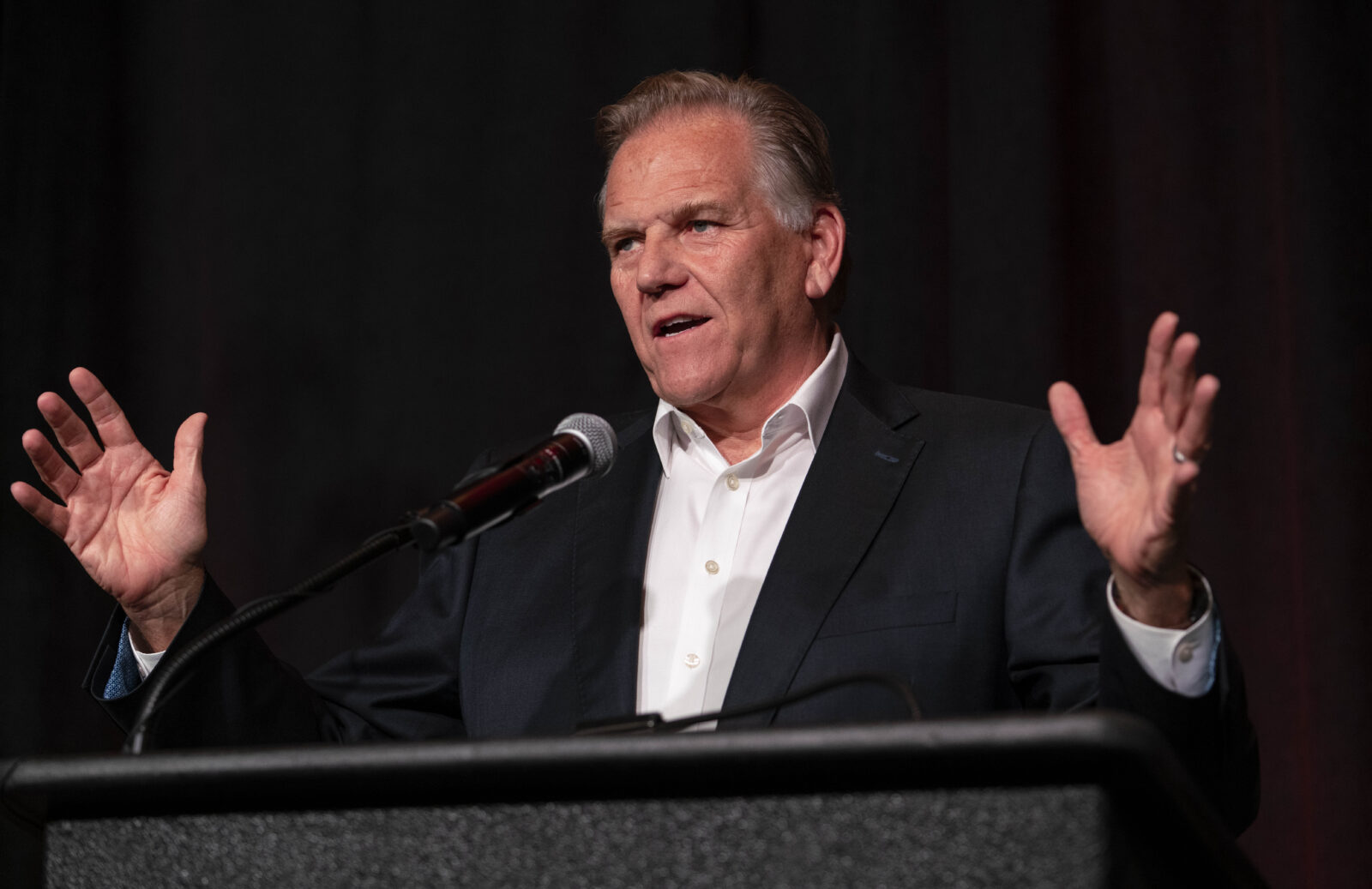
Sarah Rice/Getty Images
Republicans betting Jewish voters swing Rogers’ way if El-Sayed wins primary
For many Jewish Democrats in Michigan who have long called the party home, the bruising lead-up to the primary on Tuesday has been difficult to experience


 Add JewishInsider on Google
As Abdul El-Sayed pulls ahead in the final days of Michigan’s bitter Democratic Senate primary race, Republicans are eyeing a chance, in the general election, to peel support from disaffected Jewish Democrats anxious about their party’s sharp turn to the left on Israel and its tolerance for actions they view as antisemitic.
For many Jewish Democrats in Michigan who have long called the party home, the bruising lead-up to the primary on Tuesday has been difficult to experience, as El-Sayed, a far-left former public health official, has continued to gain traction while fiercely attacking Israel, using anti-Zionist rhetoric and centering his messaging on opposition to AIPAC, the pro-Israel advocacy group whose super PAC is aggressively promoting Rep. Haley Stevens (D-MI) in a record ad barrage that has exceeded $30 million.
If Stevens loses, Republicans are eager to present former Rep. Mike Rogers (R-MI), the GOP’s presumptive nominee who was narrowly defeated in his bid for Senate last election cycle, as a safe alternative to El-Sayed for Jewish Democrats in the general election who may not be able to stomach voting along party lines.
“I think that Jewish voters and many Democrats in general feel” the party “has moved away from them,” Bobby Schostak, a former chairman of the Michigan Republican Party who sits on the Republican Jewish Coalition’s board, told Jewish Insider, calling Rogers “unconditionally and unapologetically pro-Israel and part of the fight against antisemitism in America.”
He predicted that Jewish Democrats “are going to flock to” Rogers “come November if El-Sayed wins the nomination,” referring, among other things, to the candidate’s refusal to distance himself from the antisemitic streamer Hasan Piker and controversial remarks following a foiled terrorist attack against a synagogue in Michigan in March in which he said, “Hurt people do hurt people.”
“Playing that response back is all it takes,” Schostak said of the anticipated GOP attacks against El-Sayed in the still-hypothetical general election. “That clearly showed his position and lack of concern for Jews and Jewish children,” he added of the comments. “I don’t think it takes much more than that.”
Sam Markstein, a spokesperson for the RJC, which has endorsed Rogers, said that “Michigan’s open U.S. Senate seat is at the center of the political battlefield” in the fight for control of the upper chamber.
“I think there’s a real opportunity for Mike and other Republicans in Michigan to build on Jewish support,” Jason Cabel Roe, a GOP strategist who has served as the executive director of the state’s Republican Party, told JI.
“With nearly 100,000 Jewish voters in a state where the margins of victory are incredibly close,” he said in a statement to JI, “Michigan’s Jewish community will once again be a decisive group in one of the most important contests in the country this November.”
Markstein suggested that “Michigan Jews are well aware of the stakes,” pointing to divisive comments in which El-Sayed declined to acknowledge Israel’s right to exist and said “I call bullshit” on “a definition of antisemitism to include a foreign government and its leaders,” among others that have faced scrutiny.
“I think there’s a real opportunity for Mike and other Republicans in Michigan to build on Jewish support,” Jason Cabel Roe, a GOP strategist who has served as the executive director of the state’s Republican Party, told JI.
While he called El-Sayed’s rhetoric on Israel “a big factor” influencing that dynamic, Roe argued there are deeper issues at play, notably including the Democratic state party convention in April at which pro-Israel candidates were heckled by activists and an attorney with a history of praising Hezbollah was nominated to sit on the University of Michigan Board of Regents.
Michigan Attorney General Dana Nessel, a Jewish Democrat, said last week that she planned to skip her party’s nominating convention next month, citing the episodes as sowing fears of antisemitic harassment.
“What happened at the” state convention “has really animated Jewish donors and voters and moved them in the direction of Republicans,” Cabel Roe explained to JI. “I think it’s very significant.”
Alyssa Brouillet, a spokesperson for Rogers, said his campaign is “beginning to see more and more Jewish Democrats coming to us who feel abandoned by their party.”
“It’s easy to see why when you have a candidate in this race who fundraised off of Oct. 7 and sympathized with the terrorist attacker who attempted to mass murder 140 kids at Temple Israel synagogue. That’s terrifying,” she told JI in a statement. “Unlike his opponents, Mike Rogers stands with the Jewish community in Michigan and across the country — and he will continue fighting to make life better for working families all across the state.”
The former congressman, recognized as a pro-Israel hawk while serving in the House from 2001 to 2015, has also raised concerns over rising antisemitism as well as anti-Israel sentiment on the far right, which he has said the GOP needs to more forcefully fight.
He has said publicly that it “doesn’t matter” who he faces in the general election, claiming he is confident that he will beat either of them. During a private call with supporters last month, he said that he would be “in good shape” if El-Sayed clinched the nomination as opposed to the moderate Stevens, describing him as “so radical,” according to audio obtained by CNN.
Polling has suggested that a general election matchup between Rogers and El-Sayed would be competitive.
It remains to be seen if the depth of disillusionment among Jewish Democrats in Michigan who feel their party is abandoning them will ultimately translate to a vote for Rogers should El-Sayed be the nominee — given accompanying reservations with how it could help Republicans flip a crucial seat held by retiring Sen. Gary Peters (D-MI).
But Stevens herself in some ways gave Rogers a path to make inroads with Jewish Democrats who distrust El-Sayed when she directly accused her opponent of antisemitism in a fiery social media post on Thursday underscoring the increasingly personal animosities in the closing stretch of the primary.
“After Tuesday, you will see a plethora of Jewish Democrats openly supporting Mike Rogers,” said Dennis Bernard, national chair of government relations at the Jewish Federations of North America, adding such support could help tip the scales in a general election that is expected to be close. He said Rogers has been doing “significantly more events in the Jewish community” and is being more favorably received than last cycle, when he lost to Sen. Elissa Slotkin (D-MI), a Jewish Democrat.
“Everyone in America understands you want to blame all of your problems on Jewish Americans,” she wrote in the post addressed to El-Sayed, after he had taunted AIPAC and called her the “least capable candidate in America.”
A spokesperson for AIPAC’s super PAC, United Democracy Project, did not return a request for comment about its plans for the general election.
A source familiar with UDP’s thinking told JI that “no decision has been taken yet because we’re not there,” but suggested that the group would support Rogers if Stevens loses to El-Sayed. “What would the expectation be?” the source told JI. “That they would do everything they can do to beat this guy.”
Dennis Bernard, a Jewish leader in Michigan who says he supports both Stevens and Rogers in their respective primaries, echoed others who told JI that even as there are Jewish Democrats planning to pull the lever for Rogers if Stevens loses on Tuesday, they are not willing to admit that publicly until the results are in.
“After Tuesday, you will see a plethora of Jewish Democrats openly supporting Mike Rogers,” said Bernard, national chair of government relations at the Jewish Federations of North America, adding such support could help tip the scales in a general election that is expected to be close. He said Rogers has been doing “significantly more events in the Jewish community” and is being more favorably received than last cycle, when he lost to Sen. Elissa Slotkin (D-MI), a Jewish Democrat.
Hannan Lis, a Democratic fundraiser and Jewish leader who splits his time between Michigan and Israel, said he would vote for Rogers in the general election if El-Sayed wins the nomination, adding he knows “many” Jewish Democrats who plan to do the same.
His reservations over the prospect of Republicans preserving their Senate majority by picking up the Michigan seat, Lis told JI, were overshadowed by his deeper objections to El-Sayed and his views on Israel and antisemitism. “El-Sayed is no Democrat,” he told JI.
“If Abdul El-Sayed wins the primary, I will have to spend more time seeing if El-Sayed is as dangerous to Israel, America and American Jews as he appears — and I haven’t seen anything so far to the contrary — and I will also spend some time examining Mike Rogers’ record on Israel and other issues that the Jewish community cares deeply about,” Asher Lopatin, a rabbi who serves as director of community relations at the Jewish Federation of Greater Ann Arbor and is backing Stevens, told JI.
El-Sayed’s campaign did not respond to a request for comment about tensions with Jewish voters.
One pro-Israel strategist in the state who is close to Stevens estimated, on gut instinct, that it was more likely what he called mainstream Jewish Democrats who support Israel would not vote at all rather than pull the lever for Rogers if El-Sayed is the nominee, pegging that number at some 50% of the community.
He speculated that 25% of such voters would support Rogers because they are “disgusted with Democrats,” while another 25% could swallow their concerns and choose El-Sayed, motivated by loyalty to their party.
Asher Lopatin, a rabbi who serves as director of community relations at the Jewish Federation of Greater Ann Arbor and is backing Stevens, said he is trying to keep an open mind for the general election if the congresswoman loses, even as he has “been deeply disturbed by many quotes from El-Sayed regarding Israel and by many of his ads, in which AIPAC is attacked as what I see as an antisemitic dogwhistle.”
“If Abdul El-Sayed wins the primary, I will have to spend more time seeing if El-Sayed is as dangerous to Israel, America and American Jews as he appears — and I haven’t seen anything so far to the contrary — and I will also spend some time examining Mike Rogers’ record on Israel and other issues that the Jewish community cares deeply about,” he told JI.
Lopatin added that he would also “want to make sure” that Rogers is “someone who can stand up to” President Donald Trump.
Noah Arbit, a Jewish Democratic state legislator in Michigan who is outspoken against antisemitism in his party, declined to confirm how he would vote in a general election without Stevens as the nominee, even as he has accused El-Sayed of helping to “stoke and inflame hatred against Jews” and grappled with whether he belongs in a party he sees as “hostile” to his community.
For now, he told JI, “I’m entirely focused on winning a third term representing my district in Greater West Bloomfield,” a heavily Jewish suburb of Detroit, “and electing a Democratic House, Senate and governor in Michigan.”
Michael Horowitz, a Jewish community leader and Detroit businessman, was reluctant to engage in any hypotheticals before the primary’s end. “I still think Haley is going to pull it out on Tuesday,” he told JI on Friday.
Pressed to clarify how he would vote if she loses, he wrote in a text, “I try to avoid playing games with the Devil,” inserting an upside-down smiley face emoji reflective of the uncomfortable position that Jewish Democrats now find themselves confronting as the primary finally comes barreling to a close this week.
Featured Stories
Please log in if you already have a subscription, or subscribe to access the latest updates.
 Continue with Google
 Continue with Apple