
















































David Kramer, a Jewish Democratic leader in Michigan, said Rep. Hillary Scholten is ‘someone who has a very strong sense of self and what she thinks is right and wrong’
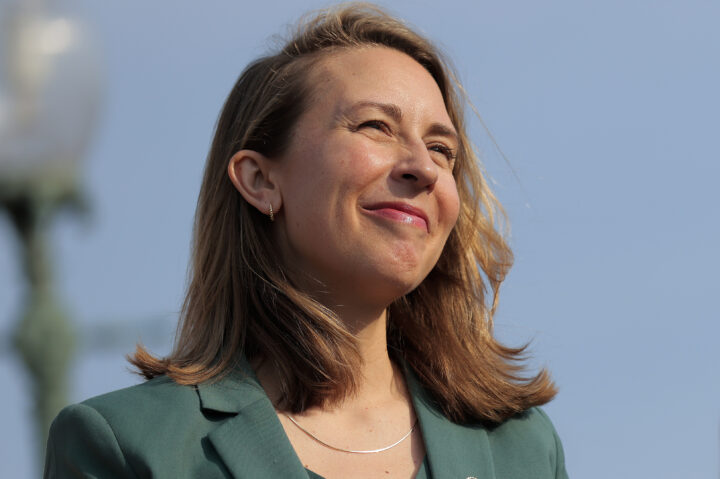
Heather Diehl/Getty Images
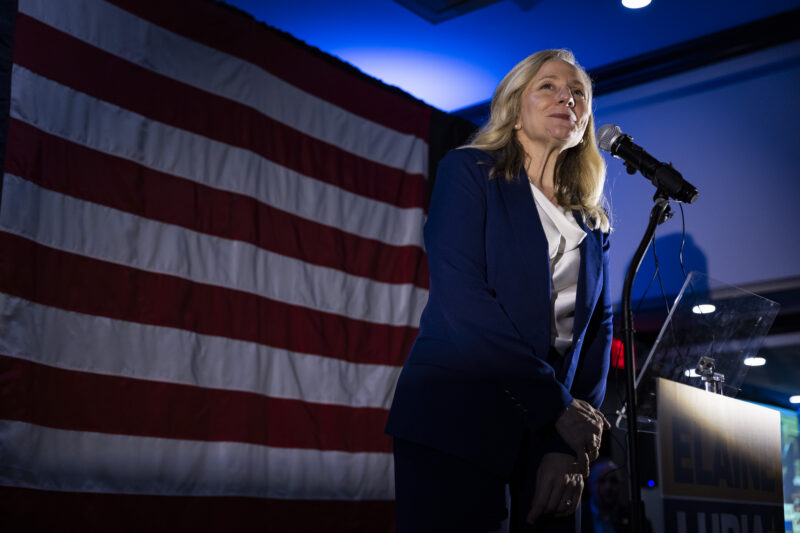
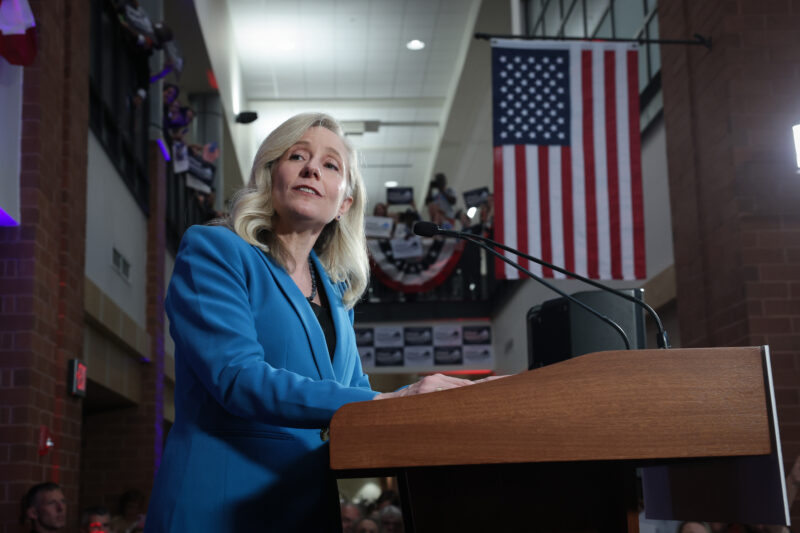
Rep. Hillary Scholten (D-MI) speaks outside the U.S. Capitol on March 26, 2026 in Washington.


 Add JewishInsider on Google
Rep. Hillary Scholten (D-MI) has emerged in recent weeks as one of the Democratic Party’s most outspoken voices against antisemitic influencer Hasan Piker — including standing as one of the few Michigan Democratic holdouts in endorsing Senate nominee Abdul El-Sayed in light of his relationship with Piker.
Her stalwart outspokenness against antisemitism and resistance to her party’s home-state Senate nominee is increasingly rare in today’s politics. But Jewish Michiganders who have worked with her say she’s long been close with and supportive of the community, and that she’s been deeply and personally disturbed by rising antisemitism and other rhetoric from Piker and El-Sayed.
At an event for a fellow Michigan House candidate this week, Scholten faced down a questioner who said that she was making “bad faith accusations” against El-Sayed and Piker and stoking Islamophobic hate speech in the interest of protecting U.S. aid to Israel. Scholten stood her ground.
“I do not support the comments of Hasan Piker. He has said some terrible things about America, about American troops, and I would stand by comments condemning those. I think they don’t have any place in the Democratic Party or in the United States of America,” she said. “But even though we may not necessarily be in agreement about all of those things, we are in alignment about the things that unite us as Democrats: lowering costs, delivering on universal health care, and fighting corruption.”
Speaking to reporters after the event, she said that she has not endorsed El-Sayed and hasn’t heard from him in any capacity.
“If he would [reach out to me], I would have questions,” Scholten said. “A lot of it has to do with his past associations with Hasan Piker.”
She said she’s hearing “a lot of support” from people who agree with her raising the question of “whether this is the right direction for our party.”
Scholten was among Rep. Haley Stevens’ (D-MI) most outspoken supporters during the Senate primary, and unlike Stevens, refused to commit to endorse El-Sayed during the general election. Her decision to stick to her guns carries political risk: El-Sayed carried Scholten’s district in the Democratic primary, winning the Kent County (Grand Rapids) base by 26 points over Stevens.
El-Sayed’s campaign did not respond to a request for comment, but largely shrugged off questions about Piker and criticisms from Scholten and other Democrats during a press conference on Wednesday.
He accused Republicans of pushing a false narrative of Democratic division and suggested that his critics are simply “still nursing wounds or grievances from the primary.”
Despite having repeatedly campaigned with Piker, El-Sayed also dismissed him as “a streamer in California” who is not central to the campaign, which he described as focused on issues in Michigan. He asserted that questions about Piker are driven by a media focus on a “tabloid version of our politics.”
Scholten declined to comment to Jewish Insider for this story.
She was first elected in 2022, after losing a 2020 race in a GOP-leaning district against former GOP Rep. Peter Meijer. The Grand Rapids-area district was redrawn to be more favorable to Democrats two years later, and she prevailed over a hard-right Republican challenger who defeated Meijer in the GOP primary. The Cook Political Report now rates her as a shoo-in to win reelection.
In a 2020 interview with Jewish Insider during her run for the House, Scholten did not rule out conditioning or reducing U.S. aid to Israel in the interest of serving as a neutral arbiter to pursue a two-state solution, though she also argued that the U.S. should continue to be supportive of Israel. Scholten voted earlier this year against an amendment cutting U.S. aid to Israel that was supported by nearly half of House Democrats.
She also strongly condemned the Boycott, Divestment and Sanctions movement, saying that it has “deep roots in antisemitic sentiment and rhetoric.”
Jewish Democrats in Michigan said that Scholten is a longtime ally of their community, and said that her strong stand against Piker and antisemitism is nothing new.
David Kramer, a prominent Jewish Democratic leader in the Detroit area who served as campaign chair for Stevens’ Senate race, said Scholten is “someone who has a very strong sense of self and what she thinks is right and wrong, and she has a history of speaking up, even if it’s unpopular” — pointing also to her early call for then-President Joe Biden to end his reelection campaign and her strong and early support for Stevens.
“This is another one in the pattern of her doing what she thinks is right, even when she knows she’s going to get some flak for it,” Kramer continued. “I’m absolutely, positively convinced that she’s doing this just because of what her convictions are and her gut reaction.”
He said he’s heard from Scholten directly that even her staff have warned her about the potential consequences of the stand she has taken on Piker and El-Sayed, but that she feels strongly that this is an issue of right and wrong.
Kramer said that Scholten has come to him on various occasions about her concerns that El-Sayed and Piker’s comments and activity will cause insecurity in the Jewish community — “she just gets it.”
He added that, while Scholten is close with the small Jewish community in Grand Rapids as well as with Jewish leaders in the Detroit area, her positions come from her own deeply held values.
“She is a very, very smart, very, very principled person who is willing to speak the truth and is willing to take stands even if it is not something that others would say will help her politically, and that is really unusual today in politics,” Mark LoPatin, another Detroit-area Jewish Democrat who has interacted with Scholten, said. “She is one of the few who is really willing to get out there to say, ‘This is wrong,’ and why she believes it’s wrong.”
LoPatin said that Scholten may very well face a more difficult primary race in 2028 as a result of her outspokenness and has told supporters that she has faced backlash for her stances, but that she does not plan to back down.
“We should have more congressional leaders that are willing to do that,” he said. “We probably wouldn’t be in the position that we’re in right now.”
Michael Horowitz, another Detroit-area Jewish Democrat, said he got to know Scholten through Stevens and her campaign at joint events they held together. “She just fits a category of intelligent, caring people who are trying to do good … they approach their job with the goal of trying to get things done.”
He said that Scholten is someone who “sees right and wrong” and was “particularly offended” by the attacks leveled against Stevens in the primary, as well as against state Sen. Jeremy Moss, a House candidate whom Piker attacked by name in recent comments that have drawn particular criticism.
“This isn’t a political calculation, she sees it as wrong,” Horowitz said. “It’s just a person who’s a decent person, cares about right and wrong. I think it just upset her. … I don’t see any agenda here, other than people that she’s close to have been attacked, and … she doesn’t buy into it. This isn’t who she is, and she’s willing to say something.”
Kramer said that, having known Scholten for several years, he believes her convictions on antisemitism are authentic and deeply rooted. He also noted that she’s an active member of her church and “someone of a lot of faith,” and said he believes that some of her dedication to the issue of antisemitism comes through her faith, though he said he hasn’t asked her the question directly.
LoPatin agreed that Scholten’s stance seems to be a product of her moral character, and said that quality means he’ll continue to support her even if he disagrees with particular stances she may take. “I do know that she will have a thoughtful response to whatever those issues are.”
Kramer also emphasized that, despite not having endorsed El-Sayed, Scholten remains committed to helping Democrats up and down the ballot in Michigan win in November — a commitment Scholten expressed herself at the event earlier this week.
Plus, Treasury tags Palestine Action as terror group
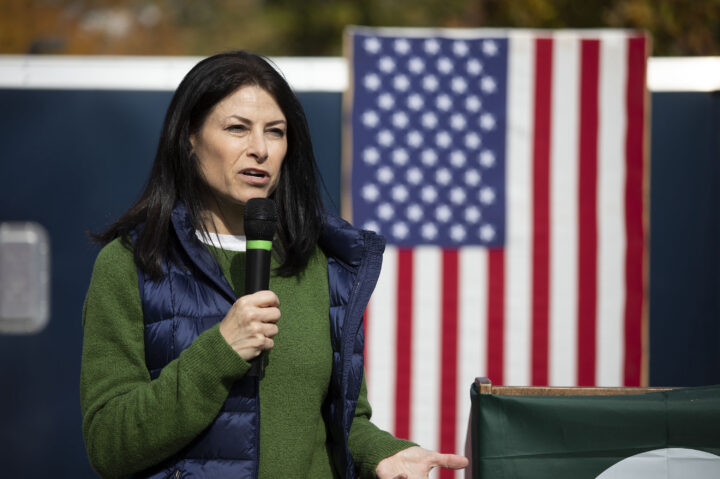
Bill Pugliano/Getty Images
Michigan Attorney General Dana Nessel speaks on Oct. 16, 2022 in East Lansing, Michigan.
Good Wednesday afternoon.
This P.M. briefing is reserved for our premium subscribers like you — offering a forward-focused read on what we’re tracking now and what’s coming next.
Today’s Daily Overtime was curated by JI U.S. Editor Danielle Cohen-Kanik.
📡On Our Radar
Notable developments and interesting tidbits we’re tracking
Michigan Attorney General Dana Nessel raised concerns that Senate Democratic nominee Abdul El-Sayed has not yet walked back his comments about the violent attack on Temple Israel in March, Jewish Insider’s Matthew Kassel reports. El-Sayed had said about the attacker — whose relatives, including a Hezbollah commander brother, had been killed in Israeli strikes in Lebanon — that “hurt people hurt people.”
“A lot of us perceived that as sort of making excuses for somebody who sought to murder over 100 pre-K school children, and that’s the kind of mentality that bothers me a lot,” Nessel, who is Jewish, explained in a podcast interview with The Atlantic’s David Frum. “You can’t make excuses for that kind of domestic terrorism,” she added…
Nearly all Senate Democrats signed on to a letter to Israeli Prime Minister Benjamin Netanyahu urging him to address growing settler violence in the West Bank by issuing “clear directives” to the Israel Police and IDF to intervene in such incidents; ensuring that individuals responsible for harassment or violence against Palestinians are held accountable; and ending Israeli settlement expansion, JI’s Marc Rod reports.
The letter, led by Sens. Adam Schiff (D-CA), Chuck Schumer (D-NY) and Cory Booker (D-NJ), who have generally been supportive of Israel, was signed by every Senate Democrat except for Sens. Bernie Sanders (I-VT) and John Fetterman (D-PA) — who stand at opposite ends of the caucus on Israel issues…
Addressing the U.N. Security Council today, Board of Peace head Nickolay Mladenov said neither Israel nor Hamas are yet fulfilling their obligations under the Gaza disarmament road map.
“After three years of war and 20 years of military operations, I ask, will another [Israeli] strike on a munitions depot stop Hamas from rearming or tightening its grip on Gaza? It will not. … In the opposite direction, every weapon still carried, every tunnel still worked on and every convoy still obstructed [by Hamas] sets the process back,” Mladenov said…
White House Special Envoy Steve Witkoff and Jared Kushner reportedly visited CENTCOM headquarters in Tampa, Fla., today for briefings on Iran…
The Treasury Department named as a Specially Designated Global Terrorist organization the U.K.-based group Palestine Action, which has been involved in multiple high-profile break-ins and vandalism incidents at weapons manufacturers and British military installations.
The department also proscribed the transnational organization Masar Badil for being a front for Samidoun, which is itself a sanctioned front group for the Popular Front for the Liberation of Palestine, JI’s Matthew Shea reports…
Mohammad Bagher Ghalibaf, the speaker of the Iranian parliament, thanked China — Iran’s largest trading partner — for rejecting the U.S.’ economic campaign against Iran, in which Washington has said it will ask all nations to help isolate Tehran. Iran’s relationship with China “needs no one’s permission,” Ghalibaf wrote on X, after China’s Foreign Ministry said yesterday that Beijing rejects the sanctions “that have no basis in international law”…
The New York Times looks at the operations of Iran’s largest bank — Bank Melli — after Treasury Secretary Scott Bessent said each of its branches around the world “must be shuttered and dark”…
Saudi Arabia is working to reroute its oil exports once again, this time through the costlier Suez Canal, as its ships in the Bab el-Mandeb Strait — itself a backup route to the Strait of Hormuz — have come under attack by the Houthis…
In his first international media interview, former Israeli hostage Evyatar David told CNN about the extreme starvation and psychological distress he suffered during his more than 700 days in Hamas captivity…
Rep. Alexandria Ocasio-Cortez (D-NY) renewed her membership with the Democratic Socialists of America this month, the organization told City & State New York, after the DSA “recently noticed” her membership had lapsed in 2019. The congresswoman also recently met with leaders of the DSA’s New York City chapter…
⏩ Tomorrow’s Agenda, Today
An early look at tomorrow’s storylines and schedule to keep you a step ahead
Keep an eye on Jewish Insider for an interview with the Republican Minnesota state senator who’s hoping a “boring,” common-sense campaign can beat the far-left Democratic nominee for the House seat currently held by Rep. Angie Craig (D-MN).
Qatari Prime Minister Sheikh Mohammed bin Abdulrahman Al Thani will visit Tehran for meetings with Iranian officials.
Israeli singer Ishay Ribo will perform with the Israel Philharmonic Orchestra at Radio City Music Hall in New York City.
The four-day Milken Institute Hamptons Dialogues will kick off in New York.
GOING ALONE
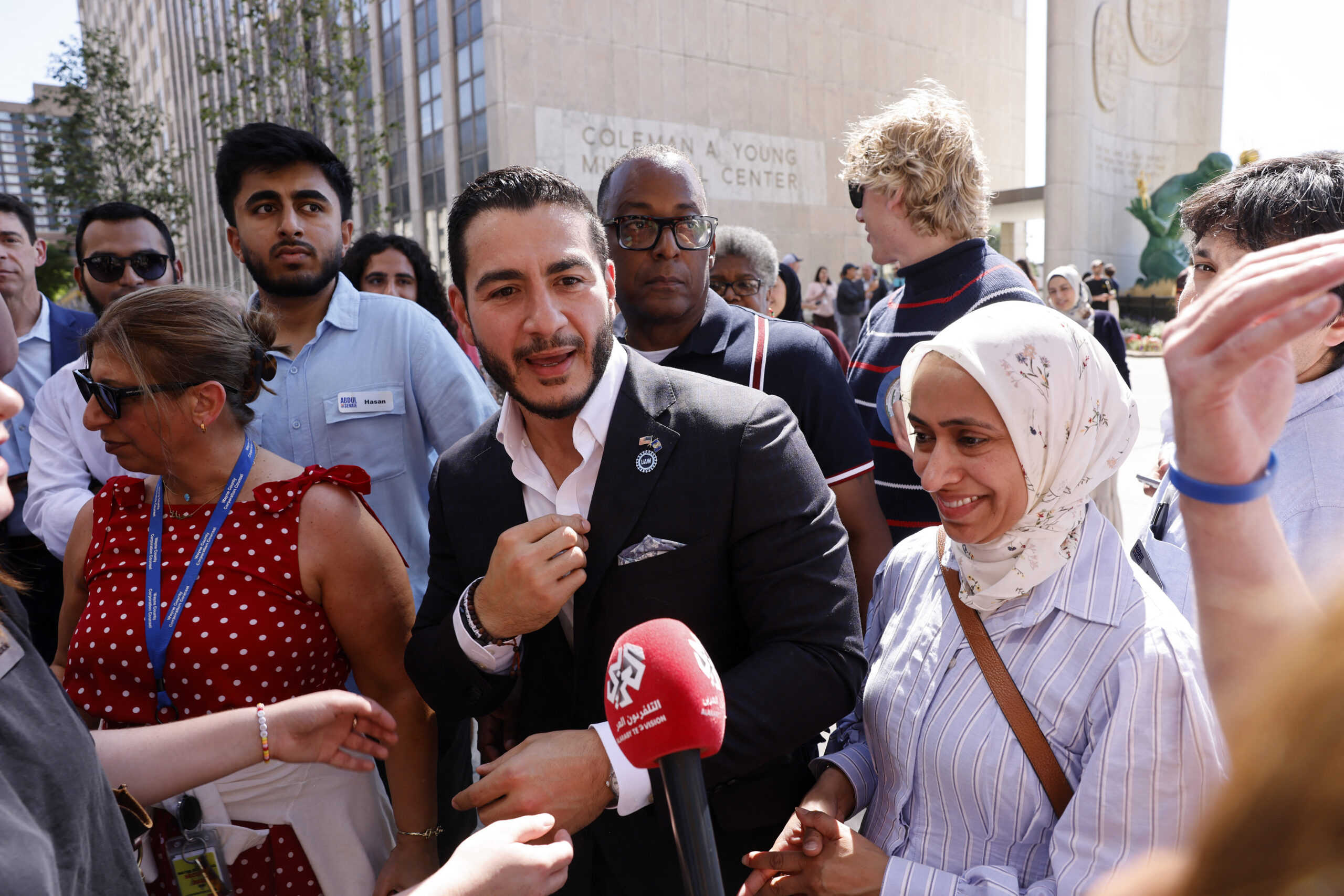
At a Dearborn church, El-Sayed declined to say whether he’d like to win an endorsement from state Sen. Jeremy Moss, a Jewish Democratic holdout
EXCLUSIVE

The Jewish civil rights group pointed to $737 million in Qatari funding and communications showing Qatar Foundation officials trying to shape Northwestern’s post-Oct. 7 messaging
Nessel, a Jewish Democrat, expressed her frustrations with the Democratic Senate nominee on David Frum’s podcast

Chip Somodevilla/Getty Images
Michigan Attorney General Dana Nessel speaks on stage during the third day of the Democratic National Convention at the United Center on August 21, 2024 in Chicago, Illinois. Delegates, politicians, and Democratic Party supporters are in Chicago for the convention, concluding with current Vice President Kamala Harris accepting her party's presidential nomination.
Michigan Attorney General Dana Nessel, a Jewish Democrat who has been outspoken against the rise of antisemitism in her party, raised concerns that Abdul El-Sayed, the state’s Democratic nominee for Senate, had not publicly withdrawn his equivocal comments responding to a violent attack in March on a synagogue in suburban Detroit.
El-Sayed faced backlash for comments that critics interpreted as excusing the attack perpetrated by a Lebanese American man whose relatives — including his brother, a Hezbollah commander — were killed in Israeli strikes in Lebanon, controversially arguing that “hurt people hurt people.”
While many Jewish Democrats in Michigan have raised alarms over El-Sayed’s hostile rhetoric toward Israel and vilification of AIPAC, Nessel indicated in a a new podcast interview released on Wednesday that his remarks about the synagogue attack remain a key source of tension with skeptical Jewish voters whose support he will likely need to win in the battleground state.
“A lot of us perceived that as sort of making excuses for somebody who sought to murder over 100 pre-K school children, and that’s the kind of mentality that bothers me a lot,” Nessel explained to David Frum of The Atlantic. “You can’t make excuses for that kind of domestic terrorism,” she added.
Nessel, who recently said that she would not attend her party’s state nominating convention due to fears of antisemitic harassment, told Frum that El-Sayed, “to his credit,” had since clinching the nomination in early August held meetings with Jewish leaders in the state to address their reservations with his candidacy.
“I think privately he will say that he regrets having made those remarks,” she said on the podcast. “But here we are. It’s almost the end of of August, and he still has not withdrawn those statements and said, ‘I misspoke’ or ‘I now recognize the harm that I caused by making those statements.’”
His reticence “has me concerned that he really stands by them, and if so, what does that mean for American Jews moving forward?” Nessel said, while suggesting his response carried troubling implications about his ability to roundly denounce future potential terrorist incidents.
“I think by the same logic,” she argued, “if Iran were to attack, whether it would be a government building or a church or a mall or what have you, that we would just deserve those attacks, because, of course, we are engaged in this war in Iran, and really the list goes on and on as to how you could make excuses for acts of domestic terrorism.”
“It’s a dangerous, dangerous world to live in, where you have somebody who supports that kind of logic,” Nessel added. “When you are providing some sort of rational explanation for why it occurs,” she went on, “it possibly encourages other people to do the same.”
Even as she voiced hesitation about El-Sayed and acknowledged many Jewish Democrats are backing his opponent, former Rep. Mike Rogers (R-MI), she said she would never vote for the GOP nominee. “To make this abundantly clear,” she emphasized, “I will amputate my right arm before I fill in the oval next to Mike Rogers’ name.”
Nessel said she would “leave hope” for El-Sayed to “withdraw” his earlier remarks about the synagogue attack “because he now has a greater understanding of it” after his meetings with the Jewish community. “That’s my hope, and I’ve had that conversation with him personally. He still hasn’t done it, but I hope that we’ll hear more from him about this soon.”
Nessel is among the most prominent Democratic holdouts on El-Sayed, who on Tuesday declined to confirm if he hoped to receive an endorsement from Jeremy Moss, a Jewish state senator and Democratic congressional nominee in Michigan. El-Sayed stirred controversy this week over a statement that his critics said failed to adequately distance himself from his campaign surrogate Hasan Piker, the antisemitic streamer who recently targeted Moss while claiming Jews who support Israel are inviting violence against themselves.
Moss has likewise remained noncommittal about whether he will back El-Sayed, even as he said they are in “continual dialogue” about such shared goals as fighting “MAGA extremism” and “Jewish and Arab safety and security.”
Speaking more broadly, Nessel, who said she has been “bombarded” with antisemitic death threats since she became Michigan’s first Jewish attorney general, claimed that El-Sayed has displayed “a lack of knowledge about” the “religious values and beliefs” of Judaism.
The “real dearth” of understanding on such issues is contributing, she said, to a growing sense of political homelessness among Jewish Democrats who are now questioning their place in a party they had long called home.
At the moment, El-Sayed’s rhetoric on Israel and antisemitism is “creating this dynamic where you have a lot of Democrats thinking there’s good Jews and bad Jews,” Nessel argued in the interview. “The good Jews are the ones that don’t believe in Zionism, and the bad Jews are the ones that believe that Israel is our biblical religious historical homeland.”
“We absolutely want a Democratic majority in the Senate. But is Abdul going to spend six years railing against Israel, irrespective of who the government is there?” she asked. “That is a real concern.”
“And an even greater concern is how that’s affecting American Jews,” Nessel continued. “Because it really is turning up the antisemitism.”
Plus, Moskowitz named to powerful Mideast post
BRENDAN SMIALOWSKI/AFP via Getty Images
Pennsylvania Governor Josh Shapiro speaks before Democratic presidential candidate Kamala Harris in Philadelphia, Pennsylvania, August 6, 2024.
Good Tuesday afternoon.
This P.M. briefing is reserved for our premium subscribers like you — offering a forward-focused read on what we’re tracking now and what’s coming next.
Today’s Daily Overtime was curated by JI U.S. Editor Danielle Cohen-Kanik.
📡On Our Radar
Notable developments and interesting tidbits we’re tracking
President Donald Trump announced on Truth Social today that the Navy informed him that “all mines have been removed and/or detonated” in the Strait of Hormuz, and that the U.S. has notified Iran “that any ship or boat placing new mines will be immediately and systematically destroyed.” The U.S. Space Force is monitoring the strait as well as Iran’s nuclear sites, including Pickaxe Mountain, for any suspicious activity, he added…
Omani Foreign Minister Badr Albusaidi said following a meeting with Iranian Foreign Minister Abbas Araghchi in Tehran today that he is hopeful the two countries “will soon announce a temporary corridor for the Strait of Hormuz and practical arrangements to restore safe navigation,” while continuing to work towards a permanent agreement on administering the waterway. The Omani Foreign Ministry further specified that the parties aim to establish a joint effort to clear the strait of mines — despite Trump’s announcement that all have been cleared…
The State Department is preparing to send some foreign service officers and other diplomats back to work at embassies in Israel, Lebanon, Saudi Arabia, Qatar, Jordan, Oman, Iraq and Kuwait that were evacuated or had staffing reductions during the Iran war, according to a State Department document obtained by The New York Times, potentially indicating the Trump administration does not expect hostilities to resume…
Israeli Foreign Minister Gideon Sa’ar announced that Israel has expelled officials from the Netherlands from the military and humanitarian coordination hub for Gaza located in Kiryat Gat due to “a series of anti-Israel moves by the Dutch government,” including a new law prohibiting trade with Israeli settlements in the West Bank…
Michigan Democratic Senate nominee Abdul El-Sayed doubled down on his anti-Israel rhetoric during an event at a Dearborn church today, Jewish Insider‘s Matthew Kassel reports, a day after the nominee drew renewed scrutiny over his ongoing association with antisemitic streamer Hasan Piker.
El-Sayed declined to confirm if he hopes to win an endorsement from state Sen. Jeremy Moss — a Jewish Democratic nominee for a congressional seat in the Detroit area who is a key holdout in offering his backing — and said that his support for ending aid to Israel is “about making sure that in our foreign policy, we substantiate equal rights to peace, dignity and self-determination for Palestinian folk”…
Rep. Jared Moskowitz (D-FL) was named ranking member of the House Foreign Affairs Committee’s Subcommittee on the Middle East and North Africa, where he said he will “work to strengthen America’s relationships with Israel and our Gulf allies.”
A source familiar with the situation told JI’s Marc Rod that, since outgoing ranking member Rep. Brad Sherman (D-CA) would have been unable to remain in the post next year, he decided to give up the position early to help support Moskowitz in his reelection race — in a South Florida district with a substantial pro-Israel constituency where the leadership position will further bolster Moskowitz’s profile — and to pass off committee leadership to a preferred successor….
A new New York Times/Philadelphia Inquirer/Siena University poll released today found that nearly half of voters in Pennsylvania view Gov. Josh Shapiro, a Jewish Democrat mulling a presidential bid in 2028, as “about right on support of Israel,” even as he has faced skepticism from the far left over his pro-Israel views, JI’s Matthew Kassel reports. Sixty percent of Democrats said they were satisfied with his support for the Jewish state; 39% of Republicans said the same, while another 40% said he is not supportive enough…
The Department of Justice announced today that a 26-year-old Ohio man had been arrested and charged for sending an email threatening to kill Rep. Randy Fine (R-FL) and his family, saying he would behead the Jewish congressman and calling him a Nazi, JI’s Marc Rod reports…
The IDF said it views with “utmost severity” an incident involving far-right MK Zvi Sukkot and his aides who, during a requested tour of the Palestinian town of Madama, attacked a memorial — dubbed the “Martyrs’ Monument” — with a sledgehammer, an incident which was captured on video. The IDF said the tour participants “acted deceptively and manipulatively” while accompanied by IDF soldiers “who had been diverted from their operational activities for this purpose … while the IDF is operating under significant operational strain”…
The Syrian Democratic Forces, a Kurdish group that was backed by the U.S. in the fight against ISIS, has officially dissolved, SDF head Mazloum Abdi announced at the presidential palace in Damascus today. The group has completed its merger into the Syrian army under President Ahmad al-Sharaa, Abdi said — the culmination of a fraught integration process that followed months of deadly clashes between government and Kurdish forces…
Assouline, the luxury publisher known for turning global cities into vibrant $100 coffee-table books, has focused its lens on several Middle Eastern capitals over the years — most recently Beirut. But out of hundreds of titles spanning the globe, not a single Israeli city has made the cut, despite co-founder Prosper Assouline‘s Moroccan Jewish roots, JI’s Haley Cohen reports…
⏩ Tomorrow’s Agenda, Today
An early look at tomorrow’s storylines and schedule to keep you a step ahead
Keep an eye on Jewish Insider for a look at how Jewish leaders are viewing Rep. Jamie Raskin‘s (D-MD) investigation into the Trump administration’s efforts to crack down on campus antisemitism.
Israeli singer Omer Adam will marry his partner Sacha Israelovich at a converted 14th-century Christian monastery in the Italian seaside village of Portofino tomorrow, after having held a civil ceremony today. Hassidic singer Motty Steinmetz is expected to perform at the celebration, reportedly prompting gender-segregated seating for the guests.
CONFRONTING HATE
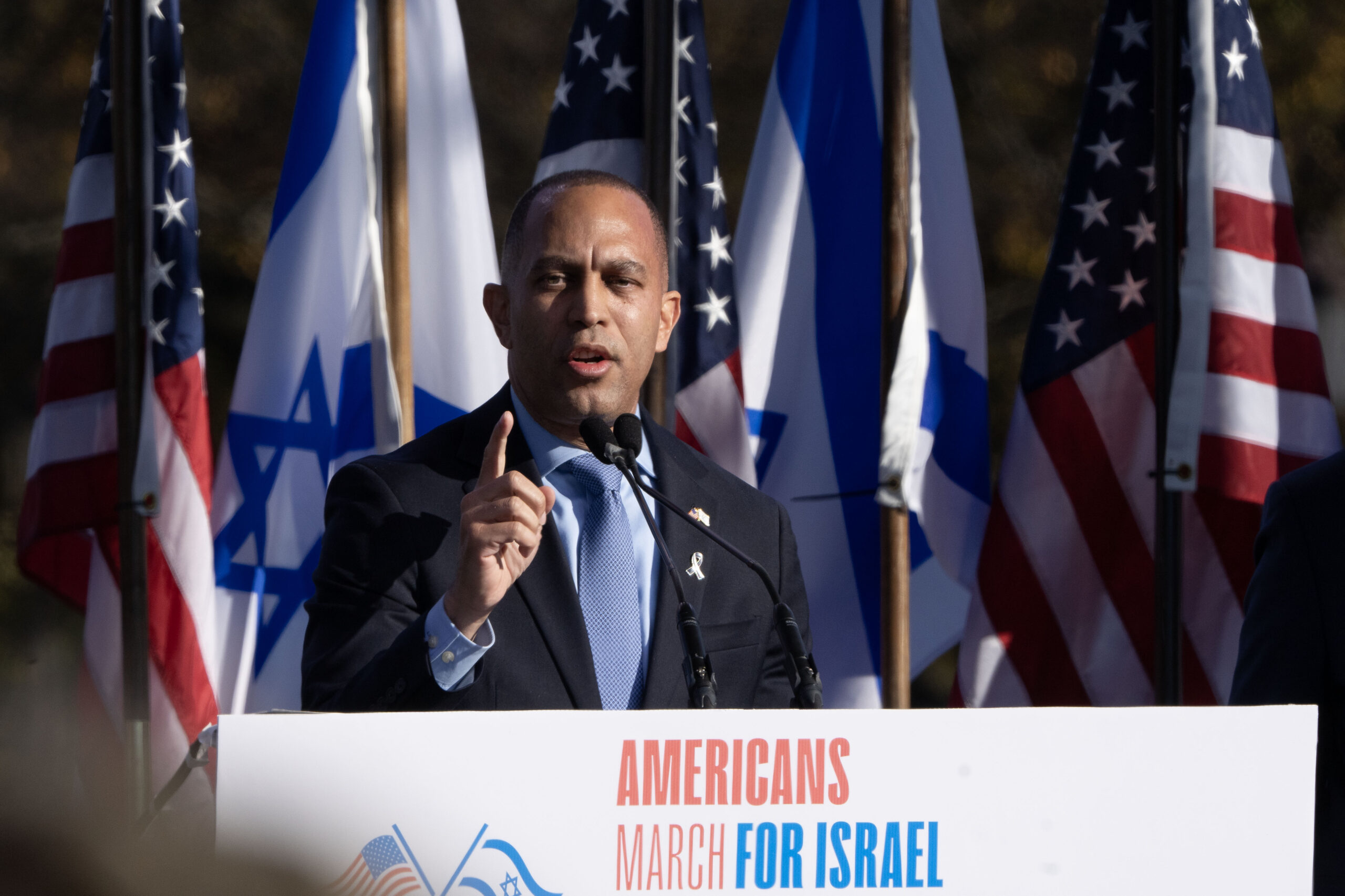
House Minority Leader: ‘There is zero justification for threats against the safety of our Jewish brothers and sisters at a moment of rising hate’
HOLLYWOOD HEADACHE
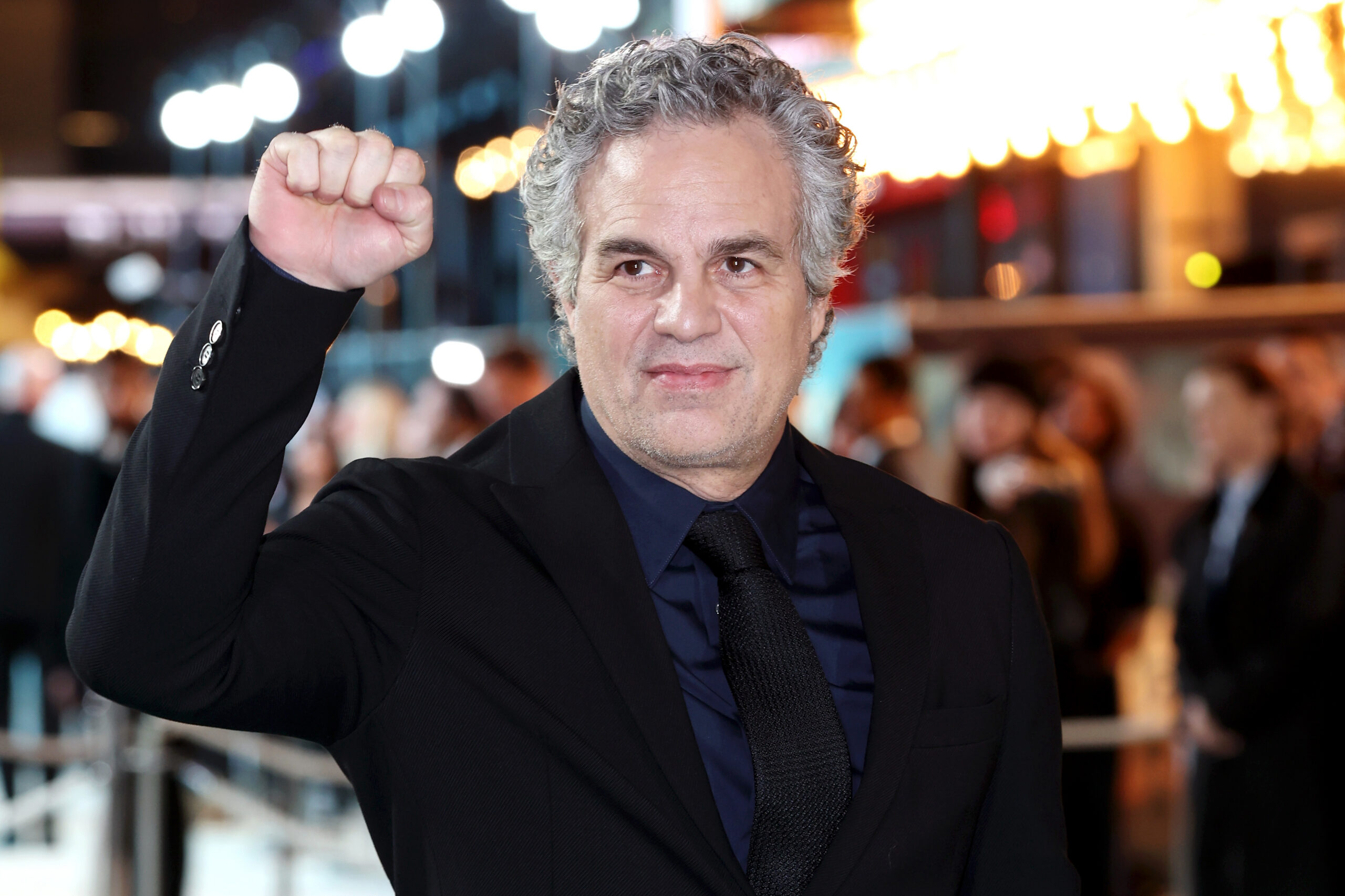
Rabbi Noah Farkas, CEO of Jewish Federation Los Angeles: ‘California has a special obligation to … protect the people who power this industry from antisemitism’
At a Dearborn church, El-Sayed declined to say whether he’d like to win an endorsement from state Sen. Jeremy Moss, a Jewish Democratic holdout
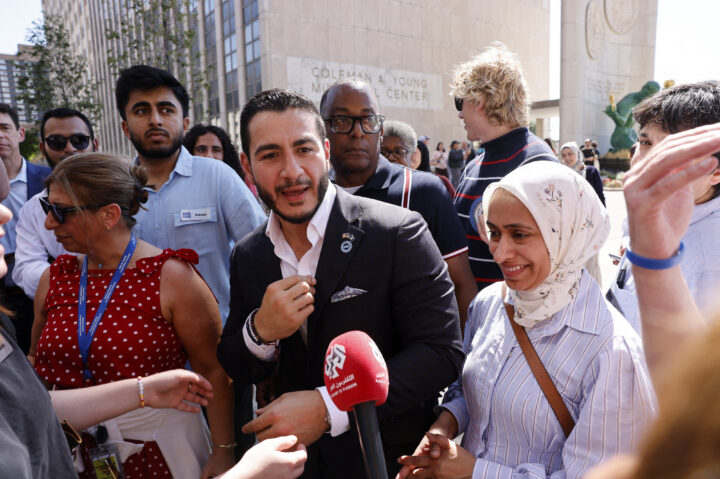
JEFF KOWALSKY / AFP via Getty Images
Michigan Democratic Senate candidate Abdul El-Sayed departs with his wife, Sarah Jukaku (R) after a press conference on August 5, 2026.
Abdul El-Sayed, Michigan’s Democratic Senate nominee, doubled down on his anti-Israel rhetoric on Tuesday — a day after he drew renewed scrutiny over his ongoing association with antisemitic streamer Hasan Piker.
Speaking at a Dearborn church, El-Sayed declined to confirm if he hopes to win an endorsement from state Sen. Jeremy Moss, a Jewish Democratic nominee for a congressional seat in the Detroit area, whom Piker had recently targeted on his show while arguing that Jews who support Israel are inviting violence against themselves.
“I’m not going to sugarcoat that we have our disagreements, especially when it comes to foreign policy and the best use of our tax dollars,” El-Sayed said of Moss at the event on Tuesday, billed as “Hate Has No Home in Michigan.”
“And the plurality of Michigan Democratic primary voters nominated me to be the Democratic nominee,” he added.
While reiterating his opposition to antisemitism and appreciation for Judaism, he said that his support for ending aid to Israel is “about making sure that in our foreign policy, we substantiate equal rights to peace, dignity and self-determination for Palestinian folk.”
“I’d rather my tax dollars not get spent to take away some people’s self-determination that could be used to empower other folks here,” El-Sayed argued in his remarks.
The comments suggest El-Sayed is continuing to play to his far-left voting base, even as his hostile views on Israel have alienated Jewish Democrats whom he will likely need to win the competitive battleground state.
Moss, for his part, is among the most prominent Democratic holdouts on El-Sayed, whose modest effort to distance himself from Piker on Monday drove a wedge between the two nominees.
In a statement posted to X on Monday, El-Sayed made no mention of either Piker or Moss, omissions that drew backlash from critics. Instead, he said that “nobody speaks for this campaign besides me and my campaign spokespeople,” while downplaying Piker as a “Twitch steamer” who would not define the contest. He did not say if his relationship with Piker, who has been a top surrogate for his campaign, would change moving forward.
“My commitment to Jewish safety is the same as my commitment to the safety of my own daughters,” he went on in his statement. “Antisemitism is a scourge and we need to address it in all its forms. And I stand against any rhetoric that puts the community at risk.”
The statement reportedly disrupted a conversation between the two nominees regarding an endorsement from Moss that is now in question — even as the state senator has vowed not to back El-Sayed’s Republican rival, former Rep. Mike Rogers (R-MI), who has been courting Jewish Democrats.
Moss, in a statement released Monday, said that he and El-Sayed have been in “continual dialogue” about shared goals such as fighting “MAGA extremism” and “Jewish and Arab safety and security.”
“There is still work ahead to unite our ticket despite our differences,” Moss added, without confirming if he would back El-Sayed. “It won’t happen overnight, nor should it. It will require continuing outreach that is credible and authentic.”
Jessica “Decky” Alexander, the Michigan Democratic Jewish Caucus chair, said that several campaigns and Jewish voices had urged El-Sayed’s team to release a statement on Monday countering Piker’s comments. “Whether they would have or not” without such prompting, “I do not know, but there is a comment,” she told Jewish Insider, calling his response a sign of “definite forward movement.”
“Many caucus members have shared that they would like him to disavow Piker,” she clarified on Tuesday.
Plus, Bessent's plan to make Iran an 'economic outcast'
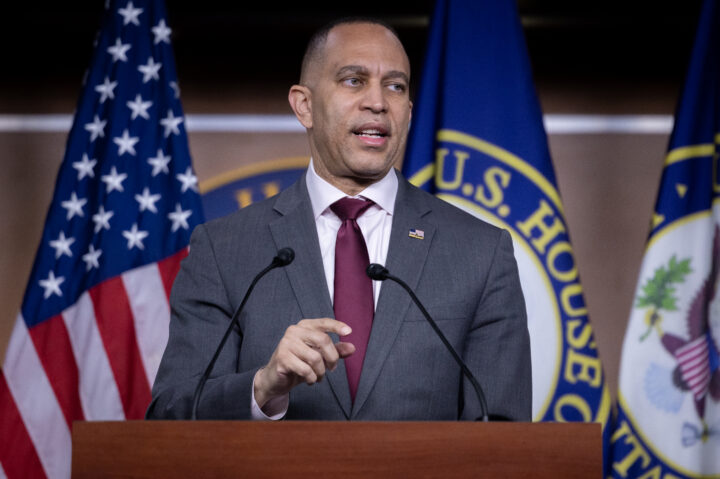
Nathan Posner/Anadolu via Getty Images
House Minority Leader Hakeem Jeffries (D-NY) speaks during his weekly press conference at the U.S. Capitol in Washington, DC on March 19, 2026.
Good Monday afternoon.
This P.M. briefing is reserved for our premium subscribers like you — offering a forward-focused read on what we’re tracking now and what’s coming next.
Today’s Daily Overtime was curated by JI U.S. Editor Danielle Cohen-Kanik.
📡On Our Radar
Notable developments and interesting tidbits we’re tracking
Treasury Secretary Scott Bessent announced this afternoon that the Trump administration is launching “Operation Economic Outcast” against Iran, an effort aimed at severing Tehran’s global economic ties in order to “collapse every last option” for the regime, Jewish Insider’s Matthew Shea reports.
The Treasury Department designated over 60 entities, individuals and vessels “that enable the Iranian regime to procure illicit nuclear and missile technology, conduct cyber operations and generate oil revenue,” Bessent said, while President Donald Trump “is making phone calls to world leaders with specific requests to cease their interactions with the regime”…
The Treasury Department also redesignated Hezbollah, already a Foreign Terrorist Organization, for acting as a proxy of the Iranian regime under the direction of the Islamic Revolutionary Guard Corps, and sanctioned 10 individuals who were part of a network transferring funds to Hezbollah through couriers on commercial flights between Lebanon, Turkey, the UAE and Iran…
Israeli Prime Minister Benjamin Netanyahu claimed today that Iran tried to assassinate one of his sons: “Iran tried to kill, to murder one of my sons,” he said in an interview with Israel’s Channel 14, without specifying which of his two sons was the target…
House Minority Leader Hakeem Jeffries (D-NY) today denounced comments by antisemitic streamer Hasan Piker claiming that Jews are inviting antisemitic attacks against themselves by supporting Israel, JI’s Marc Rod reports.
Jeffries wrote on X that the “malicious claim that American Jews are inviting violence against themselves is dangerous and antisemitic,” without naming Piker directly. “We will fight the cancer of antisemitism with the fierce urgency of now,” he said…
Michigan Democratic Senate nominee Abdul El-Sayed, meanwhile, distanced himself from Piker but did not name him nor address the substance of his comments.
El-Sayed insisted that “nobody speaks for this campaign besides me and my campaign spokespeople,” despite having campaigned prominently with Piker, and went on to downplay Piker as “a Twitch streamer” who will not define the race or his campaign. He did not say whether his or his campaign’s relationship with Piker will change going forward…
Rep. Hillary Scholten (D-MI) condemned Piker outright, calling him “a hack who thrives on hate, shock and awe because he lacks substance.” Rep. Ro Khanna (D-CA), who has previously appeared on Piker’s show, also rejected the streamer’s comments, telling JI’s Marc Rod that “Jews are not the cause of [antisemitism]. Neither are people who support Israel. Antisemites are to blame. That’s it”…
Former Rep. Mike Rogers (R-MI) attended three AIPAC-hosted fundraisers in Los Angeles yesterday with another planned for today, according to The New York Times, as reporting emerges about a growing rift between Rogers and the pro-Israel group as he runs for U.S. Senate.
Rogers reportedly told Michael Tuchin, AIPAC’s board chair, that the group should consider whether it is the best messenger against El-Sayed, though he did not explicitly say he did not want its support and its United Democracy Project super PAC is still considering running ads backing Rogers…
New York City Mayor Zohran Mamdani condemned comments by Brooklyn Democratic leader Carmella Charrington attacking Jewish investors with whom she is engaged in a property dispute as “Zionists” and suggesting some link between her situation and Israeli settlement activity in the West Bank.
“Suggesting that an alleged deed theft in Brooklyn is part of a global conspiracy involving Jewish people is blatant, reprehensible antisemitism. Trafficking in these dangerous antisemitic tropes is vile and inexcusable,” the mayor’s office told JI’s Will Bredderman, after initially avoiding his questions on the issue at a press conference earlier today. However, the administration did not answer a follow-up question about whether the mayor believes Charrington should step aside from her district leader role…
Several leading Jewish and pro-Israel organizations condemned actor Mark Ruffalo for using what they deemed antisemitic rhetoric in his recent social media commentary targeting the Ellison family amid the pending merger of Paramount and Warner Bros. Discovery, JI’s Haley Cohen reports.
Rabbi Noah Farkas, president and CEO of Jewish Federation Los Angeles, said Ruffalo’s “unhinged rant, which combined Jewish wealth, media control, secret technology and sinister global power, is not legitimate criticism. It draws on recognizable antisemitic tropes with a long and dangerous history”…
As New York magazine continues to come under fire for a recent cover issue depicting the rise of Southwest Asian and North African culture in New York City while taking a hostile view of Israel, the magazine said its editors decided “genocide” is an “accurate description” of Israel’s actions in Gaza and therefore “its use would be allowed in our pages,” claiming that “accusations of antisemitic intent” in usage of the word “were in fact obfuscating an overwhelming scholarly consensus”…
The Trump administration formally revoked Syria’s designation as a State Sponsor of Terrorism today at the end of the 45-day congressional notification period, Secretary of State Marco Rubio announced, in order to “eliminate the final major barriers for private sector investment in Syria and promote Syria’s economic recovery and reintegration into the global economy.”
Rubio also revoked the designation of Hay’at Tahrir al-Sham (HTS) — a group that Syrian President Ahmad al-Sharaa led until he assumed the presidency in January 2025 — as a Specially Designated Global Terrorist, after having removed HTS from the Foreign Terrorist Organization list last year…
⏩ Tomorrow’s Agenda, Today
An early look at tomorrow’s storylines and schedule to keep you a step ahead
Keep an eye on Jewish Insider for a preview of tomorrow’s Senate special election runoff in South Carolina, where Sen. Darline Graham (R-SC) still has the backing of much of the GOP establishment, including President Donald Trump, in her race against Rep. Ralph Norman (R-SC).
Omani Foreign Minister Sayyid Badr Albusaidi is expected to visit Iran tomorrow, as the two countries continue negotiations over administering the Strait of Hormuz amid the announcement of the new U.S. economic campaign against Tehran.
BOOKSHELF
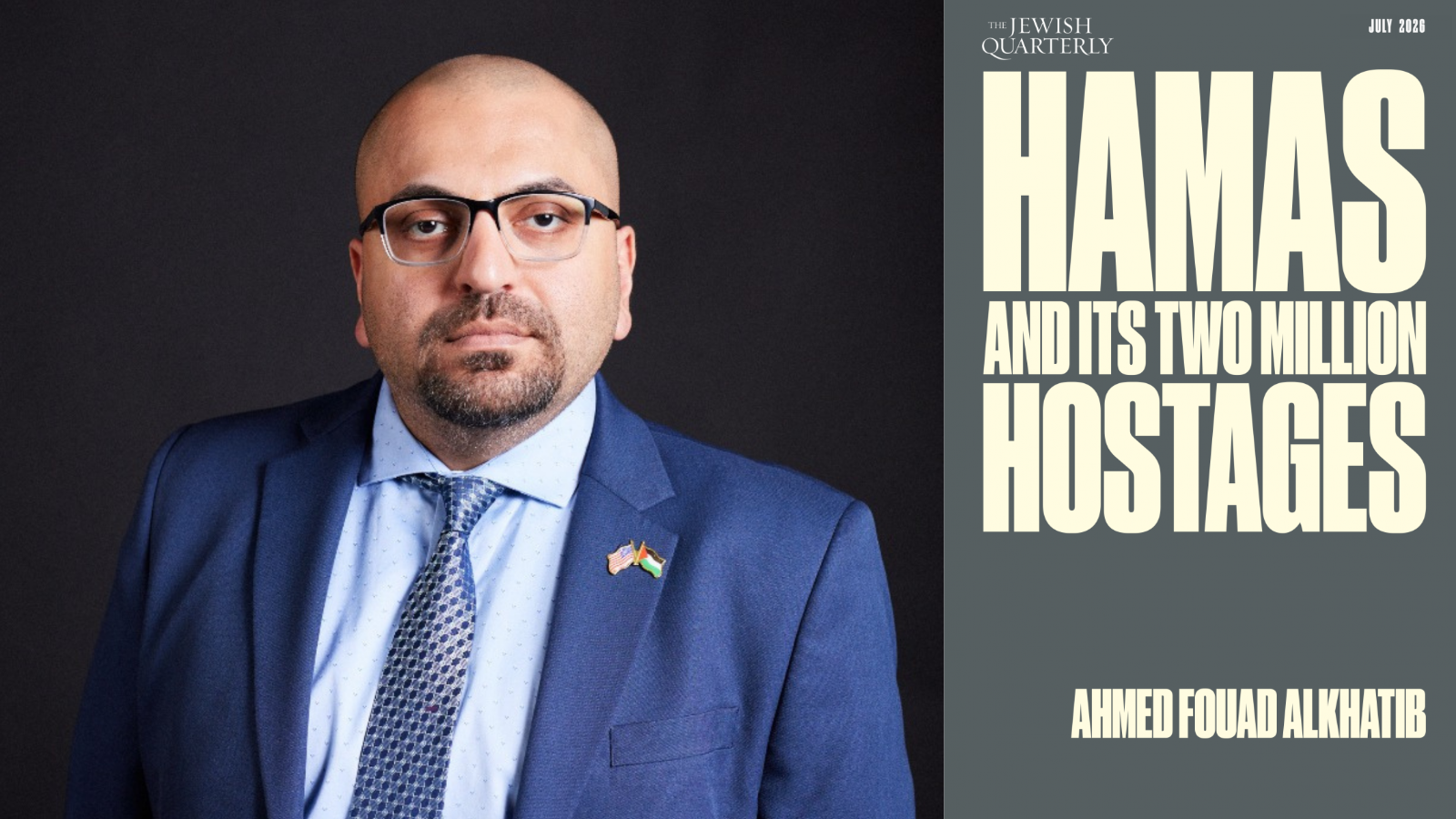
Ahmed Fouad Alkhatib, a Gaza native who lost 33 family members in Israeli airstrikes, argues in his new book that Hamas bears primary blame for Palestinian suffering and political stagnation
MONEY MOVES

The suspension ends a key commercial lifeline, though analysts said Iran’s sanctions-evasion networks and enforcement uncertainty limit how decisive a blow it will be
The Michigan Democratic Senate nominee didn't address Piker's role in promoting his campaign or his attack on congressional nominee Jeremy Moss
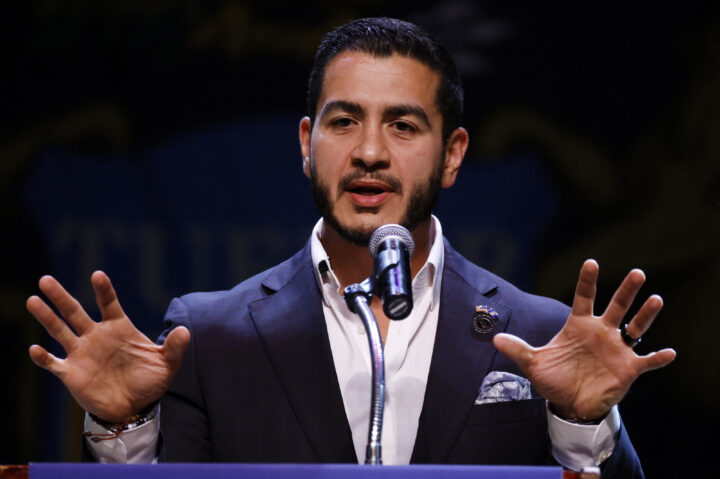
JEFF KOWALSKY / AFP via Getty Images
Abdul El-Sayed addresses supporters at his election night event at The Majestic Theatre in Detroit, Michigan, on August 4, 2026
Michigan Democratic Senate nominee Abdul El-Sayed distanced himself, to a degree, from antisemitic streamer Hasan Piker, who has been a prominent surrogate of his campaign, after Piker attacked Democratic state Sen. Jeremy Moss and argued that Jews are inciting antisemitic violence against themselves by supporting Israel.
But, in the statement — posted on X under the heading, “My statement on Hasan Piker’s comments regarding Jeremy Moss” — El-Sayed didn’t name Piker or Moss, and didn’t directly address Piker’s comments.
“I believe all Americans deserve the right to advocate what they believe without fear of violence,” El-Sayed said. “This is particularly true for communities that have been intimidated for their beliefs in the past.”
Amid ongoing attacks on him for his association with Piker, El-Sayed also insisted that “nobody speaks for this campaign besides me and my campaign spokespeople.”
He went on to downplay Piker as “a Twitch streamer” who will not define the race or his own campaign. He did not say whether his or his campaign’s relationship with Piker will change going forward.
“My commitment to Jewish safety is the same as my commitment to the safety of my own daughters,” El-Sayed added. “Antisemitism is a scourge and we need to address it in all its forms. And I stand against any rhetoric that puts the community at risk.”
Despite the title of the statement addressing Moss, the statement itself did not directly address El-Sayed’s fellow Michigan Democrat or Moss’ allegations that opponents are spreading fabricated audio of him promoting antisemitic tropes.
Republican nominee former Rep. Mike Rogers (R-MI) blasted El-Sayed’s comments as insufficient.
“Hasan Piker’s call for violence against the Jewish Community, specifically against Jeremy Moss, must be condemned by every single Michigan Democrat. But Conman Abdul El-Sayed doesn’t have the guts to disavow his running mate,” Rogers said. “Abdul’s attempt at distancing himself from this violent and hateful rhetoric now that he and Hasan won the primary is the epitome of what a conman does — says one thing when it serves him and another when it doesn’t.”
Rogers added, “His rhetoric is causing fear in Michigan communities, is unAmerican, and makes him unfit to represent our state.”
Moss said in a statement later on Monday that he and El-Sayed, whom Moss has not yet endorsed, are in ongoing conversations about their shared goals, safety for Jews and Arabs and co-existence among Michigan communities.
“These important conversations do not fit neatly in the confines of a tweet or a reel, like so many want them to. I’m grateful that Abdul and I are having them,” Moss said. “There is still work ahead to unite our ticket despite our differences. It won’t happen overnight, nor should it. It will require continuing outreach that is credible and authentic.”
But Moss made clear that despite his disagreements with El-Sayed, he will not support Rogers, as some other leaders in the Jewish community plan to.
Moss also lambasted Piker, without naming him individually.
“Provocatuers are exploiting this moment to create further divisions. I will not be lectured by a California podcaster about what Oakland County, Michigan’s Jewish community should and shouldn’t believe,” Moss continued. “And we certainly won’t be gaslit that we’re responsible for the antisemitic harm upon us. The attempted murder of Jewish children in West Bloomfield has no justification,” he said, referencing the violent attack on Temple Israel earlier this year.
Piker has so far shrugged off criticisms of his comments, including those from another Michigan Democrat, Rep. Hillary Scholten (D-MI). In a response, Piker called Scholten “an israel 1st congresswoman,” and said she’s “vying for the spotlight by actively defaming a prominent antizionist voice to harm the dem senate majority chances over a 90/10 issue,” while referencing unverified rumors about Scholten’s personal life.
Scholten, a Democrat, also called out Piker for targeting state Sen. Jeremy Moss, a Jewish Democratic congressional nominee in Michigan
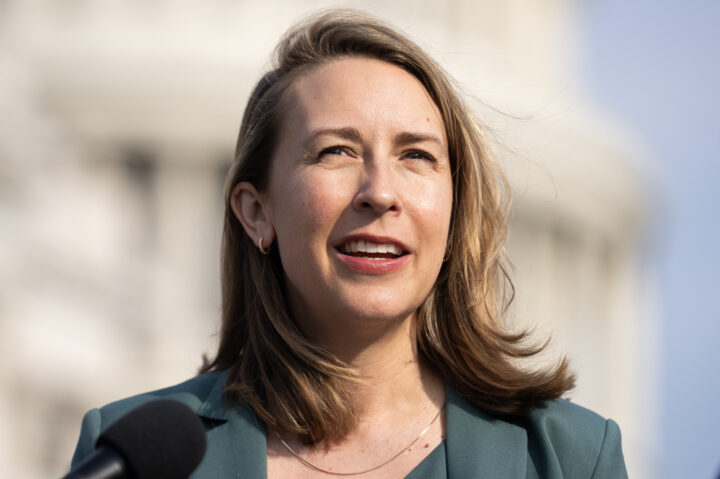
Tom Williams/CQ-Roll Call, Inc via Getty Images
Rep. Hillary Scholten (D-MI) speaks during a news conference outside the U.S. Capitol on March 26, 2026.
Rep. Hillary Scholten (D-MI) on Monday condemned antisemitic streamer Hasan Piker for comments suggesting that Jews supporting Israel are inviting violence against themselves, and for targeting Democratic Michigan state Sen. Jeremy Moss by name.
Moss last week condemned individuals circulating an unsourced and undated audio clip claiming to depict him expressing his fealty to Israel, which Moss has said is fabricated. During a stream last week, while making those comments about antisemitism, Piker displayed posts about and images of Moss from the antisemitic account TrackAIPAC, including an excerpt from the allegedly fabricated audio clip.
“Hasan Piker’s calls for violence against American Jews, and directly naming a Michigan elected official (and future Congressional colleague) Jeremy Moss are unacceptable. Full stop,” Scholten said on X. “Piker is a hack who thrives on hate, shock and awe because he lacks substance. It’s dangerous for everyone. We should all be calling out this disgusting rhetoric so it loses its grip on our politics once and for all. It has no place in Michigan, and no place in our country.”
Scholten had previously criticized Democratic Senate candidate Abdul El-Sayed for campaigning with Piker and has not endorsed El-Sayed.
Scholten is one of several elected leaders who has condemned Piker’s comments — though most of the controversial streamer’s allies and supporters have been quiet so far.
Rep. Ro Khanna (D-CA), who has previously appeared on Piker’s show and said he was “proud” to do so, rejected the streamer’s comments about pro-Israel American Jews in a statement to Jewish Insider on Monday.
“Antisemitism is a centuries-old, ugly bigotry. It must be condemned unequivocally. Jews are not the cause of it. Neither are people who support Israel. Antisemites are to blame. That’s it,” Khanna said.
“The only one inciting violence against American Jews is Piker and his rhetoric,” Rep. Josh Gottheimer (D-NJ) said on Sunday. “For the future of our party, Democrats have to call out his hate and condemn these dangerous views. Anyone campaigning with him is part of the problem.”
Rep. Mike Lawler (R-NY) said Piker is a “threat to America.”
“A rich, entitled piece of sh*t who promotes socialism but doesn’t practice it,” Lawler said. “He believes America deserved 9/11, mocks a public assassination [of conservative commentator Charlie Kirk], and believes Jews should be killed. Anyone who supports him is unfit for public office.”
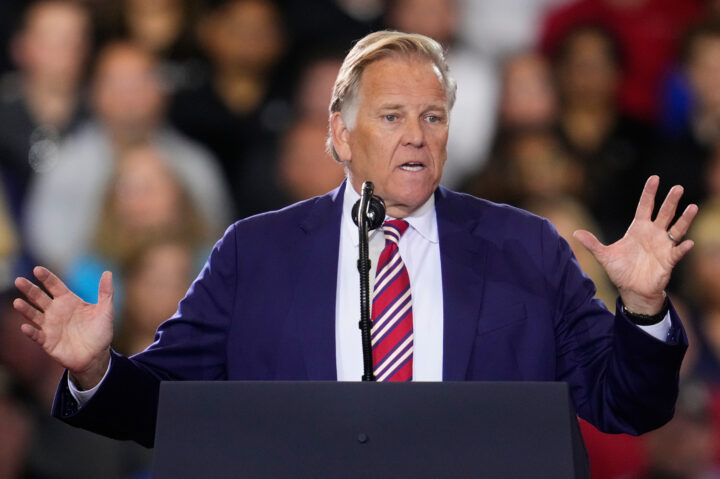
Paul Sancya/AP
Republican Senate candidate Mike Rogers speaks before President Donald Trump at an event at the General Motors Proving Ground Monday, July 27, 2026, in Milford, Mich.
The debate over AIPAC’s involvement in the high-stakes Michigan Senate race is drawing renewed attention after an Axios report outlined a request from allies of former Rep. Mike Rogers (R-MI) for the pro-Israel group’s super PAC to lay low for the general election. The Rogers campaign advisors suggested instead that the group transfer money for the race to a separate pro-Rogers entity so as not to make its outside spending a major issue in the contest.
The episode has touched a lot of raw nerves in both the pro-Israel world and the Republican political landscape. Rogers, a longtime supporter of the U.S.-Israel relationship, is highlighting his relationships with Michigan’s Jewish community, and has made attacking Democratic nominee Abdul El-Sayed’s anti-Israel virulence and his relationship with antisemitic figures like Hasan Piker a central element of his campaign message.
AIPAC’s super PAC, United Democracy Project, spent about $32 million in the Democratic primary to try to defeat El-Sayed, and there’s little doubt its money — in the absence of any moderate group willing to spend similar resources to stop a far-left candidate like El-Sayed from winning — made the race more competitive than it otherwise would have been. But it also gave El-Sayed a talking point in attacking outside money in the race that diluted the impact of the aggressive advertising campaign, especially at a time when support for Israel itself is diminishing within the Democratic Party.
Both the Rogers campaign and AIPAC see El-Sayed as uniquely vulnerable, with polls showing the race statistically tied despite the overall favorable environment for Democrats in the swing state. But beyond focusing on winning the race, both sides have slightly different tactical imperatives: AIPAC, after coming close to defeating El-Sayed in the primary, wants credit for helping finish the job in the general election. Rogers, meanwhile, is trying to turn the tables on El-Sayed, using his endless primary campaign attacks on Israel as a way to underscore he’s more obsessed about the Middle East than the issues critical to Michigan voters.
On one hand, support for Israel is decidedly higher among the general electorate than it was among primary voters — and likely is a winning issue for Rogers, especially given El-Sayed’s radicalism on the subject. But populist concerns about foreign aid and engagement abroad still resonate across party lines, with 44% of Michigan voters in a recent Fox News survey saying they favor continued military aid to Israel, while 55% oppose such aid.
The Rogers campaign believes that making the race about Middle East policy would be shortsighted, especially given that El-Sayed’s record and background makes him vulnerable to the charge that he’s the candidate more consumed with international affairs than improving the lives of Michiganders.
Furthermore, unlike in the Democratic primary, there will be no shortage of money available for the Rogers campaign and its allies in the general election. Rogers has been a solid fundraiser, and the deep pockets of both the Senate Leadership Fund GOP super PAC and a separate pro-Rogers super PAC should offer more than enough resources to run a full-fledged campaign. Rogers’ campaign would prefer donations get directed — and spent — under the Republican Party umbrella.
There’s a reason AIPAC’s super PAC hardly ever spends in general elections — most competitive races are already saturated with cash, so its involvement (or that of any outside nonpartisan super PAC) wouldn’t make much of a difference anyway.
AIPAC’s concerns are understandable as well, and I have heard them echoed by several senior GOP strategists involved with the race. El-Sayed’s ties to extremists and inability to forthrightly condemn antisemitism in his home state is a major reason why he’s vulnerable in the first place. Diluting or downplaying that argument takes one of the campaign’s strongest angles off the table.
It’s one thing to debate about whether advertisements would be best aired under the GOP banner or the UDP banner. It’s another issue to be concerned that the Rogers’ campaign, in its desire to universalize the race, isn’t taking full advantage of winning over the many Democratic-friendly Jewish voters who view El-Sayed’s record as intolerable. Asking AIPAC’s chair to stand down its ad campaign, as reported in the Axios story, might have been a tactical dispute, but it risks coming across as downplaying the importance of the pro-Israel and Jewish communities in the state.
Ultimately, the goals of the two sides are the same: winning the race. If the differences between the Rogers’ campaign and AIPAC are tactical, that’s understandable in a lengthy campaign. But if it’s a dispute about who gets credit for taking down El-Sayed, the argument seems a bit frivolous when the stakes in the race are so high.
Plus, Baltimore's Orthodox Jews get a day at the races
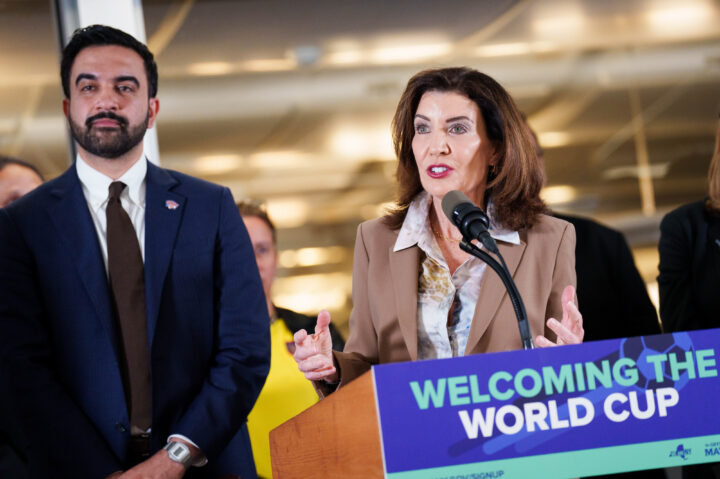
Adam Gray/Bloomberg via Getty Images
Zohran Mamdani, mayor of New York, left, and Kathy Hochul, governor of New York, during a news conference on 2026 FIFA World Cup transportation at the MTA Rail Control Center in New York, US, on Thursday, June 4, 2026.
Good Thursday afternoon.
This P.M. briefing is reserved for our premium subscribers like you — offering a forward-focused read on what we’re tracking now and what’s coming next.
Today’s Daily Overtime was curated by JI U.S. Editor Danielle Cohen-Kanik.
📡On Our Radar
Notable developments and interesting tidbits we’re tracking
Stefany Shaheen, the daughter of Sen. Jeanne Shaheen (D-NH) and a candidate for New Hampshire’s 1st Congressional District, launched a TV ad this week hitting her primary opponent, military veteran Maura Sullivan, for receiving $300,000 in donations “bundled from AIPAC donors,” Jewish Insider’s Marc Rod reports.
The donations referenced in the ad appear to be from individual donors who have previously contributed to AIPAC, but the pro-Israel group itself has made no endorsement and has not been directly involved in the race…
Michigan Democratic congressional nominee Jeremy Moss declined to endorse his party’s Senate nominee, Abdul El-Sayed, in an interview with Slate: “Abdul’s going to have to demonstrate some serious outreach to Oakland County’s Jewish community,” Moss said. The two candidates have “had an ongoing dialogue,” Moss added, as he said Democrats must ensure that “the liberal Jewish community is not politically homeless”…
Rabbi Asher Lopatin, director of community relations at the Ann Arbor Jewish federation who has been outspoken about the threat he believes El-Sayed poses to the Jewish community, appeared at a “Democrats for Rogers” press conference in Detroit today where he said, “I usually vote Democrat, but I’m gonna be voting for Mike Rogers … I’m sad to say this, that Abdul El-Sayed has made one thing very clear: We cannot let him anywhere near the U.S. Senate”…
A new poll commissioned by AARP found El-Sayed leading Rogers by one percentage point, 48-47%, but voters ages 50 and up were 16 points more likely than younger voters to say they were motivated to participate in the general election — a population that swings heavily towards Rogers. Voters ages 50-64 favored Rogers over El-Sayed 51-46%, and voters above 65 favored the Republican by 13 points (54-41%)…
Asked in a New York Times interview about New York City Mayor Zohran Mamdani’s call for the federal government to arrest Israeli Prime Minister Benjamin Netanyahu when he arrives in the city for the U.N. General Assembly next month, Gov. Kathy Hochul advised the mayor, “Let’s focus on the blocking and tackling of city government. That is where I believe the main focus should be”…
The Trump administration, meanwhile, is weighing in on another official’s appearance at the UNGA: The White House intends to prevent Palestinian Authority President Mahmoud Abbas from attending for the second year in a row, a U.S. official told The Times of Israel…
Treasury Secretary Scott Bessent explained on CNBC today that in order to implement the new U.S. economic campaign against Iran, the Trump administration will approach “all of our allies” and tell them, “You are either with us or against us.”
“If you insist on doing business with [Iran] — either transferring money, buying their oil, doing seaborne ship transfers — then the U.S. Treasury and the U.S. government will put its full might and force toward enforcing against you,” he added…
The NYT looks at which countries do the most business with Iran and could therefore be hardest hit by the new measures, including China, India and several Middle East nations…
Georgia state Rep. Esther Panitch, the only Jewish member of the state’s Legislature, denounced the Georgia branch of the Council on American-Islamic Relations for featuring extremist anti-Israel voices including Zahra Billoo, Ana Kasparian and Cenk Uygur as keynote speakers at its gala next month.
CAIR-GA has “dropped the mask at this point,” Panitch told the Jerusalem News Syndicate. “This is actual straight-out, Nazi-level Protocols of the Elders of Zion kind of antisemitism. They’re doing it, and they can’t say they didn’t know”…
For more than 150 years, Baltimore’s Orthodox Jews have walked to synagogue on Preakness Saturday and listened to the roar of the crowd from Pimlico Race Course less than a mile away, never able to join it. That changes in 2027, when the second jewel in horse racing’s Triple Crown — following the Kentucky Derby and preceding the Belmont Stakes — moves from Saturday to Sunday, finally opening the gates at Pimlico to the local Shabbat-observant community for the first time since the race started in 1873, JI’s Haley Cohen reports…
⏩ Tomorrow’s Agenda, Today
An early look at tomorrow’s storylines and schedule to keep you a step ahead
Keep an eye on Jewish Insider for a look at the growing divide between the United States and Israel over how to approach post-Assad Syria.
Despite her recent debate stage snafu, which has led GOP operatives to question her chances in next week’s special runoff election, Sen. Darline Graham (R-SC) is still enjoying the support of the party: Sen. John Barrasso (R-WY), the Senate majority whip, is in South Carolina today to support her race, and President Donald Trump will join her in Myrtle Beach for a rally tomorrow.
We’ll be back with the Daily Overtime on Monday. Shabbat shalom!
GOING LOCAL
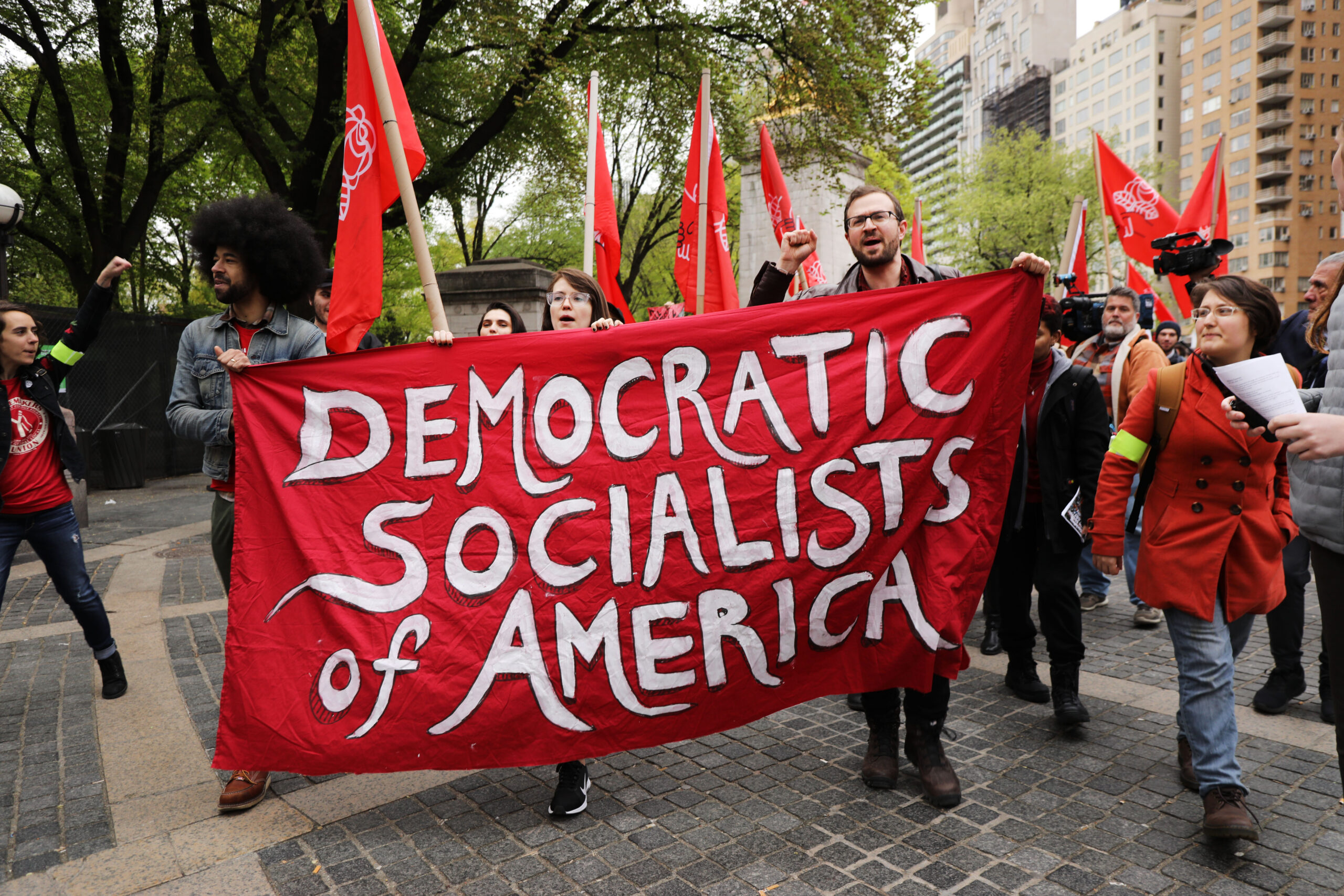
A Brookings Institution study found that of the 104 Democratic Socialists of America-backed candidates running for state legislature, nearly 75% have won their primaries
COLD TURKEY
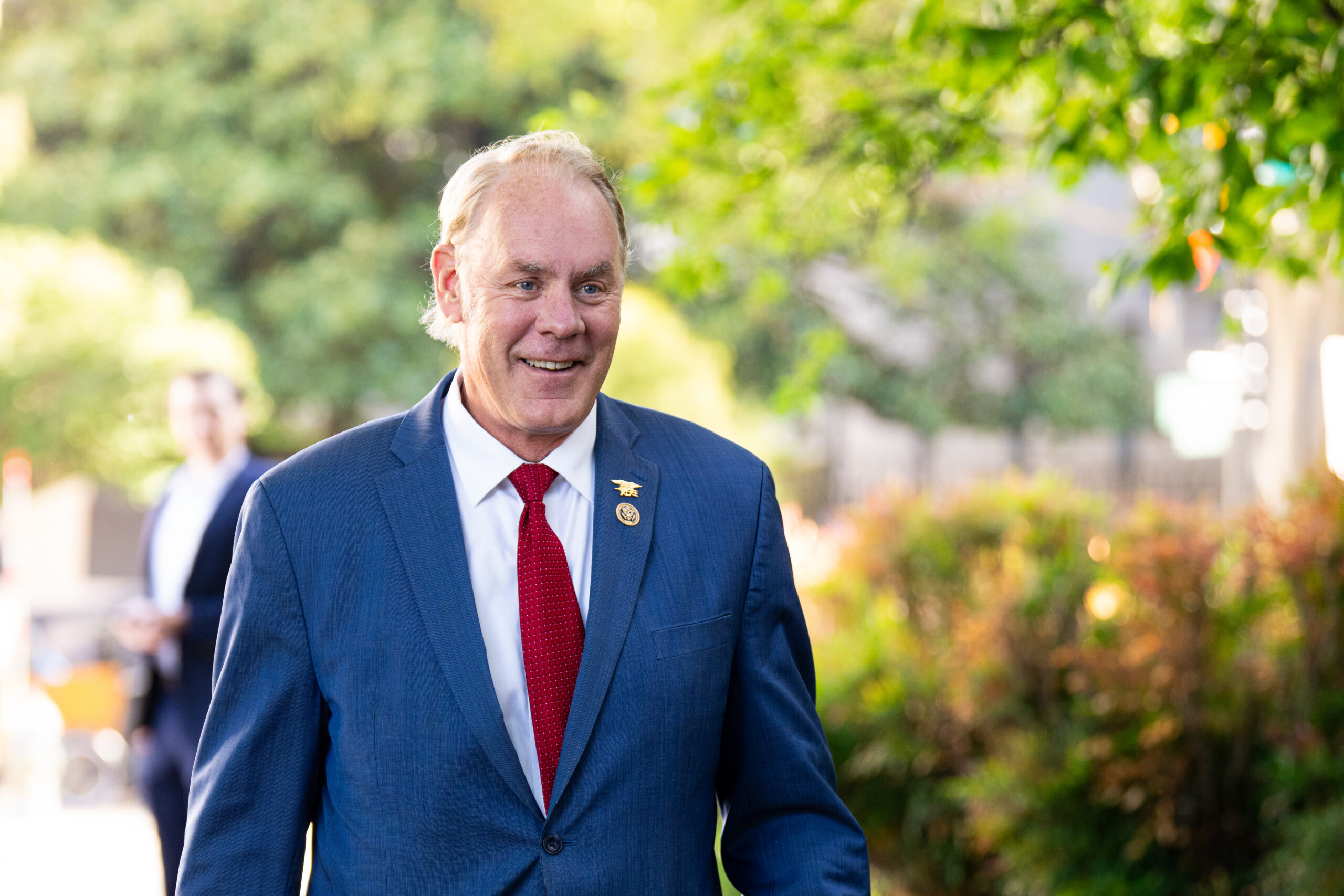
Alleged straw-donor masterminds are selling tickets to an event with the Montana Republican — who says he’s not attending
Plus, ICE detains Jewish bridal shop owner
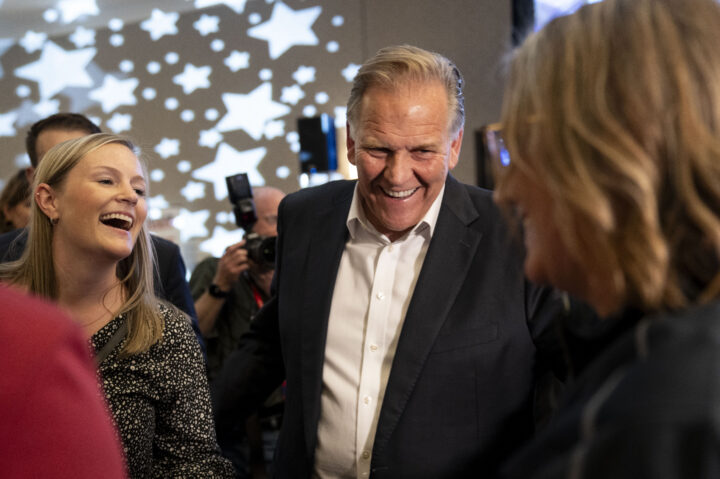
Sarah Rice/Getty Images
Senate candidate Mike Rogers greets supporters at his election watch party with the MIGOP on November 5, 2024 in Novi, Michigan.
Good Wednesday afternoon.
This P.M. briefing is reserved for our premium subscribers like you — offering a forward-focused read on what we’re tracking now and what’s coming next.
Today’s Daily Overtime was curated by JI U.S. Editor Danielle Cohen-Kanik.
📡On Our Radar
Notable developments and interesting tidbits we’re tracking
Jewish leaders in Michigan are circulating an open letter, obtained by Jewish Insider’s Matthew Kassel, urging Jewish Democrats and independents in the battleground state to sign their names in support of former Rep. Mike Rogers (R-MI) as he faces Democratic nominee Abdul El-Sayed in the race for U.S. Senate.
If El-Sayed were to claim victory in the general election, the authors say, “we fear the far-left and anti-Jewish elements in the Democratic party would become dominant … We cannot allow him to become the Democratic standard-bearer or Michigan’s senator”…
California state Sen. Aisha Wahab still holds a narrow lead as of this afternoon over former Dublin, Calif., Mayor Melissa Hernandez in the special election runoff for an East Bay House seat that drew a late surge of outside spending from AIPAC.
With 62% of the vote counted in yesterday’s election, Wahab had 51%, leading Hernandez by two percentage points or 1,356 votes, according to the unofficial initial returns. “We made a race that wasn’t close when we started into a nail-biter,” Patrick Dorton, a spokesperson for AIPAC’s United Democracy Project super PAC, told JI’s Matthew Kassel…
ICE detained a Jewish bridal shop owner and his mother living in Englewood, N.J., a local elected official confirmed today to JI’s Haley Cohen: Ari Ladino and his mother, Chava, who are originally from Bogotá, Colombia, run Luana Rose Modestly in Teaneck — a dress shop specializing in modest special occasion gowns popular among local Orthodox Jewish women. The reason for their arrest remains unclear…
In an interview with The Jerusalem Post today, U.S. Ambassador to Turkey Tom Barrack doubled down on his criticism of Israeli strikes on a Syrian air base earlier in the week, which Israel said had been prompted by Turkish involvement at the base. “Turkish forces were not aware that the Israeli aircraft were en route to that specific Syrian base … [and] could potentially have been inclined to scramble their own jets in the belief that they themselves were under attack,” Barrack said.
He announced that the U.S. is looking to relaunch a deconfliction cell between Israel and Syria, with potential Turkish participation, and downplayed reported Israeli concerns over a specific Turkish radar system said to be deployed at the base. “We remain convinced that this technical requirement need not pose a security concern, and that further conversations can help clarify the matter to everyone’s satisfaction,” Barrack said…
Lt. Gen. Eyal Zamir, the IDF’s chief of staff, visited Israeli troops in southern Syria today, where he said Israel is “monitoring the changes on the Syrian front” and “know[s] how to use our power precisely where it is needed and when it is needed”…
The IDF announced it is opening an investigation into the killing of 5-year-old Hind Rajab in Gaza in January 2024 after finding that troops had indeed fired at her family’s vehicle as it was traveling opposite the direction of an evacuation route. The military had previously denied responsibility for the incident, which drew global attention and inspired an Oscar-nominated film titled “The Voice of Hind Rajab.”
The IDF will also investigate the killing of 15 rescue workers traveling in emergency vehicles in March 2025, and closed investigations into a strike on a World Central Kitchen convoy and into the deaths of several Doctors Without Borders members, finding that troops’ actions in those incidents did not rise to the level of criminal offenses…
The New York Times examines CENTCOM’s efforts to keep oil traffic flowing through the Strait of Hormuz, including utilizing air- and water-based assets to intercept Iranian drones and missiles targeting commercial traffic.
Beyond protecting tankers loaded with oil, the U.S. military has also reportedly established its own corridor to help empty ships enter the strait, load up and exit largely undetected…
The New York State Department of Financial Services issued a notice warning Holocaust survivors and their families about potential fraud by an organization calling itself the “Jewish Holocaust Claims Center” that is contacting such individuals about their eligibility for compensation…
⏩ Tomorrow’s Agenda, Today
An early look at tomorrow’s storylines and schedule to keep you a step ahead
Keep an eye on Jewish Insider for a look at how Sen. Darline Graham‘s (R-SC) debate stage flub on national security may impact her chances in next week’s South Carolina special runoff election for Senate.
Sen. Ed Markey (D-MA) and his primary opponent, Rep. Seth Moulton (D-MA), will face off in their final debate before the election. Moulton, 47, is mounting a generational challenge to the 80-year-old Markey and has taken an increasingly critical stance against Israel and AIPAC on the campaign trail, while Markey has long staked out staunchly anti-Israel positions.
SUNSHINE STATE SOCIALISM
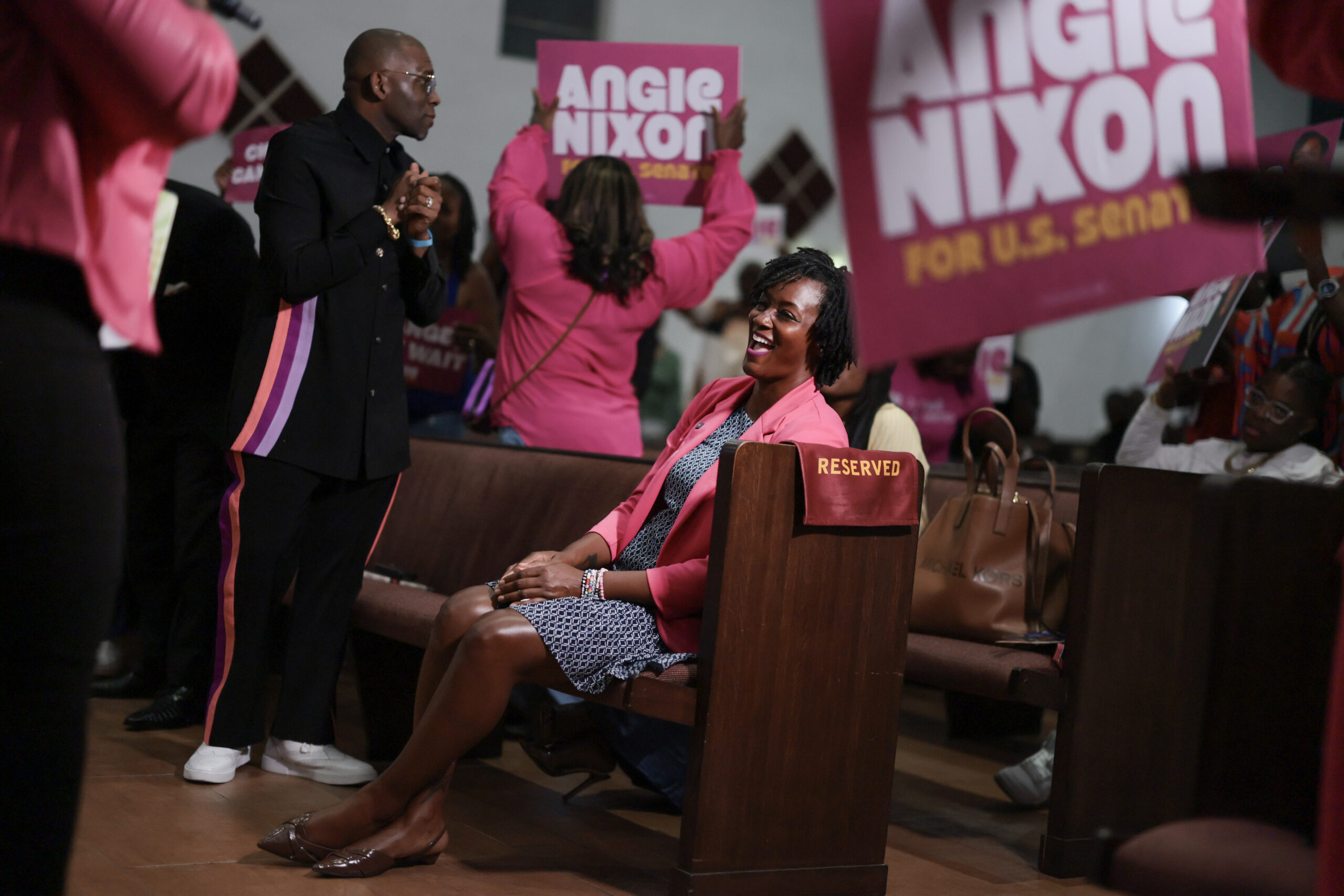
Angie Nixon, who called Israel’s war against Hamas a genocide and campaigned with Rep. Rashida Tlaib, will be the party’s candidate against GOP Sen. Ashley Moody
CAMPUS BEAT
The study shows how unions are turning away from advocating for higher wages and using their institutions to foment attacks against Israel
The signatories say they ‘fear the far-left and anti-Jewish elements in the Democratic party would become dominant’ if Abdul El-Sayed is elected
Paul Sancya/AP
Republican Senate candidate Mike Rogers speaks before President Donald Trump at an event at the General Motors Proving Ground Monday, July 27, 2026, in Milford, Mich.
Jewish leaders in Michigan are circulating an open letter urging Jewish Democrats and independents in the battleground state to sign their names in support of former Rep. Mike Rogers (R-MI) as he faces Abdul El-Sayed, the far-left Democratic nominee for Senate whose hostile positions on Israel have alarmed many Jewish voters.
The letter, which was obtained by Jewish Insider on Wednesday and has not yet been publicized, is led by Eric Bronstein, a Detroit businessman, among others identifying as Democrats and independents.
It came to light after a fundraiser for Rogers on Tuesday night hosted by three prominent Jewish Democratic bundlers in Michigan who are likewise alarmed by El-Sayed’s candidacy. The growing efforts among Jewish Democrats to rally support for Rogers in the key Senate race illustrate the degree to which El-Sayed has alienated a sizable and politically active swing voting bloc in what is expected to be a close election.
“We know it is unusual for many Jewish voters to support a Republican candidate for senate and we understand the implications,” Bronstein wrote in a recent email courting Jewish signatories that was also reviewed by JI. “Our fellow Jewish voters need to see their friends and neighbors — including you — willing to take a stand in this specific, crucial race.”
Bronstein did not immediately return a request for comment on Wednesday.
The open letter, which the authors intend to share online once it has gained “a significant initial group of signers,” emphasizes that many signatories “have been fiercely supportive of Democratic candidates and principles.”
“All of us have felt threatened and alienated by the politics and allies embraced by Abdul El-Sayed,” the letter continues, “which has included demonization of Jews, equivocation on terrorism, exclusion of Jewish Americans from public life, and expression of implacable hatred of the world’s only Jewish nation.”
If El-Sayed were to claim victory in the general election, the authors say, “we fear the far-left and anti-Jewish elements in the Democratic party would become dominant, including in the imminent 2028 presidential race,” when Michigan will be among the early nominating states in the Democratic primaries. “We cannot allow him to become the Democratic standard-bearer or Michigan’s senator.”
While the letter calls Rogers “a friend to the Jewish community,” it clarifies the signatories’ endorsement “does not require that we agree with him on every issue or that we support” President Donald Trump. “There are other elections locally and nationally, with different candidates aligned with our values,” it says. “Here in Michigan this year and in this Senate race, our own well-being and our own voice are at stake.”
“This is a moment when each of us must speak out,” the letter states. “We’re voting for Mike Rogers. We ask other Michigan Jewish voters to join us.”
Following the primary early this month, Rogers has been working to fine-tune his outreach to disaffected Jewish voters — balancing private engagement with a key constituency alongside a more broadly calibrated public invitation for Democrats to join his coalition.
On Tuesday, Rogers posted a video testimonial to social media from a supporter in the heavily Jewish Detroit suburb of West Bloomfield who called herself a “lifelong Democrat” and said that she had chosen to cross party lines to support “candidates that actually share our values.”
The voter did not say she was Jewish but was wearing a necklace featuring a Star of David and another with the shape of the State of Israel.
The Senate minority leader’s comments come as recent polling and Abdul El-Sayed’s progressive policies and have raised concerns for Democrats that he could lose the pivotal swing state
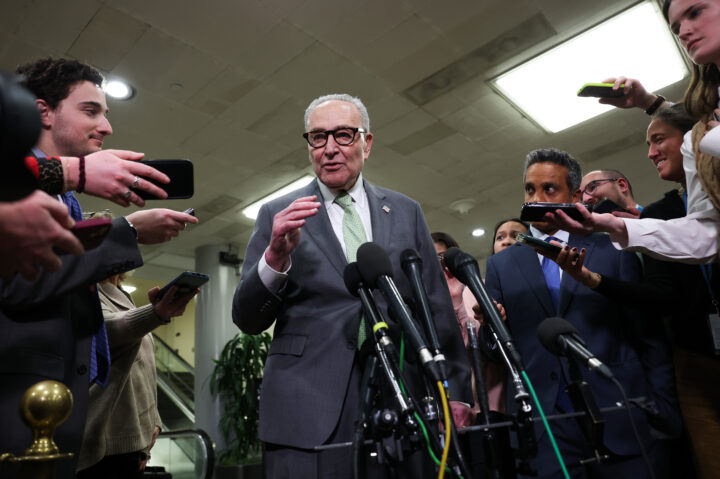
Anna Moneymaker/Getty Images
Senate Minority Leader Charles Schumer (D-NY) speaks to the media after briefings on Iran at the U.S. Capitol on March 3, 2026 in Washington, DC.
Senate Minority Leader Chuck Schumer (D-NY) suggested in an interview with The Washington Post published on Tuesday that he believes Democrats can still win the Senate even if far-left Michigan Senate nominee Abdul El-Sayed, whom Schumer has endorsed, does not win in November.
El-Sayed’s progressive positioning and recent polling showing him narrowly trailing the Republican nominee, former Rep. Mike Rogers (R-MI), have raised concerns among Democrats that El-Sayed could lose what many in the party consider to be a must-win state. Some Democratic donors, particularly in the Jewish community, are also now backing Rogers after El-Sayed won the primary.
“A path to winning back the Senate clearly goes through Michigan, but we have a whole bunch of different paths,” Schumer told the Post.
Schumer acknowledged that his views on Israel differed from El-Sayed’s, but didn’t directly say whether he believed the Michigan nominee had said or done anything antisemitic.
“I think he makes an effort to fight antisemitism even though his views on Israel are much different than mine,” Schumer told the outlet.
El-Sayed has come under fire for his comments that appeared to justify an attempted attack on a synagogue and Jewish preschool in the Detroit suburbs earlier this year, his repeated refusal to acknowledge Israel’s right to exist and his alliance with Hasan Piker, the far-left antisemitic and anti-Israel streamer.
Moss said that audio allegedly depicting him expressing loyalty to Israel over the U.S. is ‘manipulated’ and includes ‘things I never did and never would say’
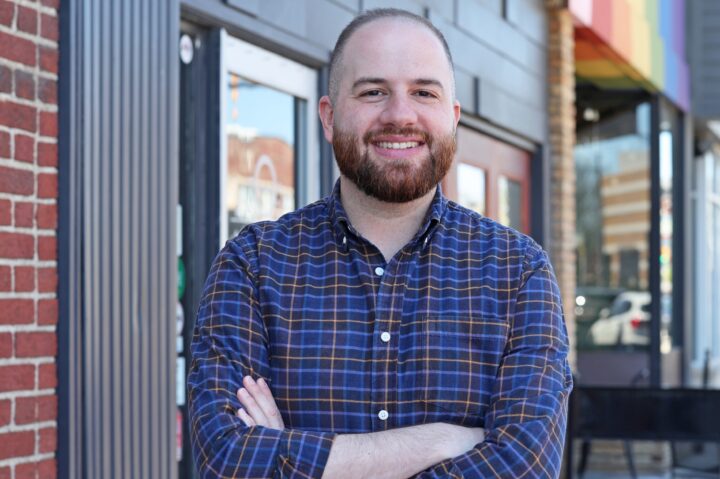
Courtesy Jeremy moss
Democratic Michigan state Sen. Jeremy Moss
Michigan state Sen. Jeremy Moss, the Democratic nominee in Michigan’s 11th Congressional District, pushed back on Tuesday against what Moss alleged was a doctored audio clip circulating online designed to portray him as more loyal to Israel than the United States.
“There is a manipulated and unsourced audio, with things I never did and never would say, that is nothing more than political disinformation intended to portray me as anti-American,” Moss, who is Jewish, said on X. “It peddles in offensive tropes and lies — especially the lie of dual loyalty suggesting that Jews are never fully citizens of or loyal to their home countries.”
The unsourced and undated audio depicts Moss saying that the entire purpose of his campaign is to support Israel and that Jews should support Israel over the United States.
The original source of the audio is unclear, but it has been shared over the past few weeks on X by former Moss opponent Aisha Farooqi and by multiple antisemitic X accounts.
Ryan Grim, co-founder of the Hamas-sympathetic outlet Drop Site News, posted an alleged quote from the clip this week, but subsequently removed the post after acknowledging he had not verified the recording.
“We are in a dangerous era of disinformation. Circulating a lie because it affirms your bias or belief is equally bad whether it comes from the left or the right,” Moss said. “We all have a choice not to spread fabricated images, videos, and audio about candidates and campaigns. We all have a role in stopping the erosion of our democracy.”
“I’m a proud Michigander. I was born in Detroit. I grew up in Oakland County. I won’t stand for people using lies to diminish my American story and my career delivering for Michigan families,” Moss continued.
Moss has repeatedly faced attacks over his support for Israel, including from the Oakland University College Democrats, which refused to endorse him over his support for Israel. In an article about the decision, the news outlet The Midwesterner also shared the audio.
Michigan GOP gubernatorial nominee John James, Steve Scalise visit site of Michigan synagogue attack
James called the rise in antisemitic threats ‘an urgent national concern’

Gubernatorial nominee John James visits Temple Israel with House Majority Leader Steve Scalise
Rep. John James (R-MI), the GOP nominee for governor of Michigan, and House Majority Leader Steve Scalise (R-LA), visited Temple Israel in West Bloomfield, Mich., the site of an attempted shooting and bombing attack earlier this year, on Thursday.
“I appreciate Leader Scalise coming here to see the site of the attack first-hand, and to talk with community leaders,” James said in a statement. “To have a top member of Congress visit signals that we are treating the rise in threats seriously, and that this is an urgent national concern.”
The pair were joined by other members, including Ways and Means Committee Chairman Jason Smith (R-MO), Rep. Glenn Grothman (R-WI) and Rep. Pete Stauber (R-MN).
In a release, James’ office noted that he is cosponsoring the Jewish American Security Act which aims to protect the Jewish community by increasing security grant funding, among other measures.
“There is a sickness in a certain segment of our population that reacted to the Oct. 7 terrorist attack with sympathy for the attackers, and which has spent the past few years irrationally targeting members of the Jewish community here in Michigan with hateful words and actions,” James continued. “I fought extremists in Iraq; we cannot let that kind of violent thinking take root here in Michigan. Everyone should be able to live and worship in peace.”
The visit was arranged in cooperation with the Jewish Federations of North America.
“Leader Scalise and his colleagues sent an unmistakable message when they walked through the doors of Temple Israel to tour the site of the terrible terrorist act against our children: We see the threat Jewish Americans are facing and we will not look away from it,” Dennis Bernard, the national chair of government relations for the JFNA, said in a statement. “They understand that violence against the Jewish community has reached unacceptable levels, and that it is time for action.”
Bernard, a Michigan resident, urged Congress to promptly pass the Jewish American Security Act.
In an early sign of Rogers’ bipartisan backing, three prominent Jewish Democratic bundlers are holding fundraiser for Rogers next week
Paul Sancya/AP
Republican Senate candidate Mike Rogers speaks before President Donald Trump at an event at the General Motors Proving Ground Monday, July 27, 2026, in Milford, Mich.
More than a week after Abdul El-Sayed narrowly clinched the Democratic nomination in Michigan’s bruising Democratic Senate primary, his Republican opponent, former Rep. Mike Rogers (R-MI), is working to fine-tune his campaign’s outreach and messaging to disaffected Jewish voters who could play a decisive role in the closely contested race.
While Republicans in the key battleground state see an opportunity in November to capitalize on Jewish Democrats’ alarm over El-Sayed’s hostile rhetoric toward Israel and lackluster record in confronting the rise of antisemitism, Rogers has in the days following the primary still appeared relatively cautious in directly courting Jewish voters, as he has widened his pitch to Democrats in Michigan whom he reassured in a video message last week have “a home with” his campaign.
He has otherwise called El-Sayed, a far-left former public health official, “beyond antisemitic” and said he “hates Jewish people,” echoing the most extreme concerns among Jewish Democrats turned off by the Democratic nominee’s ties to antisemitic Twitch streamer Hasan Piker and comments equivocating over the foiled terrorist attack against a synagogue outside Detroit in March, among other issues.
Despite such criticism, Jason Cabel Roe, a GOP strategist in Michigan not involved in the race, said that he had not seen Rogers “specifically identifying the Jewish community as a target,” underscoring how the campaign is balancing private engagement with a key constituency alongside a more broadly calibrated public invitation for Democrats to join his coalition.
“A lot of this is going to come organically,” Roe told Jewish Insider, referring to Jewish Democrats in the state who are contemplating voting for Rogers. “This is not new territory for him.”
Bobby Schostak, a former chairman of the Michigan Republican Party and a prominent Jewish campaign surrogate, said he had hosted a donor call on Monday with Rogers and his pollster, Tony Fabrizio, joined by some 150 people. “There were people there who were traditionally not Republican voters,” he told JI, citing some Jewish Democrats and other former backers of Rep. Haley Stevens (D-MI), the moderate, pro-Israel lawmaker who lost to El-Sayed.
“Mike spoke to the importance of having a wide-open campaign with multiple coalitions,” Schostak said of the donor call, while stressing that Jewish Democrats in the Detroit area are particularly energized to help Rogers. “It is consequential both in numbers and in names,” he told JI on Thursday. “They are not being passive,” he explained. “They want to beat El-Sayed.”
In one of the first major signs of those efforts now materializing, three prominent Jewish Democratic bundlers in Michigan are hosting a fundraiser for Rogers next Tuesday, according to an email invite sent to Jewish community members on Thursday.
“This is something that none of us has ever done,” said Hannan Lis, who is leading the fundraiser with Brian Hermelin and Rob Orley. “But we feel this is a departure in the direction of the Democratic Party,” he told JI of El-Sayed’s staunch opposition to Israel and refusal to recognize its right to exist as a Jewish state. “We’re taking a stand here,” he added. “This is beyond politics.”
Even though “there are many issues where we don’t necessarily agree with Mike Rogers,” Lis noted, “we trust him” on key issues. The fundraiser is meant to “show we are willing to back up a person” who holds a mutual commitment to a “strong relationship with Israel” and “is not playing politics” on other matters concerning the Jewish community, he explained.
Hermelin, the president of the Jewish Federation of Detroit, confirmed his involvement in the fundraiser but declined to comment further on the event, which he is co-hosting in his personal capacity.
Rogers, recognized as a national security-focused conservative, has also attended pro-Israel fundraisers outside of the state this week, according to a person familiar with the matter. “There is now a lot of enthusiasm in the pro-Israel community for Mike Rogers,” the person said. “A not-insignificant piece is from Democrats.”
A spokesperson for Rogers’ campaign did not return a request for comment on Thursday.
The Republican Jewish Coalition has indicated it intends to aggressively target the nearly 100,000 Jewish voters in Michigan who make up a potential swing bloc, with a special focus on Jewish Democrats who “now find themselves politically homeless,” Sam Markstein, a spokesperson for the group, told JI in a statement.
Markstein said that he could not yet share specifics about the RJC’s plans to invest in the race but noted an independent expenditure is in the works and “will be significant.”
Eric Levine, a top Republican bundler in New York and an RJC board member who hosted a fundraiser for Rogers in late July, said the former congressman is “making a direct appeal to the Jewish community,” including Democrats, and “has been very successful.”
AIPAC, the pro-Israel advocacy group whose super PAC spent over $30 million to help Stevens, has not officially endorsed Rogers, but sources say it is likely to spend on his behalf before the November election. Representatives for AIPAC and its super PAC did not respond to requests for comment.
In a tacit recognition of the Jewish vote’s potential significance in the general election, El-Sayed has, for his part, recently sought to ease tensions with Jewish Democrats who remain skeptical about his campaign, emphasizing his “commitment to Jewish safety” even he has continued to use incendiary rhetoric on Israel in the wake of the primary.
Michael Horowitz, a Jewish Democratic leader and Detroit businessman, said he was “leaning heavily” toward voting for Rogers but that he had not made up his mind, underscoring the inherent challenges in enticing Jewish Democrats to defect from a party that they have long called home.
Though Horowitz said he will not vote for El-Sayed, he attributed his reservations to delivering a win for the Trump administration as well as a “volatile world” that could shape his assessment in the lead-up to the election. “I would say that the vast majority of people I’ve talked to are voting against El-Sayed — as opposed to voting for Rogers,” he told JI.
He said he is now working to arrange a “more intimate conversation” with Rogers to get a better sense of the candidate, after a surrogate reached out to make a connection. “I don’t think that not voting is an option,” he said, adding, “until I cast my vote it’s not a done deal.”
Shimon Levy, an Israeli American entrepreneur in Detroit who identifies as an independent and backed Stevens in the primary, said he is supporting Rogers’ campaign and had wrapped up lunch with members of his team when he spoke with JI on Thursday.
“I think, at this stage, the Rogers team is just here to listen,” he said. “They’re asking, ‘How do we win your vote?’”
The Fox News survey shows Rogers leading El-Sayed, 51-47%, winning over a small but critical mass of Democratic voters
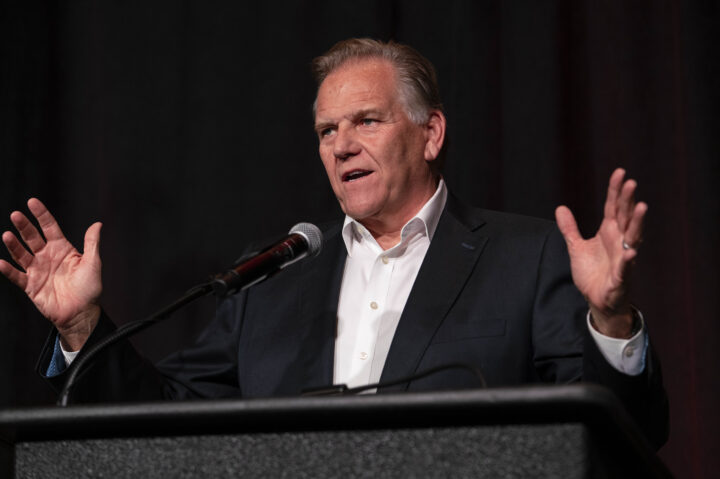
Sarah Rice/Getty Images
Michigan Senate candidate Mike Rogers speaks at his election watch party.
Former GOP Rep. Mike Rogers starts off the Michigan Senate general election race with a narrow advantage over Democrat Abdul El-Sayed, according to a new Fox News poll, aided by an advantage with independents and making inroads with a small but significant number of Democrats willing to cross party lines.
Overall, Rogers leads El-Sayed among registered voters by four points, 51-47% — and is one of the only Republicans to hold a lead in the series of Fox News Senate battleground polls that have otherwise shown Democratic Senate candidates ahead of their GOP opponents.
The poll found Rogers’ advantage is sustained by holding onto more of his base than El-Sayed, while claiming a small edge with independents. Rogers wins 96% of Republican support, while El-Sayed support is at 91% among Democrats and is only polling at 69% with Democrats who don’t support the Democratic Socialists of America.
54% of Michigan voters surveyed said El-Sayed is too extreme for the state, while 51% of respondents said Rogers was too close to President Donald Trump.
El-Sayed starts the general election with 54% of Michigan respondents viewing him unfavorably and a 41% minority viewing him favorably. That minus-13 net negative unfavorability is a notch worse than Rogers’ 45% favorable rating and 51% unfavorable rating (minus-6).
The pollsters also found that El-Sayed is underperforming with Black voters, women and suburbanites — all key constituencies in a midterm election. Rogers, however, is lagging among younger voters under 30 and independents compared to Trump’s 2024 showing in the state.
The poll surveyed 1,006 registered Michigan voters between Aug. 6-10, and has a 3% margin of error.
Plus, Josh Kushner and Bob Iger ball out
Jemal Countess/Getty Images for Breakthrough T1D)
Sen. Jon Ossoff (D-GA) questions witnesses during a hearing held to examine a future without Type 1 Diabetes with a focus on accelerating breakthroughs and creating hope at the Dirksen Senate Office Building on July 09, 2025 in Washington, DC.
Good Wednesday afternoon.
This P.M. briefing is reserved for our premium subscribers like you — offering a forward-focused read on what we’re tracking now and what’s coming next.
Today’s Daily Overtime was curated by JI U.S. Editor Danielle Cohen-Kanik.
📡On Our Radar
Notable developments and interesting tidbits we’re tracking
A State Department official pushed back on Israeli Defense Minister Israel Katz’s comments in southern Lebanon today, where he said the IDF would remain deployed in a security zone, contrary to the agreement signed between Washington, Jerusalem and Beirut.
“The United States expects all parties to act in a manner consistent with the Framework they agreed to, and Israel clearly stated that it has no territorial ambitions in Lebanon. A permanent military presence in South Lebanon is not consistent with the commitments made in the Framework, or the long-term peace and security of both states,” the official told Axios…
Sources told Reuters that Israel and Lebanon have agreed that countries including Britain, Italy, Switzerland and Indonesia could contribute troops to an international force meant to oversee Hezbollah’s disarmament; an Israeli official denied any decisions had been made on the issue…
President Donald Trump continued to boast about the success of the U.S. campaign against Iran, stating again in a post on Truth Social today that the U.S. “has total control over the Strait of Hormuz” and that the Islamic Revolutionary Guard Corps is “decimated and fleeing.”
Meanwhile, out of the 166 ships that have transited the strait so far this month — a significant decrease from the average before the war — only two are known to have used the U.S.- and Oman-backed route, according to The Wall Street Journal…
In a rare interview with Western media, top IRGC advisor Mohammad Reza Naqdi told “PBS News Hour” that Iran is prepared to continue hostilities through the end of Trump’s term and accused the U.S. of waging a “war without strategy”…
The New York Times documents the efforts being made by Gulf countries to construct routes to move oil out of the region that do not rely on the Strait of Hormuz…
Board of Peace head Nickolay Mladenov denied in a post in Hebrew today that there is any financial agreement between the board and Hamas, refuting a report by Israeli public broadcaster Kan that the board would cover Hamas’ debts up to $400 million.
The disarmament roadmap states that the new Palestinian technocratic government will “assess the legitimate commitments to suppliers, contractors and other parties — up to a total amount of no more than $400M — and address them”; Mladenov said in his post that such processes “are not channeled through Hamas” and that “all accounts are open to full scrutiny by the donor governments”…
The publisher of the Atlanta Jewish Times, Michael Morris, penned an open letter to Sen. Jon Ossoff (D-GA) today pressing the senator over his repeated votes to block U.S. military sales to Israel, Jewish Insider’s Marc Rod reports.
“I apologize for being blunt, but please, stop lying to me and your constituents. I hear you claim, over and over again, that you support Israel — that your support is ‘ironclad.’ It is not,” Morris wrote…
Rep. Haley Stevens (D-MI) denied today that the more than $30 million of support she received from AIPAC’s super PAC in her failed run for U.S. Senate backfired, saying on CNN that those who criticize AIPAC “maybe don’t understand what the group is” and that she’s “proud of the friendships and the relationships I have there [and] the really good Americans” who make up its membership…
White House Press Secretary Karoline Leavitt is stepping away from her role at the end of the month, Trump announced today, in order to spend more time with her family. The president said Leavitt will now serve as “one of my top outside advisors”…
Josh Kushner, managing partner of the venture capital firm Thrive Capital, and former Disney CEO Bob Iger have agreed to purchase a controlling interest in the Los Angeles Lakers for a record-breaking price of $12.5 billion, JI’s Matthew Shea reports…
⏩ Tomorrow’s Agenda, Today
An early look at tomorrow’s storylines and schedule to keep you a step ahead
Keep an eye on Jewish Insider for a look at local Jewish political organizing efforts in major cities across the country.
The Hudson Institute will hold an event examining the state of the ongoing conflicts in the Gulf with the Foundation for Defense of Democracies’ Behnam Ben Taleblu and Hudson’s Michael Doran, Ludo Hood and Zineb Riboua.
TRUST, BUT VERIFY
Mamdani’s antisemitism czar invited a cross-section of rabbis and Jewish leaders broadly sympathetic to the mayor for the candid conversation
BALLIN’ OUT
The sale is the largest purchase price for any sports team in American history
Plus, City Hall and NYPD clash over Rama Duwaji's travel plans

Javier Campos/NurPhoto via Getty Images
A woman waves a Venezuelan flag during a march in amid the COVID-19 pandemic, in Caracas, Venezuela on May 25, 2021. (Photo by )
Good Tuesday afternoon.
This P.M. briefing is reserved for our premium subscribers like you — offering a forward-focused read on what we’re tracking now and what’s coming next.
Today’s Daily Overtime was curated by JI U.S. Editor Danielle Cohen-Kanik.
📡On Our Radar
Notable developments and interesting tidbits we’re tracking
Mohsen Rezaei, secretary of Iran’s Supreme National Security Council, insisted today that any agreement reached between Iran and Oman on administering the Strait of Hormuz is separate from Tehran’s broader closure of the waterway, which will only be lifted once the U.S. accedes to Iran’s demands.
Meanwhile, Pakistani Interior Minister Mohsin Naqvi, a key mediator between the U.S. and Iran, met today with Iranian Foreign Minister Abbas Araghchi in Tehran. Islamabad’s defense minister, Khawaja Asif, told Bloomberg that developments are “shaping up again in favor of a peace arrangement”…
CENTCOM said it disabled a Panama-flagged cargo ship sailing toward Iranian ports today by firing two Hellfire missiles into the vessel’s engine room, the third such incident since the U.S. blockade began…
Ed Miliband, who last month was appointed by new U.K. Prime Minister Andy Burnham to be foreign secretary, said he had a “frank and constructive first call” with Israeli Foreign Minister Gideon Sa’ar today, during which the British diplomat raised the issues of settler violence, settlement expansion and the humanitarian situation in Gaza, among others.
The discussion came a day after Miliband met with British Jewish community leaders, who said they were “impressed” by the foreign secretary’s “longer-term commitment to maintaining the conversation”…
Sa’ar announced that Israel and Venezuela have agreed to renew consular relations — establishing a coordination mechanism to provide consular services to each country’s citizens — in the first official channel between the two since Caracas severed diplomatic ties in 2009. The move builds on the Israeli aid delegation dispatched to Venezuela after the June 24 earthquakes…
The Palestinian technocratic committee meant to govern Gaza convened a joint coordination meeting with several U.N. agencies — including the World Food Program, UNICEF and the World Health Organization — as well as representatives from the Board of Peace and former U.K. Prime Minister Tony Blair’s Institute for Global Change to coordinate on humanitarian aid and reconstruction issues…
Former Mossad head Yossi Cohen said at a conference in Israel today that Israeli operatives have “toured” Iran’s Fordow nuclear facility “many times” in order to “understand” it, and called the U.S. operation to bomb the site during the 12-day war in June 2025 “the fulfillment of all my dreams”…
The NYPD denied that its officers will be accompanying New York City First Lady Rama Duwaji on a trip to Lebanon and Syria next month after City Hall said that, “upon the strong recommendation of the NYPD, the First Lady’s security detail will be joining her” on the trip.
“The NYPD does not send officers to countries with level four travel advisories for discretionary reasons,” the NYPD said today, referring to the State Department’s ranking system that currently designates the two countries as “do not travel” locations. Mayor Zohran Mamdani later said the diverging statements stemmed from a “miscommunication,” and that when his wife makes the trip “it will be without any NYPD detail”…
Democratic Michigan Senate nominee Abdul El-Sayed has made private over 100 YouTube videos from his time as a podcaster and commentator, CNN reports, including videos in which he lambasted fireworks on the Fourth of July, floated replacing the Second Amendment and voiced support for prison abolition…
The Democratic Congressional Campaign Committee added Brian Poindexter, the Democratic nominee in Ohio’s 7th Congressional District, to its “Red to Blue” program as he aims to unseat Rep. Max Miller (R-OH). Democratic leadership will offer Poindexter strategic support as the district, previously considered a long shot for Democrats given its GOP leanings, is now seen as a key flip opportunity as Miller navigates accusations of domestic violence by his ex-wife…
The campaign of Francesca Hong, the socialist seen as the front-runner in today’s Democratic primary election for governor of Wisconsin, was rebuffed by Sen. Bernie Sanders (I-VT) as she sought his endorsement due to her perceived weaknesses as a candidate, Politico reports; her campaign is planning to overhaul its staff to address such issues if she proceeds to the general…
⏩ Tomorrow’s Agenda, Today
An early look at tomorrow’s storylines and schedule to keep you a step ahead
Keep an eye on Jewish Insider for results from key primaries taking place today in Minnesota, South Carolina, Connecticut and Wisconsin.
THE CAPITAL’S KOSHER CONUNDRUM

D.C. has a kosher restaurant problem. Owners say to blame the math
DSA UNFILTERED
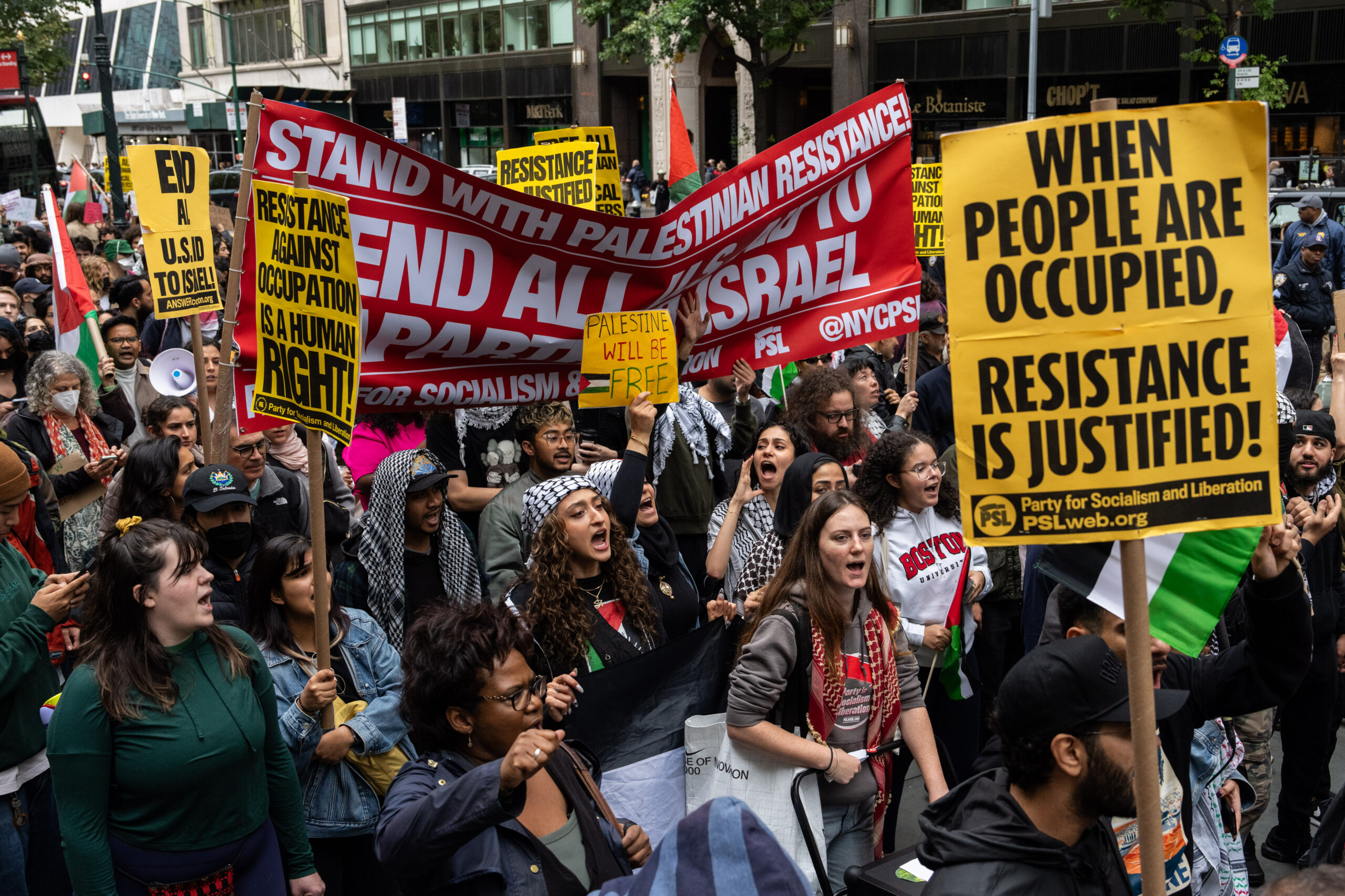
‘If you put people in an open-air concentration camp … you have to expect that they are going to not take that for that long,’ Megan Romer said of the Oct. 7 attacks
Left-wing Lt. Gov. Peggy Flanagan’s anti-Israel message is being complicated by her outreach to AIPAC earlier in the campaign

(AP Photo/Ellen Schmidt)
U.S. Rep. Angie Craig, D-Minn., left, and Minnesota Lt. Gov. Peggy Flanagan participate in a forum for U.S. Senate candidates at Farmfest Wednesday, Aug. 5, 2026, in Morgan, Minn.
The outcome of Michigan’s bruising Democratic Senate primary last week, where Abdul El-Sayed claimed a narrow victory over Rep. Haley Stevens (D-MI) in an upset championed by the anti-Israel left, is looming over the next intraparty showdown being held in Minnesota on Tuesday — the latest in a series of proxy battles between the party’s mainstream and left-wing flanks.
In an echo of Michigan, the bitter Democratic primary for an open Senate seat in battleground Minnesota this week is pitting a moderate House member with a long-standing pro-Israel record, Rep. Angie Craig (D-MN), against an outspoken progressive, Lt. Gov. Peggy Flanagan, whose attack lines have frequently centered on AIPAC, which spent over $30 million in its unsuccessful effort to help Stevens.
The Minnesota primary is, in the closing stretch, likewise revolving around questions of electability for Democrats in the must-win November contest. Craig has pointed to controversies amid Flanagan’s tenure in government as vulnerabilities Republicans are eager to exploit — most notably including the welfare fraud scandal that prompted Democratic Gov. Tim Walz to abandon his reelection campaign for a third term earlier this year.
Flanagan, in addition to her anti-AIPAC messaging, has hammered Craig over what she has described as a “disqualifying” vote approving the Laken Riley Act — legislation requiring the detention of unauthorized migrants charged with certain crimes — the optics of which have been damaging in the wake of President Donald Trump’s protracted immigration crackdown in Minnesota. Craig has expressed regret for her vote.
But unlike Michigan, where El-Sayed claimed the nomination by less than one point after polls had suggested a double-digit blowout, the Minnesota matchup has been seen as neck-and-neck, the outcome of which is hard to predict, experts say. Recent independent surveys have shown a statistical dead heat in the final weeks of the primary, with each candidate garnering around 40% of the vote.
The candidates’ equivocations over AIPAC and individual ties to the group have also emerged as fault lines in recent weeks, complicating the ideological divisions that have shaped other primaries in which Israel and Middle East policy have featured prominently.
In a reflection of the extent to which AIPAC is now viewed as a liability in Democratic primaries, Craig has distanced herself from the group, which has not officially made an endorsement in the race even as its donor network has contributed to her campaign. The congresswoman, who is backed by several pro-Israel lawmakers including Sen. Elissa Slotkin (D-MI) and House Minority Leader Hakeem Jeffries (D-NY), has said she is not accepting contributions from AIPAC’s political arm in her current campaign.
During a recent debate, Flanagan said AIPAC had been Craig’s “biggest funder throughout her entire political career,” while claiming her own “values do not align with” the group. Flanagan has cast AIPAC as part of “a band of super villains” in the race now trying to “buy this election,” language some Jewish leaders say they have found unsettling amid rising antisemitism.
Flanagan, however, acknowledged last month she had met privately with AIPAC after The Minnesota Star Tribune obtained a video recording of remarks to Jewish community members — also reviewed by Jewish Insider — in which she said the outreach was “important” for her “to make sure that we’re building that relationship.”
Flanagan claims that AIPAC turned against her and came to regard her as a “threat” when she confirmed her support last year for Senate resolutions to block arms sales to Israel. She has since endorsed a House amendment to end aid to Israel, which Craig rejected, further illustrating her policy disagreements with the group.
Craig, for her part, has sharply dismissed the lieutenant governor as “completely disingenuous about her soliciting support from AIPAC,” claiming that she “has been very hypocritical” because of her efforts to demonize the group.
While Flanagan has insisted she was not seeking an endorsement in her outreach to AIPAC officials, she did write an Israel position paper that she submitted to the group as part of their discussions, according to two people familiar with the matter.
Manny Houle, a pro-Israel Democratic consultant in Minnesota, confirmed to JI that Flanagan presented a Middle East policy paper to AIPAC and said that he had personally reviewed the document. He said he no longer had a copy, which JI was unable to obtain, but he recalled that she “was open to conditioning aid” to Israel and said she “put a lot of pressure and fault on Israel and occupation,” among other “key factors” he characterized as distinguishing Flanagan from Craig.
Houle, a former director of progressive outreach for AIPAC in the Midwest, said his impression had been that Flanagan wrote the paper and sought the group’s feedback early in her campaign last year because she viewed it as part of a broader process. The lieutenant governor “would have been open to engaging within the network of donors” affiliated with AIPAC, Houle claimed, “but when she realized that wasn’t going to be the case,” she pivoted to a more hostile position.
“Many key advisors to Peggy are anti-AIPAC, so it’s hard for me to think she’d ever honestly in good faith engage with the organization,” Houle explained to JI. “I’ve had conversations with her throughout the race trying to get her to tone down her rhetoric” on Israel issues, he added, “but to no avail.”
A spokesperson for AIPAC did not return a request for comment.
Alexandra Fetisoff, a spokesperson for Flanagan’s campaign, did not directly address the AIPAC paper in a statement responding to a request for comment. “Flanagan disagrees with AIPAC’s deeply unpopular political agenda and the catastrophic actions of” the government led by Israeli Prime Minister Benjamin Netanyahu, Fetisoff told JI on Friday.
“Flanagan believes what has happened in Gaza is genocide, a position in line with the United Nations,” Fetisoff said. “Flanagan has consistently condemned antisemitism, and will continue standing with Jewish Minnesotans against hate.”
Last week, American Priorities, a new super PAC created to counter AIPAC’s influence in Democratic primaries, began spending in the race to help boost Flanagan, spending over $50,000 on an ad calling her a “fighter” who would “stand up to Trump” while touting her support from Sen. Bernie Sanders (I-VT).
Flanagan also claims backing from the state Democratic Party and retiring Sen. Tina Smith (D-MN), whom she is vying to succeed, along with leading progressive critics of Israel such as Sens. Elizabeth Warren (D-MA) and Chris Van Hollen (D-MD).
Doug Rossinow, a professor of history at Metro State University in St. Paul, who has tracked divisions over Israel in the state Democratic Party, said the “AIPAC issue flew under the radar until pretty recently” in the election. “The Flanagan-Craig contest is, compared to Michigan’s Democratic Senate primary race, a classic case of Minnesota understatement and even passive aggression,” he told JI.
“Flanagan lately has made an issue of Craig’s history of support from AIPAC,” he noted, “but Craig, unlike Haley Stevens, doesn’t want to own that or talk about Israel.” Meanwhile, Flanagan has stated “little about her own position on Israel” and the region, he added, “unlike El-Sayed in Michigan,” a fierce critic of Israel who has refused to acknowledge its right to exist as a Jewish state.
One state party activist described the race as “a little bit less black and white than Michigan,” while noting the contrasts between Craig and Flanagan are not as drastic. “I see it as a toss-up,” he said of the primary.
Joe Radinovich, a Democratic consultant based in Minneapolis, added that while the national political mood has favored populist progressives, he believes there is reason to interpret the closer-than-expected finish in Michigan as a relatively promising omen for Craig, who flipped a GOP-held swing district in 2018.
“The dominant narrative has belonged to the further left wing of the party, populist candidates and people decrying AIPAC and Israel,” Radinovich, who said he is supporting Craig but is not involved in the primary, told JI in an interview on Friday. “But if I’m on the Craig campaign and looking at the results of the election in Michigan, I’m feeling some wind in my sails.”
Mara Kunin, Craig’s campaign manager, projected confidence in a statement on Friday. “National and state Republicans are making a serious play for this Senate seat and primary voters understand that we can’t risk putting up a weak candidate in the general election,” she said, adding Craig “is positioned to win this race on Tuesday and seal the deal in November.”
The Democratic nominee is expected to face Michele Tafoya, a former NFL sideline reporter who is heavily favored to win the Republican primary, in November. The GOP’s Senate campaign arm has indicated that it views Minnesota among four pickup opportunities as the party seeks to retain its majority in the chamber.
“It is very saturated, very ugly and very negative,” another state party activist said about the primary, which has otherwise seen a flood of outside spending from opposing groups. “I think that AIPAC will have an impact in the race, but social services fraud could be more important,” he told JI. “Whoever wins, it will sort of say which issue” carries the most weight.
In an interview with CNN, she underscored her pro-Israel bona fides, saying she is a ‘Zionist Democrat in Michigan’
Rep. Haley Stevens (D-MI), candidate for Michigan's open U.S. Senate seat, holds a rally with Sen. Gary Peters (D-MI) on August 2, 2026 in Madison Heights, Michigan (Photo by Finn Gomez/Getty Images)
In her first cable news interview since her Senate primary loss on Wednesday morning, Rep. Haley Stevens (D-MI) told CNN that Jewish voters who are concerned about Democratic Senate nominee Abdul El-Sayed’s hostility towards Israel are “going to have to make a personal and private decision” as to who to support in November.
Stevens also told CNN on Friday that she is a “Zionist Democrat in Michigan.”
Just before he was declared the winner in the Democratic primary for the pivotal Michigan Senate race, El-Sayed doubled down on his criticism of Israel on MS NOW’s “Morning Joe,” calling the Jewish state “bloodthirsty” and saying his critiques go beyond the government of Israeli Prime Minister Benjamin Netanyahu.
El-Sayed, who made his opposition to AIPAC a central part of his campaign message, sought to ease tensions with skeptical Jewish voters after winning the nomination, addressing what he called “an issue that has been focused on in this race.”
“To all of my sisters and brothers of the Jewish faith,” he said in his televised remarks, “I want you to know that my commitment to your safety, my commitment to Jewish safety, is the same commitment that I have to the safety of my own daughters.” He also spoke about his experience going to a seder during the campaign, where in an awkward turn of phrase, said he was able to “break bread” with his Jewish friends.
On Friday, Republican Senate nominee Mike Rogers argued that the “vast majority of people” rejecting El-Sayed — whose bid he framed as a “campaign filled with anger, divisiveness, calls for violence and the views that are out of touch with your values”— have “a home with us.”
In a video message directed at disaffected moderates, Rogers said ‘the fight is far greater than just left versus right. The fight is for the very soul of our nation’
Sarah Rice/Getty Images
Michigan Senate candidate Mike Rogers speaks at his election watch party.
Addressing Michigan Democrats in a videotaped message, Republican Senate nominee Mike Rogers said that the “vast majority of people” rejecting Democratic Senate nominee Abdul El-Sayed — whose bid he framed as a “campaign filled with anger, divisiveness, calls for violence and the views that are out of touch with your values”— have “a home with us.”
“If you’re among the majority of Democratic voters that woke up on Wednesday feeling hopeless because the person who won does not represent your values, well, just know there is still hope,” Rogers said seated next to his wife, in a 90-second video message released on Friday.
“Michigan deserves a senator who is ready to sit with you, hear from you and represent you.
The parents across Michigan who want an education system that sets up their kids for success have a home with us. Grandparents across Michigan who are heartbroken from watching their kids and grandkids leave the state, you have a home with us,” he continued.
“To young people who are looking for real solutions to our housing affordability crisis, you have a home with us. To families who don’t want higher taxes and lower paychecks, you have a home with us. The fight is far greater than just left versus right. The fight is for the very soul of our nation. Over the next 90 days, I’m going to work hard to earn your trust, to earn your support and earn your vote.”
Most Democrats quickly coalesced behind El-Sayed after he narrowly clinched victory in Michigan’s Democratic primary on Wednesday morning, while Republicans quickly attacked El-Sayed’s extremist history and ties.
Just before he was declared winner, El-Sayed doubled down on his criticism of Israel on MS NOW’s “Morning Joe,” calling the Jewish state “bloodthirsty” and saying his critiques go beyond the government of Israeli Prime Minister Benjamin Netanyahu.
In interview with JI, Feterman said El-Sayed ‘will quickly discover a primary is a much different situation’ than a general election
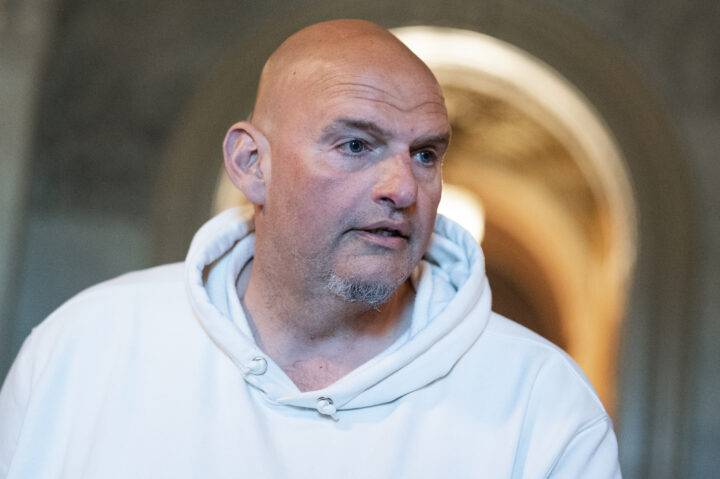
Tom Williams/CQ-Roll Call, Inc via Getty Images
Sen. John Fetterman (D-PA) is seen after the Senate luncheons in the U.S. Capitol on Tuesday, April 14, 2026.
Sen. John Fetterman (D-PA) said on Wednesday that he believes Abdul El-Sayed’s victory in the Democratic primary for U.S. Senate in Michigan has put the state in play for Republicans in November.
Fetterman made the comments in an interview with Jewish Insider in the hours after Rep. Haley Stevens (D-MI) conceded to El-Sayed in what was a competitive and contentious primary. The Pennsylvania Democrat said he expects El-Sayed will struggle to reach moderate voters without distancing himself from antisemitic streamer Hasan Piker and his record of extremist comments, including remarks that America deserved 9-11 which Republicans are already revisiting in campaign ads.
“He will quickly discover a primary is a much different situation in this state [than the general election], when you’re accountable for winning the other side. I can’t wait to see him campaign for the general. I have got my popcorn for that,” Fetterman told JI. “Will he denounce Hasan Piker? Because Piker is already calling moderates ‘Islamophobic pieces of s***.’ Will he campaign with him? Will he denounce his views? I am daring him to continue to campaign with Hasan Piker now.”
“Think about how volatile a guy like Piker is,” Fetterman said. “He’s already gone off and exploded because El-Sayed was saying how now we have to mend fences.”
Fetterman called El-Sayed “a dream for a Republican candidate,” adding that he would spend millions on political advertisements highlighting El-Sayed’s relationship with Piker if he were the GOP candidate in the race.
Fetterman argued that El-Sayed’s close margin of victory over Stevens — less than one point — shows that his win is not indicative of a shift in the state’s overall electorate.
“I don’t know why El-Sayed described this as a big movement. He thinks that this was an incredible win and that’s just not the case,” he told JI. “Just the opposite — he barely won by 14,000 votes.”
“He really ran the under-four mile politically, palling around with a dude that loves Hamas and thinks America deserved 9/11,” he added. “I mean, will that stick? We’ll see, but overall, this takes largely what had been a safe seat for Democrats and absolutely puts it in play now. Mike Rogers barely lost to [Sen.] Elissa Slotkin (D-MI) [in 2022].”
Asked if he’ll consider endorsing former Rep. Mike Rogers (R-MI), El-Sayed’s Republican opponent in the contest, Fetterman said, “I’m not making any endorsements in this race.”
The Pennsylvania Democrat expressed skepticism that El-Sayed would be able to win over pro-Israel and Jewish voters in November, specifically pointing to his defense of the perpetrator of the violent attack on Temple Israel in the Detroit suburbs earlier this year. “Nothing justifies the heinous attack that we saw on Temple Israel,” Fetterman said.
“Every other word out of his mouth is AIPAC, AIPAC, AIPAC. Imagine what that must look like to a Jewish voter,” Fetterman said of El-Sayed. “Essentially he has defined his race by opposing Jewish money or saying Israel is the aggressor, and he aligns himself with some of the worst people.”
“I’m not a member of the Jewish community, but I can’t imagine how anyone could vote for him in good conscience,” he continued. “How could a Jewish voter in Michigan vote for a guy that refused to condemn a terrorist that crashed his car into a synagogue to kill 150 Jewish children? That’s disqualifying, and it’s appalling.”
Fetterman argued that, “This is a guy that has similar views to Piker. We all know why Abdul El-Sayed was sad after we incinerated Iranian leadership. Remember what Hamas has done to defenseless Israeli and Jewish civilians on 10/7. Piker is the guy that cheers for that organization. I don’t know how you are able to reconcile that.”
Fetterman also took aim at Sen. Bernie Sanders (I-VT) for his endorsements of El-Sayed in Michigan and failed Senate candidate Graham Platner in Maine, who Sanders withdrew his support for after he was accused of sexual assault. The Pennsylvania senator, who has publicly sparred with all three men in recent months, criticized Sanders’ candidate choices as detrimental to Democrats retaking control of the Senate.
“Bernie Sanders is not flipping seats,” Fetterman said. “He is trying to put volatile and terrible candidates into otherwise more safe kinds of opportunities for Democrats.”
He went on to add that he does not plan to endorse the Democrat in the race, while noting that El-Sayed would likely not want his support.
“I can’t ever endorse him, not to think he’d even want mine, and not because he’s called me an asshole or because I’m an ogre that belongs on a pike,” Fetterman said, referring to comments El-Sayed made about him earlier this month. “It’s because he’d have to renounce people like Piker and some of those extreme community leaders that were very much involved with standing with Iran and engaged in rhetoric that describes America as evil. They’re just essentially anti-American people, ironically, while they are living in our country.”
Plus, Hawaii's sleeper House race
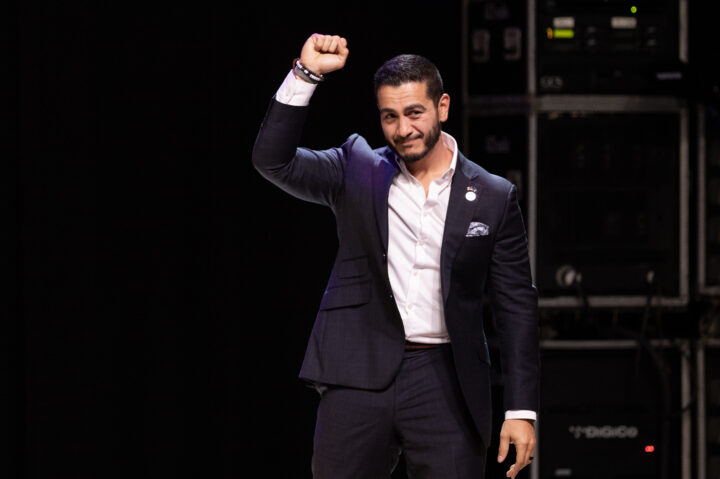
(Scott Olson/Getty Images)
Democratic candidate for U.S. Senate Abdul El-Sayed speaks to supporters at an election-night rally at the Majestic Theatre on August 04, 2026 in Detroit, Michigan.
Good Thursday morning.
In today’s Daily Kickoff, we cover the fallout from Abdul El-Sayed’s narrow victory over Rep. Haley Stevens in Michigan’s Democratic Senate primary, and talk to Jewish Democrats in the state who are considering crossing party lines to vote for GOP nominee Mike Rogers in the November election. We report on the obstacles facing Rep. Ed Case ahead of a challenge from his left in Saturday’s primary in Hawaii’s 1st Congressional District, and cover a Senate Judiciary subcommittee hearing examining Muslim Brotherhood networks and affiliates in the United States. Also in today’s Daily Kickoff: Benny Stanislawski, Tom Kahn and Gianni Infantino.
We also have a new on-demand Live Briefingthat you can access throughout the day via our new app (on Apple and Android) and on our website.
Today’s Daily Kickoff was curated by JI Israel Editor Tamara Zieve and U.S. Editor Danielle Cohen-Kanik. Have a tip? Email us here.
What We’re Watching
- U.S.-led talks between Israel and Lebanon in Rome are slated to conclude today, after yesterday’s discussion was cut short by several hours “due to events on the ground,” the State Department said.
- The decision to pause talks came after the IDF conducted strikes in southern Lebanon over what it said were “blatant violations” of the ongoing ceasefire by Hezbollah, including an incident in which two IDF reservists were killed and four seriously wounded by an explosive device in southern Lebanon.
- Reports continue to indicate Iran and Oman are inching toward a deal to reopen the Strait of Hormuz after earlier agreements on the issue fell apart. An Iranian Foreign Ministry spokesperson said on Wednesday that Tehran and Muscat were close to finalizing an agreement, so long as “certain parties do not obstruct this process” — an apparent reference to the U.S.
- Tennessee is holding its primary elections today. In the state’s 5th District, Rep. Andy Ogles (R-TN), a far-right lawmaker, is facing a serious primary challenge from Charlie Hatcher, a former state commissioner of agriculture.
What You Should Know
A QUICK WORD WITH JI’S MATTHEW KASSEL
Abdul El-Sayed’s narrow victory over Rep. Haley Stevens (D-MI) in Michigan’s bruising Democratic Senate primary on Tuesday is forcing many Jewish leaders in the state to confront an uncomfortable decision as they now look ahead to the general election in November.
Several Jewish Democrats in the battleground state are now indicating that they will break with a party they have long called home and instead vote for the Republican nominee, Mike Rogers, in the November election, citing their continued alarm over El-Sayed’s hostile rhetoric toward Israel as well as remarks they have interpreted as indifferent to rising antisemitism, among other concerns.
“I can’t vote for El-Sayed,” Michael Horowitz, a Jewish community leader and Detroit businessman who supported Stevens, a pro-Israel moderate, told Jewish Insider. “So many things I find despicable about him, not the least of which is his close association with Hasan Piker,” the antisemitic Twitch streamer, who Horowitz said “demeans America, demeans Jews and demeans all but the most radical among us.”
Horowitz confirmed he was now “leaning strongly to Rogers,” a former congressman who narrowly lost in his bid for Senate last cycle. “And I have heard from many in the Jewish community who say they will be supporting Rogers,” he said on Wednesday.
Hannan Lis, a Democratic fundraiser and Jewish leader who splits his time between Michigan and Israel, was among those who had told JI before the primary that he would vote for Rogers in the general election if El-Sayed won the nomination, noting he knows “many” Jewish Democrats who plan to do the same.
His reservations about Republicans preserving their Senate majority by picking up the Michigan seat held by retiring Sen. Gary Peters (D-MI), he clarified, were superseded by his objections to El-Sayed’s stances on Israel and responses to antisemitism. “El-Sayed is no Democrat,” he claimed.
CASE STUDY
Rep. Ed Case (D-HI), a moderate pro-Israel Democrat in Hawaii who was first elected to the House in 2002, has not drawn a serious primary threat in several years. Now, as he prepares to defend his seat in a primary on Saturday that has largely flown under the radar, some Democrats are warning that the 73-year-old could be at risk of losing to a younger challenger capitalizing on a national political environment that has proven unfavorable to Democratic incumbents amid broader calls for generational change from the party’s activist base, Jewish Insider’s Matthew Kassel reports.
While you were sleeping: “It’s one of those sleeper races where there’s definitely an upset brewing,” said a Democratic operative who worked on the Case campaign until a few months ago, speaking on condition of anonymity to avoid professional reprisals. “Ed is running a poor race,” the former staffer told JI, echoing other observers who described a sluggish approach in which Case has largely foregone campaign events and avoided debates with his opposition.
ON THE HILL
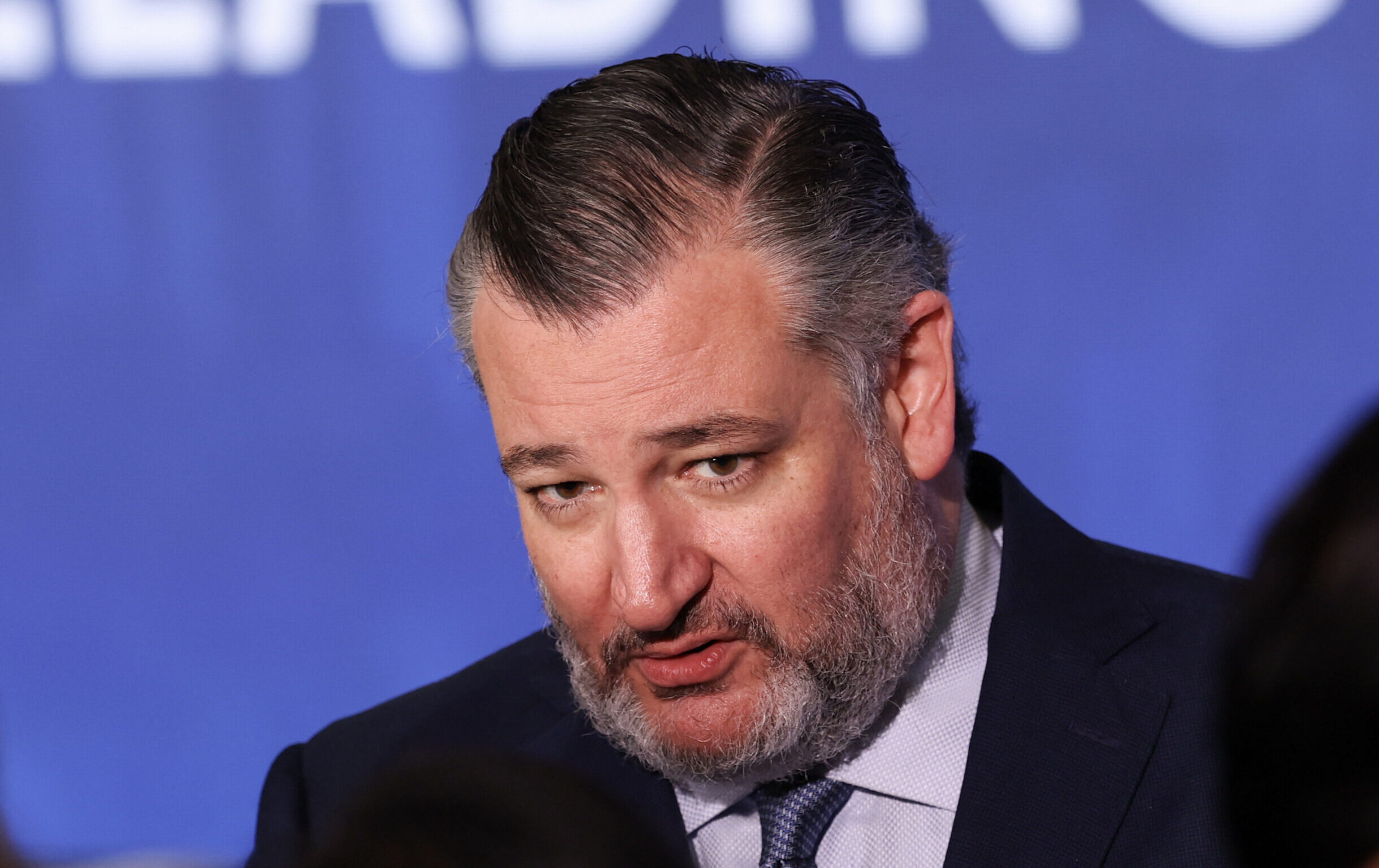
Sen. Ted Cruz (R-TX), speaking at a Senate Judiciary subcommittee hearing on Wednesday that he organized to examine Muslim Brotherhood networks and affiliates in the U.S., suggested that Michigan Senate candidate Abdul El-Sayed was tied to such networks and that his Democratic primary win represented a victory for them. “Behind El-Sayed’s political rise sits a much older and more entrenched institutional network,” Cruz asserted, Jewish Insider’s Marc Rod reports.
Zoom out: Kyle Shideler, a senior analyst for homeland security and counterterrorism at the Center for Security Policy, testified under questioning from Cruz that El-Sayed’s win concerned him given the nominee’s father-in-law’s ties to Muslim Brotherhood-linked groups and El-Sayed’s own relationship with groups connected to the Council on American-Islamic Relations. “It shows the success of the Muslim Brotherhood network over multiple decades. It achieved what they said they were going to achieve, which was to normalize support for Hamas and normalize support for terrorism,” Shideler said.
COMMUNITY CONCERN
Jewish groups expressed concern on Wednesday about the victory of Abdul El-Sayed in the Democratic primary for U.S. Senate in Michigan, highlighting his extreme rhetoric on Israel and the broader rise of the far left, Jewish Insider’s Marc Rod reports.
Reactions: Jewish Democratic Council of America CEO Halie Soifer said in a statement that the group was “disappointed” by the results of the primary, in which the group had endorsed and campaigned strongly for Rep. Haley Stevens (D-MI). Soifer congratulated but stopped short of endorsing El-Sayed. AIPAC, while declining to preview specific plans, indicated it intends to stay engaged in the Michigan race through November. “Our members remain determined to ensure that voters reject Dr. El-Sayed and his radical anti-Israel agenda in November,” spokesperson Deryn Sousa told JI.
Trump’s take: President Donald Trump, speaking at an event in Las Vegas on Wednesday, said al-Sayed “hates Jews and he hates Israel,” adding, “He’s a man of hate, and now he’s going around saying, ‘Oh I love everybody.’ He doesn’t love everybody. Put him in office, and you’re going to find out what he loves.”
WITHHOLDING SUPPORT
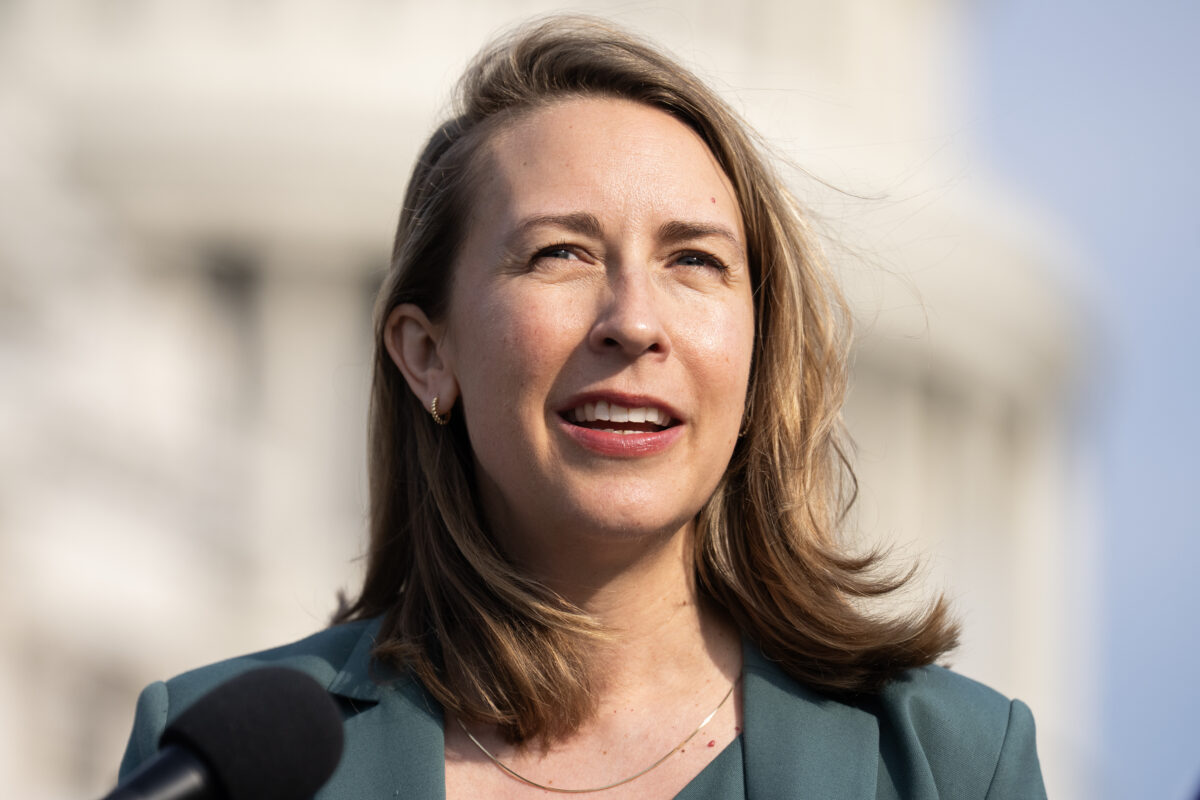
Rep. Hillary Scholten (D-MI), a moderate Michigan lawmaker representing a swing district, broke with most other Democratic members of the state’s congressional delegation in declining to offer an explicit endorsement of Democratic Senate nominee Abdul El-Sayed, after offering strident criticism of him during the primary campaign, Jewish Insider’s Marc Rod and Matthew Shea report.
What she said: “Congratulations to everyone who participated in Michigan’s hard-fought primary elections last night, and thank you to every voter who made your voice heard. In these close elections, we want you to know — you are HEARD,” Scholten said in a statement that did not mention El-Sayed. “Now our focus turns forward. I’ve always said I’ll work with anyone committed to lowering costs, expanding affordable health care, creating more opportunity, and fighting corruption. I mean that.”
Phone a friend: New York City Mayor Zohran Mamdani refused to close the door on a trip to Michigan to campaign for El-Sayed, whom Mamdani praised for what he described as a focus on “the concerns of working-class Americans” — even as he tried to explain away El-Sayed’s poor performance in the areas where working-class voters live, JI’s Will Bredderman reports.
RACE RHETORIC
Appearing on MS NOW’s “Morning Joe” on Wednesday, Abdul El-Sayed doubled down on his criticism of Israel, calling the Jewish state “bloodthirsty” and saying his critiques go beyond the government of Israeli Prime Minister Benjamin Netanyahu, Jewish Insider’s Danielle Cohen-Kanik reports.
What he said: “I think we’ve seen the worst of what the Israeli government has done [under Netanyahu] but don’t forget that we’ve been talking about an illegal apartheid regime for a very, very long time, and that supersedes Netanyahu himself,” El-Sayed said. “I understand that Netanyahu is a big reason why they’ve gotten so aggressive and frankly so bloodthirsty under his reign, but I also understand that it’s impossible for us to say we want a two-state solution while we’ve been aiding, arming and abetting the very people who have been trying to foreclose on the possibility of a Palestinian state.”
It’s all over: Democrats quickly coalesced behind El-Sayed after the far-left candidate narrowly clinched victory in Michigan’s Democratic primary on Wednesday morning, while Republicans quickly pounced on his extremist history and ties, JI’s Marc Rod reports.
Worthy Reads
Reassessing Reality: The Atlantic‘s Jonathan Chait contends that, in order to wrest back their party from the far left, moderate Democrats will have to reevaluate some of their core stances, including support for AIPAC and Israel. “Fending off a leftist insurgency will be all but impossible unless Democrats reject AIPAC’s endorsements and stop supporting unconditional aid for an Israel that no longer works toward a two-state solution. Democrats also have to stop passively allowing multiple candidates to split the mainstream vote while the leftist vote consolidates behind a single candidate, as occurred in Michigan’s Seventh District and the Wisconsin governor’s race. But the greatest challenge for mainstream liberals is to find a way to engage in and win the substantive argument with the left.” [TheAtlantic]
Lemons into Lemonade: Tablet‘s Jacob Siegel argues that the U.S.-Israel alliance is loosening, and that the moment presents an opportunity for Israel to reduce its dependence on Washington and diversify its alliances. “A greater degree of separation between the United States and Israel is not only inevitable, it is desirable. Many supporters of Israel seem to be aware only of the significant challenges that this will create for the small country. They overlook the significant opportunities it presents for Israel’s growth. … With the chapter closing on its role as an outsize client state, Israel needs to develop itself as an independent regional power that is a desirable partner by virtue of its ability to innovate technologies and project force.” [Tablet]
Fashion Faux Pas: In The New York Times, John Galliano biographer Dana Thomas cautions against the decision by the Metropolitan Museum of Art to honor the designer, who was convicted of antisemitic abuse after praising Adolf Hitler. “Not all great creators deserve a retrospective, and someone as incendiary as Mr. Galliano certainly shouldn’t be the subject of one during his lifetime, when he stands to profit from the honor personally. With ‘John Galliano: Horizons,’ the Met and Ms. Wintour are selling the idea that they can tell the rest of us how to think about a difficult and divisive figure. Maybe they didn’t notice that idea has gone badly out of fashion.” [NYTimes]
Find more Worthy Reads in our Live Briefing via our new app (on Apple and Android) and website.
Word on the Street
Asked about an Axios report that claimed Israeli Prime Minister Benjamin Netanyahu “confronted” him over their diverging policy views during his visit to Washington last week, Vice President JD Vance said in an interview on Fox News on Wednesday, “He didn’t confront me. We had a nice and frank conversation. … I would describe it as a pleasant but direct conversation”…
The White House denied a Washington Post report that President Donald Trump and Defense Secretary Pete Hegseth clashed last week at Camp David over the war in Iran; the Post reported that the president asked why he had been misled about a shortage of munitions…
A group of far-right figures, including Tucker Carlson, outgoing Rep. Thomas Massie (R-KY), former Rep. Marjorie Taylor Greene (R-GA) and former National Counterterrorism Center head Joe Kent — who gathered over the weekend at Carlson’s Maine home — are considering launching a third-party political organization…
The Israeli Foreign Ministry denounced a joint statement adopted by Arab states — including Qatar, Saudi Arabia, Turkey, Pakistan and Egypt, among others — whose foreign ministers convened in Jordan on Wednesday to discuss Israel’s policies in Jerusalem and said that Israel, which the statement claimed “has no sovereignty” over the city, had “alter[ed] the Arab Islamic and Christian identity of occupied Jerusalem”…
The IDF is investigating a reported arson attack by Israeli settlers in a Palestinian village in the West Bank overnight in which suspects allegedly set fire to homes and attacked residents, including children…
A new Israel Democracy Institute survey found that a majority of Israelis believes the integrity of the October election is in danger…
The Iran-backed Houthis in Yemen said on Wednesday that they struck a Saudi oil tanker in the northern Red Sea, escalating the group’s stated blockade against Riyadh and strikes on Saudi ships that have thus far been focused in the southern Red Sea, near the Bab el-Mandeb strait…
James Stavridis, former supreme allied commander of NATO, argues in Bloomberg that a Saudi-led naval coalition could help protect commercial shipping in the Red Sea from Houthi attacks, though it would likely still require U.S. and European intelligence and logistical support to be effective…
An Azerbaijani official said on Turkish TV that Baku lobbied Israel to stop the Knesset from voting to recognize the Armenian genocide…
FIFA officials gathered in Morocco this week reaffirmed their support for Gianni Infantino, days after the FIFA president faced widespread criticism from within the organization over a plan to privatize elements of the World Cup…
The Atlantic investigates whether al-Qaida, 25 years after the 9/11 attacks, is quietly rebuilding or if its core organization is effectively defunct…
A new poll shows left-wing Brazilian President Luiz Inácio Lula da Silva‘s lead over conservative challenger Flávio Bolsonaro, the son of former President Jair Bolsonaro, narrowing ahead of the country’s October elections…
Benny Stanislawski, previously the communications director for Rep. Ritchie Torres (D-NY), is joining Pennsylvania Democrat Bob Brooks‘ congressional campaign as communications director…
American University’s School of Public Affairs named Tom Kahn as director of its Center for Congressional and Presidential Studies; Kahn, who served as acting director for the past year, was the longest-serving staff director in history for the House Budget Committee…
Find on-demand Live Briefing updates throughout the day via our new app (on Apple and Android) and website.
Pic of the Day
The Louis D. Brandeis Center for Human Rights Under Law hosted 34 law students from leading law schools, including Columbia, Cornell, Duke, Georgetown, NYU and Vanderbilt, for its three-day Law Student Leadership Conference in Washington, D.C., this week. The students received training in civil rights law, Title VI, free speech and advocacy on behalf of Jewish students from a range of experts, including Brandeis Center founder Ken Marcus, pictured here addressing attendees.
Birthdays
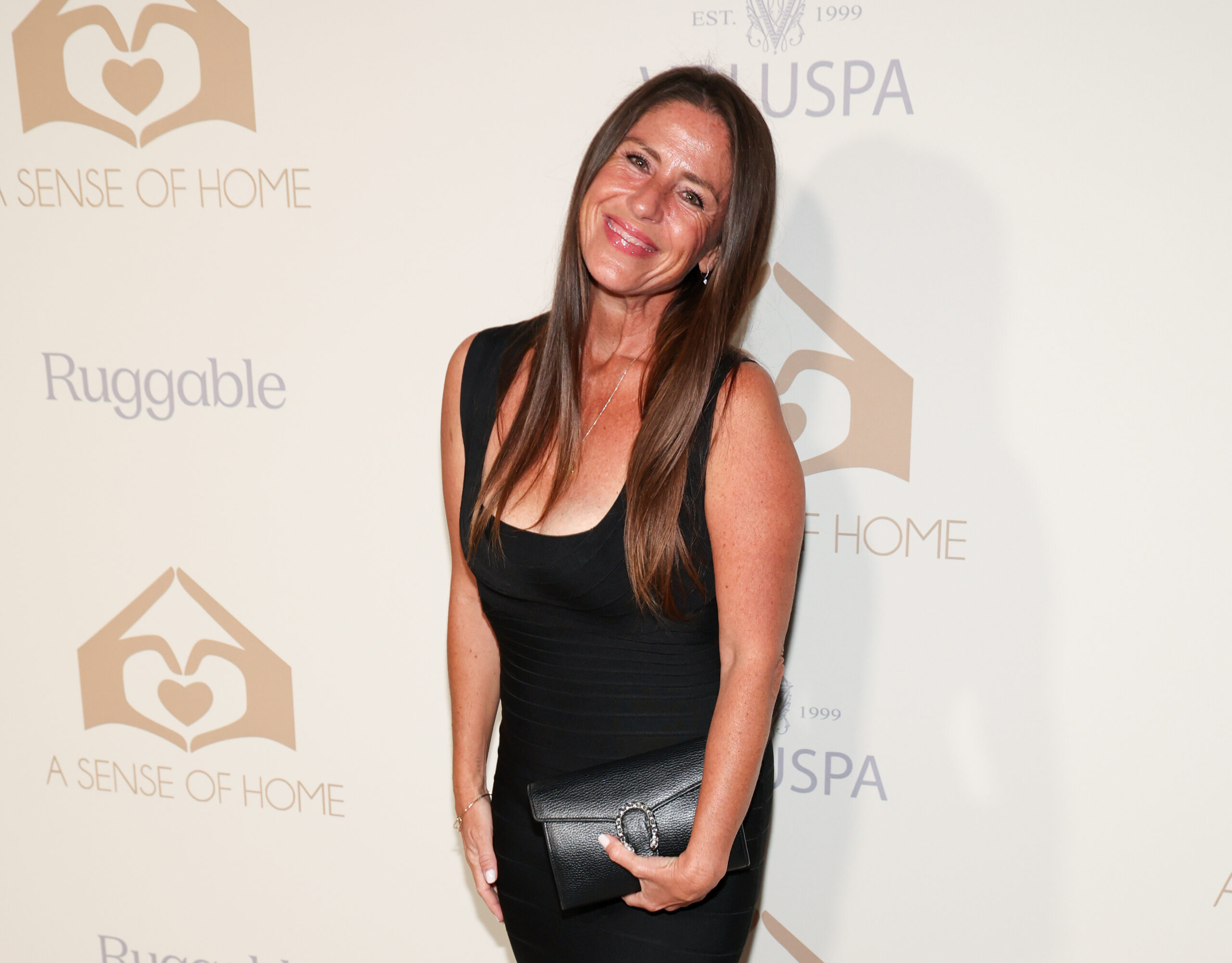
Actor, director, producer and screenwriter, Soleil Moon Frye turns 50…
Retired founding partner of the Jaffe Family Law Group, Daniel J. Jaffe turns 89… Esports executive and casino owner, he is a three-time bracelet winner at the World Series of Poker, Lyle Berman turns 85… Professor emerita and former dean at Bar Ilan University, Malka Elisheva Schaps turns 78… Film director, television director, producer and screenwriter, Brian Michael Levant turns 74… Austrian businessman with many U.S., Israeli and Eastern European investments, Martin Schlaff turns 73… Former state treasurer of Virginia and then state secretary of finance, she is now a gourmet popcorn manufacturer, Jody Moses Wagner turns 71… Professor of public diplomacy at The Fletcher School of Tufts University, she was formerly undersecretary of state for public diplomacy, Tara D. Sonenshine turns 67… Professor of psychiatry and behavioral sciences at The George Washington University Medical Center, Alan J. Lipman, Ph.D. turns 66… Israeli diplomat, he served as Israel’s consul general in NYC between 2000 and 2004, Alon Pinkas turns 65… NASA astronaut who spent 198 days on the International Space Station, he brought 18 bagels from his family’s bagel store in Montreal into space, Gregory Chamitoff turns 64… Chair of White & Case’s white collar practice group, Joel M. Cohen… Executive director of public affairs and policy communications at the American Council on Education, Jonathan Riskind… CEO of Elluminate (formerly known as the Jewish Women’s Foundation of New York), Melanie Roth Gorelick… Vice chair of Jewish California and a board member of JFNA and JCRC Bay Area, Susie Sorkin… Television and radio sports anchor on ESPN and ABC, he was one-half of the “Mike & Mike” team but now hosts his own ESPN morning program, Mike Greenberg turns 59… Chief economist at The Burning Glass Institute, Gad Levanon, Ph.D…. Law professor and associate dean at Michigan State University College of Law, David Blankfein-Tabachnick turns 55… Former boxing commentator and co-host of ESPN’s “This Just In,” Yiddish speaking Max Kellerman turns 53… Co-founder and former CEO of Uber, Travis Kalanick turns 50… Founder and CEO at Climb Together which helps prepare people from low-income backgrounds for entry level jobs, Nitzan Pelman… Screenwriter and television producer, he is best known for creating and executive producing the Fox teen drama “The O.C.,” Joshua Ian Schwartz turns 50… Former comms director for Zohran Mamdani’s New York City mayoral general election campaign, Jeffrey Lerner… Creative director and visual strategist, Rachel Gogel… Member of the New York State Assembly, Simcha Eichenstein turns 43… Winner of two gold medals in swimming at the 2008 Summer Olympics in Beijing, he is now CEO of Gather Campgrounds north of Austin, Garrett Weber-Gale turns 41… Director of strategy and policy at K2 Space Corporation, he is also a non-resident senior fellow at the Atlantic Council, Corey A. Jacobson… Reporter at San Antonio Express-News, Elizabeth Teitz… Special advisor at the Department of Homeland Security and former student at Marjory Stoneman Douglas High School, Hunter Pollack turns 29…
Several Jewish Democrats in the battleground state are now indicating that they will break with a party they have long called home and instead vote for the Republican nominee, Mike Rogers, in the November election
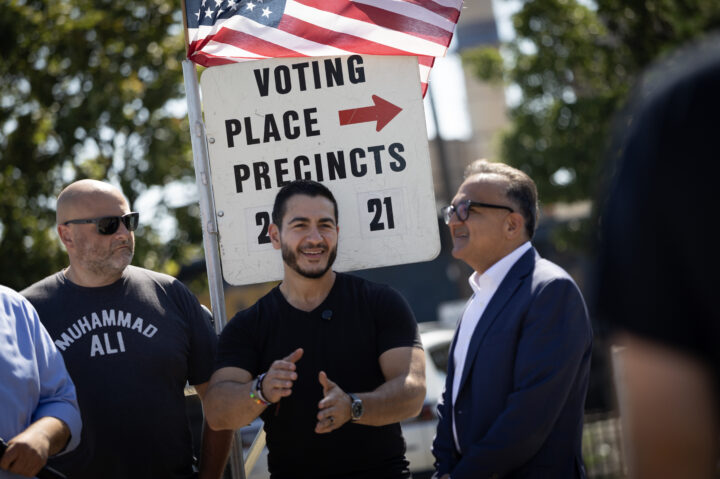
Scott Olson/Getty Images
Democratic candidate for U.S. Senate in Michigan Abdul El-Sayed visits a polling place as residents cast their votes on August 04, 2026 in Dearborn, Michigan.
Abdul El-Sayed’s narrow victory over Rep. Haley Stevens (D-MI) in Michigan’s bruising Democratic Senate primary on Tuesday is forcing many Jewish leaders in the state to confront an uncomfortable decision as they now look ahead to the general election in November.
Several Jewish Democrats in the battleground state are now indicating that they will break with a party they have long called home and instead vote for the Republican nominee, Mike Rogers, in the November election, citing their continued alarm over El-Sayed’s hostile rhetoric toward Israel as well as remarks they have interpreted as indifferent to rising antisemitism, among other concerns.
“I can’t vote for El-Sayed,” Michael Horowitz, a Jewish community leader and Detroit businessman who supported Stevens, a pro-Israel moderate, told Jewish Insider. “So many things I find despicable about him, not the least of which is his close association with Hasan Piker,” the antisemitic Twitch streamer, who Horowitz said “demeans America, demeans Jews and demeans all but the most radical among us.”
Horowitz confirmed he was now “leaning strongly to Rogers,” a former congressman who narrowly lost in his bid for Senate last cycle. “And I have heard from many in the Jewish community who say they will be supporting Rogers,” he said on Wednesday.
Hannan Lis, a Democratic fundraiser and Jewish leader who splits his time between Michigan and Israel, was among those who had told JI before the primary that he would vote for Rogers in the general election if El-Sayed won the nomination, noting he knows “many” Jewish Democrats who plan to do the same.
His reservations about Republicans preserving their Senate majority by picking up the Michigan seat held by retiring Sen. Gary Peters (D-MI), he clarified, were superseded by his objections to El-Sayed’s stances on Israel and responses to antisemitism. “El-Sayed is no Democrat,” he claimed.
Dennis Bernard, a Jewish leader in Michigan who backed both Rogers and Stevens in their respective primaries, said that the “word is out on a few Rogers fundraisers targeting historical Jewish Dems,” efforts that he described as “co-led” with Jewish Democratic donors.
“Candidly,” he added, “the only area that may not jump on Rogers is the highly progressive Ann Arbor community,” which he called “very small.”
Bernard, national chair of government relations at the Jewish Federations of North America, told JI that it would likely take a few more days for such events to materialize as donors now “settle down and organize” in the wake of the primary. “Everyone is jumping in,” he said.
One Democratic fundraiser in Michigan, who spoke on the condition of anonymity to address a sensitive subject, said he was “absolutely certain” that “several large Jewish Dem donors” will be supporting Rogers.
“I would guarantee there will be fundraisers for him hosted by high-profile Jewish Dems,” he told JI.
The fundraiser, who backed Stevens, said that hours after the race had been called on Wednesday he was “already contacted by Rogers surrogates” seeking to make inroads with Jewish Democrats whose support could prove consequential in what is expected to be a close race.
The surrogates’ pitch, as he put it: “Essentially that as Jews, we need to put our communal well-being ahead of the party.”
It remains to be seen whether the depth of Jewish Democrats’ fears of electing El-Sayed will ultimately translate to a meaningful boost for Rogers’ bid amid a national political environment that is less favorable to Republicans.
Still, Rogers and his supporters have said they are eager to court Jewish Democrats alienated by their party as support for Israel has emerged as a litmus test on the far left — particularly in Michigan, where Jewish Democratic leaders have recently voiced fears of antisemitic harassment from anti-Israel activists in the state.
Alyssa Brouillet, a spokesperson for Rogers, told JI on Sunday that his campaign was “beginning to see more and more Jewish Democrats coming to us who feel abandoned by their party.”
“Mike Rogers stands with the Jewish community in Michigan and across the country,” she said, “and he will continue fighting to make life better for working families all across the state.”
In a video ad posted to social media on Wednesday, Rogers highlighted his opponent’s close ties to Piker, featuring past comments in which the streamer said “America deserved 9/11,” among other controversial remarks that have faced scrutiny. “You are who your friends are, and Abdul El-Sayed’s are radical leftists who hate America,” Rogers wrote.
The Republican Jewish Coalition called El-Sayed “a direct threat to Michigan’s Jewish community” in a statement on Wednesday that urged Jewish voters in the state to get behind Rogers in the general election.
“To our friends in Michigan’s Jewish community, including the tens of thousands who have voted Democrat their entire adult lives and now find themselves politically homeless: this is the moment for real change and action,” said Matt Brooks, the RJC’s CEO. “There are more than 100,000 Jewish voters in the Wolverine State. We are not a rounding error, we are the decisive margin. Mike Rogers has earned your vote.”
Even as El-Sayed quickly won backing on Wednesday from national Democratic leaders hoping to unite the party for a must-win election, the Jewish Democratic Council of America stopped short of an endorsement, underscoring the extent to which the divisive primary has left some Jewish leaders rudderless after Stevens’ defeat.
“While we are disappointed in the final result of the Michigan Senate race, the razor-thin margin isn’t the resounding win for the far-left that was predicted,” said Halie Soifer, the JDCA’s CEO. “We are proud of the race run by Rep. Haley Stevens, and we thank her for her consistent and principled leadership standing with Jewish Americans. We congratulate Dr. Abdul El-Sayed on his victory after a difficult and divisive primary.”
Several nonpartisan Jewish groups, including the Anti-Defamation League and the American Jewish Committee, released statements on Wednesday condemning El-Sayed.
Deryn Sousa, a spokesperson for AIPAC, whose super PAC invested over $30 million on an aggressive effort to boost Stevens, said in a statement that the group’s “members remain determined to ensure that voters reject Dr. El-Sayed and his radical anti-Israel agenda in November,” indicating it intends to back Rogers in the general election.
AIPAC’s super PAC, United Democracy Project, did not return a request for comment, but sources told JI the group was all but certain to support Rogers, who was recognized as a pro-Israel hawk while serving in the House from 2001 to 2015.
For his part, El-Sayed, who made his opposition to AIPAC a central feature of his campaign messaging, sought to ease tensions with skeptical Jewish voters on Wednesday, addressing what he called “an issue that has been focused on in this race.”
“To all of my sisters and brothers of the Jewish faith,” he said in his televised remarks, “I want you to know that my commitment to your safety, my commitment to Jewish safety, is the same commitment that I have to the safety of my own daughters.”
But many Jewish leaders in the state suggested that they would be unmoved by such appeals — especially as El-Sayed has continued to use incendiary rhetoric while discussing Israel. In an interview on MS NOW’s “Morning Joe” on Wednesday morning, for instance, he doubled down on his criticism of Israel, calling the Jewish state “bloodthirsty” while saying his critiques go beyond the government led by Israeli Prime Minister Benjamin Netanyahu.
His comments faced criticism from Democratic Majority for Israel, which said “El-Sayed should be working to build a bigger tent and earn the trust of Jewish Michiganders” but was instead invoking “an age-old antisemitic trope that is especially dangerous amid rising violence against Jews.”
Asher Lopatin, a rabbi who serves as director of community relations at the Jewish Federation of Greater Ann Arbor and endorsed Stevens, told JI he has “heard from several people who say that they will campaign for Rogers and support him and tell others to vote for him.”
“I have not spent a lot of time looking into his positions,” Lopatin added, “but I can say clearly that I will not be voting for Abdul El-Sayed and I wish more Democrats would come out and say they will not be voting for him.”
Some Jewish Democrats in the state have confirmed privately that while they cannot bring themselves to vote for Rogers, they will leave their ballots blank or write in another candidate due to their reservations about El-Sayed.
Despite widespread objections to El-Sayed within Michigan’s mainstream Jewish community, others suggested that their loyalty to the Democratic Party outweighed those concerns. “I know Jewish Dems who will vote for Rogers,” Richard Lenter, a Jewish community activist in Detroit, told JI. “I am leaning toward voting for El-Sayed while holding my nose.”
Michigan state Rep. Noah Arbit, a Jewish Democrat who has been outspoken against antisemitism in his party, declined to confirm whether he would vote for El-Sayed, even as he expressed strong concerns about past comments in which the candidate has dismissed Zionists as “illiberal” and refused to recognize Israel’s right to exist as a Jewish state.
“Abdul’s rhetoric has been alarming and dangerous for my community,” Arbit, whose district in suburban Detroit includes a sizable Jewish constituency, said in a message posted to Facebook Wednesday morning. “There is a profound need for him to come to the table and attempt to repair the harm he has caused, to see what semblance of trust and confidence may be built.”
Other centrist Senate Democrats also sounded reticent about embracing their Michigan Senate nominee
Tom Williams/CQ-Roll Call, Inc via Getty Images
Rep. Hillary Scholten (D-MI) speaks during a news conference outside the U.S. Capitol on March 26, 2026.
Rep. Hillary Scholten (D-MI), a moderate Michigan lawmaker representing a swing district, broke with most other Democratic members of the Michigan congressional delegation in declining to offer an explicit endorsement of Democratic Senate nominee Abdul El-Sayed as of Wednesday afternoon, after offering strident criticism of him during the primary campaign.
“Congratulations to everyone who participated in Michigan’s hard-fought primary elections last night, and thank you to every voter who made your voice heard. In these close elections, we want you to know — you are HEARD,” Scholten said in a statement that did not mention El-Sayed. “Now our focus turns forward. I’ve always said I’ll work with anyone committed to lowering costs, expanding affordable health care, creating more opportunity, and fighting corruption. I mean that.”
A Scholten spokesperson did not respond to a request for clarification on whether this constituted an endorsement of El-Sayed.
Scholten said that she is a “proud, commonsense Democrat” and said that she’s focused on helping to elect “similar candidates around the country.”
During the campaign, as a vocal supporter of Rep. Haley Stevens (D-MI), Scholten suggested she might struggle to support El-Sayed in the general election.
“I will not stand beside someone who has allowed distinctly anti-American sentiment to enter our public dialogue,” she said in one interview.
In another, she criticized El-Sayed for campaigning with antisemitic and anti-Israel influencer Hasan Piker.
“To campaign with Hasan Piker, who said America deserved Sept. 11 — sure, he went on to disavow those comments, but I’m telling you, nobody on my team would ever, you know, come even close to making a comment like that,” she said. “I think that condoning behavior like this from candidates like Abdul El-Sayed is taking us in a direction that we don’t want to go as a party.”
Other Democratic moderates, with the exception of maverick Sen. John Fetterman (D-PA), are largely keeping their heads down following the election, with several contacted by JI declining to comment or not responding to requests.
Other Democrats are backing El-Sayed.
“He worked hard. People in Michigan had their word last night, and I imagine he’s going to work really hard over the next 90 days to win this race, and it’s obviously a critical one,” Sen. Mark Kelly (D-AZ) said. “If we’re going to fix some of the problems created by this president, we’ve got to win back the Senate.”
Asked whether he believes the narrow margin of victory for El-Sayed might imperil his chances in November, Sen. Gary Peters (D-MI), who had supported Stevens in the primary, offered a short response: “Yeah, he could win. Definitely.”
Sen. Chris Coons (D-DE) said he hasn’t met El-Sayed but noted that Stevens had endorsed him and “my sense is that whatever divisiveness there might have been because of the primary, they’re … past it.”
Sen. Richard Blumenthal (D-CT) declined to comment on El-Sayed’s history or his decision to campaign with Piker, and said that he doesn’t think “generalizations are possible from one race” about the direction of the party, “whether it’s in Brooklyn or Michigan.”
The mayor lauded the Democratic Senate nominee while downplaying his weak performance among working-class voters
Michael M. Santiago/Getty Images
New York City Mayor Zohran Mamdani speaks during a primary-night watch party for NYC congressional candidate Claire Valdez on June 23, 2026.
New York City Mayor Zohran Mamdani refused to close the door on a trip to Michigan to campaign for newly minted Democratic Senate nominee Abdul El-Sayed, whom Mamdani praised for what he described as a focus on “the concerns of working-class Americans” — even as he tried to explain away El-Sayed’s poor performance in the areas where working-class voters live.
The mayor extended his congratulations from Manhattan to the Wolverine State, lauding in particular El-Sayed’s slogan of “money out of politics, money in your pocket, Medicare for all.” Unlike fellow democratic socialist Rep. Alexandria Ocasio-Cortez (D-NY), Mamdani did not travel to Michigan during the primary to support El-Sayed, but left open the possibility he would visit before the general election.
“My focus thus far has been on New York City. And what I will tell you is I know that many New Yorkers were incredibly excited at the results,” Mamdani, speaking after an unrelated event, said in answer to a question of whether he would consider making the trip. Asked whether he would completely rule out such a campaign jaunt, he answered: “I’m here right now.”
Mamdani answered in the affirmative when asked whether El-Sayed was the kind of candidate he hoped to see change the Democratic Party. Meanwhile, he stayed clear of the issue that fueled their most fervent support online: Israel.
“I am proud to be part of a movement of politicians and candidates who are looking to put working-class Americans back at the heart of our politics,” the mayor said. “And that’s our focus here in New York City, and just from what we’re seeing in Michigan, that’s what Michiganders want … to be their focus come November.”
Yet the mayor struggled to answer why, like his own map in the 2025 primary against former Gov. Andrew Cuomo, the results from Tuesday night showed El-Sayed performing poorly among the lower-income voters whose interests he purportedly championed. El-Sayed’s strongest precincts, like Mamdani’s, were home to many college students and well-compensated professionals.
Mamdani suggested those voters had been duped by ad campaigns.
“When you are facing $60 million in outside spending, you are facing almost what feels like surround sound,” he said. “People are hearing a message about you again and again and again. And to win this race as someone who is not currently holding elected office, it’s a testament to what he ran on, and also to the way he ran the campaign.”
AIPAC indicated it intends to remain engaged in the race, while the Anti-Defamation League raised concerns about El-Sayed’s rhetoric and the acceptance of it
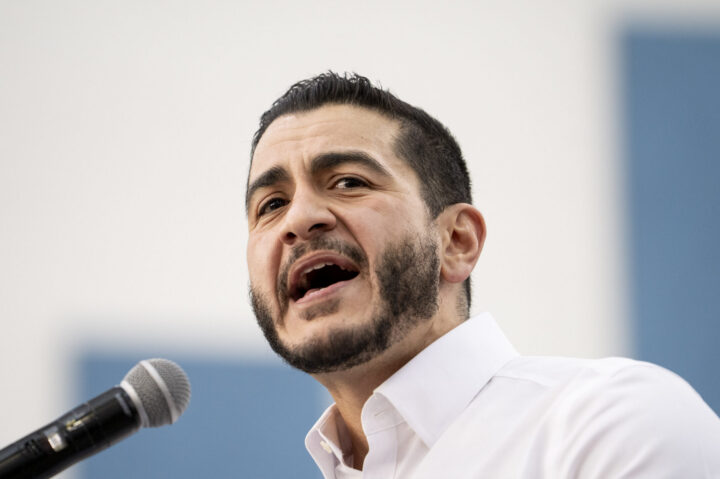
Sarah Rice/Getty Images
Abdul El-Sayed, candidate for US Senate in Michigan, speaks at Mumford High School on May 3, 2026 in Detroit, Michigan.
Jewish groups expressed concern on Wednesday about the victory of Abdul El-Sayed in the Democratic primary for U.S. Senate in Michigan, highlighting his extreme rhetoric on Israel and the broader rise of the far left.
Jewish Democratic Council of America CEO Halie Soifer said in a statement that the group was “disappointed” by the results of the primary, where the group had endorsed and campaigned strongly for Rep. Haley Stevens (D-MI). She congratulated but stopped short of endorsing El-Sayed.
“While we are disappointed in the final result of the Michigan Senate race, the razor-thin margin isn’t the resounding win for the far-left that was predicted,” Soifer said. “We are proud of the race run by Rep. Haley Stevens, and we thank her for her consistent and principled leadership standing with Jewish Americans. We congratulate Dr. Abdul El-Sayed on his victory after a difficult and divisive primary.”
Soifer also highlighted that “mainstream Democrats, including many of the candidates JDCA has endorsed, remain the key to winning back control of Congress” and emphasized that Rep. Wesley Bell (D-MO) and Michigan state Sen. Jeremy Moss “overwhelmingly defeated challengers on the far-left.”
AIPAC, while declining to preview specific plans, indicated it intends to stay engaged in the Michigan race through November.
“Our members remain determined to ensure that voters reject Dr. El-Sayed and his radical anti-Israel agenda in November,” spokesperson Deryn Sousa told Jewish Insider.
In a letter to members, AIPAC President Bernie Kaminetsky said that the group will continue to “stand up for what is right, ensure pro-Israel voices are loudly heard in Congress, and fight even harder to ensure the U.S.-Israel alliance grows stronger.”
“In Abdul El-Sayed, a fiercely anti-Israel candidate has emerged as the Democratic nominee. His statements about Israel, AIPAC, and the Jewish community are outrageous and offensive, and his ascent is part of a much larger, profoundly worrying trend we are closely tracking,” Kaminetsky added, praising Stevens and her support for Israel. “This narrow loss stings, but [Stevens’] defeat doesn’t change our principled opposition to the dangerous policies El-Sayed wants to bring to the U.S. Senate.”
Tacitly acknowledging setbacks across the political map, Kaminetsky emphasized, “Our conviction will not be measured in a single race or a single cycle. This is a generational fight, and we remain undeterred in our mission. Our political fight is not just about strengthening America’s partnership with Israel. It is also about the future of America and our individual rights to engage in our democracy.”
In a rare statement on campaign politics, Anti-Defamation League CEO Jonathan Greenblatt also highlighted the group’s concerns about El-Sayed’s rhetoric.
“Throughout the campaign, ADL has called out nominee Abdul El-Sayed for peddling in antisemitic tropes … or for campaigning with notorious bigot Hasan Piker,” Greenblatt said in a video statement. “Campaign trail rhetoric and actions send clear signals about what a person believes and what a political party thinks is permissible.”
“We are not going to stop, and we will keep calling on political leaders and candidates from both parties to reject antisemitism and to commit to combating it whenever and wherever it occurs,” Greenblatt continued.
ADL Michigan regional director Elyssa Schmier said in her own statement that “Jews across Michigan and the country are alarmed by the rhetoric that defined this race and its implications for the future of political norms in our country.”
Calling out a series of specific comments by El-Sayed, without naming him directly, Schmier said that “anyone seeking public office should know better than to normalize antisemitic tropes” and that “we are calling on political leaders to reject antisemitism outright and demand better.”
The American Jewish Committee, which also rarely comments on electoral politics, likewise issued a statement strongly condemning El-Sayed.
The group called his victory “a deeply troubling reflection of the growing mainstreaming of divisive rhetoric and exclusionary politics in America. At the same time, Congresswoman Stevens’ strong showing demonstrates that there is still a place and support for nuanced, moderate voices,” it continued.
“We are concerned by El-Sayed’s framing of American politics as a zero-sum game that too often casts those who disagree as the enemy,” the statement continued, accusing him of “delegitimiz[ing]” those who disagree with him, an “approach [that] is fundamentally at odds with the principles of civility, pluralism, and robust democratic debate that are central to our democracy.”
The group also condemned El-Sayed’s past comments on Israel and its supporters and said that “most Americans agree that political rhetoric of this nature has gone too far,” calling for voters“to reject extremist rhetoric from all candidates — no matter their party — that perpetuate this divisive approach.”
The group said it would continue efforts to engage leaders around the country “who seek to reclaim American politics from the extremes.”
In a separate statement, AJC CEO Ted Deutch said that he saw during his time as a member of Congress “that when leaders treat those who disagree with them as enemies, the communities they represent feel the consequences” and emphasized “AJC’s work to reject extremist politics.”
Democratic Majority for Israel also criticized El-Sayed after his primary win for calling Israel “bloodthirsty” in a Wednesday morning interview.
“El-Sayed should be working to build a bigger tent and earn the trust of Jewish Michiganders. Instead, this morning he described the government of the world’s only Jewish state as ‘bloodthirsty’ — an age-old antisemitic trope that is especially dangerous amid rising violence against Jews,” the group said. “His language is inflammatory. He should retract it and apologize.”
The Republican Jewish Coalition said that Michigan’s 100,000 Jewish voters could make the difference in the battleground race if they choose to back GOP nominee Mike Rogers
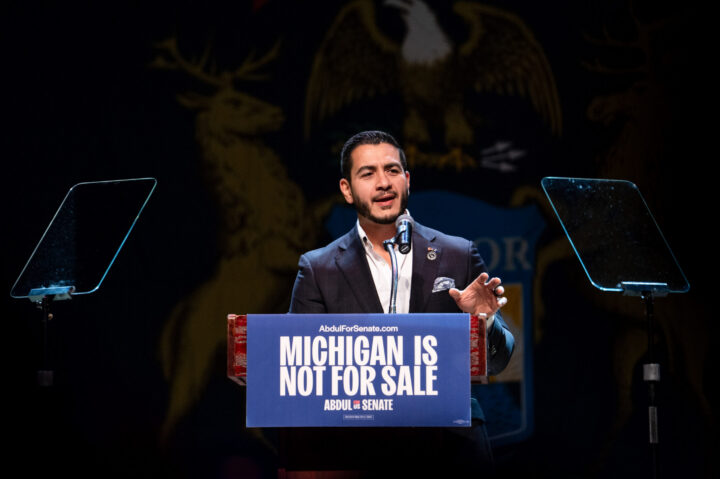
Sarah Rice/Bloomberg via Getty Images
Abdul El-Sayed speaks during a primary election night watch party at The Majestic Theatre in Detroit, Michigan early on Aug. 5, 2026.
Democrats are quickly coalescing behind Senate nominee Abdul El-Sayed after the far-left candidate narrowly clinched victory in Michigan’s Democratic primary on Wednesday morning, while Republicans quickly pounced on El-Sayed’s extremist history and ties.
Rep. Haley Stevens (D-MI), who came within a percentage point of defeating El-Sayed, promptly congratulated him on his victory and offered her support.
“I want to congratulate Abdul El-Sayed on winning the Democratic nomination for U.S. Senate. He is a doctor, a community health official, a Rhodes Scholar, and a dedicated Michigander. I am proud to offer my support as he takes on Mike Rogers in the general election,” Stevens said. “This was a thorough and rigorous campaign that brought out the full span of views within the Democratic Party — and that is why we have primaries.”
She emphasized the need for Democrats to come together in support of El-Sayed, saying, “We must elect Democrats up and down the ballot. We need to flip some important House seats. We need to re-elect my friends Hillary Scholten and Kristen McDonald Rivet. We need to win this Senate seat, because Elissa Slotkin deserves a partner like Abdul in the U.S. Senate.”
Senate Minority Leader Chuck Schumer (D-NY) and Democratic Senatorial Campaign Committee Chair Sen. Kirsten Gillibrand (D-NY) also offered support for El-Sayed in a statement.
“Abdul El-Sayed has run an energetic campaign that inspired thousands of Michiganders across the state, with a clear focus on lowering costs and standing up for working families,” the pair said. “Democrats are united by a common purpose: putting a check on Donald Trump by defeating his Republican enablers and taking back the Senate. We look forward to working with Abdul and Democrats across Michigan to win this seat in November.”
Retiring Sen. Gary Peters (D-MI), who had initially planned to stay out of the race but ultimately endorsed Stevens, said that the party must come together behind El-Sayed to block Rogers.
“Both candidates ran strong campaigns focused on improving the lives of all Michiganders. But now it’s time to come together as a party and rally around our nominee, Abdul El-Sayed, to make sure Mike Rogers never sees the floor of the U.S. Senate,” Peters said. “I’ve repeatedly said that I will support our nominee because the most important election is in November.”
Sen. Elissa Slotkin (D-MI), who declined to endorse El-Sayed in the primary, offered her support while also saying little about El-Sayed personally and focusing on the need to keep the seat in Democratic hands.
“Congratulations to @AbdulElSayed for winning the Democratic nomination for Senate. It’s been a long primary, but now it’s time to gear up to beat Mike Rogers (again) and win up and down the ticket,” Slotkin said. “There is nothing more important than the mission of the next 90 days: uniting, keeping this seat blue, flipping the House and Senate, and providing a real check on President Trump.”
Meanwhile, Republicans have quickly pounced on El-Sayed, highlighting his extreme history.
“Abdul isn’t just another liberal. He’s an extremist. He wants to empty prisons and put murderers and sex offenders back on our streets. He pledged his support to the Muslim Brotherhood and campaigns with people who refuse to condemn terrorism,” Republican nominee former Rep. Mike Rogers (R-MI) said. “I spent years hunting terrorists and bringing Osama bin Laden to justice. Never in a million years did I think that I would be running against someone who believes America deserved 9/11.” His comment was apparently a reference to El-Sayed’s ties to far-left streamer Hasan Piker, who championed El-Sayed in the primary.
Matt Brooks, CEO of the Republican Jewish Coalition, declared in a statement that El-Sayed is the “most antisemitic U.S. Senate candidate in America” and called on Jewish Democrats, who he said could prove “decisive” in the November general election, to back Rogers.
“Abdul El-Sayed is a direct threat to Michigan’s Jewish community,” Brooks said. “El-Sayed has called the government of the Jewish state as ‘evil’ as Hamas, ‘struggled’ to say that Israel has a right to exist as a Jewish state, and empathized with a terrorist who tried to murder Jewish schoolchildren at Temple Israel in the Detroit suburbs — and yet, Michigan Democrats just picked him as their nominee for the United States Senate.”
The Senate Leadership Fund, a super PAC aligned with Senate GOP leadership, announced a six-figure digital ad campaign describing El-Sayed as “dangerous.”
Plus, Dara Horn's provocative new title

Michael B. Thomas/Getty Images)
St. Louis County Prosecutor Wesley Bell gives remarks during the Ferguson mayoral inauguration ceremony for Ella James at the Urban League Empowerment Center on June 17, 2020 in Ferguson, Missouri.
Good Wednesday morning.
In today’s Daily Kickoff, we cover the results so far of yesterday’s key primary races in Michigan and Missouri and speak to experts about concerns over the U.S.’ dwindling stockpiles of long‑range missiles and air-defense interceptors. We talk to lawmakers about their views on the U.S.-led Board of Peace’s Hamas disarmament framework and report on plans by Democrats on the Senate Judiciary Committee’s Federal Courts subcommittee to boycott a hearing today set to examine Muslim Brotherhood networks in the U.S. Also in today’s Daily Kickoff: Omer Shem Tov, Dara Horn and Rabbi Yehuda Kaploun.
We also have a new on-demand Live Briefing that you can access throughout the day via our new app (on Apple and Android) and on our website.
Today’s Daily Kickoff was curated by JI Executive Editor Melissa Weiss and Israel Editor Tamara Zieve, with an assist from Danielle Cohen-Kanik. Have a tip? Email us here.
What We’re Watching
- In one of the first primary races to be called last night, Rep. Wesley Bell (D-MO) soundly defeated Cori Bush as the far-left former congresswoman attempted to reclaim her St. Louis-area seat two years after she was ousted.
- Abdul El-Sayed holds a narrow lead in the Michigan Senate primary against Rep. Haley Stevens (D-MI), with results expected to be called later today.
- Meanwhile, Rep. Shri Thanedar (D-MI), seen as a reliable pro-Israel ally, is trailing against DSA-aligned challenger state Rep. Donavan McKinney, who ran on an anti-Israel platform.
- And in the battleground Michigan 7th District, left-wing activist William Lawrence prevailed with a plurality of the vote, largely because of a split between his two moderate challengers. More below.
- The U.S. is hoping to announce a deal with Iran and Oman over the Strait of Hormuz on Wednesday, Axios reports, which would see Tehran gain greater control over the key waterway than it had before the war. No fees or tolls could be charged under the 60-day temporary agreement, but inbound traffic would be required to transit through Iranian territorial waters.
- On the Hill this afternoon, the Senate Foreign Relations Committee is holding a classified briefing on the situation in Sudan.
- Jordan is convening foreign ministers from Muslim countries today to formulate a plan to combat what Amman said were “escalatory and illegitimate Israeli measures that target the identity of Jerusalem and its Islamic and Christian sanctuaries.”
What You Should Know
A QUICK WORD WITH JI’S JOSH KRAUSHAAR
Rumors of the demise of the mainstream, pro-Israel wing of the Democratic Party turned out to be somewhat exaggerated: The Michigan Senate race between Rep. Haley Stevens (D-MI) and Abdul El-Sayed is a lot closer than polls suggested, while Rep. Wesley Bell (D-MO) romped to victory over his anti-Israel opponent, with the help of pro-Israel, Jewish supporters.
Bell’s sweeping 22-point victory in a rematch over former Rep. Cori Bush (D-MO) was an early election night highlight for Jewish and pro-Israel groups, which poured money and organizing efforts into ensuring the virulently anti-Israel Bush didn’t get a chance to return to Congress. AIPAC’s super PAC spent over $3 million on ads attacking Bush as corrupt and extreme, resources which likely played a key role in Bell’s landslide margin.
There were some other silver linings for the moderate side of the Democratic Party on Tuesday night: Michigan state Sen. Jeremy Moss won comfortably to succeed Stevens despite facing attacks over his pro-Israel record from his opponents. And Rep. Adam Smith (D-WA), the moderate ranking member of the House Armed Services Committee who faced harassment and threats over his longstanding pro-Israel record, won a clear majority of the vote against far-left challengers in Washington state’s all-party primary.
But there were plenty of warning signs about the changing ideological direction of the Democratic Party, as we’ve previously seen in deep-blue congressional districts across the country. Despite Stevens’ closer-than-expected showing, she still trails El-Sayed even after winning endorsements from top Democratic officials (including Gov. Gretchen Whitmer) and being the beneficiary of tens of millions in outside spending led by AIPAC’s ad blitz.
The results paint a picture of a Democratic Party deeply divided, with older voters, Black voters and Jewish voters forming the centrist coalition, which is facing an insurgency from the left made up of younger voters, white progressives and Arab Americans.
MISSILE MATH

Experts are warning that the United States’ dwindling stockpiles of long‑range missiles and air-defense interceptors following the war with Iran could complicate Washington’s ability to deter adversarial aggression and maintain military readiness in other theaters, Jewish Insider’s Matthew Shea reports. Reuters first reported that the U.S. has expended much of its inventory of highly accurate long‑range missiles during the conflict, while significantly drawing down stocks of Patriot and Terminal High Altitude Area Defense (THAAD) interceptors used to defend against ballistic missile attacks.
State of stockpiles: “The United States has a longstanding defense industrial crisis, whether it’s in munitions, missiles, shipbuilding or other areas,” Alexander Gray, who served as chief of staff on the National Security Council during President Donald Trump’s first administration, told JI. “It has constrained the ability to replenish our war fighters but also to make sure our partners and allies get what they need. Sustained operations against Iran are showing just how challenging this industrial base capacity problem is.”
DEAL IN DOUBT
U.S. lawmakers expressed deep skepticism on Tuesday over the Board of Peace’s newly announced Hamas disarmament framework, pointing to violations already taking place in Gaza and a lack of indications that Hamas is serious about honoring a deal as evidence that the ambitious peace proposal faces near-insurmountable hurdles, Jewish Insider’s Matthew Shea and Marc Rod report.
“There will be no real peace for Gaza or Israel as long as Hamas has weapons and is allowed to ruthlessly rule over innocent Palestinians,” Rep. Josh Gottheimer (D-NJ) told JI. “I’m cautiously encouraged by this plan, but let’s not kid ourselves — Hamas has a long record of lying, and they’ve broken their word before, over and over. I’ll be watching every step of this until Hamas is fully disarmed.” Sen. Mike Rounds (R-SD) told JI, “I suspect that while this may have good intentions to it, I’ll believe it when I actually see it happening.”
Read the full story here with additional comments from Sen. Richard Blumenthal (D-CT) and John Kennedy (R-LA).
Israeli response: Israeli Prime Minister Benjamin Netanyahu affirmed on Tuesday that the IDF will “not withdraw from the current lines in Gaza until Hamas is completely disarmed.” President Donald Trump “thinks, and his team thinks, that Hamas can be totally disarmed and Gaza demilitarized. We’re looking into it,” Netanyahu continued in a video posted to Facebook in Hebrew. “They sent us a draft, we didn’t agree. It wasn’t our draft. We sent our responses.”
HEARING HAVOC
Democrats on the Senate Judiciary Committee’s Federal Courts subcommittee said on Tuesday that they plan to boycott a subcommittee hearing on Wednesday set to examine Muslim Brotherhood networks in the United States. The Democrats — Sens. Sheldon Whitehouse (D-RI), Richard Blumenthal (D-CT), Mazie Hirono (D-HI), Alex Padilla (D-CA) and Peter Welch (D-VT) — dismissed the hearing as an effort to attack Muslims broadly, Jewish Insider’s Marc Rod reports.
What they said: “Scapegoating Muslims may be a Texas Republican strategist’s idea of ‘solid gold’ to whip up their voters, but Democrats have no intention of indulging this political creepshow, particularly after the recent violence targeting places of faith,” the lawmakers said in a statement. “Our focus is the costs families face thanks to rampant, non-stop Trump corruption.”
DIGITAL FOOTPRINT
A Florida man accused of hurling a brick through the front window of a Sarasota Chabad House shared New York City Mayor Zohran Mamdani’s video labeling Israeli Prime Minister Benjamin Netanyahu a “war criminal” just days before the crime, Jewish Insider’s Will Bredderman reports.
Details: Local police arrested 30-year-old Brayton Laschinger on July 31 and charged him with felony criminal mischief for the attack two days prior on the Lubavitch Chabad of Downtown SRQ. The Sarasota Police Department stated that Laschinger had admitted to targeting the synagogue “because it was a Jewish place of worship” — and had blamed “propaganda on social media” for enraging him in the hours before the vandalism.
HORNS AND HATE
A campaign poster circulating among Colorado Republicans depicts Colorado Attorney General Phil Weiser, who is Jewish and whose family members are Holocaust survivors, with devil horns, which critics say invokes a classic antisemitic trope, Jewish Insider’s Marc Rod reports. Weiser is the Democratic nominee for governor of Colorado.
Background: The poster promotes, but was not created by, Victor Marx, the GOP gubernatorial nominee, who has a bizarre and extremist history, including claiming to have killed and exorcised several people. It describes Weiser, depicted in front of a menacing background, as “the next threat to Colorado” and “radical,” “extreme” and “dangerous.” Marx responded supportively to an X post by the image’s creator calling for unity among Colorado Republicans, which included a version of the devil horns image.
BOOKSHELF
If you thought People Love Dead Jews — Dara Horn’s 2021 essay collection examining society’s reverence for remembering deceased Jews while failing to support the living ones — was an awkward book to read in public, just wait until you get your hands on Horn’s newest title: The Final Solution to the Jewish Question. Horn is in on the joke; she likes to say that both titles make great beach reads because no one will dare sit within several feet of you, Jewish Insider’s Gabby Deutch reports.
Author’s intention: But despite borrowing its title from the name of the Nazis’ infamous plan to rid Europe of its 11 million Jews during World War II, Horn’s latest book, which will be published on Sept. 1, is not a Nazi manifesto. Instead, the title of Horn’s new book serves as an eye-catching, subversive dog whistle that is meant to pique the interest of antisemites — while also serving as a cheeky summary of Horn’s goal of actually trying to come up with a solution to the wave of antisemitism that has swept the world in recent years. “I am providing a solution. Not a solution in terms of, like, ‘Here’s 10 policy points we should implement,’” Horn told JI. “It’s, ‘Here’s the story we need to be telling about who we are, to ourselves and to everyone else,’ and this is the story that is going to inspire people to imagine a better future.”
Worthy Reads
The Subaru Socialists: In The New Yorker, Jay Caspian Kang writes that a rising bloc of young, college-educated and downwardly mobile Democrats — for whom the war in Gaza has become a defining political litmus test — is remaking the party in the image of far-left Democrats such as Zohran Mamdani, Abdul El-Sayed and Melat Kiros. “The future of the Democratic Party involves a synthesis of Subaru Socialism’s disillusionment with the American promise and the polarized, hard-line moralizing of Gen Z. Young voters aren’t the only angry ones, of course; older Democrats are still understandably furious at a party that lost to Donald Trump twice and seems to have done precious little to stand in his way during the past year and a half. But it’s younger voters who have begun to give a political form and shape to that reactionary anger.” [NewYorker]
The Trouble with the Tent: In The Spectator, Alex Castellanos warns of the dangers of the Democratic Party’s “Big Tent” policy. “The Big Tent is the party’s latest dance craze. They thought they’d found a clever dodge: a Democrat in a swing district could say he did not personally favor abolishing prisons or nationalizing large industries. His party simply contained many different opinions. But voters see something more frightening: the Big Tent is the Democratic party’s public invitation to socialism. It lays out a welcome mat for communism to enter the Democratic party’s home. Establishment Democrats know that such views have moved aggressively into their coalition, but they refuse to say they are disqualifying.” [Spectator]
Memorandum of Misunderstanding: Former Israeli Ambassador to the U.S. Michael Oren contends in his Substack, “Clarity,” that the Hamas disarmament deal is likely to go the way of the U.S.-Iran memorandum of understanding and become muddled in the parties’ different interpretations of their obligations. “The question is: Will Hamas really give up its guns? A closer reading of the agreement reveals that Hamas will not initially turn over its weapons but only put them in NCAG storage. Further ambiguity surrounds the definition of the word ‘weapons’ — whether it refers only to rockets and rocket-propelled grenades, as Hamas prefers, or to all small arms as well. Added to those uncertainties is the matter of reciprocity. … As in the case of Iran, an MOU can be open to widely divergent interpretations and radically altered circumstances. In the Gaza Strip, no less than in the Strait of Hormuz, an MOU may lead not to peace but to further upheaval.” [Substack]
Find more Worthy Reads in our Live Briefing via our new app (on Apple and Android) and website.
Word on the Street
State Department antisemitism envoy Rabbi Yehuda Kaploun criticized Canadian officials’ “muted” response to a series of recent antisemitic attacks around the country, suggesting that Ottawa put in place visa restrictions and terrorism listings to restrict entry to those who seek “to sow discord”…
Rep. Virginia Foxx (R-NC) blasted Stony Brook University over its failure to take action against a professor who has been involved in anti-Israel activism, including reportedly harassing and accosting patrons at a Long Island restaurant, Jewish Insider’s Marc Rod reports…
Harmeet Dhillon, the assistant attorney general for civil rights, urged pro-Israel college students to distinguish between protected speech and actionable discriminatory conduct — “people literally interfering with your ability to get an education” — when facing antisemitism on campus. Dhillon made the comments on Tuesday at the conclusion of the Israel on Campus Coalition’s National Leadership Summit in Washington, JI’s Haley Cohen reports…
Days before he was confirmed as director of national intelligence, Jay Clayton, who was still serving as U.S. attorney for the Southern District of New York, wrote a letter to the mother of slain Jewish teenager Ari Halberstam, who was killed in a 1994 terror attack targeting a bus of yeshiva students on the Brooklyn Bridge, saying that the office he was exiting was “prepared to pursue” any additional evidence in the case “to the fullest extent of the law”…
Pennsylvania Gov. Josh Shapiro makes an appearance alongside rapper Meek Mill in the Philadelphia native’s latest music video, “Nightmares to Dreams”…
A Michigan cider brewery where Rep. Haley Stevens (D-MI) hosted a campaign event the night before the state’s Senate primary election issued a statement saying it regretted hosting the event, citing Stevens’ support for Israel, JI’s Gabby Deutch reports…
In a debate between CNN commentators David Axelrod and Van Jones about Michigan’s Senate primary, Axelrod described AIPAC asa foreign agent, saying, “Should essentially an agent of any foreign government, whether it’s Israel or any other, be able to spend … $30 million in a race like this to influence the outcome of that race?” Van Jones responded, “I don’t think that they’re an agent of a foreign power. I think they’re American Jews”…
New York City Mayor Zohran Mamdani disbanded the entire business-led advisory board of the Mayor’s Fund to Advance New York City as he reshapes the nonprofit’s donor network amid deepening friction with the city’s corporate establishment…
U.K. Conservative Party head Kemi Badenoch defended her backing of a local election candidate who had previously been imprisoned for racially aggravated harassment against a Jewish member of Parliament…
Antisemitic assaults across the United Kingdom jumped 82% in the first half of 2026, according to data from the Community Security Trust…
The Financial Times spotlights an “Election War Room” led by Israeli activists who fear that Prime Minister Benjamin Netanyahu’s government will try to manipulate or delegitimize October’s election…
Former Mossad head David Barnea was named global president and chairman of Florida-based defense technology firm Ondas…
X, the social media platform, announced on Tuesday that it is complying with a Turkish court order restricting access within the country to the presidential candidacy account of imprisoned Istanbul Mayor Ekrem Imamoglu, though the company is legally challenging the order…
The Wall Street Journal examines Iran’s hardline approach to maintaining control over the Strait of Hormuz in its negotiations with the U.S…
Longtime U.S. diplomat Ludovic Hood, who previously served as a senior advisor in the State Department’s Office to Monitor and Combat Antisemitism under Amb. Deborah Lipstadt, is joining the Hudson Institute as a senior fellow at the think tank’s Center for Peace and Security in the Middle East…
In The New York Times on Tuesday, Paramount Skydance CEO David Ellison defended his bid to acquire Warner Bros. Discovery, casting the merged company as a modest player against tech giants and vowing to keep CNN and CBS News ideologically independent…
Appearing on CNBC’s “Squawk Box” the same morning, TKO Group CEO and WME executive chairman Ari Emanuel proposed putting an editorial board in place to run CNN, to ease fears that Ellison could end up controlling the network and CBS…
Shoham Nicolet was announced as the next president of the Adelson Family Foundation, eJewishPhilanthropy’s Judah Ari Gross reports…
Find on-demand Live Briefing updates throughout the day via our new app (on Apple and Android) and website.
Pic of the Day
Omer Shem Tov, who was held hostage by Hamas in Gaza for 505 days, addressed the Israel on Campus Coalition’s National Leadership Summit in Washington on Tuesday.
Birthdays

Actor who starred in “Weekend at Bernie’s,” his father and grandfather were both rabbis, Jonathan Elihu Silverman turns 60…
Chairman of Delphi Capital Management, he is the founder and chairman of Open to Debate, a public policy debate series, Robert Rosenkranz turns 84… Former chairman of the World Zionist Organization who later served as chairman of the Jewish National Fund, Avraham Duvdevani turns 81… Former Israeli ambassador to France following seven years as a member of the Knesset, Yael German turns 79… Author of 25 nonfiction books, including The Portable Curmudgeon, Zen to Go and Advice to Writers, Jon Winokur turns 79… Historian, Nazi hunter and director of the Simon Wiesenthal Center in Jerusalem until 2024, Efraim Zuroff turns 78… Banker, once known as “Austria’s woman on Wall Street” and founder of Bank Medici in 1994, Sonja Kohn turns 78… Former Soviet refusenik, he served as speaker of the Knesset for seven years, Yuli-Yoel Edelstein turns 68… Intellectual property and entertainment attorney based in Ithaca, New York, he is an adjunct professor of law at both Cornell, Syracuse and Touro, Howard Leib… Member of the British House of Lords, he was chief executive of the Office of the Chief Rabbi Lord Sacks and then chief executive of the United Jewish Israel Appeal, Baron Jonathan Andrew Kestenbaum turns 67… Former hedge fund executive, Murray Huberfeld… Songwriter, author, political columnist and noted baseball memorabilia collector, Seth Swirsky turns 66… Chair of the Department of Jewish History at Baltimore’s Beth Tfiloh Dahan High School, Neil Rubin Ph.D…. President at ConservAmerica, he is an adjunct professor at Carnegie Mellon University, Jeffrey Kupfer… President of the Center for Jewish History in NYC and professor at Fairfield University, Gavriel David Rosenfeld turns 59… Former member of the Knesset for the Kulanu party, Roy Folkman turns 51… Former director of the Center for Middle East Policy at The Brookings Institution, now a senior fellow at the Middle East Institute, Natan Sachs… Investment and foundation manager at Denver-based Race Street Management and a board member of JFNA, Cintra Pollack… VP of federal affairs at the Computer & Communications Industry Association, Matt Mandel… Chairman of The New York Times Company and publisher of The New York Times, Arthur Gregg “A.G.” Sulzberger turns 46… Professional boxer who held the WBA super welterweight title from 2009 to 2010, in 2014 he was ordained as a rabbi and then known as the “Boxing Rabbi,” Yuri Foreman turns 46… Former director of responsible innovation at Meta/Facebook, now a consultant, he is also the spiritual leader of Chochmat HaLev, a progressive spiritual community in Berkeley, Calif., Zvika Krieger… Member of the comedy duo Jake and Amir, Jacob Penn Cooper Hurwitz turns 41… Longtime member of the Israeli national soccer team who also played in Europe’s UEFA Champions League, Gil Vermouth turns 41… Co-founder of Cadence, an AI-driven performance nutrition platform designed specifically for active women, Lila Cohn… Website manager at Upsun, Abby Milberg… 2023 graduate of Harvard Law School, now an assistant corporation counsel for New York City, Michael E. Snow… Senior practice associate at Johns Hopkins Bloomberg School of Public Health, Lisa Geller… Leslie Saunders… Senior director of bridge building at Repair the World, Anyu Silverman…
The results paint a picture of a Democratic Party deeply divided, with older voters, Black voters and Jewish voters forming the centrist coalition
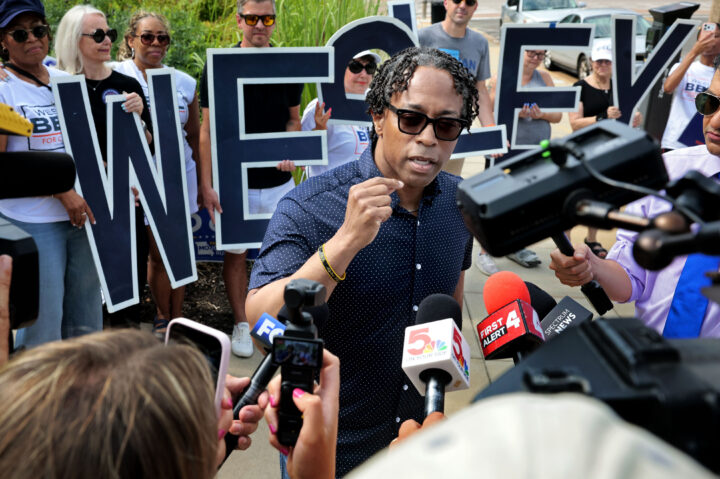
(Christian Gooden/St. Louis Post-Dispatch via Getty Images)
U.S. Rep. Wesley Bell speaks to media outside the Mid-County Branch public library on Tuesday, Aug. 4, 2026, before voting in Missouri's primary elections.
Rumors of the demise of the mainstream, pro-Israel wing of the Democratic Party turned out to be somewhat exaggerated: The Michigan Senate race between Rep. Haley Stevens (D-MI) and Abdul El-Sayed is a lot closer than polls suggested, while Rep. Wesley Bell (D-MO) romped to victory over his anti-Israel opponent, with the help of pro-Israel, Jewish supporters.
Bell’s sweeping 22-point victory in a rematch over former Rep. Cori Bush (D-MO) was an early election night highlight for Jewish and pro-Israel groups, which poured money and organizing efforts into ensuring the virulently anti-Israel Bush didn’t get a chance to return to Congress. AIPAC’s super PAC spent over $3 million on ads attacking Bush as corrupt and extreme, resources which likely played a key role in Bell’s landslide margin.
There were some other silver linings for the moderate side of the Democratic Party on Tuesday night: Michigan state Sen. Jeremy Moss won comfortably to succeed Stevens despite facing attacks over his pro-Israel record from his opponents. And Rep. Adam Smith (D-WA), the moderate ranking member of the House Armed Services Committee who faced harassment and threats over his longstanding pro-Israel record, won a clear majority of the vote against far-left challengers in Washington state’s all-party primary.
But there were plenty of warning signs about the changing ideological direction of the Democratic Party, as we’ve previously seen in deep-blue congressional districts across the country. Despite Stevens’ closer-than-expected showing, she still trails El-Sayed even after winning endorsements from top Democratic officials (including Gov. Gretchen Whitmer) and being the beneficiary of tens of millions in outside spending led by AIPAC’s ad blitz.
Meanwhile, Rep. Shri Thanedar (D-MI), seen as a reliable pro-Israel ally, is trailing against DSA-aligned challenger state Rep. Donavan McKinney, who ran on an anti-Israel platform.
And in the battleground Michigan 7th District, left-wing activist William Lawrence prevailed with a plurality of the vote, largely because of a split between his two moderate challengers. Running in a district President Donald Trump carried in 2024, Lawrence will find his ideological baggage a major vulnerability as he tries to unseat freshman Rep. Tom Barrett (R-MI).
The results paint a picture of a Democratic Party deeply divided, with older voters, Black voters and Jewish voters forming the centrist coalition, which is facing an insurgency from the left made up of younger voters, white progressives and Arab Americans.
What should be most concerning for the Jewish community is that virulently anti-Israel candidates are making inroads in the affluent, college-educated suburbs — areas where such views would have been politically toxic not long ago.
Stevens only narrowly won her home base of suburban Oakland County — the center of the state’s Jewish community — and lost badly in affluent Kent County, spanning the city of Grand Rapids. It underscores the point that the base of the DSA movement is among fairly well-off white voters.
But on the other side, there are plenty of red flags for El-Sayed after his underwhelming primary performance. El-Sayed struggled with Black voters, who make up the core of the party’s voting base. He got romped in the state’s rural counties. And El-Sayed’s overconfidence and the campaign’s grandiose expectations were undercut by the race’s close margin, and he didn’t get to enjoy a celebratory moment in the media spotlight on Election Night.
For AIPAC, which poured over $30 million into the Michigan Senate race, this is merely the first round of a lengthy battle against El-Sayed. If El-Sayed ends up prevailing, expect the pro-Israel advocacy group to remain actively engaged in the race as attention pivots to a general election with former Rep. Mike Rogers (R-MI) as the GOP nominee.
‘We DO NOT endorse Haley Stevens,’ Pux Taphouse said, claiming it has ‘advocated and continue[s] to call for a Free Palestine’
Finn Gomez/Getty Images
Rep. Haley Stevens (D-MI) speaks to the press after casting her ballot at Baldwin Public Library on Aug. 4, 2026 in Birmingham, Michigan.
A Michigan cider brewery where Rep. Haley Stevens (D-MI) hosted a campaign event the night before the state’s Senate primary election issued a statement saying they regretted hosting the event, citing Stevens’ support for Israel.
Pux Taphouse, which is located in Grand Rapids, said in an Instagram post on Monday that they did not know the event was being hosted by the Stevens campaign, only that they had been told it was “a private women’s Dem event.”
The event featured Stevens alongside Rep. Hillary Scholten (D-MI), former Sen. Debbie Stabenow (D-MI) and Jessica Mackler, president of EMILYs List. Some protesters stood outside the event, using bullhorns to accuse Stevens of supporting genocide in Gaza.
“We are heartbroken as we pride ourselves on being not only a queer friendly space but also have advocated and continue to call for a Free Palestine,” the Instagram post from the brewery stated. “We DO NOT endorse Haley Stevens.”
The message calling out Stevens and pledging not to host her for any future events comes amid a broader effort in some liberal cities and businesses to not welcome supporters of Israel. In June, a Brooklyn coffee shop wrote on Instagram that it would refund a recent purchase by Rep. Dan Goldman (D-NY) and ban him from returning because of his views on Israel.
A spokesperson for Stevens did not immediately respond to a request for comment.
Plus, Cruz champions bipartisan buffer zone bill
UNITED STATES - JUNE 3: Rep. Wesley Bell, D-Mo., right, and Sen. Eric Schmitt, R-Mo., attend the Congressional Chess Tournament hosted with the St. Louis Chess Club in Russell building on Wednesday, June 3, 2026. (Tom Williams/CQ-Roll Call, Inc via Getty Images)
In today’s Daily Kickoff, we look at the state of play in Michigan’s Democratic Senate primary in the final days of the race, and have the scoop on plans by Sen. Ted Cruz and Reps. Brad Knott and Tom Suozzi to introduce federal buffer zone legislation. We talk to Israeli officials and regional experts about the Trump administration’s newly released Gaza disarmament roadmap, and report from the Israel on Campus Coalition’s National Leadership Summit in Washington. Also in today’s Daily Kickoff: Dean Kremer, Alex Ryvchin and Balaji Srinivasan.
We also have a new on-demand Live Briefing that you can access throughout the day via our new app (on Apple and Android) and on our website.
Today’s Daily Kickoff was curated by JI Executive Editor Melissa Weiss and Israel Editor Tamara Zieve, with an assist from Marc Rod. Have a tip? Email us here.
What We’re Watching
- The Middle East remains on edge after President Donald Trump called off plans to launch “the biggest attack since World War II” targeting Iran, saying on Sunday that he was persuaded by Qatar, the United Arab Emirates and Saudi Arabia to again attempt to reach a diplomatic solution with Tehran. Trump said that talks with Iran are slated to restart today, while the Islamic Republic denied that talks were set to take place.
- Jay Clayton assumes his role today as director of national intelligence, following his confirmation vote last week to replace ODNI interim head Bill Pulte, who briefly served as acting director following Tulsi Gabbard‘s resignation.
- The Israel on Campus Coalition is holding its annual National Leadership Summit in Washington. More below.
What You Should Know
A QUICK WORD WITH JI’S JOSH KRAUSHAAR
Michigan will take center stage this week as it holds its marquee Senate primary and consequential down-ballot races that showcase the divide between the Democratic mainstream and its left-wing, anti-Israel activists.
But Missouri is playing the role of the must-watch undercard, with the rematch between Rep. Wesley Bell (D-MO) and Democratic Socialists of America-aligned former Rep. Cori Bush (D-MO) marking another significant bellwether contest between the center and the left.
Bell, a stalwart supporter of Israel who was championed by AIPAC in both of his congressional campaigns, is facing a changed political environment within the Democratic Party with public opinion turning against the Jewish state.
Bell defeated Bush by five points in 2024, but the race could end up being closer this time around given the ascendance of socialist candidates in urban, deep-blue districts like Missouri’s First District.
Bush, however, has myriad other vulnerabilities beyond her far-left policy views, from missed votes during her time in Congress to ethical questions surrounding her handling of campaign funds.
Bell is also being boosted by outside groups, led by the AIPAC-affiliated United Democracy Project super PAC, which has spent over $2.6 million in the race hitting Bush, along with the New Democrat Coalition-affiliated super PAC, which has poured in just over $1 million on Bell’s behalf. Bell has also outspent Bush on the airwaves by about a ten-to-one margin, according to the Cook Political Report.
MICHIGAN MOVES
As Abdul El-Sayed pulls ahead in the final days of Michigan’s bitter Democratic Senate primary race, Republicans are eyeing a chance, in the general election, to peel support from disaffected Jewish Democrats anxious about their party’s sharp turn to the left on Israel and its tolerance for actions they view as antisemitic. If Rep. Haley Stevens (D-MI) loses, Republicans are eager to present former Rep. Mike Rogers (R-MI), the GOP’s presumptive nominee, as a safe alternative to El-Sayed for Jewish Democrats in the general election who may not be able to stomach voting along party lines,Jewish Insider’s Matthew Kassel reports.
Shifting tide: “I think that Jewish voters and many Democrats in general feel” the party “has moved away from them,” Bobby Schostak, a former chairman of the Michigan Republican Party who sits on the Republican Jewish Coalition’s board, told JI, calling Rogers “unconditionally and unapologetically pro-Israel and part of the fight against antisemitism in America.”
Called out: In a late-night tweet five days before Michigan’s high-stakes Democratic Senate primary, Stevens explicitly accused her opponent, El-Sayed, of trafficking in antisemitism, JI’s Gabby Deutch reports. Despite that, Stevens said, when asked in an MS NOW interview if she could commit to backing El-Sayed if he wins Tuesday’s primary: “You bet … I am on the team, alright. And I am gonna link arms and do whatever’s needed.”
SCOOP
Sen. Ted Cruz (R-TX), Rep. Brad Knott (R-NC) and Rep. Tom Suozzi (D-NY) are preparing to introduce federal legislation that would establish a 100-foot buffer zone around religious institutions, within which conduct that disrupts religious services or interrupts access to the place of worship would be banned during religious services, Jewish Insider’s Emily Jacobs and Marc Rod report.
Negotiations: The Right to Worship Act aims to address demonstrations around synagogues and other houses of worship that have become a growing concern for the Jewish community following anti-Israel and antisemitic protests outside synagogues that have turned violent. Several states have pursued similar legislation. Cruz and Knott have been working on the bill for some time, and two sources familiar with the situation said that “intense negotiations” had been ongoing between Cruz and Suozzi’s teams to reach a bipartisan compromise balancing the desire to protect religious worship and free speech rights. A source said a deal was reached on Sunday evening.
PEACE PROSPECTS

Israeli officials and regional experts are expressing deep skepticism over the Trump administration’s newly unveiled Gaza disarmament roadmap, warning that public disagreements between Israel and Hamas over the timing of weapon surrenders and troop withdrawals threaten to unravel the agreement before it even begins, Jewish Insider’s Matthew Shea reports.
Israeli concern: Doron Spielman, a spokesman for the Israeli Prime Minister’s Office, told JI that Jerusalem conveyed to Washington that the plan “does not reflect Israel’s concerns.” Spielman said that Israeli intelligence has shown that Hamas “has been regrouping, digging additional tunnels, rearming and resupplying and have plans to attack Israel again.” For that reason, he said it is difficult for Israeli leaders to justify any decision to withdraw prior to Hamas’ complete disarmament.
BOILING POINT
A popular Montreal kosher restaurant was destroyed in what police are investigating as a possible arson attack early Saturday morning, the latest in a worsening pattern of antisemitic attacks across the city and throughout Jewish communities in Canada, Jewish Insider’s Haley Cohen reports.
Caught on camera: First responders were called to Nöam Restaurant in the Côte-des-Neiges neighborhood around 3:15 a.m. Saturday to find the building engulfed in flames. Despite the efforts of roughly 80 firefighters, the two-story building suffered extensive damage. No injuries were reported, and no arrests had been made as of Sunday afternoon. The Montreal Gazette reported that the blaze was set by a single individual who appeared to be a young man, perhaps in his early 20s, according to video footage of the incident.
On the soccer pitch: Amid chants of “Death to Israel,” Israeli striker Dor Turgeman scored a goal for his New England Revolution team during a Saturday night Major League Soccer match against CF Montréal.
CAMPUS CLIMATE
As close to 1,000 pro-Israel students from around the country gather in the nation’s capital for the Israel on Campus Coalition’s annual National Leadership Summit, they’ll do so against a backdrop of seemingly quieter campus antisemitism than in the years immediately following the Oct. 7, 2023, terrorist attacks in Israel. But students are still seeking tools to navigate a campus climate they’ve come to see as permanently changed, Jewish Insider’s Haley Cohen reports.
Campus concerns: “My main concern [on campus today] is every time I sit down with a classmate I have to wonder whether the person next to me was at the [anti-Israel] encampment,” Noah Lederman, an incoming senior at Columbia University majoring in philosophy and Jewish ethics, told JI. In February 2024, Lederman said he was shoved and pinned against a wall by an anti-Israel protester as he donned a shirt with an Israeli flag on it during a pro-Israel demonstration right outside of the Morningside Heights campus. More than two years later, Lederman still feels wary on campus.
ON SECOND THOUGHT
Far-left Colorado congressional candidate Melat Kiros backtracked on Sunday from her conciliatory tone in a PBS interview on the need for progressives to formulate a policy on Israel that does not engage in antisemitism, Jewish Insider’s Danielle Cohen-Kanik reports.
U-turn: Appearing on “Firing Line with Margaret Hoover” on Saturday morning, Kiros said her “greatest concern right now is that the State of Israel is losing support all across the political spectrum” and that progressives are “leaving a vacuum” for far-right commentators like Tucker Carlson and Candace Owens to fill by “pretending to care about Palestinian safety when really it’s just masking their overt hatred for Jewish people.” The 29-year-old doctoral student, who was backed by the Democratic Socialists of America in her campaign, quickly reversed course after the interview aired. Responding on Sunday to criticism on X from Al Jazeera producer Sana Saeed, Kiros said she “fumbled this line, plain and simple.”
Mounting pressure: Sen. Bernie Moreno (R-OH) publicly accused Rep. Max Miller (R-OH), his former son-in-law, of domestic abuse on Sunday and said Miller is unfit for office. Moreno’s comments came in response to a video address by Miller denying wrongdoing amid growing scrutiny of the allegations of domestic violence and abuse by his ex-wife Emily Moreno, the senator’s daughter, JI’s Emily Jacobs and Marc Rod report.
Worthy Reads
History Lesson: In The New York Times, Mehrzad Boroujerdi reflects on his father’s 1978 killing by Iranian revolutionaries, some of whom are now among the Islamic Republic’s top officials. “The United States and Israel have yet to learn that the Iranian regime is not made of papier-mâché, and the Islamic republic’s confrontational ideology is unlikely to dissipate anytime soon. The men in uniform showed no hesitation in killing thousands of their compatriots in January — a national trauma that Iranian society has yet to fully process. They will continue to practice a politics of performance for domestic audiences even as they recognize that the regime’s social contract is both morally bankrupt and fiscally unsustainable.” [NYTimes]
Threat to the West: In The Wall Street Journal, Lorenzo Vidino, the head of The George Washington University’s Program on Extremism, warns of the dangers of political Islam’s impact that have largely been misunderstood by successive U.S. presidential administrations. “Save for the years immediately after Sept. 11, 2001, there has been no concerted effort within U.S. law-enforcement and policy communities to acquire a deep institutional understanding of Islamist networks worldwide. A particular lack of understanding exists on how Islamists are using the American political and educational systems to advance their aims — dynamics that have become apparent in the past few years.” [WSJ]
Rise of the Far Right: Politico’s Kathy Gilsinan does a deep dive into concerns among Republicans over the rise of “groypers” in the party, who are beginning to gain professional footholds in Washington and in the conservative space. “If, as the adage goes, personnel is policy, the stakes are significantly higher than intergenerational trash talk, given the degree to which government staffers, across branches, effectively run the country. Student government types become interns become policy aides become senior advisers, chiefs of staff and even heads of agencies. If the conservative personnel pipeline is changing, Republican government will change with it.” [Politico]
Find more Worthy Reads in our Live Briefing via our new app (on Apple and Android) and website.
Word on the Street
A new survey of K Street leaders from Punchbowl News focused on the war with Iran and memorandum of understanding between Washington and Tehran found that 65% of respondents believed that Israel’s involvement in the war with Iran had a negative impact on its outcome…
The New York Times looks at the cyberattacks targeting water facilities in at least seven states, finding that evidence indicates potential Iranian involvement…
Sens. Marsha Blackburn (R-TN), Tim Sheehy (R-MT) and Dave McCormick (R-PA) introduced a resolution condemning the Iranian government’s human rights abuses…
Senate Appropriations Committee leaders finalized a stopgap funding bill that would, at least temporarily, prevent the Trump administration from putting political appointees in charge of approving federal grants, a plan that had raised concerns on both sides of the aisle…
A district court judge dismissed a complaint filed against The George Washington University by alumni of the school alleging that the school allowed “pervasive and severe” antisemitism on campus, citing the length of the complaint; the judge gave the plaintiffs until the end of August to refile an amended complaint…
The New York Times reports from a national meeting of the Democratic Socialists of America, finding an invigorated activist base that struggled at times to find consensus on issues regarding policy and organizing…
Boy George split from his manager, Paul Kemsley, after the latter pulled the performer from a two-week West End run of “Jesus Christ Superstar” after Boy George posted a reggae song with pro-Israel lyrics…
The Minnesota Twins acquired starting pitcher Dean Kremer, the first Israeli player drafted by a Major League Baseball team and a great-nephew of Haim Saban, from the Baltimore Orioles…
FIFA President Gianni Infantino is facing mounting criticism from the governing bodies of European, North American and Central American football leagues following his proposal to privatize FIFA — which originated last year with secret talks between Infantino and Josh Kushner; Bloomberg reports that Nasser Al-Khelaifi, the chairman of Qatar Sports Investments and president of the Paris Saint-Germain team, has the backing of some European sports officials…
The New York Times reports on the Metropolitan Museum of Art’s decision to feature an exhibition on designer John Galliano and honor him at its annual Met Gala despite a 2011 outburst in which he proclaimed, “I love Hitler”; the Times notes that Galliano participated in a May meeting with former Vogue Editor-in-Chief Anna Wintour and New York City Jewish leaders over the decisions…
The Washington Post follows up on a May story about a trove of WWII-era love letters written by a Jewish soldier Louis “Speedy” Weber to his eventual wife, Frances, after finding the couple’s nephew…
The people’s choice award of the Archibald Prize, Australia’s top portraiture honor, was given to artist Michael Zavros for his portrait of Australian Jewish leader Alex Ryvchin following the December 2025 terror attack at a Hanukkah celebration at Sydney’s Bondi Beach…
The Wall Street Journal spotlights tech entrepreneur Balaji Srinivasan’s effort to create an incubator for new countries in a sparsely inhabited Malaysian city that fell apart after the project faced government scrutiny following a social media post alleging that the incubator included participants with Israeli citizenship in violation of Malaysian laws…
CNN does a deep dive into increasing incitement in Israel against journalists, who accuse Israeli Prime Minister Benjamin Netanyahu and his political allies of stoking animus toward reporters in the country…
Ugandan officials unveiled a statue of Yonatan Netanyahu, the older brother of the Israeli prime minister, at the airport in Entebbe where the elder Netanyahu was killed during the 1976 hostage-rescue operation following the hijacking of a passenger plane by members of the Popular Front for the Liberation of Palestine…
Former Rep. Kay Granger (R-TX), the first Republican woman from Texas elected to serve in the House, died on Sunday at 83…
Find on-demand Live Briefing updates throughout the day via our new app (on Apple and Android) and website.
Pic of the Day

Members of Israel’s lacrosse team celebrated on Sunday after scoring a goal during the bronze medal match between Israel and Haudenosaunee, made up of Native American nations, during the 2026 World Lacrosse Women’s Championship in Tokyo. Israel came in third in the tournament overall after its win over Haudenosaunee.
Birthdays
Retired head coach of both the NFL’s KC Chiefs and the Buffalo Bills, the oldest-ever living member of the Pro Football Hall of Fame, Marv Levy turns 101…
English actor, author, playwright and theatre director, known for his roles as the villain in both “James Bond” and “Rambo” films, Steven Berkoff turns 89… EVP emeritus of the UJA-Federation of New York, John S. Ruskay turns 80… Retired regional director in the Cleveland office of the ADL, she serves on the board of trustees of the Cleveland Federation, Anita Gray… Former chairman and CEO of the North America office of commercial real estate brokerage firm Savills, he is a past member of AIPAC’s Real Estate Division Executive Council, Mitchell S. Steir turns 71… Voice actor in dozens of Disney films, video games and television programs, known professionally as Corey Burton, Corey Gregg Weinberg turns 71… Former chair of the board of the Jewish Federation of Los Angeles and board member of JFNA, Orna Amir Wolens… CEO and co-founder of D.C.-based Freedman Consulting, LLC, Thomas Z. Freedman turns 63… Co-founder of Pushkin Industries, a podcast company, Jacob Weisberg… Israeli filmmaker, producer and director, Ilan Moskovitch turns 60… Canadian entrepreneur and former commodities trader, Alexander Shnaider turns 58… Executive director of public affairs at the Jewish Federation of Broward County (Florida), Evan Goldman… Emmy Award-winning sportscaster, she sometimes serves as a fill-in for her husband, Rich Eisen, Suzy Shuster turns 54… Managing editor of Vital City, Josh Greenman… U.S. senator (D-CT), Chris Murphy turns 53… Chief advancement and communications officer at the National September 11 Memorial & Museum, Joshua Cherwin… Senior vice president of public policy at Riot Platforms, Brian Morgenstern… Senior editor of Commentary magazine, Seth A. Mandel turns 44… Managing partner and head of global government affairs at SoftBank Group International, Jeffrey A. Dressler turns 42… Director of strategic partnerships and senior development officer at JDC (the “Joint”), Erica Greenblatt… Caroline “Carrie” Keller-Lynn… Director of member engagement at Christians United For Israel, she was born in Lutsk, Ukraine and raised in Sacramento, California, Liliya Maskovcevs… Executive director of The Natan Fund, Adina Poupko … Executive director of the Reducetarian Foundation (a non-profit organization dedicated to reducing meat consumption), Brian Kateman… Fashion model and entrepreneur, founder of the “Kode with Klossy” nonprofit and founder and CEO of Bedford Media, Karlie Kloss turns 34… U.S. news editor at the Financial Times, Emily Goldberg… First-round pick of MLB’s Atlanta Braves in the 2020 draft, he made his MLB debut in 2023, now in the St. Louis Cardinals organization, Jared Shuster turns 28… Ariana Kaufman… Founder-director of Meeting Your Mission, Leslie Rosen Stern… Leigh Bonner Levine… Co-founder and editor-in-chief of the Washington Reporter, Matthew Foldi…
Missouri is playing the role of the must-watch undercard, marking another significant bellwether contest between the center and the left

Then-Rep. Cori Bush (D-MO) speaks at the "Just Majority" Supreme Court press conference on June 22, 2023 in Washington, DC. / Then-Louis County Prosecutor, Wesley Bell gives remarks at the Urban League Empowerment Center on June 17, 2020.
Michigan will take center stage this week as it holds its marquee Senate primary and consequential downballot races that showcase the divide between the Democratic mainstream and its left-wing, anti-Israel activists.
But Missouri is playing the role of the must-watch undercard, with the rematch between Rep. Wesley Bell (D-MO) and Democratic Socialists of America-aligned former Rep. Cori Bush (D-MO) marking another significant bellwether contest between the center and the left.
Bell, a stalwart supporter of Israel who was championed by AIPAC in both of his congressional campaigns, is facing a changed political environment within the Democratic Party with public opinion turning against the Jewish state.
Bell defeated Bush by five points in 2024, but the race could end up being closer this time around given the ascendance of socialist candidates in urban, deep-blue districts like Missouri’s First District.
Bush, however, has myriad other vulnerabilities beyond her far-left policy views, from missed votes during her time in Congress to ethical questions surrounding her handling of campaign funds.
Bell is also being boosted by outside groups, led by the AIPAC-affiliated United Democracy Project super PAC, which has spent over $2.6 million in the race hitting Bush, along with the New Democrat Coalition-affiliated super PAC, which has poured in just over $1 million on Bell’s behalf. Bell has also outspent Bush on the airwaves by about a ten-to-one margin, according to the Cook Political Report.
Jewish groups, both locally and nationally, are also organizing get-out-the-vote efforts on Bell’s behalf. The Jewish Democratic Council of America has been rallying its national membership for an in-person canvassing campaign, and Agudath Israel’s Missouri office mobilized its volunteers to help boost nonpartisan Jewish turnout.
The Cook Political Report gives Bell the advantage in the race, noting that Sen. Bernie Sanders (I-VT) (despite endorsing Bush) hasn’t campaigned on her behalf and underscoring the spending disparity which appears to be stunting Bush’s ability to grow support in the St. Louis-area district.
But given the overall momentum in Democratic primaries for anti-Israel candidates, the race is still expected to be worth tracking closely.
For many Jewish Democrats in Michigan who have long called the party home, the bruising lead-up to the primary on Tuesday has been difficult to experience
Sarah Rice/Getty Images
Michigan Senate candidate Mike Rogers speaks at his election watch party.
As Abdul El-Sayed pulls ahead in the final days of Michigan’s bitter Democratic Senate primary race, Republicans are eyeing a chance, in the general election, to peel support from disaffected Jewish Democrats anxious about their party’s sharp turn to the left on Israel and its tolerance for actions they view as antisemitic.
For many Jewish Democrats in Michigan who have long called the party home, the bruising lead-up to the primary on Tuesday has been difficult to experience, as El-Sayed, a far-left former public health official, has continued to gain traction while fiercely attacking Israel, using anti-Zionist rhetoric and centering his messaging on opposition to AIPAC, the pro-Israel advocacy group whose super PAC is aggressively promoting Rep. Haley Stevens (D-MI) in a record ad barrage that has exceeded $30 million.
If Stevens loses, Republicans are eager to present former Rep. Mike Rogers (R-MI), the GOP’s presumptive nominee who was narrowly defeated in his bid for Senate last election cycle, as a safe alternative to El-Sayed for Jewish Democrats in the general election who may not be able to stomach voting along party lines.
“I think that Jewish voters and many Democrats in general feel” the party “has moved away from them,” Bobby Schostak, a former chairman of the Michigan Republican Party who sits on the Republican Jewish Coalition’s board, told Jewish Insider, calling Rogers “unconditionally and unapologetically pro-Israel and part of the fight against antisemitism in America.”
He predicted that Jewish Democrats “are going to flock to” Rogers “come November if El-Sayed wins the nomination,” referring, among other things, to the candidate’s refusal to distance himself from the antisemitic streamer Hasan Piker and controversial remarks following a foiled terrorist attack against a synagogue in Michigan in March in which he said, “Hurt people do hurt people.”
“Playing that response back is all it takes,” Schostak said of the anticipated GOP attacks against El-Sayed in the still-hypothetical general election. “That clearly showed his position and lack of concern for Jews and Jewish children,” he added of the comments. “I don’t think it takes much more than that.”
Sam Markstein, a spokesperson for the RJC, which has endorsed Rogers, said that “Michigan’s open U.S. Senate seat is at the center of the political battlefield” in the fight for control of the upper chamber.
“I think there’s a real opportunity for Mike and other Republicans in Michigan to build on Jewish support,” Jason Cabel Roe, a GOP strategist who has served as the executive director of the state’s Republican Party, told JI.
“With nearly 100,000 Jewish voters in a state where the margins of victory are incredibly close,” he said in a statement to JI, “Michigan’s Jewish community will once again be a decisive group in one of the most important contests in the country this November.”
Markstein suggested that “Michigan Jews are well aware of the stakes,” pointing to divisive comments in which El-Sayed declined to acknowledge Israel’s right to exist and said “I call bullshit” on “a definition of antisemitism to include a foreign government and its leaders,” among others that have faced scrutiny.
“I think there’s a real opportunity for Mike and other Republicans in Michigan to build on Jewish support,” Jason Cabel Roe, a GOP strategist who has served as the executive director of the state’s Republican Party, told JI.
While he called El-Sayed’s rhetoric on Israel “a big factor” influencing that dynamic, Roe argued there are deeper issues at play, notably including the Democratic state party convention in April at which pro-Israel candidates were heckled by activists and an attorney with a history of praising Hezbollah was nominated to sit on the University of Michigan Board of Regents.
Michigan Attorney General Dana Nessel, a Jewish Democrat, said last week that she planned to skip her party’s nominating convention next month, citing the episodes as sowing fears of antisemitic harassment.
“What happened at the” state convention “has really animated Jewish donors and voters and moved them in the direction of Republicans,” Cabel Roe explained to JI. “I think it’s very significant.”
Alyssa Brouillet, a spokesperson for Rogers, said his campaign is “beginning to see more and more Jewish Democrats coming to us who feel abandoned by their party.”
“It’s easy to see why when you have a candidate in this race who fundraised off of Oct. 7 and sympathized with the terrorist attacker who attempted to mass murder 140 kids at Temple Israel synagogue. That’s terrifying,” she told JI in a statement. “Unlike his opponents, Mike Rogers stands with the Jewish community in Michigan and across the country — and he will continue fighting to make life better for working families all across the state.”
The former congressman, recognized as a pro-Israel hawk while serving in the House from 2001 to 2015, has also raised concerns over rising antisemitism as well as anti-Israel sentiment on the far right, which he has said the GOP needs to more forcefully fight.
He has said publicly that it “doesn’t matter” who he faces in the general election, claiming he is confident that he will beat either of them. During a private call with supporters last month, he said that he would be “in good shape” if El-Sayed clinched the nomination as opposed to the moderate Stevens, describing him as “so radical,” according to audio obtained by CNN.
Polling has suggested that a general election matchup between Rogers and El-Sayed would be competitive.
It remains to be seen if the depth of disillusionment among Jewish Democrats in Michigan who feel their party is abandoning them will ultimately translate to a vote for Rogers should El-Sayed be the nominee — given accompanying reservations with how it could help Republicans flip a crucial seat held by retiring Sen. Gary Peters (D-MI).
But Stevens herself in some ways gave Rogers a path to make inroads with Jewish Democrats who distrust El-Sayed when she directly accused her opponent of antisemitism in a fiery social media post on Thursday underscoring the increasingly personal animosities in the closing stretch of the primary.
“After Tuesday, you will see a plethora of Jewish Democrats openly supporting Mike Rogers,” said Dennis Bernard, national chair of government relations at the Jewish Federations of North America, adding such support could help tip the scales in a general election that is expected to be close. He said Rogers has been doing “significantly more events in the Jewish community” and is being more favorably received than last cycle, when he lost to Sen. Elissa Slotkin (D-MI), a Jewish Democrat.
“Everyone in America understands you want to blame all of your problems on Jewish Americans,” she wrote in the post addressed to El-Sayed, after he had taunted AIPAC and called her the “least capable candidate in America.”
A spokesperson for AIPAC’s super PAC, United Democracy Project, did not return a request for comment about its plans for the general election.
A source familiar with UDP’s thinking told JI that “no decision has been taken yet because we’re not there,” but suggested that the group would support Rogers if Stevens loses to El-Sayed. “What would the expectation be?” the source told JI. “That they would do everything they can do to beat this guy.”
Dennis Bernard, a Jewish leader in Michigan who says he supports both Stevens and Rogers in their respective primaries, echoed others who told JI that even as there are Jewish Democrats planning to pull the lever for Rogers if Stevens loses on Tuesday, they are not willing to admit that publicly until the results are in.
“After Tuesday, you will see a plethora of Jewish Democrats openly supporting Mike Rogers,” said Bernard, national chair of government relations at the Jewish Federations of North America, adding such support could help tip the scales in a general election that is expected to be close. He said Rogers has been doing “significantly more events in the Jewish community” and is being more favorably received than last cycle, when he lost to Sen. Elissa Slotkin (D-MI), a Jewish Democrat.
Hannan Lis, a Democratic fundraiser and Jewish leader who splits his time between Michigan and Israel, said he would vote for Rogers in the general election if El-Sayed wins the nomination, adding he knows “many” Jewish Democrats who plan to do the same.
His reservations over the prospect of Republicans preserving their Senate majority by picking up the Michigan seat, Lis told JI, were overshadowed by his deeper objections to El-Sayed and his views on Israel and antisemitism. “El-Sayed is no Democrat,” he told JI.
“If Abdul El-Sayed wins the primary, I will have to spend more time seeing if El-Sayed is as dangerous to Israel, America and American Jews as he appears — and I haven’t seen anything so far to the contrary — and I will also spend some time examining Mike Rogers’ record on Israel and other issues that the Jewish community cares deeply about,” Asher Lopatin, a rabbi who serves as director of community relations at the Jewish Federation of Greater Ann Arbor and is backing Stevens, told JI.
El-Sayed’s campaign did not respond to a request for comment about tensions with Jewish voters.
One pro-Israel strategist in the state who is close to Stevens estimated, on gut instinct, that it was more likely what he called mainstream Jewish Democrats who support Israel would not vote at all rather than pull the lever for Rogers if El-Sayed is the nominee, pegging that number at some 50% of the community.
He speculated that 25% of such voters would support Rogers because they are “disgusted with Democrats,” while another 25% could swallow their concerns and choose El-Sayed, motivated by loyalty to their party.
Asher Lopatin, a rabbi who serves as director of community relations at the Jewish Federation of Greater Ann Arbor and is backing Stevens, said he is trying to keep an open mind for the general election if the congresswoman loses, even as he has “been deeply disturbed by many quotes from El-Sayed regarding Israel and by many of his ads, in which AIPAC is attacked as what I see as an antisemitic dogwhistle.”
“If Abdul El-Sayed wins the primary, I will have to spend more time seeing if El-Sayed is as dangerous to Israel, America and American Jews as he appears — and I haven’t seen anything so far to the contrary — and I will also spend some time examining Mike Rogers’ record on Israel and other issues that the Jewish community cares deeply about,” he told JI.
Lopatin added that he would also “want to make sure” that Rogers is “someone who can stand up to” President Donald Trump.
Noah Arbit, a Jewish Democratic state legislator in Michigan who is outspoken against antisemitism in his party, declined to confirm how he would vote in a general election without Stevens as the nominee, even as he has accused El-Sayed of helping to “stoke and inflame hatred against Jews” and grappled with whether he belongs in a party he sees as “hostile” to his community.
For now, he told JI, “I’m entirely focused on winning a third term representing my district in Greater West Bloomfield,” a heavily Jewish suburb of Detroit, “and electing a Democratic House, Senate and governor in Michigan.”
Michael Horowitz, a Jewish community leader and Detroit businessman, was reluctant to engage in any hypotheticals before the primary’s end. “I still think Haley is going to pull it out on Tuesday,” he told JI on Friday.
Pressed to clarify how he would vote if she loses, he wrote in a text, “I try to avoid playing games with the Devil,” inserting an upside-down smiley face emoji reflective of the uncomfortable position that Jewish Democrats now find themselves confronting as the primary finally comes barreling to a close this week.
With polls showing Stevens trailing, she said El-Sayed wants ‘to blame all of [his] problems on Jewish Americans’
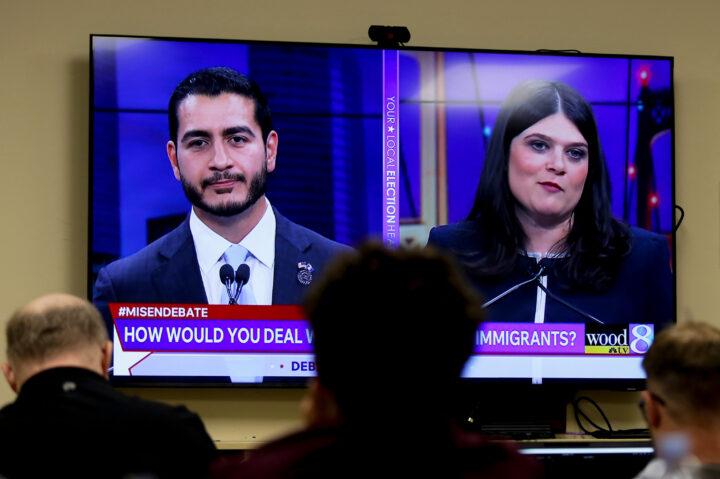
Kristen Norman/AP
Michigan U.S. Senate candidates, Abdul El-Sayed, left, and Rep. Haley Stevens, D-Mich., are displayed on a television during a debate inside the spin room at WoodTV studios on Tuesday, July 7, 2026, in Grand Rapids, Mich.
In a late-night tweet five days before Michigan’s high-stakes Democratic Senate primary, Rep. Haley Stevens (D-MI) explicitly accused her opponent, Abdul El-Sayed, of trafficking in antisemitism.
Stevens’ post came in response to a video in which El-Sayed attacked AIPAC for supporting her, as he called her “literally the least capable candidate in America.” He has made criticism of AIPAC a central tenet of his campaign.
“Abdul, we were both on the ballot in 2018. I was capable of winning my competitive primary and general election. You lost,” Stevens wrote in the post, which was uploaded at 10:30 p.m. on Thursday, referring to El-Sayed’s run for governor. “You lost by over twenty points to Gretchen Whitmer and you will lose to [GOP nominee] Mike Rogers by talking like this.”
“Everyone in America understands,” Stevens continued, “you want to blame all of your problems on Jewish Americans.”
Stevens has generally avoided mentioning AIPAC on the campaign trail, even as it has spent tens of millions of dollars backing her, as the pro-Israel group has fallen out of favor with rank-and-file Democrats. After a new poll showed her trailing El-Sayed by 15 percentage points, Stevens ratcheted up her rhetoric.
She also pledged in her post to “lower the costs of groceries, ban stock trading for elected officials, stop Trump’s abuses of power and protect Michigan manufacturing” — and said El-Sayed will just turn into “a celebrity whining and writing books to get even richer.”
Plus, a Hamas disarmament deal — with caveats
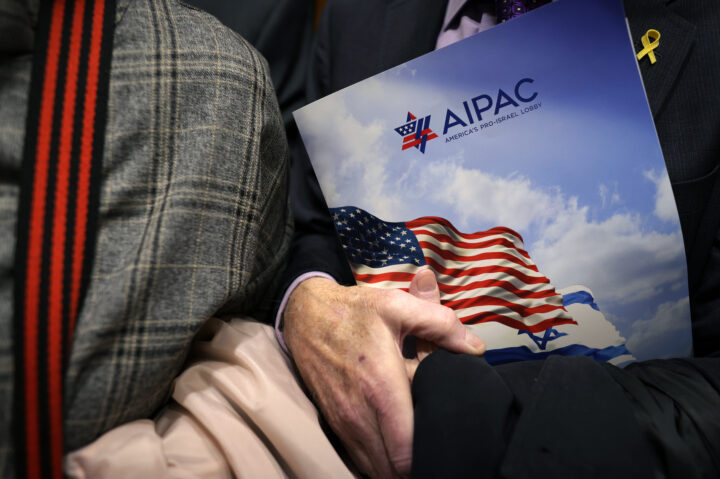
Alex Wong/Getty Images
A visitor holds an AIPAC folder in an elevator in Rayburn House Office Building on March 12, 2024 on Capitol Hill in Washington, DC.
Good Friday morning.
In today’s Daily Kickoff, we cover comments by Michigan Attorney General Dana Nessel that she will not attend the state Democratic convention due to fears over antisemitic harassment and report on an anti-AIPAC campaign against Michigan state Sen. Jeremy Moss — even though AIPAC has not endorsed him in his bid for Congress in a Detroit-area Democratic primary. We also report on President Donald Trump’s announcement that a deal has been reached for Hamas’ disarmament, and talk to analysts about Iran’s efforts to exploit Sudan’s civil war to deepen ties with Islamist factions. Also in today’s Daily Kickoff: Maor Shlomo, Boy George and Harriet and Mark Levin.
We also have a new on-demand Live Briefingthat you can access throughout the day via our new app (on Apple and Android) and on our website.
Today’s Daily Kickoff was curated by Israel Editor Tamara Zieve and U.S. Editor Danielle Cohen-Kanik, with an assist from Marc Rod. Have a tip? Email us here.
For less-distracted reading over the weekend, browse this week’s edition of The Weekly Print, a curated print-friendly PDF featuring a selection of recent Jewish Insider and eJewishPhilanthropy stories, including: Jewish leaders worried about Michigan’s prime position on Dems’ 2028 calendar; How Debra Band revives a dying Jewish artform; and Family, friends of slain Blackstone executive Wesley LePatner launch foundation in her memory. Print the latest edition here.
What We’re Watching
- Tensions are high in the Middle East going into the weekend, as Iran has continued to strike U.S. assets around the region this week and Saudi Arabia has also faced attacks by Tehran’s proxies.
- We’re keeping an eye out for word from Jerusalem on its stance on Trump’s announcement of a deal for Hamas’ “complete disarmament” announced last night, which requires complete IDF withdrawal from the Gaza Strip. See more below.
- Amid the global developments, Trump will hold the 13th Cabinet meeting of his second administration this morning at the historic Camp David retreat in Maryland.
- The Democratic Socialists of America kicks off its three-day annual organizing conference today in Chicago. One programming track is set to focus on “anti-imperialist and pro-Palestine organizing strategy” to end the “U.S.-Israeli genocide in Palestine.”
What You Should Know
A QUICK WORD WITH JI’S WILL BREDDERMAN
In chatting with plugged-in Democratic strategists currently working on congressional campaigns, I was shocked — but not all that surprised — at the acceptance that the party has been all but dominated by the socialist faction, led by Sen. Bernie Sanders (I-VT), that has gotten more radical since his presidential campaign in 2016 and has played a key role in many Democratic primaries across the country.
Two Democratic operatives involved in Michigan and other targeted races bluntly told JI that left-wing candidates endorsed by Sanders and his band of far-left allies can now expect to win about one-third of the primary vote from the start if given the Sanders seal of approval. And far from being contained to deep-blue urban districts in New York, the trend is spreading into swing-district primaries and statewide nomination fights.
That’s certainly shaping up to be the case in Michigan’s 7th District, one of the biggest battleground districts in the country long held by now-Sen. Elissa Slotkin (D-MI). Despite two candidates with cross-partisan credentials running — former Navy SEAL Matt Maasdam and former Ambassador to Ukraine Bridget Brink — the Sanders-endorsed socialist activist William Lawrence is the front-runner, according to new polling conducted in the race.
And the socialist wave is building in statewide races in two of the biggest Midwestern battlegrounds, with Democratic Socialists of America-endorsed Francesca Hong running away with the Democratic nomination for Wisconsin’s governorship, despite her recent embrace of politically toxic views like supporting funding cuts to the police.
And as we’ve extensively covered in Michigan, Abdul El-Sayed’s virulently anti-Israel and left-wing platform in the Senate race doesn’t appear to be stunting his primary campaign against Rep. Haley Stevens (D-MI), even with popular Gov. Gretchen Whitmer’s endorsement of Stevens.
IDENTITY POLITICS

Michigan state Sen. Jeremy Moss has a lot of endorsements in his campaign for Congress in a Detroit-area Democratic primary — Gov. Gretchen Whitmer, Secretary of State Jocelyn Benson and several other state and local officials — but AIPAC is not one of them. That has not stopped Don Ufford, one of Moss’ opponents, from trying to tar the Jewish lawmaker as a pawn of the pro-Israel group in the final days of the race, Jewish Insider’s Gabby Deutch reports.
You’ve got mail: A mailer that Ufford’s campaign sent to the homes of voters in the district described Moss as a “career politician who has taken thousands from AIPAC-linked donors.” A website operated by Ufford’s campaign, titled “AIPAC Jeremy Moss,” said that Moss is “for them, not for working Michiganders like you.” Moss told JI in an interview on Thursday, “The language on his mailers was very clear to say AIPAC-linked donors. One more dig deeper than that is just — it’s Jews.” Some of Moss’ donors have also supported AIPAC, but he does not think their involvement in the political system should be suspect.
SAFETY CONCERNS

Michigan Attorney General Dana Nessel, a Jewish Democrat whose eight years in office will conclude at the end of December, said at an event in Lansing on Thursday that antisemitism in the state — and in the statewide Democratic Party — has gotten so bad that she will not attend the party’s nominating convention next month, Jewish Insider’s Gabby Deutch reports.
What she said: “I don’t feel safe going,” Nessel said at the Thursday event, which was organized by the Anti-Defamation League and featured other Michigan Jews speaking about their own experiences of antisemitism. “I feel like my presence is not going to be welcomed. I don’t want to get chased around. I don’t want to get harassed. I don’t want to get yelled and screamed at. And I don’t want to get booed off the stage, irrespective of what I’m saying. And I believe that if I go, that is what will happen.”
ORGANIZING EFFORT

Members of Missouri’s Jewish community are working to turn out voters in Rep. Wesley Bell’s (D-MO) St. Louis-area congressional district as he faces down a rematch with former Rep. Cori Bush (D-MO) on Tuesday. The Jewish Democratic Council of America has rallied its national membership, particularly in Bell’s district and the broader Midwest region, for an in-person canvassing effort as well as several phone-banking events, Jewish Insider’s Marc Rod reports.
Boosting Bell: “We are mobilizing our network across the Midwest to help get out the vote for Wesley Bell,” Jacob Spiegel, JDCA’s communications director, told JI. “We’re continuing to mobilize our awesome network of volunteers to get out the vote for the candidates that represent our values.”
DONE DEAL?

President Donald Trump announced on Thursday that the Board of Peace had reached a “historic” agreement for the “complete disarmament” of Hamas and all other armed groups in Gaza, calling it a “monumental step toward lasting PEACE and SECURITY,” Jewish Insider’s Matthew Shea reports. Trump said in a post on Truth Social that the agreement would be “carried out carefully in structured phases,” and that the IDF would withdraw when Hamas’ disarmament is “completed.”
Briefing: Following the announcement, a senior U.S. official said in a call with reporters that the document is “an agreement by Hamas to follow through on the decommissioning” of its weapons as well as its terror tunnels. The official noted that Iran tried to “convince [Hamas] not to do this deal,” but in the end, “the final communication came through the mediators that Hamas has agreed.”
Word of warning: A senior U.S. official told reporters, “We’re not asking Israel to do anything that isn’t in the 20-point plan that they agreed to initially, and so we’re very confident they will adhere to it. If they don’t, President Trump would be very, very disappointed.”
Yes, but: A Hamas source told Reuters the “draft agreement” says heavy weapons would only be stored and kept under the control of a Palestinian administration. Ghazi Hamad, a senior Hamas figure, told Al Jazeera, “We will not take any action regarding disarmament prior to Israel’s withdrawal from the Strip.” Meanwhile, Reuters cited an Israeli official as having said, prior to Trump’s announcement, “Israel demands the complete disarmament of Hamas, including the removal of weapons from Gaza and the complete demilitarization of the Strip as a precondition for any process.”
POWER PLAY

As Sudan’s devastating civil war drags through its third year, experts warn the conflict could become an arena for Iranian strategic expansion and Islamist extremism in Africa, as Tehran and the Sudanese branch of the Muslim Brotherhood revive a long-standing alliance and threaten to turn the embattled nation into a staging ground for transnational jihadist operations, Jewish Insider’s Matthew Shea reports.
Iran’s involvement: Under the cover of Sudan’s official military, the Sudanese Armed Forces (SAF), armed Islamist brigades — most notably the U.S.-sanctioned Al-Bara ibn Malik Battalion (the armed wing of the Sudanese Muslim Brotherhood) — have mobilized to fight alongside state forces led by Gen. Abdel Fattah al-Burhan. Supported by funding, weaponry and training pipelines linked to Iran’s Islamic Revolutionary Guard Corps, these factions have effectively embedded themselves within the state apparatus, raising alarm among counterterrorism officials and regional foreign policy experts.
SURVEY SAYS

The share of Israelis who believe President Donald Trump is “highly committed” to protecting Israel’s security interests has dropped to a new low, according to a new survey from Tel Aviv University’s Institute for National Security Studies, Jewish Insider’s Matthew Shea reports.
Downward trend: The organization’s July 2026 National Security Survey found that only 14% of Israelis believe the country’s security interests are a top concern for Trump, representing a significant drop from the 35% recorded in March. This continues a downward trend observed as the conflict with Iran drags on, following an Israel Democracy Institute poll released earlier this month that found just 26% of Jewish Israelis believed Israel’s security was a key consideration for Trump – another record low at the time.
Worthy Reads
El-Sayed’s Villains: The Atlantic‘s Jonathan Chait argues that far-left Michigan Senate candidate Abdul El-Sayed’s brand of anti-Israel rhetoric is uniquely dangerous. “But if El-Sayed’s anti-Zionism is obsessive, it is not a singular obsession. He talks about the Israel lobby the way he talks on the stump about nearly any other political issue. The El-Sayed formula is to describe just about any policy as a conspiracy by a corporate entity or wealthy cabal to enrich itself at the expense of the people. The villains in his stories are motivated by pure greed, and trade-offs do not exist. This is a rhetorical style that has long existed on the populist left. The trouble is that, when you apply it to the Israel-Palestine conflict, and especially to the question of why some Americans do not share El-Sayed’s position on it, his approach grows paranoid and menacing.” [TheAtlantic]
Take the Win: In her Substack, “Insight,” journalist Frida Ghitis posits that Iran is “overplaying its hand” by continuing to engage in hostilities against the U.S. “Instead of consolidating what it sees as a victory, Tehran continues to test Washington, seemingly inviting another round of war. It’s unclear what’s motivating Iran’s provocative actions after the U.S. had agreed to pause strikes against Iran. It may reflect overconfidence, ideological zeal, or even the belief among some regime hardliners that an apocalyptic confrontation will hasten the return of the Mahdi and usher in a global Islamic order. I’m inclined to believe the moves are not about the world to come but about the immediate future. Islamic Revolutionary Guards Corps (IRGC) leaders not only see that they have won the first round, but they believe time is on their side because they pay close attention to Western politics and media. Another round, they may conclude, will solidify their gains.” [Substack]
The Iran Split: Washington Post columnist Marc Thiessen argues that President Donald Trump’s military, intelligence and economic teams have delivered real results against Iran while the negotiated ceasefire, which he attributes to Vice President JD Vance, has trapped Trump in a repeating cycle of Iranian violations followed by U.S. strikes and renewed talks. “Case in point: Last weekend, as Trump was on the verge of ordering a resumption of major combat, he was told that the Iranians were desperate for a deal. So he paused to give peace a chance. Result? Iran fired five ballistic missiles at a U.S. military base in Jordan. This cycle has repeated for months. Like Lucy and the football, Trump keeps getting told that this time the Iranians are finally ready to make a deal — only to be set up for failure yet again. Indeed, by elevating a deal as the definition of victory, Vance has given Iran a veto over America’s ability to declare victory. All it has to do is refuse to agree — which it is doing.” [WashPost]
Netanyahu v. Mamdani: In The Free Press, constitutional law professor Jed Rubenfeld lays out the legal case for Israeli Prime Minister Benjamin Netanyahu to sue New York City Mayor Zohran Mamdani for libel. “Mamdani specifically named Netanyahu and explicitly accused him of heinous crimes, including genocide and the maiming of children. As a result, while Netanyahu v. Mamdani would be an uphill battle, it could be won. … There is, however, an important limit on this immunity. It applies to Mamdani only if his statement concerned matters ‘within the ambit of [his] duties.’ There’s a strong argument that foreign policy is no part of the duties of a mayor. Indeed, despite Mamdani’s personal desire to arrest Netanyahu, the mayor himself has now admitted he has no legal authority to do so. It seems plausible, therefore, that Mamdani strayed far outside the ambit of his official duties in his attack on Netanyahu. If so, he forfeited New York’s absolute immunity.” [FP]
Word on the Street
The IDF carried out a “massive operation” on Thursday evening using approximately 700 tons of explosives to blow up a tunnel system in southern Lebanon that was “a central part of the Hezbollah terror organization’s invasion plan” into northern Israel, Israeli Prime Minister Benjamin Netanyahu’s office said…
The American Association of University Professors issued its first-ever political endorsement in its 110-year history on Thursday, backing far-left Abdul El-Sayed ahead of next week’s Democratic primary for U.S. Senate in Michigan. The professional organization has repeatedly faced criticism from Jewish groups and faculty members for straying from its mission by engaging in anti-Israel advocacy…
Columbia University’s student workers’ union dropped its demand that the university divest from Israel during a bargaining session on Tuesday, the Columbia Spectator reports, in a reversal of the union’s pro-Boycott, Divestment and Sanctions advocacy…
Columbia will open a global center in Tel Aviv later this summer, reviving a plan first floated in April 2023 that drew faculty petitions and student protests…
A fire at the AgriStar meat and poultry plant in Postville, Iowa, one of the largest kosher meat processing plants in the country, “means a significant portion of kosher beef and chicken … will not enter the kosher supply chain,” Rabbi Moshe Elefant, the CEO of OU Kosher, said in a statement. Elefant warned that kosher consumers “will feel the impact of the tightening supply with reduction of availability”…
Sen. Rick Scott (R-FL) argued on Thursday that, without regime change in Iran, the U.S. will likely need to continue to conduct periodic military operations against Iran’s nuclear program to prevent Tehran from obtaining a nuclear weapon, Jewish Insider’s Marc Rod reports…
The Senate narrowly blocked another push by Democrats to force an end to the Iran war, 50-49, with the vote falling along now-predictable lines. Sens. Susan Collins (R-ME), Lisa Murkowski (R-AK) and Rand Paul (R-KY) broke with their party to vote for the resolution with most Democrats, while Sen. John Fetterman (D-PA) voted against it…
The Iran-backed Houthi terror group, based in Yemen, reportedly attacked Saudi Arabia this week from Iraqi territory, potentially with the assistance of militias in the country working with the Islamic Revolutionary Guard Corps, in an indication of the growing coordination between Tehran’s proxies…
Facing renewed attacks by both Iran and the Houthis, Saudi Arabia hosted dozens of global military officials, including from the U.S., for a meeting on Thursday to establish a maritime defense alliance, the Saudi Defense Ministry said. Thirteen countries joined Riyadh in signing a statement of support for the effort: Kuwait, Bahrain, Qatar, Pakistan, Turkey, Egypt, Jordan, Yemen, Bangladesh, Nigeria, Sudan, Djibouti and Somalia…
Meanwhile, Yemeni sources told The Guardian they believe Saudi Arabia is gearing up for a major military offensive against the Houthis in Yemen — by sea and possibly also by land — aimed at breaking the group’s grip on oil exports through the southern Red Sea…
Iranian hackers may have been behind a cyberattack on dozens of municipal water systems this week in Minnesota, state and federal officials told The New York Times…
The Treasury Department sanctioned Iranian airline Mahan Air, calling it the IRGC’s “airline of choice for moving weapons, military personnel, and equipment,” as well as an IRGC-affiliated front company that has sought the locations of American and Israeli equipment in the region…
A group of Democratic House and Senate lawmakers sent a letter to Defense Secretary Pete Hegseth on Thursday announcing they are opening an investigation into the deaths of six U.S. service members in Kuwait, who were killed in an Iranian drone strike earlier this year, to determine whether the troops were adequately protected during the war…
The Wall Street Journal reports on how the Iran war has impacted the U.S.-Kuwait relationship and caused the U.S. to reconsider the scale of its military presence in the Gulf country…
Egypt confirmed that an explosion at a port on its Mediterranean coast on Wednesday, which set fire to two ships, including a U.S. gas-storage tanker, was caused by a drone attack. Egypt reportedly attributed the attack, which was not claimed by any country or group, to Iran. It marks the first time the country has been targeted during the war with Iran…
The U.S. has informed Israel that it is deploying additional military refueling aircraft to the country, amid growing concerns over a security escalation in the region, raising fears of major disruptions at Ben Gurion Airport, Israel’s N12 news site reports…
Elon Musk has authorized his super PAC, called America PAC, to spend more than $100 million to help Republicans in eight states in the midterm elections, The New York Times reports, including key Senate battleground races in Alaska, Iowa, Maine, Michigan and Ohio…
The Hackney Council in the U.K. gave initial approval to begin ending the city’s 58-year partnership with its sister city Haifa…
British singer Boy George withdrew from a West End production of “Jesus Christ Superstar,” in which he had been set to play Herod, following the release of his pro-Israel song “We Will Dance Again.” Without directly mentioning the song, which drew backlash, Boy George’s manager said: “In this instance, I felt it was right [for Boy George] to step aside, allowing the production to remain the focus, while ensuring everyone involved can move forward with mutual respect and goodwill”…
Base44 founder Maor Shlomo launched a cancer research fund and has already backed seven treatment startups after losing his mother to the disease…
Wine of the Week

JI wine columnist Yitz Applbaum reviews the La Forêt Blanche Ariel Red 2021:
This week I had the honor of attending a dinner held in tribute to the memory of the late Sen. Lindsey Graham (R-SC). Every guest at the table was a devoted friend of the senator, who was a steadfast friend of Israel, and the evening carried the quiet weight of remembrance and gratitude in equal measure. I wanted to pour something bold and unflinching, a wine in the senator’s own spirit, drawn from a corner of Israel he loved. The La Forêt Blanche Ariel Red 2021, its grapes raised in the storied heights of Mount Hebron in the Judean Hills, was the perfect answer.
The Ariel Red is 85% petit verdot and 15% syrah. The first sip delivers the firm grip one hopes for from a petit verdot of the Judean Hills: assertive, unapologetic, rooted in the soil that made it. The mid-palate softens, and the finish arrives with an elegance earned over 18 months in French and American oak. This is a wine that will only deepen over the next five years. Serve it beside a well-marbled rib steak hot off the fire, and raise your glass in a toast to the memory of the great senator from the great state of South Carolina.
Pic of the Day

U.S. Ambassador to Israel Mike Huckabee spoke yesterday evening to Harriet and Mark Levin — the parents of U.S.-born IDF “lone soldier” Michael Levin, who was killed in the Second Lebanon War on Aug. 1, 2006 — at the 20th memorial ceremony for Levin alongside his grave on Jerusalem’s Mt. Herzl Military Cemetery, eJewishPhilanthropy‘s Judah Ari Gross reports.
During the ceremony, Huckabee praised Levin for his sacrifice and “giving his life, not just for Israel, but … for America as well.” Huckabee also hailed Levin’s parents, whom he said took their grief and channeled it into building a network of organizations to support “lone soldiers,” service members without families who care for them in Israel.
“They could have taken their grief and buried it in their souls and lived the rest of their lives in anguish and even bitterness. But they didn’t do that,” Huckabee said. “They took their love for Michael and the grief, and they did something that has now benefited thousands upon thousands of lone soldiers who have served and have had support that Michael never had. … I cannot help but think that, in so many ways, nothing could have been done more powerfully for Michael’s memory, for his sacrifice, than what his parents have done in their sacrifice to honor their son.”
Birthdays

CEO of Goliath Records and former CEO and chairman of Def Jam Recordings, best known as the manager of Eminem, Paul D. Rosenberg turns 55 on Saturday…
FRIDAY: British judge and barrister, he served as a justice of the Supreme Court of the United Kingdom and later as Master of the Rolls, John Anthony Dyson turns 83… Actor, who went on to become CEO of Paramount Pictures and president of production at 20th Century Fox, Sherry Lansing turns 82… Nobel laureate in economics in 1997, known for his quantitative analysis of options pricing, longtime professor at both Harvard and MIT, Robert C. Merton turns 82… Scholar, professor, rabbi, writer and filmmaker, who specializes in the study of the Holocaust, Michael Berenbaum turns 81… Co-founder of the private equity firm Apollo Global Management, in 2015 he bought a 16th-century copy of the Babylonian Talmud for $9.3 million, Leon David Black turns 75… Software entrepreneur, he was president of Ameinu, which merged with Americans for Peace Now in 2024 to form New Jewish Narrative, and serves on the Board of Governors of the Jewish Agency, Kenneth Bob… Author of more than 30 best-selling mystery novels, many with Jewish themes, Faye Kellerman turns 74… Manhattan-based criminal defense and civil rights lawyer, radio talk show host and television commentator, Ronald L. Kuby turns 70… Chairman at Haifa-based Twin Digital Healthcare, Guido Benjamin Pardo-Roques turns 70… Owner of the NBA’s Dallas Mavericks until its partial sale to Miriam Adelson in 2023, he was a “shark” investor on the ABC reality program Shark Tank from 2011 until May 2025, Mark Cuban turns 68… Israeli attorney, real estate developer and entrepreneur, Ilan Shavit turns 68… COO at Leenie Productions, she serves on the board of directors of the Northbrook, Ill.-based Haym Salomon Center, Helene Miller-Walsh turns 67… Technology investor and social entrepreneur, he is the founder and chairman of Tmura, Yadin B. Kaufmann turns 67… Israeli libertarian politician and activist, he was previously a member of the Knesset, Moshe Zalman Feiglin turns 64… Adjunct professor at USC, UC Berkeley and Pepperdine, he was previously the director of the Los Angeles office of the American Jewish Committee, Dan Schnur… Born into a practicing Catholic family in Nazareth, Israel, billionaire investor and owner of the Detroit Pistons, Tom Gores turns 62… General manager of MLB’s Miami Marlins, he was an MLB outfielder for 13 seasons, Gabe Kapler turns 51… Author, actor and comedian, Benjamin Joseph (BJ) Novak turns 47… Founder and CEO at Wide Eye Creative, Ben Ostrower… The representative of the World Zionist Organization Executive in North America, Michal Slawny Cababia… Political activist and the founder and president of Stand Up America, a progressive advocacy community, Sean Simcha Eldridge turns 40… Head of global communications, social and film at Zipline, Danielle Meister Lurie… Technical Account Manager at CREW, Aryeh Samet Canter… Adam Rosenberg… David Goldenberg… Richard Rosenstein…
SATURDAY: Culver City, Calif., resident, Allene Prince… Formerly CEO of multibillion-dollar travel and hotel franchisor Cendant Corporation, then CEO of 54 Madison Partners, Henry R. Silverman turns 86… Founder and principal of NYC-based Midtown Equities, a major developer of nationwide real estate projects, Joseph Cayre turns 85… U.S. district court judge for the Southern District of New York, now on senior status, Judge Jed S. Rakoff turns 83… Former president of Brandeis University, now president and CEO of the Cleveland-based Jack, Joseph and Morton Mandel Foundation, Jehuda Reinharz turns 82… British businessman, he has been described as “the father of British venture capital,” Sir Ronald Mourad Cohen turns 81… Israeli-born businessman and film producer, later CEO of Marvel Studios, he won the 2019 Academy Award for best animated feature, Avi Arad turns 78… Second-generation owner of a Los Angeles flooring business, Eric Kalman Biren… Immediate past president of Hadassah, the Women’s Zionist Organization of America, Rhoda Smolow… Founder and president of Greystone Hotels, the IHA Group and Markev Realty Corporation, Eric Horodas 73… Media analyst and former host of “MediaBuzz” at Fox News, now a Fox News contributor, Howard Kurtz turns 73… Director of New York government relations at Agudath Israel of America, Yeruchim Silber… U.S. career diplomat who served as ambassador to South Korea during the Biden administration, Philip Seth Goldberg turns 70… United States secretary of the interior, Douglas James Burgum turns 70… Attorney, political strategist and former president of the American Jewish Congress, Richard Scott Gordon… Former CEO of Atlanta’s Jewish Family & Career Services, where she served for six years, she served for 11 years in the Minnesota state Senate, Terri E. Bonoff turns 69… Professor of psychiatry and neuroscience at the Icahn School of Medicine at Mount Sinai, Rachel Yehuda, Ph.D. turns 67… Policy director in the D.C. office of Brownstein Hyatt Farber Schreck, Andrew C. (“Drew”) Littman… Former senior rabbi of the British movement for Reform Judaism, now a rabbi at London’s Bromley Reform Synagogue, Laura Naomi Janner-Klausner turns 63… U.S. ambassador to Israel during the Obama administration, now a distinguished fellow at the Atlantic Council’s Scowcroft Middle East Security Initiative, Daniel B. “Dan” Shapiro turns 57… Producer for CBS’ “60 Minutes,” Shachar Bar-On… Professor of mathematics at the Institute for Advanced Study (IAS) in Princeton and at Hebrew U, he was the winner of the 2010 Fields Medal, Elon Lindenstrauss turns 56… CEO of NYC’s Quantum Media Group, he is a HAFTR and YU graduate, Ari Zoldan… Israeli film director, writer and producer, Asaf Epstein turns 48… Venture partner in Leap Forward Ventures, she is also chief marketing and revenue officer at Blue Flame, Jessica Alter… Founder and CEO of Moishe House (now known as Mem Global), David Cygielman… Chief Jewish life officer at the Jewish Federations of North America (JFNA), Sheila Katz … Chief community relations officer at the Jewish Community Relations Council of New York, Noam Gilboord… SVP of communications at Burford Capital, David Helfenbein… Board-certified family physician, Mor Toledano Shapiro, M.D…. CEO of PeaceWorks Foundation Roey Kruvi… Cross-country skier who competed for the U.S. at the Winter Olympics in 2014 (Sochi) and 2018 (Pyeongchang), now serving as an assistant attorney general fellow in the Consumer Protection section of the Colorado Attorney General’s Office, Noah Hoffman turns 37… Client relations specialist at Pacific Libra Insurance Agency, Yael Rabin… Television, stage and film actor, Benjamin “Ben” Rosenfield turns 34…
SUNDAY: Co-founder and chairman of NYC-based real estate development firm, Rockrose Development Corporation, Henry Elghanayan turns 86… Professor emeritus of Bible at London’s Leo Baeck College, Jonathan David Magonet turns 84… Former member of Knesset for 28 years, he then served as chairman of Rafael Advanced Defense Systems until 2023, Uzi Landau turns 83… Retired colonel in the U.S. Army and a recipient of the Medal of Honor and seven other medals, he serves as a military analyst for NBC News and MSNBC, Jack H. Jacobs turns 81… Longtime librarian, Irene Seff… Nationally syndicated radio talk show host, author and public speaker, Dennis Prager turns 78… Former ambassador and permanent representative of Canada to the United Nations, Robert Keith Rae turns 78… Pulitzer Prize-winning journalist and author, he is international writer-at-large for The New York Times, Roger Cohen turns 71… U.S. senator from Nevada, Jacklyn Sheryl “Jacky” Rosen turns 69… Psychoanalyst, psychiatrist and brain researcher at the Hebrew University of Jerusalem, Yoram Yovell turns 68… Strategic advisor at Breaking Through, Inc., Amy Aronoff Blumkin… Mayor of St. Petersburg, Fla., for eight years until 2022, now executive vice president and principal of the U.S. Cities Practice at Shumaker Advisors, Richard David “Rick” Kriseman turns 64… Owner of Newton, Mass.-based MPG Promotions, Elliot Mael… Senior vice president of operations and general counsel of Yeshiva University, Andrew J. “Avi” Lauer… Professional tennis player, who was once ranked No. 6 in the world, now the director of tennis at St. Andrews country club in Boca Raton, Fla., Aaron Krickstein turns 59… Former member of the Knesset, first for the Labor party and then the Yisrael Beiteinu party, Leon Litinetsky turns 59… Senior fellow for Middle East and Africa studies at the Council on Foreign Relations, Steven A. Cook turns 58… EVP for Hearst Television and past chair of the NBC Television Affiliate Board, Eric J. Meyrowitz… Senior director for global trade and public affairs at confectionery, food and pet care firm, Mars Inc., Jay Eizenstat… Professional golfer, he won a PGA tournament in both 2003 and 2004, Jonathan Andrew Kaye turns 56… Pulitzer Prize-winning, D.C.-based national security reporter for The New York Times for 13 years until 2024, now doing investment research, Matthew Rosenberg turns 52… Senior executive communications lead at Adobe, Stephen L. Rabin… Labor law attorney in the Nashville, Tenn., office of Holland & Knight, he served on the national board of JFNA, Aron Zwi Karabel… Program director at the Jewish Fertility Foundation, Tamar Poupko Smith… CEO of Make It Real, he is also the co-founder and chair of The Jewish Entrepreneur (a mentoring program), Isaac William “Zevy” Wolman… Director of philanthropy (Israel) at The Paul E. Singer Foundation, Julia Nayfeld Schulman… Vice president of the United States, James David (JD) Vance turns 42… Actor best known for her 1999 “Pepsi Girl” role as a 7-year-old, and later for subsequent teen roles, Hallie Kate Eisenberg turns 34… Baseball pitcher, he played for Team Israel in 2017 and now manages a baseball training facility for young players in Philadelphia, Kenny Koplove turns 33… CEO of Petra Power in Solon, Ohio, Aaron Goodman turns 32…
State Sen. Jeremy Moss says that attacks by his opponent, Don Ufford, over his ties to AIPAC-linked donors cross a line into antisemitism
Courtesy Jeremy moss
Democratic Michigan state Sen. Jeremy Moss
Michigan state Sen. Jeremy Moss has a lot of endorsements in his campaign for Congress in a Detroit-area Democratic primary — Gov. Gretchen Whitmer, Secretary of State Jocelyn Benson and several other state and local officials — but AIPAC is not one of them.
That has not stopped Don Ufford, one of Moss’ opponents, from trying to tar the Jewish lawmaker as a pawn of the pro-Israel group in the final days of the race.
A mailer that Ufford’s campaign sent to the homes of voters in the district described Moss as a “career politician who has taken thousands from AIPAC-linked donors.” A website operated by Ufford’s campaign, titled “AIPAC Jeremy Moss,” said that Moss is “for them, not for working Michiganders like you.”
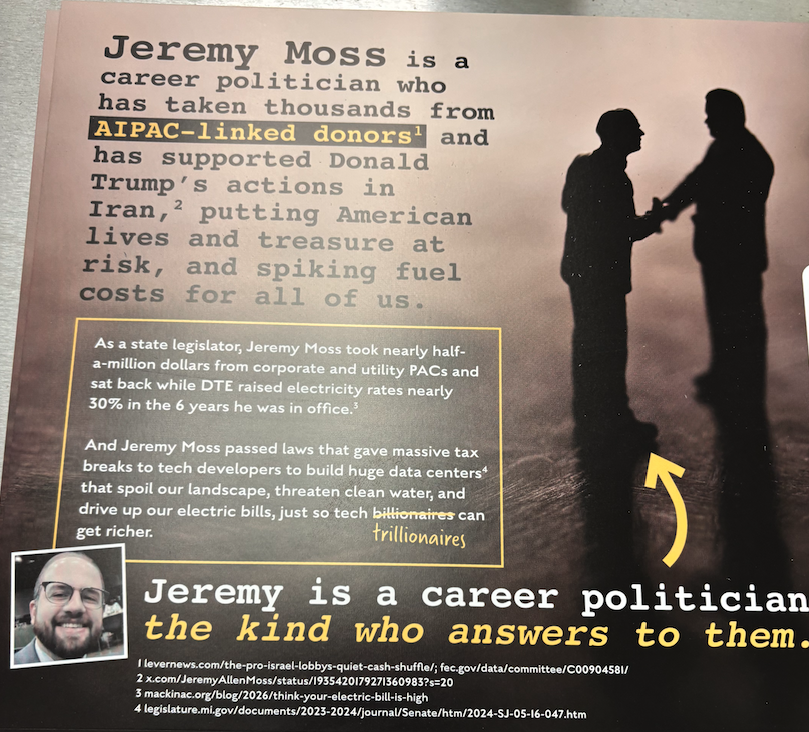
Ahead of the Aug. 4 primary, it’s a strategy that has raised eyebrows in the 11th District — the seat being vacated by Rep. Haley Stevens (D-MI) — which includes the heart of metro Detroit’s Jewish community.
“The language on his mailers was very clear to say AIPAC-linked donors,” Moss told Jewish Insider in an interview on Thursday. “One more dig deeper than that is just — it’s Jews.” Some of Moss’ donors have also supported AIPAC, but he does not think their involvement in the political system should be suspect.
“I went through the donors and I was like, ‘Oh yeah, those people go to synagogue with me. These people are the parents of my childhood friends,’” Moss said. “It does touch many people’s ears as if it’s trafficking [in] antisemitism.”
Stevens has represented the area since 2019, but her decision to run for Senate created a rare open seat in the Democratic-leaning district. Her Senate opponent, Abdul El-Sayed, has made Stevens’ support from AIPAC a key tenet of his campaign. But where AIPAC — which has become toxic in a wide swath of the Democratic Party this cycle in the wake of the war in Gaza — has spent tens of millions of dollars to boost Stevens, the group is not involved in Moss’ race.
“AIPAC has definitely been more talked about during this election year than I recall in past years,” Adam Duberstein, a clinical psychologist in the district who serves on the city council of Clawson, a small Detroit suburb, told JI. “I’m incredibly surprised by it. I really am, because I don’t think that I even really knew what AIPAC was a couple years ago.”
Ufford, a former Biden administration official who previously served as director of global vehicle engineering at Ford, is not Moss’ only opponent, but he appears to present the biggest threat to the state senator.
Moss has raised $1.4 million throughout the campaign, compared to Ufford’s $1 million haul. Ufford is making strides to catch up: In the second quarter of this year, Ufford narrowly outraised Moss, $435,000 to $414,000. The two have also received dueling endorsements from Detroit’s hometown papers: The Detroit News endorsed Ufford, while the Detroit Free Press backed Moss.
Mark Goldenberg, Ufford’s campaign manager, said Moss’ claim that the anti-AIPAC messaging traffics in antisemitism is “an outrageous and dangerous accusation.”
“Don is a longtime friend to Michigan’s Jewish community and will continue to be,” Goldenberg told JI. “Don believes it’s wrong for Jeremy Moss to run for Congress with a campaign funded by large Donald Trump and MAGA donors, and that Moss was wrong to support Trump’s 2025 strikes on Iran.”
Moss has received $1,000 from Democratic Majority for Israel, and he also earned the endorsement of Jewish Democratic Council of America.
Gene Farber, a lawyer in West Bloomfield, said he expected the anti-Israel attacks on Moss to “be less resonant in this district than some of the others” because of the large Jewish population.
“I think Jeremy’s in good shape,” said Farber, “but I’m not in other parts of the district.”
Even in heavily Jewish West Bloomfield, the intensity of the political moment has caused tensions between neighbors. Zach Nessel, a recent Michigan State graduate who has been knocking on doors with Moss’ campaign, described a “big sign war” — three Jeremy Moss yard signs have been stolen from his front lawn over the past several weeks.
A third candidate, Aisha Farooqi, is also outspoken in her opposition to AIPAC. She said in a recent interview that she opposed AIPAC “from the very beginning, before it was even popular [to do so]”. She received the endorsement of Citizens Against AIPAC Corruption, a political group affiliated with the X account “Track AIPAC,” which goes after politicians who have received money from pro-Israel groups or aligned donors. Farooqi has also been endorsed by Rep. Ro Khanna (D-CA), one of the most vocal critics of Israel in Congress.
“The problem in the Middle East is decades of western aggression, sanctions, and the US support of Israel to do as it pleases in the region,” Farooqi wrote in a post on X in June. Her profile’s bio has two slogans: “No AIPAC” and “Abolish ICE.” She supports ending all aid to Israel and “holding those responsible for war crimes accountable,” according to her campaign website. A fourth candidate who trails in fundraising, John Paul Torres, has pledged to stand against “the genocide against the Palestinian people.”
Any whiff of antisemitism in the race is particularly troubling to Jewish voters in a district that includes Temple Israel, the Reform synagogue that experienced a violent antisemitic attack in March. No one was killed besides the assailant, a Hezbollah sympathizer whose brother was a commander in the terror group in Lebanon, according to the IDF.
“I think there was a very big moment in this district when Temple Israel was attacked, and it very clearly demonstrated where the anti-Israel rhetoric does produce antisemitic hate and harm in our community,” said Moss. “It has been very challenging to grapple with all of the goings-on in the Middle East and ensure we have safety and security for our Jewish community here at home in this district.”
The Jewish attorney general said she believes she will get ‘chased around,’ ‘harassed,’ ‘yelled and screamed at’ and ‘booed off stage’ if she were to attend her own party convention
Chip Somodevilla/Getty Images
Michigan Attorney General Dana Nessel speaks on stage during the third day of the Democratic National Convention at the United Center on August 21, 2024 in Chicago, Illinois. Delegates, politicians, and Democratic Party supporters are in Chicago for the convention, concluding with current Vice President Kamala Harris accepting her party's presidential nomination.
Michigan Attorney General Dana Nessel, a Jewish Democrat whose eight years in office will conclude at the end of December, said at an event in Lansing on Thursday that antisemitism in the state — and in the statewide Democratic Party — has gotten so bad that she will not attend the party’s nominating convention next month.
At the party’s first convention of the year, in April, attendees chose a pro-Hezbollah candidate over a pro-Israel Jewish incumbent for a slot to be a University of Michigan regent. Party members loudly booed Rep. Haley Stevens (D-MI), a pro-Israel Democrat running for Senate, when she addressed the room, leaving Jewish attendees “shell-shocked,” as a former Ann Arbor city councilmember said at the time.
“I don’t feel safe going,” Nessel said at the Thursday event, which was organized by the Anti-Defamation League and featured other Michigan Jews speaking about their own experiences of antisemitism. “I feel like my presence is not going to be welcomed. I don’t want to get chased around. I don’t want to get harassed. I don’t want to get yelled and screamed at. And I don’t want to get booed off the stage, irrespective of what I’m saying. And I believe that if I go, that is what will happen.”
Nessel spoke candidly, as heard in audio of the event obtained by Jewish Insider, about a problem that she said has gotten “worse and worse and worse,” including within her own political party.
“I can’t speak for the Republican Party because I’m not a member of that party, but I will speak as a member of the Democratic Party here in Michigan, that something’s got to change. This cannot continue,” Nessel said. “I have profound fears about what is going to happen to this state, and what is going to happen to this country if we don’t have a significant change of course.”
Nessel was billed as the moderator for the roundtable, where she heard from parents whose children had faced antisemitism in Michigan schools, the director of Chabad at Michigan State University and a rabbi from Temple Israel, the West Bloomfield synagogue that is still reeling from an antisemitic attack in March. Nessel listened to the stories and asked questions of the participants, but she also spoke at length about her own experiences and her perception of the threat that antisemitism poses.
“I can’t just say that it’s caused me a good deal of depression. I often feel despair,” Nessel said. She described gradually coming to terms with the modern reality: that antisemitism is now a feature of American society, and a fixture on both the political left and right.
“I’ve never seen it in my lifetime. I appreciate that my parents did — certainly my grandparents did,” Nessel said, noting that her grandparents fled Eastern Europe. “To see some of the same language that was used during that time period, and we’re seeing it emerge now in modern-day America — if you would have told me that … I still will say I was very naive and I didn’t think, ever, that this could happen in modern-day United States of America.”
Antisemitism is not entirely a post-Oct. 7 phenomenon for Nessel. In March 2023, several months before the Hamas attacks in Israel that kicked off the war in Gaza, federal investigators arrested an armed Michigan man for threatening to kill Jewish people serving in state government, including Nessel. But she stressed that things have only gotten worse since.
“Especially since Oct. 7, what has become clear to me,” said Nessel, is “how few people know anything about our religious beliefs, how little many people know really about Israel or about any connection that the Jewish community has with Israel.”
When she won her race in 2018, Nessel became the first LGBTQ person elected to statewide office in Michigan. She expected to face threats about that. She did not expect that nearly all of the threats against her would be because she was Jewish.
“The threats that I receive are almost exclusively antisemitic threats. People aren’t interested in the fact that I’m gay. They’re not interested in the fact that I’m a woman. They are very interested in the fact that I am Jewish,” Nessel said. “That is a barometer as to the focus that people have.”
ADL Michigan regional director Elyssa Schmier told JI that Nessel’s comments about the Democratic Party convention surprised her.
“I do think it says something that the highest ranking Democrat or any party official in our state who’s Jewish does not feel comfortable or safe,” Schmier said. “I think that there are people on both sides of each political party that want to remove Jews from public life and make it so they fear for their safety or their family’s safety, or the ability to even achieve what they want to achieve in those settings.”
Rabbi Arianna Gordon, director of education and lifelong learning at Temple Israel, lauded Nessel for speaking openly about the antisemitism she has faced in politics.
“There’s some really scary things happening in the political conversation right now, particularly here, but there also are politicians who really have shown up for us and for the Jewish community, and who I know care deeply about us,” Gordon said. “Good for her for saying that out loud.”
Leading rabbis across the state are urging their congregants to vote for Stevens — even if they’re not saying so explicitly
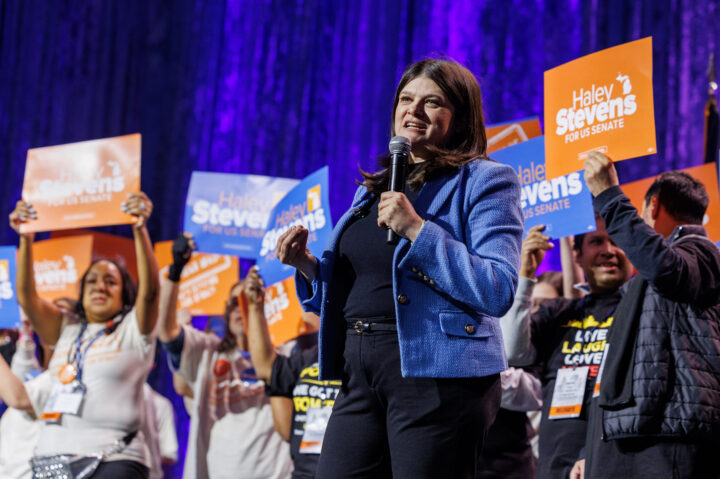
Andrew Roth/Sipa USA
Rep. Haley Stevens (D-MI) speaks at the Michigan Democratic Party Endorsement Convention in Detroit, Mich., on April 19, 2026.
Several large Detroit-area synagogues emailed their congregants earlier this summer to urge them to vote in Michigan’s Aug. 4 primary — what seemed at first to be a somewhat bland call to make their voices heard and exercise their civic duty.
Then, as primary day drew closer, the messages took on a sharper edge from the usual staid, nonpartisan rhetoric that houses of worship might have sent in the past ahead of major elections.
“While we aren’t going to tell you who to vote for and we have never sent a message like this in our congregation’s history, these are no ordinary times,” the leaders of Temple Israel, the Reform synagogue in West Bloomfield that was the site of a violent antisemitic attack in March, wrote in an email last month.
The rabbis did not directly tell congregants whom to support in the Democratic Senate primary between Rep. Haley Stevens (D-MI) and Abdul El-Sayed, a former public health official. Instead, they merely described a politician who sounded a lot like Stevens: “a candidate whose record, actions, and rhetoric demonstrate the strongest commitment to protecting Jewish lives by combating antisemitism, seeking federal security funding for American Jewish communities, and supporting Israel’s security and right to exist as a Jewish state.” (The Conservative Congregation Shaarey Zedek in Southfield used similar language in a letter to its congregants in June.)
El-Sayed, who has made attacking AIPAC a central tenet of his campaign, has refused to say whether he believes in Israel’s right to exist as a Jewish state. El-Sayed condemned the Temple Israel attack — which did not result in any casualties aside from the assailant, a Hezbollah sympathizer who drove a truck into the synagogue preschool before opening fire — but said that “hurt people hurt people,” referring to the attacker’s ties to family members in Lebanon affiliated with Hezbollah who were killed in Israeli strikes.
The email from a nonprofit religious institution was just one of many that are being forwarded between the inboxes of Jewish Michiganders in the final days of the Senate primary, which is open to all registered voters regardless of party affiliation. Rabbis’ unprecedented advocacy in the race reflects the urgency surrounding what many Michigan Jews view as one of the most important elections in their lifetime: between a moderate, pro-Israel lawmaker who has represented the hub of Detroit’s Jewish community for nearly eight years and an insurgent far-left candidate whom they view as dangerously misguided when it comes to matters of Jewish communal concern.
Rabbi Aaron Starr, of Shaarey Zedek, told Jewish Insider on Tuesday that Stevens is “a longtime friend of the Detroit Jewish community.” But he stopped short of publicly naming her as his preferred candidate. Still, he said that the stakes feel different in this election, prompting the stronger-than-usual message to congregants.
“This is not difficult at all because I just feel it is so important,” Rabbi Asher Lopatin, who leads the Orthodox Kehillat Etz Chayim synagogue in Detroit and is director of community relations at the Ann Arbor Jewish federation, told JI. “We really have seen a lot of energy, I would say really just in the last month. People have woken up, I think, to this danger.”
“We’ve spoken in condemnation of and in praise of elected officials’ and candidates’ rhetoric on both sides of the aisle,” he said of the synagogue’s past political commentary. “Yet this election feels like a more existential moment for the Jews of Michigan, of the United States and around the world.”
Other rabbis are being more overt in their support for Stevens. Rabbi Asher Lopatin, who leads the Orthodox Kehillat Etz Chayim synagogue in Detroit and is director of community relations at the Ann Arbor Jewish federation, sent an email this week to his personal contact list urging them to vote for Stevens. He also noted that his position does not formally represent the views of his employers.
“This is not difficult at all because I just feel it is so important,” Lopatin told JI. “We really have seen a lot of energy, I would say really just in the last month. People have woken up, I think, to this danger.”
Three dozen members of Detroit’s Orthodox community, including several rabbis, signed a letter calling on observant Jews to support Stevens, whom they described as an “outspoken supporter of Israel and a devoted ally to the Jewish community.”
Among Orthodox Jews, who are more likely than secular Jews to identify as Republican, there is an educational push to remind voters that in Michigan, they can vote in whichever primary they choose — Democratic or Republican — regardless of their party affiliation.
“In the primary, many of the Democratic challengers to these candidates are hostile to our community. It is imperative to vote for those who support us,” the Orthodox Jewish leaders wrote. “Having a voice in deciding who the Democratic candidate is will be important no matter who you vote for in November in the general election. You do not need to be a registered Democrat to vote in the Democratic primary.”
“We need all the help we can get, the people we can get, to represent the Jewish population,” Gail Mash, an 81-year-old resident of a senior housing facility operated by the Detroit Jewish Federation, told JI. “There are people who are homebound and have nothing to do. This is the best thing they can do: take an active part and feel that they’re doing something for the community.”
The frantic email campaigns and WhatsApp chains are joined by the actual bread-and-butter of campaigning: phone banking and canvassing. Gail Mash, an 81-year-old resident of a senior housing facility operated by the Detroit Jewish Federation, calls herself and her group of politically engaged girlfriends the “Bubbe Brigade.” (Mash described herself as a former “Kennedy girl” who has been a Democrat her whole life.)
The “Bubbe Brigade” makes phone calls each week to members of the Michigan Democratic Jewish Caucus, a grassroots group representing Jewish Democrats within the state party, and reminds them to vote.
“We need all the help we can get, the people we can get, to represent the Jewish population,” Mash told JI in a phone call on Tuesday. “There are people who are homebound and have nothing to do. This is the best thing they can do: take an active part and feel that they’re doing something for the community.”
The Democratic Jewish Caucus campaigned with Stevens in the Detroit suburbs over the weekend at a canvassing event that was also promoted by the Jewish Democratic Council of America, a national group that is supporting efforts to rally Jewish voters for Stevens. JDCA is hosting more than a dozen phone banking events, and it has also made a five-figure digital ad buy in support of Stevens.
“When Jewish Americans needed a champion, Haley Stevens stepped up,” the ad says. It touts Stevens as a leader in fighting antisemitism, “creating jobs” and “delivering for Michiganders.”
Polling has shown El-Sayed with a small lead, though the dynamics of the race have shifted in Stevens’ favor since a third candidate, state Sen. Mallory McMorrow, dropped out earlier this month.
In the final debate of the campaign on Monday, El-Sayed repeatedly went after AIPAC and attacked Stevens for her support of the U.S.-Israel relationship. The rhetoric has left some Jewish Democrats in the state confused — and frustrated — at the way Israel, and its political supporters in the U.S., have become so central to a primary for a pivotal Senate swing seat.
“We have concerns that are sometimes unique from other communities’ concerns,” Ari Weisenfeld, the director of state relations at Agudath Israel, told JI. “If you want your elected officials to take them seriously, whether that’s at the local, state or federal level, you need to get out and vote.”
“The Jewish community is just like, why is there this obsession with this organization that a lot of us do not have an affiliation with?” said Decky Alexander, who chairs the Democratic Jewish Caucus. “It is just mind-blowing that this is such a consumptive issue when we have real threats to our Constitution, our democracy and the economics that are going on.”
Early voting is already underway, but campaigning will continue until polls close on Tuesday. Ari Weisenfeld plans to travel to Detroit from his home in Connecticut to urge Orthodox Jews to vote. As the director of state relations at Agudath Israel, an Orthodox umbrella organization, Weisenfeld is not promoting a particular candidate — all he cares about is that observant Jews get out and vote. He plans to try to visit as many synagogues as he can for morning minyanim between 6 a.m. and 9 a.m, reminding people to vote. If people need a ride to the polls, he’ll provide it.
“We have concerns that are sometimes unique from other communities’ concerns,” Weisenfeld told JI. “If you want your elected officials to take them seriously, whether that’s at the local, state or federal level, you need to get out and vote.”
The AIPAC-affiliated super PAC accused El-Sayed of ‘helping Trump win,’ in a continuation of its messaging strategy hitting far-left candidates over their opposition to the Biden administration
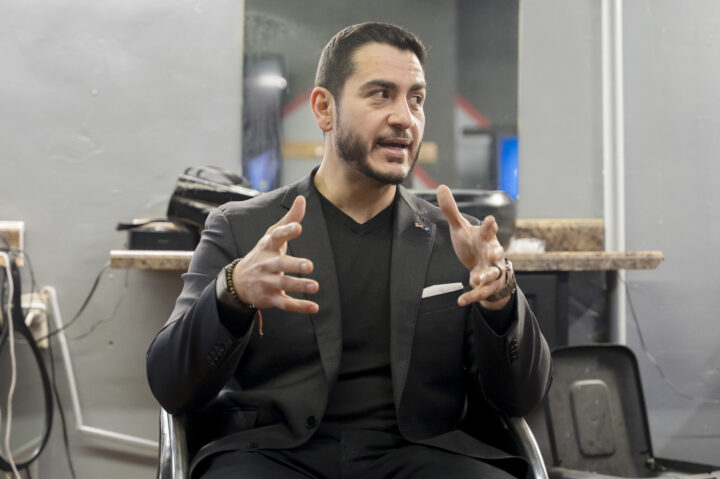
Evan Cobb for The Washington Post via Getty Images
Michigan Senate candidate Abdul El-Sayed speaks with customers and barbers at Blazin Wade Cuts in Grand Rapids, Michigan, on Saturday, Feb. 21, 2026.
United Democracy Project, the AIPAC-affiliated super PAC, is running a new ad targeting Abdul El-Sayed, a far-left Democrat in Michigan’s closely contested Senate primary, over his past support of the “uncommitted” movement and his criticisms of popular Democratic leaders — a messaging strategy the group has used as an effective attack line against anti-Israel opponents in previous election cycles.
The 30-second TV spot, released on Tuesday in advance of the Aug. 4 contest, cites comments in which El-Sayed had criticized Barack and Michelle Obama while accusing El-Sayed of “helping Trump win” the election in 2024 because of his promotion of the “uncommitted” effort that urged Democratic primary voters to leave their ballots blank as a protest against former President Joe Biden’s support for Israel amid the war in Gaza.
“With our democracy on the line against Donald Trump in 2024, El-Sayed told Democrats to vote ‘uncommitted,’ even after Gov. Whitmer warned those efforts would help elect Donald Trump,” the narrator says, referring to Michigan Gov. Gretchen Whitmer, who last week endorsed El-Sayed’s rival, Rep. Haley Stevens (D-MI), a pro-Israel Democrat backed by AIPAC.
“Disrespecting women. Attacking the Obamas. Helping Trump win. That’s the real Abdul El-Sayed,” the ad concludes.
While UDP has invoked similar rhetoric in other ads hitting El-Sayed, the new spot is the first to mention his ties to “uncommitted,” a campaign first launched in Michigan that is emerging as a key point of tension for the insurgent candidate — particularly with Black leaders who believe the movement helped contribute to former Vice President Kamala Harris’ defeat in the battleground state.
An image of Harris is shown in UDP’s new TV ad, but the former vice president is not named directly by the narrator.
UDP is also running two new digital ads — aimed at younger voters ages 18-25 who have been drawn to El-Sayed’s anti-establishment bid — that accuse him of making sexist remarks toward women and saying he was “one of the reasons Trump won,” again referring to his “uncommitted” activism.
Earlier this month, Stevens likewise highlighted El-Sayed’s alignment with “uncommitted,” while alleging he called Harris’ campaign “nauseating.”
El-Sayed, for his part, has sought to downplay his association with the movement, claiming in a recent campaign ad that he was “the first Muslim American leader to endorse Kamala Harris for president,” even as fact-checkers have deemed that statement inaccurate.
In a statement to Jewish Insider on Tuesday, Patrick Dorton, a UDP spokesperson, called El-Sayed “a bad Democrat” who “has repeatedly advocated positions that lose elections for Democrats.”
“That’s why Republicans are desperate to have him be the nominee,” Dorton said. “They know they can beat him.”
A new poll commissioned by the Michigan Education Association, which has not made an endorsement in the primary, found Stevens leading former Rep. Mike Rogers (R-MI), the Republican nominee, by two points in a hypothetical general election matchup, making the race a toss-up. El-Sayed, by contrast, was trailing Rogers by seven points in the open-seat race to succeed retiring Sen. Gary Peters (D-MI), which Democrats see as key to control of the Senate, according to the poll.
El-Sayed, an outspoken critic of Israel, has made AIPAC’s investment in the race a centerpiece of his messaging, as the group has grown increasingly toxic among Democrats. UDP’s spending to help Stevens has so far exceeded $30 million.
The pro-Israel group is also targeting former Rep. Cori Bush (D-MO), who is seeking a rematch in next Tuesday’s House primary in St. Louis against Rep. Wesley Bell (D-MO) — after he unseated her last cycle with a significant financial boost from UDP.
In recent weeks, UDP has run ads attacking Bush for past comments criticizing Biden and Harris, echoing the messaging it deployed two years ago to help oust the former Squad member who was among the most strident critics of Israel in the House.
A new TV ad released by UDP on Tuesday further dinged Bush as an absentee lawmaker who passed “zero bills” in Congress and called her opposition to the bipartisan infrastructure package in 2021 a vote “against Democrats.”
“Cori Bush has her own agenda, and it hurts St. Louis,” the ad claims.
The poll, commissioned by the state’s largest teachers’ union, shows Haley Stevens and Mike Rogers nearly tied, with El-Sayed trailing Rogers by 7 points
Sarah Rice/Getty Images
Abdul El-Sayed, candidate for US Senate in Michigan, speaks at Mumford High School on May 3, 2026 in Detroit, Michigan.
One week before Michigan’s closely watched Democratic Senate primary, a new poll shows Rep. Haley Stevens (D-MI) leading former GOP Rep. Mike Rogers by two points if she proceeds to the general election — with her opponent, Abdul El-Sayed, trailing Rogers by seven points.
Among voters who said they definitely plan to vote in the general election, the more moderate Stevens currently leads Rogers 47% to 45%, making the race a toss-up. In an El-Sayed-Rogers matchup, Rogers leads El-Sayed, a far-left former public health official, 48% to 41%.
The poll’s findings provide evidence for one of Stevens’ central campaign messages, which is that she stands the best chance of defeating Rogers in a key swing state and ensuring that Democrats hold onto the Senate seat being vacated by retiring Sen. Gary Peters (D-MI).
Among independent voters, Stevens and Rogers are nearly tied, with Rogers at 40% and Stevens at 39%. Independent voters overwhelmingly prefer Rogers to El-Sayed, with 47% saying they would support Rogers and 19% pledging to back El-Sayed.
The poll was commissioned by the Michigan Education Association — the state’s largest teachers’ union, which has not made an endorsement in the race — and an organization called Business Leaders for Michigan. It was conducted between July 22 and 24. The survey did not ask respondents their preferences in the Aug. 4 primary.
Haley Stevens touted her support for a two-state solution for Israel and the Palestinians, while Abdul El-Sayed lambasted U.S. aid to the Jewish state
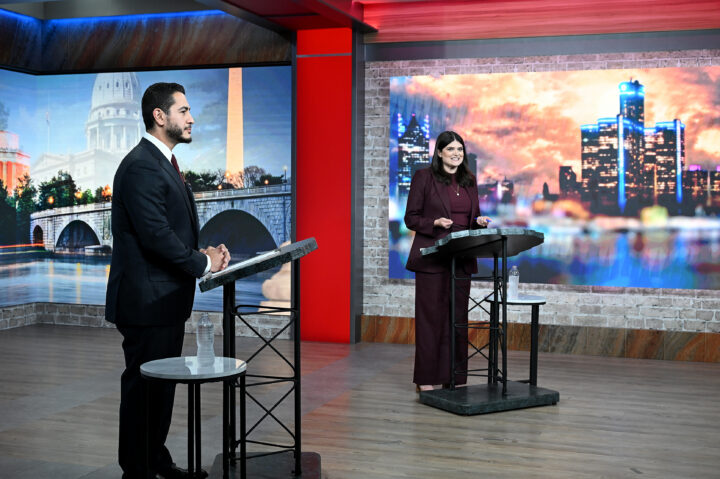
(Robin Buckson/Detroit News via AP, Pool)
Senate candidates Abdul El-Sayed, left, and Rep. Haley Stevens participate in a televised debate moderated by Roop Raj, Monday, July 27, 2026, in Southfield, Mich.
If Michigan’s Democratic Senate primary has become a test case for the saliency of AIPAC and Israel as a political issue for Democratic voters, then Monday night’s debate between Abdul El-Sayed, a far-left former public health official, and Rep. Haley Stevens (D-MI) served as the ultimate battlefield — and illustrated the gulf between the two candidates on the issue.
Over the course of an hourlong debate, El-Sayed made clear that he believes his opposition to AIPAC and to Israel will help him win next week’s election. Stevens, meanwhile, did not even utter the word “AIPAC.”
Stevens outlined her views on the Middle East, arguing that she and El-Sayed diverge because she supports a two-state solution to the Israeli-Palestinian conflict while he has not acknowledged Israel’s right to exist as a Jewish state. She touted her support for Michigan’s Jewish community and mentioned the work she did to advocate for the hostages after the Oct. 7, 2023, Hamas attacks on Israel.
Debate moderator Roop Raj, an anchor on FOX 2 News, prodded Stevens on her support from AIPAC, pushing her to discuss the group’s spending in the race, but she largely avoided doing so.
“Absolutely not,” Stevens said when asked by Raj whether voters should be concerned that she will do AIPAC’s “bidding” when she wins the seat.
Mostly, she turned the transparency questions on her opponent, attacking El-Sayed for not releasing all of his financial disclosure forms and for benefitting from a super PAC to which his father-in-law has contributed $200,000.
“I don’t think there’s much difference between super PACs going in for Abdul or super PACs going in for me,” Stevens said, when asked about AIPAC spending $46 million in the race. “We have a problem with campaign finance reform in this country.”
El-Sayed did the same, but in reverse: When she called out his lack of personal financial transparency, he went after her for benefiting from outside spending in the race.
The first question of the debate, to El-Sayed, was about how he would work to make Michigan more affordable. His answer: eschewing campaign donations “from the corporations who are jacking up your prices in the first place,” a category in which he placed AIPAC.
“Just last week, our friend here voted to send 3.3 billion of your tax dollars to a foreign government. That is the pro quo that comes with the quid of $30 million spent by AIPAC,” El-Sayed said. “It really comes down to how are you funded.”
Stevens, when asked about affordability, talked about regulating utilities in the state and promising to be a “proven fighter.”
When Stevens described being “robbed by Washington, D.C., and [President] Donald Trump,” and pledged to fight corruption in public office, El-Sayed said he agreed that Michiganders are being robbed — but by AIPAC, not Trump.
“The money that we should have to invest in our schools is being sent to foreign governments to destroy other people’s schools instead of investing in our own, and that is exactly what AIPAC wants you to do, and why they’re spending so much money to get the congresswoman elected,” El-Sayed said.
Plus, Jewish leaders wary of Michigan's early primary role

Avi Ohayon (GPO) / Handout/Anadolu via Getty Images
Israeli Prime Minister Benjamin Netanyahu makes statements at Ben Gurion Airport ahead of his visit to Washington DC, where he will meet with US President Donald Trump in Tel Aviv, Israel on February 02, 2025.
Good Monday morning.
In today’s Daily Kickoff, we report on concerns among Jewish leaders regarding Michigan’s positioning as an early Democratic primary state in the 2028 presidential nominating contest, and have the scoop on Democratic Majority for Israel’s decision to pause its endorsements of nine House Democrats who voted against aid to Israel. We talk to pollster Dahlia Scheindlin about Israelis’ understanding of anti-Israel sentiment in the U.S., and spotlight Judaica artist Debra Band, whose biblical manuscripts were acquired by the Library of Congress earlier this year. Also in today’s Daily Kickoff: Ashley Jackson, Rabbi Yitz Greenberg and Harold Grinspoon.
We also have a new on-demand Live Briefing that you can access throughout the day via our new app (on Apple and Android) and on our website.
Today’s Daily Kickoff was curated by JI Executive Editor Melissa Weiss and Israel Editor Tamara Zieve, with assists from Danielle Cohen-Kanik and Marc Rod. Have a tip? Email us here.
What We’re Watching
- With the late Sen. Lindsey Graham’s (R-SC) funeral scheduled for tomorrow in Washington, attendees will begin making their way to the capital today. Israeli Prime Minister Benjamin Netanyahu took off earlier today for Washington, where he’ll also meet with President Donald Trump tomorrow. More below.
- As tensions continue to simmer in the Middle East, Trump appeared to deescalate, halting strikes on Iranian targets over the weekend after nearly two weeks of nightly strikes. Speaking at the rescheduled White House Correspondents’ Dinner on Friday, Trump said that he didn’t think that Iranian leaders were ready to make a deal. “They are talking to us right now. They’d love to make a deal. I don’t think they’re ready to. I don’t think it’s time yet, but I’m willing to listen,” Trump said at the dinner. Read more here.
- The recalibration comes amid reports of dwindling interceptor stockpiles, as well as pushback to continued engagement among military leaders. Axios reports that CENTCOM head Adm. Brad Cooper had advocated for ending the U.S. bombing campaign around the Strait of Hormuz, arguing that the effort had reached its maximum effectiveness.
- Meanwhile, the IDF confirmed that two drones were shot down over the Jordanian border this morning, but did not say where the drones originated.
- The Atlantic Council is hosting a virtual fireside chat with Israeli Opposition Leader Yair Lapid in conversation with former U.S. Ambassador to Israel Dan Shapiro.
What You Should Know
A QUICK WORD WITH JI’S Josh kraushaar
For Democrats worried about the party’s left turn, the outcome of the presidential nominating calendar, which was approved by a Democratic National Committee panel on Friday, is something of a mixed bag. (For pro-Israel Democrats, the presence of Michigan taking center stage on the early schedule is already causing heartburn, per reporting from JI’s Matthew Kassel.)
In a boost for centrists, the nomination process is slated to lead with South Carolina, a Southern state that has long been a moderating force in the party’s presidential calendar, largely because of its sizable Black population.
But as Jonathan Martin noted in Politico, South Carolina’s first-in-the-nation status carries some unintended consequences. The state, which has typically voted after Iowa’s caucuses and New Hampshire’s primary, often played the role of choosing the nominee after the field was winnowed down by the earlier states. South Carolina has picked the primary winners in the last two decades: Barack Obama (in 2008), Hillary Clinton (in 2016) and most notably Joe Biden (in 2020) when pundits counted the former vice president out after losses in Iowa, New Hampshire and Nevada.
With South Carolina being moved to the front of the line, the state will end up narrowing down the lineup of candidates rather than having the final say on a shortlist of candidates. The changed primary calendar also puts pressure on moderate candidates to make a strong showing right away: If a leading centrist such as Pennsylvania Gov. Josh Shapiro runs for president, South Carolina suddenly becomes much more of a pivotal state, with outreach to Black voters a necessity.
SCOOP
DMFI PAC, Democratic Majority for Israel’s political arm, is pausing its endorsements of nine Democratic House members who voted this month to end all U.S. aid to Israel, underscoring the depth of its frustration even as the group also seeks to preserve relationships with lawmakers it had championed, Jewish Insider’s Matthew Kassel reports.
On hold: “Because of that vote, we are pausing our endorsement and taking your name off the list of supported lawmakers on the DMFI PAC website,” Brian Romick, the president of DMFI PAC, said in a letter to the lawmakers, the full text of which was shared exclusively with JI on Sunday. “At the same time,” he added, “our hope is that this pause will be temporary and that, through a candid conversation about the path forward, we can resume our endorsement.”
MICHIGAN MATTERS
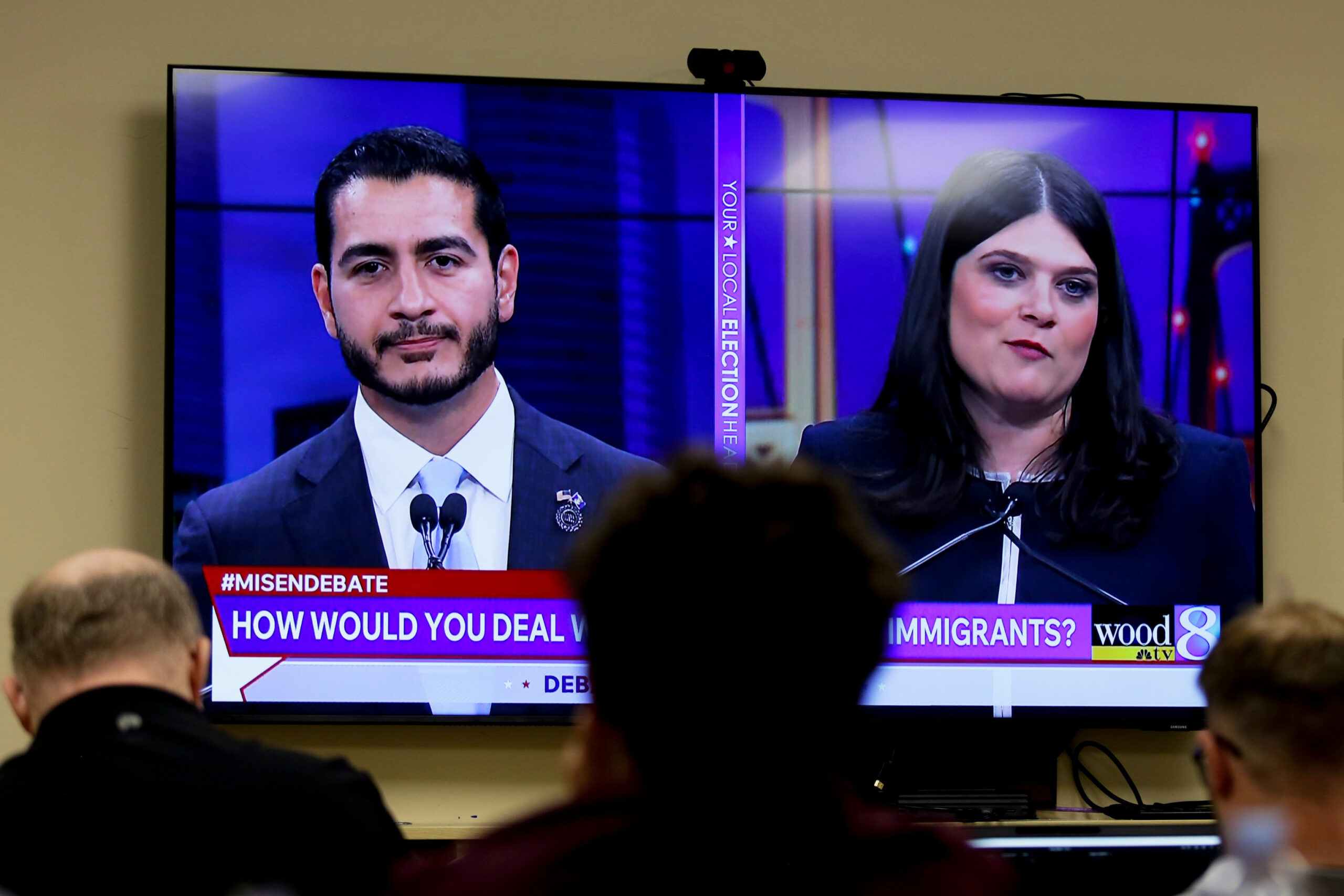
The selection of Michigan as an early Democratic primary state in the 2028 presidential nominating contest, approved on Friday by a panel of the Democratic National Committee, is prompting some concerns among Jewish and pro-Israel activists who fear the party’s sharp divisions over Israel and its recent controversies over antisemitism could create a volatile political landscape during the key contest, Jewish Insider’s Matthew Kassel reports.
Looking ahead: If the schedule is finalized, Michigan “figures to be one of the first anti-Israel or antisemitic states that has a vote,” said Dennis Bernard, a Jewish leader who advises members of both parties, told JI. The state’s Aug. 4 Senate primary — a bitter race between AIPAC-backed Rep. Haley Stevens (D-MI) and Abdul El-Sayed, whose rhetoric targeting Israel and ongoing refusal to recognize its right to exist has alarmed Jewish voters — is expected to offer an early read on how much that tension will shape 2028.
Moving the needle: With less than two weeks until Michigan’s contentious Democratic Senate primary, Michigan Gov. Gretchen Whitmer endorsed Stevens on Friday, offering a burst of momentum to the moderate Democrat’s campaign against progressive, anti-Israel firebrand El-Sayed, JI’s Gabby Deutch reports.
LEADER LIAISON
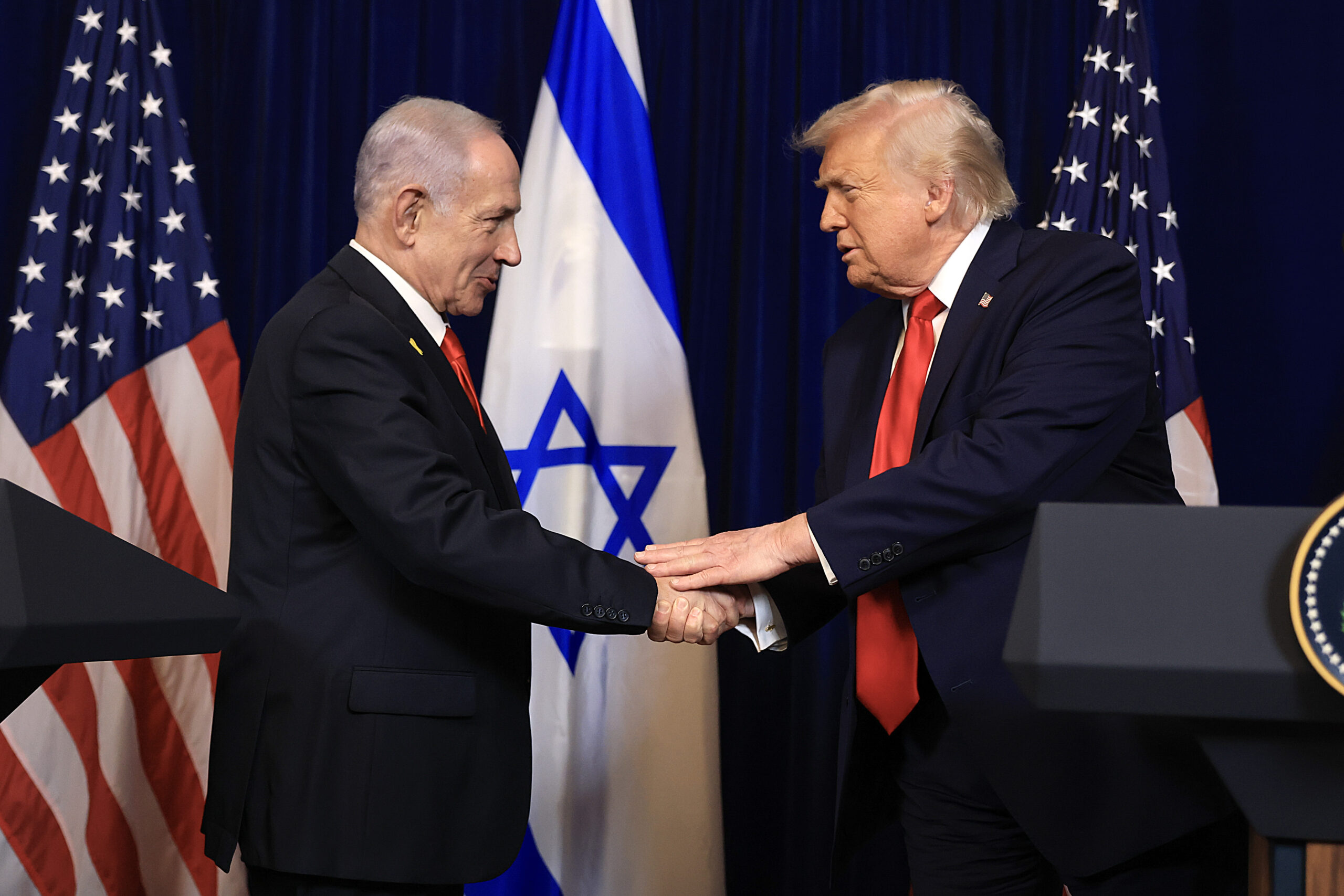
Israeli Prime Minister Benjamin Netanyahu is traveling to Washington on Monday, where he will meet with President Donald Trump and attend the funeral of Sen. Lindsey Graham (R-SC), his office announced on Friday, Jewish Insider’s Haley Cohen reports.
Honoring a friend: Netanyahu said that “Israel lost one of its greatest friends” after Graham died suddenly on July 11. The South Carolina senator’s funeral is scheduled for Tuesday at the National Cathedral in Washington.
POLLSTER PERSPECTIVE
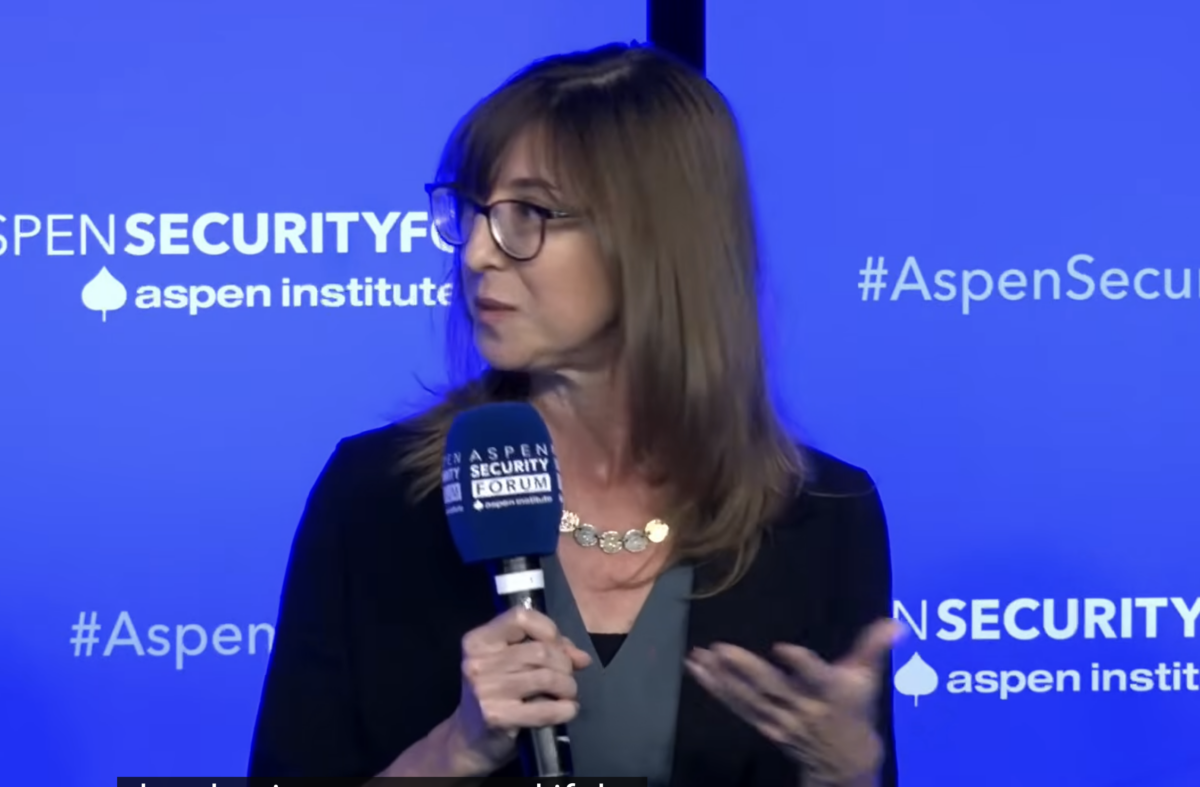
Israelis generally don’t grasp the extent of the growing anti-Israel sentiment in the United States, Dahlia Scheindlin, an Israeli public opinion researcher and columnist, told Jewish Insider’s Marc Rod on the sidelines of the Aspen Security Forum this month.
Crying wolf: Speaking to JI hours before more than 100 House Democrats voted to cut U.S. military aid to Israel, Scheindlin said that most Israelis feel that warnings of slipping U.S. support have been repeated for years but haven’t come to fruition. “Israelis for a long time have been told ‘you have to worry about the America-Israel relationship’ and nothing ever really happened — they sort of took it for granted that the relationship would always be there, and in many ways they still do,” Scheindlin said. “From the Israeli perspective, there’s a little bit of a sense of crying wolf. We see that in the 53% who still think that the relationship will be fine.”
Policy perspective: Sen. Mark Kelly (D-AZ) said on Sunday on NBC’s “Meet The Press” that he will “always stand by Israel as a nation,” while adding that he hopes Israelis will oust Prime Minister Benjamin Netanyahu in the elections later this year.
ACCOUNTABILITY FIGHT

Shockwaves from the Tisha B’Av stabbings on the Upper West Side reverberated through New York’s Jewish and Democratic Party elected leadership on Friday, as some blamed New York City Mayor Zohran Mamdani’s invective against Israel, while others called more broadly to turn down the temperature on the rhetoric in the city, Jewish Insider’s Will Bredderman reports.
Words of warning: Of the officials who participated in a press conference outside the Modern Orthodox Jewish Center, only Assemblymember Micah Lasher — who won a primary last month to succeed Rep. Jerry Nadler (D-NY) as congressional representative for the Upper West Side — openly called out Mamdani. “When a place, and by extension the people who are inextricably linked with that place, are singled out, compared to the worst evildoers in human history, blamed for problems half a world away, the space between rhetoric and violence can vanish,” warned Lasher.
BEE’S KNEES
For 30 years, Debra Band built a career in health policy — but in her Maryland studio, surrounded by kosher parchment, gold leaf and an unfinished manuscript or three, she’s spent the last quarter-century quietly reviving a Jewish art form: the illuminated manuscript. Five of her books now sit in the Library of Congress’s permanent collection, Jewish Insider‘s Christina Sher reports.
Illuminating tradition: When Band first brought her Song of Songs book to the library to show its then-head of the Hebraica section, she watched him lay all 65 pages out on a long table and pull out a jeweler’s loupe. She assumed he was hunting for errors in her calligraphy, and started speaking quickly, over-explaining the iconography. In an interview with JI, Band recalled him cutting her off and saying: “Don’t worry, if anyone in the country reads this book when it comes out, it will be me. Right now, I just need to look for the honeybees.” The bees are Band’s signature; her Hebrew name is Devorah — honeybee. As a private joke with herself, she tucks a small painted bee into nearly every manuscript page she makes.
Worthy Reads
Ambassador’s Insight: In The Washington Post, Matthew Gould, who served as a British ambassador to Israel and a deputy ambassador to Iran, explains the decision-making processes of Iranian leaders. “First: Iranian leaders are focused single-mindedly on preserving their grip on power. They know that the overwhelming majority of Iranians despise them and that the people will not be forgiving if the regime is finally removed. … Second: Iran’s actions often have more to do with internal regime dynamics than with statecraft. Western governments tend to interpret Iranian actions as aimed at them. But often, they are aimed internally.” [WashPost]
Atomic Optics: In The Wall Street Journal, Matthew Kroenig and Henry Sokolski warn of the possible fallout from the U.S.-Saudi deal announced last week that could give Riyadh a civilian nuclear program. “Providing Saudi Arabia a pathway to build the capacity the U.S. Air Force is razing in Iran gives hypocrisy a bad name. It not only would make it more difficult to get Iran to restrict its own program, but also set a poor example and encourage other nuclear suppliers to misbehave. More important, it’s sure to spook Riyadh’s neighbors. … The U.S. got the United Arab Emirates to agree to forgo making nuclear fuel with the caveat that if Washington afforded any neighbor more-generous terms, the U.A.E. could renegotiate.” [WSJ]
Candidate Corner: The New Yorker’s David Remnick profiles Gadi Eisenkot as the former IDF chief of staff mounts a challenge to Israeli Prime Minister Benjamin Netanyahu, positioning himself as the “anti-Bibi” candidate. “Eisenkot is selling himself as the humble soldier, a political novice untainted by corruption or duplicity. After forty-one years in the Israel Defense Forces, including a stint under Netanyahu as chief of the general staff, the military’s highest post, Eisenkot served in the Knesset from 2022 to 2025. During that brief tenure, he says, he discovered that ‘Israeli democracy is far more fragile than I had imagined.’” [NewYorker]
A larger selection of Worthy Reads is available in our Live Briefing.
Word on the Street
A new CBS News/YouGov poll found that eight in 10 Americans think the Iran war was more challenging for the Trump administration than it had anticipated…
The Wall Street Journal spotlights Iran’s use of Kheibar Shekan missiles, which can be deployed more quickly than older weapons and some of which have advanced maneuvering features that have posed a challenge to interception efforts…
Israeli President Isaac Herzog spoke by phone on Sunday with Bahraini King Hamad bin Isa Al Khalifa in a conversation that was reportedly initiated by Al Khalifa, who asked for the discussion to be made public…
Board of Peace head Nickolay Mladenov said he welcomed “steps by Israel” that “enable the deployment” of the U.S.-led International Stabilization Force in Gaza…
Unreleased footage from a documentary filmmaker who was chronicling Sen. Lindsey Graham’s (R-SC) diplomatic endeavors showed the late senator expressing concerns over the involvement of White House Special Envoy Steve Witkoff and Jared Kushner in Middle East efforts, with Graham saying the two were “just too conflicted”; the footage, from documentarian Alex Holder, also includes Graham comparing Trump and Netanyahu to President Franklin Roosevelt and U.K. Prime Minister Winston Churchill…
Sen. Bernie Sanders (I-VT) told The Hill that he did not regret his previous support for former Maine Senate candidate Graham Platner, who ended his campaign after a slew of allegations ranging from a tattoo of a Nazi symbol to the sexual assault of a former girlfriend…
Morris Katz, a close advisor to Platner who stood by him until the final days of his Senate race, is now adopting a more contrite tone as he looks back on what went wrong in the campaign. “The tattoo should have been enough,” Katz said in an interview on “The Ezra Klein Show,” referring to Platner’s tattoo of a Totenkopf, a symbol associated with the Nazi regime’s elite SS unit, JI’s Gabby Deutch reports…
The New York Times examines what it describes as the “dysfunction and debt” wracking the Democratic National Committee and the “fraying nerves” of its chairman, Ken Martin, as the party seeks to capitalize on a favorable national environment to make sizable gains in the midterm elections…
The Department of Justice opened applications for a new grant program providing funding for local law enforcement agencies to deploy on-duty officers to protect houses of worship; the application closes on Sept. 2. The Department of Justice is set to provide more than $7.7 million for the program, more than the minimum $5 million budgeted by Congress…
A circuit court ordered the release of Georgetown researcher Badar Khan Suri, who had been held by immigration officials, a day after a federal appeals court overturned a lower court ruling ordering the release of Columbia University anti-Israel demonstrator Mohsen Mahdawi…
In eJewishPhilanthopy, Rabbi Yitz Greenberg honors his good friend Harold Grinspoon on the occasion of the philanthropist’s 97th birthday…
In a Washington Post op-ed, Ashley Jackson, a daughter of the late Rev. Jesse Jackson, reveals she converted to Judaism two years ago, a decision that was supported by her father…
Karim Khan, the chief prosecutor of the International Criminal Court who was suspended earlier this year over allegations that he’d sexually harassed a subordinate, was officially removed after 82 of the court’s 125 members voted on Friday to oust him from the role…
Authorities in Manchester, U.K., arrested two people who allegedly shot BB guns at Jewish pedestrians in what is being investigated as a religiously motivated crime…
Police in Canada are investigating attacks on two Jewish-owned bagel shops in Toronto on Sunday…
Brazilian politician Flávio Bolsonaro, the son of the country’s former president, secured the nomination of the country’s Liberal Party to challenge President Luiz Inácio Lula da Silva; Netanyahu sent a video expressing support for Bolsonaro during the party’s convention, which was held on Saturday…
The remains of Theodor Herzl’s grandparents will be moved from a Belgrade cemetery and reinterred at Jerusalem’s Mt. Herzl…
The New York Times does a deep dive into efforts by the Iran-backed Houthis in Yemen to use the current geopolitical situation to obtain concessions from Saudi Arabia…
The Wall Street Journal reviews Yitzhak Shalev’s 1964 novel The Gavriel Tirosh Affair, about a teacher in 1930s Mandatory Palestine who convinces his students to join a paramilitary group…
Japanese militant Kozo Okamoto, who served 12 years in an Israeli prison for taking part in a 1972 terror attack at Israel’s main airport in which 26 people were killed, died at 78 in Lebanon, which had granted him asylum…
Ida Schmertz, the founding director of Rutgers University’s Center for American Women and Politics, died at 91…
Pic of the Day
French Jewish DJ Barbara Butch performed on Saturday during the Hameau Festival in Saint-Martin-du-Tertre, France, a week after her concert in Grenoble was disrupted by anti-Israel activists. She has since filed a complaint against the organizers of the demonstration that forced her offstage while performing in Grenoble.
Birthdays
Comedian, writer, producer and actor, Carol Leifer turns 70…
Real estate developer who founded Aspen Square Management, he heads an eponymous foundation known for its flagship program PJ Library, Harold Grinspoon turns 97… Forensic pathologist known for his HBO show and his work investigating high-profile deaths, Michael M. Baden turns 92… Managing partner of Access Fund Management Company, he is a past president of the Jewish Community Federation of San Francisco, Harold Zlot… Former deputy secretary of defense and then CIA director in the Clinton administration, now a professor emeritus at MIT, John Mark Deutch turns 88… Steven M. Mizel turns 87… Artist and museum founder focused on Fusionism, Shalom Tomáš Neuman turns 79… Israeli author and television producer, he is best known for his documentaries of Israel’s intelligence agencies, Yarin Kimor turns 74… Washington bureau chief and White House correspondent for the Christian Science Monitor, Linda Feldmann… Former VP of global communications, marketing and public policy at Facebook, he previously held a similar position at Google, Elliot Schrage turns 66… U.S. Army colonel (retired), Jeffrey Brian Carra… Israeli television and radio personality, Erez Moshe Tal turns 65… Heir to the Hyatt Hotels fortune, now a film producer, Jean “Gigi” Pritzker turns 64… Former CEO of the Rabbinical Assembly, she is now the founder of Insight Eldercare, Rabbi Julie Schonfeld… Member of the European Parliament since 2009, Tamás Deutsch turns 60… Rabbi at Kesher Israel: The Georgetown Synagogue, Rabbi Hyim Shafner… Former national platform director for the Democratic National Committee, now a political consultant and recruiter, Andrew Grossman… Former chief of staff of the House Republican Conference, he is now the managing partner at Capitol Venture, LLC, Jeremy Deutsch… Head of marketing at Employee Navigator and winner on “Jeopardy!” in 2019, Aaron Lichtig… D.C. area political activist, Benjamin Rothenberg… SVP of communications at CBS News, Jeremy Adler…
The biggest red flag for the party — especially among its Jewish and pro-Israel supporters — is its decision to give Michigan Democrats such a pivotal role, given the rise of antisemitism and anti-Israel hostility within the state party ranks
Bill Clark/CQ-Roll Call, Inc via Getty Images
Ken Martin, chair of the Democratic National Committee, speaks during an interview at DNC headquarters in Washington on November 2, 2025.
For Democrats worried about the party’s left turn, the outcome of the presidential nominating calendar, which was approved by a Democratic National Committee panel on Friday, is something of a mixed bag. (For pro-Israel Democrats, the presence of Michigan taking center stage on the early schedule is already causing heartburn, per reporting from JI’s Matthew Kassel.)
In a boost for centrists, the nomination process is slated to lead with South Carolina, a Southern state that has long been a moderating force in the party’s presidential calendar, largely because of its sizable Black population.
But as Jonathan Martin noted in Politico, South Carolina’s first-in-the-nation status carries some unintended consequences. The state, which has typically voted after Iowa’s caucuses and New Hampshire’s primary, often played the role of choosing the nominee after the field was winnowed down by the earlier states. South Carolina has picked the primary winners in the last two decades: Barack Obama (in 2008), Hillary Clinton (in 2016) and most notably Joe Biden (in 2020) when pundits counted the former vice president out after losses in Iowa, New Hampshire and Nevada.
With South Carolina being moved to the front of the line, the state will end up narrowing down the lineup of candidates rather than having the final say on a shortlist of candidates. The changed primary calendar also puts pressure on moderate candidates to make a strong showing right away: If a leading centrist such as Pennsylvania Gov. Josh Shapiro runs for president, South Carolina suddenly becomes much more of a pivotal state, with outreach to Black voters a necessity.
Nevada will miss out on being the central player under the new calendar, but will still play a key role, holding the first primary in the West just over a week after South Carolina. The state has typically been friendly turf for progressives, given the influence of the state’s culinary union, which organizes workers in the gaming industry. Sen. Bernie Sanders (I-VT) easily won the state in 2020 and only lost narrowly to Clinton in 2016, demonstrating his insurgent campaign’s staying power.
The power of the state’s progressive organizers and its large Hispanic population have raised concerns that a far-left candidate such as Rep. Alexandria Ocasio-Cortez (D-NY) could emerge as a favorite — a factor that dampened support for its bid to be the first-in-the-nation contest.
But Nevada also is a swing state, and the state’s switch from a caucus to a primary should broaden the Democratic electorate beyond the most committed activists. That two of the most pragmatic and pro-Israel Democrats represent the state in the Senate — Democrats Jacky Rosen and Catherine Cortez Masto — should also be a silver lining for Jewish Democrats worried about the Democratic Socialists of America factor in the state.
Under the DNC plan, New Hampshire loses its first-in-the-nation-primary status — diminishing its traditional role of thinning out the large field of candidates — but it will still hold the politically pivotal third spot. (New Hampshire Democrats condemned the calendar proposal after it was announced; New Hampshire law requires the state to hold the first presidential primary.)
If New Hampshire ends up accepting its diminished role, it is a likely blow for the more-moderate wing of the party. Even though Sanders won the 2016 and 2020 primaries (in part because he represents the state next door), New Hampshire’s primary hinges less on ideology and more on who can capture the enthusiasm of the exacting voters who treat the process as a state sport every four years.
It’s no coincidence that center-left candidates such as Pete Buttigieg and Sen. Amy Klobuchar (D-MN) outperformed expectations in 2020, and that a dark horse moderate candidate, Sen. Mark Kelly (D-AZ), is polling surprisingly well in a recent statewide survey. If there was a state that a straight-talking centrist such as Rahm Emanuel would need to do well in, it would be New Hampshire.
But with the new calendar, it will be harder for appealing candidates to translate retail buzz in New Hampshire into political momentum, as has happened so often in the past. At a time when algorithmic media and rage-bait virality typically benefit the left, New Hampshire could have served as a corrective against the ideological fads dominating the party. But going third, after two bigger states, makes it tougher for a moderate maverick to emerge.
The biggest red flag for the party — especially among its Jewish and pro-Israel supporters — is its decision to give Michigan Democrats such a pivotal role, given the rise of antisemitism and anti-Israel hostility within the state party ranks. If you’re a Jewish pro-Israel candidate like Shapiro, it will be a headache confronting the radicalism within the party that has been documented thoroughly over the last year.
Michigan is scheduled to be voting fifth in the country on Feb. 22, 2028 — with 115 delegates at stake, the most of the states in the early voting window.
The optimist’s case? The Democratic establishment in Michigan still has some fight left in them, as demonstrated by Gov. Gretchen Whitmer’s late endorsement of Rep. Haley Stevens (D-MI) against the far-left Abdul El-Sayed in the state’s critical Senate primary that’s become a proxy battle between the party mainstream and the far left. If Stevens prevails, it would underscore party activists aren’t all that representative of party voters.
And, as one senior Democratic official told JI, any successful party candidate will have to confront the issue of antisemitism head on, regardless of whether Michigan plays a key nominating role. In this strategist’s view, having to deal with it early on in a Michigan contest could end up being beneficial in the long run, despite the obvious pitfalls.
Virginia and New Mexico are the two wild cards, with both being added to the early voting schedule. Both states tend to prefer moderates over progressives, but it remains to be seen how their higher-profile roles will shape the nominating process.
All told, there are reasons for centrists to be hopeful about the nominating schedule, especially with the presence of two moderate-minded Southern states in the top five. But the importance of Michigan in the primary calendar threatens to deepen rifts between Jewish voters and the Democratic Party — at the worst possible time.
The state has been the epicenter of the anti-Israel movement, and will play a key role in nominating the next Democratic presidential candidate
Kristen Norman/AP
Michigan U.S. Senate candidates, Abdul El-Sayed, left, and Rep. Haley Stevens, D-Mich., are displayed on a television during a debate inside the spin room at WoodTV studios on Tuesday, July 7, 2026, in Grand Rapids, Mich.
The selection of Michigan as an early Democratic primary state in the 2028 presidential nominating contest, approved on Friday by a panel of the Democratic National Committee, is prompting some concerns among Jewish and pro-Israel activists who fear the party’s sharp divisions over Israel and its recent controversies over antisemitism could create a volatile political landscape during the key contest.
In recent years, Michigan has been at the center of some of the fiercest fights over Israel animating the Democratic Party. In the 2024 presidential race, for instance, the battleground state first laid the ground for the “uncommitted” movement that urged primary voters not to vote for former President Joe Biden as a protest against his support for Israel during the war in Gaza.
At Michigan’s state party convention in April, meanwhile, pro-Israel candidates were heckled by far-left activists, while an attorney with a history of praising Hezbollah was nominated for a position on the University of Michigan Board of Regents, episodes that left Jewish voters questioning if they belonged in a party they had long called home.
The state’s Democratic Senate primary, set for Aug. 4, has emerged as the latest high-profile proxy battle between the party’s mainstream and far-left factions. The most heated clashes have revolved around Israel and AIPAC, the pro-Israel advocacy group that is now spending millions to help Rep. Haley Stevens (D-MI), a close ally, in a bitter race against Abdul El-Sayed — whose rhetoric targeting Israel and ongoing refusal to recognize its right to exist has alarmed Jewish voters.
Michigan’s presidential primary will now tentatively go fifth among the six states chosen for early primaries, on Feb. 22 — a week after New Mexico and a week before Virginia. South Carolina will kick off the nominating contest on Jan. 22, followed by Nevada and New Hampshire. The newly proposed calendar will need to be ratified by DNC members at a meeting in Austin next month.
If the schedule is officially locked in, Michigan, which has the most delegates of the states chosen, “figures to be one of the first anti-Israel or antisemitic states that has a vote,” Dennis Bernard, a Jewish leader in Michigan who helps advise members of both parties, said in an interview with Jewish Insider on Sunday.
“I do think we will be very much a bellwether state” that “could be the first true test of the Democratic Party and how big their tent is,” added Bernard, the national chair of government relations for the Jewish Federations of North America. “You will potentially see a continuation of that war going on right now.”
Several Jewish leaders in Michigan said the Senate primary outcome would likely help crystallize their expectations about the degree to which Democratic conflict over Israel, and the state’s role in elevating that battle to the forefront, may end up influencing the presidential election.
“Those results will give us a better indication of 2028,” said Michael Horowitz, one such Jewish leader in Michigan, noting the positions espoused by El-Sayed are not a “national trend yet,” despite a recent series of primary wins by anti-Israel Democrats who ran in progressive House districts. “We’ll see how deep this well is. I’m not naive, but I don’t know.”
Still, the Democratic Party and pro-Israel community “have to get together and take control of the narrative again, because they’re winning the narrative,” he told JI, referring to the far left. “We have got our work cut out for us. We’ve lost the narrative.”
“If you talk to major Democratic donors, they’re concerned about Michigan because the moderate wing of the party is disappearing,” Ed Sarpolus, a Democratic pollster in the state, told JI. “Democrats could be worse off in 2028 if they don’t get back to the issues.”
By contrast, Asher Lopatin, a rabbi who serves as director of community relations at the Jewish Federation of Greater Ann Arbor, cited Gov. Gretchen Whitmer’s endorsement of Stevens last week as a sign that “may indicate the direction Michigan Democrats are going in for 2028,” which he called “not falling into the anti-Israel obsession trap.”
“I realize it’s a rosy scenario, but I am hopeful,” he told JI.
Political strategists who spoke with JI shared mixed predictions about Michigan’s early place on the 2028 primary calendar. Ed Sarpolus, a Democratic pollster in the state, said it could “exacerbate tensions within the Democratic Party” over Israel, disrupting a fragile effort to show unity ahead of what is expected to be a bruising general election to reclaim the White House.
“If you talk to major Democratic donors, they’re concerned about Michigan because the moderate wing of the party is disappearing,” Sarpolus told JI. “Democrats could be worse off in 2028 if they don’t get back to the issues.”
But Adrian Hemond, a Democratic strategist in Michigan, said it “is way too early to predict with confidence” how Israel “will play as an issue” in the 2028 Michigan presidential primary, arguing that “a lot will depend on how hard candidates lean into the issue.”
“If the situation in the Middle East deteriorates further,” he explained to JI, “this issue could look very different.”
Some experts have also speculated that Michigan’s position could lead to uncomfortable confrontations for pro-Israel centrists like Pennsylvania Gov. Josh Shapiro, a Jewish Democrat who is frequently cited as a prospective presidential candidate and who has faced antisemitism over his views on the Middle East.
Some Jewish leaders, however, said a pro-Israel win in Michigan could help defang the far left at what may be a key inflection point in the race. If an openly pro-Israel candidate emerged in the state, “I think it would be a surprise as to the traction they got,” since it “would stand out as authentic,” said one prominent pro-Israel activist in Michigan, granted anonymity to speak candidly about a sensitive issue.
He was not hopeful that such a candidate would step up. “I don’t see why Michigan is the venue in which someone does a complete paradigm shift” on Israel, he told JI, citing the existing political headwinds. “I think we are kind of a laboratory for the Democratic Party across the nation.”
One pro-Israel strategist in Michigan, speaking on condition of anonymity, said that several potential 2028 contenders have already visited the state and have had private meetings with Jewish donors and groups — including Rahm Emanuel, the Democratic operative and former Chicago mayor, and Maryland Gov. Wes Moore.
“A couple others have had meetings with prominent Jews while in Michigan, but I can’t say for sure if the reason for meetings was to lean into the Jewish vote,” the strategist told JI.
While Michigan also went fifth in 2024 after it had lobbied for an early slot, the state promises to play a more consequential role in the next election because it will be a competitive primary, as opposed to the last cycle in which Biden faced no serious opposition before dropping out of the race.
Anti-Israel activists have insisted that former Vice President Kamala Harris lost Michigan, home to the largest concentration of Arab American voters in Dearborn, due to her alignment with Biden’s support for Israel during the war in Gaza.
But many Jewish Democrats in Michigan, who make up a sizable and politically engaged constituency, say the left’s vilification of Israel as well as AIPAC is not only misguided but also a distraction from more urgent concerns that are much more relevant to swing voters who will ultimately decide the election. Some suggested that Michigan’s status in 2028 as an early nominating state could stoke those tensions and overshadow other issues, in a repeat of the last cycle.
“The antisemitic rhetoric that we have observed on the right and the left, the attacks on Israel’s right to exist as a Jewish state, are, sadly, going to be issues that both parties have to address in 2028,” Robert Zimmerman, a longtime DNC member, told JI while assessing the 2028 primary landscape. “Democrats have to do a much better job of standing up to that hateful rhetoric.”
“It means that the real issues facing Michigan will continue to be less important” than the hostility to Israel now energizing the activist left, Hannan Lis, a Democratic fundraiser and Jewish community leader in the state, told JI. “I cannot tell you I’m optimistic. I’m a realist,” he said.
Even as he acknowledged “two years is a long time,” he voiced anxiety that “support for Israel has become a litmus test for a lot of Democratic candidates,” as it has grown increasingly politicized in party primaries.
“The antisemitic rhetoric that we have observed on the right and the left, the attacks on Israel’s right to exist as a Jewish state, are, sadly, going to be issues that both parties have to address in 2028,” Robert Zimmerman, a longtime DNC member, told JI while assessing the 2028 primary landscape. “Democrats have to do a much better job of standing up to that hateful rhetoric.”
Despite reservations about Michigan’s potentially divisive role in the presidential race, some Jewish leaders in the state and beyond said they were still staying positive.
In a statement to JI, Jessica Alexander, chair of the Michigan Democratic Jewish caucus and a vice chair of the Michigan Democratic Party, said party activists had “worked hard to make the case for Michigan to be an early primary state, because the state reflects the country’s diverse demographics culturally and geographically.”
“Yes, there is a vocal virtual subset of folks who want to make not the Middle East, but Israel and the U.S.’s engagement in and with it the center” or “soul” of the campaign, she said, “but the reality on the ground is that it’s not the most formidable issue no matter how the press skews it.”
Noah Arbit, a Jewish Michigan state representative who has been outspoken against rising antisemitism in his own party, said that the Democratic Socialists of America and other groups “seem to feel that Israel is a galvanizing wedge issue they can employ to take over the Democratic Party” and for now “seem intent on putting it at the forefront of the primary debate in 2028, regardless of Michigan’s place in the calendar.”
“I’m resigned to the issue being at the forefront of the primary conversation,” he told JI last week, “despite the fact that I would argue Americans have far more pressing concerns about the state of and future of our country than an interminable conflict 5,000 miles away.”
In Whitmer’s endorsement video, she touted Stevens’ work ethic while avoiding mention of Abdul El-Sayed
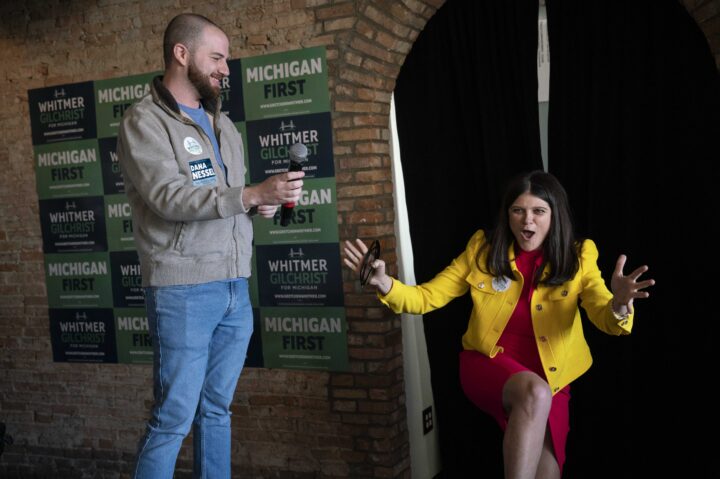
Rep. Haley Stevens is introduced to speak before Michigan Governor Gretchen Whitmer at a rally at the Crofoot Ballroom on November 6, 2022 in Pontiac, Michigan (Photo by Sarah Rice/Getty Images)
With less than two weeks until Michigan’s contentious Democratic Senate primary, Michigan Gov. Gretchen Whitmer endorsed Rep. Haley Stevens (D-MI) on Friday, offering a burst of momentum to the moderate Democrat’s campaign against progressive, anti-Israel firebrand Abdul El-Sayed.
“Haley will do whatever it takes to get things done for people in Michigan, and we need her now more than ever,” Whitmer said in a video announcing the endorsement.
Whitmer had conspicuously avoided making an endorsement in the race, which until weeks ago was a three-way contest between Stevens, El-Sayed and state Sen. Mallory McMorrow. After McMorrow dropped out, the race between Stevens and El-Sayed tightened.
El-Sayed has made opposition to Israel a core tenet of his campaign, targeting Stevens for receiving backing from AIPAC and for supporting the U.S.-Israel relationship.
In the endorsement video, Whitmer did not mention El-Sayed; she talked about Stevens as a candidate who will “get things done.”
“She knows what Michigan families are going through, and that’s how I know she will always put Michigan first,” Whitmer said.
Matt Maasdam is gaining late momentum running on his national security credentials, but Bernie Sanders-backed William Lawrence is winning over the base
Campaign website
Matt Maasdam
The Democratic primary in Michigan’s 7th Congressional District — a Lansing-area swing seat key to Democrats’ hopes for taking back the House — has turned into a three-way battle between two moderate Democrats with national security backgrounds and a far-left activist who has emerged as a contender for the nomination despite repeated controversies over extremist comments.
On the campaign trail, Matt Maasdam, a former Navy SEAL, has leaned into his background as a veteran and a military aide to former President Barack Obama who carried the nuclear football. Bridget Brink, a career foreign service officer, is highlighting her service as U.S. ambassador to Ukraine from 2022 to 2025.
William Lawrence, the progressive backed by Sen. Bernie Sanders (I-VT), is a former organizer with the Sunrise Movement, which bills itself as leading “the climate revolution” but also embraces other left-wing causes.
Adrian Hemond, a Michigan political strategist, said he expects the race to be close, predicting that the three candidates could all finish within several points of each other.
He previously told JI that Lawrence holds the progressive lane to himself, which could be an asset if Maasdam and Brink split the moderate vote — but he could lose out on young, progressive-leaning Michigan State University students who won’t return to campus until after the Aug. 4 primary. Lawrence has also struggled with Black and older voters.
The race initially appeared to be a contest between Maasdam and Brink. Lawrence gained momentum and attention by scoring a series of prominent endorsements from Sanders and other progressive leaders.
But Lawrence’s rise hit a stumbling block with the re-emergence of past comments disparaging Black political leadership, which prompted condemnations from Michigan leaders and the Congressional Black Caucus. After those initial revelations, Lawrence subsequently came under fire for past comments disparaging Obama and his administration.
In past comments on the “Hegemonicon” podcast he hosted, first uncovered by Jewish Insider, Lawrence repeatedly argued, for the sake of climate and economic goals, Americans would have to abandon the idea of the American dream and their way of life.
Discussing whether and how ideas of “abundance” or “degrowth” could or should be part of an agenda to fight climate change, Lawrence said on an episode of the podcast release in January 2024, “we’ve experienced the last several years of how that got filtered through the lens of American global competitiveness and geoeconomic dominance and, some of these questions about the role of the American consumer on a global stage and and whether or not we are proposing the continuation of the American consumer way of life and its translation into China and presumably the rest of the globe, is really viable in a climate-changing world.”
“We made that move, and now we need to reckon with the contradictions inherent even in that move,” Lawrence said. “I’m wondering how we can inspire a sense of abundance for people in the United States while, frankly, destroying the American way of life and the negative connotations, and material realities that has come to mean.”
In a statement, Lawrence defended the comments.
“We’ve been told that we would achieve happiness by buying more TVs and taking on a bigger mortgage,” Lawrence said. “Instead, the cost of housing, healthcare, and education is skyrocketing, while Michigan’s land and water is under threat. We need a new version of the American dream in which we can all have economic security while leaving a healthy environment for our kids and grandkids.”
In another episode, released in December 2023, Lawrence said that “there are certain aspects of the American dream that need to die — but maybe that’s another episode,” arguing that most people would not be able to have “the McMansion in the suburbs.”
A senior political advisor close to the Maasdam team said that the endorsements from Sanders and other top progressives catapulted Lawrence toward the front of the field, but the recent revelations of his past comments have stunted that growth.
The advisor said the endorsements from Sanders and others likely earned Lawrence the votes of around a third of the Democratic electorate who will likely vote for the most-left candidate in the race, leaving around two-thirds up for grabs.
Last week, Maasdam picked up an endorsement from Sen. Elissa Slotkin (D-MI), who subsequently filmed an advertisement supporting him. The freshman senator represented the Lansing-area district before being elected to the Senate.
The advisor close to the Maasdam campaign said that they see the race now largely as a contest between Maasdam and Lawrence, but said they believe Maasdam is well-positioned going into the final weeks of the race and peaking at the right time.
He has been the beneficiary of more than $1.6 million in outside spending by VoteVets, with another outside group, Crush MAGA PAC, spending nearly $1 million to attack Lawrence, and a third group, Michigan Values PAC, spending around $1 million to attack Brink. A nursing union group has spent $400,000 boosting Lawrence.
At the same time, they also acknowledged a real concern that Maasdam and Brink could split the moderate vote, allowing Lawrence to win with a plurality.
Brink has faced criticism from primary rivals for her service under and praise of President Donald Trump — though she ultimately resigned in protest of the administration’s efforts to pressure Ukraine.
The advisor argued that, compared to Brink, Maasdam has a better resume and background as a fighter, and said Maasdam plans to highlight his links to Obama in the wake of the revelation of Lawrence’s comments disparaging the former president.
Maasdam posted an X video on Monday highlighting his support for and ties to Obama, while calling out Lawrence’s criticism of him.
In spite of their moderate and national security focused backgrounds, neither Maasdam nor Brink appears to have spoken much about Israel policy during the campaign, and neither campaign provided comment to JI on their stances.
Lawrence has attacked the two for declining to describe the war in Gaza as a genocide, and has made cutting off arms sales to Israel a major plank of his campaign.
All three have been critical of the war with Iran.
Elizabeth Warren, who is speaking at a rally for El-Sayed later that day, was originally billed as a speaker for the event but was since removed from event publicity
Sarah Rice/Getty Images
Abdul El-Sayed, candidate for US Senate in Michigan, speaks at Mumford High School on May 3, 2026 in Detroit, Michigan.
Michigan Senate candidate Abdul El-Sayed is slated to appear at a campaign fundraiser this weekend that is co-hosted by Kelly Neumann, a controversial Democratic fundraiser in Michigan who faced scrutiny earlier this year for a 2024 Facebook post on Veterans Day that praised her grandfather, who fought for the Nazis in World War II.
Sen. Elizabeth Warren (D-MA), who endorsed El-Sayed on Monday, was initially listed as a speaker at the Saturday event hosted by Neumann, though Neumann and the campaign removed Warren from their promotional materials after Jewish Insider inquired about the senator’s role. Warren is speaking at a rally for El-Sayed later that day.
A spokesperson for El-Sayed said Warren’s “inclusion on the flier was a clerical error by our campaign” and that she was never scheduled to speak at the fundraiser. A spokesperson for Warren declined to comment.
In Neumann’s November 2024 post, which was previously reported by JI, she said her grandfather, Albert Neumann, fought “on the German side in WWI & WWII.” She noted that he “was one of the first people in my life that accepted me as gay” and described him as “a true testament that people can change and love indeed can win.”
Neumann, a Michigan attorney, has since deleted the post after it resurfaced earlier this year. In a March 2026 Facebook post, she apologized “to anyone who was hurt by [my] post from years ago, as that was certainly never my intention,” but blamed Rep. Haley Stevens’ (D-MI) Senate campaign for unearthing the original post.
Neumann had endorsed state Sen. Mallory McMorrow, but after McMorrow dropped out early this month, Neumann backed El-Sayed. Neumann hosted a fundraiser for Stevens’ House reelection campaign last year.
A spokesperson for Stevens told JI in January that Stevens would not have invited Neumann to host the event if Stevens had “seen the post celebrating Ms. Neumann’s grandfather’s service to the SS.” (The Daily Mail reported later that Neumann’s grandfather was likely in the German Wehrmacht, or armed forces, rather than the Nazi SS.)
“The host in question has hosted or donated to several democratic senators, congresspeople, statewide elected officials and candidates, including Abdul’s opponent, Congresswoman Stevens,” a spokesperson for El-Sayed told JI. “All of us, including the host, condemn Nazi ideology.”
Neumann defended her grandfather even as she apologized for the original post. “To be clear, my grandfather was a german soldier, not a nazi,” Neumann wrote in March. In a phone call with JI on Monday, Neumann stood by this assertion and claimed that a representative from Germany’s Ministry of Defense told her the same thing.
“All I know is that I’ve been informed as a child, in growing up, and then recently again, is that they said he wasn’t a Nazi,” Neumann said. “I believe there is a distinction between a young German soldier and a Nazi in the actual regime close to Hitler.”
The U.S. Holocaust Memorial Museum calls the idea that German soldiers were not part of the Nazi regime a “myth.”
“This belief is untrue. The German military participated in many aspects of the Holocaust: in supporting Hitler, in the use of forced labor, and in the mass murder of Jews and other groups targeted by the Nazis,” the museum states on its website.
Neumann’s political resume is lengthy. She served as a co-chair of the finance committee for McMorrow’s Senate campaign. She also previously worked to support gubernatorial candidate Jocelyn Benson, Michigan’s secretary of state, though Neumann has since endorsed Chris Swanson, a long-shot challenger to Benson.
Neumann told JI that she is “not antisemitic in any sort of way,” and that she regularly hosts events for Jewish politicians. Last year she hosted a fundraiser for Michigan state Sen. Jeremy Moss, a Jewish Democrat who is running for Congress.
“I’m not proud of my grandfather being in World War II as a young German soldier,” said Neumann. “What I am proud about is how he was so kind to me and accepted me as a minority in the ‘90s.”
After socialist candidates scored several surprise victories, party leaders are fighting with renewed vigor to rally behind Rep. Haley Stevens (D-MI) in the primary against her left-wing challenger, Abdul El-Sayed
Kristen Norman/AP
Michigan U.S. Senate candidates, Abdul El-Sayed, left, and Rep. Haley Stevens, D-Mich., are displayed on a television during a debate inside the spin room at WoodTV studios on Tuesday, July 7, 2026, in Grand Rapids, Mich.
As Maine Democrats pick up the pieces of Graham Platner’s failed Senate campaign and quickly try to find a replacement for the scandal-tarred candidate on the ballot, moderate Democrats in Michigan, where a primary is fast approaching, are in a race against time to prevent another far-left Senate candidate from capturing a valuable nomination.
The final three weeks of the Michigan primary will be 2026’s most consequential test yet for the power the party establishment still holds, particularly in a pivotal swing state. After socialist candidates scored a number of surprise victories in heavily blue districts in New York City, Philadelphia and Denver, party leaders are fighting with renewed vigor to rally behind Rep. Haley Stevens (D-MI) in the primary against her left-wing challenger, Abdul El-Sayed.
Retiring Sen. Gary Peters (D-MI) endorsed Stevens on Monday, a pivot from his announcement in May that he planned to stay out of the race, joining Senate Minority Leader Chuck Schumer (D-NY), who had already backed the congresswoman. The party’s left flank — including Sens. Bernie Sanders (I-VT) and Chris Van Hollen (D-MD) — is backing El-Sayed.
“The change of heart is we just know that we have to hold Michigan,” Peters said on “Morning Joe” on Tuesday of his decision to endorse, with Stevens sitting beside him. “She’s an outstanding candidate and I certainly hope that folks get behind her around the country and understand that she’s the right person to be the next senator from the state of Michigan.”
There are fresh signs that the late push for Stevens from Democratic leaders — along with millions in ad spending from pro-Stevens outside groups — has given the congresswoman momentum in the closing stretch of the race. A new poll commissioned by the Detroit News found Stevens pulling ahead of El-Sayed by seven points, 48-41%, after she trailed in most public polls this year.
The United Democracy Project, AIPAC’s affiliated super PAC, is spending big to attack him, dropping nearly $15 million in the race so far. A new 30-second ad attacks El-Sayed as sexist, referencing criticisms he’s made against former First Lady Michelle Obama and Gov. Gretchen Whitmer. A mailer sent to Michigan voters criticized El-Sayed’s response to the attack on Temple Israel in West Bloomfield in March. El-Sayed condemned the attack but said that “hurt people hurt people,” referring to the assailant having lost his brother — a Hezbollah commander — in an Israeli airstrike in Lebanon.
“We are going to continue educating Michigan voters on El-Sayed’s track record of making disparaging and sexist comments about women,” Patrick Dorton, a UDP spokesperson, told JI on Tuesday.
Platner’s collapse in Maine has, for some Democrats, raised questions about the electability of far-left candidates in must-win Senate battlegrounds for the Democratic Party.
The centrist Democratic think tank Third Way published a memo on Tuesday underscoring that Democrats could lose other winnable races if they continue taking the advice of ideologically driven left-wing consultants who advised Platner. (Fight Agency, the political ad firm that was used by Platner and New York City Mayor Zohran Mamdani, is also consulting for El-Sayed’s campaign.)
El-Sayed has continued to play to his base, doubling down on radical rhetoric in interviews at a time when Democrats are concerned about holding onto the swing seat in November. He called Israel a “rogue state” in a recent CNN interview and said that Democrats who support Israel only do so because of money. As his rhetoric has become more extreme, and the race tightens between the two candidates, Jewish Democratic groups are planning to amp up their campaigning for Stevens ahead of the Aug. 4 primary.
“It is now a direct, high-stakes two-way race between Haley Stevens and Abdul El-Sayed,” the Michigan Democratic Jewish Caucus wrote in a recent email to members. The Jewish Caucus is hosting a canvassing event on behalf of Stevens in Farmington, a heavily Jewish suburb of Detroit, this weekend.
“With early and absentee voting already underway, to ensure Haley wins on Aug. 4, we need to leverage our deep community roots, personal relationships, and trusted voices,” Jewish Caucus Chair Decky Alexander told Jewish Insider on Tuesday.
The Jewish Democratic Council of America, a national organization, is hosting a virtual phone bank for Stevens this week. The group had previously issued a joint endorsement of Stevens and state Sen. Mallory McMorrow, who withdrew from the race earlier this month, but is now planning a five-figure digital ad buy in support of Stevens’ campaign.
“JDCA is focused on mobilizing Jewish voters across Michigan in support of Haley Stevens,” JDCA CEO Halie Soifer told JI on Tuesday. “Haley has always stood with the Jewish community, and we’re proud to support her in this critically important election. We also believe she has the best chance of beating Mike Rogers in November, and we’re committed to keeping Michigan blue.”
The Stevens campaign expects a close race but views McMorrow’s decision to drop out as a boon for Stevens. McMorrow did not endorse either candidate. A source working with the Stevens campaign, who was not authorized to speak on behalf of the congresswoman, said the campaign is particularly focused on winning over Black voters, as well as older and non-college-educated voters, many of whom remain undecided. (The Detroit News poll showed Stevens with a substantial advantage with Black voters, leading El-Sayed 67-21%.)
The Michigan Jewish community, which is centered in Stevens’ congressional district, is also a part of the campaign’s get out the vote plan.
“I think that Haley wants all Michiganders to vote, but obviously has a very special connection with the Jewish community, especially in her district in Oakland County,” said the campaign source.
El-Sayed routinely tars Stevens for receiving the backing of AIPAC. She has not said much during the primary about her ties to the group, instead highlighting her support for a two-state solution to the Israeli-Palestinian conflict, which she described as “the difference between my opponent and myself on this issue” in a debate last week. El-Sayed has said he struggles with the question of whether Israel should exist as a Jewish state.
This week, El-Sayed announced a major fundraising haul from the second quarter of the year: $4.5 million, up from $2.3 million he raised in the first quarter. A spokesperson for Stevens declined to share her latest fundraising totals, which legally must be reported by Wednesday. She took in $1.9 million in the first three months of the year.
Plus, Lawler and Gottheimer attempt an UNRWA-veling
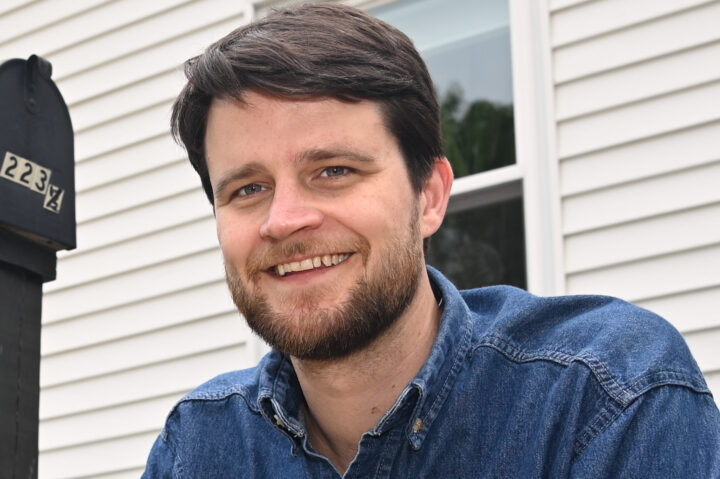
Wikimedia Commons
William Lawrence
Good Tuesday morning.
In today’s Daily Kickoff, we look at efforts by Democrats in Michigan to block a far-left congressional candidate over his past racist comments, and report on Secretary of State Marco Rubio’s announcement that the Trump administration will launch a significant diplomatic offensive against the International Criminal Court. We cover the introduction of bipartisan legislation from Reps. Josh Gottheimer and Mike Lawler to dismantle and replace UNRWA, and cover New York City Mayor Zohran Mamdani’s pledge to continue to work with scandal-plagued consultant Morris Katz. Also in today’s Daily Kickoff: Dara Horn, Eli Vered Hazan and Ronald Lauder.
We have also launched a new on-demand Live Briefing that you can access throughout the day via our new app (on Apple and Android) and on our website.
Today’s Daily Kickoff was curated by JI Executive Editor Melissa Weiss and Israel Editor Tamara Zieve, with an assist from Danielle Cohen-Kanik and Marc Rod. Have a tip? Email us here.
What We’re Watching
- President Donald Trump will meet this morning with Iraqi Prime Minister Ali al-Zaidi, whom he backed in the country’s elections earlier this year amid an effort to push Baghdad to crack down on Iranian militias operating in Iraq. The meeting comes as the U.S. continued to strike Iranian military targets overnight, including Bushehr, Chah Bahar, Jask, Konarak, Abu Musa and Bandar Abbas, “to further degrade Iran’s ability to attack commercial shipping,” CENTCOM said.
- Earlier in the day, CENTCOM announced that U.S. forces would today resume blockading Iranian ports. Trump also declared that the U.S. would institute a 20% fee on all cargo transiting the waterway. Read more here.
- The Aspen Security Forum kicks off this afternoon in Colorado. Former Secretary of State Condoleezza Rice, former Defense Secretary Mark Esper and former Commerce Secretary Penny Pritzker are set to speak later today on a panel titled, “The State of the World in 2026.”
- Darline Graham Nordone, the sister of Sen. Lindsey Graham (R-SC), will be sworn in to her brother’s Senate seat today at 2:30 p.m. ET, after South Carolina Gov. Henry McMaster announced his decision on Monday to appoint her to serve the remainder of Graham’s term. Trump threw his support behind Graham Nordone, saying that appointing her “would be a fabulous tribute to Lindsey, who loved her dearly.” Read more here.
- Fed Chair Kevin Warsh is set to testify before the House Financial Services Committee this morning — the first time Warsh will appear before the Congress since assuming the role.
- The two-day Pennsylvania Defense and Innovation Summit, hosted by Sen. Dave McCormick (R-PA), will kick off at the U.S. Army War College in Carlisle, Pa., with a keynote address from Chairman of the Joint Chiefs of Staff Gen. Dan Caine.
- Defense Secretary Pete Hegseth will host some GOP members of Congress for dinner tonight, as the Trump administration seeks more than $67 billion for the Pentagon in its supplemental funding request.
- Lebanese and Israeli officials are meeting today at the U.S. Embassy in Rome to discuss the implementation of a framework agreed to by the countries last month that would see the disarmament of Hezbollah, a withdrawal of Israeli troops from southern Lebanon and an end to the hostilities between Beirut and Jerusalem.
What You Should Know
A QUICK WORD WITH JI’S MELISSa weiss
In the span of five days, one of Washington’s most vocal champions of the U.S. relationship with Israel died, while two prospective 2028 Democratic presidential contenders traveled to the Jewish state to define their approaches to the country. Though a coincidence of timing, those events, when taken together, underscored something much more significant: the passing of one generation of American politics vis-a-vis Israel and the opening contest over what will succeed it.
The events of the last week have distilled concerns that have repeatedly emerged at Jewish and Israeli gatherings, over Shabbat meals and in breakfast meetings: As the far left gains traction within the Democratic Party, and as the isolationist right increasingly finds support among Republicans, what does that mean for American Jews and U.S. support for Israel?
Sen. Lindsey Graham (R-SC), who died suddenly on Saturday, represented a generation of politicians — across the political spectrum — for whom support for Israel was tied to deep, long-standing relationships with the Jewish state’s leaders, the belief in the country’s strategic positioning as a key ally and the ability of Israel’s friends in Washington to challenge Jerusalem without imperiling the relationship.
His death sent shockwaves across the Jewish community at a time when U.S. support for Israel — including among Republicans — is on the decline.
Days before Graham died, former U.S. Ambassador to Japan Rahm Emanuel was in Israel, where he delivered a speech — his own version of tough talk to Israelis — at Tel Aviv University on the future of the U.S.-Israel relationship. Speaking to reporters ahead of his speech, Emanuel, who served as White House chief of staff from 2009-2010, said that declining U.S. support for Israel “is not a Democratic Party problem. This is an American problem, and a generational problem.”
Separate from Emanuel’s trip, Rep. Ro Khanna (D-CA) also traveled to Israel last week, gaining attention for an incident in the West Bank in which local security forces stopped Khanna, who was accompanied by aides and an activist from Breaking the Silence, after the congressman entered what had been until recently a closed military zone. He has since called for Israel to investigate the incident, even as Israeli officials denied the congressman’s account. Khanna has not provided any evidence to back up his claim of being detained by settlers.
In his public comments and meetings, Emanuel conveyed a desire to halt the growing daylight between future generations of Israelis and Americans. Khanna, who a decade ago was a staunch supporter of close ties with Jerusalem, has adopted a different political calculation, leaning into the growing anti-Israel sentiment in his party as a launching pad for a national campaign.
MICHIGAN MATTERS
William Lawrence, a virulent Israel critic gaining momentum among progressives in Michigan’s battleground 7th Congressional District, is facing a wave of criticism over past comments denigrating Black political leadership, attacking former Vice President Kamala Harris. As a result, Lawrence is now facing the opposition of an outside group aiming to block him from winning the Democratic nomination, Jewish Insider’s Marc Rod reports.
On Israel: On the campaign trail, Lawrence has called for an end to U.S. aid to Israel and accused the country of genocide, something that the other Democratic candidates, former Navy SEAL Matt Maasdam and former U.S. Ambassador to Ukraine Bridget Brink, have declined to do. During a candidate forum, Lawrence said that Israel “has refused every other form of accountability and we continue to arm them.”
DIPLOMATIC BLITZ

The Trump administration plans to launch a major diplomatic offensive against the International Criminal Court, furthering the White House’s long-running battle against the international organization, Secretary of State Marco Rubio announced on Monday, Jewish Insider’s Gabby Deutch reports.
Rubio’s remarks: “For 250 years, Americans have governed ourselves as a free and sovereign people,” Rubio said in a video, which was accompanied by an op-ed in The Wall Street Journal. He described America’s legal system as “the essential and indispensable feature of our form of government,” but cautioned that “powerful people in far away places want to take that away from us.” He warned of shadowy “unelected globalist bureaucrats who claim their power is almost unlimited,” unless the U.S. acts quickly.
RESET BUTTON
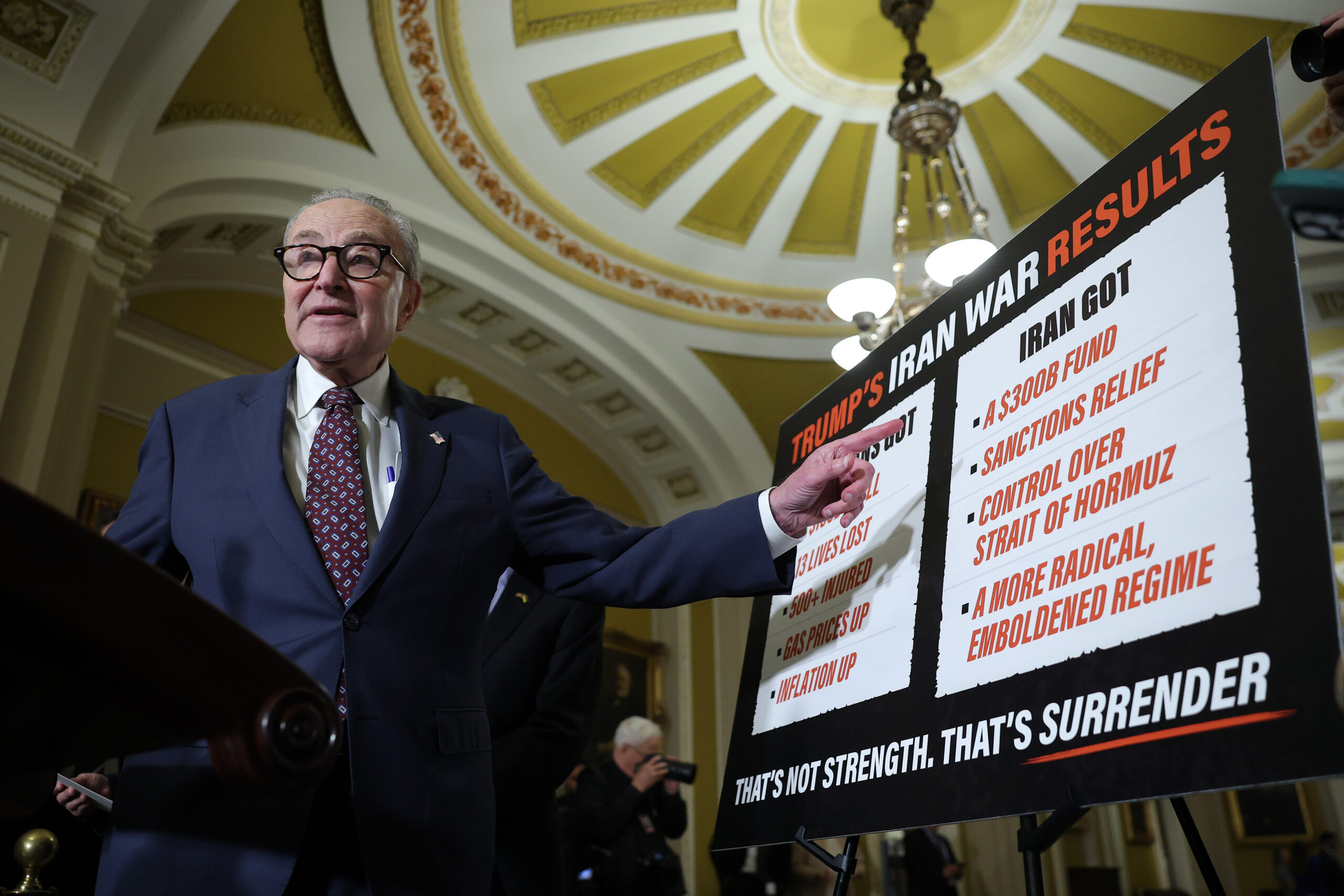
Democrats on Monday slammed President Donald Trump’s resumption of hostilities against Iran, as well as the notion, implicit in Trump’s notification, that the operations mark a new conflict and therefore reset the 60-day window for military operations launched by the executive branch without congressional approval, Jewish Insider’s Marc Rod reports.
Pushing back: Critics of the war have argued consistently that the operations that began in February never actually concluded during the since-terminated ceasefire, despite the administration’s assertions otherwise. “Trump’s rinse and repeat approach to the Iran war isn’t a strategy, it’s a recipe for utter disaster,” Senate Minority Leader Chuck Schumer (D-NY) said Monday. “It’s incredible what a fiasco this war is. Trump’s so-called understanding — lot of bull — with Iran fell apart faster than the ink could dry.”
Read the full story here with additional comments from Sens. Tim Kaine (D-VA), Adam Schiff (D-CA) and John Cornyn (R-TX) and Rep. Adam Smith (D-WA).
Windfall: Iran netted nearly $5 billion in the 22 days after Washington and Tehran signed their memorandum of understanding on June 17, according to a new report from the Jewish Institute for National Security of America, JI’s Matthew Shea reports.
UNDOING UNRWA

Reps. Mike Lawler (R-NY) and Josh Gottheimer (D-NJ) introduced a bill on Tuesday that directs the State Department to work with U.S. allies to dismantle and replace the United Nations Relief and Works Agency, Jewish Insider’s Marc Rod reports.
Details: The “Replace UNRWA with Real Humanitarian Assistance Act” would give the secretary of state 180 days to submit a “comprehensive strategy, coordinated with international partners and allies,” to dismantle UNRWA, including a detailed timeline for the wind-down, identification of governmental or non-governmental entities responsible for taking over UNRWA’s portfolio, a funding plan and a transition plan. The secretary would be required to begin implementing the plan within a year of submitting the strategy.
Flight risk: Airstrikes on Yemen’s Sanaa International Airport on Monday were intended to stop Iran and the Houthis from breaking a decades-long air blockade and opening an uncontrolled air link between Tehran and its Yemeni proxy, regional analysts said — a corridor they warn could let Iran resupply the Houthis directly with weapons for future campaigns against Saudi Arabia and Israel, JI’s Matthew Shea reports.
CLOSING RANKS

New York City Mayor Zohran Mamdani vowed on Monday to maintain ties with a controversial political operative behind the imploded campaign of Maine Senate candidate Graham Platner, whom a former romantic partner accused of rape, leading him to drop out of the race, Jewish Insider’s Will Bredderman reports.
Mayor’s stand: Morris Katz and his consulting firm Fight Agency gained a reputation as political wonder-workers after assisting in Mamdani’s 2025 campaign and then in the socialist sweep of New York’s congressional primaries last month. But following the high-profile collapse of Platner’s candidacy, members of the Democratic Socialists of America began circulating a petition calling for a boycott of Katz’s services. But Mamdani, one of DSA’s most prominent national figures, declared he would not participate in the proposed blacklist. “I will continue to work with Morris Katz,” Mamdani told reporters at an unrelated event. “He remains a top advisor of mine.”
SEEKING SUCCESSORS

Nearly every surface in Ronald Lauder’s office on the 42nd floor of the General Motors Building in Midtown Manhattan has a clock on it. Some are brass, some are gold, and there’s a large wooden one with a shining pendulum hanging on the wall. And all of them were ticking away as he spoke with eJewishPhilanthropy’s Judah Ari Gross about his past, the Jewish community’s troubling present and his hopes for its future, while sitting on his distressed leather furniture, looking out over the southeast corner of Central Park, in one of his first extended interviews in years.
Ticktock: The clocks, of course, are also a metaphor. Lauder, 82, announced earlier this year that he will not seek reelection when his term as president of the World Jewish Congress ends in 2029, and his mind is occupied with both finding a specific successor for that role and, more broadly, encouraging the next generation of Jewish leaders to step up, particularly in Jewish education. He was also explicit that this is the reason why he agreed to a rare interview. “I believe very strongly that we must have young philanthropy. I would say that 80% of philanthropy today is from people over 60,” he told eJP.
Read the full interview here and sign up for eJewishPhilanthropy’s Your Daily Phil here.
Worthy Reads
The Loneliness of Chuck Schumer: The Wall Street Journal’s William McGurn posits that even as Senate Minority Leader Chuck Schumer (D-NY) serves as one of his party’s most prominent voices, antisemitism of the kind Schumer rails against has gained traction among Democrats. “Today’s party is nothing like the one Mr. Schumer grew up in. Those who regard Israel as a genocidal enemy are ascendant, and though the first Jewish Senate minority leader may cast individual pro-Israel votes, he certainly isn’t leading in Congress on Jewish or Israeli issues. His position is like that of the young babysitter in the 1979 horror film ‘When a Stranger Calls.’ After a series of disturbing phone calls, she calls the police. They get back to her with this chilling message: ‘The calls are coming from inside the house.’” [WSJ]
Poison PEN: The Atlantic’s Gal Beckerman observes the “meltdown” taking place at PEN America, following the resignation of the group’s president over an article that looked at the isolation faced by Israeli and Jewish writers. “Thursday’s article nodded to the curtailed freedoms of Israeli and Jewish writers without taking any ideological side. It was far from a battle cry or a shift in priorities. … This reality does not neutralize the cause of pro-Palestinian writers or the suffering in Gaza and elsewhere. The fact that the article was perceived that way, and that it led to the resignation of a president, tells us all a great deal about the hair-trigger moment we live in, and about the precarity of the liberal principles on which PEN America was founded.” [TheAtlantic]
Guess Who’s Coming to Dinner?: In “Moral Clarity,” Israeli writer Nachum Kaplan reflects on a recent dinner party in which Israel was a main topic of conversations among guests, most of whom were strident critics of Israel. “I walked home reflecting on the strange burden of being pro-Israel in polite society. One is expected to arrive with evidence, history, nuance, empathy, military expertise, legal precision and a detailed alternative strategy for every available course of action. The other side need only arrive with adjectives. Colonial. Genocidal. Apartheid. Brutal. … The ignorance would be less irritating if it were accompanied by humility. Yet ignorance among the educated rarely travels alone. It brings status, vocabulary and the confidence of belonging to a moral majority. Its possessors do not merely lack knowledge. They regard knowledge as faintly disreputable, particularly when it interferes with the emotional clarity of their conclusions.” [MoralClarity]
A larger selection of Worthy Reads is available in our Live Briefing.
Word on the Street
The Jewish Federations of North America offered its support for the Stop the Fakes Act, led by Reps. Josh Gottheimer (D-NJ) and Tom Kean Jr. (R-NJ), requiring the labeling of AI-generated content online. “By strengthening transparency and accountability online, the Stop the Fakes Act would help protect Jewish communities, and all vulnerable groups, from AI-enabled antisemitism, hate, impersonation, and targeted harassment,” Omer Yarden-Oppenheim, director of government relations at JFNA, said…
Sens. Chris Van Hollen (D-MD), Bernie Sanders (I-VT), Jeff Merkley (D-OR), Peter Welch (D-VT), Ed Markey (D-MA) and Elizabeth Warren (D-MA) urged colleagues to block procedural motions to move ahead with the 2027 National Defense Authorization Act without votes to strip U.S.-Israel military and intelligence cooperation out of the bill…
The Congressional Jewish Staff Association announced its 2026-2027 board, naming Zachary Freiman as president, Lindsey Rubin as vice president of member outreach, Tessa Cate as treasurer, Gabe Feiner as vice president of social programming, Louie Kahn as communications director and Joshua Lash, Max Seltzer and Sasha Frank-Stempel as members-at-large…
Federal officials charged a Texas man with transmitting threatening communications through means of interstate or foreign commerce, alleging he threatened to kill Jewish employees of a security camera company in Georgia…
The New Yorker visits Russ & Daughters with a duo from the Netherlands who are self-styled experts on pickles, as they explore the history of the popular sandwich accompaniment in New York…
U.K. Home Secretary Shabana Mahmood announced that the country designated Iran’s Islamic Revolutionary Guard Corps as a terror organization, with those found guilty of supporting the group facing up to 14 years in prison; the government also banned the Islamic Movement of the Companions of the Right, which No. 10 Downing St. said was behind a number of attacks on British Jewish sites…
The New York Times does a deep dive into a yearslong Mossad effort to groom former Iranian President Mahmoud Ahmadinejad into an Israeli intelligence asset and, potentially, a successor to the Iranian regime; the plot, which included a meeting in Hungary between Ahmadinejad and then-Mossad head David Barnea, ultimately failed following an Israeli attempt to remove the former Iranian president from government surveillance on the first day of the war…
The Wall Street Journal spotlights the U.S.’ use — for the first time — of drone boats in the war with Iran, as the military increasingly relies on unmanned technologies in battle…
The Financial Times reports on efforts by U.S. adversaries to use cyber attacks to obtain location information about U.S. forces and contractors in the Middle East in the lead-up to the war with Iran…
Dubai-based port operator DP World is planning to build a new port near the city of Fujairah on the United Arab Emirates’ east coast, in an effort to bypass the Strait of Hormuz and decrease the Gulf state’s reliance on the Jebel Ali hub near Dubai…
Israeli Ambassador to Singapore Eli Vered Hazan was named the world chairman of Keren Hayesod, succeeding Sam Grundwerg…
Pic of the Day

Author Dara Horn (right) discussed her work researching and writing about contemporary antisemitism with Anila Ali, board chair and president of the American Muslim and Multifaith Women’s Empowerment Council, at AMMWEC’s conference in Washington on Monday about antisemitism and hate. Other speakers included Reps. Brad Schneider (D-IL) and Greg Stanton (D-AZ), as well as Luke Moon, a visiting fellow at the Heritage Foundation and the head of Generation Zion.
Birthdays

U.S. representative to the U.N. Human Rights Council during the last three years of the Biden administration, she is the daughter and granddaughter of Holocaust survivors, Ambassador Michèle Taylor turns 60…
Past president of Congregation B’nai Jehoshua Beth Elohim in Deerfield, Ill., Sandee Holleb… Architect and urban designer, he is identified with Habitat 67, a housing complex built in conjunction with Expo 67 (the 1967 Montreal World’s Fair), Moshe Safdie turns 88… MLB pitcher for 11 seasons, now a sportscaster and author, he won the Cy Young Award and was an MLB All Star in 1980, Steve Stone turns 79… Los Angeles resident, Susan Farrell… Film producer, best known for the “Lethal Weapon” series, the first two “Die Hard” movies and the “Matrix” trilogy, Joel Silver turns 74… Film and theatrical producer, in 2012 he became the first producer to have won an Emmy, Grammy, Oscar and Tony Award, Scott Rudin turns 68… Co-founder and managing director of Beverly Hills Private Wealth, Scott M. Shagrin… United States secretary of commerce, Howard Lutnick turns 65… Media columnist for the Chicago Tribune until 2021, Phil Rosenthal turns 63… Illustrator and author best known as the writer of The Invention of Hugo Cabret, Brian Selznick turns 60… Principal at Oakland, Calif.-based Full Court Press Communications and a past president of the Oakland Hebrew Day School, Daniel Eli Cohen… Member of the Washington State Senate until 2023, David S. Frockt turns 57… President and CEO at the Jewish Federation of Greater Houston, Renee Wizig-Barrios… Rapper and record producer from Brooklyn known as “Ill Bill,” he is the producer, founder and CEO of Uncle Howie Records, William “Bill” Braunstein turns 54… Professor in the department of genetics at the Harvard Medical School, David Emil Reich, Ph.D. turns 52… COO at Aish Global, Elliot Mathias… Fashion designer and cast member on “The Real Housewives of Beverly Hills,” Dorit Kemsley turns 50… Retired mixed martial artist, now a life coach, Emily Peters-Kagan turns 45… Co-founder and executive chairman of Pinterest, Ben Silbermann turns 44… Interior designer and owner of Tribe By Design, Tehillah Braun… Professional golfer with four tournament wins in the Asian and European tours, David Lipsky turns 38… Founder at Bashert Group and head of a NYC-based family office, Daniel B. Jeydel… AVP for grantmaking at Hillel International, she is on the board of the Siegel JCC of Delaware, Rachel Giattino… Reporter covering housing and the home building industry for The Wall Street Journal, Nicole Friedman… Director of Chabad Georgetown and rabbi at the Pentagon, Rabbi Menachem Shemtov turns 36… Creator of the Instagram feed called Second Date Shadchan, Elizabeth Morgan “Lizzy” Brenner… Collegiate basketball star for Princeton and Maryland, now playing for Perfumerías Avenida of Spain’s Liga Femenina de Baloncesto, Abby Meyers turns 27… Attorney and founder of In Every Generation, David Rosenberg-Wohl…
William Lawrence, who has won support from progressive lawmakers and groups, has been under fire for his comments attacking Kamala Harris and denigrating Black political leadership
Wikimedia Commons
William Lawrence
William Lawrence, a virulent Israel critic gaining momentum among progressives in Michigan’s battleground 7th Congressional District, is facing a wave of criticism over past comments denigrating Black political leadership, attacking former Vice President Kamala Harris.
As a result, Lawrence is now facing the opposition of an outside group aiming to block him from winning the Democratic nomination.
The swing district, currently held by Rep. Tom Barrett (R-MI), is a critical pick-up opportunity for Democrats in order to take back the House. It was previously held by Sen. Elissa Slotkin (D-MI), and is currently rated by the Cook Political Report as a toss-up.
On the campaign trail, Lawrence has called for an end to U.S. aid to Israel and accused the country of genocide, something that the other Democratic candidates, former Navy SEAL Matt Maasdam and former U.S. Ambassador to Ukraine Bridget Brink, have declined to do.
During a candidate forum, Lawrence said that Israel “has refused every other form of accountability and we continue to arm them.”
“I don’t know how we can call ourselves a just nation, and my heart is pounding becasue it is dispiriting in our politics to see how many people still refuse” to call Israel’s war in Gaza a genocide, he said in response to the other candidates. “I support a lasting peace for all Palestinians and Israelis. Everybody deserves to live with security and in comfort. We got a lot of work to do with them.”
He said in September 2025 that the war in Gaza involved “war crimes on an historic scale,” adding that it’s a “moral necessity” to stop arming Israel, which is also “the best leverage the U.S. has to end the genocide in Gaza, apartheid conditions in the West Bank, ensure the hostages are finally freed, and move towards a lasting peace for Palestinians and Israelis.”
Asked on the campaign trail whether he views the Iranian regime as “evil,” Lawrence said he did not. “I do not believe any regime in the world is wholly good or wholly evil,” Lawrence said.
He has also called Israel’s operations in Lebanon “a war of aggression and territorial expansion” and said that the situation in Gaza constitutes an “ongoing genocidal siege,” despite the ceasefire and provision of humanitarian aid.
As early as Oct. 9, 2023, Lawrence condemned a public statement by American and European leaders denouncing the Hamas attacks and supporting Israel’s efforts to defend itself.
“This looks like a green light for Israel to bombard Gaza with impunity, regardless of the civilian toll or risk of a regional war. Scary hours. I fear for where this will end up,” Lawrence said.
Maasdam and Brink are preferred by moderate Democrats to face off against Barrett.
Lawrence is a co-founder of the Sunrise Movement, the far-left climate movement that has since refocused significantly on anti-Israel activism. He has also made opposition to data center construction a key feature of his campaign.
Lawrence has recently landed in hot water and faced condemnation from leaders and groups including the Congressional Black Caucus PAC over past comments in which he described Black political leaders as a “pillar” of the “establishment, capitalist, imperialist American power” who “[defang] the white left.” The CBC PAC called Lawrence a “national disgrace” and demanded that Lawrence’s supporters withdraw their backing.
The progressive candidate said that his comments had been “taken out of context” but the “way I made this point was clumsy, and I regret my choice of words.” He said that his comments were in response to “Black elected leaders in D.C. [who] have been among those supporting unnecessary U.S. wars and foreign intervention” and “my horror at the genocide in Gaza.”
He also described former Vice President Harris, Slotkin and Michigan Democratic Party chair Curtis Hertel, who ran for the seat in 2024, as “warmongers.” He said voting for Harris made him “sick” and was the “second or third circle of hell,” also calling her “despicable” and her campaign “cowardly.”
The 35-year-old progressive has gained attention in the past few weeks, picking up the backing of leaders including Sen. Bernie Sanders (I-VT), far-left Senate candidate Abdul El-Sayed and left-wing Reps. Jamie Raskin (D-MD), Ro Khanna (D-CA), Rashida Tlaib (D-MI), Delia Ramirez (D-IL) and Maxwell Frost (D-FL), as well as former Rep. Andy Levin (D-MI) and Pennsylvania state Rep. Chris Rabb, the Democratic nominee for a Philadelphia House seat.
Lawrence is also backed by the anti-Israel group TrackAIPAC, which has been accused of antisemitism; the Working Families Party; the Congressional Progressive Caucus; Sunrise Movement; and the Sanders-linked Our Revolution.
In a sign of concern from opponents about his momentum, Lawrence is now the target of a more than $500,000 ad buy from Crush MAGA PAC, which seeks to paint Lawrence as corrupt and unreliable.
The ad cites his support for the Uncommitted movement opposing former President Joe Biden in the 2024 primaries, work with Sunrise Movement (which the ad describes as a dark money group) and his holdings in a mutual fund (which the ad describes as investments in “Wall Street, big oil, and data centers”).
Lawrence asserted that AIPAC and Democratic Party insiders were responsible for the ad, something a United Democracy Project spokesperson denied, further suggesting that Lawrence’s comments were motivated by prejudice.
“We have absolutely no involvement in any way in running ads against William Lawrence in MI-07. It’s pure fiction and dishonest,” Patrick Dorton, spokesperson for UDP, the AIPAC-linked super PAC, said. “This assertion raises the question of whether Lawrence is trying to stir up some base prejudice in the Democratic primary against Democrats who support Israel. It’s immoral and shameful.”
The influx of outside cash will further compound Lawrence’s fundraising struggles. As of the end of April, Brink led the field with $2.3 million raised and $1.3 million on hand, followed by Maasdam with $1.7 million raised and $937,000 on hand and Lawrence with $572,000 raised and $351,000 on hand.
“Lawrence has the progressive lane to himself, the open question is how valuable that lane actually is outside of Lansing/East Lansing,” Michigan Democratic strategist Adrian Hemond told Jewish Insider. “[Michigan State University] students don’t come back until after the primary, so he’s reliant on high youth turnout to overcome his disadvantages with Black voters and seniors, but a sizable portion of the potential youth vote is home for summer break, i.e. not in East Lansing.”
But he also acknowledged that Brink and Maasdam risk splitting the more moderate lane.
In a potential acknowledgement of the political unpopularity of the war in Iran, Barrett has been one of the few House Republicans who has broken ranks with his party on Iran war powers votes, siding with Democrats to advance such measures.
Barrett also introduced legislation that would provide a limited authorization for military operations against Iran, limited in time and scope.
Top contributors to Florida gubernatorial candidate James Fishback are also bankrolling Rashida Tlaib, Ilhan Omar, Abdul El-Sayed and Andre Carson
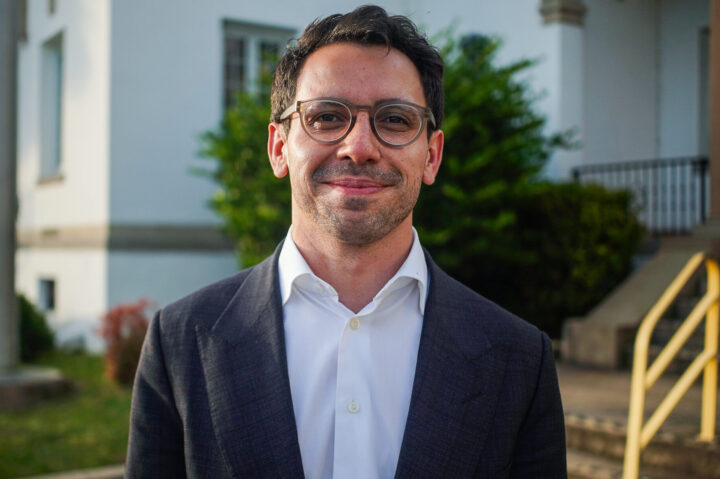
Campaign website
James Fishback
James Fishback, the GOP candidate for Florida governor whom critics call “openly racist” and “openly antisemitic,” ostensibly sits at the opposite end of the political spectrum from the likes of Rep. Rashida Tlaib (D-MI) and Democratic Senate candidate Abdul El-Sayed in Michigan.
But the far-right and far-left politicians share more than just an aversion to Israel — they also overlap in donors, Jewish Insider has found.
As a candidate, Fishback has embraced and celebrated neo-Nazi podcaster Nick Fuentes’ “groyper” movement, propagated the “white genocide” and “great replacement” conspiracy theories, told a Black Floridian they should be lynched and repeatedly taunted Rep. Byron Donalds (R-FL) — his rival to replace Gov. Ron DeSantis — over his race. The radical right candidate has also called the Western Wall “stupid,” referred to fast food as “goyslop,” promised Tucker Carlson he would dump the Sunshine State’s holdings in Israeli bonds, blamed the Iran war on AIPAC and released an ad vowing that no one would be “convicted of antisemitism” for criticizing the Jewish state under his leadership.
But his campaign has proven a magnet for donors to progressive candidates, who have poured tens of thousands of dollars into a PAC supporting his election.
Among the 27 donors to give the maximum $3,000 contribution to Fishback’s bid for Tallahassee is New York-based philanthropist and financier Amed Khan. A longtime associate of the Clinton family and contributor to former Presidents Barack Obama and Joe Biden, as well as to the Democratic National Committee, Khan’s public commentary and political giving has pivoted leftward since the Oct. 7, 2023, Hamas attacks on Israel.
Besides maxing out to Fishback, this cycle the investment banker and Quincy Institute board member has kicked $7,000 to former Maine Senate nominee Graham Platner, the progressive Democrat whose tirades against “oligarchs” and “the establishment” — not to mention his rhetoric on Israel — made him a favorite of the online left before a rape allegation derailed his campaign. In March, Khan donated the maximum $5,000 to Peace, Accountability, and Leadership PAC, an arm of the Institute for Middle East Understanding Policy Project, a dark money nonprofit dedicated to advancing pro-Palestinian narratives and candidates.
And just weeks before contributing to the Republican Fishback in February, Khan gave $3,500 to Gaza flotilla activist Greg Stoker, who is running against Rep. John Carter (R-TX) and Democratic candidate Justin Early on the Green Party line. On the same day he cut a check to the far-right Floridian, Khan donated $3,500 to another Green House hopeful: former Gaza Humanitarian Foundation contractor Anthony Aguilar, who has accused his former employer and the IDF of war crimes.
Khan also gave $3,500 in January to Rep. Ro Khanna (D-CA), part of a pattern of support for the increasingly anti-Israel lawmaker that stretches back to 2019.
In the 2024 cycle, Khan gave $5,000 to Justice Democrats, and donated smaller amounts to Rep. Summer Lee (D-PA), Rep. Ilhan Omar (D-MN), and then-Rep. Jamaal Bowman (D-NY), all figures linked to the Democratic Socialists of America and the left-wing “Squad” in Congress.
But Khan has also maintained support for more mainstream liberal figures, donating $7,000 in June 2025 to former U.S. Ambassador to Ukraine Bridget Brink’s bid for Congress in Michigan, and $14,000 that March to committees affiliated with Sen. Jon Ossoff (D-GA), a Jewish Democrat who has lately clashed with AIPAC and opposed military aid to Israel.
Another of Fishback’s max-out donors is similarly a historic backer of Democrats who lately has ventured into supporting figures on the fringes of both parties: Parviz Tayebati, a Port Biscayne-based tech investor.
Tayebati has donated a total of $19,000 to committees linked to Rep. Thomas Massie (R-KY) and $6,600 to former Rep. Marjorie Taylor Greene (R-GA), both hard-right figures who have increasingly leaned into an anti-Israel identity toward the end of their tenure. He has also donated $3,500 to a PAC supporting one of Greene’s unsuccessful replacements, former state lawmaker Colton Moore, who once was a firm supporter of Israel but more recently became the lone Republican in the state Senate to oppose adopting the International Holocaust Remembrance Alliance’s working definition of antisemitism.
In May, Tayebati gave $2,000 to Platner and another $1,000 to Effie Phillips-Staley, a left-wing Democrat who picked up an anti-Israel drumbeat in her failed bid to become the Democratic nominee against Rep. Mike Lawler (R-NY).
One of the few donors to comment for this story, Tayebati told JI he donated to Fishback after seeing a social media video of him criticizing Israel’s military campaign in the Gaza Strip. However, he called his decision to give money to the candidate “short sighted,” and pleaded ignorance of Fishback’s full views at the time of the donation in January.
“After I found out how extreme and actually antisemitic he is I regretted my support,” Tayebati wrote in a text message, adding that he has changed parties several times in the years since he arrived in the U.S. from Iran. “I am an American citizen and believe anyone who becomes a citizen [in] this country must have their loyalty only to America first and view anyone who is a U.S. citizen but uses their rights and freedom to promote another country as traitors and should be deported.”
Tayebati has also supported a few less extreme candidates, including Dr. Annie Andrews, a Democratic challenger to Sen. Lindsey Graham (R-SC) and Rep. Nancy Mace (R-SC).
Fitting a similar pattern is physician Mohamad Naem of Tampa, Fla., who has given the maximum to Fishback while also donating $7,450 to El-Sayed’s campaign in Michigan, blowing past the $7,000 campaign contribution ceiling. The Senate candidate’s team told JI they would refund the over-the-limit funds, but declined to comment for this piece beyond vowing they had never shared any donor list or had other contact with Fishback.
A longtime supporter of Tlaib, in late 2023 Naem began also sending cash to her Squad colleagues Lee, Bowman, Rep. Ilhan Omar (D-MN) and former Rep. Cori Bush (D-MO). Also in the 2024 cycle, he donated $2,000 to Pervez Agwan and $1,000 to Preston Nouri, both left-wing upstarts who made criticism of Israel and AIPAC a central theme in their campaigns.
Last year, he contributed $3,333.34 to the committees of Rep. Andre Carson (D-IN) and $1,500 to Rep. Delia Ramirez (D-IL), both key backers of legislation that would sever military aid to the Jewish state and of resolutions condemning its actions, while keeping up his support for Omar and Tlaib.
In recent months, along with donations to El-Sayed, Naem has given smaller amounts to Phillips-Staley and to Eric Yonce, another unsuccessful Israel critic who ran for Congress in Florida.
As with Khan and Tayebati, Naem has made a few donations to candidates supportive of Israel, including Sen. Jim Risch (R-ID), Rep. Abe Hamadeh (R-AZ) and Rep. Cory Mills (R-FL). He also gave $1,000 in 2025 to Rep. Marlin Stutzman (R-IN), who in June proposed winding down U.S. aid to Israel, although the congressman has aligned his position with that of Israeli Prime Minister Benjamin Netanyahu.
But Fishback’s other underwriters have shunned centrists in favor of candidates on the party’s margins. Another of his contributors is Hassan Shibly, who left his position as the head of the Florida chapter of the Council on American-Islamic Relations in 2021 following domestic abuse allegations from his wife.
On the federal level, Shibly has given this cycle to Aaron Baker, running as a right-wing, anti-Israel alternative to Rep. Randy Fine (R-FL) and to Mussab Ali, who challenged Rep. Rob Menendez (D-NJ) as an AIPAC-bashing left-wing insurgent. And beginning in November 2023, Shibly has donated $200 each month to Omar in Minnesota.
In an email to JI, Shibly fiercely disavowed all of Fishback’s controversial stances — save one.
“One of the most significant reasons for my support is his stated position that American taxpayer dollars should be prioritized for the needs of Americans rather than funding foreign governments,” Shibly wrote. “I have been outspoken in opposing continued U.S. funding for the Israeli government’s military campaign in Gaza because I believe Israel has committed genocide against the Palestinian people. Ending or substantially reducing U.S. taxpayer funding for that campaign is an issue of profound moral importance to me.”
Current CAIR-Florida director and attorney Mohammad Mubarak gave $1,000 to Fishback, but at the federal level has given thousands more to El-Sayed, Tlaib, Omar and Carson. Radiologist Nabeel Hamoui gave the GOP gubernatorial contender the full $3,000 allowed under law in May, three months after maxing out to El-Sayed’s Senate campaign. In recent cycles, he’s given to Carson, Omar, Bowman, Lee, Bush and Tlaib.
Tampa investor Ramsy Dahla gave the maximum to Fishback, but has never donated to a federal official other than Tlaib. Another longtime Tlaib backer from Tampa, Ymad Elabed, appears to have given double the largest legally permitted contribution to Fishback by donating from two separate addresses.
Meanwhile, another Tampa businessman, Yasin Saad, gave $3,000 to Fishback but has favored Tlaib and recurring Palestinian American congressional candidate Ammar Campa-Najjar at the federal level.
Texas supermarket magnate Salah Nafal is also a member of Fishback’s $3,000 club, even as he’s given strictly to left-wing Israel critics for national offices, including El-Sayed, Platner, Omar and Tlaib, as well as Rep. Analilia Mejia (D-NJ), Michigan democratic socialist Aisha Farooqi and failed Texas congressional candidates Zeeshan Hafeez and Tanya Lloyd.
Meanwhile, Florida First PAC — a state committee dedicated to backing Fishback for governor — picked up a $35,000 contribution in June from Jacksonville law office Farah & Farah. The firm’s founding partner, Eddie Farah, has given $6,000 this cycle to Tlaib while also kicking $2,000 to the committees of Georgia’s Greene. In 2024, he backed Cornel West for president, while also donating to the PAC Counter Coalition, which subsequently ran a small independent expenditure for New York City Mayor Zohran Mamdani.
Oil distributor Basem Ali gave Florida First $5,000 in May, nearly a year after he gave to the Tlaib campaign. Ali has given tens of thousands to the Michigan congresswoman over the course of her career, and also supported Omar and Campa-Najjar, though he has also donated to Rep. Gus Bilirakis (R-FL), a strong Israel supporter.
The far-left Senate candidate is facing off in the Aug. 4 primary against Rep. Haley Stevens
Sarah Rice/Getty Images
Abdul El-Sayed, candidate for US Senate in Michigan, speaks at Mumford High School on May 3, 2026 in Detroit, Michigan.
Abdul El-Sayed, the Democratic Senate candidate in Michigan running in the race’s far-left lane, on Sunday described Israel as a “rogue state” that has committed genocide and apartheid. El-Sayed made the comments in an interview with Manu Raju on CNN’s “Inside Politics Sunday.”
Asked whether he thought the Israeli government should be considered by the U.S. to be a foreign terrorist organization, El-Sayed answered, “It’s certainly a rogue state.”
“I mean, they did a genocide,” he continued. “What about doing a genocide is not evil in your book? At baseline they do apartheid.”
Abdul El-Sayed, the Democratic Senate candidate in Michigan running in the race’s far-left lane, on Sunday described Israel as a “rogue state” that has committed genocide and apartheid.@HaleyCohen19 reports: https://t.co/9BELSWPMXQ pic.twitter.com/vSYVTTRZJZ
— Jewish Insider (@jewishinsider) July 12, 2026
El-Sayed’s comments come as Michigan’s heated Democratic Senate primary enters its final stretch. He is facing off in the Aug. 4 primary against Rep. Haley Stevens (D-MI) — a moderate lawmaker who has been supported by AIPAC and pro-Israel donors.
Last week, El-Sayed told CNN that he did not believe that a Democratic politician’s support for Israel could be about anything other than money. Earlier in the race, El-Sayed said he struggled to answer questions about whether he believed Israel has a right to exist as a Jewish state and that he believed the Israeli government was just as “evil” as Hamas.
Stevens highlighted Israeli Prime Minister Benjamin Netanyahu’s criticisms of her earlier on Tuesday amid attacks by primary rival Abdul El-Sayed over AIPAC support
Andrew Roth/Sipa USA
Rep. Haley Stevens (D-MI) speaks at the Michigan Democratic Party Endorsement Convention in Detroit, Mich., on April 19, 2026.
Rep. Haley Stevens (D-MI) continued a war of words with Israeli Prime Minister Benjamin Netanyahu as she faced a barrage of attacks from her primary opponent, former public health official Abdul El-Sayed, at a debate on Tuesday in Michigan.
Netanyahu, in a CNN interview earlier on Tuesday, criticized Stevens for saying that his actions and government had made the Jewish community less safe and placed Jews in an “uncomfortable position.”
“It’s made her uncomfortable because she can’t stand up for the truth. She’s trying to, probably, excuse antisemitism,” Netanyahu said in response to a question from CNN host Dana Bash.
Asked about the war in Iran, Stevens criticized both President Donald Trump and Netanyahu.
“We need long-term peace. Donald Trump has failed us. The prime minister of Israel has failed in that regard, and he was just coming after me on this today,” Stevens said. “Look, I am unafraid. Michigan, you are my North Star, and no illegal wars, no unilateral wars at our expense.”
She doubled down on those criticisms later in the debate.
“It is very clear that Mr. Netanyahu has not made us safer, has not brought us closer to peace, and he’s endangered Jews here in America and around the world,” Stevens said. “This is why he was just trashing me today on CNN. I am not afraid of bullies. I am not afraid to stand up, and I continue to stand up for humanitarian aid, for the U.S. to work with the countries in the region and get aid into Gaza.”
She also highlighted her work with the families of Israeli hostages formerly held in Gaza.
Stevens accused El-Sayed of opposing a two-state solution, alluding to his repeated refusal to say directly whether he believes Israel has a right to exist.
“The difference between my opponent and myself on this issue is that I believe in a two-state solution,” Stevens said. “I can say that Israel has a right to peacefully exist alongside the people of Palestine and in Gaza.”
El-Sayed argued that Netanyahu and AIPAC’s support for U.S. politicians are the primary reasons the U.S. entered the war, and emphasized that an AIPAC-linked super PAC has been attacking him and supporting Stevens.
“So long as our politicians continue to be bought off by AIPAC, do not be surprised when we fight wars that are in their best interest to … annex Lebanon or to do genocide in Gaza,” he continued.
He also argued that U.S. support for Israel, which he described as a “rogue state,” has foreclosed the possibility of a two-state solution, calling for an end to U.S. aid to Israel and “blank checks” to other Middle Eastern countries including Egypt and Saudi Arabia.
In response to repeated attacks over her support from AIPAC, Stevens pivoted to discussing other issues including her record in Michigan, GOP support for El-Sayed’s campaign and El-Sayed’s failure to release his tax returns, among other issues.
Responding to multiple questions from viewers and the debate moderator about the leftward shift of the Democratic Party, both candidates largely sidestepped the issue, though El-Sayed suggested he’s supportive of a shift in the party.
“I’ll tell you this: it won’t shift if we continue to elect leaders who take money from the same corporations who have broken with the interests of the American public,” El-Sayed said. “[Senate Minority Leader] Chuck Schumer (D-NY) desperately wants one of us to be the next senator, and it’s not me. So, if you want your politics dictated by AIPAC or Chuck Schumer, then I’m not your guy.”
Stevens, meanwhile, emphasized her record in office as a “workhorse” for the state. “This has always been about Michigan,” she said, when asked whether the race was a battle over the future direction of the Democratic Party.
El-Sayed ultimately offered a similar answer, saying, “I’m not doing this because of some direction of a party. I’m doing this because of the Michiganders that I’ve gotten to see.”
The Michigan Senate candidate also intimated it’s not possible to be a Zionist and a progressive
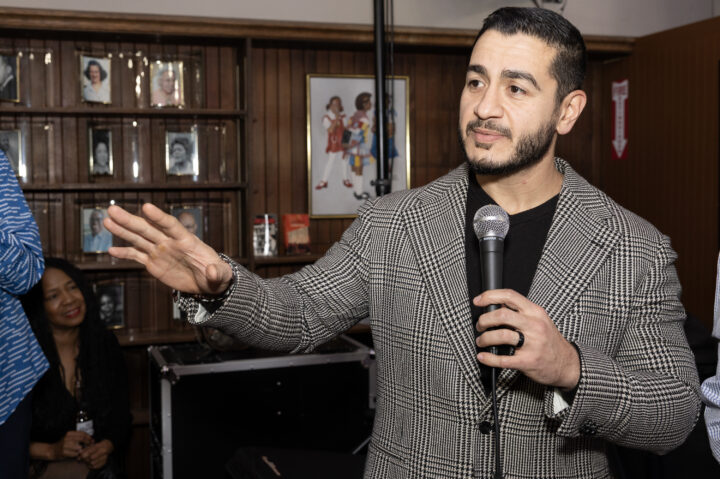
Monica Morgan/Getty Images
Abdul El-Sayed at the Bridge Center on Dec. 16, 2025, in Detroit, Michigan.
As the heated Democratic Senate primary in Michigan enters its final stretch, far-left candidate Abdul El-Sayed told CNN this week that he does not believe that a politician’s support for Israel could be about anything other than money.
“Not if you’re a Democrat and you believe in human rights,” El-Sayed told CNN when asked about such a distinction.
Asked whether it was possible to be a Zionist and be a progressive, El-Sayed said, “Every definition of a Jewish state ends up in some articulation of illiberal values, every single one.”
El-Sayed is facing off against Rep. Haley Stevens (D-MI) in the Aug. 4 primary, following state Sen. Mallory McMorrow’s departure from the race on Sunday.
Stevens, a moderate lawmaker who has been supported by AIPAC and pro-Israel donors throughout her career, has drawn a contrast between herself and El-Sayed on the issue.
“There is a difference between me and Abdul,” she said in an MS NOW interview on Monday. “I believe in a two-state solution. I want to see the people of Palestine and in Gaza live peacefully, side by side, with the people of Israel. He cannot qualify Israel’s right to exist.”
Recent polling has shown a relatively close race between the moderate Stevens and far-left El-Sayed, with El-Sayed leading in several surveys
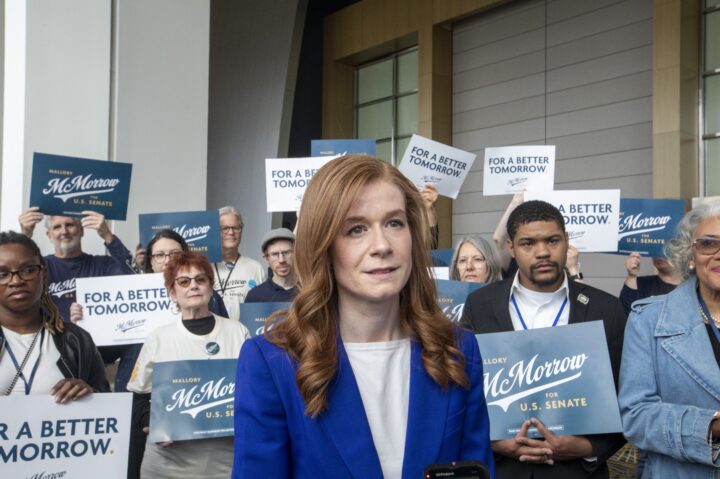
Jim West/UCG/Universal Images Group via Getty Images
Mallory McMorrow, a candidate for U.S. Senate, campaigns at the Michigan Democratic Nominating Convention
Michigan state Sen. Mallory McMorrow dropped out of the Democratic primary for U.S. Senate on Sunday, narrowing the race to a contest between Rep. Haley Stevens (D-MI) and Abdul El-Sayed, a former public health official.
McMorrow suspended her campaign without endorsing either of her rivals, saying only that “whoever wins this primary on August 4th will have my full support.”
Recent polling has shown a relatively close race between the moderate Stevens and far-left El-Sayed, with El-Sayed leading in several surveys. With McMorrow generally claiming around 10% of the vote in polls, her withdrawal could shift dynamics in the race.
At the same time, mail-in ballots in the state have already been dispatched — with McMorrow’s name still on them.
The end of McMorrow’s campaign marks a significant fall for the up-and-coming state senator, who posted strong performances in early polls but has seen flagging support and enthusiasm in recent months.
McMorrow’s voting base will likely end up divided among both candidates, and both are making efforts to attract her supporters.
McMorrow had sought to carve out a middle ground between Stevens and El-Sayed, running as a somewhat progressive anti-establishment candidate but claiming a more pragmatic lane than El-Sayed, who some Democrats worry will not be electable in a general election against former Rep. Mike Rogers (R-MI), the expected GOP nominee.
That positioning extended to the tightrope she tried to walk on Israel policy issues, criticizing Israel and agreeing with those who characterized the war in Gaza as a genocide while also condemning antisemitism in the anti-Israel movement.
Democrats who backed McMorrow for electability reasons, and some female voters, will likely end up in Stevens’ camp. But others, who were attracted by McMorrow’s anti-establishment message and more progressive posture than Stevens, will likely move toward El-Sayed. El-Sayed is also likely to pick up those voters turned off by Stevens’ staunch support for Israel — to the extent such voters hadn’t already abandoned McMorrow.
In her statement on McMorrow’s withdrawal, Stevens said she plans to continue to make her case that she’s “the strongest Democrat to defeat Mike Rogers.” In his statement, El-Sayed emphasized, “we cannot allow the establishment to decide our nominee for us.”
McMorrow’s withdrawal from the race may give space for Michigan’s political establishment to coalesce behind Stevens to block El-Sayed. Shortly after McMorrow dropped out, Attorney General Dana Nessel endorsed Stevens, saying that the “choice is clear.”
Former Sen. Debbie Stabenow (D-MI) previously endorsed Stevens, who has also been privately backed by Senate Minority Leader Chuck Schumer (D-NY).
Also in the wake of McMorrow’s decision, Republicans have continued to work to boost El-Sayed. Sen. Bernie Moreno (R-OH) accused Washington Democrats of “working overtime to stack the deck against” El-Sayed and boost Stevens.
Outside spending will also likely play a significant role in shaping the final month of the campaign. The AIPAC-linked United Democracy Project super PAC has already spent more than $10 million in the race, launching its first negative ads attacking El-Sayed late last week.
And after McMorrow withdrew from the field, the anti-Israel American Priorities super PAC told Politico it is “fully committed” to ensuring El-Sayed is the Democratic nominee “and we will do what it takes to get there” — the biggest test yet of the progressive, anti-Israel movement’s ability to win in a critical swing state.
The state lawmaker did not offer an endorsement of either of her former Democratic primary rivals, Rep. Haley Stevens and Abdul El-Sayed
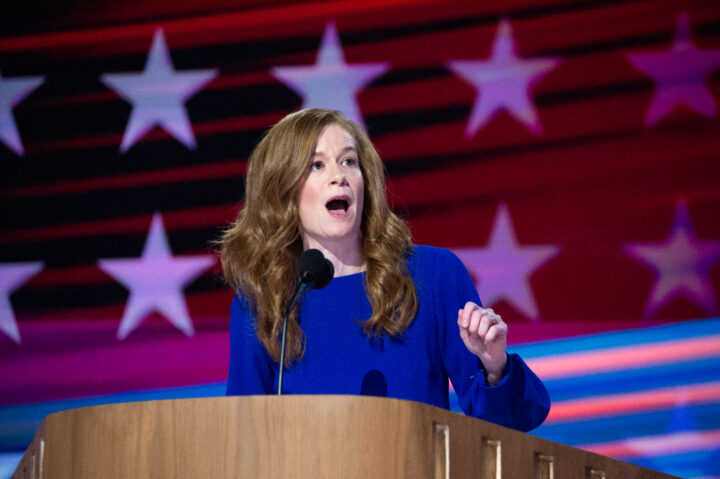
Jacek Boczarski/Anadolu via Getty Images
State Sen. Mallory McMorrow, a Democrat from Michigan speaks during the 2024 Democratic National Convention in Chicago, Illinois, United States on August 19, 2024.
Michigan state Sen. Mallory McMorrow dropped out of the Democratic primary for U.S. Senate on Sunday, without offering her support to either of her opponents in the hotly contested race.
“Here’s what we do next. Every day through November 3rd. We win this Senate seat and send Mike Rogers back to Florida for good,” McMorrow wrote in her announcement on X, referring to the expected GOP nominee.
“Whoever wins this primary on August 4th will have my full support,” she continued, declining to endorse either Rep. Haley Stevens (D-MI) or Abdul El-Sayed.
Fundraising figures released at the end of the first quarter of the year showed Stevens trailing El-Sayed in fundraising but having the most cash on hand, at $3.4 million to El-Sayed’s $2.5 million. El-Sayed has held a slight lead in the latest polls.
Following McMorrow’s announcement, Michigan Attorney General Dana Nessel, a Jewish Democrat, said the “choice is clear” and “wholeheartedly” issued her endorsement of Stevens.
Stevens also has the backing of other Democratic leaders including Senate Minority Leader Chuck Schumer (D-NY) and former Sen. Debbie Stabenow (D-MI).
El-Sayed, meanwhile, is backed by leading progressives including Sens. Bernie Sanders (I-VT) and Chris Van Hollen (D-MD), and Rep. Alexandria Ocasio-Cortez (D-NY). Last week, the AIPAC-linked United Democracy Project super PAC, which has boosted Stevens with more than $10 million, issued its first negative ad against El-Sayed.
Plus, debating who won the war
Mount Rushmore National Memorial is centered on a colossal sculpture carved into the granite face of Mount Rushmore in the Black Hills in Keystone, South Dakota.
Good Thursday morning.
In today’s Daily Kickoff, we look at how American Jewish thought leaders are reflecting on the country’s semiquincentennial, and report on Rep. Shri Thanedar’s serious primary challenge from a far-left state legislator in Michigan. We spotlight a new report on antisemitism in the human rights nonprofit sector, and cover the launch of Hussain Abdul-Hussain’s book, The Arab Case for Israel. Also in today’s Daily Kickoff: Michelle Greenberg-Kobrin, Katie Roof and Eliya Cohen and Ziv Abud.
Ed. note: In commemoration of Independence Day, the next edition of the Daily Kickoff will arrive on Monday, July 6. Happy America 250!
We have also launched a new on-demand Live Briefing that you can access throughout the day via our new app (on Apple and Android) and website.
Today’s Daily Kickoff was curated by JI Executive Editor Melissa Weiss and Israel Editor Tamara Zieve, with an assist from Danielle Cohen-Kanik. Have a tip? Email us here.
For less-distracted reading over the weekend, browse this week’s special Independence Day edition of The Weekly Print, a curated print-friendly PDF featuring a selection of recent Jewish Insider and eJewishPhilanthropy stories, including: Serving faith and nation: The rabbis bringing light to U.S. troops on Europe’s front line; The single best diaspora experience’: Jewish leaders mark America’s 250th with open letter; and How Jews reinvented themselves — and America. Print the latest edition here.
What We’re Watching
- U.S.-Iran talks that wrapped up in Doha on Wednesday are likely to resume next week, following funeral ceremonies for former Iranian Supreme Leader Ayatollah Ali Khamenei that will begin this weekend.
- Americans will celebrate the country’s semiquincentennial with events around the U.S. through the weekend. President Donald Trump is slated to speak tomorrow at Mount Rushmore.
- In Washington, Jacob Helberg, the under secretary of state for economic affairs, and Trump administration antisemitism envoy Yehuda Kaploun will host a Shabbat dinner tomorrow at the U.S. Institute of Peace. More below on how the Jewish community will commemorate the anniversary.
- In New York on Saturday, former Israeli hostage Alon Ohel will play the piano alongside Five For Fighting singer John Ondrasik on the USS Nimitz as part of the International Naval Review 250.
- Bar-Ilan University’s two-week pilot leadership institute concludes today. Read more about the initiative here.
- Christians United For Israel’s annual summit kicks off on Sunday in Washington. Israeli Ambassador to the U.S. Yechiel Leiter, former Israeli hostage Yair Horn and Judge Roy Altman are among those slated to speak.
What You Should Know
A QUICK WORD WITH JI’S GABBY DEUTCH
In the run-up to America’s 250th anniversary, the Jewish community finds itself navigating a best-of-times, worst-of-times, head-spinning paradox — standing nervously between the promise of an ideal America and the peril of today’s America.
In conversation after conversation, Jewish thinkers who spoke to Jewish Insider about this unique moment expressed fear and concern about the increasingly precarious situation facing American Jews in one breath. In the next, they spoke glowingly about the gifts this country’s democracy has given to the Jews who live here.
Despite this deep ambivalence, or perhaps because of it, the Jewish community is all-in on the 250th.
We interviewed nearly two dozen rabbis, writers, historians and Jewish leaders from across the political and religious spectrum ahead of the 250th anniversary of the signing of the Declaration of Independence. We wanted to know how they’re thinking about July Fourth at a time when antisemitism is rising and trust in American democracy is plummeting.
The conversations reveal a shared sense of hope in the American project — and a belief that this semiquincentennial celebration presents a rare opportunity for American Jews to hold their heads high and reflect on what this democracy, even if flawed, has given them.
And we looked at how American Jews are celebrating the country’s birthday: with a Shomer Shabbat barbecue, an English-only day at a Jewish sleepaway camp, an all-night Torah study, a Talmudic-level close read of America’s founding documents.
”An anniversary is a good occasion to put things in historic perspective. As bad as things may feel in the moment, they’re still pretty great relative to the bulk of not even just Jewish history, but also American Jewish history,” Atlantic writer Franklin Foer told JI. “All the ways in which Jewish values and American values are not just compatible, but overlap and extend one another, is something that I think is really important to cultivate within American Jewry and within American Jewish education.”
Read the full story from JI’s Gabby Deutch here, with comments from figures including author Dara Horn, former Treasury Secretary and U.S. Ambassador to Israel Jack Lew, Union for Reform Judaism President Rabbi Rick Jacobs, Florida Rabbi Efrem Goldberg and Shalom Hartman Institute President Yehuda Kurtzer.
NEW CHAPTER

At a launch event for his book, The Arab Case for Israel, on Tuesday, writer and researcher Hussain Abdul-Hussain argued that the path to peace in the Middle East begins with Arabs reexamining long-held assumptions about Israel, drawing on his own transformation from believing anti-Israel propaganda to an advocate for the Jewish state, Jewish Insider’s Haley Cohen reports.
Sharing his journey: Speaking days after Israel and Lebanon signed a U.S.-brokered framework agreement, Abdul-Hussain said the Lebanese people can follow in his footsteps, as the country remains divided between a faction that promotes the Iranian narrative that Israel “only understands the language of war and force,” and those seeking to reclaim the country’s sovereignty. “My story is the story of an average person who was told something and when he dug up the story it turned out to be something else,” Abdul-Hussain, a fellow at the Foundation for Defense of Democracies, told some 50 attendees — a mix of Jews, Christians and Muslims — at the event in Manhattan.
WORKPLACE WORRIES

The human rights nonprofit sector has systematically ignored or suppressed employee complaints of antisemitism for years, according to a new report published on Wednesday by EiGHT, an organization based in Israel that was created after the Oct. 7, 2023, Hamas terror attacks to provide oversight of humanitarian NGOs, Jewish Insider’s Gabby Deutch reports.
Conclusions: The 63-page report was submitted to Australia’s Royal Commission on Antisemitism and Social Cohesion, which was formed after the Bondi Beach terror attack last December, as well as several United Nations bodies. It draws on interviews with more than 70 current and former employees of organizations such as Human Rights Watch, Amnesty International, Doctors Without Borders and Greenpeace. It alleges that the organizations’ biased treatment of Israel contributed to a hostile work environment for Jewish and Israeli employees.
Exclusive: As the U.S. celebrates its 250th anniversary this weekend, a new study by the Combat Antisemitism Movement reveals a stark reality for American Jews: 57% reported experiencing antisemitism — frequently manifesting online — in the past year, JI’s Haley Cohen reports.
FRIENDLY FISSURE

The director general of Israel’s Ministry of Defense, Maj. Gen. (res.) Amir Baram, urged Israelis on Wednesday to understand Washington’s perspective as the U.S. and Israel negotiate the next memorandum of understanding, cautioning against judging American policy through a purely “provincial lens,” Jewish Insider’s Matthew Shea reports.
What he said: “What some in Israel perceive as weakness or folly, an apparent disregard for every warning sign on the ground, is viewed in Washington as cold, calculated and clear-eyed risk management in an era of shifting global attention,” he said at the annual Herzliya Conference at Reichman University. “For us, Iran is an existential threat; for the United States, it is a chronic regional challenge, while China and the Indo-Pacific theater remain the core concern,” Baram said. “We think Tehran, they think Taiwan.”
WAR GAMES

Top Middle East analysts — including the Carnegie Endowment’s Karim Sadjadpour and Foundation for Defense of Democracies’ Mark Dubowitz — offered starkly different takes on whether the United States or Iran has emerged in a stronger strategic position following the recent U.S.-Iran conflict, yet shared a deeply critical view of the preliminary memorandum of understanding brokered between Washington and Tehran, Jewish Insider’s Matthew Shea reports.
Opposing perspectives: Speaking on Monday at the Aspen Ideas Festival in Colorado during a panel discussion moderated by CNN’s Fareed Zakaria, Sadjadpour argued that Tehran successfully leveraged the crisis to its advantage. “I think the biggest advantage they now have is controlling the Strait of Hormuz. They want to try to turn it, if not into the Panama Canal, at least have administrative control over it,” he said. Dubowitz countered that Tehran has actually suffered an unprecedented, devastating strategic and military defeat, saying, “The United States of America is winning, Israel is winning and the Islamic Republic of Iran is losing.”
MICHIGAN MATTERS

Rep. Shri Thanedar (D-MI) is facing a serious primary threat from state Rep. Donavan McKinney, a left-wing challenger backed by several anti-Israel groups including Justice Democrats and TrackAIPAC. Those groups are riding high, coming off of a recent wave of congressional primary victories, which they say point to a desire for a leftward shift in the Democratic Party and, in particular, rejection of support for Israel and pro-Israel groups among the Democratic base. Thanedar is one of their next top targets, Jewish Insider’s Marc Rod reports.
Israel record: Thanedar is one of the few Democrats who has gotten more supportive of Israel during his tenure in Congress, even as the party has become more hostile to the Jewish state. As a state legislator in 2021, he co-sponsored a resolution calling for a halt in U.S. aid to Israel, which described Israel as an “apartheid state” and accused it of “countless human rights violations.” After comfortably winning the contested 2022 primary, Thanedar met with supporters of Israel and traveled to the Jewish state, ultimately reinventing himself as a strong pro-Israel voice and picking up support from the Jewish community. That stance has since cost him support among progressives.
CAMPAIGN CONTROVERSY
Francesca Hong, a Democratic Socialists of America-affiliated candidate for governor of Wisconsin, appeared on Monday on the Twitch stream of Mike Beyer, known by his online handle “Mike From PA,” a fringe far-left influencer who has espoused open antisemitism. Beyer was suspended from Twitch last year for comments in which he said that “Jewish is not an ethnicity” and Jewish identity is “a constructed ethnicity, this demonic ethnicity, wholly invented,” Jewish Insider’s Marc Rod reports.
What she said: Amid scrutiny of his interview with Hong, Beyer blamed an organized conspiracy trying to slander “grassroots politicians like they are getting direct orders from [Israeli Prime Minister Benjamin] Netanyahu.” Later on Monday, Hong also appeared on antisemitic streamer Hasan Piker’s Twitch show. Asked about the two appearances, Allison Geyer, a spokesperson for Hong’s campaign said, “Rep. Hong has been clear throughout this campaign that antisemitism, Islamophobia, racism, transphobia, and all forms of dehumanization have no place in Wisconsin politics or in the movement we are building.”
Worthy Reads
Zionism, From the Beginning: In The New York Times, Rabbi Ari Berman, the president of Yeshiva University, weighs in on the debate over the “profound misunderstanding” of the definition of Zionism. “While the modern state of Israel was founded on the ashes of the Holocaust and served as a safe haven for refugees, Zionism always aspired to be more than simply an answer to or refuge from antisemitism. It was a means of allowing Jews to live to their greatest potential, unfettered by the restrictive, often brutal, experiences of living in foreign lands. Zionism is thus an answer to a 3,800-year-old yearning, not only a response to a modern crisis.” [NYTimes]
What the DSA Really Wants: The Atlantic’s Jonathan Chait does a deep dive into the ideological shift undertaken by the Democratic Socialists of America. “The organization is still called democratic socialists, of course, but the term does not necessarily mean ‘liberal democracy’ as Americans have traditionally defined it. … The DSA’s long-term strategy is to exploit the Democratic Party’s ballot access and reservoir of voters to build its following, and then, after it gains enough power, break off to form its own party, after which the husk of the old Democratic Party would wither and die.” [TheAtlantic]
Finding Patriotism at a Summer Camp: The Free Press’ U.K.-based digital editor, Josh Kaplan, reflects on his experiences as a counselor at an American Jewish summer camp in upstate New York ahead of the U.S.’ semiquincentennial. “Spending every waking moment surrounded by people who speak your language and have very little else in common with you is remarkably eye-opening. You learn why they believe things that a European never would — like, they believe they were born in the best country in the world. And you learn that even if they have conflicted thoughts about their country’s politics and government, they still love the idea of America, its pageantry, and the flag.” [FreePress]
Word on the Street
In a letter to President Donald Trump, Reps. Laura Gillen (D-NY), Nicole Malliotakis (R-NY) and Mike Lawler (R-NY) urged the administration, in any sanctions relief for or negotiation with Iran, to address Iran’s support for terrorism and statutorily required compensation for victims of Iran-backed terrorism which amounts to billions of dollars…
The Free Press interviews Rep. Tom Suozzi (D-NY) about his “Promise to America” pledge as the moderate Long Island Democrat works to restore the party’s base amid a series of Democratic Socialists of America wins in primaries and local elections around the country…
The Detroit News endorsed Rep. Haley Stevens (D-MI) in the Democratic primary for the state’s open Senate race…
Politico looks at the challenges facing House Minority Leader Hakeem Jeffries (D-NY) as he eyes the House speakership amid the far left’s ascendance — and two years before a state redistricting effort that could affect some of the Democratic Socialists of America’s recent gains, in which he is expected to play a significant role…
Far-left activist Darializa Avila Chevalier, who last week won the Democratic primary in New York’s 13th Congressional District, confirmed her relationship with attorney Ramzi Kassem, the chief counsel to New York City Mayor Zohran Mamdani, saying the two met outside an immigration detention center…
A California man who pleaded guilty to manslaughter in the 2023 death of Paul Kessler at dueling pro- and anti-Israel rallies in California was sentenced to one year in jail; Kessler fell and hit his head in a confrontation with Loay Alnaji and died the following day…
Michelle Greenberg-Kobrin, who served as dean of students at Columbia Law School, was named Columbia’s Jewish life liaison, a position created following the school’s 2025 settlement with the Trump administration…
Immigration officials detained a Cuban national who had been living in the U.S. for more than a decade and working as what federal authorities described as a “foreign subversive” for Cuba’s “premier influence and intelligence front group”; Carlos Antonio Lloga Dominguez is alleged to be working with the U.S.-sanctioned Cuban Institute of Friendship With the People that brought far-left antisemitic streamer Hasan Piker and CodePink’s Medea Benjamin to Cuba earlier this year…
Qualcomm is acquiring Israeli cybersecurity company SAM Seamless Network in a deal estimated to be worth more than $150 million…
Former Israeli hostage Eliya Cohen and his fiancee, Nova music festival survivor Ziv Abud, held their henna ceremony on Wednesday night ahead of their wedding next month…
Archeologists discovered a cave believed to have been used by early human ancestors who predate the Neanderthals some 400,000 years ago outside the northern Israeli town of Fureidis…
The Wall Street Journal spotlights the United Arab Emirates’ efforts to recover from the economic and physical damage caused by ongoing Iranian attacks earlier this year…
Bloomberg reports that the UAE has returned to its prewar levels of oil exports, quietly sending ships through the Strait of Hormuz undetected and using a pipeline to bypass the area…
The U.S. is resuming some shipments of money to Iraq after suspending the payments for several months in an effort to pressure Baghdad to distance itself from Iran…
Syrian President Ahmad al-Sharaa appointed 70 legislators to the country’s parliament, with the 210-member body set to meet for the first time on Monday…
The Information’s Katie Roof is joining Business Insider as editor at large and will additionally join the Axel Springer Global Reporters Network as a global reporter…
Arno Rosenfeld is joining Haaretz as Washington correspondent, working with newly named U.S. Bureau Chief Ben Samuels…
The Louis D. Brandeis Center for Human Rights Under Law announced the death of board member Richard Cravatts…
Pic of the Day

Former Israeli hostage Daniella Gilboa released a new single on Wednesday, a year and a half after her release from Hamas captivity in Gaza. In an Instagram post, Gilboa said that she wrote the song, “Bye to Worries,” when she was 17, together with her boyfriend, Roy Dadon, when “we still didn’t understand where life would take us, out of innocence and true love for music, and certainly I didn’t think I would sing this song to myself in my darkest moments when everything was taken from me.”
Birthdays

Inductee into the Rock & Roll Hall of Fame in 2014 as a member of the E Street Band, Roy J. Bittan turns 77…
Director emerita of Hebrew studies at HUC-JIR, she sits on the board of Lashon Academy, Rivka Dori… Nobel laureate in medicine in 2004, he is a professor at Columbia University and a molecular biologist, Richard Axel turns 80… Co-creator of the “Seinfeld” television series and creator of HBO’s “Curb Your Enthusiasm,” comedian and producer, Larry David turns 79… Swedish author and screenwriter, she wrote a novel about Jewish children who escaped the Holocaust, Annika Thor turns 76… Former CEO of the Milwaukee Jewish Federation, she also served as a State Department’s special envoy on antisemitism, Hannah Rosenthal turns 75… Montclair, N.J.-based philanthropic consultant, Aaron Issar Back, Ph.D…. Israeli Druze politician who serves as a member of Knesset for the New Hope party, Akram Hasson turns 67… Maryland state senator since 2015, Cheryl C. Kagan turns 65… Founder and head of business development of AQR Capital Management, David G. Kabiller turns 63… Member of the Knesset for the United Torah Judaism alliance, Ya’akov Asher turns 61… Chief White House correspondent for The New York Times, Peter E. Baker turns 59… Reading specialist at Wayne Thomas School in Highland Park, Ill., Stephanie Rubin… Co-founder, president and dean at Mechon Hadar in Manhattan, Shai Held, Ph.D. turns 55… Executive director at the Foundation for Defense of Democracies, Jonathan Schanzer turns 54… Global industry editor for health and pharma at Thomson Reuters, Michele Gershberg… Music video and film director, Alma Har’el turns 51… Motivational speaker, media personality and EVP at RXR Realty, Charlie Harary turns 49… Author of fiction and nonfiction on a variety of Jewish topics, Elisa Albert turns 48… Israeli journalist, TV anchor and popular lecturer, Sivan Rahav-Meir turns 45… Member of Congress (R-NY) who is stepping down after this term, Elise Stefanik turns 42… Actor, singer and producer, she appeared in her first films as a 14-year-old, Ashley Tisdale turns 41… Actor and internet personality, Barbara Dunkelman turns 37… Actor, singer and songwriter, she played a lead role in the 2019 ABC series “Emergence,” Alexa Swinton turns 17..
El-Sayed suggests anti-Israel activists indicted because of beliefs, not alleged criminal conspiracy
‘It's a lot more about what you're advocating for that gets you indicted or not indicted, rather than what you did,’ El-Sayed said
Evan Cobb for The Washington Post via Getty Images
Michigan Senate candidate Abdul El-Sayed speaks with customers and barbers at Blazin Wade Cuts in Grand Rapids, Michigan, on Saturday, Feb. 21, 2026.
Abdul El-Sayed, the far-left Democratic Senate candidate in Michigan, suggested at an event on Friday that the Trump administration had indicted a group of anti-Israel demonstrators at the University of Michigan for their beliefs, rather than their actions.
The eight defendants, including a former staffer on El-Sayed’s campaign, who were indicted Friday have been accused of a campaign of intimidation against university officials they saw as pro-Israel and vandalism of local Jewish organizations.
“It’s a lot more about what you’re advocating for that gets you indicted or not indicted, rather than what you did,” El-Sayed said, at a Friday campaign event, according to The Detroit News.
Speaking to reporters after the event, El-Sayed said that it’s “just wrong, full stop” to target families, businesses and property as the indicted individuals alleged did, but also drew a contrast between the treatment of the eight indicted individuals and the Trump administration’s mass pardon of those involved in the Jan. 6, 2021, attack on the U.S. Capitol.
“I believe in justice, because I believe that when you break the law, you should be held accountable, but I don’t love watching our justice system treat people differently based on what it is that they were advocating for,” El-Sayed said. “Targeting people, families, properties, businesses is wrong, of course it’s wrong, but it’s also wrong when Jan. 6 terrorists do it. To watch the same Trump administration use these terms in certain ways — I think we all need to be asking the questions.”
El-Sayed previously faced criticism for his response to the attack on Temple Israel in West Bloomfield, Mich., which some saw as excusing or rationalizing the attack.
Rep. Haley Stevens (D-MI) on X condemned El-Sayed for his “equivocation.”
“The reported planned violence and intimidation at the University of Michigan is wrong. This is simple and any leader should be able to say so,” she said. “The fact my opponent cannot bring himself to say that is concerning.”
In remarks to reporters, she said that she was “concerned about [El-Sayed’s] repeated patterns of embracing political violence and being out of step with Michigan voters,” pointing also to his decision to rally with far-left influencer Hasan Piker at the University of Michigan.
“We need leaders who are going to showcase leadership and be the leaders that we deserve, not continue to divide us and compensate for when people commit violence or threaten violence for political purposes,” she said.
Her comments have prompted scorn from El-Sayed’s campaign and allies.
Rep. Rashida Tlaib (D-MI) responded to Stevens’ X post by copying Stevens’ wording to criticize Stevens for refusing to describe the war in Gaza as a genocide.
Roxie Richner, El-Sayed’s communications director, accused Stevens on X of “sid[ing] with the Trump administration” and said she “can’t string two coherent sentences together.”
“Leadership requires that you have moral clarity and can say words that make sense when put in order,” Richner continued.
Mariam Odeh, a defendant in the case, remained on the Democratic candidate’s payroll until April
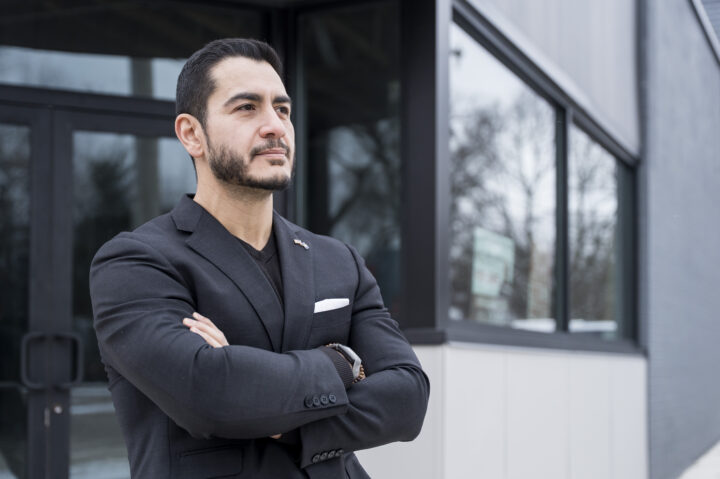
Evan Cobb for The Washington Post via Getty Images
Michigan Senate candidate Abdul El-Sayed poses for a portrait in Grand Rapids, Michigan, on Saturday, Feb. 21, 2026.
One of the eight anti-Israel activists indicted on Wednesday over allegedly threatening University of Michigan officials seen as pro-Israel and vandalizing local Jewish organizations was on the staff of far-left U.S. Senate candidate Abdul El-Sayed as recently as April.
The federal indictment lists Mariam Odeh, 24, of Dearborn, Mich., as one of the defendants who allegedly carried out a series of coordinated actions targeting university leaders or organizations with connections to Israel following the Oct. 7, 2023, Hamas terrorist attacks.
On the one-year anniversary of the attacks, they vandalized Detroit’s Jewish federation building and spray-painted businesses, with words including “intifada,” according to the indictment.
The defendants also forcibly entered and occupied university buildings, defaced property and disrupted campus events — and placed fake bloody corpses outside the homes of multiple university leaders, including then-President Santa Ono, over their perceived support for Israel.
According to a statement in the indictment from Jennifer Runyan, special agent in charge of the FBI’s Detroit field office, the perpetrators — while masked and hooded — “allegedly threw noxious chemicals through the windows of families’ homes and taped demand letters to their front doors” and also “discussed methods by which to harm the targets and their families, including poison, bombs, and psychological torture.”
Odeh, who is listed in the indictment as president of the organization Students Allied for Freedom and Equality, was paid $154 by El-Sayed’s campaign on March 3 and $593 on March 13, according to fundraising disclosures first obtained by The Detroit News, which reported that the payments were described as salary disbursements.
El-Sayed’s spokesperson, Roxie Richner, told the paper that Odeh was an hourly employee on the campaign for two weeks and has not been affiliated with it since April 15. Odeh was charged with one count of conspiracy to transmit threats in interstate and foreign commerce, which carries a penalty of up to five years in prison.
El-Sayed is one of three candidates in Michigan’s Democratic Senate primary, alongside Rep. Haley Stevens (D-MI) and state Sen. Mallory McMorrow.
Seen as the most progressive candidate in the race, El-Sayed told Jewish supporters last month that he struggles to answer whether he believes Israel has a right to exist as a Jewish state. He said in an interview with CNN in April that he believes the Israeli government is just as evil as Hamas.
A spokesperson for Rep. Stevens’ campaign, Arik Wolk, told JI on Thursday, “Haley condemns all forms of hate and political violence…antisemitism and political intimidation — especially violence that seeks to silence the voices of others — has no place in Michigan.”
Neither El-Sayed’s nor McMorrow’s campaigns responded to requests for comment from JI about the indictment or about Odeh’s employment on the campaign.
The AIPAC-affiliated super PAC is touting Stevens’ record fighting for the auto industry, opposing Medicare cuts and working to cap insulin prices in Congress
Andrew Roth/Sipa USA
Rep. Haley Stevens (D-MI) speaks at the Michigan Democratic Party Endorsement Convention in Detroit, Mich., on April 19, 2026.
United Democracy Project, the super PAC affiliated with AIPAC, is spending $2 million on an initial ad buy this week to boost Rep. Haley Stevens (D-MI) in the Democratic primary for Michigan’s open Senate seat, a UDP spokesperson confirmed to Jewish Insider on Tuesday.
The new TV ad, which calls Stevens “a proven fighter for Michigan,” touts her past role as chief of staff to President Barack Obama’s auto task force, support for capping insulin prices and efforts “fighting back against” President Donald Trump’s “Medicare cuts.”
“She’s a fighter for Michigan families on affordability and jobs,” Patrick Dorton, a spokesperson for UDP, said of Stevens, a moderate pro-Israel Democrat. “We are going to show that on these ads,” he said in a statement to JI.
UDP is also spending $300,000 on radio and mail ads, Dorton said of the group’s first investment in the race. He was unable to share how much UDP intends to spend in the primary, which takes place on Aug. 4.
The spending comes as AIPAC is viewed as a lightning rod in Michigan’s closely contested Democratic Senate primary, where one of Stevens’ top rivals, Abdul El-Sayed, a vocal far-left critic of Israel, has accused her of being beholden to donors from the pro-Israel group. Mallory McMorrow, a state senator, has also vowed to reject campaign contributions from AIPAC.
In contrast with other races where UDP has relied on shell PACs that allow it to shield its involvement until after a primary has concluded, the group is spending under its own name in Michigan, which is home to a sizable Jewish community.
Meanwhile, Rep. Haley Stevens avoided a question about receiving support from pro-Israel donors, while Abdul El-Sayed blamed rising antisemitism on white supremacy
Jim West/UCG/Universal Images Group via Getty Images
Mallory McMorrow, a candidate for U.S. Senate, campaigns at the Michigan Democratic Nominating Convention
State Sen. Mallory McMorrow offered a straightforward answer when asked at a debate on Thursday, alongside the other two Democrats vying for an open Senate seat in Michigan, whether there is an antisemitism problem in the Democratic Party.
“There is,” said McMorrow. She told the story of an attendee at last month’s Democratic Party convention in Detroit who yelled an antisemitic slur at her Jewish husband, in front of their young daughter.
“That is terrifying. We need to be able to state very clearly that what the Netanyahu government is doing is wrong, that the violence needs to end, that we need to bring about long-term peace and security for Palestinians and for Israelis, and that turning that into not an anti-Netanyahu, but an anti-American Jewish message is dangerous,” McMorrow said, earning applause from the room.
The other two candidates — Rep. Haley Stevens (D-MI) and former public health official Abdul El-Sayed — did not directly address the question about Democrats.
Stevens condemned “rising political violence and extremism,” including the attack at Temple Israel in West Bloomfield, in her district, which she said was carried out by a “homegrown terrorist.” She described herself as a lawmaker who is “leading on combating antisemitism in a bipartisan way. That does not have to be a partisan thing.”
El-Sayed said he understands discrimination because he has faced it himself. He blamed antisemitism in the U.S. on white supremacy.
“I know that antisemitism and Islamophobia tend to go hand in hand, and the real issue when it comes to either of them is the scourge of white supremacy,” he said, while arguing that respecting American Jews does not require supporting Israel.
The Democratic primary for the open Senate seat in Michigan is one of the most contentious in the country, and antisemitism has become a major issue, alongside U.S. foreign policy and support for Israel. It is perhaps the most high-profile seat where debates about the role of AIPAC might actually have an impact on the outcome.
Stevens, a longtime ally of the pro-Israel group, was the early frontrunner in the race but has faced attacks from her opponents for not criticizing AIPAC.
Presented with an opportunity on Thursday in a primary debate to help voters understand why she continues to receive support from the pro-Israel advocacy group, Stevens chose not to speak about the group at all.
“You take money from AIPAC. Walk us through what that money means and what it buys, and maybe what it doesn’t,” one of the debate’s moderators asked Stevens, as part of a question about how much influence individual donors have over their decisions.
“Michiganders are frustrated because we have not done comprehensive campaign finance reform. Mike Rogers will not vote for comprehensive campaign finance reform like I have in the House of Representatives,” Stevens said, referring to former Rep. Mike Rogers (R-MI), the expected GOP nominee for Senate. “We squarely need to put people at the front of our agenda.”
She also said she is “deeply proud to have grassroots support coming from grocery clerk workers to retired teachers to factory workers and the like,” and named some of the politicians who have endorsed her, including former Rep. Brenda Lawrence (D-MI), former Sen. Debbie Stabenow (D-MI) and former Gov. Jennifer Granholm.
When asked about her views on foreign policy, Stevens attacked President Donald Trump for the “harmful and ridiculous” steps he took to pare back U.S. humanitarian aid abroad, and pledged to focus on peace.
“We need to see the United States work with our allies to achieve lasting peace between Russia and Ukraine, between the people of Israel and Palestine and of course between China and Taiwan,” said Stevens. “But when you remove the tools from our tool kit, you fail this country and you fail us, to allow us to work alongside our allies.”
Both McMorrow and El-Sayed used Thursday’s debate to remind voters that they do not accept donations from AIPAC. (AIPAC has not made an endorsement in the Senate race, but it has encouraged its supporters to donate to Stevens’ campaign.)
“I have not taken a dime of corporate PAC donations. I have not taken a dime of AIPAC donations,” said McMorrow, who is endorsed by the progressive Israel advocacy group J Street.
El-Sayed, who regularly accuses Israel of genocide and has said he struggles with the question of whether Israel has the right to exist as a Jewish state, slammed Stevens for taking AIPAC supporters’ donations.
“Let me tell you what absolutely would not shape my perception [of foreign policy]: it’s AIPAC money,” said El-Sayed.
The Michigan Senate candidate questioned how Israel being a Jewish state is ‘consistent with any form of liberal values that we say we believe in here in the United States’
Evan Cobb for The Washington Post via Getty Images
Michigan Senate candidate Abdul El-Sayed speaks with customers and barbers at Blazin Wade Cuts in Grand Rapids, Michigan, on Saturday, Feb. 21, 2026.
Abdul El-Sayed, the far-left Democratic candidate for Michigan’s Senate seat, said at an event with Jewish supporters last week that he struggles to answer questions about whether he believes Israel has a right to exist as a Jewish state.
At his “Jews for Abdul” event last week in Pontiac, Mich., a recording of which was obtained by Jewish Insider, El-Sayed, in response to a question from an audience member about him sidestepping inquiries about Israel’s right to exist, said, “I often struggle with the question that people ask in this particular scenario, because what they now ask is, ‘Do you believe in the right of Israel to exist as a Jewish state,’ which, to me, forces the question of a definition of what a Jewish state means.”
SCOOP | Abdul El-Sayed, the far-left Democratic candidate for Michigan’s Senate seat, said at an event with Jewish supporters last week that he struggles to answer questions about whether he believes Israel has a right to exist as a Jewish state.
— Jewish Insider (@jewishinsider) May 27, 2026
“I often struggle with the… pic.twitter.com/ugjbXgxUvr
El-Sayed continued: “I need folks who want to ask me that question [to explain] what it is that they mean by that, and how that is consistent with any form of liberal values that we say we believe in here in the United States.”
He accused Israel of “bypassing” the issue of Palestinian rights and maintaining a Jewish majority in Israel by implementing apartheid in the West Bank, east Jerusalem and Gaza, and said that the question of Israel’s right to exist overlooks “the rights of people who’ve been displaced by Israeli action” dating back to 1948.
He said that U.S. support is “funding leadership” in Israel that is opposed to a two-state solution while Palestinians do not have a voice in that conversation, and said “it’s not actually our job to decide what the peace looks like there.”
“[Israel] exists as it stands, but nobody ever asked me about the right of Palestine to exist, because it doesn’t exist. And so I just push back on the characterization here,” El-Sayed said.
MORE EXCLUSIVE VIDEO: Abdul El-Sayed says “I need folks who want to ask me that question [to explain] what it is that they mean by that, and how that is consistent with any form of liberal values that we say we believe in here in the United States.”
— Jewish Insider (@jewishinsider) May 27, 2026
Read more:… pic.twitter.com/8kaWUqwYCK
El-Sayed’s candidacy, positions and affiliations — particularly his campaigning with streamer Hasan Piker, who has repeatedly shared antisemitic sentiments and support for terrorism — has drawn concern from the sizable Jewish community in Michigan and nationally.
Photos from the event shared by El-Sayed’s campaign appear to show around a few dozen people in the audience, at least one of whom — who raised the question about Israel’s right to exist — said she was not Jewish.
Republican nominees Lena Epstein and Michael Schostak, who both identify as Jewish, told JI they’re campaigning on fighting antisemitism at the school
Campaign website
Lena Epstein and Michael Schostak
Michigan’s statewide election for two seats on the University of Michigan Board of Regents — the body that governs the state’s flagship university — has become a surprisingly contentious race in a swing state full of high-profile match-ups.
After Amir Makled, a trial attorney with a history of antisemitic and pro-Hezbollah social media posts, unseated incumbent Regent Jordan Acker at the Democratic Party nominating convention last month, the two Republican candidates running for the board see an opening to pitch themselves to Democrats and Independents.
Acker, who is Jewish, had spoken out against efforts to divest Michigan’s endowment from Israeli companies, and faced antisemitic harassment from pro-Palestinian campus activists, while Makled has promoted efforts to boycott Israel. (Acker and Brown campaigned together during the primary, but Acker did not respond to a request for comment about who he’s backing in the general election.)
Lena Epstein, an oil executive who chaired President Donald Trump’s campaign in Michigan in 2016 before running for regent, told Jewish Insider in a recent interview that reaching disaffected Democrats who are upset about Makled’s place on the ticket is a priority for her.
“There are the individuals that believe that I’ll be a fabulous regent and really great at the job and able to effect positive change over these next eight years, and for the long term,” said Epstein, who also ran for the board in 2022 and narrowly lost. “Then there’s the other folks that simply don’t want the other gentleman who is nominated to win, and we accept support from Democrats, independents and Republicans.”
Epstein has an MBA from Michigan, as does the other Republican on the ticket, Michael Schostak, the treasurer of Bloomfield Township, a Detroit suburb. Schostak told JI in an interview that since Makled’s nomination, Michigan alumni around the country who are now closely following the race have been calling him.
“They care about their alma mater and they want to make sure that it stays in good hands, and they’re very concerned about what they’ve seen from Amir Makled,” Schostak said. “I’m not running to be the Jewish candidate. I am Jewish, but that’s not why I’m running. I got into this race eight months ago because I cared about affordability of tuition and college costs.”
The two regents who are elected this November to serve on the eight-person board will join an ongoing search for a new university president following a tumultuous few years for Michigan, one of the top public universities in the country — and the school with the fifth-largest Jewish student population, according to Hillel International.
Both Schostak and Epstein identify as Jewish, though Epstein has at times described herself as a messianic Jew, meaning she believes in the divinity of Jesus. For that reason, the mainstream Jewish community considers messianic Jews to be Christian. She recently told the Forward that she is “100% Jewish,” and that her family belongs to a Reform synagogue in Bloomfield Hills.
Both Republicans say fighting antisemitism is a priority for them if elected to the board of regents.
“Antisemitism should never be minimized, normalized or explained away. Jewish students deserve the same protection and dignity as every other student on campus,” Epstein said. “One of the most troubling failures that we’ve seen at the University of Michigan is the hesitation to call antisemitism what it is.”
Schostak recalled conversations with Jewish students who were afraid to wear Star of David necklaces on campus or scared to walk to class during the anti-Israel encampments two years ago.
“I felt terrible, just sick to my stomach for the Jewish students on campus who had to live through that, and the pro-Israel students. There are a lot of pro-Israel students who are not Jewish,” said Schostak. “We’ve got to acknowledge them, who felt like they couldn’t express themselves because they were going to be harassed or followed or shouted at, or whatever, and the fact that all this was going on, the encampments, and people felt like it wasn’t safe.”
Both candidates said the university did a poor job of handling the firestorm of campus events in the 2023-2024 school year after Hamas’ Oct. 7 attacks and called for more clarity about rules surrounding campus protests.
“When it comes to protests on campus at U of M, peaceful protest has been a very long-standing tradition at this fine university,” said Epstein. “Students have every right to speak out. Students do not have the right to make other students feel unsafe walking to class. A university simply can’t function if rules are enforced selectively, depending on politics.”
Schostak and Epstein said they will emphasize support for free speech across all viewpoints at a school where they think intellectual diversity is lacking. But the response to anti-Israel protests, even hateful ones, cannot be shutting all protests down, according to Shostak.
“Free speech to me is very important, and they have the right to protest and make noise, as long as they don’t disrupt the university’s business,” said Schostak. “What I would tell the Jewish and pro-Israel students is, ‘Look, you need to be just as vocal in your beliefs and standing up for Israel and standing up for the Jewish people as they are standing up for the Palestinian people.’”
After a Michigan professor delivered an anti-Israel speech at commencement this month, Epstein and Schostak released a joint statement questioning the choice of the professor, Derek Peterson, as a speaker and criticizing his rhetoric. “There is a time and a place for emotionally charged debate. A commencement ceremony is not it,” they wrote.
Makled and Paul Brown, the other Democratic nominee who was first elected to the board of regents in 2018, have both criticized President Donald Trump’s approach to higher education, and pledged to push back on funding cuts where possible. Schostak expressed concern about the cuts as well, while noting that the regents should encourage the university to work to not get additional funding cut off.
“I am concerned,” Schostak said. “The university is going to have to tap dance around that to make sure that they abide by all the rules to make sure that our research funding isn’t cut off or any of our other funding isn’t cut off.”
Epstein has declined to say much on the issue. When asked about Trump’s adversarial approach to universities, she pointed out that Michigan is a public institution.
“We do accept public funds, and we do work in concert with the government based on those financial dynamics,” she said. “With that said, I believe that the University of Michigan should be an autonomous organization.”
Both candidates understand that to the extent to which Michigan voters are even paying attention to the race, most will not make a decision based on issues related to Israel or campus protests. So their focus remains on issues like college affordability and job opportunities.
“[Voters] care about sending their kids to college, being able to afford to pay for it, having their kids stay here when they graduate, so that we can provide an environment where they can thrive,” said Schostak. “That’s what they care about, and those are the issues that I’m going to be speaking to.”
The move is intended to block Abdul El-Sayed’s path to victory, though a divided mainstream vote could help the anti-Israel candidate
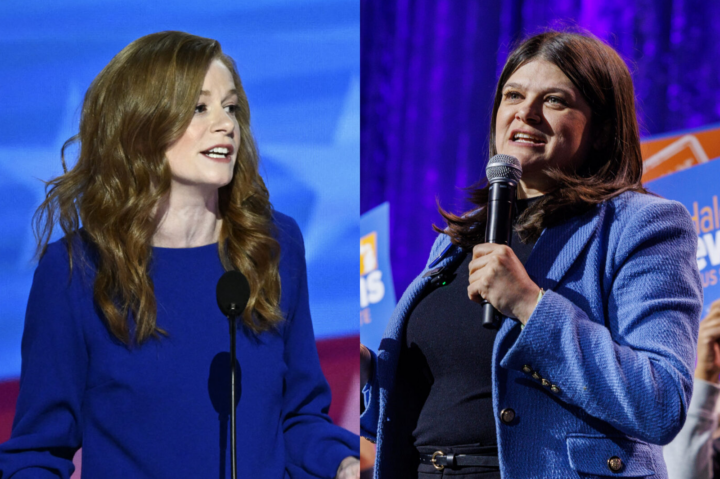
MANDEL NGAN/AFP via Getty Images & Andrew Roth/Sipa USA
Mallory McMorrow and Haley Stevens
The Jewish Democratic Council of America announced a dual endorsement on Wednesday of Rep. Haley Stevens (D-MI) and state Sen. Mallory McMorrow in Michigan’s three-way Senate Democratic primary, saying “there are two candidates who stand with our community on issues of importance to Jewish voters, and there is one who does not.”
“It is because of this stark contrast of the views and values of Haley Stevens and Mallory McMorrow, compared to those of Abdul El-Sayed,” a vocal critic of Israel who has captured the enthusiasm of the far left, “that we are taking the distinct opportunity to endorse two candidates,” Halie Soifer, JDCA’s CEO, said in a statement.
The decision to issue a dual endorsement is rare for JDCA, which has long supported Stevens, a moderate pro-Israel Democrat who is favored by establishment leaders as well as AIPAC. In recent days, Stevens has won a series of major endorsements from Sen. Chris Coons (D-DE), former Sen. Debbie Stabenow (D-MI) and former Michigan Gov. Jennifer Granholm, with under three months until the August 4 primary seen as key to reclaiming the party’s majority in the upper chamber.
McMorrow, who has backed efforts to restrict arms sales to Israel and called its military conduct in Gaza a genocide while also reaching out to Jewish voters in the state, stands to to the left of JDCA on Middle East policy, which backs continued U.S. aid to Israel “with no cuts or conditions,” its website states.
In an interview with Jewish Insider, Soifer said the group had weighed those differences and engaged in “extensive conversations with McMorrow” as it made its endorsement.
“Given the fact that her views on this issue stood in such contrast with those of Abdul El-Sayed,” who has drawn criticism for campaigning with Hasan Piker, a Twitch streamer who regularly espouses antisemitic rhetoric, “we felt that it was important to send a clear message that either Stevens or McMorrow would” be preferable, Soifer explained on Wednesday.
McMorrow and Stevens have criticized El-Sayed for appearing with Piker, whose rhetoric he has refused to denounce. El-Sayed, who has been rising in recent polls — including one earlier this month in which he held a 10-point lead over his two primary opponents — has also side-stepped questions about Israel’s right to exist and said the Israeli government is just as evil as Hamas, among other inflammatory comments that have raised alarms among Jewish voters in the state.
While Soifer acknowledged concerns that Stevens and McMorrow could end up splitting the vote and inadvertently propelling El-Sayed to the nomination, she told JI the dual endorsement was meant to reflect JDCA’s broader assessment of the stakes of the race.
El-Sayed “stands alone among the most anti-Israel candidates who are running this cycle,” Soifer said, calling him an “unacceptable choice” in a state home to a sizable Jewish community.
“We wanted to send a clear message that he is a threat both to Democrats and the chances of holding onto that Senate seat,” she added. “It is our interest to ensure he is defeated.”
Polling has indicated that the general election — where Democrats are now expected to face former Rep. Mike Rogers (R-MI) — will be competitive.
JDCA has endorsed more than 120 candidates this election cycle. The group has so far notably refrained from offering its imprimatur to Graham Platner, the presumptive Senate Democratic nominee in Maine who has faced scrutiny over a Nazi tattoo he recently covered up and other personal controversies linked to his past online statements.
According to Soifer, JDCA plans to spend “at least six figures” in the Michigan Senate race, but she said she was not yet ready to share additional details about its strategy.
In an interview with leftist podcasters Matt Bernstein and Emma Vigeland, the Michigan Senate candidate backed Israel’s access to Iron Dome systems, suggested Palestinians should also have them
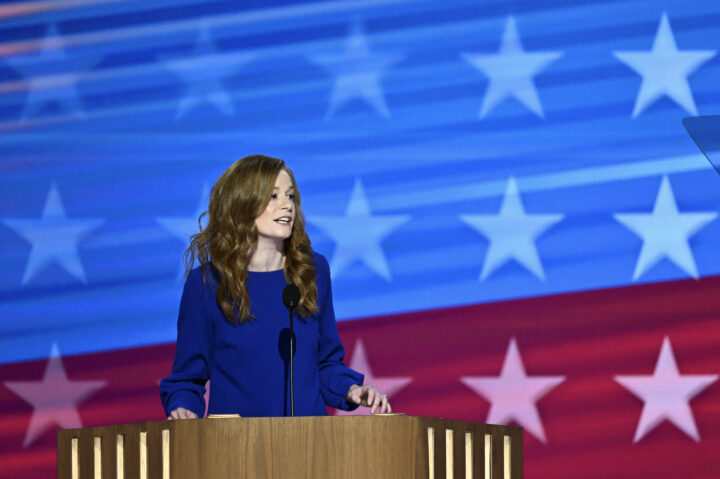
MANDEL NGAN/AFP via Getty Images
Michigan state Sen. Mallory McMorrow speaks on the first day of the Democratic National Convention (DNC) at the United Center in Chicago, Illinois, on August 19, 2024.
In the tight Michigan Senate race, state Sen. Mallory McMorrow has tried to present herself as a middle-of-the-road Democrat, ideologically situated between Abdul El-Sayed, an anti-Israel progressive, and Rep. Haley Stevens (D-MI), who has been endorsed by AIPAC.
In a recent interview with leftist podcasters Matt Bernstein and Emma Vigeland, McMorrow continued to position herself as an objective observer of the Israeli-Palestinian conflict — and said it’s worth discussing whether the Palestinians should also have access to the Israeli-developed Iron Dome missile-defense technology, which the U.S. partially funds for Israel.
Bernstein, the host of the queer political podcast “A Bit Fruity,” questioned McMorrow about why she supports Israel’s access to the life-saving Iron Dome systems, arguing that it empowers Israel to attack Palestinians without risk of harm to its own population, which is protected by the systems.
While highly effective, the Iron Dome does not provide complete protection and Israelis have continued to be killed and wounded throughout the conflict.
“I don’t think anybody should live in fear of being bombed or killed. I would look at: How do we support defensive systems for Palestinians? How would we support defensive systems for Lebanese?” McMorrow said. When Vigeland sarcastically asked if the Palestinians should get their own Iron Dome, McMorrow said maybe.
“Let’s talk about that as a conversation,” McMorrow said. “I mean, the horror of living in fear of being bombed constantly. Let’s work with the outcome of how do we end the violence, period?
Then backing away from that, how do we protect people?”
She added that she wants to get to a place where Iron Dome systems are “not needed, period, for anybody.”
McMorrow’s interview with Bernstein, which was released on Monday, was initially canceled — according to Bernstein, who said in a post on X earlier this month that her team withdrew after the podcast host told them he wanted to talk about foreign policy — but then rescheduled after Bernstein publicized the cancellation.
Bernstein’s questions to McMorrow reflected his own anti-Israel worldview. McMorrow responded by reiterating her opposition to sending financial aid to Israel, a position that she said has evolved as even Israeli Prime Minister Benjamin Netanyahu now says he wants to end U.S. aid.
“I would support Israel continuing to be able to purchase systems like the Iron Dome defensive systems, but I think it’s in the best interest of the United States in reducing that aid and allowing Israel to do that on their own,” said McMorrow. “I do not support the Netanyahu government. I think that they have continued to push well beyond what is proportionate, what is rational in response to the Oct. 7 attacks, in a way that is horrifying to watch.”
McMorrow said she would have voted with the 40 Senate Democrats who supported a measure last month that sought to block some arms sales to Israel.
“Let’s acknowledge how stunning it is that a year ago that number was significantly smaller than it is today. My views on this have evolved because the reality on the ground has evolved,” said McMorrow.
Mallory McMorrow: "I would have voted alongside the 40 out of 47 senators who voted in the past Sanders' resolution blocking arms sales" to Israel.
— Jewish Insider (@jewishinsider) May 19, 2026
"My views on this have evolved because the reality on the ground has evolved," she said.
Read more about how Michigan Senate… pic.twitter.com/og2dKQ5kIv
When Bernstein and Vigeland pressed McMorrow to describe Israel’s actions in Gaza as a genocide, she said she believes it meets “the legal definition” of the word. But she added that she doesn’t like to use it because of Jewish constituents’ “personal visceral reaction” to the word, due to family members lost in the Holocaust. And avoiding the word, McMorrow said, is a way to build consensus and not alienate voters in a swing state, even as she uses sharply critical language to describe Israel’s actions.
“There is no doubt that war crimes have been committed. There is no doubt that the pain and suffering at the vast expense of our taxpayer dollars, Matt, to your point, that we continue to pay for this, needs to end,” McMorrow said.
Bernstein: "Do you believe Israel has committed — and is committing — a genocide?"
— Jewish Insider (@jewishinsider) May 19, 2026
McMorrow: "I do believe that it meets the [legal] definition."
"What I also heard in response," the Michigan Senate candidate said, "from many of my constituents who had family that they lost in… pic.twitter.com/xCDX2WugoA
“I’m asking for the trust to represent 10 million people in a very diverse state that is a purple state that could very easily go to the Republicans,” added McMorrow, referring to “the goal that I think all of us on this call share: to keep a state like mine together and to not let this issue tear people, apart because if we let it tear us apart, we get [Republican Senate candidate] Mike Rogers. [Donald] Trump gets a win.”
Bernstein has more than 400,000 subscribers on YouTube and 2.2 million followers on Instagram.
There hasn’t been much incentive for party groups to set red lines against radicals looking to disrupt the party in lower-profile races
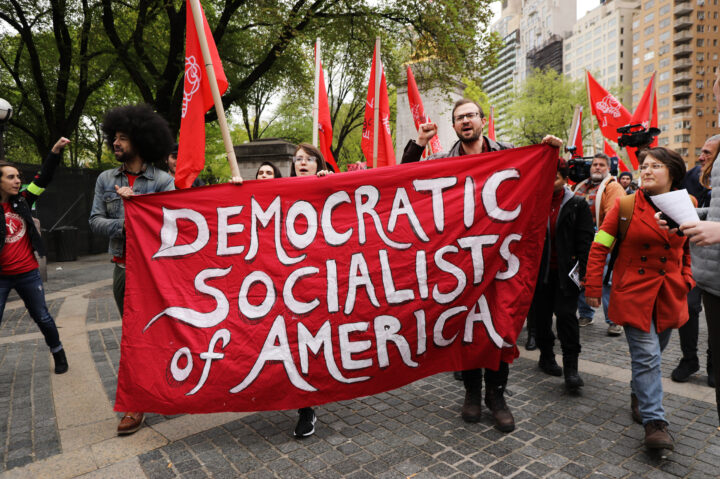
Spencer Platt/Getty Images
Members of the Democratic Socialists of America May 01, 2019 in New York City.
As the Democratic Party lurches left in the run-up to the midterms — and amid the rise of high-profile, far-left Senate candidates such as Graham Platner in Maine and Abdul El-Sayed in Michigan — candidates affiliated with the Democratic Socialists of America (DSA) have gradually been making inroads and positioning themselves to win nominations in several key House races.
This has happened without much protest or opposition from Democratic Party leadership. And given that the urban districts where the DSA-endorsed candidates have the most support are so heavily Democratic, there hasn’t been much incentive for party groups to set red lines against radicals looking to disrupt the party in these lower-profile races.
One of the most insidious aspects of the advocacy of many DSA chapters is the demand that its endorsees cut ties with any Jewish group that recognizes the State of Israel. Some chapters celebrated or justified Hamas’ Oct. 7 terror attacks against Israel.
“They are trying to do in America what [the Boycott, Divestment and Sanctions movement] seems to do internationally, which is to make being Jewish unacceptable in polite society,” Ron Halber, the CEO of the Jewish Community Relations Council of Greater Washington, recently said on a webinar of D.C-area Jewish leaders.
But despite the group’s radical views, DSA-endorsed candidates have a real shot at prevailing in several upcoming Democratic primaries in major cities.
Pennsylvania state Rep. Chris Rabb, one of several Democrats looking to succeed retiring Rep. Dwight Evans (D-PA) in his Philadelphia district, has the notoriety of recirculating an Instagram post blaming the Bondi Beach terrorist attack that killed 14 Jewish Australians on “Zionists,” insinuating the terror attack was a false flag. (His campaign later blamed a former staffer for reposting the item.)
Rabb, who has been endorsed by many of the leading anti-Israel progressives in Congress, also recently campaigned with antisemitic streamer Hasan Piker. His far-left views and virulent criticism of Israel has alarmed Gov. Josh Shapiro, according to Axios, and the popular Pennsylvania governor has worked behind the scenes to oppose his campaign.
Democratic sources familiar with the primary, however, suggest that any behind-the-scenes efforts aren’t having much effect in derailing the DSA candidate’s campaign. Rabb’s two leading opponents — surgeon Ala Stanford and state Sen. Sharif Street — are both mainstream Democrats and may potentially split the more-moderate vote. The primary is on Tuesday.
Next month, a similar clash between the Democratic mainstream and socialist wing of the party is taking place in New York City, where state Assemblymember Claire Valdez, who is backed by Mayor Zohran Mamdani and New York’s DSA chapter, is squaring off against Brooklyn Borough President Antonio Reynoso, the progressive establishment’s favorite.
The race, in one of the most left-wing districts in the city, which covers part of Brooklyn and Queens, will mark a major test of Mamdani’s political capital — and whether the DSA brand is more compelling to progressives than the endorsement of Reynoso by retiring liberal stalwart Rep. Nydia Velazquez (D-NY).
Reynoso, in an interview with The New York Editorial Board, proclaimed himself the underdog in the race despite boasting endorsements from organized labor, the outgoing congresswoman, state Attorney General Letitia James and the left-wing Working Families Party line. “Zohran Mamdani is a celebrity-status, inspiring figure at the levels of AOC and Bernie Sanders. He is a movement and is deeply important,” Reynoso said.
Meanwhile, in Denver, another DSA hotbed, Rep. Diane DeGette (D-CO) faces a primary threat from DSA-backed challenger Melat Kiros, a 28-year-old attorney. Kiros has made criticism of Israel a centerpiece of her campaign, accusing Israel of genocide, and she supports an arms embargo against the Jewish state. Kiros dominated DeGette at a districtwide party convention filled with activists in March, and the congresswoman has been airing ads touting her progressive record, in anticipation of a competitive June primary.
And in St. Louis, the local DSA chapter is again backing former Rep. Cori Bush (D-MO), who was one of the most extreme anti-Israel lawmakers when serving in Congress, in her attempt at a comeback against Rep. Wesley Bell (D-MO).
(The other major contest featuring a DSA-endorsed contender is next month’s D.C. mayoral primary, where Jewish groups have been alarmed by Janeese Lewis George’s rhetoric around Israel and antisemitism.)
All told, there could be at least four Democratic Socialists of America-endorsed lawmakers in the next Congress, with limited party efforts to marginalize the extremists from within. It underscores how fast the Democratic Party is evolving, and how quickly the guardrails that kept the party centered — and largely free of antisemitism — are falling out of place.
JDCA’s top activists made clear this week that a major concern is making sure pro-Israel Jews continue to be welcome in the party
MANDEL NGAN/AFP via Getty Images
Jewish Democratic Council of America CEO Halie Soifer in Washington on May 24, 2023.
When a group of Jewish Democratic activists and donors convened in Washington this week for the annual leadership summit of the Jewish Democratic Council of America, the message seemed to be one of defiance: defiance against President Donald Trump, to be sure, but also a defiant attitude pushing back against some of the recent shifts within the party.
JDCA’s primary objective is to elect Democrats. But as more Democrats have taken positions critical of or outright hostile to Israel, JDCA’s top activists made clear this week that another major concern is making sure pro-Israel Jews continue to be welcome in the party.
“We are fighting to ensure that the views and values of Jewish Americans continue to find their political home in the Democratic Party in Michigan and beyond, and we have work to do,” Halie Soifer, the group’s CEO, said on Tuesday night. She noted that the JDCA hopes to help defeat Michigan Senate candidate Abdul El-Sayed, a far-left candidate who appears to be rising in the polls.
“It’s clear there’s one candidate whose views are antithetical to ours, and we want to ensure he’s defeated,” said Soifer, though she did not name El-Sayed directly. JDCA has not endorsed either of his opponents, state Sen. Mallory McMorrow or Rep. Haley Stevens (D-MI).
“We at JDCA only support Democrats, but we do not support them all,” Soifer told the summit. “We understand it’s not just about electing Democrats. It’s about electing Democrats who align with us, and this includes efforts to ensure that candidates who have espoused anti-Israel and/or antisemitic views are defeated before November.”
Over the two-day gathering, a parade of high-profile speakers from Democratic leadership — Senate Minority Leader Chuck Schumer (D-NY) and House Minority Leader Hakeem Jeffries (D-NY), along with Reps. Nancy Pelosi (D-CA) and Steny Hoyer (D-MD), respectively the former House speaker and majority leader — addressed the convening. Their appearances seemed designed to affirm that Democrats remain pro-Israel and committed to fighting antisemitism.
“We have to decisively confront antisemitism from wherever it comes from,” said Jeffries. “I will always hold firm in my support for the State of Israel as a Jewish and democratic state and eternal homeland for the Jewish people.”
Schumer did not specifically discuss Israel but raised concerns about the increasing use of the word “Zionist” as a slur.
“I’ve long said we must fight antisemitism wherever and whenever it appears, even if it’s in our own party. I’ll continue to do so,” said Schumer. “Today, antisemitism takes all different forms: Holocaust denialism, conspiratorial delusions of Jewish or Zionist control of the world, replacing the word ‘Jewish’ with the word ‘Zionist’ to demonize Jewish communities.”
The outgoing Democratic leaders were not as sanguine, instead offering a note of caution about how the dynamic towards Israel has shifted within the Democratic Party.
“Always, but right now, we really have to work together to make sure that support for Israel is, without question, bipartisan,” Pelosi said. “It doesn’t mean we don’t have our differences of opinion … but it should not weaken the fact that we have bipartisan support. That has always been the tradition, and we must make sure we get through this place where we are, where there may be some doubt in people’s minds as to whether that is a value.”
Pelosi is retiring at the end of this year, as is Hoyer, who was even more blunt: “How many of you have been anxious yourselves about rhetoric heard from some Democratic officials and candidates? We ought to be,” he said.
Speaking to reporters on Wednesday, Sen. Chris Coons (D-DE) said he hoped to prove that Sen. Bernie Sanders (I-VT) does not speak for the party on matters related to Israel, though he noted with worry that Sanders’ attitude — one that is deeply critical of Israel — appears to be on the rise.
“It’s clearer and clearer to me that there is real alarm about a fundamental break between Democrats as a party and Israel as a nation, and I’m going to do everything I can to resist and oppose that break, while criticizing [Benjamin] Netanyahu and his values and decisions,” said Coons. “I’m trying to be an effective and engaged voice with a perspective that you just heard and not have Bernie Sanders be the only senator whose perspective and attitude is heard across the country.”
Forty Senate Democrats voted last month for a Sanders-authored resolution attempting to block some arms sales to Israel, a record high. Coons said he knows those senators still support Israel’s right to exist, but cautioned that being too critical of Netanyahu can give cover to people who are actually anti-Israel.
“I strongly support Israel’s right to exist, its right to be a Jewish homeland and a democracy, and its value to the American people as a partner and ally,” said Coons. “I think we are at risk of some of my colleagues, in trying to send a message to Netanyahu or in opposition to his policies and stances, to be misunderstood as abandoning that commitment.”
Coons said that on the campaign trail, and on recent trips around the country, he hears “profound concern about where’s the Democratic Party going on Israel.” Some Jewish politicians who addressed the JDCA summit expressed a deeper sense of unease and discomfort about their Jewish identity, against the backdrop of rising antisemitism.
Sen. Elissa Slotkin (D-MI), who spoke at a cocktail reception Tuesday evening, talked about how challenging it is to be a Jewish elected official in the current environment.
“It has become deeply, deeply complicated to be a Jew in America,” said Slotkin. “There’s not a single day that goes by for myself representing the state of Michigan that I am not feeling torn.”
Minneapolis Mayor Jacob Frey delivered a jolt of energy to the room with an impassioned speech about his community’s support for immigrants in the face of ICE enforcement activity, which resulted in the killing of two American citizens by ICE agents in his city in January. When a JDCA member asked him for advice on how to respond to others in the Democratic Party who have made anti-Zionism a political litmus test, he expressed concern.
“It has been deeply concerning for me personally, as a proud Jew,” Frey said. “I am a great supporter of the endurance of our American Republic, a big believer that America should continue to exist, and an adamant opponent of Donald Trump. The same thing can apply to Israel.”
Ultimately, though, the gathering was a political pep rally — a chance for Democratic activists and donors to hear from politicians at all levels of government and gin up excitement ahead of this year’s midterm elections. Everyone who addressed the gathering all but guaranteed that Democrats would take back control of the House and Senate.
The conversations seemed meant to ressure Jewish Democrats about both the party’s fortunes for November and its treatment of pro-Israel Jews. One JDCA activist described the group’s work as “grasstops,” which was demonstrated by the appearances from top party leaders.
But the anti-Israel sentiment that has steadily grown within the party over the past three years is not coming from party leaders; it is driven by far-left activists. Whether JDCA has a plan to counter that grassroots energy remains to be seen — and the answer will only come at the ballot box later this year.
Please log in if you already have a subscription, or subscribe to access the latest updates.
 Continue with Google

 Continue with Apple