


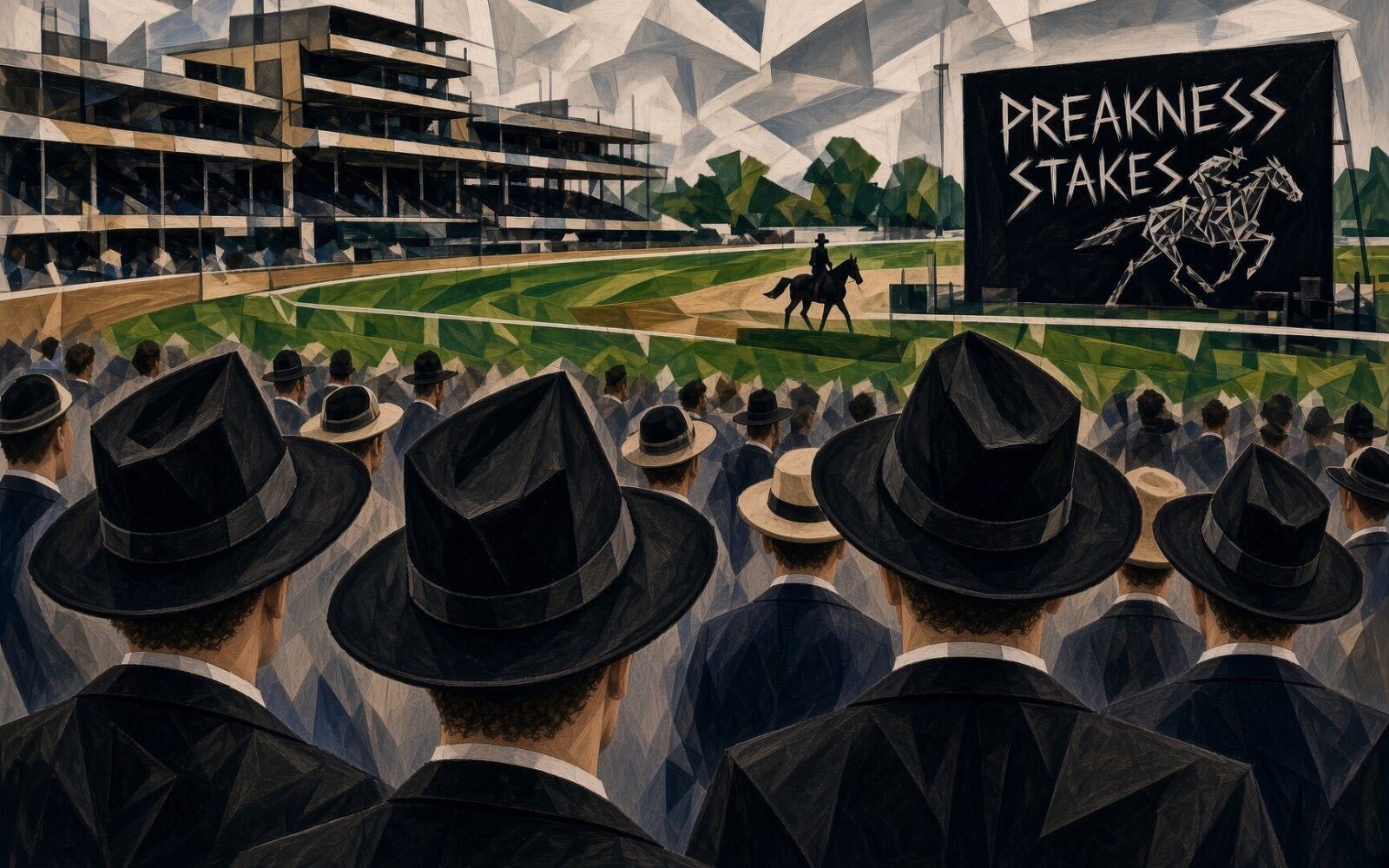
AI-generated illustration
As Preakness moves to Sunday, the 153-year-old race could see first-time Orthodox attendees
The change opens the second leg of the Triple Crown to Orthodox Baltimore for the first time in the race’s history, and locals are betting kosher stands follow


 Add JewishInsider on Google
For more than 150 years, Baltimore’s Orthodox Jews have walked to synagogue on Preakness Saturday and listened to the roar of the crowd from less than a mile away, never able to join it.
That changes in 2027, when the second jewel in horse racing’s Triple Crown — following the Kentucky Derby and preceding the Belmont Stakes — moves from Saturday to Sunday, finally opening Pimlico’s gates to the local Shabbat-observant community for the first time since the race started in 1873.
Maryland Gov. Wes Moore and the Maryland Jockey Club announced earlier this month that the 152nd Preakness will run Sunday, May 23, 2027 — eight days later than its usual third Saturday in May date.
The move wasn’t made for the Orthodox Jewish community’s benefit — but rather to give horses more time to rest following the Kentucky Derby. Still, locals say Baltimore’s observant community could have factored into the decision, as the city has one of the largest Orthodox populations in the country.
“Growing up, I would walk to synagogue every Shabbat of Preakness and I’d be able to hear the crowd roaring. I always felt like I was missing out,” Alex Friedman, a member of the Baltimore City Democratic State Central Committee, told Jewish Insider. “The Preakness is a central identity of Baltimore and of Maryland. When people think of our city and our state, they think of the Preakness. Baltimore doesn’t have that many nationally recognized symbols — it’s Fort McHenry and Pimlico.”
“As a proud Baltimorian who has never had the chance to go to Preakness — which is right by my house — I’m very excited about the opportunity. I know a lot of people are excited. My dad’s lived in the neighborhood for 60 years and never been able to go,” said Friedman.
Baltimore City Councilman Yitzy Schleifer told JI that he spoke with Moore’s team as plans to change the date of the race were being developed.
“[We spoke] about the importance of this decision and that it be inclusive of the large Orthodox Jewish community,” he said.
“Now Preakness is being rebuilt, reimagined and strengthened for generations to come. And now, for the first time, Orthodox Jewish Baltimoreans will be able to fully share in Preakness Day,” said Schleifer.
Many Orthodox Jews avoid horse betting because traditional Jewish law discourages gambling. However, Friedman noted that the community could benefit from track betting. A portion of that money helps local neighborhoods, meaning people who bet and lose are still helping the community, he said.
For some observant Jews involved in racing, the overlap between Shabbat and the Triple Crown isn’t new territory. Ahmed Zayat, the Orthodox owner of 2015 Triple Crown winner American Pharoah, famously slept in RVs near Pimlico and Belmont Park and walked to the tracks on Shabbat rather than drive.
The news marks a significant shift for observant Jews outside of Charm City too, said David Warschawski, a Baltimore-based marketing executive whose eponymous agency represents sports-related organizations and brands.
“This is a phenomenal moment in the Jewish sporting world,” Warschawski told JI. “There’s so much history of Jews and the horse racing history and now to allow all segments of the Jewish community to be able to attend one of the premier races, I don’t think this is just a positive for the greater Baltimore Jewish community but for any sports and horse racing enthusiasts who [are observant Jews]. Now you have a destination event they can go to — that they can take your kids to — that before wasn’t even a thought.”
“Moving it to Sunday makes sense from a sports standpoint,” continued Warschawski. “But then from a Jewish standpoint, it’s fantastic. Look at how many Jews love to go to [Baltimore] Ravens games. The majority of football games are on Sunday and that has been a winning formula to getting all ethnicities and religions to attend. So this makes all the sense in the world to me as someone who is involved in sports business.”
Eli Schlossberg, a historian of the local Baltimore observant community, similarly has childhood memories of walking on Preakness Shabbat and standing by the fences in the backstretch as the horses came around toward the finish line.
“Not that I was into horses, but it was something we did,” he recalled. “We did it as shtick. From my home it was about a 25-minute walk. But very few religious people were involved in horses here.”
In the 1960s, a few Orthodox-owned businesses operated in the Park Heights neighborhood around Pimlico, Schlossberg noted. Today, Baltimore’s Jewish center is in Pikesville, about a 30-minute walk from the Preakness track.
“Will frum people go on Sunday? Who knows,” he said. “Maybe it will be something the younger generation will like to do.”
Friedman predicts observant Jews will turn out at Pimlico — and that the track may follow Oriole Park at Camden Yards and M&T Bank Stadium in adding kosher food stands.
“We’ve never had the opportunity before, but there could be a demand now,” he said.
Featured Stories
Please log in if you already have a subscription, or subscribe to access the latest updates.
 Continue with Google
 Continue with Apple