










































































As Iran war depletes U.S. missile stocks, experts warn deterrence is at risk
The drawdown in U.S. stockpiles could complicate future efforts to defend Israel while deterring China, Iran and other adversaries
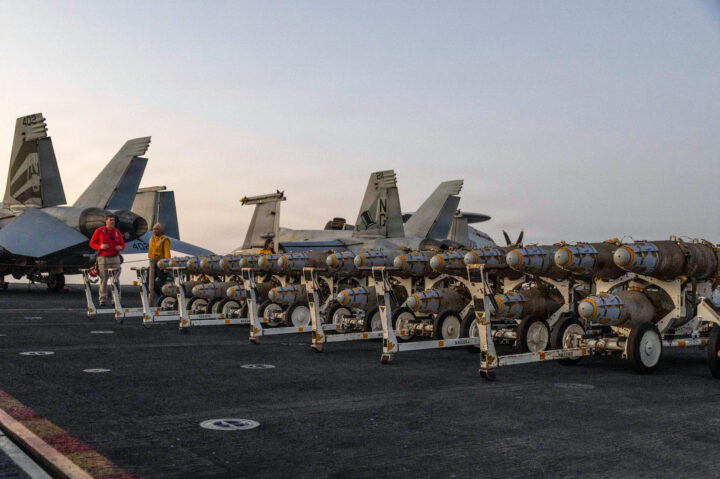
U.S. Central Command via Getty Images
U.S. Sailors transfer ordnance on the flight deck of Nimitz-class aircraft carrier USS Abraham Lincoln (CVN 72), on February 27, 2026 in the Arabian Sea.


 Add JewishInsider on Google
Experts are warning that the United States’ dwindling stockpiles of long‑range missiles and air-defense interceptors following the war with Iran could complicate Washington’s ability to deter adversarial aggression and maintain military readiness in other theaters.
Reuters first reported that the U.S. has expended much of its inventory of highly accurate long‑range missiles during the conflict, including Army Tactical Missile Systems (ATACMS) and the newer Precision Strike Missile (PrSM), while significantly drawing down stocks of Patriot and Terminal High Altitude Area Defense (THAAD) interceptors used to defend against ballistic missile attacks.
A recent report from the Center for Strategic and International Studies estimated that the U.S. depleted roughly 65% of its Patriot interceptor stockpile between February and July, while inventories of THAAD ballistic missile interceptors fell by at least 38% from the start of the war.
The long-range munitions form a critical part of the U.S. military’s strike capability, allowing forces to engage targets from long distances with precision, rather than having to carry out riskier manned bombing campaigns. Patriot and THAAD systems, meanwhile, are among the country’s most advanced missile-defense assets and have been heavily relied upon to intercept Iranian ballistic missiles targeting Israel, U.S. forces and regional partners.
“The United States has a longstanding defense industrial crisis, whether it’s in munitions, missiles, shipbuilding or other areas,” Alexander Gray, who served as chief of staff on the National Security Council during President Donald Trump’s first administration, told Jewish Insider. “It has constrained the ability to replenish our war fighters but also to make sure our partners and allies get what they need. Sustained operations against Iran are showing just how challenging this industrial base capacity problem is.”
Ari Cicurel, an associate director of foreign policy at the Jewish Institute for National Security of America, explained that the munitions shortage is a “serious concern that long predates the war.”
“Replenishing the depleted stockpiles is not enough. Reaching the arsenal size we actually need could take 3.5 to 6 years,” Cicurel told JI. “That shortage and the time it will take to build up our arsenal weakens U.S. leverage against Iran now.”
“It also cuts into deterrence elsewhere, since the war pulled long-range missiles out of the Pacific and other theaters to supply this fight,” he continued. “The U.S. likely carried a heavy share of missile-defense operations during the war, and thinner interceptor stocks mean less capacity to support during the next fight.”
Gray said the U.S. still “continues to maintain substantial capabilities,” but he argued that the current state of the stockpiles could put Trump in a precarious position.
“While the U.S. continues to maintain substantial capabilities, it’s now a matter of “risk acceptance: how much risk will the U.S. accept in other potential conflict theaters globally to bring additional munitions to the Iran conflict?” Gray said. “No American president should ever be in that position and it speaks to the urgent need for a defense industrial base renaissance.”
Brad Bowman, senior director of the Center on Military and Political Power at the Foundation for Defense of Democracies, said the current shortages reflect “years of insufficient defense spending that spans both Republican and Democratic administrations and Congresses, we’ve devoted insufficient money to national defense and to munitions.”
Bowman argued that the Pentagon has often purchased key weapons in quantities too small to sustain prolonged conflicts while maintaining adequate reserves. He noted that the U.S. expended roughly a quarter of its THAAD interceptors during the 12-day war with Iran in June 2025.
Additionally, U.S. forces had fired more than 1,000 Tomahawk cruise missiles against Iran as of April while the Pentagon purchased just 38 of the weapons in Fiscal Year 2025, according to publicly available Pentagon procurement data cited by Bowman.
“Deterrence is based on two things: our adversaries’ perception of our military capability and our political will,” he said. “If our adversaries come to believe that our muscles are smaller because we’ve expended so many of our munitions, whether they be offensive or defensive, they may come to the conclusion that they could roll the dice in the Taiwan Strait, for example, and that America would either lack the political will or the military capability or capacity to do anything about it.”
Anne Dreazen, vice president of the American Jewish Committee’s Center for a New Middle East, said the depleted stockpiles are “definitely something that CENTCOM would have to think through carefully, particularly since they need to have a plan to defend not only U.S. bases across the region, but to support the missile and air defense needs of our partners.”
She also noted the economic challenge posed by prolonged missile exchanges, as such weapons cost over $1 million each.
“There is also a cost imbalance which is separate from the issue of stockpile availability,” she said. “Iranian missiles are relatively cheap. U.S. air defenses are very expensive.”
While warning that depleted stockpiles could embolden U.S. adversaries, Bowman said the Pentagon has begun taking steps to rebuild inventories through expanded procurement and investments in defense production.
“The good news is that the Pentagon is stepping up to the plate in many ways and doing things that ideally I would have liked to see four years ago,” Bowman said. “They’re taking steps to triple the production of Patriot Advanced Capability-3s and quadruple production of THAAD interceptors. That’s all very, very positive — but that’s going to require money.”
More Stories

OBAMA BOOST
Obama to campaign with Abdul El-Sayed at rally with Michigan Dems

FUNDRAISER FALLOUT
Attendee at El-Sayed fundraiser bragged about beating up pro-Israel demonstrator

analysis
Texas Jewish voters at a loss in the state’s hotly contested Senate race

exclusive
Second local Jewish Democratic official endorses Republican Lawler, citing Israel and antisemitism

PASTOR'S POSITION
Kansas Democratic Senate candidate wants to cut offensive aid to Israel, rejects genocide label

analysis
Chris Murphy’s selective outrage in the Middle East
Please log in if you already have a subscription, or subscribe to access the latest updates.
 Continue with Google
 Continue with Apple