














































UAE deals major blow in cutting Iran financial ties — but experts warn Tehran has work-arounds
The suspension ends a key commercial lifeline, though analysts said Iran's sanctions-evasion networks and enforcement uncertainty limit how decisive a blow it will be
Stringer/Anadolu via Getty Images
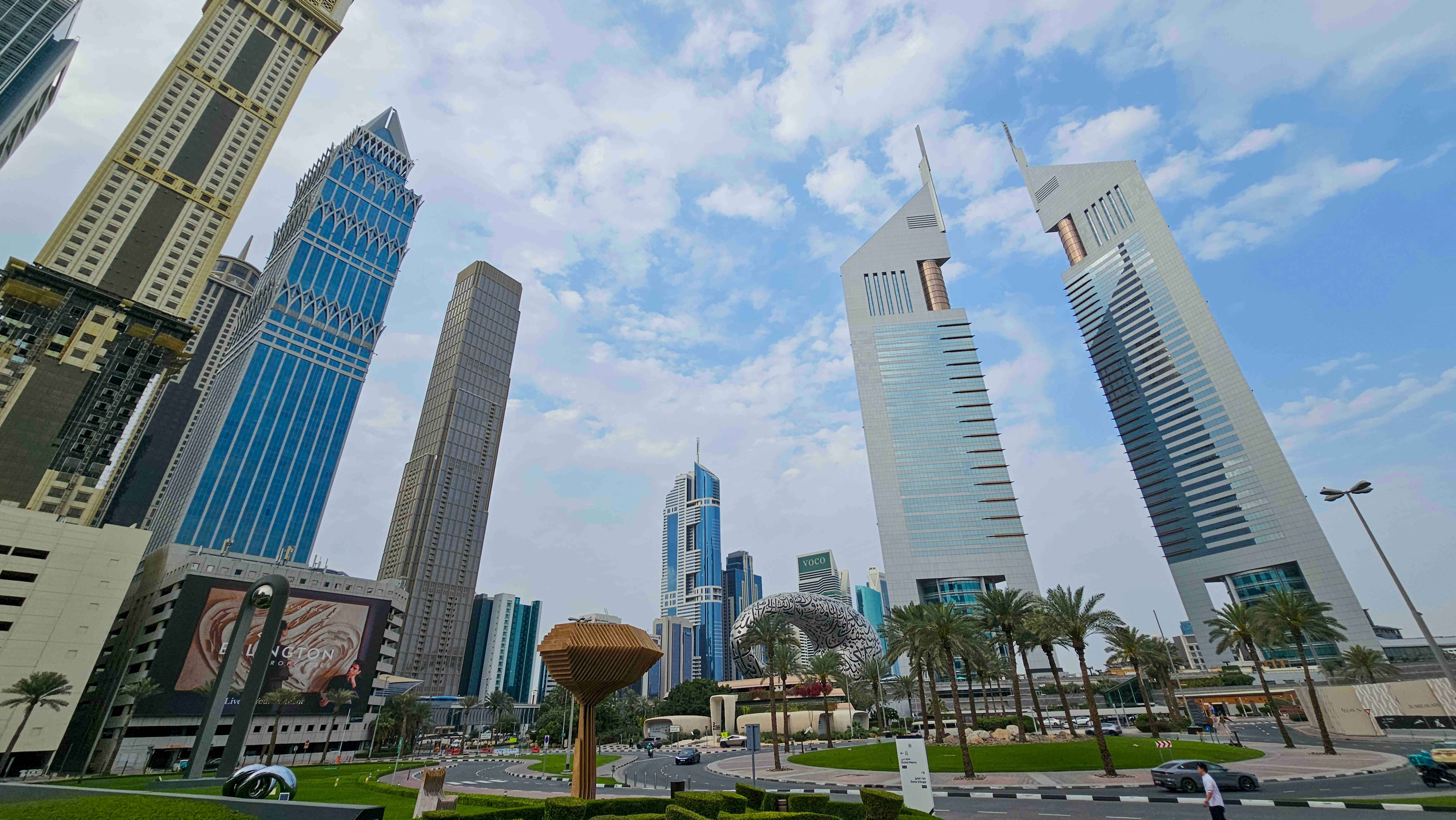
A view from the Dubai International Financial Centre (DIFC) on March 03, 2026 in Dubai, United Arab Emirates.


 Add JewishInsider on Google
The United Arab Emirates’ decision to sever trade and financial ties with Iran could deliver a major blow to Tehran’s economy, regional analysts said, disrupting a commercial lifeline that Iran has relied on for years. But experts cautioned that Tehran is likely to turn to existing workarounds to keep money flowing and that the UAE’s full implementation of the move is not completed.
In a statement released on Tuesday, Afra Al-Hameli, a spokesperson for the UAE Ministry of Foreign Affairs, announced that Abu Dhabi had suspended all trade activity, commercial exchanges and financial transactions with Iran “until further notice.” The UAE — which serves as Tehran’s second-largest commercial partner — issued the declaration after its Defense Ministry reported detecting two Iranian ballistic missiles that were “targeting maritime navigation” before falling into the sea. Iran’s Foreign Ministry denied launching the missiles.
Since the Iran war began in late February, the UAE has been the country most heavily targeted by Tehran’s missile and drone attacks, with strikes damaging airports, ports, energy facilities, financial centers and other critical infrastructure.
Regional experts told Jewish Insider that given the UAE’s history as a vital commercial conduit and financial hub for Iran, cutting those links would deal a heavy blow to Tehran’s already fragile economy.
“Dubai in particular has been a key hub for Iranian finance, and if that role ends, Iran’s economy will be hurt,” Elliott Abrams, who served as special envoy for Iran during the first Trump administration, told JI. “And while Iran will scramble to find alternatives, that will be difficult and take time — and meanwhile their weak economy will suffer even more.”
Abrams added that ensuring the UAE acts as “a full ally” rather than a neutral observer is essential to President Donald Trump’s strategy of exerting maximum economic pressure against Tehran.
Anne Dreazen, vice president of the American Jewish Committee’s Center for a New Middle East, similarly described the UAE’s declaration as “significant,” emphasizing that sustained enforcement would restrict Iran’s commercial access and financial liquidity.
“This move by the UAE sends an important message to Iran that it can’t continue to attack Gulf commerce with impunity while continuing to rely on the Gulf as one of its principal economic lifelines,” Dreazen said. “If this suspension is sustained and enforced, it will make it more difficult for Iran to conduct commerce and move money.”
However, Dreazen pointed out that Tehran’s economic resilience and pre-existing sanctions evasion networks mean the move will not act as a “silver bullet.”
“Iran is resilient, and a lot of Iran-UAE trade has already been disrupted due to the war. I therefore don’t expect this move to be a silver bullet — Iran will devise workarounds and can probably withstand this move,” Dreazen continued. “However, it will cause significant additional economic pain for Iran at a time when Iran cannot really afford more economic pressure.”
Jason Greenblatt, who served as White House Middle East envoy during the first Trump administration, voiced strong support for the decision, framing it as a necessary measure against Iranian aggression.
“It also strengthens President Trump’s effort to choke the Iranian regime economically and stop its threats to the region and the United States,” Greenblatt told JI. “The more nations that join, the greater the pressure on Tehran and the better the chance of changing its behavior.”
Conversely, Kristin Diwan, a senior resident scholar at the Arab Gulf States Institute in Washington, expressed skepticism over whether Abu Dhabi will follow through with full execution or that neighboring Gulf nations will replicate the move.
“Dubai is the safety valve for the Iranian economy. Losing that outlet would unquestionably be punishing, but it will hurt Dubai as well,” Diwan said. “I’m skeptical that this will be fully executed or that other Gulf states will follow the UAE on this path. While the U.S. is now focusing on punishing Iran economically, many Gulf partners are looking for ways to deescalate, and those tools may also be economic.”
More Stories

PIKER PUSHBACK
University of Texas College Dems invitation to Hasan Piker sparks campus outrage, GOP fire
SCOOP
Sen. Rick Scott urges Trump to pave pathway for Canadian Jews to emigrate to U.S.

Doha Dealings
CNN’s ties with Qatar deepen with October summit in Doha

OCEAN STATE OF PLAY
Antisemitism roils Providence mayoral race
Clinton’s Critique
Hillary Clinton: U.S. should take a ‘very tough position’ with Israel if Netanyahu reelected

Daily Overtime
Miznon’s U.S. Open upset
Please log in if you already have a subscription, or subscribe to access the latest updates.
 Continue with Google
 Continue with Apple