


Spencer Platt/Getty Images
Socialist surge happening in under-the-radar local and state legislative races
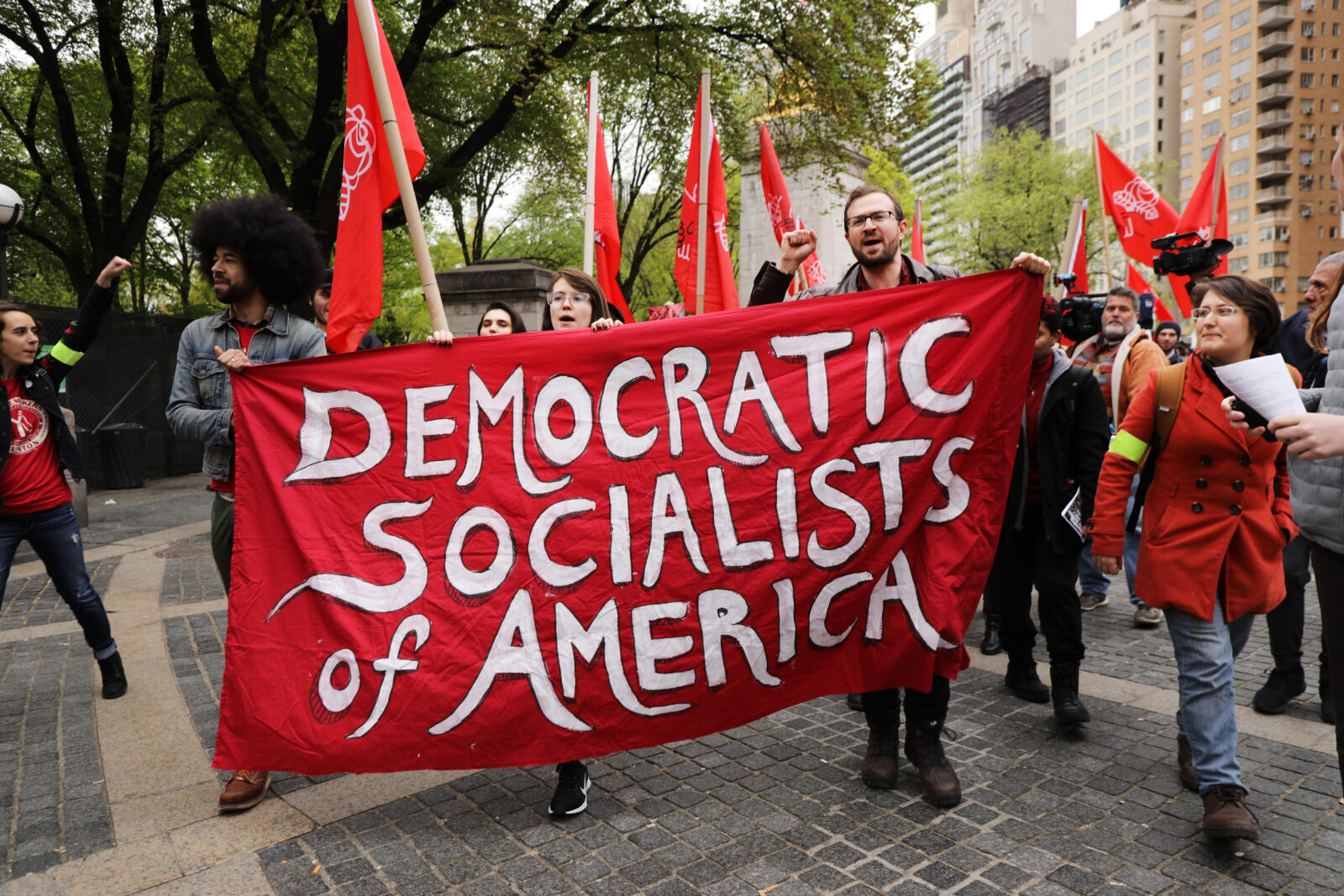
A Brookings Institution study found that of the 104 Democratic Socialists of America-backed candidates running for state legislature, nearly 75% have won their primaries


 Add JewishInsider on Google
The Democratic Socialists of America notched another win this week in Florida’s Democratic Senate primary, with the shock victory of state Rep. Angie Nixon, a DSA member, over a much better-funded, establishment-backed challenger.
The far-left group has also notched at least six new victories in deep-blue House districts where its members are all but guaranteed to be elected, and could lead four major U.S. cities — New York, Los Angeles, Seattle and Washington, D.C. — after the midterm elections.
But some of the group’s more overlooked victories have happened at the state level, where the DSA members could wield significant power if they win. A new study by the Brookings Institution, released Wednesday, found that of the 104 state legislative candidates endorsed by national or local DSA chapters in 2026, 76 have won their primaries or advanced to the general election without a primary.
At the local level, another 64 of the 99 DSA-endorsed candidates are moving on to the general election. By comparison, at the congressional level, only 20 of the 64 total DSA-endorsed candidates have made it to general election races.
In New York City, already a comparative bastion of DSA representation in the state Assembly and Senate, eight DSA endorsees have advanced to the general election, including state Senate candidate Aber Kawas, who downplayed the 9/11 attacks, as well as seven state Assembly candidates. In total, the group is expected to have at least 15 members in Albany next year.
Sara Forman, the former executive director of the New York Solidarity Network, a state-level Jewish advocacy organization, said that after New York City Zohran Mamdani’s victory, the DSA seems to be emboldened to “flex their muscles” nationwide, after previously taking a more “surgical” approach at the state and local level.
Forman, who is now a senior advisor at Optimistic Labs, said she thinks the group learned lessons from the Mamdani race, including targeting highly engaged communities and neighborhoods. She also emphasized that the group has spent two decades building out the infrastructure that fueled the recent victories highlighted in the Brookings data.
“The Jewish community needs to take a hard look at this and really decide whether or not we’re willing to break bread” with a group that only looks at the Jewish community for “how they can use us,” she continued, while adding that Jewish community members will likely need to engage with some DSA elected officials in some capacity..
The national DSA organization endorses only a small subset of the DSA-affiliated candidates running nationwide. But outside of New York, five of its endorsees have advanced to general election races in state assembly seats around the country, with some set to coast to election and others facing competitive general election races: Robert LeVertis Bell in Kentucky, Tammy Carpenter in Oregon, Chris Gilmer-Hill in Michigan, Luke Alfaro-Jungmann in New Mexico and Mathewos Samson in Georgia.
Local DSA groups have racked up many more wins, such as state Rep. Maryam Khan’s ouster of an incumbent in a recent Hartford, Conn.-area state Senate seat.
“It’s interesting to me that the places where you’ve seen a lot of the newer elected officials pop up were a little unexpected, Connecticut being one example,” Forman said.
The state-level wins carry the potential to advance the DSA’s agenda, particularly in places such as New York, where the DSA expects its endorsees to work as a bloc in coordination with DSA leaders.
The Brookings study found that most DSA candidates hailed from already liberal areas — 111 were from California and New York alone — and most from districts that heavily favor Democrats. And DSA candidates contested and were nominated in a small fraction of the 7,386 total legislative seats around the country.
“From one perspective, the story of DSA candidates’ influence is overblown. The scarcity of candidates and their lack of strong success rates overall make this look more like a skirmish than a war,” the study’s authors conclude. “Nonetheless, the high-profile wins, fueled by young, white, educated voters, represent a warning to the rest of the party. They signal that unhappiness with the Democratic establishment and, in the post-Biden world, opposition to elderly officeholders can be leveraged by young, charismatic DSA candidates — and reflect an impatience with party leadership that transcends ideology.”
The rapid rise of the far left has alarmed Jewish leaders, who have seen candidates aligned with the DSA or affiliated with other virulently anti-Israel groups and in some cases, embracing antisemitic views. Those ties haven’t stopped them from winning deep-blue primaries across the country.
“Just judging on Missouri, it’s worse than people are realizing,” said Stacey Newman, a former Democratic state lawmaker who now leads the Missouri Alliance Network.
She emphasized that St. Louis-area Democrats elected a growing number of far-left candidates — albeit most not formally DSA-endorsed — and others hostile to Jewish community interests to the Legislature even while reelecting a close Jewish community ally in Rep. Wesley Bell (D-MO). “They all have the same anti-Israel, anti-Jew platforms,” she said.
Forman said that Jewish advocates and their allies at the state level “need to be prepared for what I’m assuming is going to be the incoming push to try to make Israel a state and local issue,” as Mamdani and other DSA members did in New York State with legislation such as the Not On Our Dime Act.
“We really need to be making sure that our advocates and our allies are prepared to push back on that narrative,” Forman said, “but second of all, to remind people that state and local office has nothing to do with foreign policy.”
She said that the existing Jewish educational infrastructure needs to have the “toolkit to be able to say and push back hard and aggressively that this has no place in the state legislature,” and have its messaging clear and prepared.
Newman, whose group led advocacy for an antisemitism bill in the Missouri Legislature, said she feels that the Jewish community increasingly can’t rely on Democrats in Missouri’s legislature to support their priorities. And, she emphasized, much more policy work happens at the state level than the federal level.
“As a former Jewish state legislator, I’m petrified, because we’re all watching what’s happening around the country,” Newman said. “We’re watching Michigan, Wisconsin, we’re watching the Democratic Party throw caution to the wind.”
Featured Stories

partnership pitch
Somaliland president discusses expanded military cooperation with U.S. officials
ENVOY DEBATE
Congressional Jewish Caucus opposes proposal to combine State Dept. Holocaust, antisemitism offices
FAMILY TRAGEDY
Israeli ambassador’s son seriously wounded in West Bank car-ramming attack
Please log in if you already have a subscription, or subscribe to access the latest updates.
 Continue with Google
 Continue with Apple