
















































Judge Roy Altman, in new book, takes on Israel critics, one legal claim at a time
Altman, a Venezuelan-born Jewish jurist, decided to apply the same legal methodology that judges, lawyers and juries have deployed in courtrooms for centuries to address legal accusations being wielded against Israel
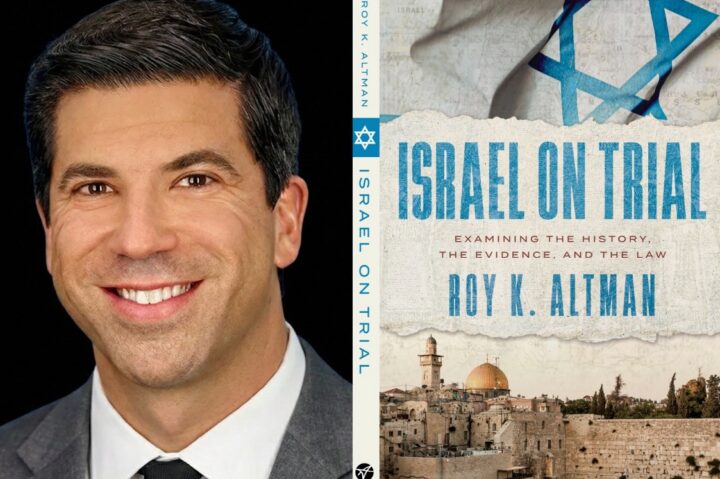
Courtesy
U.S. District Judge for the Southern District of Florida Roy Altman/book cover


 Add JewishInsider on Google
While TikTok and X algorithms make it harder than ever for Americans to distinguish fact from fiction, a courtroom setting changes everything. Summoned to the jury box, citizens are “given the tools they need as human beings to be able to assess questions properly,” U.S. District Judge for the Southern District of Florida Roy Altman told Jewish Insider.
Altman, a Venezuelan-born Jewish jurist, decided to apply the same legal methodology that judges, lawyers and juries have deployed in courtrooms across America for centuries to address six legal accusations being wielded against Israel by its detractors.
Those include claims that Israel’s founding was illegitimate or aberrational; that Israel has prevented the establishment of a Palestinian state; that Jews are colonists in the land of Israel; that Israel was occupying Gaza (and had turned Gaza into an open-air prison or a concentration camp) before the Oct. 7, 2023, terrorist attacks; and that the Jewish state has committed genocide and apartheid.
Altman explores each of those claims in a new book called Israel On Trial: Examining the History, the Evidence and the Law, released on Tuesday. Each of those claims about the State of Israel, which the book describes as “compelling — almost intoxicating” arguments, gets its own chapter, which reads like a legal brief that is written for a lay audience. Each culminates with a conclusion, grounded in the law.
Altman sat down with JI, just ahead of the book’s release, to make the case for examining Israel through a legal lens.
This interview has been condensed and edited for clarity.
Jewish Insider: How does making the case for Israel using courtroom standards and the rules of evidence differ from the way traditional advocates for Israel — political activists, Jewish organizational professionals, politicians, etc. — make their case?
Roy Altman: Each of these claims is at their core a legal claim that requires legal analysis just like any contested legal claim in any courtroom across America. So I thought to myself, why not just apply the same legal methodology that judges, lawyers and juries have been applying in every courtroom and law office around this country for 250 years, a time tested methodology that we know we trust because we use it when truth telling matters most in our courtrooms?
Legal questions allow us to pair back the vitriol, emotion, bias and prejudice. That’s what we do with jurors every day in this country. For hundreds of thousands of years, human beings have been accustomed to living in small groups. It was really important in the context of that environment to tell the truth and for the group as a whole to be able to decide whether the person was telling the truth. We did that by using three basic tools. [First,] deciding things as a group, which is helpful because one person might have a bias or prejudice, but when everyone is together those biases are thinned out. Second, we did it face to face. Third, we did it one issue at a time. Using those three techniques over hundreds of thousands of years we developed some time-tested rules for deciding whether something was credible.
What happens in our courtrooms is we tap into those hundreds of thousands of years of human evolution. We bring people who at home, all the data shows, are really bad at discerning truth on their TikTok feed. That’s because they violate all of the techniques that we use: they do it alone, over a screen with an overwhelming tidal wave of information at a time that your brain isn’t equipped to handle.
In the jury box, we take 12 people who individually are really bad at discerning truth from fiction on their phones, and we sit them together and revert them in historical evolutionary time. We tell them they are going to make the most momentous decisions in our society, all together, face to face looking at the witnesses. And [they’re dealing with] one issue at a time.
The judge and the lawyers give the jury that methodology, the truth guide called jury instructions, which are just a set of rules for assessing the credibility of people and the reliability of evidence that have been tested [based on] those three techniques. Those people are not biologically or psychologically different than they were when they couldn’t tell truth from fiction on their phone. But when they get together as a group, I am constantly astonished by the extent to which we give them extremely complicated work — patent cases, antitrust cases — and they get the answers completely right. It’s not because they’re smarter. It’s because they are being given the tools they need as human beings to be able to assess questions properly.
These questions about Israel should be assessed properly, just like the questions in our courtrooms.
JI: What is your religious and cultural background with respect to Israel?
RA: My father was in the Israeli Air Force. He went to Israel when he was 18 from Venezuela. My mother went to Israel when she was 17 from Colombia. Her father had a wife and five children in Poland, my mother’s half-brothers and sisters, all killed in the gas chambers at Auschwitz. So my parents met and married in Israel and then moved to Venezuela where I was born. We moved to America when I was a kid. We grew up going to Israel in the summertime. It’s a very special and inspiring place.
I’m a religious person, a man of faith. We have dinner at the house every Friday night. I went to Jewish day school, my kids went to Jewish day school, my dad went to Jewish day school, so it’s a deep part of our identity.
JI: You began leading trips to Israel for federal judges in the wake of Oct. 7. Why do you organize these missions and what impacts have you seen from these trips?
RA: One of the things we learned is that our judges are inspired by the resilience of the Israeli people. People who are willing to stand up and defend western values … willing to do that with love for one another and optimism about their future.
The judges have come back and seen what the truth on the ground is. So many of these judges are not Jewish and have never been to Israel before. They go around their own states when they come back presenting to law clerks and friends.
Federal judges across America are not perceived as being political, we’re neutral arbiters of contested claims. So when federal judges come back from any scenario and say this is what it’s like, people tend to listen.
JI: Who are some of your mentors and role models among prominent lawyers and judges who have been strong American Zionists?
RA: The judge I clerked for, Judge Stanley Marcus, taught me that the American legal tradition really harkens back not to the English common law system, but the ancient Jewish tradition under the law.
We allow decisions to percolate through common law jurisprudence over many decades and centuries from people from different walks of life and diverse backgrounds making these decisions. When you’re a lawyer you can look to this body of law. We don’t say ‘this is the right answer,’ ‘that’s the wrong answer,’ we say, ‘Here are what the different scholars say, you pick the answer that’s right for you.’ That sounds just like the Talmud. That’s also foundational to the character of America … and the Israeli mindset.
Foundationally, philosophically, morally, Israel and America are two places where traditionally human beings are given the most important choices in their civil society, precisely because their governments trust them enough to make the right choices, because their populations are infused with this character of virtue.
JI: AI is being increasingly used by judges to help them sift through massive amounts of evidence and trial testimony and even help with crafting decisions. Can AI play a similar role in helping to defeat misinformation about Israel, especially on social media?
RA: I think so, but AI cuts both ways. To the extent that AI is valuable, it’s only as valuable as the inputs that are placed into it. To the extent that you’ve got millions of pieces of information that are false on the internet, all of those pieces of information are fed into the box that produces the knowledge base foundational to how large language models work. So we need to be careful about the things we put in because those will be outputs through AI on the backend.
People are no longer capable — because they’re no longer scrutinizing the information being provided to them the way a juror would — and because the fake information is being provided in such a realistic way, to discern what is true from what isn’t.
JI: Is a well-reasoned legal brief any match for posts on TikTok, X or the internet that are used by many young people as their main source of information?
RA: Standing on its own, absolutely not. The question isn’t whether one book can counteract the millions of pieces of false information being relayed every day. The question is whether we can revert our people to a place where they care about making choices in the right way. It’s not so important where you get your information as long as you’re scrutinizing the incentive structure of the people providing it to you.
We need to teach people, including our youngest people, the mechanisms and methodologies that we have used — corroboration, reliability and credibility — that we’ve been using for thousands of years in order to discern truth from fiction in an age of information warfare.
We’re not saying you shouldn’t use your phone or AI. The question is when you consume information through those media, whether you should be using the same time-tested reliability mechanisms we’ve been using for thousands of years. Those mechanisms are there for a reason. We know they work irrespective of where you get your information.
More Stories

Democracy Deficit
New report warns civics education crisis is fueling antisemitism, eroding support for Israel

EXCLUSIVE
Brandeis Center urges Qatar to provide ‘complete public accounting’ of campus funding

delay deja vu
Department of Education again delays report on foreign funding to universities

AID CONVERSATION
GOP Reps. Kustoff, Goldman say Republicans want to see U.S. aid to Israel continue

LONDON'S GAMBLE
Former Trump official: U.K. sanctions will render Europe ‘less relevant in Middle Eastern affairs’

SURVEY SAYS
New poll shows Vance with very low support among Jewish voters
Please log in if you already have a subscription, or subscribe to access the latest updates.
 Continue with Google
 Continue with Apple