
































Trump announces deal for ‘complete disarmament’ of Hamas
The president thanked Turkey, Qatar and Egypt for mediating the deal that will see the IDF withdraw from Gaza and the International Stabilization Force take over
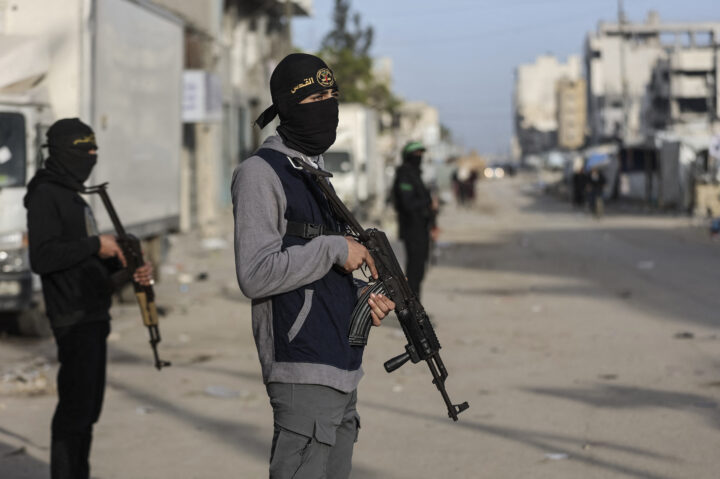
Omar AL-QATTAA / AFP via Getty Images
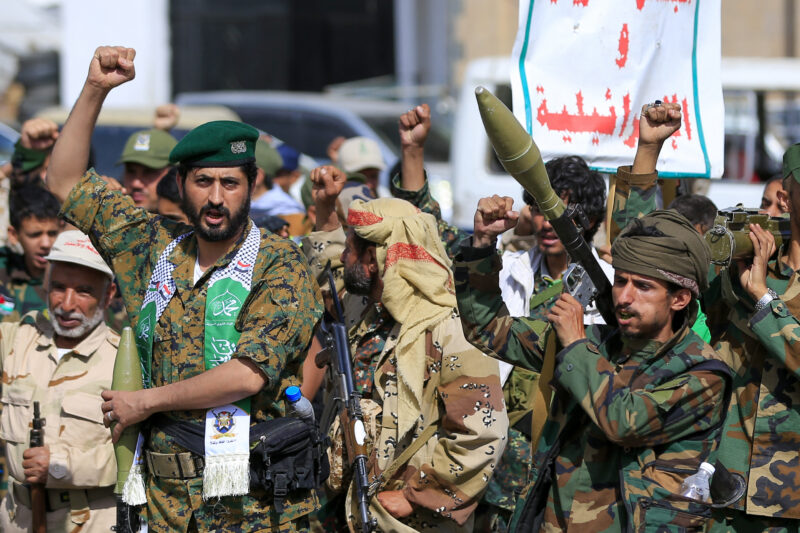
Members of Palestinian Hamas' Ezzedine Al-Qassam Brigades and Islamic Jihad's Quds Brigades are deployed at intersections in Gaza City on March 20, 2026.


 Add JewishInsider on Google
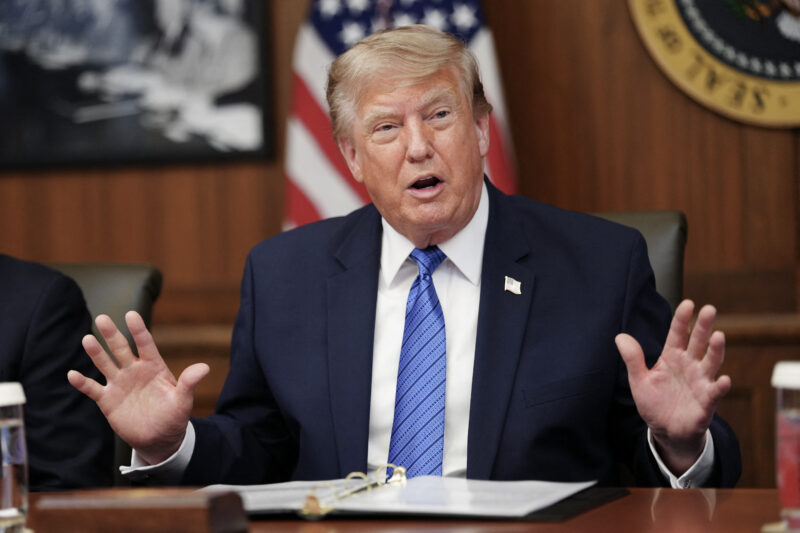
President Donald Trump announced on Thursday that the Board of Peace had reached a “historic” agreement for the “complete disarmament” of Hamas and all other armed groups in Gaza, calling it a “monumental step toward lasting PEACE and SECURITY.”
Trump said in a post on Truth Social that the agreement would be “carried out carefully in structured phases,” and that the IDF would withdraw when Hamas’ disarmament is “completed.”
The president said that moving forward, “the International Stabilization Force will work with a new Palestinian police force to take responsibility for Gaza being safe for its residents and neighbors.” He emphasized that the transition represents a critical step toward establishing a government that works for Palestinians while not posing a threat to Israeli security.
“The threat that emerged from Gaza on October 7 will NOT be allowed to rebuild!” Trump wrote. “Under this agreement, Gaza will finally be in the hands of a new Palestinian government that serves its PEOPLE.”
Trump said the ultimate goal is for the Palestinian government, ostensibly a reference to the technocratic government established under the Board of Peace, to “work closely” with the board and oversee a Gaza “no longer used as a base for terror attacks.”
He also thanked Turkey, Qatar and Egypt for their role as mediators whose “important efforts” made “this historic breakthrough possible.”
Following the announcement, a senior U.S. official said in a call with reporters on Thursday evening that the document is “an agreement by Hamas to follow through on the decommissioning” of its weapons as well as its terror tunnels. The official noted that Iran tried to “convince [Hamas] not to do this deal,” but in the end, “the final communication came through the mediators that Hamas has agreed.”
“There were a lot of concerns that [Hamas] had about what would happen to them — would Israel honor its commitments if they did that? — it’s been a very delicate negotiation and discussion with them over the past months that have led us to this breakthrough where we have an understanding of what needs to be done,” the U.S. official said. “We’ll hopefully work over the next weeks to start putting it in motion.”
Text of the deal released on Friday by the Board of Peace indicates the process will be carried out over three years, and requires that Israel immediately end all military operations in the Gaza Strip, to eventually withdraw completely from the enclave.
Hamas must relinquish its heavy weapons, military production sites, depots of weapons and terror tunnels in a process linked to the IDF’s phased withdrawal, and personal weapons will be “subject to the regulations of relevant Palestinian laws.” At the end of the process, “only [the new technocratic government] shall hold, store or control weapons in Gaza,” the agreement reads.
Ghazi Hamad, a senior Hamas figure, told Al Jazeera, “We will not take any action regarding disarmament prior to Israel’s withdrawal from the Strip.”
Meanwhile, Reuters cited an Israeli official as having said, prior to Trump’s announcement, “Israel demands the complete disarmament of Hamas, including the removal of weapons from Gaza and the complete demilitarization of the Strip as a precondition for any process.”
A Board of Peace official told reporters that the plan includes U.N. Security Council Resolution 2803, in which the U.N. endorsed Trump’s Gaza peace plan, stating that “for the first time, effectively, Hamas and the Palestinian factions have agreed to accept this entire framework and have agreed on a way to implement it.”
They noted that the framework includes “everything from demilitarization and de-radicalization to the transfer of civilian authority in Gaza to the transfer of security authority in Gaza as well to the national committees,” along with “a full monopoly on weapons.”
The Board of Peace official said that the board will implement a “verification committee” in order to ensure the plan’s objectives are being met. They noted that weapons will be transferred to the technocratic government.
Officials added that the ISF has secured commitments for over 5,000 troops from various nations. The force will help train Palestinian police, oversee the decommissioning of weapons and act as a buffer between Israeli and Palestinian forces during the IDF withdrawal. Meanwhile, a newly trained Palestinian police force will handle internal security, taking over from Hamas.
Asked whether the board would seek the involvement of the Palestinian Authority, the official said that “for the time being, we’re trying to just do something new.”
“They [the PA] have to show that they can run the West Bank and do reforms,” the official said. “If the PA shows that they do a good job … then obviously the discussion could be open.”
The official said that despite “a lot of criticism, particularly in Israel,” about the involvement of Turkey and Qatar in the Board of Peace, they noted that the two Arab nations, along with Egypt, have been “essential partners … in getting to this stage.”
The Board of Peace official said that the negotiations were “very complicated,” given that the two sides “do not trust each other.”
“From Day One, we heard the same thing both from Hamas and Israel, that they absolutely do not trust each other,” the official said. “So we built this entire proposal that we took to them on the basis of zero trust … everything that is in it is conditional, and it needs to be verified. No side is being asked to do something without that being confirmed and by reciprocity from the other side.”
“The first step is getting a framework, getting the de-escalation, getting the humanitarian issues resolved, having a plan forward … and so we’re going to do it as quickly as we can,” the official added. “But it can get slower, and hopefully both sides will cooperate in an appropriate way. And if they don’t, we’ll deal with it accordingly, like we have the last months.”
A senior U.S. official told reporters, “We’re not asking Israel to do anything that isn’t in the 20-point plan that they agreed to initially, and so we’re very confident they will adhere to it. If they don’t, President Trump would be very, very disappointed.”
More Stories

Schmear campaign
Politico picks Yom Kippur to attack Huckabee’s observant Jewish aide
MICHIGAN MANEUVER
After holding out for weeks, Michigan AG Nessel endorses El-Sayed
MONEY MATTERS
Treasury moves to terminate tax-exempt status for some universities, private schools
Daily Overtime
Amb. Leiter’s son seriously wounded in terror attack
CANARY CALL
Two Seattle Jewish leaders warn of Jewish complacency in face of rising antisemitism
on the hill
Shaheen holding up $2.8 billion arms sale to Israel
Please log in if you already have a subscription, or subscribe to access the latest updates.
 Continue with Google
 Continue with Apple