


























What to watch for at the Board of Peace’s first meeting in D.C.
A source told JI they expect discussion on humanitarian aid and the Palestinian technocratic government in Gaza; it remains to be seen how Israel and Hamas will respond to the board's directives
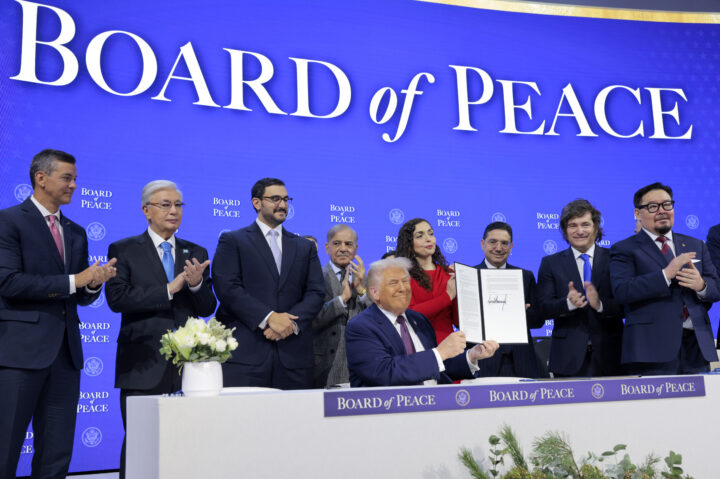
Chip Somodevilla/Getty Images
President Donald Trump holds up his signature on the founding charter during a signing ceremony for the “Board of Peace” at the World Economic Forum (WEF) on January 22, 2026 in Davos, Switzerland.


 Add JewishInsider on Google
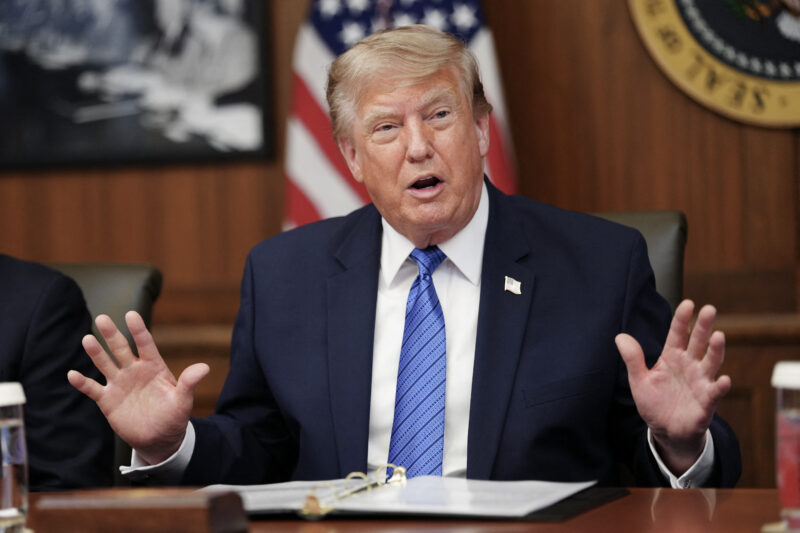
After a splashy debut at the World Economic Forum in Davos last month, President Donald Trump’s Board of Peace will convene for its first meeting on Thursday in Washington.
The new international body now faces a test of its ability to operationalize its goals: Observers will be watching whether the board makes any significant announcements toward its goal of implementing Phase 2 of Trump’s peace plan, which is focused on rebuilding Gaza and securing the enclave.
A source familiar with Thursday’s meeting told Jewish Insider that it is “not just pomp and circumstance,” and that they expect discussion about topics including humanitarian aid and the Palestinian technocratic government in Gaza. “It’s not window dressing at all,” the source said of the board’s work.
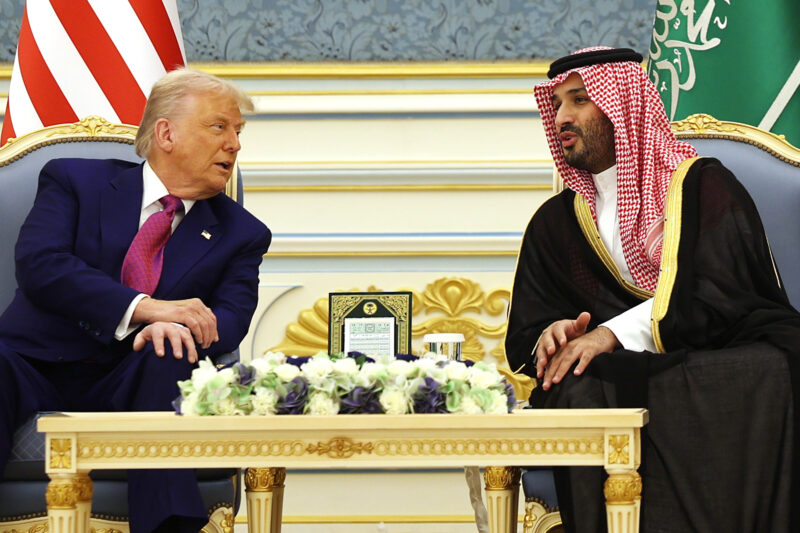
Trump has assembled a roster of regional heavy hitters on the Board of Peace, including Saudi Arabia, the United Arab Emirates, Qatar, Turkey, Jordan and Israel. Many European nations, including France, have so far declined the invitation, wary that it intrudes on the United Nations’ authority and that its mandate is not clearly confined to Gaza.
According to a senior Trump administration official, speakers at the event will include Trump, Secretary of State Marco Rubio, Jared Kushner, former U.K. Prime Minister Tony Blair, U.S. Ambassador to the U.N. Mike Waltz, White House Special Envoy Steve Witkoff and Nickolay Mladenov, the former U.N. Middle East envoy now serving as the high representative for Gaza on the Board of Peace. Little has been shared publicly about what the format will be.
Hungarian Prime Minister Viktor Orban, a close ally of Trump, said he plans to attend, as will the leaders of Armenia, Azerbaijan, Indonesia, Vietnam, Cambodia, Pakistan, Kazakhstan and Uzbekistan. Several countries, including Israel, Egypt and Turkey, are sending senior ministers in place of their heads of state. A European Union commissioner is expected to attend Thursday’s meeting as an observer, alongside observers from some other nations who have not joined the board, including South Korea.
“President Trump is proud to welcome representatives from over 40 nations to the Donald J. Trump Institute of Peace on Thursday for a big announcement on Board of Peace actions to establish an enduring peace in the Middle East,” White House principal deputy press secretary Anna Kelly told Jewish Insider, arguing that the board will be “the most consequential international body in history.”
The gathering of Middle East and global leaders will also come against the backdrop of U.S.-Iran nuclear negotiations and speculation that Trump is seriously considering military action against Iran, with the U.S. building up military assets in the region this week.
Trump announced on Sunday that member countries have pledged $5 billion toward rebuilding the war-torn enclave and will commit thousands of personnel to the International Stabilization Force, which has not yet been launched. He did not detail which member nations were making the pledges for funds or troops, though Indonesia said it was readying up to 8,000 personnel to deploy to Gaza by this summer. The estimated cost to rebuild Gaza is $70 billion.
The White House said the media had been too skeptical of Trump’s plans but declined to offer specifics about the source of the $5 billion or how the money would be deployed.
“We’re talking about reconstructing Gaza. I remember when those words came from the president’s lips in the East Room many months ago and all of you in the press were bewildered at how the president could have such an ambitious goal of rebuilding Gaza, which is obviously a place that has been just turmoiled by violence and chaos for many many years,” White House Press Secretary Karoline Leavitt said at a Wednesday press briefing. “But we’re well underway in doing that.”
The key question facing the body is whether it can actually make progress toward addressing the most intractable issue in Gaza: Hamas’ continued control over large parts of the Strip and the terror group’s refusal to disarm.
“What will come out of it besides rhetoric is some financial commitments and troop commitments. But the troop commitments are limited. No one will agree to disarm Hamas,” Elliott Abrams, who served as an Iran envoy in Trump’s first term, told JI. “Reconstruction won’t really begin until Hamas is disarmed and fighting has ended.”
While Trump has repeatedly indicated that disarming Hamas is a top priority, the International Stabilization Force tasked with keeping the peace in Gaza is not expected to take on Hamas militarily. The White House has not laid out a plan for how the ISF will take over control from Hamas, which is thus far unwilling to relinquish governance. It is also not clear how Israel and Hamas will respond to the board’s directives.
“The three core questions that the board is examining are, who’s going to govern Gaza, who is going to provide security for Gaza and then number three, how is Gaza going to be reconstructed?” said Aaron David Miller, a former State Department negotiator. “The board can’t answer those questions. It can provide the resources that could supplement good answers, but those decisions lie in Jerusalem and in Gaza and on the part of Hamas’ external leadership.”
More Stories

AID CONVERSATION
GOP Reps. Kustoff, Goldman say Republicans want to see U.S. aid to Israel continue

Daily Overtime
Miznon’s U.S. Open upset

Hard cover, soft launch
Assouline puts Tel Aviv on the coffee table at last
NUCLEAR NEWS
Mast ‘likely’ to support administration’s nuclear deal with Saudi Arabia
LONDON'S GAMBLE
Former Trump official: U.K. sanctions will render Europe ‘less relevant in Middle Eastern affairs’
Settlement Showdown
U.K. Foreign Secretary Ed Miliband announces sanctions against Israeli settlements
Please log in if you already have a subscription, or subscribe to access the latest updates.
 Continue with Google
 Continue with Apple