


































































Congressional leaders split over whether U.S. faced imminent threat from Iran
Both Secretary of State Rubio and House Speaker Mike Johnson suggested Israel’s determination to strike Iran necessitated U.S. engagement

Andrew Harnik/Getty Images
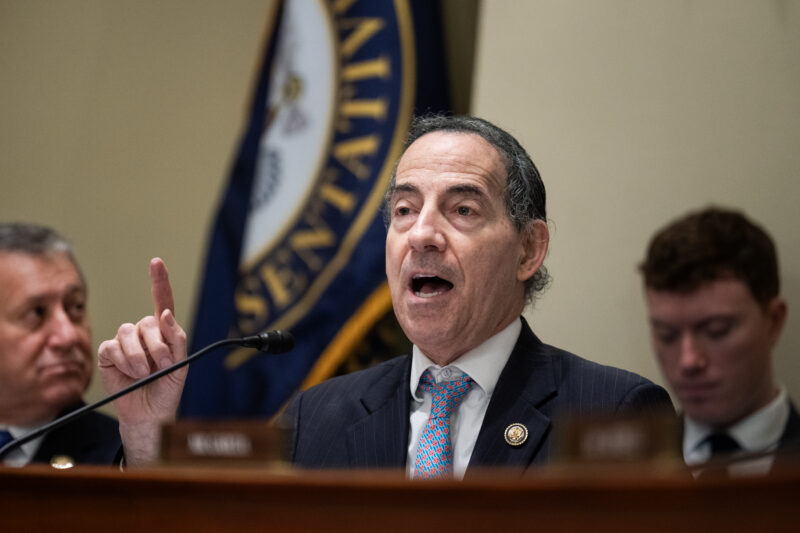
Sen. Mark Warner (D-VA) address a Senate Intelligence Committee hearing on March 25, 2025 in Washington.


 Add JewishInsider on Google
House Speaker Mike Johnson (R-LA) and Senate Intelligence Committee Vice Chairman Sen. Mark Warner (D-VA) emerged from a classified briefing with Cabinet officials on Monday split over whether the U.S. faced an imminent threat from Iran that necessitated and permitted the president to take military action under U.S. statute and the Constitution.
Before entering the briefing, held by administration officials for a bipartisan group of congressional leaders, Secretary of State Marco Rubio told reporters that the U.S. launched the strikes because Israel was determined to carry out an operation against Iran, which U.S. intelligence showed would have prompted retaliation by Iran against American assets.
He also said that the U.S. goal was to degrade Iran’s ballistic missile capacities and sink its navy, not to effect regime change.
Johnson emerged from the briefing offering strong support for the administration’s actions and echoing Rubio’s explanation of the strikes.
“The most critical point is that this was a defensive measure, a defensive operation,” Johnson said. “Israel was determined to act in their own defense here, with or without American support. Why? Because Israel faced what they deemed to be an existential threat. Iran was building missiles at a radical, rapid clip, to the point where our allies in the region do not keep up.”
Johnson argued that, if the U.S. had failed to act alongside Israel and instead waited for Iran to attack its forces in retaliation, “the consequences of inaction on our part could have been devastating. … those losses would have been far greater than if we had done what we did.”
He added that, if U.S. officials had deferred action, they would instead now be facing questions from Congress about why they had not acted sooner. He said that he believes the operation “will be wound up quickly, by God’s grace.”
Warner said that the war is “a war of choice that has been acknowledged by others [that] was dictated by Israel’s goals and timelines. Israel is a great ally of America. I stand firmly with Israel, but I believe at the end of the day, when we are talking about putting American soldiers in harm’s way, when we have American casualties and expectations of more, there needs to be the proof of an imminent threat to American interests. I still don’t think that standard has been met.”
He also criticized the administration and Trump for their shifting articulation of the U.S.’ goals, and said that the administration has no clear plan for what it will do if there is an uprising by Iranian demonstrators followed by another crackdown by the remaining regime.
Warner said that, in January, when the Iranian regime was massacring protesters in the streets, “you could have actually made a case then that taking a strike towards the [Islamic Revolutionary Guard Corps] might have pushed the people forward and the regime to crumble,” but said that such an action was impossible at the time because of the operation in Venezuela and the tensions with European allies over Trump’s ambitions to take over Greenland.
“I might not have agreed with an action then, but at least there was a logic to that moment in time,” Warner said. “Now it appears that the timeline is not being driven by American imminent security concerns, but by others.”
In a brief statement to reporters, Senate Minority Leader Chuck Schumer (D-NY) said he found the administration officials’ answers “completely and totally insufficient” and said that the briefing provided more questions than answers.
Lawmakers also indicated that the administration is likely to request additional funding from Congress to replenish weapons stockpiles expended in the war.
Johnson emphasized after the briefing that administration officials had made it clear that the “objective is not regime change” and that the U.S. mission did not involve eliminating the ayatollah or other Iranian leaders, several dozen of whom have now been killed.
While none directly contradicted the Trump administration, some Senate Republicans seemed to take a different view of whether the U.S. should be pursuing a change in the Iranian regime.
Sen. John Kennedy (R-LA) emphasized that the Iranian regime’s leadership is “crazy as a bed bug” and composed of “just insane” religious fanatics who cannot be reasoned with, and that their nuclear ambitions would set off a global arms race.
“I don’t want America to be the world’s policeman,” Kennedy said. “But I don’t want these crazy people in Iran to be the world’s policeman either. And if you give them a nuclear weapon, they will be.”
Pressed on whether he would think the administration has done enough if Iran remains ruled by someone who is, as he put it, “insane” and pursuing a nuclear weapon, Kennedy said, “that would not be my preference,” but he said he could not predict what the outcome of the war will entail.
“I’m assuming that the administration is destroying all capability to develop a nuclear weapon to the extent that we haven’t destroyed it already, destroying their ability to manufacture missiles, destroying their launchers,” Kennedy continued. “The key to controlling Iran is controlling the Revolutionary Guard and the military. And I assume that they’re trying to give them a curb stomping as well.”
Sen. James Lankford (R-OK) argued that “regime change has already occurred there, one way or the other, since all the senior leadership is now gone.”
Asked whether it would be a sufficient outcome if someone else from the current Iranian government ends up leading the country at the end of the U.S. operations, Lankford said it is dependent on the posture that Iran’s next leader takes — whether they still threaten Iran’s neighbors, attack the United States, pursue a nuclear weapon and seek to eliminate Israel.
“I think that’s the litmus test,” Lankford said.
Sen. Markwayne Mullin (R-OK) said that the question of Iran’s governance is up to the Iranian people.
The duration of the war, he said, is “just a matter of how much fight they have left and how long the Iranian people are going to put up with this … they get to choose their next leadership, hopefully, and we’re eliminating a threat to the United States and our assets. After that, it’s up to the Iranian people to choose.”
Pressed on whether he would be satisfied if the regime remains in power at the end of the war, Mullin emphasized that the U.S. was no longer willing to allow Iran to present a threat, but “what they choose next will be up to the Iranian people. We’re giving that opportunity, but we’re not going to fight for their country harder than they’re willing to fight.”
Johnson argued after the briefing that it would be “frightening” and “dangerous” for Congress to approve a war powers resolution to “take [Trump’s] authority away right not to finish the job.”
Democrats — who plan to force votes on such resolutions demanding the end of U.S. operations against Iran without congressional approval — did not articulate a clear exit strategy from the conflict in the unlikely event that that resolution passes.
“Ask the drafters of the resolution,” Warner replied, when asked about the consequences of pulling U.S. troops out of ongoing operations in Iran. Warner said he intends to support the resolutions.
Asked the same question, Sen. Richard Blumenthal (D-CT) emphasized that the key question in the war powers vote is one of congressional authority and that the White House needs to explain the threat that administration officials said the U.S. faced.
He argued that Rubio’s public statements — that Iran’s ballistic missile arsenal was growing to a point of “immunity” allowing it to “hold the whole world hostage” within the next year or year and a half — illustrate that the arsenal did not pose an imminent threat to the U.S.
“The president’s been all over the place. He’s, in effect, workshopping a war. It’s like he’s a kid with a puzzle trying to fit the pieces together in a way that creates a picture,” Blumenthal continued.
Asked whether there was any form of an operation in Iran that he could support, if the administration presented a clear plan to Congress for its approval, Blumenthal emphasized that he had no regrets about the death of Supreme Leader Ayatollah Ali Khamenei and other senior Iranian leaders.
“If this war, in effect, were not a war and simply the kind of strike that we did in Venezuela, where we removed the key leader, it might be a lot more palatable,” Blumenthal said. “Here’s what really concerns me: the president is talking about regime change, and there’s no way to accomplish regime change from 30,000 feet. There is no precedent for bombing successfully achieving regime change. There have to be boots on the ground.”
Trump and Defense Secretary Pete Hegseth explicitly did not rule out a U.S. ground operation in separate comments on Monday.
Blumenthal said that such an on-the-ground operation would be unacceptable to the American people and set off a “forever war.”
“I think we are on a very perilous path without defined objectives,” Blumenthal said. “If it’s only to kill Ayatollah Khamenei, we’ve accomplished that objective. Right now, we’re way beyond it in a regional war that is spreading in both intensity and geographic scope.”
And asked whether Trump had the authority to launch the war, Blumenthal responded that Trump “doesn’t have the power to continue it, constitutionally, without approval by Congress.”
More Stories

EXCLUSIVE
Brandeis Center urges Qatar to provide ‘complete public accounting’ of campus funding

AID CONVERSATION
GOP Reps. Kustoff, Goldman say Republicans want to see U.S. aid to Israel continue

TOUR TROUBLE
Macklemore dropped from Ed Sheeran’s U.S. tour after venues refuse to host him over anti-Israel activism
PEOPLE OVER PARTY
Local Democratic official endorses Lawler, citing record on antisemitism, Israel

BOOKSHELF
New book ‘In the War Room’ offers candid look at Netanyahu’s wartime decisionmaking
scoop
Tenney calls on Treasury to weigh anti-boycott penalties for U.K., countries sanctioning Israeli settlements
Please log in if you already have a subscription, or subscribe to access the latest updates.
 Continue with Google
 Continue with Apple