



















































Netanyahu denies pushing Trump into action against Iran
‘You don’t have to drag him into anything. Donald Trump is the strongest leader in the world. He does what he thinks is right for America,’ Netanyahu said in his first interview since the operation began

SAUL LOEB/AFP via Getty Images
President Donald Trump shakes hands with Israeli Prime Minister Benjamin Netanyahu during a meeting in the Oval Office of the White House in Washington, DC, on April 7, 2025.


 Add JewishInsider on Google
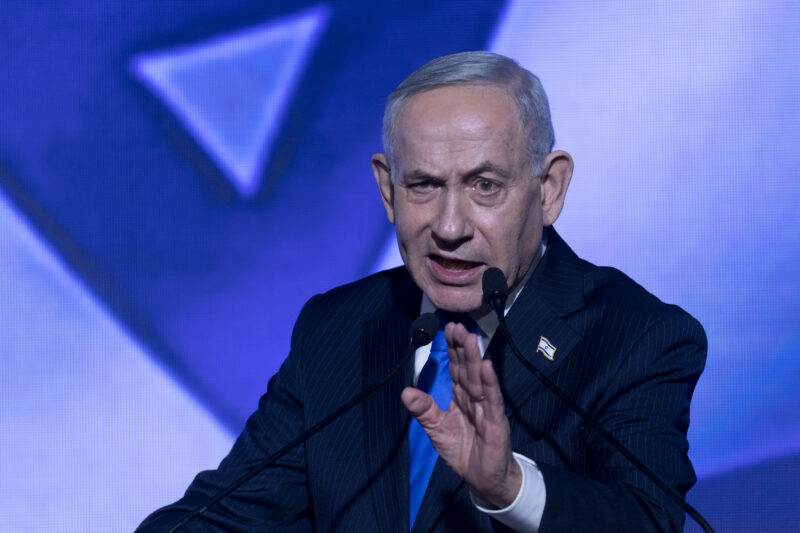
In his first interview since the U.S. and Israel launched their joint military campaign against Iran, Israeli Prime Minister Benjamin Netanyahu defended the timing of the operation’s launch and rebuffed the notion that he decisively pushed President Donald Trump to take action.
“The reason that we had to act now is because after we hit [Iran’s] nuclear sites and their ballistic missile program [in June 2025] … they started building new sites, new places, underground bunkers that would make their ballistic missile program and their atomic bomb program immune within months,” Netanyahu told Fox News host Sean Hannity on his show Monday night. “If no action was taken now, no action could be taken in the future.”
Without undertaking military operations, Netanyahu warned that Iran would be able to “target” and “blackmail America” and argued that Tehran could threaten the U.S. and Israel “and everyone in between.” He added that the moment was also opportune due to the Iranian regime being “at the weakest point that it’s been since it hijacked Iran from the brave Iranian people 47 years ago.”
When asked about allegations from critics of the operation that he had “dragged” the U.S. into a wider conflict with Iran, Netanyahu dismissed the notion, calling it “ridiculous.” He said that Trump made the decision on his own because he “understands” the threat Iran poses to the U.S.
“You don’t have to drag him into anything,” said Netanyahu. “Donald Trump is the strongest leader in the world. He does what he thinks is right for America.”
In comments Monday afternoon, both Secretary of State Rubio and House Speaker Mike Johnson (R-LA) suggested it was Israel’s determination to strike Iran, which would have prompted Iranian retaliation against U.S. assets, that necessitated U.S. preemptive action.
Netanyahu did not offer a timeline for how long he expects the joint operation to last; however, he emphasized that it will be “quick and decisive” and not an “endless war” as some critics have alleged.
“You’re not going to have an endless war,” said Netanyahu. “This is going to be a quick and decisive action, and we’re going to create the conditions first for the Iranian people to get control of their destiny, to form their own democratically elected government, which will make Iran different altogether. It may take some time, but it’s not going to take years.”
The prime minister argued that the current military confrontation is intended not only to neutralize an immediate threat but to reshape the region’s long-term trajectory, describing it as a potential “gateway to peace.”
“I think it changes the world,” Netanyahu said, arguing that dismantling Iran’s regime would remove what he called the Middle East’s primary driver of instability. “Iran has been the main engine of war over these years. Ninety-five percent of all the problems you see in the Middle East are generated by Iran and the worldwide terror network that they built.”
“When you take away Iran [Iranian leadership] — let the people of Iran have the opportunity to act and liberate themselves, free themselves from the work of this terror machine — you get a different future,” he added.
Rubio and Defense Secretary Pete Hegseth, however, have insisted that the U.S. objective in Iran is more constrained. The White House has asserted it is not seeking regime change, instead emphasizing that American action is narrowly focused on dismantling Tehran’s nuclear program, ballistic missile capabilities and naval assets.
Still, Netanyahu embraced a broader vision, suggesting that the fall of the Iranian regime would fundamentally reshape the region and open the door to normalization agreements and “many peace treaties” with Arab and Muslim-majority countries. He specifically pointed to Saudi Arabia as a potential partner.
“Saudi Arabia will have a lot to gain,” Netanyahu said. “All these countries around Iran are threatened by Iran. I think they [Arab countries] want to see this regime go down, even if they don’t publicly say that.”
“If Iran [Iranian leadership] is removed, that’s a great boon to Saudi Arabia, a great boon to these other countries, and I think peace between Israel and Saudi Arabia would be really possible — and probably very close — once this thing happens.”
More Stories
analysis
MBS bet Saudi Arabia’s future on economic transformation. The Houthis are testing that wager

booking bias
Irish Jewish leader says Dublin hotel canceled guest rooms for conference on fighting antisemitism

MAINE EVENT
Maine Senate candidate Troy Jackson says Congress should cut off funding for Iran war

PLATFORM CHECK
Where Israel’s parties stand on the Diaspora — in their own words
NUCLEAR NEWS
Senate expected to vote on Saudi nuclear deal before end of year
HISTORY LESSON
Brett McGurk’s fact check of former Harris advisor Phil Gordon on hostage negotiations
Please log in if you already have a subscription, or subscribe to access the latest updates.
 Continue with Google
 Continue with Apple