













Court rules protest leader Mahmoud Khalil can be rearrested
Khalil was released from ICE detention in June as the federal government sought his deportation
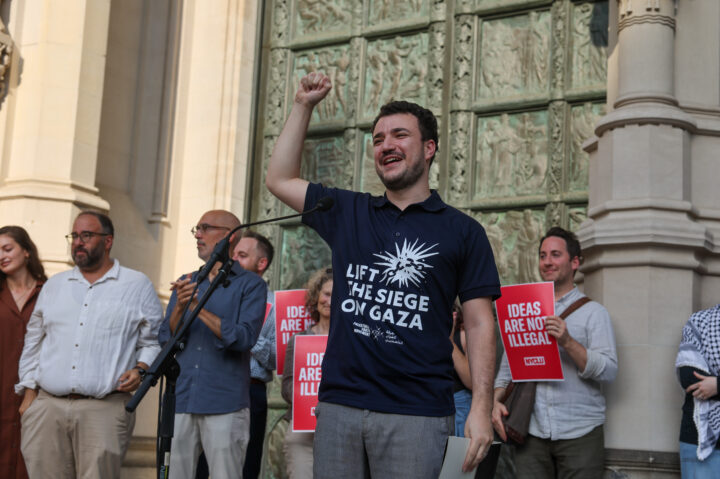
Spencer Platt/Getty Images
Palestinian activist Mahmoud Khalil, who was released from ICE detention, speaks during a rally on the steps of the Cathedral of St. John the Divine in Manhattan on June 22, 2025 in New York City.


 Add JewishInsider on Google
A federal appeals court ruled on Thursday that former Columbia University graduate student Mahmoud Khalil, a leader of the school’s anti-Israel protest movement, could be rearrested.
Khalil was released in June from the Immigration and Customs Enforcement detention center in Louisiana, where he had been held for three months.
A three-judge panel from the U.S. Court of Appeals for the Third Circuit reopened the case on Thursday, instructing the lower court to dismiss Khalil’s habeas petition, a court filing that challenged his incarceration and eventually secured his release. In a 2-1 ruling, the panel decided that the federal district court in New Jersey that issued Khalil’s release did not have jurisdiction over the matter and that it should have been handled in immigration court, which is part of the executive branch overseen by the Justice Department, meaning Khalil is now liable to be rearrested.
Baher Azmy, a lawyer for Khalil, told The New York Times, “We are disappointed with and strongly disagree with the majority opinion, but take heart in the very powerful and persuasive dissenting opinion. We’ll continue to fight with all available legal options.” The dissenting option came from Judge Arianna Freeman, who said that Khalil had proved that he faced irreversible injuries during his detention.
Khalil’s deportation proceedings are currently paused, secured through a deal between his lawyers and the federal government. Thursday’s ruling could mean that the case restarts again, though it will very likely be appealed.
New York City Mayor Zohran Mamdani responded to the reopening of Khalil’s case, saying in a statement that “last year’s arrest of Mahmoud Khalil was more than just a chilling act of political repression, it was an attack on all of our constitutional rights.”
“Now, as the crackdown on pro-Palestinian free speech continues, Mahmoud is being threatened with rearrest. Mahmoud is free—and must remain free,” said Mamdani.
Khalil, who grew up in Syria but is of Palestinian descent, first came to the U.S. on a student visa, and later married a U.S. citizen and received a green card. While a graduate student at Columbia in 2024, he led campus protests against the war in Gaza and subsequent negotiations with university administrators.
The federal government sought to deport Khalil on the basis of his failure to disclose crucial information in his green card application, including his former employment by the U.N. Relief and Works Agency that works with Palestinians, as well as his membership in the unofficial campus group Columbia University Apartheid Divest, which was banned from Instagram last year for promoting violence.
Immigration authorities arrested Khalil at his home in March. He was not charged with a crime. The White House said at the time that the government had authority to arrest and deport Khalil based on the 1952 Immigration and Nationality Act, which states that if the secretary of state has “reasonable grounds” to believe that a migrant poses “potentially serious adverse foreign policy consequences,” that person is eligible for deportation.
A memo submitted in May to the court in Louisiana and signed by Secretary of State Marco Rubio cited the president’s authority to expel noncitizens whose presence in the country could have adverse foreign policy consequences, regardless of whether they have committed a crime. It stated that Khalil’s arrest and planned deportation were based on his “participation in antisemitic protests and disruptive activities, which fosters a hostile environment for Jewish students in the United States.”
Khalil’s arrest was largely met with cautious celebration from mainstream Jewish groups at the time who said his deportation was “fully justified” but emphasised a need for due process.
Khail was released on June 20 when Judge Michael Farbiarz ruled that his prolonged detention likely violated his constitutional rights.
One day after his release, Khalil appeared at a rally in New York City organized by a group accused of ties to the Iranian regime protesting the U.S.’ airstrikes on Iran’s nuclear facilities that had occurred a few days earlier.
More Stories
analysis
Playing to the cameras in the West Bank
Daily Kickoff
If not then, when? Hillel says Emory rabbi hid conflicts
PRAIRIE STATE PRIORITIES
Illinois Democrats spend big for anti-Israel candidate running for state Senate
DEBATE DIGS
Rogers describes El-Sayed as a national security threat in final Michigan Senate debate
SPEAKING OUT
Jewish groups call for apology after educators asked to condemn Israel to attend Italy trip
MINNESOTA MIC DROP
Jacob Frey, Betty McCollum join Minnesota Dem chorus condemning Piker event
Please log in if you already have a subscription, or subscribe to access the latest updates.
 Continue with Google
 Continue with Apple