




















Former Trump officials, analysts slam UN’s conciliatory moves towards Iranian regime
On Tuesday, the UN elected Abbas Tajik of the Islamic Republic of Iran as vice chair of its Commission for Social Development
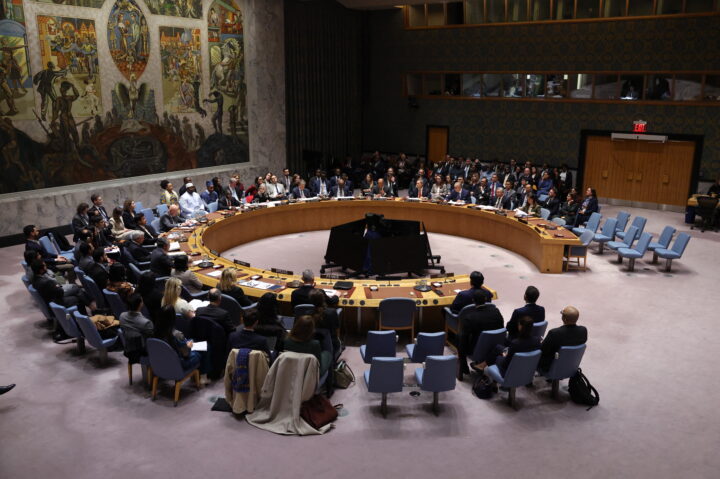
ANGELA WEISS/AFP via Getty Images
Ambassadors and representatives to the United Nations meet at the U.N. Security Council to vote on a U.S. resolution on the Gaza peace plan at the U.N. Headquarters in New York City, Nov. 17, 2025.


 Add JewishInsider on Google
The United Nations this week elevated an Iranian official to a senior leadership role and publicly congratulated Tehran on the anniversary of the Islamic Revolution — moves that former Trump administration officials and Middle East policy analysts say reflect a troublingly conciliatory posture by the international body toward a regime accused of violently repressing its own people.
On Tuesday, the UN elected Abbas Tajik of the Islamic Republic of Iran as vice chair of its Commission for Social Development, a body tasked with advancing policies on poverty eradication, employment and social inclusion. The commission recently adopted resolutions focused on social justice, gender equality and combating gender-based violence — issues critics note remain acute inside Iran, where legal, social and cultural restrictions continue to limit women’s rights and political freedoms.
The following day, UN Secretary-General António Guterres congratulated Iran on the anniversary of the 1979 Islamic Revolution — the founding moment of the regime now facing widespread domestic unrest — weeks after authorities violently suppressed nationwide protests, imposed internet blackouts and oversaw a crackdown that, according to human rights groups, has resulted in thousands of deaths.
Guterres’ message was condemned by Israel’s Foreign Ministry, which posted on X that the gesture represented a “moral failure.”
“History will not remember your speeches. It will remember the regimes you chose to honor,” the statement read. “Sending congratulations to the Islamic Revolution regime — a state built on repression and terror — is not neutrality.”
Critics argue that the juxtaposition of congratulatory gestures and leadership appointments raises broader questions about institutional coherence and moral clarity — particularly as Iran continues to face internal unrest and international scrutiny.
Jason Greenblatt, a former White House Middle East envoy under President Donald Trump, told Jewish Insider that Iran’s latest promotion “tells you all you need to know about what the UN stands for.”
“It’s a bloated, broken, perhaps irredeemable system, and a colossal waste of money,” said Greenblatt.
Elliott Abrams, the former U.S. special representative for Iran during the first Trump administration, agreed, calling the UN a “morally bankrupt institution.”
“The secretary general congratulating the Iranian regime just days after it murdered thousands of its citizens is another example,” said Abrams.
However, Abrams also described the situation as more nuanced, noting that other parts of the UN have taken a firmer stance.
He pointed to a Jan. 26 resolution adopted by the UN Human Rights Council condemning the Iranian regime’s crackdown. During that session, Sara Hossain, chair of the U.N.’s fact-finding mission on Iran, described unfolding events in Tehran as “the deadliest crackdown against the Iranian people since the 1979 revolution.”
“The violent repression of the Iranian people doesn’t solve the country’s problems,” UN High Commissioner for Human Rights Volker Türk said at the time. “On the contrary, it creates conditions for further human rights violations, instability, and bloodshed.”
Still, several foreign policy analysts argued that the UN’s repeated elevation of Iran is misguided and at odds with the intended goals of the organization. David May, a senior research analyst at the Foundation for Defense of Democracies, suggested the UN’s actions are a pattern of hypocrisy, noting that the organization has previously elected Tehran to committees despite its poor track record on human rights.
In 2023, Tehran was elected to the UN Committee on Disarmament and International Security. However it was during the same time that Iran was significantly accelerating its nuclear weapons program.
Tehran was also elected by the UN Economic and Social Council (ECOSOC) in 2021 to the Commission on the Status of Women (CSW), a group responsible for empowering women and promoting gender equality. Former Vice President Kamala Harris supported a U.S-led effort in 2022 to oust Iran from the committee, calling out its “denial of women’s rights and brutal crackdown on its own people.”
Experts said the UN’s latest elevation of Tehran was not unexpected. Still, they argued that the continuation of this pattern is deeply troubling and reflects a broader institutional posture toward the Iranian regime.
“All of this would be laughably absurd if it wasn’t so actively counterproductive, both in terms of isolating Iran’s regime and, more fundamentally, what the UN supposedly stands for in founding documents like the UN Charter and Universal Declaration of Human Rights,” said Jonathan Ruhe, a fellow at the Jewish Institute for National Security of America.
Ruhe argued that the UN treats Iran as a “normal” member in “good standing,” creating what he described as a “dangerous equivalence between Tehran and Washington.”
“Promoting Iran to vice chair, and inviting its foreign minister to address the UN Human Rights Council, bestows a veneer of legitimacy on a regime that just brutally violated its citizens’ right to peaceful protest — a core right recognized in the Universal Declaration of Human Rights,” Ruhe said. “The UN is extending olive branches that rehabilitate Tehran at the exact moment it should be a pariah on par with North Korea.”
David May, a senior research analyst at the Foundation for Defense of Democracies, similarly argued that the UN has become a venue for Iran and other authoritarian governments to “launder their human rights records.”
“People are noticing the absurdity of the UN secretary-general congratulating the Islamic Republic on the anniversary of seizing power because it comes one month after the Tehran regime killed as many as tens of thousands of protesters,” May said.
He added that “when the spotlight is not on Tehran’s tyranny, the United Nations treats Iran like any other country.”
“If the United Nations wants to escape its reputation as a den of dictators, it should disinvite Iran’s foreign minister from addressing the opening of the Human Rights Council on February 23,” May said. “Otherwise, this will provide another opportunity for a human rights abuser to mask its violations by launching attacks against the United States and its allies.”
More Stories

EVENT RESCHEDULED
State Department to hold Oct. 7 commemoration event on Wednesday
Cross-Party Call
JCPA urges candidates in both parties to reject antisemitism ahead of midterms
BACK FROM THE GULF
Sen. Murphy accuses admin of ‘active cover-up’ of Iran war, vows to leverage funding to end war
Mayor Unmoved
Mamdani brushes off pro-Hamas heckling at Oct. 7 vigil
speaking out
In open letter, dozens of retired U.S. military leaders reject genocide allegations against Israel

SCOOP
Rep. Lawler urges Treasury to reopen investigation into Swiss bank’s Nazi ties
Please log in if you already have a subscription, or subscribe to access the latest updates.
 Continue with Google
 Continue with Apple