
































































Trump official says tax code could be tool in fight against campus antisemitism
The Education Department’s Noah Pollak argued at an antisemitism conference that IRS regulations could force nonprofits to increase transparency about funding and staff
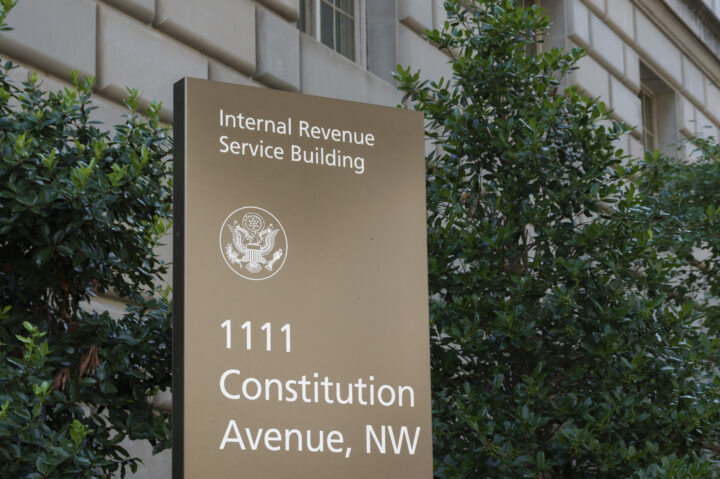
Kevin Carter/Getty Images
A sign is displayed outside of the Internal Revenue Service (IRS) Building on June 7, 2025 in Washington, DC.


 Add JewishInsider on Google
The next frontier for the Trump administration’s war with higher education might be the U.S. tax code, a senior Education Department official said on Tuesday.
Speaking at a conference about antisemitism organized by the Republican Jewish Coalition and National Review, Noah Pollak, a senior advisor to Education Secretary Linda McMahon, said that making changes to American tax policy could be a useful vehicle to fight antisemitism on campuses.
His argument was a wonky one, suggesting that changes to IRS rules regulating nonprofits could increase transparency — and require the organizations fomenting antisemitism at U.S. universities to reveal much more information about their operations and staff.
Pollak called for the federal government to create limits on fiscal sponsorship, a tool by which an existing nonprofit incubates a new one. This allows a new nonprofit organization to launch quickly, with donations passing through a larger, more established organization. The idea is that once the new nonprofit has a steadier foundation, it will eventually incorporate as a 501(c)(3) nonprofit with the IRS, after which point it must meet certain federal requirements and make information about its finances and activities publicly available.
But there is currently no legal requirement that a nonprofit ever spin off from the organization where it is fiscally sponsored. That allows organizations seeking to avoid the spotlight to stay in the shadows, and to avoid having to file a Form 990, the IRS-mandated document that nonprofits must file yearly laying out the state of their finances, activities, senior staff and top board members.
“Over the past 15 years or so, particularly on the left and on the far left, they realized that there were really no restrictions on this, and you could just run whole organizations via fiscal sponsorships,” Pollak said. “It means you can raise money — tax deductible money, which is much easier to raise than non-tax deductible money — and never have to disclose who the money’s going to, what it’s funding [or] how much money.”
Pollak argued this transparency gap benefits organizations like Students for Justice in Palestine, which played a key role in fomenting anti-Israel sentiment on campuses after the Oct. 7 terror attacks.
“Changing the fiscal sponsorship rules to compel disclosure of who’s being funded via fiscal sponsorships would basically be a neutron bomb going off in the world of radical, left-wing, kind of criminal activism,” said Pollak. “You all know what Students for Justice in Palestine is. Go try to find their EIN [Employer Identification Number]. Go try to find a 990 for them. You can’t. They’re not a real organization. They’re not incorporated.”
“Things in the tax code, they may sound boring,” Pollak added. “But they would be very effective in creating some disclosure.”
Pollak said changes to the tax code might also force universities to cut back on spending on left-wing priorities.
“Over the past 40 or 50 years, the tax code has actually been tweaked and rigged and modified in so many different ways that creates a lot of advantages for universities, to the point where the universities now have so much money that they can spend on essentially luxury goods,” Pollak said. “For a university, the luxury goods they spend on is the gender studies department, and it’s DEI [diversity, equity and inclusion] bureaucracies.”
Pollak pointed to those “luxury goods” — left-wing programs in the humanities, for instance — as a key factor in the growth of antisemitism at elite universities. He did not offer a specific policy fix but said he thinks that the solution might be found in the tax code.
“If you actually look at adjustments to the tax code, that will translate into less antisemitism, because the universities would be compelled to sober up to get back to the core mission of education and the pursuit of knowledge and the pursuit of excellence,” said Pollak. “They would actually have to drop a lot of the kind of insane nonsense departments and fake academic programs.”
Universities’ status as nonprofit organizations should also come into play when the State Department determines how many foreign students should be allowed to enroll at those universities, Pollak said.
The Trump administration has sought to limit the number of foreign students at universities and deport those who are flouting American values; Pollak argued that the number of foreign students at elite institutions is so high that they push the campuses toward an anti-American sentiment.
“There’s so many of them, and many of them are from cultures that, frankly, are not particularly compatible with the type of values that we want on a campus, on a Western U.S. campus, and they get our kids spun up on third worldist-type causes and radical causes,” said Pollak.
“Universities in America are actually supposed to — they are charities. They’re 501(c)(3)s, and they are actually supposed to be operated for the benefit of Americans, and not just be kind of sold out to whoever wants to come from all over the world.”
More Stories
TEHRAN TALK
Analyst warns of potential Iranian ‘October surprise’ ahead of midterms

CAMPAIGN CONTROVERSY
Michigan Dem nominee Jeremy Moss denounces ‘disinformation’ peddling dual loyalty tropes

MIXED MESSAGES
U.S. accuses Israel of striking Syrian airbase

BLAME GAME
Brooklyn Democratic leader who promoted infamous antisemitic tract rips ‘Zionists’ in new video

NEW BATTLEGROUND
Jewish leaders build up local grassroots organizing to counter radical forces in politics

GAME CHANGER
Sen. Darline Graham, at debate: ‘National security is not my thing’
Please log in if you already have a subscription, or subscribe to access the latest updates.
 Continue with Google
 Continue with Apple