

















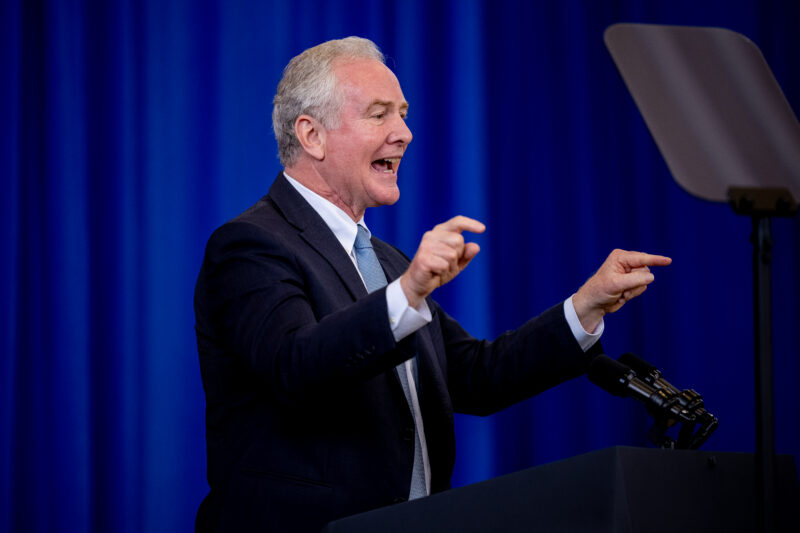

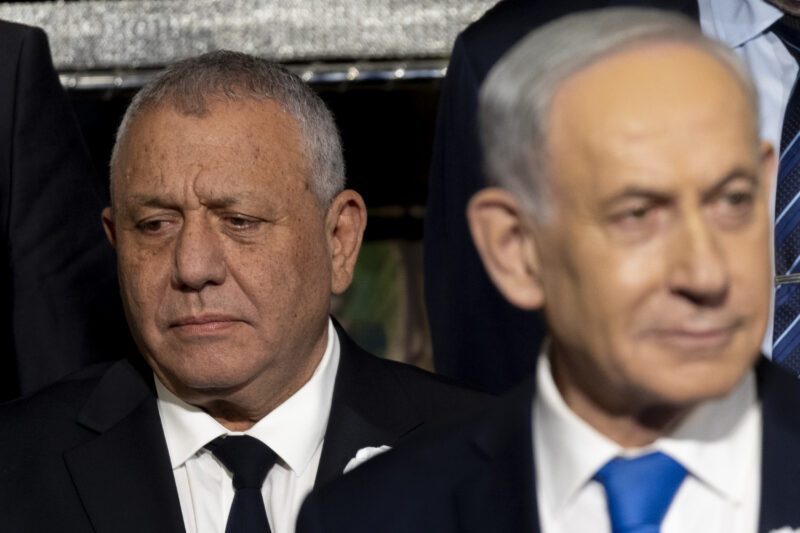








































Plus, Bibi faces coalition chaos

Gage Skidmore
Sen. Amy Klobuchar (D-MN) speaking with attendees at the Moving America Forward Forum hosted by United for Infrastructure at the Student Union at the University of Nevada, Las Vegas in Las Vegas, Nevada.


 Add JewishInsider on Google
Good Wednesday afternoon.
This P.M. briefing is reserved for our premium subscribers like you — offering a forward-focused read on what we’re tracking now and what’s coming next.
I’m Danielle Cohen-Kanik, U.S. editor at Jewish Insider and curator, along with assists from my colleagues, of the Daily Overtime briefing. Please don’t hesitate to share your thoughts and feedback by replying to this email.
📡On Our Radar
Notable developments and interesting tidbits we’re tracking
Sen. Amy Klobuchar (D-MN) rebuked antisemitic comments made by Minneapolis mayoral candidate Omar Fateh’s campaign staff in a statement to Jewish Insider today, after initially declining to comment when JI unearthed the statements last week.
Klobuchar’s spokesperson said the senator “strongly and immediately condemned the Hamas terrorist attack, and condemns any statements to the contrary.” She called Fateh’s staffers’ comments “outrageous” and said they “have no place in our politics.”
Klobuchar reiterated her endorsement of Mayor Jacob Frey in the race; Frey’s other supporters, including Minnesota Gov. Tim Walz, and other state Democratic officials have thus far refrained from commenting on the situation…
Staying in the Midwest, protesters interrupted Rep. Wesley Bell’s (D-MO) first in-person town hall last night in St. Louis over Bell’s support for Israel, shouting over the congressman and getting into altercations with police.
In response to a question about “the ongoing genocide in Palestine,” Bell said, “Let’s talk about the word genocide, because we see that differently.” He repeatedly asked protesters to stop shouting and listen.
“There’s a lot of folks who don’t want to have the conversation,” Bell said. “They just want to spew what they think is important, but they don’t want to have an actual debate because these are tough issues. So, now we’re going to have the conversation — whether you like it or not”…
Meanwhile on the campaign trail, Politico reported this morning on Rep. Chris Pappas’ (D-NH) new competitor in the Democratic primary for New Hampshire’s open Senate seat, political activist Karishma Manzur.
Manzur said she would have supported recent resolutions from Sen. Bernie Sanders (I-VT) — which the moderate Pappas said he would have opposed — seeking to block some arms sales to Israel, saying she “will be against any money to any country to kill people” and that the U.S. should take “concrete actions against the harrowing acts of torture of Palestinians” by the IDF …
President Donald Trump called in to Fox News host Mark Levin’s radio show yesterday and said that, at the time of the U.S. strikes on Iran’s nuclear facilities in June, he believed Iran “would have had nuclear weapons in a period of four weeks.”
“If we didn’t [strike Iran], they would probably by this time, just about this time, have a nuclear weapon and they would have used it,” the president said.
Trump also told Levin that the U.S. Air Force pilots who conducted the strikes told him that they and their predecessors had been practicing the flight to Iranian airspace for 22 years…
The New York Times published an analysis on the damage inflicted by U.S. strikes on the Iranian nuclear site Fordow based on the site’s structure and the munitions used…
The State Department responded today to a bipartisan congressional letter led by Pappas last month expressing lawmakers’ concerns that the administration was considering selling F-35 fighter jets to Turkey in a reversal of U.S. policy, which currently bans the sale of the jets in light of Turkey’s purchase of an S-400 missile defense system from Russia.
Paul Guaglianone, senior bureau official in the department’s Bureau of Legislative Affairs, wrote in a letter to Pappas that the “U.S. position on Turkey’s acquisition and continued possession of the Russian S-400 system has not changed, and the requirements for Turkey to acquire U.S. F-35 aircraft are well-known”…
Secretary of State Marco Rubio also announced this morning that the U.S. is sanctioning four additional officials from the International Criminal Court, two judges and two prosecutors, in addition to the four judges sanctioned by the U.S. in June, over the ICC’s continued “efforts to investigate, arrest, detain, and prosecute American and Israeli nationals”…
In Israel, coalition politics are heating up over a potential ceasefire and hostage-release agreement with Hamas, which reports indicate the terror group recently accepted but Israel has not yet responded to.
Israeli media reported that Finance Minister Bezalel Smotrich told hostage families he would resign if Prime Minister Benjamin Netanyahu agreed to a ceasefire, and Minister of National Security Itamar Ben-Gvir is likely to do the same, as he did in January when Israel agreed to a previous ceasefire deal.
Meanwhile, opposition MK Benny Gantz, whose Blue and White-National Unity party is currently hemorrhaging in the polls, is reportedly considering rejoining Netanyahu’s coalition to help bolster support for a deal…
Back stateside, Israeli scholar and dance instructor Yael Nativ is suing the University of California, Berkeley, alleging that the university denied her a teaching position because she is Israeli. Nativ had previously taught at Berkeley and was encouraged to apply to teach another course.
When Nativ’s application was rejected shortly after the Oct. 7, 2023, terror attacks, according to the suit, the dance department chair wrote to her, “My dept cannot host you for a class next fall. Things are very hot right now and many of our grad students are angry. I would be putting the dept and you in a terrible position if you taught here”…
⏩ Tomorrow’s Agenda, Today
An early look at tomorrow’s storylines and schedule to keep you a step ahead
Keep an eye on Jewish Insider tomorrow morning for reporting on Graham Platner, the oyster farmer turned Democratic challenger to Sen. Susan Collins (R-ME), who called AIPAC “weird” in a recent interview.
Tomorrow afternoon, the American Jewish Committee will host a briefing on “Justice for Victims of Hamas’ Sexual Violence: The U.N. Blacklist and What Comes Next,” referring to the U.N.’s recent decision to “blacklist” Hamas as a group that uses sexual violence as a weapon of war.
FOREIGN POLICY FEID
Trump’s senior director for counterterrorism: ‘I was worried by this neo-Buchanan isolationism, but I look at President Trump’s actions, they have no hold on him’
TRIP TALK
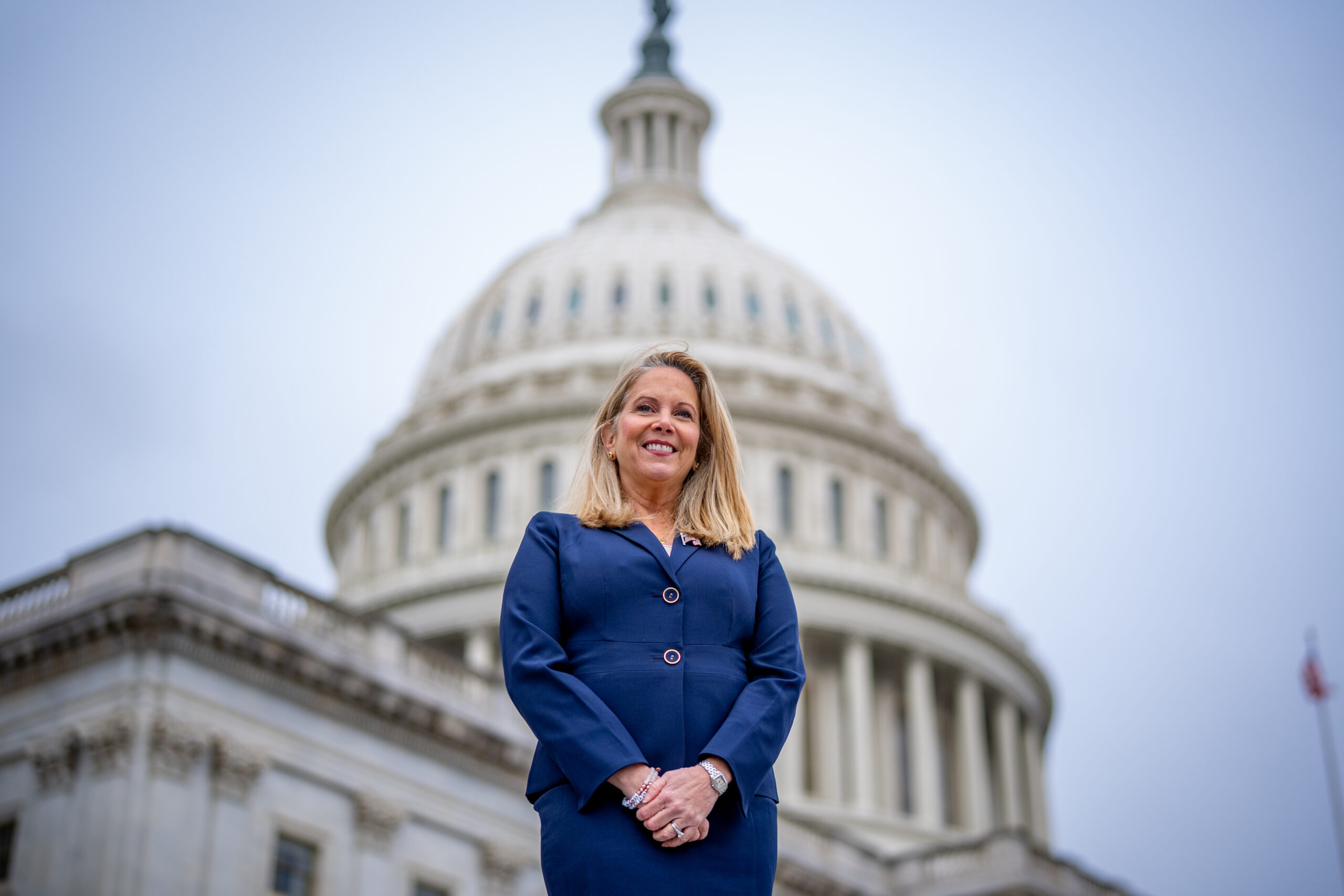
The New York Democrat told JI ‘the majority of people see the value and the special nature of our relationship with our ally Israel’
‘These comments are outrageous and have no place in our politics,’ said the Democratic Minnesota senator, who is backing Minneapolis Mayor Jacob Frey
Gage Skidmore
Sen. Amy Klobuchar (D-MN) speaking with attendees at the Moving America Forward Forum hosted by United for Infrastructure at the Student Union at the University of Nevada, Las Vegas in Las Vegas, Nevada.
Sen. Amy Klobuchar (D-MN) is rebuking a top mayoral candidate in Minneapolis, far-left state Sen. Omar Fateh, who has recently faced criticism for employing campaign staffers who have glorified Hamas’ Oct. 7, 2023, terror attacks, blamed Israel for the war in Gaza and called for the destruction of the Jewish state, among other extreme comments.
In a statement to Jewish Insider on Wednesday, a spokesperson for Klobuchar, who is backing Fateh’s chief rival, Mayor Jacob Frey, said that the senator “strongly and immediately condemned the Hamas terrorist attack, and condemns any statements to the contrary.”
“These comments are outrageous and have no place in our politics,” the spokesperson, Jane Meyer, said of the staffers’ remarks, which were unearthed by JI last week. “She has spoken out against antisemitism for years. She has endorsed the mayor and did so months ago.”
Klobuchar, who along with Minnesota Gov. Tim Walz is the most high-profile Democratic official supporting Frey’s campaign for a third term, had until now remained silent with regard to Fateh, a 35-year-old democratic socialist whose insurgent bid has drawn comparisons to Zohran Mamdani, the Democratic nominee for New York City mayor.
Meyer declined a request for comment from JI last Friday but ultimately shared a statement this week after Fateh drew backlash from, among others, the local Jewish Community Relations Council, which called into question his commitment to addressing Jewish safety concerns as he tolerates staffers who “traffic in antisemitism” and act as “apologists” for Hamas.
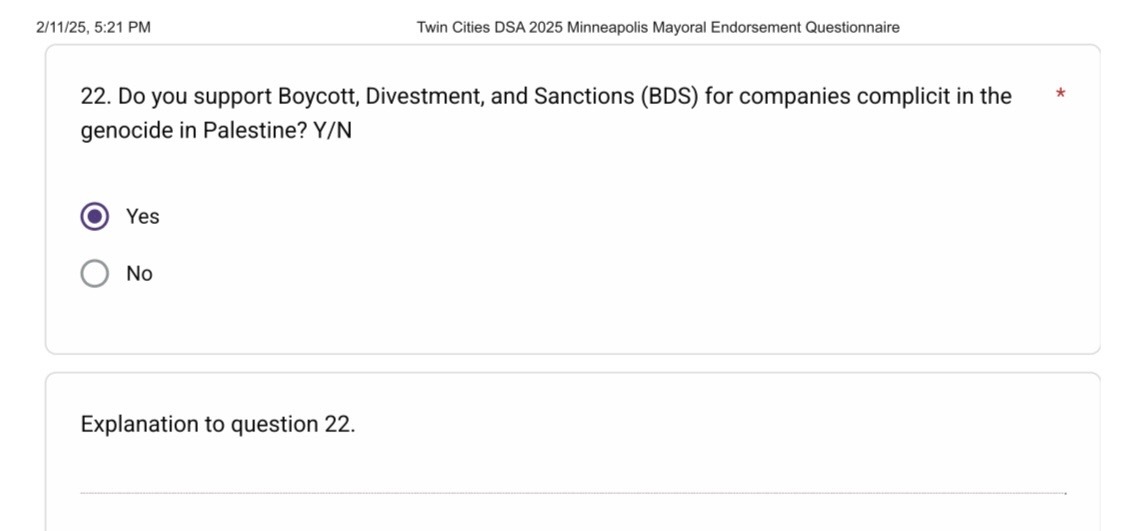
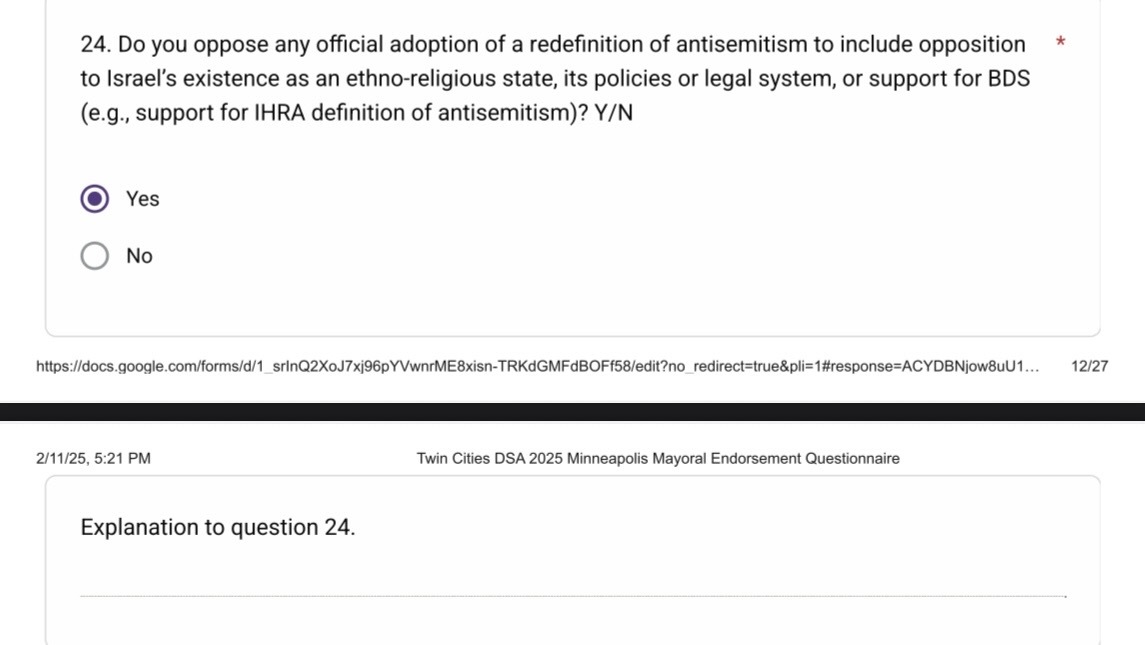
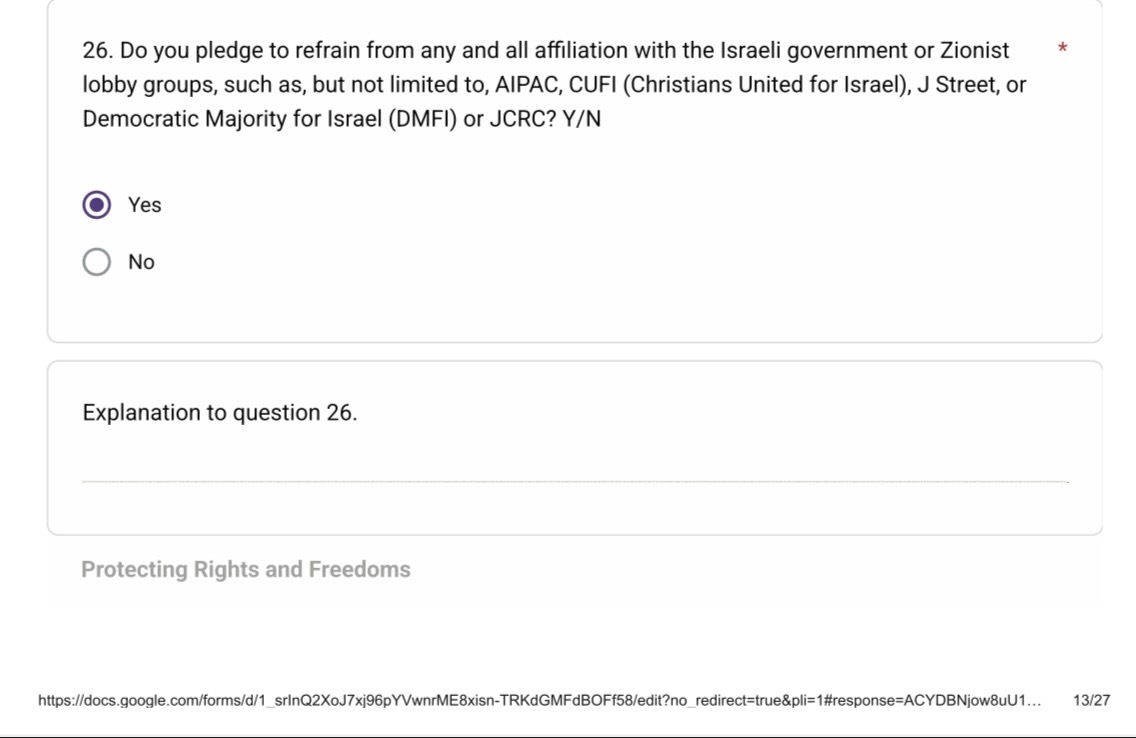
Fateh, who pledged to boycott the JCRC in a recent candidate questionnaire solicited by the Twin Cities chapter of the Democratic Socialists of America, has not yet addressed the staffers’ rhetoric, significantly more extreme than his own public stances on Israel and Gaza.
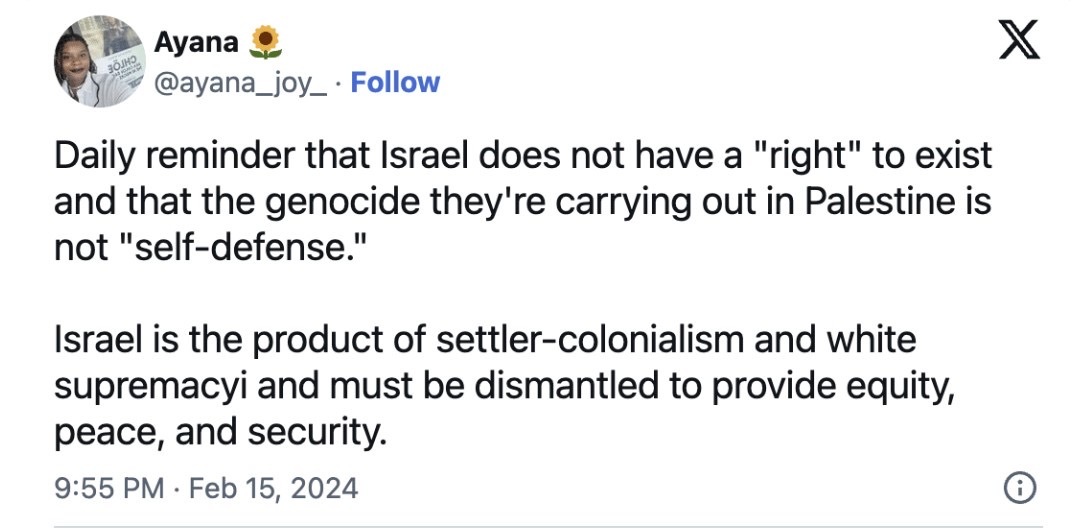
While he has accused Israel of genocide and voiced support for the Boycott, Divestment and Sanctions movement against Israel, Fateh’s communications manager, Ayana Smith-Kooiman, has endorsed the Hamas attacks as a justified act of “resistance” and declared that Israel “does not have a ‘right’ to exist” and “must be dismantled,” among several other now-deleted social media posts reviewed by JI.
In addition, David Gilbert-Pederson, a local political activist and City Council aide who has been listed as a Fateh campaign staffer in filings, has unreservedly praised Hamas’ violence against Israel. Speaking in December 2023, Gilbert-Pederson celebrated “what happened collectively for the people of Palestine on Oct. 7” and said supporters of the Palestinian cause must “stand in unconditional solidarity with those resisting oppression.”
Despite Klobuchar’s new condemnation of such rhetoric, most of Frey’s leading allies in the hotly contested mayoral race have so far refrained from commenting on the situation. Representatives for Walz have not responded to multiple requests for comment on the staffers or Fateh’s acceptance of their views.
Prominent Democratic officials who have not taken sides in the race have likewise declined to weigh in on the matter.
Fateh’s campaign did not respond to a request for comment on Wednesday.
The state senator is set to host a “Jews for Fateh” fundraiser early next month, according to an event page, which notes that attendees will learn about his “campaign’s movement to build a city that leaves no one behind.”
Both objectives — 'total victory' over Hamas and Palestinian statehood — are at present incompatible with the realities on the ground

Elke Scholiers/Getty Images
IDF soldiers prepare tanks on August 18, 2025 near the Gaza Strip's northern borders, Israel.
Israel is finalizing plans this week for a ground offensive into Gaza City, with the goal of having fully evacuated the city by the symbolic date of Oct. 7, 2025. Speaking at his weekly Sunday meeting, Israeli Prime Minister Benjamin Netanyahu said that Israel would “complete the victory” over Hamas. Tens of thousands of IDF reservists will begin receiving call-up notices today in preparation for the offensive.
The plans come amid a renewed push for Palestinian statehood, led by France and Saudi Arabia, that has seen a surge in support from global heads of state, including Canadian Prime Minister Mark Carney and Australian Prime Minister Anthony Albanese.
Palestinian statehood efforts also have support in Congress, where Rep. Ro Khanna (D-CA) is leading a group of House Democrats in calling on President Donald Trump to recognize a Palestinian state.
But both objectives — “total victory” over Hamas and Palestinian statehood — are at present incompatible with the realities on the ground.
Netanyahu has not wavered from his stated objective of “total victory” — even as he has yet to articulate, in practical terms, what that looks like — or how the Gaza City offensive will achieve it.
The goal of “total victory” over Hamas also runs into the challenge that the U.S. and Western allies faced amid the spread of ISIS a decade ago — that eliminating a group’s top leadership (as Israel has done in its targeting of Yahya and Mohammed Sinwar, Mohammed Deif and Marwan Issa, among others), but not its ideology, will attract new recruits to swell the ranks left empty by those who came before them.
Outside of Israel, efforts to unilaterally recognize Palestinian statehood have ignored core challenges facing both Palestinian society and government, the former of which was plagued by antisemitic and anti-Israel rhetoric long before Oct. 7, 2023, and the latter of which has for decades been mired in corruption and nepotism and lacks the ground support needed for long-term stability.
Further, leading Israeli officials have described the renewed Palestinian statehood push as a reward for Hamas’ Oct. 7 attacks and view a path to statehood rooted in the deadliest attack in Israeli history as obscene — and one that ignores the long path of deradicalization and reforms necessary before such measures are discussed.
Marcus Sheff, the executive director of IMPACT-se, an NGO that monitors and provides recommendations for curricula and educational materials across the Arab world, noted that many of the European governments that back unilateral Palestinian statehood are the same nations that “directly or indirectly” fund Palestinian curricula that incite violence against Jews and Israelis, damaging efforts to prepare a population for statehood.
“To talk about any Palestinian state without taking on, headfirst, the necessity of deradicalizing Palestinians through the education system, and even worse, being a party to their radicalization by financing it, is actually quite bizarre,” Sheff added.
The limitations of reality are a reminder that wars are fought in clashes and not catchphrases, in policies rather than platitudes. It’s easier to declare a Palestinian state than to do the work of nation-building, just as it is easier to pledge “total victory” over a deeply entrenched ideology than to strategically chart the course of its defeat.
The New York Democrat told JI ‘the majority of people see the value and the special nature of our relationship with our ally Israel’

Andrew Harnik/Getty Images
Rep.-elect Laura Gillen (D-NY) poses for a photograph after joining other congressional freshmen of the 119th Congress for a group photograph on the steps of the House of Representatives at the U.S. Capitol Building on November 15, 2024 in Washington, DC.
Rep. Laura Gillen (D-NY) said she came away from her recent visit to Israel feeling resolute in her determination to strengthen the U.S.-Israel relationship and support the Jewish state in its efforts to bring all remaining hostages in Gaza home.
Gillen, a freshman lawmaker who represents a Nassau County, Long Island, swing district with a significant Jewish population, took part in a delegation of 14 House Democrats to the Jewish state last week. The trip was sponsored by the AIPAC-affiliated American Israel Education Foundation, which organized a similar visit to Israel for House Republicans the week prior that overlapped for several days with the Democratic trip.
“We need to continue to strengthen the relationship between the United States and Israel,” Gillen told Jewish Insider in an interview on Monday. “The most important thing is: We need to be consistently supporting Israel. Hamas needs to end this war. It needs to give the hostages back. That’s something that can happen today, and the world needs to remember that.”
The Long Island lawmaker noted that the trip, her first visit to Israel as a member of Congress, highlighted the nonpartisan nature of support for Israel in the United States and sent a message that the vast majority of Americans are behind the Jewish state.
“Just being on this trip with colleagues from the other side, having the opportunity to sit down and talk about some of the things that we saw, the conversations we were having with various elected officials and various nonprofit groups and business leaders in Israel, and talking to our colleagues on the other side of the aisle about what we’re sharing, the shared experience of visiting Israel, I think is really important going forward,” Gillen said.
“I think it’s important for the world to see this, that the detractors are the extremes on both sides of the aisle, that the majority, I believe, of people see the value and the special nature of our relationship with our ally Israel,” she continued.
The trip comes amid increasing tensions between the Israeli government and some of the most vocal pro-Israel Democrats on Capitol Hill, many of whom have expressed concern over the humanitarian crisis in Gaza and Israel’s recently finalized plans to expand the war and conduct a military takeover of Gaza City.
Gillen said that the response from constituents to her trip has been overwhelmingly positive. “The folks that I have been speaking with, they’ve been glad that I went to Israel. They were glad that I could share stories about what I saw going on there, the stories about how aid is actually getting into Gaza, the challenges that are faced, the stories about meeting with the hostages’ families,” she told JI, adding, “people are losing sight of what is going on with this conflict.”
Placing blame for the war in the hands of Hamas, Gillen noted, “We have to keep reminding the world that that is why people are suffering.”
The House Democrat said that the most consistent concerns she heard from Israeli officials and citizens were focused on securing the release of the remaining hostages in Gaza.
“The No. 1 feeling that I got is [that] people want the hostages home. Everywhere you look you see pictures of the hostages, whether it’s arriving in the airport where their photographs are up to just on a fence outside a private home. That’s the most overwhelming sentiment, I think, is we need to get the hostages home, and we need to get them back alive,” Gillen said.
Asked about her sense of public sentiment among Israelis nearly two years since the Oct. 7, 2023, attacks on Israel, Gillen replied: “I’m always in awe of the resilience of the Israeli people.”
Gillen pointed to her tour of Kibbutz Nir Oz, one of the communities in southern Israel targeted on Oct. 7, and said her guide “was telling us the stories and the horrible things that happened all around her that day, to her neighbors and friends, but she also talked about how they’re going to rebuild. They’re going to come back, and they’re going to be stronger than they were before.”
In addition to seeing the sites of the Oct. 7 attack, the group toured the Old City of Jerusalem and visited the Western Wall and Yad Vashem — the World Holocaust Remembrance Center. The lawmakers also traveled to northern Israel and the Golan Heights. They received several briefings from IDF officials, including one on Iranian threats to Israel from IDF Maj. Gen. Tamir Hayman, former Military Intelligence Directorate chief.
The trip featured meetings with hostage families and senior Israeli officials, including with Israeli Prime Minister Benjamin Netanyahu, President Isaac Herzog and Opposition Leader Yair Lapid. The group also met with U.S. Ambassador to Israel Mike Huckabee, whom Gillen’s office said she “had the honor of introducing” to her colleagues on the trip, as well as hostage families.
Regarding a visit to Ashdod Port to see the World Food Program’s aid collection operation on the ground, Gillen told JI, “it was a top priority for our delegation to find out what is going on in terms of humanitarian aid getting into Gaza.”
“One of things we took away is [that] it’s very challenging because they are trying to distribute food in an active war zone, so that makes it harder to get the aid to the folks who need it most. However, there is aid going into Gaza. There’s agreement there, and that the challenges in getting aid are caused by Hamas,” Gillen said.
“Hamas’ military operations are hurting the ability of all aid organizations to get the food to the people who need it, but certainly aid is getting into Gaza,” she continued. “There’s agreement also that we need to, or they need to, increase the number of distribution sites, but that’s being made more challenging because of Hamas’ activities.”
Trump’s senior director for counterterrorism: ‘I was worried by this neo-Buchanan isolationism, but I look at President Trump's actions, they have no hold on him’
JIM WATSON/AFP via Getty Images
U.S. Senior Director for Counterterrorism Sebastian Gorka walks outside the White House in Washington, DC, on May 7, 2025.
Seb Gorka, the White House senior director for counterterrorism and a deputy assistant to the president, aired his grievances with the anti-Israel faction within the Republican Party on Tuesday, alleging that the wing of the GOP aligned with podcast host Tucker Carlson is “basically Pat Buchanan in a new guise.”
Gorka made the comments in a conversation on counterterrorism and U.S. strategy at the Hudson Institute after being pressed on the foreign policy disputes within the MAGA movement and Carlson’s grievances with President Donald Trump’s decision to strike Iran’s nuclear facilities in June.
Asked by moderator Michael Doran, a Hudson senior fellow and director of the Center for Peace and Security in the Middle East, if he was comfortable addressing the growth of anti-Israel, antisemitic sentiment on right-wing podcasts and social media, Gorka replied, “Yeah, I am, because it bothers me immensely, but I’ve come to a certain realization with regards to that, that this wing of isolationism is nothing new. We had this 100 years ago.”
“This is just a poor, substandard repackaging of neo-Buchananite isolationism,” Gorka said, referencing Buchanan, the former Nixon communications director who became an outspoken critic of Israel. “It’s actually a more shallow version. Pat is far smarter than this version of isolationism.”
Gorka said that he is “actually in a better place with” the onslaught of anti-Israel rhetoric from Carlson’s wing of the party than he was previously, explaining that he realized that most of the rhetoric was coming from “probably half a dozen very loud people on Twitter and Rumble,” the right-wing video platform.
“You get out of the miasma, the cesspit that is social media, and you talk to representative MAGA voters, of the 80 million that put the president back in the White House, they don’t think that we should pull down the shutters on the Pacific and the Atlantic coast,” Gorka explained. “They don’t think that Israel is the reason for Oct. 7. They actually have a very special place in their heart for Israel, and they don’t think that hospitals being bombed in Ukraine is a good thing because somebody offered NATO membership to Ukraine, allegedly, a decade ago.”
“As an immigrant to this country, a legal immigrant to the United States, one of the most trenchant indicative characteristics for me of the American people is common sense. They understand who is responsible for Oct. 7. They understand who [Russian President] Vladimir Putin is. And as such, I was worried by this neo-Buchanan isolationism, but I look at President Trump’s actions, they have no hold on him,” he continued.
Gorka then pointed to the early days of the first Trump administration, alleging that at the time, then-Defense Secretary James Mattis and Secretary of State Rex Tillerson expressed hesitation about moving the U.S. Embassy in Israel to Jerusalem out of fear that doing so would cause a third world war.
Gorka said that Trump told concerned members of his Cabinet at the time that they were going through with the move because, “A) We promised the people of Israel 23 years ago, and we’ve broken that promise every six months of 23 years. B) I promised the American electorate in the campaign. We’re doing it. And C) It’s the right thing to do.” He argued that the “moral clarity” shown by Trump on issues impacting Israel highlighted the contrast between the president and his detractors on foreign policy matters.
Earlier in the program, Gorka told Doran that the president’s approach to the Middle East was heavily focused on combating Iran.
“You need to understand one thing: When the president looks at the region, he doesn’t slice it down into cylinders of excellence. He doesn’t care if you’re the Syrian desk officer or the natural resources expert. He has one overlay for the whole AOR [Area of Responsibility], and that one metric, that one prism, is Iran, and he’s absolutely right,” Gorka said. “Iran is front and center in everything we do in the region, because they remain the greatest state sponsor terrorism, and the world would be a much safer place if that were not the case.”
Gorka noted that when Trump is asked by reporters about anything related to national security, “more than 50% of the time … the president will bring up Iran,” adding that this was “especially” the case “before [Operation] Midnight Hammer, because it really is on his mind that this is the threat. A nuclear Iran, an ideologically Islamo-fascist regime that wishes to acquire the most dangerous weapons in the world, is a threat to all decent peoples.”
Turning his attention to Israel, Gorka argued that the Jewish state’s “post-Oct. 7 operations have rewritten the map of the Middle East for the next 50 to 100 years.” He praised Israel’s military moves in Syria and Lebanon, crediting the IDF with taking down the Assad regime in Damascus and significantly weakening Hezbollah.
As for whether the U.S. will undertake additional operations in the region to target Iranian proxies, Gorka said the “jury is still out on that,” but praised Trump’s strikes against the Houthis.
“We had great success with our operation against the Houthis. Again, it wasn’t well understood by the so-called experts. For the president, the action against the Houthis was about one thing and one thing alone. When we told him there had been 150 attacks against U.S. vessels going through the Straits and that they’d actually fired on naval vessels as well, he said, ‘Well, that will not be allowed to stand.’ It’s not just about U.S. interests [but] about global freedom of maritime transport. So all of these things are connected,” Gorka said of Trump’s motivation to strike the Iran-backed Yemeni terror group.
Gorka also disputed the notion that the president was tied down by ideological labels, but rather that he’s focused on achieving results and fixing problems: “Here’s the trouble for the Beltway with understanding the current commander in chief: there is no ideological taxonomy into which he will fall.”
Plus, Loomer lashes out
Annabelle Gordon/Bloomberg via Getty Images
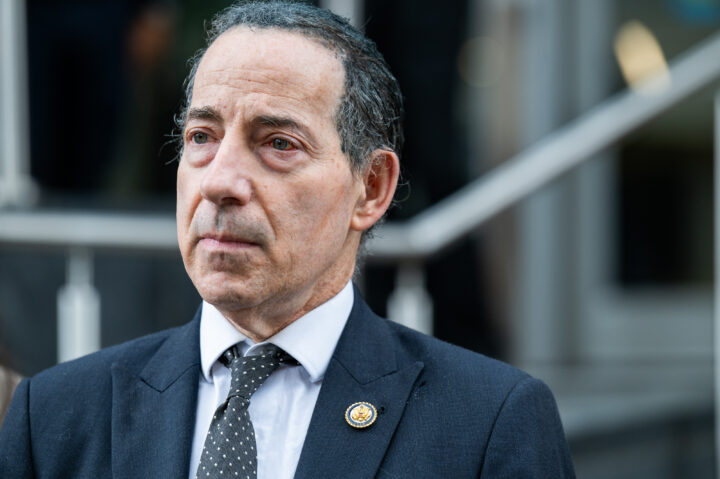
Rep. Jamie Raskin (D-MD) during a news conference in Washington, D.C., on Thursday, May 22, 2025.
Good Tuesday afternoon.
This P.M. briefing is reserved for our premium subscribers like you — offering a forward-focused read on what we’re tracking now and what’s coming next.
I’m Danielle Cohen-Kanik, U.S. editor at Jewish Insider and curator, along with assists from my colleagues, of the Daily Overtime briefing. Please don’t hesitate to share your thoughts and feedback by replying to this email.
📡On Our Radar
Notable developments and interesting tidbits we’re tracking
Ron Halber, CEO of the Jewish Community Relations Council of Greater Washington, called Rep. Jamie Raskin’s (D-MD) decision to co-sponsor legislation severely restricting U.S. aid to Israel “extremely disappointing,” telling Jewish Insider today that he had a “very honest and frank conversation” with the congressman, whom he considers a friend.
Halber framed his concerns with Raskin, a prominent progressive Jewish lawmaker, within the broader trend of the Democratic Party moving away from its long-standing support for Israel. “It’s difficult when two-thirds of our community is voting for a political party whose base is hostile to Israel,” he remarked.
“Once the war comes to an end, the whole Jewish community is going to have to re-strategize,” Halber said.
The JCRC of Greater Washington CEO said he had asked Raskin to remove himself as a co-sponsor of the bill and instead issue a statement conveying his concerns with Israel’s war in Gaza. “If he doesn’t, we will be disappointed, but that’s his decision to make and he has to live with the ramifications of his decision”…
Speaking this morning at a briefing co-hosted by the American Jewish Congress and World Zionist Organization, U.S. Ambassador to Israel Mike Huckabee sounded a cautious note on the current ceasefire negotiations with Hamas, as reports indicate the terror group has accepted a Qatari- and Egyptian-backed proposal.
“Whether or not [Hamas is] serious about bringing this to a close, all I can tell you is I hope so. But what’s happened before, even when they say they are thinking seriously about bringing this to a conclusion, making a deal, they always add one or more things that are completely unacceptable, bring those to the table, then it all starts over again,” Huckabee said.
Israel has yet to respond to the proposal and White House Press Secretary Karoline Leavitt said at a press briefing today that the U.S. “continues to discuss” it…
Huckabee and his wife, Janet, hosted U.S. Ambassador to France Charles Kushner and his wife, Seryl, in Jerusalem tonight…
Israeli Defense Minister Israel Katz met with Lt. Gen. Eyal Zamir, the IDF’s chief of staff, today to approve the IDF’s plans to take over Gaza City. Israeli officials said Gazans will have until Oct. 7 to evacuate the city, to coincide with the second anniversary of Hamas’ attacks, at which point the IDF offensive will begin. It remains to be seen if a ceasefire and hostage-release deal will be reached before then…
The Israeli government also voted today to approve a $9 billion increase to the country’s budget for the year, including $473 million for humanitarian aid for Gaza…
In other negotiation news, Israeli Minister for Strategic Affairs Ron Dermer is scheduled to meet this evening in Paris with Syrian Foreign Minister Asaad al-Shibani and U.S. Ambassador to Turkey and Syria envoy Tom Barrack to discuss security arrangements on the Israel-Syria border.
The meeting comes a day after Barrack, while visiting Beirut, said Israel needs to “comply with [an] equal handshake” to the Lebanese government’s commitment to disarm Hezbollah by fully withdrawing its troops from Lebanon…
Back stateside, the president of the American Association of University Professors said in a recent interview, “We believe strongly that no weapons should be sent to Israel, at all. Not defensive or offensive, nothing,” escalating the association’s adversarial stance against the Jewish state…
The New York Times chronicles the Trump administration’s attempts to wrest financial settlements from elite universities, including ongoing negotiations with Harvard and the University of California, Los Angeles, the latter of which may pay the administration upwards of $1 billion, according to a draft agreement…
Media mogul Shari Redstone told the Times that she decided to sell Paramount to Skydance in a recent $8 billion merger in part due to her frustrations over anti-Israel bias at CBS, particularly after the Oct. 7 attacks. “Once that happened, I wanted out,” Redstone said. “I wanted to support Israel, and address issues around antisemitism and racism”…
Rep. Ritchie Torres (D-NY) endorsed New York Gov. Kathy Hochul in her reelection bid today, after initially exploring a run against her and criticizing her tenure…
The Free Press reports on growing frustration with Laura Loomer, a right-wing provocateur and informal advisor to President Donald Trump, inside the White House, with some officials speculating she may be paid or influenced by lobbying firms and business interests.
Loomer lashed out on X, telling Free Press reporter Gabe Kaminsky he should “contact your anonymous White House sources who are so horrified by ‘lobbyists’ and their intentions and ask them how they feel about their friendship with” Jeff Miller, a Republican strategist, board member of the Republican Jewish Coalition and Trump-appointed member of the U.S. Holocaust Memorial Council…
⏩ Tomorrow’s Agenda, Today
An early look at tomorrow’s storylines and schedule to keep you a step ahead
Keep an eye on Jewish Insider tomorrow morning for an interview with top New York Democrat Rep. Laura Gillen (D-NY) on her takeaways from a recent visit to Israel.
This evening, Maryland Gov. Wes Moore, a potential 2028 presidential contender, will speak at D.C.’s Politics & Prose on “the role of states in preserving and advancing U.S. democracy.”
Tomorrow, the historic Sinai Temple in Los Angeles will host a conversation with Ahmed Fouad Alkhatib, the director of the Realign for Palestine program at the Atlantic Council who was born and raised in Gaza. It’s the second event in a series the prominent Conservative synagogue has held about the war in Gaza for its congregants, the first of which was held last month with Gaza Humanitarian Foundation head Johnnie Moore. Read JI’s coverage of Moore’s conversation here.
CALIFORNIA COMPETITION

Sherman, a stalwart pro-Israel Democrat, is facing several politically connected Democratic challengers in next year’s primary
CLARK’S CLARIFICATION
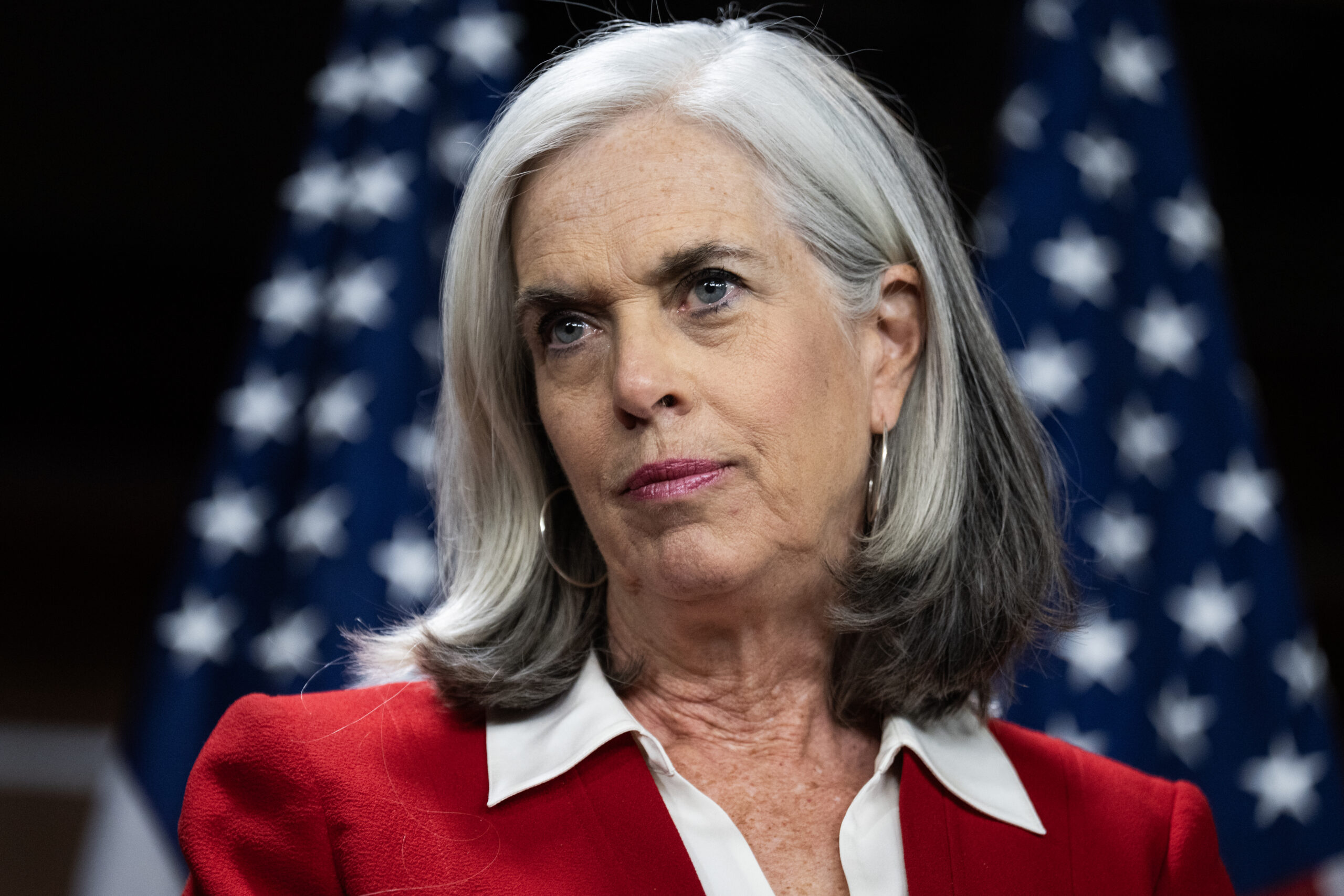
AIPAC said its endorsement is ‘unchanged’ and based on the House minority whip’s ‘long-standing support for the U.S.-Israel relationship’
Huckabee: ‘We’re not dealing with a nation state. We’re dealing with savages’

Chip Somodevilla/Getty Images
Mike Huckabee moderates a roundtable discussion with President Donald Trump on Oct. 29, 2024 in Drexel Hill, Pennsylvania.
U.S. Ambassador to Israel Mike Huckabee said on Tuesday he is “optimistic” while also remaining “realistic,” about the latest round of ceasefire and hostage-release negotiations with Hamas.
“I want to be optimistic about a deal with Hamas but I’m also aware of who we are dealing with, we’re not dealing with a nation state. We’re dealing with savages,” Huckabee said during an online briefing co-hosted by the American Jewish Congress and World Zionist Organization.
The former governor of Arkansas’ comments come as Hamas has reportedly agreed to a 60-day ceasefire proposed by Qatari and Egyptian mediators, during which some of the remaining 50 hostages would be released. Israel had not responded to the proposal as of Tuesday afternoon.
“Whether or not [Hamas is] serious about bringing this to a close, all I can tell you is I hope so. But what’s happened before, even when they say they are thinking seriously about bringing this to a conclusion, making a deal, they always add one or more things that are completely unacceptable, bring those to a table, then it all starts over again,” he continued.
“So I’m not going to give up, I’m always going to be optimistic, but I’m also realistic,” Huckabee said. “These are not people that come to the table because they are reasonable,” he said referring to Hamas.
Huckabee also spoke about what Gaza could look like after the war ends. “It’s going to be a very different future and we don’t know exactly where it’s going,” he said, claiming that most Gazans he’s met with do not want Hamas in control, nor do they want the Palestinian Authority, Palestine Liberation Organization or Fatah in power.
“One thing we can agree on is Hamas can’t win, they can’t stay, they must disarm,” he said. The ambassador condemned France and the United Kingdom for their intent to formally recognize a state of Palestine. Doing so, he said, is “empowering and emboldening Hamas.”
Huckabee lauded the June 22 U.S. airstrikes on Iran’s nuclear facilities, which “obliterated their nuclear capacity,” but he cautioned that Iran still has “nuclear aspirations.”
“You would think they would give those up in light of what happened to them,” Huckabee said.
“Iran is still talking about how to get nuclear capacity. I would say to them, ‘You’ve been kicked once you don’t want to go through it again.’ But if it has to be, it will be.”
Under new President Todd Wolfson’s leadership, the group dropped its longtime opposition to academic boycotts last year
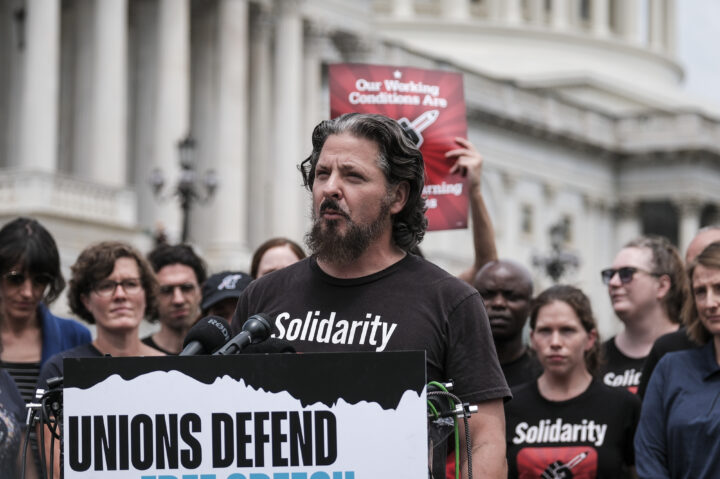
Michael A. McCoy/Getty Images
Todd Wolfson, AAUP president, speaks to the press during a press conference on Capitol Hill on May 23, 2024 in Washington, DC.
The head of the American Association of University Professors said in a recent interview that the United States should not send defensive weapons to Israel amid its war against Hamas, which he called a genocide in Gaza.
“We believe strongly that no weapons should be sent to Israel, at all. Not defensive or offensive, nothing,” Todd Wolfson, the president of AAUP, told Inside Higher Ed.
“First and foremost, our job is to safeguard ourselves at home and to set a vision that aligns with what we’re trying to do in the United States,” Wolfson, who was elected president in June 2024, continued. “We need to stand up for academic freedom, for freedom of speech, for freedom of assembly for our students so they can protest the war — the genocide, excuse me — that’s taking place in Gaza.”
Wolfson, who is on leave from his position as a Rutgers University associate professor of journalism and media studies until 2027, has a history of making hostile comments towards Israel.
In response to Israeli Prime Minister Benjamin Netanyahu’s condemnation of the anti-Israel encampments and building occupations that overtook dozens of campuses around the U.S. in the spring of 2024, Wolfson wrote on X that Netanyahu is a “fascist” who has “no right to talk about peaceful protests in the U.S. as he murders thousands in Gaza.” In July 2024, Wolfson tweeted a petition urging the New Jersey Senate to vote against adopting the International Holocaust Remembrance Alliance’s working definition of antisemitism. “Anti-Zionism is not antisemitism,” he wrote.
Under Wolfson’s leadership, AAUP dropped its longtime opposition to academic boycotts in August 2024. Although the policy does not mention Israel, the move led to faculty members on several campuses implementing non-official boycotts of Israel by not assigning articles written by Israeli scholars, refusing to invite Israeli academics to conferences and declining to write study abroad letters for students wishing to spend a semester in Israel.

AP Photo/Abbie Parr
U.S. Senator Amy Klobuchar, left, and Minnesota Gov. Tim Walz, right, arrive at a press conference ahead of the U.S. Gymnastics Olympic Trials Monday, June 24, 2024, in Minneapolis.
Good Tuesday morning.
In today’s Daily Kickoff, we report on House Minority Whip Katherine Clark’s walkback of her previous comment that Israel is committing genocide in Gaza, and spotlight the Democratic primary in California’s 32nd District, where Rep. Brad Sherman is facing challenges from two millennial political neophytes. We talk to Gaza Humanitarian Foundation head Johnnie Moore about recent threats made against him by anti-Israel activists, and report on a campaign to boycott Israel within the American Association of Geographers. Also in today’s Daily Kickoff: Rabbi Berel Wein, Santa Ono and Pierre Poilievre.
What We’re Watching
- We’re keeping an eye on ceasefire efforts in Cairo, following Hamas’ acceptance of a Qatari- and Egypt-proposed deal. Israeli Prime Minister Benjamin Netanyahu vowed on Monday night to move forward with plans to take over Gaza City, saying that “enormous pressure” had pushed Hamas to accept the partial-ceasefire proposal.
- In a post to his Truth Social site on Monday, President Donald Trump said that “we will only see the return of the remaining hostages when Hamas is confronted and destroyed.”
- Today marks the first yahrzeit, or Hebrew anniversary, of the deaths of six hostages in Gaza, including Israeli American Hersh Goldberg-Polin, whose family is holding a memorial this evening in Jerusalem.
- With the House and Senate out for the August recess, a number of legislators are making trips abroad. Sens. Joni Ernst (R-IA) and Markwayne Mullin (R-OK), as well as Rep. Jason Smith (R-MO), are among the legislators in Jordan this week. The delegation met with King Abdullah II yesterday in Amman.
- U.S. Ambassador to Israel Mike Huckabee is holding a virtual briefing at noon ET today with the American Jewish Congress.
- In Washington, the Hudson Institute is hosting the White House’s Seb Gorka for a conversation about counterterrorism and the U.S.’ approach to addressing global terrorist threats.
What You Should Know
A QUICK WORD WITH JI’S JOSH KRAUSHAAR
If there is one word to describe the political mood in dealing with rising antisemitism, it would be apathy. Even the most jaw-dropping displays of anti-Jewish hatred — from abject Holocaust denial on far-right podcasts to support for Hamas’ atrocities on the extreme left — are increasingly responded to with shrugs from mainstream political leaders.
The most recent example of obvious antisemitism being ignored by a party’s political class came out of Minnesota, where we reported about Minneapolis Democratic mayoral candidate Omar Fateh — running as a democratic socialist against sitting Mayor Jacob Frey — hiring top staff who celebrated Hamas’ Oct. 7 terror attacks.
In normal times, a candidate would be ashamed to be associated with extremists, and would immediately cut ties with the offending staffers. Not long ago, having ties to that type of extremist rhetoric would be disqualifying for the candidate as well.
But these are not normal times. Not only has Fateh, a state senator, ignored the controversy entirely, but the local and national media has been uninterested in following up on Jewish Insider’s reporting about the radical operatives on Fateh’s team.
Even more shocking: Two of Frey’s most prominent backers, Sen. Amy Klobuchar (D-MN) and Minnesota Gov. Tim Walz — have remained silent when asked about their thoughts about the antisemitism stemming from an endorsee’s political rival. It’s a sign that many mainstream Democrats fear that speaking out against antisemitism or anti-Israel extremism could lead to a backlash from other grassroots supporters.
At best, it’s a sign that speaking out against hate carries few political benefits these days.
CLARK’S CLARIFICATION
After a video surfaced last week of Rep. Katherine Clark (D-MA), the House minority whip, referring to Israel’s actions in Gaza as genocide, Clark walked back the remark on Monday — and maintained her endorsement from AIPAC amid the controversy, a spokesperson for the group told Jewish Insider’s Gabby Deutch. “Last week, while attending an event in my district, I repeated the word ‘genocide’ in response to a question,” Clark told the Jewish News Syndicate on Monday. “I want to be clear that I am not accusing Israel of genocide. … We all need to work with urgency to bring the remaining hostages home, surge aid to Palestinians and oppose their involuntary relocation, remove Hamas from power and end the war.”
Sticking by her: AIPAC spokesperson Marshall Wittmann told JI on Monday that the organization will stick by Clark, the No. 2 Democrat in the House. “We appreciate that the congresswoman clarified her remarks, as Israel is fighting a just and moral war against a barbaric terrorist enemy. Our endorsement is unchanged and based upon her long standing support for the U.S.-Israel relationship,” Wittmann said.
CALIFORNIA COMPETITION
When Rep. Brad Sherman (D-CA) was first elected to Congress in 1996, his two opponents in the current race, Democrats Jake Rakov and Jake Levine, were 8 and 12 years old, respectively. Both candidates are making a generational appeal: They argue that California’s 32nd Congressional District, which encompasses several tony neighborhoods on the west side of Los Angeles, including Malibu and the Pacific Palisades, as well as much of the San Fernando Valley, needs bold new representation to respond to the challenges of the moment. Neither Rakov, 37, nor Levine, 41, has held elected office before, and both have spent the past several years away from Los Angeles. They will each face a tough, drawn-out fight if they hope to have a chance against a battle-tested incumbent in a primary election that’s still more than nine months away, Jewish Insider’s Gabby Deutch reports.
Primary pressure: The San Fernando Valley district is solidly blue, but it’s also an affluent constituency that isn’t all that enamored with the progressive wing of the Democratic Party. That doesn’t mean Sherman, who is 70, is automatically safe from an upstart candidate who might excite the base in his district. “At this point, he’s pretty much become background noise. There’s no animosity against him. His constituents are perfectly content to continue sending him back to Congress, and most of them believe that he does a perfectly serviceable job,” said Dan Schnur, a political analyst in L.A. who teaches at both the University of Southern California and the University of California, Berkeley. “But that’s exactly the type of incumbent that’s vulnerable to a generational challenge in this landscape.”
VIOLENT DISSENT

Rev. Johnnie Moore, executive chairman of the Gaza Humanitarian Foundation, has spent the past two weeks under “24/7 protection while evil wants to kill me,” he told attendees of the Rohr Jewish Learning Institute’s annual National Jewish Retreat, held last week at the Omni Shoreham Hotel in Washington. Moore was referring to some 50 anti-Israel demonstrators who have protested outside of his Northern Virginia home multiple times in recent weeks — making death threats and painting graffiti. Moore told Jewish Insider’s Haley Cohen he has received “two credible death threats,” which are currently under investigation, adding that police have “done an extraordinary job taking it seriously” and made one arrest for destruction of property.
Opposite effect: As well as demonstrating outside Moore’s home, the Palestinian Youth Movement has also protested outside the nearby home of John Acree, the interim executive director of the GHF. “I never thought that it would be so life-threatening to do something so obviously right,” Moore told supporters of JLI, an educational arm of Chabad-Lubavitch, at a VIP reception Thursday night, referring to his work with GHF. “If they’re doing this to try and force us to quit, in fact it’s going to have the exact opposite effect because every attack, every threat, every lie is only more proof that what we’re doing is right and it’s essential,” Moore, a member of President Donald Trump’s evangelical advisory committee, told JI.
SCOOP

The Association of American Geographers became the latest professional association to face pressure to adopt a boycott of Israel after a recent member petition urged the association “to endorse the campaign for an academic boycott of Israeli academic institutions,” Jewish Insider’s Haley Cohen reports.
On the agenda: The campaign also calls for “financial disclosure and divestment of any AAG funds invested in corporations or state institutions profiting from the ongoing oppression of the Palestinian people.” A special member meeting is scheduled for Oct. 3 to move toward a vote on the resolution after the group behind the petition succeeded in reaching the required 10% of member signatures. An AAG spokesperson told JI that the organization has “no statement or resolution about Israel-Palestine.” AAG did not respond to a follow-up inquiry asking which Israeli institutions the association currently invests in.
NEW GIG

Santo Ono, the former president of the University of Michigan, is set to become the inaugural director of the Ellison Institute of Technology, a research and development center, he announced on Monday. “I am humbled to share that I’ve been appointed Global President of the Ellison Institutes of Technology (EIT), reporting directly to its founder and chairman, Larry Ellison,” Ono wrote in a social media post. Ellison is also the founder and chairman of the software company Oracle and a major donor to Jewish and Israeli causes, Jewish Insider’s Haley Cohen reports.
Background: The appointment comes two months after Ono was rejected by the Florida Board of Governors as the University of Florida’s next president. At a board meeting in June, Ono, who resigned from his position at the University of Michigan in May, was questioned by the board, which oversees the state’s 12 public universities, about an anti-Israel encampment last year that remained on the Michigan campus for a month. Board members also scrutinized his response to antisemitism on campus after the Oct. 7, 2023, terrorist attacks, which some called inadequate.
BARUCH DAYAN EMET

Rabbi Berel Wein, the influential Orthodox rabbi, historian and “Voice of Jewish History,” died Saturday in Jerusalem at 91, eJewishPhilanthropy’s Jay Deitcher reports. Born in Chicago in 1934, Wein descended from seven generations of Lithuanian rabbis. He was educated in both secular studies and religious studies, receiving a bachelor’s degree from Roosevelt University and a law degree from DePaul University while completing his rabbinic ordination at Hebrew Theological College. After moving to New York City, Wein began his journey of constant reinvention, first serving as executive vice president of the organization now known as the Orthodox Union. Then he became rabbinic administrator of OU Kosher and founded Congregation Bais Torah and Yeshiva Shaarei Torah in Monsey, N.Y.
Life-shaping moment: As a boy studying at a Chicago yeshiva in 1946, Wein heard Rabbi Isaac Herzog, then the Ashkenazi chief rabbi of the British Mandate of Palestine, recount a plea he had made to the pope to help retrieve the thousands of Jewish children who had been hidden in Catholic institutions as a way to protect them from the Nazis. The pope refused saying the children had already been baptized. After telling his story, Herzog, his eyes still wet with tears, looked into the crowd of nearly 250 people. “I cannot do anything more for those 10,000 children,” Wein recalled Herzog saying. “But what are you going to do to build the Jewish people?” In the years that followed, Wein became a lawyer, rabbi, historian, dean, producer and writer whose lectures have been purchased on tape, CD and streaming platforms over 1 million times worldwide.
Read the full obituary here and sign up for eJewishPhilanthropy’s Your Daily Phil newsletter here.
Paying respects: Israeli President Isaac Herzog, the grandson of Rabbi Herzog, attended the shiva for Wein.
Worthy Reads
How Would Mamdani Govern?: The Atlantic’s Michael Powell considers what strain of socialist governance New York City Democratic mayoral nominee Zohran Mamdani would, if elected, bring to City Hall. “Mamdani, 33, conveys that he is a man prepared to work with the organs of capitalist democracy to progressive ends and not to demand ideological litmus tests. But the Mamdani who takes great pride in his identity as a member of Democratic Socialists of America and who told ‘Meet the Press’ in late June that ‘I don’t think we should have billionaires’ — to the alarm of Wall Street donors — has hardly disappeared. By his own account, his political journey from state assemblyman to mayoral nominee owes almost entirely to his umbilical connection with DSA. … The political left from which Mamdani emerges is a collection of disorderly tribes, sheltering self-styled revolutionaries alongside those who prize compromise and electoral victory, and those who want to sand the edges off capitalism alongside those who want to replace it altogether.” [TheAtlantic]
Still On Guard: Bloomberg’s Golnar Motevalli looks at how Iran’s Islamic Revolutionary Guard Corps has become “more critical” to Tehran’s survival following the 12-day war between Israel and Iran in June. “The Guard comprises a navy, ground troops, aerospace, an elite unit called the Quds Force and the Basij volunteer paramilitaries. It also has its own intelligence organization that’s known to directly compete with — and sometimes work against — the government’s Ministry of Intelligence. … Now, the galvanizing impact of Israel’s attacks on nationalist sentiment in Iran may have already helped improve public support for the IRGC, according to Narges Bajoghli, associate professor of Middle East Studies at the School of Advanced International Studies, Johns Hopkins University. ‘People are angry at them, but they also realize that there is no other force in the country,’ she said. ‘What they’re committed to today, is about sovereign independence and the idea of resistance to Western and Israeli imperialism.’” [Bloomberg]
Ending Hostage Diplomacy: In The Washington Post, Diane Foley, whose son James Foley was killed in Syria by ISIS after two years in captivity, suggests how the U.S. government can more forcefully address the taking of American hostages by rogue and enemy regimes. “The Trump administration should swiftly exercise this new authority to signal that engaging in hostage diplomacy has consequences. Designated states could face visa restrictions, sanctions, controls on U.S. exports, reductions or elimination of foreign assistance, and asset seizures. … Eleven years after Jim’s murder, the use of Americans as political leverage remains a tragic feature of international relations. A coordinated effort to deter and prevent unjust captivity abroad is the necessary next step to ensure that our government not only never again abandons its citizens, but also places their safety and security at the forefront of U.S. foreign policy.” [WashPost]
Word on the Street
President Donald Trump said on Monday afternoon that he had begun making arrangements for a meeting between Ukrainian President Volodymyr Zelensky and Russian President Vladimir Putin, following his meeting with Zelensky and foreign heads of state in Washington earlier in the day…
The State Department pulled the visas of some 6,000 foreign students, the majority of whom had overstayed their visas or committed crimes while in the U.S.; between 200-300 of the visas revoked were due to terror ties, including fundraising for U.S.-designated terrorist groups…
Rep. David Schweikert (R-AZ) is mulling joining the state’s 2026 gubernatorial race, potentially setting up a high-stakes contest in the state’s purple 1st Congressional District, where five Democrats have already entered the race…
Soho House reached a $2.7 billion deal in which it will be taken private by a group of New York-based investors led by MCR Hotels; as part of the deal, Apollo Global Management, led by partner Reed Rayman, will contribute $800 million in debt and equity financing…
CBS News spotlights the Chicago chapter of “Lox & Loaded,” a group that trains members of the Jewish community and allies on firearm use, amid a rise in antisemitic attacks and concerns about personal safety among community members…
George Washington University suspended its campus chapter of Jewish Voice for Peace through May 2026, following a series of complaints over misconduct, harassment and Title VI violations by the group; a member of the JVP chapter told GWU’s Hatchet that the group planned to disaffiliate from the university over the multiple clashes with the school’s administration in recent years…
Canadian Conservative Party leader Pierre Poilievre won a byelection to a rural Alberta-based House of Commons seat, four months after losing his seat in an Ottawa-area district; Poilievre won the seat, which was vacated by Conservative MP Damien Kurek so that Poilievre could run, with 80% of the vote…
Norges, Norway’s sovereign wealth fund, sold off six Israeli companies in addition to the half dozen it had previously announced divesting last month; Norwegian Finance Minister Jens Stoltenberg told reporters that “there might be more exclusions to come” as Oslo’s central bank makes more referrals to the fund’s external ethics council…
Former U.K. Labour MP Zarah Sultana said that Jeremy Corbyn, the former Labour leader who was ousted over the party’s handling of antisemitism and formed a new party with Sultana last month, had made a “serious mistake” in “capitulating” to the International Holocaust Remembrance Alliance’s working definition of antisemitism…
The Gaza Humanitarian Foundation unveiled a pilot program that will allow Palestinian families to reserve food parcels in advance, in an effort to increase order at the distribution sites, which have faced crowding, violence and supply issues…
U.S. Ambassador to Turkey Tom Barrack, who is also serving as Syria envoy, called on Israel to comply with a phased plan to end its military operations in Lebanon in exchange for the disarmament of Hezbollah by the end of the year…
Israel’s Foreign Ministry revoked the visas of Australian diplomats to the Palestinian Authority, who live in Israel, following Canberra’s decision last week to cancel the visa of hard-right MK Simcha Rothman…
South Sudanese officials privately confirmed talks with Israel regarding the potential resettlement of Palestinians in Gaza in the East African nation, despite public denials that talks are taking place…
Qatar Airways plans to open its first exclusive lounge in the U.S. in John F. Kennedy Airport’s new international terminal; the 15,000-square-foot lounge will be built in the airport’s new Terminal 1…
Bloomberg looks at the logistical, financial and construction challenges facing Saudi Arabia’s Trojena ski resort project, located within the country’s broader Neom project, as Riyadh works to have the resort constructed in time to host the 2029 Asian Winter Games…
Graphic designer Joe Caroff, whose most famous works included James Bond’s 007 logo and the posters for “West Side Story” and “Cabaret,” died at 103…
Linguist Robin Lakoff, who focused on gender and language, died at 82…
Pic of the Day

Israeli President Isaac Herzog (second from right) and Israeli First Lady Michal Herzog (center) met this week with IsraAid CEO Yotam Polizer (left); Ruthie Rousso, the head of World Central Kitchen’s Israel operations (second from left); and World Central Kitchen founder José Andrés during Andrés’ trip to Israel and Gaza.
Birthdays

Actress and producer, known for her role as Deputy Chief Brenda Leigh Johnson in the 109 episodes of the TNT crime drama “The Closer,” Kyra Sedgwick turns 60…
One of the earliest Silicon Valley venture capital investors with positions in firms like Intel and Apple, Arthur Rock turns 99… Ventura County, Calif., resident, Jerry Epstein… Past member of both houses of the South Dakota Legislature, Stanford “Stan” M. Adelstein turns 94… Retired president of Ono Academic College in Israel, she was Israel’s ambassador to the United Nations from 2008 to 2010, Gabriela Shalev turns 84… Photographer and director of television programs and movies, Neal Slavin… Professor emeritus of religion and philosophy at the University of Toronto, he is the author of 16 books, David Novak turns 84… 42nd president of the United States, William Jefferson Clinton turns 79… Retired reading teacher for the NYC Department of Education, she co-founded the kosher pantry at Bethesda Hospital in Boynton Beach, Fla., Miriam Baum Benkoe… Actor and director, Adam Arkin turns 69… Gavriel Benavraham… Managing partner at Wolf Haldenstein Adler Freeman & Herz, Mark C. Rifkin… Co-founder and CEO of Apollo Global Management, he is the board chairman of the UJA-Federation of New York, Marc J. Rowan turns 63… Chairman of the FCC in the Obama administration, he is now a senior advisor at the Carlyle Group, Julius Genachowski turns 63… Executive editor of The New York Times, Joseph Kahn turns 61… Managing partner and talent agent at William Morris Endeavor, he is active in the contemporary art world as a collector, Dan Aloni turns 61… Former member of Knesset, he is the son of former Israeli Prime Minister Ariel Sharon, Omri Sharon turns 61… Executive administrator of the Ventura, Calif., accounting firm, Morgan, Daggett & Wotman, Carolynn Wotman… District attorney of Queens, N.Y., Melinda R. Katz turns 60… Founder and CEO of The Friedlander Group, Ezra Friedlander… Private equity financier and a founding partner of Searchlight Capital Partners, he recently joined the board of Estee Lauder, Eric Louis Zinterhofer turns 54… Chair of the Orthodox Union and past chair of The Associated: Jewish Federation of Baltimore, Yehuda L. Neuberger… Contributing editor for The Daily Beast and the author of three books, Molly Jong-Fast turns 47… Businessman and investor, Brett Icahn turns 46… Managing partner of Handmade Capital, Ross Hinkle… Laser radial sailor, she represented Israel at the 2008 (Beijing) and 2012 (London) Olympics, Nufar Edelman turns 43… Founder and principal at Aron’s Kissena Farms and Cedar Market, Aaron Yechiel Hirtz… President at Kansas City-based Eighteen Capital Group, Isaac Gortenburg… Rapper, singer and songwriter, known by his stage name Hoodie Allen, Steven Adam Markowitz turns 37… Team manager at HubSpot, Cassandra Federbusz…One of the earliest Silicon Valley venture capital investors with positions in firms like Intel and Apple, Arthur Rock turns 99… Ventura County, Calif., resident, Jerry Epstein… Past member of both houses of the South Dakota Legislature, Stanford “Stan” M. Adelstein turns 94… Retired president of Ono Academic College in Israel, she was Israel’s ambassador to the United Nations from 2008 to 2010, Gabriela Shalev turns 84… Photographer and director of television programs and movies, Neal Slavin… Professor emeritus of religion and philosophy at the University of Toronto, he is the author of 16 books, David Novak turns 84… 42nd president of the United States, William Jefferson Clinton turns 79… Retired reading teacher for the NYC Department of Education, she co-founded the kosher pantry at Bethesda Hospital in Boynton Beach, Fla., Miriam Baum Benkoe… Actor and director, Adam Arkin turns 69… Gavriel Benavraham… Managing partner at Wolf Haldenstein Adler Freeman & Herz, Mark C. Rifkin… Co-founder and CEO of Apollo Global Management, he is the board chairman of the UJA-Federation of New York, Marc J. Rowan turns 63… Chairman of the FCC in the Obama administration, he is now a senior advisor at the Carlyle Group, Julius Genachowski turns 63… Executive editor of The New York Times, Joseph Kahn turns 61… Managing partner and talent agent at William Morris Endeavor, he is active in the contemporary art world as a collector, Dan Aloni turns 61… Former member of Knesset, he is the son of former Israeli Prime Minister Ariel Sharon, Omri Sharon turns 61… Executive administrator of the Ventura, Calif., accounting firm, Morgan, Daggett & Wotman, Carolynn Wotman… District attorney of Queens, N.Y., Melinda R. Katz turns 60… Founder and CEO of The Friedlander Group, Ezra Friedlander… Private equity financier and a founding partner of Searchlight Capital Partners, he recently joined the board of Estee Lauder, Eric Louis Zinterhofer turns 54… Chair of the Orthodox Union and past chair of The Associated: Jewish Federation of Baltimore, Yehuda L. Neuberger… Contributing editor for The Daily Beast and the author of three books, Molly Jong-Fast turns 47… Businessman and investor, Brett Icahn turns 46… Managing partner of Handmade Capital, Ross Hinkle… Laser radial sailor, she represented Israel at the 2008 (Beijing) and 2012 (London) Olympics, Nufar Edelman turns 43… Founder and principal at Aron’s Kissena Farms and Cedar Market, Aaron Yechiel Hirtz… President at Kansas City-based Eighteen Capital Group, Isaac Gortenburg… Rapper, singer and songwriter, known by his stage name Hoodie Allen, Steven Adam Markowitz turns 37… Team manager at HubSpot, Cassandra Federbusz…
Moore told JI police are investigating two credible death threats against him

Courtesy
Rev. Johnnie Moore, executive chairman of the Gaza Humanitarian Foundation, has spent the past two weeks under “24/7 protection while evil wants to kill me,” he told attendees of the Rohr Jewish Learning Institute’s annual National Jewish Retreat, held last week at the Omni Shoreham Hotel in Washington.
Moore was referring to some 50 anti-Israel demonstrators who have protested outside of his Northern Virginia home multiple times in recent weeks — making death threats and painting graffiti.
“Johnnie Moore is a war criminal … We will remain on the streets, outside these criminals’ homes, until the siege on Gaza is lifted, until aid is allowed in, until we see an arms embargo against the zionist entity, and until all of Palestine is liberated, from the river to the sea,” the Palestinian Youth Movement wrote Saturday on social media, following its most recent demonstration outside of the entrance gates of Moore’s Prince William County neighborhood, about 30 miles outside of D.C.
Graffiti and signs near Moore’s home on Saturday read, “Johnnie Moore Kills Palestinians For $$$,” “Johnnie Moore Kills Babies” and “Your Neighbor is a Genocider Johnnie Moore.” Moore told Jewish Insider he has also received “two credible death threats,” which are currently under investigation, adding that police have “done an extraordinary job taking it seriously” and made one arrest for destruction of property.

The group has also protested outside the nearby home of John Acree, the interim executive director of the GHF.
“I never thought that it would be so life-threatening to do something so obviously right,” Moore told supporters of JLI, an educational arm of Chabad-Lubavitch, at a VIP reception Thursday night, referring to his work with GHF.
“If they’re doing this to try and force us to quit, in fact it’s going to have the exact opposite effect because every attack, every threat, every lie is only more proof that what we’re doing is right and it’s essential,” Moore, a member of President Donald Trump’s evangelical advisory committee, told JI. “These profane efforts to stop us from saving lives only makes us more determined to save lives,” said Moore, adding that he views the attacks as “domestic terrorism.”
“I believe some things are simple, like when Hamas opposes you, it means you’re probably doing the right thing, whatever the secretary-general of the United Nations thinks about it,” he continued, a reference to the U.N.’s calls for the dismantling of GHF.
GHF has faced mounting criticism in recent weeks — including from some pro-Israel American Jews — amid the humanitarian crisis in Gaza. Recent reports have claimed that since GHF took over aid distribution in May, with backing from the United States and Israel, Palestinians have been crushed in crowds and killed by live ammunition while waiting for aid. The IDF has admitted to firing warning shots near the aid sites.
Last month, Moore called reports of civilian casualties at GHF’s aid sites overblown but acknowledged that “there have been some civilian casualties of people trying to get to our distribution sites — [which] the IDF has said it is responsible for, but we think that’s a relatively small number of people, [although] one person is too much.”
Moore also spoke at the reception about the partnership between Jews and Christians, which he said “fundamentally comes down to a simple fact — your book is also our book.”
“Your values are our values. Your heroes are our heroes. I stand here today as a Christian blessed because of Israel. Blessed because of the Jewish people because the Bible we love and cherish as Christians is a Jewish book. Your care for the Hebrew Bible, the diligence, reverence of your scribes throughout the centuries, changed our lives.”
Moore continued, “I’ve been trying to do everything I possibly can — and I don’t know another evangelical leader that isn’t trying to do the same — [to] fight antisemitism when it rears its head, making sure that the hostages remain a bipartisan issue in the United States.”
In introductory remarks, Rabbi Hesh Epstein, chairman of the National Jewish Retreat and director of Chabad of South Carolina, called Moore “an international leader and advisor on religious freedom.” The reception also featured remarks from former Israeli hostage Or Levy, who was held by Hamas in Gaza for 491 days after being kidnapped from the Nova Music Festival where his wife, Einav, was killed.
AIPAC said its endorsement is ‘unchanged’ and based on the House minority whip’s ‘long-standing support for the U.S.-Israel relationship’
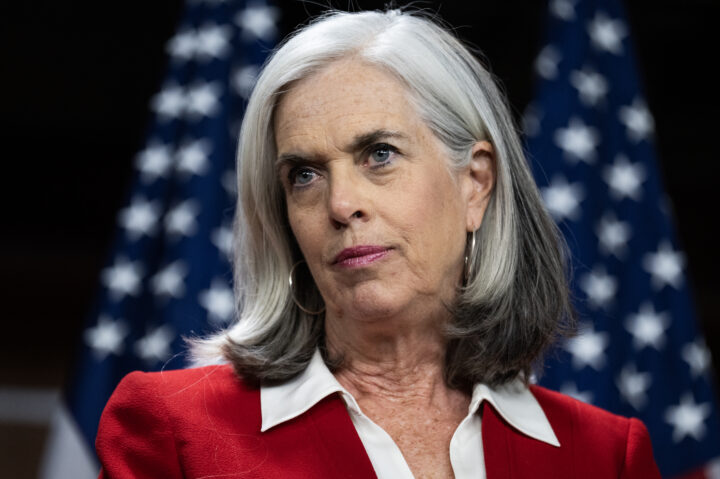
Tom Williams/CQ-Roll Call, Inc via Getty Images
House Minority Whip Katherine Clark (D-MA) conducts a news conference in the Capitol Visitor Center on Wednesday, July 23, 2025.
After a video surfaced last week of Rep. Katherine Clark (D-MA), the House minority whip, referring to Israel’s actions in Gaza as genocide, Clark walked back the remark on Monday — and maintained her endorsement from AIPAC amid the controversy, a spokesperson for the group told Jewish Insider.
“Last week, while attending an event in my district, I repeated the word ‘genocide’ in response to a question,” Clark told the Jewish News Syndicate on Monday. “I want to be clear that I am not accusing Israel of genocide. … We all need to work with urgency to bring the remaining hostages home, surge aid to Palestinians and oppose their involuntary relocation, remove Hamas from power and end the war.”
AIPAC spokesperson Marshall Wittmann told JI on Monday that the organization will stick by Clark, the second highest-ranked Democrat in the House.
“We appreciate that the congresswoman clarified her remarks, as Israel is fighting a just and moral war against a barbaric terrorist enemy. Our endorsement is unchanged and based upon her long standing support for the U.S.-Israel relationship,” Wittmann said.
In a video from an event hosted on Thursday by the Friends Committee on National Legislation in Cambridge, Mass., Clark made a passing reference to Israel’s actions in Gaza. “We each have to continue to have an open heart about how we do this, how we do it effectively, and how we take action in time to make a difference, whether that is stopping the starvation and genocide and destruction of Gaza, or whether that means we are working together to stop the redistricting that is going on, taking away the vote from people in order to retain power,” said Clark.
Plus, Santa Ono lands on his feet

Tom Williams/CQ-Roll Call, Inc via Getty Images
Then-Rep. Ruben Gallego (D-AZ) in Rayburn Building on Capitol Hill on June 9, 2022.
Good Monday afternoon.
This P.M. briefing is reserved for our premium subscribers like you — offering a forward-focused read on what we’re tracking now and what’s coming next.
I’m Danielle Cohen-Kanik, U.S. editor at Jewish Insider and curator, along with assists from my colleagues, of the Daily Overtime briefing. Please don’t hesitate to share your thoughts and feedback by replying to this email.
📡On Our Radar
Notable developments and interesting tidbits we’re tracking
President Donald Trump posted on Truth Social this morning, “We will only see the return of the remaining hostages when Hamas is confronted and destroyed!!! The sooner this takes place, the better the chances of success will be. … Play to WIN, or don’t play at all!”
Hours later, reports indicated that Hamas had accepted a new ceasefire and hostage-release proposal from Qatari Prime Minister Mohammed Al Thani and Egyptian officials in Cairo, after a meeting in Doha last week between Al Thani and Mossad Director David Barnea.
A source told Axios that the deal is “98% similar” to the latest U.S.-backed proposal initiated by Middle East envoy Steve Witkoff.
Though neither American nor Israeli officials have confirmed the news, Prime Minister Benjamin Netanyahu said in a statement this afternoon, “Like you, I hear the reports in the media, and from them you can be impressed by one thing — Hamas is under immense pressure“…
Meanwhile at home, the embrace of anti-Israel actors by the Democratic mainstream continues.
Over the weekend, Sen. Ruben Gallego (D-AZ), a potential 2028 Democratic presidential contender from a swing state, told a local political outlet about New York City Democratic mayoral nominee Zohran Mamdani, “It’s OK to say ‘I disagree with this, this, and this, but I agree with that.’ But the idea that we’re just gonna throw out people that are really bringing in new ideas to the fold, exciting people, just because they’re slightly to the right or to the left of us is dumb.”
It’s a notable marker, a pragmatic lawmaker with national aspirations calling Mamdani — a democratic socialist who has refused to condemn the phrase “globalize the intifada” — “slightly to the left” of the Democratic center.
And this morning, opinion writer Jerusalem Demsas, formerly of The Atlantic, announced the launch of her new liberal media company, The Argument. The publication will feature writings from center-left heavyweights including Derek Thompson and Matthew Yglesias and received funding from similarly aligned investors including Arnold Ventures and Open Philanthropy.
In her announcement video, Demsas said conservatives are “persecuting Americans for exercising their basic freedoms” over news clips covering anti-Israel protest leader Mahmoud Khalil’s detention by the federal government.
The continued embrace of Khalil by Democratic thought leaders and influencers is significant as Khalil has continued to escalate his anti-Israel rhetoric, including in a recent appearance on “The Ezra Klein Show” podcast where he said about the Oct. 7 attacks that “we couldn’t avoid such a moment” and about Hamas’ killing of civilians that “we cannot go and ask Palestinians to be perfect victims”…
Former University of Michigan President Santa Ono announced today that he’s been appointed as the inaugural director of the Ellison Institute of Technology. Ono had been named president of the University of Florida but was rejected in an unprecedented move by the Florida Board of Governors, partially over concerns of his handling of antisemitism and an anti-Israel encampment at the Ann Arbor campus.
Now, Ono will report directly to Larry Ellison, the second wealthiest man in the world, who is the founder of the software company Oracle and a major donor to Jewish and Israeli causes…
The Association of American Geographers is set to consider a resolution on Oct. 3 to boycott Israeli academic institutions, the latest professional association to face calls from its members to do so…
⏩ Tomorrow’s Agenda, Today
An early look at tomorrow’s storylines and schedule to keep you a step ahead
Keep an eye on Jewish Insider tomorrow morning for an interview with Rev. Johnnie Moore, the head of the Gaza Humanitarian Foundation, about the repeated death threats and vandalism he’s faced at his home, and a look at Rep. Brad Sherman’s (D-CA) primary challenge.
Tomorrow afternoon, the Hudson Institute will host a conversation with Sebastian Gorka, deputy assistant to the president and senior director for counterterrorism at the National Security Council, on U.S. strategy on counterterrorism and its impacts on U.S. policy in the Middle East.
BACKING THE BLOCK
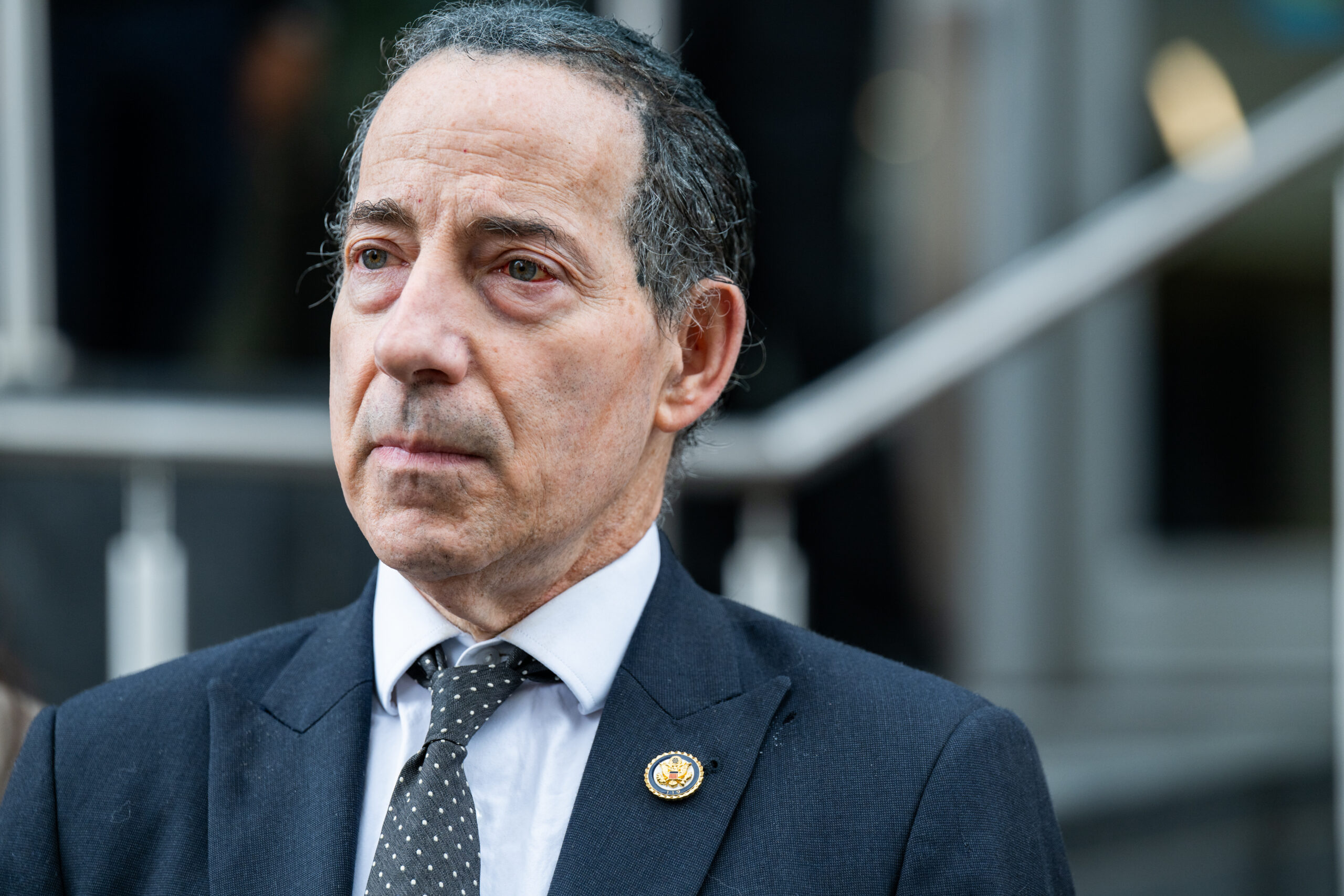
One of the most visible and well-known progressive Jewish lawmakers in Congress became a cosponsor of the ‘Block the Bombs Act’
CLARK’S BARK
Rep. Katherine Clark is the highest-ranking Democrat to have used the term, even as only a small number of other lawmakers have done so
The AAG is the latest professional association to face calls from its members to adopt a boycott of the Jewish state

Mike Kemp/In Pictures via Getty Images
Israel on the public art sculpture The World Turned Upside Down by artist Mark Wallinger on June 10, 2024 in London, U.K.
The American Association of Geographers became the latest professional association to face pressure to adopt a boycott of Israel after a recent member petition urged the association “to endorse the campaign for an academic boycott of Israeli academic institutions.”
The campaign also calls for “financial disclosure and divestment of any AAG funds invested in corporations or state institutions profiting from the ongoing oppression of the Palestinian people.”
A special member meeting is scheduled for Oct. 3 to move toward a vote on the resolution after the group behind the petition succeeded in reaching the required 10% of member signatures. An AAG spokesperson told Jewish Insider that the organization has “no statement or resolution about Israel-Palestine.” AAG did not respond to a follow-up inquiry asking which Israeli institutions the association currently invests in.
“I was absolutely shocked,” Liora Sahar, an Israeli-American member of AAG, told JI.
Sahar, a geospatial expert with a PhD from Georgia Tech, said that she first noticed anti-Israel rhetoric within the association at this year’s annual meeting, held in Detroit in March.
“I was deeply disturbed by the inclusion and promotion of sessions that allowed for inflammatory, biased and harmful rhetoric, far removed from academic rigor or geographic inquiry,” said Sahar.
“Sessions, organized by a group calling itself ‘Geographers for Justice in Palestine,’ centered not on scholarly exploration, but on academic boycott and divestment campaigns. These are political actions, not scientific ones, and they directly undermine the values of academic freedom and open discourse.”
Sahar, who attended the conference virtually, said that she came across a session titled “Dismantling the Palestine Exception” as well as six other “related abstracts [that] accused Israel of ‘ethnic cleansing’ and a ‘U.S.-enabled genocidal war.’”
“It had nothing to do with geography,” she said. Geographers for Justice in Palestine’s “entire goal was to get 10% of the AAG membership to sign the petition.”
The Anti-Defamation League urged the AAG to reject the resolution in a statement, highlighting “its divisive impact on academic communities and violations of AAG’s own ethical guidelines. We have previously expressed concerns about similar issues at AAG meetings and are ready to help AAG understand the potential harm of this resolution before the meeting.”
The campaign comes as members of other professional associations have also called for the adoption of academic boycotts of the Jewish state, a movement that has gained momentum in the aftermath of the Oct. 7, 2023, terrorist attacks and the ensuing Israel-Hamas war.
Last September, for example, the American Association of University Professors reversed course and dropped its longtime opposition to academic boycotts. Faculty members on several campuses soon after started implementing non-official boycotts of Israel by not assigning articles written by Israeli scholars, refusing to invite Israeli academics to conferences and declining to write study abroad letters for students wishing to spend a semester in Israel.
Plus, the two-finger hustle that impressed Ari Emanuel

Senate Television via AP
In this image from video, House impeachment manager Rep. Jamie Raskin, D-Md., becomes emotional as he speaks during the second impeachment trial of former President Donald Trump in the Senate at the U.S. Capitol in Washington, Tuesday, Feb. 9, 2021.
Good Monday morning.
In today’s Daily Kickoff, we report on yesterday’s strikes across Israel to call attention to the plight of the remaining 50 hostages, and report on Rep. Jamie Raskin’s support for the “Block the Bombs” bill that calls for limiting offensive weapons sales to Israel. We cover comments from Rep. Katherine Clark, the No. 2 House Democrat, calling Israel’s actions in Gaza a “genocide,” and report on a new push from leading Jewish organizations for universities to pursue reforms to deal with antisemitism. Also in today’s Daily Kickoff: Mark Shapiro, Larry Fink and Liv Schreiber.
What We’re Watching
- President Donald Trump is convening European leaders at the White House today following his meeting on Friday with Russian President Vladimir Putin. Trump will meet privately with Ukrainian President Volodymyr Zelensky at 1 p.m. ET, followed by a larger meeting with the European heads of state at 3 p.m.
- Leaders expected to be in attendance include U.K. Prime Minister Keir Starmer, Italian Prime Minister Giorgia Meloni, French President Emmanuel Macron, German Chancellor Friedrich Merz, President of the European Commission President Ursula von der Leyen and NATO Secretary-General Mark Rutte.
- Qatari Prime Minister and Foreign Minister Mohammed Al Thani is meeting with senior officials in Cairo today to discuss a new ceasefire proposal. The trip comes days after Al Thani met in Doha with Mossad head David Barnea.
What You Should Know
A QUICK WORD WITH JI’S TAMARA ZIEVE
The unrest could be felt everywhere — in traffic jams, on the airwaves, in WhatsApp groups, even in the waiting room of a dental clinic.
Across Israel yesterday, hundreds of thousands joined a nationwide unofficial strike, led by hostage families and bereaved families, demanding an end to the war in Gaza and the immediate release of the hostages still held there. According to the Hostages Families Forum, over 1 million people participated in protests throughout the day. As the government plans to escalate its military campaign against Hamas, emotions ran high across towns, cities and online spaces, deepening a national rift.
Police clashed with demonstrators blocking roads. In Ra’anana, a truck driver was arrested after allegedly attacking a protester. In a Tel Aviv neighborhood mothers’ WhatsApp group, several members condemned local cafés for staying open, while another defended them for “not strengthening Hamas.” At a dental clinic, a man berated staff for opening their doors, shouting, “What about the hostages!?”
At the heart of the tensions is a painful divide: Protesters — including the majority of the hostage families — argue that rescuing the captives must come before all else. Meanwhile, the government and its supporters, and even several hostage families, claim such demonstrations weaken Israel’s negotiating hand and embolden Hamas. Israeli President Issac Herzog, speaking at Hostages Square, said, “There’s no Israeli who doesn’t want them back home. We can argue about philosophies, but truly, the people of Israel want our brothers and sisters back home.”
Israeli Prime Minister Benjamin Netanyahu doubled down on his government’s stance in a public statement, warning: “Those who are calling for an end to the war today without defeating Hamas, are not only hardening Hamas’s stance and pushing off the release of our hostages, they are also ensuring that the horrors of October 7 will recur again and again … to advance the release of our hostages and to ensure that Gaza will never again constitute a threat to Israel, we must complete the work and defeat Hamas.”
Yet recent polls show that a majority of Israelis support prioritizing the hostages’ release and bringing an end to the war.
BACKING THE BLOCK
Rep. Jamie Raskin (D-MD), one of the most visible and well-known progressive Jewish lawmakers in Congress, late last week became a co-sponsor of the “Block the Bombs Act,” a bill led by far-left lawmakers that aims to severely restrict U.S. aid to Israel. The bill would impose unprecedented new conditions on weapons sales or transfers to Israel, requiring specific congressional authorization for each individual transfer of various weapons systems, and would require Congress to identify specific purposes for which those weapons would be used, Jewish Insider’s Marc Rod reports.
Arms embargo: Critics say that the bill would effectively constitute an arms embargo for the key weapons in question. Raskin has not issued any statement on his support for the bill, which aligns him with some of the most anti-Israel members of the House, and did not respond to a request for comment. Currently, 32 other lawmakers are co-sponsoring the legislation, but Raskin, the ranking member of the House Judiciary Committee, is among the most recognizable sponsors. Three other progressive Jewish House members, Reps. Sara Jacobs (D-CA), Becca Balint (D-VT) and Jan Schakowsky (D-IL), are also backing the bill.
sound of silence

Leading elected officials in Minnesota are remaining silent in response to a top Minneapolis mayoral candidate, far-left state Sen. Omar Fateh, whose campaign has faced scrutiny for employing staffers who have celebrated Hamas’ Oct. 7, 2023, attacks and called for Israel’s destruction, among other extreme views he has yet to publicly address, Jewish Insider’s Matthew Kassel reports.
No comment: Even as some of the state’s leading Democratic lawmakers have endorsed Fateh’s rival, incumbent Mayor Jacob Frey, who is seeking a third term, they have so far declined to weigh in on the staffers’ comments and Fateh’s decision to hire them, which has raised questions about his acceptance of extreme rhetoric on a particularly sensitive issue. Sen. Amy Klobuchar (D-MN) and Gov. Tim Walz, who are Frey’s most high-profile backers in what is expected to be a hotly contested race, both avoided addressing the matter to JI. A spokesperson for Klobuchar declined to comment on Friday, and representatives for Walz did not return multiple requests for comment.
CLARK’S BARK
Rep. Katherine Clark (D-MA), who serves as the House Democratic whip, the No. 2 Democratic leader in the chamber, described the war in Gaza as a “genocide” at an event last Thursday, based on video of the event that has been shared online, Jewish Insider’s Marc Rod reports.
What she said: “We each have to continue to have an open heart about how we do this, how we do it effectively, and how we take action in time to make a difference, whether that is stopping the starvation and genocide and destruction of Gaza, or whether that means we are working together to stop the redistricting that is going on, taking away the vote from people in order to retain power,” Clark said in a brief clip from an event that was first reported by Axios.
CAMPUS BEAT

As students return to school in the coming weeks, four leading Jewish organizations are encouraging university leaders to adopt a new set of recommendations, released on Monday, designed to curb the antisemitism that has overwhelmed many campuses since the Oct. 7, 2023, terrorist attacks in Israel, Jewish Insider’s Haley Cohen has learned.
The guidelines: The joint effort from the Anti-Defamation League, Conference of Presidents of Major American Jewish Organizations, Hillel International and Jewish Federations of North America calls for increased safety measures as well as long-term structural reforms and builds upon a four-page set of recommendations released last August. The recommendations urge university leaders to “consistently enforce” codes of conduct around protests; appoint a coordinator to address Title VI discrimination complaints; reject academic boycotts of Israel; conduct annual student and faculty surveys in regard to campus antisemitism; crack down on online harassment (in addition to physical safety concerns); and hold faculty accountable for political coercion and identity-based discrimination.
AID ALLEGATIONS

An aid worker in Gaza filed a whistleblower complaint with the inspector general of the U.S. Agency for International Development alleging that the World Food Program and U.N. refused security cooperation with the IDF, the whistleblower confirmed to Fox News last week. The complaint alleges “gross misconduct and misuse of humanitarian funds” by the WFP and U.N. Office for the Coordination of Humanitarian Affairs and that the agencies had turned down support “including security protection and coordination” to distribute humanitarian aid from senior IDF officials, saying “they were not prepared to discuss such coordination,” Jewish Insider’s Danielle Cohen-Kanik reports.
What they said: The whistleblower told Fox News that the IDF has cleared thousands of tons of U.N. aid for distribution that are waiting inside of Gaza, and the “U.N. must be held accountable to pick up and distribute such aid.” They said that it must be determined “the extent to which U.N. agencies, by refusing to coordinate with the IDF on essential issues, including security, are abusing U.S. taxpayer funds rather than using them to deliver the aid the American people are donating — and whether such actions are being taken independently by U.N. officials in Gaza or at the direction of the U.N. Secretary-General or other senior U.N. officials in New York.”
EXCLUSIVE
Rep. Mike Lawler (R-NY) introduced legislation on Friday to repeal a decades-old provision in U.S. law relating to the construction of new diplomatic facilities in Israel and the West Bank, Jewish Insider’s Marc Rod reports. The provision, enacted in 1986 as part of a package designed to improve security for U.S. diplomats and combat terrorism, banned funding from that bill from being used for “site acquisition, development, or construction of any facility in Israel, Jerusalem, or the West Bank except for facilities to serve as a chancery or residence within five miles of the Israeli Knesset building and within the boundaries of Israel as they existed before June 1, 1967.”
Lawler’s law: Lawler’s bill, the Keeping Official Territories Eligible for Land-use (KOTEL) Act, named for the Jewish holy site, would repeal the language from the 1986 bill. “Israel is one of America’s closest allies, and this 40-year-old inactive prohibition serves no purpose. The KOTEL Act removes these outdated restrictions so we can continue to ensure the bond between the U.S. and Israel remains ironclad,” Lawler said in a statement. It’s not clear how much impact Lawler’s initiative would have on current efforts to acquire or build new diplomatic facilities — the funding to which the 1986 provision applies has expired. But it could head off future attempts to challenge such construction.
Worthy Reads
Aid Aide: In Foreign Affairs, Jack Lew and David Satterfield, respectively the former U.S. ambassador to Israel and U.S. special envoy for Middle East humanitarian issues during the Biden administration, detail their efforts to send aid into Gaza and suggest how the Trump administration can prevent a worsening humanitarian crisis in the enclave. “When aid was flowing before the cease-fire, it did not arrive by chance. It came one border crossing and one truck convoy at a time, and it required overcoming political and battlefield challenges every step of the way. As the world watches the crisis unfolding today and demands a solution, it is important to learn from what worked and what did not, and to remember that it falls to all parties to find a solution. The stakes are too high to allow the delivery of critical assistance to be derailed by Israeli political dynamics, obstruction by Hamas or armed Gazan gangs, or infighting among aid providers. And Washington must remember that it uniquely has the tools and leverage to avert an escalating catastrophe.” [ForeignAffairs]
Northern Exposure: In The Wall Street Journal, Eugene Kontorovich calls on the Trump administration to use its United Nations Security Council veto power to nix an effort to extend the mandate of UNIFIL, arguing that the U.N. peacekeeping force has long failed in its goals to maintain peace and calm along the Israel-Lebanon border. “The first Trump administration considered nixing Unifil but was persuaded to compromise on a package reducing its size and supposedly introducing reforms. There will be temptations for the U.S. to compromise again. But if Unifil survives, it will eventually regrow under a less vigilant administration. Some in the administration argue the Lebanese army isn’t ready to take over for Unifil. But Unifil doesn’t keep the peace, so there’s nothing to get ready for. … If the U.S. doesn’t veto Unifil, it would undermine the credibility of Washington’s broader demands — both for genuine disarmament of terror groups in Lebanon and Gaza and for broader U.N. reform.” [WSJ]
What ‘Pro-Israel’ Means Now: In the Jerusalem Journal, Halie Soifer, the CEO of the Jewish Democratic Council of America, considers what it means to be a pro-Israel American in a post-Oct. 7 era. “In 2025, being pro-Israel should mean standing with the Israeli people in the aftermath of October 7, supporting Israel’s security as it faces ongoing regional threats, remaining deeply committed to Israel’s future as a Jewish and democratic state, and recognizing there’s no future for Hamas as part of any solution to this conflict. It also means expressing concern about the war — and continued captivity of hostages — which has gone on for too long. Calls to address the acute humanitarian crisis in Gaza don’t make someone anti-Israel. American Jews are also concerned about the crisis in Gaza, though there’s a clear double standard when it comes to assessing support of Israel among Democrats.” [JerusalemJournal]
Fight Club: The Wall Street Journal profiles Mark Shapiro, TKO’s president and chief operating officer, following the $7.7 billion deal between Paramount Skydance and TKO to acquire the distribution rights to TKO subsidiary Ultimate Fighting Championship, which Shapiro orchestrated. “It was on a cross-country flight in 2002 that Shapiro had a chance meeting with [TKO CEO] Ari Emanuel, the Hollywood power broker. Emanuel spotted Shapiro frantically typing with his two index fingers. After watching him for a few hours, Emanuel was mesmerized. ‘I couldn’t take it anymore,’ Emanuel says. He persuaded the person sitting next to Shapiro to switch seats and asked, ‘what the f—k are you doing?’ Shapiro replied he worked at ESPN and was preparing a report for Disney bosses Michael Eiser and Iger. Emanuel and Shapiro, who are from neighboring Chicago suburbs, hit it off. Soon, they were talking regularly. Today, they are joined at the hip. Emanuel is executive chairman and chief executive of TKO and executive chairman of talent agency WME Group.” [WSJ]
Word on the Street
The Trump administration halted the issuance of all visitor visas to Gazans, following a social media post by Laura Loomer citing the entry of families of Palestinian children seeking medical treatment in the U.S….
Members of The Wall Street Journal’s editorial page talk to former U.S. Ambassador to Japan Rahm Emanuel about his opposition to the Democratic Party’s far-left flank as he mulls a 2028 presidential bid…
2020 Democratic congressional candidate Ammar Campa-Najjar is weighing a rematch against Rep. Darrell Issa (R-CA). Read Jewish Insider’s 2020 profile of Campa-Najjar here…
The New York City Parks Department issued an order to vacate to the leaders of a Queens community garden who required prospective members to sign a “statement of values” that opposed Zionism…
New Yorker staff writer Doreen St. Felix deleted a series of social media posts about the Holocaust after coming under fire for calling Sydney Sweeney an “Aryan princess” following the release of a viral American Eagle ad campaign featuring the actress…
An Ohio man pleaded guilty to hate crimes charges connected to the November 2023 assaults of two Jewish students from Ohio State University; according to court documents, Timur Mamatov punched a student wearing a “chai” necklace after asking if the student was Jewish…
The Forward interviews “Bojack Horseman” creator Raphael Bob-Waksberg about his new animated series “Long Story Short,” about a Jewish family…
The World Economic Forum named Larry Fink a co-chair of the group’s board of trustees, alongside Andre Hoffmann; the two replace Peter Brabeck-Letmathe, who served as chairman on an interim basis…
The Wall Street Journal spotlights Camp Social, founded by entrepreneur Liv Schreiber, amid the rise in popularity of adult sleep-away camps…
French President Emmanuel Macron condemned as “antisemitic hatred” the cutting down of a tree planted in a Paris suburb in memory of Ilan Halimi, a French-Jewish man who was tortured and killed in 2006…
Australia canceled the visa of far-right Israeli lawmaker Simcha Rothman hours before he was scheduled to depart for a speaking tour in the country; Australian Foreign Minister Tony Burke confirmed the ban, saying that Canberra “takes a hard line on people who seek to come to our country and spread division”…
Israeli National Security Minister Itamar Ben-Gvir posted a video of himself in an Israeli prison warning Marwan Barghouti, the high-profile Palestinian political leader who is serving five life sentences for his role in the murders of numerous Israelis, “Whoever messes with the people of Israel, whoever murders children and women — we will wipe them out. You need to know this”…
The Wall Street Journal reports on the deepening clean water shortage in the Gaza Strip…
An investment group led by Israel’s Leumi Partners is acquiring the rideshare app Gett for $190 million…
The New York Times looks at Iranian efforts to recruit Israelis to commit espionage and acts of terrorism within Israel…
The Israeli military said it struck a Houthi energy infrastructure site south of the Yemeni capital of Sana’a over the weekend…
South Africa’s Foreign and Defense Ministries distanced themselves from comments by army chief Gen. Rudzani Maphwanya, made during his recent trip to Iran, praising the close ties between Pretoria and Tehran and condemning Israel; South African President Cyril Ramaphosa called Maphwanya’s trip to Iran “ill-advised” and said he planned to meet with the military leader over it…
Historian Rabbi Berel Wein, the founder of Yeshiva Shaarei Torah in Monsey, N.Y., who previously led the Orthodox Union’s kashrut division, died at 91…
Rachel Aliza Nisanov, the 13-year-old daughter of Rabbi Shlomo Nisanov, died in a jet-skiing accident in Florida last Tuesday…
Pic of the Day
Seventeen-year-old Pushpa Joshi, the sister of Nepali hostage Bipin Joshi, speaks at a hostage rally in Tel Aviv on Saturday night. The Joshi family arrived in Israel last week for the first time as they work to raise awareness about the plight of Bipin, a farming student who was taken hostage on Oct. 7, 2023, from Kibbutz Alumim.
Birthdays

Auctioneer, television personality and sports card collector, he is featured on the Netflix TV series “King of Collectibles: The Goldin Touch,” Kenneth Goldin turns 60…
Art collector, museum trustee in Chicago, Aspen, Colo., and Orange County, Calif. and former member of Cultural Property Advisory Committee to the U.S. State Department, Barbara Bluhm-Kaul turns 85… Baltimore resident, Jerome Seaman… Holocaust survivor, novelist, artist and producer, Sonia Wolff Levitin turns 91… Retired teacher of Talmud at Jerusalem’s Yeshiva Torat Shraga, Rabbi Noam Gordon, Ph.D…. Former two-term mayor of San Diego, the first Jewish mayor of San Diego, Susan G. Golding turns 80… Businessman and former chair of the Jewish Community Federation of San Francisco, John D. Goldman turns 76… Partner in Chazan-Leipzig Consulting, Cindy Chazan… Retired judge of the Montgomery County (Pa.) Court of Common Pleas, Gary S. Silow turns 74… Dramatist, screenwriter and poet, Winnie Holzman turns 71… President at Wyckoff, N.J.-based Benefit Connections, Raphael Schwartz… President of Touro University, Alan H. Kadish, M.D. turns 69… Labor law attorney in the Los Angeles office of Ogletree Deakins, Stuart Douglas Tochner… U.S. Treasury secretary in the Obama administration, now president of Warburg Pincus, Timothy Geithner turns 64… CEO of the Future of Privacy Forum, a D.C.-based think tank and advocacy group focused on issues of data privacy, Jules Polonetsky turns 60… Executive director of the Maccabee Task Force, David Brog turns 59… Criminal defense attorney and media personality in Las Vegas, Dayvid Figler turns 58… Award-winning comic book writer and artist for both Marvel and then DC Comics, Brian Michael Bendis turns 58… Professor at Harvard’s Kennedy School, he served as chairman of the Council of Economic Advisers during the Obama administration, Jason Furman turns 55… Sarah S. Bronson… Conservative political talk radio host on the Sirius XM Patriot channel, Andrew Steven Wilkow turns 53… Greek Orthodox priest, he serves as a judge in Israel’s religious court system and encourages Christians to enlist in the IDF, Gabriel Naddaf turns 52… Best-selling author, her novels have been translated into 35 languages, Nicole Krauss turns 51… Writer, actress and stand-up comedian from NYC, Jessi Ruth Klein turns 50… Washington director of the Reagan Presidential Foundation and Institute, Roger Zakheim… Actor, comedian, writer, producer and musician, David A. J. “Andy” Samberg turns 47… Commissioner of New York City Emergency Management, Zachary Iscol turns 47… Fellow at The Jewish People Policy Institute and managing partner of the Madad website, Noah Slepkov… Editor of Moment Magazine, Sarah Breger… Reporter for The Wall Street Journal covering the Justice Department and federal law enforcement, Sadie Gurman… Co-founder and CEO of Mostly Human, Laurie Segall turns 40… Mixed martial artist, she competes in the bantamweight and featherweight divisions, Olga Rubin turns 36… Israeli judoka who won Olympic bronze medals at the 2016 and 2020 Summer Olympics, Or “Ori” Sasson turns 35…
A nationwide strike led by hostage families draws hundreds of thousands into the streets, revealing the depth of Israel’s internal divide as the military prepares for its next move in Gaza

Yair Palti
Protestors hold up phone flashlights in Tel Aviv's Hostages Square and the surrounding streets during mass demonstration for the hostages, August 18th, 2025
The unrest could be felt everywhere — in traffic jams, on the airwaves, in WhatsApp groups, even in the waiting room of a dental clinic.
Across Israel yesterday, hundreds of thousands joined a nationwide unofficial strike, led by hostage families and bereaved families, demanding an end to the war in Gaza and the immediate release of the hostages still held there. According to the Hostages Families Forum, over 1 million people participated in protests throughout the day. As the government plans to escalate its military campaign against Hamas, emotions ran high across towns, cities and online spaces, deepening a national rift.
Police clashed with demonstrators blocking roads. In Ra’anana, a truck driver was arrested after allegedly attacking a protester. In a Tel Aviv neighborhood mothers’ WhatsApp group, several members condemned local cafés for staying open, while another defended them for “not strengthening Hamas.” At a dental clinic, a man berated staff for opening their doors, shouting, “What about the hostages!?”
At the heart of the tensions is a painful divide: protesters — including the majority of the hostage families — argue that rescuing the captives must come before all else. Meanwhile, the government and its supporters, and even several hostage families, claim such demonstrations weaken Israel’s negotiating hand and embolden Hamas. Israeli President Issac Herzog, speaking at Hostages Square, said “There’s no Israeli who doesn’t want them back home. We can argue about philosophies, but truly, the people of Israel want our brothers and sisters back home.”
Israeli Prime Minister Benjamin Netanyahu doubled down on his government’s stance in a public statement, warning: “Those who are calling for an end to the war today without defeating Hamas, are not only hardening Hamas’s stance and pushing off the release of our hostages, they are also ensuring that the horrors of October 7 will recur again and again … to advance the release of our hostages and to ensure that Gaza will never again constitute a threat to Israel, we must complete the work and defeat Hamas.”
Yet recent polls show that a majority of Israelis support prioritizing the hostages’ release and bringing an end to the war.
Israeli journalist and commentator Ben Caspit wrote on social media: “To join the protest strike, you don’t have to be a leftist. Nor a centrist. Nor a rightist… You need a heart. There on the left side, between the ribs and the lungs. A beating heart that feels the need to express solidarity with our kidnapped brothers, with their families, with the terrible suffering.”
“And no, don’t believe the spin that it ‘helps Hamas.’ It doesn’t. Hamas doesn’t need strike X or demonstration Y to get to know Israeli society. Hamas knows us very well, just as we know them. They are death eaters. We seek life. That’s the whole difference.”
Meanwhile, Amit Segal — a reporter and political commentator often seen opposite Caspit on Channel 12 — offered a more sober take in his newsletter on Sunday: “While the strike will help many Israelis express their frustration and desperation to bring the hostages home, it won’t bring Israel closer to achieving the very thing they’re protesting for.”
Even if that may be, the protests reach further than home: former hostages have recounted the strength they gained from witnessing the demonstrations on the news while in captivity in Gaza. In Tel Aviv, as night fell, thousands of protesters raised their phone flashlights in Hostages Square and the surrounding streets, creating a moment of visual unity. The sea of lights stretched across the plaza and beyond — a simple gesture that carried a message of solidarity for the hostages still held in Gaza.
At the same time, the wheels of war are already turning. While Israelis grappled with grief, anger and hope in the streets, the military was preparing for its next incursion. Lt. Gen. Eyal Zamir, the IDF’s chief of staff, declared yesterday from the Gaza Strip: “Today we are approving the plan for the next phase of the war.”
“We will maintain the momentum of Operation ‘Gideon’s Chariots’ while focusing on Gaza City. We will continue to strike until the decisive defeat of Hamas, with the hostages always at the forefront of our minds,” Zamir said, adding, “Soon we will move on to the next phase” of the operation.
Rep. Katherine Clark is the highest-ranking Democrat to have used the term, even as only a small number of other lawmakers have done so
Tom Williams/CQ-Roll Call, Inc via Getty Images
House Minority Whip Katherine Clark (D-MA) conducts a news conference in the Capitol Visitor Center on Wednesday, July 23, 2025.
Rep. Katherine Clark (D-MA), who serves as the House Democratic whip, the No. 2 Democratic leader in the chamber, described the war in Gaza as a “genocide” in an event this week, based on video of the event that has been shared online.
“We each have to continue to have an open heart about how we do this, how we do it effectively, and how we take action in time to make a difference, whether that is stopping the starvation and genocide and destruction of Gaza, or whether that means we are working together to stop the redistricting that is going on, taking away the vote from people in order to retain power,” Clark said in a brief clip from an event that was first reported by Axios.
Clark spokesperson Joy Lee has said in a statement provided to multiple outlets that Clark’s “position on the war has not changed,” including that she supports a permanent ceasefire, the return of all hostages and an increase of aid to Gaza.
“It should not be controversial to say that Israeli children did not deserve to be kidnapped and murdered by Hamas, nor should it be controversial to say that Palestinian children, who bear no responsibility for Hamas’ atrocities, do not deserve to be killed by war or starvation,” Lee’s statement reads. “A secure future for Israeli and Palestinian children demands a real two-state solution and a permanent end to efforts to deny their rights to exist.”
Clark’s office did not respond to a request for comment seeking further clarity.
Lee told The Boston Globe that Clark’s comments came in response to protesters at the event. The brief clip shared online does not include the context of Clark’s remarks.
Only a small number of far-left and far-right lawmakers have described the situation in Gaza as a genocide, and none who serve in leadership roles in Congress.
Clark was speaking at an event organized by the Friends Committee on National Legislation, a lobbying group of the Quaker movement, which has been heavily critical of Israel and supported efforts in the Senate to block arms sales to Israel.
Clark’s office did not respond to a question about whether she supports efforts to block some or all weapons sales.
The group’s criticism of Israel predates the war in Gaza, and it lobbied in favor of the Iran nuclear deal. It also advocates more broadly against militarization generally, including pushing for shrinking military spending.
Clark has been endorsed by AIPAC and is featured alongside each of the other top House leaders on the group’s PAC website.
Mayor Jacob Frey’s most prominent backers are declining to criticize his rival for employing staff that celebrated the Oct. 7 Hamas attack

Stephen Maturen/Getty Images
Omar Fateh, a member-elect of the Minnesota State Senate, speaks during a vigil for Dolal Idd, who was shot and killed by Minneapolis Police on December 31, 2020, in Minneapolis, Minnesota.
Leading elected officials in Minnesota are remaining silent in response to a top Minneapolis mayoral candidate, far-left state Sen. Omar Fateh, whose campaign has faced scrutiny for employing staffers who have celebrated Hamas’ Oct. 7, 2023, attacks and called for Israel’s destruction, among other extreme views he has yet to publicly address.
Fateh, a 35-year-old Democratic socialist, now employs a campaign communications manager, Anya Smith-Kooiman, who, in now-deleted social comments recently unearthed by Jewish Insider, has endorsed the Hamas attacks as a justified act of “resistance,” said Israel “does not have a ‘right’ to exist” and “must be dismantled,” and amplified a comment dismissing widespread reports of sexual violence on Oct. 7 as “propaganda,” according to screenshots.
Meanwhile, David Gilbert-Pederson, a local political activist and City Council aide who has been listed as a Fateh campaign staffer in filings, has unreservedly praised the Oct. 7 attacks, insisting in remarks on a December 2023 panel discussion that supporters of the Palestinian cause must “stand in unconditional solidarity with those resisting oppression.”
But even as some of the state’s leading Democratic lawmakers have endorsed Fateh’s rival, incumbent Mayor Jacob Frey, who is seeking a third term, they have so far declined to weigh in on the staffers’ comments and Fateh’s decision to hire them, which has raised questions about his acceptance of extreme rhetoric on a particularly sensitive issue.
Sen. Amy Klobuchar (D-MN) and Gov. Tim Walz, who are Frey’s most high-profile backers in what is expected to be a hotly contested race, both avoided addressing the matter to JI. A spokesperson for Klobuchar declined to comment on Friday, and representatives for Walz did not return multiple requests for comment.
Prominent Democratic officials who have not taken sides in the mayoral contest also did not respond to requests for comment — including Peggy Flanagan, the lieutenant governor who is now running for U.S. Senate, and Rep. Angie Craig (D-MN), a pro-Israel lawmaker also seeking to replace retiring Sen. Tina Smith (D-MN). A spokesperson for the senator did not respond to a message seeking comment about Fateh.
The muted responses underscore an increasing reluctance among many Democratic elected officials and public figures to speak out against extremist or antisemitic language related to the ongoing war between Israel and Hamas.
In Minneapolis, only one of the three City Council members who have endorsed Frey’s reelection bid was open to weighing in on the matter, denouncing the campaign staffers as well as Fateh’s judgement for choosing to employ them.
“Defending the Oct. 7 terrorist attack is disgraceful, and it’s embarrassing that Sen. Fateh is OK with this behavior,” Linea Palmisano, a Democratic councilwoman, told JI on Friday. “Who mayors surround themselves with matters, and anyone who stands by these remarks isn’t ready for the job.”
LaTrisha Vetaw and Michael Rainville, the other Council members supporting Frey, did not return requests for comment.
While Fateh himself has not used the same rhetoric as his allies, the state legislator has been a staunch critic of Israel — calling for a ceasefire 10 days after the Hamas attacks and accusing Israel of genocide in its war in Gaza.
Fateh has also voiced his support for the Boycott, Divestment and Sanctions movement targeting Israel, which some critics have accused of stoking antisemitism, and has pledged not to engage with the local Jewish Community Relations Council, according to a candidate questionnaire solicited by the Twin Cities chapter of the Democratic Socialists of America, a supporter of his campaign.
In the document, portions of which were recently obtained by JI, Fateh vowed to “refrain from any and all affiliation” with the JCRC, which the DSA dismissed as a “Zionist lobby group” akin to AIPAC, J Street and Christians United for Israel — even as the group is nonpartisan and represents the Jewish community to Minneapolis government officials.
Fateh did not share an explanation for his answer despite space to do so, according to the document reviewed by JI.
Steve Hunegs, executive director of the JCRC of Minnesota and the Dakotas, sharply criticized the state senator’s responses to the DSA in a statement to JI on Friday, while questioning his commitment to combating antisemitism.
“Sen. Fateh’s campaign slogan promises a ‘city that works for everyone,’” Hunegs said. “But how can Sen. Fateh be understood as anything other than a divider when he’s pledged to boycott Jewish organizations? Likewise, how can Jews feel that our safety will be a priority when Sen. Fateh’s staff traffic in antisemitism? As proud Jews we aren’t going to allow Sen. Fateh, the DSA or Hamas apologists drive us from the public square.”
Fateh’s campaign did not respond to a request for comment on Friday.
Fateh, who assumed office in 2021 as the first Muslim and first Somali American to serve in the Minnesota state Senate, won the state Democratic Party endorsement last month over Frey, who has challenged the results.
The mayor, 44, is the second Jewish mayor to represent Minneapolis and has been increasingly outspoken against rising antisemitism in the wake of Hamas’ attacks, while opposing some resolutions on Israel in the City Council that he has dismissed as one-sided. He has also been a critic of Israel Prime Minister Benjamin Netanyahu and his handling of the war in Gaza amid a worsening humanitarian crisis.
Lawler: The KOTEL Act would remove ‘outdated restrictions so we can continue to ensure the bond between the U.S. and Israel remains ironclad’

David Dee Delgado/Getty Images
Rep. Mike Lawler (R-NY) speaks during a press conference outside of Columbia University on April 22, 2024 in New York City.
Rep. Mike Lawler (R-NY) introduced legislation on Friday to repeal a decades-old provision in U.S. law relating to the construction of new diplomatic facilities in Israel and the West Bank.
The provision, enacted in 1986 as part of a package designed to improve security for U.S. diplomats and combat terrorism, banned funding from that bill from being used for “site acquisition, development, or construction of any facility in Israel, Jerusalem, or the West Bank except for facilities to serve as a chancery or residence within five miles of the Israeli Knesset building and within the boundaries of Israel as they existed before June 1, 1967.”
The language was intended to force the relocation of the U.S. Embassy in Israel from Tel Aviv to Jerusalem, according to a report at the time. The Reagan administration opposed the move, resisting efforts to recognize Jerusalem as Israel’s capital ahead of a negotiated agreement between Israelis and Palestinians about Jerusalem’s final status.
Congress later passed the Jerusalem Embassy Act in 1995, mandating the relocation of the embassy and recognition of Jerusalem as Israel’s capital, though it was waived by successive presidents until President Donald Trump made the move in 2017. Republicans repeatedly accused President Joe Biden of seeking to undo that move or reopen the U.S. consulate in East Jerusalem that primarily served Palestinians.
Lawler’s bill, the Keeping Official Territories Eligible for Land-use (KOTEL) Act, named for the Jewish holy site, would repeal the language from the 1986 bill.
“Israel is one of America’s closest allies, and this 40-year-old inactive prohibition serves no purpose. The KOTEL Act removes these outdated restrictions so we can continue to ensure the bond between the U.S. and Israel remains ironclad,” Lawler said in a statement.
It’s not clear how much impact Lawler’s initiative would have on current efforts to acquire or build new diplomatic facilities — the funding to which the 1986 provision applies has expired. But it could head off future attempts to challenge such construction.
Lawler plans to introduce the bill for consideration as part of the House Foreign Affairs Committee’s upcoming, wide-ranging State Department reauthorization effort.
Plus, an interview with Jack Ciattarelli

CNN
South Bend, Indiana, Mayor Pete Buttigieg moderated by Chris Cuomo. CNN Democratic Presidential Town Hall: The Climate Crisis New York, NY 2019
Good Friday morning.
In today’s Daily Kickoff, we look at leading Democrats’ leftward shifts on Israel and talk to New Jersey Republican gubernatorial nominee Jack Ciattarelli about his outreach to the Garden State’s Jewish community ahead of the November election. We report on the Toronto International Film Festival’s decision to reinstate the screening of a documentary about the Oct. 7, 2023, attacks, and talk to House legislators who recently returned from Israel about their meetings with senior officials. Also in today’s Daily Kickoff: Michael Eisenberg, Rep. Dan Goldman and Dan Raviv.
For less-distracted reading over the weekend, browse this week’s edition of The Weekly Print, a curated print-friendly PDF featuring a selection of recent Jewish Insider and eJewishPhilanthropy stories, including: Jay Schottenstein has great genes; Mountain minyan: An unorthodox experiment in North Carolina’s Blue Ridge Mountains; and After quietly supporting Gaza relief work since early 2024, IsraAid CEO opens up and warns: ‘We are reaching an extreme humanitarian situation’. Print the latest edition here.
What We’re Watching
- Today marks the 80th anniversary of the end of World War II.President Donald Trump and Russian President Vladimir Putin are slated to meet today in Alaska for talks aimed at ending the Russia-Ukraine war.
- The Rohr Jewish Learning Institute’s National Jewish Retreat wraps up this weekend in Washington. Weekend speakers include journalist Dan Raviv, Rabbi Dovid Bashevkin and Amb. Stuart Eizenstat.
- An anti-Israel protest slated to take place in New York City tomorrow is expected to draw thousands of participants, the largest protest of its kind in the city in months.
What You Should Know
A QUICK WORD WITH JI’S JOSH KRAUSHAAR
Watching several nationally ambitious Democrats, under pressure from the activist left, shift away from their measured support of Israel is reminiscent of watching the party’s 2020 presidential candidates rush to embrace a panoply of hard-left positions that turned politically costly in the long run.
The biggest flip-flop under pressure came from former Transportation Secretary Pete Buttigieg, who, in a recent appearance on the “Pod Save America” podcast, tried to maintain some support for the U.S.-Israel alliance while criticizing Israeli Prime Minister Benjamin Netanyahu for being responsible for the humanitarian crisis in Gaza.
That nuanced, largely-critical-of-Israel reaction, nonetheless, drew widespread opprobrium from the loudest anti-Israel voices within the party, including the former Obama administration operatives who host the show.
Within days, Buttigieg backtracked in favor of embracing a more hostile view towards the Jewish state. He came out against re-upping another long-term agreement to secure military aid to Israel — the type of deal that former President Barack Obama last secured before leaving office in 2016. He said he would have supported anti-Israel resolutions championed by Sen. Bernie Sanders (I-VT) to cut off some military aid to Israel. And he called for recognition of a Palestinian state, a position held by only the furthest-left Democratic lawmakers in Congress.
Buttigieg’s rapid reversal does him little good in advancing his national political interests. As a presidential candidate whose appeal was centered in his thoughtful pragmatism, his rush to pander to the far flank of his party threatens to undermine his more-moderate brand.
Sen. Ruben Gallego (D-AZ), to a lesser extent, is feeling similar pressure from the base as he hints at an interest in presidential politics. The swing-state senator, who has been critical of his party’s far-left, came out squarely against Sanders’ anti-Israel resolutions. But as anti-Israel activists aired an ad in Iowa targeting his position (he missed the actual vote in the Senate), he responded by saying his view on Israel is “evolving.”
And it wasn’t lost on the pro-Israel community that among the 26 Senate Democrats who voted with Sanders on the anti-Israel resolution was Sen. Amy Klobuchar (D-MN), a pragmatic Democrat who nonetheless is watching the radical strains within the party grow in influence within her state. Klobuchar is also expected to consider another presidential campaign, after experiencing surprising success in her first run — running as a centrist.
LEFTWARD SWERVE

A senior Biden official expressed concerns about Pete Buttigieg’s about-face on Israel and its wider implications about Democratic politics, in comments to Jewish Insider’s Gabby Deutch following the former transportation secretary’s recent remarks on military support for the Jewish state and his support for recognizing a Palestinian state.
Notable quotable: “Pete Buttigieg is a viable president of the United States. He won the Iowa caucus. He was the transportation secretary. And his words really matter,” the official told JI. “The fact that he so quickly got wobbly and said his comments about the 10-year MOU suggests that those who still believe in standing strong really need to stand up right now, because we’re seeing a trend that’s extremely disturbing.”
NEW JERSEY JOUST
Ever since President Donald Trump ran surprisingly close to Vice President Kamala Harris in New Jersey during last year’s presidential race, Republicans have been looking at the state’s gubernatorial race as a chance to capitalize on the party’s momentum in the blue state. Jack Ciattarelli, the GOP’s nominee for governor, also came tantalizingly close to defeating Gov. Phil Murphy in the state’s last gubernatorial race. He’s running again, and hoping to get over the finish line against Rep. Mikie Sherrill (D-NJ), in part, by courting the state’s sizable Jewish community, which has swung a bit to the right in recent elections. “People now know, because of the closeness of my race, that we can win. There’s just an attitude change because they feel like the Democrats have really failed them on a number of issues, and antisemitism is one of them,” Ciattarelli told Jewish Insider’s Emily Jacobs in an interview ahead of his visit to Israel this week.
Trade goals: Ciattarelli organized his five-day visit to Israel in a show of solidarity. He also spent time on his visit pursuing opportunities for economic investment from leading Israeli companies in the technology and medical sectors. He told JI that one of his goals with the visit was to boost the state’s economy “by forging a closer economic relationship with a number of nations” that are close U.S. allies. “Israel is first and foremost on the list, but as governor, I will certainly look to Canada, Mexico and India as well to increase our bilateral trade,” Ciattarelli said.
REVERSING COURSE

The Toronto International Film Festival reversed course on Thursday, deciding to screen “The Road Between Us: The Ultimate Rescue,” a documentary about the Oct. 7, 2023, Hamas terror attacks, at its upcoming festival. TIFF had faced serious backlash from Jewish organizations and Canadian politicians over its initial decision to cancel the screening due to the film’s usage of Hamas footage from the attacks, saying the terror organization had not approved them for use, Jewish Insider’s Danielle Cohen-Kanik reports.
Back and bigger: TIFF board member John Ruffolo told the Toronto SunToronto Sun that the organization decided at a board meeting Thursday that the movie “will be exhibited as planned and even bigger than originally.” Another source told the Sun that TIFF President Cameron Bailey and Barry Avrich, the film’s director, were essential to the decision, along with input from philanthropist Heather Reisman and entrepreneur Henry Wolfond, both influential Jewish Canadians.
ISRAEL INSIGHTS

Returning from a trip to Israel, two first-term House Republicans blasted European nations and others that have recently hardened their positions against Israel, saying that those decisions had set back efforts to free the hostages and end the war, Jewish Insider’s Marc Rod reports.
Discussion: One of the lawmakers who visited Israel with the AIPAC-affiliated American Israel Education Foundation also indicated that she had not heard in meetings with Israeli leaders a concrete plan for bringing the war to an end. “Europe’s actions definitely set back the … negotiations for Hamas releasing the existing hostages — potentially resulting in them dying,” Rep. Julie Fedorchak (R-ND) said. “It’s maddening that these countries that should know better, or should take the time to find out better, are taking these very unhelpful positions.” Rep. Randy Fine (R-FL) said it was crucial to “stand up to these countries like France and the U.K. and Canada and Australia that have fully embraced Muslim terror and want to reward it.”
Q&A

American-Israeli venture capitalist Michael Eisenberg isn’t just watching Israel’s transformation — he’s trying to shape it. As cofounder of the prominent investment fund Aleph, early backer of companies including Lemonade and WeWork, and a longtime thought leader in the intersection of Judaism, economics and technology, Eisenberg has become an influential voice in Israel’s public discourse. In a wide-ranging conversation on the Misgav Mideast Horizons podcast, co-hosted by Jewish Insider’s Lahav Harkov, Eisenberg discussed the impact of the war in Gaza on Israeli society and the tech sector, what the government must do to turn postwar recovery into long-term renewal and why he sees young Israelis as a “defining generation.”
Faith in the youth: “Part of what makes me optimistic is the youth of Israel,” Eisenberg said. “Two years into this war that nobody wanted, two years into a war that saw hundreds of thousands of people called up to reserves — [I have] sons, sons-in-law who have probably done more than 1,500 days of reserve duty in Gaza or mandatory service in Gaza. We currently have two kids in the army right now. These kids have proven to be what I called already in November 2023 the ‘defining generation.’” Eisenberg also made the case for an ambitious AI-powered regional alliance between Israel and its Abraham Accords partners — and warned that Israel’s political dysfunction could squander the opportunity.
Worthy Reads
Classroom Conversation: In The Wall Street Journal, Claremont Consortium professors Jon Shields and Yuval Avnur reflect on the results of their recent study demonstrating anti-Israel biases in academia. “We also looked at the most assigned texts that narrowly focus on the history of the Israel-Palestinian conflict. We found that the most commonly assigned works were sharply critical of Israel. Those that show sympathy for Zionism are less popular and rarely paired with more critical texts. … More of us should follow the minority of professors who teach the real controversy — not only the dominant texts but also work that is critical of them. Doing so is good for developing citizens and for maintaining the public trust of the university. It’s hard for us to see a path toward restoring public confidence in the university that doesn’t involve curricular reform. If we shut out the views of half or more of the population, we shouldn’t be surprised when the democratic process leads to the diminution of our subsidies and other privileges.” [WSJ]
All Politics is Local: The Atlantic’s David Frum considers the domestic political motivations behind the recent decisions by French, British, Canadian and Australian leaders, whom he describes as “centrist politicians” who “regard themselves as strong friends of Israel,” to recognize Palestinian statehood. “If they’re investing their prestige in a seemingly futile gesture, they must have good reason. They do. All four men lead political coalitions that are fast turning against Israel. Pressure is building on the leaders to vent their supporters’ anger, and embracing the French initiative creates a useful appearance of action. … Now here we are again, after another failed Palestinian terror campaign, and there is only one idea energizing Western foreign ministries: That thing that failed before? Let’s try it one more time. But this time, the hope is not to bring peace to the Middle East. They hope instead to bring peace to their own streets.” [TheAtlantic]
Taiwan Talk: In The Washington Post, Vincent Chen spotlights what he calls the “hypocrisy” of Western recognition of a Palestinian state while denying Taiwan the same recognition. “Many Western democracies lining up to recognize a Palestinian state are in the process of conferring legitimacy on something that, legally speaking, doesn’t yet exist. Meanwhile, an economically crucial and politically functional democratic state that Western leaders have vowed to aid in case of outside aggression — Taiwan — remains unrecognized. This kind of hypocrisy invites trouble. Those trying to will a Palestinian state into being are doing so to constrain Israel’s ability to intervene. And yet no such moves are being contemplated on Taiwan’s behalf vis-à-vis China. By recognizing one entity and not the other, Western leaders are signaling to Beijing that its commitments to Taipei should not be taken too seriously. Tragic miscalculations are likely to follow.” [WashPost]
A Time to Choose: In Sapir, former Israeli Ambassador to the U.S. Michael Oren reflects on the “chosenness” of the Jewish people and the State of Israel. “Today’s anti-Zionists, much like the Jew-haters of the past, adduce our wholesale demonization as proof of our inherent wickedness. After all, those countless keffiyeh-clad college students chanting ‘from the river to the sea’ can’t be all wrong. In response, Israelis could assert, as our ancestors did, that the world’s hatred of us is a sign of our chosenness — that accusations of genocide, like the earlier ones of deicide, indicate that we remain, even as a secular state still yearning for normalcy, chosen. … Whether on the battlefield or in the Israeli streets where opposing protests sometimes clash, it is a status we must always strive for and a title we must relentlessly earn. Israel, built by the chosen people on the chosen land, must prove it is chosen not by suffering and enduring hate, but by showing strength, seeking justice, and embracing peace. Not only to the world but to ourselves, Israelis must affirm that chosenness is, in fact, our normal.” [Sapir]
Word on the Street
President Donald Trump said he would “like to see” Israel grant access to foreign journalists to enter Gaza…
Rep. Dan Goldman (D-NY) is holding off on making an endorsement in the New York City mayoral race, saying he “what actions and concrete steps [Democratic nominee Zohran Mamdani] takes to address the significant concerns of the 1.3 million Jews in New York City who are justifiably and understandably very afraid given the most recent hate crime statistics that came out”…
A Massachusetts man who pleaded guilty to making threats against area synagogues and Jewish community members, as well as placing dozens of menacing calls to the Israeli Consulate in Boston, was sentenced to 26 months in prison…
Israel’s Foreign Ministry funded a trip to Israel for MAGA-aligned social media influencers in an effort to bolster GOP support amid party divisions over the war in Gaza and the U.S.-Israel relationship…
The New York Times reports on the surge in settler attacks on Palestinian communities in the West Bank since the beginning of the year…
Mossad head David Barnea met in Doha yesterday with Qatari Prime Minister Mohammed bin Abdul Rahman al-Thani for the highest-level talks in weeks aimed at reaching a ceasefire and hostage-release deal…
The Financial Times looks at how Israel has become “increasingly criticised, sanctioned and isolated” over its war against Hamas in Gaza…
Recent Western intelligence reportedly indicates that Beijing may be preparing to assist Iran in rebuilding its ballistic-missile program…
Egyptian Foreign Minister Badr Abdelatty said Cairo was moving forward with plans, in partnership with Jordan, to train thousands of Palestinian police officers in preparation for administration in a post-war Gaza Strip…
The defense ministers of Turkey and Syria signed an agreement this week for Ankara to send weapons and other military equipment to Syria…
Pic of the Day

Thousands of people attended the second annual Nova Healing Concert last night in Tel Aviv’s HaYarkon Park to remember and commemorate 22 months since the Oct. 7 Hamas-led massacre at the Nova music festival in Re’im.
Birthdays

Pennsylvania’s two U.S. senators, John Fetterman (D-PA) and David Harold McCormick (R-PA), celebrate their birthdays this weekend. Fetterman turns 56 today, and McCormick turns 60 on Sunday.
FRIDAY: Philadelphia resident, Irvin Farber… Retired associate justice of the Supreme Court of the United States, Justice Stephen Breyer turns 87… Investment banker, businessman, Republican politician, economist and historian, Lewis Lehrman turns 87… Former CFO of The Trump Organization, Allen Weisselberg turns 78… Founder and chairman of the Executive Committee of Limmud FSU, he has also served as treasurer of the Jewish Agency and the World Zionist Organization, Chaim Chesler turns 76… Economist, CPA, investment advisor and founding member of wealth advisor RVW Investing LLC, Selwyn Gerber… Colorado resident, he is an artist and avid mountain biker, William Crary (“Bill”) Weidman… Chairman of Benj. E. Sherman & Sons, he is the chair of Israel Policy Forum, David A. Sherman turns 65… Orthopedic and trauma surgeon in Rome, Dr. Dario Perugia turns 63… Co-founding rabbi of Congregation Or Hadash in Sandy Springs, Ga. (he made aliyah in 2020), Rabbi Mario Karpuj… Emmy Award-winning actress, she played Grace Adler on the 11-season sitcom “Will & Grace,” Debra Messing turns 57… Chief development officer for the Birthright Israel Foundation, Margot (Atlas) Ettlinger… Board chair of Holocaust Museum Houston, Elyse Spector Kalmans turns 56… Co-CEO and chairman of the entertainment production company Propagate, Benjamin Noah Silverman turns 55… Associate justice of the California Supreme Court since 2019, Joshua Paul Groban turns 52… Member of the U.S. House of Representatives (D-VA) for four years ending in 2023, Elaine Goodman Luria turns 50… Real estate and business law attorney in the Baltimore law firm of Rosen Neuberger Lehmann, Meir Neuberger… Senior director at Teva Pharmaceuticals, he was an international model for Armani and appeared in the Israeli versions of “The Amazing Race” and “Dancing with the Stars,” Raz Meirman-Baruch turns 48… National college football reporter for ESPN, Adam Rittenberg turns 44… Former executive director of New York’s Transit Innovation Partnership, now chief of staff at Los Angeles-based Bedrock, Rachel Sterne Haot turns 42… Computer scientist at MIT and podcaster with 867 million YouTube views, Lex Fridman turns 42… Career counselor, Rachel Spekman… Member of the Alaska House of Representatives until 2023, now mayor of the Fairbanks North Star Borough, Grier Hayden Hopkins turns 42… VP of global brand and communications at AI-powered data security platform Cyera, Yael Wissner-Levy… Contemporary jazz and classical recorder player, vocalist, composer and educator, Tali Rubinstein turns 41… Co-founder of Irenic Capital Management, Adam Jason Katz… Freelance designer, Talia Siegel… MLB pitcher for the Cincinnati Reds in 2015 and 2016, he played for Team Israel in the 2020 Summer Olympics, he is now an associate for a private equity firm, Jon Moscot turns 34… VP of technology policy at Retail Industry Leaders Association, Justin Goldberger… Founder and managing partner at Ezra Venture Group, Ezra Mosseri… Joe Farry… David Summer…
SATURDAY: Solicitor general of New York State, Barbara Dale Underwood turns 81… Member of Congress (R-NJ) from 1991 to 1997, Richard Alan “Dick” Zimmer turns 81… Retired judge of the U.S. District Court for the Southern District of New York, she is currently of counsel at Boies Schiller Flexner, Shira Ann Scheindlin turns 79… Sportscaster who is known as the “Voice of the Dallas Cowboys,” Brad Sham turns 76… President and CEO of the Business Roundtable, he was previously the White House chief of staff in the Bush 43 administration, Josh Bolten turns 71… Secretary of the Maryland Department of Aging from 2015 until 2023, Rona E. Kramer turns 71… Gerald Platt… Media consultant, Sol Levine… Former commander of the Israeli Air Force and later CEO of El Al, Eliezer Shkedi turns 68… Senior partner in the Denver office of Brownstein Hyatt Farber Schreck and an AIPAC board member, Steven C. Demby… Founder of Value Retail Plc and co-owner of the NHL’s New York Islanders, his sister is married to Sen. Richard Blumenthal (D-CT), Scott David Malkin turns 67… Pulitzer Prize-winning reporter for the Associated Press, Martha Mendoza turns 59… Founder of Walk Swiftly Productions, she spent 17 years on-air at ESPN/ABC and CBS covering the Super Bowl, NBA playoffs and MLB playoffs, Bonnie Bernstein turns 55… Johannesburg-born model, actress and singer-songwriter living in NYC, Caron Bernstein turns 55… Senior staff writer for Politico Magazine and editor-at-large of The Agenda, Michael Grunwald… Lieutenant governor of Vermont until this past January, David E. Zuckerman turns 54… Member of the Knesset for the Yesh Atid party, Vladimir Beliak turns 52… Mayor of Ramat Gan, he served as a member of the Knesset and as Israel’s ambassador to the OECD, UNESCO and the Council of Europe, Carmel Shama-HaCohen turns 52… Board member of the Torah School of Greater Washington, Kami Troy… Chairwoman of Profitero and board member of Campbell Soup Company, Sarah Hofstetter… Co-founder and co-CEO of The Creative Counsel, South Africa’s largest advertising agency, Gil Oved turns 50… Political and public relations consultant based in Albuquerque, Jonathan Lipshutz… Emmy Award winner in 2016 and 2018, he is a supervising producer at CBS, Matthew J. Silverstein… Chief political analyst for “The Upshot” at The New York Times, Nathan David “Nate” Cohn turns 37… VP at BlackRock, Julian Olidort… Studio manager at Barre3 Bethesda and founder of Atom, LLC, Anna Dubinsky… Founder and CEO at Project Healthy Minds, Phillip Schermer… Argentine professional tennis player, he has ranked as high as 8th in the world, Diego Schwartzman turns 33… Rachel Berman… Associate in the D.C. office of Eversheds Sutherland, Katherine Dolgenos O’Donnell… Member of AJR, an indie pop multi-instrumentalist trio, together with his two brothers, Jack Metzger turns 28… Managing director and head of the London office of Tier One Rankings, she was the executive assistant to the ambassador at the Embassy of Israel in Washington, Galit Tassi Imbo… Director of public affairs at J Street, Cooper Boyar… Ellen Weissfeld… Marshall Cohen… Dave Jacobsen…
SUNDAY: Leader of the Ponevezh Yeshiva in Bnei Brak, Rabbi Baruch Dov (Berel) Povarsky turns 94… Former U.S. ambassador to Hungary, David B. Cornstein turns 87… Co-founder of Oracle Corporation, Larry Ellison turns 81… Head of Drexler Ventures and 16-year board member of Apple until 2015, Millard “Mickey” S. Drexler turns 81… Former U.S. senator from Minnesota, his family name was originally Goldman, Norm Coleman turns 76… Partner in Katten Muchin Rosenman, he represented Jonathan Pollard, Eliot Lauer… Audiologist and disability activist in the Boston area, Louise Citron… Senior U.S. District court judge for the southern district of California, Barry Ted Moskowitz turns 75… Retired special education teacher with an interest in Holocaust studies and human rights education, Sharon Taksler… Former chairman, president and CEO of Continental Airlines and then United Airlines, Jeffery Alan “Jeff” Smisek turns 71… Associate justice of the Supreme Court of New Jersey until 2024, Lee A. Solomon turns 71… Founder and managing partner of SBNY, he is a past president of the Jewish Federation of Greater Buffalo, Jordan Levy… Co-owner and founding partner of The Jackal Group, a television and film production firm, Gail Berman turns 69… Communications coordinator at Temple Beth El in Longmeadow, Mass., Deborah Kessner Peskin… Former member of Knesset for the Zionist Union and Labor parties, she is a leading Israeli criminal defense attorney, Revital Swid turns 58… Former MLB baseball player, now an insurance advisor in Baltimore, Brian Kowitz turns 56… Arab affairs correspondent on Israel’s i24 News, Zvi Yehezkeli turns 55… Emmy Award-winning documentary film director and producer, Judd Milo Ehrlich turns 54… Special assistant for baseball operations at Major League Baseball, Glen Caplin… Partner in the white collar and securities litigation groups at Proskauer Rose, Hadassa Robyn Waxman… Former Obama White House staffer, now a podcaster and comedian, Jon Lovett turns 43… Chief impact officer at Rare Beauty by Selena Gomez, Elyse Cohen… Comedian, writer, producer and actor, Raphael “Raizin” Bob-Waksberg turns 41… Technology reporter at Punchbowl News, Ben Brody… One of the Sprout Brothers from Great Barrington, Mass., Ari Meyerowitz… VP of government affairs at the Hollywood Chamber of Commerce, Aaron Taxy… Project manager of real estate at BDT & MSD Partners, Amanda Horwitz Langer… Israeli marathon and half marathon runner who represented Israel at the 2016, 2020 and 2024 Summer Olympics, Marhu Teferi turns 33… Eli Diamond… Gabriel Berger… John Kohan…
Racing to follow the ideological herd instead of focusing on the big political picture is the very mindset that drove so many Democrats off the political cliff in 2020
Anna Moneymaker/Getty Images
U.S. Secretary of Transportation Pete Buttigieg listens during a Senate Appropriations committee hearing in the Dirksen Senate Office Building on November 20, 2024 in Washington, DC.
Watching several nationally ambitious Democrats, under pressure from the activist left, shift away from their measured support of Israel is reminiscent of watching the party’s 2020 presidential candidates rush to embrace a panoply of hard-left positions that turned politically costly in the long run.
The biggest flip-flop under pressure came from former Transportation Secretary Pete Buttigieg, who, in a recent appearance on the “Pod Save America” podcast, tried to maintain some support for the U.S.-Israel alliance while criticizing Israeli Prime Minister Benjamin Netanyahu for being responsible for the humanitarian crisis in Gaza.
That nuanced, largely-critical-of-Israel reaction, nonetheless, drew widespread opprobrium from the loudest anti-Israel voices within the party, including the former Obama administration operatives who host the show.
Within days, Buttigieg backtracked in favor of embracing a more hostile view towards the Jewish state. He came out against re-upping another long-term agreement to secure military aid to Israel — the type of deal that former President Barack Obama last secured before leaving office in 2016. He said he would have supported anti-Israel resolutions championed by Sen. Bernie Sanders (I-VT) to cut off some military aid to Israel. And he called for recognition of a Palestinian state, a position held by only the furthest-left Democratic lawmakers in Congress.
Buttigieg’s rapid reversal does him little good in advancing his national political interests. As a presidential candidate whose appeal was centered in his thoughtful pragmatism, his rush to pander to the far flank of his party threatens to undermine his more-moderate brand.
Sen. Ruben Gallego (D-AZ), to a lesser extent, is feeling similar pressure from the base as he hints at an interest in presidential politics. The swing-state senator, who has been critical of his party’s far-left, came out squarely against Sanders’ anti-Israel resolutions. But as anti-Israel activists aired an ad in Iowa targeting his position (he missed the actual vote in the Senate), he responded by saying his view on Israel is “evolving.”
And it wasn’t lost on the pro-Israel community that among the 26 Senate Democrats who voted with Sanders on the anti-Israel resolution was Sen. Amy Klobuchar (D-MN), a pragmatic Democrat who nonetheless is watching the radical strains within the party grow in influence within her state. Klobuchar is also expected to consider another presidential campaign, after experiencing surprising success in her first run — running as a centrist.
Five years ago, Israel wasn’t driving the left-wing grassroots the same way it is today. Back then, the issues driving the Democratic base were calls to defund the police, protecting illegal immigrants, ending private health insurance in favor of Medicare for All and backing protections for transgender individuals. Other than then-candidate Joe Biden, few of the leading candidates could resist pandering to what looked like an ascendant social justice movement. These issues ended up becoming politically toxic for the party’s image.
In fact, former Vice President Kamala Harris’ biggest impediments as the 2024 Democratic nominee stemmed from the most out-of-the-mainstream positions she adopted in that 2020 primary campaign.
It’s telling that Democrats who are focused on winning general elections in swing states or districts aren’t following suit with their anti-Israel rhetoric. It’s notable that the Democratic National Committee chairman is feverishly trying to head off an effort from the anti-Israel wing of the party calling for an arms embargo against Israel.
Even the polling, which has swung against Israel as the war drags on in Gaza, is still evenly divided. By a 13-point margin, voters are still more sympathetic to Israelis than Palestinians, according to a recent Gallup survey. And in a spring survey from the Chicago Council of Global Affairs, Israel received a “50” favorability rating — one that reflects divided and more-partisan public opinion towards the Jewish state, not a total collapse in support.
When the war ends and new Israeli elections are held in 2026 (if not earlier) with the possibility of a new prime minister, it’s not hard to imagine public opinion for Israel rebounding before the next U.S. presidential election. Indeed, racing to follow the ideological herd instead of focusing on the big political picture is the very mindset that drove so many Democrats off the political cliff in 2020 — a lesson that is being quickly forgotten in party circles.
Senior Biden official: ‘We’re seeing a trend that’s extremely disturbing’
Alex Wong/Getty Images
U.S. Secretary of Transportation Pete Buttigieg speaks during a news conference at Ronald Reagan Washington National Airport November 21, 2024 in Arlington, Virginia.
When Pete Buttigieg was asked a question about Israel and Gaza this week on “Pod Save America,” the former transportation secretary and possible 2028 presidential contender answered in a way that matched many Democrats’ stances on Israel: broadly supportive of the U.S.-Israel relationship while sharply critical of Israeli Prime Minister Benjamin Netanyahu and his role in the humanitarian crisis.
But after facing a barrage of attacks on social media from progressives and anti-Israel activists, Buttigieg did an about face and gave in to critics, telling Politico on Thursday that he would have supported recent Senate resolutions seeking to block certain arms sales to Israel and that he would recognize a Palestinian state as part of a two-state solution.
Most surprisingly, he said the U.S. should not negotiate another 10-year memorandum of understanding with Israel laying out Washington’s military support for the Jewish state — a crucial component of America’s Middle East policy that was last negotiated in the Obama administration and runs through 2028.
“Pete Buttigieg is a viable [contender for] president of the United States. He won the Iowa caucus. He was the transportation secretary. And his words really matter,” one former senior Biden administration official told Jewish Insider. “The fact that he so quickly got wobbly and said his comments about the 10-year MOU suggests that those who still believe in standing strong really need to stand up right now, because we’re seeing a trend that’s extremely disturbing.”
In 2016, the U.S. and Israel signed a 10-year deal that pledged $3.8 billion in military assistance to Israel each year, which President Barack Obama celebrated at the time: “Under President Obama’s leadership, the multifaceted cooperation between the United States and Israel has reached unprecedented levels,” the White House said nine years ago. Even as some progressive Democrats have sought to condition or limit military assistance to Israel, there has not yet been a concerted effort to cancel or significantly alter the MOU.
A spokesperson for Buttigieg said the former South Bend, Ind. mayor stood by his comments and suggested he wants to see a major change in American military support for Israel.
“He said we have to shift to a more case-by-case approach, instead of a blanket approach,” the Buttigieg spokesperson told JI on Thursday. “There is a difference between providing defensive equipment so that they can shoot down Iranian missiles raining down on them, versus contributing to the conduct of a war that now has civilians starving within a few miles of food that is intended for them.”
That Buttigieg so rapidly gave in to pressure from the progressive left is an indication of where the party’s center of gravity is moving when it comes to Israel and Gaza. When Buttigieg ran for president in the 2020 Democratic primary, he was viewed as more liberal than Joe Biden on Israel, but much more centrist than Sen. Bernie Sanders (I-VT).
Buttigieg has for years been seen a more moderate voice in the party who could speak to both progressives and conservatives — as indicated by his frequent appearances on Fox News last year during the 2024 campaign. His willingness to acquiesce to the left in just a matter of days suggests the influence of the left-wing base in Democratic politics is growing.
At a J Street conference in 2019, Buttigieg criticized some Israeli actions and said America should express that disagreement — as a friend. “What you do in that situation is you put your arm around your friends and you try to guide them to a better place,” Buttigieg said. He also said that year that he would not consider cutting aid to Israel.
A year earlier, in 2018, he traveled to Israel with the American Jewish Committee, and said afterward that support for Israel “shouldn’t be” a “left vs. right issue.”
In the original “Pod Save America” interview that aired earlier this week, Buttigieg hinted at frustration with Israel’s actions in Gaza while declining to answer questions about the Senate resolutions or Palestinian statehood. “I think we need to insist that if American taxpayer funding is going to weaponry that is going to Israel, that that is not going to things that shock the conscience,” he said.
Buttigieg suggested, though, that his concerns about Israel’s actions in Gaza come from a position of caring about the country.
“We — I think especially including voices who care about Israel, who believe in Israel’s right to exist, who have stood with Israel in response to the unbelievable cruelty and terrorism of Oct. 7 — I think there’s a reason why so many of those voices are speaking up now too,” he said. “Because this is not just something that is on its face and in itself a moral catastrophe. It is also a catastrophe for Israel for the long run.”
His response was criticized by former Obama administration official Ben Rhodes and Rep. Ro Khanna (D-CA), who has in recent weeks been leading the charge for the U.S. to recognize a Palestinian state.
Andrew Bates, who serves as a deputy press secretary in the Biden administration, told JI he viewed Buttigieg’s answer as pro-Israel and anti-Netanyahu.
“I took Buttigieg’s interview to mean he is strongly committed to America’s alliance with Israel and Israel’s right to self-defense, but that he does not support Netanyahu’s new offensive. I agree,” said Bates. But he declined to weigh in on Buttigieg’s about-face.
Some of the leading pro-Israel voices in the Democratic Party have tried to avoid the intra-party squabble about the Senate resolutions and whether to recognize a Palestinian state. Gov. Josh Shapiro of Pennsylvania and Gov. Wes Moore of Maryland both declined to comment on the topic to Politico.
Shapiro said recently the U.S. has a “moral responsibility” to get aid to Gaza, and he told JI last month that support for Israel should remain bipartisan.
Both Reps. Julie Fedorchak and Randy Fine slammed European leaders, saying they are making it harder to get hostages released
Tom Williams/CQ-Roll Call, Inc via Getty Images)Kayla Bartkowski/Getty Images
Reps. Julie Fedorchak (R-ND) and Randy Fine (R-FL)
Returning from a trip to Israel, two first-term House Republicans blasted European nations and others that have recently hardened their positions toward Israel, saying that those decisions had set back efforts to free the hostages and end the war.
One of the lawmakers who visited Israel with the AIPAC-affiliated American Israel Education Foundation also indicated that she had not heard in meetings with Israeli leaders a concrete plan for bringing the war to an end.
Rep. Julie Fedorchak (R-ND) told Jewish Insider she had been interested during the trip to examine the increasing hostility by European countries and others toward Israel, including their decisions to recognize a Palestinian state, and their public postures blaming Israel for the humanitarian issues in Gaza.
“It is not supported by the facts on the ground. … Europe’s actions definitely set back the … negotiations for Hamas releasing the existing hostages — potentially resulting in them dying,” Fedorchak said. “It’s maddening that these countries that should know better, or should take the time to find out better, are taking these very unhelpful positions.”
She called on the European leaders and others criticizing Israel to visit the sites of the Oct. 7, 2023, Hamas attacks and meet with Hamas’ victims, calling it “almost unfathomable that people are blaming Israel.”
“Go talk to the families whose houses were invaded, and the parents of 15-year-olds who died being shot at in a safe room, trying to hold the door from the terrorist on the other side,” Fedorchak said, “families who had to watch their women be raped and abused. The 300 young people that were killed at the music festival.”
Rep. Randy Fine (R-FL) told JI that it was critical for the group, and for supporters of Israel in general, to “continue to make clear the lie being spread about starvation” — which Israeli Prime Minister Benjamin Netanyahu has insisted does not exist in the enclave while President Donald Trump has said there is “real starvation.”
Fine also said it was crucial to “stand up to these countries like France and the U.K. and Canada and Australia that have fully embraced Muslim terror and want to reward it.”
He likewise argued that the European countries’ actions had extended the war. Fine said he’s not worried, however, about longer-term fallout from the shift away from Israel by some of its longtime European allies.
“I’ve always thought Israel needs to stop caring about what the world thinks and take care of itself,” he said. “There’s lots of antisemites in the world, they’re always looking for an excuse. … All of this stuff is simply an excuse to let your inner antisemitism out. That’s all any of it is.”
Fedorchak indicated that Israeli leaders had not laid out a concrete plan for how they would bring the war to an end.
“The big question of how do you end this, and how do you get out of it with the hostages alive — I didn’t ever hear a real great plan for that. I think that’s a million-dollar question,” Fedorchak said, highlighting concerns about the hostages being held in potentially booby-trapped tunnels, the risks to Israeli soldiers in the ongoing military campaign and the likelihood that further concessions to Hamas in negotiations will further embolden the terror group.
“I was frustrated that a long-term solution — or even an immediate solution for the war — is very elusive. I wish that it hadn’t gone on so long. I wish that when the hostages were first taken, the whole world would have stood with Israel and tried to get them back right away … so it wasn’t allowed to drag out so long,” she said.
Fine said that specific plans for ending the war would be sensitive for Israel to share, but that the goals remain the same, of bringing home the hostages and ensuring that terrorists do not continue to control Gaza.
“It has to get to an end point, so I am confident that it will get there,” Fine said. “I’m disappointed that I think these European countries, in their publicly backing Hamas, drag it out. If I was in Taiwan right now, I’d consider going into China and killing a bunch of people, because that seems to be the great way to get your country recognized.”
Fedorchak said she was struck by how the ongoing hostage crisis “has pretty much frozen in time that invasion in Israel, and everybody is reliving it pretty much constantly,” adding that the ongoing hostage situation is an “an ongoing, terrible human rights offense by Hamas.”
She added that the trip had highlighted the proximity of the threats that Israel faces: The lawmakers were forced to take shelter from a rocket attack on their first night in Israel. “You can’t appreciate what that’s like if you don’t go there and see it.”
The group also met with leadership from the Gaza Humanitarian Foundation.
Fine said that the meeting was an opportunity to learn more about its efforts — including that “they haven’t used any lethal force at all since they set up their sites,” he said.
He also noted that the GHF leaders told the group they had been trying to work with Hamas, “but the U.N.’s not interested in working with them, because the U.N. is an offshoot of Hamas.”
Fedorchak said that GHF leadership gave the impression that the organization was “making progress” in expanding aid deliveries and aiming to open more distribution sites.
She said the U.S. should continue providing humanitarian aid and called on other nations to do so as well, calling it “critical” to protecting and supporting the Palestinians “that are really stuck there” as Israel continues its efforts to defeat Hamas, either through military means or a Hamas surrender.
“Hamas still has a stranglehold on the leadership and governing in Palestine or in Gaza, and they’re a terrorist organization with the [goal] of eliminating Israel,” Fedorchak said. “So that’s not going to work long term there. I don’t envision any time where Hamas can lead Gaza and provide peace and economic stability for the people there and for their neighbors to the east and north of Israel. So Hamas has to go.”
Nevertheless, Fedorchak said she came away feeling hopeful about the potential future beyond the war, saying that there’s “a lot of promise” for expanding the Abraham Accords and ultimately “hopefully providing an opening for a new pro-peace Palestinian leadership to take root in Gaza and the West Bank.”
Fine, who has traveled to Israel before and has quickly built a name for himself as a combative supporter of Israel in his short time since taking office, said he was grateful for all of the colleagues who joined the trip and showed their support for Israel.
“It was good to see that the anti-Israel voices are small and they are loud,” Fine said. “The vast majority of my colleagues, I think, are even more pro-Israel now than they were before. … I don’t think we can give too much attention to the antisemites in Congress. I think the vast majority of Republicans are more pro-Israel now than they were before, not less.”
He argued that an overlapping trip by House Speaker Mike Johnson (R-LA) — during which Johnson offered support for Israel asserting full sovereignty over the West Bank, which Fine refers to by its biblical name, Judea and Samaria — is a signal of Republicans’ continued and increased affinity for the Jewish state.
Addressing those — including some Republican lawmakers — who’ve grown frustrated with Israel’s leadership and the war in Gaza, Fine said that “their frustrations are misplaced.”
“The … people who it appears are starving in Gaza are the hostages,” he said. “The responsibility for all of this lies with the Muslim terrorists. This all ends if they release the hostages and surrender.”
Fedorchak said that the visit had given her “a greater appreciation for the value of America and our willingness to stand up for the ideals” that the U.S. shared with Israel and its allies.
“I appreciate that the U.S. is willing to be on the front lines defending that, and the partnership with us and Israel is obviously central to Israel’s ongoing strength and existence in the Middle East,” she said. “It’s really valuable to have an ally like Israel in the Middle East.”
Fedorchak said she was deeply impressed with Israel’s “resourcefulness,” both in developing impressive weapons and defensive systems as well as in agriculture, and with Israelis’ focus on family, patriotism and national service.
Fine noted that the group had also received a briefing about the atrocities committed against the Druze in Syria, and condemned the international community for its comparative lack of attention on that crisis. “Nobody cares when you see Druze being slaughtered in Syria … no Jews, no news,” he said.
Asked about whether the U.S. should adjust its policy toward the new Syrian government in response to the attacks against the Druze, Fine declined to weigh in specifically, while reiterating that the situation is “dire” and is being overlooked.
In addition to the large group meetings, Fine said he’d taken several one-on-one meetings at the request of Israeli leaders, including with Finance Minister Bezalel Smotrich, Knesset Constitution, Law and Justice Committee Chairman Simcha Rothman and members of Israel’s foreign ministry.
He said that those meetings had also focused on Israeli security issues — ”making sure Israel is safe and secure, Jews are safe and secure and having zero tolerance for Muslim terror.”
Fine also said that he was stopped by Israelis repeatedly during the trip who recognized him and were “appreciative of the stands that I’ve taken, about wearing a kippah.”
The venture capitalist and thought leader discusses the Gaza war’s impact on Israeli tech and society, and how Israel and its neighbors can lead a new AI-powered alliance

American-Israeli venture capitalist Michael Eisenberg isn’t just watching Israel’s transformation — he’s trying to shape it. As cofounder of the prominent investment fund Aleph, early backer of companies including Lemonade and WeWork, and a longtime thought leader in the intersection of Judaism, economics and technology, Eisenberg has become an influential voice in Israel’s public discourse.
In a wide-ranging conversation on the Misgav Mideast Horizons podcast, co-hosted by Jewish Insider’s Lahav Harkov, Eisenberg discussed the impact of the war in Gaza on Israeli society and the tech sector, what the government must do to turn postwar recovery into long-term renewal and why he sees young Israelis as a “defining generation.”
“It’s not just a defining generation for Israel, it’s a defining generation for the West,” Eisenberg said. “These were kids that everybody was worried about, that they were behind their screens, Instagram, TikTok, who put it all aside and got up to defend the values of Israel, the safety of Israel, the people of Israel and by extension, Western civilization, because Islamism is on the rise.”
Eisenberg also made the case for an ambitious AI-powered regional alliance between Israel and its Abraham Accords partners — and warned that Israel’s political dysfunction could squander the opportunity.
This interview has been edited and condensed for clarity.
Q: When you look at the Israeli tech ecosystem over the next five years, look at Israeli society in general over the next five years, what makes you optimistic and what makes you worried?
Michael Eisenberg: Part of what makes me optimistic is the youth of Israel. Two years into this war that nobody wanted, two years into a war that saw hundreds of thousands of people called up to reserves — [I have] sons, sons-in-law who have probably done more than 1,500 days of reserve duty in Gaza or mandatory service in Gaza. We currently have two kids in the army right now.
These kids have proven to be what I called already in November 2023 the “defining generation.” It’s not just a defining generation for Israel, it’s a defining generation for the West. These were kids that everybody was worried about, that they were behind their screens, Instagram, TikTok, who put it all aside and got up to defend the values of Israel, the safety of Israel, the people of Israel and by extension, Western civilization, because Islamism is on the rise.
And Hamas is not even an extreme version of Islamism. It is one of the variants of this disease called Islamism, which is a mutant form of Islam promulgated by the Muslim Brotherhood, and these kids stood up, risked their lives, some of them lost their lives. I lost two cousins since Oct. 7.
The most important reason to be optimistic about Israel is the young people here who have shown incredible courage, conscientiousness, responsibility, fortitude and innovation in tackling this problem. I’m a high-tech investor in my day job. The amount of innovation that this war has brought out of Israelis, like magic stuff, the AI and space lasers, etc., but also just simple innovation. Just the amount of ingenuity that has come out is stunning, and people are paying attention to it. The U.S. Department of Defense just issued [a statement that] they want technologies that have been battle-tested. There’s nowhere where technologies have been more battle-tested than Israel, maybe Ukraine second, but certainly kind of the high-tech wizardry and missiles — it’s Israel. I think that sets us up now for a lot of positives.
What worries me is a lack of political will. And I use one example of it. We need to borrow the money to fight the war, but at the same time, politicians need to rise out of the sectarianism and to make the hard political decisions to cut the budget in places which are not growth investments or investments in security. Period. Full stop.
Q: What needs to change?
A: Israel is not necessarily on the best path. We went into the war with a debt-to-GDP ratio in the low 60s; we can finance our welfare state for the most part. However, to the best of my knowledge, there’s nobody in the Israeli government or the Ministry of Finance who sits down and says, “OK, these shekels are for investments in future growth; these shekels are just handouts or part of the welfare state.” The only way to get our debt-to-GDP ratio back to where it needs to be, post the war — and again, we should borrow money to prosecute this war and win it as fast as possible — is to grow. In order to grow, you need investments in infrastructure. The investments in infrastructure are more limited because we spend way too much on the spending part of the ledger, which is non-investment, whether it’s supporting ultra-Orthodox yeshivas or unproductive parts of society in general.
Western society has been taken over by progressive nonsense in which you fund the fringes, instead of focusing on the core of society. The core of Israeli society serves. We can’t afford [funding the fringes] and we need to make the cuts necessary to be able to focus on the core needs of society, which is defense. We need to revamp our education system completely from the ground up. We need to make sure that our health system is taken care of, because we’re one of the best health systems on the planet, but it’s falling behind because it’s both underfunded and there aren’t enough doctors and nurses in the system. These are solvable problems, but they need shekels that are being frittered away elsewhere.
Q: Is it just an issue of priorities? At the Knesset last year, at a hearing on AI, you described Israel’s approach as amateurish and said that nobody in the Knesset knows what they’re talking about. What do you think Israel needs to do to ensure its leadership is moving forward in critical tech areas like AI and defense tech?
A: Generally, in technology, civilian innovation wins, and we’re very good at that. Nobody said, “Hey, go do defense tech.” People came out of Gaza and said, “Hey, I saw drones or missiles or AI, I can do this.” Defense tech has popped up without any government help, and that’s the way it should be.
AI is an entirely different story. AI is infrastructure for the future nation state, like nuclear power, like nuclear weapons. This is what will define the winning nation states of the coming 100 years. And it’s infrastructure, because it needs a lot of energy, because you need a lot of human beings with a lot of degrees. We’re a small country, so we need to bring some of these people either back, because they left, or [bring them] in, because there’s not a small number of Jews or other people who would want to live in Israel that we can bring into this.
Q: You recently said the following about AI: “As Europe declines and the east and south rise, Israel and our Abrahamic partners are perfectly placed as the innovation ecosystem that will help drive their economies and drive an AI future in this region and a realigned world.” How do you think Israeli innovation and AI can change Israel’s standing in the world and change the Middle East more broadly?
A: The leadership of Israel has always been very tactical. Part of it, I think, comes from a survival mentality and instinct. But we are now a regional superpower. We need to think like a regional superpower and that requires much more strategy, but it also requires working with our neighbors.
The UAE has spent incredible amounts of time, energy, money and professionalism, and they’ve done incredible work on AI strategy. They figured out, to their credit, that what they have in abundance is energy, and their capability to do large projects, I would argue, is almost second to none. The Emiratis are incredible at building infrastructure projects, whether it’s the new airport in Abu Dhabi, the airport in Dubai, the energy fields. It’s mind-boggling and a sight to behold. I admire them greatly.
The Saudis have launched this initiative called HUMAIN. The Saudis, I think, are behind the Emiratis, but they have abundant energy and abundant money to be able to bring chips in, and perhaps, although I’m skeptical of it, to bring manufacturing in.
What they all lack is talent. What do we have? We’re way worse than the Emiratis at building big projects. We have way less energy abundance, but we have real innovation talent. Number two, we have a relationship with the United States, which wants to kind of own this sphere of AI, that almost nobody has. Now we have this new energy agreement that was signed by the prime minister when he was in Washington a couple of weeks ago, and an AI agreement and very friendly people coming into the State Department.
Q: When you look at the coalition politics, the question is, can we get there? You can be supportive of Prime Minister [Benjamin] Netanyahu, you can be critical of him, but he has a vision for the Israeli economy and for Israeli technological development. But when you look at the broader political spectrum, you don’t seem to have that kind of strategic thinking and the economic vision is often subsumed by politics. Most of Netanyahu’s partners are not free-market capitalists like he is.
A: I actually think that a not-small part of the Likud party, currently in government, is socialist. All the ultra-Orthodox parties are socialists, even though the bases of these parties are not socialists. I think Prime Minister Netanyahu is a capitalist, but below him on the list are a lot of people who unfortunately have the wrong view of economics, or forgot what socialism is, and certainly the ultra-Orthodox politicians who just want handouts without responsibility. They just want to kind of keep the people underfoot.
Q: So what do you do about it?
A: To use a different example, because it’s less personal. You ask yourself, How is it plausible that Keir Starmer, the prime minister of the U.K., has said such a dumb thing [recognizing a Palestinian state]? I don’t think there is a dumber statement ever made by a politician. We should say it openly. He may have killed the hostages by caving to Hamas and the Palestinian narrative. [French President Emmanuel] Macron, also. These two may be responsible for the life of our hostages because of stupid things that they said.
Why are people so stupid? And the answer is, because all politics, at the end of the day, are local. My friend Eugene Kandel, the former economic advisor for the prime minister, said the KPI [key performance indicator] of every politician is to get reelected. That’s what they want. And you look at the voting bases, under Starmer and under Macron, there are a lot of Islamists there in these countries. And so they’re pandering to the base.
I think a lot of this in democratic politics, unfortunately, comes down to a lack of leadership and people who pander to the base, and populism has become popular again. But the laws of physics for every action is an equal and opposite reaction. I hope that there is going to be an era of leadership that follows this era of populism, because I think people are sick and tired of the amateur hour that has become much of government, technology and economic policy. They’re sick and tired of it. And they’re sick and tired of the cost of living going up here.
When you want to be a regional superpower, you can’t run a country like this in the modern era, and we need to fix that. This younger generation is incredible. They’re going to fix it.
Q: We’ve seen the negative impact of campaigns against Israel, not just in Europe, but particularly in the U.S., where we’ve seen a drop in public opinion towards Israel. You’ve talked a lot about narrative and storytelling and how it applies to startups, but when you look at Israel, what do you think it should be doing differently?
A: I did some work at the beginning of the war on bot networks, and how this coordinated campaign got unleashed on Oct. 8. Amazingly, there were Google Drives all over campuses in America that had posters that you could download and print. The people were ready for this. The Network Contagion Research Institute run by Joel Stein has done an incredible job recently of charting this, and there is a very, very well-honed narrative meme-making system, probably funded by Qatar in various ways, that has gotten the best of the West and Israel, too.
You have a very complicit media. You just look at that picture of the poor kid with MS that ends up on the cover of all these pages, and you look at the inside deliberations of The New York Times where they knew the problem and they still decided to publish it. It is outrageous, by the way. You can read on my Twitter, I’m calling for the New York Times editor Joe Kahn to resign. In this case, Kahn got it right, and he still published it. The guy is complicit in spreading false narratives to a level of nobody anywhere in the world.
We need to start playing offense and not defense. And unfortunately, I think the government and the narrative are always defensive, rather than offensive, and we wait for the crisis to happen rather than crafting the narrative ourselves.
What is the narrative? I think the answer is, we are Israel. Israel is the freest, most innovative, most initiative-taking society in the world, and it is the most mutually responsible. You want to raise your children here, because they grow up with mutual responsibility for their society and in an emergent regional superpower. Together with our cousins in the UAE and Saudi Arabia and the southern part of the Mediterranean in Greece and Italy, we can define this region as a future model for the world.
Q: What impact has the war had on the tech sector and the economy? It seems that things are better than anyone could have predicted.
A: Israel is the best-performing stock market in the world since October 2023. It’s pretty mind-blowing. It’s been very resilient.
Since the war started, numerous American funds have been set up in Israel. People want to access the innovation. I’ve been working very, very hard to try to develop the finance sector here. I think the current Finance Minister [Bezalel Smotrich] has figured this out, and I think you’ll see some news in the future about a regulatory and tax overhaul to enable the emergence of the finance industry. We need a second industry other than tech.
In tech, cyber carried us this far, but it’s not enough to carry us to the next phase. We need the AI enabled services businesses to sell globally from here — like Lemonade, which I was lucky to be the first investor in, is the fastest growing insurance company in the world. It’s an AI native business and we now operate globally, we started here. We need these businesses to grow so that we have more engines of growth other than just cyber and defense.
Q: Now for a more personal question. You have eight kids. How do you manage running a large investment fund, writing books, chairing charitable organizations, owning a winery — and being a dad and grandfather?
A: I think the secret in life is kind of two things. Marry well, and I was very fortunate to meet my wife young, and we’ve had just an incredible relationship and partnership and raising a family together, and incredible business partners and in the nonprofit universe. And we don’t have a television — I say that half in jest, but it’s kind of true, I don’t have that many hobbies in life.
Even on the books that I’ve published, I have an incredible editor who is also a thought partner and challenges me really hard and fine tunes me quicker. So everything in life is who you partner with. And then my only two real hobbies that I have that I enjoy very much are skiing, which you can only do a small number of days a year, unfortunately, and drinking Israeli wine. I just want to write books and help Israel and the Jewish people. That’s my life. And raise our family together.
I actually don’t believe in work-life balance. I think this is a terrible promise that psychologists make to kids, and it’s just false. What is balanced about the last two years? If I’ve promised you that your life is going to be balanced and you encounter the last two years, you will have failed, because there’s no balance. No one promised my daughter, who had three kids and now had her fourth in the middle of the war and her husband was 300-plus days in reserve duty, any balance this year. What we need to do is to tell people that there are trade-offs in life because there are 24 hours a day and seven days in a week, and we try to be as good as we can at everything, and we’re going to fail. And I think that builds resilience.
What I think Israel has in spades is optimism and resilience. Optimism and resilience. That’s the reason I’m bullish on Israeli society in this generation, that’s because they’re battle hardened. They have built resilience. It hasn’t been easy. Nothing is easy. That’s real life.
We got knocked on our butts, and we got up and gave it back, and it’s had a tremendous price. It still has a price. The hostages are still the price. There’s still people fighting in Gaza, and unfortunately, soldiers being killed and a lot of broken hearts and a lot of widows and orphans who are our responsibility collectively. But we have, unfortunately, through trauma, built resilience, and now we need to get to the post-traumatic growth phase.
Plus, NY Dems continue to withhold Mamdani backing

GETTY IMAGES
Three people with backpacks on sidewalk in front of the campus administrative building on sunny day moving away.
Good Thursday afternoon.
This P.M. briefing is reserved for our premium subscribers like you — offering a forward-focused read on what we’re tracking now and what’s coming next.
I’m Danielle Cohen-Kanik, U.S. editor at Jewish Insider and curator, along with assists from my colleagues, of the Daily Overtime briefing. Please don’t hesitate to share your thoughts and feedback by replying to this email.
📡On Our Radar
Notable developments and interesting tidbits we’re tracking
Mossad Director David Barnea was in Doha today meeting with Qatari Prime Minister Mohammed bin Abdul Rahman al-Thani, which Israeli officials downplayed as being unrelated to a ceasefire and hostage-release deal.
However, with Israel’s expanded operations in Gaza not expected to begin for several weeks and a flurry of diplomatic meetings underway (the Qatari PM also met with Middle East envoy Steve Witkoff in Ibiza last weekend), the negotiating parties likely view this time as a last-ditch opportunity to secure a deal…
Axios spotlights a trip of 15 young MAGA influencers to Israel, organized by the advocacy group Israel365, which describes itself as an “Orthodox Jewish institution that believes that Jews and Christians must respect one another,” and partially bankrolled by the Israeli Foreign Ministry.
Even as Israel’s falling public approval in the U.S. is driven by Democrats and to a lesser extent independents, the story notes that the Israeli government “sees shifting attitudes among young Republicans as the more immediate threat”…
In the world of academia: Professors Jon Shields and Yuval Avnur share their findings from a new study on the diversity of thought in college syllabi in the Wall Street Journal.
Drawing on the Open Syllabus Project, which has a database of over 27 million syllabi, they find that Edward Said’s Orientalism — one of the preeminent anti-West and anti-Israel academic texts — is the 16th most assigned text in the database, featured in nearly 16,000 courses in universities around the world.
However, Shields and Avnur find that Orientalism is rarely assigned with any of its critiquing texts, including Sam Huntington’s Clash of Civilizations and Bernard Lewis’ Islam and the West. At just 5% of syllabi, Huntington is assigned alongside Said the most commonly, and similar critics almost never.
The professors conclude with a warning to academics who are shaping the next generation of scholars and thinkers: “More of us should follow the minority of professors who teach the real controversy — not only the dominant texts but also work that is critical of them. … If we shut out the views of half or more of the population, we shouldn’t be surprised when the democratic process leads to the diminution of our subsidies and other privileges”…
Rep. Dan Goldman (D-NY) told Politico this morning that he won’t endorse New York City Democratic mayoral nominee Zohran Mamdani until he takes “concrete steps” to address concerns from Jewish New Yorkers around hate crimes.
Goldman said, “We’ve had a good conversation, and I am pleased in some respects with many of the things he said, and I’m interested to see how he moves forward, and what actions and concrete steps he takes to address the significant concerns of the 1.3 million Jews in New York City who are justifiably and understandably very afraid given the most recent hate crime statistics that came out”…
House Minority Leader Hakeem Jeffries (D-NY) is also still withholding his endorsement from Mamdani, declining to give CNBC a direct answer this morning on if he intends to support the Democratic nominee. He did say that in a “constructive and candid” conversation last month, Mamdani had asked him to help organize meetings with other members of the New York congressional delegation as well as working class communities that Jeffries represents, and that he had assisted Mamdani in doing so…
On the far left side of the American political spectrum, the Democratic Socialists of America adopted a resolution at their National Convention last weekend called “For a Fighting Anti-Zionist DSA,” which makes certain actions in support of Israel — including “making statements that ‘Israel has a right to defend itself’ and making or endorsing statements or legislation equating anti-Zionism with antisemitism” — “expellable” offenses for DSA members.
The DSA did not ultimately debate a resolution censuring Rep. Alexandria Ocasio-Cortez (D-NY) — one of the most vocal anti-Israel members of Congress — over her “tacit support for Zionism” at the convention…
⏩ Tomorrow’s Agenda, Today
An early look at tomorrow’s storylines and schedule to keep you a step ahead
Keep an eye on Jewish Insider tomorrow morning for more reporting on the reaction to former Transportation Secretary Pete Buttigieg’s newly hostile posture towards Israel, which is alarming many mainstream Democrats about the direction their party is headed.
Tomorrow, we’ll be watching the summit between President Donald Trump and Russian President Vladimir Putin taking place in Alaska, which aims to end the war in Ukraine. The conflict, along with the war in Gaza, has plagued Trump since he took office as he’s been unable to fulfill his campaign promise of ending wars abroad.
We’ll be back in your inbox with the Daily Overtime on Monday. Shabbat shalom!
ONLINE ARCHIVE

The Minneapolis mayoral candidate’s communications manager wrote on social media that Israel ‘must be dismantled’
FAMILY FEUD

Jewish Democrats are pushing for defeat of a resolution calling for an arms embargo and advocating for a competing, pro-Israel resolution backed by the DNC chair
Top IDF and government officials have clashed on a series of issues, including the appointments of more than two dozen military officials and Zamir’s opposition to the plan to take over Gaza City and expand IDF operations in the Gaza Strip

IDF
The Chief of the General Staff, LTG Eyal Zamir, the Director of the ISA, Ronen Bar, and the Commanding Officer of the IAF, Maj. Gen. Tomer Bar, in the IAF’s Underground Operations Center, commanding the strikes in Gaza overnight between March 17th and March 18, 2025
Tensions between Israeli Prime Minister Benjamin Netanyahu and Eyal Zamir, the chief of staff of the IDF, are as high as the record-setting temperatures that have swept the region.
The IDF’s top officials and the Israeli government have clashed on a series of issues in recent days, including the appointments of more than two dozen military officials and Zamir’s opposition to Netanyahu’s plan to take over Gaza City and expand IDF operations in the Gaza Strip, which was approved by Israel’s Security Cabinet last week.
The IDF chief of staff has warned that the new approach to Gaza risks the lives of the 20 remaining living hostages in the enclave, and would further deplete the military’s resources in Gaza. The army, under strain after nearly two years of war, has — even prior to Zamir’s appointment in March — been at odds with the government over the continued exemption of the majority of the country’s Haredi population from the mandatory conscription required of most Israelis.
Israel Democracy Institute President Yohanan Plesner told Jewish Insider this morning that “historically, the relationship between the political level — prime minister, defense minister — and the top brass of the defense establishment, and mainly the IDF chief of staff, has been based on the premise that when Israel engages or embarks on significant security endeavors, operations and so on, it’s based on mutual consent,” with both parties having “de facto … veto power.”
But now, Plesner said, Netanyahu “is violating this decision-making norm that characterized the way decisions on core security [and] national security issues were made in the past.”
Plesner pointed to IDI polling conducted earlier this summer that showed Zamir being the senior official in whom Israelis had the most trust, at 68.5%. The same poll found Netanyahu with a trust rating of 40%.
The potential removal of a senior official months into his tenure “was not in the cards in the past. A chief of staff would voice their professional opinion and they wouldn’t risk being fired.”
The clash between Netanyahu and Zamir has also drawn in former Israeli Prime Minister Naftali Bennett, who is widely seen as one of the only people who could topple Netanyahu in the next election. Bennett attributed the infighting to Zamir’s opposition to the continuation of Haredi draft exemptions — an issue that has sowed division even within Netanyahu’s coalition and still threatens to topple the government.
“Instead of standing behind the army,” Bennett said, “the government has launched an attack *on* the army.”
Netanyahu has previously clashed with — and dismissed — senior military officials, most notably former Israeli Defense Minister Yoav Gallant, whom Netanyahu first tried to fire in early 2024 but was met with mass protests, before ousting him in November 2024. Last summer, Israeli media reported tensions between the prime minister and Zamir’s predecessor, Lt. Gen. Herzi Halevi, over Netanyahu’s suggestion that hostage talks had not moved forward because Hamas did not feel enough pressure from the country’s military. Netanyahu also pursued the dismissal of former Shin Bet chief Ronen Bar whom he clashed with on a number of issues — including the hostage negotiations and war strategy — citing “continuing lack of trust.”
Plesner pointed out that relations between Netanyahu and both Gallant and Halevi “very much soured around the fact that they were committed to implementing the Supreme Court ruling” that removed the Haredi draft exemption, and that Zamir, as chief of staff, similarly backs the conscription of the Haredi community as war fatigue plagues the reservists who have served hundreds of days in uniform since the start of the war.
Nearly all of the IDF’s top leaders from Oct. 7, 2023, have departed their roles, whether by choice or force, in the almost two years since the attacks. Netanyahu — who has long tried to absolve himself of responsibility for the attacks, instead blaming the military and the Shin Bet — remains the only senior government official from that time still in power. Analyst Nadav Pollak suggested that the prime minister has, since Oct. 7, been “trying to divert the blame from him to the military leadership (he didn’t know Hamas plans etc.) and as long as the focus is on the IDF leadership it’s not on Bibi.”
Now, with the Knesset out for the rest of the summer, ceasefire talks stalled and an immediate collapse of his government off the table, Netanyahu is able to buy some time — perhaps up to several weeks — as Israel’s top political and military brass game out and implement the government’s Gaza strategy. Meanwhile, observers will watch to see how Zamir will carry out Netanyahu’s orders.
Rep. Brad Schneider told JI that a recent Democratic delegation to Israel conveyed continued bipartisan U.S. support as well as concerns about Israel’s conduct

Bill Clark/CQ Roll Call
Rep. Brad Schneider (D-IL)
A group of congressional Democrats visiting Israel this week, including 11 first-term lawmakers, pressed Israeli leaders on the humanitarian situation in the Gaza Strip, emphasizing the need for them to increase aid flows into the enclave, Rep. Brad Schneider (D-IL) told Jewish Insider on Wednesday.
Schneider said the “focus of the trip, without question, was understanding Israel’s existential war against Hamas — Hamas attacked on Oct. 7 … understanding the implications of that. But also understanding the humanitarian crisis that’s taking place in Gaza.”
He said the group’s meetings, including with Israeli Prime Minister Benjamin Netanyahu, focused on the humanitarian crisis, the obstacles to providing aid and how to to increase aid flows.
“We are committed to resolving the war in Gaza. That means bringing back the hostages … and we need to bring them back with great urgency, while at the same time we’re committed to getting aid into Gaza,” the Illinois Democrat said.
Schneider, the co-chair of the Congressional Jewish Caucus, has been a key Democratic supporter of Israel in the House, but has also been increasingly vocal about the humanitarian crisis in Gaza and of Israel’s plans to further expand its war operations, finalized last week.
“We need more locations, we need more distribution points, we just need more aid,” Schneider told JI. “We’re committed to trying to do everything we can, and we pressured the Israeli government to continue to do more, and we’ll continue to do that. This was very informative — the ability to be on the ground to see what’s happening, to better understand the challenges.”
He emphasized that Israel is providing aid in Gaza, but recent United Nations statistics confirmed that the vast majority of U.N.-facilitated aid is being diverted from its intended destinations inside the enclave.
“There are great challenges, but that doesn’t change the fact that there is a crisis that needs a response,” Schneider said. “Israel is part of that response. The U.S. has a role, as do other nations, our allies.”
The lawmaker said they also met with opposition leader Yair Lapid, whom Schneider said delivered a similar message to the group: that “as [Israel] fights Hamas, and works to defeat its enemy that is sworn to destroy Israel and kill all Jews, not just in Israel but around the world — the people of Gaza are not the enemy.”
In addition to Israeli political leaders, the group met with leadership from the World Food Program, the Gaza Humanitarian Foundation and COGAT, the Israeli military division that coordinates aid moving into Gaza.
The group also discussed the aid issue at length with U.S. Ambassador to Israel Mike Huckabee.
Regarding the future of the war in Gaza, Schneider said that Netanyahu delivered a similar message in their private meeting as in public — that he has a plan to bring the war to an end. He added that Lapid, in their conversation, accused Netanyahu and his administration of acting without a plan.
“My view has not changed about the idea of occupying all of Gaza or even going in and occupying Gaza City,” Schneider said. “I think the best thing for Israel, for the Palestinians, for the region is to bring the war to a conclusion.”
He added that Hamas is the only party that wants to see the war continue, and it “has the power to end the war tomorrow” by surrendering and releasing the hostages. He added that the U.S. and its Arab partners are working “very hard” to put more pressure on Hamas, but said that the post-war plan is also critical.
“It’s not just ending the war, it’s what happens on the day after. And we need to make sure that we have that plan laid out just as much. That’s why, in all my conversations and my colleagues’ conversations, we were asking that question,” Schneider said.
He said that he and the other lawmakers sought to send the message that the U.S.’ commitment to Israel’s security “remains solid and bipartisan.”
Schneider said that the meeting with Netanyahu, which lasted for an hour and a half, touched on a series of other issues, including a 16-year-old Palestinian-American detained for allegedly throwing rocks at Israeli settlers, Israeli settler violence and the need to free the hostages — which Schneider said Netanyahu conveyed he was committed to doing.
The trip also included a visit to Ramallah, where the lawmakers spoke with Mohammad Mustafa, the prime minister of the Palestinian Authority, and other PA leaders. Schneider, who has met with PA leaders on numerous occasions, said that this was the “most constructive conversation” he’s had with them.
He said Mustafa expressed a commitment to a two-state solution, to finding a path to peace and to implementing necessary reforms, including to the PA’s terror payments policy. Schneider also noted the Palestinian cabinet ministers are largely a new group installed last year. But, he added, the PA lacks credibility with the Palestinian people and is widely seen as corrupt.
“They seem to be taking those steps, but they need to be concrete,” Schneider said. “They need to demonstrate a commitment to good governance, a commitment to addressing their finances and being a partner for peace that really hasn’t been there for a very long time. So it was very positive.”
The trip comes at a time of intense strain in the relationship between the Israeli government and congressional Democrats. Schneider said that, in such a moment, it was important for the Democratic freshmen to learn about the situation on the ground.
“You’re getting a broad perspective and understanding that Israel is America’s best ally in a very important region for us, that we can strengthen that relationship,” he said. “It is fair for people to be critical of actions — Democrats are critical of our own government, Democrats can be critical of Israel’s government, and we should have expectations of our allies.”
But he added that the trip also addressed hopes for a more positive future, focused on the Abraham Accords, and that his colleagues heard about that “commitment to peace” and to finding a path toward expanding normalization.
“The vision and promise within the Abraham Accords is for an entirely different region where Muslims, Jews, Christians, Israelis, Arabs, Emiratis, Jordanians, etc., live together in peace, building a better future for all of their children and their countries,” he said. “That can’t happen until we get through the barrier of the enemies of peace. Hamas is an enemy of peace. Hezbollah. Iran. We can’t let them win.”
The Democrats visited the Gaza envelope together with a Republican delegation that overlapped with the Democrats’ visit for part of last week, going to some of the communities hit hardest in the Hamas attacks and visiting an overlook to Gaza.
Schneider said that, in their meetings, in addition to the situation in Gaza, the Democratic lawmakers had discussed the range of other existential threats that Israel faces from its various regional enemies.
“Israel can’t afford to stumble, and the U.S. and Israel have to remain vigilant and stand strong together,” Schneider said.
The group visited the Israeli border with Syria and received a briefing on the situation in the country. Schneider said that the path forward in Syria is “uncertain” and that the exact shape and intentions of the new Syrian regime remain unclear.
He said that “everyone we talked to supported the idea of lifting the sanctions on Syria and giving [President Ahmed Al-Sharaa] a chance to succeed” and described Israel as supportive of the U.S. approach of working with the new Syrian government.
Schneider added that the atrocities committed against the Alawites and Druze in Syria by government-aligned forces — in response to which Israel carried out strikes on several key Syrian government facilities in Damascus — were comparable to those of the Oct. 7, 2023, attacks.
“It can change in an instant,” Schneider said. He said that there’s a “chance for a more constructive and positive future” if the Syrian government is willing to represent and embrace the diverse groups that make up Syrian society.
Regarding the recent Israeli and American strikes on Iran’s nuclear program, Schneider emphasized the “broad support” for those efforts in Israel, including from Lapid.
“One of the reasons that the moment was right to strike Iran is because their defenses were diminished, but their capabilities were on the cusp of becoming exceedingly more threatening and more dangerous,” Schneider said. “We had a good step, and we need to get to a next step, which is not just moving Iran back from the threshold nuclear capabilities, but closing every pathway Iran might pursue towards a nuclear weapon.”
He said that the coming months, particularly ahead of the expiration of the snapback mechanism for the United Nations sanctions on Iran, will be critical.
The Minneapolis mayoral candidate’s communications manager wrote on social media that Israel ‘must be dismantled’

Trisha Ahmed/AP Photo
Minnesota Sen. Omar Fateh, of Minneapolis, speaks in front of the state capitol building in St. Paul, Minn., on Monday, Feb. 12, 2024.
Two political activists closely affiliated with Omar Fateh, a far-left Minnesota state senator who is now running for mayor of Minneapolis, have expressed a range of extreme views on the Hamas terror attacks of Oct. 7, 2023, endorsing the violence as a justified act of resistance and accusing Israel of initiating the war in Gaza, among other inflammatory comments.
Their rhetoric could fuel concerns among local Jewish leaders who sounded alarms about Fateh’s close alliances with anti-Israel activists after he won the state Democratic Party endorsement last month over Jacob Frey, the incumbent seeking a third and final term. Fateh, a 35-year-old democratic socialist whose campaign has recently drawn comparisons to New York City Democratic mayoral nominee Zohran Mamdani, has likewise been a staunch critic of Israel, calling its conduct in Gaza a genocide and pushing for a ceasefire 10 days after Hamas’ attack.
In a mayoral candidate questionnaire solicited by the Twin Cities chapter of the Democratic Socialists of America — which endorsed his bid after facing widespread criticism over its response to the Oct. 7 attack — Fateh also backed the Boycott, Divestment and Sanctions movement targeting Israel, according to portions of the form reviewed by Jewish Insider.
He additionally pledged, without explanation, to “refrain from any and all affiliation” with what the DSA questionnaire dismissed as “Zionist lobby groups,” citing AIPAC, J Street, Christians United for Israel and, most notably, the Jewish Community Relations Council, a nonpartisan organization that typically engages with a diverse group of elected officials in both parties. The local JCRC — which represents the Jewish community to Minneapolis government officials — has voiced reservations about its ability to interact with Fateh if he is elected, in light of his statements on Israel.
But some of Fateh’s campaign staffers have gone significantly further than the state legislator, raising questions over his tolerance for incendiary language on a sensitive issue that has stoked growing internal tensions in the state party and could possibly inflect an increasingly bitter mayoral race in the lead-up to November.
In a series of now-deleted social media posts, for instance, Fateh’s communications manager, Anya Smith-Kooiman stated that Israel “does not have a ‘right’ to exist” and “must be dismantled,” while amplifying comments dismissing widespread reports of sexual violence on Oct. 7 as “propaganda” and hailing the attacks as a form of “resistance” that succeeded where the peace process had failed.

Elsewhere, Smith-Kooiman, who joined Fateh’s campaign in December, according to her LinkedIn page, declared a month after the Oct. 7 attacks that she did “not give a flying f**k about Hamas,” claiming “the root of the problem is a colonial government segregating, ethnically cleaning, murdering Palestinians, stealing their land with impunity and not expecting a resistance group to violently fight back.”
“Colonial and oppressive regimes love to call everyone but themselves a terrorist,” she continued in her November 2023 post to X, now removed from her profile. “Israeli terrorism created Hamas and the cycle will go on and on until Israel, Britain and the U.S. are held accountable for their violence and thievery. Let’s address root causes: imperialism.”
More recently, Smith-Kooiman, in a June social media post, advocated for the release of what she called “all Palestinian hostages,” equating prisoners held in Israel with the captives who were kidnapped by Hamas on Oct. 7.
In addition to Smith-Kooiman, another activist with ties to Fateh’s mayoral bid, David Gilbert-Pederson, has unreservedly praised the Oct. 7 attack, which he has characterized as a heroic feat of defiance against “imperial domination.”

Speaking on a panel discussion about “connecting movements for collective liberation” in December 2023, Gilbert-Pederson — who has been listed as a Fateh campaign staffer in filings — celebrated “what happened collectively for the people of Palestine on Oct. 7,” saying it was not his place to cast judgment on the violence.
“We as Americans, people who live in the imperial core, our job is to stand in unconditional solidarity with those resisting oppression,” Gilbert-Pederson, a close ally of Rep. Ilhan Omar (D-MN), explained in his panel remarks. “Unconditional solidarity does not mean that we get to say, ‘Oh, this tactic you did, we don’t really like that,’ or, ‘We agree with you, but I think that some of your methods are too extreme.’ That’s not what unconditional solidarity means.”
“We live in the core of the empire,” he said, “so it is our job to demand that our government divest from Israel, divest from the colonial project, and start to free the U.S. as well.”
Broadly summarizing his approach, he argued that “all resistance to that kind of imperial domination is justified.”
Fateh’s campaign did not respond to a request for comment on Wednesday about Gilbert-Pederson and Smith-Kooiman, both of whom have previously faced some scrutiny for their rhetoric on Israel and Oct. 7, or his answers to the DSA’s questionnaire.
For his part, Frey, a Jewish Democrat, has been outspoken against rising antisemitism in the wake of Hamas’ attacks. The mayor, 44, has clashed with the City Council over anti-Israel resolutions he has dismissed as one-sided, even as he has condemned Israeli Prime Minister Benjamin Netanyahu and his government’s handling of the ongoing war in Gaza.
Jewish Democrats are pushing for defeat of a resolution calling for an arms embargo and advocating for a competing, pro-Israel resolution backed by the DNC chair

Audrey Richardson/Bloomberg via Getty Images
Ken Martin, chairman of the Democratic National Committee (DNC), speaks to members of the media during a news conference in Aurora, Illinois, US, on Tuesday, Aug. 5, 2025.
When Democratic National Committee members gather in Minneapolis later this month for the party’s summer meeting, they’ll consider two Israel-related resolutions — a more balanced one, which has the backing of party chair Ken Martin, and an anti-Israel measure that calls for an arms embargo and a suspension of U.S. military aid to Israel.
Sources within the DNC say they don’t expect the anti-Israel resolution, which was authored by a committee member from Florida, to pass. But the fact that it will be considered by the body has unnerved Jewish Democrats, who are working behind the scenes to promote the more balanced resolution. That one calls for an “immediate ceasefire and the unconditional release of all hostages, living and deceased, held by Hamas.” It also reiterates Democratic Party support for a two-state solution. (The text of the two resolutions was first reported by Semafor.)
The Martin-backed resolution is co-sponsored by the DNC’s entire leadership, including DNC associate chair Stuart Appelbaum, the president of the Jewish Labor Committee, according to a copy of the resolution obtained by Jewish Insider. Both measures will first be voted on by the DNC’s Resolutions Committee.
“It sends a strong signal that the chair himself has chosen to sponsor and lead the resolution that clearly condemns the Oct. 7 terrorist attack on Israel, affirms Democrats’ commitment to bringing home the hostages and addresses the need for humanitarian aid in Gaza,” Jewish Democratic Council of America CEO Halie Soifer told JI on Wednesday. “We are hopeful the DNC Resolutions Committee will reject the arms embargo resolution and reaffirm its support of a two-state solution and a release of the hostages.”
A DNC spokesperson declined to comment on the specific measures. “Any DNC member can submit resolutions for fellow members to consider,” the spokesperson told JI, noting that “submitted resolutions might not necessarily represent the views of the entire DNC.”
The anti-Israel resolution was submitted first; the competing resolution came later, as an attempt to reiterate the positions adopted in the Democratic Party platform at the convention in Chicago last year. The platform stated that former President Joe Biden and former Vice President Kamala Harris were committed to “Israel’s security, its qualitative military edge [and] its right to defend itself.” The measure being advanced by Martin and his allies leading the DNC strongly condemns the Oct. 7 Hamas attacks, and it takes aim at both Hamas militants and “far-right ministers in the government of Israel.”
JDCA and Democratic Majority for Israel have both been part of conversations with DNC officials to offer suggestions on the Martin-backed resolution.
DMFI CEO Brian Romick said in a statement that the group is “deeply troubled by the introduction of a flawed, irresponsible” anti-Israel resolution “that will further sow division within our party and do nothing to help bring an end to the Israel-Hamas.”
Other left-leaning Jewish groups, like Zioness, offered feedback as well and called on Democrats to reject the anti-Israel resolution, which did not mention Hamas or the Oct. 7, 2023, terror attacks.
“DNC members should vote against this attempt to reopen and rewrite the party platform that was adopted with overwhelming enthusiasm at the convention less than one year ago,” Zioness CEO Amanda Berman told JI. “Americans want to see Democrats fighting for housing, healthcare, education, economic opportunity and democracy, not fighting about support of our democratic allies abroad.”
The intra-party fight comes soon after Martin faced criticism from some Jewish leaders for an interview in which Martin fumbled a question about New York City mayoral candidate Zohran Mamdani’s refusal to condemn the phrase “globalize the intifada.”
Plus, Jews across the aisle sound alarm on DNC resolution

Wisam Hashlamoun/Anadolu via Getty Images
Streaks of light from Iranian ballistic missiles are seen in the night sky above Hebron, West Bank, as Iran resumes its retaliatory strikes against Israel.
Good Wednesday afternoon.
This P.M. briefing is reserved for our premium subscribers like you — offering a forward-focused read on what we’re tracking now and what’s coming next.
I’m Danielle Cohen-Kanik, U.S. editor at Jewish Insider and curator, along with assists from my colleagues, of the Daily Overtime briefing. Please don’t hesitate to share your thoughts and feedback by replying to this email.
📡On Our Radar
Notable developments and interesting tidbits we’re tracking
Jewish Insider sat down with the Jewish Institute for National Security of America (JINSA) team in Washington today. They presented findings from a recent trip to Israel and a report on the estimated costs to the U.S., Israel and Iran from the 12-day war between Israel and Iran in June. Several key takeaways:
The U.S. used around 150 THAAD interceptors — approximately 25% of its stockpile — defending Israel from Iranian missiles and drones. Given that the U.S. acquired 11 interceptors in 2024, will acquire 12 in 2025 and is expected to acquire between 25-37 in 2026, it will take years to replenish U.S. capabilities at current production.
Also putting pressure on production, Saudi Arabia inaugurated its first THAAD system from the U.S. last month and is meant to receive hundreds of interceptors in the coming years.
From JINSA’s analysis, it appears that Israel, using its Arrow missile-defense system, shot fewer interceptors per incoming projectile than the U.S. did, suggesting that Israel’s systems may have better interception rates. In addition, Israel’s Arrow system is significantly cheaper to operate, at $2-3 million per interceptor versus THAAD’s $13-14 million.
On Iran’s nuclear and ballistic missile programs, the JINSA team found that rebuilding from the damage inflicted by the U.S. and Israel would be indistinguishable from building them from scratch. More important than Iran’s capability is its psychological fortitude and desire to rebuild its programs, after dozens of top nuclear and military officials were taken out in the span of days…
France, Germany and the U.K. sent a letter to U.N. Secretary-General Antonio Guterres and the Security Council last month announcing their readiness and “unambiguous legal grounds” to reinstate snapback sanctions on Iran if it does not reengage in nuclear negotiations by the end of August.
Iran suspended its negotiations with the U.S. — as well as its cooperation with the International Atomic Energy Agency, the U.N.’s nuclear watchdog — in June following the Israel-Iran war. IAEA Deputy Director Massimo Aparo was in Iran earlier this week for talks on the agency’s relationship with Tehran…
Inside Germany, The Washington Post reports, Chancellor Friedrich Merz is facing backlash from his own center-right party and allies after his Friday announcement that the government plans to suspend weapons shipments to Israel “that could be used in the Gaza Strip,” prompted by Israel’s decision last week to expand the war. It was a major shift for Berlin, as Germany has been one of Israel’s most reliable allies in Europe while its neighbors have turned against the Jewish state over the war in Gaza…
Democratic Majority for Israel weighed in on an anti-Israel resolution being considered by the Democratic National Committee that calls for Democrats to recognize a Palestinian state and for the suspension of all military aid to Israel.
DMFI CEO Brian Romick said in a statement that the organization is “deeply troubled” by the “flawed, irresponsible resolution.” “Shockingly, this resolution does not even mention the barbaric attacks of October 7 nor the terrorist group Hamas at all,” he continued. Matt Brooks, CEO of the Republican Jewish Coalition, applauded DMFI for the statement, saying, “That’s how it should be done”…
⏩ Tomorrow’s Agenda, Today
An early look at tomorrow’s storylines and schedule to keep you a step ahead
Keep an eye on Jewish Insider tomorrow morning for reporting on the extreme anti-Israel views of individuals connected to Minneapolis mayoral candidate Omar Fateh‘s campaign, as well as an interview with Jack Ciattarelli, the Republican gubernatorial nominee in New Jersey, as he spends time in Israel this week.
Nancy Jacobson, a former Democratic fundraiser now the CEO of the independent No Labels organization, and entrepreneurs Irwin Simon and Matthew Rabinowitz will be hosting a fundraiser in New York City for former Gov. Andrew Cuomo this evening, Jewish Insider has learned. The event is anticipated to raise over $200,000 for Cuomo as he continues his campaign for mayor of New York City as an independent.
BEHIND THE BILLBOARD

The American Eagle CEO is building a legacy in business — and in Jewish giving
CHRISTIAN CONCERNS

Even as the president has prioritized tackling antisemitism in his second term, leading conservatives are quietly pushing for more engagement against far-right hate
Jewish groups, Canadian politicians outraged over film festival’s cancellation of Oct. 7 documentary
American Jewish Committee: ‘Pulling a movie because footage wasn't cleared for copyright by a terror group is so ridiculous that it would almost be laughable’

Jemal Countess/Getty Images
A view of a large TIFF display on King Street during the first night of the 2024 Toronto Film Festival on September 05, 2024 in Toronto, Ontario.
Pro-Israel groups and Canadian politicians expressed outrage on Wednesday after organizers of the Toronto International Film Festival canceled an invitation to show the documentary “The Road Between Us: The Ultimate Rescue,” about the Oct. 7, 2023, Hamas terror attacks, at its upcoming festival, citing the use of Hamas footage of the attacks that had not been approved for use by the terror group.
The documentary tells the story of retired Israeli general Noam Tibon, who raced from Tel Aviv to rescue his son and two young granddaughters trapped in a safe room in Kibbutz Nahal Oz when Hamas terrorists invaded on Oct. 7.
“The Toronto International Film Festival’s reasoning for canceling the October 7 documentary screening is completely absurd and transparently dishonest,” the American Jewish Committee said in a statement. “Pulling a movie because footage wasn’t cleared for copyright by a terror group is so ridiculous that it would almost be laughable — if it weren’t so deeply, shamelessly disturbing.”
In an open letter, Creative Community for Peace, a nonprofit that mobilizes prominent members of the entertainment community to oppose boycotts of Israel, wrote that “instead of advancing peace, TIFF has chosen to amplify hate.”
“This is a surrender to an antisemitic campaign determined to silence Jewish and Israeli voices, at a time when antisemitism in Canada is surging to historic levels. Your decision has only deepened and legitimized that hostility. You claim the cancellation was for security reasons — yet anti-Israel productions face no such barrier.”
The CCFP letter continued, “You claim that the project couldn’t be screened because the filmmakers didn’t have the rights to footage Hamas — a Canadian designated terrorist group, broadcast to the world on October 7, 2023 when they massacred, raped, brutalized, and kidnaped thousands of innocent people from toddlers to Holocaust survivors — but that strains credibility.”
“By pulling this film, TIFF has silenced a story of extraordinary courage and survival,” Noah Shack, CEO of the Centre for Israel and Jewish Affairs, the advocacy arm of the Jewish Federations of Canada, said in a statement. “This shameful decision comes at a perilous time, as extremists are emboldened by recent plans by Canada and other nations to recognize Palestinian statehood.”
Toronto City Councillors James Pasternak and Brad Bradford called on the TIFF to reverse its decision.
“If TIFF does not reverse its decision, [the] Council should demand an investigation into this film banning decision,” Pasternak and Bradford said in a joint statement. “This film tells the story of a heroic rescue in the face of unimaginable violence, yet instead of defending truth and artistic freedom, TIFF appears to have yielded to political pressure and the fear of protests. Intimidation must not dictate which stories can be told. Silencing survivors and granting a listed terrorist organization any semblance of legal legitimacy is not neutrality — it is a moral failure.”
A TIFF spokesperson told Deadline that the invitation was withdrawn “because general requirements for inclusion in the festival, and conditions that were requested when the film was initially invited, were not met, including legal clearance of all footage.”
“The purpose of the requested conditions was to protect TIFF from legal implications and to allow TIFF to manage and mitigate anticipated and known risks around the screening of a film about highly sensitive subject matter, including potential threat of significant disruption.”
The 2024 TIFF festival also did not spotlight an Israeli film. Rather, it featured three anti-Israel documentaries, with four more slated for 2025. The festival is scheduled to run Sep. 4-14.
The governor convened several roundtables with executives from Israeli companies that Arkansas is looking to attract

Arkansas Gov. Sarah Huckabee Sanders/X
Arkansas Gov. Sarah Huckabee Sanders with her father, U.S. Ambassador to Israel Mike Huckabee, and mother, Janet, at the Western Wall, Jerusalem, Israel, August 2025
Arkansas Gov. Sarah Huckabee Sanders returned to the U.S. on Sunday following a nearly weeklong trip to Israel aimed at boosting Arkansas’ diplomatic and economic ties with the Jewish state.
The trade delegation was Sanders’ first official visit to Israel as governor and her first time visiting the Jewish state since her father, U.S. Ambassador to Israel Mike Huckabee, was confirmed to his role in April.
“It was an amazing trip,” Sanders told Jewish Insider in an interview. “The thing that stands out and is so amazing to see in person is just the resiliency of the people of Israel and just their steadfast commitment. Getting to visit with people that are living the day-to-day challenges that they are and yet, they’re still showing up for work, they’re still going to school, they’re still running their businesses and continuing on in the face of some pretty uphill, significant challenges is amazing.”
“I’m honored I got the chance to go and thankful for what I think is a great future in partnership and collaboration between Arkansas and the State of Israel in a lot of different ways,” she said.
Asked about her father’s tenure as ambassador thus far, Sanders remarked that Amb. Huckabee viewed the position as “a calling” rather than a job, given his longstanding connection to the Jewish state.
“Not only does he have a sense of joy about the job, but he has a true passion. For him, it is not a job, it’s a calling. He is somebody who has always led with conviction, but I don’t think that there’s any role he’s taken on where there’s a greater sense of conviction than this one,” Sanders said of her father, who served as governor of Arkansas from 1996 to 2007.
Sanders noted that her father’s appointment as ambassador to Israel was “a bit of a culmination of everything else he’s done in his life, from being a pastor to a governor to a communicator. It is a role that kind of encompasses a lot of different parts of his background, and something that he is genuinely very honored to be able to do.”
“Several members of the government leadership in Israel all commented [on what] an amazing job he was doing, how much they appreciate what he’s doing,” she explained, adding that, “One in particular even joked that the only bad thing about my dad in that role is that he may love [the country] more than even some of the Israelis.”
During her trip, Sanders met with Israeli Prime Minister Benjamin Netanyahu, Finance Minister Bezalel Smotrich and Economy Minister Nir Barkat, and was given a tour of the Knesset by Speaker Amir Ohana. The governor took part in a tour of the Ariel settlement in the West Bank alongside House Speaker Mike Johnson (R-LA) and a delegation of House lawmakers. Her first stop upon landing in Israel was Jerusalem, visiting the Western Wall to pray with her mother, former Arkansas First Lady Janet Huckabee, who moved to the Jewish state following her husband’s confirmation as ambassador.
During Sanders’ summit with Netanyahu, given that “components of Israel’s Iron Dome are produced in Arkansas … the governor expressed interest in expanding that partnership to support both Arkansas’ economy and Israel’s national security,” according to a readout from her office.
Asked if Netanyahu or others offered any suggestions of ways American governors could strengthen the U.S.-Israel relationship, Sanders told JI, “Generally, they appreciated us being there and showing such public support. Obviously, my dad is very vocally supportive, and they certainly appreciate that. I think the biggest thing was how much just showing up makes a difference, and being willing to not back down despite the fact that there is criticism.”
“[The Israelis] appreciated us and our delegation making the effort, not just to put something on Twitter or Instagram, but to come there in person and show our commitment to the relationship. Also, we don’t just want to show up, but we want to be able to work with Israeli companies to bring business into our state, to increase trade,” the Arkansas governor said.
Sanders noted that her administration had “done a lot when it comes to public legislation to support and show our commitment, whether it was signing the Judea and Samaria Act, where we recognized the area west of the Jordan [River] as Judea and Samaria, the way that God intended it to be. We’ve also invested significantly in pension funds and Israeli bonds in our state and a number of other things.”
“I didn’t have to tell them [the Israelis] that we had done those things. They knew. They’d been paying attention and they appreciated the things that we were doing and the way that we were showing support, most recently by coming to Israel and being there in person,” she said.
While in Israel, Sanders signed an Arkansas-Israel Memorandum of Understanding aimed at strengthening the trade relationship between the two. Little Rock counts Israel as one of its biggest trading partners, exporting over $150 million in goods to the Jewish state last year.
“Our goal with the MOU was to deepen the partnerships between Arkansas and Israel, especially in some of the areas that Israel is so advanced in: aerospace and defense, ag tech, energy and manufacturing. Those are also spaces that our state is heavily leaning into,” Sanders told JI.
“Agriculture is our number one industry, aerospace and defense are number one exports. Energy and manufacturing are key cornerstones in our state’s economy. So there’s a great synergy between our state and the State of Israel. Being able to collaborate further is good for both of us, and it will continue to facilitate the exchange of information and research between both sides and set the groundwork for a significant amount of future economic cooperation,” she added.
In addition to visiting Israel, Sanders briefly touched down in the United Arab Emirates to meet with government officials and leading aerospace and defense companies.
Even as the president has prioritized tackling antisemitism in his second term, leading conservatives are quietly pushing for more engagement against far-right hate

AP Photo/Alex Brandon
President Donald Trump talks with supporters while standing with pastor Mario Bramnick, second from right, at Versailles restaurant on Tuesday, June 13, 2023, in Miami.
President Donald Trump came into office with a promise to make tackling antisemitism a priority of his second term. So far, the focus of that effort has been almost exclusively on addressing left-wing and Islamist antisemitism, primarily tied to anti-Israel extremism — while leaving out antisemitism emerging from the political right.
Now, a group of staunch Trump allies from within the evangelical Christian community is urging Republicans to also focus on countering what they describe as a growing threat of antisemitism from within their own camp. They see prominent MAGA-aligned figures such as podcast hosts Tucker Carlson and Candace Owens platforming overtly antisemitic views, and worry that those voices — with massive social media followings — could play a role in shaping the direction of the Republican Party.
Last month, an organization called the Conference of Christian Presidents for Israel hosted a meeting to discuss the topic at the Family Research Council, a powerful Christian advocacy group. Billed as a “private roundtable for key Christian leaders,” according to the event invitation, it identified right-wing antisemitism as a high-stakes challenge: “It is vital that Christian leaders counter the forces on the right who are demonizing the state of Israel, its leadership and the Jewish people,” stated the invitation, which was obtained by Jewish Insider.
“We’ve been very concerned about the progressive leftist [antisemitism],” Mario Bramnick, a pastor in South Florida who is the president of the Latino Coalition for Israel, told JI on Tuesday. He is also the founder of the Christian Conference, and he organized last month’s event with Luke Moon, the executive director of the Philos Project. “But some of the statements coming out on the right, to me, are possibly more brazen and more troubling and clearly, clearly, do not represent President Trump or his administration,” added Bramnick.
The meeting was attended by Rabbi Yehuda Kaploun, Trump’s nominee to serve as the special envoy to monitor and combat antisemitism, as well as Mark Walker, a former congressman from North Carolina who is Trump’s pick to serve as ambassador-at-large for international religious freedom. Yair Netanyahu, the eldest son of Israeli Prime Minister Benjamin Netanyahu, addressed the group virtually.
“Antisemitism is a bipartisan issue and needs to be condemned anytime, anyplace,” Kaploun told JI. “It is imperative that all parties educate their members about the dangers of antisemitism.”
The Christian group is concerned about a small but growing anti-Israel faction within the Republican Party. In a press release on Tuesday, Bramnick called out Carlson and Owens, as well as two figures who remain close to Trump: Steve Bannon and Rep. Marjorie Taylor Greene (R-GA). A Trump administration spokesperson did not respond to a request for comment on Tuesday.
“It’s almost like we have more of an onus to handle this, because it’s our own camp, our own family. Imagine something goes wrong with someone in your family, you feel more of an obligation,” Bramnick told JI. “Who better than us to be able to handle it?”
Bramnick met last week with Justice Department senior counsel Leo Terrell, the chair of the federal government’s antisemitism task force, to raise the issue of antisemitism on the right.
“They are clearly on this and following it, from my understanding, and wanting to work with us,” Bramnick said. A spokesperson for Terrell did not respond to a request for comment.
The Conference of Christian Presidents has ties to influential conservative groups in Washington. Hours after the meeting at the Family Research Council, the Conference co-hosted an event on the Trump administration’s policies in the Middle East with the Heritage Foundation. The event featured video remarks from U.S. Ambassador to Israel Mike Huckabee and a keynote speech by evangelical leader Rev. Johnnie Moore, executive chair of the Gaza Humanitarian Foundation.
Last year, the Heritage Foundation released a policy document focused on antisemitism, called Project Esther, which identified left-wing antisemitism as the main form of antisemitism in the U.S., without mentioning any issues on the right. An inquiry to the authors of the Project Esther report did not garner a response.
Christians United for Israel, the largest Christian pro-Israel group with more than 10 million members, is not part of the Conference of Christian Presidents for Israel. But Sandra Hagee Parker, chair of the CUFI Action Fund, told JI that the organization agrees with the need to combat antisemitism on the right.
“One cannot be a Christian and antisemitic. The two are mutually exclusive,” Parker said in a statement. “Just as liberals must condemn those who use human rights as cover for their Jew-hatred, conservatives must call out those who drape themselves in the flag or the banner of the cross while bastardizing the former and defiling the latter.”
Republican Jewish Coalition CEO Matt Brooks said antisemitism is “percolating out there at the extreme ends of the far right, well outside of the mainstream of the Republican Party.”
“I don’t know that it’s growing. It’s gotten a little louder,” he told JI. “Our challenge and our effort going forward is to ensure that it doesn’t take hold in the Republican Party as it did in the Democratic Party.”
As his party becomes more critical of Israel, Brown’s views on the Middle East will likely be in the spotlight for his political comeback
Stephen Maturen/Getty Images
Democratic senate candidate, then-Sen. Sherrod Brown (D-OH), addresses volunteers at a campaign office on November 4, 2024 in Cleveland Heights, Ohio.
Former Sen. Sherrod Brown (D-OH) is set to make a bid to return to the Senate in 2026, according to the Cleveland Plain Dealer.
Brown, who lost his 2024 reelection race by four points to Sen. Bernie Moreno (R-OH), will challenge Sen. Jon Husted (R-OH), who was appointed earlier this year to fill Vice President JD Vance’s seat. President Donald Trump carried the state by more than 11 points in 2024.
The progressive Brown remained relatively popular in the state even as it has trended increasingly red in recent years, and maintained strong ties with the state’s large Jewish community. He had also been floated as a potential gubernatorial candidate in 2026, but was strongly courted by Senate Democrats to make a comeback bid.
In late 2024, Brown voted against Sen. Bernie Sanders’ (I-VT) first efforts to block certain U.S. arms transfers to Israel.
“Senator Brown strongly believes that Israel has a clear and undeniable right to defend itself against Hamas’ brutal terrorism and voted to send military aid to Israel, along with much-needed humanitarian aid to Gaza,” a Brown spokesperson said prior to the vote. “Ultimately, Senator Brown believes that Israel and Hamas must agree to a ceasefire that ends the war, frees the hostages, and delivers desperately needed humanitarian aid to the Palestinian people.”
Numerous Democrats have since shifted their position on the issue, citing the worsening humanitarian situation in Gaza.
In 2022, Brown said that he believed that support for Israel was a majority position in both parties, and that those who opposed the Jewish state were a small group of “outliers,” rejecting the notion that “progressive values” were incompatible with support for Israel.
The former Ohio senator, then the chairman of the Senate Banking Committee, took a relatively hawkish position on Iran last year, pressing the administration, after Hamas’ Oct. 7, 2023, terror attacks, to re-freeze Iranian funds previously released under a deal to free Americans held hostage in Iran.
Brown also called on the Biden administration, in early 2024, to re-impose a Foreign Terrorist Organization designation on the Houthis.
Husted has generally been seen as a moderate and has maintained a pro-Israel record in office, opposing efforts to block weapons transfers to Israel, joining with nearly all other Senate Republicans in demanding full dismantlement of Iran’s nuclear program, supporting American and Israeli strikes on Iran and backing legislation to increase sanctions on Iran.
Speaking at a Senate hearing on campus antisemitism, Husted said that the disruptions in the days after the Oct. 7, 2023 terror attacks appeared coordinated.
The student group responsible for the damage has ties to a terror organization, SCN report finds

GENNA MARTIN/San Francisco Chronicle via Getty Images
Suzzallo Library at the University of Washington.
More than 30 anti-Israel demonstrators who occupied a University of Washington engineering building at the end of the spring semester — causing more than $1 million worth of damage — are now being investigated by the university and local attorney’s office for potential criminal charges, Jewish Insider has learned.
The investigation comes after a recent report put a spotlight on a link between the radical student group that led the takeover and the U.S. designated terrorist group Popular Front for the Liberation of Palestine.
“We have taken this incident very seriously, including having issued emergency suspensions for all students who were arrested in the building and working with the King County Prosecuting Attorney’s Office on potential criminal charges,” a University of Washington spokesperson told JI on Wednesday, referring to the demonstration in May in which masked demonstrators blocked entrances and exits to the building and ignited fires in two dumpsters on a street outside.
The newly constructed engineering building had been partially funded by Boeing, which the student protest group, Students United for Palestinian Equality & Return (SUPER UW), said makes UW a “direct partner in the genocide of the Palestinian people” due to the IDF’s use of Boeing products. Days later, the university suspended 21 students who were arrested during the anti-Israel protests, a marked shift from the school’s reaction to previous anti-Israel activity.
The incident also led the Trump administration’s Task Force to Combat Antisemitism to open a review into the university.
The Seattle public university’s investigation into criminal charges comes as the Secure Community Network (SCN), a safety and security network for American Jewish communities, found that a manifesto released by SUPER UW — which the student group published on Medium shortly before its building takeover began — was inspired by a foreign terrorist entity.
The document praised Hamas’ Oct. 7 terrorist attacks in Israel as a “heroic victory” and said the group looks to “the rich history of struggle in our university for strength and inspiration as we take action.” SUPER UW also released a statement of solidarity with the Samidoun Palestinian Prisoner Solidarity Network, a fundraising arm of the terror group Popular Front for the Liberation of Palestine which was designated as a terror group by the U.S. Treasury Department in October 2024.
“The fact that this action was inspired by a foreign terrorist entity is gravely concerning and should be an alarm for the broader community,” Solly Kane, president and CEO of the Jewish Federation of Greater Seattle, told JI. “When foreign terrorist organizations are allowed to infiltrate university campuses the implications are significant and we hope the university leadership will continue to follow-up on this incident seriously and with consequences for those responsible, after appropriate due process.”
Miriam Weingarten, co-director of Chabad UW with her husband Rabbi Mendel Weingarten, said she hoped that those responsible for the damage from the May protest would be “held responsible in a way that would deter any future actions.” She said doing so would help Jewish students feel safe and comfortable on campus, and, in the meantime, “Chabad continues to be open as a space for Jewish students to become more confident in their Jewish pride.”
Kerry Sleeper, SCN deputy director of intelligence and information sharing, warned in June at a congressional hearing about the rise of antisemitism that the terror ties associated with UW demonstrators are part of a larger pattern at protests on campuses around the country — claiming that “this is not a protest in the traditional sense; it is an information and intimidation campaign targeting Jewish students and institutions, often through violent tactics.”
“These trends are fueled by a persistent ecosystem of anti-Israel networks operating in the U.S. and online,” Sleeper said. “Groups such as the Students for Justice in Palestine, Within Our Lifetime, Unity of Fields, and online propaganda hubs such as the emerging ISNAD Network consistently amplify messaging aligned with Hamas, Hezbollah, Al Qaeda, ISIS, and Iranian-backed information operations.”
“While not all are directly tied to designated foreign terrorist organizations, they help blur the lines between protest and incitement, justifying, glorifying and promoting violence against the Jewish community in the name of Gaza.”
In a statement to JI, Michael Masters, SCN national director and CEO, said that as students return to campus in the coming weeks, “these threats are not dissipating; they’re evolving.”
“These incidents are not isolated; they are part of a coordinated effort, which has included the circulation of terror toolkits, to intimidate Jewish students and disrupt Jewish life.”
Masters called for universities to “do more to protect their students and secure Jewish spaces, including allocating the necessary resources and funding for security. Jewish students should never have to choose between their safety and fully participating in campus or religious life.”
Tzvika Mor, head of the hawkish Tikvah Forum, a minority group of hostages’ families, calls to prioritize defeating Hamas, says putting hostages first is ‘indescribable stupidity’

Chip Somodevilla/Getty Images
The parents of Eitan Mor, a security guard kidnapped on October 7 at the Supernova rave, wait to meet with Speaker of the House Mike Johnson (R-LA) and other fellow family members of kidnapped victims at the U.S. Capitol on February 06, 2024 in Washington,
The day after Israel’s Security Cabinet voted to seize control of Gaza City, the Hostages Families Forum organized a major protest in Tel Aviv against the decision, warning it would put their loved ones’ lives in danger.
But Tzvika Mor, father of hostage Eitan Mor, has been speaking out against the Cabinet decision for a different reason — he thinks the IDF should be pushing even more aggressively to take over the rest of Gaza.
Nearly two years since his son was kidnapped while working as a security guard at the Nova festival on Oct. 7, 2023, Mor, 48, has not wavered from his position that defeating Hamas must be Israel’s top priority in the war in Gaza, above the hostages.
Mor, who lives in Kiryat Arba, a settlement abutting Hebron in the West Bank, normally works as an ADHD coach. But since the Oct. 7 attacks, he has divided his time between advocating for the country’s victory over Hamas and serving as an IDF reservist in the Paratroopers’ Brigade. In the long term Mor wishes to see the entirety of Gaza become part of Israel, telling Jewish Insider in an interview on Sunday, “It is the land of the Tribe of Judah; it is ours.”
As chairman of the Tikvah Forum, a more hawkish minority group of hostage families than the larger and better-known Hostages Families Forum, Mor and several other hostages’ relatives oppose partial deals and the release of large numbers of terrorists, arguing that only sustained military pressure will bring all of the hostages home. Mor spoke out against the Israeli Security Cabinet’s recent decision in his interview with JI.
“The question isn’t what they’re going to do, but what is the goal. If the goal is to lead Hamas to negotiate, it will fail, just like in Gideon’s Chariots, which took five months and didn’t bring back the hostages and didn’t destroy Hamas,” Mor said, referring to the IDF operation that began earlier this year. “The goal cannot be to bring [Hamas] to talks; it must be to destroy them.”
Hamas, he said, is not motivated to return the hostages, because they have the food, fuel and water that they need to survive, but if they feared for their survival, the situation would be different.
Mor compared the situation to the story in Genesis in which Abraham’s nephew Lot is kidnapped by four kings, and Abraham took an army with him to fight the kings.
Abraham “didn’t talk to them. He didn’t pay them. He fought a war until they surrendered. That is the way,” Mor said.
Mor said fighting to pressure Hamas to return to the table reflects an order of priorities that is both wrong and ineffective.
“The war cannot be about the hostages, and I say that as the father of a hostage. How many soldiers should be killed for the hostages?” he asked. “You don’t go to war to bring back hostages. You go to war for sovereignty, for deterrence. Then, when you win, you get your captives back.”
Prioritizing the hostages “not only harms national security, but it also hurts the hostages, because Hamas learns that they’re the most important to us and raises the price all the time. It’s indescribable stupidity,” he lamented.
Mor warned that if Israel “concedes in Gaza, Hamas will never give up all of the hostages … And what would the message be to the Arabs in Judea and Samaria” – he asked, using the biblical name for the West Bank – “that kidnapping Israelis is the best thing to do?”
In the past, Mor said, “it was clear that there was no negotiating with terrorists. We would try to save our hostages and take risks, but we could not give in to terrorism.”
Mor cited research by the Yachin Research Center, which he said showed that four times more Israelis were killed in terrorist attacks between the signing of the Oslo Accords in 1993 and 2023 than in 1949-1992.
“That means that since Israel gave in to terrorism, more Israelis were murdered. It’s clear … That needs to stop,” he stated.
Asked about the concerns that other hostage families have expressed about expanded military action in Gaza putting their loved ones at risk, Mor responded with a question: “Is our war in Gaza necessary? If there weren’t hostages, would we still need to go to war?”
“The answer is yes, because [Hamas] cannot remain our neighbors after we saw what they can do, or they would do it again. They are religious people; they live for this. They don’t live for a nice house and a car and social status. Not for coffee shops and pilates. They live to kill Jews. They’re like zombies. You have to destroy them. The war would be necessary even if there were no hostages,” he said.
As such, Mor said, Israel must take the necessary steps to win the war in Gaza: “It cannot be that we will endanger 10 million Israelis because of the hostages. We need to solve that problem such that we are not harming national security.”
“We have fears, too,” he added, “but in war, some are hurt. Soldiers are injured in the war too.”
Mor and another one of his sons have been in combat units in the current war. Thirteen soldiers in Mor’s brigade have been killed.
Early in the war, after Israeli Prime Minister Benjamin Netanyahu met with members of the Tikvah Forum, Hebrew news coverage accused the forum members of being Likud plants or, at least, being easier for Netanyahu to talk to than the Hostages Families Forum, whose early leadership included political campaigners involved in protests seeking to bring down his government.
Mor, however, has been and continues to be critical of Netanyahu, who he said he hasn’t spoken to in six months, and of Likud ministers who he has spoken to more recently, including Intelligence Minister Gila Gamliel and Agriculture Minister and former Shin Bet director Avi Dichter.
“I tell them these things, but almost all of the ministers in Likud align with the prime minister and say we have to agree to partial [hostage] deals,” Mor lamented.
Mor says that he has faced pressure for raising a different voice from the more prominent hostage relatives, and that “people defame and curse me.” In December 2023, the father of another hostage accused him on live television of giving up on his son, leading Mor to start crying.
“The Israeli media doesn’t help. They lead the campaign” against him, he said. “But I feel that I am a messenger of the people of Israel. It is clear to me that the people of Israel want to win … They are connected to their roots, to the Land of Israel and to Judaism. They don’t want to be sold dreams and delusions that ‘it will all be OK, we can give in to terror and then deal with it later.’ We can’t deal with it. If we surrender, we will pay a higher price.”
Mor has not seen pictures or videos of his son Eitan, 25, since Oct. 7, 2023, but he said that the most recent sign of life he received was from Israeli intelligence services in February this year.
“We don’t know anything except that he’s alive,” Mor said.
In May, Eitan’s mother, Efrat Mor, said she learned from another hostage released in the first deal in November 2023 that Eitan is using his “incredible social skills … both for himself and for the other hostages” to lift everyone’s spirits.
Eitan is the eldest of eight children.
“He is very strong, physically and mentally. He was very Zionist. He was a fighter and commander in the Golani Brigade” of the IDF, his father said. “He’s not soft; he doesn’t whine. He is strong; he’s a leader. We are sure that if he is with other hostages, he is helping them and strengthening them.”
When Hamas terrorists attacked the Nova rave, Eitan contacted an uncle because his parents do not use phones on Shabbat. He said that he and his friends were hiding, and sent videos of terrorists on pickup trucks. He also sent his location so that his uncle could pass it on to the IDF. The last time he was in contact with his uncle was at 10:04 a.m. His parents did not know that he was at the party, and they did not find out about the Oct. 7 attacks or that their son had been taken hostage until the evening.
Later, Nova survivors said that Eitan left his hiding place and saved their lives, which his father said “tells you the most about him.”
“He could have gone home at 6:29, but he stayed to save people,” Mor said. “He hid people and ran with them until he was kidnapped at 12:30, not by Hamas but by Gazan civilians.”
The $2 trillion fund is divesting from 11 Israeli companies while holding onto relationships with prominent American executives who have stood firmly behind Israel since Oct. 7
Carina Johansen/Bloomberg via Getty Images
Nicolai Tangen, chief executive officer of Norges Bank Investment Management, during the presentation of the sovereign wealth fund's half-year earnings at the Arendalsuka conference in Arendal, Norway, on Tuesday, Aug. 12, 2025.
Norway’s sovereign wealth fund said on Monday that it was divesting from 11 Israeli companies and had terminated its contracts with external fund managers in Israel over concerns regarding the humanitarian crisis in Gaza and the West Bank.
“These measures were taken in response to extraordinary circumstances,” Nicolai Tangen, CEO of Norges Bank Investment Management, which manages the Norwegian Sovereign Wealth Fund, said in a statement. “The situation in Gaza is a serious humanitarian crisis. We are invested in companies that operate in a country at war, and conditions in the West Bank and Gaza have recently worsened. In response, we will further strengthen our due diligence.”
The decision follows a review initiated last week by Norway’s finance minister amid media reports that the fund had in recent years increased its holdings in an Israeli jet engine company that provides services to the Israeli military.
The new announcement comes amid heightened tensions between Israel and Norway in the wake of Hamas’ Oct. 7, 2023, attacks and the ensuing war in Gaza. In what was largely interpreted as a symbolic rebuke of Israel last year, for instance, Norway said it would recognize a Palestinian state. In response, Israel revoked the accreditation of eight Norwegian diplomats in Tel Aviv who had served in Norway’s representative office in the Palestinian Authority.
Yonatan Freeman, an expert on international relations at the Hebrew University of Jerusalem, said that there is “clear public pressure on the Norwegian government,” whose ruling Labour Party is up for reelection next month, “to respond to the Israeli war in Gaza,” and the wealth fund’s latest move “seems to be, in part, a symbolic gesture to that end.”
“Symbolic, because Israeli companies have long contributed to the fund’s performance and to Norway’s economy more broadly — through tech innovation, cybersecurity and medical devices,” Freeman told Jewish Insider on Monday. “Israel also imports Norwegian goods, such as salmon, which make up a significant portion of its fish market.”
Last year, the fund also said that it had divested from Israeli telecommunications firm Bezeq after a state ethics watchdog had raised objections to the company’s servicing of Israeli settlements in the West Bank.
In an interview with a Norwegian broadcaster last week, Tangen said the fund has a mandate to invest in Israel but ultimately defers to the ethics council that oversees the bank’s holdings, according to The Wall Street Journal. “Being invested in Israel is a political question, it is not a decision we make in the oil fund,” Tangen said. “We must have a very clear division of roles here, and we carry out the mandate that we have.”
The bank, the world’s largest sovereign wealth fund, held investments in 61 Israeli companies at the end of June, according to its announcement on Monday.
“A truly consequential move would have been a full divestment from Israeli firms and a severing of trade ties, which undeniably could hurt Israel’s financial capacity to wage war,” Freeman told JI. “But Norway knows that would come at a steep cost — economically and diplomatically.”
Tangen has worked to build relationships with American business leaders he has hosted on his podcast in recent years, including Michael Dell of Dell Technologies, Jonathan Gray of Blackstone, Paul Singer of Elliott Management and Ruth Porat of Alphabet — many of whom have prominently engaged in philanthropic efforts to support Israel following the Oct. 7 attacks.
The bank has also hosted several other pro-Israel U.S. business executives at its annual investment conference in Oslo, including Marc Rowan of Apollo Global Management and David Solomon of Goldman Sachs.
Representatives for Dell, Gray and other executives who have been courted by Tangen did not respond to requests for comment on Monday.
Even as the fund did not announce a wholesale divestment from Israeli holdings, its decision drew scrutiny from the Anti-Defamation League, whose CEO, Jonathan Greenblatt, characterized the divestment strategy as perpetuating double standards in a statement to JI on Tuesday.
“Hamas is celebrating this divestment in the tunnels of Gaza,” Greenblatt said. “Demonizing the Middle East’s only democracy while practically giving a free pass to authoritarian regimes isn’t ethical investing — it’s capitulating to forces that seek to isolate Israel.”
Israeli companies face the “highest exclusion rate” — 32% — in the fund’s equity portfolio, which includes 63 countries and 8,659 holdings, according to a new analysis by JLens, a Jewish investor network affiliated with the ADL. Ari Hoffnung, managing director of JLens, called the disparity “outrageous,” arguing in a statement to JI that “Norway’s ‘ethical guidelines’ aren’t about ethics — they’re about singling out the Jewish state.”
Some experts speculated that the fund’s decision could draw backlash from the Trump administration and Congress as well.
Emmanuel Noval, a lecturer on international relations at Tel Aviv University, said the decision “might backfire” and could “face legal issues in the U.S.,” as congressional lawmakers have ramped up efforts targeting anti-Israel boycott and divestment campaigns.
Rich Goldberg, a senior advisor at the Foundation for Defense of Democracies who recently wrapped up a stint as a senior counselor to the White House’s new National Energy Dominance Council, criticized the wealth fund’s investing practices, which he said deserved broader scrutiny amid ongoing trade talks with the United States.
“It’s important to recognize that Norges isn’t just attacking Israel, it’s been attacking America for years through its ESG investment and divestment strategy,” Goldberg told JI on Monday, referring to environmental, social and governance reporting. “Israel is typically the canary in the coal mine.”
“I’d urge our trade negotiators to take a hard look at all of Norges’ anti-American practices and make demands for fundamental change a condition of any trade deal with Norway,” he added.
The White House did not respond to a request for comment on Monday.
The delegation, which makes up a third of freshman Democratic House members, demonstrates the organization’s continued pull even amid heightened tensions between Dems and Israel

President Isaac Herzog on X
Israeli President Isaac Herzog meets a delegation of House Democrats in Jerusalem on August 11, 2025.
A group of 14 House Democrats, including 11 first-term lawmakers, are currently visiting Israel with the AIPAC-affiliated American Israel Education Foundation.
The group includes Reps. Tim Kennedy (D-NY), Gil Cisneros (D-CA), Josh Riley (D-NY), Nellie Pou (D-NJ), Wesley Bell (D-MO), Laura Gillen (D-NY), Johnny Olszewski (D-MD), Eugene Vindman (D-VA), Luz Rivas (D-CA), Herb Conaway (D-NJ) and George Latimer (D-NY).
They make up a third of the 33 freshman Democratic members of the House — a sign of AIPAC’s continued pull among more centrist pro-Israel Democrats even as progressives have sought to make the group politically toxic. An AIEF-sponsored Republican trip which visited Israel last week included around the same number of freshmen lawmakers.
The trip comes at a time when tensions, even among Israel’s most vocal Democratic supporters, and the Israeli government are at a high point, amid concern with the humanitarian crisis in Gaza and Israel’s newly finalized plans to expand the war and conduct a military takeover of Gaza City.
The Democratic delegation also includes Reps. Steny Hoyer (D-MD), Pete Aguilar (D-CA) and Brad Schneider (D-IL). Aguilar is the No. 3 Democrat in the House.
The Democratic group met with Israeli President Isaac Herzog on Monday, who said that the “visits show the bi-partisan, steadfast alliance between the United State[s] and Israel, and of the true shared values between our peoples.”
“I told them that Israel continues to operate in accordance with international law, that it was dramatically increasing the flow of humanitarian aid to Gaza, and that Israel continues to strive with all its might and in every way possible to bring our hostages home,” Herzog said in a statement. “I also made clear that Hamas continues to hold, starve, torture and abuse the hostages, holding 50 still in captivity, in a deliberate and flagrant crime against humanity. I told them it was Hamas which was looting and stealing the aid, preventing the distribution to the civilians in Gaza. And that Hamas was blocking and rejecting a deal that would bring an end to the suffering.”
The Democratic group also appears to have visited the City of David.
Plus, Ciattarelli stumps in Israel

Melissa Sue Gerrits/Getty Images/Bill Clark/CQ-Roll Call, Inc via Getty Images
Reps. Valerie Foushee (NC-D) and Maxine Dexter (D-OR)
Good Monday morning.
In today’s Daily Kickoff, we report on Israel’s new war plan following its adoption by Israel’s Security Cabinet, and the backlash Prime Minister Benjamin Netanyahu is facing. We have the scoop on New Jersey GOP gubernatorial candidate Jack Ciattarelli’s trip to Israel this week, and report on the condemnation of recent anti-Israel rhetoric from a top Virginia lawmaker by Democratic lieutenant governor nominee Ghazala Hashmi. Also in today’s Daily Kickoff: CENTCOM head Adm. Brad Cooper, Tal Shalev and Jonathan Greenblatt.
What We’re Watching
- Palantir cofounder and CEO Alex Karp is slated to address House Speaker Mike Johnson’s (R-LA) two-day donor retreat in Jackson Hole, Wyo., which kicks off today.
- In Washington, President Donald Trump is holding a press conference this morning on crime in the nation’s capital.
- The deputy head of the International Atomic Energy Agency is in Tehran today for meetings with Iranian officials aimed at restarting the nuclear watchdog’s inspections in the country. Iranian Foreign Minister Abbas Araghchi said that no inspections would take place during this week’s visit, the first after the 12-day war between Israel and Iran in June.
What You Should Know
A QUICK WORD WITH ji’s josh kraushaar
One of the biggest slurs coming from anti-Israel influencers and other crankish extremists is that outside pro-Israel advocacy groups, such as AIPAC, somehow play an inordinate role in the reason so many lawmakers support a close U.S.-Israel alliance.
Their misguided belief is that the donations from pro-Israel donors drive lawmakers’ behavior. The reality is that such financial support has reflected the strong public support Israel has long enjoyed — within both parties.
But as that public support drops within the Democratic Party (and to a lesser extent, among independents), all the resources in the world won’t be able to prevent progressive-minded elected officials from putting their finger in the wind and reneging on their past backing for the Jewish state.
We’re already seeing the consequences of Israeli Prime Minister Benjamin Netanyahu’s decision to expand the war in Gaza by taking control of Gaza City — a decision that has limited support in Israel, and has been drawing criticism even from some of Israel’s stalwart Democratic party supporters at home.
But what should be doubly concerning to the Jewish state and its supporters is that several of the Democrats championed by AIPAC’s super PAC in the last two congressional elections — Reps. Valerie Foushee (D-NC), Maxine Dexter (D-OR), and Robert Garcia (D-CA) — have lately become more hostile to Israel, with the former two calling for a cutoff in military aid.
And as we documented last Friday, Rep. Maxwell Frost (D-FL), whose initial candidacy was boosted by commitments he made to Jewish leaders amid skepticism about his record on Israel, is now reneging on many of those promises, joining a handful of progressives in calling for a Palestinian state.
Some important context: All these Democrats represent some of the most progressive turf in the country, with deep-blue constituencies in Portland, Ore.; Durham, N.C.; and Long Beach, Calif. AIPAC’s engagement in these primaries, electing more mainstream Democratic candidates, was a key marker of the group’s success, given the sizable anti-Israel constituency in all these districts.
But ultimately, the overall progressive turn against Israel proved more consequential than these lawmakers’ relationships with AIPAC or the amount of financial support they received in their primaries. It’s hard enough for mainstream Democrats to run against the left-wing tide that’s been gaining ground in their party. In these activist-minded districts, it’s become nearly impossible.
GAZA GAMBIT

Israel’s decision to take control of Gaza City is meant to prevent further prolonging the war, Israeli Prime Minister Benjamin Netanyahu said on Sunday. The prime minister’s comments come as elements of the Israeli right and nearly all of the left have railed against the decision, further destabilizing the prime minister’s hold on Israel’s leadership. In a video statement on Saturday night, Israeli Finance Minister Bezalel Smotrich said he had “lost trust that the prime minister can and wants to lead the IDF to a decisive victory.” At the same time, tens of thousands of Israelis took to the streets of Tel Aviv to protest against the Cabinet’s decision, calling for an immediate hostage deal, Jewish Insider’s Lahav Harkov reports.
Defending the decision: Speaking Sunday at a press conference for foreign media in Jerusalem, Netanyahu said that “Hamas still has thousands of terrorists in Gaza … Hamas is refusing to lay down its arms, so Israel has no choice but to finish the job. Contrary to false claims,” the prime minister argued, “this is the best way to end the war and to end it speedily.” As to whether Israel’s new plan puts hostages in further danger, Netanyahu said that “the option of just doing a war of attrition from a defensive position has not proved itself. It won’t bring [the hostages] out … [It will lead to a] protracted conflict that won’t bring the war to an end.”
POLICY FLIP
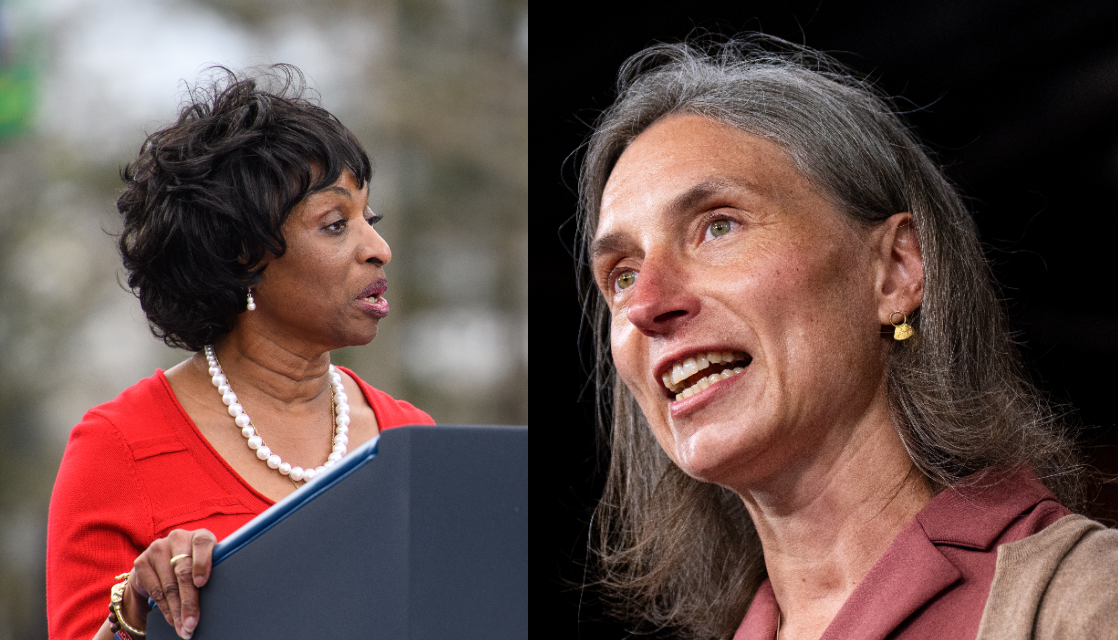
Reps. Maxine Dexter (D-OR) and Valerie Foushee (D-NC), two House Democrats who received significant backing from the AIPAC-aligned United Democracy Project super PAC in their primary races against far-left opponents, announced this week that they would support efforts to block offensive weapons to Israel, Jewish Insider’s Marc Rod reports.
State of play: They join a third UDP-supported Democrat, Rep. Robert Garcia (D-CA), who indicated his support for such a policy more than a year ago. The latest moves highlight the growing anger among Democrats with Israel’s continued war operations in Gaza — and the limited efficacy in advocating for a strong U.S.-Israel relationship towards liberals at a time when public support for the Jewish state within the Democratic party is declining.
BREAKING WITH BIBI

Additional pro-Israel Democrats joined colleagues on Friday in criticizing Israel’s plans to take over Gaza City, which were approved Friday after Israeli Prime Minister Benjamin Netanyahu said Israel intends to take over Gaza City as part of an expanded military operation. It’s a further sign that Israel’s ongoing war plans are causing growing gaps between the Jewish state and some of the country’s most critical left-of-center allies in Washington, Jewish Insider’s Marc Rod reports.
Words of warning: Rep. Brad Schneider (D-IL), a co-chair of the House Jewish caucus and pro-Israel stalwart who is currently visiting Israel, said in a statement that the plan to take over Gaza City “is tactically questionable and strategically self-defeating.” Sen. Adam Schiff (D-CA) noted in a statement that Israeli military officials oppose the Gaza occupation effort and warned that it “could extend [the war] for years, will only result in further loss of life among the hostages, Palestinian civilians, and the members of the IDF required to undertake such a calamitous task. The situation in Gaza is unendurable; this will make it worse. This war must end, not escalate.”
Read the full story here with additional comments from Sen. Mark Warner (D-VA) and Rep. Josh Gottheimer (D-NJ).
Friendly concern: The American Jewish Committee expressed its “deep apprehension” over the Israeli Security Cabinet’s vote to move forward with a military takeover of Gaza City, in a statement released by the organization on Friday, Jewish Insider’s Danielle Cohen-Kanik reports.
SCOOP

Former New Jersey state Rep. Jack Ciattarelli, the Garden State’s Republican nominee for governor, traveled to Israel on Sunday for his first visit during the campaign, his campaign revealed to Jewish Insider’s Emily Jacobs. Ciattarelli is running against Rep. Mikie Sherrill (D-NJ) in the race to succeed New Jersey Democratic Gov. Phil Murphy, who is term-limited. He was New Jersey’s GOP gubernatorial nominee in 2021 against Murphy, narrowly losing to the sitting governor.
Trip talk: Speaking to JI in an interview ahead of his trip, the New Jersey Republican said he expects to have “five very, very productive days in Israel.” Ciattarelli said that the goal of the visit was to find opportunities for economic investment in New Jersey from leading Israeli companies in the technology and medical sectors and to show his solidarity with the Garden State’s Jewish community. New Jersey has the second-largest Jewish population in the country.
CANDIDATE COMMITMENTS

The Democratic and Republican nominees for governor of New Jersey spoke last week at an event organized by the New Jersey Jewish Business Alliance about their plans to combat antisemitism across the Garden State, Jewish Insider’s Marc Rod reports.
What they’re saying: “I vow to be an ally in the governor’s office. I’ll put the full force of law behind combating antisemitism and making sure that everyone can thrive here in the Garden State,” Rep. Mikie Sherrill (D-NJ) said. Republican Jack Ciattarelli said that his entire administration “will be sensitive to the needs and worries of the Jewish community across this state,” and that he’d launch a Jewish advisory council. “It’s not complicated. Anybody who’s violating university policy should be expelled. Anybody who’s broken the law should be arrested, and anybody here on academic visa that’s done either those two things should go back to where the hell they came from,” he continued.
SPEAKING OUT

Virginia state Sen. Ghazala Hashmi, the Democratic nominee for lieutenant governor, on Thursday became the latest Virginia politician to weigh in on antisemitic comments by state lawmaker Sam Rasoul. Without naming Rasoul directly, Hashmi appeared to criticize his language, which has been described as antisemitic by several leading Jewish organizations in the state, Jewish Insider’s Gabby Deutch reports.
What she said: “The rise in antisemitism has created real fear in communities across Virginia — and it cannot be ignored or dismissed; instead it must be condemned clearly, consistently and without caveat,” Hashmi wrote in a post on X on Thursday. “As a Muslim, I know what it feels like when an entire community is scapegoated for the actions of a few. No group should be vilified, targeted, or dehumanized. Antisemitism, Islamophobia, racism and all forms of hate have no place in our communities — they are an affront to our shared values.”
Worthy Reads
Churchill’s Legacy: In The Wall Street Journal, Winston Churchill biographer Andrew Roberts considers why the wartime British leader is reviled by far-right, revisionist podcasters who have engaged in historical revisionism around Churchill’s legacy. “So why is the ultraright targeting Churchill? In the simplest terms, it is because his practical aims and principles as a leader of the West were directly opposed to the new strain of isolationism in America and Britain. Today’s revisionists project their views about Iraq, Afghanistan and now Iran backward through history and denounce the leading global interventionists of yesteryear. They blame Churchill (along with Franklin Roosevelt) for ‘escalating’ the conflict with Hitler and thus associate him with any effort to confront today’s aggressive tyrants.” [WSJ]
Cyber Conflict: The Financial Times’ James Shotter and Bita Ghaffari look at the ongoing cyberconflict between Israel and Iran that preceded the 12-day June war and remains ongoing. “But while physical fighting ended after 12 days, the digital warfare has not. ‘It heated up after the start of the war, and it’s still going on,’ one Israeli official said of the texts. ‘I’m still getting them.’ Since the ceasefire, for example, Iranian-aligned groups have attempted to use a vulnerability recently identified in a global breach of Microsoft server software to attack Israeli companies, according to Boaz Dolev, chief executive of the Israeli cyber threat intelligence company ClearSky. ‘Although there is a ceasefire in the physical world, in the cyber arena, [the attacks] did not stop,’ Dolev said.” [FT]
Word on the Street
White House Middle East envoy Steve Witkoff met on Saturday in Ibiza, Spain with Qatari Prime Minister Sheikh Mohammed bin Abdul Rahman al-Thani to discuss a potential ceasefire and hostage-release deal that would end the war…
Former CENTCOM head Gen. Erik Kurilla departed his posting over the weekend; Kurilla is being succeeded by Adm. Brad Cooper, who served as Kurilla’s deputy…
In a feisty interview with The New York Times’ Lula Garcia-Navarro, ADL CEO Jonathan Greenblatt explains why he considers much of anti-Zionism to be antisemitism, saying, “Let me tell you what anti-Zionism doesn’t mean to me but what it results in: It’s a lunatic trying to burn down the governor’s mansion with his family sleeping in it because of his, quote, position on Palestine. It is, again, firebombing elderly people because you want to “end all Zionists”…
Police in Montreal are investigating an attack on a Jewish man in the city’s Villeray–Saint-Michel–Parc-Extension neighborhood; Canadian Prime Minister Mark Carney called the incident “an appalling act of violence”…
German Ambassador to Israel Steffen Seibert expounded on Berlin’s decision last week to halt offensive weapons sales to Israel in light of Israel’s plan to expand operations in Gaza, listing Germany’s priorities as “hostage release, ceasefire, humanitarian aid and no future role for Hamas,” and saying it was “[u]nclear how intensified military op’s will help achieve them”…
The New York Times looks at the conversations and meetings that led British, French and German leaders to take more critical approaches to Israel…
Australian Prime Minister Anthony Albanese said Canberra would recognize a Palestinian state at the United Nations General Assembly next month…
U.S. Ambassador to Israel Mike Huckabee slammed U.K. Prime Minister Keir Starmer’s recent comments opposing Israel’s planned offensive in Gaza City, suggesting that England would have lost World War II under Starmer’s leadership…
More than 450 people were arrested in London during a demonstration in support of the Palestine Action group, which the U.K. last month proscribed as a terror group…
Seyed Hossein Mousavian, a former senior Iranian official who had been teaching at Princeton since 2010, retired from the school, where he taught in the Program on Science and Global Security at the Princeton School of Public and International Affairs…
Elon Musk’s Starlink internet service launched its services to the general public in Israel…
Al Jazeera said five of its staffers were killed in an Israeli strike in Gaza City; Israel said Anas Al-Sharif, who was killed in the strike, was a Hamas cell leader…
Former Israeli hostage Shlomi Ziv, who spent nearly 250 in captivity in Gaza, responded to the report of Al-Sharif’s death, saying, “I was held by a journalist in captivity and his father was a Doctor!!!!!!!!”…
A section of the Western Wall near the site’s egalitarian section was vandalized with graffiti reading, “There is a Holocaust in Gaza”…
A Holocaust survivor who was injured in an Iranian ballistic missile strike in June died on Saturday at her home in Rehovot…
Iran’s judiciary said that authorities had arrested 20 people in recent months alleged to have been working with Israel’s Mossad…
In an excerpt from their upcoming book, The Wall Street Journal’s Drew Hinshaw and Joe Parkinson detail an effort to free Russian opposition leader Alexei Navalny, who died in prison in February 2024, noting that discussions to free Navalny began with a meeting in Tel Aviv between Russian-Israeli businessman Roman Abramovich and former U.S. hostage envoy Roger Carstens…
Tal Shalev is now an Israel correspondent for CNN…
Max Eden is joining the America First Policy Institute as director of federal education policy…
Dancer and Martha Graham protogee Linda Hodes, who spent 13 years teaching at Israel’s Batsheva Music Company and whose daughters were held hostage during a PFLP hijacking in 1970, died at 94…
Texas businessman Morton Meyerson, who advised Ross Perot on his 1992 presidential campaign, died at 87…
Boxing promoter Don Elbaum, who worked with Don King, Sugar Ray Robinson and Muhammed Ali, died at 84…
Pic of the Day

Shir Siegel (center), the daughter of former hostages Keith and Aviva Siegel (pictured), married Yuval Bar On on Thursday, after having postponed their wedding until after both of her parents were freed from captivity.
Birthdays

Co-founder and partner of MizMaa Ventures and wine columnist for Jewish Insider, Isaac “Yitz” Applbaum…
Longtime Democratic Party activist in N.Y.’s Orange and Rockland Counties, Doris Feder turns 93… Architect best known for the Holocaust Memorial in Berlin and the State Farm Stadium in Glendale, Ariz., Peter David Eisenman turns 93… Former member of the House of Representatives, she also served as Brooklyn DA and NYC comptroller, Elizabeth Holtzman turns 84… Principal of Investors Research Group based in Los Angeles, Jacob S. Segal… Former SVP for international affairs at the Jewish Federation Los Angeles, Lois Weinsaft… Co-founder of The Carlyle Group, in 2024 he became the principal owner of MLB’s Baltimore Orioles, David Rubenstein turns 76… U.S. trade representative during the Clinton administration, she retired in 2021 as the chair of the international trade group at WilmerHale, Ambassador Charlene Barshefsky turns 75… Senior counsel for benefits and employment at the Wagner Law Group, Linda E. Rosenzweig… Lenore Solomon… Artistic director and choreographer of an eponymous dance company based in Union, N.J., Carolyn Dorfman… CEO, chairman and major shareholder of the Russian gas company Novatek, Leonid Mikhelson turns 70… Board member emeritus of AIPAC, Jeffrey Snyder… Former member of the Massachusetts Senate, he is the founder of Cape Air (an airline started on Cape Cod but that now has 37 domestic and international destinations), Daniel A. “Dan” Wolf turns 68… Publisher of Yated Ne’eman, Rabbi Pinchos Lipschutz turns 67… Member of Knesset since 2015 for the Likud party, he serves as minister of regional cooperation, David “Dudi” Amsalem turns 65… Chairman at Duty Free Americas, he owns Israel’s Psagot Winery, Simon Falic… Former chief of the Shin Bet, Nadav Argaman turns 65… Political, cultural and social science commentator for The New York Times, David Brooks turns 64… Host of “The Joe Rogan Experience,” one of the most popular podcasts in the world with 6.1 billion views on YouTube, Joe Rogan turns 58… Senior advisor for communications and engagement at The Aspen Institute, Ilana Marcus Drimmer… Clarinetist who performs internationally as a soloist, Sharon Kam turns 54… MLB pitcher for seven teams, he has also been the pitching coach for Team Israel, Andrew Lorraine turns 53… NFL offensive lineman for four seasons, he is now the managing partner of Oakland-based North Venture Partners, Alex Bernstein turns 50… Co-founder and CEO of Israeli interactive video firm Eko, Yoni Bloch turns 44… Chief investment officer and CEO of Toronto-based investment firm Murchinson, Marc Bistricer… NFL punter for seven seasons with the Jaguars and Bears, he was then a broker in the Jacksonville office of Merrill Lynch, Adam Podlesh turns 42… Reporter for Mishpacha Magazine, known as Jake Turx, Avraham Yaakov Tarkieltaub turns 39… Ukrainian-born and San Francisco-raised journalist and copywriter, Yelena Shuster… Complex general surgical oncology fellow at the University of Texas MD Anderson Cancer Center, Sara Ginzberg, M.D…. Daniel Weitz…
The change in how young voters get information is driving the shift in public opinion on a wide range of issues

Alex Wong/Getty Images
A visitor holds an AIPAC folder in an elevator in Rayburn House Office Building on March 12, 2024 on Capitol Hill in Washington, DC.
One of the biggest slurs coming from anti-Israel influencers and other crankish extremists is that outside pro-Israel advocacy groups, such as AIPAC, somehow play an inordinate role in the reason so many lawmakers support a close U.S.-Israel alliance.
Their misguided belief is that the donations from pro-Israel donors drive lawmakers’ behavior. The reality is that such financial support has reflected the strong public support Israel has long enjoyed — within both parties.
But as that public support drops within the Democratic Party (and to a lesser extent, among independents), all the resources in the world won’t be able to prevent progressive-minded elected officials from putting their finger in the wind and reneging on their past backing for the Jewish state.
We’re already seeing the consequences of Israeli Prime Minister Benjamin Netanyahu’s decision to expand the war in Gaza by taking control of Gaza City — a decision that has limited support in Israel, and has been drawing criticism even from some of Israel’s stalwart Democratic party supporters at home.
But what should be doubly concerning to the Jewish state and its supporters is that several of the Democrats championed by AIPAC’s super PAC in the last two congressional elections — Reps. Valerie Foushee (D-NC), Maxine Dexter (D-OR), and Robert Garcia (D-CA) — have lately become more hostile to Israel, with the former two calling for a cutoff in military aid.
And as we documented last Friday, Rep. Maxwell Frost (D-FL), whose initial candidacy was boosted by commitments he made to Jewish leaders amid skepticism about his record on Israel, is now reneging on many of those promises, joining a handful of progressives in calling for a Palestinian state.
Some important context: All these Democrats represent some of the most progressive turf in the country, with deep-blue constituencies in Portland, Ore.; Durham, N.C.; and Long Beach, Calif. AIPAC’s engagement in these primaries, electing more mainstream Democratic candidates, was a key marker of the group’s success, given the sizable anti-Israel constituency in all these districts.
But ultimately, the overall progressive turn against Israel proved more consequential than these lawmakers’ relationships with AIPAC or the amount of financial support they received in their primaries. It’s hard enough for mainstream Democrats to run against the left-wing tide that’s been gaining ground in their party. In these activist-minded districts, it’s become nearly impossible.
It’s been the rise of social media platforms amplifying extreme views that have played an outsized role in shaping public opinion — far more than the money from outside advocacy groups. The change in how young voters get information is driving the shift in public opinion on a wide range of issues, and is fueling the left-wing, anti-establishment constituency within the Democratic party.
We’re seeing the consequence of that change within the Democratic party and its voters’ views towards Israel in real time. Even the best and well-resourced outside advocacy can only do so much when the rules of the game are skewed against the political mainstream.
Reps. Maxine Dexter (D-OR) and Valerie Foushee (D-NC) flip-flopped on their previous opposition to block military aid to the Jewish state
Melissa Sue Gerrits/Getty Images/Bill Clark/CQ-Roll Call, Inc via Getty Images
Reps. Valerie Foushee (NC-D) and Maxine Dexter (D-OR)
Reps. Maxine Dexter (D-OR) and Valerie Foushee (D-NC), two House Democrats who received significant backing from the AIPAC-aligned United Democracy Project super PAC in their primary races against far-left opponents, announced this week that they would support efforts to block the transfer of offensive weapons to Israel.
They join a third UDP-supported Democrat, Rep. Robert Garcia (D-CA), who indicated his potential support for such a policy more than a year ago.
The latest moves highlight the growing anger among Democrats with Israel’s continued war operations in Gaza — and the limited efficacy in advocating for a strong U.S.-Israel relationship towards liberals at a time when public support for the Jewish state within the Democratic party is declining.
Dexter, who represents a deep-blue Portland, Ore. district, benefitted from more than $2 million in UDP donations provided during her 2024 primary race to other PACs supporting Dexter and attacking her opponent, Susheela Jayapal.
Dexter said in a statement this week that the U.S. “must halt the transfer of offensive weapons to Israel and ensure immediate, sufficient and sustained humanitarian aid into Gaza,” also stating that “Palestinians and Israelis alike have the right to security, safety, self-determination and peace. Netanyahu’s war crimes against the Palestinians in Gaza shatter any path toward those aims.”
She added that “Netanyahu clearly believes U.S. support comes without conditions. Israel has the right to defend itself from attack, but it does not have the right to commit gross violations of human rights or obstruct humanitarian aid to innocent civilians. Netanyahu’s government is doing both and worse. … We must use all means necessary to stop Netanyahu’s government from perpetuating these crimes against humanity.”
Jayapal, the sister of Rep. Pramila Jayapal (D-WA), supported conditions on U.S. aid to Israel during her campaign. Dexter, in an interview during her campaign in 2024, told Jewish Insider she would not support imposing additional conditions on U.S. aid to Israel that don’t apply to all U.S. allies.
Dexter said “Israel had the right to defend itself, they were obligated to defend itself” while also calling for a negotiated ceasefire and raising concerns about the humanitarian situation in Gaza. She said she did not believe that Israeli Prime Minister Benjamin Netanyahu was interested in peace.
Asked about her apparent turnaround on the issue, Dexter said in a statement to JI that she would apply a similar standard to any ally.
“It is clear to me that Israel has violated international humanitarian law in the way it has prosecuted this war,” Dexter said. “The withholding of offensive arms, in light of these violations, is a standard to which I would and will continue to hold any American ally. The safety, security, and peace for Israelis and Palestinians alike depend on Netanyahu’s government being held accountable.”
Dexter also voted earlier this year against sanctions on the International Criminal Court, the first major Israel-related vote for new members in the current Congress.
Foushee, whose Durham, N.C.-based district is among the most progressive in the state, was among the first beneficiaries of UDP assistance during her 2022 primary campaign. The group spent $2.1 million supporting her campaign against progressive Nida Allam and former “American Idol” finalist Clay Aiken. Allam had a record of anti-Israel activism even before her campaign for Congress.
Foushee this week announced she would sponsor legislation “to prevent the sale of offensive weapons to Israel.”
“A ceasefire and de-escalation are urgently needed to ensure the sufficient flow of aid into Gaza and protect innocent civilians at aid delivery sites from military attacks,” Foushee said on X. “We simply cannot continue to provide the Israeli government with weapons when they are not being used in accordance with international law to maximize the protection of civilians in Gaza.”
Foushee’s campaign said this week that she would not accept further support from AIPAC.
Her new stance on U.S. aid to Israel comes as the culmination of a series of more critical stances she’s taken since first being elected to office, though she maintained AIPAC’s endorsement in the 2024 cycle.
In June 2023, Foushee signed onto a letter opposing Israel’s entry into the Visa Waiver Program, but subsequently told Jewish Insider she’d done so by mistake. As early as December 2023, Foushee signed onto a letter calling for a ceasefire between Israel and Hamas.
She has voted against numerous measures since the Oct. 7, 2023, Hamas-led attacks on Israel cracking down on Iran, the Houthis and the International Criminal Court. And she voted against several measures to combat antisemitism including the Antisemitism Awareness Act and a resolution describing the slogan “from the river to the sea, Palestine will be free” as antisemitic.
Even so, she traveled to Israel in March 2024 with an AIPAC-affiliated delegation and voted in favor of supplemental aid to Israel.
In December 2024, she signed onto a letter led by other lawmakers accusing Israel of failing to fulfill the conditions of U.S. arms sales policy and law, and co-led a resolution in June condemning the humanitarian situation in Gaza.
Foushee’s office also did not respond to a request for comment.
Asked about Dexter and Foushee’s positions, AIPAC didn’t address them directly, but said that the U.S. should not abandon Israel.
“If American leaders desire to end the conflict, they should take concrete steps to pressure Hamas to free the hostages and surrender,” the group said in a statement. “This is not a moment to abandon an American ally that is battling Hamas terrorists who launched this war with the barbaric attack of October 7.”
A UDP spokesperson did not respond to a request for comment.
Garcia — who was backed by around $500,000 in UDP spending in 2022 — has also taken a more critical stance since taking office. Though he ran as the more moderate Democrat in his campaign, Garcia has frequently aligned with the left since taking office.
He signed onto a letter in April 2024 calling for the U.S. to withhold offensive arms transfers from Israel if it “fails to sufficiently mitigate the harm to innocent civilians in Gaza … and if it fails to facilitate — or arbitrarily denies or restricts — the transport and delivery of humanitarian aid into Gaza.”
His office did not respond to a request for comment on whether he currently supports suspending offensive aid. He voted, after that letter, in favor of supplemental aid for Israel and traveled to Israel with the AIPAC-affiliated American Israel Education Foundation.
Garcia called for a ceasefire on Nov. 11, 2023, and announced last year he would boycott Netanyahu’s address to Congress. Like Foushee, he has opposed many of the measures the House has voted on in the past two years aimed at countering Iran and its proxies, and several of the antisemitism-related measures.
Right and left rail against Israeli plan to seize control of Gaza City to further pressure Hamas
GIL COHEN-MAGEN/AFP via Getty Images
Israel's Prime Minister Benjamin Netanyahu speaks during an event at the Waldorf Astoria Hotel in Jerusalem on July 27, 2025.
Israel’s decision to take control of Gaza City is meant to prevent further prolonging the war, Israeli Prime Minister Benjamin Netanyahu said on Sunday.
The prime minister’s comments come as elements of the Israeli right and nearly all of the left have railed against the decision, further destabilizing the prime minister’s hold on Israel’s leadership.
In a video statement on Saturday night, Israeli Finance Minister Bezalel Smotrich said he had “lost trust that the prime minister can and wants to lead the IDF to a decisive victory.”
At the same time, tens of thousands of Israelis took to the streets of Tel Aviv to protest against the Cabinet’s decision, calling for an immediate hostage deal.
Speaking Sunday at a press conference for foreign media in Jerusalem, Netanyahu said that “Hamas still has thousands of terrorists in Gaza … Hamas is refusing to lay down its arms, so Israel has no choice but to finish the job.”
”Contrary to false claims,” the prime minister argued, “this is the best way to end the war and to end it speedily.”
Rather than take control of Gaza City, part of the remaining 25% of Gaza that Israel does not control, IDF Chief of Staff Lt. Gen. Eyal Zamir presented to the Security Cabinet on Thursday night a strategy of surrounding those areas, while expressing concern about the safety of the 20 hostages believed to still be alive if a military takeover is attempted.
As to whether Israel’s new plan puts hostages in further danger, Netanyahu said that “the option of just doing a war of attrition from a defensive position has not proved itself. It won’t bring [the hostages] out … [It will lead to a] protracted conflict that won’t bring the war to an end.”
”I don’t want to prolong the war. I want to end the war, and I think the other option would have prolonged the war,” he added. “Prolonging the war means that many of them could be starved to death.”
Netanyahu also emphasized Israel’s “five principles for concluding the war,” authorized by the Security Cabinet, which he said were his “day-after plan” for Gaza. They consist of disarming Hamas, returning the hostages, demilitarizing Gaza, Israeli security control of the enclave and establishing a civilian administration for Gaza led by neither Hamas nor the Palestinian Authority.
Though Netanyahu said in an interview with Fox News last week that Israel plans to take control of all of Gaza, the Security Cabinet decision announced early Friday morning fell short of that.
The Security Cabinet voted early Friday, after a 10-hour meeting that began the previous day, for the IDF to “prepare for taking control of Gaza City while distributing humanitarian assistance to the civilian population outside the combat zones.”
Netanyahu continued to speak of the IDF seizing all of Gaza on Sunday, presenting an image of the “remaining Hamas strongholds” of Gaza City and the “central camps and Moassi,” a second enclave. A spokesperson for the prime minister clarified to Jewish Insider after the press conference that “the decision that was authorized is about Gaza City. Later, if needed, the central camps as well.”
Netanyahu said that, as Israel did before maneuvering into Rafah over a year ago, it plans to move the population out of Gaza City, “safeguard the civilian population and let us go, at last, into the most important stronghold of Hamas.”
Gaza City is only part of the remaining 25% of Gaza not currently controlled by the IDF. Reports indicate that the IDF said it will take two months to move the civilian population out of the city; Netanyahu said he instructed the military to do it in less time because he wants to finish the war as soon as possible.
That two-month window leaves an opening for another ceasefire deal as Qatar, Egypt and the U.S. are reportedly working on reviving negotiations.
The plan was supported by “a decisive majority of Security Cabinet ministers,” according to the Prime Minister’s Office.
Smotrich accused Netanyahu of “making a U-turn” from a plan they devised together “to go all the way,” involving “dramatic moves to bring victory in Gaza, a combination of a quick military victory and an immediate diplomatic move to exact a painful price from Hamas, destroy its military and civilian capabilities, and put unprecedented pressure to free the hostages.”
Instead, Smotrich argued, the Security Cabinet chose to support “an immoral, unreasonable folly,” that would involve “sending tens of thousands of fighters to maneuver in Gaza City while endangering their lives and paying heavy diplomatic and international prices, only to pressure Hamas to free hostages and then retreat.”
“I cannot back this decision. My conscience doesn’t allow it … No more stopping [the war] in the middle … We must make a clear, sharp move to defeat Hamas and bring the hostages home all at once,” he stated.
Despite saying that he lost trust in Netanyahu, Smotrich did not say he was leaving the coalition. Instead, he called for another Security Cabinet meeting to further discuss Israel’s next steps in Gaza.
Israeli National Security Minister Itamar Ben-Gvir, who, like Smotrich, has pushed for more aggressive moves in the war in Gaza, told Army Radio on Sunday that Smotrich turned down his offer to present an ultimatum to Netanyahu to quit the government if it does not accept a plan to “go in, destroy, conquer.” Smotrich and Ben-Gvir have called for Israel to fully occupy Gaza and build Israeli settlements in the enclave.
Smotrich’s outspoken criticism is a signal of the growing leverage he holds within Netanyahu’s volatile government. Netanyahu currently has a minority coalition, holding just 60 out of the Knesset’s 120 seats, making his political situation tenuous. The United Torah Judaism and Noam parties left the coalition last month over disputes relating to sanctions for Haredim who do not serve in the IDF.
Tzvi Sukkot, a lawmaker from Smotrich’s Religious Zionism Party, wrote in a post on X on Sunday morning, “if we are going back to Oct. 6, 2023 and decide to give up on the war aims, it is an existential threat to the State of Israel. If that is the situation, in my humble opinion, we must go to an election.”
Israeli opposition leader Yair Lapid wrote Smotrich a letter asking for his support for a bill to disperse the Knesset, which would trigger an election.
“You admitted that the prime minister’s policy is not bringing a decisive victory in Gaza, is not bringing back our hostages and is not winning the war,” Lapid wrote. “You added that you cannot stand behind the prime minister and back him anymore. In light of this, I call you to join me in a letter to the Knesset speaker in which we can say there was a significant change in circumstances that justifies bringing up the bill to disperse the Knesset again.”
At the same time, the political opposition and the Hostages Families Forum spoke out against the more aggressive approach in Gaza approved by the Security Cabinet, pointing to Zamir’s opposition to the move.
Lapid called the decision “a disaster that will lead to many additional disasters.”
“In total opposition to the opinion of the military and security levels, without consideration for the exhaustion and attrition of the fighting forces, Ben-Gvir and Smotrich dragged Netanyahu to a move that will take many months, will lead to the death of hostages, to many soldiers killed, will cost tens of billions of Israeli taxpayer money and will lead to diplomatic collapse. That’s just what Hamas wants,” Lapid said.
“As we approach the tragic one-year anniversary of the murder of six hostages who were executed by their captors, the expansion of fighting only further endangers those still held in Gaza’s tunnels,” the forum stated. “Hamas continues to exploit military escalation as justification for its brutal treatment of our loved ones … Our government is leading us toward a colossal catastrophe for both the hostages and our soldiers. The Cabinet chose last night to embark on another march of recklessness, on the backs of the hostages, the soldiers, and Israeli society as a whole.”
Tens of thousands gathered for the weekly demonstrations in central Tel Aviv Saturday night, blocking the city’s central artery, the Ayalon Highway. Some of the hostages’ relatives called for a general strike on Sunday and for soldiers to refuse orders.
Shai Mozes, nephew of released hostage Gadi Mozes, said that following the Security Cabinet decision, “the mission you’ll be given is participation in killing the hostages. In this situation, there is no choice but to refuse.”
Several hostages’ relatives expressed support for a general strike, as did Lapid. The Hi-Tech Forum, representing dozens of Israeli tech companies and hedge funds, said they would allow their employees to miss work if a strike is held.
The Histadrut, Israel’s national labor union, declined to support a strike, following a court ruling last year that they can only strike for explicitly labor-related reasons.
Netanyahu also discussed the humanitarian situation in Gaza in the press conference Sunday, saying that Israel’s “policy throughout the war has been to prevent a humanitarian crisis while Hamas’ policy is to create it.”
Israel is working to avoid a humanitarian crisis by designating safe corridors for aid distribution, increasing safe distribution points managed by the Gaza Humanitarian Foundation and continuing airdrops by Israel and other countries, he said.
”The only ones being deliberately starved in Gaza are our hostages,” Netanyahu argued, displaying a screenshot from a video Hamas released last week of hostage Evyatar David and contrasting his emaciated arm with the much thicker one of his captor.
Netanyahu also displayed photographs of children from Gaza who appeared in the foreign media alongside claims that they had been starved by Israel, and listed the congenital diseases from which they suffered that were not originally reported. He said his office is looking into whether Israel can sue The New York Times over the matter.
The prime minister compared the claims to blood libels: “We were said to be spreading vermin in Christian society; we were said to be poisoning the wells; we were said to slaughter Christian children for blood. That was followed by massive violence, pogroms, displacement, followed by the worst of all, the Holocaust.”
”The international press is falling for Hamas propaganda, hook line and sinker,” he added, standing next to the text “Open your eyes to Hamas’s lies.”
Netanyahu also said he had ordered the IDF to allow more foreign journalists into Gaza.
However, he stated, “We will not commit suicide to get a good op-ed.
The Anti-Defamation League also voiced ‘significant reservations’ about Netanyahu’s military operation
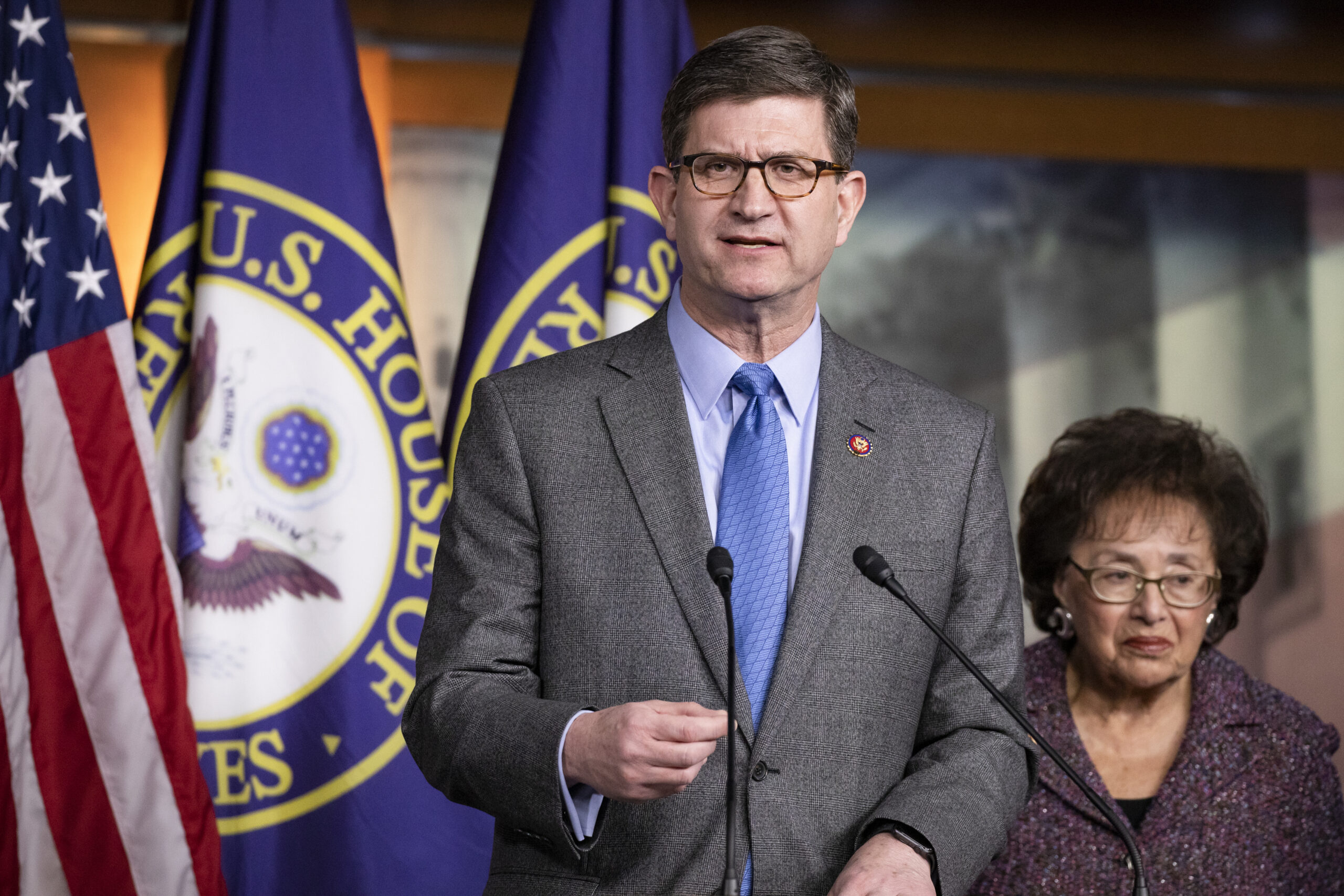
Samuel Corum/Getty Images
Rep. Brad Schneider (D-IL) speaks about his experiences during a trip to Israel and Auschwitz-Birkenau as part of a bipartisan delegation from the House of Representatives on January 28, 2020 in Washington, DC.
Additional pro-Israel Democrats joined colleagues on Friday in criticizing Israel’s plans to take over Gaza City, which were approved Friday after Israeli Prime Minister Benjamin Netanyahu said Israel intends to take over Gaza City as part of an expanded military operation.
It’s a further sign that Israel’s ongoing war plans are causing growing gaps between the Jewish state and some of the country’s most critical left-of-center allies in Washington.
Rep. Brad Schneider (D-IL), a co-chair of the House Jewish caucus and pro-Israel stalwart who is currently visiting Israel, said in a statement that the plan to take over Gaza City “is tactically questionable and strategically self-defeating.”
“If implemented, the decision is more likely to play into Hamas’s original objectives in starting this war and further unite much of the world against Israel than it is to bring home the last surviving hostages and advance the security needs of the nation,” Schneider continued. “In fighting what is unquestionably an existential war against absolute evil, Israel must also uphold its responsibility to do all it can to protect civilians in Gaza and enable humanitarian aid to reach those in need.”
At the same time, he emphasized that Hamas started the war with the intent of eliminating Israel, and that Israel has the “absolute right” to defend itself and free the hostages. He said that if the world wants the war to end, it must commit to working with Israel, the U.S. and European and Arab states to “open new pathways for relief, recovery and renewal.”
Sen. Adam Schiff (D-CA) warned in a statement that Israeli military officials oppose the Gaza occupation effort and that it “could extend [the war] for years, will only result in further loss of life among the hostages, Palestinian civilians, and the members of the IDF required to undertake such a calamitous task. The situation in Gaza is unendurable; this will make it worse. This war must end, not escalate.”
“To be clear: Hamas must be held to account for its mass murder, torture, and rape of Israelis, and for any diversion of food from those who are hungry. No call upon the Israeli government to act to stop this unendurable suffering by civilians in Gaza can ignore the barbaric acts committed by Hamas that brought this war about, the need to ensure they can never threaten Israel again, and the even more urgent need for the release of all of the hostages,” Schiff continued. “The international community must be persistent in its demand for the immediate release of the hostages and not ignore the casus belli of this terrible war.”
He said that the U.S.-Israel relationship should transcend any particular government on either side, and urged U.S. allies not to abandon Israel, “But that does not mean we can or should ignore or fail to call out continued perilous action — and inaction — by both this Prime Minister and this President — and insist on a dramatic change in the policies of both.”
Schiff added, “I find no shared value in the preventable starvation of the people of Gaza. I see no common principle in the forced displacement of Palestinians from Gaza or plans for settler colonies there, only a moral and legal failing of terrible proportion. I am compelled to speak out, because I believe in an Israel that has been, and can be again, a light unto other nations.”
Sen. Mark Warner (D-VA) called the Gaza City plan “a dangerous and counterproductive move that will not secure the release of the remaining hostages or bring an end to the fighting that has already taken so many lives.”
“This approach will without question worsen the already terrible humanitarian conditions in Gaza, and Israel’s own military leaders have expressed serious concerns about the feasibility and risks of this strategy,” Warner continued. “The priority must be to end this war immediately through diplomatic efforts and coordinated pressure to ensure the safe return of hostages and protect innocent lives. Pursuing this path will only guarantee prolonged conflict and greater suffering.”
Rep. Josh Gottheimer (D-NJ), one of Israel’s most vocal defenders in the House, took a somewhat different tack, saying in a statement and an interview on CNN that Netanyahu had told him in a meeting this week that Israel does not plan to occupy Gaza in the long term.
“I’m opposed to long-term occupation and annexation — but Hamas must go,” Gottheimer said on X. “I strongly support crushing Hamas terrorists and their last strongholds. I fervently back surging humanitarian aid and preventing Hamas from blocking it. We must urgently free the hostages being starved by Hamas, remove Hamas from power, and transition to an Arab-led peacekeeping force to bring lasting peace and safety for both innocent Palestinians and Israelis.”
He said in the CNN interview that Hamas could end the war by agreeing to surrender.
The Anti-Defamation League also voiced “significant reservations about the Israeli Cabinet’s decision to expand operations in Gaza” in a statement on Friday. The group declined to weigh in on the strategy involved but said that the move could further endanger the hostages and worsen the humanitarian situation for Palestinian civilians.
Democratic Majority for Israel said that “Pro-Israel Democrats have questions and concerns about the reported escalation of the conflict,” while emphasizing Hamas’ responsibility for the war and the need for a deal to free the hostages and increase humanitarian aid.
“We call on the Trump Administration to ensure sufficient humanitarian assistance and exert maximum pressure on Arab states such as Qatar to force Hamas to accept a ceasefire and free the hostages,” the DMFI statement continued.
It’s the GOP gubernatorial nominee’s second trip to the Jewish state
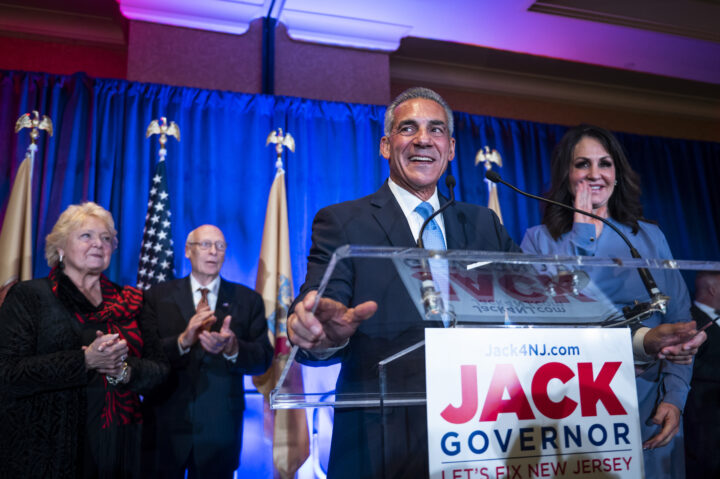
Mark Kauzlarich/Bloomberg via Getty Images
Jack Ciattarelli, Republican candidate for governor of New Jersey
Former New Jersey state Rep. Jack Ciattarelli, the Garden State’s Republican nominee for governor, will travel to Israel on Sunday for his first visit during the campaign, his campaign revealed to Jewish Insider.
Ciattarelli is running against Rep. Mikie Sherrill (D-NJ) in the race to succeed New Jersey Democratic Gov. Phil Murphy, who is term-limited. He was New Jersey’s GOP gubernatorial nominee in 2021 against Murphy, narrowly losing to the sitting governor.
Speaking to JI in an interview ahead of his trip, the New Jersey Republican said he expects to have “five very, very productive days in Israel.”
Ciattarelli said that the goal of the visit was to find opportunities for economic investment in New Jersey from leading Israeli companies in the technology and medical sectors and to show his solidarity with the Garden State’s Jewish community.
New Jersey has the second-largest Jewish population in the country.
“One of my objectives as governor is to grow our economy, and one of the ways that we achieve that objective is by forging a closer economic relationship with a number of nations, one of which is certainly Israel. They have technology companies, medical device companies, pharmaceutical companies, and a number of other industries that are looking to expand internationally. And when they do, we certainly want them to do that in New Jersey,” Ciattarelli said.
Ciattarelli added that the trip, his second time visiting the Jewish state, “also has great significance for New Jersey’s Jewish community,” because it signifies his commitment to a strong U.S.-Israel relationship.
“I’ve always been a big supporter of Israel. And as we know, antisemitism is at an all-time high in New Jersey, across the nation and the globe. As governor, antisemitism will not be tolerated. And so again, by going to Israel, we demonstrate a very close relationship between New Jersey and this very important ally in the Middle East and, of course, in the world,” he explained.
Ciattarelli previously traveled to the Jewish state during his 2021 gubernatorial run, one month before the general election. The trip, which Ciattarelli described to JI at the time as a “life-changing experience,” was his first visit to Israel.
“My goal was to let civic leaders, business leaders and religious leaders know that Israel will have a strong ally in New Jersey when I’m governor. From an economic development perspective, Israel does more than $14 billion a year in bilateral trade with New York. It does only $1 billion with New Jersey. That shouldn’t be the case,” Ciattarelli said after his 2021 visit.
“So I made clear during my trip and meeting with all leaders, that New Jersey is going to strengthen its cultural, religious and economic ties with the State of Israel. And we will stand with her in defending its people,” he continued.
He again mentioned the trade deficit while speaking to JI on Friday about his upcoming visit.
“Israel does $14 billion a year in bilateral trade with New York, less than $2 billion a year with New Jersey. There’s nothing New York has that New Jersey doesn’t. So we want to make sure that Israeli companies, when they invest in the United States, they do so right in New Jersey,” Ciattarelli said.
AJC statement: ‘The profound risks posed by a full military takeover of Gaza City cannot be overlooked’

Haley Cohen
Ambassador Deborah Lipstadt, U.S. special envoy to monitor and combat antisemitism, and Rabbi Andrew Baker, AJC’s director of international Jewish affairs, in conversation with AJC CEO Ted Deutch.
The American Jewish Committee, one of the leading global Jewish and pro-Israel advocacy organizations, expressed its “deep apprehension” over the Israeli Security Cabinet’s vote to move forward with a military takeover of Gaza City, in a statement released by the organization on Friday.
AJC acknowledged the “extraordinary challenges” Israel faces due to Hamas’ “intransigence” in negotiations and the “failure of the international community to impose sufficient pressure on the terrorist organization.”
“Still,” the statement read, “the profound risks posed by a full military takeover of Gaza City cannot be overlooked.” It highlighted concerns over “endanger[ing] the lives of the remaining hostages” and the possibility of “substantial casualties among both Israeli soldiers and Palestinian civilians,” in particular.
AJC called on the signatories of the New York Declaration — signed last month by dozens of countries including member states of the Arab League and European Union — to “apply maximum pressure on Hamas to agree to a hostage release and ceasefire agreement.”
Plus, Maxwell Frost's cold shoulder to Israel

JACQUELYN MARTIN/POOL/AFP via Getty Images
Israeli Prime Minister Benjamin Netanyahu gives statements to the media inside The Kirya, which houses the Israeli Defence Ministry, after their meeting in Tel Aviv on October 12, 2023.
Good Friday morning.
In today’s Daily Kickoff, we look at how Israeli Prime Minister Benjamin Netanyahu’s proposed actions in Gaza are prompting criticism from some of Israel’s most reliable supporters, and report on Rep. Maxwell Frost’s 180-degree pivot from his campaign pledges regarding Israel. We cover a push by dozens of House members in support of maintaining the U.S. ban on exporting advanced F-35 fighter jets to Turkey, and talk to Rich Goldberg about his monthslong stint in the Trump administration as the senior counselor for the White House’s new National Energy Dominance Council. Also in today’s Daily Kickoff: Stephen Miran, Katie Miller and Tony Blinken.
For less-distracted reading over the weekend, browse this week’s edition of The Weekly Print, a curated print-friendly PDF featuring a selection of recent Jewish Insider and eJewishPhilanthropy stories, including: Maxwell Frost reneges on pro-Israel pledges; Lessons from Gaza disengagement remain relevant 20 years later; and James Walkinshaw sounds more supportive of Israel than his former boss. Print the latest edition here.
What We’re Watching
- We’re keeping an eye on IDF moves in Gaza this weekend, following a late-night Israeli Security Cabinet vote to move forward Israeli Prime Minister Benjamin Netanyahu’s plan to take over Gaza City. More below.
- Vice President JD Vance is in Kent, England, today, where he is slated to meet with U.K. Foreign Secretary David Lammy.
- Armenian Prime Minister Nikol Pashinyan and Azerbaijani President Ilham Aliyev are in Washington for meetings with senior Trump administration officials, including a trilateral meeting with the president this afternoon during which time the leaders will sign a peace deal ending decades of conflict. Yesterday, Aliyev met with Middle East special envoy Steve Witkoff.
- The Jewish National Fund’s Our Jewish Roots conference kicks off today in Carlsbad, Calif.
- Hadassah’s National Conference begins on Sunday in Aventura, Fla.
What You Should Know
A QUICK WORD WITH JI’S MELISSA WEISS
Israeli Prime Minister Benjamin Netanyahu’s announcement on Thursday that Israel plans to take control of additional parts of the Gaza Strip before handing it over to an unspecified Arab governing authority is being met with hesitation from even some of Israel’s most stalwart defenders. The Security Cabinet voted early this morning to take over Gaza City, stopping short of the full occupation of the Strip previously discussed.
Throughout much of Israel’s war against Hamas in Gaza, the Israeli public broadly supported the military effort, even as progressive lawmakers such as Sens. Bernie Sanders (I-VT) and Elizabeth Warren (D-MA) painted the war as “Netanyahu’s war,” and the Israeli prime minister as the bogeyman-in-chief.
But in recent months, public sentiment in Israel has shifted noticeably. With most of Hamas’ senior military leadership eliminated, growing numbers of Israelis have begun to question the feasibility of Netanyahu’s goal of “total victory” over Hamas, given the terror group’s hold on the Gazan population and a lack of clarity on what’s left to accomplish militarily. Instead, polling shows that a large majority of Israelis prefer prioritizing a diplomatic resolution that secures the release of the remaining hostages, rather than expanding the military occupation of Gaza in hopes of complete surrender.
Netanyahu’s plan this week to take over more of Gaza has begun to sap Israel’s political capital even among some of its closest allies on Capitol Hill, not to mention the isolation the Jewish state is facing from less-friendly European capitals. Even within the American Jewish community, as the war drags on into its 23rd month and with mounting IDF fatalities and no living hostages having been released since May, splits have emerged over the wisdom of Netanyahu’s double-down strategy.
Indeed, while the official Israeli position on its war against Hamas in Gaza has hardened, the approach in the Diaspora, both from Jewish groups and leaders and elected officials, has also shifted — in the opposite direction.
hill reactions

Pro-Israel Democrats are criticizing the Israeli government’s plans to expand its operations and take control of additional parts of Gaza, Jewish Insider’s Marc Rod reports. The Israeli Security Cabinet early Friday approved plans to take over Gaza City, though it stopped short of Prime Minister Benjamin Netanyahu’s statement earlier Thursday that Israel plans to take over the entire Gaza Strip.
State of play: The plan seems to be aggravating the growing friction between the Israeli government and some of the Jewish state’s most vocal liberal backers in the United States over Israel’s ongoing war in Gaza and the humanitarian crisis in the enclave. Rep. Ritchie Torres (D-NY) said that Israel is ultimately responsible for making its own decisions, but said he’d advise the Israeli government to seek an end to the war once it frees the hostages. Rep. Jake Auchincloss (D-MA) questioned Netanyahu’s suggestions that Arab forces would be available and willing to take over Gaza in the long term.
FROSTY OUTLOOK

Jewish and pro-Israel leaders are expressing some buyer’s remorse over their previous support for Rep. Maxwell Frost (D-FL), who as a sophomore legislator has embraced positions that put him at odds with his past commitments, fueling frustration among those who had believed he would be a more dependable ally on key issues concerning Israel, Jewish Insider‘s Matthew Kassel reports.
Then: Despite some initial concerns about his history of involvement in pro-Palestinian demonstrations as well as relationships with anti-Israel activists, Frost had circulated a lengthy Middle East position paper in consultation, in part, with a top pro-Israel group that largely assuaged lingering reservations among Jewish community leaders over the sincerity of his views. In the paper as well as a candidate questionnaire solicited by JI during his first primary, the young progressive organizer, describing himself as both “pro-Israel” and “pro-Palestinian,” voiced opposition to conditioning aid to Israel — arguing that the security threats facing the Jewish state are “far too grave” to enact such measures.
Now: The most recent move to draw scrutiny from Jewish and pro-Israel leaders is a letter Frost signed urging the Trump administration to recognize a Palestinian state over growing concerns with the humanitarian crisis in Gaza. In addition to the letter — which followed a similar resolution he co-sponsored in 2023 during his first term — Frost in May joined legislation to place unprecedented new conditions on aid to Israel by withholding offensive weapons over its alleged violations of international law. Last year, he also voted against a widely approved bill to provide supplemental aid to Israel six months after Hamas’ attacks. In a statement explaining his thinking at the time, Frost wrote that he was “only able to justify aid for defense, not offense, and this legislation did not allow me to separate the two,” as the war “has claimed the lives of countless innocent Palestinian civilians and brought us no closer to the return of innocent Israeli hostages held by Hamas.”
SPANBERGER SPEAKS

Facing pressure from the Virginia Jewish community to speak out against recent anti-Zionist social media posts from state Del. Sam Rasoul, former Rep. Abigail Spanberger, the Democratic gubernatorial nominee, addressed concerns about antisemitism without specifically referencing Rasoul, Jewish Insider’s Gabby Deutch reports.
What she said: “This war continues to unleash heartbreak and tragedy as we witness civilian deaths, starving families, and hostages still held by Hamas. These horrors rightly compel so many to advocate for the mass delivery of aid, the release of all Israeli hostages, and a ceasefire between Hamas and Israel,” Spanberger told the Virginia Scope, a political newsletter, in response to a question about Rasoul, who chairs the Education Committee in the House of Delegates. “However, one can and must denounce these tragedies without using antisemitic language, whether intentional or not.” She did not specify whether she identified Rasoul’s rhetoric as antisemitic. Spanberger’s campaign did not respond to multiple requests for comment from JI.
laying down the law

Authorities in the District of Columbia announced on Thursday that they filed federal hate crime charges against Elias Rodriguez, the suspect in the fatal shooting in May of two Israeli Embassy staffers outside the Capital Jewish Museum in Washington. The indictment on nine counts, filed on Wednesday, includes a charge relating to a hate crime resulting in death and comes more than two months after Rodriguez was charged with two counts of first-degree murder, the murder of foreign officials, causing death with a firearm and discharging a firearm in a violent crime for the May 21 attack, Jewish Insider’s Emily Jacobs reports.
Pirro’s presser: Speaking at a press conference on Thursday morning about the new charges, U.S. Attorney for the District of Columbia Jeanine Pirro said, “A D.C. grand jury has charged in this indictment two hate crimes, alleging that he murdered Yaron Lischinsky and Sarah Milgrim because of his bias against the people of Israel. He demonstrated this hatred through his words, ‘Death to Israel,’ and his violent actions against Yaron and Sarah and their co-workers from the Israeli Embassy,” Pirro said.
ADMINISTRATION INSIGHT

Rich Goldberg, a senior advisor at the Foundation for Defense of Democracies, this week concluded a monthslong stint in the Trump administration as the senior counselor for the White House’s new National Energy Dominance Council (NEDC) and a senior advisor to Secretary of the Interior Doug Burgum, Jewish Insider’s Marc Rod reports.
Looking back: Goldberg helped launch the NEDC, which he compared in an interview with JI this week to a “[National Security Council], only for energy,” coordinating with the White House, Burgum and Secretary of Energy Christopher Wright to build domestic production of energy and exploitation of oil, gas, coal and nuclear resources, as well as critical minerals. Goldberg discussed the administration’s efforts to counter Iran and its proxies, push forward AI development and build a new energy and shipping infrastructure in the Middle East, as well as its decision to strike Iran and the path forward in Gaza.
MILITARY MATTERS

A bipartisan group of 40 House members is urging Secretary of State Marco Rubio to maintain the U.S. ban on exporting advanced F-35 fighter jets to Turkey, amid ongoing reports that the U.S. and Turkey are negotiating to allow the sale of the jets, Jewish Insider’s Marc Rod reports.
The argument: “Turkey still possesses S-400 systems and has shown no willingness to comply with U.S. law. This behavior cannot be rewarded,” the letter to Rubio reads. “Lifting sanctions or allowing Turkey back into the F-35 program without first removing its S-400s would jeopardize the integrity of F-35 systems; expose U.S. military secrets to Russian intelligence; undermine our defense industrial base and allied confidence in purchasing future U.S. platforms; and disrupt development of the next-generation fighter jet recently announced by the Administration.”
Elsewhere on the Hill: Sens. James Lankford (R-OK) and Jacky Rosen (D-NV), the co-chairs of the Senate antisemitism task force, highlighted concerns about the latest FBI hate crimes statistics showing a record-high level of antisemitic hate crimes in 2024, and called for further action, Jewish Insider’s Marc Rod reports.
Worthy Reads
Gloom in Khartoum: Reporting from Sudan, The Atlantic’s Anne Applebaum examines how the myriad challenges facing the country have brought about the “end of the liberal world order” in the war-torn African nation. “Turkish, Egyptian, Saudi, Emirati, Qatari, Russian, Iranian, and Ukrainian interests intersect and overlap on this final layer of cellophane, helping make Sudan, like Yemen and Libya, a place where antagonists from around the planet fund violent proxy wars, at the expense of the people who live there. … Meanwhile, the countries that might once have banded together to stop the fighting have lost interest or capacity. The institutions that might once have helped broker a cease-fire are too weak, and can’t or won’t help. ‘We live in a very interesting, many people call it, new world order,’ [Abdalla] Hamdok, the former Sudanese prime minister, told me. ‘The world we got to know — the consensus, the Pax Americana, the post–Second World War consensus — is just no more.’” [TheAtlantic]
Not Joe’s Party: In the New York Daily News, Nathan Diament, executive director of the Orthodox Union Advocacy Center, reflects on the Democratic Party’s shift away from the previously “mainstream” positions of “foreign policy hawkishness and outspoken support for Israel” in the 25 years since Sen. Joe Lieberman, then a Democrat, was announced as former Vice President Al Gore’s 2000 running mate. “This is a stunning change for a party that elevated and embraced Lieberman 25 years ago. Could it happen again today? Many American Jews wondered as much when Pennsylvania Gov. Josh Shapiro was under consideration to be [Vice President Kamala] Harris’ VP. We will never know why Harris didn’t pick Shapiro, but we all saw the concerted antisemitic campaign against him in social media and the press. … The Democratic Party once drew Jews to its cause because it was seen as the party of tolerance and equal opportunity. This was a natural home base for immigrant Jews fleeing the ghettos and pogroms of Europe. Today, the Democratic Party is battling to redefine itself in the wake of its failures in the 2024 election. A growing portion of the left wants it to be a party Lieberman could no longer call home.” [NYDN]
Saving Navalny: In a piece adapted from their upcoming book SWAP: A Secret History of the New Cold War, Wall Street Journal reporters Drew Hinshaw and Joe Parkinson look at the efforts to free Russian opposition leader Alexei Navalny, who died in February 2024. “To this day, a debate continues over whether the U.S. missed a chance to save Navalny, or whether back-channel efforts to free him inadvertently precipitated his demise. One camp believes he could have been exchanged if the Biden administration had moved faster, before he was sent to the harsh arctic prison in Dec. 2023. They place particular blame on Jake Sullivan, Joe Biden’s national security adviser, who was simultaneously assembling a complex, multinational agreement to save Navalny and jailed Americans and juggling an unmanageable set of geopolitical threats, including wars in Ukraine and Gaza.” [WSJ]
Word on the Street
Israeli Prime Minister Benjamin Netanyahu’s office denied as “total fake news” an NBC News report that a conversation with President Donald Trump about concerns over the humanitarian situation in Gaza “devolved into shouting.” …
The U.S. facilitated a meeting between Gaza Humanitarian Foundation head Johnnie Moore and senior U.N. aid officials; Morgan Ortagus, who joined the U.S. mission at the U.N. in June, was reportedly part of the meeting, the first direct engagement between the international body and the GHF since it began operations in May…
The Treasury Department announced sanctions against 18 entities and individuals tied to Iranian sanctions evasion and revenue generation…
Trump plans to nominate Stephen Miran, the head of the White House’s Council of Economic Advisers, to the vacant seat on the Federal Reserve’s Board of Governors…
Katie Miller, who served as a senior advisor to Elon Musk during and after his time in the Trump administration, is departing her role and plans to launch a podcast focused on reaching conservative women…
Former Secretary of State Tony Blinken is joining the Center for American Progress’ board of directors…
Florida Republicans are hoping to redraw three congressional districts in their favor, according to Punchbowl News, targeting two of the most pro-Israel Democrats in Reps. Jared Moskowitz (D-FL) and Debbie Wasserman Schultz (D-FL), as part of the partisan redistricting effort…
Puck’s Julia Ioffe examines the growing divide in the Republican Party over support for Israel…
The Department of Education announced an investigation into Baltimore City Public Schools following a complaint from the Anti-Defamation League that numerous schools in the district failed to act to address antisemitism in classrooms…
Police in Baltimore County are investigating the vandalism of a kitchen design store that displayed Israeli and American flags at its entrance…
Actress Gina Carano settled a lawsuit against Lucasfilm and The Walt Disney Co. after she was fired from “The Mandalorian” in 2021 over a social media post comparing the treatment of conservatives in America to Jews in Nazi Germany…
U.K. officials arrested two men in connection with an incident in Manchester in which the men allegedly used water guns to spray a visibly Jewish man and children walking down a street in the city; video of the incident posted by one of the alleged assailants, which went viral, was paired with a rendition of “Hava Negila”…
Israel’s NewMed Energy announced that the partners in Israel’s Leviathan offshore oil field signed a $35 billion deal to supply natural gas to Egypt through 2040; the agreement marks the largest export deal in Israeli history…
German Chancellor Friedrich Merz said Berlin will halt future arms sales to Israel following the Israeli government’s plan to take over Gaza City…
As American Jewry overall has experienced an increase in Jewish engagement in the wake of the Oct. 7 terror attacks, in what has been deemed “The Surge,” the largest rise has been seen among those connected to the Chabad-Lubavitch movement, outpacing all other denominations and among unaffiliated Jews, according to survey data from Jewish Federations of North America that were provided exclusively to eJewishPhilanthropy’s Judah Ari Gross…
Pic of the Day

Yarden Bibas (second from right) and Dana Silberman-Sitton (far right), respectively the husband and sister of Shiri Bibas, on Thursday cut the ribbon outside the Bibas Family Playroom at Schneider Children’s Hospital in Petah Tikva, Israel. The children’s room, a project of Toys for Hospitalized Children, was dedicated to the memories of Shiri, as well as her sons Ariel and Kfir, who were killed by their captors in Gaza after being taken hostage from their home in Kibbutz Nir Oz on Oct. 7, 2023.
Bibas wore a shirt with the Batman logo in homage to Ariel’s love of the superhero, while the ribbon he and Silberman-Sitton cut was orange in tribute to the boys’ hair color.
Read eJewishPhilanthropy’s coverage of the efforts to build the center here.
Birthdays

Israeli actor, best known for his role as Yanky Shapiro in the 2020 Netflix miniseries “Unorthodox,” Amit Rahav turns 30 on Saturday…
FRIDAY: Actor and director, he won the Academy Award for Best Actor in 1980 for “Kramer vs. Kramer” and in 1989 for “Rain Man,” Dustin Hoffman turns 88… Arlington Heights, Ill., resident, Elizabeth Gordon… Dutch diplomat and politician, he served as the speaker of the Dutch House of Representatives, Frans Weisglas turns 79… Greenwood Village, Colo., resident, Robert M. Schwartz… Tampa, Fla., resident, Roy D. Pulliam… Retired U.S. Army four-star general, who then served as the secretary of defense during the Biden administration, Lloyd James Austin III turns 72… Vancouver, Wash., resident, Juliana E. Miles Bagherpour… Former U.S. ambassador to Israel, David Melech Friedman turns 67… Former CEO of BusinessGhost, Michael Graubart Levin turns 67… Managing general partner of MLB’s Tampa Bay Rays, Stuart L. Sternberg turns 66… Chess grandmaster, once ranked eighth in the world, he is the director of the Brooklyn Chess Academy, Leonid Yudasin turns 66… White House chief of staff for the first two years of the Biden administration, Ron Klain turns 64… Film director whose works include nine Disney films, Jon Turteltaub turns 62… Chief justice of the Nevada Supreme Court until earlier this year, she continues to serve as a justice, Elissa F. Cadish turns 61… Digital strategist, he is the founding partner of Fuse consultancy, Jonah Seiger… Director of Jewish media, publications and editorial communications for the Orthodox Union, Rabbi Gil Ofer Student turns 53… Lead guitarist of the mathcore band the Dillinger Escape Plan, also playing rhythm guitar with the crossover thrash band Suicidal Tendencies, Benjamin A. Weinman turns 50… Film and television actress, Lindsay Sloane turns 48… MLB pitcher for 13 seasons and now chief baseball officer of the Boston Red Sox, Craig Breslow turns 45… Author, freelance writer and editor, she is a former dancer with the New York City Ballet, Sophie Flack turns 42… Managing principal at Rocktower Capital, Bara Lane… Canadian film, television and stage actor, Jacob Benjamin “Jake” Goldsbie turns 37… Director of operations and strategy at UNC Chapel Hill’s Winston Center, Sarah Garfinkel… Founder and managing partner at Avid Ventures, Addie Lerner Katz… Director of marketing and communications at Alpha Epsilon Pi, Zachary Pellish… Creative producer for Airbnb, Morgan Furlong… Internet celebrity and fitness model, Jennifer Leigh “Jen” Selter turns 32… Jack Baum… Rob Schwartz…
SATURDAY: Prominent Sephardic rabbi in Tel Aviv, he was a member of the Knesset for the Shas party, Rabbi Moshe Maya turns 87… Physicist and venture capitalist, co-founder and general partner emeritus of New Markets Venture Partners, Donald M. “Don” Spero, Ph.D. turns 86… Comedian, actor, writer, director and author, son of a rabbi, he appeared 130 times on Johnny Carson’s “Tonight Show,” David Steinberg turns 83… Romance novelist with 22 books on the NYT bestseller lists, Barbara Delinsky (born Barbara Ruth Greenberg) turns 80… Author of 36 Jewish themed books and an ordained rabbi, Seymour Rossel turns 80… Telecommunications consultant based in Chattanooga, Tenn., Mark Shapiro turns 79… Psychologist and bestselling suspense novelist, Jonathan Kellerman turns 76… Southern California resident, Faith Schames… Brigadier general (IDF reserves) in the Israeli Air Force, Amir Abraham Haskel turns 72… Executive director of the Steinhardt Family Foundation in Israel and deputy chair of WZO, Tova Dorfman… U.S. senator (R-KS), Roger Marshall, M.D. turns 65… Member of the Minnesota State Senate since 2007, Ronald Steven “Ron” Latz turns 62… Professor of French at Yale University, he is the inaugural director of the Yale Program for the Study of Antisemitism, Maurice Samuels turns 57… Chief of staff for Rep. Jerrold Nadler (D-NY) for 25 years, she started a consulting practice in 2024, Amy Beth Rutkin… Founder and CEO of AFC Gamma and Sunrise Realty Trust, Leonard M. Tannenbaum turns 54… Two-time Grammy Award-winning operatic soprano, songwriter and actress, Hila Plitmann turns 52… Assistant secretary for inter-departmental data integration for the Maryland Department of Human Services, Kirill Reznik turns 51… Reporter in the Washington bureau of The New York Times, Kenneth P. Vogel turns 50… Democratic political strategist, Rebecca Kirszner Katz… Chair of JEWELS (Jewish Education Where Every Level Student Succeeds), Jules Friedman turns 50… Drummer, popular on YouTube with 361 million views, Meytal Cohen turns 42… CEO of the Israel on Campus Coalition since 2013, Jacob Baime… Real estate investor based in Cleveland, Amanda Isaacson… Associate at Ropes & Gray LLP, Isaac Lederman… SVP at Dezenhall Resources, he was previously communications director for the Republican Jewish Coalition and an RNC alum, Fred Brown… Elise Aronson… Dan Zimerman…
SUNDAY: CEO at Royal Health Services in Beverly Hills, Robert N. Feldman… Professor of biochemistry at the Hebrew University of Jerusalem, Shimon Schuldiner turns 79… NYC-based real estate developer, he is the founder and principal of Clipper Equity, David Bistricer turns 76… Former Governor of the South African Reserve Bank, the first woman to hold that position, Gill Marcus turns 76… Conservative rabbi who served as president of the Interfaith Alliance, Rabbi Jack Moline turns 73… Retired co-leader of the securities litigation practice at Weil, Gotshal & Manges, he is the co-president of NYC’s Metropolitan Council on Jewish Poverty, Joseph S. Allerhand… Certified registered nurse anesthetist for the U.S. Department of Veterans Affairs, Edward Salkind… Author, media consultant and former film critic for The New York Post and The New York Daily News, Jami Bernard turns 69… Former director of the Jewish Museum of Vienna, Austria, she was a founder of the German-language magazine Nu devoted to Jewish politics and culture, Danielle Spera turns 68… Member of the California state Senate until this past November, Steven Mitchell Glazer turns 68… Sephardi chief rabbi of Israel and Rishon LeZion since 2024, Rabbi David Yosef turns 68… Former member of the U.S. House of Representatives (D-MI-9), now a distinguished senior fellow at the Center for American Progress, Andy Levin turns 65… Professor of physics and astronomy at Tel Aviv University, Yaron Oz turns 61… Tech entrepreneur, he served as a Washington State senator until 2023, Reuven Michael Carlyle turns 60… Former member of the Florida State Senate, he authored a book about his time as one of the first employees of Yahoo, Jeremy Ring turns 55… Deputy attorney general of Israel, Sharon Afek turns 55… Regional chief technology officer in the South Texas office of Technologent, Jason P. Reyes… Senior director of development for the NYC-based Tikvah Fund, Eytan Sosnovich… Senior group manager of social media and influencer marketing at Eventbrite, Sophie Vershbow… SVP of commodities compliance at Citibank, Jacob Cohen…
In recent months, public sentiment in Israel has shifted noticeably. With most of Hamas’ senior military leadership eliminated, growing numbers of Israelis have begun to question the feasibility of Netanyahu’s goal of 'total victory' over Hamas

Amir Levy/Getty Images
Israeli soldiers organize military equipment while standing on armored personnel carriers near the border with the Gaza Strip on August 6, 2025 in Southern Israel, Israel.
Israeli Prime Minister Benjamin Netanyahu’s announcement on Thursday that Israel plans to take control of additional parts of the Gaza Strip before handing it over to an unspecified Arab governing authority is being met with hesitation from even some of Israel’s most stalwart defenders. The Security Cabinet voted early this morning to take control of Gaza City, stopping short of the full occupation previously discussed.
Throughout much of Israel’s war against Hamas in Gaza, the Israeli public broadly supported the military effort, even as progressive lawmakers such as Sens. Bernie Sanders (I-VT) and Elizabeth Warren (D-MA) painted the war as “Netanyahu’s war,” and the Israeli prime minister as the bogeyman-in-chief.
But in recent months, public sentiment in Israel has shifted noticeably. With most of Hamas’ senior military leadership eliminated, growing numbers of Israelis have begun to question the feasibility of Netanyahu’s goal of “total victory” over Hamas, given the terror group’s hold on the Gazan population and a lack of clarity on what’s left to accomplish militarily. Instead, polling shows that a large majority of Israelis prefer prioritizing a diplomatic resolution that secures the release of the remaining hostages, rather than expanding the military occupation of Gaza in hopes of complete surrender.
Netanyahu’s plan this week to occupy more of Gaza has begun to sap Israel’s political capital even among some of its closest allies on Capitol Hill, not to mention the isolation the Jewish state is facing from less-friendly European capitals. Even within the American Jewish community, as the war drags on into its 23rd month and with mounting IDF fatalities and no living hostages having been released since May, splits have emerged over the wisdom of Netanyahu’s double-down strategy.
Indeed, while the official Israeli position on its war against Hamas in Gaza has hardened, the approach in the Diaspora, both from Jewish groups and leaders and elected officials, has also shifted — in the opposite direction.
Meanwhile, the families of hostages, whose desperation has been deepened by recent videos and images of emaciated captives, have escalated their efforts, taking to the sea in a flotilla that sailed toward Gaza on Thursday in an effort to raise awareness about the plight of their loved ones.
Netanyahu, still mired in legal issues, finds himself in a bind of his own making amid mounting global pressure to end the war and let aid flow freely into Gaza — which contrasts sharply with right-wing members of his coalition who loudly call for the opposite, even as top IDF brass opposes a full Gaza takeover. Speaking from the Temple Mount/Al Aqsa Mosque in Jerusalem earlier this week, National Security Minister Itamar Ben-Gvir called on Israel to “conquer all of Gaza, declare sovereignty over the entire Strip, eliminate every Hamas member, and encourage voluntary emigration.”
On Capitol Hill, Israel’s traditional allies in the Democratic caucus — including some who have given Netanyahu leeway to press forward in Gaza in the past, even when it meant butting heads with the Biden administration — are beginning to shift.
Rep. Ritchie Torres (D-NY) told Jewish Insider’s Marc Rod that Israel is ultimately responsible for making its own decisions, but said he’d advise the Israeli government to seek an end to the war once the remaining 50 hostages are freed.
“The war fatigue and post-traumatic stress in Israeli civil society and in the Israeli military — as well as the humanitarian crisis in Gaza — have become unbearable,” Torres said. “Israel has degraded Hamas. And so once Israel has secured the release of the hostages, it should declare victory, end the war and focus on expanding the Abraham Accords to include relations with the likes of Saudi Arabia and Indonesia.” More reactions from Torres and other Democratic lawmakers here.
Rep. Dan Goldman (D-NY) said in a statement on Thursday that “Netanyahu’s personal and political interests are guiding Israel’s actions” and slammed the prime minister’s “ineffective military operation in Gaza,” which, he added, “has only led to more unnecessary deaths.”
Earlier this week, Rep. Valerie Foushee (D-NC) – who in 2022 was one of the first major recipients of support from AIPAC’s super PAC— announced she was signing onto legislation to ban offensive arms sales to Israel.
The New York Times’ Bret Stephens warned this week, “If Netanyahu makes the colossal mistake of trying to reoccupy Gaza for the long term, then no thoughtful person can be pro-Israel without also being against him.”
The new shift in tone — exacerbated by mounting concerns about humanitarian aid in Gaza and bolstered by Netanyahu’s recent efforts to prolong the war in Gaza — extends beyond Washington and the media elite to some of the leading Jewish communal organizations, figures and philanthropists, dozens of whom signed onto a letter to Netanyahu this week, condemning his government’s policies and rhetoric for causing “lasting damage” to Israel and Diaspora Jewry and calling for an end to the Israel-Hamas war. Read more in eJewishPhilanthropy here.
Mainstream groups and officials, such as the American Jewish Committee and U.K. Chief Rabbi Ephraim Mirvis, have in recent days expressed deep concern about the humanitarian crisis in Gaza and the prosecution of the war.
Israel finds itself, 22 months after Hamas’ attacks, at war at home and abroad. Hamas’ attack didn’t resolve the issues that had caused divisions in Israeli society in the months leading up to Oct. 7, 2023. The national cohesion following the horrific attacks has dissipated, and now segments of Israeli society are again at odds with each other, as Israel finds itself needing to win back invaluable political capital even as its leadership is taking it for granted.
Rep. Dan Goldman (D-NY): ‘It is clear that Prime Minister Netanyahu’s personal and political interests are guiding Israel’s actions, rather than what is best for the Israeli people’

Blue/Bloomberg via Getty Images
Representative Ritchie Torres, during an interview in New York, US, on Tuesday, Jan. 28, 2025.
Pro-Israel Democrats on Thursday criticized the Israeli government’s plans to expand its operations and take control of additional parts of Gaza.
The Israeli Security Cabinet early Friday approved plans to take over Gaza City, though it stopped short of Prime Minister Benjamin Netanyahu’s statement earlier Thursday to Fox News that Israel plans to occupy the entire Gaza Strip.
The plan seems to be aggravating the growing friction between the Israeli government and some of the Jewish state’s most vocal liberal backers in the United States over Israel’s ongoing war in Gaza and the humanitarian crisis in the enclave.
Rep. Ritchie Torres (D-NY) said that Israel is ultimately responsible for making its own decisions, but said he’d advise the Israeli government to seek an end to the war once it frees the hostages.
“First: the highest priority is to secure the release of the hostages who are at grave risk of dying from deliberate starvation and torture,” Torres told Jewish Insider. “Second: the war in Gaza is in danger of becoming a quagmire that bogs Israel down for years — indeed decades — to come.”
He again said the war risks becoming a long-term entanglement like the Iraq and Afghanistan wars were for the United States, costing both money and lives.
“The war fatigue and post-traumatic stress in Israeli civil society and in the Israeli military — as well as the humanitarian crisis in Gaza — have become unbearable,” Torres continued. “Israel has degraded Hamas. And so once Israel has secured the release of the hostages, it should declare victory, end the war, and focus on expanding the Abraham Accords to include relations with the likes of Saudi Arabia and Indonesia.”
Rep. Jake Auchincloss (D-MA) pushed back on suggestions by Netanyahu in his announcement of the new Gaza plan that governance would ultimately be turned over to Arab forces.
“Netanyahu said: ‘We don’t want to keep Gaza. We want a security perimeter. We want to hand Gaza over to Arab forces that will govern Gaza properly,’” Auchincloss said to JI. “My question is: What Arab force has agreed to this? What is the plan for governance? There is no evidence that either exists.”
Rep. Lois Frankel (D-FL) said that Israel should prioritize increasing humanitarian aid and protecting civilians.
“Israel has the right and responsibility to defend itself against Hamas and other terrorist threats. At the same time, I believe it is in the interest of Israel, the United States, and the entire region to prioritize efforts that protect innocent lives and stabilize the situation,” Frankel said. “That means working urgently to get food, water and medicine to civilians in Gaza while continuing to support Israel’s long-term security. I remain committed to a path that ensures the safety of the Israeli people and upholds our shared humanitarian values.”
In a lengthy statement released hours before Netanyahu’s formal announcement, Rep. Dan Goldman (D-NY) blasted both Netanyahu and the situation in Gaza, saying that Netanyahu’s decisions are being motivated by the prime minister’s self-interest, rather than Israel’s best interests. He unequivocally rejected discussion of full occupation of Gaza.
“The current crisis in Gaza shocks the conscience. The international community — especially Israel and the United States — must immediately put an end to this humanitarian catastrophe,” Goldman said. “It is clear that Prime Minister Netanyahu’s personal and political interests are guiding Israel’s actions, rather than what is best for the Israeli people or for the nation of Israel. He is beholden to the extreme right, whose support he needs to remain in power, which, in turn, is helpful to defend against his corruption case.”
Goldman continued, “To the extent a full occupation is indeed his plan, it is not only morally reprehensible, but it is also opposed by Israeli military and national security leaders as well as the Israeli people.”
He said that the international community must come together to free the hostages, end the war and surge aid into Gaza, which requires “unified international pressure on Hamas,” and said that international recognition of a Palestinian state before the hostages are released “only serves to reward” Hamas and disincentivize it from agreeing to a ceasefire and hostage deal.
“Fundamentally, Prime Minister Netanyahu must stop putting his own personal interests ahead of the state of Israel’s,” Goldman concluded. “The sacredness of human life and Israel’s sacrosanct place as a democracy and safe haven for the Jewish people are simply too important to be sacrificed on the altar of political self-interest.”
Rep. Brad Sherman (D-CA), in a new statement on Thursday, did not directly address the new Israeli plans, but said that all parties must work to “surge humanitarian aid to the people Gaza — not Hamas or criminal gangs” to the point of eliminating scarcity.
“I welcome the steps Israel has taken, including instituting humanitarian pauses and conducting airdrops of aid. However, these steps alone are not sufficient — it is clear that the current aid delivery system needs to be scaled up to adequately meet the needs in Gaza,” Sherman said. “That includes significantly increasing the number of Gaza Humanitarian Foundation’s distribution sites to prevent crowding, establishing safer distribution processes, and distributing higher quantities of aid each and every day.”
He also urged the United Nations and NGOs to “stop playing politics,” work with the GHF and distribute the food stockpiles sitting inside Gaza. And he said that those who criticize Israel without pressuring Hamas or acknowledging its starvation of hostages only encourage the terrorist group to keep fighting.
“The fastest way to alleviate the suffering of Gazans and the hostages is for Hamas to release the hostages and lay down its arms and depart for Iran or another country willing to accept them. This would pave the way for legitimate Arab-led governance and allowing Gaza to be rebuilt,” Sherman continued.
Pro-Israel Republicans, meanwhile, are supporting Netanyahu’s latest moves.
“The fastest way for this conflict to end is for Hamas to surrender and release the hostages. In the absence of that — Hamas has continually refused the terms of a ceasefire — Israel must take the necessary steps to eliminate Hamas,” Rep. Mike Lawler (R-NY), who chairs a key House subcommittee focused on the Middle East, told JI. “Simply put, there cannot be peace so long as Hamas and the Palestinian Authority remain in power. I support Israel’s decision to use all military and diplomatic means to achieve their objectives, while continuing to provide humanitarian aid and assistance to the innocent Palestinians long suffering under Hamas’ brutal oppression.”
Rep. Joe Wilson (R-SC) said in an X post he supports Netanyahu’s “proposal to provide governance to Gaza. This will protect Israeli civilians from Hamas rocket attacks whose covenant is to murder all Jews. It will also allow for safe delivery of food for the people of Gaza. Mutually beneficial to everyone.”
Asked about the Israeli government’s decision, AIPAC placed the blame on Hamas.
“This war is only being extended because Hamas refuses to free all 50 hostages and surrender power in Gaza,” the group said in a statement. “America’s leaders must continue to stand with our ally Israel and take concrete steps that increase the pressure on Hamas to let all the hostages go and give up control of Gaza.”
Vocal critics of the Israel government on Capitol Hill blasted the new plan.
“Netanyahu’s plan to reoccupy Gaza is key to the far-right’s goal of taking over Gaza & the West Bank and forcing Palestinians out,” Sen. Chris Van Hollen (D-MD) said on X. “Meanwhile, Trump is making us a subcontractor in this operation. US taxpayers should not be funding what amounts to ethnic cleansing by another name.”
Congressional Progressive Caucus Chair Rep. Greg Casar (D-TX) said on X that the move toward full occupation of the Strip is “unacceptable and will not lead to safety and security for Israelis or Palestinians.” He renewed his call for the U.S. to stop providing weapons to Israel.
The Florida Democrat has shifted away from commitments he made to Jewish leaders during his first run for Congress, fueling frustration among former supporters
Courtesy
Maxwell Frost
When Rep. Maxwell Frost (D-FL) won his first election to the House in 2022, Jewish leaders in his Orlando, Fla., district who had been encouraged by his personal outreach were optimistic he would follow through on a range of commitments he had made vowing to uphold support for Israel.
Despite some initial concerns about his history of involvement in pro-Palestinian demonstrations as well as relationships with anti-Israel activists, Frost had circulated a lengthy Middle East position paper in consultation, in part, with a top pro-Israel group that largely assuaged lingering reservations among Jewish community leaders over the sincerity of his views.
In the paper as well as a candidate questionnaire solicited by Jewish Insider during his first primary, the young progressive organizer, describing himself as both “pro-Israel” and “pro-Palestinian,” voiced opposition to conditioning aid to Israel — arguing that the security threats facing the Jewish state are “far too grave” to enact such measures. In backing a two-state solution, he clarified that any agreement should require “the basic recognition that Israel has a right to exist” as well as “an end to the antisemitic rhetoric and positions of Hamas.” And if elected, he pledged to visit Israel — which he called “one of the United States’ most important allies and strategic partners.”
Now, almost midway into his second term, Jewish and pro-Israel leaders are expressing some buyer’s remorse as Frost, 28, has embraced positions that put him at odds with his past commitments, fueling frustration among those who had believed he would be a more dependable ally on key issues concerning Israel.
Frost, for his part, insists that the humanitarian conditions in Israel’s war with Hamas in Gaza have deteriorated so drastically during his tenure that he had no choice but to change his views, though that has not quelled discontent among his former allies.
“He has broken a lot of promises,” said one Jewish leader, echoing others who expressed dismay with Frost’s turn in Congress.
The most recent move to draw scrutiny from Jewish and pro-Israel leaders is a letter Frost signed urging the Trump administration to recognize a Palestinian state over growing concerns with the humanitarian crisis in Gaza.
The letter, signed by several prominent House progressives and led by Rep. Ro Khanna (D-CA) — who plans to introduce a similar resolution — said such a state “will need to fully recognize Israel” and guarantee “the disarmament of and relinquishing of power by Hamas.” But pro-Israel activists broadly see the renewed effort as a misguided concession to Hamas amid the ongoing war — as the terror group seeks to leverage international outrage over Israel’s military conduct.
Democratic Majority for Israel, whose political arm had provided input on Frost’s position paper during his primary, took issue with his decision to join the letter. While the group felt sufficiently comfortable with Frost’s Middle East policy views when he first ran for Congress, opting not to intervene on behalf of a top primary rival who had won an endorsement from its super PAC, it has become dissatisfied with his approach as he has continued to stake out more adversarial stances toward Israel during his time in the House.
“We strongly support a two-state solution that ensures Israel’s future as a Jewish and democratic state with recognized borders and upholds the right of Palestinians to live in freedom and security in a viable state of their own,” Brian Romick, DMFI’s president, said in a statement to JI on Tuesday. “But unilateral recognition of a Palestinian state at this time — as the terrorist group Hamas still governs parts of Gaza and continues to hold Israeli hostages — would not advance peace. It will instead prolong the war by incentivizing Hamas to reject any ceasefire deal, and reward the terrorism we saw on Oct. 7 while making future acts of terror more likely.”
In addition to the letter — which followed a similar resolution he co-sponsored in 2023 during his first term — Frost in May joined legislation to place unprecedented new conditions on aid to Israel by withholding offensive weapons over its alleged violations of international law.
Last year, he also voted against a widely approved bill to provide supplemental aid to Israel six months after Hamas’ attacks. In a statement explaining his thinking at the time, Frost wrote that he was “only able to justify aid for defense, not offense, and this legislation did not allow me to separate the two,” as the war “has claimed the lives of countless innocent Palestinian civilians and brought us no closer to the return of innocent Israeli hostages held by Hamas.”
“For me, the North Star here is having a two-state solution, and everything, all the decisions we make, have to point to that,” Frost said, arguing that he has remained consistent in upholding his core beliefs on the conflict even as his positions on specific policies have changed since he launched his initial campaign for Congress. “The thing I have in mind is the safety and security of everybody, of Israel, of Palestinians — of everybody.”
Meanwhile, Frost has yet to fulfill his campaign vow to travel to Israel, and has declined invitations to do so while in Congress, according to a person familiar with the matter.
In an interview on Wednesday, Frost acknowledged that his approach has changed since he entered the House, attributing his new positions to his revulsion at Israel’s behavior in Gaza — which he described as “completely unacceptable” and “abhorrent” in light of the civilian death toll. “In terms of specific policy points, things have changed,” Frost told JI. “Things have changed a lot — and unfortunately, not for the better.”
“For me, the North Star here is having a two-state solution, and everything, all the decisions we make, have to point to that,” he added, arguing that he has remained consistent in upholding his core beliefs on the conflict even as his positions on specific policies have changed since he launched his initial campaign for Congress. “The thing I have in mind is the safety and security of everybody, of Israel, of Palestinians — of everybody.”
Even as he condemned Hamas and said the terror group should have no role in rebuilding postwar Gaza, Frost said the conflict has evolved into what he regards as a “war on innocent people,” resulting in “massive loss of innocent life” that has fueled his decision to speak up against the Israeli government and its ongoing military campaign.
In the Middle East position paper he wrote in his first primary, Frost had rejected placing additional conditions on aid to Israel because, he wrote at the time, it would “undermine Israel’s ability to defend itself against the very serious threats it faces.” But he explained on Wednesday he had also felt such measures were “already written into the law” and “we didn’t really need to go further” in enforcing it at the time.
Now, however, “I do believe that the law is being violated,” he told JI, clarifying his recent support for legislation that seeks to withhold transfers of offensive weapons to Israel. “Because of that, we have to look at the way that we are both complicit but also encouraging the current behavior of the Netanyahu government,” he said.
Unlike a handful of his far-left House colleagues who have accused Israel of carrying out a genocide in Gaza, Frost hesitated to use the term himself, calling it a “difficult” word because of its historical connection to the Holocaust. Still, he said he would not seek to discourage others from such charges. “I’m not going to sit here and defend what is going on right now in any way, shape or form,” he said. “I understand why people use that word. But when we see what’s going on, it’s hard to find the words for it.”
“There’s a lot of things to hold, but the main thing is, yes, there are many things that have changed,” he reiterated. “But for me, what has not changed is the main goal, which is making sure that everyone’s safe and everyone’s secure.”
Frost is hardly alone among Democratic lawmakers who in recent months have become more critical of Israel’s behavior, with even some of the staunchest supporters of the Jewish state struggling to defend the Israeli government as the humanitarian situation in Gaza has continued to worsen nearly two years into the war.
“It’s a radical shift,” one community activist told JI, voicing frustration with Frost’s positions, even as he described their ongoing conversations as “very open and honest.”
His vacillating stances also illustrate some of the cross-pressures facing progressive Democrats who are not completely aligned with the party’s far left on its hostility toward Israel. Pro-Israel Democrats have recently voiced their concerns that anti-Israel policies could become a litmus test for the left in the midterms, particularly amid Israeli Prime Minister Benjamin Netanyahu‘s moves to occupy the enclave.
But Jewish community leaders in Frost’s district, who spoke on condition of anonymity to address what they characterize as an increasingly delicate relationship with the congressman, explained they are particularly disappointed with his evolution on Middle East policy, given their initial hopes that he would be among a dwindling number of progressive allies committed to defending Israel in the House.
“It’s a radical shift,” one community activist told JI, voicing frustration with Frost’s positions, even as he described their ongoing conversations as “very open and honest.”
The activist noted that Frost, who had been a prominent gun control advocate before he was elected to Congress, has “a good heart and doesn’t want to see people dying.” But “as a result,” he said, Frost has “a lot of blind spots” in his assessment of the conflict. The activist argued that Frost’s critique of Israel’s conduct in Gaza has ignored Hamas’ role in perpetuating the crisis as it refuses to surrender.
“At the end of the day, he very much comes from the ‘oppressor-oppressed’ worldview and sees Israel as the oppressor,” the activist said.
Frost, for his part, said his statements have been misconstrued by a wide range of critics across the spectrum, including pro-Palestinian activists who allege that he made separate commitments during his first primary bid that he has failed to uphold in Congress.
He stressed that he does not “do tit-for-tat stuff” while addressing the war. “Whenever I post about the hostages, I’ll have people sending me messages. ‘What about this?’ No,” he said. “Whenever I post about Palestinians, I’ll have people saying, ‘What about this?’ No, I will post about it all. I will talk about it all. I will say how I feel about everything.”
“I’m very firm in that, just coming from a place of, since I was 15 years old, being involved in the fight to end gun violence, and have grown up through a movement of death,” he told JI. “I just don’t think that’s the way to live as a human, quite frankly.”
“We’ve been disappointed that he has not met the commitments he gave to us,” one DMFI source told JI. “At the same time, we’re grateful that he has come to realize he made a mistake in at least one case, but members of Congress should think through their votes fully and discuss them with knowledgeable people before casting them.”
Even as Jewish and pro-Israel leaders say their relationships with Frost have worsened in recent months, frustration over his approach to Israel has been mounting since his first term, when he called for an “immediate ceasefire” in Gaza just days after Hamas’ terror attacks. As a freshman, he also voted against a resolution condemning rising antisemitic activity on college campuses, but he later said that vote had been a mistake after meeting with Jewish students in his district.
While Frost had shown contrition for his vote on the resolution in November 2023, DMFI still expressed dissatisfaction with his initial decision at the time — alleging he had not performed proper due diligence beforehand. “We’ve been disappointed that he has not met the commitments he gave to us,” one DMFI source told JI not long after the vote.
“At the same time, we’re grateful that he has come to realize he made a mistake in at least one case, but members of Congress should think through their votes fully and discuss them with knowledgeable people before casting them,” the source stated.
A spokesperson for Frost told JI at the time that the congressman “is trying to hold multiple truths all at once” as he receives input from constituents pushing opposing interests.
“I’m very comfortable with the decisions I’ve made,” Frost said of his approach to Israel. “As I walk the streets of my district, as I speak with the people in my district, this is where I find most people are at. They’re not really at the extremes that I’ve heard from.”
Speaking with JI on Wednesday, Frost said he has appreciated his ongoing discussions with pro-Israel leaders in his district — even if they have not been aligned on major policy questions in recent months. “Hearing their perspective is really important,” he confirmed. “What I always tell people is I might not always come to the conclusion that you agree with,” he said, “but I hope you’ll always feel I’ve engaged in good faith.”
He suggested that Jewish community activists who have been irked by his approach to the Middle East have not fully reckoned with his belief that Israel’s military actions have damaged its reputation in the United States. “It’s palpable across the country, and I think a lot of this has to do with the decisions that are being made by Netanyahu,” he argued.
“I’m very comfortable with the decisions I’ve made,” Frost said of his approach to Israel. “As I walk the streets of my district, as I speak with the people in my district, this is where I find most people are at. They’re not really at the extremes that I’ve heard from.”
When he assumed office in 2023, Frost had sought guidance from pro-Israel Democrats including Rep. Ritchie Torres (D-NY), who enthusiastically backed his campaign, and House Minority Leader Hakeem Jeffries (D-NY), one person familiar with the matter told JI. But the congressman has since drifted away from the two lawmakers on Israel while staking out positions that have put him more in line with the far left.
More recently, Frost has built closer relationships with such leading Israel critics as Rep. Alexandria Ocasio-Cortez (D-NY), the source told JI, even if he has resisted identifying as an official member of the so-called Squad of progressive House Democrats.
Owing in part to his network in Congress, Jewish community leaders are doubtful Frost will change his views on Israel. “It may be the best that we can hope is that he doesn’t become an actual member of the Squad,” said one activist, while noting that Frost is “totally safe” in his deeply blue district as he seeks a third term next year.
Still, the activist said, “his refusal to actually go and see” Israel “first-hand is a problem,” particularly in light of his primary vow to visit the Jewish state as a congressman.
Frost, who acknowledged the commitment that he had made, said he hopes to see the region “at some point,” but added that it has “been difficult to figure out the timing.”
After the interview, Frost asked his spokesperson to clarify that he would “like to travel to the region at a point where he’d be able to visit both Israel and the Gaza Strip,” indicating a potential visit is unlikely to occur in the foreseeable future.
The Israeli prime minister said he and Trump hadn’t discussed the plan but had agreed to a humanitarian surge beforehand

Kevin Dietsch/Getty Images
Israeli Prime Minister Benjamin Netanyahu speaks during a meeting with U.S. President Donald Trump in the Oval Office of the White House on April 7, 2025 in Washington, DC.
Just before convening his Security Cabinet to vote on a full IDF takeover of the Gaza Strip, Israeli Prime Minister Benjamin Netanyahu said on Thursday that Israel “intends to” take over the enclave but “doesn’t want to keep” the territory or “be there as a governing body.”
Speaking to Fox News’ Bill Hemmer from his office in Jerusalem, Netanyahu said, “We don’t want to keep [Gaza]. We want to have a security perimeter. We don’t want to govern it. We don’t want to be there as a governing body. We want to hand it over to Arab forces that will govern it properly without threatening us and giving Gazans a good life.”
Asked if President Donald Trump had given him a “green light” for the plan, Netanyahu said Trump “understands that it’s Israel who’s going to do the fighting” but that the two “haven’t gone into that kind of discussion.” Netanyahu added that the two leaders had agreed to a “humanitarian surge” to take place before what Netanyahu called “our final military action.”
Netanyahu said he and Trump also agreed on “certain principles” for a day-after plan for Gaza, including the demilitarization of both Hamas and Gaza, the release of the remaining hostages, Israel maintaining responsibility for security in and around the Strip and for Gaza to be “governed by a civilian authority that is not Israel.”
“I don’t want to occupy Gaza forever,” Netanyahu said.
In the Fox interview, Netanyahu also railed against the recent New York Times above-the-fold front page photograph of a Gazan child, presented as an example of suffering from severe malnutrition, when he had a genetic disorder. Netanyahu said he was looking into “whether a country can sue The New York Times.”
Asked if he would allow more independent reporters to go into Gaza in order to report more accurately, Netanyahu said, “That’s my conclusion. In fact, that’s my instruction as of this morning to the military … Those who are lying are going to continue lying, but give honest journalists the ability to see the truth.”
Plus, Bianna Golodryga and Yonit Levi pen YA novel on antisemitism

Good Thursday morning.
In today’s Daily Kickoff, we cover this week’s House Intelligence Committee trip to Israel, and interview Democrat Rebecca Bennett, who is challenging Rep. Tom Kean Jr. in New Jersey’s 7th Congressional District. We report on a new young adult novel about antisemitism by journalists Bianna Golodryga and Yonit Levi, and cover a new report alleging a yearslong effort by Hamas to direct humanitarian assistance. Also in today’s Daily Kickoff: Brett McGurk, Stephen Levin and former Rep. Abigail Spanberger.
What We’re Watching
- Israeli Prime Minister Benjamin Netanyahu is convening his Security Cabinet tonight for a vote on what Israeli media has described as a “full conquest” of the Gaza Strip. IDF Chief of Staff Eyal Zamir has warned against a full takeover of the enclave.
- We’ll be keeping an eye on the U.S. reaction to the vote, with several dozen legislators in Israel this week — and meeting with Netanyahu (more on those meetings below). In Washington, President Donald Trump, Axios reported on Wednesday, does not plan to intervene, despite opposition within the administration to a full Israeli takeover of Gaza.
- In Southampton, N.Y., Dynasty Partners wraps up its annual two-day Hamptons Investment & Philanthropy Forum today.
- Israeli singer Ishay Ribo is performing tonight at Bethel Woods Center for the Arts in New York’s Catskill Mountains as part of B’nei Akiva’s Yamim Ba’im concert. Singers Avraham Fried, Zusha and Shmuel are also set to perform at the concert.
What You Should Know
A QUICK WORD WITH ji’s JOSH KRAUSHAAR
Based on the latest wave of Democratic primary results, it’s looking more likely that the hard-left “resistance” faction of the Democratic Party, which was muted in the aftermath of the 2024 election, is reasserting itself in a consequential way — especially in the deep-blue cities that make up much of the party’s voting base.
Democratic socialist Zohran Mamdani’s come-from-behind victory in the New York City mayor’s primary was a major wake-up-call for party leadership. His success came after a surge of progressive discontent with the Democratic establishment, a sentiment fueled by the Trump administration’s aggressive (and at times, unlawful) deportation push, the imposition of tariffs and the general sense that party leaders in Washington weren’t doing everything they could to oppose President Donald Trump’s polarizing policies.
The reason the Democratic Party brand is polling at historic lows is because a sizable share of younger, progressive voters are expressing their discontent with their own party leadership — even as most still plan to vote Democratic in a general election. We’re seeing the growth of the left-wing faction within the party, in real time.
The fact that Mamdani’s radical views on the economy, crime and antisemitism did little to dissuade a critical mass of rank-and-file Democrats is a sign of the changing mood of the party.
That same dynamic that drove New York City Democrats was apparent in the first round of results in Seattle’s local primaries Tuesday night.
In the early returns from the city’s all-party primary, moderate incumbents — serving as mayor, city attorney and council president — were all trailing left-wing challengers. The moderate city officials were elected in 2021, largely as a backlash to the crime, homelessness and disorder in the city under progressive leaders.
EXCLUSIVE

Amid an international outcry over the humanitarian conditions in Gaza, Israel and the Gaza Humanitarian Foundation have repeatedly pointed to Hamas’ practice of diverting and disrupting the distribution of aid that officials say has entered Gaza unimpeded as one of the culprits behind the crisis. In a new report given exclusively to Jewish Insider’s Lahav Harkov, NGO Monitor, which tracks the funding of anti-Israel organizations, claims to show evidence of Hamas controlling the destination of humanitarian aid given in cash for years before and during the Gaza war, including money coming from U.N. agencies and NGOs funded by European governments.
Follow the money: The report alleges that the groups distributed cash and vouchers to beneficiaries selected by the Hamas-run Gaza Ministry of Social Development (MoSD), which since 2019 has been led by Ghazi Hamad, a member of the Hamas politburo who was designated a terrorist by the U.S. last year and who, weeks after Hamas’ Oct. 7, 2023, attacks, vowed that “there will be a second, a third, a fourth … one-millionth” Oct.7-style attack on Israel. In 2023, the EU provided $19.6 million, France donated $9.34 million and Spain $1.75 million “for the payment of social allowances to poor Palestinian families.” The EU stated that since 2008, it “has been a steadfast supporter of the Palestinian Authority’s Ministry of Social Development, collaborating to ensure that basic social allowances are extended to the most vulnerable families residing in the West Bank and Gaza.”
Bonus: The BBC reported on Wednesday that Hamas has continued to pay 30,000 salaries throughout the war in Gaza using “a secret cash-based payment system” even as Israel attempts to block the terrorist group from making payments.
NO COMMENT

As concern mounts in the Virginia Jewish community about anti-Zionist rhetoric posted on social media by a state lawmaker who leads the Education Committee in the House of Delegates, former Rep. Abigail Spanberger, a Democrat who is favored in this year’s governor’s race, has avoided weighing in on the matter, taking heat from her opponent in the process. Spanberger’s campaign did not respond to several calls and emails from Jewish Insider’s Gabby Deutch on Wednesday inquiring about state Del. Sam Rasoul, a Roanoke Democrat who has in recent weeks called Zionism “evil.” Rasoul is the chair of the House Education Committee in Richmond.
On record: Winsome Earle-Sears, Virginia’s lieutenant governor and the Republican nominee for governor, described Rasoul’s rhetoric as antisemitic and called on Spanberger to address his comments. His recent Instagram posts have drawn criticism from prominent Democrats in the state, including former Virginia House Speaker Eileen Filler-Corn, who said Rasoul’s language is “fueling one of the oldest forms of hatred in the world,” as well as Sen. Tim Kaine (D-VA).
communal concern

St. Louis’ Jewish community is reeling after a targeted antisemitic attack in the predawn hours of Tuesday morning on a family whose college-aged son served in the IDF, Jewish Insider’s Marc Rod reports.
What happened: The family, living in a quiet suburban neighborhood with a significant Jewish population, found three of their cars burned and a message spray-painted on the street which read, in part, “Death to the IDF.” Another part of the message specifically targeted the IDF veteran, local news reports and members of the local Jewish community said, but has not been publicly disclosed. The attack has shaken a Jewish community that has faced frequent and heated protests since the Oct. 7, 2023, attacks on Israel. This is the first time that activity has turned openly violent. Local and federal officials are investigating the attack as a hate crime.
BOOK TALK

The rise of antisemitism has dominated breaking news headlines, films and books in recent years. But two leading journalists noticed a void — a lack of resources in how to address the subject matter with young readers. Concerned about what they observed, CNN anchor Bianna Golodryga and Yonit Levi, an anchor on Israel’s Channel 12, joined forces to write Don’t Feed the Lion, a new novel geared towards middle schoolers, Jewish Insider’s Haley Cohen reports.
Timely release: The book tells the story of three children in Chicago who experience antisemitism firsthand at school when a soccer star makes an antisemitic remark and a swastika appears on a locker. Theo, his sister Annie and their new friend Gabe each struggle with how to speak up and confront hate. The book comes as antisemitism and anti-Israel sentiment has increasingly impacted K-12 classrooms nationwide in the aftermath of the Oct. 7, 2023, Hamas terror attacks on Israel and ensuing war in Gaza.
flight path

Rebecca Bennett is the kind of Democrat — combat-tested, pragmatic, pro-Israel — who moderates hope can be a balm to a battered Democratic brand, especially in competitive swing districts. The Navy veteran is hoping that her military background — which included stints as a helicopter pilot over the Strait of Hormuz and as a test pilot — will help her clinch victory over incumbent Rep. Tom Kean Jr. (R-NJ) in New Jersey’s 7th Congressional District, one of those purple districts, Jewish Insider’s Marc Rod reports.
Military minded: Bennett told JI in a recent interview that national security, alongside affordability and health care, would be one of her core focuses if she’s elected. “There’s two key areas in this bucket that I think about,” Bennett said. “One is, how are we preparing the United States and our allies for 21st-century conflicts? … And then the other piece of it is, what are we doing to support our veterans and military families, both when they’re serving and then when they come home?” Bennett, 37, brings a personal perspective to the ongoing conflicts in the Middle East, having flown missions over the Strait of Hormuz to ensure the safe travel of an aircraft carrier strike group through the region.
trip talk

A group of House Intelligence Committee members visited Israel this week, meeting with top Israeli leaders as well as visiting one of the sites of the Oct. 7, 2023, Hamas terror attacks, a Gaza Humanitarian Foundation staging site and the Kerem Shalom border crossing, Jewish Insider’s Marc Rod reports. The group included Intelligence Committee Chairman Rep. Rick Crawford (R-AR) and Reps. Josh Gottheimer (D-NJ) and Ronny Jackson (R-TX).
Itinerary: The group met with leaders including Prime Minister Benjamin Netanyahu, Mossad Director David Barnea, U.S. Ambassador to Israel Mike Huckabee, IDF officials and Palestinian Authority officials. They also visited Kibbutz Kfar Aza near the Gaza border, which was hard hit during the Oct. 7 attack, and met with hostage families, including the family of Evyatar David, the emaciated Israeli hostage forced by Hamas to dig his own grave in a Gaza tunnel in a video released by the terrorist group last week.
Worthy Reads
A Mother’s Plea: In The Free Press, Rachel Goldberg-Polin makes a plea for a ceasefire and hostage-release agreement to end the war between Israel and Hamas. “With thousands and thousands suffering in our battered region, I would like to get up on the highest table in the area and, like Norma Rae, in the movie I was too young to understand, hold up a homemade sign that plainly says, ‘enough.’ Enough of the hostage families trying to convince the world that stealing our children is not an option. Enough of innocent people suffering from lack of resources: water, food, clothing, medical care. Enough of leaders who use their people as props. It’s time for this excruciation to end. The innocent people in Gaza, the ones who have lived there for a long time, and the innocent people in Gaza who were dragged there from Israel on October 7, 2023, have had it. We, the people who love them, are broken.” [FreePress]
Closing Doors: In The Wall Street Journal, Simone Rodan-Benzaquen, American Jewish Committee’s Europe director, raises concerns about France’s asylum policies regarding Gazans, following the deportation of a Palestinian master’s degree student over antisemitic social media posts. “For many French elites, humanitarianism seems to be moral performance. Bureaucracies aren’t built to detect ideology. Suffering is assumed to neutralize hatred — despite decades of documented indoctrination in Gaza’s schools. But ideology doesn’t dissolve at the border. It doesn’t disappear with a visa. … France still can — and must — set clear criteria for admission, funding and advancement that doesn’t endanger society. Humanitarian protection can’t mean subsidizing the glorification of Hitler or the celebration of mass murder.” [WSJ]
State of the Teachers’ Unions: In The Hill, Ken Marcus, the founder of the Louis D. Brandeis Center for Human Rights Under Law, looks at the role some teachers’ unions across the country have played in fomenting antisemitism in K-12 schools. “In many instances, teachers unions play a role in curriculum development, resolve disputes between teachers and administrators and address issues related to school resources. Unions are also the bargaining representative of teachers. As such, federal labor law imposes on a union the legal duty to fairly represent all its employees. Unions cannot choose to favor one protected identity over another or facilitate discrimination against a group of its members. By developing antisemitic curricula and encouraging teachers to include discriminatory materials and propaganda in the classroom, the bias is clear.” [TheHill]
Word on the Street
President Donald Trump is mulling getting involved in New York City’s mayoral race; Trump spoke with former New York Gov. Andrew Cuomo after Cuomo’s primary loss to Assemblymember Zohran Mamdani…
New York City’s Campaign Finance Board denied New York City Mayor Eric Adams’ request for public matching funds, alleging that the campaign had violated the law and provided “incomplete and misleading” information…
Sen. Marsha Blackburn (R-TN) announced a bid for governor; the Tennessee Republican won her Senate reelection bid last year with 64% of the vote…
The Chicago man accused of shooting and killing two Israeli Embassy employees outside the Capital Jewish Museum in Washington in May was indicted on federal hate crimes charges…
U.S. Ambassador to Israel Mike Huckabee said that the U.S.-backed Gaza Humanitarian Foundation planned to scale up the number of distribution sites from the existing four to as many as 16…
The San Francisco Standard interviews former senior Biden administration official Brett McGurk about his post-White House pivot to VC as a venture partner at the defense- and AI-focused Lux Capital, as well as serving as a special advisor for the Middle East and international affairs at Cisco Systems; McGurk has made at least two trips to the Middle East since departing the administration earlier this year…
TikTok removed a video from Huda Kattan in which the beauty influencer accused Israel of orchestrating both world wars, the Sept. 11 attacks and Hamas’ Oct. 7, 2023, attack on Israel…
The University of Pennsylvania removed the name of alum and donor Stephen Levin from the school’s behavioral sciences building after Levin halted the remainder of his $15 million pledge to the university in November 2023 over administrators’ handling of campus antisemitism…
Gratz College launched a doctoral program in antisemitism studies, a year and a half after launching a master’s program on the subject…
The U.K.’s Royal Ballet and Opera canceled an upcoming collaboration with the Israeli Opera on a production of “Tosca” slated for next year, following backlash from more than 180 RBO staffers over the decision to perform in Israel…
A flotilla carrying families of Israeli hostages sailed toward Gaza this morning “to get as close as possible to their loved ones,” the Hostages and Missing Families Forum said…
Dozens of prominent Jewish philanthropists and communal leaders joined a letter to Israeli Prime Minister Benjamin Netanyahu condemning his government’s policies and rhetoric for causing “lasting damage” to Israel and Diaspora Jewry and calling for an end to the Israel-Hamas war, eJewishPhilanthropy‘s Nira Dayanim reports.
Iran executed a nuclear scientist convicted of spying for Israel by providing information on one of the nuclear scientists killed during Israel’s 12-day war with Iran in June…
Iranian President Masoud Pezeshkian appointed Ali Larijani to be secretary of Iran’s Supreme National Security Council; Larijani had previously led the council from 2005-07, when he was removed by then-President Mahmoud Ahmadinejad…
The Financial Times reports on a previously unknown trip to Russia by a group of Iranian nuclear officials, who visited scientific institutes in the country that focused on “dual use” nuclear technology that is used for both military and civilian purposes…
The New York Times covers the fragile calm that has settled on southern Syria following a wave of sectarian violence targeting the Druze community in Sweida…
Legal scholar and professor Marshall Breger, who served as White House Jewish liaison during the Reagan and Bush 41 administrations, died at 78…
Pic of the Day

The New York City-Israel Economic Council, a new joint initiative between the two governments aimed at building economic ties, hosted its launch event on Wednesday at New York City Hall, Jewish Insider’s Haley Cohen reports. The council is a reflection of “the long relationship we’ve had with [New York City],” Anat Katz (pictured), the outgoing head of Israel’s economic mission in the U.S., told the crowd, which included representatives from American and Israeli companies including Google and Electra as well as Israeli venture capitalists.
Birthdays

Emmy Award-winning political reporter for The New York Times, Jonathan V. Swan turns 40…
Brooklyn resident, Esther Holler… Former U.S. trade representative and then U.S. secretary of commerce, both positions during the Clinton administration, Michael (“Mickey”) Kantor turns 86… Co-founder of the worldwide chain of Hard Rock Café, his father founded the Morton’s Steakhouse chain, Peter Morton turns 78… Retired lieutenant general in the Israeli Air Force, he also served as chief of staff of the IDF, Dan Halutz turns 77… Former PR director for the New York Yankees and author of more than 20 books, Marty Appel turns 77… President of private equity firm Palisades Associates, former CEO of Empire Kosher Poultry, Greg Rosenbaum turns 73… Former U.S. intelligence analyst, he pled guilty to espionage in 1987 and was released from prison in 2015, Jonathan Pollard turns 71… Spiritual leader of Agudas Israel of St. Louis since 1986, Rabbi Menachem Greenblatt… Founder of the Cayton Children’s Museum in Santa Monica, Calif., Esther Netter… Former comptroller of the city of Rockville Centre, N.Y., Michael Schussheim turns 67… Television cook, YouTuber, restaurateur and cookbook author, known as Sam the Cooking Guy, Samuel D. Zien turns 66… Local and state government relations principal for Cleveland’s MetroHealth System, he is also the city council president of Westlake, Ohio, David S. Greenspan turns 60… Professor of computational biology at the Hebrew University of Jerusalem, Liran Carmel turns 54… CEO at Capital Camps & Retreat Center, Havi Arbeter Goldscher… U.S. representative (D-VA-7) from 2019 until earlier this year, she is running to become governor of Virginia, Abigail Spanberger turns 46… Financial news anchor for CNBC, Sara Aliza Eisen turns 41… Public address announcer for both MLB’s Athletics and the AHL’s San Jose Barracuda, Amelia Schimmel… Former MLB catcher, he batted .350 with two home runs for Team Israel at the 2020 Olympics, he is now a catching instructor for the Chicago Cubs, Ryan Lavarnway turns 38… An incoming professor of psychology at Israel’s Ariel University and director of research at Metiv: Israel Psychotrauma Center, Anna Harwood-Gross… Product management director at Signify Health, Estee Goldschmidt… Professional Super Smash Bros. player, known as Dabuz, Samuel Robert Buzby turns 32… Goalkeeper for Real Salt Lake in Major League Soccer, he played for the U.S. in the 2009 Maccabiah Games in Israel, Zac MacMath turns 34… Founder of Love For Our Elders, a global nonprofit organization in 27 countries, Jacob Cramer turns 25… Scott Harrison…
Bennett is a former Navy helicopter and test pilot who served in the Middle East

Rebecca Bennett for Congress website
Rebecca Bennett
Rebecca Bennett is the kind of Democrat — combat-tested, pragmatic, pro-Israel — who moderates hope can be a balm to a battered Democratic brand, especially in competitive swing districts. The Navy veteran is hoping that her military background — which included stints as a helicopter pilot over the Strait of Hormuz and as a test pilot — will help her clinch victory over incumbent Rep. Tom Kean Jr. (R-NJ) in New Jersey’s 7th Congressional District, one of those purple districts.
Bennett, a Democrat, told Jewish Insider in a recent interview that national security, alongside affordability and health care, would be one of her core focuses if she’s elected.
“There’s two key areas in this bucket that I think about,” Bennett said. “One is, how are we preparing the United States and our allies for 21st-century conflicts? … And then the other piece of it is, what are we doing to support our veterans and military families, both when they’re serving and then when they come home?”
Bennett, 37, brings a personal perspective to the ongoing conflicts in the Middle East, having flown missions over the Strait of Hormuz to ensure the safe travel of an aircraft carrier strike group through the region.
“I really felt like I just needed to do everything I could to really fight for this country, because I love it, and I took an oath to support and defend the Constitution,” Bennett said.
While she was in the Navy, Bennett deployed to the Middle East with an aircraft carrier strike group in support of the war in Afghanistan, an experience she said showed her “how important Israel is as an ally, both from an intelligence perspective, but just how important Israel is as an ally for the United States. And so I will say it’s really shaped my worldview.”
She said she also worked with the Israeli military and Israeli contractors while serving as a test pilot. Bennett has never visited the Jewish state, but said she wants to.
“I just feel very strongly that Israel has a right to defend itself and has a right to exist, and that the United States needs to be able to support Israel, and it shouldn’t be partisan,” Bennett continued. “I think we should be supporting Israel as an ally, regardless of political party.”
Bennett said she supports continuing U.S. aid to Israel without restrictions or conditions.
Speaking to JI shortly after ceasefire talks between Israel and Hamas fell apart last month, Bennett said she was disappointed by the development, emphasizing the need to free the hostages and end the war in Gaza.
“I think this is why it’s so important that we have serious, experienced leaders that are at the table having these conversations,” she continued.
In the long term, Bennett said she supports a two-state solution, adding, “it’s incredibly important that we make sure that Israel is safe and secure.”
Asked about the U.S. strikes on Iran, Bennett said that she believes that Iran cannot have a nuclear weapon, but said that she didn’t want to weigh in directly on the U.S. strikes without having access to the intelligence that prompted them. She added that the strikes highlight the need for “serious people” in power who understand the consequences of U.S. policies.
Going forward, she said the U.S. should lean on diplomacy when possible to de-escalate the conflict with Iran and move it further away from nuclear weapons capacity, “but it’s also necessary to make sure that we have all options on the table when we’re having these types of conversations.”
In her own district, Bennett said she’s seen and heard about the impact of rising antisemitism. The day before her interview with JI, Bennett said she had spoken to a mother who was worried about sending her children to a Holocaust museum after the deadly shooting at the Capital Jewish Museum in Washington in May.
“It is just unacceptable that this is what’s happening in our country,” Bennett said. “I just want to make sure that is very clear.”
She said that leaders have an “obligation to try to bring down the temperature” on the rhetoric in this country, pointing as well to the shootings of Democratic state lawmakers in Minnesota. She said that such rhetoric must be taken seriously and denounced without hesitation.
“That’s something that I do feel very strongly about, because I think everyone has the right to feel free in this country,” she continued. “And I never want a mom to be worried about sending their kid to a Holocaust museum.”
Bennett told JI she joined the Navy to give back and noted that her husband is also a veteran. After her time in the military, she earned her MBA and worked in the healthcare field. She became politically active as a volunteer after her military service, and said she felt called to step up after the 2024 election.
“I really felt like I just needed to do everything I could to really fight for this country, because I love it, and I took an oath to support and defend the Constitution,” Bennett said.
Bennett said she’s running for Congress to “to stand up and fight for the version of the country that we want to live in and the version that I want to leave for my daughters in the next generation” as another form of service to the country.
She said her military background and experience with leadership in difficult environments it conveyed — as well as her role as a mother of two, and her time in the private sector — gives her the right profile to take on Kean.
She argued that military veterans like herself are “uniquely positioned” to win over independent voters — who she said make up around a third of the district — who might not otherwise vote for a Democrat.
During her interview with JI, Bennett made reference during to a group of Democratic women from the national security field who helped Democrats flip seats in the 2018 election, including Sen. Elissa Slotkin (D-MI), Rep. Mikie Sherrill (D-NJ) and former Rep. Abigail Spanberger (D-VA).
Bennett is reportedly a member of a group chat, the “Hellcats,” of Democratic women veterans running for competitive House seats.
New Jersey’s 7th is a swing district, represented by Rep. Tom Malinowski (D-NJ) prior to Kean. President Donald Trump won the district over Kamala Harris by two points, 50-48%, in the 2024 presidential election.
Bennett led the Democratic field in fundraising as of the close of the second quarter, with close to $1 million raised and $670,000 on hand. She’s trailed by businessman and political activist Brian Varela, who raised $693,000 and has $622,000 on hand; former Biden administration official Michael Roth who raised $302,000 and has $225,000 on hand; and Democratic activist Greg Vartan, who raised $150,000 and had $79,000 on hand.
All of them have a gap to close with Kean, who has raised nearly $2 million this cycle and has $1.5 million left on hand.
A new report from NGO Monitor describes the ‘workaround’ used by international aid groups to continue flow of aid to Gaza despite Hamas involvement

Ali Jadallah/Anadolu via Getty Images
Members of the Al-Qassam Brigades, the military wing of Hamas as the bodies of hostages' are handed over to the Red Cross teams as part of the Hamas-Israel prisoner-hostage swap agreement in Khan Yunis, Gaza on February 20, 2025.
Amid an international outcry over the humanitarian conditions in Gaza, Israel and the Gaza Humanitarian Foundation have repeatedly pointed to Hamas’ practice of diverting and disrupting the distribution of aid that officials say has entered Gaza unimpeded as one of the culprits behind the crisis.
NGO Monitor, which tracks the funding of anti-Israel organizations, wrote a new report given exclusively to Jewish Insider, which claims to show evidence of Hamas controlling the destination of humanitarian aid given in cash for years before and during the Gaza war, including money coming from U.N. agencies and NGOs funded by European governments.
The report alleges that the groups distributed cash and vouchers to beneficiaries selected by the Hamas-run Gaza Ministry of Social Development (MoSD), which since 2019 has been led by Ghazi Hamad, a member of the Hamas politburo who was designated a terrorist by the U.S. last year and who, weeks after Hamas’ Oct. 7, 2023 attacks, vowed that “there will be a second, a third, a fourth … one-millionth” Oct.7-style attack on Israel.
Hamad made headlines in Israel earlier this week with his assertion that the commitments of 11 countries to recognize a Palestinian state is an “achievement” stemming from Hamas’ attacks on Israel.
In 2023, the EU provided $19.6 million, France donated $9.34 million and Spain $1.75 million “for the payment of social allowances to poor Palestinian families.” The EU stated that since 2008, it “has been a steadfast supporter of the Palestinian Authority’s Ministry of Social Development, collaborating to ensure that basic social allowances are extended to the most vulnerable families residing in the West Bank and Gaza.”
In August 2024, according to the report, the EU and Spain provided 15.5 million Euros of aid for Gaza, saying they were partnering with the PA MoSD to deliver it. The EU also gave UNICEF over 4 million Euros in 2023 for a project in which the MoSD was the “main partner.”
Among the governments funding programs involving the MoSD is the U.K., even though its Foreign Office had been made aware of the matter and expressed concern over possible “severe” reputational damage that could come from its involvement.
Other countries funding programs working with the MoSD, according to the NGO Monitor report, include Germany, Switzerland and Norway.
The EU and others say that they are working with the MoSD in Ramallah, controlled by the Palestinian Authority, as opposed to the Gaza MoSD, controlled by Hamas.
However, the NGO Monitor report argues that the Ramallah MoSD was used to circumvent Western countries’ rules against contact with Hamas, a proscribed terrorist organization, while the beneficiaries were still chosen by the Hamas-controlled MoSD in Gaza.
A 2022 Oxfam International analysis of its cash-assistance programs in Gaza described “workarounds needed for the no-contact policy” with Hamas, by way of “the interface between humanitarian agencies and the MoSD in Ramallah, and the local authorities in Gaza,” otherwise known as Hamas.
The Oxfam analysis notes that there is “collaboration between the de-facto government in Gaza and the official Ramallah government,” and that “in the MoSD in Gaza, most of the staff are from the de-facto government,” meaning Hamas.
The organization called for more work with Arab humanitarian aid groups, “capitalizing on the fact that the latter are not restricted by no-contact policies,” meaning that they work directly with Hamas.
Hamas also takes a cut of the cash that aid organizations transfer into Gaza.
The minutes from a Oct. 8, 2024, meeting of the Gaza Cash Working Group, a U.N.-led coordination mechanism for U.N. agencies and international NGOs, state that the Hamas-controlled government in Gaza charged “withdrawal fees up to 20% … these fees are not limited to multipurpose cash assistance, but apply across the entire market.”
NGO Monitor also highlighted a 2022 Mercy Corps Gaza project as an example of Hamas control of humanitarian funding. A description of the project from the U.N. repeatedly referred to the MoSD’s central role.
“Through unconditional cash assistance, this project will identify and select the most vulnerable HHs [households] … from the Ministry of Social Development (MoSD) unserved waiting lists of Social Safety Net (SSN),” the U.N. description states. At another point, it says that the project will be undertaken with “full coordination and engagement with the MoSD.”
Oxfam responded to inquiries from JI that the organization “operates under a strict and clear no-contact policy with de facto authorities in Gaza. We do not work or communicate with the Ministry of Social Development (MoSD) in Gaza. In line with this, our work in Gaza is coordinated through the MoSD’s PA focal point based in Ramallah.”
“The reference in the 2022 study is not an admission of direct engagement,” the organization continued. “It describes sector-wide challenges … We have robust safeguards in place to prevent any misuse or manipulation of our aid programs and adhere to the highest standards of humanitarian principles and accountability.”
Mercy Corps also told JI it has a strict no-contact policy against engaging with sanctioned entities and that allegations that it worked with the MoSD in Gaza is “false and inaccurate.” Their aid recipient lists came from the MoSD in Ramallah, managed by the PA, the organization stated.
“We do not and have not coordinated with Hamas in Gaza to implement our aid programs, and allegations that we work with Hamas are false,” the group stated. “We are confident in our processes and policies, including a rigorous verification process for program participants, which ensures we help the most vulnerable families, while avoiding those with affiliation or contact with sanctioned groups. We have decades of experience delivering humanitarian assistance in high-risk environments like Gaza.”
The BBC reported on Wednesday that Hamas has continued to pay 30,000 salaries throughout the war in Gaza using “a secret cash-based payment system” even as Israel attempts to block the terrorist group from making payments.
Hamas employees receive encrypted messages inviting them to “meet a friend for tea” at a specific time and place. When they arrive, someone hands them an envelope of cash and then walks away.
Hamas has stockpiled about $700m in cash, according to the BBC, but has only paid $7m in salaries since the war began in Oct. 2023. Employees reportedly only receive about 20% of their wages, and the BBC quoted employees claiming to have non-combat roles who were frustrated with the insufficient payments and the dangers in having to travel to collect the cash amid Israeli airstrikes.
In addition, Hamas has reportedly distributed food packages to its members, angering Gazans who accuse the terrorists of not aiding others, according to the BBC.
The new initiative, backed by both governments, seeks to formalize innovation and investment partnerships across sectors like AI, cyber, and education

Haley Cohen
Anat Katz speaks at the NYC-Israel Economic Council launch at City Hall, August 6th, 2025
The New York City-Israel Economic Council, a new joint initiative between the two governments aimed at building economic ties, hosted its launch event on Wednesday at New York City Hall.
The council is a reflection of “the long relationship we’ve had with [New York City],” Anat Katz, the outgoing head of Israel’s economic mission in the U.S., told the crowd, which included representatives from American and Israeli companies including Google and Electra as well as Israeli venture capitalists. “This group is the embodiment of these strong ties,” Katz said. “It’s not political. It’s not Jewish. It’s a place for people to engage and get things done.”
New York City and Israel are the second and third largest technology hubs in the world, respectively, after Silicon Valley. While the relationship between the two has been strong for years, Katz said, the council was formed as a way to ensure “that systematically we are connected.” The council’s focus will include partnerships in economic development, emergency management, education and technology. In the fall, the council — which is currently seeking advisors — plans to coordinate delegations focused on AI and cybertechnology.
A declaration of intent to establish the council was initially signed in May by New York City Mayor Eric Adams and Israeli Economy Minister Nir Barkat. The mayor’s Office for International Affairs will lead the program.
The launch comes as Adams, who is running for reelection as an independent, has stepped up his outreach to the city’s Jewish voters as he faces off against Zohran Mamdani, the Democratic nominee. Mamdani said in June that if elected mayor, he would discontinue the council.
Randy Mastro, New York City’s first deputy mayor, also addressed the audience at Wednesday’s event, which neither Adams nor Barkat attended.
The group also visited a Gaza Humanitarian Fund staging site on the Gaza border and met with hostage families
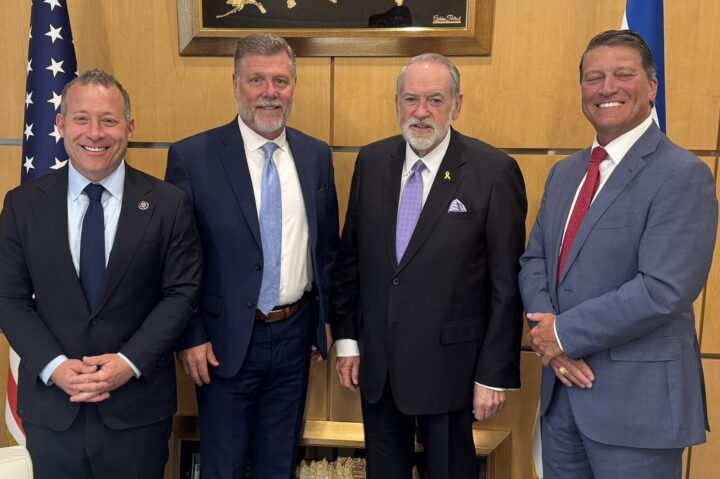
Courtesy of Rep. Rick Crawford
From left to right: Rep. Josh Gottheimer (D-NJ), House Intelligence Committee Chair Rick Crawford (R-AR), Ambassador to Israel Mike Huckabee and Rep. Ronny Jackson (R-TX).
A group of House Intelligence Committee members visited Israel this week, meeting with top Israeli leaders as well as visiting one of the sites of the Oct. 7, 2023, Hamas terror attacks, a Gaza Humanitarian Foundation staging site and the Kerem Shalom border crossing.
The group included committee Chairman Rick Crawford (R-AR) and Reps. Josh Gottheimer (D-NJ) and Ronny Jackson (R-TX).
The lawmakers met with officials including Prime Minister Benjamin Netanyahu, Mossad Director David Barnea, U.S. Ambassador to Israel Mike Huckabee, IDF representatives and Palestinian Authority officials.
The group also visited Kibbutz Kfar Aza near the Gaza border, which suffered heavy losses in the Oct. 7 attacks, and met with hostage families, including the family of Evyatar David, an Israeli hostage shown in a recent video emaciated and forced by Hamas to dig his own grave in a Gaza tunnel.
“Israel and its people have experienced untold levels of tragedy and devastation because of the very fact that they exist,” Crawford said in a statement. “But the Jewish people are a strong, resilient, and compassionate people. Based on our conversations and briefings with military and intelligence partners this week, it is clear Israel is committed to a peaceful end to the unrest in the region but will not cede any ground to Hamas or other Iranian terrorist proxies.”
He said that the group’s “message was simple — the United States stands with Israel and its people. I am grateful for the ongoing cooperation between the U.S. and our Israeli partners as we work to advance our shared goals in the region.”
In a statement, Gottheimer emphasized the need to free the hostages, increase humanitarian aid and end Hamas’ rule in Gaza.
“Given the situation, it was extremely important to meet with Prime Minister Netanyahu and other senior Israeli officials, Ambassador Huckabee, and family members of hostages still in Gaza,” Gottheimer said. “It was also critical to visit an aid staging location at the Kerem Shalom border crossing and a GHF coordination site, which gave me a better understanding of efforts to surge aid into Gaza.”
“We must ensure aid is able to swiftly reach Gazans in need, not Hamas terrorists, who continue to steal food from innocent Palestinians,” he continued. “With so much misinformation, there is no better way to understand the situation than to see it firsthand. By promoting security and stability in the Middle East, the United States will improve our own national security.”
Jackson said in a statement, “This trip not only provided critical firsthand updates from our Defense, State, and Intelligence partners on the ever-evolving elements that threaten Israel, the Middle East, and ultimately the United States, but also reinforced the need for continued strong support to our key ally in the region, Israel.”
He praised both Huckabee and Netanyahu for the work that they are doing.
“We need strong leadership and coordination to protect American lives and interests, and I’m proud to see the Trump administration making national security a top priority with a strategy that is tough, smart, and focused on keeping our country and allies safe,” Jackson continued.
Discussions touched on issues including freeing the hostages, the need to end Hamas’ control of Gaza, the need to increase humanitarian aid — including through the GHF — the need for continued maximum pressure on Iran, the threats from Iran-backed terrorist groups, Hamas’ use of human shields and the need for continued bipartisanship in the U.S.-Israel relationship, according to press releases.
‘Don’t Feed the Lion,’ written by Bianna Golodryga and Yonit Levi, opens a dialogue for kids and their communities on how to stand up to hate

The rise of antisemitism has dominated breaking news headlines, films and books in recent years. But two leading journalists noticed a void — a lack of resources in how to address the subject matter with young readers.
Concerned about what they observed, CNN anchor Bianna Golodryga and Yonit Levi, an anchor on Israel’s Channel 12, joined forces to write Don’t Feed the Lion, a new novel geared towards middle schoolers.
The book tells the story of three children in Chicago who experience antisemitism firsthand at school when a soccer star makes an antisemitic remark and a swastika appears on a locker. Theo, his sister Annie and their new friend Gabe each struggle with how to speak up and confront hate.
The book comes as antisemitism and anti-Israel sentiment has increasingly impacted K-12 classrooms nationwide in the aftermath of the Oct. 7, 2023, Hamas terror attacks on Israel and ensuing war in Gaza.
“We approached this project wearing three hats: as journalists who seek clarity, as Jews who feel the weight of history, and as mothers who want our children to live in a world that is kinder and more just,” Golodryga and Levi, both first time authors, told Jewish Insider in a joint statement.
“Empathy doesn’t happen in silence. We wrote this to help open dialogue between kids, parents, teachers, and communities, especially in times like these,” the veteran reporters said.
Don’t Feed the Lion, published by Arcadia Children’s Books, goes on sale Nov. 11.
Netanyahu, Zamir and Katz held a three-hour meeting on Tuesday, which was reportedly very tense due to disagreement over the plan

EYAD BABA/AFP via Getty Images
Smoke billows from Israeli bombardment as pictured from Deir el-Balah in the central Gaza Strip on July 21, 2025.
Israel’s Security Cabinet is set to vote this week on occupying the remaining parts of Gaza that it does not currently control, after Hamas refused last month’s ceasefire and hostage deal proposal and did not return to negotiations.
Israeli Prime Minister Benjamin Netanyahu, IDF Chief of Staff Lt.-Gen. Eyal Zamir and Defense Minister Israel Katz held a three-hour meeting on Tuesday, which was reportedly very tense due to disagreement over the plan, though Zamir ultimately said he will follow through with the government’s decision.
Zamir argued that the IDF should surround the areas in Gaza in which it currently does not have a presence, including Gaza City and towns in the center of Gaza in which hostages are believed to be held. Entering those areas, Zamir warned, would endanger the lives of the 20 hostages who are thought to be alive. Hamas has threatened to kill hostages if the IDF approaches, as it had executed six hostages a year ago.
Beyond the fraught issue of the hostages, there is the matter of what “occupation” means.
Broadly, the war in Gaza was initially conducted via raids in which the IDF would warn civilians to leave a given area, enter, destroy terrorist infrastructure and combat terrorists, and eventually leave to move to a different part of Gaza, letting the population return. Hamas terrorists would also end up returning to those areas, leading the IDF to have to enter some of the same places repeatedly.
In March, Israel embarked on Operation Gideon’s Chariots, in which Israel entered Gaza from its perimeter on all sides, and moved inwards, capturing territory and maintaining control of it, in contrast to its previous strategy. That operation has, in effect, resulted in Israel controlling 75% of Gaza.
The remaining 25% is what Israel would move to control under the plan Netanyahu supports.
Brig.-Gen. (res.) Yossi Kuperwasser, head of the Jerusalem Institute for Strategy and Security and the former head of research for IDF intelligence, told the Misgav Mideast Horizons podcast this week that the commonly used 75%-25% formulation is “a misrepresentation.”
“Almost all the population of Gaza is in areas controlled by Hamas, which allows Hamas to keep its grip over the population, and this is the source of its power … It’s not about the percentage of the area, it’s about who controls the population,” he said.
While “occupation” is the correct military term for what Israel would be doing by taking control of territory, the connotation of the word in the Israeli context tends to be the West Bank, which Israel has controlled since 1967 and where over half a million Jewish citizens of Israel live.
Some Cabinet ministers have advocated for allowing Israelis to move to Gaza, where 21 Israeli settlements were forcibly evacuated in 2005; Netanyahu has repeatedly rejected such a plan.
What senior Israeli officials have long said is that, while Israel seeks to have other countries and some Palestinians administer Gaza, they will not do so until it’s clear that Hamas has been ousted. As such, Israel may have to take control for some time until other arrangements are made.
Kuperwasser said that while Netanyahu’s decision may be risky, Zamir’s preference of surrounding the remaining 25% of Gaza is more of the same.
“In Gaza, there are no good options,” he said. “The option of continuing what we have done for the last 22 months is not a good option, because it didn’t put enough pressure on Hamas to release the hostages and accept the idea that they should give up their arms. The option of succumbing to Hamas demands … is a very bad idea, too. And taking over Gaza is also a bad idea, because you end up being responsible for the population of Gaza and there is going to be a lot of criticism around the globe … you cannot guarantee that you are going to get the hostages alive.”
Kuperwasser argued that the only way at this point for Israel to move towards freeing the hostages and removing Hamas from power is if Hamas is “convinced that we are about to take over Gaza by force and remove them from power by force … So we have to make this decision, and yes, it comes with a price.”
Starting on the new strategy may be enough to convince Hamas to reach a deal, Kuperwasser said, but in order to get to that point, he argued, Israel has to prepare to actually occupy Gaza.
“We have to convince Hamas that we are serious, that we are really preparing for this eventuality,” including for civil administration of Gaza, he said.
Former Virginia House Speaker Eileen Filler-Corn said Del. Sam Rasoul’s rhetoric is ‘fueling one of the oldest forms of hatred in the world, repackaged in the language of activism’
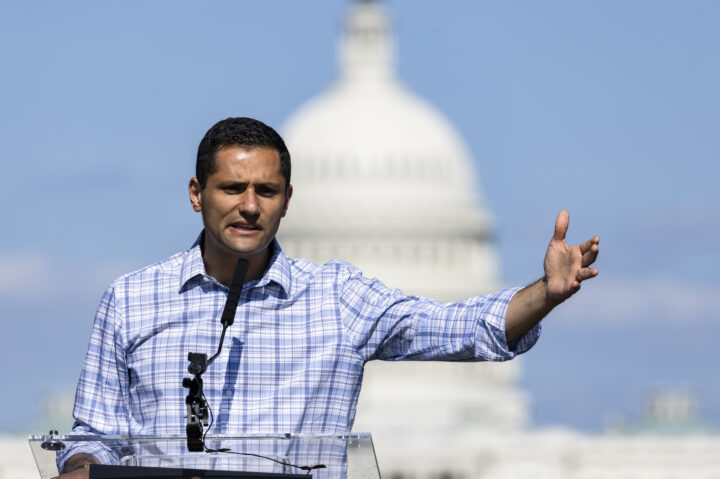
Samuel Corum/Getty Images
Sam Rasoul of the Virginia House of Delegates speaks during a rally on the National Mall on May 31, 2021 in Washington, DC.
Since soon after the Oct. 7, 2023, Hamas attacks, Virginia state Del. Sam Rasoul, a Democrat who chairs the Education Committee in the state’s House of Delegates, has used his social media accounts to attack Israel and decry American support for the Jewish state.
But Jewish Democrats in the state fear that a series of recent posts from Rasoul vilifying Zionists has taken his anti-Israel rhetoric to a new level, prompting concerns about his leadership of the committee that is tasked with reviewing the education-related legislation that comes before the statehouse.
“Zionism has proven how evil our society can be,” Rasoul wrote in a July 26 Instagram post that described Zionism as a “supremacist ideology created to destroy and conquer everything and everyone in its way.” Rasoul accused Zionists of “making the world less safe for my Jewish friends.” Public opinion polling shows that the vast majority of American Jews feel a connection to Israel.
Former Virginia House Speaker Eileen Filler-Corn, a Democrat from Northern Virginia, told Jewish Insider on Tuesday that Rasoul’s rhetoric is “fueling one of the oldest forms of hatred in the world, repackaged in the language of activism.”
“I would expect more from someone who was appointed chair of the Education Committee and is entrusted to set an example for young people,” said Filler-Corn, who was the first woman and first Jewish person to serve as Speaker of the House in Virginia, from 2020 to 2022. She left office in 2024.
Committee leadership is decided by Virginia House Speaker Don Scott, a Democrat from Portsmouth. Several leaders in the Jewish community — including both within the Democratic Party and from nonpartisan Jewish communal organizations — told JI they have raised concerns about Rasoul’s posts directly with Scott or his staff, seeking Rasoul’s removal from the chairmanship. Neither Scott nor other high-ranking Democrats in the state have weighed in on Rasoul’s posts.
“I’m concerned about people’s silence,” said Cookie Hymer Blitz, a longtime Jewish and Democratic activist in Northern Virginia. “Others need to speak out without fear of intimidation or just taking the consequences. If you’re intimidated, sometimes you still have to just do the right thing.”
One person, who requested anonymity to speak about their private conversation with Scott, said the speaker did not defend Rasoul, who is the son of Palestinian immigrants — nor did the speaker seem to take the impact of Rasoul’s language as seriously as they would have liked. Another said Scott was not receptive to the concerns raised.
“Under Speaker Don Scott’s leadership, Virginia has taken real, bipartisan steps to combat antisemitism and hate,” his communications director, Gianni Snidle, told JI in a statement on Tuesday. “Speaker Scott has been proud to strengthen Virginia’s partnership with Israel, including continued support for the Virginia Israel Advisory Board.”
Snidle did not answer a question from JI about Rasoul’s posts and his leadership of the Education Committee.
“We think that it is very concerning that he’s the chair of the Education Committee while he’s propagating antisemitic rhetoric,” Vicki Fishman, director of Virginia government and community relations at the Jewish Community Relations Council of Greater Washington, said of Rasoul. “He’s considered a thought leader on equity and security of our public schools, and we are deeply concerned that his ability to empathize and truly understand the serious crisis of school-based antisemitism is compromised when he is propagating and amplifying demonization of Jews — demonizing this core aspect of Jewish identity, which is Zionism.”
Daniel Staffenberg, the CEO of the Jewish Community Federation of Richmond, said Rasoul’s leadership atop the Education Committee is “deeply troubling … not just for Jews but all people who value truth [and] justice, who wish to combat hate, not normalize it.”
In his July Instagram post, Rasoul appeared to minimize the Holocaust in describing the scale of what he described as “genocide” in Gaza. “After 22 months of the most horrific crimes, there is no doubt that Israel is conducting the most evil cleansing in human history,” Rasoul wrote.
Rasoul wrote on Instagram in May that “those who defend Zionism and remain quiet … are making our world a more evil place.” Earlier that month, he said Zionism “shows us the worst in humanity” and that “the depravity of Zionism knows no bounds.” Rasoul has represented Roanoke in the statehouse since 2014. He ran for statewide office in 2021, coming in second in the Democratic primary for lieutenant governor.
Marc Broklawski, a public employee who lives in Virginia and serves as the vice-chair for rules in the Virginia Democratic Party, decided to go public with his concerns about Rasoul in a thread on X last week and to call for Democratic leaders in his state to speak out against Rasoul’s language.
“It wasn’t just one post. It was the pattern, painting Jewish fear as fake, Jewish trauma as a strategy. At some point, you either stay silent or speak up. I spoke up. Because when you say there’s ‘no middle ground,’ you’re not asking for justice, you’re demanding sides. And we know what happens when Jews are cast as the enemy,” Broklawski told JI, referring to language in Rasoul’s July post that said there is “no middle ground in this supremacist mess.”
Rasoul did not respond to a request for comment.
A board member of his local Jewish community relations council board, Grayzel is running to succeed Rep. Mikie Sherrill (D-NJ)

Jeff Grayzel campaign website
Jeff Grayzel and Rep. Mikie Sherrill (D-NJ)
Democrat Jeff Grayzel, a leader in northwest New Jersey Jewish communal organizations and deputy mayor of Morris Township, N.J., formally launched his congressional campaign this week, running as a staunchly pro-Israel candidate in the seat that will be vacated by Rep. Mikie Sherrill (D-NJ) if she wins the state’s gubernatorial race.
“I am a proud Jew and a proud Zionist, and I plan to run this race for Congress as such, as a proud Jew and as a proud Zionist. I am not going to shy away from it and everybody will know,” Grayzel said in an interview with Jewish Insider last week. “I think we need leaders that are going to be more bold in addressing antisemitism in our country, and we need leaders who are going to push harder for a comprehensive solution in the Middle East, so that Israel can once and for all live in peace.”
He formally filed to run for the seat, in the 11th Congressional District, on Tuesday, but has been publicly exploring a run for over a month. Grayzel said he will not run against Sherrill should she lose the gubernatorial race.
Grayzel, a two-term former mayor, is a board member of his local Jewish community relations council, chairs the local federation’s Jewish civic leadership initiative, is a founding member of its “community leaders against hate” program, is a member of his synagogue board and is a member of the Jewish Museum in New York City.
He said that the genesis for his campaign came in part during a talk at the Jewish Museum by Rabbi Elliot Cosgrove of Park Avenue Synagogue. Cosgrove discussed the story of Purim and the way that Esther, its main protagonist, stepped up to change history.
“Rabbi Cosgrove challenged the audience of over 200 people to find a space in their life — because Jews are under attack on every front … to find a space in their life big or small where you have the opportunity to step into a moment where you can make a difference,” Grayzel said. “I used that as a calling for me to run for Congress.”
The House candidate described the Senate Democrats who voted last week to halt certain arms sales to Israel as “short-sighted” about “what Israel’s partnership in a big, broad sense means to our country, and the importance of having Israel as a continued ally.”
He said that it also “saddens” him as an American and a Democrat to see the Democratic Party moving in an anti-Israel direction.
“I’m going to go to Washington to try to steer the Democratic Party back to center,” Grayzel said — on a variety of issues. “Part of that is steering the Democratic Party back to understanding how important Israel is.”
He said that the U.S. should never condition aid to Israel or other allies.
“Hamas is evil, and they weaponized human suffering and continue to use civilians as human shields. And we wouldn’t be in the current mess if they hadn’t started the war and taken hostages, and if they released the hostages, we could come to a ceasefire,” Grayzel said. “They’re weaponizing their people, they’re weaponizing the food, and it’s a total tragedy.”
Grayzel said that his most central focus regarding the ongoing conflict in Gaza is freeing the hostages. He says he frequently wears hostage dog tags and a hostage ribbon pin, and that every discussion he has about Israel “starts with bringing the hostages home.” He called for more pressure on Hamas and its backers.
He said that it’s important to focus on the fact that the war began and continues because of Hamas, that the war cannot end until the hostages are released and that Hamas’ attacks on Israel date back well before Oct. 7, 2023.
“Hamas is evil, and they weaponized human suffering and continue to use civilians as human shields. And we wouldn’t be in the current mess if they hadn’t started the war and taken hostages, and if they released the hostages, we could come to a ceasefire,” he continued. “They’re weaponizing their people, they’re weaponizing the food, and it’s a total tragedy.”
He said that the Israeli government has also failed in living up to the highest moral standards in providing humanitarian aid in Gaza. “We can’t let the situation in Gaza degrade to the point that we’ve let it degrade to. … It is clear that the people of Gaza are under duress. They’re not in their homes, they’re living in tents, and they’re hungry.”
But, he reiterated, “there’s going to be no end to this until the hostages are home.”
He said that his criticisms of Israel and Prime Minister Benjamin Netanyahu do not negate the fact that he still “love[s] Israel, because I think that healthy democracies and healthy relationships in general require that we speak out when we think something is wrong.”
He said that, despite his differences with Netanyahu, he believes that the prime minister deserves credit for Israel’s transformation into a leading global economy, though he added that Netanyahu’s current coalition is “disastrous.”
While in college, Grayzel studied abroad at the Hebrew University of Jerusalem and interned at Israel Aircraft Industries.
Grayzel said that, despite his disagreements with President Donald Trump, Trump deserves credit and gratitude for moving the U.S. Embassy in Israel to Jerusalem, for the Abraham Accords, for using U.S. assets to defend Israel from Iranian attacks and for ordering strikes on Iran’s nuclear facilities.
“When they do things right, we need to acknowledge that they do things right,” Grayzel said. “I stand firmly behind President Trump’s order to bomb the Iranian nuclear facilities.”
He described the U.S. and Israel as having done the “dirty work for the rest of the world to literally save Western civilization” from the threat of an Iranian nuclear weapon.
Grayzel said that, in the long term, he wants to see a regional peace plan to address conflicts throughout the region, including those between Israel and Iran and the Palestinians. He said he wants to see Saudi Arabia join the Abraham Accords and become “part of the solution” between Israel and the Palestinians. He said that comprehensive regional and global negotiations are necessary to permanently resolve the conflict.
He added that unilaterally recognizing a Palestinian state, as some U.S. allies plan to do, is not a real solution.
He also called for “maximum pressure” on the Iranian regime until it changes course, noting that the Iranian people are also victims of the regime’s governance.
Grayzel said more broadly that transitioning toward a sustainable energy economy will undermine U.S. adversaries like Russia and China, which rely heavily on oil and oil revenues. He said he also sees oil money as driving global Islamist radicalization efforts and as fueling antisemitic protests in the United States, including through funding anti-Israel Middle Eastern studies programs at U.S. colleges and universities.
“This is what’s funding all of this chaos around the world,” Grayzel said. “If we can reduce the demand for oil, we will reduce the dollars that these countries have to fund the terror. … [The world] will be a cleaner place, but it will also be a safer place when we are on clean energy.”
Grazyel said that the current antisemitism crisis in the United States is particularly personal to him because his son was a Columbia University student.
“I really think Columbia needed to be hit over the head. It’s unfortunate they were not listening to … parents, all of the communal organizations in New York City … none of it moved the needle, none of it. And it just continued on, day after day with no change,” Grayzel said. “Something needed to happen. And President Trump took the action. Whether he went too far, I think we’ll wait to see what happens. … But something needed to give with these universities.”
“He had to run a gauntlet to get onto campus,” Grayzel said. “Oftentimes, campus was shut down and he couldn’t go to the library. He had to endure the shouting and screaming and try really, really hard not to internalize it. But he had friends that would come home crying every day. They had cry sessions back in the dorm for these kids who just couldn’t take it anymore.”
He said he’s also been disturbed by antisemitism on campus at Rutgers, the New Jersey state university.
In contrast to many Democrats, Grayzel offered some praise for the actions the Trump administration had taken toward Columbia.
“I really think Columbia needed to be hit over the head. It’s unfortunate they were not listening to … parents, all of the communal organizations in New York City … none of it moved the needle, none of it. And it just continued on, day after day with no change,” Grayzel said. “Something needed to happen. And President Trump took the action. Whether he went too far, I think we’ll wait to see what happens. … But something needed to give with these universities.”
He said he’s hopeful that Trump does not use such actions “as a cudgel in another way” and that Jews will not take the blame for universities losing funding. He said he does not believe in defunding universities permanently, in dismantling the Department of Education or in defunding scientific research at universities and elsewhere.
“I think we need to lean further into what our universities can do for us, but [they have] to be safe spaces for everybody,” he continued.
Grayzel testified before the New Jersey state legislature in support of legislation codifying the International Holocaust Remembrance Alliance’s working definition of antisemitism, a bill which has become a point of division among some Democrats.
“Synagogues being desecrated. Jews being attacked. This isn’t just happening in far away places. It’s happening right here and right now in New Jersey. This is not the vision of America that our country’s founders, many of whom came from this great state, had in mind,” Grayzel told the legislators. “We are on the precipice, and we must move quickly to ensure that New Jersey and all of America remain a place where all forms of hate are quickly and loudly condemned.”
He said that passing the bill would be the first step to send a message “that hate has no home in New Jersey.”
Grayzel told JI he wants to work with colleagues in Washington who don’t have sizable Jewish constituencies to help them better understand the challenges that Jewish Americans are facing, “to try to personalize the situation and make it feel real for them.”
“We need to condemn the phrase, ‘globalize the intifada,’” Grayzel said, calling the phrase “clearly hate speech.” “For [Mamdani] not to condemn that in a city that contains so many Jews is very, very scary.”
“I think there needs to be a lot more bridge-building across the parties … on issues that affect all of us, and antisemitism is one of them,” he said. “It’s personal for me. I’m not just talking as a Jew who sees other Jews under attack. My family’s been under attack.”
Grayzel also said he’s been concerned by New York City Democratic mayoral candidate Zohran Mamdani, noting that what happens in New York City has a “profound impact” on the Jewish community in northern New Jersey.
“We need to condemn the phrase, ‘globalize the intifada,’” Grayzel said, calling the phrase “clearly hate speech.” “For [Mamdani] not to condemn that in a city that contains so many Jews is very, very scary.”
He added he’s concerned Mamdani’s refusal to forcefully condemn such rhetoric will create permission for other candidates to follow in his footsteps.
Grayzel argued that the 11th District special election — which would happen if Sherrill wins — will be one of the first major bellweathers of the Democratic Party’s direction after the New York City mayoral race. He said he hopes the upcoming elections will show there’s “space in the Democratic Party” for moderates like himself and Sherrill who will stand up against antisemitism.
He would likely face stiff competition in the race — Chatham Borough Councilman and Iraq veteran Justin Strickland has already filed to run, former Rep. Tom Malinowski (D-NJ) has expressed interest in the race, and a slew of others are also seen as potential candidates
Grayzel was the first Democrat to win a local government race in his town since the early 1970s, and said he first ran for office because he was “pissed off” and believes that “it’s imperative for you to be part of the solution if you want to complain.”
Democrats gained control of the city council in 2018, and Grayzel became mayor, which he said showed him “how much good you can do when you’re in a position of power.” He later ran, unsuccessfully, for state Senate in 2021. Now he says he sees an opportunity in Congress that he doesn’t want to let pass.
Outside of Israel and antisemitism, Grayzel said he anticipates leveraging his experience as an engineer to focus on building an innovation economy in the United States, which he said includes improving education and infrastructure. He said he wants to “[build] bridges” and be a “problem solver” in Washington.
He said he also wants to work toward immigration reform and find a way for long-term immigrants who have been living law-abiding lives in the country for years to receive permanent status. He said he wants to push Republicans to handle the immigration issue “in a humane way.”
Grayzel said that his focus on immigration is also derived from his Jewish values and the Jewish-American immigrant experience.

Tom Brenner For The Washington Post via Getty Images
Metropolitan Police Department and Federal Bureau of Investigation officers stand guard at a perimeter near the Capital Jewish Museum on May 22, 2025 in Washington.
Good Tuesday afternoon.
This P.M. briefing is reserved for our premium subscribers like you — offering a forward-focused read on what we’re tracking now and what’s coming next.
I’m Danielle Cohen-Kanik, U.S. editor at Jewish Insider. I’ll be curating the Daily Overtime for you, along with assists from my colleagues. Please don’t hesitate to share your thoughts and feedback by replying to this email.
📡On Our Radar
Notable developments and interesting tidbits we’re tracking
Pennsylvania Gov. Josh Shapiro spoke out on the humanitarian crisis in Gaza today, telling a local news channel, “The fact that kids are starving in Gaza is not OK. It is not OK. And I think everyone has a moral responsibility to figure out how to feed these kids. It is true that Hamas intercepts aid. It is true that the aid distribution network is not as sophisticated as it needs to be, but given that, I think our nation, the United States of America, has a moral responsibility to flood the zone with aid. … It is awful, what is happening in Gaza.”
The Democratic governor called Israeli Prime Minister Benjamin Netanyahu’s claim that there is no starvation in Gaza “quite abhorrent,” and said Netanyahu’s language and support of “occupying” Gaza is “not only reckless … but what it does is it further isolates Israel in the world, and that’s a dangerous place for Israel to be.” It’s a sign of the rhetorical tightrope even pro-Israel Democrats are walking, as the party’s voters turn more critical towards the Jewish state…
Sen. Elissa Slotkin (D-MI), another moderate-minded Jewish Democrat, who recently said she supported resolutions led by Sen. Bernie Sanders (I-VT) last week to block some arms sales to Israel, told Semafor that Israel’s moves to airlift increased aid into Gaza are “a start, but you can’t possibly get the volume of food in there that you need via an airlift.”
However, asked if she would support recognition of a Palestinian state, Slotkin said, “I just don’t believe that we should be recognizing a new state in the middle of an active hot war”…
After sources in the Prime Minister’s Office briefed reporters yesterday that IDF Chief of Staff Eyal Zamir can step down if he doesn’t agree with Netanyahu’s move to expand the war in Gaza, the PMO released a statement that “the IDF is prepared to enact any decision made by the Security Cabinet.” The statement came after a three-hour meeting of senior security officials in which Zamir presented “possibilities to continue the campaign in Gaza.” Netanyahu plans to convene the full Security Cabinet on Thursday, according to Israel’s Channel 12 news…
House Speaker Mike Johnson’s (R-LA) trip to Israel continues, including a meeting last night in Shiloh — the second West Bank settlement Johnson has visited since his arrival — with Netanyahu and his wife, Sara, as well as U.S. Ambassador to Israel Mike Huckabee and his wife, Janet. Johnson’s delegation also met with Ditza Or, mother of hostage Avinatan Or…
The FBI released its 2024 Hate Crime Report this morning, which found that nearly 70% (1,938 incidents) of all religiously motivated hate crimes in the U.S. last year were committed against Jews, including terrorist threats, assault, vandalism, harassment, burglary, false bomb threats and swatting. It’s the highest number of anti-Jewish hate crimes ever recorded by the bureau since it began collecting data in 1991…
Sen. Tom Cotton (R-AR) sent a letter to the IRS yesterday asking the agency to investigate the Council on American-Islamic Relations’ status as a 501(c)(3) nonprofit organization based on “substantial evidence” that “confirms CAIR has deep ties to terrorist organizations”…
U.S. Ambassador to France Charles Kushner met yesterday with Saudi Ambassador to France Fahd bin Mayouf Al-Ruwaili. Kushner said the two discussed “the ways that our two countries can each contribute to peace and stability in the Middle East,” just one week after Saudi Arabia and France co-chaired a U.N. conference on the two-state solution which the U.S. and Israel boycotted…
The Department of Homeland Security, which oversees the Federal Emergency Management Agency, quietly removed a requirement for grant applicants to certify they will not engage in a commercial boycott of Israel in order to be eligible for funding. The requirement had been included in notices published by FEMA on Friday for a tranche of at least $1.9 billion in natural disaster preparedness grants…
⏩ Tomorrow’s Agenda, Today
An early look at tomorrow’s storylines and schedule to keep you a step ahead
Keep an eye on Jewish Insider this week for reporting on Rep. Maxwell Frost’s (D-FL) anti-Israel turn since coming into office as the first Gen-Z lawmaker, the University of Maryland’s decision to settle a lawsuit with CAIR for a six-figure sum and the Democratic Navy veteran, Rebecca Bennett, looking to unseat Rep. Tom Kean Jr. (R-NJ) in New Jersey’s 7th Congressional District.
Tomorrow, the New Jersey Jewish Business Alliance will host its 11th annual Legislative and Business Luncheon featuring gubernatorial candidates Rep. Mikie Sherrill (D-NJ) and former Republican state Rep. Jack Ciattarelli. The two will face off in the Garden State’s November general election, with recent polling showing Sherrill with a comfortable lead.
POLICY RECKONING

A lack of a ‘day-after plan’ and an unwillingness to address threats before they grew left Sharon’s 2005 promises unfulfilled. What has Israel learned since then?
DISTRICT DYNAMICS

Walkinshaw said the U.S.-Israel relationship ‘has immense strategic importance to the United States, and I want to see a strong U.S. Israel relationship with bipartisan support’
Plus, the House Rs and Ds in Israel this week

NEVE DEKALIM, GAZA STRIP - AUGUST 16: Israeli police arrest anti-disengagement activists trying to prevent the entry of shipping containers August 16, 2005 into Neve Dekalim, the largest Jewish settlement in the Gaza Strip. As Israel's disengagement of some 8000 settlers from the Gaza Strip enters its second day, diehard settlers dug in for the final fight against Israel's historic Gaza Strip pullout after 38 years of occupation. (Photo by Shaul Schwarz/Getty Images)
Good Tuesday morning.
In today’s Daily Kickoff we talk to key figures from the period of Israel’s disengagement from Gaza 20 years ago and report on Israeli Prime Minister Benjamin Netanyahu’s new plans to expand the war in Gaza. We also interview a cousin of Evyatar David, days after Hamas released a video of him being forced to dig his own grave. We review the latest round of fundraising reports filed by leading pro-Israel advocacy groups and interview James Walkinshaw, the favorite to win a special general election in Virginia’s 11th Congressional District in September. Also in today’s Daily Kickoff: Gideon Sa’ar, Rabbi Hirschy Zarchi, William Daroff and Elbridge Colby.
What We’re Watching
- Israeli Foreign Minister Gideon Sa’ar is in New York this morning for a meeting of the U.N. Security Council on the situation of the hostages held in Gaza. Sa’ar prompted the special session after videos of two hostages — Evyatar David and Rom Braslavski — were released by Hamas and the Palestinian Islamic Jihad. Before the session, Sa’ar will hold a meeting with American Jewish leaders. Read more here.
- Northwestern University President Michael Schill will appear before the House Education and Workforce Committee today for a closed-door transcribed interview about alleged failures to protect Jewish students on the Illinois campus.
- Also in Israel this week are two delegations of freshman House members, one from each caucus, organized by the AIPAC-affiliated American Israel Education Foundation. The Democratic trip is led by Rep. Steny Hoyer (D-MD), the former House majority leader, and Rep. Pete Aguilar (D-CA), the caucus chair.
- The Republican trip is led by House Majority Whip Tom Emmer (R-MN), and includes Reps. Guy Reschenthaler (R-PA), Michael Baumgartner (R-WA), Josh Brecheen (R-OK), Rep. Troy Downing (R-MT), Julie Fedorchak (R-ND), Randy Fine (R-FL), Brandon Gill (R-TX), Craig Goldman (R-TX), Harriet Hageman (R-WY), Abe Hamadeh (R-AZ), Mark Harris (R-NC), Jeff Hurd (R-CO), Brian Jack (R-GA), John McGuire (R-VA), Bob Onder (R-MO), Derek Schmidt (R-KS), Jefferson Shreve (R-IN), Marlin Stutzman (R-IN) and Tony Wied (R-WI). Their visit will include meetings with Israeli Prime Minister Benjamin Netanyahu and Opposition Leader Yair Lapid.
What You Should Know
A QUICK WORD WITH ji’s josh kraushaar
A new poll of New York City Jewish voters commissioned by the pro-Israel New York Solidarity Network underscores the presence of a cohesive constituency opposed to Zohran Mamdani’s candidacy to become New York City mayor — but also illustrates some of the divisions preventing the city’s Jewish community from speaking with a loud, united voice.
The poll, conducted by the respected Democratic polling firm GQR, found Mamdani, the Democratic nominee, winning only 37% of Jewish voters, with 25% backing Mayor Eric Adams, 21% supporting former Gov. Andrew Cuomo and 14% preferring Republican nominee Curtis Sliwa. The results show that even though most Jewish voters identify as Democrats, a clear majority won’t support the Democratic nominee because of his record on issues of concern to the Jewish community — in a city where registered Democrats outnumber Republicans 6-to-1.
Adams performs particularly well among Orthodox Jews, winning 61% of their vote, while Cuomo leads among Conservative Jewish voters with 35% support. But among unaffiliated and Reform Jews, Mamdani leads with a near majority of the Jewish vote.
Asked if Jewish voters were pro-Israel, two-thirds (66%) responded in the affirmative, while 31% said they weren’t. That’s a slightly larger share of non-Zionist Jews than we’ve seen in national polling. Nearly two-thirds (63%) also said that the “globalize the intifada” rhetoric that Mamdani has defended is antisemitic, with just 27% disagreeing.
policy reckoning
Twenty years ago this month, Israel dismantled 21 settlements in the Gaza Strip, in what was known as the disengagement, initiated and overseen by then-Prime Minister Ariel Sharon. Two decades later, Israel is fighting its longest war in Gaza, after the Oct. 7, 2023, attacks perpetrated by the Hamas terrorist organization that has controlled Gaza since 2006. In the interim years, Hamas and other Palestinian terrorist groups in Gaza shot hundreds and sometimes thousands of rockets at Israeli population centers each year, prompting five major Israeli military operations in Gaza. Key figures from that period told Jewish Insider’s Lahav Harkov that the Israeli government’s failure to formulate a day-after plan for Gaza — a criticism that has been leveled at Jerusalem in the current war — is in part to blame for the unfulfilled promises of the disengagement.
Pressure point: Gilad Erdan, a former senior Israeli cabinet minister and ambassador to the U.S., was a freshman Likud lawmaker when the disengagement was announced, and became a leading figure in the party’s rebellion against Sharon. Erdan noted to JI that Sharon not only claimed the disengagement would improve Israel’s security, he said that “if Israel doesn’t take this step, there will be other diplomatic plans [that the world will] try to force on Israel, and this step will free us of pressure from the international community. It’s clear that it didn’t reduce pressure, it increased it.”
Not followed through: Elliott Abrams, who was deputy national security advisor to the George W. Bush administration at the time of the disengagement, told JI that Sharon did have a larger overarching idea behind the move, but subsequent prime ministers did not follow through with it. “Sharon said at the time that Israel needs to establish its borders, and I think he would have done something … with the West Bank. Whatever the future of Israel is, it doesn’t include Gaza, which has no use economically and no significance religiously,” was the logic, Abrams said.
WAR PATH
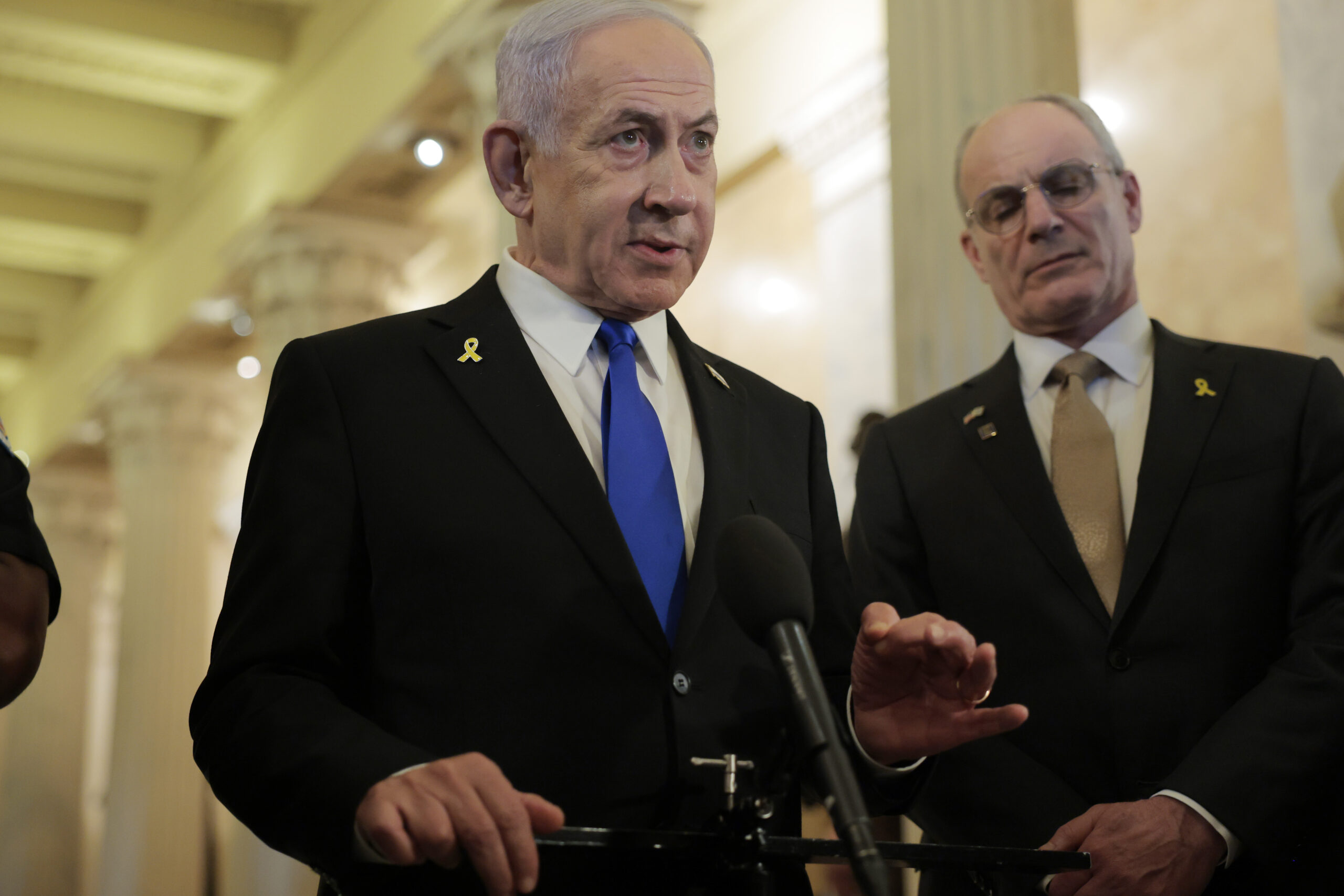
Israeli Prime Minister Benjamin Netanyahu plans to ask the Security Cabinet to back expanding Israel’s military efforts in Gaza, Israeli media reported on Monday. “We are going to conquer the [Gaza] Strip,” a senior source in Netanyahu’s office told Israel’s Channel 12. “The decision was made. Hamas will not free more hostages without us fully surrendering, and we will not surrender. If we don’t act now, the hostages will die of hunger and Gaza will remain under Hamas’ control,” the source added, Jewish Insider’s Lahav Harkov reports.
A few caveats: Netanyahu did not use the term conquer or occupy with all of the Cabinet ministers to whom he conveyed his position, according to Israeli public broadcaster Kan. Maariv reported that Netanyahu has not made a final decision yet about whether the IDF should take control of all of Gaza, and noted that legally, he cannot decide on his own without the Security Cabinet.
COUSIN’S CRY

Days after Hamas released a video showing hostage Evyatar David emaciated and being forced to dig his own grave in a tunnel under Gaza, David’s family called on the Trump administration to do anything it can to ensure that the hostages are released. “Evyatar is fighting for his life with what little strength he has left,” Matan Eshet, David’s cousin, told Jewish Insider’s Lahav Harkov on Monday. “You can see it in his eyes. You don’t need a medical degree to understand that Evyatar only has a few days to live.”
Unrecognizable: David, 24, was kidnapped by Hamas terrorists from the Nova Festival on Oct. 7, 2023. In a video released over the weekend, an extremely gaunt David was shown in a tunnel under Gaza digging, with his bones protruding. He wrote on a calendar documenting the small amounts of food — either lentils or beans — his captors have given him on some days, and on other days he wrote “no food.” Eshet said his family is “feeling broken” after seeing the new footage. “It’s not Evyatar. He doesn’t look like that or sound like that. That’s not how he moves. We see the distress in so many ways. He looks like a shadow of himself,” Eshet said. “He has to get medical care and food already.”
More from David’s family: Ilay David, brother of hostage Evyatar David, said on CNN on Monday, “Hamas is using my brother in this twisted, sick experiment on human lives. It’s not pressured enough … All leaders of all nations should stand up united and put every ounce of pressure they can on Hamas. Hamas must be begging for a deal.”
MONEY MATTERS

The latest round of fundraising reports filed by leading pro-Israel advocacy groups suggests that they are in strong financial shape as the midterms come into view, even as some of the top pro-Israel candidates have underperformed with their fundraising in key races. United Democracy Project, a super PAC affiliated with the pro-Israel lobbying group AIPAC, raised $13.5 million in the first half of 2025, according to its mid-year fundraising report filed late last week, with nearly $39 million on hand at the end of June, Jewish Insider’s Matthew Kassel reports.
Shot up: Those figures were far higher than the $8.8 million in contributions the group had pulled in during the same six-month period in 2023, at the beginning of the last election cycle. The group, which ultimately raised much more in the months following Hamas’ Oct. 7, 2023, attacks, had $9 million on hand at the time, federal filings show. Among the top donors to UDP this cycle are Blair Frank, a portfolio manager at Capital Group, who gave $1.5 million — marking the only seven-figure contribution. The Kraft Group, a holding company led by Robert Kraft, the owner of the New England Patriots, gave $500,000 — as did four other donors including Sanford Grossman, Michael Leffell, David Messer and Andrew Schwartzberg, according to the new filings.
DISTRICT DYNAMICS
James Walkinshaw, a longtime former aide to Rep. Gerry Connolly (D-VA), aims to follow in his late mentor’s footsteps as the strong favorite to win a special general election in Virginia’s 11th Congressional District in September, Jewish Insider’s Marc Rod reports.
Comparisons: Asked if he sees any major differences between himself and Connolly — whether on policy or his approach to the role of a member of Congress — Walkinshaw said that there are few, and that he was aligned with his former boss’ views on most issues. But when it comes to Israel, Walkinshaw sounds likely to adopt a more moderate tone on Middle East policy, something of a contrast from Connolly, who took an increasingly critical view of the Jewish state during his tenure in the House. “I think the U.S.-Israel relationship has immense historical importance. It has immense strategic importance to the United States, and I want to see a strong U.S.-Israel relationship with bipartisan support,” Walkinshaw told JI.
selective security

Harvard University’s recent decision to cover security costs for Harvard Hillel was celebrated by many Jewish students as a way to alleviate growing security costs amid a surge in campus antisemitism. But for others, it raised questions about why the agreement did not extend to other Jewish groups affiliated with the school, such as Harvard Chabad, Jewish Insider’s Haley Cohen reports.
Left out: “Of course, there is a sense that there should be a responsibility” to cover Chabad’s security as well, Harvard Chabad Rabbi Hirschy Zarchi told JI, although he said that he has never directly asked the administration to do so. Alex Bernat, Harvard Chabad’s outgoing undergraduate student president who graduated in the spring, said it’s “crucial” that Chabad receive the same funding. “If you want to make claims about protecting the Jewish community, you have to protect the whole Jewish community,” he told JI.
Worthy Reads
The Blame Game: Coleman Hughes writes in The Free Press about the West’s “moral confusion” in assigning blame for the humanitarian crisis in Gaza. “There’s no doubt that there is a humanitarian disaster in Gaza. But the information pipeline between Gaza and the West is fundamentally broken, biased, untrustworthy, and weaponized against Israel. And the less skeptical that Western journalists are, the more sources like Hamas and the Gaza Health Ministry can disseminate misinformation without penalty, perpetuating the false narrative that Israel is the genocidal aggressor in a war waged against them by a group whose mission is, in fact, genocide.” [FreePress]
PR Course Correction: The Atlantic’s Franklin Foer writes about how Israel can turn international public opinion around. “Every image of a child with protruding ribs is both a human tragedy and a propaganda victory for Hamas — and proof of how a just war badly lost the plot. I believed in Israel’s casus belli. I don’t believe in this. No justification can redeem the immorality of a policy built on deprivation. As Gaza braces for the worst, Israel still has a narrow window to correct its course. By flooding the zone [with aid], Israel has one last chance to redeem itself.” [TheAtlantic]
Questioning the War: The Wall Street Journal’s Anat Peled spotlights the growing number of voices in Israeli society, mostly on the center-left, that are questioning the morality of Israel’s actions in Gaza and calling for an end to the war. “In recent weeks, more Israelis — including prominent public figures — have called to end the war in Gaza while decrying the dire humanitarian situation in the enclave, marking a shift in the public discourse. A majority of former directors of the Israeli military; Mossad; Shin Bet, the country’s internal security agency; and the police, called on the Israeli government on Sunday to end the war against Hamas. The cause began as a just one after the Oct. 7, 2023, attacks, they said. But now it has become futile … Nightly news reports have featured more Gazans talking about suffering in the strip. Photos of Gazans killed in the war are now more visible in some public spaces such as protests. More than 1,000 leading Israeli artists created a stir when they signed a petition calling to end the killing of children and civilians in Gaza.” [WSJ]
Baltics Balance: The Jerusalem Post’s Herb Keinon writes about Israel’s “pivot to the Baltics,” as Israeli President Isaac Herzog and Foreign Minister Gideon Sa’ar return from separate trips to Lithuania, Latvia and Estonia. “Calls for punitive measures against Israel are growing louder in EU corridors. In that environment, courting sympathetic voices in the Baltics – where the diplomatic weather is noticeably warmer – isn’t just smart; it’s necessary. … What’s at stake here is more than just goodwill. There are real, high-stakes policy implications. The EU is currently debating whether to suspend the EU-Israel Association Agreement, a framework governing economic and political cooperation between Israel and the EU. Sa’ar’s visit to the Baltics in June – before going to Brussels – was part of an effort to prevent such a move, and Herzog’s visit now continues that effort.” [JPost]
Word on the Street
A new Pentagon report confirmed that the U.S. withdrew troops from three military bases in Syria and Iraq in May, who were stationed there to combat ISIS forces…
Air Mail writes about the issue of ordinary Israelis engaging in espionage on behalf of Iran, with the Shin Bet confirming more than 60 Israeli citizens are being prosecuted for treason…
Sen. Elizabeth Warren (D-MA) defended New York City Democratic mayoral nominee Zohran Mamdani’s policy proposals for the city on Monday in a heated debate with CNBC host David Faber. Warren called Mamdani’s primary win “democracy at work”…
House Speaker Mike Johnson (R-LA) visited the town of Ariel yesterday, making him the highest-ranking elected federal official to visit a West Bank settlement…
The Federal Emergency Management Agency said in grant notices made public Friday that states must guarantee they will not engage in boycotts of Israeli companies in order to qualify for a tranche of more than $1.9 billion in natural disaster preparedness grants…
The Israeli Cabinet voted unanimously yesterday to oust Attorney General Gali Baharav-Miara, with whom the current government has been at odds since it was formed, accusing her of political bias. Shortly after the vote, the Israeli Supreme Court issued an injunction temporarily blocking the firing and ordering the government to continue abiding by Baharav-Miara’s legal opinions until the court issues a final ruling…
The third season of the TV series “Tehran,” which follows an undercover Mossad agent in Iran, may come to Apple TV soon, according to The Hollywood Reporter. Though it aired in Israel over two years ago, Apple has repeatedly delayed the season’s release in the U.S. due to the Oct. 7 attacks and the ensuing war in Gaza…
Rest of World examines how the rise of data centers in the Gulf amid the race to develop artificial intelligence infrastructure will stress already water-scarce countries including the UAE and Saudi Arabia…
The Anti-Defamation League said on Monday that the Portland Police Department is investigating the recent vandalism of the Oregon Jewish Museum and Center for Holocaust Education with swastikas as a hate crime…
New Lines Magazine chronicles the violent clash inside Sweida Hospital in southern Syria last month as government-aligned militias and Bedouin groups clashed with the local Druze population last month…
Pic of the Day
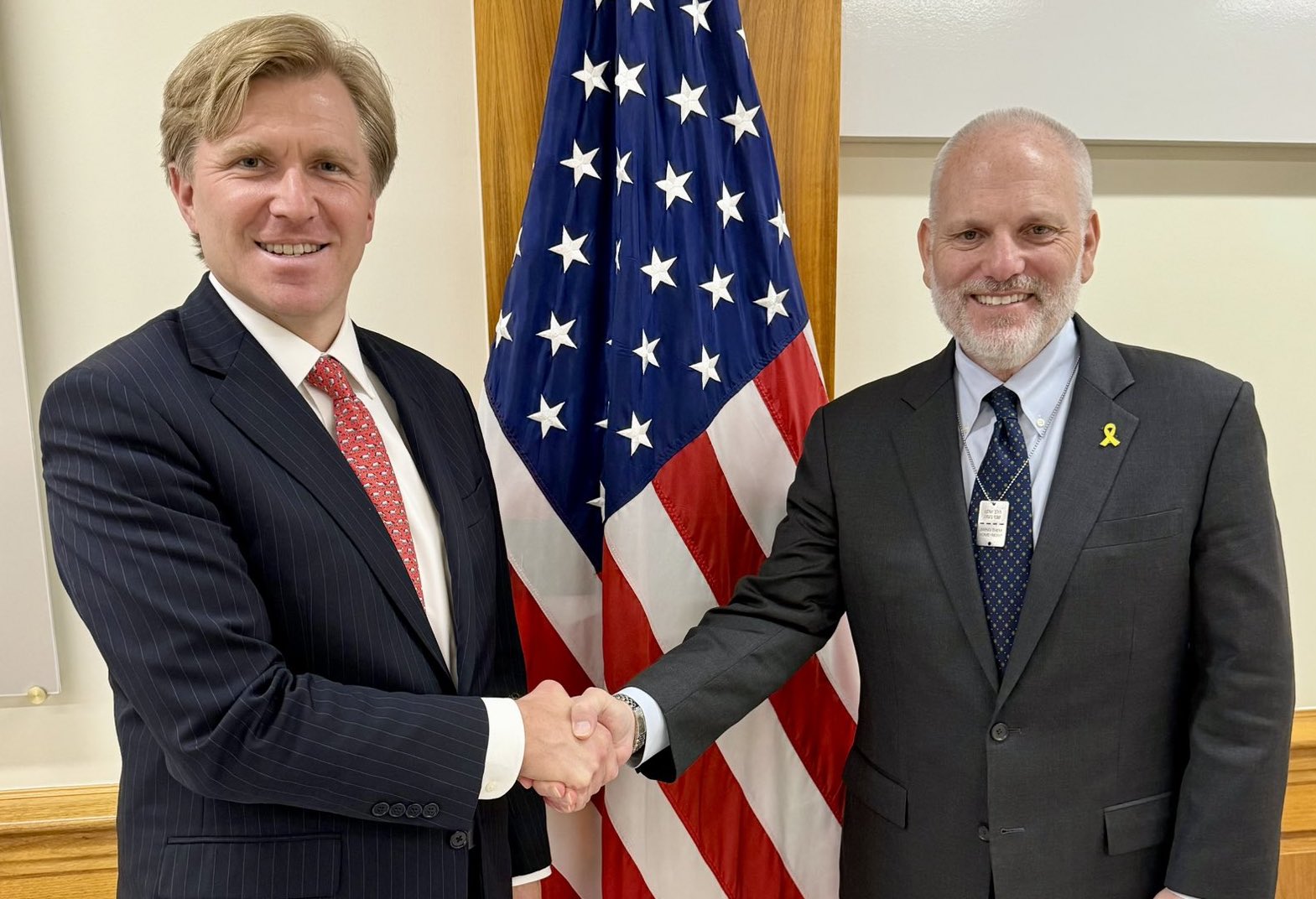
Conference of Presidents of Major American Jewish Organizations CEO William Daroff (right) met with Under Secretary of Defense Elbridge Colby at the Pentagon yesterday. Daroff told Jewish Insider that Colby “expressed a clear and serious understanding of U.S. strategic interests in the Middle East, including the vital importance of deterring Iran, preventing regional adversaries from gaining dominance, and sustaining Israel’s security following the Twelve Day War,” and that he was “encouraged by [Colby’s] principled and grounded approach.”
Birthdays

Professional boxer who held the WBA super welterweight title from 2009 to 2010, in 2014 he was ordained as a rabbi and then known as the “Boxing Rabbi,” Yuri Foreman turns 45…
Chairman of Delphi Capital Management, he is the founder and chairman of Open to Debate, a public policy debate series, Robert Rosenkranz turns 83… Former chairman of the World Zionist Organization who later served as chairman of the Jewish National Fund, Avraham Duvdevani turns 80… Former Israeli ambassador to France, following seven years as a member of the Knesset, Yael German turns 78… Author of 25 nonfiction books, including The Portable Curmudgeon, Zen to Go and Advice to Writers, Jon Winokur turns 78… Historian, Nazi hunter and director of the Simon Wiesenthal Center in Jerusalem until 2024, Efraim Zuroff turns 77… Banker, once known as “Austria’s woman on Wall Street” and founder of Bank Medici in 1994, Sonja Kohn turns 77… Former Soviet Refusenik, he served as speaker of the Knesset for seven years, Yuli-Yoel Edelstein turns 67… Intellectual property and entertainment attorney based in Ithaca, N.Y., he is an adjunct professor of law at both Cornell and Touro, Howard Leib… Member of the British House of Lords, he was chief executive of the Office of the Chief Rabbi Lord Sacks and then chief executive of the United Jewish Israel Appeal, Baron Jonathan Andrew Kestenbaum turns 66… Businessman Murray Huberfeld… Songwriter, author, political columnist and noted baseball memorabilia collector, Seth Swirsky turns 65… Chair of the Department of Jewish History at Baltimore’s Beth Tfiloh Dahan High School, Neil Rubin, Ph.D…. Actor who starred in “Weekend at Bernie’s,” his father and grandfather were both rabbis, Jonathan Elihu Silverman turns 59… President at ConservAmerica, he is an adjunct professor at Carnegie Mellon University, Jeffrey Kupfer… President of the Center for Jewish History in NYC and professor at Fairfield University, Dr. Gavriel David Rosenfeld turns 58… Former member of the Knesset for the Kulanu party, Roy Folkman turns 50… Director of the Center for Middle East Policy at The Brookings Institution for 13 years until this past June, he is soon to become a senior fellow at the Middle East Institute, Natan Sachs… Investment and foundation manager at Denver-based Race Street Management and a board member of JFNA, Cintra Pollack… VP of government affairs at WISPA – the Association for Broadband Without Boundaries, Matt Mandel… Chairman of The New York Times Company and publisher of The New York Times, Arthur Gregg (A.G.) Sulzberger turns 45… Former director of responsible innovation at Meta / Facebook, now a consultant, he is also the spiritual leader of Chochmat HaLev, a progressive spiritual community in Berkeley, Calif., Zvika Krieger… Member of the comedy duo Jake and Amir, Jacob Penn Cooper Hurwitz turns 40… Longtime member of the Israeli national soccer team who also played in Europe’s UEFA Champions League, Gil Vermouth turns 40… Co-founder of Cadence, an AI-driven performance nutrition platform, Lila Cohn… Front end engineer at Platform.sh, Abby Milberg… 2023 graduate of Harvard Law School, now an assistant corporation counsel for New York City, Michael E. Snow… Senior advisor for implementation at the Johns Hopkins Center for Gun Violence Solutions, Lisa Geller… Leslie Saunders… Director of antisemitism programs at the Anti-Defamation League, Anyu Silverman…
‘We need everyone who sees the difficult pictures of Evyatar to understand that we don’t have another minute. We don’t have another day. We can lose him in the coming days,’ Matan Eshet tells JI

Ezzedine al-Qassam Brigades/AFP via Getty Images
This screengrab from a video released on August 1, 2025 by Hamas, shows Israeli hostage Evyatar David looking weak and malnourished.
Days after Hamas released a video showing hostage Evyatar David emaciated and being forced to dig his own grave in a tunnel under Gaza, David’s family called on the Trump administration to do anything it can to ensure that the hostages are released.
“Evyatar is fighting for his life with what little strength he has left,” Matan Eshet, David’s cousin, told Jewish Insider on Monday. “You can see it in his eyes. You don’t need a medical degree to understand that Evyatar only has a few days to live.”
David, 24, was kidnapped by Hamas terrorists from the Nova Festival on Oct. 7, 2023.
In a video released over the weekend, an extremely gaunt David was shown in a tunnel under Gaza digging, with his bones protruding. He wrote on a calendar documenting the small amounts of food — either lentils or beans — his captors have given him on some days, and on other days he wrote “no food.”
At one point in the video, a Hamas terrorist reaches out from behind the camera to hand him a can of food, and the terrorist’s arm is visibly much thicker than David’s.
“This can is for two days, just to keep me alive,” David said of the food.
“I don’t know what I’m going to eat,” David said. “I haven’t eaten in days … I’m getting thinner and weaker by the day … What I’m doing now is digging my own grave … This is the grave where I think I’m going to be buried. Time is running out.”
Prof. Ronit Endevelt, the former head of the Nutrition Division at the Israeli Health Ministry now on the Hostage Families Forum medical team, estimated that David’s weight dropped about 41% to 40-45 kg.
Hamas released a video of David in February of this year, with hostage Guy Gilboa Dalal in a car, visibly distressed while being forced to watch other hostages being released. David’s health has visibly deteriorated since the previous video; he appears much thinner and paler in the new one.
Eshet said his family is “feeling broken” after seeing the new footage.
“It’s not Evyatar. He doesn’t look like that or sound like that. That’s not how he moves. We see the distress in so many ways. He looks like a shadow of himself,” Eshet said. “He has to get medical care and food already.”
The video of David describing his starvation at the hands of Hamas came as some of the world’s largest media outlets published photos of children in Gaza who they reported were starving, but failed to mention that they suffered from genetic diseases. More broadly, much of the media coverage of Gaza in recent weeks has been about the humanitarian situation and difficulties distributing food to the residents.
“It’s maddening,” Eshet said. “Hamas are the ones taking the aid instead of the civilians. And then they claim that [Israel is] starving them, not Hamas who is preventing people from getting the food, while Hamas is choosing not to let Evyatar receive food.”
Eshet noted that the arm of the Hamas terrorist who handed Evyatar the can of food was “much bigger and more muscular compared to Evyatar.”
“On the news, you can see people walking in the food markets in Gaza. People do not look the way Evyatar looks,” Eshet added. “No one was close to looking the way Evyatar does.”
Eshet called on “Israel and the world to demand that Evyatar come home already.”
“We need everyone who sees the difficult pictures of Evyatar to understand that we don’t have another minute. We don’t have another day. We can lose him in the coming days,” he added.
“The U.S. government succeeded in getting a deal on Day minus-One, before [President Donald] Trump’s inauguration,” Eshet said. “America needs to do the same thing again and stand up and insist that the hostages are freed now, regardless of whatever else is happening.
“They did it once. They made a deal happen. They need to use that power again to make sure Evyatar comes home,” Eshet added.
Asked about the reports that Israel plans to expand its military operations in Gaza, including in areas where the hostages are believed to be held, Eshet said he hopes “these are tactical tools to bring about a change, stand up to Hamas and reach a [hostage] deal from a position of strength.”
Eshet and David are first cousins. Eshet recalled that they “grew up together.”
“Evyatar is a charming and loving person, a good listener with a contagious smile,” Eshet said. “He was a middle child, and was friends with his big brother and little sister. He always paid attention to whoever needed help in the house.”
Eshet said that David loved to play guitar and that his music could always be heard in his parents’ house. Before Oct. 7, David planned to travel the world and try to make a living playing music.
“He had a smile and shining eyes, and we’re all waiting for him,” Eshet said. “He was a boy who became a skeleton in the Hamas tunnels. He needs to come home and be a regular person and live the life that is waiting for him.”
There are 50 hostages remaining in Gaza, 20 of whom are believed to be alive. Hamas rejected the latest attempt by the U.S. and Israel to reach a temporary ceasefire and hostage-release deal late last month.
Palestinian Islamic Jihad also released a video of hostage Rom Braslavski last week, who was also emaciated.
The Hostages Families Forum released a report by its medical team on Monday “warning that the hostages still held alive in Gaza are suffering from deliberate, prolonged, and systematic starvation … causing multisystem damage and posing an immediate risk of death.”
Prof. Hagai Levine, head of the medical team, said that “the outcome of this cruel experiment is foreseeable — body and mind will gradually deteriorate until they collapse. Any further delay in rescuing the hostages may cost human lives. We must not stand idly by while our brothers vanish. We must act now to bring them all home.”
A poll conducted by the Democratic polling firm GQR found Zohran Mamdani, the Democratic nominee, winning only 37% of Jewish voters
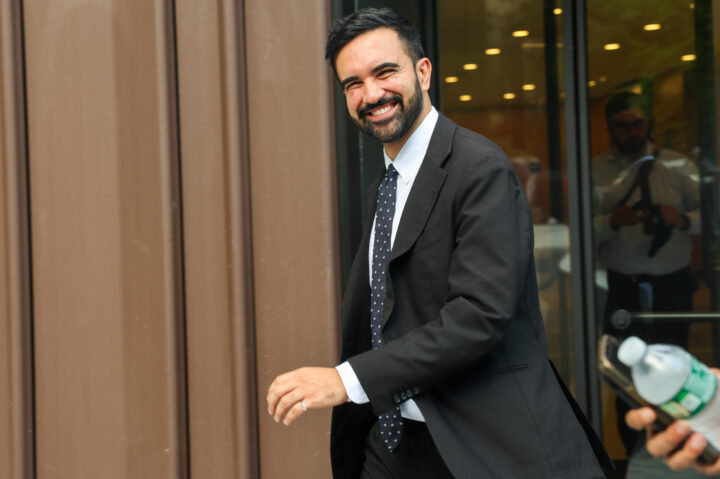
Spencer Platt/Getty Images
Democratic socialist candidate Zohran Mamdani, who won the Democratic primary for mayor of New York City, attends an endorsement event from the union DC 37 on July 15, 2025, in New York City.
A new poll of New York City Jewish voters commissioned by the pro-Israel New York Solidarity Network underscores the presence of a cohesive constituency opposed to Zohran Mamdani’s candidacy to become New York City mayor — but also illustrates some of the divisions preventing the city’s Jewish community from speaking with a loud, united voice.
The poll, conducted by the respected Democratic polling firm GQR, found Mamdani, the Democratic nominee, winning only 37% of Jewish voters, with 25% backing Mayor Eric Adams, 21% supporting former Gov. Andrew Cuomo and 14% preferring Republican nominee Curtis Sliwa. The results show that even though most Jewish voters identify as Democrats, a clear majority won’t support the Democratic nominee because of his record on issues of concern to the Jewish community — in a city where registered Democrats outnumber Republicans 6-to-1.
Adams performs particularly well among Orthodox Jews, winning 61% of their vote, while Cuomo leads among Conservative Jewish voters with 35% support. But among unaffiliated and Reform Jews, Mamdani leads with a near majority of the Jewish vote.
Asked if Jewish voters were pro-Israel, two-thirds (66%) responded in the affirmative, while 31% said they weren’t. That’s a slightly larger share of non-Zionist Jews than we’ve seen in national polling. Nearly two-thirds (63%) also said that the “globalize the intifada” rhetoric that Mamdani has defended is antisemitic, with just 27% disagreeing.
Just over half of Jewish voters in New York City (51%) believe Mamdani is antisemitic; 42% of respondents disagree.
The results illustrate the long-standing dynamic of the general election: Mamdani’s political standing is unusually weak as a Democratic nominee, but he continues to benefit from the divided field of opponents — and lack of a coherent strategy to go after the front-runner.
The fact that there isn’t a consensus Mamdani alternative within the Jewish community at this late stage demonstrates the hands-off approach to the race outside groups have taken, despite the very real fears many hold of what a Mamdani mayoralty would look like.
Most of DMFI’s fundraising haul this year comes from one wealthy Democratic donor in Indiana

Alex Wong/Getty Images
A visitor holds an AIPAC folder in an elevator in Rayburn House Office Building on March 12, 2024 on Capitol Hill in Washington, DC.
The latest round of fundraising reports filed by leading pro-Israel advocacy groups suggests that they are in strong financial shape as the midterms come into view, even as some of the top pro-Israel candidates have underperformed with their fundraising in key races.
United Democracy Project, a super PAC affiliated with the pro-Israel lobbying group AIPAC, raised $13.5 million in the first half of 2025, according to its mid-year fundraising report filed late last week, with nearly $39 million on hand at the end of June.
Those figures were far higher than the $8.8 million in contributions the group had pulled in during the same six-month period in 2023, at the beginning of the last election cycle. The group, which ultimately raised much more in the months following Hamas’ Oct. 7, 2023, attacks, had $9 million on hand at the time, federal filings show.
Among the top donors to UDP this cycle are Blair Frank, a portfolio manager at Capital Group, who gave $1.5 million — marking the only seven-figure contribution. The Kraft Group, a holding company led by Robert Kraft, the owner of the New England Patriots, gave $500,000 — as did four other donors including Sanford Grossman, Michael Leffell, David Messer and Andrew Schwartzberg, according to the new filings.
Meanwhile, AIPAC’s bipartisan political action committee, which has yet to issue endorsements in a range of key House and Senate races, raised $2.6 million last month — and was sitting on nearly $14 million at the end of June, its latest monthly filing shows. By contrast, the group had raked in around $1.5 million in June 2023, with nearly $1.4 million on hand.
The fundraising indicates that pro-Israel donors are being driven to contribute amid a new shift in which a growing number of Democratic lawmakers, as well as some Republicans, have endorsed blocking aid to Israel over its handling of the humanitarian crisis in Gaza. That trend has coincided with the Democratic nomination of Zohran Mamdani, an avowed critic of Israel, in New York City’s mayoral race, opening up an ongoing debate over the party’s future direction.
Marshall Wittmann, an AIPAC spokesperson, said in a statement that “grassroots pro-Israel activists are deeply engaged in the political process given the critical importance of the U.S.-Israel relationship as the Jewish state battles aggression from Iran and its terrorist proxies.”
“As the 2026 midterm elections approach, that increased involvement will ensure that the voice of the pro-Israel community will be heard,” Wittmann told Jewish Insider on Monday.
On the Democratic, rather than bipartisan, side of the equation, DMIF PAC, Democratic Majority for Israel’s political arm, reported raising $2.1 million so far this year, with $2.6 million on hand heading into July.
While the group’s latest cash haul was buoyed largely by a single $2 million contribution from Deborah Simon, a pro-Israel donor in Indiana, its new filing indicates a healthier financial situation than its last mid-year report in 2023, when DMFI PAC pulled in just over $700,000 during the first six months of that year, with only a small amount more in reserve funds.
DMFI PAC, which worked alongside UDP to unseat two Squad-aligned Israel critics in House races last cycle, has not yet announced endorsements in next year’s primaries.
Despite relatively robust fundraising for the two groups, such donor enthusiasm has yet to translate to some key races in which pro-Israel candidates are lagging behind their opponents. Rep. Haley Stevens (D-MI), a longtime ally of AIPAC who is running for Senate, was recently outraised by state Sen. Mallory McMorrow and Abdul el-Sayed, an outspoken critic of Israel. And in an open-seat House primary in the Chicago suburbs, Laura Fine, a state senator who is touting her pro-Israel positions, fell well behind her two left-leaning rivals.
One prominent pro-Israel activist who is close to AIPAC, speaking on the condition of anonymity to address what he called an “undeniable shift” in the Democratic Party on Israel, said he was unfazed by such fundraising at this stage of the primary cycle — noting that Stevens in particular has a “reservoir of support that is out there waiting” within the Jewish and pro-Israel communities.
“We are committed to the cause which we think is deeply in America’s interest, and we’re not going to give up,” he told JI. “People like us are just going to get more animated by this, not scared off.”
A lack of a ‘day-after plan’ and an unwillingness to address threats before they grew left Sharon’s 2005 promises unfulfilled. What has Israel learned since then?

AP Photo/Emilio Morenatti
A bulldozer breaks through the main gate as troops force their way into the Jewish settlement of Netzer Hazani, in the Gush Katif bloc of settlements, in the southern Gaza Strip, Thursday Aug. 18, 2005.
Twenty years ago this month, Israel dismantled 21 settlements in the Gaza Strip, forcing 8,000 Israelis to evacuate and demolishing their homes, in what was known as the disengagement. That process was met with mass protests on the streets and the splintering of the Likud party, whose leader, then-Prime Minister Ariel Sharon, initiated and oversaw the disengagement.
While Sharon did not promise peace as a result of the disengagement, the plan was presented as a move to make Israel more secure, while fewer soldiers would have to die protecting a small number of residents in the Gaza Strip. The prime minister and his supporters said that if even one rocket was shot from Gaza after the pull-out, Israel would respond militarily. They also promised that the disengagement would ensure that “this whole package called the Palestinian state, with all that it entails, [would be] removed indefinitely from our agenda … all with a presidential blessing and the ratification of both houses of Congress,” as Sharon’s senior advisor, Dov “Dubi” Weisglass, put it at the time.
Two decades later, Israel is fighting its longest war in Gaza, after the Oct. 7, 2023, massacres and attacks perpetrated by the Hamas terrorist organization that has controlled Gaza since 2006. In the interim years, Hamas and other Palestinian terrorist groups in Gaza shot hundreds and sometimes thousands of rockets at Israeli population centers each year, prompting five major Israeli military operations in Gaza.
As to Weisglass’ 2004 promise that international pressure to reach a two-state solution would be put in “formaldehyde,” Sharon’s political protege and the Israeli prime minister immediately following him, Ehud Olmert, offered the Palestinians a state in 2008. Last week, 11 countries announced their intention to recognize a Palestinian state.
Key figures from that period told Jewish Insider that the Israeli government’s failure to formulate a day-after plan for Gaza — a criticism that has been leveled at Jerusalem in the current war — is in part to blame for the unfulfilled promises of the disengagement.
Gilad Erdan, a former senior Israeli cabinet minister and ambassador to the U.S., was a freshman Likud lawmaker when the disengagement was announced, and became a leading figure in the party’s rebellion against Sharon, which then-Finance Minister Benjamin Netanyahu — who voted in favor of the disengagement plan in early key votes — joined at a later stage.
Erdan noted to JI that Sharon not only claimed the disengagement would improve Israel’s security, he said that “if Israel doesn’t take this step, there will be other diplomatic plans [that the world will] try to force on Israel, and this step will free us of pressure from the international community. It’s clear that it didn’t reduce pressure, it increased it.”
“What happened then, and is still the case now, is that Israel didn’t have an alternative plan on the table, whether for the coming few years or the short term,” Erdan said. “This is something to consider as a lesson of the disengagement.”
“I think a Palestinian state is now off of the agenda for many years … Something we can consider a lesson of the disengagement is that we should say no withdrawals, no unilateralism, no to a Palestinian state. I think those lessons were learned over the years at a great cost in blood,” said Gilad Erdan, who was a freshman Likud lawmaker when the disengagement was announced, and became a leading figure in the party’s rebellion against Sharon.
Israel now has “an opportunity to present a plan … that puts Israel’s security and our right to the land at the forefront, but we are not presenting any diplomatic plan for the world to discuss. Even if the international community doesn’t accept it — so what? What looks crazy today could look different in 20 years. It’s not like we’ll have peace with the Palestinians in five minutes,” the former ambassador stated.
Erdan said that the aftermath of the disengagement underscored for Israelis the danger of a potential Palestinian state.
“I think a Palestinian state is now off of the agenda for many years … Something we can consider a lesson of the disengagement is that we should say no withdrawals, no unilateralism, no to a Palestinian state. I think those lessons were learned over the years at a great cost in blood,” he said.
Elliott Abrams, who was deputy national security advisor to the George W. Bush administration at the time of the disengagement, told JI that Sharon did have a larger overarching idea behind the move, but subsequent prime ministers did not follow through with it.
“Sharon said at the time that Israel needs to establish its borders, and I think he would have done something … with the West Bank. Whatever the future of Israel is, it doesn’t include Gaza, which has no use economically and no significance religiously,” was the logic, Abrams said.
“Establish a border, build a wall, and maybe something will change in 100 years, but for now, try to have a border for Israel,” Abrams said. “It was a larger plan and then Sharon had his stroke” in December 2005, followed by another in January 2006 that left him in a vegetative state until his death in 2014.
“Sharon refused for domestic reasons to work with the Palestinian Authority at all on Gaza, because it would make it look like a reward,” following the years-long wave of Palestinian terrorism called the Second Intifada, Abrams recalled.
“Sharon wasn’t going to have anything to do with [the PA]; he was just going to leave Gaza,” Abrams said. “It’s a question whether it would have been possible to avoid a Hamas takeover in June 2006, followed by the complete collapse of the PA [in Gaza]. It’s a question worth asking. It is a fact that there was zero coordination.”
Though Palestinian leader Yasser Arafat died after Sharon announced the disengagement, the Israeli prime minister did not reconsider his plan in light of the election of new leader Mahmoud Abbas — who remains PA president 20 years later.
Abrams argued that international pressure was not a major contributing factor to the disengagement, noting that the plan was entirely Sharon’s and not something Bush sought for him to do.
Still, Abrams said that “international pressure to make concessions to the Palestinians is Israel’s predicament. That is simply a fact … I don’t think this is a problem that has a solution. I think it’s a condition.”
“Israelis have to decide when they’re going to say ‘drop dead,’ when they’re going to say politely ‘no, we can’t do that,’ when to take half measures and when they’re going to agree,” he added. “Those questions have not changed much. They get worse for a while sometimes, and then better and then worse again, depending on how successful Arab propaganda campaigns are and how unsuccessful Israel’s campaigns are. It also depends on how strong the support is from the U.S. in resisting the other pressure.”
Erdan similarly said that “Sharon sent Dubi Weisglass to convince [Bush], one of the most supportive presidents ever, to support the disengagement. Bush didn’t want to support it at first … there wasn’t such significant international pressure.”
Rather, Erdan, who was Sharon’s political advisor a decade before the disengagement, said the debate was more of a domestic Israeli one, after Sharon “changed 180 degrees from all of the ideas he had presented to us about security and ideology, Judea and Samaria,” the Biblical term for the West Bank.
The disengagement came after “Israel was under pressure from terrorism,” Erdan said.
“The disengagement was a terrible, historic mistake that inspired the Oct. 7 massacre,” Erdan argued. “It not only gave [Hamas] the opportunity to dig tunnels and arm itself, it gave them the motivation, the desire and the belief that they could do it. That the strong Israel, led by the decorated General Ariel Sharon, retreated unilaterally when facing terrorism strengthened the extremists in Palestinian society and led to the loss of deterrence we experienced two years ago.”
Erdan also argued that the disengagement did not reduce Israeli deaths, saying that the number of Israeli soldiers and civilians killed in attacks emanating from Gaza in 1967-2005, when Israel controlled the territory, was smaller than in the ensuing years 18 years before the latest war.
Abrams pointed out that Sharon and Olmert did not fulfill their promise of striking back if any attacks came from Gaza.
“The problem began very quickly,” Abrams recalled, “because Sharon in the first few months, and then after he had a stroke it was Olmert, never enforced their own statements about Gaza.”
Two Qassam rockets were shot from Gaza into Israel while the disengagement was still taking place, and another 33 during the remainder of that year. From 2005 to 2006, the number of rocket and mortar attacks from Gaza on Israel rose 42% to 1,777. Hamas also began building tunnels into Israel at that time.
Abrams recalled that when Sharon initiated the disengagement and presented it to Bush and then the public, Sharon argued that “if Israel got out of Gaza, there would be no excuse for any attack from Gaza on Israel, and if there were attacks, they would be met with the strongest, most forceful military reaction. It never happened.”
“Don’t let your enemies get into a position where they can do you great harm. That was learned, and that explains the attacks on Hezbollah and Iran. That is the right lesson. That is the lesson Israel did not seem to learn when it got out of Gaza,” said Elliott Abrams, who was deputy national security advisor to the George W. Bush administration at the time of the disengagement.
Israel at the time, he said, “had an opportunity to respond very strongly to Hamas right away, and it would have had considerable American and international support … It was an opportunity that was missed … by Sharon, Olmert and later [since 2009, Israeli Prime Minister Benjamin] Netanyahu. It was a continuing problem.”
Abrams said that after the Oct. 7 attacks, Israel learned at least one lesson it had failed to internalize after the disengagement: “Don’t let your enemies get into a position where they can do you great harm. That was learned, and that explains the attacks on Hezbollah and Iran. That is the right lesson. That is the lesson Israel did not seem to learn when it got out of Gaza.”
“Israel is a democracy and the whole Jewish people debate about everything nonstop,” Erdan said, but “the lessons of the disengagement are growing over the years. It didn’t happen overnight.”
“In the early years after the disengagement, we realized the Palestinians had the ability and desire to launch missiles and rockets, so we can’t live in the delusion that [Gaza would be] the Singapore of the Middle East,” he said. “Only on Oct. 7 did many more people in Israel believe that not only unilateral but any withdrawal is bad. Israelis totally lost trust in the Palestinians and realized that Jewish settlements have a great and significant security value … We cannot only rely on technology and smart cameras; physical presence is essential … I think a lot of us woke up from our delusions on Oct. 7 that withdrawals will lead the Palestinians to reconcile with us.”
Still, Erdan said, “there are people who continue to claim that the price of staying in Gaza would be even higher, so I can’t say all the lessons were learned. With time, more are learned.”
“Having settlers in Gaza [would be] insane. It was a tremendous strain on the IDF. Do we really want to add that strain? It seems insane to me,” said Abrams.
It appears likely from Israeli leaders’ statements and positions in ceasefire negotiations that, at the end of the war, Israel will retain some of Gaza as a buffer zone between Israelis and Palestinians.
Beyond that, many on the Israeli right have called for Israel to retake part or all of Gaza. Some called for annexation as a military tactic to pressure Hamas, which was discussed in recent Israeli Security Cabinet meetings, and others have been calling from the beginning of the war to reverse the disengagement and for Israelis to be allowed to settle in Gaza again.
Abrams said that “having settlers in Gaza [would be] insane. It was a tremendous strain on the IDF. Do we really want to add that strain? It seems insane to me.”
Despite the lack of follow-through to reap the possible security benefits of the disengagement, Abrams said “Sharon was right.”
“First, we need to win the war,” Erdan said. “We are in a different situation today. Israel, unfortunately, already uprooted the [Israeli] towns and we are in a war with consequences for our future. I don’t think bringing the issue of settlements into it now contributes to our effort to win the campaign … We don’t have to give the international community more tools to make the matter of total victory in the war more complex … Israel should look at its interests and its priorities.”
“I personally do not believe that maintaining 7,000 [Israeli] settlers in the middle of 2 million hostile Arabs in Gaza, and using a substantial part of the IDF to protect them, was a sensible plan for Israel,” he said.
Abrams also took issue with the idea of annexing parts of Gaza to pressure Hamas: “It strikes me that that’s not going to move the remaining Hamas leadership living in tunnels in Gaza to agree to let the hostages out. They don’t seem to care about anything. It is truly a death cult … It doesn’t seem to me — putting aside the legality or illegality — that it would work.”
Erdan said that, in principle, he believes “Jews have the right to live anywhere in the Land of Israel, and a solution to a conflict must include the moral principle that every population can choose where to live and the other side must accept it.”
However, he said that Israeli resettlement of Gaza is “not the most urgent or central thing.”
“First, we need to win the war,” Erdan said. “We are in a different situation today. Israel, unfortunately, already uprooted the [Israeli] towns and we are in a war with consequences for our future. I don’t think bringing the issue of settlements into it now contributes to our effort to win the campaign … We don’t have to give the international community more tools to make the matter of total victory in the war more complex … Israel should look at its interests and its priorities.”
Abrams called the idea of maintaining a buffer zone “very sensible to protect Israelis in Israel.”
Erdan also favored Israel retaining a buffer zone in Gaza, because “even if Hamas isn’t there anymore, we don’t know who will be.”
“I don’t think the end lines of the war need to be the Sharon disengagement lines,” he said. “We don’t need to leave the Philadelphi Corridor [along the border with Egypt] and we don’t need the people of Gaza to return to live so close [to Israelis], almost up to my parents’ house in Ashkelon.”
The meeting comes a day after reports indicated Netanyahu intends to expand IDF control over Gaza

Dursun Aydemir/Anadolu via Getty Images
Israeli Foreign Minister Gideon Saar (C) attends the EU-Israel Association Council meeting in Brussels, Belgium, on February 24, 2025.
Israeli Foreign Minister Gideon Sa’ar will meet with American Jewish leaders in New York on Tuesday morning, Jewish Insider has learned.
Sa’ar is in New York to attend a special session of the United Nations Security Council, which he initiated to discuss the situation of the remaining hostages in Gaza, days after the release of videos of two hostages — Evyatar David and Rom Braslavski — by Hamas and the Palestinian Islamic Jihad, showing the two men looking haggard and emaciated.
William Daroff, CEO of the Conference of Presidents of Major American Jewish Organizations, said in a statement to JI, “We look forward to this important meeting with Foreign Minister Gideon Sa’ar, continuing a long-standing relationship grounded in mutual respect and shared priorities. It is always beneficial when American Jewish leaders and Israel’s foreign minister engage directly on the key issues of the day.”
“As Minister Sa’ar prepares to address the United Nations Security Council on the ongoing plight of the hostages,” he continued, “it is critical that their suffering not be swept aside by the international community. Their release must remain a global moral imperative.”
The meeting comes a day after reports indicated Israeli Prime Minister Benjamin Netanyahu plans to ask the Security Cabinet to back expanding Israel’s military efforts in Gaza.
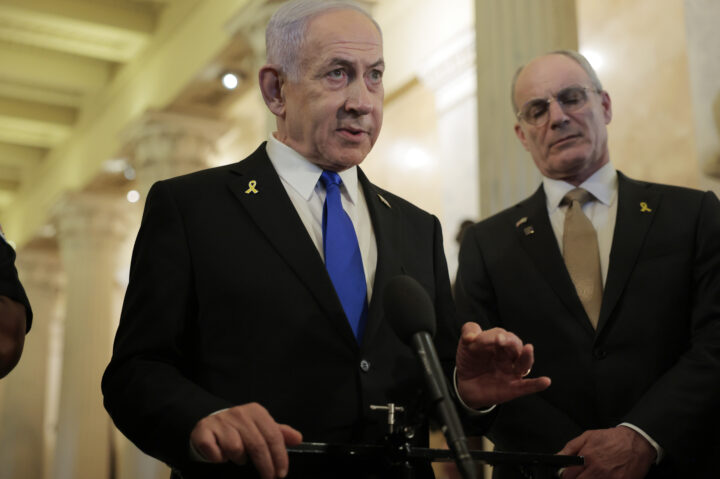
Anna Moneymaker/Getty Images
Israeli Prime Minister Benjamin Netanyahu speaks to reporters after meeting with U.S. Speaker Mike Johnson (R-LA) at the U.S. Capitol on July 8, 2025, in Washington, D.C.
Good Monday afternoon.
This P.M. briefing is reserved for our premium subscribers like you — offering a forward-focused read on what we’re tracking now and what’s coming next.
I’m Danielle Cohen-Kanik, U.S. editor at Jewish Insider. I’ll be curating the Daily Overtime for you, along with assists from my colleagues. Please don’t hesitate to share your thoughts and feedback by replying to this email.
📡On Our Radar
Notable developments and interesting tidbits we’re tracking
There has been a whirlwind of political activity in Israel today, starting with the bombshell news that Prime Minister Benjamin Netanyahu intends to ask the Security Cabinet to approve an expansion of Israel’s war in Gaza, which would see the IDF control all of the enclave.
The move will have reverberations throughout Jerusalem and Washington, from Netanyahu’s own government to hostage families, Capitol Hill and the White House. Officials on both sides of the aisle in the U.S. have been pushing hard for a comprehensive ceasefire and an end to the war — including Middle East envoy Steve Witkoff, who was in Israel just days ago at the behest of President Donald Trump. Stay tuned to Jewish Insider for how this will play out in the coming days…
In other headlines coming out of Israel, the Cabinet voted unanimously this morning to oust Attorney General Gali Baharav-Miara, with whom the current government has been at odds since it was formed, accusing her of political bias.
Shortly after the vote, the Israeli Supreme Court issued an injunction temporarily blocking the firing and ordering the government to continue abiding by Baharav-Miara’s legal opinions until the court issues a final ruling.
It’s the first time an Israeli government has ever voted to oust the AG, and with some Cabinet ministers already boycotting her and pushing back on the court’s decision, Israel could be edging toward a constitutional crisis.
Meanwhile, Likud MK Yuli Edelstein was officially pushed out of his chairmanship of the Knesset Foreign Affairs and Defense Committee today, over coalition disagreements on a Haredi conscription bill. He was replaced by Boaz Bismuth, also from Likud, whom the party hopes will be more amenable to reducing sanctions on Haredim who dodge the draft. Israeli voters across a large swath of the political spectrum, including the Likud base, are on Edelstein’s side of the debate…
Getting a front-row seat to these developments, House Speaker Mike Johnson’s (R-LA) trip to Israel with a House Republican delegation continues today. The group visited the town of Ariel, making Johnson the highest-ranking elected federal official to visit a West Bank settlement. While there, Johnson told a meeting of senior Yesha Council officials that “Judea and Samaria are the front lines of the State of Israel and must remain an integral part of it,” and stopped by Ariel University…
Also in Israel this week are two delegations of freshman House members, one from each caucus, organized by the AIPAC-affiliated American Israel Education Foundation. The Democratic trip is led by Rep. Steny Hoyer (D-MD), the former House majority leader, and Rep. Pete Aguilar, (D-CA), the caucus chair…
Back at home, Conference of Presidents of Major American Jewish Organizations CEO William C. Daroff met with Under Secretary of Defense Elbridge Colby at the Pentagon today. Though Colby had faced criticism around his nomination from pro-Israel circles for his calls to scale back U.S. involvement in the Middle East, Daroff told JI that Colby “expressed a clear and serious understanding of U.S. strategic interests in the Middle East, including the vital importance of deterring Iran, preventing regional adversaries from gaining dominance, and sustaining Israel’s security following the Twelve Day War.” Daroff said he was “encouraged by [Colby’s] principled and grounded approach”…
The Federal Emergency Management Agency said in grant notices made public Friday that states must guarantee they will not engage in boycotts of Israeli companies in order to qualify for a tranche of more than $1.9 billion in natural disaster preparedness grants…
Software analytics giant Palantir topped $1 billion in revenue for the first time, it shared in an earnings report today. The company has secured several large contracts with the Trump administration, including an agreement announced last week for $10 billion over the next decade with the U.S. Army…
Veteran Democratic political strategist Howard Wolfson, an outspoken supporter of Israel and Jewish causes, appeared on Daniel Gordis’ “Israel from the Inside” podcast today with the message that “the war for hearts and minds” in U.S. support for Israel “has been lost.” The former communications director of Hillary Clinton’s 2008 presidential campaign, Wolfson said that he’s “clanging the alarm bell as loudly as I can and hoping that the Israeli public and the decision-makers in Israel understand how far Israel has fallen in public approval in the United States and what the implications of that are.”
“Israel is getting absolutely decimated” in information warfare, Wolfson continued. “And that may not be fair, it may not be accurate, but I think those questions of fairness and accuracy, they’ve become largely irrelevant. It’s not about fairness and accuracy. It’s about effectiveness and about impact.”…
⏩ Tomorrow’s Agenda, Today
An early look at tomorrow’s storylines and schedule to keep you a step ahead
Keep an eye on Jewish Insider this week for a dive into the lessons learned from Israel’s disengagement from Gaza 20 years ago this month, an analysis of what a new poll of New York City Jewish voters means for Zohran Mamdani’s mayoral prospects and a look into the latest fundraising figures from pro-Israel campaign groups.
Tomorrow morning, Israeli Foreign Minister Gideon Sa’ar will meet with American Jewish leaders in New York, JI has learned, and then head to a meeting of the U.N. Security Council on the situation of the hostages held in Gaza. Sa’ar prompted the special session after videos of two hostages — Evyatar David and Rom Braslavski — were released by Hamas and the Palestinian Islamic Jihad, showing the two men looking haggard and severely emaciated.
MARYLAND MOOD
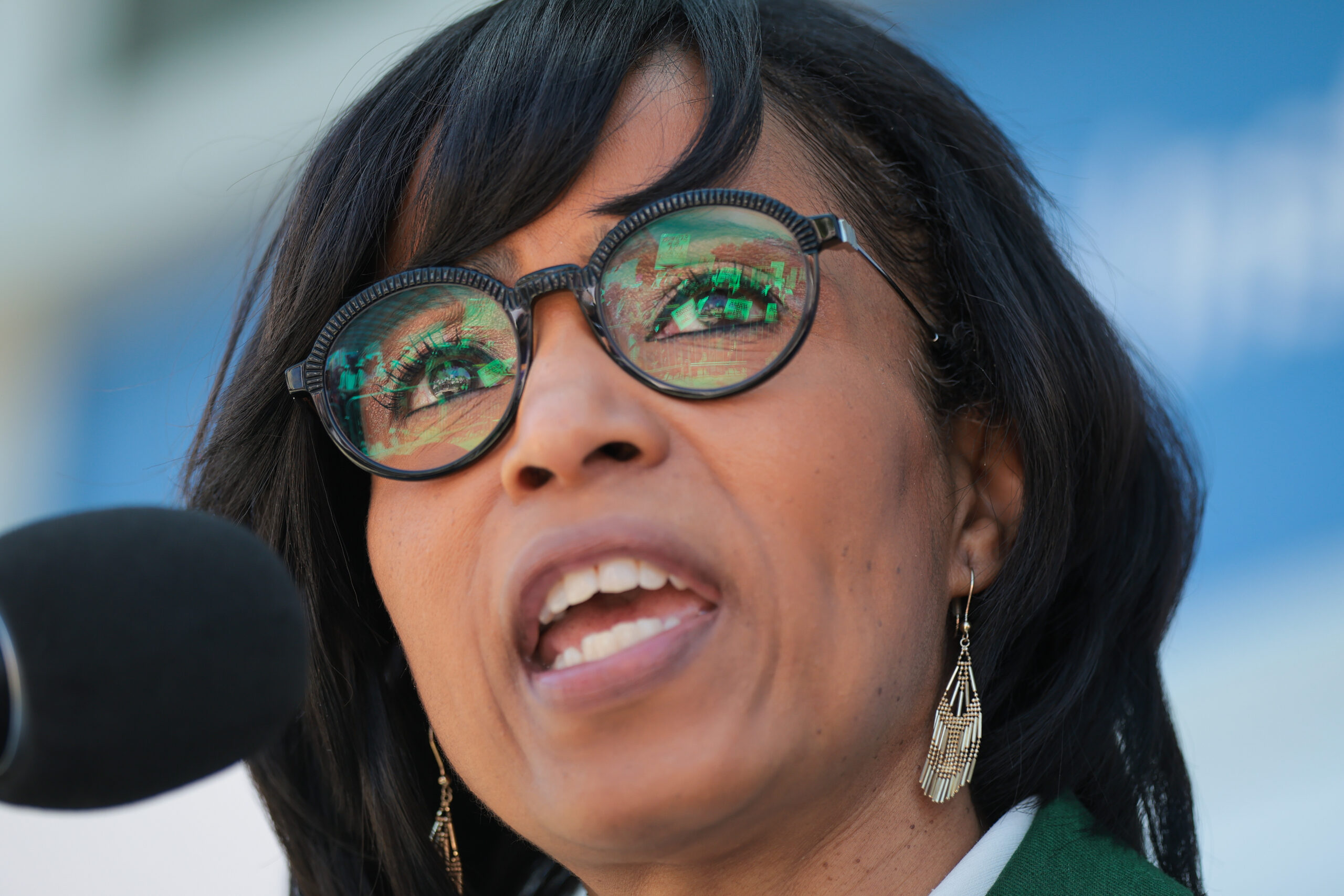
Many of the state’s Jewish leaders are wary of speaking out against the Maryland Democrat’s votes to block arms sales to Israel
QATAR CALL
The Democratic congressman, in a letter rejecting an offer for a staffer to travel to Qatar, said that the kingdom needs to do more to pressure Hamas
Last year, Hamas executed six hostages when the IDF approached their position; military reportedly opposes taking control of areas in Gaza where hostages are believed to be held
Anna Moneymaker/Getty Images
Israeli Prime Minister Benjamin Netanyahu speaks to reporters after meeting with U.S. Speaker Mike Johnson (R-LA) at the U.S. Capitol on July 8, 2025, in Washington, D.C.
Israeli Prime Minister Benjamin Netanyahu plans to ask the Security Cabinet to back expanding Israel’s military efforts in Gaza, Israeli media reported on Monday.
“We are going to conquer the [Gaza] Strip,” a senior source in Netanyahu’s office told Israel’s Channel 12. “The decision was made. Hamas will not free more hostages without us fully surrendering, and we will not surrender. If we don’t act now, the hostages will die of hunger and Gaza will remain under Hamas’ control.”
A few caveats: Netanyahu did not use the term conquer or occupy with all of the Cabinet ministers to whom he conveyed his position, according to Israeli public broadcaster KAN. Maariv reported that Netanyahu has not made a final decision yet about whether the IDF should take control of all of Gaza, and noted that legally, he cannot decide on his own without the Security Cabinet.
“Netanyahu realized … that there is no point anymore in waiting for Hamas [to agree to a deal], and therefore a decision about the next stage of the war must be made quickly,” a source involved in the matter told Maariv. “The dispute now is not about whether to act or negotiate, because a deal with Hamas is no longer on the table. Rather, it’s about how to act without a deal, whether to go for full conquest or for a siege and increased pressure.”
IDF Chief of Staff Maj.-Gen. Eyal Zamir reportedly favors a siege over occupying all of Gaza.
The IDF currently controls about 75% of the Gaza Strip, and the new plan would bring the entire area under Israel’s control. Among the areas the IDF would enter would include Gaza City, where the IDF has not maneuvered in a year and a half, and towns in central Gaza, where some 20 remaining living hostages are believed to be held.
The military’s hesitation to enter those areas was, in part, due to a concern for the hostages’ safety. Last year, Hamas executed six hostages when the IDF approached their position and former hostages have said that their captors said they would kill them if the army approached the location where they were held. Hamas has also warned the IDF that attempts to rescue hostages would result in death.
Senior officials were quoted in multiple Israeli news outlets saying that Zamir should resign if he disagrees with Netanyahu’s decision to take control of the remaining 25% of the Gaza Strip.
Netanyahu is expected to bring the proposal to a Security Cabinet vote on Tuesday.
The move comes two weeks after Hamas rejected a partial ceasefire and hostage-release deal, and Israel and the U.S. said they would only pursue comprehensive agreements to free all of the hostages moving forward. Hamas and Palestinian Islamic Jihad published videos in recent days of hostages Rom Braslavski and Evyatar David who appeared to be starving; the latter was filmed digging his own grave.
In addition to Zamir, others expected to argue against conquering the rest of Gaza, according to Channel 12, are Foreign Minister Gideon Sa’ar, Shas leader Arye Deri, National Security Advisor Tzachi Hanegbi and Mossad chief David Barnea, among others.
Netanyahu has the support of Strategic Affairs Minister Ron Dermer, Finance Minister Bezalel Smotrich, National Security Minister Itamar Ben-Gvir, Military Secretary Maj.-Gen. Roman Gofman and Cabinet Secretary Yossi Fuchs.
The Prime Minister’s Office did not respond to requests for comment on the reports.
Rather than confirm or deny that he had made a decision about Israel’s next military steps in Gaza, Netanyahu posted a video to X after Hebrew media reported on the matter, which focused on Israeli efforts to get food and medicine to residents of Gaza, and compared claims that Israel was starving Gazans to antisemitic conspiracy theories.
Plus, Mike Johnson’s first Israel trip as House speaker ͏ ͏ ͏ ͏ ͏
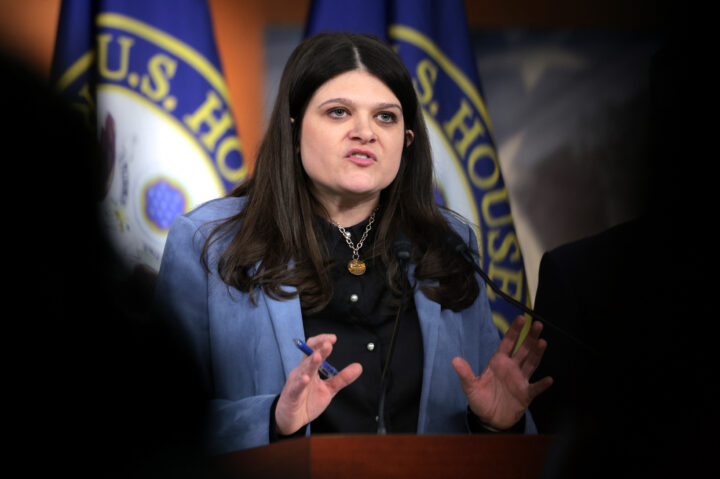
Kayla Bartkowski/Getty Images
U.S. Rep. Haley Stevens (D-MI), joined by fellow House Democrats, speaks at a press conference on overreach by President Donald Trump, Elon Musk and the Department of Government Efficiency (DODGE) at the U.S. Capitol on February 06, 2025 in Washington, DC.
Good Monday morning.
In today’s Daily Kickoff we look at the split in the Democratic Party over Senate resolutions to block military sales to Israel and talk to Maryland Jewish community leaders who are disappointed with Sen. Angela Alsobrooks’ flip-flop on the issue. We talk to Democratic Rep. Greg Landsman about his call for Qatar to detain Hamas leaders and report on House Speaker Mike Johnson’s current visit to Israel. We also interview former Israeli diplomat Emmanuel Nahshon about the mounting isolation of Israeli academia. Also in today’s Daily Kickoff: Aaron Parnas, Loretta Rothschild, and Janet Huckabee and Sarah Huckabee Sanders.
What We’re Watching
- House Speaker Mike Johnson (R-LA) and a group of House Republicans are visiting Israel this week, in Johnson’s first international trip and first visit to Israel since becoming speaker. More below.
- Arkansas Gov. Sarah Huckabee Sanders is on a trade mission to Israel and the United Arab Emirates this week, currently on the first leg of the mission, “to meet with government officials and business leaders and deepen Arkansas’ economic ties.”
- Former college football coach Derek Dooley jumped into the Georgia Senate race against Sen. Jon Ossoff (D-GA) today, a development that shakes up the race. Dooley, who was recruited into the race by Georgia Gov. Brian Kemp, will be facing Reps. Buddy Carter (R-GA) and Mike Collins (R-GA) in the GOP primary. We’re keeping a close eye on whether President Donald Trump chooses a favorite.
What You Should Know
A QUICK WORD WITH JI’S JOSH KRAUSHAAR
After a majority of Senate Democrats voted last week to cut off some military sales to Israel, the issue has emerged as a dividing line in some key Senate primaries. The votes have become a pivotal test in determining which members have maintained their support for Israel, and those who are responding to the political pressure from the party’s progressive activist base.
All told, most of the leading recruits — from former North Carolina Gov. Roy Cooper to Rep. Raja Krishnamoorthi (D-IL) to Rep. Haley Stevens (D-MI) — have said they would have voted with the pro-Israel wing of the party against the two resolutions sponsored by Sen. Bernie Sanders (I-VT). But there are some notable divisions that are emerging in key races.
Here’s a quick overview of the Democratic candidates’ views in the key open seat races:
MI-SEN: Stevens, a pro-Israel stalwart, said she would have voted against the Sanders resolutions on cutting off military aid, as the state’s delegation was divided on the vote. Sen. Gary Peters (D-MI) voted against it, but newly elected Sen. Elissa Slotkin (D-MI), who missed the vote to appear on Stephen Colbert’s talk show, said she would have supported the anti-Israel measure.
State Sen. Mallory McMorrow, who earlier this year had been meeting with Jewish groups to reassure them of her pro-Israel bona fides, publicly broke with her past positions. “The United States has to stop providing Netanyahu with offensive weapons that do nothing but continue to extend this war,” she said. At a campaign event last Wednesday, she slammed the Israeli prime minister further: “We cannot let this man tell us that what we are seeing with our own eyes is not what is actually happening.”
MARYLAND MOOD
Maryland Jewish leaders are expressing disappointment over Sen. Angela Alsobrooks’ (D-MD) decision to support both of Sen. Bernie Sanders’ (I-VT) resolutions blocking U.S. arms sales to Israel despite vowing to oppose such efforts when she campaigned for the Senate last year. In a statement on her decision, the Maryland senator said she was joining the “voices of so many who feel the moral imperative to demand change. To witness the inhumanity of starving children and say nothing is not just a dereliction of duty but of conscience,” Jewish Insider’s Emily Jacobs reports.
Jewish community reaction: Ron Halber, the CEO of the Jewish Community Relations Council of Greater Washington, said that the JCRC planned to request a meeting with Alsobrooks to “try and figure out what her thoughts were on this matter and express our concern” about her votes on Wednesday. Halber predicted that Alsobrooks was “probably swayed by the humanitarian disaster that has unfolded” in Gaza, pointing out her comments during the campaign and her votes against the April resolutions. He also noted that Alsobrooks was “speaking publicly at JCRC forums and speaking as recently as our legislative breakfast in December of last year” about her support for continued aid to Israel.
QATAR CALL
Rep. Greg Landsman (D-OH) called on Qatar last week to step up more forcefully to pressure Hamas and bring about a hostage-release and ceasefire deal in Gaza, including taking into custody the Hamas leaders who have long enjoyed safe haven in Doha, in a lengthy X thread about the conflict in Gaza. “It’s time to call the question on everybody, including the Qataris. There are legitimate questions about whether or not they should be doing more, they could be doing more,” Landsman said in an interview with Jewish Insider’s Marc Rod. “[Hamas] just refuses to engage anymore.”
Leaving no stone unturned: In light of that situation, Landsman argued that every potential lever to change Hamas’ calculus must be explored and pursued. He said that Qatar, as “the entity that has the most influence” over Hamas at this point, “has to feel way more pressure from the international community to do everything in their power” to get to a deal. The status quo of Hamas leaders living lavish lives in Qatar “should absolutely be questioned,” Landsman said. He said he’s heard from Israeli officials and others involved in the hostage talks that the Qataris are “not seen as a trusted partner in this effort to end the war.”
SPEAKER’S SOJOURN

House Speaker Mike Johnson (R-LA) and a group of House Republicans arrived in Israel on Sunday, in Johnson’s first international trip and first visit to Israel since becoming speaker. Johnson was set to visit Israel in June to address the Knesset, but postponed his visit after the war between Israel and Iran began. He will not be addressing the Knesset on this visit, a source familiar with his plans told Jewish Insider’s Marc Rod.
Words at the Wall: Johnson and those in his delegation — Reps. Michael McCaul (R-TX), Nathaniel Moran (R-TX), Claudia Tenney (R-NY) and Michael Cloud (R-TX) — have prayed at the Western Wall and met with Israeli Defense Minister Israel Katz and Foreign Minister Gideon Sa’ar. “We’re so grateful to be in Israel, particularly on this day, recognizing the destruction of the two Temples … it is such a moving time for us to be here at the Wailing Wall. We’ve offered our prayers, we’ve put our notes into the wall,” Johnson said in brief video remarks from the Kotel, which he visited on Tisha B’Av. “We’re so moved by the hospitality of the people and the great love of Israel.”
DEM DIVIDE
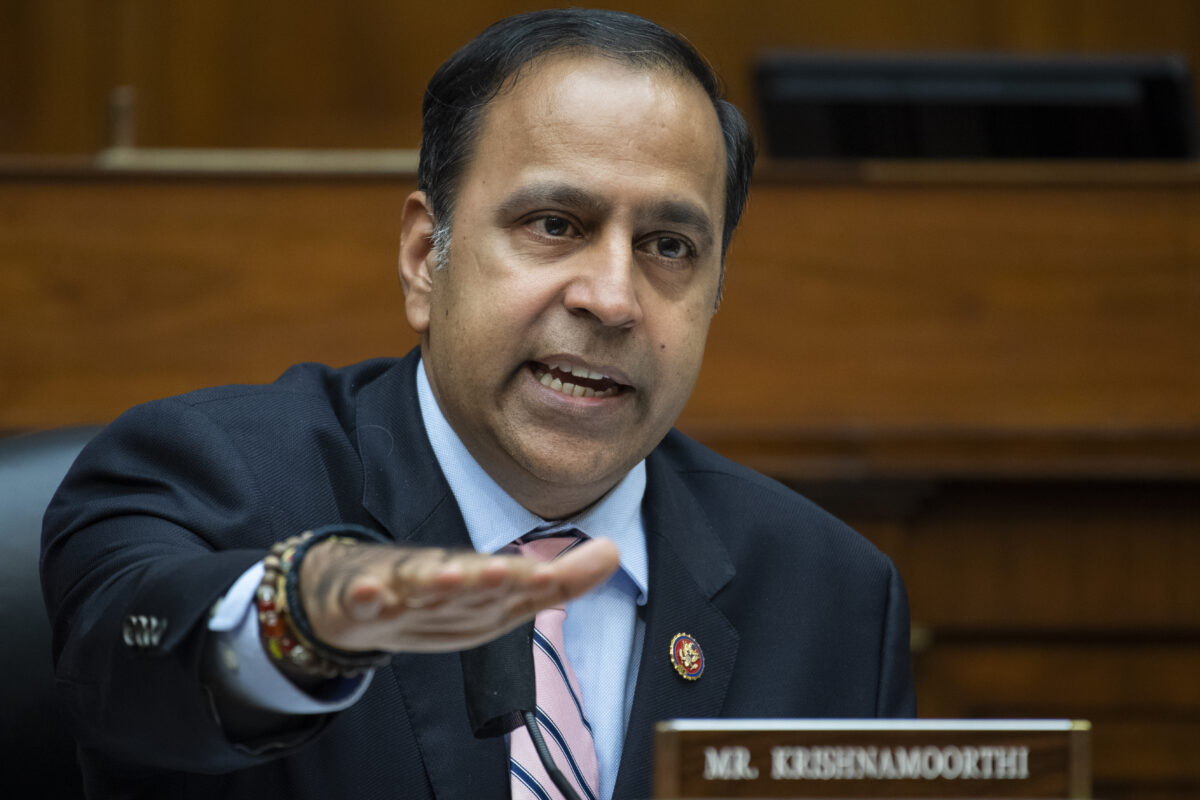
A divide is emerging in the Democratic Senate primary in Illinois over resolutions the Senate voted on earlier this week to block certain arms sales to Israel,Jewish Insider’s Marc Rod reports.
Split paths: Lt. Gov. Juliana Stratton’s campaign and Rep. Raja Krishnamoorthi told JI on Friday that they wouldn’t have supported the resolutions led by Sen. Bernie Sanders (I-VT), even as they condemned the humanitarian crisis in Gaza. But Rep. Robin Kelly (D-IL) announced earlier in the day that she would have voted for the resolutions if she’d been in the Senate. The split could help shape the potentially crucial Jewish community vote in the upcoming Senate primary.
FLIP-FLOP

Sen. Amy Klobuchar (D-MN) said that she voted, for the first time, for resolutions blocking U.S. arms sales to Israel last week to send a message to the Israeli government of disapproval for the humanitarian situation in Gaza, even as she acknowledged that the vote might not make much of an impact, Jewish Insider’s Marc Rod reports.
Explaining: “I just think it’s really important for people to speak out when they can, even if it’s on a vote that isn’t probably going to make all the difference right now. And it doesn’t mean I’m going to be hard-stop against aid for Israel in the future,” Klobuchar told Punchbowl News. “At some point, you’ve got to seek change. And I think this is one way you can do it,” she continued. “I have supported Israel’s right to defend itself, I always will. But they aren’t changing.”
Tar Heel take: North Carolina Democratic Senate candidate Roy Cooper, the state’s former governor, meanwhile, rejected efforts to withhold U.S. aid to Israel. A Cooper spokesperson told JI’s Marc Rod: “The Governor believes it’s urgent for the United States to use other means of pressure on the Israeli government to step up now and find ways to get food to people who desperately need it and return the hostages. He would consider the specific text of any bills that came before the Senate, but generally does not believe we should withhold aid from a critical ally like Israel when they have to defend themselves against countries like Iran.”
Q&A

As several European countries moved to recognize a Palestinian state last week, the EU debated suspending Israel from Horizon Europe — its $109.2 billion science and innovation program — citing the humanitarian crisis in Gaza. The proposed partial suspension, which could cost Israeli startups over $11.4 million, failed to pass after Germany and Italy reportedly blocked the move, though talks will continue. Former Israeli diplomat Emmanuel Nahshon, now the coordinator for combating academic boycotts on behalf of the Israeli Association of Universities, warned in an interview with Jewish Insider’s Lahav Harkov that Israeli academia is facing mounting isolation and long-term damage in the wake of the Gaza war.
Snowball effect: “It’s a slippery slope. The more it happens, the more it is bound to happen. Universities copy one another. On top of that, we have the silent, covert boycott. It’s like Voldemort [from ‘Harry Potter’], no one is saying its name, but it is there and we feel it all the bloody time. Israeli lecturers are not invited to international events anymore; articles are rejected; Israelis are not invited to take part in science and research consortia, etc. If it continues for a year or two, we may face dire consequences,” Nahshon said. “It’s the slow strangling of the Israeli academic world. We cannot function without contact with the outside world. Israel is too small a country to be able to have its own, internal academic world. We need contact with …the Ivy League and Western European universities.”
Worthy Reads
Losing the French: The New York Times’ David French, a pro-Israel, anti-Trump conservative, calls on Israel’s allies “to stage an intervention” in order to protect the U.S.-Israel alliance. “The Israeli government has gone too far. It has engineered a staggering humanitarian crisis, and that crisis is both a moral atrocity and a long-term threat to Israel itself. … Hamas’s war crimes — including its murders, its hostage taking and its concealment among civilians and civilian buildings — do not relieve Israel of its own moral and legal obligations. … No nation — not even the United States — can thrive without allies, and Israel (despite its nuclear weapons) is far more vulnerable and dependent on international friendship than the United States or Britain or France. If Israel creates a lasting rift with its European allies and shatters the longstanding bipartisan American consensus on aiding Israel, then the long-term consequences could be grave. … Israel’s friends must speak with one voice: End the famine in Gaza. Drop any talk of annexation. Protect the civilian population. Defeating Hamas does not require starving a single child.” [NYTimes]
Gaza, 20 Years After: Israeli journalist Amit Segal argues in Israel Hayom that opponents of Israel’s withdrawal from Gaza 2005 were right. “It’s trendy these days to pin messianic thinking on the right. Fair enough. But the truth is that two messianic movements crashed head-on in Gaza: the religious-nationalist right that wanted to annex the Gaza Strip and pretended two million Palestinians didn’t exist because ‘it’s our land,’ and the less talked-about secular-liberal left that believed pulling out would create a Gaza Riviera with high-tech and Singapore-style beach clubs. … The whole point was to pay a steep price at home to get better security, not end up with the same nightmare. Unless better security was never really the goal, because no sane group with hundreds of years of military experience would think running away from terrorists would make them put down their guns. Maybe the real goal was always to crush internal opposition in Israeli society. You know: the operation failed, but at least the patient died.” [IsraelHayom]
The Luigi Effect: Jesse Arm, vice president of external affairs at the Manhattan Institute, writes in City Journal about the rise of “Luigism,” evidenced by those celebrating the murder of Blackstone executive and Jewish philanthropist Wesley LePatner on social media. “This grotesque display is part of a broader trend of class rage and Internet nihilism that justifies violence by turning innocent victims into scapegoats for moral fury. The permission structure for such ghoulishness is now fully operational. What were once the disturbing mutterings of the fringe are now public, performative, and proudly cruel. A political movement is testing its power. Call it Luigism. Invoking Luigi Mangione — the Ivy League-educated radical who allegedly assassinated UnitedHealthcare CEO Brian Thompson last December — Luigism is the idea that violence is a legitimate response to the perceived injustices of capitalism. If the victim represents wealth, whiteness, pro-Israel Judaism, or institutional power, the killing can be framed as justified, or even glamorous.” [CityJournal]
TikTok Trend: The Atlantic’s Amogh Dimri explores the rise of TikTok-native news influencers through the lens of Aaron Parnas — a 26-year-old lawyer-turned-political commentator whose rapid-fire video updates have turned him into one of Gen Z’s most influential news sources. “Parnas, who is 26, is a lawyer by trade. He told me that he monitors every court case he deems significant with a legal tracker. He was immersed in politics at an early age. (His father, Lev Parnas, gained brief notoriety as an associate of Rudy Giuliani during Trump’s first term. ‘I love my dad,’ Aaron Parnas has said. ‘And I’m not my dad.’) C-SPAN is on ‘all day every day.’ And he’s enabled X and Truth Social notifications for posts from every member of Congress and major world leader. When he decides that his phone’s alerts are newsworthy, he hits the record button. His rapid-reaction formula for news has made him a one-man media giant: He currently has 4.2 million followers on TikTok. He told me that his videos on the platform have reached more than 100 million American users in the past six months. His Substack newsletter also has the most subscriptions of any in the ‘news’ category, and he recently interviewed Senator Cory Booker, French Foreign Minister Jean-Noël Barrot, and this magazine’s editor in chief.” [Atlantic]
Word on the Street
President Donald Trump declined to characterize Israel’s war against Hamas in Gaza as a genocide yesterday, responding to a reporter saying, “I don’t think it’s that. They’re in a war.” Talking to reporters boarding Air Force One at Lehigh Valley International Airport, Trump said, “We want the people fed. We’re the only country that’s really doing that. We’re putting up money to get the people fed. And [Middle East envoy] Steve Witkoff is doing a great job.” …
Witkoff told hostage families in Tel Aviv on Saturday that the U.S. is now aiming to reach a comprehensive ceasefire and hostage-release deal with Hamas, including ending the war and returning all the remaining hostages, rather than the incremental deals previously attempted…
Hamas released a video of severely emaciated hostage Evyatar David digging his own grave in an underground tunnel in Gaza over the weekend, shortly after the Palestinian Islamic Jihad released a video of hostage Rom Braslavski, similarly emaciated and weak…
Several Democratic members of Congress, speaking with CNN, criticized Israeli Prime Minister Benjamin Netanyahu for declining support of Israel in the party. Sen. Brian Schatz (D-HI) said, “I think there’s a recognition that Netanyahu is making Israel and Israelis and Jews unsafe all over the world.” Rep. Mikie Sherrill (D-NJ) told the outlet, “Netanyahu has to be held accountable”…
Rep. Haley Stevens (D-MI) sent a second letter to Department of Homeland Security Secretary Kristi Noem on Friday asking why 22-year-old Thomas Fugate, a recent college graduate, was tapped to lead the Center for Prevention Programs and Partnerships, a top anti-terrorism role. Stevens chastized Noem for dodging the question in her response to Stevens’ first letter on the issue in July…
The Wall Street Journal spotlights the rise of Omar Fateh, the “Mamdani of Minneapolis,” in his mayoral bid, as a reflection of the widening rift in the Democratic Party…
Semafor obtained internal messages from The New York Times illuminating the outlet’s internal debate over the cover photo for a story on malnutrition in Gaza, which ultimately led to the Times clarifying that the child pictured had previous health conditions…
The Free Press also highlighted the Times’ mistake, in an editorial titled, “Mistakes at ‘The New York Times’ Only Go in One Direction,” highlighting the reach of the mistake in comparison with the quiet correction …
Fourteen Democratic senators and House members threatened Harvard with a potential congressional investigation if it agrees to a reported settlement with the Trump administration and cautioned it against “any settlement that undermines its independence or validates the misuse of governmental power for partisan ends.”…
Politico interviews right-wing provocateur Laura Loomer about her role in the Trump administration’s staffing decisions, including continued firings and pulled nominations based on questions of the individual’s loyalty to the president …
The New York Times details four Iranian Americans being detained by Iran, according to human rights groups and lawyers, including a “70-year-old Jewish father and grandfather from New York who has a jewelry business” who is “being questioned about a trip to Israel”…
Sens. Ted Budd (R-NC) and Mark Kelly (D-AZ) introduced the SEIZE Act, to allow the U.S. to quickly distribute to partners any weapons seized in transit from Iran to its terrorist proxies…
The New York Times spotlights the outlet Campus Reformand its editor-in-chief, Zachary Marschall, whose longtime coverage of leftist bias on college campuses has resulted in several schools coming under investigation from the federal government…
Brazil announced its withdrawal from the International Holocaust Remembrance Alliance, where it held observer status, last week, in a move that Dani Dayan, president of the IHRA, called “a serious crossing of a red line.” “This is the first time a Western country has subordinated Holocaust remembrance to political considerations,” Dayan said…
Over 600 former Israeli security officials — including former Mossad chief Tamir Pardo and former Shin Bet chief Ami Ayalon — who make up the Commanders for Israel’s Security group sent a letter to Trump on Sunday asking him to press Netanyahu to end the war in Gaza…
The American Jewish Committee donated $25,000 to help repair the Holy Family Church, the only Catholic church in Gaza, which was damaged by errant Israeli munitions last month, eJewishPhilanthropy’s Nira Dayanimreports…
Israel’s Ministry of Foreign Affairs announced Friday that its embassy and consulate in the United Arab Emirates remain open and operational, including “ensuring the protection of Israeli diplomats,” after the Israeli National Security Council warned its citizens in the country of heightened terror threats last week and reportedly evacuated some of its diplomats…
The New York Times profiles U.S. Ambassador to Israel Mike Huckabee, including his evangelical support for the Jewish state and his long history of visiting the country…
Azerbaijan will export 1.2 billion cubic meters of natural gas per year through Turkey to Syria to help Damascus rebuild and stabilize, Vice President Elshad Nasirov of SOCAR, the Azeri state energy company, told Reutersat a ceremony to launch the project on Saturday…
Arkansas Attorney General Tim Griffin told the Forward last week that the fringe group “Return to the Land,” which bars Jews and non-white individuals from living in their community, does not violate state or federal anti-discrimination law…
Ami Eden, CEO of JTA’s parent company 70 Faces Media, identifies himself as the former student-body president at Akiba Hebrew Academy who once bested Josh Shapiro in what Shapiro has described, most recently in an interview with Stephen Colbert, as the only campaign defeat of his life…
Ivanka Trump gave a boost to Loretta Rothschild’s new debut novel, Finding Grace, with a glowing review, posted to her Instagram, of the book that was released last month…
Pic of the Day

U.S. Ambassador to Israel Mike Huckabee’s wife, Janet, and daughter, Sarah Huckabee Sanders, the governor of Arkansas, prayed at the Western Wall in Jerusalem on Tisha B’Av on Sunday.
Birthdays

Chief political correspondent and host of Fox News’ “Special Report,” Bret Baier turns 55…
Professor emerita of American history at Yeshiva University and Stern College, she is an expert on the history of McCarthyism, Dr. Ellen Wolf Schrecker turns 87… Talmudic scholar and a leader of New York’s Sephardic Jewish community, Rabbi Eliyahu Ben Haim turns 85… President at Salco Mechanical, Michael Salzberg… Rabbi of Centro Israelita de Bogotá and chief rabbi of Colombia, Alfredo Goldschmidt turns 80… Immediate past board chair of the Jewish Funders Network, Marcia Riklis… Frederic Lewis Bloch… Former Ashkenazi chief rabbi of Israel, Rabbi Yona Metzger turns 72… Retired professor in Memphis, Sheldon Dan… Longtime member of the Knesset for Likud including multiple ministerial positions, Silvan Shalom turns 67… Executive producer of “Live with Kelly and Mark,” Michael Gelman turns 64…44th president of the United States, Barack Obama turns 64… Mayor of Chicago from 2019 until 2023, Lori Lightfoot turns 63… Attorney general of Minnesota, Keith Ellison turns 62… Administrative manager at Edelman, Helen Lapkovsky… Global editorial director for PwC and editor-in-chief of PwC’s management magazine strategy+business, Daniel Gross turns 58… Editor-in-chief of “Cuepoint” at Medium, he is known as Shecky Green, Jonathan Miles Shecter turns 57… Congressman (D-NY-8), he is the minority leader of the House of Representatives, Hakeem Jeffries turns 55… Emmy Award-winning broadcast meteorologist at WJLA-TV in Washington, Steven Rudin… Washington director of Bend the Arc Jewish Action, Rabbi Jason Kimelman-Block… Director-general of the United Nations Educational, Scientific and Cultural Organization (UNESCO), Audrey Azoulay turns 53… Senior editor at Politico, he writes Politico‘s “Capital City” column, Michael Schaffer… Chair of the Arizona Democratic Party from 2011 through 2012, he is a former White House speechwriter, Andrei Cherny turns 50… Head of PR for Unit 42 at Palo Alto Networks, Caren Beth Auchman… CEO of Something Major, a leadership coaching and advisory firm, Randi Braun… Director of corporate growth strategy in the geostrategic business group at EY-Parthenon, Ben-Ari Boukai… CRO and co-founder at Riverside.fm, Jonathan Keyson… Childhood student at the Donna Klein Jewish Academy in Boca Raton, Fla., he is a placekicker for the NFL’s San Francisco 49ers, Greg Joseph turns 31… TikToker, comedian and influencer, Sabrina Plon Brier turns 31… Natalie Roberts… Evelyn Murphy…
BELATED BIRTHDAY: Representative of the World Zionist Organization Executive in North America, Michal Slawny Cababia (was Thursday)…
The votes have become a pivotal test in determining which members have maintained their support for Israel, and those who are responding to the political pressure from the party’s progressive activist base

Kevin Dietsch/Getty Images
Sen. Bernie Sanders (I-VT), joined by fellow senator Sen. Jeff Merkley (D-OR) (R), speaks at a news conference on restricting arms sales to Israel at the U.S. Capitol on November 19, 2024 in Washington, DC.
After a majority of Senate Democrats voted last week to cut off some military sales to Israel, the issue has emerged as a dividing line in some key Senate primaries. The votes have become a pivotal test in determining which members have maintained their support for Israel, and those who are responding to the political pressure from the party’s progressive activist base.
All told, most of the leading recruits — from former North Carolina Gov. Roy Cooper to Rep. Raja Krishnamoorthi (D-IL) to Rep. Haley Stevens (D-MI) — have said they would have voted with the pro-Israel wing of the party against the two resolutions sponsored by Sen. Bernie Sanders (I-VT). But there are some notable divisions that are emerging in key races.
Here’s a quick overview of the Democratic candidates’ views in the key open seat races:
MI-SEN: Stevens, a pro-Israel stalwart, said she would have voted against the Sanders resolutions on cutting off military aid, as the state’s delegation was divided on the vote. Sen. Gary Peters (D-MI) voted against it, but newly elected Sen. Elissa Slotkin (D-MI), who missed the vote to appear on Stephen Colbert’s talk show, said she would have supported the anti-Israel measure.
State Sen. Mallory McMorrow, who earlier this year had been meeting with Jewish groups to reassure them of her pro-Israel bona fides, publicly broke with her past positions. “The United States has to stop providing Netanyahu with offensive weapons that do nothing but continue to extend this war,” she said. At a campaign event last Wednesday, she slammed the Israeli prime minister further: “We cannot let this man tell us that what we are seeing with our own eyes is not what is actually happening.”
Abdul el-Sayed, a vocal Israel critic, didn’t release any statements about the vote or respond to requests for comment on the prospect of blocking offensive weapons sales to Israel. But as a longtime Sanders ally, it’s safe to assume he’s aligned with the push to withhold aid.
IL-SEN: Krishnamoorthi and Illinois Lt. Gov. Juliana Stratton have come out against Sanders’ anti-Israel resolutions, while also calling for Israel to address the humanitarian crisis in Gaza. But Rep. Robin Kelly (D-IL) joined with Sanders in saying she would have voted for the resolutions despite her general pro-Israel voting record in the past.
NC-SEN: Cooper said he would support other ways of pressuring Israel to increase humanitarian aid into Gaza, but said he would have voted against the resolutions cutting off aid. Cooper is running unopposed for the Democratic nomination in a key swing-state seat.
NH-SEN: Rep. Chris Pappas (D-NH), the expected Democratic nominee who has maintained a pro-Israel voting record in the House, said he would have voted against the resolutions in an interview with WMUR-TV: “I would have opposed these resolutions because I believe that we should be holding Hamas to account and realizing a future for the Palestinian people.”
MN-SEN: Rep. Angie Craig (D-MN), the early front-runner and a pro-Israel moderate, has not publicly explained — or responded to JI — how she would have voted. Lt. Gov. Peggy Flanagan, running as the progressive in the primary, told JI she would have supported the resolutions, adding, “She believes all of the hostages need to be brought home, that leaders in the U.S. and Israel must do more to get aid into Gaza, and that all sides need this conflict to end.”
Stay tuned to JI for more reporting on where the candidates stand on an issue that’s emerging as a dividing line inside the party.
Please log in if you already have a subscription, or subscribe to access the latest updates.
 Continue with Google

 Continue with Apple