





















































Phil Roeder/Flickr
Sen. Kirsten Gillibrand (D-NY)


 Add JewishInsider on Google
Sen. Kirsten Gillibrand (D-NY) questioned the Israeli government’s commitment to the U.S.-Israel alliance on Sunday following its decision last week to bar entry to two members of Congress.
“Congress has a duty to make decisions about whether we give aid, how we protect allies such as Israel with qualitative military edge. I don’t know why Netanyahu would want to deny members of Congress to come to Israel if they expect us to be that never-ending partner and friend,” Gillibrand said in an interview on ABC’s “This Week” with Martha Raddatz.
The 2020 presidential candidate also indicated that she would hold Israel “accountable” for its decision if she was president, although she didn’t illustrate what that meant. “I think our obligation, as an ally and as a friend is to hold them accountable when they’re wrong,” Gillbrand explained. “And I think any time you are undermining basic free speech rights and human rights you’re going in the wrong direction.”
Gillibrand said it was unfortunate that Netanyahu’s government had passed a law to prevent supporters of the BDS movement from entering Israel “because in this country, we believe in free speech.”
Read Gillibrand’s comments in full below:
Raddatz: I want to turn to Israel. Congressman Tlaib has said she will no longer travel there, even though Israel had said they would allow her to do that on humanitarian basis to visit her grandmother. She says she won’t do that now because of some of the demands that were put on her. Is that a mistake? Should she have gone because she wanted to originally go see her grandmother?
Gillibrand: “So, the tradition is for members of Congress — I have been to Israel several times as a member of Congress, and I brought a CODEL of Republicans and Democrats — Lindsey Graham was on my trip, Senator Hoeven, Amy Klobuchar. And we met with Netanyahu. And the point is, Congress has a duty to make decisions about whether we give aid, how we protect allies such as Israel with qualitative military edge. I don’t know why Netanyahu would want to deny members of Congress to come to Israel if they expect us to be that never-ending partner and friend.”
Raddatz: Well, they talk about the BDS movement…
Gillibrand: “Agreed. I understand…”
Raddatz: You don’t support that, so why is that enough?
Gillibrand: “Because in this country, we believe in free speech. In this country, we don’t deny people the right to participate in conversations about their views and their values. Unfortunately, Netanyahu has allowed a very conservative government to have a law that says if you support the BDS movement they can prevent you.”
Raddatz: Should there be repercussions for Israel?
Gillibrand: “I think our obligation, as an ally and as a friend is to hold them accountable when they’re wrong. And I think any time you are undermining basic free speech rights and human rights you’re going in the wrong direction.”
Raddatz: And how do you hold them accountable?
Gillibrand: “That’s what you do as president. President Trump is unwilling to hold anyone accountable. He’s unwilling to stand up to other world leaders. You’ve seen it with this instance of Israel, you’ve seen it with China, you’ve seen it with Russia. And he has really shrunk in the face of his responsibilities, unwilling to actually lead and to ask other world leaders to support and protect human rights.”
Running his own routes in Jerusalem and D.C., NFL-player-turned Congressman Anthony Gonzalez says parties must work together

Courtesy
Rep. Anthony Gonzalez (center) visits Israel in August 2019 with a congressional delegation.
Thirty-four members of the 116th Congress previously served as mayors, 161 hold law degrees and 78 have served in the military. Only two are former NFL players. And one of those is Rep. Anthony Gonzalez, a 34-year-old freshman Republican lawmaker from Ohio.
Gonzalez, who visited Israel last week on a trip coordinated by the AIPAC-affiliated American Israel Education Foundation, sat down in Jerusalem with Jewish Insider to discuss his time in the Jewish state, his unorthodox path to Congress, his efforts to reach across the political aisle and his thoughts on the political future of his former teammate, Peyton Manning.
“When I left the NFL I was never sure exactly what would translate to the rest of my life,” Gonzalez told JI last week in the lobby of the King David Hotel. “When you leave something like the NFL, the concern is always that you didn’t develop any skills that translate into the traditional business world, or the non-NFL world.” But in fact, he said, “there are unbelievable parallels, both from a campaign standpoint, but more importantly from [the standpoint of] how to work with people who you may not agree with.”
Gonzalez, the son of a Cuban immigrant father, grew up in Cleveland, Ohio. He played college football at The Ohio State University, and was drafted by the Indianapolis Colts in 2007. In 2012 he signed with the New England Patriots, but was released several months later and opted to retire from the sport, going on to earn an MBA degree from Stanford. In 2018, when a congressional seat opened up in Ohio’s 16th district, Gonzalez beat out two Republicans in the primary and trounced Democrat Susan Moran Palmer in November. Since taking office in January, the congressman has regularly pursued bipartisan initiatives and worked closely with several Democrat lawmakers.
“One flaw of American politics is that we simply do not sit together and talk through issues in a bipartisan way,” he said. “We do that in our silos, and then we come to the House floor and we argue like cats and dogs — it doesn’t make a bit of sense to me, but that’s what we do.” Gonzalez said that more conversations and discussions that reach across the aisle “will ultimately lead to better legislation and better lawmaking.”

Reps. Anthony Gonzalez (R-OH) and Steve Cohen, (D-TN) are seen in Rayburn Building in January 2019.
One issue in particular that Gonzalez has been working on with a Democratic colleague is foreign election interference. He and fellow freshman Rep. Elissa Slotkin (D-MI) have spearheaded a task force to address the role of foreign agents in spreading propaganda in the United States.
“What we wanted to do was come together as a bipartisan group and push legislation that will hopefully protect our infrastructure and also force disclosure on certain entities who are broadcasting propaganda into our country,” he said, pointing in particular to Russian networks including Sputnik and Russia Today. “These are two entities that are sponsored and controlled by the Russian government,” he said. “And if they’re going to be broadcasting into the country on stories that are pure propaganda, I think they need to disclose who they are.”
Gonzalez said he is confident if and when legislation from the task force comes to the House floor, it will receive widespread support.
“My belief is that this is one of those things that — when you read it and you understand the situation — you ask yourself, how is this not already a law?” he said. “I’m hopeful.”
The freshman Republican spoke to JI just a week after the mass shootings in El Paso, Texas and Dayton, Ohio — a few hours from where he grew up. Gonzalez said he hopes that when Congress reconvenes in September, real action can be taken on the issue.
“We need to have these debates,” he said. “Let’s put everything on the table and let’s work on things that are actually going to solve the problem. There are a lot of bills that we can talk about that will make us feel good, but probably won’t do much.”
Gonzalez added that “the one thing that I can guarantee is: If we do nothing, if we don’t work on our mental health issues, if we don’t have the debate about what sensible laws look like, nothing will change… If we don’t enact solutions, we’re going to be talking about this again in the not-too-distant future, and that’s horrifying.”
The Ohio Republican would like to see progress made on red flag laws, where guns can be removed from people deemed by a judge to be a danger to themselves and others.
“To me it just makes sense that if there is an individual who is threatening, has deep mental illness, is showing all kinds of signs that they are going to commit one of these mass murders, then I think we need to have the system where you are able to take the weapons away from that person and potentially commit them to an asylum of some sort,” he said. “We need a mechanism to step in and make sure that nothing horrible happens.”
And Gonzalez is aware that the issue of gun safety is a critical one to many American Jews, particularly in the wake of two fatal synagogue shootings in the past year. He said he has asked Jewish friends in his district: “‘Do you feel safe going to synagogue? Do you feel secure in the community?’ And the reality is a lot of them don’t right now, and security costs and insurance costs are going through the roof for a lot of our synagogues because of these attacks.”
Gonzalez said it is “shocking that we’re dealing with this in our country in 2019, but at the same time, I believe that we have a cultural sickness that is manifesting itself in a whole host of places. And unfortunately, antisemitism is one of those places.” He posited that there is no “quick fix” to the issue, but “there are things we can do from a funding standpoint to help provide security to make sure that… our Jewish brothers and sisters can worship in peace.”
While Gonzalez has criticized President Donald Trump — calling his attack on “the Squad” last month “wildly inappropriate” — he mostly tries to steer clear of the constant partisan squabbling.
“This job is about making law. That’s fundamentally what my job is,” he said. “My job is to advocate for policies that are going to benefit my district. And so that is what I focus all of my time and energy on. I’m somebody who doesn’t find… the tweeting and the 24-hour cable news cycle to be one that is particularly productive for lawmaking. I actually think it’s a complete disaster.” Gonzalez said he deleted his personal Twitter account from his phone “about a month ago. And I am so much happier. Twitter is a complete cesspool.”

Wide receiver Anthony Gonzalez #11 of the Indianapolis Colts runs a pass pattern against the Cleveland Browns at Cleveland Browns Stadium on November 30, 2008.
Gonzalez’s visit to Israel this month was his first to the country, and an opportunity he immediately jumped to take.
“The Middle East is a complicated place, and I think it’s incumbent on all members of Congress to understand the issues in the Middle East, understand who our friends are, who our allies are, what the state of play is and how we can partner forward,” he said. “Not to mention that I’ve always wanted to come here for its historical significance, religious significance and geopolitical significance.”
The freshman congressman pointed to the group’s meeting with Prime Minister Benjamin Netanyahu, discussing ways Israel can partner with the U.S. on tech innovation and cyber security, as a highlight of the trip.
“We had a great discussion about where the future of the U.S.-Israel relationship can go,” Gonzalez said of the meeting. “He spoke eloquently about our ability to partner on cyber security, on big data and machine-learning initiatives specific to the intelligence community, but also the armed forces. And that makes perfect sense because Israel is so unbelievably innovative as a country and is so far ahead of the curve… when it comes to innovating on our technological future.”
One area that wasn’t much discussed in the sit down with Netanyahu? Peace or Palestinians.
“We didn’t get into that as much,” Gonzalez said. “We focused primarily on the U.S.-Israel relationship.”
The Ohio lawmaker chose to skip the delegation’s visit to Ramallah after learning that Palestinian Authority President Mahmoud Abbas opted not to meet with the Republicans, despite meeting a similar Democratic delegation a week earlier.
But Gonzalez said he and his wife, Elizabeth, took time to explore the city of Jerusalem and meet average citizens.
“I’ve done that a handful of times throughout this trip,” he told JI. “I went for dinner one night with my wife and then we walked into the shopping areas and just talked to people. And I felt like I got a pretty well-rounded perspective on Israel.”
Gonzalez and Rep. Colin Allred (D-TX) — who was also on the recent AIPAC trip — are the only former NFL players currently in Congress, but could more be joining the ranks soon? Peyton Manning, Gonzalez’s former Colts teammate, contributed to the Republican’s congressional campaign in 2018. And rumors that the legendary quarterback could enter politics himself continue to abound.
“He’s too smart for that,” Gonzalez said with a laugh. “He won’t. He’s not gonna run… he would win unquestionably, without a doubt… he’s an incredible competitor and he’s very smart. So I think he would do very well if he wanted to. But I would put the odds of him jumping into politics at zero.”
The Jewish veteran says Israel could serve as a model for national service in the United States
Courtesy
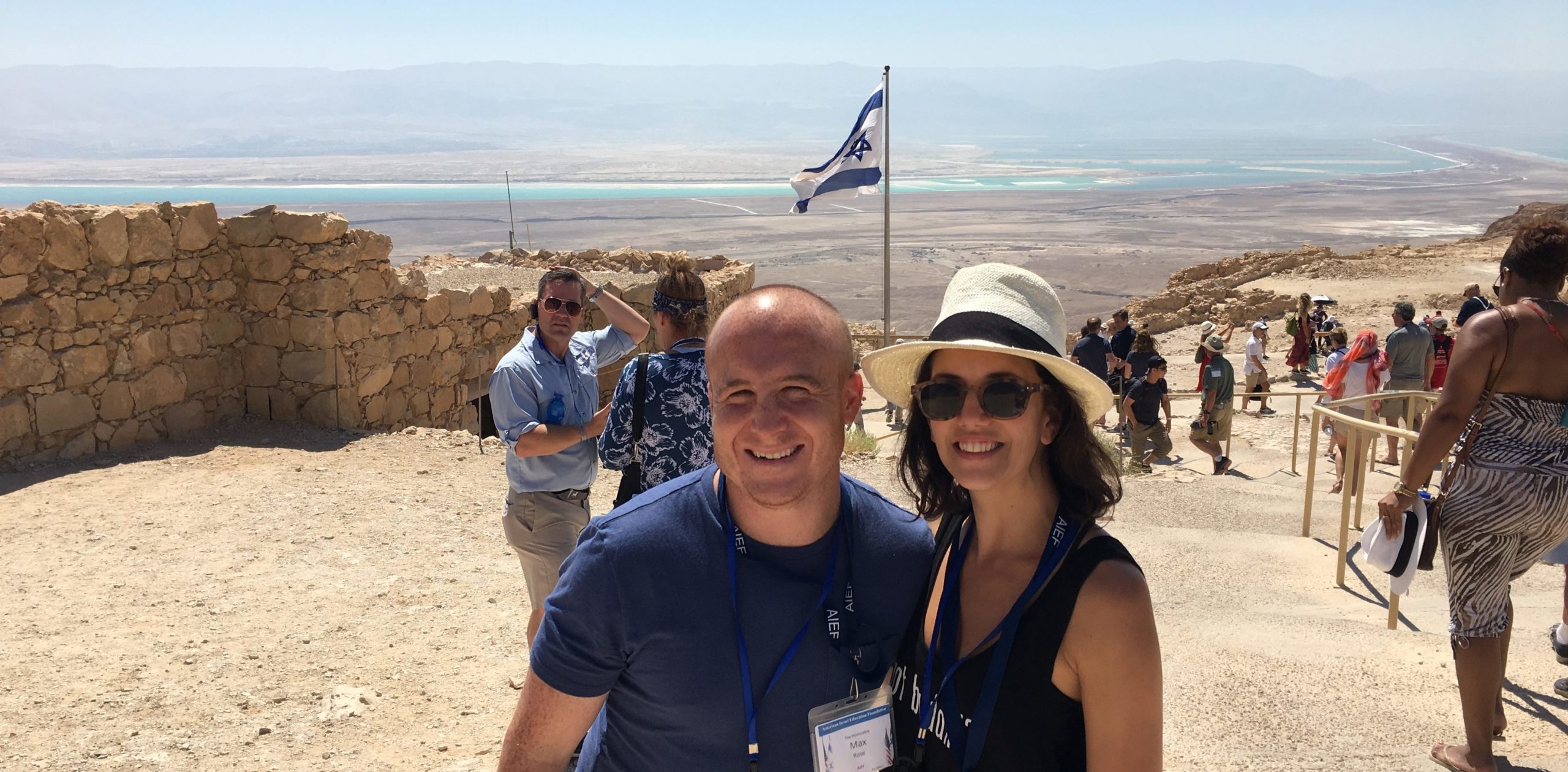
Rep. Max Rose (D-NY) and his wife, Leigh, pose for a photo atop Masada.
Congressman Max Rose (D-NY) returned from Israel this week with a renewed commitment to the U.S.-Israel relationship and an unflagging belief in the possibility of peace between Israelis and Palestinians.
“I will never lose hope on the potential for a peace resolution in the region, whether that is [with] Mahmoud Abbas or down the road, whoever replaces him,” Rose told Jewish Insider in a phone interview this week, just a day after he arrived back in the United States.
Similarly, on the Israeli side, Rose said that “irrespective of who leads Israel, whether it is Prime Minister [Benjamin] Netanyahu, whether it is Mr. [Benny] Gantz, or whether it is someone else down the road… I am especially hopeful after this trip that America’s firm alliance, strategic support for Israel as a Jewish, democratic nation will continue. This has got to be something that rises above politics. And that’s also the case for [whomever] is in political power in Washington DC.”
Rose was one of 41 Democrats — the majority of whom are, like him, freshman members of Congress — who took part in a weeklong visit to Israel led by the American Israel Education Foundation, an affiliate of AIPAC. The group met with Netanyahu, Gantz and Abbas, as well as Israeli and Palestinian entrepreneurs, business leaders and IDF troops.
But unlike the majority of the freshmen on the trip, this was not Rose’s first visit to Israel. The Jewish war veteran said he had traveled to Israel 10 years ago, though his experience this month was wildly different.
“The most memorable part was certainly the opportunity to see firsthand the incredible security conundrum that Israel finds itself in — and has found itself in since its inception,” Rose said. “To see that firsthand, to go to the border with Syria, to go to the border with Lebanon, to go near the border with Gaza, to travel through the West Bank, you can really see the incredibly tenuous situation that it’s in.”

Rep. Max Rose (D-NY) meets with active IDF soldiers.
Rose, a veteran of the war in Afghanistan, said he was particularly excited to meet with IDF soldiers during his time in Israel.
“Anytime that I get the opportunity to meet with and speak to soldiers… there’s such a shared bond and shared culture,” he said. Rose said he views the Israeli model as something that could “speak potentially to the need for a national service model in the United States. It brings people together from all different parts of the country, it establishes a common bond that rises above other divisions.”
Rose told JI that taking part in the AIPAC trip was a no-brainer for him, despite criticism that lawmakers should be remaining in their district or that the trip is a biased look at the region.
“In my district, many people of Jewish faith know that I have personally been to Israel as a member and witnessed firsthand the tenuous security situation that they’re in — as well as the economic and diplomatic and historical miracle… that’s very important to many people in my district,” Rose said. “It’s important to Jews and to Christians… as well as people who are concerned with issues of national security, both global and domestic.”
Rose said the AIPAC-affiliated trip was “very valuable and informative” but it was not a “silver bullet. This trip is representative of just the beginning of our work.”

Rose and his wife, Leigh, visit the Western Wall in Jerusalem.
The New York Democrat also pushed back against the media firestorm surrounding Reps. Rashida Tlaib (D-MI) and Ilhan Omar (D-MN), who are expected to visit Israel on a separate trip later this month.
“This is representative of a trend in media generally, because media enjoys this type of story,” he said. “The narrative that I was focused on throughout my time there, was the fact that this was the largest congressional delegation to Israel in history. That is monumental.”
Rose said he believes that “those who did not make this trip, they need to make some type of trip to Israel, and there are plenty of opportunities for them to do this.” The freshman Democrat said while “there are plenty of people who enjoy speaking about… drama, reality TV politics. I’m not one of them.”
He also addressed the reports of increased violent antisemitic attacks on Jews in New York, including in his district.
“We’re not seeing a revival of antisemitism,” he said. “We know antisemitism never went away, but it has certainly been increasing, and I do believe that — as it has been throughout history — it is often tied to culturally divisive rhetoric and economic anxiety.”
“We have got to invest in educating our youth about the history of antisemitism,” he continued. “We have to support our law enforcement as they show that there are consequences for engaging in acts like this. And we cannot be nuanced with our response either. This is wrong, and there’s no place for these types of actions in the United States of America.”
“Examining your own aggression prevents the next victim,” said filmmaker Joseph Cedar.

RAN MENDELSON/HBO
The contentious, dramatic events that marred the summer of 2014 in Israel will be dramatized in the HBO series “Our Boys,” which premieres a week from today on August 12.
On June 12, 2014, three Israeli teenagers — Eyal Yifrach, Gilad Sha’ear and Naftali Fraenkel — were kidnapped by Hamas terrorists. After a nationwide search of more than two weeks that left the country on edge, their bodies were found dumped in a field. Two days later, the burned body of Palestinian teenager Mohammed Abu Khdeir was discovered in a western Jerusalem forest. “Our Boys” follows the Shin Bet’s investigation into Abu Khdeir’s murder, revealing an unexpected story that the show’s creators believe is worth retelling — for both dramatic and political reasons.
While “Our Boys” begins with the kidnapping of the three Israeli teenagers, neither the boys nor their families appear as actual characters in the show. Viewers are instead brought up to speed courtesy of news footage from 2014. In contrast, Abu Khdeir and his family are introduced as well-developed characters with whom the audience can sympathize.
Hagai Levi, one of the show’s Israeli creators, explained the decision to Jewish Insider: “It’s much more interesting to deal with my own soul searching than why ‘the other’ would do something to me,” he said.
Levi, along with co-creators Joseph Cedar (who previously directed “Norman”) and Palestinian filmmaker Tawfik Abu Wael, visited New York City last week to promote the show. Joined by actor Shlomi Elkabetz (who plays Shin Bet operative Simon), the three filmmakers sat down with JI in the reading room of The Whitby Hotel in midtown Manhattan to share what drew them to the project.
“We’re on this wheel,” notes Cedar, who was born in New York but immigrated to Jerusalem at age six, regarding the Israeli-Palestinian conflict. “A cycle of where some kind of violent act creates victimhood, suffering, pain that then creates rage, that turns into a violent act that creates pain, suffering, victimhood and so on.” In Cedar’s view, “aggression is more interesting than victimhood and so dramatically that’s probably the reason.”
Cedar said the decision to focus on Khdeir also had political motivations. “There’s also a political reason for us focusing on the aggression and not the victimhood,” he said. “Holding onto victimhood creates more aggression. Examining your own aggression prevents the next victim. We’re not interested in our own victimhood, not because we don’t sympathize with the pain but, because we have an interest in stopping the cycle.”
For a show about a region with competing narratives, the creators embraced their own differences and didn’t shy away from the challenge of syncing those views into a single series.
Abu Wael, who directed the Palestinian scenes for “Our Boys,” said the series is written from an Israeli point of view, which created a challenge for him. “It is very difficult because from a Palestinian point of view, the first thing they will say is ‘but the occupation didn’t start with the kidnapping of the three boys. The killers of the three boys were living under apartheid.’”
Cedar, who argued that there are both Israeli and Palestinian points of view in the miniseries, conceded that for Abu Wael, even if the three Israeli boys aren’t characters in the show, “the decision to start the cycle with our victimhood is a cop-out on our side.”
It remains to be seen how the average HBO viewer will react to a show diving deep into the murky waters of the Israeli-Palestinian conflict. The Shin Bet’s investigation into Abu Khdeir’s murder leads them to a pair of Mizrahi yeshiva students in the West Jerusalem neighborhood of Har Nof, a group not typically associated with acts of extremism. “For us it was very important to show the hidden currents in society and not the obvious ones,” Levi said.

A scene from the upcoming miniseries “Our Boys.”
Cedar said the identity of Khdeir’s murderers reverberated through Israel in a unique way.
“One of the interesting things that happened when the identity of the killers became known is that all Israelis had a sigh of relief,” Cedar recalls. “They’re not one of us. It’s either an insane man who forces his young nephews to take part in this or they’re in some weird group that has no larger institutionalized base, or no belonging to something that reflects on us. It’s extremely rare and it probably will never happen again because it’s so rare.”
For Cedar, the series demonstrates how that perception is wrong, and in his view, there is no way for Israeli Jews to distance themselves from the murder.
Elkabetz, whose character leads the Shin Bet investigation on the show, said there might not have been an organization behind the murder, but “if individuals decide to do an act, you understand there are bigger influences. It’s in the air and they get permission from it.”
For fans of “Fauda” and “Shtisel,” “Our Boys” incorporates both similar dynamics and even several cast members from the two shows. Shadi Mar’i, who plays Walid on “Fauda,” appears on “Our Boys” as Abu Khdeir’s older brother, while Michael Aloni, who plays Akiva on “Shtisel,” is a Shin Bet investigator.
Abu Wael points out that there are only so many actors in Israel, but says there’s a key difference between “Fauda” and “Our Boys.”
“On Fauda, Palestinians are either terrorists or traitors,” he said. “This show is different because you have a very normal Palestinian family with dreams like everyone else.”
As the holiday of Hanukkah – the festival of lights – came to a close last week, it is worth considering Israel’s strategically important partnership with the ‘land of fire’: Azerbaijan. The only Muslim majority country to have friendly, sustained and substantive relations with Israel, Azerbaijan is not only a beacon of religious tolerance with a historical and currently thriving Jewish community, but also an important geopolitical partner just to the north of Iran.
Israel and Azerbaijan cooperate closely in the defense and energy spheres and both share disquiet over the recent Western rapprochement with Tehran. Iran has threatened to annex Azerbaijani territory and bomb its energy infrastructure. Azerbaijani authorities have foiled Iranian-sponsored terrorist plots in their country. So, Israel and Azerbaijan have developed a joint venture to produce drones and Israeli defense contractors supply the Azerbaijani military with state of the art equipment. In return, Azerbaijan’s state energy company, SOCAR, is active in helping to develop Israel’s offshore natural gas fields, while much of the oil imported to Israel is from Azerbaijani reserves.
Due to the ‘miracle of oil’, Azerbaijan has been able to develop and distinguish itself as a ‘Dubai on the Caspian’, spending its energy wealth wisely and emerging as an international player of outsized stature in the former Soviet space. When Russian President Vladimir Putin visited recently, he showed uncommon respect to Azerbaijan’s President Ilham Aliyev and was not able to pressure Azerbaijani leaders the way Russian has done in Georgia, Ukraine and even with the United States over Syria. Azerbaijan recently served on the UN Security Council and is very active in a number of other international fora. And, its leaders do not hide their amity with Israel: Azerbaijan’s foreign minister visited Jerusalem this year and on another visit to Washington DC made a point of addressing pro-Israel Jewish organizations.
In Azerbaijan, it is not just the secular state that emphasizes good relations with Israel and discourages anti-Semitism. When asked, average Azerbaijanis express admiration for the accomplishments of the State of Israel and warm opinions about Jews in their country and around the world. Many Azerbaijani tourist guides will make a point of showcasing a major new synagogue in Baku, the country’s capital. President Aliyev regularly congratulates the Jewish community on days of religious significance and when the country’s religious leaders gather, rabbis congregate with imams and priests.
It behooves Israeli leaders and Jewish communities around the world to encourage this relationship, especially now that historical ties to Turkey are in tatters. In fact, Azerbaijan is now the largest outside investor in Turkey, due to a major pipeline project, and it is increasingly wielding influence in the greater Levant region. Azerbaijan is keen to become a technological and telecommunications hub for the Eurasian continent, so Israeli companies could seek partnerships for innovation in that sphere as well as others. Overall, as the nuclear and regional threat from Iran continues to loom large for both countries, Israel and Azerbaijan should continue to provide for their own mutual defense, strengthening an already substantive partnership amongst small nations that know how to seize the initiative.
Dr. Alexandros Petersen is the author of The World Island: Eurasian Geopolitics and the Fate of the West and co-editor of ChinainCentralAsia.com.
Just presented my credentials to President Obama in the @WhiteHouse with my family #honored
— Amb. Ron Dermer (@AmbDermer) December 3, 2013
In @WhiteHouse guestbook, I wrote: “I feel proud and honored to serve as Israel’s Ambassador to the United States.” 1/3
— Amb. Ron Dermer (@AmbDermer) December 3, 2013
I wrote: “America is a country to which the Jewish people owe so much and to which I, as a son of America, am so personally indebted” 2/3
— Amb. Ron Dermer (@AmbDermer) December 3, 2013
I finished with: “I look forward to working with you and your administration to make the bonds between Israel & America stronger than ever”
— Amb. Ron Dermer (@AmbDermer) December 3, 2013
I told President Obama, “this could be the first Golda in the Oval Office for 40 years” (though my Golda is only 5 months old) @WhiteHouse
— Amb. Ron Dermer (@AmbDermer) December 3, 2013
I also gave President Obama these custom-made etched menorah cufflinks all the way from the City of David, Jerusalem pic.twitter.com/eCS1VGChOQ
— Amb. Ron Dermer (@AmbDermer) December 3, 2013
Pic w/Pres. Obama-I look fwd to working w/you & your admin to make the bonds b/w Israel & America stronger than ever. pic.twitter.com/oV2Pdci5Hs
— Amb. Ron Dermer (@AmbDermer) December 3, 2013
From today’s Jewish Insider Daily Kickoff email…
First Look – Ron Dermer profile in Politico Magazine by Ron Kampeas — ‘Bibi’s Brain’ Comes to Washington: Can Dermer, dubbed “Bibi’s Brain” by an American Jewish publication and “Bibi’s Mirror” by an Israeli newspaper, reset the fraught relationship between Obama and Netanyahu? The “yes, he can” argument goes something like this: No one knows Netanyahu better than Dermer, who is also one of the few Israelis to really understand the American political landscape. “Ron Dermer’s significance now cannot be overrated,” says Ari Shavit, a writer for the liberal Haaretz newspaper. “Prime Minister Netanyahu is probably the loneliest head of state one can imagine,” Shavit told me. “There are very few people he truly trusts and appreciates, and Ron Dermer is one of them. If Washington plays it right and Dermer plays it right and they enable America and Israel to start a new page—a new dialogue in which leading American players will find a way to his heart and mind while he finds a way to their hearts and minds—it might be good news.”
–The other view is that Dermer will entrench in Washington a bunker mentality that has isolated Netanyahu and helped perpetuate the breakdown in relations with Israel’s closest and most important ally. “Among the White House’s inner circle—Denis McDonough, Ben Rhodes—Dermer is a red flag,” says Barak Ravid, Haaretz’s political correspondent, referring respectively to the White House chief of staff and deputy national security adviser. “They see him as the guy who incited Congress and Jewish organizations against Obama.” It’s a reputation that Dermer’s defenders say is unfair—it does not take into account missteps by Obama and his team, and understates Netanyahu’s determinative role in shaping relations with Washington. But it is a reputation that continues to dog Dermer nonetheless. When I asked about him, a Democratic source on the Hill who is close to Jewish groups blamed Dermer for distributing talking points on Iran, critical of the White House, to Republican members of Congress. Asked for evidence, the source said, “Who else?”
–Nicolas Muzin, the director of coalitions for the House Republican Conference, says Dermer was respectful and never partisan in his pitch—but emphatic. “He’s been trying to make the case that the sanctions relief is more than dollar value because it’s the change in momentum [that really matters],” Muzin says, underscoring an Israeli claim that the $7 billion the Obama administration says Iran could earn from eased sanctions may be a low-ball figure.
His predecessor Michael Oren says he believes that Dermer can and will overcome the suspicion that he was an architect of the Netanyahu-Obama tensions. “I understand that was the perception of him, but the reality is going to be different, because it has to be,” Oren told me. “He’s going to understand that to be an effective ambassador, he has to be scrupulously bipartisan.” Differences over Iran will be a test. “Clearly the prime minister is not impressed with this arrangement,” Oren adds. “Does that mean you actively campaign against it, lobby against it, or are you briefing people on the Hill? I have a feeling it will be the latter. Over the next six months, Israel will try to have a close conversation with the administration over what we consider a safe deal.” Can Dermer straddle the line between presenting Israel’s case and pressuring the United States to embrace it? “Lobbying has a negative connotation. Lobbying is putting pressure on someone,” Oren notes. “What an ambassador does is explain. That doesn’t involve attacking the president’s position but explaining ours.” [PoliticoMag]
Israel’s Washington, DC, embassy is having a rough day with two news reports detailing two unrelated problems. Apparently the US is ‘outraged’ with Israel after Israel backed out of a terror suit involving a Chinese bank. In other news, Israel’s new envoy to the US can’t get himself a diplomatic passport and may be stuck in Israel until the Foreign Ministry strike is sorted out.
US ‘outraged’ after Israel backs out of terror suit
Israeli Ambassador to the US Michael Oren was called back to Israel to take part in an emergency meeting convened this weekend by Prime Minister Benjamin Netanyahu so that Oren could pass on messages sent by the US administration and Congress in the wake of tensions between the two countries.
The tensions and lightening visit stem from the US’s outrage at Israel’s decision to back out of their commitment to a terror prosecution involving a Chinese bank allegedly laundering monies for Hamas so that Netanyahu and his family could embark on their State visit to the country last May.
The case itself is a civil suit filed by Sheryl and Yekutiel Wultz from Florida, whose son Daniel was killed in terror attack in Tel Aviv in 2006 when he was only 16 years old.
According to the suit, the money used by Hamas to undertake the terror attack reached the terrorist group through a money laundering scheme run the Chinese bank in which some $6 million were laundered through trade.
The story has invoked the rage of the White House, a number of US congressmen and Jewish organizations active in the US who were flabbergasted by the decision to back out of a legal battle against the funding of international terror only in an attempt to prevent harm from coming to Netanyahu’s visit.
On Sunday, during the meeting called by Netanyahu, Oren was meant to stress to the additional participants – among them ambassador designate Ron Dermer – that the Americans view with severity Israel’s decision to cave into China’s pressure and prevent testimonies which would legally link Hamas and the Islamic Jihad to the Bank of China.
Oren was also to convey the American shock that Netanyahu, who the Americans call “Mr. Terror” for his zero tolerance approach to terror, would take such decision.
Congress, Oren was indented to say, sees the move as nothing short of betrayal by Israel of the US, both in regards to the international war on terror and in regards to the struggle for hegemonic control raging between the West and the rising eastern powerhouse.
The crux of Oren’s mission was to inform the Israel administration of the US’s intent on advancing legal procedures against the Bank of China; to inform them that if the security officials fail to show up in court they would be subpoenaed; and additional subpoenas would also be filed against Oren, Dermer and National Security Adviser Yaakov Amidror.
Dermer’s Passport Problems
Israel’s newly appointed ambassador to the United States may have to wait a while to get his feet under his new DC desk, as striking Foreign Ministry workers are refusing to process his transfer to Washington, give him a diplomatic passport, or even buy him a ticket for the plane out. Ron Dermer, who was named last week by Prime Minister Benjamin Netanyahu to be the country’s top envoy to the US, is stuck in Israel for the time being while the Foreign Ministry Workers’ Union continues ongoing labor sanctions, the Foreign Ministry confirmed on Monday.
“The strike is still ongoing, so it is entirely natural that we wouldn’t issue a diplomatic passport for someone from the outside,” spokesman Yigal Palmor told The Times of Israel.
The workers, who have gradually stepped up sanctions over the last four months, are protesting wage cuts as well as reductions in the compensation packages offered to partners and spouses of those sent overseas.
Last month workers expanded their protest by halting all consular activities in Israel and abroad. As a result, thousands of Israelis are stranded in foreign countries waiting to obtain renewed passports and visiting business VIPs who require visas had to cancel trips to Israel.
Among those caught in the deadlock is Dermer, who will not receive his diplomatic passport or any other paperwork. Requests to US authorities for special ambassadorial permits have not been made and Dermer has not received the usual preparation courses required before he takes up his new position, Yedioth Ahronoth reported earlier Monday. He has also not been able to meet with staff from the North American offices who are to prepare him for the job.
As a result, Dermer will likely be forced to delay his arrival in Washington beyond the scheduled target date for next month, Yedioth said.
Texas Gov. Rick Perry said Thursday that he will visit Israel in October, a move that signals to the political world that he is seriously considering making another presidential run in 2016. “We will be going to Israel to bring together Arabs, Christian and Jews in an educational forum,” Mr. Perry told The Washington Times in an interview just three days after he announced he would not seek an unprecedented fourth term as Texas governor.
Please log in if you already have a subscription, or subscribe to access the latest updates.
 Continue with Google

 Continue with Apple