



































The president also claimed ‘we’ve won this war,’ though did not indicate military operations would wind down
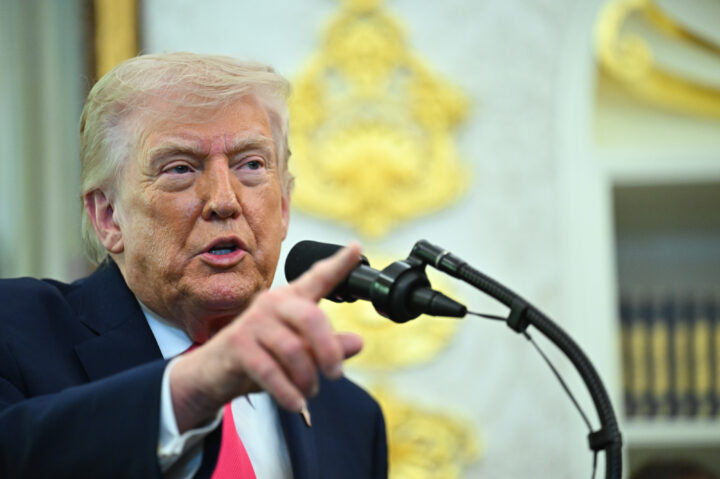
Graeme Sloan/Bloomberg via Getty Images
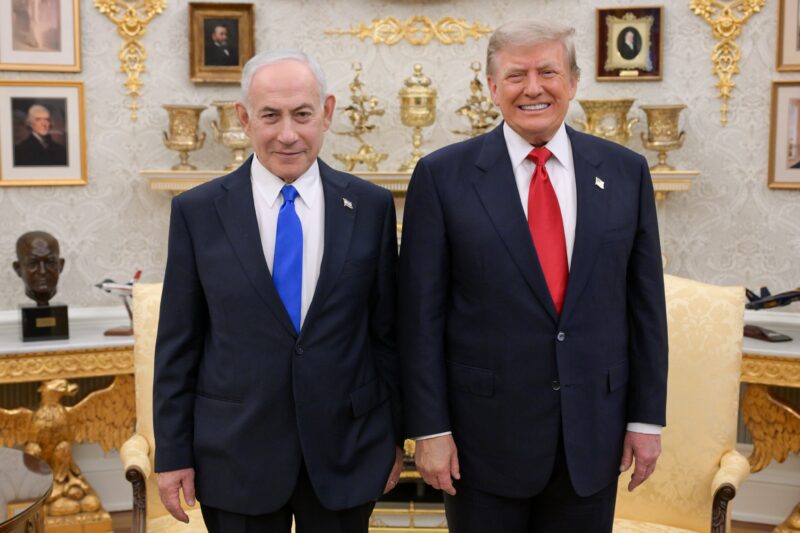
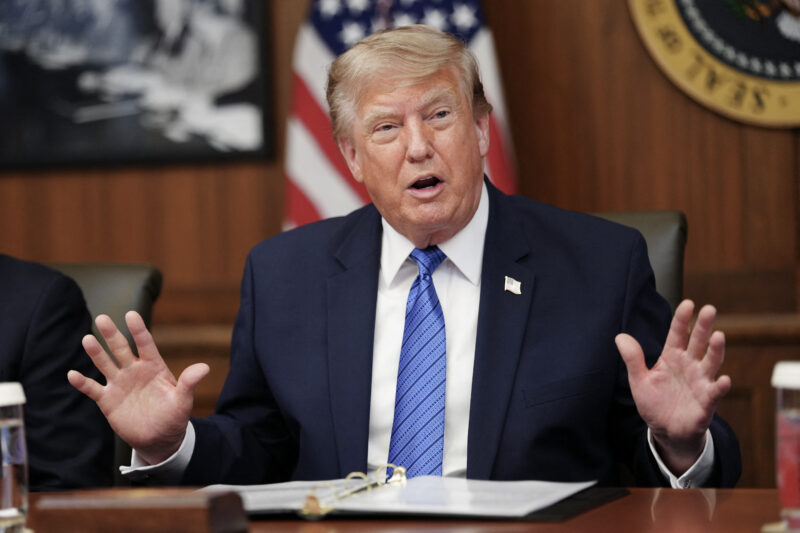
President Donald Trump speaks during a swearing-in ceremony in the Oval Office of the White House in Washington, DC, US, on Tuesday, March 24, 2026.


 Add JewishInsider on Google
President Donald Trump said on Tuesday that the United States had achieved “regime change” in Iran through the killing of Iranian leaders and teased a “very significant prize” provided by Iran to the U.S. in the course of ongoing negotiations.
“We have, really, regime change. This is a change in the regime, because the leaders are all very different than the ones that we started off with that created all those problems,” Trump told reporters in the Oval Office.
Asked if he was hopeful that diplomatic negotiations would achieve a lasting ceasefire, the commander-in-chief replied, “I think we’re going to end it. I can’t tell you for sure. You know, I don’t like to say this — this war has been won. The only one that likes to keep it going is the fake news. … We’ve won this war.”
Trump also acknowledged on Tuesday that Jared Kushner, White House Special Envoy Steve Witkoff, Secretary of State Marco Rubio and Vice President JD Vance are involved in peace talks while expressing optimism that the current leadership in Iran was capable of making a deal.
“We’re talking to the right leaders, and they want to make a deal so badly,” Trump said without specifying which Iranian officials his administration was engaged with.
The president said he reached the conclusion that “we’re dealing with the right people” after receiving a “gift” from Iranian leaders that was “oil and gas related” and “worth a tremendous amount of money.” Trump declined to say what exactly the gift was, but said the offering was “related to the flow, to the Strait [of Hormuz].”
The Iranians “gave us a present, and the present arrived today,” said.. “It was a very significant prize.”
Defense Secretary Pete Hegseth said in remarks following the president’s comments that Pentagon leaders “see ourselves as part of this negotiation as well. We negotiate with bombs.”
Trump then responded by noting that Hegseth and Joint Chiefs of Staff Chairman Gen. Dan Caine were the “only two people” in his administration who “were quite disappointed” when he suggested that the war could be resolved soon.
The president revealed that after telling the two men that he thought “this thing’s going to be settled very soon,” both men replied “Oh, that’s too bad.”
“Pete didn’t want it to be settled. These guys are doing a great job. That’s a good attitude though, right?” Trump said of Hegseth and Caine. “They were not interested in settlement. They were interested in just winning this thing.”
Plus, media misdirection over AIPAC money

Shauna Clinton/Sportsfile for Web Summit Qatar via Getty Images
Hasan Piker during day two of Web Summit Qatar 2026 at the Doha Exhibition and Convention Center in Doha, Qatar.
This P.M. edition is reserved for our premium subscribers — offering a forward-focused read on what we’re tracking now and what’s coming next. Please don’t hesitate to share your thoughts and feedback by replying to this email.
📡On Our Radar
Notable developments and interesting tidbits we’re tracking
Rumblings of a potential peace summit between Washington and Tehran have begun — sources told Axios that the U.S. and several mediating countries are waiting for Iran to respond to a proposal for peace talks this Thursday, while President Donald Trump reposted a message from Pakistan offering to “be the host to facilitate meaningful and conclusive talks”…
Trump told reporters in the Oval Office this afternoon that “we’re dealing with the right people” in Iran because they “gave us a present, and the present arrived today. It was a very big present worth a tremendous amount of money,” but would only tease that it was “oil and gas related.” Asked if he is negotiating over who will control the Strait of Hormuz, Trump said, “No … we’ll have control of anything we want”…
Saudi Crown Prince Mohammed bin Salman has encouraged Trump to continue the campaign against Iran and push towards toppling the regime, The New York Times reports, believing that Iran’s threat to the Gulf will only be removed through the transition of its government and not if the war results in a failed state. MBS has reportedly argued in favor of striking Iran’s energy infrastructure and putting U.S. troops on the ground…
The Pentagon is expected to announce the deployment of about 3,000 soldiers from the military’s 82nd Airborne Division to participate in the campaign against Iran, The Wall Street Journal reports, a move that opens the possibilities for boots on the ground, as the division is trained to parachute into hostile territory…
Israeli Defense Minister Israel Katz said today that the IDF will now maintain control over a security zone south of the Litani River in Lebanon and prevent the return of Lebanese residents who have been evacuated from the area “until the security of northern [Israeli] residents is assured”…
Lebanese Minister of Foreign Affairs Youssef Raggi declared Iran’s ambassador to Beirut persona non grata and expelled him from the country, as Iranian proxy Hezbollah continues to fire on Israel against the Lebanese government’s orders.
Shortly after, an Iranian ballistic missile was launched towards Beirut for the first time — it was reportedly intercepted by a “foreign naval vessel,” presumably the U.S., though fragments struck Lebanese towns…
Secretary of State Marco Rubio is being dispatched to France later this week to discuss the Iran war, among other issues, with the U.S.’ G7 allies, including Britain, Canada, France, Germany, Italy and Japan, countries that have all declined to participate in the war effort…
Majed al-Ansari, spokesperson for the Qatari foreign ministry, said today that Qatar is not involved in mediating any U.S.-Iran negotiations, a shift for the country that has traditionally played the part of go-between. Al-Ansari said there has been no communication between Doha and Tehran since a phone call early in the conflict when Qatar made clear its anger with Iranian strikes on its territory…
Politico reports that several 2028 Democratic presidential hopefuls said they wouldn’t or haven’t taken money from AIPAC, including Sen. Cory Booker (D-NJ), California Gov. Gavin Newsom, Sen. Ruben Gallego (D-AZ), Kentucky Gov. Andy Beshear, Illinois Gov. JB Pritzker, Pennsylvania Gov. Josh Shapiro, Sen. Elissa Slotkin (D-MI) and former Chicago Mayor Rahm Emanuel.
But while framing the statements as rejections of AIPAC and Israel, the outlet buried or declined to mention Booker’s rebuke of the Democratic Party’s singling out of the pro-Israel group, several respondents’ inability to accept funds from AIPAC since it only participates in congressional elections and Newsom’s own about-face on Israel, where in the same publication he walked back critical comments he’s made and said he’s “proud to support the state.”
AIPAC said in response that it has “never given to a presidential campaign” and that “singling out and excluding millions of pro-Israel Democrats” who are AIPAC members “is wrong and undemocratic”…
Michael Sacks — a prominent Democratic donor and supporter of former President Barack Obama who chaired the 2024 Democratic National Convention host committee — denounced Democratic criticism of AIPAC as a “thinly disguised effort to make support for Israel politically toxic in the Democratic Party, to chase Jews and their allies out of our big tent coalition.”
Sacks wrote in the Chicago Tribune, “Real leadership recognizes that we can hold complicated views about the Israeli government and still refuse to make Jewish identity and pro-Israel sentiment a political disqualifier in our party. We can defend the big tent when it is inconvenient, not just when it is easy”…
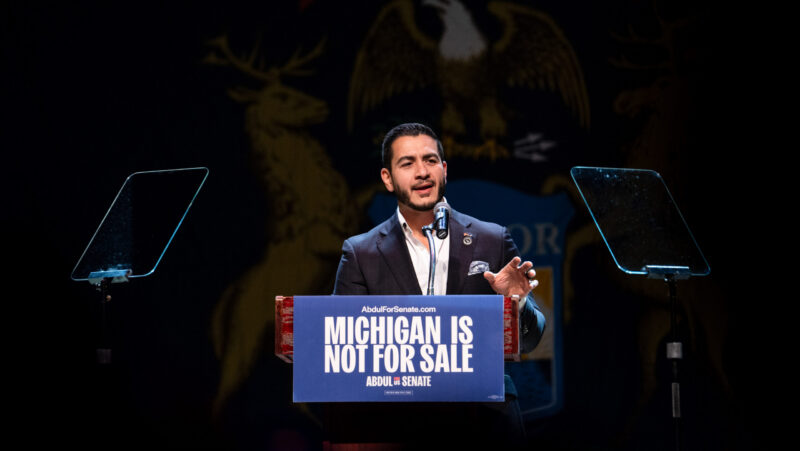
Jonathan Cowan, president of the moderate Democratic think tank Third Way, condemned far-left Michigan Senate candidate Abdul El-Sayed for his upcoming rallies with antisemitic streamer Hasan Piker, Jewish Insider’s Danielle Cohen-Kanik reports.
“It is morally repugnant and strategically self-defeating for Democrats like Abdul El-Sayed and Members of Congress like Summer Lee to cozy up to antisemitic extremists like Hasan Piker,” Cowan said in a statement. “Anyone eager to campaign with Hasan Piker is, at best, comfortable overlooking his antisemitic and anti-American extremism and, at worst, endorsing it”…
El-Sayed stood by his controversial statement about the shooting attack at Temple Israel in suburban Detroit earlier this month, in which he condemned the attack but blamed Israel’s military campaign in Lebanon for the perpetrator’s actions (the attacker’s brother was a Hezbollah commander).
The statement “was a risk,” El-Sayed said on an internal campaign call, per Punchbowl News, “but leadership is being willing to say the thing if you believe it to be true that nobody else is going to say”…
⏩ Tomorrow’s Agenda, Today
An early look at tomorrow’s storylines and schedule to keep you a step ahead
Keep an eye out in Jewish Insider for coverage of another war powers resolution expected to receive a vote this evening in the Senate.
President Donald Trump will give the keynote speech at the National Republican Congressional Committee’s annual President’s Dinner in Washington.
The House Homeland Security Committee will hold a hearing assessing the impact of the Department of Homeland Security shutdown, as lawmakers make progress on negotiations to fund the agency.
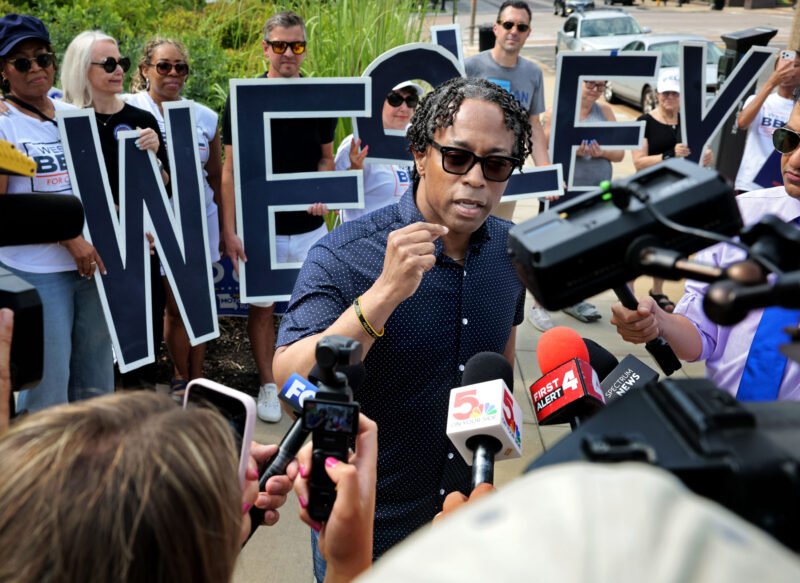
D.C. councilmember and mayoral candidate Janeese Lewis George will rally alongside other members of the Democratic Socialists of America including Squad-member Rep. Rashida Tlaib (D-MI), days after Lewis George held a private meeting with Jewish leaders to apologize for saying in a DSA questionnaire she would boycott events “promoting Zionism” and avoid the “Zionist lobby.”
Scholar of Jewish literature Ruth Wisse will deliver the annual Jefferson Lecture in the Humanities, the highest honor the federal government gives for intellectual achievement in the humanities, at the Kennedy Center in Washington.
The FII PRIORITY Summit, a high-profile investment and policy conference, will kick off in Miami, with speakers over the rest of the week including Trump; Donald Trump Jr.; Jared Kushner; White House Special Envoy Steve Witkoff; Dina Powell McCormick, president of Meta; Saudi Ambassador to the U.S. Princess Reema Bandar Al Saud; former Treasury Secretary Steve Mnuchin; Massad Boulos, senior White House advisor on the Middle East; and many more.
The Conservative Political Action Conference, known as CPAC, also begins tomorrow in Dallas.
The Jewish Book Council will hold the 75th National Jewish Book Awards Gala, hosted by entertainer Jonah Platt, at Temple Emanu-El in New York City.
Stories You May Have Missed
SECOND ACT
Former Rep. Jamaal Bowman finds work with Track AIPAC

The ousted New York lawmaker consulted for the far-left PAC, which is partially funded by Don Henley of The Eagles
PAIN TO POWER
From WhatsApp chats to City Hall, a new Jewish activism is born

In the wake of Oct. 7, some in the Jewish community turned to faith, philanthropy or federal advocacy. Others set their sights closer to home, organizing to shape school boards and influence city councils
Plus, GOP losing hope in unseating Ossoff
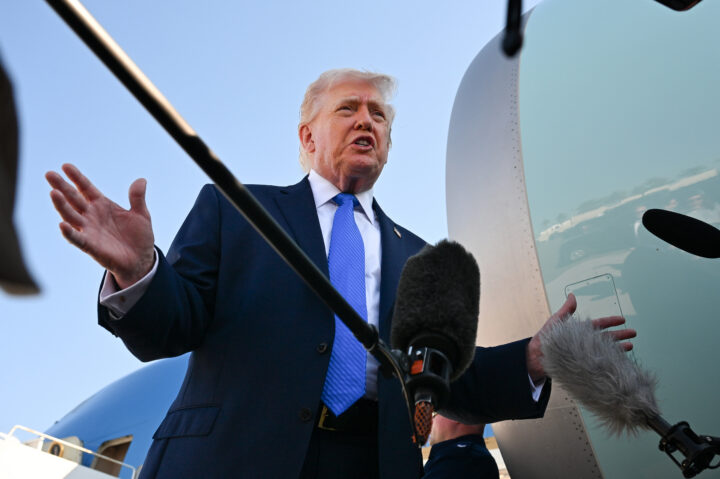
Roberto Schmidt/Getty Images
President Donald Trump speaks to reporters before boarding Air Force One at Palm Beach International Airport on March 23, 2026 in West Palm Beach, Florida.
This P.M. edition is reserved for our premium subscribers — offering a forward-focused read on what we’re tracking now and what’s coming next. Please don’t hesitate to share your thoughts and feedback by replying to this email.
📡On Our Radar
Notable developments and interesting tidbits we’re tracking
President Donald Trump revealed today that White House Special Envoy Steve Witkoff and advisor Jared Kushner have been negotiating with Iran amid the ongoing war, Jewish Insider’s Emily Jacobs reports, which played a role in Trump’s decision to delay by five days potential strikes on Iranian energy infrastructure.
“We have had very strong talks,” Trump told reporters. “Mr. Witkoff and Mr. Kushner had them. They went, I would say, perfectly. If they carry through with that, it’ll end that problem.” But the president kept the option of continued military action open: “If it goes well, we’re going to end up with settling this. Otherwise, we’ll just keep bombing our little hearts out,” he said.
At an event in Tennessee this afternoon, Trump added, “My whole life has been a negotiation, but with Iran we’ve been negotiating for a long time, and this time they mean business” and claimed the U.S. has taken out 90% of Iran’s missile launchers…
Israeli Prime Minister Benjamin Netanyahu said in a video statement that he spoke with Trump today about the negotiations, which the president believes could result in “an agreement that will safeguard our vital interests.”
“At the same time,” Netanyahu said, Israel is continuing to strike targets in Iran and Lebanon; the IDF announced it had struck several “regime headquarters” in Tehran and CENTCOM also said it continues “to aggressively strike Iranian military targets with precision munitions”…
Senate Minority Leader Chuck Schumer (D-NY) declined to directly address whether the degradation of Iran’s military infrastructure should be viewed as a positive outcome, JI’s Matthew Shea reports, instead emphasizing the war’s potential economic and geopolitical consequences.
Asked on MS NOW’s “Morning Joe” if the degradation is a “good thing,” Schumer said it’s a “premature question. What is going to happen in the next several months? Is it worth it? Will the world economy collapse? … If you ask the American people, if you have the choice of degrading the military structure in Iran, but having gasoline be $6 a gallon and our economy falling into a deep recession where millions lose their job, what do you think?”…
The New York Times reports on the apparent failure of a plan by the Mossad to foment internal Iranian rebellion that could lead to the overthrow of the regime amid the ongoing war, as American and Israeli intelligence indicates the regime is weakened but intact…
UAE Foreign Minister Abdullah bin Zayed said Abu Dhabi will “never be blackmailed by terrorists,” in response to a post from French diplomat Gérard Araud who called the UAE’s further embrace of the U.S. amid bombardment from Iran “strange”…
The Associated Press examines Israel’s use of Iran’s network of surveillance cameras to carry out intelligence operations including the assassination of former Supreme Leader Ayatollah Ali Khamenei…
Asked if former intelligence official Joe Kent was leaking classified information, as he is reportedly under investigation by the FBI for doing, Trump said “that’s possible,” and largely derided Kent for his failed congressional campaigns and for remarrying “quickly” after his first wife was killed in 2019 while serving in Syria.
“I felt badly for him, so I told my people, ‘Reach out to him, give him a job at the White House.’ This is the thanks I get,” Trump told reporters. He also dismissed Kent’s opposition to the Iran war as an effort “to get publicity”…
Heritage Foundation President Kevin Roberts said that internal MAGA divisions over the Iran war, like those espoused by Kent, are “good” for the movement. “As it relates to tensions in the movement or disagreements about national security, actually, it’s good that those exist,” he told The Hill. But, Roberts said, he believes Trump “has executed [the war] perfectly, including not involving untrustworthy European, quote, unquote allies in the conversation”…
Politico looks at the decision of pro-Israel groups including AIPAC and the Republican Jewish Coalition not to spend money against Texas congressional candidate Brandon Herrera as they did during his first run for Congress, despite Herrera’s history of extreme views and antisemitic rhetoric. Trump endorsed Herrera last week after Rep. Tony Gonzales (R-TX) withdrew from the race…
New filings from the Federal Election Commission show that two super PACs rumored to be established by pro-Israel groups during the Illinois Democratic primaries were primarily funded by United Democracy Project, the AIPAC-affiliated super PAC, which spent more than $5.3 million through Elect Chicago Women and Affordable Chicago Now.
Among the other major donors who backed the two groups was prominent Democratic philanthropist Michael Sacks, who had lamented the rising “Jew hate” among candidates who refused to take money from donors affiliated with AIPAC earlier in the election…
Republicans are quietly losing hope in their ability to defeat Sen. Jon Ossoff (D-GA), a seat which the GOP had named as one of its main targets to flip, The Washington Post reports. “This guy’s no slouch,” Rep. Buddy Carter (R-GA), running in the GOP primary, told a crowd of Republican voters, calling Ossoff “articulate” and “handsome.”
Jewish leaders in Georgia told JI last year that Ossoff was making amends with their community after he had voted to block some aid to Israel, though the Jewish lawmaker is now drawing fresh controversy by adopting Rep. Ro Khanna’s (D-CA) rhetoric about the “Epstein class,” which some have identified as antisemitic…
⏩ Tomorrow’s Agenda, Today
An early look at tomorrow’s storylines and schedule to keep you a step ahead
Keep an eye out in Jewish Insider for a look at how the aftermath of the Oct. 7 attacks has sparked a wave of grassroots Jewish political activism across the U.S., as community members organize locally — from city councils to school boards — to respond to rising antisemitism and shape down-ballot races.
The Hill & Valley Forum, a summit focused on connecting government and the tech and innovation industries, will hold its annual gathering in Washington tomorrow with opening remarks by its co-founder, Jacob Helberg, now under secretary of state for economic affairs. Ahead of the summit, Helberg announced today that the U.S. will contribute $250 million alongside a consortium of countries involved in the Pax Silica initiative to invest in energy projects and critical minerals.
Also speaking tomorrow are Sens. Mike Rounds (R-SD), Chris Coons (D-DE), Todd Young (R-IN), Maria Cantwell (D-WA), Jim Banks (R-IN), Rick Scott (R-FL) and Mark Warner (D-VA); House Speaker Mike Johnson (R-LA); Reps. Josh Gottheimer (D-NJ) and John Moolenaar (R-MI); OpenAI COO Brad Lightcap; JPMorgan Chase CEO Jamie Dimon; NASA Administrator Jared Isaacman; Palantir CTO Shyam Sankar; Michael Duffey, under secretary of defense for acquisition and sustainment; and Ben Black, CEO of the U.S. International Development Finance Corporation.
Stories You May Have Missed
PERSIAN COVERAGE PUSH
Court ruling reviving VOA sparks cautious hope for expanded Iran coverage
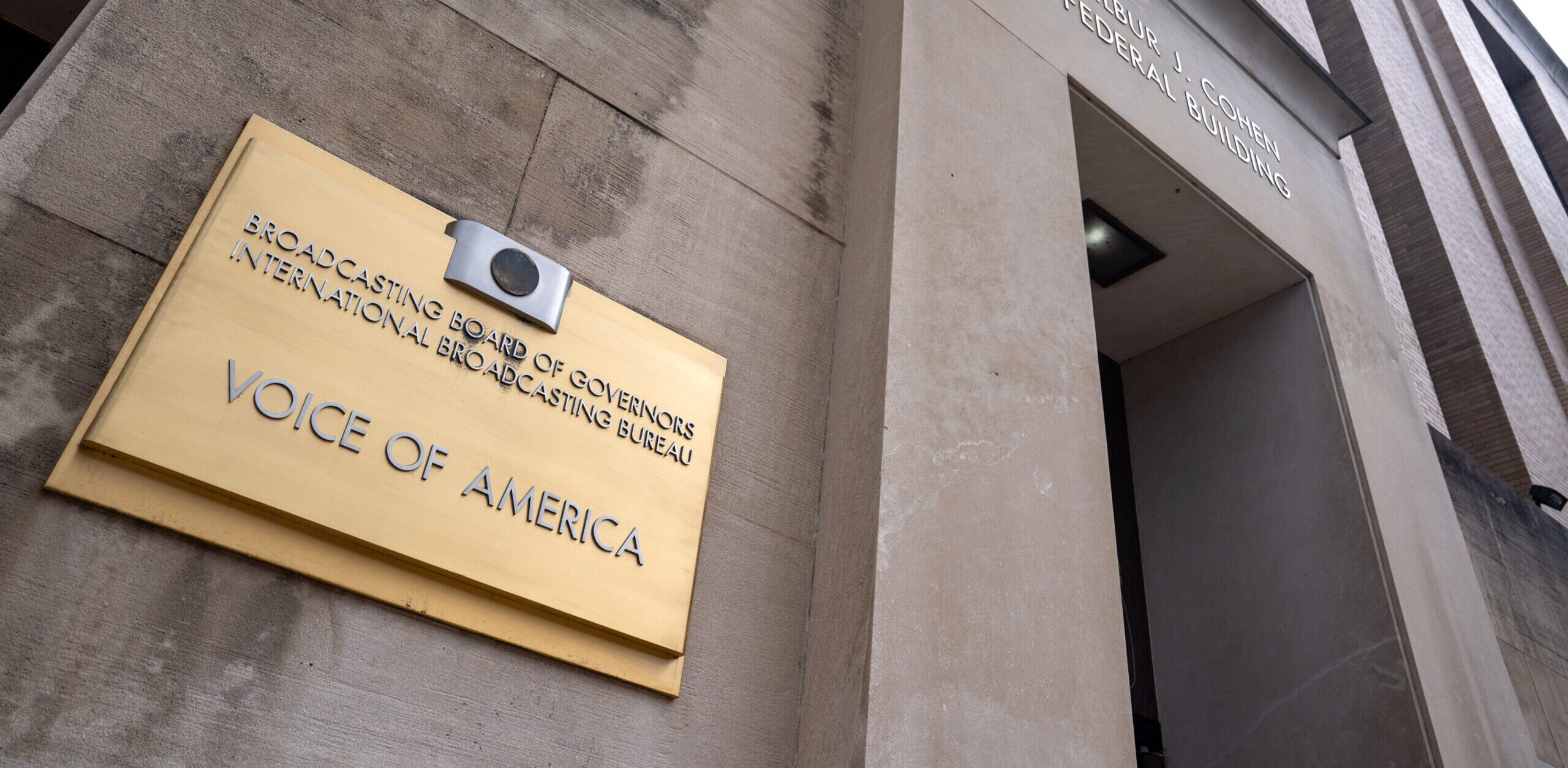
The international broadcaster, along with Radio Free Europe, has struggled to deploy its Persian-language services to provide coverage amid an internet blackout in Iran
IVY LEAGUE INQUIRY
Report on declining Jewish enrollment at Harvard raises alarm and sparks debate

The report’s author argued Harvard has been ‘ambivalent’ about its decreasing Jewish population, while other Jewish leaders cast doubt on its findings
Plus, Temple Israel seeks to 'tell its story'

Andrew Harnik/Getty Images
Tulsi Gabbard is sworn in as Director of National Intelligence in the Oval Office at the White House on February 12, 2025 in Washington, DC.
This P.M. edition is reserved for our premium subscribers — offering a forward-focused read on what we’re tracking now and what’s coming next. Please don’t hesitate to share your thoughts and feedback by replying to this email.
📡On Our Radar
Notable developments and interesting tidbits we’re tracking
Director of National Intelligence Tulsi Gabbard distanced herself — to a degree — from two of her isolationist-minded aides, Joe Kent and Dan Caldwell, who have taken a hostile stance to the U.S.’ Middle East policy, Jewish Insider’s Marc Rod reports.
Gabbard affirmed, after being pressed at a House Intelligence Committee hearing today, that the conspiratorial views about Israel espoused by Kent in his resignation letter earlier this week did concern her, and said about Caldwell that he would have no influence over intelligence reports at her agency.
Gabbard, who has previously been a vocal critic of military engagement with Iran, further acknowledged that her current position requires her to “check” her personal views “at the door”…
Reports of a potential $200 billion emergency funding request from the Pentagon for the war in Iran are drawing firm Democratic opposition and hedged responses from Republicans on the Hill: House Speaker Mike Johnson (R-LA) said he’ll “look at” the request “but obviously it’s a dangerous time in the world and we have to adequately fund defense,” while Sen. Lindsey Graham (R-SC) said he’d “hate to be the senator that denied the request if it made sense.” Rep. Pat Ryan (D-NY) responded with a simple “No,” while Sen. Richard Blumenthal (D-CT) called it a “nonstarter”…
The Senate is set to hold another round of votes on blocking U.S. arms transfers to Israel, after Sen. Bernie Sanders (I-VT) filed three new joint resolutions of disapproval against $658.8 million in sales of over 20,000 bombs to Israel, JI’s Marc Rod reports.
A majority of the Democratic caucus — 27 lawmakers — voted to block at least one arms sale in July of last year, a significant jump in support from previous similar efforts; Israel’s standing in the party has largely declined since then amid Democratic criticism of the war with Iran…
During a meeting with Japanese Prime Minister Sanae Takaichi at the White House today, President Donald Trump reiterated that he had told Israeli Prime Minister Benjamin Netanyahu not to attack Iranian oil facilities, after an Israeli strike on the South Pars gas field yesterday: “I told them, don’t do that. We didn’t discuss. … It’s coordinated, but on occasion, he’ll do something.”
Trump also put pressure on Takaichi to help secure the Strait of Hormuz, while European leaders released a joint statement “express[ing] our readiness to contribute to appropriate efforts to ensure safe passage through the Strait,” after repeatedly declining to get involved. A team of British military planners is now consulting with CENTCOM on options to assist short of military action, The New York Times reports…
Asked if he will deploy more U.S. troops in the region, Trump told reporters he’s “not putting troops anywhere. If I were, I certainly wouldn’t tell you — but I’m not putting troops”…
Secretary of Defense Pete Hegseth compared Iran to Hamas in a briefing today, saying that, “just like Hamas and their tunnels,” Iran has “poured any aid, any economic development … into tunnels and rockets”…
A group of congressional Democrats is urging the State Department to restart chartered evacuation flights out of Israel and take additional steps to help U.S. citizens who wish to leave the country amid the ongoing war with Iran, JI’s Marc Rod reports.
The lawmakers described the State Department’s current partnership with El Al, which launched on March 13 with a limited number of special evacuation flights for U.S. citizens, as insufficient. The Israeli airline has currently suspended registration for the flights, and government-imposed security restrictions are limiting passenger capacity on each flight and reducing airport operations…
Treasury Secretary Scott Bessent said that the U.S. may lift sanctions on Iranian oil already at sea in order to blunt rising gas prices. “In essence, we will be using the Iranian barrels against the Iranians to keep the price down for the next 10 or 14 days as we continue this campaign,” he explained on Fox News…
Saudi Foreign Minister Prince Faisal bin Farhan warned the kingdom is reaching a breaking point after continued Iranian attacks, saying “what little trust” Riyadh had with Tehran has “completely been shattered.”
On a potential Saudi military response, Prince Faisal said, “Do they have a day, two, a week? I’m not going to telegraph that.” It’s a notable shift for Riyadh, which had been pivoting away from its traditional allies and towards Iran and other Islamist countries prior to the war…
Illinois Gov. JB Pritzker condemned AIPAC after a primary cycle in which the pro-Israel group spent millions backing — and opposing — candidates across the state, calling it “an organization that was supporting Donald Trump and people who follow Donald Trump.”
Pritzker, a Jewish Democrat who was once an AIPAC donor himself, said it “really is not an organization that I think today I would want any part of.” He further echoed far-left sentiments that Israel dragged the U.S. into conflict with Iran, claiming Trump “simply follow[ed] Netanyahu into that war”…
Rep. Jared Moskowitz (D-FL) details his experience with a would-be assailant, a man described by authorities as a “ticking time bomb,” who was arrested near his home last year after police discovered an arsenal of weapons and a handwritten list of targets that included Jewish sites and Moskowitz.
“Besides the police presence outside his house, Moskowitz himself will not appear in parades and says he won’t speak at outdoor staged events. ‘It’s not worth it. I’d rather lose my election,’” the lawmaker told Roll Call…
Temple Israel in suburban Detroit released photos of the devastation to the building caused by an attacker last week, noting that it had “chosen thus far not to make [the photos] public” but are doing so now “to take back control of our narrative” after several were leaked to the media.
“We share these images because our community deserves to see our building through eyes of love, not through the lens of spectacle. This is our sacred space, and we will be the ones to tell its story,” the synagogue wrote…
The University of California, Berkeley reached a settlement in its lawsuit with the federal government, agreeing to pay $1 million and make changes to its discrimination policy following accusations that the university had failed to properly address campus antisemitism.
Among the policy changes, the school will clarify that the word “Zionist” cannot be used as a proxy for Jew or Israeli. The claims in the lawsuit predate the recent campus unrest over Israel’s war in Gaza, stemming from an incident in 2022 when student groups adopted policies saying they would not host Zionist speakers…
⏩ Tomorrow’s Agenda, Today
An early look at tomorrow’s storylines and schedule to keep you a step ahead
Keep an eye out in Jewish Insider for a look at the struggles facing international broadcasters Voice of America and Radio Free Europe in reaching Iranian citizens during the ongoing war due to budget cuts and roadblocks from the U.S. Agency for Global Media.
The House Appropriations Committee will hold a field hearing at the U.S. Mission to the U.N. in New York City on “accountability and reform” at the U.N.
We’ll be back in your inbox with the Daily Overtime on Monday. Shabbat Shalom!
Stories You May Have Missed
DEADLINE LOOMING
Netanyahu has less than two weeks to pass a budget — or go to early elections
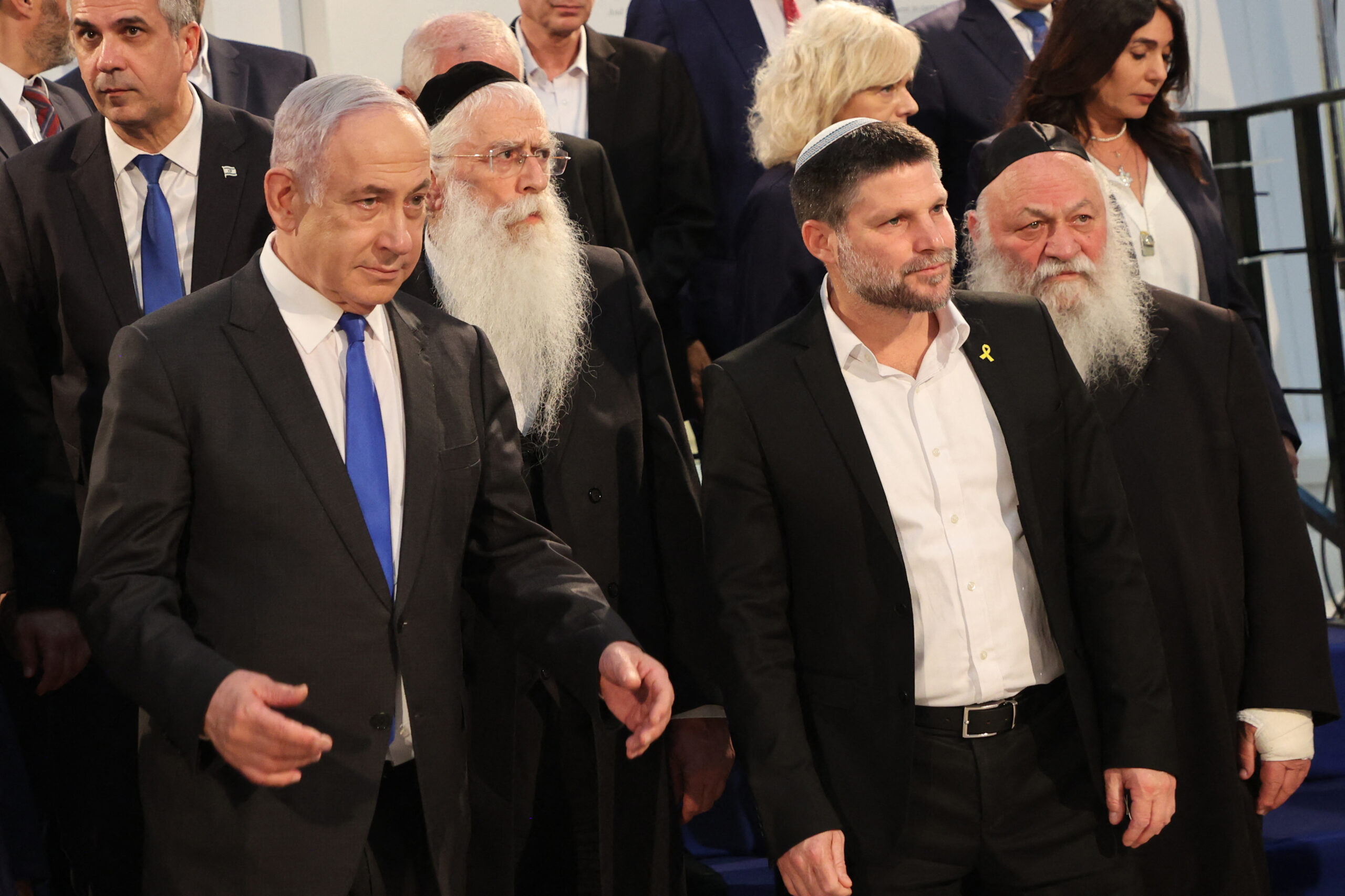
The prime minister’s governing coalition is struggling to stay intact to pass 2026 budget amid shifting political priorities
QUARREL ON THE QUAD
University of Michigan regent race revives campus fight over Israel

Anti-Israel activists are singling out regent Jordan Acker, hoping to unseat him with attorney Amir Makled, who represented a member of the school’s encampment
Plus, JD Vance says he likes Joe Kent
Oliver Contreras/AFP via Getty Images
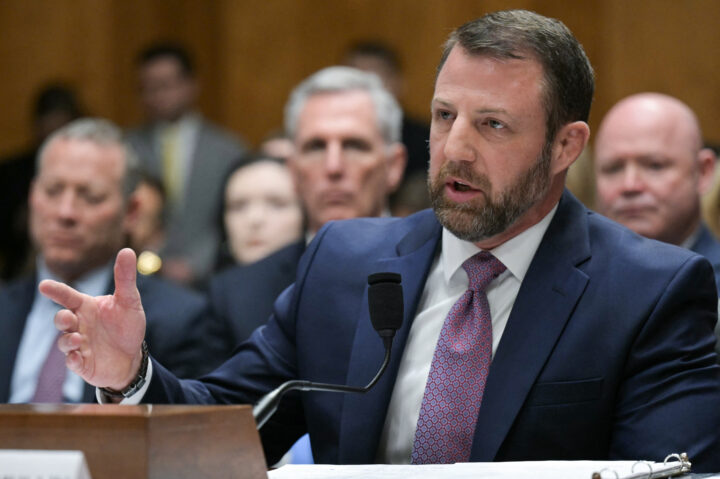
DHS Secretary Markwayne Mullin testifies during a Senate Committee on Homeland Security and Governmental Affairs confirmation hearing on Capitol Hill in Washington, DC
This P.M. edition is reserved for our premium subscribers — offering a forward-focused read on what we’re tracking now and what’s coming next. Please don’t hesitate to share your thoughts and feedback by replying to this email.
📡On Our Radar
Notable developments and interesting tidbits we’re tracking
Director of National Intelligence Tulsi Gabbard said during a Senate Intelligence Committee hearing today that the Iranian regime “appears to be intact but largely degraded,” Jewish Insider’s Marc Rod reports, as the U.S. and Israel continue to target Iranian leaders and assets. If it survives the war, she said, the regime would “seek to begin a yearslong effort to rebuild its military, missiles and UAV forces.”
Gabbard, a longtime opponent of war with Iran, repeatedly declined to say whether the intelligence community had assessed Iran to be an imminent threat to the United States, after her former deputy, Joe Kent, alleged in his resignation letter yesterday that no such threat existed. CIA Director John Ratcliffe, however, was clear in his view that “Iran has been a constant threat to the United States for an extended period of time, and posed an immediate threat at this time”…
Regarding Kent’s resignation over his opposition to the war in Iran and claims that Israel coerced the U.S. into the war, White House Press Secretary Karoline Leavitt said Kent “was not someone who was involved in … the president’s intelligence briefings over the last several months. Have not seen him here at the White House for quite some time.”
She said President Donald Trump finds it “disappointing” that Kent would “resign with a letter filled with falsehoods, accusing the president of the United States [of] being controlled by a foreign country. That’s both insulting and laughable.”
Vice President JD Vance told reporters, “I know Joe Kent a little bit. I like Joe Kent … It’s fine to disagree, but once the president makes a decision, it’s up to everybody who serves in his administration to make it as successful as possible. That’s how I do my job”…
In his nomination hearing to be secretary of homeland security, Sen. Markwayne Mullin (R-OK) said he will aim to “streamline the process” for grants, including the Nonprofit Security Grant Program, JI’s Matthew Shea reports, vowing to work to “cut out the redundancies.”
“The amount of paperwork once you’re approved to get the funding flowing, and then the paperwork that’s followed up on is way too encompassing,” Mullin said. “Taking years to get reimbursed is not acceptable. Taking months to get reimbursed is not acceptable.” His hearing was otherwise colored by personal hostility with Homeland Security Committee Chair Sen. Rand Paul (R-KY), which could complicate Mullin’s path to nomination…
The Israeli Air Force reportedly struck the South Pars gas field in Iran, the largest in the world; Qatar, which owns half of the field, called it a “dangerous and irresponsible step.” The U.S. reportedly had knowledge of the operation, despite the Trump administration asking Israel earlier this month not to strike energy facilities…
Trump issued a veiled threat to American allies who have declined to assist in securing the Strait of Hormuz, musing on Truth Social, “I wonder what would happen if we ‘finished off’ what’s left of the Iranian Terror State, and let the Countries that use it, we don’t, be responsible for the so called ‘Strait?’ That would get some of our non-responsive ‘Allies’ in gear, and fast!!!”…
Michael Blake, the Democrat challenging Rep. Ritchie Torres (D-NY) whose campaign has focused extensively on criticism of Israel and AIPAC, expressed strong support for Kent’s resignation letter and his baseless claim of Israel’s role in initiating the war. “An absolutely breathtaking, courageous and bold resignation letter stating that Iran posed NO IMMINENT THREAT to us and Trump made this decision due to the Israeli government and its American Lobby,” Blake wrote on X…
Maine Senate candidate Graham Platner released an ad in response to one from his opponent, Gov. Janet Mills, highlighting social media comments he had made about sexual assault. “If I saw these ads, I’d have questions,” Platner says in the spot. “Maine, I’m asking you not to judge me for the worst thing I said on the internet on my worst day 14 years ago, but who I am today.”
Mills replied with another ad featuring an interview clip of Platner in which he said about his posts, “I made a lot of comments that I’m not, like, ashamed of. It’s not as though I have this ream of comments in which I look back and I’m like, oh my god, I was a terrible person back then”…
During an economic-focused visit to Detroit today, Vance remarked about the recent shooting attack at nearby Temple Israel, “When something happens to any member of our American family, and this particular incident happened to Jewish members of our American family, it is something that all of us have to stand up and say, it’s disgusting, it’s unacceptable”…
Also in response to the Temple Israel attack, Montgomery County, Md., a heavily Jewish suburb of Washington, announced it will provide $500,000 in supplemental funding for its Nonprofit Security Grant Program for current recipients over the next 90 days. It’s one of the few localities that provides its own funding in addition to the federal program…
⏩ Tomorrow’s Agenda, Today
An early look at tomorrow’s storylines and schedule to keep you a step ahead
Keep an eye out in Jewish Insider for a look at the far-left candidates running against establishment Democrats in Colorado.
The Senate will vote on another war powers resolution this evening aiming to stop the U.S. operation in Iran. The resolution, sponsored by Sen. Cory Booker (D-NJ), is expected to fail largely along party lines, as the previous one did earlier this month.
Administration intelligence officials including DNI Tulsi Gabbard and CIA Director John Ratcliffe will appear before the House Intelligence Committee tomorrow for its rescheduled worldwide threats hearing.
The Senate’s Homeland Security & Governmental Affairs Committee is set to hold a vote on Sen. Markwayne Mullin’s (R-OK) nomination to be secretary of homeland security, though Sen. Rand Paul (R-KY) threatened to cancel it over personal animosity and outstanding questions about a 2016 overseas trip that Mullin claims was classified. If a vote is held, Mullin will need the support of at least one Democrat on the committee in order to advance without Paul’s support, which Sen. John Fetterman (D-PA) has previously pledged to provide.
After his appearance this evening on far-right commentator Tucker Carlson’s podcast, Joe Kent will be interviewed tomorrow by Candace Owens, who similarly deals in antisemitic conspiracy theories, at the Catholic Prayer for America gala in Washington. Also appearing at the gala is Carrie Prejean Boller, the former beauty pageant queen who was removed from the White House’s Religious Liberty Commission after berating Jewish hearing witnesses over antisemitism.
Stories You May Have Missed
LONE STAR LIABILITY
Israel conspiracies threaten Democratic hopes in Texas runoff race

Bexar County sheriff’s deputy Johnny Garcia is facing off against Maureen Galindo, who has made antisemitic conspiracy theories a key feature in her campaign
HORSESHOE POLITICS
Onetime Democratic critics elevate Joe Kent’s conspiratorial resignation letter
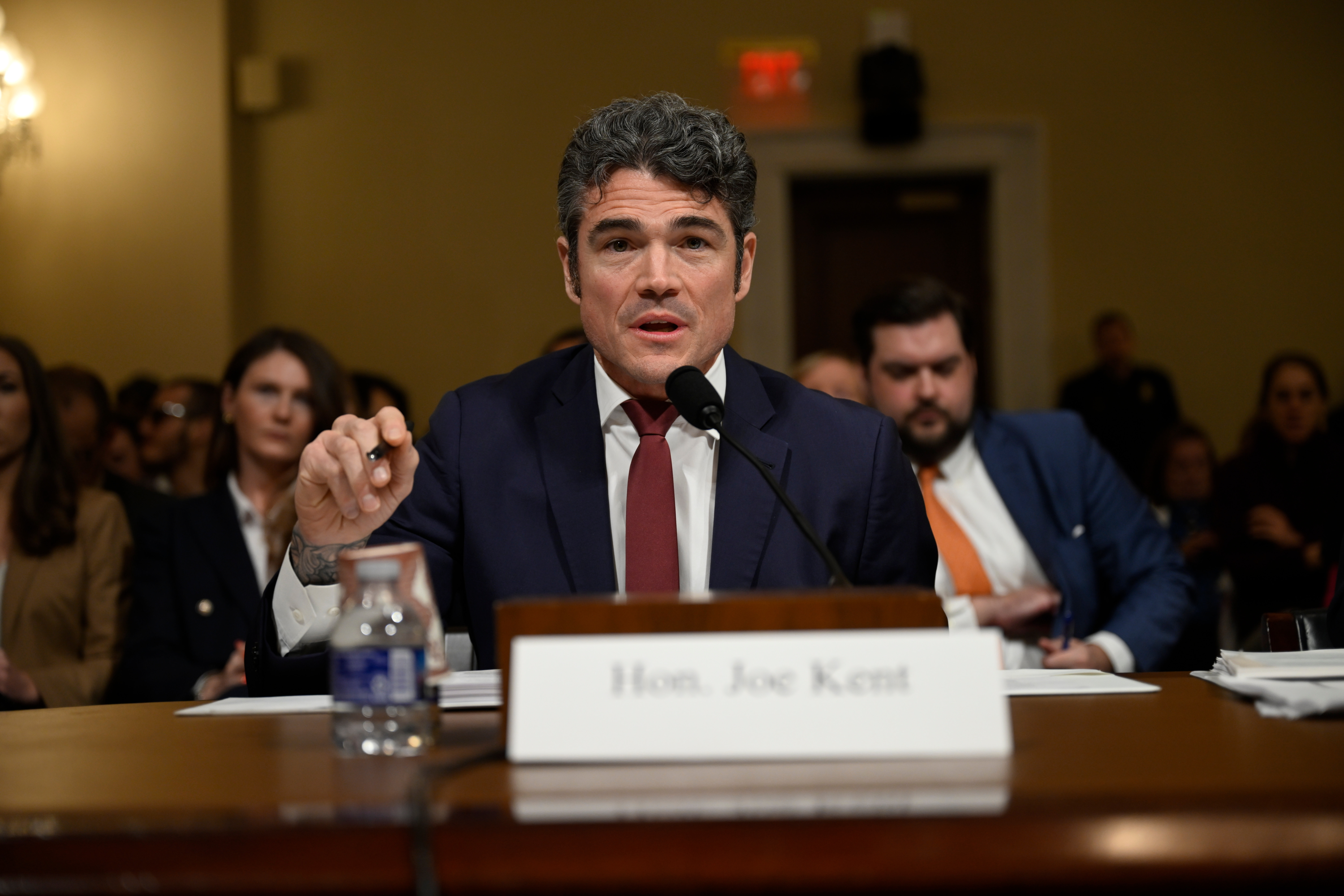
Democrats previously slammed Kent as an untrustworthy extremist in opposing his nomination. Now, amid his anti-Israel accusations, some argue he has a point
In his resignation letter, Kent baselessly claimed Israel tricked President Trump into war with Iran and said U.S. operations in Syria were also 'manufactured by Israel'

AP Photo/Jenny Kane
Former congressional candidate and counterterrorism official Joe Kent speaks during a debate at KATU studios on Monday, Oct. 7, 2024, in Portland, Ore.
Joe Kent, director of the National Counterterrorism Center, resigned from his role on Tuesday over opposition to the war in Iran, baselessly alleging that Israel had coerced the United States into what he characterized as a misguided military conflict.
In a letter to President Donald Trump shared on social media, Kent, a former Green Beret who had reported to Director of National Intelligence Tulsi Gabbard, wrote that he “cannot in good conscience support the ongoing war in Iran,” claiming that the Islamic Republic “posed no imminent threat to our nation, and it is clear that we started this war due to pressure from Israel and its powerful American lobby.”
Kent, a hard-right former congressional candidate in Washington State who has pushed an isolationist foreign policy vision, has previously drawn scrutiny for promoting conspiracy theories, echoing pro-Russia messaging and associating with white supremacists and neo-Nazis, among other controversies.
During a failed House bid in 2022, Kent also said that accepting donations from pro-Israel lobbying groups like AIPAC puts Israel’s “interests ahead of ours” — invoking an antisemitic trope about foreign influence over American politics that is increasingly common on the far right.
Kent’s wife, Heather Kaiser, is a military veteran who has written for The Grayzone, an extremist outlet, authoring articles with its founder Max Blumenthal, a prominent conspiracy theorist who has published sympathetic coverage of Iran and spread misinformation about the Hamas terror attacks of Oct. 7, 2023.
In his letter, Kent claimed that Trump had been tricked into striking Iran by “high-ranking Israeli officials and influential members of the American media” who “deployed a misinformation campaign that wholly undermined” the president’s “America First platform and sowed pro-war sentiments to encourage war with Iran.”
“This echo chamber was used to deceive you into believing that Iran posed an imminent threat to the United States, and that should you strike now, there was a clear path to a swift victory,” Kent wrote to the president. “This was a lie and is the same tactic the Israelis used to draw us into the disastrous Iraq war that cost our nation the lives of thousands of our best men and women. We cannot make this mistake again.”
Kent, who served in Iraq, also claimed his first wife, Shannon Kent, a military cryptologist who died in an ISIS suicide bombing in Syria in 2019, had been killed “in a war manufactured by Israel.” Israel was not a member of the U.S.-led coalition combating ISIS at the time.
“I pray that you will reflect upon what we are doing in Iran, and who we are doing it for,” he concluded, telling the president that he can “reverse course and chart a new path for our nation” or “allow us to slip further toward decline and chaos.”
Karoline Leavitt, the White House press secretary, rejected Kent’s account. “As President Trump has clearly and explicitly stated, he had strong and compelling evidence that Iran was going to attack the United States first,” she wrote in a lengthy social media post.
She called Kent’s claim that Israel had duped Trump into joining the war “an absurd allegation” that “is both insulting and laughable,” arguing that “Trump has been remarkably consistent and has said for DECADES that Iran can NEVER possess a nuclear weapon.”
Speaking to reporters from the Oval Office on Tuesday, Trump said it was a “good thing” that Kent had resigned, calling him “very weak on security.”
“He said that Iran was not a threat. Iran was a threat. Every country realized what a threat Iran was. The question is whether or not they wanted to do something about it,” Trump added. “So when somebody is working with us that says they didn’t think Iran was the threat, we don’t want those people.”
Kent’s comments, which underscored deepening divisions in Trump’s MAGA coalition over the war, also drew criticism from Republican lawmakers.
Rep. Don Bacon (R-NE), a leading moderate voice in the House, accused Kent of fueling antisemitism. “Good riddance,” he said of Kent’s departure on social media. “Iran has murdered more than a thousand Americans. Their EFP land mines were the deadliest in Iraq. Anti-Semitism is an evil I detest, and we surely don’t want it in our government.”
House Speaker Mike Johnson (R-LA) said Kent’s claims about Israeli influence were “clearly wrong” and that “there was clearly an imminent threat” to the United States.
Sen. Lindsey Graham (R-SC) and Rep. Mike Lawler (R-NY) also criticized Kent’s letter and said they were glad to see him leave the administration — Lawler called him “a leaker who spent more time undermining our foreign policy than doing his job,” while Graham said, based on his claims, Kent “clearly … did not go to work enough.”
On the other side of the aisle, Sen. Mark Warner (D-VA), vice chairman of the Senate Intelligence Committee, said in a statement that Kent had been “right” to point out “there was no credible evidence of an imminent threat from Iran that would justify” an attack — even as he called Kent’s “record deeply troubling” and believed he “never should have been confirmed” to lead the counterterrorism office.
Meanwhile, Tucker Carlson, a close ally of Kent, praised his decision to resign. “Joe is the bravest man I know, and he can’t be dismissed as a nut,” Carlson told The New York Times on Tuesday.
The divide was evident in an exchange between a centrist and top advisor to Yair Lapid and a foreign policy advisor to AOC and former confidante of Bernie Sanders (I-VT)
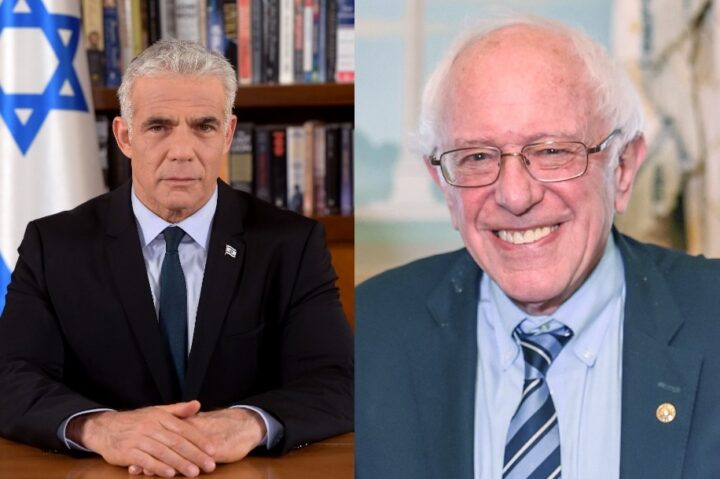
Avi Ohayon/Government Press Office of IsraelWikimedia Commons/Palácio do Planalto from Brasilia, Brasil
Israeli Opposition Leader Yair Lapid/Sen. Bernie Sanders (I-VT)
The ongoing war in Iran is highlighting a widening gulf between center and center-left voters in Israel and Democrats in the United States. While Democrats in the United States are mostly opposed to the war, Israelis are overwhelmingly supportive of the effort.
Recent polling from Israel has shown that 92.5% of Jewish Israelis and 81% of Israelis overall support the war
The divide was particularly evident in an exchange on X this week between Yair Zivan, a centrist and top advisor to Israeli Opposition Leader Yair Lapid, and Matt Duss, a foreign policy advisor to Rep. Alexandria Ocasio-Cortez (D-NY) and a former confidante of Sen. Bernie Sanders (I-VT), whose post prompted the exchange.
Sanders, on X, condemned the Israeli operations against Hezbollah in Lebanon, saying, “The U.S. cannot continue to be complicit in [Israeli Prime Minister Benjamin] Netanyahu’s wars.”
Zivan said in response that he was writing from a bomb shelter and that Israel “is under attack by fanatical terrorists who want to murder us,” arguing that Sanders’ “humanity never seems to extend to Israeli lives.”
Duss responded that Israelis are under fire “because your fanatical prime minister and my president launched a reckless and unnecessary war. Bernie is trying to stop it. What’s your boss doing?”
Zivan, who also edited a book on centrism, responded that the blame for the attacks lies with the “fanatical regime in Iran” and “fanatical terrorist organization in Lebanon sworn to our destruction (yours too if they could get to you),” rather than with Netanyahu.
He followed up later saying that war “should be a last resort” but is “sometimes … just and necessary.”
Zivan told Jewish Insider that most Israelis agree about the need to take on Iran.
“For us Israelis, this war is just and necessary. The vast majority of Israelis (left, right and center) understand the absolute necessity of removing the Iranian threat which is hanging over us,” Zivan said. After Hamas’ Oct. 7, 2023, attacks, “no one should expect us to wait until it’s too late to defend ourselves from terror. I think most of our friends in the U.S., on both sides of the aisle, understand the importance of what’s happening for Israel’s national security.”
Ilan Goldenberg, the senior vice president of J Street, which has strongly opposed the war in Iran, acknowledged the divide between Israelis and the American left in an op-ed last week — but argued that Israelis are mistaken in their outlook on the war.
“Just because the Israeli public supports the war doesn’t mean it’s a good idea or in Israel’s interest. [Seventy-two] percent of Americans supported invading Iraq in 2003. That didn’t make it a wise decision,” Goldenberg said. “Americans and Israelis see this conflict through very different strategic lenses. … because American and Israeli interests and perspectives are not perfectly aligned.”
Israelis, Goldenberg continued, see Iran as their primary geopolitical enemy and as the primary threat to their homeland, which is not the case for Americans. He argued that “aggressive” Israeli views are also being driven by the “trauma” of the Oct. 7 attacks, and that the set of acceptable outcomes from the war are different for Israel than for the U.S., for strategic reasons.
Democrats began calling out those who traffic in antisemitic rhetoric when they offered platitudes after an attack on a Michigan synagogue
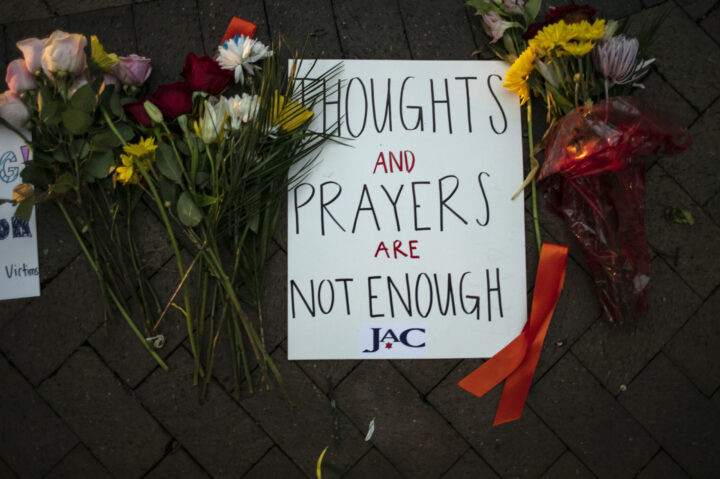
Jim Vondruska/Getty Images
A vigil is held near the scene of a mass shooting at a Fourth of July parade, on July 5, 2022 in Highland Park, Illinois.
American antisemitism is having its “thoughts and prayers” moment.
Whenever there is a mass shooting in the United States, the immediate reaction has become something of a meme. “Sending thoughts and prayers,” politicians — mostly Republicans — will inevitably write in a social media post expressing grief at the murder of innocent people at an elementary school, in a bowling alley or at a Walmart.
Gun violence prevention advocates roll their eyes. They see the oft-repeated sentiment as disingenuous, given how little action Congress has taken to enact gun control measures. During the 2018 March for Our Lives, when hundreds of thousands of Americans took to the streets to demand action after 17 people were killed at a high school in Parkland, Fla., scores of people carried signs with the words “thoughts and prayers” crossed out, and the phrase “policy and change” written underneath.
A similar phenomenon was on display after a heavily armed man drove a car into a synagogue in suburban Detroit on Thursday. He was killed by a security guard before he was able to enter the building, where 140 preschool and kindergarten students were locked down in their classrooms.
Afterward, politicians with a history of promoting antisemitic tropes began bemoaning antisemitism. And Jewish politicians and activists in the Democratic party who had grown exasperated over the hypocrisy of it all started calling them out.
Noah Arbit, the Jewish state representative whose district includes West Bloomfield Township, where the attack took place, called out Democratic Senate candidate Abdul El-Sayed for his “crocodile tears” expressing concern about the shooting. Arbit grew up attending Temple Israel.
“Amazed by the crocodile tears from someone who’s done more than most to stoke & inflame hatred against Jews. It’s a very small logical leap from ‘AIPAC controls the US government,’ ‘Israel is committing genocide,’ ‘Zionists kill Arab babies’ to ‘kill Jews in West Bloomfield,’” Arbit, a Democrat, wrote in a post on X replying to El-Sayed.
El-Sayed, a progressive running a campaign with an anti-Israel message, sent a fundraising email on the two-year anniversary of Oct. 7 accusing Israel of genocide and calling out AIPAC. “If you’re asking yourself, ‘Why on Earth are politicians in Washington continuing to add fuel to the fire?’ The answer is money. AIPAC is funneling millions into campaigns in exchange for loyalty,” El-Sayed wrote in the Oct. 7 email, referring to the war in Gaza.
As the attack was unfolding, Rep. Ro Khanna (D-CA) took to social media to respond to a message by a junior staffer at the centrist think tank Third Way that called for Democrats to do more to address antisemitism within their ranks. Rather than taking the criticism seriously, Khanna said he was “proud” to stand by New York City Mayor Zohran Mamdani and far-left antisemitic streamer Hasan Piker, and took aim at “neocons” in the party. (Forty minutes later, Khanna condemned the shooting and said “antisemitism and violence have no place in America.”)
“What the hell is wrong with you? 48 hours ago two men were beaten in your district for speaking Hebrew. Earlier today there was a shooting at a Jewish school in Michigan. Is it politics? Lack of empathy? Are you actually racist?” Ethan Agarwal, a Silicon Valley entrepreneur challenging Khanna in this year’s Democratic primary, wrote in response.
Earlier in the day, Khanna had tweeted in defense of Pat Buchanan, President Ronald Reagan’s communications director who has a lengthy history of making overtly antisemitic arguments.
“The same Pat Buchanan who wrote that Hitler was ‘a man of great courage’? Who called Capitol Hill ‘Israeli-occupied territory’? Who said there was ‘No evidence exists that any Jews were gassed at Treblinka’? Pretty sure he was antisemitic,” said Shannon Watts, a liberal activist who started the advocacy group “Moms Demand Action” after the Sandy Hook shooting in 2012, when 26 students and teachers were killed at a Connecticut elementary school.
Khanna doubled down afterward.
Later, Watts — who has called Republicans’ “thoughts and prayers” framing a form of gaslighting — said Democrats need to do more to combat antisemitism among members of their own party.
“The Democratic Party has been infected by antisemitism and it’s spreading. It isn’t (yet) as virulent as it is on the right, but it’s insidious and we have to stop pretending it doesn’t exist,” Watts wrote on X.
In West Bloomfield, tragedy was averted, miraculously, because of the actions of a security guard who quickly put himself in harm’s way.
But if the response to rising antisemitism begins to resemble the country’s response to gun violence — expressions of outrage followed by little introspection — the result may be a familiar one: condemnation after the antisemitic incident, but little reckoning with the permissive culture that helped create the danger in the first place.
‘We don’t want to leave early. We want to finish the job and not have to return in two years,’ Trump said
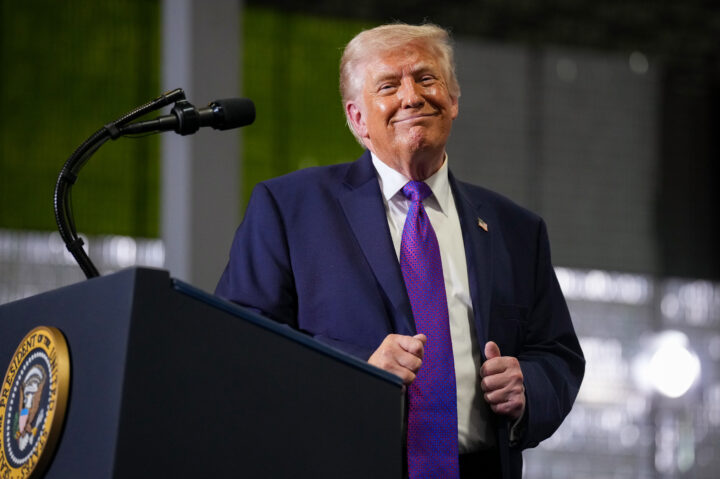
Andrew Harnik/Getty Images
President Donald Trump speaks on stage at Verst Logistics on March 11, 2026 in Hebron, Kentucky.
President Donald Trump said on Wednesday that the United States has “won” the war in Iran, while warning that U.S. forces will continue the military operation until they “finish the job.”
Trump made the comments while discussing his administration’s efforts to reduce oil prices amid the war in Iran at a campaign rally in Hebron, Ky., on Wednesday to support Ed Gallrein, his endorsed candidate to take on anti-Israel and isolationist Rep. Thomas Massie (R-KY) in the contentious primary between the two men.
Trump noted that the International Energy Agency had “agreed to coordinate the release of a record 400 billion barrels of oil from various national petroleum reserves around the world, which will substantially reduce the oil prices as we end this threat to America and this threat to the world,” prompting him to then ask the crowd: “We don’t want to leave early, do we? We’ve got to finish the job.”
“After [Operation] Midnight Hammer [in June 2025], we left. We figured that’ll be the end of them for a while. But they started again. That’s why we gotta finish it,” Trump said. “We don’t want to go back every two years, and that’s because there will be some day when you don’t have me as president.”
“We’re not leaving until that job is finished, and it’s going to be very fast, but we’re not going to count on having competent presidents,” he continued.
The president ripped into Massie, who he described as “disloyal,” a “loser,” the “worst person” and a “disaster as a congressman” later on during his speech. Trump also touted Gallrein’s candidacy to represent Kentucky’s 4th Congressional District, describing the farmer and former Navy SEAL officer as “central casting” and a “tremendous war hero.” He also defended Gallrein’s decision to leave the GOP and register as an independent for a time because he returned to the party under the president’s leadership.
“He [Gallrein] said, ‘I came back because of the strength and wisdom that Donald Trump displayed, and I appreciate that,” Trump said. “Many people have joined and rejoined our party, but Massie did not, because he only votes no. He just votes no. Doesn’t matter. I could give him the best things in the history of a Republican voter, and he’d vote no. There’s something wrong with him.”
“We call him Rand Paul, Jr., he votes against everything. At least I like Rand a little bit,” referring to Sen. Rand Paul (R-KY), who frequently opposes the Trump administration on foreign policy.. “Rand votes against us all the time too, but at least he’s okay. I wouldn’t say the greatest.”
Massie broke with Trump throughout his first term, voting against the president’s priorities multiple times in Congress, though the two became serious political foes over the last year — after the Kentucky congressman voted against Trump’s tax cut legislation last year and began leading the charge to force the release of the Department of Justice’s files on the Jeffrey Epstein case. Their relationship deteriorated further as Massie became one of the most vocal GOP critics of Trump’s war in Iran.
Gallrein described Massie’s opposition to Trump’s actions in Iran as “unforgivable” in remarks to attendees at the rally.
“He’s even leading the Democrats to block the president while we are engaged in combat actions to save our nation and the world from the Iranians [getting] a nuclear weapon, while we have troops in harm’s way. Unforgiveable,” Gallrein said of Massie. “You deserve a congressman who stands united with you, the Republican Party and the president.”
Also in attendance were the leading candidates in the competitive GOP primary to replace retiring Sen. Mitch McConnell (R-KY) — former Kentucky Attorney General Daniel Cameron, pro-Trump businessman Nate Morris and Rep. Andy Barr (R-KY) — and boxer and influencer Jake Paul, whom Trump said he would endorse if Paul were to run for office.
The California governor said Tuesday the U.S. should reconsider its military support for Israel just months after having supported continuing U.S. aid
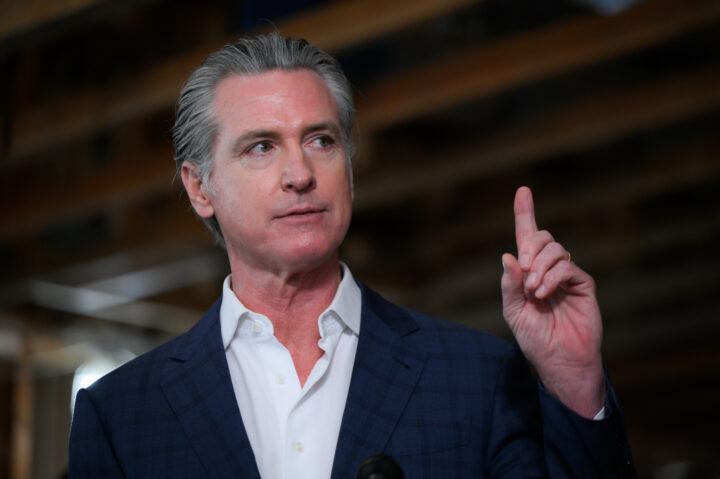
Tayfun Coskun/Anadolu via Getty Images
Governor Gavin Newsom criticizes U.S. President Donald Trump’s decision to strike Iran during a press conference in Hayward, California, United States, on March 2, 2026.
California Gov. Gavin Newsom said on Tuesday night on a popular liberal podcast that the U.S. should reconsider its military support for Israel, a marked evolution for a politician who traveled to Israel less than two weeks after the Oct. 7 terror attacks in 2023 and who said in an October interview that he would not consider eliminating U.S. military aid to Israel.
“Do you think, looking down the road, that the United States should consider maybe rethinking our military support for Israel?” Jon Favreau, the co-host of “Pod Save America,” asked Newsom during an event promoting the Democratic governor’s new book.
“It breaks my heart because the current leadership in Israel is walking us down that path where I don’t think you have a choice,” Newsom said in response. He also said in the conversation with Favreau and co-host Tommy Vietor, which came amid the joint U.S.-Israeli operation against Iran, that Israel could “appropriately” be described as an apartheid state.
The “Pod Save” hosts have been some of the leading voices in the Democratic Party hostile to Israel and pro-Israel groups, boosting progressive primary candidates including Graham Platner in Maine and Abdul El-Sayed in Michigan, who made criticism of Israel central to their campaigns.
Further, Newsom seemed to make the argument that military support for Israel comes at the expense of social welfare programs in the U.S.
“To say this is in America’s interest at a time when affordability is at crisis levels, where you have an administration who literally got elected saying this is exactly the opposite of what they would ever consider doing, the fact that we are in this now regional war, all these proxies,” Newsom said, before trailing off into a conversation about corruption in the Trump administration.
On Thursday, Newsom will appear in Portsmouth, N.H., for another book talk — a location sure to raise eyebrows because of the state’s importance in the presidential primary contest. He’ll be interviewed by Jack Cocchiarella, a self-described “progressive political YouTuber” who also frequently bashes Israel. Cocchiarella said in a post on X promoting the event that they will be discussing Israel. Earlier this week, the podcast host called Israel “a terrorist state that threatens and kill [sic] Americans.”
Izzy Gardon, a spokesperson for Newsom, told The New York Timeson Wednesday that he “believes in Israel’s right to exist — and its right to defend itself. Period.”
Newsom “is calling out a difficult truth,” added Gardon, saying that President Donald Trump and Israeli Prime Minister Benjamin Netanyahu are “taking Israel down a course that threatens the safety of Israel — a democracy and America’s closest Middle East ally — as well as Israelis and American Jews.” Gardon declined to comment further to JI.
Newsom’s move away from military support for Israel is a shift even from his recent positions. In October, during an interview with the “Higher Learning” podcast, Newsom said he would not support ending U.S. military aid to Israel.
“No, I’m not prepared to say that I would support a blanket exemption for military support of Israel. That said, I’ve been very vocal in my opposition to Bibi Netanyahu,” said Newsom.
He touted his decision in December 2023 to send humanitarian aid to Gaza, while also defending Israel’s right to exist.
“I am sitting here on your behalf, you’re a taxpayer,” Newsom said on the podcast, “as the only governor in the United States that sent a field hospital to Gaza and got it in through a third party country, and is disgusted by what’s happened in Gaza as a human being, as a father, who sees these children and how this war has been perpetuated by Bibi Netanyahu. I also have deep respect for the right of the State of Israel to exist and defend itself. And I thought the attack by Hamas was a terrorist attack, and we have to be clear about that as well.”
Newsom is widely considered a 2028 presidential contender, and he has been shifting his public stances on Israel to the left in recent months in response to questions from progressive interviewers.
In the days immediately after Oct. 7, Newsom lit the state capital in blue and white and unequivocally condemned Hamas’ actions. Less than two weeks later, he added a one-day visit to Israel onto a pre-planned trip to Asia.
“Despite the horror, what I saw and heard from the people of Israel was a profound sense of resilience. A commitment to community and common purpose, especially in these most difficult of times,” Newsom said afterward. He first traveled to Israel in 2008, the first sitting mayor of San Francisco to do so, on a trip organized by the San Francisco Jewish Community Federation.
Jewish allies of Newsom’s in California told Jewish Insider they disagreed with his choice of using the word “apartheid” but said his comments reflected sentiments familiar to those held by many pro-Israel Democrats who disagree with Netanyahu’s actions.
“I heard what he was saying as sort of a frustration, as, ‘I don’t want it to go there,’ but I’m hearing a lot of concerns and frustrations when he’s saying ‘it breaks my heart,’” said Andrew Lachman, a Culver City school board member and the former president of California Jewish Democrats.
Sam Lauter, a Democratic donor and activist in San Francisco, said he “would have preferred [Newsom] not use those words.”
“I don’t want the word apartheid to come up. I don’t want someone to position themselves as being open to the idea of cutting off military aid to Israel,” Lauter said. “I wouldn’t say that his position has changed or evolved. I think it’s just that the more that folks see Netanyahu and the Netanyahu government proceed down the path that they have proceeded down, the more you’re going to hear people say, this is where he’s put us.”
During his October interview with the “Higher Learning” podcast, Newsom was asked to discuss his views on AIPAC after Van Lathan, the show’s host, said he would not vote for any candidate who accepted money from the pro-Israel lobby. At the time, Newsom appeared flummoxed and did not give a substantive answer.
“It’s interesting. I haven’t thought about AIPAC. And it’s interesting, you’re, like, the first to bring up AIPAC in years, which is interesting. It’s not relevant to my day to day life,” Newsom said.
Two months later, he was asked a similar question by Cocchiarella.
“I’ve never received a dollar from them in my entire political career. So that’s sort of absolute. So I’ve had an opinion on that going back decades now,” said Newsom.
AIPAC only started spending in political races in 2022, and they have never donated to state candidates, only to congressional campaigns. But Newsom doubled down and compared AIPAC to other groups deemed politically toxic to Democrats.
“I don’t take tobacco money, oil money. I’ve never taken AIPAC money. I mean, there’s certain absolutes that are the lines that have been drawn for decades for me,” he said.
Lauter, who used to be involved with AIPAC and now sits on the board of Democratic Majority for Israel, called Newsom’s comments on AIPAC “immensely unfortunate.”
“I’m disappointed that AIPAC has become such an easy target, even for folks that we should consider friends,” Lauter told JI on Wednesday.
IDF chief announces offensive campaign against Hezbollah after overnight attacks against Israeli by the Iranian proxy

Stringer/picture alliance via Getty Images
Smoke from an Israeli air raid billows from Hezbollah positions in the southern Lebanese village of Dier Siran
Israel expanded its war effort against Iran to southern Lebanon on Monday after Iranian proxy Hezbollah launched rockets and drones at Israel overnight.
“We have launched an offensive campaign against Hezbollah,” Lt.-Gen. Eyal Zamir, the IDF’s chief of staff, said in a situational assessment on Monday. “We are not only operating defensively — we are now going on the offensive as well. We must prepare for many prolonged days of combat ahead.”
The war against Iran and Hezbollah “requires strong defensive readiness and sustained offensive readiness, operating in continuous waves while constantly utilizing opportunities,” Zamir said.
On Sunday, Zamir also spoke of Israel’s “close cooperation with our most important partner — the United States of America. We are working in coordination with CENTCOM, with AFCENT, CENTCOM’s Air Force, and there is undoubtedly tremendous force here.”
Hours after Hezbollah launched rockets and drones at Israel at about 1 a.m. Monday, the IDF carried out strikes against dozens of Hezbollah targets in southern Lebanon and as far north as Beirut that extended into the morning. Targets included senior Hezbollah terrorists, command posts, infrastructure and a vehicle carrying operatives from the Sh’ia militia’s elite Radwan force.
Israeli Defense Minister Israel Katz said on Monday that Hezbollah leader Naim Qassem “decided on the attack under pressure from Iran [and] is from this moment a marked target for elimination.”
The IDF will “act forcefully against Hezbollah,” Katz added, “while continuing to advance the primary objective: crushing and defeating the Iranian terror regime and neutralizing its capabilities in Operation Lion’s Roar in order to remove the threats against the State of Israel and enable the citizens of Iran to rise up against the regime and overthrow it.”
The IDF’s Arabic-language spokesperson issued evacuation notices for 53 villages in southern Lebanon.
“The IDF had previously prepared for the possibility of Hezbollah joining the hostilities,” the military spokesperson’s office stated. “In the Northern Command, combat forces were significantly reinforced along the border with both defensive and offensive capabilities. This preparation enabled a rapid and robust counterattack while maintaining full operational protection across all scenarios.”
The expansion of the war to a second front followed a month of smaller IDF strikes in southern Lebanon, as Hezbollah continued efforts to rebuild after Israel killed Hezbollah leader Hassan Nasrallah and many other leading figures in the Iranian proxy group in late 2024.
As Operation Roaring Lion, as the IDF called its strikes on Iran, was launched on Saturday, the IDF called up 70,000 reservists to bolster its forces in all sectors, including the northern border, as well as Central Command, focusing on counterterrorism activity in the West Bank, and Southern Command, to defend the Yellow Line in Gaza and protect residents of southern Israel.
The IDF continued intercepting Iranian missiles on Monday, including over Jerusalem, where the Iranian Revolutionary Guard Corps said it was targeting the Prime Minister’s Office and the home of Air Force Commander Tomer Bar.
Israel confirmed that on the first day of the war, it eliminated 40 commanders, including the Iranian Armed Forces’ Chief of Staff Abdolrahim Mousavi, whose predecessor was eliminated by the Israeli Air Force last year.
In addition, the IDF targeted the Iranian Intelligence Ministry, killing Sayed Yahya Hamidi, deputy minister of intelligence for ‘Israel affairs,’ who directed attacks on Jews around the world, and Jalal Pour Hossein, head of the espionage division, among others.
The Intelligence Ministry reported directly to Iran’s supreme leader and was also a central tool through which Iran monitored citizens and provided intelligence for the violent suppression of protests. It has long been under U.S. sanctions.
The IDF said that, in addition to missiles, the air force and navy have intercepted dozens of Iranian drones launched toward Israel.
Late Sunday and early Monday, Iranian missiles struck Jerusalem twice, including one that landed right outside the walls of the Old City.
The second strike, in a residential neighborhood, injured five, Magen David Adom reported.
On Sunday, 10 were killed as a result of missile strikes, mostly in a barrage that decimated a residential area in Jerusalem suburb Bet Shemesh.
Since the beginning of Operation Roaring Lion, there have been 12 fatalities in Israel. MDA reported 228 injuries.
Also Monday, Israel’s Energy Ministry instructed a halt on gas production at the Leviathan platform in the Mediterranean Sea.
Canada and Australia immediately offered support; European leaders signaled changing views amid Iran’s indiscriminate attacks in the region

Kay Nietfeld/picture alliance via Getty Images
French President Emmanuel Macron (l-r), German Chancellor Friedrich Merz (CDU) and Keir Starmer, Prime Minister of Great Britain, meet in The Hague at the delegation hotel on the sidelines of the NATO summit for trilateral talks in the E3 format.
President Donald Trump’s decision to launch a military campaign against Iran has earned unexpected support from Western leaders who have otherwise sparred with Trump, particularly on trade policy. Canada and Australia, both of which are led by liberal parties, robustly backed the strikes that began on Saturday morning.
“We support the United States acting to prevent Iran from obtaining a nuclear weapon and to prevent Iran continuing to threaten international peace and security,” Australian Prime Minister Anthony Albanese said in a statement on Saturday.
Canadian Prime Minister Mark Carney, speaking to reporters during a trip to India, also threw his support behind the U.S.: “Canada supports the United States acting to prevent Iran from obtaining a nuclear weapon and to prevent its regime from further threatening international peace and security,” he said.
Meanwhile, three powerful European allies known as the E3 — France, Germany and the United Kingdom — were more circumspect after the military campaign began, with British Prime Minister Keir Starmer, French President Emmanuel Macron and German Chancellor Friedrich Merz calling on Saturday for nuclear negotiations to resume.
But by late Sunday, as Iran doubled down on its campaign of retaliation against American and Western assets across the Middle East, the E3 nations inched toward support for Washington with a statement strongly calling on Iran to cease its “indiscriminate and disproportionate missile attacks.”
“We call on Iran to stop these reckless attacks immediately. We will take steps to defend our interests and those of our allies in the region, potentially through enabling necessary and proportionate defensive action to destroy Iran’s capability to fire missiles and drones at their source,” the E3 leaders said. “We have agreed to work together with the U.S. and allies in the region on this matter.”
Plus, Witkoff calls for indefinite Iran nuclear deal

Mario Tama/Getty Images
An attendee wears a jacket at an Iowa caucus watch party organized by Metro D.C. Democratic Socialists of America, on February 3, 2020 in Washington, DC.
Good Wednesday afternoon!
This P.M. edition is reserved for our premium subscribers — offering a forward-focused read on what we’re tracking now and what’s coming next.
It’s me again — Danielle Cohen-Kanik, U.S. editor at Jewish Insider and curator, along with assists from my colleagues, of the Daily Overtime. Please don’t hesitate to share your thoughts and feedback by replying to this email.
📡On Our Radar
Notable developments and interesting tidbits we’re tracking
Ahead of the third round of U.S.-Iran negotiations taking place in Geneva tomorrow, Vice President JD Vance told Fox News that President Donald Trump “has a number of other tools at his disposal” besides diplomacy to ensure “the craziest and worst regime in the world” does not obtain nuclear weapons, following on the president’s remarks during last night’s State of the Union calling Iran “the world’s No. 1 sponsor of terror”…
In response to Trump’s comments, where he also said Iran was developing advanced ballistic missiles and had killed 32,000 protesters, Iranian Foreign Ministry spokesperson Esmail Baghaei tied Trump to the “law of propaganda coined by Nazi [chief propagandist] Joseph Goebbels.”
“This is now systematically used by the U.S. administration and the war profiteers encircling it, particularly the genocidal Israeli regime … Whatever they’re alleging in regards to Iran’s nuclear program, Iran’s ballistic missiles, and the number of casualties during January’s unrest is simply the repetition of ‘big lies,’” Baghaei wrote on X…
White House Special Envoy Steve Witkoff, who is leading Iran negotiations alongside Jared Kushner, reportedly told AIPAC members at the group’s summit in Washington yesterday that any deal reached with Iran should not have a “sunset clause,” as the 2015 Joint Comprehensive Plan of Action was criticized for.
“We start with the Iranians with the premise that there is no sunset provision. Whether we get a deal or not, our premise is: you have to behave for the rest of your lives,” Witkoff told the group, according to Axios. He said talks are currently focused only on the nuclear issue, but if they are successful, the administration would look to hold additional talks on Tehran’s missile program and support for terror proxies…
Satellite photos analyzed by the Associated Press appear to show U.S. ships that typically dock in Bahrain as part of the U.S. Navy’s 5th Fleet have moved out to sea. The 5th Fleet similarly scattered its ships during the U.S. strikes in Iran last June…
Dutch airline KLM announced a suspension of flights between its hub in Amsterdam and Israel’s Ben Gurion Airport starting March 1 until further notice, saying in a statement that it is currently “not commercially or operationally feasible for KLM to operate flights to Tel Aviv.” It’s the first airline to pause flights amid the current unrest with Iran…
On the campaign trail, Washington, D.C., mayoral candidate Janeese Lewis George vowed to reject the “Zionist lobby” in a questionnaire seeking the endorsement of the Metro D.C. chapter of the Democratic Socialists of America, Jewish Insider’s Gabby Deutch reports, a category that the DSA said includes AIPAC, Democratic Majority for Israel, Christians United for Israel and J Street.
Referencing her appearance at an event with the Jewish Community Relations Council of Greater Washington in December, Lewis George assured the DSA she “disagree[s] with the JCRC on a number of issues,” including its opposition to describing Israel’s actions in Gaza as a genocide and its “definition of antisemitism that criminalizes dissent, and their attacks on activists.”
Ron Halber, CEO of the JCRC, told JI, “As far as I’m concerned, [the DSA’s questionnaire] is an antisemitic manifesto. They are making the price of their endorsement the social exclusion of Jews”…
Illinois state Sen. Laura Fine, a Democrat running for an open Illinois House seat, unapologetically championed her backing for Israel in a position paper obtained by JI’s Marc Rod, amid attacks from anti-Israel activists and groups over her support for the Jewish state and backing from pro-Israel supporters.
Fine described Israel in the paper as “more than just a strategic ally, it is a beacon of democracy in one of the world’s most volatile regions,” as she and some of her primary opponents, including Evanston Mayor Daniel Biss and far-left activist Kat Abughazaleh, are set to participate in a televised debate tonight…
The U.S.-led Board of Peace released a video today laying out its vision for Gaza. The board’s goal by Year 3 is to fully rebuild the southern Gazan city of Rafah and have Gaza “connected to the world through an Abrahamic gateway, linking it with Egypt, Israel, Jordan, Saudi Arabia, the UAE and extending to India and Europe.” By the board’s 10th year, it said, Gaza will be “self-governed,” without specifying who will oversee the enclave and how Hamas will be removed from power…
Knesset Speaker Amir Ohana awarded Indian Prime Minister Narendra Modi the newly established Medal of the Knesset, the highest honor of the body, after Modi’s address there today. His remarks were warmly received by members of Knesset and Israeli Prime Minister Benjamin Netanyahu, who was also in the chamber…
Following Israel’s recognition of Somaliland’s independence in December, Jerusalem accepted the appointment of Mohamed Hagi as the first Somaliland ambassador to the Jewish state (and its first fully accredited ambassador anywhere in the world). Hagi “was a member of the inner circle of officials who promoted the establishment of relations between Israel and Somaliland,” the Israeli Foreign Ministry said, and vowed that a reciprocal Israeli ambassador “will soon be appointed”…
Former Harvard President Larry Summers will remain on leave from his teaching position at the Ivy League school for the duration of the academic year, at which point he will retire, Harvard announced today, after files released by the Department of Justice showed Summers maintained a relationship with sex trafficker Jeffrey Epstein after the financier had been convicted of prostitution involving a minor…
⏩ Tomorrow’s Agenda, Today
An early look at tomorrow’s storylines and schedule to keep you a step ahead
Keep an eye out in Jewish Insider for a preview of Fox Nation’s new docudrama on King David, offering a dramatic reenactment of the biblical coming-of-age story of the Jewish leader.
White House Special Envoy Steve Witkoff and Jared Kushner will hold discussions with Iranian Foreign Minister Abbas Araghchi in Geneva, mediated by Omani Foreign Minister Badr Albusaidi.
California Jewish groups including the JCRC Bay Area, the Jewish Federation of Los Angeles and Jewish California, which rebranded today from its previous name of JPAC, are hosting a forum for candidates running for governor, as Gov. Gavin Newsom reaches his term limit. Participating candidates include former presidential contender Tom Steyer, Rep. Eric Swalwell (D-CA), San Jose Mayor Matt Mahan and former Los Angeles Mayor Antonio Villaraigosa, all of whom are Democrats, as well as Republican commentator Steve Hilton.
Stories You May Have Missed
PUSHING BACK
Moderate Democrats mock notion that Kamala Harris lost because she wasn’t tougher on Israel
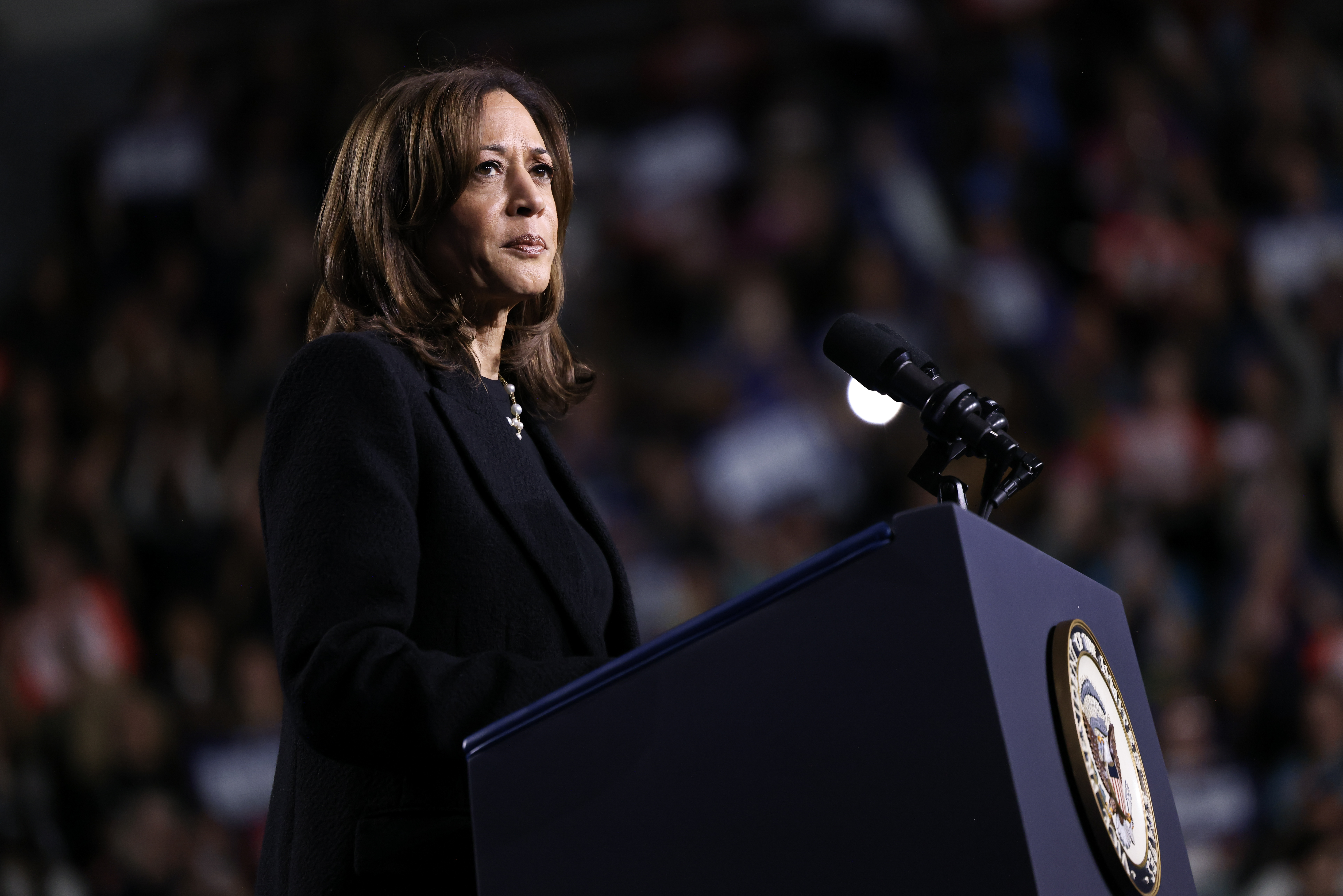
Rep. Jared Moskowitz, representing a swing district: ‘The idea that the vice president lost every swing state because she wasn’t more extreme on this issue is laughable’
CAPPELLO’S CAMPAIGN
Democrat John Cappello brings military experience in Israel to race against Mike Lawler
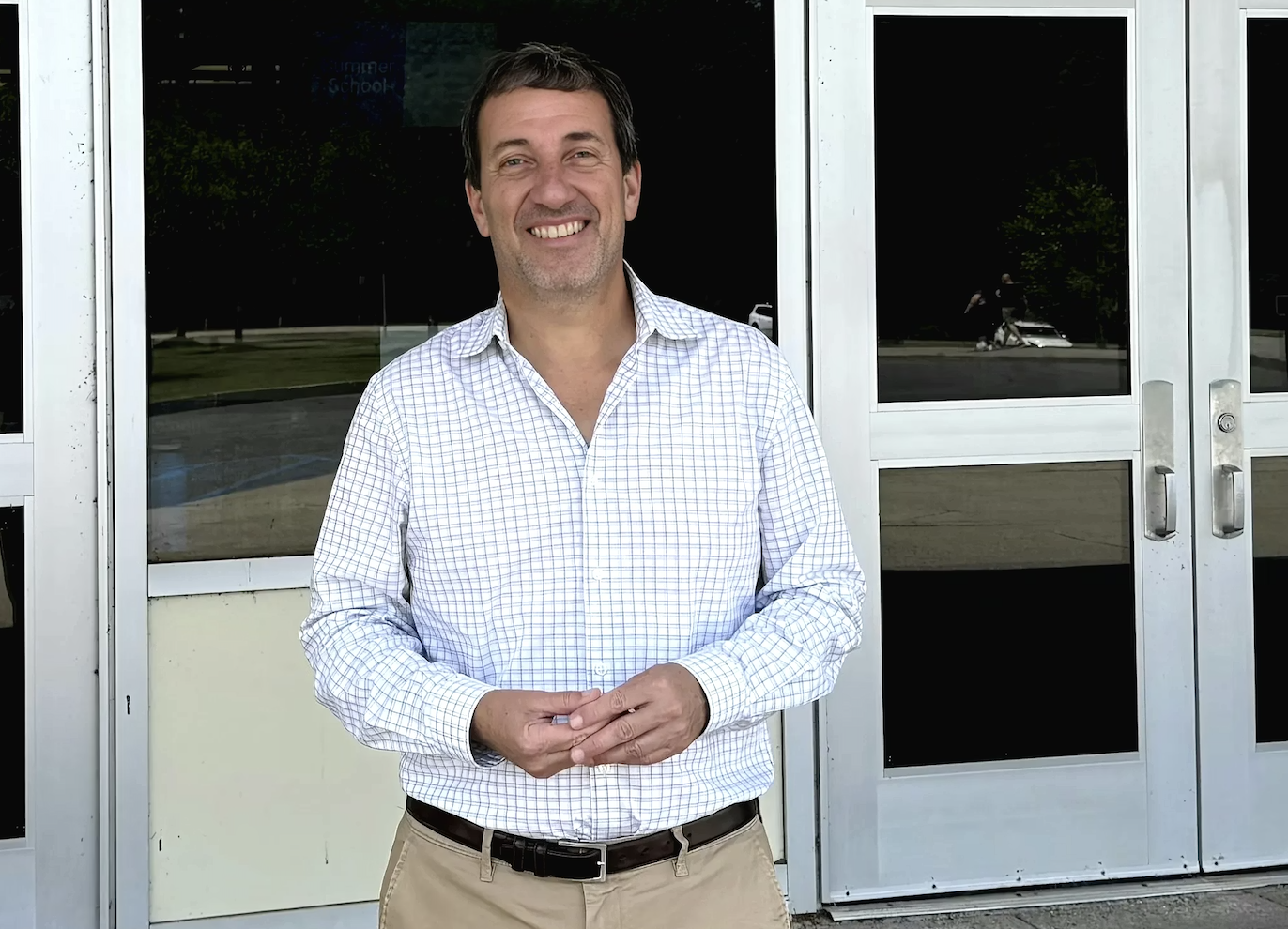
The Air Force veteran, who served for six years at the U.S. Embassy in Israel, said Israel should continue to make efforts toward peace
Plus, Trump says Iran won't rule out nuclear weapons

Mario Tama/Getty Images
Protestors gather after police cleared a new encampment on the UCLA campus on May 23, 2024 in Los Angeles, California.
Good Tuesday afternoon!
This P.M. edition is reserved for our premium subscribers — offering a forward-focused read on what we’re tracking now and what’s coming next.
It’s me again — Danielle Cohen-Kanik, U.S. editor at Jewish Insider and curator, along with assists from my colleagues, of the Daily Overtime. Please don’t hesitate to share your thoughts and feedback by replying to this email.
📡On Our Radar
Notable developments and interesting tidbits we’re tracking
Previewing his State of the Union address tonight, where it remains to be seen if he will make any announcements on Iran, President Donald Trump told reporters, “Iran wants to make a deal more than I do, but they just won’t say the sacred phrase: ‘We won’t build nuclear weapons,’” signaling that the two sides are still at an impasse ahead of the third round of negotiations scheduled for Thursday…
Secretary of State Marco Rubio briefed the congressional Gang of Eight, the bipartisan set of leaders advised on classified matters by the executive branch, this afternoon to provide an update on Iran, with CIA Director John Ratcliffe reportedly joining the discussion. The White House did not brief the group before striking Iran last June, drawing ire from Democrats…
Ahead of the meeting, Senate Minority Leader Chuck Schumer (D-NY) told C-SPAN about potential Iran strikes, “Closed-door briefings are fine, but the administration has to make its case to the American people on something as important as this”…
Around a dozen U.S. F-22 stealth fighter jets departed from the U.K. today to be deployed at an Israeli Air Force base in the south of the country, as over 150 aircraft are being moved to the region. Military experts told The Washington Post that the “assets being assembled are indicative of a multiday campaign without a ground invasion”…
The Coast Guard is investigating a swastika drawn at its primary recruit training center in New Jersey, where Coast Guard commandant Adm. Kevin Lunday quickly flew to address recruits and staff about the incident. Lunday recently came under fire from Congress, and had his confirmation delayed, over a change in Coast Guard policy that downgraded the swastika from a prohibited hate symbol to “potentially divisive,” which was eventually walked back.
Regarding the recent incident, Lunday said in a statement to The Washington Post, “Anyone who adheres to or advances hate or extremist ideology — get out. Leave. You don’t belong in the United States Coast Guard and we reject you”…
Rep. Brad Sherman (D-CA) is pushing for legislation to require an affirmative congressional vote prior to the U.S. reaching any nuclear deal with Saudi Arabia, Jewish Insider’s Marc Rod reports, following a notification from the administration to Congress indicating that it is moving toward a deal that could allow Riyadh to enrich uranium for civilian purposes.
The notification procedures, which do not include specific terms of a potential deal, suggest that Saudi Arabia will not be required to agree to more intrusive International Atomic Energy Agency inspections or “gold standard” safeguards — which would require Saudi Arabia to agree not to enrich or reprocess nuclear material — used for the U.S. nuclear cooperation agreement with the United Arab Emirates…
The Justice Department sued the University of California today under Title VII of the Civil Rights Act, which prohibits employment discrimination, alleging that the UCLA campus created a “hostile work environment against Jewish and Israeli faculty and staff.”
During campus anti-Israel protests in 2024, the DOJ said, “the University allowed antisemitic harassment to continue unabated for days” and “has ignored, and continues to ignore, gross and repeated violations” of time, place and manner restrictions on student protest. The department further claimed Jewish and Israeli faculty at the school have been physically threatened, ostracized, harassed, forced to take leave and assaulted…
The New York Times details efforts by New York’s business community and Democratic establishment to organize and promote the moderate wing of the party in response to New York City Mayor Zohran Mamdani’s rise to power. Some of the individuals involved, including former Gov. Andrew Cuomo allies Phil Singer and Steven Cohen, are considering forming PACs, watchdog groups, lobbying campaigns and more…
New York’s Working Families Party endorsed Brooklyn Borough President Antonio Reynoso to replace retiring Rep. Nydia Velázquez (D-NY) yesterday over Mamdani’s objections. The mayor has been backing Assemblymember Claire Valdez, who, like Mamdani, is a member of the Democratic Socialists of America and a vocal critic of Israel, and he had lobbied the WFP to endorse her or to stay out of the race. WFP’s director, Jasmine Gripper, told the Times, “At the end of the day, Zohran is an individual who gets to weigh in as an individual”…
A new poll from the University of New Hampshire found oyster farmer Graham Platner with a commanding lead among likely Senate Democratic primary voters, outdistancing Gov. Janet Mills by 34 points, with the primary less than four months away. In a general election matchup with incumbent Sen. Susan Collins (R-ME), Platner leads Collins by 11 points, while Mills and Collins are neck-and-neck…
Khalid Turaani, executive director of the Ohio branch of the Council on American-Islamic Relations (CAIR), testified at the Ohio Senate Judiciary Committee last week against a bill to codify the International Holocaust Remembrance Alliance’s working definition of antisemitism, where he claimed that Israel operates the world’s largest human skin bank and harvests the skin from deceased Palestinians. “And if I call them Nazis,” Turaani continued, “your law is going to punish me.”
The Anti-Defamation League’s Ohio River Valley office condemned Turaani’s speech, saying that the “antisemitic organ harvesting myth plays on the blood libel trope, which has spurred the torture, murder, and expulsion of Jews for centuries”…
The U.S. Embassy in Israel announced that, as part of the government’s “efforts to reach all Americans,” the embassy will be providing consular services for one day only at several locations across Israel and the West Bank, including Ramallah and the Jewish settlement of Efrat…
⏩ Tomorrow’s Agenda, Today
An early look at tomorrow’s storylines and schedule to keep you a step ahead
Keep an eye out in Jewish Insider for the highlights from President Donald Trump’s State of the Union address, taking place at 9 p.m. ET tonight, as all eyes are on possible U.S. military action against Iran.
Indian Prime Minister Narendra Modi arrives in Israel tomorrow, where he will be greeted by Prime Minister Benjamin Netanyahu before addressing the Knesset. In the evening, the two leaders will have dinner at Jerusalem’s King David Hotel. Read JI’s interview on Modi’s visit with Israeli Ambassador to India Reuven Azar.
The New York City Council will hold its first hearing on Council Speaker Julie Menin’s bill aiming to create “buffer zones” around houses of worship to protect from disruptive protests. The bill’s language was updated last night to remove the original 100-foot figure, which had reportedly emerged as a point of concern for the NYPD.
Congressional candidates from Illinois’ 9th District, where pro-Israel spending is boosting state Sen. Laura Fine and attacking Evanston Mayor Daniel Biss, will hold a debate on local news.
Stories You May Have Missed
SHIFTING STANCE
Sue Altman pivoting on Israel as she runs in safely Democratic N.J. district

The progressive activist ran as a pro-Israel candidate in a neighboring swing district, but is now walking back her support as she runs to succeed Rep. Bonnie Watson Coleman
PRAIRIE STATE OF PLAY
Raja Krishnamoorthi emerging as the strongest ally of Jewish voters in Illinois Senate race
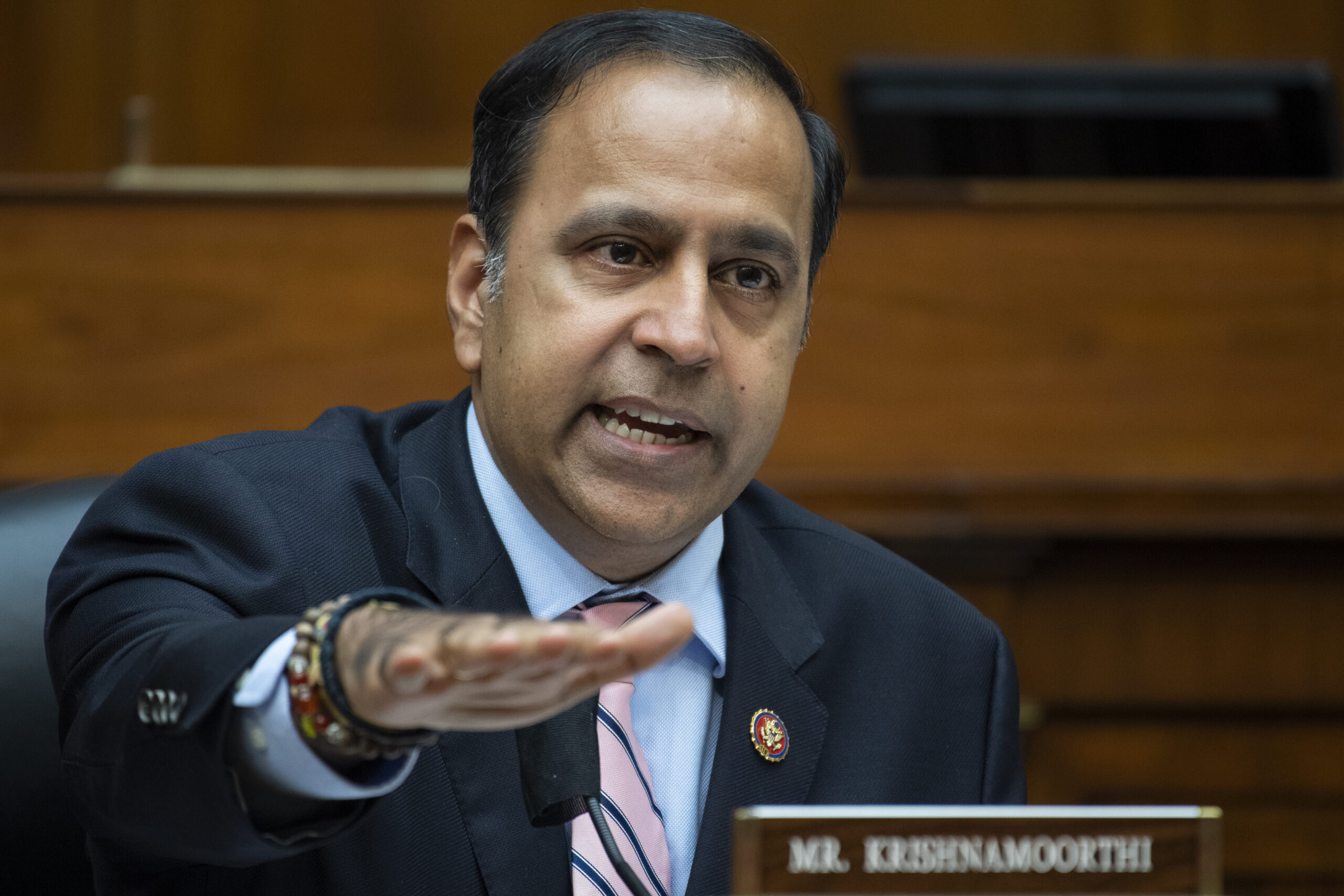
Lt. Gov. Juliana Stratton seems to be running to the congressman’s left on Israel, even as Rep. Robin Kelly is the most outspoken critic of Israel in the race
The ‘Ceasefire Compliance Act’ would require continued verification that Israel is not striking in Gaza, without exceptions for operations in response to Hamas’ violations
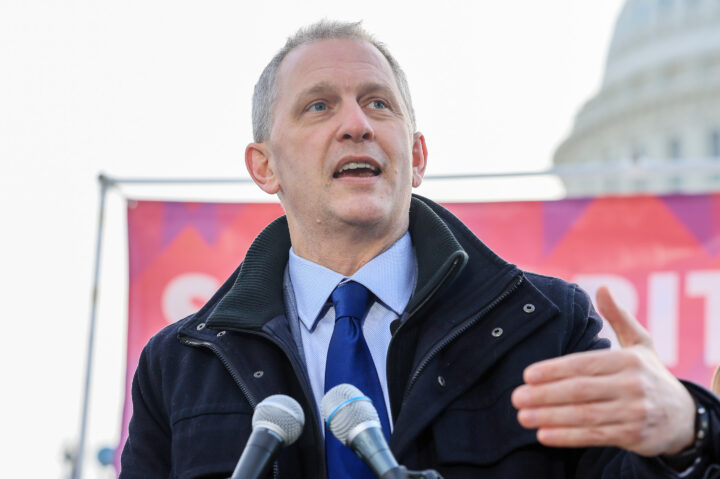
Jemal Countess/Getty Images for Protect Borrowers
Rep. Sean Casten (D-IL) speaks on Capitol Hill on February 09, 2026 in Washington, DC.
Rep. Sean Casten (D-IL) and 25 Democratic co-sponsors introduced a bill on Monday that would implement wide-ranging new conditions and restrictions on U.S. aid to Israel.
The Ceasefire Compliance Act would require the administration to assess and report to Congress every 90 days on whether Israel is complying with the October 2025 ceasefire agreement in Gaza, including halting military operations and bombing campaigns.
The legislation does not appear to contain exceptions for the strikes Israel has taken in retaliation for Hamas’ own violations of the ceasefire deal, nor mention its targeting of individual Hamas leaders.
Under the terms of the legislation, if Israel does not meet the conditions included in the law, the U.S. would be banned from selling or transferring any U.S. military systems to Israel for use in Gaza or the West Bank, any further transfers would be subject to a specific agreement by Israel that the weapons would not be used in Gaza or the West Bank and the administration would be required to reach an agreement with Israel that U.S.-origin systems already in Israel’s possession would also be banned from use in Gaza or the West Bank.
Those restrictions would remain in effect until Israel is in compliance with all conditions. The legislation establishes an end-use monitoring group within the administration to monitor whether U.S.-provided systems are in use in Gaza or the West Bank.
The legislation includes language guaranteeing that U.S. defensive assistance to and intelligence sharing with Israel, as well as provision of missile-defense systems to Israel, are exempt from the conditions. The bill would sunset after five years.
Other conditions would require Israel to work to implement President Donald Trump’s 20-point peace plan; allow humanitarian aid into Gaza; cooperate in the establishment of a temporary Palestinian government and ultimately a Palestinian Authority government in the West Bank; take “material steps” to prevent settler attacks on Palestinians in the West Bank; and ban any forcible displacement of Palestinians from Gaza, annexation of Gaza or “de facto or de jure annexation” of any part of the West Bank.
The Israeli government, and a broad swath of Israeli society, oppose the establishment of a Palestinian Authority government in Gaza given the group’s ongoing payments to the families of terrorists, among a raft of other concerns.
“As one of the United States’ most important allies, Israel must ensure that its policies and the use of U.S. military assistance align with American values, interests, and the law,” Casten said in a statement. “That starts with requiring compliance with the October 10, 2025, ceasefire agreement and the steps laid out in the 20-point plan, curbing settler violence, and rejecting annexation in the West Bank.”
The legislation includes a limited presidential waiver of the conditions for transfers and sales “vital to the national security of the United States.” The president would be required to provide a detailed justification to Congress 15 days before invoking such a waiver explaining why it is necessary and unavoidable.
“This bill redefines the system of US military aid to Israel, transforming it from a blank check to an accountability-based system that advances US strategic interests in the Middle East, aligns with American values, enhances Israel’s security, and protects Palestinian civilians,” a release by Casten’s office about the bill states. “Through thorough oversight and tough enforcement mechanisms, it makes clear that actions undermining shared U.S. and Israeli interests and values will have consequences.”
The bill is co-sponsored by Reps. Madeleine Dean (D-PA), Veronica Escobar (D-TX), Chris Deluzio (D-PA), Becca Balint (D-VT), Jim McGovern (D-MA), Jan Schakowsky (D-IL), Ro Khanna (D-CA), John Garamendi (D-CA), Don Beyer (D-VA), Jill Tokuda (D-HI), Lloyd Doggett (D-TX), Valerie Foushee (D-NC), Mike Thompson (D-CA), Sylvia Garcia (D-TX), Doris Matsui (D-CA), Derek Tran (D-CA), Emily Randall (D-WA), Jared Huffman (D-CA), Mark Takano (D-CA), Troy Carter (D-LA), Chellie Pingree (D-ME), Bonnie Watson Coleman (D-NJ), Marcy Kaptur (D-OH), Betty McCollum (D-MN) and Joaquin Castro (D-TX).
The legislation also includes specific language emphasizing that the administration has no authority to transfer U.S. funds to the Board of Peace — after Trump pledged a $10 billion U.S. commitment last week — or to provide the Board of Peace with authorities that “[supersede] the role or authorities of the United Nations.”
One source familiar with the situation told Jewish Insider that J Street, which is backing the bill alongside New Jewish Narrative and Foreign Policy for America, is making the legislation its top priority. The group is holding a conference in Washington later this month.
“The Ceasefire Compliance Act puts into law the common sense principle that American weapons cannot be used by the Israeli government in Gaza and the West Bank in ways that fundamentally violate American values and directly contravene U.S. interests,” J Street President Jeremy Ben-Ami said in a statement. “US assistance — whether aid or arms — should never come as a blank check. The CCA will ensure the Israeli government is held to agreements it has signed and abides by the ceasefire, allows a Palestinian governing council to take control of Gaza, and cannot annex the West Bank.”
Though the bill is unlikely to pass Congress under Republican control, it could provide a model for Democrats critical of Israel shy of the terms of the Block the Bombs Act and other efforts to impose a full offensive arms embargo on the Jewish state.
Plus, major Dem donor calls out 'Jew hate' in party
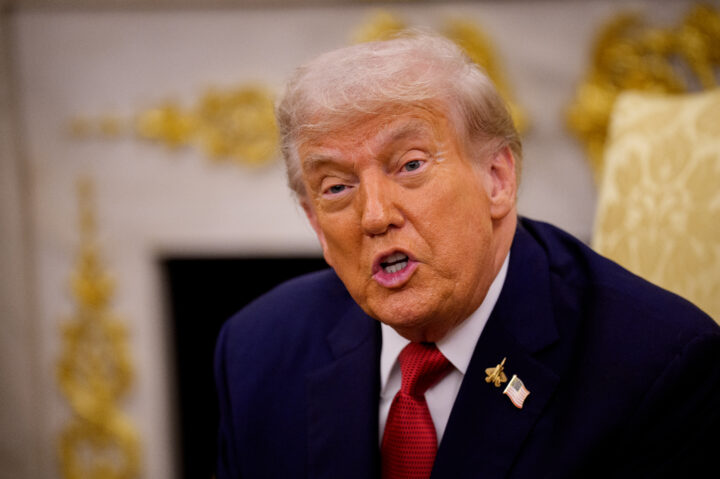
Andrew Harnik/Getty Images
President Donald Trump in the Oval Office at the White House on September 25, 2025 in Washington, DC.
Good Monday afternoon!
This P.M. edition is reserved for our premium subscribers — offering a forward-focused read on what we’re tracking now and what’s coming next.
It’s me again — Danielle Cohen-Kanik, U.S. editor at Jewish Insider and curator, along with assists from my colleagues, of the Daily Overtime. Please don’t hesitate to share your thoughts and feedback by replying to this email.
📡On Our Radar
Notable developments and interesting tidbits we’re tracking
As rumors abound about the possibility and timing of U.S. strikes on Iran, the State Department ordered the evacuation of non-essential personnel and their families from the U.S. Embassy in Beirut. “Based on our latest review, we determined it prudent to reduce our footprint,” a State official told Fox News…
Nearby, amid the buildup of U.S. military assets in the region, American refueling and cargo planes were spotted at Ben Gurion Airport…
President Donald Trump denied reports that Pentagon officials, namely Joint Chiefs of Staff Chairman Gen. Dan Caine, are raising concerns about striking Iran, writing on Truth Social this afternoon, “General Caine, like all of us, would like not to see War but, if a decision is made on going against Iran at a Military level, it is his opinion that it will be something easily won.”
“He has not spoken of not doing Iran, or even the fake limited strikes that I have been reading about, he only knows one thing, how to WIN and, if he is told to do so, he will be leading the pack,” Trump said of Caine, while alluding to the potential breadth of military action against Iran…
Secretary of State Marco Rubio pushed back his visit to Israel, originally scheduled for this weekend, to March 2, The Jerusalem Post reports, days after the next round of U.S.-Iran negotiations in Geneva on Thursday…
Sen. Chris Coons (D-DE), a leader on foreign policy among Democrats in Congress, told Jewish Insider’s Emily Jacobs that he heard “pretty stark early warning signs of some challenges where core allies do not share our priorities” on a potential Iran strike during his recent trip t0 Europe, which included stops at the Munich Security Conference, along with meetings in Ukraine and Moldova with top European diplomats.
Coons laid out what he hopes to see from the president: “A) Consult Congress. B) Make a case to the American people about why this is in our national security interest. C) Clarify what on earth he’s planning with this Board of Peace … And D) If he’s going to work with close allies to ramp up pressure to try and achieve something at the negotiating table, he should work with close allies”…
Anthony Driver Jr., a union organizer and candidate in Illinois’ 7th Congressional District, doubled down on his recent repudiation of AIPAC, despite previously having little public record on Israel policy issues. Following a press conference last week where Driver, who is running against AIPAC-backed Chicago Treasurer Melissa Conyears-Ervin, denounced the pro-Israel group, he returned donations from major Democratic Party donor Michael Sacks over the finance executive’s ties to AIPAC.
Sacks, who was a major backer of former President Barack Obama and former Chicago Mayor Rahm Emanuel, said in his reply, “It is truly sad there is so much anti Israel sentiment and outright Jew hate that Anthony found himself in this position. I can only hope that the electorate rejects hate in all forms”…
As more details emerge about Rep. Tony Gonzales’ (R-TX) alleged affair with a staffer who later committed suicide, a poll commissioned by the campaign of Brandon Herrera, Gonzales’ opponent, shows the congressman trailing Herrera by a whopping 24 points among likely GOP primary voters. The story, which entered the news cycle right as early voting kicked off, could catapult Herrera, a social media influencer with a history of antisemitism, to the Republican nomination and on to Congress…
Investigators at the cryptocurrency giant Binance found last year that about $1.7 billion had been sent from two accounts to Iranian entities with links to terror groups, The New York Times reports, even after Binance pleaded guilty to violating anti-money laundering laws in 2023 and vowed to prevent sanctioned actors from accessing its platform. Trump pardoned Binance founder Changpeng Zhao, who was jailed for his role in the saga, in October 2025…
The Atlanta Jewish Film Festival backtracked in its defense of a juror selected for a judging panel who had posted antisemitic and anti-Israel content online, whom it had stood behind even after the Israeli Consulate in Atlanta announced it was withdrawing its funding and support of the event over the pick.
The festival changed its tune yesterday, saying it is “first and foremost, a Jewish institution” and has “a responsibility, particularly at this fraught time, to stand firmly against antisemitism and to affirm the Jewish people’s right to self-determination.” It said it would review its “organizational processes and policies, including those related to antisemitism, BDS, and cultural boycotts”…
The French Foreign Ministry has moved to block U.S. Ambassador to France Charles Kushner’s access to government officials after he declined to appear for a summons by Foreign Minister Jean-Noël Barrot today, which was issued after the U.S. Embassy reposted comments by Trump about a far-right French activist who was killed in a clash with far-left protesters. It was Kushner’s second summons, after his first last year when he accused the French government of not adequately combating antisemitism…
⏩ Tomorrow’s Agenda, Today
An early look at tomorrow’s storylines and schedule to keep you a step ahead
Keep an eye out in Jewish Insider for a look at Sue Altman’s shifting views on Israel as the formerly pro-Israel congressional candidate is now running in New Jersey’s more heavily Democratic 12th Congressional District.
We’ll be watching for mention of President Donald Trump’s thinking on Iran as he delivers the annual State of the Union address tomorrow night. Virginia Gov. Abigail Spanberger will deliver the Democratic response.
The House Foreign Affairs Committee will hold a hearing on “advancing national security through commercial diplomacy” with Jacob Helberg, under secretary of state for economic affairs, who recently told JI that he hopes the Pax Silica initiative, which he leads, “will pave the way for peace and economic integration” in the Middle East.
Australia’s royal commission on antisemitism, formed after the Hanukkah terror attack at Sydney’s Bondi Beach, will hold its first public hearing, though no testimony or evidence will be heard.
Stories You May Have Missed
OVERTON WINDOW
Jewish Democrats alarmed about whether their party will remain welcoming
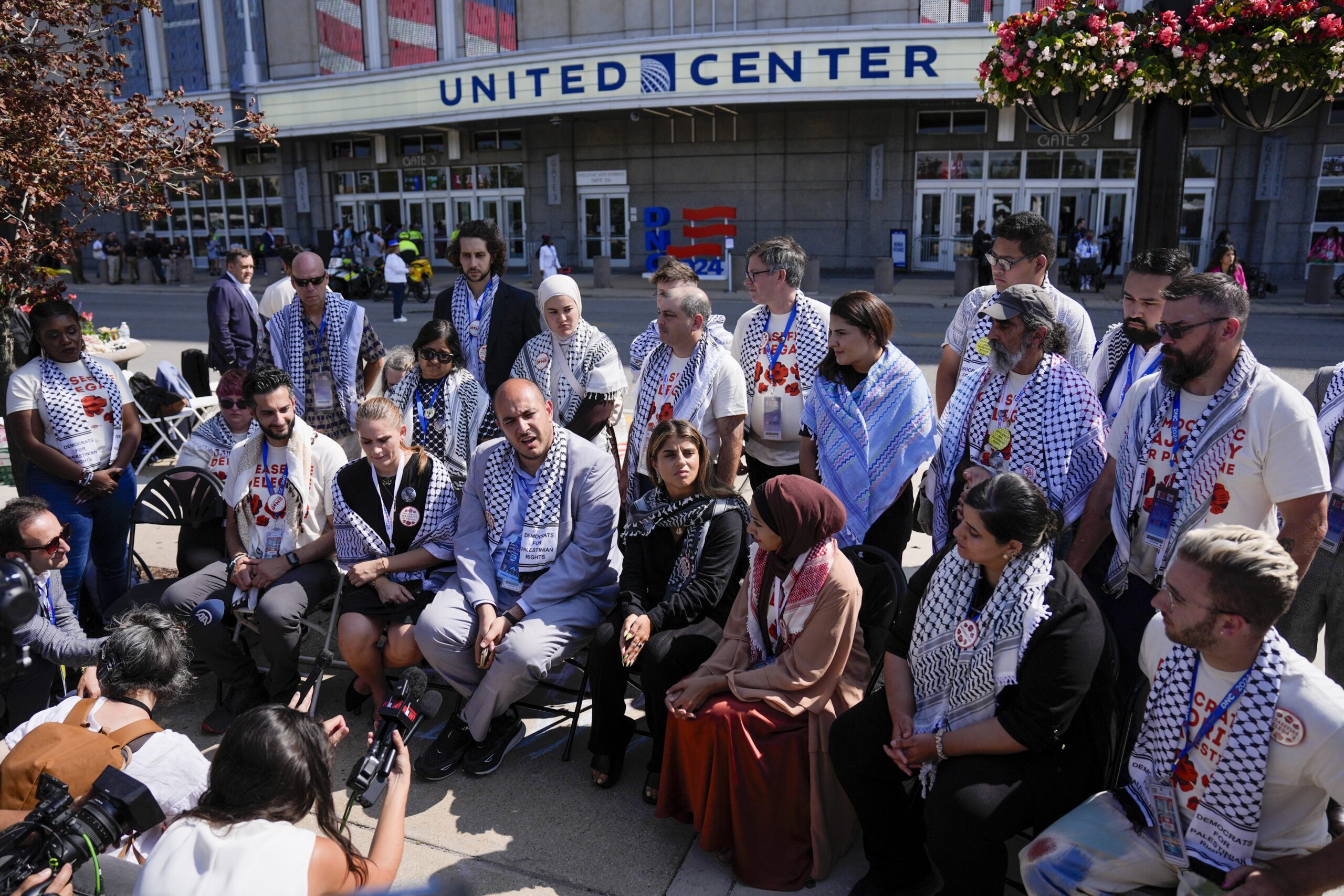
Former Democratic Rep. Kathy Manning: ‘There is no doubt that we are living through very difficult times for American Jews’
BIG TENT SHABBAT
State Dept. Shabbat dinner draws UAE, Saudi ambassadors and senior Trump officials
The dinner was hosted by Rabbi Yehuda Kaploun, the U.S. antisemitism special envoy
During an appearance on the ‘On The Record’ podcast, Sen. Lindsey Graham urges Gulf nations to prioritize regional stability and make tough choices on Iran

Sean Gallup/Getty Images
Sen. Lindsey Graham (R-SC) speaks at the 62nd Munich Security Conference on February 13, 2026 in Munich, Germany.
Sen. Lindsey Graham (R-SC) on Thursday rejected the suggestion from some in the Arab world that the deaths of civilians in Gaza does not align with Christian values. Graham made the comments during an appearance on an episode of the “On The Record” podcast with Hadley Gamble, while discussing how Israel’s war in Gaza had impacted regional stability in the Mideast and delayed normalization efforts with the Saudis.
“I just don’t buy that at all, because what did we do in World War II? Did we think for one minute about starving the Germans? Did we bomb every city into smitherreens?” Asked if that meant he was comparing Israel’s response to Hamas’ Oct. 7, 2023, attacks on the Jewish state to how the U.S. responded in World War II, Graham responded affirmatively.
“This is an absolute, existential threat to the Jewish people. What happened on October the 7th was 1,200 people were slaughtered, raped and murdered, and filmed by radical Islamists who would kill every Jew if they could.”
Gamble then pressed Graham on Israel “flattening Gaza,” which the South Carolina senator said he took no issue with.
“Just flatten it. We flattened Berlin. We flattened Tokyo,” Graham said. “Were we wrong to drop an atomic bomb to end the Japanese reign of terror? Were we? In my view, if I were Israel, I would have probably done it the same way. Without military victory, there is no hope of breaking radicalism. We flattened Germany. We flattened Japan.”
“It’s a TV war. We didn’t have TV in World War II. The behavior of the United States was to pursue total destruction of the enemy. That was our behavior. Take Tokyo and Berlin,” he added. “Those people who are trying to say this is just another conflict, it’s not another conflict. It’s existential to the Jewish state.”
Graham, who is in the Middle East for meetings with Israeli, Emirati and Saudi officials, also criticized Saudi Arabia for “attacking the United Arab Emirates pretty viciously for being in the Abraham Accords” and questioned assertions that the kingdom’s ongoing dispute with the Emiratis was solely based on differences in Sudan and Yemen.
“Saudi Arabia is now moving backward. They’re attacking the United Arab Emirates pretty viciously for being in the Abraham Accords,” Graham said. “There is no good reason for this. You can have disputes about Sudan and Yemen, but they’re basically declaring war.”
Asked if he believed the dispute “is all about Israel,” Graham replied: “I don’t know what this is about. I know the consequences. [Mohammed bin Zayed], the president of the United Arab Emirates, I’m going to meet him, you could not ask for a better partner. You could not ask for a better partner than the United Arab Emirates. They’ve stuck with the Abraham Accords through Gaza.”
In a post on X after his meeting on Thursday with Saudi Crown Prince Mohammed bin Salman, Graham praised the kingdom while acknowledging his concerns about achieving normalization with Israel.
“The Crown Prince is dealing with the aftereffects of October 7 like all leaders in the region, particularly with the tremendous loss of life in Gaza,” Graham wrote. “Having said that, his vision for the region is for conservative Islam to coexist — with tremendous economic opportunity — for the people of Saudi Arabia, the Middle East, and the entire world. He is the first Arab leader in modern history that’s expressed a vision not only for the faith, but for economic empowerment that is simply stunning when absorbed, and will set the tone for the region for generations to come.”
Graham criticized Gulf state opposition to regime change in Iran over fears about potential fallout as politically weak.
“That is a short-sighted view of the problems you face over here,” he said. “You’ve got domestic problems, so do I. I’ve got domestic problems. It’s probably better for me to be at home than it is here, so I don’t have a lot of tolerance anymore for people having to make uncomfortable decisions, because I have to make them all the time.”
Pressed on Saudi concerns about oil prices and regional instability, Graham said all of the Gulf states needed to “suck it up.”
“I’m telling everybody over here to suck it up. You’ve got to suck it up to bring about real change. Real change doesn’t come without sacrifice. Now, this region is going to change one way or the other,” Graham said. “There are two scenarios. … The inflection point is weeks away, not months away. That’s why I’m here. That’s why I haven’t slept, because it’s either going to go really good or really bad.”
Later Thursday, Graham warned in a post on X that the U.K. should not deny the U.S. the ability to use British military bases to attack Iran.
“If it turns out to be true that Britain is denying the United States the ability to use British bases against Iran if there is a necessity for an attack – it would be beyond surprising,” Graham tweeted. “I’ve been a military lawyer most of my adult life. What they’re saying about the status of Diego Garcia, the joint US-UK military base, is a huge question.”
“To my friends in Britain, sitting this one out puts you on the wrong side of history and is yet another example of how much our alliances throughout Europe have degraded,” the tweet concluded.
Plus, Trump's kind words for Qatari PM
Alex Wong/Getty Images
A visitor holds an AIPAC folder in an elevator in Rayburn House Office Building on March 12, 2024 on Capitol Hill in Washington, DC.
Good Thursday afternoon!
This P.M. edition is reserved for our premium subscribers — offering a forward-focused read on what we’re tracking now and what’s coming next.
It’s me again — Danielle Cohen-Kanik, U.S. editor at Jewish Insider and curator, along with assists from my colleagues, of the Daily Overtime. Please don’t hesitate to share your thoughts and feedback by replying to this email.
📡On Our Radar
Notable developments and interesting tidbits we’re tracking
President Donald Trump used the occasion of the first meeting of the Board of Peace in Washington today to announce significant monetary and troop commitments from the U.S. and other countries to stabilize Gaza, as well as lay out a timeline for military action against Iran, Jewish Insider’s Matthew Shea reports.
The pledges included $10 billion from the U.S. and $7 billion from several Middle Eastern countries for Gaza’s reconstruction, as well as commitments to provide troops and police to the U.S.-led International Stabilization Force. (The Guardian reports the White House is currently exploring plans to build a 5,000-person military base to house the ISF in southern Gaza.)
On Iran negotiations, Trump said in his remarks, “Now we may have to take it a step further or we may not. Maybe we are going to make a deal [with Iran]. You are going to be finding out over the next probably 10 days.”
He later told reporters on Air Force One, “Ten, 15 days, pretty much maximum.” Remember: Last June, Trump said he would decide whether to take action against Iran within two weeks, and carried out strikes on Iranian nuclear facilities two days later…
U.K. Prime Minister Keir Starmer has reportedly not given approval to Washington to use the joint U.S.-U.K. base on Diego Garcia island for a strike on Iran, as Trump said yesterday he is considering. London is concerned that a U.S. strike from the shared base, which the U.K. must grant permission to use, could implicate it in violating international law…
Trump also offered praise for Qatar’s prime minister, Sheikh Mohammed bin Abdulrahman Al Thani, during his Board of Peace remarks, despite widespread criticism of Doha’s backing of Hamas and platforming of anti-Israel actors.
“His excellency, Prime Minister Al Thani of Qatar, just a great and highly respected man,” Trump said. “I always say he needs a public relations agency because you do so much good, and they have you down as evil, and you’re not evil. You help us so much and you’re such a good ally”…
Meanwhile, Hamas is entrenching itself further in Gaza, repositioning its loyalists in government and paying salaries across the enclave, according to Reuters. Hamas has said it is willing to hand power over to the Palestinian technocratic committee established by the U.S. and led by former Palestinian Authority official Ali Shaath, but as one Palestinian source told the outlet, “Shaath may have the key to the car, and he may even be allowed to drive, but it is a Hamas car”…
Former Rep. Tom Malinowski (D-NJ), who recently lost the Democratic primary for New Jersey’s 11th Congressional District, called AIPAC’s attacks against him in the race “bizarre in several ways,” writing in an op-ed today that he has “no problem identifying as a Zionist” and calling on Democratic leaders to collectively “refuse [AIPAC’s] support, instead of letting it pick off candidates one by one”…
Rep. Jan Schakowsky (D-IL) withdrew her endorsement of Cook County Commissioner Donna Miller, the front-runner in Illinois’ 2nd District Democratic primary, over Miller’s backing by groups that are reported to be affiliated with AIPAC, though the pro-Israel group hasn’t endorsed her and neither AIPAC nor its super PAC are publicly spending any money in the district.
“Illinois deserves leaders who put voters first, not AIPAC or out-of-state Trump donors,” Schakowsky told the Chicago Sun-Times. “I cannot support any candidate running for Congress who is funded by these outside interests”…
Ahead of a hearing next week on New York City Council Speaker Julie Menin’s proposed 100-foot ban on protests around houses of worship, Mayor Zohran Mamdani said today that he had the NYPD review the legality of the measure, “and I can tell you, my police commissioner has expressed concerns about that proposal”…
Three officials appointed by Mamdani to administration posts are co-founders of a group that blamed Israel for the Oct. 7 Hamas attacks two days after they took place, the Washington Free Beacon reports.
The group, the Muslim Democratic Club of New York (MDCNY), was founded by Faiza Ali, now commissioner of the Mayor’s Office of Immigrant Affairs; Aliya Latif, now executive director of the mayor’s Office of Faith-Based Partnerships; Ali Najmi, tapped as chair of the mayor’s Advisory Committee on the Judiciary; and anti-Israel activist Linda Sarsour.
On Oct. 9, 2023, the MDCNY posted on X, “Many NYers are feeling pain, fear, and anger after the horrific events in the Holy Land this weekend. Especially as the Israeli apartheid regime have forced millions of Palestinians in Gaza to live under occupation for decades and an open air prison since 2007.” The group went on to condemn “elected officials offering support for Israeli occupation’s rampant violence as it openly declares & enacts its intent to engage in mass violence and genocide against Palestinians,” well before Israel’s ground invasion of Gaza had begun…
The Forward profiles Los Angeles City Councilmember Nithya Raman as she runs for mayor with a unique ideology: Raman is a member of the Democratic Socialists of America, but has also been vocally supportive of Israel. She called DSA’s statement blaming Israel for the Oct. 7 attacks “unacceptably devoid of sympathy” and rejects the BDS movement, but was also condemned by the local Jewish community for introducing a ceasefire resolution in June 2023…
⏩ Tomorrow’s Agenda, Today
An early look at tomorrow’s storylines and schedule to keep you a step ahead
Keep an eye out in Jewish Insider for a preview of the AIPAC Congressional Summit, which is kicking off Sunday amid the group’s increasing involvement in midterm election races.
President Donald Trump is expected to meet with governors at the White House tomorrow, though the meeting will no longer be held under the auspices of the National Governors Association, as is done annually, after the White House declined to invite Democratic Govs. Jared Polis of Colorado and Wes Moore of Maryland to a black-tie dinner on Saturday.
We’ll be back in your inbox with the Daily Overtime on Monday. Shabbat Shalom!
Stories You May Have Missed
FULOP’S FIGHT
Former Jersey City Mayor Steve Fulop brings the fight against antisemitism to NYC’s business community
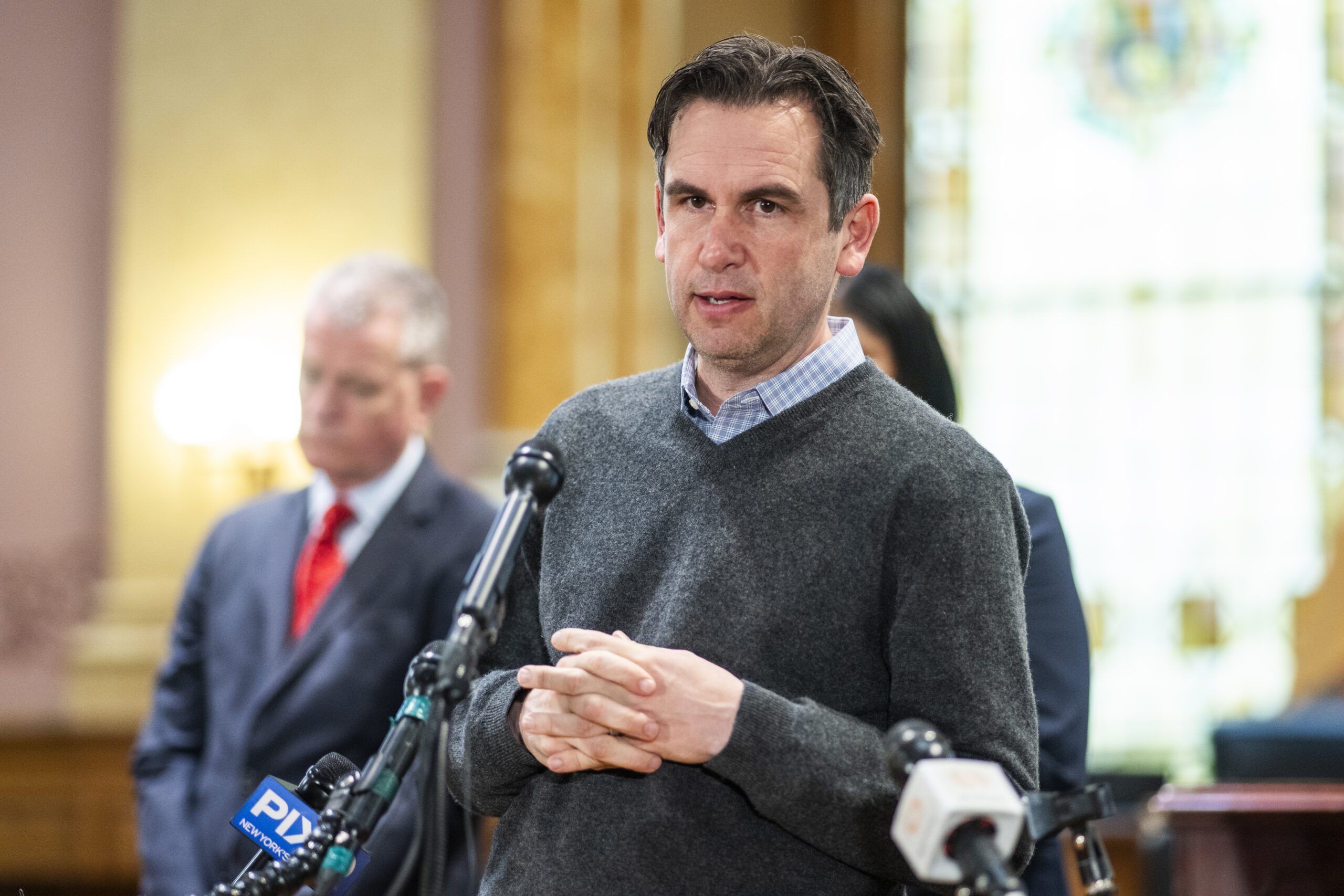
As the new head of NYC’s leading business advocacy group, Fulop said he’s preparing for ‘this experiment of what it means to be an executive in a DSA world’
TEXAS TROUBLE
How an anti-Israel Republican with an antisemitic history could get elected in Texas

An unfolding scandal involving Rep. Tony Gonzales could cost him his seat at the hands of a far-right social media influencer
At the inaugural meeting of the Board of Peace, the president also announced monetary and troop commitments from several foreign nations
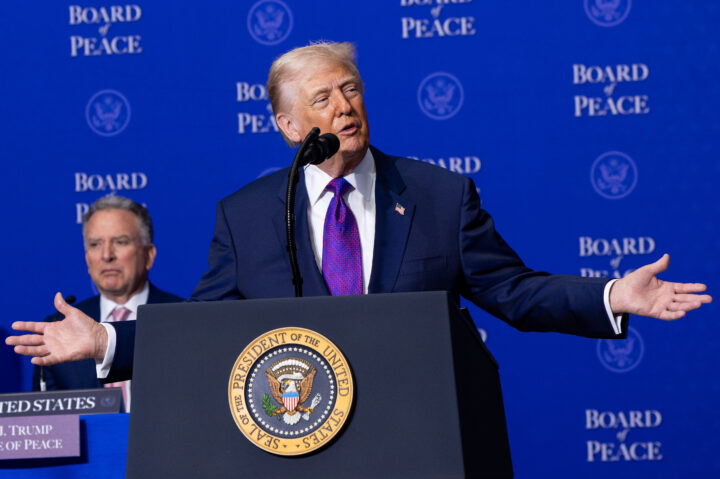
Murat Gok/Anadolu via Getty Images
President Donald Trump makes a speech during the inaugural meeting of the 'Board of Peace' at the US Institute of Peace in Washington, DC, United States on February 19, 2026.
President Donald Trump used the occasion of the first meeting of the Board of Peace in Washington on Thursday to announce significant monetary and troop commitments from the U.S. and other countries to stabilize Gaza, as well as lay out a timeline for military action against Iran.
“I want to let you know that the United States is going to make a contribution of $10 billion to the Board of Peace,” Trump said at the United States Institute of Peace, where several foreign leaders gathered for the meeting.
The president also named, for the first time, which countries have agreed to make additional financial contributions to the reconstruction of Gaza: Kazakhstan, Azerbaijan, the United Arab Emirates, Morocco, Bahrain, Qatar, Saudi Arabia, Uzbekistan and Kuwait “have all contributed more than $7 billion toward the relief package,” Trump said.
The meeting comes as the administration works to address several issues in the Middle East, including rising tensions with Iran. The U.S. has amassed a large collection of military assets in the region in preparation for a potential strike, as the two sides attempt to negotiate a nuclear deal.
Trump said in his remarks, “Now we may have to take it a step further or we may not. Maybe we are going to make a deal [with Iran]. You are going to be finding out over the next probably 10 days.”
Speaking to reporters on Air Force One later in the day, Trump said, “I would think that would be enough time — 10, 15 days, pretty much maximum.” Last June, Trump said he would decide whether to take action against Iran within two weeks, and carried out strikes on Iranian nuclear facilities two days later.
During the meeting, Trump also called on Iran to “join” the board “on a path that will complete what we’re doing.”
“If they [Iran] join us, that will be great. If they don’t join us, that will be great too, but it will be a very different path,” the president said. “They cannot continue to threaten the stability of the entire region, and they must make a deal. Or if that doesn’t happen, I maybe can understand if it doesn’t happen, but bad things will happen.”
Trump also announced that several countries would contribute personnel to an International Stabilization Force tasked broadly with securing Gaza and upholding the ceasefire between Hamas and Israel. Morocco, Albania, Kosovo and Kazakhstan “have all committed troops and police to stabilize Gaza,” he said. Indonesia vowed prior to the meeting to also contribute personnel to the body’s mission.
The president added that “Egypt and Jordan are likewise providing very, very substantial help, troops, training and support for a very trustworthy Palestinian police force. We think we’re getting some very good people on that police force.”
However, despite the announcements, questions remain over how effective the pledges will be. Hamas continues to maintain a presence in Gaza and has thus far refused to disarm or relinquish governing authority — a dynamic that could complicate reconstruction and stability efforts. Trump has not clearly defined the operational scope of the International Stabilization Force, including whether its members would be expected to confront Hamas directly or focus on traditional peacekeeping functions.
Despite those uncertainties, Trump still expressed confidence that Hamas would comply with disarmament commitments.
“[Hamas] made a promise, and they promised me they would get rid of their weapons. Looks like they’re going to be doing that,” Trump said, adding that if they do not, “they’ll be very harshly met.” Since announcing the Board of Peace, Trump has made similar threats to Hamas numerous times.
He also said there are “two countries that want to go in and do a number on Hamas,” without specifying which countries, but added, “I really don’t think that’s going to be necessary, because [Hamas] they made a promise.” The ISF is not expected to play a role in countering Hamas.
During his address, the president also took a moment to acknowledge the foreign leaders of member countries that had shown up to back the announcement, including offering praise for Sheikh Mohammed bin Abdulrahman Al Thani, Qatar’s prime minister. Despite widespread criticism of Doha’s ties to Hamas officials and support for the terrorist organization, Trump strongly defended the leader against accusations that he and his country are “evil.”
“His excellency, Prime Minister Al Thani of Qatar, just a great and highly respected man,” said Trump. “I always say he needs a public relations agency because you do so much good, and they have you down as evil, and you’re not evil. You help us so much and you’re such a good ally.”
Meanwhile, Trump signaled that he hopes to broaden the Board of Peace’s membership, though several leaders of major U.S. allies — including the United Kingdom, Germany and France — have indicated they do not plan to take part.
Trump also withdrew an invitation previously extended to Canadian Prime Minister Mark Carney after the leader delivered remarks critical of the initiative at last month’s World Economic Forum in Davos.
“So many of our friends in Europe are attending today, and we’re eager to have them become full members,” said Trump. “And we’ve had a great response from Europe. I’m excited to announce that Norway has agreed to host an event bringing together the board of peace.”
Trump also addressed the board’s relationship with the United Nations, amid questions about whether the new body is intended to complement or rival existing international institutions. He positioned the board as senior to the U.N., and that the two bodies would work “very closely.”
“We’re going to bring them back. I think the United Nations has great potential, really great potential. It has not lived up to potential,” said Trump. “The United Nations will be much stronger, and the Board of Peace is going to almost be looking over the United Nations and making sure it runs properly. But we’re going to strengthen the United Nations. We’re going to make sure its facilities are good. They need help, and they need help money wise. We’re going to help them money wise, and we’re going to make sure the United Nations is viable.”
Plus, Sen. Graham reports MBZ is alive and well

Mass Communication Specialist 3rd Class Amber Smalley/U.S. Navy via Getty Images
Flight deck of the Nimitz-class aircraft carrier USS Abraham Lincoln (CVN 72) May 10, 2019 in the Red Sea.
Good Wednesday afternoon!
This P.M. edition is reserved for our premium subscribers — offering a forward-focused read on what we’re tracking now and what’s coming next.
It’s me again — Danielle Cohen-Kanik, U.S. editor at Jewish Insider and curator, along with assists from my colleagues, of the Daily Overtime. Please don’t hesitate to share your thoughts and feedback by replying to this email.
📡On Our Radar
Notable developments and interesting tidbits we’re tracking
President Donald Trump warned U.K. Prime Minister Keir Starmer not to relinquish control over Diego Garcia — an island in the Indian Ocean that hosts a joint U.S.-U.K. base, as the U.K. plans to transfer sovereignty of the larger island chain to Mauritius, while maintaining a 99-year lease on the base — because it may act as the launching pad for a U.S. strike on Iran.
“Should Iran decide not to make a Deal, it may be necessary for the United States to use Diego Garcia, and the Airfield located in Fairford, in order to eradicate a potential attack by a highly unstable and dangerous Regime — An attack that would potentially be made on the United Kingdom, as well as other friendly countries,” Trump wrote on Truth Social…
Iran is also signaling its readiness for military conflict, The Wall Street Journal reports, including deploying Islamic Revolutionary Guard Corps naval units to the Strait of Hormuz, launching cruise missiles along the coast, conducting a military exercise with a Russian warship near the USS Abraham Lincoln, testing air defense systems, hardening nuclear sites and cracking down once more on dissidents…
Israel, meanwhile, is preparing for its civilian infrastructure to be “a central arena” in a potential U.S.-Iran conflict, Jewish Insider’s Lahav Harkov reports, as Home Front Command chief Maj.-Gen. Shay Klapper told the Knesset Foreign Affairs and Defense Committee today. Committee Chairman Boaz Bismuth said, “There is not one [Israeli] who doesn’t ask himself several times a day when there will be a campaign against Iran. The entire population and home front are preparing”…
Sen. Lindsey Graham (R-SC) dispelled rumors, seemingly spread by Saudi media, that UAE President Sheikh Mohamed bin Zayed was ill or even dying after meeting with him in Abu Dhabi today: “Not only is he alive, but he is also well and as sharp as I’ve ever seen him. To those powers that feel the need to attack MbZ and the UAE for doing the right thing — you do so at your own peril,” Graham said on X.
He also called MBZ’s decision to join the Abraham Accords and “to try to integrate the region with the whole world … one of the most consequential decisions any Middle Eastern leader has made.” Graham is now headed to Saudi Arabia where he will meet with Crown Prince Mohammed bin Salman, whom he recently told publicly to “knock it off” regarding the kingdom’s destabilizing activities in the region…
Democratic Texas state Rep. James Talarico raised $2.5 million in donations for his Senate campaign in the 24 hours after his interview on Stephen Colbert’s late-night show was reportedly quashed by CBS, Politico reports, as early voting in Texas kicked off yesterday ahead of the March 3 primary.
CBS denied it had banned the interview, saying Colbert’s show “was provided legal guidance that the broadcast could trigger the FCC equal-time rule for two other candidates, including Rep. Jasmine Crockett, and presented options for how the equal time for other candidates could be fulfilled,” which Colbert derided as a statement “written by — and I’m guessing for — lawyers”…
On the GOP side of the Texas Senate ballot, Attorney General Ken Paxton looks like the front-runner in his hotly contested primary against incumbent Sen. John Cornyn (R-TX) and Rep. Wesley Hunt (R-TX), despite the GOP establishment spending more than $60 million in attack ads against Paxton, Punchbowl News reports. (And the infighting goes further: Hunt said yesterday he filed criminal charges against a senior member of Cornyn’s campaign team for allegedly doxxing a member of his family.)
Trump told reporters last night that he still hadn’t decided which of the GOP candidates, if any, to endorse, saying, “I like all three of them actually. Those are the toughest races. They’ve all supported me. They’re all good. You’re supposed to pick one, so we’ll see what happens. But I support all three”…
Democratic Virginia state Del. Dan Helmer, a key architect of the state’s current redistricting effort, plans to enter the race for the 7th Congressional District that will be created if state voters approve a constitutional amendment to allow redistricting to proceed.
Helmer, who is Jewish and the son of an Israeli immigrant, ran for the state’s 10th District in 2024 on a staunchly pro-Israel platform, telling JI at the time that calls for conditions on U.S. aid to Israel are “incredibly frustrating.” He became the target of late-stage ad campaigns, which their backers insisted to JI were unrelated to his support for Israel, and ultimately came in second in the Democratic primary…
Humain, Saudi Arabia’s state-sponsored AI company, invested $3 billion in Elon Musk’s xAI, the company announced today. The investment came just before Musk combined xAI with his SpaceX aerospace company, giving the Saudi firm a significant stake in the major U.S. government contractor…
⏩ Tomorrow’s Agenda, Today
An early look at tomorrow’s storylines and schedule to keep you a step ahead
Keep an eye out in Jewish Insider for a look at how the emerging scandal involving Rep. Tony Gonzales (R-TX) — whom the San Antonio Express News confirmed yesterday was engaged in an extramarital affair with a staffer who committed suicide — could catapult an anti-Israel Republican, who has posted videos featuring Nazi imagery, to Congress.
Our focus tomorrow will be the first meeting of the Board of Peace, which will bring several heads of state and senior ministers, including Israeli Foreign Minister Gideon Sa’ar, to Washington. Read JI’s preview of the meeting.
Jewish Federations of North America CEO Eric Fingerhut will deliver what JFNA is calling the first “State of the Jewish Union Address,” ahead of the president’s State of the Union next week, from the organization’s Washington headquarters.
The U.S. Commission on Civil Rights will hold a daylong hearing on antisemitism on college campuses, featuring legal experts, former administration officials, students and Jewish communal leaders, which include Amy Spitalnick, CEO of the Jewish Council for Public Affairs; Kenneth Marcus, founder and CEO of the Louis D. Brandeis Center; Erin Beiner, J Street U director; and Kevin Rachlin, Washington director of The Nexus Project.
Stories You May Have Missed
MONIKER MEANING
Anger at ‘Epstein class’ bleeds into conspiratorial finger-pointing

Follow the language to its most extreme end, and what emerges is undiluted antisemitism
ROCK AND A HARD PLACE
In North Carolina’s Research Triangle, pro-Israel voters at a loss
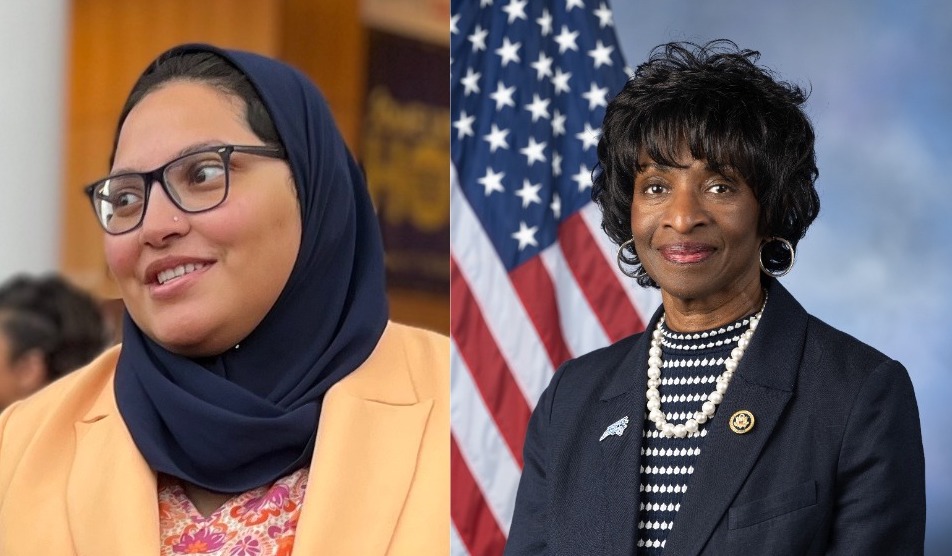
Rep. Valerie Foushee was backed by AIPAC, but has since turned against supporting Israel. Her Democratic opponent is a virulently anti-Israel activist
The International Federation of Social Workers is set to hold a vote on Feb. 18 to expel Israel over its members’ service in the IDF

Leon Neal/Getty Images
A university student studying social work helps provide emotional support to families who have been forced to evacuate from their homes in the south of Israel on October 16, 2023 in Beit Shemesh, Israel.
The largest global membership organization for social workers from around the world will vote next week on whether to expel Israel’s leading social work body, sparking a feverish advocacy campaign by Jewish and Israeli practitioners to urge members to vote against the measure.
The vote by the International Federation of Social Workers is scheduled for Feb. 18, and it comes after several members in the IFSW complained that some Israeli social workers served in combat roles in the Israel Defense Forces during Israel’s war against Hamas in Gaza. The IFSW alleges that military service violates social workers’ professional and ethical commitments to nonviolence.
The Israeli Union of Social Workers — and its allies in the United States and Canada — argue that such a request ignores Israel’s mandatory draft policy, holds Israel to a different standard from other member nations and singles out the only Jewish state. The leader of the Israeli body said it would be “entirely unimaginable” for Israeli social workers to ask not to serve in combat, noting that it would come across as “elitist” and “mark our union as illegitimate in the eyes of both the government and the public.”
“If we believed that removing the [IUSW] from the IFSW would promote peace, guarantee the rights and security of both nations — we ourselves would vote in favor,” IUSW’s chair, Inbal Hermoni, wrote in a letter urging countries to vote against the measure. “This is a noble goal. However, this is not the case.”
The IFSW comprises 141 country members — including Russia, Iran and China — representing more than 3 million people. The only other country to ever face a similar punishment from the IFSW was South Africa, which was suspended during the era of apartheid rule.
Last year, the IFSW voted to formally censure Israel — the second time the body had done so.
“This position was grounded in our ethical mandate: social workers are called to uphold human dignity, promote peace, and work for social justice. Active participation in combat contradicts these principles,” IFSW President Joachim Mumba, who is from Zambia, said last year.
Social workers, psychologists, doctors and other practitioners in the so-called “helping professions” have complained about antisemitism that they say has become normalized since the Oct. 7, 2023, terror attacks in Israel — with double standards, anti-Zionist litmus tests and outright antisemitism now viewed as widespread and even acceptable among others working in those fields.
“This vote shouldn’t be seen in isolation. It’s a reflection of the systemic hostility towards Israel and towards Jews that have come to permeate these professional spaces,” said Guila Franklin Siegel, chief operating officer of the Jewish Community Relations Council of Greater Washington. “In fighting against this, we are fighting against a much bigger problem.”
Andrea Yudell, a therapist in Washington, told Jewish Insider on Thursday that voting to expel Israeli social workers “would effectively legitimize the hostility that we’ve been seeing in the field.”
A petition organized by several groups for Jewish therapists in the U.S. and Canada is urging the National Association of Social Workers and the Canadian Association of Social Workers — the two membership organizations in each country — to publicly oppose next week’s vote.
“It imposes a nationality-based collective sanction, treating professionals as ethically suspect solely because of their national affiliation. No other national association is held to this standard,” the petition states. It has been signed by more than 11,000 people. Spokespeople for NASW and CASW did not respond to requests for comment.
Several U.S. Jewish organizations are helping to circulate the petition and generate attention about the vote, which the Anti-Defamation League called “collective punishment.”
The issue, according to Jewish social workers, goes deeper than just professional drama among the practitioners. The spread of antisemitism in a field predicated on compassion could threaten to alienate or harm Jewish clients who turn to social workers to help meet their emotional and material needs.
“It’s not just the social workers themselves. It’s the people we are trying to serve. Those people. It’s unethical to them,” said Jennifer Kogan, a licensed clinical social worker in Washington, D.C. “Jewish clients are affected by this. They don’t feel safe.”
Budd says Qatar should hand over Khaled Mashaal because he has the ‘blood of Americans on his hands’

Kevin Dietsch/Getty Images
Sen. Ted Budd (R-NC)
Sen. Ted Budd (R-NC) called on Qatar to extradite Hamas operative Khaled Mashaal to the U.S., telling Jewish Insider on Wednesday that the leader has the “blood of Americans on his hands.”
Mashaal, who is under U.S. indictment on terrorism-related charges, appeared this past weekend at the Al Jazeera Forum in Doha, where he rejected the U.N. Security Council-backed plan for Gaza — a move that could further complicate U.S. efforts to advance Phase 2 of President Donald Trump’s Gaza peace initiative.
“[Mashaal] is responsible for plotting the brutal massacre of Americans and Israelis on Oct. 7, 2023,” said Budd. “He should absolutely be extradited to the U.S. to face justice for his appalling crimes, not walking free to make public appearances in Qatar calling for Hamas to maintain its weapons and deny foreign intervention in Gaza.”
Budd also told JI that he wants to see Qatar crack down on the content disseminated by state-backed Al Jazeera.
Sen. Pete Ricketts (R-NE) said that he wasn’t familiar with Mashaal’s case in particular, but told JI that “one would like to see the that Qataris, who are supposed to be helping us out, participate or cooperate with us when we’re trying to bring terrorists to justice.”
Also featured at the forum was Francesca Albanese, the U.N. special rapporteur, who was sanctioned by the U.S. in July 2025. Appearing by video, she told forum attendees that humanity has a “common enemy” in Israel.
Middle East policy experts have cautioned that Qatar’s hosting of prominent Hamas and U.S.-sanctioned individuals allows those figures to circumvent U.S. restrictions, while promoting anti-American sentiment. The U.S. does not currently impose any direct sanctions on Qatar.
“The Qataris are not inherently violating U.S. sanctions by inviting these guys to speak,” said Natalie Ecanow, senior research analyst at the Foundation for Defense of Democracies. But, she added, “that’s not to say that this isn’t a latent disregard for U.S. sanctions by a country that’s supposed to be an ally and a partner.”
Ecanow said it is “not the first time” the Qataris have “thrown a finger in the face of American sanctions.” She noted Doha’s significant and long-term investment in Russia’s energy sector amid the ongoing war in Ukraine, as well as Qatar’s continual hosting of Hamas officials.
“The Qataris say that they were asked by the Americans to host Hamas. I have not seen documentation to prove that,” said Ecanow. “Hamas leaders have been living there for over a decade, and they amass multi-billion dollar fortunes.”
Edmund Fitton-Brown, a former British diplomat and senior fellow at FDD, called the forum in Doha a “convention of enemies of America,” telling JI that the decision to give Hamas leaders a platform is “thoroughly obnoxious.”
“The fact that this is happening doesn’t seem to me to be a significant evolution from what has been completely normal practice in Qatar throughout the year and during the Trump administration,” said Fitton-Brown. “How do you have a close relationship with Qatar when it evidently supports Hamas?”
Ecanow said Doha’s actions are especially troubling as a country that is supposed to be a U.S. partner. During Trump’s second term, the White House has worked to strengthen bonds with Qatar; the president visited last May and signed an executive order in September that regards “any armed attack on the territory, sovereignty, or critical infrastructure of the State of Qatar as a threat to the peace and security of the United States.” The two countries also finalized an agreement in October that allows Doha to build an air force facility in Idaho.
“These guys are supposed to be our allies,” said Ecanow. “It’s not just some random country that’s disrespecting U.S. sanctions. It’s a major non-NATO ally. It hosts the largest American military base in the region and invests billions of dollars in the U.S. education system.”
Michael Jacobson, a senior fellow at The Washington Institute for Near East Policy, said the issue has become a “continuous source of angst and irritation in Washington circles.” He said that entities and individuals in Qatar are involved in “sanctionable activity.”
“I’m sure there’s still Qatari entities and individuals involved in trying to send money to Hamas,” said Jacobson. “It’s interesting that this administration has sanctioned many entities and pushed other governments to sanction entities tied to Hamas and its fundraising, meanwhile I don’t think there’s been any in Qatar that have been sanctioned over the last year.”
Jacobson described the issue as a “long-standing problem” and said the Trump administration’s inaction is “telling,” adding that there is “certainly stuff you could sanction if you wanted to.” However, he also argued that the U.S. relationship with Qatar does carry upside.
“It’s not like [Qatar is] doing nothing to help us,” said Jacobson. “They did serve as a liaison to Hamas, and they were able to, with the Turks, put pressure on Hamas to release the hostages and agree to a ceasefire.”
Regardless, analysts suggested that the Trump administration is unlikely to alter its current approach to Doha.
“It would have to be something really headline-grabbing that would have the president look at it and say, ‘Hang on a minute,” said Fitton-Brown.
“In my view, the nearest we’re going to get to [sanctions] is going to be some of the actions of the Qatari state in U.S. academia, where they’re putting money into universities with completely unacceptable conditions about not criticizing Qatar or appointing totally unsuitable faculty,” said Fitton-Brown.
He added that Qatar’s influence in education “crosses over with some of the anti‑Israel, anti‑Jewish, anti‑American manifestations on U.S. campuses that have certainly been a focus of concern from this administration.”
Even if Washington stops short of imposing new penalties, Fitton-Brown argued that the larger strategic question about Qatar’s role in the U.S. and the region remains unresolved.
“[Qatar] is not a friend,” said Fitton-Brown. “At best it’s a frenemy, and at worst it’s actually a systematic and insidious and sustained threat to America, its way of life, and its values.”
Ahead of reported talks between the U.S. and Iran, Sen. Mike Rounds said the regime ‘would love to deceive us … I just don’t think we’re going to have much success’

Iranian Leader Press Office / Handout/Anadolu via Getty Images
Iranian Supreme Leader Ayatollah Ali Khamenei makes remarks in Tehran, Iran, on May 20, 2025.
Several Republican senators expressed skepticism that the Iranian regime would negotiate in good faith with the United States on its nuclear program or on its crackdown on pro-democracy protesters, as the administration pursues a diplomatic approach with Tehran following threats of military action.
Some, including Sen. Lindsey Graham (R-SC) — and the Saudi defense minister, behind closed doors — have warned that, if the U.S. fails to act after President Donald Trump promised Iranian protesters that “help is on its way,” it would be a blow to the U.S.’ credibility in the Middle East and would strengthen the Iranian regime.
Sen. Rick Scott (R-FL) expressed skepticism that the Iranians would engage sincerely or willingly give up their nuclear program in talks with the U.S., reported to be taking place in Turkey on Friday.
“Wouldn’t that be great? It’d be great if they did. It’d be great if they got rid of their nuclear weapons,” Scott told JI. “Do I actually believe they’re going to negotiate in good faith? I don’t.”
Scott added that he was in favor of Trump taking action to support the protesters after promising to do so. “I think if you tell somebody you’re going to help them, you’ve got to help them,” the Florida senator said.
Sen. Mike Rounds (R-SD) said he believes Trump “wants to avoid a war.”
“I hope he’s successful,” Rounds added, but said that he is not optimistic that a viable deal is achievable. “I, personally, am really discouraged. I don’t think Iran really wants to negotiate a deal that would stop them from doing their terrorist activities, supporting terrorism around the area, and I don’t think they really want to give up their nuclear ambitions — although they would love to deceive us,” Rounds said.
“I wish [Trump] the best. I think he’s right in trying to do [make a deal]. I think that’s what we should be trying to do, but I don’t, I just don’t think we’re going to have much success,” he added.
Sen. Markwayne Mullin (R-OK) said, “You can’t trust anything the ayatollah says at all.”
“I don’t know what the details are, so it’s hard for me to say what I’d like to see in [an agreement],” Mullin continued. “We all know that a nuclear Iran can never happen, so that’s got to be part of it. What else happens there? I don’t know, but I still go back to the fact that you can’t trust anything that the ayatollah or this current regime says.”
Mullin disagreed that not striking Iran would be seen as a shift in U.S. policy, describing the administration’s current approach as an extension of the president’s “peace through strength” policy.
“People respect that the president will always strike, or ratchet that up, when the time is right. He always wants diplomacy first, but he’s willing to use the strength part if he has to get to that point,” Mullin said. “And I think that’s what the president has positioned himself to do, but he has multiple options … so hopefully we’ll have a positive outcome without anyone getting hurt.”
Sen. John Kennedy (R-LA) said that he’d want to see Iran surrender its enriched uranium, give up any future potential to obtain a nuclear weapon, stop funding terrorist groups and “start being a responsible member of a stable world order.”
He disputed the notion that a failure by the U.S. to launch strikes now would hurt the country’s credibility, arguing that any military strikes would be based on U.S. intelligence, which he does not have.
“It’s a lot more complicated. I mean, these folks are entitled to their opinion … obviously I hope the negotiations are successful,” Kennedy said. “Whether the president decides to go further is going to depend an awful lot on national and military intelligence, which I don’t have access to. We have the best spies in the world, and I don’t know what they’re telling the president, but it matters. So I can’t advise him if I don’t have the information from the intelligence community.”
Sen. Richard Blumenthal (D-CT) said that any deal with the Iranians would need to include “a complete renunciation of nuclear arms and ballistic missiles that can reach Israel or our European allies.” He also said the regime’s crackdown on protesters would need to be “renounced.”
“They’re a country that continues to maintain ‘death to America, death to Israel.’ It is what it is,” Blumenthal said. “On a military front, there has to be a complete renunciation of nuclear weapons and long-range ballistic missiles, and I think the brutal and inhumane tactics toward its own people have to be renounced.”
“I think we should do something, but it may not be a military strike,” he added. “There are a range of actions that we could take, [such as] to expand economic efforts and [implement] a stronger enforcement of sanctions. So between those, there are options.”
Sen. Tim Kaine (D-VA), who recently introduced a war powers resolution to block military action against Iran without congressional authorization, explained to JI that the resolution was a response to Trump’s comments about a potential attack and the current deployment of U.S. military assets to the Middle East.
Kaine said that the resolution would be eligible for consideration on the Senate floor next week, and that whether he calls it up will depend on how events develop and whether it will have the votes to pass.
“What really prompts me is when I think I can get the votes,” Kaine said. “Usually that means something beyond saber-rattling and it’s some kind of step, like in the international waters or Venezuela, we’re actually killing people — that clearly demonstrates we need to do this.”
Kaine also emphasized that the administration’s explanation for potential military action against Iran has shifted — citing both the protests and nuclear issue — and said he was concerned by a report last week that the administration may be considering some ground deployment of special forces into Iran.
“I’ve just got an awful lot of military families in Virginia who don’t want their kids to be in another war in the Middle East,” Kaine said.
The group behind the pro-Hamas chants in Queens has a nationwide network and links to pro-terror organizations and individuals

Selçuk Acar/Anadolu via Getty Images
Anti-Israel demonstrators gather at 'No Settlers on Stolen Land' protest against a Nefesh b'Nefesh event at the Park East Synagogue in Manhattan in November 2025.
The group behind a pro-Hamas demonstration near a Queens synagogue earlier this month and a series of other events targeting Jewish religious institutions has deep pockets — and deep roots, which criss-cross the country and link it to various extremist cells — according to publicly available tax filings.
The demonstrators who broke into chants of “Say it loud, say it clear, we support Hamas here” outside Young Israel of Kew Garden Hills — and triggered outrage over New York City Mayor Zohran Mamdani’s belated condemnation — were affiliated with an outfit known by multiple names: Palestinian Assembly for Liberation (PAL), Al-Awda (Arabic for “the return”) and Palestine Right to Return Coalition (PRRC). But official filings with state and federal authorities reveal that the groups are different monikers of a single nonprofit operation, one whose revenue has exploded in recent years: from just $44,789 in 2022 to $451,903 in 2024, the most recent period for which filings are available.
The group also orchestrated the action targeting Park East Synagogue in Manhattan in November, and the “Flood Boro Park” rally that devolved into violence last February. On the day of Hamas’ Oct. 7, 2023, attacks on Israel, the organization issued a full-throated endorsement of the assault.
“The Palestinian Assembly for Liberation and Al-Awda NY send their highest salutations to the Palestinian Resistance, the Freedom Fighters and Defenders of the indigenous Palestinian people,” a post on its Facebook page reads. “PAL and Al-Awda NY call on Palestinians globally to take their place in history, and to mobilize in all fora in support of the Liberation Operation.”
The group helped organize a Times Square protest the following day, alongside multiple far-left organizations. Much of the blowback the event received from New York officials centered on the participation of the NYC chapter of the Democratic Socialists of America, of which Mamdani is and was a member.
However, materials promoting the demonstration show that its staging received support not just from PAL/Al-Awda/PRRC but also from the People’s Forum, a Manhattan-based arm of a global network financed by Beijing-based tech mogul Neville “Roy” Singham. Singham and his wife, Jodie Evans, have poured their massive fortune into advancing disinformation supportive of the Chinese government and its allies, Russia and Iran. The People’s Forum also hosted Al-Awda’s national conference in 2022, which featured speakers from the DSA BDS Working Group.
Social media and blog posts reveal that PAL/Al-Awda/PRRC has also worked closely with Evans’ organization CODEPINK, known for its tactics of disrupting Capitol Hill hearings and political events, and for its pro-China and pro-Iran activism. PAL/Al-Awda/PRRC has also long partnered with the Party for Socialism and Liberation and its affiliate, Act Now to Stop War and End Racism Coalition, which provides staff to the Singham network. All of these groups have been involved in the Shut It Down 4 Palestine protest campaign, as well as in the 2024 encampments at Columbia University.
PAL/Al-Awda/PRRC also has ties to Samidoun, a group identified by Israel, Germany, Canada and the United States as a fundraiser and affiliate of the Popular Front for the Liberation of Palestine, which has been designated as a terror group by the U.S. for decades. PAL/Al-Awda/PRRC and Samidoun have cross-promoted and participated in each other’s events for years.
Further, a booklet for a 2023 “People’s Tribunal” on the Al-Awda website identifies Samidoun co-founder Charlotte Kates as “a member of Al-Awda, The Palestine Right to Return Coalition,” and archived versions of a now-deleted page listing PAL/Al-Awda/PRRC’s national board identified Kates as the group’s “Communications/Secretary” from 2021-2023. These pages also reveal that Nerdeen Kiswani, the founder of Within Our Lifetime and an outspoken defender of militant group violence, served as PAL/Al-Awda/PRRC’s “Youth Representative” in these same years. During that same period, Kiswani was a student at CUNY Law School, and delivered a speech at the school’s 2022 commencement in which she alleged that she had “been facing a campaign of Zionist harassment by well-funded organizations with ties to the Israeli government and military.”
The national board also includes attorney Lamis Deek, who has publicly praised Hamas, the PFLP, and Iran’s Al-Quds intelligence force — and who officially launched the “Palestinian Assembly for Liberation” with other Al-Awda organizers in 2021.
The PFLP and Hamas are not the only terror organizations with which PAL/Al-Awda/PRRC and its leaders have shown affinity. The Anti-Defamation League discovered one of the group’s self-identified founders, Abbas Hamideh, lauded Hezbollah on his Twitter account.
Tax documents show PAL/Al-Awda/PRRC at present has just two officers on its board. The organization’s chair is Amani Barakat, part of a prominent business, real estate and philanthropic dynasty based in Southern California. The late family patriarch, Adil Barakat, was a leader in the Arab American Press Guild and the United States Organization for Medical and Educational Needs, a relief organization centered on Middle Eastern affairs.
PAL/Al-Awda/PRRC’s treasurer and only other listed executive is Anas Amireh, a Miami-area realtor who has lectured at Florida International University.
Barakat, Amireh and Deek did not respond to requests for comment, and messages left in an inbox and at a phone number listed on the Al-Awda website similarly received no answer.
The source of the group’s swelling resources isn’t clear from public information. It has received sizable contributions from “dark money” funds that mask the original contributor’s identity, as well as from the WESPAC Foundation, a New York-based charity that has come under fire for underwriting organizations that call for Israel’s destruction.
Labor for Palestine and U.S. Campaign for the Academic and Cultural Boycott of Israel are also both affiliated with PAL/Al-Awda/PRRC, and operate out of its address in Coral Gables, Fla.
Plus, Jason Zengerle on Tucker's transformation

Chesnot/Getty Images
PARIS, FRANCE - JUNE 16: Saudi Arabia's Crown Prince Mohammed bin Salman (MBS) poses prior to a working lunch with French President Emmanuel Macron at the Elysee Presidential Palace on June 16, 2023 in Paris, France.
👋 Good Monday morning!
In today’s Daily Kickoff, we talk to journalist Jason Zengerle about his new book about Tucker Carlson’s political evolution, and look at the wave of antisemitic and anti-Israel messaging coming from Saudi Arabia in recent weeks. We spotlight White House advisor Josh Gruenbaum’s position as a key player in U.S. diplomacy, and look at the role that the United Auto Workers union is playing in anti-Israel activist efforts. Also in today’s Daily Kickoff: Jennifer Mnookin, Morris Katz and Marc Shaiman.
Today’s Daily Kickoff was curated by JI Executive Editor Melissa Weiss and Israel Editor Tamara Zieve, with assists from Danielle Cohen-Kanik and Marc Rod. Have a tip? Email us here.
What We’re Watching
- Ahead of International Holocaust Remembrance Day tomorrow, Meta, UNESCO and the World Jewish Congress are convening a discussion at the U.N. today in New York focused on the role that technology can play in Holocaust preservation efforts.
- Israel’s Ministry of Diaspora Affairs is hosting the second annual International Conference on Combating Antisemitism in Jerusalem. Speakers at the two-day confab include Diaspora Affairs Minister Amichai Chikli, the Department of Justice’s Leo Terrell, Albanian Prime Minister Edi Rama, former New York City Mayor Eric Adams and Jewish Federations of North America CEO Eric Fingerhut.
- Elsewhere in Jerusalem, Israeli President Isaac Herzog will host the annual lecture of the Jabotinsky Institute at the President’s Residence tonight, delivered this year by U.S. Ambassador to Israel Mike Huckabee.
- The IDF, acting on new information from Hamas, is conducting an operation in northern Gaza to locate the remains of Ran Gvili, who was killed during the Oct. 7, 2023, attacks.
- The Saudi Real Estate Future Forum kicks off today in Riyadh. Former Secretaries of State Hillary Clinton and John Kerry are slated to speak, as is far-right commentator Tucker Carlson.
What You Should Know
A QUICK WORD WITH JI’S LAHAV HARKOV
Anti-Israel and antisemitic messages from Saudi regime mouthpieces and state-sanctioned media have increased in recent weeks, as Riyadh has pivoted away from a more moderate posture to an alignment with Islamist forces, such as Qatar and Turkey.
Over the weekend, prominent Saudi columnist Dr. Ahmed bin Othman Al-Tuwaijri wrote an article in a Saudi news site attacking the United Arab Emirates, with whom Saudi Arabia has been at odds in recent weeks, as “an Israeli Trojan horse in the Arab world … in betrayal of God, His Messenger and the entire nation.” He also wrote that “Israel is on a path to a rapid downfall and the umma [community of Muslims] will remain, God willing.” The column, published after weeks of anti-Israel and antisemitic messaging from Saudi-backed channels, sparked an uproar from Western voices, including the Anti-Defamation League, which condemned “the increasing frequency and volume of prominent Saudi voices … using openly antisemitic dog whistles.”
Hussain Abdul-Hussain, a research fellow at the Foundation for Defense of Democracies, said on the “Ask A Jew” podcast earlier this month that the Trump administration needs “to have a serious talk with” the Saudis. “I’m ringing the alarm; I’m breaking the glass,” he said. “I’m saying, listen, these guys are changing.”
In the past, “you only got these crazy terrorist clerics, the al-Qaida types … would be inciting against the Jews,” Abdul-Hussain said. “But this week, the [Saudi] state-owned media was inciting against the Zionist plan to partition the region and to divide the region. This is very new.”
One possible reason for the turn in Saudi messaging is that Riyadh is “very afraid of Israel,” Edy Cohen, a research fellow at the Israel Center for Grand Strategy, told Jewish Insider, noting that it views recent Israeli actions as going against Saudi interests.
Cohen noted that “the Saudis and the Qataris led a campaign for Trump not to strike Iran. …[The Saudi leadership] heard [exiled Iranian Crown Prince Reza Pahlavi] said the new Iran will normalize relations with Israel, and this drove the leadership crazy. Imagine Iran and Israel together … It’s their biggest nightmare.” Riyadh and Jerusalem are also at odds on Syria and Somaliland.
NEW ON THE SCENE
Josh Gruenbaum’s rapid rise from overseeing federal contracting to dealmaking on the world stage

Josh Gruenbaum’s Thursday started in Davos, Switzerland, at the signing ceremony to inaugurate President Donald Trump’s Board of Peace. Gruenbaum walked onto the World Economic Forum stage where Trump sat, surrounded by world leaders, to hand the president the board’s first resolution — focused on the demilitarization and reconstruction of Gaza — for him to sign. Hours later, Gruenbaum’s day ended at the Kremlin in Moscow, alongside White House Special Envoy Steve Witkoff and advisor Jared Kushner. Gruenbaum is a relatively new figure on the diplomatic scene. He started working with Witkoff and Kushner soon after the ceasefire between Israel and Hamas took effect in October, Jewish Insider’s Gabby Deutch reports.
Trajectory: Since then, Gruenbaum has been spotted in meetings with Israeli Prime Minister Benjamin Netanyahu and Ukrainian President Volodymyr Zelensky. Earlier this month, hewas named a diplomatic advisor to the new Board of Peace, which the Trump administration is reportedly envisioning as a replacement to the United Nations. It’s a somewhat surprising turn for Gruenbaum, whose expertise is not diplomacy or foreign policy but investment banking. But with his business background, Gruenbaum fits in with Witkoff and Kushner, both of whom come from the real estate world. His rise underscores how the Trump administration is reshaping the machinery of government by elevating loyalists with private-sector backgrounds and expanding their portfolios far beyond traditional lanes.
HER WAY
Tahesha Way campaigns as close ally of Jewish community in pivotal N.J. special election

Campaigning in a crowded field for the New Jersey House seat recently vacated by newly inaugurated Gov. Mikie Sherrill, former New Jersey Lt. Gov. Tahesha Way is leaning strongly into her support for Israel and the state’s Jewish community, Jewish Insider’s Marc Rod reports.
What she said: Speaking to JI last week, Way cited the rise in antisemitism that is leaving Jewish voters “terrified” as one of the reasons she’s running for office, alongside her concern about attacks on civil liberties, health-care access, the economy and immigration raids. She said that, going forward, it’s “really my fervor and my hope to continue my work on behalf of the Jewish community,” highlighting the work of the New Jersey-Israel Commission — which fell under her purview when she served as secretary of state — to increase trade between Israel and New Jersey as well as push back on antisemitism.
BISS’ BACKTRACK
Daniel Biss reversed position on aid to Israel after launching congressional campaign
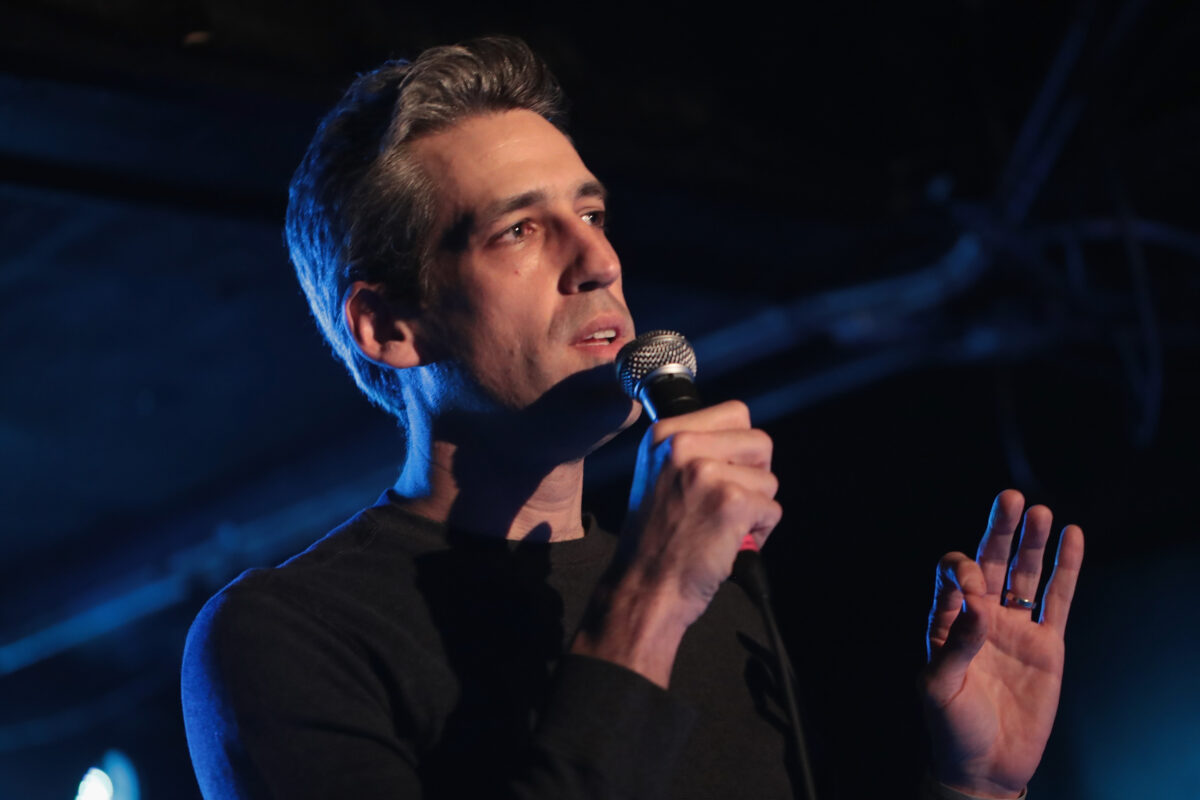
Evanston, Ill., Mayor Daniel Biss, who has expressed support for cutting off some military aid to Israel during his campaign for Congress in the Chicago suburbs, had expressed support for continued aid to Israel earlier in the campaign, according to a position paper Biss himself released Friday amid scrutiny of his past communications with AIPAC, Jewish Insider’s Marc Rod reports.
What it says: Biss said Friday that he had met with local AIPAC representatives to lay out his positions, but that he does not share AIPAC’s views and met with the group in the interest of open communication and in hopes “they might decide not to direct [their] MAGA donors to support [his primary opponent, state Sen.] Laura Fine.” The paper Biss released — which includes stances largely in line with those of other candidates AIPAC has endorsed — stated that Biss supports continued aid to Israel under the terms of the current U.S.-Israel memorandum of understanding, and that he would support another MOU in the future. Biss now supports efforts to impose an offensive weapons ban on Israel — a direct contradiction to the MOU.
Texas turnaround: Texas state Rep. James Talarico, a Democratic candidate for Senate in the state, has disavowed AIPAC and pledged not to take support from the group on the campaign trail. But in late 2019, he attended an AIPAC event alongside a major donor to his campaign, according to a contemporaneous Instagram post about the event posted by an AIPAC supporter, JI’s Marc Rod reports.
UNSEALED
Newly released memos reveal State Dept. concerns about basis for student deportations
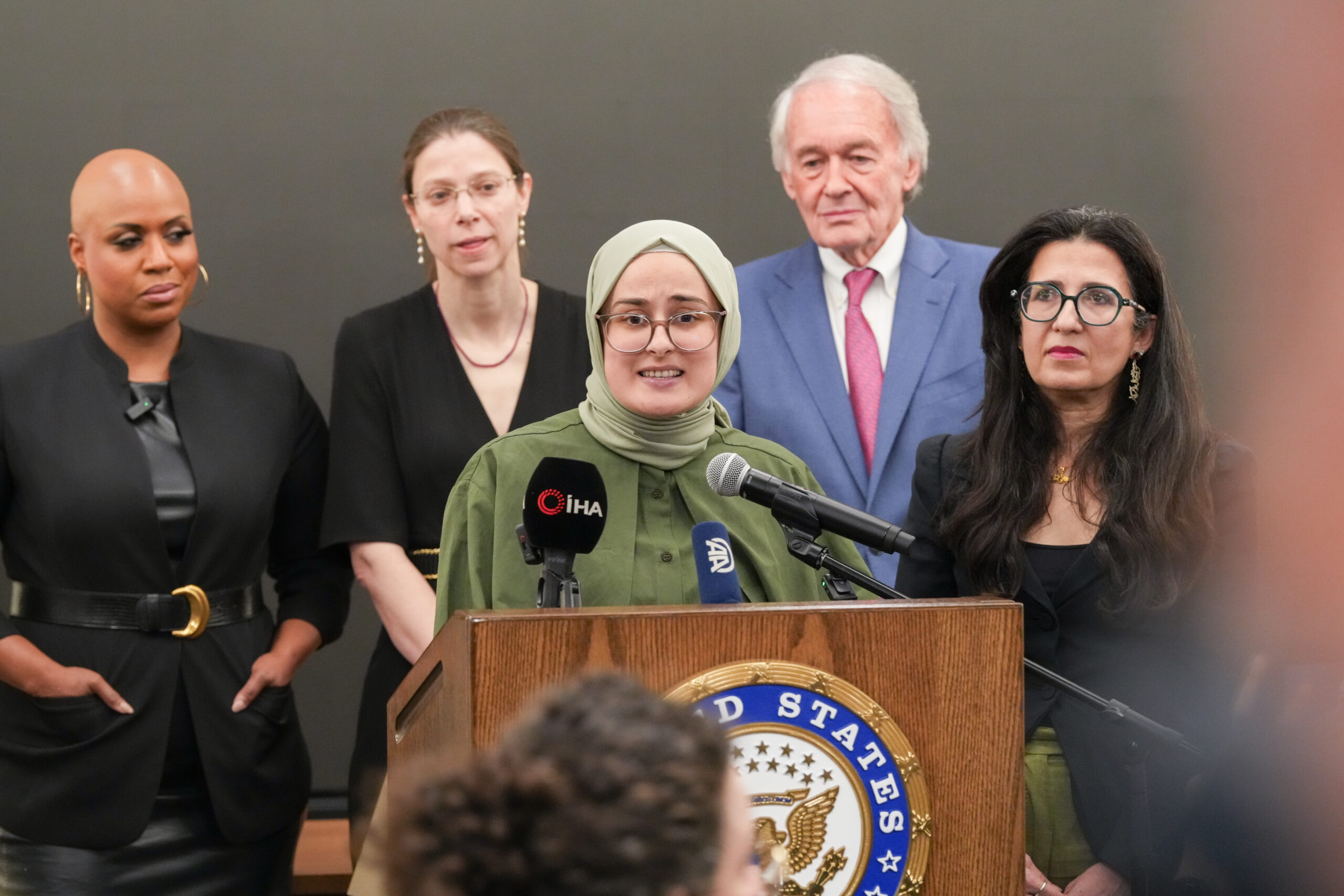
State Department officials who were tasked with deporting foreign students accused of antisemitism and threatening American national security warned that the efforts may present free speech concerns, according to government documents that a federal judge released last week. The several hundred pages of previously sealed federal documents are connected to the ongoing deportation cases against Mahmoud Khalil, Rümeysa Öztürk, Mohsen Mahdawi, Yunseo Chung and Badar Khan Suri, each of whom U.S. immigration authorities targeted because of their involvement in anti-Israel activity at American universities, Jewish Insider’s Gabby Deutch reports.
Scant evidence: One case concerned the visa status of Öztürk, a Turkish student at Tufts University who was ordered to be deported last March and was arrested by federal agents on her way to a Ramadan event. A senior Department of Homeland Security official told JI last year that federal investigators “found Öztürk engaged in activities in support of Hamas, a foreign terrorist organization that relishes the killing of Americans.” The only public evidence at the time connecting her to the anti-Israel protest movement was a 2024 op-ed in Tufts’ student newspaper that she penned with three other students calling for the university to divest from Israel. One of the State Department memos unsealed last week revealed that this op-ed was the sole basis for the effort to deport her — and that department officials recognized it might face legal challenges.
UNION LABEL
Beyond the assembly line: Auto workers’ labor union emerges as key player in anti-Israel activism
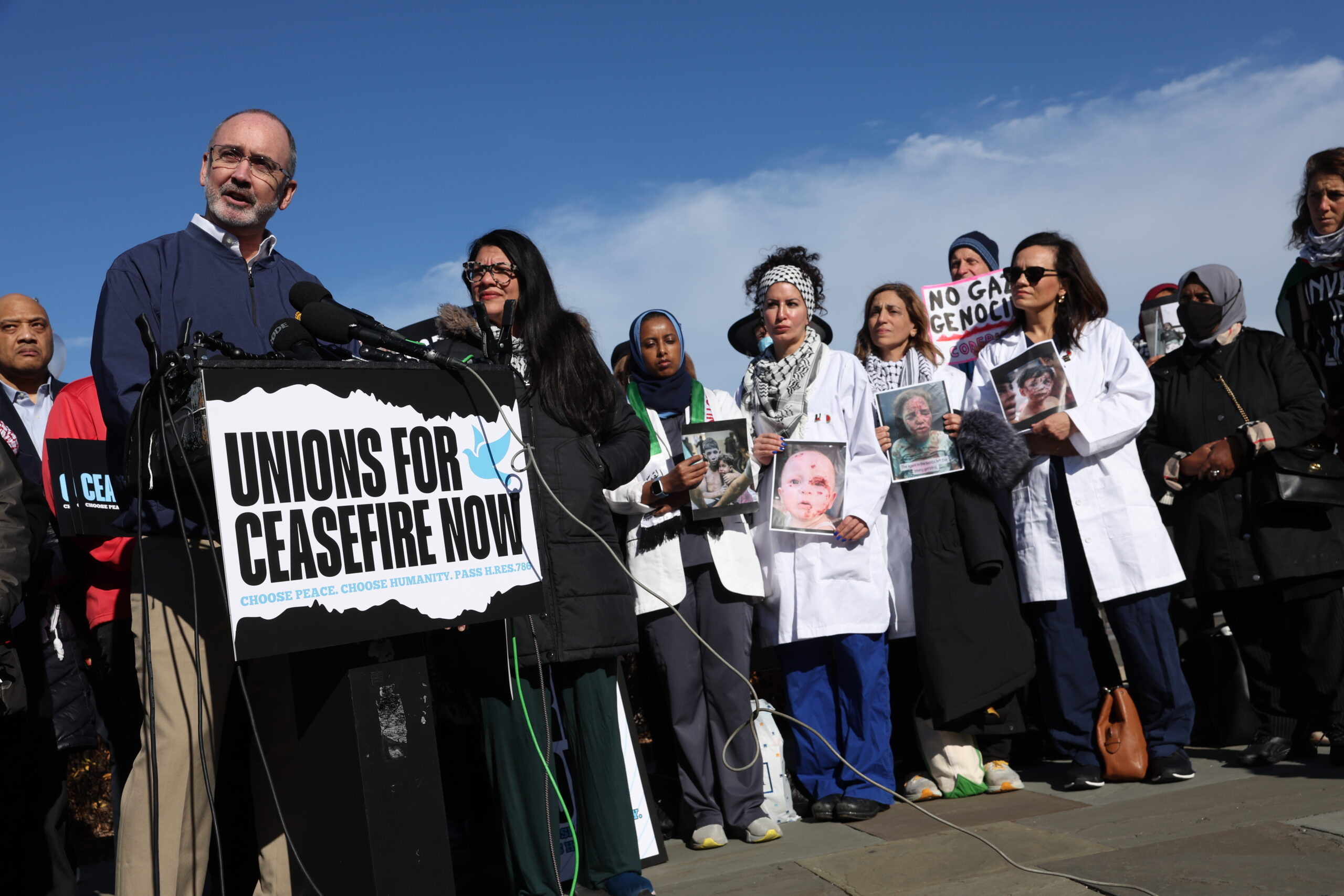
The United Auto Workers, one of the largest unions in the country, has increasingly drifted away from its core mission of representing autoworkers in the workplace, driven by individuals pushing an extreme anti-Israel political agenda that leaves critics questioning the relevance to workplace issues. The most recent example came earlier this month, when 30% of the 275 employees of the Israeli-owned Breads Bakery signed union authorization cards for UAW Local 2179, the percentage necessary to petition the National Labor Relations Board for a union election. The group’s demands include that the management of the New York-based bakery chain, CEO Yonatan Floman and founder Gadi Peleg, “halt use of bakery profit to materially support the Israeli occupation,” Jewish Insider’s Haley Cohen reports.
Behind the push: Deborah Lipstadt, who served as the State Department’s antisemitism envoy under President Joe Biden, told JI that “many institutions and organizations, whether they be universities, unions [or] city councils, a small group is able to go in and organize, and with the minority of members, push a policy.” Lipstadt, a historian who has served on Emory University faculty for more than 30 years, said she has “seen similar situation[s] on university campuses and [within] professional academic organizations where a small group, sometimes just a few individuals, is able to gain control and push the organization in a certain direction, even if the vast majority of members don’t agree. I wonder if that is the same thing happening” with the Breads unionization push, she said.
Worthy Reads
Hatred, Then and Now: In The Telegraph, Deborah Lipstadt, who served as the Biden administration’s antisemitism envoy, distances modern-day antisemitism from that of prewar Europe, but warns that similar sentiments can erode society if not properly addressed. “There are no shortages of historical examples of anti-Semitism. And probably each generation that faced these disasters wondered if their experience paralleled that of a previous generation. While we do not want to forget or ignore the past – something I have spent my whole life studying and teaching – or ignore what might be the consequences of this cosmic hatred, we also must avoid finding or inventing simple continuities. Every situation and era has unique characteristics. While the past can remind us just how bad things can get, we must avoid using it as a template for predicting the future. … Today we find anti-Semitism on the Right and the Left. We find it among Christian nationalists and Islamist radicals. We find it among white supremacists and multiculturalists. We even find it among Jews. Too many people, who do not share these views, remain silent when those next to them, their political allies, engage in overt anti-Semitism.” [Telegraph]
Limits of the Law: In The Atlantic, John Yoo argues that the present-day interpretation of international law does not defend against malign actors and should be revamped accordingly. “If critics correctly argue that the attack on Venezuela violates international law, they have unintentionally revealed that international law — not the United States — must change. Removing Maduro was just: The dictatorship has killed tens, if not hundreds of thousands, of Venezuelans, destroyed the country’s economy, and denied the electoral wishes of the Venezuelan people for new leadership. But international law did nothing about this crisis, and countenanced no solution. Because it prevents Western democracies from using force to preempt grave threats from disruptive nations, such as Venezuela or Iran, while posing little obstacle to the designs of our rivals in Beijing or Moscow, international law no longer serves as an instrument of global stability.” [TheAtlantic]
Peace Board Problems: On X, Palestinian American analyst and Gaza native Ahmed Fouad Alkhatib raises concerns about the degree to which the Trump administration’s newly created Board of Peace can be effective given on-the-ground constraints. “There are no perfect answers, solutions, or scenarios to address the myriad of terrible circumstances that require tough choices, strategic patience, and some trial and error. That said, what has been unfolding reeks of a horrendous disaster in the making and a five-alarm fire that may ensure the failure of Gaza’s future trajectory and prospects especially as it relates to the post war era, de-Hamasification, demilitarization, and deradicalization – all of which are core necessities for any hope that the coastal enclave will no longer be a battle field for Islamist jihadi terrorism or meaningless regional proxy battles which lead to squandered potential, needless deaths, and wasted opportunities.” [X]
Word on the Street
Israeli Prime Minister Benjamin Netanyahu reportedly rejected a request from the White House for Israeli President Isaac Herzog to attend last week’s Board of Peace signing ceremony on the sidelines of the World Economic Forum in Davos, Switzerland…
Axios obtained two audio recordings of Sen. Ted Cruz (R-TX) speaking to donors last year, during which the potential 2028 presidential candidate suggested that Vice President JD Vance was “created” by his “protégé” Tucker Carlson, calling the two “one and the same”; Cruz also assailed the Trump administration’s economic policies and warned that Republicans could face a “bloodbath” in the 2026 midterms…
The New York Times spotlights political strategist Morris Katz, who was a key player in New York City Mayor Zohran Mamdani’s campaign; Katz is also working for Maine Senate candidate Graham Platner, who has come under fire for having previously bragged about having tattoos of Nazi imagery…
The U.S. is reportedly pushing Bolivia to expel suspected Iranian spies from the South American country and to designate Iran’s Islamic Revolutionary Guard Corps, Hezbollah and Hamas as terror groups…
Columbia University’s Board of Trustees unanimously selected University of Wisconsin-Madison Chancellor Jennifer Mnookin to be the school’s next president; Mnookin, who will be the school’s fifth president in four years when she assumes the role at the end of the academic year, has led UW-Madison since 2022…
The New York City Council is investigating a recent fundraiser in Brooklyn hosted by the Muslim American Society in which merchandise supporting U.S.-designated terror groups including Hamas and Hezbollah were available for purchase…
Robert Kraft’s New England Patriots are heading to next month’s Super Bowl, where they’ll face off against the Seattle Seahawks; the Patriots are making their 12th Super Bowl appearance, the most by any NFL team in history…
The New York Times profiles Broadway songwriter Marc Shaiman, the co-lyricist behind “Hairspray,” ahead of the release of his memoir, Never Mind the Happy: Showbiz Stories From a Sore Winner…
Police in London arrested 86 people who breached the grounds of a West London prison during a protest in support of a Palestine Action activist taking part in a hunger strike in the prison…
Australia canceled the visa of Sammy Yahood hours before the British-Israeli comedian was set to travel to the country for several speaking engagements; Yahood had in recent months called for the banning of Islam, which he had called a “murderous” and “disgusting” ideology…
Le Monde spotlights Israel’s Route 1 highway as a tourist destination, recommending that travelers make a stop at Neve Ilan’s Elvis American Diner…
Paypal acquired Israeli commerce technology startup Cymbio in a deal estimated to be worth hundreds of millions of dollars…
The Wall Street Journal looks at efforts by Israel to work with Palestinian militias in Gaza that are fighting against Hamas in areas of the enclave still controlled by the terror group and unable to be accessed by Israeli forces…
Israeli airlines El Al, Israair and Arkia are loosening ticket cancellation policies amid concerns over conflict between Israel and Iran…
The New York Times does a deep dive into Iran’s violent crackdown on anti-government protesters, as The Washington Post reports on an attack by Iranian forces on people fleeing a fire at an open air market in which dozens of people were gunned down…
Meanwhile, two senior Iranian Health Ministry officials told Time that as many as 30,000 people have been killed since the protests began last month…
In Tehran, officials unveiled a mural over the weekend depicting a damaged aircraft carrier strewn with bodies with the message “If you sow the wind, you will reap the whirlwind,” ostensibly a warning to the U.S. as an American aircraft carrier makes its way to the Gulf…
Saudi Arabia is scaling back its Neom project as the endeavor faces delays and funding issues…
The head of Iraq’s intelligence agency warned of a resurgence in Islamic State fighters in Syria, whose numbers have more than quintupled in the last year since President Ahmad al-Sharaa assumed power…
New York City art dealer Marian Goodman, who helped garner interest in avant-garde European art in the 1980s, died at 97…
Pic of the Day

Israeli Foreign Minister Gideon Sa’ar (left) met with Azerbaijani Foreign Minister Jeyhun Bayramov in Baku earlier today. Sa’ar traveled to the Caucasus country with a delegation of Israeli businessmen for conversations focused on advancing bilateral economic ties.
Birthdays

Two-time Emmy Award-winning film and television director, her 2018 film is a biographical legal drama based on the life of Justice Ruth Bader Ginsburg, Mimi Leder turns 74…
Pioneering computer scientist, Barbara Bluestein Simons, Ph.D. turns 85… Singer-songwriter, socialite and political fundraiser, Denise Eisenberg Rich turns 82… Economic and social theorist, author of 23 books, Jeremy Rifkin turns 81… New Haven, Conn.-based personal injury attorney, Herbert Ira Mendelsohn… Publishing professional, Agnes F. Holland… Professor emeritus of modern Judaic studies at the University of Virginia, Peter W. Ochs turns 76… President of The Foundation for Ethnic Understanding, Rabbi Marc Schneier turns 67… Senior rabbi of Manhattan’s Stephen Wise Free Synagogue, Ammiel Hirsch turns 67… Argentina’s largest real estate developer, president of Chabad Argentina, president of Hillel Argentina and president of Taglit Birthright Argentina, Eduardo Elsztain turns 66… Co-founder of the Laura and Gary Lauder Family Venture Philanthropy Fund, Laura Heller Lauder… President of HSK Consulting focused on strategic planning and fundraising services, Hilary Smith Kapner… Former CNN anchor and correspondent for 12 years, author of two books, she runs a website and newsletter focused on uplifting and positive news, Daryn Kagan turns 63… Co-founder of Boardroom One, Brent Cohen… Actress, comedian and television screenwriter, Claudia Lonow turns 63… Former speaker of the U.S. House of Representatives, Kevin McCarthy turns 61… Chief of the general staff of the IDF, previously director-general of the Ministry of Defense, Eyal Zamir turns 60… Senior strategist and consultant at Hillel of Broward and Palm Beach, Fla., Jill Weinstock Deutch… Oakland County (Michigan) clerk and register of deeds, she served on the board of the Jewish Association for Residential Care, Lisa Brown turns 59… Inaugural director of the Pava Center for Women’s Torah Scholarship at Yeshiva University, Raizi Chechik… Former middleweight boxing champion, he retired in 2003 with a 37–1–1 record, now a credit union loan officer, Dana Rosenblatt turns 54… Retired tennis player who was the top-ranked player in his age group at the ages of 12, 14, 16 and 18, then as an adult he won 15 doubles championships, Justin Gimelstob turns 49… Actress, she hosted The CW reality series “Shedding for the Wedding,” Sara Rue (born Sara Schlackman) turns 47… Policy director and counsel at Morrison Cohen LLP, he was previously an Obama White House Jewish liaison, Jarrod Neal Bernstein turns 46… Senior advisor at the Harold Grinspoon Foundation and president of the Palm Collective, Tamar Remz… Former Olympic figure skater, now in business operations at Figma, Emily Hughes turns 37… Blues and jazz musician, he describes himself as “sporadically shomer Shabbos,” Jerron “Blind Boy” Paxton turns 37… Member of the Rhode Island House of Representatives from 2015-2019, Jonathan Aaron Regunberg turns 36… Co-founder and CEO of Bardin, Fay Goldstein…
Several Republican lawmakers threatened to reimpose sanctions on the Syrian government if it fails to protect the Kurds

OMAR HAJ KADOUR / AFP via Getty Images
Syrian government troops patrol through the streets of Tabqa on January 18, 2026 after Kurdish-led forces withdrew from Syria's largest oil field.
U.S. officials and GOP legislators are raising concerns about the Syrian government military offensive against territory held by the Kurdish-led Syrian Democratic Forces, which has been a close U.S. ally.
Several Republican lawmakers said the Syrian government is failing to meet expectations that Damascus would protect minority rights — which was their impetus to agree to repeal the Caesar Act sanctions on Syria just months ago.
The lawmakers are now threatening to reverse course — but re-imposing those sanctions would be a difficult task.
The Syrian military, assisted by local tribal militias, has advanced into areas of northern Syria long held by the SDF, pushing them out and taking control of major power-generation facilities and oil and gas fields. Despite certain agreements made between Syrian Kurds and the government, the SDF said the government had not offered them sufficient concessions or autonomy.
On Sunday, the Syrian government announced a new agreement with the SDF, which would involve further significant concessions by the SDF to the Syrian government.
“The United States commends the Syrian government and the Syrian Democratic Forces (SDF) for their constructive efforts in reaching today’s ceasefire agreement, paving the way for renewed dialogue and cooperation toward a unified Syria,” U.S. Ambassador to Turkey Tom Barrack, who also serves as Syria envoy, said in a statement.
Barrack said that the Syrian government had “affirmed that the Kurds are an integral part of Syria, and the United States looks forward to the seamless integration of our historic partner in the fight against ISIS with the Global Coalition’s newest member, as we press forward in the enduring battle against terrorism.”
He said that work would have to continue to finalize a “comprehensive integration agreement.”
On Saturday, some U.S. officials had expressed concerns about the Syrian government offensive.
“We welcome ongoing efforts by all parties in Syria to prevent escalation and pursue resolution through dialogue. We also urge Syrian government forces to cease any offensive actions in areas between Aleppo and al-Tabqa,” Adm. Brad Cooper, who leads U.S. Central Command, said in a statement on Saturday. “Aggressively pursuing ISIS and relentlessly applying military pressure requires teamwork among Syrian partners in coordination with U.S. and coalition forces. A Syria at peace with itself and its neighbors is essential to peace and stability across the region.”
Several prominent GOP lawmakers also expressed concern about the developing situation and threatened to reimpose sanctions as a result.
“The Kurdish people have long fought for a better future for Syria and have been steadfast American partners,” Rep. Brian Mast (R-FL), the House Foreign Affairs Committee chair, said in a statement. “It is time for Syrian President [Ahmad] al-Sharaa to follow in their footsteps and work for his country’s future, rather than fighting the Kurdish people.”
Mast had been a skeptic of fully repealing the Caesar sanctions, but ultimately acquiesced.
“If there is use of military force by the new Syrian government against Syrian Kurds and the SDF, that would create tremendous instability in Syria and the region and would tell me all I need to know about this new regime,” Sen. Lindsey Graham (R-SC) said. “If military action is taken by the Syrian government, I will do everything in my power to revive the Caesar Act sanctions, making them even more bone crushing.”
Graham fought, unsuccessfully, to place binding conditions on the repeal of the sanctions. He and Mast ultimately both pushed for non-binding conditions to be included in the repeal, which recommended the administration reimpose sanctions if the Syrian government fails to protect minority rights.
Lawmakers faced intense pressure, including from the Trump administration as well as from Syrian diaspora groups, to agree to a full and unconditional repeal of the sanctions. Restoring a sanctions regime similar to Caesar now would likely require renewed action by Congress.
“Amidst numerous brutal attacks on religious and ethnic minorities in Syria — including Christians, Druze, and Kurds — I call on the Syrian government to do more to stop the violence immediately,” Rep. Michael McCaul (R-TX), the former Foreign Affairs Committee chairman, said. “Congress’ repeal of Caesar Act sanctions should not be misconstrued as indifference to the government’s actions, but as an expectation that they will form a better future in which all Syrians can live in peace.”
McCaul, like Graham, suggested that Congress would act to reimpose sanctions if the Syrian government does not change course in protecting minorities and following through on an agreement to integrate the SDF into the state armed forces.
“I am also deeply concerned by reports that armed forces are advancing against the Syrian Democratic Forces in Aleppo. I would remind the Syrian government that the Caesar Act repeal included requirements on protecting ethnic minorities and upholding the March 10th integration agreements with the SDF,” McCaul continued. “The government must immediately de-escalate and protect vulnerable communities to ensure the stability of the region. Congress — and the United States — is watching closely.”
Rep. Marlin Stutzman (R-IN) said that the Syrian government has the “responsibility” to stop any violence in Syria and “must protect all Syrians from [being] attacked — no matter their religion.”
“The outcome of this situation is going to determine how America approaches Syrian diplomacy in the future. If Al-Sharra needs help putting a stop to the violence, he should ask for help!” Stutzman, one of the first lawmakers to travel to Syria after the fall of the Assad regime, said. “Sanctions can be reversed!!”
The Oregon lawmaker said the U.S. ‘must send a clear message to Benjamin Netanyahu’ and that his actions ‘have made Jews less safe’
Heather Diehl/Getty Images
Sen. Ron Wyden (D-OR) speaks to reporters following a Senate Democratic policy luncheon at the U.S. Capitol on December 09, 2025 in Washington, DC.
Sen. Ron Wyden (D-OR) introduced legislation on Wednesday to condemn the Israeli government for allegedly withholding aid in Gaza and to potentially impose sanctions on Israeli government officials.
Under the Accountability for Withholding Aid and Relief Essentials (AWARE) Act, any foreign government officials or those acting on their behalf “found to be restricting, diminishing, undermining, or preventing the delivery and distribution of sufficient humanitarian assistance” would be subject to U.S. financial and visa-blocking sanctions.
The legislation includes a presidential waiver, though that, or the removal of sanctions, can be overridden by a joint resolution of disapproval by Congress. Senior lawmakers would also be allowed to request an assessment of whether a foreign official meets the criteria for sanctions.
The policy would apply globally, but is formulated around the situation in Gaza.
The legislation states that the entire population of Gaza is “facing acute levels of hunger” and that “actual levels of humanitarian assistance remain well below what is needed,” though a U.N. report last week stated that 100% of Gaza’s basic food needs, for the first time since 2023, are now being met.
“The United States must send a clear message to [Israeli Prime Minister] Benjamin Netanyahu and any other leader who would deny food, medicine, and shelter to vulnerable people: If you are complicit in denying humanitarian assistance to Palestinians or others in need, you will face personal consequences,” Wyden said.
Wyden, who is Jewish, has generally not been a prominent critic of Israel in the Senate, and did not vote with a majority of his Democratic colleagues last year to block certain weapons shipments to Israel.
“As Jews, we have a duty to moral leadership. Netanyahu has failed this duty by all counts,” he continued. “As a lifelong champion for Israel’s security, I believe the actions of the Netanyahu government have made Jews less safe and contributed to horrific suffering in Gaza.”
Under the legislation, the administration would also be required to report annually to Congress on any officials violating the policy and justify any case in which sanctions were not imposed — or to explain their reasoning if they fail to add any individuals to the list.
It further states that it will be U.S. policy that “if a government is unable or unwilling to ensure delivery and distribution of sufficient humanitarian assistance to a territory under its control, that government must allow any and all United States and internationally recognized humanitarian organizations to deliver and distribute sufficient humanitarian assistance to the protected persons in that territory.”
Various international NGOs, including Doctors Without Borders (MSF), that are cited in the bill text, as well as the U.N. Relief and Works Agency, have been found by Israel and researchers to have employed members of Hamas and other terrorist groups. Israel recently banned MSF and other international NGOs because they refused to provide information about their staff for vetting.
The legislation condemns both Hamas and Iran, while also condemning Israel for restricting aid flows into Gaza, stating, “actions by the Netanyahu administration that have contributed to the humanitarian crisis and acute suffering of Palestinians are horrifying” and that the Israeli government’s actions are “not consistent with the State of Israel’s core values” and have “eroded the State of Israel’s standing in the world by undermining the rule of law and violating fundamental human rights.”
The legislation is supported by the Friends Committee on National Legislation, New Jewish Narrative, J Street and Refugees International.
“Our Jewish values compel us to stand up against the continued oppressive restrictions on humanitarian aid into Gaza, which exacerbate the destruction inflicted on civilians by two years of war,” J Street President Jeremy Ben-Ami said in a statement. “At a time when humanitarian groups are facing increasing obstacles to providing help on the ground, those who intentionally restrict access to humanitarian assistance must face real consequences.
“Humanitarian aid should never be used as a weapon of war. Nor should the suffering of a people be exploited for diplomatic leverage,” NJN CEO Hadar Susskind said. “Unfortunately, the current Israeli government has a demonstrable record of doing just that. Gazans continue to suffer to this day. By introducing this bill, Senator Wyden is reasserting American values, and backing them up with real consequences.”
Joel Rayburn, a former Trump admin nominee, said the U.S. should carry out a sustained ‘campaign’ of pressure

Matthew Shea
Iran International event, Jan 14th. 2025
Middle East policy experts argued on Wednesday that the United States should actively intervene in Iran’s unrest — including through cyber measures, economic pressure and potentially military strikes — amid the regime’s crackdown on nationwide protests. The comments were made during a program hosted by Iran International, one of the largest independent Persian-language news outlets in the world.
President Donald Trump has for days issued repeated warnings to the regime that the U.S. is “watching closely” and that Iran would “pay hell” for killing protesters. On Wednesday afternoon, however, the president said he had been notified that the “killing in Iran is stopping” and that Iran would not be conducting executions of protesters, as was expected, and downplayed the severity of protester deaths.
“The first thing I would recommend is that we use our very impressive capabilities to shut down the communication system for the government,” said Robert Satloff, executive director of The Washington Institute for Near East Policy, speaking of a potential retaliation for the regime’s decision to cut internet access to the public. “This will be a huge step.”
Satloff said if that did not work, he would then support subsequent U.S. strikes on Iranian military infrastructure.
“If that first act does not bring about a substantial change in Iranian behavior, then I would target very specifically the barracks and the facilities of the IRGC [Iranian Revolutionary Guard Corps],” said Satloff.
Joel Rayburn, a senior fellow at the Hudson Institute and a former diplomat in the Middle East, argued that any U.S. intervention in Iran should not be a “one-off military strike,” but rather a sustained “campaign” of economic and political pressure.
Rayburn was tapped by the White House to be assistant secretary of state for Near Eastern affairs in February 2025, however, his nomination was ultimately pulled last October.
“We have to use all of the tools at our disposal,” Rayburn said Wednesday. “There’s no reason not to be fully implementing maximum pressure to pressure the Iranian regime in order to change its behavior.”
Responding to questions about whether a weak Iranian regime — in the midst of dire economic and political challenges — can survive the protests, Rayburn suggested it is bound to fall, stating that there will be a “day after this Khamenei regime,” referring to Iran’s supreme leader, and that he believes that day will come “sooner rather than later.”
“The Iranian regime is going to collapse at some point in the not-too-distant future,” said Rayburn. “[It] can no longer function as a state. The last function they can perform is to use violence against their own people. That means they are not a sustainable regime.”
Tehran has threatened to respond to any military action with retaliation against the U.S. and Israel. Satloff said the fall of the regime would be “an enormous strategic gain for Israel,” but noted that Jerusalem is “playing it quiet.”
“The Israelis have made at least the tactical decision, that since Donald Trump has been out front, that Donald Trump has drawn a line in the sand, let Donald Trump be the key actor right now,” said Satloff. “There is no comparative advantage for Israel to be out in front in any military fashion. Let the United States play this role, the president seems to have embraced it.”
He also cast doubt on the likelihood that Tehran would strike Israel in response to U.S. action. Reports have indicated that Iran and Israel have conveyed reassurances through Russian intermediaries that neither side intends to carry out a preemptive strike.
“If the Iranians make the mistake of retaliating against Israel or Israeli assets, or Jewish assets around the world, there will be a very high price to pay,” said Satloff.
Analysts also weighed in on reports that Gulf allies have been lobbying the Trump administration to refrain from striking or intervening in Iran, warning that a U.S. intervention could be ineffective and expose them to retaliation. While the analysts acknowledged those concerns, they argued that regional governments would ultimately like to see the regime fall.
“I don’t think there are any major frontline countries in the Gulf region that believe that the Iranian regime is a regime that they can live with indefinitely,” said Rayburn. “We have not seen real restraint from the Arab capitals to either U.S. or Israeli pressure against the Iranian regime. All of those capitals would be better off without the regime.”
Regardless of whether the U.S. intervenes, Satloff emphasized that any outcome is “ultimately an Iranian process and an Iranian decision.”
“This will be their [the Iranian people’s] revolution, if it happens,” said Satloff. “It will not be something that we trigger or engineer, but to help them to be able to assert their own wishes and desires for the future.”
Experts say what is unfolding now could be more significant than protests of the past, expressing to JI that recent developments could pose an unprecedented challenge to a regime already under strain

Kamran / Middle East Images / AFP via Getty Images
Iranians gather while blocking a street during a protest in Kermanshah, Iran on January 8, 2026.
The United States, Israel and their regional allies are watching closely as sustained unrest in Iran puts renewed pressure on the regime at a moment of economic strain, international isolation and lingering fallout from the 12-day war with Israel last June.
Recent demonstrations have spread across all 31 of Iran’s provinces, fueled by public anger over a collapsing economy, inflation exceeding 40% and aggressive crackdowns by security forces. Economic pressure — intensified by costly proxy wars and United Nations sanctions — have sent Iran’s currency into a sharp decline.
Jonathan Ruhe, a fellow at the Jewish Institute for National Security of America, said the regime’s “unwillingness to be responsive to its people’s basic demands and rights,” is also a factor. Adding that Tehran has a “clear preference to spend the country’s resources on military projects like its proxies, missiles and nuclear program instead of its citizens’ well-being.”
More than 400 demonstrations took place this week alone, with at least 743 recorded over the past month, according to a tracker from the Foundation for Defense of Democracies. The death toll has reached at least 38, with more than 2,200 arrests reported. The demonstrations are the largest since April 2025 and among the most sustained since late 2022 as videos continue to circulate online of Iranians flooding the streets, burning regime flags and lighting fire to statues of Supreme Leader Ayatollah Ali Khamenei.
Ruhe said that uprisings by the Iranian people against the regime are not uncommon. “In 2009 it was political corruption, when the regime clearly stole the presidential election to get [former President Mahmoud] Ahmadinejad reelected,” he said. “In 2017-18 it was economic and foreign policy issues, for instance Iranians being killed in the Syrian civil war and the regime’s lavish spending on its proxies instead of at home. In 2022 it was social and cultural issues, namely hijab enforcement.”
But experts say what is unfolding now could be more significant than protests of the past, expressing to Jewish Insider that recent developments could pose an unprecedented challenge to a regime already under strain.
Behnam Ben Taleblu, the senior director of FDD’s Iran program, called the protests a “nationwide anti-regime uprising,” telling JI that they are reaching a “crescendo” with a “greater demographic and geographic group of Iranians protesting.”
“Protests have rapidly spread due to the shared consensus that the Islamic Republic of Iran is behind the demise of Iran,” said Taleblu, who called the demonstrators “historic and different” given how the Iranian people have “not given up” in the face of crackdowns. “This matters for a regime that is battered and bruised.”
Ruhe also said the protests are “different from past waves,” explaining that the regime is less capable of solving the issues of the Iranian people in the current moment.
“The economic grievances that triggered the current protests are much more clearly beyond the regime’s ability to fix than they might have been years ago, before the effects of the regime’s corruption and mismanagement had reached the point where the country is running out of electricity and water and its money is absolutely worthless,” said Ruhe.
The ayatollah’s fears are also likely heightened by the recent U.S. operation in Venezuela that ousted President Nicolás Maduro. The U.S. pursuing similar actions in Iran is unlikely, however, Iranian officials have expressed concerns that their regime in Tehran could be next. President Donald Trump has warned that the U.S. is watching the protests “very closely.”
In response, the Iranian regime has vowed to crack down against protesters, with Khamenei stating last week that they must be “put in their place.” The regime also appeared to cut off internet access on Thursday. But none of these methods have seemed to quell the unrest, with recent reports suggesting Khamenei could flee Tehran for Moscow if security forces become overwhelmed by protests.
Nadav Eyal wrote that the continued protests could indicate that “fear has shifted sides” from the people of Iran to the regime itself.
“The oppressors are no longer as certain as they once were in using force. They cannot compete with sheer numbers, with masses filling the streets,” Eyal wrote on X. “The Islamic Republic still possesses formidable repressive capacity. Yet the signals — hesitation, mixed messaging, demonstration of fear by cutting internet — suggest a leadership aware that it may no longer be able to rely on obedience.”
Some Venezuelan Jews see similarities in the response of far-left activists to Trump’s capture of Maduro and their criticism of Israel’s actions in Gaza

Michele Eve Sandberg/Sipa USA)(Sipa via AP Images
Mural artist from Venezuela, Pedro Martin, pictured. A mural depicting Venezuelan President Nicolas Maduro portrayed as captured is seen in the Wynwood Arts District in Miami, Florida.
When Valerie Stramwasser woke up on Saturday, Jan. 3, she glanced at her phone and saw hundreds of WhatsApp messages.
“I’m like, ‘Oh my god, something happened.’ I first thought that it was something in the family, and then I opened up and I hear, ‘We’re free.’ We’re free. It happened,” Stramwasser told Jewish Insider on Thursday. “Literally tears of joy.”
Stramwasser, 37, lives in Hollywood, Fla., with her husband and two children, but she grew up in Caracas, Venezuela. She was forced to flee the country as a teenager after a failed kidnapping attempt against her. She hasn’t been back in years, not even for the funerals of her grandparents.
The tears of joy began when she saw the news that the U.S. military had captured Venezuelan President Nicolás Maduro and his wife, and flown them to New York to stand trial on narco-terrorism charges. Stramwasser and her husband, who is also Venezuelan, couldn’t wait to tell their 8- and 11-year-old children the news.
“As a mom, you tell the stories to your kids, and they know how much I miss my country. But I’ve never been able to go back,” Stramwasser recounted. Then they drove to her brother’s house to celebrate and watch President Donald Trump discuss the operation. “This is one of the most important things that, as a Venezuelan, you can hear in the past 30 years.”
“Growing up there, it was a community of about 28,000 Jews that were living there. It was a vibrant community, a very successful and respected community,” said Paul Kruss, a city commissioner in Aventura, Fla., who also owns a popular local bagel shop. “Now there’s maybe 4,500 that live there, which should tell you all you need to know about the kind of brain drain that they had. It wasn’t only the Jewish community that fled.”
An economic crisis that began under the country’s socialist president, Hugo Chávez, who was elected in 1999, grew exponentially worse when Maduro came to power in 2013 after Chávez’s death. The resulting poverty, starvation and crime have led to a massive refugee crisis of roughly 8 million people who have left the South American country. Amid the global diaspora of Venezuelans, many are cheering the removal of Maduro, whom they view as responsible for deteriorating standards of living, repression and political dysfunction plaguing the country.
Stramwasser is one of hundreds of thousands of those Venezuelans who now call Florida home, including several thousand Venezuelan Jews who have developed outposts of their once-strong Caracas community centers in Miami.
“Growing up there, it was a community of about 28,000 Jews that were living there. It was a vibrant community, a very successful and respected community,” said Paul Kruss, a city commissioner in Aventura, Fla., who also owns a popular local bagel shop. His mother, who was from Warsaw, Poland, moved to Caracas after surviving the Holocaust. “Now there’s maybe 4,500 that live there, which should tell you all you need to know about the kind of brain drain that they had. It wasn’t only the Jewish community that fled.”
The surprise operation has largely garnered support from Republicans, while Democrats are more skeptical, including many who are outspoken critics of Maduro, igniting a debate in Congress about presidential war powers. Senate Minority Leader Chuck Schumer (D-NY) said Trump should not have acted without congressional approval.
“Maduro is a horrible, horrible person, but you don’t treat lawlessness with other lawlessness, and that’s what’s happened here,” Schumer said over the weekend.
In Florida, even among Democrats, the reaction was more celebratory.
“The capture of the brutal, illegitimate ruler of Venezuela, Nicolás Maduro, who oppressed Venezuela’s people is welcome news for my friends and neighbors who fled his violent, lawless, and disastrous rule,” Rep. Debbie Wasserman Schultz (D-FL) said in a statement. “However, cutting off the head of a snake is fruitless if it just regrows. Venezuelans deserve the promise of democracy and the rule of law, not a state of endless violence and spiraling disorder.”
The question of what comes next for Venezuela remains unanswered. The country’s interim president is Delcy Rodríguez, the vice president and oil minister, who was close to Maduro.
“The good thing about what just happened is that sometimes bad people in the world need a message to be sent. If they know that they can do bad things, and no one will come for them, well, they will just keep doing bad things,” said Brian Fincheltub. “ We want to go back, so we are very happy with this.”
Secretary of State Marco Rubio laid out a three-step process for Washington’s plans in Venezuela: stabilizing the country, followed by allowing American companies access to the Venezuelan market and, finally, a transition of power. But the U.S. has not laid out plans for a new political regime in Venezuela.
The Venezuelans cheering on the ouster of Maduro are content to wait a bit longer.
“She’s been part of the problem, no question,” Kruss said of Rodríguez. “I’m hopeful that the United States will be guiding them and letting the Venezuelan people decide who they want to be their leader, and I think this is just a transition period.”
Brian Fincheltub grew up in the Caracas Jewish community, which he called “one of the best in the world.” He was a social activist working in the slums of Caracas, but due to his ties to the opposition party, he fled the country in 2018 to avoid being jailed. Venezuela’s National Assembly named opposition leader Juan Guaidó acting president of Venezuela in 2019, setting up a showdown with Maduro, who never ceded power. Fincheltub moved to Washington to serve as Venezuela’s consul general under Guaidó’s opposition rule. Now Fincheltub works at the World Bank.
Fincheltub supports Trump’s actions, which he said is not about politics — that he would have supported the move had President Joe Biden done the same thing.
“The good thing about what just happened is that sometimes bad people in the world need a message to be sent. If they know that they can do bad things, and no one will come for them, well, they will just keep doing bad things,” said Fincheltub, 38. “ We want to go back, so we are very happy with this.”
Some Venezuelan Jews see similarities in the response of far-left activists to Trump’s capture of Maduro and their criticism of Israel’s actions in Gaza.
“People who are not Venezuelan, who did not grow up under Chávez or Maduro, who did not lose their country, their safety, their future, feel entitled to explain Venezuela to us,” said Valerie Stramwasser, who has said Florida will remain her home even if Venezuela elects a new government. “The same goes for people who are not Jewish, who have never lived the history, the wars, the constant existential threat, feel entitled to explain the Israel-Palestine conflict to us.”
“The same ones that were attacking Israel and the Jewish people are the same ones, or many of them, that are attacking President Trump, or that are attacking what happened in Venezuela,” Fincheltub said. “This is not about President Trump or President Biden. This is about the liberation of Venezuela.”
Stramwasser posted a video making a similar point on Instagram, where her posts usually get a couple thousand views. This one has been viewed more than 500,000 times.
“People who are not Venezuelan, who did not grow up under Chávez or Maduro, who did not lose their country, their safety, their future, feel entitled to explain Venezuela to us,” said Stramwasser, who has said Florida will remain her home even if Venezuela elects a new government. “The same goes for people who are not Jewish, who have never lived the history, the wars, the constant existential threat, feel entitled to explain the Israel-Palestine conflict to us.”
History, she added, will be on her side.
“History is very clear about this,” Stramwasser said in the video. “Those who confuse aggressors with victims don’t end up on the right side of history.”
Bashir Goth hopes Somaliland’s story of building itself ‘by the bootstraps’ will resonate in particular with the GOP
X/Rev. Johnnie Moore
Somaliland diplomat Bashir Goth with Rabbi Abraham Cooper. associate dean and director of Global Social Action for the Simon Wiesenthal Center
Bashir Goth is in the unusual position of serving as a diplomat from a place that almost no one else in the world considers a country. That changed last month, when Israel became the first state to formally recognize Somaliland as an independent nation.
That gives Goth an opening he has been seeking since he arrived in Washington in 2018: a chance to try to convince the United States to now follow Israel’s lead and recognize the independence of Somaliland, a breakaway region of Somalia that has governed itself for 35 years.
“Our friends will be more active now, more vigorous, more encouraged by the Israeli recognition,” Goth told Jewish Insider in an interview on Wednesday.
Israeli Foreign Minister Gideon Sa’ar visited Hargeisa, the capital of Somaliland, for a meeting on Tuesday with Somaliland President Abdirahman Mohamed Abdullahi. Goth is hoping to capitalize on the rare occurrence of Somaliland being in the news, in part by attempting to rally American Jews to his cause.
“We always built very strong relations and engagements with Jewish organizations in Washington, D.C., and they are more active now, more than any time before,” said Goth. “I think they will also be very, very helpful in pushing this forward.”
Major American Jewish organizations, however, have not weighed in on Israel’s decision to recognize Somaliland, except for a post on X by AIPAC that took aim at Qatar for criticizing Israel’s actions. Sen. Ted Cruz (R-TX) has urged American recognition of Somaliland, but President Donald Trump said this week that he would not do so.
Goth, ever the diplomat, did a close read of Trump’s comments and held tight to one sentence that gave him hope — Trump told The New York Post last month that he would “study” the matter.
“Regarding President Trump, I think if you look at the end, at the last sentence of his statement, with that interview, he said, ‘At the end of the day, I study everything,’” Goth said.
Washington considers Somaliland part of Somalia, a policy in keeping with the African Union and the United Nations. And while geopolitics factor into Goth’s pitch — he suggests that a Somaliland aligned with Israel, the United Arab Emirates, Ethiopia and the U.S. could be a bulwark to China, Turkey and Somalia — his message to American officials is all about politics.
“The Somaliland story always resonated with the Republican community here in Washington, D.C., and in America, because it’s a country that has built itself from ruins, from rivers, to what it is now — its democracy and infrastructure — by its own resources, ‘by its bootstraps,’ as the Americans say,” said Goth. “We will be part of contributing to the prosperity and peace that the current American government is looking for.”
News reports last year suggested that Israel had approached Somaliland officials about the prospect of relocating Palestinians from Gaza, which Somaliland has denied. Goth called it a “false statement.”
Israel has sought ties with Somaliland in part because of its strategic proximity to Yemen, which could offer Israel a better position from which to attack the Iran-aligned Houthis. Deqa Qasim, the director of the political department in Somaliland’s Foreign Ministry, told Israel’s N12 on Thursday that Jerusalem and Hargeisa were discussing setting up an Israeli military base in the African territory, contradicting a previous denial that such an agreement was on the table. Goth would not say whether Somaliland had agreed to allow Israel to do so, but he did not deny it.
“There’s nothing that says we cannot have a security pact or agreement with Israel, and I can leave it like that,” he said.
Israeli recognition of Somaliland, home to 6 million people, also allows Goth to make the case that Israeli prosperity could be a beacon for Somaliland — an example, perhaps, of making the desert bloom.
“We could be the Singapore of the Horn of Africa, if we are given the chance. And there is no better example to look at than Israel. And what you achieved in Israel. To have our recognition from Israel will open that prosperity, I think, for us, in technology [and] agriculture,” Goth said. “That would be, actually, a role model for us.”
The president said the U.S. is ‘locked and loaded’ if Iranian forces shoot at demonstrators amid nationwide protests
Andrew Harnik/Getty Images
President Donald Trump in the Oval Office at the White House on September 25, 2025 in Washington, DC.
President Donald Trump said Friday that the United States would intervene to “rescue” Iranian anti-government protesters if the Iranian government attempts to kill them, amid a renewed wave of public demonstrations in Iran.
“If Iran shoots and violently kills peaceful protesters, which is their custom, the United States of America will come to their rescue,” Trump said on Truth Social. “We are locked and loaded and ready to go. Thank you for your attention to this matter!”
Nationwide protests have racked Iran for days, largely caused by an ongoing economic crisis and broader discontent with the regime.
Trump publicly floated the idea of pursuing regime change and targeting the leadership of the Islamic Republic last summer during the Israel-Iran war, but later backed off of the idea.
Ali Larijani, the secretary of the Supreme National Security Council of Iran, responded to Trump on X, suggesting that the U.S. and Israel are interfering in Iranian internal affairs and threatening U.S. soldiers.
“With the statements by Israeli officials and @realDonaldTrump, what has been going on behind the scenes is now clear. We distinguish between the stance of the protesting shopkeepers and the actions of disruptive actors, and Trump should know that U.S. interference in this internal matter would mean destabilizing the entire region and destroying America’s interests,” Larijani said. “The American people should know — Trump started this adventurism. They should be mindful of their soldiers’ safety.”
Sen. Lindsey Graham (R-SC) praised Trump’s efforts and said, “A weakened Iran — a nation run by religious nazis — is due to President Trump’s efforts to isolate Iran economically and to use military force wisely. It is time to Make Iran Great Again.”
“Under President Trump’s leadership and in collaboration with our allies, I can see the demise of Hamas and Hezbollah in 2026, paving the way for normalization between Saudi Arabia and Israel. This would be the biggest change in the Middle East in thousands of years,” Graham continued.
Daniel Shapiro, the former U.S. ambassador to Israel and a senior Defense Department official in the Biden administration, advised Democrats to express support for the Iranian protesters.
“This should be a bipartisan issue,” Shapiro said. “Press Trump to do more than issue threats: support protesters with internet access and prepare now to advise/assist in a transition.”
He also said that Trump’s threat “could be a tipping point moment” if it causes the Iranian regime to refrain from crackdowns, but also “imposes an obligation on the U.S. to follow through if needed, with both the risk of deeper U.S. military involvement, and the moral hazard of failing to back up the threat.”
Shapiro urged the administration to prepare “now for the transition that may unfold. The U.S. must be prepared to provide humanitarian assistance, expertise in institution building and reconstruction, carefully implemented sanctions relief, and coordination among regional partners to assist Iranians in steering toward a transition to a peaceful, stable (and hopefully democratic) outcome.”
Meeting in Florida, Trump and Netanyahu projected unity but highlighted disagreements on Turkey, Syria and the West Bank
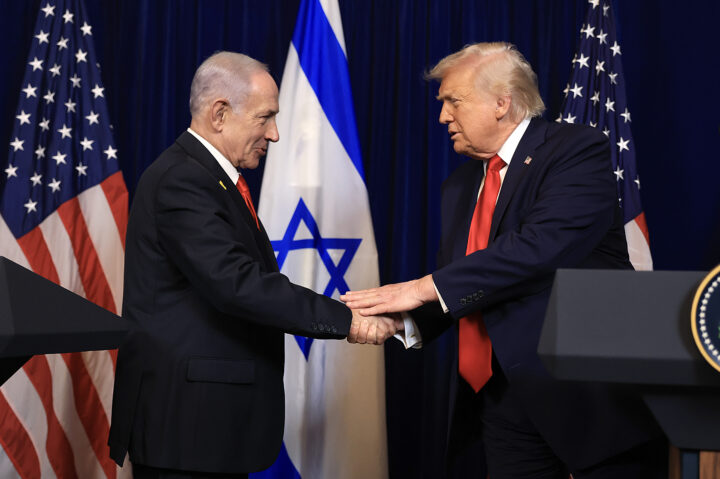
Joe Raedle/Getty Images
President Donald Trump shakes hands with Israeli Prime Minister Benjamin Netanyahu during a press conference at his Mar-a-Lago club on December 29, 2025 in Palm Beach, Florida.
President Donald Trump vowed on Monday that he would support the U.S. or Israel launching another round of strikes against Iran if Tehran is attempting to rebuild its ballistic missile program or nuclear facilities.
Trump made the comments while speaking to reporters from his Mar-a-Lago estate in Palm Beach, Fla., alongside Israeli Prime Minister Benjamin Netanyahu for the latter’s fifth visit to the United States this year.
Asked if he will support another Israeli attack on Iran if they continue their ballistic missile and nuclear programs, Trump said, “If they continue with the missiles? Yes. If the nuclear? Fast, okay? One will be yes, absolutely; the other was, we’ll do it immediately.”
He added later, “If they are [rearming], we’re going to have no choice but very quickly to eradicate that build up. … We don’t want to waste the fuel on a B-2 [bomber]. It’s a 37-hour trip, both ways, I don’t want to waste a lot of fuel,” suggesting the U.S. would again utilize its bomber jets that conducted the June strikes on Iran’s nuclear facilities.
The president repeatedly urged Tehran to return to the negotiating table with the U.S. while cautioning that the regime would face consequences for declining his offer to address the nuclear issue diplomatically. “They could have made a deal the last time before we went through the big attack on them, and they decided not to make the deal. They wish they made that deal. So I think, again, they should make a deal,” he said.
About reports that Iran is rearming, Trump said, “Iran may be behaving badly. It hasn’t been confirmed, but if it’s confirmed, look, they know the consequences.”
“This is just what we hear, but usually where there’s smoke, there’s fire,” he continued. “I’m hearing that their [efforts are] not nuclear yet, but maybe nuclear, too. The sites were obliterated, but they’re looking at other sites [than the ones the U.S. bombed in June]. That’s what I’ve heard. They’re looking. It’ll take a long time. They’re not going to go back to where they were, but they have other places they can go. And if they’re doing that, they’re making a big mistake.”
Trump repeatedly praised Turkish President Recep Tayyip Erdogan in his remarks with Netanyahu, pledging to thaw tensions between the Turkish and Israeli leaders and repeated that he was “very seriously” considering approving Turkey’s longstanding requests to purchase F-35 fighter jets from the United States. “We’re thinking about it very seriously,” Trump said about the move, which Israeli Ambassador to the U.S. Yechiel Leiter said last month that Israel opposes.
“I know President Erdogan very well, and as you all know, he’s a very good friend of mine … and I do respect him and Bibi respects him, and they’re not going to have a problem,” Trump said.
Speaking to reporters alongside Netanyahu ahead of their meeting, Trump also voiced his support for Turkey joining the proposed U.S.-led International Stabilization Force to be deployed in Gaza.
“I have a great relationship with President Erdogan, and we’ll be talking about it. And if it’s good, I think that’s good. And a lot will be having to do with Bibi, we’re going to be talking about that,” Trump said. “But Turkey has been great, and he [Erdogan] has been excellent, as far as I’m concerned. I don’t know about you [Netanyahu], but to me he’s been very good.”
Netanyahu did not comment on the suggestion at the time or during the press conference later on, though Israel, as well as several U.S. lawmakers, has said it opposes Ankara’s involvement in the proposed peacekeeping force due largely to Turkey’s ties to Hamas, despite the supportive posture from the Trump administration.
The president later used the topic of Syria to again praise Erdogan, arguing the Turkish leader deserved “a lot of credit” for ousting the Assad regime.
“Don’t forget, it was President Erdogan that helped very much get rid of a very bad ruler of Syria. That was President Erdogan, and he never wanted the credit for it, but he really gets a lot of credit. Bibi agrees with that. … I know it,” Trump told reporters.
The president went on to say that the U.S. and Israel “have an understanding regarding Syria” and that he was working to improve relations between the Jewish state and its neighbor, praising Syrian President Ahmad al-Sharaa along the way.
“We do have an understanding regarding Syria. Now with Syria, your new president. I respect him. He’s a very strong guy. That’s what you need in Syria. You can’t put a choir boy, you can’t put somebody that’s a perfect person — everything’s nice, no problems in life,” Trump said.
“I’m sure that Israel and him will get along,” he continued. “I will try and make it so that they do get along. I think they will.”
For its part, Israel has been wary of al-Sharaa and the new Syrian government, with the IDF maintaining control of the 155-square-mile buffer zone between the two countries since the fall of Syrian dictator Bashar Assad last year, against Damascus’ wishes. Israel and Syria have also continued to disagree on the contours of a potential security agreement, which the Trump administration has continuously sought, with Netanyahu maintaining that any agreement must require Syria to accept the demilitarization of territory stretching from southern Damascus to the Israeli border.
Trump was also asked about the Lebanese government’s failure thus far to disarm Hezbollah, amid reports that the terror group is rearming. The president demurred when pressed on his support of Israel striking Hezbollah targets in Lebanon again as a result, instead only acknowledging his disapproval with the terrorist organization.
“Well, we’re going to see about that. We’ll see about it,” Trump said. “The Lebanese government is at a little bit of a disadvantage, if you think of it, with Hezbollah, but Hezbollah has been behaving badly. So we’ll see what happens.”
Asked about attacks by Israeli settlers against Palestinians, Trump acknowledged that he and Netanyahu discussed the West Bank during the meeting and that they’re not in complete alignment on the issue. Still, Trump expressed confidence that all parties would reach “a conclusion” to prevent the matter from undermining the implementation of his broader peace plan, though he declined to offer specifics.
“Well, we have had a discussion, big discussion, for a long time on the West Bank. And I wouldn’t say we agree on the West Bank 100%, but we will come to a conclusion on the West Bank. … It’ll be announced at an appropriate time, but [Netanyahu] will do the right thing. I know that. I know him very well. He will do the right thing,” he said.
Trump also expressed gratitude during his remarks for being named the recipient of the Israel Prize, the Jewish state’s highest cultural honor awarded by the country’s education minister. Netanyahu said Trump will be the first non-Israeli to receive the award, which the president said “really is a great honor.”
Netanyahu invited Trump to visit Israel on Yom Ha’atzmaut, the Jewish state’s independence day, in April, which will be an election year, to receive the award in person.
Joined by Trump at his the meeting with Netanyahu were White House Chief of Staff Susie Wiles; Stephen Miller, deputy chief of staff for policy at the White House; Secretary of State Marco Rubio; Defense Secretary Pete Hegseth; Gen. Dan Caine, the chairman of the Joint Chiefs of Staff; Steve Witkoff, the White House’s Mideast envoy; and Jared Kushner, Trump’s advisor on Middle East efforts.
Netanyahu also met individually with Secretary of State Marco Rubio and Defense Secretary Pete Hegseth while at the president’s property.
Plus, the man tapped to lead the Mossad

Avi Ohayon (GPO) / Handout/Anadolu via Getty Images
Israeli Prime Minister Benjamin Netanyahu makes statements at Ben Gurion Airport ahead of his visit to Washington DC, where he will meet with US President Donald Trump in Tel Aviv, Israel on February 02, 2025.
👋 Good Tuesday morning!
In today’s Daily Kickoff, we preview next week’s White House meeting between Israeli Prime Minister Benjamin Netanyahu and President Donald Trump, and profile Israeli Maj.-Gen. Roman Gofman, who was recently announced as the next head of the Mossad. We look at efforts by former Vice President Mike Pence’s Advancing American Freedom organization to hire former Heritage Foundation staffers as the think tank faces mass departures over its support for Tucker Carlson, and report on moves by members of the Holocaust Memorial Council to remove Sen. Bernie Sanders over his failure to attend board meetings and repeated claims about Gaza that run counter to the museum’s mission. Also in today’s Daily Kickoff: Larry Ellison, George Conway and Sen. Ted Cruz.
Today’s Daily Kickoff was curated by Jewish Insider Executive Editor Melissa Weiss and Israel Editor Tamara Zieve, with an assist from Marc Rod. Have a tip? Email us here.
Ed. note: This is the last Daily Kickoff of 2025. The next Daily Kickoff will arrive on Monday, Jan. 5. Sign up for our email alerts to continue to read our breaking news reporting through the new year.
What We’re Watching
- We’ll be reporting on Israeli Prime Minister Benjamin Netanyahu’s meeting with President Donald Trump at the White House, slated for next week. More below.
- New York City Mayor-elect Zohran Mamdani will be sworn in on Jan. 1. New York Attorney General Tish James will conduct the official swearing-in at midnight, while Sen. Bernie Sanders (I-VT) will perform the ceremonial swearing-in during the day.
What You Should Know
A QUICK WORD WITH JI’S LAHAV’S HARKOV
When Israeli Prime Minister Benjamin Netanyahu meets with President Donald Trump next week, the Iranian threat will be at the top of the agenda. That’s a sentence that could have been written countless times in the past – but this time, after the degradation of Iran’s nuclear program, was supposed to be different.
We’re six months out from Operation Midnight Hammer, when the U.S. and Israel worked together to bomb Iranian nuclear facilities, and the 11 days of Israeli airstrikes on Iran that preceded it.
But much of the public conversation following that 12-day war focused on the damage done to Iran’s nuclear program – which is likely significant, but still hard to measure precisely – and less on the Islamic Republic’s ballistic missiles and air defenses.
Israel destroyed hundreds of missiles, launchers and production sites, and boasted about its control of the airspace over Tehran a day into the war as testament to its military prowess. But Jerusalem is now deeply concerned that Tehran has managed to recoup, with help from China, much of its losses.
In that vein, Netanyahu and his team are preparing to brief Trump on Israel’s concerns that Iran is expanding its ballistic missile program.
WAITING FOR GOFMAN
Netanyahu’s nominee to lead Mossad is his close advisor and an IDF general who fought the system
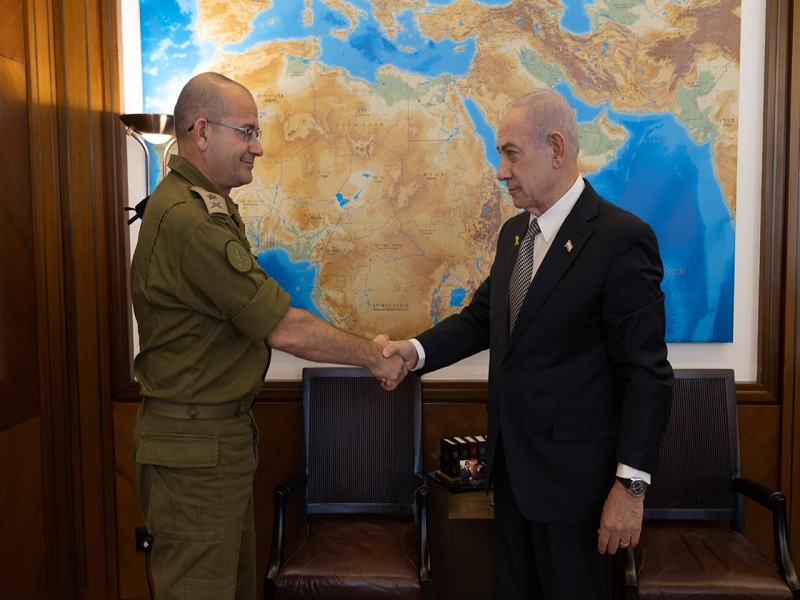
Israeli Prime Minister Benjamin Netanyahu’s announcement earlier this month that his military secretary, Maj.-Gen. Roman Gofman, would become head of the Mossad, came as a surprise to the public, as journalists and experts had been confident that current Mossad chief David Barnea’s deputy, known only as “A,” had the job in all but name. However, for those who know Gofman, his time in the IDF and his working relationship with Netanyahu, as well as the prime minister’s post-Oct. 7 predilection for bringing in outside candidates to take over defense institutions, Gofman was a natural choice, Jewish Insider’s Lahav Harkov reports.
Background: Gofman has a limited public profile as Netanyahu’s senior military advisor. But in Israel, his face is fairly familiar, as he can be seen walking behind Netanyahu into the Oval Office and other high-level meetings, even as military secretaries don’t make public statements. Gofman, 49, was born in Belarus, then part of the Soviet Union, and immigrated to Israel with his family at the age of 14. He was bullied in school and took up boxing to fight back, becoming the second-ranked young boxer in Israel in his weight category. He enlisted in the IDF Armored Corps in 1995 and has been in the military ever since, rising to the rank of Aluf, or major general.
CONSERVATIVE REALIGNMENT
Mike Pence’s think tank absorbs wave of Heritage departures
Tim Chapman, the president of former Vice President Mike Pence’s think tank, said on Monday that he expects his Advancing American Freedom organization to poach more staffers from the Heritage Foundation after announcing the hiring of 15 individuals from the embattled conservative organization, Jewish Insider’s Emily Jacobs reports.
New recruits: Advancing American Freedom, founded by Pence in 2021 to advocate for classical conservative principles as President Donald Trump’s MAGA movement cemented its hold on parts of the Republican Party, announced on Monday that 15 Heritage staffers, including three senior officials from the think tank’s legal, economic and data teams, would be moving to AAF at the start of the new year. Chapman, who has been leading the recruitment effort, predicted more Heritage staffers would resign amid continuing frustration over Heritage President Kevin Roberts’ refusal to disavow Tucker Carlson for his platforming of neo-Nazi influencer Nick Fuentes.
SANDERS SCRUTINY
Trump-appointed Holocaust Museum board members pushing to oust Bernie Sanders

Several Trump appointees to the board of the United States Holocaust Memorial Museum are pushing for the ouster of Sen. Bernie Sanders (I-VT), alleging that he has rarely attended meetings and that his accusations of genocide against Israel run directly counter to the museum’s mission, Jewish Insider’s Marc Rod reports.
What they’re saying: Jonathan Burkan, who was appointed to the council twice by President Donald Trump, said he’s never seen Sanders at any meetings of the council — which he said has not been the case for other lawmakers, both Democrats and Republicans. “Everything that’s happened after Oct. 7, everything that has been going on with antisemitism, with the Holocaust — I do feel that if someone is a Jewish elected official, they should at least attend one meeting in over a 20 year period of time,” Burkan said. “They should find someone else besides Bernie just to be on the council.”
MILITARY MATTERS
Pentagon plan to reorganize military could undermine U.S.-Israel security, experts warn

Senior Pentagon officials are reportedly weighing a sweeping proposal to reorganize the U.S. military that would shift authorities and resources away from the Middle East, a move experts warn could undermine U.S.-Israel security cooperation and destabilize the region. The plan, driven by Defense Secretary Pete Hegseth, would reduce the number of U.S. combatant commands from 11 to eight, cut the number of four-star generals and consolidate regional commands into broader organizations. Most notably, U.S. Central Command (CENTCOM) — which oversees the Middle East and parts of South Asia — would be placed under a newly created U.S. International Command, Jewish Insider’s Matthew Shea reports.
Regional ramifications: “If the reorganization happens, it will have detrimental effects on Israel and the wider region,” said Michael Koplow, chief policy officer at the Israel Policy Forum. “The Middle East presents unique challenges stemming from Iranian efforts to upend the regional order and the importance of protecting sea lanes and trade routes. Treating the region as one component of a larger command risks harming U.S. goals.”
DAMASCUS DEALINGS
Trump’s Syria strategy tested amid resurgence of ISIS in Damascus
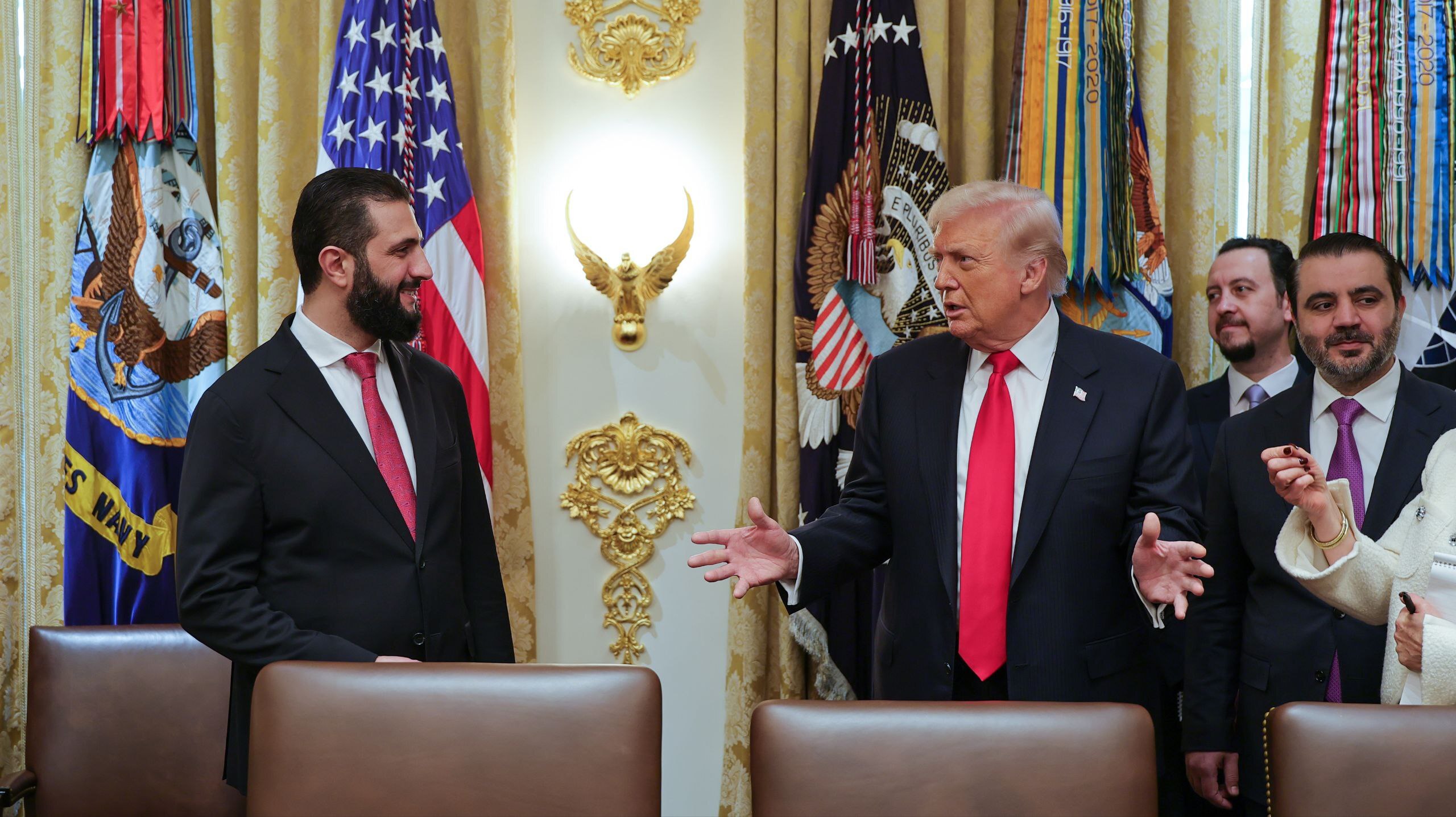
Following the fall of the Assad regime in Syria, President Donald Trump has taken an unusually open approach toward Damascus, seeking to usher in a new era of stability and regional integration. But that strategy is beginning to face significant tests from jihadist elements embedded within Syrian President Ahmad al-Sharaa’s own military ranks, Jewish Insider’s Matthew Shea reports.
Flagging concerns: “What my colleagues and I have been warning this entire year is that al-Sharaa was putting his jihadist allies into the new Syrian military without apparent measures to prevent bad things from happening,” said David Adesnik, vice president of research at the Foundation for Defense of Democracies, who added that those with jihadist beliefs were integrated in “large groups.” Those concerns were underscored earlier this month, when two U.S. soldiers and one civilian contractor were killed in Syria in an attack claimed by the Islamic State (ISIS) — the first U.S. casualties in the country since Assad’s fall in December 2024.
Bonus: The New York Times reports on the Assad family’s “life of luxury and impunity” in Moscow, a year after Bashar al-Assad, his wife and children left Damascus for Russia.
CAMPUS BEAT
Professor who backed encampment selected for role on Northwestern presidential search committee

A Northwestern University professor who supported the anti-Israel encampment on the Evanston, Ill., campus and is married to the founder of the university’s chapter of Educators for Justice in Palestine was tapped to join a new presidential search committee, the school announced last week. Ian Hurd, a professor of political science and president of the faculty senate at Northwestern University, is listed on Northwestern’s website as an “expert on the Middle East.” As Faculty Senate president, Hurd has played an influential role in shaping faculty responses to campus protests, academic freedom disputes and university governance questions, Jewish Insider’s Haley Cohen reports.
Raising eyebrows: Hurd’s appointment to the search committee drew criticism from some of the school’s Jewish alumni. “The antisemitic encampment at Northwestern occurred in April 2024, immediately before Ian Hurd was elevated into senior faculty leadership. At the time, Hurd was a leading figure in the Faculty Senate and publicly defended the administration’s response,” Michael Teplitsky, president of the Coalition Against Antisemitism at Northwestern and an alum of the school, told JI.
Worthy Reads
Banning the Brotherhood: In The Spectator, Ed Husain calls on the United Kingdom to follow the lead of the U.S. and other countries and ban the Muslim Brotherhood. “What does the Brotherhood’s growing influence mean for Britain’s Muslims? It results in women facing sharia court trials for divorce proceedings. Mosques must send coaches to marches in London or risk becoming outcasts. For the rest of the country it has meant greater communal separatism and multiple terror attacks. Britain’s Jews are afraid to walk the streets of their country, and MPs have been attacked by Islamist extremists. The resulting terror threat has been classed by the government as ‘substantial’, with 43,000 individuals on an MI5 watch list just five years ago. The Jenkins report warned a decade ago about the threat from the Brotherhood to Britain’s national security. That menace has now metastasised.” [TheSpectator]
What the Far Right Gets Wrong: In Compact, David Azerrad examines the rise of the “JQers” — far-right influencers who push the idea of the “Jewish Question” as a means of explaining societal ills. “The problems we face are so daunting, the odds so overwhelming, that it is easier to rail against the Jews than to undertake the Herculean task of revitalizing the dying nations of the West. The JQers simply don’t have the stomach to consider that, in fact, it may well be our fault. We Americans and Westerners are the ones who squandered our inheritance, defiled our countries, and replaced our populations. We elected — and re-elected — the leaders who launched reckless wars and embraced foolish policies. They were not hoodwinked by the Israel lobby, and they would not suddenly become prudent statesmen if all Jewish influence were expunged from our politics.” [Compact]
Bank Notes: Bloomberg’s Paul Davies looks at Apollo Global Management CEO Marc Rowan’s efforts to redefine private credit through the creation of what Davies calls a “narrow” bank. “Apollo has ridden the boom in private markets over the past decade to command $908 billion in assets and become an increasingly significant lender to the US economy, along with a string of rivals and copycats. Banks, investors, regulators and politicians are — or ought to be — watching closely for emerging risks and benefits from the model Rowan has built. He needs to get his message about Athene’s version of private credit to all of these observers and to a media he has called confused and hysterical, but most of all to the armies of mom-and-pop annuity holders whose trust his business relies on.” [Bloomberg]
Word on the Street
A new report by the Anti-Defamation League highlights several members of New York City Mayor-elect Zohran Mamdani’s transition team who have used antisemitic tropes and justified Hamas’ Oct. 7, 2023 attacks, among other issues the group flags as “deeply troubling” and that raise further questions about his vetting process, Jewish Insider’s Matthew Kassel reports…
The Trump administration is recalling senior career diplomats from 29 countries, all of whom were appointed during the Biden administration; the majority of those whose tenure is being ended are posted in Africa or the Pacific Islands…
Former Blackrock executive Mark Wiseman was named Canada’s next ambassador to the U.S….
Axios spotlights Steve Witkoff’s South Florida Shell Bay club, where the White House special envoy and Jared Kushner, and occasionally Secretary of State Marco Rubio, have hosted high-level diplomatic delegations to discuss issues ranging from the Israel-Gaza war to Ukraine…
NBC News reports on Witkoff and Rubio’s clashing approaches to the Trump administration’s Russia-Ukraine policy…
The Washington Post looks at Sen. Ted Cruz’s (R-TX) efforts to position himself as a traditional Republican on foreign policy issues ahead of the 2028 presidential election, as the Texas Republicans mulls another White House bid…
Attorney George Conway filed to run in the crowded Democratic primary in New York’s 12th Congressional District, where Rep. Jerry Nadler (D-NY) is not seeking reelection…
Larry Ellison is personally guaranteeing the $40.4 billion that Paramount, led by his son David Ellison, is putting forward in its bid for Warner Bros. Discovery…
A New York Times analysis of donors to Trump administration projects and priorities found that Dr. Miriam Adelson’s foundation pledged $25 million to the construction of a new White House ballroom; additional donors include Palantir and Lockheed Martin, which are both donating $10 million to the reconstruction effort…
Authorities in New York levied a hate crime charge against a man in connection with an attack in Brooklyn’s Crown Heights neighborhood last week in which a Jewish man was stabbed; the assault was captured on camera and took place blocks from the Chabad Lubavitch headquarters…
The Washington Post looks at efforts by volunteers, aided by Jewish communal security organizations, to identify threats to Jewish groups and institutions…
Israel’s Cabinet approved the closure of Galei Tzahal, the army radio station, after 75 years of operation, as part of a broader government effort to exert control over Israeli media; Israeli press organizations plan to challenge the decision, which was also opposed by Attorney General Gali Baharav-Miara…
Israeli Defense Minister Israel Katz told leaders of the country’s settlement movement that “when the time comes,” Israel will reestablish settlements in the Gaza Strip, contradicting previous assertions by Israeli Prime Minister Benjamin Netanyahu…
The Wall Street Journal spotlights security lapses that have allowed Iranian hackers to exploit vulnerabilities in an effort to breach Israeli institutions and obtain and leak information…
Longtime Jewish public relations professional H. Glenn Rosenkrantz died at 64…
Swedish-born actress May Britt, who converted to Judaism before marrying Sammy Davis Jr., died at 91…Record producer Jerry Kasenetz, who with his business partner Jeffry Katz produced such songs as “Yummy Yummy Yummy” and “Little Bit O’ Soul,” died at 82…
Pic of the Day

Israeli Prime Minister Benjamin Netanyahu met on Monday in Jerusalem with Cypriot President Nikos Christodoulides and Greek Prime Minister of Greece Kyriakos Mitsotakis.
Birthdays

Israeli-Spanish singer-songwriter of Judeo-Spanish (Ladino) music, Yasmin Levy turns 50…
Television producer, best known for his work on the 1980’s television series “Cagney & Lacey,” Barney Rosenzweig turns 88… Electrical engineer, who with Vint Cerf, invented the Transmission Control Protocol (TCP) and the Internet Protocol (IP), the fundamental protocols at the heart of the Internet, Robert Elliot “Bob” Kahn turns 87… Emmy Award-winning actor, writer, director and producer, best known for his work on “The Simpsons”, he is still an active podcast host, Harry Shearer turns 82… Russian-born mathematician, living in France, Mikhail Leonidovich Gromov turns 82… U.S. district judge in the Southern District of New York, he has been on senior status since 2011, Judge Lewis A. Kaplan turns 81… Documentary filmmaker, she is best known for her films on businessman Julius Rosenwald and baseball players Hank Greenberg and Moe Berg, Aviva Kempner turns 79… Retired Justice on the Supreme Court of Canada, Michael Moldaver turns 78… One of two Grand Rebbes of Satmar, Rabbi Zalman Leib Teitelbaum turns 74… Editor-at-large of The Bulwark, William “Bill” Kristol turns 73… Retired Israeli basketball player and coach, until 2006 she was in the Guinness Book of World Records for the most points (108) ever scored in a women’s professional game, Orna Ostfeld turns 73… Dean at Indiana University’s School of Global and International Studies, he served as the U.S. ambassador to Poland in the Obama administration, Lee A. Feinstein turns 66… Software engineer at Goldman Sachs, Bill Pinsky… CEO of the Rabbinical Assembly, the international association of Conservative rabbis, Rabbi Jacob Blumenthal turns 59… USAID acting mission director for the West Bank and Gaza until 2021, then mission director for Bosnia and Herzegovina until 2024, Courtney Chubb turns 56… Political technology entrepreneur and campaign finance attorney, Jonathan Eric Zucker turns 54… Israeli investor in natural resources including diamond and copper mining interests in Africa, Dan Gertler turns 52… Beverly Hills-based attorney and real estate agent, he is a supporter of pro-democracy groups in his native Iran, Pooya Dayanim… Attorney in Austin, she clerked for Justice Alito on the U.S. Supreme Court, Zina Linda Gelman Bash… VP of strategy and mergers at the Heritage Group, an Indiana-based multi-generational family portfolio of companies, Adam Milakofsky… Israeli singer, songwriter, musician and composer of the genre known as Mizrahi music, Dudu Aharon turns 41… COO at Israel Policy Forum, Snezhana Valdman Orlando turns 41… Liberal rabbi in the city of Dresden and founder of the Besht Yeshiva, Akiva Weingarten turns 41… Partner and chief investment officer at Gelt Venture Partners, he was an MLB infielder and played for Team Israel in 2012 and 2017, Joshua Blake Satin turns 41… Chief of staff for the U.S. Ambassador to France and Monaco Charles Kushner, Gabriel Scheinmann… Founder and CEO at Stealth AI, he is also a lecturer and research scholar at the Wharton School at the University of Pennsylvania, Emil Pitkin… Brand marketing manager at Metagenics, Lauren Kahn… Israeli fashion model, Shlomit Malka turns 32… Senior vice president of the American Foreign Policy Council, Ilan Berman… Former account executive at Edelman, India Goodman… Tom Epstein…
Jewish military chaplains told JI about their drive to be ohr l’goyim, a light unto the nations

Courtesy
Rabbi Laurence Bazer reading Hanukkah cards sent to Jewish servicemembers
The women’s basketball team at Rochelle Zell Jewish High School in Chicago was practicing earlier this month ahead of its annual Senior Night when an announcement came over the intercom, presenting a special guest. That’s where the video starts — one of those designed-to-go-viral tearjerkers showing a child reuniting with their parent who is in the military.
“He is joining us after leaving the military service in Europe,” the announcer says. Team members start to look around, smiling but confused, when they see that the door to the gym is open.
“We are grateful for his dedication, especially his daughter Hannah,” the announcer continues. That’s when one athlete, in a long-sleeve practice jersey and a ponytail, begins to cry and run toward the door. “Thank you for your service and sacrifice, and welcome home, U.S. Army Chaplain Rabbi Aaron Melman.” Everyone cheers. Throwing her arms around her father, Hannah sobs.
Melman, a Conservative rabbi who since 2021 has served as a chaplain in the Illinois Army National Guard, had just returned from a U.S. Army base in Western Poland. He submitted his request for leave back in September but didn’t tell his daughter, who was devastated most of all to learn his deployment conflicted with the pinnacle of her high school basketball career. (She was more upset that he would miss that game than her graduation.) When she hugged him, Melman took off his cap and revealed a light brown yarmulke that matched his fatigues.
“We made it happen,” Melman tells his daughter in the video, smiling. Days later, RZJHS won at Senior Night. Hannah scored four points.
For more than two decades after he graduated from the Jewish Theological Seminary in 2002, Melman was a congregational rabbi in the northern suburbs of Chicago. He had thought, early in his career, about joining the military — his father served in the U.S. Army Reserves — but decided against enlisting, recognizing that serving in active duty would be challenging as he raised two young children.
But later, when his kids were older, the itch to serve returned. Melman was commissioned as an officer in the Illinois Army National Guard, a responsibility that typically required two days of service a month and two weeks each year, until he was sent to Poland earlier this year. That assignment made him one of several Jewish chaplains serving on the front lines of Europe, providing religious support and counseling to American soldiers — most of whom are not Jewish — who are stationed in Germany, Poland and other allied nations largely as a bulwark against Russia.
Many Jewish chaplains serve in the military only part-time. They fit the training into already-busy schedules leading congregations and providing pastoral care to people in their own communities.
Several military rabbis told JI that they view their mission as more than counseling the soldiers in their care and helping them deal with the hardships of military service. They explained that it’s also about reminding American Jews — many of whom have parents or grandparents who fought in World War II, Korea or Vietnam — about the value of service. During World War II, the military printed pocket-sized Hebrew bibles for Jewish soldiers. Today, some Jews don’t know anyone serving in the military.
“Most Jews in America are not connected in any way, shape or form to the United States Armed Forces. The common reaction many of us get, when we go into the armed forces here in the States is, ‘Oh, you don’t want to go into the IDF?’ or, ‘Why didn’t you go into the IDF?’ And for the record, I happen to be a very strong Zionist,” Melman told Jewish Insider in an interview last week. “One of the things for me that I’ve really grown to appreciate is trying to connect the younger generation of American Jews into joining or thinking about joining the military and how important it is.”
Rabbi Aaron Gaber spent nine months at Grafenwoehr, a major American base in Germany, starting last summer. As a member of the Pennsylvania Army National Guard, his unit’s mission was to train Ukrainian soldiers, and Gaber was tasked with training Ukrainian chaplains. He took them to the Memorium Nuremberg Trials, a museum located inside the German courtroom where Nazi leaders were tried for their crimes after World War II.
“That created a whole conversation about moral integrity and personal courage. How do you say to your commander, ‘Don’t commit atrocities’? Or how do you keep your soldiers who are angry at what’s happening and want to do things that are unethical or immoral from doing that?” Gaber told JI. “That elicited a whole conversation on a theological level about light versus darkness, good versus evil, but also then on a practical level: How do you advise your commander in a way that gives him or her the option not to do something that shouldn’t be done?”
Most of Gaber’s job, when dealing either with Ukrainian troops or American, involved assisting people who were not Jewish.
“As a rabbi, I got to make sure every week there was a Protestant worship service happening,” said Gaber, who returned from Germany in June (and specified that he did not lead those services).
Last year, he volunteered to spend the High Holidays in Poland and Lithuania. He drove between several different bases to make sure Jewish soldiers had access to religious services, food and learning opportunities tied to the holidays.
“I take the idea of ohr l’goyim, or bringing light to the world, I was able to bring light to the world. I was able to help Jewish soldiers celebrate their faith. If I met 10 Jewish soldiers through the entire two weeks, that was a lot. So it was individual work,” Gaber said. “In one case, I had one soldier travel, I think, three hours each way to be able to spend an hour with me. He couldn’t go by himself, so he had a noncommissioned officer, one of his squad leaders, go with him. That was the length that the military can and does go to make sure soldiers can access their faith.”
Ohr l’goyim is a phrase that comes up often for Jewish military chaplains. For Rabbi Laurence Bazer, a retired U.S. Army colonel who is now a vice president at the JCC Association and the Jewish Welfare Board’s Jewish Chaplains Council, those words — from the Book of Isaiah — commanded him to be a light unto the nations. “And that’s not just to our own fellow Jews, but to the rest of the community,” Bazer told JI.
A friend of his from the North Dakota National Guard once took Bazer, who served in the Massachusetts Army National Guard, to visit North Dakota’s state partner in Ghana. He sat down with a group of Ghanaian soldiers and told them to ask him anything they might want to know about Judaism.
“Now, these are all Catholic, Protestant and Muslim chaplains from the Ghanaian army,” Bazer recalled. “I said, ‘You could ask me, like, why Jews don’t believe in the New Testament, or Jesus, whatever.’ That’s part of the role that I love doing, of being, again, ohr l’goyim, a light unto the nations, to be able to share the positive, affirming side of Judaism so that they felt enriched. It was all in true fellowship of, we’re all servants of the Divine.”

Bazer spent his final years in the military in Washington, working full time in an active duty role at the National Guard’s headquarters. He oversaw the religious response to the COVID-19 pandemic, the 2020 racial-justice protests and the Jan. 6 Capitol riot.
“I was advising commanders up to four stars at a senior level about what’s going on religiously, which really meant the moral welfare of their troops,” said Bazer, who had served in New York during the 9/11 attacks and later led the chaplaincy response to the Boston Marathon bombings in 2013. “That emotional level affects readiness, and chaplains are the key to help that readiness.”
In 2023, Bazer was asked to go to Europe to lead Passover services and programming for Jewish troops. He led Passover Seders in Germany and Poland, and then drove between Lithuania and Latvia, delivering matzah and visiting with Jewish soldiers.
The Seder at Grafenwoehr took place on a large lawn on the base. After he spoke about opening the door for the prophet Elijah, a symbolic act tied to hope that the Messiah will come, a Christian chaplain on base who had attended the Seder pulled Bazer aside. He pointed to a tower that stood next to the lawn.
“He says, ‘You know, Hitler used to go up there and watch,’” Bazer said. The base — now so central to America’s operations in Europe — was once used by the Nazis. “To think that back then he used to watch the Nazis do formation, and now, in 2023 we’re holding a Passover Seder on the same base in the shadow of that tower is an incredible experience.”
The Trump administration’s eagerness to normalize relations with Syria’s new government is echoing advocacy from leading Biden officials
Francis Chung/POLITICO via AP Images
Syrian President Ahmed al-Sharaa departs a meeting in the Senate Foreign Relations Committee hearing room at the U.S. Capitol, Nov. 10, 2025.
One year after the fall of the Assad regime in Syria, policymakers and officials in the United States and Israel remain increasingly divided over how to confront the changing landscape in Damascus.
Following the fall of Bashar al-Assad in December 2024, the IDF moved into a U.N. buffer zone inside southern Syria to protect Israel’s northern border as Damascus’ military and political landscape shifted. A year later, against Damascus’ wishes, Israel still controls the 155-square-mile area and has proceeded to carry out arrests of terror suspects, while also seizing weapons and conducting targeted airstrikes.
These actions have collided with President Donald Trump’s push to broker a security agreement and end hostilities between the two countries, which the president and some experts see as a key part of stabilizing Syria — and, ultimately, the region. The Trump administration has often sided with Damascus in recent disputes, warning that Israel’s strikes are undermining efforts to reach an agreement, which the White House also views as a path to normalization.
Israeli Prime Minister Benjamin Netanyahu maintains that any agreement must require Syria to accept the demilitarization of territory stretching from southern Damascus to the Israeli border. However, Syrian President Ahmad al-Sharaa has rejected this condition, arguing that it would create a dangerous security vacuum in southern Syria.
Critics of al-Sharaa and some in the pro-Israel community have remained wary of relinquishing the area to the Syrian government given al-Sharaa’s past ties to Al-Qaida, a U.S.-designated Foreign Terrorist Organization that he joined following the 2003 U.S. invasion of Iraq. While operating for the group as a foot soldier, al-Sharaa was captured by U.S. military forces and imprisoned, and he later founded one of the terror group’s Syrian branches.
“In [Israel’s] perspective, the problem is mistrust as well as hard security indicators,” Ahmad Sharawi, a research analyst at the Foundation for Defense of Democracies, told Jewish Insider. “Southern Syria is awash with weapons, weapon trafficking routes and Iran-backed networks. At the same time, Israel is being asked to make concessions to a government led by a former Al-Qaida emir whose coalition still includes figures that praised the Oct.7 attacks and openly endorse armed resistance against Israel.”
Jonathan Ruhe, a fellow at the Jewish Institute for National Security of America, explained that Israel is concerned that should a deal be made, it could allow for “potentially hostile forces to encroach anywhere near the border.” In a conversation with the Hudson Institute last month, Caroline Glick, international affairs advisor to Netanyahu, said keeping threats away from Israel’s borders has become an instrumental part of the Israeli government’s foreign policy in the aftermath of the Oct. 7, 2023, terrorist attacks.
“Defense is simply not an option for such a small country, and thus the security of each and every border matters more for Israel than most any other country,” said Ruhe. “To be viable for Israel, a deal would have to demilitarize southwest Syria and probably include real prohibitions on Turkish military presence in Syria. It also likely would have to permit Israel to use Syria as an air corridor to Tehran, or at least not openly prohibit this.”
Reflecting the views of those urging an accommodation towards the new Syrian government, Barbara Leaf, assistant secretary of state for Near Eastern affairs under the Biden administration, maintained that Israel has nothing to worry about with a normalized al-Sharaa government.
Participating on a panel at the Middle East Institute on Wednesday, Leaf refrained from addressing Israel’s security concerns, instead arguing that Syria holds no hostile posture towards the Jewish state and that Israel’s actions are prohibiting an agreement. She pushed for the U.S. to exert more pressure.
“There’s no other recourse but for the White House to come down very hard and definitively on the Israeli government to stop the bombing and to start making plans to pull back from that border and get serious and finish this set of discussions,” said Leaf.
Sharawi suggested that Israel remains hesitant and has taken a “far more pessimistic view of Syria’s short-term trajectory.
“Even if al-Sharaa himself is signaling restraint, Israeli decision-makers are deeply skeptical that his control is durable or that he would retain power long enough to enforce any agreement,” said Sharawi.
Last month, Trump administration officials indicated that a security deal was “99% done,” with hopes that Trump’s Oval Office meeting with al-Sharaa in November could help push the agreement over the line. But talks continue to stall.
Gideon Sa’ar, Israel’s foreign minister, said on Wednesday that the gap between the two sides has grown, as the Syrians have added new demands.
Ruhe said it may also be tricky for the White House to fast-track an agreement as Trump could have less room to exert pressure on Israel.
“Partly it’s a question of how much pressure Trump can still apply to Israel, since he already leaned hard on Netanyahu to agree to the Gaza ceasefire,” said Ruhe. “Any foreseeable deal would be a narrow nonaggression pact, not Syria joining the Abraham Accords as Trump may wish.”
About one-quarter of Americans hold antisemitic attitudes, according to research from Robert Kraft’s Blue Square Alliance Against Hate

Erik McGregor/Getty Images
Participant holding a sign at the rally. Thousands of New Yorkers joined community leaders and city and statewide elected officials in Foley Square at the No Hate. No Fear. solidarity march in unity against the rise of anti-semitism.
Antisemitism in America has plateaued after a sharp rise in anti-Jewish hate incidents in the immediate aftermath of the Oct. 7, 2023, terrorist attacks in Israel — yet fewer Americans are pushing back against it, according to a survey released Thursday by the Blue Square Alliance Against Hate.
About 25% of the population has consistently held antisemitic attitudes since June 2024, the 2025 Antisemitism Landscape Survey reported. That’s a notable rise from the recent past, but the survey found that the growth of antisemitic views has slowed significantly.
The survey, which has been conducted twice a year since June 2023, polled 7,028 American adults from Aug. 1-Sept. 30. It found that 58% of respondents think antisemitism is a minor problem or not a problem at all, a sizable majority, though one that has remained fairly steady for the past two years.
“This is an alarming moment for the United States,” said Adam Katz, president of the Blue Square Alliance Against Hate, a nonprofit founded by New England Patriots owner Robert Kraft, which recently rebranded from the Foundation to Combat Antisemitism. “At a time when national data shows clear increases in antisemitic incidents and hate crimes, our survey results show a decline in the number of Americans who see antisemitism as a major problem.”
Katz called the stabilization of Americans expressing antisemitic attitudes a “glimmer of hope that hate is no longer spreading.”
At the same time, the report found that the number of Americans willing to speak out against antisemitic behavior is dropping compared to before Oct. 7.
The number of “allies” to American Jews — defined as “well informed and aware of antisemitism, already activated to stand up to Jewish hate” — stayed consistent at 9% between December 2024 and August 2025, though that’s down from 15% in June 2023.
The number of Americans categorized as “haters” — defined as “blatantly prejudiced against Jews and tend to be outspoken about it” — decreased slightly from 11% in 2024 to 10% in 2025, though that’s up from 6% in 2023.
Nearly half (46%) of Americans think Jews can “handle antisemitism on their own,” which has stayed largely consistent since 2024.
Only around a third (33%) of respondents expressed belief that other people will disapprove of them if they don’t stand up for Jews who are experiencing prejudice, a number that is consistent with the December 2024 poll and slightly less than 39% in December 2023.
Polling was conducted while the Israel-Hamas war was still underway, with many participants expressing the view that supporting Jews might be interpreted as siding against Palestinians.
Belief in classic antisemitic tropes — such as “Jews are penny pinchers” and “Jews run the media” — are softening slightly, the survey found, although they are still higher than 2023 numbers.
The last year has featured several high-profile attacks on Jews around the U.S., including the arson attack against Pennsylvania Gov. Josh Shapiro’s home, the Washington shooting of two Israeli Embassy staffers outside the Capital Jewish Museum and the Colorado firebombing of a hostage solidarity event.
The survey also found solid support for the U.S.-Israel alliance, even as the level of backing has slightly declined
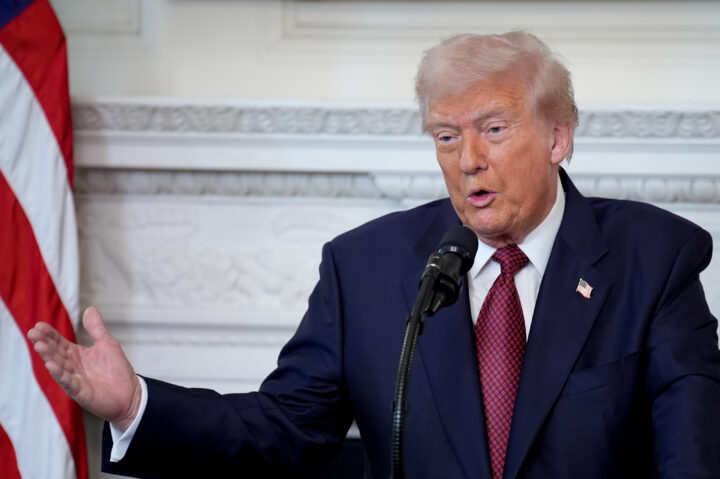
Yuri Gripas/Abaca/Bloomberg via Getty Images
US President Donald Trump during a breakfast with Senate Republicans in the State Dining Room of the White House in Washington, DC, US, on Wednesday, Nov. 5, 2025.
President Donald Trump’s decision to strike Iran’s nuclear facilities in June, dealing a significant blow to the Islamic Republic’s weapons program, is viewed favorably by 60% of Americans, according to a newly released survey commissioned by the Ronald Reagan Institute.
The decision to bomb Iran’s nuclear program was one of the most popular policies the Pentagon has made in Trump’s second term, according to the survey. Of the 10 policies tested, only two (using force against drug traffickers in Latin America and issuing gender-neutral standards for combat roles) had a higher net approval rating.
Despite the widespread support for the airstrikes, there is a partisan divide in support. Republicans overwhelmingly supported the military action, while 39% of Democrats did so.
The survey also painted a mixed picture about the state of U.S.-Israel relations, finding that two-thirds of Americans consider Israel to be an ally, including 57% of Democrats. The share of respondents calling Israel an ally is down six points from the institute’s survey last year. When it comes to sending weapons to Israel, half of respondents were supportive — with a 68% supermajority of Republicans, but just 35% of Democrats.
If Hamas refuses to demilitarize Gaza, however, 54% of Americans would favor further Israeli military action, including 42% of Democratic voters.
“Overall, the American people know who is the ally and who the adversary is in the Middle East,” Roger Zakheim, the director of the Ronald Reagan Presidential Foundation & Institute, told Jewish Insider. “Even after the impact of Israel’s lengthy war against Hamas in Gaza, you still have close to a supermajority [in the U.S.] viewing Israel as a strong ally, which is reassuring for Jerusalem.”
The findings are part of a wide-ranging examination of American public opinion on national security issues, indicating a consistent American preference to maintain engagement in the world. Nearly two-thirds (64%) of respondents said the “it is better for the United States to be more engaged” in international affairs, with just 33% disagreeing.
Notably, support for the U.S. sending weapons to Ukraine as it defends itself from Russian attacks wins widespread support, with 64% in favor — a nine-point jump from last year’s survey. Ukraine is also viewed as an ally by three-fourths of respondents. Only 17% said they thought Russia was an ally, while 79% viewed the country as an enemy.
When asked which country poses the greatest threat to the U.S., China held a sizable lead, with nearly half of respondents naming Beijing, while 26% ranked Russia at the top. Only 3% said Iran posed the greatest threat.
The poll of 2,507 adults was conducted jointly by Beacon Research, a Democratic firm, and Shaw & Company Research, a Republican firm, between Oct. 23-Nov. 3. The two polling firms also conduct Fox News’ polling.
It was released in the run-up to this year’s Reagan Defense Forum, which is being held this Friday and Saturday at the Ronald Reagan Presidential Library in Simi Valley, Calif.
The new ISGAP report cites authenticated Muslim Brotherhood documents describing the group’s strategy of entrenching itself in the institutions of Western democracies

Salah Malkawi/Getty Images
Jordanian police close the entrance of a Muslim Brotherhood headquarter after the announcement of banning the society in the country on April 23, 2025 in Amman, Jordan.
The Muslim Brotherhood’s influence has become increasingly pervasive in the United States, according to a new report by the Institute for the Study of Global Antisemitism and Policy, titled “The Muslim Brotherhood’s Strategic Entryism into the United States: A Systemic Analysis.”
President Donald Trump’s recent instruction to Secretary of State Marco Rubio to take steps toward banning Muslim Brotherhood-affiliated organizations came soon after ISGAP briefed policymakers from both parties and national security professionals, including Trump administration officials, in Washington and beyond about the study.
“For decades now, we’ve known that Islamism has been a problem within our liberal secular democracies,” ISGAP Vice President Haras Rafiq told the Misgav Mideast Horizons podcast. (Jewish Insider’s Lahav Harkov co-hosts the podcast.)
The new ISGAP report cites authenticated Muslim Brotherhood documents describing the group’s strategy – called tamkeen, which loosely translates to “empowerment” – of entrenching itself in the institutions of Western democracies.
“It was a 100-year plan, and they’re 43 years into it,” Rafiq said. “We looked at the who, why, what, where … and then analyzed how well we’re doing against it.”
The Muslim Brotherhood’s basic goals, he said, are “to set up a utopian Islamist state and enforce their vision of Sharia-based law on the whole state, and secondly, to spread that around the world. … [Their] tactic, the opium of the masses, is to wipe Israel off the map.”
In liberal democracies, one of the major elements of the plan is “figuring out a way to persuade Muslims, if you’re living in the West, that the Islam that your parents practice … is actually wrong and it fits into … innovation, false association with a deity, [and] haram, which means not allowed,” Rafiq said. “So first of all, change the Islam that’s practiced from within.”
The way the Muslim Brotherhood relates to non-Muslim societies, Rafiq said, is to “try to persuade others by using a faith-based identity politics which aligns with what they believe — that they are the proper Muslims. And over time, there are four key areas where they focus: One is political infiltration and legislation, the second is controlling the narrative, the media, the third is how they can increase the capacity [of those steps], and looking at Muslims and changing from within.”
Rafiq said that Muslim Brotherhood-sympathetic organizations latched onto the Sept. 11, 2001, attacks to increase their influence.
“It was a time when there was a lot of confusion,” he recounted. “What organizations like CAIR [the Council on American-Islamic Relations] and others were able to do was to latch onto people who wanted to understand who were these Muslims, why did people want to fly planes into the Twin Towers … and they actually were very quick to latch onto the media, the politicians, the people within civil society who were hungry to know more, and become one of the main voices.”
Texas Gov. Greg Abbott, a Republican, recently declared both the Muslim Brotherhood and CAIR to be foreign terrorist organizations banned from the state. Rafiq pointed out, however, that the state has not seized any assets or taken any concrete action against the organization.
The difference between CAIR, which presents itself as an advocacy group for a minority population, and other organizations that aim to do the same, Rafiq said, is that “ultimately, at the end of the day, the people who set up the organization actually are part of the Muslim Brotherhood Islamist worldview, and ultimately are trying to … use entrenchment to change the liberal democracy from within.”
Rafiq also cited ties between CAIR and unindicted co-conspirators in the Holy Land Foundation trial, the largest terrorism finance trial in the U.S., which shut down an organization that was funding Hamas.
“I guess other non-Islamist organizations that represent Muslims and other organizations don’t want those objectives and are not involved in these kinds of criminal activities,” he said.
CAIR has “been able to persuade and fool people that they’re actually representing Islam and Muslims and they’re the correct voices,” he said. Still, Rafiq cited polling that out of 1.9 billion Muslims worldwide, 1.4 billion reject Islamism, which includes the Muslim Brotherhood.
“The good news is still that the majority of Muslims around the world reject Islamism,” Rafiq said, while noting that he did not have specific data about the U.S.
However, Rafiq said that the Muslim Brotherhood has successfully inculcated young Muslims in the West with antisemitism.
“Antisemitism is a key tool that they use in the guise of being anti-Israel or anti-Zionist, etc., to recruit people to their worldview,” he said.
Rafiq called Qatar “the last man standing” in the Sunni Arab world, in that its regime supports the Muslim Brotherhood.
“Muslim Brotherhood Islamist ideology is deeply entrenched within all parts of [Qatar’s] civil society, all the way to the top,” he said. “As a result of this entrenchment … they’ve used tamkeen successfully across the board, from educating children all the way up to civil society organizations and the leadership. One can say the Muslim Brotherhood has a funding arm, which is directly the Emir and the institution, the country, the economy and the corporation that is Qatar.”
ISGAP has estimated that Qatar’s soft power assets worldwide are worth $1 trillion. The Gulf state is the largest state donor to universities in the U.S., and much of those donations are undocumented.
Qatar spreads the Muslim Brotherhood’s messages via Al Jazeera in Arabic and English.
“The English one will be a lot more palatable, but still pushing the Islamist narrative. The Arabic is downright nasty – and they get away with it, because what they’ve done is set up Al Jazeera as a corporation,” Rafiq said. “But they are 100% owned by the Qatari royal family. Therefore, in my view, when they operate in the U.S., they should [register] under the Foreign Agents Registration Act.”
Rafiq said the West can do more to make support for the Muslim Brotherhood more costly for Qatar and discourage its leadership from continuing. One example he gave is an ISGAP report exposing Qatari funding for Texas A&M, including a contract that said all of the research projects are property of the Qatar Foundation – including those with dual-use purposes that could be used to develop weapons. After initially denying the links, the president of the university pulled it out of Education City in Doha.
“That really hurt [Qatar],” Rafiq said. “The reason I know it hurt them was that we are constantly besmirched and lies are told about us and we are targeted by the Qatari government.”
Another win, Rafiq argued, was the Israeli strike on Doha in September.
“That was the key moment in which they realized that even though they have a defense agreement with the U.S., they can’t really hide. But the downside was that rather than actually use that and push on the advantage, what the U.S. government has done is create the situation with the ceasefire in Gaza … and pushed out countries like Saudi Arabia and the U.A.E. … and decided to bring in Qatar and Turkey, and that’s a problem.”
“We need more support from [the Trump administration] in terms of Qatar, and not to be taken in by geopolitics,” he added.
Rafiq compared fighting the Muslim Brotherhood without taking on Qatar to taking aspirin when you have cancer.
“Islamism is a virus or a cancer … which is spreading rapidly, and unless we deal with it, the root cause, and we persuade Qatar to stop funding it … it won’t really make a difference,” Rafiq said.
One of the challenges in combating Islamism, Rafiq said, is that “we don’t make it easy to recognize Islamism in the same way that we recognize fascism and communism … [because] they’ve been able to push this narrative so effectively of Islamophobia.”
“Islam is a set of ideas, a set of values. In a liberal democracy, no set of ideas should be beyond critique, satire or even parody, even if they are ideas that I believe – and I’m a Muslim,” he said. “The people who are intolerant have persuaded us that these concepts are intolerant; therefore, we fall in line.”
Plus, Ted Cruz turns up the heat on Tucker Carlson
Jason Fochtman/Houston Chronicle via Getty Images
Gov. Greg Abbott announces his reelection campaign for Texas governor in Houston, Sunday, Nov. 9, 2025.
Good Tuesday afternoon!
This P.M. briefing is reserved for our premium subscribers like you — offering a forward-focused read on what we’re tracking now and what’s coming next.
I’m Danielle Cohen-Kanik, U.S. editor at Jewish Insider and curator, along with assists from my colleagues, of the Daily Overtime briefing. Please don’t hesitate to share your thoughts and feedback by replying to this email.
📡On Our Radar
Notable developments and interesting tidbits we’re tracking
After their bilateral meeting in the Oval Office today, President Donald Trump and Saudi Crown Prince Mohammed bin Salman announced progress on a U.S.-Saudi defense pact and revealed details about Riyadh’s purchase of F-35 fighter jets, Jewish Insider’s Matthew Shea reports.
Trump said the F-35s being sold to Riyadh are “going to be pretty similar” to the advanced F-35I Adir model that Israel flies. “This [Saudi Arabia] is a great ally, and Israel’s a great ally. I know they’d like you [MBS] to get planes of reduced caliber, but I don’t think that makes you too happy. … As far as I’m concerned, [both countries are] at a level where they should get top of the line.”
The U.S. has granted Israel customization rights and operational freedoms with the F-35 that other countries do not have, which contribute to its qualitative military edge. With Saudi Arabia now the only other country in the Middle East besides Israel to obtain the fighter jet, questions remain around which model and allowances Riyadh will receive.
Trump also announced the two countries have “reached an agreement” on a defense pact, without offering further details, and said he expects them to reach a civil nuclear agreement as well…
MBS’ meeting with a bipartisan group of senators on Capitol Hill tomorrow has been canceled, Punchbowl News reports, after the Saudis were reportedly very selective about which senators could attend. His meeting with House lawmakers is still on the books, and he may still meet with individual senators…
The deals keep coming: Humain, the artificial intelligence company backed by Saudi Arabia’s sovereign wealth fund, is set to announce a “slew” of agreements with U.S. businesses tomorrow, Semafor scooped, including data center construction in collaboration with Amazon, AMD, xAI and GlobalAI…
Elsewhere in Washington, Sen. Ted Cruz (R-TX) upped the ante in his public dispute with Tucker Carlson, JI’s Gabby Deutch reports, telling the Jewish Federations of North America’s General Assembly this morning that calling out antisemitism from Carlson and his Republican allies is necessary to defend American values.
Cruz warned that many people are not fully grasping the scope of the problem, describing a meeting with Israeli Prime Minister Benjamin Netanyahu this year where, he said, Netanyahu tried to push back on the idea that right-wing antisemitism was a threat.
“I’ll tell you, he actually was a little dismissive of that. He said, ‘No, no, no, that’s Qatar, that’s Iran, that’s bots,’” Cruz said. “My response: ‘Mr. Prime Minister, yes, but no. Yes, that’s happening. Yes, there are millions of dollars being spent to spread this poison. Yes, that’s happening online. But it is real and organic’”…
Texas Gov. Greg Abbott designated the Muslim Brotherhood and Council on American-Islamic Relations as foreign terrorist groups and transnational criminal organizations today, JI’s Marc Rod reports, prohibiting them from buying land in Texas and allowing the AG’s office to sue to shut them down.
Efforts to designate the Muslim Brotherhood and CAIR have seen little public progress at the federal level, both in Congress and in the executive branch. But Abbott’s move may end up fueling momentum for similar legislative moves out of Washington, and could also provide a model to other like-minded governors in key states…
The Department of Education signed agreements with six other federal agencies to take over aspects of its work, marking one of the largest moves to dismantle the department to date, USA Today reports.
The Departments of the Interior, Health and Human Services and State are all taking a piece of the pie, though the Education Department has not determined the future of its Office for Civil Rights…
Cornell University Provost Kavita Bala took the unusual step of disclosing details about a discrimination case against Eric Cheyfitz, a professor who was placed on leave after he attempted to exclude an Israeli student from participating in his course on Gaza, due to misinformation circulating about the case. The professor recently retired to avoid further investigation by the university.
“After [the] third class, the faculty member talked to the student and explicitly told the student that he was not welcome in the class because ‘he was an Israeli citizen supporting an Israeli stance in Gaza.’ Those are the faculty member’s words,” Bala said at a recent Faculty Senate meeting. “This is not a case of academic freedom. This is a case of discrimination based on national origin”…
In an op-ed titled, “Why I Became a Socialist,” Chi Ossé, the New York City councilman mounting a primary challenge to House Minority Leader Hakeem Jeffries (D-NY), explains his recent decision to join the Democratic Socialists of America and touts his support for Mayor-elect Zohran Mamdani as critical to his victory.
Though Ossé appears to be capitalizing on his partnership with the incoming mayor to elevate his profile, Mamdani has discouraged Ossé on several occasions from running against the top House Democrat at a time when he’ll need support and funds from Washington…
⏩ Tomorrow’s Agenda, Today
An early look at tomorrow’s storylines and schedule to keep you a step ahead
Keep an eye on Jewish Insider tomorrow morning for a dispatch from the conservative National Task Force to Combat Antisemitism’s first summit following its split with the Heritage Foundation.
Tomorrow, the U.S.-Saudi Investment Forum will take place at the Kennedy Center, featuring discussions on energy policy, AI, financial services, urban development, biotechnology, aerospace and defense and more. A special address is on the agenda, though neither President Donald Trump nor Crown Prince Mohammed bin Salman’s attendance has been confirmed.
The Senate Foreign Relations Committee will hold a hearing on the nomination of Tammy Bruce, currently the State Department spokesperson, to be deputy U.S. ambassador to the U.N.
The Endowment for Middle East Truth is holding its 16th annual Rays of Light in the Darkness awards dinner in Washington, honoring Sen. John Fetterman (D-PA), Justice Department senior counsel Leo Terrell, Israeli Ambassador to the U.S. Yechiel Leiter, Hungarian Ambassador to the U.S. Szabolcs Takács and journalist Anila Ali.
Stories You May Have Missed
THE RIGHT’S NEW DIVIDE
‘Confused young groypers’: Jewish Republicans reckon with resurgent antisemitism on the right

President Donald Trump, called by his Jewish supporters ‘the most pro-Israel president in history,’ won’t lead the party forever. So what will come next?
TRIBUNAL TURMOIL
Israel petitions ICC to remove chief prosecutor from case, citing conflict of interest

Karim Khan has been accused of sexual misconduct; Jerusalem alleges the ICC’s head prosecutor pursued a case against senior Israeli officials as a distraction
The visit includes a welcome ceremony, bilateral meeting in the Oval Office and a black-tie dinner in the evening
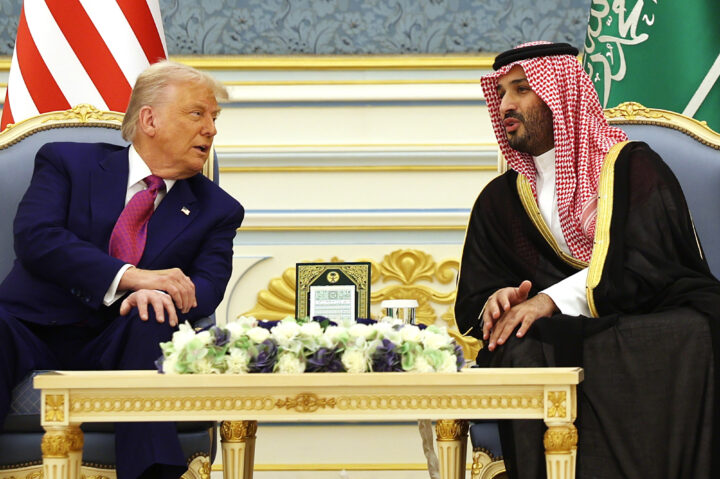
Win McNamee/Getty Images
President Donald Trump meets with Saudi Crown Prince Mohammed bin Salman during a “coffee ceremony” at the Saudi Royal Court on May 13, 2025, in Riyadh, Saudi Arabia.
President Donald Trump is hosting Saudi Crown Prince Mohammed bin Salman on Tuesday at the White House, marking the first time MBS has visited Washington since 2018.
Trump plans to roll out the red carpet for the visit, which includes a welcome ceremony, bilateral meeting in the Oval Office and a black-tie dinner in the evening. Tiger Woods and Elon Musk are expected to be in attendance at the dinner, among other high-profile attendees. “We’re more than meeting,” Trump said late Friday. “We’re honoring Saudi Arabia, the crown prince.”
The visit is not an official state visit, as MBS is not Saudi Arabia’s head of state; however, the crown prince holds almost all responsibility in ruling the kingdom.
The bilateral meeting will feature high-stakes discussions on several key issues, including the sale of F-35 fighter jets, Saudi-Israel normalization and a possible U.S.–Saudi defense pact. Experts told Jewish Insider such an agreement is likely to be modeled after the assurances Trump gave Qatar in September, in the wake of an Israeli strike on Hamas in the Gulf state, when he issued an executive order stating that the U.S. will regard “any armed attack” on Qatar “as a threat to the peace and security of the United States.”
Trump announced on Monday he would approve the sale of the F-35s to Riyadh, helping the Saudis secure a long-coveted deal and making them the first country in the Middle East other than Israel to obtain the advanced fighter jets. “They want to buy. They are a great ally. We will be doing that. We will be selling them F-35s,” Trump told reporters in the Oval Office.
Concerns remain within the foreign policy community over the impact that the sale of F-35s will have on the military balance in the region and Israel’s qualitative military edge, which the U.S. is bound by law to uphold. Experts also cautioned the risks of transferring sensitive technology to Riyadh after Saudi naval forces conducted a joint military exercise with China last month. Israel has requested that such a sale be conditioned on the kingdom joining the Abraham Accords, however Trump made no mention of such a provision.
Trump, however, is planning to discuss Saudi normalization with Israel. “The Abraham Accords will be a part we’re going to be discussing,” Trump said Friday. “I hope that Saudi Arabia will be going into the Abraham Accords fairly shortly.”
Despite the president’s optimism, the hope of adding Riyadh to the Abraham Accords is likely a lot more wishcasting than a reflection of diplomatic progress in the region. Experts told JI that the Trump administration should use the aforementioned agreements as leverage tied to normalization, as has been the case under past administrations, but Trump is poised to take a different approach.
The gap between Saudi Arabia and Israel remains wide. Saudi officials have said they require an Israeli commitment to a two-state solution as a prerequisite to normalizing ties, something that Israeli Prime Minister Benjamin Netanyahu — and much of the Israeli public — is firmly against. Experts told JI that after two years of war in Gaza, the security deals are likely not enticing enough on their own and Saudi Arabia may be holding out for more concessions before joining the Abraham Accords.
Plus, UNSC adopts U.S. resolution on Gaza

Andrew Harnik/Getty Images
President Donald Trump speaks before signing an executive order in the Oval Office of the White House on March 31, 2025 in Washington, DC.
Good Monday afternoon!
This P.M. briefing is reserved for our premium subscribers like you — offering a forward-focused read on what we’re tracking now and what’s coming next.
I’m Danielle Cohen-Kanik, U.S. editor at Jewish Insider and curator, along with assists from my colleagues, of the Daily Overtime briefing. Please don’t hesitate to share your thoughts and feedback by replying to this email.
📡On Our Radar
Notable developments and interesting tidbits we’re tracking
Washington is preparing for Saudi Crown Prince Mohammed bin Salman’s visit tomorrow, where he’ll meet President Donald Trump at the White House and be hosted for dinner with administration officials, members of Congress and business leaders. On Wednesday, MBS is expected to meet with lawmakers on Capitol Hill, Punchbowl News reports, and the U.S.-Saudi Investment Forum will take place at the Kennedy Center.
Trump confirmed to reporters in the Oval Office this afternoon that the U.S. will sell F-35 fighter jets to Saudi Arabia, without offering details of the deal…
In a blurring of the lines between the political and the personal, the president may have more than just defense deals on his mind: The Trump Organization is in talks to bring a Trump property to one of Saudi Arabia’s largest government-owned real estate developments, The New York Times reports…
The U.N. Security Council just adopted the U.S.-sponsored resolution backing Trump’s 20-point peace plan, including the creation of an international stabilization force in the Gaza Strip, with 13 votes in favor and Russia and China abstaining. The resolution contains language on “a credible pathway to Palestinian self-determination and statehood”…
The Journal also reports on Hamas’ rising popularity inside Gaza since the start of the ceasefire with Israel, as Gazans see the terror group as capable of restoring order and preventing lawlessness, which may pose an issue to the implementation of the ceasefire that requires Hamas to disarm…
In the latest fallout at the Heritage Foundation over its president’s defense of Tucker Carlson after his friendly interview with neo-Nazi influencer Nick Fuentes, Robert George, a prominent board member, resigned today, citing the lack of a “full retraction” by Heritage President Kevin Roberts of the video defending Carlson, Jewish Insider’s Matthew Kassel reports.
George’s decision to step down indicates that Roberts is likely safe in his role, for now, as its board remains split about his future, according to a former Heritage staffer familiar with internal discussions…
Trump weighed in on the Carlson controversy over the weekend, saying when asked by reporters what role Carlson should play in the conservative movement after his interview with Fuentes, “I found [Carlson] to be good. I mean, he said good things about me over the years. I think he’s good. We’ve had some good interviews.”
“You can’t tell him who to interview. I mean, if he wants to interview Nick Fuentes, I don’t know much about him, but if he wants to do it, get the word out. People have to decide. Ultimately, people have to decide. … Meeting people, talking to people for somebody like Tucker, that’s what they do. You know, people are controversial. Some are, some aren’t. I’m not controversial, so I like it that way”…
Also evoking backlash, a producer for former Rep. Matt Gaetz’s (R-FL) weeknight show on the right-wing One America News Network has reportedly been fired after he shared a vehemently antisemitic social media post depicting Jews as cockroaches, JI’s Matthew Kassel reports.
Vish Burra, who was a booker and script writer for Gaetz, had drawn widespread backlash for posting an AI-generated animated video last week showing him entering a “scheming room” with Stars of David on the door to find a group of cockroaches counting money, who scurry away upon his arrival. The post has since been deleted.
Burra also defended Roberts in a separate post, writing, “I will expose the vermin in the venomous coalition and their transgression against MAGA, America First, and Kevin Roberts at The Heritage Foundation. It all starts with Susan Lebovitz-Edelman,” referring to a Jewish trustee at the conservative Manhattan Institute who is married to hedge fund manager Joseph Edelman…
Political alliances are developing in the Democratic primary to replace New Jersey Gov.-elect Mikie Sherrill in a special election for the state’s 11th Congressional District: Gov. Phil Murphy announced he’s backing Essex County Commissioner Brendan Gill, his former campaign manager and a front-runner in the race, while Tahesha Way, his lieutenant governor, is expected to launch a campaign shortly.
The field of nine other Democrats also includes former Rep. Tom Malinowski (D-NJ), who represented the neighboring district until 2023 and today received the endorsement of Sen. Andy Kim (D-NJ), in an apparent act of reciprocity — Malinowski supported Kim in his bid for Senate in 2024 against the governor’s wife, Tammy Murphy. The primary is expected to take place in late January-early February…
In nearby New York, pro-Israel Rep. Grace Meng (D-NY) drew a primary challenger today: Chuck Park, who served as a foreign service officer until 2019 and as chief of staff to New York City Councilman Shekar Krishnan, an ally of Mayor-elect Zohran Mamdani, announced an anti-establishment bid for the Queens district…
Now that he is about to assume leadership of the largest city in the U.S., Mamdani will need to receive top-level security clearance from the Trump administration, marking the first test of the new mayor’s relationship with Washington, Politico reports. Trump told reporters on Sunday that Mamdani “would like to come to Washington and meet and we’ll work something out” and “we want to see everything work out well for New York”…
⏩ Tomorrow’s Agenda, Today
An early look at tomorrow’s storylines and schedule to keep you a step ahead
Keep an eye on Jewish Insider tomorrow morning for a deep dive into the shifting anti-Israel dynamics on the far right.
Saudi Crown Prince Mohammed bin Salman’s White House visit will begin tomorrow with an arrival ceremony on the South Lawn and a greeting on the South Portico, before an Oval Office bilateral meeting and signing and lunch in the Cabinet Room. A formal dinner, hosted by First Lady Melania Trump, will take place in the evening in the East Room.
The American Jewish Committee will hold a webinar, “Unpacking the Saudi White House Visit,” tomorrow afternoon with Jason Isaacson, AJC’s chief policy and political affairs officer; Anne Dreazen, vice president of AJC’s Center for a New Middle East; and Michael Ratney, former U.S. ambassador to Saudi Arabia.
The National Task Force to Combat Antisemitism, a project that was closely affiliated with the Heritage Foundation until earlier this month when it broke with the conservative think tank over Heritage President Kevin Roberts’ defense of Tucker Carlson, is hosting a summit in Washington tomorrow in response to the recent developments. The gathering, “Exposing and Countering Extremism and Antisemitism on the Political Right,” will feature remarks from task force co-chairs Luke Moon, Pastor Mario Bramnick and Ellie Cohanim; U.S. Ambassador to Israel Mike Huckabee; Ralph Reed, president of the Faith and Freedom Coalition; and Tony Perkins, president of the Family Research Council. Discussion topics will include “replacement theology,” the path ahead for Gen Z and “overcoming the Woke Right.”
The Jewish Federations of North America’s General Assembly wraps up tomorrow in Washington. Sen. Ted Cruz (R-TX) is slated to speak and JI’s Lahav Harkov will moderate a panel on the Middle East in a post-Oct. 7 world.
U.S. Ambassador to the U.N. Mike Waltz will deliver remarks with pop diva Nicki Minaj tomorrow on the persecution of Christians in Nigeria.
Stories You May Have Missed
MILITARY MATTERS
Israel said to eye new defense agreement with U.S. as future of military assistance faces uncertainty
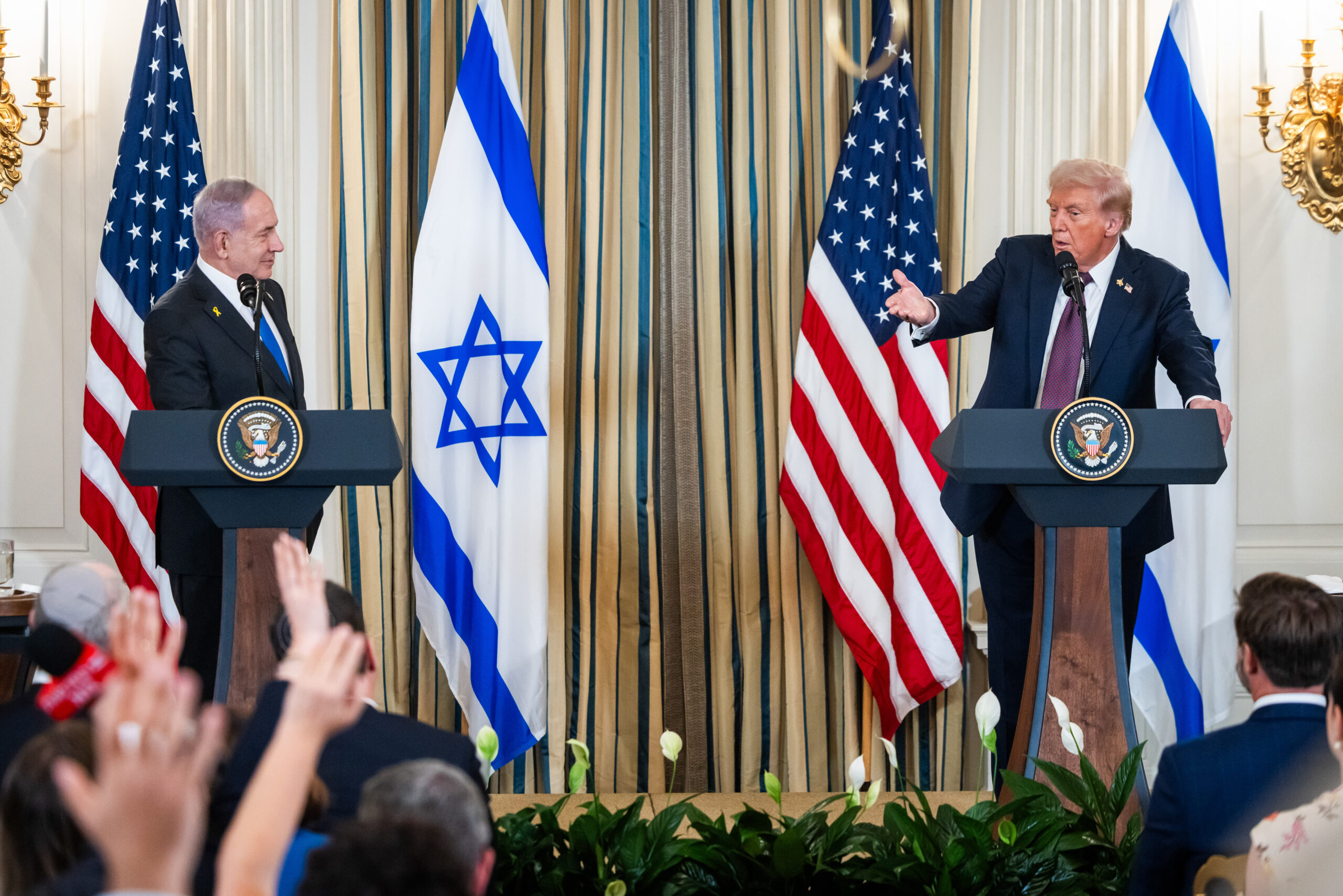
Jerusalem is looking to secure a new MOU – which would reportedly run through 2048 and includes ‘America First’ provisions – amid growing skepticism in U.S. politics over foreign aid
MANHATTAN MOMENTUM
Crowded field of Democrats seeks to win over Jewish voters in race to succeed Nadler
Andrew Cuomo carried the district in the NYC mayoral race, underscoring its pro-Israel constituency
Plus, moderates speechless in Seattle
Shmulik Almany
Israeli Ambassador to the U.S. Yechiel Leiter addresses Rosh Hashanah reception at the Israeli Embassy in Washington, Sept. 18th, 2025
Good Thursday afternoon!
This P.M. briefing is reserved for our premium subscribers like you — offering a forward-focused read on what we’re tracking now and what’s coming next.
I’m Danielle Cohen-Kanik, U.S. editor at Jewish Insider and curator, along with assists from my colleagues, of the Daily Overtime briefing. Please don’t hesitate to share your thoughts and feedback by replying to this email.
📡On Our Radar
Notable developments and interesting tidbits we’re tracking
Israeli Ambassador to the U.S. Yechiel Leiter said in an interview with The Jerusalem Post that Israel “prefer[s] that Turkey not receive F-35s from the U.S.,” breaking with Washington over the move that President Donald Trump indicated he was open to during a meeting with Turkish President Recep Tayyip Erdogan in September.
But Leiter dismissed concerns around Saudi Arabia potentially acquiring F-35s, which is currently under negotiation ahead of Crown Prince Mohammed bin Salman’s visit to the White House next week. “There’s no indication that Israel’s qualitative edge will be compromised,” he said. Leiter has recently become Israeli Prime Minister Benjamin Netanyahu’s main conduit in Washington after the resignation of Strategic Affairs Minister Ron Dermer…
Israel is seeking a new 20-year memorandum of understanding with the U.S. when the current one expires in 2028, U.S. and Israeli officials told Axios, double the length of past agreements.
New Israeli propositions, including redirecting some of the funds towards joint U.S.-Israeli R&D rather than direct military aid, are reportedly designed to make the lengthy deal more attractive to Trump as well as the GOP, which has grown weary of foreign aid…
Trump told MBS in a phone call last month that he expects to see progress made on Israel-Saudi normalization now that the ceasefire in Gaza is in force, U.S. officials also told Axios, which MBS said he was “willing to work on”…
Israel and White House advisor Jared Kushner are preparing contingency plans in case Trump’s 20-point Gaza peace plan doesn’t come to fruition, Israeli media reports. The IDF’s chief of staff, Lt. Gen. Eyal Zamir, told Israeli Security Cabinet officials that the IDF will soon present its alternative…
Meanwhile in the U.S., the Democratic primary for the seat of retiring Rep. Jerry Nadler (D-NY) in New York’s 12th Congressional District, which has one of the largest Jewish constituencies in the country, gets more crowded by the day.
Shortly after the entry of JFK’s grandson, Jack Schlossberg, into the race, Erik Bottcher, a Democratic city councilman and LGBTQ activist, told The New York Times he’s jumping in (and that he supports Israel’s right to exist as a Jewish state). There are rumors that Lincoln Project co-founder George Conway is eyeing a bid, as well.
Among the many other candidates are longtime Nadler aide Micah Lasher, who today got the endorsement of Comptroller-elect Mark Levine; state Assemblyman Alex Bores; and gun control activist Cameron Kasky, who posted yesterday on social media, “If you are a Democrat running in 2026 and do not fully support an arms embargo to the State of Israel … Stop wasting everybody’s time”…
Seattle Mayor Bruce Harrell conceded to his opponent, socialist Katie Wilson, today after last night’s ballot drop made it mathematically impossible for him to prevail.
Though the moderate Harrell led in the polls for the week following Election Day, Wilson eventually gained ground and now leads him by a 0.7% margin — just shy of 2,000 votes. With only several hundred votes left to be counted, The Seattle Times said the race is “on pace to be the closest in modern Seattle politics.”
Wilson joins New York City Mayor-elect Zohran Mamdani, as well as progressive challengers who prevailed in several Seattle City Council races, as evidence of the far left’s growing popularity in major U.S. cities. However, their small (or razor thin, in Wilson’s case) margins of victory and Minneapolis Mayor Jacob Frey’s win over his DSA-aligned opponent are proof the fringe still lacks a mandate in the Democratic Party…
Former Rep. Elaine Luria (D-VA) announced raising more than $500,000 in the first 24 hours after the launch of her comeback bid for her seat in Virginia’s 2nd Congressional District.
The Jewish, pro-Israel Navy veteran sent out a fundraising email this afternoon with the subject line “Chutzpah,” saying the “Yiddish term that means guts or courage … runs in my family” and she’s “not afraid of a little mishigas”…
Sen. John Fetterman (D-PA) was hospitalized today after suffering a “ventricular fibrillation flare-up” and subsequent fall and face injuries, but is doing well, his spokesperson reported. His scheduled discussion this evening with UJA-Federation of New York about his new book has been cancelled…
The New York Times profiles Heritage Foundation President Kevin Roberts and his path from leading a small Catholic college to helming the prominent think tank and sparking controversy among conservatives over his embrace of Tucker Carlson.
Roberts claimed as part of his defense over releasing the controversial video during a staff meeting last week, “I actually don’t have time to consume a lot of news. I consume a lot of sports,” and “I didn’t know much about this [Nick] Fuentes guy. I still don’t.”
“‘Who could believe that the head of a think tank doesn’t think?’ said Charles Jacobs, the president of the Jewish Leadership Project, which resigned from a Heritage Foundation task force meant to fight antisemitism after Mr. Roberts’ video was released”…
Joining the list of Heritage resignations, Adam Mossoff, a law professor at George Mason’s Scalia Law School and a prominent pro-Israel advocate, announced he is resigning as a Heritage visiting fellow today “based on [his] considered judgment” of Roberts’ video and “subsequent commentary”…
⏩ Tomorrow’s Agenda, Today
An early look at tomorrow’s storylines and schedule to keep you a step ahead
Keep an eye on Jewish Insider tomorrow morning for a preview of President Donald Trump’s meeting next week with Saudi Crown Prince Mohammed bin Salman.
New York City Mayor Eric Adams is traveling to Israel tomorrow for a five-day trip where he plans to meet with government officials and economic development and high-tech leaders.
The Texas Tribune Festival, taking place this week in Austin, continues tomorrow with speakers including former Transportation Secretary Pete Buttigieg, Sen. Michael Bennet (D-CO), Democratic Texas Senate candidates James Talarico and Rep. Colin Allred, Sen. Chris Murphy (D-CT), comedian John Mulaney, former Sen. Joe Manchin (I-WV), venture capitalist Joe Lonsdale and former U.S. Attorney General Eric Holder. On Saturday, Sens. Amy Klobuchar (D-MN) and Adam Schiff (D-CA) are slated to speak.
MSNBC is launching its rebrand on Saturday as MS NOW, part of its separation from NBCUniversal, with dozens of veteran journalists recruited as part of its expanded newsroom.
On Sunday, the Museum of Jewish Heritage – A Living Memorial to the Holocaust will present its fourth annual New York Jewish Book Festival.
Sunday evening, the Jewish Federations of North America’s General Assembly kicks off in Washington, with an opening plenary including former U.S. Ambassador to Japan Rahm Emanuel, authors Sarah Hurwitz and Micah Goodman, CNN contributor Scott Jennings and Rabbi Angela Buchdahl, senior rabbi at Central Synagogue in New York City.
We’ll be back in your inbox with the Daily Overtime on Monday. Shabbat Shalom!
Stories You May Have Missed
BROTHERHOOD PARADOX
Israel’s neighbors have banned the Muslim Brotherhood, but Israel hasn’t. Why not?
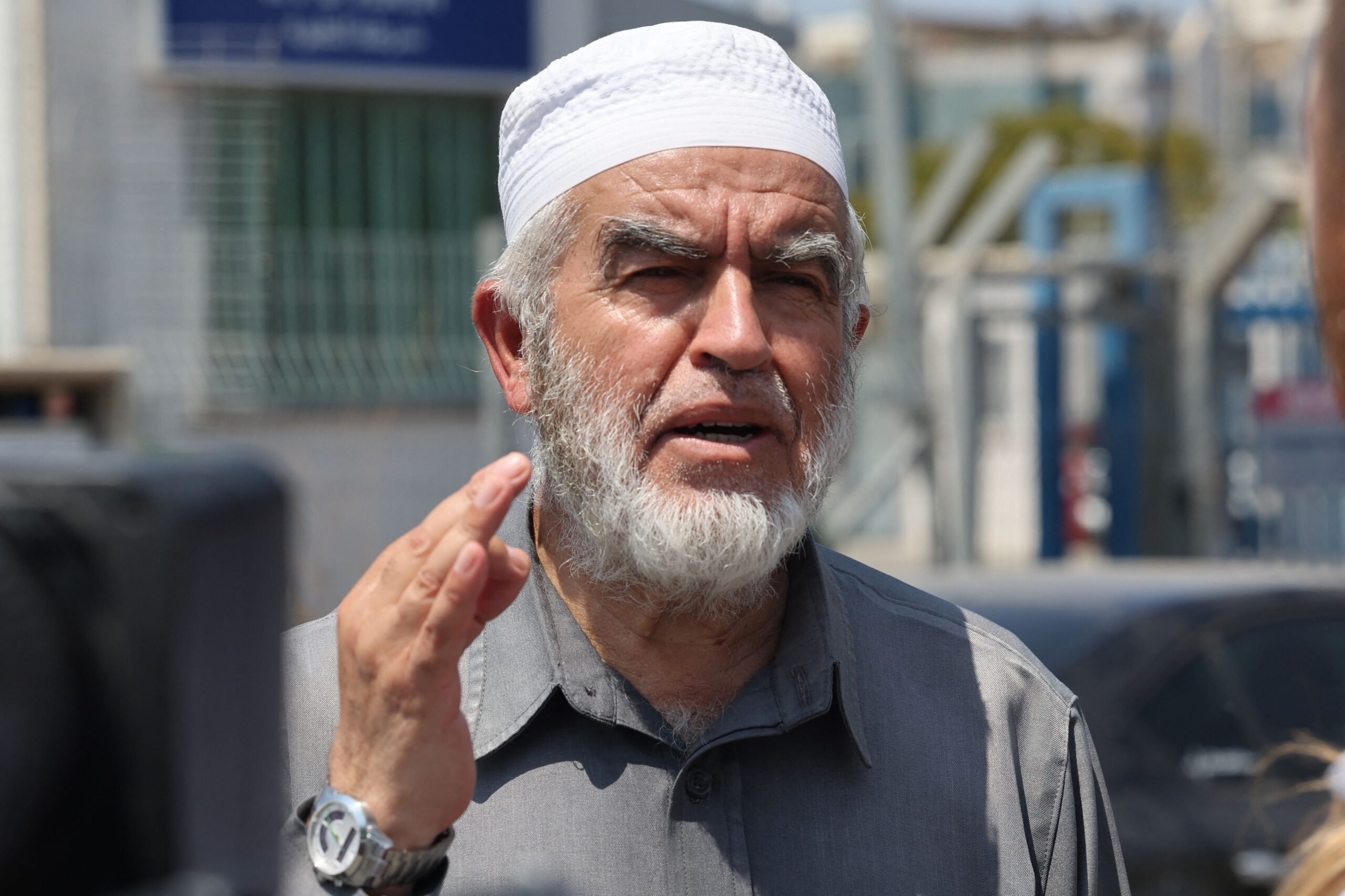
One of its branches is banned for Hamas ties. The other sits in the Knesset
WOOD-N’T TAKE IT
Another Maine Democrat takes page from Platner playbook
Jordan Wood, now running to succeed Rep. Jared Golden, said he won’t take money from AIPAC in his newly launched House campaign
Plus, Cait Conley emerges as Dem front-runner against Lawler
Win McNamee/Getty Images
President Donald Trump meets with Saudi Crown Prince Mohammed bin Salman during a “coffee ceremony” at the Saudi Royal Court on May 13, 2025, in Riyadh, Saudi Arabia.
Good Wednesday afternoon!
This P.M. briefing is reserved for our premium subscribers like you — offering a forward-focused read on what we’re tracking now and what’s coming next.
I’m Danielle Cohen-Kanik, U.S. editor at Jewish Insider and curator, along with assists from my colleagues, of the Daily Overtime briefing. Please don’t hesitate to share your thoughts and feedback by replying to this email.
📡On Our Radar
Notable developments and interesting tidbits we’re tracking
U.S. and Saudi officials are working to finalize a defense pact between the two countries ahead of Crown Prince Mohammed bin Salman’s visit to Washington next week, Axios reports. The agreement would reportedly contain similar guarantees to those Qatar received from the U.S. last month, with the Saudis also looking to purchase a weapons package that would include F-35 fighter jets.
The Trump administration also told the Saudis that it would like to see progress made on Saudi-Israel normalization, U.S. officials said. The negotiations on these deals quietly brought White House advisor Jared Kushner to Riyadh over the weekend and the Saudi defense minister to the U.S. earlier this week…
Jordan Wood, a former congressional aide and Democratic candidate for Senate in Maine, announced that he is switching his candidacy to now run for the House in Maine’s 2nd Congressional District, where Rep. Jared Golden (D-ME) has said he will not seek reelection.
Wood joined his fellow Maine Senate candidate Graham Platner in vowing not to accept support from AIPAC, saying in an interview last week, “There’s a tremendous amount of distrust right now among Democratic primary voters that the money that AIPAC has put into our political system has affected our priorities when it comes to foreign aid to Israel”…
Another shifting race is New York’s 17th Congressional District, where Jessica Reinmann, a Democratic nonprofit executive who was challenging Rep. Mike Lawler (R-NY), dropped out of the Democratic primary today and endorsed Cait Conley.
An Army veteran with extensive counterterrorism experience in the Middle East, Conley told Jewish Insider in April about her commitment to Israel’s security and concerns around threats posed by Iran.
With her background in national security, Conley is viewed as having the strongest profile to win back the swing seat for the party, according to Democratic sources familiar with the race.…
The Wall Street Journal reports on financial gains made by U.S. businesses over the two-year Israel-Hamas war; out of the $32 billion of military-related sales the U.S. has greenlit to Israel since October 2023, $19.3 billion is through contracts with Boeing, Lockheed Martin has secured $743 million, Caterpillar secured $295 million, and more…
An Israeli-founded AI cybersecurity company, Tenzai, founded just six months ago, came out of stealth yesterday with a $75 million seed round. Its technology, which finds hackable vulnerabilities in code, drew support from major venture capital firms including Greylock Partners, Lux Capital and Battery Ventures…
Israel reopened the Zikim border crossing into Gaza today to facilitate increased food and humanitarian aid flow, as part of its compliance with the ongoing ceasefire agreement with Hamas…
After being heckled by anti-Israel protesters at a podcast taping earlier this week, former Vice President Kamala Harris paused the conversation to tell the audience: “A lot of what this process has been for me has been about reflection. Look, we should’ve done more as an administration. We should’ve spoken publicly about our criticism of the way that Netanyahu and his government were executing this war.”
“We had more levers in terms of leverage that we did not use. … But let’s be very clear, that the inhuman nature of what has happened to the Palestinian people in Gaza, the innocent civilians, the extent of hunger, famine, suffering, death, is something that we must acknowledge,” Harris continued…
⏩ Tomorrow’s Agenda, Today
An early look at tomorrow’s storylines and schedule to keep you a step ahead
Keep an eye on Jewish Insider tomorrow morning for reporting on the status of the Muslim Brotherhood under Israeli law.
The U.S. House is expected to approve a spending package to reopen the government this evening, which would fund the government through Jan. 30.
The U.S. Commission on International Religious Freedom is holding a hearing tomorrow morning on religious freedom in Syria during the country’s transition out of dictatorship.
The DP World Tour golf championship kicks off in Dubai, UAE, tomorrow.
Stories You May Have Missed
NEXT STEPS
After Mamdani win, socialists look to challenge Democratic incumbents in NYC

Pro-Israel Democratic Reps. Hakeem Jeffries, Ritchie Torres and Dan Goldman are facing long-shot challengers from the far left
HISTORY LESSONS
Clintons tie Trump’s Gaza peace plan to Oslo Accords in Rabin memorial discussion

Former President Bill Clinton invoked slain Israeli Prime Minister Yitzhak Rabin’s ‘law’: ‘We will fight terror as if there are no negotiations. We will negotiate as if there is no terror’
Plus, Elaine Luria wants a rematch
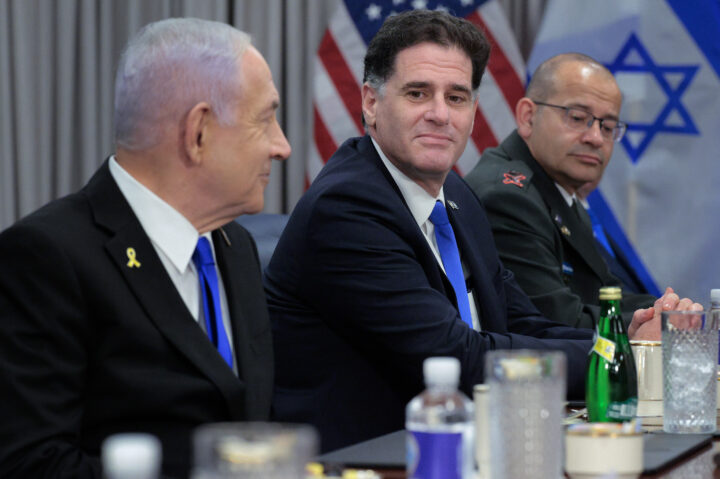
Chip Somodevilla/Getty Images
Israeli Prime Minister Benjamin Netanyahu (L) is joined by Israeli Minister of Strategic Affairs Ron Dermer and other officials for a meeting with U.S. Secretary of Defense Pete Hegseth at the Pentagon on July 09, 2025 in Arlington, Virginia.
Good Tuesday afternoon!
This P.M. briefing is reserved for our premium subscribers like you — offering a forward-focused read on what we’re tracking now and what’s coming next.
I’m Danielle Cohen-Kanik, U.S. editor at Jewish Insider and curator, along with assists from my colleagues, of the Daily Overtime briefing. Please don’t hesitate to share your thoughts and feedback by replying to this email.
📡On Our Radar
Notable developments and interesting tidbits we’re tracking
Michigan Democratic Senate candidate Abdul El-Sayed sidestepped a question about Israel’s right to exist during an interview with the anti-Israel media outlet Zeteo last week, Jewish Insider’s Marc Rod reports.
Zeteo founder Mehdi Hasan asked El-Sayed how he would respond if and when he faces questions on the campaign trail about whether he supports Israel’s right to exist as a Jewish state. Pressed after initially dodging the question, El-Sayed said, “Israel exists. Palestine doesn’t. And so I always wonder why nobody asks me why Palestine doesn’t have a right to exist.”
El-Sayed also dismissed AIPAC donors as “MAGA billionaires throwing their money around to try to dictate the outcome for a Democratic primary,” though AIPAC has not yet endorsed a candidate in the Michigan Senate race…
Chi Ossé, a far-left Gen Z New York City councilman, is planning to launch a primary challenge to House Minority Leader Hakeem Jeffries (D-NY), The New York Times reports, despite discouragement from his ideological ally, Mayor-elect Zohran Mamdani, who clinched Jeffries’ endorsement shortly before the general election. Ossé’s insistence on running reportedly caused him to be disinvited from Mamdani’s election night party…
Elsewhere in New York, Bruce Blakeman, the first Jewish executive of Nassau County who just won reelection last week, is considering mounting a bid for governor, he told Politico, where he would face off against Rep. Elise Stefanik (R-NY) in the GOP primary. Both are allies of President Donald Trump; Blakeman said he “told [Trump] that I was interested, and he didn’t discourage me. And I think he’s had the same conversation with Elise. I think the president is going to play it out and see what happens at the convention”…
Also throwing her hat in the ring, former Rep. Elaine Luria (D-VA), a moderate Jewish Democrat with a strong pro-Israel record, plans to launch a comeback campaign tomorrow, Punchbowl reports. Luria would likely be the front-runner in the already crowded Democratic primary to win back Virginia’s 2nd Congressional District from Rep. Jen Kiggans (R-VA), who defeated her in 2022…
Ron Dermer, Israel’s minister of strategic affairs and longtime advisor and confidante to Prime Minister Benjamin Netanyahu, resigned from his post today after three years in the role, JI’s Tamara Zieve reports. “This government will be remembered both for the October 7 attack and for its management of the two-year, seven-front war that followed,” Dermer wrote in his resignation letter. Israeli media had reported for months that Dermer’s departure was expected.
Dermer has led Israel’s ceasefire and hostage-release negotiations since February and is expected to stay on as Netanyahu’s envoy to continue handling the future of the Gaza portfolio, political sources recently told JI…
The State Department denied reports today that White House advisor Jared Kushner met with Gaza militia leader Yasser Abu Shabab to discuss ceasefire issues including dozens of Hamas terrorists still “stuck” in tunnels on the Israeli side of the ceasefire lines, though U.S. officials told Axios Kushner did speak with Netanyahu about the issue during their meeting in Jerusalem yesterday, and is eager to resolve it without impact on the next phase of the deal…
Saudi Arabia is set to host a U.S.-Saudi investment summit in Washington next Wednesday, a day after Crown Prince Mohammed bin Salman’s visit to the White House. An invite obtained by CBS News shows the event taking place at the Kennedy Center, co-hosted by Saudi Arabia’s Ministry of Investment and the U.S.-Saudi Business Council…
An undated letter from Houthi Chief of Staff Yusuf Hassan al-Madani to Hamas’ Al Qassam Brigades indicates that the Yemeni terror group has halted its attacks on Israel and ships in the Red Sea amid the ongoing ceasefire: “We are closely monitoring developments and declare that if the enemy resumes its aggression against Gaza, we will return to our military operations deep inside the Zionist entity, and we will reinstate the ban on Israeli navigation in the Red and Arabian Seas,” the letter reads…
⏩ Tomorrow’s Agenda, Today
An early look at tomorrow’s storylines and schedule to keep you a step ahead
Keep an eye on Jewish Insider tomorrow morning for an analysis on congressional redistricting efforts and additional reporting on Syrian President Ahmad al-Sharaa’s Washington meetings.
The International Conference of Chabad-Lubavitch Emissaries kicks off tomorrow, drawing 6,200 rabbis from 111 countries to New York City.
Former First Lady Michelle Obama will appear at Washington’s Sixth & I Synagogue tomorrow evening to discuss her forthcoming book, The Look.
Stories You May Have Missed
BETTER TOGETHER
Black and Jewish college students explore shared adversity and allyship at DC-area ‘Unity Dinner’

Sponsored by Robert Kraft’s Blue Square Alliance, Hillel International and the United Negro College Fund, the event brought together over 100 students in an effort to rebuild the Black-Jewish alliance of the Civil Rights Movement
PEACEKEEPING PROSPECTS
Concerns in Israel as U.S. seeks United Nations mandate for international force in Gaza

Israeli experts are pessimistic about the effectiveness and safety of a U.N.-led force, given Israel’s experience with similar mandates in the past
Plus, Laura Loomer turns on Israel aid
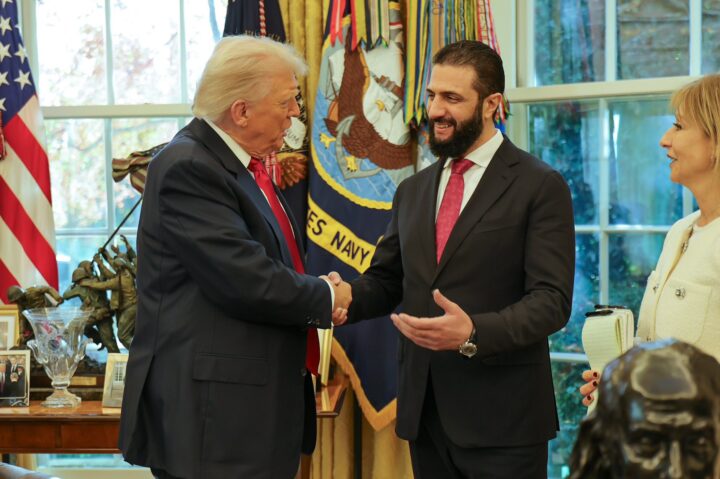
Syrian Presidency
President Donald Trump greets Syrian President Ahmad al-Sharaa in the Oval Office on Nov. 10, 2025.
Good Monday afternoon!
This P.M. briefing is reserved for our premium subscribers like you — offering a forward-focused read on what we’re tracking now and what’s coming next.
I’m Danielle Cohen-Kanik, U.S. editor at Jewish Insider and curator, along with assists from my colleagues, of the Daily Overtime briefing. Please don’t hesitate to share your thoughts and feedback by replying to this email.
📡On Our Radar
Notable developments and interesting tidbits we’re tracking
Despite the historic nature of Syrian President Ahmad al-Sharaa’s White House visit today, his meeting with President Donald Trump was kept a relatively low-key affair. Al-Sharaa entered through a back door and didn’t receive the usual greeting photo op with Trump, and the meeting was closed to the press.
The two leaders made news nonetheless: Syria is now set to join the U.S.-led campaign against ISIS, Trump and al-Sharaa discussed reopening respective embassies in Damascus and Washington and the Treasury Department issued a new order extending the suspension of U.S. sanctions on Syria for six months.
Ibrahim Olabi, Syria’s U.N. ambassador, said the two leaders also discussed a prospective Israel-Syria security agreement. “The term used frequently during the meeting by President Trump and Secretary [of State Marco] Rubio was ‘let’s get this done,’” Olabi said…
Trump has encouraged lawmakers to fully lift the congressionally mandated U.S. sanctions on Syria, but Rep. Brian Mast (R-FL), a Trump ally and the chair of the House Foreign Affairs Committee, did not commit to supporting sanctions relief when he held his own meeting with al-Sharaa yesterday, Jewish Insider’s Marc Rod reports.
Mast and al-Sharaa “had a long and serious conversation about how to build a future for the people of Syria free of war, ISIS, and extremism,” Mast said in a statement, but offered no words of praise for the Syrian leader…
Sergio Gor was sworn in as U.S. ambassador to India today to unusual fanfare — he and Trump were joined in the Oval Office by Rubio; Vice President JD Vance; Treasury Secretary Scott Bessent; Attorney General Pam Bondi; U.S. Attorney for the District of Columbia Jeanine Pirro; Sens. Lindsey Graham (R-SC), Jim Risch (R-ID); Katie Britt (R-AL) and Tommy Tuberville (R-AL); Erika Kirk and Fox News host Laura Ingraham, among others.
Swearing in Gor, who used to serve as the head of the Presidential Personnel Office where he wielded significant influence in assuring political hires shared his skepticism of American engagement abroad, Vance said, “We have such a crowd here, you’d think we were swearing in a vice president”…
Laura Loomer, a right-wing Trump advisor who has historically maintained pro-Israel stances, wrote on social media today that, after spending “an incredible week” in Israel, she has “reached a firm conclusion: Israel must end its dependence on U.S. aid and the U.S. must end all aid to Israel.”
“I truly hope by the end of the Trump administration and by the beginning of a new administration in 2028 that we see zero aid flowing to Israel,” she wrote, calling it a “win-win” for the U.S., which will no longer be a “global baby sitter,” and for Israel, which will be free to conduct its wars as it wishes.
In response, Democratic Majority for Israel accused Loomer of continuing “a troubling pattern on the Right — embracing anti-Israel policies & undermining our allies,” in the vein of Tucker Carlson and Rep. Marjorie Taylor Greene (R-GA)…
Christine Pelosi, daughter of Rep. Nancy Pelosi (D-CA), who was thought to be considering a run for her mother’s seat as she retires, announced today that she is not running for Congress. Instead, Pelosi is launching a campaign for the state Senate seat currently held by Scott Wiener, who is running for her mother’s San Francisco congressional district…
New York City Mayor-elect Zohran Mamdani named two of his top advisors today: Dean Fuleihan to be first deputy mayor and Elle Bisgaard-Church as his chief of staff.
Bisgaard-Church is a democratic socialist who was part of Mamdani’s campaign inner circle. Fuleihan, on the other hand, is a city and state government veteran; he previously served in the same role under former Mayor Bill de Blasio and as his budget director, as well as a budget expert in the state Legislature, among other roles. Rep. Ritchie Torres (D-NY), who was at times at odds with Mamdani during his campaign, called Fuleihan’s appointment “exceptional … in more ways than one”…
Danielle Sassoon, the former interim U.S. attorney for the Southern District of New York who resigned her post rather than drop a case against New York City Mayor Eric Adams at the request of the Trump administration, has joined the law office of Clement & Murphy, The New York Times reports. The conservative boutique firm is known for its “longstanding opposition to executive branch overreach”…
The Wall Street Journal reports on Yale’s attempt to stay out of the line of fire in Trump’s crusade against higher education, including President Maurie McInnis’ increased government lobbying expenditures and a student forum where classmates encouraged each other to refrain from disruptive anti-Israel protests: “‘The only thing continuing to protest will do is to take education and opportunities away from the rest of us,’ said one post [on the forum]. ‘Ppl need to stop being stupid and selfish and realize they will gain no ground under this administration on the Israel issue’”…
Palantir CEO Alex Karp defended his support of Israel in an interview with WIRED, released today, saying, “Israel is a country with a GDP smaller than Switzerland, and it’s under massive attack. Some critiques are legitimate, but others are aggressive in attacking Israel. My reaction is, well, then I’m just going to defend them.”
“When people are fair to Israel and treat it like any other nation, which I don’t think they do, I will be much more willing to express in public the things I express in private to Israelis”…
⏩ Tomorrow’s Agenda, Today
An early look at tomorrow’s storylines and schedule to keep you a step ahead
Keep an eye on Jewish Insider tomorrow morning for reporting on veteran journalists Bianna Golodryga and Yonit Levi’s new book, Don’t Feed the Lion, which they will launch at Temple Emanu-El in New York City tomorrow night, joined in conversation by comedian Elon Gold.
This evening, Syrian President Ahmad al-Sharaa will appear on Fox News’ “Special Report” with Bret Baier.
Stories You May Have Missed
SCENE AT SOMOS
Jewish leaders begin outreach to incoming Mamdani administration, sensitively

At the post-election Somos conference, Jewish officials tried to find areas of common ground with the new mayor
DAYTONA X DAMASCUS DIPLOMACY
The influencer couple selling Syria on Capitol Hill
JI asked senior New York Democratic officials and Jewish community leaders to discuss the top threats that a Mamdani administration could pose to Jewish life in the city
Plus, Treasury targets Hezbollah financiers

Maksim Konstantinov/SOPA Images/LightRocket via Getty Images
The Kazakhstan national flag flutters in the wind on a flagpole.
Good Thursday afternoon!
This P.M. briefing is reserved for our premium subscribers like you — offering a forward-focused read on what we’re tracking now and what’s coming next.
I’m Danielle Cohen-Kanik, U.S. editor at Jewish Insider and curator, along with assists from my colleagues, of the Daily Overtime briefing. Please don’t hesitate to share your thoughts and feedback by replying to this email.
📡On Our Radar
Notable developments and interesting tidbits we’re tracking
The Abraham Accords is expected to gain another participant this evening, though in a first, the country is not joining as a show of peace with Israel — since the new addition, the Muslim-majority central Asian nation of Kazakhstan, has had full diplomatic relations with Israel since 1992.
Kazakhstan’s president, Kassym-Jomart Tokayev, is expected to announce the move at a meeting with President Donald Trump later today, where they will also hold a joint phone call with Israeli Prime Minister Benjamin Netanyahu. Trump administration officials told Axios that the White House wants to “build momentum” for the Abraham Accords ahead of Saudi Crown Prince Mohammed bin Salman’s visit to Washington on Nov. 18.
As far as Kazakhstan’s motivation, the former Soviet nation has long lobbied Washington to cancel a Cold War-era law that has hindered its access to American markets, and could benefit from currying favor with the Trump administration.
Leading Jewish organizations have worked with Kazakhstan’s Jewish community and government for over a decade to lobby Congress to repeal the Jackson-Vanik Amendment, and told Jewish Insider’s Lahav Harkov and Danielle Cohen-Kanik that they are highly supportive of the country’s inclusion in the Accords…
Ahead of Syrian President Ahmad al-Sharaa’s own visit to the White House on Monday, the U.N. Security Council voted in favor of a U.S.-sponsored resolution to lift sanctions on the former Al-Qaida leader turned president…
Also getting an Oval Office welcome, Israeli media reported today that Trump invited the 20 Israeli hostages released from Gaza last month to visit the White House in two weeks…
On the Hill, members of the Senate Armed Services Committee from both parties voiced concerns with Elbridge Colby, under secretary of defense for policy, and his office at the Pentagon at a committee hearing today — for the second time this week, JI’s Marc Rod reports.
“Many of this committee have serious concerns about the Pentagon’s policy office and how it is serving the president of the United States and the Congress,” Sen. Roger Wicker (R-MS), the chairman of the committee, said in his opening statement. “In many of these conversations, we hear that the Pentagon policy office seems to be doing what it pleases without coordinating, even inside the U.S. executive branch”…
Rep. Nancy Pelosi (D-CA) announced this morning that she will retire at the end of her term in 2027, after serving 39 years in Congress where she made history as the first female speaker of the House.
For most of her illustrious career, Pelosi has been a reliable ally of Israel and, as Democratic leader, generally managed to keep her caucus united around support for the Jewish state. But, like many Democrats, she leaned in a more critical direction during the war in Gaza, at one point supporting a call to suspend weapons transfers to Israel. Read JI’s interview with Scott Wiener, the state senator from California seeking to win her seat…
The IDF is beginning to demobilize thousands of reservists called up for duty, some of whom have served hundreds of days in the past two years, announcing that the country is transitioning from war into a period of “enhanced border security” as the ceasefire with Hamas in Gaza largely endures…
The Treasury Department announced sanctions today against members of Hezbollah’s “finance team” who “oversee the movement of funds from Iran” in an effort to support the Lebanese government’s moves to disarm the terror group. The department revealed that the Iranian Revolutionary Guard Corps has already transferred over $1 billion to Hezbollah this year…
Author Jamie Kirchick argues in The Washington Post that the “inevitable fracturing of President Donald Trump’s MAGA movement is in sight, the instigator of its rupture that most narcissistic and destructive of media personalities: Tucker Carlson.”
Kirchick admonishes Heritage Foundation President Kevin Roberts for failing to outright condemn Carlson’s platforming of neo-Nazi influencer Nick Fuentes: “Stalinists and Holocaust deniers like Fuentes are perfectly entitled to spew their nonsense on street corners, through self-published manifestos or in online livestreams. What they are not entitled to is the imprimatur of purportedly respectable institutions whose reputations hinge upon the voices they choose to amplify”…
⏩ Tomorrow’s Agenda, Today
An early look at tomorrow’s storylines and schedule to keep you a step ahead
Keep an eye on Jewish Insider tomorrow morning for an interview with former Minnesota Sen. Rudy Boschwitz, who will be celebrating his 95th birthday.
On Sunday, the Zionist Organization of America will hold its annual gala, where it will present awards to Rep. Elise Stefanik (R-NY); Israeli Ambassador to the U.S. Yechiel Leiter; Leo Terrell, head of the Department of Justice’s antisemitism task force; Israeli Ambassador to the U.N. Danny Danon; and philanthropists Irit and Jonathan Tratt.
We’ll be back in your inbox with the Daily Overtime on Monday. Shabbat Shalom!
Stories You May Have Missed
THE INSIDE STORY
The 36 hours in Washington that took hostage families from grief to gratitude
The story of how the hostage families came to learn their loved ones were coming home, told to JI by key players
COMMUNITY CONCERNS
What New York City Jewish leaders are most worried about in a Mamdani mayoralty
JI asked senior New York Democratic officials and Jewish community leaders to discuss the top threats that a Mamdani administration could pose to Jewish life in the city
The Oklahoma senator also told JI that his colleagues have more work to do on raising awareness about efforts to designate the Muslim Brotherhood as a terrorist organization

Andrew Harnik/Getty Images
Sen. James Lankford (R-OK) speaks during a news conference on Capitol Hill on May 1, 2024 in Washington, DC.
As the international community looks to advance the ceasefire plan in Gaza, Sen. James Lankford (R-OK) emphasized the need for continued pressure from countries like Turkey and Qatar on Hamas to comply with the terms of the ceasefire requiring it to disarm.
But he also warned that there should be limits on the ways in which Turkey and Qatar are involved in the future of Gaza, arguing that they should have no role in certain sensitive areas, even as they remain involved in reconstruction work.
Lankford, in an interview with Jewish Insider this week, said that Hamas’ release of the final remaining deceased hostages will be an inflection point necessitating movement into the next phase of the ceasefire plan presented by the United States.
“The requirement for Hamas to disarm is still there. It has to be there, both for the people that live in Gaza that are Palestinian and for the security of the entire region,” Lankford said.
He said that ensuring that Hamas disarms, something it has thus far refused to do, will require military, diplomatic and financial pressure, particularly from countries like Turkey and Qatar that have been Hamas patrons.
“If the Turks want contracts to be able to rebuild in Gaza, which they do, then that’s not going to happen until Hamas is actually disarmed, so Turkey’s got to decide, ‘Do you want those contracts to be able to rebuild or not?’ If they do, then here’s what that requirement is going to be,” Lankford said.
He said that providing a higher level of security and freedom of movement on the Israeli-controlled side of Gaza will also help to increase pressure on Hamas. And he said that any further violations of the ceasefire agreement by Hamas should be met with “immediate, serious consequences.”
Turkey and Qatar’s roles in the future of Gaza should be limited to certain sectors, Lankford added, given the countries’ hostility to Israel and support for Hamas. He said he’s comfortable seeing Ankara assist with reconstruction, but it should not be involved in running hospitals, schools or mosques or in rebuilding the economy.
“We’re going to have to figure out what are roles that they can do and they cannot do,” Lankford said. “There are certain roles they just should not be a part of.”
He said he’s not yet able to name specific countries that he would be comfortable seeing taking on more sensitive tasks — though he noted Indonesia’s interest — and said it’s “going to take a multinational force.”
“It’s going to be a trusted force. It’s not going to be American forces in the middle of that. It needs to be a trusted force from the region as much as possible, but that’s going to have to be somebody that’s tenacious enough to say, ‘No, we’re going to actually bring some stability to this area,’” Lankford said. “And I don’t know who that is yet.”
He said that there are “plenty of Arab countries that don’t like the Muslim Brotherhood and don’t like all of its offshoots” — including Hamas — but the question will be whether they’re “willing to be able to put their sons on the line” to confront the terrorist groups in Gaza.
Asked about efforts to counter the Muslim Brotherhood at home — several of Lankford’s colleagues have introduced legislation to designate the group as a terrorist organization and have pushed for similar action by executive order from the White House — Lankford said that supporters of the effort have more work to do to raise awareness.
“I think the first issue for me is really to keep raising it, to be able to continue to raise awareness of it, because you’re not going to build momentum among 100 senators if it’s the first time they thought about it,” Lankford said. “So we’re going to have to build some of that momentum for a while.”
The Oklahoma senator, a co-chair of the Senate antisemitism task force, has also been outspoken about rising antisemitism on the “New Right” and was critical of the Heritage Foundation’s response to neo-Nazi Nick Fuentes’ recent appearance on Tucker Carlson’s podcast.
Asked about Carlson, Lankford said that he “can say whatever he wants to … but we also have a protected right to be able to speak back and to say we disagree on areas.”
“I think the worst case scenario is to just be able to leave it out there,” Lankford continued. He argued that providing counter-narratives to antisemitic talking points is crucial to stemming the tide of antisemitism on both sides of the aisle.
“If you get loud voices that say it and repeat it, people that just see it and don’t see a counter-narrative just accept it,” Lankford said. “We’ve got to make sure a counter-narrative is out there so that people actually hear a different opinion on it.”
Lankford, a Southern Baptist minister, objected to Carlson’s comments condemning Christian Zionists.
“To say those that support Israel that are Christians are ‘heretics,’ and are ‘the worst’ — I guess worse than Hamas and Hezbollah,” Lankford said. “That’s a bit of a bizarre statement to make, and I think we have a responsibility to be able to speak out and say, ‘Hey, I don’t agree with that.’”
“It seems that he is defining what Christianity is. And he has a right to be able to say whatever he wants to, but I also have a right to be able to live biblical Christianity as well, and to be able to see the scripture in the full context of what it says,” Lankford continued. “So I want to speak out on that as well.”
Asked about Vice President JD Vance’s exchange last week with a student who asserted that Jews are seeking to persecute Christians — a narrative that Vance did not address or dispute — Lankford said that leaders, including in the White House and the Trump administration, need to speak up “for the most basic issue of religious liberty.”
He said it’s important for people to be able to hold and live their own faiths and to also protect the ability of others to practice different faiths. “What’s interesting on that dialogue is, I’ve literally not met a Jewish person that wasn’t very protective of religious liberty,” Lankford added. “It’s literally the opposite of that question.”
Plus, the end of a Golden era in Maine

Stephen Maturen/Getty Images
Minneapolis Mayor Jacob Frey speaks to supporters at an Election Night party on November 2, 2021 in Minneapolis, Minnesota.
Good Wednesday afternoon!
This P.M. briefing is reserved for our premium subscribers like you — offering a forward-focused read on what we’re tracking now and what’s coming next.
I’m Danielle Cohen-Kanik, U.S. editor at Jewish Insider and curator, along with assists from my colleagues, of the Daily Overtime briefing. Please don’t hesitate to share your thoughts and feedback by replying to this email.
📡On Our Radar
Notable developments and interesting tidbits we’re tracking
Jewish Americans are still taking stock after Zohran Mamdani’s victory last night in the New York City mayoral race. The Conference of Presidents of Major American Jewish Organizations, based in New York, called Mamdani’s victory a “grim milestone” and a reminder “that antisemitism remains a clear and present danger, even in the places where American Jews have long felt most secure.” Ted Deutch, CEO of the American Jewish Committee, listed policies the organization will be looking toward “to address the profound concerns about what the future holds for Jewish safety and belonging.”
Robert Tucker, the Jewish commissioner of the New York City Fire Department, resigned this morning, The New York Post reports, hours before he was set to fly to Israel to meet his counterpart there.
In his first response to an incident of antisemitism as mayor-elect, Mamdani denounced the vandalism of the Magen David Yeshiva in Brooklyn, which had two swastikas graffitied on it overnight, as “a disgusting and heartbreaking act of antisemitism, and it has no place in our beautiful city”…
Another heavily Democratic city rejected its own far-left candidate for mayor today, as incumbent Mayor Jacob Frey of Minneapolis won reelection against his DSA-aligned challenger, state Sen. Omar Fateh, Jewish Insider’s Matthew Shea reports. Marking a win for the more pragmatic wing of the Democratic Party, Frey secured his third term with 50% of the vote, to Fateh’s 44%, in the second round of the city’s ranked-choice voting.
A similar result may be emerging in Seattle, where preliminary results last night showed the Democratic incumbent, Mayor Bruce Harrell, leading over his socialist challenger, Katie Wilson, though many ballots remain to be counted…
One day after a historic Election Day — first democratic socialist mayor of New York City, largest turnout in an NYC mayoral race since 1969, first female governor of Virginia, first Muslim woman elected to statewide office as Virginia’s lieutenant governor, a record percentage of registered voters turning out for the municipal election in Minneapolis, among others — and the U.S. is already hitting another milestone: the longest government shutdown in history, at 36 days long.
President Donald Trump partially blamed the shutdown for Democrats’ strong showing in yesterday’s elections at a breakfast with Senate Republicans this morning, telling them, “I thought we’d have a discussion after the press leaves about what last night represented, and what we should do about it. … I think if you read the pollsters, the shutdown was a big factor, negative for the Republicans”…
Citing the shutdown, increased polarization and rising political violence, Rep. Jared Golden (D-ME) announced this afternoon that he will not be seeking reelection. Golden, a pro-Israel centrist who often worked across the aisle, has represented Maine’s 2nd Congressional District, a largely rural, working-class district that Trump won in the 2024 election by 14 points, since 2018, a seat that will be difficult for Democrats to maintain…
Recently freed former hostage Elizabeth Tsurkov recounted her two and a half years of captivity by Kataib Hezbollah, the Iran-backed terror group in Iraq, in a new interview with The New York Times, detailing the torture she experienced that resulted in potentially permanent nerve damage and the need for “long-term physical and psychological rehabilitation,” as determined by doctors at Israel’s Sheba Medical Center…
The University of Maryland, College Park student government is scheduled to vote on two resolutions hostile towards Israel tonight, JI’s Haley Cohen reports. One calls for the university to prohibit people who are “committing war crimes” and “genocide” from speaking on campus, after the campus chapter of Students Supporting Israel hosted an event last month where former IDF soldiers spoke about their experiences serving during Israel’s war with Hamas.
The second resolution calls on the university to issue an apology to students who faced disciplinary action for protesting that event, when demonstrators packed the outside hallway shouting “baby killers” and “IOF [Israel “Occupation” Forces] off our campus,” while several others protested outside of the building with chants comparing the IDF to the Ku Klux Klan…
Variety profiles David Ellison in his first 100 days as CEO of the recently merged Paramount Skydance, including the media company’s about-face on Israel issues. Free Press founder Bari Weiss, hired as editor-in-chief of CBS News by Ellison, “has been so vocal in her support of [Israel] that she faces frequent death threats. She and her wife, The Free Press co-founder Nellie Bowles, require a detail of five bodyguards that costs the studio $10,000-$15,000 a day.”
Paramount also reportedly “maintains a list of talent it will not work with because they are deemed to be ‘overtly antisemitic’ as well as ‘xenophobic’ and ‘homophobic,’” after the studio was the first to denounce a boycott of Israel signed by several Hollywood heavyweights…
⏩ Tomorrow’s Agenda, Today
An early look at tomorrow’s storylines and schedule to keep you a step ahead
Keep an eye on Jewish Insider tomorrow morning for the latest news on the Heritage Foundation’s internal reckoning with its defense of Tucker Carlson.
Tomorrow, the Senate Judiciary Committee will hold a hearing on the Holocaust Expropriated Art Recovery (HEAR) Act, a bill aimed at eliminating loopholes used to possess Nazi-looted artwork that Jewish families have been trying to recover.
The Senate Armed Services Committee will hold a nomination hearing for Alex Velez-Green to be deputy under secretary of defense for policy, coming days after committee lawmakers blasted the Pentagon office and its head, Elbridge Colby, during a contentious hearing for failing to communicate with them.
Maccabi Tel Aviv will play Aston Villa tomorrow in a Europa League match that generated controversy after local authorities announced that supporters of the Israeli team would not be permitted to attend, with the game deemed “high risk” over security concerns. Over 700 police officers are expected to be deployed and a no-fly zone will be established around the Villa Park stadium in Birmingham, England.
Israel’s Hapoel Tel Aviv basketball team will face off against the Dubai team in Sarajevo, Bosnia and Herzegovina, in Round 9 of the EuroCup tomorrow.
The Blue Square Alliance Against Hate, formerly the Foundation to Combat Antisemitism, will host its second Sports Leaders Convening at Gillette Stadium in Massachusetts tomorrow, featuring Robert Kraft, the organization’s CEO and owner of the New England Patriots; Ted Deutch, CEO of the American Jewish Committee; Jonathan Greenblatt, CEO of the Anti-Defamation League; Adam Lehman, CEO of Hillel International; Michael Masters, CEO of the Secure Community Network; and leaders from major sports leagues.
The Washington Institute for Near East Policy will host a webinar tomorrow on the possibility of peace between Israel and Lebanon with Lebanese Member of Parliament Fouad Makhzoumi.
Stories You May Have Missed
KENTUCKY CONTEST
Nate Morris seeks McConnell’s seat with populist, pro-Israel message
In an interview with JI, the wealthy businessman declined to weigh in on the Tucker Carlson controversy but said Republicans ‘shouldn’t be in the business of canceling anyone’
IN MEMORIAM
VP Dick Cheney remembered as friend of Israel, strong voice on national security issues
X is the only mainstream social media platform where Fuentes is allowed to have an account; he was unblocked in May 2024 and now has over 1 million followers
Plus, lawmakers say Pentagon, Elbridge Colby icing them out
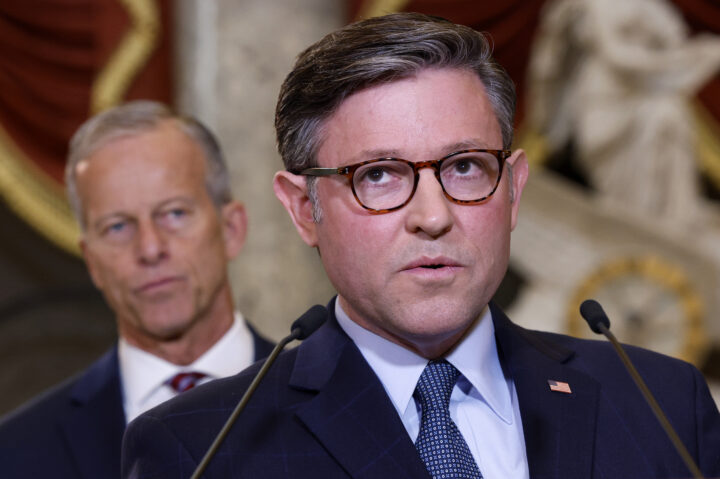
Kevin Dietsch/Getty Images
Speaker of the House Mike Johnson (R-LA), accompanied by Senate Majority Leader John Thune (R-SD), speaks during a news conference in Statuary Hall at the U.S. Capitol Building on October 3, 2025 in Washington, DC.
Good Tuesday afternoon!
This P.M. briefing is reserved for our premium subscribers like you — offering a forward-focused read on what we’re tracking now and what’s coming next.
I’m Danielle Cohen-Kanik, U.S. editor at Jewish Insider and curator, along with assists from my colleagues, of the Daily Overtime briefing. Please don’t hesitate to share your thoughts and feedback by replying to this email.
📡On Our Radar
Notable developments and interesting tidbits we’re tracking
Election Day is underway, and voters are breaking turnout records in New York City. Already by noon today, more people had voted in the mayoral race than had voted in the entirety of the 2021 NYC mayor’s race. By 3 p.m., more than 1.4 million New Yorkers had voted in the race — more than in any NYC mayoral election since 2001, according to The New York Times — with several more hours before the polls close at 9 p.m.
President Donald Trump chimed in last night, urging New Yorkers to vote for former Gov. Andrew Cuomo. “Whether you personally like Andrew Cuomo or not, you really have no choice. You must vote for him, and hope he does a fantastic job,” he wrote on social media. Trump added in another post, “Any Jewish person that votes for Zohran Mamdani, a proven and self professed JEW HATER, is a stupid person!!!”…
One party leader not weighing in: Senate Minority Leader Chuck Schumer (D-NY), who has officially made it through the mayoral race without issuing an endorsement. He had said throughout the election that he had held “conversations” with Mamdani but resisted calls to either endorse his party’s candidate or to denounce his anti-Israel views. At a press conference in the Capitol this afternoon, Schumer told reporters he himself had voted and “look[s] forward to working with the next mayor” but would not reveal who got his vote…
Leading right-wing figures continue to contend with the normalization of antisemitism within the GOP: House Speaker Mike Johnson (R-LA) joined the list of Republicans who have publicly admonished Tucker Carlson for platforming neo-Nazi Nick Fuentes on his podcast, saying today, “Some of the things [Fuentes has] said are just blatantly antisemitic, racist and anti-American. Anti-Christian, for that matter. I think we have to call out antisemitism wherever it is. Whether it’s Tucker or anybody else, I don’t think we should be giving a platform to that kind of speech. He has a First Amendment right, but we shouldn’t ever amplify it. That’s my view.”
Senate Majority Leader John Thune (R-SD) also denounced antisemitism on the right in comments today, though without naming Carlson or Fuentes. “Well, there are lots of voices, obviously, out there, but I don’t think there ought to be any — there just should be no room at all whatsoever for antisemitism or other forms of discrimination. That’s certainly not what our party is about,” Thune said…
Backlash against the Heritage Foundation for defending Carlson also continues; the National Task Force to Combat Antisemitism, a conservative coalition aligned with Heritage, changed its tune today in an email to President Kevin Roberts, a day after the task force said it would stand by the organization.
In today’s email, obtained by Jewish Insider’s Gabby Deutch, the NTFCA co-chairs made several demands of Roberts, including removing his controversial video defending Carlson; an apology “to those Christians and Jews who are steadfast members of the conservative movement and believe that Israel has a special role to play both biblically and politically;” a conference hosted by Heritage on the boundaries of the conservative movement; hiring a visiting fellow “who shares mainstream conservative views on Israel, Jews and Christian Zionists” to win over Gen Zers; and to host Shabbat dinners with Heritage’s interns and junior staff members to educate them about Judaism.
The task force co-chairs said in the email that if an agreement is not reached soon, their relationship with Heritage “will be irrevocably harmed.” Co-chair Luke Moon told JI, “If the terms aren’t met, we will take the NTFCA elsewhere”…
Several Jewish organizations have cut ties with the NTFCA already over the incident, including the Zionist Organization of America and Young Jewish Conservatives; today, the Coalition for Jewish Values and Combat Antisemitism Movement did so as well.
“We cannot grant legitimacy to an effort to combat antisemitism operated by the Heritage Foundation while Heritage is validating antisemitism and giving it a platform,” CJV wrote. “Although our target” on the task force “was and remains primarily a left-wing cause, ‘no enemies on the right’ was always liable to be proven false.”
CAM, in its resignation letter to Roberts, affirmed its support of free speech and specified that “the genesis of this letter is our deep concern with how you, Mr. Roberts, on behalf of the Heritage Foundation, have chosen to exercise your rights” [emphasis original]…
Bipartisan lawmakers expressed frustration with the Pentagon for not properly briefing them on national security issues at a Senate Armed Services Committee hearing today, after Defense Secretary Pete Hegseth announced a new rule last month requiring all Pentagon staffers to get approval before interacting with members of Congress.
Sen. Dan Sullivan (R-AK) called out Elbridge Colby, under secretary of defense for policy, specifically, saying it was even harder to contact him than Hegseth or Trump. “Man, I can’t even get a response, and we’re on your team,” Sullivan said…
The Trump administration is pushing Congress to repeal the Caesar Act sanctions on Syria ahead of Syrian President Ahmad al-Sharaa’s first visit to the White House on Monday, urging lawmakers to include it in the 2026 National Defense Authorization Act. The Senate already approved the repeal in its version of the NDAA last month, but the House version does not include a similar provision…
⏩ Tomorrow’s Agenda, Today
An early look at tomorrow’s storylines and schedule to keep you a step ahead
Keep an eye on Jewish Insider tomorrow morning for an interview with Republican Kentucky Senate candidate Nate Morris, who is seeking to take the seat of retiring Sen. Mitch McConnell (R-KY), and for a reflection on the late Vice President Dick Cheney’s legacy.
Tomorrow afternoon, the ADL will host a post-election briefing on the New York City mayoral race with its CEO, Jonathan Greenblatt, and Hindy Poupko, senior vice president of community strategy and external relations at UJA-Federation of New York.
Former Israeli hostage Emily Damari will appear at Temple Emanu-El in New York City tomorrow evening for her first public speaking engagement in the U.S., joined by author Noa Tishby.
Stories You May Have Missed
SCOOP
Before denouncing AIPAC, Moulton sought group’s endorsement for Senate campaign, source says
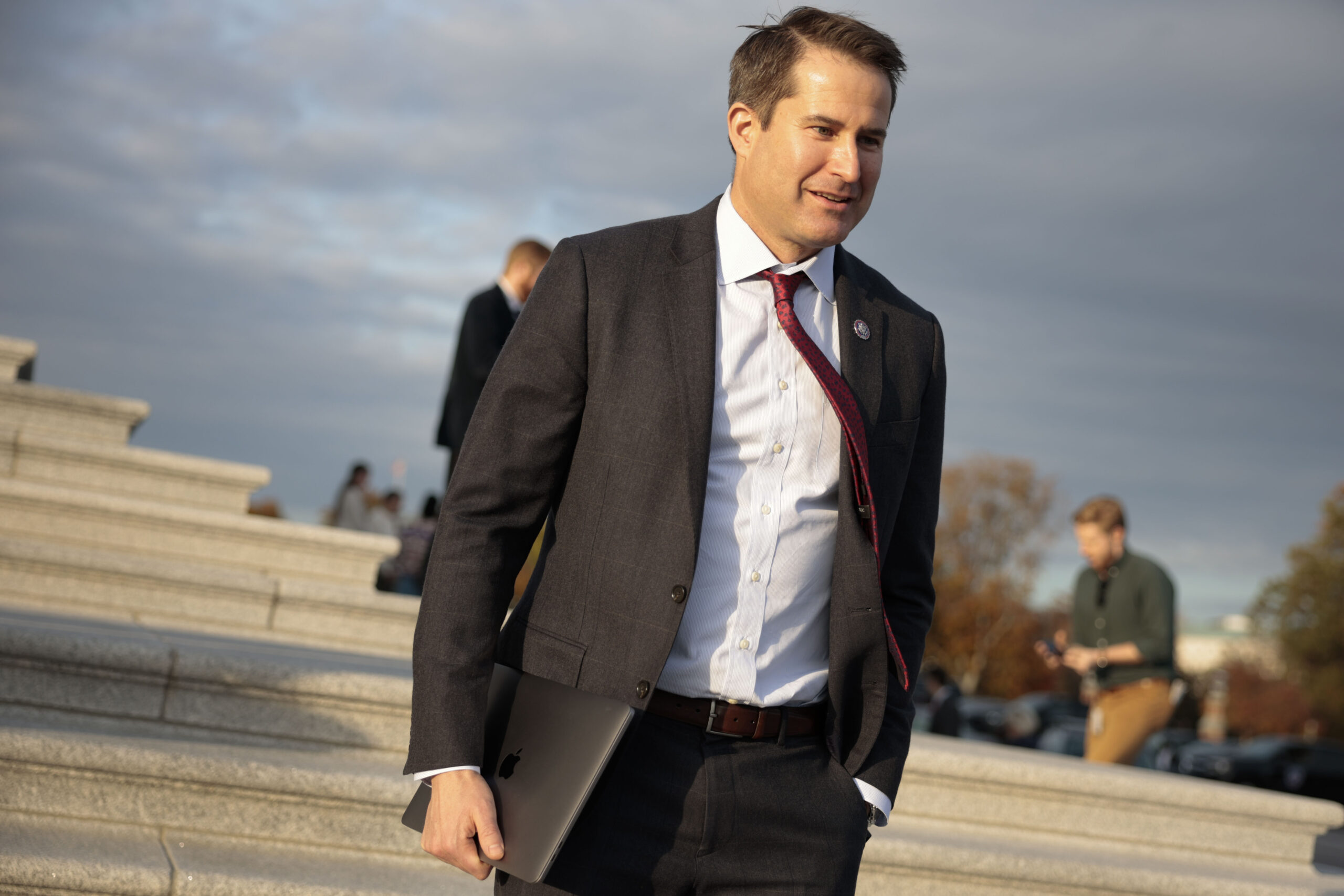
Moulton turned against the group when it was unable to guarantee him an endorsement upon the launch of his Senate campaign, a source told JI
THE X FACTOR
Conservatives resist blaming Musk for reinstating Nick Fuentes on X

X is the only mainstream social media platform where Fuentes is allowed to have an account; he was unblocked in May 2024 and now has over 1 million followers
Plus, Virginia LG candidate skirts antisemitism questions

Joshua Sukoff/Medill News Service
President Donald Trump holds a joint news conference at the White House with Israeli Prime Minister Benjamin Netanyahu on February 4, 2025. This is Trump’s first joint news conference with a foreign leader in his second term.
Good Monday afternoon!
This P.M. briefing is reserved for our premium subscribers like you — offering a forward-focused read on what we’re tracking now and what’s coming next.
I’m Danielle Cohen-Kanik, U.S. editor at Jewish Insider and curator, along with assists from my colleagues, of the Daily Overtime briefing. Please don’t hesitate to share your thoughts and feedback by replying to this email.
📡On Our Radar
Notable developments and interesting tidbits we’re tracking
It’s Election Day across the country tomorrow, and we’ll be watching several key races.
Front of mind is the New York City mayoral race where Democratic nominee Zohran Mamdani is expected to prevail, though it remains to be seen if he’ll claim an absolute majority.
All candidates are still vying for the Jewish vote: Over the weekend, divisions emerged in the anti-Zionist Satmar Hasidic community after one of its political leaders issued an endorsement of Mamdani — some leaders publicly broke ranks to reject the move and instead endorse his rival, former New York Gov. Andrew Cuomo.
Meanwhile, Republican nominee Curtis Sliwa visited the Lubavitcher Rebbe’s Ohel in Queens (and recalled a blessing he received from Rabbi Menachem Mendel Schneerson decades ago which Sliwa claimed “saved my life”)…
In nearby New Jersey, gubernatorial candidates Rep. Mikie Sherrill (D-NJ) and Jack Ciattarelli are doing the same. We’ve covered Sherrill’s recent outreach efforts to the state’s sizable Jewish community; on the GOP side, President Donald Trump posted on Truth Social on Sunday urging “ALL of my supporters in the Orthodox community in Lakewood [N.J.] and its surrounding towns to vote in HUGE numbers for Jack Ciattarelli,” naming in particular “all the Yeshiva students who turned out to vote for me last year.” Trump won around 88% of the heavily Jewish township’s vote in the 2024 presidential election…
And in Virginia, former Rep. Abigail Spanberger (D-VA) is likely to win the governor’s mansion against the state’s current lieutenant governor, Republican Winsome Earle-Sears, in a race set to make Old Dominion history — either way, the state will elect its first female governor.
Also on the Virginia ballot: Ghazala Hashmi, the Democratic state senator running for lieutenant governor, who has elicited concern from the state’s Jewish community over her past involvement in anti-Israel activism and her record on combating antisemitism.
In a brief interview today, Jewish Insider’s Editor-in-Chief Josh Kraushaar asked Hashmi how big of a challenge she thinks antisemitism is in Virginia. Hashmi replied: “I think we see growing challenges on so many levels of bigotry, and we have to be united in our efforts. I’m facing a great deal of Islamophobic attacks, as you probably have seen, so we have to respond to everything.” Pressed on what she thought about antisemitism specifically, Hashmi cut the interview short…
The fallout from the Heritage Foundation’s embrace of Tucker Carlson and refusal to disavow Nick Fuentes continues, as right-wing figures publicly declare themselves aligned with or opposed to the move. Orthodox conservative influencer Ben Shapiro said about Carlson, Fuentes and their ilk in a lengthy video statement today: “These people aren’t to my right. They’re not attached in any way to the fundamental principles of conservatism. And these people have already declared themselves my enemies. I’d be a fool not to take them seriously.”
Ryan Neuhaus, who served as Heritage Foundation President Kevin Roberts’ chief of staff until Friday, resigned after reposting numerous social media posts in defense of Roberts, including one saying that Heritage employees opposed to his statement were “virtue signaling” and calling for them to resign…
A new poll released today by the Democratic Majority for Israel finds that Democrats overwhelmingly support the ceasefire deal reached between Israel and Hamas and a majority of them think Trump played at least a “somewhat important role” in reaching the agreement, JI’s Danielle Cohen-Kanik reports.
A majority of those polled (56%) said they believe that the U.S. should keep its alliance with Israel, though only 32% felt so “strongly.” Three-quarters (75%) said they support Israel’s right to exist as a Jewish homeland, with 12% saying they don’t believe Israel has a right to exist…
The Wall Street Journal documents the rise and sustained popularity of Abdulmalik Al-Houthi, the reclusive commander of the Houthis in Yemen, who has continued to resist pressure by officials from Arab states to cease the terror group’s attacks on Israel and ships in the Red Sea, “and go back to being a relatively small-time player in the region’s conflicts.”
“‘They genuinely believe in this jihad to remove Israel from that land,’ said April Longley Alley, a former United Nations diplomat who has engaged with the Houthi leadership. ‘And they’re going to keep pushing’”…
Israeli Prime Minister Benjamin Netanyahu ordered the dispatch of a humanitarian and medical aid delegation from Israel to Jamaica today, to assist in relief efforts after Hurricane Melissa tore through the country earlier this week…
Sudanese refugees in Israel told The Times of Israel about the compounded pain and fear they experienced as the Oct. 7 Hamas attacks and the civil war in Sudan unfolded in parallel, decrying the lack of media coverage of Sudan while the world focused on Gaza…
Yad Vashem announced today that the museum has identified the names of 5 million Jewish victims of the Holocaust, and hopes to use artificial intelligence to name at least 250,000 more…
⏩ Tomorrow’s Agenda, Today
An early look at tomorrow’s storylines and schedule to keep you a step ahead
Keep an eye on Jewish Insider tomorrow morning for the backstory surrounding Massachusetts Senate candidate Rep. Seth Moulton’s (D-MA) attacks against AIPAC.
Tomorrow, the World Zionist Organization and Temple Emanu-El are holding a memorial event in New York City for slain Israeli Prime Minister Yitzhak Rabin on the 30th anniversary of his assassination. Speakers will include Rabin’s grandson, Jonathan Benartzi; Yehuda Kurtzer, president of the Shalom Hartman Institute; former U.S. Ambassador to Israel Dan Shapiro; Amy Spitalnick, CEO of the Jewish Council for Public Affairs; and Israeli American peace advocate Alana Zeitchik.
Stories You May Have Missed
UNIVERSITY INSIGHTS
Longtime higher ed leader Gordon Gee says fear, not free speech, is ruling America’s campuses

Gee, who served as president of five universities over 45 years, told JI he believes some administrators are opposed to reform efforts as a knee-jerk reaction to Trump
SHOW OF SOLIDARITY
Overhauled Kennedy Center takes on the mantle of combating antisemitism
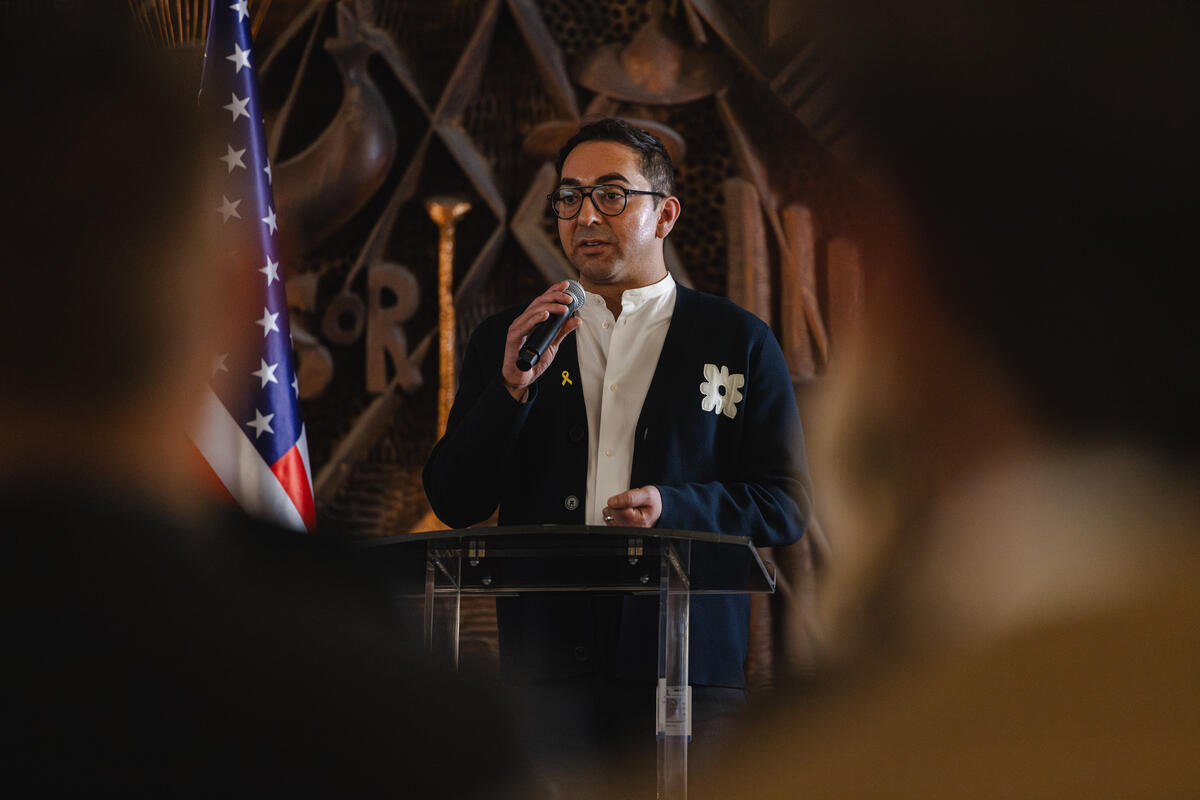
With a new board and leadership, the Kennedy Center is spotlighting Jewish culture and the fight against antisemitism in ‘solidarity’
Lawmakers on both sides of the aisle said the U.S. must take further action to prevent Iran from rebuilding its military capabilities, including the enforcement of sanctions

Wisam Hashlamoun/Anadolu via Getty Images
Streaks of light from Iranian ballistic missiles are seen in the night sky above Hebron, West Bank, as Iran resumes its retaliatory strikes against Israel.
Iran’s recent moves to rebuild its ballistic missile program, with materials imported from China in circumvention of international sanctions, are prompting concerns on Capitol Hill, with multiple lawmakers saying that the efforts should be met with a strong response from the United States.
President Donald Trump met with Chinese President Xi Jinping on Thursday, during which he agreed to cut U.S. tariffs on Beijing in exchange for a series of steps by China, including pausing export controls on rare earths and agreeing to a sale of TikTok. Trump also halted the implementation of a measure that would have banned Chinese firms that are partly owned by sanctioned companies from obtaining U.S. technologies.
No measures relating to China and Chinese firms’ continued evasion of Iran sanctions — either in supplying materials to Iran or receiving a majority of Iran’s oil exports — were announced by either side.
Lawmakers on both sides of the aisle said they had not seen the CNN reporting, which cited European intelligence that Iran was importing components of ballistic missile fuel from China, on the issue, but expressed concerns.
Sen. Rick Scott (R-FL) said he’s “not surprised” by the news because “we all have to understand that Russia, Iran, China, North Korea — they’re all working together to demolish our way of life.”
He said that he expects that the U.S. and Israel are going to have to take further military action against Iran in the future.
“We’re going to have to demolish the nuclear weapons capability. Until there’s a new leadership in Iran, the same thing is going to happen,” Scott told Jewish Insider. “They’re going to have a bad economy, the people are not going to have any opportunity and every so often, we’re going to have to have to demolish their ability to make nuclear weapons. So elections matter, and I’m glad President Trump is the president so this happens.”
Asked about whether there are ways the U.S. can pressure China to abide by the sanctions, Scott said, “I think we have leverage, but it doesn’t really matter what they agree to because they don’t do it. They lie about everything. I’m very hopeful that President Trump, the trade deal that he’s on, that it works. If you look at history, they never comply with anything.”
Sen. Pete Ricketts (R-NE) also said the report “does not shock me.”
“Communist China is intent on replacing the United States, and they will fund our adversaries, like they’ve been doing with Russia and Iran, to be able to cause us trouble,” Ricketts said. “How should we be responding? We should be responding very harshly to both Iran and Communist China to get them to stop.”
Sen. James Lankford (R-OK) said that China assisting Iran in rebuilding its missile program “would be a serious problem” and that he hopes Trump and his team raised the issue in trade talks.
“Rearming a nuclear-ambitious Iran or providing money and materials to a Russia that is murdering their neighbors is not a way to be able to be a nation that’s actually going to be a world leader,” Lankford said. “If China wants to be a world leader, they need to be able to encourage good behavior for other countries as well.”
Rep. Mike Lawler (R-NY), who has led a series of bills aiming to sanction Chinese entities for their support of Iran, called for the enforcement of existing and new sanctions.
“If reports are true that China is supplying materials to help Iran rebuild its ballistic missile program, it’s an alarming development that threatens U.S. and global security,” Lawler said. “I encourage the administration to act immediately to enforce existing sanctions and impose new ones on any parties involved. History has shown appeasement has only emboldened Iran.”
Sen. John Cornyn (R-TX) said it would be a “bad idea” for Iran and China to try to rebuild Iran’s missile program.
Sen. Mark Kelly (D-AZ) said that he “would not be surprised” to see Iran trying to rebuild its ballistic missile capacity.
“China’s a bad actor on a lot of fronts, including with the Iranians, so I’m not shocked by that either,” Kelly continued.
Sen. Richard Blumenthal (D-CT) said that there’s “no reason to think that we have held or quenched [Iran’s] ambition to be a nuclear power.”
“We need to be vigilant and vigorous in countering that threat. I never thought that [Operation] Midnight Hammer ‘obliterated’ Iran’s nuclear capability, because they still have the scientists with the know-how to reconstruct and somewhere under the rubble, there is still equipment,” Blumenthal said, referring to U.S. strikes on Iran’s nuclear facilities in June. “So I am not surprised that they are continuing to take steps toward restoring their nuclear capacity, and we need to consider what action is appropriate in response.”
Plus, Palantir CTO's Israeli inspiration

Joe Raedle/Getty Images
Tucker Carlson speaks during the memorial service for political activist Charlie Kirk at State Farm Stadium on September 21, 2025 in Glendale, Arizona.
Good Thursday afternoon!
This P.M. briefing is reserved for our premium subscribers like you — offering a forward-focused read on what we’re tracking now and what’s coming next.
I’m Danielle Cohen-Kanik, U.S. editor at Jewish Insider and curator, along with assists from my colleagues, of the Daily Overtime briefing. Please don’t hesitate to share your thoughts and feedback by replying to this email.
📡On Our Radar
Notable developments and interesting tidbits we’re tracking
Efforts are underway to establish an International Stabilization Force in Gaza, Axios scooped today, with U.S. Central Command taking the lead on drafting the plan and holding discussions with countries, including Indonesia, Azerbaijan, Egypt and Turkey, to potentially contribute troops.
Though Israeli officials have said they oppose Turkey’s involvement in Gaza, the U.S. still views Ankara as most capable of getting Hamas “to agree and behave,” one U.S. official told the outlet.
Israel’s main concern is the new force’s legitimacy with Gazans and its willingness to engage militarily with Hamas, a senior Israeli official said. The plan would also see the creation of a new Palestinian police force, with training and vetting by the U.S., Egypt and Jordan…
Kevin Roberts, president of the influential Heritage Foundation, released a video today affirming the organization’s support of anti-Israel commentator Tucker Carlson, defending the podcaster from the “pressure” of the “globalist class,” after reports arose that Heritage had scrubbed references to Carlson from one of its donation pages.
“When it serves the interests of the United States to cooperate with Israel and other allies, we should do so … But when it doesn’t, conservatives should feel no obligation to reflexively support any foreign government, no matter how loud the pressure becomes from the globalist class or from their mouthpieces in Washington,” Roberts said.
His comments come days after Carlson hosted neo-Nazi influencer Nick Fuentes on his podcast, whom Roberts said he was unwilling to “cancel.”
“We will always defend our friends against the slander of bad actors who serve someone else’s agenda. That includes Tucker Carlson, who remains — and as I have said before — always will be a close friend of the Heritage Foundation,” Roberts continued…
In the run-up to the New York City mayoral election, The Bulwark co-founder Bill Kristol — a longtime conservative commentator and founder of The Weekly Standard — said that he would vote for Democratic nominee Zohran Mamdani if he were a resident of the city.
“You know, New York City gets to have a left-wing mayor. It’s not the first time, and it’s different from the rest of the country. I wish they were a little less, you know, tolerant of certain things — on Israel, and so, against Israel and all that. But some of the economic stuff, I think, is just silly, but I don’t think it’s going to matter,” Kristol told The Forum. He called “the idea of going back to” former New York Gov. Andrew Cuomo “ridiculous”…
Cuomo, meanwhile, picked up the endorsement of Rep. Nick Langworthy (R-NY), the former chair of the New York State Republican Party, who said he’s had “plenty of disagreements — very publicly over the years — and fought tooth and nail with Gov. Cuomo. But there’s no doubt in my mind he would be a far superior mayor than a communist,” referring to Mamdani.
When asked if it’s a mistake for Republican nominee Curtis Sliwa to stay in the race, Langworthy said, “Everyone’s really got to check, is this a vanity project? Or is this something you’re trying to do to seriously be the mayor? There’s only one candidate running against Mamdani that has a credible path to win. And there’s Andrew Cuomo”…
Rep. Elise Stefanik (R-NY) is preparing to enter the race for New York governor shortly after the mayoral election, Axios reports, with more than $13 million on hand. Stefanik’s team reportedly believes New Yorkers will turn on the Democratic Party if Mamdani is elected mayor, leaving Democratic Gov. Kathy Hochul — who endorsed Mamdani — more vulnerable…
Rep. Haley Stevens (D-MI), the party front-runner for Senate in Michigan, is “underwhelming” the Democratic establishment, NOTUS reports, with strategists warning that her fundraising and campaign activity does not show her substantially pulling ahead of her opponents — state Sen. Mallory McMorrow and Abdul El-Sayed, the latter of whom is backed by Sen. Bernie Sanders (I-VT), both running to her left — as expected…
Palantir’s chief technology officer, Shyam Sankar, appearing on The New York Times’ “Interesting Times” podcast released today, affirmed that Israel is a “morally appropriate partner” for the software giant to conduct business with, and said that he was motivated to join up as a lieutenant colonel in the U.S. Army Reserves this year to lend his technological expertise because of his “observation in Israel after Oct. 7.”
“Israel is an incredibly technical country. Bountiful resources of technologists,” Sankar said. But when reservists were called up to join the IDF in its war in Gaza, “they were horrified at the state of technology, which is actually an implicit self-critique. … The IDF got more modernization done in the four months after Oct. 7 than in the 10 years that I’d worked with them prior”…
⏩ Tomorrow’s Agenda, Today
An early look at tomorrow’s storylines and schedule to keep you a step ahead
Keep an eye on Jewish Insider tomorrow morning for reporting on the Kennedy Center’s efforts to address antisemitism and fight cultural boycotts of Israel as its Trump-appointed director looks to make a mark on programming at the institution.
The Republican Jewish Coalition’s leadership summit kicks off tomorrow in Las Vegas, with featured speakers including House Speaker Mike Johnson (R-LA), Homeland Security Secretary Kristi Noem, Sen. Lindsey Graham (R-SC), Arkansas Gov. Sarah Huckabee Sanders, Rep. Randy Fine (R-FL), Israeli Ambassador to the U.S. Yechiel Leiter and many more. JI’s Matthew Kassel will be in attendance — be sure to say hello!
We’ll be back in your inbox with the Daily Overtime on Monday. Shabbat Shalom!
Stories You May Have Missed
CALIFORNIA CAMPAIGN TRAIL
Scott Wiener, looking to succeed Pelosi, balances progressive politics with Jewish allyship

Weiner, a longtime California state senator, could face a crowded field of Democrats if Nancy Pelosi retires — including AOC’s former chief of staff
TURNING UP THE VOLUME
Former Rep. Cori Bush shows no signs of dialing down extreme rhetoric in comeback campaign
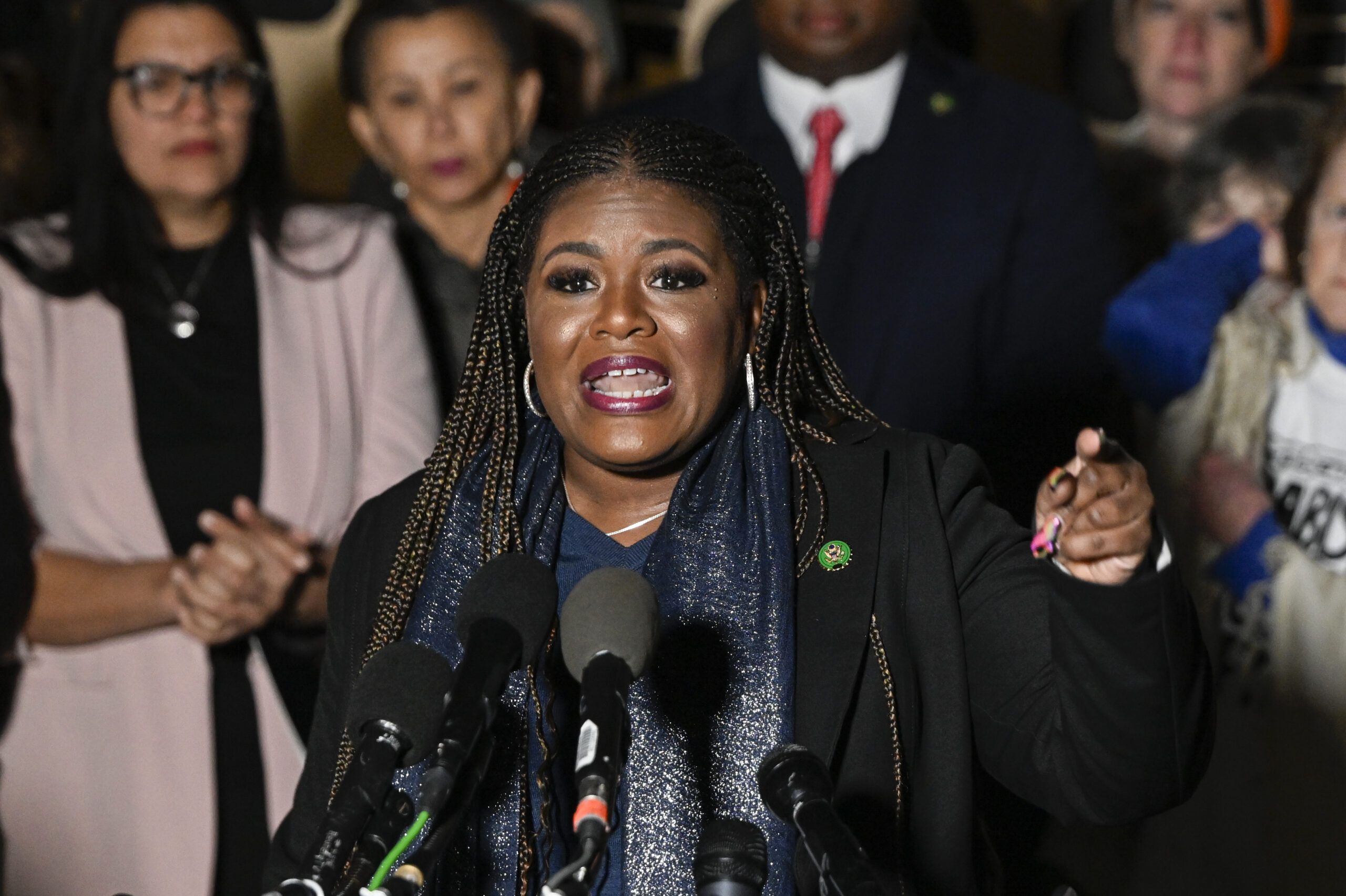
In a speech at a ‘No Kings’ rally, Bush spent time eulogizing convicted murderer Assata Shakur
Plus, Suozzi re-ups Cuomo endorsement
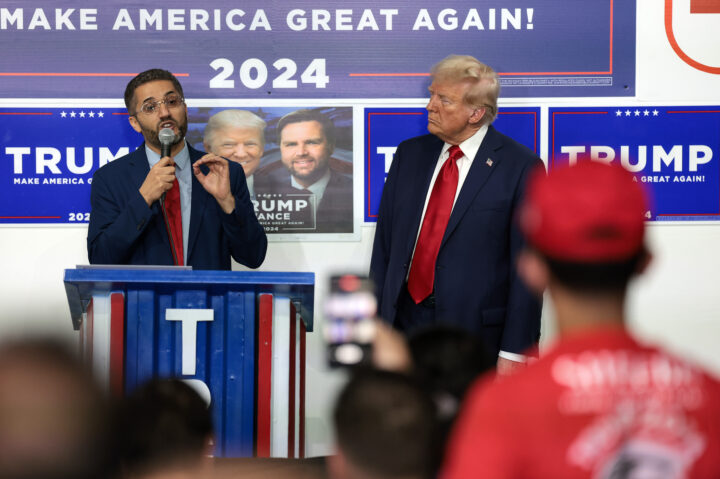
Win McNamee/Getty Images
Hamtramck, Mich. Mayor Amer Ghalib introduces President Donald Trump, as Trump visits a campaign office on Oct. 18, 2024, in Hamtramck, Michigan.
Good Wednesday afternoon!
This P.M. briefing is reserved for our premium subscribers like you — offering a forward-focused read on what we’re tracking now and what’s coming next.
I’m Danielle Cohen-Kanik, U.S. editor at Jewish Insider and curator, along with assists from my colleagues, of the Daily Overtime briefing. Please don’t hesitate to share your thoughts and feedback by replying to this email.
📡On Our Radar
Notable developments and interesting tidbits we’re tracking
The White House has told Republicans that President Donald Trump will not pull the nomination of Amer Ghalib, the mayor of Hamtramck, Mich., to be U.S. ambassador to Kuwait and wants the Senate Foreign Relations Committee to hold a vote on his candidacy, despite the growing bipartisan opposition to his nomination, Jewish Insider’s Emily Jacobs reports.
White House officials have communicated to committee Republicans in recent days that Trump would not withdraw Ghalib’s nomination because the president credits the Democratic Hamtramck mayor with helping him win the state of Michigan in the 2024 presidential election by turning out the state’s Arab American vote, two sources familiar with the ongoing discussions told JI.
“If Trump wants his friend to go down that way, that’s OK. He can go down that way,” one Republican on the committee said, expressing confidence that Ghalib had no path to advance out of committee…
Rep. Tom Suozzi (D-NY), who represents a Long Island-based swing district on the outskirts of New York City, today endorsed former New York Gov. Andrew Cuomo in the general election for New York City mayor. Suozzi had endorsed Cuomo in the Democratic primary and announced last month that he would not be endorsing Zohran Mamdani after he secured the party’s nomination.
In Suozzi’s decision to re-up his support for Cuomo, now running as an independent, less than a week out from the election, he distanced himself from Mamdani’s political leanings: “I’m a Democratic Capitalist, not a Democratic Socialist. I endorse Andrew Cuomo. I can not back a declared socialist with a thin resume to run the most complex city in America”…
Time magazine profiles New York City Mayor Eric Adams, where he recalls hosting Mamdani and his father, Mahmood Mamdani — a professor at Columbia University with a long record of anti-Israel commentary — for dinner in 2023. “The frightening thing is, he really believes this stuff! Globalize the intifada, there’s nothing wrong with that! He believes, you know, I don’t have anything against Jews, I just don’t like Israel. Well, who’s in Israel, bro?” Adams said…
Elsewhere in New York, the Democratic race to clinch the nomination for retiring Rep. Jerry Nadler (D-NY)’s seat gained another candidate today: Cameron Kasky, a Jewish gun control activist who survived the Marjory Stoneman Douglas High School shooting in 2018. Kasky, who recently started co-hosting the “For You Pod” with The Bulwark, frequently criticizes Israel and AIPAC in public statements, including accusing Israel of carrying out a genocide in Gaza and not being committed to the ongoing ceasefire with Hamas.
The field to succeed Nadler, a progressive Jewish lawmaker whose district has one of the largest Jewish constituencies in the country, has already drawn several candidates, including his former longtime aide, Micah Lasher…
Another candidate with harsh words for AIPAC is Rep. Seth Moulton (D-MA), challenging Sen. Ed Markey (D-MA) for his seat. Moulton, considered more moderate than Markey, continued to appeal to his left flank this week, appearing on a podcast hosted by Jack Cocchiarella, a self-described “progressive Gen Z political commentator” who frequently engages in harsh criticism of Israel on social media.
Moulton — who recently decided to return AIPAC’s donations and pledged not to take its support going forward — said his split with the group could continue to feature in the race depending “a lot on what happens in Gaza and Israel. … I certainly hope … we don’t resort to more violence, and if that’s the case, I think we’ll be able to talk about other issues in this campaign. Sadly, if it’s not, then I’m sure this will keep coming up.”
Moulton did not push back on Cocchiarella’s assertion that AIPAC, which he said has ties to the “Netanyahu regime,” should “be registered as a foreign lobby.” (Accusations from both political fringes that AIPAC — whose members are American citizens — constitutes a foreign influence operation have often invoked antisemitic dual loyalty tropes)…
The Anti-Defamation League today removed a section called “Protect Civil Rights” from its “What We Do” webpage, the Jewish Telegraphic Agency reports, shortly after it pulled down its “Glossary of Extremism and Hate” amid conservative attacks on the organization. The group appears to be pivoting after FBI Director Kash Patel recently cut the bureau’s ties with the ADL, calling it “an extreme group functioning like a terrorist organization”…
Spotted in Riyadh, Syrian President Ahmad al-Sharaa spoke today at the Future Investment Initiative summit, with front-row spectators Donald Trump Jr. and Saudi Crown Prince Mohammed bin Salman…
Also in the region, U.S. envoy Morgan Ortagus visited Lebanon today to push the Lebanese government to speed up efforts to disarm Hezbollah, with a goal of total disarmament by the end of the year, The New York Times reports.
The Lebanese Armed Forces have seized 10,000 rockets and 400 missiles from the terror group as part of disarmament efforts already, though Israeli and American officials told the Times it’s not sufficient, with Hezbollah moving to rebuild its stockpile…
⏩ Tomorrow’s Agenda, Today
An early look at tomorrow’s storylines and schedule to keep you a step ahead
Keep an eye on Jewish Insider tomorrow morning for an interview with California Democratic state Sen. Scott Weiner, running to replace former House Speaker Nancy Pelosi (D-CA), who is rumored to be announcing her retirement plans shortly.
Tomorrow, the N7 Foundation and Polaris National Security Foundation are hosting the invite-only Washington Prosperity Summit, with attendees including Trump administration officials, bipartisan lawmakers, foreign dignitaries from the Middle East and business executives, “to explore policies to advance prosperity in the region.”
The Simon Wiesenthal Center is hosting its 2025 Humanitarian Award Dinner in Los Angeles tomorrow, honoring Warner Bros. Discovery CEO David Zaslav, CNN anchor Dana Bash, Oct. 7 survivor Aya Meydan and former Israeli hostage Omer Shem Tov. Director Steven Spielberg will present Zaslav with this year’s Humanitarian Award, the center’s highest honor.
In Washington, Sony Pictures Entertainment, the Motion Picture Association and the German Embassy will host a special screening of “Nuremberg,” a new feature film on the Nuremberg Trials.
Also tomorrow, the World Zionist Congress wraps up in Jerusalem and the Future Investment Initiative summit comes to a close in Riyadh.
Stories You May Have Missed
JUSTICE, JUSTICE HE PURSUES
New U.S. Attorney in Minnesota Daniel Rosen sees history of antisemitism repeating itself
In an interview with JI, the Minnesota prosecutor and Jewish community leader said he was motivated to seek the role because of the ‘rapid escalation of violent antisemitism’
TIKTOK TALK
Jewish leaders, tech experts hopeful, but realistic about TikTok deal’s impact on online antisemitism

JFNA CEO Eric Fingerhut cited TikTok’s new owners’ ties to the Jewish community as an an encouraging sign
JFNA CEO Eric Fingerhut cited TikTok’s new owners’ ties to the Jewish community as an an encouraging sign
PATRICK T. FALLON/AFP via Getty Images
The TikTok logo is displayed on signage outside TikTok social media app company offices in Culver City, California, on March 16, 2023.
As a deal to split off TikTok’s U.S. business is set to be finalized between President Donald Trump and Chinese President Xi Jinping on Thursday, antisemitism experts expressed mixed views over how likely the agreement will be in transforming the social media platform’s approach when it comes to combating the spread of antisemitism in its algorithm.
Among the expected new owners of TikTok is technology company Oracle, which has Jewish ownership and has consistently expressed support for Israel. “We are optimistic about this moment,” Eric Fingerhut, CEO of the Jewish Federations of North America, said while moderating a panel discussion on Tuesday about the deal, hosted at the organization’s headquarters in Washington.
The panel featured Sarah O’Quinn, U.S. director of public affairs at the Center for Countering Digital Hate; Daniel Kelley, director of the Anti-Defamation League’s Center for Technology and Society; and Yair Rosenberg, a staff writer at The Atlantic.
Last month, Trump signed an executive order paving the way to keep TikTok operating in the U.S. under a new corporate structure with American ownership. Specific terms of the deal have not yet been made public. The agreement follows the bipartisan passage of legislation last year of a national security bill, which gave the U.S. government power to ban or sell apps controlled by foreign adversaries, such as TikTok.
While the government has said the deal will protect Americans from Chinese influence, as TikTok’s parent company is beholden to the Chinese government, JFNA advocated for the bill’s passage last year in hopes that changing TikTok’s ownership would reduce the spread of antisemitic and anti-Israel rhetoric seen on the app. According to JFNA, those who use TikTok for over 30 minutes a day are 17 percent more likely to hold antisemitic or anti-Israel views, compared to six percent on Instagram and two percent on X. Last year, antisemitic comments on TikTok spiked 912 percent from the previous year.
“The part that makes us most optimistic is the parties that seem to be associated with the deal on the American side, especially Larry Ellison [the co-founder] of Oracle, have been such strong supporters of the [Jewish] community,” said Fingerhut.
“When people ask, ‘Why would the Jewish Federations of North America be involved in an issue like the TikTok bill?’ our answer was simple,” continued Fingerhut. “The number one issue we’re hearing from our communities is the responsibility to address the rise of antisemitism, particularly that’s being directed at our young people, and there’s no way you can do that without tackling the problem on social media, and TikTok was the largest and worst offender.”
But Rosenberg and Kelley remained skeptical about the deal’s ability to mitigate online hate — stressing the virality algorithms on TikTok and other platforms have demonstrated when showing antisemitic or anti-Israel content.
“TikTok’s entire value is actually tied up in its algorithm, this black box that decides what people see on the app,” said Rosenberg. “That algorithm makes all of its money. That is what makes it valuable. That’s what makes it more popular and better than many other platforms … I think that there are some deep and fundamental problems that changing ownership of one particular social media platform can’t really address. The biggest thing for TikTok will be this question over the algorithm.”
Kelley said, “We can’t look at TikTok alone as the arbiter of antisemitism. I think we have to place it in the context of a huge backwards trend in terms of addressing antisemitism online.”
O’Quinn echoed Fingerhut’s sense of cautious optimism around the deal, saying, “when it comes to the state of tech and platform accountability in the United States, because we live in a completely unregulated space, weight from elected officials, and then also from constituents, is the most important thing that we really have to hold these platforms accountable.”
She said the biggest concern around TikTok, versus other online platforms, is that it’s designed for young people. “That is where you’re seeing — even in our internal data — that is where you’re seeing the most likely group to be falling for or believing antisemitic tropes.”
O’Quinn went on: “For Oracle to say this is their first time entering a social media platform, unlike other platforms, it is really for young people that are using this platform, and is there going to be a responsibility here? I think that we’re going to see very soon what kind of commitment is going to be made to American youth.”
Even with TikTok’s new leadership, O’Quinn called for “more oversight from these social media platforms, all across the board.”
Plus, Mamdani invokes antisemitic tropes in newly revealed video
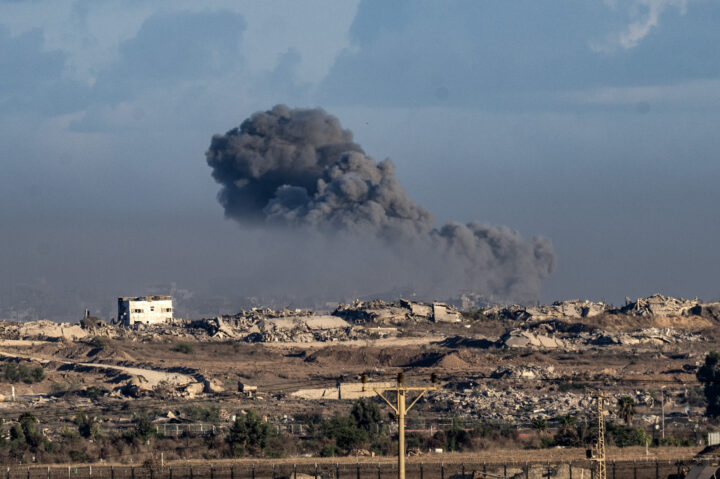
Mostafa Alkharouf/Anadolu via Getty Images
Smoke rises after Israeli airstrikes in the Gaza Strip, as seen from Israel near the border, on Oct. 7, 2025.
Good Tuesday afternoon!
This P.M. briefing is reserved for our premium subscribers like you — offering a forward-focused read on what we’re tracking now and what’s coming next.
I’m Danielle Cohen-Kanik, U.S. editor at Jewish Insider and curator, along with assists from my colleagues, of the Daily Overtime briefing. Please don’t hesitate to share your thoughts and feedback by replying to this email.
📡On Our Radar
Notable developments and interesting tidbits we’re tracking
Israeli Prime Minister Benjamin Netanyahu today ordered the IDF to “immediately carry out forceful strikes in the Gaza Strip” after Hamas terrorists opened fire on Israeli troops in the southern Gaza city of Rafah.
Hamas, in response, said it is postponing the release of a hostage body meant to be turned over to Israel today. Yesterday, Hamas staged the recovery of hostage remains that it reburied before handing to the Red Cross, caught on film by the IDF, which turned out to be partial remains belonging to a hostage who was already recovered by the Israeli army in 2023. Netanyahu said the act “constitute[d] a clear violation of the [ceasefire] agreement.”
Israeli officials told Axios that Netanyahu initially sought approval for action against Hamas from President Donald Trump, who is currently traveling in Asia, before moving forward, but there’s “no indication” the two leaders spoke before Netanyahu’s announcement on today’s strikes…
A senior Israeli official told Israel Hayom that Saudi Arabia has scaled back its participation in ceasefire talks after far-right Israeli Finance Minister Bezalel Smotrich made a disparaging comment last week on Saudi-Israel normalization, if it were to require the establishment of a Palestinian state. The statement (“No thank you, keep riding camels in the desert”) prompted blowback and he apologized shortly after.
“It’s not only because of Smotrich, but his comments certainly pushed [the Saudis] in that direction,” the official told the outlet. “Israel is now dealing with a bloc that includes Turkey, Qatar and Egypt — countries interested in preserving Hamas’ role in Gaza to varying degrees and refusing to pressure it to disarm”…
The Wall Street Journal traveled to an IDF outpost on the “yellow line” demarcating where Israeli troops have pulled back in Gaza. Israel is working on building water and electricity infrastructure and new aid hubs in the area and believes the entire line, which sits on high ground by design, is defensible from Hamas, Israeli officials told the Journal…
With a week to go until Election Day in the New York City mayoral race, new video has surfaced of Democratic nominee Zohran Mamdani invoking antisemitic rhetoric shortly before the Oct. 7, 2023, terror attacks.
Speaking at a Democratic Socialists of America convention in August 2023, Mamdani said, “For anyone to care about these issues, we have to make them hyper local. We have to make clear that when the boot of the NYPD is on your neck, it’s been laced by the IDF.” The idea that police brutality in the United States is caused by law enforcement training or coordination with Israel is a modern antisemitic trope.
Mamdani continued, “We are in a country where those connections abound, especially in New York City. You have so many opportunities to make clear the ways in which that struggle over there [Israel], is tied to capitalist interests over here”…
Meanwhile, The New York Times reports on the super PACs backing former New York Gov. Andrew Cuomo for mayor, which have raised him more than $40 million over the course of the election — compared to $10 million raised by super PACs for Mamdani and $1 million for Curtis Sliwa, the Republican nominee.
“The donors to the pro-Cuomo super PACs have included Michael R. Bloomberg, the former mayor; William Lauder, the chair of the Estée Lauder Companies; Ronald Lauder, the president of the World Jewish Congress; Bill Ackman, the investor; Steve Wynn, the casino investor; Daniel Loeb, the hedge fund manager; Barry Diller, the chairman of IAC; and Joe Gebbia, the co-founder of Airbnb,” the Times reports.
Bloomberg, who spent at least $8 million attempting to defeat Mamdani in the Democratic primary, met with him last month after he clinched the party’s nomination. Bloomberg was careful to note it was not an endorsement meeting, but rather a discussion on policy and staffing if Mamdani is elected mayor…
On the Hill, the nomination of Amer Ghalib, the mayor of Hamtramck, Mich., to be U.S. ambassador to Kuwait is facing what appear to be insurmountable odds as opposition to his confirmation grows among Senate Republicans, Jewish Insider’s Emily Jacobs reports.
Senators on both sides of the aisle had privately expressed reservations about Ghalib’s nomination prior to his rocky confirmation hearing in the Senate Foreign Relations Committee last week, but his attempts to evade responsibility for his support of antisemitic positions prompted several Republicans on the committee to go public.
Sen. Ted Cruz (R-TX) announced at the end of Ghalib’s hearing last Thursday that he would not be able to support moving his nomination out of committee to the Senate floor. Sens. John Curtis (R-UT), John Cornyn (R-TX) and Dave McCormick (R-PA) have since followed suit. Others on the panel, including Sen. Pete Ricketts (R-NE), have said they plan to raise their concerns about Ghalib with the committee chairman, Sen. Jim Risch (R-ID), and the White House…
Rep. Claudia Tenney (R-NY) will introduce a resolution this week affirming Israel’s sovereignty over the Temple Mount and demanding equal freedom of worship for all, JI’s Emily Jacobs scooped.
The resolution, if adopted, would put the House of Representatives on record as affirming “the inalienable right of the Jewish people to full access [of] the Temple Mount and the right to pray and worship on the Temple Mount, consistent with the principles of religious freedom.”
The current Israeli position, however, that Netanyahu has consistently affirmed, is to maintain the status quo at the holy site, which restricts Jewish prayer…
Rep. Elise Stefanik (R-NY), who led the the memorable questioning of university presidents at a House Education Committee hearing in December 2023, is coming out with a new book, titled Poisoned Ivies: The Inside Account of the Academic and Moral Rot at America’s Elite Universities, on April 7, 2026…
⏩ Tomorrow’s Agenda, Today
An early look at tomorrow’s storylines and schedule to keep you a step ahead
Keep an eye on Jewish Insider tomorrow morning for reaction in Washington to Israel’s latest strikes in Gaza in response to Hamas’ ceasefire violations.
Tomorrow, the Future Investment Initiative continues its ninth annual conference in Riyadh, Saudi Arabia.
In the evening, the Jewish Community Relations Council of Greater Washington is hosting its 2025 annual gala. Honorees include former Rep. David Trone (D-MD) and his wife, June, who is a JCRC board member; Behnam Dayanim, attorney and JCRC vice president; and Eva Davis, a realtor and co-chair of the Jewish Federation of Greater Washington’s Network Council.
Stories You May Have Missed
POSTWAR PLAN
East Gaza v. west Gaza: How partial IDF control could shape the enclave

Experts say the IDF-controlled eastern region of Gaza could become a tool to isolate the terrorist group and reshape the enclave’s future, even as major hurdles remain
COPYCAT EFFECT
Fairfax County schools denounce Muslim student groups promoting hostage taking, violence on social media

The DC area’s Jewish community council calls for the offending students to be disciplined
Plus, Brad Lander considers congressional bid
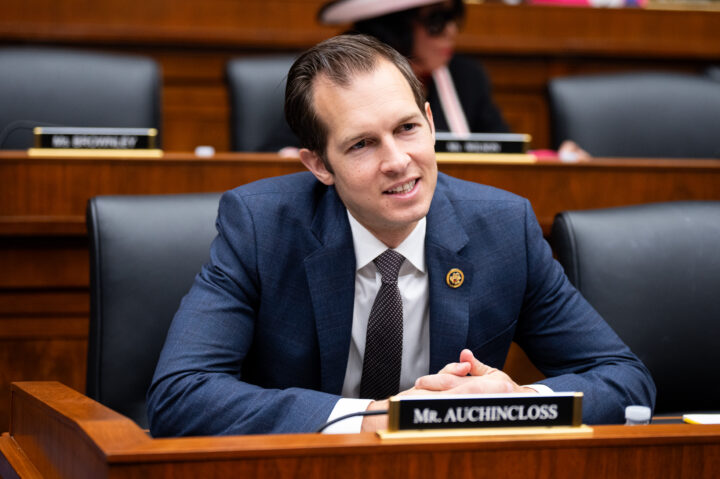
Bill Clark/CQ-Roll Call, Inc via Getty Images
Rep. Jake Auchincloss (D-MA) participates in the House Transportation Committee hearing on Thursday, June 27, 2024.
Good Monday afternoon!
This P.M. briefing is reserved for our premium subscribers like you — offering a forward-focused read on what we’re tracking now and what’s coming next.
I’m Danielle Cohen-Kanik, U.S. editor at Jewish Insider and curator, along with assists from my colleagues, of the Daily Overtime briefing. Please don’t hesitate to share your thoughts and feedback by replying to this email.
📡On Our Radar
Notable developments and interesting tidbits we’re tracking
Secretary of State Marco Rubio said today that Israel’s airstrike in Gaza over the weekend, which the IDF said targeted a Palestinian Islamic Jihad member who was planning a terror attack, did not violate the ongoing ceasefire with Hamas.
Rubio, who visited Jerusalem last week, told reporters standing next to President Donald Trump aboard Air Force One, “Israel didn’t surrender its right to self-defense. … We don’t view that as a violation of the ceasefire. They have a right — if there’s an imminent threat to Israel — and all the mediators agree to that”…
On the campaign trail, Rep. Jake Auchincloss (D-MA) became the first elected Democrat to call for Democratic Maine Senate candidate Graham Platner to drop out of the race to replace Sen. Susan Collins (R-ME), saying he finds the candidate’s conduct “personally disqualifying,” Jewish Insider’s Matthew Shea reports.
“This is a man who criticized and mocked police, rural Americans, and then put a Nazi tattoo on his body,” Auchincloss said. He expressed dissatisfaction with Platner’s defenses, in which the progressive candidate has claimed his actions aren’t a “liability.”
“I think it’s a liability, and I think we should have high standards for United States senators and one of them is: you don’t have a Nazi tattoo on your body,” Auchincloss continued…
Kevin Brown, the campaign manager for Platner, is stepping down after starting the job just last week, Axios scooped today. Brown told the outlet, “I started this campaign Tuesday but found out Friday we have a baby on the way. Graham deserves someone who is 100% in on his race and we want to lean into this new experience as a family”…
More than 160,000 New Yorkers submitted their ballot for New York City mayor with the start of early voting over the weekend, five times higher than the first weekend of early voting in 2021, according to Gothamist. Voters over 55 made up the majority of ballots cast, in contrast with the Democratic primary when voters ages 25-34 were first to the polls…
New York City Comptroller Brad Lander, who also ran in the mayoral Democratic primary and has been backing nominee Zohran Mamdani, is advancing plans to challenge Rep. Dan Goldman (D-NY) for his congressional seat, City & State New York reports.
“I’m very focused on helping Zohran win next Tuesday, and I’ll focus on after that, after that,” Lander told the outlet. At a rally for Mamdani over the weekend, Lander said “it’s more important than ever that we have leaders who understand this moment and will be partners to Zohran” in “the halls of Congress,” potentially hinting at his desire to run. Read JI’s reporting last month of the dynamics of a possible Lander-Goldman matchup…
Former Sen. John E. Sununu (R-NH), the former New Hampshire senator and part of an influential Granite State political family, officially launched his bid last week to take over the Senate seat of retiring Sen. Jeanne Shaheen (D-NH).
Sununu’s candidacy ensures a hotly contested GOP primary against former Sen. Scott Brown (R-MA), who served as ambassador to New Zealand during the first Trump administration. Brown, who announced his candidacy in June, served a partial term representing Massachusetts in the Senate from 2010-2012, only holding the seat for two years before being bested by Sen. Elizabeth Warren (D-MA).
Brown and Sununu, both of whom had pro-Israel records when they served in the Senate, will battle it out before taking on Rep. Chris Pappas (D-NH), the expected Democratic nominee with a history of winning in a swing district…
In an interview with The New York Times, Pennsylvania Gov. Josh Shapiro said that he still believes the U.S. could elect a Jewish president in his lifetime, even in the face of frequent antisemitic violence like the Passover arson attack on his residence.
“Being open about my faith has opened me up to be able to have a deeper relationship with the people of Pennsylvania, allowed them to share their stories … We’re doing that in this ultimate swing state,” Shapiro, seen as a 2028 presidential contender, said…
Semafor reports on a new survey of hundreds of thousands of voters, conducted by a new center-left group called Welcome, that finds that 70% of voters think the Democratic Party over-prioritizes cultural issues. The report urges Democrats “to abandon some of the progressive language about race, abortion, and LGBTQ issues that Democrats began using after the 2012 election — and recommends the nomination of more candidates willing to vote with Republicans on conservative immigration and crime bills”…
⏩ Tomorrow’s Agenda, Today
An early look at tomorrow’s storylines and schedule to keep you a step ahead
Keep an eye on Jewish Insider tomorrow morning for reporting on Fairfax County Public Schools’ reaction to glorifications of violence by local Muslim Student Association chapters.
Tomorrow afternoon, the Senate Judiciary Committee’s Subcommittee on the Constitution will hold a hearing on “Politically Violent Attacks: A Threat to Our Constitutional Order.”
Jewish Federations of North America will hold a briefing tomorrow on how the deal that split off ownership of TikTok’s U.S. business may impact the social media platform’s treatment of antisemitic content.
The 39th World Zionist Congress kicks off in Jerusalem tomorrow with the largest U.S. delegation in history, made up of 155 delegates and approximately 100 alternates. U.S. Ambassador to Israel Mike Huckabee will address a luncheon hosted by the American Zionist Movement ahead of the Congress’ opening.
Stories You May Have Missed
PEOPLE OF THE BOOK (CLUB)
As Jewish writers face boycotts and bias, new initiative aims to boost their books

The Jewish Book Council launched a new subscription service, Nu Reads, which provides six Jewish books per year, modeled on the success of PJ Library
QUAD CONTROL
Harmeet Dhillon says DOJ will fight antisemitism through law, not speech codes

In an interview with JI, the senior DOJ official said that while combating antisemitism is a priority, the Justice Department is focused on the Trump administration’s battle with DEI
The vice president’s comments echo a warning from President Donald Trump that the terror group would face ‘elimination’ if it doesn’t abide by the terms of the ceasefire agreement
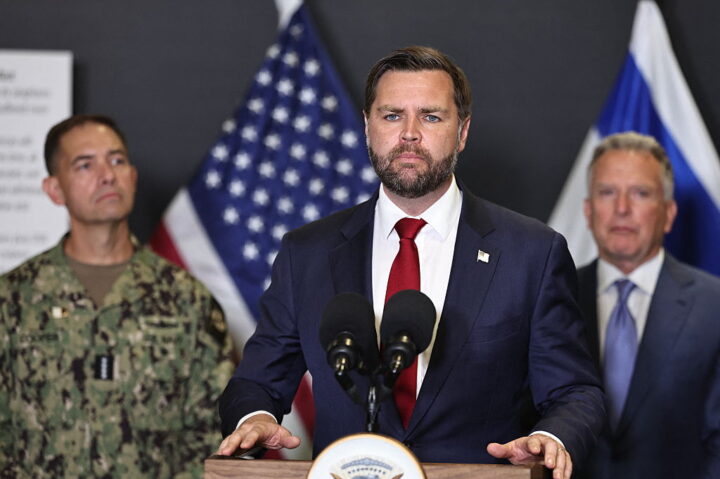
FADEL SENNA/AFP via Getty Images
Vice President JD Vance listens to a question during a press conference following a military briefing at the Civilian Military Coordination Center in southern Israel on October 21, 2025.
Visiting the new U.S.-run Civilian Military Cooperation Center in southern Israel, Vice President JD Vance said on Tuesday that he is “very optimistic” about the advancement of the peace plan, but warned that Hamas must disarm and cooperate with international interlocutors, or else it would be “obliterated.”
The vice president’s comments came shortly after President Donald Trump, in a post on his Truth Social site, threatened Hamas with “elimination” should the terror group continue to carry out violence in Gaza and violate the terms of the peace deal.
“Numerous of our NOW GREAT ALLIES in the Middle East … have explicitly and strongly, with great enthusiasm, informed me that they would welcome the opportunity, at my request, to go into GAZA with a heavy force and ‘straighten out Hamas’ if Hamas continues to act badly, in violation of their agreement with us,” Trump wrote. “There is still hope that Hamas will do what is right. If they do not, an end to Hamas will be FAST, FURIOUS, & BRUTAL!”
The president’s statement, which came hours after Vance touched down in Israel in part to keep the deal on track, underscored his growing impatience and frustration with the terrorist group.
“Hamas has to disarm,” Vance said. “They’re not going to be able to kill their fellow Palestinians. … If Hamas doesn’t cooperate, as the president of the United States said, Hamas will be obliterated.”
“But I’m not going to do what the president of the United States has thus far refused to do, which is put an explicit deadline on it,” the vice president continued, “because a lot of this stuff is difficult … In order for us to give it a chance to succeed, we’ve got to be a little bit flexible.”
Asked about Turkish troops entering Gaza despite the country’s hostility to Israel, Vance said that Israel will have to agree to any foreign troops on the ground. “We’re not going to force anything on our Israeli friends when it comes to foreign troops on their soil, but I think there’s a constructive role for the Turks to play,” he said. “They already played a constructive role.”
As for reconstruction of Gaza, Jared Kushner, who has played a central role in negotiating the end of the war, said that “no reconstruction funds will be going to areas Hamas still controls. … There are considerations in the area the IDF controls to start reconstruction of a new Gaza, in order to give the Palestinians in Gaza a place to go, a place to get jobs, a place to live.”
Vance said that the eventual governing structure of Gaza is still undetermined, as the plan focuses on getting “to a point where both Gazans and our Israeli friends have some measure of security.” After that, he added, “we’ll worry about long term governance.”
“Let’s worry about security, give people food and medicine,” he said.
Vance said that the CMCC’s focus is on repatriating the bodies of the 15 remaining Israeli hostages, but that “it’s not going to happen overnight.”
The administration’s push for Hamas’ disarmament is expected to face hurdles. “On the one hand, Hamas wants to avoid losing the sympathy of Turkey and Qatar and wants to avoid wasting Egypt’s desire for a political settlement that creates Palestinian unity with Hamas support,” said Rob Satloff, executive director at The Washington Institute for Near East Policy. “On the other hand, it is clear that Hamas has no intention of voluntarily giving up the battle against Israel, let alone voluntarily disarming.”
But while Trump threatened that “many countries” will get involved, other nations have been reluctant to send in reinforcements, despite talks of forming an International Stabilization Force, as laid out in the unfinalized second phase of the peace deal.
At the CMCC facility on Tuesday, the vice president noted that the force is still in the process of being formed, but said no American troops will be on the ground in the enclave. There are about 200 U.S. servicemembers at the CMCC in Kiryat Gat, Israel, tasked with coordinating the effort.
Trump himself emphasized that the U.S. will not send troops into Gaza, telling reporters at the White House on Monday that “Israel would go in in two minutes if I asked them to go in … But right now we haven’t said that.”
“Many countries are hesitant to send troops to serve as peacekeepers,” said David May, a senior research analyst at the Foundation for Defense of Democracies. “So, it will be very difficult to find a country able and willing to strike Hamas as punishment.”
Even if Trump is able to get other countries on board to take a more involved role in defanging Hamas in Gaza, May said more firepower does not always mean better results.
“There’s a certain value in threats and provocative language, especially from an unpredictable president,” said May. “But striking Hamas and not killing civilians requires surgical precision — something the Israelis excel in — not the overwhelming force that the United States alone possesses. [At the same time,] Hamas’ violations are mounting, and the terrorist group cannot be allowed to retake Gaza and execute its potential replacements.”
May said a return to fighting would sink any possibility of the current deal developing into full-fledged peace. The Trump administration has sought to avoid a return to hostilities and build on the momentum from phase one. Experts warned the administration is in a precarious position, balancing between keeping the president’s deal stable and preventing Hamas from reasserting power.
“The Trump administration is trying to navigate between these poles,” said Satloff. “Taking advantage of political pressure while avoiding a showdown with Hamas without the Arab, Muslim or international troops to back it up, all the while trying to avoid a collapse of relapse into full-scale Hamas-Israel war that would undermine the president’s great diplomatic achievement.”
The vice president also spoke of the significance of Israel to him as a Christian, sharing plans to visit the Church of the Holy Sepulcher. “I pray that the Prince of Peace,” he said, using a name for Jesus,” can continue to work a miracle in this part of the world.”
Plus, Patel probes far-left protest funding

Good Wednesday morning.
In today’s Daily Kickoff, we interview Sen. Steve Daines about his weekend visit to Israel and have the scoop on a letter signed by 50 Senate Republicans urging the foreign ministers of the U.K., France and Germany to hold firm in triggering snapback sanctions on Iran. We report on FBI Director Kash Patel’s comments that federal investigators are probing the funding sources of left-wing protest movements and highlight a call by House Republicans on the White House to probe far-left billionaire Neville Roy Singham’s ties to China. We also cover a press conference held yesterday by Israeli Prime Minister Benjamin Netanyahu to clarify his previous comments that the Jewish state will need to be like “super-Sparta” and adapt to “autarkic characteristics.” Also in today’s Daily Kickoff: Gov. Josh Shapiro, Rep. Josh Gottheimer and Alex Karp.
Today’s Daily Kickoff was curated by Jewish Insider Israel Editor Tamara Zieve and U.S. Editor Danielle Cohen-Kanik, with an assist from Marc Rod. Have a tip? Email us here.
What We’re Watching
- President Donald Trump and First Lady Melania Trump are spending the day in England for a royal visit, where they will be welcomed by King Charles III and Queen Camilla at Windsor Castle.
- This morning, the House Foreign Affairs Committee will hold a markup of bills aimed at reorganizing and reforming the State Department. Read JI’s breakdown of the legislation here.
- The Senate Foreign Relations Committee will vote to advance a series of nominees out of committee, including Michel Issa to be ambassador to Lebanon; Richard Buchan to be ambassador to Morocco; Ben Black to lead the U.S. International Development Finance Corporation; and a second vote on the nomination of Mike Waltz, the former national security advisor, to be U.S. ambassador to the U.N., in order to prevent a procedural challenge from Democrats.
- Also on the Hill, the U.S. Helsinki Commission will hold a briefing on “conspiracy theories, antisemitism and democratic decline.”
- The annual Defense of Freedom-Federalist Society Education, Law & Policy Conference examining the most pressing legal and policy issues in education kicks off today in Washington. Featured speakers include Secretary of Education Linda McMahon and Brandeis Center Chairman Kenneth Marcus. One of the panels will focus on discussing the federal government’s efforts to combat antisemitism.
What You Should Know
A QUICK WORD WITH JI’S JOSH KRAUSHAAR
A new poll of young conservatives between the ages of 18-34 commissioned by the Washington Free Beacon shows that Gen Z Republicans are decidedly more supportive of Israel than their liberal counterparts, but that there is a notable faction of those who take a more critical view towards the Jewish state.
The Echelon Insights poll also found that anti-Israel and antisemitic podcasters like Nick Fuentes, Tucker Carlson and Candace Owens are viewed favorably by this right-wing cohort — even among many of the respondents who say they support Israel and recognize antisemitism is a problem.
Carlson’s favorability rating among these Gen Z conservatives, for instance, is 50%, with only 11% viewing him unfavorably. Owens has a similarly strong 49/14% favorability rating. The Holocaust-denying podcaster Darryl Cooper isn’t nearly as well-known, but is viewed positively by those who listen to him, holding a 26/8% favorability rating.
At the same time, pro-Israel podcasters like Ben Shapiro are also viewed very favorably; Shapiro’s favorability rating with this cohort is 50/16%. Fox News host Mark Levin isn’t quite as well-known, but holds a stellar 29/7% favorability rating. Asked about “Jews” generally, half of respondents hold a favorable view with only 12% holding an unfavorable opinion.
The encouraging news? A number of these podcast listeners are tuning in to these transgressive shows featuring conspiracy theories, anti-Israel views and some antisemitism, but many are not being persuaded by them. For all their vitriolic attacks against the Jewish state, 54% of Carlson’s viewers and 58% of Owens’ audience have a favorable view towards Israel.
But the gloomier finding is that a notable minority on the right holds bigoted views towards Jews and is critical of Israel. Between 20-25% of these Gen Z conservatives consistently express anti-Israel or antisemitic views — while support for Israel is not nearly as widespread as it is among older conservatives. While 40% of respondents said they side with Israel in its current conflict, about one-fifth (22%) said they side with the Palestinians. About the same percentage of Gen Z conservatives said they agree that “Israel is a colonizer built on the suffering of others.”
KARP’S CALL
Palantir’s Alex Karp says Jews need to ‘leave their comfort zone’ to defend community

Palantir CEO Alex Karp called for the Jewish community to step outside its “comfort zone” and look for new strategies to defend itself amid rising antisemitism, during a speech on Tuesday at the American Friends of Lubavitch (Chabad) annual Lamplighter Awards in Washington. Karp, who was honored at the Chabad gala, also framed the battle against antisemitism as part of a broader fight for Western civilization and societies, Jewish Insider’s Marc Rod reports.
What he said: “Lessons that we’ve learned at Palantir … might be valuable for defending the West, in this particular case a particular tribe of people that are equally associated with the West, the Jewish people,” Karp said. “Palantir is a metaphor for working when there’s no playbook, and currently there is no playbook because institutions that have historically effectively defended people who’ve been discriminated against, especially Jewish people, are kind of not working.” Karp continued, “If we’re going to have a meaningful chance of fighting, everybody’s going to have to leave their comfort zone a couple times a year. It’s our job and my job to remind people [of] that, especially younger people here.”
trip talk
Following visit to Israel, Sen. Daines reemphasizes the need to ‘eradicate’ Hamas
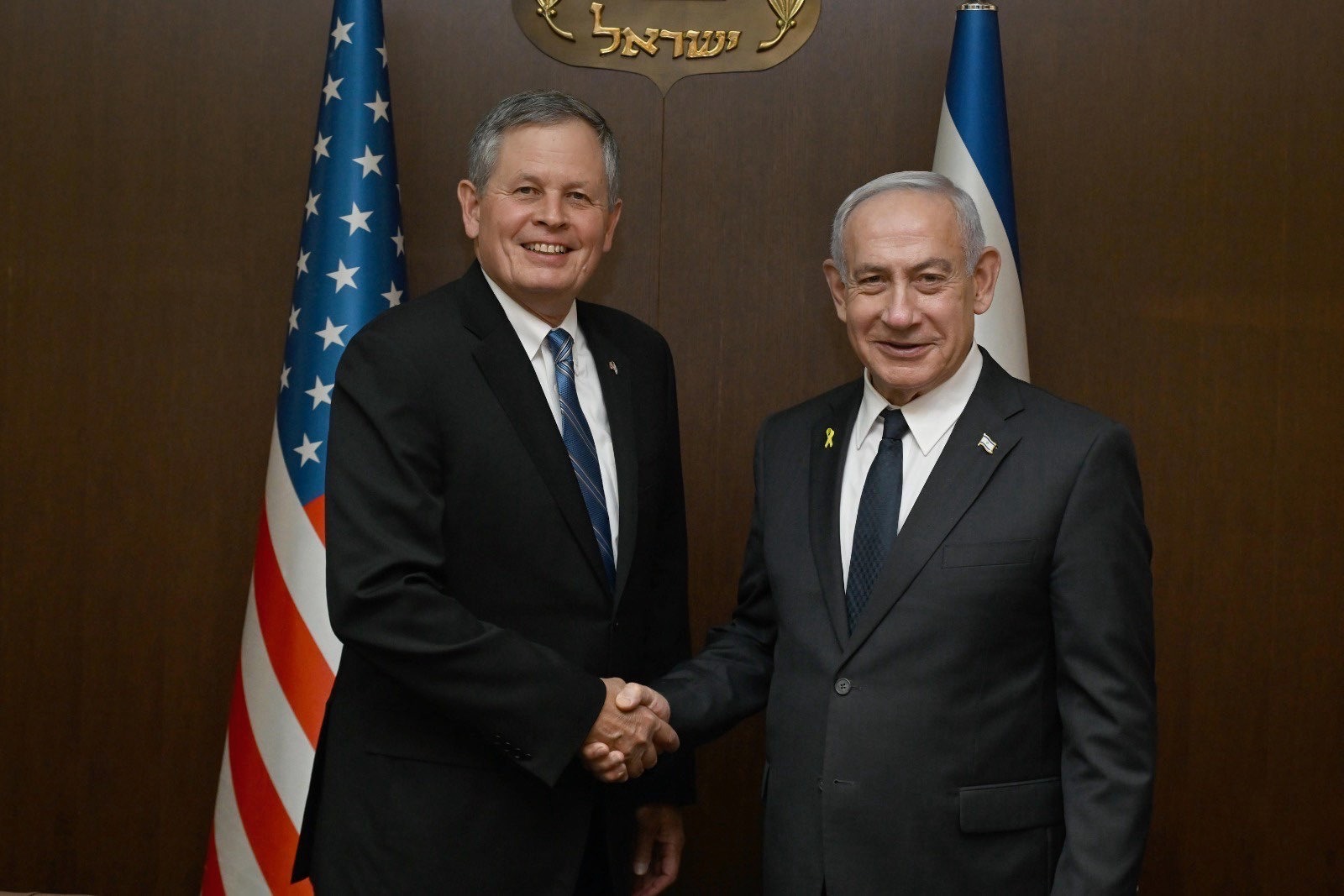
Sen. Steve Daines (R-MT) said he left Israel from a weekend visit with a renewed belief in the U.S.-Israel relationship and the necessity of fully eradicating Hamas, as the IDF begins expanded operations in Gaza City, Jewish Insider’s Marc Rod reports.
Doubling down: “It just reinforced my position of the importance that the United States stands with Israel, and in supporting Israel in their mission to eradicate Hamas in Gaza,” Daines said in an interview with JI this week, reflecting on a meeting with Israeli Prime Minister Benjamin Netanyahu. “There will never be true peace in Gaza and peace with Israel until Hamas is eradicated.” He said that it’s also crucial for innocent Palestinians that Israel be successful in its mission to defeat Hamas. Daines said that he didn’t discuss the postwar vision for Gaza with Netanyahu, “but clearly the important first step will be eradicating Hamas.”
SCOOP
Fifty Senate Republicans call on European foreign ministers to hold firm on snapback, enforce Iran sanctions

Fifty Senate Republicans wrote to the foreign ministers of the U.K., France and Germany on Tuesday urging them to hold firm in triggering snapback sanctions on Iran and requesting their cooperation in sanctions enforcement, Jewish Insider’s Marc Rod reports.
Notable quotable: “While we back diplomatic efforts to restore Iran’s compliance with its International Atomic Energy Agency (IAEA) commitments, the international community should not allow hollow gestures and cynical threats from Tehran to stop the snapback process,” the lawmakers wrote. “The regime has abused diplomatic processes for years to avoid penalties. Sanctions relief should only be negotiated after snapback is fully implemented.”
COMMENT CLEAN-UP
Netanyahu does damage control after saying Israel to be like ‘super-Sparta,’ ‘autarky’
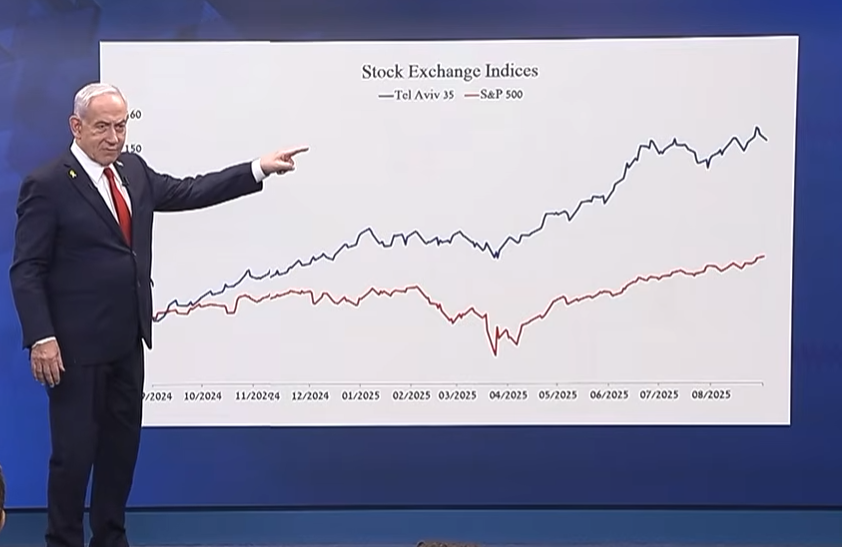
Israeli Prime Minister Benjamin Netanyahu clarified his remarks that Israel’s economy may “need to adapt to … autarkic characteristics” on Tuesday, after a dip in the Tel Aviv Stock Exchange and after business and industry leaders came out against Netanyahu’s remarks, saying that “an autarkic economy will be a disaster for Israel,” and “this vision … will make it hard for us to survive in a developing globalized world,” Jewish Insider’s Lahav Harkov reports.
Damage control: A day later, Netanyahu called a press conference amid widespread concern in Israel, clarifying that his comments were specific to the Israeli defense industry. In the defense industry, he said “there are limitations that are not economic, but political.” He stated, “If there’s one lesson from this war, it is that we want to be in a situation where we are not limited. We want to defend ourselves by ourselves and with our own weapons. We are going to produce an independent arms industry that is very strong that can withstand any political constraints.”
WH invite: In the press conference, Netanyahu also said he had spoken on the phone with President Donald Trump several times since Israel’s strike aimed at Hamas leaders in Qatar last week, including one in which the president invited him to the White House. Netanyahu said he will be meeting with Trump in Washington on Sept. 29.
PROTEST PROBE
Kash Patel vows to investigate funding for left-wing protest movements
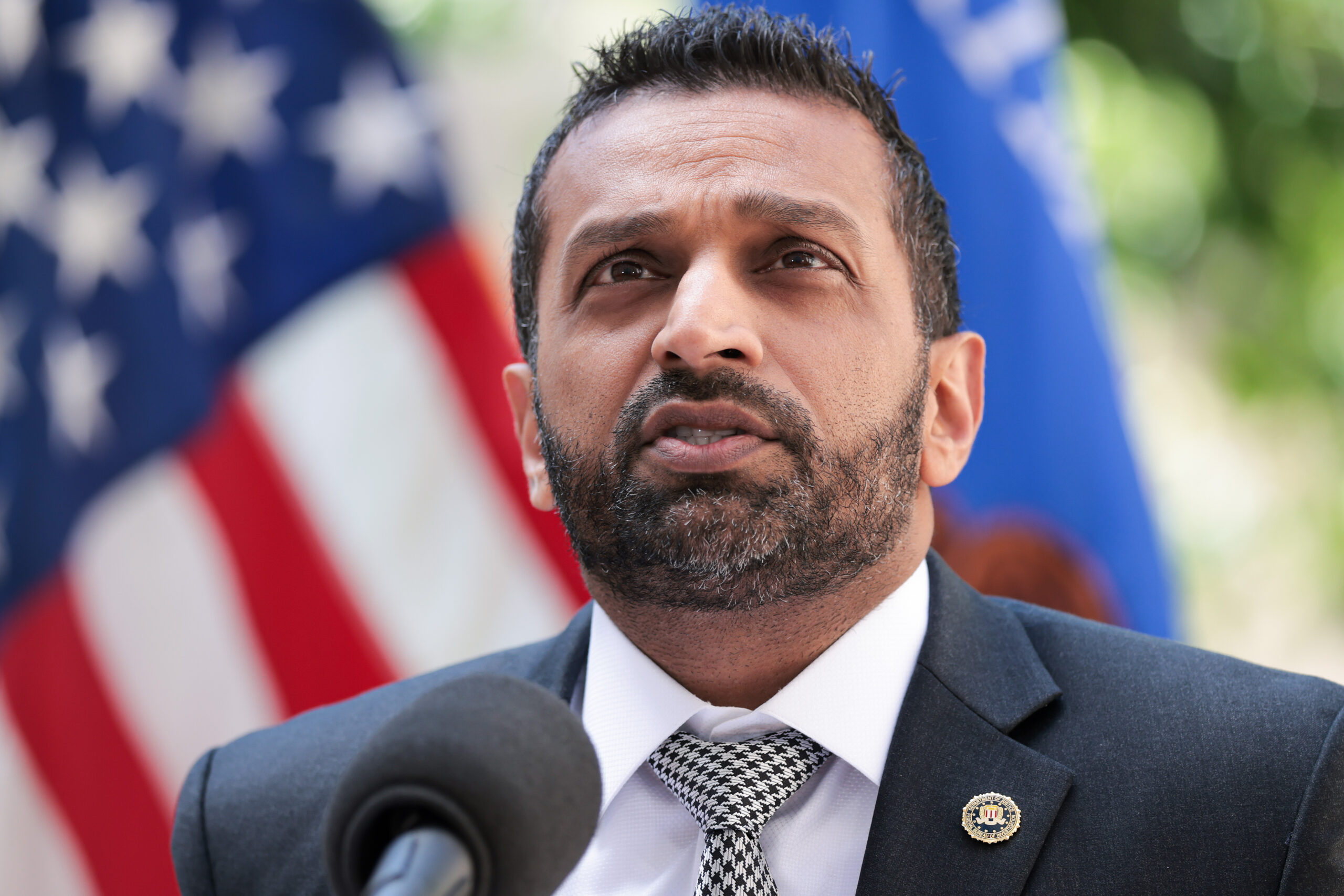
FBI Director Kash Patel said on Tuesday that federal investigators were looking into the funding sources for left-wing groups behind organized protest movements that have resulted in rioting on city streets and civil rights violations on college campuses. Patel made the comments while appearing before the Senate Judiciary Committee for a marathon oversight hearing, where he faced dozens of questions from Democrats and Republicans about the assassination of conservative influencer Charlie Kirk last week, Jewish Insider’s Emily Jacobs reports.
Follow the money: Sen. Ted Cruz (R-TX) urged Patel to investigate the financing of far-left groups that the Texas senator said may have influenced the suspected shooter and supported protests in recent years that saw instances of rioting or other illegal activity. “As I’ve always said, Senator, money doesn’t lie. We’ve been following the money, and that’s what we’re doing, issuing a lawful process to organizations involved with criminal activity because the money has got to come from somewhere,” Patel told Cruz.
Money matters: The House Oversight Committee asked the Trump administration on Monday to investigate if far-left billionaire Neville Roy Singham’s bankrolling of “extremist organizations fueling division and civil unrest across the United States” would qualify him for federal sanctions or make him eligible for criminal or legal penalties.
SHAPIRO’S SERMON
Drawing on Jewish blessing, Shapiro offers ‘words of healing’ to a nation on edge

Amid an alarming rise in political violence, Pennsylvania Gov. Josh Shapiro said Tuesday that the way to combat extremism and division is by bringing people together and restoring their faith in the government — a civic-minded strategy that included some thinly veiled swipes at President Donald Trump and the hard-line rhetoric he has adopted since conservative activist Charlie Kirk was killed in Utah last week, Jewish Insider’s Gabby Deutch reports.
What he said: “I believe we have a responsibility to be clear and unequivocal in calling out all forms of political violence, making clear it is all wrong,” Shapiro, a Democrat, said in a keynote address at the Eradicate Hate Global Summit, a Pittsburgh conference created in the aftermath of the 2018 mass shooting at the Tree of Life synagogue. “Unfortunately some, from the dark corners of the internet all the way to the Oval Office, want to cherry pick which instances of political violence they want to condemn.” Shapiro leaned on Jewish teachings in his speech, referring as he often does to how his faith underpins his public service.
Worthy Reads
Out in Left Field: Former Obama administration official Ken Baer writes in the Washington Post about how DSA-affiliated New York City mayoral nominee Zohran Mamdani is an affront to Democratic Party principles. “It is “spineless politics” to do precisely what [Sen. Chris] Van Hollen, [Gov. Kathy] Hochul and other Democrats have done — and that more Democrats presumably will do in coming days — by casting aside the party’s time-honored liberal principles to back Mamdani. Addressing the affordability crisis is noble. But who’s against affordability? What matters is not just a party’s policy ends, but also its means and its rationale for pursuing them. In the months since President Donald Trump’s victory, Democrats have made no progress in articulating what they are for — and why … At best, this failure presents Democrats as inauthentic as they explain and backpedal when confronted with extreme beliefs from the party’s left but offer nothing in replacement. At worst, it allows the left — within and outside the party — to define the party” [WashPost]
Good Cop, Bad Cop: In The Free Press, Michael Doran, senior fellow and director of the Center for Peace and Security in the Middle East at the Hudson Institute, weighs in on what he describes as President Donald Trump and Israeli Prime Minister Benjamin Netanyahu’s “good cop-bad cop” routine. “Israel’s ability to go on offense places it in a rare category among U.S. allies. Most lack the will or capacity to wage war independently. Critics like Tucker Carlson depict Israel’s independence as a liability, dragging America into fights that don’t serve its interests. Trump sees the reverse: Unilateral Israeli military operations spare American forces and serve U.S. strategic goals. In just two years, Israel has blunted Iran’s nuclear ambitions, hammered Hezbollah, neutered Hamas, and weakened the Houthis—achievements many Americans view as enhancing their own security.” [FreePress]
History Lesson: In The Atlantic, Arash Azizi revisits the history of Zionism amid growing use of the term as a slur. “One summer in Brooklyn, a controversy broke out in my dog-park group chat. Dedicated to the upkeep of the park and welfare of our canines, our chat had never indulged in politics before. But someone was now complaining that a dog-insurance company was ‘Zionist,’ and a passionate debate ensued … To criticize someone for supporting, say, the Israeli government or its war in Gaza is one thing. But this charge is broader and vaguer, uttered sometimes in circumstances with no reference to Israel, and in many cases as little more than an anti-Semitic dog whistle. I’m probably the only Middle Eastern member of that park group chat. I’m also a historian by training. I jumped in to say that I didn’t think Zionist should be used as a term of derision. Zionism is a nationalist movement, I insisted, and like other nationalist movements, it has a story rooted in the 19th century—one that is neither all good nor all bad. To call someone a Zionist as an insult is as strange as attacking someone for being a Ghanaian or Chinese nationalist. I’m not sure how many people I convinced. But to me the history of Zionism bears revisiting as a reminder of its impetus and early diversity.” [Atlantic]
Word on the Street
Israeli and U.S. officials continue to lament the failure of the Israeli strike in Doha, Qatar, both substantively and diplomatically, with one Israeli official telling Axiosthat “none of the top Hamas leaders were killed” and an American official saying they’d advised Israel to take steps to rectify its relationship with the Trump administration…
Rep. Josh Gottheimer (D-NJ) wrote to Kathy Goldenberg, the president of the New Jersey State Board of Education, on Monday urging the state to reject calls from the New Jersey chapter of the Council on American-Islamic Relations for the state’s education boards to cut ties with the Anti-Defamation League, Jewish Insider’s Marc Rod reports…
Advocates with the Anti-Defamation League are set to lobby lawmakers this week on a series of actions related to antisemitism, including a push to jump-start the stalled Antisemitism Awareness Act, Jewish Insider’s Marc Rod reports…
A new plaintiff was added to a lawsuit brought by the Louis D. Brandeis Center for Human Rights under Law against the Massachusetts Institute of Technology. The complaint alleges that a Jewish graduate student was cornered in a campus parking lot by masked individuals calling for death to Israel and Zionists and faced a “campaign of hostility” inside his lab, and the university took no action when it was reported. The original complaint focused on a tenured linguistics professor who publicly harassed an Israeli postdoctoral researcher at the school…
Jerry Greenfield, co-founder of Ben & Jerry’s, has quit the ice cream company, saying that the business has been “silenced” by parent company Unilever on social issues; Unilever and Ben & Jerry’s have clashed in recent years over issues related to the Israeli-Palestinian conflict…
Israel presented Syria with a new security agreement several weeks ago, Axios reports, and Syria is now preparing a counterproposal. Israeli Strategic Affairs Minister Ron Dermer, Syrian Foreign Minister Asaad al-Shaibani and U.S. envoy Tom Barrack are set to meet in London on Wednesday to discuss the proposal…
Israeli strikes in Gaza City have reportedly cut off internet and telephone services in the city…
Iran executed Babal Shahbazi, whom it accused of spying for Israel, Iranian state media reported today…
The U.S. and China are finalizing a deal to transfer 80% of ownership of TikTok’s U.S. business to an investor consortium including Oracle, Silver Lake and Andreessen Horowitz. The new U.S. app will still utilize ByteDance’s algorithm, and Oracle will handle its user data in Texas…
Carl Heastie, the Democratic speaker of the New York State Assembly, is expected to endorse New York City Democratic mayoral nominee Zohran Mamdani this week, The New York Times reports, one of several state leaders in the party who have thus far resisted doing so, while Jay Jacobs, chair of the New York Democratic Party, told several people he does not plan to endorse Mamdani. Rep. Yvette Clarke (D-NY), chair of the Congressional Black Caucus, is reportedly set to endorse him on Monday…
Rep. Elise Stefanik (R-NY) introduced a bill that would “prohibit state and local law enforcement from arresting foreign nationals within the United States” solely based on warrants from the International Criminal Court, as Mamdani has threatened to do to Israeli Prime Minister Benjamin Netanyahu…
Sens. John Fetterman (D-PA) and Dave McCormick (R-PA) appeared on Fox News’ “Special Report” with Bret Baier on Tuesday evening for a discussion on improving political civility, where the duo condemned the use of political rhetoric equating one’s political opponents to Nazis or Adolf Hitler. “When you see dangerous rhetoric like fascist and Nazism and authoritarianism, and the end of democracy, that’s a permission, that takes us down a path where the inevitable next step is violence, and that’s what we see,” McCormick said…
The Democratic PR firm SKDK terminated its contract with the Israeli government, which was meant to run until March 2026. Originally contracted to raise the profile of the Bibas family tragedy, a spokesperson for the firm declined to tell Politico why the deal was cut short…
Gordon Gee, who served as president of five universities, is joining Brownstein as a strategic consulting adviser for the firm’s higher education task force…
Israeli Transportation Minister Miri Regev cleared Uber for entry into Israel’s taxi market, a significant move for the country, which has a strong taxi drivers union…
Ecuadorian President Daniel Noboa signed an executive order on Tuesday designating the Islamic Revolutionary Guard Corps, Hamas and Hezbollah as terrorist organizations…
The Wall Street Journal reviews Yaakov Katz and Amir Bohbot’s new book, While Israel Slept: How Hamas Surprised the Most Powerful Military in the Middle East, calling it “an agonizing litany of might-have-beens” and saying “Katz and Bohbot could have titled their book ‘While Israel Was Busy Doing Other Things.’” Read JI’s Lahav Harkov’s interview with Katz here…
Speaking at The Jerusalem Post Diplomatic Conference yesterday, U.S. Ambassador to Israel Mike Huckabee called out European countries for pushing for a unilateral recognition of a Palestinian state, charging that “it destroyed the negotiations for the hostages.” …
Political commentator, author and former host of “The View,” Meghan McCain accepted the Champion of Israel Award yesterday at the American Friends of Magen David Adom Gala at Cipriani Wall Street in New York City…
The Air Force said it has started upgrading the luxury jet donated by Qatar for use as Air Force One…
The New York Times reports on growing turmoil at Manhattan’s iconic Pierre Hotel, where Commerce Secretary Howard Lutnick, the building’s largest shareholder, now faces backlash from residents over a proposed $2 billion sale involving foreign investors that could force them out…
The Wall Street Journal spotlights the transformation of Manhattan’s 666 Fifth Avenue, once a high-profile real estate debacle under Jared Kushner’s ownership, now rebounding under Brookfield’s leadership with major renovations and new tenants…
TikTok recently removed at least two antisemitic items from TikTok Shop, a spokesperson told Axios, in a sign of the platform’s recent attempts to address antisemitism…
A new Broadway play, “Giant,” will explore the life of children’s author Roald Dahl and his controversial moments around antisemitism and Israel, in particular, including incendiary comments about the First Lebanon War and the Holocaust…
Pic of the Day
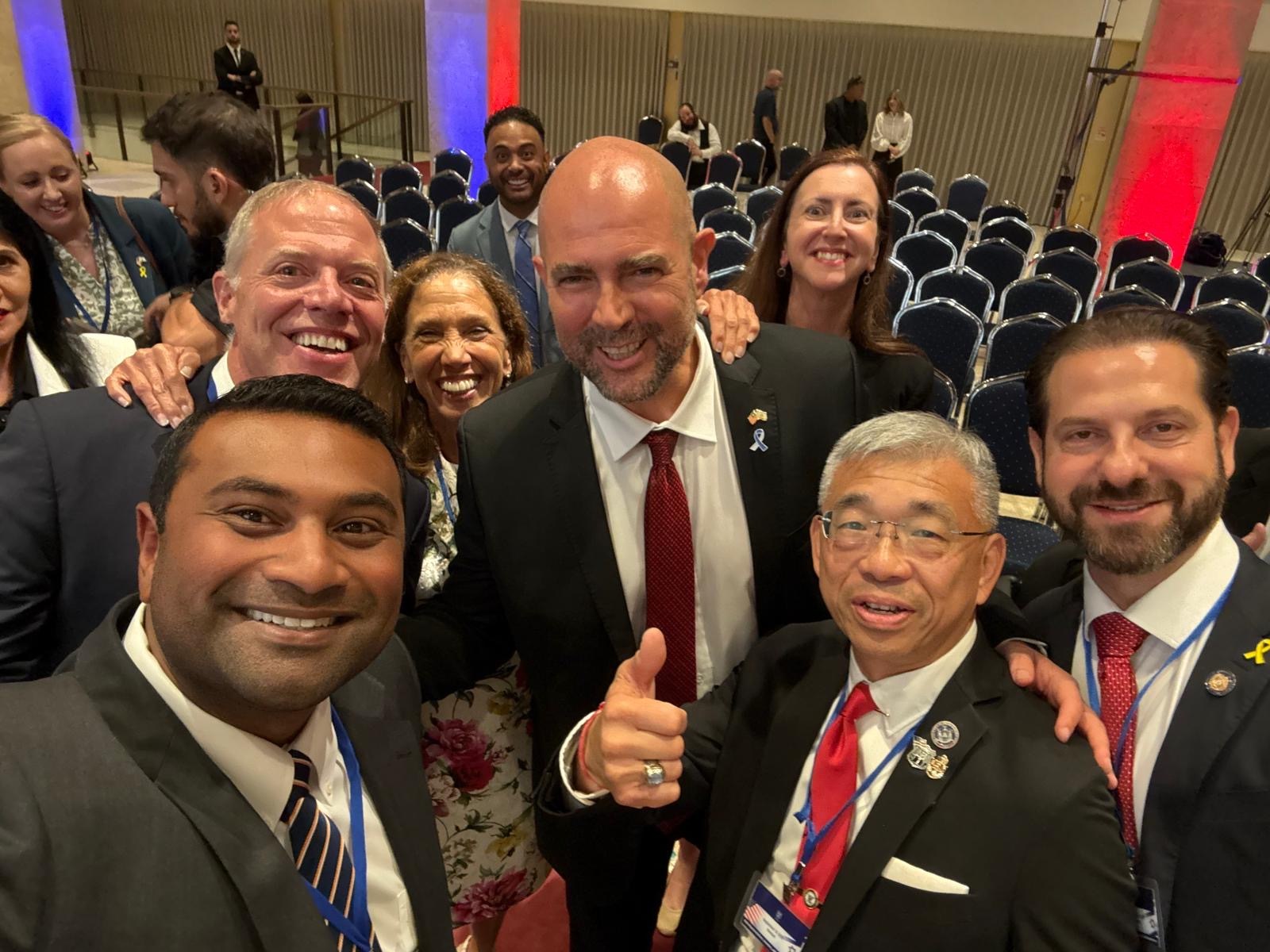
A delegation of New York State legislators met with Knesset Speaker Amir Ohana (center) in Jerusalem on Monday. From left: Assemblyman AJ Beephan, Minority Leader Will Barclay, Assemblywoman Amy Paulin, Assemblywoman Nily Rozic, Assemblyman Lester Chang and Assemblyman Daniel Norber.
Birthdays

Comedian, writer and actress, she was a frequent guest of Johnny Carson on the “Tonight Show,” Rita Rudner turns 72…
Fashion designer, known worldwide for his leading-edge corporate uniforms, Stan M. Herman turns 97… U.S. senator (R-IA) since 1981, Chuck Grassley turns 92… Investment banker who once served as a NYC deputy mayor, Peter J. Solomon turns 87… Newbery Honor-winning author of many young adult books, Gail Carson Levine turns 78… Author of 11 books, Joshua Muravchik turns 78… Former president of the National Technical Institute for the Deaf and then president of Gallaudet University, T. Alan Hurwitz turns 78… Rochester attorney, he has held positions at the UJA-Federation of New York and the Rochester Jewish Federation, Frank Hagelberg… Retired judge on the U.S. District Court for the Northern District of California, Jeremy Don Fogel turns 76… Professional tennis player who achieved a world ranking of No. 5 in 1980, Harold Solomon turns 73… Author, comic book writer and editor, best known as group editor of the Spider-Man books at Marvel Comics, Daniel Fingeroth turns 72… Israeli businessman with real estate holdings in Israel and NYC, Mody Kidon turns 71… Author and graphic designer, Ellen Kahan Zager… Former member of the Knesset for the Yesh Atid party, Rina Frenkel turns 69… Rabbi of the New North London Synagogue with over 3,700 members, Jonathan Wittenberg turns 68… Former consultant at Quick Hits News, Elliott S. Feigenbaum… Journalist, best-selling author including two books on the Obama presidency and Emmy Award-winning executive producer, Richard Wolffe turns 57… Director of the Centers for Disease Control and Prevention (CDC) for the last 18 months of the Biden administration, Mandy Krauthamer Cohen turns 47… Former regional communications director and spokesperson for President Obama, now a partner at Seven Letter, Adam Abrams… Member of the Los Angeles Unified School District’s Board of Education, Nick Melvoin turns 40… Former Obama White House speechwriter who has since written a best-selling comedic memoir, David Litt turns 39… Principal product manager for CathWorks, Adina Shatz… National health-care reporter The Washington Post covering the FDA, Rachel Roubein… Associate at Strand Partners in London, Natalie Edelstein Jarvis… Founder of the Israel Summit at Harvard and board member of the IDF Widows and Orphans Organization, Max August…
The freshman New York congressman also said that Israel must do more to pursue an end to the war, make its case to the world and provide aid in Gaza

Spencer Platt/Getty Images
Westchester County Executive George Latimer speaks to supporters after winning his race against Democratic incumbent Representative Jamaal Bowman in the 16th Congressional District of New York's Democratic primary.
Having recently returned from a trip to Israel, Rep. George Latimer (D-NY) is emphasizing that Israel’s critics in the United States and around the world are overlooking Hamas’ key role in perpetuating the conflict and contributing to the humanitarian issues in Gaza, strengthening the terrorist group’s position and insulating it from external pressures.
At the same time, the New York Democrat also said that Israel must do more to pursue an end to the war, make its case to the world and provide aid in Gaza.
Latimer, speaking to Jewish Insider last week, said that the trip, organized by the AIPAC-affiliated American Israel Education Foundation for Democratic freshmen and leading Democratic lawmakers, had reinforced his view that the situation on the ground is more complicated than the more simplistic narratives demonizing Israel that have been spread by some critics and media.
“When you see on the ground, you understand it is not a simple black-and-white situation,” Latimer, a first-term congressman from Westchester County, N.Y., who sits on the House Foreign Affairs Committee, said. “People come up to me and say, ‘Israel is practicing genocide. What they’re doing is evil and we need to stop it.’ And then you get on the ground and you realize how much more complicated it is than that.”
He said that American critics of Israel fail to acknowledge Hamas’ “role in all of this and its contributory actions.” He said he sees a “lack of appreciation here in the United States that Hamas is committed — has shown no signs to want to sit, talk peace, have a cessation of hostilities. … That makes it very, very hard to plot a strategy, if the other side is completely intransigent.”
Latimer said the situation is comparable to overlooking the fact that the U.S. entered World War II because Japan bombed Pearl Harbor, or that the U.S. invaded Afghanistan because of the 9/11 attacks. He said that the “mindset” that motivated such attacks doesn’t disappear overnight, and can take protracted conflict to address.
At the same time, he said that “there’s a gap between what [the Israeli government] needs to be doing and what it is doing, and it’s a serious gap.” He said he doesn’t see proposals to relocate the population of Gaza out of the enclave, discussed during a meeting with Israeli Prime Minister Benjamin Netanyahu, as “workable” or “humane.”
He addressed friction within Israeli society over Israel’s war plans in Gaza, and said that Netanyahu’s decision-making may be shaped by his far-right coalition members, adding that “if there’s no movement from Hamas, what can you ask Israel to do unilaterally?”
“So Netanyahu’s strategies present as intransigent in the face of intransigence on the other side,” Latimer continued. “You need some joint breakthrough where both sides step back from the path that they’re on, and both sides have to be willing to do that, if you can expect the other side to also then do that.”
He noted the difficulty of forcing a dug-in enemy like Hamas to surrender, comparing it to the challenge of forcing a Japanese surrender during WWII.
Latimer unseated Rep. Jamaal Bowman (D-NY), a vocal Israel critic, in the 2024 Democratic primary, boosted by significant support from his district’s Jewish community as well as national pro-Israel groups.
Latimer told JI he thinks Israel has not done enough to try to win over or influence global opinion in its favor. Latimer said he believes that the Israeli government views such efforts as a lost cause and not worth attempting.
“There’s a case to be made [for Israel]. But in lieu of that, the rhetoric is all what Israel is doing and not doing, and how evil they are, when, in fact, all of this came from an attack that was horrific on Oct. 7,” Latimer said.
He said that there have been “atrocities” on the Israeli side, pointing broadly to settler violence in the West Bank, but said that “the question is, overall, are you weighing all of these things together, or as the world opinion, and much of the United States opinion, particularly among younger people, has been framed completely around ‘Israel bad,’” ignoring the “evil that’s been done on behalf of the other side of this. That is a contributing reason why we’re in the situation we’re in.”
“The fact that people are starving is horrific. But as long as the world blames Israel for it solely, Hamas is winning. Why would they change any strategies?” Latimer said. “The leaders of Hamas are not sitting in the tunnels. … They’re sitting in the safety of the protection of [Turkish President Recep Tayyip] Erdogan or over in Qatar. Therefore, they’re not under the pressure.”
Latimer said that the food supply in Gaza was a key issue he examined on the trip, calling starvation in Gaza a “legitimate” problem.
He said that the current four Gaza Humanitarian Foundation aid distribution sites are “nowhere near enough,” given the “massive number of people that need to be fed and housed.”
But he added that Hamas being “unwilling to cooperate” in the safe delivery of aid is an impediment to efforts to improve the humanitarian situation and that the United Nations “in the eyes of the Israelis, has lost credibility.”
He said that the best path forward would likely be for a coalition of Arab countries to take the lead of a humanitarian aid distribution entity: “We need to have a third party that has credibility.”
“Israel is not doing enough to solve the problem, and Hamas is doing things to prohibit the problem from being solved,” Latimer said, calling on Israel to work to increase the number of food distribution centers and strengthen supply lines and on Hamas to stop attempting to intercept food and sow chaos at distribution sites.
“The fact that people are starving is horrific. But as long as the world blames Israel for it solely, Hamas is winning. Why would they change any strategies?” he said. “The leaders of Hamas are not sitting in the tunnels. … They’re sitting in the safety of the protection of [Turkish President Recep Tayyip] Erdogan or over in Qatar. Therefore, they’re not under the pressure.”
“What I saw in September 2005 gave me hope. What I see when I go back 20 years later is, you shake your head and you go, ‘Why did it turn out this way?’” Latimer said. “Did it turn out this way because Israel wanted it to turn out this way? Israel didn’t want Oct. 7. Israel didn’t want all of its young men in the reserves and active duty, constantly on a wartime footing.”
He declined to weigh in definitively — citing the limited information at his disposal and his limited power as a lone congressman — on whether the U.S. needs to increase pressure on its allies in Turkey or Qatar to expel or detain those Hamas leaders, but said that “clearly there has been insufficient pressure on Hamas” because its leaders have shown no urgency to return the hostages, negotiate in good faith or participate in un-corrupted food distribution.
Latimer said he first traveled to Israel two decades ago, just after the Israeli disengagement from Gaza, and that there was hope at the time that the Israeli withdrawal would “allow the opportunity for Gaza to experience peace and some kind of growth.”
“What I saw in September 2005 gave me hope. What I see when I go back 20 years later is, you shake your head and you go, ‘Why did it turn out this way?’” Latimer said. “Did it turn out this way because Israel wanted it to turn out this way? Israel didn’t want Oct. 7. Israel didn’t want all of its young men in the reserves and active duty, constantly on a wartime footing.”
He said that if Gaza’s leaders had pursued growth and development over the past 20 years, “we could be in a very different place today,” but instead Hamas seized power and used Gaza as a platform to attack Israel.
Asked about recent decisions by European countries to unilaterally recognize a Palestinian state, which came around the time of Latimer’s trip, the congressman said that he supports a two-state solution, but one that “comes out of a negotiated process,” noting the many outstanding issues to be worked through.
“You cannot expect Israel to survive with a hostile entity interspersed with its borders, and yet be its own country. And there has to be a sense that this country can function and provide its services to its people and maintain civil control. None of those things are automatically in place yet, so I don’t know what we’re recognizing in substance,” Latimer said.
“I think what we’re recognizing in symbolism is European countries that basically are saying, ‘We need to have a two state solution,’ and probably their population is reacting to what’s happening in the moment and putting pressure on their governments to do this,” he continued.
“The Palestinian Authority certainly has a steep mountain to climb, but right now, they’re the best hope that you have of a presence — and certainly it’s not Hamas, it’s certainly not coming out of any of the groups that Iran is backing or has backed,” Latimer said.
Based on the delegation’s meeting with Palestinian Authority leaders, Latimer said that he believes there is an “intent” and “willingness” in the PA to pursue needed reform and bolster credibility with the Palestinian population.
“How much success they’re going to have with the civilian population to accomplish those things — it’s going to be a tall task,” he said.
At the same time, he noted that some Arab governments such as those in Jordan and Egypt maintain cooperative relationships with Israel even as many of their citizens remain hostile.
“The Palestinian Authority certainly has a steep mountain to climb, but right now, they’re the best hope that you have of a presence — and certainly it’s not Hamas, it’s certainly not coming out of any of the groups that Iran is backing or has backed,” he continued.
In the long term, Latimer added, the Abraham Accords represent a path forward for the region, and said that moderate Sunni Arab states want to see a viable and demilitarized Palestinian Authority government that can credibly govern the Palestinian people.
The next U.S.-Israel memorandum of understanding will need to be secured in a political environment much more hostile to Israel than 10 years ago

GETTY IMAGES
A general view of the U.S. Capitol Building from the National Mall, in Washington, D.C., on Thursday, May 29, 2025.
In September 2016, when President Barack Obama announced that the U.S. and Israel had signed a 10-year deal pledging a total of $38 billion in military assistance to Israel, the news was generally uncontroversial and greeted with bipartisan plaudits — a striking contrast to the nasty presidential campaign playing out across the country at the time.
That deal, known as the U.S.-Israel Memorandum of Understanding, is now close to expiring, and the next one — if there is a next one — will be negotiated in an entirely different political environment. Israel remains deeply enmeshed in a nearly two-year war in Gaza, with little indication of an end in sight, making forward-looking negotiations more difficult.
A new MOU is not a given. U.S. support for Israel has dramatically declined on the left, and it is fracturing in isolationist corners of the right as well. Even some staunchly pro-Israel Republicans have grown wary of foreign aid in general, a shift that could affect U.S. policy toward Israel.
“When many of the threats that have faced Israel in the past have been largely neutralized, Israel will need to figure out how to make the case that it is in need of over half of the U.S. security assistance budget,” a former Biden administration State Department official told Jewish Insider. “They will need to demonstrate the threats that they face in order to warrant this level of funding when Hamas has been decimated, when Hezbollah is a shadow of what it once was, when Iranian air defenses are nonexistent and Israel has proven its ability to be able to infiltrate Iran.”
The conversation about the next U.S.-Israel MOU came to the fore last month, when Pete Buttigieg, the former transportation secretary and a potential 2028 Democratic presidential candidate, became the first prominent Democrat to say the U.S. should not enact another 10-year military aid deal with Israel.
No other potential Democratic presidential contenders have weighed in on the issue, though it could become a litmus test for a party whose base is steadily turning more hostile to Israel.
The current U.S.-Israel MOU, which expires in 2028, is the countries’ third. President Bill Clinton and Israeli Prime Minister Ehud Barak signed the first 10-year MOU in 1999. It was meant as a way to phase out U.S. economic aid to Israel, which Jerusalem no longer needed as an emerging economic and technological powerhouse. Another MOU was negotiated by President George W. Bush and completed in 2007.
“Ten-year MOUs have communicated an ongoing, consistent and bipartisan commitment to support Israel’s security by crossing administrations and demonstrating that it’s an ongoing relationship,” said former U.S. Ambassador to Israel Dan Shapiro. “It allows planning for big ticket acquisitions.”
The long-standing commitment allows Israel to plan to make large purchases that could take several years to acquire, such as fighter jets.
The MOU is not actually a binding agreement, it’s a framework. Congress must still approve the $3.3 billion in military financing and $500 million in missile defense laid out in the MOU each year during the annual appropriations process, and could do so even in the absence of an MOU.
“It’s simply a political commitment that Congress and the president can honor or not honor, and not having an MOU does not necessarily mean that we won’t have foreign military financing,” said Brad Bowman, an analyst at the Foundation for Defense of Democracies and former national security advisor to Sen. Todd Young (R-IN).
“But if we’ve had MOUs with Israel for so long under presidents of both parties, to not have one, I think, would really be quite a political statement about what’s going on with Israel, and would undermine the efforts of both Americans and Israelis to do necessary planning,” Bowman added.
“Both the left and the right are having deep reservations about the U.S.-Israel relationship, and that could very much have negative consequences for the MOU,” a former Biden administration State Department official said.
Congress has in the past weighed in to signal its support for the MOU. In 2016, Congress voted overwhelmingly to endorse the new MOU, with 405 members of the House voting for the measure. Just four representatives — all Republicans — voted against the bill. Only one of them, Rep. Thomas Massie (R-KY), is still in the House.
Since then, American support for Israel has shifted significantly, particularly since Israel’s response to the Oct. 7 Hamas attacks in 2023. A Quinnipiac poll released in August found that 60% of voters oppose sending more military aid to Israel for its war with Hamas, while only about one-third (32%) support it.
Meanwhile, only 13% of Democrats say their sympathies lie more with the Israelis than the Palestinians, a decline from 34% when asked the same question in November 2023. Far more Republicans side with the Israelis — 66% — but that’s down from 80% in November 2023.
“Both the left and the right are having deep reservations about the U.S.-Israel relationship, and that could very much have negative consequences for the MOU,” the former Biden State Department official said.
Congressional efforts to place conditions on American military aid to Israel have gained steam since Oct. 7.
Twenty-seven Senate Democrats voted last month on a resolution to block the shipment of certain weapons to Israel. The measure was largely symbolic and destined to fail in the Republican-led Senate. Still, even with an MOU, Congress would not be prevented from passing a bill further restricting U.S. aid to Israel.
“We continue to have an interest in ensuring that Israel can defend itself. They continue to be an important partner in the Middle East addressing many threats that threaten them, but also threaten us,” said former U.S. Ambassador to Israel Dan Shapiro. “If our relationship with Israel were to become far less supportive and far less intimately connected, we would quickly see a decline in our influence much more broadly in the region. That doesn’t mean we can’t also have critical conversations and use our leverage as a provider of assistance when we have concerns about Israeli military actions.”
That’s not considering the leeway given to the State Department, which approves arms sales. Last year, President Joe Biden held up a shipment of 2,000-pound bombs for months over concerns about Israel’s incursion into Rafah.
The Trump administration, which would be the one to negotiate and sign off on a new MOU before its expiration, has not yet indicated any reservations with the process.
Israel is by far the largest recipient of U.S. foreign military financing. The U.S. and Jordan have their own security MOU, though Jordan receives roughly a tenth of the annual military aid that Israel gets. Shapiro, the former U.S. ambassador to Israel, said the reason for the high level of support goes beyond Israel, and deep into the Middle East. He urged the U.S. to raise concerns with Israel about its conduct when issues arise, but not to cut into the aid itself.
“We continue to have an interest in ensuring that Israel can defend itself. They continue to be an important partner in the Middle East addressing many threats that threaten them, but also threaten us,” he said. “If our relationship with Israel were to become far less supportive and far less intimately connected, we would quickly see a decline in our influence much more broadly in the region. That doesn’t mean we can’t also have critical conversations and use our leverage as a provider of assistance when we have concerns about Israeli military actions.”
It would be tempting for Israel to try to increase its defense production to account for such a turbulent political environment. Israel has grown its military exports substantially in recent years and some Israeli lawmakers have indicated they’d like to phase out reliance on U.S. aid, but it would be very difficult for Israel to domestically produce everything it needs.
“The problem is that’s never going to happen,” Bowman said. “Israel, as impressive as it is, is never going to be completely self-sufficient in producing its own weapon systems. The United States is not. If we’re not, Israel never will be. Israel is a technology superpower. It’s not an industrial superpower.”
‘We all see Lebanon is at a point of change. We're here to tell you that we're buying into that change,’ Graham said, citing the country’s ‘religious diversity’

Houssam Shbaro/Anadolu via Getty Images
Sen. Lindsey Graham (R) speaks during a press conference alongside Sen. Jeanne Shaheen and Rep. Joe Wilson in Beirut, Lebanon on August 26, 2025.
Sen. Lindsey Graham (R-SC) championed a U.S. defense agreement with Lebanon during a bipartisan congressional delegation to Beirut on Tuesday, saying it would be the “biggest change in the history of Lebanon.”
Speaking at a press conference alongside Sen. Jeanne Shaheen (D-NH) and Rep. Joe Wilson (R-SC), Graham asked, “How many nations have a defense agreement with the United States? Very few. … The number of nations that America is willing to go to war for is very few. Why do I mention Lebanon being in that group? You have one thing going for you that is very valuable to me: religious diversity.”
“Christianity is under siege in the Mideast. Christians are being slaughtered and run out of all over, all over the region, except here. And so what I am going to tell my colleagues is, ‘Why don’t we invest in defending religious diversity in the Mideast? Why don’t we have a relationship with Lebanon where we would actually defend what you’re doing?’” he continued.
“I think it’s in America’s interest to defend religious diversity, whether you’re Druze or Alawite or a Christian or whatever. The idea that America may one day have a defense agreement with Lebanon changes Lebanon unlike any single thing I could think of,” Graham said.
During their visit, the delegation, joined by U.S. Ambassador to Turkey Tom Barrack, diplomat Morgan Ortagus and U.S. Ambassador to Lebanon Lisa Johnson, met with Lebanese President Joseph Aoun, Prime Minister Nawaf Salam, Parliament Speaker Nabih Berri and head of the Lebanese Armed Forces Gen. Rodolph Haykal.
During the press conference, the lawmakers conveyed their encouragement over the progress that Lebanon has made in military, financial and democratic reforms and their hope that the government would be able to execute the changes fully.
“We all see Lebanon is at a point of change. We’re here to tell you that we’re buying into that change, that we support what you’re trying to do. That if you do make an effort to disarm Hezbollah, we’ll be there trying to help. We’ll try to help your military, we’ll try to help your economy. We think that’s the right thing for you to do, and it benefits the entire region,” Graham said.
“If you’re able to pull this off, Saudi Arabia will look at you differently. If you’re able to pull it off, Israel will look at you differently. If you’re able to pull this off, there’ll be a groundswell of support in Washington to help your economy and to help your military,” he continued.
“Congress is looking at Lebanon differently because you’re behaving differently. If you continue to go down this road, I think you have a wonderful opportunity to secure your nation, economically, militarily, like anything I’ve seen since I’ve been coming to the region with [the late Sen.] John McCain (R-AZ). It all depends on what happens with the Hezbollah file and the Palestinian file.”
Wilson compared recent changes in Lebanon and in Syria with the fall of dictator Bashar al-Assad to the fall of the Berlin Wall in 1989. “There’s such an opportunity for stability, security, for economic prosperity, for everyone,” he said.
Graham also emphasized the potential for improved relations between Israel and Lebanon if Hezbollah was contained. “If I were the Israeli prime minister, I would be looking at Lebanon differently after Hezbollah was disarmed by the Lebanese people,” he said.
Pressed by reporters on what steps Israel is taking to disarm Hezbollah and de-escalate conflict, Graham answered, “Why do you need Israel to tell you to disarm Hezbollah? That’s not Israel’s decision. That’s yours. Whether [the IDF] withdraw[s from southern Lebanon] or not, it depends on what you do. So don’t tell me anymore, ‘We’re not going to disarm Hezbollah until Israel does something.’ If that’s the model, you’re going to fail.”
“The reason you disarm Hezbollah is because it’s best for you. This country is going backward, not forward, if you don’t follow through with disarming the Palestinians and Hezbollah and making the Lebanese army the central repository of arms for the nation. If you don’t do that, you’re going nowhere,” the South Carolina senator said.
Israeli Prime Minister Benjamin Netanyahu said in a statement yesterday that he “acknowledges the significant step taken by the Lebanese Government” and that “in light of this important development, Israel stands ready to support Lebanon in its efforts to disarm Hezbollah and to work together towards a more secure and stable future for both nations.”
Netanyahu pledged that if the Lebanese Armed Forces “take the necessary steps to implement the disarmament of Hezbollah, Israel will engage in reciprocal measures.”
Shaheen and Graham, both of whom serve on the Senate Appropriations Committee, also spoke about their support for supplying U.S. funding for the LAF and Lebanon’s financial recovery.
Shaheen called the steps Lebanon’s government has pledged to make in military and banking reforms “critical” and said the lawmakers will “continue to press for support, through legislation and through the appropriations process, support for the avenue that Lebanon has chosen for your future.”
Two attendees called the conversation ‘antagonistic,’ citing the group’s conversation about the humanitarian situation in Gaza
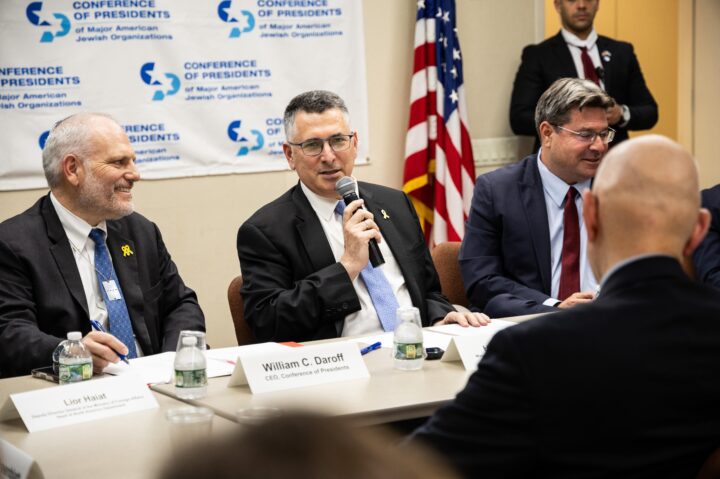
Ohad Kav
Israeli Foreign Minister Gideon Sa'ar (center) meets with members of the Conference of Presidents of Major American Jewish Organizations on Aug. 25, 2025, in New York City.
Israeli Foreign Minister Gideon Sa’ar met on Monday with American Jewish leaders in New York, speaking with the group at a moment when tensions between Diaspora Jews and Israel’s leaders over the conduct of the war seem to be growing.
The meeting was organized by the Conference of Presidents of Major American Jewish Organizations, and most of its members — representing the Reform, Orthodox and Conservative movements, as well as major national organizations including the Anti-Defamation League, the American Jewish Committee, and the Jewish Federations of North America — were present in the room.
Conference of Presidents CEO William Daroff said the 90-minute meeting was “positive and wide-ranging.”
“We spoke about the war, the plight of the hostages, and the challenges facing Israel, with a clear focus on strengthening U.S.-Israel relations,” Daroff told Jewish Insider. “The exchange underscored our unity, our partnership with Israel and our shared commitment to the Jewish future.”
Two attendees, who requested anonymity, described the meeting as antagonistic, saying Sa’ar took an argumentative tone against Jewish leaders in America who have raised concerns about the humanitarian situation in Gaza.
Amy Spitalnick, the CEO of the Jewish Council for Public Affairs, told JI after the meeting that she sees a growing distance between Israeli leaders and Jews in the United States.
“I think there is deep concern among many American Jews that this government’s quadrupling down on its approach is only going to widen the gap between the diaspora and Israel, when the vast majority of American and, frankly, Israeli Jews have made clear that they believe the war must end, the hostages must be released and the humanitarian crisis in Gaza needs to be addressed,” Spitalnick said.
That sentiment was echoed by Rabbi Liz P.G. Hirsch, CEO of Women of Reform Judaism.
“I said I was there representing two million Reform Jews. We’re the largest denomination in North America, and we are proud Zionists. We’re lovers and defenders of Israel, even as there are broad views within our movement,” Hirsch told JI on Monday. “The frame that this government is offering — and this is something I would say not just in this meeting, but publicly — is widening the breach between the North American community, between the full movement that I represent, and Israel.”
A spokesperson for the Israeli consulate in New York declined to comment. Sa’ar will also travel to Washington this week, where he is expected to meet with Secretary of State Marco Rubio on Wednesday. It will be Sa’ar’s first official visit to Washington since he was appointed Israel’s foreign minister last November.
The Ohio Democrat, who visited Israel last week, also called for pressure on Qatar to push Hamas officials in Doha to end the war and release the remaining 50 hostages
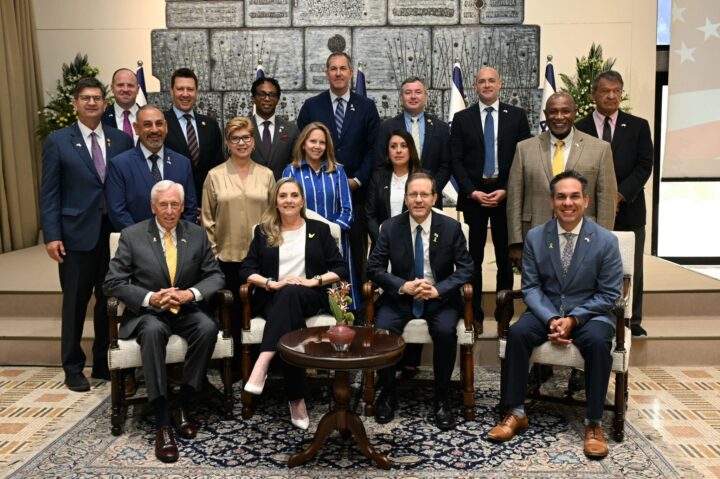
President Isaac Herzog on X
Israeli President Isaac Herzog meets a delegation of House Democrats in Jerusalem on August 11, 2025.
Following his recent trip to Israel, Rep. Greg Landsman (D-OH) says he believes that the Jewish state is “as close as I’ve understood it to be to ending” the war in Gaza.
“The language around aid has changed. [Israel talks] about surging aid and they talk about ending this war quickly,” Landsman, who discussed his trip on Wednesday with Jewish Insider, said. “They talk about getting the hostages back no matter what, and whether there’s a deal or not, they’re getting them home. So, they obviously can’t speak to what that looks like or what that means, but I got the sense that this should and hopefully will be the end.”
He made a similar comment in a statement on his trip shared with JI, which stated: “The end of the war appears close, and G-d willing it ends very soon. With it, rebuilding of Gaza can begin. The first glimpses of this ‘day after’ plan can be seen, and the Arab nations that have declared the end of Hamas must play a huge role in what happens next.” His comments came as Israel weighs the most recent ceasefire proposal, and as the IDF prepares to call up tens of thousands of reservists ahead of plans to take over Gaza City in the coming months.
Regarding next steps, Landsman wrote in the statement, “This is a moment of truth for Qatar, to be sure. With senior Hamas leaders in their midst, detaining them – if negotiations continue to falter – may be necessary. This could hasten the end of the war and the release of the hostages. They must do everything in their power – now.”
Landsman told JI that he believes “everyone should be putting pressure on all parties to end the war. I think it is entirely appropriate to put pressure on the Israeli government to end this war. I also think it is necessary for people to put pressure on Qatar and Egypt to end this war, to use all of the leverage they have, particularly with the senior Hamas leaders that are in Qatar.”
“I believe that’s true to some extent, to a lesser extent, for folks in Egypt to say we’re done, you have to accept a return, a deal that ends this war and returns hostages. The pressure also needs to be placed on these 22 Arab countries, and I believe Egypt and Qatar are on that list, but the other 20 who have said, in an unprecedented move, that Hamas needs to disarm and disband. Now they’ve got to turn that into action and establish a coalition with the United States and Israel and Europe to end this war,” he continued.
The Ohio congressman was one of 14 House Democrats who took part in a delegation to the Jewish state last week. The trip was organized by the AIPAC-affiliated American Israel Education Foundation, which organized a similar visit to Israel for House Republicans the week prior that overlapped for several days with the Democrats’ trip.
Landsman told JI that he viewed the trip as an opportunity to accomplish three main objectives: to be available as a resource to answer questions from Israeli leaders and build relationships with newer members of Congress like himself; to get fully briefed on the work being done to ensure the delivery of humanitarian aid into Gaza; and to engage with stakeholders in the broader peace process in the region. “Going sort of allows me to do all three of those things,” he said.
Landsman said that this trip highlighted the similarities between the American and Israeli people and as citizens of liberal democracies where citizens are free to air frustrations about their respective governments.
“The frustration with the government is something that many Israelis feel. They are frustrated with this government, especially as it relates to Gaza,” Landsman said. “And I appreciate that because it’s a liberal democracy. Israelis are just as critical of this government, if not more, than folks around the world or here in the United States.”
Landsman told JI that the Israeli officials and citizens he spoke with urged him and others on the trip to continue supporting a strong U.S.-Israel relationship during moments when they took issue with some of the actions of Israeli Prime Minister Benjamin Netanyahu.
“They remind you that they would never want anyone to abandon them, as we would never want anyone to abandon us. It’s an important reminder that being critical of the government when you disagree is part of democracy, it’s why democracy and freedom are so important,” he said. “There’s a line. In terms of having the strength and courage to both stand up to and criticize your partners, while also having the strength and courage to not abandon them, especially a partnership like this one and in an existential moment such as this.”
The Ohio Democrat offered a similar thought in his official statement, in which he wrote: “Instead of abandonment, many of us have chosen to visit the region, to show up, and to support the Israeli government when we agree and to push back when we don’t. We know that abandonment may be politically expedient, but it is strategically wrong. It will render our country unreliable to those who we need to ensure global security and global prosperity.”
“We must always remain a reliable partner for democracy and peace. The United States of America does not abandon its allies, nor will we do so here,” the statement continued.
Landsman told JI, “We should not abandon Ukraine and our European allies. We should not abandon, and I don’t believe we will, one of our strongest partners in peace and democracy and freedom, and that’s the state of Israel.”
“We want people to stick with us. That’s why I used the word ‘reliable’ in my statement. We need people to stick with us for our economic prosperity, for national security. If we’re not sticking with others, people will stop sticking with us, and that is very bad for the United States,” the Democratic lawmaker said.
“This is why we worry about [President Donald] Trump or any president that starts to undermine our relationships with folks across the world. It becomes very, very costly and very dangerous to the United States. We wouldn’t want anyone to look at this government [in the U.S.] and say, ‘Well, we’re gonna back away from our commitment, our investments in America.’ That would be terrible,” he continued.
Landsman said he believed his worldview was shared by the majority of the American people.
“When I come home and have these conversations, I get a very common-sense position. It’s where I believe most people are when I talk to them. They worry about the humanitarian situation. How can you not? They want this war to end. How can you not? They get frustrated with a government that has people like [Israeli National Security Minister Itamar] Ben-Gvir and [Finance Minister Bezalel] Smotrich. Of course, they should,” Landsman explained.
“But they also know that Hamas can’t stay, and Israel has to figure out a way to win this war or end it so that folks can rebuild without a terrorist organization in their way. They know that Iran is the barrier to everything good in the region. They know if you start to undermine the partnership with Israel, the only people who win are folks associated with the regime and the terror networks they fund,” he added.
The Florida Democrat has shifted away from commitments he made to Jewish leaders during his first run for Congress, fueling frustration among former supporters

Courtesy
Maxwell Frost
When Rep. Maxwell Frost (D-FL) won his first election to the House in 2022, Jewish leaders in his Orlando, Fla., district who had been encouraged by his personal outreach were optimistic he would follow through on a range of commitments he had made vowing to uphold support for Israel.
Despite some initial concerns about his history of involvement in pro-Palestinian demonstrations as well as relationships with anti-Israel activists, Frost had circulated a lengthy Middle East position paper in consultation, in part, with a top pro-Israel group that largely assuaged lingering reservations among Jewish community leaders over the sincerity of his views.
In the paper as well as a candidate questionnaire solicited by Jewish Insider during his first primary, the young progressive organizer, describing himself as both “pro-Israel” and “pro-Palestinian,” voiced opposition to conditioning aid to Israel — arguing that the security threats facing the Jewish state are “far too grave” to enact such measures. In backing a two-state solution, he clarified that any agreement should require “the basic recognition that Israel has a right to exist” as well as “an end to the antisemitic rhetoric and positions of Hamas.” And if elected, he pledged to visit Israel — which he called “one of the United States’ most important allies and strategic partners.”
Now, almost midway into his second term, Jewish and pro-Israel leaders are expressing some buyer’s remorse as Frost, 28, has embraced positions that put him at odds with his past commitments, fueling frustration among those who had believed he would be a more dependable ally on key issues concerning Israel.
Frost, for his part, insists that the humanitarian conditions in Israel’s war with Hamas in Gaza have deteriorated so drastically during his tenure that he had no choice but to change his views, though that has not quelled discontent among his former allies.
“He has broken a lot of promises,” said one Jewish leader, echoing others who expressed dismay with Frost’s turn in Congress.
The most recent move to draw scrutiny from Jewish and pro-Israel leaders is a letter Frost signed urging the Trump administration to recognize a Palestinian state over growing concerns with the humanitarian crisis in Gaza.
The letter, signed by several prominent House progressives and led by Rep. Ro Khanna (D-CA) — who plans to introduce a similar resolution — said such a state “will need to fully recognize Israel” and guarantee “the disarmament of and relinquishing of power by Hamas.” But pro-Israel activists broadly see the renewed effort as a misguided concession to Hamas amid the ongoing war — as the terror group seeks to leverage international outrage over Israel’s military conduct.
Democratic Majority for Israel, whose political arm had provided input on Frost’s position paper during his primary, took issue with his decision to join the letter. While the group felt sufficiently comfortable with Frost’s Middle East policy views when he first ran for Congress, opting not to intervene on behalf of a top primary rival who had won an endorsement from its super PAC, it has become dissatisfied with his approach as he has continued to stake out more adversarial stances toward Israel during his time in the House.
“We strongly support a two-state solution that ensures Israel’s future as a Jewish and democratic state with recognized borders and upholds the right of Palestinians to live in freedom and security in a viable state of their own,” Brian Romick, DMFI’s president, said in a statement to JI on Tuesday. “But unilateral recognition of a Palestinian state at this time — as the terrorist group Hamas still governs parts of Gaza and continues to hold Israeli hostages — would not advance peace. It will instead prolong the war by incentivizing Hamas to reject any ceasefire deal, and reward the terrorism we saw on Oct. 7 while making future acts of terror more likely.”
In addition to the letter — which followed a similar resolution he co-sponsored in 2023 during his first term — Frost in May joined legislation to place unprecedented new conditions on aid to Israel by withholding offensive weapons over its alleged violations of international law.
Last year, he also voted against a widely approved bill to provide supplemental aid to Israel six months after Hamas’ attacks. In a statement explaining his thinking at the time, Frost wrote that he was “only able to justify aid for defense, not offense, and this legislation did not allow me to separate the two,” as the war “has claimed the lives of countless innocent Palestinian civilians and brought us no closer to the return of innocent Israeli hostages held by Hamas.”
“For me, the North Star here is having a two-state solution, and everything, all the decisions we make, have to point to that,” Frost said, arguing that he has remained consistent in upholding his core beliefs on the conflict even as his positions on specific policies have changed since he launched his initial campaign for Congress. “The thing I have in mind is the safety and security of everybody, of Israel, of Palestinians — of everybody.”
Meanwhile, Frost has yet to fulfill his campaign vow to travel to Israel, and has declined invitations to do so while in Congress, according to a person familiar with the matter.
In an interview on Wednesday, Frost acknowledged that his approach has changed since he entered the House, attributing his new positions to his revulsion at Israel’s behavior in Gaza — which he described as “completely unacceptable” and “abhorrent” in light of the civilian death toll. “In terms of specific policy points, things have changed,” Frost told JI. “Things have changed a lot — and unfortunately, not for the better.”
“For me, the North Star here is having a two-state solution, and everything, all the decisions we make, have to point to that,” he added, arguing that he has remained consistent in upholding his core beliefs on the conflict even as his positions on specific policies have changed since he launched his initial campaign for Congress. “The thing I have in mind is the safety and security of everybody, of Israel, of Palestinians — of everybody.”
Even as he condemned Hamas and said the terror group should have no role in rebuilding postwar Gaza, Frost said the conflict has evolved into what he regards as a “war on innocent people,” resulting in “massive loss of innocent life” that has fueled his decision to speak up against the Israeli government and its ongoing military campaign.
In the Middle East position paper he wrote in his first primary, Frost had rejected placing additional conditions on aid to Israel because, he wrote at the time, it would “undermine Israel’s ability to defend itself against the very serious threats it faces.” But he explained on Wednesday he had also felt such measures were “already written into the law” and “we didn’t really need to go further” in enforcing it at the time.
Now, however, “I do believe that the law is being violated,” he told JI, clarifying his recent support for legislation that seeks to withhold transfers of offensive weapons to Israel. “Because of that, we have to look at the way that we are both complicit but also encouraging the current behavior of the Netanyahu government,” he said.
Unlike a handful of his far-left House colleagues who have accused Israel of carrying out a genocide in Gaza, Frost hesitated to use the term himself, calling it a “difficult” word because of its historical connection to the Holocaust. Still, he said he would not seek to discourage others from such charges. “I’m not going to sit here and defend what is going on right now in any way, shape or form,” he said. “I understand why people use that word. But when we see what’s going on, it’s hard to find the words for it.”
“There’s a lot of things to hold, but the main thing is, yes, there are many things that have changed,” he reiterated. “But for me, what has not changed is the main goal, which is making sure that everyone’s safe and everyone’s secure.”
Frost is hardly alone among Democratic lawmakers who in recent months have become more critical of Israel’s behavior, with even some of the staunchest supporters of the Jewish state struggling to defend the Israeli government as the humanitarian situation in Gaza has continued to worsen nearly two years into the war.
“It’s a radical shift,” one community activist told JI, voicing frustration with Frost’s positions, even as he described their ongoing conversations as “very open and honest.”
His vacillating stances also illustrate some of the cross-pressures facing progressive Democrats who are not completely aligned with the party’s far left on its hostility toward Israel. Pro-Israel Democrats have recently voiced their concerns that anti-Israel policies could become a litmus test for the left in the midterms, particularly amid Israeli Prime Minister Benjamin Netanyahu‘s moves to occupy the enclave.
But Jewish community leaders in Frost’s district, who spoke on condition of anonymity to address what they characterize as an increasingly delicate relationship with the congressman, explained they are particularly disappointed with his evolution on Middle East policy, given their initial hopes that he would be among a dwindling number of progressive allies committed to defending Israel in the House.
“It’s a radical shift,” one community activist told JI, voicing frustration with Frost’s positions, even as he described their ongoing conversations as “very open and honest.”
The activist noted that Frost, who had been a prominent gun control advocate before he was elected to Congress, has “a good heart and doesn’t want to see people dying.” But “as a result,” he said, Frost has “a lot of blind spots” in his assessment of the conflict. The activist argued that Frost’s critique of Israel’s conduct in Gaza has ignored Hamas’ role in perpetuating the crisis as it refuses to surrender.
“At the end of the day, he very much comes from the ‘oppressor-oppressed’ worldview and sees Israel as the oppressor,” the activist said.
Frost, for his part, said his statements have been misconstrued by a wide range of critics across the spectrum, including pro-Palestinian activists who allege that he made separate commitments during his first primary bid that he has failed to uphold in Congress.
He stressed that he does not “do tit-for-tat stuff” while addressing the war. “Whenever I post about the hostages, I’ll have people sending me messages. ‘What about this?’ No,” he said. “Whenever I post about Palestinians, I’ll have people saying, ‘What about this?’ No, I will post about it all. I will talk about it all. I will say how I feel about everything.”
“I’m very firm in that, just coming from a place of, since I was 15 years old, being involved in the fight to end gun violence, and have grown up through a movement of death,” he told JI. “I just don’t think that’s the way to live as a human, quite frankly.”
“We’ve been disappointed that he has not met the commitments he gave to us,” one DMFI source told JI. “At the same time, we’re grateful that he has come to realize he made a mistake in at least one case, but members of Congress should think through their votes fully and discuss them with knowledgeable people before casting them.”
Even as Jewish and pro-Israel leaders say their relationships with Frost have worsened in recent months, frustration over his approach to Israel has been mounting since his first term, when he called for an “immediate ceasefire” in Gaza just days after Hamas’ terror attacks. As a freshman, he also voted against a resolution condemning rising antisemitic activity on college campuses, but he later said that vote had been a mistake after meeting with Jewish students in his district.
While Frost had shown contrition for his vote on the resolution in November 2023, DMFI still expressed dissatisfaction with his initial decision at the time — alleging he had not performed proper due diligence beforehand. “We’ve been disappointed that he has not met the commitments he gave to us,” one DMFI source told JI not long after the vote.
“At the same time, we’re grateful that he has come to realize he made a mistake in at least one case, but members of Congress should think through their votes fully and discuss them with knowledgeable people before casting them,” the source stated.
A spokesperson for Frost told JI at the time that the congressman “is trying to hold multiple truths all at once” as he receives input from constituents pushing opposing interests.
“I’m very comfortable with the decisions I’ve made,” Frost said of his approach to Israel. “As I walk the streets of my district, as I speak with the people in my district, this is where I find most people are at. They’re not really at the extremes that I’ve heard from.”
Speaking with JI on Wednesday, Frost said he has appreciated his ongoing discussions with pro-Israel leaders in his district — even if they have not been aligned on major policy questions in recent months. “Hearing their perspective is really important,” he confirmed. “What I always tell people is I might not always come to the conclusion that you agree with,” he said, “but I hope you’ll always feel I’ve engaged in good faith.”
He suggested that Jewish community activists who have been irked by his approach to the Middle East have not fully reckoned with his belief that Israel’s military actions have damaged its reputation in the United States. “It’s palpable across the country, and I think a lot of this has to do with the decisions that are being made by Netanyahu,” he argued.
“I’m very comfortable with the decisions I’ve made,” Frost said of his approach to Israel. “As I walk the streets of my district, as I speak with the people in my district, this is where I find most people are at. They’re not really at the extremes that I’ve heard from.”
When he assumed office in 2023, Frost had sought guidance from pro-Israel Democrats including Rep. Ritchie Torres (D-NY), who enthusiastically backed his campaign, and House Minority Leader Hakeem Jeffries (D-NY), one person familiar with the matter told JI. But the congressman has since drifted away from the two lawmakers on Israel while staking out positions that have put him more in line with the far left.
More recently, Frost has built closer relationships with such leading Israel critics as Rep. Alexandria Ocasio-Cortez (D-NY), the source told JI, even if he has resisted identifying as an official member of the so-called Squad of progressive House Democrats.
Owing in part to his network in Congress, Jewish community leaders are doubtful Frost will change his views on Israel. “It may be the best that we can hope is that he doesn’t become an actual member of the Squad,” said one activist, while noting that Frost is “totally safe” in his deeply blue district as he seeks a third term next year.
Still, the activist said, “his refusal to actually go and see” Israel “first-hand is a problem,” particularly in light of his primary vow to visit the Jewish state as a congressman.
Frost, who acknowledged the commitment that he had made, said he hopes to see the region “at some point,” but added that it has “been difficult to figure out the timing.”
After the interview, Frost asked his spokesperson to clarify that he would “like to travel to the region at a point where he’d be able to visit both Israel and the Gaza Strip,” indicating a potential visit is unlikely to occur in the foreseeable future.
The Pennsylvania governor called Netanyahu’s comments that there is no starvation in Gaza ‘quite abhorrent’
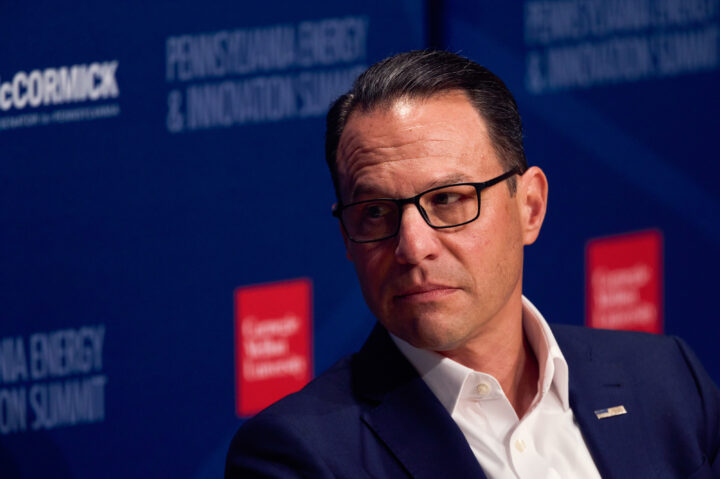
Brian Kaiser/Bloomberg via Getty Images
Pennsylvania Gov. Josh Shapiro during a panel discussion at the inaugural Pennsylvania Energy and Innovation Summit at Carnegie Mellon University in Pittsburgh, Pennsylvania, US, on Tuesday, July 15, 2025.
Pennsylvania Gov. Josh Shapiro called the humanitarian crisis in Gaza “awful” and said the U.S. has a “moral responsibility” to “flood the zone with aid.”
Speaking to the central Pennsylvania Fox34 news channel on Tuesday, Shapiro said, “The fact that kids are starving in Gaza is not OK. It is not OK. And I think everyone has a moral responsibility to figure out how to feed these kids. It is true that Hamas intercepts aid. It is true that the aid distribution network is not as sophisticated as it needs to be, but given that, I think our nation, the United States of America, has a moral responsibility to flood the zone with aid.”
“It is awful, what is happening in Gaza,” the Democratic governor continued.
He also called Israeli Prime Minister Benjamin Netanyahu’s claim that there is no starvation in Gaza “quite abhorrent.”
“He is wrong. He is wrong,” Shapiro said.
“I believe that also, as a result of that type of language, as a result of standing with Donald Trump with plans to occupy Gaza, or, as President Trump said, drive all the Palestinians out and create — his words, not mine — a Riviera of the Middle East, or however the president said it, I think that is not only reckless language, but what it does is it further isolates Israel in the world, and that’s a dangerous place for Israel to be,” Shapiro added.
Shapiro has faced criticism from the left flank of the Democratic Party for his support of Israel in the past, particularly when he was being considered as a potential vice president to join Kamala Harris’ ticket in the 2024 presidential election.
The alleged perpetrator of the arson attack on Shapiro’s residence in Harrisburg, Pa., on the first night of Passover in April said he was motivated by the governor’s stance toward the Palestinians.
A letter signed by prominent House progressives said such a state ‘will need to fully recognize Israel’ and guarantee ‘the disarmament of and relinquishing of power by Hamas’

Chip Somodevilla/Getty Images
Rep. Ro Khanna (D-CA) leaves the U.S. Capitol on March 13, 2024 in Washington.
Rep. Ro Khanna (D-CA) is circulating a letter to President Donald Trump and Secretary of State Marco Rubio among House lawmakers calling for the United States to recognize a Palestinian state.
Khanna, a prominent progressive voice in the House with aspirations for higher office, has become increasingly vocal in recent weeks about the humanitarian crisis in Gaza and in his criticism of the pro-Israel lobby group AIPAC.
“We are writing to request that the United States officially recognize a Palestinian state, as this tragic moment has highlighted for the world the long overdue need to recognize Palestinian self-determination,” a draft version of the letter obtained by Jewish Insider reads. “Just as the lives of Palestinians must be immediately protected, so too must their rights as a people and nation urgently be acknowledged and upheld.”
The letter had nine co-signatories, in addition to Khanna, as of Thursday evening.
The signatories said they welcome French President Emmanuel Macron’s decision to recognize a Palestinian state, and urged other governments to do the same. The U.K. and Canada said this week that they intend to do so as well, given certain conditions.
“It has long been acknowledged by much of the international community and previous U.S. administrations of both major political parties that a Palestinian state recognized as a full and equal member of the community of nations is necessary to fulfill the legitimate national rights of the Palestinian people and ensure the state of Israel’s survival as the democratic homeland of the Jewish people,” the letter continues.
U.S. policy has long opposed the unilateral recognition of a Palestinian state outside of a negotiated two-state solution between the Israelis and Palestinians.
“A viable Palestinian state will need to fully recognize Israel and adopt a framework to guarantee Israel’s security, including the disarmament of and relinquishing of power by Hamas in order to be broadly embraced by the community of nations,” the letter continues. “We will need to work closely with the Palestinian people, the Palestinian Authority, our Arab allies, and Israel to make this feasible.”
The letter argues that “recognizing Palestinian statehood and obligating Palestinian leaders to abide by the international law binding on states and their governments will make that far more achievable and sustainable than decades of statelessness and repression have.”
The letter has been co-signed by Reps. Greg Casar (D-TX), Lloyd Doggett (D-TX), Veronica Escobar (D-TX), Maxwell Frost (D-FL), Al Green (D-TX), Jared Huffman (D-CA), Pramila Jayapal (D-WA), Mark Pocan (D-WI) and Bonnie Watson Coleman (D-NJ) — all prominent progressive lawmakers in the House — since opening on Tuesday evening.
In a statement to JI, Khanna said, “This is the moment for the United States to officially recognize a Palestinian state. All 22 states in the Arab League this week called for a non Hamas Palestinian state that recognizes Israel.”
He said that his office had begun outreach on the issue this week, but did not plan to send the letter until the United Nations General Assembly in September, when France and others said they plan to formally recognize a Palestinian state. He described the response from his fellow lawmakers as “overwhelming.”
“It’s disappointing someone would leak the letter thinking it would sabotage the effort,” Khanna continued. “But you cannot sabotage an idea whose time has come.”
Khanna said in a memo to colleagues about the letter, “Recognition of Palestinian statehood — alongside continued efforts to secure Israel’s safety and guarantee its future as a democratic homeland for the Jewish people — is essential to achieving peace.”
He continued, “As the devastating toll of the war in Gaza continues to mount, this tragic moment has underscored the urgent need to acknowledge Palestinian self-determination and take meaningful steps toward a just and lasting resolution to the Israeli-Palestinian conflict.”
Previously, a resolution supporting Palestinian statehood, introduced in the House by Green in December 2023, received five co-sponsors — Watson Coleman, Frost, Doggett, Escobar and Rep. Andre Carson (D-IN).
Anti-Israel activists on the left are working to win over Democratic lawmakers to their side — and are finding some unlikely allies moving in their direction amid the sustained pressure
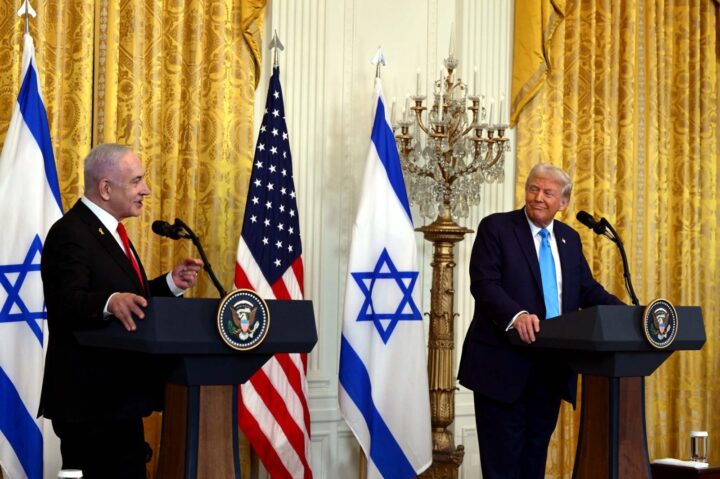
Avi Ohayon (GPO)
Israeli Prime Minister Benjamin Netanyahu and President Donald Trump hold a joint press conference at the White House on February 4, 2025
A new Gallup poll underscores the degree to which Israel’s security is now dependent on support from President Donald Trump and the Republican Party, the Jewish state having drained much of its political capital from both Democrats and independents amid the ongoing war against Hamas in Gaza and the resulting humanitarian crisis.
The numbers are clear: Support for Israel is now becoming a partisan issue after the Jewish state enjoyed decades of bipartisan support in the United States. Anti-Israel activists on the left, looking to exploit the moment, are working to win over Democratic lawmakers to their side — and are finding some unlikely allies moving in their direction amid the sustained pressure.
The data is sobering: Only about one-third of Americans now support Israel’s military action in Gaza, with 60% disapproving. At the beginning of the war, exactly half of Americans supported Israel’s war against Hamas. The drop-off has come entirely from Democrats (36% supported in November 2023, while 8% do now) and independents (47% supported in November 2023 while 25% support now).
Among Republicans, however, support for Israel’s military efforts has remained significant. The exact same share of Republicans who backed Israel’s war against Hamas in November 2023 (71%) continue to support Israel’s efforts today. Trump’s decision to strike Iran’s nuclear facilities has, if anything, bolstered GOP support for Israel and undermined the isolationist and small anti-Israel faction within the party.
Israeli Prime Minister Benjamin Netanyahu’s close relationship with Trump, a partnership that has led to major policy successes, like the successful, coordinated attacks against Iran’s nuclear program, has nonetheless also played a role in the growing partisanship. Netanyahu, for the first time, is viewed unfavorably by a majority of Americans — with Democrats now registering more overt disapproval of the Israeli leader since Trump reentered office.
The Gallup polling shows there was already soft support for Israel among Democrats before the war began, with majorities of Democrats opposed to the Jewish state’s efforts at self-defense just weeks after the Oct. 7 attacks. That said, a clear majority of Democratic lawmakers maintained their support for Israel’s war against Hamas, with only a relatively small faction calling for ceasefires before Hamas’ leadership and terror infrastructure could be degraded.
But there are signs that some of the more mainstream voices are succumbing to the anti-Israel shifts within the party’s base. Over half of Senate Democrats supported a Bernie Sanders-led resolution last night that would block U.S. arms sales to Israel — up from the 15 Democrats who voted for a similar measure back in April. Sen. Elissa Slotkin (D-MI), a pragmatic Democratic senator, who was absent for the vote, sounded open to cutting off “offensive” military aid to Israel. Sen. Angus King (I-ME), a pro-Israel independent who caucuses with Democrats, changed his tune and called for ending all military aid to Israel this week.
What’s alarming is how some of this consuming anti-Israel sentiment among Democrats is showing some signs of evolving into, at least, a tolerance of antisemitism. Pennsylvania Gov. Josh Shapiro received blowback from the left for simply calling out New York City Democratic mayoral nominee Zohran Mamdani over failing to condemn “globalize the intifada” rhetoric. Slotkin felt the need, while on an anti-Israel podcast, to pander that she’s a Jewish senator who wasn’t backed by Jewish groups. Progressive spaces are becoming increasingly inhospitable to Jews, at least those who don’t renounce their support for a Jewish state.
The many liberal-minded, pro-Israel Jewish Democrats have felt increasingly homeless politically as a result of the shifts within the party — and the accommodation of views that, until very recently, have been beyond the political pale. If the party’s reaction to its 2024 defeat is to tack even further leftward and alienate core parts of their coalition, it could well be lurching towards its own McGovern moment in the future.
A former French culture minister, Azoulay is the first Jewish leader of the controversial U.N. agency
Li Yang/China News Service/VCG via Getty Images
Audrey Azoulay, director-general of the United Nations Educational, Scientific and Cultural Organization (UNESCO), delivers a speech during the opening ceremony of the 47th session of the World Heritage Committee on July 7, 2025 in Paris, France.
When Audrey Azoulay was elected director-general of the United Nations Educational, Scientific and Cultural Organization in 2017, many U.N. watchers — including some of its staunchest critics — were pleasantly surprised that UNESCO’s members had selected a Jew to lead the organization for the first time since it was founded in 1946.
The timing of Azoulay’s come-from-behind two-vote victory over a Qatari competitor came with a tinge of irony: Just one day earlier, the United States and Israel had each announced their intention to withdraw from the body, citing its persistent anti-Israel slant and “extreme politicization.”
The organization tasked with preserving cultural heritage sites around the world has for decades faced accusations of political bias. President Ronald Reagan first pulled the U.S. out of the body in 1984 over allegations of anti-Western, pro-Soviet sentiment.
When UNESCO became the first U.N. body to vote to admit the “State of Palestine” as a full voting member in 2011, the U.S. cut funding to the organization. In 2016, UNESCO passed a controversial resolution about the Temple Mount in Jerusalem that ignored Jewish ties to the holy site. A year later, Israel and the U.S. cut ties entirely.
All of that was before Azoulay took the helm of UNESCO. Now her leadership is in the spotlight, after the Trump administration said last week that it would again depart the body, following President Joe Biden’s decision to reenter UNESCO in 2023. “UNESCO works to advance divisive social and cultural causes,” State Department spokesperson Tammy Bruce said this month, arguing that the organization perpetuates “a globalist ideological agenda for international development at odds with our America First foreign policy.”
But Azoulay, a former French culture minister who comes from an illustrious Moroccan Jewish family, said in a statement last week that “the situation has changed profoundly” since the U.S. departed UNESCO in 2018. “These claims also contradict the reality of UNESCO’s efforts, particularly in the field of Holocaust education and the fight against antisemitism,” she said. UNESCO declined to make Azoulay available for an interview, but a spokesperson noted that “the level of tension” within the body on Middle East issues “has been reduced, which is a unique situation in the U.N. system today.”
Her lobbying is unlikely to impact the Trump administration. But even without the U.S. as a member, UNESCO remains an important global organization with lofty goals: “to create solutions to some of the greatest challenges of our time, and foster a world of greater equality and peace.” Azoulay has bought into that mission, with the added challenge of trying to make the organization less politically toxic in a polarized world.
“She really came into office intent on changing UNESCO’s public image and internal work,” Deborah Lipstadt, the former U.S. special envoy to monitor and combat antisemitism, told Jewish Insider this week. She has worked with Azoulay on antisemitism-related programming since 2018. “I think she recognized the flaws that had been prevalent before, and I think she was really trying to turn things around, and she deserves great credit for that.”
Azoulay grew up in France, but her family hails from Essaouira, a seaside Moroccan city that was once majority Jewish, though she rarely speaks about her family’s story. Her father, André Azoulay, spent the first two decades of his career climbing the ranks at Paribas Bank in Paris, before he returned to Morocco in 1990 to serve as an advisor to King Hassan II. Now, he is a senior advisor to King Mohammed VI, and his influence is rumored to be expansive.
“She is a really remarkable person, to have come from this Moroccan Jewish background, to become so French that she’s a minister in the French government, and then to achieve this position in UNESCO,” said Jason Guberman, executive director of the American Sephardi Federation. Whatever people want to say about UNESCO, I think you have to judge her by what she has done.”
“Azoulay is the kingdom’s all-purpose fixer, a man who gets stuff done thanks to an endless list of high-profile contacts who wouldn’t dare to ignore his calls,” Tablet Magazine wrote in a 2018 profile of the elder Azoulay.
When he inaugurated a structure called Beit Dakira — “House of Memory” — in Essaouira in 2020, to preserve the city’s Jewish heritage, his daughter attended the event on behalf of UNESCO. She has worked in several French government agencies, and before being named culture minister in 2016, Azoulay was an advisor to French President Francois Hollande.
“She is a really remarkable person, to have come from this Moroccan Jewish background, to become so French that she’s a minister in the French government, and then to achieve this position in UNESCO,” said Jason Guberman, executive director of the American Sephardi Federation, who attended the Essaouira event in 2020. He worked with Azoulay on a 2021 World Philosophy Event celebrating Muslim and Jewish poetry. “Whatever people want to say about UNESCO, I think you have to judge her by what she has done,” said Guberman.
UNESCO has worked closely with the World Jewish Congress in recent years, particularly on programming related to Holocaust education. Its president, Ronald Lauder, wrote in a 2018 op-ed that UNESCO’s history of dozens of resolutions condemning Israel “makes a mockery of the U.N.” Azoulay, he wrote, has been able to move the organization forward — to a point.
“She was able to accomplish some things diplomatically with Israel that hadn’t been done before. She got the president to come to Holocaust Remembrance Day, and that was the first time that ever happened,” said David Killion, who served as U.S. ambassador to UNESCO in the Obama administration.
“Audrey Azoulay, the new head of UNESCO, is making great strides correcting this and we applaud her for what she’s doing. But after decades of bad behavior at UNESCO, its reputation cannot be cleansed overnight. Especially when this virus of antisemitism still runs throughout the entire body of the U.N.,” Lauder wrote.
Azoulay reportedly urged Israel not to exit the organization in 2018, arguing at the time that UNESCO had made progress in fighting bias. Israel still left. But she pulled off a strategic victory in 2022.
“She was able to accomplish some things diplomatically with Israel that hadn’t been done before. She got the president to come to Holocaust Remembrance Day, and that was the first time that ever happened,” said David Killion, who served as U.S. ambassador to UNESCO in the Obama administration.
In Israeli President Isaac Herzog’s virtual remarks at a UNESCO Holocaust remembrance event in 2022, he directly praised Azoulay. They were unexpected words from a country that had previously offered sharp criticism of the organization.
“UNESCO has the tools with which to inform the younger generation about what happened and teach them what must never be allowed to happen again,” Herzog said. “I wish to recognize UNESCO Director-General Audrey Azoulay for her strong leadership.”
Azoulay said in a speech soon after the Oct. 7, 2023, Hamas terror attacks that UNESCO “was born out of the ashes of the Holocaust and the Second World War,” which is why, she said, fighting Holocaust denial remains a key priority of the organization.
That work has been done in partnership with the World Jewish Congress, American Jewish Committee, the U.S. Holocaust Memorial Museum and, for a period, the Biden administration. Former Second Gentleman Doug Emhoff met with Azoulay at the UNESCO headquarters in Paris last year and pledged that the U.S. would contribute $2.2 million to a UNESCO program to teach about the Holocaust and genocide.
But the agency’s commitment to fighting antisemitism has been tested since Oct. 7.
Speaking to a global gathering of antisemitism special envoys two weeks after the attacks, Azoulay said the Hamas terrorists operated “in the same modus operandi as the pogroms.” After the “massacres” that day, Azoulay added, “We have seen a new wave of antisemitism, regrettably with all the hallmarks of our time.”
Since then, though, UNESCO has mostly directed its ire at Israel’s actions in Gaza. Critics have noted, for instance, that UNESCO has warned of damage to cultural heritage sites in Gaza and Lebanon, while not expressing the same degree of concern about sites in Israel. At a recent meeting of UNESCO’s executive board, the agency voted to approve several measures calling out Israel’s actions in Gaza, the West Bank and the Golan Heights.
“That kind of stuff remains, and it’s really bigger than her, because I think that’s the point with any U.N. [agency]. The system is so geared against Israel,” said Anne Herzberg, legal advisor at NGO Monitor, a research institute that is critical of the U.N. system. “I do think she’s well-intentioned, and I do think she has made efforts to try to depoliticize the agency. I don’t want to cast aspersions on her at all, but I do think the problem is, you’re operating in a system that’s almost impossible to change.”
Please log in if you already have a subscription, or subscribe to access the latest updates.
 Continue with Google
 Continue with Apple