


















































Sen. Lindsey Graham defends Israel’s Gaza war, draws WWII comparisons
During an appearance on the ‘On The Record’ podcast, Sen. Lindsey Graham urges Gulf nations to prioritize regional stability and make tough choices on Iran
Sean Gallup/Getty Images
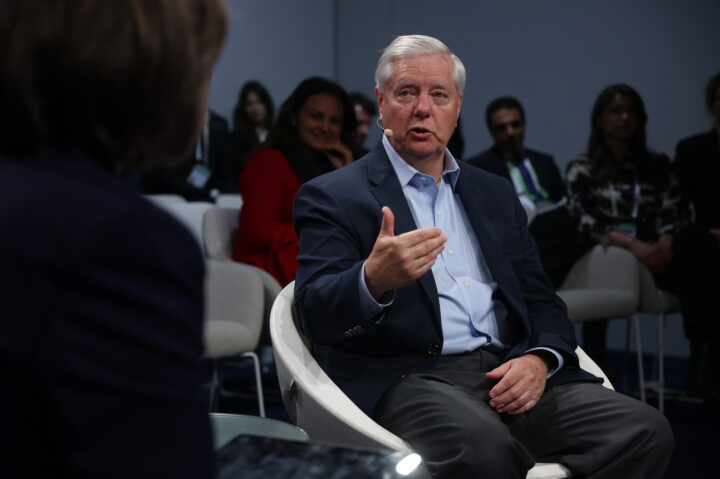
Sen. Lindsey Graham (R-SC) speaks at the 62nd Munich Security Conference on February 13, 2026 in Munich, Germany.


 Add JewishInsider on Google
Sen. Lindsey Graham (R-SC) on Thursday rejected the suggestion from some in the Arab world that the deaths of civilians in Gaza does not align with Christian values. Graham made the comments during an appearance on an episode of the “On The Record” podcast with Hadley Gamble, while discussing how Israel’s war in Gaza had impacted regional stability in the Mideast and delayed normalization efforts with the Saudis.
“I just don’t buy that at all, because what did we do in World War II? Did we think for one minute about starving the Germans? Did we bomb every city into smitherreens?” Asked if that meant he was comparing Israel’s response to Hamas’ Oct. 7, 2023, attacks on the Jewish state to how the U.S. responded in World War II, Graham responded affirmatively.
“This is an absolute, existential threat to the Jewish people. What happened on October the 7th was 1,200 people were slaughtered, raped and murdered, and filmed by radical Islamists who would kill every Jew if they could.”
Gamble then pressed Graham on Israel “flattening Gaza,” which the South Carolina senator said he took no issue with.
“Just flatten it. We flattened Berlin. We flattened Tokyo,” Graham said. “Were we wrong to drop an atomic bomb to end the Japanese reign of terror? Were we? In my view, if I were Israel, I would have probably done it the same way. Without military victory, there is no hope of breaking radicalism. We flattened Germany. We flattened Japan.”
“It’s a TV war. We didn’t have TV in World War II. The behavior of the United States was to pursue total destruction of the enemy. That was our behavior. Take Tokyo and Berlin,” he added. “Those people who are trying to say this is just another conflict, it’s not another conflict. It’s existential to the Jewish state.”
Graham, who is in the Middle East for meetings with Israeli, Emirati and Saudi officials, also criticized Saudi Arabia for “attacking the United Arab Emirates pretty viciously for being in the Abraham Accords” and questioned assertions that the kingdom’s ongoing dispute with the Emiratis was solely based on differences in Sudan and Yemen.
“Saudi Arabia is now moving backward. They’re attacking the United Arab Emirates pretty viciously for being in the Abraham Accords,” Graham said. “There is no good reason for this. You can have disputes about Sudan and Yemen, but they’re basically declaring war.”
Asked if he believed the dispute “is all about Israel,” Graham replied: “I don’t know what this is about. I know the consequences. [Mohammed bin Zayed], the president of the United Arab Emirates, I’m going to meet him, you could not ask for a better partner. You could not ask for a better partner than the United Arab Emirates. They’ve stuck with the Abraham Accords through Gaza.”
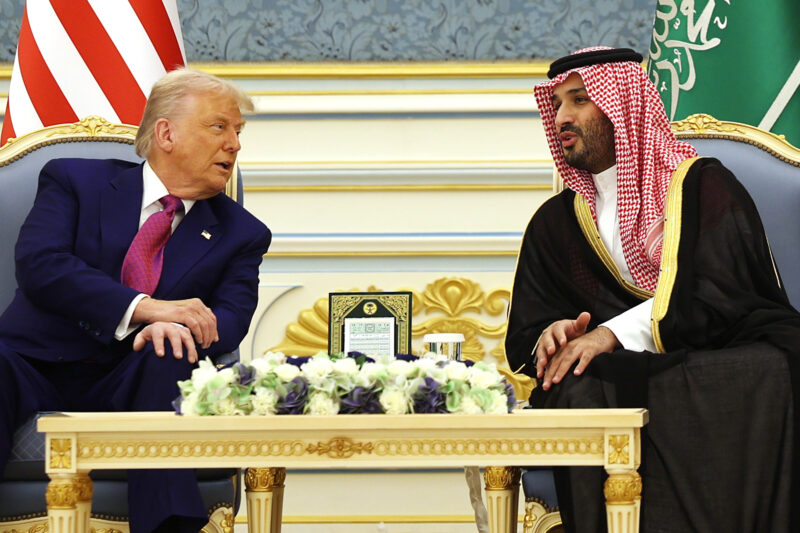
In a post on X after his meeting on Thursday with Saudi Crown Prince Mohammed bin Salman, Graham praised the kingdom while acknowledging his concerns about achieving normalization with Israel.
“The Crown Prince is dealing with the aftereffects of October 7 like all leaders in the region, particularly with the tremendous loss of life in Gaza,” Graham wrote. “Having said that, his vision for the region is for conservative Islam to coexist — with tremendous economic opportunity — for the people of Saudi Arabia, the Middle East, and the entire world. He is the first Arab leader in modern history that’s expressed a vision not only for the faith, but for economic empowerment that is simply stunning when absorbed, and will set the tone for the region for generations to come.”
Graham criticized Gulf state opposition to regime change in Iran over fears about potential fallout as politically weak.
“That is a short-sighted view of the problems you face over here,” he said. “You’ve got domestic problems, so do I. I’ve got domestic problems. It’s probably better for me to be at home than it is here, so I don’t have a lot of tolerance anymore for people having to make uncomfortable decisions, because I have to make them all the time.”
Pressed on Saudi concerns about oil prices and regional instability, Graham said all of the Gulf states needed to “suck it up.”
“I’m telling everybody over here to suck it up. You’ve got to suck it up to bring about real change. Real change doesn’t come without sacrifice. Now, this region is going to change one way or the other,” Graham said. “There are two scenarios. … The inflection point is weeks away, not months away. That’s why I’m here. That’s why I haven’t slept, because it’s either going to go really good or really bad.”
Later Thursday, Graham warned in a post on X that the U.K. should not deny the U.S. the ability to use British military bases to attack Iran.
“If it turns out to be true that Britain is denying the United States the ability to use British bases against Iran if there is a necessity for an attack – it would be beyond surprising,” Graham tweeted. “I’ve been a military lawyer most of my adult life. What they’re saying about the status of Diego Garcia, the joint US-UK military base, is a huge question.”
“To my friends in Britain, sitting this one out puts you on the wrong side of history and is yet another example of how much our alliances throughout Europe have degraded,” the tweet concluded.
More Stories

Mamdani’s Mensch
The Chabadnik inside Zohran Mamdani’s ‘people-powered’ office

EMIRATI ENGAGEMENT
Antisemitism envoy Kaploun meets with Emirati President MBZ in Abu Dhabi
Pappas romps, ‘shill for AIPAC’ smear flops

SURVEY SAYS
New poll shows Vance with very low support among Jewish voters

SAFETY SURGE
Hochul announces security funding, enhanced police presence ahead of High Holy Days
COMMUNITY VOICE
Coalition of Michigan Jewish leaders sets out ‘nonnegotiable’ demands for El-Sayed, Democrats
Please log in if you already have a subscription, or subscribe to access the latest updates.
 Continue with Google
 Continue with Apple