







































Senate Republicans skeptical that Iranian regime will negotiate in good faith
Ahead of reported talks between the U.S. and Iran, Sen. Mike Rounds said the regime ‘would love to deceive us … I just don’t think we’re going to have much success’

Iranian Leader Press Office / Handout/Anadolu via Getty Images
Iranian Supreme Leader Ayatollah Ali Khamenei makes remarks in Tehran, Iran, on May 20, 2025.


 Add JewishInsider on Google
Several Republican senators expressed skepticism that the Iranian regime would negotiate in good faith with the United States on its nuclear program or on its crackdown on pro-democracy protesters, as the administration pursues a diplomatic approach with Tehran following threats of military action.
Some, including Sen. Lindsey Graham (R-SC) — and the Saudi defense minister, behind closed doors — have warned that, if the U.S. fails to act after President Donald Trump promised Iranian protesters that “help is on its way,” it would be a blow to the U.S.’ credibility in the Middle East and would strengthen the Iranian regime.
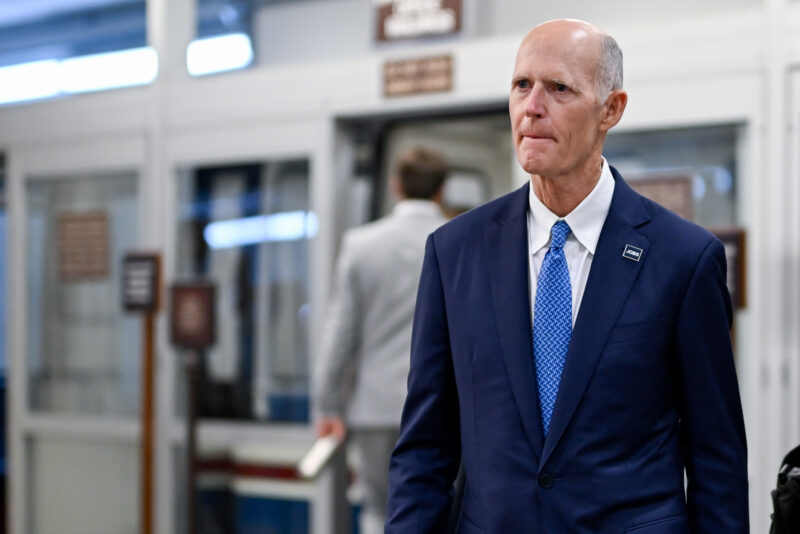
Sen. Rick Scott (R-FL) expressed skepticism that the Iranians would engage sincerely or willingly give up their nuclear program in talks with the U.S., reported to be taking place in Turkey on Friday.
“Wouldn’t that be great? It’d be great if they did. It’d be great if they got rid of their nuclear weapons,” Scott told JI. “Do I actually believe they’re going to negotiate in good faith? I don’t.”
Scott added that he was in favor of Trump taking action to support the protesters after promising to do so. “I think if you tell somebody you’re going to help them, you’ve got to help them,” the Florida senator said.
Sen. Mike Rounds (R-SD) said he believes Trump “wants to avoid a war.”
“I hope he’s successful,” Rounds added, but said that he is not optimistic that a viable deal is achievable. “I, personally, am really discouraged. I don’t think Iran really wants to negotiate a deal that would stop them from doing their terrorist activities, supporting terrorism around the area, and I don’t think they really want to give up their nuclear ambitions — although they would love to deceive us,” Rounds said.
“I wish [Trump] the best. I think he’s right in trying to do [make a deal]. I think that’s what we should be trying to do, but I don’t, I just don’t think we’re going to have much success,” he added.
Sen. Markwayne Mullin (R-OK) said, “You can’t trust anything the ayatollah says at all.”
“I don’t know what the details are, so it’s hard for me to say what I’d like to see in [an agreement],” Mullin continued. “We all know that a nuclear Iran can never happen, so that’s got to be part of it. What else happens there? I don’t know, but I still go back to the fact that you can’t trust anything that the ayatollah or this current regime says.”
Mullin disagreed that not striking Iran would be seen as a shift in U.S. policy, describing the administration’s current approach as an extension of the president’s “peace through strength” policy.
“People respect that the president will always strike, or ratchet that up, when the time is right. He always wants diplomacy first, but he’s willing to use the strength part if he has to get to that point,” Mullin said. “And I think that’s what the president has positioned himself to do, but he has multiple options … so hopefully we’ll have a positive outcome without anyone getting hurt.”
Sen. John Kennedy (R-LA) said that he’d want to see Iran surrender its enriched uranium, give up any future potential to obtain a nuclear weapon, stop funding terrorist groups and “start being a responsible member of a stable world order.”
He disputed the notion that a failure by the U.S. to launch strikes now would hurt the country’s credibility, arguing that any military strikes would be based on U.S. intelligence, which he does not have.
“It’s a lot more complicated. I mean, these folks are entitled to their opinion … obviously I hope the negotiations are successful,” Kennedy said. “Whether the president decides to go further is going to depend an awful lot on national and military intelligence, which I don’t have access to. We have the best spies in the world, and I don’t know what they’re telling the president, but it matters. So I can’t advise him if I don’t have the information from the intelligence community.”
Sen. Richard Blumenthal (D-CT) said that any deal with the Iranians would need to include “a complete renunciation of nuclear arms and ballistic missiles that can reach Israel or our European allies.” He also said the regime’s crackdown on protesters would need to be “renounced.”
“They’re a country that continues to maintain ‘death to America, death to Israel.’ It is what it is,” Blumenthal said. “On a military front, there has to be a complete renunciation of nuclear weapons and long-range ballistic missiles, and I think the brutal and inhumane tactics toward its own people have to be renounced.”
“I think we should do something, but it may not be a military strike,” he added. “There are a range of actions that we could take, [such as] to expand economic efforts and [implement] a stronger enforcement of sanctions. So between those, there are options.”
Sen. Tim Kaine (D-VA), who recently introduced a war powers resolution to block military action against Iran without congressional authorization, explained to JI that the resolution was a response to Trump’s comments about a potential attack and the current deployment of U.S. military assets to the Middle East.
Kaine said that the resolution would be eligible for consideration on the Senate floor next week, and that whether he calls it up will depend on how events develop and whether it will have the votes to pass.
“What really prompts me is when I think I can get the votes,” Kaine said. “Usually that means something beyond saber-rattling and it’s some kind of step, like in the international waters or Venezuela, we’re actually killing people — that clearly demonstrates we need to do this.”
Kaine also emphasized that the administration’s explanation for potential military action against Iran has shifted — citing both the protests and nuclear issue — and said he was concerned by a report last week that the administration may be considering some ground deployment of special forces into Iran.
“I’ve just got an awful lot of military families in Virginia who don’t want their kids to be in another war in the Middle East,” Kaine said.
More Stories
TAKING AIM
Netanyahu targets Mamdani, Macron and foreign critics in UNGA address
exclusive
Rosen, Lankford press Zuckerberg over antisemitic bot accounts on Facebook, Instagram
VIRGINIA IN VIEW
DMFI launches $1 million ad campaign supporting Elaine Luria

in the courts
‘Un-American’: Ohio man who tried to host home minyan tells of harassment ahead of Supreme Court case
DEMOCRATIC SHIFT
Nearly all Democrats vote for resolution demanding report on Israeli violence in the West Bank
CAMPUS IN FOCUS
Federal commission highlights campus antisemitism concern, rebukes WH response
Please log in if you already have a subscription, or subscribe to access the latest updates.
 Continue with Google
 Continue with Apple