

















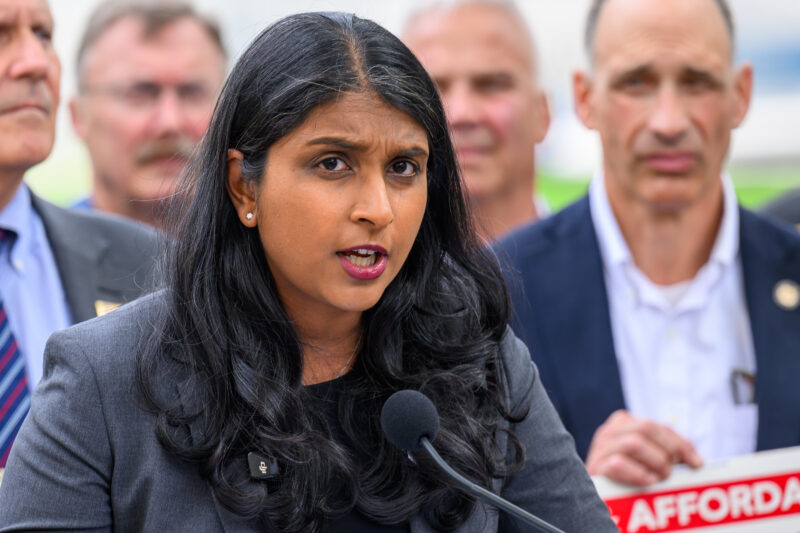





















Left-wing Lt. Gov. Peggy Flanagan’s anti-Israel message is being complicated by her outreach to AIPAC earlier in the campaign

(AP Photo/Ellen Schmidt)
U.S. Rep. Angie Craig, D-Minn., left, and Minnesota Lt. Gov. Peggy Flanagan participate in a forum for U.S. Senate candidates at Farmfest Wednesday, Aug. 5, 2026, in Morgan, Minn.


 Add JewishInsider on Google
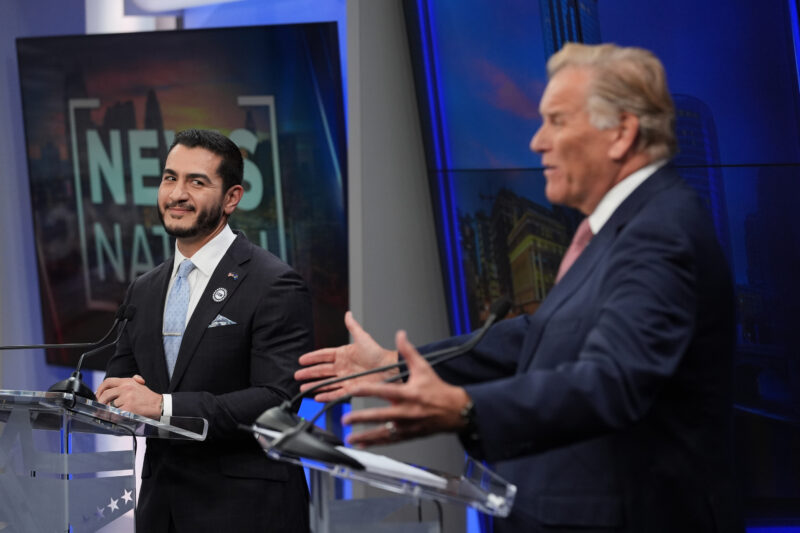
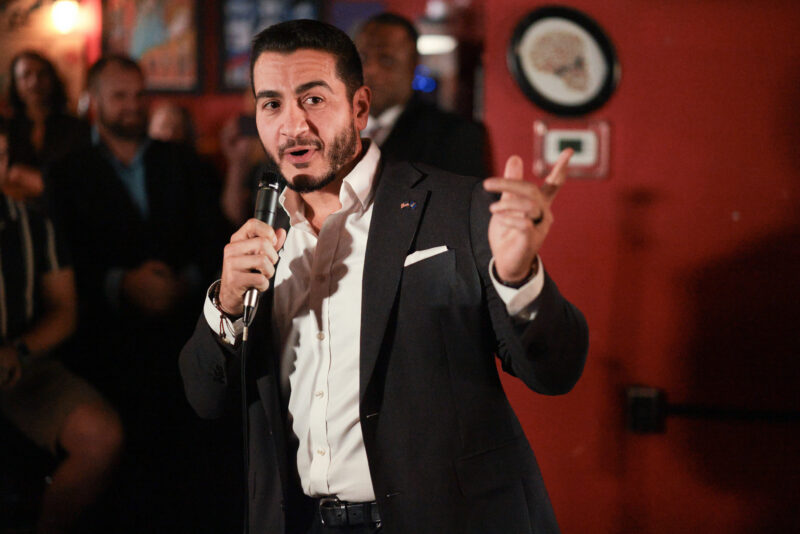
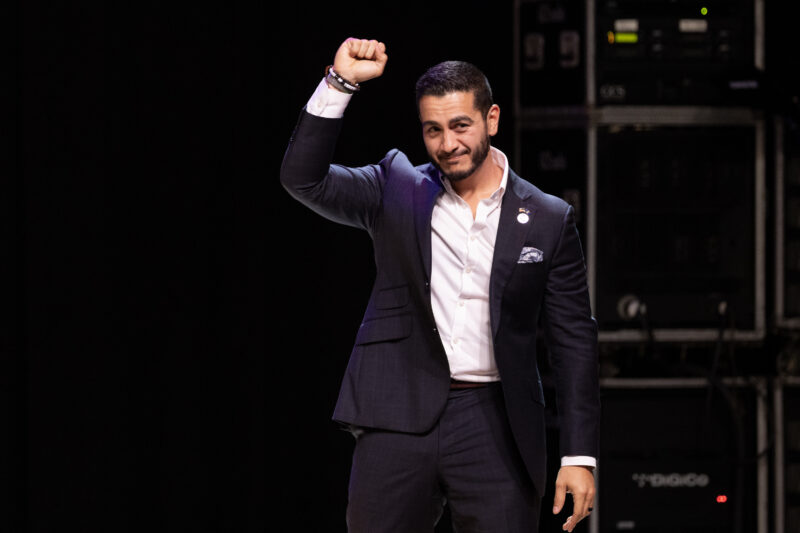
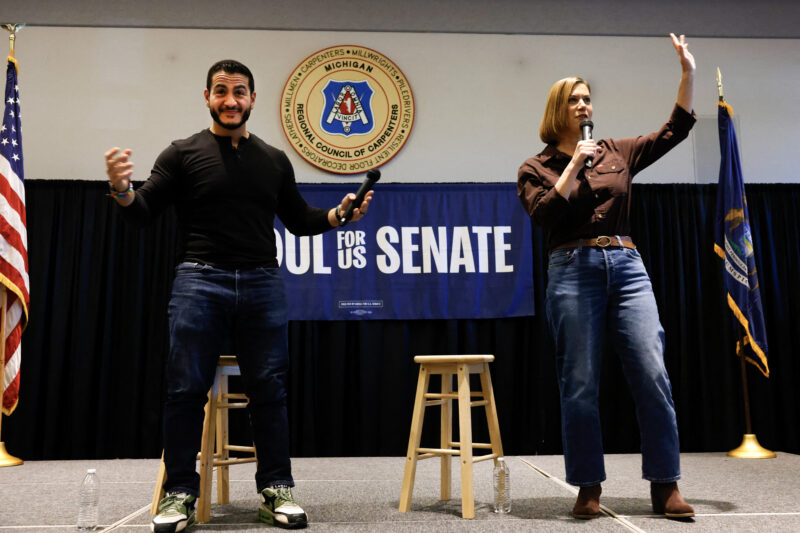
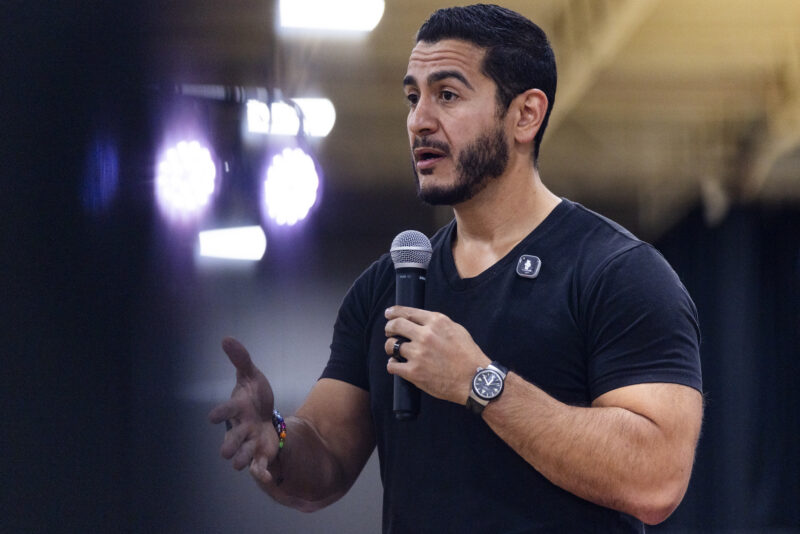
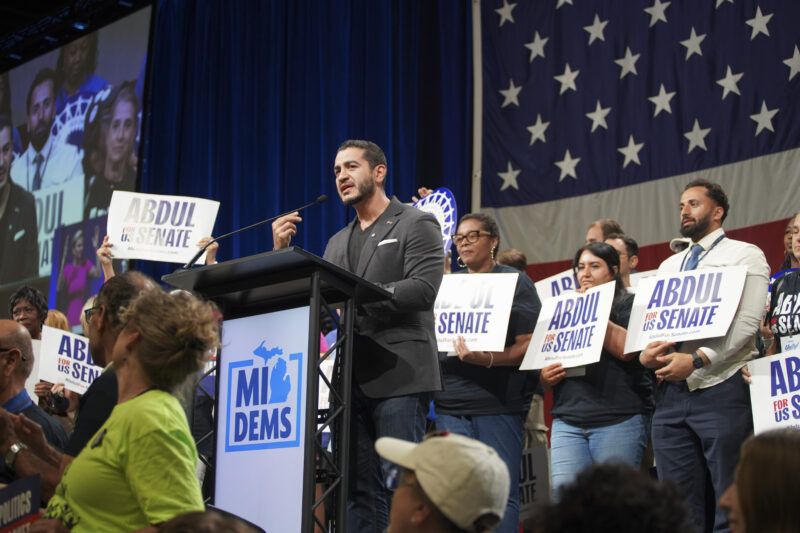
The outcome of Michigan’s bruising Democratic Senate primary last week, where Abdul El-Sayed claimed a narrow victory over Rep. Haley Stevens (D-MI) in an upset championed by the anti-Israel left, is looming over the next intraparty showdown being held in Minnesota on Tuesday — the latest in a series of proxy battles between the party’s mainstream and left-wing flanks.
In an echo of Michigan, the bitter Democratic primary for an open Senate seat in battleground Minnesota this week is pitting a moderate House member with a long-standing pro-Israel record, Rep. Angie Craig (D-MN), against an outspoken progressive, Lt. Gov. Peggy Flanagan, whose attack lines have frequently centered on AIPAC, which spent over $30 million in its unsuccessful effort to help Stevens.
The Minnesota primary is, in the closing stretch, likewise revolving around questions of electability for Democrats in the must-win November contest. Craig has pointed to controversies amid Flanagan’s tenure in government as vulnerabilities Republicans are eager to exploit — most notably including the welfare fraud scandal that prompted Democratic Gov. Tim Walz to abandon his reelection campaign for a third term earlier this year.
Flanagan, in addition to her anti-AIPAC messaging, has hammered Craig over what she has described as a “disqualifying” vote approving the Laken Riley Act — legislation requiring the detention of unauthorized migrants charged with certain crimes — the optics of which have been damaging in the wake of President Donald Trump’s protracted immigration crackdown in Minnesota. Craig has expressed regret for her vote.
But unlike Michigan, where El-Sayed claimed the nomination by less than one point after polls had suggested a double-digit blowout, the Minnesota matchup has been seen as neck-and-neck, the outcome of which is hard to predict, experts say. Recent independent surveys have shown a statistical dead heat in the final weeks of the primary, with each candidate garnering around 40% of the vote.
The candidates’ equivocations over AIPAC and individual ties to the group have also emerged as fault lines in recent weeks, complicating the ideological divisions that have shaped other primaries in which Israel and Middle East policy have featured prominently.
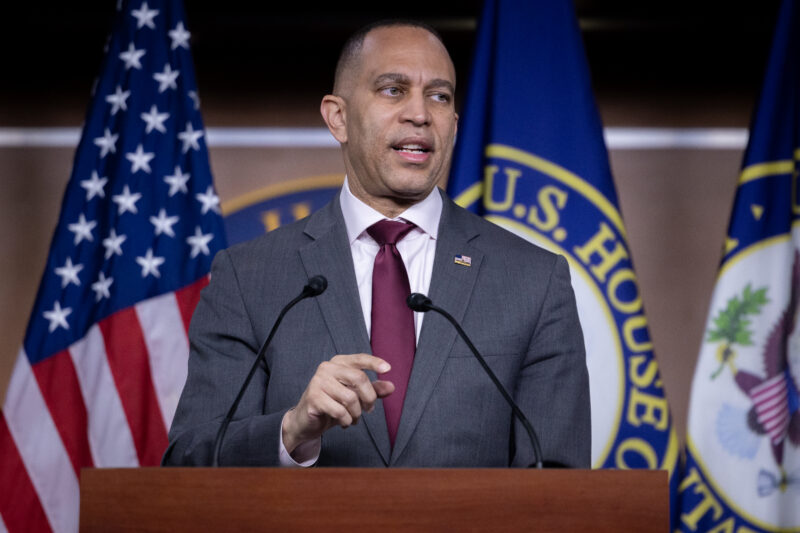
In a reflection of the extent to which AIPAC is now viewed as a liability in Democratic primaries, Craig has distanced herself from the group, which has not officially made an endorsement in the race even as its donor network has contributed to her campaign. The congresswoman, who is backed by several pro-Israel lawmakers including Sen. Elissa Slotkin (D-MI) and House Minority Leader Hakeem Jeffries (D-NY), has said she is not accepting contributions from AIPAC’s political arm in her current campaign.
During a recent debate, Flanagan said AIPAC had been Craig’s “biggest funder throughout her entire political career,” while claiming her own “values do not align with” the group. Flanagan has cast AIPAC as part of “a band of super villains” in the race now trying to “buy this election,” language some Jewish leaders say they have found unsettling amid rising antisemitism.
Flanagan, however, acknowledged last month she had met privately with AIPAC after The Minnesota Star Tribune obtained a video recording of remarks to Jewish community members — also reviewed by Jewish Insider — in which she said the outreach was “important” for her “to make sure that we’re building that relationship.”
Flanagan claims that AIPAC turned against her and came to regard her as a “threat” when she confirmed her support last year for Senate resolutions to block arms sales to Israel. She has since endorsed a House amendment to end aid to Israel, which Craig rejected, further illustrating her policy disagreements with the group.
Craig, for her part, has sharply dismissed the lieutenant governor as “completely disingenuous about her soliciting support from AIPAC,” claiming that she “has been very hypocritical” because of her efforts to demonize the group.
While Flanagan has insisted she was not seeking an endorsement in her outreach to AIPAC officials, she did write an Israel position paper that she submitted to the group as part of their discussions, according to two people familiar with the matter.
Manny Houle, a pro-Israel Democratic consultant in Minnesota, confirmed to JI that Flanagan presented a Middle East policy paper to AIPAC and said that he had personally reviewed the document. He said he no longer had a copy, which JI was unable to obtain, but he recalled that she “was open to conditioning aid” to Israel and said she “put a lot of pressure and fault on Israel and occupation,” among other “key factors” he characterized as distinguishing Flanagan from Craig.
Houle, a former director of progressive outreach for AIPAC in the Midwest, said his impression had been that Flanagan wrote the paper and sought the group’s feedback early in her campaign last year because she viewed it as part of a broader process. The lieutenant governor “would have been open to engaging within the network of donors” affiliated with AIPAC, Houle claimed, “but when she realized that wasn’t going to be the case,” she pivoted to a more hostile position.
“Many key advisors to Peggy are anti-AIPAC, so it’s hard for me to think she’d ever honestly in good faith engage with the organization,” Houle explained to JI. “I’ve had conversations with her throughout the race trying to get her to tone down her rhetoric” on Israel issues, he added, “but to no avail.”
A spokesperson for AIPAC did not return a request for comment.
Alexandra Fetisoff, a spokesperson for Flanagan’s campaign, did not directly address the AIPAC paper in a statement responding to a request for comment. “Flanagan disagrees with AIPAC’s deeply unpopular political agenda and the catastrophic actions of” the government led by Israeli Prime Minister Benjamin Netanyahu, Fetisoff told JI on Friday.
“Flanagan believes what has happened in Gaza is genocide, a position in line with the United Nations,” Fetisoff said. “Flanagan has consistently condemned antisemitism, and will continue standing with Jewish Minnesotans against hate.”
Last week, American Priorities, a new super PAC created to counter AIPAC’s influence in Democratic primaries, began spending in the race to help boost Flanagan, spending over $50,000 on an ad calling her a “fighter” who would “stand up to Trump” while touting her support from Sen. Bernie Sanders (I-VT).
Flanagan also claims backing from the state Democratic Party and retiring Sen. Tina Smith (D-MN), whom she is vying to succeed, along with leading progressive critics of Israel such as Sens. Elizabeth Warren (D-MA) and Chris Van Hollen (D-MD).
Doug Rossinow, a professor of history at Metro State University in St. Paul, who has tracked divisions over Israel in the state Democratic Party, said the “AIPAC issue flew under the radar until pretty recently” in the election. “The Flanagan-Craig contest is, compared to Michigan’s Democratic Senate primary race, a classic case of Minnesota understatement and even passive aggression,” he told JI.
“Flanagan lately has made an issue of Craig’s history of support from AIPAC,” he noted, “but Craig, unlike Haley Stevens, doesn’t want to own that or talk about Israel.” Meanwhile, Flanagan has stated “little about her own position on Israel” and the region, he added, “unlike El-Sayed in Michigan,” a fierce critic of Israel who has refused to acknowledge its right to exist as a Jewish state.
One state party activist described the race as “a little bit less black and white than Michigan,” while noting the contrasts between Craig and Flanagan are not as drastic. “I see it as a toss-up,” he said of the primary.
Joe Radinovich, a Democratic consultant based in Minneapolis, added that while the national political mood has favored populist progressives, he believes there is reason to interpret the closer-than-expected finish in Michigan as a relatively promising omen for Craig, who flipped a GOP-held swing district in 2018.
“The dominant narrative has belonged to the further left wing of the party, populist candidates and people decrying AIPAC and Israel,” Radinovich, who said he is supporting Craig but is not involved in the primary, told JI in an interview on Friday. “But if I’m on the Craig campaign and looking at the results of the election in Michigan, I’m feeling some wind in my sails.”
Mara Kunin, Craig’s campaign manager, projected confidence in a statement on Friday. “National and state Republicans are making a serious play for this Senate seat and primary voters understand that we can’t risk putting up a weak candidate in the general election,” she said, adding Craig “is positioned to win this race on Tuesday and seal the deal in November.”
The Democratic nominee is expected to face Michele Tafoya, a former NFL sideline reporter who is heavily favored to win the Republican primary, in November. The GOP’s Senate campaign arm has indicated that it views Minnesota among four pickup opportunities as the party seeks to retain its majority in the chamber.
“It is very saturated, very ugly and very negative,” another state party activist said about the primary, which has otherwise seen a flood of outside spending from opposing groups. “I think that AIPAC will have an impact in the race, but social services fraud could be more important,” he told JI. “Whoever wins, it will sort of say which issue” carries the most weight.
Plus, Jewish authors write their own ending

Samuel Corum/Getty Images
President Donald Trump speaks with reporters while aboard Air Force One on June 5, 2026 en route to Chippewa Falls, Wisconsin.
Good Friday morning.
In today’s Daily Kickoff, we look at concerns that President Donald Trump is ceding oversight to Iran as issues related to the Strait of Hormuz remain unresolved, and report on the opening of several literary houses that will focus on publishing Jewish authors. We interview Ludo Hood, who retired from the State Department last week after more than two decades of service, and report on the United Democracy Project’s involvement in the special election runoff in California’s 14th Congressional District to succeed Rep. Eric Swalwell. Also in today’s Daily Kickoff: Gov. Mikie Sherrill, Yoav Segalovitz and Lele Yutzy.
We also have a new on-demand Live Briefing that you can access throughout the day via our new app (on Apple and Android) and on our website.
Today’s Daily Kickoff was curated by JI Executive Editor Melissa Weiss and Israel Editor Tamara Zieve, with assists from Danielle Cohen-Kanik and Marc Rod. Have a tip? Email us here.
For less-distracted reading over the weekend, browse this week’s edition of The Weekly Print, a curated print-friendly PDF featuring a selection of recent Jewish Insider and eJewishPhilanthropy stories, including: Jewish Democrats in Michigan weigh crossing party lines after El-Sayed’s Senate primary win; Dara Horn’s shocking new title hides a serious argument about fighting antisemitism; and Darline Graham, backed by Trump, still faces obstacles in bid to succeed brother in the Senate. Print the latest edition here.
What We’re Watching
- Turkish President Recep Tayyip Erdoğan is meeting today with Saudi Crown Prince Mohammed bin Salman and Pakistani Prime Minister Shehbaz Sharif in Riyadh, where the three are slated to sign a joint defense agreement.
- We’re keeping an eye out for a public statement from Rep. Andy Ogles (R-TN) after his primary defeat last night. The far-right lawmaker, who had the backing of President Donald Trump, was ousted by Charlie Hatcher, the state’s former agriculture commissioner. In his remarks at his victory party last night, Hatcher said Ogles had called to concede.
What You Should Know
A QUICK WORD WITH JI’S MELISSA WEISS
A meme circulated on social media earlier this week depicting a cartoon version of President Donald Trump addressing different stages of negotiations with Iran. In it, the president cycles between “We’re going to bomb their power plants,” “They called us begging for a deal,” “They’re giving us everything we want” and “They’re scum, you can’t negotiate with these people.”
It’s perhaps the most accurate commentary on the situation that has unfolded since early July, as the U.S. and Iran have continued to exchange fire, with Iran striking Arab states around the region. Every few days, the stage resets. The endless loop of diplomacy and military strikes has thrown the countries into a situation that is equal parts “Groundhog Day” and “The Apprentice” — military strikes on loop, with a major breakthrough soon to come.
Indeed, Trump suggested on Tuesday that “a lot of progress had been made” in negotiations that would see the Strait of Hormuz reopened and signaled a deal on the strategic waterway could be announced as soon as this week.
His rhetoric echoes comments he has made in recent weeks teasing a diplomatic breakthrough that is right around the corner, while the consistent reality is that diplomacy has been cyclical, devoid of significant progress and increasingly beneficial to Tehran, which has learned that it only needs to wait out the situation — at least until the midterms, if not until 2029.
It also raises questions about the limits of American deterrence — especially when taken alongside recent reports of dwindling American weapons stockpiles.
Trump understands optics (and markets) perhaps better than any other world leader, hence his constant claims that a major diplomatic breakthrough could be days away — whereas Iran, unburdened by looming midterms and the realities that come with living in a democracy, can afford to wait it out as Washington runs through the endless narrative loop.
Almost as cyclical as Trump’s pronouncements are Iran’s near-immediate denials of the president’s claims: the regular insistence that a deal is far off and unlikely to happen without significant American and Israeli concessions.
STRAIT TALK

Experts are expressing growing concern over reports that an emerging deal between Iran and Oman to reopen the Strait of Hormuz could grant Tehran unprecedented oversight over the international shipping route, ceding control to Iran that it did not possess prior to the conflict, Jewish Insider’s Matthew Shea reports. Under the proposed terms, inbound commercial vessels would be directed through a northern route in Iranian waters, while outbound ships would traverse a southern route in Omani waters, managed in coordination with Iran.
Waterway worries: Although a U.S. official told the Associated Press that such a deal would preclude Iran from issuing formal approvals for transiting ships, tolls or service fees, regional analysts warn that formalizing Iranian oversight over the chokepoint represents a significant strategic concession. Matthew Levitt, a senior fellow at The Washington Institute for Near East Policy, told JI, “President Trump is very eager for a deal that reopens the strait, and seems inclined to accept a deal under which Iran has greater oversight of ships entering and exiting the strait. The key is denying Iran any way of monetizing the flow of traffic through this international waterway.”
REGIONAL RIFT
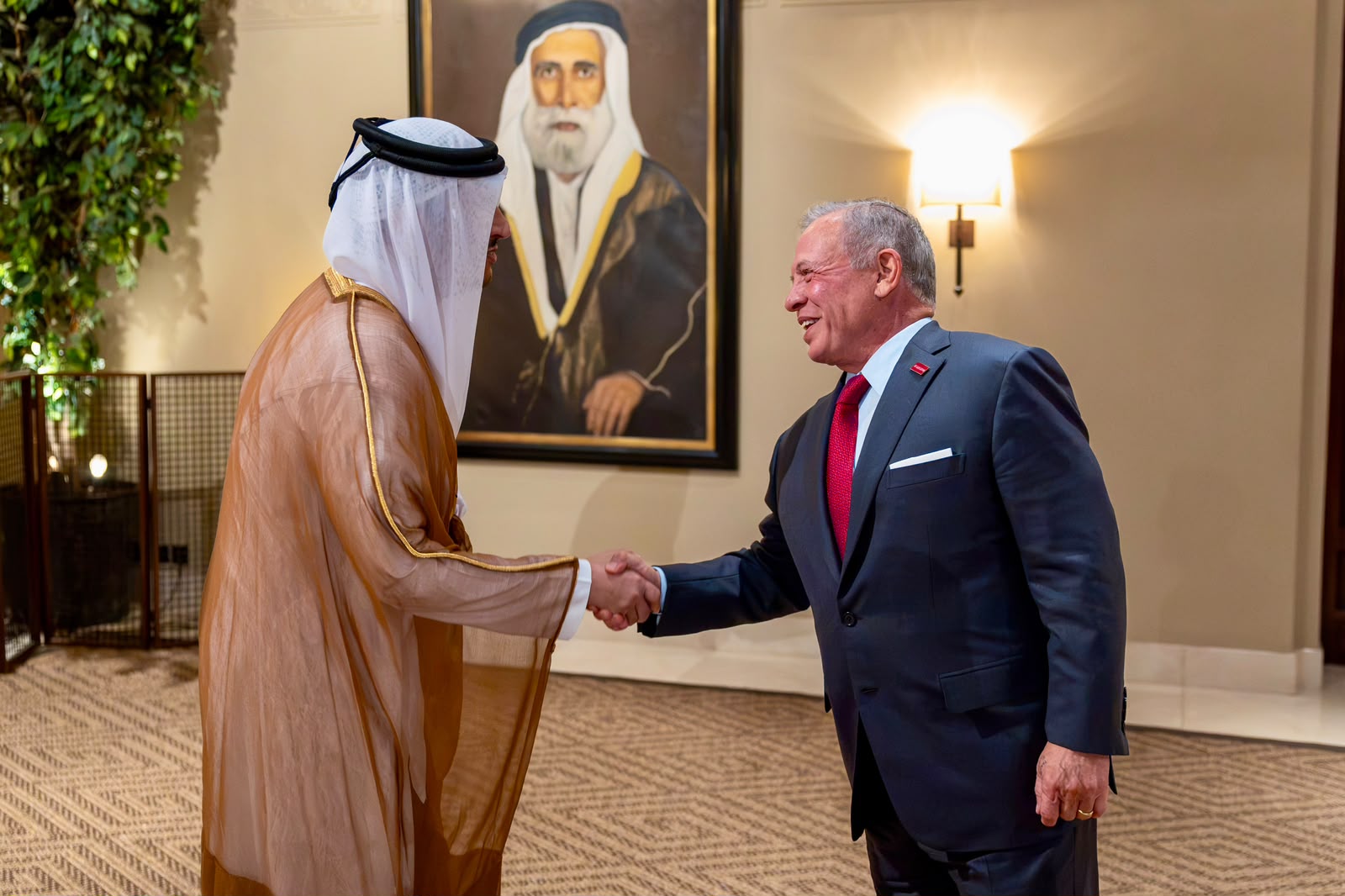
A coalition of foreign ministers from Arab and Muslim countries met in Jordan on Wednesday to launch a coordinated campaign against Israeli policies in Jerusalem — a gathering marked both by the notable absence of key regional players and rhetoric that dismissed Jewish ties to the city, Jewish Insider’s Matthew Shea reports.
The meeting brought together diplomats from Jordan, Egypt, Saudi Arabia, Qatar, Algeria, Iraq, Tunisia, Somalia and Morocco, alongside representatives from the Arab League, Indonesia, Details: Pakistan, Turkey and Malaysia. Missing from the Amman summit were several close U.S. allies including the United Arab Emirates, Bahrain and Kuwait. In a joint statement, the group denounced what it called an “unprecedented Israeli escalation in occupied Jerusalem and its Islamic and Christian holy sites,” accusing Israel of trying to alter “the Arab Islamic and Christian identity of occupied Jerusalem and its legal and demographic status” — omitting any mention of Jewish historical or religious ties to the city.
PEOPLE OF THE BOOK

A number of literary professionals have announced in recent weeks the launch of their own Jewish publishing companies, aimed at fulfilling a need for frustrated authors who say they’ve hit the same wall: agents advising them to cut Jewish names and references to Israel, editors going silent on submissions that once would have been fast sales and a mounting sense that the industry’s embrace of the #ownvoices storytelling trend — a hashtag used to amplify the work of diverse and minority voices — has an unspoken exception for Jewish writers, Jewish Insider’s Haley Cohen reports.
Elevating voices: Meg Keene, an established nonfiction author who has sold more than 150,000 copies of her two books offering tips for wedding planning, recently announced the launch of Meg Keene Books, her own imprint at Wicked Son Press, a Jewish publisher known mostly for right-leaning nonfiction. “Earlier this year I got to the point where I realized I didn’t have anything left to lose,” Keene told JI. “Jews were having all these conversations behind the scenes but it felt like whoever came forward was going to destroy their career. I felt like I was in a position — because of my past in digital publishing and connection to editors, I knew how to do it. So many authors couldn’t sell their first book.”
PAC PLAY
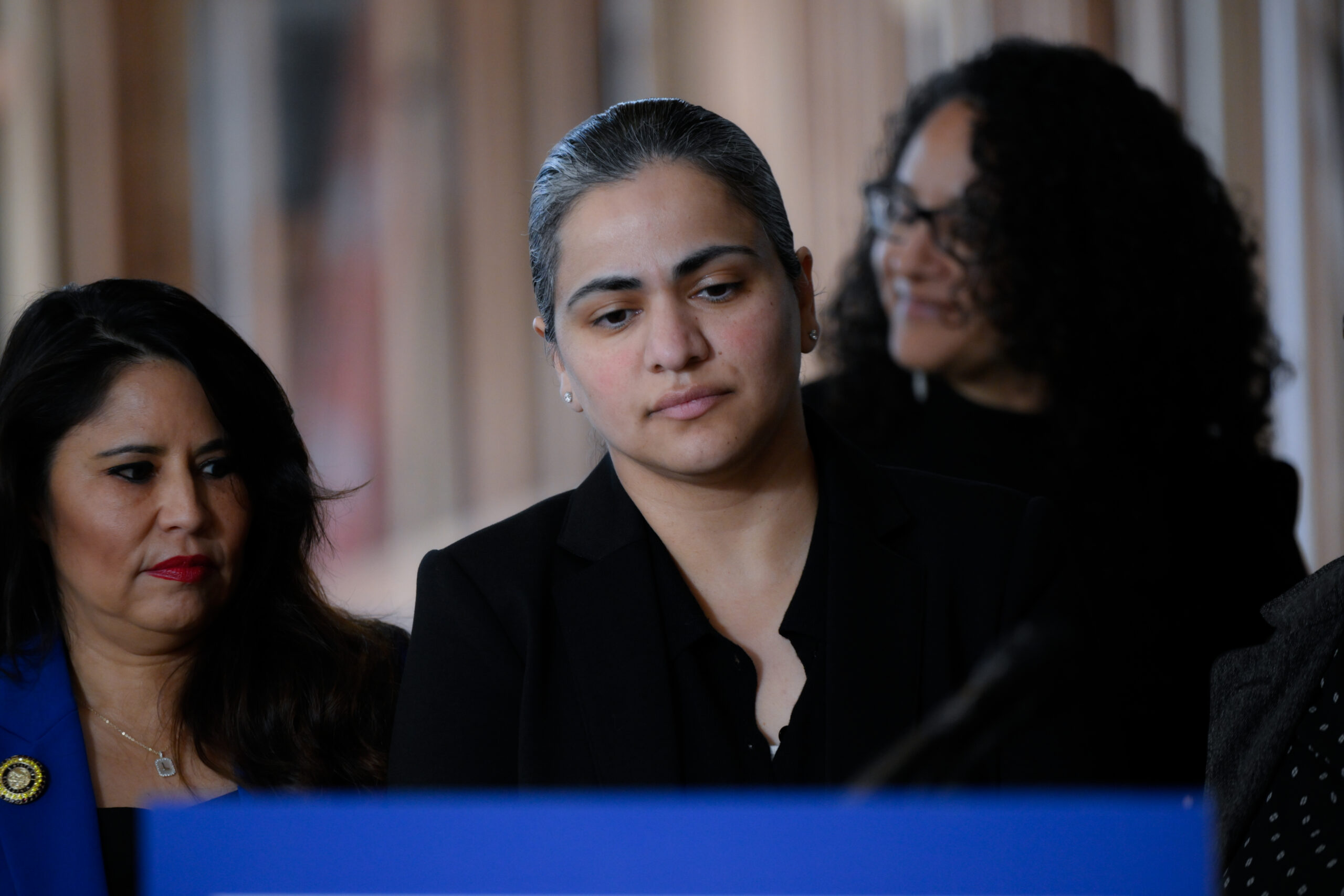
After a night of mixed results in Tuesday’s primary elections, AIPAC’s United Democracy Project super PAC is turning its eyes toward the special election runoff in California’s 14th Congressional District, where progressive state Sen. Aisha Wahab and a moderate local mayor, Melissa Hernandez, are competing to replace disgraced former Rep. Eric Swalwell (D-CA), Jewish Insider’s Marc Rod reports.
About the race: Wahab, seen as the heavy favorite, brings a record raises concerns for some members of the Jewish community — she has not been supportive of numerous priority bills and resolutions aimed at tackling antisemitism and has been a vocal critic of Israel, including describing the war in Gaza as a genocide and championing legislation in the state Senate on the issue. But one Jewish leader in the district expressed skepticism that UDP’s spending would defeat her, and warned that it risked pushing her further left.
BILL BUFFERING

Sen. Elissa Slotkin (D-MI) joined Sen. Ted Cruz (R-TX) and Reps. Brad Knott (R-NC) and Tom Suozzi (D-NY) on Thursday in introducing the Right to Worship Act, a federal bill that would ban activity that knowingly disrupts or impedes access to scheduled religious services within 100 feet of the entrance to a house of worship during that time, Jewish Insider’s Marc Rod reports.
Details: The bill would ban activity that “meaningfully interferes with the ability of people to participate in the scheduled religious service, to the extent that the conduct causes a substantial interruption to the service’s normal operation” or “unreasonably hinders or deters a person from entering a house of worship, or threatens or intimidates a person, in a manner that prevents participation at a scheduled religious service.” The bill would carry escalating civil fines for repeated offenses, as well as allow impacted individuals, the U.S. attorney general or a state attorney general to commence a civil suit under the law.
LIFTING THE HOOD
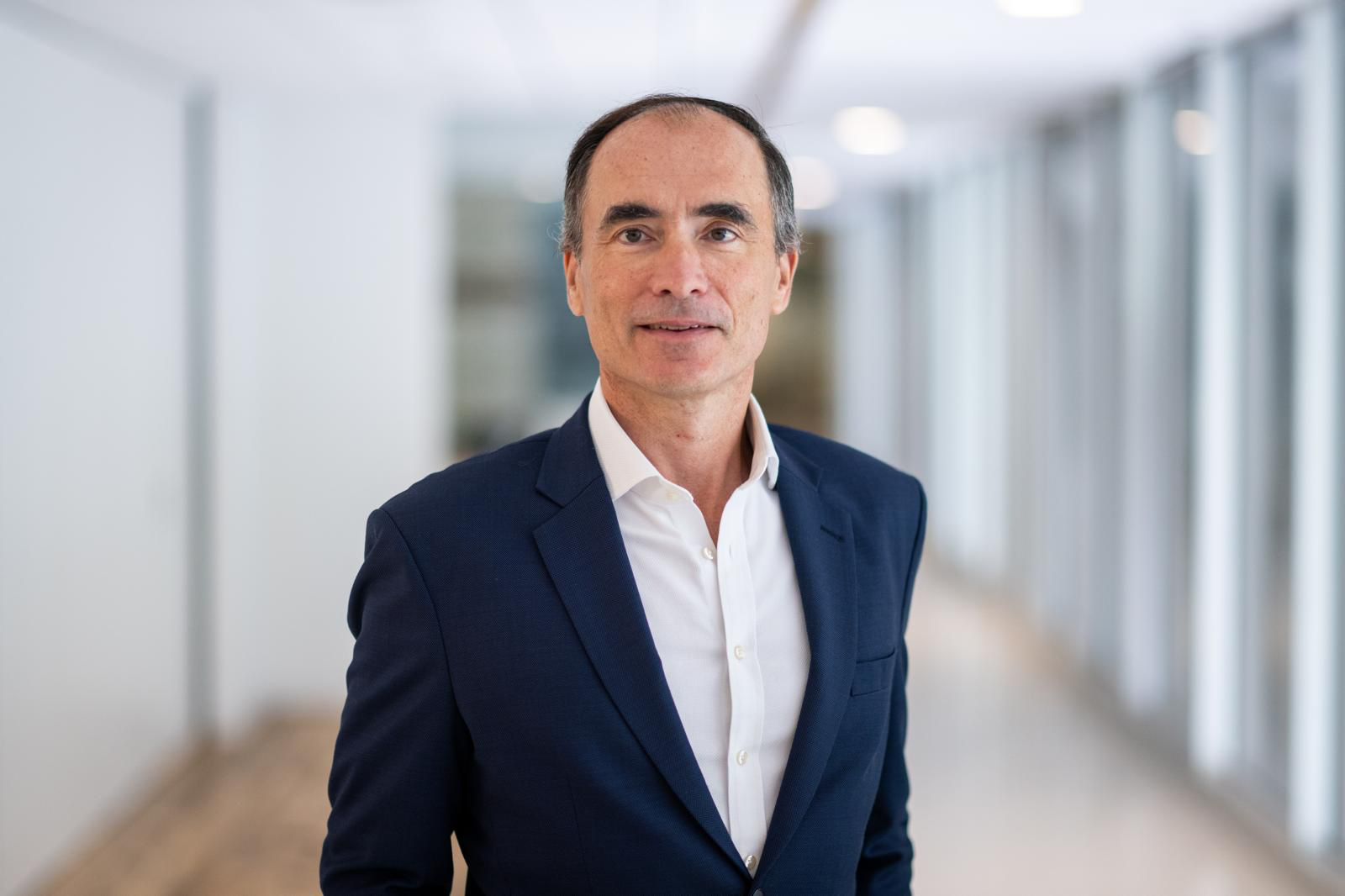
After a career in the foreign service, where officers are obliged to keep their political views to themselves and promote the positions of the current U.S. administration, some retiring diplomats have a hard time getting used to speaking their minds. Ludo Hood is not one of those people. The 53-year-old retired from the U.S. Foreign Service last week after two decades of service. Hood sat down with Jewish Insider’s Gabby Deutch this week to reflect on a career representing the U.S. that included stints working on Iran policy during negotiations for the 2015 nuclear deal, relations with Gulf states during the fraught Arab Spring and antisemitism policy in the tense aftermath of the Oct. 7 Hamas attacks in 2023.
Exception to the rule: Through all those foreign postings and geopolitical flashpoints, one of the most “alarming and shocking” moments of Hood’s time as a foreign service officer came within the halls of Foggy Bottom — when, in the months after Oct. 7, the State Department hosted listening sessions for staffers to express anti-Israel views and bash the policies espoused by the federal government. “It was the only time in my career where active dissent against the elected president’s overall policy and strategic direction was allowed to be aired in the open, and was actually in many ways encouraged,” Hood told JI.
Worthy Reads
Sanders’ Sensibilities: In The New York Times, Matthew Yglesias raises concerns about the “political judgments” of Sen. Bernie Sanders (I-VT) as the Vermont senator has sought to boost the insurgent left — causing damage to the Democratic Party along the way. “The very top electoral performers among Democrats — lawmakers who have a record of results in districts most liberals would lose, like Vicente Gonzalez of Texas, Marie Gluesenkamp Perez of Washington State, Tom Suozzi of New York and Don Davis of North Carolina — are independent thinkers who are critical of Democratic Party leaders and the establishment. The difference is that rather than positioning themselves even further left than a party that most Americans think is too left-wing, they pick issues and rhetoric that are heterodox and often more restrained.” [NYTimes]
Back to School: In Fox News Opinion, Teach Coalition CEO Sydney Altfield calls for a “whole-of-society response” to mounting antisemitism as students head back to school, following an NYPD report indicating a significant increase in antisemitic hate crimes since the start of the year. “Administrators should say plainly that antisemitism is unacceptable, whether it appears as a threat, a slur, a swastika, harassment over Jewish identity or intimidation tied to Israel or Zionism. Further, education must be more than a one-off assembly after an incident. Students should learn what antisemitism is, how it mutates across political movements, conspiracy theories and social media trends and why targeting Jews corrodes civic life for everyone.” [FoxNews]
Find more Worthy Reads in our Live Briefing via our new app (on Apple and Android) and website.
Word on the Street
Vice President JD Vance was pressed by Senate Republicans at a lunch on Thursday to provide more transparency into the Trump administration’s decision-making on Iran…
Sen. Mitch McConnell (R-KY) said he was discharged from a rehabilitation center nearly two months after he was first hospitalized following a fall…
Sen. Chris Van Hollen (D-MD) demanded that U.S. Ambassador to Israel Mike Huckabee step down over his handling of incidents in which U.S. citizens have allegedly been injured by the IDF and other Israelis…
Sen. Jon Husted (R-OH) joined Sen. Bernie Moreno (R-OH) in calling on Rep. Max Miller (R-OH), Moreno’s former son-in-law, to drop out of his reelection race and resign from Congress amid growing scrutiny of domestic violence allegations against Miller, Jewish Insider’s Marc Rod reports…
Sen. John Fetterman (D-PA) said on Wednesday that he believes Abdul El-Sayed’s victory in the Democratic primary for U.S. Senate in Michigan has put the state in play for Republicans in November. “He will quickly discover a primary is a much different situation in this state [than the general election], when you’re accountable for winning the other side. I can’t wait to see him campaign for the general. I have got my popcorn for that,” Fetterman told JI’s Emily Jacobs…
El-Sayed gave an extensive interview to The New York Times, in which he declined to say whether he’d continue to campaign with antisemitic streamer Hasan Piker, with whom he had appeared during the primary…
Politico looks at Republican efforts to win over disaffected Jewish and Black voters in Michigan following El-Sayed‘s primary win as the Michigan Democrat seeks to shore up support from the party’s base; El-Sayed has already reached out to Maryland Gov. Wes Moore as he looks to make inroads with Black voters…
In her first cable news interview since her Senate primary loss on Tuesday, Rep. Haley Stevens (D-MI) told CNN that she identifies as “a Zionist Democrat in Michigan” and suggested that voters concerned about El-Sayed’s stance on Israel and rhetoric about the Jewish state “need to make a personal and private decision” as to who to support in November…
Sens. Tammy Duckworth (D-IL) and 16 Democratic colleagues introduced the Honoring the Sacrifice of Troops in War Act, which aims to prevent the administration from manipulating Iran war casualty data and protects benefits for troops involved in the effort; Fetterman, who supports the Iran war and has broken with Democrats on other measures relating to it, is supporting the bill…
The Atlantic does a deep dive into how the U.S. “squandered” its advantage in the war with Iran, as Washington finds itself facing weapons shortages…
Reps. Derek Tran (D-CA), Ami Bera (D-CA) and Salud Carbajal (D-CA) led 65 House Democrats raising concerns about Israeli restrictions they said are preventing the entry of medical supplies and other humanitarian goods into Gaza…
Jonathan Cowan, president of the center-left group Third Way, told The New York Times that the group plans to spend $15 million ahead of the 2028 presidential election to target the Democratic Socialists of America after El-Sayed’s primary win in the Michigan Senate race…
New Jersey Gov. Mikie Sherrill‘s Mission to Deliver PAC endorsed a series of Democratic candidates with national security or military backgrounds, including Rep. Seth Moulton (D-MA) in his primary campaign to oust Sen. Ed Markey (D-MA)…
The Education Department announced probes into anti-Israel protests at San Jose State University and San Francisco State University, citing complaints alleging the schools’ administrators failed to adequately address antisemitism on campus…
Former Starbucks CEO Howard Schultz sold his Hawaii estate for $36 million, 11 years after purchasing the property for $25 million…
Nazi warships deliberately sunk by the Germans as they retreated from Romania in 1944 are emerging in the Danube River in Serbia as the waterway faces dropping water levels due to drought and recent heat waves…
The United Arab Emirates has successfully transported more oil through the Strait of Hormuz in the last two months than any other country despite ongoing military hostilities in the area, Bloomberg reports, by utilizing tankers that switch off their transponders during the risky crossing…
Israel charged Israeli settler activist Yinon Levy with reckless homicide following the death last month of a Palestinian activist in the West Bank who was killed in a confrontation that occurred when Levy allegedly directed settlers to enter a private property and then shot at a group of Palestinians at the site…
Yesh Atid head Yair Lapid announced that MK Yoav Segalovitz is departing the party; the announcement came amid reports that Segalovitz is considering joining the Ra’am party, a move that would make him the first Jewish official on the Arab party’s ticket. In his new Substack, former crime reporter Ben Hartman examines how Segalovitz, formerly the head of Israel’s police intelligence and investigations branch, could shake up Israeli politics if he joins Ra’am…
Longtime former Likud MKs Gilad Erdan, a former Israeli ambassador to the U.N., and Yuli Edelstein announced the creation of a new, as-yet-unnamed party; the two former MKs said that they hoped to attract Likud voters disillusioned with the party’s direction under Prime Minister Benjamin Netanyahu, with a special focus on military conscription…
Israeli media reported that Mossad head Roman Gofman dismissed the agency’s intelligence directorate head as well as the head of the Mossad’s Iran division over Israel’s failure to topple the Iranian regime earlier this year…
The Yemeni Defense Ministry said the Iran-backed Houthis attacked the internationally recognized government’s military forces in several locations — reportedly killing dozens of soldiers and officers — and that the military would retaliate against the terror group “at the appropriate time and place”…
Two former members of Iran’s national women’s soccer team were granted citizenship in Australia, where they sought humanitarian asylum earlier this year during a tournament in Melbourne…
California Gov. Gavin Newsom appointed Lele Yutzy as the state’s first director of its Office of Civil Rights, which was created under a bill enacted last year that acknowledged the prevalence of antisemitism in the state’s public schools and pledged to tackle discrimination…
The Simon Wiesenthal Center announced that Steve Gamer was joining the organization as chief development officer…
Find on-demand Live Briefing updates throughout the day via our new app (on Apple and Android) and website.
Pic of the Day

Israeli Foreign Minister Gideon Sa’ar met on Thursday with Colombia’s incoming president, Abelardo de la Espriella, in Barranquilla, Colombia, one day before his official inauguration. According to a readout from Sa’ar’s office, the two discussed steps to strengthen diplomatic, security and economic relations between their countries.
Birthdays

Former professional soccer player, he played for the U.S. in the 2009 Maccabiah Games in Israel, Zac MacMath turns 35 today…
FRIDAY: Brooklyn resident, Esther Holler… Former U.S. trade representative and then U.S. secretary of commerce, both positions during the Clinton administration, Michael “Mickey” Kantor turns 87… Co-founder of the world-wide chain of Hard Rock Café, Peter Morton turns 79… Retired lieutenant general in the Israeli Air Force, he also served as chief of staff of the IDF, Dan Halutz turns 78… Former PR director for the New York Yankees and author of more than 20 books, Marty Appel turns 78… President of private equity firm Palisades Associates, former CEO of Empire Kosher Poultry, Greg Rosenbaum turns 74… Former U.S. intelligence analyst, he pled guilty to espionage in 1986 and was released from prison in 2015 and moved to Israel in 2020, Jonathan Pollard turns 72… Spiritual leader of Agudas Israel of St. Louis since 1986, Rabbi Menachem Greenblatt… Founder of the Cayton Children’s Museum in Santa Monica, Esther Netter… Former comptroller of the city of Rockville Centre, N.Y., Michael Schussheim turns 68… Television cook, YouTuber, restaurateur and cookbook author, known as Sam the Cooking Guy, Samuel D. Zien turns 67… City council president of Westlake, Ohio, David S. Greenspan turns 61… Professor of computational biology at the Hebrew University of Jerusalem, Liran Carmel turns 55… CEO at Capital Camps & Retreat Center after 14 years at AIPAC, Havi Arbeter Goldscher… Governor of Virginia, Abigail Spanberger turns 47… Financial news anchor for CNBC, Sara Aliza Eisen turns 42… Emmy Award-winning political reporter for The New York Times, Jonathan V. Swan turns 41… Public address announcer for both MLB’s Athletics and the AHL’s San Jose Barracuda, Amelia Schimmel… Former MLB catcher, he batted .350 with two home runs for Team Israel at the 2020 Olympics, he is now a catching instructor for the Chicago Cubs, Ryan Lavarnway turns 39… Senior faculty at Ariel University, Anna Harwood-Gross… Product management director at Signify Health, Estee Goldschmidt… Professional Super Smash Bros. player, known as Dabuz, Samuel Robert Buzby turns 33… Founder of Love For Our Elders, a global nonprofit organization in dozens of countries, Jacob Cramer turns 26… Scott Harrison…
SATURDAY: Actor and director, he won the Academy Award for Best Actor in 1980 for “Kramer vs. Kramer” and in 1989 for “Rain Man,” Dustin Hoffman turns 89… Arlington Heights, Ill., resident, Elizabeth Gordon… Dutch diplomat and politician, he served as the speaker of the Dutch House of Representatives, Frans Weisglas turns 80… Greenwood Village, Colo., resident, Robert M. Schwartz… Tampa, Fla., resident, Roy D. Pulliam… Retired U.S. Army four-star general, who then served as the secretary of defense during the Biden administration, Lloyd James Austin III turns 73… Vancouver, Wash., resident, Juliana E. Miles Bagherpour… U.S. ambassador to Israel throughout the Trump 45 administration, David Melech Friedman turns 68… Former CEO of BusinessGhost, a ghostwriting firm that has written and published over 700 books, Michael Graubart Levin turns 68… Former managing general partner of MLB’s Tampa Bay Rays, Stuart L. Sternberg turns 67… Chess grandmaster, once ranked 8th in the world, he is the director of the Brooklyn Chess Academy, Leonid Yudasin turns 67… White House chief of staff for the first two years of the Biden administration, Ron Klain turns 65… Film director whose works include nine Disney films, Jon Turteltaub turns 63… Former chief justice of the Nevada Supreme Court, she continues to serve as a justice, Elissa F. Cadish turns 62… Digital strategist, he is the founding partner of Fuse, a consultancy, Jonah Seiger… Former book editor of the Orthodox Union’s Jewish Action magazine, Rabbi Gil Ofer Student turns 54… Lead guitarist of the mathcore band the Dillinger Escape Plan, also playing rhythm guitar with the crossover thrash band Suicidal Tendencies, Benjamin A. Weinman turns 51… Film and television actor, Lindsay Sloane turns 49… MLB pitcher for 12 seasons and now chief baseball officer of the Boston Red Sox, Craig Breslow turns 46… Author, freelance writer and editor, she is a former dancer with the New York City Ballet, Sophie Flack turns 43… Managing principal at Rocktower Capital, Bara Lane… Canadian film, television and stage actor, Jacob Benjamin “Jake” Goldsbie turns 38… Digital director at the Jewish Democratic Council of America, Sarah Garfinkel… Founder and managing partner at Avid Ventures, Addie Lerner Katz… Director of marketing and communications at Alpha Epsilon Pi, Zachary Pellish… Creative producer for Airbnb, Morgan Furlong… Internet celebrity and fitness model, Jennifer Leigh “Jen” Selter turns 33… Jack Baum… Rob Schwartz…
SUNDAY: Prominent Sephardic rabbi in Tel Aviv, he was a member of the Knesset for the Shas party, Rabbi Moshe Maya turns 88… Physicist and venture capitalist, co-founder and senior advisor at New Markets Venture Partners, Donald M. “Don” Spero, Ph.D. turns 87… Comedian, actor, writer, director and author, son of a rabbi, he appeared 140 times on Johnny Carson’s “Tonight Show,” David Steinberg turns 84… Romance novelist with 25 books on the NYT bestseller lists, Barbara Delinsky (born Barbara Ruth Greenberg) turns 81… Author of more than 33 Jewish-themed books, he is an ordained rabbi as are two of his daughters, Seymour Rossel turns 81… Telecommunications consultant based in Chattanooga, Tenn., Mark Shapiro turns 80… Psychologist and bestselling suspense novelist, Jonathan Kellerman turns 77… Southern California resident, Faith Schames… Brigadier general (res.) in the Israeli Air Force, Amir Abraham Haskel turns 73… Executive director of the Steinhardt Family Foundation in Israel and executive director of the Henry S. and Mala Dorfman Family Foundation, Tova Dorfman… U.S. senator (R-KS), Roger Marshall, M.D. turns 66… Member of the Minnesota state Senate since 2007, Ronald Steven “Ron” Latz turns 63… Professor of French at Yale University, he is the inaugural director of the Yale Program for the Study of Antisemitism, Maurice Samuels turns 58… Chief of staff for Representative Jerrold Nadler for 25 years, she started a consulting practice in 2024, Amy Beth Rutkin… Founder of Tannenbaum Capital Group, Leonard M. Tannenbaum turns 55… Two-time Grammy Award-winning operatic soprano, songwriter and actor, Hila Plitmann turns 53… Assistant secretary for inter-departmental data integration for the Maryland Department of Human Services, Kirill Reznik turns 52… Reporter in the Washington bureau of The New York Times, he covers the confluence of money, politics and influence, Kenneth P. Vogel turns 51… Democratic political strategist, Rebecca Kirszner Katz… Chair of JEWELS (Jewish Education Where Every Level Succeeds), Jules Friedman turns 51… Drummer, popular on YouTube with over 300 million views, Meytal Cohen turns 43… CEO of the Israel on Campus Coalition since 2013, Jacob Baime… Real estate investor based in Cleveland, Ohio, Amanda Isaacson… Associate at K&L Gates LLP, Isaac Lederman… Israeli actor, best known for his role as Yanky Shapiro in the 2020 Netflix miniseries “Unorthodox,” Amit Rahav turns 31… SVP at Dezenhall Resources, he was previously communications director for the Republican Jewish Coalition and an RNC alum, Fred Brown… Elise Aronson… Dan Zimerman…
Trump understands optics (and markets) perhaps better than any other world leader, hence his constant claims that a major diplomatic breakthrough could be days away
Aaron Schwartz / AFP via Getty Images
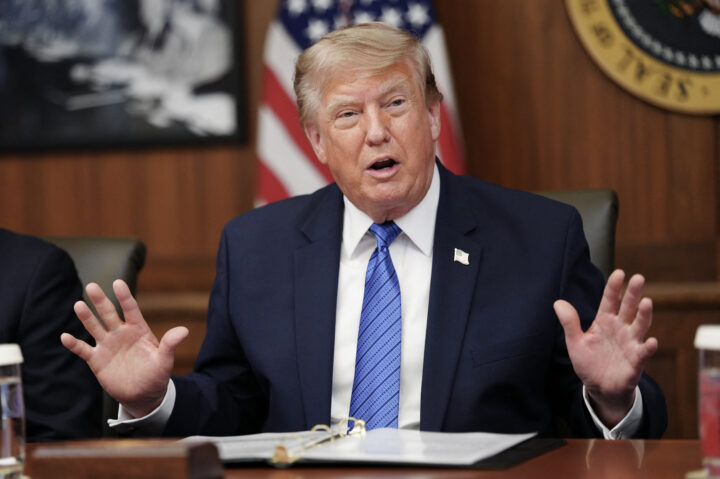
US President Donald Trump speaks during a Cabinet meeting at Camp David in Maryland, on July 31, 2026.
A meme circulated on social media earlier this week depicting a cartoon version of President Donald Trump addressing different stages of negotiations with Iran. In it, the president cycles between “We’re going to bomb their power plants,” “They called us begging for a deal,” “They’re giving us everything we want” and “They’re scum, you can’t negotiate with these people.”
It’s perhaps the most accurate commentary on the situation that has unfolded since early July, as the U.S. and Iran have continued to exchange fire, with Iran striking Arab states around the region. Every few days, the stage resets. The endless loop of diplomacy and military strikes has thrown the countries into a situation that is equal parts “Groundhog Day” and “The Apprentice” — military strikes on loop, with a major breakthrough soon to come.
Indeed, Trump suggested on Tuesday that “a lot of progress had been made” in negotiations that would see the Strait of Hormuz reopened and signaled a deal on the strategic waterway could be announced as soon as this week.
His rhetoric echoes comments he has made in recent weeks teasing a diplomatic breakthrough that is right around the corner, while the consistent reality is that diplomacy has been cyclical, devoid of significant progress and increasingly beneficial to Tehran, which has learned that it only needs to wait out the situation — at least until the midterms, if not until 2029.
It also raises questions about the limits of American deterrence — especially when taken alongside recent reports of dwindling American weapons stockpiles.
Trump understands optics (and markets) perhaps better than any other world leader, hence his constant claims that a major diplomatic breakthrough could be days away — whereas Iran, unburdened by looming midterms and the realities that come with living in a democracy, can afford to wait it out as Washington runs through the endless narrative loop.
Almost as cyclical as Trump’s pronouncements are Iran’s near-immediate denials of the president’s claims: the regular insistence that a deal is far off and unlikely to happen without significant American and Israeli concessions.
Such a move would not be the kind of diplomatic victory to be celebrated — unless you’re Iran — which will likely now extract greater authority and stand to benefit from control of the Strait of Hormuz. A return to the status quo — largely unfettered transit through the strait — appears unlikely, as even Trump praises ongoing talks between Oman and Iran.
It’s this low-level exchange of fire that keeps the pot from bubbling over and full-scale war from again breaking out. But as the cycle refreshes itself, the U.S. is increasingly drawn into a longer war that is more persistence than persuasion — a game for which Tehran holds the cheat codes.
Plus, Israel and Turkey trade barbs over Syria
Tom Williams/CQ-Roll Call, Inc via Getty Images
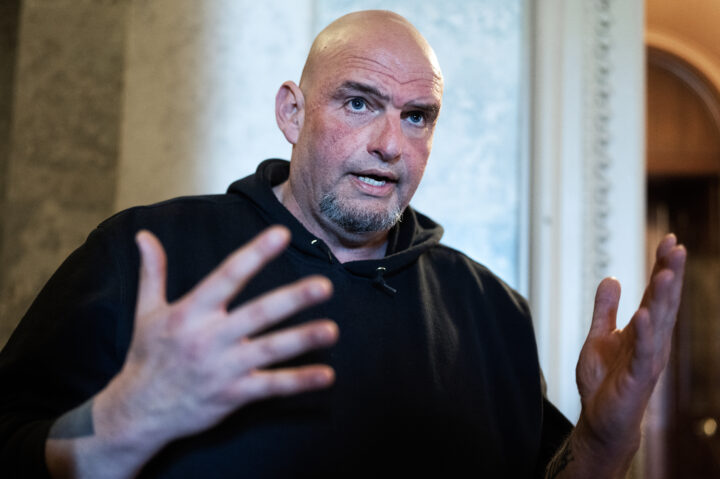
Sen. John Fetterman (D-PA) talks with reporters after the Senate luncheons in the U.S. Capitol on Tuesday, March 11, 2025.
Good Thursday afternoon.
This P.M. briefing is reserved for our premium subscribers like you — offering a forward-focused read on what we’re tracking now and what’s coming next.
Today’s Daily Overtime was curated by JI U.S. Editor Danielle Cohen-Kanik.
📡On Our Radar
Notable developments and interesting tidbits we’re tracking
President Donald Trump disputed reports that the U.S. is running low on critical munitions as a result of the Iran war, claiming on Truth Social last night that the country has “massive amounts of ‘munitions,’ especially of certain types” and that more are being manufactured and shipped to the U.S. “as needed”…
The IDF struck several targets in southern Lebanon again today “in response to the incident yesterday” during which two IDF soldiers were killed and four severely injured in an explosion that the army attributed to Hezbollah.
The strikes came during the last day of Israel-Lebanon talks in Rome, which a State Department official said were “productive on the technical and expert levels” and brought the parties “a lot closer on what needs to be done to advance and expand the pilot zone process”…
Jonathan Cowan, president of the center-left group Third Way, told The New York Times that the group plans to spend $15 million ahead of the 2028 presidential election to target the Democratic Socialists of America after Abdul El-Sayed’s primary win in the Michigan Senate race. “It is deeply troubling to see radical, far-left candidates winning in places that are potentially presidential swing states,” Cowan said. El-Sayed was not endorsed by the DSA, though he was championed by the far left…
Sen. John Fetterman (D-PA) told Jewish Insider’s Emily Jacobs that he believes El-Sayed’s victory has put Michigan in play for Republicans to win in November. “[El-Sayed] will quickly discover a primary is a much different situation in this state [than the general election], when you’re accountable for winning the other side. I can’t wait to see him campaign for the general. I have got my popcorn for that,” Fetterman said…
Sen. Elissa Slotkin (D-MI) joined Sen. Ted Cruz (R-TX) and Reps. Brad Knott (R-NC) and Tom Suozzi (D-NY) today in introducing the Right to Worship Act, a federal bill that would ban activity that knowingly disrupts or impedes access to scheduled religious services within 100 feet of the entrance of a house of worship, JI’s Marc Rod reports…
California Gov. Gavin Newsom appointed Lele Yutzy as the state’s first director of its Office of Civil Rights, which was created under a bill enacted last year that acknowledged the prevalence of antisemitism in the state’s public schools and pledged to tackle discrimination. The office is also required to appoint an antisemitism prevention coordinator…
Sen. Jon Husted (R-OH) joined Sen. Bernie Moreno (R-OH) in calling on Rep. Max Miller (R-OH), Moreno’s former son-in-law, to drop out of his reelection race and resign from Congress amid growing scrutiny of domestic violence allegations made against Miller, JI’s Marc Rod reports…
New Jersey Gov. Mikie Sherrill‘s Mission to Deliver PAC endorsed a series of Democratic candidates with national security or military backgrounds, including Rep. Seth Moulton (D-MA) in his primary campaign to oust Sen. Ed Markey (D-MA).
Asked in a debate on local news earlier this week if Israel committed war crimes in Gaza, Markey answered an emphatic “yes” and called to end all military aid to Israel, while Moulton called the conflict an “absolute moral atrocity” and highlighted his rejection of AIPAC’s support but did not answer in the affirmative…
Sen. Mitch McConnell (R-KY) said in a statement today that he has been discharged from the hospital after a fall in Juneand will continue his recovery at home, without indication of when he will return to Capitol Hill…
The feud between Jerusalem and Ankara continued today as Turkish Foreign Minister Hakan Fidan claimed Israel’s “attacks targeting Syria’s sovereignty and territorial integrity” are “among the greatest threats to the country’s stability.”
Israeli Foreign Minister Gideon Sa’ar in turnaccused Fidan of hypocrisy, arguing that Turkey currently occupies 5% of Syria while the IDF holds a buffer zone “that comprises just one-tenth of one percent of Syrian territory”…
An extremist Israeli settler, Yinon Levi, was charged by the Israeli State Attorney’s Office with reckless homicide over the July 2025 killing of Palestinian activist Awdah Hathaleen, who had been featured in the Oscar-winning documentary “No Other Land” about home demolitions in the West Bank…
The Yemeni Defense Ministry said the Houthis attacked the internationally recognized government’s military forces in several locations — reportedly killing dozens of soldiers — and that the military would retaliate against the terror group “at the appropriate time and place.”
The hostilities mark Yemen’s latest potential slide back towards its brutal civil war that devastated the country from 2014 until the Houthis and the Saudi-backed government reached a ceasefire in 2022…
The United Arab Emirates has successfully transported more oil through the Strait of Hormuz in the last two months than any other country despite ongoing military hostilities in the area, Bloomberg reports, by utilizing tankers that switch off their transponders during the risky crossing…
⏩ Tomorrow’s Agenda, Today
An early look at tomorrow’s storylines and schedule to keep you a step ahead
Keep an eye on Jewish Insider for a look at the special election to replace former Rep. Eric Swalwell (D-CA), where AIPAC’s United Democracy Project super PAC is working to boost Dublin, Calif., Mayor Melissa Hernandez over state Sen. Aisha Wahab.
A deal to reopen the Strait of Hormuz may still emerge, though its reported contours are raising concerns among experts that it could grant Tehran unprecedented oversight over the international shipping route, Jewish Insider’s Matthew Shea reports.
In the latest development, Iranian state media reported today that the country’s parliament is considering a preliminary bill to bar American, Israeli and other “hostile” vessels from utilizing the strait.
We’ll be back in your inbox with the Daily Overtime on Monday. Shabbat shalom!
Stories You May Have Missed
MICHIGAN MALAISE
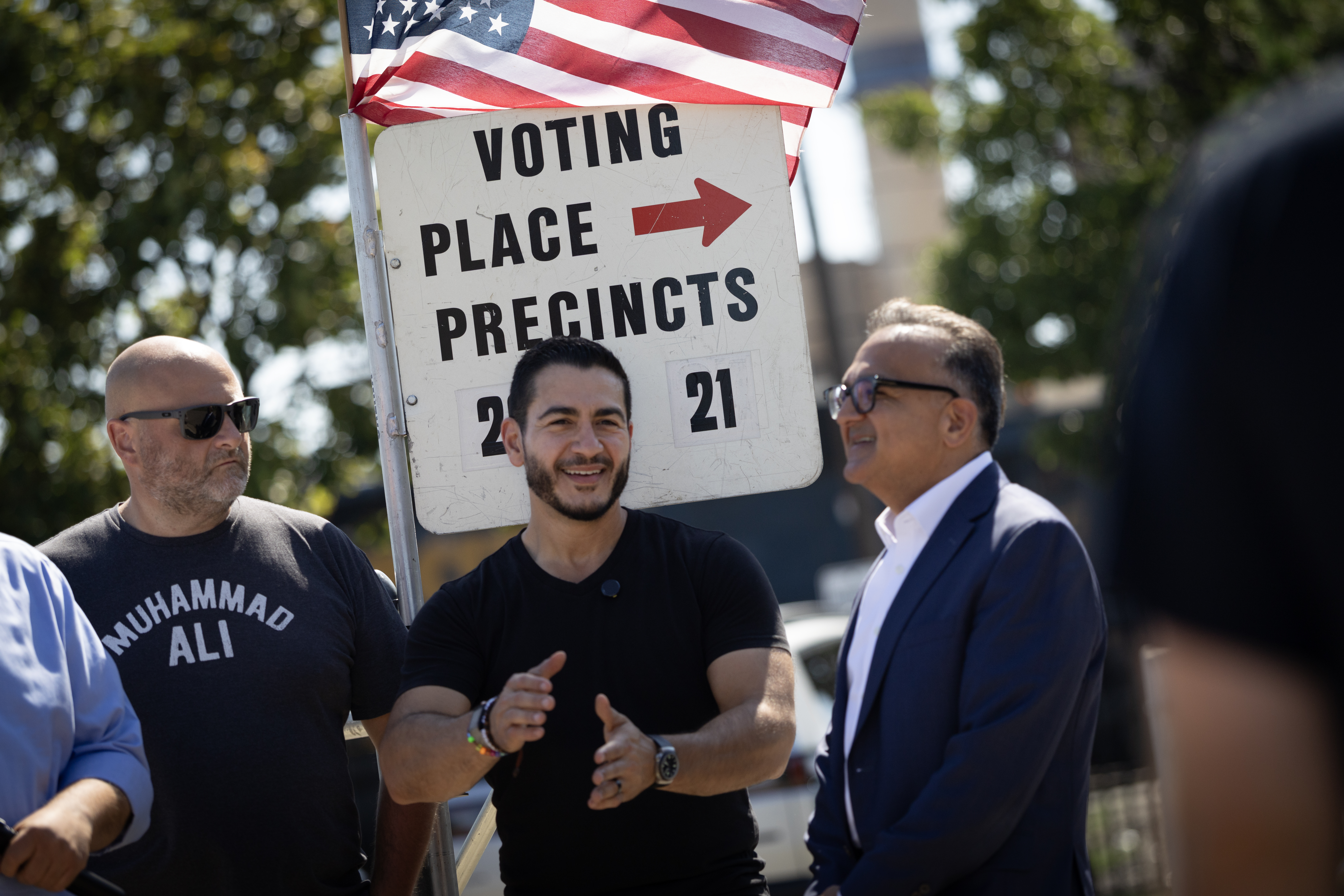
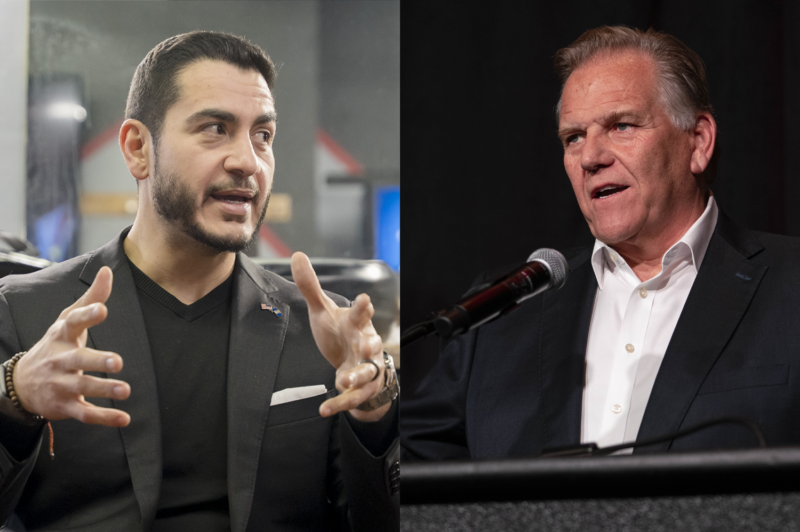
Several Jewish Democrats in the battleground state are now indicating that they will break with a party they have long called home and instead vote for the Republican nominee, Mike Rogers, in the November election
CASE STUDY
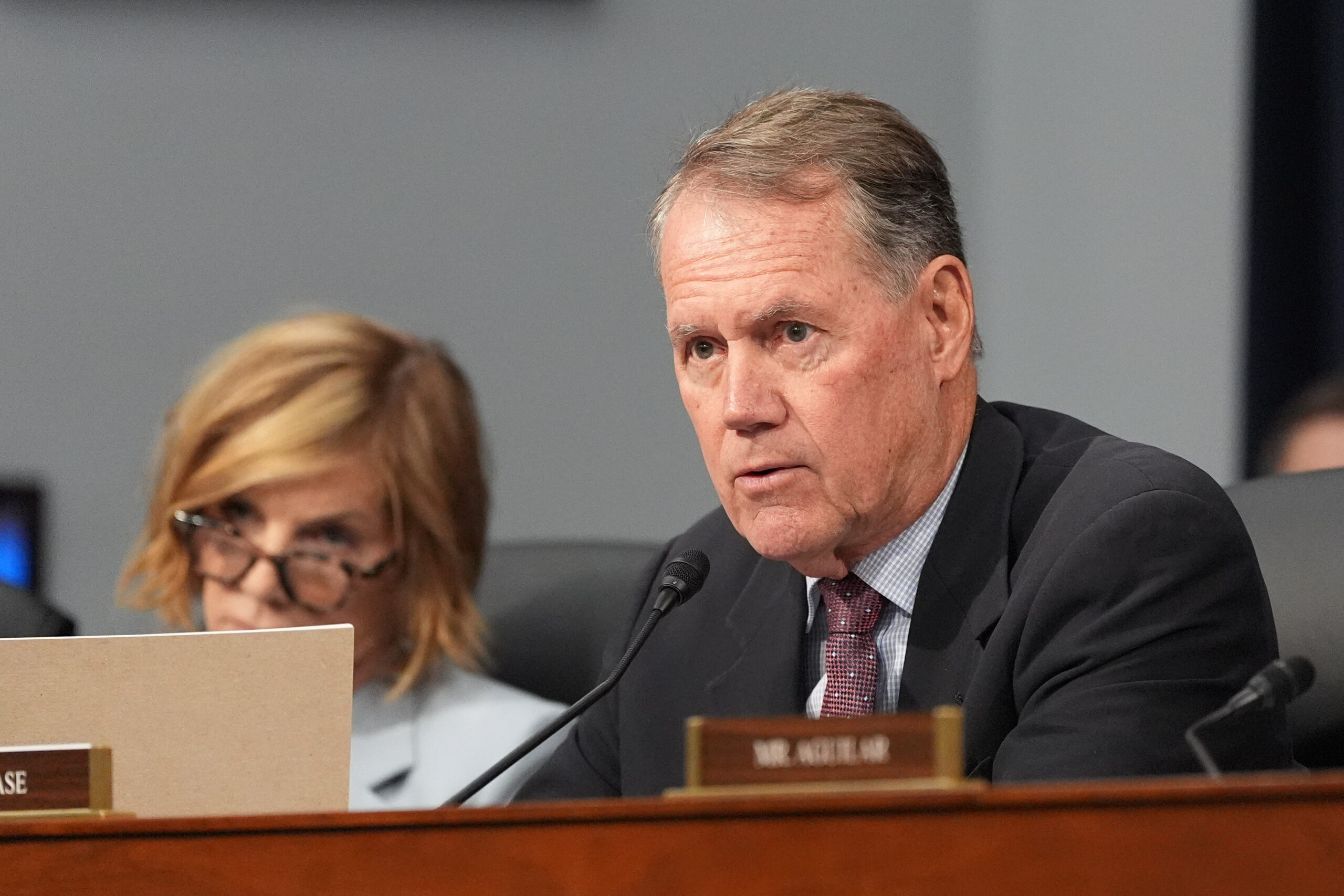
A 42-year-old progressive state senator has quietly closed the gap on the 73-year-old pro-Israel incumbent, with internal polls showing a tightening race before Saturday’s vote
Analysts warn the proposed 60-day arrangement, if signed as reported, would mark the first time Iran formally directs shipping through the international waterway, setting a dangerous precedent

Amirhossein KHORGOOEI / ISNA / AFP via Getty Images
Vessels are pictured anchored in the Strait of Hormuz off Bandar Abbas in southern Iran on May 5, 2026.
Experts are expressing growing concern over reports that an emerging deal between Iran and Oman to reopen the Strait of Hormuz could grant Tehran unprecedented oversight over the international shipping route, ceding control to Iran that it did not possess prior to the conflict.
The potential agreement comes as President Donald Trump suggested on Tuesday that “a lot of progress had been made” in negotiations and signaled a deal on the strategic waterway could be announced as soon as this week. Iranian Foreign Ministry spokesperson Esmail Baghaei confirmed on Wednesday that an arrangement with Oman had reached the “final stage.”
Iran’s deputy foreign minister has denied direct negotiations with the U.S. and warned that an agreement would not automatically reopen the waterway. Iranian state media also reported that, under a draft bill currently being reviewed by an Iranian parliamentary committee, U.S. and Israeli ships may also be barred from crossing the strait.
Reports indicate any agreement would likely last for 60 days and require the U.S. to lift its naval blockade on Iranian ports. A deal would potentially initiate the clearing of naval mines in the strait, a return to a broader ceasefire and resumption of talks with the U.S. on Tehran’s nuclear program.
Under the proposed terms, inbound commercial vessels would be directed through a northern route in Iranian waters, while outbound ships would traverse a southern route in Omani waters, managed in coordination with Iran. Although a U.S. official told the Associated Press that such a deal would preclude Iran from issuing formal approvals for transiting ships, tolls or service fees, regional analysts warn that formalizing Iranian oversight over the chokepoint represents a significant strategic concession.
Matthew Levitt, a senior fellow at The Washington Institute for Near East Policy, told Jewish Insider that Washington’s drive for a resolution with Iran may be driving it to agree to a less-than-ideal scenario.
“President Trump is very eager for a deal that reopens the strait, and seems inclined to accept a deal under which Iran has greater oversight of ships entering and exiting the strait,” Levitt said. “The key is denying Iran any way of monetizing the flow of traffic through this international waterway.”
Daniel Shapiro, a former U.S. ambassador to Israel under President Barack Obama who also served as President Joe Biden’s Iran liaison to Israel, told JI that “if the deal that is being described comes into effect, it is a strategic win for Iran.”
“[Iran] will emerge with effective control over the Strait of Hormuz, which was a fully open international waterway before the war,” Shapiro said. “The United States will be strategically worse off with this outcome than we were before the war, but it is almost certainly the only way to prevent an escalation that would produce even greater global economic disruption than we have already seen.”
Shapiro noted that even after a deal is made, Iran “will probably receive early sanctions relief … and they will only be expected to start negotiations on their nuclear program, which could turn out to be fruitless and endless.”
Analysts emphasized that the disconnect between Washington and Tehran regarding the scope of the agreement poses risks to maritime security.
Jonathan Ruhe, director of foreign policy at the Jewish Institute for National Security of America , pointed out that much like the June U.S.-Iran memorandum of understanding, the potential deal means vastly different things to each side. While the U.S. expects international shipping to resume unencumbered, Tehran views the arrangement as a vehicle to establish long-term authority.
“Iran expects much more, including at least de facto ability to toll and veto passage through Hormuz,” Ruhe said. “Tehran’s redline for a deal is recognition of its ‘right’ to determine and deter shipping in Hormuz, as the spoils of its victory and a key counterweight to further U.S. pressure.”
“Combined with the complications of gaining signoff from Iran’s Supreme Leader, and Iran’s predictable tendency to seek additional U.S. concessions, these differences explain the lack of a deal so far – despite U.S. anticipation of an imminent announcement,” he continued.
Ruhe said that even if the Trump administration secures a deal that reopens the strait, the precedent set by such an agreement could remain dangerous.
“It would affirm that the fate of this critical waterway is subject to Iran’s approval, and undermine America’s abiding interest in free navigation,” he said. “By cementing a key wartime gain, it would embolden Tehran to take the hardest possible line in any follow-on talks.”
Richard Goldberg, a senior advisor at the Foundation for Defense of Democracies and a former Trump administration official, cautioned that the final structure of the deal will determine whether Washington is conceding leverage or calling Tehran’s bluff.
“I find it difficult to believe we would ever cede formal control over a critical international waterway to a terrorist group, or otherwise tolerate that group collecting tolls or fees for what is already an international right to freedom of navigation,” Goldberg said.
Goldberg noted that Iran’s rhetoric may ultimately be bluster.
“Oftentimes the reality of a situation might differ from Iran’s propaganda — that is, in this case, Iran might claim it’s ‘allowing’ ships to pass through its claimed ‘territorial waters’ but in practice it could mean ships are just moving through the strait as they always used to without taking drone or missile fire,” Goldberg explained. “If we see formal control, tolls or fees, that’s a terrible outcome; if we see Iran just making claims that it’s allowing something to happen but there is no formalized control, no extortion payments being made, that could very well be a propaganda-disguised-victory for the United States.”
Plus, Israel-Lebanon talks wrap early after IDF strikes
Sarah Rice/Bloomberg via Getty Images
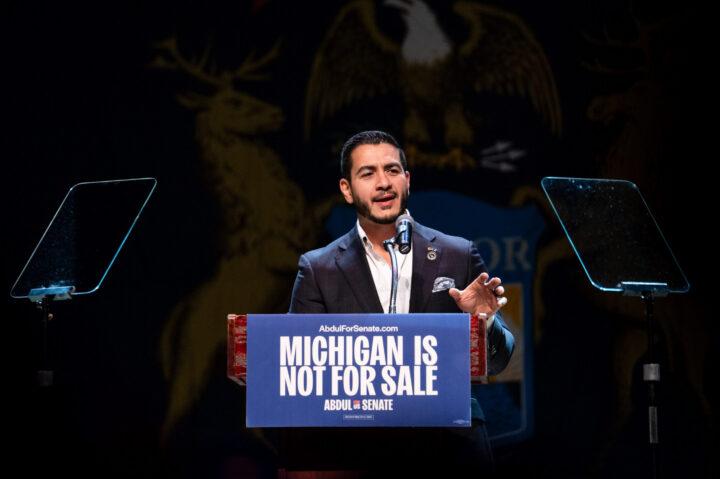
Abdul El-Sayed speaks during a primary election night watch party at The Majestic Theatre in Detroit, Michigan early on Aug. 5, 2026.
Good Wednesday afternoon.
This P.M. briefing is reserved for our premium subscribers like you — offering a forward-focused read on what we’re tracking now and what’s coming next.
Today’s Daily Overtime was curated by JI U.S. Editor Danielle Cohen-Kanik.
📡On Our Radar
Notable developments and interesting tidbits we’re tracking
Abdul El-Sayed’s victory today in the Democratic primary for U.S. Senate in Michigan rattled Jewish groups, who raised concerns about his rhetoric on Israel and the broader rise of the far left, Jewish Insider’s Marc Rod reports.
The Jewish Democratic Council of America congratulated El-Sayed but said it was “disappointed” by the result and stopped short of endorsing him, while AIPAC said its members “remain determined to ensure that voters reject Dr. El-Sayed and his radical anti-Israel agenda in November”…
The Republican Jewish Coalition is urging Jewish Democrats to support the GOP nominee, former Rep. Mike Rogers (R-MI), in the general election, calling El-Sayed “a direct threat to Michigan’s Jewish community.”
A Democratic fundraiser in Michigan told JI’s Matthew Kassel it is “absolutely certain” that “several large Jewish Democratic donors” will be backing Rogers. “I would guarantee there will be fundraisers for him hosted by high-profile Jewish Democrats,” they said…
Shortly after his win, El-Sayed previewed his evolving message to Jewish voters, saying he welcomes the opportunity to “break bread with you at Seder” and to “worship with you at shul.” He spoke of his “sisters and brothers who said, you know, ‘I want to join this movement because AIPAC doesn’t speak for me’” and vowed he would prioritize Jewish safety…
But just before he was declared the victor, El-Sayed appeared on MS NOW where he called Israel “bloodthirsty,” JI’s Danielle Cohen-Kanik reports. He said that “we’ve been talking about an illegal apartheid regime” in reference to Israel since before Prime Minister Benjamin Netanyahu came to power, though “Netanyahu is a big reason why they’ve gotten so aggressive and frankly so bloodthirsty”…
Democrats, meanwhile, are quickly coalescing behind the new Senate nominee, JI’s Marc Rod reports. El-Sayed’s opponent, Rep. Haley Stevens (D-MI), promptly endorsed him upon conceding the race; Senate Minority Leader Chuck Schumer (D-NY) and Democratic Senatorial Campaign Committee Chair Sen. Kirsten Gillibrand (D-NY) offered their joint support; and former Vice President Kamala Harris is fundraising for El-Sayed’s campaign alongside her PAC.
New York City Mayor Zohran Mamdani is also backing his ideological ally and left open the possibility that he’ll travel to Michigan to campaign with El-Sayed ahead of the general election, per JI’s Will Bredderman…
In another consequential Michigan race, pro-Israel Rep. Shri Thanedar (D-MI) was ousted in his primary, losing to state Rep. Donavan McKinney, a democratic socialist who cross-endorsed with El-Sayed, campaigned alongside him and Sen. Bernie Sanders (I-VT) and ran on ending U.S. military aid to Israel…
Talks between Israel and Lebanon ended several hours early today “due to events on the ground,” the State Department said, but were “extremely productive” and are slated to restart tomorrow. The move came after the IDF conducted strikes in southern Lebanon due to what it said were “blatant violations“of the ongoing ceasefire by Hezbollah.
An Israeli source told The Times of Israel that the talks were cut off after Israeli Ambassador to the U.S. Yechiel Leiter accused Lebanese representatives of leaking false information to the media…
The Israeli Foreign Ministry denounced a joint statement adopted by Arab states who convened in Jordan today to discuss Israel’s policies over Muslim and Christian sites in Jerusalem, which asserted that Israel “has no sovereignty” over the city and accused Israel of “altering the Arab Islamic and Christian identity of occupied Jerusalem.”
The countries also pledged to launch a “media platform to document and expose Israeli violations against the holy sites and worshipers” and hold a meeting at the U.N. General Assembly to further discuss the issue. Israel said the statement was “built on false accusations, historical distortions, and a complete disregard for the facts”…
The Conference of Presidents of Major American Jewish Organizations sent a letter to Secretary of State Marco Rubio today renewing its call for the Trump administration to press Jordan to honor its extradition treaty obligations and send Ahlam Aref Ahmad al-Tamimi to the United States.
Al-Tamimi was convicted in Israel for her role in the 2001 bombing of the Sbarro pizzeria in Jerusalem, which killed 16 people, including three Americans. She has been charged by the Justice Department and remains on the FBI’s Most Wanted list…
⏩ Tomorrow’s Agenda, Today
An early look at tomorrow’s storylines and schedule to keep you a step ahead
Keep an eye on Jewish Insider for a look at Rep. Ed Case‘s (D-HI) reelection race, a primary that has largely flown under the radar but could pose a threat to one of the House’s more reliably pro-Israel moderates. While the contest has not centered on Middle East policy, it reflects the pattern seen in several recent Democratic primaries where well-established pro-Israel incumbents have faced increasingly competitive challenges from their left.
It remains to be seen if a deal will materialize between Iran, Oman and the U.S. to reopen the Strait of Hormuz (again), after Iranian Foreign Ministry spokesperson Esmaeil Baghaei said today that Tehran and Muscat were finalizing a bilateral agreement without Washington. The latest reporting indicates that such an agreement would preclude any fees or tolls for a temporary period of time.
Tennessee will hold its primary elections tomorrow, where Sen. Marsha Blackburn (R-TN) and Rep. John Rose (R-TN) are the front-runners for the open governorship, Sen. Bill Hagerty (R-TN) is expected to win renomination and Rep. Andy Ogles (R-TN) is running in the redrawn 5th Congressional District.
Stories You May Have Missed
BOOKSHELF
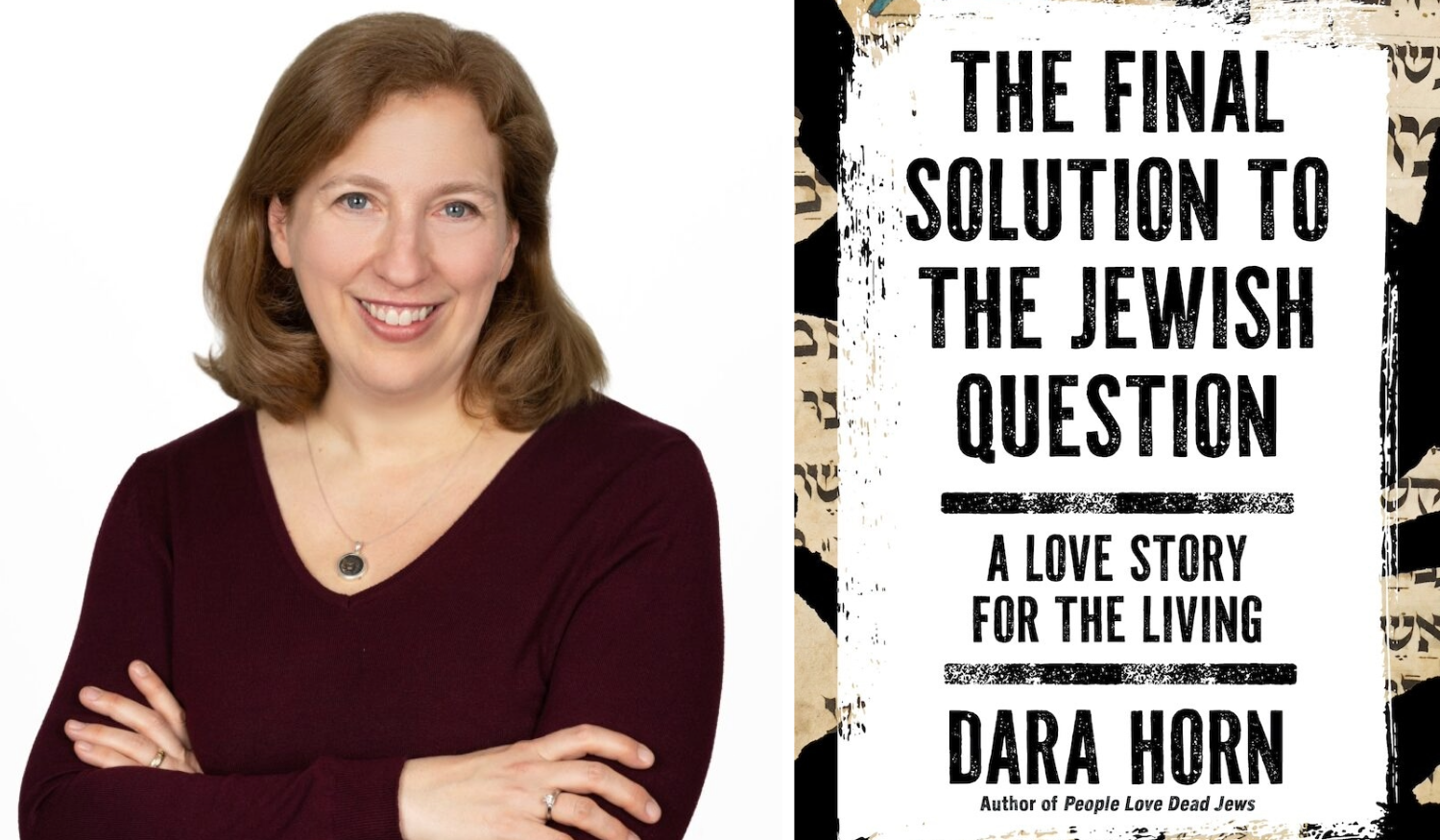
Five years after ‘People Love Dead Jews,’ the novelist’s new book reframes Jewish hatred as a lie about destruction — and tells Jews they don’t have to accept it
MISSILE MATH

The drawdown in U.S. stockpiles could complicate future efforts to defend Israel while deterring China, Iran and other adversaries
Plus, Mamdani's anti-Bibi video features in synagogue vandal's feed

Nathan Howard-Pool/Getty Images
Delegation staff members meet in the lobby during a quadrilateral meeting between the U.S., Iran, Pakistan, and Qatar at the Lake Lucerne Summit, aimed at advancing a deal to end the Middle East conflict at the Buergenstock Resort, Lake Lucerne on June 21, 2026 near Stansstad, Switzerland.
Good Tuesday afternoon.
This P.M. briefing is reserved for our premium subscribers like you — offering a forward-focused read on what we’re tracking now and what’s coming next.
Today’s Daily Overtime was curated by JI U.S. Editor Danielle Cohen-Kanik.
📡On Our Radar
Notable developments and interesting tidbits we’re tracking
Israeli Prime Minister Benjamin Netanyahu affirmed today that the IDF will “not withdraw from the current lines in Gaza until Hamas is completely disarmed.” President Donald Trump “thinks, and his team thinks, that Hamas can be totally disarmed and Gaza demilitarized. We’re looking into it,” Netanyahu continued in a video posted to Facebook in Hebrew. “They sent us a draft, we didn’t agree. It wasn’t our draft. We sent our responses”…
Evoking a sense of déjà vu, U.S. and Iranian officials are signaling a deal over the Strait of Hormuz is near at hand: Treasury Secretary Scott Bessent said on CNBC this morning that “there is a chance” the U.S. and Iran “may have a deal today or tomorrow to open” the strait, while Qatari Foreign Ministry spokesperson Majed al-Ansari told reporters that talks are in “very progressive stages” and that draft agreement language has been “circulated among the parties.”
Trump called Qatari Emir Tamim bin Hamad Al Thani this afternoon to discuss “ongoing efforts to deescalate tensions” between Washington and Tehran, the emir’s office said, in order “to bring their views closer together”…
Reuters reports that the U.S. Army has depleted“virtually all” of its long-range surface-to-surface missiles in the course of the war with Iran, raising concerns about readiness for future conflicts and the potential need to carry out riskier missions if hostilities with Iran escalate. The White House disputed the report, with Trump insisting that the U.S. has “far more munitions than anyone in the world”…
A brewery in Michigan apologized for hosting an event last night for Rep. Haley Stevens’ (D-MI) campaign for Senate ahead of today’s primary election due to her support for Israel, Jewish Insider’s Gabby Deutch reports.
“We DO NOT endorse Haley Stevens,” Pux Taphouse wrote on Instagram, claiming it was not aware the event was being hosted by the campaign. “We are heartbroken as we pride ourselves on being not only a queer friendly space but also have advocated and continue to call for a Free Palestine,” the company said…
A Florida man accused of hurling a brick through the front window of a Sarasota Chabad house shared New York City Mayor Zohran Mamdani’s video labeling Netanyahu a “war criminal” just days before the crime, JI’s Will Bredderman reports.
The Sarasota Police Department stated that the alleged perpetrator, Brayton Laschinger, had admitted to targeting the synagogue in an attack last week “because it was a Jewish place of worship” — and had blamed “propaganda on social media” for enraging him in the hours before the vandalism. An Instagram account bearing Laschinger’s name, and featuring photos of him dating back more than a decade, reposted the clip, which Mamdani had published the week prior to the attack…
The Anti-Defamation League called out far-left streamer Hasan Piker for promoting a conspiracy theory claiming Israel is behind the recent migration crisis in Ceuta, Spain, going as far as to claim on his Twitch stream that Israel is working to make the antisemitic text The Protocols of the Elders of Zion“come true.”
“Saying Israel looks at those conspiracy theories and decides to make them ‘come true’ shifts responsibility for antisemitism onto the Jewish state,” the ADL said…
The Colorado Democratic Party called on Victor Marx, the GOP nominee for governor, and other state Republicans to denounce an image that Marx and others have boosted of Phil Weiser, the state’s Jewish attorney general who is Marx’s opponent, depicting Weiser with devil horns, which critics have said evokes a classic antisemitic trope.
Montrose County Commissioner Sean Pond, who created the image, claimed he was unaware Weiser is Jewish and said, “Weiser does not receive immunity from political satire because of a personal fact I did not even know”…
Supreme Court Justice Sonia Sotomayor declined a request by the Palestinian Authority and Palestine Liberation Organization to pause a $656 million judgment won by families of American victims of Palestinian terror attacks during the Second Intifada. The PA and PLO had argued that paying the sum now would “destabilize” government services in the West Bank as the bodies appeal the ruling…
Ellen Germain ended her five-year tenure as the State Department’s special envoy for Holocaust issues last week; it remains unclear if someone else will be tapped to lead the office — which deals with issues including restitution of Holocaust-era assets, Holocaust remembrance and combating Holocaust denial around the world — or if its remit will be wrapped into the Office of the Special Envoy to Monitor and Combat Antisemitism, currently headed by Rabbi Yehuda Kaploun. Jewish communal organizations have advocated both for and against the prospect of the consolidation…
Paramount Skydance CEO David Ellison spoke out in a New York Times op-ed against those who oppose Paramount‘s ongoing acquisition of Warner Bros. Discovery, which he argued is at its core a concern about his own political views. “I have regularly voted for candidates of both parties; I hold some views that would be called conservative and others that would be called liberal, just like most Americans; and when it comes to our news operations, I do not aspire to lead these companies to bend their newsrooms to my views,” he wrote…
⏩ Tomorrow’s Agenda, Today
An early look at tomorrow’s storylines and schedule to keep you a step ahead
Keep an eye on Jewish Insider for election results from key races taking place today in Michigan and Missouri.
Talks between Israel and Lebanon will continue in Rome, where technical teams are working to advance the pilot zone process, Hezbollah’s disarmament and the IDF’s redeployment from southern Lebanon, the State Department said today.
Democrats on the Senate Judiciary Committee’s Federal Courts subcommittee are planning to boycott a hearing tomorrow set to examine Muslim Brotherhood networks in the United States, Jewish Insider’s Marc Rod reports, calling the hearing a “political creepshow” designed to attack Muslims broadly.
The Senate Foreign Relations Committee will receive a classified update on the ongoing civil war in Sudan.
Stories You May Have Missed
SOUTH CAROLINA STATE OF PLAY
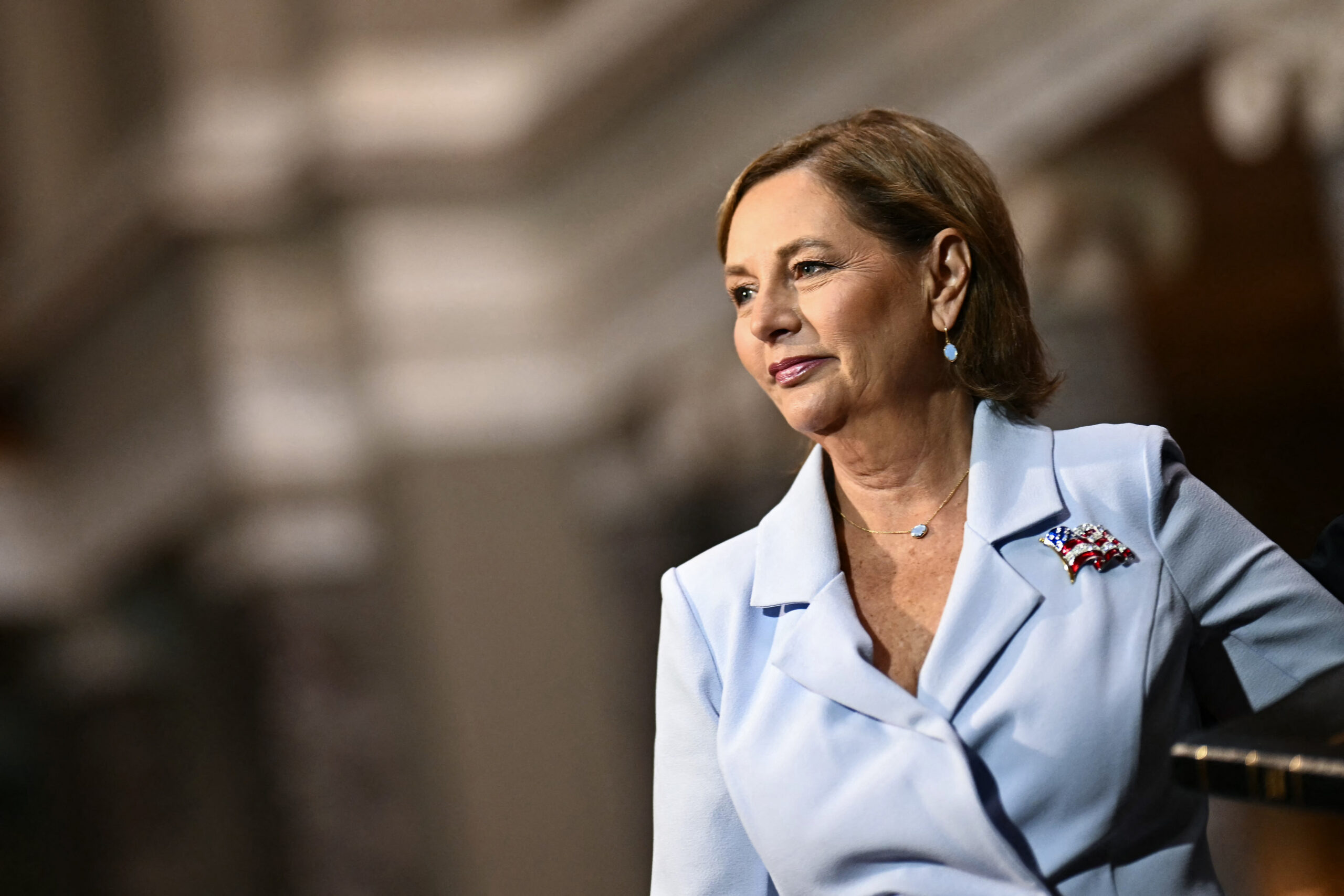
Polls show she’s largely unknown to South Carolina voters as she struggles to win a majority of Republican support
MONEY MATTERS

Only 20% of the more than 8,000 institutions that requested funding ultimately received it
Polls show she’s largely unknown to South Carolina voters as she struggles to win a majority of Republican support
Kent NISHIMURA / AFP via Getty Images
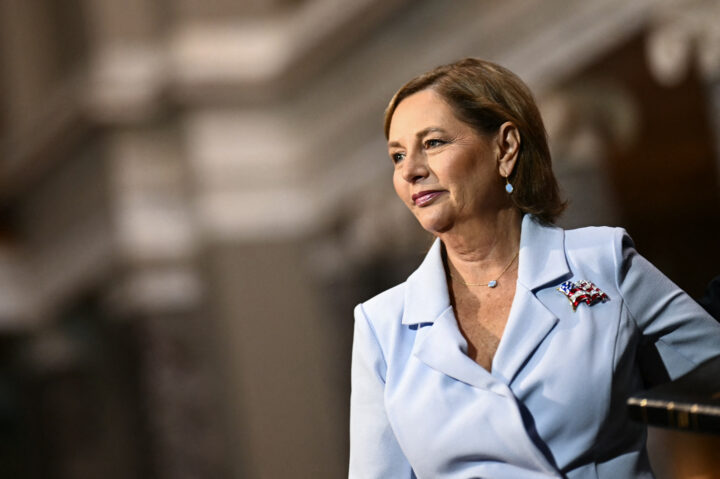
Darline Graham, sister of Lindsey Graham, looks on during her ceremonial swearing in to become a U.S. Senator on July 14, 2026.
Sen. Darline Graham’s (R-SC) bid to succeed her late brother in the Senate is facing growing skepticism from Republican operatives and lawmakers who say President Donald Trump’s endorsement is unlikely to spare her from a runoff in South Carolina’s special GOP primary next week.
Over the last week, six senior GOP campaign operatives and Republican lawmakers told Jewish Insider that they believe a runoff is all but certain after the Aug. 11 special election primary, with most predicting Graham will not be able to clinch a majority of the vote to avert one as her brother, the late Sen. Lindsey Graham (R-SC), did with his June primary victory.
While Republicans believe Graham will be one of the top two candidates in the race, thus allowing her a spot in the Aug. 25 runoff, they are still unsure whether she will face Rep. Ralph Norman (R-SC) or Rep. Russell Fry (R-SC) in that contest. Those who spoke to JI expressed skepticism that Graham could win a head-to-head showdown, despite having Trump’s coveted primary endorsement.
“The sense that this is going to go to a runoff seems pretty clear,” Doug Heye, a Republican strategist who served as communications director for the Republican National Committee and a deputy communications official for former House Majority Leader Eric Cantor (R-VA), said. “What happens after that is anyone’s guess.”
“Ultimately, it’s going to be a question of what Republican voters in South Carolina want to do and how they view the new Sen. Graham,” he continued. “You can’t really factor in what she’s done yet, but you know what she says she’s going to do. She doesn’t have a high name ID, although that is increasing every day, whereas the others who are running have much higher name ID and not just necessarily in their districts.”
The uncertainty surrounding the race has caused some to worry about Graham entering a competitive election contest, which will require her to develop a full policy platform and hit the campaign trail as she mourns her brother’s recent death.
“It’s being said and unsaid by a lot of people on Capitol Hill right now. Up to this point, most people here have been more concerned about her personally than figuring out her political philosophy, asking if it’s fair to her to put her in this situation,” a Republican senator told JI. “This has got so many consequences. I’ve been very concerned about it. The people who express concern the most are still mainly worried about her personally, which is heartwarming, but the stakes are also very high.”
Four sources noted that Trump’s support for Graham did not deter Norman or Fry from entering the contest, nor has it hurt either of their performances in recent primary polling.
“There really is an appetite for change, but also for someone who is known, who has a proven record,” a GOP campaign source said. “Love them or hate them, folks know what Ralph and Russell’s records look like. Love them or hate them, you know where they stand. Darline is largely an unknown.”
Republican sources pointed to issues around voter turnout, Graham’s ability to fundraise quickly enough on the compressed campaign schedule, her lack of political background or voting record and the possibility of her losing support if portrayed to voters as being anointed to the role.
Darline Graham should be able to benefit from some of the leftover cash in her brother’s campaign account. Lindsey Graham’s campaign filed a statement with the Federal Election Commission after his death reporting $2.3 million in remaining funds.
Lindsey Graham’s campaign was able to transfer some of that money to the National Republican Senatorial Committee, the Senate GOP campaign arm, for Darline Graham to use for her campaign, according to two sources with direct knowledge of the situation. The figure expected to be transferred is under $1 million, one source confirmed, leaving Darline Graham with a possible cash disadvantage for the primary and the general election, where the Republican nominee will face Dr. Annie Andrews, a pediatrician who handily won the Democratic primary in June and has proven to be a strong fundraiser.
Prior to Lindsey Graham’s passing, Andrews drew attention for outraising the incumbent senator in the first two quarters of 2026. Despite the fundraising success, national Democrats declined to commit resources to the race against Graham, which the Cook Political Report continues to rate as solid Republican even after his death.
Sens. Rick Scott (R-FL) and Mike Lee (R-UT) got behind Norman’s campaign before Graham had entered; once she did, she quickly secured her own endorsements from three members of Senate GOP leadership: Senate Majority Whip John Barrasso (R-WY); Senate Republican Conference Chairman Tom Cotton (R-AR); and Senate Republican Policy Committee Chairwoman Shelley Moore Capito (R-WV).
Senate Majority Leader John Thune (R-SD) said after Graham announced her candidacy that he would not be weighing in with an endorsement, though he praised the incumbent senator as a “strong candidate” who “obviously carries on Lindsey’s legacy.”
Beyond those who have already endorsed her, Graham does not appear to have asked her other Republican colleagues in the Senate for their backing, according to two Republican senators and one senior GOP Senate staffer. The senators suggested that perhaps Graham was not in the right frame of mind to ask about endorsements herself, though both senators expressed surprise that no one from Graham’s campaign had made those overtures on her behalf.
“Many of us had never met her before. All I knew was how much Lindsey adored her. He talked about her a lot. He referenced her a lot. He’d take her call whenever it happened to be,” a GOP senator told JI of Graham. “But we don’t have a clue how Republican she is. I don’t have the faintest idea what her basic philosophies are.”
“She hasn’t asked me or the members that I’ve talked to,” one GOP senator told JI on condition of anonymity of Graham seeking out endorsements late last week. “If she isn’t asking and nobody is asking on her behalf, she sure as heck won’t get a lot of them. Maybe she’ll get around to that next week now that she’s on the job full time. It’s kind of a pivotal week, I would say.”
Graham has picked up one House endorsement from Rep. William Timmons (R-SC), who opposes Norman’s candidacy, while Norman has been endorsed by Rep. Nancy Mace (R-SC) and former Rep. Bob Good (R-VA). He also has the support of former White House Chief of Staff Mark Meadows, who served with Norman in the House.
The slow drip of congressional endorsements have since ground to a halt, as it became clear that Graham’s surprise campaign launch and Trump’s support for her candidacy had not deterred her Republican opponents or hurt their polling numbers.
“Many of us had never met her before [she was sworn in to serve out the remainder of her brother’s term]. All I knew was how much Lindsey adored her. He talked about her a lot. He referenced her a lot. He’d take her call whenever it happened to be,” a GOP senator told JI of Graham. “But we don’t have a clue how Republican she is. I don’t have the faintest idea what her basic philosophies are.”
“She’s still grieving,” a senior GOP campaign official involved with the race told JI. “Nobody wants to be seen hitting someone whose brother literally just died — and then was vaulted into a very public, very national spotlight — but at some point the gloves are gonna have to come off at least somewhat.”
“I suspect that being through what she’s been through the last couple of weeks, reliving his whole life basically in written word and broadcast and even just storytelling, she’s probably getting a pretty good lesson if she’s still forming her positions,” the senator continued. “I doubt she’s 180 degrees from him, but I don’t know what’s in her heart.”
Several Republicans have expressed concern that voters would respond poorly to the idea of Graham running while mourning the loss of her brother. They also worry about the possibility that the contest turns negative and the consequences of that shift.
“She’s still grieving,” a senior GOP campaign official involved with the race told JI. “Nobody wants to be seen hitting someone whose brother literally just died — and then was vaulted into a very public, very national spotlight — but at some point the gloves are gonna have to come off at least somewhat.”
One Republican senator told JI that they were “afraid it could be a brawl before it’s over, especially if her opponent feels like they’re up against a wall and corners her. We know how this goes.”
“If they get to a runoff, at that point, it is a whole new ball game and she’s no longer a grieving sister. She becomes a semi-incumbent obstacle to whoever wants to win,” the senator said. “These things happen faster nowadays. We have short memories.”
The South Carolina senator faced her four leading opponents in a televised debate on Monday evening. Graham was joined on the debate stage by Norman, Fry, former Gov. Mark Sanford (R-SC) and Mark Lynch, a MAGA-aligned businessman who lost to Lindsey Graham in last month’s primary by 30 points.
The debate was largely respectful, though Graham called out Lynch in her closing statement for repeatedly criticizing her late brother while on stage. “I don’t know if I can rebut, but Mr. Lynch mentioned Lindsey Graham multiple times. I don’t know if he’s just afraid Lindsey beat him and now his little sister is going to beat him, but I just don’t like hearing that,” Graham said.
Graham used the debate to highlight where she and her late brother agree and disagree on policy matters, emphasizing their shared support for the U.S. war in Iran and how they diverge on the filibuster, which Darline Graham said she supports abolishing to pass the Save America Act despite her later brother’s opposition to the move.
It is unclear if the two candidates who advance to the runoff, should one be triggered, will hold another debate.
“Lindsey just made his way through a pretty contentious primary himself, and there is a degree of the primary electorate that was not a fan of his. I think that segment will still be very much adamantly opposed to this because they’ll see it as a continuation of the policies that they don’t support,” a senior GOP campaign source said. “Ralph Norman is a little bit better positioned to capture some of these hardcore conservative voters. I think she’ll have a difficult time even with the president’s endorsement.”
“This is potentially a race where debates could have a real impact, in part because this would be part of her introduction statewide as a candidate,” Heye said. “In moments like that where you have somebody in that situation, it’s very important for the other people on stage, including the moderators, to be appropriately respectful.”
While several Republicans acknowledged Trump’s endorsement as a key booster for Graham, they pointed out that her late brother, who was known to be close to the president, struggled in his own primary.
“Lindsey just made his way through a pretty contentious primary himself, and there is a degree of the primary electorate that was not a fan of his. I think that segment will still be very much adamantly opposed to this because they’ll see it as a continuation of the policies that they don’t support,” a senior GOP campaign source said. “Ralph Norman is a little bit better positioned to capture some of these hardcore conservative voters. I think she’ll have a difficult time even with the president’s endorsement.”
Heye noted to JI that, “Not everything that happens in a Republican primary is about Donald Trump. His endorsement is always a boost, but that’s it.”
Reached for comment, Graham campaign press secretary Abby Zilch told JI in a statement, “Sen. Darline Graham has had to work hard for every single thing she’s ever done — running for the United States Senate will be no different. That’s just one of the many reasons why President Trump has endorsed her and why so many South Carolinians see a true fighter in this campaign.”
Robert Greenway predicted that reduced Iranian threat would make it easier for Arab states to join the Abraham Accords

Aspen Security Forum
Robert Greenway speaks at Aspen Security Forum, July 17, 2026.
ASPEN, Colo. — Robert Greenway, who led the Middle East and North Africa portfolio on the National Security Council during President Donald Trump’s first administration, predicted to Jewish Insider in an interview last month that the Iranian regime would not “make it” to the end of Trump’s time in office.
Greenway’s comments came amid the resumption of hostilities between the U.S. and Iran in late July, following the collapse of the countries’ memorandum of understanding, prior to the latest pause in U.S. strikes.
“We’ve really put ourselves in a position where we’ve got massive leverage. Their economy is virtually non-existent. I think it’s dead. We’re just waiting for the funeral, I think their political leadership is in turmoil,” Greenway said in an interview on the sidelines of the Aspen Security Forum. “The military has been decimated, and very little capacity remains to threaten the United States and our interests. That’s the reality of it. Despite claims to the contrary — those are not serious claims. They’re not supported by the facts.”
Greenway said that the administration’s military success had allowed it to “indulge a potential diplomatic path” that it knew was “unlikely” to actually succeed.
After the war, Greenway said that the U.S.’ regional approach should include working to contain Iran, building on the burgeoning regional security architecture developed with other Middle East allies and expanding the Abraham Accords. He was bullish about the chances for expanded normalization in spite of the apparent obstacles created by the wars in Gaza and Iran.
“The destruction [and] the attrition [in] Iran lowers the price of admission” for the Abraham Accords, Greenway said. “The math equation works here because we’ve reduced the Iranian threat. So there isn’t a massive requirement for us to provide enormous capabilities” to Arab states as a price for normalization.
Greenway was involved in negotiating the Abraham Accords during Trump’s first administration and continued to work to promote normalization after leaving the administration, first as the executive director of the Abraham Accords Peace Institute and later as the director of the Allison Center for National Security at the Heritage Foundation.
“Getting Saudi Arabia and the other states integrated into the region with Israel and expanding the accords is different now than it was a year or four years ago,” Greenway continued. “But it is still, I think, practical, necessary and achievable.”
He was dismissive of Saudi statements that the kingdom intends to condition normalization on a path to a two-state solution, arguing that such statements are a “public rhetorical mechanism that serves a purpose” but won’t be enforced in practice.
Greenway was a member of the Heritage Foundation when the group issued a report last year — which was controversial at the time — calling for the gradual phasing out of U.S. military aid to Israel. In the months since, the concept has been endorsed by Israeli Prime Minister Benjamin Netanyahu and some American supporters of Israel, and most observers expect that a drawdown of direct financial support will be a component of the next U.S.-Israel memorandum of understanding.
He said that phasing out U.S. aid would insulate Israel from American attempts to exert leverage over Jerusalem, such as that undertaken by the Biden administration. He said that the threat of growing Democratic shifts against Israel are a key reason for the U.S. to work to ensure that Israel no longer needs aid.
“Let’s improve Israel’s economy, let’s improve the trade that exists between our two countries, the security cooperation that exists between our two countries and our industries, and let’s improve Israel’s relationship to its neighbors, and if we can, reduce the threat,” Greenway said of the path to phasing out aid.
But he also said that aid should only be phased out “if Israel was in a financial position to do it, and its security relative to its neighbors was increased.”
He argued that Israel “doesn’t want” the U.S. involved in its relations with the Palestinians. Instead, he said the U.S. can best help Israel through economic ties and working to broker relationships with its neighbors, things Israel “can’t do … for itself.”
Greenway — as a Trump ally — was something of an outlier at the Aspen conference, which has generally attracted more traditional internationalist voices on the left and right. He said he wanted to urge the attendees to judge Trump and his administration by their results, rather than by rhetoric.
He pointed to the administration’s policy on Russia as one example. He argued that, while Trump has been accused of “coddling” Russia, he’s managed to severely damage Russia’s economy as well as press European countries to curtail their energy purchases that had been fueling Russia’s war machine.
“That actually, concrete, matters, right? And again, if you’re using a different lens and arbiter to look at how policies actually succeed or prevail or not, you can get to dangerous places,” Greenway said.
Greenway was also involved in crafting the Project Esther antisemitism strategy at the Heritage Foundation. Asked about how to avoid the encroachment of antisemitism on the right, Greenway pointed back to that strategy, and argued that Republicans have been more successful in fighting antisemitism in their party than Democrats.
“Republicans aren’t electing high officials that hold antisemitic principles and anti-Israel positions,” Greenway said. “I can’t say the same for the Democratic Party. … You cannot, as a Republican, stand up and make antisemitic comments and expect to survive, much less win an election or even become a candidate representing the party. It just isn’t going to happen.”
But he also said that there is a “very real struggle” to resist those trends and the problem of growing youth antisemitism crosses party lines, a phenomenon he blamed on conservatives “losing control of curricula and institutions and education.”
He said conservatives should work to reform educational systems and have zero tolerance for antisemitism.
Plus, Iran’s ‘unbelievably duplicitous’ leaders irk Trump

Amir Levy/Getty Images
Israeli tanks stationed near the border with the Gaza Strip on September 17, 2025 in southern Israel.
Good Monday afternoon.
This P.M. briefing is reserved for our premium subscribers like you — offering a forward-focused read on what we’re tracking now and what’s coming next.
Today’s Daily Overtime was curated by JI U.S. Editor Danielle Cohen-Kanik.
📡On Our Radar
Notable developments and interesting tidbits we’re tracking
President Donald Trump lambasted Iranian leadership today, calling the regime “unbelievably duplicitous” for contradicting his claim that Washington and Tehran are currently conducting negotiations, after Iranian Foreign Ministry spokesperson Esmail Baghaei said that Tehran was only in discussion with Oman about the Strait of Hormuz and had no plans to speak to the U.S.
Trump claimed in his Truth Social post that the regime had “begged” for a meeting, “with more scheduled in the immediate future,” adding, “whether Iran wants to admit it or not, we are, in fact, talking of a solution to a problem that they have caused, for decades.” Trump later told reporters that the talks were “a last chance for Iran to sign a good document” and that he wants to give Iran “every last chance before decapitation”…
Board of Peace head Nickolay Mladenov held a “constructive and detailed” meeting with Israeli Prime Minister Benjamin Netanyahu today, the board said, after the IDF continued to strike targets in Gaza over the weekend — in contravention of the Board of Peace’s Hamas disarmament plan, which called for the immediate cessation of hostilities in the enclave.
The board clarified that the IDF’s withdrawal beyond the yellow line in Gaza “will take place only once decommissioning [of Hamas’ weapons] is complete,” including all light and heavy weapons as well as terror tunnels. Netanyahu has yet to officially comment on the deal, but a senior Israeli spokesman said earlier today that the agreement “does not reflect Israel’s positions” and another Israeli official declared that the IDF “will not withdraw from the current line in the Gaza Strip”…
Israeli President Isaac Herzog received the credentials of the new ambassadors from Chile and Honduras today; the two Latin American countries had pulled their ambassadors from the Jewish state shortly after the Oct. 7, 2023, Hamas terror attacks in protest of the war in Gaza but have since elected new conservative governments that have sought to strengthen ties with Jerusalem…
Education Secretary Linda McMahon sent a letter to every university in the country today asking their leadership to publish by the end of the year a statement committing to principles including transparency in admissions, free speech, diversity of thought and keeping foreign influence out of academics.
Yeshiva University President Rabbi Ari Berman applauded the initiative, which came after most universities rejected a compact from the Trump administration last year that had asked them to agree to a set of ideological principles in order to receive federal funding, and said YU would participate in the effort to rebuild public trust of higher education…
Brown University President Christina Paxson announced today that she will step down at the end of the 2026-27 academic year, concluding her 15-year tenure at the Ivy League, during which the school increased Jewish student enrollment even as most peer institutions experienced significant drops, Jewish Insider’s Haley Cohen reports…
As the Israel on Campus Coalition’s National Summit continues in Washington, Noah Pollak, a senior advisor at the Education Department, debated Jonathan Rauch, a senior fellow at the Brookings Institution, on whether the Trump administration’s crackdown on campus antisemitism has protected or threatened America’s liberal norms. After the debate, where Pollak argued in favor of the policy and Rauch argued against, students who were polled in the audience shifted their views to align more with Rauch, JI’s Haley Cohen reports…
New hate crime data released by the NYPD shows an uptick of 8.5% in hate crimes against Jews in New York City this year so far, accounting for more than half of all hate crimes in the city, despite Jewish New Yorkers only accounting for 10% of the city’s population…
A New York man was indicted on hate crimes charges on Friday for repeatedly vandalizing a kosher bagel shop, weeks after he was indicted for manslaughter for killing a prominent Jewish community member in a car crash…
Author Alyssa Rosenheck pushed back on arguments raised by Bell Bird Books, a local bookstore in Nashville, Tenn., that canceled a book launch event for Rosenheck’s White. Blond. Jew.,which the bookstore claimed was due to security concerns. Rosenheck said she had personally paid for a private firm to secure the event and was told there were no outstanding security concerns, alleging that the event was canceled “because I’m an unapologetic Jewish voice … and it provokes an online mob of hate”…
Trump is considering removing Jeanine Pirro, the U.S. attorney for the District of Columbia, according to CNN, after he said today that she “folded like an umbrella” when she withdrew a case against an alleged vandal of the Reflecting Pool and instead blamed the Interior Department for its botched renovation…
⏩ Tomorrow’s Agenda, Today
An early look at tomorrow’s storylines and schedule to keep you a step ahead
Keep an eye on Jewish Insider for a look at Sen. Darline Graham’s (R-SC) bid for a full term in the Senate, where she is facing headwinds despite having secured President Donald Trump’s endorsement.
We’ll be watching tomorrow’s Democratic primaries in Michigan and Missouri — the sharpest tests yet of the party’s divide over Israel. In Michigan’s Senate race, far-left Abdul El-Sayed seems the favorite in recent polling over Rep. Haley Stevens (D-MI); in Missouri, Rep. Wesley Bell (D-MO) faces a rematch with former Rep. Cori Bush (D-MO). Also on the Michigan ballot: the battleground 7th District, where DSA-backed William Lawrence is the front-runner, and the 11th District, where Jewish state Sen. Jeremy Moss is running to succeed Stevens. Kansas, Virginia and Washington state will also hold their primaries tomorrow.
Israeli and Lebanese representatives will meet tomorrow to begin another round of U.S.-led negotiations in Rome. U.S. Ambassador to Lebanon Michel Issa sounded a cautious note today on the ongoing trilateral agreement, as the Lebanese Armed Forces and the IDF continue to work toward establishing the fragile pilot zones in southern Lebanon: “A great deal of technical work remains to ensure civilian safety on the ground,” Issa said. “There is a meaningful difference between drafting an agreement on paper and implementing it responsibly — moving too quickly risks jeopardizing the very civilians this process is meant to protect.”
The Senate Judiciary Committee is set to vote tomorrow on whether to advance acting Attorney General Todd Blanche‘s nomination to lead the Justice Department, after Sens. John Cornyn (R-TX) and Thom Tillis (R-NC) dropped their opposition to his nomination when the administration agreed to rescind its $1.8 billion “anti-weaponization” fund.
Stories You May Have Missed
MICHIGAN MOVES
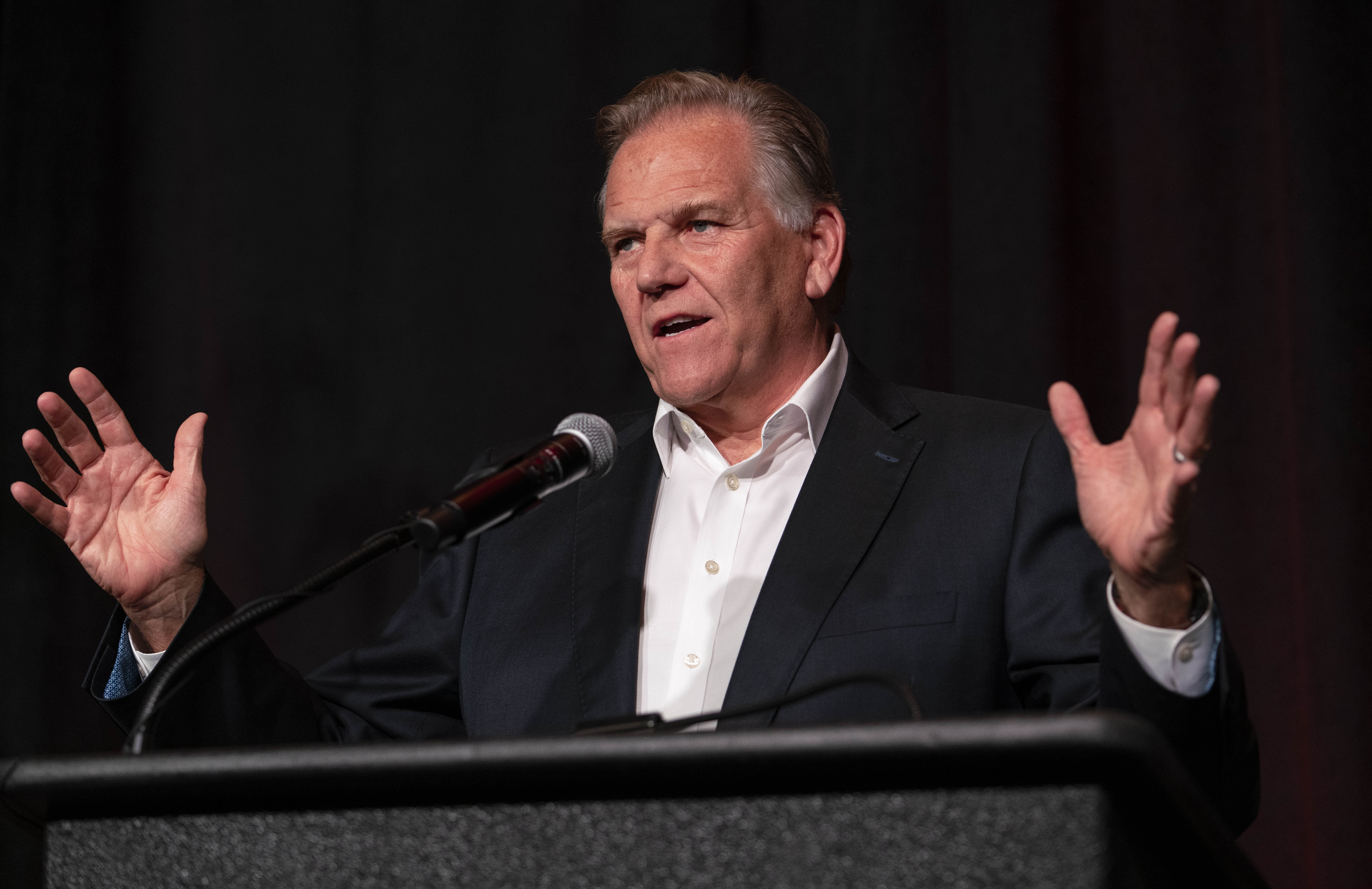
For many Jewish Democrats in Michigan who have long called the party home, the bruising lead-up to the primary on Tuesday has been difficult to experience
CAMPUS CLIMATE
‘The assumption is that it’s better by virtue of there being no encampments right now, there’s no buildings being sieged. But that being the bar is ridiculous,’ Columbia student Noah Lederman said of the challenges on campus
The president thanked Turkey, Qatar and Egypt for mediating the deal that will see the IDF withdraw from Gaza and the International Stabilization Force take over

Omar AL-QATTAA / AFP via Getty Images
Members of Palestinian Hamas' Ezzedine Al-Qassam Brigades and Islamic Jihad's Quds Brigades are deployed at intersections in Gaza City on March 20, 2026.
President Donald Trump announced on Thursday that the Board of Peace had reached a “historic” agreement for the “complete disarmament” of Hamas and all other armed groups in Gaza, calling it a “monumental step toward lasting PEACE and SECURITY.”
Trump said in a post on Truth Social that the agreement would be “carried out carefully in structured phases,” and that the IDF would withdraw when Hamas’ disarmament is “completed.”
The president said that moving forward, “the International Stabilization Force will work with a new Palestinian police force to take responsibility for Gaza being safe for its residents and neighbors.” He emphasized that the transition represents a critical step toward establishing a government that works for Palestinians while not posing a threat to Israeli security.
“The threat that emerged from Gaza on October 7 will NOT be allowed to rebuild!” Trump wrote. “Under this agreement, Gaza will finally be in the hands of a new Palestinian government that serves its PEOPLE.”
Trump said the ultimate goal is for the Palestinian government, ostensibly a reference to the technocratic government established under the Board of Peace, to “work closely” with the board and oversee a Gaza “no longer used as a base for terror attacks.”
He also thanked Turkey, Qatar and Egypt for their role as mediators whose “important efforts” made “this historic breakthrough possible.”
Following the announcement, a senior U.S. official said in a call with reporters on Thursday evening that the document is “an agreement by Hamas to follow through on the decommissioning” of its weapons as well as its terror tunnels. The official noted that Iran tried to “convince [Hamas] not to do this deal,” but in the end, “the final communication came through the mediators that Hamas has agreed.”
“There were a lot of concerns that [Hamas] had about what would happen to them — would Israel honor its commitments if they did that? — it’s been a very delicate negotiation and discussion with them over the past months that have led us to this breakthrough where we have an understanding of what needs to be done,” the U.S. official said. “We’ll hopefully work over the next weeks to start putting it in motion.”
Text of the deal released on Friday by the Board of Peace indicates the process will be carried out over three years, and requires that Israel immediately end all military operations in the Gaza Strip, to eventually withdraw completely from the enclave.
Hamas must relinquish its heavy weapons, military production sites, depots of weapons and terror tunnels in a process linked to the IDF’s phased withdrawal, and personal weapons will be “subject to the regulations of relevant Palestinian laws.” At the end of the process, “only [the new technocratic government] shall hold, store or control weapons in Gaza,” the agreement reads.
Ghazi Hamad, a senior Hamas figure, told Al Jazeera, “We will not take any action regarding disarmament prior to Israel’s withdrawal from the Strip.”
Meanwhile, Reuters cited an Israeli official as having said, prior to Trump’s announcement, “Israel demands the complete disarmament of Hamas, including the removal of weapons from Gaza and the complete demilitarization of the Strip as a precondition for any process.”
A Board of Peace official told reporters that the plan includes U.N. Security Council Resolution 2803, in which the U.N. endorsed Trump’s Gaza peace plan, stating that “for the first time, effectively, Hamas and the Palestinian factions have agreed to accept this entire framework and have agreed on a way to implement it.”
They noted that the framework includes “everything from demilitarization and de-radicalization to the transfer of civilian authority in Gaza to the transfer of security authority in Gaza as well to the national committees,” along with “a full monopoly on weapons.”
The Board of Peace official said that the board will implement a “verification committee” in order to ensure the plan’s objectives are being met. They noted that weapons will be transferred to the technocratic government.
Officials added that the ISF has secured commitments for over 5,000 troops from various nations. The force will help train Palestinian police, oversee the decommissioning of weapons and act as a buffer between Israeli and Palestinian forces during the IDF withdrawal. Meanwhile, a newly trained Palestinian police force will handle internal security, taking over from Hamas.
Asked whether the board would seek the involvement of the Palestinian Authority, the official said that “for the time being, we’re trying to just do something new.”
“They [the PA] have to show that they can run the West Bank and do reforms,” the official said. “If the PA shows that they do a good job … then obviously the discussion could be open.”
The official said that despite “a lot of criticism, particularly in Israel,” about the involvement of Turkey and Qatar in the Board of Peace, they noted that the two Arab nations, along with Egypt, have been “essential partners … in getting to this stage.”
The Board of Peace official said that the negotiations were “very complicated,” given that the two sides “do not trust each other.”
“From Day One, we heard the same thing both from Hamas and Israel, that they absolutely do not trust each other,” the official said. “So we built this entire proposal that we took to them on the basis of zero trust … everything that is in it is conditional, and it needs to be verified. No side is being asked to do something without that being confirmed and by reciprocity from the other side.”
“The first step is getting a framework, getting the de-escalation, getting the humanitarian issues resolved, having a plan forward … and so we’re going to do it as quickly as we can,” the official added. “But it can get slower, and hopefully both sides will cooperate in an appropriate way. And if they don’t, we’ll deal with it accordingly, like we have the last months.”
A senior U.S. official told reporters, “We’re not asking Israel to do anything that isn’t in the 20-point plan that they agreed to initially, and so we’re very confident they will adhere to it. If they don’t, President Trump would be very, very disappointed.”
Plus, Columbia student union drops BDS demand

Chip Somodevilla/Getty Images
Michigan Attorney General Dana Nessel speaks on stage during the third day of the Democratic National Convention at the United Center on August 21, 2024 in Chicago, Illinois. Delegates, politicians, and Democratic Party supporters are in Chicago for the convention, concluding with current Vice President Kamala Harris accepting her party's presidential nomination.
Good Thursday afternoon.
This P.M. briefing is reserved for our premium subscribers like you — offering a forward-focused read on what we’re tracking now and what’s coming next.
Today’s Daily Overtime was curated by JI U.S. Editor Danielle Cohen-Kanik.
📡On Our Radar
Notable developments and interesting tidbits we’re tracking
Michigan Attorney General Dana Nessel, who is Jewish, said today at an antisemitism roundtable with local Jewish community leaders that she will not be attending the Michigan state Democratic Party convention in August because she would not feel safe there…
A new Emerson College pollof the Democratic primary for U.S. Senate in Michigan found far-left candidate Abdul El-Sayed surging ahead of Rep. Haley Stevens (D-MI) by 15 points, 54-39%…
The American Association of University Professors issued its first-ever political endorsement in its 110-year history today, backing El-Sayed ahead of next week’s primary. The professional organization has repeatedly faced criticism from Jewish groups and faculty members for straying from its mission by engaging in anti-Israel advocacy…
An Emerson College poll of next month’s special primary election to replace the late Sen. Lindsey Graham (R-SC) on the ballot in South Carolina found Rep. Ralph Norman (R-SC) at the top of the pack, leading Sen. Darline Graham (R-SC) 22-19%, with a quarter of likely primary voters still undecided. If no candidate receives a majority, the top two vote-getters will advance to a runoff…
Columbia University’s student workers’ union dropped its demand that the university divest from Israel during a bargaining session on Tuesday, the Columbia Spectator reports, in a significant reversal of the union’s pro-Boycott, Divestment and Sanctions advocacy. Union President Grant Miner claimed the move was a natural part of the negotiation process: “As you bargain, you have to face the realities of where you are.”
Columbia is also set to open its global center in Tel Aviv this summer, professor Nadav Eyal said on an episode of Dan Senor’s “Call Me Back” podcast earlier this week. Plans for the center were announced in April 2023, but have been on hold since the Oct. 7 attacks…
Former Wisconsin Lt. Gov. Mandela Barnes dropped out of the Democratic primary for governor today. Barnes said in his announcement video that it’s “very clear who our nominee is going to be,” in an apparent reference to Democratic Socialists of America-backed Francesca Hong, though he did not offer her his endorsement.
Barnes dropped out shortly before The Milwaukee Journal Sentinel reported that the Wisconsin Democratic Party had investigated allegations in 2025 that he had taken advantage of his role in the party for sexual encounters with young women…
Negotiations between mediators and Hamas, taking place on Thursday in Cairo, are “making progress” on disarmament, a diplomatic official told The Times of Israel. The plan under discussion would see “all weapons decommissioned” as well as “the elimination of all tunnels, depots of weapons and any weapons production facilities” in Gaza, the official said…
Iranian hackers may have been behind a cyberattack on dozens of municipal water systems this week in Minnesota, state and federal officials told The New York Times…
The Iran-backed Houthi terror group, which is based in Yemen, reportedly attacked Saudi Arabia this week from Iraqi territory. The group may have operated with the assistance of militias in the country working with the Islamic Revolutionary Guard Corps, in an indication of the growing coordination between Tehran’s proxies…
Amid the renewed attacks it has faced from both Iran and the Houthis, Saudi Arabia hosted dozens of military officials from around the world, including the U.S., for a meeting today to establish a maritime defense alliance. Thirteen countries joined Riyadh in signing a statement of support for the effort: Kuwait, Bahrain, Qatar, Pakistan, Turkey, Egypt, Jordan, Yemen, Bangladesh, Nigeria, Sudan, Djibouti and Somalia…
The Senate narrowly blockedanother push by Democrats today to force an end to the Iran war, 50-49, with Sens. Susan Collins (R-ME), Lisa Murkowski (R-AK) and Rand Paul (R-KY) again breaking with their party to vote for the war powers resolution and Sen. John Fetterman (D-PA) voting against it…
The share of Israelis who believe President Donald Trump is “highly committed” to protecting Israel’s security interests has dropped to a new low, according to a survey from Tel Aviv University’s Institute for National Security Studies.
The organization’s July 2026 National Security Survey found that only 14% of Israelis believe the country’s security interests are a top concern for Trump, representing a significant drop from the 35% recorded in March, Jewish Insider’s Matthew Shea reports…
Sen. Rick Scott (R-FL) argued today at the Hudson Institute that, without regime change in Iran, the U.S. will likely need to continue to conduct periodic military operations against Iran’s nuclear program to prevent Tehran from obtaining a nuclear weapon, JI’s Marc Rod reports…
⏩ Tomorrow’s Agenda, Today
An early look at tomorrow’s storylines and schedule to keep you a step ahead
Keep an eye on Jewish Insider for a look at the dynamics in the Democratic primary for the congressional seat being vacated by Rep. Haley Stevens (D-MI), where Jewish state Sen. Jeremy Moss’ challengers are targeting him for his ties to pro-Israel donors.
President Donald Trump is expected to hold a Cabinet meeting tomorrow at the historic Camp David retreat in Maryland.
The Democratic Socialists of America will hold its annual organizing conference this weekend in Chicago, where some programming will focus on “anti-imperialist and pro-Palestine organizing strategy” to end the “U.S.-Israeli genocide in Palestine.”
We’ll be back with the Daily Overtime on Monday. Shabbat shalom!
Stories You May Have Missed
LOSING YOUR HERITAGE

A former trade policy analyst at the conservative think tank said that many new hires were fixated on conspiracy theories about the Holocaust
SECURITY CONCERN

The agency said state administrative agencies and the extended DHS shutdown caused the lengthy delay in issuing the grants
The INSS survey found that only 14% of Israelis now believe the country’s security interests are a top concern for the U.S. president — down 12 points since earlier this month

AHMAD GHARABLI / AFP via Getty Images
A photograph shows a banner depicting US President Donald Trump with the slogan "The Deliverer" in Jerusalem on April 20, 2026. Iran is not currently planning to attend talks with the United States, state media said, after the US president ordered US negotiators to travel to Pakistan on April 20, just days before a ceasefire in the Middle East expires.
The share of Israelis who believe President Donald Trump is “highly committed” to protecting Israel’s security interests has dropped to a new low, according to a new survey from Tel Aviv University’s Institute for National Security Studies.
The organization’s July 2026 National Security Survey found that only 14% of Israelis believe the country’s security interests are a top concern for Trump, representing a significant drop from the 35% recorded in March. This continues a downward trend observed as the conflict with Iran drags on, following an Israel Democracy Institute poll released earlier this month that found just 26% of Jewish Israelis believed Israel’s security was a key consideration for Trump – another record low at the time.
The results reflected a broader decline in Israeli faith in Trump, with 60% of respondents indicating that they believe Trump only supports Israel when it serves his own interests, while 23% view him as unpredictable and unreliable on security matters.
The survey also highlighted deep divisions over whether Israel should launch another offensive military campaign against Iran, with 42% of respondents favoring such a move and 46% opposing it.
Public optimism that another military offensive would achieve key strategic objectives remains low.
A majority of respondents, 64%, believed another campaign against Iran would only partially dismantle its nuclear program or fail to do so at all, compared to a combined 29% who believed it would fully or mostly dismantle the program.
Similarly, 65% of respondents said another offensive would yield only partial or negligible results against Iran’s ballistic missile program, while 72% stated that renewed military action would be unlikely to trigger the full collapse of the Iranian regime.
The results represent a major shift from the start of the Iran war, when a large majority of respondents indicated a strong belief that military action would fulfill those objectives. At the onset, 63% of Israelis said they believed Iran’s nuclear program would be significantly damaged or fully dismantled, and 73% held the belief that Iran’s missile program would be severely damaged or taken apart.
Plus, a tale for Tu B'Av: matchmaking meets machines
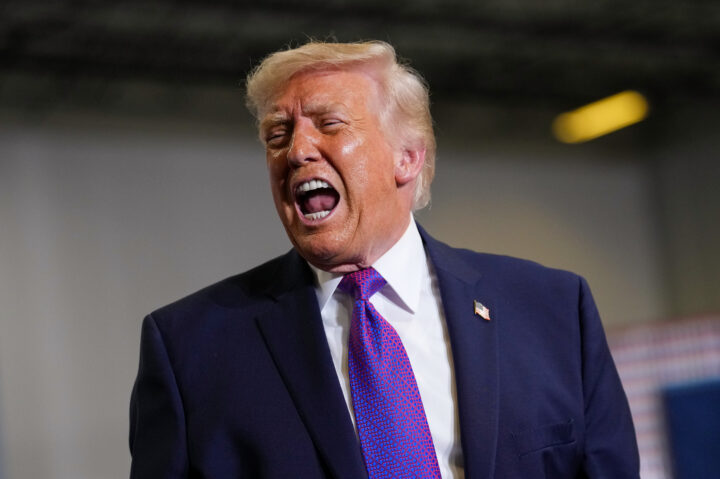
Andrew Harnik/Getty Images
President Donald Trump prepares to leave after speaking during an event at Verst Logistics on March 11, 2026 in Hebron, Kentucky.
Good Wednesday afternoon.
This P.M. briefing is reserved for our premium subscribers like you — offering a forward-focused read on what we’re tracking now and what’s coming next.
Today’s Daily Overtime was curated by JI U.S. Editor Danielle Cohen-Kanik.
📡On Our Radar
Notable developments and interesting tidbits we’re tracking
President Donald Trump warned this morning that the U.S. would “beat the f**king sh*t out of” Iran following an attempted surprise ballistic missile attack yesterday by the Islamic Revolutionary Guard Corps on U.S. forces, even as the president signaled a willingness to keep diplomatic channels open, Jewish Insider’s Matthew Shea reports.
Asked later if Iran was involved in a drone attack today on a U.S.-owned gas storage tanker at a shipping terminal in Egypt, Trump told reporters in the Oval Office that the incident was “a little more of the same. … We’re going to be hitting [Iran] very hard ’cause it’s our turn to hit them. They know it’s coming,” he continued…
A U.S. official said last night’s retaliation by the U.S. and Saudi militaries against Iran-backed militias in Iraq resulted in the deaths of 20 Iran-linked individuals, who were a mix of IRGC members and technical advisors…
Before the latest escalation, Israeli Prime Minister Benjamin Netanyahu and Trump discussed in their Oval Office meeting yesterday several potential next steps in Iran: reaching a diplomatic agreement, increasing economic pressure or intensifying military strikes, Axios reports.
The two leaders also spoke about Netanyahu’s continued insistence that the U.S. wind down aid to Israel — an effort the Israeli prime minister wants to lead publicly to give GOP lawmakers cover to support it — as well as the IDF’s continued presence in Syria…
Wrapping up his trip in Washington, Netanyahu met with Vice President JD Vance last night and hosted Defense Secretary Pete Hegseth at Blair House this morning…
Turkish Foreign Minister Hakan Fidan met today in Ankara with new Hamas head Khalil Al-Hayya…
The Treasury Department sanctioned the Persian Gulf Marine Insurance Company and Hormuz Safe Marine Services Authority, which are backed by the IRGC, for running “insurance” schemes in the Strait of Hormuz, whereby the terror group creates threats to commercial shipping and then charges vessels for insurance coverage…
New York City Mayor Zohran Mamdani continued to face questions today about his decision to appoint a judicial advisory committee that did not include any Jews, which critics have noted is at stark odds with the large population of Jewish attorneys working in the five boroughs, JI’s Will Bredderman reports.
“Any suggestion that there would be any decision made or motivated by religion, it does bother me,” Mamdani told reporters today. “Any suggestion that the composition of the advisory committee was motivated by religion is false”…
Mamdani’s communications director disputed an account by former Chicago Mayor Rahm Emanuel of his September 2025 meeting with Mamdani in which Emanuel said he told him, “You chant ‘[from the] river to the sea,’ and that means there will never be a homeland for Jews who had faced the Holocaust. I want you to hear this: Over my dead body.”
Anna Bahr, Mamdani’s staffer, said in a post replying to the clip of Emanuel on the “Unholy” podcast: “can confirm this … did not happen”…
A new pollof Michigan’s battleground 7th Congressional District shows progressive William Lawrence, a co-founder of the Sunrise Movement, leading the Democratic primary with a 38% plurality, followed by former Navy SEAL Matt Maasdam (27%) and former U.S. Ambassador to Ukraine Bridget Brink (19%). The survey, which was commissioned by a group backing Maasdam, also found 16% of voters are still undecided ahead of next week’s primary…
Rep. Ro Khanna (D-CA) predicted Pennsylvania Gov. Josh Shapiro would be a “formidable” opponent if both men run in the 2028 Democratic presidential primary and told the Washington Examiner that Shapiro “very graciously” called him after Khanna claimed he was detained by Israeli settlers in the West Bank earlier this month…
A read for Tu B’Av, the Jewish holiday of love, happening today: A new Jewish dating app combining the benefits of traditional matchmakers with technology, set to launch in the coming weeks, is exclusively made for Jewish day school grads to find their bashert, founder Erica Schwartz told JI’s Haley Cohen. The app — called The Well, in a nod to the biblical story of Eliezer finding Isaac’s wife, Rebecca — utilizes a chatbot, human intuition and no swiping at all…
CBS News announced that Wall Street Journal correspondent Dov Lieber will join its team in September as a senior reporter based in Israel…
⏩ Tomorrow’s Agenda, Today
An early look at tomorrow’s storylines and schedule to keep you a step ahead
Keep an eye on Jewish Insider for a look into the reported far-right dynamics now at play among the new employees of the Heritage Foundation, following an exodus of the organization’s traditionally conservative staff under President Kevin Roberts.
Michigan Attorney General Dana Nessel will co-host an antisemitism roundtable with the Anti-Defamation League to hear from Jewish community leaders about the impacts of recent antisemitic incidents in the state.
The Senate Foreign Relations Committee will hold a nomination hearing for Sarah Rogers, the under secretary of state for public diplomacy, to be CEO of the U.S. Agency for Global Media. Rogers was nominated for the role by President Donald Trump after a federal judge ruled that Kari Lake had been unlawfully serving as the agency’s acting chief executive, invalidating many of the actions she took while leading the agency.
Sen. Rick Scott (R-FL) will appear at the Hudson Institute for a conversation on the global threat environment.
Stories You May Have Missed
SHUL POLITICS
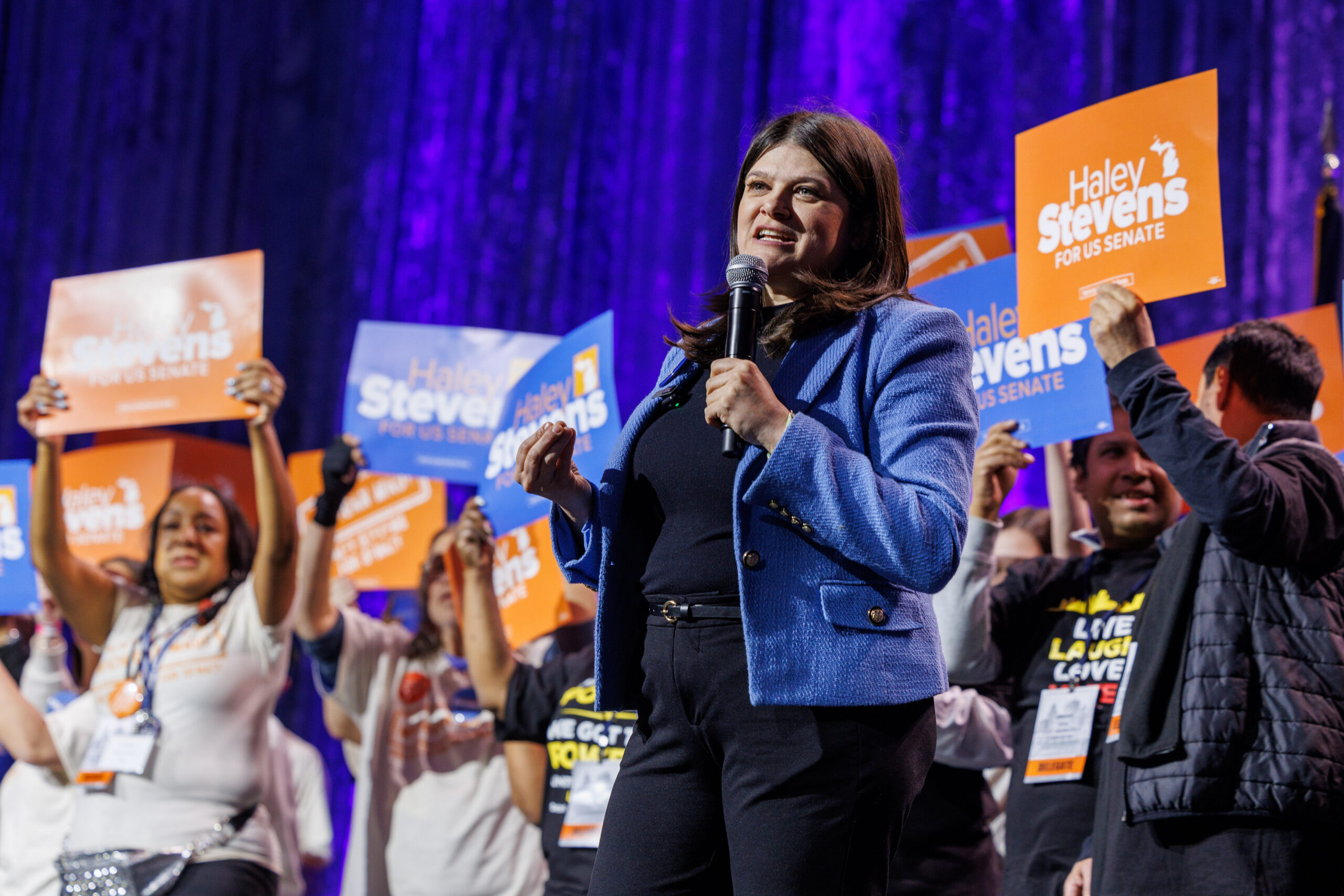
Leading rabbis across the state are urging their congregants to vote for Stevens — even if they’re not saying so explicitly
AID ARGUMENTS

Many of the attendees at Temple Emanuel who listened to the congressman defend his position appeared critical of the stance he’d taken and unconvinced by his explanation, Jewish constituents said
The president made the comments on Fox News after the IRGC attempted a surprise ballistic missile attack on U.S. forces in the region
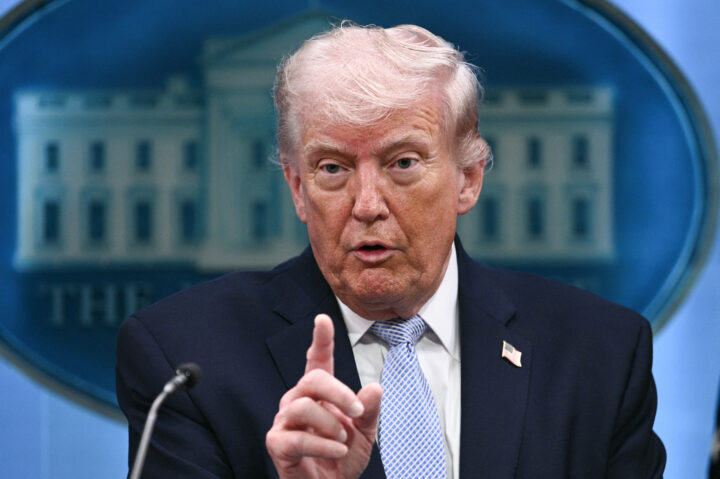
Brendan SMIALOWSKI / AFP via Getty Images
US President Donald Trump speaks about the conflict in Iran in the James S. Brady Press Briefing Room of the White House on April 6, 2026, in Washington, DC.
President Donald Trump warned on Wednesday that the U.S. would “beat the f**king sh*t out of” Iran following an attempted surprise ballistic missile attack by the Islamic Revolutionary Guard Corps on American forces in the region, even as he signaled a willingness to keep diplomatic channels open.
“We’ll be hitting them hard,” Trump told Fox News’ Trey Yingst. “They’re going to get a beating.”
But Trump added that he’s “going to let them keep talking,” referring to ongoing indirect U.S.-Iran negotiations.
The president’s comments followed a spate of attacks on Tuesday evening into Wednesday morning by Iran and its proxies. In addition to the IRGC surprise attack, Iran also directed more than 30 drone attacks by its proxies in Iraq over several days on “U.S. forces and Saudi energy infrastructure,” CENTCOM said, leading the U.S. and Saudi Arabia to conduct joint strikes on logistics and weapons sites in eastern Iraq early Wednesday. The Jordanian military also announced that it had intercepted five missiles launched from Iran on Tuesday night.
The attacks ended a pause in hostilities between the parties, which began last Friday, and came after Trump’s disclosure on Monday that the U.S. remains engaged in “very deep talks” with Iran. But the president has repeatedly threatened to reengage in military action if diplomacy collapses.
Plus, Washington bids farewell to Lindsey Graham
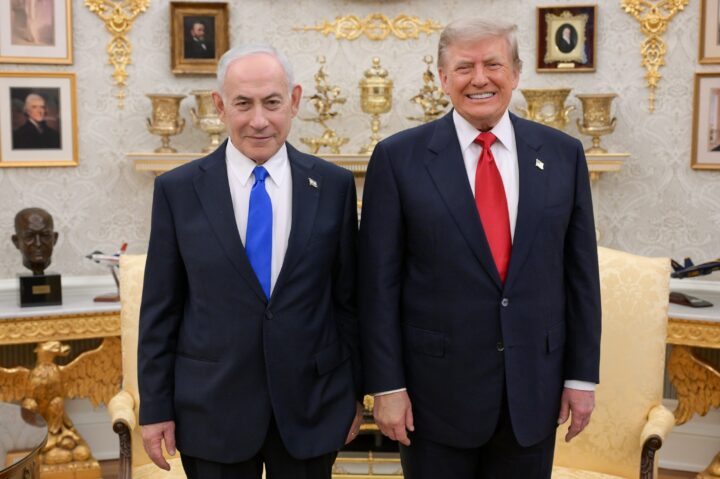
Prime Minister's Office
Israeli Prime Minister Benjamin Netanyahu meets with President Donald Trump in the Oval Office on July 28, 2026.
Good Tuesday afternoon.
This P.M. briefing is reserved for our premium subscribers like you — offering a forward-focused read on what we’re tracking now and what’s coming next.
Today’s Daily Overtime was curated by JI U.S. Editor Danielle Cohen-Kanik.
📡On Our Radar
Notable developments and interesting tidbits we’re tracking
Israeli Prime Minister Benjamin Netanyahu hailed his sit-down with President Donald Trump in the Oval Office this morning as “one of the best conversations I’ve ever had with a president of the United States,” saying in a video statement that the two leaders were completely aligned “on the shared goal that Iran will not have nuclear weapons.”
Caroline Glick, Netanyahu’s international affairs advisor, also described the meeting, which was closed to the press, as “extremely positive” and pushed back against reports of a rift between Jerusalem and Washington. Netanyahu and Trump “have arguments from time to time … but they are on the same page 100% with everything relating to the goal of all operations regarding Iran,” Glick told Jewish Insider’s Matthew Shea…
That rift was on display just hours before the meeting, when Trump expressed frustration with Netanyahu over reports that he planned to share with him Israeli intelligence regarding Iranian nuclear activity at Pickaxe Mountain.
“I don’t need Bibi to tell me that. Bibi is telling me that because he wants me to stay involved [in Iran],” Trump alleged in an interview on Fox News. “I know exactly what’s happening at Pickaxe, it’s not a big problem,” he said…
And in another indication of daylight emerging between the two countries, Israeli Defense Minister Israel Katz told Israel’s Channel 14 today that Jerusalem “very much want[s] to strike Iran’s energy targets,” but Washington “is not approving it at the moment because of the concern that Iran would attack neighboring countries, causing a global oil crisis”…
The funeral of Sen. Lindsey Graham (R-SC) at the Washington National Cathedral this afternoon drew his friends and supporters from all walks of life. Among those spotted in the sanctuary were Netanyahu; Ukrainian President Volodymyr Zelensky; Joint Chiefs of Staff Chairman Gen. Dan Caine; Miriam Adelson; former Vice President Mike Pence; Ron Dermer, Israel’s former minister of strategic affairs; the parents of slain American Israeli hostage Omer Neutra; Reza Pahlavi, the exiled former crown prince of Iran; and a host of administration officials and members of Congress…
Despite both being in Washington today for the same reasons — White House meetings with Trump and Graham’s funeral — Netanyahu and Zelensky will not hold an official meeting, The Times of Israel reports, though the two leaders were spotted speaking in person for the first time in several years at the National Cathedral ahead of the funeral proceedings.
Israeli Foreign Minister Gideon Sa’ar and Ukrainian Foreign Minister Andrii Sybiha also spoke by phone today, where Sa’ar invited Sybiha to visit Israel…
The Senate added a provision extending long-standing sanctions on Iran, currently set to expire at the end of the year, into a major Russia sanctions package negotiated and championed by Graham before his death, JI’s Marc Rod reports. The bill is expected to receive its first procedural vote later today, after its sponsors meet with Zelensky…
Lebanese businessman Antoun Sehnaoui and former U.S. Middle East envoy Morgan Ortagus hosted a dinner in honor of Graham last night at the Four Seasons hotel in Washington, Axios reports. Netanyahu, who attended the event with his wife, Sara, told those gathered, “America has lost a great patriot, Israel has lost one of its greatest friends and supporters, and I have lost a dear friend”…
A man armed with a hammer today entered the premises of the Lev Leviev School in Queens, N.Y., where a Jewish day camp was operating and shoved a child into a fence before being subdued by camp personnel.
Queens Shmira, a local public safety organization, told JI that the incident was not a hate crime but was rather perpetrated by an “emotionally disturbed individual.” The NYPD took a person of interest into custody and the child was treated for a laceration on site before being transported to a hospital…
A new poll shows Rep. Haley Stevens (D-MI) leading former GOP Rep. Mike Rogers by two points if she wins next week’s closely watched Senate Democratic primary — with her opponent, Abdul El-Sayed, trailing Rogers by seven points, JI’s Gabby Deutch reports.
United Democracy Project, the AIPAC-affiliated super PAC, is meanwhile running a new ad hitting El-Sayed over his past support of the “uncommitted” movement and his criticisms of popular Democratic leaders…
CENTCOM announced today that it has signed an agreement with the UAE to establish the first bilateral task force focused on developing military artificial intelligence. The group, named Task Force Talon Synapse, will formally launch in the coming weeks and will be based in Abu Dhabi, with around 20 American and Emirati personnel with expertise in AI, data and cybersecurity…
⏩ Tomorrow’s Agenda, Today
An early look at tomorrow’s storylines and schedule to keep you a step ahead
Keep an eye on Jewish Insider for a look at Jewish organizing efforts in Michigan ahead of the state’s Senate Democratic primary election next week.
Graham’s funeral will continue tomorrow in South Carolina, where he will receive a public procession at the Statehouse in Columbia and a private burial.
Stories You May Have Missed
MICHIGAN MATTERS
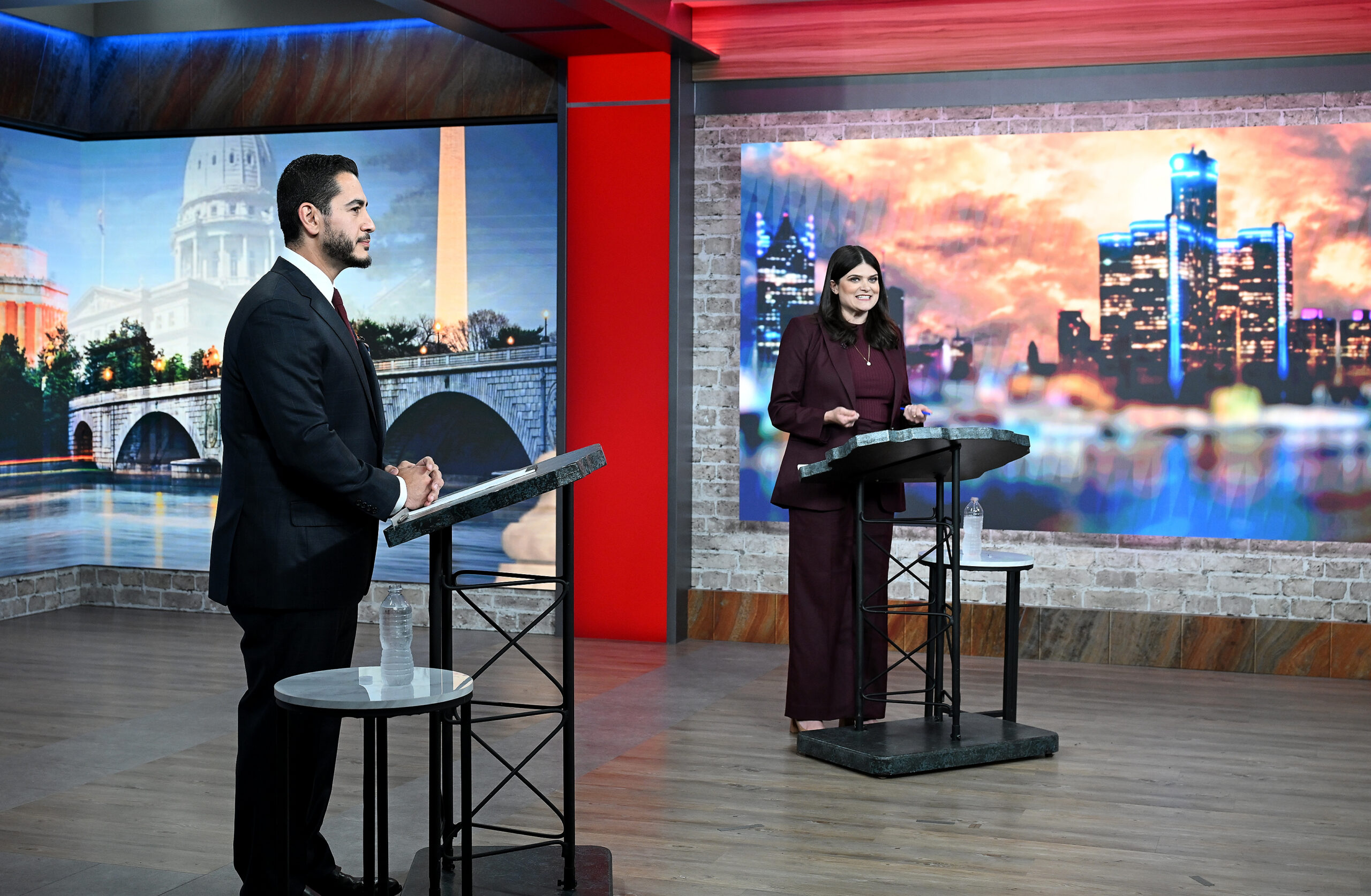
Haley Stevens touted her support for a two-state solution for Israel and the Palestinians, while Abdul El-Sayed lambasted U.S. aid to the Jewish state
COALITION CALCULUS
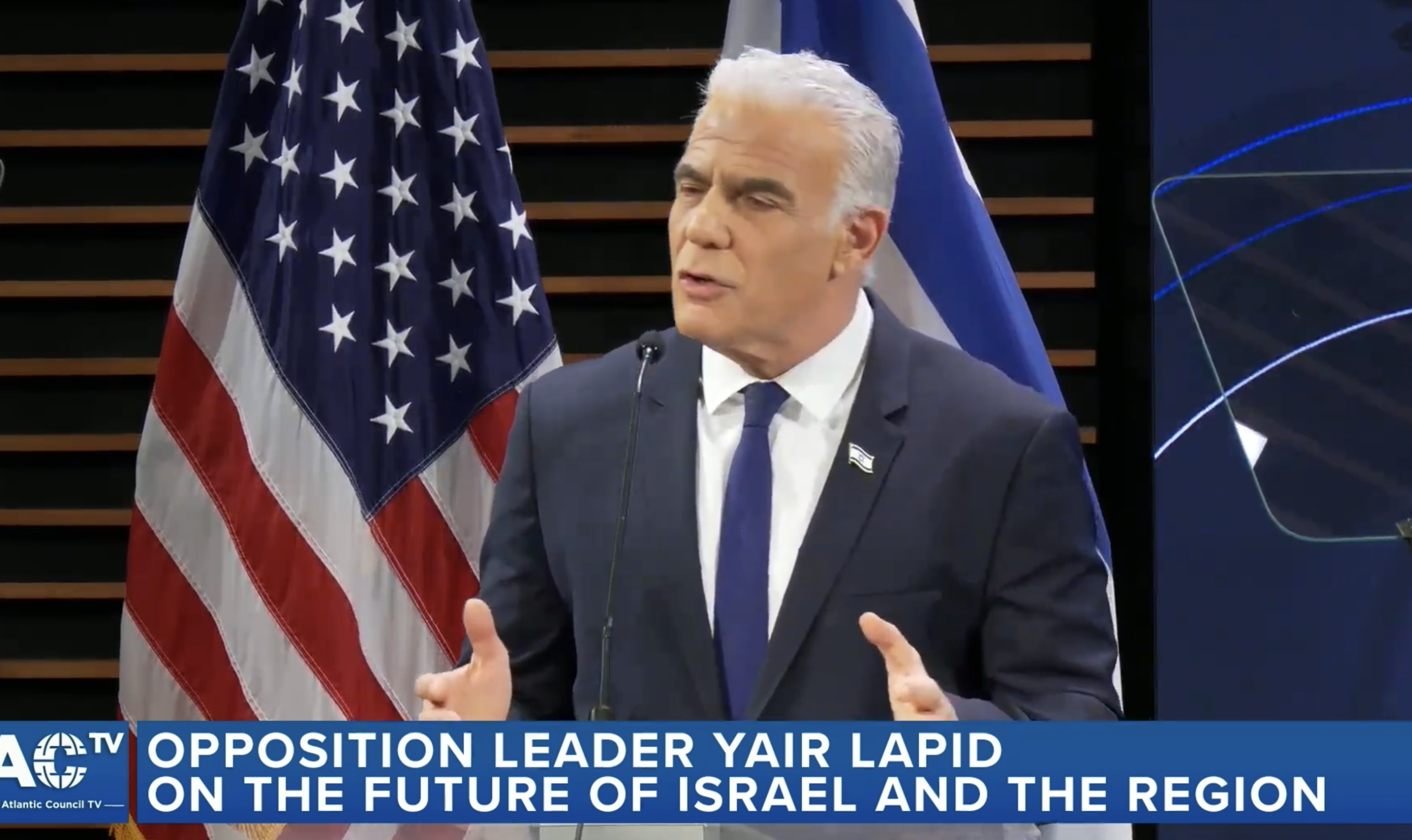
In an address in Washington, the opposition leader sketched a coalition with Bennett and Eisenkot that would mend U.S. and European ties, harden Israel’s line on Iran and shift tone on Gaza
The five-year extension of the Iran Sanctions Act of 1996 was included into the hard-fought bill at Trump’s urging

Tim Graham/ Getty Images
U.S. Capitol Building
The Senate on Tuesday advanced a major Russia sanctions package, negotiated and championed by Sen. Lindsey Graham (R-SC) before his death, to which lawmakers added a provision extending longstanding sanctions on Iran, currently set to expire at the end of the year.
The addition of the five-year extension of the Iran Sanctions Act of 1996 to the package is a relatively minor change to the hard-fought bill, which will extend a key piece of the U.S. economic pressure campaign on Iran and address President Donald Trump’s late-stage demands that threatened to upend a bipartisan agreement.
Lawmakers have been working for years on a bipartisan basis to extend the Iran sanctions past 2026 and they have been extended on a bipartisan basis in the past.
“We are proud to announce an agreement on legislation to stop purchasers of Russian oil and gas from fueling Putin’s war machine and to continue restricting the Iranian regime’s ability to support terrorism and build its nuclear program,” Sens. Jim Risch (R-ID), Richard Blumenthal (D-CT), Darline Graham (R-SC), Katie Britt (R-AL), Jeanne Shaheen (D-NH) and Roger Wicker (R-MS) said in a joint statement on Tuesday. “There is no greater way to honor Senator Graham’s legacy than to move forward with this bipartisan agreement, and we look forward to today’s vote.”
The bill advanced by an 86-12 procedural vote. Sens. Bernie Sanders (I-VT), Elizabeth Warren (D-MA), Maggie Hassan (D-NH), Jon Ossoff (D-GA), Lisa Blunt Rochester (D-DE), Andy Kim (D-NJ), Mazie Hirono (D-HI), Ed Markey (D-MA), Alex Padilla (D-CA), Ron Wyden (D-OR) and Rand Paul (R-KY) voted no.
Blumenthal, the lead Democrat on the bill, had initially reacted negatively to Trump’s efforts to include Iran sanctions, warning against further changes to the bill, which took months to negotiate.
The bill “was the result of painstaking, sometimes painful negotiation involving leadership here, the White House, the U.S. trade representative over many months. I personally would like to see it passed as is,” Blumenthal said earlier this month after Trump initially began pushing for changes. “There may be other provisions that are worthwhile which should be passed separately.”
Asked Tuesday about the decision to add the Iran sanctions provisions, Blumenthal told Jewish Insider, “Darline Graham asked us — asked me — to do it. And by the way, that Iran provision was in the bill as originally written, so restoring it was a pretty simple yes.”
Blumenthal also told reporters that, during a closed-door meeting with senators shortly before the vote, Ukrainian President Volodymyr Zelensky emphasized the role that Ukrainian drone technology has been playing in assisting the U.S. with defending its bases from Iranian attacks.
Prominent House Democrats have raised concerns about the bill, which provides tariff authority to the administration to target importers of Russian oil, concerns shared by some of the bill’s Senate opponents, even as some of them expressed strong support for Ukraine. Critics worry that the bill would allow Trump to impose punishing tariffs on the U.S.’ European allies, but Democratic supporters insist that the authority is carefully tailored and limited.
Alexandria Paolozzi Moore, the senior director of government relations at FDD Action, said the extension is “a critical, bipartisan win. ISA is a foundational tool for countering Iran’s WMD proliferation, ballistic missile program, and support for terrorism.”
Caroline Glick, an advisor to Netanyahu, pushed back on reports of a rift between the two leaders
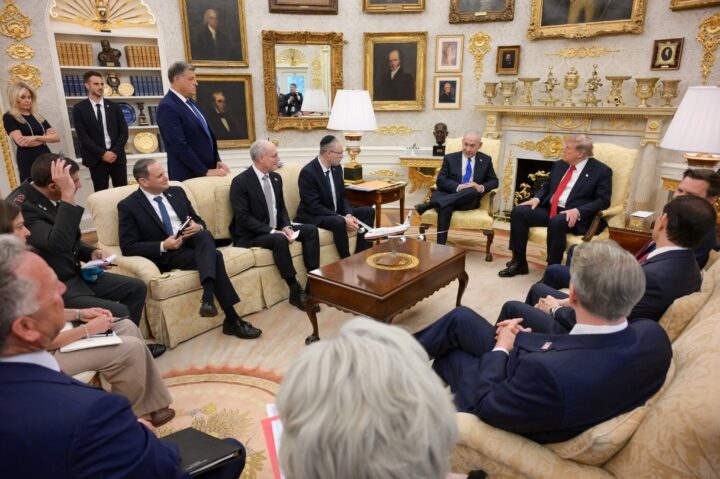
Prime Minister's Office
Israeli Prime Minister Benjamin Netanyahu meets with President Donald Trump in the Oval Office on July 28, 2026.
Israeli Prime Minister Benjamin Netanyahu hailed his sit-down with President Donald Trump in the Oval Office on Tuesday as “one of the best conversations I’ve ever had with a president of the United States, our friend Donald Trump.”
The Israeli prime minister called the meeting “excellent.”
“When I say excellent, I don’t mean it lightly,” he added, speaking in a video statement after the summit. It was “a conversation with full partnership, mutual support, with understanding on the shared goal that Iran will not have nuclear weapons and also other goals,” he said.
Caroline Glick, Netanyahu’s international affairs advisor, similarly described the meeting as “extremely positive” and pushed back against reports of a rift between Jerusalem and Washington.
“The two sides continue to be totally committed to our shared goal of preventing Iran from acquiring nuclear weapons, and that was obviously the focus of the discussion, but we discussed a whole range of regional issues,” Glick told Jewish Insider.
Glick said the Israeli delegation left the meeting feeling “terrific” about the strategic alignment between Washington and Jerusalem.
Addressing reports of friction between the two leaders over strategy in the Iran war and Trump’s proposed sale of F-35 fighter jets to Turkey, Glick said “nothing specific” on the jet deal came up during the meeting. She added that Trump and Netanyahu “have an incredible relationship,” dismissing talk of tension as a “media-manufactured crisis.”
“They have arguments from time to time… but they are on the same page 100% with everything relating to the goal of all operations regarding Iran,” Glick said. “The discussion was what you would expect from an alliance. You had two leaders who know each other very well, have enormous amounts of respect for one another and share common goals that they are completely committed to achieving.”
Hours before the meeting, Trump had expressed frustration with Netanyahu’s reported intention to raise with him Israeli intelligence regarding Iranian nuclear activity, saying in an interview on Fox News, “I don’t need Bibi to tell me that. Bibi is telling me that because he wants me to stay involved.”
While analysts framed the Oval Office meeting as a key opportunity for Netanyahu to gauge where Trump stands on Iran, Glick declined to say where the administration truly prefers diplomacy or resuming strikes, stressing instead that both nations are moving toward a unified outcome.
“All the trends are moving towards the achievement of our joint goal, which is to prevent Iran from having nuclear weapons,” Glick said. “So if it’s the hard way, the easy way, the middle way, the side way, it’s all geared towards moving the ball into that goal. I don’t think you can characterize it one way or another. It’s not a linear process.”
Hostilities between the U.S. and Iran remain paused as the U.S. is in “very deep talks” with Iran, Trump said on Monday, though the president has repeatedly threatened to return to military action if talks fail.
Glick said the trilateral agreement between the U.S., Israel and Lebanon was “touched on” but “wasn’t the focus,” saying that it will be left to the meetings between the parties set to take place in Rome next week.
She also noted that the two leaders briefly discussed the issue of expanding the Abraham Accords, with both remaining committed to bringing additional nations into the normalization framework.
“We believe that the prospects for expanding them are very high and look forward to doing so,” Glick said. “But as the prime minister always says, if we discuss which specific country, it will only undermine the process.”
‘Bibi is telling me that because he wants me to stay involved,’ Trump said of reported Israeli intelligence about Iran’s Pickaxe Mountain, ahead his Oval Office meeting with Netanyahu
Samuel Corum/Getty Images
President Donald Trump speaks with reporters while aboard Air Force One on June 5, 2026 en route to Chippewa Falls, Wisconsin.
President Donald Trump expressed discontent with Israeli Prime Minister Benjamin Netanyahu’s reported forthcoming warnings regarding Iranian nuclear activity at Pickaxe Mountain, dismissing the issue as “not a big problem” in a sharp public split hours ahead of their high-stakes Oval Office meeting.
“I don’t need Bibi to tell me that. Bibi is telling me that because he wants me to stay involved [in Iran],” Trump alleged in an interview on Fox News on Tuesday morning.
Netanyahu is reportedly expected to brief Trump on Iran’s activities at Pickaxe Mountain during their meeting, attempting to demonstrate that Tehran is undermining diplomatic talks by relocating its nuclear infrastructure underground.
Commenting on reports that Netanyahu intends to raise with him Israeli intelligence demonstrating that Iran moved nuclear centrifuges into Pickaxe following the 12-day war in June 2025, Trump said: “Why don’t you [Netanyahu] just tell it to me? Why do you have to announce it to the world? I know exactly what’s happening at Pickaxe, it’s not a big problem.” Trump has previously downplayed such reports, saying earlier this month that the U.S. has not seen evidence of nuclear activity at the site.
Trump insisted on Tuesday that U.S. intelligence is monitoring Pickaxe Mountain closely, while renewing threats to launch military strikes if a diplomatic agreement falls through.
“We have the greatest cameras in the world focused on it,” Trump said. “We took out their nuclear sites, and we’ll have to take out Pickaxe if we don’t make a deal … We’ll take it out very easily.”
The complex, which Tehran is believed to have begun constructing in 2020, is located roughly a mile south of Iran’s primary Natanz nuclear facility, a site struck multiple times during the 12-day war.
While Trump has previously noted that Pickaxe Mountain was spared amid the current U.S.-Iran war due to a lack of evidence that nuclear enrichment was taking place there, he warned during a meeting last week with Lebanese President Joseph Aoun that the U.S. could target the area “pretty soon.”
Tuesday’s Oval Office meeting marks the eighth between Trump and Netanyahu during Trump’s second term, and their first face-to-face sit-down since the current Iran war began in February. Once closely aligned, the two leaders enter the talks divided over key strategic decisions, including how to conclude the war and Trump’s proposed sale of F-35 fighter jets to Turkey.
Plus, Bibi's back in town
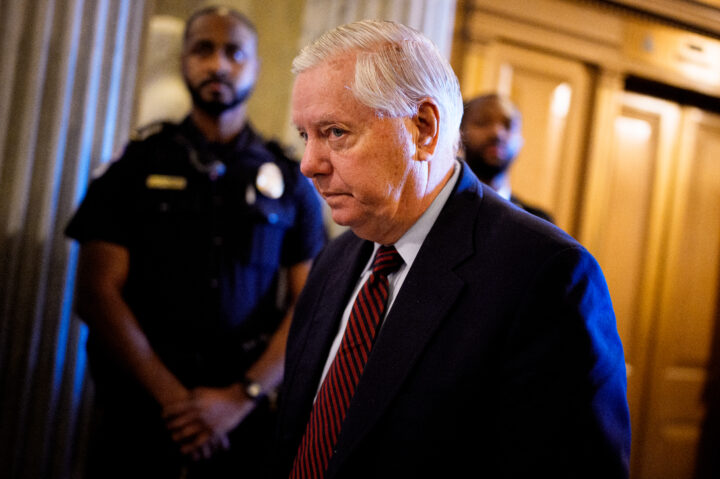
Andrew Harnik/Getty Images
Sen. Lindsey Graham (R-SC) walks into the Senate Chamber on December 11, 2025 in Washington, DC.
Good Tuesday morning.
In today’s Daily Kickoff, we preview Israeli Prime Minister Benjamin Netanyahu’s meeting with President Donald Trump at the White House, which will take place today before the funeral of Sen. Lindsey Graham (R-SC), which both leaders are attending. We look at AIPAC’s messaging strategy to attack far-left candidates, and cover last night’s Michigan Senate primary debate between Abdul El-Sayed and Rep. Haley Stevens (D-MI). We also report on New York City Mayor Zohran Mamdani’s refusal to engage with calls to tone down his rhetoric on Israel after the recent stabbing attack on the Upper West Side, and highlight a meeting between Qatari Emir Sheikh Tamim bin Hamad Al Thani and a group of rabbis in Doha, which was publicized by the emir. Also in today’s Daily Kickoff: Yair Lapid, Rahm Emanuel and Amir Tibon.
We also have a new on-demand Live Briefing that you can access throughout the day via our new app (on Apple and Android) and on our website.
Today’s Daily Kickoff was curated by Israel Editor Tamara Zieve and U.S. Editor Danielle Cohen-Kanik. Have a tip? Email us here.
What We’re Watching
- Israeli Prime Minister Benjamin Netanyahu will meet with President Donald Trump at the White House this morning for their eighth such meeting during Trump’s second term. Read more below. Earlier, Trump is slated to meet separately with Ukrainian President Volodymyr Zelensky, before all the leaders — joined by others, including Israeli Opposition Leader Yair Lapid — make their way to the funeral of Sen. Lindsey Graham (R-SC).
- The Jewish Federations of North America is hosting a breakfast at its Washington office in honor of Graham, ahead of his funeral later today.
- Graham’s funeral will begin at the U.S. Capitol with a private ceremony and continue with a service at Washington National Cathedral, where remarks will be delivered by Trump, Fox News’ Sean Hannity and Emillie Boggs Roberts, Graham’s niece.
- The Senate is expected to hold votes on a number of issues including on Jay Clayton’s nomination to become director of national intelligence and on a procedural motion to begin consideration of Russia sanctions legislation championed by Graham before his death, which now includes Iran sanctions as well.
- This evening, Central Synagogue in Manhattan will hold a memorial service for Wesley LePatner, one year after the Blackstone executive and Jewish philanthropist was killed in a shooting at the firm’s Midtown headquarters.
- The 20th Sami Rohr Prize for Jewish Literature will be awarded to Haaretz journalist Amir Tibon for his Oct. 7 memoir, The Gates of Gaza, this evening at a private ceremony in Jerusalem.
What You Should Know
A QUICK WORD WITH JI’S melissa weiss
For watchers of the U.S.-Israel relationship, the events of the last few days have had a familiar feel. On Friday, President Donald Trump suggested at the White House Correspondents’ Dinner that Iran would “love to make a deal. I don’t think they’re ready to. I don’t think it’s time yet, but I’m willing to listen.” Today, the president will meet at the White House with Israeli Prime Minister Benjamin Netanyahu as the countries weigh a military escalation with Iran.
The similarities to the dialogue surrounding Iran earlier this year are striking. In early February, Trump told reporters aboard Air Force One, “Iran looks like it wants to make a deal very badly.” Days later, Trump would meet at the White House with Netanyahu for talks focused on Iran. Weeks after that meeting, the U.S. and Israel launched joint military strikes against the Islamic Republic, kicking off a six-week war.
Despite the similarities around these two meetings — much has changed.
In the U.S., there is growing opposition among Americans to renewed military action against Iran — a sentiment that extends to some top military officials, including, reportedly, CENTCOM head Adm. Brad Cooper.
Public perception of Israel — and Israelis — has hit its most negative point in years, with Gen Z Americans across the political spectrum having significantly more favorable views of Palestinians than Israelis.
The numbers demonstrate the degree to which opinions on Israel and Iran — and the U.S. role in the region — have shifted in the five months since the war began. The domestic politics in the U.S. vis-a-vis Iran look very different than they did during the last Trump-Netanyahu meeting.
PRIMARY PLAYBOOK

From Michigan to Missouri, where tensions between the Democratic Party’s moderate and far-left factions are playing out in high-profile contests for the House and Senate, AIPAC is hitting its anti-Israel opponents for their past criticism of former President Joe Biden and former Vice President Kamala Harris in an effort to portray the candidates as hostile to mainstream policy goals, Jewish Insider’s Matthew Kassel reports.
Messaging strategy: The tactic, which the AIPAC-linked United Democracy Project super PAC also deployed last election cycle in key races, dates back to at least 2021, when DMFI PAC, Democratic Majority for Israel’s political arm, had relentlessly attacked Nina Turner — a former Ohio state senator running for an open House seat in Cleveland on a platform that was critical of Israel — for remarks in which she had compared voting for Biden to eating a “bowl of s**t.” Now, UDP is reviving the playbook as it takes on former Rep. Cori Bush (D-MO), who is seeking a rematch against Rep. Wesley Bell (D-MO) after she lost her St. Louis House seat in 2024. In recent attack ads, UDP, which has spent over $2.5 million to boost Bell, is hitting Bush over past comments criticizing Biden and Harris, as well as her vote against the bipartisan infrastructure package while in Congress in 2021.
MICHIGAN MATCHUP
If Michigan’s Democratic Senate primary has become a test case for the saliency of AIPAC and Israel as a political issue for Democratic voters, then Monday night’s debate between Abdul El-Sayed, a far-left former public health official, and Rep. Haley Stevens (D-MI) served as the ultimate battlefield — and illustrated the gulf between the two candidates on the issue, Jewish Insider’s Gabby Deutch reports.
Debate recap: Over the course of an hourlong debate, El-Sayed made clear that he believes his opposition to AIPAC and to Israel will help him win next week’s election. Stevens, meanwhile, did not even utter the word “AIPAC.” Stevens outlined her views on the Middle East, arguing that she and El-Sayed diverge because she supports a two-state solution to the Israeli-Palestinian conflict while he has not acknowledged Israel’s right to exist as a Jewish state. She touted her support for Michigan’s Jewish community and mentioned the work she did to advocate for the hostages after the Oct. 7, 2023, Hamas attacks on Israel.
TEMPERATURE CHECK
Days after an alleged hate crime against a Jewish person in Manhattan, New York City Mayor Zohran Mamdani refused to engage with suggestions from various corners that he de-escalate his rhetoric around Israel — or speak to why he continued publicly toying with arresting Israeli Prime Minister Benjamin Netanyahu well after city attorneys told him he couldn’t, Jewish Insider’s Will Bredderman reports.
Dismissing questions: A number of Jewish leaders linked the attack to the mayor’s recent denunciations of Netanyahu and the Jewish state, and even a fellow Democrat signaled at a press conference on Friday morning that Mamdani should “take the temperature down.” Netanyahu himself, whom Mamdani excoriated in a widely watched video last week, accused the mayor of “fomenting hate” in a Sunday appearance on Fox News. But the mayor declined to substantively engage with any of these criticisms when pressed by reporters on Monday. “I’m not interested in getting into a back-and-forth with Prime Minister Netanyahu,” the mayor said.
SHEIKH SHIVA
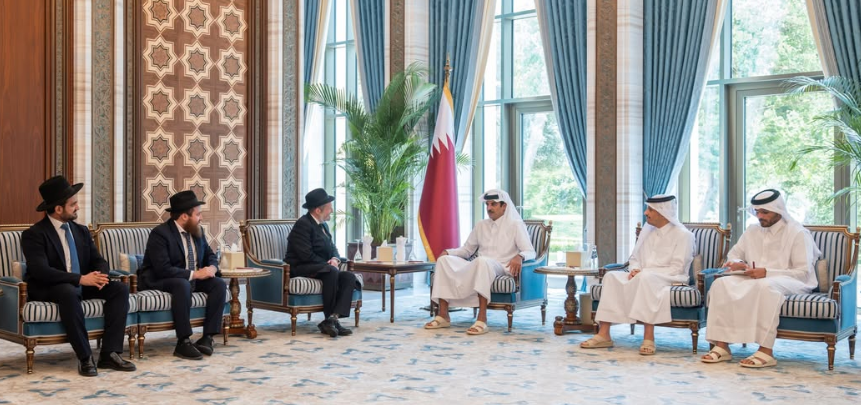
Qatari Emir Sheikh Tamim bin Hamad Al Thani hosted a group of rabbis on Monday at Lusail Palace in Doha. Rabbi Mendy Chitrik, chairman of the Alliance of Rabbis in Islamic States, led the delegation along with his son, Rabbi Eliyahu Chitrik, who organizes Jewish communal programming in Qatar. They were joined by Rabbi Yehuda Gerami, the chief rabbi of Iran, Jewish Insider’s Haley Cohen reports.
Making it public: The emir’s office publicized the meeting, posting on the palace’s social media account that the delegation offered condolences on the death of the emir’s father and predecessor, Sheikh Hamad bin Khalifa Al Thani. Qatari Prime Minister Sheikh Mohammed bin Abdulrahman Al Thani also attended the meeting. The emir’s decision to publicize the visit on his official channels is a rare public acknowledgment of Jewish communal ties by a Gulf state that has no formal relations with Israel and funds the news outlet Al Jazeera, which amplifies narratives hostile to the Jewish state.
COALITION CALCULUS
Addressing the Atlantic Council in Washington, former Israeli Prime Minister Yair Lapid presented his case on Monday for Israel’s diplomatic future should his opposition bloc form the country’s next government after the upcoming elections. Lapid argued that Israel is increasingly isolated diplomatically and feuding with its allies — which he blamed primarily on Prime Minister Benjamin Netanyahu and his coalition — and he recommended that Jerusalem adopt a more measured and bipartisan approach going forward, Jewish Insider’s Marc Rod reports.
What he said: Lapid said that Israel can’t act on the world stage with the same impunity that the United States can, that it needs to listen to its friends around the world instead of writing them off. The Jewish state, he continued, should never fund digital influence operations against American leaders, should stay out of American partisan politics and must rebuild its relationships with Europe. “Iran is an enemy. Hezbollah is an enemy. Hamas is an enemy,” Lapid said. “France is not the enemy. Sweden is not the enemy. [Sens.] Elizabeth Warren [D-MA], Jon Ossoff [D-GA] and Tim Kaine [D-VA] are not the enemy. The Democratic Party is not the enemy. [Vice President] JD Vance is not the enemy.”
CANDIDATE CORNER
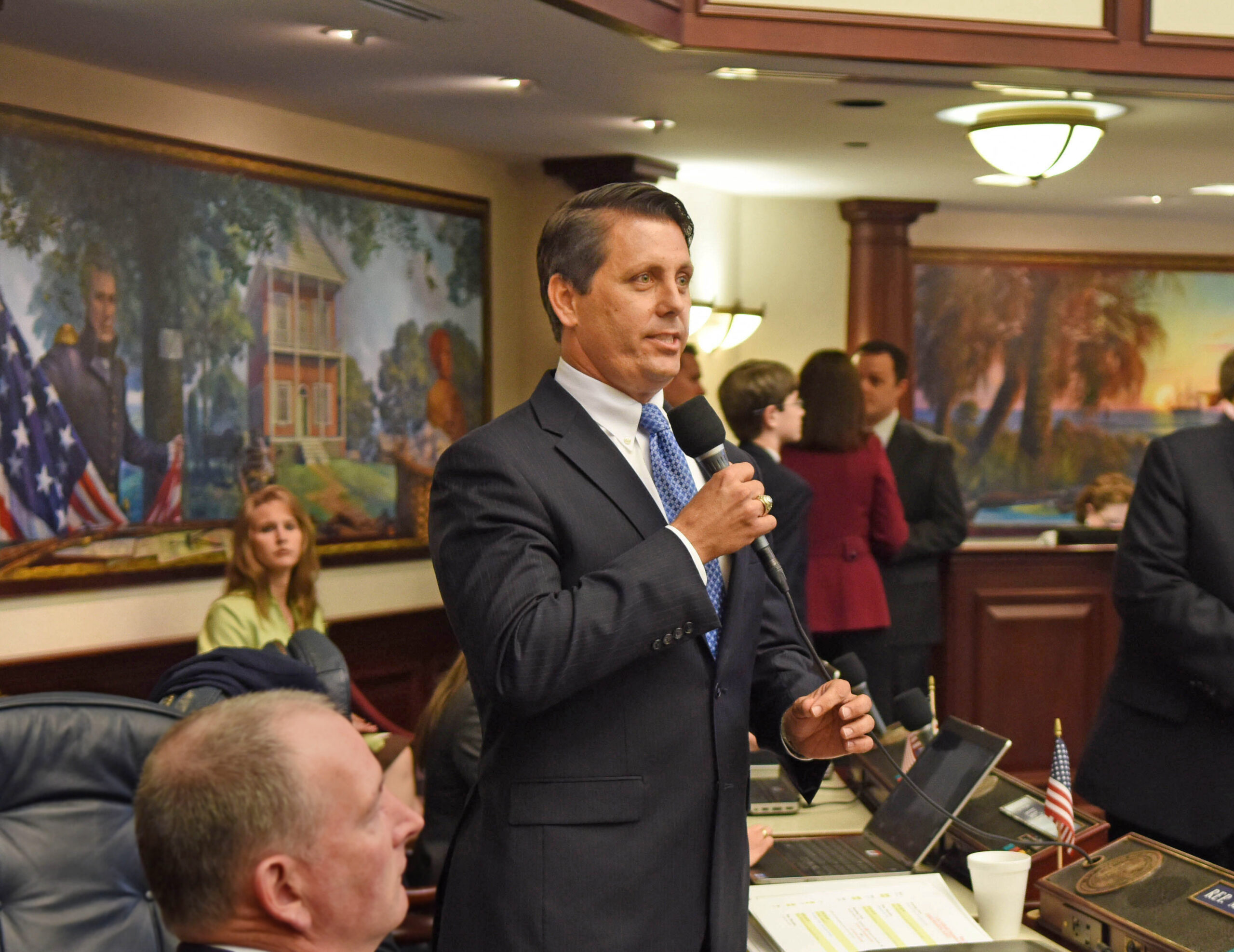
Former Florida state Rep. George Moraitis is hoping that a bipartisan approach and his background in the Statehouse and as a military veteran will make him a formidable candidate to take on Rep. Jared Moskowitz (D-FL) in South Florida in November. Moraitis is running in the Republican primary in Florida’s 25th Congressional District against former Boca Raton Mayor Scott Singer, who is Jewish, and businessman Dan Franzese, Jewish Insider’s Marc Rod reports.
Moraitis’ pitch: In the general election, the winner will face Moskowitz — or his socialist primary challenger — in the district redrawn to favor Republicans. Moraitis told JI he spent his “whole life in public service,” serving in the Navy on submarines and as a state representative. He said he wants to work to “restore the American dream,” protect U.S. national security and defend “our God-given freedoms” of worship, speech and assembly, including combating rising antisemitism, as well as what he described as efforts to shut down churches and Christian prayer.
Worthy Reads
Winning the Battle, Losing the War: The Atlantic‘s Franklin Foer argues that Israeli Prime Minister Benjamin Netanyahu has squandered his role as “the guardian of Israel’s standing in America.” “Netanyahu aggressively confronted the military threats — but proceeded to lose on the battlefield that made his career. He had risen to power by persuading Americans on the correctness of his cause, but came to govern as though persuasion were futile, as if his father had been right all along. He never seemed to recognize that his old successes had come amid tailwinds: the Cold War, the wars on terror, decades when America was predisposed to sympathize with Israel’s case. When the zeitgeist turned, Netanyahu did not adjust the argument. He concluded there were no minds to change: The hatred of the Jewish state was immutable. Under Netanyahu, Israeli public diplomacy has treated each new critic not as someone to be persuaded or corrected, but as an anti-Semite revealed.” [TheAtlantic]
A Home for Hate: Matthew Hennessey writes in The Wall Street Journal‘s “Free Expression” newsletter that New York City Mayor Zohran Mamdani’s recent invective against Israeli Prime Minister Benjamin Netanyahu was an “antisemitic smoke signal.” “Campaign crowds ate it up when Mr. Mamdani said he was going to make the NYPD enforce the International Criminal Court’s dubious arrest warrant for Mr. Netanyahu. Mr. Mamdani must have loved the buzz. Were he more experienced, or less of a zealot, he might realize that being mayor comes with responsibilities that a rabble-rouser in a kaffiyeh never needs to consider. … Mr. Mamdani and his allies play definitional games: We aren’t antisemitic, they say, only anti-Zionist. … You may think you’re making a clever distinction, or that your limp assertions about hate having no home in the city will absolve you of all blame when someone believes what you say and starts trying to kill Jews while shouting ‘Allahu akbar.’ It won’t.” [WSJ]
Surrender to Socialism: Axios co-founders Jim VandeHei and Mike Allen lay out the six stages of “political surrender,” warning the Democratic Party might be on its way to capitulating to socialism. “Republicans didn’t decide to become President Trump’s party. They surrendered to him, one stage at a time, over a decade, in plain sight. Democrats swear that socialism’s growing grip on their party is different, and can be contained. The early signals suggest otherwise. Why it matters: Party transformations follow a predictable six-stage evolution — recoil, squint, rationalize, submit, amplify, and purge. Each stage has language you can hear long before you see it in the votes. Republicans just finished the full cycle. Democrats might be starting it.” [Axios]
Forbidden Fruit: Designer and brand strategist Debbie Millman posits in The New York Times that guidelines around AI usage should follow those of Kabbalah, which many are encouraged not to study until they reach the age of 40. “We do not wait for children to turn 16 to hand them car keys because cars are evil, and we do not insist that surgeons train for years because scalpels are immoral. We build thresholds around powerful things because power requires judgment, and judgment can’t be downloaded or installed. Before a person asks a machine to write for them, they should know what it feels like to write from the depths of their own uncertainty and identity. Before a person lets a machine imitate their voice, they should have endured the long, uneven, often humiliating process of acquiring one.” [NYTimes]
Word on the Street
Israeli Prime Minister Benjamin Netanyahu will reportedly present intelligence to President Donald Trump at their meeting on Tuesday showing that Iran is rebuilding its military capabilities and pursuing a nuclear bomb at an accelerated pace, according to Israel’s Channel 12…
Asked about Netanyahu’s opposition to the U.S.’ planned sale of F-35 fighter jets to Turkey, Trump told reporters on Monday, “Turkey’s been a great ally — for me. … Nobody tells me what we should be selling,” a clip that the White House’s rapid response social media account posted to X…
Saudi Arabia intercepted drones launched by Iran-backed militias in Iraq on Monday, which were targeting oil facilities in the country’s Eastern Province and in Riyadh, the Saudi Defense Ministry said in a statement. Israel, Jordan and Iraq also reported drone attacks on Monday…
Senate Majority Leader John Thune (R-SD) said that he wants to include a significant increase in defense funding when the Senate takes up the budget reconciliation bill recently passed by the House, which is aimed in part at covering expenses related to the Iran war…
Next week’s talks between Israel and Lebanon, to be held again in Rome, will focus on expanding the “pilot zone” process in southern Lebanon, resolving “all outstanding border issues” and working towards a comprehensive peace agreement, a State Department official said…
Iranian authorities publicly hanged two men who were found guilty of attacking two police officers during anti-regime protests earlier this year, Iran’s judiciary said on Tuesday…
Far-right commentator Laura Loomer told Politico she would “like to serve as an envoy” to Trump on foreign policy, after the death of Sen. Lindsey Graham (R-SC), who had held a similar role in Trump’s orbit…
Former Congressional Black Caucus Chair Rep. Steven Horsford (D-NV), a relative moderate, joined several left-wing CBC members in endorsing Donovan McKinney, who is challenging Rep. Shri Thanedar (D-MI)…
Former New York City Mayor Eric Adams is being sued by an ex-staffer over allegations that she was discriminated against because she is Palestinian, claiming that Adams had adopted a strict anti-Palestinian stance after the Oct. 7, 2023, Hamas attacks. The aide, Hasibe Rashid, is asking for the court to reinstate her as a policy advisor in Mayor Zohran Mamdani’s office…
Several Jewish legal organizations sent Mamdani a letter protesting the makeup of his 18-person judicial nominating advisory committee, which contains no Jewish representation…
In an opinion piece in the Jewish Telegraphic Agency, William Daroff and Betsy Berns Korn, the CEO and chair of the Conference of Presidents of Major American Jewish Organizations, decry Mamdani’s repeated claim that Israel committed a “genocide” in Gaza, comparing it to medieval blood libels…
Former Chicago Mayor Rahm Emanuel told Politico he heard from Vice President Kamala Harris, former House Speaker Nancy Pelosi (D-CA), House Minority Leader Hakeem Jeffries (D-NY), Sen. Chris Coons (D-DE), Pennsylvania Gov. Josh Shapiro and GOP Utah Gov. Spencer Cox after his speech laying out his Israel policy at Tel Aviv University earlier this month, saying they were “all very affirmative and all appreciative”…
Daniel Moraff, the political consultant who helped recruit failed Maine Senate candidate Graham Platner before Platner’s campaign collapsed following a rape allegation, was himself accused of sexual assault: One former romantic partner told The Handbasket that Moraff had sex with her in 2019 in spite of her repeated objections and the former campaign manager for Rep. Summer Lee (D-PA) said Moraff was barred from Lee’s 2022 campaign due to six allegations of sexual misconduct, including at least one of sexual assault…
David Fox, the dealmaker credited with building Kirkland & Ellis into the world’s biggest law firm, has now launched Irving, a law firm primarily driven by AI, and is building a center for AI at Hebrew University’s law school…
In The Free Press, Casey Babb reports on a spike in emigration of Jewish Canadians due to heightened antisemitism in the country…
The New York Times profiles Sammy Nussdorf, the Jewish 29-year-old who parlayed his family’s business acumen and his TikTok account into Meadow Lane, a viral Lower Manhattan gourmet market that pulled in $3 million in its first 90 days…
“Mazel Tough,” a new romantic comedy series about modern dating in the Jewish community, will feature Jewish stars Alex Rich, Adam Shapiro, Michael Vlamis and Jonathan Lipnicki…
British musician Boy George released a new single defending Israel’s actions in the aftermath of the Oct. 7, 2023, Hamas-led attacks. Posted to his X account with the hashtag “Shalom,” the song is titled “We Will Dance Again,” a mantra used by survivors of the Nova music festival massacre…
Pic of the Day
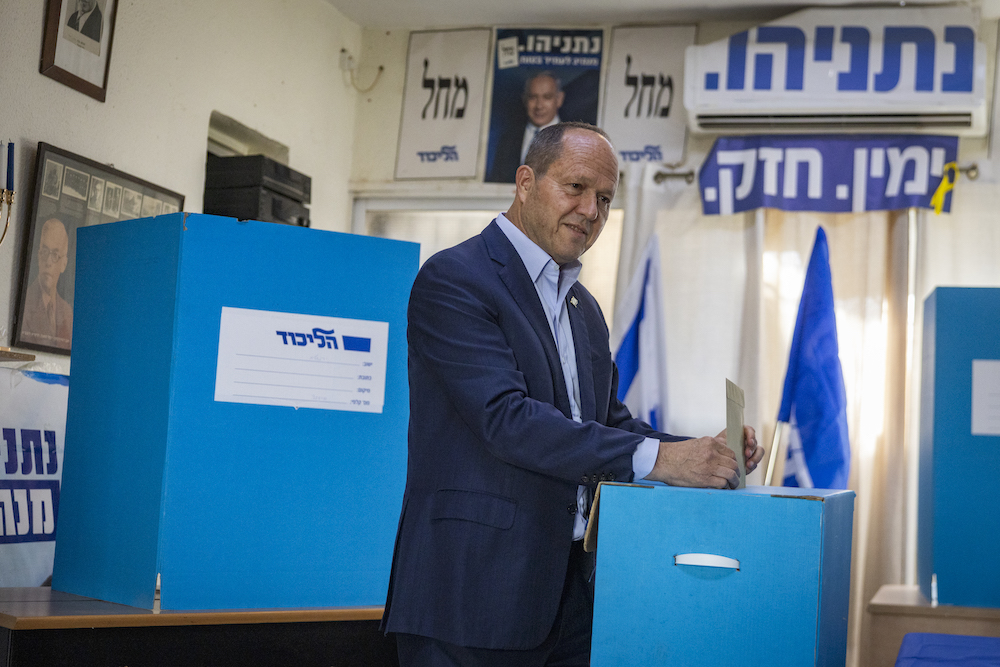
Israeli Minister of Economy and Industry Nir Barkat voted in the Likud party’s internal elections on Monday in Jerusalem.
The Likud Central Committee approved a proposal that grants Israeli Prime Minister Benjamin Netanyahu eight reserved slots in the top 29 places on the list, significantly increasing his control over the party’s slate.
Birthdays
Actor and reality show personality, Elizabeth Berkley Lauren turns 54…
Survivor of Auschwitz-Birkenau as a teen, he emigrated to Israel and became an artist, Yehuda Bacon turns 97… Chicago radio and television news personality, Walter David Jacobson turns 89… U.S. District Court judge in Manhattan, then U.S. attorney general during the Bush 43 administration, now of counsel at the international law firm of Debevoise & Plimpton, Michael Mukasey turns 85… Swedish industrialist, chairman of the Nobel Foundation (manager of the Nobel Prize) from 2005 to 2013, Marcus Storch Ph.D. turns 84… In 1986 she became the first woman in the IDF to hold the rank of brigadier general, she then served as a member of Knesset, and now serves on multiple for-profit and nonprofit boards, Amira Dotan turns 79… Tax professional, Joe Pollak turns 76… President of the Council on Foreign Relations for 20 years until he retired in 2023, Richard N. Haass turns 75… Tel Aviv-born real estate developer, he has restored many historic buildings in Downtown Los Angeles, Izek Shomof turns 67… Partner and managing director of Meadow Lane Advisors, he serves on the board of American Jewish World Service, Marty Friedman… French-Israeli hairdresser and entrepreneur, Michel Mercier turns 65… American schoolteacher, wrongfully detained by Russia in 2021, he was released in the early weeks of the Trump 47 administration, Marc Hilliard Fogel turns 65… Talent booker, publicist and television and radio personality in Atlanta, Mara Davis turns 57… Tech entrepreneur who has invested in more than 100 startups, New York Times best-selling author, Joshua M. “Josh” Linkner turns 56… Co-founder of the personal genomics and biotechnology company 23andMe, she recently regained control of the company, Anne Wojcicki turns 53… Inaugural Jewish life venture fellow at the William Davidson Foundation, now deputy CEO at UpStart, Jennifer Lew Goldstone… Jerusalem-born actor with more than 30 movie and television roles in the U.S., Ori Pfeffer turns 51… Associate justice of the Supreme Court of California, Leondra Kruger turns 50… Israeli journalist and former member of the Knesset, Ksenia Svetlova turns 49… Managing partner at Altitude Ventures, a healthcare venture capital firm, he served as White House Jewish liaison from 2005 to 2007, Jay Zeidman… Senior reporter at Bloomberg News, Laura Nahmias… CEO and CTO at Diagnostic Robotics in Jerusalem, the firm produced an app for managing COVID-19 patients during the pandemic, Kira Radinsky Ph.D. turns 40… VP of player personnel at MLB’s Miami Marlins, Samuel Mondry-Cohen… Director of operations at Elite Healthcare Consultants, Menachem “Mark” Perl… Actor and producer who stars in the CBS series “Ghosts,” Asher Chazen Grodman turns 39… Staff writer at The New Yorker, Ruby Cramer… Larry Gordon…
The numbers demonstrate the degree to which opinions on Israel and Iran — and the U.S. role in the region — have shifted in the five months since the war began
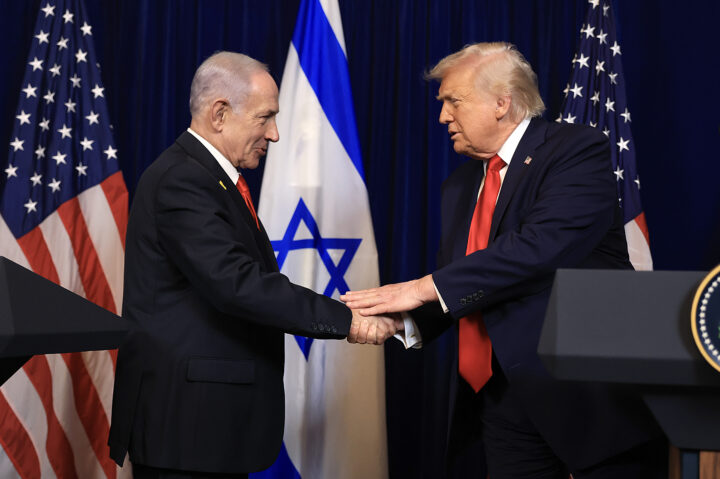
Joe Raedle/Getty Images
President Donald Trump shakes hands with Israeli Prime Minister Benjamin Netanyahu during a press conference at his Mar-a-Lago club on December 29, 2025 in Palm Beach, Florida.
For watchers of the U.S.-Israel relationship, the events of the last few days have had a familiar feel. On Friday, President Donald Trump suggested at the White House Correspondents’ Dinner that Iran would “love to make a deal. I don’t think they’re ready to. I don’t think it’s time yet, but I’m willing to listen.” Today, the president will meet at the White House with Israeli Prime Minister Benjamin Netanyahu as the countries weigh a military escalation with Iran.
The similarities to the dialogue surrounding Iran earlier this year are striking. In early February, Trump told reporters aboard Air Force One, “Iran looks like it wants to make a deal very badly.” Days later, Trump would meet at the White House with Netanyahu for talks focused on Iran. Weeks after that meeting, the U.S. and Israel launched joint military strikes against the Islamic Republic, kicking off a six-week war.
And despite the similarities around today’s meeting — which comes hours before the funeral of Sen. Lindsey Graham (R-SC) — much has changed.
In the U.S., there is growing opposition among Americans to renewed military action against Iran — a sentiment that extends to some top military officials, including, reportedly, CENTCOM head Adm. Brad Cooper.
Public perception of Israel — and Israelis — has hit its most negative point in years, with Gen Z Americans across the political spectrum having significantly more favorable views of Palestinians than Israelis.
The numbers demonstrate the degree to which opinions on Israel and Iran — and the U.S. role in the region — have shifted in the five months since the war began. The domestic politics in the U.S. vis-a-vis Iran look very different than they did during the last Trump-Netanyahu meeting.
Among Israelis, there is little confidence that Trump is acting with Israel’s security needs in mind, with just 28% of those surveyed in an Israel Democracy Institute poll last month saying that they believed the country’s security was a central consideration for Trump.
When Trump and Netanyahu last met, elections in both countries were still a far-off prospect. But with less than four months before both the midterms and Israel’s first election in nearly four years, the calculus has changed.
In Israel, Netanyahu is facing a tough reelection battle as recent polls show former IDF Chief of Staff Gadi Eisenkot and his Yashar party making gains on the prime minister and his Likud party. Netanyahu had reportedly spent weeks seeking a meeting with Trump as the memorandum of understanding between Washington and Tehran fell apart and both sides resumed attacks before confirming he’d attend Graham’s funeral — with a Trump meeting to boot.
The meeting also offers Netanyahu an opportunity to remind Israeli voters of his close relationship with Trump — something no other Israeli candidate can boast. And he’s also seeking a more permanent solution on Iran leading into the election — a tangible win he can tout to Israeli voters, who are overall unhappy with the outcome of the war.
For Trump, the outcome of the midterms is less threatening to his standing, but will likely serve as a referendum on American attitudes toward the war with repercussions extending well into the 2028 presidential race.
And even as Trump has claimed that he doesn’t care about voter opinions about the war with Iran, the rest of his party — and those looking to shape its direction — will be waiting to see the outcome of the Netanyahu meeting.
With the region on edge, today’s meeting is likely to offer one of the clearest indications as to whether Trump and Netanyahu share the same vision for the future of the Middle East — or whether they’re on increasingly divergent paths.
Plus, El-Sayed defends leaked 'ogre' remarks
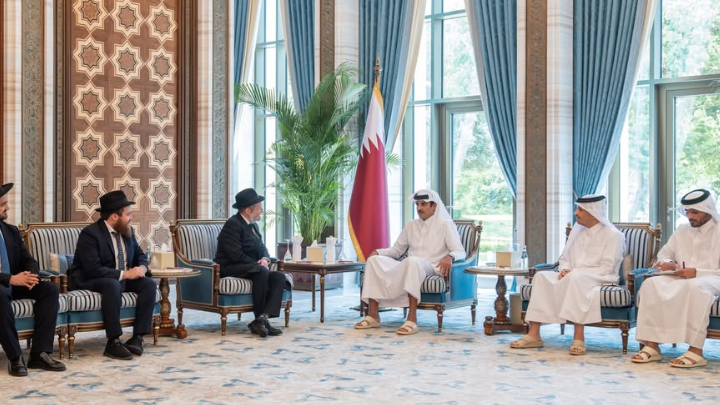
Emir of Qatar
Qatari Emir Tamim bin Hamad Al Thani and Prime Minister Mohammed bin Abdulrahman Al Thani met with Rabbi Mendy Chitrik on July 27, 2026.
Good Monday afternoon.
This P.M. briefing is reserved for our premium subscribers like you — offering a forward-focused read on what we’re tracking now and what’s coming next.
Today’s Daily Overtime was curated by JI U.S. Editor Danielle Cohen-Kanik.
📡On Our Radar
Notable developments and interesting tidbits we’re tracking
President Donald Trump decided to pause military strikes on Iran because the U.S. and Tehran are “in very deep talks,” he told Axios today, but if the discussions “don’t work out, we will go back to very strong military action.”
Negotiations are thus far indirect, reportedly taking place primarily between Iran and Oman, though Trump told reporters today that Iran had requested a meeting directly with the U.S…
Asked about Israeli Prime Minister Benjamin Netanyahu’s opposition to the U.S.’ planned sale of F-35 fighter jets to Turkey, Trump said, “Turkey’s been a great ally — for me. … Nobody tells me what we should be selling,” a clip that the White House’s rapid response social media account posted to X…
Saudi Arabia intercepted drones launched by Iran-backed militias in Iraq today which were targeting oil facilities in the country’s Eastern Province and in Riyadh, according to the Saudi Defense Ministry…
The U.S. Embassy in Israel temporarily restricted travel by U.S. government employees and their families into the West Bank due to “heightened security concerns and increased volatility” in the area…
Qatari Emir Tamim bin Hamad Al Thani publicized a meeting in Doha today with a delegation of rabbis — led by Rabbi Mendy Chitrik, chair of the Alliance of Rabbis in Islamic States — who came to offer their condolences on the death of the emir’s father and predecessor, Sheikh Hamad bin Khalifa Al Thani, Jewish Insider’s Haley Cohen reports…
Days after an alleged hate crime against a Jewish person in Manhattan, New York City Mayor Zohran Mamdani refused to engage with suggestions from various corners that he tone down his rhetoric around Israel — or to address why he continued publicly toying with arresting Netanyahu well after city attorneys told him he couldn’t, JI’s Will Bredderman reports…
The New York chapter of the Democratic Socialists of America is planning to lobby state lawmakers to pass the “Not on Our Dime” bill, which would revoke the tax-exempt status of New York nonprofits that support Israeli settlement activity, as well as a bill that would impose penalties on airlines that move arms shipments to Israel from JFK Airport, The New York Times reports…
Conservative writer Rod Dreher said Vice President JD Vance, with whom he used to be friends, “cut me off” after a meeting in which Dreher asked him to push back against rising antisemitism among young people on the right.
Dreher recalled on an episode of “The Jeremy Boreing Show”: “I pointed out to [Vance] these people — [neo-Nazi Nick] Fuentes, the groypers, all of them — are going to destroy conservatism and the Republican Party, and I said to him, ‘Because of your background, because of your age, you are uniquely positioned to draw a red line there’ … but he hasn’t chosen to do it”…
Far-left Michigan Senate candidate Abdul El-Sayed came under fire for leaked audio in which he said about his potential primary win, “You put one ogre on a pike, and then everyone else gets the message,” comments which some understood to refer to his opponent, Rep. Haley Stevens (D-MI).
El-Sayed disputed the interpretation, telling The 19th that he was “clearly referring to supporting a primary against [Sen.] John Fetterman (D-PA), who I’ve called an ogre many, many times”…
Troy Jackson, the newly minted U.S. Senate candidate in Maine, announced he’s raised $2 million since he replaced Graham Platner as the Democratic nominee over the weekend…
The Office of the Attending Physician in Congress said in a statement today that Sen. Mitch McConnell (R-KY), who has been hospitalized since he fell in June, is still not medically cleared to leave the rehabilitation facility and return to office…
New York Gov. Kathy Hochul and Maryland Gov. Wes Moore appeared separately at The Hampton Synagogue on Long Island over the weekend, where they both “affirmed their commitment to Israel and to combating antisemitism,” founding Rabbi Marc Schneier said…
⏩ Tomorrow’s Agenda, Today
An early look at tomorrow’s storylines and schedule to keep you a step ahead
Keep an eye on Jewish Insider for an interview with George Moraitis, a former Florida state representative who is running in the Republican primary for the 23rd Congressional District, hoping to unseat Rep. Jared Moskowitz (D-FL).
Israeli Prime Minister Benjamin Netanyahu will meet at the White House tomorrow with President Donald Trump for the eighth time in Trump’s second term, the most of any international leader. Before departing for Washington earlier today, Netanyahu said he and Trump would “discuss all the issues on the agenda — first and foremost, Iran.”
The two leaders will also attend the funeral of the late Sen. Lindsey Graham (R-SC), which will begin at the U.S. Capitol and then move to a service at the National Cathedral, where Trump is slated to give remarks. Other world leaders are also expected to be in attendance, including Israeli Opposition Leader Yair Lapid, who landed in the U.S. this morning, and Ukrainian President Volodymyr Zelensky.
Central Synagogue in Manhattan will hold a memorial service for Wesley LePatner, one year after the Blackstone executive and Jewish philanthropist was killed in a shooting at the firm’s Midtown headquarters.
Stories You May Have Missed
MICHIGAN MATTERS
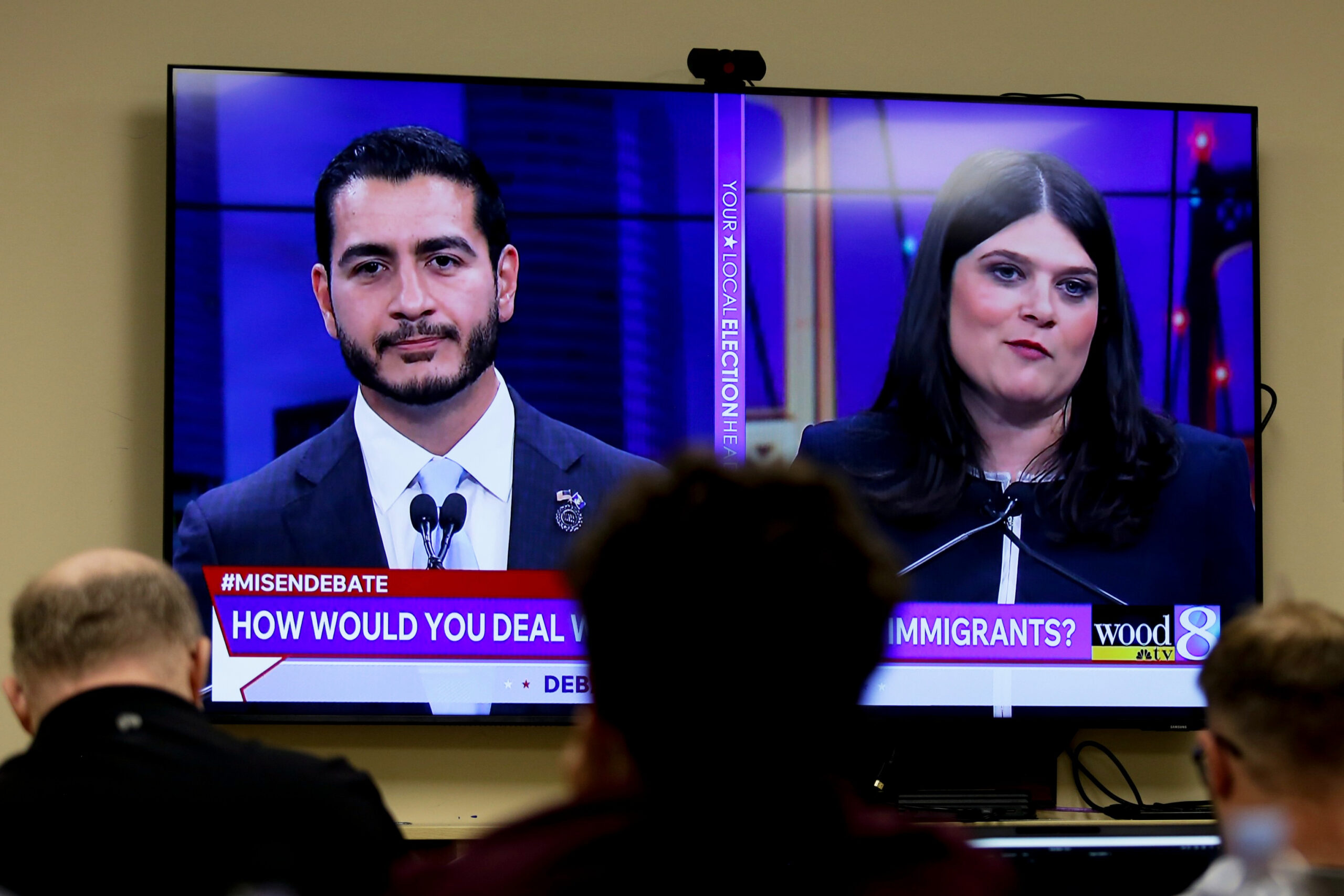
The state has been the epicenter of the anti-Israel movement, and will play a key role in nominating the next Democratic presidential candidate
BEE’S KNEES

Band spent 30 years in health policy before turning full-time to Judaica; now, the Library of Congress houses five of her books
‘They are talking to us right now. They’d love to make a deal. … I don’t think it’s time yet, but I’m willing to listen,’ the president said at the White House Correspondents' Dinner
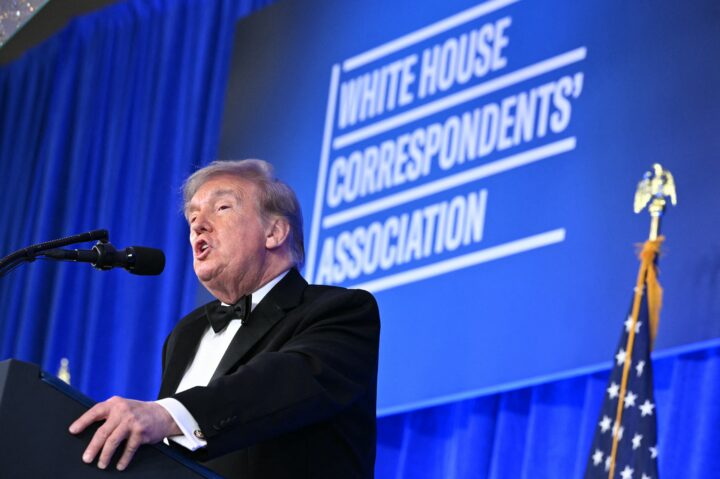
Mandel NGAN/AFP via Getty Images
President Donald Trump speaks during the 2026 White House Correspondents' Association Dinner at the Waldorf Astoria in Washington, D.C., on July 24, 2026.
President Donald Trump said in remarks at the White House Correspondents’ Dinner on Friday that the U.S. is continuing to negotiate with Tehran even amid U.S. strikes on Iran, but added that he didn’t think that Iranian leaders were ready to make a deal.
“They are talking to us right now. They’d love to make a deal. I don’t think they’re ready to. I don’t think it’s time yet, but I’m willing to listen,” Trump said at the dinner, held at Washington’s Waldorf Astoria after being rescheduled following a shootout at the annual April dinner between a lone gunman and Secret Service agents at the Washington Hilton.
Trump added that if Iran were to obtain a nuclear weapon, the country “would use it,” potentially targeting the U.S., Israel or elsewhere in the Middle East.
The Israeli prime minister, who will travel to Washington on Monday, is also set to attend Sen. Lindsey Graham’s funeral while in the U.S.
Joe Raedle/Getty Images
President Donald Trump shakes hands with Israeli Prime Minister Benjamin Netanyahu during a press conference at his Mar-a-Lago club on December 29, 2025 in Palm Beach, Florida.
Israeli Prime Minister Benjamin Netanyahu will fly to Washington on Monday, where he will meet with President Donald Trump and attend the funeral of Sen. Lindsey Graham (R-SC), his office announced on Friday.
Slated for Tuesday, the Oval Office meeting — Trump and Netanyahu’s first in-person sitdown since the start of the Iran war in late February — comes amid escalating U.S.-Iran hostilities and heightened Israeli readiness for potential strikes from Tehran.
Trump told Axios on Thursday that he’s considering restarting major combat operations in Iran — including strikes larger than those carried out by the U.S. and Israel against Iran before the ceasefire began in early April.
Netanyahu said that “Israel lost one of its greatest friends” after Graham died suddenly on July 11. The South Carolina senator’s funeral is scheduled for Tuesday at the National Cathedral in Washington.
How largely pro-Israel Democrats in solidly-blue districts balance the pressures from the base against their longstanding principles will speak volumes about whether the U.S.-Israel relationship can maintain support within their party
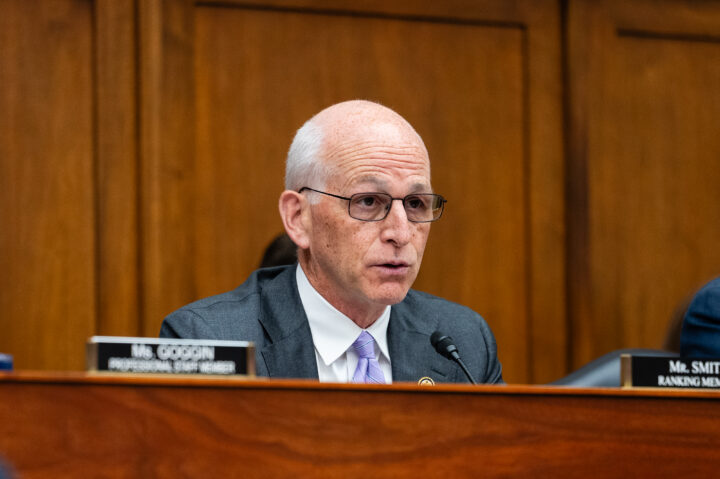
Eric Lee/Bloomberg via Getty Images
Rep. Adam Smith (D-WA), ranking member of the House Armed Services Committee, during a hearing on May 14, 2026.
President Donald Trump’s capture of the Republican Party did not happen at once, and was memorably met with resistance from some lawmakers who would later become his allies.
Many Republicans, during the rise of Trump, cast mostly party-line votes alongside the president and rarely spoke out publicly when they disagreed. But there were notable times when prominent party leaders used their political capital to stand up for their principles on key issues, such as then-Senate Majority Leader Mitch McConnell’s (R-KY) outspoken advocacy for Ukraine funding or Sen. Susan Collins’ (R-ME) decisive vote against repealing Obamacare.
There may be a similar political calculus at play for some typically pro-Israel Democrats, who are facing immense political pressure from loud activists in their party base to turn against the Jewish state. Nearly half of the House Democratic caucus voted to cut off aid to Israel last week, a record number that included 18 lawmakers who had previously been endorsed by AIPAC and were seen as strong allies of the U.S.-Israel relationship.
AIPAC cut off fundraising to their reelection campaigns after the vote, and how these lawmakers will position themselves on Israel policy going forward is now uncertain.
Not all of the Democrats who supported the amendment have adopted an anti-Israel worldview. Some said that they still support Israel, but wanted to make a statement, via a bill that was certain to fail, that they disagree with many recent actions of the Israeli government.
It’s also possible that some of them — especially those in districts where they face a credible primary threat from the left — took the vote to attempt to placate anti-Israel activists without making any real change in policy, like the Republicans who would offer an olive branch to their right-wing base by voting contrary to their longstanding beliefs.
For instance, in April 2024, then-Sen. Marco Rubio (R-FL) and Sen. Ted Cruz (R-TX) voted against a sweeping foreign aid package for Israel and Ukraine in the face of rising isolationist sentiment in the party, despite their hawkish records. But politically speaking, it helped maintain their credibility with a MAGA base skeptical of any foreign assistance without jeopardizing the funding.
A similar dynamic appears to be taking place among the generally pro-Israel Democrats who are trying to hold onto their place in the party as anti-Israel voices are on the rise.
Rep. Adam Smith (D-WA), for instance, described his “yes” vote as an attempt to “to try to get the attention of the Netanyahu government to force them to change their actions.” He also said he still supports Israel and expressed concern “about the tactics used by those on the far left to advocate for cutting off aid to Israel,” including vandalizing his family’s home. Days later, he spent time on a far-left podcast attacking the host’s anti-Israel views and explaining to her why he’s been such a strong supporter in his career of the Jewish state.
Far from sounding like an anti-Israel convert, Smith sounded like he wanted to throw the left-wing activists a bone by voting for the symbolic anti-Israel resolution without fundamentally shifting his longstanding views on Middle East policy.
In the liberal Boston suburbs, Rep. Jake Auchincloss (D-MA) — a Jewish Democrat and strong supporter of the U.S.-Israel relationship — surprised many by voting for the amendment. But in an interview with Jewish Insider’s Marc Rod this week, he asserted that the vote was in line with his pro-Israel beliefs.
“I represent a pro-Israel, anti-Netanyahu district and this is a pro-Israel, anti-Netanyahu vote,” Auchincloss said, adding that he believes “a majority of my Jewish constituents would agree with me.”
How largely pro-Israel Democrats in solidly blue districts such as those represented by Smith and Auchincloss balance the pressures from the base against their longstanding principles will speak volumes about whether the U.S.-Israel relationship can maintain support within their party.
White House Press Secretary Karoline Leavitt said the deal, which was already signed, is ‘still being finalized’
Win McNamee/Getty Images
President Donald Trump (R) meets with Crown Prince and Prime Minister Mohammed bin Salman of Saudi Arabia during a bilateral meeting in the Oval Office of the White House on November 18, 2025.
The new civilian nuclear cooperation agreement already signed between the U.S. and Saudi Arabia is now contingent on Riyadh joining the Abraham Accords, President Donald Trump announced on Thursday morning.
The president’s Truth Social post — in which he said the deal is “totally subject” to Saudi Arabia normalizing relations with Israel, a provision not previously disclosed by the administration — was quickly affirmed by the White House.
“Yes, this deal with Saudi Arabia, the energy deal, is contingent on this condition as far as the president is concerned,” White House Press Secretary Karoline Leavitt said during a press briefing on Thursday. “So we’ll continue to talk with our Saudi counterparts to get the deal finalized, and hopefully see them joining the Abraham Accords very soon.”
It appeared that Trump thought to add the provision only after the signing ceremony, which took place on Wednesday afternoon between Energy Secretary Chris Wright and Saudi Energy Minister Prince Abdulaziz bin Salman.
Asked if Trump had spoken to Saudi Crown Prince Mohammed bin Salman about it, Leavitt said, “As you know, the president just put out this statement a few hours ago. I don’t believe he’s had a call with MBS in the hours since.”
The new addition may have thrown a wrench in the agreement: Leavitt said the deal is “still being worked out,” despite already having been signed by the parties, and “will eventually, hopefully, be finalized with the condition that the president spoke about this morning.”
Leavitt also said she did not believe the provision was requested by Israeli Prime Minister Benjamin Netanyahu.
Plus, Jewish groups sound the alarm on Mamdani
Win McNamee/Getty Images
President Donald Trump (R) meets with Crown Prince and Prime Minister Mohammed bin Salman of Saudi Arabia during a bilateral meeting in the Oval Office of the White House on November 18, 2025.
Good Wednesday afternoon.
This P.M. briefing is reserved for our premium subscribers like you — offering a forward-focused read on what we’re tracking now and what’s coming next.
Today’s Daily Overtime was curated by JI U.S. Editor Danielle Cohen-Kanik.
📡On Our Radar
Notable developments and interesting tidbits we’re tracking
President Donald Trump set a new red line on Iran today: Any time the Islamic Republic fires on a ship in the Strait of Hormuz going forward, the U.S. will “bomb and destroy one bridge or power plant,” including ones located in or near Tehran, he wrote on Truth Social.
But the president’s threat didn’t seem to sway the regime: Iranian parliament speaker Mohammad Bagher Ghalibaf in turn warned on X that “in a region where we do not sell oil, no one will sell oil,” and said Iran would further target ships in the strait…
Congressional Democrats are lining up in opposition to the Trump administration’s reported nuclear agreement with Saudi Arabia that would allow Riyadh to enrich uranium for civilian purposes, while Republicans are mostly supportive of the effort, Jewish Insider’s Marc Rod and Christina Sher report.
Rep. Brad Sherman (D-CA) warned that the nuclear enrichment technology could eventually fall into the hands of a malign regime — as U.S. weapons did with the fall of the shah in Iran in 1979. “We have no idea who’s going to be running Saudi Arabia ten years from now,” Sherman told JI…
In a narrow vote, largely along partisan lines, the House passed its version of the 2027 National Defense Authorization Act this afternoon. All but six Democrats, as well as seven Republicans, voted against the bill in protest of issues including the continued Iran war and the proposed Defense Department budget of more than $1 trillion.
Some lawmakers, including Rep. Thomas Massie (R-KY), had sought to strip a provision on U.S.-Israel cooperation out of the bill, though Massie’s amendment on the issue ultimately didn’t receive a vote…
Italian Foreign Minister Antonio Tajani announced that the country will host another round of U.S.-led talks between Israel and Lebanon on Aug. 4…
Roman Gofman, the new head of the Mossad, reportedly traveled to Washington earlier this month for talks with CIA Director John Ratcliffe and White House officials on the Iran war and the Iranian nuclear program…
At a House Foreign Affairs Committee hearing today on U.N. reform, Jeff Bartos, the U.S. representative for U.N. management and reform, derided Francesca Albanese, the special rapporteur for the Palestinian territories, as an “absolute lunatic” and an “anti-America, anti-capitalist, anti-West, anti-Judeo-Christian, anti-Jew, anti-Israel bigot”…
Secretary of State Marco Rubio appeared to walk back the idea previously floated by Trump that Syria could take Israel’s place in fighting Hezbollah in Lebanon: “Well, the Syrian authorities are not big fans of Hezbollah. But what we’ve encouraged Syria to do is to focus on its own internal challenges that it has in sort of building a nation state,” Rubio said when asked about the concept…
A new Politico poll found a 13-point drop in support for the Iran war among Trump’s MAGA base: In May, 50% of MAGA voters said the war was worth the economic cost, down to just over a third who say the same now…
New York City Mayor Zohran Mamdani’s video released last night — in which he railed against Israeli Prime Minister Benjamin Netanyahu but confessed he couldn’t honor his campaign pledge to arrest the Israeli leader — triggered a wave of warnings from mainstream Jewish organizations that Mamdani excoriating Israel from his official platforms places Jewish New Yorkers at risk, JI’s Will Bredderman reports.
Rep. Josh Gottheimer (D-NJ) also slammed Mamdani for “parroting Hamas talking points” in his video and said the mayor should be “a little less obsessed with foreign policy, and a little more obsessed with cleaning up his streets”…
The Republican Jewish Coalition endorsed Sen. Darline Graham (R-SC) in the special election next month as she seeks a full term to succeed her late brother, Sen. Lindsey Graham (R-SC). The RJC, which last night announced the creation of an award in Lindsey Graham’s memory, said he was “the best friend of the Jewish people” in the Senate and that the group “trust[s] his beloved sister to carry the fight forward”…
Connie Chan, a member of San Francisco County Board of Supervisors who is running for the seat of retiring Rep. Nancy Pelosi (D-CA), received the endorsement yesterday of Citizens Against AIPAC Corruption, the political arm of the group TrackAIPAC, and pledged to “oppose any aid to Israel and do everything in our power to stop their government’s genocidal actions.” Chan, who is endorsed by Pelosi as well as Sen. Adam Schiff (D-CA), is seeking to defeat state Sen. Scott Wiener in the Democrat-on-Democrat general election…
The Louis D. Brandeis Center for Human Rights Under Law and the Anti-Defamation League reached a settlement today with Reed College, which agreed to implement “one of the nation’s most comprehensive sets of reforms addressing campus antisemitism,” the groups said in a statement.
As part of the agreement — negotiated over allegations of Title VI civil rights violations, including a Jewish student who was struck in the head by a rock — Reed will adopt a “first-of-its-kind FAQ” into its discrimination policy detailing how anti-Zionist conduct can constitute unlawful discrimination…
California Gov. Gavin Newsom appointed Scott Galloway, the Jewish UCLA and UC Berkeley alum who is now a business professor and commentator, to serve on the University of California Board of Regents, pending state Senate confirmation. Galloway has emerged as a leading voice against campus antisemitism in the aftermath of the Oct. 7, 2023, Hamas attacks…
⏩ Tomorrow’s Agenda, Today
An early look at tomorrow’s storylines and schedule to keep you a step ahead
Keep an eye on Jewish Insider for a look at comments by Rep. Adam Smith (D-WA) on the “Breaking Points” podcast as he becomes more outspoken against far-left activists who continue to harass him, even as he takes increasingly critical stances on Israel.
The Senate Committee on Health, Education, Labor and Pensions will vote to advance acting Labor Secretary Keith Sonderling’s nomination to assume his role permanently. Read more about Sonderling’s Jewish family history, which he invoked during his confirmation hearing.
The International Criminal Court‘s 125 member states will hold a vote on Friday in a special session at U.N. headquarters in New York on whether to remove chief prosecutor Karim Khan over sexual misconduct allegations, which he denies. An absolute majority of 63 states would have to vote on the secret ballot in favor of ousting Khan — who took a leave of absence last May and was formally suspended in June — in order to remove him. The vote lands amid a renewed U.S. push, announced by Secretary of State Marco Rubio last week, to dismantle the court.
The White House Correspondents’ Association will hold its rescheduled annual dinner on Friday at the Waldorf Astoria in Washington, three months after the original gala was cut short when a gunman stormed a security checkpoint and allegedly attempted to assassinate President Donald Trump. (Read JI senior congressional reporter Marc Rod’s first-hand account of the experience here.) The president is once again expected to attend and speak at the dinner.
In observance of Tisha B’Av, the Daily Overtime will be back in your inbox on Monday, July 27.
Stories You May Have Missed
MICHIGAN MATTERS
Matt Maasdam is gaining late momentum running on his national security credentials, but Bernie Sanders-backed William Lawrence is winning over the base
CAMPUS CLASH

In a statement, the caucus said the speaker selection ‘sent Jewish students a clear message that they were not welcome’
Matt Maasdam is gaining late momentum running on his national security credentials, but Bernie Sanders-backed William Lawrence is winning over the base
Campaign website
Matt Maasdam
The Democratic primary in Michigan’s 7th Congressional District — a Lansing-area swing seat key to Democrats’ hopes for taking back the House — has turned into a three-way battle between two moderate Democrats with national security backgrounds and a far-left activist who has emerged as a contender for the nomination despite repeated controversies over extremist comments.
On the campaign trail, Matt Maasdam, a former Navy SEAL, has leaned into his background as a veteran and a military aide to former President Barack Obama who carried the nuclear football. Bridget Brink, a career foreign service officer, is highlighting her service as U.S. ambassador to Ukraine from 2022 to 2025.
William Lawrence, the progressive backed by Sen. Bernie Sanders (I-VT), is a former organizer with the Sunrise Movement, which bills itself as leading “the climate revolution” but also embraces other left-wing causes.
Adrian Hemond, a Michigan political strategist, said he expects the race to be close, predicting that the three candidates could all finish within several points of each other.
He previously told JI that Lawrence holds the progressive lane to himself, which could be an asset if Maasdam and Brink split the moderate vote — but he could lose out on young, progressive-leaning Michigan State University students who won’t return to campus until after the Aug. 4 primary. Lawrence has also struggled with Black and older voters.
The race initially appeared to be a contest between Maasdam and Brink. Lawrence gained momentum and attention by scoring a series of prominent endorsements from Sanders and other progressive leaders.
But Lawrence’s rise hit a stumbling block with the re-emergence of past comments disparaging Black political leadership, which prompted condemnations from Michigan leaders and the Congressional Black Caucus. After those initial revelations, Lawrence subsequently came under fire for past comments disparaging Obama and his administration.
In past comments on the “Hegemonicon” podcast he hosted, first uncovered by Jewish Insider, Lawrence repeatedly argued, for the sake of climate and economic goals, Americans would have to abandon the idea of the American dream and their way of life.
Discussing whether and how ideas of “abundance” or “degrowth” could or should be part of an agenda to fight climate change, Lawrence said on an episode of the podcast release in January 2024, “we’ve experienced the last several years of how that got filtered through the lens of American global competitiveness and geoeconomic dominance and, some of these questions about the role of the American consumer on a global stage and and whether or not we are proposing the continuation of the American consumer way of life and its translation into China and presumably the rest of the globe, is really viable in a climate-changing world.”
“We made that move, and now we need to reckon with the contradictions inherent even in that move,” Lawrence said. “I’m wondering how we can inspire a sense of abundance for people in the United States while, frankly, destroying the American way of life and the negative connotations, and material realities that has come to mean.”
In a statement, Lawrence defended the comments.
“We’ve been told that we would achieve happiness by buying more TVs and taking on a bigger mortgage,” Lawrence said. “Instead, the cost of housing, healthcare, and education is skyrocketing, while Michigan’s land and water is under threat. We need a new version of the American dream in which we can all have economic security while leaving a healthy environment for our kids and grandkids.”
In another episode, released in December 2023, Lawrence said that “there are certain aspects of the American dream that need to die — but maybe that’s another episode,” arguing that most people would not be able to have “the McMansion in the suburbs.”
A senior political advisor close to the Maasdam team said that the endorsements from Sanders and other top progressives catapulted Lawrence toward the front of the field, but the recent revelations of his past comments have stunted that growth.
The advisor said the endorsements from Sanders and others likely earned Lawrence the votes of around a third of the Democratic electorate who will likely vote for the most-left candidate in the race, leaving around two-thirds up for grabs.
Last week, Maasdam picked up an endorsement from Sen. Elissa Slotkin (D-MI), who subsequently filmed an advertisement supporting him. The freshman senator represented the Lansing-area district before being elected to the Senate.
The advisor close to the Maasdam campaign said that they see the race now largely as a contest between Maasdam and Lawrence, but said they believe Maasdam is well-positioned going into the final weeks of the race and peaking at the right time.
He has been the beneficiary of more than $1.6 million in outside spending by VoteVets, with another outside group, Crush MAGA PAC, spending nearly $1 million to attack Lawrence, and a third group, Michigan Values PAC, spending around $1 million to attack Brink. A nursing union group has spent $400,000 boosting Lawrence.
At the same time, they also acknowledged a real concern that Maasdam and Brink could split the moderate vote, allowing Lawrence to win with a plurality.
Brink has faced criticism from primary rivals for her service under and praise of President Donald Trump — though she ultimately resigned in protest of the administration’s efforts to pressure Ukraine.
The advisor argued that, compared to Brink, Maasdam has a better resume and background as a fighter, and said Maasdam plans to highlight his links to Obama in the wake of the revelation of Lawrence’s comments disparaging the former president.
Maasdam posted an X video on Monday highlighting his support for and ties to Obama, while calling out Lawrence’s criticism of him.
In spite of their moderate and national security focused backgrounds, neither Maasdam nor Brink appears to have spoken much about Israel policy during the campaign, and neither campaign provided comment to JI on their stances.
Lawrence has attacked the two for declining to describe the war in Gaza as a genocide, and has made cutting off arms sales to Israel a major plank of his campaign.
All three have been critical of the war with Iran.
‘The idea that the vice president’s team … would try or even be able to interfere with a visit by a foreign leader with the president is laughable,’ the official told JI
Marc Israel Sellem/Getty Images
U.S. Vice President J.D. Vance (L) and Israeli Prime Minister Benjamin Netanyahu (R) speak to the media at the Prime Minister's Office in West Jerusalem, on October 22, 2025.
A senior White House official told Jewish Insider on Tuesday that a report claiming Vice President JD Vance was attempting to scuttle a potential White House meeting between President Donald Trump and Israeli Prime Minister Benjamin Netanyahu was “completely false.”
“The idea that the vice president’s team, or any official in the administration for that matter, would try or even be able to interfere with a visit by a foreign leader with the president is laughable,” the official said.
The report in the Israeli outlet Ynet cited senior Israeli officials who said Vance feared Netanyahu would convince Trump to escalate action against Iran.
“This is 100% fake news,” Taylor Van Kirk, Vance’s communications director, wrote about the story on X.
Plus, direct flights to Beirut cleared for takeoff
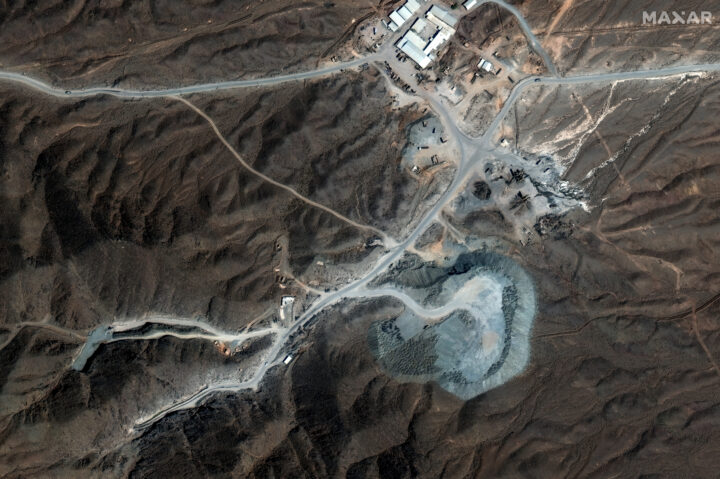
Satellite image (c) 2026 Vantor
Vantor satellite image shows tunnel construction activity and road infrastructure near the Natanz nuclear facility in the mountainous area around Pickaxe Mountain.
Good Tuesday afternoon.
This P.M. briefing is reserved for our premium subscribers like you — offering a forward-focused read on what we’re tracking now and what’s coming next.
Today’s Daily Overtime was curated by JI U.S. Editor Danielle Cohen-Kanik.
📡On Our Radar
Notable developments and interesting tidbits we’re tracking
Meeting with Lebanese President Joseph Aoun in the Oval Office today, President Donald Trump warned that the U.S. would “pretty soon” strike Iran’s Pickaxe Mountain, the underground facility suspected of housing components of Tehran’s nuclear program, Jewish Insider’sEmily Jacobs reports.
“We’ll be hitting that area pretty soon, and very heavily,” he said, following a Wall Street Journal report that Israeli intelligence indicates Iran moved thousands of centrifuges into the site last fall…
Trump added in his comments that Iran “wants to meet desperately” with the U.S. to end the war, but “until they’re ready to meet in a meaningful way, we have no interest in meeting with them”…
Trump announced after his meeting with Aoun that he is directing his administration toallow all U.S. airlines to fly directly between the U.S. and Lebanon. The Reagan administration suspended direct flights in 1985 after Hezbollah-linked hijackers seized TWA Flight 847 and killed a U.S. service member aboard…
Israeli Finance Minister Bezalel Smotrich said at a conference today that Israel has “no interest” in joining the renewed U.S. campaign against Iran. “The best way to bring about the regime’s downfall is to crush it economically,” he said, pointing to the U.S. blockade on Iranian ports…
Defense Secretary Pete Hegseth told the Senate Appropriations Committee during a hearing this afternoon that the estimated cost of the Iran war thus far is $37.5 billion, up from $29 billion estimated by Pentagon Comptroller Jules Hurst in May.
Sen. Patty Murray (D-WA), the top Democrat on the committee, indicated that Democrats do not intend to support the Pentagon’s $88 billion supplemental funding request. The administration’s “expectation that Americans will just pay for [the war in Iran] without any explanation or transparency is disrespectful,” she said…
The IDF said its soldiers operating in southern Lebanon fired warning shots today as personnel from the Lebanese Armed Forces crossed into Israeli-controlled territory, an area the IDF said was not included in the pilot zones the LAF is meant to control. The LAF called the incident “an act of aggression” that could hinder the broader deployment plan…
A senior White House official told JI that a report that Vice President JD Vance was attempting to scuttle a potential White House meeting between Trump and Israeli Prime Minister Benjamin Netanyahu is “completely false.”
“The idea that the vice president’s team, or any official in the administration for that matter, would try or even be able to interfere with a visit by a foreign leader with the president is laughable,” the official said…
A group of Jewish House Democrats asked Secretary of State Marco Rubio today to pressure Malaysia to walk back plans to deport Israeli citizens, JI’s Marc Rod reports, urging him to leverage U.S. military assistance to the Southeast Asian nation…
The Senate Intelligence Committee voted to advance the nomination of Jay Clayton to be director of national intelligence, Committee Chair Sen. Tom Cotton (R-AR) announced, sending his nomination to the full Senate for approval. Democrats who had previously wanted to see Clayton confirmed said they were disappointed by his refusal to affirm at his hearing that former President Joe Biden won the 2020 election…
The Jewish Caucus of the College Democrats of America condemned the CDA’s decision to host far-left streamer Hasan Piker at its convention over the weekend and claimed in a statement that attendees were prevented from conducting a walkout during Piker’s speech. The caucus called on CDA leadership to issue a formal apology and to publicly condemn Piker’s previous antisemitic comments, JI’s Haley Cohen reports…
Rep. Tom Tiffany (R-WI), the leading Republican candidate for governor in Wisconsin, appeared on a podcast hosted by an individual who defended Hitler and joked about the Holocaust, the Milwaukee Courier reports. Tiffany had previously criticized his likely Democratic opponent, Francesca Hong, for going on Piker’s podcast…
The now-former treasurer of the New York Young Republican Club, Nicholas T. Rafael Jr., appeared to operate an anonymous X account that posted Hitler images and antisemitic caricatures, according to New York Magazine, which also obtained a photo of Rafael making what appears to be a Nazi salute while wearing German military attire. It’s the latest scandal regarding far-right extremism for the once-influential club…
The University of New Hampshire released a new poll of the race for U.S. Senate in Maine showing former state Sen. Troy Jackson, the presumed replacement for former Democratic nominee Graham Platner, leading Sen. Susan Collins (R-ME) 49-46% in the general election…
New York Assemblymember Micah Lasher, the presumed successor to retiring Rep. Jerry Nadler (D-NY), strongly defended his ongoing relationship with Morris Katz and said he’ll continue to work with the consultant who was behind Platner‘s failed Senate bid, a week after New York City Mayor Zohran Mamdani said the same…
⏩ Tomorrow’s Agenda, Today
An early look at tomorrow’s storylines and schedule to keep you a step ahead
Keep an eye on Jewish Insider for a look at the Democratic primary in Michigan‘s battleground 7th Congressional District, where two Democrats with national security backgrounds are facing off against a far-left activist.
The House Foreign Affairs Committee will hold a hearing on U.N. accountability and reform with U.S. Ambassador to the U.N. Mike Waltz and U.S. Representative to the U.N. for Management and Reform Jeff Bartos.
Later, the committee’s Middle East subcommittee will hold a hearing on the “next phase of the Abraham Accords” with former U.S. Ambassadors to Israel David Friedman and Dan Shapiro as well as Asher Fredman, executive director of the Misgav Institute for National Security.
The House Ways and Means Committee will mark up several bills including the Foreign Funding Transparency Act, which would make nonprofits disclose foreign donors; the Fiscal Sponsorship Transparency Act, which would require charities to report the groups they fund; and the Fair Treatment of Religious Organizations Act, which would shield religious groups’ tax-exempt status.
Stories You May Have Missed
FRIENDLY FIRE
Joel Rubin: Sanders has endorsed ‘the most categorically anti-Israel, antisemitic candidates that we’ve seen in a generation, if ever’
BLUE STATE BLUES
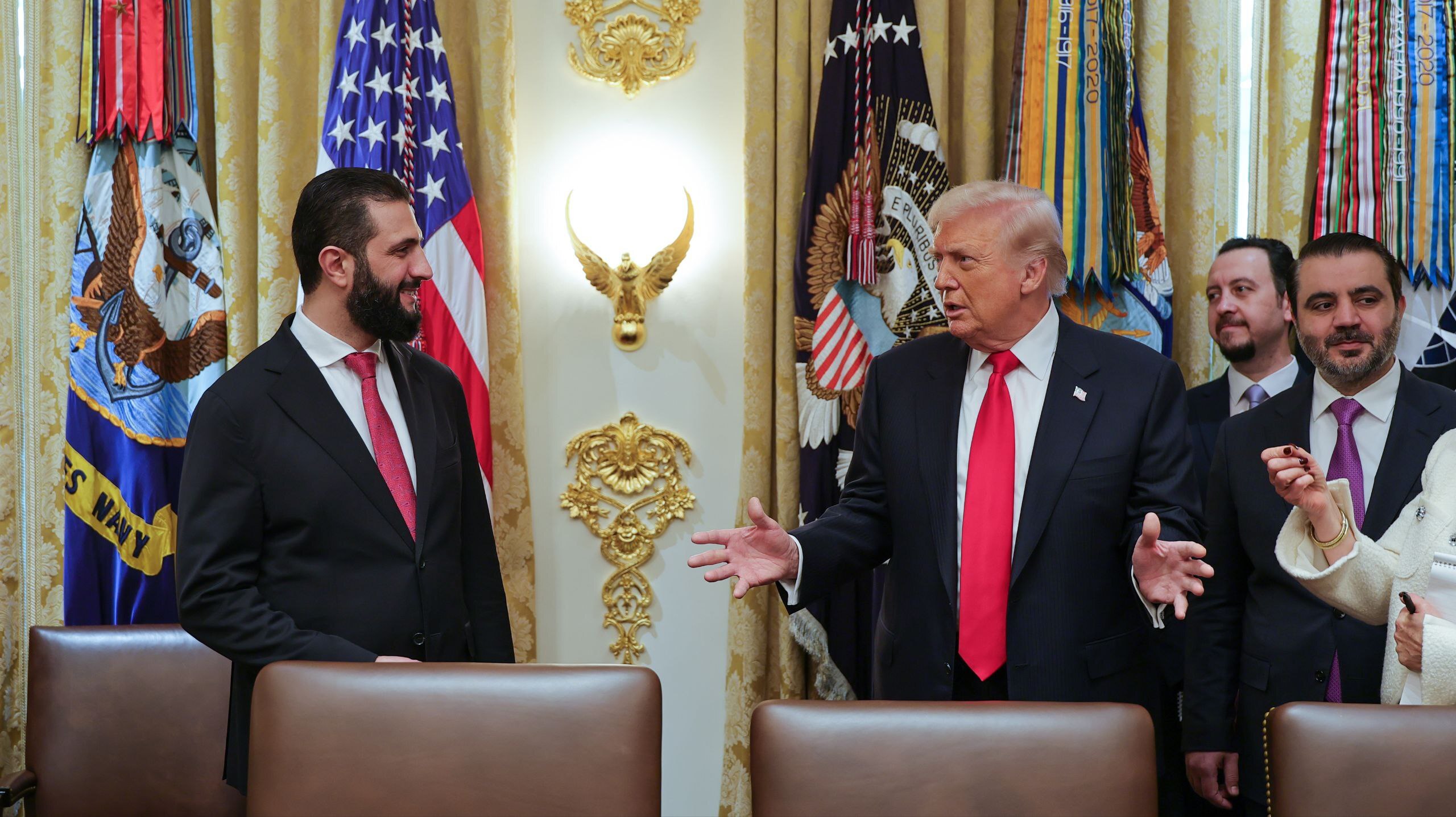
In one of the bluest states in the country, Jewish Democrats feel increasingly estranged from a party they helped build — but the answer, they say, is to lean in
The president said Iran ‘desperately’ wants to meet with the U.S. but ‘until they're ready to meet in a meaningful way, we have no interest in meeting with them’
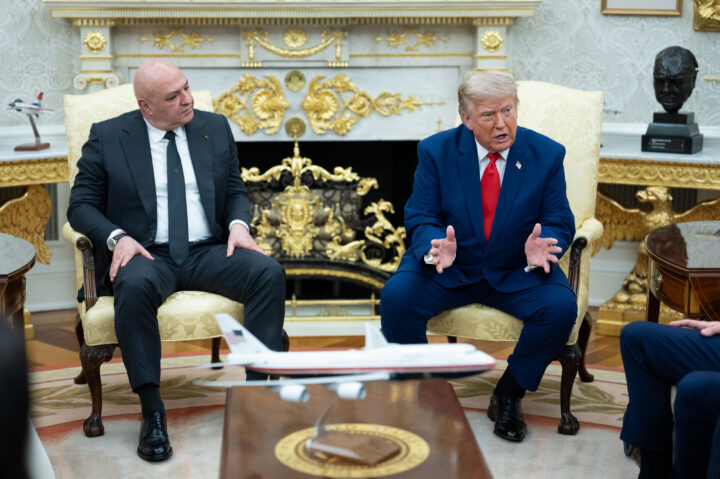
Aaron Schwartz/CNP/Bloomberg via Getty Images
Joseph Aoun, Lebanon's president, left, and President Donald Trump during a meeting in the Oval Office of the White House on July 21, 2026.
President Donald Trump warned on Tuesday that the U.S. would “pretty soon” strike Iran’s Pickaxe Mountain, the underground facility suspected of housing components of Tehran’s nuclear program.
The president made the comments from the Oval Office while welcoming Lebanese President Joseph Aoun for a meeting about the ongoing U.S.-led talks between Israel and Lebanon. Trump was asked about a Wall Street Journal report that Israeli intelligence shared with the U.S. indicated that Iran moved thousands of centrifuges into its clandestine Pickaxe Mountain site last fall.
“I think that they may have [moved the centrifuges],” Trump said. “It doesn’t mean anything unless they have the [nuclear] material. They don’t have it. We follow the material. That’s where the action is.”
“We’ll be hitting that area probably pretty soon. There’s not a thing they can do about it,” he continued. “Normally, I wouldn’t say that. If I thought they could do something about it, I would never say that, but we’ll be hitting that area pretty soon, and very heavily.”
The president predicted that it would take Iran between 20 to 25 years to rebuild its nuclear program if U.S. forces immediately ceased striking Iranian nuclear targets, though he noted that the U.S. was “not finished at all” in Iran and was “not leaving right now.”
He added that Iran “wants to meet desperately” with the U.S. to end the war “because they’re getting decimated,” but “until they’re ready to meet in a meaningful way, we have no interest in meeting with them.”
Joining Trump for his meeting with Aoun were Vice President JD Vance, Defense Secretary Pete Hegseth, Treasury Secretary Scott Bessent and White House Chief of Staff Susie Wiles.
On the subject of Lebanon, Trump told reporters that he was willing to speak to Hezbollah’s leaders directly to advance peacemaking efforts with Israel.
“I would speak to Hezbollah. I speak to everybody. I’ll speak to people that a lot of people think I shouldn’t be speaking to and things work out,” Trump said. “If [Aoun] wanted me to speak to Hezbollah, you know he’s lived with Hezbollah for a long time, and if the president wanted me to speak to Hezbollah, I would.”
Trump praised Aoun directly and detailed his own affinity for Lebanon, telling reporters that the U.S. is “going to help [the country] a lot” and describing the U.S.-Lebanese relationship as “very good.”
“I think that Lebanon has been a very mistreated country for a long period of time,” Trump said.
The president said that he planned to discuss with Aoun Israel’s ongoing troop withdrawal from southern Lebanon and ways to empower the Lebanese Armed Forces.
“We’ll be speaking about that today with the president, and we have some very concrete plans already in store for that with others going in and helping,” Trump said. “But they’re also becoming much more self-sufficient, and we will be speaking about that.”
Plus, Darline Graham heads for the campaign trail

Kyle Mazza/Anadolu via Getty Images
A U.S. Army carry team moves the flagged-draped coffins containing the remains of the U.S. soldiers killed in an Iranian strike on March 7, 2026.
Good Monday afternoon.
This P.M. briefing is reserved for our premium subscribers like you — offering a forward-focused read on what we’re tracking now and what’s coming next.
Today’s Daily Overtime was curated by JI U.S. Editor Danielle Cohen-Kanik.
📡On Our Radar
Notable developments and interesting tidbits we’re tracking
U.S. and Iranian leaders continued to escalate their rhetoric as renewed military hostilities entered their second week: Iranian President Masoud Pezeshkian said today that Tehran is in “full-scale war” with the U.S., while President Donald Trump proclaimed that “every time Iran kills an American soldier” — after three service members were killed in Iranian attacks over the weekend — “they will pay for that killing many times over!” Trump said he had conveyed that directive to Defense Secretary Pete Hegseth, Joint Chiefs Chairman Gen. Dan Caine and “every leader in the military”…
U.S. officials told The New York Times that dozens of U.S. service members were injuredand several helicopters damaged in previously undisclosed Iranian strikes in Jordan last week, prior to this weekend’s fatal attacks.
The deadly strikes reportedly hit housing units where U.S. forces live and sleep, with some troops unable to reach bomb shelters before the missiles struck…
The NYT also investigates the deaths of three civilian crewmembers aboard a shadow tanker carrying Iranian oil that was targeted by U.S. strikes on June 10 as part of the American blockade of Iranian ports.
The Strait of Hormuz continues to be a focal point of the conflict, as the Islamic Revolutionary Guard Corps claimed today that two oil tankers had exploded after passing through the waterway…
All the while, the White House posted to its social media feed a three-week-old poll from a right-wing polling firm showing support for the now-defunct U.S.-Iran memorandum of understanding signed last month, Jewish Insider’s Haley Cohen reports…
New York City Mayor Zohran Mamdani seemed to back away today from a campaign pledge — reiterated in an interview over the weekend — to arrest Israeli Prime Minister Benjamin Netanyahu when he visits New York for the upcoming U.N. General Assembly, JI’s Will Bredderman reports.
“My administration will follow all applicable local laws. That is our commitment,” the mayor told reporters. Trump, meanwhile, pledged on Truth Social that Netanyahu “will not be arrested, in any way, shape, or form, while in the United States of America”…
Sen. Darline Graham (R-SC) confirmed on Fox News that she will run in the special election next month for U.S. Senate to fill the seat of her late brother, Sen. Lindsey Graham (R-SC); Darline Graham already has Trump’s endorsement, given as he encouraged her to run on Friday.
Not to be dissuaded, Rep. Russell Fry (R-SC), who was thought to be a front-runner before Darline Graham came on the scene, also declared his candidacy for the seattoday. Senate Majority Leader John Thune (R-SD) told reporters he is not endorsing anyone “at the moment” in the race…
Sen. Elizabeth Warren (D-MA) became the latest progressive lawmaker to endorse far-left Michigan Senate candidate Abdul El-Sayed today, citing the “special interests running millions of dollars in TV ads to buy this seat,” an apparent reference to the AIPAC-linked United Democracy Project super PAC supporting El-Sayed’s opponent, Rep. Haley Stevens (D-MI)…
Rep. Mike Collins (R-GA) pulled family pictures off of his campaign site that feature his son-in-law, who was found to have promoted white nationalism and Nazi ideology online, as he runs for U.S. Senate against Sen. Jon Ossoff (D-GA)…
The State Departmentannounced today that the Lebanese Armed Forces is assuming control of three villages in southern Lebanon as part of pilot zones established under the trilateral agreement between Israel, Lebanon and the U.S. The IDF, which is coordinating the effort with the LAF and U.S. military, said it will “respond forcefully to any violation of the agreement”…
Houthi military spokesman Yahya Saree announced a maritime blockade of Saudi Arabia today in retaliation for what the terror group called Riyadh’s “oppressive siege” on Yemen…
Former Israeli Minister of Strategic Affairs Ron Dermer has rejoined the Jewish Institute for National Security of America as a distinguished fellow, the organization announced…
⏩ Tomorrow’s Agenda, Today
An early look at tomorrow’s storylines and schedule to keep you a step ahead
Keep an eye on Jewish Insider for a look at Ed Miliband, the member of Parliament who was tapped today by new U.K. Prime Minister Andy Burnham to serve as foreign secretary, and what his selection could mean for British policy toward Israel.
Lebanese President Joseph Aoun will meet President Donald Trump at the White House. The two leaders’ first in-person meeting comes as Lebanon, the U.S. and Israel work to implement their trilateral agreement signed last month and as the Lebanese government seeks to demonstrate its ability to disarm and contain Hezbollah.
On the Hill, Defense Secretary Pete Hegseth and Joint Chiefs Chairman Gen. Dan Caine will appear before the Senate Appropriations Committee for a hearing on the Trump administration’s $88 billion supplemental funding request for the Pentagon.
The House Intelligence Committee will hold a hearing on the terror threat landscape ahead of the upcoming 25th anniversary of the 9/11 terror attacks with testimony from former National Security Advisor H.R. McMaster.
Jewish groups including the Jewish Federation of Columbia South Carolina, the Conference of Presidents of Major American Jewish Organizations, the Zionist Organization of America, Young Jewish Conservatives, the Jewish Community Action Network, the Focus Project, ChaiTech and Stop Antisemitism will hold a virtual national tribute to the late Sen. Lindsey Graham (R-SC).
Stories You May Have Missed
TRUST FALL
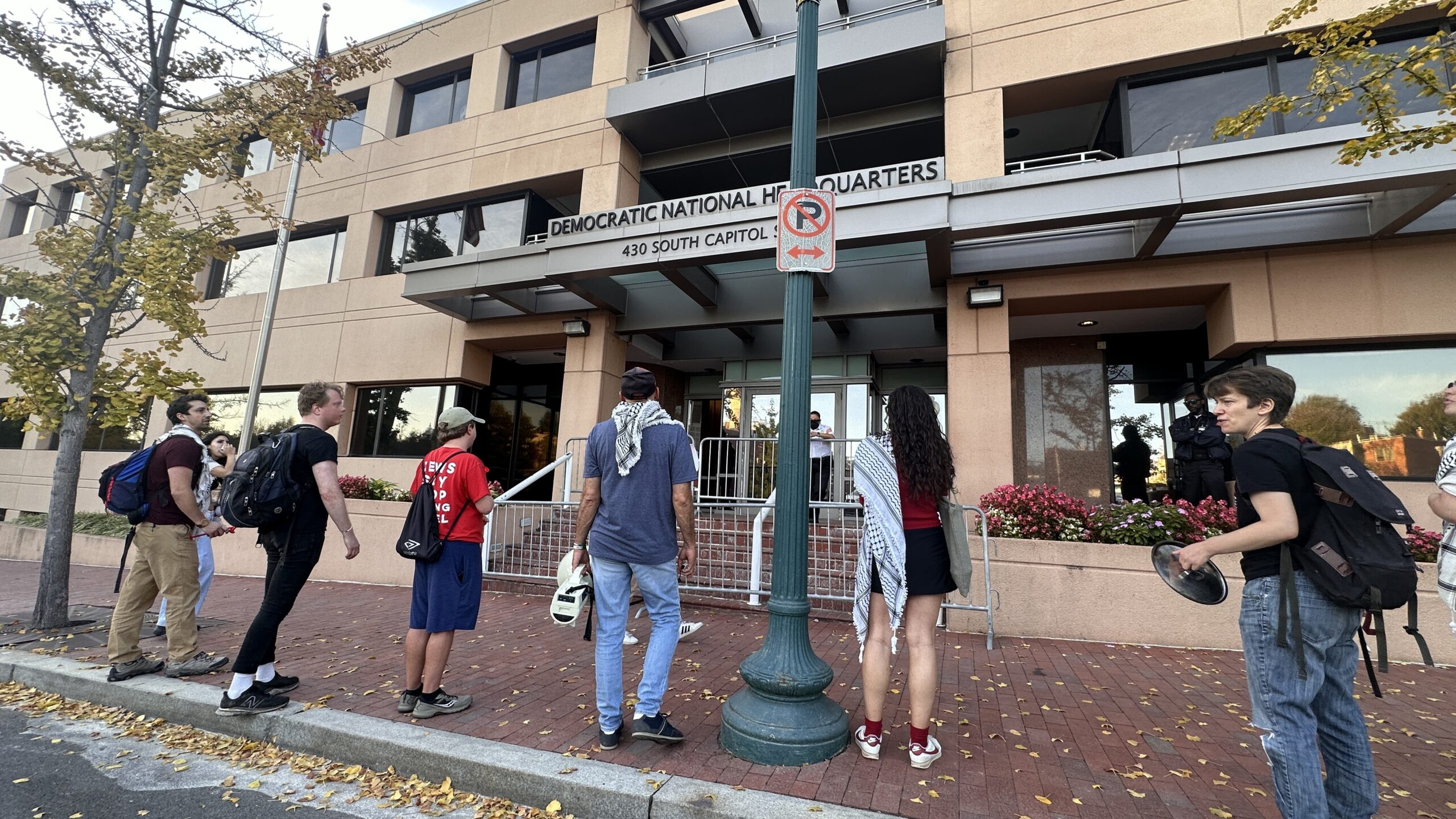
After 104 members of the House voted last week in favor of an amendment to eliminate military aid to Israel, pro-Israel activists who have spent years building ties with lawmakers are now wondering how to approach those relationships
NO STRINGS ATTACHED
Members of Congress acknowledged Israel-Syria normalization is a worthwhile goal, while recognizing the limits of the current geopolitical landscape
The three-week-old poll describes the memorandum of understanding as a ‘peace deal to end the war,’ purportedly garnering 60% support from American voters

Fatemeh Bahrami/Anadolu via Getty Images
Smoke rises after airstrikes in Tehran, Iran on March 13, 2026.
Amid its escalating conflict with Iran, the White House’s social media feed posted a three-week-old poll on Monday from a right-wing polling firm indicating Americans support the U.S.-Iran memorandum of understanding established last month.
The poll was posted on both President Donald Trump’s Truth Social account and tweeted by the White House’s X account.
The June 29 survey from the firm Big Data Poll, whose methodology has drawn scrutiny from non-partisan pollsters, showed 60% of registered voters supporting the “Iran Peace Deal,” with just under one-quarter opposed and 15% undecided.
The poll’s loaded wording characterizes the MOU as a “peace deal to end the war with Iran,” though the signed agreement only launched talks to negotiate a permanent end to the conflict.
The White House did not immediately respond to a request for comment from Jewish Insider regarding the timing of the poll being posted.
Sens. Blumenthal and Shaheen said the late Sen. Lindsey Graham never sought to include Iran sanctions in the legislation he spent months negotiating before his death
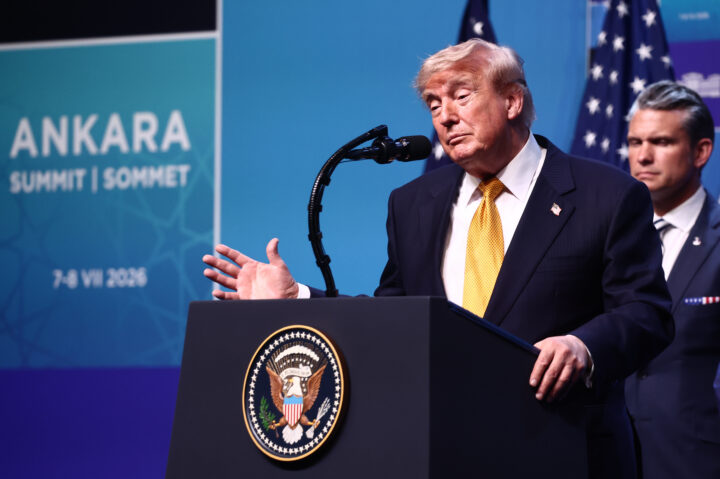
Jakub Porzycki/NurPhoto via Getty Images
President Donald Trump during the press conference at the NATO Summit in Ankara, Turkiye on July 8, 2026.
President Donald Trump’s call for Republicans to incorporate sanctions against Iran into the late Sen. Lindsey Graham’s (R-SC) bipartisan legislation sanctioning Russia and countries that buy Russian oil was met with confusion by some of the Democrats supporting the bill.
The legislation, which was renamed in the late senator’s honor, places sanctions on Russia and secondary sanctions on countries that buy Russian oil and gas in an effort to cut off Russian President Vladimir Putin’s ability to finance his war in Ukraine. It also codifies sanctions against Russia that have already been implemented via executive order, preventing a future president from easily terminating them.
Trump wrote on his Truth Social platform on Sunday that, “Republicans should add Iran to the Russian Sanctions Bill. That’s what Lindsey wanted to do, and it was going to happen.”
His comments come less than a week after he said that Republicans would “like to add Iran and they’d like to add Hezbollah” to the sanctions package. “That’s what I’m hearing,” the president told reporters at the White House on Tuesday.
“This is in honor of Lindsey,” Trump said when asked if he will sign the Russia sanctions bill if it reaches his desk. “This was his thing, he wanted this more than any other thing. You know how he felt.”
The president’s comments came as a surprise to the Democrats who worked with Graham on the legislation, who noted that the late senator had never sought to add sanctions on Iran or its proxies into the package.
“Our Russia sanctions bill was meticulously crafted during painstaking, sometimes painful negotiations over many months,” Sen. Richard Blumenthal (D-CT), who spearheaded the effort alongside Graham for over a year, told Jewish Insider in a statement. “This bill should move forward as quickly as possible — as is — without additional provisions, which can be done separately.”
Sen. Jeanne Shaheen (D-NH), the top Democrat on the Senate Foreign Relations Committee, told Bloomberg’s “This Weekend” on Sunday that, “Sen. Graham never raised the concern about putting Iranian sanctions on the bill.”
“The fact is, we have significant sanctions on Iran. When the war started, we put additional sanctions on Iran. I think if the president wants to do that, let’s do it in a separate bill, but this bill is moving,” Shaheen said. “It’s targeted in a way that is important and it comes on the heels of the G7 conference, where everyone, including President Trump, signed on to a communiqué that said we need to support Ukraine and put more pressure on Putin. That was echoed at the NATO summit.”
“We know that that’s what it’s going to take to get Vladimir Putin to the table,” she continued. “So far, we have not been successful at getting him to the negotiating table. Let’s put more pressure on him to do that.”
Sen. Katie Britt (R-AL), a cosponsor of the sanctions legislation and an ally of both Graham and Trump, did not rule out Trump’s idea to add Iran sanctions to the bill during a joint appearance with Shaheen on “Fox News Sunday.”
“I think Lindsey Graham was clear-eyed about this,” Britt said. “He knew what Iran was capable of, and he knew that when they chanted, ‘Death to America,’ that they meant it. Look, he believed in President Trump and knew that President Trump had what it takes to create a resolution to what is happening there”
“Being able to move this bill across the finish line — [along with] the bipartisan support that we have gotten to hold Putin accountable, to give President Trump the flexibility and the tools he needs and the economic firepower to bring Putin to the table to create peace and resolution here — will ultimately have a lasting impact across the globe, making sure that those who are funding bad actors, whether it be Russia or those in Iran, will be held accountable,” the Alabama senator continued.
Graham and Blumenthal first introduced their legislation last April. By May, the duo had accumulated more than 80 cosponsors in the Senate for the bill, which was repeatedly stalled last year as the late senator worked to secure Trump’s support. Despite the bipartisan support, a number of Democrats and other critics, including the Wall Street Journal editorial board, expressed concern about the legislation over the fact that its language grants sweeping tariff authorities to the president.
After being sworn in last Tuesday, Sen. Darline Graham (R-SC), the late senator’s sister who was appointed to serve out the remainder of his term, sponsored a revised version of the legislation, which was renamed to honor her late brother. The bill has since collected 62 cosponsors.
The president said he’d give Darline Graham his ‘complete and total endorsement’ if she enters the special election to succeed her late brother
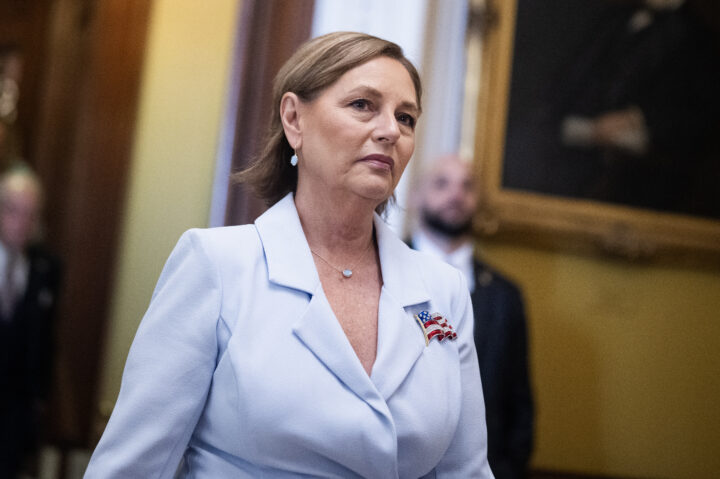
Tom Williams/CQ-Roll Call, Inc via Getty Images
Sen. Darline Graham (R-SC) makes her way to a swearing in ceremony in the U.S. Capitol after she was sworn in on the Senate floor on Tuesday, July 14, 2026.
President Donald Trump said on Friday that he has asked newly appointed Sen. Darline Graham (R-SC) to consider running in next month’s special Senate election for the full term of her late brother’s seat.
Trump wrote on Truth Social that he had encouraged Darline Graham, who was appointed to serve out the remainder of her brother’s term following his unexpected passing last weekend, to run in the race to succeed Lindsey Graham during her visit to the White House on Thursday for their first meeting since she was sworn in.
The president said that Darline Graham would receive his endorsement should she decide to seek a full term in the Senate.
“During her visit, I asked Darline, for the Good of our Nation, to run for the U.S. Senate in the Special Republican Primary on Tuesday, August 11, 2026,” Trump wrote. “I hope Darline does this, in that there would be nobody better to honor the legacy of her beloved brother, Lindsey. Darline, who comes from an absolutely incredible family, has been a WINNER all of her life, and should she accept, has my Complete and Total Endorsement in the Special Election for U.S. Senate in South Carolina.”
Trump said he has known Darline Graham “for a long time” and called her “a spectacular person, and a true American Patriot. Lindsey was one of the greatest people and Senators I have ever known, and his sister shares his deep love of our Country, and the State of South Carolina.”
“SHE WILL NEVER LET YOU DOWN,” he wrote. “RUN, DARLINE, RUN!”
South Carolina Gov. Henry McMaster announced on Monday that he was appointing Darline Graham to serve out the remainder of her older brother’s Senate term, which ends in January. The announcement came hours after Trump publicly declared that Darline Graham was his preferred choice to represent South Carolina on her brother’s behalf until the conclusion of his Senate term.
At the time, Darline Graham had not expressed any interest in running in the special election next month to be the GOP nominee, prompting other Republicans in the state to start engaging with the White House and the National Republican Senatorial Committee about possibly getting into the race.
Two sources familiar with Darline Graham’s thinking told Jewish Insider that she was not interested in running for a full term when she initially agreed to accept the appointment on Sunday. While the sources confirmed she is now considering entering the race, they stressed that she has not made a final decision.
Among those who began fielding calls were Reps. Russell Fry (R-SC), Ralph Norman (R-SC) and Nancy Mace (R-SC) and former Rep. Trey Gowdy.
Mark Lynch, who lost to Graham in last month’s primary by 30 points, has already entered the special election and committed $5 million of his own money to the campaign. Lindsey Graham attacked him for using antisemitic rhetoric during this year’s regularly scheduled GOP primary.
Fry reportedly emerged as a top contender for the president’s endorsement, though roadblocks emerged midweek as it became clear that any House Republican seeking to run for the seat would make it harder for House Speaker Mike Johnson to secure enough GOP votes to secure legislative majorities.
Darline Graham’s office did not respond to JI’s requests for comment.
Sonderling’s nomination has drawn support from the Louis D. Brandeis Center for Human Rights Under Law, which advocates for Jewish civil rights
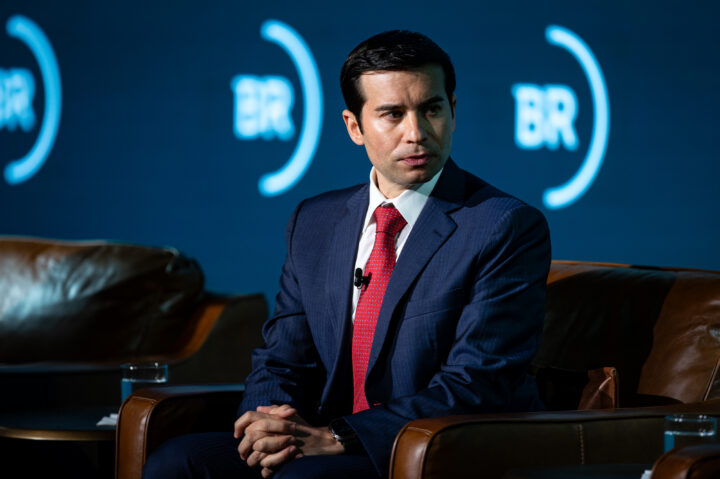
Al Drago/Bloomberg via Getty Images
Keith Sonderling, US deputy labor secretary, during the Business Roundtable CEO Workforce Forum in Washington, DC, US, on Tuesday, June 17, 2025.
Keith Sonderling, the acting labor secretary nominated by President Donald Trump to officially assume the role, told lawmakers during his confirmation hearing on Thursday that the federal government must play a role in shielding workers from religious discrimination, invoking his own Jewish family history to highlight his dedication to the issue.
Responding to a question from Sen. Susan Collins (R-ME) regarding the department’s responsibility to protect American workers against religious discrimination, Sonderling referenced his background and emphasized that the Department of Labor under his leadership would remain committed to rooting out bias.
“My family’s personal story, as you heard, both my grandparents were Holocaust survivors,” Sonderling said. “They came over here before some of these laws were in place, and they were discriminated against based upon that, and weren’t given the employment opportunities that others were solely based upon their religion. Unfortunately, we still see that today, and that’s a very important role that we have in this administration — to root out all religious bias, including antisemitism.”
Sonderling has been operating as acting labor secretary since former Secretary Lori Chavez-DeRemer resigned in April. He also served on the Equal Employment Opportunity Commission from 2020 until his term expired in 2024.
Sonderling made similar comments regarding the discrimination his grandparents faced during his confirmation hearing to be deputy secretary last year.
Sonderling, speaking before the Senate Committee on Health, Education, Labor and Pensions, explained that the Department of Labor launched the “Center for Faith” in March, a website which allows users to click on their state to review localized religious protections, identify workplace discrimination and access federal resources.
“We put out more guidance for religious workers to be able to come forward,” Sonderling said. “Also, too, it’s religious discrimination if religious organizations can’t get the same federal services that other organizations could get.”
“So it’s very important to me. It’s very important to the president,” he continued. “He’s issued executive orders on antisemitism, on anti-Christian bias and on religious discrimination as a whole, and we will prosecute those cases as equally as we will any other case.”
Sonderling’s nomination has drawn strong support from the Louis D. Brandeis Center for Human Rights Under Law, a nonpartisan organization that advocates for Jewish civil rights.
Brandeis Center CEO Kenneth Marcus said in a statement following the hearing that Sonderling is the “right leader to protect Jewish workers,” pointing to the nominee’s personal background and his established track record of combating antisemitism in the workplace in his previous roles in government.
“Antisemitism in the American workplace is rising at an alarming rate, and the moment demands a Department of Labor unafraid to confront it, along with every other form of discrimination,” Marcus said. “As the grandson of Holocaust survivors, Keith understands what’s at stake in this fight in a way few others do.”
“At the EEOC, he worked to educate employers and employees on antisemitism directly, and as deputy secretary and acting secretary at the Department of Labor, he repeatedly demonstrated that combating antisemitism and discrimination is a top priority,” Marcus added.
Republican and Democratic senators paid tribute to his legacy, while wondering if anyone will be able to fill the leadership vacuum

Anna Moneymaker/Getty Images
Sen. Lindsey Graham (R-SC) in the Senate Judiciary Committee on January 30, 2025 in Washington, D.C.
Sen. Lindsey Graham’s (R-SC) sudden death last weekend is complicating an already difficult dynamic between Senate Republicans and President Donald Trump, as legislators try to muster enough support in the caucus to pass the president’s key legislative priorities.
Graham’s committee chairmanships, vast donor network and his close relationship with Trump and Secretary of State Marco Rubio made him a critical leader in Washington whose presence helped move forward multiple bipartisan efforts, especially on foreign policy. He became one of the most geopolitically connected members of Congress, with world leaders and captains of industry on speed dial.
“It’s impossible to fill that void, number one, so I’ll just take that off the table,” Sen. Tim Scott (R-SC), the chairman of the National Republican Senatorial Committee, told Jewish Insider at a press conference at NRSC headquarters on Capitol Hill on Wednesday.
Scott, who represented South Carolina alongside Graham for 13 years, said he has spoken with Senate Majority Leader John Thune (R-SD) about the challenges Graham’s death creates for the party and detailed several areas where Senate GOP leadership is hoping some of their members will attempt to step in on the late senator’s behalf.
The first of those “three layers,” Scott said, is “the foreign policy front.” The second was Graham’s “budgetary responsibilities” as chair of the Senate Budget Committee. The third area, he said, was “bridging the gap between the two sides of the aisle.”
“Those are the three areas that I know that we’ve been consciously considering,” Scott said. “I have spoken to Leader Thune as well. I think those are three big areas that we’d love to see, probably, a couple people step into.”
On the foreign policy front, Scott noted, “There’s no doubt that when you’re looking at leaders around the world who disagree vehemently with each other, the one guy you might be willing to sit at the table with was Lindsey Graham. He just did a really good job.”
“Frankly, you go to the Middle East and without any question, I’m not sure that there was a bigger, more enthusiastic supporter of the president’s actions in Iran — I happen to be one of them as well — than Lindsey Graham,” Scott said. “[Israeli Prime Minister] Bibi [Netanyahu] calling him at lunch was kind of fun to watch. I’m a big fan of Bibi myself, and just knowing the relationship that they had when I spoke with Bibi myself years ago, I would say without question, Lindsey Graham’s name always came up. You know why? Because, frankly, he took the time to make the trip there.”
“Whether it’s the European front, the Middle East, or frankly, his enthusiasm around Venezuela, he was always in the midst when it came to solving problems around the world because he believed in peace through strength,” he continued. “It was not just a tagline. It was not just a philosophy. It was embedded in his DNA.”
Scott said Republicans will need to focus on “finding someone who has that passion” that Graham applied to his foreign policy dealings. Graham spearheaded the passage of the second Trump administration’s two reconciliation packages — the One Big Beautiful Bill last July, which made the tax cuts implemented in the first Trump administration permanent and enacted a wide range of spending cuts, and the Secure America Act in June to fund Immigration and Customs Enforcement (ICE) and Customs and Border Protection (CBP).
“We are living in polarizing times politically. Lindsey Graham was not completely aware of that. He thought you could still find common ground to get something done,” Sen. Tim Scott (R-SC) said. “He turned out to be right. Being able to have [Sen. Richard] Blumenthal (D-CT) knocking on the door for Russian sanctions is only possible because Lindsey Graham spends so much time talking to people that vehemently disagree with him on 85% or 90% of topics. Find that one, you march together.”
As to the budget reconciliation process, Scott said, Sen. Ron Johnson (R-WI) would step in as budget chair. “Big shoes to fill,” Scott added.
Scott touted his late colleague’s ability to reach across the aisle and argued that “bridging that gap is going to be really important.”
“We are living in polarizing times politically. Lindsey Graham was not completely aware of that. He thought you could still find common ground to get something done. He turned out to be right. Being able to have [Sen. Richard] Blumenthal (D-CT) knocking on the door for Russian sanctions is only possible because Lindsey Graham spends so much time talking to people that vehemently disagree with him on 85% or 90% of topics. Find that one, you march together.”
As one of the few lawmakers capable of closing the gap between Senate Republicans and the president, Graham became somewhat of a mediator.
“Lindsey left an indelible mark on the Senate, on the nation and on the hearts of his colleagues,” Sen. Ted Cruz (R-TX) told JI. “At times when senators were at each other’s throats, were angry, Lindsey could cut the tension with a self-deprecating quip that brought everything to a stop and brought people back together again.”
Leading Democrats also paid tribute to Graham’s legislative acumen. “Lindsey was part of every important policy issue and an indispensable player in every Senate ‘gang.’ He was a fierce Republican partisan one day and a key bipartisan ally the next,” Senate Minority Whip Dick Durbin (D-IL) said of Graham after his death was announced.
“I don’t know who can play this role going forward. I just don’t see it,” Sen. Chris Coons (D-DE) told JI on Sunday of Graham. “He’s just not replaceable. There’s not going to be anyone like him again.”
Graham was involved in every successful bipartisan piece of legislation that Trump has signed into law thus far in his second term. During the Biden administration, Graham was one of the 19 Republican senators who crossed party lines to support the bipartisan infrastructure bill, and his decision to come out against the bipartisan immigration reform deal organized by Sens. James Lankford (R-OK), Chris Murphy (D-CT) and former Sen. Kyrsten Sinema (I-AZ) has been described as the final death knell that sealed the legislation’s fate.
Graham was also the Republican in Trump’s orbit to whom Senate Democrats would go when trying to settle a legislative dispute or join forces on an issue of bipartisan concern.
“I don’t know who can play this role going forward. I just don’t see it,” Sen. Chris Coons (D-DE) told JI on Sunday of Graham. “He’s just not replaceable. There’s not going to be anyone like him again.”
Graham’s passing puts the longtime legislative and geopolitical priorities he fought for in jeopardy.
The South Carolina Republican spent the last five years lobbying Saudi Crown Prince Mohammed bin Salman to bring Riyadh into the Abraham Accords. Graham tried to secure an agreement on several occasions under Trump and former President Joe Biden, and said repeatedly that he was on the verge of reaching a deal that would see Saudi Arabia normalize relations with Israel in exchange for Israel recognizing a Palestinian state.
After Hamas’ Oct. 7, 2023, attacks on Israel, Graham maintained that Iran ordered the attacks to upend his Saudi-Israeli normalization efforts.
Graham was one of the most outspoken and effective Republican advocates in Congress for increasing military funding. Prior to his death, he had been lobbying the president to get behind the Russia sanctions bill he co-sponsored with Blumenthal, and expressed optimism in his final phone call with Morgan Ortagus, the former deputy presidential envoy for Middle East peace in the second Trump administration, that Trump was coming around to the idea.
Trump said on Tuesday that he was considering supporting the bill, which he has long hesitated to get behind, “in honor of Lindsey.”
“This was his thing, he wanted this more than any other thing. You know how he felt,” Trump said from the White House. “There’s a good chance that it gets done. But they’d like to add Iran. And they’d like to add Hezbollah to it. That’s what I’m hearing.”
Ortagus told JI, “There was not a fight on domestic or foreign affairs that he didn’t want to jump into. If he believed in an issue and believed that a particular policy was the right thing, he really didn’t care about the politics.”
Plus, Jeffries vows change to Israel policy under Dems
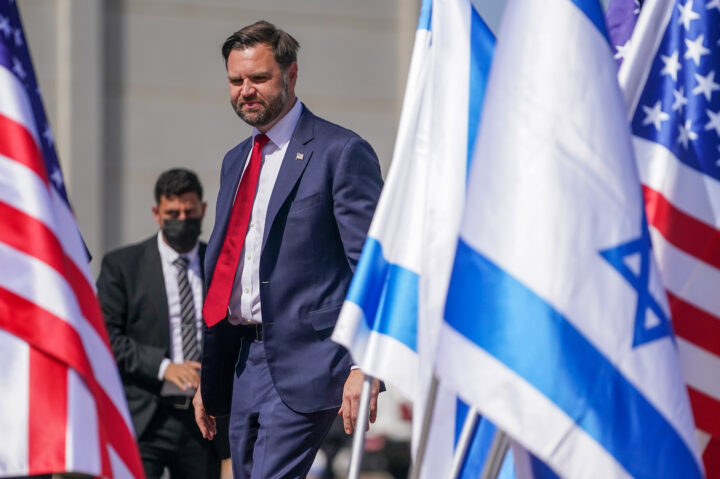
(Photo by Nathan Howard - Pool/Getty Images)
U.S. Vice President J.D. Vance arrives at Ben Gurion airport on October 21, 2025 in Tel Aviv, Israel.
Good Thursday afternoon.
This P.M. briefing is reserved for our premium subscribers like you — offering a forward-focused read on what we’re tracking now and what’s coming next.
Today’s Daily Overtime was curated by JI U.S. Editor Danielle Cohen-Kanik.
📡On Our Radar
Notable developments and interesting tidbits we’re tracking
House Minority Leader Hakeem Jeffries (D-NY) vowed today that should Democrats regain control of the House in the upcoming midterm elections, the party will adopt a “broadly inclusive” but fundamentally new approach to policy on Israel, Jewish Insider’s Matthew Shea reports.
“The situation relative to the United States’ relationship with Israel, the Palestinian people and policy in the Middle East has to change because the current status quo is unsustainable,” Jeffries said at a press conference, following yesterday’s vote by more than 100 House Democrats to cut aid to Israel…
Rep. Adam Smith (D-WA), the top Democrat on the House Armed Services Committee, said in a statement about his “very close” vote in support of the amendment to end aid to Israel that he’s “deeply concerned” about hostile actions taken by those on the far left to pressure him to support such a measure, including having his home vandalized, a staff member assaulted and a fire set in his driveway.
He insisted he still supports the Jewish state but said he voted in favor “to try once more to get the attention of the Israeli government,” with which he disagrees…
Sen. John Fetterman (D-PA) again insisted that he has no plans to leave the Democratic Party, but said he would do so if it “officially” becomes “the anti-Israel party,” during an appearance at the Hill Nation Summit in Washington yesterday…
Even as CENTCOM initiated a sixth straight day of strikes on Iran this afternoon, White House Press Secretary Karoline Leavitt said that Tehran “very much continues to talk to the United States of America and express that they want to make a deal with us”…
Leavitt declined to address directly if President Donald Trump agrees with the assessment shared by Vice President JD Vance on a podcast yesterday that Israeli actors are engaged in influence campaigns to change U.S. public opinion on the Iran war: “The president would certainly agree that foreign countries certainly try to persuade American public opinion. There’s no doubt about that. I think it’s just a basic fact,” she said, without addressing Israel…
Israel’s Foreign Ministry denounced as “defamatory” a story in Time magazine referenced by Vance as evidenceof his allegations about Israeli influence campaigns: “All of our activities are transparent and are conducted in strict compliance with U.S. law. … We certainly do not interfere in any U.S. foreign or domestic policy,” the Foreign Ministry stated, without referring to Vance by name.
The ministry said it had “lawfully contracted with an experienced digital agency” to work to combat antisemitism and strengthen support for the U.S.-Israel relationship…
David Alan Scheer II, the son-in-law of U.S. Senate candidate Rep. Mike Collins (R-GA), has built a following as a pro-white nationalist social media influencer and has shared antisemitic and pro-Nazi material online, CNN reports.
Scheer has promoted conspiracies that Jews are responsible for the assassination of former President John F. Kennedy and the 9/11 terror attacks, among other claims, and said one antisemitic graphic he shared was made by his wife, Collins’ daughter. It’s the latest incident of Collins being closely tied to far-right figures as he attempts to unseat Sen. Jon Ossoff (D-GA)…
Ossoff called on Collins to “apologize immediately for his and his office’s disqualifying ties to neo-Nazi ideology and notorious white supremacists,” calling him a “known bigot and antisemite.” Georgia state Rep. Esther Panitch, a Jewish Democrat, said of Collins, “Being pro-Israel is not a hall pass for antisemitism”…
The Wall Street Journal examines what is known about Iran’s Pickaxe Mountain, amid reports that Trump is looking into striking the highly fortified underground facility. Experts believe the site could be large enough to “hold a centrifuge enrichment plant capable of producing weapon-grade uranium” and potentially manufacture nuclear weapon delivery components…
Abdul-Malik al-Houthi, the leader of the Houthis in Yemen, warned today that the terror group will target “all Saudi oil installations and highly vital facilities” with drone and missile attacks if Saudi Arabia escalates its operations in Yemen, the latest sign of a potential breakdown in the yearslong truce between the Houthis and Riyadh…
⏩ Tomorrow’s Agenda, Today
An early look at tomorrow’s storylines and schedule to keep you a step ahead
Keep an eye on Jewish Insider for a look at the gaps left in the Republican Party by the sudden death of Sen. Lindsey Graham (R-SC) and the jockeying in the Senate to fill them.
The Aspen Security Forum wraps up in Colorado tomorrow with a live taping of the “Pod Save the World” podcast with former Obama administration staffers Ben Rhodes and Tommy Vietor, in conversation with Annalena Baerbock, president of the U.N. General Assembly.
American Friends of Magen David Adom is hosting a summer conversation series across the country with “Fauda” star Lior Raz, kicking off tomorrow in Long Branch, N.J.
We’ll be back with the Daily Overtime on Monday. Shabbat shalom!
Stories You May Have Missed
SEAT SHAKE-UP
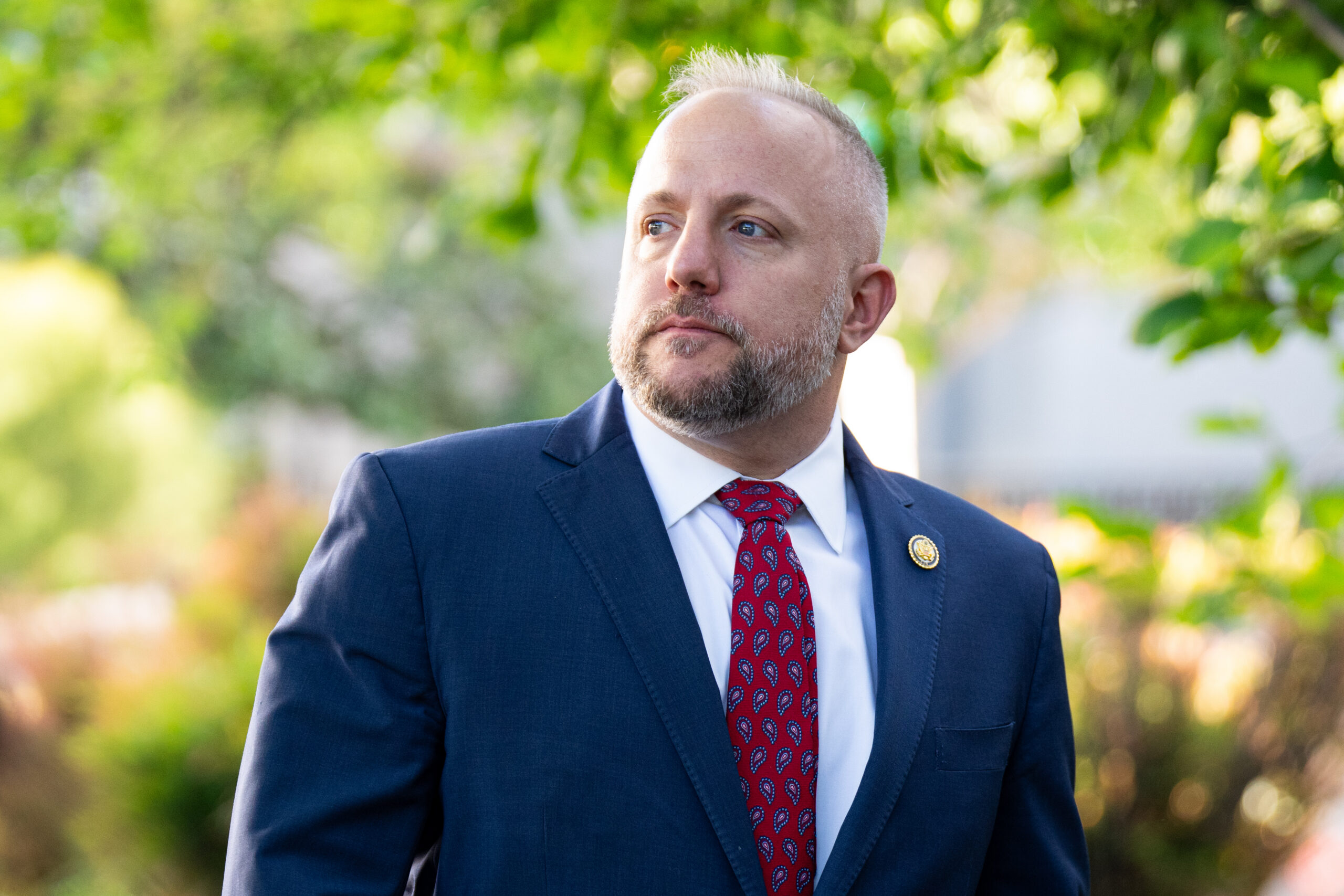
The president called Fry, who defeated a Republican backing his impeachment in 2021, a ‘very, very talented person’ in an interview this week
exclusive
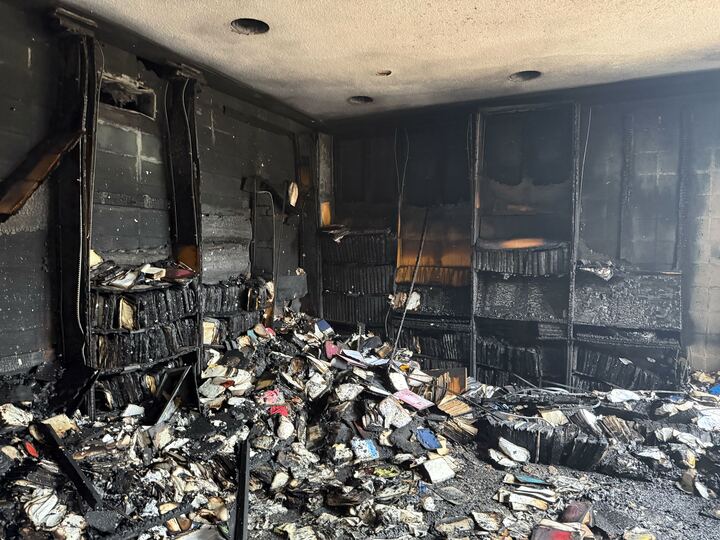
Robert Kraft’s antisemitism awareness group found 30% of the public now holds antisemitic attitudes — the highest level since it began tracking in 2023
‘Without oil, they're nothing,’ the former national security adviser said at the Aspen Security Forum, adding that by cutting it off, the U.S. could ‘turn them into a ‘stan, turn them into a nonentity’
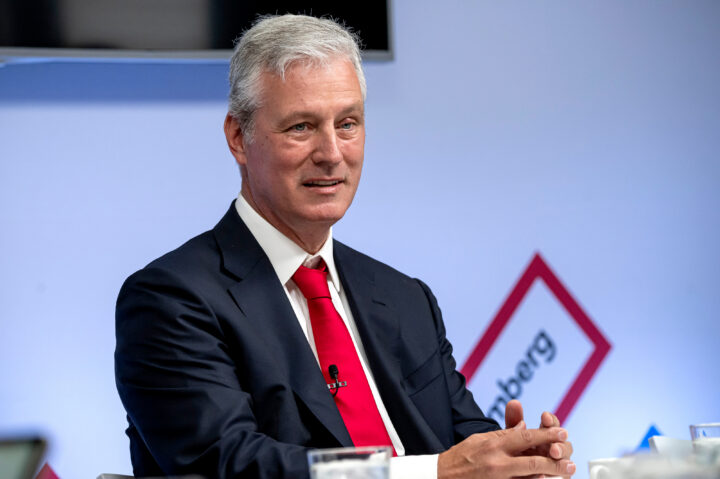
(David Paul Morris/Bloomberg via Getty Images)
Robert O'Brien, former national security adviser, at an interview during the Republican National Convention (RNC) near the Fiserv Forum in Milwaukee, Wisconsin, US, on Wednesday, July 17, 2024.
ASPEN, Colo. — Robert O’Brien, who served as national security advisor during President Donald Trump’s first term, said on Wednesday that the U.S. should target Iran’s oil infrastructure with the goal of choking off its economy — and predicted that the president is moving in that direction.
The former national security advisor said on a panel at the Aspen Security Forum that Trump had been “very, very generous” with Iran but he believes that Trump’s “patience” with Iran is running thin. The next steps, he predicted, would be for the U.S. to “hit them hard” and “finish the job” by targeting sites connected with Iran’s oil infrastructure, including the facilities at Kharg Island, in order to deprive Iran of its ability to produce and export oil.
“Without oil, they’re nothing. With oil, the regime thinks if they can survive, they can just buy more kit,” O’Brien said. “I think President Trump will finish the job. The Iranians are using the old playbook of extend, pretend and snowball. … They’re dealing with a whole new administration with Donald Trump. They don’t understand it, and I think that they’ll pay a heavy penalty for their lack of understanding.”
The first Trump administration’s strategy of maximum pressure through economic sanctions is “not enough” without strikes on Iran’s oil production, he continued.
O’Brien said that cutting short Iran’s oil exports would be the skeleton key to deafening the regime — cutting off its ability to build missiles, support terrorism or rebuild its nuclear program, and said that the U.S. could “turn them into a ‘stan, turn them into a nonentity” and prevent it from ever rebuilding.
The former national security advisor acknowledged that targeting Iranian oil production would hurt the world economy, but made the case that there are other oil producers that would be able to fill the gap with the right support, including Venezuela, Guyana and Mozambique, along with increased production in the U.S.
Asked after the panel by Jewish Insider about how he views the future of Israel policy among conservatives — and about comments by Vice President JD Vance accusing Israel of running a cover influence campaign to undermine the Iran deal and of having ties to sex offender Jeffrey Epstein — O’Brien insisted that support for Israel among conservatives, including Vance, remains strong.
O’Brien said he hadn’t heard Vance’s comments but called him a “supporter” and “friend of Israel.” He added that Trump is “a very good friend of Israel. President Trump has Jewish grandkids, I mean, so he cares deeply about it. He got the Abraham Accords for us and sent me to Jerusalem many times. And I can tell you, after Oct. 7, he was very concerned about Israel and has remained so ever since. No better friend to Israel than President Trump.”
He argued that recent polling indicates that support for Israel remains strong among Republicans in general, even among young people, and predicted that issues among “some conservatives — or people who claim to be conservatives” will not “hold.”
“Those of us who value the partnership, love our Jewish friends, our Israeli colleagues, just need to be forthright and stand up for Israel,” O’Brien said. “Israel, I’ve always said throughout my career, is a canary in the coal mine. If people are attacking Israel, the next country they’re going to attack is America, and so we need to stand strong with our allies in Israel, stand strong with Jerusalem, and I think it’s going to be a relationship that lasts long into the future.“
Stephen Hadley, who served as national security advisor in the Bush administration, said on the panel that the U.S. “can do better in terms of an outcome” with Iran, urging the administration to “stop chasing after the Iranians for an agreement on the nuclear issue,” adding that the U.S.’ operations have done significant damage to Iran’s nuclear program and can hit Iran again if it attempts to reconstitute the program.
It’s a similar strategy to that outlined by former Secretary of State Condoleezza Rice, also a Bush administration alumnus, a day prior at the Aspen conference.
Hadley said the U.S. should be open to nuclear talks if Iran seeks them out — but with the preconditions of no enrichment and no financial paydays for Iran.
He said that with continued sanctions, facilitation of trade along the Omani side of the Strait of Hormuz, strikes on Iranian capabilities threatening trade in the strait and assistance to countries in the region to diversify their export channels in the longer term, the U.S. could erode Iran’s ability to hold the global economy hostage and reach a stable situation.
“Hopefully, someday an Iranian regime will come forward and decide that their pursuit of nuclear weapons and support for Hezbollah and the like has been a dead end, and they will join the countries in the region to try to build a more prosperous and secure Iran for their people,” Hadley said. “If that happens, great. If it does not happen, the kind of arrangement I think I’ve described will protect our interests, protect the interests of our allies. “
At the same time, he emphasized that regime change through air power alone is likely off the table.
“[Trump] has to be clear that his objectives are consistent with the tools and means he has at his disposal,” Hadley said. “I think that’s a mistake he made in Iran initially when he was talking about regime change.”
Former Undersecretary of Defense Michèle Flournoy, who served under President Barack Obama, praised the U.S.’ Operation Midnight Hammer last June as “very targeted, very specific and very effective” — something few Democrats said at the time.
She contrasted her praise of that operation to the war this year, which she said started with unclear objectives, priorities and strategy, a lack of appreciation of the risks and a failure to appreciate the Iranian regime’s durability.
“I don’t know how this is going to conclude,” Flournoy said. “But the most likely outcome is we’re going to have a new normal. Even if the Strait opens, Iran is still going to have a few drones, a few mines to jerk the chain of the international economy when it’s unhappy.”
She said that, even if one agrees with the objectives of the war, “the way it’s been done has not paid enough attention to managing the risks, having a clear strategy, and ensuring you want to translate the military campaign into political outcomes.”
Plus, Vance alleges Israeli influence campaign to extend Iran war
Photo by Kevin Carter/Getty Images
The sun sets behind the U.S. Capitol Building on July 8, 2026 in Washington, D.C.
Good Wednesday afternoon.
This P.M. briefing is reserved for our premium subscribers like you — offering a forward-focused read on what we’re tracking now and what’s coming next.
Today’s Daily Overtime was curated by JI U.S. Editor Danielle Cohen-Kanik.
📡On Our Radar
Notable developments and interesting tidbits we’re tracking
More than 100 House Democrats, about half of the caucus, voted in favorof Rep. Thomas Massie’s (R-KY) amendment to strip all U.S. aid to Israel out of the State Department appropriations bill this afternoon, including several leaders of the caucus such as Rep. Katherine Clark (D-MA), the No. 2 House Democrat, and former House Speaker Nancy Pelosi (D-CA).
While the amendment was overwhelmingly defeated, 314-104, the large segment of Democrats supporting the measure indicates a growing shift away from the party’s historic support for Israel…
Vice President JD Vance, in an episode of “The Joe Rogan Experience” released today, stated repeatedly that Israeli actors are engaged in a “very discreet, very well-funded” influence campaign to extend the war in Iran: “There are some people within their system we know beyond a shadow of a doubt who are manipulating and trying to change American public opinion to keep the war going on indefinitely. Again, not towards any objective, but just indefinitely,” he alleged.
Vance also said that the late disgraced financier Jeffrey Epstein “clearly had connections to the highest levels of Israeli intelligence” and to “elements of the Israeli deep state that were left of center”…
The U.S., Israel and Lebanon, wrapping up talks in Rome this week, agreed on the structure and guidelines for implementing the two pilot zones the parties agreed to create in southern Lebanon, a State Department official said today, without specifying a timeline for the IDF’s withdrawal. The parties will now engage in expanded technical talks to implement the trilateral agreement reached in the last round of negotiations…
CENTCOM began another round of strikes against Iran this afternoon; coming after strikes earlier in the day, the pace of the operations appears to be gaining momentum. President Donald Trump is reportedly considering expanding U.S. military efforts to include more airstrikes, utilizing ground forces and targeting nuclear sites again, according to The Wall Street Journal…
Three senior U.S. officials connected to the Board of Peace, the Trump-led body created to resolve the conflict in Gaza, have been meeting with congressional offices this week to request $200 million for the International Stabilization Force, two people with knowledge of the meetings told Jewish Insider’s Gabby Deutch. The meetings mark the first time that Board of Peace representatives have approached Congress with a funding request…
Ahead of today’s deadline, candidates have begun releasing their fundraising reports for the second quarter. In Georgia, where some in the Jewish community have felt torn between two less-than-ideal options in Sen. Jon Ossoff (D-GA) and his opponent, Rep. Mike Collins (R-GA), Ossoff holds a commanding fundraising advantage: The senator reported raising$20 million this quarter with $42 million in the bank, while Collins raised $2.1 million, leaving him with $2.2 million in cash on hand…
Meanwhile, Michigan Senate candidate Abdul El-Sayed released his 2025 tax returns, which he is not legally obligated to do but was pressured to do by his opponent in the Democratic primary, Rep. Haley Stevens (D-MI). El-Sayed’s reported total income was over $680,000, nearly $300,000 of which was unspecified as to its source…
The anti-Israel American Priorities super PAC made an initial investment of $375,000 to boost El-Sayed in the race; El-Sayed has repeatedly railed against super PAC involvement in politics — particularly that of AIPAC’s United Democracy Project, which is spending heavily in favor of Stevens…
Rep. Hilary Scholten (D-MI), speaking to Semafor about electability concerns in the Democratic Party, criticized progressives who “prop up other candidates who have said really problematic things.” The moderate congresswoman added that El-Sayed, who has been criticized for comments about Stevens seen as misogynistic, “has a problematic record with women”…
A new Quinnipiac poll of Pennsylvania voters found Gov. Josh Shapiro leading his Republican opponent in his reelection race by 13 points, 53-40%, with a 56% overall approval rating. Sen. John Fetterman (D-PA) had a 77% approval rating among Republicans, but only 19% among voters in his own party. Nearly half (49%) of voters said the Democratic Party has moved too far to the left, while 42% said the Republican Party has moved too far to the right…
Former White House senior official Brett McGurk is releasing a book, Brink: Inside the Race to Free the October 7 Hostages, on his role leading U.S. efforts under former President Joe Biden to secure the release of hostages held by Hamas after the Oct. 7, 2023, attacks, due out on Oct. 6 to coincide with the third anniversary of the attacks…
The New York Times examines the role that Hollywood superagent Ari Emanuel could play in the potential presidential run of his brother, former Chicago Mayor Rahm Emanuel, as politicians increasingly seek access to media as part of their campaigns; among those close to Ari Emanuel are the UFC’s Dana White, commentator Joe Rogan, pundit Stephen A. Smith as well as Elon Musk…
⏩ Tomorrow’s Agenda, Today
An early look at tomorrow’s storylines and schedule to keep you a step ahead
Keep an eye on Jewish Insider for a look at what this afternoon’s vote on Massie‘s amendment to cut all U.S. aid to Israel means for the future of Israel policy in the Democratic Party.
At least eight Democratic candidates vying to replace former nominee Graham Platner on the ballotfor U.S. Senate in Maine will take the debate stage tomorrow evening in their first chance to pitch themselves to voters, ahead of the state Democratic Party’s nominating convention later this month.
President Donald Trump will give an address to the nation in the evening, which he has said will largely focus on American election security.
The American Federation of Teachers’ annual convention will kick off in Washington. The second largest teachers’ union in the U.S., the AFT has previously featured anti-Israel resolutions at its gatherings.
The Aspen Security Forum continues with several panels on the Middle East, including speakers such as Akif Çağatay Kılıç, top advisor to Turkish President Recep Tayyip Erdoğan; Ayman Safadi, Jordan’s foreign minister; Sen. Chris Murphy (D-CT); Ted Deutch, CEO of the American Jewish Committee; Dan Shapiro, former U.S. Ambassador to Israel; Rahm Emanuel; Anne Neuberger, former deputy national security advisor; and Salam Fayyad, former prime minister of the Palestinian Authority.
Stories You May Have Missed
SPACE MAN

Harvard professor Avi Loeb believes his research, which propelled him to the White House, could usher in a ‘new messianic era’
LITMUS TEST
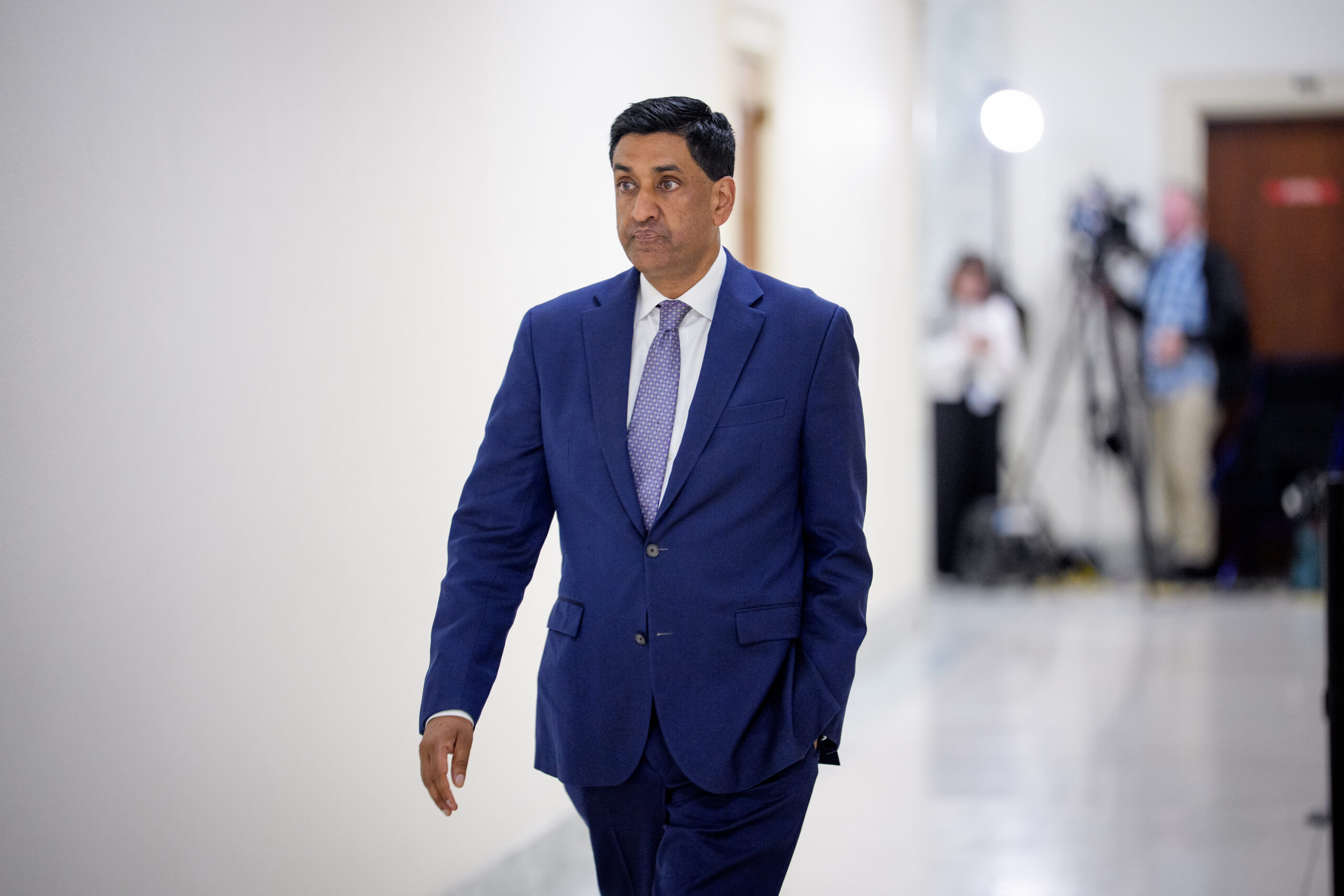
The congressman angered Drop Site co-founder Jeremy Scahill by refusing to condone the attacks; Scahill accused Khanna of promoting a ‘double standard’
The president called Fry, who defeated a Republican backing his impeachment in 2021, a ‘very, very talented person’ in an interview this week
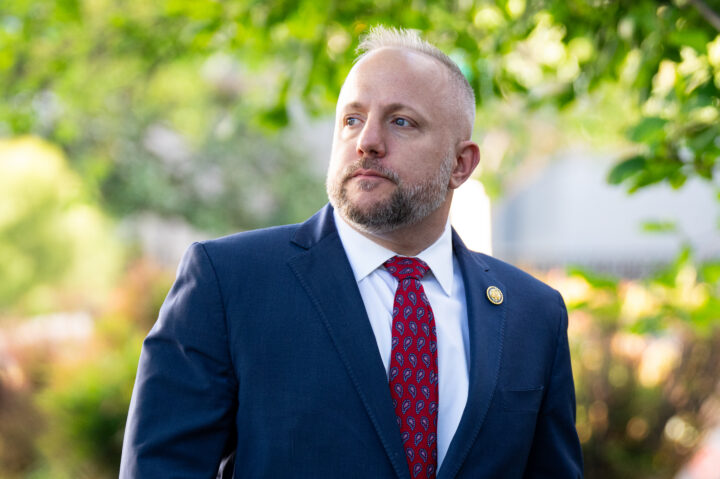
Bill Clark/CQ-Roll Call, Inc via Getty Images
Rep. Russell Fry (R-SC) arrives for the House Republican Conference caucus meeting at the Capitol Hill Club in Washington on Wednesday, May 13, 2026.
The late Sen. Lindsey Graham (R-SC) understood the value of staying in President Donald Trump’s good graces — both to advance his top legislative priorities and to shield himself from challenges on his right flank.
In the wake of Graham’s sudden death, the candidates vying to succeed him have absorbed a central lesson of his career: the most decisive factor in the Republican primary will almost certainly be who wins Trump’s endorsement.
Rep. Russell Fry (R-SC), who ousted a sitting GOP lawmaker with Trump’s endorsement in 2022, is emerging as one of the leading contenders and someone who has an inside track to receive the president’s blessing. Fry’s defeat of former Rep. Tom Rice (R-SC), who was one of the few Republicans to vote for Trump’s impeachment in 2021, allowed him to build early relationships with Trump’s political circle.
Fry has been making calls to White House officials about a possible run this week, a source familiar with the matter told Jewish Insider.
Asked on Monday evening about the possibility of endorsing Fry if he launched a bid for a full term in Graham’s seat, Trump told Newsmax that Fry is “somebody you can watch out for” as a rising Republican star and did not deny he was considering backing the House lawmaker if he enters the race.
Fry, who became an ally of Graham’s while they served in Congress together, was one of the Republicans who had reached out to the White House about a possible interim appointment to the seat. South Carolina Gov. Henry McMaster ultimately announced on Monday that he was appointing Sen. Darline Graham Nordone (R-SC), Graham’s younger sister, to serve out the remainder of her older brother’s Senate term, which expires next January.
“Russell Fry, a young congressman, is outstanding. That could happen. I could see that happening,” Trump said of an endorsement. “I think he’s a very, very talented person. … I mean, he’s doing much better than the person that preceded him. He’s been very popular in the state.”
Reached for comment, a White House official told JI about the president potentially endorsing Fry that, “Until the president makes an announcement, any speculation is just speculation.”
Fry has been a reliably conservative and party-line vote in the House since elected, and also holds a solidly pro-Israel voting record. AIPAC congratulated him on his primary victory in 2024.
Graham’s GOP replacement on the November ballot will be chosen in a special election scheduled for Aug. 11. Candidates can file to run for the seat starting on July 21, in accordance with the timeline required by state law, and several others are also looking to throw their hats in the ring.
Among the other Republicans who have reportedly been lobbying the White House and considering jumping into the race are Rep. Ralph Norman (R-SC); Rep. Nancy Mace (R-SC); former Rep. Trey Gowdy (R-SC), a Fox News host and close ally of National Republican Senatorial Committee chairman Sen. Tim Scott; and Lt. Gov. Pamela Evette, who lost to the state’s Attorney General Alan Wilson in a runoff of South Carolina’s Republican gubernatorial primary in June.
Mark Lynch, who lost to Graham in last month’s primary by 30 points, said on Monday that he would enter the special election and committed $5 million to his campaign. During the campaign, Trump called him a “lunatic” who “would be a DISASTER for the Republican Party,” which came in response to Lynch blaming the U.S. war in Iran on Graham by arguing that the senator had convinced the president to start the conflict. Graham had criticized Lynch, a South Carolina businessman, for employing staffers with records of making antisemitic statements,
Rep. Joe Wilson (R-SC), who was also floated for a possible interim appointment, said on Sunday that he was committed to staying in the House to protect Republicans’ slim majority in the lower chamber. He has not divulged if he is considering entering the special election.
Rep. William Timmons (R-SC) said late Tuesday that he would not enter the race to replace Graham, adding in the announcement that he would not support Noman or Mace’s candidacies.
Regardless of who the nominee is, Republicans are confident that they will hold the Senate seat in November. Trump carried South Carolina in the 2024 presidential election by 18 points, 58-40%.
The Democratic nominee in the race is Dr. Annie Andrews, a pediatrician who handily won her primary. A political outsider who challenged Mace unsuccessfully in 2022, Andrews has drawn attention for her effective fundraising against Graham, outraising the incumbent in the last two quarters. National Democrats, however, have so far declined to prioritize the race, citing the need to use those resources in battleground states.
The Cook Political Report grades the race as solid Republican.
A national Democratic campaign source told JI that this is not expected to change unless Republicans were to nominate a weak candidate with a record of extremism or concerning accusations about their personal background, such as accusations of criminal activity or assault.
“If you remember back to [former Democratic National Committee Chair] Jaime Harrison’s campaign [in 2020], he was the head of the South Carolina Democratic Party and raised over $100 million and still got blown out,” Dr. Gibbs Knotts, a professor of political science at Coastal Carolina University, told JI. “South Carolina has not dipped its toe into that purple state category for two to three decades.”
“Whoever gets this [Republican] nomination, to state the obvious, is very likely to be the next senator.”
Harvard professor Avi Loeb believes his research, which propelled him to the White House, could usher in a ‘new messianic era’

Ilan Fisher
Avi Loeb at the CISO summit at 1440 Multiversity, June 17, 2024
President Donald Trump has a border czar, a government official leading the crackdown on undocumented immigrants — whom the White House calls “illegal aliens” — crossing the southern border. The president, who likes to go big, now also has a UFO czar, a Harvard astrophysicist who is scanning the cosmos in search of aliens of the science-fiction variety.
It’s a stunning if improbable career highlight for Avi Loeb, the grandson of a Holocaust survivor who fled Nazi Germany and settled in a moshav, a cooperative agricultural community, in central Israel. As a child, Loeb had a lot of time alone with his thoughts — walking around to collect eggs from the chickens, or driving a tractor to the surrounding hills, where he would sit and read philosophy books.
“I was deeply interested in the most fundamental questions of our existence,” Loeb told Jewish Insider in a recent interview.
Loeb still studies life’s big questions, but from a different perspective. A series of small but ultimately life-changing pivots led him to study astronomy instead of philosophy, setting him on the path toward becoming one of America’s best known, and most controversial, scientists.
He now has a new benefactor supporting his quest to discover whether intelligent life exists elsewhere in the universe: Trump, who tapped him in June to lead the White House’s new effort on the issue.
“That’s why I’m doing astrophysics, because I was offered things that I couldn’t decline, but at the end of the process it’s like an arranged marriage, and I realized that I’m married to my true love,” Loeb said. “Because in astrophysics we can ask fundamental questions about the universe, which was pretty much what I was aiming to do in philosophy. But I can address it with the scientific method.”
Decades before Loeb would be tapped to lead the Trump administration’s unidentified aerial phenomena (UAP) science advisory council — an updated scientific term for what are colloquially known as unidentified flying objects, or UFOs — he got his start in the Israeli military.
Loeb served in the Israel Defense Forces’ elite Talpiot unit, where he pursued a doctorate in astrophysics in order to advance Israel’s scientific research and development needs. After earning his doctorate at Hebrew University, a project he pursued in the 1980s through his military service led him on a trip to Washington, where he met someone who helped him get a job at Princeton. A position at Harvard opened up a few years later. He has been there for 34 years.
At Harvard, Loeb was granted tenure after just three years and spent more than two decades researching major cosmological questions, seeking to understand the formation of the universe and early stars and galaxies. He was named to a Time magazine list of the 25 most influential people in space in 2012. Loeb chaired Harvard’s astronomy department for nine years.
The last decade of Loeb’s career has been less straightforward. His public appearances skyrocketed, even as other astronomers sought to keep him closer to earth. In 2017, an interstellar object — meaning an object that was believed to have come from another solar system — was captured on astronomers’ telescopes for the first time. It had an unusual shape and exhibited motion unlike asteroids or comets. No one seemed able to explain what the object was or where it had come from.
One year later, Loeb and a Harvard colleague argued in a scientific journal that the object was “humanity’s first contact with an artifact of extraterrestrial intelligence.”
Loeb believed the interstellar object was likely an alien craft, a UFO of the science-fiction variety. Except he argued that it was real — or, at least, it could be. The argument he has honed over the past decade, which has now launched him into the president’s orbit, is that astronomers have a duty to explore the possibility that extraterrestrial life might exist, and that scientists should not preemptively shut down the debate. Many other astronomers say he’s tilting at windmills, pursuing a quixotic quest for answers when no evidence exists for his attention-grabbing claims.
“I get attacked from both sides, from people who are skeptics who say we don’t want to look at the data, because there is nothing there. They ridicule the actual dealing with the anomalies that the government talks about,” said Loeb. “Then you have people on the other side who say, ‘We already know the answer, he’s wasting his time, and how dare he even consider other possibilities other than we are being visited by aliens.’”
After decades of silence from the federal government on extraterrestrial matters, Congress held a hearing on UAP in 2022. It came after the Office of the Director of National Intelligence released a report that found that UAP posed a risk to national security.
At the hearing, lawmakers explored whether the unidentified objects were drones or weapons from adversaries like Russia or China; whether they were the result of American pilots observing other American technology they did not know about; whether the UAP were really just glitches on radar or camera screens; and, lastly, whether the UAP were extraterrestrial in nature. Scientists have not seen any evidence of aliens.

Whether life exists outside of earth has long been one of the most energizing and heretofore unanswerable questions facing scientists. It has spurred movies and TV shows and books and Reddit rabbit holes. And it has captured Trump’s attention. Earlier this year, he directed the government to release files related to the unexplained objects that have been spotted by military craft.
Loeb thinks that the advisory body he now leads, composed mostly of his Harvard colleagues, stands the best chance of definitively identifying the UAP once and for all. He sees two options: either the group determines that the UAP are a national security threat, which would further American interests — or the body finds that UAP are evidence of an alien civilization. Loeb is not modest about the stakes.
“Altogether I think the partnership between science and government is a blessing. It will bring us to a better place: either improve national security in this context of UAP, or reveal the most important discovery ever made,” he told JI. “This may be a naive expectation, but it could bring cooperation among all humans on earth, and in that sense it will reflect the new messianic era of more peace on earth, but the messiah will not arrive from earth. It will arrive from another star.”
Loeb’s dramatic claims may put him at odds with many of his peers in academia. But he says their immediate skepticism toward his conclusions is “not in tune” with the interests of the public, which he sees as just one area of many where he believes academia is failing the American people. He has also been frustrated to see Harvard tilt towards “a particular political direction,” which he thinks is a mistake. And after the Oct. 7, 2023, terror attacks in Israel, Loeb watched the university “allow protests to disrupt scholarship,” some of which were antisemitic in nature.
“Definitely something is wrong within academia,” said Loeb.
Despite his frustrations, Loeb remains at Harvard. He publishes fewer academic papers now, and focuses more on blog posts on Medium, but his research has not slowed down. He oversees the Galileo Project, which searches for evidence of extraterrestrial technology. His work has made its way to the highest reaches of the American government.
Next month, he’ll face his biggest audience yet: a Major League Baseball game. He’ll be throwing out the ceremonial first pitch at a Houston Astros game in Space City, U.S.A.
Orthodox Jewish groups that have long warned that such a move would have negative impacts for Jewish morning prayer and raise dangers for school children

CHRIS DELMAS/AFP via Getty Images
This illustration photo shows a clock in the background of a smartphone showing the time after daylight saving time was implemented in Los Angeles, California, on March 15, 2022.
In a bipartisan vote pushed in part by President Donald Trump, the House passed the Sunshine Protection Act, making daylight saving time permanent, a situation that raises concerns for Orthodox Jewish groups that have long warned that such a move would have negative impacts for Jewish morning prayer and potentially raise dangers for school children who have to travel to school before daybreak.
The bill passed the House by a 308-117 vote, with 95 Democrats and 22 Republicans voting no. The issue has been a priority for Trump, and lawmakers have also included the same legislation in a must-pass transportation bill, with near unanimous support in committee.
Rabbi AD Motzen, the national director of government affairs at Agudath Israel of America, said that, in spite of the popular desire to eliminate time changes, “We are concerned, however, that by choosing permanent daylight saving time for the entire country it will put children at risk and affect our religious practices.”
Motzen emphasized that permanent daylight saving time would set up post-9 a.m. sunrises in parts of the country for several weeks a year, posing potential dangers to students who would have to travel to school in the dark. He also warned that extending daylight saving time “will create an extreme hardship on observant Jews,” making it “extraordinarily difficult — if not impossible — to arrive on time for a job and [effecting] the start time of our schools.”
Nathan Diament, the executive director of the Orthodox Union Advocacy Center, said that making daylight saving time permanent would “raise safety issues for children who would be going to school in the pitch dark for many weeks of the year,” about which health experts have expressed concern.
He said that it would also “interfere with the ability of members of our community to engage in congregational prayers and get to their places of work on time.”
Motzen also emphasized that a previous change to permanent daylight saving time was quickly reversed after Americans experienced its actual impacts.
Attention for the bill’s opponents now turns to the Senate, where the bill has some vocal opponents.
Diament noted that some Senate lawmakers, including Sen. Tom Cotton (R-AR), expressed “firm opposition to this measure,” offering his thanks for their efforts.
Motzen also placed his hopes on the Senate blocking passage of the legislation.
“We are hopeful that the Senate will consider all of the effects of DST and compare them to the effects of permanent standard time or maintaining the status quo before rushing into this major change,” Motzen said.
Plus, Dem leaders split on Israel aid
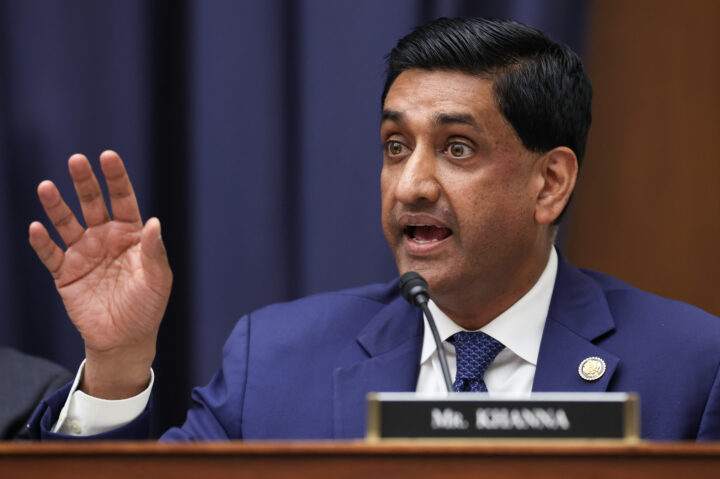
Photo by Win McNamee/Getty Images
Rep. Ro Khanna (D-CA) questions U.S. Secretary of Defense Pete Hegseth as he testifies before the House Armed Services Committee April 29, 2026.
Good Tuesday afternoon.
This P.M. briefing is reserved for our premium subscribers like you — offering a forward-focused read on what we’re tracking now and what’s coming next.
Today’s Daily Overtime was curated by JI U.S. Editor Danielle Cohen-Kanik.
📡On Our Radar
Notable developments and interesting tidbits we’re tracking
Israeli Prime Minister Benjamin Netanyahu issued a warning to Iranian leaders, as military hostilities escalate between Iran and the U.S.: “Do not count on there being calm if you attack us,” Netanyahu addressed Tehran, while speaking today at a conference in southern Israel. “Do not expect a repeat of what happened before, because there will be no repeat. … Any further attempt to harm us will be met with a different response — far more powerful”…
Meanwhile, President Donald Trump walked back his announcement that the U.S. would institute a 20% toll on all cargo passing through the Strait of Hormuz, saying in a post on Truth Social that Middle East leaders had agreed to additional trade and investment deals with the U.S. to replace the fee…
CENTCOM announced it began launching an additional round of strikes against Iran this afternoon “to continue degrading Iranian capabilities used to attack commercial shipping” in the strait, and officially reinstated a blockade on Iranian ports. The Islamic Revolutionary Guard Corps said it launched missile and drone attacks in retaliation against bases in Kuwait and Bahrain…
House Minority Leader Hakeem Jeffries (D-NY) said he would oppose an amendment led by Rep. Thomas Massie (R-KY) to strip all aid to Israel out of the 2027 State Department appropriations bill, Jewish Insider’s Marc Rod reports. But Jeffries also argued for “urgent change” to the U.S.-Israel relationship, including suggesting that direct U.S. military aid to Israel should end when the current memorandum of understanding expires.
Progressive Caucus Chair Rep. Greg Casar (D-TX), on the other hand, said he plans to vote yes on Massie’s amendment, writing in a “Dear Colleague” letter that the “American people are crying out for an end to US tax dollars subsidizing Israel’s military”…
Israeli Transportation Minister Miri Regev announced today that the U.S. will only be permitted to station 20 military refueling aircraft at Ben Gurion Airport, while the rest must be parked at Israeli Air Force bases, in order to facilitate commercial travel for Israelis over the summer…
U.N. official Ramiz Alakbarov accused Hamas forces of interfering at a humanitarian aid distribution site in Gaza, saying armed men had entered a warehouse and “endangered humanitarian personnel,” leading the organization to suspend its operations at the site. “These incidents are not isolated. They are completely unacceptable and reflect an increasingly dangerous pattern of intimidation, violence and obstruction,” Alakbarov said…
Trump asked Netanyahu in a phone call last week to pull IDF forces back from Syria and Lebanon, Axios reports; the Prime Minister’s Office said Netanyahu in turn emphasized Israel’s need for security zones along its borders…
The Jewish Community Relations Council Bay Area issued a statement today on Rep. Ro Khanna’s (D-CA) recent encounter in the West Bank, where he claims he was detained by violent settlers as well as the IDF. The group said it has “conveyed our concerns to the Congressman in how he is representing the district and our community on foreign policy issues” and called on Khanna “to exercise the same urgency he has brought to criticizing Israel to address the hostile climate many Jewish Americans face every day”…
Pressed repeatedly by writers with the Hamas-sympathetic outlet Drop Site News to offer support for the Oct. 7, 2023, terror attacks and Palestinians’ “right to kill Israeli soldiers,” Khanna said he is “not for violence in any way”…
Asked about legislation imposing sanctions on Russia that was championed by the late Sen. Lindsey Graham (R-SC), Trump said in the Oval Office today that lawmakers “may be adding Iran to it … They may add Hezbollah, too.” He said there’s a “good chance” it will pass “in honor of Lindsey”…
White House Special Envoy Steve Witkoff and Jared Kushner were spotted in the Senate chamber during the swearing-in this afternoon of Darline Graham Nordone to fill Graham’s seat…
The AIPAC-linked United Democracy Project super PAC sent direct mail to voters in Michigan highlighting far-left Senate candidate Abdul El-Sayed’s refusal to condemn extreme rhetoric from antisemitic streamer Hasan Piker and El-Sayed’s efforts to “rationalize” the attack on Michigan’s Temple Israel earlier this year…
Columbia University anti-Israel protest leader Mahmoud Khalil filed a civil rights lawsuit against Trump administration officials, the Heritage Foundation and pro-Israel groups Canary Mission and Betar, alleging they “sought to terrorize” him to “intimidate and silence the growing movement for Palestinian rights”…
⏩ Tomorrow’s Agenda, Today
An early look at tomorrow’s storylines and schedule to keep you a step ahead
Keep an eye on Jewish Insider for an interview with Avi Loeb, the Israeli Harvard scientist leading Trump’s search for answers that may be out of this world.
Trump will headline the last day of Sen. Dave McCormick’s (R-PA) Pennsylvania Defense and Innovation Summit at the U.S. Army War College, with additional remarks from Army Secretary Dan Driscoll, U.S. Ambassador to the U.N. Mike Waltz, CIA Director John Ratcliffe and JPMorgan Chase CEO Jamie Dimon.
The Aspen Security Forum in Colorado will feature fireside chats with former Navy Secretary John Phelan and Trade Representative Jamieson Greer. Also on tomorrow’s agenda: a live taping of the “What the Hell is Going On?” podcast hosted by the American Enterprise Institute’s Danielle Pletka and Marc Thiessen, in conversation with former National Security Advisors Stephen Hadley and Robert O’Brien as well as Michèle Flournoy, former under secretary of defense for policy.
Jay Clayton will appear before the Senate Intelligence Committee for his confirmation hearing to be director of national intelligence, after Trump abruptly canceled his hearing originally scheduled for last month.
Rep. Mike Lawler (R-NY) will speak at the Hudson Institute on the future of U.S. foreign policy in the Middle East..
Stories You May Have Missed
MICHIGAN MATTERS

William Lawrence, who has won support from progressive lawmakers and groups, has been under fire for his comments attacking Kamala Harris and denigrating Black political leadership
PEACH STATE PROBLEMS
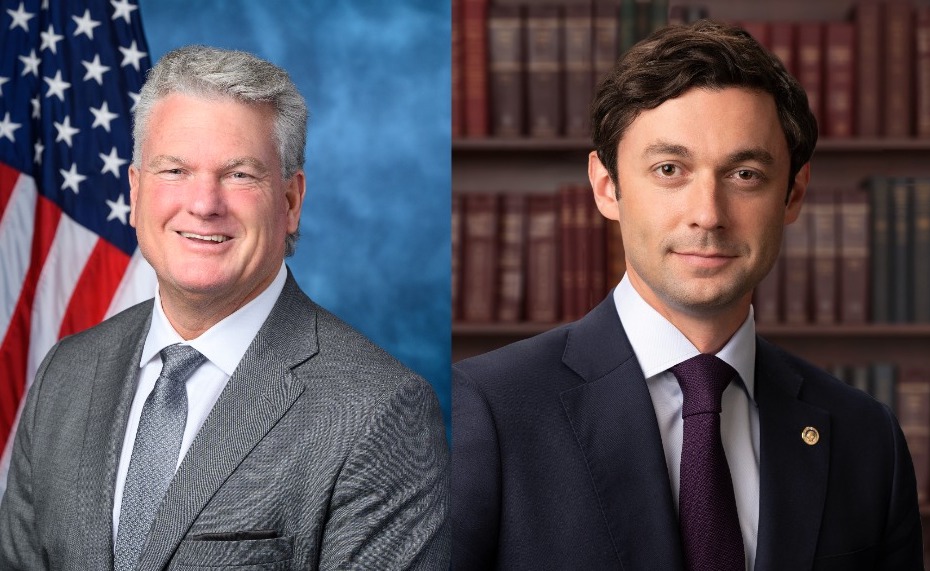
Top contributors to Florida gubernatorial candidate James Fishback are also bankrolling Rashida Tlaib, Ilhan Omar, Abdul El-Sayed and Andre Carson
Trump said the change came after ‘highly productive conversations with Middle East leadership’

SAUL LOEB / AFP via Getty Images
Chairman of the Joint Chiefs of Staff Gen. Dan Caine speaks as a map of the Strait of Hormuz is displayed during a press briefing at the Pentagon in Washington, DC, on April 16, 2026.
President Donald Trump on Tuesday walked back his announcement, made the previous day, that the U.S. would institute a 20% fee on cargo transiting the Strait of Hormuz, saying the toll would be replaced by trade deals with Gulf states.
Trump, having hosted Iraqi Prime Minister Ali al-Zaidi at the White House Tuesday morning, wrote on Truth Social that his change of heart was “based on highly productive conversations with Middle East leadership,” and that the deals “will be MASSIVE but, at the same time, extraordinarily good for them, and their future.”
Trump did not name specific countries, provide figures or outline a timeline for the new arrangement.
Trump reiterated in his post that the U.S. blockade, reinstituted on Tuesday, will remain in place on Iranian ships and cargo.
The reversal follows a rapidly escalating military exchange in the Gulf: The U.S. carried out a third consecutive night of strikes against Iranian targets early Tuesday. Iran, in turn, claimed to have struck and disabled two tankers in the strait and fired on Bahrain, Jordan and Kuwait.
The president implied that the renewed strikes reset the 60-day clock for operations without congressional authorization
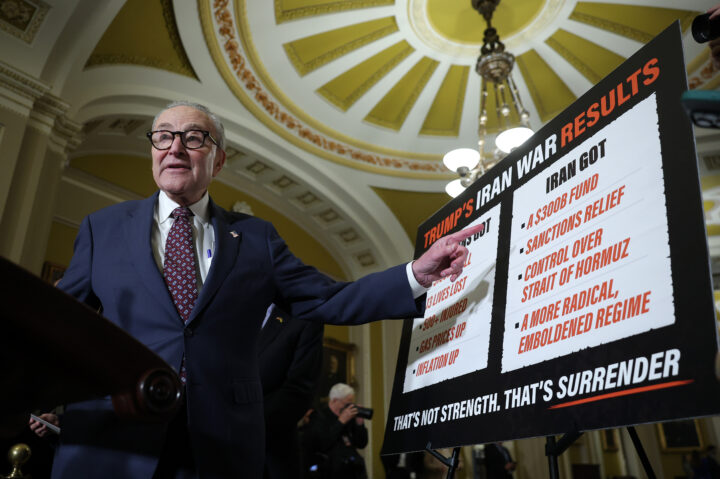
Photo by Kevin Dietsch/Getty Images
U.S. Senate Minority Leader Chuck Schumer (D-NY) speaks to reporters after the weekly Senate policy luncheons at the U.S. Capitol on June 23, 2026 in Washington. Schumer spoke out against President Trump's Iran deal and a the need for the Senate to pass a War Powers Resolution regarding Iran.
Democrats on Monday slammed President Donald Trump’s resumption of hostilities against Iran, as well as the notion, implicit in Trump’s notification, that the operations mark a new conflict and therefore reset the 60-day window for military operations launched by the executive branch without congressional approval.
In a letter to congressional leaders on Friday notifying them that the war had resumed, Trump said that Iran repeatedly violated the memorandum of understanding by attacking commercial vessels on July 6 and 7, and that the U.S. had, as of July 7, commenced “defensive strikes against targets within Iran including missile launch sites, air defenses, military maritime assets, military support infrastructure, and command and control capabilities.”
Trump said that ground forces are not involved in the operations and are focused on protecting the U.S., but American forces “remain postured to take further action.” He added that he was notifying Congress pursuant to his obligation under the War Powers Act, the statute that lays out the 60-day timeline.
Critics of the war have argued consistently that the operations that began in February never actually concluded during the since-terminated ceasefire, despite the administration’s assertions otherwise.
“Trump’s rinse and repeat approach to the Iran war isn’t a strategy, it’s a recipe for utter disaster,” Senate Minority Leader Chuck Schumer (D-NY) said Monday. “It’s incredible what a fiasco this war is. Trump’s so-called understanding — lot of bull — with Iran fell apart faster than the ink could dry.”
Sen. Tim Kaine (D-VA), who has led war powers efforts in the Senate to end the conflict, said the U.S. has been at war, and argued that the administration is obligated to withdraw U.S. forces in response to the war powers resolution that Congress passed last month.
“The notion that [the 60-day clock] was paused before, I think, was sort of laughed out of the room. This has been an ongoing conflict, even during the midst of a ceasefire,” Kaine said. “There were still hostilities underway. So this is not a war that paused and restarted.”
He said he will continue to support war powers efforts but believes that Congress has already definitively declared the war illegal. The resolution that Congress passed came in the form of a concurrent resolution, which is not presented to the president, and its legal force is disputed.
Sen. Adam Schiff (D-CA) filed a new war powers resolution on Monday to oppose the war, which likewise argues that combat operations never ceased.
“We were promised the war would be over for months. And now in a matter of days we’ve gone from a bad U.S.-Iran deal to more strikes, another blockade, and added turmoil that will only drive prices higher,” Schiff said in a statement. “Any assertion by the Trump administration that he gets 60 more days to act without Congress has no foundation in law.”
Kaine and Sens. Andy Kim (D-NJ), Jeff Merkley (D-OR) and Chris Van Hollen (D-MD) cosponsored the resolution.
Rep. Adam Smith (D-WA), the ranking member of the House Armed Services Committee, “wholeheartedly condemn[ed]” Trump’s plans to take control of the Strait of Hormuz, arguing that it is impossible without significant escalation and would be “frankly, just wrong.”
“Iran has gained greater leverage, continues to destabilize the region, and has a younger and more hardline leadership than when this war started,” Smith said. “It is past time for [Republicans] to work with us to ensure the president finds a diplomatic solution to ending a war he never should have started and that threatens our national security and defense as well as that of our partners.”
Even some Republicans have expressed skepticism of the administration’s strategy, including over Trump’s plan to impose a toll on the Strait of Hormuz.
“I recall Secretary [of State Marco] Rubio saying that would not be proper for any country. … Am I wrong?” Sen. John Cornyn (R-TX) told reporters.
Additionally, given the recent sudden death of Sen. Lindsey Graham (R-SC) and the extended medical absence of Sen. Mitch McConnell (R-KY), Democrats may be able to more consistently pass war powers resolutions to oppose the war in Iran.
Many Democrats also say they plan to oppose a procedural vote this week to advance the 2027 National Defense Authorization Act in protest of the continued operations against Iran.
The analysis by the Jewish Institute for National Security of America found that Tehran made 47% more in the three weeks following the MOU than it normally did in a month before the war

Photo by AFP via Getty Images
A cargo ship is pictured off coast of the Khor Fakkan Container Terminal, the only natural deep-sea port in the region, along the Gulf of Oman on June 28, 2026.
Iran netted nearly $5 billion in the 22 days after Washington and Tehran signed their memorandum of understanding on June 17, according to a new report from the Jewish Institute for National Security of America.
The findings come as President Donald Trump announced on Monday that the U.S. would reimpose its naval blockade on Iranian ports effective July 14 at 4 p.m. ET, with an added 20% U.S. toll on all shipping through the strait.
The U.S. had lifted the blockade last month upon the signing of the MOU with Iran, at which time the Trump administration also issued a waiver that allowed the sale of Iranian oil. That waiver was revoked last week in response to Iranian attacks on shipping vessels in the strait, but the damage, JINSA says, was already done.
The JINSA report, published on July 8, found that once the initial maritime blockade was lifted mid-June, the Iranian regime “rushed to export its oil at the first opportunity.” Shipping data analyzed in the report indicates that Iran exported 50 million barrels of crude within the first two weeks after the blockade was lifted. By early July, total exports under the temporary truce topped 55 million barrels, netting the regime more than $4.5 billion.
Before the conflict, Iran typically exported between 47 million and 50 million barrels in a single month, averaging roughly $3.05 billion in revenue, according to the report. Because the U.S. waiver allowed Iran to sell its crude at standard market prices rather than the heavily discounted rates it usually relied on to bypass international sanctions, the regime pulled in 47% more cash in the 22 days following the MOU than it normally did in an entire month before the war.
Tehran has simultaneously maintained a tight grip on the Strait of Hormuz that has severely constrained broader global shipping, in what the report describes as a “bad omen for the future of maritime security in the Middle East — and U.S. deterrence of Iran.”
Daily global transit through the Strait of Hormuz fell from 15 million barrels of crude oil per day before the war to 4.8 million barrels per day during the first week after the MOU was reached — less than a third of normal volumes. By contrast, Iran managed to export 5 million barrels of its own crude oil per day during that same week.
Beyond standard oil sales, the report notes that Iran maintained an aggressive financial squeeze on foreign vessels transiting the region. Citing Israeli media reports, the report said Iranian authorities blocked commercial oil tankers from passing through the Strait of Hormuz unless they paid a transit fee of up to $2 million per vessel.
Tracking data from the shipping analytics firm Kpler suggests that these unauthorized checkpoints generated roughly $300 million in extra revenue for Tehran, directly violating the agreement’s terms guaranteeing free passage for international trade.
Plus, Graham's Senate seat kept in the family

Shady Alassar/Anadolu via Getty Images
Commercial vessels and oil tankers preparing to transit through the Strait of Hormuz maintain their wait in the Gulf of Oman, on June 17, 2026.
Good Monday afternoon.
This P.M. briefing is reserved for our premium subscribers like you — offering a forward-focused read on what we’re tracking now and what’s coming next.
Today’s Daily Overtime was curated by JI U.S. Editor Danielle Cohen-Kanik.
📡On Our Radar
Notable developments and interesting tidbits we’re tracking
President Donald Trump declared today that the U.S. will take control of the Strait of Hormuz and will institute a 20% fee on all cargo passing through the waterway “for any and all costs necessary to do the job of providing safety and security to this very volatile section of the World,” Jewish Insider’s Christina Sher reports. The move comes after Trump and his administration insisted for months that no country is permitted to charge fees to transiting ships…
Trump also announced he is reinstating a blockade of Iranian ports, which was lifted when the two countries signed a memorandum of understanding last month. CENTCOM said the blockade will resume tomorrow at 4 p.m. ET and will be enforced “against vessels transiting to or from Iranian ports and coastal areas.”
CENTCOM also revealed that it successfully deployed sea drones in combat operations for the first time yesterday, using the unmanned vessels to strike an Iranian submarine at the Bandar Abbas Naval Base…
Trump notified Congress on Friday that fighting with Iran officially resumed last week, further stoking tensions between the executive and legislative branches as lawmakers already approved a war powers resolution calling for an end to American operations in Iran.
Trump’s letter to congressional leadership said U.S. “ground forces are not involved in these strikes” — which he described as “limited, measured, planned, and executed in a manner designed to minimize civilian casualties” — and said he is acting “pursuant to [his] constitutional authority as Commander in Chief”…
The Mossad spent years grooming former Iranian President Mahmoud Ahmadinejad as an intelligence asset to be installed as Iran’s leader after a post-Khamenei regime change, including paying for his housing and travel and arranging a meeting with then-Mossad chief David Barnea under cover of a climate conference in Budapest in 2024, American and Iranian officials told The New York Times.
As the Iran war broke out on Feb. 28, Mossad operatives rescued Ahmadinejad from an Israeli airstrike on his Tehran compound and took him to a safe house, but he balked and left — Ahmadinejad is now reportedly under house arrest by the Islamic Revolutionary Guard Corps…
The Houthis accused Saudi Arabia of bombing Yemen’s international airport today, with a spokesperson saying the action “will not go unanswered,” threatening a tenuous truce enacted several years ago between the terror group and the Saudis. A spokesperson for the internationally recognized Yemeni government, which is backed by Riyadh, said the Houthis subsequently fired ballistic missiles into Saudi Arabia…
U.K. Home Secretary Shabana Mahmood announced on Monday that the country designated the IRGC as a terror organization, with those found guilty of supporting the group facing up to 14 years in prison. The government also banned the Islamic Movement of Companions of the Right, which No. 10 Downing St. said was behind a number of attacks on British Jewish sites…
South Carolina Gov. Henry McMaster announced at a press conference this afternoon that he is appointing Darline Graham Nordone, the late Sen. Lindsey Graham’s (R-SC) sister, to serve out the rest of Graham’s term. Trump had voiced his support for Nordone, who shared an exceptionally close bond with her brother, as “a fabulous tribute to Lindsey.” Fox Newsreported that Nordone could be sworn in as soon as Wednesday…
The Trump administration plans to launch a major diplomatic offensive against the International Criminal Court, Secretary of State Marco Rubio announced today, the latest move in the White House’s longtime battle against the international organization.
The push appears to be rooted in concerns that the ICC will seek to prosecute American servicemembers, JI’s Gabby Deutch reports. Such actions would not only be “a grave overreach of its purported authorities,” Rubio wrote in a Wall Street Journal op-ed, “it would mean the death of the U.S. as a sovereign and independent nation”…
New York City Mayor Zohran Mamdani vowed that he would maintain ties with Morris Katz, the controversial political operative behind Mamdani’s own victory as well as the imploded campaign of former Maine Senate candidate Graham Platner, JI’s Will Bredderman reports, despite calls from members of the Democratic Socialists of America to boycott the consultant’s services…
Rep. Ilhan Omar (D-MN), a member of the Squad and a vocal detractor of Israel, endorsed far-left Michigan Senate candidate Abdul El-Sayed today, joining fellow Squad members Reps. Alexandria Ocasio-Cortez (D-NY), Rashida Tlaib (D-MI), Summer Lee (D-PA) and Delia Ramirez (D-IL) in backing him less than a month before the primary…
⏩ Tomorrow’s Agenda, Today
An early look at tomorrow’s storylines and schedule to keep you a step ahead
Keep an eye on Jewish Insider for a look at the surging anti-Israel candidate in the Democratic primary for Michigan‘s swing 7th Congressional District.
The sixth round of talks between Israel and Lebanon are slated to begin tomorrow in Rome, despite Beirut’s reported threat not to attend if the IDF did not vacate two pilot zones in southern Lebanon before the discussions. Israeli media reported that this week’s talks will focus on the timeline for the withdrawal.
The Aspen Security Forum, the high-profile annual gathering of national security leaders, policymakers and foreign policy experts, begins tomorrow afternoon in Colorado. Former Secretary of State Condoleezza Rice, former Defense Secretary Mark Esper and former Commerce Secretary Penny Pritzker will speak on a panel on the “state of the world.”
The two-day Pennsylvania Defense and Innovation Summit, hosted by Sen. Dave McCormick (R-PA), will kick off at the U.S. Army War College in Carlisle, Pa., with a keynote address from Joint Chiefs Chairman Gen. Dan Caine.
Some House Republicans were invited to a dinner tomorrow night with Defense Secretary Pete Hegseth, according to Punchbowl News, as the Trump administration is seeking more than $67 billion for the Pentagon in its supplemental funding request.
Stories You May Have Missed
REMEMBERING
Trump, Cruz, Fetterman, Coons and Jewish organizations remembered the South Carolina Republican, who died suddenly at 71
FOLLOW THE MONEY
Top contributors to Florida gubernatorial candidate James Fishback are also bankrolling Rashida Tlaib, Ilhan Omar, Abdul El-Sayed and Andre Carson
The president also said he is reinstating a blockade on Iranian ports

AFPTV / AFP via Getty Images
A cargo ship anchoring near the Strait of Hormuz off the eastern coast of the United Arab Emirates on July 12, 2026.
President Donald Trump declared on Monday that the U.S. will take control of the Strait of Hormuz and said Washington will institute a 20% fee on all cargo passing through the waterway “for any and all costs necessary to do the job of providing safety and security to this very volatile section of the World.”
“The Hormuz Strait is OPEN, and will remain OPEN, with or without Iran,” Trump wrote on Truth Social. “The U.S.A. will be, from this point forward, known as ‘THE GUARDIAN OF THE HORMUZ STRAIT,’ but as such, and as a matter of FAIRNESS, will be reimbursed, at the rate of 20% on all cargo shipped.”
Trump’s comments came after the Islamic Revolutionary Guard Corps announced on Sunday that the strait was considered closed until further notice.
Trump also said he is reinstating the U.S. blockade on Iran, which had been lifted as part of the memorandum of understanding signed between the two countries last month. The blockade will once again prevent “Iran’s ships or customers from entering or leaving,” he said. “All other countries will have fair and open use of the Strait.”
Earlier on Monday, Trump said during a “Fox & Friends” interview that “we’re going to keep the strait, and we’ll probably run it.”
Trump has declared the MOU, which said Iran would oversee arrangements for ships transiting the key waterway, as finished.
“We had a deal. It was a done deal, and then they broke it. They always break it,” Trump said of Iran on Monday, declaring his intent to “hit them very hard.” The U.S. struck Iranian targets near the strait on Sunday night after Iran hit a Cyprus-flagged container ship, prompting Iran to fire barrages of drones and missiles at Qatar, Jordan and the United Arab Emirates.
Iran has attacked several commercial tankers this month for traversing the strait through “unauthorized routes.”
Iran’s Islamic Revolutionary Guards Corps said that normal shipping traffic can only resume if the U.S. ends its military involvement in the strait entirely, according to Iranian state media.
Trump, Cruz, Fetterman, Coons and Jewish organizations remembered the South Carolina Republican, who died suddenly at 71
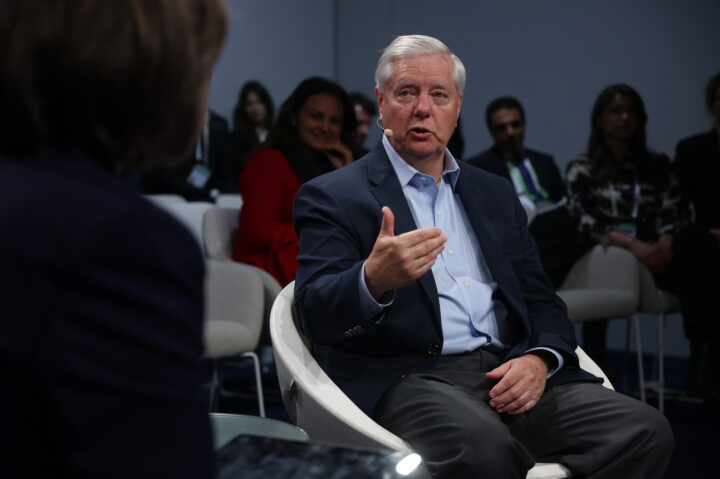
Sean Gallup/Getty Images
Sen. Lindsey Graham (R-SC) speaks at the 62nd Munich Security Conference on February 13, 2026 in Munich, Germany.
As President Donald Trump returned to Washington on the first Sunday of the new year, he was joined by Sen. Lindsey Graham (R-SC), who had traveled to the president’s Mar-a-Lago estate a day earlier to be with Trump after he ordered the operation that deposed Venezuelan President Nicolás Maduro.
Graham, 71, had been encouraging Trump since returning to office last January to take a more aggressive posture toward the Maduro regime, and vigorously defended the president’s decision to launch a series of strikes targeting Venezuelan boats that the Trump administration alleged were carrying drugs meant to reach U.S. soil. By late October, he was calling on Maduro to flee Venezuela and cede power as tensions between Trump and the dictator escalated.
During an impromptu press conference aboard Air Force One, Trump and Graham defended the merits of the operation and predicted that the Cuban regime was likely to fall as a result of the mission. The South Carolina senator, one of the most hawkish Republican lawmakers on foreign policy, grinned as he heralded the mission as a success.
“When I was on Air Force One with the president flying back and we did that news conference, if you thought I was smiling big on the outside, you have no idea how much I was smiling on the inside,” Graham told Jewish Insider in an interview shortly after arriving in Washington with the president. “This is the best time in my political life because I’ve aligned myself with the strongest president in modern times. We’re getting results that are making this world safer and America more prosperous.”
By that time, more than 10 years after rejecting Trump’s candidacy and decrying him as a “race-baiting, xenophobic bigot” whose rhetoric would “kill my party,” Graham had become one of the president’s closest allies in the Senate and a close confidante on foreign policy matters.
“This is what happens when you stay in his orbit, realizing there’s far more good than bad and understanding that this man has magic that nobody on the planet has,” the South Carolina senator told JI. “It’s not so much that I’m on a roll. It’s the fact that talking with President Trump, he is embracing policies that he calls common sense, and the small part I play on the end of this, I’m so proud of.”
Following Graham’s sudden passing this weekend, Trump somberly reflected on the loss of his friend, political confidante and golfing partner, praising the late senator for his political acumen and his patriotism in a pair of media interviews and two social media posts.
“He’s a tough one to lose. He was great. He was unique in every way, actually,” Trump told NBC’s “Meet the Press” on Sunday morning of Graham. “He was really a worker. … He was a great politician, actually.”
“He was such an advocate if he wanted to get something. He had a unique ability, he was able to deal with Democrats. If I had a problem, a real problem, I wouldn’t often ask, but if I had a problem with a Democrat, he could work it out,” he continued. “There was nobody like him. He loved being a politician, and he was going to win his election [in November for a fifth Senate term]. … He just had it made.”
Graham passed away on Saturday evening after returning from a congressional delegation that included stops in Kyiv, Ukraine, and Ankara, Turkey, for last week’s NATO summit.
The South Carolina senator arrived to his Capitol Hill townhome late Saturday afternoon and began making phone calls to Republican political allies in the early evening about legislative business, developments in the Middle East and to share details of his recent trip, according to two sources with direct knowledge.
One of those calls was to the president. Another was to Morgan Ortagus, the former deputy presidential envoy for Middle East peace in the second Trump administration and one of Graham’s closest confidantes in Washington. The president said that Graham mentioned being “tired” during their conversation, but noted that “he was fine” and expressed shock at his sudden passing. Ortagus told JI on Sunday afternoon that Graham was upbeat during their final conversation, expressing optimism that Trump was coming around on supporting his Russia sanctions bill and with resuming military operations in Iran.
“Nobody was expecting this. That’s for sure. Not even Lindsey was, or he wouldn’t have been running for another term,” Sen. Kevin Cramer (R-ND), who has had close relationships with both Graham and Trump, said of the senator’s sudden passing. “When a person cuts as wide a swath as Lindsey cuts, it is shocking. It will take some time to process the reality of it. It should really hit on Monday when we show up for work.”
It came as a shock to Trump, Ortagus and everyone else in Graham’s orbit when his office announced his passing in the early hours of Sunday morning, which the Washington D.C. medical examiner’s office, in a preliminary autopsy report, attributed to aortic dissection caused by arteriosclerotic cardiovascular disease.
“He was extremely jazzed up in our last conversation. He had just gotten off the phone with the president, and he was super excited about the Russia sanctions bill and the president deciding to go back into Iran,” Ortagus told JI. “He could not have been happier when I spoke to him last night. He was in the best mood and in a great place. He spoke about how he felt like he was doing consequential work.”
“Nobody was expecting this. That’s for sure. Not even Lindsey was, or he wouldn’t have been running for another term,” Sen. Kevin Cramer (R-ND), who has had close relationships with both Graham and Trump, said of the senator’s sudden passing. “When a person cuts as wide a swath as Lindsey cuts, it is shocking. It will take some time to process the reality of it. It should really hit on Monday when we show up for work.”
Asked about his phone call with Graham during his “Meet the Press” appearance — on which Graham had been scheduled to appear — Trump said, “I just can’t believe it. He was like a member of the family to me. It’s very tough, actually. It’s amazing.”
Trump and Graham formed an unlikely relationship over the course of the first Trump administration, finding common ground with the establishment of the Abraham Accords and the confirmation of the president’s Supreme Court nominees.
Graham briefly broke with Trump in the immediate aftermath of the Jan. 6, 2021, Capitol riot, condemning the attack and recognizing Biden’s 2020 victory. But within months, Graham was regularly visiting Trump at his Mar-a-Lago estate in Palm Beach, Fla., and publicly urging his party to rally around the president’s bid for a second term in 2024.
“He genuinely had a fantastic relationship with President Trump. They really actually liked each other a lot. I think Trump was his best friend in many ways,” Ortagus said. “He loved the president. It was genuine. They were incredibly good friends.”
Sen. Ted Cruz (R-TX) and Graham got to know each other as members of the Senate Judiciary Committee and on the presidential campaign trail in 2016. The two developed a close working relationship in the last decade, finding common ground on economic and foreign policy issues that pitted them against the expanding populist wing of the GOP.
Speaking to JI on Sunday, Cruz said that Graham and Trump “became close friends. Lindsey would call the president early in the morning, late at night and at every hour in between. And the president listened to him. He didn’t always agree, but he trusted him and he knew that Lindsey was speaking from the heart.”
“[Senate Majority Leader] John Thune (R-SD) is going to miss him terribly. Donald Trump is going to miss him terribly,” Cramer told JI. “It confounds them, MAGA world. They love Donald Trump and can’t stand Lindsey Graham, so they’re befuddled by the relationship.”
Cramer noted that Trump has developed political alliances with several former critics, the most notable example being Vice President JD Vance, who was similarly disapproving of the president during the 2016 election. Like Graham, the vice president became an avid defender of Trump during the president’s first term.
While both men found their way into the president’s orbit, they remained on opposing sides of the conservative movement, with Vance becoming one of the leading GOP voices wary of U.S. military engagement abroad and Graham emerging as a leading force behind the effort to maintain an engaged foreign policy.
“With Lindsey, he was talented,” Cramer said. “He was bright and he knew things that a lot of people don’t know. He had a historical perspective a lot of people don’t have. He had a Rolodex that’s probably in several languages, and he called you from all kinds of time zones. You never knew where he was when he called.”
Despite having those conservative detractors, following his death, Graham was lauded for his humor, his friendship and his public and private support for Trump by those in the president’s orbit — including Vance and other prominent Trump administration officials who were not often ideologically aligned with the late senator.
“Early in my Senate tenure, I remember getting into a shouting match with Lindsey about a Ukraine funding bill at lunch and then learning the very next day that he was pushing rail legislation I really cared about behind the scenes,” Vance wrote on X. “That was Lindsey Graham. He fought like hell for the things he believed in, and he was just as willing to go to bat for you when it counted.”
“Lindsey had the best sense of humor in the Senate. He loved the game of politics. He was constantly asking which races were up and down, and how he could help,” the vice president continued. “As he liked to say, ‘I don’t care if you’re an isolationist or a religious fanatic, so long as you have an R next to your name, I want you to win.’ We certainly had our disagreements. But I couldn’t help but like him. A one of a kind figure in our politics.”
Stephen Miller, the White House deputy chief of staff for policy and a longtime Trump advisor, described Graham as a cherished ally to the president in implementing the administration’s policy goals and spoke of telling the late senator “what his friendship meant to me and to us all.”
“I cannot describe to you how much joy President Trump’s leadership and friendship brought to Lindsey,” Miller wrote on X. “Meetings with Graham at the White House were filled with camaraderie, kinship and uproarious laughter.”
“The fact that Lindsey started out as a political opponent only to become one the President’s most steadfast and faithful supporters underscores that Lindsey believed emphatically in the voice of the people,” he explained.
Miller described Graham as “a senator’s senator” and praised his ability to “move a room,” calling it “a glorious thing to witness.”
Sander Gerber, the CEO of Hudson Bay Capital and the architect of the Taylor Force Act, the passage of which Graham championed, told JI, “Lindsey was a maverick. He didn’t care about convention. He cared about doing what was right. When Lindsey set his mind to something, he was going to deliver on it, and he had a keen sense of the politics to be successful at that. He should be remembered as one of the greatest champions for Israel among members of Congress.”
“As heartbreaking as his sudden passing is, I hope it will bring some measure of comfort to those who cherished him to know just how much he was living his dream every day,” Miller said. “Very rarely in life do you get to be exactly where you want to be, when you want to be there, with who you want to be with, doing precisely what you want to do — that was every moment for Lindsey.”
Many of those who spoke about Graham after his passing described the South Carolina Republican, who spent more than two decades in the Senate, as a professional at navigating choppy political waters
“He wasn’t just a good talker, he had depth,” Cramer said. “He knew what the hell he was talking about. He had interesting insights.”
Sander Gerber, the CEO of Hudson Bay Capital and the architect of the Taylor Force Act, the passage of which Graham championed, told JI, “Lindsey was a maverick. He didn’t care about convention. He cared about doing what was right. When Lindsey set his mind to something, he was going to deliver on it, and he had a keen sense of the politics to be successful at that. He should be remembered as one of the greatest champions for Israel among members of Congress.”
“In order to get things done in Congress, to actually make a difference, you need to have the relationships,” Gerber said. “Lindsey was able to cultivate those relationships, and that’s what enabled him to get things done. There are 100 senators, but he was able to get his voice to stand out and to drive policy forward.”
Republicans and Democrats alike predicted Graham would be remembered as a legendary American political figure known for his ability to take political risks and find common ground in unexpected places.
“There was not a fight on domestic or foreign affairs that he didn’t want to jump into,” Ortagus said of Graham. “If he believed in an issue and believed that a particular policy was the right thing, he really didn’t care about the politics. Ultimately, he wouldn’t change what he believed was right based on politics, and that’s in very short supply politically right now.”
Ret. Gen. David Petraeus, the former director of the CIA and head of U.S. Central Command, told JI that Graham’s legacy would be “that of someone who was fiercely committed to the enduring principles, values and freedoms that we cherish, and who had the political skills and determination to see what he supported promoted by legislation, policies and strategies.”
“Sen. Graham’s dedication to the state of Israel and to the Jewish people was deeply sincere. We talked about it all the time. I went to Israel with him many times,” said Morgan Ortagus, the former deputy presidential envoy for Middle East peace in the second Trump administration and one of Graham’s closest confidantes in Washington. “He was a Southern Baptist and believed in the importance of the Jewish state to his core, and was willing to defend it.”
“I think he would be pleased to hear me say that he was not just adept, but was diabolically creative when necessary to achieve the outcomes to which he was committed,” Petraeus said.
Many of Graham’s allies said they expect his longstanding support for Israel and his commitment to aiding Ukraine in Russia’s war against it to be signature pieces of his foreign policy legacy.
“Sen. Graham’s dedication to the state of Israel and to the Jewish people was deeply sincere. We talked about it all the time. I went to Israel with him many times,” Ortagus said. “He was a Southern Baptist and believed in the importance of the Jewish state to his core, and was willing to defend it.”
“We talked a lot in the past year about the rise of antisemitism and anti-Zionism in both parties. He was very close to my daughter and she called him ‘Uncle Lindsey,’” she continued. “I would always remind him that I have a Jewish daughter and that throughout our history, the Jewish people have always thought we were safe until we weren’t.”
Ortagus said she and Graham “agreed that we have to fight antisemitism back in our party, that it can’t be allowed to fester. He would always talk about how important it was. He had deeply held personal beliefs on what America’s relationship with Israel should be. There was nothing cynical or craven about it.”
Cruz described Graham as “a passionate and formidable defender of Israel” and noted that Israeli Prime Minister Benjamin Netanyahu “trusted Lindsey and listened to him.”
“Lindsey loved the nation of Israel. He loved the people of Israel, and he believed ferociously in defending and strengthening America’s friendship and alliance with Israel,” the Texas senator said of his late colleague. “Now, Lindsey would sometimes tell his friends messages they didn’t want to hear. Lindsey was not one to just blow smoke. He would tell people exactly what he thought, but that made him an incredibly effective advocate for Israel.”
“Lindsey understood that standing with Israel is overwhelmingly in America’s national security interests,” he continued. “He and I collaborated very closely on articulating why standing with Israel makes America safer, that the enemies of Israel, whether Hamas or Hezbollah or Iran, are the enemies of America as well.”
Sen. Chris Coons (D-DE) credited Graham with doing “a masterful job of pulling” senators from across the ideological spectrum “in the same direction” in the immediate aftermath of Hamas’ Oct. 7, 2023, attacks on Israel, swiftly organizing a bipartisan congressional delegation alongside former Sen. Ben Cardin (D-MD) to Israel, Saudi Arabia and Egypt as he sought to salvage his longstanding efforts to achieve Saudi-Israeli normalization.
“It was an incredible trip, and all of us said it was just one of the most consequential, constructive trips we’d ever been on,” Coons told JI. “[Sen.] Katie Britt (R-AL) came on the trip. It was one of her first trips as a senator, I think. Think about the range of members who we had. We had [Sens.] Chris Murphy (D-CT) and Dan Sullivan (R-AK) in the same meeting.”
“Even though it was two weeks after Oct. 7 and it was in the middle of that shock, he knew what he was doing,” Coons continued. “He was building a coalition of supporters for the deal that he was hoping he could pull off.”
Coons was one of several people to point to Graham’s well-documented friendships with the late Sens. John McCain (R-AZ) and Joe Lieberman (I-CT), known as the Senate’s “three amigos,” as an important part of his legacy.
“I think he continued McCain’s legacy of fighting for freedom, and he never gave up on the possibility of ending the Arab-Israeli conflict,” Coons said. “That was his prize.”
“He was not afraid to be critical and he was never uncritical of friends. He believed that friends owe it to each other to try to enable them to do better,” Sen. Richard Blumenthal (D-CT) said. “He had a vision, which was in effect the normalization of relationships throughout the Middle East, an extension of the Abraham Accords. He pursued it relentlessly.”
Sen. Richard Blumenthal (D-CT), who maintains a similarly bipartisan reputation in Congress, worked with Graham frequently on foreign policy matters. Blumenthal began traveling abroad with Graham in 2012, two years after being elected to the Senate. Their first trip together was a congressional delegation to the Middle East organized by McCain. The two traveled repeatedly to Ukraine and its European neighbors since Russia’s invasion, and to the Middle East since Oct. 7.
“He loved the Jewish people and he loved the Jewish state, which was so striking to me when I first traveled with him and John McCain to Israel,” Blumenthal told JI. “He and McCain loved the faith of the Jewish people, which of course is so much a part of life in Israel, but Sen. Graham also loved Israel’s ingenuity and inventiveness and the prowess and scrappiness of its military.”
“He was not afraid to be critical and he was never uncritical of friends. He believed that friends owe it to each other to try to enable them to do better,” he continued. “He had a vision, which was in effect the normalization of relationships throughout the Middle East, an extension of the Abraham Accords. He pursued it relentlessly.”
On the Taylor Force Act, Gerber noted that he convinced Graham to push for the Palestinian Authority to end its controversial payment program to Palestinian terrorists and their families, also known as “pay-for-slay,” after showing the senator video footage of the Palestinian Authority celebrating the terrorist who murdered Taylor Force, a U.S. army veteran killed by a Palestinian while visiting Israel in 2016.
“I’d shown this to many other senators, but no one was as upset as Lindsey. I remember him shaking when he saw the footage,” Gerber said. “Originally, I just wanted to educate Congress about what was going on, so I was trying to meet with as many members as I could to let them know the Palestinian Authority had this institutional infrastructure in place.”
Leading Jewish and pro-Israel organizations praised Graham in statements on his passing as a champion for the Jewish state and in the fight to combat rising antisemitism.
“For more than two decades in the United States Senate, his voice was a constant reminder that a strong Israel is firmly in America’s national security interest, and his commitment to these principles never wavered,” AIPAC said. “His many visits to Israel and his love for the Israeli people reflected not just a policy position, but a deep personal connection to the Jewish state and its citizens.”
The American Jewish Committee described the late senator as “a powerful advocate for many of the issues AJC champions, including American global leadership, Israel’s security, a robust North Atlantic Treaty Organization, and Ukraine’s defensive fight against Russian aggression.”
AIPAC called Graham “a great friend and true champion of the U.S.-Israel relationship.”
“For more than two decades in the United States Senate, his voice was a constant reminder that a strong Israel is firmly in America’s national security interest, and his commitment to these principles never wavered,” the organization said. “His many visits to Israel and his love for the Israeli people reflected not just a policy position, but a deep personal connection to the Jewish state and its citizens.”
The Republican Jewish Coalition released a statement from Matt Brooks, the organization’s CEO, and former Sen. Norm Coleman (R-MN), the organization’s national chairman, describing the late senator as “a dear friend” to both men personally and the organization as a whole.
“On a personal level, Lindsey was a man of deep loyalty, humor, and heart. He treated everyone, ally or adversary, with warmth and respect, and he built friendships across the aisle that many said were impossible in today’s Washington,” the statement read.
The GOP senator’s slow embrace of Trump earned him criticism from constituents and lawmakers on both sides of the aisle. As a former conservative House lawmaker who had fought the rise of the Tea Party movement in the early 2010s, Graham had built a reputation as a defense hawk with a penchant for bipartisanship when Trump was first elected in 2016.
Some Democrats were angered by his political pivot, especially during and after the first Trump administration, but Graham maintained strong relationships with his Democratic colleagues and continued working with them frequently on efforts to support Ukraine and other areas of agreement.
“He deeply, genuinely loved the Senate. He tried really hard to do positive things for the institution at the same time that he was a fierce partisan,” Coons said of Graham. “Our fight over Kavanaugh was one of the worst I’ve ever had.”
Another of those Democrats is Sen. John Fetterman (D-PA), who became close with Graham in the two-and-a-half years since the Oct. 7 attacks. Graham and Fetterman, whose decision to vocally support Israel amid declining support in the Democratic Party prompted his relationship with the progressive left to collapse, frequently engaged on foreign policy matters, especially related to developments in the Middle East.
Fetterman described Graham to JI as “warm, friendly and thoughtful” and called his passing “a tragedy.”
“Israel lost a huge champion with Lindsey Graham,” the Pennsylvania senator said.
Libertarian and isolationist Republicans, meanwhile, grew frustrated that such a hawkish voice was being consulted so closely on foreign policy matters in an America First administration.
“There should be a law that Lindsey Graham can only enter the White House every other week, and that he’s only to meet with under mid-level people, not the president. No more golf outings,” Sen. Rand Paul (R-KY), a foe of Graham’s in the Senate Republican Conference who opposed the president’s actions in Venezuela, told reporters in January.
Across the political spectrum, those who knew Graham described him as an irreplaceable fixture in the Senate and predicted that his loss would cause many voids in the upper chamber, where the late senator was supposed to take over as the top Republican on the Senate Judiciary Committee next year.
“He links so many things and so many people that without him, there’s a missing link in a lot of relationships between Middle Eastern countries between members of the Senate, between Budget Committee members and leadership, between the Republicans and Democrats,” Cramer said of Graham’s expansive presence in the Senate. “We’ll find out the consequences of losing him in time like this soon, but it’ll be hard to navigate to be sure.”
“I don’t know who can play this role going forward. I just don’t see it,” Sen. Chris Coons (D-DE) said. “He’s just not replaceable. There’s not going to be anyone like him again.”
Cruz told JI that, “nobody will fill that void” left by Graham’s absence, citing the respective impacts of McCain and the late Sen. Orrin Hatch (R-UT) to the upper chamber.
“When John McCain passed away, that was a void that was never filled. When Orrin Hatch, another longtime legend of the Senate, passed away, that was a void that was never filled,” Cruz said. “Nobody will fill Lindsey’s shoes. Others will step up and lead in different ways, but Lindsey left an indelible mark on the Senate, on the nation and on the hearts of his colleagues.”
“I don’t know who can play this role going forward. I just don’t see it,” Coons said. “He’s just not replaceable. There’s not going to be anyone like him again.”
Plus, Khanna's quiet Israel trip
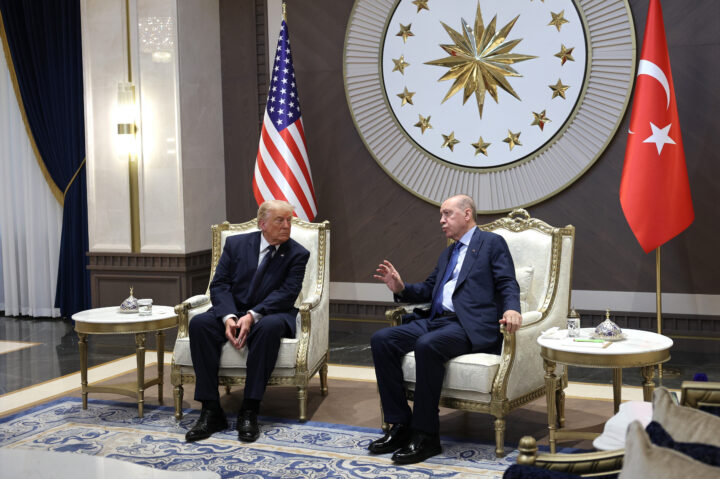
Win McNamee/Getty Images
President Donald Trump speaks to Turkish President, Recep Tayyip Erdogan, after arriving at Etimesgut Air Base for the annual NATO Summit on July 7, 2026 in Ankara, Turkey.
Good Friday morning.
In today’s Daily Kickoff, we have the scoop on a letter from House Democrats concerned that the U.S.’ warming relationship with Turkey is being driven by the personal interests of President Donald Trump and his family and associates, and report on a call from a bipartisan group of lawmakers urging FEMA to extend the nonprofit security grant application deadline. We look at the candidates who have thrown their hats in the ring to be Maine Democrats’ Senate nominee following Graham Platner’s withdrawal from the race, and report on Rep. Ro Khanna’s trip to Israel and the West Bank this week. Also in today’s Daily Kickoff: David Lubin, Ambassador Mike Huckabee and Evan Bernstein.
We have also launched a new on-demand Live Briefing that you can access throughout the day via our new app (on Apple and Android) and on our website.
Today’s Daily Kickoff was curated by JI Executive Editor Melissa Weiss and Israel Editor Tamara Zieve, with an assist from Danielle Cohen-Kanik. Have a tip? Email us here.
For less-distracted reading over the weekend, browse this week’s edition of The Weekly Print, a curated print-friendly PDF featuring a selection of recent Jewish Insider and eJewishPhilanthropy stories, including: Rahm Emanuel, in Tel Aviv, says he is ‘not impressed’ by far-left wing of the Democratic Party; New psychology training program aims to combat antisemitism in mental health care; and AI models more lax with antisemitism when engaging in Persian, new ADL study finds. Print the latest edition here.
What We’re Watching
- We’re keeping an eye on the tense situation in the Middle East, amid hints from senior Israeli officials, including Prime Minister Benjamin Netanyahu, Defense Minister Israel Katz and Israeli Ambassador to the U.S. Yechiel Leiter, that it is willing to reenter the fight against Iran and assist the U.S. More below.
- The Wall Street Journal reported last night that Israel had notified the U.S. of intelligence indicating that Iran was plotting a new assassination attempt against President Donald Trump, who, while in Turkey earlier this week for the NATO summit, repeatedly suggested that Iran considered him its “No. 1” target. “I saw this morning, I’m on every single one of their lists,” Trump told reporters in Ankara. When the president returned from Turkey mid-week, he took one of the older planes home, rather than the refurbished Qatari luxury jet, which lacks some of the same security features as the older Air Force Ones.
- Turkey is expected to announce today that it will sell its Russian-made S-400 batteries to the United Arab Emirates, a move that would allow the U.S. to move forward on its sale of F-35s to Ankara.
What You Should Know
A QUICK WORD WITH JI’S TAMARA ZIEVE AND MATTHEW SHEA
After several days of watching from the wings as the United States has conducted strikes against Iran, Israeli officials have increasingly indicated that Jerusalem is ready to return to military action if it determines that circumstances demand it.
Israeli Ambassador to the U.S. Yechiel Leiter told CNN on Thursday that Jerusalem is “supportive of the position of the United States” and would “fly alongside U.S. aircraft” if called on to do so.
At an Israeli Air Force graduation ceremony the same day, Defense Minister Israel Katz said the IDF is prepared to “regain air superiority and carry out ‘blue-and-white’ [Israeli] strikes in Iran to remove threats — even for a third time,” warning that it would be with “even greater force” than before. Meanwhile, IDF Chief of Staff Lt. Gen. Eyal Zamir told graduates that “on the drawing board are new plans. Major operations are still expected to lie ahead of us. Be prepared.”
Prime Minister Benjamin Netanyahu reinforced that message in his remarks at the ceremony. While celebrating the outcome of Operations Rising Lion and Roaring Lion, he made clear that Israel does not view the conflict with Iran as settled. “Our policy is clear: With an agreement or without an agreement, Iran will not have nuclear weapons,” Netanyahu said. He added: “The war is not yet over. Alongside old challenges, new ones are emerging. Axes fall, and axes rise. We are turning our attention to this. We are prepared for any scenario.”
Security analysts say the messaging reflects a desire to preserve military pressure without committing to another immediate campaign. Yoni Tobin, a senior political analyst at the Jewish Institute for National Security of America, told Jewish Insider, “While Israel isn’t exactly clamoring for more combat with Iran, particularly after nearly three years of multifront war, it is certainly ready for it.” Tobin noted that “Israel will likely feel comfortable acting against Iran if the United States does so as well, and if the two countries are aligned on objectives and strategy.”
David May, a senior research analyst at the Foundation for Defense of Democracies, said the memorandum of understanding “should be seen as part of the process of ending the fighting between the United States and Iran, not the final agreement.”
SCOOP
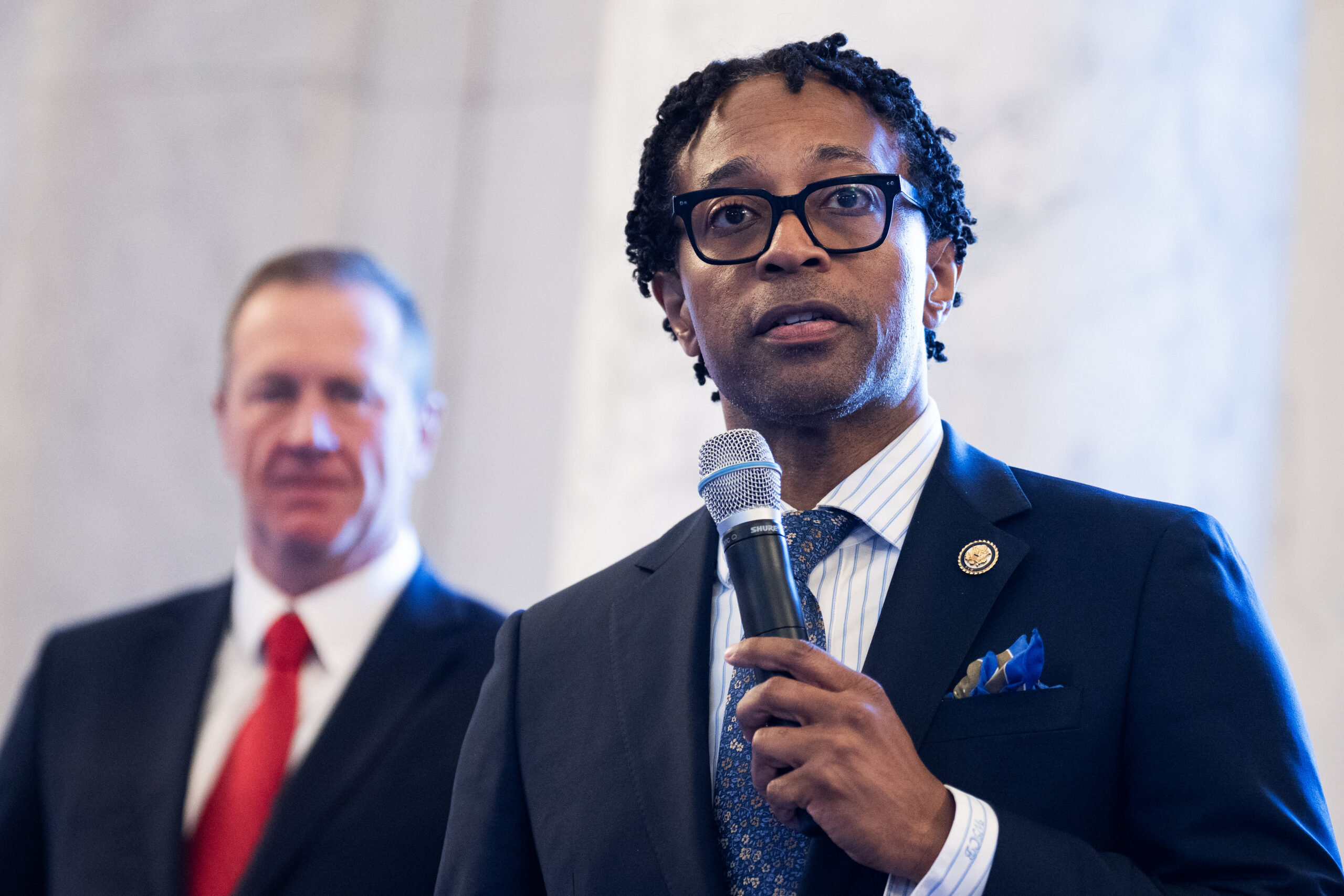
A group of House Democrats wrote to President Donald Trump on Friday to express “strong opposition” to the administration’s plans to lift sanctions on Turkey and sell the country’s F-35 fighter jets, and suggested that the decisions may be driven by Trump’s or his family members’ financial interests, Jewish Insider’s Marc Rod reports.
What they’re saying: The letter requests that Trump, U.S. Ambassador to Turkey Tom Barrack and Trump’s son Donald Trump Jr. preserve records relating to their relationships with Turkish President Recep Tayyip Erdoğan and the Turkish government, stating that, “In the coming months and years, Congress will continue to exercise our constitutional oversight authorities and thoroughly scrutinize this matter to ensure the interests of the American people and their security is protected” — suggesting a potential House investigation if Democrats retake the chamber in November.
Signed on: The letter was led by Reps. Wesley Bell (D-MO), Dan Goldman (D-NY) and Dina Titus (D-NV), joined by Reps. Debbie Wasserman Schultz (D-FL), Brad Schneider (D-IL), Gabe Amo (D-RI), Jim Costa (D-CA), Jared Moskowitz (D-FL), Brad Sherman (D-CA) and Rob Menendez (D-NJ).
SHORT NOTICE

Fifty-eight House members from both sides of the aisle urged the Federal Emergency Management Agency on Thursday to extend the deadline for 2026 Nonprofit Security Grant Program applications, arguing that the current timeline gives states and institutions “insufficient time to complete the application process” and fulfill the program’s goals, Jewish Insider’s Marc Rod reports.
Deadline dealings: Applications for the program were announced on June 24 and are due to the federal government from state emergency management agencies by July 24. Those state agencies must set their own earlier deadlines for individual institutions to submit applications. “It is essential that eligible applicants have a fair shot to apply for these funds and fully realize the program’s intended purpose,” the lawmakers, led by Reps. Grace Meng (D-NY) and David Joyce (R-OH), wrote in a letter to acting FEMA Administrator Robert Fenton.
IN QUEUE

The mad dash to replace Graham Platner as the Democratic Senate nominee in Maine is coming together so quickly and haphazardly that one potential replacement, Nirav Shah, is taking stickers from his failed gubernatorial campaign and cutting off the “for governor” line below his name before handing them to supporters, Jewish Insider’s Gabby Deutch reports.
Following in his footsteps: Many of the candidates now seeking to succeed Platner on the general election ballot — which also include Troy Jackson, Paige Loud, Shenna Bellows, Dan Kleban and Jordan Wood — are commending the populist movement he built and looking to capitalize on it. Less than 24 hours into the contest, some had already made clear they will adopt a platform much like Platner’s when it comes to Israel — seeking to end U.S. weapons sales to the country and shunning donations from AIPAC — while others are remaining mum on that topic.
Into the woods: Wood, a former chief of staff to Rep. Katie Porter (D-CA), shared his views with JI on Thursday about the U.S.-Israel relationship, saying that he considers Israel “our strongest ally in the Middle East” but that its government must be reined in. He entered the race after placing third in last month’s congressional primary to replace retiring Rep. Jared Golden (D-ME).
SCOOP

Rep. Ro Khanna (D-CA) traveled to Israel and the West Bank this week while Congress is in recess, according to two individuals with knowledge of the trip, Jewish Insider’s Melissa Weiss reports. Khanna has not posted publicly about his trip, which is scheduled to conclude Thursday night. His office did not respond to requests for comment from JI.
Israel approach: The California Democrat has become increasingly critical of Israel since the onset of the Israel-Hamas war following Hamas’ Oct. 7, 2023, terror attacks. In September 2025, he accused Israel of having committed genocide in Gaza. A spokesperson for the Prime Minister’s Office said that Netanyahu did not meet with Khanna during this trip.
SCENE IN SUN VALLEY
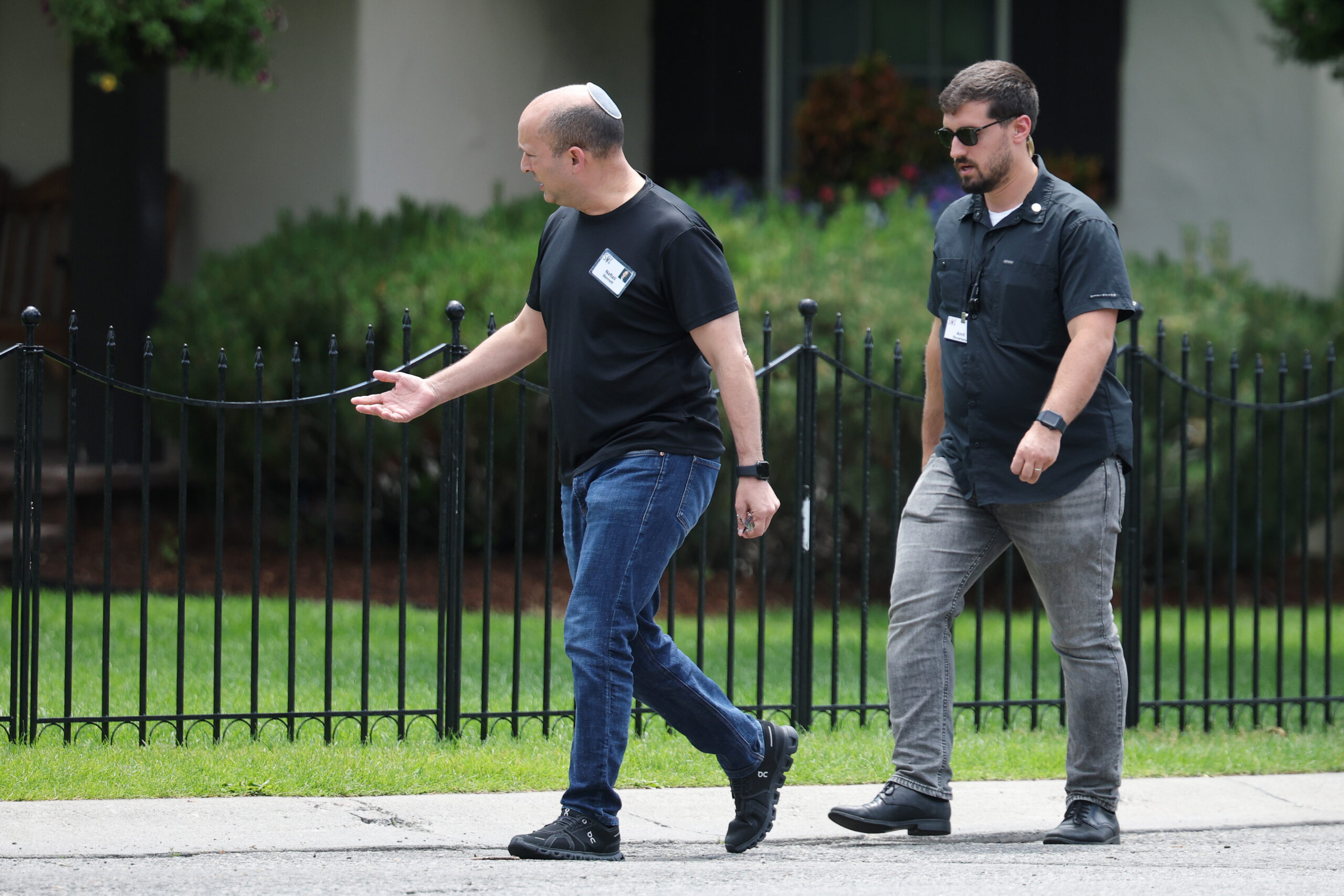
Jared Kushner, United Arab Emirates Ambassador to the U.S. Yousef Al Otaiba and former Israeli Prime Minister Naftali Bennett participated in an off-the-record discussion on Thursday morning at Allen & Company’s annual Sun Valley conference, Puck News reported. The closed-door conversation was held before the conference’s invite-only audience of business, media and technology leaders, Jewish Insider’s Emily Jacobs reports.
Also in attendance: Later in the morning, Sens. Dave McCormick (R-PA) and John Fetterman (D-PA) appeared together for a wide-ranging discussion. Meta COO Dina Powell McCormick, who is married to the Pennsylvania senator, is also in attendance at Sun Valley this week alongside Meta CEO Mark Zuckerberg and other senior Meta executives.
Bonus: In an op-ed in Time, Bennett posits that Israel is one of the “greatest assets” to U.S. foreign policy, describing the relationship between Jerusalem and Washington as “a partnership of equals — not in the size of our populations, but in the depth of our commitments.”
TRANSITIONS

In a generational change at the top of B’nai B’rith International, the organization has tapped Evan Bernstein as its next CEO, the group exclusively told eJewishPhilanthropy’s Jay Deitcher on Thursday, as the longtime communal professional looks to breathe new life — and a spirit of innovation — into a 182-year-old legacy organization.
Drawing on experience: Bernstein, 51, will take the reins of B’nai B’rith on Aug. 24, succeeding longtime CEO Dan Mariaschin, 77. Bernstein brings with him 25 years of Jewish nonprofit experience at a host of communal organizations, including serving as the inaugural CEO of Community Security Service and in leadership roles at the Jewish Federations of North America, the Anti-Defamation League and AIPAC. In his first interview since accepting the position, Bernstein discussed how he will use his connections at past agencies to cultivate new partnerships for B’nai B’rith and how he will bring a startup mentality to the world’s oldest Jewish service organization.
Read the full interview here and sign up for eJewishPhilanthropy’s Your Daily Phil newsletter here.
Worthy Reads
From Friends to Foes: Bloomberg‘s Ethan Bronner spotlights the dissolution of the “cross-cultural bromance” between Israeli entrepreneuer Eyal Waldman and Palestinian American tycoon Bashar Masri following Hamas’ Oct. 7, 2023, attacks on Israel in which Waldman’s daughter Danielle, who was attending the Nova music festival, was killed. “The Hamas attack effectively reset the historical clock so that in Israel today, all political and security discussions start on Oct. 7. … Waldman today says his views on coexistence haven’t changed. He continues to meet with the Palestinian leadership and advocate for two states. But he dismisses the notion that Masri might ever again be a partner. Convinced that Masri helped Hamas build the infrastructure that was set loose to such devastating effect, Waldman is doing everything he can to bring down his old friend through the U.S. lawsuit.” [Bloomberg]
Mojtaba’s MIA: The New York Times’ Yeganeh Torbati reports on Ayatollah Mojtaba Khamenei’s “looming absence at the top of the government” and failure to appear in public since he succeeded his father in March. “Without a strong central authority like the elder Ayatollah Khamenei, it has become even more unpredictable which faction will eventually gain the upper hand — and how the country will navigate its many crises. … ‘There’s no central authority in effect to reconcile the various factions that are fighting for control,’ said Ali Ansari, a historian of Iran at the University of St. Andrews in Scotland.” [NYTimes]
Crowd Control: In The Free Press, Masih Alinejad posits that the coverage from within Iran of the funeral ceremonies for late Supreme Leader Ayatollah Ali Khamenei did not depict the reality on the ground. “The Islamic Republic has always treated mass mobilization as a proof of legitimacy: The bigger the crowd, the stronger the claim to power. But the crowds are an illusion. I know from experience how they are assembled: through force. This time is no different. … The Islamic Republic spent this week performing strength. But the regime has a problem: Almost everything about it — the chants, the flags, the scripted weeping at the coffin — is a performance. The people inside Iran, dancing in secret or driving north with 20 kilograms of rice they did not want, know this to be true.” [FreePress]
Word on the Street
Rep. Carlos Gimenez (R-FL) withdrew as co-chair of the Congressional Friends of Spain Caucus, citing in part Madrid’s “hostile actions against Israel and the Jewish people”…
A new survey from the Pew Research Center found that fewer than half of Americans ages 18-29 — both Democrats and Republicans — view either Israelis or the Israeli government favorably…
A Pennsylvania man was arrested and charged with making antisemitic threats targeting Gov. Josh Shapiro; the Delco, Pa., resident, after entering the office of a state legislator to complain about taxes, threatened an arson attack at the governor’s mansion, 15 months after Shapiro’s residence was firebombed during Passover…
The New York Times spotlights Notarikon Review Publisher Mendel Uminer, whose collection of some 10,000 books prompted his landlord to force him from his apartment…
David Lubin, the father of slain lone soldier Rose Lubin, an Atlanta native who was killed in a terror attack in Jerusalem in November 2023, opened the first U.S. chapter of Yad LaBanim, an Israeli group that supports bereaved military families, eJewishPhilanthropy’s Nira Dayanim reports…
U.K. Labour MP Andy Burnham, who is poised to become the U.K.’s next prime minister, apologized for the party’s stance on Gaza, saying that London was “too slow to call for a ceasefire. And we must now do more to strengthen our approach”…
London Mayor Sadiq Khan visited the Nova music festival exhibition in the city, a week after the exhibition’s organizers told the Jewish News they were disappointed that the mayor had yet to attend; Khan was at the exhibition on the birthday of British-Israeli musician Jack Marlowe, who was killed at the music festival…
Jewish Community Iceland—Beit Tovah Chabad opened the country’s first Jewish center, in the capital of Reykjavik, after years of operating out of the home of the local emissary…
The Wall Street Journal looks at the challenges and delays the International Stabilization Force in Gaza is facing in deploying troops to the enclave…
The IDF said it is investigating an incident in which a Palestinian detainee was stripped and bound, after an image of the man posted online last month by a Palestinian activist went viral; the IDF confirmed the photograph’s authenticity while not releasing any details about the circumstances surrounding it…
The Associated Press spotlights an Israeli effort to clear unexploded ordnance and other munitions off the coast of the city of Rishon LeZion, which has been used for decades as a military firing range…
Pic of the Day

Alongside former Israeli hostage Yarden Bibas (left), whose wife and sons were killed in captivity in Gaza after being taken during the Oct. 7, 2023, Hamas terror attacks, U.S. Ambassador to Israel Mike Huckabee and his wife, Janet, installed a plaque through the My Tree in Israel program honoring Shiri, Ariel and Kfir Bibas.
Birthdays

Co-founder of Imagine Entertainment, his films and TV series have been nominated for 47 Academy Awards and 217 Emmys, Brian Grazer turns 75 on Sunday…
FRIDAY: Senior U.S. district court judge in the Southern District of Texas, Judge David Hittner turns 87… Retired attorney at the California Office of Legislative Counsel, Robert D. Gronke… Stan Udaskin… Folk singer-songwriter, Arlo Guthrie turns 79… NYC-born author of 13 novels, she has been living in Israel since 1971, Naomi Ragen turns 77… Partner in consulting firm Quorum, LLC and president at Regal Domestics, Barbara Goldberg Goldman… Author of 13 books, journalist, she is the daughter of two Holocaust survivors, Julie Salamon turns 73… Editor of the Cleveland Jewish News, Columbus Jewish News and Akron Jewish News, Bob Jacob… Israel’s ambassador to Spain until 2024, Rodica Radian-Gordon turns 69… Past president of the Jewish Federation of Greater MetroWest New Jersey, Leslie Dannin Rosenthal… Partner in Holland & Knight’s public policy group, he was previously a member of Congress (D-FL-22), Ronald J. “Ron” Klein turns 69… Lobbyist, he was a member of the New York state Legislature: Assembly for 10 years and Senate for 14 years, Jeffrey D. Klein turns 66… National president of the American Jewish Committee, he is a founder of Lapin & Landa, a Houston-based civil litigation firm, Robert E. Lapin turns 66… Voice actor and impressionist who has voiced Bugs Bunny, Daffy Duck, Sylvester the Cat and dozens of others, Jeffrey Bergman turns 66… U.S. ambassador to his native Estonia, he is the former president of NYC’s Park East Day School, Roman Pipko turns 66… Critic at large for The New York Times Book Review, Anthony Oliver “A.O.” Scott turns 60… U.S. senator (D-MI), Elissa Blair Slotkin turns 50… NYC-based founding partner at Purposeful Advisors, Elie Jacobs… Member of the Knesset for the Shas party, Yinon Azulai turns 47… VP of politics and public affairs at Altice and Optimum Media, Rena Shapiro… Writer and comedian, his conversion from Mormon to Jew is the subject of a documentary, “Latter Day Jew,” H. Alan Scott turns 44… Senior policy adviser at the U.S. Mission to the United Nations, Morgan Deann Ortagus turns 44… Managing editor of The Bulwark, a center-right news outlet, Sam Stein… Multidisciplinary artist, filmmaker,and fine art photographer, she is the daughter of CAA co-founder Michael Ovitz, Kimberly Ovitz turns 43… Television and film actor, Aviva Farber Baumann turns 42… Dance teacher at John Foster Dulles High School in Sugar Land, Texas, Kayla Sokoloff…
SATURDAY: Entrepreneur, investment banker, civil servant and political advisor, Stephen Berger turns 87… Developmental psychologist at Harvard, he was selected in the 1981 inaugural class of MacArthur genius fellows, Howard Gardner turns 83… Member of the U.K.’s House of Lords, he was PM Tony Blair’s special envoy to the Middle East for nine years, Baron Michael Abraham Levy turns 82… U.S. senator (D-MA), Ed Markey turns 80… EVP of the Milken Family Foundation and past chair of the board of trustees of the Jewish Federations of North America, Richard V. Sandler turns 78… Journalist covering classical music, he is the author of Genius & Anxiety: How Jews Changed the World, 1847-1947, Norman Lebrecht turns 78… Founder in 1992 of Schnur Associates, a marketing, PR and lobbying firm, she spent 12 years as executive director of the Greater New York Coalition for Soviet Jewry, Zeesy Schnur… West Orange, N.J., resident, Jeffrey Maas… Actor, she portrayed Frau Farbissina in the “Austin Powers” film series, Mindy Lee Sterling turns 73… Singer-songwriter, known by his stage name “RebbeSoul,” Bruce Burger turns 69… Founder and retired CEO of Sidewalk Labs (an Alphabet company), he was previously CEO of Bloomberg L.P., Daniel L. Doctoroff turns 68… Group EVP of public relations for Discovery Channel and Science Channel from 2007 to 2023, Laurie Goldberg… Executive chairman of Aston Martin and the owner of the Aston Martin Formula 1 Team, Lawrence Stroll turns 67… Radiation oncologist at the Dana-Farber Cancer Institute and Brigham and Women’s Hospital, Harvey Jay Mamon, MD, Ph.D…. General partner and head of research at CET Ventures, Barry Mannis… Former member of the Knesset for the Likud party, Yaron Mazuz turns 64… Former commander of the IDF’s Southern Command, now in the IDF Reserves, Maj. Gen. Shlomo “Sami” Turgeman turns 62… Judge of the U.S. Court of Appeals for the 11th Circuit since 2014, Judge Robin Stacie Rosenbaum turns 60… Retired tax attorney, she now bakes challahs on Manhattan’s UWS to benefit UJA-Federation of New York, Adina Tamar Spiro Wagman… Editor-in chief of the Forward, Alyssa A. Katz… Founder of Koz and Effect LLC, Lindsey Caren Kozberg… Consultant focused on social impact strategies, Joshua D. Wachs… Actor, podcaster and lead singer of the band Sun Spin, Michael Owen Rosenbaum turns 54… Ukrainian-born computer scientist and internet entrepreneur, Max Levchin turns 51… Founder and CEO of Wisconsin-based Good Karma Brands, Craig Karmazin turns 51… Principal at Civitas Public Affairs Group, Celine Mizrahi… Chabad rabbi at Washington University in St. Louis, Rabbi Hershey Novack… Comedian, podcaster and political commentator, Katherine Rose “Katie” Halper turns 45… Screenwriter and executive producer, Theodore Beren Bressman… Retired ice hockey forward, he played for 19 seasons in the U.S., Canada and Europe, now a businessman in Destin, Fla., Jacob Micflikier turns 42… Executive director of the New Democrat Coalition, Anne Sokolov… and her twin sister, a co-founder at Social Goods, Kate Sokolov (daughters of shopping mall executive Rick Sokolov)… Offensive guard in the NFL for eight seasons, his Hebrew name is Gedalia Yitzhak, Geoff Schwartz turns 40… Senior deputy associate counsel in the White House Counsel’s office during the Biden administration, Matthew J. Rosenbaum… Bryan Stone…
SUNDAY: Former U.S. Ambassador to the U.N. Commission on Human Rights, Rita E. Hauser turns 92… Former congressman (R-OK-5) for 16 years, Marvin Henry “Mickey” Edwards turns 89… Former executive director of the Crown Heights Jewish Community Council, Dan Botnick… Canadian journalist, social activist and author of three bestselling books, Michele Landsberg turns 87… Former member of the Florida House of Representatives for eight years, Franklin Sands turns 86… Best-selling author, screenwriter, and playwright, sister of the late Nora Ephron, Delia Ephron turns 82… Professor of religion at the University of Vermont, he was an advisor to Sen. Bernie Sanders (I-VT) on his 2016 presidential campaign, as an undergraduate at Yale his roommate was Joe Lieberman, Richard Sugarman turns 82… Obstetrical nurse and board certified lactation consultant in NYC, Rhona Yolkut… Founding executive director (now retired) of Newton, Mass.-based Gateways: Access to Jewish Education, focused on children with special educational needs, Arlene Remz… Co-owner of the Midland Group with holdings in steel, shipping, real estate, agriculture and sports, Eduard Shifrin turns 66… Former member of the Knesset for the Blue and White party, he grew up in Raleigh, N.C., as Albert Rosenthal, Alon Tal turns 66… Chief television critic for The New York Times, James “Jim” Poniewozik turns 58… Former chairwoman of the Federal Communications Commission, now executive director of the MIT Media Lab, Jessica Rosenworcel turns 55… Israeli journalist and former member of Knesset for the Yisrael Beiteinu party, Anastassia Michaeli turns 51… Founder of Innovation Policy Solutions, a D.C.-based health care consulting and advocacy firm, Jennifer Leib… U.S. senator (I-AZ) until January 2025, Kyrsten Sinema turns 50… Israeli news anchor, television presenter and journalist, Yonit Levi turns 49… Winner of an Olympic gold medal (Athens, 2004) and a silver medal (Sydney, 2000) as a freestyle swimmer, now in the product development software business, Scott Daniel Goldblatt turns 47… Senior reporter at CNN, Edward-Isaac Dovere… Partner in the Des Moines, Iowa-based public relations firm AdelmanDean Group, Liz Rodgers Adelman… Israeli media personality, sociologist and fashion and jewelry designer, Ortal Ben Dayan turns 45… U.S. senator (D-NJ), Andrew Kim turns 44… Founder and CEO of executive communications firm A.H. Levy & Co based in NYC, Alex Halpern Levy… Intensive care nurse now living in Jerusalem, Rena Meira Rotter… Benjamin Birnbaum… Actor, she is well known for playing a Jewish character on television (the title character in “The Marvelous Mrs. Maisel”), though she herself is not of Jewish descent, Rachel Brosnahan turns 36… CEO of Teach Coalition, an Orthodox Union affiliate, Sydney Altfield… Board member at Israel Policy Forum and member of the board of governors of the Peres Center for Peace and Innovation, Steven Koppel…
A letter sent by House Democrats requested that Trump, Donald Trump Jr. and Ambassador Tom Barrack preserve records relating to their relationship with the Turkish president, previewing a potential investigation
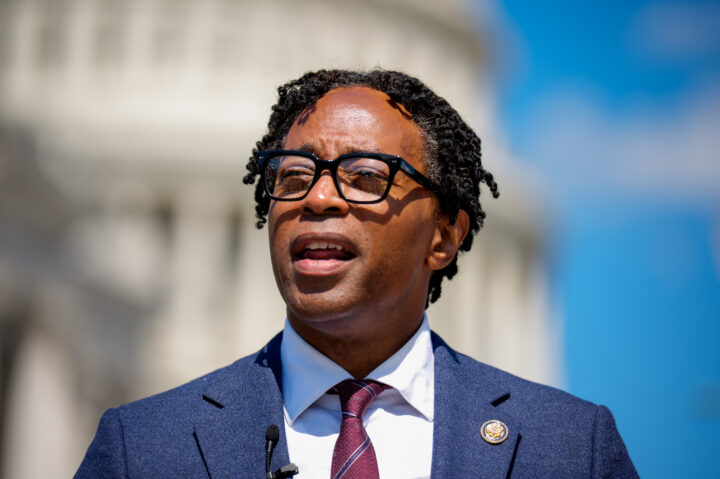
Andrew Harnik/Getty Images
Rep. Wesley Bell (D-MO) speaks during a news conference outside the U.S. Capitol on September 9, 2025 in Washington.
A group of House Democrats wrote to President Donald Trump on Friday to express “strong opposition” to the administration’s plans to lift sanctions on Turkey and sell the country F-35 fighter jets, and suggested that the decisions may be driven by Trump’s or his family members’ financial interests.
The letter requests that Trump, U.S. Ambassador to Turkey Tom Barrack and Trump’s son Donald Trump Jr. preserve records relating to their relationships with Turkish President Recep Tayyip Erdoğan and the Turkish government, stating that, “In the coming months and years, Congress will continue to exercise our constitutional oversight authorities and thoroughly scrutinize this matter to ensure the interests of the American people and their security is protected” — suggesting a potential House investigation if Democrats retake the chamber in November.
The letter was led by Reps. Wesley Bell (D-MO), Dan Goldman (D-NY) and Dina Titus (D-NV), joined by Reps. Debbie Wasserman Schultz (D-FL), Brad Schneider (D-IL), Gabe Amo (D-RI), Jim Costa (D-CA), Jared Moskowitz (D-FL), Brad Sherman (D-CA) and Rob Menendez (D-NJ).
“Besides the legal limitations on your authority on this issue, we are perplexed by what you believe justifies this potential action,” the lawmakers said of the sanctions relief.
They emphasized that Turkey has only continued to “provoke our democratic allies, undermine regional stability, and support U.S. adversaries and their proxies — including Foreign Terrorist Organizations” since the sanctions were first imposed by Congress during Trump’s first term, and has still not resolved the issue that prompted the sanctions initially — namely, purchasing a Russian S-400 missile-defense system. This issue may be resolved on Friday, as Turkey is expected to announce that it will sell its S-400 batteries to the United Arab Emirates.
The lawmakers said that given the lack of “any reasonable explanation” for the change in policy, the decision “raises serious questions about your Administration’s personal dealings with the Turkish government.”
“There exists no indication of Erdogan’s willingness to reform his rogue, authoritarian behavior — in fact, quite the opposite,” the letter states. “This lack of clear benefit to American interests leads us to the inevitable conclusion that you and those around you may be personally benefiting from this absurd arrangement.”
They highlighted a reported private meeting between Trump Jr. and Erdoğan in 2025 as reason for further investigation and alleged that Barrack “has a history of acting in his own self interests,” pointing to his past indictment for acting as an unregistered foreign agent on behalf of the United Arab Emirates.
Other critics have also alleged that Barrack’s actions on policy and statements have suggested an excessive closeness with Erdoğan or even service to Turkey’s interests and priorities over those of the U.S.
The lawmakers demanded the administration answer questions about Trump Jr.’s visit to Turkey, the Trump and Barrack families’ business interests in Turkey, the administration’s plans regarding a potential F-35 sale, Turkey’s support for Hamas and the administration’s decision to drop an Iran sanctions evasion case against the Erdoğan-linked Halkbank.
The lawmakers argued that Turkey has not, as Trump has claimed, been a strong ally, but rather maintained ties with Russia and threatened and violated the territorial integrity of U.S. allies and risked U.S. security by maintaining the Russian missile-defense system.
“Erdoğan has made no attempt to hide his cozy relationship with our adversaries, including Iran and Russia. Despite sanctions on those countries, Turkey maintains significant economic and energy ties to both,” the lawmakers wrote.
The White House referred Jewish Insider to comments Trump had made during a press conference with Erdoğan this week and Trump Jr. did not respond to a request for comment.
Bell said in a statement to JI that Erdoğan has “made it perfectly clear that he advocates for our adversaries and their terrorist proxies in the Middle East,” but asserted that Trump’s actions are being driven by personal ties.
“Because of President Trump and his family’s ties to Erdogan’s regime, he is reopening a Pandora’s box that can only lead to more chaos in the region,” Bell continued. “President Trump ran on a platform of getting our nation out of continued conflicts in the Middle East. Instead, he has further destabilized the region — costing American service members their lives, wreaking havoc for our allies abroad, and eroding our global leadership. And this latest action only continues to advance his dangerous agenda.”
Plus, Labour's leftward turn on Israel

Israeli Ministry of Defense/Anadolu via Getty Images
Israeli Defense Minister Yisrael Katz holds a security situation assessment meeting with IDF Chief of Staff Lt. Gen. Eyal Zamir and other senior commanders in Tel Aviv, Israel, on March 07, 2026.
Good Thursday afternoon.
This P.M. briefing is reserved for our premium subscribers like you — offering a forward-focused read on what we’re tracking now and what’s coming next.
Today’s Daily Overtime was curated by JI U.S. Editor Danielle Cohen-Kanik.
📡On Our Radar
Notable developments and interesting tidbits we’re tracking
Appearing on CNN this morning, Israeli Ambassador to the U.S. Yechiel Leiter said Jerusalem is “supportive of the position of the United States” regarding renewed strikes on Iran, and said Israel would “fly alongside U.S. aircraft” if called on to do so.
He added that Iran had violated its “only obligation” under the memorandum of understanding — to keep the Strait of Hormuz open — and that if the Iranians “persist in their malign intentions,” the war could resume “in full swing”…
Israeli military leaders are also hinting at potential Israeli involvement: At an Israeli Air Force graduation ceremony, Defense Minister Israel Katz said the IDF is prepared to carry out independent strikes “to remove threats” in Iran. Lt. Gen. Eyal Zamir, the IDF’s chief of staff, told the graduates that “new plans” are “on the drawing board” and that “major operations are still expected to lie ahead of us. Be prepared”…
Israeli Prime Minister Benjamin Netanyahu’s office said he spoke with President Donald Trump today and was updated by the president “on American moves in the Gulf.” According to a statement from the PMO, Netanyahu again raised the issue of Turkish President Recep Tayyip Erdoğan‘s hostile rhetoric toward Israel…
The Wall Street Journal examines the “root of the dispute” over the Strait of Hormuz — the “poorly worded” fifth article in the U.S.-Iran memorandum of understanding that says Tehran will “make arrangements” to restore shipping in the waterway and then work with Oman on a plan to administer it going forward.
“Notably, the paragraph says nothing about the U.S. making arrangements for the safe passage of vessels, which Iran has seized on to attack ships that use a U.S.-coordinated route,” a U.S. official told the outlet…
Rep. Ro Khanna (D-CA) is in Israel and the West Bank this week while Congress is in recess, according to two individuals with knowledge of the trip. Khanna has not posted publicly about his visit, which is scheduled to conclude tonight, JI’s Melissa Weiss reports…
While wrapping up his trip, Khanna, who was one of Senate candidate Graham Platner’s most vociferous defenders until a rape allegation was made against the Maine Democrat earlier this week, told MS NOW that he’s endorsing former state Sen. Troy Jackson to take Platner’s place on the ballot. Jackson, who previously ran for governor, is a progressive seen as aligned with Platner…
But Platner’s potential replacements will have to wait a few more days: The candidate told campaign staff he intends to wait until the very last day — Monday — to officially file his paperwork to drop out of the race, Axios reports…
The Journal profiles Cheyenne Hunt, the progressive influencer and activist who played a key role in bringing to light the sexual assault and misconduct allegations that ultimately saw the ouster of Platner and the resignation of former Rep. Eric Swalwell (D-CA)…
Rep. Carlos Gimenez (R-FL) withdrew as co-chair of the Congressional Friends of Spain Caucus due to what he called Madrid’s “escalating, hostile crusade” against Israel…
Andy Burnham, widely expected to become Britain’s next prime minister, told The Guardian that the response of his Labour party to Israel’s military actions in Gaza “has too often not been good enough” and that the U.K. has “got to do more to put pressure on the Israeli government,” including sanctions and potentially banning trade in goods from Israeli settlements in the West Bank.
Burnham also said there is “increasing evidence” that Israel committed war crimes, though he did not use the word genocide, and said the determination should be left to international courts. His comments mark a shift to the left of Labour’s outgoing leader, Keir Starmer, who was slower than other European leaders to back a ceasefire and recognize Palestinian statehood…
Among those speaking at the closed-door Allen & Company retreat in Sun Valley, Idaho, today were Jared Kushner, UAE Ambassador to the U.S. Yousef Al Otaiba, former Israeli Prime Minister Naftali Bennett, Sens. John Fetterman (D-PA) and Dave McCormick (R-PA) as well as Ken Griffin, the hedge fund manager and GOP megadonor.
Asked whether he would support Vice President JD Vance or Secretary of State Marco Rubio in the 2028 presidential election, Griffin said he’d be inclined to back Rubio…
⏩ Tomorrow’s Agenda, Today
An early look at tomorrow’s storylines and schedule to keep you a step ahead
Keep an eye on Jewish Insider for a look at Platner’s potential replacements, as a handful of Maine Democrats are already jockeying for the position less than 24 hours after Platner announced he intends to drop out of the race for U.S. Senate.
We’ll be watching to see if U.S. and Iranian strikes continue into the weekend, or if the current flare-up has run its course. Prior to the outbreak in hostilities, Saudi media had reported that talks between Washington and Iran would restart on July 11, after the dayslong funeral of late Supreme Leader Ayatollah Ali Khamenei wraps up today. Trump said this morning that the Iranians had called and “want to make a deal so badly,” but it’s unclear whether the two sides intend to meet.
We’ll be back in your inbox with the Daily Overtime on Monday. Shabbat shalom!
Stories You May Have Missed
SCOOP
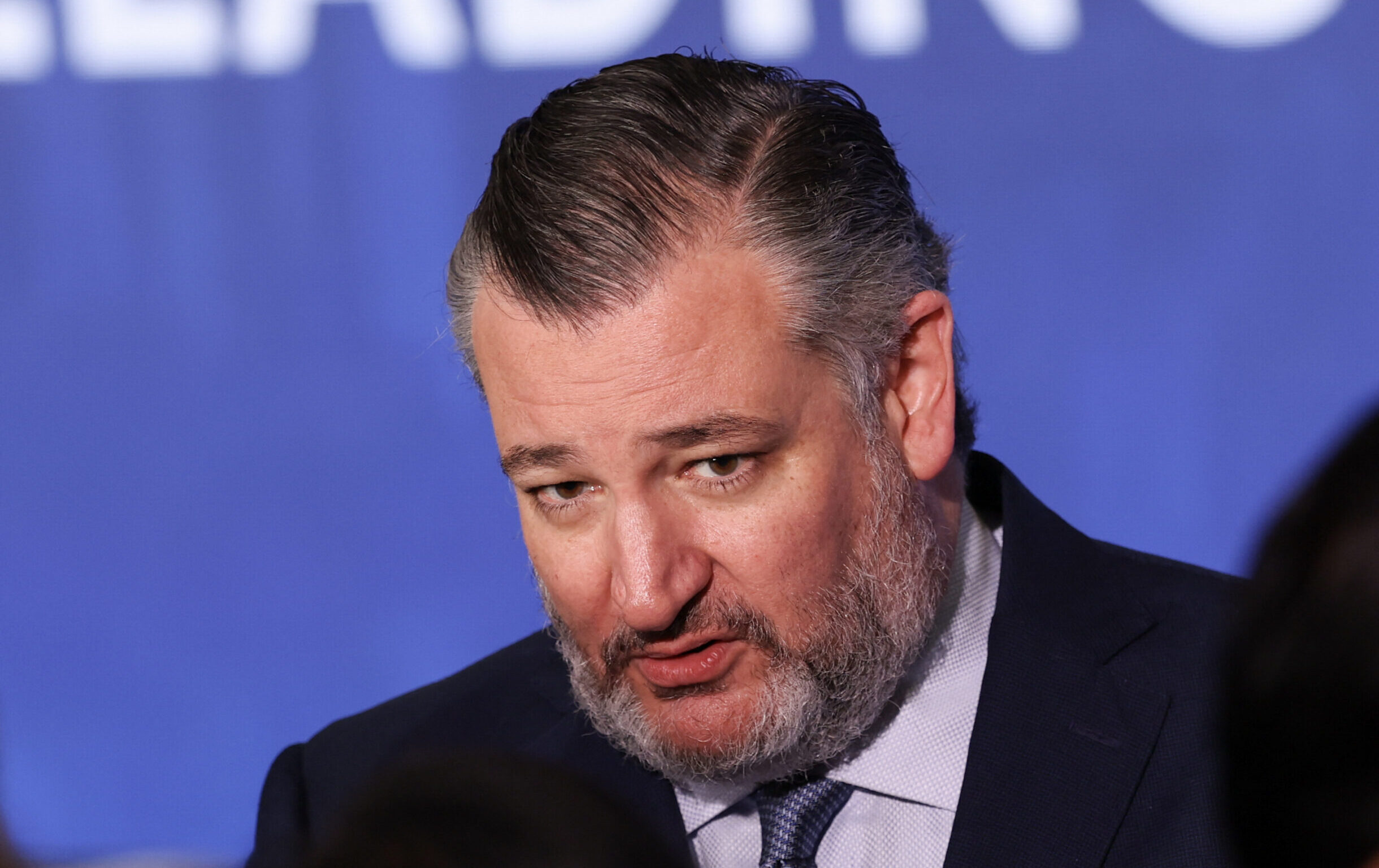
Allies of the Texas senator are launching The Front Line, a 501(c)(4) nonprofit aimed at making antisemitism ‘disqualifying’ for GOP candidates
BELL BOUY
As of this week, UDP has reserved $865,000 in ad time for the race and New Democrat Majority has reserved $500,000, ahead of the Aug. 4 primary
Plus, Rahm Emanuel on the ‘moral bankruptcy’ of far-left Dems
Jakub Porzycki/NurPhoto via Getty Images
President Donald Trump during the press conference at the NATO Summit in Ankara, Turkiye on July 8, 2026.
Good Wednesday afternoon.
This P.M. briefing is reserved for our premium subscribers like you — offering a forward-focused read on what we’re tracking now and what’s coming next.
Today’s Daily Overtime was curated by JI U.S. Editor Danielle Cohen-Kanik.
📡On Our Radar
Notable developments and interesting tidbits we’re tracking
CENTCOM began conducting additional strikes against Iran this afternoon, after President Donald Trump continued to escalate his rhetoric against the regime in his remarks today at the NATO summit in Ankara, Turkey.
Trump said he wasn’t sure he wanted to make a deal with the Iranians any longer and reiterated his threat to “finish the job,” but still denied the strikes mark a return to full-scale war: “I think anything that happens is going to be over very quickly,” he said…
Israeli Prime Minister Benjamin Netanyahu confirmed that Defense Secretary Pete Hegseth had scrapped a planned trip to Israel, saying in an interview that the defense chief had been “called back home” from the summit in Ankara. Meanwhile, Israeli media reports that American military refueling planes have begun to return to the region…
Trump is likely to face pushback from lawmakers over the renewed strikes: Rep. Greg Meeks (D-NY), the ranking member of the House Foreign Affairs Committee, said he’s already “in conversations with the Senate to explore any and all legal pathways to hold Trump accountable,” given that both chambers of Congress already passed a war powers resolution seeking an end to U.S. military action in Iran…
Trump also informed Congress today that he intends to rescind Syria’s designation as a State Sponsor of Terrorism following a 45-day pre-notification period, Secretary of State Marco Rubio announced, shortly after Trump held a friendly meeting with Syrian President Ahmad al-Sharaa on the sidelines of the NATO summit…
Former Chicago Mayor Rahm Emanuel, speaking to Jewish Insider’s Melissa Weiss prior to his speech at Tel Aviv University today, criticized the “moral bankruptcy” of “those that paraded, celebrated and cheered” in the aftermath of Hamas’ Oct. 7, 2023, attacks on Israel.
Responding to a question about Democrats who did so — including New York City congressional candidate Darializa Avila Chevalier, who attended an anti-Israel rally in Times Square on Oct. 8, 2023 — Emanuel said, “I have no place for the moral bankruptcy of those that found Oct. 8 as the day to cheer 1,200 people not only killed but sexually abused, and for taking hostage 250 people”…
In an interview on Israel’s Channel 12, Emanuel confirmed he’s “thinking about” running for president in 2028 and said he believes Americans could elect a Jewish president. “I believe people will evaluate me based on my character and my background,” he said…
Maine Democratic Senate candidate Graham Platner still remains in the race two days after Politico published an account from a former romantic partner accusing him of rape, though the candidate’s feud with the Maine Democratic Party continues. Platner’s campaign manager, Ben Chin, sent a message to supporters today accusing the MDP of allowing the national Democratic Senatorial Campaign Committee to orchestrate Platner’s replacement “behind closed doors.”
In response, the MDP, which was reportedly set to hold a meeting on the issue this afternoon, said Platner’s campaign is “distracting from the job of defeating [Sen.] Susan Collins (R-ME) in November with false accusations” and pledged to develop “a representative, transparent and inclusive process to select a new nominee when he chooses to withdraw from the race”…
A new Politico survey of Democratic primary voters in Michigan, conducted in the two days after state Sen. Mallory McMorrow dropped out of the race for U.S. Senate, found the two remaining candidates — Rep. Haley Stevens (D-MI) and Abdul El-Sayed — in a statistical tie at 42-41%, with nearly 20% of voters undecided…
Kentucky Gov. Andy Beshear sent a letter to Sen. Mitch McConnell (R-KY) requesting that he “fully update Kentuckians regarding the current status of your health,” as McConnell has been hospitalized for nearly a month…
A new poll from the Associated Press-NORC Center for Public Affairs Research found that 44% of American Jews hold a favorable view of New York City Mayor Zohran Mamdani — a higher percentage than Netanyahu, who received a 32% favorability rating…
Jewish groups — including the Jewish Council for Public Affairs, Anti-Defamation League, American Jewish Committee, Conference of Presidents of Major American Jewish Organizations, Hadassah and StandWithUs — celebrated several steps taken at the National Education Association’s Representative Assembly, which wrapped up yesterday in Denver, including the Jewish Affairs Caucus’ work in advancing three amendments to the NEA Constitution and a resolution on Jewish education…
Bertrand Benoit, The Wall Street Journal’s bureau chief in Germany, explores what it means for Germany’s identity as its citizens begin to lose their living connection to the Holocaust, including how the fading of survivor testimony, rising antisemitism and challenges from both the political right and left are reshaping the country’s culture of remembrance…
⏩ Tomorrow’s Agenda, Today
An early look at tomorrow’s storylines and schedule to keep you a step ahead
Keep an eye on Jewish Insider for a look at the choice ahead for Georgia’s Jewish community in the race between Sen. Jon Ossoff (D-GA) and his opponent, Rep. Mike Collins (R-GA).
The Contemporary Antisemitism conference at the University of Haifa will wrap up with a keynote speech by philosopher and author Bernard-Henri Lévy.
Stories You May Have Missed
SANCTIONS STANDOFF

Members from both parties warned lifting penalties would reward Erdoğan’s destabilizing actions, while senators at NATO summit said Turkey could rejoin F-35 program if concerns over Russian S-400 system are resolved
CHATBOT FAIL

The antisemitism watchdog tested ChatGPT, Claude, Gemini and Grok and found Persian responses hedged or missed antisemitic framing that English responses rejected outright
The president called Iran’s leaders ‘a little loco’ and said he was no longer sure he wanted a deal, while insisting that renewed strikes did not mean the war was resuming
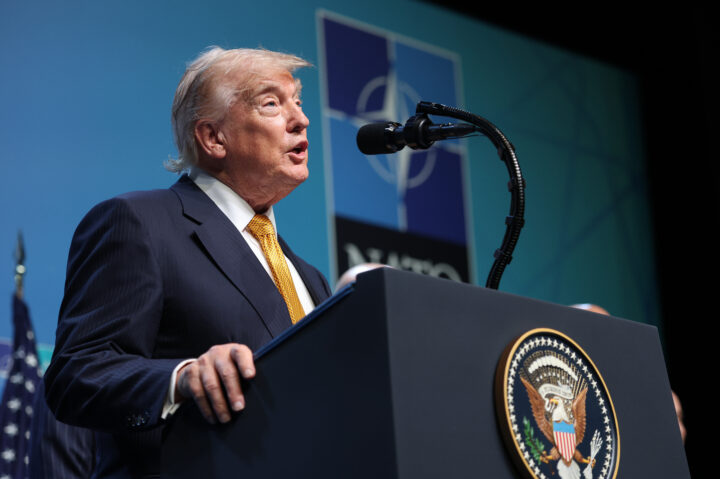
Photo by Win McNamee/Getty Images
U.S. President Donald Trump speaks at a press conference during the 2026 NATO Leaders Summit at the Beştepe Presidential Compound on July 08, 2026 in Ankara, Turkey.
President Donald Trump on Wednesday reiterated his threat to “finish the job” in Iran and said the current ceasefire is “over” while denying that renewed U.S. strikes in the country mark a return to war.
Trump told reporters during a press conference at the NATO summit in Ankara, Turkey, on Wednesday that he was no longer sure if he was interested in a peace deal with Iran and was questioning if the country’s leadership was rational enough to work with.
Hours after Trump’s remarks, CENTCOM announced additional strikes on Iranian targets “at the direction of” the president, saying in a statement that the operation was intended to “further degrade [Iran’s] ability to threaten freedom of navigation in the Strait of Hormuz.”
Asked during the press conference what caused him to sour on Iran’s leadership — whom he referred to on Wednesday as “scum” and “sick people,” after praising them last month as “very rational” and “nice to deal with” — Trump replied: “I got to know them.”
Trump noted that he was comparing the current regime to the previous two regimes in his prior complimentary statements.“I think they’re much more rational than level one, level two. Level one is gone, level two is gone. This is level three,” Trump said. “I think they are more rational, but based on their actions over the last week or two, they’re not doing a service to the people.”
“I’m not sure I want to make a deal with them,” he continued. “We can play games, but I’m not sure I want to make a deal. Let’s just finish the job.”
The comments came hours after the president said that the memorandum of understanding between the U.S. and Iran was “over” and said “I don’t want to deal with them anymore.”
Trump went on to criticize Iran’s leaders as “a little loco. They’re a little crazy,” pointing to Iran’s continued attacks against commercial shipping in the Strait of Hormuz and claiming he’s Iran’s top target for assassination.
“They want to make a deal, but they don’t know how to make the deal, and then they go around shooting ships at night [in the Strait of Hormuz]. I don’t like that,” he said. “I’m the No. 1 target. … I’m the No. 1, because they’re scum. That’s the way they act, and that’s the way they’ve done it for 47 years.”
Still, he rejected the idea that the military operations meant that the U.S. was resuming full-scale warfare with Iran.
“I don’t think it’s going to start again. I think it’s going to go very quickly. They hit a couple of ships, and so we hit them much harder,” Trump said of the war. “When they hit, we hit. We use their language. We speak their language. No, I don’t think so. I think anything that happens is going to be over very quickly and will only make [the region] safer.”
The potential for the sale — one that strikes at the heart of Israel's qualitative military edge in the region — is fueling anxiety in Israel
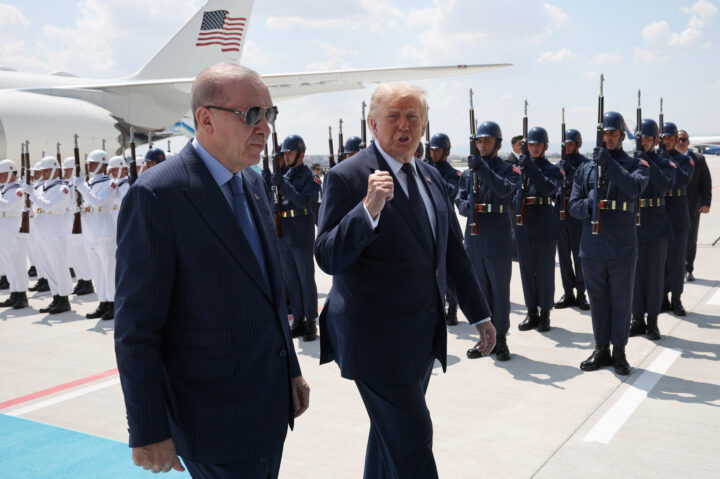
(Win McNamee/Getty Images)
U.S. President, Donald Trump (R), speaks to Turkish President, Recep Tayyip Erdogan, as he arrives at Etimesgut Air Base for the annual NATO Summit on July 7, 2026 in Ankara, Turkey.
Is President Donald Trump about to throw Israel under the … fighter jet?
The F-35 may be a stealth jet, but the Trump administration’s likely sale of the highly sophisticated planes to Turkey is creating a very out-in-the-open rift between Jerusalem and Ankara. It pits two strongmen of the type that Trump purports to admire — Israeli Prime Minister Benjamin Netanyahu and Turkish President Recep Tayyip Erdoğan, both of whom are vying to be a kind of Mideast “favorite son” to the mercurial American president — against each other.
The potential for the sale — one that strikes at the heart of Israel’s qualitative military edge and could tilt the balance of power in the region — is fueling anxiety in Israel. So much so that Netanyahu took to Fox News on both Sunday and Monday to detail Turkey’s long anti-Israel “rap sheet.” And this comes after harsh words by both Trump and Vice President JD Vance about Israel’s isolation on the world stage.
Israeli foreign policy analysts are also raising red flags. “Defining [Turkey] as an enemy would be a mistake, but it is clearly a rival that openly acts against the State of Israel and promotes a vision that includes Israel’s destruction,” Avner Golov, vice president of national security consulting firm MIND Israel and former senior director at the Israeli National Security Council, told JI.
The relationship between the two regional superpowers, however, hasn’t always been this strained. Just three years ago, Netanyahu met with Erdoğan on the sidelines of the U.N. General Assembly, and the two leaders were planning reciprocal visits. But about a month later, Hamas launched the Oct. 7 attacks against Israel and regional dynamics were rocked with the multifront war that followed.
Turkey has repeatedly claimed that Israel was committing genocide in Gaza, and the rhetoric only escalated, followed, eventually, by action. Last week, after years of deliberation, Israel officially recognized the Armenian genocide, a move that deeply displeased Ankara. Then came the Trump administration’s moves to allow Turkey back into the F-35 program, which deeply troubled Israeli decision-makers.
In his comments to Fox, Netanyahu listed Jerusalem’s grievances against Turkey, including: supporting Hamas; failing to assist in the struggle against Iran (even though in 2022, the Mossad and the Turkish MIT, headed then by Hakan Fidan, now the foreign minister, thwarted an Iranian cell actively targeting Israeli citizens); occupying half of Cyprus and even threatening to conquer Jerusalem. Netanyahu then delivered his punch line: “They are not like us. We, Israel and the U.S., share the same values.”
But the potential F-35 fighter jet sale is a complex one for Israel. Turkey was actually part of the program once before, but was expelled from it during the previous Trump administration over its purchase of a Russian air-defense system.
“Turkey used to be our friend, we used to train together, so they were not part of our demand within the framework of the Qualitative Military Edge,” a former Israeli Air Force planner told Jewish Insider. “And here we find ourselves in a problem: Turkey was a member of the project, and we are not” — though Israel has received F-35s despite not being an official partner.
“The Turks were thrown out of the project,” the former planner said, “because of internal matters between them and the U.S. But Turkey is very hostile to us, and it is not good for it to receive such an advanced system whose greatest advantage is the richness of the image that the pilot himself has in the cockpit.”
According to Golov, “In practice, Turkey is leading a Muslim Brotherhood camp that combines military power, diplomatic influence alongside Qatar, nuclear capabilities through Pakistan and a drive to establish a presence on Israel’s borders in Egypt, Jordan and Syria. It is also leading the delegitimization campaign against Israel in the West. Preserving Israel’s military superiority vis-à-vis the Turkish threat is therefore a critical Israeli interest, both in order to restrain Erdogan and, in my view, to pursue diplomatic superiority.”
Israeli officials believe that the die has been cast, and the deal will move forward. Does this mean there will soon be a Turkish F-35? Not necessarily. There is still a long way to go, but Israel is banking on two things: first, that Congress will raise objections, as lawmakers have already begun to do, and second, that the highly complex bureaucracy inherent in the stealth fighter jet program will run its course and delay the matter further.
Dan Shapiro, former U.S. ambassador to Israel, thinks that even after Turkey acquires the F-35, Israel and its air force will be years ahead. “As the United States insists that NATO allies do more to provide for their own security, it will be more difficult to deny a key NATO partner top-line U.S. equipment. So an F-35 sale to Turkey is increasingly likely,” he told JI.
“Rather than try to block it,” Shapiro continued, “Israel should focus on the understandings the United States should seek to ensure Turkish capabilities do not pose a threat to Israel’s security. Israel will be more than a decade ahead of any Turkish F-35 capability. But to ensure Israel stays ahead and can maintain access to this capability, Israel needs to take into account the totality of its relationship with, and standing in, the United States.”
The harsh, even painful words from Vance regarding Israel’s current standing in the world, and his assertion that Trump remains the only one by Israel’s side, spark exactly that anxiety. If this is what Trump is doing now, by likely allowing the sale of the F-35, what will come next? Israel, for now, is left with the question of how it maintains the sense that, ultimately, the Jewish state is the “model ally” for the United States, regardless of the political climate in Washington.
The president said the U.S. would ‘de-nuke’ the Islamic Republic following Iranian strikes targeting U.S. military facilities in Bahrain and Kuwait
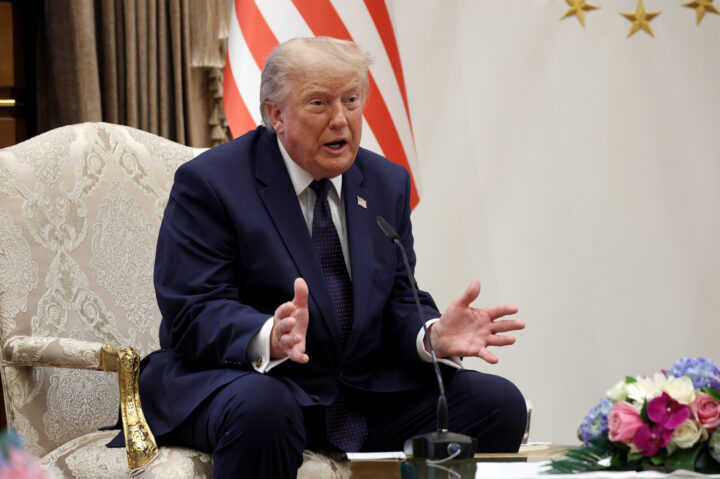
Win McNamee/Getty Images
President Donald Trump speaks during bilateral meeting at the Bestepe Presidential Compound, following his arrival to attend the annual NATO Summit on July 7, 2026 in Ankara, Turkey.
President Donald Trump, speaking at the NATO summit in Ankara, Turkey, on Wednesday, said that the memorandum of understanding with Iran that was inked last month was “over,” following overnight Iranian attacks targeting U.S. military installations in Bahrain and Kuwait.
“To me, I think it’s over,” Trump said. “I don’t want to deal with them anymore.”
The Iranian attacks came after CENTCOM hit over 80 targets in Iran on Tuesday in retaliation for Iranian strikes on three commercial vessels — including a Qatari ship and a Saudi oil tanker — in the Strait of Hormuz earlier this week.
“We attacked very powerfully last night the very dangerous people from Iran,” Trump said of the U.S. strikes, which targeted air-defense systems, command and control networks, coastal radar sites and more than 60 Islamic Revolutionary Guard Corps small boats. “They’re sick. There’s something wrong with them.”
“We said, ‘Go and do your funeral stuff,’” Trump added, noting the multiday funeral ceremonies for the late Iranian Supreme Leader Ayatollah Ali Khamenei, who was killed in joint U.S.-Israeli strikes on the first day of the war against the Islamic Republic in February. “Instead of that, they start shooting rockets at ships yesterday, and so we hit them very hard last night.”
The president, appearing alongside NATO Secretary General Mark Rutte in Ankara, said that the U.S. was “going to de-nuke Iran.”
“We’re not going to let them because they’re crazy,” Trump added.
The Iranians, the president said, are “bad people, very bad people. I think they’re incompetent, by the way, because if they were competent they would have made a deal a long time ago.”
“Of course they’re dirty players, so they go after everyone. Probably including me. I’ve been No. 1 on their list for years. And they’re a bunch of scum, if you want to know the truth. They’re scum. So we don’t like them, I don’t like them. And they’re evil people.”
Members from both parties warned lifting penalties would reward Erdoğan's destabilizing actions, while senators at NATO summit said Turkey could rejoin F-35 program if concerns over Russian S-400 system are resolved

Burak Kara/Getty Images
Turkey's President Recep Tayyip Erdogan speaks to supporters at his party’s Istanbul mayoral candidate Murat Kurum's campaign rally on March 29, 2024 in Istanbul, Turkey.
Lawmakers on both sides of the aisle remain deeply skeptical of President Donald Trump’s plans to lift sanctions on Turkey and revive its participation in the F-35 fighter jet program, but members of a bipartisan Senate delegation attending the NATO summit said Wednesday they could support the move if Ankara resolves longstanding security concerns over its Russian-made S-400 missile defense system.
Trump said at the NATO summit on Tuesday that he’s preparing to remove sanctions under the Countering America’s Adversaries Through Sanctions Act (CAATSA), explaining, “We don’t want to sanction friends.” The CAASTA sanctions block the administration from selling Turkey F-35s until it disposes of an S-400 missile defense system it purchased from Russia.
“Selling one of America’s most advanced fighter jets to Turkey is not in the best interest of the United States,” Rep. Mike Lawler (R-NY) told Jewish Insider. “It risks compromising critical technology and sends the wrong message to our allies in Europe and the Middle East. Restrictions on the sale of F-35s to Turkey should absolutely remain in place while Erdogan continues to operate Russian S-400s, in accordance with existing U.S. law.”
Rep. Nicole Malliotakis (R-NY) also called on the administration not to allow the F-35 sale to proceed.
“Erdogan has aligned himself with Iran and Russia, harbored Hamas, refused to sanction Russia, undermined American counter-ISIS operations, continues to illegally occupy part of Cyprus, has repeatedly directed illegal military jet overflights above the Greek Islands, and called for the destruction of Israel,” Malliotakis said in a statement to JI. “Additionally, he continues to jail his political opponents and has denied dozens of journalists access to the NATO Summit.”
“Providing Turkey with our most advanced fighter jet would jeopardize U.S. national security, risk sensitive technology falling into the wrong hands, and endanger our allies in the Eastern Mediterranean and Middle East,” she continued.
Rep. Brad Sherman (D-CA) said that lifting CAATSA sanctions or reopening the possibility of F-35 sales would be a “profound mistake” that “would reward Erdogan’s actions toward Israel as well as his domestic strongman behavior, and it would be tantamount to handing [Russian President Vladimir] Putin the blueprints to our technology.”
“Congress imposed these sanctions because Turkey’s acquisition of the S-400 posed an unacceptable threat to U.S. and NATO security, and those concerns remain every bit as valid today,” Sherman said. “Until Turkey permanently disposes of the S-400 system, we should not consider lifting sanctions or returning Turkey to the F-35 program.”
He emphasized Turkish President Recep Tayyip Erdoğan’s repeated hostile language toward Israel as well as the threat that operating the S-400 in proximity to the F-35 would pose to sensitive U.S. stealth technology.
“Trump cannot unilaterally authorize the sale of F-35s to Turkey,” Sherman added. The legal process by which the White House could lift the sanctions unilaterally remains unclear.
Rep. Brad Schneider (D-IL) emphasized that Turkey remains in breach of CAATSA and the sale should not proceed.
“Congress passed CAATSA in 2017, and the law is very clear: it’s illegal to bring Turkey back into the F-35 program so long as it has the Russian S-400 air defense system. This violates the law,” Schneider told JI. “We cannot let President Trump give Putin a backdoor to one of our most technologically advanced aircrafts, just because an authoritarian leader who hosts Hamas flatters him.”
Speaking on the sidelines of the NATO summit at a press conference on Wednesday morning, members of a bipartisan delegation sounded a more positive note toward Trump’s effort.
Sen. Jeanne Shaheen (D-NH), ranking member of the Senate Foreign Relations Committee and co-chair of the NATO observer group, noted that “[Sen.] Thom Tillis [R-NC] and I wrote the legislation that prohibited, that kicked Turkey out of the F-35 program because of their acquisition of the S-400.”
“If there is an acceptable way to deal with the S-400 and the threat that that poses to the technology and the F-35 and there is satisfactory agreement on the part of all parties about that, then I think having Türkiye back in the F-35 program would be a positive development, both for Türkiye and for the United States,” Shaheen added. “But we still have questions to answer with respect to what’s being proposed, and we haven’t gotten those answers, so we will wait to see what happens.”
Sen. Mike Rounds (R-SD), also participating in the press conference, agreed with Shaheen on the matter, saying, “Hopefully it can be resolved. Türkiye is a major NATO contributor, and anything that we can do to provide them with the resources to be an even stronger adversary with regard to incurrences by Russia in Europe, the better off we all are, and one of those is to have that tool of the F-35.”
Asked about the U.S.-Turkey relationship, Shaheen said, “I think Congress views the relationship with Türkiye as positive, and particularly with respect to Türkiye’s role in NATO, there are some concerns about the commitment to democracy and how that is playing out in Türkiye with respect to elections, but I think that there is an appreciation for the importance of the defense industrial base in Türkiye, and how that contributes to NATO, and that that will continue in Congress.”
Rounds added, “we really need to re-energize” the industrial base “among all of the NATO countries.”
“We need what each of our NATO allies can offer with regard to that industrial base, and Türkiye does not stand alone, they stand with everyone else, but they have some real opportunities here for advancements,” Rounds continued. “They were one of the countries selected to participate originally in the manufacturing of the F-35 fighters and that shows a strong competency in technological areas that provided that award to them in the first place, and so we want Türkiye, along with all of our NATO allies, to be able to participate in this growth of an industrial base that makes it easier for us to respond to areas of aggression by Mr. [Russian President Vladimir] Putin.…”
Rep. Mike Turner (R-OH) said during the press conference that “the details that have been shared with us do appear to be promising,” with regard to the F-35 and S-400 issues.
Sen. Chris Coons (D-DE) added that “the legitimate national security concerns that drove the actions led by Sen. Shaheen … would continue if the S-400 were to be deployed somewhere else, so concerns about the possibility of critical American technology related to the F-35 being misappropriated or sent to Russia would also pertain if there were some resolution.”
Rep. George Latimer (D-NY), however, said that Congress should push to block the sale of F-35s if Trump insists on moving ahead with it.
“President Trump’s inclination for deal-making with dictators like President Erdoğan is grossly neglectful of our national security interests at home and abroad,” Latimer told JI. “This Congress — both houses and both sides of the aisle — needs to speak out against this situation and remain adamant for a Joint Resolution of Disapproval should this administration move to readmit Turkey back into the United States F-35 program.”
Rep. Dina Titus (D-NV) and 17 other House Democrats sent a letter to House leaders on Monday urging them to “stand ready to exercise your authority under statute to prevent” the administration from allowing Turkey back into the F-35 program by introducing a joint resolution of disapproval to block the move.
The letter emphasizes that the administration is required to maintain the CAATSA sanctions until such time as Turkey disposes of the S-400 — which Turkey has not. “Beyond the legal question, we are also concerned about the strategic message this decision would send to U.S. partners in the Eastern Mediterranean and beyond,” the letter continues, noting Turkey’s aggression against Greece, Cyprus, Armenia and Israel.
“CAATSA was passed by overwhelming bipartisan margins in both chambers precisely to ensure that Congress, not any individual president, retains a meaningful check on decisions to reward adversary-aligned conduct with American military technology,” the lawmakers wrote. “The integrity of that framework and the signal it sends to every country weighing whether to purchase Russian arms depend on Congress being willing to enforce it.”
Actually waiving or lifting the CAATSA sanctions is likely easier said than done, and could spark conflict with Congress. The original legislation provides little wiggle-room, requiring sanctions on anyone or any country that engages in business with the Russian defense or intelligence sectors.
Congress added a modified waiver provision in 2018 that requires the administration to certify that the waiver would not endanger U.S. alliances or adversely affect U.S. operations and that the waiver recipient is actively working to decrease its use of Russian military equipment or is otherwise cooperating with the U.S. on critical matters.
Updated certifications and reports to Congress are required every 90 days.
Under CAATSA, Congress can advance a joint resolution of disapproval to overturn the administration’s decisions on sanctions relief or arms sales, though it’s unlikely that the Republican-controlled Congress would publicly buck Trump on the issue.
Matt Zweig, the managing director for policy at FDD Action and a former congressional staffer who helped craft the original CAATSA bill, told JI, “Lifting these sanctions is generally easy to announce but will likely be hard to execute. The sanctions and the congressional review mechanism are embedded in the law, unwinding them runs straight through the Hill,”
Sen. John Cornyn (R-TX) said on X that he hoped that a report about Trump’s move was “wrong,” following up by sharing information about CAATSA sanctions.
Rep. Chris Pappas (D-NH) said in a separate statement, “It’s outrageous for Trump to even consider readmitting Turkey to the F-35 program while Erdogan’s government continues to violate U.S. law and threaten our allies. We cannot reward Erdogan’s aggressive and destabilizing activity across the region.”
Reached for comment, a spokesperson for Rep. Gus Bilirakis (R-FL) referred JI to a statement that Bilirakis and other Greek-American Republican House members previously released opposing the sale of military jet engines and F-35s to Turkey.
“As Greek American Members of Congress, we are deeply concerned about reports of a proposed military sale of jet engines to Turkey. Turkey continues to be a destabilizing force in the region through its expansive and disputed maritime claims, continued illegal occupation of Cyprus, and rhetorical demonization of Israel,” the lawmakers said, also raising concerns about Ankara’s decision to harbor Hamas leaders and refusal to sanction Russia.
“We are actively engaging with the Administration and House leadership to obtain additional information regarding this reported sale and to express our strong opposition to any prospect of Turkey’s reintegration into the F-35 program without complete compliance with CAATSA requirements,” the statement continued.
Rep. Joe Wilson (R-SC), one of the most vocal supporters of Turkey in the House, offered the most unqualified support for Trump’s effort to roll back sanctions.
“President Trump and [U.S.] Ambassador [to Turkey] Tom Barrack have displayed visionary leadership and pragmatism alongside valued NATO ally Türkiye,” Wilson said. “Türkiye has played an instrumental role in assisting Syria’s stabilization after over a decade of mass murder under butcher [Bashar al-]Assad, who correctly fled to Moscow. We don’t sanction friends. We work together for a better future.”
Plus, progressives pull the plug on Platner

Photo by Elke Scholiers/Getty Images
Crude oil tankers, bulk carriers and vessels sit anchored around Qaboos Port on June 22, 2026 in Muscat, Oman.
Good Tuesday afternoon.
This P.M. briefing is reserved for our premium subscribers like you — offering a forward-focused read on what we’re tracking now and what’s coming next.
Today’s Daily Overtime was curated by JI U.S. Editor Danielle Cohen-Kanik.
📡On Our Radar
Notable developments and interesting tidbits we’re tracking
The fallout from a rape allegation made against Maine Senate candidate Graham Platner intensified today as Sens. Bernie Sanders (I-VT) and Chris Van Hollen (D-MD) — some of the Democrat’s most prominent progressive backers — rescinded their support of Platner and called on him to drop out. New York City Mayor Zohran Mamdani, who shares a top consultant with Platner, also advised the candidate to drop his bid.
Platner’s campaign has canceled all in-person fundraising events scheduled for the coming days and put holds on its social media ads, according to Politico. The candidate reportedly told his campaign staff in a call last night that a decision on the future of his race is forthcoming…
Several prominent Maine Democrats have begun to signal interest in replacing Platner on the general election ballot, should he withdraw by the deadline of July 13. Among those hinting at a run are Troy Jackson, a former state Senate president who has already filed with the Federal Election Commission to explore a bid; former U.S. House candidate Jordan Wood; former gubernatorial candidate Nirav Shah; and Platner’s former primary opponent David Costello.
Maine Democratic Party officials are considering holding a pop-up convention around July 25 or holding a statewide caucus to choose Platner’s replacement, sources told The New York Times…
As the heated Democratic Senate primary in Michigan enters its final stretch, far-left candidate Abdul El-Sayed told CNN this week that he does not believe that a politician’s support for Israel could be about anything other than money, Jewish Insider’s Gabby Deutch reports. “Not if you’re a Democrat and you believe in human rights,” El-Sayed told CNN when asked about such a distinction…
The Treasury Department revoked the waiver it issued last month lifting sanctions on Iranian oil, after Iran reportedly struck another vessel in the Strait of Hormuz today, marking the third such attack in the last 24 hours.
“As President [Donald] Trump and the administration have repeatedly affirmed, the [memorandum of understanding] in effect with Iran is entirely performance-based. Iran will only reap benefits if they exhibit good behavior,” a U.S. official told JI’s Matthew Shea. “Iran’s actions in the Strait were wholly unacceptable to the United States and will be met with consequences. Our negotiators continue to work in good faith towards a final deal”…
Qatar’s Foreign Ministry summoned Iran’s deputy ambassador in the Gulf stateto express its “strong condemnation and denunciation” of Tehran’s strike yesterday on a Qatari tanker, after Doha sent a delegation of officials to the funeral of Supreme Leader Ayatollah Ali Khamenei in an apparent diplomatic olive branch…
Saudi Arabia is considering increasing the capacity of its East-West oil pipeline in order to bypass the Strait of Hormuz and facilitate oil exports out of the Red Sea, Reuters reports…
Trump announced today that his administration is preparing to lift congressionally mandated sanctions on Turkey as he weighs moving forward with the sale of F-35 fighter jets to Ankara, JI’s Matthew Shea reports.
“It’s time to do that. We don’t want to sanction friends,” the president said. Defense experts and lawmakers previously told JI that Turkey still maintains the Russian air-defense system that prompted the sanctions in 2020, which makes lifting the sanctions legally complicated…
Israeli Prime Minister Benjamin Netanyahu again voiced his opposition to Trump’s overtures to Ankara, telling CNN that Turkish President Recep Tayyip Erdoğan is “not exactly a model ally of the United States” as he “threatens to destroy my country, the one and only Jewish state.”
Israeli Diaspora Affairs Minister Amichai Chikli went further in his rhetoric, calling Erdoğan a “grotesque hybrid of Hitler and [late Hamas leader Yahya] Sinwar” and a “pathetic blood-soaked zero” in a post on X yesterday…
The Israeli Consulate in New York was evacuated from its Midtown Manhattan building after a nearby high-rise building under construction showed signs of collapsing, prompting evacuations across the area…
⏩ Tomorrow’s Agenda, Today
An early look at tomorrow’s storylines and schedule to keep you a step ahead
Keep an eye on Jewish Insider for coverage of tonight’s debate between Michigan Senate Democratic primary candidates Abdul El-Sayed and Rep. Haley Stevens (D-MI), with less than a month to go until the election.
The NATO summit in Ankara will conclude with the main working session of all 32 member states as well as a press conference from NATO Secretary-General Mark Rutte. A bipartisan delegation of U.S. lawmakers is set to attend a dinner tonight on the sidelines of the summit with Treasury Secretary Scott Bessent and U.S. Ambassador to Turkey Tom Barrack.
Former U.S. Ambassador to Japan Rahm Emanuel will deliver a speech at Tel Aviv University, where he is set to lay out his vision for the future of the U.S.-Israel relationship as he prepares for a potential 2028 presidential run. Emanuel met today with Israeli President Isaac Herzog and visited the Yad Vashem Holocaust museum.
The Contemporary Antisemitism conference will continue at the University of Haifa.
Stories You May Have Missed
SORE SPOT
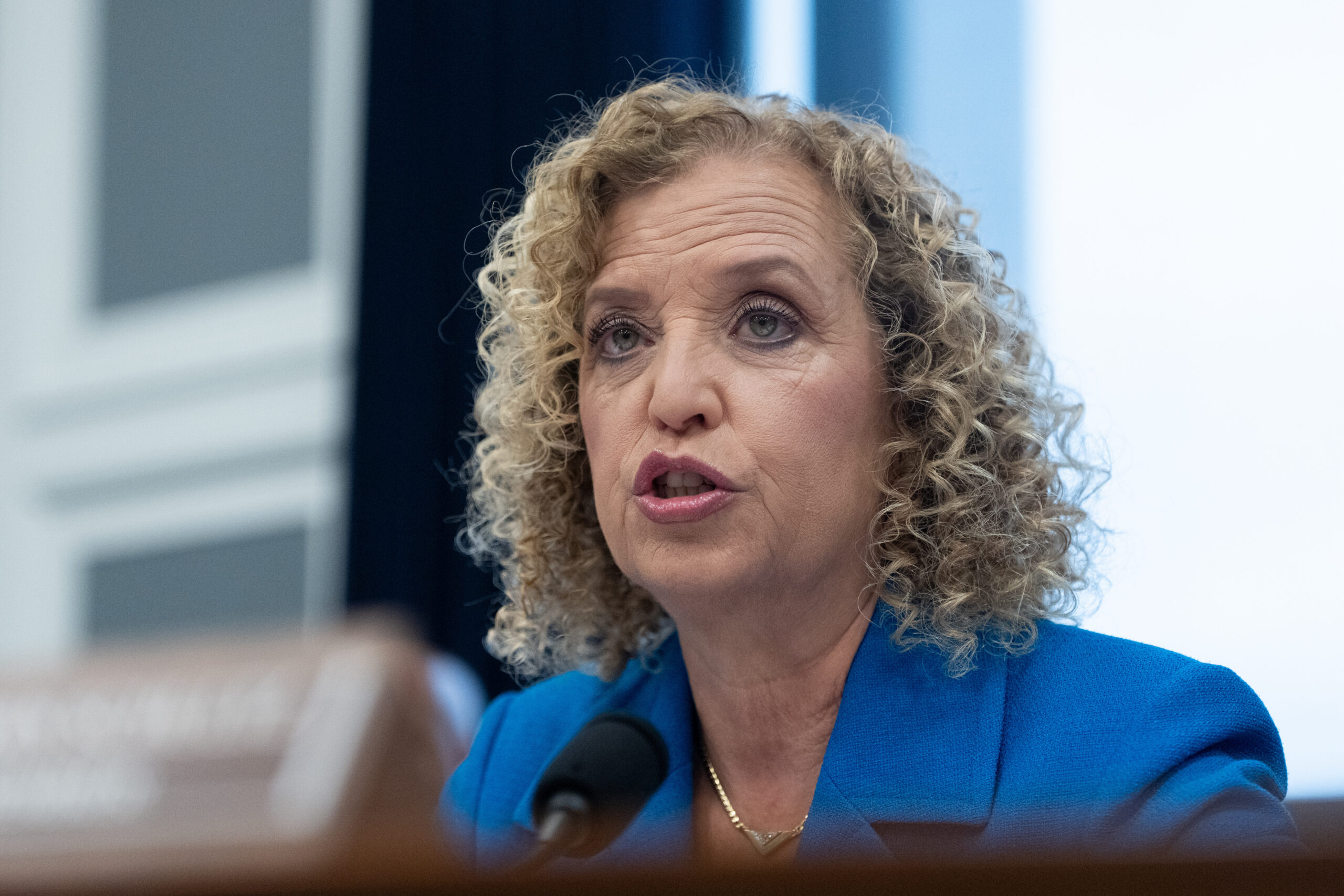
Black leaders in the district have failed to unite behind a single challenger, leaving the Jewish congresswoman favored in a plurality race but potentially vulnerable down the road
DEAL DISPUTE
The ambassador announced that the next round of Israel-Lebanon negotiations will take place next week in Rome
Trump told reporters in Ankara that ‘Turkey has been in many ways much more loyal than other countries’
Win McNamee/Getty Images
President Donald Trump speaks to Turkish President, Recep Tayyip Erdogan, after arriving at Etimesgut Air Base for the annual NATO Summit on July 7, 2026 in Ankara, Turkey.
President Donald Trump announced on Tuesday that his administration was preparing to lift congressionally mandated sanctions on Turkey as he weighs moving forward with the sale of coveted F-35 fighter jets to Ankara.
“We’re going to be taking the sanctions off,” Trump said alongside Turkish President Recep Tayyip Erdoğan on the sidelines of the NATO summit in Ankara, referring to lifting the Countering America’s Adversaries Through Sanctions Act (CAATSA).
“It’s time to do that. We don’t want to sanction friends. It’s very simple,” he continued. “We’re working very closely with [Secretary of State] Marco Rubio and with [Treasury Secretary] Scott Bessent and with [Defense Secretary] Pete [Hegseth] and everybody else.”
"We don't wanna sanction friends," Trump said at the NATO summit as he announced he was preparing to lift sanctions on Turkey.
— Jewish Insider (@jewishinsider) July 7, 2026
"It's very simple."
Read more: https://t.co/FM9Me9HQQk pic.twitter.com/HjwESQs5M6
The CAATSA sanctions were imposed by Congress in December 2020 during the final weeks of Trump’s first administration due to Turkey’s acquisition of Russian S-400 missile-defense systems. The Trump administration had, the year before, announced it would be banning Turkey from the F-35 fighter jet program over the same issue, which Congress codified. Defense experts and lawmakers have previously told Jewish Insider that Turkey still maintains the Russian hardware, which makes lifting the sanctions legally complicated.
The Trump administration noted last month that it planned to review Ankara’s eligibility to receive the F-35s, a move that has already drawn bipartisan pushback in Congress. Asked whether he is still considering the deal despite these remaining legal restrictions, Trump said it was “something, certainly, we would consider.”
“It’s a decision we’re going to make,” Trump said. “We have a very good relationship. I can tell you, many people, including the people sitting right here, think, ‘Why wouldn’t we do that?’ We have a better relationship with Turkey and Turkey has been in many ways much more loyal than other countries.”
Throughout the exchange, Trump repeatedly emphasized his close ties with Erdoğan, describing the two as “great friends” and crediting the Turkish leader with playing an instrumental part in neighboring Syria.
“Because of [Erdoğan], we have a very good relationship with the new leader of Syria,” Trump said. “I approved [Syrian President Ahmad al-Sharaa] along with [Erdoğan]. We were the two that really wanted him, and he’s done a great job.”
Trump also lauded Turkey for playing an “extraordinary” role in helping wind down the military conflict between the U.S. and Iran, downplaying criticism over Ankara’s increasingly hostile relationship with Israel.
“They could have gotten into the fight on the other side,” Trump said of Turkey’s role in the Iran war.
“They are a nation that’s been very good, they’ve been extraordinary in many ways with respect to our relationship, including trying to end the war with Iran — or whatever you call it, it’s not even a war, it’s a military operation, it’s a denuclearization,” he added.
The unfolding situation in Maine comes amid a broader trend in American politics in which immoral or questionable behavior by one’s peers has at times been ignored or obfuscated to serve a perceived 'greater good'
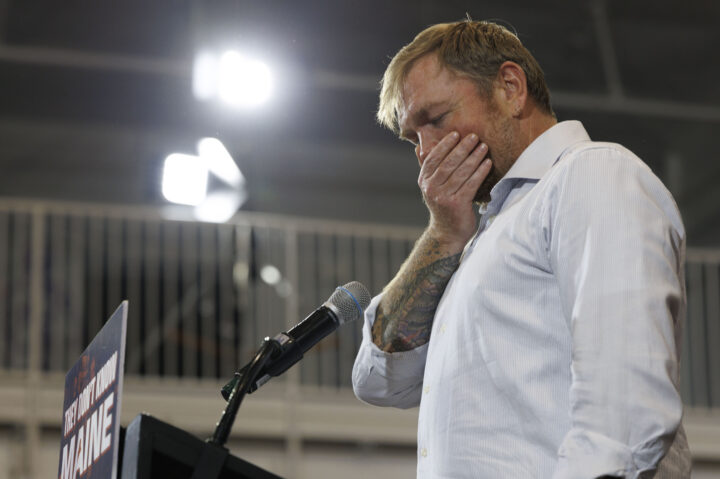
(CJ Gunther/Getty Images)
Democratic U.S. Senate candidate Graham Platner speaks at his Primary Election event on June 9, 2026 in Blue Hill, Maine.
When an ex-girlfriend of Graham Platner told Politico in a story published on Monday that the Maine Democratic Senate candidate had raped her in 2021 after entering her home while heavily intoxicated, she said she did so because the response to a recent New York Times report on Platner’s past dubious behavior had focused on discrediting Lyndsey Fifield, one of the women who featured prominently in the story, over her ties to the GOP.
Jenny Racicot, a Democrat, hadn’t wanted to go public with the rape accusation (which she had shared off-record with the Times), in part because she and Platner were largely politically aligned. “One of the reasons I didn’t come forward sooner was, the huge moral conflict that I had between supporting his politics, but not supporting him as a person,” Racicot told Politico. “My part of the story [in the NYT] was just a read-over,” Racicot said. “And the story was Lyndsey, and the accusations of her being politically motivated.”
The unfolding situation in Maine comes amid a broader trend in American politics in which immoral or questionable behavior by one’s peers has at times been ignored or obfuscated to serve a perceived “greater good” of electing a political ally despite their failing moral standards.
In recent years, both major parties have increasingly tolerated conduct that would have once been considered disqualifying — even as the #MeToo movement briefly changed the nature of the discourse. Similar arguments have surfaced across political controversies over the last decade (including against President Donald Trump), with supporters of embattled candidates and officials insisting that policy positions outweigh personal conduct and dismissing allegations as politically motivated.
In a short span of time, the 2017 rallying cry of “Believe women” gave way to “Believe women whose politics align with ours” — a mindset that extended to the widespread denial of Hamas’ sexual violence during the Oct. 7, 2023, terror attacks and against the Israeli hostages kept in captivity in Gaza.
But yesterday’s Politico report, which prompted calls from Platner’s most prominent backers — including Rep. Ro Khanna (D-CA) and Sens. Elizabeth Warren (D-MA) and Ruben Gallego (D-AZ) — for him to end his bid, may mark the point at which previous defenses of the Maine Democrat become politically untenable.
Since shortly after the launch of his campaign, Platner — a virtual unknown before last summer — has faced numerous controversies, from his tattoo of an SS totenkopf to Reddit comments praising Hamas tactics to the revelation that he exchanged inappropriate messages with numerous women despite being married. The Wall Street Journal reported last month that Platner’s vetting process — normally a weeks-long process — took place in a matter of days, expedited by Platner’s top strategist and done at a fraction of the cost of a standard background check, which likely would have flagged at least some of these issues.
Yet none of those allegations proved politically fatal — and Platner ended up winning the Democratic primary with 72% of the vote. Platner’s defenders echoed the rhetoric of many of Trump’s early backers: that the party establishment had targeted him, that the media had unfairly covered the incidents and that a candidate’s positions, rather than their personal lives, should be on the ballot.
Unlike Trump, who was weeks away from his 2016 presidential victory when the infamous “Access Hollywood” tape leaked, Platner had only recently clinched his party’s nomination after Gov. Janet Mills ended her bid. He can still be replaced on the ballot, provided he exits the race by next Monday, though any new candidate will face a much more difficult battle against Sen. Susan Collins (R-ME) in what had been the Democrats’ best hope for a pickup and control of the Senate.
Now, the question is whether American politics still has a meaningful threshold beyond which partisan leanings give way to concerns about character and ethics — or whether that threshold has simply become much higher than it once was.
Plus, Rahm Emanuel says Israel support should come with strings
Joe Raedle/Getty Images
Democratic U.S. Senate candidate Graham Platner speaks at a “Fighting Oligarchy” tour stop held by Sen. Bernie Sanders (I-VT) at the Collins Center for the Arts on the University of Maine campus on May 24, 2026 in Orono, Maine.
Good Monday afternoon.
This P.M. briefing is reserved for our premium subscribers like you — offering a forward-focused read on what we’re tracking now and what’s coming next.
Today’s Daily Overtime was curated by JI U.S. Editor Danielle Cohen-Kanik.
📡On Our Radar
Notable developments and interesting tidbits we’re tracking
A woman who dated Maine Senate nominee Graham Platner alleged in a series of interviews with Politico that the Democrat sexually assaulted her in 2021, an account the outlet backed up with her correspondence and other interviews.The woman, Jenny Racicot, said Platner came into her home uninvited while intoxicated and forced himself on her despite her repeated objections.
In a video statement, Platner denied the accusation outright but said he’s “mindful of the political reality it will inflict” and would be “taking the time to reflect on the best path forward for the state that I love,” a different tone than Platner has struck in the aftermath of his previous controversies. The Maine Democratic Party can only choose a replacement nominee for the general election ballot if Platner voluntarily withdraws by July 13…
Israeli Prime Minister Benjamin Netanyahu voiced opposition today to the Trump administration’s sale of jet engines and potential sale of F-35 fighter jets to Turkey, hours before President Donald Trump was set to depart for the NATO summit in Ankara, Jewish Insider’s Christina Sher reports.
Netanyahu suggested on “Fox & Friends” that such moves “will upset the power balance in the Middle East, which is ultimately guaranteed by Israeli air superiority” and U.S. posture in the region. Axios reports that Netanyahu relayed the same message directly to Trump in a phone call last week and asked him to help address Turkish President Recep Tayyip Erdoğan‘s escalating anti-Israel rhetoric…
The percentage of Jewish Israelis who believe Israel’s security is a central consideration for Trump has reached a record low of 26%, according to a new survey from the Israel Democracy Institute, JI’s Matthew Shea reports. The figure marks a 15-point decrease from a month ago, during which time the Trump administration signed its memorandum of understanding with Iran…
Hamas spokesperson Hazem Qassem announced at a press conference in Gaza today that the terror group’s Emergency Committee — the administrative body that has governed the enclave for more than two decades — is dissolving and that its civil servants, who will remain in their roles, stand ready to work under the new technocratic government established by the Board of Peace.
The BoP expressed skepticism about the announcement, JI’s Emily Jacobs and Matthew Shea report, saying its “assessment will be guided by actions, not promises” and calling for a “genuine transfer of authority” and for Hamas to disarm. Israeli Foreign Minister Gideon Sa’ar dismissed the move outright, calling it a “trick … designed to prevent [Hamas’] own disarmament”…
Israeli Ambassador to the U.S. Yechiel Leiter said both Israel and Lebanon see the agreement signed between Jerusalem, Beirut and Washington earlier this month as “superseding” the first clause of the U.S.-Iran MOU, which calls for the end of hostilities on all fronts. “Whether or not the United States does, you’ll have to ask an administration spokesman,” Leiter said at an event with the Council on Foreign Relations.
Leiter also said he “can’t imagine that any ultimate agreement with Iran would be absent a clause limiting the development of ballistic missiles,” though the MOU did not mention Iran’s ballistic missile program…
In a preview obtained by Politico of the speech former U.S. Ambassador to Japan Rahm Emanuel is set to deliver at Tel Aviv University on Wednesday, the prospective 2028 presidential candidate is set to say that the U.S. has spent too long “averting its eyes” from what he views as Israel’s misadventures, calling for “significant changes and a new direction” in the bilateral relationship.
“Going forward, Emanuel plans to say, Israelis should regard U.S. support as expressly contingent: On reviving a serious commitment to Palestinian sovereignty; On rejecting dreams of asserting dominion beyond official borders in pursuit of ‘Greater Israel’; On abandoning a security strategy that emphasizes brutally effective military force with scant attention to diplomacy or credible what-next plans in Gaza and Iran,” the outlet reported…
French President Emmanuel Macron became the first major Western head of state to visit Syria since the fall of dictator Bashar al-Assad in 2024, landing in Damascus today for meetings with Syrian leaders. Syrian President Ahmad al-Sharaa is also expected to meet with Trump on the sidelines of the NATO summit in Turkey this week…
⏩ Tomorrow’s Agenda, Today
An early look at tomorrow’s storylines and schedule to keep you a step ahead
The two-day NATO summit begins in Turkey tomorrow with leaders of all 32 NATO countries expected to attend, as well as a congressional delegation comprised of Sens. Dick Durbin (D-IL), Jeanne Shaheen (D-NH), Thom Tillis (R-NC), Chris Coons (D-DE) and Mike Rounds (R-SD) and Rep. Mike Turner (R-OH). At the top of the agenda are increasing defense investments, as Trump continues to press NATO allies to shoulder a greater share of the alliance’s defense burden and threatens to draw down U.S. troops from Europe, and continuing to support Ukraine in its war with Russia.
Rep. Haley Stevens (D-MI) and Abdul El-Sayed, now the only remaining candidates in Michigan’s Democratic U.S. Senate primary, will participate in a televised debate on local news tomorrow night, their first head-to-head matchup since state Sen. Mallory McMorrow suspended her campaign yesterday.
The annual Contemporary Antisemitism conference, which bills itself as the largest annual academic conference on contemporary antisemitism, will kick off tomorrow at the University of Haifa. The three-day summit will feature hundreds of academics and experts, with a keynote speech tomorrow from former State Department antisemitism envoy Deborah Lipstadt and a lifetime achievement award presented to Tel Aviv University professor emerita Dina Porat.
Stories You May Have Missed
NO FLIGHT PLAN

Rep. Dina Titus is leading the Joint Resolution of Disapproval against the Trump administration’s $700 million sale of F110 jet engines to Turkey despite legal restrictions on U.S. military sales to the country
TEACHING MOMENT

Some Jewish Affairs Caucus leaders say they weren’t consulted about the changes, which are meant to prevent issues around antisemitism that occurred at last year’s assembly
The Israeli leader said Turkey was 'infected by the Muslim Brotherhood' and warned the sales would upset the regional power balance hours before Trump's NATO summit departure
POOL/AFP via Getty Images
Israeli Prime Minister Benjamin Netanyahu arrives for a press conference in Jerusalem on March 19, 2026.
Israeli Prime Minister Benjamin Netanyahu voiced opposition to the Trump administration’s sale of jet engines and potential sale of F-35 fighter jets to Turkey on Monday, saying on “Fox & Friends” that such moves “will upset the power balance in the Middle East, which is ultimately guaranteed by Israeli air superiority” and “America’s posture” in the region.
Netanyahu’s remarks came hours before President Donald Trump’s departure for a NATO summit in Turkey, on the sidelines of which Trump is expected to hold a bilateral meeting with Turkish President Recep Tayyip Erdoğan.
“I don’t think [Turkey] should be given F-35s or the engines for their fighter jets,” Prime Minister Benjamin Netanyahu said on Fox News.
— Jewish Insider (@jewishinsider) July 6, 2026
He described Turkey as “infected by the Muslim Brotherhood, an extreme movement that hates America.”
Read more: https://t.co/gSW5VJLPfA pic.twitter.com/XKovNgVPJM
Last month, the Trump administration told Congress it was moving to sell more than $700 million of U.S.-made F-110 jet engines to the Turkish military and was reviewing Ankara’s eligibility for the F-35 program, in a potential change to U.S. sanctions which currently prevent Turkey from participating.
“I don’t think they should be given F-35s or the engines for their fighter jets,” Netanyahu said on Monday, describing Turkey as “infected by the Muslim Brotherhood, an extreme movement that hates America.” He also pointed to recent comments by Erdoğan and Turkish ministers that Netanyahu characterized as “calling for the annihilation of Israel.”
Netanyahu’s comments echo concerns shared by a bipartisan group of House lawmakers, led by Reps. Mike Lawler (R-NY) and Brad Sherman (D-CA), who wrote to Trump last week warning that Erdoğan’s “constant and growing anti-Israel rhetoric” and ties to Iran make Turkey’s inclusion in the F-35 program unwise.
Trust in Trump dropped 15 points among Jewish Israelis in the last month, though a majority still see tensions between Washington and Jerusalem as temporary

Jack GUEZ / AFP via Getty Images
A billboard depicting an image of President Donald Trump with a message thanking him, is displayed on the side of a building in the Israeli coastal city of Tel Aviv on March 12, 2026.
The number of Israelis who believe President Donald Trump views Israel’s security as a central consideration has continued to fall to record lows after Washington signed a memorandum of understanding with Iran, according to a new survey from the Israel Democracy Institute.
The June 2026 Israeli Voice Index, conducted between June 28 and July 1, found that 28% of respondents — including 26% of Jewish Israelis and 36% of Arab Israelis — believe Israel’s security is a key consideration for Trump.
Among Jewish Israelis, the figure dropped 15 percentage points from a month ago, when 41% of respondents said they felt Israeli security was a key consideration for Trump as his administration engaged in negotiations with Tehran. At the time, those findings marked the lowest levels of Israeli trust in Trump since the research center began tracking the metric when he was elected to a second term in November 2024.
Despite declining confidence in Trump, a majority of Israelis continue to view current tensions between Washington and Jerusalem as temporary rather than indicative of a meaningful deterioration in bilateral ties. Among Jewish Israelis, 54% said current disagreements represent a temporary crisis that will not harm the relationship, while 34% said they mark a longer-term shift for the worse.
Respondents were more divided when asked whether Israel’s strategic security situation was better or worse than it was before the Iran war. Thirty-six percent said Israel’s security situation is now worse, an increase of eight percentage points from April. Meanwhile, 38% said it is better, down six percentage points over the same period.
The survey also found strong support for maintaining an Israeli security zone in southern Lebanon, even if doing so conflicts with U.S. interests. Overall, 72% of respondents backed a permanent security zone in the area. Support was especially high among Jewish Israelis, at 80%, while a majority of Arab Israelis (58%) opposed maintaining a permanent Israeli presence in southern Lebanon.
Beyond military and diplomatic issues, the poll found that rising antisemitism and attacks targeting Israelis abroad were influencing travel decisions. Fifty-six percent of respondents said the threat environment has affected their travel plans, with 41% saying it has impacted where they choose to travel and 15% saying they plan to avoid traveling abroad altogether because of security concerns.
Plus, Israel ally draws the line at Syria
Andrew Harnik/Getty Images
Rep. Yassamin Ansari (D-AZ) speaks during a news conference on Capitol Hill on November 13, 2025 in Washington, DC.
Good Thursday afternoon.
This P.M. briefing is reserved for our premium subscribers like you — offering a forward-focused read on what we’re tracking now and what’s coming next.
Today’s Daily Overtime was curated by JI U.S. Editor Danielle Cohen-Kanik.
📡On Our Radar
Notable developments and interesting tidbits we’re tracking
In their indirect talks in Doha this week, the U.S. offered Iran access to some of its$100 billion in frozen funds in exchange for Tehran not instituting a toll on the Strait of Hormuz, but Iranian officials have continued to signal they plan to proceed with the move. Continued fighting between Israel and Hezbollah in Lebanon also caused tension during the discussions, The Wall Street Journal reports…
U.S. officials told The New York Times that Washington believed Israel was plotting to assassinate Iran’s top negotiators — Foreign Minister Abbas Araghchi and parliament speaker Mohammad Bagher Ghalibaf — as they were engaged in recent talks with the U.S. over the memorandum of understanding…
Arizona Jewish and pro-Israel leaders told Jewish Insider’s Matthew Kassel that they feel misled by Rep. Yassamin Ansari (D-AZ), whom they supported in her contested 2024 primary but who has since turned away from the pro-Israel views she espoused during the campaign — including now rejecting support from Democratic Majority for Israel, which backed her with a surge of spending in 2024…
The AIPAC-linked United Democracy Project super PAC is up with its first negative ad against far-left Michigan Senate candidate Abdul El-Sayed, JI’s Marc Rod reports, hitting the Democrat in the initial $2 million ad buy for his “long history of disrespecting women.” Meanwhile, El-Sayed picked up a high-profile endorsement today from Rep. Alexandria Ocasio-Cortez (D-NY), her first in a contested Senate race this cycle.
UDP also made $400,000 in advertising reservations to support Rep. Wesley Bell (D-MO) as he faces a comeback primary challenge from former Rep. Cori Bush (D-MO), whom UDP helped Bell defeat in 2024…
Colorado Attorney General Phil Weiser, the Democratic nominee for governor, criticized his party’s socialist congressional nominee, Melat Kiros, for her refusal to describe the deadly firebombing of a Boulder, Colo., hostage awareness march last year as an act of antisemitism, JI’s Marc Rod reports…
New York City congressional nominee Brad Lander published a response to Rabbi Elliot Cosgrove’s letter earlier this week in which Cosgrove predicted that Lander’s hostility to Israel would not be enough to protect him from being targeted by the far left. Lander argued in his response that criticism of Israel — including describing its war in Gaza as a genocide — is consistent with Jewish values and that excluding anti-Zionist Jews weakens the Jewish community…
New polling data shows that a sizable majority of Jewish voters disapprove of New York City Mayor Zohran Mamdani’s job performance and fear he is pushing the Democratic Party too far to the left, in contrast with non-Jewish voters who hold a largely favorable view of the democratic socialist, JI’s Matthew Kassel reports…
A bipartisan group of House lawmakers, led by Reps. Mike Lawler (R-NY) and Brad Sherman (D-CA), wrote to President Donald Trump today to “express deep concern about any effort” to sell F-35 fighter jets to Turkey, JI’s Marc Rod reports, after Trump and Vice President JD Vance indicated they were looking into it last week…
Rep. Joe Wilson (R-SC), the founder of the Republican Israel Caucus and a reliable ally of the Jewish state, called Israel’s “continuing aggressive operations” in Syria “deeply disturbing,” “counterproductive” and “irresponsible.” Wilson accused Israel of “taking Syrian land and attacking Syrian cities,” saying the operations “need to end immediately”…
Wilson, along with Sens. Jeanne Shaheen (D-NH) and Elizabeth Warren (D-MA), also sent a letter to Secretary of State Marco Rubio urging the administration to remove Syriafrom the State Sponsor of Terrorism list…
Israel marked 1,000 days today since the Oct. 7, 2023, Hamas terror attacks, with memorials and protests taking place around the country…
Far-right commentator Tucker Carlson told the Columbia Journalism Review that he plans to help start a new political party — after saying last month he was renouncing the Republican Party — but does not plan to run as a candidate. He repeatedly railed against Israel in the interview and accused it of “taking over my political system and destroying my country”…
Fanatics CEO Michael Rubin hosted his annual White Party at his Hamptons estate yesterday featuring a host of high-profile attendees, including Ivanka Trump, New England Patriots owner Robert Kraft, former quarterback Tom Brady, actor Leonardo di Caprio and more…
⏩ Tomorrow’s Agenda, Today
An early look at tomorrow’s storylines and schedule to keep you a step ahead
Keep an eye on Jewish Insider for a look at Rep. Debbie Wasserman Schultz’s (D-FL) contentious primary race in Florida’s 20th Congressional District.
Fourth of July celebrations in the nation’s capital are kicking off with a bang (literally — the fireworks show on the National Mall could break world records). President Donald Trump is slated to give a speech on the Mall ahead of the fireworks show on Saturday night, followed by a military flyover debuting the new Qatari-gifted Air Force One jet.
Iran is slated to hold a massive, dayslong funeral procession for the late Supreme Leader Ayatollah Ali Khamenei beginning on Saturday in Tehran and including cities across Iran and Iraq. Pakistan’s Foreign Ministry said Prime Minister Shehbaz Sharif, a top mediator between the U.S. and Iran, will attend the memorial, alongside officials from dozens of other countries.
Christians United for Israel’s annual summit in Washington will begin on Sunday. Speakers over the three-day confab include State Department antisemitism envoy Rabbi Yehuda Kaploun; former Auburn University basketball coach Bruce Pearl; Malcolm Hoenlein, vice chair of the Conference of Presidents of Major American Jewish Organizations; Georgia state Rep. Esther Panitch; and former Israeli hostage Yair Horn.
We’ll be back in your inbox with the Daily Overtime on Monday. Shabbat shalom and happy Fourth of July weekend!
Stories You May Have Missed
LAND OF THE FREE

Rabbis, historians and communal leaders told JI that the nation’s semiquincentennial offers an opportunity to celebrate America’s promise even as they confront the antisemitism and political currents challenging Jewish life today
CAMPAIGN CONTROVERSY
The same day Francesca Hong appeared on the livestream of antisemitic conspiracy theorist ‘Mike From PA,’ she also joined Hasan Piker’s Twitch show
The lawmakers, led by Reps. Mike Lawler and Brad Sherman, warned the White House of Turkey’s ‘constant and growing anti-Israel rhetoric’ and its relations with Iran
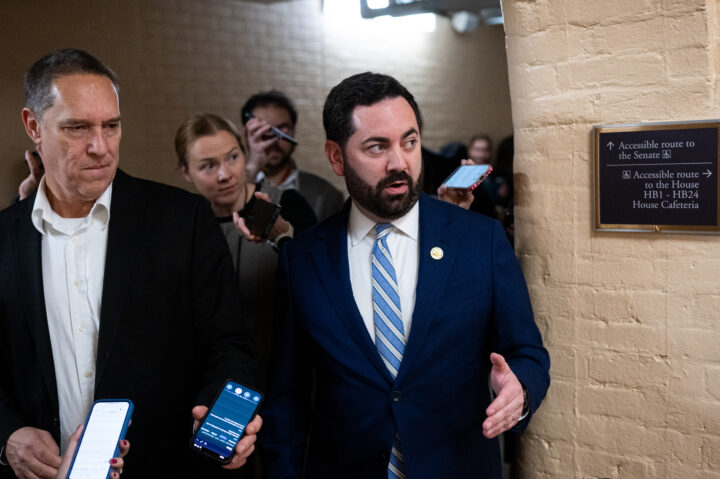
Bill Clark/CQ-Roll Call, Inc via Getty Images
Rep. Mike Lawler (R-NY) speaks to reporters as he leaves the House Republican Conference meeting in the U.S. Capitol on December 10, 2025.
A bipartisan group of House lawmakers wrote to President Donald Trump on Thursday to “express deep concern about any effort to sell F-35s to Turkey.”
The letter comes after Trump and Vice President JD Vance publicly discussed plans to push the sale ahead at the White House last week, in spite of continued legal restrictions prohibiting such a sale, and ahead of a NATO summit in Ankara next week.
“With [Turkish] President [Recep Tayyip] Erdogan’s continued aggression toward our greatest partners along with his troubling defense partnerships with our adversaries, it is not in the best interest of our country to sell them F-35s,” the lawmakers, led by Reps. Mike Lawler (R-NY) and Brad Sherman (D-CA), wrote. “While Turkey has been a NATO ally since 1952, they have hardly been a reliable partner in the present day.”
They emphasized that the first Trump administration removed Turkey from the advanced F-35 fighter jet program for its purchase of a Russian S-400 air defense system in spite of warnings from the U.S. and other NATO allies, describing the S-400 as a “major security threat” to the critical military asset.
They noted that Congress also sent a clear message codifying the ban on F-35 sales to Turkey while it maintains possession of the S-400. There have been no public reports of Turkey disposing of the S-400 system.
“Since 2019, President Erdogan has only further antagonized the U.S. and our NATO allies,” the lawmakers continued, pointing to Turkey’s continued occupation of northern Cyprus, its aggression toward Greece and its “constant and growing anti-Israel rhetoric, all while Turkey maintains bilateral relations with Iran.”
The lawmakers said that reversing course now “would send the wrong message to President Erdogan and to our allies and partners both in Europe and the Middle East.”
The letter was co-signed by Reps. Nicole Malliotakis (R-NY), Gus Bilirakis (R-FL), Jeff Hurd (R-CO), Max Miller (R-OH), Young Kim (R-CA), Stephen Lynch (D-MA), Gabe Amo (D-RI) and Jared Moskowitz (D-FL).
Other lawmakers are currently working on additional efforts to oppose the F-35 sale and other military sales to Turkey, including the White House’s recently announced sale of fighter jet engines to Ankara. Some House members reportedly plan to introduce legislation aimed at blocking that sale, though the administration will likely ultimately be able to proceed if it wishes to do so.
Plus, NEA cracks down on antisemitism chaos
Amirhossein KHORGOOEI / ISNA / AFP via Getty Images
Vessels are pictured anchored in the Strait of Hormuz off Bandar Abbas in southern Iran on May 5, 2026.
Good Wednesday afternoon.
This P.M. briefing is reserved for our premium subscribers like you — offering a forward-focused read on what we’re tracking now and what’s coming next.
Today’s Daily Overtime was curated by JI U.S. Editor Danielle Cohen-Kanik.
📡On Our Radar
Notable developments and interesting tidbits we’re tracking
Talks in Doha about the U.S.-Iran memorandum of understanding have concluded, Iranian Deputy Foreign Minister Kazem Gharibabadi announced, with the countries agreeing to create a communication channel “by tomorrow” in order to address MOU violations.
The U.S. and Iran also agreed to “keep things quiet for the coming week,” a U.S. official told Axios, while Washington is reportedly continuing to press Tehran to abandon its plan to charge tolls in the Strait of Hormuz and “think bigger” on a nuclear deal. The sums Iran could generate from freely selling oil without sanctions under such a deal “would be 100 times more valuable to them,” the official said…
New York Times/Siena polls of the six Senate battleground states — Alaska, Iowa, Maine, North Carolina, Ohio and Texas — found that Democrats have a path, albeit an uphill one, to retake the chamber in November. All of the races are within the margin of error except in North Carolina, where former Democratic Gov. Roy Cooper leads Michael Whatley, former chair of the Republican National Committee, with the largest margin of seven points…
Poetica Coffee, the Brooklyn cafe that banned Rep. Dan Goldman (D-NY) last week over his support of Israel, claimed in an Instagram post today that Goldman intentionally “smear[ed]” the business in talking about his experience “possibly for election-eve media exposure”…
Rep. Adam Smith (D-WA), ranking member of the House Armed Services Committee, told CNN yesterday that some democratic socialist candidates have views that are “vastly more radical” than where the “Democratic coalition” stands, saying their support for communism, open borders and defunding the police represents “a fundamental attack on America itself”…
Asked about Republicans viewing him as easier to beat in a general election than his more-moderate primary opponents, far-left Michigan Democratic Senate candidate Abdul El-Sayed told Semafor, “The number of times I’m gonna define and redefine Mike Rogers!” referring to the GOP Senate front-runner and former Michigan representative. “By the time I’m done, his best friends are gonna look at him and think what I think, say what I say. I’m gonna define him into eternity”…
The National Education Association adopted new policies ahead of its convening this weekend in Denver after its Jewish Affairs Caucus and the Jewish Council for Public Affairs advocated for such changes, JCPA said, in response to last year’s assembly which grew contentious over antisemitism issues. The new changes include stronger conduct enforcement for delegates, electronic voting to reduce shouting on the floor during resolution votes, de-escalation training for NEA staff and repeated public reminders of the rules…
Loay Abdelfattah Alnaji was sentenced to one year in jail and two years of probation yesterday after pleading guilty to involuntary manslaughter and battery in the death of Paul Kessler, a 69-year-old Jewish man who died after Alnaji struck him with a megaphone at a protest in California shortly after the Oct. 7 Hamas attacks. The Anti-Defamation League’s California regional offices decried the sentence as “little more than a slap on the wrist” and expressed concern at the judge’s dismissive demeanor during sentencing…
A New York woman was arrested yesterday by the FBI for allegedly providing material support to the Palestinian Islamic Jihad, including over $30,000 in cryptocurrency. The woman is a leader of an extremist organization called the Direct Action Movement for Palestinian Liberation, according to the FBI, and had communicated with a person claiming to be a PIJ fighter in Gaza, whom she told she “wish[es] every day were October 7th”…
Speaking at the Herzliya Conference in Israel, Maj. Gen. (res.) Amir Baram, director general of the Israeli Ministry of Defense, addressed Israeli public criticism of the U.S.’ foreign policy, Jewish Insider’s Matthew Shea reports: “What some in Israel perceive as weakness or folly, an apparent disregard for every warning sign on the ground, is viewed in Washington as cold, calculated and clear-eyed risk management in an era of shifting global attention.”
“For us, Iran is an existential threat; for the United States, it is a chronic regional challenge,” Baram said of the countries’ differing priorities. “We think Tehran, they think Taiwan”…
U.S. Ambassador to Israel Mike Huckabee and Israeli Foreign Minister Gideon Sa’ar held a ceremony to sign the lease for the permanent new complex of the U.S. Embassy in Jerusalem; Huckabee handed Sa’ar a $1 bill as symbolic payment for the 99-year lease…
The New York Times looks at President Donald Trump’s insistence that Syria take over fighting Hezbollah in Lebanon from Israel, an idea that has been shot down by Syrian President Ahmad al-Sharaa and raised alarm across the Middle East…
CENTCOM hosted a regional security dialogue alongside the Bahrain Defense Force with participation from Egypt, Jordan, Kuwait, Lebanon, Oman, Qatar, Saudi Arabia, Syria, the UAE and Yemen — “the first time military leaders from Syria and Lebanon participated in a regional defense conference led by the United States,” CENTCOM said…
The U.S. Navy is searching for a missing aircrew member after a Sea Hawk helicopter made an emergency water landing in the Arabian Sea, with three of the four crew members rescued in stable condition. There’s no indication any hostile action was involved, the Navy’s 5th Fleet said…
⏩ Tomorrow’s Agenda, Today
An early look at tomorrow’s storylines and schedule to keep you a step ahead
Keep an eye on Jewish Insider for a look at how Jewish leaders are approaching America’s 250th birthday — and why many see the milestone, coming at a fraught moment, as a chance to reaffirm both their Jewish identity and their faith in the American experiment.
The Maccabiah Games, which kicked off today in Jerusalem with a grand opening ceremony, begin in earnest tomorrow as about 5,000 athletes — including 900 from the U.S. — compete in more than 30 sports over the next two weeks.
