



























































U.S., Israel largely aligned on Iran war aims, but public opinion and political timelines diverge
Analysts say close military coordination masks growing differences in domestic support and strategic priorities that could shape how long Washington and Jerusalem sustain the campaign
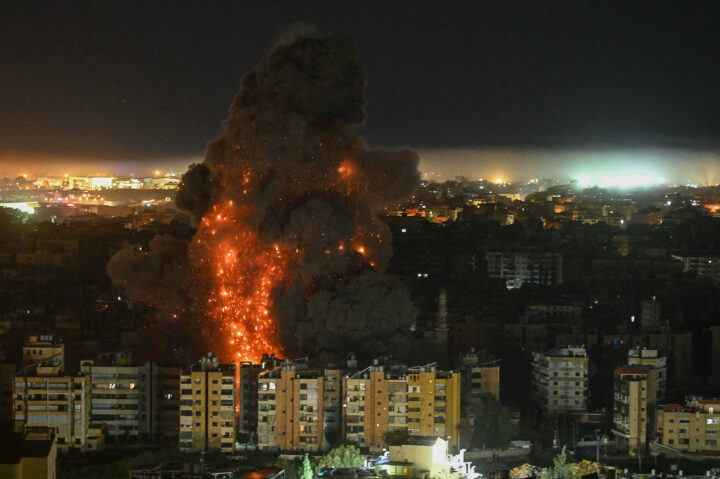
FADEL itani/AFP via Getty Images
A fireball rises from the site of an Israeli airstrike that targeted an area in Beirut's southern suburbs overnight March 10 to 11, 2026.


 Add JewishInsider on Google
Over two weeks into the war with Iran, American and Israeli leaders’ public statements about the effort and their goals remain largely in sync, with President Donald Trump praising Israel on Sunday for helping secure the Strait of Hormuz, while other countries with greater oil interests in the region have yet to offer to help.
However, the populations of the two countries have markedly different views of the war, which is popular in Israel while most Americans oppose it, which likely puts Trump and Israeli Prime Minister Benjamin Netanyahu on different timelines. That, in turn, could impact the level of cooperation moving forward.
Assaf Orion, a senior researcher at the Institute for National Security Studies at Tel Aviv University, said that “it’s clear that even though this is a joint operation embarked on together, there are significant differences. In the end, it depends on Trump.”
Dan Diker, president of the Jerusalem Center for Security and Foreign Affairs, said that “it is our sense [in Israel] that Trump is on the same page about staying the course” with goals including “the complete neutering and elimination of the ballistic and nuclear programs as we’ve known them, but also to locate and get rid of the 440 kilograms of highly enriched uranium,” as well as to “assist the regime to collapse and change.”
”Without regime change, this is all for naught,” Diker added. “[Israel] simply can’t live with this messianic, jihadist regime. This is our opportunity.”
The U.S. and Israel are cooperating more closely than ever before, Diker noted. “It’s a real partnership,” he explained. “We haven’t had that since the founding of the State [of Israel]. It had been a client, an ally, the little brother, not a full-fledged partner. [Secretary of Defense Pete] Hegseth said the only amazing air forces in the world are the U.S. and Israel — that’s quite a statement.”
“American and Israeli leaders are on the phone every single day — the president and prime minister, joint chiefs of staff, the defense ministers — it’s incredibly tightly coordinated, because we can’t afford surprises,” he added.
That close coordination has “a great deterrent effect … it scares the living daylights out of the Iranian regime. It encourages the [Iranian] people who are still at home in Iran” to rise up against the regime, Diker posited.
Orion noted that different goals between the U.S. and Israel may include the U.S.’ aim to destroy Iran’s navy, something Israel has not mentioned, and the types of missiles they are most concerned about. Israel seeks to destroy long-range missiles that can reach its shores, while U.S. forces in the Gulf are threatened by short-range missiles.
“Within those goals, there can be differences in the level of achievement, the understanding of how much is enough,” he said. “Iran is Israel’s number one priority. For the U.S., the number one priority is China. Iran is an existential threat to Israel, but is far from it for the U.S.”
“Israel is willing to take greater risks because of that threat assessment, while the U.S. has to explain why it’s taking this risk,” Orion added.
While one may think the U.S. could endure a longer war because of its larger size and economy, and because Israelis are the ones running for shelter multiple times a day, while Americans are not, Orion said that does not appear to be the case.
“In Israel, [leaders are] saying it will take as long as it takes, expressing a kind of patience, while the U.S. government speaks out against ‘forever wars.’ They can continue, but they are less forgiving of long wars than Israel at this time. … Though the Israeli population is under fire and U.S. troops are under fire, Israel is more willing to absorb losses because of the sense that it is being threatened,” he said.
Diker said the differences between the U.S. and Israel are mostly in their political timelines: “President Trump has midterms [in November] and Israel has national elections,” set for the end of October, but may be held earlier. “Both men understand the existential nature of the moment. … Both men know their legacies can be built on destroying the world’s most dangerous regime.”
Still, Diker said, “public opinion in Israel backs the prime minister on this war and public opinion in the U.S. is deeply divided on the war … and have over 50% of the public saying they don’t know what this war is about. … That gives Netanyahu more breathing room to finish what needs to be finished even if it takes more time. … [Israel] wants to make sure this regime is destroyed however long it takes.”
Trump, however, has to “withstand political pressure from home with regard to the more isolationist wing of the MAGA movement and the Republican Party as a whole. He has to tie things up in the coming few weeks,” Diker said.
In addition, the “real challenge” in the U.S. is “the economic war, a soft spot in American political culture. People are nervous about the stock market, the price of oil and have become very impatient.”
Looking at how the war may continue, Orion said that while the public does not know what targets remain in Iran, the IDF has said there are enough targets left to require three additional weeks — or more — of warfare.
At the same time, Israel and the U.S. have to “manage their inventory of bombs and interceptors,” Orion said. “Israel also has the Lebanese arena. [Americans] talk about how whatever they use in the Middle East can’t be used in [East] Asia.”
Diker noted that the U.S. started striking Kharg Island over the weekend, which has the potential to cut off 90% of Iran’s oil revenue. After that, he posited, there will need to be some boots on the ground, likely from the U.S., to locate and destroy Iran’s enriched uranium. If that is achieved, he said, the American role in the war will likely end.
Israel, in the meantime, will “help topple this regime in Iran. What we’ve accomplished is severe unprecedented degradation of the regime’s capabilities.” In addition, Israel will likely continue fighting Hezbollah in Lebanon.
Orion posited that it is unlikely that Israel would continue the war in Iran after the U.S. pulls out.
”The reason the U.S. would stop would be to open the Strait of Hormuz and attacks on oil interests. If Israel continues [bombing Iran], Iran will continue [to attack oil interests],” he said. “However, if the U.S. stops in Iran, Israel may continue in Lebanon with American approval.”
Diker said he thinks it is unlikely that the U.S. would “just pack up and go home.”
”They have to get this uranium out,” he said. “Trump has to be convinced that [Iran] cannot build a nuclear weapon, and he is not convinced of that yet. They still have the uranium and the regime is still operating, somehow.”
More Stories
Daily Overtime
Mamdani resists DSA over Tisch tensions

SEEKING ANSWERS
After State Department memorial, families of Oct. 7’s American victims call for U.S.-led probe
TISCH TENSIONS
Mamdani stands by NYPD’s Tisch as his allies demand her removal

Daily Overtime
Dublin hotel dumps antisemitism conference

PRESIDENTIAL POV
Obama scrutinizes Israel’s founding, says Palestinians want their ‘land back’

Daily Overtime
Obama faults Israel’s founding in Belfast
Please log in if you already have a subscription, or subscribe to access the latest updates.
 Continue with Google
 Continue with Apple