

















































Day 4: Decrease in Iranian missile strikes on Israel result of targeting launchers, IDF says
'We were able to take out dozens of launchers,’ IDF spokesperson says
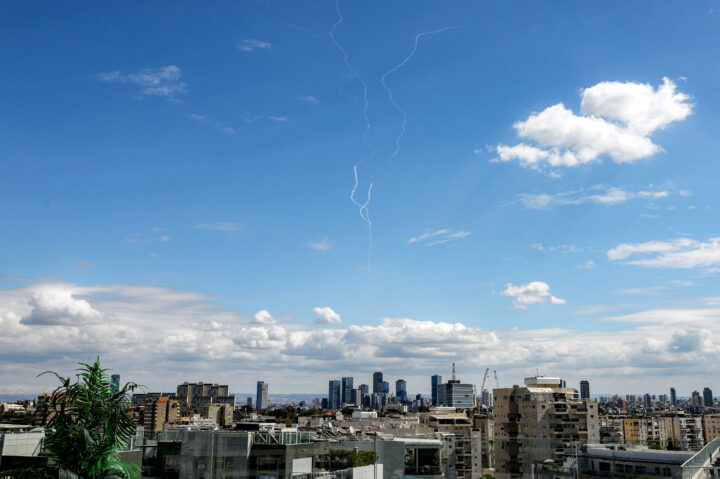
Jack GUEZ/AFP via Getty Images
Rocket trails from Israel's Iron Dome missile defense system are seen over Tel Aviv on February 28, 2026.


 Add JewishInsider on Google
A notable decrease in the number and frequency of Iranian missile strikes at Israel is the result of a focused strategy of hunting and aiming at launchers, Lt.-Col. Nadav Shoshani, the IDF’s spokesperson for international media, said on Tuesday.
“The missile and launcher hunt is happening in real time,” Shoshani told reporters. “We have been able to narrow [Iran’s] capability to fire missiles toward us. … We are putting our focus on continuing to do so in the coming days.”
“We were able to take out dozens of launchers,” since the operation began on Saturday, Shoshani said.
Shoshani said that Iran currently has “a lack of capability to fire in large amounts” and that there is a diminished rate of fire.
“I’m sure all of you in Israel can feel it,” he added. “We have significantly limited their ability to fire toward our civilians and other civilians in the region.”
At the same time, Shoshani said part of the reduction in missile launchers may be attributed to Iran trying to ensure it can keep the war going over the coming weeks.
The IDF is also prepared for the war to continue for weeks, but “it is early to give estimates,” Shoshani said, adding that “we are in a more positive scenario than [what] we looked at in the beginning of the war.”
Israel has also destroyed hundreds of Iranian missiles, but “launchers, that’s the real thing that’s important,” the spokesperson said.
Shoshani did not have readily available information on how many missiles Iran has shot, because the Islamic Republic attacked several countries in the region and not just Israel.
Asked if he expects Israeli boots on the ground in Iran, following President Donald Trump’s remarks about deploying U.S. ground troops “if necessary,” Shoshani said he does not see such a scenario as realistic for Israel.
Most of the targets the IDF struck were found after Operation Rising Lion began on Saturday, including radar and detection arrays, surface-to-air missile launchers, surface-to-surface missile launchers and related infrastructure, command and control centers, strategic military bases in Tehran, and facilities belonging to the regime’s repression and enforcement mechanisms.
Among those targets was the Iranian regime leadership’s compound in Tehran, which includes the presidential office, national security council and a training facility for military officers.
Israel’s “aerial superiority now allows the IDF to continuously strike the Iranian regime’s terror infrastructure — including its command-and-control centers and other high-value assets — not merely through isolated sorties, but through sustained operations, fundamentally shifting the operational reality in Operation Roaring Lion and enabling the IDF and the Israeli Air Force to operate freely in Iranian airspace,” the military spokesperson’s office said.
About 30 female aircrew members, including pilots and navigators, have taken part in the strikes on Iran in recent days.
Combat Navigator Maj. S, whose name was kept anonymous by the IDF Spokesperson’s Unit, said that she and her crew “prepared for this operation for a long time — hours of training and briefings.”
Maj.-Gen. Shlomi Binder, the IDF’s intelligence chief, said on Monday, “In 40 seconds, we eliminated more than 40 of the most important people in Iran … and we are not finished. … We intend to add to the list every day.”
“We are sending a very clear message to our enemies — there is no place where we will not find them,” Binder added. “Anyone who chooses to engage in such actions against the state of Israel, against the residents of the state of Israel, against our future here, we will find them, and we will eliminate them.”
As Israeli strikes in Lebanon continue as far north as Beirut, Israeli Defense Minister Israel Katz said the IDF will move to “take control of additional strategic positions in Lebanon in order to prevent attacks on Israeli border communities.”
The IDF holds five positions in southern Lebanon, as permitted by the U.S.-negotiated late-2024 ceasefire, and Katz said he “authorized the IDF to advance and secure additional strategic areas in Lebanon, and from there to defend the border communities.”
Shoshani said that while Israel’s main goal is to “remove the existential threat” emanating from Iran, it is doing “we are acting defensively on the northern front in order to focus our effort on Iran.”
He also noted that “Hezbollah’s main lifeline is Iran,” and said that in the last year, Iran sent over $1 billion to its proxies, with Hezbollah getting the majority of the money.
Israel does not plan to evacuate civilians from towns on the Lebanon border as it did in October 2023, though they have been dealing with frequent drone and rocket attacks in recent days, Shoshani said.
The IDF struck over 70 weapons storage facilities, launch sites and missile launchers in Lebanon on Monday, the military said.
One target was Hezbollah’s intelligence headquarters. The IDF killed Hussein Makled, Hezbollah’s chief intelligence official, a role he took on after Israel eliminated his predecessor in November 2024.
The IDF also said it eliminated the commander of Palestinian Islamic Jihad in Lebanon, Abu Hamza Rami, who was “responsible for advancing and carrying out hundreds of terrorist attacks against IDF troops and Israeli civilians.”
Another target was the Al-Qard Al-Hassan Association, which Hezbollah has said provides social services to the people of Lebanon. Al-Qard Al-Hassan has been sanctioned by the U.S. and others since 2007, and as such, deals exclusively in cash, which the IDF sought to destroy.
According to the IDF, “the terrorist organization uses these services to create economic dependency on the association and to exploit public funds for the purchase of weapons and the payment of salaries to its operatives.”
Also on Monday, the IDF Home Front Command extended restrictions until Saturday night, including closing schools and nonessential workplaces, and prohibiting large gatherings.
Two major missile barrages hit Israel on Tuesday, with two injured in the first one in Israel’s north, and no casualties in the second. Overnight Monday, Magen David Adom released its final casualty count for an Iranian missile strike on Beersheba, where 21 were injured. Since Operation Roaring Lion was launched on Saturday, there have been at least 371 casualties, including 12 fatalities and two severely injured.
Iran continued its strikes around the Gulf on Monday, with a drone causing minor damage to a U.S. Embassy building in Riyadh. Among the sites damaged by Iranian projectiles were three Amazon facilities in the United Arab Emirates and Bahrain.
Trump briefed leaders of two main Kurdish factions in Iraq on what may come next in the war, a step that Israeli Prime Minister Benjamin Netanyahu had encouraged him to take, Axios reported. Kurdish groups throughout the Middle East have had close security and intelligence ties with Israel for decades. The Kurdistan Freedom Party has also accused Iran of targeting them with missiles and drones.
More Stories

SMITHSONIAN STUDY
Commission studying potential Smithsonian Jewish museum holds first meeting
HISTORY LESSON
Brett McGurk’s fact check of former Harris advisor Phil Gordon on hostage negotiations

Daily Overtime
Jewish leaders press Miliband on U.K. antisemitism

COURSE CORRECTION
ADL, Gratz College launch antisemitism training for college administrators, faculty

IN THEIR MEMORY
Administration officials join bereaved families for Oct. 7 commemoration event

Daily Overtime
Dublin hotel dumps antisemitism conference
Please log in if you already have a subscription, or subscribe to access the latest updates.
 Continue with Google
 Continue with Apple