


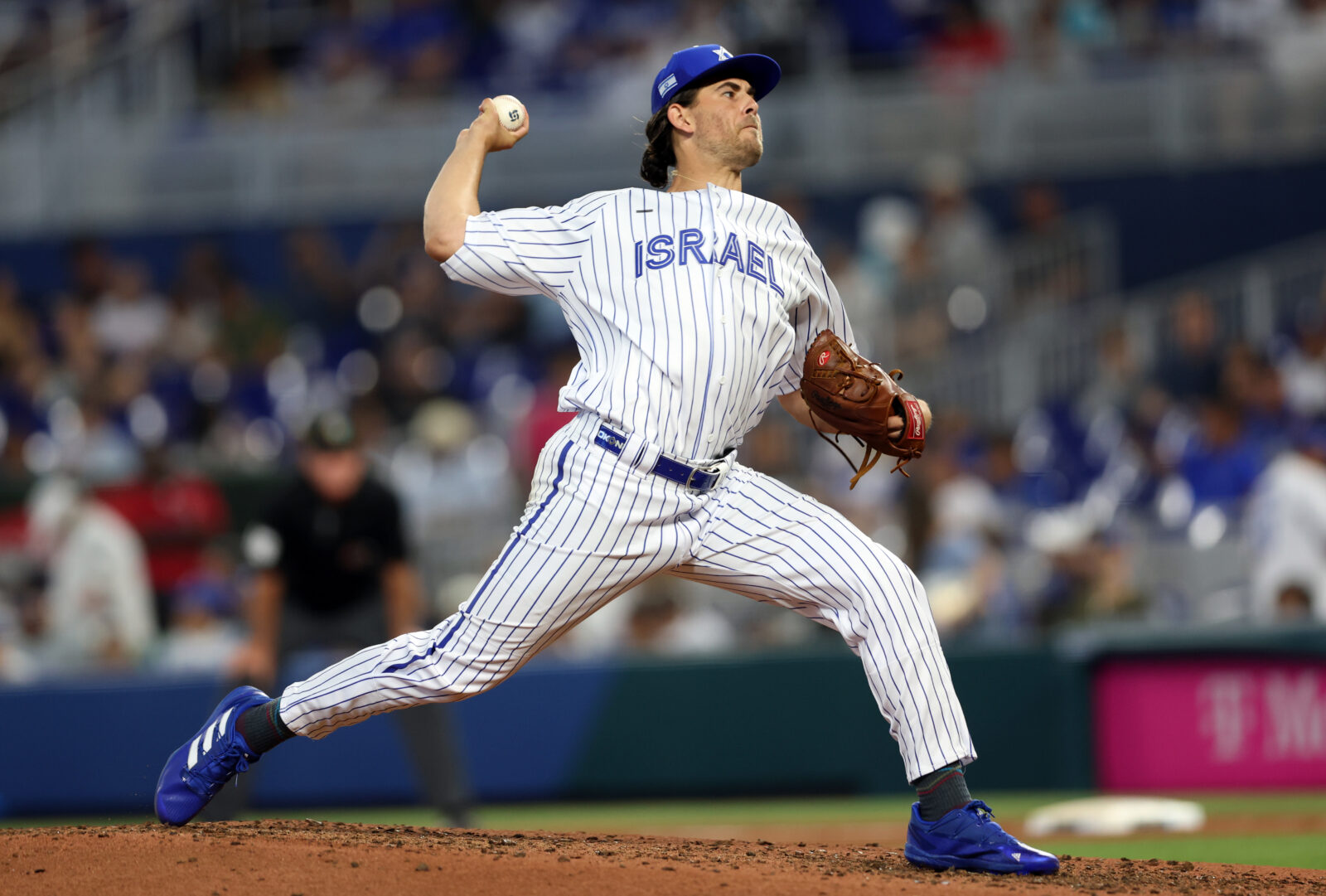
Rob Tringali/WBCI/MLB Photos via Getty Images
Team Israel’s World Baseball Classic team unveils its 2026 roster
The team is anchored by its pitching ace Dean Kremer of the Orioles, while Harrison Bader and Spencer Horwitz are among its best known hitters


 Add JewishInsider on Google
ROCKVILLE, Md. — Team Israel unveiled its roster for the 2026 World Baseball Classic on Tuesday, assembling a mix of major leaguers, high-level minor league players and homegrown Israeli talent as it prepares to return to baseball’s biggest international stage in March — a moment that carries added weight for players and staff amid high levels of antisemitism and anti-Israel sentiment worldwide.
The team, managed by Brad Ausmus, will once again feature Baltimore Orioles pitcher Dean Kremer, a longtime fixture of the team, along with Philadelphia Phillies catcher Garrett Stubbs and offensive contributions from first baseman Spencer Horwitz of the Pittsburgh Pirates and outfielder Harrison Bader of the San Francisco Giants.
Officials involved with Team Israel say the roster is more talented and balanced than that of the previous tournament in 2023. But for many within the organization, the meaning of representing Team Israel extends far beyond the field. Simon Rosenbaum, Team Israel’s general manager and director of player programming for the Tampa Bay Rays, told Jewish Insider at the team’s roster reveal at the Woodmont Country Club in the Washington suburbs that representing Israel on the world stage is deeply personal.
“For me, it starts with my family,” said Rosenbaum. “My grandfather was born in Germany in the 1930s and was able to survive the Holocaust. His mom and one of his sisters were not as fortunate, and he came to Israel, which became his home and where our family started. So to be able to represent Israel and blend that with baseball — which is another thing that I’m passionate about — it means a lot.”
Rosenbaum said he’s “proud to represent Israel,” calling it a “huge honor.” He said wearing the Israeli uniform comes with a responsibility.
“It’s the only Jewish country in the world,” said Rosenbaum. “Anything that we can do to represent that in a positive light and let people know that we’re here — that we’re proud to be here — is a responsibility that we don’t take lightly.”
That sentiment was echoed by Nate Fish, CEO of Israel Baseball Americas and a former Team Israel manager and player, who has been involved with the program for nearly two decades.
“It’s always special every time we go out and stand on the first or third baseline, wearing our uniform, and ‘Hatikvah’ plays,” Fish said, referring to the Israeli national anthem. “And you know you’re on an all-Jewish team, and the families and friends and fans are in the stands. It’s always a powerful experience.”
Fish said that experience has taken on new meaning since the Oct. 7, 2023, Hamas attacks on Israel, recalling heightened security concerns during international competitions last year.
“We played in Holland in the European Championships this past year in September of 2025 and there were such serious security concerns for us that we couldn’t leave the hotel for two weeks,” said Fish. “So the team was not allowed to leave the hotel, except to go to the field to play in the games.”
“There were fans who were having trouble getting into the stadium,” he added. “They had to consider canceling the tournament.”
Fish said the experience made playing for the team “that much more meaningful, because you’re doing it in an environment where people openly don’t want you there, and you still have to be proud, put the uniform on, go out on the field and represent your people with even more pride.”
On the field, Israel will face one of the tournament’s toughest paths, kicking off play in Pool D in Miami in March, where the team will square off against juggernauts Dominican Republic and Venezuela, as well as the Netherlands and Nicaragua — a grouping widely referred to as the “group of death.” The top two teams from each of the tournament’s four groups advance to the next round.
“Obviously, the Dominican Republic and Venezuela rosters are littered with Major League All-Stars,” Rosenbaum said. “It’s going to be a massive test. That being said, the Netherlands are a really good team, especially offensively. Nicaragua added some players who are really good, and there’s no team that we’re going to take lightly.”
Fish also noted that the Dominican Republic is “the toughest roster that we’ll face,” with Venezuela “damn near as good.”
“You don’t want to be playing those guys because it’s like a team of Hall of Famers, and it’s horrifying,” said Fish. “If you look objectively at the tournament and the matchups and the way that the rosters match up, our must-win games are Nicaragua and the Netherlands if we want to advance into the second round.”
Still, Rosenbaum said the team is “happy with the roster that we were able to put together,” noting the acquisition of Bader to the team as a “big addition” to the team’s outfield.
Israel is looking to rebound from a difficult 2023 tournament, when it went 1–3 in group play and was outscored 25–1 in its three losses, failing to advance beyond the opening round. Rosenbaum expressed confidence that this year’s team is better positioned to compete, telling JI he believes Israel can go “toe to toe against all of them.”
“I don’t put a ton of stock in four games that we played a couple years ago,” said Rosenbaum. “Our team is really talented. In baseball, anything can happen, especially in one game.”
Meanwhile, Fish framed the setback as part of a longer cycle for the program, which has experienced both highs and lows over the years. In 2012, Team Israel failed to qualify for the competition. Five years later, the team proceeded to finish first in the group stage, sweeping the competition and setting up an underdog run that resulted in a sixth place finish — the highest in Team Israel’s history at the competition.
“We’ve failed plenty of times before, and we’ve also succeeded,” said Fish. “We’re not scared of the cycles. You learn what you can learn, put the best team together and hope the guys go out and perform.”
A central figure in Israel’s effort will be Kremer, whom Fish described as the unquestioned ace of the team. Rosenbaum called Kremer the “ultimate professional,” adding that he expects the Orioles pitcher to have a “great outing.”
Fish, who has known Kremer since he was 14, traced the pitcher’s rise from an unheralded teenager to a dependable major league starter.
“He’s not just a random big leaguer you’re renting for the weekend,” Fish said. “He speaks Hebrew. He spends time in Israel. His family is Israeli. He’s been part of the program for 10, 15 years. Rolling into 2026, there’s no doubt he’s our ace.”
“As far as what we expect from him is that he goes out there and gives us just really quality innings and our best chance of winning a game,” Fish added.
Despite Israel’s progress, expectations remain measured. The team has never finished within the top three at a World Baseball Classic competition, a feat Rosenbaum said would be “incredible.”
“That’s the goal,” said Rosenbaum. “We have a lot of players who are fighting for their careers in Major League Baseball, trying to make an opening day roster, and so they’re going to be motivated. We have other players who are motivated because of their family’s connection to Judaism or Israel. I think the common thread is we want to win.”
Win or lose, Rosenbaum hopes to use the platform to inspire the next generation of Israeli baseball players and continue the growth of the game in the Jewish state. Doing so, he said, would be a “huge success for the longevity of Israeli baseball.”
“I’ve had a lot of great experiences playing for Team Israel in the European championships before, and I would like to give back, especially to the kids who are growing up in Israel who want to play baseball,” said Rosenbaum. “I think someone like Dean [Kremer] and Harrison Bader can be amazing role models for them, to let them know what’s possible.”

Please log in if you already have a subscription, or subscribe to access the latest updates.
 Continue with Google
 Continue with Apple