




































Democratic governors facing push from Jewish groups to embrace education tax credits
Gov. Jared Polis of Colorado is the only Dem governor so far to opt into the program; other Dem governors actively considering it
CHET STRANGE/AFP via Getty Images
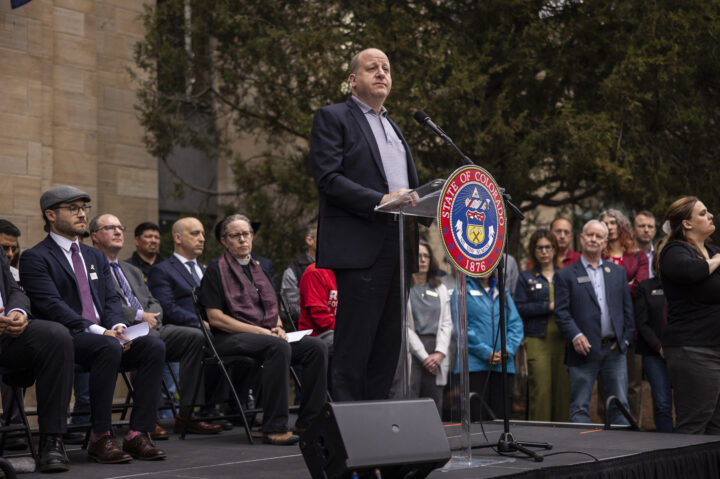
Colorado Governor Jared Polis speaks during a community gathering at the site of an attack against a group people holding a vigil for kidnapped Israeli citizens in Gaza oin Boulder, Colorado on June 4, 2025.


 Add JewishInsider on Google
At the start of a pivotal campaign cycle, Democratic governors will face a politically high-stakes decision this year on a new education policy that President Donald Trump signed into law last year.
One provision of Republicans’ sweeping spending package adopted in 2025 — dubbed the “One Big Beautiful Bill” by Trump — was a measure that provides a dollar-for-dollar federal tax credit for people who donate to approved scholarship organizations that can support a range of education expenses, including private school tuition and tutoring.
Individual states must opt in for taxpayers to be eligible for the credit of up to $1,700 annually.
So far, the policy has been a no-brainer for Republican governors, who already support school choice programs, to allow parents to receive a federal tax credit to support private schools, including religious schools. Twenty-three states have formally opted in as of last month, and at least two other Republican-led states (Florida and Utah) said they plan to do so.
Democratic governors, skeptical of school choice programs and wary of powerful teachers’ unions, face a trickier choice. They have to opt in by the end of the year for taxpayers to be eligible for the credit. The National Education Association urged lawmakers to vote against the bill last year, and has said that “voucher-inspired schemes” like the federal tax credit program “erode public education, the foundation of our democracy.” (An NEA spokesperson declined to comment on Wednesday.)
Orthodox Jewish groups have long supported school choice efforts, including vouchers, while most non-Orthodox groups — including umbrella organizations such as the Jewish federations — sat out those matters in the past or opposed them. Now, Orthodox leaders are being joined by the Jewish Federations of North America as the umbrella group urges Democratic governors to support the bill. The Union for Reform Judaism, which opposed an earlier version of the tax credit that was farther-reaching, ultimately did not come out against the measure.
“We think this should be a priority for the entire Jewish community, to support students, especially in Jewish day schools,” said Rabbi A.D. Motzen, national director of government affairs at Agudath Israel, a major Orthodox organization. “I think it’s very helpful, because in many of those blue states, the more governors see that this is a politically wise idea, and that there is widespread support among different faiths, whether it’s Catholic clergy or Jewish leaders and business leaders, then it will make it easier for them to to opt in.”
Marc Baker, CEO of Combined Jewish Philanthropies, Boston’s Jewish federation, said the tax credit “aligns with CJP’s vision to make day school more affordable and accessible for families in Greater Boston,” and that he plans to discuss it with Massachusetts Gov. Maura Healey, a Democrat.
Part of the pitch that Gil Preuss, CEO of the Jewish Federation of Greater Washington, is making to Democratic leaders in Maryland, Virginia and Washington, is to differentiate the tax credit from more controversial voucher programs.
“I know, particularly for Democratic governors, they place significant value in public education, and we as a Jewish community strongly support public education,” said Preuss. “We don’t believe it’s taking away money from public education, but it is a way for individual households to direct some of their federal taxes.”
Colorado Gov. Jared Polis is so far the Democrat who has expressed the most enthusiasm about the tax-credit scholarship program.
“It supports donors to give more money to our schools,” Polis said in November. “I mean, I would be crazy not to” opt in. A spokesperson for Polis confirmed in December that he plans to add the state to the program.
North Carolina Gov. Josh Stein, a Democrat, has also said he intends to opt in his state once more information is released from the federal government. “School choice is good for students and parents,” Stein said last year. “I intend to opt North Carolina in so we can invest in the public school students most in need of after school programs, tutoring, and other resources.”
A handful of blue-state governors — in Wisconsin, Oregon, New Mexico and Hawaii — have stated they will opt out of the program.
Most Democratic governors, including in states with the largest Jewish communities, are taking a wait-and-see approach, saying they need to see formal regulations from the IRS and the Treasury Department outlining what the funds can be used for and how they can be collected. Activists in the Jewish community working on this issue say they are still in conversation with Democratic governors even though the timeline for implementation is not totally clear.
“The governors that we speak to on a regular basis about this are very clear that they want to see the regulations first, which we don’t hold against them. We think that’s fair. You don’t want to play a game until you see the rules of the game,” said Sydney Altfield, CEO of Teach Coalition, a project of the Orthodox Union that advocates for federal funding for nonpublic schools. “We think that in the long run, it will be a positive outcome, but we understand that there’s no movement yet.”
Rosie Lapowsky, a spokesperson for Pennsylvania Gov. Josh Shapiro, said his administration “is awaiting federal guidance to address key questions about how this program would work, including which students will be eligible, how this federal initiative will interact with existing programs, and more. We look forward to reviewing that guidance.”
A spokesperson for Maryland Gov. Wes Moore said he has not yet taken a position. Alana Davidson, director of communications at the Massachusetts Executive Office of Education, told JI that Gov. Healey “is awaiting official guidance from the U.S. Department of Education and Treasury at this time.”
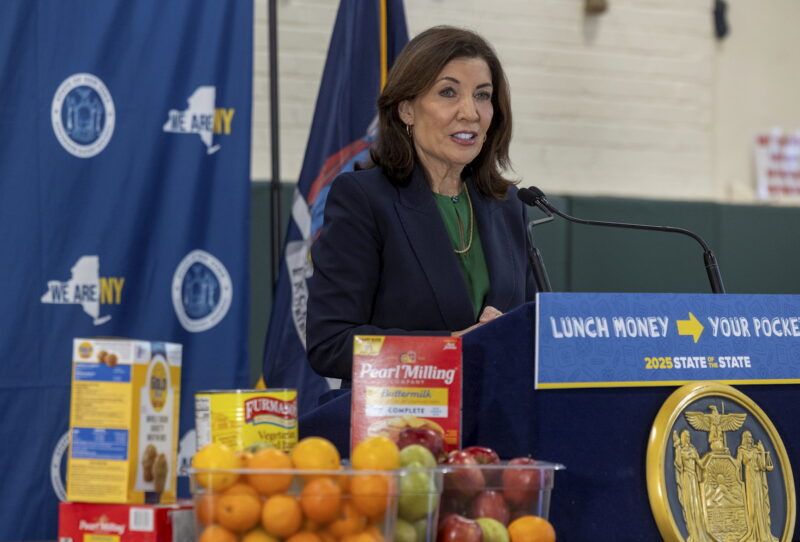
Jen Goodman, a spokesperson for Gov. Kathy Hochul of New York, took a swipe at the Trump administration while saying Hochul has not yet made up her mind.
“While this proposal doesn’t take effect until 2027, it’s surprising that the federal government continues to fail to share any policy details with states,” Goodman told JI. “Gov. Hochul is supportive of anything that would help students and schools, but given this administration’s record of including poison pills in policies, the state needs to thoroughly review the proposal before making commitments.”
Spokespeople for Illinois Gov. JB Pritzker, California Gov. Gavin Newsom, New Jersey Gov. Mikie Sherrill, Washington, D.C., Mayor Muriel Bowser and Virginia Gov. Abigail Spanberger did not respond to requests for comment.
Spanberger is in a different position from other Democrats, because her predecessor — Republican Gov. Glenn Youngkin — already opted Virginia in last month before he left office, so she would have to formally revoke that permission.
Preuss said his goal at the moment is not necessarily to get area governors in the Washington area to a yes anytime soon, with IRS regulations not likely to come out for a few more months. He just wants to convince them to leave the door open.
“It’s very early on,” Preuss said. “We mostly want to make sure that governors do not come out against it.”
More Stories

Super Ball
Robert Kraft’s Blue Square gala pulls in $32 million as NYC’s Waldorf glows blue
SUNSHINE STATE RETREAT
House GOP leadership super PAC pulls ad spending against Jared Moskowitz
VATICAN VISIT
Pope Leo affirms commitment to fighting antisemitism in meeting with AJC leaders
PRAIRIE STATE PRIORITIES
Illinois Democrats spend big for anti-Israel candidate running for state Senate
DEBATE DIGS
Rogers describes El-Sayed as a national security threat in final Michigan Senate debate
MINNESOTA MIC DROP
Jacob Frey, Betty McCollum join Minnesota Dem chorus condemning Piker event
Please log in if you already have a subscription, or subscribe to access the latest updates.
 Continue with Google
 Continue with Apple