





































Arab states unite as Iran strikes every member of Gulf Cooperation Council
UAE and Saudi leaders spoke by phone; the GCC affirmed its ‘right to respond’
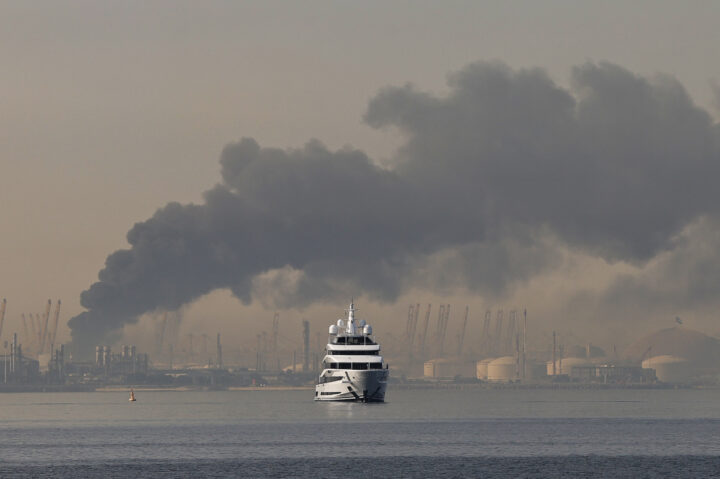
Fadel SENNA / AFP via Getty Images
A yacht sails past a plume of smoke rising from the port of Jebel Ali following a reported Iranian strike in Dubai on March 1, 2026.


 Add JewishInsider on Google
Major Gulf powers are coming together in rare lockstep amid Iran’s strikes around the region, with the United Arab Emirates closing its embassy in Iran and the Gulf Cooperation Council declaring it retains the right to respond.
After the U.S. and Israel launched a major operation against Iran on Saturday, the regime struck sites in at least nine countries around the Middle East, including Israel, Jordan, Syria and every member of the Gulf Cooperation Council — Bahrain, Kuwait, Oman, Qatar, Saudi Arabia and the UAE.
Despite claiming it is aiming at U.S. military assets in the region, Iran has struck widely at civilian infrastructure, including hotels, residential neighborhoods and airports in the UAE, Bahrain, Kuwait and Iraq. At least 12 civilians were killed in Israel over the weekend, along with three U.S. servicemembers.
On Saturday, the first day of the operation, UAE President Mohamed bin Zayed spoke by phone with Saudi Arabia’s Crown Prince Mohammed bin Salman to discuss Iran’s aggression and their response, a significant development and sign of the seriousness of the issue amid a regional rift between the two major powers.
The UAE has taken the brunt of much of Iran’s malign activity — its Ministry of Defense said Sunday that the country had been targeted by 165 ballistic missiles, two cruise missiles and 541 drones from Iran. Three civilians were killed and 58 injured in the barrage.
Shortly after, Abu Dhabi announced the closure of its embassy in Tehran and the withdrawal of its entire diplomatic mission, citing Iran’s “hostile attacks against civilian sites … in a serious and irresponsible escalation [that] constitute a flagrant violation of national sovereignty.” The country’s Ministry of Foreign Affairs also summoned the Iranian ambassador to the UAE and “delivered a strongly worded note of protest” about Iran’s “terrorist attacks and assault.”
Also on Sunday, the ministerial council of the GCC held a meeting over video conference and issued a statement strongly condemning Iran’s attacks and affirming the countries’ “legal right to respond.”
“The Council also expressed full solidarity among the GCC countries and their unified stance in confronting these attacks, stressing that the security of GCC member states is indivisible, and that any attack against any member state constitutes a direct attack against all GCC countries,” the statement went on. The countries “will take all necessary measures to defend their security and stability and to protect their territories, citizens, and residents, including the option of responding to the aggression,” they pledged.
The U.S. also joined the GCC in another statement Sunday, saying that Iran’s “targeting of civilians and of countries not engaged in hostilities is reckless and destabilizing behavior.”
More Stories
DIPLOMACY DIARIES
AJC plans ‘diplomatic marathon’ amid U.N. General Assembly in New York

Daily Kickoff
Vance’s Shabbos Shuva
MICHIGAN MANEUVER
After holding out for weeks, Michigan AG Nessel endorses El-Sayed

CROSSING THE AISLE
Biden envoy Amos Hochstein defends Trump admin’s nuclear deal with Saudi Arabia
ALTERNATE REALITY
Pezeshkian denies Iran seeks nuclear weapons at UNGA
Daily Overtime
Bibi takes on Mamdani, Qatar, Turkey at U.N.
Please log in if you already have a subscription, or subscribe to access the latest updates.
 Continue with Google
 Continue with Apple