


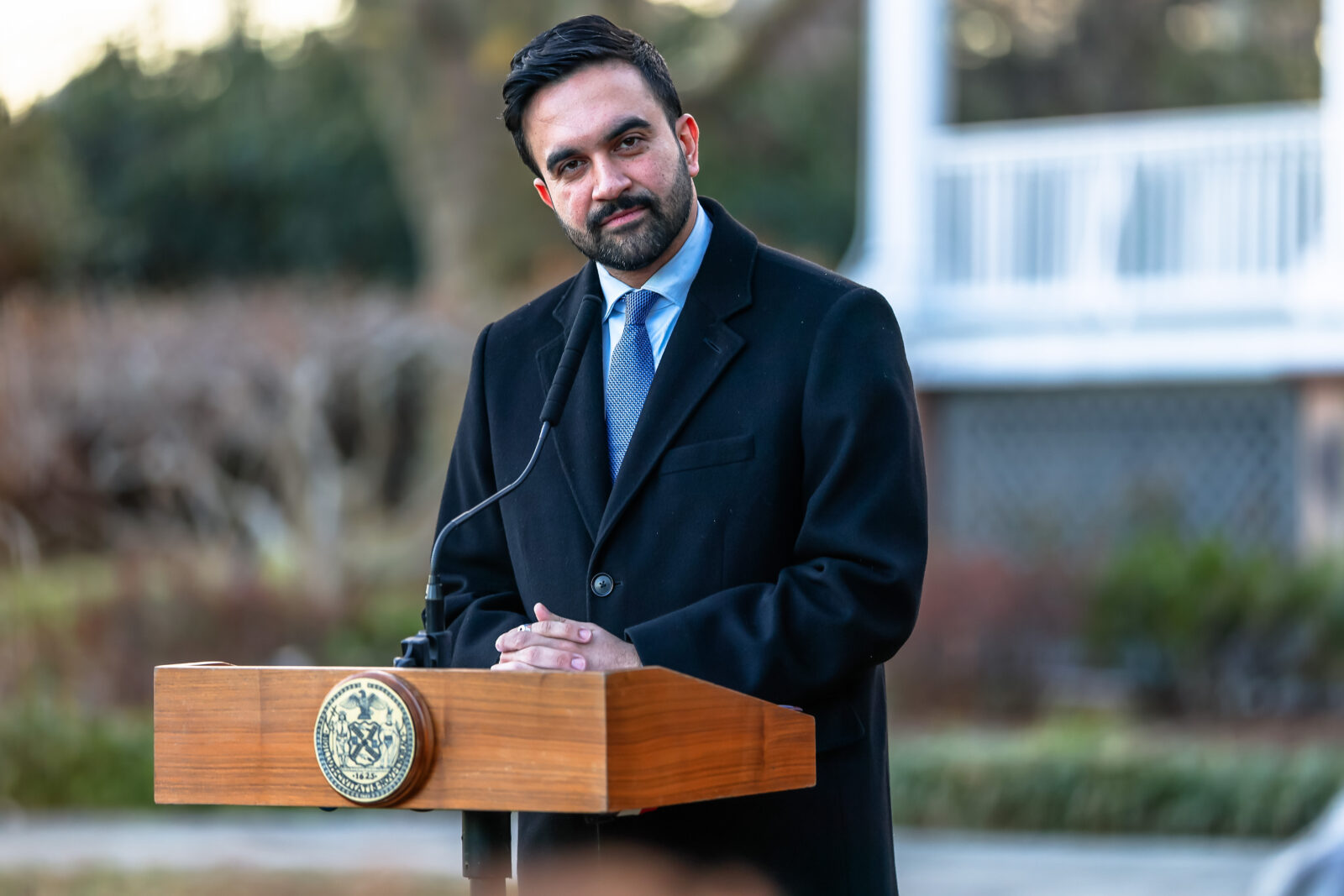
Michael M. Santiago/Getty Images
Mamdani, socialist allies face first electoral test in battle for NYC House seat
The fight to succeed Rep. Nydia Velazquez pits Mamdani and the DSA faithful against the congresswoman and her protege


 Add JewishInsider on Google
New York City Mayor Zohran Mamdani and his allies in the Democratic Socialists of America are set on contesting congressional turf home to one of the city’s biggest Hasidic Jewish communities — setting up a battle royale in the 7th Congressional District that could either blunt Mamdani’s brand of socialist politics, or bolster the new mayor and his far-left supporters.
Mamdani was only days into his term when he endorsed New York state Assemblymember Claire Valdez, who, like Mamdani, is a DSA member, to succeed retiring Rep. Nydia Velázquez (D-NY), whose district delivered Mamdani’s strongest primary margins last year and contains most of the so-called “commie corridor”: a chain of trendy, gentrifying Brooklyn and Queens neighborhoods where socialist support runs strong.
Velázquez, meanwhile, has backed Brooklyn Borough President Antonio Reynoso to be her successor, and some community and labor organizations have aligned behind him, pitting Mamdani’s hard-left bloc against the older progressive establishment.
Mamdani has so far been cautious in spending his political capital on behalf of DSA allies. Even before entering City Hall, Mamdani scuttled a left-flank challenge to House Minority Leader Hakeem Jeffries (D-NY) and persuaded a DSA-aligned city councilwoman to drop her bid against Rep. Dan Goldman (D-NY) to consolidate a left-wing lane for former city Comptroller Brad Lander.
Democratic observers who spoke to Jewish Insider were split over whether Mamdani is steering DSA or DSA is steering the mayor.
But Mamdani has now put his name and credibility on the line in this race, argued veteran Democratic strategist Hank Sheinkopf.
“He’s not a mayor. He’s a movement,” Sheinkopf said. “If he beats [Velázquez’s candidate], he gets more powerful than he’s ever been. As long as you’re winning, people are afraid of you. You start losing, the fear is no longer there and it makes him less significant.”
Not long ago, Velázquez and Reynoso themselves were considered the left wing of the party, defying the once-feared power of the Brooklyn Democratic machine, helping to build a coalition of idealistic new arrivals, community groups, unions and longtime political reform organizations that became the dominant force in the borough’s politics. But the political struggles of the last 20 years are long forgotten, and with the rise of DSA and Mamdani, the residents of what local political observers have humorously tagged the “commie corridor” are no longer content to be one factor among many — or to accept compromise candidates — in their demographic heartland.
“Progressive’s not good enough any more. If you aren’t part of the DSA, that isn’t enough,” said Marcos Masri, a political consultant and native of the district. “They are hungry, they want to hold the reins.”
Valdez’s career path is stereotypical for a DSA member. The daughter of an engineer from Texas, she studied sculpture at the prestigious School of the Art Institute in Chicago before arriving in New York for a job at a Queens-based museum. She then took a role in the visual arts department at Columbia University, and pivoted from creative pursuits to politics when an organizer recruited her to a bargaining unit for the United Auto Workers — itself amid a pivot in New York from its old base of industrial employees and dealership mechanics to radicalized grad students and administrative workers.
At Local 2110, Valdez signed an open letter just weeks after the Oct. 7, 2023, Hamas terror attacks that blasted the American labor movement for its historic support of Israel, and demanded the UAW as a whole embrace the Boycott, Divestment, and Sanctions movement against Israel. The letter makes no reference to the Hamas massacre in Israel that incited the latest phase of conflict.
“Workers in the U.S. are struggling against many of the same capitalist forces that maintain and bolster the Israeli occupation of Palestine. These forces rely on racialized exploitation, dispossession, and policing in the United States and around the world,” reads the missive, which makes no mention of Hamas or the then-fresh terror attacks. “A global class of workers will not achieve liberation if fragmented by colonization, apartheid, and borders. These are the structures on which an ascendant global fascist movement is shoring up white supremacy, nativism, militarism, heteropatriarchy, and other tools of oppression to further divide us.”
The epistle ends with the sign-off “Until Liberation and Return.” A little over a year later, Valdez won election as a DSA-backed insurgent to the New York state Assembly, where she co-sponsored Mamdani’s “Not on our dime!: Ending New York funding of Israeli settler violence act.” This legislation would forbid nonprofit organizations in New York from “unauthorized support of Israeli settlement activity,” including in Jerusalem, and establish both monetary penalties as well as a basis for individual lawsuits for damages.
Reynoso, born in Brooklyn to Dominican immigrant parents, has followed a more traditional political career path. He served as an organizer for the now-defunct Association of Community Organizations for Reform Now (ACORN), before he joined the staff of City Councilwoman Diana Reyna. He succeeded Reyna in the City Council in 2013, part of a progressive wave that also lifted Bill de Blasio to the mayoralty, and participated in a council trip to Israel in 2015 over the protests of some activists. He won the largely symbolic borough president’s office in 2021.
A Valdez victory would enhance both DSA and Mamdani’s reach and prestige, said Sheinkopf, as well as give the mayor “a wedge” against the more pragmatic Jeffries in the House. If Reynoso wins the seat, Masri said it would show the mayor and his socialist cadres still depend on other, older institutional actors to win and exercise power, and their clout — and ability to pressure elected officials leftward — would diminish.
But the race promises to be a test, too, for the district’s large Hasidic Jewish community, the bulk of whom belong to the Satmar movement. Despite their religious objections to Zionism and strong network of social service networks that rely on city funding — and despite a few of their rabbis’ receptiveness toward Mamdani — sources predicted the group’s leaders would largely endorse Reynoso. The borough president, who had an at-times fraught relationship with Satmar leadership in the City Council, has heavily networked within the community in his current role.
But Masri questioned whether the community’s mobilization would match the inevitable DSA get-out-the-vote campaign, which will draw on a city-spanning web of activists to knock doors for Valdez.
Further complicating the picture is the recent entry of another Democrat, Councilwoman Julie Won, into the contest. Won, who filed paperwork to run on Monday, has little institutional support, but could scrape off more centrist or right-leaning voters who might otherwise support Reynoso.
“If it’s a very close race, and she pulls like 2,000 votes, that is something that can decide the race,” Masri said.
Sheinkopf was more bullish on Reynoso’s prospects, noting the political organization and trust Velázquez, his backer, built during her 16 terms in Congress. He argued Mamdani risks alienating potential progressive allies loyal to the borough president and congresswoman as he seeks to expand his socialist domain.
“He believes he is immune from any blowback,” the strategist said. “This is not a credit card with unending credit. At some point the credit runs out. The shine runs out. You can’t do this forever.”
Featured Stories
partnership pitch
Somaliland president discusses expanded military cooperation with U.S. officials
ENVOY DEBATE
Congressional Jewish Caucus opposes proposal to combine State Dept. Holocaust, antisemitism offices
FAMILY TRAGEDY
Israeli ambassador’s son seriously wounded in West Bank car-ramming attack
Please log in if you already have a subscription, or subscribe to access the latest updates.
 Continue with Google
 Continue with Apple