

























































After classified briefing, senators reject claims Israel forced U.S. into Iran war
Republicans and some Democrats insisted Trump made the decision, while other Democrats said that the timing of the onset of hostilities was impacted by Israel’s plans
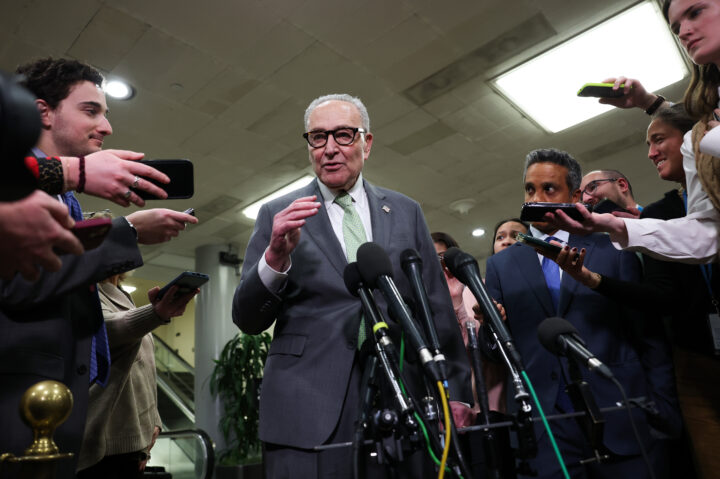
Anna Moneymaker/Getty Images
Senate Minority Leader Charles Schumer (D-NY) speaks to the media after briefings on Iran at the U.S. Capitol on March 3, 2026 in Washington, DC.


 Add JewishInsider on Google
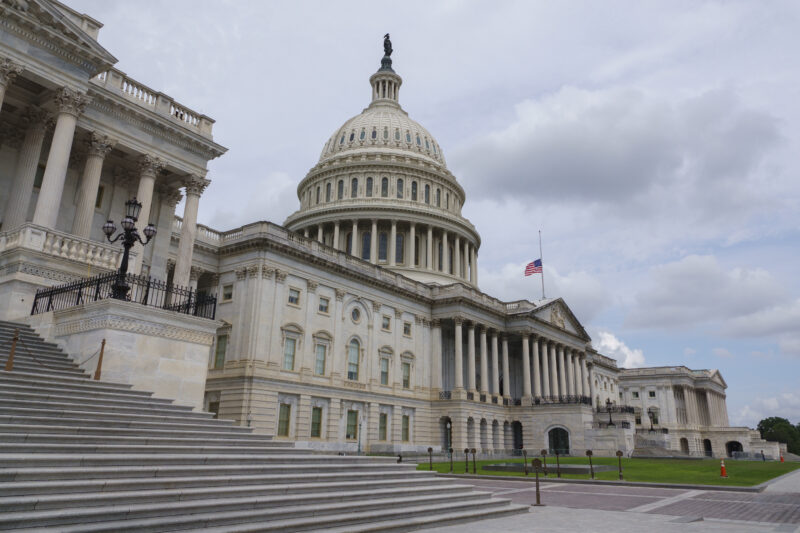
Following a classified briefing on Tuesday, Senate Republicans strongly rejected claims that Israel had effectively forced the U.S.’ hand into war with Iran or dictated the timeline of the conflict, claims that were fueled by comments on Monday by Secretary of State Marco Rubio and top lawmakers who were briefed on the Trump administration’s plans.
Sen. Rick Scott (R-FL) told Jewish Insider he had been in touch with the administration since the war began, and that no one in the administration had told him that Israel had triggered the U.S. to act.
“Anybody that thinks they’re going to get President Trump to do anything — talk to anybody that’s done business with him for his entire business career,” Sen. Markwayne Mullin (R-OK) told JI, calling the idea that Israel had forced Trump’s hand “a joke.”
Sen. John Hoeven (R-ND) added, ”We work very closely with our ally Israel for maximum effect to take out Iran’s capabilities when they are the weakest so we minimize the risk to our military and civilians in the region.”
Democrats also distanced themselves from the narrative that emerged on Monday.
Asked whether Israel had prompted the start of hostilities, Senate Minority Leader Chuck Schumer (D-NY), who was also briefed on Monday, told JI, “No one wants an endless war, but we certainly don’t want a nuclear Iran, that’s for sure.”
Sen. Andy Kim (D-NJ) said that the responsibility for the operation “always falls squarely on President Trump. Regardless of what other countries are doing, he is the one that owns this.”
“Look, I certainly have my concerns about how this all unfolded, but I think it’s very important for the American people to know that this was still Donald Trump’s decision,” Kim continued.
Other Democrats framed the narrative as one of several shifting explanations the administration has offered.
Sen. Cory Booker (D-NJ) said that the administration “jump[s] around until they think they found an explanation that could satisfy the most people. They have changed their justification for this time and time again, and we got nothing that even approached a justifiable reason for the president to commit an act of war.”
Rep. Greg Meeks (D-NY), the ranking member of the House Foreign Affairs Committee, also said that placing responsibility with Israel was one of just several shifting rationales. “Each day, sometimes twice a day, the rationale for doing this changes. That tells me it is not serious.”
Other Democrats, however, said that the timing of the onset of hostilities was impacted by Israel’s plans.
“The way we got into this war, I think, put the principal decision in another country’s hands, rather than ours, and did not lead to preparations in advance of the war starting that protected as many Americans as possible,” Sen. Chris Coons (D-DE) said.
Democrats supporting the war powers resolution set to come up for a vote in the Senate on Wednesday — which mandates the withdrawal of U.S. forces from combat with Iran — argued on Tuesday that the resolution would nevertheless allow some sort of wind-down of U.S. operations, as U.S. bases and embassies come under fire by Iran, though they did not offer specifics.
“I think they’d be allowed to conduct the completion of the operation,” Sen. Brian Schatz (D-HI) said.
Sen. Adam Schiff (D-CA), a cosponsor of the war powers resolution, said, “It would require an end to the use of force. I’m sure it would permit the safe drawdown of our forces in the region, but it would insist on the president coming to Congress to seek an authorization, to make the case — if indeed he believes there’s a case to be made.”
Though the resolution “terminate[s] the use of United States Armed Forces from hostilities against the Islamic Republic of Iran or any part of its government or military,” Meeks said that the resolution “does not say that the president has to move everybody out.”
“It says, though, that he has to come and talk to us and tell us what the end game, what the beginning game is. We just cannot get involved in the hostilities, as of right now,” Meeks told JI. “Israel will do what it’s doing, I would imagine. But the American people need to know where their members of Congress stand.” He’s supporting a similar resolution in the House.
Sen. Tim Kaine (D-VA), the lead sponsor of the war powers resolution, said that if it fails as expected, he can and may continue re-filing the resolution as the war continues, and as casualties and disruptions mount. He said that Democrats are also contemplating other measures, such as using the appropriations process or amendments to other legislation, to force lawmakers to vote on the war.
Several Democrats also said Congress should vote on an authorization for use of military force, in addition to the war powers resolution. Sen. Chris Murphy (D-CT) said that Senate Democrats should refuse to provide votes on any legislation until such a vote occurs.
Meeks said he expects that the conflict will still be ongoing in 60 days, the end of the period in which the administration is legally allowed to conduct unilateral operations without congressional authorization.
Lawmakers offered differing views on whether American ground operations inside Iran are likely.
Scott said that the U.S. shouldn’t take a ground invasion off the table but he was hopeful that the mission could be accomplished through airstrikes.
“You never take that off the table. That would be stupid. That’s what Obama did, and that’s what Biden did. We’d never do that,” Scott said. He said he did not think congressional authorization would be needed to send in troops on the ground, which others see as a significant escalation.
Sen. Josh Hawley (R-MO) said that Trump “hasn’t ruled it out, but I’d urge him to rule it out” and said that a congressional authorization would, in his view, be necessary to put boots on the ground.
Sen. Richard Blumenthal (D-CT) said his takeaway from the briefing is that U.S. ground forces “may be necessary to accomplish objectives that the administration seems to have.”
Trump reportedly spoke this weekend to Kurdish leaders about potentially launching an offensive against the Iranian regime, but Kim said that the subject did not come up in the briefing.
“You wouldn’t be having those conversations if you weren’t thinking about maybe getting different actors on the ground,” Kim told JI. “It very much feels like they are fomenting, potentially, different groups on the ground to start to get engaged in what will essentially be what happened in Syria before, what happened in Libya before. And so if they are trying to start a civil war, this is a very good way to go about it.”
Senators, particularly Democrats, also said after the briefing that Cabinet officials told them to expect stronger strikes going forward, and that the past few days have been the beginning of a much longer operation.
“This is the most significant military action this country has taken since the Iraq war. … They told us in there that this is an open-ended operation that hasn’t even really started in earnest yet,” Murphy said.
Sen. Lindsey Graham (R-SC) said that he believes the U.S. coalition against Iran is expanding, making the “demise of the regime far more likely” every day, adding, “Stay tuned … the liberation of Iran is at hand. The gateway to peace is about to open.” He predicted that normalization between Israel and additional Arab countries would be forthcoming.
Coons warned that the U.S. should be “careful” about how it addresses Iranian dissidents, emphasizing there was no plan he was aware of to send assistance, troops or arms to allow them to defend themselves from the Iranian security apparatus, which he said remains fully capable of repressing civilians. He said he’s “heard nothing that suggests” that enough of the regime has been eliminated to allow for a mass uprising.
Kim said that he is “very concerned” about the U.S.’ stockpiles of air defense interceptors, and “did not get a satisfactory answer,” though some Republicans said they believed U.S. munitions supplies are sufficient.
Kim said he believes that the interceptor stockpiles for both the U.S. and its Arab allies will be a “determining factor for the length of this war, as well as whether other countries are getting involved.”
More Stories
HISTORY LESSON
Brett McGurk’s fact check of former Harris advisor Phil Gordon on hostage negotiations

GOING GLOBAL
Israeli, Lebanese leaders expressed interest in Michigan Senate race, Sen. Lankford says

booking bias
Irish Jewish leader says Dublin hotel canceled guest rooms for conference on fighting antisemitism

MAINE EVENT
Maine Senate candidate Troy Jackson says Congress should cut off funding for Iran war
PROBLEMATIC POST
Paxton senior advisor endorsed antisemitic slur on social media
SEEKING ANSWERS
After State Department memorial, families of Oct. 7’s American victims call for U.S.-led probe
Please log in if you already have a subscription, or subscribe to access the latest updates.
 Continue with Google
 Continue with Apple