




































The strikes reportedly targeted air-defense systems, radars and drone command-and-control units in southern Iran

ATTA KENARE / AFP via Getty Images
Explosions erupt following strikes at Tehran Oil Refinery in Tehran on March 7, 2026.


 Add JewishInsider on Google
CENTCOM announced on Wednesday evening that it had begun launching additional “self-defense” strikes against multiple targets in Iran, after initially renewing its attacks on Tuesday. A U.S. official told Axios the latest targets included air-defense systems, radars and drone command-and-control units in southern Iran.
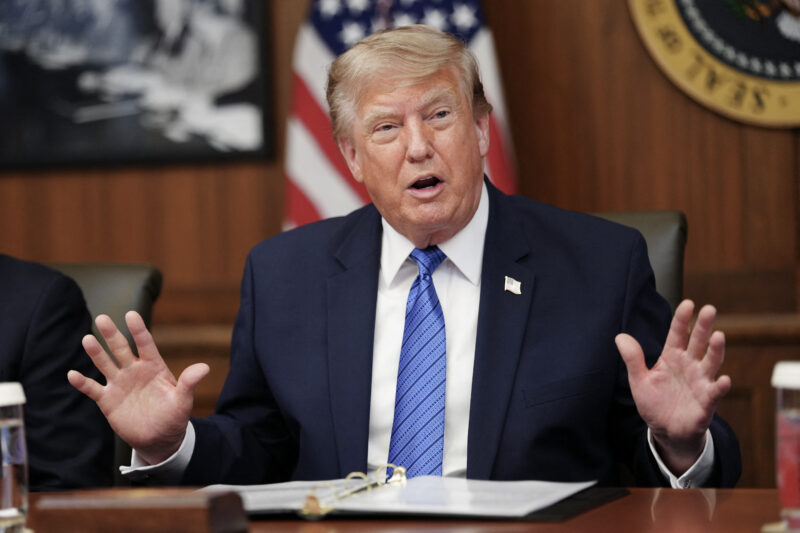
The strikes came hours after President Donald Trump met with his national security team to discuss military options, and as Defense Secretary Pete Hegseth told reporters that CENTCOM would be “busy tonight” with “bombs dropping on key facilities in Iran.”
The military action came as Qatari mediators were reportedly meeting with officials in Tehran in an effort to revive negotiations and close remaining gaps between the U.S. and Iran.
Earlier in the day, Trump raised the possibility of targeting Iranian power plants and bridges, expressing frustration that Tehran is, in his view, stringing the U.S. along in diplomatic discussions. The strikes ultimately focused on military targets, according to a U.S. official.
Plus, Ron Klain goes to bat for Platner

Getty Images
A large plume of smoke rises over Tehran after explosions were reported in the city during the night on March 28, 2026 in Tehran, Iran.
This P.M. edition is reserved for our premium subscribers like you — offering a forward-focused read on what we’re tracking now and what’s coming next.
Today’s Daily Overtime was curated by JI U.S. Editor Danielle Cohen-Kanik.
📡On Our Radar
Notable developments and interesting tidbits we’re tracking
After the U.S. conducted strikes yesterday in Iran, President Donald Trump said from the Oval Office this morning that the U.S. would “hit them hard again today” and told Fox News that he may target Iranian power plants and bridges because Tehran is “tapping the United States along” in negotiations.
As Trump convened his national security team in Washington this afternoon to discuss military options, Defense Secretary Pete Hegseth told reporters CENTCOM will be “busy tonight” with “bombs dropping on key facilities in Iran”…
Trump also revealed today that he directed the U.S. military last month to “execute a secret mission” to assist oil tankers and other commercial vessels in transiting the Strait of Hormuz, an effort that “has resulted in more than 100 MILLION Barrels of Oil” and over 200 commercial ships moving through the waterway. His Truth Social post was a clarification of earlier comments that seemed to suggest the U.S. was stealing this oil directly out of Iran; U.S. operations to facilitate passage in the strait have been previously reported…
Trump provided Fox News with new details of the downing of the U.S. Army helicopter earlier this week, describing how an Iranian drone became lodged between the two pilots in the cockpit who guided the helicopter into the sea, where they were rescued “for the first time in U.S. military history” by an unmanned sea drone…
Qatari mediators visited Tehran today in the hopes of pushing Iranian officials to engage more effectively in negotiations with the U.S., Axios reports, after Trump had grown increasingly frustrated with their intransigence over the last two weeks, even as he continued to signal the two sides were approaching a deal…
U.S. Ambassador to the U.N. Mike Waltz met with UAE Foreign Minister Abdullah bin Zayed Al Nahyan in Abu Dhabi, the highest-level U.S. official to publicly visit the Gulf since the Iran war began…
Israeli Prime Minister Benjamin Netanyahu blasted Turkish President Recep Tayyip Erdoğan as an “antisemitic dictator” today after Erdoğan condemned Israel’s “network of murder” in Syria and Lebanon and threatened a “very clear and strong response” if Turkish interests in the region were jeopardized. Netanyahu said Erdoğan, whom he accused of supporting Hamas, lacks the moral authority to criticize Israel.
Trump, when asked in the Oval Office about the potential for war between Israel and Turkey, described Erdoğan as a “hell of a leader” and said, “I don’t think that will happen as long as I’m president”…
More than 20 countries, including the U.S., issued a joint statement condemning “lethal plotting and malign actions” by Iran’s security forces working with international and local criminal groups in Europe, North America and Australia, including their efforts to target “Iranian dissidents, journalists and Jewish and Israeli communities and interests”…
The Department of Justice indicted eight individuals associated with the University of Michigan for allegedly threatening university leaders, law enforcement, businesses and the Jewish Federation of Metropolitan Detroit over the conspirators’ perception of their “purported financial support of Israel.”
The individuals “discussed methods by which to harm the targets and their families, including poison, bombs, and psychological torture,” engaged in extensive vandalism and threw jars filled with noxious chemicals into homes, according to the department…
An immigration judge ordered earlier this month that Columbia University anti-Israel protest leader Mohsen Mahdawi be deported to Jordan, after a lengthy legal battle in which the Trump administration claimed Mahdawi has been involved in and supported terrorist violence. Mahdawi, who has not been charged with a crime, is still seeking review of his removal proceedings in federal court…
The Senate Education and Natural Resources Committee advanced the Holocaust Education and Antisemitism Lessons (HEAL) Act by a voice vote…
The National Republican Senatorial Committee, in a memo to donors, acknowledged that the “political fundamentals in Maine remain challenging” for Sen. Susan Collins (R-ME) to retain her seat against scandal-plagued challenger Graham Platnerand called it a “fatal mistake to assume Platner is too damaged to win”…
Trump offered Collins his backing today after having long been at odds with the senator: Asked if she has his full endorsement, Trump said, “She does, because she’s a sane woman. She’s not my best friend at all … but she’s a sane person and she’s a respected person.” He called Platner a “thug,” a “phony” and a “bad person”…
Ron Klain, the former chief of staff to President Joe Biden, defended Platner’s tattoo of a Nazi symbol in a comment responding to the Republican Jewish Coalition on Instagram, Jewish Insider’s Marc Rod reports: Klain claimed the Totenkopf “was a skull and crossbones to remember [Platner’s] fallen comrades from his service in Afghanistan,” an explanation Platner’s campaign has not previously offered…
Former New York City Comptroller Brad Lander, running against Rep. Dan Goldman (D-NY) in the 10th Congressional District, denied to JI’s Will Bredderman that he’s backing Darializa Avila Chevalier in her race against Rep. Adriano Espaillat (D-NY) — even as the two appeared together in an ad paid for jointly by both of their campaigns…
Kennedy scion Jack Schlossberg, running in the Democratic primary for New York’s 12th District, came out yesterday in support of the Block the Bombs Act, JI’s Matthew Kassel reports, despite having previously expressed skepticism about the bill seeking to broadly restrict weapons sales to Israel…
Meanwhile, Public First Action, the PAC linked to AI giant Anthropic, is spending $1.2 million on a Knicks-themed ad in support of Schlossberg’s opponent, Alex Bores, who has become a leading advocate for AI regulation on the campaign trail. The ad is set to air tonight during Game 4 of the NBA Finals, Politico reports…
⏩ Tomorrow’s Agenda, Today
An early look at tomorrow’s storylines and schedule to keep you a step ahead
Keep an eye out in Jewish Insider for a look at the state of play in Israel’s elections, taking place this fall.
The House Appropriations Defense Subcommittee will hold a closed-door markup of the 2027 defense spending bill.
Reps. Don Beyer (D-VA) and Ritchie Torres (D-NY) will speak at a Progressive Policy Institute event on “Working Toward a New Era of Patriotism and Democratic Renewal” at the National Press Club in Washington.
Stories You May Have Missed
SIDESTEPPING QUESTIONS
Senior House Democrats profess ignorance of Hamawy’s controversial past
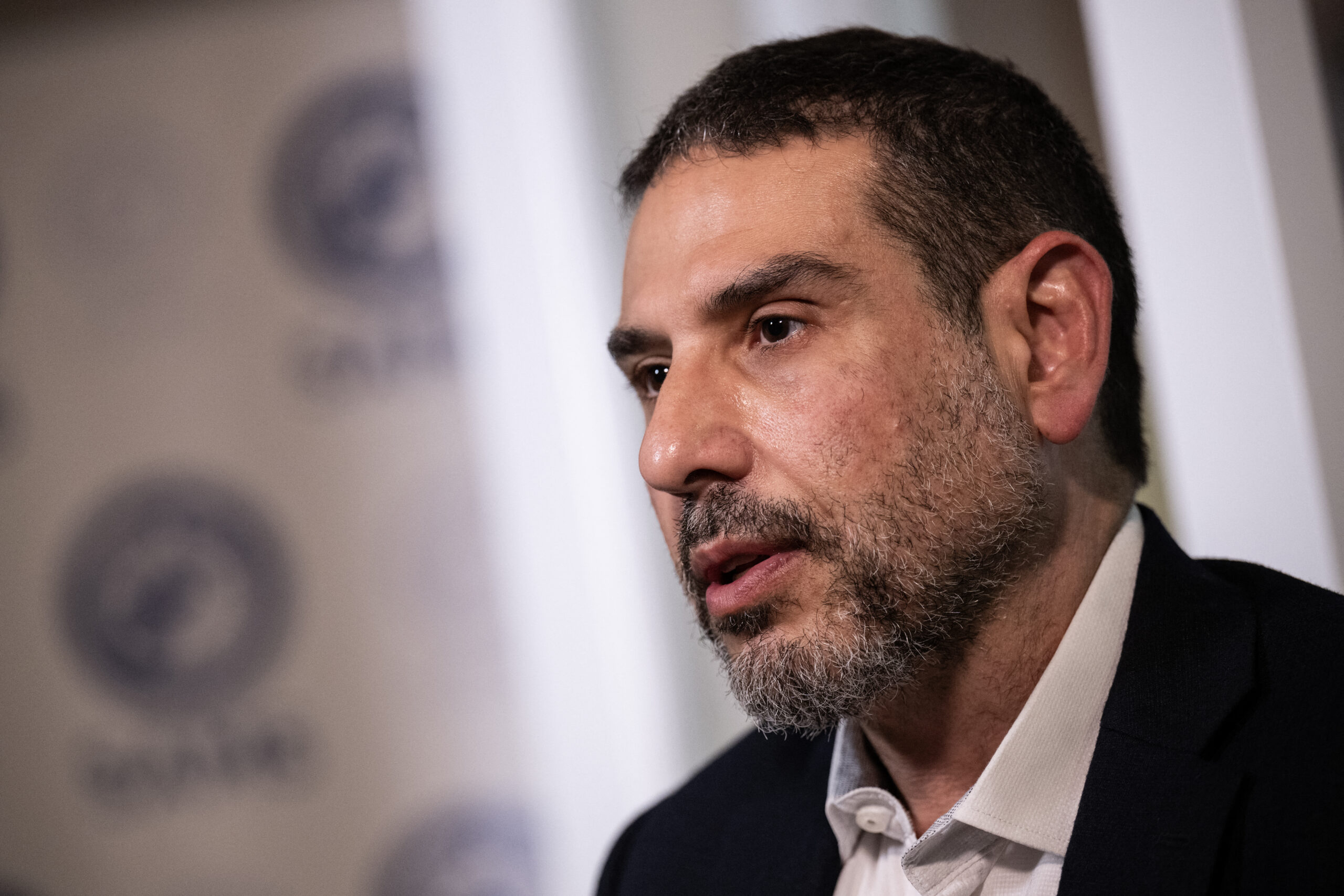
House Foreign Affairs Committee ranking member Greg Meeks said of the Democratic N.J. congressional nominee, ‘I don’t like to talk about somebody I don’t know’
LASHING OUT
Micah Lasher says he’s ‘exhausted’ by political ‘obsession’ with Israel

The Democratic congressional hopeful aired his frustration when asked about his stance regarding U.S. aid to the Jewish state at a candidate forum
The president told Fox News that Washington is nearing a decision on additional strikes against Iran, arguing that Tehran has dragged out negotiations and must now ‘pay the price’
Getty Images
A large plume of smoke rises over Tehran after explosions were reported in the city during the night on March 28, 2026 in Tehran, Iran.
President Donald Trump said on Wednesday morning that the U.S. could soon launch additional strikes against Iranian power plants and bridges, raising the prospect of a broader military campaign against Tehran as he accused Iran of dragging the U.S. along in diplomatic negotiations.
The president’s comments to Fox News’ Trey Yingst came hours after the U.S. military announced it had targeted Iranian air defense, ground control and surveillance radar sites in response to Iran downing a U.S. Army helicopter on Monday. Iranian state media, meanwhile, claimed attacks on U.S. military facilities in Bahrain, Kuwait and Jordan.
Trump said in a post on Truth Social on Wednesday morning that Iran had “taken too long to negotiate a deal that would have been great for them” and warned that Tehran would now “have to pay the price.”
Trump made similar threats regarding targeting Iranian power plants and bridges as a way to escalate hostilities when he was unsatisfied with negotiations in April, though such strikes were not carried out.
Trump also disclosed new details about the incident that precipitated the latest U.S. action: According to the president, an Iranian drone became lodged between the two pilots of a U.S. Apache helicopter who guided the helicopter into the sea, where they were rescued “for the first time in U.S. military history” by an unmanned sea drone.
Plus, Israeli confidence in Trump hits new low

U.S. Navy via Getty Images
A U.S. Sailor signals the launch of an MH-60R Sea Hawk helicopter, attached to Helicopter Maritime Strike Squadron 70, on the flight deck of the world's largest aircraft carrier, USS Gerald R. Ford (CVN 78), while supporting Operation Epic Fury on February 28, 2026.
This P.M. edition is reserved for our premium subscribers like you — offering a forward-focused read on what we’re tracking now and what’s coming next.
Today’s Daily Overtime was curated by JI U.S. Editor Danielle Cohen-Kanik.
📡On Our Radar
Notable developments and interesting tidbits we’re tracking
President Donald Trump announced today that Iran was responsible for downing a U.S. Apache helicopter over the Strait of Hormuz last night, and vowed to respond out “of necessity.” Trump had reportedly told aides his “red line” for resuming military action would be if Iran killed any more Americans, though he confirmed in his post on Truth Social that both American pilots involved were “safe and uninjured.”
Later, however, in a call with The Wall Street Journal, Trump appeared to downplay the incident, saying it “wasn’t a big deal” and that “the pilot is fine”…
Top GOP lawmakers echoed Trump’s initial assessment that the U.S. must respond: Sen. Ted Cruz (R-TX) told Jewish Insider’s Matthew Shea that Iran should face “significant consequences.” Rep. Mike Rogers (R-AL), chairman of the House Armed Services Committee, similarly said the U.S. must “vigorously respond,” and Sen. Ted Budd (R-NC) pushed for “decisive action”…
Iranian Foreign Minister Abbas Araghchi signaled that Tehran is distancing itself from the episodeand not claiming it as a direct attack on the U.S. He said in a statement, “Foreign forces in proximity to our territory are at constant risk on account of their own human errors, plain accidents, or potentially being caught in crossfire. To reduce risk, best solution is for them to leave”…
Trump, speaking to ABC News, openly mused about whether Israeli Prime Minister Benjamin Netanyahu “even wants to continue” and run in Israel’s upcoming elections, slated to take place this fall. “He’s a wartime prime minister. We will very shortly win the war one way or the other, and you know he’s a wartime prime minister,” Trump said…
A gunman from Lebanon entered Israeli territory and fired on IDF troops, who killed him before he crossed the border fence, the IDF said. The infiltration set off a widespread search for potential accomplices, though none were found…
Before the latest round of missile fire between Israel and Iran, U.S. and Iranian negotiators had focused their discussions on four major elements of a nuclear deal, officials told The New York Times, even as the Trump administration has said nuclear issues will be discussed in a subsequent round of negotiations.
The key points reportedly include how long Iran will suspend uranium enrichment, diluting the country’s stockpile of already enriched uranium, dismantling three of its major nuclear facilities and “snap” inspections of all relevant sites inside the country…
A new survey from the Israel Democracy Institute found the share of Israelis who believe the country’s security is a primary consideration for Trump has plummeted to 44%, down from 60% who said the same in March at the beginning of the Iran war, JI’s Matthew Shea reports.
It’s the lowest level of Israeli trust in Trump since the institute began tracking the metric when he was elected to a second term in November 2024, coming as Washington and Jerusalem seemingly diverge on their strategies and ultimate goals of the war with Iran…
Twenty-one countries issued a joint statement urging Israel not to implement a new law requiring international NGOs wanting to operate in the West Bank and Gaza to register with and be vetted by the Israeli government, calling the law “part of a broader pattern of restrictive measures” that “constrain the urgently needed humanitarian response.”
Israel’s Foreign Ministry dismissed the concerns and claims of the countries as “completely unfounded and detached from reality” as it said there are “immense amounts of humanitarian aid entering the Gaza Strip”…
Randy Villegas, a left-wing Democrat running to unseat Rep. David Valadao (R-CA) in California, claimed victory today in the jungle primary over Jasmeet Bains, a moderate Democrat who had been favored by pro-Israel leaders as well as the party’s national leadership, JI’s Matthew Kassel reports. Democratic Majority for Israel’s super PAC had spent heavily to help Bains with a $500,000 TV ad buy opposing Villegas…
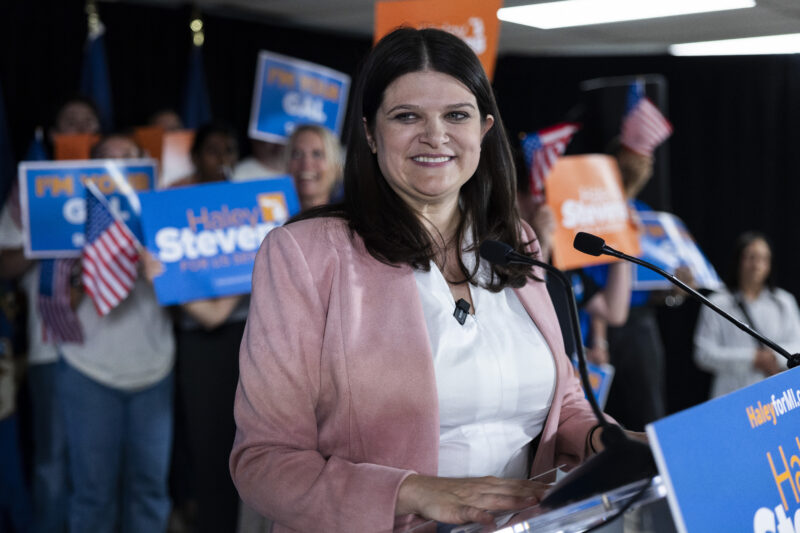
United Democracy Project, the AIPAC-affiliated super PAC, is spending $2 million on an initial ad buy this week to boost Rep. Haley Stevens (D-MI) in the Democratic primary for Michigan’s open Senate seat, a UDP spokesperson confirmed to JI’s Matthew Kassel. The ad touts Stevens’ record fighting for the auto industry, opposing Medicare cuts and working to cap insulin prices in Congress…
⏩ Tomorrow’s Agenda, Today
An early look at tomorrow’s storylines and schedule to keep you a step ahead
Keep an eye out for timely analysis of today’s primary election results in Maine, Nevada and South Carolina from Jewish Insider Editor-in-Chief Josh Kraushaar — premium JI subscribers like you will receive it first.
The Senate Energy & Natural Resources Committee will hold a markup of the HEAL Act, a bipartisan bill examining Holocaust education efforts across the country.
The Culture for Peace Institute will hold a conference in Washington with speakers including State Department antisemitism envoy Rabbi Yehuda Kaploun; Sens. John Fetterman (D-PA) and Dan Sullivan (R-AK); and Reps. Nick LaLota (R-NY), Randy Fine (R-FL), Andy Barr (R-KY), Mike Lawler (R-NY), Max Miller (R-OH), Tom Suozzi (D-NY), Elise Stefanik (R-NY) and Derrick Van Orden (R-WI).
Elsewhere in Washington, Iran International will hold a town hall focused on the conflicts in Lebanon and Iran, featuring the Middle East Institute’s David Hale and Alex Vatanka as well as Dan Diker, president of the Jerusalem Center for Security and Foreign Affairs.
In the evening, lawmakers will take the field for the annual Congressional Baseball Game at Nationals Park.
In New York, the Conference of Presidents of Major American Jewish Organizations will hold its annual antisemitism convening, bringing together communal professionals, experts and others to discuss efforts to combat antisemitism.
New York state Assemblymember Claire Valdez, Brooklyn Borough President Antonio Reynoso and City Councilmember Julie Won — the top Democratic candidates for New York’s 7th Congressional District to replace retiring Rep. Nydia Velázquez (D-NY) — will face off for a debate on local news channel PIX11.
The Auschwitz Jewish Center Foundation will honor New York City Council Speaker Julie Menin, former Israeli hostage Elkana Bohbot and Gazan human rights lawyer Moumen Al-Natour at its gala in Manhattan.
Stories You May Have Missed
MOUNTING SCRUTINY
Will Avila Chevalier’s ‘beyond the pale’ views sink the DSA challenger’s campaign against Espaillat?
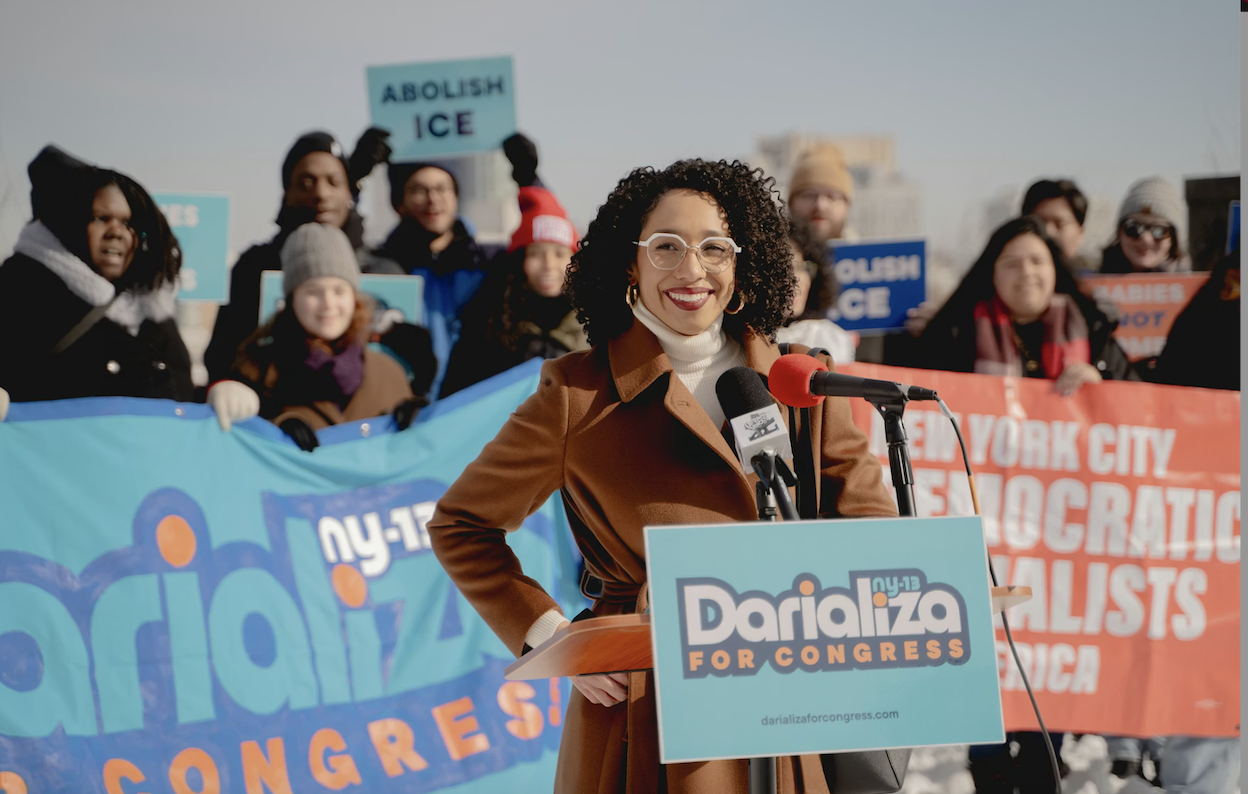
Avila Chevalier has a long record of extreme views, including calling for the abolition of police, voicing pro-Russia sentiment and rejecting Israel’s existence
SPECTATOR SPECTACLE
A who’s who of notables packed Madison Square Garden for Game 3 of the NBA Finals
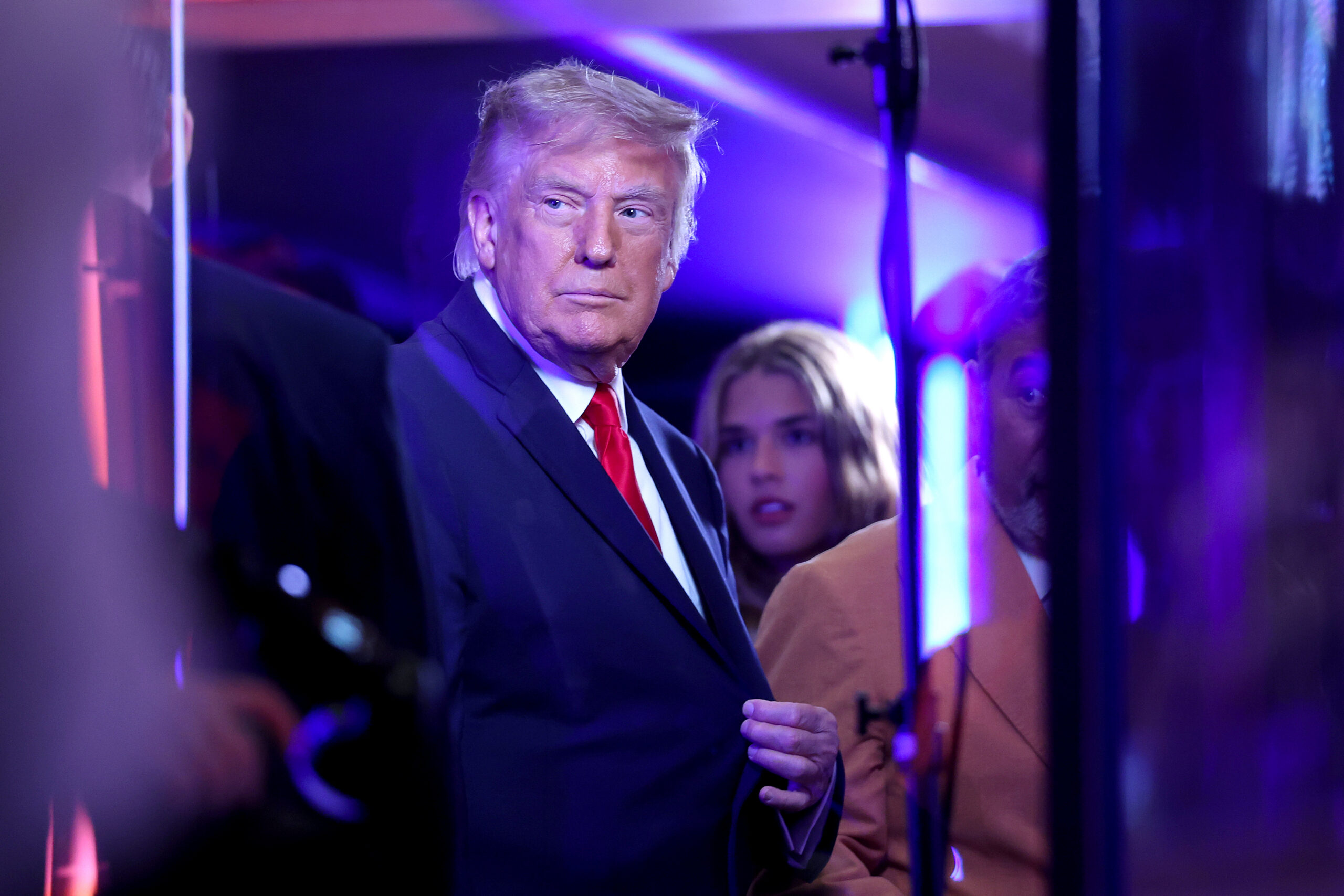
Trump, Mamdani, Witkoff, Kraft, Lutnick and more watched the game
Trump said that the U.S. must respond to the military provocation
U.S. Navy via Getty Images
A U.S. Sailor signals the launch of an MH-60R Sea Hawk helicopter, attached to Helicopter Maritime Strike Squadron 70, on the flight deck of the world's largest aircraft carrier, USS Gerald R. Ford (CVN 78), while supporting Operation Epic Fury on February 28, 2026.
President Donald Trump’s declaration that the U.S. “must, of necessity, respond” to Iran’s downing of a U.S. Army Apache helicopter off the coast of Oman on Monday evening received support from GOP lawmakers on Capitol Hill, several of whom called for a powerful military retaliation.
U.S. officials confirmed to CNN that the attack helicopter — whose pilots Trump said were successfully rescued — was brought down by an Iranian one-way attack drone. The high-stakes incident marks the most serious uptick in direct hostilities between Washington and Tehran in weeks, occurring amid diplomatic efforts to end the regional war and begin negotiations to curb Tehran’s nuclear program.
“I agree with the president, there should be significant consequences,” Sen. Ted Cruz (R-TX) told Jewish Insider.
“Enough is enough,” Cruz later wrote on X. “President Trump and our Armed Forces decimated Iran militarily, but the Iranian regime has been trying to rebuild and now they’ve taken down an American Apache. President Trump is absolutely right. There is a pressing necessity for the U.S. to respond to this attack.”
Rep. Mike Rogers (R-AL), who chairs the House Armed Services Committee, also called for a powerful response, urging Trump to look at “meaningful options.”
“We need to vigorously respond,” Rogers said. “We can’t let anybody shoot down one of our helicopters and it not be responded to.”
Sen. Ted Budd (R-NC) similarly pushed for “decisive action” in order to put the looming Iranian threat “behind us.”
“I think America would be in a better place if we had this behind us and clear, decisive action that would bring an absolute end to this so we don’t have to do it again,” Budd told JI. “They [Iran] cannot persist to threaten us and then develop nuclear weapons. … They should never ever have a nuclear weapon.”
While some regional experts agreed that the Iranian attack necessitates a firm U.S. military reaction, they argued that any such response is likely to be limited in scope and is not anticipated to trigger a return to full combat operations, nor is it expected to derail ongoing negotiations given the president’s focus on a diplomatic exit.
“If information is correct, that Iran shot down a U.S. helicopter, then the president is correct, the United States does need to respond,” said former U.S. Ambassador to Israel Dan Shapiro, who later served as deputy assistant secretary of defense in the Biden administration. “That’s a very serious attack, which thankfully did not seem to take the lives of the two aviators, but it needs a response.”
Shapiro noted that while U.S. action is necessary, the retaliation will likely be calibrated to avoid escalation, as Trump remains intensely “motivated” to secure a broader deal that would reopen the Strait of Hormuz.
“U.S. Central Command will be able to give [Trump] options that will include a meaningful response against an Iranian military target, but one that does not necessarily produce a strong Iranian response that leads to an escalatory cycle,” Shapiro explained. “If he wants to succeed in negotiations, say, on the war, he needs to respond, but do it in a way that leads to a de-escalation.”
Alexander Gray, who served as chief of staff on the National Security Council during Trump’s first administration, also anticipates a precise, “proportional blow against key Iranian targets.”
“The president has responsibly maintained considerable American military power in the vicinity of Iran, both conducting the U.S. Navy’s successful blockade, but also being held in reserve should the need arise to continue kinetic military operations,” Gray said. “The president will likely strike a proportional blow against key Iranian targets, while keeping in mind the broader American strategic imperative of concluding this conflict with a diplomatic solution that advances American interests in the region.”
Steven Cook, a senior fellow for Middle East studies at the Council on Foreign Relations, agreed that failing to respond would be a political and strategic impossibility for the White House.
“It would be hard for the president not to respond, though I suspect that this is not a return to combat,” Cook observed. “Trump will likely direct CENTCOM to take out one or several high-value targets.”
Analysts noted that the exchange is unlikely to impact the high-level talks or alter the calculations of either side, as negotiators continue to work out an agreement.
“It doesn’t necessarily push a deal further off the table,” Shapiro said. “It sounds like negotiators are close to a deal. Until there is a deal, though, exchanges in a ceasefire that has seen numerous violations of it are not surprising, but if both sides are motivated to get a deal, this will not prevent it from happening.”
Cook said that a minor strike could solidify Tehran’s perception of American vulnerability.
“I don’t believe that a tit-for-tat exchange will significantly alter Iran’s view that it has time on its hands and that the president is desperate for a deal,” Cook said. “It seems clear that the president does not want anything to upset negotiations and the chances of a negotiated way out of the conflict. The Iranians do not seem willing to give him anything that he could call a victory, however. The result is likely to be a continued stalemate.”
Iran has similarly appeared to prefer a diplomatic exit over renewed escalation. Iranian Foreign Minister Abbas Araghchi on Tuesday said that Iranian leaders “prefer language of diplomacy but speak other languages too.”
“Foreign forces in proximity to our territory are at constant risk on account of their own human errors, plain accidents, or potentially being caught in crossfire,” Araghchi posted on X following the incident. “To reduce risk, best solution is for them to leave.”
Aaron David Miller, a senior fellow at the Carnegie Endowment for International Peace and a former State Department negotiator, said the incident reflects a “manifestation of how emboldened [the Iranians] are and how willing they are to take risks.”
While Miller warned against a heightened response, he noted that even restrained exchanges could lead to eventual escalation if a final diplomatic breakthrough is not reached soon.
“If [Trump] doesn’t [limit the response], then what he’s going to trip into is a very hard response if he goes after directly Iranian targets on the mainland,” Miller warned. “The longer this goes on without having an agreement, it’s inevitable that this is going to escalate.”
The core parameters of a potential deal have been “evident for quite some time,” Miller added, but concluded it will ultimately require a painful political calculation from both Washington and Tehran.
“Both sides must be prepared to accept a situation in which they’re going to perceive to have given something up,” Miller said.
Senior congressional correspondent Marc Rod contributed reporting
A new poll from the Israel Democracy Institute found that less than half of Israelis believe Trump puts a premium on Jerusalem’s security, the lowest figure since he was reelected in 2024

JACK GUEZ/AFP via Getty Images
Commuters drive along a road in front of a billboard bearing the flags of the U.S. and Israel with a message in support of then-presidential candidate Donald Trump in Tel Aviv on October 30, 2024.
The share of Israelis who believe the country’s security is a primary consideration for President Donald Trump has plummeted to a new low, according to a new poll, revealing a sharp shift in public attitudes as the U.S. and Israel diverge on their strategies and ultimate goals of the war with Iran.
The survey, conducted by the Viterbi Family Center for Public Opinion and Policy Research at the Israel Democracy Institute from May 31 to June 5, found that 44% of Israelis believe Israel’s security is a central consideration for the Trump administration, a decline from the 60% recorded in March at the beginning of the Iran war.
The drop was even more pronounced among Jewish Israelis, where confidence fell 23 points over the same period, from 64% to 41%.
The findings mark the lowest levels of Israeli trust in Trump since the center began tracking the metric when he was elected to a second term in November 2024, highlighting a rapid erosion of Israeli public confidence as the White House intensifies its pursuit of a deal with Iran.
The polling also reveals a stark collapse in public optimism regarding Israel’s ability to achieve its key objectives in the conflict. Roughly one-third — 32% — of respondents now believe the war’s outcome will include the elimination of Iran’s ballistic missile arsenal — down sharply from the 65% who held that view in March. Similarly, the share of Israelis who believe the conflict will weaken the Iranian regime has also been cut by nearly half, falling to 28% (from 55%) over the same period.
This pervasive skepticism aligns with deep public resistance to Washington’s current diplomatic track. Even as the Trump administration continues to seek an immediate cessation of hostilities and a negotiated settlement with Tehran, a majority of Jewish Israelis (58%) maintain that ending the war under its current conditions is fundamentally incompatible with Israel’s long-term security needs.
Plus, Ms. Rachel’s Capitol cameo
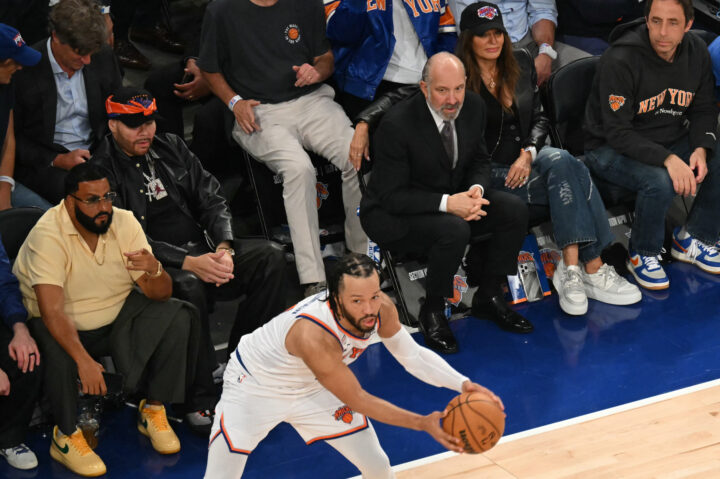
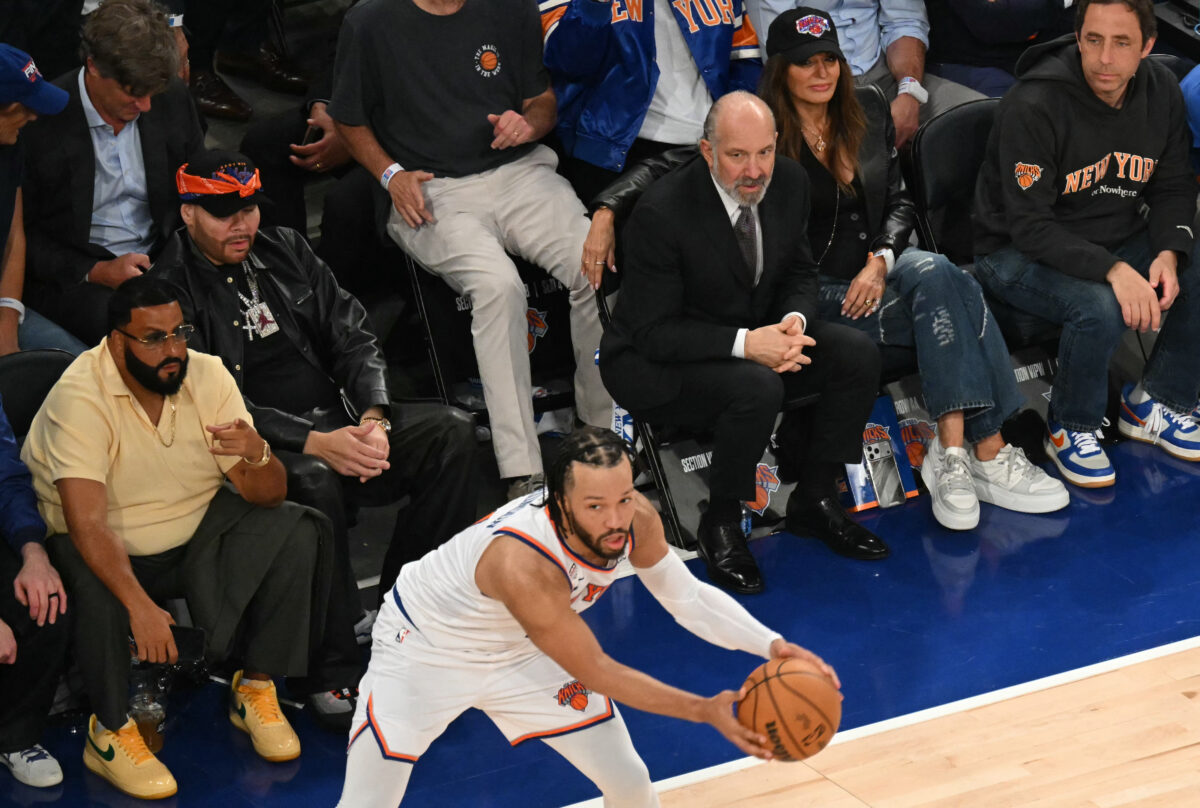
(L/R) US producer DJ Khaled, US rapper Fat Joe, US Secretary of Commerce Howard Lutnick and his wife Allison Lutnick watch Knicks guard Jalen Brunson during Game Three of the NBA Finals between the San Antonio Spurs and the New York Knicks at Madison Square Garden in New York on June 8, 2026. (Photo by SAUL LOEB / AFP via Getty Images)
PRESENTED BY

Good Tuesday morning.
In today’s Daily Kickoff, we talk to Middle East experts about the dynamic between the U.S. and Israel on strategy in the region as President Donald Trump and Prime Minister Benjamin Netanyahu diverge on how to address Iran and its proxies, and have the scoop on the newest additions to the House Foreign Affairs Committee. We report on the who’s who of notables at last night’s NBA Finals game in New York, and talk to friends and colleagues of Tisch family matriarch Billie Tisch, who died on Sunday. Also in today’s Daily Kickoff: Sam Bankman-Fried, Ms. Rachel and Dan Loeb.
Today’s Daily Kickoff was curated by JI Executive Editor Melissa Weiss and Israel Editor Tamara Zieve, with assists from Danielle Cohen-Kanik and Marc Rod. Have a tip? Email us here.

What We’re Watching
- Voters in Maine head to the polls today to cast their ballots in the state’s primary races, including the Democratic primary for Senate, where embattled oyster farmer Graham Platner is expected to win the nomination following Gov. Janet Mills’ suspension of her campaign earlier this spring. We’ll be watching the margin by which Platner, who has been dogged by a series of scandals ranging from a Nazi tattoo to comments supporting Hamas tactics to past volatile romantic relationships, wins tonight — which will indicate his strength going into the general election against one of the Senate’s most moderate Republicans, Sen. Susan Collins (R-ME).
- We’ll also be keeping an eye on primaries in Nevada, North Dakota and South Carolina.
- In the Middle East, Lebanese media reported Israeli airstrikes near Tyre in southern Lebanon on Tuesday morning after the IDF issued an evacuation order to residents of the city. On Monday, Israeli Prime Minister Benjamin Netanyahu said that, though Israel is “holding its fire” against Iran, Jerusalem has “a full right to self-defense” and is “exercising it to the extent necessary.” Two Israeli sources told CNN that Jerusalem planned to continue its operations against Hezbollah targets in southern Lebanon.
- The House Judiciary Committee is holding a hearing on the Southern Poverty Law Center. The hearing comes two months after the Department of Justice charged the group with fraud in connection with now-defunct efforts to spend upwards of $3 million to pay informants at extremist groups.
- The House Appropriations Committee is holding markups this morning on the 2027 budgets for the Department of Homeland Security and the Department of Labor.
- Elsewhere in Washington, Chabad-Lubavitch’s Living Legacy International Conference, which kicked off last night, resumes this morning with a congressional leadership breakfast followed by events at the Library of Congress, a luncheon at the State Department, a roundtable with Jewish leaders from around the world this afternoon and a gala dinner in the evening.
- Agudath Israel of America is holding a dinner to dedicate its new Washington office and pay tribute to Rabbi Abba Cohen, the longtime head of the group’s DC operations.
- The Atlantic Council’s Global Energy Forum kicks off today in Washington. Energy Secretary Chris Wright, Sens. Bill Cassidy (R-LA), Chris Coons (D-DE), Martin Heinrich (D-NM), Alan Armstrong (R-OK); Reps. Ami Bera (D-CA), Young Kim (R-CA); Alaska Gov. Mike Dunleavy, Development Finance Corporation CEO Ben Black and TWG Global’s Amos Hochstein are slated to speak at the two-day gathering.
What You Should Know
A QUICK WORD WITH JI’S JOSH KRAUSHAAR
Domestic politics isn’t always the best lens through which to evaluate foreign policy decisions.
But in assessing why President Donald Trump has gone to significant lengths to prevent Israeli Prime Minister Benjamin Netanyahu from striking back against Iran’s attacks, and why Netanyahu went ahead with the first wave of military strikes before standing down, it’s instructive to understand how the domestic politics in the U.S. and Israel are diverging.
The joint U.S.-Israel military operation against Iran, which began on Feb. 28 and has evolved into a very tenuous ceasefire since April 8, has not achieved many of the military goals outlined by both sides. Iran’s extremist leadership is still in place, it still maintains its nuclear ambitions and retains its nuclear material, and its ballistic missile stockpiles, while damaged, still remain.
On the Lebanese front, Hezbollah continues to threaten Israel’s north and not abide by any of the diplomatic agreements recently negotiated between Israel and the Lebanese government.
As a result of the limited achievements so far, public support for renewing military action against Iran has been low among the American public, and the overall operation is receiving lukewarm backing from Republicans.
Over two-thirds of voters in a recent Economist/YouGov poll said the U.S. “should make a deal to end the war in Iran as quickly as possible,” with just 11% disagreeing. Over half of Republicans shared the same sentiment of ending the war, with just 21% opposing.
Support for the war itself was much higher among Republicans than Democrats or independents, but still less than typical partisan support for Trump’s actions, with 67% of GOP voters backing the war in Iran and 20% opposing. (Among all voters, just 28% said they supported the war against Iran, with 60% opposing.)
These polling numbers explain why Trump, ever cognizant of public opinion especially in the run-up to a consequential midterm election, is trying to avoid reengaging with Iran militarily — even as he desperately seeks for some diplomatic off-ramp that Iran isn’t giving him.
In fact, it’s Trump’s very transparent desperation for a deal with Iran — and apparent unwillingness to go back to war —that’s emboldening Iran to continue its rejectionism to the point where it launched ballistic missiles at Israel over the weekend, feeling confident Trump would constrain Israel from any sustained response (which he did).
WAR AND PEACE
Experts warn Trump’s attempts to restrain Israel undermine leverage in Iran talks
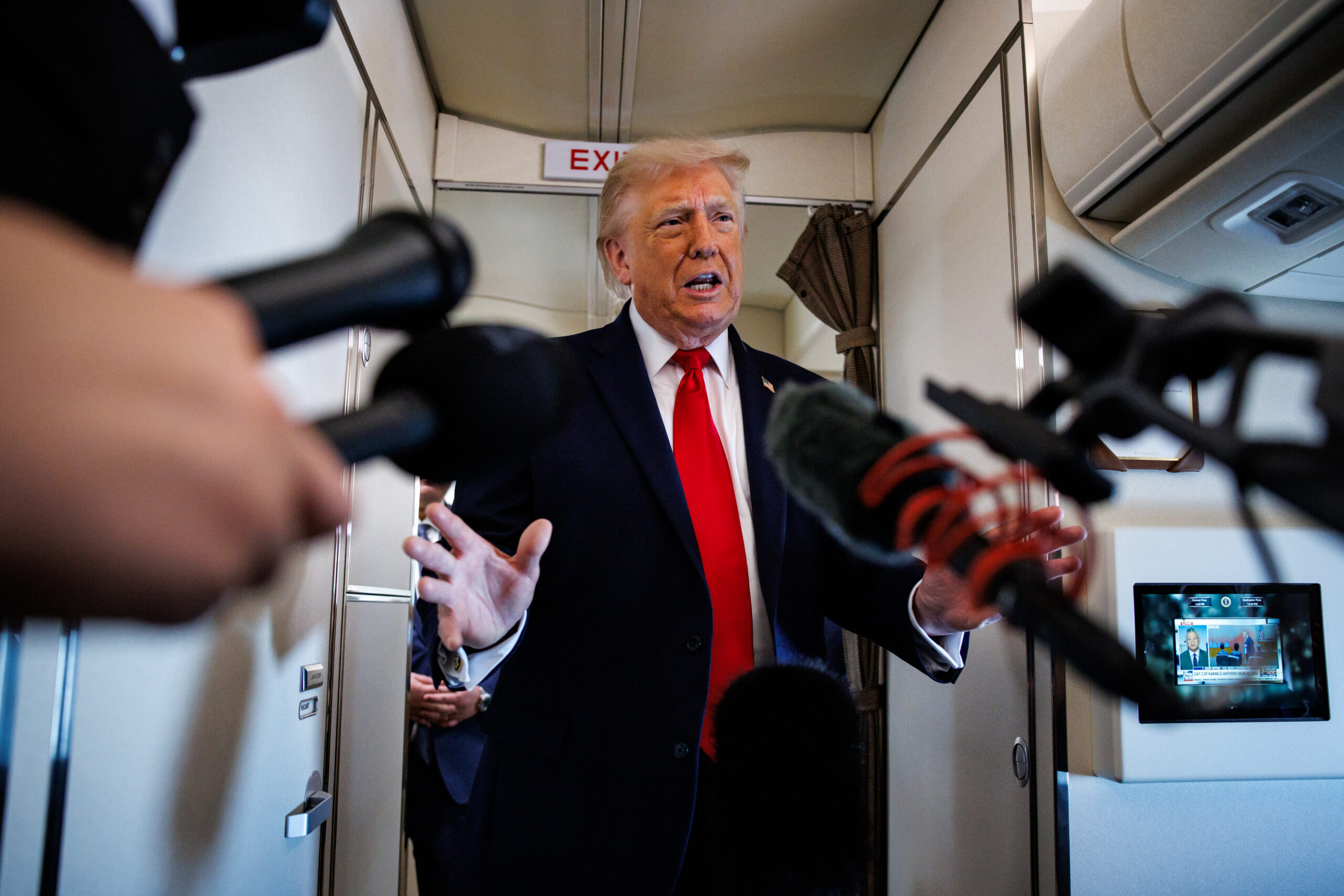
Middle East experts warned on Monday that the Trump administration’s attempts to prevent Israel’s military retaliation against Iran and its pursuit of a swift diplomatic breakthrough with Tehran are exposing a fundamental breakdown in strategic alignment between Washington and Jerusalem. This dynamic is actively undermining American leverage and hardening Tehran’s resolve both at the negotiating table and on the battlefield, the analysts argued, Jewish Insider’s Matthew Shea reports.
Trump and Tehran: Speaking at a webinar hosted by the Jewish Institute for National Security of America, Amb. Eric Edelman, a distinguished fellow at JINSA and former White House official, said that the president’s behavior makes the U.S. appear “desperate for a deal.” Ari Cicurel, an assistant director of foreign policy at JINSA, agreed that the administration’s apparent urgency to reach a deal removes vital military deterrence to back up U.S. diplomacy. “The president has signaled that he is highly prioritizing reaching some deal, and is willing to restrain Israel in order to do that,” Cicurel told JI.
On the Hill: Sen. Roger Wicker (R-MS), the chairman of the Senate Armed Services Committee, said on Monday that he would support President Donald Trump abandoning diplomatic talks with Iran and resuming military operations, JI’s Marc Rod and Emily Jacobs report.
MOUNTING SCRUTINY
Will Avila Chevalier’s ‘beyond the pale’ views sink the DSA challenger’s campaign against Espaillat?
As Darializa Avila Chevalier mounts an insurgent campaign against Rep. Adriano Espaillat (D-NY) in Upper Manhattan, the democratic socialist has faced mounting scrutiny over past controversial posts that have surfaced in recent days, raising questions about whether the negative publicity will blunt her chances in the June 23 primary election. Some strategists suggested that her incendiary views could get overlooked amid a national political landscape favoring extreme, anti-establishment sentiments now fueling the rise of several far-left candidates in Democratic primaries around the country, Jewish Insider’s Matthew Kassel reports.
Sign of the times: “It seems to not matter in a way that it would have been a deal-breaker 15 or 20 years ago,” Chris Coffey, a Democratic strategist in New York City who is not involved in the primary, told JI on Monday. “This race feels like our new outlier, where some of the things she’s said are so far beyond the pale.”
SCOOP
Controversial influencer Ms. Rachel set to be hosted by Congressional Dads Caucus

The Congressional Dads Caucus is hosting children’s influencer Rachel Griffin-Accurso, better known as Ms. Rachel, as a featured guest at a reception in Washington on Tuesday, according to an invitation obtained by Jewish Insider’s Marc Rod. Griffin-Accurso has faced scrutiny and criticism over antisemitic activity and for hosting a pro-Hamas Palestinian journalist on her social media accounts.
Background: Griffin-Accurso is one of 10 “special guests,” including “leaders, advocates, creators, entertainers, and changemakers who are helping redefine fatherhood and caregiving in America,” at the Tuesday reception. The reception is co-hosted by the Dads Caucus, founded by Rep. Jimmy Gomez (D-CA), to advocate for policies including childcare affordability and accessibility, paid family leave and the child tax credit, ahead of the group’s Dad Ambassador Awards. The event is co-hosted by Equimundo, which describes itself as a nonprofit focused on promoting gender equality and preventing violence.
SCOOP
Democrats to name Reps. Bell, Wasserman Schultz and Pocan to Foreign Affairs Committee
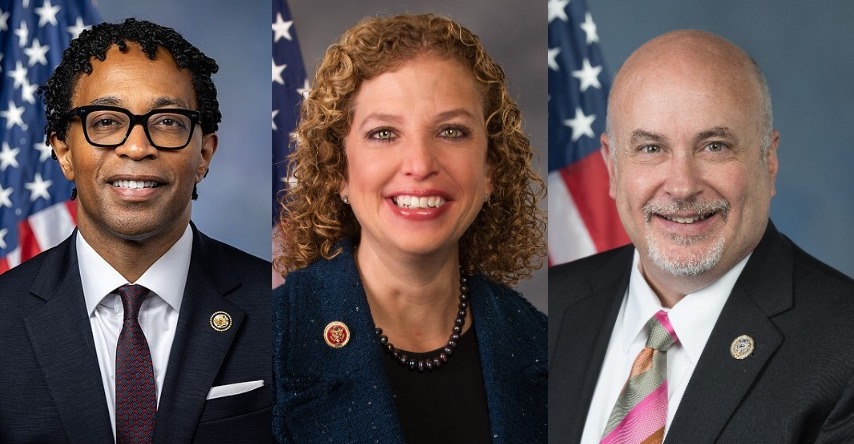
House Democrats are set to name Reps. Wesley Bell (D-MO), Debbie Wasserman Schultz (D-FL) and Mark Pocan (D-WI) to the House Foreign Affairs Committee, Jewish Insider’s Marc Rod has learned.
Lineup changes: Bell and Wasserman Schultz are both strong supporters of Israel, while Pocan is an outspoken critic, joining a panel that features outspoken voices on both sides of the Israel policy debate. None of the three offices responded to requests for comment. Rep. Max Miller (R-OH), a Jewish Republican and strong supporter of Israel, also recently joined the panel.
SPECTATOR SPECTACLE
A who’s who of notables packed Madison Square Garden for Game 3 of the NBA Finals
White House Special Envoy Steve Witkoff, EPA Administrator Lee Zeldin and Boris Epshteyn, the personal attorney to President Donald Trump, joined the president in a luxury suite at Madison Square Garden on Monday night for Game 3 of the NBA Finals, where the Knicks lost to the San Antonio Spurs on home turf, 115-111, Jewish Insider’s Melissa Weiss reports.
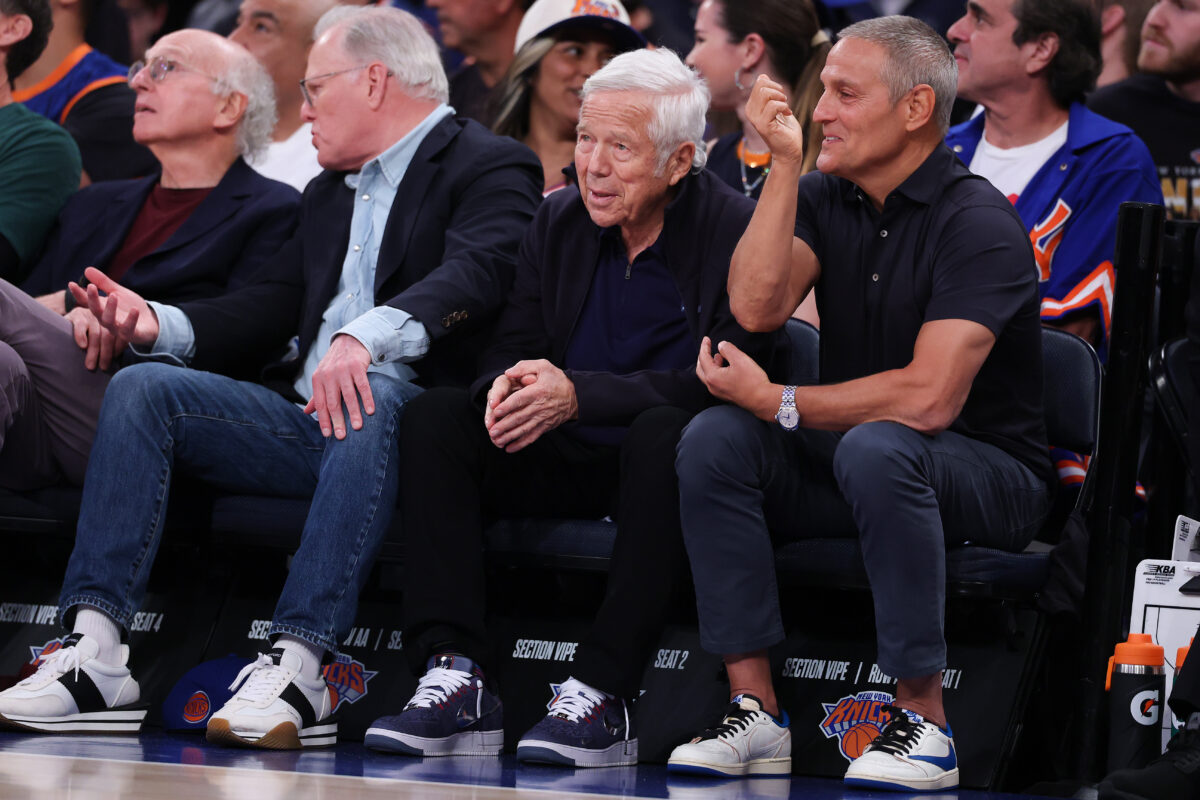
Spotted: Courtside, Commerce Secretary Howard Lutnick sat with his wife, Allison, across the aisle from rappers Fat Joe and DJ Khaled. Elsewhere at MSG, former U.S. Ambassador to Japan Rahm Emanuel, TKO Group CEO Ari Emanuel, Mark Shapiro, Larry David, David Zaslav and Robert Kraft were seated courtside for the game. Former New York City Mayor Michael Bloomberg also sat courtside — and found himself face-to-face with Jose Alvarado as the Knicks guard crashed into spectators while trying to save the ball from going out of bounds.
‘SMARTEST, NICEST PERSON IN THE ROOM’
Colleagues mourn philanthropist Wilma ‘Billie’ Tisch

When Louise Greilsheimer thinks about Billie Tisch, she thinks about the way a room felt after she left it. “When you walked in a room, she didn’t strike you,” Greilsheimer told eJewishPhilanthropy’s Nira Dayanim, “but when you left, you knew that she was probably the smartest and nicest person in the room.” Tisch — a billionaire philanthropist, matriarch of one of New York’s most prominent Jewish families and the first woman ever elected president of the Federation of Jewish Philanthropies of New York — died on Sunday at her home in Manhattan. She was 98.
Legacy: Tisch was the last surviving member of her family’s original quartet of philanthropists, whose combined legacy is reflected in a wide range of educational, cultural and medical institutions carrying the Tisch name, and in decades of sustained support for Jewish organizations throughout New York City.
Read the full obituary here and sign up for eJewishPhilanthropy’s Your Daily Phil newsletter here.
Worthy Reads
High Seas Hostage Diplomacy: For CNN, Brett McGurk, who served as the White House’s coordinator for the Middle East in the Biden administration, posits that Iran is applying the same tactics to negotiations over reopening the Strait of Hormuz as it did to talks over hostages held in the Islamic Republic. “For Iran, [holding the Strait] is possession. It now has something the US (and for that matter, the rest of the world) wants. And it will not give it up unless and until America pays an exorbitant price. In Tehran’s eyes, the strait has now become the most valuable hostage it has ever possessed. … The question in Washington is when a deal might be concluded following exchanges of texts through mediators. The question in Tehran is simply whether Trump will pay the price they are demanding. It’s the classic dynamic of a hostage negotiation.” [CNN]
Broad Daylight: The Financial Times explores the divide between President Donald Trump and Israeli Prime Minister Benjamin Netanyahu. “Dahlia Scheindlin, a Tel Aviv-based pollster and political analyst, said there was also an element of ‘political theatre’ to the public disagreements. ‘Trump is basically trying to show the American public that he’s trying to keep the war from re-escalating and he’s trying to keep America from getting involved again,’ she said. ‘And Netanyahu looks good to his domestic audience because he’s defying Trump.’” [FT]
Boycotts and Battlefields: In The Washington Post, Aaron Kaplowitz, president of the United States-Israel Business Alliance, argues that efforts to boycott Israeli defense technology, as some European countries have done on the basis of “moral leadership,” risks forgoing technology that is effective on the battlefield. “According to defense officials, governments that have announced boycotts on Israeli weapons makers are placing orders anyway. That is what governing by perception looks like: Speeches for the activist base. Procurement contracts in the back office. European defense ministries understand what they cannot say in public. Israeli systems are battle-tested in real time against adaptive enemies, and there are not many alternatives that perform as well. The defense systems a nation procures depends on what has the best capabilities.” [WashPost]
Word on the Street
Vice President JD Vance was asked by Fox News host Jesse Watters about reports that Israel was spying on the U.S. and engaging in military operations in Lebanon, responding that “The Israelis and I, the Israelis and the United States, we have a lot of shared interests, but we also have some situations where our interests diverge. While Israel obviously has objectives it has, the U.S. main objective in Iran is that Iran doesn’t have a nuclear weapon… We’ve created this space necessary where the president believes, and I think he’s right, that we can get the long-term settlement to an Iran nuclear deal. Israel may like that, they may not like that… this is in the best interest of the United States of America”…
President Donald Trump nominated Todd Blanche to be attorney general; Blanche has been serving in the role in an acting capacity since former AG Pam Bondi departed the position in April…
A State Department report submitted to Congress last month accuses Russia, Iran and China of weaponizing antisemitic imagery and rhetoric “across physical and cyber domains”…
Two crew members of a U.S. Army Apache helicopter were rescued after it went down in the Strait of Hormuz; the cause of the helicopter’s downing remains under investigation…
Thirty-eight Senate Democrats, led by Sens. Adam Schiff (D-CA), Tim Kaine (D-VA) and Senate Minority Leader Chuck Schumer (D-NY), demanded the administration provide Congress with the legal opinion backing its determination that U.S. hostilities against Iran have ended, given the ongoing strikes and U.S. presence in the region…
By voice votes, the House passed legislation requiring the Trump administration to determine whether various Iranian clerics, and other Iranian entities meet the standards to face U.S. sanctions, and requiring the State Department to brief Congress on antisemitism in Europe…
Eighty-five House Democrats led by Reps. Mark Pocan (D-WI) and Jan Schakowsky (D-IL) urged the administration to act to halt construction of the E1 settlement project in the West Bank…
Third Point founder Dan Loeb hosted Treasury Secretary Scott Bessent on Monday at his hedge fund’s Manhattan office, according to a photo posted on Loeb’s Instagram account…
Axios reports that Paramount executives have engaged in preliminary conversations for a business-side counterpart to CBS News Editor-in-Chief Bari Weiss…
Federal officials arrested a New Jersey man on charges of attempting to provide support to the Islamic State; authorities said that Mohamed Sagha had displayed an interest in attacking a Jewish site or National Guard station in the state…
Under the headline “The New York Primary That Is All About Israel,” The Wall Street Journal looks at the degree to which debate over Israel and U.S. policy in the Middle East is “dividing neighbors and consuming” New York’s 10th Congressional District, where Rep. Dan Goldman (D-NY) is facing a tough primary challenge from former New York City Comptroller Brad Lander…
Los Angeles City Councilmember Nithya Raman, a far-left Democrat, edged out Republican Spencer Pratt for the second runoff spot in the race for Los Angeles mayor; Raman will face incumbent Mayor Karen Bass, also a Democrat, in November…
In a Wall Street Journal opinion piece, Meta President Dina Powell McCormick and Mike Rowe, the CEO of the mikeroweWORKS Foundation, announce the launch of America’s Workforce Academy, a partnership between Meta and a number of partner groups to train would-be workers on AI technology…
Meta accused NSO Group of attempting to hack its WhatsApp messaging service in violation of a court order prohibiting the Israeli spyware firm from doing so…
FTX co-founder Sam Bankman-Fried submitted a formal request to the Justice Department’s Pardon Attorney Office seeking a presidential pardon after serving more than two years of a 25-year term for overseeing a fraudulent cryptocurrency empire…
Richmond, Calif., Mayor Eduardo Martinez is expected to lose his bid for reelection after coming under fire for sharing antisemitic conspiracy theories, including a post that the terror attack at a Sydney, Australia, Hanukkah celebration was an Israeli false flag operation; Martinez trails at least two other candidates in the race, leaving him short of the runoff…
In a letter to Canadian Prime Minister Mark Carney, members of the J7 — leading Jewish groups from Argentina, Australia, Canada, France, Germany, the U.K. and the U.S. — raise concerns about rising antisemitism in Canada and call on Ottawa to take a “whole-of-government effort” and address what the body sees as Canada’s “lack of urgency, coordination, and enforcement” as well as “of real action” to address antisemitism…
Karim Khan, the chief prosecutor of the International Criminal Court, was suspended on Monday over allegations of sexual misconduct with a female aide; the ICC’s Assembly of States Parties will hold a special session to determine the future of Khan’s employment by the court…
The Wall Street Journal looks at the precarious situation in Lebanon as Beirut, backed by Washington and amid talks with Israel, seeks to degrade Hezbollah as the Iranian-backed group maintains its deep entrenchment in the country’s military and politics…
Pic of the Day

An Israeli man on Monday visited the wreckage of an Iranian missile near the West Bank city of Jericho, following strikes from Iran earlier in the day targeting Israel.
Birthdays

Producer, director, playwright and screenwriter, he has won an Academy Award, five Primetime Emmy Awards and three Golden Globes, Aaron Benjamin Sorkin turns 65…
Former executive director of the Jewish Federation of Greater Dallas, Walter Julius Levy turns 104… Journalist for 30 years at CBS and NBC who then became the founding director of Harvard’s Shorenstein Center, then a fellow at GWU, Marvin Kalb turns 96… Retired Israeli diplomat who served as ambassador to Italy and France and world chairman of Keren Hayesod – United Israel Appeal, Aviezer “Avi” Pazner turns 89… Author of 12 books, journalist, lecturer and social activist, founding editor of Ms. Magazine, Letty Cottin Pogrebin turns 87… British businessman, co-founder with his brother Maurice of advertising agency Saatchi & Saatchi which became the largest in the world, noted for his art collection and for founding Saatchi Gallery, Charles Saatchi turns 83… Diplomat and Shakespeare historian, he was the longtime national editor of Washingtonian magazine, Kenneth Adelman turns 80… Founder of Commonwealth Financial Network (a broker/dealer network) and former chairman of Southworth Development (a golf and leisure business), Joseph Deitch turns 76… Professional mediator, for years she was a syndicated advice columnist in Jewish newspapers, Wendy J. Belzberg… Israel’s former minister of defense and deputy prime minister, Benny Gantz turns 67… Canadian journalist, author, documentary film producer and television personality, Steven Hillel Paikin turns 66… Former lead singer of the Israeli pop rock band Mashina, Yuval Banay turns 64… CEO of Jewish Women’s International, Meredith Jacobs… Managing director at Major, Lindsey & Africa, Craig Appelbaum… EVP of Jewish Funders Network, Rabbi Rebecca Sirbu… Screenwriter, director and producer, Hayden Schlossberg turns 48… Founder and CEO of Delve, an AI platform for public affairs, he was previously a Bush 43 White House Jewish liaison, Jeff Berkowitz… NYC-based writer, actor and entrepreneur, he is a co-founder of Swish Beverages, David Oliver Cohen turns 46… Jerusalem-born Academy Award-winning actor, producer and director, Natalie Portman turns 45… Online producer, writer and director, who together with his brother Benny founded the “React” video series, Rafi Fine turns 43… Multimedia artist known for her work in photography, makeup, hairstyling and textile crafts, Anna Marie Tendler turns 41… Composer and lyricist, in 2024 he became the 20th person to complete the EGOT, an acronym for the Emmy, Grammy, Oscar and Tony Awards, Benj Pasek turns 41… Israeli tech entrepreneur, he is the founder and CEO of A.Team, Raphael Ouzan turns 39… Director of the Yale Journalism Initiative, her book, A Flower Traveled In My Blood, was published last year, Haley Cohen Gilliland… Deputy assistant secretary for strategic communications at the Department of Homeland Security during the Biden administration, Jeff Solnet… Ice hockey player for the NHL’s Edmonton Oilers and best-selling author of children’s books, Zachary Martin Hyman turns 34… Serial entrepreneur, founder and CEO of Setscale, Daniel Fine…
Now that shifting American politics is pushing the president to distance himself from Israel’s preferred policies, Netanyahu is stuck without his trump card

SAUL LOEB/AFP via Getty Images
President Donald Trump shakes hands with Israeli Prime Minister Benjamin Netanyahu during a meeting in the Oval Office of the White House in Washington, DC, on April 7, 2025.
Domestic politics isn’t always the best lens through which to evaluate foreign policy decisions.
But in assessing why President Donald Trump has gone to significant lengths to prevent Israeli Prime Minister Benjamin Netanyahu from striking back against Iran’s attacks, and why Netanyahu went ahead with the first wave of military strikes before standing down, it’s instructive to understand how the domestic politics in the U.S. and Israel are diverging.
The joint U.S.-Israel military operation against Iran, which began on Feb. 28 and has evolved into a very tenuous ceasefire since April 8, has not achieved many of the military goals outlined by both sides. Iran’s extremist leadership is still in place, it still maintains its nuclear ambitions and retains its nuclear material, and its ballistic missile stockpiles, while damaged, still remain.
On the Lebanese front, Hezbollah continues to threaten Israel’s north and not abide by any of the diplomatic agreements recently negotiated between Israel and the Lebanese government.
As a result of the limited achievements so far, public support for renewing military action against Iran has been low among the American public, and the overall operation is receiving lukewarm backing from Republicans.
Over two-thirds of voters in a recent Economist/YouGov poll said the U.S. “should make a deal to end the war in Iran as quickly as possible,” with just 11% disagreeing. Over half of Republicans shared the same sentiment of ending the war, with just 21% opposing.
Support for the war itself was much higher among Republicans than Democrats or independents, but still less than typical partisan support for Trump’s actions, with 67% of GOP voters backing the war in Iran and 20% opposing. (Among all voters, just 28% said they supported the war against Iran, with 60% opposing.)
These polling numbers explain why Trump, ever cognizant of public opinion especially in the run-up to a consequential midterm election, is trying to avoid reengaging with Iran militarily — even as he desperately seeks for some diplomatic off-ramp that Iran isn’t giving him.
In fact, it’s Trump’s very transparent desperation for a deal with Iran — and apparent unwillingness to go back to war —that’s emboldening Iran to continue its rejectionism to the point where it launched ballistic missiles at Israel over the weekend, feeling confident Trump would constrain Israel from any sustained response (which he did).
Only in Trump’s mind is a ceasefire with active fighting still a ceasefire. But he’s hoping he can maintain that illusion long enough to prevent him from losing more ground politically. Gas prices and reopening the Strait of Hormuz are bigger priorities at the moment to him than Israel’s national security.
Meanwhile, in Israel, the public is pushing Netanyahu to continue taking the fight to Hezbollah, whose drones and rockets have made the northern part of the country virtually uninhabitable. And Israelis are increasingly frustrated, despite Trump’s popularity in the country, over how Netanyahu is being restrained from responding against Iran because of American political pressure.
A clear majority of Israelis (59%) in a May poll from the Institute of National Security Studies believed Israel should intensify its fighting against Hezbollah in Lebanon. The pollster also found, a month earlier, that 61% of Israelis opposed the initial American-led ceasefire.
Netanyahu, in an election year, is in a no-win situation where he’s tasked with maintaining solid support from Trump, given their perceived strong relationship has been at the center of his reelection messaging. But now that shifting American politics is pushing the president to distance himself from Israel’s preferred policies, Netanyahu is stuck without his trump card.
This is where Netanyahu’s bet on Trump — and trust in the personal relationship he’s built with him — is looking a bit shaky right now. Support for Israel runs widely in Republican circles (and deeply among Jewish Republicans and evangelicals), but some of the backing is a partisan reflection of the president’s own stalwart support of the Jewish state.
If Trump, for his own political self-interest, decided to change course in his Middle East policy, it’s likely many of his voters would follow to the beat of his drum. And that would leave Israel without much backing within the Democratic Party, and support within the GOP subject to Trump’s own personal whims.
That’s a pretty precarious place for Netanyahu to be in — just several months before his own big election.
Roger Wicker, the Senate Armed Services Committee chair, told Jewish Insider that Iran has ‘been stringing us along’ and ‘had no intention of negotiating in good faith’

Tom Williams/CQ-Roll Call, Inc via Getty Images
Senate Armed Services Committee Chairman Roger Wicker (R-MS) arrives for a confirmation hearing in Dirksen building on Tuesday, May 13, 2025.
Sen. Roger Wicker (R-MS), the chairman of the Senate Armed Services Committee, said on Monday that he would support President Donald Trump abandoning diplomatic talks with Iran and resuming military operations.
“It’s becoming clearer and clearer that they’ve been stringing us along and that they had no intention of negotiating in good faith,” Wicker told Jewish Insider of Iran. “I wouldn’t blame the president at all if we resume full-scale war. I don’t think the American people would blame him at all.”
The senator’s remarks follow a sharp weekend escalation, which saw Iran launch a barrage of ballistic missiles at Israel in response to IDF operations in Beirut. Asked at the Capitol on Monday about Trump’s subsequent pressure on Israeli Prime Minister Benjamin Netanyahu to hold back retaliatory strikes, Wicker encouraged a tougher stance on Iran.
Wicker has been skeptical for weeks of U.S. negotiations with Iran, urging a return to combat operations.
While Netanyahu reportedly called off broader strikes on Iran on Monday, he suggested he had pushed back on Trump’s request for Israel not to respond to an Iranian missile attack on Sunday. Netanyahu said he had relayed to the White House that Israel retains its right to self-defense “with appreciation and respect in my good conversations with my friend President Trump.”
Wicker dismissed concerns that Trump and Netanyahu’s relationship had deteriorated over the war in Iran, and emphasized his support for Israel’s actions against Hezbollah in Lebanon.
“I think the president would tell you that our relationship with Israel is as strong as it’s ever been, and that he’s doing well with Netanyahu,” Wicker said. “On the issue of Israel and Hezbollah, Hezbollah exists for no reason other than to destroy Israel and kill Americans. That’s the only reason they exist. They’re not a religion, they’re not a region, they’re not an ethnic group.”
“I absolutely believe that Israel has every right to respond forcefully when attacked by Hezbollah,” he added.
Sen. Ted Budd (R-NC) said that Israel and the U.S. are responsible for making their own decisions, but said that shouldn’t damage the core alliance.
“Israel is a sovereign country. They can make their own decisions. We’re a sovereign country, we can make ours,” Budd said. “We can make recommendations to either, and they’re a great ally. We need to make sure we maintain the status of them being a great ally.”
Sen. Richard Blumenthal (D-CT) argued that what he characterized as the administration’s failures are producing friction with Israel.
Blumenthal said that “Israel has a right to defend itself” from both Iran and Hezbollah and “has a right to strike back at Hezbollah, in Lebanon, where it is strongest, maybe outside Beirut.”
“The fundamental problem here is that Trump is caught in a quagmire of his own making with unrealistic and, in fact, confused goals that have not been achieved,” Blumenthal continued, “He’s struggling for negotiations, while Israel wants to achieve some goals, including securing the enriched uranium, and so there’s bound to be some tension.”
“But at the end of the day, they’ll have to continue working in concert, because that’s the only path toward peace,” Blumenthal said.
Trump, Mamdani, Witkoff, Kraft, Lutnick and more watched the game
Al Bello/Getty Images
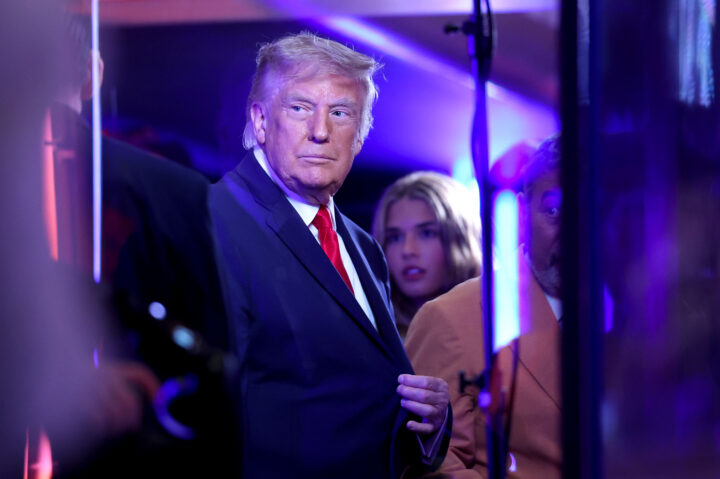
U.S. President Donald Trump looks on prior to a game between the San Antonio Spurs and the New York Knicks in Game Three of the 2026 NBA Finals at Madison Square Garden on June 08, 2026 in New York City.
White House Special Envoy Steve Witkoff, EPA Administrator Lee Zeldin and Boris Epshteyn, the personal attorney to President Donald Trump, joined the president in a luxury suite at Madison Square Garden on Monday night for Game 3 of the NBA Finals, where the Knicks lost to the San Antonio Spurs on home turf, 115-111.
Also in the suite were MSG Network CEO Jim Dolan, White House Deputy Chief of Staff Dan Scavino, Interior Secretary Doug Burgum and Transportation Secretary Sean Duffy, White House Communications Director Steven Cheung and Michael Boulos, who is married to Trump’s daughter Tiffany and is the son of White House senior advisor Massad Boulos.
New York City Mayor Zohran Mamdani also attended the game, the first time the Knicks’ played the Spurs at home in the Finals. The mayor’s office said Mamdani paid $1,000 for a standing room only ticket to the game, where he was photographed with New York state lawmakers.
Courtside, Commerce Secretary Howard Lutnick sat with his wife, Allison, across the aisle from rappers Fat Joe and DJ Khaled. Elsewhere at MSG, former U.S. Ambassador to Japan Rahm Emanuel, TKO Group CEO Ari Emanuel, Mark Shapiro, Larry David, David Zaslav and Robert Kraft were seated courtside for the game. Former New York City Mayor Michael Bloomberg also sat courtside — and found himself face-to-face with Jose Alvarado as the Knicks guard crashed into spectators while trying to save the ball from going out of bounds.
The Knicks will face the Spurs again on Wednesday at MSG.
Plus, AIPAC wades into Mich. Senate race
SAUL LOEB/AFP via Getty Images
President Donald Trump shakes hands with Israeli Prime Minister Benjamin Netanyahu during a meeting in the Oval Office of the White House in Washington, DC, on April 7, 2025.
This P.M. edition is reserved for our premium subscribers like you — offering a forward-focused read on what we’re tracking now and what’s coming next.
Today’s Daily Overtime was curated by JI U.S. Editor Danielle Cohen-Kanik.
📡On Our Radar
Notable developments and interesting tidbits we’re tracking
President Donald Trump cautioned Israeli Prime Minister Benjamin Netanyahu that if Israel went forward with a plan to escalate its strikes on Iran today, “you will be on your own very soon,” the president recalled in an interview with Axios, after which the Israeli leader reportedly called off the attack. Trump also claimed the U.S. and Iran are nearing a “phenomenal deal. We are getting everything we wanted”…
Netanyahu subsequently said in a video statement that, while Israel is “holding its fire” against Iran, Jerusalem has “a full right to self-defense” and is “exercising it to the extent necessary” — a message he said he relayed “with appreciation and respect in my good conversations with my friend President Trump.” But Netanyahu warned that if Iran resumes its attacks on Israel, the IDF would respond with “overwhelming force”…
Mohammad Bagher Ghalibaf, the speaker of the Iranian parliament, said in an address today that Iran’s simultaneous military strikes and diplomacy are part of an intentional strategy and that, though Tehran is seeking to end the war, it does not want to normalize relations with Washington…
U.S. forces disabled another empty oil tanker attempting to sail to Iranian ports today after it failed to disobey orders to stop by firing a precision munition into the ship’s engineering and steering spaces, CENTCOM announced. It’s the seventh such vessel U.S. forces have disabled since the blockade began…
Thirty-eight Senate Democrats, led by Sens. Adam Schiff (D-CA), Tim Kaine (D-VA) and Minority Leader Chuck Schumer (D-NY), demanded in a letter to Trump that the administration provide Congress with the legal opinion backing its determination that U.S. hostilities against Iran have ended, given the ongoing strikes and U.S. presence in the region…
At next week’s G7 summit in France, which Trump will be attending, European leaders will attempt to secure the president’s support for a U.K. and France-led effort to de-mine the Strait of Hormuz, Bloomberg reports…
The J7, a coalition of Jewish communal organizations representing the seven largest Jewish Diaspora populations, urged Canadian Prime Minister Mark Carney to prioritize action over further study after he announced Ottawa’s new Ministerial Advisory Council on Rights, Equality and Inclusion would examine rising antisemitism in the country.
Arguing that the problem has already been well documented, the groups called for a “whole-of-government” response focused on enforcement and countering extremist ideologies and terror movements…
United Democracy Project, the AIPAC-aligned super PAC, began buying ad time in Michigan today, in what appears to be the pro-Israel group’s first foray into the state’s heated Democratic Senate primary…
The Wall Street Journal interviews activists Daniel Moraff and Leanne Fan, who, along with consultant Morris Katz, recruited Graham Platner to run for Senate in Maine. The two said that their own vetting process of Platner did not turn up the Nazi tattoo he had on his chest, nor the full extent of his controversial Reddit posts, but they believed none of what they had seen at the time “will or should stop him from becoming a U.S. senator”…
The two factions of Williamsburg, Brooklyn’s Satmar community united behind Brooklyn Borough President Antonio Reynoso in the race to succeed retiring Rep. Nydia Velazquez (D-NY). Reynoso, a native of the district, clashed with some of the Hasidic sect’s leaders as a city councilmember but rebuilt relationships in subsequent years. New York City Mayor Zohran Mamdani, who has found allies in the Satmar sect while in office, is backing Reynoso’s opponent, Assemblymember Claire Valdez…
Ahead of tonight’s Knicks NBA Finals game against the San Antonio Spurs at Madison Square Garden, The Forward examines the chant sweeping New York City — “My mayor Muslim, my bagel Jewish, my Christian Dior, Knicks in four!” — and what it says about the city’s identity…
⏩ Tomorrow’s Agenda, Today
An early look at tomorrow’s storylines and schedule to keep you a step ahead
Keep an eye out in Jewish Insider for a look at the view from Washington on Trump’s attempt to pressure Netanyahu not to retaliate to Iran’s recent ballistic missile attacks.
Maine, Nevada, North Dakota and South Carolina will hold their primary elections tomorrow.
The House Foreign Affairs Committee will hold a markup of various bills, including one to direct the State Department to impose sanctions on the leaders and family members of the Rapid Support Forces (RSF) and the Sudanese Armed Forces (SAF) responsible for genocide, war crimes and crimes against humanity in the Sudanese civil war.
The House Appropriations Committee will mark up the FY 2027 spending bills for Labor, Health and Human Services and Homeland Security.
The Atlantic Council will kick off its two-day Global Energy Forum with remarks from Energy Secretary Chris Wright; Ben Black, CEO of the U.S. International Development Finance Corporation; Alaska Gov. Mike Dunleavy; and representatives from Kuwait, Egypt, Syria and more.
Agudath Israel of America will celebrate the opening of its new office on Capitol Hill with a tribute to its longtime vice president for government affairs, Rabbi Abba Cohen, who is set to step down after 37 years at the organization.
Stories You May Have Missed
PROMISES AND PERILS
As AI reshapes society, Jewish leaders grapple with what comes next

Rabbi Mordechai Lightstone: ‘When we ascribe human attributes — emotions, consciousness and soul — to AI, we risk transforming a sophisticated instrument into an idol’
GOLDEN MEMORIES
In Altneu art exhibit, artists grapple with the end of American Jewry’s ‘Golden Age’

A new exhibition at the Upper East Side synagogue uses paintings of everyday Jewish life to explore nostalgia and identity as Jewish artists increasingly feel unwelcome in cultural spaces
The Israeli prime minister said that Israel had finished retaliating against Iran, but would defend itself against further attacks

Kevin Dietsch/Getty Images
Israeli Prime Minister Benjamin Netanyahu speaks during a meeting with U.S. President Donald Trump in the Oval Office of the White House on April 7, 2025 in Washington, DC.
Israeli Prime Minister Benjamin Netanyahu said on Monday that, though Israel is “holding its fire” against Iran, Jerusalem has “a full right to self-defense” and is “exercising it to the extent necessary.”
The prime minister warned that if Iran resumes its attacks on Israel, the IDF would respond with “overwhelming force.”
Netanyahu’s statement follows a series of tit-for-tat exchanges between Israel and Iran and its proxies that began with Hezbollah’s fire on northern Israel on Sunday. After Israel struck Hezbollah targets in Beirut, Iran fired a wave of ballistic missiles at Israel, prompting the IDF to strike military targets, as well as a petrochemical facility, in Iran.
Netanyahu also suggested he had pushed back on President Donald Trump’s request for Israel to not respond to Iranian strikes on Sunday. He said he had relayed to the White House the message about Israel’s right to self-defense “with appreciation and respect in my good conversations with my friend President Trump.”
Trump asked Netanyahu on Sunday to keep Israel’s strikes against Iran limited to prevent escalation, once it became clear that Israel would not stand down, according to a report from The Wall Street Journal. On Monday, Netanyahu agreed to a second request from Trump to halt Israel’s attacks, sources told the outlet.
The president also said on ‘Meet the Press’ that U.S. forces could be deployed into Iran to retrieve and destroy the regime's stockpile of enriched uranium
Roberto Schmidt/Getty Images
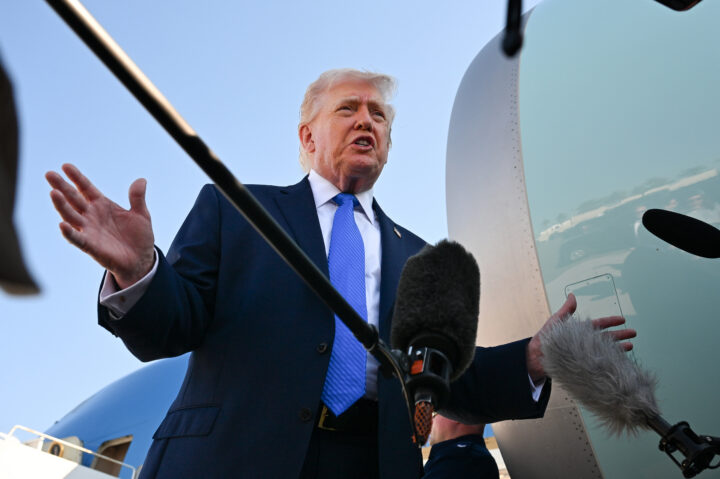
President Donald Trump speaks to reporters before boarding Air Force One at Palm Beach International Airport on March 23, 2026 in West Palm Beach, Florida.
Appearing on NBC’s “Meet the Press” on Sunday, President Donald Trump said his red line for resuming military action in Iran would be if he didn’t believe the parties could reach a deal in a timely manner, and said U.S. forces could be deployed into Iran to retrieve and destroy the regime’s stockpile of enriched uranium.
Trump continued to assert that Iran is desperate for a deal, even as negotiations appear largely deadlocked and as Esmaeil Baghaei, Iran’s Foreign Ministry spokesperson, told CNN in Tehran on Sunday that the primary obstacle to an agreement is Washington’s changing and “contradictory” positions. Meanwhile, U.S. and Iranian forces continue to exchange strikes nearly daily around the Strait of Hormuz.
Trump ruled out the prospect of unfreezing any Iranian assets or offering upfront sanctions relief to secure a breakthrough, maintaining that compliance must precede concessions.
“If they behave, if they do a good job, we start talking,” Trump said. But should Iran walk away from the table or drag out the timeline, the president emphasized he would not rule out a return to hostilities.
“My red line would be if I think I wasn’t going to make a deal, or if I wasn’t going to make a deal fast enough,” Trump said of resuming military action, noting that if Iran were to kill additional Americans — more than a dozen U.S. troops have already been killed in the current conflict — that would be “something that I would think about very seriously.”
“We’re having very good negotiations with the people that are leading the country now. It’s the third group that we’ve been dealing with. And they are different. And you could say it’s regime change actually because these are very different people. I find them to be more rational, very smart,” he added.
Trump specifically noted that he considers Supreme Leader Mojtaba Khamenei — the son of the late Supreme Leader Ayatollah Ali Khamenei — a more “rational” negotiating partner.
“I think [he is] more rational. He’s pretty badly injured. So there’s a certain bravery there,” Trump said. “A lot of people, if they were injured that badly, they wouldn’t be talking about, you know, ‘How are we doing with the United States?’ They’d have other things on their mind. So there’s a certain bravery there. But he is very seriously injured.”
The president further said U.S. forces could be sent into Iranian territory to secure the regime’s nuclear stockpiles, claiming that Washington knows exactly where the material is stored.
“The way you do it is if we make a deal now, we’re friendly, we’ll all go together. It’ll be our equipment. We’ll take it out and destroy it, whether it’s onsite or whether we take it offsite,” Trump explained. “We will be at peace. And we will go with them, or without them. But we won’t have people shooting at us, okay?”
He added: “Now, if we don’t make a deal, then we’re going to take them out militarily very harshly. And we’ll wait until we do that before we go, in which case we’ll have safety either way.”
Trump further claimed that the U.S. possesses highly specific data on Iran’s remaining military capabilities, including the locations of its drones, manufacturing plants, remaining missiles and launch sites. While the president stated that the majority of Iran’s production facilities “have been knocked out,” he acknowledged that Tehran still maintains some of its arsenal.
“I know almost the number, and we know where they are too, and we know where their drones are, and we know where their drone factories are,” Trump said. “Most of the drone factories have been knocked out, most of the launching pads have been knocked out and most of the missile manufacturing areas have been knocked out. But they still have capacity. They have some missiles, they have some drones. I would say percentage wise, maybe 21-22% of their missiles. It’s a lot of missiles, but it’s not what it was when we first attacked.”
Turning to the broader regional landscape, Trump clarified that he is “not demanding” that Lebanon be included in a peace deal with Iran, as Tehran has requested, though he expressed a desire to see “a more surgical” approach to combating Hezbollah
“I’d like to see Lebanon have a better life,” Trump said. “I’d like to see a more surgical attack on Hezbollah. I think it should be more surgical,” he added, but did not reference Israel or its recent military actions against the terror group.
Experts told JI that the agreement in its current form would not require Riyadh to adhere to the nonproliferation ‘gold standard’ – a commitment to forgo domestic uranium enrichment and fuel reprocessing
Win McNamee/Getty Images
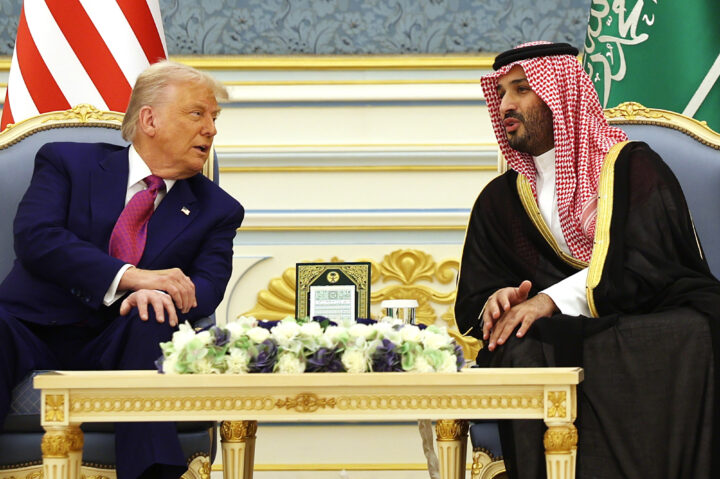
President Donald Trump meets with Saudi Crown Prince Mohammed bin Salman during a “coffee ceremony” at the Saudi Royal Court on May 13, 2025, in Riyadh, Saudi Arabia.
As the Trump administration prepares to submit a proposed civil nuclear pact with Saudi Arabia to Congress, U.S. lawmakers are raising concerns about the potential agreement while nonproliferation experts and former Trump administration officials are sounding the alarm, warning that the pact abandons traditional safeguards and could ignite a nuclear arms race in the Middle East.
Last month, the Trump administration proposed the pact to assist Saudi Arabia with its development of civilian nuclear power, following indications last year that it would pursue such an agreement to strengthen bilateral diplomatic ties. Experts say the White House is looking to construct and operate a uranium enrichment plant within Saudi Arabia, safeguarding the facility through a bilateral framework.
The pact is currently undergoing final review before President Donald Trump can formally submit it to Congress. Once the president signs the agreement and transmits it to Capitol Hill, both chambers will have 90 days to pass resolutions of disapproval to block the deal. Otherwise, the pact will automatically go into effect, permitting the U.S. to share civilian nuclear power technology with the kingdom.
Experts told Jewish Insider that the agreement in its current form would not require Riyadh to adhere to the nonproliferation “gold standard” – a commitment to forgo domestic uranium enrichment and fuel reprocessing. Other regional partners, such as the United Arab Emirates, accepted this stringent safeguard in past U.S. deals specifically to prevent military or illicit nuclear activity.
The proposed pact would also exempt Riyadh from accepting the International Atomic Energy Agency’s (IAEA) “additional protocol.” This accord helps rule out clandestine military activities by granting international inspectors the authority to conduct sudden, unannounced visits to nuclear facilities. While the U.S. maintains numerous nuclear cooperation agreements globally, it rarely establishes them with nations that reject these baseline oversight protocols.
Democrats across the ideological spectrum have previously indicated concern over the potential civil nuclear pact, reflecting a historical trend in which Congress has typically supported a stringent nonproliferation policy toward Saudi Arabia that includes robust safeguards.
In May, a dozen Democratic lawmakers sent a letter to Secretary of State Marco Rubio asking that the administration follow strict U.N.-backed protocol, including IAEA inspection. However, in a letter from the State Department to Sen. Edward Markey (D-MA), the administration only indicated that the agreement would require the two sides to commit to a “bilateral safeguards agreement,” and did not make a mention of the “gold standard,” according to Reuters.
Rep. Brad Sherman (D-CA) told JI he was concerned about the administration pushing forward the agreement without safeguards, saying that “there’s only one reason not to have non-militarization safeguards and that’s militarization.”
“The idea that allowing Saudi Arabia to move toward a nuclear weapon defies history,” Sherman said. “A Saudi nuclear weapon leads to worldwide proliferation. Egypt and Turkey would feel that they need to match that, and then where’s Argentina and Brazil going to be?”
Sherman emphasized that Saudi Arabia should follow an agreement that mimics a 2009 nuclear agreement between the U.S. and UAE, in which the vital safeguard standard was followed.
“The UAE signed the good agreement. Why the hell can’t the Saudis sign the same agreement?” he said, noting that UAE would likely follow and “get out of the gold standard too,” in the event the pact goes through.
In February, Sherman, a longtime opponent of nuclear cooperation between the U.S. and Riyadh, announced that he would be introducing legislation to require an affirmative congressional vote prior to the administration finalizing any nuclear deal with Saudi Arabia.
Rep. Jared Moskowitz (D-FL) said he had heard about the discussions, but declined to comment on whether he would support the agreement in its current format. The Florida lawmaker, however, expressed little concern over the U.S. sharing civilian nuclear power with Riyadh or other regional players, calling the subject “fair to discuss.” Though he noted that such a deal should ultimately be tied to the “Abraham Accords framework.”
“I think it’s something that is fair to discuss, but also that’s why Iran not getting a nuclear weapon is such a big deal, because that will start a nuclear arms race,” Moskowitz said.
Rep. Tim Burchett (R-TN) declined to comment on whether he had reviewed or would support the potential pact, but expressed a firm desire to limit the expansion of nuclear weapons in the region.
“We can’t have anybody else over there [in the Middle East] with nuclear weapons,” Burchett said.
When asked about the potential deal by JI, several Senate Republicans indicated they were unfamiliar with the plan. Other lawmakers, including Rep. Dan Goldman (D-NY) and Rep. Marlin Stutzman (R-IN), also noted they had not yet heard much regarding the potential agreement, stating they would need to look into the matter further.
Sen. James Lankford (R-OK), however, said he was not concerned about the agreement breaking the “gold standard.”
“I don’t necessarily assume that would break the gold standard on it,” Lankford said. “The biggest issue is where is the uranium coming from and who’s actually producing it, and where are they stored?”
While it was previously thought that a civil nuclear agreement would be linked to Saudi normalization with Israel, the Trump administration has notably uncoupled the two initiatives. In May 2025, a group of nine Jewish House Democrats wrote to Trump to voice their displeasure over the separation of the two objectives.
Meanwhile, analysts continue to express deep concern over the arrangement in its current format, citing that the lack of safeguards could create severe risks to national security and set a poor precedent for current and future U.S. nuclear cooperation frameworks.
“The U.S. should be helping other countries with nuclear power but should strongly avoid helping them learn the fuel cycle and move closer to being able to build a nuclear weapon,” Elliott Abrams, an Iran envoy under the first Trump administration, said. “The gold standard remains our agreement with the UAE, where they agree not to enrich uranium. There is no reason the Saudis have to enrich uranium and the U.S. should not agree to it.”
Abrams called it “ironic” that the U.S. would remain locked in a confrontation with Iran over the threat of its nuclear weapons program while simultaneously considering “helping one of its neighbors enrich uranium.” He noted that the fallout from such a deal would inevitably compromise existing agreements and future negotiations with other Arab partners.
Experts also worry the concessions could undermine Washington’s strategic partnership with Abu Dhabi and incentivize other nations to pursue similar proliferation pathways.
“If we agree to this in the Saudi case, we will be abandoning a longstanding position and every deal we do after that will have to allow enrichment,” Abrams said. “In fact, we will have to renegotiate the UAE agreement as well.”
Jonathan Ruhe, a fellow at the Jewish Institute for National Security of America (JINSA), similarly expressed that the format of the deal could “undermine cooperation” with the UAE even as the Gulf state emerges as “America’s most valuable partner in the Gulf.”
He also cautioned that the pact could “threaten the global nonproliferation regime and raise the risks of a regional proliferation cascade.” Other experts joined in warning that bending established rules for Saudi Arabia could shift the calculus of neighboring states, prompting a rush to acquire enrichment and reprocessing capabilities.
“The fear is that other countries – Egypt, Turkey and the UAE – would use enrichment technology to develop the potential to make a nuclear weapon,” Simon Henderson, a senior fellow at the Washington Institute for Near East Policy, said. Additionally, while the UAE has already agreed to the “gold standard,” Henderson said that commitment could “change if other regional countries obtain the technology.”
Critics have also argued that Saudi Arabia could eventually seek to manufacture a nuclear weapon of its own. While Riyadh is a party to the Treaty on the Non-Proliferation of Nuclear Weapons (NPT) — which legally obligates the kingdom not to manufacture or acquire nuclear arms — several Saudi officials have explicitly stated in recent years that if Iran acquires a nuclear weapon, the kingdom would follow suit.
Andrea Stricker, director of the nonproliferation program at the Foundation for Defense of Democracies (FDD), said that the current U.S. approach “undermines decades of U.S. nonproliferation policy” and could allow Saudi Arabia with “the option to make fuel for nuclear weapons.”
“If the Saudis have access to the technology, and combined with weak IAEA inspections, they could build parallel covert capabilities. There is also little to stop Riyadh from ejecting U.S. officials from a plant and taking over,” Stricker said. “President Trump should stop this historic mistake before it is finalized, and if not, Congress should block the agreement.”
Ruhe shared similar concerns about Saudi Arabia’s potential long-term intentions.
“Such a deal raises real concerns that the kingdom would one day decide to slip free of the U.S. deal and enrich uranium on its own, either openly or secretly,” Ruhe said. “Given its past ties, this could include covert cooperation with Pakistan or China.”
Saudi Arabia has previously entered into several bilateral civil nuclear arrangements with foreign nations, including Argentina, France, Hungary, Kazakhstan, and South Korea. Of greater concern to Washington, however, are Riyadh’s active agreements with Russia and China. In recent years, Saudi Arabia has steadily expanded its nuclear cooperation with Beijing. The two U.S. adversaries are capable of providing similar nuclear products to Riyadh without the same strict demands and nonproliferation commitments.
“Washington appears to want to sell civil nuclear reactors to Saudi Arabia rather than allow a country like Russia or China to do so,” Henderson said. “The fear is that Saudi Arabia already has enrichment technology obtained from Pakistan and doesn’t want to give it up. Since Iran already has enrichment technology, Saudi Arabia thinks it deserves the same.”
U.S.–Saudi nuclear cooperation has historically remained limited. The two nations entered into a memorandum of understanding in 2008 that provided for low-level nuclear energy cooperation and later signed a nuclear safety cooperation memorandum of understanding in 2022.
“With Iran’s enrichment program degraded due to U.S. and Israeli strikes, it would be far sounder policy to continue rolling back Tehran’s efforts and insist the Saudis rule out enrichment and reprocessing and maintain control of the spread of this sensitive technology in a proliferation-sensitive region,” Stricker said. “The United States should also remind the Saudis of extensive economic, military, and defensive support that Washington provides, assistance which should not be available if Riyadh tilts toward China.”
Plus, John's bolting to a guilty plea
Daryn Slover/Portland Press Herald via AP
Senate candidate Graham Platner acknowledges the large crowd that attended Platner's town hall, Sept. 25, 2025, at Bunker Brewing in Portland, Maine.
This P.M. edition is reserved for our premium subscribers like you — offering a forward-focused read on what we’re tracking now and what’s coming next.
Today’s Daily Overtime was curated by JI U.S. Editor Danielle Cohen-Kanik.
📡On Our Radar
Notable developments and interesting tidbits we’re tracking
Three women who were romantically involved with Maine Senate candidate Graham Platner told The New York Times in a detailed exposé that the presumptive Democratic nominee had been “toxic,” physically threatening, misogynistic and unfaithful during their yearslong relationships.
One former partner, Lyndsey Fifield, confirmed Jewish Insider’s reporting from October that Platner had known what the Nazi symbol tattooed on his chest represented and had taught her the word for it, calling it “my Totenkopf”…
John Bolton, President Donald Trump’s national security advisor during his first term, intends to plead guilty to illegally retaining sensitive national security information, CNN reports, a charge that could carry up to five years in prison…
Trump told aides he would only consider resuming military action against Iran — besides the skirmishes in the Strait of Hormuz, which the administration has insisted do not qualify as warfare — if Iran were to kill American troops, U.S. officials told The Wall Street Journal…
Trump lambasted the House’s “meaningless vote” yesterday passing an Iran war powers resolution “right in the middle of my final negotiations to end the War with the Islamic Republic of Iran. Who would do such an unpatriotic thing,” he mused…
Lebanese President Joseph Aoun told reporters today that the ceasefire announced yesterday with Israel would take effect only after Hezbollah approved of the proposal, given that it’s contingent on the terror group’s disarmament and withdrawal from southern Lebanon; Hezbollah leader Naim Qassem then rejected the agreement, calling the negotiations “absurd, humiliating and insulting,” and claiming Hezbollah’s withdrawal at this time would mean “surrender, defeat and achieving the enemy’s goals”…
Israel and Hezbollah then continued to exchange fire in southern Lebanon, where a UNIFIL peacekeeper was killed today after a mortar shell struck a U.N. position in the area. The IDF said the launch trajectory of the mortar “clearly indicates” it was launched by Hezbollah…
The House rejected a war powers resolution by Rep. Rashida Tlaib (D-MI) that aimed to block U.S. support for the Israeli operations in Lebanon, after House Democratic leaders publicly came out against the effort. But the Democratic leaders said they would support a future effort by Tlaib along similar lines that will include carveouts for other U.S. operations inside Lebanon, indicating that Tlaib’s next effort is likely to pick up greater Democratic support…
Iran and Russia signed a $25 billion memorandum of understanding on nuclear cooperation, Iranian state media reported…
The Times takes a look at how Qatar and the U.S. came to dominate the global liquefied natural gas market and how disruptions to Qatari exports amid the Iran war are exposing the risks of that concentration while potentially increasing America’s energy and geopolitical leverage…
In its markup of the 2027 National Defense Authorization Act, the House Armed Services Committee blocked by a voice vote an effort to strip out a relatively routine provision on cooperation with Israel, which has become the subject of criticism and misinformation online. Both the chairman and ranking member of the committee said that critics were misrepresenting the provision and what it entails…
Republicans on the House Appropriations Committee proposed providing $315 million for the Nonprofit Security Grant Program in 2027, a slight increase from 2026 funding levels but far below the $1 billion that supporters of the program in the House and Jewish and other faith communities have advocated for, JI’s Marc Rod reports. Jewish groups called the proposal appreciated, but vastly inadequate, given the current threat level…
Sen. Chris Van Hollen (D-MD) called out recent AIPAC and crypto-linked spending in the crowded Democratic primary to replace retiring Rep. Steny Hoyer (D-MD), where AIPAC’s super PAC has invested heavily in support of Hoyer-endorsed Adrian Boafo, JI’s Matthew Kassel reports. Van Hollen accused the “outside groups” of “trying to buy this congressional seat,” and said the groups “do not have the voters’ interests at heart”…
A week after winning his primary runoff against anti-Israel Rep. Al Green (D-TX), Rep. Christian Menefee (D-TX) co-sponsored the Block the Bombs Act. Menefee was seen as the more pro-Israel choice in the race, who Jewish community leaders hoped would provide a fresh start after their relationship with Green collapsed…
Israeli Prime Minister Benjamin Netanyahu appointed Brig. Gen. Guy Markizeno as his military secretary, after his previous military secretary, Maj. Gen. Roman Gofman, became director of the Mossad earlier this week. Markizeno, who currently serves as military secretary to Defense Minister Israel Katz, has “extensive experience in coordinating between the political echelon and the military echelon,” Netanyahu said in a statement…
Israeli Foreign Minister Gideon Sa’ar announced Israel will open its first embassy in the Slovenian capital of Ljubljana, calling the rise of center-right Prime Minister Janez Janša, whose government was approved by the country’s parliament today, a “new chapter” in Israel-Slovenia relations after “years of the hostility of the previous government”…
The Times interviews Iranian soccer federation head Mehdi Taj, who said the Iranian national team’s U.S. visas have still not been approved less than two weeks before the team is set to play its first World Cup match in the country, while the team trains in Mexico rather than its planned home base in Arizona. Taj was formerly a commander in Iran’s Islamic Revolutionary Guard Corps…
⏩ Tomorrow’s Agenda, Today
An early look at tomorrow’s storylines and schedule to keep you a step ahead
Keep an eye out in Jewish Insider for a look at the new art exhibit at Manhattan’s Altneu synagogue grappling with the end of American Jewry’s “golden age.”
We’ll be watching to see how the latest revelations about Platner‘s past play out on the campaign trail ahead of Tuesday’s primary election, where Democratic Gov. Janet Mills is still on the ballot. Rep. Ro Khanna (D-CA) is expected to join Platner at his Get Out the Vote rally in Bar Harbor, Maine, tomorrow evening.
We’ll be back with the Daily Overtime on Monday. Shabbat Shalom!
Stories You May Have Missed
SITTING IT OUT
UDP faces questions from N.J. Jewish leaders why it stayed on sidelines against Hamawy

Hamawy, despite his past ties to a convicted terrorist, faced minimal scrutiny from outside groups — including many of his primary rivals
CAPITOL CONCERNS
GOP lawmakers argue Hamawy’s terror ties could pose national security risk in House
‘Anybody that’s tied to that should never be elected to Congress, and if he is, I think should never serve on a national security committee,’ Rep. Michael McCaul told JI
The tense nature of the Trump-Netanyahu call this week underscores the increasingly divergent tactics the two are taking to ongoing conflicts in the Middle East
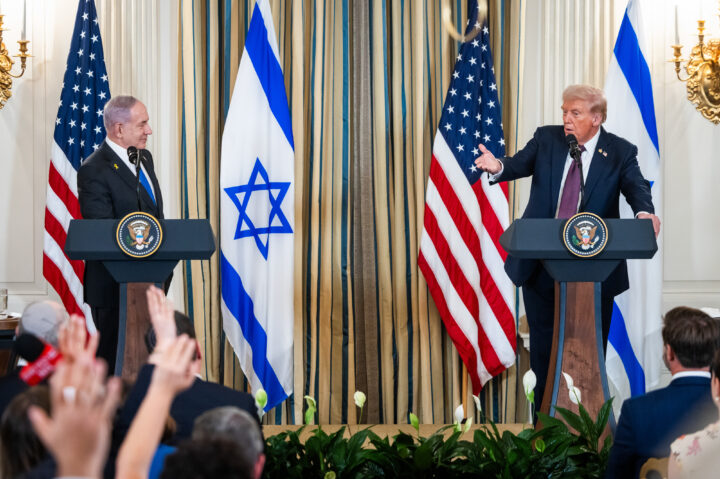
Jim Lo Scalzo/EPA/Bloomberg via Getty Images
President Donald Trump, right, and Benjamin Netanyahu, Israel's prime minister, during a news conference in the State Dining Room of the White House in Washington, DC, US, on Monday, Sept. 29, 2025.
It’s a strange moment when the leader of the free world explains to a reporter why he cursed out the prime minister of a major ally.
But we live in an increasingly strange moment, one in which President Donald Trump confirmed to the New York Post this week that he had indeed called Israeli Prime Minister Benjamin Netanyahu “f***ing crazy” during a discussion about Israel’s plans to expand operations in Lebanon, even as he stressed that he and the Israeli leader have “worked very well together.” (Trump’s confirmation came after Netanyahu’s office denied the remarks.)
The tense nature of the Trump-Netanyahu call this week underscores the increasingly divergent tactics the two are taking to ongoing conflicts in the Middle East as Trump leans into diplomacy while Netanyahu pushes for intensified military action — and as questions loom over the future of U.S. aid to Israel.
With the House’s passage of a war powers resolution yesterday (with four Republicans breaking with House GOP leadership), and a Senate vote on the issue still pending, the Trump administration’s appetite for a resumption of hostilities is even smaller than it was last month (when, as we reported, it was already quite low, owing to rising gas prices and the approaching midterms).
And it’s not just Trump distancing the U.S. from renewed all-out conflict. Speaking before the Senate Foreign Relations Committee on Wednesday, Secretary of State Marco Rubio told lawmakers that the Iran war was “over.”
The comments come even as Iran continues to scale up its attacks in the region, in some cases prompting a U.S. response. Early Wednesday morning, the Islamic Republic launched a drone attack targeting Kuwait’s main airport, killing one person and injuring at least 60.
Trump has reportedly set a red line on Iran, telling aides that he could end the ceasefire — which, while not a technical halting of all fire, has resulted in far fewer exchanges of fire and destruction than at the height of the war in March and early April — if U.S. troops are killed.
Meanwhile, Netanyahu told CNBC on Wednesday that he wants to start the process of winding down U.S. military aid to Israel over the next two years — the final years of Trump’s term — in a way that would shift the relationship, according to the prime minister, “from aid to a partnership where we both invest equal amounts and both share equally in the fruits of our innovators and technologies.” Such a move, Netanyahu added, “will also take away the myth that Israel is depleting America’s coffers” — a popular talking point among opponents of U.S. aid to Israel on Capitol Hill and beyond.
On paper, Washington and Jerusalem do appear in lockstep — alongside Beirut — on deepening relations between Israel and Lebanon and rooting out Hezbollah. To that effect, the White House announced in a joint statement with Lebanese and Israeli officials on Wednesday that the parties had agreed to a renewed ceasefire — though it is contingent on the cooperation of Hezbollah, which did not take part in the talks and continues to launch drones and missiles at northern Israel.
But even as officials in Washington reach an accord on Lebanon, the challenges on the ground remain much the same. It was, after all, the issue of Lebanon — and Netanyahu’s announcement that the IDF would attack Hezbollah strongholds in Beirut — that triggered Trump’s expletive-laden outburst on Monday, causing Netanyahu to walk back Israel’s military plans in Lebanon.
And while Netanyahu needs to stay in Trump’s good graces, it is voters in Israel — including those in the country’s north who are living under daily Hezbollah fire — whom Netanyahu will need to sway ahead of the fall elections.
The resolution passed 215-208, with four Republicans breaking ranks to vote for the resolution, and all present Democrats remaining united on the issue for the first time since the war began

Kevin Carter/Getty Images
U.S. Capitol Building on January 18, 2025 in Washington, DC.
The House passed a war powers resolution on Wednesday that would halt U.S. military operations against Iran, after House Republicans postponed an expected vote on the resolution for more than a week, in an ultimately futile effort to stave off defeat.
The resolution passed 215-208, with four Republicans breaking ranks to vote for the resolution, and all present Democrats remaining united on the issue for the first time since the war began. Six Republicans and one Democrat were absent for the vote — so the resolution likely still would have passed even with full attendance.
The vote comes after the Senate advanced a procedural vote on a similar resolution, and is a notable signal of opposition from Congress to the war in Iran, even if President Donald Trump can veto such a resolution if it passes the Senate. Some Republicans have suggested that the underlying 1973 War Powers Act is unconstitutional or invalid, and should be challenged in court or ignored by the administration.
A final Senate vote on the war powers resolution that advanced last month is still pending.
Republican Reps. Warren Davidson (R-OH), Thomas Massie (R-KY), Tom Barrett (R-MI) and Brian Fitzpatrick (R-PA) broke ranks to support the resolution. Davidson and Massie are libertarian-leaning isolationists, while Barrett and Fitzpatrick represent hotly contested swing districts.
Davidson voted for a war powers resolution at the outset of the conflict, but voted present and then against subsequent resolutions, before flipping his vote back to yes on the latest vote.
Fitzpatrick told reporters his vote was an issue of the law. The War Powers Act gives the administration 60 days to conduct military operations without congressional approval.
“We’re past the 60 days, so you have two choices: you either follow the law or you change the law,” Fitzpatrick said. “You can’t violate the law, that’s not an option. … I don’t see what’s complicated about it. Bring it to Congress, debate it on the merits and have us vote. That’s the way the system’s supposed to work.”
The administration has claimed that its military operations against Iran that began in February have concluded, and that its continued limited strikes against Iranian targets do not qualify as warfare.
Barrett, who introduced a limited Authorization for Use of Military Force in Iran, offered a similar stance in a statement.
“Congress has the exclusive authority under the Constitution to declare war and authorize the use of force,” Barrett said. “The War Powers Act of 1973 delegates some of that authority to the president for a limited period of time. That authority has expired, so my consistent belief is that it is time for Congress to decide the scope of the mission and the appropriate limits on the use of force in Iran.”
Other Republicans argue the legislation sends a message of weakness and division and strips the U.S. of leverage in the midst of negotiations.
“I think what it signals to Iran is that, especially from the Democratic standpoint, it gives them confidence to try and drag these negotiations out. So I think it undermines the position of the United States of America,” Rep. Mike Lawler (R-NY), who chairs the Foreign Affairs Committee’s Middle East subcommittee, told reporters. “They’re actively undermining the United States position in these negotiations, so, from my standpoint, I think it’s foolish, and that’s why I voted no.”
Rep. Jared Golden (D-ME), the sole Democratic holdout on previous votes, also flipped his vote to support the resolution in Wednesday’s vote.
Golden said that, after the 60-day mark of the Iran war passed, the statutory cutoff for military operations undertaken without congressional authorization, he believed the war could not continue without such approval. But he described a war powers resolution the House voted on last month as textually flawed and outdated.
“The passage of my War Powers Resolution is a significant bipartisan rebuke of President Trump’s illegal and costly war in Iran, and the first step toward ending it once and for all,” House Foreign Affairs Committee Ranking Member Greg Meeks (D-NY) said in a statement. “The passage of this WPR today signals a significant turning point: more and more Republicans are listening to their constituents who do not want another open-ended war in the Middle East. Now the Senate must take up this measure and make clear to the President that enough is enough.”
Plus, Rubio defends Israel's Lebanon strikes
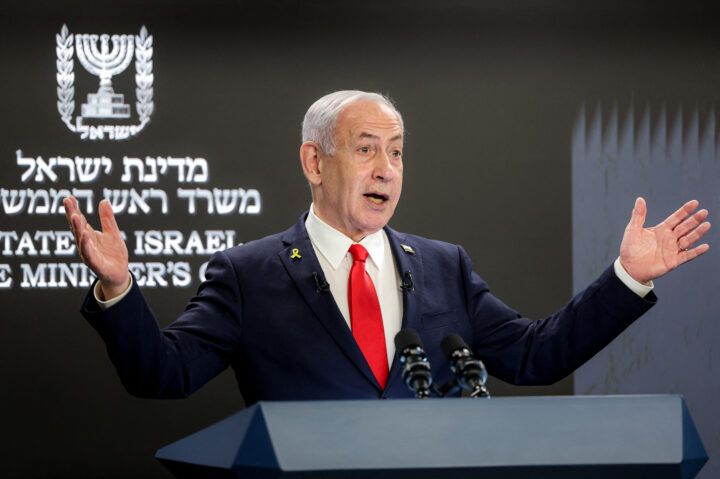
ABIR SULTAN/POOL/AFP via Getty Images
Israel's Prime Minister Benjamin Netanyahu gives a press conference at the Prime minister's office in Jerusalem on August 10, 2025.
This P.M. edition is reserved for our premium subscribers like you — offering a forward-focused read on what we’re tracking now and what’s coming next.
Today’s Daily Overtime was curated by JI U.S. Editor Danielle Cohen-Kanik.
📡On Our Radar
Notable developments and interesting tidbits we’re tracking
Israeli Prime Minister Benjamin Netanyahu told CNBC’s Sara Eisen today that he wants to start the process of winding down U.S. aid to Israel in the final two years of the Trump administration, as both countries work toward reaching a new memorandum of understanding, Jewish Insider’s Emily Jacobs reports.
“We’re now working on a memorandum of understanding which will bring down the aid,” Netanyahu said. “I want it to start in the last two years of the Trump administration and I want it to keep going down, coming to zero.” His comments suggest he’s looking to begin phasing out aid even while the current MOU is set to provide Israel with $3.8 billion in U.S. military assistance annually through FY 2028…
Despite President Donald Trump’s public acknowledgement of a confrontational phone call with Netanyahu regarding Israeli operations in Lebanon, Secretary of State Marco Rubio largely defended Israel’s attacks against the Lebanese terrorist group, JI’s Marc Rod reports.
Rubio said at a House Foreign Affairs Committee hearing today that Hezbollah reached out to the U.S. government through Lebanese authorities and said that it would stop launching missiles into Israeli territory if Israel did not attack Beirut, but Hezbollah went back on that agreement and launched rockets at Israel within hours…
Trump avoided directly answering a question from reporters this afternoon if the U.S. ceasefire with Iran still stands, after Iran launched several ballistic missile attacks around the region last night.
“There is a reason for certain things, and there’s usually a reason that sometimes makes sense. We got it, we nipped it in the bud very quickly … but some people would say they were slightly provoked because we took a strong action for a different reason. So they were reciprocating,” the president said…
Sens. John Fetterman (D-PA) and Dave McCormick (R-PA) told JI’s Emily Jacobs on Tuesday that they both believe antisemitism is worse on the left than on the right, arguing that the electoral success of far-left candidates with antisemitic records in Democratic primaries distinguishes the left from the right, as similarly controversial candidates have struggled in GOP primary contests…
The anti-Israel American Priorities super PAC pledged to spend $2 million backing New York City Mayor Zohran Mamdani’s chosen congressional candidates: former City Comptroller Brad Lander, running to unseat Rep. Dan Goldman (D-NY); Darializa Avila Chevalier, challenging Rep. Adriano Espaillat (D-NY); and Claire Valdez, running to succeed Rep. Nydia Velazquez (D-NY). All three candidates have denounced super PAC spending in the past…
Maine Senate candidate and presumptive Democratic nominee Graham Platner released an internal poll showing he still leads his general election opponent, Sen. Susan Collins (R-ME), by a margin of four points after potential voters are told about his most recent scandals. The latest figures from Platner’s camp mark a drop from the roughly eight-point advantage the Democratic candidate has held in previous polls…
In the race to succeed retiring Rep. Nancy Pelosi (D-CA), state Sen. Scott Wiener and Connie Chan, a member of the San Francisco Board of Supervisors who was endorsed by Pelosi, will advance to the general election. With half of votes counted so far in the jungle primary, Wiener won 41% and Chan received 28%, while Saikat Chakrabarti, a wealthy tech entrepreneur aligned with the anti-Israel left, came in third with 15%…
In Montana’s 1st Congressional District, where Rep. Ryan Zinke (R-MT) is retiring, smokejumper Sam Forstag prevailed in the Democratic primary, where several of the candidates, including Forstag, had expressed views critical of Israel. Forstag now faces an uphill battle against Trump-endorsed Republican military veteran Aaron Flint in the general election, given the district’s GOP leanings…
The NYPD arrested an NYU student today for raising a flag that displayed swastikas and a Star of David atop a university building last month. The perpetrator was a fourth-year NYU student at the time of the incident and has not yet received a diploma, a university spokesperson told JI’s Haley Cohen. The New York Times reported that the man is named Alexander Stepnowsky, a music technology student who was charged with a hate crime and trespassing…
⏩ Tomorrow’s Agenda, Today
An early look at tomorrow’s storylines and schedule to keep you a step ahead
Keep an eye out in Jewish Insider for a look at why pro-Israel groups chose not to engage in New Jersey’s 12th Congressional District to oppose anti-Israel Democratic nominee Adam Hamawy in yesterday’s primary election.
The House Armed Services Committee will hold a markup of the 2027 National Defense Authorization Act, where Rep. Ro Khanna (D-CA) said he will attempt to strip out a routine provision facilitating expanded U.S.-Israel cooperation.
Treasury Secretary Scott Bessent will testify before the House Ways & Means Committee.
New York City Council Speaker Julie Menin and City Councilmember Virginia Maloney will meet with Manhattan Holocaust survivors at UJA-Federation of New York headquarters to mark Holocaust Survivor Day.
Brandeis University’s Jonathan Sarna will sit in conversation with Princeton’s Laura Arnold Leibman at Temple Emanu-El in New York City to discuss the Jewish experience of the American Revolution, a month ahead of the U.S. Semiquincentennial.
UN Watch will hold its annual gala in Geneva, where the group will honor free speech and women’s rights activists Abnousse Shalmani and Ayaan Hirsi Ali.
Stories You May Have Missed
PAC PLAY
AIPAC betting big on pro-Israel Democrat and party favorite in Maryland
State Del. Adrian Boafo is Steny Hoyer’s favored candidate, and is getting support from Democratic leaders across the state
PLATNER POSITIONS
Senate Dems wary after latest Platner revelations, but stick by him
Most aren’t calling for him to leave the race, or throwing their support behind Gov. Janet Mills, who still remains on the primary ballot even after suspending her campaign
The secretary of state largely defended Israel’s strikes in response; ‘Israel has a right to act in its defense’
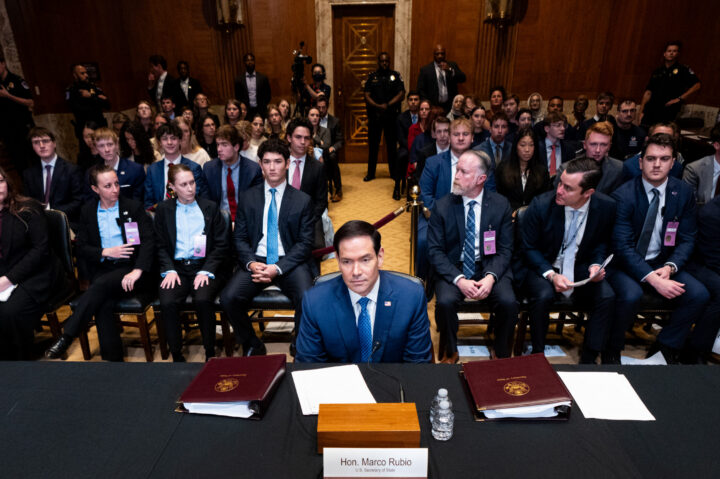
Bill Clark/CQ-Roll Call, Inc via Getty Images
Secretary of State Marco Rubio appears before the Senate Appropriations Subcommittee on State, Foreign Operations, and Related Programs hearing on the State Department budget request on Wednesday, June 3, 2026.
Despite President Donald Trump’s public acknowledgement of a confrontational phone call with Israeli Prime Minister Benjamin Netanyahu regarding Israeli operations in Lebanon, Secretary of State Marco Rubio on Wednesday largely defended Israel’s attacks against the Lebanese terrorist group.
He said that Hezbollah reached out to the U.S. government through the Lebanese authorities approximately two weeks ago and said that it would stop launching missiles into Israeli territory if Israel did not attack Beirut. But Rubio said that Hezbollah went back on that agreement and launched rockets at Israel within hours.
“Israel has not conducted massive operations in Beirut for some time,” Rubio said at a House Foreign Affairs Committee hearing. “Israel has a right to act in its defense.”
Israeli strikes have taken place largely to prevent imminent attacks by Hezbollah forces preparing to attack Israel, Rubio said. He said that Israel’s seizure of territory in southern Lebanon has been intended to deny Hezbollah freedom to operate and launch missiles, and that Israel has not been conducting large-scale operations in Beirut.
Pressed on the current U.S. position in negotiations with Iran, particularly in comparison to the first Trump administration’s condemnation of the 2015 Iran nuclear deal, Rubio largely focused on the nuclear elements of the deal, but said that Iran’s missile program would also be discussed.
He said that Iran would not receive money or sanctions relief unless it agrees to dispose of its highly enriched uranium and give up its enrichment program.
Asked whether the administration would submit any deal reached to Congress, he said that the administration would comply with the Iran Nuclear Agreement Review Act, which requires such review. He said in a Senate Appropriations Committee hearing in the afternoon that the bill, known as INARA, has “very specific requirements about elements of the nuclear program that would have to be noticed to Congress.”
Pressed by Sen. Lindsey Graham (R-SC) on whether Iran’s support for proxy terrorism would be part of any deal, Rubio said that the U.S. would like to see limits on that activity in a deal, but said that there could also be U.S. sanctions “just on that.”
He also suggested at the House hearing the U.S. is seeking to address Iran’s supply of 20% enriched uranium, in addition to 60% enriched uranium.
Asked about recent comments by Trump describing the Iranian military as moderate, and saying that the U.S. has left it “alone,” Rubio drew a distinction between military equipment and capabilities, which the U.S. has targeted, and certain figures inside the regime who have been more open to negotiations with the U.S. or a more conciliatory posture.
He also framed all U.S. operations since the ceasefire as defensive — retaliatory attacks to respond to or prevent attacks on commercial shipping, to which Iran has responded with strikes on facilities throughout the region.
“These are completely defensive in nature. But they are happening in response to an Iranian action. If they don’t shoot at those ships, we don’t shoot. But we have to respond,” Rubio said. “You have a civilian commercial vessel transiting the straits and they’re being targeted by drones.”
He denied a report that Iran had threatened to test a nuclear weapon if the U.S. does not make concessions in negotiations.
Asked about congressional action on Iran, Rubio noted that Iranian state media has framed congressional votes in favor of war powers resolutions to block operations against Iran as a victory which would tie the U.S.’ hands.
He also said that the administration does not feel it needs an Authorization for Use of Military force to carry out any potential further operations against Iran, but said that the administration would engage with Congress if that occurs and that it would welcome any further congressional authorities.
Pressed by Rep. Joaquin Castro (D-TX) about Israel’s alleged nuclear capabilities, Rubio emphasized that Israel has never acknowledged that it has a nuclear program, though most of the world believes it does. “But they’ve never acknowledged that publicly, and as a feature of our foreign policy, for a variety of reasons, we don’t discuss it in that way either,” he said.
He said that the State Department might be able to discuss the issue further in a closed session and in a different context than a letter Castro and other Democrats sent to Rubio on the subject.
Rubio also affirmed that Turkey is currently not eligible to receive F-35 fighter jets as long as it operates a Russian S-400 missile defense system, under U.S. statute.
The Pennsylvania Democrat, the most hawkish member of his party on Iran, told JI that failing to eliminate Tehran's nuclear threat would undermine the president's legacy

Andrew Harnik/Getty Images
Sen. John Fetterman (D-PA) speaks at a rally for Democratic vice presidential nominee Minnesota Gov. Tim Walz at York Exposition Center UPMC Arena on October 2, 2024 in York, Pennsylvania.
Sen. John Fetterman (D-PA) said on Tuesday that he is growing increasingly concerned that President Donald Trump may agree to a deal with Iran that does not ensure the retrieval of Tehran’s stockpile of enriched uranium or that the regime will never acquire a nuclear weapon.
Fetterman, who has become the most hawkish Democrat in Congress on Iran and the sole member of his party to vote against every Iran war powers resolution in recent months, spoke with Jewish Insider in Washington about the possible outcomes of the ongoing peace talks. The Pennsylvania senator acknowledged that he and Trump had taken political heat from their respective parties over their stances on the conflict, but argued that solving the Iranian nuclear issue would be legacy-defining for the president.
“Nuclear dust, that’s the reason why we’re here. This is why I was reasoned and OK with setting myself politically on fire to be the only Democrat for the last 90 days voting against these war powers acts,” Fetterman told JI. “Presidents always talk about their legacy. At this point, if you cave just for political convenience, what kind of legacy is that?”
“I appreciate every now and then when Trump will say, ‘Well, it [the war in Iran] is only going to be about that nuclear dust,’ but Israel is never allowed to fully pulverize their enemies,” he continued. “They’re fighting a nation where they like martyrdom and that’s what they celebrate. It’s so dumb.”
The Pennsylvania senator addressed the negative U.S. public perception of the war, arguing that the president was acting in a “Churchillian” manner by taking on the Iranian regime, and expressing concern that reversing course in Iran could indicate the Trump administration’s lack of commitment to Taiwan, in the event of a Chinese invasion.
“I hope after that silly visit to China that they [the Trump administration] aren’t now like, ‘Well, we’re going to turn our back to Taiwan,’” he added, referencing the president’s summit in Beijing last month with Chinese President Xi Jinping. “These are all fights for civilization and democracy. I don’t care if it’s in Gaza or Iran, Taiwan against Chinese communism or Russia and Ukraine, it’s the same fight, and that’s why it’s our special responsibility, it’s America’s, to stand with these allies.”
Fetterman pointed to the pressure Democrats faced during the 2024 election to take a firmer stance in opposition to Israel’s war in Gaza due to the high death toll of Palestinians. He argued that those of his Democratic colleagues who had worked to restrain Israel since Hamas’ Oct. 7, 2023, attacks on the Jewish state had damaged their credibility.
“How can you trust these people?” he asked of those Democrats. “Two years ago they were all demanding and pushing for a ceasefire. Can you believe where we would be now if we had a ceasefire? Can you imagine if Israel had to grovel to get their people back? Can you imagine if Iran could be a nuclear power by now?”
“If [there was] a ceasefire in July [2024] based on the pressures from the election in ‘24, [former Hamas chief Yahya] Sinwar would be alive. Hezbollah would be intact. They could launch thousands of rockets at will — and think of the capabilities that Iran could be at now,” he added. “Where’s the outrage? They pretended to be so worried about it. It was politically convenient to try to push Israel into a position that would put Iran on the path to nuclear power, and [leave] their proxies fully intact.”
Given initial reactions from critical Senate Republicans, Pulte would likely struggle to be confirmed for a permanent position

Brendan SMIALOWSKI/AFP via Getty Images
Bill Pulte, director of the Federal Housing Finance Agency, speaks to reporters outside the West Wing of the White House in Washington, DC, on January 9, 2026.
Senate Republicans on Tuesday expressed skepticism about President Donald Trump’s decision to name Bill Pulte, a lawyer and Trump ally who has been working on housing policy issues and has no known intelligence or national security background, as acting director of national intelligence.
Pulte will take over the agency, which coordinates efforts across the intelligence community, after DNI Tulsi Gabbard resigns later this month. Trump had originally announced that Gabbard’s current chief deputy, Aaron Lukas, a career intelligence official, would be assuming the acting role, but pivoted without explanation.
It’s not clear yet whether Trump plans to nominate Pulte, who he said will simultaneously continue in his current roles as director of the Federal Housing Finance Agency and chairman of Fannie Mae and Freddie Mac, as permanent DNI, but given initial reactions from critical Senate Republicans, he would likely struggle to be confirmed. The statute establishing the post also requires that the nominee be an individual with experience in national security.
Under federal law, Pulte could serve in the role in an acting capacity for up to 210 days, before requiring Senate confirmation.
Leading Senate Republicans said they did not think Pulte was qualified for the role.
“I don’t see any evidence of qualifications for that job, but as you know the Senate doesn’t have a role to play in acting [appointments],” Sen. John Cornyn (R-TX) said. Cornyn would be a crucial swing vote on the Senate Intelligence Committee if Pulte is nominated for the permanent role, and was recently defeated in his primary by a Trump-backed challenger.
“He doesn’t seem very qualified,” Sen. Bill Cassidy (R-LA), also recently defeated by a Trump-backed primary challenger, agreed.
Sen. Ted Budd (R-NC), who also sits on the Intelligence Committee, offered a terse response. “Certainly an interesting choice. There’s a lot of talented people that I probably would have considered. Congrats on his nom[ination],” Budd said.
Other Senate Republicans couched their comments, emphasizing their lack of familiarity with Pulte and his record, and saying they were not aware of whether he had any national security experience (per his public record, Pulte does not).
Sen. James Lankford (R-OK), a member of the Intelligence Committee, said that he did not know what experience Pulte has in intelligence, or whether he would be nominated for the role in the long-term. But he emphasized that intelligence experience is critical for the job.
“That role’s pretty important in coordinating people from a lot of different agencies, you’ve got to have some level of trust in the different agencies to be able to help move,” Lankford said. “The ODNI’s role is to be able to see where are the siloes and to be able to help tear those down to make sure we keep our nation secure. If you don’t know those different roles — it’s not a matter of knowing intelligence products, it’s knowing how each agency actually works. That’s the bigger challenge. If you don’t have any familiarity with that, that does make that job tougher.”
He said separately that it’s critical for the job to remain “nonpartisan.”
“I had no idea he had national security experience. I’m going to have to look into his resume,” said Sen. Thom Tillis (R-NC), who is retiring and has broken on numerous occasions with the administration.
Sen. Susan Collins (R-ME) said that she doesn’t know anything about Pulte, including whether he had any intelligence or military background or even a security clearance.
She said she’s not concerned about her lack of familiarity with Pulte “yet, because maybe there’s a lot in his background that is relevant to this important position. As one of the authors of the Intelligence Reform and Terrorism Prevention Act of 2004, which created the position of DNI, I obviously care a great deal about having a qualified individual in that position.”
Other top Senate Republicans were also hardly enthusiastic about Trump’s pick.
Senate Majority Leader John Thune (R-SD) said, when asked if he was worried about Pulte weaponizing the role, “we don’t need a weaponized DNI, we need professionals there,” but said he had “just heard about it.”
“If he’s somebody they want in that position permanently, he’s got, as you all know, a lengthy road ahead of him,” Thune continued.
Asked at a press conference later in the day about the choice, Thune deferred to Intelligence Committee Chairman Tom Cotton (R-AR), who said he has “no observations” on the choice of Pulte.
Trump’s choice of Pulte for the role is likely to fuel greater concerns that he aims to politicize and weaponize the role for his own ends. Pulte, in his current role, became perhaps best-known for pursuing investigations against and making allegations that various political adversaries of Trump were engaged in mortgage fraud.
Gabbard faced backlash for her alleged involvement in manipulating intelligence information to fit the administration’s preferred narrative, and for her involvement in an FBI raid on an elections office in Georgia, linked to Trump’s claims that the 2020 presidential election was fraudulent.
In a scathing statement, Sen. Mark Warner (D-VA), the ranking member of the Senate Intelligence Committee, said that Trump’s appointment of Pulte “makes clear that this president is not looking for an intelligence leader who will follow the facts or speak truth to power, but rather someone who will be willing to shape intelligence around the president’s wishes, regardless of the cost to the American people.”
He said that Pulte is not only unqualified for the job, but “appears to have been selected precisely because the White House believes he will provide the narrative it wants, not the intelligence we need,” ultimately raising the risk of a terrorist attack.
Pulte’s appointment could make the passage of critical legislation renewing federal foreign surveillance authorities more difficult. The legislation was already plagued by opposition on both sides.
Plus, Trump's unconventional pick for intel chief
Brooks Kraft LLC/Corbis via Getty Images
International flags at the State Department in Washington.
This P.M. edition is reserved for our premium subscribers like you — offering a forward-focused read on what we’re tracking now and what’s coming next.
Today’s Daily Overtime was curated by JI U.S. Editor Danielle Cohen-Kanik.
📡On Our Radar
Notable developments and interesting tidbits we’re tracking
President Donald Trump again dismissed reports that Iranian negotiators have cut off dialogue with the U.S. as “false and erroneous,” writing in a post on Truth Social that discussions have continued “four days ago, three days ago, two days ago, one day ago, and today”…
About the current talks, Secretary of State Marco Rubio told the Senate Foreign Relations Committee today that the U.S. is not offering Iran any sanctions relief in exchange for reopening the Strait of Hormuz, and that sanctions relief would only be on the table if Tehran makes concessions related to its nuclear program in the next phase of negotiations, Jewish Insider’s Marc Rod reports…
The Trump administration sent a fresh slate of diplomatic nominations to the Senate for approval today, but noticeably absent was a full-throated push to fill critical ambassadorial vacancies across the Middle East and North Africa, even as the Iran conflict has increased the need for coordination and dialogue in the region, JI’s Matthew Shea reports.
The newest list of nominees included only two names for the MENA area: Donald Blome, tapped to serve as assistant secretary of state for Near Eastern affairs — a role that acts as the principal advisor on U.S. foreign policy across the region — and Nick Oberheiden, nominated to be U.S. ambassador to Egypt…
In a highly unusual move, Trump appointed Bill Pulte, the director of the Federal Housing Finance Agency and chairman of Fannie Mae and Freddie Mac, as acting director of national intelligence, after DNI Tulsi Gabbard announced she will resign effective June 30. Pulte, who has no prior experience in an intelligence role, has been a staunch Trump loyalist and led some of the president’s retribution efforts against his political adversaries…
The fourth round of Israel-Lebanon diplomatic talks began at the State Department today, and is expected to last through tomorrow…
At an emergency meeting of the U.N. Security Council yesterday requested by France, every country except for the U.S. called for Israel to immediately withdraw from southern Lebanon and deescalate military hostilities in the country…
The heads of the Conference of Presidents of Major American Jewish Organizations met today with Egyptian President Abdel Fattah El-Sisi and Maj. Gen. Hassan Rashad, head of the country’s General Intelligence Service, in Cairo, where they discussed U.S.-Egypt relations and Middle East security…
A new poll of 600 likely voters in the Michigan Senate Democratic primary conducted for the campaign of physician Abdul El-Sayed found him leading the pack with 34% of the vote, two months ahead of Election Day. Rep. Haley Stevens (D-MI) came in second with 31% and state Sen. Mallory McMorrow trailed at 19%…
Harmeet Dhillon, the assistant attorney general for civil rights, appearing at the American Jewish Committee’s Global Forum in Washington, condemned the “egregious examples of antisemitism that have transpired here at home on American soil” since the Oct. 7, 2023, attacks on Israel as “devastating and antithetical to our values as a nation,” JI’s Emily Jacobs reports…
The backlash to the participation of Israeli Finance Minister Bezalel Smotrich and other far-right Israeli politicians in the Israel Day on Fifth parade in New York City over the weekend continues: Mark Treyger, the head of the Jewish Community Relations Council of New York, which organizes the parade, told The New York Times that he had been blindsided by their attendance.
“There was a complete lack of transparency here,” Treyger said, adding that the Israeli consulate in New York had declined to share with him who would be attending. Dan Rosenthal, a top official at the UJA-Federation of New York, wrote on X that both New York City Mayor Zohran Mamdani and Smotrich “believe in a one-state solution”…
White House Correspondents’ Association President Weijia Jiang announced that the Correspondents’ Dinner will be rescheduled for July 24, after April’s event was cut short by a shooting attack. Trump said he will once again give remarks at the gathering, which will take place at the Waldorf Astoria hotel in Washington…
⏩ Tomorrow’s Agenda, Today
An early look at tomorrow’s storylines and schedule to keep you a step ahead
Keep an eye out in Jewish Insider for the results of today’s high-stakes Democratic primary in New Jersey’s 12th Congressional District, where plastic surgeon Adam Hamawy, whose past terror ties have raised red flags about his candidacy, is the favorite to win.
Secretary of State Marco Rubio will be back on the Hill testifying before the House Foreign Affairs Committee and a Senate Appropriations subcommittee, while Homeland Security Secretary Markwayne Mullin will appear before the House Homeland Security Committee.
State Department antisemitism envoy Yehuda Kaploun and the Argentine Embassy in Washington will co-host a commemoration ceremony at the U.S. Institute of Peace marking the 32nd anniversary of the bombing of the Argentine Israelite Mutual Association (AMIA), with remarks from House Foreign Affairs Committee Chairman Brian Mast (R-FL) and AMIA President Osvaldo Armoza.
The Jewish Democratic Council of America will host a candidate forum for the New York 12th Congressional District Democratic primary at the Streicker Center in New York City.
Stories You May Have Missed
Hard Ro To Hoe
Khanna’s hostile turn towards Israel divides Silicon Valley Jews

His critics once saw him as an ally, but fear he’s pandered to extremists as he raises his national profile ahead of the 2028 presidential election
GROWING THREAT
Cheap, deadly and hard to spot: Hezbollah’s drones create urgent security threat for Israel

‘You just have Israeli soldiers completely unaware. If you can’t hear the drone, if you don’t know that it’s there until it’s too late, it’s too late,’ said FDD’s David Daoud
According to Trump and Netanyahu, Israel will refrain from striking Beirut but continues to operate in southern Lebanon, while Hezbollah has agreed to cease its attacks against northern Israel

Anwar AMRO / AFP via Getty Images
A Hezbollah banner placed amid the rubble of a destroyed building near Sayyid al-Shuhada complex in Beirut's southern suburbs on May 6, 2026.
President Donald Trump announced on Monday that Israel would not carry out strikes against Hezbollah in Beirut in exchange for the terror group halting its persistent attacks on northern Israel and IDF soldiers, cutting off imminent Israeli plans to expand its operations against Hezbollah in the Lebanese capital.
Trump made the announcement in a post on Truth Social where he touted successful phone calls earlier Monday with Israeli Prime Minister Benjamin Netanyahu and “highly placed representatives” representing Hezbollah. In a subsequent post, he added that he had asked Netanyahu “not to go into a major raid of Beirut” and Netanyahu “turned his Troops around.” Hezbollah likewise “agreed to stop shooting at Israel, and its soldiers.”
“Let’s see how long that lasts — Hopefully it will be for an ETERNITY!” Trump wrote.
Netanyahu, who had said in a video statement hours earlier that he had “instructed the IDF to strike terrorist targets in Beirut,” seemingly confirmed the deal, saying after Trump’s announcement that Israel would stop firing on Hezbollah targets in the capital for as long as the terrorist group ceased its attacks on Israel.
“I spoke this evening with President Trump and told him that if Hezbollah does not stop firing at our cities and civilians, Israel will strike terrorist targets in Beirut. This position remains unchanged,” Netanyahu said. “At the same time, the IDF will continue operating in southern Lebanon as planned.”
The Lebanese Embassy in Washington said on Monday that, “Lebanese authorities received confirmation of Hezbollah’s agreement to the U.S. proposal calling for a mutual cessation of attacks.”
The embassy said the “scope of the ceasefire” will “subsequently [be] expanded to encompass the entirety of Lebanese territory,” a provision that Netanyahu made no mention of.
The announcement came hours after Iranian state media reported that Tehran had suspended peace talks with the U.S. over Israel’s expanding military campaign in Lebanon. Iranian Foreign Minister Abbas Araghchi wrote on X on Monday that, “a ceasefire between Iran and the United States constitutes, without any ambiguity, a comprehensive ceasefire across all fronts, including Lebanon.”
Trump dismissed this reporting, writing on Truth Social that “talks are continuing, at a rapid pace, with the Islamic Republic of Iran.”
Plus, Huckabee says next MOU will end Israel aid

Marwan Naamani/picture alliance via Getty Images
Pro-Iranian Hezbollah supporters wave the party flags during a ceremony in a southern Beirut suburb on May 5, 2026.
This P.M. edition is reserved for our premium subscribers like you — offering a forward-focused read on what we’re tracking now and what’s coming next.
Today’s Daily Overtime was curated by JI U.S. Editor Danielle Cohen-Kanik.
📡On Our Radar
Notable developments and interesting tidbits we’re tracking
President Donald Trump announced that Israel would not carry out strikes against Hezbollah in Beirut in exchange for the terror group halting its attacks on northern Israel, hours after Israeli Prime Minister Benjamin Netanyahu made a statement instructing the IDF to strike Hezbollah targets in the Lebanese capital.
While Trump said he had a “very good call with Hezbollah” as part of the negotiations, the Lebanese Embassy in Washington later clarified that the message was relayed through Lebanese officials rather than communicated directly from the president to the terror group.
Netanyahu said after the announcement that he had informed Trump that “if Hezbollah does not stop attacking our cities and civilians, Israel will strike terrorist targets in Beirut,” while the IDF will continue hitting targets in southern Lebanon as planned…
The news came hours after Iranian state-linked media reported that Tehran had suspended negotiations with the United States and warned it could direct its proxies, including the Houthis in Yemen, to target shipping through the Bab el-Mandeb Strait — another critical global trade route — in response to Israel‘s continued military operations against Hezbollah…
Trump disputed the reporting, writing on Truth Social this afternoon that “talks are continuing, at a rapid pace, with the Islamic Republic of Iran,” despite having told NBC News earlier in the day that he would welcome a pause in talks if the reports were accurate. “I think we’ve been talking too much, if you want to know the truth,” Trump told the outlet. “I think going silent would be very good, and that could be for a long time”…
Amid the diplomatic dance, military operations have escalated: The U.S. struck several sites in Iran over the weekend after Iran downed an American MQ-1 drone. U.S. forces also intercepted two Iranian ballistic missiles targeting American forces based in Kuwait last night, CENTCOM said…
Michael Makovsky, the president and CEO of the Jewish Institute for National Security of America, criticized the Trump administration’s recent handling of the U.S. war in Iran, telling Jewish Insider’s Emily Jacobs on Friday, before the events of this weekend, that the “U.S. has lost the plot on Iran” and that a deal with the regime now “wouldn’t be worth the paper it’s written on”…
Responding to claims from former National Counterterrorism Center head Joe Kent that U.S. aid to Israel does not confer benefits to America, U.S. Ambassador to Israel Mike Huckabee defended the relationship and said the next U.S.-Israel memorandum of understanding, after the current one expires in 2028, will end aid to Israel and “be based on trade”…
Republican Jewish Coalition CEO Matt Brooks celebrated his group’s role in ousting Rep. Thomas Massie (R-KY) in his primary election earlier this month at the organization’s “America 250”-themed gala held last night in Manhattan, JI’s Haley Cohen reports.
“Being anti-Israel in today’s Republican Party is not — unlike the Democratic Party — a path to success,” said Brooks, who called defeating Massie a “critical victory” for the direction of the GOP and conservative movement…
Pennsylvania Gov. Josh Shapiro told CNN that he believes Israel is being unfairly singled out for criticism as a Jewish state: “For those who do not want there to be a Jewish state, oftentimes they will predicate their views on this notion that being grounded in a religion and being a democracy can’t coexist,” he said.
“I think it’s important to point out the hypocrisy of that view when there are 46 majority Muslim nations, 23 of which have Islam as their official religion … and only one has Judaism as their official religion, and yet we’re focused on just the Jewish state,” Shapiro continued. (Important to note: While Israel has a Basic Law declaring it the nation-state of the Jewish people, the country does not have an official state religion)…
El Al announced it will restart nonstop flights between Israel and San Francisco on Oct. 25, citing high demand for the route between the tech hubs, which was paused in 2020 at the beginning of the COVID-19 pandemic. The three weekly flights will be numbered LY49, in a nod to the San Francisco 49ers NFL team…
The Israeli Ministry of Defense said France has barred Israeli officials from participating in the Eurosatory defense show in Paris later this month. Israeli defense firms, which can participate but will not have a dedicated Israeli national pavilion, can only showcase air-defense systems and are prohibited from displaying offensive weapons systems…
⏩ Tomorrow’s Agenda, Today
An early look at tomorrow’s storylines and schedule to keep you a step ahead
Keep an eye out in Jewish Insider for coverage of tomorrow’s key primary elections across the country — including House races in New Jersey, California, Montana, Iowa, New Mexico and South Dakota, California’s gubernatorial race and Montana’s open-seat Senate race — several of which will serve as a referendum on the Democratic Party’s progressive versus establishment divide.
On the Hill, Secretary of State Marco Rubio will appear before the Senate Foreign Relations Committee and the House Appropriations Committee. Homeland Security Secretary Markwayne Mullin will testify at a Senate Appropriations Committee hearing, and acting Attorney General Todd Blanche will speak at a House Appropriations Committee hearing. The Senate Select Committee on Intelligence will also hold a closed intel hearing.
Israeli Prime Minister Benjamin Netanyahu and President Isaac Herzog will attend a command change ceremony at Mossad headquarters to inaugurate Maj. Gen. Roman Gofman as the new head of the agency, after the Israeli High Court rejected petitions today calling for Gofman’s appointment to be annulled on ethical and procedural grounds.
The Israel Democracy Institute will kick off its two-day Eli Hurvitz Conference on Economy and Society in Jerusalem.
Stories You May Have Missed
ANGELENO AFFAIRS
Wide-open Los Angeles mayoral race could hinge on support from Jewish voters

The race features an embattled Mayor Karen Bass facing a spirited challenge from her right in reality TV star Spencer Pratt, and from her left in City Councilmember Nithya Raman
BIG SKY BATTLE
Most Montana Democrats running for Rep. Ryan Zinke’s seat slam U.S.-Israel relationship
Two of the four Democrats in the race have also faced scrutiny over antisemitic activity online
Makovsky said Trump’s reported deal with Tehran ‘wouldn’t be worth the paper it’s written on’
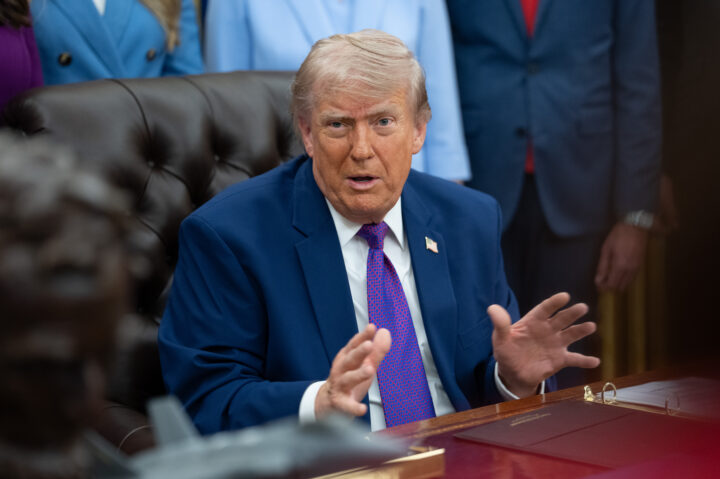
Aaron Schwartz/Sipa/Bloomberg via Getty Images
President Donald Trump speaks during a maternal healthcare event in the Oval Office of the White House in Washington, DC, US, on Monday, May 11, 2026.
Michael Makovsky, the president and CEO of the hawkish Jewish Institute for National Security of America, criticized the Trump administration’s recent handling of the U.S. war in Iran, expressing concern about the possibility of a broader peace deal that does not address key issues.
“The U.S. has lost the plot on Iran,” Makovsky told Jewish Insider on Friday. “After significant military achievements, declaring the ceasefire was a huge mistake, and there was too much hype about what pressure a blockade alone would achieve. The net result has reduced U.S. leverage, and the perception that America is vulnerable if gasoline nears $5 per gallon.”
Makovsky said that the U.S. “should not pursue a deal” with Iran, arguing that such an agreement “wouldn’t be worth the paper it’s written on.” He said that a deal “will only enrich and strengthen the regime and demoralize the Iranian people.”
“Instead, the U.S. should resume military operations for a couple weeks, weaken the regime and its nuclear and conventional capabilities further, cease the military campaign while maintaining the blockade and support the Iranian people in every way possible,” he said.
Makovsky spoke to JI in response after President Donald Trump’s announcement on Friday that he was nearing a decision on the agreement reportedly reached by U.S. and Iranian negotiators to extend the ongoing ceasefire by 60 days, reopen the Strait of Hormuz and continue nuclear talks. Makovsky made the comments prior to this weekend’s fighting between the two countries, with the U.S. striking Iranian air defenses and drone sites after Iran downed an American MQ-1 drone and shot missiles at U.S. forces based in Kuwait.
“Based on what appears to being negotiated, the Strait of Hormuz will be opened in return for certain Iranian pledges about what will be worked out in further negotiations,” Makovsky said. “There are even reports about a possible international investment fund in Iran, which would be preposterous with this regime.”
After holding a Situation Room meeting on Friday, Trump reportedly requested several amendments to the negotiated deal, including firmer commitments around Iran’s stockpile of enriched uranium, leading to another round of negotiations. Iranian state media reported on Monday that its delegation was suspending talks with the U.S. over Israel’s continued strikes against Hezbollah in Lebanon.
Plus, Jill Biden's advice to Joe on Bibi
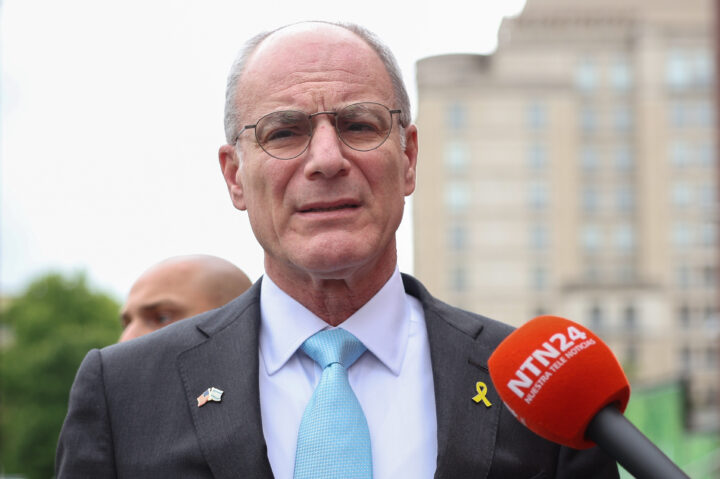
Tasos Katopodis/Getty Images
Israeli Ambassador to the United States Yechiel Leiter
This P.M. edition is reserved for our premium subscribers like you — offering a forward-focused read on what we’re tracking now and what’s coming next.
Today’s Daily Overtime was curated by JI U.S. Editor Danielle Cohen-Kanik.
📡On Our Radar
Notable developments and interesting tidbits we’re tracking
Despite recent clashes between the U.S. and Iran — including Iranian missile and drone attacks around the region last night — negotiators from both countries have reportedly agreed to terms for a 60-day ceasefire with continued negotiations on Iran’s nuclear program, U.S. sources confirmed to the White House press pool.
President Donald Trump has not yet given his stamp of approval to the deal, Axios reports, and has told mediators he wants a couple of days to consider it…
In the meantime, Iranian state media reported a renewed exchange of fire in the Strait of Hormuz this afternoon, as Iranian forces were said to have fired “warning shots” at four vessels and engaged air defenses against a “hostile aircraft”…
Treasury Secretary Scott Bessent warned that the U.S. “will not tolerate any effort to impose a tolling system in the Strait of Hormuz,” specifically cautioning Oman that the Treasury Department will “aggressively target” any actors involved in facilitating such tolls. Bessent said during a press conference this afternoon that he spoke with the Omani ambassador to the U.S. this morning who assured him Muscat has no plans to do so…
In an excerpt of her forthcoming memoir, View From the East Wing, shared with The Atlantic, former First Lady Jill Biden recalls leaving her husband notes on the bathroom mirror during his time as president, including her views on Israel’s war in Gaza. “Net has to stop,” she once wrote, in a reference to Israeli Prime Minister Benjamin Netanyahu. Before a phone call between him and President Joe Biden, she advised, “Be strong. Don’t let BN use your goodness”…
A week after describing J Street as “a cancer within the Jewish community,” Israeli Ambassador to the U.S. Yechiel Leiter doubled down on his critique of the organization, stating that the liberal advocacy group’s recent actions are “decidedly not pro-Israel,” Nira Dayanim reports for Jewish Insider.
Speaking today at the Re-Charging Reform Judaism summit at the Stephen Wise Free Synagogue in Manhattan, Leiter was resolute, but more measured in his criticism: “I believe the tent, as we call it, should be wide and as inclusive as possible. But it cannot be inclusive to those who are contributing to the efforts of those seeking the collapse of the tent,” he said…
Rep. Jared Moskowitz (D-FL) announced today that he would seek reelection in a new South Florida House district recently drawn to favor Republicans, after his own was largely erased, JI’s Matthew Kassel reports, setting the stage for what is expected to be a costly and competitive race…
Rep. Josh Gottheimer (D-NJ) met with UAE National Security Advisor Tahnoon bin Zayed Al Nahyan in Abu Dhabi today, where the two “reviewed the distinguished strategic relations” between the UAE and U.S…
Kip Talley, the chief of staff to Rep. Mike Collins (R-GA) — who is currently the front-runner for the GOP runoff in Georgia to take on Sen. Jon Ossoff (D-GA) — used his position to push to free Charles Johnson, a notorious Holocaust denier who was jailed for contempt of court, according to text messages reviewed by Slate. Talley sent the messages in a group chat that also included neo-Nazis Nick Fuentes and Richard Spencer…
A new Democratic super PAC called Project 218 dropped nearly $400,000 in support of progressive organizer Sue Altman in New Jersey’s 12th Congressional District Democratic primary, just days ahead of the election next week. The paid ads are intended to counter the nearly $1.5 million spent by the anti-Israel American Priorities super PAC in support of Altman’s opponent, Adam Hamawy, who has faced scrutiny over his work with a group tied to Al-Qaida…
New York City Mayor Zohran Mamdani is considering endorsing democratic socialist Darializa Avila Chevalier in her insurgent bid to unseat Rep. Adriano Espaillat (D-NY), according to The New York Times, changing course from his pledge to back Espaillat, which came after the congressman endorsed Mamdani in the mayoral general election…
UJA-Federation of New York purchased 20,000 bags of Bamba peanut snacks in response to the Park Slope Food Coop’s decision to boycott Israeli-made products, which the federation intends to distribute at the Israel Day parade in the city on Sunday…
Democratic Michigan Gov. Gretchen Whitmer, seen as a potential presidential contender, ruled out a run for the White House in the next election, telling a local Fox outlet, “I think there will be a robust group of people running for president. I will not be one of them in 2028”…
CBS Editor-in-Chief Bari Weiss tapped former New York Times and Vanity Fair contributor and documentarian Nick Bilton as executive producer of “60 Minutes,” after the former head of the program, Tanya Simon, was fired today amid disagreements over issues including editorial independence of the top-rated weekly news program…
Mutra, a high-end kosher restaurant in North Miami run by Israeli chef Raz Shabtai, received a Michelin star today, which the restaurant said makes it the first fully kosher establishment to do so…
⏩ Tomorrow’s Agenda, Today
An early look at tomorrow’s storylines and schedule to keep you a step ahead
Keep an eye out in Jewish Insider for a look at how Israel and antisemitism have become a flashpoint in the Democratic primary for Montana’s 1st Congressional District. A sneak peek:
“Though the district leans Republican, that hasn’t stopped a majority of Democrats in the field from racing to the left on Israel policy, a dynamic that was on clear display at a recent debate.”
Rep. Jim Clyburn (D-SC) will host his annual Famous Fish Fry tomorrow in Columbia, S.C., an event that has evolved into a key stop for Democratic presidential hopefuls. Among those with an eye on 2028, Rep. Ro Khanna (D-CA) and Kentucky Gov. Andy Beshear are expected to attend the gathering.
Israeli and Lebanese military representatives are expected to hold discussions at the Pentagon tomorrow, Israeli media reports, without diplomatic representation.
Defense Secretary Pete Hegseth is in Singapore, where he will deliver remarks at the Shangri-La Dialogue, a high-level defense summit, on Saturday.
The annual “Israel Day on Fifth” parade will take place in New York City on Sunday, with organizers predicting “one of the biggest turnouts ever” as well as the largest-ever Knesset delegation, JI’s Will Bredderman reports. Breaking with 61 years of tradition, Mayor Zohran Mamdani will skip the festivities, while NYPD Commissioner Jessica Tisch will serve as grand marshal.
Elsewhere in the city on Sunday, the Republican Jewish Coalition will hold its gala celebrating the forthcoming 250th anniversary of the United States with speakers including U.S. Ambassador to the U.N. Mike Waltz, Israeli Ambassador to the U.N. Danny Danon, Knesset Speaker Amir Ohana, Rep. Randy Fine (R-FL) and Republican Nassau County Executive Bruce Blakeman, who is running for New York governor.
In Washington, the American Jewish Committee’s Global Forum kicks off on Sunday with a plenary featuring former Israeli hostages Keith and Aviva Siegel, Vanderbilt University Chancellor Daniel Diermeier and AJC CEO Ted Deutch.
We’ll be back with the Daily Overtime on Monday. Shabbat Shalom!
Stories You May Have Missed
SCOOP
DSA quietly poised to make inroads in NYC’s congressional delegation
Two DSA-backed challengers have a credible shot at winning seats, while Rep. Dan Goldman is down in polls against Brad Lander
Q&A
State Dept official Sarah Rogers urges protecting free speech while fighting antisemitism
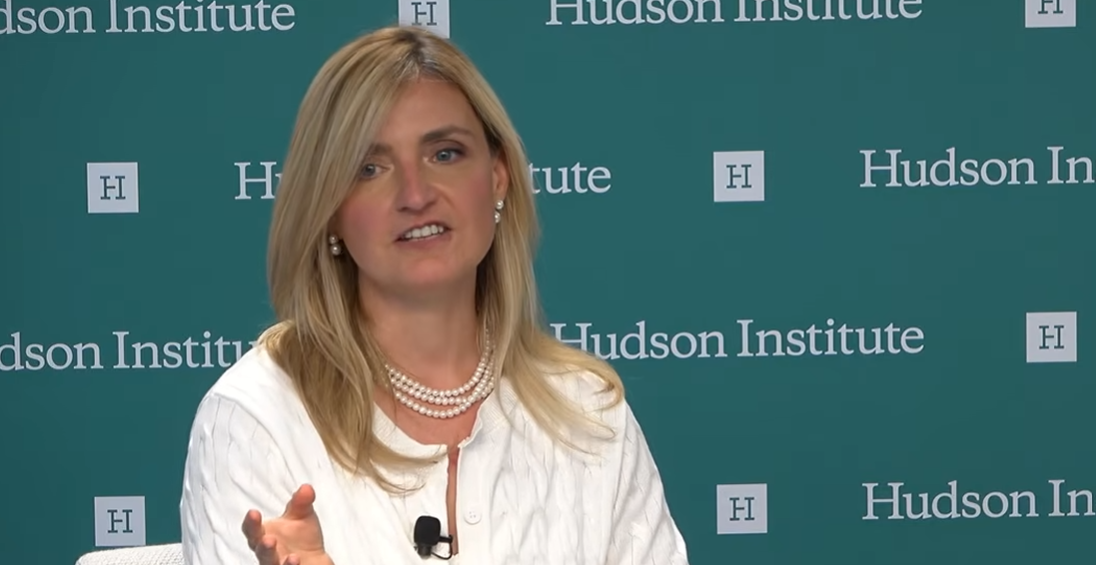
‘The Nazis may have the right to post, but also the Nazis are bad and sick and stupid,’ Rogers told JI
Both lawmakers are vocal supporters of Israel and engage on Middle East policy
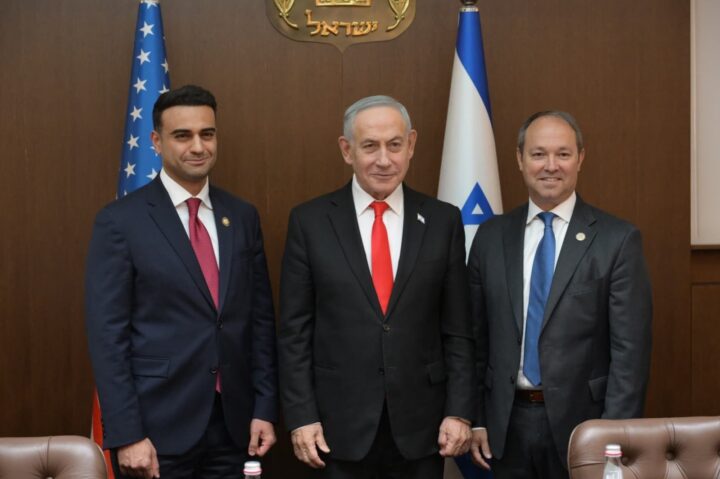
PMO
Israeli prime Minister Benjamin Netanyahu meets with Reps. Marlin Stutzman (R-IN) and Abe Hamadeh (R-AZ) in Jerusalem on May 27, 2026.
Reps. Marlin Stutzman (R-IN) and Abe Hamadeh (R-AZ), two strong supporters of Israel, made another trip to the country this week, during which they met separately with Israeli Prime Minister Benjamin Netanyahu, President Isaac Herzog and Foreign Minister Gideon Sa’ar.
The lawmakers visited with Netanyahu at his office in Jerusalem, the PMO confirmed.
Sa’ar said the group held “an in-depth discussion on regional issues, including Lebanon and Syria” where he “stressed the need to safeguard Syria’s minorities” and “described the aim of Israel’s activities in southern Lebanon: protecting our citizens from Hezbollah attacks within Lebanese territory and dismantling the terror kingdom it built there.”
Herzog’s office said he “thanked the congressman for their great friendship” and “commended President Donald Trump’s leadership in confronting Iran’s empire of evil.”
Hamadeh, the first Arab American elected to Congress from Arizona, took part in an AIPAC-organized trip of Republican members of Congress in August 2025, during which he thanked Netanyahu for his support for the Druze in southern Syria. Hamadeh is the son of Syrian immigrants and his mother is Druze.
Stutzman also visited Israel in 2025, meeting with Netanyahu after meeting with Syrian President Ahmed al-Sharaa. During the trip Stutzman said the Syrian leader appeared open to peace with Israel.
Both have been active on issues relating to post-Assad Syria including the protection of minority groups.
If Trump seeks to fill these posts, it will likely be in the administration’s interest to do so before the end of the current Congress

(AFP via Getty Images)
The US Embassy headquarters in Riyadh is pictured on March 3, 2026, after it was hit by drone strikes.
We reported earlier this month on the series of vacancies in key ambassador-level posts throughout the Middle East — in countries including Saudi Arabia, the United Arab Emirates, Qatar, Iraq and Kuwait. A senior State Department post overseeing Middle East issues also remains vacant, after the previous nominee was blocked by lawmakers.
At this point, time is running short for President Donald Trump to fill any of those vacant posts before the confirmation process potentially becomes more difficult in the Senate after the midterm elections.
Processing the nominations will take time: The chamber is set to be out of session for significant portions of the next few months. And there will be various other critical bills — including government funding, the annual defense bill and a potential third reconciliation package, to process on the Senate floor. Even ahead of floor proceedings, the vetting process in the Senate Foreign Relations Committee can, itself, take months before nominees appear for a confirmation hearing.
If Trump seeks to fill these posts, it will likely be in the administration’s interest to do so before the end of the current Congress, as GOP control of the Senate for the final two years of Trump’s term is not assured, and even if Republicans retain the majority, it could be with an even smaller margin.
It’s not just Democrats who have proven to be an obstacle to some of the administration’s picks. Amer Ghalib, Trump’s original nominee to be ambassador to Kuwait, was blocked by Republicans over his history of antisemitism, among other issues. And Joel Rayburn, tapped for a top Middle East job in the State Department, was blocked by Sen. Rand Paul (R-KY), who also slowed down proceedings for U.N. Ambassador Mike Waltz.
That said, it’s not clear whether the administration will prioritize filling these vacancies. Earlier this month, experts told Jewish Insider that the White House has seemed content to vest responsibility for broad Middle East portfolios within a tight circle of personal allies of the president, including White House Special Envoy Steve Witkoff, Jared Kushner and Ambassador to Turkey Tom Barrack — whose role has particularly concerned some Republicans. Many experts have argued that leaving the positions open is unwise and risks harming U.S. influence and diplomacy in the region.
State Department spokesperson Tommy Pigott told JI that “the department has confidence in our ability to communicate with our counterparts around the world and advance the national interest.”
A State Department official claimed that the Trump administration is on track to have more nominees confirmed in the first two years of Trump’s second term than the Biden administration, and praised the Senate Foreign Relations Committee for working to promptly confirm its nominees. The official also noted that the State Department had reestablished a committee to review potential career foreign service officers who could be elevated to ambassadorial posts.
Elliott Abrams, who served as U.S. envoy to Iran during the first Trump administration, however, warned that it might be “too late” to clear the nominations. He added that “it does not seem that the administration is very concerned” with the issue.
“Normally any administration would try to fill as many ambassadorial posts as possible before the August recess. But it is a little late, because in order to do that you have to have people cleared, formally nominated, go through hearings, be voted out of committee and then come to the floor for a vote,” Abrams said. “I doubt the administration will rush to get ambassadors in place now, because it just does not seem to be a very high priority for the president.”
Alexander Gray, who served as chief of staff on the National Security Council in Trump’s first administration, suggested that the White House should prioritize advancing qualified nominees for ambassadorships and criticized Democrats for what he described as a “long history of stymying President Trump’s nominations, regardless of whether they are in the majority or the minority.”
“The administration should continue to prioritize sending qualified ambassadors aligned with the president’s agenda to strategically significant countries, and pressuring Senators to confirm them expeditiously,” Gray said. “Historically, presidents received considerable deference in the confirmation of ambassadors. President Trump and Senate Republicans should demand similar treatment today.”
Other Trump allies argued that filling the ambassadorships is less critical, doubling down on the belief that the administration’s current approach of running Middle East policy through Trump’s inner circle is effective.
“In this region, trusted relationships, direct lines of communication and confidence from the president matter more than whether an ambassador is in place,” Jason Greenblatt, who served as White House Middle East envoy in the first Trump administration, said. “The leadership and senior diplomats in Saudi Arabia, the UAE and Qatar have strong and trusted relationships with President Trump and with the group doing much of the day-to-day work, including Steve Witkoff, Secretary [of State Marco] Rubio, Vice President Vance, and Jared Kushner. That group has President Trump’s deep trust and direct access to him. That remains true regardless of how Senate politics develops.”
Two DSA-backed challengers have a credible shot at winning seats, while Rep. Dan Goldman is down in polls against Brad Lander

Erik McGregor/LightRocket via Getty Images
NY Assemblymember Claire Valdez
As an emboldened socialist wing of the Democratic Party gains traction across New York City in the aftermath of Mayor Zohran Mamdani’s victory, Jewish leaders and moderate officials are bracing for the possibility of multiple upsets in key House races that could reshape the ideological orientation of the state’s congressional delegation.
Three races have drawn heightened attention in recent weeks, including a marquee House contest playing out largely in progressive Brooklyn where Rep. Dan Goldman (D-NY) is seeking to fend off a serious challenge from former New York City Comptroller Brad Lander. Meanwhile, in upper Manhattan and the Bronx, Rep. Adriano Espaillat (D-NY) is facing what looks like an increasingly credible challenge from an anti-Israel organizer. And in the race to replace retiring Rep. Nydia Velazquez (D-NY), her favored primary candidate is struggling to compete against a democratic socialist endorsed by Mamdani.
“If you have two socialists and Brad Lander” who are elected, “that’s a real move to the left — and it’s a lot of people who are bringing down the seniority of the congressional delegation,” said Chris Coffey, a New York City Democratic strategist not involved in the races. “That is probably the biggest shift we’ve seen at the congressional level in generations,” he told Jewish Insider, adding that there are “a lot of ifs baked into that.”
A recent public poll showing Goldman trailing badly behind Lander underscored how an emboldened far left is asserting itself in a race that is hinging in large part on the candidates’ differences over Israel. The independent survey, released last week by Emerson College, strongly indicated that Goldman is in serious trouble in the closely watched June 23 primary, lagging badly behind Lander, who held a commanding 57% of the vote.
Goldman, a pro-Israel Democrat who gained prominence as an outspoken critic of President Donald Trump, touts a relatively progressive record on domestic issues like healthcare, climate policy and immigration. But as he seeks a third term, Goldman has faced backlash from left-wing activists over his continued support for U.S. funding to Israel, which Lander, notably endorsed by Mamdani, has vowed to end, even for missile defense.
In a rare convergence on Middle East-related issues, the candidates opposed a successful effort this week to implement a boycott of Israeli products at a high-profile local food cooperative in the Park Slope neighborhood of Brooklyn, which sits in the district. (In a sign of the times, the boycott vote passed by a 2-to-1 margin.) But they otherwise disagreed on whether the measure was antisemitic, as Goldman and other Jewish community activists, including an influential rabbi in the district, had described the divisive effort.
Both Goldman and Lander are slated to address Jewish community concerns on June 7 during off-the-record town hall events at Congregation Beth Elohim, a Reform synagogue in Park Slope that is led by that rabbi, Rachel Timoner, according to an email recently sent to members. They will answer questions from congregants independently in the back-to-back, hour-long forums.
Despite tensions over Israel, some strategists note that Lander’s dominance in the progressive district covering sections of Brownstone Brooklyn and Lower Manhattan can be attributed to his standing as a popular former councilman and citywide elected official who also ran for mayor last cycle — a level of name ID that marks him as a sort of de facto incumbent.

But other races have also sharply demonstrated how anti-Israel sentiment is fueling the rise of candidates endorsed by the Democratic Socialists America’s New York City chapter. The group, which has championed anti-Zionism as a core element of its platform, is now backing challengers in two high-profile congressional primaries as well as some down-ballot races for seats in the state Legislature.
The closest race, for an open House seat spanning parts of Brooklyn and Queens, pits Claire Valdez, a democratic socialist assemblymember who is known for her anti-Israel activism, against Antonio Reynoso, the progressive Brooklyn borough president boasting establishment support from the outgoing incumbent, Velazquez, and the state attorney general, Letitia James, among other elected officials and groups.
But even as Reynoso entered the race in a favorable position, well-known to voters for his reputation as a more traditional progressive, he has struggled in his campaign to gain traction, recently calling himself an underdog, thanks to Valdez’s support from Mamdani paired with the grassroots organizational muscle of a resurgent DSA. A recent poll showed Valdez narrowly leading Reynoso by two points, with 23% of the vote, even while she is comparatively new to the district as a first-term state lawmaker.
Valdez’s favorable position has come as she has made opposition to Israel a primary focus of her campaign, while facing some scrutiny over her decision to sit for a friendly discussion earlier this month with a Twitch streamer who was once suspended from the platform for calling Jews a “demonic ethnicity.” Her campaign did not respond to a request for comment concerning the interview.
In a separate House primary in upper Manhattan as well as parts of the Bronx, Jewish leaders have begun to raise alarms about an insurgent challenger to Espaillat, a veteran incumbent who, like Goldman, is backed by the pro-Israel group AIPAC. In the final weeks of the race, he is now facing what Democratic strategists say is an increasingly serious threat from Darializa Avila Chevalier, a DSA-endorsed organizer who helped lead campus anti-Israel demonstrations at Columbia University.
“Folks seem to be getting very nervous,” one Jewish leader following the race told JI, echoing others who relayed similar concerns about the contest as it enters its closing stretch.
An internal campaign poll conducted in March, for instance, put Avila Chevalier at 28% among primary voters, with Espaillat at 42%, a poor showing for an incumbent who has held office for close to a decade. Political observers suggested the race could be closer as the primary nears and Avila Chevalier rides a wave of anti-establishment, leftist sentiment now shaping several races across the country where the DSA is involved.
In addition to backing an arms embargo on Israel and efforts to boycott the Jewish state, both Avila Chevalier and Valdez pledged to “refrain from any affiliation with the Israeli government and Zionist lobby groups, including but not limited to AIPAC, J Street, or DMFI,” according to DSA questionnaires reviewed by JI.
Justice Democrats, the far-left group that has frequently targeted incumbents, has also endorsed both candidates and is now spending to boost their campaigns. On Wednesday, it dropped $260,000 on ads to help boost Avila Chevalier — suggesting it sees the race as in play. The group also made its first foray into Valdez’s primary this week, according to filings, spending $11,000 on digital ads to prop up her bid.
Reynoso and Espaillat, meanwhile, can expect seven figures spent independently on their behalf in the coming weeks, a Democratic operative familiar with the matter told JI, but did not disclose the source of such funding.
The upcoming expenditures foreshadow what is shaping up to be a bitterly contested fight between the Democratic establishment and the far left now seeking to supplant it.
Still, there are signs that the far left is struggling to gain traction outside of deeply progressive districts. For example, Rep. Ritchie Torres (D-NY), a pro-Israel stalwart facing a challenge from former state lawmaker Michael Blake, who has made opposition to AIPAC a key part of his messaging, is expected to prevail. A recent poll showed Torres with a commanding 60% of the vote share, far outpacing Blake, who held just 15% in the Bronx-based district.
Torres’ position “shows that if you are actually working hard in your district and are there and present and delivering, then you should be OK,” Coffey, the Democratic strategist, told JI, noting that the congressman also developed a positive relationship with Mamdani, despite their disagreements on Middle East policy.
Hank Sheinkopf, a veteran Democratic strategist in New York City, characterized the DSA’s strategy as part of a “long-term plan” to “take over legislatures” across the country and influence foreign policy at the congressional level, as other far-left candidates have made inroads in key House races in Philadelphia and Denver. “New York is just the beginning,” he told JI.
Plus, Lasher sits out buffer bill victory lap

GPO
Bahrain Foreign Minister Khalid bin Ahmed Al Khalifa, Israeli Prime Minister Benjamin Netanyahu, President Donald Trump, and United Arab Emirates Foreign Minister Abdullah bin Zayed al-Nahyan during the Abraham Accords signing ceremony at the White House on Sept. 15, 2020.
This P.M. edition is reserved for our premium subscribers like you — offering a forward-focused read on what we’re tracking now and what’s coming next.
Today’s Daily Overtime was curated by JI U.S. Editor Danielle Cohen-Kanik.
📡On Our Radar
Notable developments and interesting tidbits we’re tracking
Speaking at a Cabinet meeting today at the White House, President Donald Trump signaled that he may not agree to a deal to end the war with Iran if Middle East countries including Saudi Arabia and Qatar do not join the Abraham Accords. “I think those countries owe it to us,” he said, adding, “I’m not sure we should make a deal if they don’t sign.”
Secretary of State Marco Rubio was vague about the prospects and timeline for such an agreement with Iran, saying, “I think there’s been some progress and some interest, and we’ll see over the next few hours and days whether progress could be made”…
The White House also denied reports from Iranian state media about the contents of an apparent draft agreement, calling it a “complete fabrication.” Among other details, the deal would have seen Iran maintain some control over the Strait of Hormuz in conjunction with Oman; at the Cabinet meeting, Trump said about the prospect, “Oman will behave just like everybody else or we’ll have to blow them up”…
Sarah Rogers, the under secretary of state for public diplomacy, maintained in an interview with Jewish Insider’s Emily Jacobs that the Trump administration’s commitment to free speech, including for extreme views, does not take away from its opposition to antisemitism, claiming that “the Nazis may have the right to post, but also the Nazis are bad and sick and stupid”…
Reps. Marlin Stutzman (R-IN) and Abe Hamadeh (R-AZ) met today in Israel with Prime Minister Benjamin Netanyahu and Foreign Minister Gideon Sa’ar, where they discussed regional issues including Lebanon and Syria. Both lawmakers are active on issues of Middle East policy in Congress and were some of the first members to visit Syria, where Hamadeh’s family is from, after the fall of dictator Bashar al-Assad…
Despite publicly billing himself as the candidate most critical of Israel in the race for New York’s 12th Congressional District, Kennedy scion Jack Schlossberg told a group of supporters at Manhattan’s exclusive Harmonie Club earlier this month that he has “been a stronger supporter of Israel than I ever thought I would be standing here today with you, because of educating myself on the issue,” according to a recording obtained by Politico. “I probably would have continued funding Israel’s offensive weaponry within the years following Oct. 7,” he told the group.
Schlossberg denied that the comments mark a change from his previous stances, and said that he has consistently opposed all weapons sales to Israel while supporting funding for the Iron Dome…
Several Jewish New York state legislators, including Assemblymembers Sam Berger, Simcha Eichenstein, Nily Rozic, Kalman Yeger and Aron Wieder and Sen. Sam Sutton, released a statement applauding the Legislature’s passage yesterday of a bill establishing a 50-foot buffer zone around religious institutions, calling it a “strong message to the Mayor that the Jewish community is not afraid to stand up.”
Assemblymember Micah Lasher, who was a sponsor of the bill and is running for Congress in the 12th District, did not sign on…
The Museum of Jewish Heritage in Manhattan announced the appointment of former federal prosecutor Tali Farhadian as its new CEO, with her term set to begin on Sept. 8. A Persian Jew born in Tehran, Farhadian has had a storied legal career including clerking for the late Supreme Court Justice Sandra Day O’Connor, serving as counsel to former Attorney General Eric Holder and teaching at NYU and Columbia law schools…
Far-right activist Bo French won the Republican nomination for a spot on Texas’ powerful oil and gas regulatory commission in yesterday’s primary runoff, heading to a general election against Democratic state Rep. Jon Rosenthal, the only Jewish member of the Texas state Legislature (who also identifies as agnostic and “multireligious”)…
Harvard has selected four new Radcliffe Fellows for the 2026-2027 academic year who have histories of anti-Israel activism, The Washington Free Beacon reports, including an English professor from Gaza’s Al-Aqsa University, which has ties to Hamas…
The Heritage Foundation added four new members to its board, including Israeli American conservative political theorist Yoram Hazony, after several members resigned in the aftermath of Heritage President Kevin Roberts’ defense of Tucker Carlson over his interview with neo-Nazi Nick Fuentes…
⏩ Tomorrow’s Agenda, Today
An early look at tomorrow’s storylines and schedule to keep you a step ahead
Keep an eye out in Jewish Insider for a look at the Trump administration’s decision to keep many ambassador positions vacant, as the clock ticks down for any potential nominations before the end of the current Congress.
U.S. Ambassador to Israel Mike Huckabee will deliver the commencement address at Yeshiva University’s graduation ceremony at Louis Armstrong Stadium in Queens, N.Y.
Stories You May Have Missed
SCOOP
Leading N.J. Dem congressional candidate Adam Hamawy volunteered with Al-Qaida-tied group in Bosnia
After traveling with the ‘Blind Sheikh,’ Hamawy worked with Benevolence International Foundation, later shuttered as an Al-Qaida front
EXCLUSIVE
New report documents $65 million Qatari campaign to influence U.S. education at all levels
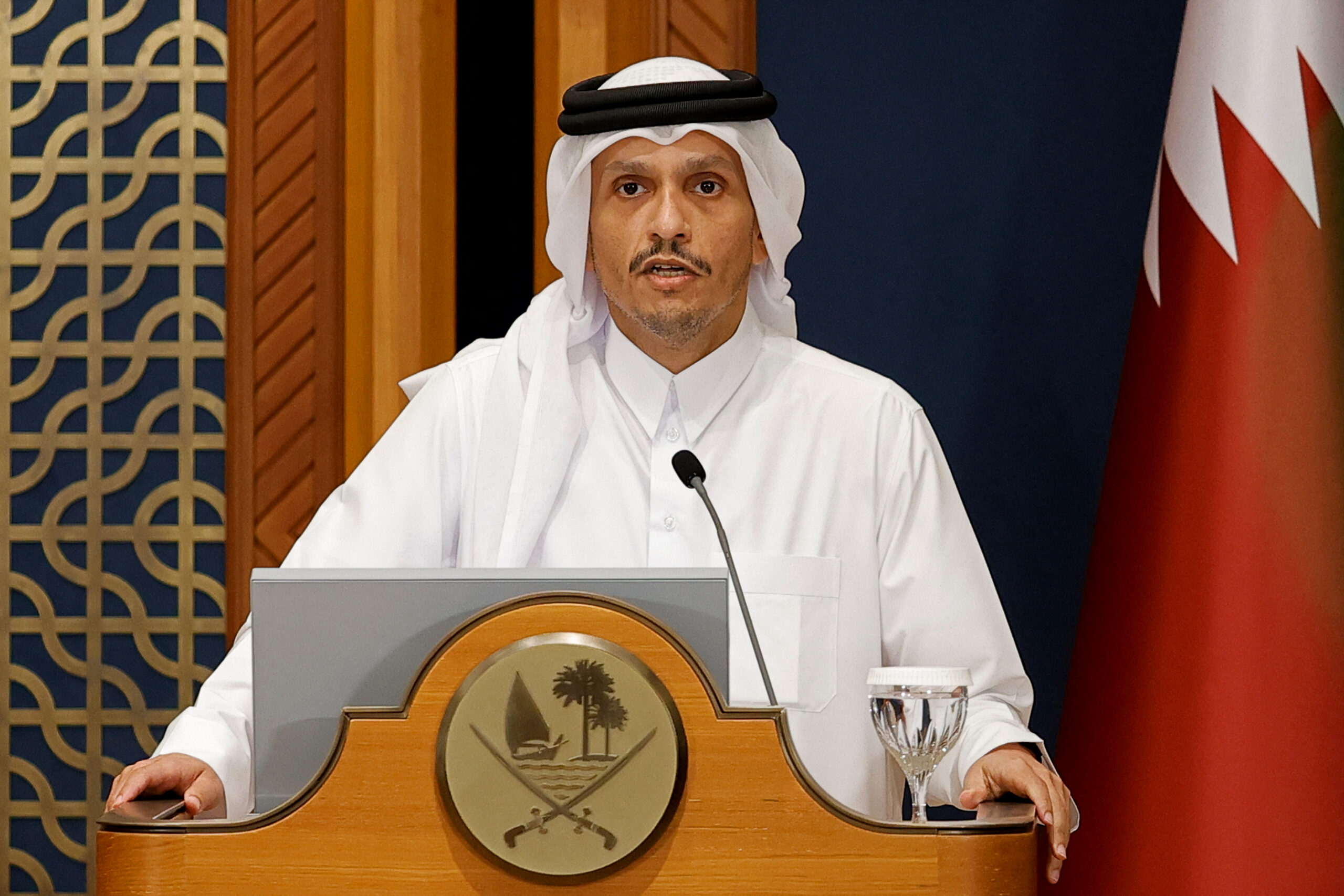
The Institute for the Study of Global Antisemitism and Policy in its report, called for a federal investigation of Qatar’s influence efforts targeting American education
‘I'm not sure we should make the deal if they don't sign,’ the president said at a Cabinet meeting
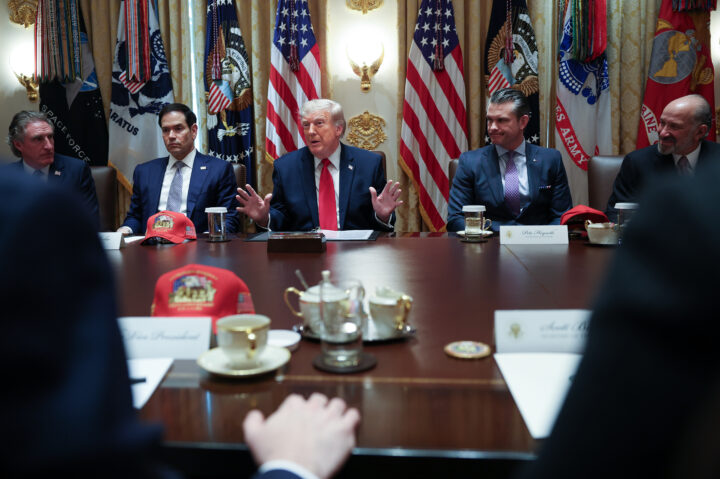
Win McNamee/Getty Images
President Donald Trump speaks during a Cabinet Meeting in the Cabinet Room of the White House on May 27, 2026 in Washington, DC.
President Donald Trump signaled on Wednesday that he may not agree to a deal to end the war with Iran if Saudi Arabia, Qatar and other countries in the region do not join the Abraham Accords, arguing that the Gulf nations “owe that to us.”
The president made the comments while taking questions from reporters during a Cabinet meeting at the White House, where he was asked if he would accept a peace agreement with Iran that did not address uranium enrichment. Trump responded that he would agree to a deal that allows for continued negotiations on some issues, though he repeatedly said he would not allow for “a crummy agreement.”
He expressed hesitation about moving forward with any peace deal with Iran that did not include commitments from Saudi Arabia, Qatar, Kuwait and others to normalize relations with Israel.
“I would like to have the countries we were talking about — Saudi Arabia, UAE, Qatar and the others — we’d like to have them immediately join, and [White House Special Envoy] Steve Witkoff is working on that with Jared [Kushner] and some others, but I would like to have them join the Abraham Accords,” Trump said. “It would be historic if they do it. I think they owe that to us, to be honest, because that really would be a tremendous sign. I think those countries owe it to us.”
Addressing Witkoff, the president said, “I’m not sure we should make the deal if they don’t sign, if you want to know the truth. If they don’t sign to join the Abraham Accords, I don’t know.”
When pressed if that meant he viewed an Iran deal as contingent on those countries joining the Abraham Accords, Trump responded: “I don’t know. I don’t want to say that. I’m not going to give you what’s contingent, what’s not. I can say that we can make a good deal right now, but maybe not a great deal, and if it’s not a great deal, we’re not making it.”
“We can make a great deal with this guy right here,” he continued, pointing to Defense Secretary Pete Hegseth. “But that’s a lot nastier, probably wouldn’t go as quickly … but it would be foolproof.”
Addressing reports from Iranian state media that Oman may assist Iran in overseeing the Strait of Hormuz once the war is over, Trump later said, “Oman will behave just like everybody else or we’ll have to blow them up.”
The results painted a picture of a volatile electorate in both parties
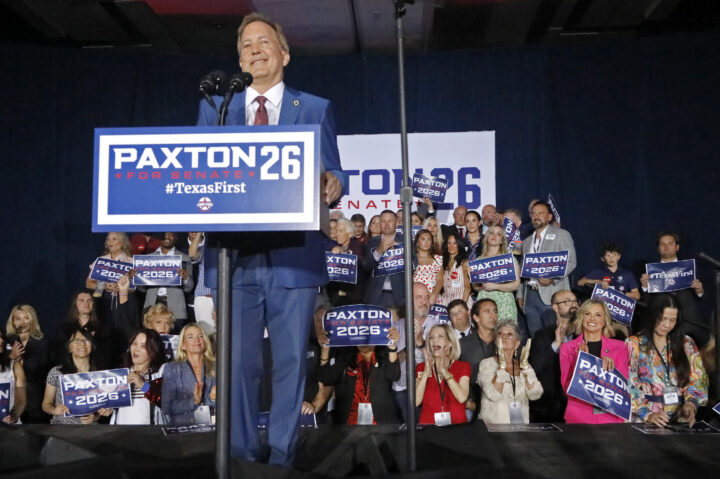
(Stewart F. House/Getty Images)
Attorney General Ken Paxton speaks at an election night watch party held by the Lone Star Liberty PAC at the Dallas/Plano Marriott at Legacy Town Center on May 26, 2026 in Plano, Texas.
In last night’s Texas primary runoffs, Democrats successfully prevented a virulent antisemite from becoming the party’s nominee in a battleground House race, while voters also ousted one of the party’s longtime anti-Israel lawmakers for a younger, more pragmatic replacement.
On the Republican side, President Donald Trump’s endorsement of Texas Attorney General Ken Paxton was the decisive factor in Paxton’s sweeping victory over Sen. John Cornyn (R-TX), a widely respected pragmatic conservative who served for years in party leadership.
The results painted a picture of a volatile electorate in both parties. A late push by the Democrats’ House campaign arm and the pro-Israel advocacy group Democratic Majority for Israel helped prevent sex therapist Maureen Galindo, who advocated putting pro-Israel Jews in internment camps as part of her campaign message, from winning a valued nomination in Texas’ swing 35th Congressional District.
Johnny Garcia, a Bexar County sheriff’s deputy long touted by national Democrats as a top recruit, won the Democratic nomination by 28 points (64-36%) despite finishing in second place in the primary. He will face Republican Air Force veteran Carlos de la Cruz in the general election.
DMFI’s political action committee touted its role as an early endorser of Garcia’s campaign, and for being one of the first and few groups to raise the red flag on Galindo’s extreme views. In its victory statement, DMFI also condemned the efforts from a secretive GOP group to spend nearly $1 million on Galindo’s behalf, in hopes of elevating a more vulnerable Democratic candidate to the general election.
On the positive side, an extremist was defeated thanks to leading Democratic Party organizations and officials rushing to condemn her candidacy. It’s a sign of how institutions can use their power to unify in speaking out against hate. On the other hand, she still won over one-third of the runoff vote despite the full-court press from Democrats to oppose her, a sign that it may take aggressive measures simply to stop a crank from prevailing.
Pro-Israel leaders also cheered the resounding defeat of Rep. Al Green (D-TX), who has alienated the Houston Jewish community with his anti-Israel votes in Congress in recent years and lackluster constituent services. Green lost by nearly 40 points to Rep. Christian Menefee (D-TX), who was just elected to Congress in a neighboring district and was forced to run against his colleague as a result of redistricting.
AIPAC tweeted a congratulatory note to Menefee after he prevailed, cheering his “victory tonight over one of the most outspoken anti-Israel voices in Congress.” Menefee, a former Harris County attorney, was generally a critic of Israel’s wartime actions during its campaign in Gaza, but unlike Green, refused to describe its war against Hamas as a “genocide.” He also said during a debate against Green that he understood why a democratic nation would want to wage a war against a terrorist group.
And in a suburban Dallas district that pitted former Rep. Colin Allred (D-TX) against his successor, Rep. Julie Johnson (D-TX), Allred prevailed in the battle of the two experienced politicos. Allred was the party’s unsuccessful nominee for the Senate in 2024 and considered another Senate campaign before pivoting and deciding to run for the House again.
The race generating the most national headlines was Paxton’s resounding victory over Cornyn by 28 points (64-36%) — proving another example of Trump’s endorsement power in Republican nomination fights. Cornyn had been one of the state’s most popular Republican elected officials before facing growing grassroots opposition from the right over his pragmatism and lack of deep MAGA bona fides. Paxton, despite facing considerable personal baggage, sensed Cornyn’s vulnerability with the base — and in the end, parlayed a Trump endorsement to victory.
This month alone, Trump defeated five of seven targeted Indiana state senators for resisting redistricting efforts, ousted Sen. Bill Cassidy (R-LA) and Rep. Thomas Massie (R-KY) in primaries over perceived disloyalty and handily dispatched the battle-tested Cornyn. Trump is struggling to maintain support with many Americans, but within the Republican Party, his grip is still tight.
Plus, the IDF targets Hamas' succession plans
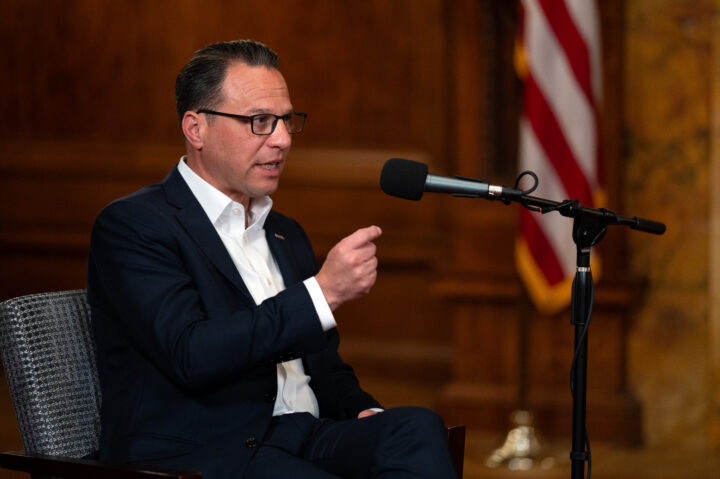
Peter W. Stevenson/The Washington Post via Getty Images
Pennsylvania Gov. Josh Shapiro sits for an interview at the Pennsylvania State Capitol on June 11, 2025.
This P.M. edition is reserved for our premium subscribers like you — offering a forward-focused read on what we’re tracking now and what’s coming next.
Today’s Daily Overtime was curated by JI U.S. Editor Danielle Cohen-Kanik.
📡On Our Radar
Notable developments and interesting tidbits we’re tracking
No agreement has materialized between the U.S. and Iran today, as the Iranian Foreign Ministry denounced U.S. strikes in the country last night as a sign of “bad faith and unreliability” and warned Tehran “will leave no act of aggression unanswered”…
The IDF carried out a strike against Mohammed Odeh, Hamas’ new military commander in Gaza and one of the “architects” of the Oct. 7 attacks, Israeli Prime Minister Benjamin Netanyahu and Defense Minister Israel Katz said in a joint statement, days after Israel killed his predecessor, Izz al-Din al-Haddad…
The IDF has also expanded its military campaign against Hezbollah beyond the security zone established in the ongoing Israel-Lebanon ceasefire, in an effort to combat drone attacks by the terror group on Israel’s northern communities. Netanyahu said at the start of a Security Cabinet meeting today that Israel is “operating with significant forces on the ground and taking control of strategically dominant positions” in Lebanon.
U.S. officials reportedly approved of the plan but warned Israel “not to bring down buildings in Beirut,” for fear of impacting talks with Iran…
Iran has begun restoring some internet access for its citizens, an Iranian official and watchdog groups said today, curbing what is reportedly the longest nationwide internet shutdown in history at nearly three months long…
Mike Needham, a close advisor to Secretary of State Marco Rubio, will transition from the State Department, where he serves as counselor and head of policy planning, to deputy national security advisor and assistant to the president at the White House…
Netanyahu is considering appointing his advisor Caroline Glick to the position of Israeli consul in New York, according to Israel’s Channel 12. Glick has drawn scrutiny for her repeated criticisms of the Reform and Conservative movements as well as liberal Israel advocacy groups…
CENTCOM denied reporting by The Wall Street Journal that it has restarted “Project Freedom” and said U.S. forces are “not currently escorting commercial vessels through the Strait of Hormuz.”
And the State Department called reports that the U.S. and Israel are working to strip Jordan of its custodianship of the Al-Aqsa Mosque in Jerusalem “categorically false”…
Pennsylvania Gov. Josh Shapiro warned in an interview with Politico that efforts within the Democratic Party to single out AIPAC as “toxic” could be seen as silencing Jewish voices in the American political system.
“Do I agree with every political decision they’ve made, every endorsement they made? Of course not,” Shapiro said of the pro-Israel group. “I think what we have seen is a weaponization of that. … When you have people who are advocating for issues that they feel strongly about and they are having their voices silenced, I think that’s a problem in our system”…
In a letter sent to Trump today, more than 90 House Republicans, led by Rep. Mike Lawler (R-NY), called for the administration to “fully dismantle” the United Nations Relief and Works Agency and to rethink its operations “not only in Gaza, but across the West Bank, Jordan, Lebanon, and Syria,” Jewish Insider’s Marc Rod reports.
UNRWA has “perpetuated the refugee crisis and reinforced the conditions that have allowed terrorism to persist,” the lawmakers wrote, arguing that in serving as the primary provider of public services in several countries, the agency “has reduced incentives for host governments to pursue long-term solutions”…
The Justice Department sued UCLA today for allegedly violating Title VI of the Civil Rights Act due to its “deliberate indifference to race and national origin discrimination against Jewish and Israeli students”; it’s the Trump administration’s latest move in its legal campaign against the school, as it also pursues a Title VII lawsuit alleging UCLA discriminated against its Jewish and Israeli employees…
The final version of a New York state “buffer zone” law will make it a Class B misdemeanor — one of the lowest levels of criminal offenses — to “knowingly” infringe on the right of access or egress to a religious institution, or to cause those entering or exiting to fear for their safety from a distance of less than 50 feet, JI’s Will Bredderman reports.
The bill, which is expected to pass as part of a package around the state budget, is less punitive than the original legislation endorsed by Gov. Kathy Hochul, which would have charged such obstruction as a felony, but doubles the buffer zone from its original distance of 25 feet…
The Park Slope Food Coop, a high-profile progressive Brooklyn institution with around 17,000 members, is set to vote this evening whether to enact a BDS policy against selling Israeli-made products, an issue that has ignited a political flashpoint among New York Democrats and caused the vote to go virtual, with organizers citing security concerns.
Rep. Dan Goldman (D-NY) has encouraged members to oppose the measure, while his congressional primary opponent, former New York City Comptroller Brad Lander, said he would vote against it if he was a member but would not tell others to do so. City Council Speaker Julie Menin said in a statement today that the “proposed boycott serves to further divide New Yorkers” and that she hopes the co-op will reject the effort…
New York City Mayor Zohran Mamdani declined, in an interview with a local news outlet, to endorse a candidate in New York’s 12th Congressional District — where he noted he is a constituent — calling it a “pleasure” to serve with both Micah Lasher and Alex Bores in the state Assembly…
After doubling down on his claim that presumptive Maine Senate Democratic nominee Graham Platner’s tattoo of a Nazi Totenkopf is “disqualifying,” Rep. Jake Auchincloss (D-MA) reiterated today that he still will not endorse Platner’s opponent, Sen. Susan Collins (R-ME): “Susan Collins is a rubber stamp for the worst admin in history. Claims that I would endorse her, implicitly or otherwise, ignore my track record supporting Democrats to take back both chambers. … Regardless of what happens in Maine, Democrats need to take back the Senate and I’ll keep working hard to make it happen”…
Jeremy Burton, CEO of the Jewish Community Relations Council of Greater Boston, condemned as “crazy and disgusting” a video of a man in the city dressed as Adolf Hitler stomping on an Israeli flag…
⏩ Tomorrow’s Agenda, Today
An early look at tomorrow’s storylines and schedule to keep you a step ahead
Keep an eye out in Jewish Insider for results from today’s primary runoff elections in Texas, where we’re tracking the races between Sen. John Cornyn (R-TX) and Trump-endorsed Attorney General Ken Paxton for U.S. Senate; antisemitic conspiracy theorist Maureen Galindo and establishment-backed sheriff’s deputy Johnny Garcia for the Democratic nomination in the 35th District; and Reps. Al Green (D-TX) and Christian Menefee (D-TX) in the member-on-member primary for the newly redrawn 18th District.
Trump will convene a Cabinet meeting tomorrow at the White House — relocated from the historic Camp David in Maryland due to weather — where the issue of negotiations with Iran is expected to feature prominently on the agenda.
Stories You May Have Missed
PLANNING AHEAD
Pro-Israel groups grapple with the future of Israel funding
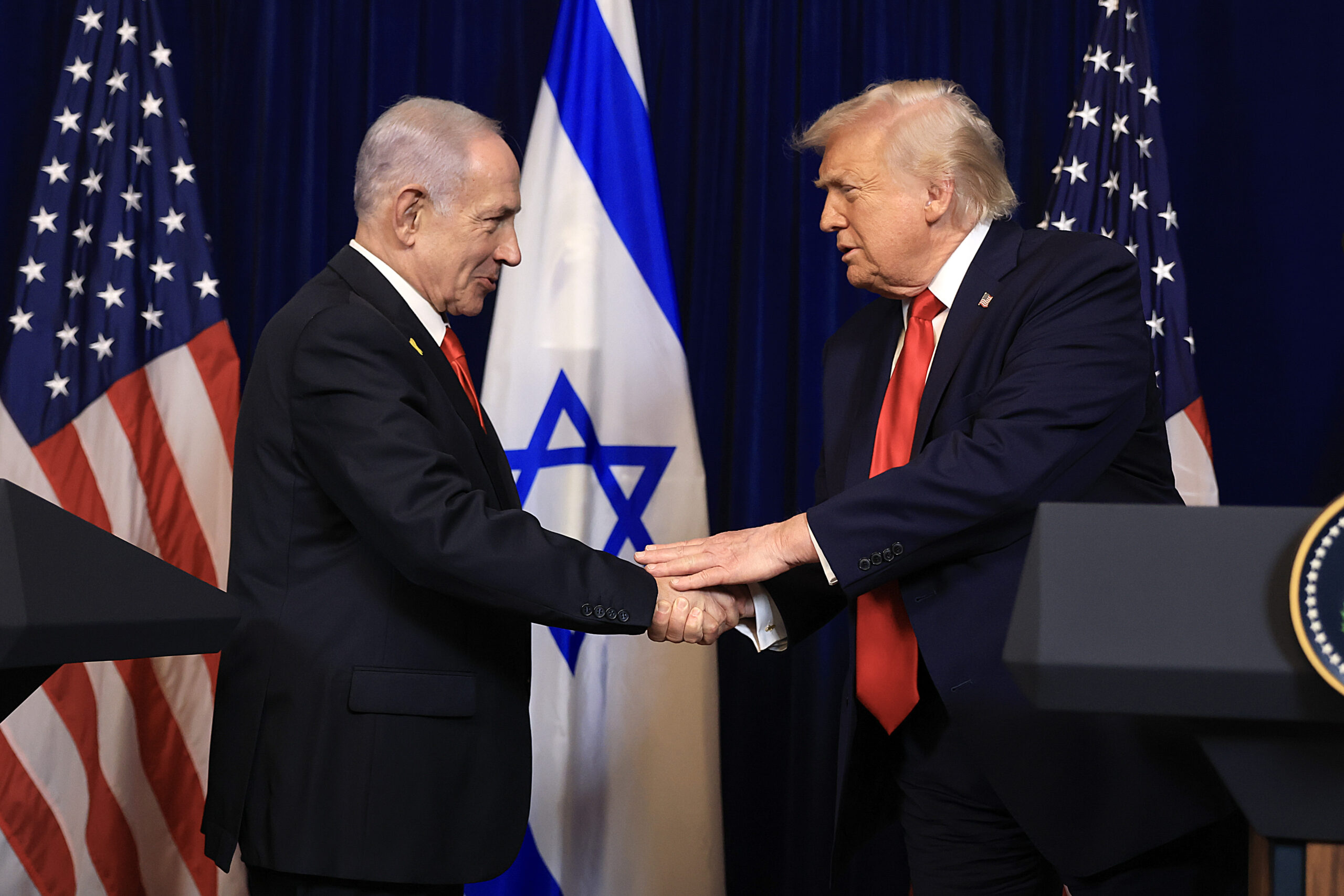
Jewish and pro-Israel groups seem at pains to clarify how they are now assessing an issue that has long been key to their advocacy — particularly as the conversation around funding and the possibility for a new MOU has rapidly evolved in recent months
CALLING OUT HATE
DCCC announces spending campaign against antisemitic Texas candidate, branding her ‘MAGA Maureen’
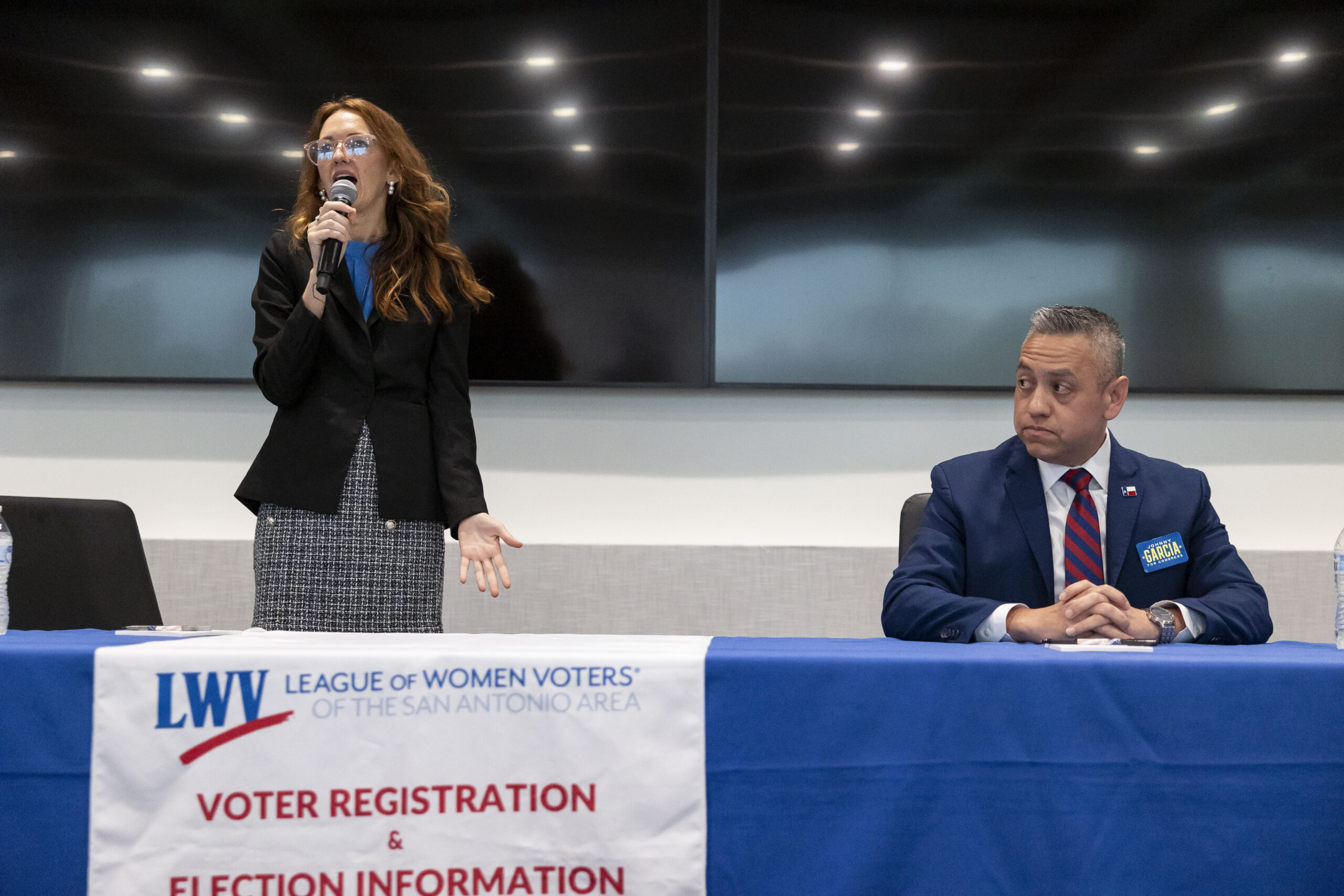
The $34,000 ad is in response to a GOP-linked outside spending campaign boosting the extremist candidate
‘Ultimately, UNRWA has not been a force for stability but has instead perpetuated the refugee crisis and reinforced the conditions that have allowed terrorism to persist,’ wrote the lawmakers, led in the house by Rep. Mike Lawler

Dawoud Abo Alkas/Anadolu via Getty Images
Palestinian families stand outside a school affiliated with the United Nations Relief and Works Agency (UNRWA) at the Daraj neighborhood as the Israeli attacks continue in Gaza City, Gaza on February 6, 2024.
Republicans in both chambers of Congress are urging the Trump administration to move to permanently dismantle the United Nations Relief and Works Agency, with a new letter from House Republicans calling for a reworking of Palestinian refugee programs in the region.
In a letter sent to President Donald Trump on Tuesday, more than 90 House Republicans, led by Rep. Mike Lawler (R-NY), called for a “broader view of the agency’s operations — not only in Gaza, but across the West Bank, Jordan, Lebanon, and Syria” and for the administration to ensure that the U.S. does not “continue to rely on failed systems that have further entrenched the Israeli-Palestinian conflict.”
The U.S. stopped funding UNRWA in early 2024, after revelations that several UNRWA employees participated in the Oct. 7, 2023, Hamas attacks on Israel, and Congress has continued to impose statutory bans on such funding since then, in spite of efforts by Democrats to reinstate funding for the aid agency.
“Ultimately, UNRWA has not been a force for stability but has instead perpetuated the refugee crisis and reinforced the conditions that have allowed terrorism to persist,” the lawmakers wrote. “We strongly urge your administration to take decisive action to fully dismantle UNRWA and transition its functions to more credible and trusted partners that are demonstrably free of ties to terrorism and committed to transparency, accountability, and peace.”
The letter suggests transferring funding for Palestinian refugee programs to their host countries directly or to other non-governmental organizations.
The letter states that UNRWA has “perpetuated and expanded” the Palestinian refugee crisis by conferring heritable refugee status across generations, “transforming what was once a finite humanitarian issue into a permanent and growing political challenge.”
The lawmakers also argued that in serving as the primary provider of public services in several countries and territories, UNRWA has “has reduced incentives for host governments to pursue long-term solutions, leaving millions dependent on the agency and prolonging the refugee crisis.”
And it raises concerns about the role that UNRWA educational curricula may have played in radicalizing young Palestinians.
The House letter follows a similar letter last week led by Sen. Tom Cotton (R-AR) with two dozen other Senate Republicans which also calls for dismantling UNRWA both in Gaza and throughout the region.
The letter highlights that UNRWA employees were involved in the Oct. 7 attacks and that 10% of UNRWA’s employees in Gaza have been found to have ties to terrorist groups. It also notes that Hamas has diverted UNRWA’s supplies and repeatedly used the agency’s facilities for terror purposes.
The letter urges the administration to eliminate UNRWA from the U.N. budget.
“Any aid organization in Gaza or otherwise must be demonstrably free of ties to terrorism and committed to transparency, accountability, and peace,” the senators wrote. “We must ensure this failed system doesn’t continue reinforcing the conditions that have fueled terrorism from generations.”
The reported contours of the burgeoning agreement drew rebukes from hawkish Senate Republicans
Aaron Schwartz/Sipa/Bloomberg via Getty Images
President Donald Trump speaks during a maternal healthcare event in the Oval Office of the White House in Washington, DC, US, on Monday, May 11, 2026.
For many Americans, Memorial Day weekend marked the unofficial start of summer, with barbecues, weddings and trips to the beach. For President Donald Trump — who opted against attending his own son’s wedding in the Bahamas, citing “circumstances pertaining to Government” — the weekend was spent on calls with Middle East leaders and inching the U.S. closer to a deal with Iran.
The working assumption in Jerusalem and Washington last week — noted in our Daily Kickoff last Thursday — was that the White House preferred a deal with Tehran over a resumption of fighting, owing to increasing opposition to the war and a slew of recent GOP defections on war powers resolutions indicating concerns among Republicans that renewed military action could further damage the party’s midterm prospects.
That assumption was actualized over the weekend, with a series of Truth Social posts by Trump indicating that a deal was near, with the finer details yet to be ironed out. Among the details reportedly in the draft agreement: a 60-day extension of the ceasefire, a lifting of the U.S. blockade of the Strait of Hormuz, Iran’s commitment not to seek nuclear weapons as well as the disposal of its stockpile of enriched uranium and an end to fighting on every front — including Lebanon.
In a Truth Social post, Trump — who convened a call with a group of Arab leaders, and a separate call with Israeli Prime Minister Benjamin Netanyahu — said that he was “mandatorily requesting that all Countries immediately sign the Abraham Accords,” suggesting that Saudi Arabia and Qatar should be the first new countries to normalize relations with Israel, followed by Pakistan, Turkey, Egypt and Jordan (though the latter two have already enacted peace treaties with Israel, and Ankara and Jerusalem have diplomatic relations).
Pakistani Defense Minister Khawaja Asif — who last month called the Jewish state a “curse for humanity” — ruled out such a move, telling a Pakistani outlet that normalizing relations with Israel was “not acceptable to us,” even as the country attempts to situate itself as a regional mediator.
The reported contours of the burgeoning agreement drew rebukes from hawkish Senate Republicans. “If the result of all that is to be an Iranian regime — still run by Islamists who chant ‘death to America’ — now receiving billions of dollars, being able to enrich uranium & develop nuclear weapons, and having effective control over the Strait of Hormuz, then that outcome would be a disastrous mistake,” Sen. Ted Cruz (R-TX) said. Read more here.
But even as Washington and Tehran moved closer to a deal, the U.S. carried out what it called “self-defense strikes” on Iranian targets, including missile launch sites and vessels around the Strait of Hormuz. And in Lebanon, Israel ramped up strikes on Hezbollah targets, with Netanyahu vowing to “crush” the Iran-backed terror group.
The weekend was also marked by Director of National Intelligence Tulsi Gabbard’s announcement that she was stepping down from her role, citing her husband’s recently diagnosed illness.
Gabbard’s departure is the latest in a series of resignations in the office, following Joe Kent’s resignation in February as head of the National Counterterrorism Center — which he blamed on the Trump administration’s Iran policy — and Amaryllis Fox Kennedy’s announcement that she’d be stepping down from her senior roles in both ODNI and Office of Management and Budget.Trump has tapped Aaron Lukas, a longtime CIA official who got his start at the Cato Institute, to serve as acting DNI following Gabbard’s departure at the end of June.
Details of the arrangement remain unclear, but reports indicate the U.S. would end military action, lift its blockade and release $25 billion in frozen Iranian funds
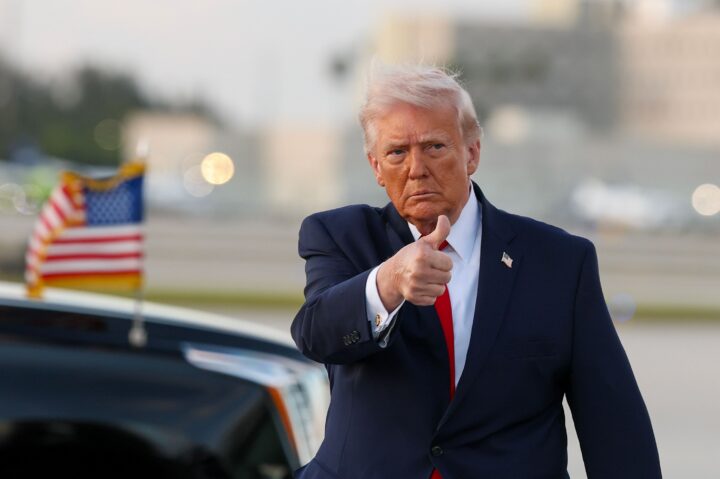
Tasos Katopodis/Getty Images
U.S. President Donald Trump waves to the media after walking off of Air Force One at Miami International Airport on April 11, 2026 in Miami, Florida.
The U.S. is nearing a deal with Iran to end the war, President Donald Trump announced on Saturday, though the precise parameters of the agreement remained unclear.
After holding a call with officials from the United Arab Emirates, Saudi Arabia, Qatar, Turkey, Pakistan, Jordan, Bahrain and Egypt, as well as a separate discussion with Israeli Prime Minister Benjamin Netanyahu, Trump said on Truth Social on Saturday afternoon that an agreement has “been largely negotiated” with “final aspects and details … currently being discussed.”
“In addition to many other elements of the Agreement, the Strait of Hormuz will be opened,” the president said.
While Trump did not offer any further details, Iranian officials had told The New York Times that a memorandum of understanding under discussion with the U.S. would end fighting on all fronts, including between Israel and Lebanon; lift the U.S. blockade of Iranian ports and allow for free movement of commercial traffic without any tolls; leave nuclear issues to be negotiated within 30 to 60 days; and see the release of $25 billion in frozen Iranian funds.
U.S. officials told the Times that, under the current agreement, Tehran has committed to giving up its stockpile of already enriched uranium, an issue that Trump has frequently stated is a U.S. priority, but the specifics as to how that transfer will occur are set to be worked out in subsequent negotiations.
A senior Iranian official denied to Reuters on Sunday that Iran’s nuclear program was a part of the initial agreement, and said that Tehran had not agreed to hand over its enriched uranium. “The nuclear issue will be addressed in negotiations for a final agreement and are therefore not part of the current deal,” the official told Reuters.
A U.S. official told Axios’ Barak Ravid that the agreement involves a 60-day ceasefire extension during which the Strait of Hormuz would be reopened and Iran would be able to sell oil freely. The draft MOU, according to Axios, includes commitments from Iran that it will never pursue nuclear weapons and to negotiate a suspension of its uranium enrichment program and the removal of its stockpile of highly enriched uranium. The draft also includes an end to the war between Israel and Hezbollah in Lebanon.
Netanyahu said in a statement on Sunday regarding his conversation with Trump the day prior that the two leaders “agreed that any final agreement with Iran must eliminate the nuclear danger,” including dismantling Tehran’s nuclear program and removing enriched uranium from the country. Trump also “reaffirmed Israel’s right to defend itself against threats on every front, including Lebanon,” Netanyahu said.
Some hawkish Senate Republicans expressed outrage on Saturday over the reported terms of the deal, calling it a defeat for the United States filled with major concessions to the Iranian regime.
‘The rumored 60-day ceasefire — with the belief that Iran will ever engage in good faith — would be a disaster,’ said Senate Armed Services Committee Chairman Roger Wicker

Drew Angerer/Getty Images
Sen. Ted Cruz (R-TX)
Hawkish Senate Republicans expressed outrage on Saturday over the reported terms of a U.S. ceasefire deal with Iran, calling the agreement a defeat for the U.S. filled with major concessions to the Iranian regime.
“I am deeply concerned about what we are hearing about an Iran ‘deal,’ being pushed by some voices in the administration,” Sen. Ted Cruz (R-TX) said on Saturday.
Cruz said that Trump’s decision to strike Iran was correct and “the most consequential decision of his second term, but said that ending the war on the reported terms would be a failure.
“If the result of all that is to be an Iranian regime — still run by Islamists who chant ‘death to America’ — now receiving billions of dollars, being able to enrich uranium & develop nuclear weapons, and having effective control over the Strait of Hormuz, then that outcome would be a disastrous mistake,” Cruz continued.
He said that he is “pray[ing] the early reports are wrong” but said the fact that former Biden administration Iran envoy Rob Malley praised the reports is “not encouraging.”
“President Trump believes in peace through strength, and his strong leadership has already made America much safer,” Cruz said. “He should continue to hold the line, defend America & enforce the red lines he has repeatedly drawn.”
Sen. Lindsey Graham (R-SC) said that ending the war along the proposed terms would be conceding that there is no military solution to defeating Iran.
“If a deal is struck to end the Iranian conflict because it is believed that the Strait of Hormuz cannot be protected from Iranian terrorism and Iran still possesses the capability to destroy major Gulf oil infrastructure, then Iran will be perceived as being a dominate force requiring a diplomatic solution,” Graham said.
He said that such an outcome would shift the balance of power in the region and “be a nightmare for Israel.”
“Also, it makes one wonder why the war started to begin with if these perceptions are accurate. I personally am a skeptic of the idea that Iran cannot be denied the ability to terrorize the Strait and the region cannot protect itself against Iranian military capability,” Graham continued. “It is important we get this right.”
Sen. Tom Cotton (R-AR), who chairs the Senate Intelligence Committee, shared Graham’s post.
Sen. Roger Wicker (R-MS), the chairman of the Senate Armed Services Committee, had urged Trump on Friday to ignore advisors urging an agreement with Iran, and encouraged the administration to return to war so as not to leave behind a legacy of weakness.
“The rumored 60-day ceasefire — with the belief that Iran will ever engage in good faith — would be a disaster,” Wicker said Saturday. “Everything accomplished by Operation Epic Fury would be for naught!”
Meanwhile, other congressional Republicans are expressing support for the administration’s approach.
“President Trump is the ONLY one who could have gotten Iran — the world’s largest state sponsor of terrorism — to the negotiating table,” House Speaker Mike Johnson (R-LA) said. “We are greatly encouraged to learn a PEACE DEAL in Iran is underway — and look forward to learning more about the specifics. Under President Trump’s leadership, our nation is stronger, more respected on the global stage, and safer than ever before.”
Rep. Randy Fine (R-FL) said he’d spoken to the White House about the proposed deal and expressed support for it.
“President Trump will land this deal and end the conflict on his terms,” Fine said. “The Mullahs will never have a nuclear weapon.”
Former Secretary of State Mike Pompeo also lambasted the reported deal’s terms, calling it “straight out of the Wendy Sherman-Robert Malley-Ben Rhodes playbook: Pay the IRGC to build a WMD program and terrorize the world,” referring to the 2015 Iran nuclear deal struck by the Obama administration. He also called for a return to war.
Pompeo’s post faced furious backlash from White House Communications Director Steven Cheung, Trump advisor Alex Brusewitz and Rep. Anna Paulina Luna (R-FL).
Makia Green is a D.C. activist who founded a nonprofit that advocates for prison abolition
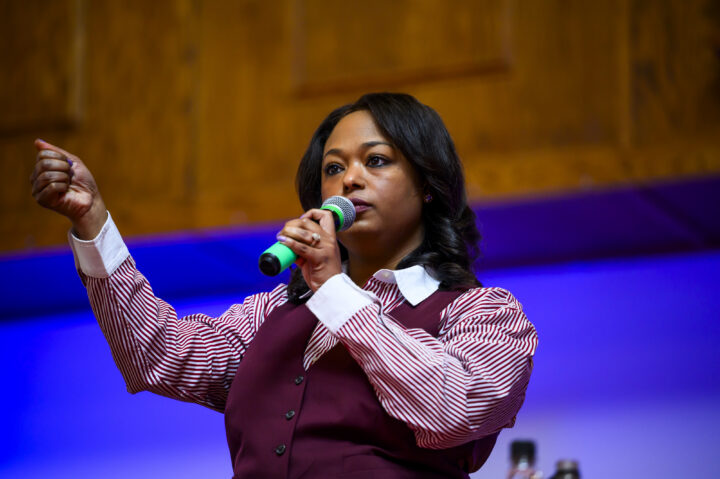
Pete Kiehart for The Washington Post via Getty Images
Mayoral candidate Janeese Lewis George speaks during the Free DC candidate forum, an event for constituents to meet and question candidates for mayor.
The highest-paid staffer on Washington, D.C., mayoral candidate Janeese Lewis George’s campaign has a social media history showing deep-seated hostility toward Israel and adherence to far left views on the Middle East, according to a review of the staffer’s public posts.
Makia Green, Lewis George’s political director, posts frequently on Instagram, often a mix of photos or videos of herself alongside TikTok videos that she downloads and shares to her own profile. Green is a local activist who founded a nonprofit called Harriet’s Wildest Dreams that advocates for prison abolition.
In the months after the Oct 7, 2023, Hamas attacks in Israel, Green’s posts on Instagram, where she has 6,400 followers, regularly centered on anti-Israel advocacy.
One video she shared in Dec. 2023 called Israel an “imaginary state.” Another post that month featured a video with someone saying “Israel is a bitch, so evil.”
In November, weeks after the Oct. 7 attacks, Green shared a video of a woman who called it “sickening” that Israeli actress Gal Gadot was screening footage of Hamas’ atrocities.
At least two posts featured videos that appeared to defend the Houthis, an Iran-backed militia in Yemen that began attacking Israel and commercial vessels in the Red Sea after Oct. 7. One, from Jan. 2024, showed an Irish parliamentarian criticizing the European Union for its concern about the Houthis’ attacks on global shipping.
A Dec. 2023 post included a video with a woman who said that “Yemen is the only nation militarily backing the people of Palestine.” The caption to the post expressed support for the Boycott, Divestment and Sanctions movement.
The captions to many of Green’s posts in late 2023 and 2024 called on her followers to advocate for the Palestinian cause. In Jan. 2024, she wrote “from the river to the sea, Palestine will be free,” alongside a video showing pro-Palestinian protesters with bullhorns outside the home of Sen. Chris Van Hollen (D-MD), shouting that his wife should be “ashamed.”
Green’s posts reveal a deep commitment to BDS, including calls to boycott Starbucks because of its support for “genocide.” (Starbucks was the target of anti-Israel activists in the fall of 2023 because of its posture toward pro-Palestinian members of its union.)
“My views are my own,” Green’s Instagram bio states. She did not respond to a request for comment.
Green’s posts have come under scrutiny as Lewis George continues to face questions about her own views on Israel.
At a candidate forum hosted by the Jewish Community Relations Council on Thursday, Lewis George was asked to specify her views on Zionism — an issue that has become a flashpoint in the race after she said in a Democratic Socialists of America endorsement questionnaire that she would reject the “Zionist lobby.”
Lewis George said at the event that she would not exclude any segment of the Jewish community but avoided sharing her opinion about Zionism. She is a member of the Metro DC DSA chapter and earned the group’s endorsement in the mayoral race.
“I will refrain from going on any political junkets to Israel. I will also not attend events focused on obfuscating the realities of occupation or promoting Zionism and apartheid,” Lewis George wrote in the DSA questionnaire.
Asked whether she supports BDS, Lewis George did not answer, but said she supports “the right of all people, including Palestinians, to use nonviolent strategies like boycotts and calls for divestment to build a more just world.”
A spokesperson for Lewis George’s campaign did not respond to multiple inquiries seeking comment about whether Green advises Lewis George on Israeli-Palestinian matters or if their views align.
In her anti-Israel messages, Green also regularly took aim at Democrats. One video she shared in Dec. 2023 showed a man describing both Donald Trump and Joe Biden as “horrible choices.” In a post several months later, Green shared a video encouraging Democrats to support the Uncommitted movement to protest Biden’s support for Israel. She routinely highlighted anti-Israel protests at events hosted by Biden and Vice President Kamala Harris.
In one post with a “ceasefire” caption, from Jan. 2024, Green boosted a video that escalated from criticism of the president to the entire country.
“F*** the United States government and every member that belongs to that shit,” a woman said in the video.
Gabbard will depart as head of the Office of the Director of National Intelligence on June 30
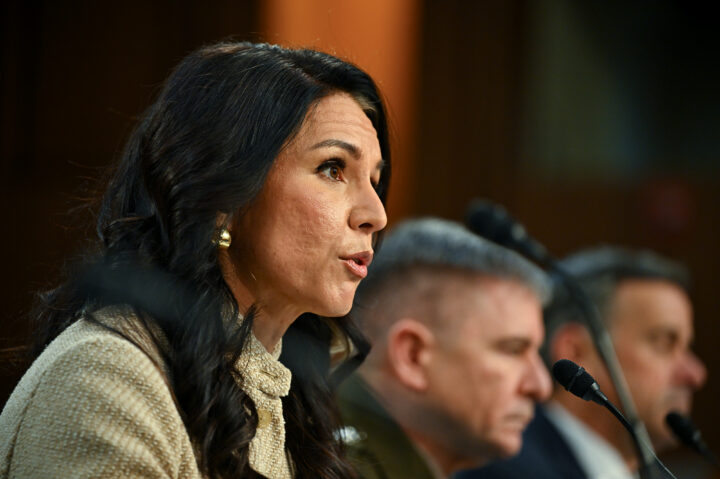
Graeme Sloan/Bloomberg via Getty Images
Tulsi Gabbard, director of National Intelligence, speaks during a Senate Intelligence Committee hearing on worldwide threats in Washington, DC, US, on Wednesday, March 18, 2026.
Director of National Intelligence Tulsi Gabbard is resigning effective June 30, citing her husband’s recently diagnosed “extremely rare form of bone cancer,” she wrote in a resignation letter.
“Unfortunately, I must submit my resignation, effective June 30, 2026,” she wrote in her letter, which was first reported by Fox News Digital. “My husband, Abraham, has recently been diagnosed with an extremely rare form of bone cancer.”
President Donald Trump posted Gabbard’s resignation letter publicly, and thanked Gabbard for her service.
“Unfortunately, after having done a great job, Tulsi Gabbard will be leaving the Administration on June 30th,” Trump said. “Tulsi has done an incredible job, and we will miss her.”
He announced that Gabbard’s principal deputy director of national intelligence, Aaron Lukas, will take Gabbard’s place in an acting capacity. Lukas, a longtime Central Intelligence Agency officer, served in the first Trump administration for the Office of the Director of National Intelligence and the National Security Council.
Citing an unnamed source familiar with the matter, Reuters reported that Gabbard had been forced out of her role.
Gabbard, a former Democratic congresswoman, has been one of the most prominent isolationist members of Trump’s inner circle, but has not been part of various key meetings related to the war in Iran.
Trump publicly broke with Gabbard over her public assessments of Iran’s nuclear program: She testified in March 2025 that Iran was not building a nuclear weapon, which Trump said ahead of the U.S. strikes on Iran’s nuclear facilities in June 2025 was “wrong.”
Top lawmakers on both sides of the aisle have long been skeptical of the former DNI. During her term, Democrats accused her and her office of politicizing intelligence and her role.
Gabbard’s staffing choices have also raised eyebrows. Earlier this year, one of her top deputies, Joe Kent, resigned as head of the National Counterterrorism Center, claiming that Israel had tricked Trump into the war in Iran and blaming Israel for U.S. operations in Syria.
Kent has since become a prominent right-wing opponent of the war in Iran, including spreading false Iranian propaganda at one juncture.
Gabbard has staffed up the ODNI with a series of other isolationist figures. Daniel Davis, an anti-Israel commentator, was briefly tapped as a deputy director of national intelligence, but the administration backed away from hiring him amid public scrutiny and criticism.
She ultimately hired William Ruger, another outspoken opponent of military operations against Iran’s nuclear program, for the same role.
And Dan Caldwell, a vocal Republican critic of the administration’s Middle East strategy and isolationist, was also hired to a job under Gabbard earlier this year.
One former administration official told Jewish Insider earlier this year they saw Ruger and Gabbard as undermining Trump, the U.S. operations against Iran and CIA Director John Ratcliffe.
Amaryllis Fox Kennedy, who served in three roles as a senior aide to Gabbard, in the Office of Management and Budget and on the President’s Intelligence Advisory Board, resigned earlier this week. Kennedy is the daughter-in-law of Health and Human Services Secretary Robert F. Kennedy Jr.
Kennedy sought to become the deputy CIA director, but ran into opposition from top Republican senators.
“I thank Tulsi Gabbard for her service in this administration and in uniform, and I wish her the very best as she supports her husband Abe in his battle with cancer,” Sen. Tom Cotton (R-AR), the chair of the Senate Intelligence Committee, said in a statement.
Sen. Mark Warner (D-VA), the committee’s ranking member, offered his prayers to Gabbard’s husband, but also told a reporter, “this position, now more than ever, needs to be an experienced intelligence professional that will know their lanes; that understands the Director of National Intelligence should be focusing on foreign intelligence and not involving himself or herself in domestic election incidents.”
Sen. Adam Schiff (D-CA), a former chair of the House Intelligence Committee, also offered condolences over Gabbard’s husband’s illness but said, “Tulsi Gabbard’s only positive contribution [to] our nation’s national security is her resignation. She politicized intelligence. She dismantled critical agencies keeping Americans safe. She weaponized the IC to pursue baseless election fraud claims. And more.”
Plus, see JI's summer reading list recs
Alex Wong/Getty Images
Committee members wait for the beginning of a meeting of the Democratic National Committee’s Rules and Bylaw Committee in Washington, DC
This P.M. edition is reserved for our premium subscribers like you — offering a forward-focused read on what we’re tracking now and what’s coming next.
Today’s Daily Overtime was curated by JI U.S. Editor Danielle Cohen-Kanik.
📡On Our Radar
Notable developments and interesting tidbits we’re tracking
Jewish Insider’s Gabby Deutch has compiled our team’s summer reading list to kick-start the long weekend. Take a look at the new releases we’re recommending from this spring, as well as books we’re looking forward to in the coming months…
President Donald Trump struck a confident note on the U.S.’ ability to secure Iran’s already enriched uranium, telling reporters in the Oval Office today, “We will get it. We don’t need it, we don’t want it. We’ll probably destroy it after we get it, but we’re not going to let them have it.” He’s also still hinting at renewed military operations: “We’re going to either make sure they don’t have a nuclear weapon or we’re going to have to do something very drastic,” he said…
Former New York City Comptroller Brad Lander — who polls show running well ahead of Rep. Dan Goldman (D-NY) in next month’s Democratic primary — broadened his already sweeping criticism of Israel in a speech to a Queens mosque earlier this month, suggesting the country’s actions against Hezbollah in Lebanon could constitute genocide, JI’s Will Bredderman reports…
More than 2,000 New Jersey rabbis and lay leaders signed a petition to New Jersey Gov. Mikie Sherrill and state lawmakers urging them to take prompt action to implement the International Holocaust Remembrance Alliance’s working definition of antisemitism in the state, JI’s Marc Rod reports.
“We were deeply dismayed that legislation to adopt the IHRA definition was recently shelved for political reasons, despite broad support in the legislature and clear evidence of rising antisemitism,” the letter, which was organized by the Jewish Majority, reads, referencing former Gov. Phil Murphy’s efforts to quash the bill last year…
Critics of Qatari funding of American universities are watching Northwestern University’s incoming president, Mung Chiang, to see how he handles the school’s upcoming contract renewal for its satellite campus in Doha, JI’s Haley Cohen reports.
Northwestern’s contract to operate its campus in Qatar (NU-Q) is set to expire at the end of the 2027-2028 academic year. Interim President Henry Bienen said earlier this month that the NU-Q review process is “ongoing” and would be left up to the university’s new leadership…
Democratic National Committee Chair Ken Martin released the DNC’s long-awaited 2024 election “autopsy” today, ending months of pressure from activists demanding answers for the party’s losses last year; the 192-page document, the contents of which Martin disavowed, does not mention the party’s policies on Israel, Gaza or the Middle East, which critics had alleged sank Vice President Kamala Harris’ presidential bid…
A new poll conducted for the Jewish Voters Resource Center found American Jewish voters’ top priorities in the midterm elections are the “future of democracy” and cost of living, with antisemitism ranked as the third most important issue, though it was the No. 1 “dealbreaker” that would cause a candidate to lose their vote. Israel ranked fifth among most important issues, while the Iran war — which 62% of American Jews disapproved of — ranked nearly last.
Ninety percent of respondents said they were concerned about antisemitism in the U.S., including 63% who said they were very concerned. Only 16% of respondents said they think Israel’s war in Gaza was a success, while the rest were nearly split in considering it a failure or being unsure…
Former Israeli Ambassador to the U.S. Michael Herzog said today that he does not view J Street, the progressive Israel advocacy group, as a pro-Israel organization, JI’s Marc Rod reports, weighing in on the escalating war between his successor, Ambassador Yechiel Leiter, and J Street.
“To me, to be pro-Israel is to draw a clear line between criticizing Israeli government policies — and supporting anti-Israel agendas and libels de-legitimizing the State of Israel,” Herzog said on X…
The Senate abruptly departed for its Memorial Day recess, not set to return until June, without taking up the partisan reconciliation bill to fund immigration enforcement and security for the White House ballroom; the primary source of the delay is opposition from Republicans to the administration’s proposed $1.8 billion “anti-weaponization” fund, expected to give payouts to Jan. 6 defendants and other Trump allies. The House is also set to depart a day earlier than anticipated…
Board of Peace head Nickolay Mladenov published in a series of posts on X a 15-point plan to “complete the implementation” of Trump’s 20-point Gaza peace plan. Hamas’ disarmament, Mladenov said, would not be “unilateral” or require “immediate surrender”; instead, it would be a “phased, Palestinian-led and internationally verified process” that would see arms transferred to the Palestinian technocratic committee governing Gaza rather than Israel…
The State Department’s Office of the Inspector General is conducting an investigation into the Gaza Humanitarian Foundation, according to the Financial Times, focused on how the now-defunct aid organization spent a $30 million federal grant it received last June…
The Atlantic’s David Frum argues that rising antisemitic violence in the West — such as the attack on his hometown synagogue in Toronto when a gunman fired 20 bullets at its exterior — makes recent media coverage of Israel especially dangerous, criticizing Nicholas Kristof’s dubiously sourced New York Times column alleging systemic sexual abuse of Palestinian prisoners by Israeli officials as “the new blood libel”…
⏩ Tomorrow’s Agenda, Today
An early look at tomorrow’s storylines and schedule to keep you a step ahead
Keep an eye out in Jewish Insider for the results of this afternoon’s expected Iran war powers vote in the House, which could pass, depending on attendance. Rep. Jared Golden (D-ME), until now the lone Democratic holdout, is expected to flip his vote in favor.
President Donald Trump is expected to deliver remarks tomorrow in Rockland County, N.Y., at a campaign event for Rep. Mike Lawler (R-NY), as the congressman faces a competitive reelection in his swing district.
Secretary of State Marco Rubio will travel to Sweden tomorrow to attend a meeting of NATO foreign ministers; from there, he will embark on a three-day visit to India, stopping in several cities for meetings on energy security, trade and defense cooperation.
On Sunday, the left-wing “Pod Save America” will host a Michigan Senate Democratic primary forum with candidates Rep. Haley Stevens (D-MI), state Sen. Mallory McMorrow and far-left Abdul El-Sayed, who has been championed by the podcast’s hosts.
In observance of Shavuot and Memorial Day, we’ll be back with the Daily Overtime on Tuesday. Chag sameach!
Stories You May Have Missed
LIBRARY LOOK
Obama presidential center touts Iran nuclear deal as key part of former president’s legacy

The new presidential center, scheduled to open June 19 in Chicago, highlights Obama’s ‘strategic engagement with adversaries’
FACING THE HEAT
Track AIPAC under fire as Democrats condemn its extremist Texas pick
The anti-Israel account rescinded its endorsement of Maureen Galindo, who called to imprison Zionists, after a groundswell of Dem condemnation
Plus, TX Dem gets the preemptive boot

Julie Menin, speaker of the New York City Council and Zohran Mamdani, mayor of New York, arrive for an announcement in the Brooklyn borough of New York, US, on Monday, Jan. 12, 2026 (Photographer: John Lamparski/Bloomberg via Getty Images)
This P.M. edition is reserved for our premium subscribers like you — offering a forward-focused read on what we’re tracking now and what’s coming next.
Today’s Daily Overtime was curated by JI U.S. Editor Danielle Cohen-Kanik.
📡On Our Radar
Notable developments and interesting tidbits we’re tracking
President Donald Trump and Israeli Prime Minister Benjamin Netanyahu held a heated phone call on Tuesday where they discussed a potential peace deal with Iran that was drafted by Qatar, Pakistan and other mediators, Axios reports, with Netanyahu pushing for a return to war.
Responding to reports that Netanyahu favors continuing strikes, Trump said on Wednesday that the Israeli leader “will do whatever I want him to do”…
Trump said the U.S. and Iran are “right on the borderline” of either securing a deal or resuming the war, telling reporters the process “could go very quickly, or could be a few days.” Iran’s Islamic Revolutionary Guards Corps, meanwhile, threatened to strike “beyond the region” should military operations continue…
The Jewish Democratic Council of America announced a dual endorsement today of Rep. Haley Stevens (D-MI) and state Sen. Mallory McMorrow in Michigan’s three-way Senate Democratic primary, Jewish Insider’s Matthew Kassel reports, saying, “There are two candidates who stand with our community on issues of importance to Jewish voters, and there is one who does not.”
While JDCA CEO Halie Soifer acknowledged concerns that Stevens and McMorrow could end up splitting the more-moderate vote and inadvertently propelling the far-left Abdul El-Sayed to the nomination, she told JI the dual endorsement was meant to reflect JDCA’s broader assessment of the stakes of the race…
New York City Council Speaker Julie Menin is backing a new buffer zone bill for schools that aims to avoid another veto from Mayor Zohran Mamdani, JI’s Will Bredderman reports; the revised legislation narrows the language to early childhood facilities and K-12 schools and carves out other educational facilities, addressing concerns from the mayor and other councilmembers…
A new poll from the independent Pan Atlantic Research firm found presumptive Maine Senate Democratic nominee Graham Platner leading incumbent Sen. Susan Collins (R-ME) 48-41% among likely voters. There was a stark educational divide: Platner led Collins by 20 points among those with a four-year college degree or higher, while the candidates were neck-and-neck among those without…
Reps. Josh Gottheimer (D-NJ) and Jared Moskowitz (D-FL) vowed that if Maureen Galindo, the antisemitic conspiracy theorist running in the Democratic primary for Texas’ 35th District, is elected to Congress, “we will force a vote to expel her every single day we are here.”
All Jewish Democratic members of Congress also joined to condemn Galindo’s “vile, bigoted, and antisemitic views,” calling her “desperate and unhinged”…
Yesterday’s primary elections saw Rep. Andy Barr (R-KY) secure the GOP nomination for retiring Sen. Mitch McConnell’s (R-KY) Senate seat, while in Georgia, former Rep. Mike Collins (R-GA) and former football coach Derek Dooley will head to a runoff next month after neither received 50% in the race to take on Sen. Jon Ossoff (D-GA)…
Former Rep. Barney Frank (D-MA), who represented the Boston area in Congress for more than three decades and was the first openly gay member of Congress, died on Tuesday, JI’s Gabby Deutch reports. He was 86.
In the final weeks of his life, Frank did a series of interviews to promote his forthcoming book, even as he anticipated not making it to the release date. In a May 8 interview with the Jewish Telegraphic Agency, Frank said he believed Democrats should reject far-left litmus tests, but said Israel policy is “180 degrees” different and that Democrats need to make clear their opposition to Netanyahu…
Netanyahu, along with other Israeli officials, issued a sharp condemnation of far-right National Security Minister Itamar Ben-Gvir after he released a video showing himself taunting detained flotilla activists, JI’s Matthew Shea reports.
In the video, Ben-Gvir waves a large Israeli flag over blindfolded activists kneeling on the ground and shouts, “Welcome to Israel, we are the masters.” Netanyahu said the way his Cabinet minister “dealt with the flotilla activists is not in line with Israel’s values and norms”…
James Murdoch, the son of media mogul Rupert Murdoch, is purchasing, through his media holding company Lupa Systems, New York magazine, the Vox Media Podcast Network and Vox.com from Vox Media. Murdoch’s other business ventures include an investment firm, Bodhi Tree, founded in 2022 with $1.5 billion from the Qatar Investment Authority. His expanded holdings in American media mark a homecoming of sorts — his father owned New York magazine from 1977-1991…
⏩ Tomorrow’s Agenda, Today
An early look at tomorrow’s storylines and schedule to keep you a step ahead
Keep an eye out in Jewish Insider for an interview with the two Republican candidates running for the University of Michigan Board of Regents, as they see an opening to pitch themselves to voters over Amir Makled, an anti-Israel Democratic nominee.
The Capital Jewish Museum in Washington will open to the public to mark the one-year anniversary of the shooting that killed Israeli Embassy staffers Yaron Lischinsky and Sarah Milgrim.
The Jewish Community Relations Council of Greater Washington will hold candidate forums with D.C. mayoral hopefuls Janeese Lewis George and Kenyan McDuffie.
Stories You May Have Missed
DEM DISCUSSIONS
Center-left think tank’s conference avoids the elephant in the room: Israel
The Center for American Progress hosted leading Democratic officials and featured several panels on foreign policy. Israel was barely discussed
FLOURISHING FRIENDSHIPS
Iran war is leading to stronger alliance between Israel, India and the UAE, experts say

The emerging partnership is being sharpened by a rival alliance between Pakistan and Saudi Arabia
While pro-Israel leaders were encouraged by the defeat of Massie in Kentucky, many watched warily as Rabb, a DSA-endorsed candidate with a long record of extremist rhetoric and conspiratorial views, prevailed in a Philadelphia-area Democratic primary
Tom Williams/CQ-Roll Call, Inc via Getty Images/Matthew Hatcher/Getty Images
Rep. Thomas Massie, R-Ky. and Pennsylvania State Rep. Chris Rabb
Pro-Israel and Republican Jewish groups helped oust one of their leading GOP antagonists on Tuesday night, aligning with President Donald Trump to defeat Rep. Thomas Massie (R-KY) in the most expensive House primary in recent memory.
Ed Gallrein, a military veteran and farmer recruited by the Trump White House to challenge Massie, decisively defeated the congressman by 10 points, 55-45%. Massie, a libertarian lawmaker who long cast lonely Republican votes against Israel funding and resolutions condemning antisemitism, increasingly trafficked in bigoted rhetoric in the closing weeks of the campaign.
In his concession speech, Massie continued his antisemitic vitriol against his opponent, telling the crowd: “I had to call my opponent and concede, and it took a while to find Ed Gallrein in Tel Aviv.” Even though Trump’s outspoken opposition was the leading factor behind his demise, he routinely blamed Jewish and pro-Israel donors like Miriam Adelson for costing him his seat and insinuated that Israel was buying seats in Congress.
Massie first drew the ire of Trump for voting against his “big beautiful” reconciliation bill last year, and the anger was exacerbated by his work with Democrats to force the Department of Justice to release all of the files involving Jeffrey Epstein.
Outside groups, including a Trump-aligned super PAC (MAGA KY) and those affiliated with the Republican Jewish Coalition, AIPAC and Christians United for Israel, spent aggressively with ads and billboards attacking Massie over his record, with several pointing out his opposition to Israel and Trump’s foreign policy.
Massie’s defeat also underscores Trump’s strong and continued support within the party, with his endorsements in primaries almost always translating into his candidate’s victory. His opposition to Sen. Bill Cassidy (R-LA) led to his defeat last week, and he successfully ousted most of the Indiana GOP state senators who opposed his redistricting efforts.
Trump’s next test will come next week In Texas, after he just endorsed Texas Attorney General Ken Paxton’s intraparty challenge against Sen. John Cornyn (R-TX).
While pro-Israel leaders were encouraged by the defeat of a leading GOP antagonist in Kentucky, many watched warily as state Rep. Chris Rabb, a DSA-endorsed candidate with a long record of extremist rhetoric and conspiratorial views, prevailed in a Philadelphia-area Democratic primary for the seat of retiring Rep. Dwight Evans (D-PA).
During the campaign, Rabb called Israel’s war against Hamas in Gaza a genocide, and attacked his opponents for not doing the same.
Rabb comfortably led state Sen. Sharif Street by 14 points (44-30%), with surgeon Ala Stanford finishing in third with 24% of the vote. Rabb, who was endorsed by leading progressive lawmakers like Rep. Alexandria Ocasio-Cortez (D-NY), Sen. Chris Van Hollen (D-MD) and Rep. Jamie Raskin (D-MD), also spent time campaigning and fundraising with antisemitic streamer Hasan Piker.
Rabb’s sharing of an Instagram post claiming the Bondi Beach terror attack that killed 14 Jews at a Chanukah celebration in Australia was a “false flag” perpetrated by Zionists did little to stunt his support. It also didn’t prevent Ocasio-Cortez from campaigning with him in the campaign’s closing days. (He claimed a former staffer was responsible for the post.)
Election results indicated that Rabb performed best in the whitest and wealthier precincts in the city, while Street and Stanford’s base was in the majority-Black working-class parts of Philadelphia.
Plus, Trump's Paxton endorsement puts Texas in play

Noam Galai/Getty Images
Sen. James Lankford speaks during the 'March For Israel' at the National Mall on November 14, 2023 in Washington, DC.
This P.M. edition is reserved for our premium subscribers like you — offering a forward-focused read on what we’re tracking now and what’s coming next.
Today’s Daily Overtime was curated by JI U.S. Editor Danielle Cohen-Kanik.
📡On Our Radar
Notable developments and interesting tidbits we’re tracking
Sens. Jacky Rosen (D-NV) and James Lankford (R-OK) introduced the Jewish American Security Act today, a broad new effort to address antisemitism across multiple sectors of American society, Jewish Insider’s Marc Rod reports.
The bill — launched at a Jewish Federations of North America press conference on Capitol Hill — aims to combat antisemitism on campus and online, as well as streamline and provide $1 billion in funding for the Nonprofit Security Grant Program, and has broad support among Jewish community groups and across all major religious denominations.
William Daroff, CEO of the Conference of Presidents of Major American Jewish Organizations, told JI it was “deeply encouraging to see this bill come together with bipartisan, bicameral support at a time when that kind of consensus is all too rare”…
President Donald Trump endorsed Texas Attorney General Ken Paxton over Sen. John Cornyn (R-TX) ahead of the state’s heated GOP primary runoff next Tuesday, JI’s Emily Jacobs reports. Trump, who has repeatedly praised both candidates, claimed Cornyn “is a good man … but he was not supportive of me when times were tough.”
If Paxton wins the May 26 runoff, Democrats plan to invest millions behind their nominee, state Rep. James Talarico, who is trying to become the first Democrat to win a Senate seat in Texas since 1988. General election polling indicates that a matchup between Talarico and Paxton — who carries significant legal and ethical baggage — would be highly competitive…
Activist Maureen Galindo, a candidate for the Democratic nomination in Texas’ 35th Congressional District who has continuously trafficked in antisemitic conspiracy theories, pledged in an Instagram post last week to turn an immigrant detention center in south Texas into a “prison for American Zionists.” “It will also be a castration processing center for pedophiles which will probably be most of the Zionists,” she continued.
Jewish and Democratic groups, including Democratic Majority for Israel, are backing Galindo’s opponent, Bexar County sheriff’s deputy Johnny Garcia. In a statement about Galindo’s comments, DMFI accused Republicans of funding her campaign and “deliberately elevating one of the most grotesque antisemites in America”…
Trump blasted Rep. Thomas Massie (R-KY) for sending a campaign text to voters, as election day is underway in Kentucky, with a statement from Trump endorsing Massie — from 2022. Trump has endorsed Massie’s opponent, Ed Gallrein, in today’s Republican primary.
“Horrible Congressman Thomas Massie put out an old Endorsement, from many years ago, of him by me long before I found out that he was the Worst Congressman in the History of our Country,” Trump wrote on X — his first post on the platform in months…
New polling from the campaign of Navy veteran Rebecca Bennett shows her with a 20-point lead in the Democratic primary for New Jersey’s 7th Congressional District, the seat held by Rep. Tom Kean Jr. (R-NJ) — who is drawing increasing scrutiny for his monthslong unexplained absence from Congress. Bennett, who is leading the pack in fundraising, polled at 35% among likely primary voters, while Tina Shah came in second at 15%…
After abruptly scrapping a strike on Iran planned for today, Trump gave a vague timeline for renewed diplomacy, saying Tehran has only “a limited period of time” to return to the negotiating table. “Two or three days. Maybe Friday, Saturday, Sunday. Maybe early next week,” he told reporters today.
Hours after calling off the strike yesterday evening, Trump met with his national security team to discuss military options in Iran, Axios reports, suggesting resumed strikes are still on the table…
Speaking at the No Money for Terror Conference in Paris, Treasury Secretary Scott Bessent called on U.S. allies to “step up” and join Washington in taking aggressive economic action against Iran and its broader terrorism financing networks, JI’s Matthew Shea reports.
Bessent’s comments came as the Treasury Department announced sanctions against four individuals associated with the pro-Hamas flotilla traveling towards Gaza, as well as a suite of sanctions against Iranian shadow banking operations and 19 regime-linked vessels…
The Emirati Defense Ministry said that drone attacks that caused a fire at the UAE’s nuclear power plant over the weekend were launched from Iraqi territory, where several Iran-backed militias are based…
Adm. Brad Cooper, the head of U.S. Central Command, told members of the House Armed Services Committee that reports that Iran had managed to reconstitute many of its drone and missile sites struck during U.S. operations were inaccurate…
Twenty-five Republican senators led by Sen. Tom Cotton (R-AR) wrote a letter to Trump urging him to “fully dismantle” the U.N. Relief and Works Agency and remove it from the U.N. budget, citing the agency’s “systemic infiltration by Hamas and other U.S.-designated terrorist organizations”…
The Oklahoman, a local daily newspaper, pulled down an opinion article published on Monday comparing the Oklahoma City Thunder NBA team to Israel — an “underdog that has become hated.” The article, written by a pro-Israel Jewish Oklahoman, was “mistakenly published,” the paper’s executive editor said, and “did not align with our opinion standards”…
⏩ Tomorrow’s Agenda, Today
An early look at tomorrow’s storylines and schedule to keep you a step ahead
Keep an eye out in Jewish Insider for a readout from the Center for American Progress’ IDEAS Conference, where more than a dozen Democrats, several with national ambitions, shared their policy visions today in Washington.
The Jewish Federations of North America, Conference of Presidents of Major American Jewish Organizations, Combat Antisemitism Movement and Weitzman National Museum of American Jewish History will host a breakfast with lawmakers on Capitol Hill to celebrate Jewish American Heritage Month, with a keynote speech from Sam Salz, believed to be the first and only Orthodox Jew to play Division I college football.
The Senate will begin consideration on the reconciliation bill to fund immigration enforcement, as well as security for the new White House ballroom, during which Senate Democrats could force votes on a range of issues, including the war in Iran.
The House Foreign Affairs Committee will hold a budget hearing on State Department-adjacent entities, with testimony from former lawmaker and diplomat Tom Malinowski (D-NJ), National Endowment for Democracy President Damon Wilson and Inter-American Foundation CEO Sara Aviel.
The House Committee on Education & Workforce will hold a hearing on antisemitism in healthcare settings. Witnesses will include Deena Margolies, an attorney from the Louis D. Brandeis Center for Human Rights Under Law; Jamie Beran, CEO of the progressive Jewish organization Bend the Arc; Eveline Shekhman, CEO of the American Jewish Medical Association; and Dr. Jacob Agronin from Temple University Hospital.
Sarah Rogers, the under secretary of state for public diplomacy, will speak at the Hudson Institute about the U.S.’ public diplomacy strategy abroad, with opening remarks from Sen. Eric Schmitt (R-MO).
Stories You May Have Missed
PROBLEMATIC PLATFORMING
Nevada GOP candidate Marty O’Donnell hosted neo-Nazi influencer on podcast

In August 2025, O’Donnell hosted a popular far-right influencer best known by his online pseudonym ‘Raw Egg Nationalist’ on his podcast for a friendly discussion
MICHIGAN MIDDLE GROUND
McMorrow walks the line on Israel, floats Iron Dome for Palestinians
In an interview with leftist podcasters Matt Bernstein and Emma Vigeland, the Michigan Senate candidate backed Israel’s access to Iron Dome systems, suggested Palestinians should also have them
The president backed Texas Attorney General Ken Paxton’s primary challenge to Sen. John Cornyn, despite the AG’s ethical and legal baggage
Shelby Tauber/Bloomberg via Getty Images
Ken Paxton, Texas attorney general and Republican US Senate candidate, speaks at the Conservative Political Action Conference (CPAC) in Grapevine, Texas, on Friday, March 27, 2026.
President Donald Trump endorsed Texas Attorney General Ken Paxton’s primary challenge against Sen. John Cornyn (R-TX) on Tuesday, dealing a significant blow to Cornyn’s bid for a fifth term.
Trump announced the Paxton endorsement in a post on Truth Social a week before the runoff election, writing that while Cornyn “is a good man,” the senator was insufficiently “supportive of me when times were tough.” He pointed to Cornyn’s late backing of his presidential bids and his aversion to terminating the filibuster in the Senate in order to pass the president’s Save America Act.
The president argued that Paxton, on the other hand, “is a true MAGA warrior who has ALWAYS delivered” for Texans, calling him “someone who has always been extremely loyal to me and our AMAZING MAGA MOVEMENT.”
The endorsement makes Paxton the odds-on favorite to win the Republican nomination, given Trump’s track record of success with his endorsed candidates in primaries. Cornyn narrowly finished ahead of Paxton in the first round of balloting in March with 42% of the vote, while Paxton received 41%.
If Paxton wins the May 26 runoff, Democrats plan to invest millions behind their nominee, state Rep. James Talarico, who is trying to become the first Democrat to win a Senate seat in Texas since 1988. General election polling indicates that a matchup between Talarico and Paxton — who carries significant legal and ethical baggage — would be highly competitive.
Sen. Lindsey Graham (R-SC) told reporters Tuesday that he thought the race would be three times more expensive with Paxton as the nominee. “You don’t have to be a rocket scientist to figure out the pathway for Paxton is there, but it’s more uphill.” Graham said.
Paxton thanked the president for his endorsement on X, saying “he look[s] forward to championing his American First agenda in the Senate.” In March, Paxton said that he would consider withdrawing from the race if Senate GOP leadership, who were lobbying the president to endorse Cornyn, agreed to get rid of the filibuster to pass the Save America Act, Trump’s election security bill. GOP leadership did not seriously consider Paxton’s offer, two sources familiar with the matter told JI.
Cornyn, in a statement, said that he has “worked closely with President Trump through both of his presidential terms and voted with him more than 99% of the time,” claiming Trump has “consistently called me a friend in this race.”
“It is now time for Texas Republican voters to decide if they want a strong nominee to help our GOP candidates down ballot and defeat [Democratic state. Rep James] Talarico in November, or a weak nominee who jeopardizes everything we care about,” Cornyn continued.
Cornyn, who was first elected in 2002, warned in an interview with Jewish Insider in February that the GOP is at risk of being overrun by extremists if prominent conservatives continue to align themselves with fringe figures who espouse antisemitic views, and attacked Paxton for appearing on Steve Bannon’s podcast.
“To maintain the integrity of conservatives, that’s why it’s so important to call out and to cut out some of these cancers that I think ultimately would result in the failure of the conservative movement,” Cornyn said.
“I know Ken Paxton regularly goes on Bannon’s ‘War Room’ podcast, and it’s something that should be alarming to Texas voters. People like that I don’t think are what I would call conservatives.”
In August 2025, O’Donnell hosted a popular far-right influencer best known by his online pseudonym ‘Raw Egg Nationalist’ on his podcast for a friendly discussion

Gage Skidmore/Wikimedia Commons
Marty O’Donnell
Marty O’Donnell, a Republican candidate in Nevada’s 3rd Congressional District recently endorsed by President Donald Trump, hosted a Nazi supporter on his podcast last year, months after filing to run for Congress.
O’Donnell is an outsider candidate who also ran in the district in 2024, placing fourth in the GOP primary. He was best known before his political career as the music composer for the “Halo” video game series.
But with Trump’s endorsement — as well as backing from the National Republican Congressional Committee’s MAGA Majority program — the unlikely political candidate has become the favorite for the nomination, despite facing a former U.S. ambassador to Iceland, among others.
In August 2025, O’Donnell hosted Charles Cornish-Dale, a popular far-right influencer better known by his online pseudonym “Raw Egg Nationalist,” on his podcast for a friendly discussion. Repeatedly, over the course of multiple years, Cornish-Dale has shared antisemitic and pro-Nazi content on his Raw Egg Nationalist X account.
Those posts include a quote from Mein Kampf alongside a meme featuring a man in a Nazi uniform in front of a swastika flag; a reference to the “zog” — a conspiracy theory claiming Zionist control of the U.S. government and society; the shorthand “HH” — which stands for Heil Hitler; an advertisement for “Blood, Soil and Grass-fed Beef” t-shirts — referencing a Nazi and white nationalist slogan; and various other Nazi-sympathetic posts.
In his introduction to the interview, O’Donnell acknowledged that Cornish-Dale has been “accused of many weird — fascist, nationalist, white nationalist, misogynist, you name it — he’s been accused of everything. And of course I’m being accused of those things too, so I had to talk to him to find out what’s true and what’s not true.” He called the interview “one of those sort of marriages made in heaven.”
“Charles Cornish Dale was booked by Marty’s production team. Marty was unfamiliar with Dale before the interview and was unaware of these posts shared by Jewish Insider until we received the inquiry,” Keith Schipper, a spokesperson for O’Donnell, said in a statement. “Marty’s support of Israel is unequivocal and, as seen in various interviews and online posts, he will not tolerate the rise of anti-semitism in our country. Marty will continue to fight bigotry, misinformation, and hate toward Israel because it is the right and moral thing to do.”
Later in the interview, O’Donnell again dismissed criticisms of Cornish-Dale, including accusations of white nationalism and misogyny, as not credible. Cornish-Dale responded, “Once upon a time you were a Nazi if you held specific political beliefs and worshiped Adolf Hitler and all that, and now you’re just a Nazi if you’re right wing” — glossing over his own past commentary.
O’Donnell’s personal Discord server — The Marty Army — which he has used and promoted for campaign purposes, also contains a number of users who have shared antisemitic, pro-Nazi and anti-Israel sentiments, even as O’Donnell himself has personally debated with and threatened to ban some of those users from the server — and appears to have banned at least one such user.
Some of those comments, including a series of comments deriding the Anti-Defamation League, have been shared in a channel dedicated to O’Donnell’s congressional campaign.
O’Donnell’s friendly interview with Cornish-Dale comes in spite of his own personal history of speaking out against antisemitism and in support of Israel on social media, in the Discord server and in other public forums.
In a recent podcast interview, O’Donnell leaned into the religious and historical connection between Jews and Christians, and emphasized the West’s “Judeo-Christian” heritage.
“These Christian weirdos who are heretics, who say, ‘Oh, well, the Jews killed Jesus.’ Like, no, Jesus said, ‘No one takes my life from me. Amen. I lay down willingly. I’m doing my Father’s will.’ This is the plan for saving humanity, and it’s a Judeo-Christian plan. That’s God’s plan. That’s the people He chose,” O’Donnell said.
He said he believes that politics now is a form of “spiritual warfare,” including against antisemitic figures on the far right.
“How else do you explain Candace Owens? How else do you explain Tucker Carlson? Some evil spirit has clouded their minds, whether they’re just grifting for money or something evil is happening, but it’s spiritual warfare,” he said.
“Antisemitism, or Jew Hatred, is NOT ‘woke right’. Groypers, [Nick] Fuentes, and his followers are as far from the right as any of the godless Marxist progressives are,” he said at another point on X last year.
The embattled Kentucky congressman called his Trump-endorsed challenger a ‘puppet’ of the Republican Jewish Coalition
DANIEL HEUER/AFP via Getty Images
Rep. Thomas Massie (R-KY) speaks to reporters at the US Capitol on Washington, DC on November 18, 2025.
In the closing days of his House reelection campaign against Trump-endorsed Navy veteran Ed Gallrein — which will conclude with Tuesday’s primary — Rep. Thomas Massie (R-KY) has focused his ire on pro-Israel and Jewish advocacy groups, claiming that his opponent is a “puppet” of such interests.
At a rally on Saturday, the congressman joked that Gallrein’s phone number had a Tel Aviv area code, part of a narrative by Massie that Gallrein is working on behalf of Israeli interests.
“After months of beating around the bush, one reporter finally writes the true story of my race and when asked, the lobbyists brag about it,” Massie said on X on Sunday, referring to a story in Politico about pro-Israel groups’ spending to defeat him. “A coalition of Israel’s lobbyists and donors is spending tens of millions of dollars in a blatant attempt to buy a KY congressional seat.”
The congressman also asserted that Gallrein is a “puppet” of the Republican Jewish Coalition and that “they are running his race.”
The RJC’s national political director, Sam Markstein, responded, “I am speaking for ALL Republicans who want to see you lose tomorrow — including President Donald Trump.”
On Friday, Massie called his primary, which has become the most expensive intraparty congressional contest in U.S. history, “a referendum on whether Israel gets to buy seats in Congress.”
“I’ve never seen Great Britain, Australia or even Germany play in our elections here in the United States. But Israel gets so much from the United States. It’s a one-sided relationship,” Massie said. “They get us to be their proxies in wars they want against their enemies. They get our military assistance. They get our technology. They get our bombs. They get our tax dollars. And I think it’s a very one-sided relationship. At least with NATO, we pretend that they would come to our aid someday if we needed it — and even that’s a ruse.”
Massie also reportedly hosted at least two antisemitic social media figures at his home for an event over the weekend. Some of the attendees said online that Massie brought a group of several dozen influencers into his home for the event. His campaign did not respond to a request for comment on the event or on the individuals invited.
One of the individuals pictured at the event was Ryan Matta, a Holocaust denier who was pictured with Massie at a separate event wearing an “American Reich” sweatshirt. Another was David Reilly, a self-described antisemite who also has a history of racist and otherwise offensive comments.
Various figures with records of antisemitism including Tucker Carlson, former Rep. Marjorie Taylor Greene (R-GA), former Rep. Ron Paul (R-TX), Carrie Prejean Boller, who was booted from the White House Religious Liberty Commission over her antisemitic views, Alex Jones, Nick Fuentes and Ian Carroll have all declared their support for Massie, framing his race as a battle between him and Israel and its supporters.
He’s also picked up support from a variety of anti-Israel and Israel-critical figures on the left.
In the final days of the campaign last week, Massie also introduced the “AIPAC Act,” demanding that the pro-Israel group, and other interest groups supporting other countries, register as foreign agents — a longtime talking point by the congressman that leans into antisemitic dual loyalty tropes.
Not all Republicans were in favor of the president’s announcement; ‘He’s going to have to go to war at some point, so might as well do it,’ Sen. Rick Scott told JI
Tasos Katopodis/Getty Images
U.S. President Donald Trump waves to the media after walking off of Air Force One at Miami International Airport on April 11, 2026 in Miami, Florida.
President Donald Trump announced on Monday that he was calling off a planned U.S. attack on Iran, which he said was scheduled for Tuesday, at the request of Saudi Arabia, Qatar and the United Arab Emirates to allow peace talks to continue.
The commander-in-chief wrote on his Truth Social platform that the leaders of the three Gulf nations had asked him to hold off because “serious negotiations are now taking place” and they believed that “a deal will be made, which will be very acceptable to the United States of America, as well as all countries in the Middle East, and beyond.”
The possible U.S.-Iran deal, Trump said, “will include, importantly, NO NUCLEAR WEAPONS FOR IRAN!”
The president wrote that he had “instructed” Defense Secretary Pete Hegseth, Joint Chiefs of Staff Chairman Gen. Dan Caine and the U.S. military “ to be prepared to go forward with a full, large scale assault of Iran, on a moment’s notice, in the event that an acceptable deal is not reached.”
Axios reported on Monday that Trump is considering restarting military operations in Iran after rejecting Iran’s latest proposal in ongoing peace talks, and the president told the New York Post in an interview earlier in the day that Iranian leaders were aware of “what’s going to be happening soon.” He did not elaborate further, though he noted that he was “not open” to making any concessions in negotiations.
Speaking at an event focused on healthcare affordability at the White House on Monday afternoon, Trump said, “We were getting ready to do a very major attack tomorrow. I’ve put it off for a little while. Hopefully maybe forever, but possibly for a little while because we’ve had very big discussions with Iran.”
“We’ll see what they amount to,” he continued.
Sen. Rick Scott (R-FL) was not optimistic that negotiations would yield any result.
“He’s going to have to go to war at some point, so might as well do it,” Scott told Jewish Insider on Monday evening. “I don’t believe they’re going to come to their senses.”
Sen. Josh Hawley (R-MO), who has been urging the president to ignore calls to return to war, said he was glad to see Trump announce that he would not be resuming military strikes.
“Where we’re at now is I think a good place, in terms of the president has said that hostilities are terminated, his word, so that’s good. I hope that we can get to a more definite resolution of the conflict,” Hawley continued.
Sen. Lindsey Graham (R-SC) said on X that he had “every confidence” that Trump would “not continue to tolerate a refusal to negotiate in good faith along with Iran’s defiant aggression in the Strait of Hormuz and throughout the region,” and appeared to argue in favor of additional military action now.
“A short but forceful response now would reset the conflict in all the right ways,” Graham said. “When it comes to Iran, it is imperative that we negotiate from a position of strength and dominance. We must finish what we started. I fear continuing negotiations without a forceful response prolongs the conflict, gives our allies doubt and will further embolden the Iranian terrorist regime.”
Plus, Massie's antisemitic closing message
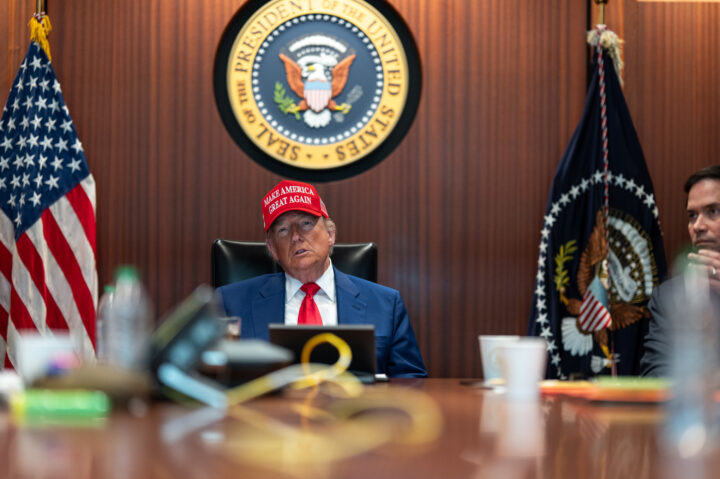
Daniel Torok/The White House via Getty Images
President Donald Trump and Secretary of State Marco Rubio (R) sit in the Situation Room as they monitor the mission that took out three Iranian nuclear enrichment sites, at the White House on June 21, 2025 in Washington, DC.
This P.M. edition is reserved for our premium subscribers like you — offering a forward-focused read on what we’re tracking now and what’s coming next.
Today’s Daily Overtime was curated by JI U.S. Editor Danielle Cohen-Kanik.
📡On Our Radar
Notable developments and interesting tidbits we’re tracking
President Donald Trump announced that, at the request of Qatari, Saudi and Emirati leaders, he was calling off an attack on Iran he said was planned for tomorrow, after the heads of state assured him Iran would agree to a deal that “will include, importantly, NO NUCLEAR WEAPONS FOR IRAN!”
Trump said he had instructed Defense Secretary Pete Hegseth and Chairman of the Joint Chiefs of Staff Gen. Dan Caine to “be prepared to go forward with a full, large scale assault of Iran, on a moment’s notice, in the event that an acceptable Deal is not reached”…
A new New York Times/Siena poll found 35% of respondents said they sympathize more with Israelis, while 37% said they sympathize more with Palestinians. There was a stark partisan divide: Among Republicans, 66% said they sympathize more with Israelis, while just 17% of Democrats said the same.
Meanwhile, the poll found nearly two-thirds of respondents overall said they disapprove of the Iran war, including 91% of Democrats and 23% of Republicans. Eighty-one percent of Democrats said the costs of the Iran war would not be worth the benefits; 50% of Republicans said they thought it would be worth it, but 32% were unsure…
Several New York City Jewish leaders — including JCRC CEO Mark Treyger, the UJA-Federation of New York and Rabbi Joseph Potasanik, executive vice president of the New York Board of Rabbis — plan to skip Mayor Zohran Mamdani’s Shavuot event taking place this evening at Gracie Mansion, the New York Post reports, after the mayor released a video on Friday for “Nakba Day” that sparked outrage among the Jewish community.
Asked about the backlash, Mamdani claimed his “door is always open” for Jewish leaders “beyond just this evening’s event,” while doubling down on his decision to post the video, saying he was “proud to commemorate Nakba Day” because there are “many Nakba survivors in New York City”…
Two dozen Jewish lawmakers and candidates from both parties shared with Axios a stream of antisemitic voicemails and messages they’ve received, including repeated death threats and praise of Nazis. “It’s no longer a Republican and a Democrat [issue],” said Rep. Max Miller (R-OH). “Both ends of our parties are wackadoos who hate Jews”…
Ahead of tomorrow’s primary elections in Kentucky, Rep. Thomas Massie (R-KY) is going out with an antisemitic bang: He accused his opponent, Trump-backed Navy veteran Ed Gallrein, of being the “puppet” of the Republican Jewish Coalition, which has spent nearly $4 million opposing Massie. The congressman further claimed “a coalition of Israel’s lobbyists and donors” is executing a “blatant attempt to buy a KY congressional seat” and that the RJC is “running [Gallrein’s] race.”
Gallrein, meanwhile, got a boost from Hegseth, who appeared today in Hebron, Ky., to urge voters to turn out for the GOP challenger. Hegseth — who claimed he was there in his personal capacity, as his appearance broke a longstanding tradition of defense secretaries who typically avoid engaging in electoral politics — praised Gallrein as a military leader who would remain loyal to Trump…
House Majority Leader Steve Scalise (R-LA) endorsed Rep. Julia Letlow (R-LA) in her runoff for U.S. Senate, after she finished in first place in the Louisiana primary held over the weekend, ousting Sen. Bill Cassidy (R-LA). Letlow, who is already endorsed by Trump, is expected to prevail over state Treasurer John Fleming…
A man named Zaid Gitesatani was arrested today on a hate crime charge for assaulting a Jewish man in June 2024 in the heavily Orthodox Pico-Robertson neighborhood of Los Angeles, as the victim was walking his dog near a synagogue that was hosting an Israeli real estate event.
In the days following the assault, Gitesatani posted screenshots of a video of the incident to his Instagram account with the caption, “The Chosen People sometimes need a good smack to wake up” and claimed he “whopped 2 zios,” among other comments, according to the Justice Department…
The three leading Democratic candidates in the race for executive of Montgomery County, Md., — Councilmembers Andrew Friedson, Evan Glass and Will Jawando — pledged to address the rise of antisemitism within the local school system in a discussion today with the Jewish Community Relations Council of Greater Washington, Jewish Insider’s Haley Cohen reports.
Jawando, the most progressive Democrat in the race, said, “I am disappointed that MCPS has not accepted” the training recommended by the JCRC earlier this month. “I will continue to urge them to do so”…
Rahm Emanuel, the former Chicago mayor and prospective 2028 presidential candidate, is slated to discuss the future of U.S.-Israel relations at Tel Aviv University on July 8, according to an announcement from the school today, JI’s Matthew Kassel reports…
Israeli-founded AI startup Decart raised $300 million at a nearly $4 billion valuation for software that helps AI companies switch more easily between chips from Nvidia, which invested in the company, and its rivals…
Police said they “neutralized” a threat during an active shooter situation today at the Islamic Center of San Diego, the largest mosque in the county. Local news reported two suspects are dead, and the mosque’s chairman said a security guard had been killed…
⏩ Tomorrow’s Agenda, Today
An early look at tomorrow’s storylines and schedule to keep you a step ahead
Keep an eye out in Jewish Insider for a preview of tomorrow’s primaries in Kentucky and Pennsylvania.
CENTCOM Commander Adm. Brad Cooper will testify before the House Armed Services Committee.
The Senate Appropriations Committee will hold a budget hearing on the Department of Justice.
The Jewish Federations of North America will hold a press conference on the Hill with House and Senate lawmakers and hundreds of community leaders on the need for increased funding for the Nonprofit Security Grant Program.
The Center for American Progress will hold its 2026 IDEAS Conference in Washington with speakers including Govs. Gavin Newsom, Wes Moore, Mikie Sherrill and Abigail Spanberger, Senate Minority Leader Chuck Schumer (D-NY), House Minority Leader Hakeem Jeffries (D-NY), Sens. Cory Booker (D-NJ), Ruben Gallego (D-AZ) and Elizabeth Warren (D-MA), Minneapolis Mayor Jacob Frey and columnist Ezra Klein.
The Middle East Forum will begin its three-day policy conference in Washington, with keynote speeches from White House official Seb Gorka, Israeli Ambassador to the U.S. Yechiel Leiter and Deputy Special Presidential Envoy Morgan Ortagus.
The Stephen Wise Free Synagogue in Manhattan will hold its spring benefit where it will honor Amb. Deborah Lipstadt, the former State Department antisemitism envoy, with its Light of Freedom Award, and synagogue lay leader and attorney Ira Bogner with its Shem Tov Award.
Tomorrow is Jewish Community Day at Nationals Park in Washington as the team faces off against the New York Mets.
Stories You May Have Missed
DEM DYNAMICS
DSA’s ascent tests Democratic Party’s ideological boundaries

If elected mayor of Washington, D.C., Janeese Lewis George’s victory would hand a major win to Washington’s Democratic Socialists of America chapter
CAMPAIGN COMPANY
Claire Valdez sat for interview with Twitch streamer who called Jews ‘demonic ethnicity’

The far-left congressional candidate also liked a post celebrating Oct. 7 shortly after the attacks
Trump told Axios on Sunday that 'the clock is ticking' for Iran and the U.S. to reach an agreement to end the war
Brendan SMIALOWSKI / AFP via Getty Images
US President Donald Trump speaks about the conflict in Iran in the James S. Brady Press Briefing Room of the White House on April 6, 2026, in Washington, DC.
For the last two weeks, a resumption of hostilities with Iran seemed unlikely, with the U.S. uninterested in sparking renewed fighting against the Islamic Republic in advance of President Donald Trump’s summit with Chinese President Xi Jinping — whose country is a key trade partner of Iran.
But with the president back in Washington, the administration appears to be reopening military options — even as Iran continues to drag out tensions by offering what U.S. officials have said were unacceptable proposals to end the war. That extends to Congress, where Democrats on both sides of Capitol Hill are expected to introduce new war powers resolutions this week in an attempt to constrain the administration’s actions in the Middle East.
Trump told Axios on Sunday that “the clock is ticking” for Iran and the U.S. to reach an agreement to end the war. After rejecting Iran’s previous response to a U.S. proposal, Trump said that Tehran has to get to “where we want them to be,” or else “they are going to get hit much harder.”
A decision on whether to return to active fighting could come as soon as Tuesday, when Trump is set to hold a Situation Room meeting to discuss options. After returning from Beijing, the president met on Sunday with Vice President JD Vance, Secretary of State Marco Rubio, White House Special Envoy Steve Witkoff and CIA Director John Ratcliffe.
In Israel, preparations are being made for a possible return to war. Channel 12 quoted a senior Israeli official on Friday saying that the country is “preparing for days to weeks” of renewed fighting.
Even as the tenuous ceasefire has held, the United Arab Emirates — which during the active hostilities took the brunt of Iran’s attacks — has continued to face drone attacks. Emirati officials are investigating a fire near Abu Dhabi’s Barakah Nuclear Power Plant that broke out on Sunday after a drone entered the UAE from its western border and struck a generator near the facility.
The Islamic Republic’s ongoing strikes targeting the UAE — and its clashes with the U.S. Navy in the Gulf — play into a broader Iranian strategy to slow-walk negotiations as it continues to destabilize the region. Few doubt Iran’s capacity — even after six weeks of active fighting — to hit the U.S., the UAE, Israel or other U.S. assets in the region, but doing so would likely prompt a severe U.S. response and collapse the tenuous ceasefire, dragging Iran into a renewed conflict as it works to recoup its heavy losses from the U.S. and Israeli bombing campaigns.
It’s a strategy underscored by Iran’s seizure last week — the same day that Trump and Xi met — of a boat belonging to a Chinese security firm. While disruptive, no one aboard the vessel was killed or injured, and China is unlikely to retaliate for the incident. But analysts told The Wall Street Journal that the move was likely an effort by Tehran to send a message to Beijing. Chatham House’s Sanam Vakil told the WSJ that Iran’s apprehension of the boat “is a way to remind the Chinese who is in control of [the Strait of] Hormuz and they shouldn’t even think of providing their own security.”
Foot-dragging talks while making minimal concessions has served Iran well through multiple U.S. administrations, and allowed the Islamic Republic to retain control through rounds of active fighting while preserving its military and diplomatic leverage. Now, with Tehran appearing to bet that the outcome of the midterms could provide a more favorable environment in Washington and constrain the Trump administration’s ability to escalate, the question will be if Iran will slow-walk its way to November — or whether the clock has run out.
Rep. Julia Letlow is now the favorite to win the Louisiana race; she faces state Treasurer John Fleming in a June runoff
Tyler Kaufman/Getty Images
Sen. Bill Cassidy (R-LA) speaks to media on the first day of early voting outside of the Louisiana State Archives on May 02, 2026 in Baton Rouge, Louisiana.
Dogged by his vote to impeach President Donald Trump in 2021, Sen. Bill Cassidy (R-LA) lost his bid for reelection on Saturday night, finishing in third place in the Louisiana Republican primary behind Trump-endorsed Rep. Julia Letlow (R-LA) and state Treasurer John Fleming.
Letlow and Fleming, the top two finishers, will now compete in a runoff, which will be held on June 27. Cassidy only received 25% of the primary vote, lagging well behind Letlow, who received 45% of the vote, and Fleming, who won 28%.
The race offered another strong signal that Trump’s backing is the most important factor in Republican nomination fights. Of the seven Republican senators who voted to convict Trump at his 2021 impeachment trial, only two remain in the Senate. One of them, Sen. Susan Collins (R-ME), faces her own difficult reelection.
The results also come two weeks after Trump and his political allies successfully ousted five Republican state senators in Indiana primaries, after they opposed the Trump administration’s push to redraw the state’s congressional lines to further favor Republicans.
Cassidy, first elected to the Senate in 2014, had long been one of the more bipartisan members of his caucus, using his experience as a doctor to take the lead on health care issues. He drew close scrutiny for his decision supporting Robert F. Kennedy, Jr. to be confirmed as health and human services secretary in his role as HELP Committee chairman, despite holding serious misgivings over Kennedy’s record opposing vaccine requirements.
In his concession speech, Cassidy told supporters: “When you participate in democracy, sometimes it doesn’t turn out the way you want it to. But you don’t pout. You don’t whine. You don’t claim that an election was stolen from you.”
The next big test of Trump’s influence in party politics will come on Tuesday, when Rep. Thomas Massie (R-KY), a virulent opponent of Israel, will face off against Trump-endorsed challenger Ed Gallrein, a Navy veteran. Trump allies and outside pro-Israel groups have poured millions into the race to defeat Massie. Polls show the race is competitive, with Gallrein holding late momentum.
The question is whether Massie’s image has been tarnished enough to cause his defeat, or if he’ll emerge wounded but still standing
DANIEL HEUER/AFP via Getty Images
Rep. Thomas Massie (R-KY) speaks to reporters at the US Capitol on Washington, DC on November 18, 2025.
Rep. Thomas Massie (R-KY) will enter Tuesday’s closely watched primary against Ed Gallrein, a Navy veteran and farmer backed by President Donald Trump, politically damaged — but it remains to be seen whether he’s taken enough hits to end his career in Congress.
Scott Jennings, a Kentucky-based GOP strategist and CNN political analyst, said that he’s spoken to operatives on both sides of the race who are very confident in victory. “Based on some of the polling I’ve personally seen and heard about, it feels like Massie’s image has been severely degraded by the sustained campaign that’s been run against him,” Jennings told Jewish Insider.
The question is whether Massie’s image has been tarnished enough to cause his defeat, or if he’ll emerge wounded but still standing. Jennings said that Massie has built a “popular brand” in the district during his seven terms in office, but also hasn’t before faced a full-frontal assault from Trump and the associated avalanche of spending.
Al Cross, a professor emeritus at the University of Kentucky School of Journalism and a political columnist, said he’s “loath to make predictions about that race, but Gallrein clearly has the momentum.”
He explained that Gallrein has received significant positive coverage in pro-Trump media, has stronger support among older voters, who are more likely to turn out, has a significant advantage in outside spending and has Trump’s influential endorsement.
A Quantus Insights poll conducted this week showed Gallrein with a lead outside the margin of error, tallying 48% support from GOP voters, with Massie at 43%. Eight percent of voters remained undecided.
In another late-breaking boost for Gallrein, the U.S. Chamber of Commerce announced its endorsement of the veteran on Thursday, a sign it sees Massie as vulnerable.
Ultimately, Jennings said the race will be a test of voters’ willingness to support a representative who has been at odds with Trump. He said the influx of anti-Massie advertising has made the break between the two men clear to voters in a way that it may not have been before.
“The most popular Republican in the district is Donald Trump. And the thing Republicans want more than anything else in this world is for Donald Trump to succeed and for his party to help him succeed,” Jennings said. “And if they come to believe that you are an impediment to that success, they will punish you.”
“Now that having been said, there are certainly libertarian/contrarian voters in that district,” Jennings added, noting that the state has a long “contrarian streak,” particularly in Massie’s district.
But, voters also tend to harbor suspicions of first-time candidates they aren’t familiar with, Cross said, and Massie and his supporters have been working aggressively to frame Gallrein as untrustworthy, deceitful and not committed to the president.
Cross noted the recent polling as another positive sign for Gallrein — though he cautioned against putting too much stock in the results in a district where turnout could vary significantly from county to county.
Various Jewish and pro-Israel groups have poured money into the race attacking Massie and boosting Gallrein. The Republican Jewish Coalition has spent nearly $4 million, the AIPAC-affiliated United Democracy Project has spent $3.2 million against Massie and Christians United for Israel allocated six figures to buy dozens of billboards across the district.
The pro-Massie campaign has also waded into antisemitic territory, most recently with a television ad by a Massie-allied group attacking conservative Jewish donor Paul Singer, superimposing his head alongside a large Star of David.
Meanwhile, William Paul, son of the state’s junior senator, Rand Paul (R-KY), went on an antisemitic tirade against Rep. Mike Lawler (R-NY) in a Washington bar this week claiming that Jews would be responsible if Massie lost the race.
Massie on Thursday announced plans to introduce the “AIPAC Act,” which would require the pro-Israel group, whose members are American citizens and do not take instruction from the Israeli government, to register under the Foreign Agents Registration Act. He said that the legislation would apply to interest groups supporting other countries as well.
The congressman has long described AIPAC and its members as vectors of malign foreign influence, accusations that critics say lean into antisemitic dual loyalty tropes.
If elected mayor of Washington, D.C, Janeese Lewis George’s victory would hand a major win to Washington’s Democratic Socialists of America chapter

Craig Hudson for The Washington Post via Getty Images
D.C. councilmember and mayoral candidate Janeese Lewis George is seen on Capitol Hill for a press conference in Washington, DC on March 10, 2025.
The open race for mayor of Washington, D.C., has been largely uneventful ahead of next month’s primary — so much so that the first TV ads run by the leading candidates, Kenyan McDuffie and Janeese Lewis George, sound nearly identical. Both candidates tout affordability and safety on the campaign trail, with promises to build more housing and stand up against President Donald Trump.
But if elected, Lewis George’s victory would mark a significant shift away from the centrist brand of politics espoused by outgoing Mayor Muriel Bowser over the last 12 years, and would instead hand a major win to Washington’s Democratic Socialists of America chapter, of which Lewis George has been a member for years.
Lewis George has faced criticism throughout the campaign from some in the Jewish community for comments she made on a DSA endorsement questionnaire pledging to boycott events that “promote Zionism” and criticizing Jewish activists’ approach to combating antisemitism. Ron Halber, CEO of the Jewish Community Relations Council of Greater Washington, on Tuesday called DSA an “evil” organization that seeks “to make being Jewish unacceptable in polite society.”
DSA has activated its small but growing membership to knock on doors for Lewis George, a member of the D.C. Council, tapping into a grassroots energy that they hope translates into success at the ballot box. Rep. Rashida Tlaib (D-MI), one of two DSA members currently serving in Congress, attended a recent DC DSA rally alongside Lewis George.
DSA’s Metro DC chapter is relatively small. Yet its current roster of roughly 3,400 members represents a massive increase from its pre-2016 nadir of just 200 members — and mirrors DSA’s growing clout nationally.
“For most of the ‘80s and ‘90s and 2000s, DSA was a small organization with maybe 5,000 or 8,000 people at the most. I would say the average age was probably over 60, maybe higher than that,” said Peter Dreier, an emeritus professor of politics at Occidental College in Los Angeles. “Then Bernie [Sanders] ran for president in 2016 and started talking about democratic socialism in a way that made sense to, particularly, a lot of young people, and he kind of opened the door to people to be in DSA.”
Overall, DSA is still a small organization on the fringes of Democratic politics. Even the highest membership counts — adding up DSA’s local chapters — don’t top 100,000. But the unexpected popularity of Sanders’ 2016 presidential run sparked a resurgence of interest in democratic socialism not seen in generations, and that has continued well past his two campaigns. A 2025 Gallup poll found that 42% of Democrats have a positive image of capitalism, down from 54% a decade ago, while 66% have a positive view of socialism.
“If [young people] don’t remember the Cold War, then what do they think when they hear the word socialism? There’s still a battle over that, but they’re more likely to think, ‘Oh, countries that have more equality, or students that get free or almost free higher education, everybody has access to healthcare,’” said Dreier.
“We are going to raise money and develop a plan over the course of the next few months to try to make them toxic, to make it unacceptable for major figures in the party or anybody actually running for office to be affiliated with the DSA, the way it should be unacceptable to be affiliated with [neo-Nazi influencer] Nick Fuentes if you’re running as Republican,” Third Way’s senior vice president for public affairs, Matt Bennett, said.
The key question now facing capital-D Democrats — one they sound unsure of how to answer, or perhaps unwilling — is how to handle an insurgent faction that has galvanized people over its straightforward messaging on corporations (bad), taxing the rich (good) and Medicare for All (necessary), while at the same time promoting far-left positions like prison and police abolition that are nowhere near the Democratic mainstream. The group has long promoted the Boycott, Divestment and Sanctions movement, as well as calling for an arms embargo on Israel, and its members passed a resolution last year affirming their commitment to anti-Zionism. On Oct. 7, 2023, DSA released a statement holding Israel accountable for the Hamas attacks and calling on members to take to the streets to protest U.S. support for Israel.
The centrist Democratic group Third Way plans to launch a major PR campaign against DSA in the coming months, one of the group’s executives told JI, arguing that its far-left positions and incendiary brand of politics will be harmful for the party’s electoral prospects.
“We are going to raise money and develop a plan over the course of the next few months to try to make them toxic, to make it unacceptable for major figures in the party or anybody actually running for office to be affiliated with the DSA, the way it should be unacceptable to be affiliated with [neo-Nazi influencer] Nick Fuentes if you’re running as Republican,” Third Way’s senior vice president for public affairs, Matt Bennett, said.
In the decade since Sanders’ 2016 campaign, DSA has had an outsized impact on national politics. The 2018 congressional victory of Rep. Alexandria Ocasio-Cortez (D-NY), a DSA member, raised the group’s profile. A steady stream of more than 200 DSA-aligned candidates have been elected to state and local offices since, culminating with the election of DSA member Zohran Mamdani as mayor of New York City last year.
“To the degree that people need to pay attention to DSA, it’s because they built this kind of political machine,” said Micah Sifry, a journalist focused on left-wing political organizing. “In a time when people are, for the most part, not very organized, the ability of any small group, relatively speaking, to punch above its weight grows.”
Perhaps unsurprisingly, New York has the largest bench of DSA-affiliated state lawmakers. The group has slowly but steadily been gaining electoral power in state and local offices in some unexpected places, too, like Minnesota, Colorado, Delaware and Wisconsin. The group’s largest foothold is in city council races, where a small but committed cadre of volunteers can swing elections in low-turnout races.
National Democratic leaders are divided about how to treat the small but vocal socialist minority in the party.
House Minority Leader Hakeem Jeffries (D-NY) declined to support Mamdani in the primary election but ultimately endorsed him ahead of the general election last year. Weeks later, Jeffries voted in favor of a Republican-led resolution condemning socialism. He has been skeptical of the left-wing ideology throughout his political career: “There will never be a moment where I bend the knee to hard-left democratic socialism,” he said in 2021. A spokesperson for Jeffries declined to comment this week when asked if he believes Democrats should be welcoming socialists into the party.
Democratic National Committee Chair Ken Martin has been more open-minded about socialists. Asked by Fox News last year whether progressives like Mamdani and Ocasio-Cortez make his job harder, he said no.
“The party is a big tent. But just like we have to believe it’s a big tent, the DSA also has to believe it’s a big tent, and I’m not sure they do,” Brian Romick, CEO of Democratic Majority for Israel, said. “Democratic leaders want to win elections, and that means a big tent, and that means that Democratic base voters and pro-Israel voters and moderate people who maybe voted for [Donald] Trump sometimes because they’re concerned about prices have to be in the tent.”
“I don’t think they make it difficult at all,” Martin said in August 2025. “The difference between the Democratic Party and the Republican Party is that we’re a big tent. We have lots of people in that tent from all of the different ideological wings, from conservative Democrats, to centrists, to progressives, to these new leftists.” A DNC spokesperson did not respond to multiple requests for comment this week.
Brian Romick, CEO of Democratic Majority for Israel, told Jewish Insider this week that he is concerned about the inroads DSA is making in the party. He agreed with Martin that the Democratic Party should be a big tent, but noted that DSA members — who are at times intent on putting litmus tests even on would-be allies — don’t extend the same understanding to more moderate members of the party.
“The party is a big tent. But just like we have to believe it’s a big tent, the DSA also has to believe it’s a big tent, and I’m not sure they do,” Romick said. “Democratic leaders want to win elections, and that means a big tent, and that means that Democratic base voters and pro-Israel voters and moderate people who maybe voted for [Donald] Trump sometimes because they’re concerned about prices have to be in the tent.”
The questionnaire Lewis George filled out in Washington to earn DSA’s endorsement reveals how important hard-line opposition to Israel is to the organization, which requires even candidates for local offices with no connection to foreign policy to all but disavow the Jewish state. Most voters who support DSA-aligned candidates likely are not drawn to them because of their views on the Middle East; Mamdani’s message was first and foremost about affordability. But DSA’s growing reach among Democrats gave a foothold to anti-Israel views that may have once been rare, though global attention on the war in Gaza also contributed to shifting Democratic orthodoxy on the conflict. (Other far-left groups like Justice Democrats have played a role, too.)
Zach Shartiag, a Jewish Democratic campaign operative from Chicago, told JI that Democrats he has talked to who support DSA candidates generally do not do so because of DSA’s stance on Israel, even if the activists are themselves critical of Israel.
“People might be very anti-Israel now, but at the same time, it’s like, what does that have to do with local politics?” said Shartiag, who is currently working on a congressional campaign in Hawaii. “I’ve talked to a lot of people, just in general, normal humans, and it’s like, ‘Yeah, I might be against what Israel’s doing, but what does that have to do with the local and the city and the state?’”
The full picture of DSA’s influence in the party will not be known until all the votes are tallied at the end of this year’s midterm elections. A number of DSA-affiliated candidates are gaining ground in congressional primaries, such as Pennsylvania state Rep. Chris Rabb, who has garnered progressive endorsements in a Philadelphia-area open seat, and New York state Assemblymember Claire Valdez, who has Mamdani’s backing for her congressional campaign.
Still, the election outcomes in states across the country this year will present only a partial picture of where the Democratic Party is moving. In the same year that Mamdani won in New York City, for instance, Democratic moderates Abigail Spanberger and Mikie Sherrill won gubernatorial races in Virginia and New Jersey, respectively.
The only certainty, then, is that the battle between centrists and socialists will continue into 2028.
“I think you’re going to have a real mixed verdict, with us yelling about our side and the left yelling about their side,” Third Way’s Bennett acknowledged. “So what that means is, unsurprisingly, we’re going to go into the presidential primary season with the two camps demanding that they are right.”
Many Jewish Trump administration staffers are expected to attend the White House’s official reception in the Indian Treaty Room

Getty Images
Washington, D.C., will be buzzing with events on Friday evening bringing in Shabbat 250, a national Sabbath marking the 250th birthday of the United States.
Several Jewish organizations have been planning celebratory gatherings, both in Washington and across the country, to commemorate Shabbat 250 since President Donald Trump encouraged Jewish Americans to observe Shabbat this weekend in his Jewish American Heritage Month proclamation.
The proclamation marked the first time a U.S. president had called for a national Shabbat, prompting some Jewish leaders to rush to organize events.
“There will be a number of events taking place around town for Shabbat 250,” Rabbi Levi Shemtov, the executive vice president of American Friends of Lubavitch (Chabad), told Jewish Insider. “In observance of the Sabbath, I’ll need to walk everywhere, so I hope to make it to as many gatherings as possible.”
Shemtov said the message he’s taken from his conversations with fellow Jewish leaders going into this weekend is one of gratitude toward the president for including the national Sabbath in his JAHM proclamation and of hope that the venture would prompt more Jewish Americans to keep Shabbat.
“I’m obviously delighted by the president’s call to observe Shabbat, because this reinforces Jewish identity with Jewish observance and tradition. I hope those who don’t yet observe Shabbat will choose to do so, and those who already observe will choose to share with a friend who doesn’t yet know about this beautiful cornerstone of our heritage,” Shemtov said. “I would imagine that those Jewish people who were in America 250 years ago could not have imagined our good fortunes today and must be kvelling.”
“Some Jewish leaders have said that much like Shabbat gives us a break from the week for renewal and recalibration, their hope is that this Shabbat will be a moment of reprieve from partisan political battles for even just one day,” he continued.
The most difficult ticket to snag is the White House’s official Shabbat 250 reception, which is slated to take place at 6 p.m. ET in the Indian Treaty Room. While Trump and Vice President JD Vance are not expected to be in attendance, Trump administration staffers have been invited to and are expected at the gathering.
Several invite-only dinners are taking place around D.C. after the White House event concludes and before sundown on Saturday. Details for many events are being kept under wraps due to security concerns.
One of those receptions is being co-sponsored by the American Association of Jewish Lawyers & Jurists and the Combat Antisemitism Movement. The gathering, titled, “Shabbat 250 Dinner: A Celebration of the President’s National Sabbath,” will feature a “family style” Sabbath meal and an afterparty dubbed “Farbrengen 250,” according to an invitation obtained by JI.
An event organizer described the gathering to JI in a statement as an “off-the-record dinner” bringing together “Jewish members of the administration, Capitol Hill staff, media and policy professionals in celebration of the president’s National Sabbath.” The organizer told JI that guests will receive “the usual kippot and benchers” and copies of Charlie Kirk’s book on Shabbat. The wine served at the event will be donated by Psagot Winery, the Israeli vineyard located in the West Bank.
“We were incredibly moved by President Trump’s call for a national Sabbath as part of the USA250 commemorations,” Arie Lipnick, advisory board chairman of the Combat Antisemitism Movement, told JI in a statement. “In that spirit, CAM is excited to help bring together more than a hundred Jewish members of the administration, Hill staff, media and policy professionals in celebration of America and Shabbat.”
Plus, Vance vouches for Susan Collins
Getty Images
A large plume of smoke rises over Tehran after explosions were reported in the city during the night on March 28, 2026 in Tehran, Iran.
This P.M. edition is reserved for our premium subscribers like you — offering a forward-focused read on what we’re tracking now and what’s coming next.
📡On Our Radar
Notable developments and interesting tidbits we’re tracking
During their meeting today in Beijing, President Donald Trump and Chinese President Xi Jinping discussed the issue of Iran, where the Chinese leader “did offer, he said, ‘if I can be of any help at all I would like to be of help,’” Trump recalled to Fox News’ Sean Hannity. “Anybody that buys that much oil has obviously got some kind of a relationship with them,” Trump added.
Secretary of State Marco Rubio told NBC News about the discussion that the “Chinese side is not in favor of militarizing the Strait of Hormuz and they’re not in favor of a tolling system,” which are positions the Trump administration shares…
At a meeting of foreign ministers of the BRICS bloc in India today, Iranian Foreign Minister Abbas Araghchi accused the UAE of “direct involvement” in military operations against Iran; Araghchi later met on the sidelines with Russian Foreign Minister Sergey Lavrov…
CENTCOM Commander Adm. Brad Cooper testified at a Senate Armed Services Committee hearing that the U.S. and Israeli campaign against Iran has severely degraded its capabilities across a variety of fronts, to the extent that it will take years to reconstitute, Jewish Insider’s Marc Rod reports.
Cooper said that 90% of Iran’s defense industrial base has been destroyed and that support to key Iranian proxies Hamas, Hezbollah and the Houthis has been “completely cut off.”
Treasury Secretary Scott Bessent, meanwhile, said on CNBC’s “Squawk Box” that the U.S. believes Iran has run out of storage capacity for its crude oil and will need to cut off oil production, a key marker that may put more pressure on the regime to agree to a deal…
Saudi Arabia has begun to consider promoting a nonaggression pact between Middle East countries and Iran once the war ends, according to the Financial Times, fearing that the conflict will leave Iran weaker but more hardline and conflict-prone. Several European countries are reportedly supporting the effort…
The House unanimously passed a resolution yesterday evening recognizing Jewish American Heritage Month and calling on elected officials to combat antisemitism…
Israeli Prime Minister Benjamin Netanyahu and Foreign Minister Gideon Sa’ar said they will initiate a defamation lawsuit against The New York Times over Nicholas Kristof’s column earlier this week alleging widespread Israeli sexual violence against Palestinian prisoners, which critics said used dubious sourcing and elevated conspiracy theories…
The Times looks under the hood of the campaign of Jack Schlossberg, running in New York’s 12th District Democratic primary, which sources described as “so erratic and plagued by turnover that it raises questions about how he might handle himself as a member of Congress”…
Vice President JD Vance, speaking at a rally in Maine, praised Sen. Susan Collins (R-ME) — despite her strained relationship with the president — as she heads to a competitive general election against presumptive Democratic nominee Graham Platner.
“Sometimes I get frustrated with Susan Collins, I almost wish that she was more partisan,” Vance said. “But the thing I love about Susan is she is independent, because Maine is an independent state. And frankly, if she was as partisan as I sometimes wish that she was, she would not be a good fit for the people of Maine”…
The United Federation of Teachers endorsed Rep. Dan Goldman (D-NY) in his competitive primary race against former New York City Comptroller Brad Lander next month; Goldman has been racking up labor support ahead of the June 23 primary against the progressive Lander, who is endorsed by New York City Mayor Zohran Mamdani…
Tune Inn, the D.C. bar where William Paul, son of Sen. Rand Paul (R-KY), accosted Rep. Mike Lawler (R-NY) with an antisemitic rant, announced that the younger Paul would be barred from the establishment going forward. The elder Paul hasn’t made any statement on the confrontation…
A flag with two swastikas and a Star of David was flown atop a building at New York University during a popular graduation event yesterday, reportedly appearing on top of the Steinhardt School of Culture, Education and Human Development, named for Jewish benefactors Michael and Judy Steinhardt. The flag was quickly removed and police say an investigation is underway…
⏩ Tomorrow’s Agenda, Today
An early look at tomorrow’s storylines and schedule to keep you a step ahead
Keep an eye out in Jewish Insider for a look at the emerging bloc of Sunni countries uniting against Israel’s allies, potentially complicating the Jewish state’s regional strategy.
The White House will host a reception with Jewish leaders tomorrow evening to kick off Shabbat 250, an initiative announced by President Donald Trump in his proclamation marking Jewish American Heritage Month where he encouraged Jewish Americans to “observe a national Sabbath” to celebrate the approaching Semiquincentennial of the United States.
Several Jewish organizations and institutions will also be marking the day with special events, including a Shabbat 250 dinner being held in Washington by the Combat Antisemitism Movement and American Association of Jewish Lawyers and Jurists.
New York City Police Commissioner Jessica Tisch will speak at Friday evening Shabbat services at Temple Emanu-El in Manhattan.
The Lennart Meri Conference, an annual foreign policy and security summit in Estonia, begins tomorrow. Speakers include several foreign leaders, former Israeli National Security Advisor Eyal Hulata and Israeli Russian researcher and former hostage Elizabeth Tsurkov.
Indian Prime Minister Narendra Modi is kicking off an international tour tomorrow with a visit to the UAE, later heading to several European countries.
We’ll be back with the Daily Overtime on Monday. Shabbat Shalom!
Stories You May Have Missed
FAMILY TIES
Alex Bores’ father, a key ally in his son’s House campaign, celebrated Israeli deaths, equated Zionists with Nazis
Alex Bores has invoked his labor bona fides through his union chief father in his run for the heavily Jewish Manhattan seat
PHILLY FRONTRUNNER
Far-left state Sen. Chris Rabb surging ahead in Philadelphia primary
Rabb is facing off against state Sen. Sharif Street, a former state Democratic Party chair, and Ala Stanford, a physician and activist
‘No defense, only offense,’ Gottheimer said at an event in Washington commemorating the 78th anniversary of Israel’s founding. 'I am sick and tired of people apologizing, of making excuses.'

Lev Radin/Pacific Press/LightRocket via Getty Images
Rep. Josh Gottheimer (D-NJ) speaks during annual Jerusalem Post conference at Gotham Hall.
Reps. Josh Gottheimer (D-NJ) and Jared Moskowitz (D-FL) urged the Jewish and pro-Israel communities to go on the offensive against antisemitism and anti-Israel attacks, in remarks on Wednesday at an event hosted by the Israeli Embassy in Washington, D.C., commemorating the 78th anniversary of Israel’s founding.
Both lawmakers said they were fed up with constant attacks against the Jewish and pro-Israel communities — and against themselves and other pro-Israel lawmakers personally — for their stances, and urged the audience to forcefully push back and put those attacking the Jewish community and Israel on the defensive.
“No defense, only offense,” Gottheimer said. “I am sick and tired of people apologizing, of making excuses. We should feel proud of the U.S.-Israel relationship, of the independence, of what it’s done for America, of the bipartisan nature, historically, of the relationship and thank God we have Israel to help us fight terror, to stand for freedom and to stand for democracy.”
Moskowitz emphasized that lawmakers who support Israel are being held to a drastically different standard than they are about any other global conflict, just as, he argued, Israel is held to a different standard than other countries.
“We have to stop the defense. We as Jews feel like, ‘Oh, if we just educate them, if we just educate people, if we just give them the information, if we just talk to them, they’ll finally understand,’” Moskowitz said. “We have to flip the script. It’s enough of defending what Israel does. … We have to make the other side defend.”
He said that members of Congress should be grilled aggressively on their support for and relationships with extreme figures such as Hasan Piker and Tucker Carlson, and they should be forced to defend or justify the stances such figures have taken.
“We need all of you … to stand up, to fight back, to play offense, whether that’s against Hasan Piker, whether it’s Candance Owens, we need to make it very clear that’s not going to fly. You’re not going to mess with us. We’re coming for you,” Gottheimer agreed.
Other speakers at the event included Energy Secretary Chris Wright and Israeli Ambassador to the U.S. Yechiel Leiter. Wright drew comparisons between President Harry Truman’s decision to recognize the state of Israel and President Donald Trump’s decision to attack Iran.
“The United States and Israel will prevail, and we will remove a massive threat, and we will bring years and decades of peace, prosperity and restoring confidence in the economic, social and cultural progress of this awesome region, the Middle East, anchored by the state of Israel,” Wright said.
He paid homage to Yaron Lischinsky and Sarah Milgrim, the two Israeli Embassy staffers gunned down last year in an antisemitic attack at the Capital Jewish Museum, not far from the location of Wednesday night’s event.
Wright also highlighted Israel’s technological and energy sector successes and innovations.
Other lawmakers in attendance at the event included Sen. Jacky Rosen (D-NV) and Reps. Brad Schneider (D-IL), Randy Fine (R-FL), Don Bacon (R-NE), Mike Lawler (R-NY) and Virginia Foxx (R-NC).
Other administration officials who attended the event included Sebastian Gorka, Josh Gruenbaum and Rabbi Yehuda Kaploun.
The annual event also included, for the first time, a dance floor, DJ and live music, to highlight and celebrate the end of the yearslong Gaza hostage crisis — following through on a slogan that emerged following the Hamas massacre at the Nova Music Festival on Oct.7, 2023: “We will dance again.”
JDCA’s top activists made clear this week that a major concern is making sure pro-Israel Jews continue to be welcome in the party
MANDEL NGAN/AFP via Getty Images
Jewish Democratic Council of America CEO Halie Soifer in Washington on May 24, 2023.
When a group of Jewish Democratic activists and donors convened in Washington this week for the annual leadership summit of the Jewish Democratic Council of America, the message seemed to be one of defiance: defiance against President Donald Trump, to be sure, but also a defiant attitude pushing back against some of the recent shifts within the party.
JDCA’s primary objective is to elect Democrats. But as more Democrats have taken positions critical of or outright hostile to Israel, JDCA’s top activists made clear this week that another major concern is making sure pro-Israel Jews continue to be welcome in the party.
“We are fighting to ensure that the views and values of Jewish Americans continue to find their political home in the Democratic Party in Michigan and beyond, and we have work to do,” Halie Soifer, the group’s CEO, said on Tuesday night. She noted that the JDCA hopes to help defeat Michigan Senate candidate Abdul El-Sayed, a far-left candidate who appears to be rising in the polls.
“It’s clear there’s one candidate whose views are antithetical to ours, and we want to ensure he’s defeated,” said Soifer, though she did not name El-Sayed directly. JDCA has not endorsed either of his opponents, state Sen. Mallory McMorrow or Rep. Haley Stevens (D-MI).
“We at JDCA only support Democrats, but we do not support them all,” Soifer told the summit. “We understand it’s not just about electing Democrats. It’s about electing Democrats who align with us, and this includes efforts to ensure that candidates who have espoused anti-Israel and/or antisemitic views are defeated before November.”
Over the two-day gathering, a parade of high-profile speakers from Democratic leadership — Senate Minority Leader Chuck Schumer (D-NY) and House Minority Leader Hakeem Jeffries (D-NY), along with Reps. Nancy Pelosi (D-CA) and Steny Hoyer (D-MD), respectively the former House speaker and majority leader — addressed the convening. Their appearances seemed designed to affirm that Democrats remain pro-Israel and committed to fighting antisemitism.
“We have to decisively confront antisemitism from wherever it comes from,” said Jeffries. “I will always hold firm in my support for the State of Israel as a Jewish and democratic state and eternal homeland for the Jewish people.”
Schumer did not specifically discuss Israel but raised concerns about the increasing use of the word “Zionist” as a slur.
“I’ve long said we must fight antisemitism wherever and whenever it appears, even if it’s in our own party. I’ll continue to do so,” said Schumer. “Today, antisemitism takes all different forms: Holocaust denialism, conspiratorial delusions of Jewish or Zionist control of the world, replacing the word ‘Jewish’ with the word ‘Zionist’ to demonize Jewish communities.”
The outgoing Democratic leaders were not as sanguine, instead offering a note of caution about how the dynamic towards Israel has shifted within the Democratic Party.
“Always, but right now, we really have to work together to make sure that support for Israel is, without question, bipartisan,” Pelosi said. “It doesn’t mean we don’t have our differences of opinion … but it should not weaken the fact that we have bipartisan support. That has always been the tradition, and we must make sure we get through this place where we are, where there may be some doubt in people’s minds as to whether that is a value.”
Pelosi is retiring at the end of this year, as is Hoyer, who was even more blunt: “How many of you have been anxious yourselves about rhetoric heard from some Democratic officials and candidates? We ought to be,” he said.
Speaking to reporters on Wednesday, Sen. Chris Coons (D-DE) said he hoped to prove that Sen. Bernie Sanders (I-VT) does not speak for the party on matters related to Israel, though he noted with worry that Sanders’ attitude — one that is deeply critical of Israel — appears to be on the rise.
“It’s clearer and clearer to me that there is real alarm about a fundamental break between Democrats as a party and Israel as a nation, and I’m going to do everything I can to resist and oppose that break, while criticizing [Benjamin] Netanyahu and his values and decisions,” said Coons. “I’m trying to be an effective and engaged voice with a perspective that you just heard and not have Bernie Sanders be the only senator whose perspective and attitude is heard across the country.”
Forty Senate Democrats voted last month for a Sanders-authored resolution attempting to block some arms sales to Israel, a record high. Coons said he knows those senators still support Israel’s right to exist, but cautioned that being too critical of Netanyahu can give cover to people who are actually anti-Israel.
“I strongly support Israel’s right to exist, its right to be a Jewish homeland and a democracy, and its value to the American people as a partner and ally,” said Coons. “I think we are at risk of some of my colleagues, in trying to send a message to Netanyahu or in opposition to his policies and stances, to be misunderstood as abandoning that commitment.”
Coons said that on the campaign trail, and on recent trips around the country, he hears “profound concern about where’s the Democratic Party going on Israel.” Some Jewish politicians who addressed the JDCA summit expressed a deeper sense of unease and discomfort about their Jewish identity, against the backdrop of rising antisemitism.
Sen. Elissa Slotkin (D-MI), who spoke at a cocktail reception Tuesday evening, talked about how challenging it is to be a Jewish elected official in the current environment.
“It has become deeply, deeply complicated to be a Jew in America,” said Slotkin. “There’s not a single day that goes by for myself representing the state of Michigan that I am not feeling torn.”
Minneapolis Mayor Jacob Frey delivered a jolt of energy to the room with an impassioned speech about his community’s support for immigrants in the face of ICE enforcement activity, which resulted in the killing of two American citizens by ICE agents in his city in January. When a JDCA member asked him for advice on how to respond to others in the Democratic Party who have made anti-Zionism a political litmus test, he expressed concern.
“It has been deeply concerning for me personally, as a proud Jew,” Frey said. “I am a great supporter of the endurance of our American Republic, a big believer that America should continue to exist, and an adamant opponent of Donald Trump. The same thing can apply to Israel.”
Ultimately, though, the gathering was a political pep rally — a chance for Democratic activists and donors to hear from politicians at all levels of government and gin up excitement ahead of this year’s midterm elections. Everyone who addressed the gathering all but guaranteed that Democrats would take back control of the House and Senate.
The conversations seemed meant to ressure Jewish Democrats about both the party’s fortunes for November and its treatment of pro-Israel Jews. One JDCA activist described the group’s work as “grasstops,” which was demonstrated by the appearances from top party leaders.
But the anti-Israel sentiment that has steadily grown within the party over the past three years is not coming from party leaders; it is driven by far-left activists. Whether JDCA has a plan to counter that grassroots energy remains to be seen — and the answer will only come at the ballot box later this year.
ADL’s Lauren Wolman: ‘The fact that a Member of Congress was subjected to this kind of abuse so openly is outrageous and a sign of how far too normalized antisemitism has become’

David Dee Delgado/Getty Images
Rep. Mike Lawler (R-NY) speaks during a press conference outside of Columbia University on April 22, 2024 in New York City.
William Paul, the adult son of Sen. Rand Paul (R-KY), verbally accosted Rep. Mike Lawler (R-NY) at a popular bar in Capitol Hill on Tuesday evening in a lengthy, public antisemitic tirade, Lawler confirmed to Jewish Insider on Wednesday afternoon.
NOTUS, whose reporter witnessed the confrontation, was the first to report the situation.
The tirade occurred less than a week before the congressional election in Kentucky’s 4th Congressional District, where anti-Israel Rep. Thomas Massie (R-KY), who has repeatedly faced accusations of antisemitism, is facing a primary challenger, Ed Gallrein, backed by President Donald Trump and a range of Jewish and pro-Israel groups.
Lawler said that William Paul was visibly intoxicated when he entered the restaurant, the Tune Inn. He said that Paul had confronted him when he first entered the restaurant, and introduced himself as the senator’s son, later sitting next to Lawler at the bar and ultimately interjecting into Lawler’s conversation with the NOTUS reporter.
“He goes on a drunken tirade about Thomas Massie, and if he loses, it’s because of my people. I said, ‘My people, who’s that?’ He goes, ‘Jews,’” Lawler, who is Catholic, told JI.
Lawler said that he told Paul he was not Jewish, and that Paul had apologized for “accusing you of that,” to which Lawler responded, “‘Even if I was Jewish, what’s the problem?’ And he just went on a tirade about it. Totally insane.”
He said that Paul went on to rant, “I hate Jews and I hate gay people, and I don’t care if they die,” which Lawler called “pretty vile” and “f****** disgusting.” He described Paul as engaging in a “roughly 10-minute diatribe about Israel, accusing Jews of being responsible for so many things, playing right into the typical antisemitic tropes that so many people rely on.”
Paul ended the conversation by giving Lawler the middle finger, and tripped on his way out of the bar, according to Lawler.
Lawler said that he was “honestly flabbergasted that somebody would engage in that type of rhetoric, let alone directly to a member of Congress.” He called it “arguably the most shocking thing” he’d experienced in his four years in Washington.
Paul apologized for the comments on Wednesday.
“Last night, I had too much to drink and said some things that don’t represent who I really am. I’m sorry and today I am seeking help for my drinking problem,” Paul wrote on X.
Asked what he wanted to hear from the elder Paul in response to the incident, Lawler said he would be “mortified” if it was his own child who had engaged in such behavior, but said he would leave it to the senator how he wants to respond. He said he hasn’t spoken to Sen. Paul or Massie about the incident.
He said that there is “no question when you look at some of the polling that the issue of Israel among young people and support for Israel is waning, and it’s a concern. … I think a lot of the anti-Israel sentiment is rooted in Jew-hatred, and driven by antisemitic tropes that are published on social media and online, and it’s something that we as a society and certainly Congress needs to combat.”
He said the incident “speaks to a larger issue, obviously in society, and what we’re seeing among young people and what we see online,” a “level of hatred and vitriol” that his Jewish colleagues and Jewish constituents have experienced firsthand.
The Kentucky senator’s office did not respond to JI’s request for comment on the incident.
Multiple House lawmakers condemned Paul’s son.
Rep. Randy Fine (R-FL) told JI, “his grandfather,” former Rep. Ron Paul (R-TX) “was an antisemite. So why should we be surprised that it didn’t fall from the tree? And his father’s supporting the biggest antisemite in the house, Thomas Massie. So I don’t find it surprising. I would be curious where he works, because I wouldn’t suspect he’ll work there for long.”
Rep. Jared Moskowitz (D-FL) wrote on X, “If you are wondering how things are going up on Capit[o]l Hill. We have elected family members screaming ‘you are a Jew’ at catholics.”
Rep. Don Bacon (R-NE) called it, “Repugnant behavior that we don’t want in the GOP.”
Melanie Pell, chief engagement officer for the American Jewish Committee, who lives in Kentucky, told JI, “What’s most disturbing here is how casually ‘Jew”’ was weaponized as a slur in a face-to-face exchange. This isn’t about politics or personal relationships — this is textbook antisemitic bigotry, and its normalization should alarm everyone.”
Pell said she “would hope that Senator Paul would be quick to condemn any use of ‘Jew’ as a slur irrespective of the source.”
The Republican Jewish Coalition responded to the original NOTUS report saying simply, “gross.” Jeff Miller, a Republican lobbyist and board chair of the U.S. Holocaust Memorial Museum, responded, “WTF.”
Rabbi Shlomo Litvin, the chairman of the Kentucky Jewish Council, said that his organization was “deeply disturbed both by the antisemitic conspiracy theories posited by Mr. Paul and with his comfort in harassing someone he thought was Jewish in a public place.”
“The antisemitic conspiracy of Jews controlling the government, supported by extremist bigots like Thomas Massie and Tucker Carlson are not only false, stupid, and a refutation of American values, they are also dangerous, as we can see how they go from online bots to public confrontations, and can potentially turn to violence,” he said in a statement.
Litvin reiterated his concern over the younger Paul’s actions in an interview with JI later Wednesday, questioning if the encounter with Lawler would have ended differently if Paul had confronted “a kid in a yarmulke.”
“My initial reaction is hurt, but not shock. What Congressman Lawler went through last night is an experience that nearly every Jewish American understands,” Litvin said. “I’m relieved this was a U.S. congressman who he thought was Jewish. It could have just been a kid in a yarmulke, and I don’t know how the night would have ended in that case.”
Litvin linked the Tuesday night incident with Massie’s appearance on Tucker Carlson’s podcast, accusing the Kentucky congressman of spreading “Nazi propaganda of Jewish control of the government” as he claimed Jews were responsible for his primary challenge.
Massie, according to Litvin, “said, ‘I’m the only one who didn’t support the leader of my party in my body, Speaker Johnson, and I voted against Trump. Now they’re coming after me and it’s because of the Jews.’ Perhaps, if you’ve made enemies out of all the leaders of your party, the Jews are not responsible when people are upset with you, but that’s his claim, that it’s the Jews, it’s the Zionists.”
“That’s exactly what this young man said to Mike Lawler: ‘You need to watch more Tucker Carlson because this is what they’re talking about,’” he said.
Still, Litvin repeatedly emphasized in his statement and to JI that he has “never seen a hint of antisemitism” from Sen. Paul “who has been a friend to Jewish Kentuckians, condemning antisemitism, supporting Jewish students, standing for the return of stolen Holocaust art and valuables, rejecting the hateful extremism at international organizations, and celebrating the Jewish community’s contributions to our country.”
Litvin called on statewide officials to condemn the younger Paul’s comments, while defending the Kentucky senator.
“I think everyone should speak out at this point. I think we have a growing problem we’ve been ignoring in America. Of Candace Owens, of Tucker Carlson, of Hasan Piker,” he continued. “They’re not on some big news station who’s held responsible. They are given a limitless platform and a microphone, and far too many times we have seen those direct comments lead to violence.”
Lauren Wolman, the senior director of government relations and strategy for the Anti-Defamation League, called the comments “disgusting and dangerous.”
“We’re thankful to Rep. Lawler for standing up in the face of this hate, but the fact that a Member of Congress was subjected to this kind of abuse so openly is outrageous and a sign of how far too normalized antisemitism has become,” Wolman said. “Every leader and public official, in every party, must condemn it clearly and unequivocally and make clear this hate will not be tolerated.”
The incident comes just days after another antisemitic incident in Massie’s race drew widespread national condemnation. An outside group backing Massie and opposing Gallrein published a vitriolic attack ad against Gallrein donor and Jewish billionaire Paul Singer, which placed Singer alongside a large star of David.
Paul has made headlines in the past for alcohol-related issues, including a 2015 collision with a parked vehicle while intoxicated and a 2013 arrest for assaulting a flight attendant, underage drinking and disorderly conduct.
Paul’s LinkedIn page lists him as a digital communications manager in the House, and a former staffer for two conservative groups. But a recent post from four days ago suggested he no longer works on the Hill.
Jewish Insider’s Washington reporter Matthew Shea contributed to this report.
Plus, Lasher links with Mamdani consultant
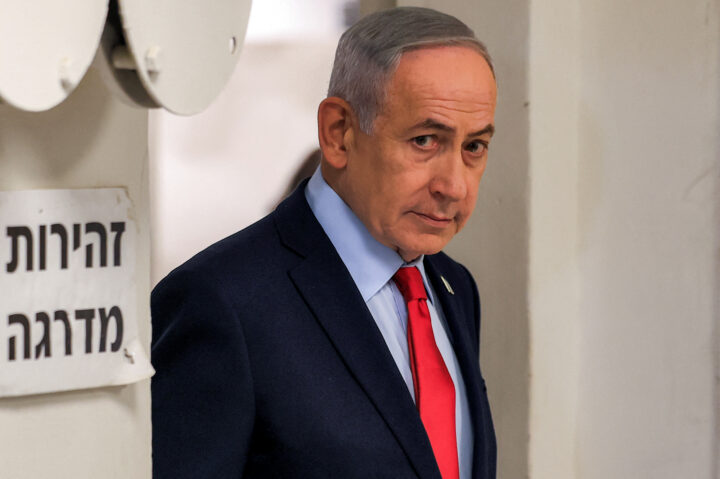
POOL/AFP via Getty Images
Israeli Prime Minister Benjamin Netanyahu arrives for a press conference in Jerusalem on March 19, 2026.
This P.M. edition is reserved for our premium subscribers like you — offering a forward-focused read on what we’re tracking now and what’s coming next. Please don’t hesitate to share your thoughts and feedback by replying to this email.
📡On Our Radar
Notable developments and interesting tidbits we’re tracking
Israeli Prime Minister Benjamin Netanyahu’s office announced that he secretly traveled to the UAE during the war with Iran and met with President Sheikh Mohammed bin Zayed, leading to a “historic breakthrough in relations” between the two countries.
The UAE, however, called the prime minister’s report “baseless” and denied the meeting occurred, saying in a statement that its relations with Israel “are public … and are not based on secrecy or hidden arrangements.”
But Netanyahu’s not the only one to make an under-the-radar visit: Mossad chief David Barnea also reportedly traveled to Abu Dhabi twice during the war, sources told The Wall Street Journal…
Netanyahu’s governing coalition submitted a bill today to dissolve the Knesset and trigger early elections, which is expected to receive a vote next week. If the measure passes, elections would have to be held within five months, though it’s possible they could happen in early September, so as not to coincide with the High Holy Days and the anniversary of the Oct. 7, 2023, attacks.
The move appears to be an attempt to thwart the opposition, which submitted similar bills yesterday after Degel HaTorah, part of the ultra-Orthodox coalition party United Torah Judaism, said it would support such efforts due to the coalition’s failure to pass a law exempting yeshiva students from military service…
Sen. Lisa Murkowski (R-AK) became the latest of a small number of Senate Republicans to break ranks and vote today with the majority of Democrats in favor of an effort to force an end to the war in Iran, Jewish Insider’s Marc Rod reports.
She joined her colleagues Sens. Susan Collins (R-ME) and Rand Paul (R-KY) in supporting the war powers resolution, but the effort still fell short of a majority of the Senate — or of the 60-vote threshold needed for passage — with a final vote of 50-49…
Paul’s son,William Paul, drunkenly accosted Rep. Mike Lawler (R-NY) yesterday, telling Lawler in front of a NOTUS reporter that, if anti-Israel Rep. Thomas Massie (R-KY) is to lose his reelection race, it will be because of “your people” and “you Jews,” going on to accuse Jews of being “anti-American” and prioritizing Israeli interests. Lawler, who is not Jewish, reportedly defended his support for Israel and told Paul he was being antisemitic.
Paul apologized in a post on X today, claiming he “had too much to drink and said some things that don’t represent who I really am”…
The Board of Peace is considering implementing its governance and reconstruction efforts solely in the parts of Gaza not under Hamas control, Axios reports, a contingency option written into the Gaza peace plan in case the terror group refused to disarm…
In an unlikely pairing, New York state Assemblymember Micah Lasher has enlisted Fight Agency, a top progressive consulting firm, to cut ads for his campaign for the 12th Congressional District, JI’s Matthew Kassel reports.
The firm — which was co-founded by Morris Katz, who rose to prominence as an advisor for New York City Mayor Zohran Mamdani’s campaign — prides itself on elevating left-wing, anti-establishment candidates, including current clients and Senate hopefuls Graham Platner in Maine and Abdul El-Sayed in Michigan. Lasher, meanwhile, has called himself a “proud Zionist Jew” and has close connections to the state’s Democratic establishment…
A new nonprofit aiming to counter Mamdani has already raised over $1 million, according to its co-founder Phil Singer, who also worked on a super PAC for former Gov. Andrew Cuomo in the mayoral race. NYC Common Sense intends to run ads and issue policy papers about Mamdani’s policies with which it disagrees and file lawsuits as needed…
House Minority Leader Hakeem Jeffries (D-NY) called for an increase in funding for the Nonprofit Security Grant Program to $1 billion, JI’s Gabby Deutch reports from the Jewish Democratic Council of America’s leadership summit in Washington.
Noting that the Pentagon now estimates the cost of the Iran war at $29 billion, Jeffries asked, “How is it possible that we can’t spend at least 500 million [on NSGP]? I think the number should be even higher. Why wouldn’t we spend a billion dollars to make sure that the communities that we care about across this country are safe?”…
In a speech to parliament, King Charles III laid out his legislative priorities, including several aimed at combating the recent spate of violent attacks on the British Jewish community. One would permit the government to designate the Islamic Revolutionary Guards Corps as a terrorist organization and create a new penalty for those who attack synagogues on behalf of foreign actors like Iran, with a potential of up to 14 years in prison…
Open Society Foundations, founded by left-wing philanthropist George Soros and run by his son Alex, announced it will provide $30 million to organizations combating antisemitism and Islamophobia over the next three years.
In a video statement, Alex Soros spoke of the personal nature of the investment, mentioning his father, who is a Holocaust survivor, and his wife, who is Muslim. OSF President Binaifer Nowrojee further cited the “deep injustices occurring in the Middle East,” which she said are “fueling indiscriminate prejudice, dehumanization, and violence directed against both Muslims and Jews”…
The Senate confirmed Kevin Warsh to be chairman of the Federal Reserve this afternoon on a largely party-line vote, with only Sen. John Fetterman (D-PA) crossing the aisle to support the nominee, who is also the son-in-law of philanthropist Ronald Lauder. It’s the narrowest margin of approval for any Fed chair since the position became Senate confirmed in 1977…
⏩ Tomorrow’s Agenda, Today
An early look at tomorrow’s storylines and schedule to keep you a step ahead
Keep an eye out in Jewish Insider for a conversation with Rep. Mike Lawler (R-NY) about his antisemitic run-in with William Paul.
President Donald Trump and Chinese President Xi Jinping will hold bilateral talks in Beijing.
Back in Washington, Israel and Lebanon will hold their third round of ambassador-level talks — which will reportedly include military representatives for the first time — to continue discussions on a peace deal framework and efforts to disarm Hezbollah.
CENTCOM Commander Adm. Brad Cooper and AFRICOM Commander Gen. Dagvin Anderson will appear before the Senate Armed Services Committee for a hearing on the posture of their respective areas of command.
The congressional Abraham Accords Caucus will hold an event on the implications of the tensions in the Strait of Hormuz, including Reps. Craig Goldman (R-TX) and Brad Schneider (D-IL) and the Middle East Institute’s Ambassador Yael Lempert and Karen Young.
The Israeli American Council will host a gala in New York City, featuring a keynote speech from former CENTCOM Commander Erik Kurilla with special guests Miriam Adelson and former Mossad Deputy Director Henrike Weissberg. The event will honor Yakir Gabay, a member of the Gaza Board of Peace’s executive board, and his wife, Elena.
Stories You May Have Missed
HEATED BACKLASH
Israeli officials, AJC slam Nick Kristof’s NYT column as modern-day ‘blood libel’

Kristof, citing testimonies from victims, alleged that Israeli security forces and settlers committed sexual abuse against Palestinian prisoners; critics argue he relied on Hamas propaganda
SOUNDING THE ALARM
Lawmakers offer dire warnings about rising antisemitism at ADL reception
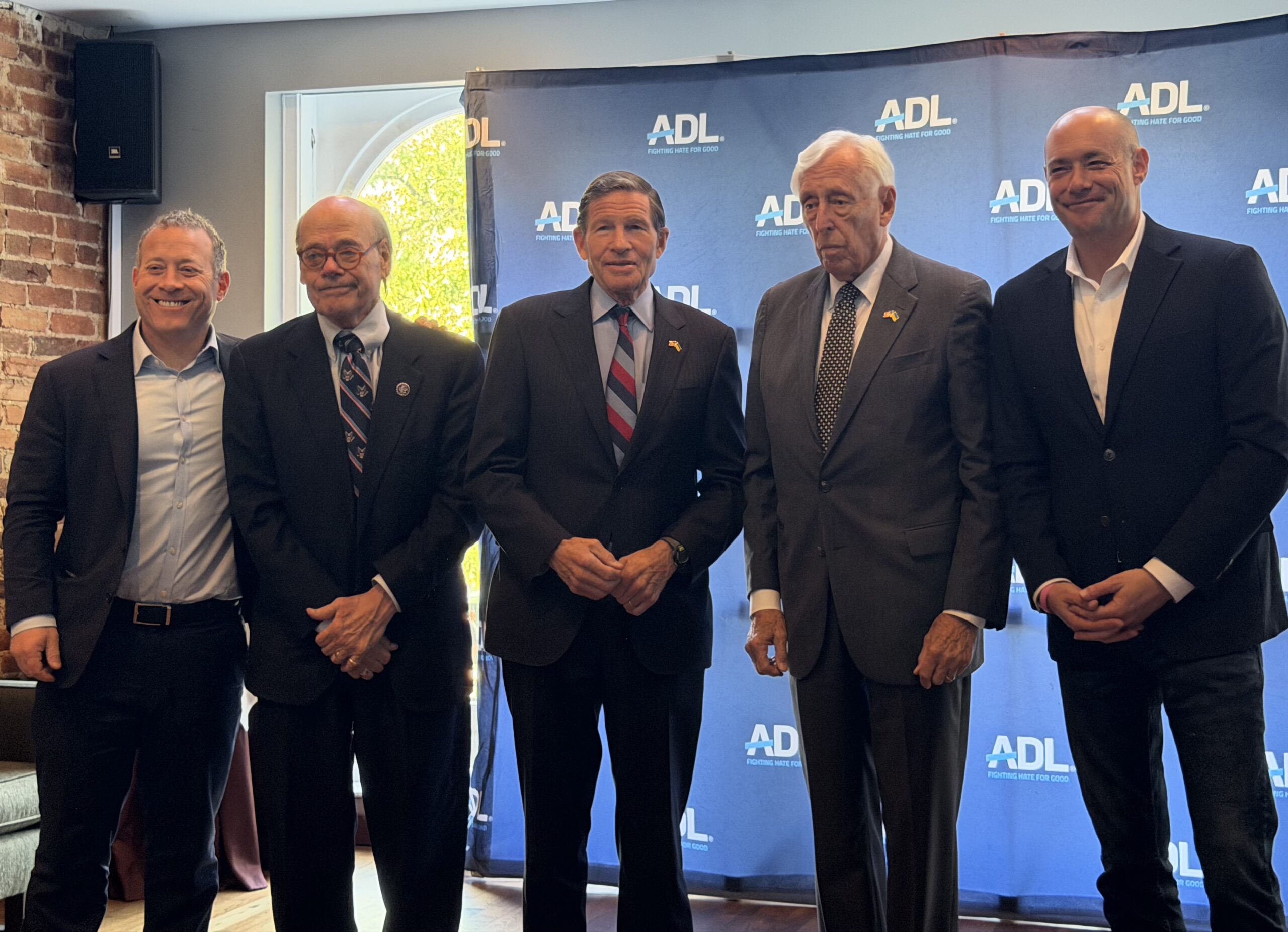
Former House Majority Leader Steny Hoyer said antisemitism has worsened to the point that Jews aren’t guaranteed safety in the U.S.
Plus, meet UJA’s new CEO

AP Photo/Julio Cortez
The exterior of the New York Times building in New York.
Good Wednesday morning.
In today’s Daily Kickoff, we preview President Donald Trump’s trip to China amid the tenuous ceasefire with Iran, and report from last night’s Anti-Defamation League reception in Washington, where lawmakers sounded the alarm over rising antisemitism. We have the first interview with Michael Kay, announced yesterday as the next head of UJA-Federation of New York, and report on NY-12 candidate Alex Bores‘ effort to distance himself from Our Revolution‘s stances on Israel despite receiving the group’s endorsement. Also in today’s Daily Kickoff: Gov. Mikie Sherrill, Noam Bettan and Spencer Pratt.
Today’s Daily Kickoff was curated by JI Executive Editor Melissa Weiss and Israel Editor Tamara Zieve, with assists from Danielle Cohen-Kanik and Marc Rod. Have a tip? Email us here.
What We’re Watching
- President Donald Trump will arrive in China this evening ahead of his meeting tomorrow in Beijing with President Xi Jinping. More below.
- In Washington, the House Foreign Affairs Committee is holding markups on a number of pieces of legislation, including a resolution condemning attacks on civilians in Sudan and calling for an end to external support for warring parties in the war-torn country.
- Elsewhere in D.C., the Jewish Democratic Council of America’s annual gathering continues. Speakers today include Senate Minority Leader Chuck Schumer (D-NY), House Minority Leader Hakeem Jeffries (D-NY), Sen. Chris Coons (D-DE), Rep. Nancy Pelosi (D-CA), Minneapolis Mayor Jacob Frey, pollster Jim Gerstein, former diplomat Dennis Ross, former Pentagon officials Jeremy Bash and Dana Stroul, and former national security officials Jake Sullivan and Jon Finer.
- Tonight, the Israeli Embassy in Washington is holding a belated Yom Ha’atzmaut reception.
- Nonprofit executive Denise Powell defeated Nebraska state Sen. John Cavanaugh by two points (39-37%) in the Democratic primary last night in Nebraska’s 2nd District. Cavanaugh, a consistent Israel critic, was one of 10 state senators who declined to sign onto a resolution supporting Israel and condemning Hamas on the first anniversary of the terrorist group’s Oct. 7, 2023, attacks on Israel. Powell will face Republican Brinker Harding, an Omaha city councilmember, in a bid to succeed retiring Rep. Don Bacon (R-NE).
- President Isaac Herzog is hosting the “President’s Conference for a Shared Israeli Future” today in Jerusalem. Actor Gal Gadot is participating in a panel dedicated to relations between Israel and the Diaspora.
What You Should Know
A QUICK WORD WITH JI’S MELISSA WEISS
There will be a number of items on the agenda when the two most powerful men in the world — President Donald Trump and Chinese President Xi Jinping — meet in Beijing tomorrow, chief among them tech and AI. The president is bringing with him a roster of top business leaders, including Elon Musk, Nvidia’s Jensen Huang, Apple’s Tim Cook, Goldman Sachs’ David Solomon, Meta’s Dina Powell McCormick, BlackRock’s Larry Fink and Blackstone’s Stephen Schwarzman.
And while emerging technologies will be a major topic of conversation during the three-day trip, most eyes — and markets — are on the tenuous ceasefire between the U.S. and Iran.
Beijing has, after all, been playing a major role in the U.S.-Iran conflict — even if it has done so from the margins: serving as the largest importer of oil from the Islamic Republic in violation of U.S. sanctions, meeting with top Iranian officials (including last week’s sit-down between Xi and Iranian Foreign Minister Abbas Araghchi) and transferring weapons to Iran through third countries.
Trump, who has spent much of his second term welcoming leaders to Washington, will be on Xi’s home turf, face-to-face with a leader who is opting not to use his leverage to push Iran into making concessions. The longer the uncertainty continues, the more restless even the president’s most fervent supporters will get — especially with the midterms approaching.
That dynamic is already beginning to play out on Capitol Hill. Yesterday, JI reported on divisions among Republican senators over whether the U.S. should reengage militarily with Iran, while last week, Rep. Tom Barrett (R-MI), who is facing a tough reelection battle in his swing district, became the first GOP lawmaker to introduce an authorization for use of military force in Iran.
All of that is good for Xi, and gives him little incentive to use China’s economic and diplomatic leverage over the Islamic Republic, which while knocked down a few pegs, has managed to maintain control despite the severe blows it has been dealt.
SOUNDING THE ALARM
Lawmakers offer dire warnings about rising antisemitism at ADL reception
A series of largely Democratic lawmakers painted an unusually dire portrait of the state of rising antisemitism and threats to the Jewish community in remarks on Tuesday evening at an Anti-Defamation League reception honoring Jewish American Heritage Month on Capitol Hill, Jewish Insider’s Marc Rod reports. Several emphasized the need for those in the audience, many of them young Jewish congressional staffers and Washington professionals, to continue speaking out and fighting for the Jewish community in a time of crisis.
Unvalidated: Rep. Laura Friedman (D-CA) emphasized that efforts to fight antisemitism have often been met with additional hostility. “It is a very scary time for the Jewish community,” Friedman said. “And to make matters worse, when we express that we’re scared and that there’s this rising level of hatred directed towards the Jewish community, we’re often met with people telling us that we’re not allowed to feel that way. And how dare we even say that there’s anything wrong with treatment towards Jews in this country?”
Read the full story here with additional comments from Reps. Steny Hoyer (D-MD), Haley Stevens (D-MI), Steve Cohen (D-TN), Greg Landsman (D-OH), Mike Lawler (R-NY), Jake Auchincloss (D-MA), Kim Schrier (D-WA), Jamie Raskin (D-MD), Josh Gottheimer (D-NJ), Debbie Wasserman Schultz (D-FL) and Sen. Richard Blumenthal (D-CT).
Dem divides: Hoyer, a pro-Israel stalwart and a former House majority leader, said on Tuesday that Jewish Democrats “ought to be” concerned about the critical way that some of their Democratic colleagues talk about Israel, in remarks at the Jewish Democratic Council of America’s annual leadership summit, where he was honored with an award marking his upcoming retirement, after 45 years in Congress, JI’s Gabby Deutch reports.
HEATED BACKLASH
Israeli officials, AJC slam Nick Kristof’s NYT column as modern-day ‘blood libel’
Nicholas Kristof’s New York Times column alleging widespread Israeli sexual violence against Palestinian prisoners was certain to generate intense debate and scrutiny, given the sensitivities involved in covering such a highly charged subject. But after it was published on Monday, his opinion piece, headlined “The Silence That Meets the Rape of Palestinians,” has faced particularly heated backlash, including accusations of antisemitism and claims Kristof relied on discredited sources to advance his message, Jewish Insider’s Matthew Kassel reports.
Pushing back: Despite the direct testimonies he presented, critics have countered with a range of rebuttals, claiming that he drew a false equivalence between Israel and Hamas, that his column overstated the existence of alleged misconduct and that his broader assessment rests on questionable data and sources that weaken his central thesis. The American Jewish Committee expressed concerns about Kristof’s decision to cite allegations that Israel had trained police dogs to rape Palestinian prisoners, a claim critics have rejected as a thinly sourced conspiracy theory, saying the allegation represented “a modern-day blood libel in the ‘paper of record.’”
NAME AND SHAME
DSA is ‘evil,’ trying to drive Jews out of polite society, D.C. Jewish leader says

Amid the rise of a DSA-aligned mayoral candidate in the city, a senior Jewish community leader in Washington, D.C., excoriated the Democratic Socialists of America as an “evil” organization committed to driving Jews out of society. Speaking on a webinar with other Washington-area Jewish leaders on Tuesday, Ron Halber, the CEO of the Jewish Community Relations Council of Greater Washington, stridently criticized the far-left group, Jewish Insider’s Marc Rod reports.
Icing out: “I think they’re a fringe, radical, antisemitic organization, and I happen to even think they’re evil,” Halber said. “They are trying to do in America what [the Boycott, Divestment and Sanctions movement] seems to do internationally, which is to make being Jewish unacceptable in polite society.” He said that the group wants to make Jews feel “isolated” and force them to “renounce Zionism” and their connection to Israel in order to participate in the political process. Antisemitism is “core to their belief,” he continued.
Slotkin signals: Asked at the Politico Security Summit in Washington on Tuesday if she still calls herself a Zionist, Sen. Elissa Slotkin (D-MI) said, “I believe in a Jewish State of Israel, yes. And that to me isn’t a radical thing to say and I always have,” JI’s Danielle Cohen-Kanik reports.
CANDIDATE FORUM WATCH
Bores breaks with Our Revolution on approach to Israel
New York State Assemblymember Alex Bores, a leading Democratic primary candidate for an open House seat in Manhattan, said on Tuesday that he disagreed with Our Revolution, the left-wing advocacy group that recently endorsed his campaign, over its opposition to U.S. military funding for Israel, Jewish Insider’s Matthew Kassel reports.
What he said: Speaking at a candidate forum hosted by West Side Institutional Synagogue and moderated by JI’s editor-in-chief, Josh Kraushaar, Bores said that even as he welcomed the endorsement because of such shared interests as AI regulation, he was not aligned with Our Revolution’s approach to Israel, a key issue in the heavily Jewish 12th Congressional District. “They asked me specifically about my position on Israel, which is well-documented and different from theirs,” Bores explained. “I said the same thing I say in every room.”
Cash flow: New York City Mayor Zohran Mamdani announced his administration would allocate $26 million annually toward anti-hate crimes measures, signaling that the significant funding increase — promised during the campaign season — would go toward a program that funds both leading Jewish organizations and left-wing nonprofits, JI’s Will Bredderman reports.
ON THE FENCE
Mikie Sherrill to ‘evaluate’ N.J. adoption of federal Education Freedom Tax Credit
New Jersey Gov. Mikie Sherrill has not committed to joining a new federal education tax initiative being championed by Jewish community advocates to secure funding for Jewish day schools and yeshivas, which New York Gov. Kathy Hochul recently agreed to adopt, Jewish Insider’s Haley Cohen reports.
Wait-and-see approach: “Governor Sherrill will evaluate the program once the Trump Administration has finalized and published its rules. The Governor’s top priority is building New Jersey into the best public school system in the nation for all our kids,” Maggie Garbarino, Sherrill’s deputy press secretary, told JI on Tuesday.
TRANSITION
UJA-Federation of New York taps Leffell School’s Michael Kay to serve as next CEO

The country’s largest Jewish federation, UJA-Federation of New York, has reached into the day school world to tap its next leader, naming longtime Jewish educator Michael Kay as CEO, eJewishPhilanthropy’s Nira Dayanim reports for Jewish Insider. Kay, who currently serves as head of school at The Leffell School in Westchester County, N.Y., will succeed Eric Goldstein, 66, a former Wall Street lawyer who announced last June that he was stepping down after 12 years in the role. Kay, 46, will enter the position on Oct. 5.
City Hall relationships: Asked how he wants UJA’s relationship with New York City Mayor Zohran Mamdani to look under his leadership during an interview with JI announcing his appointment, Kay said, “We have an obligation and a responsibility to work with our local elected officials no matter who they are to ensure that our needs are met and they are accountable for meeting those needs, as I said, well-being, thriving, safety, security.”
Read and watch the full interview here.
Nostra Aetate Award: Reflecting on his tenure as the archbishop of New York, Cardinal Timothy Dolan said it would be “difficult” to serve in his former position without the friendship of Jewish people, noting that Jews are a “respected part of the fabric” of New York City. Dolan was speaking at the American Jewish Committee’s Manhattan headquarters on Tuesday, where AJC honored him with the Nostra Aetate at Sixty Award for his work combating antisemitism and improving Catholic-Jewish relations, Jewish Insider’s Haley Cohen reports.
Worthy Reads
Dahiya or Dubai?: The New York Times’ Tom Friedman talks to Emirati Lebanese writer Nadim Koteich about the two warring visions for the future of the Middle East, which Koteich refers to as “Dahiya or Dubai” — respectively a Hezbollah-controlled area of Beirut and a flourishing Middle Eastern business hub. “Anything this Dahiya vision touches ‘is a kiss of death for a country,’ as Koteich put it. ‘It turns it into another mediocre version of Iran.’ … [The Dubai model] proclaimed that the future belongs to those governments that produce noncorrupt, responsible bureaucracies, and that support moderate Islam, religious pluralism and an openness to the world and anyone eager to bring their talents. … The Dubai model is precisely the one Tehran wants to destroy.” [NYTimes]
AI in the Negev: In The Wall Street Journal, the Foundation for Defense of Democracies’ Mike Doran and Zineb Riboua advocate for the development of a joint U.S.-Israel AI hub in Israel’s Negev desert dubbed by Jerusalem as Project Spire. “Technologies developed at Spire would remain under American ownership, enabling scaling and manufacturing back in the U.S. — creating jobs on both sides of the Atlantic. A successful Negev base would serve as the prototype. Once proven, the model can be replicated with Britain, Japan, India and other trusted partners. In the contest to neutralize China’s espionage apparatus, Project Spire offers the foundation for enduring American primacy.” [WSJ]
Doing Deals in the ‘Stans: Politico’s Diana Nerozzi and Phelim Kine profile Sergio Gor, President Donald Trump’s envoy to India and Central Asia, who has focused the administration’s efforts in the region on dealmaking. “But Gor’s investment focus is a welcome change to those in the region and Central Asian countries have embraced the Trump administration’s focus on ‘business, business, business,’ said a Washington-based Central Asia diplomat. For Central Asian leaders that’s a welcome shift away from a traditional U.S. focus on governance issues. … ‘He’s much more effective because he has that direct line to the White House,’ a second Central Asian diplomat said. ‘That means he can much more easily overcome the bureaucracy of D.C.’” [Politico]
Word on the Street
Defense Secretary Pete Hegseth said during a Senate Appropriations Committee hearing on Tuesday that the Trump administration does not plan to and does not believe it needs to seek congressional approval should it decide to resume military operations in Iran, further sidelining Congress at a time when a growing number of Republicans are becoming hesitant about continued U.S. military operations, Jewish Insider’s Marc Rod reports…
Vice President JD Vance tapped Cliff Sims, who served as special assistant to the president and director of White House message strategy in the first Trump administration, to serve as a national security advisor; Sims previously worked closely with CIA Director John Ratcliffe and served as chair of the CIA’s external advisory board…
The Wall Street Journal looks at how infrastructure in the United Arab Emirates, Saudi Arabia and Oman has been turned into an “emergency logistics lifeline” for trucks carrying exports bypassing the closed Strait of Hormuz…
The Islamic Revolutionary Guard Corps expanded its definition of the boundaries of the Strait of Hormuz to encompass a much wider area than before the war…
Kuwait accused Iran of sending members of the Islamic Revolutionary Guard Corps to the strategically located Kuwaiti-held Bubiyan Island earlier this month, where the fighters exchanged fire with Kuwaiti soldiers, injuring one; four of the six IRGC fighters who took part in the attack on the island, located in the Persian Gulf, were arrested…
Reuters reports that Saudi Arabia launched covert strikes against Iran in late March in response to attacks from the Islamic Republic on Saudi territory…
Georgia Gov. Brian Kemp, a Republican, signed into law a bill requiring the disclosure of foreign government funding in statewide K-12 schools; read more about the first-in-the-nation legislation here…
Politico reports on the “overwhelming evidence” that Michigan Senate candidate Abdul El-Sayed, who cites his background in medicine and experience as a physician in campaign materials and interviews, has “no experience as a licensed medical doctor”…
The New York Times looks at efforts by two GOP-linked super PACs to get involved in Democratic primaries in Nebraska, Texas, Ohio and California to boost their preferred general election candidates, in one instance sending out a mailer in support of a fringe candidate who has espoused antisemitic tropes…
The NYPD arrested four protesters demonstrating outside of a Jewish senior home in Brooklyn’s Midwood neighborhood, which was hosting an event promoting real estate opportunities in Israel…
In text messages shared on X, Los Angeles mayoral candidate Spencer Pratt appeared to denounce antisemitism, calling it a “legitimate mind virus and sign of a decaying society,” adding that he has “been horrified to see how the Jewish community has been vilified over the past few years”…
The Jewish Council for Public Affairs, in partnership with the American Federation of Teachers and the Weitzman National Museum of American Jewish History, released a new online resource that provides educational materials focused on the American Jewish experience…
The Wall Street Journal interviews Israeli-American therapist Orna Guralnik ahead of the release on Friday of the new series “Couples Therapy,” in which Guralnik plays a major role…
A survey conducted by the National Council of Jewish Women of Australia and presented to the royal commission investigating antisemitism in the country found that 80% of Jewish women surveyed said that they or a family member had experienced antisemitism firsthand in the last two years; the survey also found that of that group, more than two-thirds had been called “genocidal” because they were Jewish, Israeli or Zionist…
U.K. Prime Minister Keir Starmer is facing growing calls to step down following last week’s local elections that saw his Labour Party lose more than 1,000 municipal seats…
Israeli singer Noam Bettan advanced to the Eurovision finals after his performance of “Michelle” at last night’s semifinals in Vienna…
Hezbollah head Naim Kassem called on the Lebanese government to pull out of direct talks with Israel, the third round of which is scheduled for Thursday, and return to indirect talks…
Pic of the Day
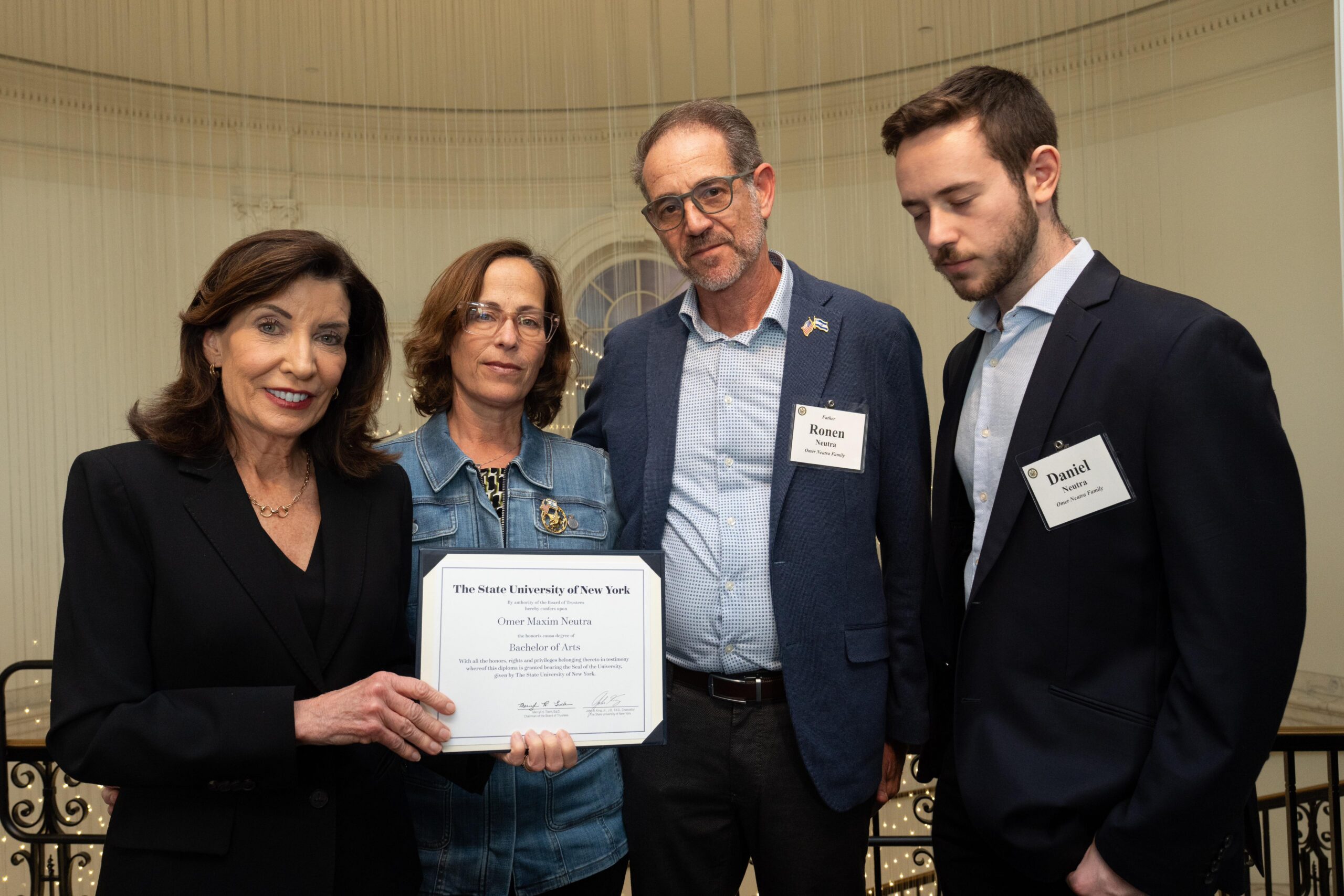
The family of slain Israeli American hostage Omer Neutra, who was killed in the Oct. 7, 2023, attacks and his body taken to Gaza, was awarded an honorary degree from Binghamton University at a reception hosted by New York Gov. Kathy Hochul (left) to mark Jewish American Heritage Month.
Birthdays

Emmy Award-winning film, television and stage actress, Zohra Lampert turns 89…
Professor emerita of Yiddish literature at Harvard University, she is presently a distinguished senior fellow at The Tikvah Fund, Ruth Wisse turns 90… Actor and producer, Harvey Keitel turns 87… Ophthalmologist in South Florida, he is the father of Facebook’s former COO Sheryl Sandberg, Dr. Joel Sandberg turns 83… Former dean of the College of Arts and Sciences at American Jewish University, Samuel Edelman turns 78… Professor of mathematics at Princeton since 1987, he was a winner of a 1991 MacArthur genius fellowship, Sergiu Klainerman turns 76… Former FDA commissioner in the 1990s, then chief science officer for COVID-19 response during the Biden administration, David A. Kessler turns 75… Retired editor and columnist for the New York Post, he was also managing editor of The Jerusalem Post, Eric Fettmann turns 73… Rabbi Uren Reich turns 70… Chief rabbi of the city of Shoham in central Israel, chairman of the Tzohar organization and rabbi for the Ezra youth movement, Rabbi David Stav turns 66… Founder and former CEO of LRN, a legal research, ethics and compliance management firm, Dov Seidman turns 62… Past chair of JFNA’s National Women’s Philanthropy Board and of the Hartford (Conn.) Federation, Carolyn Gitlin… Retired NFL defensive lineman, he played for the Raiders and Panthers, Josh Heinrich Taves, a/k/a Josh Heinrich, turns 54… Ice hockey player, she won a gold medal at the 1998 Winter Olympics and a silver medal at the 2002 Winter Olympics, Sara Ann DeCosta-Hayes turns 49… U.S. Sen. Tom Cotton (R-AR) turns 49… CEO of Friedkin Philanthropies, previously chief Jewish life officer at JFNA, Sarah Eisenman… Former Israel director for J Street, then the chief of staff for Israel’s Ministry for Regional Cooperation, Yael Patir … Member of the U.K.’s House of Lords, she was previously a member of the House of Commons, Baroness Luciana Berger turns 45… Software entrepreneur, Google project manager, then Facebook engineering lead, Justin Rosenstein turns 43… Israeli rapper, singer, songwriter and actor, known by his stage name Tuna, Itay Zvulun turns 42… Retired NFL offensive lineman for seven NFL teams, now a regional manager at Rocksolid, Brian de la Puente turns 41… Actress, writer, producer and director, best known as the creator, writer and star of the HBO series “Girls,” Lena Dunham turns 40… Hannah Sirdofsky… Co-founder in 2018 of Manna Tree Partners, she is the daughter of Carlyle Group co-founder David Rubenstein, Gabrielle “Ellie” Rubenstein… Chief of staff and senior program manager at Jigsaw, a unit within Google, she is an alum of The Washington Institute for Near East Policy, Raquel Saxe Gelb… Therapist in Philadelphia, Bela Galit Krifcher turns 33… Law clerk for the U.S. District Court for the Southern District of New York, Dore Lev Feith turns 30… VP of external affairs at the Manhattan Institute, Jesse Martin Arm… Gold medalist for Israel in rhythmic gymnastics at the 2020 Olympics in Tokyo, Linoy Ashram turns 27…
While emerging technologies will be a major topic of conversation during the three-day trip, most eyes — and markets — are on the tenuous ceasefire between the U.S. and Iran
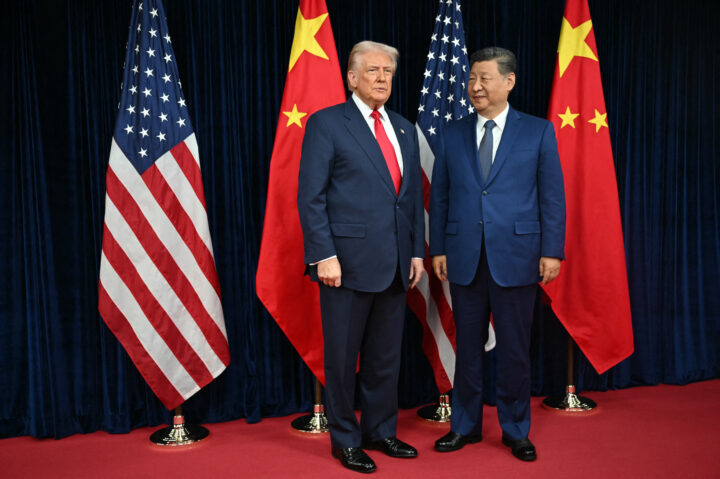
ANDREW CABALLERO-REYNOLDS/AFP via Getty Images
US President Donald Trump (L) and China's President Xi Jinping arrive for talks at the Gimhae Air Base, located next to the Gimhae International Airport in Busan on October 30, 2025.
There will be a number of items on the agenda when the two most powerful men in the world — President Donald Trump and Chinese President Xi Jinping — meet in Beijing tomorrow, chief among them tech and AI. The president is bringing with him a roster of top business leaders, including Elon Musk, Nvidia’s Jensen Huang, Apple’s Tim Cook, Goldman Sachs’ David Solomon, Meta’s Dina Powell McCormick, BlackRock’s Larry Fink and Blackstone’s Stephen Schwarzman.
And while emerging technologies will be a major topic of conversation during the three-day trip, most eyes — and markets — are on the tenuous ceasefire between the U.S. and Iran.
“We have a lot of things to discuss,” Trump told reporters before departing for China. “I wouldn’t say Iran is one of them, to be honest with you, because we have Iran very much under control.” Nonetheless, the president said, “We’re going to have a long talk about [Iran]. I think he’s been relatively good, to be honest with you.”
Beijing has, after all, been playing a major role in the U.S.-Iran conflict — even if it has done so from the margins: serving as the largest importer of oil from the Islamic Republic in violation of U.S. sanctions, meeting with top Iranian officials (including last week’s sit-down between Xi and Iranian Foreign Minister Abbas Araghchi) and transferring weapons to Iran through third countries.
Indeed, the summit, delayed from earlier this year due to the war, comes amid reports of a U.S. intelligence assessment that Iran has restored access to 30 of its nearly three dozen missile sites, and days after Washington rejected an Iranian response to a U.S. proposal that fell short of the Trump administration’s demands.
China’s interest isn’t purely power-driven: it’s also economic. Being able to purchase Iranian oil at steeply discounted prices — owing to Tehran’s global economic isolation — has meant that China has not felt the same financial pressures as the West.
Trump, who has spent much of his second term welcoming leaders to Washington, will be on Xi’s home turf, face-to-face with a leader who is opting not to use his leverage to push Iran into making concessions. The longer the uncertainty continues, the more restless even the president’s most fervent supporters will get — especially with the midterms approaching.
That dynamic is already beginning to play out on Capitol Hill. Yesterday, JI reported on divisions among Republican senators over whether the U.S. should reengage militarily with Iran, while last week, Rep. Tom Barrett (R-MI), who is facing a tough reelection battle in his swing district, became the first GOP lawmaker to introduce an authorization for use of military force in Iran.
All of that is good for Xi, and gives him little incentive to use China’s economic and diplomatic leverage over the Islamic Republic, which while knocked down a few pegs, has managed to maintain control despite the severe blows it has been dealt.
The Iranian regime has been able to survive in large part because it knows how to play the long game: to drag out negotiations, give breadcrumbs instead of the whole loaf and wreak just enough havoc to serve as a disruptor without prompting massive retaliation. It has enough to survive, for now.
Xi finds himself in a similar dynamic: unbound by pending elections, unaffected by rising energy costs and distanced from military action in the Middle East, Beijing is — unlike Trump — does not need a quick resolution to the conflict.
Plus, El-Sayed's physician creds called into question

Mario Tama/Getty Images
An attendee wears a jacket at an Iowa caucus watch party organized by Metro D.C. Democratic Socialists of America, on February 3, 2020 in Washington, DC.
This P.M. edition is reserved for our premium subscribers like you — offering a forward-focused read on what we’re tracking now and what’s coming next. Please don’t hesitate to share your thoughts and feedback by replying to this email.
📡On Our Radar
Notable developments and interesting tidbits we’re tracking
UJA-Federation of New York has tapped longtime Jewish educator Michael Kay as its next CEO, the country’s largest Jewish federation shared exclusively with Nira Dayanim for Jewish Insider, marking a generational change that signals the growing importance of day schools on the Jewish communal agenda.
Kay, 46, currently serves as head of school at The Leffell School in Westchester County, N.Y., and will step into his new role on Oct. 5, succeeding Eric Goldstein, 66, a former Wall Street lawyer who will step down after 12 years in the role…
President Donald Trump continued to hedge today on resuming military action in Iran while keeping open diplomatic options: “We’re either going to make a deal or they’re going to be decimated,” he said of Iran while departing for his state visit to China. “So one way or the other, we win.”
Earlier in the day, Trump told the “Sid & Friends in the Morning” radio show that he’s anticipating Iran’s economic collapse due to the U.S. blockade of its ports. “It’s just a question of time, we don’t have to rush anything,” the president said…
Kuwait accused Iran of attempting to invade its Bubiyan Island today, claiming six members of the Islamic Revolutionary Guards Corps attacked soldiers on the strategic piece of Kuwaiti territory where the Gulf state, with assistance from China, is building a large port…
Sen. Lindsey Graham (R-SC) expressed frustration with Defense Secretary Pete Hegseth and Joint Chiefs Chairman Gen. Dan Caine at a Senate Appropriations Committee hearing as they declined to comment on a report that Pakistan harbored Iranian military aircraft from U.S. strikes.
Asked, if the report were to be accurate, if the U.S. should reconsider Pakistan’s role as mediator between the U.S. and Iran, Hegseth and Caine said they “didn’t want to get in the middle of ongoing negotiations.” Graham replied, “Well I do! I want to get in the middle of these negotiations. I don’t trust Pakistan as far as I can throw them … No wonder this damn thing is going nowhere”…
Jay Hurst, the Pentagon’s comptroller, testified that the cost of the war has risen to $29 billion — up from the $25 billion figure the Pentagon cited just two weeks ago…
Hezbollah leader Naim Qassem wrote in a letter to terror group operatives that a deal between the U.S. and Iran is “the strongest card” for “stopping [Israel’s] aggression” in Lebanon, while slamming the Lebanese government for engaging in direct talks with Jerusalem, the third round of which are slated to take place this week in Washington…
Asked at the Politico Security Summit in Washington if she still calls herself a Zionist, Sen. Elissa Slotkin (D-MI) said, “I believe in a Jewish State of Israel, yes. And that to me isn’t a radical thing to say and I always have. I can say that in the same breath that I criticize the military policy of Bibi Netanyahu.”
Slotkin said that “as someone who served three tours in Iraq” she has “concerns with the way the Israelis are organizing military policy right now. … What I can’t accept, though, is collective punishment that comes from saying, ‘well, I don’t like Bibi Netanyahu’s military policy so Jews in America’s synagogues should be attacked,’” she continued…
Senate Majority Leader John Thune (R-SD) told the Washington Examiner he’s open to Israeli Prime Minister Benjamin Netanyahu’s proposal to wind down U.S. aid to Israel over the next decade: The proposal “has been sort of a given, I think, in our foreign aid budget” for “a long time,” he said, “but if that’s how the Israeli leader feels about it — feels like they’re able to deal with their national security threats with their own resources — then I guess I would listen to what he has to say”…
Two weeks ahead of the Texas Senate Republican primary runoff, Thune said he “still [doesn’t] know where [Trump] is headed” in his intent to endorse either Sen. John Cornyn (R-TX) or Attorney General Ken Paxton, but “someone would clearly benefit from it.”
Cornyn, meanwhile, told reporters he doesn’t expect Trump to make an endorsement at all. “We can’t wait, and we’re not waiting. We’re getting prepared, and we are optimistic,” he said. (Still, in what may be a last-ditch effort to secure the president’s support, Cornyn introduced a bill yesterday to rename U.S. Route 287 as Interstate 47 in honor of Trump, the country’s 47th president)…
Politico cast doubt on Michigan Senate candidate Abdul El-Sayed’s claim and campaign talking point that he is a practicing physician, finding that “there’s overwhelming evidence that he’s had no experience as a licensed medical doctor.”
While El-Sayed did attend prestigious medical schools and served as executive director of the Detroit Health Department, he was never granted a medical license in either Michigan or New York, where he says he has practiced, and appears not to have treated patients since his schooling days, despite claiming repeatedly in campaign pitches that he is a physician…
AIPAC denied accusations by El-Sayed and others that it is behind the Center for Democratic Priorities super PAC, a new group supporting Rep. Haley Stevens (D-MI) in the Michigan Senate Democratic primary, and also noted it “isn’t funding any group’s efforts” in Pennsylvania’s 3rd Congressional District, where critics have alleged the pro-Israel group is behind efforts to support candidate Ala Stanford…
Speaking on a webinar with other Washington-area Jewish leaders today, Ron Halber, the CEO of the Jewish Community Relations Council of Greater Washington, excoriated the Democratic Socialists of America as an “evil” organization committed to driving Jews out of society, JI’s Marc Rod reports.
“I think they’re a fringe, radical, antisemitic organization,” Halber said, adding that the group wants to make Jews feel “isolated” and force them to “renounce Zionism” and their connection to Israel in order to participate in the political process…
New York City Mayor Zohran Mamdani released his city budget proposal this afternoon, which includes $26 million annually for the Office to Prevent Hate Crimes, a significant increase from its current budget of around $3 million…
Under Secretary of State for Economic Affairs Jacob Helberg hosted a lunch at the State Department with officials from Gulf Cooperation Council countries as well as Jordan to discuss technology supply chains and the India-Middle East-Europe Economic Corridor…
⏩ Tomorrow’s Agenda, Today
An early look at tomorrow’s storylines and schedule to keep you a step ahead
Keep an eye out in Jewish Insider for coverage of tonight’s forum of New York 12th Congressional District Democratic candidates moderated by JI Editor-in-Chief Josh Kraushaar.
The Israeli Embassy in Washington will host its belated Yom Ha’Atzmaut reception.
The Jewish Democratic Council of America’s conference in Washington continues, with speakers including Senate Minority Leader Chuck Schumer (D-NY), House Minority Leader Hakeem Jeffries (D-NY), Sen. Chris Coons (D-DE), Rep. Nancy Pelosi (D-CA), Minneapolis Mayor Jacob Frey, diplomat Dennis Ross, The Washington Institute’s Dana Stroul and former national security officials Jake Sullivan, Jeremy Bash and Jon Finer.
Stories You May Have Missed
DEMOCRATIC FAULT LINES
Race to replace Pelosi offers early test of whether progressive Jews welcomed on the left
State Sen. Scott Wiener has called Israel’s actions in Gaza a genocide and is open to conditions on offensive aid to the Jewish state, but is still derided as a ‘Zionist’
ECONOMIC OUTLOOK
Israel’s business leaders see opportunity amid war, political shifts

‘I’m not an investment advisor, but you can see that if you were not in Israel in the past two years, you probably missed out, if Israel was not part of your portfolio,’ Seffy Zinger, chair of the Israel Securities Authority, told JI
‘I’m not an investment advisor, but you can see that if you were not in Israel in the past two years, you probably missed out, if Israel was not part of your portfolio,’ Seffy Zinger, chair of the Israel Securities Authority, told JI

Patrick T. Fallon / AFP via Getty Images
Laurence D. Fink (R), co-founder, chairman and CEO of BlackRock, speaks next to Milken Institute chairman Michael Milken during the 29th annual Milken Institute Global Conference at the Beverly Hilton in Beverly Hills, California on May 5, 2026.
LOS ANGELES — The Israeli financiers, investors and entrepreneurs who attended last week’s Milken Institute Global Conference in Beverly Hills almost couldn’t make it. Just weeks earlier, after all, the country’s airspace had been largely closed as war raged with Iran.
But aside from their slight fear that the fragile ceasefire would fall apart and leave them stranded in the United States, the Israelis who participated in the marquee conference of global finance brought an upbeat attitude about Israel’s economy, even two-and-a-half years into near-constant war that began with Hamas’ Oct. 7, 2023, attacks.
“When the war began, I think none of us — none of the regulators in Israel, and almost none of the players or the investors in Israel — thought or believed that after two-and-a-half years of war, Israel would show such growth, such resilience,” Seffy Zinger, chair of the Israel Securities Authority, told Jewish Insider in an interview. (The ISA is Israel’s equivalent of the U.S. Securities and Exchange Commission.)
Zinger was at Milken to spread the message that global financiers should consider investing in the Israeli economy, and in particular the Tel Aviv Stock Exchange, despite the doom-and-gloom headlines about the Middle East.
“I’m not an investment advisor, but you can see that if you were not in Israel in the past two years, you probably missed out, if Israel was not part of your portfolio. So I think Israel is becoming a very interesting place economically,” he said.
The shift away from Israel in American politics did not appear to be reflected at this gathering of global business elites: Natti Ginor, a managing director at Jefferies and the bank’s head of Israel investment banking, pitched Israel at the conference as a financial capital in the Middle East. Blackstone’s Tel Aviv-based senior managing director, Yifat Oron, was also there talking about her work leading the firm’s investments in Israel.
“When we are talking to investors and the big players, what I see is a lot of interest in Israel, and I think the economy and the numbers speak for themselves,” said Zinger.
Dror Barak traveled to Los Angeles from Israel to meet developers and investors from across the Middle East, including Saudi Arabia, the United Arab Emirates and the Palestinian territories. He is the founder of Align Capital, an infrastructure-focused private equity firm that is working on projects related to IMEC, the India-Middle East-Europe Economic Corridor — a planned project meant to further economic cooperation across wide swathes of the world. Its development has stalled since the Oct. 7 terror attacks and the ensuing war, but behind the scenes, progress is being made.
“The war, I don’t like to say it, but with all the bad things it also pushed us toward a new era of cooperation,” Barak told JI last week. “The war made us on the same side. It’s the first time in history that we, the UAE [and] Saudi are on the same side. We are all against, publicly or less publicly, Iran. With the United States, of course. So this is a very, very, very dramatic thing, and it’s changed dramatically the nature of our relationship.” IMEC has been floated as an alternative for global shipping amid turbulence in the Strait of Hormuz.
Barak acknowledges that Israel’s reputation has suffered: “Yes, it’s an issue,” he said. But he argued that the work of investing in cross-regional infrastructure must happen, even if the geopolitical situation remains unresolved.
“I’m not waiting for the American public to dedicate my direction, and I’m not waiting for [Israeli Prime Minister Benjamin Netanyahu] or [President Donald Trump] to do some peace,” said Barak. “We promote Arabs and Jews working together. So everywhere that you are looking, I think that we are doing the right thing — the right thing for Israel, the right thing for the region and the right thing for the global politics that want to support the right forces.”
Last year was a banner one for Israeli startups, and the country’s GDP rebounded last year after slowing in 2023 and 2024. But challenges remain. Bentzion Levinson, founder and CEO of Heven AeroTech, an American company with a large Israeli workforce, said there were times that more than one-third of his employees were out of the office doing reserve duty in the Israeli military.
“To this day, we have an average of 10 to 20% of our employees in reserves, around the clock. So I think it’s a challenge. But challenges build strength,” Levinson told JI in Los Angeles. His company’s creation of pioneering long-range stealth drones has driven contracts with the U.S. military and earned a unicorn valuation.
“A lot of things are taking a toll on families [and the] personal, but I think people are strong and they realize that there’s no other choice,” said Levinson. “I think it’s gonna be a decade of significant growth in Israel, especially in the defense tech world … it’s a challenge, but I think the Israeli people can overcome it.”
Zinger, the ISA chair, was attending Milken with his chief of staff, who spent nearly 400 days serving in the reserves after Oct. 7. Responsibilities got juggled; some days the staffer would work three days and do reserve duty for two days. There was no choice but to adapt. And that flexibility, Zinger argued, is part of why Israel’s economy has performed better than anyone expected during the war.
“I think this is part of the strength of the Israeli community and society, exactly these kinds of things, and of course, without that strength, the performance that we see could not have happened,” said Zinger. “It’s something that I think we learn how to live with.”
Sen. Rick Scott said military action is ‘the only thing that’s going to work,’ while Sen. Josh Hawley urged the president not to reengage

Fatemeh Bahrami/Anadolu via Getty Images
Smoke rises after airstrikes in Tehran, Iran on March 13, 2026.
With President Donald Trump reportedly mulling the resumption of military action against Iran, fault lines are opening up among Senate Republicans over the prospect of a renewed military effort.
Some prominent Senate Republicans publicly called for the U.S. to resume military operations this weekend, after Trump dismissed as a nonstarter Iran’s latest negotiating proposal. Other colleagues joined them on Monday.
Sen. Rick Scott (R-FL) said he thinks military operations must resume. “It’s the only thing that’s going to work, unfortunately,” Scott told Jewish Insider. Asked whether the administration needs to seek congressional approval to resume fighting, he said, “I think the president should go forward.
Sen. Roger Wicker (R-MS), chairman of the Senate Armed Services Committee, reiterated that he “hope[s]” Project Freedom, the administration’s effort to protect shipping in the Strait of Hormuz, is resumed, after writing to Trump on X on Sunday that it’s time to “get back to business.” He said that he would not expect the administration to come to Congress for authorization if that effort were to continue.
Others are leaving the prospect of military action on the table without fully ruling out a diplomatic path, while offering varying degrees of skepticism about how realistic a deal actually would be.
Asked about resuming the war, Sen. John Cornyn (R-TX) said, “We need to clear the Strait of Hormuz, and I support doing that by whatever means necessary.” Cornyn faces a competitive primary runoff in late May, and a hotly contested general election race in November should he be victorious in the primary.
Sen. Mike Rounds (R-SD) said that the U.S. “has a problem” as long as the Iranian regime remains in place and has the capacity to produce a nuclear weapon, “and we’re going to have to address it one way or the other.”
“I’m hopeful for a diplomatic solution, but I don’t think these fanatics over there necessarily believe that a diplomatic solution is what they really want,” Rounds continued. “I think they’d rather martyr themselves, and I think they’d murder millions of their own people if they could.”
“I think we all want to get this resolved as quickly as possible,” Sen. Ted Budd (R-NC) said. “I would say, let’s focus right now. Let’s see if China wants to play a role in this, and we should probably know more by this weekend. But I don’t think anyone wants to end this in a decisive way more than President Trump.”
He predicted that the war would be a major topic of conversation in Trump’s meetings with leaders in Beijing later this week.
“The whole world’s watching right now,” Budd continued. “But look, we need to resolve this permanently, and we want to resolve it as soon as possible. And I know that’s President Trump’s goal.”
Sen. Josh Hawley (R-MO), among the most prominent advocates in the Senate for keeping the war brief, praised the administration for notifying Congress at the beginning of the month that it considered hostilities concluded, and urged the administration not to reengage.
“I welcome his statement that the president sent … saying that the original operation — he had terminated those hostilities. That’s a good thing. That’s a good outcome. I certainly hope that will hold,” Hawley said. “I think we’re in a posture now where he’s clearly trying to conclude a long-term peace, which I think is good. But I welcomed his statement that hostilities have terminated.”
He praised Trump for not following his colleagues’ calls to return to war.
“I want to applaud the termination of hostilities,” Hawley said. “He’s been urged to return to full scale bombing, to his original bombing campaign by many of my colleagues over the last two weeks. He’s very pointedly not done so. … I’m glad that so far the president’s not listened to my colleagues who want to do something very different.”
Hawley dismissed followup questions about whether he believed that the hostilities had indeed terminated as the administration claimed, with U.S. forces remaining in the region and continuing certain operations even during the ceasefire.
The administration faced a 60-day statutory deadline to conclude operations against Iran without congressional approval under the War Powers Act at the end of April. Hawley said the administration appears to be following the same precedent set by the Obama administration during operations in Libya.
“The ‘war’ is a very broad term. The statute speaks particularly to ‘hostilities,’” he said.
Plus, Jew hatred pushes Pa. justice out of Dem Party
Aaron Schwartz/Sipa/Bloomberg via Getty Images
President Donald Trump speaks during a maternal healthcare event in the Oval Office of the White House in Washington, DC, US, on Monday, May 11, 2026.
This P.M. edition is reserved for our premium subscribers like you — offering a forward-focused read on what we’re tracking now and what’s coming next. Please don’t hesitate to share your thoughts and feedback by replying to this email.
📡On Our Radar
Notable developments and interesting tidbits we’re tracking
President Donald Trump sounded a pessimistic note today about the state of the ceasefire with Iran, telling reporters in the Oval Office it’s “unbelievably weak” and on “massive life support” while calling Iran’s proposal to end the war, which he rejected yesterday, a “piece of garbage.”
The president was set to meet this afternoon with his national security team to discuss next steps with Iran, including a potential return to military action and resumption of Project Freedom in the Strait of Hormuz, according to Axios.
A number of hawkish Republican lawmakers are encouraging the president to resume military operations, including Senate Armed Services Committee Chairman Roger Wicker (R-MS), Sen. Lindsey Graham (R-SC) and Rep. Derrick Van Orden (R-WI)…
The UAE has secretly carried out military attacks on Iran during the course of the war, The Wall Street Journal reports, after being on the receiving end of the majority of Iran’s ballistic missile and drone attacks. Abu Dhabi’s targets have included an Iranian oil refinery, struck in early April as Trump was announcing the ceasefire…
Graham called for a potential “complete reevaluation” of Pakistan’s role as mediator between the U.S. and Iran following a CBS News report that Islamabad had permitted Iran to shelter some of its military aircraft from U.S. strikes in Iran. “Given some of the prior statements by Pakistani defense officials towards Israel, I would not be shocked if this were true,” Graham said…
Democratic Majority for Israel PAC is mounting a six-figure mail campaign to boost Bexar County sheriff’s deputy Johnny Garcia in his Democratic primary runoff against activist and conspiracy theorist Maureen Galindo. The campaign is slated to start tomorrow, exactly two weeks from primary day in Texas’ newly redrawn 35th Congressional District…
Axios spotlights the increasingly heated primary between Rep. Thomas Massie (R-KY) and Navy veteran Ed Gallrein, who is backed by Trump. The race, scheduled for May 19, has already seen $25.6 million in outside spending — including an ad from a pro-Massie group featuring antisemitic tropes targeting Jewish GOP donor Paul Singer — making it the most expensive U.S. House primary in history…
The New York Times highlights Nebraska’s contentious Senate race, where several candidates have been accused of acting as “plants” intending to siphon votes for the other party (and one candidate isn’t intending to run for Senate at all), as Democrats largely line up behind independent Dan Osborn, realizing their party brand has been tainted in the Midwest…
A new poll by New Jersey congressional candidate Adam Hamawy, who has made criticism of Israel a centerpiece of his campaign, found him leading the crowded Democratic primary field for the 12th District with 19% of likely voters, up from a March poll by his campaign that found him winning just 5%. His surge coincided with a spending blitz by the anti-Israel super PAC American Priorities, which poured $1 million into pro-Hamawy ads in the district…
New York state Assemblymember Alex Bores released his first ad of the Democratic primary for New York’s 12th Congressional District, highlighting his advocacy for AI regulation and involvement in workers’ rights as positioning him to take on Trump. Rep. Pat Ryan (D-NY), citing Bores’ AI focus, endorsed the former Palantir employee today…
Pennsylvania Supreme Court Justice David Wecht announced today that he is changing his party registration from Democrat to independent, citing increasing antisemitism in the Democratic Party. In his statement, Wecht said Democrats have changed since he served as vice chair of the state party 25 years ago: “Nazi tattoos, jihadist chants, intimidation and attacks at synagogues, and other hateful anti-Jewish invective and actions are minimized, ignored, and even coddled,” he said.
“Acquiescence to Jew-hatred is now disturbingly common among activists, leaders and even many elected officials in the Democratic Party. I can no longer abide this. So, I won’t,” he wrote…
Israeli Diaspora Minister Amichai Chickli prohibited anti-Israel influencer Tyler Oliveira from entering the country as he landed in Ben Gurion Airport today; Chikli told right-wing influencer Laura Loomer that Israel “has strong immigration policies, and if you come to Israel with the intent on inciting violence and hatred against Jewish people, you will not be allowed entry into our country.”
Oliveira has recently released videos purporting to expose welfare fraud among ultra-Orthodox communities in Kiryas Joel, N.Y., and Lakewood, N.J., widely denounced as antisemitic, which he discussed at length on Tucker Carlson’s podcast last week while again invoking antisemitic conspiracy theories…
Trump tapped Kari Lake, former far-right Arizona gubernatorial candidate and short-lived head of the U.S. Agency for Global Media, as ambassador to Jamaica, seen as a step down for the one-time close Trump ally. He also named far-right Pennsylvania state Sen. Doug Mastriano as ambassador to Slovakia…
Trump has invited several business leaders to join him on his trip later this week to China, including Elon Musk, outgoing Apple CEO Tim Cook, BlackRock’s Larry Fink, Meta’s Dina Powell McCormick, Goldman Sachs’ David Solomon, Citi’s Jane Fraser and Blackstone’s Stephen Schwarzman, among others…
⏩ Tomorrow’s Agenda, Today
An early look at tomorrow’s storylines and schedule to keep you a step ahead
Keep an eye out in Jewish Insider for a look at the race to succeed Rep. Nancy Pelosi (D-CA), where state Sen. Scott Wiener is testing whether progressive Jews can still win among the Democratic left.
Defense Secretary Pete Hegseth and Joint Chiefs Chairman Gen. Dan Caine will testify before the House Appropriations Defense Subcommittee as well as the Senate Appropriations Committee for Pentagon budget hearings. Later, FBI Director Kash Patel is also scheduled to appear before Senate Appropriations for a separate budget hearing.
Politico will host its Security Summit in Washington — speakers at the confab will include exiled Iranian Crown Prince Reza Pahlavi; former Homeland Security Secretary Alejandro Mayorkas; Sens. Deb Fischer (R-NE) and Elissa Slotkin (D-MI) and Reps. Adam Smith (D-WA), Jim Himes (D-CT) and Mike Turner (R-OH).
Elsewhere in Washington, the Anti-Defamation League will hold a reception to celebrate Jewish American Heritage Month.
In New York, the funeral for longtime ADL head and storied Jewish leader Abe Foxman, who died on Sunday at 86, will be held at Park Avenue Synagogue.
Democratic primary candidates for New York’s 12th Congressional District including Bores, George Conway and Micah Lasher will take part in a forum at West Side Institutional Synagogue moderated by JI Editor-in-Chief Josh Kraushaar.
Across the river, Democratic candidates seeking to unseat Rep. Tom Kean Jr. (R-NJ) in New Jersey’s 7th Congressional District — including Rebecca Bennett, Michael Roth, Tina Shah and Brian Varela — will participate in a debate moderated by the New Jersey Globe.
Israeli singer Noam Bettan will represent the Jewish state in Vienna for the first semifinal of the international singing competition Eurovision; Israel’s participation in the contest has been marked by protests and boycotts of several European countries, as well as accusations of Israel’s meddling in voting processes that have been dismissed by Eurovision organizers.
Stories You May Have Missed
HISTORY LESSONS
Minnesota Vikings owner Mark Wilf leads players, high school students on Holocaust Museum trip

The players also toured the National Museum of African American History as part of the D.C. visit
RACE TO WATCH
In America’s largest Jewish district, Democratic candidates split over Israel, antisemitic protests

As Alex Bores and Jack Schlossberg woo the left, Micah Lasher emerges as favorite among Jewish voters
‘I would say the ceasefire is on massive life support,’ the president said on Monday after rejecting Iran’s latest proposal
Aaron Schwartz/Sipa/Bloomberg via Getty Images
President Donald Trump speaks during a maternal healthcare event in the Oval Office of the White House in Washington, DC, US, on Monday, May 11, 2026.
President Donald Trump said on Monday that the U.S. ceasefire in Iran is “unbelievably weak” and on “massive life support” after rejecting the regime’s latest proposal to end the war.
Trump made the comments while speaking to reporters from the Oval Office on Monday during an event on expanding maternal healthcare access. Asked about the status of the ongoing ceasefire, Trump described it as being at its “weakest” point and criticized the last offer sent by the Iranians in ongoing peace talks as “a piece of garbage.”
“It is unbelievably weak, I would say. I would call it the weakest right now,” Trump said of the ceasefire. “After reading that piece of garbage they sent us, I didn’t even finish reading it. I said, ‘I’m not gonna waste my time reading it.’ I would say it’s one of the weakest, right now. … I would say the ceasefire is on massive life support, where the doctors walks in and says, ‘Sir, your loved one has approximately a one percent chance of living.’”
The comments come ahead of the president’s reported Monday afternoon meeting with his national security team, including Vice President JD Vance, Secretary of State Marco Rubio, Defense Secretary Pete Hegseth, Joint Chiefs Chairman Gen. Dan Caine, CIA Director John Ratcliffe and Special Envoy Steve Witkoff.
The group is set to discuss next steps in Iran, according to Axios, including a potential return to military action and possibly resuming Project Freedom, the operation aimed at reopening the Strait of Hormuz to commercial traffic, after Trump suspended it last week.
Several Republican lawmakers have begun to urge the president to return to military operations, including Senate Armed Services Committee Chairman Roger Wicker (R-MS), who told Trump on X that he’s “been generously patient with the murderous Iranian Islamist regime” but it’s time to “get back to business” and “restart Project Freedom.”
Sen. Lindsey Graham (R-SC) said on Sunday it’s “time to consider changing course” from the diplomatic route. “Project Freedom Plus sounds pretty good right now,” he added, referencing a plan by Trump to involve other countries in the mission to open the strait. Rep. Derrick Van Orden (R-WI) said bluntly in response to a post from the White House, “Start bombing again. It is the only thing they understand.”
Trump also said on Monday that he was “disappointed” with Kurdish leaders in Iraq for not following through with supporting an armed offensive against the Iranian regime, accusing them of not providing arms to the Iranian people in an effort to spark a popular uprising.
The Iranian people, Trump said, “have no weapons, they have no guns. We thought the Kurds were going to give them weapons, but the Kurds disappointed us. The Kurds take, take, take, and they have a great reputation in Congress. Congress says: ‘Oh, they fight so hard.’ They fight hard when they get paid. So I’m very disappointed in the Kurds.”
“I said it wasn’t going to work,” he continued, referencing reported U.S. and Israeli efforts to convince Kurdish leaders to launch a ground invasion of Iran. “I said they’ll never get there and I was right. I like to be right, in this case [it’s] too bad, but we sent some guns with ammunition and they were supposed to be delivered, but they kept it. I said they’re gonna keep it, but what do I know?”
Kurdish leaders have denied U.S. claims that they held on to weapons that American forces provided to them to pass along to the Iranian people, or that they received any arms from the U.S. in the first place.
The move makes Hochul the second Democratic governor to join the tax credit program
Susan Watts/Office of Governor Kathy Hochul
Gov. Kathy Hochul tours Anne Frank exhibit and delivers remarks at the Anti-Hate Center in Education at the Center for Jewish History.
New York Gov. Kathy Hochul confirmed to Jewish leaders on Thursday that she will opt into a new federal education tax initiative, a move promoted by community advocates to help fund Jewish day schools and yeshivas.
Starting in the 2027 tax year, the federal Education Freedom Tax Credit, part of President Donald Trump’s 2025 flagship policy package, provides a dollar-for-dollar tax credit — up to $1,700 annually — for donations to approved Scholarship Granting Organizations. These SGOs offer scholarships for a variety of K-12 public and private education expenses, including private school tuition, transportation and tutoring.
If states don’t opt in, taxpayers can still donate, but residents of that state won’t receive the benefit.
A spokesperson for Hochul confirmed to Jewish Insider that the governor told Jewish leaders she will opt in.
The move would make Hochul the second Democratic official to join the program, following Colorado Gov. Jared Polis in February.
While nearly all Republican governors have already opted in, their Democratic counterparts have been hesitant. Some critics have voiced concerns that the program has insufficient oversight against fraud or that it could divert public money to private schools.
New York would be the 30th state to opt in. States have the next several months to choose to participate.
Teach Coalition, an Orthodox Union-run organization that advocates for government funding and resources for yeshivas and Jewish day schools, as well as Jewish Federations of North America, have for months lobbied governors and met with Jewish communities to educate on the initiative. The tax credit push marks the first time JFNA has waded into the issue of Jewish day school affordability.
Hochul’s “support for this program puts New York at the forefront of expanding educational opportunity and positions the state as a leader among blue states looking to empower families,” said Sydney Altfield, CEO of Teach Coalition. “We are also deeply grateful to the parents, advocates, educators, and community leaders whose voices helped make this moment possible. This is bigger than New York. Blue states across the country will now be watching closely.”
State Rep. Houston Gaines has secured Trump’s endorsement, while executive Ryan Millsap wants to defeat what he calls the Republican ‘cabal’
Arvin Temkar/Atlanta Journal-Constitution via AP
Georgia State Rep. Houston Gaines speaks before the House Public Safety and Homeland Security Committee meeting at the Paul D. Coverdell Legislative Office Building in Atlanta, Tuesday, Feb. 27, 2024.
State Rep. Houston Gaines is in many ways a prototypical House candidate — the 36-year-old Georgia native has served in the Statehouse since 2019, and quickly jumped into the race to replace Rep. Mike Collins (R-GA), who is running for Senate, picking up the backing of President Donald Trump and House Speaker Mike Johnson (R-LA).
But he faces a potentially potent challenge in Tuesday’s GOP primary from Ryan Millsap, a real estate and film industry executive who is pumping $4 million of his own money into his congressional bid and made a name for himself locally in a protracted legal battle against far-left agitators who camped out on his land to protest a proposed police training center.
The race has turned into a nasty — and heated — battle between the two men.
Gaines is leaning on his background in the state Legislature in his run, arguing to Jewish Insider in an interview that “we need folks in Congress who know how to get things done” and that he’s “proven in my time in the state Legislature” that he delivers results on a variety of issues. He emphasized his focus on public safety issues and immigration, as well as supporting farmers and the Second Amendment.
The solidly Republican district includes parts of suburban Atlanta, as well as the college town of Athens and rural areas in northeast Georgia.
Millsap told JI in an interview that his interest in running for office started with his “five-year war with Antifa.” Far-left agitators set up camp and destroyed property on Millsap’s land next to a police training facility site, with which Millsap was not involved, known derisively to critics as “Cop City.” He said that elected officials refused to take action against the trespassers out of fear of violence.
“We can’t just sit around as a society and let violent criminals rule our political process and take over our lands because we’re afraid of violence,” Millsap told JI. “That is capitulation to a bullying enemy. … I found that the career politicians were largely spineless, feckless and unwilling to take any risks because they don’t want to risk their careers.”
He said the demonstrators have also graffitied his house and threatened his wife. He said his goal in running for Congress is to prevent the far-left from overrunning the country.
Millsap accused the Republican “cabal” of smearing him to “protect their rubber stamp candidate” — Gaines — a “30-year-old kid who didn’t have any real life experience.”
He also argued that Trump’s endorsement hasn’t been decisive in the district in the past, and suggested that the president’s support for Gaines was a “political deal that was negotiated by Speaker Johnson and the RINO [Republican in Name Only] cabal in Congress” because Johnson “doesn’t want to deal with Ryan Millsap.”
Gaines argued that Millsap is trying to misrepresent his legislative record, and framed the executive as a carpetbagger from California who until recently cast himself as a moderate Republican who had donated to Democrats. “This guy is trying to cover up and hide all the things that he’s done, and some of the things that he has said are just horrific,” Gaines said.
Gaines was referring to comments — some of which were reported by the Atlanta Journal-Constitution and ProPublica in 2024 — in which Millsap allegedly complained about “nasty Jews,” among other disparaging remarks about Jewish business associates, and other racist comments.
Those remarks, from alleged texts between Millsap and his ex-girlfriend, were revealed as part of litigation involving a former lawyer for Millsap’s company, who also claimed Millsap made a range of other antisemitic and offensive comments in the workplace.
“It’s just horrific,” Gaines told JI. “It’s just totally unacceptable for someone in public life. As a Christian, I’ll always stand against antisemitism and what my opponent has said is just, in my opinion, disqualifying.”
At the time of the original AJC/ProPublica reporting, Millsap appeared to acknowledge the veracity of the text messages — as did his ex-girlfriend — and apologized in a statement, while emphasizing that he had won the case against his former lawyer, received punitive damages and planned to file a formal complaint against the lawyer.
“Unfortunately, in the course of this litigation, comments which I never intended to share publicly have come to light, and people I care about and who have put their trust in me have been hurt. I want to extend my sincere apologies to my dear friends, colleagues and associates in both the black and Jewish communities for any and all pain my words have caused,” he said at the time. “My sincere hope is that the bonds and friendships that we have forged speak far louder than some flippant, careless remarks. I intend to work privately with all of you to use this as an opportunity to have a healthy and authentic dialogue about race and culture, in a productive, not destructive, manner.”
Millsap now argues that the alleged comments may have been fabricated by his former lawyer, and that their veracity can’t be taken at face value.
“The guy who is responsible for creating all of this supposed mess is a disgraced attorney of mine who tried to extort me for $24 million, was sued because of that and now owes me close to $6 million,” he said. “Everything he claims as hearsay is utterly fabricated and false.”
Regarding the text messages, Millsap said that he has “no recollection of anything like this,” but his public relations team at the time urged him to issue an apology. He said has found out since then that “we have no idea where this data came from, we have no idea of if it’s real or false,” adding that “it just appears like it’s whole-cloth creation” by his ex-lawyer.
Pressed on why neither he nor his ex-girlfriend denied or questioned the veracity of the messages at the time, Millsap said, “these are very old claims and I am not antisemitic.” But he appeared to acknowledge he could have made those or similar comments, in a different context.
“I’ve been doing business with Jewish friends and colleagues, and I’m married to a Jewish woman,” he continued. “But in the midst of all of life, would we ever say anything that somebody could take out of context and try to twist? I’m not willing to say that that’s absolutely impossible, but in the context that it’s being used, it’s absolutely impossible. I’m not antisemitic. I’m not against Jewish people.”
He said that he’s had “nothing but great experiences” throughout his life with Jewish friends and colleagues, but said that it’s “not impossible” that he might have “joke[d] with them.”
“Have I ever had any bad experiences in business with all kinds? Yes. And would there be any context under which I might refer to having bad experiences? Sure. But these particular texts are not credible,” he continued.
He also framed the article in ProPublica, a left-leaning nonprofit investigative journalism group, as part of a long-running far-left campaign against him tied to the police training complex protest.
More broadly, Millsap said there is “no place in America for people to be abused for their religion” and that he is willing to “go to the mat for Jewish people” to worship as they choose.
Gaines said he’s “proud” of supporting antisemitism legislation in the state Legislature, of working with local groups combating antisemitism and of championing legislation to force greater disclosure of foreign funding to Georgia schools, which he said has sought to force anti-Israel and anti-Jewish messages into school curricula.
He called Israel one of the U.S.’ “strongest allies” and said that he would stand with Israel in Congress, as he said he has in the state Legislature. He praised Trump’s “bold and decisive action to decimate” Iran’s nuclear capacity, regime and other aggressions. He called slain Iranian Supreme Leader Ayatollah Ali Khamenei “one of the worst people in the history of the world” but said there are “still a lot of bad folks in Iran” against whom he is glad the administration had continued to take action.
Amid the U.S.-Iran ceasefire, he praised Trump’s peacemaking efforts, while emphasizing that an Iranian nuclear weapon or continued sponsorship of terrorism “[is] not peace.” He said he also wants to ensure that Israel does not face “constant threat on every single border, because that’s not peace.” He expressed confidence that the administration would be able to secure favorable solutions to both challenges.
Millsap praised Israel as “a bunch of studs,” describing the country as “filled with fighters, guys who are committed to their homeland and committed to defending their homeland,” something he said the U.S. and Israel share in common.
“When we combine as a force, we are unstoppable. You see that in Iran,” he continued. “We’re very, very lucky, and I think Israel is lucky too. It’s a special, beautiful relationship between two countries that value their own cultures and value their own freedoms and are willing to be great allies and [work] together to protect each other. That’s all you can ask for in an ally.”
Millsap said he has visited Israel several times, including a monthlong backpacking trip at age 20, and has done business deals with Israeli businessmen. He said he supports continued military aid to the Jewish state.
He said Trump has “earned my trust” in military engagements, describing Iran as a longtime enemy of the U.S. and Israel. He said he does not want to see the war in Iran turn into a long-term “slog” but that he wants to see the U.S. move quickly to eliminate Iran’s nuclear capabilities and gain control over its oil flows to stop its support for terrorism and strike a blow against China, the primary importer of Iranian oil.
“If Trump pulls this off and secures all those things cleanly, it will turn out to be a stroke of genius that he went in, along with Israel, and pulled this off. It will be a hugely important geopolitical event that will shape global politics for the next 50 years,” Millsap said.
Plus, Colorado firebomber gets life in prison

Mark Makela/Getty Images
Sen. Susan Collins (R-ME) addresses the press on Nov. 6, 2022.
This P.M. edition is reserved for our premium subscribers like you — offering a forward-focused read on what we’re tracking now and what’s coming next. Please don’t hesitate to share your thoughts and feedback by replying to this email.
📡On Our Radar
Notable developments and interesting tidbits we’re tracking
Saudi Arabia and Kuwait have lifted restrictions on the U.S.’ use of their military bases and airspace after a series of tense calls between President Donald Trump and Saudi Crown Prince Mohammed bin Salman, according to The Wall Street Journal.
The administration is now seeking to restart Project Freedom and assist commercial ships in transiting the Strait of Hormuz, an effort Trump said he paused on Tuesday at the request of Pakistan “and other countries.” The renewed effort could begin as soon as this week…
Meanwhile, Iranian state media reported several explosions along the country’s coast in recent hours; an American official told Axios and Fox News that the U.S. attacked Iranian targets in the area, but claimed it did not constitute a return to war…
Rep. Tom Barrett (R-MI), who represents a Lansing-based swing district, introduced today the first authorization for use of military force (AUMF) that would limit the length and scope of U.S. military operations in Iran, Jewish Insider’s Marc Rod reports. A group of Senate Republicans is working on a similar effort, amid concerns that the war could be a political liability for the GOP in the midterm elections.
Barrett claimed that U.S. operations in Iran “are ongoing,” despite the administration’s notification to Congress that they had concluded as of May 1; the proposed authorization would expire on July 30 and would ban “sustained ground combat operations,” seizing or holding any territory and “nation-building” operations in Iran…
The Trump administration issued sanctions against actors involved in exploiting Iraq’s oil sector to fund Iranian terror activities, including Iraqi Deputy Minister of Oil Ali Maarij Al-Bahadly…
Sen. Susan Collins (R-ME) and her presumptive opponent, Democrat Graham Platner, released their first ads of the general election Senate race since Gov. Janet Mills dropped her Democratic primary bid.
Collins’ ad highlights her work in restoring a Maine infrastructure project without addressing Platner, while Platner’s ad slams Collins for “selling us out” to the “Epstein class” and for supporting the Iran war (Collins is one of the only Republicans who has supported a war powers resolution to end U.S. operations in Iran)…
Our Revolution, an advocacy group spun off of Sen. Bernie Sanders’ (I-VT) 2016 presidential campaign, today endorsed New York state Assemblymember Alex Bores in the competitive Democratic primary for the state’s 12th Congressional District, JI’s Will Bredderman reports.
Following Sanders, Our Revolution has aligned with student anti-Israel protesters and advocated against military aid to the Jewish state. Its endorsement of Bores emphasized the former Palantir employee’s signature issue — regulating artificial intelligence — and didn’t mention Israel policy…
A new Emerson College poll of likely Democratic primary voters in Massachusetts found Sen. Ed Markey (D-MA) leading his challenger, Rep. Seth Moulton (D-MA), 37-32%, ahead of the Sept. 1 primary. Nearly 30% of respondents, however, are still undecided if they want to support their incumbent senator or Moulton, 32 years Markey’s junior, who is positioning himself as a generational change.
Markey has been hostile to Israel and Jewish communal measures in Congress, particularly in the wake of the Israel-Hamas war in Gaza; Moulton had been known as more moderate, but shifted to the left on Israel issues after announcing his Senate run, including denouncing his previous affiliation with AIPAC…
State Department officials confirmed to several outlets that Israeli Ambassador to the U.S. Yechiel Leiter and Lebanese Ambassador to the U.S. Nada Hamadeh are expected to hold talks in Washington next Thursday and Friday to discuss the ongoing ceasefire, even as Israel and Hezbollah continued trading fire this week…
The federal Board of Immigration Appeals reopened deportation proceedings against Columbia University protest leader Mohsen Mahdawi, after a judge dropped the case in February. The Department of Homeland Security has characterized Mahdawi, who has not been charged with a crime, as a “ringleader” in anti-Israel protests at Columbia and claimed he admitted to being involved in and supporting terrorist violence…
Mohamed Soliman, the man accused of firebombing an Israeli hostage awareness march in Boulder, Colo., last June, was sentenced to life in prison today after pleading guilty to all 101 charges filed against him, including one count of murder for an 82-year-old victim who died of her wounds…
Religious leaders gathered at the White House this afternoon for an event marking the National Day of Prayer, including Rabbi Levi Shemtov, executive vice president of American Friends of Lubavitch (Chabad); Nathan Diament, executive director of the Orthodox Union Advocacy Center; and Rabbi A.D. Motzen, national director of government affairs at Agudath Israel. Environmental Protection Agency Secretary Lee Zeldin, who is Jewish, was among those who delivered remarks…
The Louis D. Brandeis Center for Human Rights Under Law sent a letter to Acting Attorney General Todd Blanche yesterday requesting that the Justice Department launch an investigation into whether Georgetown University must register under the Foreign Agents Registration Act, following a Washington Free Beacon report that the university agreed to consult the Qatari government on speakers and themes for its Islamophobia initiative, for which Qatar provided a grant…
The Israeli Health Ministry said there are currently no hantavirus patients in Israel, Hebrew media reported. One individual reportedly returned to Israel with a strain of hantavirus from Eastern Europe last year, but that strain, passed from rodents to humans, is a “different virus altogether” from the strain that spreads between humans that has been identified on a cruise ship en route to Spain, an infectious disease expert told The Times of Israel…
⏩ Tomorrow’s Agenda, Today
An early look at tomorrow’s storylines and schedule to keep you a step ahead
Keep an eye out in eJewishPhilanthropy for an interview with Rabbi Mike Uram, incoming chancellor of the Jewish Theological Seminary.
The Capital Jewish Museum in Washington is hosting an after-hours party this evening to celebrate Jewish American Heritage Month.
UJA-Federation of New York will host a Shabbat dinner tomorrow for young Wall Street professionals.
The Altneu Synagogue in New York City will host its second annual gala on Sunday, including a performance and awards show.
We’ll be back in your inbox with the Daily Overtime on Monday. Shabbat Shalom!
Stories You May Have Missed
DOHA DYNAMICS
Iran’s attacks on Qatar could prompt regional realignment, experts say

They said, however, it’s unlikely the rift with Tehran will engender any goodwill towards Israel
PROTEST POLITICS
New York Democrats condemn Park East demonstrators’ rhetoric as Mamdani doubles down

The mayor again condemned the Israeli real estate event while the governor, attorney general and council speaker ripped protesters’ extremist behavior
Gulf allies were surprised by the U.S. effort to help stranded ships leave the Strait of Hormuz, and Riyadh barred U.S. military aircraft from taking off from Prince Sultan Airbase or flying over the country, according to NBC

Amirhossein KHORGOOEI / ISNA / AFP via Getty Images
Vessels are pictured anchored in the Strait of Hormuz off Bandar Abbas in southern Iran on May 5, 2026.
The U.S. halted its short-lived effort to help stranded ships leave the Strait of Hormuz after Riyadh denied it the use of Saudi bases or airspace, NBC reported.
President Donald Trump announced he was pausing the effort, called “Project Freedom,” on Tuesday, one day after it began, writing on Truth Social that the reversal came “based on the request of Pakistan and other countries … to see whether or not the agreement [with Iran] can be finalized and signed.”
Amid the U.S. move to aid ships that had been stuck in the Strait of Hormuz for weeks, Iran launched missiles at the United Arab Emirates.
According to NBC, Gulf allies were surprised by Project Freedom, and Riyadh took the step of barring U.S. military aircraft from taking off from Prince Sultan Airbase or flying over the country.
Saudi Crown Prince Mohammed bin Salman reportedly did not change his position after a call with Trump, forcing the U.S. to pause the endeavor.
Qatar and Oman were also surprised by the announcement regarding the Strait of Hormuz, NBC reported. Trump spoke with the emir of Qatar after launching Project Freedom.
The White House said in a statement that “regional allies were notified in advance.”
Please log in if you already have a subscription, or subscribe to access the latest updates.
 Continue with Google
 Continue with Apple