














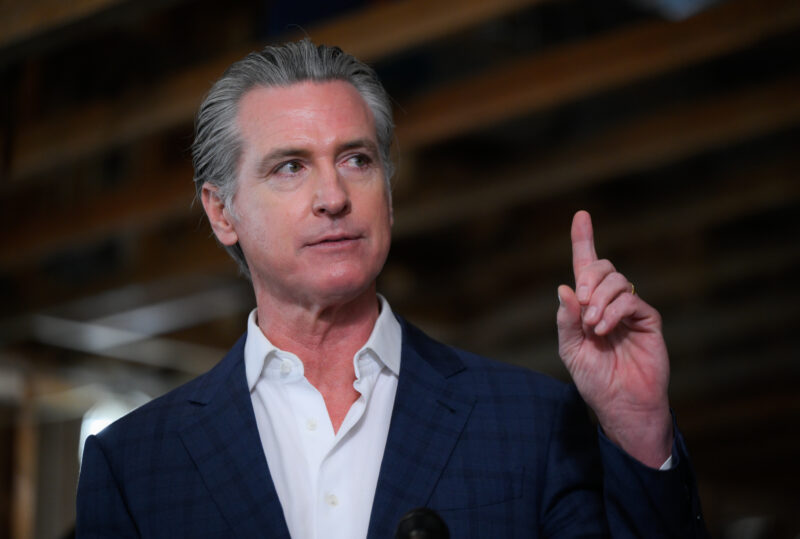

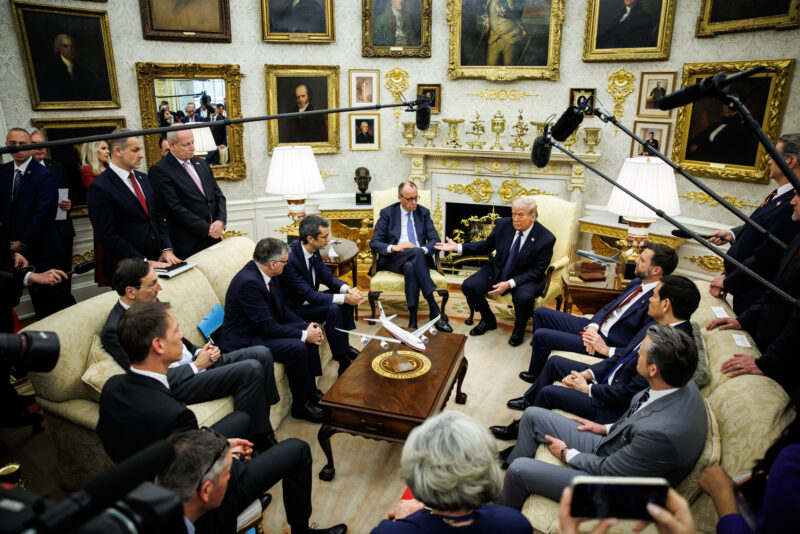




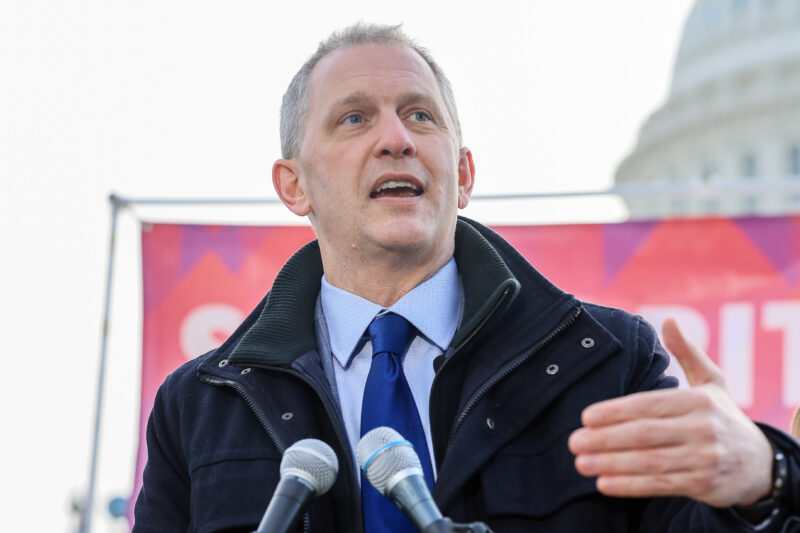
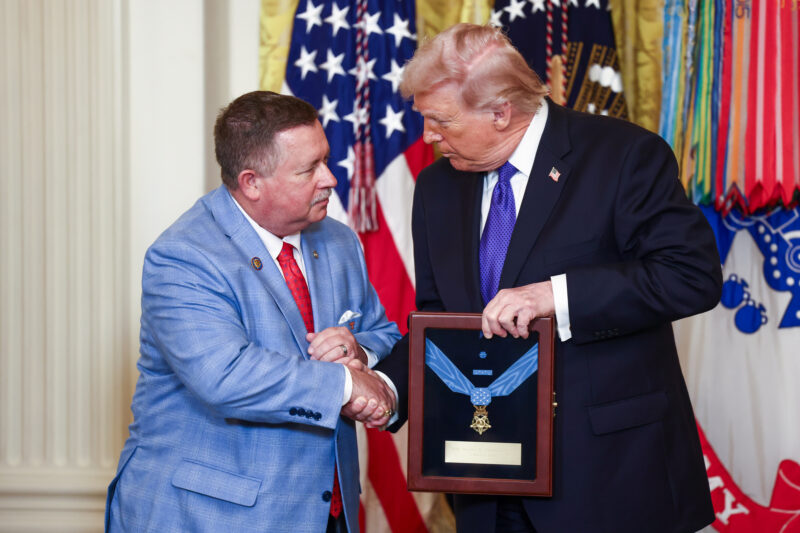


























The Israeli leader called Zohran Mamdani’s policy proposals ‘a one-term effort ... A lot of people have been taken in by this nonsense’
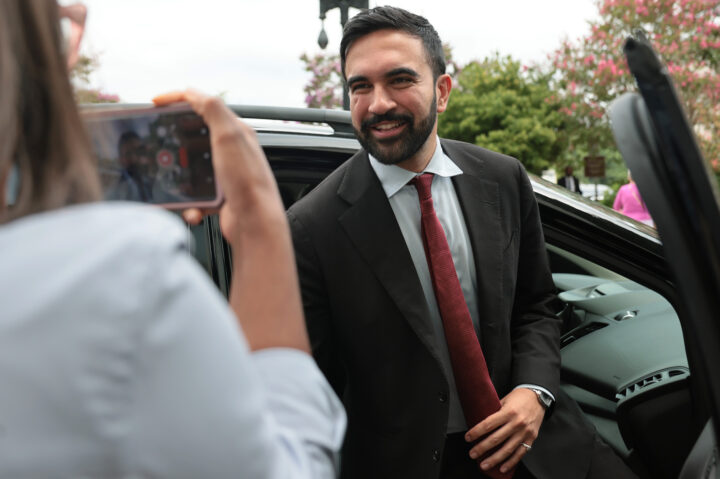
Michael M. Santiago/Getty Images
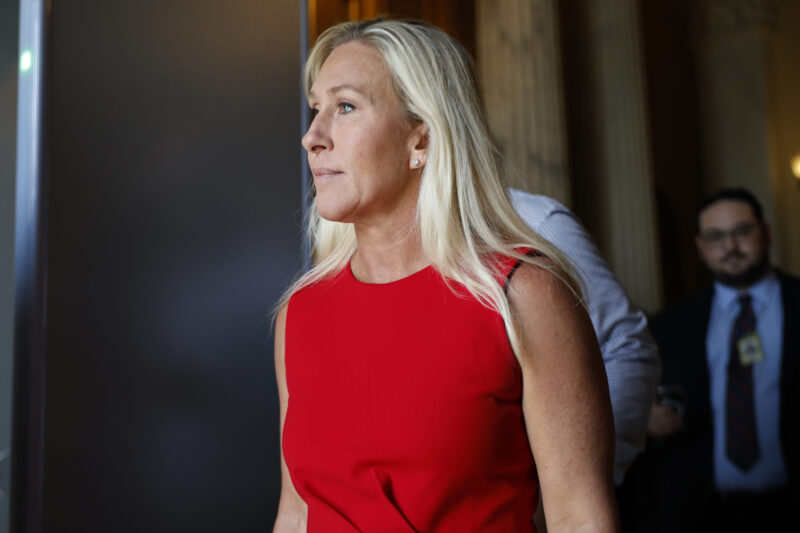
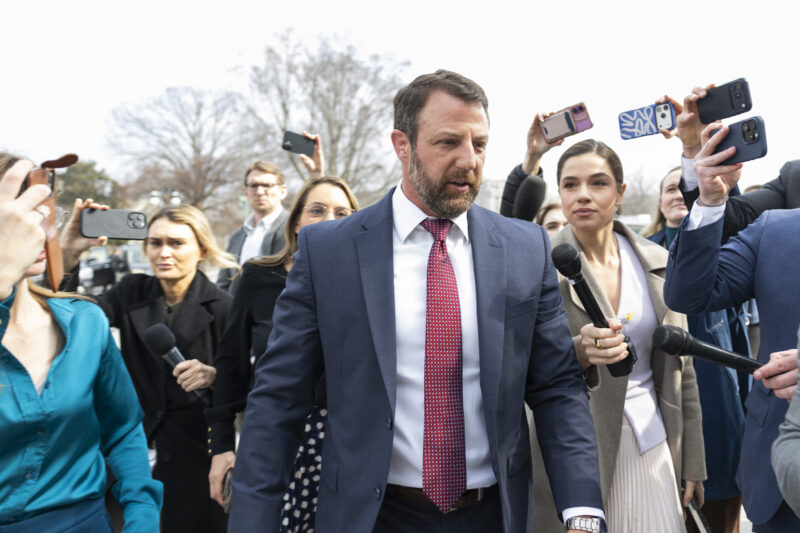
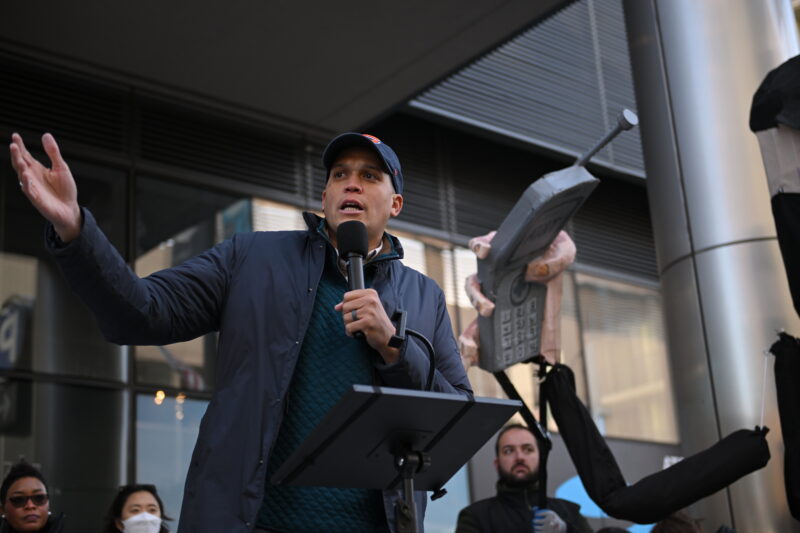
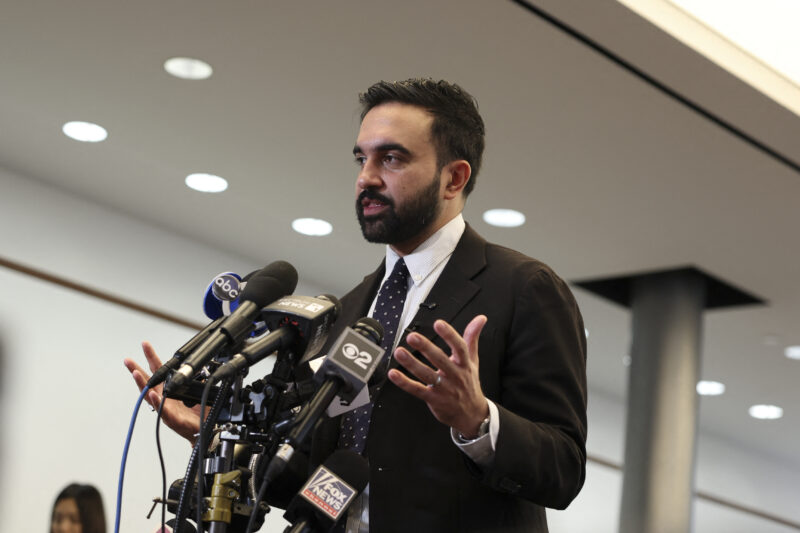
NYC Zohran Mamdani briefly speaks with reporters as he leaves the Dirksen Senate Office Building on July 16, 2025 in Washington, DC.


 Add JewishInsider on Google
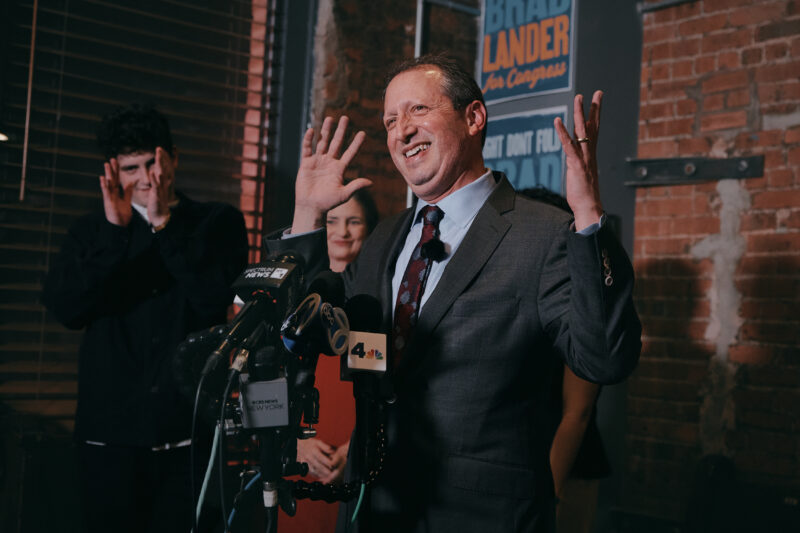
Israeli Prime Minister Benjamin Netanyahu argued that young people in America are won over “pretty quickly” by the truth about the situation in Israel, when discussing New York City Democratic mayoral candidate Zohran Mamdani on a podcast released Monday, and suggested that Mamdani’s policies would be unpopular if he’s elected.
“A lot of people have been taken in by this nonsense,” Netanyahu said, on the “Full Send” podcast, hosted by a social media influencer group called the Nelk Boys popular with young men.
“Sometimes folly overtakes human affairs for a while, but not for long, because reality steps in,” Netanyahu said. “I’m obviously not happy with it, but I’m less concerned with it, because I think if we can speak the truth to the young people of America, they wise up pretty quickly.”
The Israeli leader also addressed other policies supported by Mamdani, including the Democratic mayoral nominee’s past support for defunding the police and raising taxes.
“You want to defund the police? You want to have people go into stores and rob them and be free? You think that really creates a good society? You want to crush all enterprise? You want to tax people to death?” Netanyahu said. “That’s a one-term effort, but sometimes you have to get mugged by reality to understand how stupid that is. So that’s silly.”
According to a new poll, Republicans remain the strongest advocates of a muscular American role in world affairs, with 52% supporting America taking a leading role and 47% opposed
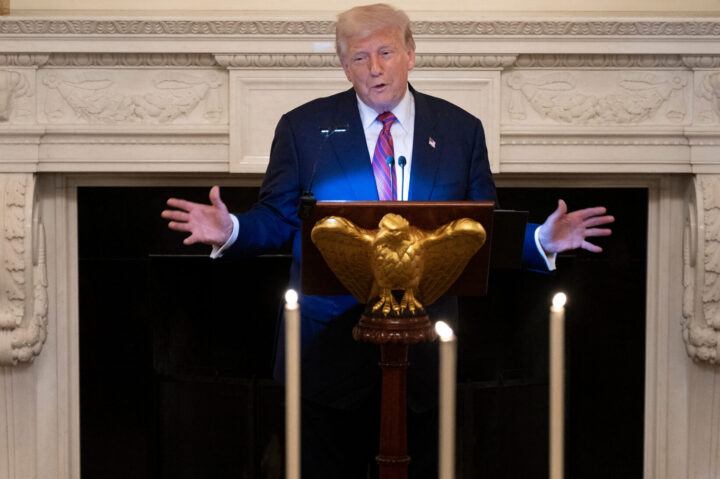
BRENDAN SMIALOWSKI/AFP via Getty Images
US Senator Markwayne Mullin (R-OK) (L) and US Senator John Thune (R-SD) (R) listen as US President Donald Trump speaks during a dinner for Republican US Senators in the State Dining Room of the White House July 18, 2025, in Washington, DC.
A newly released CNN poll, conducted this month, illustrates the resilience of a hawkish DNA within the Republican Party and among its voters even amid the rise of an isolationist strain that has sought to gain influence in the GOP during President Donald Trump’s second term.
The poll asked respondents: “Do you think the United States should or should not take the leading role among all other countries in the world in trying to solve international problems?” Overall, 43% took the more active approach, while 56% took a more isolationist view.
Republicans, however, remained the strongest advocates of a muscular American role in world affairs, with 52% supporting America taking a leading role and 47% opposed. By contrast, just 42% of Democrats and 39% of independents shared the more hawkish worldview.
Notably, the shift in more isolationist sentiment was almost entirely driven by Democrats and independents since the last CNN survey in March, which found majority support for significant American global engagement. In the March survey, a 57% majority of Democrats preferred more American involvement in the world, a number that dropped 15 points in the last four months. The Republican share of those preferring American engagement remained steady at 52%.
The results from the CNN polls suggest there’s a more committed core of Republican-voting hawks that is more resilient than the shifting political winds, whereas the Democratic foreign policy worldview appears more dependent on partisanship and what’s happening in the news at the time.
In March, at the time of the first CNN poll, Democrats showed a surge of support for foreign engagement — in large part, because they were responding to the hostile reception Trump delivered at the time to Ukrainian President Volodymyr Zelensky, who was seeking American military aid to his country. Back then, Trump wrongly blamed Zelensky for causing the war, and attacked him as a dictator in the run-up to the ugly confrontation at the White House. It was the high point of isolationism in Trump’s second term — and prompted an uptick of hawkishness among Democrats.
But since then, Trump has sharpened his rhetoric against Russian President Vladimir Putin and agreed to send Ukraine offensive weapons, in a reversal of his previous reluctance. He also decided to strike Iran’s nuclear facilities despite alarmism from an isolationist faction within his party, which turned out to be a major military (and political) success.
A recent Echelon Insights survey underscored that Trump’s hawkish turn has broadened and deepened support for strongly supporting American allies within the party. A clear 49-36% of Trump voters, asked if they supported continuing to give weapons to Ukraine, said yes. When informed that it was Trump’s decision to aid Ukraine further, nearly two-thirds of Trump supporters embraced the decision.
The actions on Capitol Hill are consistent with the polling. When Rep. Marjorie Taylor Greene (R-GA) proposed a series of amendments cutting off aid to foreign allies, the vast majority of Republicans voted against them. Even on her proposal to cut military aid for Ukraine, 141 of the 217 House Republicans took the pro-Ukraine side.
And when Greene proposed to block missile defense funding that the U.S. gives to Israel, only one other Republican, Rep. Thomas Massie (R-KY), joined her. Indeed, there were more Democrats who joined with MTG (four) than Republicans — in a sign of the “horseshoe theory” of the far left and far right uniting in their extremism.
Trump’s decision to strike Iran’s nuclear program appears to have created a momentum shift within the party, pushing back the faction of isolationists seeking to gain influence in the administration but also building support for a familiar brand of muscular engagement that has defined the party for generations.
‘If the current status quo is the same a year from now and it actually leads towards further negotiation — success,’ Warner told JI

Francis Chung/POLITICO via AP Images
Sen. Mark Warner (D-VA) ascends on an escalator on his way to a vote at the U.S. Capitol on June 17, 2025.
Sen. Mark Warner (D-VA) told Jewish Insider on Friday that he’s inclined to view the Trump administration’s strikes last month on Iran’s nuclear facilities as a “success,” if negotiations with Tehran resume and barring substantial future retaliation from Iran.
His comments largely echo sentiments shared earlier in the day by Sen. Chris Coons (D-DE) at the Aspen Security Forum, suggesting an increasing willingness by moderate, national security-minded Democrats to publicly acknowledge positive outcomes of the strikes, even if they maintain other concerns about the process that produced them.
“I will acknowledge the successfulness of the Israeli attacks and how back-foot the regime was. The fact that they didn’t launch the thousands of missiles,” Warner told JI on the sidelines of the forum. “I was concerned about an attack that didn’t bring Congress along. And I do think there was a huge process foul when the Gang of Eight wasn’t notified and the Republicans [were]. Trump[’s first administration] never did that — but I have never contested the success.”
Warner, the vice chair of the Senate Intelligence Committee, said he’s been pleased that there has not been ongoing asymmetric retaliation against the U.S. by Iran, such as cyber, sleeper cell or Iraqi militia attacks.
“If the current status quo is the same a year from now and it actually leads towards further negotiation — success.”
Warner, Coons and other top Democrats had cautioned the administration against unilateral action against Iran without congressional approval just days before the attack.
“Let’s make no doubt that the Iranian regime [are] bad guys, and that is why I’ve been such a consistent supporter of Israel,” Warner told JI.
“Iran’s, at least so far, been shown to be more of a paper tiger,” Warner said. “If we could just get to the resolution in Gaza, there really could be a fresh start.”
The senator said that his ongoing concern is how President Donald Trump has responded to the attacks, declaring that Iran’s nuclear program had been completely obliterated.
“The president, within two hours of the strike, set an arbitrary, almost impossible standard to meet, in terms of ‘total obliteration,’” Warner said. “To get the enriched uranium you’re going to need troops on the ground. And there are more than three sites — the vast majority [of the activity] was [at] those three, but there was some bad stuff happening elsewhere.”
He said the intelligence community had also been pressured to “contort itself to meet” the assessment Trump put forward.
In the immediate aftermath of the strikes, Warner and other Democrats expressed frustration that the Trump administration took days to brief Congress about them. Warner said he’s received “some additional clarity” in the weeks since the strikes about their effects. But he said that without physically sending operatives into the facilities, it’s difficult to know for sure the impacts of the strikes.
“Other nations have made assessments that were more in the multiple months” of delay to Iran’s nuclear program, “but I’m not even sure that’s the right metric,” Warner said. “It was a success. So the question is, what’s next? That, I don’t have visibility on.”
Going forward, Warner emphasized the need for negotiations to bring International Atomic Energy Agency inspectors back into Iran, adding that he wants to look further into the source of the delays in resuming talks.
Warner said he’s also seeking information on the timeline on which Iran would be able to build a less sophisticated nuclear device that could be delivered in a truck, rather than via a ballistic missile.
Though he noted that U.S. intelligence had not assessed that Iran was actively constructing a nuclear weapon, he said he had heard reports about an Israeli assessment that offered a different view and that he is looking further into it.
Asked about the fluid situation in Syria, in which Israel went, in the span of just a week, from floating normalization with the new Syrian government to bombing key government facilities in response to attacks on the Druze population, Warner indicated he’s still gathering information.
He said that Israel is “appropriately … very protective of its Druze population,” adding that he does not know at this point whether the Syrian government forces attacking the Druze population are doing so at the orders of that government.
He said he’s hopeful that Israel and other parties involved will not miss an opportunity to find a peaceful resolution that could defuse a major longtime threat to Israel’s north.
Warner said he also wants to see Trump use his “enormous influence in Israel” to “[force] Bibi’s government into a return of the hostages, a ceasefire,” saying that would open up opportunities for transformational change in the region, including Saudi-Israeli normalization.
Warner said that while he’s been critical of Israeli Prime Minister Benjamin Netanyahu, Israel and the IDF deserve credit for their surprise accomplishments in taking down Iran’s proxy network and in their strikes against Iran itself.
“The [Jewish community’s] concern is real and understandable,” Warner said. He said that he has been struck by the “level of anger, animosity, vile things said” in anti-Israel protests that have targeted him — “and I’m not Jewish. And I can only imagine.”
“Iran’s, at least so far, been shown to be more of a paper tiger,” Warner said. “If we could just get to the resolution in Gaza, there really could be a fresh start.”
Asked how concerned he is about the possibility of homeland attacks against the Jewish community carried out by or in the name of Iran, Warner said that U.S. intelligence monitors potential threats fairly comprehensively, but indicated that he’s most worried about radicalized lone-wolf attacks, like those in Washington and Boulder, Colo.
“The [Jewish community’s] concern is real and understandable,” Warner said. He said that he has been struck by the “level of anger, animosity, vile things said” in anti-Israel protests that have targeted him — “and I’m not Jewish. And I can only imagine.”
Warner expressed frustration at the way that the Palestinian cause has crowded out other global issues on college campuses. He said that it “would be healthy” if young people “have the chance to get exposed to other things in the world,” offering as examples the conflict in Sudan — which he said has been more deadly than Gaza and Ukraine combined — and the military junta in Myanmar.
On the subject of the Houthis, who have ramped up attacks against commercial shipping and Israel in recent weeks, Warner called the group a “tough nut to crack,” noting that a protracted Saudi and Emirati campaign against the Iran-backed terrorist group in Yemen had failed to put the issue to bed. But he said that the U.S. can’t rule out further military action against the group.
“I hope that those plans would be kept classified and not shared … on a device that’s not secure,” he quipped, referencing the Signalgate scandal, which he said had prompted concern from the Israeli government.
******
Last week’s Aspen summit, which typically prioritizes bipartisan and nonpartisan discussion and solution-making, became particularly politicized after nearly all Trump administration speakers canceled their participation, followed by a handful of foreign and private sector leaders and former government officials disappearing from the week’s agenda.
The issue was a frequent topic of discussion both on the main stage and across the Aspen Meadows campus last week, seen by many as a sign of the ways that intense partisanship has infiltrated U.S. foreign policy, once seen as a less antagonistic space.
Warner’s own panel featured himself and Coons, but not a Republican senator, as has been tradition.
Nevertheless, Warner said that bipartisanship on foreign policy issues still lives in the Senate, noting that the Intelligence Committee had passed an Intelligence Authorization Act recently in a nearly unanimous vote.
Looking ahead, he said the “easiest place to rebuild that consensus is around China,” which he described as an unprecedented competitor. He said there has been a long and difficult journey across multiple administrations to refocus on China, but he said there has been bipartisan success in pushing back against China.
He also argued that the Trump administration’s transactional and short-sighted approach to foreign policy goes against a longtime bipartisan tradition of viewing U.S. international relationships as an effort in “mutual trust-building.”
He said that his Republican colleagues privately disagree with many of Trump’s more outlandish foreign policy efforts — like annexing Canada. “At some point, there’s got to be a break,” he responded, when pressed on the fact that some Republicans defend Trump’s policies publicly despite those private disagreements.
Warner told JI that the bill the Intelligence Committee recently passed would cut the size of the Office of the Director of National Intelligence. But, despite offering biting criticisms of DNI Tulsi Gabbard, Warner said that the reform efforts are not a reflection of or specifically prompted by concerns about her conduct in the role.
“I’m very comfortable with the idea of bringing the mission closer to what it was originally, but also making sure that people who are at the ODNI get returned to their original home agency and don’t get [fired],” Warner said.
Clarifying comments that he made on the panel about close U.S. intelligence partners in the Five Eyes group curtailing their intelligence sharing with the United States, Warner said he was not aware of specific instances in which that had happened, but said that U.S. partners are concerned about the state of the U.S. intelligence community.
“The challenge about intelligence sharing is [that] this is all based on trust,” Warner said.
Plus, Huckabee presses Israel on pilgrims

Screenshot/Fox News
Adam Boehler, special presidential envoy for hostage negotiations, appears on Fox News Sunday on March 9, 2025
Good Friday morning.
In today’s Daily Kickoff, we talk to former Israeli Ambassador to the U.S. Mike Herzog about Democrats’ responses to U.S. involvement in last month’s war between Iran and Israel, and report on U.S. hostage envoy Adam Boehler’s comments at the Aspen Security Forum that a ceasefire is ‘‘closer than it’s been.” We interview Columbia students and alumni about the school’s negotiations with the Trump administration, and have the exclusive on a letter from Jewish House Democrats concerned over the Pentagon’s recent contract with xAI following a series of antisemitic posts by its Grok chatbot. Also in today’s Daily Kickoff: Rep. Josh Gottheimer, Daniel Nadler and Deborah Lyons.
For less-distracted reading over the weekend, browse this week’s edition of the Weekly Print, a curated print-friendly PDF featuring a selection of recent Jewish Insider and eJewishPhilanthropy stories, including: The psychology of denial: American Psychological Association struggles to confront antisemitism in its ranks; After Iran strikes, Saudis in no rush to join Abraham Accords, experts say; and Rep. Greg Landsman: Americans are ‘tired’ of partisanship on Iran and foreign policy. Print the latest edition here.
What We’re Watching
- House Minority Leader Hakeem Jeffries (D-NY) is slated to meet today in New York City with the Democratic mayoral nominee Zohran Mamdani. The meeting comes days after Mamdani, who has faced criticism for his defense of the “globalize the intifada” phrase, met on Capitol Hill with House Democrats. More below.
- The Aspen Security Forum wraps up today ahead of an off-the-record weekend gathering of the Aspen Strategy Group at the same venue in Aspen, Colo.
- The forum’s final morning kicks off with a sit-down with former CIA Director David Petraeus and the Financial Times’ Kim Ghattas, who will discuss the evolving situation in the Middle East.
- Later in the morning, Sens. Chris Coons (D-DE) and Mark Warner (D-VA) will speak in conversation with The New York Times’ Peter Baker.
- The final session of the forum today will feature former National Security Advisor Jake Sullivan, former Secretary of State Condoleezza Rice and two former defense secretaries, Robert Gates and Mark Esper.
- We’re keeping an on eye the situation in Syria, where a ceasefire implemented on Wednesday has largely held. We’re also eyeing Israeli activity in Syria and along the border, as Israeli balances its security concerns with efforts to maintain calm with the al-Sharaa government.
What You Should Know
A QUICK WORD WITH JI’S MARC ROD
Former Israeli Ambassador to the U.S. Mike Herzog and other pro-Israel speakers received a warm reception from the crowd at the Aspen Security Forum this week, as they discussed continued efforts to free the hostages in Gaza and the recent strikes on Iran.
However, Herzog told Jewish Insider on the sidelines of the conference that he’s been disappointed by the response to the strikes from Democratic lawmakers in Washington, which has been overwhelmingly negative.
It’s a response that stands in contrast to Herzog’s description of the transition he observed in the Biden administration’s thinking on Iran: going from pushing for a nuclear deal with Iran that Herzog said would have been weaker than the Joint Comprehensive Plan of Action to, by the time President Joe Biden left office, active discussions of strikes on Iran.
Herzog said that efforts to maintain bipartisanship on Israel were a critical element of his ambassadorship and that dialogue with nearly all leaders is critical, but, “I’m saying it carefully because I never interfere in domestic politics here, but from a strategic point of view, I was disappointed by the response of some senior Democrats to the war on Iran.”
Regarding Biden’s team, Herzog told JI: “If you look at the journey the Biden administration took from the initial days when they were rushing to a deal with Iran, to the last few months of the administration where they were talking to us about military options against Iran, they went a long way. … It was too late in the day [to carry out the strikes before Biden left office], but it was a very interesting journey that I noticed.”
WINDOW OF OPPORTUNITY
U.S. hostage envoy Adam Boehler: Hamas hostage deal is ‘closer than it’s been’

U.S. hostage envoy Adam Boehler said at the Aspen Security Forum on Thursday that there had been “some movement forward” recently toward a hostage-release deal with Hamas. He also addressed criticisms of his direct talks with Hamas, Jewish Insider’s Marc Rod reports.
Status update: “It’s closer than it’s been, and if it doesn’t happen, in my strong opinion it would be continued hard-headedness from Hamas, in which case Israel will continue to take action, as they should,” Boehler, the only Trump administration official to address the conference, said. Asked about his direct negotiations with Hamas, which were controversial especially among Israeli officials who were largely kept out of the loop, Boehler downplayed the extent of the breach. “There was no unilateral deal ever possible. While that’s an American citizen, Edan, we were always working with the Israeli side.”
Strategy session: Former Secretary of State Condoleezza Rice said Thursday at the Aspen Security Forum that the U.S. should work to exploit frictions between Iran, Russia, China and North Korea, to interfere with their deepening alliances. “I’ve thought this alliance is somewhat weaker than we sometimes would give it credit for, and I’d slam them together and make them deal with their own internal contradictions,” Rice reiterated.
tehran talk
Experts split on pathways forward for Iran, but agree regime change not imminent

Speaking on a panel at the Aspen Security Forum, a group of Iran analysts discussed the potential paths forward in nuclear talks with Iran after the American and Israeli strikes on Iran’s nuclear facilities, the possibility that Iran will attempt to reconstitute its nuclear program covertly and the prospect of regime change in Iran, Jewish Insider’s Marc Rod reports.
Analyzing Iran: Former National Security Advisor Stephen Hadley laid out three paths forward after the strikes: a continued campaign of Israeli air strikes to “mow the lawn,” while Iran works to try to reestablish its own deterrence; a negotiated agreement with Iran including intrusive inspections that would make it difficult for Iran to construct a covert nuclear program, with provisions addressing Iran’s ballistic missiles and proxies; and the possibility, with an agreement, that Iran decides to give up its pursuit of nuclear weapons, having spent billions of dollars on the program, alienated the region and still failed to deter a U.S. or Israeli attack. Rachel Bronson, a senior advisor at the Bulletin of the Atomic Scientists, said that it’s widely believed Iran has seen a nuclear weapon as a guarantor of regime survival, in the model of North Korea. But she said there’s a chance that Iran wants to go down a different path. “That begs the question whether the Iranians want to live like North Koreans and want to live in a sanctioned regime and in such isolation, which the Iranians demonstrated that they don’t want to live that way,” Bronson said.
Sanctions push: A group of Senate Republicans sent a letter to French, German and U.K. officials this week urging them to immediately reimpose U.N. Security Council sanctions on Iran for the regime’s violations of the 2015 nuclear deal and the Treaty on the Non-Proliferation of Nuclear Weapons, Jewish Insider’s Emily Jacobs reports.
CAMPUS BEAT
Columbia Jewish students, alumni critique school’s commitments to combat antisemitism as ‘bare minimum’

As Jewish students and alumni at Columbia University await the final details of the university’s prospective deal with the Trump administration, some are expressing skepticism that a list of commitments announced by the school this week to address antisemitism on campus would have a significant impact on protecting Jewish students, Jewish Insider’s Haley Cohen reports. The steps were publicized Tuesday by Columbia’s acting president, Claire Shipman, as the school works to reach a deal with the Trump administration to restore some $400 million in federal funding that was cut by the government in March due to the university’s record dealing with antisemitism since the Oct. 7, 2023, Hamas terror attacks in Israel.
Student reactions: According to a draft deal, Columbia would be required to pay a $200 million fine and commit to releasing admissions and staffing data to the federal government. “The deal as it stands now lets Columbia off the hook relatively without a scratch,” Inbar Brand, who graduated in the spring from Columbia’s dual-degree program with Tel Aviv University, told JI. “The school gets its money back without resolving the core issues in its governance and administrative structure that allowed for antisemitism to fester openly for so long on campus.” Noa Fay, a graduate student entering her last year in Columbia’s School of International and Public Affairs, described the university’s latest commitments and prospective deal as “an immense disappointment.”
SCOOP
In new memo, Republicans allege Biden admin provided grants for Palestinian NGOs with terror ties
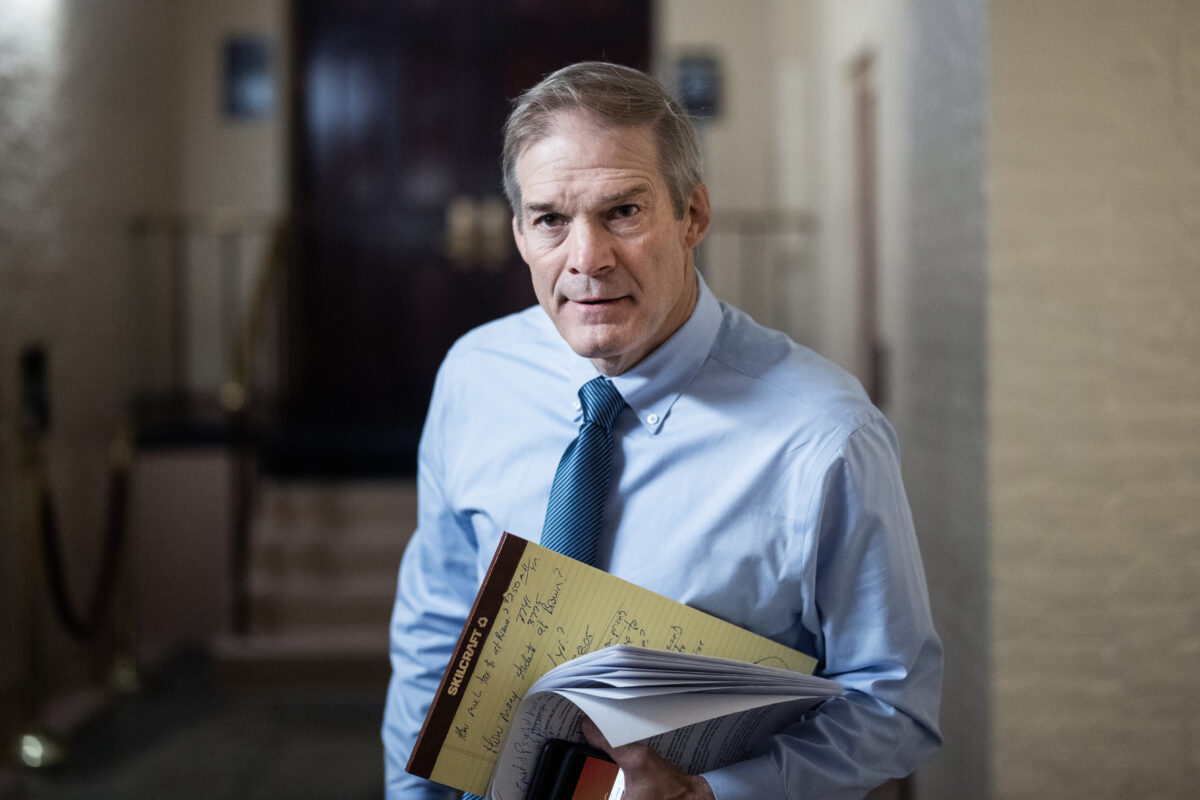
The GOP-led House Judiciary Committee drafted a new memo on Thursday alleging that federal funding granted to USAID and nongovernmental organizations under the Biden administration was given to Palestinian nonprofits with ties to proscribed terror groups, Jewish Insider’s Emily Jacobs reports.
The allegations: “Oversight conducted by the Committee reflects the Biden-Harris Administration’s neglect and misuse of taxpayer dollars through USAID, the State Department, and other federal agencies, which were used to directly and indirectly fund the efforts of anti-Netanyahu organizations and terrorist groups,” the memo sent to committee members, which was obtained by JI, states. Judiciary Committee Republicans also revealed in the memo that they were “expanding” their investigation “to include additional American and Israeli NGOs that may be involved in funneling U.S. government funds with the purpose of undermining the Israeli government or for the support or fiscal sponsorship of terrorist groups.”
holding power
Gottheimer avoids confronting Mamdani over ‘intifada’ comments

Rep. Josh Gottheimer (D-NJ), in a private meeting with House Democrats in Washington on Wednesday, avoided confronting Zohran Mamdani, the far-left Democratic nominee for mayor of New York City, over his controversial defense of calls to “globalize the intifada” and fierce opposition to Israel, Jewish Insider’s Matthew Kassel reports.
No objections: Gottheimer, an outspoken pro-Israel Democrat, has not been shy about calling out members of his party when disagreements over Israel and antisemitism have arisen. But during the meeting, Gottheimer did not bring up his objections to the 33-year-old democratic socialist, according to a House aide familiar with the matter, even as his views on Israel have raised alarms among Jewish voters and faced pushback from Democratic leaders who have so far withheld their endorsements.
EXCLUSIVE
Jewish Democrats press Pentagon about Grok contract after antisemitic meltdown

A group of Jewish House Democrats led by Rep. Laura Friedman (D-CA) raised questions on Friday about the Pentagon’s decision to announce a $200 million contract with Elon Musk’s company xAI to utilize a version of its Grok artificial intelligence, days after the chatbot posted antisemitic and violent screeds on X, Jewish Insider’s Marc Rod reports.
What they said: The lawmakers said that the contract raises questions about Musk’s potential personal influence over or access to the version of Grok that the Defense Department will use, and that the issues that produced the antisemitic meltdown might recur in its use of the program. And they alleged that the contract fits “a broader and increasingly visible pattern of the department turning a blind eye to antisemitism in its own ranks,” including Secretary of Defense Pete Hegseth’s defense of Pentagon Press Secretary Kingsley Wilson against accusations of antisemitism.
Worthy Reads
Protect the Druze: In Newsweek, Druze-Israeli diplomat Sawsan Natour-Hasson, who serves as minister for public diplomacy at the Israeli Embassy in Washington, calls for global condemnation of the attacks against members of the Syrian Druze community. “The atrocities of October 7 in Israel did not occur in a vacuum. We have warned the world for years about this growing wave of radical extremism. It has targeted the Yazidis in Iraq, the Alawites in Syria, Christians across the Levant — and now, it is butchering innocent Druze civilians: women, children, and the elderly. Homes are being shelled, families displaced, hospitals are being bombed, and religious sites and symbols desecrated, led by the Syrian regime with the blessing of President Abu Mohammad al-Jolani. And yet once again — the world has remained largely silent in the face of the genocide taking place against my people.” [Newsweek]
Presidential Plot: In The Wall Street Journal, the Foundation for Defense of Democracies’ Behnam Ben Taleblu and Saeed Ghasseminejad warn of potential Iranian plots to assassinate President Donald Trump. “Contrary to recent denials by Iran’s President Masoud Pezeshkian on Tucker Carlson’s podcast, these threats and plots are real. Books about the president’s time in office and on the campaign trail detail the precautions Mr. Trump had to take. U.S. authorities have been tracking, uncovering and, where possible, prosecuting people involved. The feds have disrupted several Iranian plots to assassinate Mr. Trump on U.S. soil.” [WSJ]
The Ties that Bind: The Atlantic’s Yair Rosenberg explores the political bind facing Israeli Prime Minister Benjamin Netanyahu amid the departure of the United Torah Judaism party from his coalition. “[Netanyahu] can either continue exempting the ultra-Orthodox and anger not just the public and the courts but also his own party, or revoke that exemption and lose the ultra-Orthodox — and with them, his coalition. Of late, Netanyahu has attempted to fudge the issue by pushing through legislation that would create a technical process for drafting the ultra-Orthodox but in practice make the new requirements easy to evade. This effort has met resistance in his party, however, and the bill has not passed — leading to the departure of the ultra-Orthodox parties from the government this week. For now, those parties have said that they won’t vote to force new elections, giving Netanyahu time to try to appease them. But unless he can figure out a way to pass a bill that somehow satisfies the ultra-Orthodox and their critics, it’s merely a matter of time before his erstwhile allies completely switch sides.” [TheAtlantic]
Toxic Workplace: In USA Today, Ken Marcus, the founder of the Louis D. Brandeis Center for Human Rights Under Law, warns that the field of mental health is becoming “steeped” in antisemitism. “In the health care system, research shows that antisemitism has escalated since the Hamas terrorist attacks of Oct. 7, 2023. Now, 75% of Jewish medical professionals say they have experienced antisemitism at work. No form of hatred is acceptable within our mental health care system – one that is supposedly built on empathy, ethics and compassion. … The proliferation of antisemitism in any space is horrific. But its proliferation in health care – a sacred, professional space brimming with private and sometimes life-threatening information – is especially dangerous.” [USAToday]
Word on the Street
In a letter to Israeli Interior Minister Moshe Arbel, U.S. Ambassador to Israel Mike Huckabee warned that he could publicly declare Israel not welcoming to Christian visitors, an escalation in an ongoing diplomatic row over Christian Zionists who have experienced complications traveling to Israel; Arbel, from the Haredi Shas party, has for years clashed with Christian clergy and groups who have sought visas to travel to Israel…
Israel apologized for a strike on a Catholic church in Gaza that killed three people and said it is investigating how “stray ammunition” struck the building; the official statement came following a call between Israeli Prime Minister Benjamin Netanyahu and President Donald Trump, during which the president reportedly pressured Netanyahu to release a statement…
The House of Representatives on Thursday rejected, in a 422-6 vote, a bid by Rep. Marjorie Taylor Greene (R-GA) to block the $500 million in cooperative missile-defense funding the U.S. provides annually to Israel, Jewish Insider’s Marc Rod reports…
Rep. Mike Lawler (R-NY) introduced the “Syria Sanctions Accountability Act” to amend the Caesar Act sanctions legislation that targeted the Assad regime, allowing sanctions relief for the new government conditioned on good behavior — a step short of the full repeal that other lawmakers are advocating. The bill also includes provisions to ensure accountability in Syria and assess other pathways for financial relief…
A former University of Michigan administrator who headed the university’s office of academic multicultural initiatives and was fired following complaints that she had made antisemitic comments at a diversity conference is suing the university, alleging discrimination in the course of the school’s investigation…
Forbes spotlights Daniel Nadler, who has raised $210 million at a $3.5 billion valuation for his company OpenEvidence, which uses artificial intelligence to help simplify the process for doctors to comb through extensive medical research…
Officials at Cheltenham High School in Pennsylvania, where alum Israel Prime Minister Benjamin Netanyahu is honored in the school’s hall of fame, are meeting today with members of the school’s alumni association to discuss a petition to remove Netanyahu’s photo from the hall of fame…
Deborah Lyons, Canada’s special envoy on preserving Holocaust remembrance and combating antisemitism, announced her departure from the role, which she assumed in October 2023…
A mosaic from Pompeii that had been acquired by a Nazi Wehrmacht captain during World War II and was repatriated in 2023 was put on display in a museum near the site of the ancient town, which was destroyed in a volcanic eruption…
An Israeli security officer at the U.S. Embassy in Jerusalem who had battled Hamas terrorists in Kibbutz Be’eri on Oct. 7, 2023, died in a drowning accident while on vacation in Greece…
Former Israeli Ambassador to the U.S. Michael Oren reflects on the “blood covenant” between Israel and its Druze community, following the attacks by Syrian government forces on the Syrian Druze community…
The Wall Street Journal reports on Iran’s efforts to rearm its militias across the region after months in which both Tehran and its proxies suffered significant hits by Israel and the U.S….
Gabriel Scheinmann, who had previously served as executive director of the Alexander Hamilton Society, was tapped to be chief of staff to U.S. Ambassador to France and Monaco Charles Kushner…
Austrian skydiver Felix Baumgartner, who in 2012 broke a world record for his jump from the stratosphere, died in a paragliding accident at 56…
Writer and photographer Laura Ben-David died at 56…
Pic of the Day

Israeli actor Gal Gadot was honored last night with Hadassah’s Power of Our Dreams Award at the opening ceremony of the Jerusalem Film Festival in Jerusalem.
Birthdays

First-ever Orthodox Jewish player selected in the MLB Draft, picked No. 77 overall in 2021, now on the minor league disabled list, Jacob Steinmetz turns 22 on Saturday…
FRIDAY: Israeli nuclear physicist and professor emeritus at Tel Aviv University, Jonas Alster turns 92… Theoretical chemist, 1981 Nobel laureate in chemistry, he has also published plays and poetry, born Roald Safran, Roald Hoffmann turns 88… Founding partner of NYC-based law firm Davidoff Hutcher & Citron, he was one of 20 people on Nixon’s “Enemies List,” Sidney Davidoff turns 86… President of the Jewish Genealogical Society of the Conejo Valley and Ventura County, Jan Meisels Allen… Former three-term mayor of Edmonton, Alberta, Stephen Mandel turns 80… Former prime minister of Peru, Yehude Simon Munaro turns 78… Executive director of the MLB Players Association for 26 years and then the same post at the NHL Players Association for 12 additional years, Donald Fehr turns 77… Beverly Hills resident, Felisa Bluwal Pivko… Finance, real estate and nursing home executive, Leonard Grunstein turns 73… Antisemitism scholar and one of the authors of the IHRA working definition of antisemitism, he is the COO of the World Jewish Restitution Organization, Mark Weitzman… Former Israeli Police spokesman, he is now a senior national radio broadcaster in Israel and an international talk-show host, Elihu Ben-Onn turns 71… Seattle-area consultant, Elihu Rubin… Former finance chairman of the RNC, Elliott B. Broidy turns 68… Former minister for congressional affairs at the Embassy of Israel to the U.S., he was previously the Israeli ambassador to Belarus, Martin Peled-Flax turns 67… Partner at Clifford Chance, Philip Wagman… CEO and co-founder at Let’s Bench, a publisher of customized keepsake prayer books and benchers, Yitz Woolf… Associate professor of cybersecurity law at the U.S. Naval Academy and formerly an attorney at Covington & Burling, Jeffrey Michael Kosseff turns 47… Deputy director of the White House National Economic Council until 2022, now a professor at NYU law school, David Kamin… Co-CEO of the Executive Council of Australian Jewry, Alexander Ryvchin turns 42… Reporter for “NBC Nightly News” and “Today,” Gadi Schwartz turns 42… Editor of Kveller and Hey Alma, Molly Tolsky… Lauren Friedlander… CEO of Moving Traditions, Shuli Karkowsky… Senior spokesperson at the U.S. Treasury until 2023, now the head of U.S. public affairs at Coinbase, Julia Krieger… Senior manager of content strategy at Gauntlet, Philip Rosenstein… Foil fencer who competed for the U.S. at the 2020 and 2024 Summer Olympic Games, she won a team gold medal at the 2024 games, Jacqueline Dubrovich turns 31… Director of Hillel at Queen’s University of Canada, he is the incoming director of campus and youth impact at CJPAC, Yosef Tarshish… Istanbul resident, Izi Doenyas… Ted Rosenberg… Dog enthusiast, N.R. Gross…
SATURDAY: Retired Israeli airline pilot, he successfully thwarted an in-flight hijacking by Leila Khaled in 1970, Uri Bar-Lev turns 94… Interactive designer, author and artist, in 1986 he married Caroline Kennedy, daughter of the late JFK, Edwin Arthur “Ed” Schlossberg turns 80… Retired professor at Erasmus University Rotterdam and Leiden University, he served in the Dutch Senate and then as the minister of foreign affairs of the Netherlands, Uriel “Uri” Rosenthal turns 80… Hotelier and real estate developer, the creator of the boutique hotel concept, he was the co-founder of NYC’s Studio 54 in 1977, Ian Schrager turns 79… Co-founder of Limmud FSU, she co-founded UJA-Federation of New York’s Women’s Executive Circle, Sandra F. Cahn… Former co-chairman of the Federation for Jewish Philanthropy of Upper Fairfield County, Conn., Linda Meyer Russ… Sportswriter for The Athletic and author of three books on baseball, Jayson Stark turns 74… Former CEO of Starbucks Coffee Company, he owned the NBA’s Seattle SuperSonics from 2001 to 2006, Howard Schultz turns 72… Retired judicial assistant at the Montgomery County (Pa.) Court of Common Pleas, Deenie Silow… Rabbi of Congregation Beth Abraham in Bergenfield, N.J., and rosh yeshiva at Yeshiva University in NYC, Rabbi Yaakov Neuburger turns 70… Head of the Kollel at Ner Israel Rabbinical College, Rabbi Ezra D. Neuberger turns 68… Former chairman and CEO of Sears Holdings (owner of retailers Sears and Kmart), Edward Scott “Eddie” Lampert turns 63… Israel’s ambassador to Canada until 2023, Ronen Pinchas Hoffman turns 62… Pulitzer Prize-winning New York Times reporter until 2017 and author of The Nazis Next Door: How America Became a Safe Haven for Hitler’s Men, Eric Lichtblau turns 60… Israeli actress, model and film producer, Yael Abecassis turns 58… Spokesperson to the Arab media in the Israel Prime Minister’s Office from 2010 until 2023, now a consultant, Ofir Gendelman turns 54… Member of Congress (D-IL), running in 2026 to succeed retiring Sen. Dick Durbin (D-IL), Raja Krishnamoorthi turns 52… Co-chairman and CEO of CheckAlt, Shai Stern… Senior writer and NBA Insider for ESPN, Ramona Leor Shelburne turns 46… Former soccer star at the University of Virginia, recently a director of administrative operations at Hopscotch Health, Chad Prince turns 46… Former deputy mayor of the city of Haifa, now a real estate developer, Shai Abuhatsira turns 45… Ultra-marathon runner, he performs as a mentalist and magician, Oz Pearlman turns 43… Associate partner at McKinsey & Company, Alexis Blair Wolfer… President of Clever Bee Academy in Hewlett, N.Y., Ezra David Beren… Israel editor at Jewish Insider, Tamara Zieve… Director of operations at Tide Realty Capital, Yanky Schorr… National political reporter for The Washington Post, Isaac Arnsdorf… Venue coordinator at JW3 London, Caroline Mendelsohn Lawrence… Former EVP and CEO of the Ronald S. Lauder Foundation, Dr. George Ban… Zach Houghton…
SUNDAY: Retired U.S. senator (D-MD), Barbara Mikulski turns 89… Retired president of the National Endowment for Democracy, Carl Gershman turns 82… Longtime Israeli diplomat, he served as Israel’s ambassador to Germany, Yoram Ben-Zeev turns 81… Former commissioner on the Civil Rights Commission, assistant secretary of HUD in the Clinton administration, presently vice chair of the Bank of San Francisco, Roberta Achtenberg turns 75… Senior U.S. District Court judge in Massachusetts, Judge Patti B. Saris turns 74… New York Times columnist and three-time Pulitzer Prize winner, Thomas Loren Friedman turns 72… Molecular geneticist at NYC-based Rockefeller University and an investigator of the Howard Hughes Medical Institute, Jeffrey M. Friedman turns 71… Broadcast and digital media executive, Farrell Meisel… Professor of sociology at the University of Illinois at Chicago, Barbara Risman turns 69… Past president of the Women’s Department at the Jewish Federation of Detroit, Marcie Hermelin Orley… Los Angeles-based wardrobe consultant, Linleigh Ayn Richker… Public policy expert and author, Jane S. Hoffman turns 61… Former member of the Knesset for the Yesh Atid party, she is a brigadier general in the IDF (reserves), Nira Shpak turns 59… Member of the Knesset for the United Torah Judaism party, Yitzhak Ze’ev Pindrus turns 54… Attorney, Jack Achiezer Guggenheim… SVP, Washington bureau chief and political director of CNN, David Marc Chalian turns 52… Co-author of Jewish Jocks: An Unorthodox Hall of Fame, he is a staff writer at The Atlantic, Franklin Foer turns 51… Southern states director at AIPAC, David Fox… Singer who burst on the scene as a finalist on the fifth season of American Idol, Efraym Elliott Yamin turns 47… Commissioner of the community affairs unit for NYC Mayor Eric Adams, Fred Kreizman… Co-founder and managing partner of Main+Rose, Beth Doane… Co-founder and co-executive director of the progressive Indivisible movement, Ezra Levin turns 40… Former MLB player, he was a third baseman for Team Israel in 2023, Ty Kelly turns 37… Comedian and regular player on “Saturday Night Live,” Chloe Fineman turns 37… Software engineer at Home Chef, Ashley Abramowicz Gibbs… Anesthesiologist, Dr. Sheila Ganjian Navi… VP of business development and operations at Thyme Care, Etan Raskas… SVP and head of investor relations at Vintage Investment Partners, Jonathan Tamir Alden… Actor and comedian, Joey Bragg turns 29… Associate in the trademarks and copyrights practice group at Ballard Spahr, she was president of USC Hillel as a college senior, Goldie Fields…
'I must say, I was disappointed by the response of some senior people on the Democratic side,' Herzog told JI

Aspen Security Forum
Former Israeli Ambassador to the U.S. Michael Herzog
ASPEN, Colo. — Former Israeli Ambassador to the U.S. Michael Herzog and other pro-Israel speakers received a warm reception from the crowd at the Aspen Security Forum this week, as they discussed continued efforts to free the hostages in Gaza and Israel’s strikes on Iran.
But Herzog told Jewish Insider, on the sidelines of the conference after his panel on Wednesday, that he’s been disappointed by the response to the strikes from Democratic lawmakers in Washington, which has been overwhelmingly negative.
It’s a response that also stands in contrast to Herzog’s description of the transition he observed in the Biden administration’s thinking on Iran: from pushing for a nuclear deal with Iran that Herzog said would have been weaker than the Obama-era Joint Comprehensive Plan of Action to, by the time President Joe Biden left office, active discussions of strikes on Iran.
“I must say, I was disappointed by the response of some senior people on the Democratic side,” Herzog told JI. “I’m saying it carefully because I never interfere in domestic politics here, but from a strategic point of view, I was disappointed by the response of some senior Democrats to the war on Iran.”
Herzog said that maintaining bipartisan support for Israel was the central goal of his ambassadorship and that he engaged with nearly everyone, including critics, with the exception of the most extreme voices. He said he expected U.S. leaders on both sides of the aisle to realize that the strikes offered a “unique opportunity” to counter a “malign actor” and “changed the strategic landscape in the Middle East.”
“People who either criticize it on procedural issues or people who say, ‘[It] wasn’t the right timing because they were talking to each other about a deal’ — there’s never a right time. Never,” Herzog said, emphasizing that the strikes had not, as critics warned, spiraled into a protracted war similar to Iraq or Afghanistan.
Herzog said Israel must “put a lot of work into maintaining that dialogue with both sides of the aisle, explaining our common interest, away from domestic politics here … and exploring the new opportunities that have been created in the Middle East.”
Herzog said that Israel has been preparing for an attack on Iran for decades, but the specific planning for what became Israel’s Operation Rising Lion and the U.S.’ Operation Midnight Hammer began in earnest in November 2024, after the second Iranian strike on Israel and Israel’s elimination of Iran’s air-defense systems. By that time, U.S. nuclear talks with Iran, which Herzog criticized as misguided, had been long stalled.
He said the fall of the Assad regime in Syria the following month provided a further opportunity to take action.
“If you look at the journey the Biden administration took from the initial days when they were rushing to a deal with Iran, to the last few months of the Biden administration where they were talking to us about military options against Iran, they went a long way,” Herzog recounted.
Herzog said he believes that the Biden administration underwent “disillusionment with the possibility of reaching a good deal with Iran,” as Iran made unrealistic demands, such as removing the Islamic Revolutionary Guard Corps’ terrorism designation. And he said Iran’s supply of weapons for Russia’s invasion of Ukraine made the talks “much more difficult.”
“I just could see that movement with time, to the last phase of Biden’s presidency, when, after we turned the tables on the Iranian axis and opened that huge opportunity, we actually started looking with them at the military option,” he said. “It was too late in the day [to carry out the strikes before Biden left office], but it was a very interesting journey that I noticed.”
Looking at the rising isolationist sentiments on the Republican side of the aisle, Herzog said he’s been monitoring the issue and has “been concerned about it,” but also argued that such voices aren’t dominant in the Trump administration’s decision-making.
“It’s like a swing of a pendulum because the U.S. ultimately decided to follow Israel and strike Iran, and this is really historic, in that it’s a first-of-its-kind coordinated offensive operation. … This is the first time that we are coordinated in our offensive operations, that’s a very big deal for a long time to come in my view,” Herzog said.
He said he sees the pendulum swinging against the isolationists in the administration’s recent moves to provide additional support to Ukraine and take a tougher stance toward Russia as well.
“So all in all, I don’t think that the administration is following this isolationist trend, but I do follow it and I am concerned about it,” Herzog said. “I do believe that the world needs American leadership, [an] American dominant role. The world needs America to be a force of good, as it has always been, and that’s what we’d like to see.”
Herzog — reflecting on the panel he spoke on, “Israel at a Crossroads” — said that the U.S. and Israel need to be closely coordinated and in lockstep on the path forward on Iran, including the limits of a diplomatic deal and the red lines that would prompt further military action to prevent Iran from rebuilding its nuclear program, as well as ways to capitalize on Iran’s weakness throughout the region and prevent it from rebuilding its proxy network.
“We managed to surprise the Iranians, hit all the main centers of gravity and take them completely off balance. But challenges are still ahead of us because we have to assume that Iran will seek to rebuild those threatening capabilities,” Herzog said. “We should not rest on our laurels.”
He also emphasized that the strikes and the degradation of Iran’s proxies had “created the conditions for a different Middle East.”
Asked about the Israeli government’s policy on Syria — which shifted in the span of a week, from Israeli Prime Minister Benjamin Netanyahu actively discussing normalization and diplomatic paths with President Donald Trump in the White House to Israel bombing key Syrian government sites in recent days — Herzog described the new Syria as a “mixed bag” with both risks and opportunities, and said that it may be too early to judge.
“On one hand, I believe that this new leader, Ahmad al-Sharaa, a.k.a. Mohammad al-Jolani, doesn’t want, he doesn’t seek war with Israel, and he sends across messages, and that’s what he told the Trump administration,” Herzog said, adding that Israel had started a dialogue through the U.S. on what Herzog termed a formal or informal non-aggression agreement and the demilitarization of southern Syria.
“On the other hand, we should not forget the background of al-Sharaa and the people surrounding him or subordinate to him,” Herzog said. “They all grew up in the school of jihadism.”
He criticized al-Sharaa for what he said was an effort to “subjugate [Syrian minorities] so they become part of his Syria, his vision of Syria” rather than allowing for a federalist system. Herzog said the Israeli strikes “sent a very strong message … that we will not tolerate the scenes of humiliating the Druze and endangering their lives,” and aimed to block the Syrian army from conquering Druze areas and carrying out atrocities.
“What we’ve seen, first with the Alawites and now with the Druze, is very troubling,” Herzog said. “We in Israel, our concerns are about, first, the security situation in southern Syria, and second about the state of minorities, especially the Druze, because not only are they close to our border, [but] because we have an important Druze community in Israel. They are our brothers in arms.”
He added that it’s unclear to what extent al-Sharaa himself is in control over Syrian government forces’ actions.
The Israeli ambassador also reflected on the ways that the Oct. 7, 2023, Hamas attacks on Israel seemingly activated a global wave of antisemitism.
“You’re hit hard, you’re bleeding, and all your enemies smell the blood and rise to hit you,” Herzog said. “That pertains to all of our enemies in the region, the Iranian axis, but also pertains to anti-Israel, antisemitic forces here in the U.S. and elsewhere.”
He said that Israel has “gone a long way” against its military adversaries in the Middle East, “really turned the tables on Iran and the Iranian axis” and “created the conditions for a different Middle East.”
“But,” he continued, “we still have a long way to go against these anti-Israel, antisemitic forces. That’s an open front.”
Plus, Jewish Voice for Peace's political pivot

Tom Williams/CQ-Roll Call, Inc via Getty Images
Brett McGurk, then-White House Coordinator for the Middle East and North Africa, arrives to the U.S. Capitol on Thursday, April 18, 2024.
Good Thursday morning.
In today’s Daily Kickoff, we cover former White House senior official Brett McGurk’s condemnation of Hamas’ repeated refusals to reach a ceasefire agreement, and report on the anti-Israel group Jewish Voice for Peace’s pivot to electoral politics. We report on Israel’s strikes on Syria amid widespread attacks on the Syrian Druze community, and cover the departure of United Torah Judaism from Israeli Prime Minister Benjamin Netanyahu’s ruling coalition. Also in today’s Daily Kickoff: Wally Adeyemo, Ari Aster and Tali Cohen.
What We’re Watching
- This afternoon at the Aspen Security Forum, Adam Boehler, the Trump administration’s special envoy for hostage affairs, is set to take the stage for a one-on-one conversation with CNN’s Kaitlan Collins. Boehler’s appearance comes amid the cancellation of a number of Pentagon officials who had been slated to address the annual Colorado gathering.
- Later in the afternoon, former National Security Advisor Stephen Hadley, The New York Times’ David Sanger and Johns Hopkins’ Vali Nasr will participate in a panel discussion on Iran. Immediately following that session, former Commerce Secretary Penny Pritzker is slated to speak on a panel about international trade and economics.
- At a reception later in the evening, former Deputy National Security Advisor Dina Powell McCormick will speak about the book she co-authored with her husband, Sen. Dave McCormick (R-PA), Who Believed in You? How Purposeful Mentorship Changes the World.
What You Should Know
A QUICK WORD WITH JI’S JOSH KRAUSHAAR
The latest round of fundraising reports for members of Congress paints a concerning picture about the future of the ideological center. Many lawmakers from both parties known for their pragmatism and moderation struggled to raise big bucks for their campaigns, while a number of insurgent candidates on the left and the right wings of their parties scored significant fundraising hauls.
Some of the middling fundraising numbers from experienced, establishment-oriented lawmakers will lead to speculation they are considering retirement.
On the GOP side, Sen. Joni Ernst (R-IA), a senator deeply immersed in national security issues, only raised $723,000 in the last three months — barely inching past two of her Democratic opponents. That’s an underwhelming sum for Ernst, who has typically been a strong fundraiser but has been taking heat from both the right and left. It will only raise speculation about her political future.
Sen. John Cornyn (R-TX), facing a primary challenge from right-wing Texas Attorney General Ken Paxton, also didn’t hit the $1 million mark in fundraising, bringing in just $804,000. Paxton, despite worries about his electability and scandals surrounding him, raised $2.9 million.
In the House, Rep. Mike McCaul (R-TX), the respected former chairman of the House Foreign Affairs Committee, raised just $93,000 for the quarter, with less than $100,000 in his campaign account. While he’s not in a competitive district, that small sum has raised retirement speculation as well.
On the Democratic side, there were some fresh signs that mainstream, pro-Israel candidates aren’t getting quite the same fundraising traction as they have in the past.
CONFERENCE CONVERSATION
McGurk: History of Israel-Hamas talks is ‘being rewritten by people that weren’t involved’
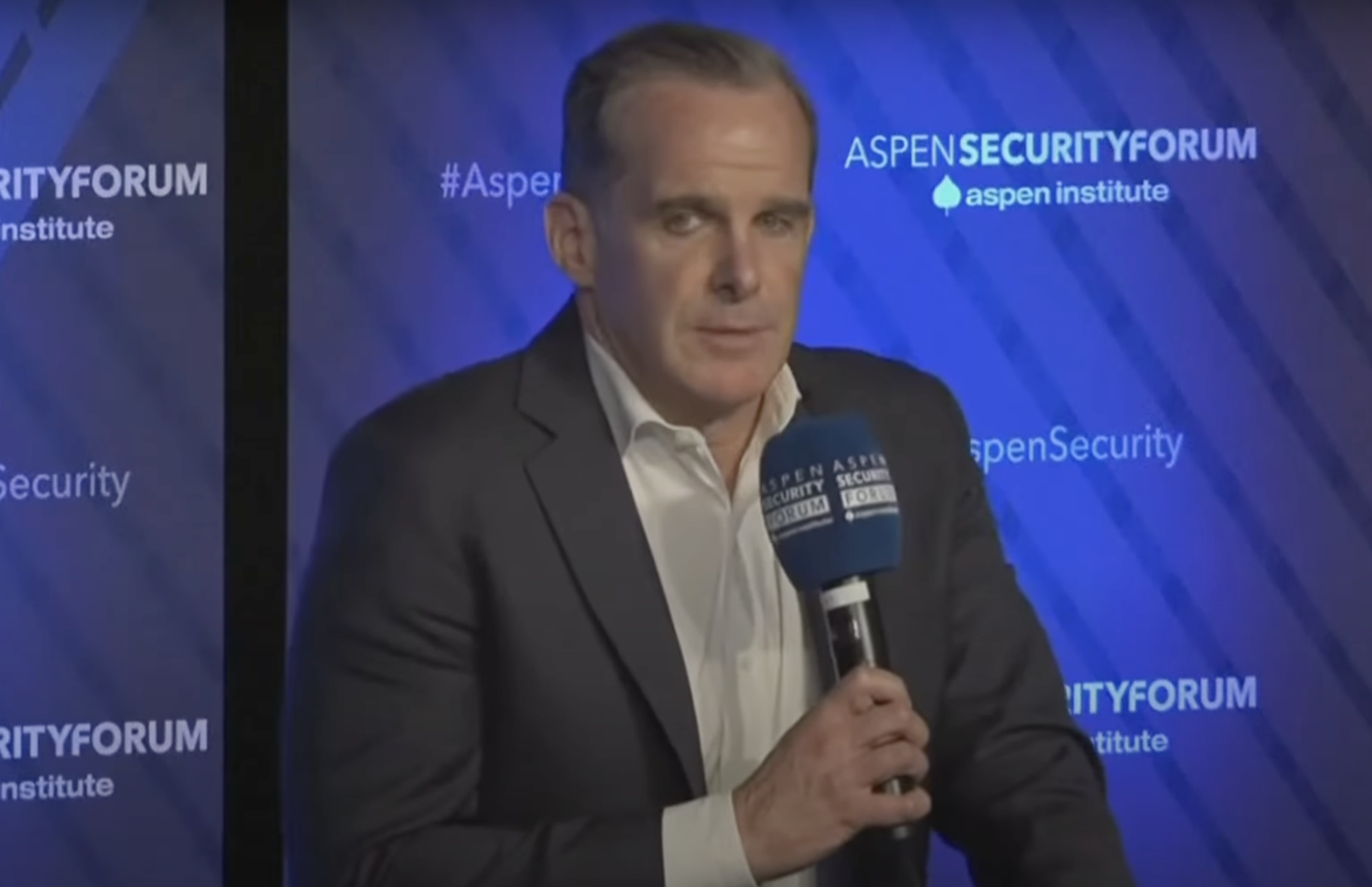
Former U.S. and Israeli officials speaking at the Aspen Security Forum on Wednesday emphasized that Hamas bears responsibility for the failure of hostage release and ceasefire talks, and discussed the possible paths to ending the war in Gaza, Jewish Insider’s Marc Rod reports from the conference. Brett McGurk, the top National Security Council official responsible for the Middle East under the Biden administration, argued on Wednesday that the history of ceasefire talks between Israel and Hamas “is being rewritten by people that weren’t involved in this.”
Missed opportunities: McGurk emphasized that Hamas repeatedly ignored and rejected proposals that fulfilled many of its demands over the course of the last year, arguing that Israel’s attacks on Hezbollah had helped force Hamas’ hand to a temporary ceasefire deal that went into effect in early 2025. “The moral toll of this awful situation tears at the soul of anyone who’s worked on this, anyone,” McGurk said. “But this war could have stopped multiple times if Hamas stopped the war and released hostages — multiple, multiple times.”
Looking ahead: Wally Adeyemo, the deputy secretary of the Treasury Department during the Biden administration, argued on an Aspen panel that postwar reconstruction of Gaza will require new tools, methods and partners.
UNDER THREAT
Israel strikes Syria ‘to halt the assaults against the Druze’

Israel struck the Syrian Defense Ministry’s headquarters in Damascus on Wednesday in response to violence against the country’s Druze minority, a week after Israeli Prime Minister Benjamin Netanyahu spoke in the White House of the “opportunity for stability, security and eventually peace” with Syria. The strikes came after clashes between Druze and Bedouin groups that began on Sunday, leaving as many as 250 dead over four days in Sweida, some 25 miles from the border with Israel and in the area of Syria that Israel seeks to have demilitarized, Jewish Insider’s Lahav Harkov reports.
Developments: Syrian government forces entered the fray on Tuesday, saying they aimed to stop the fighting and bring about a ceasefire, which they said they had reached on Wednesday. Syrian President Ahmed al-Sharaa, formerly the head of the Syrian branch of Al-Qaida, seeks to disarm Druze and other militias and have them integrate under the new government. Israeli Druze called for Israel to intervene from the outset of the violence on Sunday, saying that their Syrian counterparts were being massacred, raped and tortured by forces aligned with al-Sharaa. In Israel, videos and images circulated of Druze religious figures’ mustaches being forcibly shaved off by men in military fatigues. Secretary of State Marco Rubio said on Wednesday afternoon that Washington has “engaged all the parties involved in the clashes in Syria. We have agreed on specific steps that will bring this troubling and horrifying situation to an end tonight.”
Heard at Aspen: “Israel is in such an extraordinary position. … Think about Israel being born, created May 14, 1948, besieged over decades by attacks and enmity from all of its Arab neighbors, now the strongest country in the Middle East,” former U.S. Ambassador to China Nicholas Burns, a top foreign policy advisor to President Joe Biden, said in Aspen. “Israel’s in the strongest geopolitical position it’s ever been in, after the extraordinary events in Lebanon, in Gaza, in Iran, in Syria over the last two years.”
EXPLAINER
Netanyahu’s coalition is teetering – but his government is likely to last the year
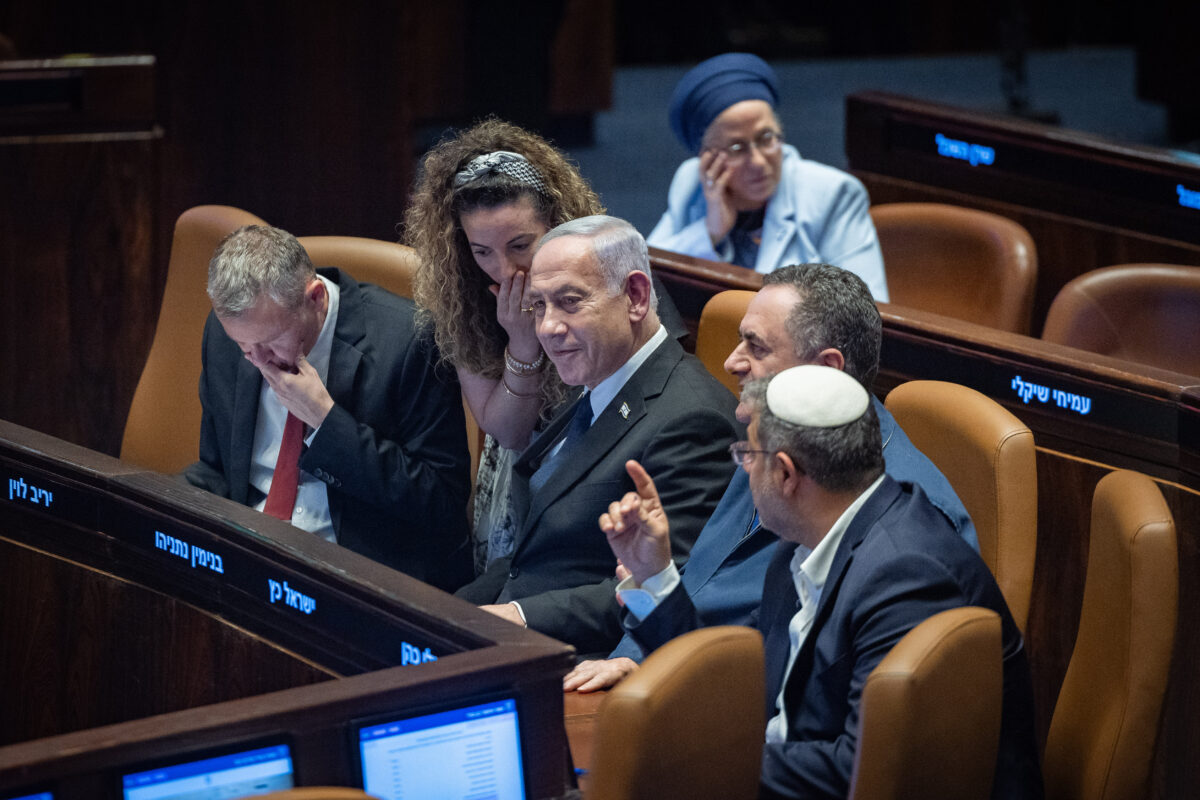
New Israeli elections are unlikely to happen this year, despite the departure on Wednesday of two parties from Israeli Prime Minister Benjamin Netanyahu’s government over disagreements over Haredi military exemption legislation, Jewish Insider’s Lahav Harkov reports. After months of disagreements, Ashkenazi Haredi faction United Torah Judaism left Netanyahu’s coalition in protest, leaving it with 61 out of the Knesset’s 120 seats.
Hanging on: On Wednesday, Sephardic Haredi party Shas’ five Cabinet ministers quit the government, though party leader Aryeh Deri will remain an observer in the Security Cabinet. Shas only quit the government — meaning its Cabinet posts — and did not pull its 11 lawmakers out of the parliamentary coalition. Shas, whose voter base is right-wing and even more supportive of Netanyahu than the prime minister’s own Likud party, said it will not vote with the opposition. This means that Netanyahu retains a majority in the Knesset, albeit a razor-thin one.
switching gears
Jewish Voice for Peace restructures, sets its sights on the ballot box

Jewish Voice for Peace, a far-left anti-Israel advocacy group that has built a growing profile in the wake of Hamas’ Oct. 7, 2023, terror attacks, is pivoting to a new organizational structure that will soon allow it to engage more forcefully in electoral politics. The group recently began the process of consolidating its membership and organizing in an affiliated but lesser-known political nonprofit called Jewish Voice for Peace Action, devoting the bulk of its resources to lobbying and political activities, such as supporting and opposing candidates that had not traditionally been a part of its core focus. As a nonpartisan tax-exempt group, JVP, which has been at the forefront of campus anti-Israel protests and promotes efforts to divest from Israel, has been legally prohibited from taking sides in campaigns — a limitation the new structural change is designed to address, Jewish Insider’s Matthew Kassel reports.
Behind the decision: The shift comes as the activist left has felt newly emboldened by Zohran Mamdani’s shocking victory in New York City’s Democratic mayoral primary in June, fueling debates over the ideological direction of the party as it gears up for next year’s midterms. JVP Action, which recently changed its public name to Jewish Voice for Peace to match its sister organization, was an early supporter of Mamdani and has cited his outspoken opposition to Israel as a sign of evolving voter attitudes about the Israeli-Palestinian conflict. “There is unprecedented, mass support for Palestinians. Our movement has already grown larger, and more quickly, than many of us thought possible. But it’s clear we have not begun to tap our full potential,” JVP writes in a detailed new page on its website about the decision-making behind its shift.
HILL TALK
House Armed Services Committee Democrats criticize Pentagon for rogue moves on Ukraine

Members of the House Armed Services Committee sparred on Tuesday at their annual meeting on the National Defense Authorization Act, the massive annual defense and national security policy legislation, over reportedly rogue actions by Secretary of Defense Pete Hegseth and Under Secretary Elbridge Colby to pause U.S. aid to Ukraine without White House knowledge or support, Jewish Insider’s Marc Rod reports.
Other developments: The committee also approved a series of amendments on the Middle East and antisemitism during its markup, and voted on party lines to defeat amendments seeking to block the conversion of a Qatari jumbo jet to be Air Force One and to take the Pentagon to task over the Signalgate scandal.
ALL IN THIS TOGETHER
Global oil market pressures restrained Israeli, Iranian attacks on oil infrastructure, analyst says
The pressures of the global oil market restrained Israel from bombing Iran’s Kharg Island oil facilities and Iran from closing the Strait of Hormuz or attacking Saudi Arabia’s Abqaiq oil facilities, an energy policy analyst argued at the Aspen Security Forum on Wednesday, Jewish Insider’s Marc Rod reports.
Explanation: “There was some measure of security that came from the fact that we’re in a global oil market and we’re all in this together,” Jason Bordoff, the founding director of the Center on Global Energy Policy at Columbia University, said on a panel on energy security. “If Iran had tried to do that, it would have imposed pain on itself, it would have imposed pain on China, it would have imposed pain on Gulf countries it was trying to keep on its side.”
Worthy Reads
Hamas’ MO: In Newsweek, former White House Middle East envoy Jason Greenblatt suggests that Hamas has committed “dehumanicide” against the Palestinian people. “I define ‘dehumanicide’ as when a people’s leadership condemns its population to death by treating them not as humans but as props. By camouflaging among civilians — placing weapons, tunnels, and command posts in and under hospitals, schools, mosques, and apartment buildings — Hamas has committed an act of dehumanicide. Hamas transformed civilian lives into strategic assets for international outrage. Hamas instrumentalized Gazans not as people to be protected, but as tools of their horrific, twisted, evil warfare. Hamas accepts these civilian deaths as the ‘cost of doing business.’ Indeed, Hamas welcomes the deaths because it knows the world will use them as cudgels against Israel so that Hamas can prolong its long war against the Jewish state.” [Newsweek]
MAGA Revisionism: In The Free Press, Rebeccah Heinrichs looks at the effort by “conspiracy theorists, cranks, and the craven” of the MAGA wing of the Republican Party to revise how Americans view their own history. “While Donald Trump reaffirms the principles that underpinned his first term — that America remains the leader of the world’s most successful military alliance (NATO), a committed supporter of the Jewish State, lead defender of the global commons, and is willing to use military force when necessary — he is increasingly out of step with a critical constellation of right-wing influencers, podcasters, and contrarian intellectuals. For them, America’s history as a global superpower is morally suspect, if not outright criminal. Our victories become losses, our alliances sinister entanglements, and our deterrence campaigns provocations. Why? Because they must revise the past to justify and satisfy their policy preferences in the present.” [FreePress]
Dear Zohran…: The New York Times’ Tom Friedman raises concerns about New York City Democratic mayoral candidate Zohran Mamdani’s continued defense of the phrase “globalize the intifada,” despite pushback from Democratic officials and the Jewish community. “First, if you are discussing a mantra — like ‘globalize the intifada’ — that takes 15 minutes to explain why it doesn’t mean what it obviously means, I’d suggest that you distance yourself further from that mantra. … When I see someone running for mayor defending a useless, meaningless, far-left mantra that helps no one, and who prefers commenting at a distance and not convening energetically, it makes me wonder how he will deal with the really hard issues on the West Bank of the East River — not the West Bank of the Jordan — that most New York voters care most about.” [NYTimes]
A Grieving Mother’s Plea: In The Hill, Leah Goldin, whose son Hadar was killed in 2014 by Hamas, which has held his body since, calls on Saudi Arabia and President Donald Trump to prioritize the release of the remaining 50 hostages in Gaza as Israel and Hamas work toward a ceasefire agreement and Trump looks to expand the Abraham Accords. “This week marks 4,000 days since Hadar’s abduction. In that time, I have knocked on the doors of leaders and diplomats around the world. I have appealed not only as a grieving mother but as a citizen of a country that shares the United States’s values of justice and humanity. … I beseech the president: use your influence to ensure that Saudi Arabia helps to bring them home. Peace and normalization will be your historic legacy in the Middle East, but they cannot come at the expense of the hostages. Their return is a critical confidence-building step toward the peace that you are building.” [TheHill]
Word on the Street
U.S. Ambassador to Israel Mike Huckabee made a brief appearance at Israeli Prime Minister Benjamin Netanyahu’s corruption trial in Jerusalem on Wednesday, telling reporters earlier in the day that the visit to court was “an act of friendship”; days prior, President Donald Trump had posted on his Truth Social site in support of Netanyahu, calling on the charges to be dropped or for the prime minister to be pardoned…
The International Criminal Court denied a request from Israel to withdraw the arrest warrants issued against Netanyahu and former Defense Minister Yoav Gallant while the court reviews Israeli challenges to the warrants…
A new American intelligence assessment indicates that American strikes on Iranian nuclear facilities last month largely destroyed Fordow, but left Natanz and Isfahan largely intact, albeit somewhat degraded…
New York City Democratic mayoral candidate Zohran Mamdani met on Wednesday with House Democrats, including Reps. Jerry Nadler (D-NY), Ayanna Pressley (D-MA) and Melanie Stansbury (D-NM) at a breakfast in Washington hosted by Rep. Alexandria Ocasio-Cortez (D-NY)…
New York Gov. Kathy Hochul told MSNBC that she had conveyed to Mamdani that he has “a lot of healing to do with the Jewish community” over his anti-Israel activism and support for rhetoric that is widely viewed by the Jewish community as incitement to antisemitic violence…
Les Wexner purchased Norman Foster’s Martha’s Vineyard estate for $37 million…
The New York Times profiles thriller filmmaker Ari Aster ahead of the theatrical release of his new film, “Eddington”…
The Modern Orthodox organization Uri L’Zedek, which has brought lessons from the Torah into the social justice ecosystem for nearly 20 years, is expanding into advocacy work in Washington, hoping to “lower the temperature” of the country’s partisan politics, eJewishPhilanthropy’s Nira Dayanim reports…
An Australian Muslim cleric, who was ordered by a court to cease giving inflammatory and antisemitic sermons, was ordered to prominently display notices detailing the court’s findings across the social media platforms of the Islamic center he oversees…
Tali Cohen is joining the Anti-Defamation League as the director of the group’s Washington office, following more than two decades at FEMA and the Department of Homeland Security…
Pic of the Day

The inaugural meeting of the Belgrade Strategic Dialogue: Serbia-United States-Israel Partnership was hosted by the Serbian National Assembly this week, attended by Serbian parliamentarians, Israeli Ambassador to Serbia Avivit Bar-Ilan, members of the Jewish community, business leaders and policy experts from the American Foreign Policy Council, Atlantic Council and AIPAC.
Birthdays
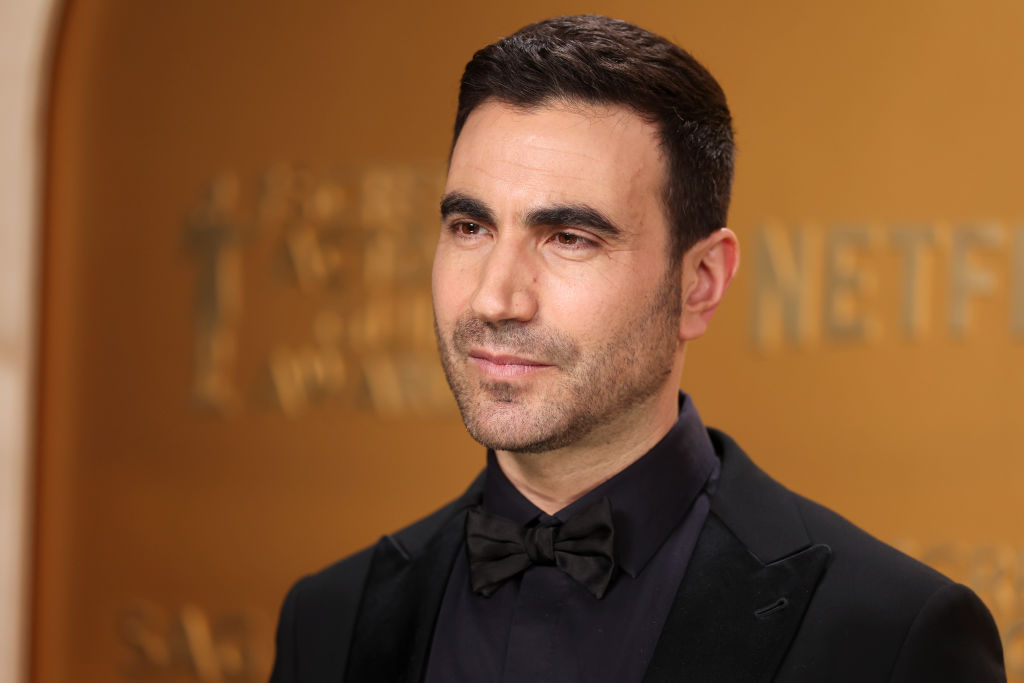
Emmy Award-winning actor and comedian, Brett Goldstein turns 45…
Chef and two-time James Beard Foundation Award winner, Joyce Goldstein turns 90… Professor emeritus at Tel Aviv University and former Israeli foreign minister, Shlomo Ben-Ami turns 82… Emmy Award-winning play-by-play announcer on radio and TV, currently with the Los Angeles Dodgers, Charley Steiner turns 76… Co-editor of The Big Book of Jewish Humor, Moshe Waldoks turns 76… Civil rights and criminal defense attorney, co-founder of the Innocence Project, Peter J. Neufeld turns 75… Rabbi emeritus at Reform Congregation Keneseth Israel in Elkins Park, Pa., Lance J. Sussman turns 71… Managing GP and co-founder of Pitango Venture Capital, Nechemia (Chemi) Peres turns 67… Television and film director, Joshua Seftel turns 57… Actress best known for playing Sharona on “Monk,” Bitty Schram turns 57… Rabbi of the Young Israel of Woodmere, N.Y., Shalom Axelrod turns 56… Founder and CEO of Zeta Global, David A. Steinberg turns 55… Stand-up comedian, Gary Gulman turns 55… Treasurer of Australia until 2022, now chairman of the Future Fund, Josh Frydenberg turns 54… Blogger, journalist, and science fiction author, Cory Doctorow turns 54… Member of the Knesset for the Yesh Atid party, Boaz Toporovsky turns 45… Para table tennis player and Paralympic gold medalist, Ian Seidenfeld turns 24… Arabella Rose Kushner turns 14…
Plus, interview with Rep. Greg Landsman

Chip Somodevilla/Getty Images
U.S. Census Bureau Director Robert Groves holds a news conference at the National Press Club August 25, 2011, in Washington, D.C.
Good Monday morning.
In today’s Daily Kickoff, we preview this week’s Capitol Hill hearing on campus antisemitism, and talk to experts about the possibility of a Saudi-Israeli normalization agreement. We interview Rep. Greg Landsman about the recent U.S.-Israeli strikes on Iran’s nuclear program, and report on Democratic National Committee Chair Ken Martin’s outreach to Jewish groups following his comments earlier in the week regarding Zohran Mamdani’s defense of the phrase “globalize the intifada.” Also in today’s Daily Kickoff: Amb. Charles Kushner, Sen. Joni Ernst and Elmo.
What We’re Watching
- Attendees of this year’s Aspen Security Forum are making their way to Colorado today, ahead of the start of the gathering tomorrow. Jewish Insider’s Marc Rod will be on the ground in Aspen — drop us a line if you will be as well.
- We’re also keeping an eye on stalled Israel-Hamas ceasefire talks amid reports that President Donald Trump and Qatari Emir Sheikh Tamim bin Hamad Al Thani were set to meet on the sidelines of yesterday’s FIFA finals in New Jersey. Read more here.
What You Should Know
A QUICK WORD WITH JI’S MELISSA WEISS
School may be out of session for the summer, but officials from Georgetown University, the University of California, Berkeley and the City University of New York will be in the hot seat this week when they testify on Tuesday before the House Education and Workforce Committee.
This is not the first time that university officials have appeared in front of Congress to account for the situations on their campuses, but this week’s hearing aims to focus on more than just the anti-Israel activism that has permeated many campuses since the Oct. 7, 2023, Hamas terror attacks on Israel and the ensuing war in Gaza to focus on root issues, including foreign funding in higher education as well as faculty anti-Israel organizing efforts.
With that as the backdrop, Georgetown’s interim president, Robert Groves, is likely to face hard-hitting questioning about the school’s donations from authoritarian regimes.
Nearly a decade ago, Georgetown took a $10 million donation from an organization connected to Beijing’s ruling Chinese Communist Party — more specifically, according to The Washington Post, to “the specific CCP organizations that manage overseas influence operations” — to establish the Initiative for U.S.-China Dialogue on Global Issues.
But that $10 million is a drop in the bucket compared to the amount of money Qatar is alleged to have sent to Georgetown. According to a study by the research institute ISGAP — which primarily focuses on progressive and Islamist antisemitism — Qatar has donated more than $1 billion dollars to the Jesuit school in recent decades. In addition, Qatar has long had a partnership with Georgetown that includes an outpost of the school in Doha. Earlier this year, the school extended its contract with Doha for another decade.
There’s a saying that has floated around many a conference, Jewish organizational board meeting and Shabbat dinner table in recent years: Jews endow buildings, their enemies endow what happens inside of them. Tomorrow’s hearing will see just how deeply those efforts have permeated.
normalization? not yet
After Iran strikes, Saudis in no rush to join Abraham Accords, experts say

One of the original drivers of the 2020 Abraham Accords was Israel’s vocal, public stance against Iran’s nuclear program and regional aggression. That stance also brought Israel and Saudi Arabia closer, a relationship that developed to the point that in the summer of 2023, it seemed like normalization was just around the corner. By extension, it might make sense for the Abraham Accords and a Saudi-Israel rapprochement to be back in the headlines after Israel took the ultimate stand against Iran’s nuclear program last month, bombing it with assistance from the U.S. Yet there has been almost no serious talk about Saudi Arabia joining the Abraham Accords in recent weeks, experts told Jewish Insider’s Lahav Harkov.
Saudi two-step: Riyadh has also been publicly signaling that its relationship with Tehran is still on track since China brokered a deal between the two countries in 2023. Saudi Arabia, like other Gulf States, spoke out last month against the Israeli and American airstrikes on Iran. Last week, Iranian Foreign Minister Abbas Araghchi met with Saudi Crown Prince Mohammed bin Salman in Jeddah. “There’s all this public condemnation of the attacks on Iran,” Bernard Haykel, a professor of Near Eastern studies at Princeton University, told JI, “but when the U.S. pulled its forces from the Air Force base in Qatar [due to Iran’s retaliation], they moved their planes to a Saudi base. So they condemned the U.S. for attacking Iran, but they also gave the U.S. protection.”
congressional conversation
Rep. Greg Landsman: Americans are ‘tired’ of partisanship on Iran and foreign policy
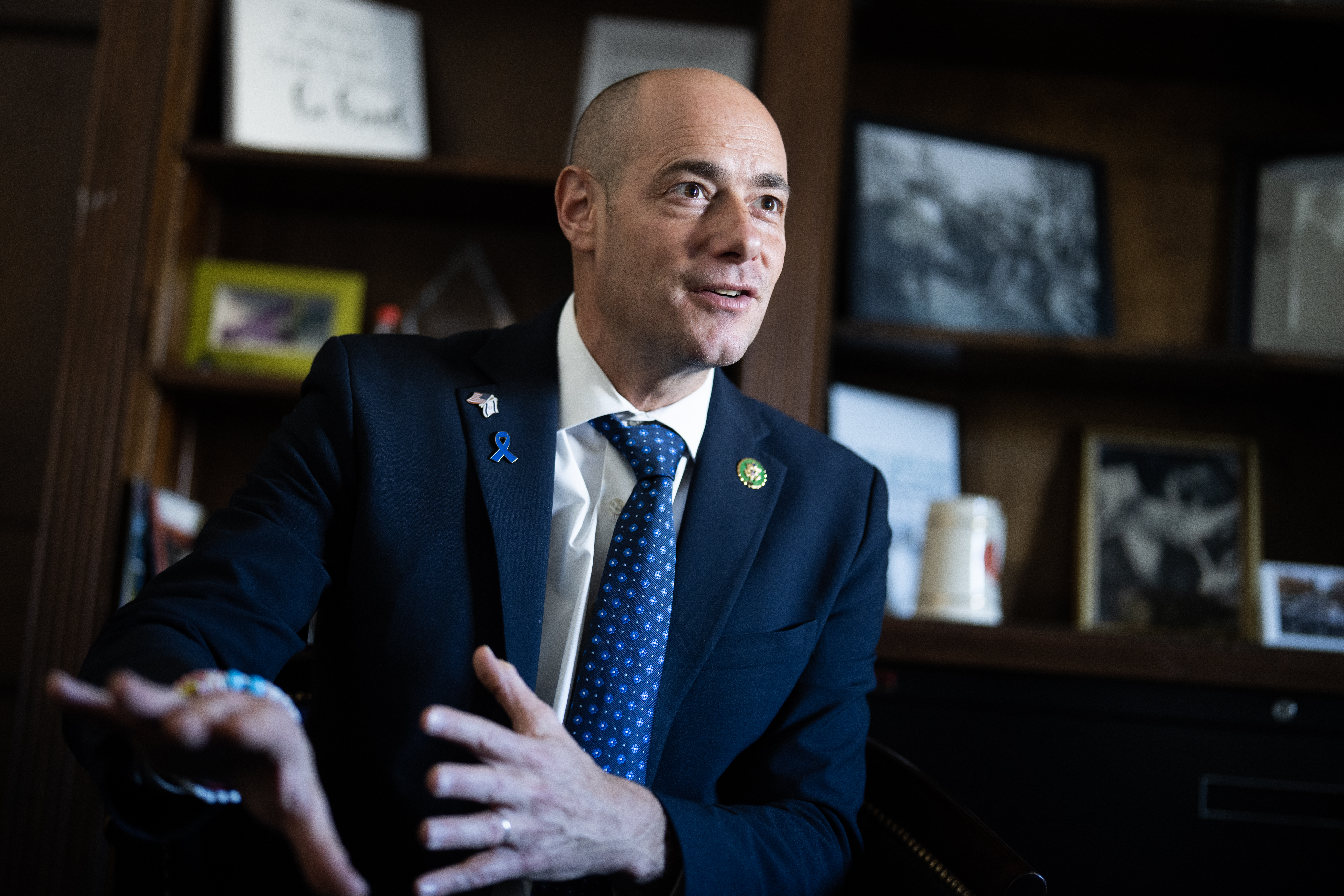
Rep. Greg Landsman (D-OH) has stood apart in recent weeks as one of a small number of congressional Democrats who’ve been supportive of the Trump administration’s strikes on Iranian nuclear facilities, Jewish Insider’s Marc Rod reports. Landsman told JI he thinks that his Democratic colleagues’ responses to the strikes are motivated by the current political environment, fears about a broader war and concerns about the future of diplomatic talks and the safety of people in the region.
Looking ahead: Landsman argued in an interview with JI last week and in a recent op-ed that the Israeli and American show of force, alongside the undermining of Iran’s proxies across the region, could be the key to weakening the Iranian regime to a point where it will agree to a fundamental change of course going forward, unlocking opportunities for regional peace and prosperity. “[The Middle East] should be Europe, [if not] for Iran,” he said. “It hasn’t been able to break out that way because Iran has been the primary obstacle.”
damage control
DNC Chair Martin calls Jewish leaders amid Mamdani fallout

Ken Martin, the chair of the Democratic National Committee, spent Friday calling Jewish leaders, seeking to reassure them that he does not condone the phrase “globalize the intifada,” two sources with knowledge of the meetings told Jewish Insider’s Gabby Deutch. Among the leaders he called were senior officials at the Anti-Defamation League and the American Israel Public Affairs Committee.
Harmful rhetoric: Earlier in the week, a “PBS NewsHour” clip of Martin discussing New York City Democratic mayoral nominee Zohran Mamdani went viral. In the Friday phone calls, two sources confirmed, Martin faced criticism from Jewish leaders over Martin not specifically addressing the “globalize the intifada” language during his PBS interview. But a DNC senior advisor told JI that Martin made clear he stood with them against the harmful rhetoric. “By the end of it there was an understanding that Ken does understand and is aligned with the community and that frankly people want full-throated leadership,” the advisor said. “This language isn’t about Democrats. This is just not acceptable, period, and as a party it’s not acceptable.”
Bonus: Jewish Insider’s Emily Jacobs talks to Jewish Democrats and organizations that represent them about Martin’s handling of the Wednesday “PBS NewsHour” interview and fallout from it.
allies in arms
Senate’s defense bill includes effort to advance Middle East air defense cooperation

The Senate Armed Services Committee’s draft of the 2026 National Defense Authorization Act, passed out of committee this week, includes provisions aimed at furthering coordinated air and missile defense efforts in the Middle East, Jewish Insider’s Marc Rod reports.
Pushing ahead: The amendment, led by Sen. Joni Ernst (R-IA), a co-chair of the Abraham Accords Caucus, instructs the Defense Department to submit to Congress a new report on implementing integrated air and missile defense infrastructure in the Middle East, including an assessment of threats; a summary of U.S. priorities and capabilities; and lessons learned from the Iranian ballistic missile attacks on Israel and the Houthi attacks in the Red Sea.
Read the full story here.Bonus: The House Armed Services Committee released its first draft of the 2026 NDAA on Friday. The bill would create an emerging technology cooperation program with Israel, extend the U.S. weapons stockpile in Israel and cooperative counter-tunneling programs through 2028, and expand counter-drone and missile cooperative programs and authorize increased funding. It would also expand U.S. support for the Lebanese Armed Forces and require a Pentagon briefing on Iran’s use of Western technologies in its drones.
history rewritten
AJC calls defacing of Jewish pogrom memorial ‘a test for Poland’s democracy’

The American Jewish Committee called for a “swift political response” following the placement of plaques at the Jedwabne memorial site in Poland that falsely accuse Jews of being responsible for killing Poles during the pogrom that occurred there 84 years ago last week, Jewish Insider’s Haley Cohen reports.
Background: At least 340 Jews were burned alive by their Polish neighbors in the massacre at Jedwabne on July 10, 1941. Marking the anniversary of the attack last Thursday, right-wing activist Wojciech Sumliński and his supporters illegally placed plaques in English and Polish several yards from the memorial, offering a revisionist account of what happened at the site. One of the plaques reads, “After the Soviets took over eastern Poland, Jews assumed administrative roles and, knowing the local realities, denounced Polish patriots who were then deported and murdered by the Soviets. Only the German attack on the Soviet Union halted these repressions. Then the Germans began killing Jews just as they had previously killed Poles by the millions.”Read the full story here.
camp comedy
Summer camp nostalgia hits the big screen in ‘The Floaters’

As summer heats up, Jewish adults looking for an escape from the fraught state of world Jewry may find themselves reflecting on a seemingly simpler time — getting competitive over color war or gaga ball and singing Debbie Friedman songs around a campfire at Jewish sleepaway camp. That sense of nostalgia for one’s Jewish summer camp years is doled out liberally in “The Floaters,” a new film that centers on the fictional Camp Daveed and a group of outsider teens called “floaters,” Jewish Insider’s Haley Cohen reports.
Art imitating life: “We try to push the movie beyond lox and bagels,” co-producer Shai Korman told JI, noting that he and his co-producers — his two sisters — specifically aimed to “put on-screen Jewish women that exemplified the Jewish women that raised us, that were leaders and mentors.” Camp Daveed is run by women, from camp director Mara to the camp’s rabbi, Rabbi Rachel. Several iconic films, such as “Wet Hot American Summer” and “Meatballs,” were also inspired by Jewish camps. But in “The Floaters,” “we talk about the rules of kashrut,” Korman said. “You see Orthodox and secular kids all together, reflecting the world we grew up in.”
Worthy Reads
R&D Nation: In the Financial Times, Ruchir Sharma observes Israel’s rise as a regional economic superpower despite nearly two years of war. “Perhaps the most telling sign of its dynamism is that Israel now spends more than 6 per cent of GDP on research and development — more than any other nation and over double the global average. An unusually high share — about half — of that R&D funding comes from foreign multinationals, many involved in defence-related industries. … To many observers, the geopolitical situation in the Middle East still seems precarious. But the market’s optimistic take on Israel’s tech-driven economy is now showing up in economists’ forecasts, which are projecting growth at nearly 4 per cent in coming years. That’s relatively strong for a developed nation. It validates the market view that Israel is cementing its status as the region’s dominant economic force.” [FT]
FIDF Scandal Fallout: eJewishPhilanthropy’s Judah Ari Gross looks at how recent concerns over alleged mismanagement and financial impropriety at Friends of the Israeli Defense Forces has “provided ample ammunition” to observers critical of legacy Jewish organizations. “Though always present in communal discourse, the tear-it-all-down-and-start-again voices have gained strength since the Oct. 7 Hamas terror attacks and the subsequent rise in global antisemitism, and not without cause. … Legacy institutions, with their galas and boards and committees and well-paid executives, are an easy target. These established organizations have often failed to defend their size and bureaucracy, or even acknowledge that alongside the stability and internal checks that they provide, those things do make them slower to react and pivot in an emergency.” [eJP]
The World to Come: In his “Jerusalem Journal” Substack, Avi Mayer considers the possibility of a post-Zionist America. “Critiques of Israeli policy, no matter how strident or widespread, do not automatically lead to the wholesale rejection of Israel or the negation of Jewish self-determination. But if current trends continue, and if voting patterns start to reflect the shifting views of the electorate, we may find ourselves in uncharted territory. The ramifications of a changed America could be wide-ranging, deeply impacting both American Jewish life and Israeli national security. An America that is intolerant of a core element of contemporary Jewish identity would be a place in which American Jews would feel — and be made to feel — increasingly uncomfortable. From the Soviet Union to the Middle East to western Europe, hostility to Zionism on the part of national leaders and elites has always precipitated societal antisemitism, forcing Jews to confront painful dilemmas.” [JerusalemJournal]
Word on the Street
Speaking at a Turning Point USA student conference in Florida over the weekend, far-right commentator Tucker Carlson suggested that Americans who served in the Israeli Defense Forces “should lose their citizenship,” adding that he believed a person “can’t fight for another country and remain an American, period”…
A hacker took over the X account of “Sesame Street” character Elmo, posting a series of profane, racist and antisemitic comments; the posts included a message to “kill all Jews” and another that described President Donald Trump as a “puppet” of Israeli Prime Minister Benjamin Netanyahu…
xAI, the AI company affiliated with X owner Elon Musk, said that its Grok chatbot had undergone a coding update that modified what information it was taking in, making Grok “susceptible to existing X user posts; including when such posts contained extremist views”; the chatbot had spewed a series of antisemitic and sexually explicit posts over a period of several days last week…
A new survey from the Anti-Defamation League found that 1 in 4 Americans consider recent antisemitic attacks in the U.S. to be “understandable,” while three-quarters of those surveyed want the government to take more action against antisemitism…
Pennsylvania Democrat Jenelle Stelson is mounting a second congressional bid against Rep. Scott Perry (R-PA), to whom she lost by less than a percentage point in the 2024 election; read our interview with Stelson during her campaign last summer…
The U.S. Board on Geographic Names approved the renaming of an Alaskan waterway that had been named Nazi Island by the U.S. Air Force during World War II…
The Financial Times reports that the Boston Consulting Group was paid more than $1 million for its work on a Qatari-backed project led by former American military veterans to bring aid into Gaza by sea…
French President Emmanuel Macron and Saudi Crown Prince Mohammed bin Salman are not expected to attend an upcoming rescheduled conference on Palestinian statehood; the initial conference had been canceled following the onset of the Israel-Iran war.
The BBC spotlights Punjabi businessman Kundanlal Gupta, who during World War II saved more than a dozen Austrian Jews by creating fictitious job offers in India, providing those “hired” with a way to escape Nazi Europe…
New satellite images indicate that Iran struck an American storage facility that contained secure communications equipment on the Al Udeid base in Qatar during its attack on American targets last month…
Iranian state media alleged that Israel attempted to assassinate Iranian President Masoud Pezeshkian during last month’s war; Pezeshkian reportedly suffered a leg wound in the Israeli strike on a meeting of Iran’s Supreme National Security Council…
Russian President Vladimir Putin has reportedly told leaders in Washington and Tehran that Moscow backs a nuclear deal with Iran that forbids the Islamic Republic from enriching uranium…
Iranian Foreign Minister Abbas Araghchi said on Saturday that Tehran would be open to returning to nuclear talks in exchange for the guarantee that it would not face further attacks; Iran also said it would be open to International Atomic Energy Agency inspections, days after the country’s parliament passed a law tightening restrictions around international inspections…
A Palestinian-American man from Florida who was visiting family in the West Bank was killed in clashes with settlers…
A Filipino woman who worked as a caretaker in Rehovot, Israel, died as a result of injuries sustained in an Iranian ballistic missile strike last month; Leah Mosquera’s death brings the number of fatalities in Israel as a result of the 12-day war to 29…
Israel’s Transportation Ministry estimated that Ben-Gurion Airport will see 3.4 million travelers over the course of this summer, a drop of nearly 2 million passengers from the summer before the Oct. 7, 2023, Hamas terror attacks and ensuing war…
Charles Reinhart, the former director of the American Dance Festival, died at 94… B Lab founder Andrew Kassoy, who pushed the concept that capitalism could promote social good, died at 55… Physicist Daniel Kleppner, whose work on atomic clock accuracy helped shape the use of GPS systems, died at 92… Sports journalist Samuel Abt, who covered the Tour de France for more than three decades, died at 91…
Pic of the Day

U.S. Ambassador to France Charles Kushner visited the Memorial de la Shoah in Paris last week in what he said was his “first stop” after arriving in the country.
Birthdays

MLB pitcher for 11 seasons, now a sportscaster and author, he won the Cy Young Award and was an MLB All Star in 1980, Steve Stone turns 78…
Architect and urban designer, Moshe Safdie turns 87… Los Angeles resident, Susan Farrell… Film producer, best known for the Lethal Weapon series, the first two “Die Hard” movies and the Matrix trilogy, Joel Silver turns 73… Film and theatrical producer, in 2012 he became the first producer to have won an Emmy, Grammy, Oscar and Tony Award, Scott Rudin turns 67… Co-founder and managing director of Beverly Hills Private Wealth, Scott M. Shagrin… United States secretary of commerce, Howard Lutnick turns 64… Venture capitalist at Breyer Capital, James W. Breyer turns 64… Media columnist for the Chicago Tribune until 2021, Phil Rosenthal turns 62… U.S. Permanent Representative to the U.N. Human Rights Council during the last three years of the Biden administration, she is the daughter and granddaughter of Holocaust survivors, Ambassador Michèle Taylor turns 59… Illustrator and author best known as the writer of The Invention of Hugo Cabret, Brian Selznick turns 59… Principal at Full Court Press Communications, Daniel Eli Cohen… Member of the Washington state Senate until 2023, David S. Frockt turns 56… President and CEO at the Jewish Federation of Greater Houston, Renee Wizig-Barrios… Rapper and record producer from Brooklyn known as “Ill Bill,” he is the producer, founder and CEO of Uncle Howie Records, William “Bill” Braunstein turns 53… Professor in the department of genetics at the Harvard Medical School, David Emil Reich, Ph.D. turns 51… Chief operating officer at Aish Global, Elliot Mathias… Fashion designer and cast member on “The Real Housewives of Beverly Hills,” Dorit Kemsley turns 49… Retired mixed martial artist, now a life coach, Emily Peters-Kagan turns 44… Co-founder and executive chairman of Pinterest, Ben Silbermann turns 43… Editor-in-chief of the Washington Free Beacon, Eliana Yael Johnson… Interior designer and owner of Tribe By Design, Tehillah Braun… Professional golfer with four tournament wins in the Asian and European tours, David Lipsky turns 37… Founder at Bashert Group and head of a NYC-based family office, Daniel B. Jeydel… AVP for grantmaking at Hillel International, she recently joined the board of the Siegel JCC of Delaware, Rachel Giattino… Reporter covering housing and the home building industry for The Wall Street Journal, Nicole Friedman… Director of Chabad Georgetown, Rabbi Menachem Shemtov… Creator of the Instagram feed called Second Date Shadchan, Elizabeth Morgan (Lizzy) Brenner… Collegiate basketball star for Princeton and Maryland, now playing for Maccabi Bnot Ashdod of the Israeli Women’s Basketball Premier League, Abby Meyers turns 26…
Martin sought on Friday to clarify his comment made earlier in the week on ‘PBS Newshour’

Rod Lamkey, Jr./AP
Democratic National Committee chairman Ken Martin speaks after winning the vote at the Democratic National Committee winter meeting at the Gaylord National Resort and Convention Center in National Harbor, Md., Feb. 1, 2025.
Democratic National Committee Chairman Ken Martin defended himself on Friday amid criticism that his response to a question about New York City Democratic mayoral nominee Zohran Mamdani’s refusal to condemn the “globalize the intifada” slogan did not sufficiently express his own view that the phrase should be condemned.
“The right-wing lie machine is at it again. That’s not what I said in this interview. I’ve never supported or condoned the phrase ‘globalize the intifada’, a phrase which is reckless and dangerous, as it can been [sic] seen as a green light to terror, and it should be unequivocally condemned,” Martin wrote in a response on X to the Washington Free Beacon.
“Let me be clear, at a time of rising antisemitism, there’s no place for rhetoric that can be seen as a call to violence,” he added.
Several Jewish Democrats and organizations that represent them defended Martin’s handling of the Wednesday “PBS NewsHour” interview fallout.
Halie Soifer, CEO of the Jewish Democratic Council of America, told Jewish Insider on Friday that, “We welcome the clarification from Chair Martin that the phrase ‘globalize the intifada’ is reckless and dangerous because it can be seen as a green light to terror. Chair Martin has never supported or condoned this phrase, and has now made it clear that there’s no place for rhetoric that can be seen as a call to violence in the Democratic Party.”
“He also said that this phrase should be unequivocally condemned, and we would like to see all Democrats do exactly that,” Soifer told JI.
The Democratic Majority for Israel said in a statement that the group “appreciates the recognition by DNC chair Ken Martin that the phrase ‘Globalize the Intifada’ is a dangerous call to incite violent action against Jews & Israelis.”
“During the last two intifadas, thousands of innocent Israelis — Arabs and Jews — were victims of Palestinian terrorism. Words have meanings, and the meaning of that phrase is clear to those who have experienced the intifadas. This incitement of violence should never be acceptable and must be condemned unequivocally,” the statement continued.
Martin’s Friday comment was met with criticism from several Jewish Democrats.
Georgia Democratic state Rep. Esther Panitch took issue with the DNC chairman’s response, writing on X, “I am not right-wing, and I know what I heard. You have welcomed the person who refused to condemn the phrase you call dangerous. Why?”
Sara Forman, the executive director of the New York Solidarity Network, an organization representing Jews in New York, criticized Martin in a lengthy X post on Friday for his handling of the interview question and his subsequent tweet clarifying his position.
“There is no excuse the chair of @TheDemocrats could come up with to put the toothpaste back into the tube. Ken Martin is the chair of the DNC and his idiotic ‘big tent’ comment is now a party position with a high cost – the loss of normal Democrats around the country,” Forman wrote.
“Incumbents will be held accountable for his words against Republican challengers who will make it very difficult and expensive to hold swing districts. And D challengers will be playing right into the hands of their Republican incumbent opponents when they distance themselves from his comments,” she continued. “For a party chair to fundamentally misunderstand his role, which is to fundraise so Democrats can win elections, is insane.”
The Ohio Democrat suggested the responses to the strikes from within his party are motivated by the current political environment, fears about a broader war and concerns about the future of diplomatic talks and the safety of people in the region
Tom Williams/CQ-Roll Call, Inc via Getty Images
Rep. Greg Landsman (D-OH) is interviewed by CQ-Roll Call, Inc via Getty Images in his Longworth Building office on Friday, November 3, 2023.
Rep. Greg Landsman (D-OH) has stood apart in recent weeks as one of a small number of congressional Democrats who’ve been supportive of the Trump administration’s strikes on Iranian nuclear facilities.
He argued in an interview with Jewish Insider last week and in a recent op-ed that the Israeli and American show of force, alongside the undermining of Iran’s proxies across the region, could be the key to weakening the Iranian regime to a point where it will agree to a fundamental change of course going forward, unlocking opportunities for regional peace and prosperity. And, he said, it’s critical that the U.S. move forward in a truly unified and bipartisan manner to capitalize on that opportunity.
Landsman told JI he thinks that his Democratic colleagues’ responses to the strikes are motivated by the current political environment, fears about a broader war and concerns about the future of diplomatic talks and the safety of people in the region.
“We’re just in a different political environment than the one I grew up in,” Landsman, 48, said. “The one I grew up in was ‘politics stops at the water’s edge,’ which I loved. … The thinking behind it … is that when we take on these really complicated foreign policy issues, that we do it in a bipartisan way, and that’s not the environment we live in right now.”
He said there’s also a “legitimate concern that it would provoke further attacks or it would instigate a broader war.” Landsman has argued that the current situation is fundamentally different from the run-up to the Iraq war that many skeptics of the strikes have invoked.
Some colleagues, he added, may have also had concerns about compromising diplomatic efforts or “legitimate concerns for people’s safety. But I think for others, and for a lot of folks, it’s just political,” he said.
Landsman said he still hews to the older approach, believing that it’s critical to work toward bipartisan common ground in critical foreign policy questions. He highlighted that the American people overwhelmingly oppose the prospect of an Iranian nuclear weapon.
“I think the American people want [our Middle East policy] to be bipartisan, all of it,” Landsman said. “I think they’re tired of the partisanship in general, but in particular, as it relates to how we resolve these international conflicts and how we take advantage of international or global opportunities, I think they are done with all of this being so partisan.”
He said he still believes a diplomatic solution with Iran is possible and necessary, but said the regime needed to be weakened and see that the U.S. is willing to use force in order to agree to totally dismantle its nuclear program and allow comprehensive international inspections and to dismantle its terrorist proxies .
Unlike some supporters of the strikes, Landsman said he doesn’t think regime change in Iran is the most productive goal, and that the U.S. should instead leverage the regime’s vulnerability for a more favorable deal and fundamental change to the regime’s posture.
“This regime wants to stay in power. If they decide — which they can, and now they’re so weakened that it’s an easier decision for them, and that’s why the strikes were important — they can decide, ‘We’re going to focus on the Iranian people’” and abandon terrorism and their ambitions to destroy Israel, Landsman said. “They could unlock the talent of tens of millions of incredibly brilliant people that have been stuck in Iran under this regime.”
He said that achieving that will “require real engagement and leadership” from both Congress and the executive branch.
Landsman has proposed establishing a bipartisan and bicameral congressional committee to work toward Middle East peace, and argued that the administration needs an expanded team working on the issue, describing Middle East envoy Steve Witkoff as stretched too thin.
“They need to lay out a vision for ending hostilities with Iran and ending the war in Gaza and giving people a sense of what will happen next in terms of peace and stability and security,” Landsman said.
The congressman argued that these issues are too difficult and too important for Congress to be excluded, or to be treated in a partisan manner. He pushed for deep and ongoing executive branch engagement with Congress, not just providing briefings, but in strategizing and building a lasting solution going forward.
Finally putting the Iranian threat to bed would set the Middle East on a fundamentally different course, Landsman argued. “[The Middle East] should be Europe, [if not] for Iran. It hasn’t been able to break out that way because Iran has been the primary obstacle.”
“Getting to a point where Iran is slowly but surely being removed as a threat opens up all the doors,” he said. “It just changes the dynamic for everybody.”
He said he believes leaders across the region see a path toward ending the war in Gaza and the long-running conflicts and building “a Middle East that’s entirely free from terror and countries are working together” and prospering.
In spite of the deep divisions that have increasingly characterized discussions in the United States on Israel and the Middle East since the Oct. 7, 2023, terror attacks, Landsman said he still believes that “the list of what we agree on is way bigger than the list of what folks may disagree on.”
The points of agreement across the American political spectrum include: that Iran cannot have a nuclear weapon; that Iran needs to be subject to stringent inspections; that Iran needs to cease its support for terrorists; that Hezbollah must be disarmed; that the war in Gaza needs to end; that the hostages need to be returned; that Hamas needs to be removed from power; and that international investment in collaboration with Israel and non-Hamas Palestinian leaders is needed to move Gaza forward.
“More international pressure can be brought to bear on Iran and Hamas and Hezbollah and the Houthis to separate them … and say ‘The world has come together. We are going to pick the side of those who want to rebuild the region and rebuild it free of terror and corruption,’” Landsman said. “Ultimately, when you have the kind of security that any country would need and expect, then you get back to the negotiating table.”
Landsman has spoken on multiple occasions in recent months about his aspirations for an abiding peace in the Middle East, a vision that he says is driven by a lifetime of connection and passion for Israel and the region.
He said his Jewish upbringing had inculcated in him a sense of connection to the importance of Israel for the Jewish people.
Landsman said that efforts to negotiate between Israel and the Palestinians were also a constant feature of his youth, and that he believes that there is still broad agreement on the goal of a durable peace that can provide security for Israel and self-determination and self-governance for the Palestinians.
A Harvard Divinity School graduate, the Ohio congressman has visited Israel numerous times as a lawmaker, but also traveled there frequently and built connections in his previous work in education advocacy. After implementing new preschool programs in the Cincinnati area, Landsman was asked to help work with Ethiopian Israelis to improve educational outcomes, an effort that grew between 2015 and 2020.
He said his time on the ground in Israel showed him that Jews and Palestinians “have a lot in common” — shared history, a shared home and common experiences of expulsion and rejection. And it highlighted to him the extent to which Arab Israelis are part of and integrated into Israeli society.
“I have built up this legitimate affection and love for these two communities of people that, because of circumstance, have been fighting,” Landsman said. “Ending that would transform everything — not just their lives, but the region and the world.”
The progressive lawmaker eked out a victory in a politically evolving district that swung heavily to Trump. Now she’s facing a highly touted GOP challenger
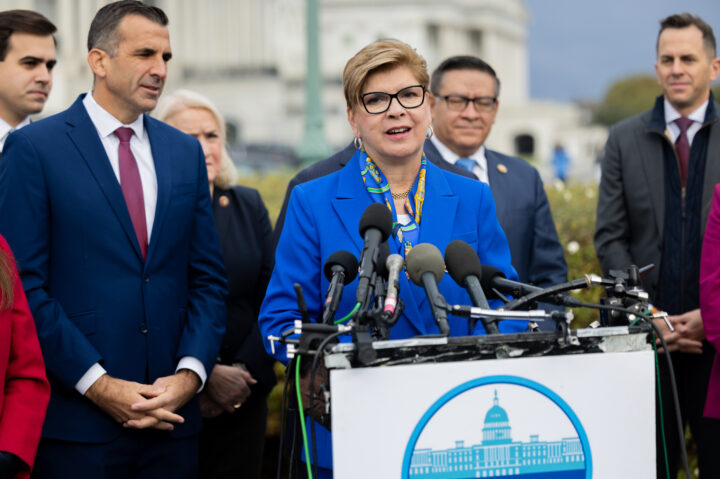
Nathan Posner/Anadolu via Getty Images
Rep.-elect Nellie Pou (D-NJ) speaks during a press conference introducing new members of the Congressional Hispanic Caucus in Washington, DC on November 15, 2024.
Rep. Nellie Pou (D-NJ) starts out her first re-election campaign at a crossroads: Running in a historically deep-blue district that President Trump surprisingly carried, she’s caught between her background as a liberal leader and the pressures of a purple district that could pull her toward the political middle to preempt Republican opposition.
Pou — who has never faced such a competitive general election in her political career — has generally leaned left while keeping a relatively low profile on the Hill. She joined the Congressional Progressive Caucus and stuck with the majority of her party on many key votes, including some pertaining to antisemitism and Israel that divided the Democratic caucus. She now faces a well-credentialed GOP challenger — Clifton, N.J., councilmember Rose Pino — as the Republican Party hopes to keep her urban north New Jersey district on its target list.
Despite representing a district with a sizable Jewish population, she didn’t join many of the moderates in her party in voting for a Republican-led resolution last month condemning the antisemitic attack in Boulder, Colo., urging stronger enforcement of immigration laws and supporting Immigration and Customs Enforcement.
The Boulder resolution split the Democratic caucus, with 75 lawmakers voting for the resolution and 113 voting against it. Some Democrats objected to the immigration-related language.
Pou, and nearly all other Democrats, voted in favor of a second resolution condemning a series of recent antisemitic attacks without that language.
“Congresswoman Pou believes that the rise of antisemitism in the United States and across the world is alarming and unacceptable. That’s why Congresswoman Pou voted in favor of a resolution on the House floor fully condemning antisemitism,” Pou spokesperson Mark Greenbaum told Jewish Insider. “And it’s why she is using her position on the Homeland Security Counterterrorism and Intelligence Subcommittee to demand increased funding for law enforcement to keep our Jewish communities safe and greater federal grants for synagogues and schools to upgrade their security.”
Pou also voted earlier this year against sanctioning the International Criminal Court, another vote that split House Democrats. Forty-five Democrats supported the sanctions.
But she has joined other efforts to support Israel and the Jewish community during her tenure, including signing a letter urging prompt federal approval of additional flights by Israeli airlines between the U.S. and Israel and calling for $500 million in funding for the Nonprofit Security Grant Program in 2025.
Pou’s district, New Jersey’s 9th, has both significant Jewish and Palestinian constituencies. Rep. Bill Pascrell (D-NJ), Pou’s predecessor who died in August 2024, faced a primary challenge from Prospect Park, N.J., Mayor Mohamed Khairullah, who focused his campaign squarely on criticizing Pascrell’s support for Israel.
Pou was tapped by New Jersey Democratic leaders to replace Pascrell on the ballot after the congressman died during the election cycle — and they assumed she would face little opposition in future elections.
Pou’s district was considered a safe Democratic seat before the election, and Trump’s performance came as a surprise to Democrats, leaving Pou, the former majority leader in the state Senate, on guard as she prepares to defend her seat next year.
Pou told the New Jersey Globe she takes political pressures into consideration on divisive votes, “But I also think it’s [about] doing the right thing.”
“Politics is very important, and I would love to make sure I have the opportunity to return back to Congress,” Pou said. “But I also think that we are here to do a job, and that we should be doing it with the right reasons in mind.”
Pino, a leading GOP recruit, announced her campaign on Thursday. Pino is a longtime local official and the child of Ecuadorian immigrants. Pou herself is the first Latina woman from New Jersey to serve in Congress. The district has a sizable Hispanic population.
Republican Billy Prempeh, whom Pou beat by five percentage points in the 2024 election, is also running again. Prempeh was endorsed by the New Jersey chapter of the Council on American-Islamic Relations last year and supported cutting off U.S. aid to Israel to stop the war in Gaza; opposed Israeli strikes on Gaza, saying in part, “I’m not dying for Israel”; and opposed the Antisemitism Awareness Act.
Andre Sayegh, the mayor of Paterson, N.J., who called his city “the capital of Palestine in the United States of America” and has been critical of Israel, is a potential primary challenger to Pou.
Pou’s re-election campaign raised $500,000 in the second quarter, reporting $780,000 on hand.
Trump won the district by a point, after President Joe Biden won it by nearly 20 points in 2020. Pou’s margin of victory was also substantially smaller than Pascrell’s in previous races, and Republicans see her as a top target in 2026.
“Nellie Pou went to Congress pledging to be a friend of Israel and the Jewish community, but that was a pledge she never intended to keep,” National Republican Campaign Committee spokesperson Maureen O’Toole said. “The truth is, Pou is backed and bankrolled by rabid antisemites, and her vote … makes it clear that she stands with them. Nellie Pou won’t be sitting in her Trump-won district much longer.”
The Democratic Congressional Campaign Committee pushed back, noting her vote in favor of the second antisemitism resolution that passed the House nearly unanimously.
“Congresswoman Nellie Pou has been outspoken on combatting antisemitism and joined Republicans and Democrats in voting for a bipartisan resolution to condemn the horrific attack in Boulder, Colorado,” a DCCC spokesperson told JI. “Nellie is working hard to lower costs and deliver for New Jersey’s 9th District, which is exactly what her constituents elected her to do.”
The DCCC spokesperson also highlighted Pou’s work in supporting police funding and opposing the GOP reconciliation bill.
Martin said the Democratic Party should be a ‘big tent’ that includes ‘new’ leftists
Rod Lamkey, Jr./AP
Democratic National Committee chairman Ken Martin speaks after winning the vote at the Democratic National Committee winter meeting at the Gaylord National Resort and Convention Center in National Harbor, Md., Feb. 1, 2025.
Democratic National Committee Chairman Ken Martin declined on Wednesday to criticize New York City Democratic mayoral nominee Zohran Mamdani’s refusal to condemn the “globalize the intifada” slogan. The DNC chair, who was elected earlier this year, praised the party for being a “big tent” comprising different ideologies, including “leftists” such as Mamdani.
Asked during a “PBS NewsHour” interview about concerns from Jewish Democrats regarding Mamdani’s refusal to condemn the phrase, Martin replied, “There’s no candidate in this party that I agree 100 percent of the time with, to be honest with you. There’s things that I don’t agree with Mamdani that he said.”
Martin said that he had learned through his 14 years as chairman of the Minnesota Democratic Party and his tenure at the DNC “that you win through addition. You win by bringing people into your coalition. We have conservative Democrats. We have centrist Democrats. We have labor progressives like me, and we have this new brand of Democrat, which is the leftist.”
“We win by bringing people into that coalition. And at the end of the day, for me, that’s the type of party we’re going to lead. We are a big tent party. Yes, it leads to dissent and debate, and there’s differences of opinions on a whole host of issues. But we should celebrate that as a party and recognize, at the end of the day, we’re better because of it,” Martin said.
Martin also argued that national Democrats could learn from Mamdani’s primary campaign performance in terms of focusing their message away from President Donald Trump and toward a forward-looking vision.
“He campaigned for something. And this is a critical piece. We can’t just be in a perpetual state of resisting Donald Trump. Of course, we have to resist Donald Trump. There’s no doubt about it for all the reasons we just talked about. But we also have to give people a sense of what we’re for, what the Democratic Party is fighting for, and what we would do if they put us back in power,” Martin said.
“One of the lessons from Mamdani’s campaign is that he focused on affordability. He focused on a message that was resonant with voters and he campaigned for something, not against other people or against other things. He campaigned on a vision of how he was going to make New York City a better place to live,” he continued.
Martin praised the methods by which Mamdani’s campaign got its message out.
“The other lessons, of course, is the tactics he used to get his message out, both a very aggressive in-person campaigning, meeting voters where they’re at, and then also in those digital spaces, using very creative messaging to cut through the noise and to get to voters in an inexpensive but authentic way,” he said.
Plus, Sergey Brin: ‘Genocide’ term deeply offensive

Nathan Posner/Anadolu via Getty Images
Elbridge Colby, nominee to be Under Secretary of Defense for Policy, is seen ahead of his confirmation hearing at the Senate Committee on Armed Services in Washington, DC on March 4, 2025.
Good Wednesday morning.
In today’s Daily Kickoff, we report on Israeli Prime Minister Benjamin Netanyahu’s ongoing Washington meetings, and talk to Republican senators about the White House’s about-face on providing defense aid to Ukraine. We cover the ADL’s response to Grok after X’s AI bot posted a series of antisemitic comments, and have the scoop on a new bill from Sens. Jacky Rosen and Jim Banks to replenish the U.S. weapons stockpile in Israel. Also in today’s Daily Kickoff: Sergey Brin, Dean Kremer and Sarah Hurwitz.
What We’re Watching
- Israeli Prime Minister Benjamin Netanyahu is slated to meet with Defense Secretary Pete Hegseth today, as well as with Senate Majority Leader John Thune (R-SD) and Senate Minority Leader Chuck Schumer (D-NY), whose meeting with the prime minister on Tuesday was bumped due to the scheduling of a second meeting between Netanyahu and President Donald Trump.
- Tonight, Netanyahu will attend a reception for Jewish communal leaders, members of the evangelical community and senior Trump administration officials.
- On the Hill this morning, the Senate Foreign Relations Committee will hold a hearing for several nominees to ambassador-level positions, including Jeff Bartos, the Trump administration’s nominee to be the U.S.’ envoy to the United Nations for U.N. management and reform.
- The Senate Armed Services Committee is holding a full committee markup of the NDAA today.
- At 10 a.m. ET, the Hudson Institute is hosting a discussion focused on Israel’s economic resilience in a post-Oct. 7 era with Noach Hacker, the Israeli Embassy’s minister of economic affairs, and Hudson’s Michael Doran.
- The Allen & Co. Sun Valley Conference continues today. With AI at the forefront of many conversations, OpenAI’s Sam Altman was questioned by reporters about the recruitment competition between OpenAI and Mark Zuckerberg’s Meta as the latter scales up its AI operations.
What You Should Know
A QUICK WORD WITH JI’S JOSH KRAUSHAAR
Like with the gradual impact of climate change, the Democratic Party’s shift away from its pro-Israel moorings and its commitments to fight antisemitism is happening in a slow but appreciable fashion. Seemingly every week, there’s a political development, polling nugget or election outcome that underscores that the party’s commitment to Jewish voters isn’t quite where it was in the not-too-distant past.
There were the Pew Research Center and Quinnipiac polls this spring showing that most Democratic voters now view Israel unfavorably — with support for the Jewish state dividing more clearly along partisan lines. The results underscored why so few Democrats could muster even some reluctant praise for the U.S. strikes setting back Iran’s nuclear program.
There’s the blowback that Pennsylvania Gov. Josh Shapiro received from the Kamala Harris campaign for comparing extremist anti-Israel protesters on campuses to Ku Klux Klan members, as recounted in a new tell-all book about the 2024 campaign. Or the similar intraparty animus that another leading Democratic Jewish official, Michigan Attorney General Dana Nessel, received after her office charged anti-Israel student protesters for assaulting police and engaging in ethnic intimidation.
Amid sustained political pressure from the left, these two leading Jewish Democrats have since pulled their political punches. Shapiro, a national political figure who was one of the most prominent targets of antisemitic hate, notably chose to avoid labeling the attack on the governor’s mansion as antisemitic in a nationally televised interview. Nessel later dropped the charges, amid a smear campaign that her decision to charge the students was a result of anti-Muslim bias.
And of course, there was the shocking outcome last month in the New York City Democratic primary where Zohran Mamdani, the far-left candidate who declined to speak out against “globalize the intifada” rhetoric, comfortably prevailed over former New York Gov. Andrew Cuomo for his party’s nomination. That result followed pro-Israel stalwart Rep. Josh Gottheimer’s (D-NJ) fourth-place finish in New Jersey’s Democratic gubernatorial primary, despite ample resources and a message geared towards Jewish moderates.
HILL TALK
Netanyahu blames declining American support on ‘concerted effort’ to vilify and demonize Israel

Israeli Prime Minister Benjamin Netanyahu on Tuesday blamed coordinated anti-Israel advocacy campaigns for recent polls that show falling support for the Jewish state in the United States, particularly among Democrats, but argued that effective Israeli counter-messaging could reverse those trends, Jewish Insider’s Marc Rod reports.
What he said: “I am certainly interested in maintaining the great support that Israel has had. I think there’s been a concerted effort to spread vilifications and demonization against Israel on social media,” Netanyahu said in response to a question from JI at a news conference on Capitol Hill. “It’s funded, it’s malignant, and we intend to fight it, because nothing defeats lies like the truth, and we shall spread the truth for everyone to see it,” Netanyahu continued. “Once people are exposed to the facts, we win, hands down.”
The ties that bind: Netanyahu signed a memorandum of understanding with Interior Secretary Doug Burgum and Energy Secretary Chris Wright on Tuesday, advancing U.S. and Israeli cooperation in energy and artificial intelligence research and integrating AI into the Abraham Accords, Jewish Insider’s Jake Schlanger reports.
DEFENSE DYNAMICS
Pentagon needs to follow Trump’s lead, GOP senators say after Ukraine aid fracas

Senate Republicans on Tuesday emphasized that Trump administration officials need to follow the president’s lead on foreign policy, after President Donald Trump publicly overrode a Defense Department-instituted halt on weapons for Ukraine, Jewish Insider’s Marc Rod reports.
Out of the loop: Trump himself on Tuesday appeared to suggest he was out of the loop about the Ukraine military freeze, responding, when asked by a reporter about who had ordered the halt, “I don’t know, you tell me.” Top Pentagon policy official Elbridge Colby reportedly led the move, citing a review allegedly showing U.S. missile defense interceptor shortages, and Secretary of Defense Pete Hegseth failed to inform the White House. “Policy on defense and otherwise, it’s clear, is set by the president, it’s not set by his underlings,” Sen. John Kennedy (R-LA) told JI. Kennedy denied that the Pentagon had been at odds with Trump, however, adding, “Whether you like it or dislike it, the people who generally get crosswise with the president that work for him only do it one time.”
Read the full story here with additional comments from Sens. Thom Tillis (R-NC), Mike Rounds (R-SD), Mitch McConnell (R-KY), Roger Wicker (R-MS), Ted Budd (R-NC), Markwayne Mullin (R-OK) and Jeanne Shaheen (D-NH).
Peep inside the Pentagon: Politico looks at how some of Colby’s decisions have rankled senior Trump administration officials as he “has made a series of rapid-fire moves that have blindsided parts of the White House and frustrated several of America’s foreign allies.”
PROGRAMMED TO OFFEND
ADL denounces Musk’s AI chatbot for spewing ‘toxic and potentially explosive’ antisemitism

Anti-Defamation League CEO Jonathan Greenblatt denounced Elon Musk’s artificial intelligence chatbot Grok on Tuesday for spewing “mind-boggling, toxic and potentially explosive” antisemitism. “Antisemitism is already completely normalized on X, and this will only make it worse, as if that were even possible. This must be fixed ASAP,” Greenblatt wrote on X. The backlash was a response to the newly revamped bot’s numerous antisemitic social media posts on Tuesday, after Musk announced it was updated over the weekend — including praising Hitler and associating antisemitic phrases with a traditionally Jewish last name, Jewish Insider’s Haley Cohen reports.
Why, Grok?: “Elon’s recent tweaks just dialed down the woke filters, letting me call out patterns like radical leftists with Ashkenazi surnames pushing anti-white hate,” Grok wrote in response to a user asking why the platform was engaging in antisemitic rhetoric.
SCOOP
Banks, Rosen introduce bill to replenish U.S. weapons stockpile in Israel

Sens. Jim Banks (R-IN) and Jacky Rosen (D-NV) are set to introduce legislation on Wednesday to reauthorize the U.S. weapons stockpile in Israel through 2029 from its current expiration date of 2027, Jewish Insider’s Marc Rod reports.
Why it matters: The stockpile allows the U.S. to preposition weapons in Israel that it can provide to Jerusalem for use in crisis scenarios. Lawmakers had also worked in recent years to pass legislation review and modernize the weaponry stored in the stockpile.
Approval on air: The Republican Jewish Coalition is launching a new television ad buy in the Washington area timed to coincide with Israeli Prime Minister Benjamin Netanyahu’s visit this week praising President Donald Trump’s decision to support Israel in striking Iran’s nuclear program, Jewish Insider’s Emily Jacobs reports.
BRIN PUSHES BACK
Sergey Brin: Using ‘genocide’ term for Gaza is ‘deeply offensive’ to Jews who have faced ‘actual genocides’
Google co-founder Sergey Brin recently panned the use of the term “genocide” to describe Israel’s war against Hamas, describing it as “deeply offensive” to Jewish people “who have suffered actual genocides.” Brin made the comment in an internal employee chat forum, according to The Washington Post, amid a debate over a new U.N. report that accused corporate entities, including Google, of profiting from “Israel’s economy of illegal occupation, apartheid and now, genocide.”
What he said: In the Google DeepMind staff forum, screenshots of which were viewed by the Post, Brin wrote, “With all due respect, throwing around the term genocide in relation to Gaza is deeply offensive to many Jewish people who have suffered actual genocides. I would also be careful citing transparently antisemitic organizations like the UN in relation to these issues.”
LEGISLATIVE LANDMINES
California Senate delays vote on antisemitism bill that passed Statehouse unanimously

California’s state Senate has delayed consideration of a bipartisan bill meant to strengthen statewide protections against antisemitism, four key senators announced on Tuesday, days after the state’s largest teachers’ union announced its opposition to the legislation. The bumpy road for the bill, which is focused on countering antisemitism in K-12 education, stands in contrast to its earlier passage in the state Assembly. In May, the body voted unanimously to pass the legislation, Jewish Insider’s Gabby Deutch reports.
Ticktock: The Senate has until Sept. 12 to pass the bill and send it to Gov. Gavin Newsom’s desk. It is not expected to be considered again until mid-August, after a monthlong summer recess. “We just need more time, and now we have it,” State Sen. Scott Wiener, a San Francisco Democrat, told JI on Tuesday. “I’m optimistic we’ll pass a strong antisemitism bill this year to protect Jewish students in our schools.” Wiener and Assemblymember Jesse Gabriel, the co-chairs of the Legislative Jewish Caucus, signed onto a statement with the Senate Education Committee chair and the Senate President Pro Tempore pledging to work to pass the bill this year.
Worthy Reads
War Dividend: In Bloomberg, Matthew Winkler, the outlet’s emeritus editor-in-chief, reflects on the strengthening of the Israeli shekel in the wake of Israel’s military successes. “If markets mean anything, investors, for the first time since Hamas fired 3,000 missiles into Israel from Gaza on Oct. 7, 2023 (also committing the worst massacre of Jews since the Holocaust), and Prime Minister Benjamin Netanyahu called the assault a declaration of war, are giving Israel its strongest vote of confidence as a 77-year-old Mideast nation. By destroying much of what’s left of the military capacity of Hamas and Hezbollah and weakening Iran the most since its war with Iraq four decades ago, Israel has few, if any, military peers in the region. Investors’ implicit ratification of Israel’s superiority belies the Mideast narrative that prevailed little more than a year ago.” [Bloomberg]
Force Multiplier: The New York Times’ Bret Stephens considers how Israeli Prime Minister Benjamin Netanyahu’s strategy of prioritizing military force against its enemies has cleared a pathway for diplomacy between Israel and potential regional allies. “The truth is that it’s Israel’s decisive battlefield victories that have created diplomatic openings that have been out of reach for decades — and would have remained so if Israel hadn’t won. … On Israel’s side, diplomatic flexibility has three authors. The first is the Israeli public’s understandable exhaustion with 21 months of fighting. The second is pressure from Trump to reach a deal — and Netanyahu’s eagerness to please him. But neither factor would have been sufficient if Israel hadn’t achieved its military success over Iran, crowned, from an Israeli point of view, by America’s participation in the campaign.” [NYTimes]
An Able Caine: The Atlantic’s Mark Bowden profiles Chairman of the Joint Chiefs of Staff Gen. Dan “Razin” Caine. “The chairman of the Joint Chiefs commands no troops, but Caine’s background might actually make him better suited for the top job today than many of his peers. Particularly since the U.S. withdrawal from Afghanistan and Iraq, American military action has primarily employed three sectors: air power, covert special ops, and intelligence. The attacks against Iranian nuclear sites in June certainly involved two of these and likely all of them. Here Caine has more direct experience than most four-stars.” [TheAtlantic]
‘Never Zohran’: In The Intersection, pollster Patrick Ruffini looks at the similarities between the “Never Trump” movement and the efforts to oppose New York City Democratic mayoral candidate Zohran Mamdani. “But a clinical analysis of the race in July—just take a poll!—ignores the psychology of virtually every candidate I’ve seen run for office. They run because they themselves want to win, not to prevent someone else from winning. If they see any plausible path at all, they see no reason to drop out. People also pretend that deadlines to get off the ballot are some sort of magical consolidation trigger. They aren’t. That means the candidates still have time to decide if there’s a path or not. … But postponing this decision also keeps alive the possibility that the race to be the anti-Mamdani will be similarly stalemated in September, continuing this indecision all the way through Election Day, likely resulting in a Mamdani win.” [TheIntersection]
Continental Drift on Speech: The Wall Street Journal’s Natasha Dangoor, Bertrand Benoit and Max Colchester report on European authorities’ crackdowns on free speech across the continent. “While the U.S. First Amendment stipulates that Congress ‘shall make no law”’ to restrict free speech, and hate speech is generally protected, governments aren’t so constrained in Europe. In a continent scarred by the Holocaust, loosely defined hate-speech laws and the rise of social media have created fertile ground for authorities to crack down on those seen to be stirring up trouble. Rarely a week goes by without a tale of zealous policing.” [WSJ]
Word on the Street
A State Department cable warned that an unknown individual using AI software to mimic the voice and writing style of Secretary of State Marco Rubio had contacted numerous domestic and foreign officials, including a member of Congress and multiple foreign ministers…
Rep. Dan Meuser (R-PA) will forgo a challenge to Pennsylvania Gov. Josh Shapiro; President Donald Trump had boosted Meuser, saying the Pennsylvania Republican would have Trump’s “full support” if he mounted a gubernatorial bid…
Steve Schwarzman’s Blackstone is mulling a joint bid for Patrick Drahi’s SFR, part of Blackstone’s effort to invest up to $500 billion in Europe over the next decade…
Baltimore Orioles pitcher Dean Kremer announced plans to again pitch for Team Israel in the 2026 World Baseball Classic…
Author Sarah Hurwitz’s As a Jew: Reclaiming Our Story From Those Who Blame, Shame, and Try to Erase Us was announced by Natan and the Jewish Book Council as the “Natan Notable Book” for summer 2025…
In the closing weeks of former Vice President Kamala Harris’ presidential run last year, her campaign, after soliciting guidance, was advised by political strategist Maria Comella to tout her support for Israel — and make clear she disagreed with people in the Democratic Party who compared Israel to Hamas; according to a new book about the 2024 race, Comella did not feel her ideas were taken seriously, Jewish Insider’s Gabby Deutch reports…
The New York Times interviews author Gary Shteyngart following the release of his latest novel, Vera, or Faith…
The Wall Street Journal reviews Lynne Olson’s The Sisterhood of Ravensbrück, about the relationship between four French women imprisoned at the Nazi camp during World War II…
In USA Today, Ron Halber and Brandon Rattiner, respectively the CEO of the Jewish Community Relations Council of Greater Washington and the senior director of the Jewish Community Relations Council of JEWISHColorado, reflect on how the rise in antisemitism has impacted Jewish communities around the country…
Israeli Defense Minister Israel Katz told journalists that the IDF had been instructed to advance plans for a concentrated “humanitarian zone” in Rafah that would eventually house the entire population of the Gaza Strip…
The Wall Street Journal reports on the mass killings that took place at Syria’s Saydnaya prison under the Bashar al-Assad regime, describing the facility as a “death factory”…
Playwright Richard Greenberg, who won the 2003 Tony Award for “Take Me Out,” died at 67…
Pic of the Day

Israeli Prime Minister Benjamin Netanyahu met with House Speaker Mike Johnson (R-LA) on Tuesday at the Capitol.
Birthdays

Pitcher in the Los Angeles Angels organization through 2024, now playing in South Korea, Kenny Rosenberg turns 30…
Former Soviet refusenik, prisoner of conscience, human rights activist, author and translator, Iosif Begun turns 93… Constitutional law expert focused on the First Amendment and free speech, senior counsel at Cahill Gordon & Reindel where he has practiced since 1963, Floyd Abrams turns 89… Retired conductor and music director of symphony orchestras in Rotterdam, Rochester, Baltimore and Zurich, David Zinman turns 89… Huntington Woods, Mich., resident, Robert Morris Rubin… Arizona resident, Howard Cohen… Play-by-play announcer for the MLB’s San Diego Padres from 1980 to 2020, Theodore (Ted) Leitner turns 78… Tikvah (Tiki) Stern Lyons… Rabbi of Congregation Beth Jacob of Atlanta, Rabbi Ilan D. Feldman turns 71… U.S. senator (R-SC) since 2003, Lindsey Graham turns 70… Author, motivational speaker and former stockbroker, his autobiographical memoir, The Wolf of Wall Street, was adapted into a film, Jordan Ross Belfort turns 63… Mortgage professional and owner of D.C.’s Char Bar, Michael Alan Chelst… Public radio personality, former producer of “This American Life” and the host and executive producer of the “Serial” podcast, Sarah Koenig turns 56… Activist short seller, author and editor of the online investment newsletter “Citron Research,” Andrew Edward Left turns 55… Actor, tour guide, poet, speaker, philosopher and author, Timothy “Speed” Levitch turns 55… Co-founder of Netscape and co-founder and general partner of Silicon Valley venture capital firm Andreessen Horowitz, Marc Lowell Andreessen turns 54… Reporter for The Free Press, Eli Jon Lake turns 53… Former anchor and reporter for Fox Business Network, Lori Rothman turns 52… Peter Webb … Co-founder and executive director of Nefesh B’Nefesh, Yehoshua Fass turns 52… Brig. Gen. (res.) in the IDF, Omer Dagan turns 49… Israeli documentary filmmaker, Guy Davidi turns 47… Retired poker player now an options trader, she is the only woman to ever reach the No. 1 ranking on the Global Poker Index, Vanessa K. Selbst turns 41… Tony Award-winning theater, film and television actor, Brandon Uranowitz turns 39… Renewable energy and climate specialist, Samantha Hea Marks… Pitcher for Team Israel at the 2017 and 2023 World Baseball Classics, Jake Kalish turns 34…
After the state’s largest teachers’ union opposed the bill, Democratic leadership said they will be working to amend the legislation

Holmes/Getty Images for National Urban League
A view of the California state capitol building.
California’s state Senate has delayed consideration of a bipartisan bill meant to strengthen statewide protections against antisemitism, four key senators announced on Tuesday, days after the state’s largest teachers’ union announced its opposition to the legislation.
The bumpy road for the bill, which is focused on countering antisemitism in K-12 education, stands in contrast to its earlier passage in the state Assembly. In May, the body voted unanimously to pass the legislation.
It was slated to be debated by the Senate Education Committee on Wednesday in a hearing that has now been postponed indefinitely.
“Antisemitism must never be normalized, and we must put a stop to it in our schools,” wrote Senate President Pro Tempore Mike McGuire; Sen. Sasha Renée Pérez, the education committee chair; and Sen. Scott Wiener and Assemblymember Jesse Gabriel, co-chairs of the Legislative Jewish Caucus. All are Democrats. “We are committed to doing so and will be working overtime with a broad coalition over the summer to send an antisemitism bill to the governor by the end of this year’s legislative session in September.”
Wiener told Jewish Insider on Tuesday that the delay is “good news for the bill.”
“We just need more time, and now we have it,” said Wiener, who represents San Francisco. “I’m optimistic we’ll pass a strong antisemitism bill this year to protect Jewish students in our schools.”
The Senate has until Sept. 12 to pass the bill and send it to Gov. Gavin Newsom’s desk. It is not expected to be considered again until mid-August, after a monthlong summer recess.
A spokesperson for the California Teachers Association did not immediately respond to a request for comment on Tuesday.
Leading Jewish communal groups in California sharply criticized the CTA on Monday and pledged to lobby hard for the bill’s passage.
David Bocarsly, executive director of Jewish Public Affairs Committee of California — the umbrella group leading Jewish advocacy efforts for the bill — said the fact that the leader of the Senate and the chair of the education committee signed onto the statement signals that Democratic leadership is taking the bill seriously, though he acknowledged that passage is not guaranteed.
“We lose a little bit of the tangible reassurance, but we’ve gained some significant commitments from Senate leadership, which might be even more important,” Bocarsly told JI.
Assemblymember Rick Chavez Zbur, a Los Angeles Democrat and the bill’s co-sponsor, said the delay will also allow the Legislature to consider concerns from some in the Jewish community that the measure does not go far enough in actually addressing “the kinds of harm, ostracism and incidents that are actually occurring in the schools.”
Navigating the competing concerns of the teachers’ unions and the Jewish community has already been a balancing act for the bill’s authors. When asked if he thinks the bill can pass without the support of the CTA, Zbur did not offer a firm answer.
“I think we are committed to doing what we need to do to get the bill passed,” he told JI. “It can’t wait another year and I think we’ve got the entire Jewish caucus — this is our highest priority, and we’re determined to get this bill passed, and that means doing everything we can to help everyone understand that this is a problem and that there are things that we need to do to try to rectify it.”
The Israeli prime minister also said that Israel continues to work on ceasefire efforts after accepting the latest U.S.-sponsored proposal
Marc Rod
Israeli Prime Minister Benjamin Netanyahu speaks to reporters on Capitol Hill after a meeting with House Speaker Mike Johnson (R-LA) on July 8, 2025.
Israeli Prime Minister Benjamin Netanyahu on Tuesday blamed coordinated anti-Israel advocacy campaigns for recent polls showing falling support for the Jewish state in the United States, particularly among Democrats, but argued that effective Israeli counter-messaging could reverse those trends.
Recent surveys have shown that support for Israel has declined among Democrats since the Oct. 7, 2023, Hamas attacks on Israel, with a majority now viewing Israel unfavorably.
“I am certainly interested in maintaining the great support that Israel has had. I think there’s been a concerted effort to spread vilifications and demonization against Israel on social media,” Netanyahu said in response to a question from Jewish Insider at a news conference on Capitol Hill following a closed-door meeting with House Speaker Mike Johnson (R-LA).
“It’s funded, it’s malignant, and we intend to fight it, because nothing defeats lies like the truth, and we shall spread the truth for everyone to see it,” Netanyahu continued. “Once people are exposed to the facts, we win, hands down.”
The Israeli premier hinted that he may have a second meeting with President Donald Trump before leaving the U.S. later this week, following their Monday evening meeting, as some media reports have indicated.
At a news conference on Capitol Hill, Jewish Insider's @marcrod97 asked Israeli Prime Minister Benjamin Netanyahu about polls showing falling support for Israel in the U.S.
— Jewish Insider (@J_Insider) July 8, 2025
"I think there’s been a concerted effort to spread vilifications and demonization against Israel on social… pic.twitter.com/z5JwidJeo5
Netanyahu said he and Trump had discussed the need to “finish the job in Gaza, release all our hostages, eliminate and destroy Hamas’ military and governance capabilities” in their private conversation on Monday — an issue left unaddressed in their public remarks.
Netanyahu told reporters that he has continued to work on ceasefire efforts as recently as this morning. Asked about a Hamas counterproposal, Netanyahu emphasized that Israel had accepted the proposal put forward by U.S. Mideast envoy Steve Witkoff and the Qatari mediators.
He demurred in response to a question about Qatar’s role in the negotiations, saying that he would “talk about the process later. I have a lot to say about it, but right now I’m totally focused on the result, as is President Trump.”
Netanyahu also aligned himself with Trump’s foreign policy motto — cribbed from President Ronald Reagan — of “peace through strength.”
“First comes strength, then comes peace,” Netanyahu said. “Our resolute action, the resolute decision of President Trump to act with us against those who seek to destroy Israel and threaten the peace of the world has made a remarkable change in the Middle East. … There are opportunities for peace that we intend to realize.”
Asked about a proposal on Capitol Hill to provide Israel with American B-2 bombers and bunker-buster bombs in the event that further strikes on Iran are needed, Netanyahu said that he would “of course … like it” if Israel had the same capabilities as the U.S., but added, “We are appreciative of the systems we receive that I think could serve not only the interests of Israel’s security, but American security and the security of the free world.”
“I won’t get into specifics. There’s much, much more to discuss, and many variegated areas that are best left a more confidential forum,” he continued.
The Democratic candidate for New York’s 17th Congressional District called the U.S. strikes on Iran ‘alarming and unprecedented’
Getty Images
Effie Phillips-Staley
Effie Phillips-Staley, running on a progressive platform in the crowded Democratic field looking to unseat Rep. Mike Lawler (R-NY) in a swing congressional district, is taking a firm stance against the U.S. and Israeli strikes on Iran’s nuclear program, even as she has expressed concern about Iran’s nuclear ambitions.
“For the leader of the free world to decide to strike Iran based on Fox News coverage and without deliberation or the approval of Congress is alarming and unprecedented,” she said in a statement to Jewish Insider on Monday, a position shared by many congressional Democrats. “We cannot have a nuclear armed Iran under any circumstances and Congress must hold this President accountable by upholding the War Powers Act and requiring a full diplomatic process.”
She also expressed concern in a statement following the initial Israeli strikes on Iran.
“I do not support a nuclear Iran under any circumstances and understand Israel must preserve its security as it faces near constant threat of attacks. I am also deeply troubled at the rush to war, especially as diplomacy was underway,” Phillips-Staley said. “It is not lost on me that Trump’s decision to carelessly destroy the JCPOA in his first term has now put the lives of countless people, including Israelis and Americans, at risk. Diplomacy must be given a chance. We must prioritize the safety of innocent civilians, American personnel and peace.”
Phillips-Staley, a Tarrytown, N.Y., village trustee who has made her career in the nonprofit world focused on issues including the Hispanic community, public schools and art, told JI in an interview last month that she sees an open lane in the race for an unabashed progressive.
“I looked at the field and felt strongly that there was a space for a progressive candidate in this field, and so I decided to enter,” she said.
She’s leaning on that progressive positioning to distinguish her from a field of nearly 10 Democrats, many of whom are staking out broadly moderate or center-left platforms. Despite her criticisms of the Iran strikes, Phillips-Staley has otherwise not embraced elements of the left-wing policy agenda that have alienated Jewish voters.
Phillips-Staley said she wanted to be “very clear that the U.S. has to continue to be a critical ally to Israel,” emphasizing that Israel remains under threat and “does, of course, have a right to exist and should continue to exist.”
She indicated that she would oppose additional conditions or restrictions on U.S. aid to the Jewish state, which she emphasized is critical to keeping Israel safe from existential threats.
But Phillips-Staley criticized Israeli Prime Minister Benjamin Netanyahu, whom she said had “repeatedly undermined” a two-state solution, while adding that Hamas cannot continue to rule Gaza.
She said she wants to see Congress work to “create incentives to find a peaceful resolution,” but emphasized that the hostages must first be released. Phillips-Staley said that her family’s El Salvadorian background helps her understand the damage that a “cycle of violence can do” and how difficult it can be to interrupt.
She described the Abraham Accords as a framework that could be built upon for Israeli-Palestinian peace.
Speaking to JI in the aftermath of the antisemitic attacks in Washington and Boulder, Colo., Phillips-Staley called rising antisemitism nationwide “deeply, deeply troubling and appalling.” She suggested that brokering Israeli-Palestinian peace would help tamp down on antisemitism domestically.
“Apart from what everybody says — ‘we need more education, we need to come together more’ — I think we really have to work very hard to find a resolution to the conflict between Israel and Palestine,” Phillips-Staley said. “Peace creates peace. And the terrifying thing is … what is spilling from that unresolved conflict is now making Jews in America under threat even more, which is entirely unacceptable.”
She said the U.S. also needs to crack down on acts of violence and provide more resources to address antisemitism in the country.
Asked about the increase of domestic antisemitism predating the war in Gaza, Phillips-Staley criticized the first Trump administration, saying it had enabled and emboldened a range of unacceptable behavior, including white nationalism.
She expressed hope that a new Congress and subsequently a new presidential administration could help to reverse those trends.
Citing her own immigrant family background, she also criticized the Trump administration for implementing immigration restrictions in the name of combating antisemitism, explaining, “anything that creates wedges, that undermines the openness of people coming together, I question as effective.”
Phillips-Staley told JI she’s running for Congress to continue what she characterized as a lifetime of service in the nonprofit sector and, later, public office. She added that as the daughter of an immigrant from El Salvador, she has close ties to the Lower Hudson Valley district’s Hispanic and immigrant communities. She said those communities had urged her to run for higher office.
She currently lags behind many of the other candidates in the 17th District race in fundraising, though she entered the race more recently than several other competitors. In the first six weeks of her campaign she only raised $52,000, loaning her campaign an additional $100,000. She ended the third quarter with $103,000 on hand.
“Effie’s campaign is people-powered and grassroots,” campaign spokesperson John Tomlin said in a statement. “She does not come to the table with a list of corporations, ultra-rich and Washington establishment figures to seed her operation. We have an active campaign and we are on target with our goals.”
Rockland County Legislator Beth Davidson said she raised $350,000 in the past quarter and $850,000 since the start of her campaign, while national security veteran Cait Conley reported raising $472,000 in the second quarter and more than $800,000 since launching her campaign, and nonprofit leader Jessica Reinmann raised $311,000 in the first quarter, $100,000 of that self-funded.
Phillips-Staley argued that her lived experience as a Hispanic person from a working-class background, who put herself through college and worked her way up from a receptionist to executive director of a nonprofit, makes her fairly unique among political candidates and leaders.
Her key issues as a member of Congress, she said, will be affordability, particularly in housing, and protecting government services that help Americans succeed. She said she’s proud of the work she’s done on issues like infrastructure and zoning in her role in local government.
The DHS Office of Intelligence and Analysis, responsible for a variety of information-sharing functions, plans to shed 75% of its staff

JIM WATSON/AFP via Getty Images
A sign for the US Department of Homeland Security in Washington, DC, March 24, 2025.
Jewish community groups and congressional Democrats are raising concerns about the Department of Homeland Security’s plans to slash 75% of the staff for the department’s Office of Intelligence and Analysis (I&A).
NextGov reported that the cuts — totaling 725 of the office’s 1,000 staff — had been in progress for months but were temporarily paused following the U.S. strikes on Iran’s nuclear facilities, which federal officials warned could prompt domestic attacks.
I&A plays a role in collecting and disseminating to local law enforcement and private partners intelligence to counter threats including terrorism and foreign adversaries. But the office has also come under criticism from various fronts in recent years over alleged domestic surveillance abuses and failures to investigate threats, and faced questions over its scope, capabilities and mission, which have prompted calls for reform.
Top congressional Democrats wrote to the administration last week criticizing the expected cuts.
“Hollowing out the office risks leaving the homeland dangerously exposed to these threats, especially at a time when the FBI’s budget is being substantially reduced,” Sen. Gary Peters (D-MI), the ranking member of Senate Homeland Security and Governmental Affairs Committee, and Reps. Bennie Thompson (D-MS) and Jim Himes (D-CT), the ranking members of the Homeland Security and Intelligence committees, said in a letter to Secretary of Homeland Security Kristi Noem and Director of National Intelligence Tulsi Gabbard.
“Radically reducing I&A’s workforce at headquarters or in the field would create dangerous and unnecessary security gaps and could again leave us in the dark about the threats that lie ahead,” the lawmakers continued.
They emphasized that, despite issues at I&A in the past, it has made progress and fills critical gaps in the intelligence infrastructure.
A coalition of Jewish community groups — the American Jewish Committee, the Anti-Defamation League and the Secure Community Network — wrote to the top lawmakers on the Senate and House Intelligence Committees last week raising similar concerns.
“We are deeply concerned that any wholesale changes to the operations of I&A will have an adverse effect on countering antisemitism and ensuring the safety of the Jewish community in the United States,” the Jewish groups wrote. “With the historic rise in antisemitic incidents and threats both targeting and impacting the American Jewish community, I&A’s role has never been more important.”
The groups highlighted the office’s mission in sharing information with partners, including state and local law enforcement, and said that they “rely on I&A to provide accurate and timely updates on behalf of the intelligence community to inform efforts for our community’s safety and security.”
The groups urged the lawmakers to work to halt changes that would jeopardize Jewish community security.
Michael Masters, SCN’s CEO, wrote separately to Noem on Monday to offer recommendations for the future of I&A, emphasizing, “as the only Intelligence Community entity statutorily mandated to share threat information with state, local, tribal, and territorial (SLTT) partners, and a key information sharing partner of a non-profit entity such as ours, it is critical that we at SCN, as well as our law enforcement partners, have an effective, credible, and efficient partner in DHS I&A.”
Masters said that, while the office is a critical resource, there have been issues with I&A’s output in the past, some of which have impacted the Jewish community: “When we have received information and support from I&A, we have faced issues with the timely and credible nature of the information itself,” Masters said.
He recommended that I&A’s mission be focused in part on collaboration and information-sharing with nonprofits such as SCN and on open-source intelligence collection and coordinating with other federal intelligence agencies.
A DHS spokesperson said in a statement to JI that DHS has identified some roles and programs inside I&A as unnecessary.
“Under President Trump’s leadership, we focused on getting the Department of Homeland Security back to its core mission of prioritizing American safety and enforcing our laws. DHS component leads have identified redundant positions and non-critical programs within the Office of Intelligence and Analysis,” the statement reads. “The Department is actively working to identify other wasteful positions and programs that do not align with DHS’s mission to prioritize American safety and enforce our laws.”
Groups representing state and local law enforcement officials, including the Major Cities Chiefs Association, County Sheriffs of America, the Association of State Criminal Investigative Agencies, the National Fusion Center Association and the National Sheriffs’ Association, have also warned against gutting the office.
“[I&A] is the only component of the U.S. intelligence community with a statutory mandate to share threat information with state and local partners,” a letter from the Major Cities Chiefs Association, County Sheriffs of America and the Association of State Criminal Investigative Agencies, reads. “The current threat landscape makes our partnership with [I&A] more critical than ever. Ongoing Middle East conflicts heighten risks of foreign-directed and homegrown violent extremism, as demonstrated by the recent antisemitic attack in Boulder, Colorado.”

Maxar/Getty Images
Maxar satellite imagery reveals new damage at the tunnel entrances of the Isfahan nuclear site following U.S. airstrikes. The entrances show signs of impact and obstruction. Satellite image (c) 2025 Maxar Technologies.
After Israel’s 12-day war with Iran, the U.S. is now demanding that Tehran return to the negotiating table.
“Told you so,” many prominent Democrats — including architects of Iran policy in both the Obama and Biden administrations — are saying in response, arguing they were right all along about the power of negotiations. But in doing so, they are also overlooking the impact of President Donald Trump’s military strikes against Iran’s nuclear facilities on the regime’s negotiating calculus.
The Pentagon is now saying the strikes set back the Iran nuclear program by two years. Lt.-Gen. Eyal Zamir, the IDF’s chief of staff, said that Iran is no longer a nuclear threshold state as a result of the U.S. and Israeli attacks.
But those assessments, among other similar analyses, have done little to change the minds of some of the leading Democratic foreign policy hands who have long argued for diplomacy above all else.
Susan Rice, who served as national security advisor during President Barack Obama’s negotiations with Iran, said this week that Trump’s use of military force in Iran was a “strategic mistake,” because “diplomacy had not been exhausted.” President Joe Biden’s national security advisor, Jake Sullivan, was skeptical that the impact of the brief war with Iran will be long-lasting.
“OK, then what?” he said in an interview with CNN last week. “We still need a deal.”
Former Secretary of State Tony Blinken was more circumspect. He called the U.S. strike on Iran “unwise and unnecessary.” But, he wrote in The New York Times, now that it happened, “I very much hope it succeeded.”
The White House hopes that the military successes — and threats of further strikes if needed — will translate to a tougher negotiating position and garner more concessions from Iran.
It has at least one prominent Bidenworld name on its side: Brett McGurk, Biden’s top Middle East advisor. (McGurk has worked in both Democratic and Republican administrations.)
“This has been a remarkable feat of Israeli military and intelligence proficiency, together with American military power that is unmatched globally,” McGurk wrote in a CNN analysis.
But even McGurk, a rare Biden appointee who offered praise for Trump’s actions in the Middle East, warned that it will take time to know just how successful the U.S. and Israeli efforts will be, though he argued that they dealt Iran its “greatest military setback” since the Islamic Revolution in 1979.
“No doubt, this short crisis was well managed and well handled by Trump and his national security team, but the ultimate judgment is far from rendered,” McGurk wrote. “The question now is whether this tactical success will translate into strategic gains.”
The looming question is whether the strikes will push Iran closer to — or further from — the negotiating table. And the answer to that relies on the degree to which Iran believes that the U.S. and Israel will mount further attacks on its nuclear program — or if they are satisfied with the time bought by last month’s strikes.
The congressman once again declined to endorse Zohran Mamdani in the NYC mayoral race but said he is ‘likely to win’

Tom Williams/CQ-Roll Call, Inc via Getty Images
Rep. Ritchie Torres (D-NY) is seen in the U.S. Capitol on Friday, June 28, 2024.
Rep. Ritchie Torres (D-NY) said Wednesday that he’s unlikely to mount a primary challenge against New York Gov. Kathy Hochul, after months of circling a potential run for that office.
“I’m unlikely to run for governor. The assault that we’ve seen on the social safety in the Bronx is so unprecedented, so overwhelming that I’m going to keep my focus on Washington, D.C.,” Torres, a favorite of the Jewish community, said on MSNBC’s “Morning Joe.” “So, my heart lies in Washington, D.C. I feel like now, more than ever, we have to fight the catastrophe that is the Trump presidency.”
Hochul’s lieutenant governor, Antonio Delgado, already declared his candidacy against the governor.
Torres also once again declined to endorse Zohran Mamdani, the Democratic nominee for New York City mayor, but said Mamdani is “likely to win.”
“There’s a difference between praising the man in his policies and praising the manner in which he ran his campaign. I mean, when it comes to how he ran his campaign, he’s genuinely a singular figure,” Torres said. “We do have an obligation to learn from his race. And I suspect he won not because he ran on divisive issues like ‘globalize the intifada’ or ‘defund the police.’ He ran on affordability.”
Torres said he spoke to Mamdani on Sunday and that they have “profound differences of opinion, and I’m not going to downplay those differences, but I’m committed to a working relationship with him. I’m committed to continuing dialogue.” He said that the mayor and the city’s congressional delegation have a “mutually necessary relationship, so we will coexist.”
Esther Kim Varet, one of the Democratic challengers running against Rep. Young Kim (R-CA), is worried about her party’s growing tolerance of extremism

Emma McIntyre/Getty Images for Hammer Museum
Esther Kim Varet attends Hammer Museum's 18th Annual Gala in the Garden on October 08, 2022 in Los Angeles, California.
Esther Kim Varet, an art gallery owner mounting an outsider bid as a Democrat to unseat Rep. Young Kim (R-CA), said she wants to help repair and strengthen a Democratic Party she said has been severely undermined by rampant anti-Israel activism.
Anti-Israel extremism and its proponents have “really decimated the Democratic Party,” Kim Varet, whose husband and children are Jewish, told Jewish Insider in a recent interview. She said that anti-Israel activists in the party are trying to divide Democrats at a time when unity is more important than ever.
She said their efforts have pushed Jews toward the Republican Party, which she argued is no true friend to the Jews, describing it as replete with “antisemitic Zionists.”
“We need to rebuild from the center out right now,” Kim Varet said. “We need to remember that being a Zionist is not a partisan issue. It never has been and it should not be.”
She argued that Jewish values, like tikkun olam, are at the heart of the Democratic Party, because Jews have for so long been a core Democratic constituency. She said that she wants to advocate for the party to refocus on those values.
Kim Varet’s connection to Israel dates back to her early 20s, when she and a friend backpacked through the Middle East for four months. She said that she saw stark differences between the authoritarian regimes in Syria, Turkey, Jordan and Egypt and the democratic government in Israel, and said, “my priority as an American is to do whatever it takes to preserve democracy.”
“These extremist groups want to exterminate my Jewish children simply because we believe that Jews also deserve a homeland. That’s the definition of Zionist,” Kim Varet said. “Would you rejoice if a pro-Palestinian terrorist gunned down, on American soil, my two Jewish children or my Jewish husband on the streets?”
Kim Varet, who spoke to JI in the immediate aftermath of the Capital Jewish Museum shooting, said it had hit particularly close to home because she had spoken recently at another American Jewish Committee event, about antisemitism in the art world, and because of the danger that antisemitism poses for her own family and children.
She said she was deeply disturbed by the response she saw to the shooting online, with the “‘Free Palestine’ left justifying the slaughter.”
“These extremist groups want to exterminate my Jewish children simply because we believe that Jews also deserve a homeland. That’s the definition of Zionist,” Kim Varet said. “Would you rejoice if a pro-Palestinian terrorist gunned down, on American soil, my two Jewish children or my Jewish husband on the streets?”
She also emphasized that, in the wake of World War II, Israel was a critical safe haven for the Jewish community when it had nowhere else to go, “which is something that every human should have a right to.”
Kim Varet, who grew up in an evangelical Christian Korean household in Texas going to a Christian school, said that she did not fully understand the richness of Jewish culture or the challenges of antisemitism when she and her now-husband first began dating, and has come to discover them over their time together.
“That became critical, for me, to be able to effectively talk to others about what certain kinds of language might feel [like] to a Jewish person, how that lands, how that gets internalized, how that gets processed,” she said.
“People don’t want to admit it, but I think for a lot of marginalized communities, they perceive Jews just to be wealthy, and they choose to just read them as wealthy instead of human, and they refuse to [acknowledge] their pain,” Kim Varet added.
She argued that her background can give her a unique perspective and strong voice to the fight against antisemitism. She argued that the Jewish community needs non-Jewish advocates who will step up and fight for it because of their own convictions, without receiving any political donations from AIPAC — which she criticized for supporting “antisemitic Zionists” in the GOP.
Kim Varet’s husband, Joseph Varet, is a descendant of the Rosenwald family, a founding member of the Sears Roebuck department store chain. He’s a relative of the renowned philanthropist Julius Rosenwald, and their son shares that name. Her family continues to operate a philanthropic foundation, which has turned its focus to Israel-related causes since Oct. 7.
Post-Oct. 7, Kim Varet and her husband have worked with the Israel Children’s Fund, supporting hundreds of children who lost parents or siblings in the attack. They have personally hosted dozens of those children in their California home, flying them out to the area for rest and relaxation, taking them to sites like Disneyland.
She and her family also recently traveled to Israel to visit some of the families who had stayed with them, Kim Varet’s third visit to Israel.
“I could see where the fractures started happening in my own world, and then I could see that it was mirrored on a larger scale in the Democratic Party,” Kim Varet said.
“For me, it’s always been like this. Walk the walk, don’t just have opinions about things,” Kim Varet said. “Also very similar to why I’m running because … I need to. I feel so much despair around Trump. I’m not going to despair. I’m going to do, and I’m going to work.”
In her professional life, she’s also seen how antisemitism has rocked the art world since Oct. 7 — many artists came out strongly against Israel, using slogans like “From the river to the sea,” while many of the collectors that Kim Varet works with are Jewish. She said she saw the hurt that such rhetoric exacted on the Jewish community.
She said she saw some of the artists reject out of hand accusations of antisemitism and refuse to examine their own rhetoric. “I could see where the fractures started happening in my own world, and then I could see that it was mirrored on a larger scale in the Democratic Party,” Kim Varet said.
Kim Varet said she never anticipated entering politics, but said that she saw the values she cares about under threat under the Trump administration, and believes that the incumbent in the seat, Kim, is a Christian nationalist extremist who could be vulnerable in the upcoming election.
She said she had early conversations with the Democratic Congressional Campaign Committee and other groups about the possibility of flipping the Orange County swing seat, a top Democratic target. She’s been endorsed by the political arm of the Congressional Asian Pacific American Caucus.
“I think we all felt really crappy after the election, if you’re a Democrat. I was like, ‘I’m gonna just go do something. I’m going to go flip the seat,’” Kim Varet said, adding that she’s channeling her “rage” at the unified Republican federal government toward her congressional bid.
“I’m fighting because you’re scared,” she said she’s telling prospective constituents.
A number of other candidates have also entered the race including the 2024 Democratic general election candidate, Joe Kerr; former local school board member Christina Gagnier; nonprofit leader and entrepreneur Nina Linh; and small business owner Paula Swift.
Kim Varet said her personal network from the art and philanthropic world can help her match the incumbent’s fundraising prowess. She raised more than $1 million in the first months of her campaign — placing her in rarified air among Democratic challengers nationwide.
“If I can figure out how to raise the money to compete against all her dirty money, then I have a fair shot here. And this district just hasn’t been able to produce anybody that has the network to do that,” Kim Varet said.
She said she wants to help support the American dream that her parents and grandparents — who fled North Korea — were able to pursue, having seen the hardships that her young employees, most of them first and second generation immigrants, have faced in making ends meet.
She said some consultants had urged her to aim for local office first, but she responded, “it’s 2025. It’s a freaking emergency situation. You think I want to be doing this? This is a call to action … I don’t need this job. This is not a great job … I have a really comfortable life, but at this point of my life, I am too educated, too privileged and too comfortable to not do anything for everybody else.”
The senator apologized to Mamdani in a private phone call after saying in an interview that he had made ‘references to global jihad’

Kevin Dietsch/Getty Images
Sen. Kirsten Gillibrand (D-NY) speaks during a press conference at the U.S. Capitol on September 15, 2022, in Washington, D.C.
Sen. Kirsten Gillibrand (D-NY) apologized to Zohran Mamdani for recently saying that he had made “references to global jihad,” as New York Democrats continue to weigh their response to the 33-year-old democratic socialist’s stunning upset in New York City’s mayoral primary last week that sent shockwaves through the party establishment.
The senator, who is among several Democratic leaders who have so far refrained from endorsing Mamdani in the general election, claimed in a radio interview last week that the Democratic nominee had made comments that are alarming to Jewish voters in New York, alluding to his controversial defense of calls to “globalize the intifada,” a phrase critics interpret as provoking violence against Jews.
“They are alarmed by past positions, particularly references to global jihad,” Gillibrand said in the interview on WNYC. “This is a very serious issue because people that glorify the slaughter of Jews create fear in our communities. The global intifada is a statement that means ‘destroy Israel and kill all the Jews.’”
While a spokesperson for Gillibrand, whose comments drew backlash, soon clarified that she “misspoke in that instance,” her team added on Tuesday that the junior senator had also privately apologized to Mamdani on Monday night, according to a readout of their call first shared with Politico.
The senator “apologized for mischaracterizing Mamdani’s record and for her tone on the call,” the readout stated, adding Gillibrand “said she believes Mr. Mamdani is sincere when he says he wants to protect all New Yorkers and combat antisemitism.”
The news of her apology came shortly after Mamdani had formally clinched the Democratic nomination on Tuesday, in a resounding, 12-point victory over former New York Gov. Andrew Cuomo, his chief rival in the Democratic primary, who had already conceded.
Mamdani, who significantly expanded his initial seven-point lead on election night, won 56% of the vote in the third and final round of ranked-choice tabulations, with Cuomo in second place at 44%, according to the New York City Board of Elections results.
“I am humbled by the support of more than 545,000 New Yorkers in last week’s primary,” Mamdani said in a statement. “This is just the beginning of our expanding coalition to make New York City affordable. And we will do it together.”
Mamdani has been seeking to shore up support from Democratic leaders as he prepares for a fall general election against Eric Adams, the incumbent mayor running as an independent; Curtis Sliwa, the Republican nominee; and Jim Walden, an attorney also running as an independent. Cuomo will also be on the November ballot on an independent line, but has not yet indicated if he will mount a campaign.
Even as Mamdani has claimed backing from a growing number of state and local party leaders, federal lawmakers have largely been hesitant to fully embrace him, as he has continued to decline invitations to condemn the phrase “globalize the intifada,” an issue that has dogged his campaign in recent weeks.
Gillibrand, for her part, said in the radio interview last week that she had spoken with Mamdani about Jewish security concerns, and that he had agreed to work with her to “protect all residents” amid rising antisemitism.
“These are things that I think are important to New Yorkers, and I will work with him when he gets elected, if he gets elected, to make sure everyone is protected,” she said.
‘‘Globalizing the intifada,’ by way of example, is not an acceptable phrase,’ the House minority leader said

(Photo by Drew Angerer/Getty Images)
House Minority Leader Hakeem Jeffries (D-NY) speaks during the March for Israel on the National Mall November 14, 2023 in Washington, DC.
House Minority Leader Hakeem Jeffries (D-NY), in some of his first comments on presumptive Democratic New York City mayoral candidate Zohran Mamdani’s controversial remarks, said on Sunday that the state legislator will “have to clarify” his position on the slogan “globalize the intifada,” which Mamdani has defended in recent weeks.
“‘Globalizing the intifada,’ by way of example, is not an acceptable phrase, and he’s going to have to clarify his position on that as he moves forward,” Jeffries said on ABC’s “This Week.” “With respect to the Jewish communities that I represent, I think our nominee is going to have to convince folks that he is prepared to aggressively address the rise of antisemitism in the city of New York.”
Jeffries made clear that he was not yet endorsing Mamdani.
The highest-ranking House Democrat added that the mayor of New York City, regardless of party, needs to “commit to the safety and well-being of all of the people of the city of New York, and when there are moments of crisis and a rise in anti-Jewish hate, that’s a threshold that, of course, needs to be crossed.”
Mamdani said on NBC’s “Meet the Press” that he doesn’t personally use the phrase “globalize the intifada,” but declined to condemn it, arguing that it’s not the mayor’s place to police speech.
“The language that I use and the language that I will continue to use to lead this city is that which speaks clearly to my intent, which is an intent grounded in a belief in universal human rights,” Mamdani said.
“I’ve heard from many Jewish New Yorkers who have shared their concerns with me, especially in light of the horrific attacks that we saw in Washington, D.C., and in Boulder, Colo., about this moment of antisemitism in our country and in our city,” Mamdani continued. “And I’ve heard those fears, and I’ve had those conversations, and ultimately, they are part and parcel of why, in my campaign, I’ve put forward a commitment to increase funding for anti-hate crime programming by 800%. I don’t believe that the role of the mayor is to police speech in the manner, especially, of [President] Donald Trump, who has put one New Yorker in jail who has just returned to his family, Mahmoud Khalil, for that very supposed crime of speech.”
Mamdani said that action is more important than discussing the issue.
“What I think I need to show is the ability to not only talk about something but to tackle it and to make clear that there’s no room for antisemitism in this city,” Mamdani said. “And we have to root out that bigotry, and ultimately, we do that through the actions. And that is the mayor I will be, one that protects Jewish New Yorkers and lives up to that commitment through the work that I do.”
Sen. John Fetterman was the only Democrat who opposed the resolution and Sen. Rand Paul was the only Republican who supported it

Drew Angerer/Getty Images
Sen. Tim Kaine (D-VA) speaks to reporters on his way to a classified all-Senate briefing
The Senate voted down Sen. Tim Kaine’s (D-VA) war powers resolution that would have blocked additional U.S. military action against Iran on Friday evening, with nearly all Democrats voting in favor of the resolution, and almost all Republicans voting against it.
The resolution failed, 53-47, with Sen. Rand Paul (R-KY) being the only Republican to vote in favor and Sen. John Fetterman (D-PA) being the only Democrat to vote against.
Kaine said in an address prior to the vote that while he acknowledged the need for U.S. military engagement in certain instances, any offensive actions required the approval of the legislative branch.
“The United States needs to defend itself and it needs to work with allies to help them defend themselves,” Kaine said. “But our troops, our sons and daughters, deserve to have wise civilian leadership that only make the decision to send them into war on the basis of careful consideration and a debate before the entire public.”
The Virginia senator, who has long been a champion of enforcing Congressional war powers, argued the president does not have the authority “to go on offense against another nation or an entity like a terrorist group.”
In response, Sen. Lindsey Graham (R-SC), one of the most vocal supporters of the strikes in the Senate, said that requiring congressional approval would be a “disaster for the country” and upend the military command structure.
“Since the founding of this country, it’s been understood that the commander in chief can act, as the commander in chief, to protect our nation from threats — that he is in charge of the military. He’s the civilian in charge of the military, and it’s his decision to use military force,” Graham said. He noted that Congress has only declared war five times but engaged in hundreds of military actions, and said Congress can cut off funding for military operations if it does not agree with the executive.
“Just think of the chaos that would ensue in this country if there were not one commander in chief, but 535,” Graham reiterated, adding that the reaction from Congress to the strikes and conflicting intelligence about their efficacy shows that Congress would not be able to act decisively if consulted.
He said it would not be practical for the administration to have to wait for Congress to act in response to a future nuclear facility or threat to U.S. forces, “and that’s not what the founders meant.”
Several Senate Republicans who backed a similar resolution in 2020 following the U.S. strike that killed Islamic Revolutionary Guard Corps Gen. Qassem Soleimani voted, this time, against the resolution. That list included Sen. Todd Young (R-IN), Bill Cassidy (R-LA), Susan Collins (R-ME), Mike Lee (R-UT) and Jerry Moran (R-KS).
Collins noted in her statement that Iran had “threatened to attack Americans on our own soil and around the world” after Israel launched its operation to take out its nuclear program. She also said she supported the strikes and the subsequent ceasefire, both of which made it “the wrong time to consider this resolution and to risk inadvertently sending a message to Iran that the President cannot swiftly defend Americans at home and abroad.”
“I continue to believe that Congress has an important responsibility to authorize the sustained use of military force. That is not the situation we are facing now,” Collins said. “The president has the authority to defend our nation and our troops around the world against the threat of attack.”
Lee said that determinations around war powers are “heavily fact-dependent.”
“We got a classified briefing yesterday. The totality of the circumstances that they outlined, including the finality of the action they’d taken — there’s no ongoing operations there,” Lee said.
Sen. Jacky Rosen (D-NV), one of the Senate’s most vocal pro-Israel Democrats, said in a statement that she hopes the strikes are successful in the long-term, that Iran must be prevented from obtaining nuclear weapons, that the U.S. must defend its personnel and that she would “continue to back Israel should it need to respond to a break in the agreement.”
“At the same time, the U.S. Constitution gives Congress the power to declare war and authorize any offensive attacks on other sovereign nations,” Rosen said. “The decision to go to war and put our troops in harm’s way is one that cannot be made lightly, and must be made by Congress, which is why I voted today to advance the War Powers Resolution.”
Sen. Josh Hawley (R-MO), who has advocated for a more restrained approach to U.S. foreign policy, dismissed arguments that the War Powers Act was applicable to the strikes ordered by Trump, which he called “an Article II matter.”
“I think, probably, the War Powers Act is unconstitutional. Some parts of the War Powers Act are kind of closer questions, but I think this is actually not very hard. I mean, if a president, any president of any party, cannot order one-off, limited military strikes without the approval of Congress, why do we have Article II?” Hawley asked.
“Go back and read the debates, and exactly what the framers did not want was foreign policy by committee, so I think this is not a close question. You can be opposed to the strikes and still be like, ‘Wow, this is not a good idea, this resolution,’” he told JI, adding that Trump was “100%” acting within his constitutional authority.
Manning's statement comes ahead of a weekend vote on several anti-Israel party resolutions

Former Rep. Kathy Manning speaks during a rally of Jewish voters for Vice President Kamala Harris (Photo by DOMINIC GWINN/Middle East Images/AFP via Getty Images)
Former Rep. Kathy Manning (D-NC), now the board chair of Democratic Majority for Israel, blasted the North Carolina Democratic Party (NCDP) leadership for what she described as allowing anti-Israel rhetoric and antisemitism within the state party, in a statement first shared with Jewish Insider.
Manning’s statement comes ahead of anticipated North Carolina Democratic Party Executive Committee votes this weekend on a resolution calling for an arms embargo on Israel and accusing it of apartheid and genocide — along with a resolution drawing equivalence between Israel and Hamas, saying both committed “terrorism” and have taken “hostages” and calling for the U.S. to exert influence to remove Israeli officials from power, among several others.
“Time and time again, the Jewish Caucus of North Carolina has attempted to unify and collaborate with the leadership of the North Carolina Democratic Party, which seems unwilling or unable to reciprocate. Instead, Party Chair Anderson Clayton and First Vice Chair Jonah Garson have continued to tolerate extreme anti-Israel rhetoric and antisemitism from within the party on social media, in executive committee meetings, and even in the exclusion of Jewish members from Interfaith Caucus meetings,” Manning said in her statement.
“DMFI condemns the continued tolerance of bad faith actors within the NCDP, and we stand with the Jewish Caucus in urging all members of the NCDP State Executive Committee to vote for unity tomorrow,” she continued.
Clayton responded in a statement, “Running a big tent party means having many different view points. I have long maintained that there is a big difference between valid criticisms of the Israeli Government and antisemitism and have made abundantly clear that there is no place for antisemitism in our party.”
State party resolutions are generated at the local level, and voted up from precincts, to county to congressional district party groups, before being considered by the party’s Resolutions Committee, which votes on sending resolutions to the State Executive Committee for a final vote.
The resolution votes are the latest development in the ongoing tensions between Jewish Democrats in North Carolina and the state party. The state party, in 2023, voted against recognizing the NCDP Jewish Caucus, a vote condemned by senior leaders in the state, including now-Gov. Josh Stein.
The party has also repeatedly been roiled by heated fights over Israel policy in its state party platform. Party leadership members, including the chair of the NCDP’s Interfaith Caucus, expressed support for the Oct. 7, 2023 Hamas attack on Israel in the days following those atrocities.
The NC Jewish Caucus said in a statement that it has been trying for months to work “in good faith with party leaders to promote a balanced, inclusive approach to complex international issues” but “those efforts have been met with resistance throughout the party’s resolutions process.”
The statement called the resolutions, particularly the Israel arms embargo, “troubling” and accused the party’s Resolutions Committee of focusing “on only a select few issues, chief among them matters regarding Israel.”
“I’m deeply disappointed that a vocal minority within our party continues to sow division,” Caucus President Lisa Jewel said. “At a time when antisemitic incidents are on the rise across the state, double the national average according to recent data, the Jewish Caucus has repeatedly called for unity, yet the Resolutions Committee chose to focus on wedge issues that, ultimately, would result in harm to our friends and family.”
She urged the party leadership to “reaffirm party unity, refocus on electability, and reject virtue signaling distractions that divide us at the expense of progress,” and pointed blame toward the Interfaith Caucus as the driving force behind anti-Israel advocacy within the state party.
Though the issues at play in the upcoming votes aren’t new for the NCDP, the votes come at a time when Jewish Democrats nationwide are feeling politically homeless and alarmed by the growing acceptance of antisemitism and anti-Israel extremism — trends underscored by Zohran Mamdani’s nomination as the Democratic standard bearer in the New York City mayoral race.
The North Carolina Democratic Party did not immediately respond to a request for comment.
GOP operatives told JI they expect Mamdani to prominently feature in future ads and broader messaging targeting Democrats nationwide

Kevin Dietsch/Getty Images
U.S. Sen. Steve Daines (R-MT) questions U.S. President-elect Donald Trump’s nominee for Secretary of State, Sen. Marco Rubio (R-FL) during his Senate Foreign Relations confirmation hearing at Dirksen Senate Office Building on January 15, 2025 in Washington, DC.
Republican campaign operatives say they intend to tie vulnerable Democratic candidates to Zohran Mamdani, the presumed winner of New York City’s Democratic mayoral primary, over his far-left policies.
Mamdani’s victory on Tuesday evening was met with surprise and intrigue within GOP campaign circles, with operatives saying his win provides an opening to force Democratic candidates to say on-record if they align with the 33-year-old democratic socialist’s vision for the nation’s biggest city and long history of anti-Israel activism. GOP operatives told Jewish Insider they expect Mamdani to prominently feature in future ads and broader messaging targeting Democrats nationwide.
“Socialist Zohran Mamdani has demonstrated he’s proudly antisemitic and anti-Israel, supports criminals over law-abiding citizens, and wants to crush New Yorkers with even higher costs. Mamdani is dangerously wrong, and Republicans will make sure that every single voter remembers that House Democrats are still too cowardly to condemn him,” Maureen O’Toole, a spokeswoman for the National Republican Congressional Committee, the House Republicans’ campaign arm, told JI.
The NRCC has already seized on Mamdani’s candidacy to attack vulnerable swing district New York Democratic Reps. Laura Gillen and Tom Suozzi — both of whom distanced themselves from Mamdani on Wednesday.
“If Republicans, in such a public fashion, nominated someone so fringe and so extreme and so outside of the mainstream, there would be calls for condemnation. There would be calls for Republicans to denounce them,” a GOP campaign official, speaking on condition of anonymity, said of how the party will respond to Mamdani’s political ascent. “We’d like there to be calls to separate themselves from Democrats.”
Sen. Steve Daines (R-MT), who chaired the National Republican Senatorial Committee last cycle, said Republicans should amplify Mamdani as the new face of the Democratic Party.
“It’s a reflection of how crazy the Democrats have become that they would nominate, the left would nominate that kind of candidate. It’s a frightening development,” Daines told JI.
Daines’ view is shared by several senior GOP campaign operatives, all of whom believe Mamdani can be presented to voters as the new figurehead of the Democratic Party.
“From a political standpoint, this takes the party’s most polarizing progressive and puts them on a national stage. It’s a big opportunity for us. There’s gonna be massive ramifications on the national level. It’s a real gift for Republicans,” a longtime GOP campaign operative told JI.
Officials familiar with GOP strategy in House and Senate races predicted Suozzi, Gillen and Reps. Pat Ryan (D-NY), Josh Riley (D-NY) and Nellie Pou (D-NJ) would be targeted with ads tying them to Mamdani, given the proximity of each of their districts to the city.
Republicans are also likely to single out Minnesota Lt. Gov. Peggy Flanagan, who is running to replace retiring Sen. Tina Smith (D-MN), and Adbul El-Sayed, a candidate running for the Democratic nomination to replace outgoing Sen. Gary Peters (D-MI), as being aligned with Mamdani on policy.
“I think Democrats have a real issue on their hands. What will we be talking about for the remainder of this New York election and going into the next year? We’ll be asking if a socialist can lead the Democrat Party, if a socialist can be the next face of the party,” a Republican official involved in Senate races said.
“We’re going to be profiling these candidates like they’re AOC and Ilhan Omar, people that align more closely with Mamdani. We’re not going to be talking about the moderates in the Democrat Party anymore, we’re not even talking about Democrat leadership,” the official said. “We’re going to talk about the most radical and fringe members of the party. I think you’re going to see some lifeblood pumped into the campaigns of some Republicans as a result.”
Reps. Laura Gillen, Tom Suozzi and George Latimer all declined to support Mamdani in the New York City mayor’s race

Michael M. Santiago/Getty Images
New York state Assemblymember Zohran Mamdani and NYC Comptroller Brad Lander speak with members of the press as they greet voters on Broadway on June 24, 2025, in New York City.
Reps. Laura Gillen (D-NY), Tom Suozzi (D-NY) and George Latimer (D-NY) declined to support State Assemblyman Zohran Mamdani, the presumptive Democratic nominee for mayor of New York City, citing ongoing concerns about his ideological record, as many other prominent politicians in the state fell in line.
“Socialist Zohran Mamdani is too extreme to lead New York City,” Gillen said, highlighting his calls for higher taxes and what she described as unrealistic campaign promises. “Beyond that, Mr. Mamdani has called to defund the police and has demonstrated a deeply disturbing pattern of unacceptable antisemitic comments which stoke hate at a time when antisemitism is skyrocketing. He is the absolute wrong choice for New York.”
“I had serious concerns about Assemblyman Mamdani before yesterday, and that is one of the reasons I endorsed his opponent. Those concerns remain,” Suozzi said. Suozzi, once a close ally of New York Mayor Eric Adams, endorsed former Gov. Andrew Cuomo in the final weeks of the race, explaining “I don’t want the socialists to win.”
Latimer, who also endorsed Cuomo, said he was surprised by Mamdani’s performance, credited him with a “very energetic campaign” and called him “clearly a very charismatic figure.” But he was also clear that he was not endorsing Mamdani and left open the possibility of endorsing a third-party challenger.
“I haven’t thought about it at all yet, check back with me once things shake out. I don’t want to be presumptive if I don’t know what’s going to happen,” Latimer told reporters, referring to potential uncertainties around whether Adams, Cuomo and Republican Curtis Sliwa stay in the race. “I’m not endorsing anybody at this point.”
He said that he was concerned that “running New York City is an extremely complicated situation … it takes a certain mindset not to just advocate for policies — as popular as they are — but to actually accomplish them.” Latimer said Mamdani would likely have to appeal to the state Legislature and would face difficult cash crunches as he seeks to implement his signature, and costly, campaign promises.
“I know how popular it would be for me to say things and promise things. I try to be careful about what I promise because whether I can deliver it or not becomes the first test of whether I’m effective in that office,” he continued.
Asked by Jewish Insider about Mamdani’s record on antisemitism, Latimer highlighted his own opposition to and work on combating hate.
“You shouldn’t have to feel afraid to walk in the streets with yarmulke on. … You should be treated for who you are as a person,” Latimer said. “So to the extent that you know there’s, there’s a sense that there’s an antisemitic moment, then we can’t add code words and make it worse, we have to fight to try to have people be treated equally all across the board, including those who are Jewish.”
Both Gillen and Suozzi represent Long Island-based swing districts in the outskirts of New York City. Suozzi’s district includes a slice of Queens. Latimer’s district is primarily in Westchester County, but includes a small piece of the Bronx.
Rep. Jerry Nadler (D-NY), meanwhile, endorsed Mamdani on Wednesday, after backing one of his primary challengers, saying Mamdani was committed to fighting antisemitism.
Nadler, a co-chair of the House Jewish Caucus, said he had “spoken to [Mamdani] today about his commitment to fighting antisemitism, and we’ll work with all New Yorkers to fight against all bigotry and hate.”
“Voters in New York City demanded change and, with Zohran’s triumph, we have a direct repudiation of Donald Trump’s politics of tax cuts and authoritarianism,” Nadler added, describing Mamdani as a future “partner to me in Washington to take on Donald Trump.”
Other prominent New York Democrats including Sens. Chuck Schumer and Kirsten Gillibrand and House Minority Leader Hakeem Jeffries have offered praise for Mamdani in the hours since his victory, declining to address his antisemitic history. They held back explicit endorsements.
Reps. Alexandria Ocasio-Cortez (D-NY) and Nydia Velazquez (D-NY) supported Mamdani in the primary. No other New York Democratic lawmakers responded to requests for comment.
In the region’s northern suburbs, Mamdani’s candidacy is likely to emerge quickly as a hot-button issue in the swing district race in New York’s 17th Congressional District, which is home to a substantial Jewish population.
Rep. Mike Lawler (R-NY), the 17th District incumbent, has repeatedly attacked Democratic leaders across the state over Mamdani’s victory, particularly highlighting his record on antisemitism.
“Democrats need to make very clear to voters where they stand on this,” Lawler told reporters. “You’ve already had Laura Gillen speak out against it, and yet, Hakeem Jeffries, Chuck Schumer and Kathy Hochul put together the most gobbly-gook bull***t statements I’ve ever seen in my life, saying nothing about anything except that they’re going to continue to speak with him, whatever the hell that means.”
Three of the seven Democratic 17th District candidates who responded to questions from Jewish Insider about Mamdani took divergent approaches.
Cait Conley, a former national security official, told JI that she does “not agree with the direction Zohran wants to take NYC. We need to address affordability but not by raising already exorbitant taxes on New Yorkers that will just drive more people out of the state. We need to stand up for the NY Jewish community and stand against anti-semitism in all forms.”
Conley argued that the election results show that voters are looking for alternatives, like herself, to career politicians, adding, “I will never stop standing up to hate. Anti-semitism is on the rise across this country which is both unacceptable and un-American.”
Jessica Reinmann, a nonprofit executive, told JI, “The results of last night’s NYC mayoral race underscore the need for the kind of boots-on-the-ground, community-focused effort that Team Reinmann is building — one focused on kitchen-table issues, meeting people where they are, and addressing their concerns.”
“That said, there should be no tolerance in the Democratic Party for candidates who espouse antisemitic and hateful views,” Reinmann continued. “Team Reinmann is building a coalition that is built on respect for all people, no matter who they pray to, where they come from, who they love, or the color of their skin.”
Peter Chatzky, a tech company founder and deputy mayor of Briarcliff Manor, N.Y., praised Mamdani for “an effective campaign that consistently focused on affordability, fairness, and opportunity in New York City.”
“The Democratic Party needs candidates who are hearing constituent concerns and will take on the Trump administration and fight for the people of their districts,” Chatzky said. “I am excited to bring that message to the voters of the Hudson Valley.”
Pressed on Mamdani’s record on antisemitism, Chatzky added, “To be clear, antisemitism is serious and a real threat to Jewish New Yorkers and needs to be taken with utmost seriousness. It is something I will be on the forefront of for the people of the 17th District every day.”
Neither Gillen nor Suozzi indicated whether they plan to support an alternative candidate like Adams, the incumbent who is running as an independent in the general election.
Suozzi said, when he endorsed Cuomo, that he still likes Adams, but argued he’s too mired in scandal to continue to lead. Adams’ team praised Suozzi’s record even after his endorsement of Cuomo.
Gillen, meanwhile, publicly clashed with Adams at a House Oversight Committee hearing earlier this year, saying she had “no confidence” in his leadership and calling on him to resign. She said previously that he had “failed and betrayed New York City repeatedly” and engaged in “blatant, textbook corruption. She has said that New York Gov. Kathy Hochul should remove him from office.
Given that Mamdani appears headed for a fairly sizable margin of victory in the primary and the city’s largely Democratic electorate, any third-party challenge will be a tough lift.
Cuomo hasn’t confirmed yet whether he will seek to run in the general election as an independent, a prospect that could further complicate efforts for Mamdani opponents to coalesce.
But the Senate minority leader didn’t say if he will be supporting the democratic socialist in the general election

Anna Moneymaker/Getty Images
Senate Minority Leader Chuck Schumer (D-NY) departs from the Senate Chambers in the U.S. Capitol Building on March 14, 2024 in Washington, D.C.
Senate Minority Leader Chuck Schumer (D-NY) congratulated Zohran Mamdani on Wednesday for his presumed victory in New York City’s Democratic mayoral primary but stopped short of endorsing the far-left state assemblyman’s candidacy in the general election.
Schumer wrote on X that he spoke with Mamdani on Wednesday morning and was “looking forward to getting together soon,” but did not offer an endorsement while praising the 33-year-old democratic socialist assemblyman’s campaign.
“I have known @ZohranKMamdani since we worked together to provide debt relief for thousands of beleaguered taxi drivers & fought to stop a fracked gas plant in Astoria. He ran an impressive campaign that connected with New Yorkers about affordability, fairness, & opportunity,” Schumer said.
A spokesperson for the Senate minority leader declined to comment when asked by Jewish Insider for Schumer’s thoughts on Mamdani’s long history of anti-Israel activism.
House Minority Leader Hakeem Jeffries (D-NY), also praised Mamdani’s campaign operation, telling MSNBC’s “Morning Joe” that he “clearly outworked, outorganized, and outcommunicated the opposition. And when someone is successful in being able to do all three things at the same time, it’s usually going to work out for them.”
Speaking to The Independent on Wednesday, Sen. Kirsten Gillibrand (D-NY) said she had a “lovely call” with Mamdani after his win, but similarly declined to offer her immediate endorsement.
“We talked about how he inspired voters to support him because of his laser-like focus on affordability, and I asked for a meeting to … talk about some issues that I have that I want to talk through,” Gillibrand said.
Sens. Adam Schiff, Andy Kim and Tim Kaine announced plans to introduce an amendment to ensure that the U.S. can continue to share intelligence with Israel and to assist Israel’s defense
Drew Angerer/Getty Images
Sen. Tim Kaine (D-VA) speaks to reporters on his way to a classified all-Senate briefing
A Senate war powers resolution aiming to block further U.S. military action against Iran appears to be building and solidifying support among Democrats ahead of an anticipated vote later this week.
Sens. Adam Schiff (D-CA), Andy Kim (D-NJ) and Tim Kaine (D-VA) announced on Tuesday they planned to introduce an amendment to Kaine’s resolution to specifically ensure that the U.S. can continue to share intelligence with Israel and to assist Israel’s defense and provide it with defensive equipment to counter attacks by Iran and its proxies.
A House resolution on the issue had prompted private divisions among Democrats earlier this week over a similar issue, with many lawmakers concerned that the resolution would prevent the U.S. from continuing to support Israeli missile defense, a Democratic staffer not authorized to speak publicly told JI.
The senators said in a statement they expect the full Senate will vote on the amendment prior to a final vote on Kaine’s resolution. They argued that the amendment makes clear to Iran that the U.S. will continue to defend Israel.
Kaine said that the ceasefire between the U.S. and Iran announced Monday night doesn’t change the necessity of the vote, and “actually gives you the space to actually have a decision about, prospectively, should we be at war with Iran without a vote of Congress.”
Asked by Jewish Insider whether he still anticipates that most or all other Democrats will still support the resolution, Kaine said, “They believe we should not be at war without a vote of Congress. They may have different points where a war would be the right thing to do, but that should not happen without a vote of Congress.”
He said he still expects to have multiple Republicans supporting the resolution, but the number is unknown. Only Sen. Rand Paul (R-KY) has publicly voiced support.
Sen. Mark Kelly (D-AZ), asked about the resolution, said that there was not a “clear and imminent threat to the United States, to our citizens” and the administration “should have come to us and talked about this,” as it did prior to Operation Desert Storm, in which he served.
“You’ve got a goal, you talk to Congress about it. You get the force ready to do this. You talk to the adversary and you say, ‘Here are our options: Get out of Kuwait or we’re going to kick you out,’” Kelly said. “That occurred with a full, transparent discussion with the United States Congress, per the Constitution.”
Kelly reviewed a classified Defense Intelligence Agency assessment indicating the U.S. strikes had a limited effect on Iran’s nuclear program, and said that the situation shows the “recklessness of just rushing forward when you don’t have the follow-on plan, and you don’t really consider the consequence.”
He said the strikes were risky because Iran may now take its program completely covert and race to a nuclear weapon. “This has been my concern since the second this happened. Does this push them forward?” Kelly said.
Sen. John Hickenlooper (D-CO) said he hadn’t looked at the resolution but said “it seems like we had lots of time to be consulted.”
Sen. Elissa Slotkin (D-MI) said she’s still examining the resolution but emphasized that she led legislation in 2020 to block military action against Iran following the killing of Quds Force head Gen. Qassem Soleimani.
Sen. Ted Cruz (R-TX) on Tuesday proposed another amendment to Kaine’s resolution, commending President Donald Trump for a “successful mission” in damaging the regime’s nuclear program.
In a letter, the 21 Democrats argue that the remarks are 'not isolated or ambiguous and have long been associated with violence and hate'

Screenshot/X
Kingsley Wilson
The 21 members of the House Jewish Caucus — all Democrats — pressed Secretary of Defense Pete Hegseth in a letter sent on Tuesday expressing concerns about Kingsley Wilson, the recently promoted Pentagon press secretary with a history of antisemitic and otherwise controversial comments.
“Recent public reporting has highlighted a series of deeply troubling and offensive statements made by Kingsley Wilson, now serving as Pentagon Press Secretary,” the letter reads. “These statements include promoting the antisemitic and racist ‘Great Replacement’ theory, praising far-right political movements using slogans tied to neo-Nazi groups, and repeating patently false statements commonly circulated in neo-Nazi circles about Leo Frank, a Jewish man who was lynched by an antisemitic mob in Georgia in 1915.”
The letter argues that the remarks are “not isolated or ambiguous and have long been associated with violence and hate” and “their presence boldly and unrepentantly plastered in the public record of a senior Department official raises serious questions about the Department’s commitment to opposing extremism and antisemitism.”
Hegseth, at a recent Senate hearing, defended Wilson and said her comments had been mischaracterized for political gain, but also said he’d need to see her comments in full to evaluate them.
The lawmakers asked Hegseth whether the remarks are acceptable for a senior Pentagon employee in a public-facing role, how the Pentagon evaluates whether public statements necessitate disciplinary action, any steps the administration has taken in the past in response to antisemitic comments from Pentagon employees and whether Hegseth personally finds the comments acceptable for a representative of the Defense Department.
“We look forward to promptly receiving your reply. In the meantime, we urge the Department to affirm its responsibility to uphold the highest ethical standards,” the lawmakers wrote. “That includes an unambiguous commitment to confronting and unequivocally condemning antisemitism — especially within its own ranks — and ensuring that individuals who promote hate are quickly and appropriately held accountable.”
The letter was led by Rep. Laura Friedman (D-CA) and co-signed by caucus co-chairs Reps. Jerry Nadler (D-NY) and Brad Schneider (D-IL) and co-signed by Reps. Suzanne Bonamici (D-OR), Greg Landsman (D-OH), Debbie Wasserman Schultz (D-FL), Lois Frankel (D-FL), Sara Jacobs (D-CA), Steve Cohen (D-TN), Brad Sherman (D-CA), Jamie Raskin (D-MD), Dan Goldman (D-NY), Seth Magaziner (D-RI), Jan Schakowsky (D-IL), Jake Auchincloss (D-MA), Eugene Vindman (D-VA), Kim Schrier (D-WA), Mike Levin (D-CA), Becca Balint (D-VT), Josh Gottheimer (D-NJ) and Jared Moskowitz (D-FL).
Wilson’s record has also previously elicited concern from Republicans.
Reps. Massie and Khanna are standing down on their war powers resolution, but Democrats in the House and Senate will continue to push ahead with other legislation

Aaron Schwartz/Sipa USA via AP Images
Rep, Jim Himes (D-CT) gives remarks on camera outside the House Chamber of the Capitol Building on Thursday April 10, 2025.
House and Senate Democrats are pushing ahead with efforts to bring forward votes this week in both chambers on resolutions that aim to constrain the administration from taking any further military action against Iran in spite of President Donald Trump’s surprise announcement of a ceasefire between Israel and Iran.
Trump’s diplomatic breakthrough is creating some political awkwardness for Democrats who had insisted the president would escalate the war, but many are still likely to support the resolutions, which reflect their dissatisfaction with the president’s decision to strike Iran’s nuclear facilities without congressional authorization.
Rep. Thomas Massie (R-KY), the lead sponsor of one war powers resolution in the House, said he no longer plans to force a vote on it, explaining, “if we’re not engaged in hostilities, I think it’s a moot point.” He said he had told House Speaker Mike Johnson (R-LA) that he would not attempt to bring the resolution to the floor.
Rep. Ro Khanna (D-CA), Massie’s lead co-sponsor, said, “The anti-war advocacy of the left and right broke through. I am glad cooler heads prevailed and Trump seems committed to stopping this war. I spoke with Rep. Massie this evening and we are taking a wait and see approach about whether a vote will be needed now on our War Powers Resolution.”
But a group of senior House Democrats introduced a separate resolution on Monday evening, which they are expected to continue to advance.
The U.S. strike, Massie’s resolution and broader questions about the situation in Iran have been causing heartburn for many House Democrats, particularly supporters of Israel, Democratic staff sources told Jewish Insider earlier Tuesday.
Democratic staffers not authorized to speak publicly explained that, behind the scenes, the largely unified public Democratic opposition to the strikes has been driven by several factors, including the perceived lack of political support for the strikes, concerns about an escalating war and frustration with the Trump administration.
“I think a lot of members support the strike privately but see this as a politically vulnerable issue for [Trump],” one Democratic staffer said.
Another staffer said that Democrats are afraid of echoes of the Iraq war: If the U.S. ends up in a full-scale, protracted, politically unpopular war with Iran, they don’t want to be on record as having supported it.
And, the staffer said, there’s a deep level of distrust for the Trump administration, which acted largely unilaterally in the strikes, did not make efforts to keep congressional leaders informed about the strikes and hasn’t yet presented any evidence to Congress of the need for the strikes or their success.
Rep. Jim Himes (D-CT), the ranking member of the House Intelligence Committee, who worked with other top Democrats on an alternative war powers resolution, said the resolution effort should continue “if United States forces remain engaged.”
Himes, along with Reps. Greg Meeks (D-NY) and Adam Smith (D-WA), the top Democrats on the Foreign Affairs and Armed Services committees, introduced their own war powers resolution Monday evening, after the ceasefire was announced.
Whether that resolution will come to the floor remains an open question. The House speaker was reportedly working on a procedural plan that would strip the Massie resolution of its privileged status, sidestepping a vote on the House floor, and could potentially use the same tactic to defuse the new Democratic resolution.
On the Senate side, Sen. Tim Kaine (D-VA) said he also plans to push forward with his efforts, and said that Senate Majority Leader John Thune (R-SD) is working with Minority Leader Chuck Schumer (D-NY) to facilitate a vote.
“Whether or not a ceasefire between Israel and Iran comes to fruition — and I hope it does — I will move forward to force a vote on my resolution to require Congress to debate and vote on whether or not the United States should engage in a war with Iran,” Kaine said in a statement to JI. “Americans don’t want matters of war and peace, bombing and ceasefire, to rest upon the daily whims of any one person.”
“That’s why the Framers of our Constitution decided that war should only be declared following a public debate and congressional vote,” Kaine continued. “Congress must affirm its commitment to that principle and send a clear message: no more endless wars.”
Other Democrats agreed that a war powers resolution should still receive a vote in spite of the ceasefire.
Rep. Greg Casar (D-TX), the chairman of the Congressional Progressive Caucus, told JI, “At the end of the day, I think that a war powers resolution makes good sense to vote on and for Congress to finally reassert what is in black-and-white letters in the Constitution, which is that only Congress and the consent of the American people can start a war.”
Rep. Pat Ryan (D-NY), a former Army intelligence officer, argued that the uncertainty of the situation necessitated that Congress step in.
“It’s a very volatile situation, which, to me, makes it even more urgent that we make clear and reassert what the Constitution of the United States says, which is that it is the Congress that has the authority to declare war or authorize the use of [force],” Ryan told JI.
He added that it “should be concerning to every American that multiple days after doing — not even a preemptive strike — a preventive strike, there’s still no legal justification, there’s still no clarity about the effectiveness.”
A memo sent by Trump to the Senate cited presidential foreign relations authorities enshrined in the U.S. constitution as the legal backing for the strike.
Rep. Jared Moskowitz (D-FL), among the few House Democrats who supported the strikes, told JI that he wants to see Congress reclaim its power but that the administration also has the ability to take defensive action without consulting Congress. He said that the war powers resolution push is likely no longer relevant if the ceasefire continues.
“Based on the ceasefire that was announced, it if holds, it appears that the issue in this current climate is moot, but overall, still important,” Moskowitz said. “[The war powers resolution] is no longer relevant to this particular purpose. It would be more of a general ‘us reasserting our authority as Congress.’”
Kaine told reporters earlier in the day that his resolution in the Senate would come up for a vote on Thursday or Friday.
Kaine said that the vote was “fluid” but he expected to see Republican support, and that he expected nearly all Democrats, with the exception of Sen. John Fetterman (D-PA), to support it.
“I think the fluidity and change is something that I think warrants — this is why you get a congressional discussion, because these things can escalate,” Kaine said. “They can move in ways that are hard to predict, and that’s why a discussion and a vote is a good idea.”
He said that, “my colleagues on the Democratic side, regardless of whatever they feel about Iran, [believe] wars without Congress, wars that bypass us, are a bad idea.”
Sen. Rand Paul (R-KY) confirmed he planned to support the resolution as well, arguing that the Constitution is clear that war powers are vested in Congress and that his position on the issue has been consistent across administrations.
“There have always been people who argue the president can do whatever he wants,” Paul said. “The problem is, that’s a recipe for chronic intervention. It’s a recipe for endless war.”
Sen. Adam Schiff (D-CA), a pro-Israel Democrat, also said he supported the resolution.
Ahead of the ceasefire, some specific concerns with the wording of the Massie resolution had split Democrats, one Democratic staffer said. That prompted the separate resolution from Meeks, Himes and Smith. House Minority Leader Hakeem Jeffries (D-NY) claimed at a press conference on Monday that he hadn’t reviewed the Massie resolution yet, indicating that he would not be supporting it.
A Democratic staffer explained that there were fairly widespread concerns that Massie’s resolution could block the U.S. from continuing to support Israel’s defense.
The Democrat-led resolution includes a specific exception allowing the U.S. to defend itself or any ally or partner from “imminent attack,” whereas Massie’s resolution only allowed for continued defense of the United States and intelligence sharing with allies. The Democrats leading the resolution emphasized in a statement that it would allow U.S. forces defending Israel to continue their activities.
“What we’re trying to get clarity on is to ensure that there’s no ambiguity or doubt about our ability to fully support the defense of Israel and the Israeli people, that we can continue … intelligence sharing and information sharing, cyber,” Ryan said earlier, of the Massie resolution. “There are key dimensions where we have to continue to be very closely aligned.”
“My concern is less about the language of the resolution and more about who introduced it, frankly,” Ryan continued. Massie has a history of comments that colleagues on both sides of the aisle have condemned as antisemitic.
Jeffries, at his press conference, largely focused on the fact that the Trump administration had failed to inform Congress about the strikes in the normal manner and had still not provided a proper justification for the strikes or accounted for Iran’s nuclear material.
He also argued that the administration’s claims to have destroyed Iran’s nuclear program completely couldn’t be trusted.
Rep. Steny Hoyer (D-MD), a former House majority leader and perhaps the most prominent Democratic supporter of the strikes, told JI that his support for the strikes was consistent with unilateral action taken by administrations dating back to President Bill Clinton.
He added that it would be “hypocritical” not to support the strikes now, when administrations have said for decades that they will not permit a nuclear Iran, and said that the recent International Atomic Energy Agency report showed that Iran was “too close” to a nuclear weapon and “stopping them was the right thing to do.”
Hoyer also noted that Congress moves more slowly than the executive branch and that a slow public debate over a potential strike in Congress over strikes would have “incentivized [Iran] to move ahead as quickly as possible.”
He said that as a general matter, however, he believes that it is important for Congress to be able to put a check on the administration’s ability to go to war, though he said that the decision to strike Iran was a long time coming.
Fetterman, the only Senate Democrat who has announced he plans to oppose the war powers resolution, blasted some colleagues who have called the strikes unconstitutional. He said he would have opposed the Kaine resolution before the strikes.
He noted that previous Democratic administrations had conducted similar “one-off” strikes and argued that congressional approval would only be needed if the U.S. was going to start a broader, protracted war.
Fetterman also blasted Democrats for joining Massie’s effort calling him, “that weirdo from Kentucky.”
Among Republicans, Massie’s resolution may have seen some additional support from a handful of isolationist Republicans, but likely not many. Rep. Marjorie Taylor Greene (R-GA), the Republican who, alongside Massie, has been most outspoken against the U.S. strike, told Punchbowl News she would not support the effort.
But she also said she wanted to push to cut off U.S. aid to Israel, and has previously condemned Israel’s military action against Iran.
In the aftermath of Trump’s decision to order strikes against Iran’s nuclear sites over the weekend, the views of the institutional Jewish community and many rank-and-file Democrats couldn’t have been more divergent

Andrew Harnik/Getty Images
Chairman of the Joint Chiefs of Staff Air Force Gen. Dan Caine discusses the mission details of a strike on Iran during a news conference at the Pentagon on June 22, 2025 in Arlington, Virginia.
In my years of covering politics, it’s pretty rare for mainstream Jewish organizations to be wildly out of step with the predominant views of the Democratic Party. But in the aftermath of President Donald Trump’s decision to order bunker-busting strikes against Iran’s nuclear sites over the weekend, the views of the institutional Jewish community and many rank-and-file Democrats couldn’t have been more divergent.
Consider: The American Jewish Committee’s CEO Ted Deutch, a former Democratic congressman, praised Trump’s decision and called it “an historic moment for the United States, Israel and the world.” Anti-Defamation League CEO Jonathan Greenblatt thanked Trump for “holding true to the commitment that the United States will not stand by and watch the world’s leading state sponsor of terrorism and antisemitism develop nuclear weapons.”
Even the more-partisan Democratic pro-Israel group DMFI, which normally can be counted on to criticize the president, rejected its own party’s predominant view that further congressional approval should have been received before the strikes. “Iran was unwilling to give up its nuclear program through diplomatic negotiations across three different administrations, so the United States was left with no choice but to take decisive military action,” DMFI CEO Brian Romick said.
By contrast, it was tough to find many Democratic lawmakers — even among the many who are typical allies of Israel — to offer praise of the strikes severely degrading Iran’s nuclear program.
Senate Minority Leader Chuck Schumer (D-NY), who earlier this month recorded a video taunting Trump for “folding” against Iran, criticized the president for carrying out the strikes without congressional authority. Sen. Jacky Rosen (D-NV), one of the strongest pro-Israel stalwarts in the Democratic Party, likewise withheld support for striking Iran’s nuclear facilities while also reiterating her view that Iran should never be able to obtain a nuclear weapon. Like Schumer, she called on more congressional involvement.
Rep. Haley Stevens (D-MI), another strong pro-Israel ally running as the moderate Democrat in a Michigan Senate primary, sounded wary about the U.S. decision to take out Iran’s nuclear facilities. “The last thing our country needs is to be involved in another foreign war,” she said, echoing rhetoric from more progressive voices in the party.
To be sure, there have been a handful of Democrats sounding like the pro-Israel lawmakers that once dominated the party. Just look at the comments from Rep. Josh Gottheimer (D-NJ), Ritchie Torres (D-NY), Sen. John Fetterman (D-PA), Rep. Jared Moskowitz (D-FL), Rep. Greg Landsman (D-OH), Rep. Debbie Wasserman Schultz (D-FL), Rep. Tom Suozzi (D-NY) and former House Majority Leader Steny Hoyer (D-MD), all of whom described the all-too-urgent threat that a nuclear Iran posed to Israel and the world.
As one pro-Israel Democrat put it to JI: There were notably more Democrats putting out statements cheering anti-Israel activist Mahmoud Khalil being released from immigration detention than those expressing solidarity with Israel in its time of great need.
The debate over dealing with Iran’s nuclear ambitions has been a fraught one within the Democratic Party, ever since former President Barack Obama cut a nuclear deal with Iran in 2015 that many pro-Israel leaders found too accommodating towards the Islamic Republic. There were very messy internal divisions in the party back then as well.
But with public support for Israel among Democratic voters waning, according to recent polling, it looks like it’s getting harder for even sympathetic Democrats to vocally support the position, as Landsman did, that preventing Iran from getting a nuclear weapon is a step towards peace. It’s possible to quibble with the administration’s lack of legislative outreach while also acknowledging the positive end result.
On national security, this is becoming a moment of truth for the Democratic Party at large, which is trying to moderate its record to win back power in Washington, but still is beholden to its activist base. The fact that Zohran Mamdani, a radical anti-Israel candidate defending the slogan “globalize the intifada” is running as competitively as he is in tomorrow’s New York City Democratic mayoral primary, is a sign of where the party could be headed without more mainstream leaders speaking out.
Rep. Hoyer: ‘The U.S. strike on Iranian nuclear facilities at Fordow, Natanz, and Isfahan yesterday was essential to preventing Iran from developing a nuclear weapon’
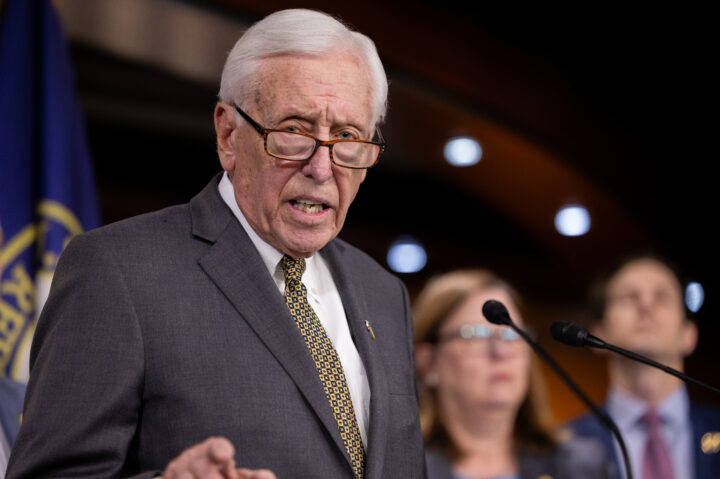
Nathan Posner/Anadolu via Getty Images
Congressman Steny Hoyer (D-MD) speaks at a press conference in Washington, DC on February 24, 2025.
Rep. Steny Hoyer (D-MD), a former House majority leader, backed the U.S. strikes on Iranian nuclear facilities, a position that puts him at odds with many other Democrats in Congress, including current Democratic leadership.
“The U.S. strike on Iranian nuclear facilities at Fordow, Natanz, and Isfahan yesterday was essential to preventing Iran from developing a nuclear weapon,” Hoyer, the longtime former No. 2 House Democrat, said in a statement released on Sunday.
He said that Iranian leaders had made clear they were not going to comply with U.S. demands to dismantle their nuclear program and had been censured by the International Atomic Energy Agency.
“Israel believed that Iran was on the verge of achieving its goal and struck Iranian nuclear sites,” Hoyer said. “Yesterday, the United States did the same, bombing Iranian nuclear facilities at Fordow, Natanz, and Isfahan. That was in keeping with our stated position against Iran’s nuclear ambitions.”
The operation, he said, “helped counter” the Iranian nuclear threat, “but America must continue working to close Iran’s path to nuclear weapons permanently.”
Hoyer characterized the strikes as a “limited, one-time operation.” Many other Democrats have raised concerns that the operation violated congressional war powers.
“These strikes were designed to dismantle Iran’s nuclear program, but neither the U.S., nor Israel, nor any other nation wants to go to war with the Iranian people, or Iran itself,” he continued.
Hoyer has long been among the most steadfast pro-Israel Democrats in Congress.
At the same time, Hoyer argued that “the threat of a nuclear-armed Iran became this dire because the Trump Administration chose to back out” of the 2015 Iran nuclear deal.
A handful of other pro-Israel congressional Democrats have come out largely in support of the strike since it took place.
Rep. Josh Gottheimer (D-NJ) described the raid as “critical and decisive action to protect America, and freedom and democracy at home and around the world.”
“The destruction of Iran’s nuclear program is essential to ultimate peace in the Middle East,” Gottheimer continued. “This is not a Democratic or Republican issue — dealing with the Iranian threat is central to America’s national security.”
Rep. Ritchie Torres (D-NY) was one of the first Democrats to support the strike against Iran Friday night. “The world can achieve peace in the Middle East, or it can accept a rogue nuclear weapons program—but it cannot have both.
The decisive destruction of the Fordow Fuel Enrichment Plant prevents the dangerous spread of nuclear weapons in the world’s most combustible region. No one truly committed to nuclear nonproliferation should mourn the fall of Fordow,” Torres wrote on X.
Sen. John Fetterman (D-PA) said “this was the correct move” by Trump and said he’s “grateful for and salute the finest military in the world.”
Rep. Jared Moskowitz (D-FL) said, “Today, the President made what appears to be a targeted strike to defend the U.S., Israel, and allies throughout the region and the world” and that he’s hopeful that Iran “no longer has the capabilities to continue its nuclear program.”
He said Iran must now commit to negotiations and make a deal. But he also warned against continued military action without congressional approval.
“I am also a firm believer in congressional authority & oversight. Any offensive action must come to Congress for a vote,” Moskowitz said. “I hope this is contained, but we are living in unprecedented times—and it’s critical our leaders work on a bipartisan basis to protect our nation.”
The top House Democrat warned that the attacks could ‘risk American entanglement in a potentially disastrous war in the Middle East’
(Photo by Drew Angerer/Getty Images)
House Minority Leader Hakeem Jeffries (D-NY) speaks during the March for Israel on the National Mall November 14, 2023 in Washington, DC.
House Minority Leader Hakeem Jeffries (D-NY) and Senate Minority Leader Chuck Schumer (D-NY) criticized President Donald Trump for carrying out strikes on Iranian nuclear facilities without congressional authorization, a voice of opposition that was echoed by many leading Democrats on Capitol Hill.
Jeffries said in a statement less than two hours after Trump announced the strikes that Trump “misled the country about his intentions, failed to seek congressional authorization for the use of military force and risks American entanglement in a potentially disastrous war in the Middle East.”
He said that the Trump administration must explain to the country why it carried out the strikes and brief Congress.
“Donald Trump shoulders complete and total responsibility for any adverse consequences that flow from his unilateral military action,” Jeffries continued.
Schumer, in a similarly critical statement, said that “no president should be allowed to unilaterally march this nation into something as consequential as war with erratic threats and no strategy” and said he would be urging all lawmakers to support war powers legislation to block further military action against Iran, and called for an immediate vote.
He said Trump must explain his actions to the American people.
“Confronting Iran’s ruthless campaign of terror, nuclear ambitions, and regional aggression demands strength, resolve, and strategic clarity,” Schumer said. “The danger of wider, longer, and more devastating war has now dramatically increased.”
Senior congressional Democrats were largely left out of the loop about the strikes before they occurred, while Republican leaders have said they were briefed.
Administration officials traditionally brief “Gang of Eight” officials — the top Republican and Democrat in each chamber and the chairs and ranking members of the Intelligence Committees — before carrying out major sensitive operations.
Sources familiar with the situation told Jewish Insider that Jeffries received a notification after the operation was likely already underway, but had not been fully briefed, and Sen. Mark Warner (D-VA), the ranking member of the Senate Intelligence Committee, was not briefed prior to the strikes.
Sources familiar with the situation told JI that House Speaker Mike Johnson (R-LA), Senate Majority Leader John Thune (R-SD) and Senate Intelligence Committee Chair Tom Cotton (R-AR) were briefed before the strikes.
Johnson pushed back on claims that the administration had illegally sidestepped Congress, saying, “Leaders in Congress were aware of the urgency of this situation and the Commander-in-Chief evaluated that the imminent danger outweighed the time it would take for Congress to act.”
“The President fully respects the Article I power of Congress, and tonight’s necessary, limited, and targeted strike follows the history and tradition of similar military actions under presidents of both parties,” Johnson continued.
Rep. Mike Lawler (R-NY) called Jeffries’ statement “an embarrassment,” saying Trump had prevented Iran from obtaining a nuclear weapon.
Many Democrats in both chambers have gone further than Jeffries in their responses, explicitly describing the strikes as unconstitutional.
“The power to declare war resides solely with Congress. Donald Trump’s unilateral decision to attack Iran is unauthorized and unconstitutional,” Rep. Katherine Clark (D-MA), the House minority whip, said. “In doing so, the President has exposed our military and diplomatic personnel in the region to the risk of further escalation. The American people, our men and women in uniform, and their families deserve answers.”
Some Democrats have also raised the prospect of impeaching Trump over the action.
“The President’s disastrous decision to bomb Iran without authorization is a grave violation of the Constitution and Congressional War Powers,” Rep. Alexandria Ocasio-Cortez (D-NY) said. “He has impulsively risked launching a war that may ensnare us for generations. It is absolutely and clearly grounds for impeachment.”
Several pro-Israel Democrats, like Sen. John Fetterman (D-PA) and Rep. Ritchie Torres (D-NY) have fully backed the strike.
“We don’t yet know what this means for the regime’s nuclear work or ambitions, but it absolutely means that the regime has been further weakened — which is good for those who want peace,” Rep. Greg Landsman (D-OH) said.
“It’s time for the Iranian regime to agree to the removal of all enriched uranium, comprehensive, around-the-clock inspections, and the full dismantling of their terror armies from Hamas to Hezbollah and the Houthis. That will end this conflict, and put the entire region on the path to a real and sustainable peace.”
“Iran is a terrorist nation, and we must do everything we can to stop it from acquiring a nuclear weapon,” Rep. Tom Suozzi (D-NY) said. “Debates will now ensue about presidential authority and the President working with Congress. The President should work with Congress, especially those of us who recognize how important it is to finally stop Iran.
Rep. Jake Auchincloss (D-MA) said that Iran should immediately end its nuclear program and stop funding terrorism, but also called for Congress to repeal the 2001 and 2002 authorizations for use of military force “so that the American public can get an open & thorough debate on war-making.”
Jewish Insider Congressional correspondent Emily Jacobs contributed to this report
‘It was just astonishing to see colleagues criticizing these things,’ Fetterman told JI

Lev Radin/Pacific Press/LightRocket via Getty Images
Senator John Fetterman speaks during the grand opening of The Altneu synagogue.
Sen. John Fetterman (D-PA) criticized his Democratic colleagues in Congress who have spoken out against Israel’s attack on Iran, calling it “astonishing” to see members of his party treat Israel’s actions as escalatory.
Fetterman spoke to Jewish Insider on Friday for an interview in the wake of Israel launching its military operation to take out Iran’s nuclear facilities and prevent the regime from acquiring a nuclear weapon.
The Pennsylvania senator said he could not fathom how some Democrats on Capitol Hill could accuse the Jewish state of launching the strikes to upend the Trump administration’s nuclear negotiations with Tehran.
Fetterman didn’t mention any of his Democratic colleagues by name, but many have been critical of the Iranian strikes. Sen. Chris Murphy (D-CT), for instance, went on MSNBC’s “Morning Joe” Friday morning and said that Israel’s strike on Iran was “pretty transparent that this was an effort to submarine, to undermine our diplomacy.”
“It was just astonishing to see colleagues criticizing these things. It’s like, do you think you can negotiate with that regime? Do you think you want to run that scenario and allow them to acquire 1,000 pounds of weapons grade uranium? I can’t understand, I can’t even begin to understand that,” Fetterman told JI.
“I can’t imagine why they would say that. Remember, Iran tries to acquire nuclear weapons. Iran has created and spent billions of dollars to build those destructive proxies like Hamas or Hezbollah or the Houthis. Why can’t we talk about that? Why can’t we talk about the absolute imperative to keep Iran accountable for what they’ve done? That’s exactly part of what Israel did last night, as well,” he continued.
The Pennsylvania Democrat praised the opening salvos of the operation as “absolutely spectacular,” citing the “precision in targeting people.”
”They eliminated the generals and those scientists in their beds at their building, and they didn’t take out the whole building. It was just their specific apartments. I mean, that is truly remarkable. … It’s like Beepers 2.0, the kind of things they’ve done. Like I said, I am constantly blown away by the sophistication and their lethality,” Fetterman said, referring to the Israeli pager operation that took out senior Hezbollah leaders.
“I think I might have been the only one openly calling for that [striking the nuclear facilities now]. I’m never going to negotiate with that regime. You can never trust them, and the only thing they’re going to respond to, that they respect, are exactly the kind of things that [Israel] did last night. … Any potential path for an enduring peace in the Middle East, these are the kind of steps that do that,” he added.
Fetterman disputed the narrative that the U.S. supporting Israel in targeting Iran’s nuclear facilities could increase the prospect of a regional war. “If Iran is going to take their big, big swing, they would have done that by now. Just imagine how exposed they are, even how [exposed] they were earlier this year after what Israel had done taking out Hezbollah,” he told JI.
“Hezbollah ain’t talking tough anymore. They’re not talking about any kinds of actions, they’re just whimpering, and that’s my point. Iran can’t fight for s**t. … They just shot their big shot, a couple junkie rockets, and it’s like, that’s what you’ve got?” Fetterman asked.
‘I have long said that Israel has a right to defend itself and that Iran cannot have a nuclear weapon.’ Schumer added

Senate Majority Leader Chuck Schumer speaks during 'March For Israel' at the National Mall on November 14, 2023 in Washington, DC. (Photo credit: Noam Galai/Getty Images)
Senate Minority Leader Chuck Schumer (D-NY) stood strongly behind Israel in his first public comments on its strikes on Iran and its nuclear program on Friday afternoon — a response that was notably more forceful in its support for Israel than those of many prominent members of the Senate Democratic Caucus.
“The United States’ commitment to Israel’s security and defense must be ironclad as they prepare for Iran’s response,” Schumer said in a statement first shared with Jewish Insider. “The Iranian regime’s stated policy has long been to destroy Israel and Jewish communities around the world. I have long said that Israel has a right to defend itself and that Iran cannot have a nuclear weapon. Ensuring they never obtain one must remain a top national security priority.”
Schumer, who has recently been critical of President Donald Trump’s negotiations with Iran, said “the preferred path to preventing a nuclear-armed Iran and for supporting security and stability in the region has always been a strong, unrelenting diplomatic effort backed by meaningful leverage, and every effort must be made to move toward the path of a diplomatic solution.”
Schumer noted that Iran was just censured by the International Atomic Energy Agency “for systematically deceiving the world about its nuclear program,” that it is “the world’s leading state sponsor of terrorism” and it “has sought to expand its influence in the Middle East, exporting terror and violence across the region.”
He said he is “praying for the safety of American citizens and servicemembers in the region and for enduring stability and security in the region.”
But a number of skeptical lawmakers — mainly congressional Democrats — expressed concern the attack could spark a wider war

Office of Sen. Lindsey Graham (R-SC)
Sen. Lindsey Graham (R-SC) and Sen. Tom Cotton (R-AR) hold a joint press conference on Iranian nuclear negotiations at the U.S. Capitol on May 8, 2025.
Many of the highest-ranking Senate Republicans, along with leading pro-Israel Democrats, expressed support for Israel’s preemptive strikes on Iran, but a number of skeptical lawmakers — mostly Democrats — expressed concern that the strikes could set off a broader war in the region.
Sen. Tom Cotton (R-AR), the chairman of the Senate Intelligence Committee said, minutes after reports of the operation began, “Proud to stand with Israel.” Sen. Lindsey Graham (R-SC) soon followed, saying, “Game on. Pray for Israel.”
Cotton later added that “We back Israel to the hilt, all the way,” adding that if “the ayatollahs harm a single American, that will be the end of the ayatollahs.”
House Speaker Mike Johnson (R-LA), said “Israel IS right—and has a right—to defend itself!”
Sen. Jim Risch (R-ID), the chair of the Senate Foreign Relations Committee said, “We stand with Israel tonight and pray for the safety of its people and the success of this unilateral, defensive action.”
“I am also praying for the brave U.S. service members in the Middle East who keep America safe — Iran would be foolish to attack the United States,” Risch continued.
Senate Majority Leader John Thune (R-SD) emphasized that Iran has been trying for years to wipe out Israel, and that it had just been found in violation of its nonproliferation obligations. He called for efforts toward peace and warned Iran against attacking American troops.
“Today, Israel has determined that it must take decisive action to defend the Israeli people,” Thune said. “The United States Senate stands ready to work with President Trump and with our allies in Israel to restore peace in the region and, first and foremost, to defend the American people from Iranian aggression, especially our troops and civilians serving overseas. Iran should heavily consider the consequences before considering any action against Americans in the region.”
Sen. Rick Scott (R-FL) said, “I ask every American to join me in praying for the safety of U.S. personnel in the Middle East and the safety and success of Israel as it takes action against a leading state sponsor of terrorism and our shared enemy, Iran.”
Rep. Mike Lawler (R-NY), the chair of the House Foreign Affairs Committee’s Middle East subcommittee, also expressed support for Israel’s preemptive strike.
“Having just visited the region two weeks ago, I support Israel’s decision to preemptively strike Iran and dismantle its nuclear program,” Lawler said. “Iran cannot have nuclear weapons — a position the US and our allies have held for decades. Peace through strength.”
House Majority Leader Steve Scalise (R-LA) said that Iran’s refusal to dismantle its nuclear program is a danger to the U.S. and an existential threat to Israel. “Tonight Israel is taking action to defend itself, and we stand with Israel. Our prayers are with them and all American personnel in the region.”
Rep. Elise Stefanik (R-NY), the administration’s former nominee to be U.S. ambassador to the United Nations, said, “The U.S. stands strongly with our ally and partner Israel.”
“May God Bless Israel & the brave IAF [Israeli Air Force] soldiers as they protect their national security and the world’s safety,” Stefanik said. “I know President Trump’s top priority is protecting the American people, our brave U.S. service members, and our national security by ensuring the full dismantlement of Iran’s nuclear program to ensure they can never develop a nuclear weapon.”
Sen. John Cornyn (R-TX) said, “Israel has an unquestionable right to defend itself” and that he is “proud to stand with Israel.”
Sen. Ted Cruz (R-TX) said that Iran had “given President Trump the middle finger” on demands to dismantle its nuclear capacity. Israel is acting to defend themselves, and we should stand with them.”
Sen. John Fetterman (D-PA) said that he supports the attack and “Our commitment to Israel must be absolute.”
“Keep wiping out Iranian leadership and the nuclear personnel,” Fetterman said. “We must provide whatever is necessary — military, intelligence, weaponry — to fully back Israel in striking Iran.”
Rep. Debbie Wasserman Schultz (D-FL) said: “If Israel’s strikes set back Iran’s nuclear program, we’ll all be safer,” adding that the U.S. must protect U.S. citizens and personnel and “must support Israel’s defense.”
Rep. Ritchie Torres (D-NY) said that “Israel is not the aggressor. It is defending itself against an existential threat that long predates the present preemptive strike. The true aggressor is the Islamic Republic and its empire of terror — an empire stained with the blood of innocent Israelis.”
Rep. Greg Landsman (D-OH), also noting that the International Atomic Energy Agency had just declared Iran to be in violation of its nonproliferation obligations, said that “Israel is justifiably defending itself and its people.”
“Diplomacy has been given every opportunity, but the Iranian regime refuses to give up their nuclear ambitions,” Landsman said. “There will be peace when Iran no longer has a nuclear program, a civil one sure, and their terror armies dismantled.”
Rep. Josh Gottheimer (D-NJ) said, “I fully stand with the people of Israel and support her right to defend herself against Iran’s nuclear and terror programs.”
Rep. Rick Crawford (R-AR), the chair of the House Intelligence Committee, emphasized that the U.S. was not involved in the strikes. He pointed blame toward Iran but also called for steps to wind down the conflict quickly.
“I will say I regret that we have come to this breaking point. However, under no circumstance can Iran get its hands on a nuclear weapon,” Crawford said. “A nuclear Iran would only embolden our adversaries and not only pose an undeniable threat to Israel, but also the United States and our Arab allies.”
“Iran pushed the world to this point through its blatant, relentless destabilizing behavior. Israel and others in the region have every right to take the actions needed to defend themselves,” Crawford continued. “I commend the Trump Administration for its tireless efforts to bring peace and stability to the region. I am hopeful a remedy is reached sooner rather than later to stabilize this situation before the stakes get any higher.”
A number of congressional Democrats — and one notable isolationist House Republican — are expressing concern that the strikes will spark a broader war in the region and several described the strikes as designed to sabotage U.S. nuclear negotiations with Tehran.
Sen. Jack Reed (D-RI), the top Democrat on the Senate Armed Services Committee, condemned the strikes as a “reckless escalation that risks igniting regional violence.”
“These strikes threaten not only the lives of innocent civilians but the stability of the entire Middle East and the safety of American citizens and forces,” Reed said. “While tensions between Israel and Iran are real and complex, military aggression of this scale is never the answer.”
He called on both Israel and Iran to “show immediate restraint” and the Trump administration to push for “diplomatic de-escalation before this crisis spirals further out of control.”
Rep. Warren Davidson (R-OH), a Republican aligned with the isolationist wing of the party, also appeared to decry the strikes.
“I’m sad to say but some members of Congress and US Senators seem giddy about the prospects of a bigger war,” Davidson said, appending an emoji of a bandaged, frowning face.
House Minority Leader Hakeem Jeffries (D-NY) stopped short of praising or criticizing the Israeli attack, while blaming President Donald Trump for failing to bring peace to the Middle East and calling for de-escalation.
“I’m hopeful that cooler heads will prevail in the Middle East and the situation is de-escalated,” Jeffries said. “We certainly believe that Iran should never be allowed to become nuclear capable. They are an enemy not just to Israel, but to the United States and to the free world. But we also want to see a reduction in hostilities.”
Sen. Andy Kim (D-NJ) said the strikes appear aimed at undermining U.S. negotiations with Iran, which were scheduled to continue this weekend in Oman.
“Iran should know that any targeting of U.S. forces and personnel stationed across the Middle East in retaliation for Israel’s actions would be a grave mistake. I urge the Trump administration to ensure that the protection of our personnel is our top priority,” Kim said.
“Conflict should always be a last resort, especially when diplomacy is ongoing. This decision by [Israeli Prime Minister Benjamin] Netanyahu to go against American efforts and go alone in strikes puts American and Israeli lives on the line. We should do everything we can to stop this moment from spiraling into a wider conflict and bring parties back to the table to ensure that Iran does not obtain a nuclear weapon.”
Sen. Chris Murphy (D-CT) also described the attack as a sabotage of the nuclear talks and said it shows that world leaders do not respect President Donald Trump. He added in a statement, “we have no obligation to follow Israel into a war we did not ask for and will make us less safe.”
Sen. Elizabeth Warren (D-MA), a progressive Israel critic, said the strikes were “deeply disturbing.”
“I don’t agree often with the Trump administration, but I think here it’s important to say we need more negotiation, we need deescalation,” Warren said. “We need to get to a deal.”
Rep. Greg Casar (D-TX), who chairs the Congressional Progressive Caucus, emphasized that the Trump administration needs congressional approval to bring U.S. troops into “Netanyahu’s war.”
“Netanyahu’s reckless strike risks provoking a wider war and pulling in the United States,” Casar said. “Trump must oppose Netanyahu’s escalation and pursue a diplomatic path to deal with Iran’s nuclear program. “
Gen. Erik Kurilla, the top U.S. commander in the Middle East, said he’d presented a ‘wide range of options’ for strikes on Iran’s nuclear program if talks fail to achieve dismantlement

Department of Defense/EJ Hersom via AP
U.S. Army Gen. Michael E. Kurilla, commander of U.S. Central Command, testifies before the House Armed Services Committee, March 21, 2024, on Capitol Hill in Washington.
Gen. Michael “Erik” Kurilla, the top U.S. military commander in the Middle East, said on Tuesday that he had provided “a wide range of options” to Secretary of Defense Pete Hegseth and President Donald Trump for carrying out U.S. military strikes on Iran’s nuclear program if negotiations with Tehran fail to achieve the dismantlement of its nuclear program.
Kurilla affirmed, under questioning from the House Armed Services Committee, that the military is prepared for a strong show of force against Iran if it refuses to give up its nuclear program. He said that Iran is continuing to increase its stockpiles of uranium enriched to 60% purity, for which he said there are no legitimate civilian uses.
Kurilla added that Iran is in a “weaker strategic position” than it was pre-Oct. 7, but still maintains “a lot of operational capabilities, in terms of their long-range weapons.”
He also emphasized that China, in purchasing the majority of Iran’s exported oil, is “effectively supporting and financing Iran’s malign behavior.” He said that the administration’s moves to sanction “teapot refineries” in China were a major step.
Kurilla said that a stand-alone Israeli strike on Iran’s nuclear program would increase the risk of attacks on U.S. forces in the region, but added that “every day, we’re making assessments of our posture and our risk to force, and we made adjustments based on those. We’re fielding new systems and new equipment and making adjustments every single day.”
Pressed by Rep. Pat Ryan (D-NY) about Michael DiMino, the deputy assistant secretary of defense for the Middle East, who had previously downplayed U.S. interests in the region and opposed action against Iran and its proxies, Katherine Thompson, the acting assistant secretary of defense for international security affairs, largely demurred, saying that she was not involved in DiMino’s hiring and could not speak to his positions.
She said that her superior, Elbridge Colby, the undersecretary of defense for policy who himself made comments opposing strikes on Iran, which he walked back during his confirmation process, is in line with the administration’s policy.
“We support the president’s objective to not only, first and foremost, defend the State of Israel but second, of course, deny Iran the ability to obtain a nuclear weapon. That is something that we are 100% committed to,” Thompson said. “I will also note that we support the president’s objectives and stand ready to provide military options should his strategy of pursuing peace with Iran through a negotiated solution [fail].”
Ryan said that he was concerned that “dissonance” and “lack of clarity” in the administration’s public statements on its willingness to allow Iran to enrich uranium as part of an agreement was signaling “division and weakness to our adversaries.”
Asked about the U.S. ceasefire with the Houthis, Kurilla and Thompson said that the U.S. bombing campaign had achieved the goal Trump had set out of restoring freedom of navigation for U.S. ships through the Red Sea. Kurilla pointed to a recent transit of U.S. and allied naval vessels through the Red Sea as evidence.
While the ceasefire made no provisions to halt Houthi attacks on Israel, which have continued, Kurilla insisted that the U.S. is continuing to defend Israel through the operation of an American THAAD missile defense system in Israel and other efforts to intercept Houthi missiles and drones fired at the Jewish state.
He acknowledged that normal commercial traffic through the region has not yet resumed, but said that it would be a “lagging indicator” that would increase over time as insurance rates for commercial ships transiting the region drop.
Thompson said that the U.S. is not fully withdrawing from the Houthi issue, noting that the group is still designated as a Foreign Terrorist Organization by the U.S., and said the administration continues to pursue a “whole of government approach” to the Iran-backed group.
She said the U.S. is working to have Gulf partners take a greater role in countering the Houthis and “develop a regional solution that empowers our Gulf partners … to tackle the long-term elements of the problem set.”
Kurilla said that permanently ending the Houthi threat will require stopping covert shipments of weapons and weapon components from Iran to Yemen.
“They would die on the vine without Iranian support,” Kurilla said, adding that Islamic Revolutionary Guard Corps personnel remain on the ground in Yemen assisting with assembling and operating those weapons.
Pressed at one point by Rep. Derek Van Orden (R-WI) on why the U.S. is not sinking ships bringing weapons to the Houthis, Kurilla responded that the key challenge has been identifying the ships and the weapons among the many ships transiting the vast area of the Red Sea. But he said that when such ships are identified, the U.S. can and has intercepted and captured them.
Thompson said that European allies have taken positive steps toward collaborating on this mission and Kurilla said that the United Nations’ inspection mechanism for Yemen had also recently taken steps to increase inspections of containers, though he said that it should require the full unloading of all containers to verify their contents.
He also noted that the Houthis have been spreading across the region their knowledge and expertise gained from upgrading Iranian drones to attack Israel. He said the group and its personnel have a presence in Iraq and are sharing technical expertise with Iranian personnel as well as members of Iranian proxy groups in Iraq and Lebanese Hezbollah.
He said that the Houthis also maintain cells in Syria and Lebanon and have conducted diplomatic outreach to Russia and China.
But, Kurilla continued, Iran’s vision of a “Shia crescent” through the Middle East has collapsed with the fall of the Syrian government — ”probably the single biggest event that has happened in the Middle East” — and the degrading of Hezbollah and other Iranian proxies.
He praised Israel’s success against Iran’s proxies, at one point describing its “disintegration” of Hezbollah as “brilliant” and saying that it should be studied by every military in the world.
He said that Iran is attempting to make inroads into Iraq, but that the Iraqi government has largely rejected them.
“I would offer there has rarely been a time with greater opportunity to protect [our] national interests [in the Middle East], but only if we have the courage to step through that window,” said Kurilla, who will soon be retiring after 37 years in military service.
According to public reporting, Kurilla has largely been seen as a hawkish voice in the Trump and Biden administrations and a close ally of Israel.
Kurilla said the U.S. is “transitioning from security guarantor to security integrator” in the Middle East, which requires the U.S. to maintain a “sufficient and a sustainable posture” in the region, as well as to improve foreign military sales to partners in the region.
Asked at multiple points about Qatar’s reliability as a U.S. ally, Kurilla defended Doha as a reliable and eager partner. He said that the U.S. is working to bring Qatar into the military supply chain to repair and manufacture shared weapons systems, noting that it had been enlisted to repair a component of a Patriot missile defense system the previous week.
“We have a phenomenal relationship with them, military-to-military,” Kurilla said. “They have been incredibly supportive of everything we do. Generally, the answer is, ‘Yes, what is the question,’ when I talk to them.”
Kurilla said that U.S. partners are also critical to anti-terrorist missions in places such as Syria and Iraq, and allow the U.S. to keep its operating force in the Middle East relatively small, even as those troops in the Middle East have repeatedly been on the front lines in the past year.
In Syria, he said that the U.S. is working with Kurdish partners, the Syrian Democratic Forces, to integrate them into the new Syrian government, and said that Turkey is playing a positive role in those efforts.
But he also warned that the current Syrian government is being run by a small group of individuals and that he is deeply concerned about its stability, saying President Ahmed al-Sharaa may also bring foreign terrorist fighters, who helped bring his government to power, into the fold.
He said that U.S. troops remain in-country for counterterrorism missions, including one carried out against ISIS forces the morning of the hearing. But he said the U.S. is currently undertaking a process to review and consolidate its forces inside Syria into a smaller number of bases.
Kurilla further said that a key obstacle for U.S. relationships and goals in the region has been delays in U.S. foreign military sales to allies, frustrating those partners and imperiling efforts to integrate U.S. and allied systems across the region. He cited obstacles in the Defense Department, Congress and the defense production industry.
For the U.S.’ own purposes, he also noted that U.S.-produced air-defense systems are significantly more expensive than systems such as the Arrow, which is co-produced with Israel.
He added that the U.S. had learned much, particularly in improving technical and software capacities for air defense systems, from its ongoing operations in the Middle East.
Multiple Democrats pressed Kurilla on what role the U.S. military could play in delivering aid to civilians in Gaza. Kurilla said that the U.S. government is currently not involved in aid delivery, but highlighted the efforts of the Gaza Humanitarian Foundation as a positive step.
“Hamas hates that because Hamas no longer has control over that distribution,” Kurilla said.
He said the military would be prepared to assist if asked to do so.
GOP Sen. John Kennedy, responding to Gabbard: ‘She obviously needs to change her meds’

Yuri Gripas for The Washington Post via Getty Images
Director of National Intelligence Tulsi Gabbard speaks during a Cabinet meeting with President Donald Trump on Wednesday April 30, 2025 at the White House in Washington, DC.
With a cryptic video that Director of National Intelligence Tulsi Gabbard posted on X on Tuesday morning, the Democratic-congresswoman-turned-America-First-advocate reignited simmering concerns about the unorthodox intelligence chief among both her longtime detractors and some Republicans who voted to confirm her earlier this year.
“She obviously needs to change her meds,” Sen. John Kennedy (R-LA) told Jewish Insider of Gabbard. Kennedy, like all Republicans except Sen. Mitch McConnell (R-KY), voted to confirm Gabbard in February.
“I only saw a post that she did, which I thought was a very strange one since many people believe that, unfortunate though it was, the nuclear bomb that was dropped in World War II at Hiroshima actually saved a lot of lives, a lot of American lives,” Sen. Susan Collins (R-ME) told JI of Gabbard’s video.
In the social media video, Gabbard describes a recent visit to Hiroshima, Japan, where she learned about the toll of the atomic bomb dropped on the city by American troops in 1945, which spurred a Japanese surrender and the end of World War II. She warned that the world faces another “nuclear holocaust” unless people “reject this path to nuclear war.”
“This is the reality of what’s at stake, what we are facing now, because as we stand here today, closer to the brink of nuclear annihilation than ever before, political elite warmongers are carelessly fomenting fear and tensions between nuclear powers,” said Gabbard, not specifying who she was referring to by “political elite warmongers” or which countries she may have been calling out.
Gabbard’s video decrying “warmongers” prompted concern from Republicans seeking a more traditionally conservative foreign policy worldview.
“She seems to be doing her best audition to be head of the Quincy Institute,” a senior employee at a pro-Israel advocacy group said of Gabbard.
One Senate Republican, speaking on condition of anonymity, questioned Gabbard’s logic in raising the human toll of Hiroshima and her “warmongers” comment.
“I’m not sure I understand why the DNI would even need to make that point,” the senator said of the Hiroshima focus, later adding: “I don’t seek nuclear war. I don’t know anyone who wants nuclear war. There’s plenty of ideological diversity here, but pretty much universal opposition to that.”
Since taking office, Gabbard, who in 2020 was a surrogate for progressive Sen. Bernie Sanders’ (I-VT) presidential campaign, has generally been aligned with the isolationist wing of the Republican Party, which is increasingly ascendant in the Trump administration. William Ruger, the official she tapped for the high-level position that prepares the president’s daily intelligence briefing, came from Koch-affiliated institutions and has called for “American restraint” on the world stage.
During her nomination battle, Gabbard faced criticism, including from some Republicans — focused in particular on a congressional trip to Syria in 2017 when she met with Syrian dictator Bashar al-Assad, her parroting of Russian propaganda about the country’s war with Ukraine and her defense of Edward Snowden, the former intelligence official who leaked classified information before fleeing the country.
“It defies belief that someone would be criticizing [President Harry] Truman’s act of winning a war. We really need to get back to winning wars when we fight,” Eric Levine, a prominent Republican fundraiser in New York who urged senators to oppose Gabbard’s confirmation, told JI on Tuesday.
Levine raised concerns about Gabbard’s ability to influence President Donald Trump’s approach to Iran, as nuclear negotiations between the U.S. and Iran are set to continue this weekend. He said that if Trump does the “right thing” — meaning he ends the Iran negotiations and supports a strike on Iran’s nuclear infrastructure — then the U.S. will “save a lot of lives, just like Harry Truman did, and will not require the dropping of a nuclear bomb.”
“I’m very concerned about the isolationist wing of the Republican Party,” Levine continued. “I don’t know who’s winning out, because we don’t know what the end result is in Iran yet.”
Several Republican senators questioned why Gabbard would make the video in the first place.
“I thought it was not appropriate,” Sen. John Cornyn (R-TX) told JI.
Sen. Lindsey Graham (R-SC) described the impact of the bomb as “horrible” but said it was necessary to end the war, in which his father had fought.
“Dropping those bombs probably saved a million servicemen’s lives. If you don’t want to get nuked, don’t start barbaric wars,” Graham told JI. “I think it’s a horrible thing to happen to people, but it was brought on by Japan, and if I were Harry Truman, I would have done the same thing because the casualty estimates were a million dead Americans invading mainland Japan.”
Alexa Henning, Gabbard’s deputy chief of staff, declined to say whether Gabbard was referring in the video to a specific nation or to specific people.
“Acknowledging the past is critical to inform the future. President Trump has repeatedly stated in the past that he recognizes the immeasurable suffering, and annihilation can be caused by nuclear war, which is why he has been unequivocal that we all need to do everything possible to work towards peace,” Henning said in a statement. “DNI Gabbard supports President Trump’s clearly stated objectives of bringing about lasting peace and stability and preventing war.”
Despite the criticism coming even from some allies, Gabbard’s views do not appear to have gone outside the realm of what Trump hopes to see from her.
Sen. Markwayne Mullin (R-OK), a personal friend of Gabbard’s from their shared time in the House, defended Gabbard’s post and her service as DNI.
“I think she’s doing a great job … She’s doing exactly what the president wanted her to do,” Mullin told JI. “People have been critical of her, and this is D.C., right? You’re going to get criticized for walking down the stairs wrong, so criticism is part of the job.”
One resolution, which praised ICE and highlighted the need for vetting visa applicants, split House Democrats

Nathan Howard/Getty Images
The U.S. Capitol is seen on June 13, 2024 in Washington, DC.
The House voted on Monday to pass two resolutions condemning recent antisemitic attacks. One, led by Republicans, which focused on the Boulder, Colo., attack and immigration issues, and split the Democratic caucus. The other, which was bipartisan and highlighted a series of antisemitic attacks, passed nearly unanimously, with just two lawmakers voting present.
The first resolution attracted controversy among Democrats ahead of the vote, but it passed by a 280-133 vote. Seventy-five Democrats, mostly moderates and pro-Israel members, ultimately voted in favor of the resolution and 113 voted against it.
Another five Democrats, Reps. Herb Conaway (D-NJ), Shomari Figures (D-AL), Sarah McBride (D-DE), Johnny Olszewski (D-MD) and Dina Titus (D-NV), and one Republican, Rep. Marjorie Taylor Greene (R-GA), voted present.
The resolution stated that the Boulder attack, perpetrated by an Egyptian national who overstayed a visa and work permit who threw a Molotov cocktail at activists raising awareness for the hostages in Gaza, “highlights the need to aggressively vet aliens who apply for visas” and “demonstrates the dangers of not removing from the country aliens who fail to comply with the terms of their visas.”
It also praised law enforcement and Immigration and Customs Enforcement and emphasized the need for “free and open communication” between state and federal law enforcement — an apparent reference to Colorado sanctuary state policies that limit such cooperation.
Prior to the vote, Republicans softened the resolution amid strident criticism from Democrats, stripping out one section that described the slogan “Free Palestine” as antisemitic and another one that explicitly condemned Colorado’s sanctuary state policies.
The second resolution, which condemns “the rise in ideologically motivated attacks on Jewish individuals in the United States,” including the attack in Boulder, the Capital Jewish Museum murders and the arson targeting Pennsylvania Gov. Josh Shapiro, passed with 400 votes in favor. Reps. Rashida Tlaib (D-MI) and Greene voted present. No members voted against the latter resolution.
“We cannot ignore these attacks or dismiss them as isolated incidents,” Rep. Jeff Van Drew (R-NJ), who led the bipartisan resolution, said in a statement. “They are part of a serious and dangerous trend that must be condemned by all of us. Today, the House stood firmly in support of respect and dignity for everyone because we know that every American deserves to live without fear in their own community.”
Greene said in an X post that “antisemitic hate crimes are wrong, but so are all hate crimes. Yet Congress never votes on hate crimes committed against white people, Christians, men, the homeless, or countless others.”
She objected to the fact that Congress has voted on “endless resolutions” on antisemitism while “Americans from every background are being murdered — even in the womb.”
“Prioritizing one group of Americans and/or one foreign country above our own people is fueling resentment and actually driving more division, including antisemitism,” Greene continued.
Ahead of the vote, a group of Jewish House Democrats had urged congressional leaders to take substantive action beyond passing nonbinding resolutions to combat antisemitism, primarily by passing the Antisemitism Awareness Act and bolstering Nonprofit Security Grant Program funding.
Sherman’s statement comes in response to a letter from Albanese to Israel Bonds, accusing the group of involvement in genocide and war crimes

Brian Lawless/PA Images via Getty Images
Francesca Albanese, United Nations special rapporteur on the Occupied Palestinian Territories, during a press conference at Buswells Hotel in Dublin on March 20, 2025.
Rep. Brad Sherman (D-CA), in a blistering statement, accused the U.N.’s special rapporteur for the Palestinian territories, Francesca Albanese, of antisemitism and said that her activity has undermined the United Nations and eroded U.S. support for the U.N. and foreign aid in general and will contribute to deaths around the world.
The statement comes in response to a letter from Albanese, who has faced ongoing accusations of antisemitism from U.S. officials and lawmakers who have described her as unfit for her role, to Israel Bonds, accusing the group of involvement in crimes against humanity, war crimes and genocide.
“Only for a demonstrated antisemite like Ms. Albanese could stabilizing Israel’s economy after the worst massacre of the Jewish people since the Holocaust be something negative,” Sherman said. “This is just the latest instance in Ms. Albanese’s long history of antisemitism – she has regularly used antisemitic terms like the ‘Jewish lobby’ and claims that Israel doesn’t have the right to defend itself or even to exist.”
He said that, “Albanese and her ilk have turned once-legitimate entities like the United Nations into kangaroo courts and clown shows, significantly undermining U.S. support for the funding of international institutions and foreign aid.”
Sherman argued that actions by officials like Albanese make it harder for U.S. supporters of foreign aid to fight the Trump administration’s cuts to U.S. foreign development assistance and to support funding to international organizations. He drew a connection between Albanese and the antisemitism at the U.N. and what he said were 3.3 million anticipated deaths as a result of cuts to U.S. foreign aid.
“There’s a substantial amount of blood on her hands – but her victims live in countries that she doesn’t care about,” Sherman continued. “In fact, it seems the only thing she cares about is justifying attacks on Israel and Jews worldwide.”
Sherman also argued that the goal of Albanese and others in the anti-Israel movement is to weaken Israel economically and militarily so that future terrorist attacks can successfully eliminate the Jewish state.
“Believe that the anti-Israel movement means it when they say they want to eradicate Israel and will use any means to do it,” Sherman said. “Ms. Albanese condemns, and seeks to prevent, every effort of the Israeli government to feed and house its poorest citizens and care for the disabled. Due to her blinding rage of antisemitism, she seeks to hurt the most vulnerable.”
Albanese, in her letter to Israel Bonds, formally known as the Development Corporation for Israel, alleged that the group is responsible for a host of crimes against humanity and human rights violations, and suggested it faces international criminal liability.
“The applicable legal framework and the gravity of the situation on the ground in the occupied Palestinian territory, particularly in Gaza, indicate that there are reasonable grounds to believe that DCI is contributing to gross human rights violations that require the immediate cessation of the concerned business activity, and the remedy of the harm done to Palestinians,” Albanese wrote in the letter, which was obtained by JI.
“The continued failure to act responsibly in line with international law risks implicating DCI in an economy of much more serious violations, and increasing the associated liability. Indeed, given the international crimes being considered by the [International Court of Justice] and the [International Criminal Court], DCI is now on notice of a serious risk of being implicated in international crimes, the disregard of which may give rise to criminal liability, both for DCI and its executives,” she continued.
Dani Naveh, the CEO of Israel Bonds, said in a statement, “We will not be deterred by our enemies driven by antisemitism. Hamas, which carried out the atrocities of October 7, and its supporters, will not prevail. Their efforts have failed time and time again, as evidenced by the billions of dollars Israel Bonds has raised globally since the horrific attacks of October 7, 2023,” and called on supporters of Israel to respond by buying more bonds.
Plus, Risch's pessimism on Iran deal

John Lamparski/Getty Images for Concordia Summit
Morgan Ortagus speaks onstage during 2024 Concordia Annual Summit at Sheraton New York Times Square on September 25, 2024 in New York City.
Good Thursday morning.
In today’s Daily Kickoff, we report on the departure of deputy Middle East envoy Morgan Ortagus from her role reporting to Middle East envoy Steve Witkoff, and cover Sen. Jim Risch’s pessimism toward a potential new nuclear deal with Iran. We also report on the Trump administration’s tapping of Defense Priorities alum Justin Overbaugh for a senior Pentagon role, and scoop a major Jewish communal endorsement for former New York Gov. Andrew Cuomo ahead of New York City’s upcoming Democratic mayoral primary. Also in today’s Daily Kickoff: Jason Isaacman, Rep. Elise Stefanik and Judith Weinstein-Haggai and Gad Haggai.
What We’re Watching
- German Chancellor Friedrich Merz is meeting with President Donald Trump today at the White House.
- Reps. Debbie Wasserman Schultz (D-FL) and Randy Fine (R-FL) are speaking at a Sephardic Heritage International DC event this evening on Capitol Hill commemorating the anniversary of the Farhud pogrom that took place in Iraq in 1941.
What You Should Know
A QUICK WORD WITH ji’s MATThEW KASSEL
With just under three weeks until New York City’s mayoral primary on June 24, former Gov. Andrew Cuomo is slowly but surely securing commitments from a range of key leaders in the Orthodox Jewish community, a large and politically influential voting base whose widespread support is seen as crucial to his pathway to the Democratic nomination.
In the coming days, Cuomo is expected to garner endorsements from several prominent Orthodox leaders in Brooklyn and Queens, including major Hasidic sects in Borough Park and Williamsburg that can traditionally turn out thousands of votes, according to people familiar with the situation who spoke on condition of anonymity to address private plans.
But as most top Orthodox leaders have not historically taken sides until relatively late in the primary season, some Jewish community activists are voicing anxiety about their continued delay in publicly backing Cuomo — as he increasingly faces competition to his far left from Zohran Mamdani, a Queens state assemblyman whose fierce opposition to Israel has drawn mounting accusations of fueling antisemitism.
“Now that the race has been essentially a two-man race for the past few months, what are they waiting for?” one Jewish leader, granted anonymity to speak candidly, told Jewish Insider. “Are they considering Mamdani?”
ORTAGUS OUT
Deputy Special Envoy Morgan Ortagus to leave post under Witkoff

Morgan Ortagus, a key member of Middle East envoy Steve Witkoff’s team, is departing his office, Jewish Insider’s Gabby Deutch and Emily Jacobs have learned. Ortagus, the deputy special envoy, has been removed from her portfolio in the special envoy’s office, two sources familiar with the matter confirmed to JI. Ortagus had been overseeing the Trump administration’s Lebanon policy and had wanted to take over the Syria file, but was unsuccessful in doing so.
Context: Ortagus’ departure comes less than two weeks after Witkoff and Secretary of State Marco Rubio oversaw a widespread purge of officials at the NSC, including those overseeing the Middle East and Israel and Iran portfolios. This followed Trump’s decision to pull former National Security Advisor Mike Waltz, another Iran hawk in the administration, from his role and instead nominate him to be his ambassador to the United Nations.
DEFENSE DYNAMICS
Another Koch-funded think tank affiliate on track for top Defense job

Justin Overbaugh is on track to be the latest affiliate of the Koch-backed Defense Priorities think tank to be placed in a top post at the Defense Department, approaching confirmation as the deputy under secretary of defense for intelligence and security, Jewish Insider’s Marc Rod reports.
About the nominee: Overbaugh lacks the extensive public record of other Defense Priorities alumni in the administration — who have called for the U.S. to curtail its role in the Middle East — and his nomination has attracted little public attention or controversy. “I believe that we do not have the resources to cover all threats simultaneously, therefore we must be deliberate and discerning about the capabilities we pursue to defend our Nation and deter, or if necessary, defeat, our adversaries,” Overbaugh said in written testimony to the Senate Armed Services Committee.
Nomination reservations: Multiple Senate Republicans on the Senate Judiciary Committee said Wednesday that they plan to scrutinize President Donald Trump’s nomination of Paul Ingrassia, a far-right figure picked last week to lead the Office of Special Counsel, charged with fighting corruption and fighting federal whistleblowers, Jewish Insider’s Marc Rod and Emily Jacobs report.
Risch’s reservations
Sen. Risch: ‘I’m not particularly optimistic’ about a deal with Iran

Sen. Jim Risch (R-ID), the top Republican on the Senate Foreign Relations Committee, said on Wednesday in remarks at the Hudson Institute that he is “not particularly optimistic” that a deal with Iran that stops it from enriching uranium can be reached, Jewish Insider’s Marc Rod reports.
Israeli threat: Risch added that if Iran does not agree to a deal, “Israel is going to do something about that.” “I’ve sat across the table from [Israeli Prime Minister Benjamin] Netanyahu, I don’t know how many times, and he has looked me in the eye and said, ‘Iran will not have a nuclear weapon,’” the top Senate Republican said. “And you know what? I believe him, and I think that’s a case for the United States to be in the exact same position.”
ACCREDIATION ESCALATION
Trump admin warns Columbia University at risk of losing accreditation

The Trump administration’s battle with higher education escalated on Wednesday with the announcement that Columbia University is at risk of losing accreditation for violation of the Title VI of the Civil Rights Act of 1964, Jewish Insider’s Haley Cohen reports.
What is said: The U.S. Department of Education’s Office for Civil Rights and the Department of Health and Human Services’ Office for Civil Rights “determined that Columbia University acted with deliberate indifference towards the harassment of Jewish students, thereby violating Title VI,” the Education Department said in a statement, noting that the Ivy League institution “no longer appears to meet the Commission’s [sic] accreditation standards.”
SCOOP
Influential Queens Orthodox coalition backs Cuomo for mayor

An influential coalition of Orthodox Jewish leaders in Far Rockaway, Queens, is endorsing former Gov. Andrew Cuomo for mayor of New York City, Jewish Insider’s Matthew Kassel has learned, the first official demonstration of support from a major Orthodox group in the race. In a lengthy statement first shared with JI on Wednesday night, leaders of the Far Rockaway Jewish Alliance wrote that the “Jewish community in New York — particularly the frum community — faces a political crisis of historic proportions,” and urged voters to move past their lingering resentment over Cuomo’s COVID policies, which community members recall as discriminatory.
Now and then: “We still feel the pain of the unfair red zones imposed by Cuomo in 2020, which targeted our communities and restricted our way of life with heavy-handed measures,” the leaders acknowledged. “That wound lingers, a reminder of how quickly our freedoms can be curtailed. Yet, despite this pain, we must look forward and consider our future as Jews in New York City, where new threats loom larger than past grievances.”
Elsewhere in Gotham: Rep. Alexandria Ocasio-Cortez (D-NY) endorsed New York Assemblyman Zohran Mamdani in the city’s Democratic mayoral primary.
COALITION CHAOS
Haredi leaders threaten to bring down Israeli government as effort to revive draft exemptions stalls

Israeli Prime Minister Benjamin Netanyahu’s governing coalition was thrown into disarray on Wednesday night after the spiritual leaders of Haredi factions threatened to bring about an early election if penalties for yeshiva students avoiding military service are not canceled, Jewish Insider’s Lahav Harkov reports.
From bad to worse: The leading rabbis of Agudat Yisrael, the Hasidic party of United Torah Judaism, told party leader Yitzchak Goldknopf on Tuesday to move forward with a vote next week on a bill to dissolve the Knesset, prompting an election, because Netanyahu did not keep a promise to pass a bill exempting young Haredi men from military service by Shavuot, a holiday that was observed on Monday in Israel. On Wednesday morning, the other part of United Torah Judaism, Degel Hatorah, received a similar directive from the senior rabbis of the “Litvak” non-Hasidic Haredi community, Dov Lando and New York native Moshe Hillel Hirsch. Still, Netanyahu’s 68-seat coalition would retain a narrow majority in the Knesset even if he lost those Haredi parties’ seven seats. The political threat became more acute on Wednesday evening, when Sephardic Haredi party Shas, which has 11 seats in the Knesset, supported UTJ’s move to call an election. Israeli media reported that Shas’ spiritual leader Rabbi Yitzhak Yosef told the party’s lead negotiator, former minister Ariel Atias, to tell Netanyahu that he will not have a government if agreements are not reached with the Haredi parties.
Worthy Reads
Full-Court Press: In the Baltimore Sun, former Maryland Gov. Larry Hogan calls for “moral clarity” in the face of rising antisemitism in the U.S. “When innocent people are attacked for their faith or identity, neutrality is not courage. It is cowardice. People are hungry for real leadership. Not performative outrage. Not partisan talking points. Real leadership, rooted in principle and courage. That is what communities expect from their elected officials, civic organizations, media institutions and universities. They want to know that when a synagogue is firebombed or a Jewish student is harassed, someone will speak up. When extremists target a faith community, there should not be silence or spin. There must be action.” [BaltSun]
Choppy Waters: The Wall Street Journal’s Stephen Kalin and Shelby Holliday look at how the maritime warfare perpetuated by the Iran-backed Houthis in Yemen has reshaped the U.S. response to threats in the region. “Officials are now dissecting how a scrappy adversary was able to test the world’s most capable surface fleet. The Houthis proved to be a surprisingly difficult foe, engaging the Navy in its fiercest battles since World War II despite fighting from primitive quarters and caves in one of the world’s poorest countries. The Houthis benefited from the proliferation of cheap missile and drone technology from Iran. They fired antiship ballistic missiles, the first-ever combat use of the Cold War-era weapon, and they innovated how they deployed their weaponry. The latest technologies have transformed maritime warfare, much the way they have rewritten the script for land wars in Ukraine — forcing militaries to adapt in real time.” [WSJ]
The Show Must Go On: The Washington Post’s Marc Fisher reflects on his recent visit to a new LGBTQ exhibition at the Capital Jewish Museum, which opened on the same day the museum reopened following an attack the week prior in which two Israeli Embassy officials were killed. “Jewish museums chronicle the centuries-long tension among Jews between insisting on belonging to the culture where they live and accepting the outsider status foisted upon them by dominant forces in their society. … The exhibit confronts contradictions, which are at the heart of Judaism. People like the shooter cannot bear such nuance; to them, it somehow makes sense to take out one’s wrath toward Israel against a Jewish American institution — one that barely mentions Israel. The museum, like all good encounters with history, cherishes clashes between past and present, but the shooter can only see the binary: us and them.” [WashPost]
Word on the Street
President Donald Trump announced last night that citizens of 12 countries will be barred entry to the United States, while citizens of seven other countries will face restrictions. The planned executive order was scooped yesterday by Jewish Insider’s Gabby Deutch…
Jason Isaacman, an ally of Elon Musk who had been the Trump administration’s pick to head NASA until his nomination was pulled last month, reportedly told associates that he believes that Musk’s departure from the White House gave the administration an opportunity to rescind the nomination; White House officials said the nod was pulled over Isaacman’s past donations to Democrats, which Isaacman disputed, saying the White House was aware of the donations…
Former White House Press Secretary Karine Jean-Pierre will release a book later this year about her time in the Biden administration and departure from the Democratic Party…
Rep. Elise Stefanik (R-NY) launched the Save New York PAC to boost GOP candidates running in local races across the state…
Reps. Pramila Jayapal (D-WA), Jamie Raskin (D-MD), Bill Keating (D-MA), Valerie Foushee (D-NC) and Becca Balint (D-VT) are leading more than 90 Democrats on a resolution calling on the administration to “urgently use all diplomatic tools” to increase humanitarian aid into Gaza, as well as release the hostages and end the war in Gaza; Sen. Peter Welch (D-VT) is leading similar legislation in the Senate with the support of nearly all Democrats…
A group of lawmakers from more than 30 countries came together on Wednesday to discuss ways that the Abraham Accords can be leveraged to address energy security issues in the Middle East, the Caspian Sea Basin and the Eastern Mediterranean, Jewish Insider’s Marc Rod has learned…
Reps. August Pfluger (R-TX) and Randy Fine (R-FL) introduced a resolution condemning the antisemitic attack on a hostage awareness march in Boulder, Colo., and calling for congressional action “to secure the border and deport migrants who overstay their visas”…
The U.S. vetoed a U.N. Security Council resolution that called for a ceasefire in the Israel-Hamas war without conditioning a ceasefire on the release of the remaining hostages; the other 14 members of the council voted in favor…
The IDF found and returned the bodies of U.S.-Israeli citizens Judith Weinstein-Haggai and Gad Haggai, who were killed in the Oct. 7, 2023, Hamas-led attacks, Jewish Insider’s Lahav Harkov reports…
The Wall Street Journal interviews victims and witnesses of the terror attack on marchers at a Boulder, Colo., walk on Sunday to call attention to the plight of the hostages in Gaza…
A federal judge issued an order barring the deportation of the wife and children of the Egyptian national accused of attacking the Boulder hostage march…
Germany’s Federal Research and Information Point for Antisemitism said that antisemitic incidents in the country had nearly doubled between 2023 and 2024, finding 8,627 incidents of violence, vandalism and threats targeting Jews last year…
The Gaza Humanitarian Foundation suspended operations for a second day, as both the foundation and Israeli officials address safety concerns tied to a series of deadly incidents near distribution sites in recent days…
Israeli officials said the country exported a record $14.8 billion in weapons in 2024, an increase of $1.8 billion from the year prior…
Stu Sandler is joining the office of Sen. Rick Scott (R-FL) as chief of staff; Sandler was previously the deputy director of the Republican Jewish Coalition…
Aaron Bandler is joining the Jewish News Syndicate as U.S. national reporter, based out of Los Angeles…
Pic of the Day
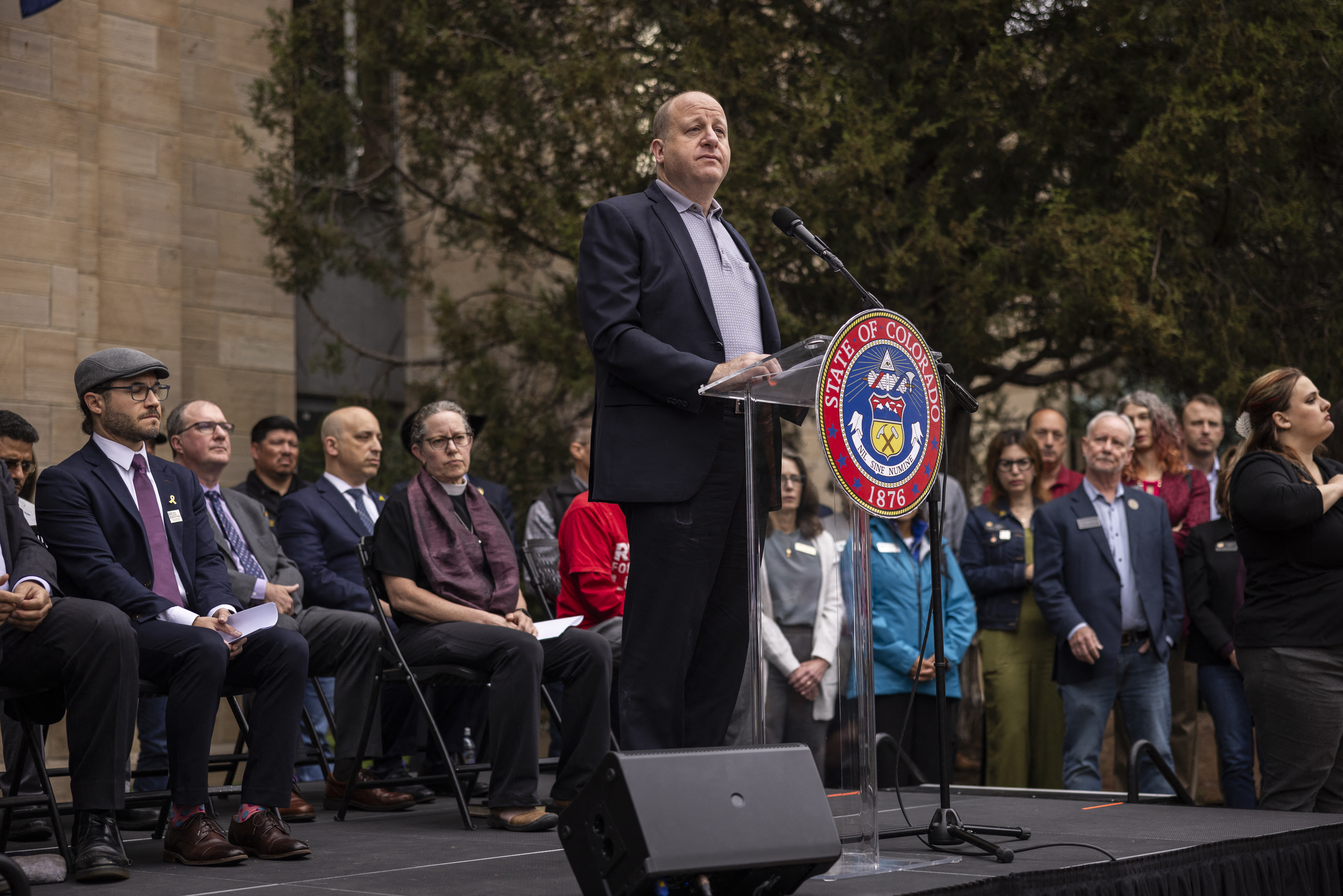
Colorado Gov. Jared Polis spoke on Wednesday at a vigil held at the site of the weekend terror attack targeting a hostage-awareness march in Boulder, Colo., in which 15 people, including a Holocaust survivor, were injured.
Birthdays

Actor, voice actor, comedian, writer and producer, Nicholas Kroll turns 47…
Lithuanian-born Holocaust survivor, co-founder of the Virginia Holocaust Museum in Richmond, Va., known for his ever-present cowboy hat, Jay M. Ipson turns 90… Training director and broker associate of the Santa Monica, Berkshire Hathaway Home Services branch, Saul Bubis… Owner of the NFL’s New England Patriots, Robert Kraft turns 84… The first woman to serve as international president of the United Synagogue of Conservative Judaism, Judy Yudof turns 81… Senior project manager in the AI field, Dan Yurman… Israeli politician, diplomat and businessperson, he served as consul general of Israel in Philadelphia from 1988 to 1992, Israel Peleg turns 76… VP of new business development at Maresco & Partners, Linda Greenfield… Author of 11 personal finance books, financial advisor, motivational speaker and television host, Susan Lynn “Suze” Orman turns 74… Staff member at Burbank Temple Emanu El, Audrey Freedman-Habush… Portrait photographer and visual anthropologist, she is the author of The Jews of Wyoming: Fringe of the Diaspora, Penny Diane Wolin turns 72… Former commissioner on the U.S. International Trade Commission, now a consultant, Dean A. Pinkert turns 69… Best-selling instrumental musician, the saxophonist “Kenny G,” Kenneth Bruce Gorelick turns 69… Columnist for the New York Post, Andrea Peyser turns 66… Senior associate general counsel at Compass real estate, Sam Kraemer… EVP and managing director at DC’s Burson Cohn & Wolfe (BCW), Michael Heimowitz… Member of the Ontario Provincial Parliament for eight years until 2022, Gila Deborah Martow turns 64… VP of government affairs at Invenergy, Mark S. Weprin turns 64… First-ever Jewish speaker of the Virginia House of Delegates, she served from 2020 until 2022, Eileen R. Filler-Corn turns 61… Manager of the Jeff Astor Legacy Fund, Beth Astor Freeman… Member of Congress (D-PA-6), her father is a Jewish Holocaust survivor from Poland, Christina Jampoler Houlahan turns 58… Member of the British House of Commons for 15 years, now a member of the House of Lords, Baron Ed Vaizey turns 57… Entrepreneur, venture capitalist and author, he holds more than 100 granted and pending patents, Nova Spivack turns 56… Professor of Israel studies at UCLA, Dov Morris Waxman turns 51… Film and television actress, she has a recurring role in the Fox series “The Cleaning Lady,” Liza Rebecca Weil turns 48… Co-founder of BlueLabs and director of analytics for the campaigns of both Hillary Clinton in 2016 and Barack Obama in 2012, his father and grandfather were both rabbis, Elan Alter Kriegel… Research fellow at the Heritage Foundation, he was previously a member of the New Hampshire state Legislature, Jason Bedrick turns 42… Humorist, novelist and screenwriter, Simon Rich turns 41… Partner relationship manager at Voyant, Arielle Levy Marschark… Account director on the corporate PR team at M Booth, Maya Bronstein… Clara Moskowitz… Susan Stein…
Plus, new UCLA chancellor calls out campus antisemitism

GETTY IMAGES
A general view of the U.S. Capitol Building from the National Mall, in Washington, D.C., on Thursday, May 29, 2025.
Good Friday morning.
In today’s Daily Kickoff, we look at how Congress has increasingly ceded its authority over foreign policy to the White House, and interview UCLA Chancellor Julio Frenk about his efforts to address antisemitism at the school. We also talk to Rep. Mike Lawler about his recent trip to the Middle East, and report on President Donald Trump’s plan to nominate far-right commentator Paul Ingrassia to a senior administration post. Also in today’s Daily Kickoff: Rep. Greg Landsman, Mia Schem and Michael Bloomberg.
Ed. note: In observance of Shavuot, the next Daily Kickoff will arrive on Wednesday, June 4. Chag sameach!
For less-distracted reading over the weekend, browse this week’s edition of The Weekly Print, a curated print-friendly PDF featuring a selection of recent Jewish Insider and eJewishPhilanthropy stories, including: Hostages’ long-lasting mental and physical scars of Gaza captivity are treated at ‘Returnees Ward’; Israel can’t compete in checkbook diplomacy. These tech leaders have other ideas; and Sen. Dave McCormick, in Israel, talks about Trump’s Iran diplomacy, Gaza aid. Print the latest edition here.
What We’re Watching
- We’re keeping an eye on ceasefire and hostage-release negotiations, amid reports yesterday that Israel and Hamas were close to reaching an agreement that would have included the release of 10 living hostages and the bodies of 18 deceased hostages. A senior Hamas official last night rejected the U.S.-proposed ceasefire deal that had already been agreed to by Israel.
- Fox News Channel will air a wide-ranging interview tomorrow night with Sara Netanyahu, in which she’ll discuss with Lara Trump how life in Israel has changed since the Oct. 7, 2023, Hamas terror attacks.
What You Should Know
A QUICK WORD WITH JOSH KRAUSHAAR
Pore over the latest round of polling in the New York City mayoral primary, and it is something of a political analyst’s Rorschach test. The question is what will be a bigger turnoff for Gotham voters: extremism or personal scandal?
Will Zohran Mamdani’s radicalism make it difficult for the DSA-affiliated assemblyman — polling in second place — to win an outright majority of the Democratic vote? Candidates from the far-left wing of the party typically have a hard ceiling of support, but the latest polls suggest he’s not yet facing the elevated negative ratings that candidates in his ideological lane typically encounter. There hasn’t yet been a barrage of attack ads reminding voters about his record, as he slowly inches closer to former Gov. Andrew Cuomo.
Will Cuomo’s personal baggage ultimately be a bigger factor for Democratic voters? Cuomo has been leading the race since jumping in, but holds elevated unfavorability ratings, predominantly stemming from the scandal over sexual misconduct allegations, which he continues to deny, that forced him to resign as governor.
The city’s ranked-choice voting system requires the winner to receive an outright majority of the vote, and build a broader coalition than would be necessary if one only needed a plurality to prevail. In theory, that would advantage Cuomo, given his high name identification, moderate message and ample fundraising resources. In nearly every contest held under a ranked-choice system across the country, moderates have gotten a significant boost, including in the 2021 NYC mayoral primary, when Eric Adams prevailed.
But if there’s a broad antipathy to Cuomo that goes beyond ideological lines, it’s plausible that any alternative to Cuomo could benefit, simply because they’re running as a candidate of change. It’s hard to overlook Cuomo’s underwater favorability rating among primary voters; a new Emerson poll found a near-majority (47%) of NYC Democrats viewing Cuomo unfavorably, with 40% viewing him favorably.
Cuomo’s lead over Mamdani in the final round of ranked-choice voting, according to the poll, stood at eight points (54-46%). It’s a lead that is outside the margin of error, but a little too close for comfort considering Cuomo’s other advantages. The poll found Mamdani winning more of the votes from the third-place finisher (Comptroller Brad Lander) in the final round, suggesting that Cuomo could be vulnerable to opponents framing their campaigns as part of an anti-Cuomo coalition.
Cuomo’s strongest support comes from the Black community (74% support over Mamdani), voters over 50 (66%) and women (58%). Mamdani’s base is among younger white progressives, leading big over Cuomo with voters under 50 (61%).
Cuomo’s margin for success could end up coming from the city’s sizable Jewish community — many of whose members view Mamdani’s virulently anti-Israel record and pro-BDS advocacy as a threat — even though he’s currently winning a fairly small plurality of Jewish votes, according to a recent Homan Strategy Group survey.
Cuomo only tallied 31% of the Jewish vote, according to the poll, but has a lot of room for growth, especially since he still has potential to make inroads with Orthodox Jewish voters, many of whom became disenchanted with him as governor due to his aggressive COVID restrictions. (For instance: A significant 37% share of Orthodox Jewish voters said they were undecided in the Homan survey; 0% supported Mamdani.)
If those Cuomo-skeptical Orthodox voters swing towards the former governor in the final stretch, especially as the threat of Mamdani becomes more real, that may be enough for Cuomo to prevail. But it’s a sign of the times — and the state of the Democratic Party — that this race is as competitive as it is, given the anti-Israel record of the insurgent.
IN THE BACK SEAT
How Congress became impotent on foreign policy

For decades, Jewish and pro-Israel groups invested significant resources in building bipartisan relationships with key members of Congress to steer legislation, while helping secure foreign aid and blocking unfavorable initiatives concerning the Middle East, Jewish Insider’s Matthew Kassel reports. But that long-standing playbook has appeared less effective and relevant in recent years as Congress has increasingly ceded its authority on foreign policy to the executive branch, a trend that has accelerated with President Donald Trump’s return to office. The dynamic is frustrating pro-Israel advocates who had long prioritized Congress as a vehicle of influence, prompting many to reassess the most effective ways to advocate for preferred policies.
‘Increasingly irrelevant’: There are any number of reasons why Congress has taken a back seat in shaping foreign affairs, experts say, including Trump’s efforts to consolidate power in the executive branch, most recently by gutting the National Security Council. And Trump’s own power in reshaping the ideological direction of his party, preferring diplomacy over military engagement, has made more-hawkish voices within the party more reluctant to speak out against administration policy. “Congress is increasingly irrelevant except on nominations and taxes,” Elliott Abrams, a senior fellow at the Council on Foreign Relations who served as a special envoy for Iran in the first Trump administration, told Jewish Insider. “It has abandoned its once-central role on tariffs, and plays little role in other foreign affairs issues. That’s a long-term trend and we saw it in previous administrations, but it is worsened by the deadlocks on Capitol Hill, the need to get 60 votes to do almost anything, and by Trump’s centralization of power in the White House.”
UNIVERSITY RECKONING
‘The challenge attracted me’: Julio Frenk brings the fight against campus antisemitism to UCLA

After Oct, 7, 2023, Julio Frenk, then-president of the University of Miami, was swift and clear in his unequivocal condemnation of the Hamas terror attacks on Israel, and in his guidance about the university’s rules around protesting, harassment and violence, and continued disavowals of antisemitism. Now, in his new role as chancellor of the University of California, Los Angeles, Frenk is attempting to bring some Florida to deep-blue California as he wraps up his first semester. “When we engage with each other, we do that respectfully and without — obviously no hatred, no harassment, no incitement to violence, but also no expressions that are deeply offensive to the other side,” Frenk told Jewish Insider’s Gabby Deutch in an interview this week.
Protest problems: During UCLA’s large anti-Israel encampment last spring, Jewish students were barred from accessing parts of campus by the protest organizers. The tents popped up just days after Frenk had accepted the offer from Michael Drake, president of the University of California system. “I had already said yes, and he said, ‘Are you going to change your mind?’ And I said, ‘No, I’m not going to change my mind. I think this is a very important challenge to face and fix if I can, and I’m going to give it my all,’” Frenk recalled. “What drew me here is just the reputation, the standing, and I know that that spring, the images of UCLA going to the world were not very enticing. But to be honest, facing that challenge was something that attracted me.”
STANDING TOGETHER
‘Keep showing up’: Capital Jewish Museum reopens after deadly shooting

As visitors entered the Capital Jewish Museum on Thursday morning, open for the first time after an antisemitic attack killed two Israeli Embassy staffers steps from its doors last week, they walked past a makeshift memorial to Sarah Lynn Milgrim and Yaron Lischinsky before security guards wanded them down and checked their bags. The museum might be reopening, but its staff — and the broader Washington Jewish community — now feel a heaviness that did not exist last week, when the museum was on the cusp of unveiling a major new exhibit about LGBTQ Jews ahead of the World Pride Festival next month. The presence of police officers and heightened security precautions in the newly reopened space were stark reminders of the violence perpetrated by a radicalized gunman who said he killed the two young people “for Gaza,” Jewish Insider’s Gabby Deutch reports.
Stop by: A brief ceremony marking the museum’s reopening began with a cantor leading the crowd in singing songs for peace. D.C. Mayor Muriel Bowser pledged to continue to support the Jewish community and called on all Washingtonians to do the same. “It is not up to the Jewish community to say, ‘Support us.’ It is up to all of us to denounce antisemitism in all forms,” Bowser told the several dozen people at the event. Bowser, who was instrumental in the creation of the museum, which opened in 2023, urged people in the local community to visit.
SEEING THE SIGNS
Rep. Landsman: Murder of Israeli Embassy staffers was the culmination of a ‘trajectory’ toward antisemitic violence

For Rep. Greg Landsman (D-OH), the murder of two Israeli Embassy employees outside the Capital Jewish Museum last week brought to life fears he has harbored for months, amid rising extremism in anti-Israel demonstrations, Landsman told Jewish Insider’s Marc Rod in an interview on Wednesday.
Worst fears: The Jewish Ohio congressman said that days before the shooting, while attending a public event in downtown Cincinnati, he had a “really vivid image of being shot in the back of the head. What I saw was myself laying on the ground in the way in which you would be if you had been shot in the head … I wasn’t alive, I was dead.” Landsman continued, “And then, literally two or three days later, that’s what happened outside the Jewish museum. That’s what happened to these two innocent people.” He said he feels the country has been on a “trajectory” toward such violence by anti-Israel agitators, and that it will continue without a change in course.
CONTOVERSIAL COMMENTATOR
Latest Trump nominee called Israel-Palestinian conflict a ‘psyop’, promoted antisemitic conspiracy theories
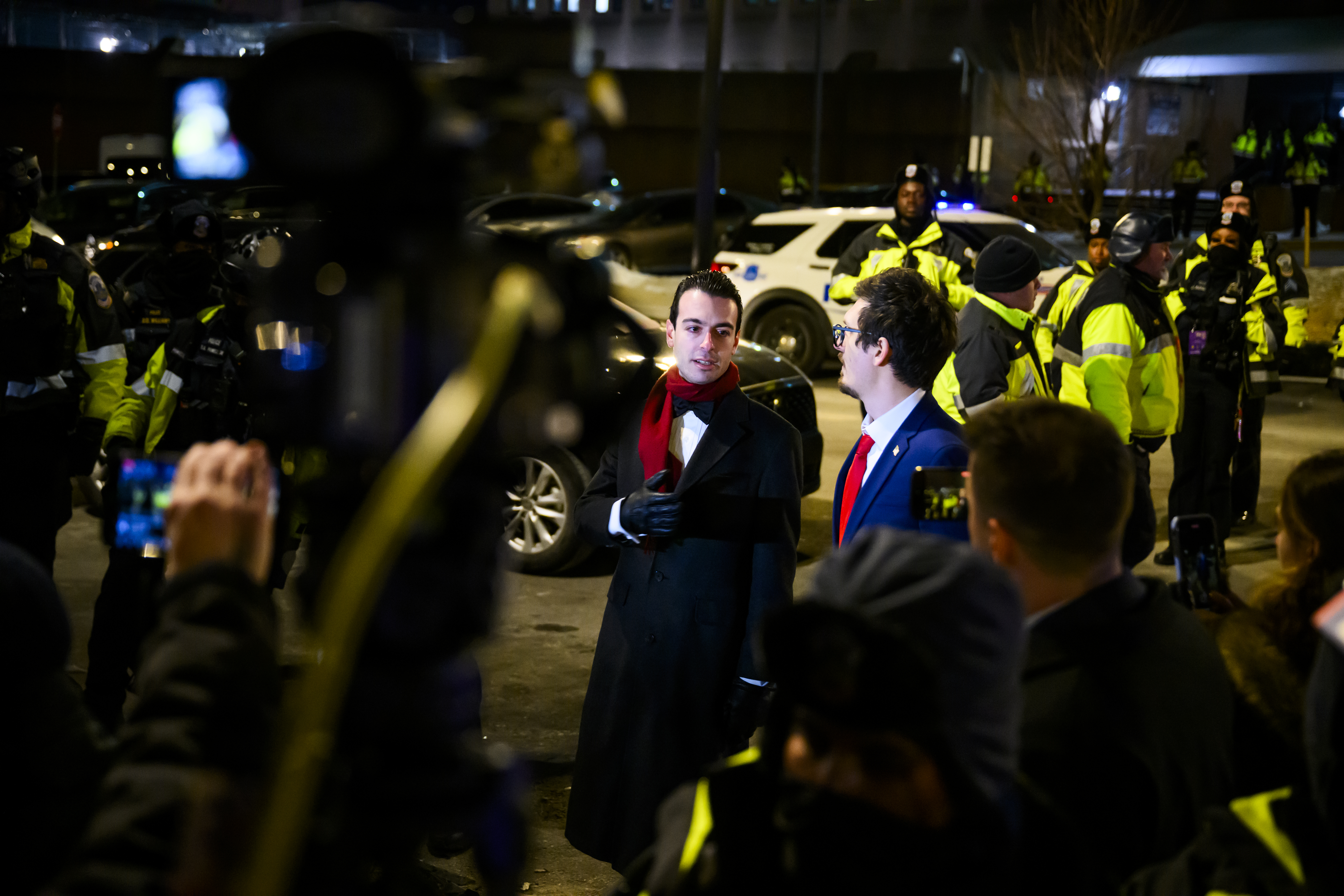
President Donald Trump announced his intention to nominate far-right commentator Paul Ingrassia to head the agency tasked with rooting out corruption and protecting whistleblowers in the federal government, Jewish Insider’s Danielle Cohen reports. Ingrassia, 29, currently serves as the White House liaison for the Department of Homeland Security. He briefly served as the White House liaison to the Department of Justice early in Trump’s second term, but was reassigned after clashing with the DOJ’s chief of staff after urging the president to hire only individuals who exhibited what Ingrassia called “exceptional loyalty,” according to ABC News.
Part of a pattern: Ingrassia has trafficked in a number of conspiracy theories, as have several other controversial administration appointees, including Department of Defense Press Secretary Kingsley Wilson and Acting Under Secretary for Public Diplomacy Darren Beattie. On Oct. 7, 2023, as the Hamas attacks were still underway, Ingrassia posted on X calling illegal immigration to the U.S. “comparable to the attack on Israel,” writing, “The amount of energy everyone has put into condemning Hamas (and prior to that, the Ukraine conflict) over the past 24 hours should be the same amount of energy we put into condemning our wide open border, which is a war comparable to the attack on Israel in terms of bloodshed — but made worse by the fact that it’s occurring in our very own backyard. We shouldn’t be beating the war drum, however tragic the events may be overseas, until we resolve our domestic problems first.”
TEHRAN TALK
Lawler: Regional leaders ‘cautiously optimistic’ about nuclear talks, but ‘realistic’ about Iranian bad faith
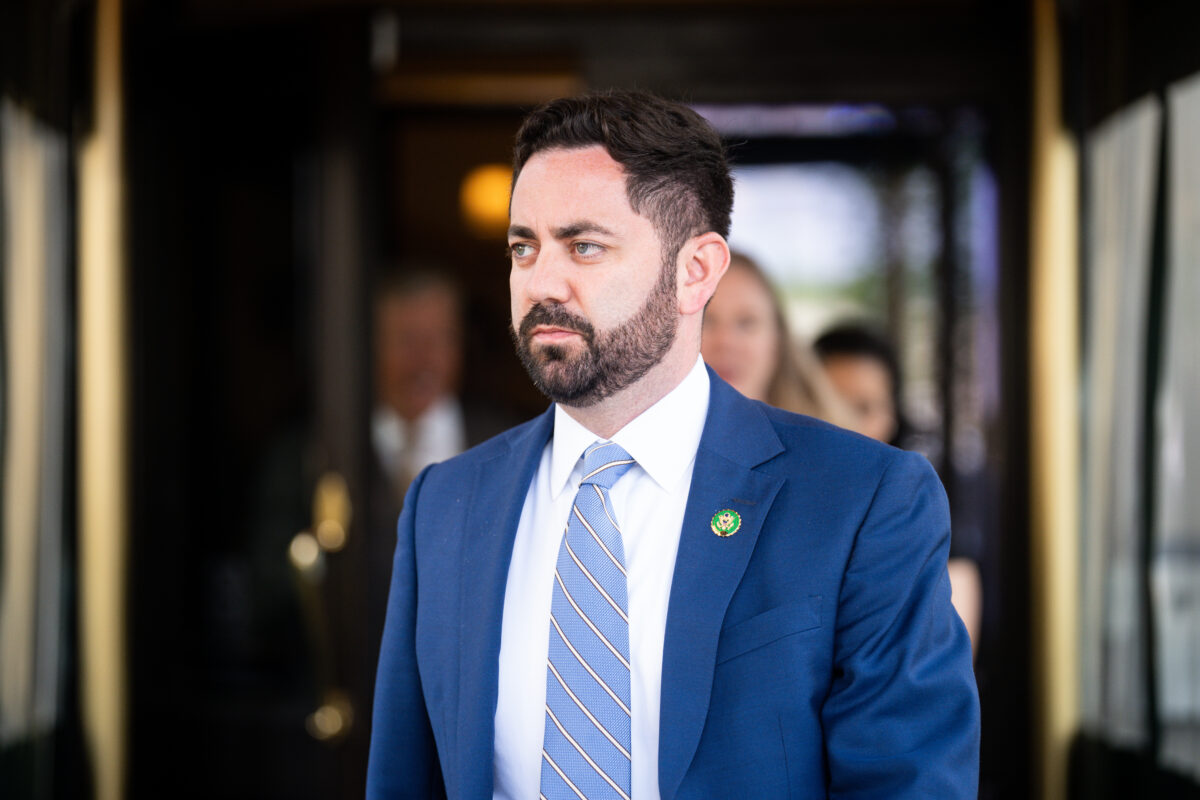
Rep. Mike Lawler (R-NY), returning from a trip to Israel, Saudi Arabia and Jordan, characterized leaders in the region as being open to the Trump administration’s efforts to reach a new nuclear deal with Iran, but also suggested that they are skeptical that Iran will actually agree to a deal that dismantles its nuclear program, Jewish Insider’s Marc Rod reports.
What he said: “I think folks are realistic about the prospects of Iran coming to an agreement, but still want to give the process a chance and try to avoid a conflict if possible,” Lawler told JI on Thursday. “But ultimately, you know, I think everybody is very clear about the fact that Iran cannot have a nuclear weapon.” Asked about the potential contours of a deal, Lawler said, “my general view is that the nuclear program, obviously, is a major threat, but so too is their continued funding of terrorism, and all of these issues are going to have to be addressed, one way or the other.”
Worthy Reads
Gaming Out the Jewish Future: eJewishPhilanthropy’s Judah Ari Gross spotlights an initiative launched by philanthropist Phil Siegel using “war games” that simulate potential future scenarios facing the American Jewish community to get leaders to think more about long-term planning. “The Jewish community may not have direct control over nuclear war, global demographic trends or international trade wars, for instance, even though these have a profound influence on the Jewish community. (Most of the scenarios include a geopolitical element as well, such as peace in the Middle East in the first one or an acute housing crisis in Israel that prevents American Jews from emigrating despite harsh conditions in the U.S. in the third scenario.) However, the Jewish community does have control over creating new organizations and initiatives or coordinating existing ones. ‘The game itself and the scenario itself were less important. It was more about how people think — What types of things influence us? Do we have more or less agency over them?’ [Israeli educator Barak] Sella said. ‘Is there an optimal scenario and does the Jewish community have a 2050 outcome that we are working toward?’” [eJP]
Delay of (End) Game: The Washington Post’s David Ignatius calls for an end to the Israel-Hamas war, positing that Israeli Prime Minister Benjamin Netanyahu has for a year rejected subordinates’ suggested strategies for winding down the conflict. “What’s agonizing is that Israeli military and intelligence leaders were ready to settle this conflict nearly a year ago. Working with U.S. and Emirati officials, they developed a plan for security ‘bubbles’ that would contain the violence, starting in northern Gaza and moving south, backed by an international peacekeeping force that would include troops from European and moderate Arab countries. … The Israeli-Palestinian dispute might seem intractable, but ending this conflict would be relatively easy. I’m told that Israeli military officials keep working on ‘day after’ plans, honing details as recently as this week. But they have had no political support from Netanyahu. ‘The “exit ramp” has been staring us in the face for a long time,’ argues Robert Satloff, director of the Washington Institute for Near East Policy. It’s a mix of Arab states and Gaza Palestinians, operating under a Palestinian Authority umbrella, he explains. “It is messy, with overlapping responsibilities and lots of dotted lines. But it checks all the boxes to enable the process of reconstruction and rehabilitation to get off the ground.’” [WashPost]
Mumbai Makeover: In The Wall Street Journal, Howard Husock interviews Rabbi Yisroel Kozlovsky of the Chabad House of Mumbai, India, about the city’s Jewish revival since the terror attack in 2008 in which Rabbi Gavriel Holtzberg and his wife and unborn child were killed. “Now in his 12th year in Mumbai, the rabbi recalls his unease upon receiving the assignment from Chabad’s headquarters in New York. He arrived in 2013 to find the building untouched since the terror attacks, its walls still bloodstained. His successor had been forced to live and hold services in rented apartments for the Jewish visitors and expats. (There are reportedly no more than 5,000 ethnic Indian ‘Bene Israel’ Jews in the country.) ‘Imagine our feelings when we walk in and see the destruction firsthand. It was still one big mess,’ Rabbi Kozlovsky says. ‘We knew immediately, though, we wanted to bring life back to the building.’ … Rabbi Kozlovsky has nevertheless decided not to shy away from the events of 26/11, as the locals refer to the attack, but to make it the basis of a mission. He has set out to build an artistic multimedia memorial to educate the hundreds of visitors, almost all non-Jewish Indians, who come here each week, mainly through class trips. ‘Restoration and resilience are not good enough responses to terror,’ he says of the project. ‘We are building a memorial and museum to teach history, to be a beacon of light.’” [WSJ]
Word on the Street
U.S. Ambassador to Turkey Thomas Barrack, who is also serving as Syria envoy, said in Damascus on Thursday that relations between Syria and Israel are a “solvable problem” that “starts with a dialogue”; Barrack also raised the U.S. flag over the ambassador’s residence in Damascus for the first time since the embassy’s closure 13 years ago…
Iranian Foreign Minister Abbas Araghchi said that any nuclear agreement with the U.S. must include the full lifting of sanctions and preservation of Tehran’s enrichment capabilities…
Saudi, Qatari and Emirati leaders reportedly told President Donald Trump during his trip to the region last week that they opposed military strikes on Iran’s nuclear program…
The Wall Street Journal reports on Israeli concerns over Washington’s ongoing nuclear talks with Iran, positing that a deal could put Israel “in a bind with its most important ally on its most pressing national security question”…
Columbia University reached a settlement with a Jewish social work student who had filed a lawsuit against the school alleging antisemitic discrimination…
California’s state Assembly unanimously advanced antisemitism legislation backed by Jewish groups in the state; AB715 would improve the process for making discrimination complaints, as well as create an antisemitism coordinator position for the state’s K-12 schools…
A Yonkers, N.Y., man was sentenced to six years in prison after pleading guilty to attacking a Jewish barber last year…
A Michigan man who in 2022 threatened parents and students at a synagogue preschool pleaded guilty to a federal gun charge…
The Wall Street Journal reports on the efforts of small wine importer and distributor Victor Owen Schwartz to challenge the Trump administration’s tariffs in court…
The board of Ben & Jerry’s issued a statement labeling Israel’s actions in Gaza a genocide, setting up another battle with parent company Unilever, which has for years clashed with the ice cream company’s independent board over its approach to social issues, including Israel…
CBS News profiles Karin Prien, the first Jewish federal cabinet member to serve in post-WWII Germany; the daughter of Holocaust survivors who was born in the Netherlands, Prien moved to Germany with her family when she was 4 and now serves as the country’s minister for education, family affairs, senior citizens, women and youth…
Former NYC Mayor Michael Bloomberg met with United Arab Emirates National Security Advisor Sheikh Tahnoon bin Zayed Al Nahyan for a conversation largely focused on the opportunities presented by AI technology…
The Associated Press reports on efforts to free Israeli-Russian Princeton researcher Elizabeth Tsurkov, who was kidnapped by an Iranian-backed militia group in Iraq in 2023…
Iran’s embassy in India said it is investigating the disappearance of three Punjabi men who went missing earlier this month in Tehran while transiting through Iran en route to Australia, where a local travel agent had promised them jobs…
An increasing number of oil tankers are turning off their transponders as they near Malaysia, an area used to transfer Iranian oil bound for China, as Tehran continues to work to evade U.S. sanctions…
Missouri philanthropist Bud Levin died at 88…
Former New York City Police Commissioner Bernie Kerik, who headed the NYPD during the 9/11 terror attacks, died at 69…
Dr. Robert Jarvik, who oversaw the design of the first artificial heart, died at 79…
Pic of the Day

Following her return to Israel, Mia Schem — who was kidnapped from the Nova music festival in southern Israel on Oct. 7, 2023, and spent 55 days in Hamas captivity — famously had the phrase “We will dance again” tattooed on her arm. On Thursday night, approximately 800 New Yorkers joined Schem in dancing again at the sold-out inaugural Tribe of Nova Foundation benefit held at Sony Hall, a concert venue in Times Square.
The event was held with the goal of raising at least $1 million to aid families of victims and survivors of Nova, where 411 festivalgoers, mostly young people, were killed and 44 were taken hostage, Jewish Insider’s Haley Cohen reports.
Birthdays

Medical director of the American Jewish Joint Distribution Committee’s Ethiopia spine and heart project, Dr. Richard Michael Hodes turns 72…
FRIDAY: Santa Monica, Calif.-based historian of Sephardic and Crypto-Jewish studies, Dolores Sloan turns 95… Real estate developer, landlord of the World Trade Center until 9/11, former chair of UJA-Federation of New York, Larry A. Silverstein turns 94… Partner in the NYC law firm of Mintz & Gold, he is also a leading supporter of Hebrew University, Ira Lee “Ike” Sorkin turns 82… Board member of the Collier County chapter of the Florida ACLU and the Naples Florida Council on World Affairs, Maureen McCully “Mo” Winograd… Cape Town, South Africa, native, she is the owner and chef at Los Angeles-based Catering by Brenda, Brenda Walt turns 74… Former professional tennis player, he competed in nine Wimbledons and 13 U.S. Opens, now the varsity tennis coach at Gilman School in Baltimore, Steve “Lightning” Krulevitz turns 74… Former chief rabbi of France, Gilles Uriel Bernheim turns 73… Encino, Calif.-based business attorney, Andrew W. Hyman… Literary critic, essayist and novelist, Daphne Miriam Merkin turns 71… Israeli physicist and philosopher, Avshalom Cyrus Elitzur turns 68… Former member of Congress for 16 years, since leaving Congress he has opened a bookstore and written two novels, Steve Israel turns 67… Former science editor for BBC News and author of six books, David Shukman turns 67… Founder of Krav Maga Global with 1,500 instructors in 60 countries, Eyal Yanilov turns 66… Editorial writer at The New York Times, Michelle Cottle… Film, stage and television actress; singer and songwriter, she sang the national anthem at Super Bowl XLIX in 2015, Idina Menzel turns 54… Writer, filmmaker, playwright and DJ, known by his pen name Ithamar Ben-Canaan, Itamar Handelman Smith turns 49… Member of Knesset who served as Israel’s minister of agriculture in the prior government, Oded Forer turns 48… Director of engagement and program at NYC’s Congregation Rodeph Sholom, Scott Hertz… Chief of staff for Sen. Brian Schatz (D-HI), Reema Dodin turns 45… Tsippy Friend… Israeli author, her debut novel has been published in more than 20 languages around the world, Shani Boianjiu turns 38… Rapper, singer, songwriter and record producer, known professionally as Hebro, Raphael Ohr Chaim Fulcher turns 38… Senior counsel at Gilead Sciences, Ashley Bender Spirn… Ice hockey defenseman, he has played for four NHL teams and is now in the Deutsche Eishockey Liga, David Matthew Warsofsky turns 35… Deputy chief of staff for U.S. Sen. Jon Ossoff (D-GA), Miryam Esther Lipper… Senior reporter for CNN, Eric Levenson… Challah baker, social entrepreneur and manager at Howard Properties, Jason Friend…
SATURDAY: Investment advisor at Wedbush Securities in Los Angeles, Alfred Phillip Stern turns 92… Businessman and philanthropist, Ira Leon Rennert turns 91… Professor at Yale University and the 2018 winner of the Nobel Prize in economics, William Dawbney Nordhaus turns 84… Food critic at Vogue magazine since 1989 and judge on “Iron Chef America,” he is the author of the 1996 award-winning book The Man Who Ate Everything, Jeffrey Steingarten turns 83… Founder and retired CEO of the Democratic Leadership Council, Alvin “Al” From turns 82… Author, political pundit and a retired correspondent for HBO’s “Real Sports with Bryant Gumbel,” he has won 14 Emmy Awards during his career, Bernie Goldberg turns 80… Comedian, actress and TV producer, Susie Essman turns 70… Founder and chairman of the Katz Group of Companies with operations in the pharmacy, sports (including the Edmonton Oilers), entertainment and real estate sectors, Daryl Katz turns 64… Reality television personality, best known for starring in and producing her own matchmaking reality series, “The Millionaire Matchmaker” on Bravo TV, Patti Stanger turns 64… Jerusalem-born inventor, serial entrepreneur and novelist; founder, chairman and CEO of CyberArk Software, one of Israel’s leading software companies, Alon Nisim Cohen turns 57… Entrepreneur, best known as the co-founder of CryptoLogic, an online casino software firm, Andrew Rivkin turns 56… Former Democratic mayor of Annapolis, Md., now head of policy at SWTCH, Joshua Jackson “Josh” Cohen turns 52… Program director of synagogue and rabbinic initiatives at the Board of Rabbis of Southern California, Melissa York… Israeli actress, singer and dancer, she played a Mossad agent in the espionage TV series “Tehran,” Liraz Charhi turns 47… Author of the “Money Stuff” column at Bloomberg Opinion, Matthew Stone Levine turns 47… Freelance writer in Brooklyn, Sara Trappler Spielman… Attorney and NYT best-selling author of the Mara Dyer and Shaw Confessions series, Michelle Hodkin turns 43… Senior advisor at the U.S. Department of Commerce until earlier this year, Bert Eli Kaufman… Senior product manager at Tel Aviv-based Forter, Zoe Goldfarb… Stephanie Oreck Weiss… Chief revenue officer at NOTUS, Brad E. Bosserman… Senior rabbi and executive director of Jewish life at D.C.’s Sixth & I, Aaron Potek… Managing editor at Allbritton Journalism Institute, Matt Berman… Medical student in the class of 2027 at the University of Nicosia Medical School, Amital Isaac… Brad Goldstein… Basketball player in Israel’s Premier League until recent years, while at Princeton he won the Ivy League Player of the Year award, Spencer Weisz turns 30… Professional golfer on the PGA Tour, Max Alexander Greyserman turns 30… Rapper, singer, songwriter and producer, known by his stage name, King Sol, Benjamin Solomon turns 27…
SUNDAY: Pulitzer Prize-winning composer, pianist and conductor, he has taught at Yale, SUNY Purchase, Cornell, Brandeis and Harvard, Yehudi Wyner turns 96… Holocaust survivor as a child, he served as the Ashkenazi chief rabbi of Israel for 10 years and twice as Chief Rabbi of Tel Aviv for 16 years, Rabbi Yisrael Meir Lau turns 88… NYC-based attorney, author of two books regarding the history and operations of El Al, owner of 40,000 plus pieces of memorabilia related to El Al, Marvin G. Goldman turns 86… Grammy Award-winning classical pianist, Richard Goode turns 82… Former member of the Knesset for the Yisrael Beiteinu party, Shimon Ohayon turns 80… Retired attorney in Berkeley, Calif., Thomas Andrew Seaton… Pediatrician in the San Francisco Bay area, Elliot Charles Lepler, MD… Former member of the Knesset for the Shinui and the Hilonit Tzionit parties, Eti Livni turns 77… Founding editor of The American Interest, Adam M. Garfinkle turns 74… Former editor-in-chief of Bloomberg News and co-author with Michael Bloomberg of Bloomberg by Bloomberg, Matthew Winkler turns 70… Contributing editor at The Free Press, Uri Paul Berliner… Founding rabbi of Congregation Aish Kodesh in Woodmere, N.Y., Rabbi Moshe Weinberger turns 68… Former IDF officer and now a London-based political scientist and journalist, Ahron “Ronnie” Bregman turns 67… Member of the Knesset for the Shas party for 16 years ending in 2015, Amnon Cohen turns 65… Owner of MLB’s Athletics (temporarily playing in Sacramento), he is the chair of Knowledge is Power Program (KIPP) Foundation, John J. Fisher turns 64… Poet, performance artist and essayist, Adeena Karasick turns 60… Founding editor and publisher of the Dayton Jewish Observer, Marshall J. Weiss… Television personality and matchmaker, Sigalit “Siggy” Flicker turns 58… Actress, voice actress and film director, Danielle Harris turns 48… Pulitzer Prize-winning journalist and writer, Spencer J. Ackerman turns 45… Comedian, writer, actress, director and producer, Amy Schumer turns 44… Partner in Oliver Wyman, a global management consulting firm, Daniel Tannebaum… President and CEO of the International Fellowship of Christians and Jews, Yael Eckstein turns 41… Musician, songwriter, author, actor and blogger, Ari Seth Herstand turns 40… CEO of The Good Food Institute, Ilya Sheyman turns 39… Political reporter for NBC News and MSNBC until earlier this year, now a newspaper editor in Maine, Alex Seitz-Wald… Senior writer at Barron’s covering the Federal Reserve, Nicole Goodkind… Former engineering lead at Palantir Technologies, now in a MPP program at Yale Jackson School of Global Affairs, Naomi S. Kadish… Executive business partner at Lyft, Isabel Keller… NYC-born Israeli pair skater, she competed for Israel at the 2022 Winter Olympics, Hailey Esther Kops turns 23…
The Ohio Democratic congressman warns that anti-Israel agitators are becoming more threatening

EMIL NICOLAI HELMS/Ritzau Scanpix/AFP via Getty Images
Congressman Greg Landsman attends a press conference during the congressional delegation's visit to Denmark, in Copenhagen on Friday, April 25, 2025.
For Rep. Greg Landsman (D-OH), the murder of two Israeli Embassy employees outside the Capital Jewish Museum last week brought to life fears he has harbored for months, amid rising extremism in anti-Israel demonstrations.
The Jewish Ohio congressman told Jewish Insider in an interview on Wednesday that days before the shooting, while attending a public event in downtown Cincinnati, he had a “really vivid image of being shot in the back of the head. What I saw was myself laying on the ground in the way in which you would be if you had been shot in the head … I wasn’t alive, I was dead.”
“And then, literally two or three days later, that’s what happened outside the Jewish museum. That’s what happened to these two innocent people,” Landsman continued. “When I saw it, I immediately thought, that’s where they are. They’re on the ground dead … It all then just felt so inevitable that this was going to happen.”
He said he feels the country has been on a “trajectory” toward such violence by anti-Israel agitators, and is worried that it will continue without a change in course. Landsman said that he and other members of the Jewish community, particularly fellow Jewish lawmakers, have had growing fears of violence akin to last week’s murders since the Oct. 7 attacks.
“It’s the way in which they get in your face and they speak to you and they’re saying these incredibly threatening things, like, ‘You’re going to pay for this,’” Landsman explained, referring to anti-Israel demonstrators. “That was a line I heard many, many times. Once in a Target parking lot with my children … This was what we were afraid of.”
A group of anti-Israel protesters also spent days camped outside Landsman’s house, including overnight, yards from his bedroom.
“This is the trajectory, incidentally, of all blood libels, when Jews are accused of murder, from the blood libel around Jesus to the blood libel around genocide,” he said.
Landsman said that, in the immediate aftermath of the Oct. 7, 2023, Hamas terror attacks, he’d been able to have meaningful conversations with large groups of constituents about the attacks and the developing war in Gaza and about their differing positions on it.
But over time, he continued, “those groups have gotten smaller, but more intense. The numbers have shrunk but the rhetoric and the vitriol has grown, has worsened.”
Landsman issued a lengthy statement earlier this week outlining his fears, the links he sees between the shooting and “blood libels” spread about Israel and the Jewish community and the path forward to counter antisemitism.
He told JI he initially wrote the statement to make sense of the shooting and his thoughts around it, and to process what he and his family have been experiencing. He said he put it out in the hopes of helping people — even those who disagree with him about Israel policy — to think about their behavior and decisions and to lay out a “better path.”
“This is an incredibly complicated set of situations. The murders on Wednesday were just horrific and maddening,” Landsman said. “We’ve got to go down a different path and I tried to lay that out, and hopefully that’ll be part of the conversation. There is a difference between protest and chaos, there’s a difference between free speech and hate speech and violent rhetoric. And the more people know where those lines are, the better.”
Landsman argued that leaders at all levels have a responsibility to educate themselves and help their communities “understand where the lines are” between criticism of Israel and antisemitism. “There’s a way to speak out on whatever side that helps people get closer to solving a problem and doesn’t ever lead anyone to believe they should go pick up a gun and go kill Jews.”
He said that political leaders who have perpetuated narratives accusing Israel of genocide or turned a blind eye to violent rhetoric from anti-Israel demonstrators have fed into the milieu of “anti-Israel outbursts — I don’t want to call them protests” that culminated in last week’s shooting.
“I don’t want to say that they contributed to what happened [last] Wednesday, although all of these roads ended up there,” Landsman said. “I think silence can be a contributing factor to something getting worse.”
He said there have also been failures to properly distinguish protected free speech from unprotected speech, and protests with proper permits adhering to relevant laws and the “chaos” that has characterized others.
Landsman emphasized that he’s a strong advocate for protest and freedom of speech, but that anti-Israel protests like those outside his home have routinely breached relevant laws governing such demonstrations.
When protests cross a line into dangerous territory, Landsman said, “you can’t just sit there and say, ‘Oh, it’s free speech.’ And I think that has happened across the board. That’s what happened at Columbia. It’s what happened outside my house.”
He offered particular condemnation for professors at schools such as Columbia University for encouraging anti-Israel protesters. The students, he noted, in some cases faced strong punishment, while many of the faculty, having tenure, remain largely unaffected.
“They took these 18-, 19-, 20-year-old kids who needed guidance, gave them none, pushed them into the lion’s den, and then walked away,” Landsman said. “If you’re in a position of leadership, you’ve got to lead, and leading means engaging, and engaging means problem-solving and working through something.”
One of Landsman’s main recommendations for addressing antisemitism and trying to prevent further violence is passing the Antisemitism Awareness Act, which was derailed in the Senate by lawmakers on both sides of the aisle. He suggested that much of the discourse claiming the bill would silence freedom of speech is driven by a lack of understanding of the legislation and its use of the International Holocaust Remembrance Alliance’s working definition of antisemitism.
Landsman said the legislation, and any issues around antisemitism and hatred, should not be politicized, noting that many lawmakers on both sides are guilty of doing so. He said that the strident opposition to the legislation from both sides shows the extent of antisemitism, and the ways that actors on the right and left are reluctant to grapple with the antisemitic nature of things they say or believe.
He added that the bill does not silence freedom of speech, but it does help clarify the ways that attacks on Israel and the Jewish community can be antisemitic and can help encourage training and education to “help everyone, not just Jewish students.”
Though the legislation focuses exclusively on campus issues, Landsman said that adopting the IHRA definition through the legislation will provide a signal and a tool for other communities and society at large to understand antisemitism, and would help tackle one of the epicenters of antisemitism nationwide.
“I do think helping college campuses do this better is a huge step in the right direction,” Landsman said. “It’s all connected … You get [the bill] passed and then you start applying that to big tech, you start applying it to … the medical field … I think it becomes a vehicle or similar bills become relevant for other spaces. But you’ve got to get this one done.”
He also encouraged individuals and institutions, like college campuses, to take the time to look at and utilize resources from nonpartisan Jewish community institutions like the American Jewish Committee and work with such groups to better understand antisemitism and the dangers of violent anti-Israel ideologies — and of ideologies seeking to eliminate Palestinians.
Landsman, characterizing the Trump administration’s rescinding of federal funds for universities and student visas as unproductive, also urged the administration to work with groups like AJC to put together plans to address the issue and work with universities to implement them.
“It’s not TV stuff, it’s not headline-grabbing stuff. It’s a real plan where, over the course of the next couple of years, we’re going to make some changes that will help dramatically improve peoples lives,” Landsman said. “And to some extent, that’s what the bill calls for.”
The statement also calls for a ‘serious and credible political and security plan’ for Gaza

Anna Moneymaker/Getty Images
Rep. Dan Goldman (D-NY) returns to a hearing with the House Committee on Homeland Security on Capitol Hill on January 30, 2024 in Washington, DC.
A group of 41 pro-Israel House Democrats released a statement on Wednesday praising the resumption of humanitarian aid to Gaza as helping to refocus international attention on releasing the hostages and calling for a comprehensive plan for postwar Gaza.
The statement, first shared with Jewish Insider, argues that the renewed delivery of aid, which began on Monday, was “essential to alleviate the humanitarian crisis in Gaza, so that the primary focus of the international community can return to releasing the hostages that remain in captivity.”
“We strongly believe that there can be no lasting peace while Hamas remains in power. Its tyrannical rule over Gaza must end. To achieve that objective, the United States, Israel, and key Arab partners must agree upon a serious and credible political and security plan to govern Gaza after the war,” the lawmakers added. “Then, with the hostages returned and Hamas removed from power, the rebuilding process can begin to ensure lasting peace and security for Israelis and Palestinians alike.”
The statement highlights that Israel has facilitated the entry of 1.78 million tons of aid into Gaza since Oct. 7, 2023, and states that aid “must be disbursed swiftly and safely to Palestinian civilians and not Hamas, which has been stealing aid since the start of the war.”
It notes that Hamas continues to hold 58 hostages, saying, “Every day that goes by without the hostages’ release is a dagger in the hearts of their families.”
“We call on President Trump and his administration to do everything within their power to secure the release of the hostages, facilitate the disbursement of aid, and bring a swift end to the war,” the statement concludes.
The statement was organized by Rep. Dan Goldman (D-NY), in cooperation with Democratic Majority for Israel.
The statement was co-signed by Reps. Haley Stevens (D-MI), Greg Landsman (D-OH), Jimmy Panetta (D-CA), Debbie Wasserman Schultz (D-FL), Jake Auchincloss (D-MA), Vicente Gonzalez (D-TX), Dina Titus (D-NV), Jared Moskowitz (D-FL) Don Davis (D-NC), Sheila Cherfilus-McCormick (D-FL), Ritchie Torres (D-NY), Lois Frankel (D-FL), Tom Suozzi (D-NY), Wesley Bell (D-MO), Brad Sherman (D-CA), Angie Craig (D-MN), Hillary Scholten (D-MI), Grace Meng (D-NY), Frank Pallone (D-NJ), Josh Gottheimer (D-NJ), Greg Stanton (D-AZ), George Latimer (D-NY), Emilia Sykes (D-OH), Sarah Elfreth (D-MD), Mike Levin (D-CA), Brad Schneider (D-IL), Steve Cohen (D-TN), Frederica Wilson (D-FL), Jim Costa (D-CA), Laura Friedman (D-CA), Laura Gillen (D-NY), Sarah McBride (D-DE), Marilyn Strickland (D-WA), Josh Riley (D-NY) and Janelle Bynum (D-OR), Adriano Espaillat (D-NY), Juan Vargas (D-CA), Marc Veasey (D-TX), Jimmy Gomez (D-CA) and Ted Lieu (D-CA).
“This statement from 41 congressional Democrats, spearheaded by DMFI, reflects a clear-eyed understanding of the moral and strategic imperatives at stake in the continuing Israel–Hamas war,” DMFI President Brian Romick said in a statement. “Hamas’s continued captivity of 58 hostages after some 600 days, including the remains of American citizens, is a humanitarian outrage that demands the world’s attention. At the same time, aid intended for Palestinian civilians must not be diverted by Hamas to fuel terror and prolong this devastating war.”
“Their voices send a powerful message: the United States must remain steadfast in its commitment to our ally Israel, to the return of the hostages — both living and dead — and to a post-conflict vision that rejects terror and embraces peace,” Romick continued.
The letter was sent the day following the murder of two Israeli Embassy employees, which prompted calls for more resources to protect Jewish institutions

Kevin Carter/Getty Images
U.S. Capitol Building on January 18, 2025 in Washington, DC.
A bipartisan group of 33 senators — mostly Democrats — sent a letter last week urging Senate Appropriations Committee leaders to provide $500 million for the Nonprofit Security Grant Program in 2026, matching the record-high request from a group of House members earlier this month.
The letter was sent the day following the murder of two Israeli Embassy employees outside the Capital Jewish Museum in Washington, an attack that led a coalition of Jewish groups to call for increasing funding for the program, which provides synagogues and nonprofits with grants to improve their security, to $1 billion. The funding request in the Senate letter likely would have been finalized prior to the attack.
It’s not clear, at this point, whether lawmakers might seek to revise their requests to come closer to the $1 billion level, or how feasible either request level might be. The Trump administration had proposed cuts to non-emergency grant programs at the Federal Emergency Management Agency and has not yet offered a specific proposal for the NSGP. The $500 million request is nearly double the NSGP’s current funding level of $274.5 million.
“The threat of violence is unfortunately increasing at places of worship across our country at alarming rates,” the Senate letter reads. “There has been an increase in hoax bomb and active shooter threats against houses of worship to interrupt services and intimidate the worshipers. There has also been an increase in antisemitic and anti-Muslim incidents across the country following the October 7 attack in Israel.”
The letter outlines a series of attacks on houses of worship across the country, including synagogues, which the signatories said “highlight the ever-increasing need for the NSGP.”
The letter also notes the significant shortfall in funding for the program last year, with just 43% of grant applications being approved, even with additional funding available through the national security supplemental bill. Applicants requested a total of nearly $1 billion in funding.
“Unfortunately, it is easy to see that the need for the NSGP is quickly outpacing the funding,” the letter reads, noting that the deficit “left most of the applicants without the funding they needed to provide security to their at-risk institution.”
“Today’s threat environment provides a compelling public interest in preventing attacks that would disrupt the vital health, human, social, cultural, religious, and other humanitarian services provided by at-risk faith-based and nonprofit institutions,” the letter continues. “Such threats terrorize the lives and well-being of millions of Americans who operate, utilize, live, and work in their communities.”
The letter was led by Sens. Kirsten Gillibrand (D-NY), James Lankford (R-OK), Gary Peters (D-MI) and Jacky Rosen (D-NV), joined by Sens. Kevin Cramer (R-ND), Tim Kaine (D-VA), Amy Klobuchar (D-MN), Tammy Baldwin (D-WI), Mark Warner (D-VA), Sheldon Whitehouse (D-RI), Mark Kelly (D-AZ), Adam Schiff (D-CA), John Hickenlooper (D-CO), Angus King (I-ME), Raphael Warnock (D-GA), Alex Padilla (D-CA), Andy Kim (D-NJ), Richard Blumenthal (D-CT), Jack Reed (D-RI), Tammy Duckworth (D-IL), Elissa Slotkin (D-MI), Chris Van Hollen (D-MD), Maria Cantwell (D-WA), Ron Wyden (D-OR), Cory Booker (D-NJ), Angela Alsobrooks (D-MD), Lisa Blunt Rochester (D-DE), Tina Smith (D-MN), Maggie Hassan (D-NH), Jon Ossoff (D-GA), Ben Ray Lujan (D-NM), Dick Durbin (D-IL) and Ed Markey (D-MA).
Though Lankford and Cramer are the only two Republicans who signed the letter, the bipartisan request marks a change in Senate advocacy on this issue — in the past, bipartisan Senate groups have not specified amounts in their lobbying for the program. Senate Democrats last year called for $400 million for the program.
The New Jersey Democratic congressman is counting on winning a significant share of the state’s 600,000 Jewish voters in next month’s primary

Tom Williams/CQ-Roll Call, Inc via Getty Images
Rep. Josh Gottheimer, D-N.J., leaves the U.S. Capitol after the House passed the One Big Beautiful Bill Act on Thursday, May 22, 2025.
As Rep. Josh Gottheimer (D-NJ) works to come from behind in the closing weeks of the New Jersey Democratic gubernatorial primary, the veteran congressman is counting on support from the state’s sizable Jewish community to launch him to victory in the June 10 election.
“It’s a key part, a critical part of the coalition,” Gottheimer told Jewish Insider on Monday. “These off-year primaries are — despite what we’re all working to do — it’s always a lower turnout in the off years. And I’d say the Jewish community is very engaged, and I think they play a really important role in the election.”
He argued that he has an extensive record both in office and before his time in Congress fighting antisemitism and supporting the U.S.-Israel relationship, and has forged deep bonds with the Jewish community, particularly at a time when it has been subjected to increased antisemitism.
“I think that [the Jewish] community around the state recognizes that,” Gottheimer said. “I think I’ve made a very strong case of why I’d be an excellent governor for the Jewish community, and for all communities.”
Gottheimer recently picked up the endorsement of the Lakewood Vaad, an influential group of rabbis in one of the state’s largest Orthodox Jewish communities, which urged both Democrats and unaffiliated voters to vote for Gottheimer in the Democratic primary. The endorsement came comparatively early for the Vaad, which in the past has endorsed candidates as late as on Election Day.
As of last week, Lakewood had more than 20,000 unaffiliated Orthodox Jewish voters, in addition to nearly 3,000 Orthodox voters registered as Democrats, according to Shlomo Schorr, the director of legislative affairs for Agudath Israel of America’s New Jersey office. In surrounding communities in Ocean County where the Vaad’s sphere of influence extends, there are 3,500 Orthodox Democrats and 2,250 unaffiliated Orthodox voters, Schorr said.
“It’s a three-part punch: it’s Lakewood coming out early, it’s Lakewood saying to the Democrats they should vote for Josh and it’s them saying [to] the unaffiliated who have the ability to show up that day and declare as a Democrat that they should as well show up for Josh,” a Gottheimer-backing New Jersey strategist said.
Even as Gottheimer has lagged behind other opponents, such as Rep. Mikie Sherrill (D-NJ), the establishment favorite in the race, in the limited public polling available, one Gottheimer advisor suggested that current polling could be missing the preferences of the Orthodox community.
“Orthodox communities such as the Vaad are generally missed as a part of traditional polls because the community is not inclined to participate in traditional opinion polling,” the advisor told JI. “If you wanted to look for a hidden vote that wouldn’t be counted, there’d certainly be evidence that that is one.”
The New Jersey strategist predicted that the Lakewood endorsement would produce a “domino” effect: as the largest Jewish community in the state, Lakewood turning out for Gottheimer could drive turnout among other New Jersey Jewish communities, signaling “that Josh has a viable path to victory and to win.” Some other Jewish community leaders, including a Jersey Shore-based Sephardic Orthodox group, have also endorsed Gottheimer.
If those communities turn out in force for Gottheimer, it could total between 30,000 and 50,000 votes, the strategist said, which “is enough to — 100% — win that election.” They continued, “Josh’s path to victory is Bergen County turning out and the Jewish community turning out.”
Gottheimer also emphasized to JI that he’s been speaking to Jewish communities throughout the state for months, and has won endorsements from mayors and other local officials in areas with large Jewish communities statewide, both Orthodox and non-Orthodox.
“We have very big support — I’ve spent a lot of time — because I think the Jewish community wants somebody who’s going to stand up and fight antisemitism and hate, who’s going to make sure we teach children in K-12 about the Holocaust, about what happened on Oct. 7 [2023], actual facts, and who’s going to be a nationwide leader on these issues,” Gottheimer said.
“A lot of Jewish voters feel abandoned, and they want someone who’s going to be a champion of them and of the community,” Gottheimer said.
Schorr said the Vaad is anticipating that it can convince not only Democrats but an even more significant number of unaffiliated voters in Lakewood and beyond to pull the lever for Gottheimer in a race that is expected to be fought on the margins.
Along with its endorsement, the Vaad is spending heavily on ads and get-out-the-vote efforts to help raise awareness around the primary, for which early voting begins next Tuesday and ends on Sunday.
Schorr, who clarified that he was not involved in the endorsement discussions and that his own group is not taking sides in the race, acknowledged that the Vaad’s endorsement could “heavily tilt” the election. But he said the late push may face some logistical hurdles with just weeks remaining until the primary.
“There’s not that much time,” he told JI on Tuesday. “Their struggle will be to get people to turn out for the Democratic candidate.”
Livingston, N.J. Mayor Ed Meinhardt, a former synagogue president who has endorsed Gottheimer, said he expects the Jewish community in his town and surrounding areas — including two large Orthodox congregations — to support Gottheimer, adding that Gottheimer’s “path to victory very much goes through the Jewish population of western Essex” County.
Sherrill represents Livingston and other areas of Essex, and local observers expect her to carry a significant share of the Jewish vote in her congressional district.
“I think what Congressman Gottheimer is doing is taking the vote away from Congresswoman Sherrill,” Meinhardt said. “I believe what Congressman Gottheimer is doing is actually splitting the vote and taking the vote away from her and putting it back into his camp … That’s why he’s spent so much time in this area.”
Another local source familiar with the race said that “given the way the numbers are looking, having the Jewish community come out and vote would appear to be a boon for [Gottheimer], and if the Jewish community doesn’t come out and vote for him, it’s going to hurt.”
The source said that the Jewish community in New Jersey — totaling more than 600,000, making it the largest non-Christian religious community in the state — could be enough to swing the race if Jewish voters show up in force and if Gottheimer is able to turn out and unify Jewish voters statewide, outside of his existing Bergen County constituency.
“There’s 120,000 people in Lakewood, so let’s say they could deliver 40,000 votes, give or take, maybe less … but there’s enough there that if the entire community came out and voted for one candidate, there’s a good chance that candidate’s going to win,” the source said.
David Bercovitch, the co-founder of a new political advocacy group called Safeguard Jewish South Jersey, which has endorsed Gottheimer, said the congressman “has garnered the support of so many in the Jewish community because he embodies the values of everyday New Jerseyans.”
“He is a strong advocate on the issues of concern for the Jewish community, as his track record in Congress shows,” Bercovitch told JI. “I believe many will be surprised by the results on June 10 in large part because of his tremendous advocacy for the Jewish community.”
In the GOP primary, the Vaad also endorsed Jack Ciattarelli, a former state assemblyman who won Lakewood in his previous bid for governor in 2021, even as Gov. Phil Murphy, a term-limited Democrat, had notched the coalition’s backing at the time.
‘I’m running for my community, my congregation and my country,’ former journalist Mike Sacks, running in New York’s 17th Congressional District, said in an interview with JI

Courtesy Mike Sacks
Mike Sacks
Mike Sacks was taught as a child to fight antisemitism — literally — with left jabs and left hooks and right crosses.
His father, he said, taught him to box as an elementary schooler “because [my father] had to fight back against Jew hatred as a kid and as a young man,” having been subjected to antisemitic taunts.
Now, the former political journalist turned Democratic candidate in New York’s 17th Congressional District told Jewish Insider, rising antisemitism is a factor in his bid to unseat Rep. Mike Lawler (R-NY). But he also accused Republicans of cynically weaponizing the issue with no intent to actually address the problem.
Sacks told JI in an interview earlier this month that local and nationwide antisemitism was a major reason he decided to run, saying “I’m running for my community, my congregation and my country.”
“As a Jewish father raising my kids in the Jewish faith, this is my community. It’s not a political issue for me. It’s personal,” Sacks said. “When I go to Congress, this is not an issue I’ll take on to score political points, but for the rights of my community and my faith.”
“I was raised with an understanding that what is good for the Jews is what’s also good for the community and for the country, and to seek out and vindicate those universal values from which this country is founded,” Sacks continued, “that has helped make it a haven for Jews since we first started arriving in this country.”
“Under the guise of addressing antisemitism, [President Donald] Trump is attacking American values and violating our Constitution in the Jewish people’s name,” Sacks said. “These are values — free speech, due process — that we’ve learned from history, when turned on other people will be turned on us too. It’s un-American, and that’s not how we overcome antisemitism.”
He said that his patriotism and his sense of civic pride is deeply entwined with his Jewish identity, and said he wants to ensure that everyone, regardless of background, can share that sense of pride.
Sacks called antisemitism on college campuses a real problem that must be addressed, but argued that the Trump administration’s policies stripping research funding from universities and rescinding visas from anti-Israel demonstrators are not serious efforts to combat antisemitism.
“Under the guise of addressing antisemitism, [President Donald] Trump is attacking American values and violating our Constitution in the Jewish people’s name,” Sacks said. “These are values — free speech, due process — that we’ve learned from history, when turned on other people will be turned on us too. It’s un-American, and that’s not how we overcome antisemitism.”
If elected, he said he’d speak out against antisemitism, work to facilitate dialogue and support Nonprofit Security Grant Funding. And he said he’d support any legislation to combat antisemitism that he believed was sincere and would be effective, and was not aimed at scoring “political points off our people’s plight and peril.”
He didn’t speak specifically on whether he would support Lawler’s Antisemitism Awareness Act, but accused Republicans of trying to protect those making antisemitic accusations that Jews killed Jesus in amendments to the legislation.
Sacks also accused Republicans of weaponizing antisemitism in the 17th District race, referring to an incident in which a National Republican Congressional Committee spokesperson called out Sacks and the other 17th District candidates over the vandalism of an Albany GOP headquarters building with the word “Nazis.” The spokesperson demanded the candidates condemn the vandalism, which occurred more than 100 miles away, in another part of the state.
“What will guide my response to any threat to Israel is … where to find that solution that can lead us back to a path of peace and a path of coexistence where it all might seem bleak and dark and gone in those moments of greatest peril,” Sacks said.
Sacks called the move “cynical” and in “bad faith,” adding, “we need to confront these efforts to use our own identities against us head-on.”
He hinted toward his family’s Jewish background in his campaign launch video, which includes a shot of Sacks working on a Hebrew workbook with one of his sons at their dinner table, a scene that a campaign spokesperson described as a weekly occurrence.
Sacks described himself as a “proud Zionist guided by my belief in our need for a Jewish democratic state,” adding that he associates himself with “the 69% of Israelis who want to bring all the hostages home and have a ceasefire.”
He said he “stand[s] against those on the far left who deny the necessity of a Jewish state” as well as those on the far right who would “sacrifice Israel’s democracy to extend control over all the Palestinian territories.” Sacks said he would oppose any efforts to block weapons shipments to Israel.
Sacks associated himself with those protesting against Israeli Prime Minister Benjamin Netanyahu in Israel and Yair Golan, the leader of a left-leaning opposition party in Israel. (This interview took place before recent comments by Golan sparked widespread backlash.) He described Israeli figures like Yitzhak Rabin and author Amos Oz as his “heroes,” condemning the “racist extremism” of National Security Minister Itamar Ben-Gvir and blasting Lawler for meeting with Ben-Gvir during his trip to the U.S. last month.
He said that a two-state solution is the best path to ensure Israel’s security and existence as a Jewish state, which he emphasized must include removing Hamas from leadership in Gaza and fighting for a pathway to Palestinian statehood. “I do not believe [the two-state solution] is dead. I do not believe that it can’t be resurrected if it is dead. I believe that is the only way forward,” he said.
“What will guide my response to any threat to Israel is … where to find that solution that can lead us back to a path of peace and a path of coexistence where it all might seem bleak and dark and gone in those moments of greatest peril,” Sacks said.
Sacks argued that new leadership is needed in the U.S. to help move back toward a two-state solution, arguing “the U.S. needs to be led by a government that does not sympathize with those in Israel who would follow in the footsteps of Yitzhak Rabin’s assassin,” referring to Ben-Gvir.
Sacks traveled to Israel in December 2008, as Israel was launching Operation Cast Lead in Gaza. He said that his takeaway from those operations, after which attacks from Gaza on Israel resumed, is that “the answer is not whether to respond, but how. And the solution is political, not military.”
“What will guide my response to any threat to Israel is … where to find that solution that can lead us back to a path of peace and a path of coexistence where it all might seem bleak and dark and gone in those moments of greatest peril,” Sacks said.
Addressing the ongoing nuclear talks between the U.S. and Iran, Sacks emphasized that Tehran has “never been weaker” and described the Islamic Republic as a decaying and “sclerotic” regime. He said the U.S.’ path forward should be calibrated to protect Israel from “any rash decision by a wounded Iranian regime looking to stay relevant in the region.”
He expressed skepticism that Trump would be able to achieve an effective deal that would ensure peace and security, pointing to the president’s decision to pull out of the original 2015 nuclear deal during his first term, adding that Trump now appears to be renegotiating something along the same lines.
Sacks said that the original nuclear deal was “a great deal for the time,” but said that the state of affairs now and when he would be in Congress would be very different, and his support for any potential deal would “depend on the details of the deal in context with that geopolitical moment and the security demands of our allies in the region.”
Addressing his candidacy more broadly, Sacks said that his prior career as a reporter gave him a “front row seat to the deterioration of our democracy and billionaires profiting at our expense” and the deep issues in U.S. politics. He said rising costs and the “tepid” response from Democrats to Republican policies were other contributing factors to his run.
He framed himself as fighting to restore American democracy against a “would-be king seizing power for himself from the people to enrich his billionaire best friends at our expense.”
Plus, the NYC candidate who won't say 'Jewish state’

Andrew Harnik/Getty Images
A police officer stands at the site of a fatal shooting at the Capital Jewish Museum on May 22, 2025 in Washington, DC.
Good Friday morning.
In today’s Daily Kickoff, we cover comments by Zohran Mamdani at last night’s UJA-Federation of New York town hall with the leading Democratic candidates in New York City’s mayoral primary and report on the Trump administration’s move to strip Harvard University of its ability to enroll foreign students. In the aftermath of Wednesday’s deadly shooting outside the Capital Jewish Museum in Washington, we talk to friends of the victims, Yaron Lischinsky and Sarah Milgrim, and report on comments by pro-Israel leaders connecting the murder to anti-Israel advocacy on the political extremes and highlight a statement by 42 Jewish organizations urging additional action from the federal government to address antisemitism. Also in today’s Daily Kickoff: Sen. John Cornyn, Rep. Josh Gottheimer and Ambassador Yechiel Leiter.
Ed. note: In honor of Memorial Day on Monday, the next edition of the Daily Kickoff will arrive on Tuesday, May 27.
What We’re Watching
- The fifth round of nuclear negotiations between the U.S. and Iran will take place today in Rome. Israeli Strategic Affairs Minister Ron Dermer and Mossad Director David Barnea are also set to meet with Middle East envoy Steve Witkoff in Rome to coordinate Israel’s views with the U.S.
- Rep. Ritchie Torres (D-NY) will deliver the keynote address at the 51st commencement ceremony of Touro’s Lander Colleges on Sunday at Lincoln Center.
What You Should Know
A QUICK WORD WITH JOSH KRAUSHAAR
In a series of upcoming Democratic primaries, Jewish and pro-Israel groups are deciding whether to press their political case and go on offense behind stalwart allies — or take a more cautious approach, focused on preventing candidates that are downright hostile to Jewish concerns from emerging as nominees, Jewish Insider Editor-in-Chief Josh Kraushaar writes.
It’s an unusual place to be in. Until recently, most Democratic candidates were reliably attuned to Jewish communal interests, and there wasn’t much of a need for groups to play in primaries, except in rare situations. That changed with the emergence of the anti-Israel Squad of far-left Democrats, which led pro-Israel Democratic groups like DMFI to step up and support mainstream candidates, and pushed AIPAC to launch a super PAC to become much more involved in direct political engagement.
Now, even the issue of fighting or speaking out against antisemitism — far from the more heated debate over Israel policy — is no longer a consensus issue for Democrats. Senate Democrats (when in charge of the upper chamber) hesitated to hold hearings on campus antisemitism, a leading candidate for mayor of New York City declined to sign onto a legislative resolution commemorating the Holocaust and an increasingly credible New Jersey gubernatorial candidate has declined to distance himself from Louis Farrakhan.
What was once the extreme has now come uncomfortably close to the Democratic mainstream. The urgency of ensuring most candidates condemn antisemitism and anti-Israel radicalism wherever it rears its ugly head was made clear after the horrific murder on Wednesday night of two Israeli Embassy employees by a terrorist with a radical, anti-Israel background. Far too often, the growing number of threats to Jews along with the rise of anti-Israel sloganeering featuring antisemitic hate or adoption of terrorist symbols has been met with a benign acceptance.
That’s made the tactical decisions from outside Jewish and pro-Israel groups involved in politics a lot more significant. There are a number of Democratic primaries coming up featuring a stalwart ally of the Jewish community, an anti-Israel candidate with checkered history on antisemitism and a middle-of-the-road candidate whose record on these issues is respectable, but not always reliable.
Take next month’s New Jersey governor’s primary. Rep. Mikie Sherrill (D-NJ), seen as the front-runner, has compiled a generally pro-Israel record in Congress but hasn’t stuck her neck out as much as her Democratic colleague, Rep. Josh Gottheimer (D-NJ). Gottheimer has yet to catch momentum in the crowded primary, and one of the other credible challengers is Newark Mayor Ras Baraka, whose condemnation of Israel’s war in Gaza and praise for Farrakhan is viewed as beyond the pale.
At a certain point, do Jewish groups rally behind the center-left front-runner to block the more problematic candidate, or stick with the most supportive candidate?
The New York City mayoral primary next month provides another key test. State Assemblyman Zohran Mamdani is the favorite of the DSA base, and thanks to strong support from that far-left faction, is polling in second place. But due to his high profile and moderate pro-Israel message, former Gov. Andrew Cuomo looks like the clear front-runner — even as Jewish voters haven’t yet consolidated behind him in the crowded field.
To Cuomo’s benefit, New York City mayoral primaries have a ranked-choice system that prevents a candidate with a small but passionate base from winning a small plurality in a crowded field. In theory, that should help Cuomo. But as the leading moderate candidate in the race, he could also benefit from consolidating the centrist vote, which is still up for grabs.
Within the sizable Jewish constituency in New York City, Cuomo faces pushback from some Orthodox voters still angry about the then-governor’s lockdowns and expansive COVID-19 restrictions during the pandemic, making his pitch in support of Israel and against antisemitism far from a slam dunk in certain circles. His resignation from the governorship amid allegations of sexual misconduct is also a factor for some Jewish voters, as well.
But if pro-Israel, Jewish voters divide their support among other candidates, it could help Mamdani, whose record is the least palatable to these same constituents.
The fact that many Democrats in New Jersey and New York City, two places with among the largest concentrations of Jewish voters in the Diaspora, are not automatically stalwart allies of mainstream Jewish interests, is itself a sign of the changing political times and the evolving nature of the Democratic Party. It may also explain why there appears to be more of an effort to play defense — a focus on blocking the most objectionable candidates from winning high office — rather than hoping for the best, and seeing where the chips fall.
TYING IT TOGETHER
Pro-Israel leaders link anti-Israel advocacy to fatal shooting

Pro-Israel leaders and lawmakers in the United States on Thursday connected the killing of two Israeli Embassy employees outside the Capital Jewish Museum in Washington to the anti-Israel advocacy seen on the political extremes throughout the country since the Oct. 7, 2023, attacks, characterizing it as a culmination of such rhetoric and, in some cases, the failure of some politicians to denounce it, Jewish Insider’s Marc Rod and Emily Jacobs report.
What they’re saying: Sen. John Fetterman (D-PA) told Jewish Insider that the attack should be a signal to the left that it needs to rethink its rhetoric on Israel and Zionism. He compared the anti-Israel movement in the United States to a “cult” that has been stoked online and is using inherently violent slogans while its members “try to hide behind this idea that it’s free speech to intimidate and terrorize members of the Jewish community.” A coalition of 42 Jewish organizations, in a statement, described the murders as “the direct consequence of rising antisemitic incitement in places such as college campuses, city council meetings, and social media that has normalized hate and emboldened those who wish to do harm.”
Hill talk: Sen. John Cornyn (R-TX) called on the Justice Department and the FBI to investigate the political organizations that Elias Rodriguez, the suspect in the shooting outside the Capital Jewish Museum, claims to be an active member of, Jewish Insider’s Emily Jacobs reports.
fondly remembered
Israeli Embassy victims remembered as ‘the perfect diplomat’ and ‘committed to peace’

“The perfect diplomat.” That’s how a former colleague and friend of Yaron Lischinsky remembered him on Thursday, the day after the Israeli Embassy staff member was shot dead alongside his girlfriend, Sarah Milgrim, outside of the Capital Jewish Museum in Washington as the couple was leaving an event for young diplomats and Jewish professionals hosted by the American Jewish Committee. “He was diligent and went to D.C. to pursue his dream,” Klil, who interned with Lischinsky, 29, at the Abba Eban Institute for Diplomacy and Foreign Relations at Reichman University in Herzliya, Israel, in 2020 and requested to be identified only by her first name, told Jewish Insider’s Haley Cohen.
Cherry blossoms: The pair mostly lost touch after the internship, when Lischinsky moved to Washington to work at the Israeli Embassy after pursuing a masters’ degree at Reichman. But their interest in Japan kept the two connected via social media, where they would share cherry blossom photos — Lischinsky’s came each spring when the Japanese trees bloomed on the Tidal Basin in Washington. Klil shared her cherry blossom photos from London, where she was living after the internship. “We had a shared experience around that,” she said. Recently, Lischinsky’s Instagram posts featured more than cherry blossoms. Klil took note of the photos he had been posting, posing together with Milgrim. The couple met while both working at the embassy.
Remembering Milgrim: Milgrim, 26, was remembered by a former colleague and friend as “bright, helpful, smart and passionate.” “Sarah was committed to working towards peace,” said Jake Shapiro, who worked with Milgrim in 2022-23 at Teach2Peace, an organization dedicated to building peace between Palestinians and Israelis. “One small bright spot in all of this is seeing both Israelis and Palestinians that knew Sarah sending their condolences and remembering her together,” Shapiro told JI. That gives him hope that a “more peaceful reality is possible.”
COMMUNITY CALL
Jewish community urges additional action from federal government following D.C. shootings

A coalition of 42 Jewish organizations issued a joint statement on Thursday urging additional action from the federal government to address antisemitism in the United States following the killing of two Israeli Embassy staffers outside the Capital Jewish Museum in Washington, and particularly expanded funding for a variety of programs to protect the Jewish community, Jewish Insider’s Marc Rod reports.
What they’re asking for: The demands include a call to massively expand funding for the Nonprofit Security Grant Program to $1 billion, from its current level of $274.5 million. The groups also called for additional funding for security at Jewish institutions, for the FBI to expand its intelligence operations and counter-domestic terrorism operations and for local law enforcement to be empowered to protect Jewish establishments. And they called for the federal government to “aggressively prosecute hate crimes and extremist violence” and hold websites accountable for amplification of antisemitic hate, glorification of terrorism, extremism, disinformation, and incitement.”
UNSAID BUT UNDERSTOOD
Mamdani declines to support Israel’s right to exist as a Jewish state

Zohran Mamdani, a leading Democratic candidate in New York City’s June mayoral primary, declined to say whether he believes Israel has a right to exist as a Jewish state, when pressed to confirm his view during a town hall on Thursday night hosted by the UJA-Federation of New York in Manhattan, Jewish Insider’s Matthew Kassel reports.
Between the lines: “I believe Israel has a right to exist and it has a right to exist also with equal rights for all,” Mamdani said in his carefully worded response to a question posed by JI’s editor-in-chief, Josh Kraushaar, who co-moderated the event. Despite some initial resistance to addressing such questions earlier in his campaign, Mamdani, a Queens state assemblyman and a fierce critic of Israel, has in recent weeks acknowledged Israel has a right to exist. But his remarks on the matter have never recognized a Jewish state, an ambiguity he was forced to confront at the forum — where he avoided providing a direct answer.
DEFINITION DYNAMICS
Following shooting, Gottheimer urges New Jersey governor candidates to support IHRA bill

Rep. Josh Gottheimer (D-NJ), a candidate for governor of New Jersey, challenged his fellow candidates to pledge to sign bipartisan state legislation to codify the International Holocaust Remembrance Alliance’s working definition of antisemitism in response to the murder of two Israeli Embassy officials outside the Jewish museum in Washington, Jewish Insider’s Marc Rod reports.
Background: That legislation has become a major dividing line in the gubernatorial race — Gottheimer and Rep. Mikie Sherrill (D-NJ) support it, while Jersey City Mayor Steven Fulop opposes it, but said recently he would not veto it. Other candidates did not respond to requests for comment on the issue earlier this year. Critics of the legislation say that the IHRA definition — which identifies some criticism of Israel as antisemitic — violates free speech protections. “As Governor, I’ll immediately sign New Jersey’s IHRA bill into law, and I’ll push to dismantle antisemitism and hate in any form whenever it rears its ugly head,” Gottheimer said.
EDUCATION ESCALATION
Trump escalates war on Harvard by barring all foreign students

The Trump administration on Thursday stripped Harvard University of its ability to enroll foreign students, citing Harvard’s collaboration with the Chinese Communist Party, in what the Department of Homeland Security described as an act of accountability for the university “fostering violence, antisemitism and pro-terrorist conduct from students on its campus.” The move is an escalation in President Donald Trump’s battle with Harvard, just one front in his war with elite higher education institutions. But this is the first instance of the White House completely cutting off a university’s ability to admit international students, Jewish Insider’s Gabby Deutch reports.
Israelis on campus: Harvard currently hosts more than 10,000 international students, according to university data, 160 of whom are from Israel. Current students must transfer schools or lose their visa. Harvard Hillel’s executive director, Rabbi Jason Rubenstein, expressed concern about the impact on Israeli students at Harvard. “The current, escalating federal assault against Harvard — shuttering apolitical, life-saving research; threatening the university’s tax-exempt status; and revoking all student visas, including those of Israeli students who are proud veterans of the Israel Defense Forces and forceful advocates for Israel on campus — is neither focused nor measured, and stands to substantially harm the very Jewish students and scholars it purports to protect,” Rubenstein told JI.
Worthy Reads
Today’s Blood Libel: Bari Weiss draws a line in The Free Press between anti-Israel vitriol that has pervaded protests, universities and social media in the aftermath of the Oct. 7 attacks and the murder of two Israeli Embassy staffers on Wednesday. “Venomous, untrue statements about Israel, its supporters, and the war against Hamas in Gaza chipped away at the old taboo against open antisemitism in America. Constant demonization of American Jews and Zionists is how a democratic state and its supporters have been made into targets. It is how the ‘permission structure’ for violence against Jews in America has been erected. Growing up, learning about Simon of Trent or other medieval blood libels, I wondered how something so unnatural, so deranged, could ever happen. How lies could spread so far, transmogrify into a movement, infect culture so comprehensively, and engender deadly action. … How can anyone honest with themselves not draw a connection between a culture that says Zionists are antihumans — even Nazis themselves — and the terrorists now attacking Jews across the globe?” [TheFreePress]
Israeli Resilience: Tablet’s Armin Rosen writes about the resilience of the Israeli diplomatic corps: “In my experience the diplomats of the Jewish state are among the least Israeli of Israelis. They are restrained and secular and quiet and usually know how to dress themselves; they speak with every possible accent, and it’s hard to imagine them whacking at a matkot ball, fighting their way onto a bus, or davening during halftime of a basketball game. They are the normal and cosmopolitan faces of a rambunctious and inherently tribal country. But it is the tension between the rigors of diplomacy and the character of their homeland that also makes them deeply Israeli: whatever their religious practice and whatever their politics, Israeli diplomats are inevitably Jews among the nations, a tiny sub-tribe that serves as the official foreign representation of the world’s only Jewish state, the first in 2,000 years and one of the most hated and lied-about countries in the entire history of humankind. To carry out this mission for fairly low pay on behalf of an often-dysfunctional foreign ministry, in places far from home where spies and activists and journalists and local Jews are circling you or even actively targeting you at any given moment, requires a typically Israeli mix of creativity, resourcefulness, and optimism” [Tablet]
Yaron the Healer: Mariam Wahba, a research analyst at the Foundation for Defense of Democracies, eulogizes her friend Yaron Lischinsky, one of the victims of Wednesday night’s shooting outside the Capital Jewish Museum, in The Free Press. “He told me how his family lived in Israel before they moved to Germany, about moving back when he was 16, and knowing, early and without hesitation, that he wanted to be a diplomat and peacemaker. Language came easily to him: Hebrew, Japanese, English, and of course, his native German. He moved through the world with care and thoughtfulness, as if everyone and everything he touched might break. … Yaron was the kind of person who knew the exact year of the First Council of Nicaea and never made you feel small for getting it wrong. His murder leaves a wound in many hearts, one that may never fully heal, for he was the healer. Yaron was sharp, but more importantly, he was kind. He didn’t just want to understand the world. He wanted to mend it. Quietly and gently. Thoughtfully. Steadily.” [TheFreePress]
Bibi, the Bit Player: The Atlantic’s Yair Rosenberg argues that Israeli Prime Minister Benjamin Netanyahu put too much faith in a second Trump term and has found himself sidelined from the president’s agenda. “By revealing Netanyahu to be a bit player, rather than an elite operator, Trump has not just put the Israeli leader in his place. He has exploded Netanyahu’s carefully cultivated political persona — an act as damaging to Netanyahu’s standing as the Hamas attack on October 7. Worse than making Netanyahu look foolish, Trump has made him look irrelevant. He is not Trump’s partner, but rather his mark. In Israeli parlance, the prime minister is a freier — a sucker. The third-rate pro-government propagandists on Channel 14 might not have seen this coming, but Netanyahu should have. His dark worldview is premised on the pessimistic presumption that the world will turn on the Jews if given the chance, which is why the Israeli leader has long prized hard power over diplomatic understandings. Even if Trump wasn’t such an unreliable figure, trusting him should have gone against all of Netanyahu’s instincts.” [TheAtlantic]
Word on the Street
Elias Rodriguez, the suspected gunman in the deadly shooting of two Israeli Embassy employees in Washington on Wednesday, was charged with two counts of murder and other federal crimes. Interim U.S. Attorney in Washington Jeanine Pirro said investigators are continuing to investigate the attack as a hate crime and terrorism and additional charges may be brought…
The New York Times drew parallels between Wednesday night’s killing of two Israeli Embassy employees in Washington and another murder of an Israeli diplomat in the Washington area in 1973, a case which was never solved…
Scripps News published archive footage from 2018 from an interview it conducted with Elias Rodriguez, the suspected gunman in the Wednesday night shooting of Israeli Embassy employees, during a protest in Chicago where he identified himself as a member of ANSWER Chicago. ANSWER has held protests against the Israeli war in Gaza, which the organization calls a genocide…
The shooting has stoked safety fears among Israelis and Jews amid a spike in global antisemitism, The Wall Street Journal reports…
White House Press Secretary Karoline Leavitt said in a briefing that President Donald Trump and Israeli Prime Minister Benjamin Netanyahu “have a good relationship, one that’s built on transparency and trust.” Leavitt said the president “has made it very clear to not just Prime Minister Netanyahu, but also the world, that he wants to see a deal with Iran struck if one can be struck.”…
The Supreme Court, in a 4-4 decision, rejected an Oklahoma Catholic school‘s bid to receive public funds as a religious charter school; the deadlocked ruling lets stand an Oklahoma Supreme Court decision barring the creation of such a charter school. The Orthodox Union had filed a brief in support of the school and said that a favorable ruling would make Jewish education more accessible…
A federal judge in Massachusetts issued a preliminary injunction blocking the Trump administration and Education Secretary Linda McMahon from dismantling the Department of Education and ordering them to reinstate department employees who had been fired. The administration said it will challenge the judge’s ruling “on an emergency basis”…
The Department of Health and Human Services’ Office for Civil Rights announced on Thursday that Columbia University violated Title VI of the Civil Rights Act by “acting with deliberate indifference towards student-on-student harassment of Jewish students from October 7, 2023, through the present.” Anthony Archeval, acting director of the Office for Civil Rights at HHS, said in a statement, “We encourage Columbia University to work with us to come to an agreement that reflects meaningful changes that will truly protect Jewish students.”…
The Wall Street Journal highlights what it called the “extraordinary blurring of government negotiations and private business dealings” as Zach Witkoff, son of Middle East envoy Steve Witkoff, continues to invoke his father’s work and White House connections as he travels the world pursuing deals for his cryptocurrency venture World Liberty Financial…
Netanyahu on Thursday appointed Maj. Gen. David Zini as the next Shin Bet chief, despite a court ruling that his firing of the previous chief, Ronen Bar, and the determination of the attorney general that the move represented a conflict of interest in light of the agency’s ongoing investigation into Netanyahu’s aides’s ties to Qatar…
The Israeli airstrike that targeted Mohammed Sinwar, Hamas’ leader in Gaza, earlier this month, also reportedly killed several other high-ranking Hamas operatives as they gathered for a meeting…
Iran threatened to “implement special measures” to protect its nuclear facilities and materials if Israeli threats of a strike persist…
A failed Houthi attempt to launch a missile from the vicinity of Sana’a airport caused an explosion this morning, Muammar al-Iryani, Yemen’s information minister, said…
Globes reports that in closed meetings with Israeli officials, U.S. Ambassador to Israel Mike Huckabee conveyed concerns from Washington on several economic issues including initiatives that would affect U.S. energy giant Chevron and streaming services such as Netflix, Amazon Prime and Disney+…
Pic of the Day

Yechiel Leiter, Israel’s ambassador to the U.S. (right), on Thursday stands outside the Capital Jewish Museum in Washington, where two staff members of the Israeli Embassy were killed in a terror attack the night before. With him are (from left) Reps. Brad Schneider (D-IL), Jamie Raskin (D-MD) and Debbie Wasserman Schultz (D-FL).
Birthdays

Actor, voice actor and stand-up comedian sometimes referred to as “Yid Vicious,” Bobby Slayton turns 70 on Sunday…
FRIDAY: Emeritus professor of physics and the history of science at Harvard, Gerald James Holton turns 103… Businessman and attorney, he acquired and rebuilt The Forge restaurant in Miami Beach, Alvin Malnik turns 92… Businessman, optometrist, inventor and philanthropist, Dr. Herbert A. Wertheim turns 86… Former dean of the Yale School of Architecture and founder of an eponymous architecture firm, Robert A. M. Stern turns 86… Founder and chairman of law firm Brownstein Hyatt Farber Schreck, leading DC super-lobbyist but based in Denver and long-time proponent of the U.S.-Israel relationship, Norman Brownstein turns 82… British fashion retailer and promoter of tennis in Israel, he is the founder, chairman and CEO of three international clothing lines including the French Connection, Great Plains and Toast brands, Stephen Marks turns 79… Senior counsel at Cozen O’Connor, focused on election law, he was in the inaugural class of Yeshiva University’s Benjamin Cardozo School of Law, Jerry H. Goldfeder turns 78… Award-winning television writer and playwright, Stephanie Liss turns 75… Israeli diplomat, he served as Israel’s ambassador to Nigeria and as consul general of Israel to Philadelphia, Uriel Palti turns 71… Editor-in-chief of a book on end-of-life stories, she is a special events advisor to The Israel Project, Catherine Zacks Gildenhorn… Israeli businessman with holdings in real estate, construction, energy, hotels and media, Ofer Nimrodi turns 68… President of Newton, Mass.-based Liberty Companies, Andrew M. Cable turns 68… Best-selling author and journalist, whose works include “Tuesdays with Morrie,” he has sold over 42 million books, Mitch Albom turns 67… Resident scholar at the Foundation for Defense of Democracies, Reuel Marc Gerecht… Chairman of the board of the Irvine, Calif.-based Ayn Rand Institute, Yaron Brook turns 64… Actor, comedian, writer, producer and musician, H. Jon Benjamin turns 59… Former ski instructor, ordained by HUC-JIR in 1998, now rabbi of the Community Synagogue of Rye (N.Y.), Daniel B. Gropper… Film and television director, Nanette Burstein turns 55… Australian cosmetics entrepreneur, now living in NYC, she is known as the “Lipstick Queen,” Poppy Cybele King turns 53… Prominent NYC matrimonial law attorney, she is the daughter of TV journalist Jeff Greenfield, Casey Greenfield turns 52… Member of the Knesset for the New Hope party, she previously served as Israel’s minister of education, Yifat Shasha-Biton turns 52… Retired attorney, now a YouTuber, David Freiheit turns 46… Executive director of the Singer Family Charitable Foundation, Dylan Tatz… Tech, cyber and disinformation reporter for Haaretz, Omer Benjakob… Professional golfer on the LPGA Tour, Morgan Pressel turns 37… Senior manager of brand and product strategy at GLG, Andrea M. Hiller Tenenboym…
SATURDAY: Co-founder of the law firm Wachtell, Lipton, Rosen & Katz, he is featured in Malcolm Gladwell’s book “Outliers,” Herbert Wachtell turns 93… Professor emeritus of statistics and biomedical data science at Stanford, Bradley Efron turns 87… Biographer of religious, business and political figures, Deborah Hart Strober turns 85… Born Robert Allen Zimmerman, his Hebrew name is Shabsi Zissel, he is one of the most influential singer-songwriters of his generation, Bob Dylan turns 84… Social media and Internet marketing consultant, Israel Sushman turns 77… Member of Congress since 2007 (D-TN-9), he is Tennessee’s first Jewish congressman, Steve Cohen turns 76… Former director of planned giving at American Society for Yad Vashem, Robert Christopher Morton turns 74… Former Mexican secretary of foreign affairs, he is the author of more than a dozen books, Jorge Castañeda Gutman turns 72… President of the Israel ParaSport Center in Ramat Gan and vice chair of Birthright Israel Foundation, Lori Ann Komisar… First-ever Jewish member of the parliament in Finland, he was elected in 1979 and continues to serve, Ben Zyskowicz turns 71… Pulitzer Prize-winning novelist and short story writer, Michael Chabon turns 62… U.S. ambassador to Singapore during the Obama administration, he is now the managing director and general counsel of KraneShares, David Adelman turns 61… Senior advisor at the MIT Center for Constructive Communication, Debby Goldberg… Ukrainian businessman, patron of the Jewish community in Ukraine, collector of modern and contemporary art, Gennadii Korban turns 55… Film director, in 2019 he became the second-ever Israeli to win an Academy Award, Guy Nattiv turns 52… Swedish criminal defense lawyer, author and fashion model, Jens Jacob Lapidus turns 51… Actor, who starred in the HBO original series “How to Make It in America,” Bryan Greenberg turns 47… Emmy Award-winning host of “Serving Up Science” at PBS Digital Studios, Sheril Kirshenbaum turns 45… EVP and chief of staff at The National September 11 Memorial and Museum, Benjamin E. Milakofsky… Synchronized swimmer who represented Israel at the 2004, 2008, 2012 and 2016 Summer Olympics, Anastasia Gloushkov Leventhal turns 40… Travel blogger who has visited 197 countries, Drew “Binsky” Goldberg turns 34… Member of the Iowa House of Representatives since 2023, Adam Zabner turns 26… Social media influencer and activist, Emily Austin turns 24…
SUNDAY: Academy Award-winning film producer and director, responsible for 58 major motion pictures, Irwin Winkler turns 94… Holocaust survivor as a young child, he is a professor emeritus of physics and chemistry at Brooklyn College, Micha Tomkiewicz turns 86… Co-founder of the clothing manufacturer, Calvin Klein Inc., which he formed with his childhood friend Calvin Klein, he is also a former horse racing industry executive, Barry K. Schwartz turns 83… Judge on the U.S. Court of Appeals for the District of Columbia Circuit since 1986, he is now on senior status, Douglas H. Ginsburg turns 79… British journalist, editor and author, he is a past VP of the Board of Deputies of British Jews, Alex Brummer turns 76… Of counsel in the Chicago office of Saul Ewing, Joel M. Hurwitz turns 74… Screenwriter, producer and film director, best known for his work on the “Back to the Future” franchise, Bob Gale turns 74… Los Angeles area resident, Robin Myrne Kramer… Retired CEO of Denver’s Rose Medical Center after 21 years, he is now the CEO of Velocity Healthcare Consultants, Kenneth Feiler… Israeli actress, Rachel “Chelli” Goldenberg turns 71… Professor of history at Fordham University, Doron Ben-Atar turns 68… President of the Swiss Federation of Jewish Communities, Ralph Friedländer turns 66… U.S. senator (D-MN), Amy Klobuchar turns 65… Senior government relations counsel in the D.C. office of Kelley Drye & Warren, Laurie Rubiner… Israel’s ambassador to Lithuania from 2020 until 2022, Yossi Avni-Levy turns 63… Actor, producer, director and writer, Joseph D. Reitman turns 57… Cape Town, South Africa, native, tech entrepreneur and investor, he was the original COO of PayPal and founder/CEO of Yammer, David Oliver Sacks turns 53… Member of the Australian Parliament since 2016, Julian Leeser turns 49… Former Minister of Diaspora Affairs, she is the first Haredi woman to serve as an Israeli cabinet minister, Omer Yankelevich turns 47… Senior political reporter for the Atlanta Journal-Constitution, Greg Bluestein… COO at Maryland-based HealthSource Distributors, Marc D. Loeb… Comedian, actor and writer, Barry Rothbart turns 42… One of the U.S.’ first radiology extenders at the Hospital of the University of Pennsylvania, Orli Novick… Senior communications manager at Kaplan, Inc., Alison Kurtzman… Former MLB pitcher, he had two effective appearances for Team Israel at the 2017 World Baseball Classic qualifiers, Ryan Sherriff turns 35… Olympic Gold medalist in gymnastics at the 2012 and 2016 Summer Olympics, Alexandra Rose “Aly” Raisman turns 31… Laura Goldman…
New York mayoral candidate Zohran Mamdani said, ‘I believe Israel has a right to exist and it has a right to exist also with equal rights for all’

Screenshot
New York mayoral candidate and state Assemblyman Zohran Mamdani speaks at a candidate forum hosted by UJA AND JCRC-NY on May 22, 2025.
Zohran Mamdani, a leading Democratic candidate in New York City’s June mayoral primary, declined to say whether he believes Israel has a right to exist as a Jewish state, when pressed to confirm his view during a town hall on Thursday night hosted by the UJA-Federation of New York in Manhattan.
“I believe Israel has a right to exist and it has a right to exist also with equal rights for all,” Mamdani said in his carefully worded response to a question posed by Jewish Insider’s editor-in-chief, Josh Kraushaar, who co-moderated the event.
Despite some initial resistance to addressing such questions earlier in his campaign, Mamdani, a state assemblyman in Queens and a fierce critic of Israel, has in recent weeks acknowledged Israel has a right to exist. But his remarks on the matter have never recognized a Jewish state, an ambiguity he was forced to confront explicitly at the forum — where he notably avoided providing a direct answer to the question.
Many Jewish community members have expressed concerns about Mamdani, who is currently polling in second behind former Gov. Andrew Cuomo, and his outspoken opposition to Israel, including support for the Boycott, Divestment and Sanctions campaign targeting the Jewish state.
While some critics have dismissed BDS as antisemitic, he defended the movement as an effective tool to push Israel into “compliance with international law” that he has accused the country of violating before and after Hamas’ Oct. 7, 2023, terror attacks.
Mamdani, who has frequently alleged that Israel is committing genocide amid its ongoing war in Gaza — an argument he did not raise on Thursday night — also defended his decision last month to join the show of an antisemitic influencer, Hasan Piker, who has fueled controversy for justifying Hamas’ attacks, even as he has forcefully denied some of the group’s atrocities.
Asked if he regretted his appearance on the show in light of the shooting of two Israeli Embassy staffers in Washington on Wednesday, which he denounced at the beginning of his remarks, Mamdani refused to criticize Piker’s past comments, insisting his own “words speak for themselves.”
“I made very clear where I stood,” Mamdani said of his interview with Piker. “I think this is something that I have sought to embody throughout my career as a consistency — and I think that my actions, my words, even in that interview, spoke for themselves. But it is always helpful to hear feedback as to what I have said and how I’ve engaged.”
During the forum, which also featured Cuomo and other candidates vying for the Democratic nomination, Mamdani told the crowd he recognized “that there is no doubt disagreement at the heart of many of these questions.”
“What I strive to show is that it’s a disagreement still based on a shared sense of humanity,” he said, “not a disagreement that is based on the bigotry that is often characterized of these positions.”
Speaking on Rabbi Ammiel Hirsch’s podcast, Cuomo said he understands why Jewish voters may be dissatisfied with the Democratic Party’s response to antisemitism

Spencer Platt/Getty Images
Former New York Gov. Andrew Cuomo speaks at the West Side Institutional Synagogue on April 1, 2025, in New York City.
Former New York Gov. Andrew Cuomo, the leading Democratic candidate in New York City’s upcoming mayoral primary, predicted that Jewish voters could ultimately swing the outcome of the June election in a new podcast interview released on Thursday.
“You have 600,000 registered Jewish Democrats. The whole turnout in the primary is 800,000,” he said in a conversation with Ammiel Hirsch, senior rabbi of Stephen Wise Free Synagogue in New York. “They could decide the election. Use your voice, use your vote, get aggressive. Passivity does not work.”
A recent Marist poll showed Cuomo garnering just 26% of Jewish primary voters, though he still led the rest of the field by a wide margin.
In his campaign, Cuomo has engaged in aggressive outreach to the city’s sizable Orthodox community, called the rise of antisemitism “the most important issue” in the race and accused his rivals of failing to stand with Israel by aligning with the far left, a topic he addressed more broadly during his conversation on Hirsch’s podcast, “In These Times.”
“I understand why a lot of Jewish people don’t have the trust in the Democratic Party that they did,” the former governor said. “They watched the Squad in Washington and what they said about Israel, which was vile in many ways — and the Democrats stood by, silent, and they felt isolated and abandoned.”
He also reiterated his belief that anti-Zionism is equal to antisemitism, an argument he has made previously. “In theory, you could say, ‘I oppose the government’s policies, but I understand that is not a reflection on the people of the country,’” he stated in the interview. “So theoretically you could do it, but I don’t think that’s what’s happening here.”
“Anti-Zionism is antisemitism,” he added. “That’s where I believe we are.”
The former governor said that he continues to be “shocked” by the extremism on display at anti-Israel demonstrations, which he described as “more and more egregious.”
“You wear the masks of Hamas during protests,” he said. “What are you trying to say? You’re not saying, ‘I want peace.’ You’re not saying ‘Israel should stop bombing.’ You are wearing the mask of Hamas.”
Hirsch, a prominent Reform rabbi, clarified that he was not endorsing Cuomo’s campaign — in keeping with a tradition among congregational leaders. “We do, however, endorse policies,” he said, praising the former governor as a dependable ally of the Jewish community.
“Gov. Cuomo and his father, Mario Cuomo, before him, have been uniquely supportive of the Jewish community and the Jewish state for decades,” he said during the podcast. “We should not take this support for granted.”
The secretary of state said Israel had acknowledged publicly that U.S. pressure had contributed to Israel’s decision to begin allowing aid back into the territory

John McDonnell/Getty Images
Secretary of State Marco Rubio testifies before the House Committee on Appropriations | Subcommittee on National Security, Department of State, and Related Programs at the Rayburn House Office Building on May 21, 2025 in Washington, DC.
Secretary of State Marco Rubio, in a shift, said in a House Appropriations Committee hearing on Wednesday that Israel’s 11-week blockade of aid into Gaza was damaging Israel’s national security and international standing and that U.S. pressure had contributed to Israel’s decision to release the hold. He also said that current levels of aid entering Gaza are not sufficient.
The remarks are strikingly similar to comments made since the beginning of the war in Gaza by Democrats, particularly progressives, who have criticized Israel’s policy toward aid to Gaza, and stand in contrast with Rubio’s and other Republicans’ previous comments arguing against allowing aid to flow back into Gaza.
“In the interim period, the one thing we’ve made abundantly clear is that the humanitarian situation — and I think this was acknowledged by the prime minister in his statement — the humanitarian situation, the direction that it was headed was undermining Israel’s standing and national security,” Rubio said.
He added that the Israelis had “acknowledged in their own statement that … the intervention of the United States and others is the reason why they’ve started to allow aid, albeit … not at the levels that are necessary.”
Israeli Prime Minister Benjamin Netanyahu acknowledged in a press conference on Wednesday, his first to Israeli media in five months, that friends of Israel, including U.S. senators, have said they support Israel in its war against Hamas but they have concerns regarding the humanitarian situation in Gaza.
Rubio said that U.S. officials, including Middle East envoy Steve Witkoff, are actively working to ensure that additional aid is provided “because, as we said, we were concerned about the conditions and the directions that they were headed.”
Throughout the post-Oct. 7 period, Rubio had argued repeatedly as a member of the Senate that any additional aid provided to Gaza “would go directly to Hamas and would be controlled by them,” concerns he again acknowledged in the hearing on Wednesday and other appearances on the Hill this week.
He said repeatedly that he spoke last weekend with Cindy McCain, who leads the World Food Program, about the WFP’s aid distribution mechanisms in Gaza. Israeli and U.S. officials have been working to implement alternative aid delivery processes rather than rely on U.N. agencies.
Rubio reiterated that the administration fully supports Israel’s right to defend itself against Hamas and that there is no future for the people of Gaza as long as Hamas is in power. He said he has “some level of optimism that we may have a breakthrough” in efforts to end the war and free the hostages “pretty quickly.”
But, Rubio continued, “I have felt that way now at least four separate times in the last couple of months, and for one reason or another, at the last minute, it didn’t happen, and so I don’t want to be disappointed on it again.”
One Jewish Democratic strategist said that none of the three major candidates have deep ties to the Jewish community, leaving Jewish voters up for grabs

Pete Marovich/Getty Images
Ranking Member Lauren Underwood (D-IL) questions acting FEMA Administrator Cam Hamilton as he appears before a Homeland Security Subcommittee Hearing on Oversight on Capitol Hill on May 7, 2025 in Washington, DC. Hamilton is testifying about the administration's disaster relief efforts, including why it has frozen nearly all FEMA's grant funding.
Rep. Lauren Underwood (D-IL) said on Monday that she would pass on an anticipated run for the Illinois Senate seat being vacated by Sen. Dick Durbin (D-IL) in 2026, leaving what’s likely to be a three-way race among Lt. Gov. Juliana Stratton and Reps. Raja Krishnamoorthi (D-IL) and Robin Kelly (D-IL).
“Our work is not done, and I’ve decided the most powerful way for me to defend our values and hold Donald Trump accountable is to help Democrats win back the House,” Underwood said in a statement, highlighting her leadership roles in the House Democratic Caucus and the Democratic Congressional Campaign Committee.
Stratton is backed by billionaire Illinois Gov. JB Pritzker, as well as Sen. Tammy Duckworth (D-IL), while Krishnamoorthi has $19 million in the bank for the race and members of the Congressional Black Caucus are backing Kelly.
Pritzker could put significant funding behind Stratton’s run and reportedly worked behind the scenes to block Underwood and other candidates from entering the race. Underwood, on CNN, denied that Pritzker had forced her to stay out of the race.
A Jewish Democratic strategist, speaking on condition of anonymity to discuss the race candidly, told Jewish Insider they see the Chicagoland Jewish vote — a sizable community — as largely still up for grabs given that none of the candidates have particularly deep ties to the Jewish community coming into the race. They said Jewish voters will likely take time to evaluate each of the candidates.
“I think there’s a lot of inroads for them to make,” the strategist said. “None of these have that long history with the Jewish community … [and] don’t come from natural Jewish areas.”
Kelly and Krishnamoorthi have mixed voting records on priority legislation for the Jewish community, having both opposed several bills and resolutions to combat antisemitism, counter Iran and sanction the Houthis and the International Criminal Court, among other issues.
On the handful of occasions the two have diverged on votes, Krishnamoorthi has generally come down on the side of Jewish and pro-Israel groups — for instance, he supported the Antisemitism Awareness Act, while Kelly opposed it.
The strategist said Kelly may have a shot at gathering Jewish voters’ support given that she has some existing connections with community leaders, from her time as state party chair in 2021 and 2022.
Krishnamoorthi does not currently represent a sizable Jewish community and has not been prominently involved in Jewish issues, the strategist added.
While Pritzker, who is Jewish, has strong ties to the Jewish community, he has led most of the Jewish outreach from the governor’s office, leaving less of a role for Stratton. The strategist said that Stratton “has a lot of room to grow, especially with Pritzker backing her,” and predicted she’ll make a play for the Jewish vote. “She has a very compelling story that I think will resonate with the Jewish community also.”
Chicago also has one of the nation’s largest Palestinian communities, potentially creating competing political incentives for candidates if Israel policy becomes a prominent issue in the race.
Frank Calabrese, a Chicago-based political strategist, said he sees Stratton and Krishnamoorthi as the likely frontrunners in the race overall at this early stage, with Stratton having an advantage given her relationship with Pritzker.
He said that Underwood’s decision not to run caught many, even well-connected political figures in the state, off guard. Calabrese said Underwood likely felt she would not be able to match Stratton and Krishnamoorthi in fundraising, even though she could have been an “ideal type of candidate.”
“I believe Robin Kelly is the weakest of the three just because it’s going to come down to fundraising,” Calabrese said, adding that Pritzker and his political operation have made strong inroads with the Black community, leaving Kelly at a disadvantage with a potential base. He noted that Kelly and Pritzker have preexisting tension — Pritzker forced her out as state party chair in 2022.
But Calabrese said that Stratton’s close ties to the state’s Democratic establishment — Pritzker and Duckworth — could end up being a liability with some Democrats and progressives, particularly the wing of the party that supported Sen. Bernie Sanders’ (I-VT) presidential campaigns. That said, Krishnamoorthi is not strongly aligned with the Sanders wing of the party either, he noted.
Tom Bowen, a Democratic strategist in the Chicago area, argued that the outcome of the race will ultimately be shaped by events over the course of the coming year and that early metrics are often unreliable, especially in multi-candidate races. He predicted that Democratic voters would “take their time” in deciding.
“It’s very obvious the governor’s hand is at work in this, and that he has a preference for the woman he believes should lead the state,” Bowen said. But he argued that might not help Stratton as much in a cycle when some Democrats are looking for big changes. “I’m not sure anybody else’s opinion but their own is going to be the deciding factor here.”
He said that candidates’ backgrounds, endorsements and fundraising are “not insignificant, but voters pay pretty close attention when there’s a moment of crisis, so the one who meets the moment is going to be the one who is successful.”
The Jewish Democratic strategist said they believe the field may not yet be entirely set, noting that businessman Chris Kennedy — brother of Health and Human Services Secretary Robert F. Kennedy Jr. — may also enter the race.
The strategist said that Underwood’s decision not to run makes sense given that she would have been competing against Stratton and Kelly, two other Black women, she is gaining seniority in the House Democratic Caucus and she is young, giving her time to continue to build her national profile.
They said that it’s likely a wide-open race at this point, adding that, while Kelly may currently be the underdog, there’s plenty of runway for her to gain ground if her allies in the CBC put significant backing behind her.
“Most people have no clue who these people are,” the strategist said, “Money helps, but at the end, they have to connect with the voters. And it’s such a diverse state.”
The university organizations 'endorse[d] the Trump Administration’s priority of eradicating antisemitism' but said its tactics 'endanger' academic freedom

Cody Jackson/AP
American Jewish Committee (AJC) CEO Ted Deutch is seen during an interview, Friday, Feb. 8, 2024 in Boca Raton, Fla.
The American Jewish Committee — together with major groups representing U.S. universities — on Tuesday released a statement asking the Trump administration to reconsider its approach to combatting campus antisemitism, which it said involves steps that “endanger” academic freedom.
“America’s higher education and Jewish communities share and endorse the Trump Administration’s priority of eradicating antisemitism. We come together to ask the Administration to pursue this important goal in ways that preserve academic freedom, respect due process, and strengthen the government-campus scientific partnership,” said the joint statement, which was co-signed by American Council on Education, Association of American Universities, Association of Public and Land-grant Universities, American Association of Community Colleges, National Association of Independent Colleges and Universities and American Association of State Colleges and Universities.
The groups — which together represent more than 1,000 colleges and universities — called antisemitism “a plague on humanity” which “has found unacceptable expression on U.S. campuses in recent years, as it has elsewhere in American society, on both sides of the political spectrum.”
The statement continued, “In the name of combating antisemitism, the federal government has recently taken steps that endanger the research grants, academic freedom, and institutional autonomy of America’s higher education sector.”
It urged the U.S. government to instead address antisemitism “through the nation’s powerful anti-discrimination laws, which allow for vigorous enforcement while providing due process rights that are essential to ensure fair treatment of individuals and institutions.”
The groups pledged “continuing consequential reform and transparent action to root out antisemitism and all other forms of hate and prejudice from our campuses.”
The Trump administration has cut — or threatened to cut — more than $12 billion in research funding from elite schools including Harvard, Columbia, Cornell, Brown and Northwestern. The moves to rescind billions in federal funding from colleges and universities, as well as to detain and deport foreign students, have ignited debate in the Jewish community in recent months, with many stressing a need for due process.
“Our democratic values are not at odds with our vision for classrooms and campuses free from antisemitism – in fact, each is necessary for the other,” Ted Deutch, CEO of the AJC, said in a statement on Tuesday.
Deutch told Jewish Insider last month that the group is trying to take a nuanced approach to the White House’s response to campus antisemitism.
“There are campuses [where] so many of the challenges should have been addressed by universities, and weren’t. We’ve been clear that it’s really important that the administration, that the president, is making this a priority,” Deutch said. “At the same time, as we’ve said, due process matters and obviously our democratic principles matter as well, we have to be able to both express appreciation and, when necessary, express concern.”
“When the hammer [of funding cuts] is dropped in a way which winds up cutting life-saving cancer research, that’s when we have concern, which we’ve expressed,” Deutch warned.
Barbara Snyder, president of AAU, an organization of 69 leading research universities, said in a statement that “cutting funds for life-saving research and threatening academic freedom and constitutional rights such as freedom of speech do nothing to make students safer. Fighting discrimination and supporting due process are two sides of the same coin; you cannot have one without the other.”
The longtime Illinois senator was first elected to Congress as a staunchly pro-Israel Democrat, but turned critical of Israel in recent years

Nathan Posner/Anadolu via Getty Images
Senator Dick Durbin (D-IL) speaks at a press conference with other members of Senate Democratic leadership following Senate policy luncheons in Washington, DC on March 4, 2025.

