

































































Moderate House Democrats pitch alternative war powers resolution on Iran
The new resolution, put forth by a group of pro-Israel Democrats, gives the administration 30 days to end the campaign or seek congressional approval

Graeme Sloan/Sipa USA
Pedestrians walk near near the U.S. Capitol Building, in Washington, D.C., on Thursday, January 2, 2025.


 Add JewishInsider on Google
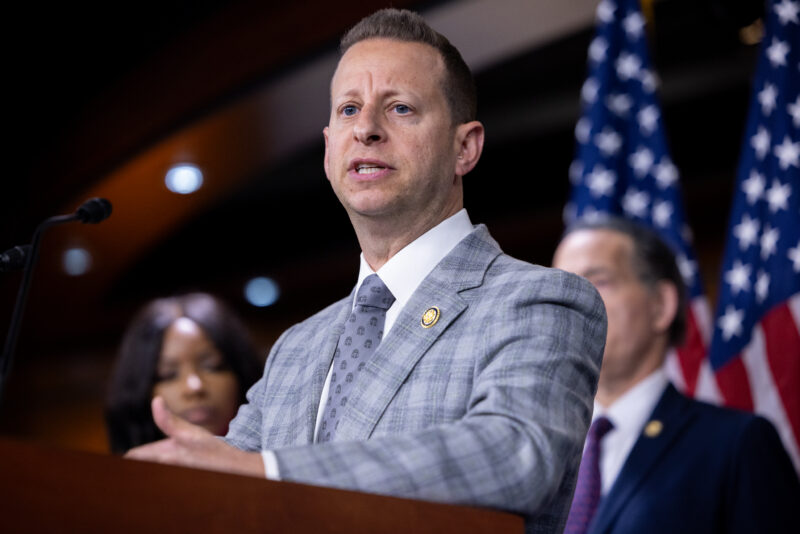
A group of six moderate House Democrats introduced an alternative war powers resolution on Iran, which — rather than demanding an immediate end to the ongoing U.S. operation — would give the administration 30 days in which to either end the campaign or come to Congress to seek approval for continued strikes.
The resolution is sponsored by Reps. Josh Gottheimer (D-NJ), Jimmy Panetta (D-CA), Henry Cuellar (D-TX), Greg Landsman (D-OH), Jared Golden (D-ME) and Jim Costa (D-CA). It signals concern from the group of hawkish pro-Israel House Democrats about the efforts by their colleagues to demand an immediate end to operations in Iran, though at least some of the sponsors of the resolution still plan to vote for the existing war powers resolution this week as well.
“Iran is actively firing drones and ballistic missiles at U.S. troops, our embassies, allies, and is targeting civilians across the region,” Gottheimer said on X on Tuesday. “This new Democratic War Powers Resolution will uphold Congress’s constitutional authority — while also ensuring the U.S. can defend our troops, embassies, and allies from Iranian aggression.”
Landsman said that the resolution “allows for the short-term, targeted strikes on the regime’s missiles and bombs, requires Trump to come to Congress for a vote, and specifies ‘no ground troops.’ Destroy the [regime’s] ability to destroy more lives or cause any more mayhem or violence. Nothing more.”
In a press release, Gottheimer’s office pointed to concerns that the resolution led by Reps. Ro Khanna (D-CA) and Thomas Massie (R-KY), which is set to receive a House vote this week, would pull out U.S. forces even as Iran is targeting U.S. troops, assets, facilities and allies. “It is vital that we allow for a safe transition, that protects our service members, embassies, and allies, not a potentially precarious withdrawal,” the statement reads.
Lawmakers supporting the war powers resolutions in both chambers have largely not articulated what an immediate end to the war would entail or the potential consequences of abruptly pulling out U.S. forces.
The new resolution includes specific language forbidding the administration from deploying ground troops into Iran “in a combat role, including for regime change, or for occupation unless explicitly authorized by Congress,” but includes an exception for search and rescue and intelligence operations.
Gottheimer’s press release argues that an “open-ended commitment” and a potential commitment of ground troops would both be “unacceptable,” while also warning that “it is equally unwise to act in a precipitous way and endanger America’s security and put our service members in additional harm’s way.”
The Gottheimer-led resolution also contains language that would allow the U.S. to continue to defend its facilities, personnel and allies from “imminent attack;” keep forces in the region “for defensive purposes” and who are engaged in other missions and continue sharing intelligence with partners.
The war powers resolution that is set to receive a House vote later this week does not include similar language to specifically allow for continued intelligence sharing and defensive operations protecting allies, which could raise concerns for pro-Israel Democrats.
The Senate version of the resolution does include such protections.
While Gottheimer and Landsman have said they oppose the Massie-Khanna resolution, Panetta said on Tuesday that he would support it, despite also backing the Gottheimer resolution.
“The President has not abided by our Constitution when it comes to invading foreign sovereign states,” Panetta said in a statement. “That is why Congress must fulfill our obligations under the constitution by supporting this week’s bipartisan War Powers Resolution.”
Asked about the Gottheimer resolution, Rep. Greg Meeks (D-NY), the ranking member of the House Foreign Affairs Committee, emphasized that the Massie-Khanna legislation will be coming to the floor on Wednesday. “That’s the one we have. This is continuing right now. We need to vote on this resolution tomorrow. I’m not considering any other [resolution].”
Jeremy Bash, a former chief of staff at the Department of Defense and Central Intelligence Agency under the Obama administration, told JI that the Khanna-Massie resolution is reckless.
“We have U.S. servicemembers in harm’s way. Some are flying combat sorties as we speak. We can’t call them in the cockpit and say ‘Congress has prohibited you from completing this mission. Please turn around and stop what you’re doing.’ If that sounds a little strange, it is because the Ro Khanna resolution requires that very strange outcome,” Bash said. “An immediate withdrawal is dangerous for our troops. Any pullback needs to be orderly and safe. We need to give the combatant commander at least a few weeks to do this safely.”
He said that Congress can and should be involved in debating the war and providing oversight, but “for a war powers resolution to be credible, it has to build in several days for the commanders to act responsibly to protect their troops. This cannot be done immediately.”
Bash called Gottheimer’s resolution a “very sensible alternative that will protect our troops.”
Daniel Silverberg, a former advisor to Rep. Steny Hoyer (D-MD), emphasized that a similar effort to cut off the U.S.’ Libya operations led by “one of the most ardent anti-war activists in the House,” then-Rep. Dennis Kucinich (D-OH), included a 15-day wind-down provision.
“The Massie-Khanna resolution lacks it. The notion that Democrats would not, at a minimum, support that amendment to allow for a responsible withdrawal of forces is problematic from a national security perspective and from a messaging perspective,” Silverberg said.
Amb. Daniel Shapiro, a former U.S. ambassador to Israel and senior State and Defense Department official, said that the resolution could serve as a “fallback” if the Massie-Khanna resolution fails, one which might have a chance of attracting GOP support.
“The 30 day clock … arguably addresses a concern that some members might have about troops who are actively engaged and in the field, and would need some window of time … to wind down and safely conclude operations,” Shapiro said.
More Stories
TAKING HEAT
Colby back in Capitol’s crosshairs
ON ALERT
NYPD braced for ‘multiple protests every day’ around U.N. summit

RIPPING ON RIYADH
Trump’s pick for Saudi ambassador once suggested kingdom is not a ‘true ally’

REGIME RECKONING
El-Sayed avoids acknowledging Iranian protester deaths, condemns Iran war instead

BOOKSHELF
In new book, Zibby Owens weaves memoir with a reckoning of Jewish life after Oct. 7

POLAND IN FOCUS
Jacky Rosen visits Poland to discuss antisemitism, Holocaust issues
Please log in if you already have a subscription, or subscribe to access the latest updates.
 Continue with Google
 Continue with Apple