










































































House narrowly defeats war powers resolution to end operations in Iran
Four Democrats and two Republicans broke with their parties to oppose and support the resolution, respectively
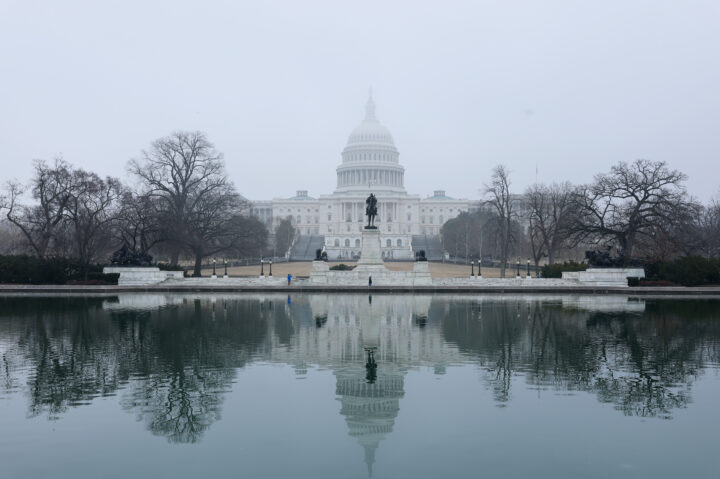
Anna Moneymaker/Getty Images
U.S. Capitol on March 05, 2026 in Washington, DC.


 Add JewishInsider on Google
A day after Republican senators blocked a vote to end the U.S.-Israeli operations in Iran, the House voted 219-212 to defeat a similar war powers resolution, with four Democrats breaking with their party to oppose an immediate end to the war, and two Republicans voting with other Democrats to oppose military action.
Reps. Greg Landsman (D-OH), Jared Golden (D-ME), Henry Cuellar (D-TX) and Juan Vargas (D-CA) were ultimately the only Democrats to vote against the resolution, which was led by Reps. Ro Khanna (D-CA) and Thomas Massie (R-KY). Reps. Josh Gottheimer (D-NJ) and Jared Moskowitz (D-FL), who said they would oppose the resolution before the war began, ultimately voted in favor.
On the Republican side, Massie and Rep. Warren Davidson (R-OH), both of whom have isolationist leanings, were the only members of the GOP to support the resolution.
Moskowitz had argued before the war that voting preemptively on the resolution would remove U.S. leverage in negotiations, but argued that the situation has since changed and that the U.S. is now in a full-scale war.
“I didn’t flip at all,” Moskowitz told Jewish Insider. “Circumstances have changed since my first statement two weeks ago.”
In a statement, he condemned Iran and its regime, saying he is “happy that [Ayatollah Ali Khamenei] is no longer able to reign terror on his country,” but added, “Regardless of how one feels about this war, or this President, Congress’s constitutional role in any declaration of war is a completely separate issue,” expressing concern at the erosion of congressional war powers over the past year.
“We must reestablish our Article I authority which grants Congress all legislative powers,” Moskowitz said, adding that he did not believe the resolution would prevent continued efforts to protect U.S. bases and personnel nor intelligence sharing with allies.
Gottheimer emphasized in a statement that the U.S. “simply can’t afford to get this wrong — we must win and crush” the Iranian regime’s military capabilities, emphasizing that he is not, in principle, opposed to military action against Iran and that the regime “deserves the punishment they’re receiving.
“With the defeat of the War Powers Resolution in the Senate, the vote in the House today shifted from an unacceptable call that could put our troops in harm’s way to a clear call for this Administration to articulate the goals for the mission, the end game, and their plan to avoid a protracted conflict,” Gottheimer continued — suggesting that he voted for the resolution because it was, in essence, symbolic given that it did not pass the Senate.
“Unlike some of my colleagues who are opposed to combatting the Iranian regime, the world’s leading state sponsor of terror, I’m supporting this resolution to send a clear message to the Administration: the American people deserve a coherent explanation of what precipitated this war, what success looks like, and how we will know when the mission has been achieved,” he continued, criticizing “shifting justifications and objectives” from the administration. “I’m not opposed to taking action against Iran. I believe that steps to address the persistent threats are merited and necessary to protect our broader national security interests.”
He pledged to make sure the military has sufficient resources, signaling that he may support supplemental funding for the mission if and when requested.
The beginning of combat operations, the loss of some American soldiers and the administration’s inconsistent messaging and strategy — as well as an aggressive push from Democratic leadership — likely helped Democrats close ranks on the war powers resolution.
After the vote, Rep. Greg Meeks (D-NY), the ranking member of the House Foreign Affairs Committee, said that he would call up another war powers resolution 60 days from the start of the war, the limit under which an administration can conduct military operations without congressional authorization under the War Powers Act.
“Members who voted against today’s WPR on the assumption that Trump’s war will be swift or limited will not have that excuse once we’ve entered the third month of open-ended hostilities,” Meeks said.
Like Moskowitz and Gottheimer, a handful of other Democrats who have offered a degree of support for the U.S. operations in Iran ultimately voted for the resolution. Some have pointed to concerns about constitutional process and the administration’s failure to seek congressional approval for the war, rather than opposition to the war in general.
“I will vote for the war powers resolution because I cannot support unchecked authority for the administration to engage, indefinitely, in an already deadly war with unknown size and scope, especially considering Secretary [of Defense Pete] Hegseth’s suggestion that he is willing to” use ground troops in the operation, Rep. Tom Suozzi (D-NY), a moderate House Democrat, said.
At the same time, Suozzi said that “Iran is weaker and the regime’s leadership has been decimated — those are good things. If these operations make the region more secure and America safer, those would also be good things.” He added that the war powers resolution would not prevent Congress from authorizing the use of force in Iran “if necessary and properly presented to Congress.”
Davidson, one of the two Republicans who voted for the resolution. said on the House floor on Wednesday that operations against Iran were just, and potentially necessary, but unconstitutional.
“For some this debate will be about whether we should even be fighting in Iran. For me, the debate is more fundamental: is the president of the United States, regardless of the person holding the office, empowered to do whatever he wants?” Davidson said. “That’s not what our Constitution says. … I rise in support of this war powers resolution today because the moral hazard posed by a government no longer constrained by our Constitution is a grave threat.”
Davidson argued that his Republican colleagues were ignoring the clear definition of what constitutes a war, and repudiating Trump’s campaign promises.
The House resolution, unlike the Senate version, included no specific protections to allow for continued U.S. intelligence sharing with Israel and other allies, and defensive operations to protect allies like Israel and U.S. forces.
Earlier this week, Gottheimer, Landsman, Suozzi, Cuellar, Golden and Reps. Jimmy Panetta (D-CA), Jim Costa (D-CA), Vicente Gonzalez (D-TX) and Adam Gray (D-CA) had introduced an alternative resolution that would give the administration 30 days from the start of the war to wind down operations in Iran, rather than demanding an immediate halt, while banning any ground operations.
Gottheimer said in his statement he plans to call up his resolution during the week of March 23, but he hopes that, “Between now and then, I hope either the conflict has reached its objectives or the Administration has made a strong case to Congress and the American people for why this mission must continue.”
But most ultimately voted for the Massie-Khanna resolution.
Suozzi said that the Gottheimer resolution “would prevent a reckless and potentially unsafe removal of our forces and allow us to continue to protect American troops and our allies in the region during this perilous time,” a seeming indictment of the war powers resolution he nevertheless supported.
Top lawmakers supporting the war powers resolution have largely failed to articulate what the implications of immediately ending operations would be, with some claiming, in spite of the resolution’s language, that U.S. forces would be allowed to finish their mission and wind down.
Some former Democratic officials argued that Gottheimer’s alternative effort would be a more prudent path, with U.S. forces and embassies under fire from Iran, and that any realistic and safe withdrawal would take time. One also argued that the resolution, if brought to a vote, might pick up enough Republican support to pass.
Daniel Silverberg, a former advisor to Rep. Steny Hoyer (D-MD), emphasized that a similar effort to cut off the U.S.’ Libya operations led by “one of the most ardent anti-war activists in the House,” then-Rep. Dennis Kucinich (D-OH), included a 15-day wind-down provision.
“The Massie-Khanna resolution lacks it. The notion that Democrats would not, at a minimum, support that amendment to allow for a responsible withdrawal of forces is problematic from a national security perspective and from a messaging perspective,” Silverberg said.
Jeremy Bash, a former chief of staff at the Department of Defense and Central Intelligence Agency under the Obama administration, told JI that the Khanna-Massie resolution “requires [a] very strange outcome” that would be “dangerous for our troops” and that it was not “credible” because it lacked any buffer period.
More Stories

DAMASCUS DIARIES
Syrian president blames Israel for diplomatic difficulties, rejects Trump push to send forces into Lebanon

Schmear campaign
Politico picks Yom Kippur to attack Huckabee’s observant Jewish aide

CANDIDATE CALCULATIONS
Vulnerable Republican candidates urge end to Iran war
UNGA UNFILTERED
Trump talks tough on Iran, even as he predicts diplomatic deal after midterms

DIPLOMACY DIARIES
AJC plans ‘diplomatic marathon’ amid U.N. General Assembly in New York

analysis
Attack on Ambassador Leiter’s son casts pall over Netanyahu’s abbreviated UNGA visit
Please log in if you already have a subscription, or subscribe to access the latest updates.
 Continue with Google
 Continue with Apple