

























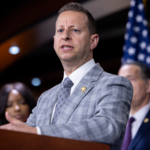


Pro-Israel Muslim Democrat walks political tightrope in Philly primary
State Sen. Sharif Street supports continued U.S. aid to Israel but calls Israeli PM Netanyahu a war criminal
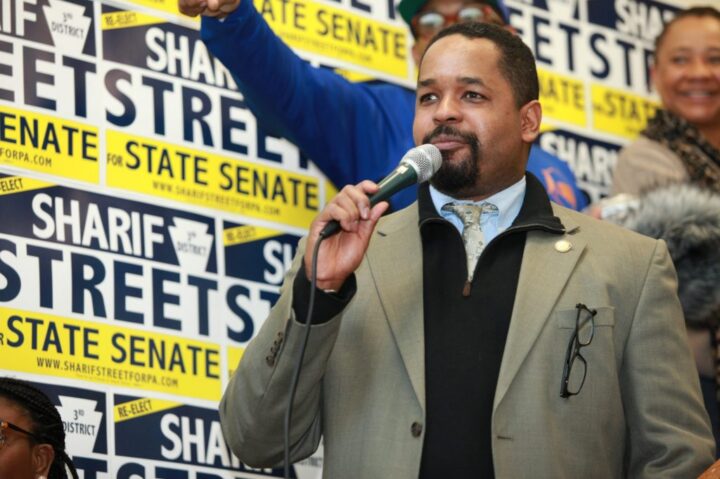
Sharif Street campaign page
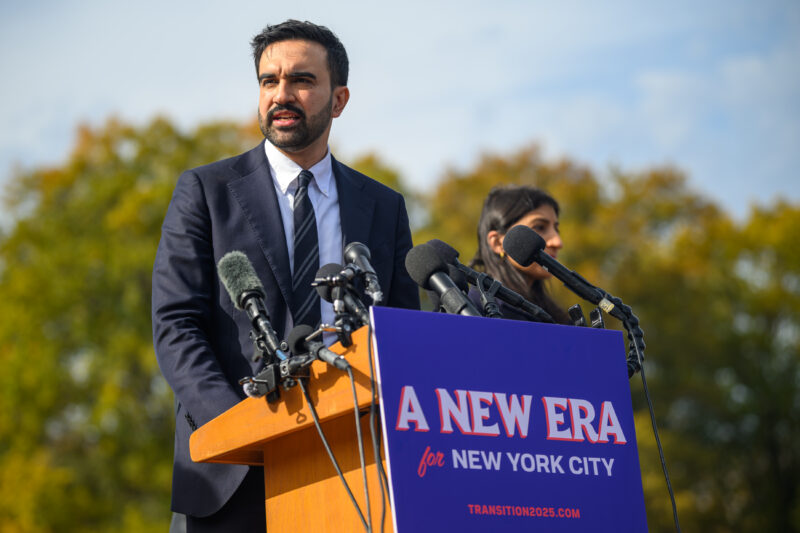
Pennsylvania state Sen. Sharif Street


 Add JewishInsider on Google
Sharif Street is walking a unique political path.
The Pennsylvania state senator running for a House seat in the heart of deep-blue Philadelphia is Black and Muslim, and has staked out positions largely supportive of Israel.
He traveled to Israel with the American Jewish Committee in 2017 “to gain some understanding” of the complexities facing Israelis and Palestinians.
He has indicated that he would not support conditions on U.S. aid to Israel, saying that the two allies need an “open dialogue,” yet he refers to Israeli Prime Minister Benjamin Netanyahu as a war criminal.
Street’s nuances on Israel — he backs a strong U.S.-Israel relationship, while also urging a compassionate approach to the Palestinians — offer a sharp contrast with his most prominent rival in the Democratic primary for Pennsylvania’s 3rd Congressional District, who is a strident antagonist of Israel.
Street’s friends and allies in the Jewish community insist his stances aren’t a matter of political convenience or calibrated to win him a congressional seat, but rather are borne of years of study on the issue, personal conviction and decades-long ties to members of the Jewish community.
The nuances Street evinces on Israel extend to his reading of the Muslim community, too. While political analyses over the past two years have seen the Jewish and Muslim communities as generally at odds over the war in Gaza — including the three current Muslim members of Congress who regularly stake out anti-Israel stances — Street argued in an interview with Jewish Insider that doesn’t tell the full story of his community.
“The Muslim community is much more diverse than I think the American press tends to think,” Street told JI in a recent interview. “I’m an African American. We have had, historically, pretty good relationships with the Jewish community. … There are over 2 billion Muslims in the world, a third of the world population. And American Muslims are from South Asia, they’re from Europe, they’re from Africa, they are from the Middle East.”
“I think the perspective of the press is always just Middle Eastern Muslims who come to this country with a very long, recent history of … concerns about Israel in the Middle East. That’s not all Muslims,” he said.
Muslims from other parts of the world “have various perspectives and their issues are diverse.” And he said the African American Muslim community of which he is a part “does not have [that] kind of entrenched negative history.”
Many African American Muslims, he said, are converts, and grew up in Christian communities, with different perspectives on Israel and the Jewish community. Of the nearly 500,000 Muslims in the Philadelphia area, 80% are African American, according to Street.
“Every time they want to talk about Muslim-Jewish relations, they just focus on a very small sector — probably less than 10% of the Muslim community, which happen to be Arab American,” Street said. “And their perspective is important, but it doesn’t represent all Muslims.”
Speaking to JI, Street cast himself as a supporter of the U.S.-Israel relationship, while also urging a compassionate approach to the Palestinians and a concerted effort to aid in the reconstruction of Gaza.
“Israel is one of the United States’ most important allies in the world and certainly in the region, and we need to make sure that we keep that relationship strong,” Street said. “We also need to understand that we have to rebuild Gaza for Palestinians.”
He argued that a failure to properly rebuild Gaza and provide it with the necessary resources will only fuel radicalization and help Hamas and other extremist groups grow. “That makes both Palestinians and Israelis less safe,” he said.
He said the U.S. should invest in rebuilding and use its influence to bring along Israel and a multinational coalition, including Arab states, to assist the reconstruction and ensure the security of Gaza and the region, which would improve trust and the chances of success.
“By investing in those communities, we increase the safety and security for Israelis and Palestinians,” he reiterated. “At the same time, we have to recognize their immediate challenges, and the United States has to continue to make sure Israel can deal with the immediate challenges, while we increase the long term safety and security for both Israeli and Palestinians as well.”
He also indicated that he wouldn’t support conditions on U.S. aid to Israel, saying that the two allies need an “open dialogue.” He said that the U.S. should “encourage peace and prosperity in the region,” something best done through a “partnership” rather than by “dictating to Israel.”
He emphasized that all sides suffered in the war, and said he believes both Israelis and Palestinians want change.
Street takes a more critical stance toward Netanyahu.
He was quoted by the Philadelphia Inquirer as saying, “Guess what? Benjamin Netanyahu is not the only leader of a major country in the world that’s committed war crimes, because Donald Trump has done the same thing. But none of us would talk about getting rid of the United States of America as a country.” He said at a recent candidate forum that Netanyahu should be prosecuted for war crimes.
Asked about the comments quoted by the Inquirer, he told JI that it is “possible” that Netanyahu was responsible for war crimes “and I certainly think that that needs to be investigated.” He highlighted that many Israelis are also concerned with and dissatisfied with Netanyahu’s leadership throughout the war, and want to see him out of office.
“Ultimately — and I think the Israeli people will do the right thing — but I think that the Israeli courts have to have a chance to really hear that and oversee those issues, and that’s not likely to happen while we’re still in an armed conflict,” he said.
About his trip with AJC to Israel alongside other Muslim leaders in 2017, Street said, “So often we oversimplify what’s going on in the Middle East,” Street said. “I don’t think Americans fully understand the depth and complexity of the issues. So I wanted to gain some understanding.”
David Hyman, a longtime attorney in Philadelphia who was an ally of Street’s father, former Philadelphia Mayor John Street, watched him grow up since he was a teenager. He said he remembers having a conversation with Street along similar lines following that trip.
“He said that what he really came away with on the trip [was] that slogans and simple answers are not what will help matters,” Hyman recounted.
Kevin Greenberg, an attorney who said he’s been friends with Street for 30 years, said he’s seen Street’s views on the Middle East grow and evolve over time, and the two had — prior to Street’s AJC trip — discussed visiting Israel together.
“I’ve seen a lot of politicians decide to be pro-Israel, pro-Jewish for contributions, and I’ve seen a lot of people be anti-Israel, pro-BDS … because you think there are votes there. That just doesn’t enter into his calculus on this issue,” Greenberg said. “It’s a core belief of who Sharif is. And he stands for the little guy in any situation.”
Hyman, a board member of AJC’s Philadelphia chapter, offered similar praise.
“He’ll speak about his support for Israel in a setting, in a context where there’s no political upside,” Hyman said. “For me, that’s the litmus test, because there’s so little political courage these days to say anything other than what’s politically expedient. He’s very upfront.”
Hyman said that, while Street may disagree with some of the Israeli government’s decisions, “in terms of standing behind the basic tenets of Zionism and the right for Israel to exist and defend itself, he distinguishes himself at a time where [other supporters are] peeling off.”
And he emphasized that Street will be accessible to groups across the Jewish community, who already have existing relationships with him. “When issues come up, it’ll be natural for us to talk to him and take his temperature.”
Robin Schatz, the director of government relations for the Jewish Federation of Greater Philadelphia, also said that Street has “always been a friend” well before his run for Congress, and that he has always been accessible to her and the Jewish community.
At the beginning of their friendship decades ago, Greenberg said Street did not know much about the Middle East but wanted to learn more, growing up in a household more focused on the needs of Philadelphia residents. “Sharif has evolved from a curious, but unknowing person, to somebody who has a deep understanding, and respect for Jews qua Jews.”
Greenberg also said that Street has always maintained a diverse group of friends, and that both his social and professional circles have included many Jewish people, and that he was a prominent participant in both of Greenberg’s daughters’ bat mitzvahs.
Hyman noted that Street worked for a time at a historically Jewish law firm, and said that he has been active in a local AJC initiative bringing together Jews and Muslims.
Street condemned those in the United States who have turned their grievances over the war in Gaza into violent action against Jewish Americans.
“I think one of the things that happens is silent complicity. When people don’t speak out against the antisemitism that exists, that fuels it,” Street said. “We also can’t allow people who are having concerns to then turn into calling for violence in the U.S. … I will use my voice, as I have done as a state senator, as a congressperson to speak out against this and use the platform to do it.”
He additionally emphasized the importance of hate crimes legislation and pointed to his support for legislation in Pennsylvania to provide funding to protect houses of worship, which he noted helps Jewish, Muslim and other communities. He said he would support similar efforts at the federal level.
Schatz said that having a devout Muslim lawmaker like Street with strong ties to the Jewish community in Congress could be good for the Jewish community, especially given tensions that have appeared between the two communities.
“I think it’s good for the Jewish community to hear that somebody from a different faith group, especially from Islam, where people have been somewhat leery because of terrorism and Israel, to see that we do have true allies,” she said. “He’s consistently there for the [Jewish] community.”
Street’s friends and allies praised him for consistently being among the first leaders to speak out against antisemitic incidents, with more than one highlighting that he was the first elected official to condemn a recent pro-Hamas rally in Philadelphia’s Rittenhouse Square last month.
“In 2024, when some of the far left were making antisemitic attacks on Josh Shapiro, when he was up to be nominated for vice president, Sharif basically went on a virtual tour of Black Muslims all over the country, saying, do not do that,” Greenberg recounted. “Josh is a perfectly good candidate. He doesn’t hate us. He’s great with us. He’s a great leader for us, and do not let people attack him because he’s Jewish. You don’t like him? You don’t like him. Say that.”
Street, at the time, was the chair of the Pennsylvania Democratic Party. Greenberg said that Shapiro had backed another candidate for the post, but said Street maintained no ill will towards him and was insistent that attacks on Shapiro for his religion were unacceptable.
Speaking to JI before the U.S. went to war with Iran, Street said that Iran shouldn’t be allowed to obtain nuclear weapons, and that the U.S. needs to work with all of its allies and partners to prevent that from happening, “but ultimately we want to [get there] in a way that avoids war, if possible.”
After the war began, in a statement shared on Facebook, Street condemned the Iranian regime and Ayatollah Ali Khamenei, who was killed in an Israeli strike, but said that the “chaotic situation in Iran is perilous for the Iranian people and the world” and that Trump lacks the capacity to “successfully manage this situation.”
He also emphasized that the Constitution gives Congress the authority to declare war, not the president. “I am calling on Congress to immediately return to vote on a more narrowly tailored measure that will allow the US to defend its interests while exercising its oversight over this President to stop him from unilaterally starting wars all over the world,” Street said.
He told JI was similarly concerned that the administration failed to brief Congress, particularly Democrats, about the strikes it carried out on Iran last summer. He said he couldn’t judge whether those strikes were the right decision because of the administration’s failure to explain and provide intelligence about them to Congress or the public.
“Democrats and Republicans have worked in a bipartisan way under Democratic and Republican administrations to deal with the threat of Iran,” Street said. “President Obama was very strong on this issue. I would be strong on this issue, but the president can’t act unilaterally without congressional oversight. That’s the problem. It shouldn’t be partisan. … The leaders in Congress have to have the right intelligence to make those decisions.”
Street’s main competitor in the primary race is far-left state Rep. Chris Rabb. A Rabb win would likely cause significant concern among the district’s sizable Jewish community, given his record of anti-Israel activism and accusations of genocide against Israel.
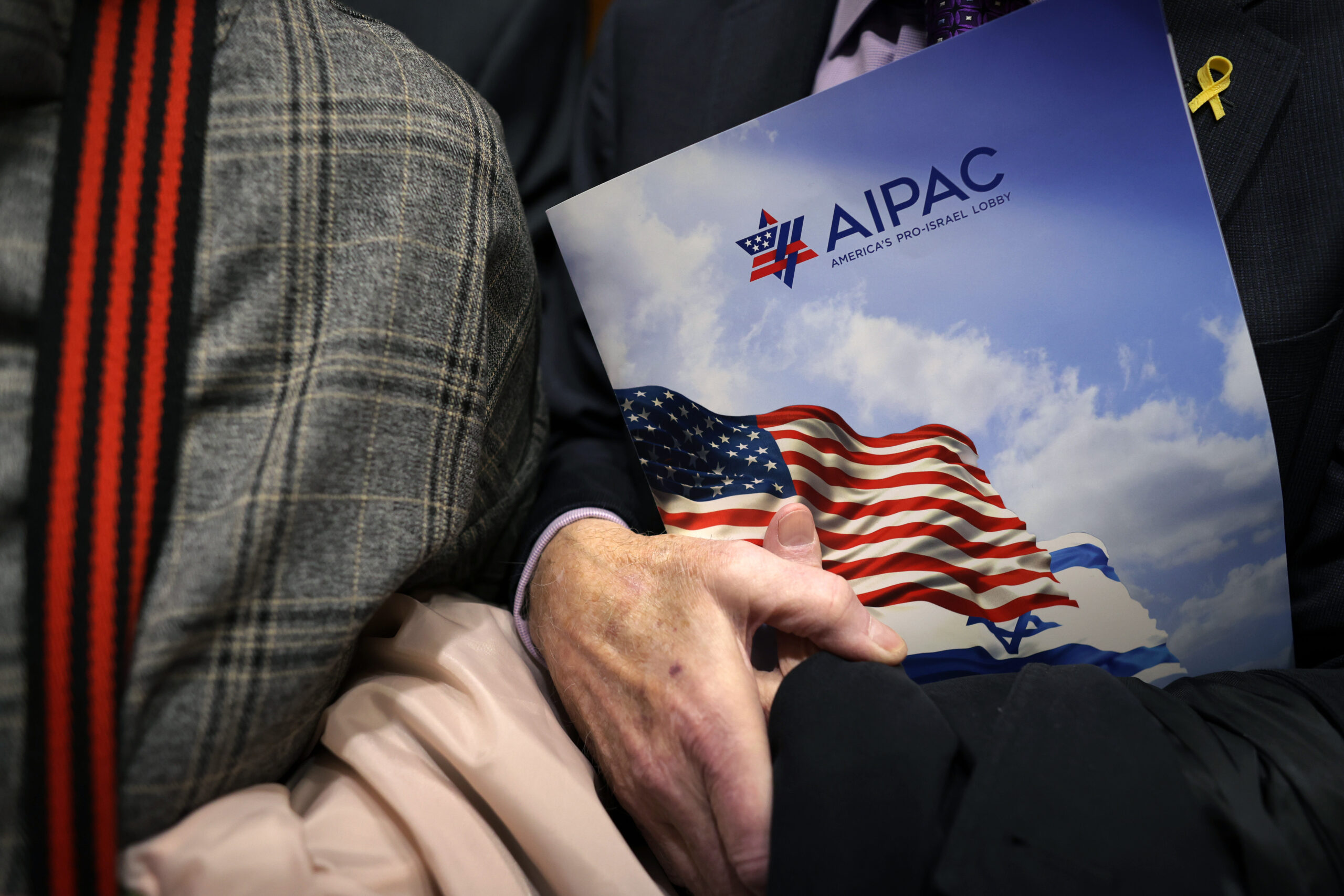
At a recent candidate forum, several major candidates offered criticism of Israel and AIPAC. “F— AIPAC. They are a racist organization and I will not meet with them,” Rabb said, accusing the group of “destroying candidates’ lives.” At another forum, Rabb said he would vote to block further U.S. aid to Israel, while other candidates avoided weighing in specifically on the legislation.
Another candidate, Ala Stanford, a physician and activist, said that she supports a two-state solution but that the U.S. should not support wars “that harm and kill children and families.” State Rep. Morgan Cephas indicated she would meet with AIPAC but suggested she disagrees with the group’s positions. David Oxman, a physician, called Netanyahu the worst Jewish leader in millennia and accused AIPAC of conflating criticism of Israel with antisemitism.
Schatz, the Federation official, said that Cephas is also “very good with the community,” Stanford is “learning about the community” and would likely be an ally and Oxman is Jewish himself. Rabb, she said, has been at odds with the Jewish community..
Street led the field in fundraising as of the end of 2025, with $701,000 raised and $527,000 on hand. He was followed by Oxman who has raised $498,000 and had $357,000 on hand; Stanford, who has raised $467,000 and had $392,000 on hand; and Rabb, who has raised $384,000 and had $99,000 on hand.
A Street campaign poll conducted by Lake Research Partners in mid-November found Street in the lead with 22%, followed by Rabb at 17%, Stanford at 11%, Cephas at 7% and Oxman at 2%, with 36% of voters undecided.
Street, a former chair of the state Democratic Party and the son of a former Philadelphia mayor, is seen as the establishment favorite, with an endorsement from former Gov. Ed Rendell, as well as endorsements from numerous labor unions and local elected officials.
Rep. Dwight Evans (D-PA), the retiring incumbent, endorsed Stanford.
More Stories
SACRAMENTO SHOWDOWN
Rep. Doris Matsui continues to highlight Hasan Piker links to far-left opponent Mai Vang

STUDENT SAFETY
Federal civil rights complaint accuses Montgomery County, Md., schools of ignoring antisemitic harassment
MINNESOTA MIC DROP
Jacob Frey, Betty McCollum join Minnesota Dem chorus condemning Piker event
CANCEL CALLS
Democratic push grows for Ilhan Omar, Fateh to cancel Hasan Piker event

MAINE EVENT
Maine Senate candidate Troy Jackson says Congress should cut off funding for Iran war
DFL DISCORD
Amy Klobuchar, Angie Craig condemn Hasan Piker ahead of Minneapolis event with Ilhan Omar
Please log in if you already have a subscription, or subscribe to access the latest updates.
 Continue with Google
 Continue with Apple