











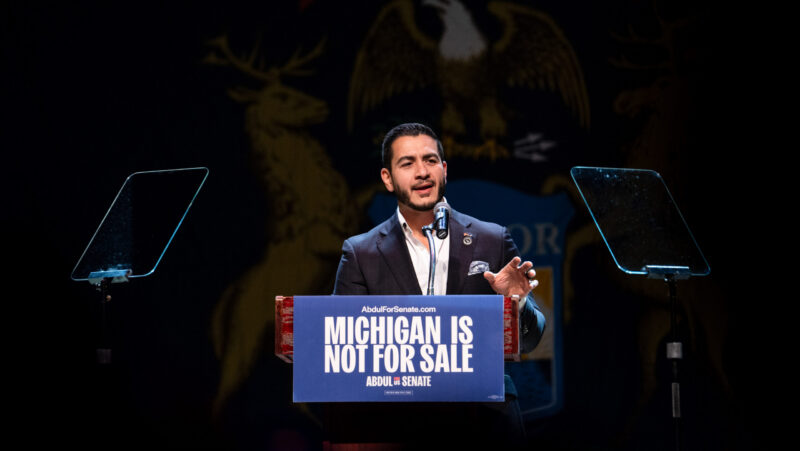
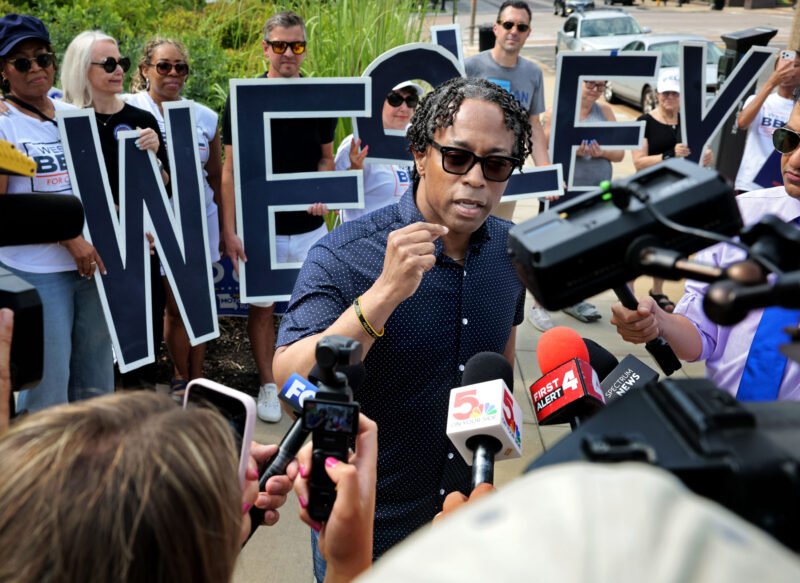

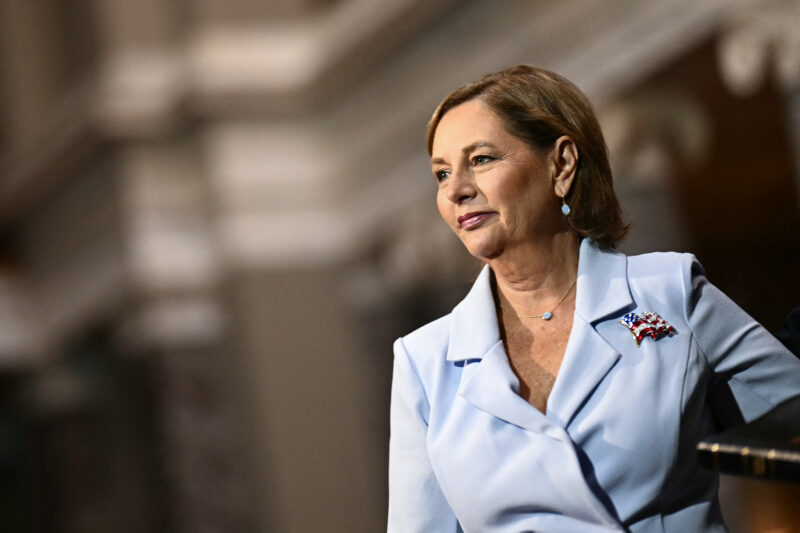


















The signatories say they ‘fear the far-left and anti-Jewish elements in the Democratic party would become dominant’ if Abdul El-Sayed is elected
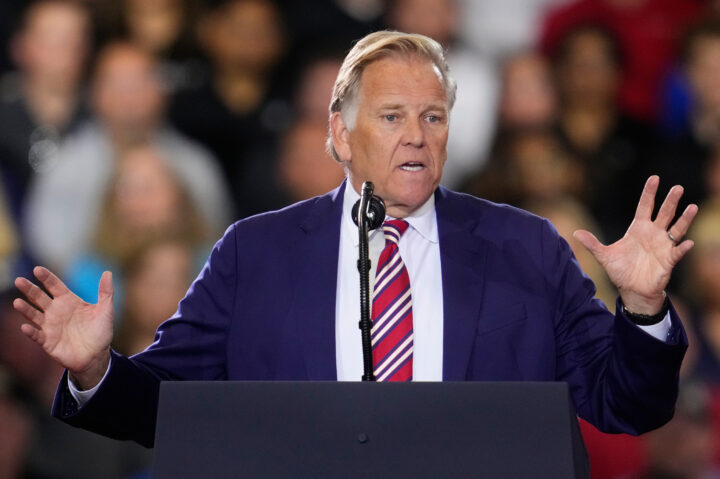
Paul Sancya/AP
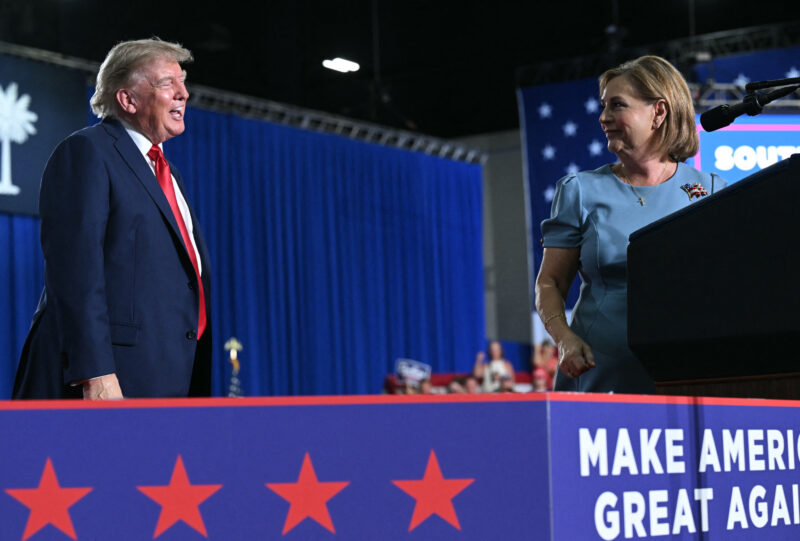
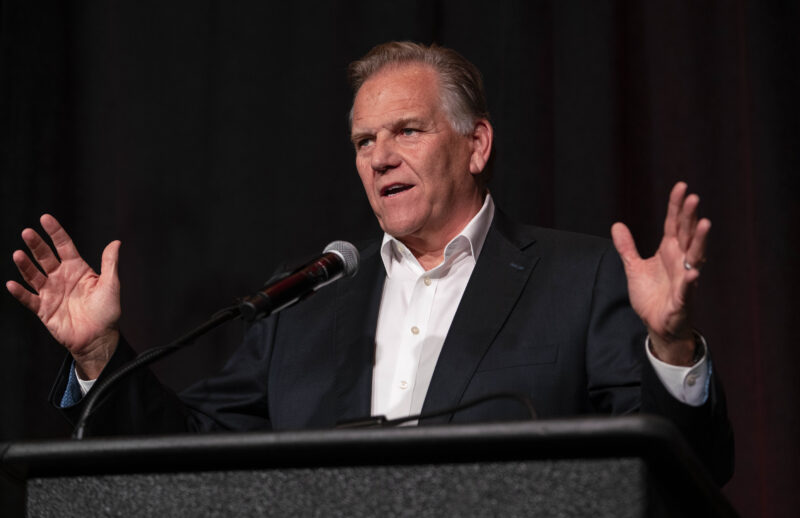
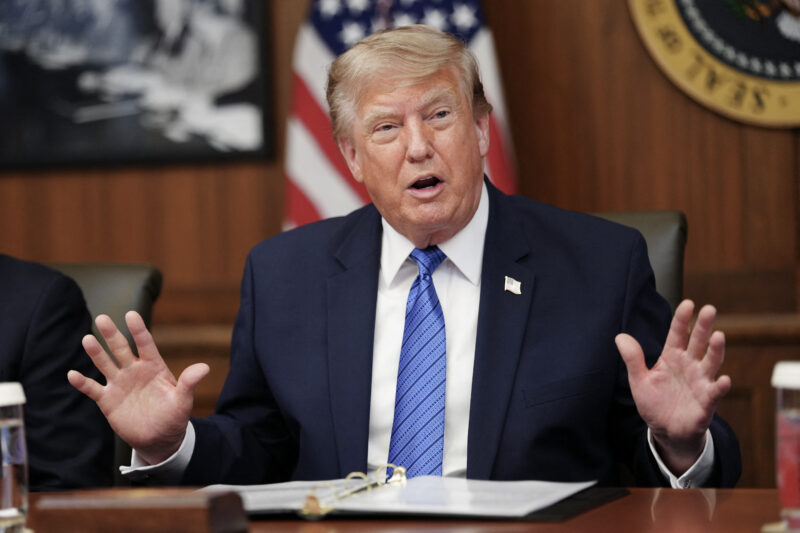
Republican Senate candidate Mike Rogers speaks before President Donald Trump at an event at the General Motors Proving Ground Monday, July 27, 2026, in Milford, Mich.


 Add JewishInsider on Google
Jewish leaders in Michigan are circulating an open letter urging Jewish Democrats and independents in the battleground state to sign their names in support of former Rep. Mike Rogers (R-MI) as he faces Abdul El-Sayed, the far-left Democratic nominee for Senate whose hostile positions on Israel have alarmed many Jewish voters.
The letter, which was obtained by Jewish Insider on Wednesday and has not yet been publicized, is led by Eric Bronstein, a Detroit businessman, among others identifying as Democrats and independents.
It came to light after a fundraiser for Rogers on Tuesday night hosted by three prominent Jewish Democratic bundlers in Michigan who are likewise alarmed by El-Sayed’s candidacy. The growing efforts among Jewish Democrats to rally support for Rogers in the key Senate race illustrate the degree to which El-Sayed has alienated a sizable and politically active swing voting bloc in what is expected to be a close election.
“We know it is unusual for many Jewish voters to support a Republican candidate for senate and we understand the implications,” Bronstein wrote in a recent email courting Jewish signatories that was also reviewed by JI. “Our fellow Jewish voters need to see their friends and neighbors — including you — willing to take a stand in this specific, crucial race.”
Bronstein did not immediately return a request for comment on Wednesday.
The open letter, which the authors intend to share online once it has gained “a significant initial group of signers,” emphasizes that many signatories “have been fiercely supportive of Democratic candidates and principles.”
“All of us have felt threatened and alienated by the politics and allies embraced by Abdul El-Sayed,” the letter continues, “which has included demonization of Jews, equivocation on terrorism, exclusion of Jewish Americans from public life, and expression of implacable hatred of the world’s only Jewish nation.”
If El-Sayed were to claim victory in the general election, the authors say, “we fear the far-left and anti-Jewish elements in the Democratic party would become dominant, including in the imminent 2028 presidential race,” when Michigan will be among the early nominating states in the Democratic primaries. “We cannot allow him to become the Democratic standard-bearer or Michigan’s senator.”
While the letter calls Rogers “a friend to the Jewish community,” it clarifies the signatories’ endorsement “does not require that we agree with him on every issue or that we support” President Donald Trump. “There are other elections locally and nationally, with different candidates aligned with our values,” it says. “Here in Michigan this year and in this Senate race, our own well-being and our own voice are at stake.”
“This is a moment when each of us must speak out,” the letter states. “We’re voting for Mike Rogers. We ask other Michigan Jewish voters to join us.”
Following the primary early this month, Rogers has been working to fine-tune his outreach to disaffected Jewish voters — balancing private engagement with a key constituency alongside a more broadly calibrated public invitation for Democrats to join his coalition.
On Tuesday, Rogers posted a video testimonial to social media from a supporter in the heavily Jewish Detroit suburb of West Bloomfield who called herself a “lifelong Democrat” and said that she had chosen to cross party lines to support “candidates that actually share our values.”
The voter did not say she was Jewish but was wearing a necklace featuring a Star of David and another with the shape of the State of Israel.
Plus, Jewish leaders go grassroots to fight political extremes

(Sarah Stier/Getty Images)
Commissioner of the NBA Adam Silver, Joshua Kushner and CEO of Disney Bob Iger attend the Men's Quarterfinal match between Novak Djokovic of Serbia and Taylor Fritz of the United States on Day Ten of the 2025 US Open at USTA Billie Jean King National Tennis Center on September 2, 2025 in the Flushing neighborhood of the Queens borough of New York City.
Good Thursday morning.
In today’s Daily Kickoff, we talk to Jewish leaders about their efforts to build up local grassroots organizing to counter extremist political forces, and report on Bob Iger and Josh Kushner’s purchase of a controlling interest in the Los Angeles Lakers. We interview Andrew Gross, the incoming head of the American Jewish Committee’s New York/New Jersey office, and spotlight Scouting America’s efforts to provide a welcoming environment for Jewish and Israeli scouts. Also in today’s Daily Kickoff: Yuval Ben Neriah, Rabbi Ben Berger and Nelson Peltz.
We also have a new on-demand Live Briefing that you can access throughout the day via our new app (on Apple and Android) and on our website.
Today’s Daily Kickoff was curated by JI Executive Editor Melissa Weiss and Israel Editor Tamara Zieve, with assists from Danielle Cohen-Kanik and Marc Rod. Have a tip? Email us here.
What We’re Watching
- We’re monitoring the situation in Israel and Lebanon after Lebanese Prime Minister Nawaf Salam slammed “attacks, incursions, demolitions and the systematic destruction of homes” in parts of southern Lebanon.
- Israeli Defense Minister Israel Katz, meanwhile, said the IDF was “destroying all the houses” in the established buffer zone between the countries as it prepares for a “long-term presence” in the area, prompting a rebuke from a State Department official, who said, without naming Katz, that a “permanent military presence in south Lebanon is not consistent with the commitments made in the framework or the long-term peace and security of both states.”
- We’re also keeping an eye on developments in the West Bank, as extremist settlers attempt a siege on a home owned by a Palestinian American family in the village of Qusra. U.S. Ambassador to Israel Mike Huckabee criticized the “horrific act of terror” targeting the home and its residents, who according to a relative in the U.S. were evacuated by the IDF.
- In Washington, the Hudson Institute is holding an event this morning looking at the U.S. and Israeli war against Iran nearly six months after the launch of Operation Epic Fury. Speakers include the Foundation for Defense of Democracies’ Behnam Ben Taleblu, the Hudson Institute’s Michael Doran and Zineb Riboua, and former State Department official Ludovic Hood, who recently joined Hudson’s Center for Peace and Security in the Middle East as a senior fellow.
What You Should Know
A QUICK WORD WITH JI’S JOSH KRAUSHAAR
Rep. Alexandria Ocasio-Cortez (D-NY), who is openly considering a presidential campaign in 2028, made waves over the weekend when she declared that “Woke 1.0 was crazy” in a nationally televised ABC News interview where she distanced herself from the most unpopular elements of the progressive movement.
Left unsaid during the conversation is what specific policies in the party’s last activist wave does she think were crazy, and does she still agree with any of them? After all, the platform of the Democratic Socialists of America currently outlines many of the same issues that played a role in Democrats’ defeat in 2024 — from progressive candidates’ support for defunding the police to the Biden administration’s open-ended immigration policy that led to the second Trump administration’s harsh crackdown on refugees and undocumented immigrants.
Presumably, she’ll be asked to answer more of the specifics in subsequent interviews. But the implication of her comments was that it’s hard for Democrats to publicly embrace the panoply of left-wing issues that became liberal conventional wisdom around the time of the pandemic without suffering a significant political penalty. Democrats aren’t exactly speaking the language of climate change activists or transgender advocates or supporting watering down penalties for criminals anymore, as was commonplace in 2020.
But they aren’t confronting the far-left forces that drove these issues to the forefront of the conversation for much of the last decade, either. The scandal surrounding Francesca Hong’s view of Thanksgiving as a “colonizer holiday” and Abdul El-Sayed’s comments bashing football, July 4 fireworks and Mackinac Island only underscore the impression that their deeply-held views are at odds with a majority of Americans.
And meanwhile, the DSA faction is as influential as ever in Democratic Party politics. How did that happen, even as a prominent progressive like AOC now acknowledges the excesses of the far left? It’s because the activists have refocused their attention away from their (still deeply held) unpopular social and cultural positions, and are now singularly focused on demanding candidates label Israel’s war against Hamas in Gaza as a genocide. That’s the biggest litmus test right now. And their efforts are aided by the overall decline in support for Israel within the Democratic Party that’s accelerated in the last year.
MOVERS AND LAKERS
Josh Kushner, Bob Iger purchase Los Angeles Lakers for record $12.5 billion

Josh Kushner, managing partner of the venture capital firm Thrive Capital, and former Disney CEO Bob Iger have agreed to purchase a controlling interest in the Los Angeles Lakers for a record-breaking price of $12.5 billion, Jewish Insider’s Matthew Shea reports.
Announcement: “As lifelong NBA fans, we are deeply honored for the opportunity to become stewards of the Los Angeles Lakers, one of the most iconic sports franchises in the world. We have immense respect for the leadership and vision of Jerry and Jeanie Buss,” Kushner and Iger said in a statement, referring to Jeanie Buss, governor and minority owner of the Lakers, and her late father, longtime Lakers owner Jerry Buss. “Our long-term commitment is to build on that foundation, compete at the highest level, and serve this extraordinary team, its fans, and the city of Los Angeles.”
NEW BATTLEGROUND
Jewish leaders build up local grassroots organizing to counter radical forces in politics

Until recently, the political strategy of the American Jewish establishment could be summed up in two ways: Elect pro-Israel lawmakers to Congress and, at a much smaller scale, educate state and local officials about Jewish values and causes. But a new model of Jewish political engagement is emerging to counter growing populist angst and surging antisemitism across the political spectrum: local efforts focused on school boards and city councils and statehouses, Jewish Insider’s Gabby Deutch reports.
Door-to-door: These Jewish activists are not shying away from the messy reality of politics: They aren’t here to make friends with everyone, acknowledging that not everyone is an ally. Their goal is to offer support — through door-knocking, organizing and their checkbooks — to candidates who have stood by the Jewish community in the post-Oct. 7 political firestorm, and to try to unseat those who have not. “All of these groups are starting to pop up because we realize that the infrastructure that the community has had in the past isn’t enough and isn’t working,” said Stefanie Clarke, a political strategist in Colorado who co-founded the Colorado Jewish Action Alliance.
EYE ON THE BALL
New AJC regional director looks to business community for allies in Mamdani’s New York
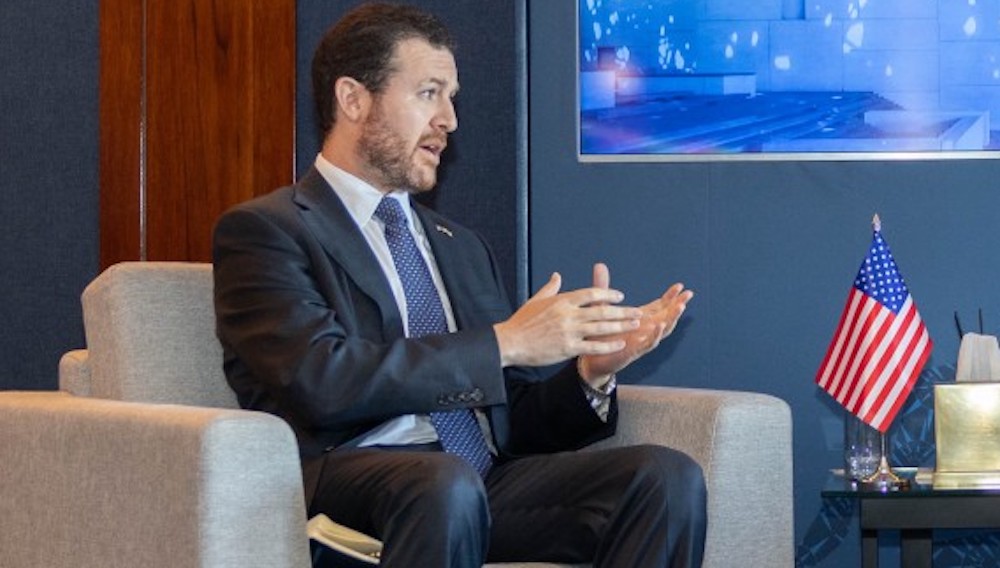
Andrew Gross arrived in his new role as the American Jewish Committee’s New York regional director on Monday with memories from the other side of the Hudson River — memories of the shattered JC Kosher Supermarket in Jersey City, where in December 2019 antisemitic gunmen murdered three people before themselves dying in a firefight with police. “I remember seeing the bullet casings and glass fragments on the ground,” Gross, who had become executive director of the New Jersey-Israel Commission under then-Gov. Phil Murphy just a few months before, told Jewish Insider’s Will Bredderman.
Wide net: “As I do my job here at the AJC, I’m going to work with everyone to make sure that exact type of scenario does not happen again,” he said in a wide-ranging interview with JI. “Everyone,” as he described it, extends from the NYPD to New York City Council Speaker Julie Menin to AJC’s long-standing network of Jewish and non-Jewish civic allies, and even friendly interests out of the Persian Gulf. Gross said he also plans to draw on another set of experiences from Murphy’s administration as he looks now to forge stronger ties with Big Apple business leaders: his time at the New Jersey Economic Development Authority.
COMMUNITY CONCERN
Atlanta Jewish Times publisher accuses Ossoff of ‘lying’ about Israel support
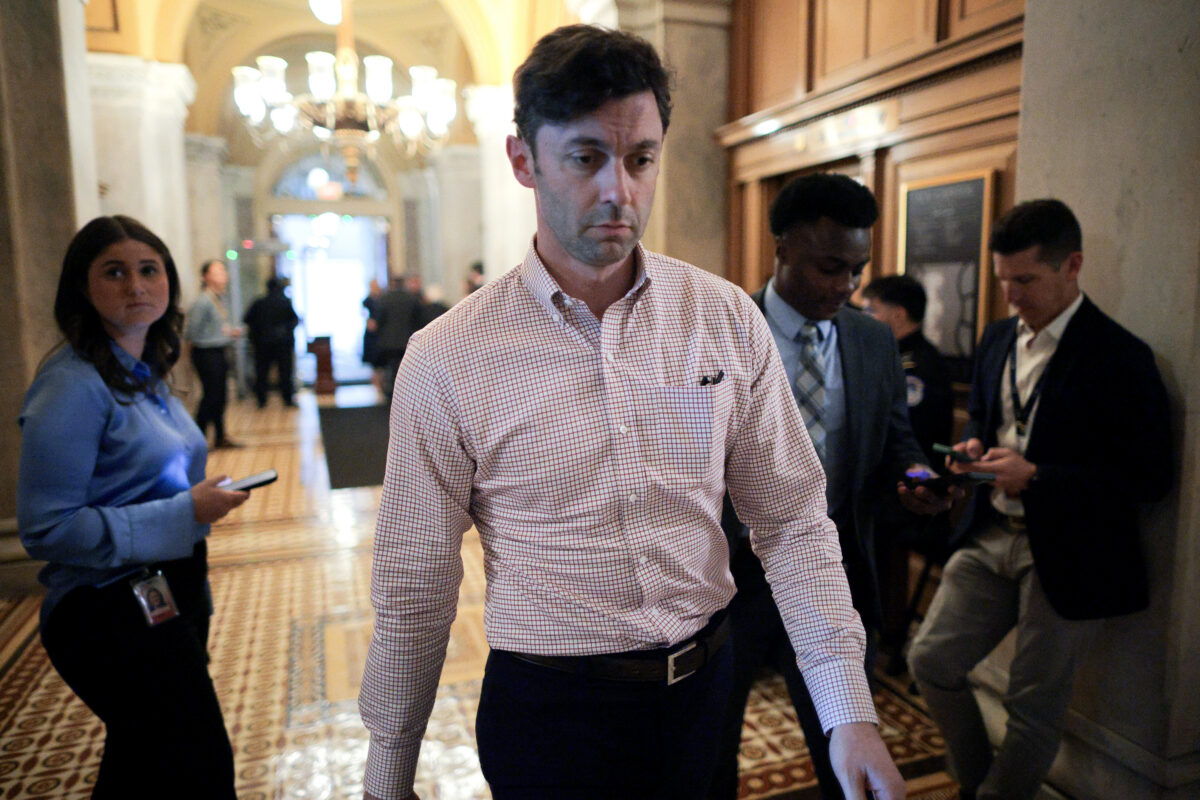
The publisher of the Atlanta Jewish Times penned an open letter to Sen. Jon Ossoff (D-GA) on Wednesday pressing the senator over his repeated votes to block U.S. military sales to Israel, accusing Ossoff of failing to support Israel and of misrepresenting his positions to his Jewish constituents, Jewish Insider’s Marc Rod reports.
Notable quotable: “I apologize for being blunt, but please, stop lying to me and your constituents. I hear you claim, over and over again, that you support Israel — that your support is ‘ironclad,’” Michael Morris wrote in the letter. “It is not. You vote against Israel on the Senate floor in Washington, then come home to Georgia and make this untruthful claim.” He argued that, by contrast, Ossoff’s “antagonism toward Israel has remained steadfast,” pointing to his repeated votes for efforts to block arms sales.
FOLLOW THE MONEY
Nevada GOP candidate took max-out contribution from ‘Protocols’-promoting activist
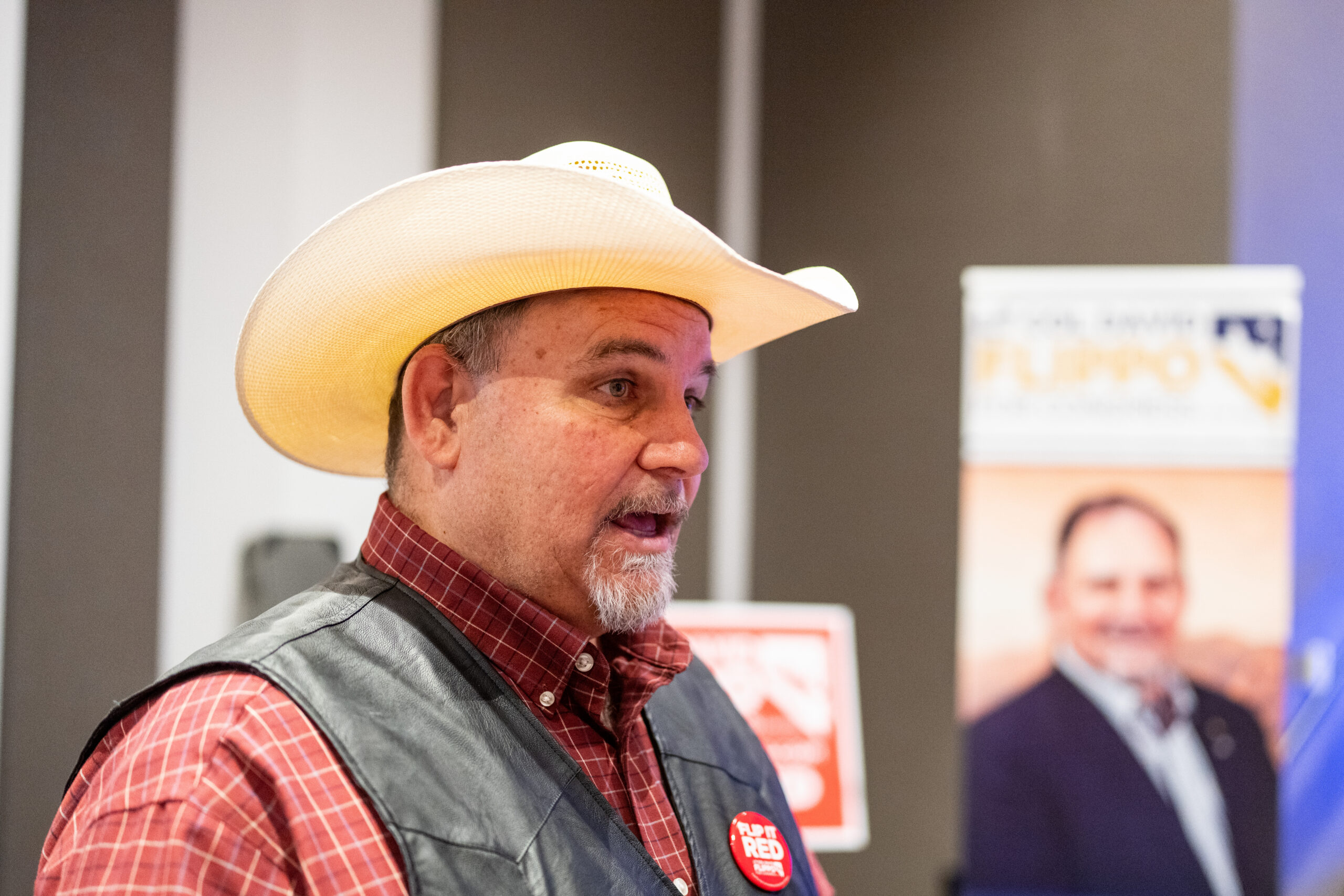
David Flippo, the Republican nominee in Nevada’s 2nd Congressional District, accepted a max-out donation from Robert Beadles, a prominent local GOP donor and commentator who has repeatedly promoted the Protocols of the Elders of Zion and other antisemitic conspiracy theories, Jewish Insider’s Marc Rod reports.
Paper trail: Flippo, a military veteran who is running in a district that strongly favors Republicans to replace Rep. Mark Amodei (R-NV), has positioned himself as a close ally of the Jewish community. But according to FEC records, he has received $7,000 in donations from Beadles — the legal allowable limit — in May and June of 2026, the only donations Beadles has made thus far this election cycle.
SCOUT’S HONOR
Scouting America offers ‘safe space’ for Jewish campers to hold Shabbat services

Clad in khaki uniforms and merit badges, hundreds of scouts gathered on a Saturday morning for a sight that has become increasingly rare in America: a Jewish prayer service without security and where nobody felt the need to look over their shoulder, Jewish Insider’s Haley Cohen reports.
Sense of security: At a moment when Jewish students contemplating the upcoming school year are weighing whether to wear or hide their Star of David necklaces as they return to the classroom, this summer’s Scouting America national jamboree in West Virginia offered a different message — holding a full, public Shabbat service for its Jewish scouts as part of an event organizers describe as one of the last unapologetically inclusive spaces for religious minorities in youth culture. “I’ve had the privilege of going to synagogue services around the world for the past 20 years. [The jamboree] was the only one I’ve been to, other than in Israel, where there was no need for security around the service,” Ricky Mason, chair of Scouting America’s national executive board, told JI.
Worthy Reads
Not Very Christian: For Fox News, George Deek, Israel’s special envoy to the Christian world, reflects on the “double standard” applied to Israel amid reports of attacks by Israeli extremists targeting Christians in the country. “Extremism exists in every democratic society. Sometimes it grows dangerously. Governments must confront it. But serious people understand the difference between extremists within a society and the character of the society itself. Except, increasingly, when that society is Israel. An extremist in Boston, Madrid or London attacks a Jew, and we correctly call him an antisemite. A fanatic spits at a Christian in Jerusalem, and suddenly we are invited to diagnose Israeli society. That is not analysis. It is a double standard. If you genuinely want to know whether Christians are flourishing in a country, there are better measures than the behavior of its worst citizens.” [FoxNews]
Trouble Back Home: The Wall Street Journal’s Sadanand Dhume looks at the challenges facing Pakistani Field Marshal Asim Munir as he notches a series of high-profile diplomatic wins but struggles with domestic constraints. “Over the past year and a half, the army chief and Pakistan’s de facto leader, Field Marshal Asim Munir, has pulled off a high-wire act: He has raised Pakistan’s international standing even as domestic challenges have mounted. But unless Gen. Munir can revive the country’s stagnant economy and calm its restive population, his diplomatic gains will likely prove evanescent. … Unfortunately for Pakistan, neither Gen. Munir’s diplomatic feats nor his consolidation of power offers solutions to the country’s domestic crises.” [WSJ]
Find more Worthy Reads in our Live Briefing via our new app (on Apple and Android) and website.
Word on the Street
Secretary of State Marco Rubio was spotted at a joint practice between the Washington Commanders and the Miami Dolphins in Virginia alongside Commanders owner Josh Harris and Dolphins CEO Daniel Sillman…
White House Press Secretary Karoline Leavitt is stepping away from her role at the end of the month; President Donald Trump, who announced Leavitt’s upcoming departure from the White House, said she will now serve as “one of my top outside advisors”…
Rep. Haley Stevens (D-MI) dismissed the notion on Wednesday that campaign spending in her favor by AIPAC’s super PAC backfired in her failed bid for U.S. Senate, and defended the pro-Israel group as Jewish Americans participating in the democratic process, Jewish Insider’s Matthew Shea reports…
Nelson Peltz’s Trian Fund Management is preparing, as part of a consortium of investors it organized that includes Abu Dhabi-based BlueFive Capital, to make a bid for Wendy’s that would take the fast food chain private…
TheWrap’s media editor looks at the pushback to New York magazine’s recent edition that focused on New York City’s Middle East culture scene while denigrating Israel, including the characterization of the Jewish state by one reporter as “the land mass currently called Israel” and lumping Zionism together with Islamophobia and xenophobia…
Israeli chef Yuval Ben Neriah is opening a chain of Japanese fast casual restaurants across Europe in a $10 billion venture; the first branch of the yet-to-be-named chain is set to open in Vienna…
Israel Police announced a monthlong gag order on details related to an Israeli mother-daughter pair who disappeared last week in Austria; the request for the order came from the Lahav 433 major crimes unit, which took over the case…
A new report from the Israeli think tank IMPACT-se, which monitors educational materials around the Middle East, found that most of the “problematic themes” in Saudi curricula targeting Jews and Christians had been addressed, noting that the materials indicated a shift “toward greater moderation, inclusivity, and alignment with the broader reform objectives of” Riyadh’s ambitious Vision 2030 project…
The European Broadcasting Union announced changes to next year’s Eurovision Song Contest in which a winning country would “automatically be ineligible to host” if it was involved in an “armed conflict” or a “sensitive geopolitical situation” at the time…
More than 25 European countries signed on to a joint statement condemning Iran’s use of the death penalty to “silence dissent, intimidate communities, and punish individuals” tied to the Islamic Republic’s anti-government protests…
The governor of Iran’s central bank said the country would soon join BRICS’ New Development Bank, two years after Tehran joined the growing consortium whose founders include Brazil, Russia, India, China and South Africa…
Yeshivat Chovevei Torah announced that Rabbi Ben Berger will serve as the Modern Orthodox seminary’s president and CEO, after eight years at Hillel International, eJewishPhilanthropy’s Jay Deitcher reports; Berger succeeds Rabbi Dov Linzer, who served as president and rosh yeshiva for seven years and will continue in the latter role…
Rachel Nielsen is joining the Milwaukee Jewish Federation as chief operating officer…
Israeli journalist Oren Nahari died at 70 of complications from ALS, a year after announcing his diagnosis and days after his last radio broadcast…
Find on-demand Live Briefing updates throughout the day via our new app (on Apple and Android) and website.
Pic of the Day

Israeli President Isaac Herzog was honored with an honorary degree from the Jewish Theological Seminary on Wednesday in a special ceremony with JTS Chancellor Emerita Shuly Rubin Schwartz at the President’s Residence in Jerusalem.
Birthdays
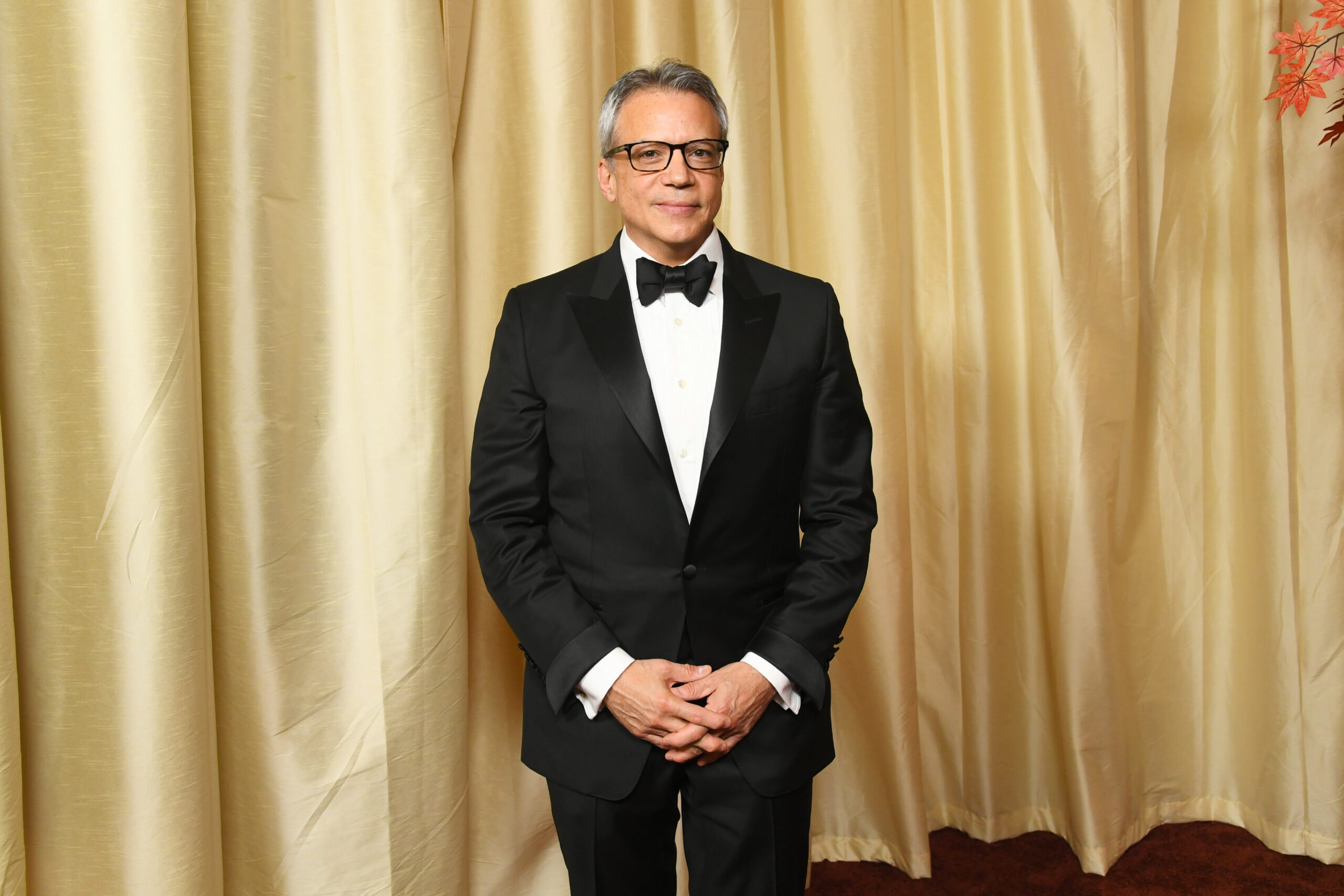
Co-chair and CEO of Warner Bros. Motion Picture Group, Michael De Luca turns 61…
Member of the New York State Assembly for 24 years, since then she is the county clerk of Queens County, Audrey I. Pheffer turns 85… Retired CPA and senior executive in Los Angeles, Morton Algaze turns 83… Treasury secretary through all four years of the Biden administration, Janet Yellen turns 80… Documentary still photographer of the American and international Jewish communities since 1970, Robert A. Cumins turns 78… Beverly Hills, Calif., resident, Ruth Fay Kellerman… VP and chief of staff at The Aspen Institute, James M. Spiegelman turns 68… Film producer, writer and director, Susan Landau Finch turns 66… Founder of the Council of Orthodox Jewish Organizations of Manhattan, he is also the executive chairman of LifeHealth Network, Michael Landau… Storyteller, producer and writer, Jeffrey Mark “Slash” Coleman turns 59… Editor-in-chief of the Hollywood Reporter, Maer Roshan turns 59… Co-founder and managing director at Beacon Global Strategies, he was chief of staff at the CIA and the Pentagon during the Obama administration, he is a graduate of CESJDS, Jeremy B. Bash turns 55… President of Accessibility Partners, a Maryland firm that hires people with disabilities for tech jobs, she is also the founder of a nonprofit I Support the Girls, Dana Marlowe… Three-time Olympian water polo player, now head coach at Pepperdine University, Merrill Marc Moses turns 49… Professor of government at Harvard University, he was the director of the Harvard Center for Jewish Studies, Eric Matthew Nelson turns 49… Professor of law at the South Texas College of Law in Houston, Joshua Michael Blackman turns 42… Deputy general counsel and global head of contracts and litigation for Tower Research Capital, Matthew Weiss turns 40… Weekend editor for The Washington Post, Sara Sorcher… Israeli Olympic long-distance runner, she ran the marathon for Israel at the Paris Olympics in 2024, Maor Tiyouri turns 36… Counsel at CD&R, Nathan Jablow… Senior account supervisor at Edelman, Jodie Michelle Singer… VP of business development at Azul Hospitality Group, Adam Dahan… Head of investor relations at Israel Legacy Partners, David Angel… Elaine Hall… Jonathan Gerber…
Plus, Hawaii's sleeper House race
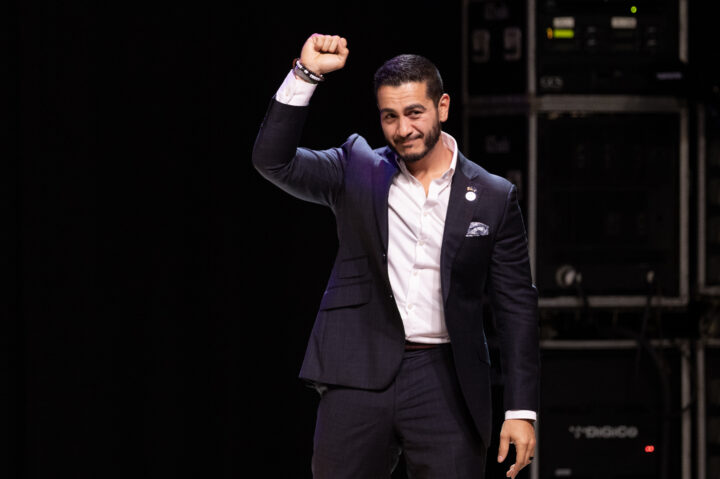
(Scott Olson/Getty Images)
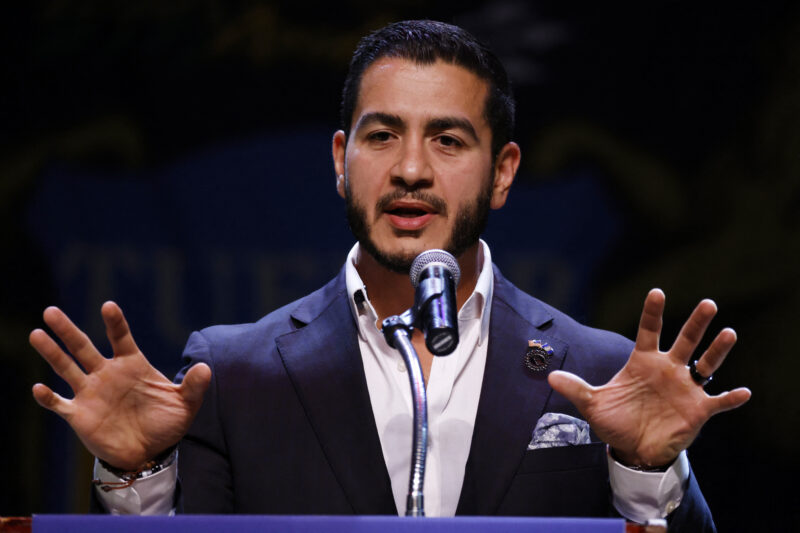
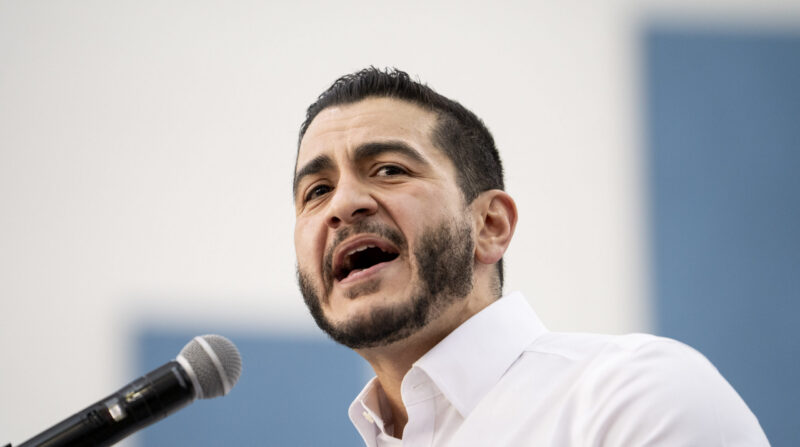
Democratic candidate for U.S. Senate Abdul El-Sayed speaks to supporters at an election-night rally at the Majestic Theatre on August 04, 2026 in Detroit, Michigan.
Good Thursday morning.
In today’s Daily Kickoff, we cover the fallout from Abdul El-Sayed’s narrow victory over Rep. Haley Stevens in Michigan’s Democratic Senate primary, and talk to Jewish Democrats in the state who are considering crossing party lines to vote for GOP nominee Mike Rogers in the November election. We report on the obstacles facing Rep. Ed Case ahead of a challenge from his left in Saturday’s primary in Hawaii’s 1st Congressional District, and cover a Senate Judiciary subcommittee hearing examining Muslim Brotherhood networks and affiliates in the United States. Also in today’s Daily Kickoff: Benny Stanislawski, Tom Kahn and Gianni Infantino.
We also have a new on-demand Live Briefingthat you can access throughout the day via our new app (on Apple and Android) and on our website.
Today’s Daily Kickoff was curated by JI Israel Editor Tamara Zieve and U.S. Editor Danielle Cohen-Kanik. Have a tip? Email us here.
What We’re Watching
- U.S.-led talks between Israel and Lebanon in Rome are slated to conclude today, after yesterday’s discussion was cut short by several hours “due to events on the ground,” the State Department said.
- The decision to pause talks came after the IDF conducted strikes in southern Lebanon over what it said were “blatant violations” of the ongoing ceasefire by Hezbollah, including an incident in which two IDF reservists were killed and four seriously wounded by an explosive device in southern Lebanon.
- Reports continue to indicate Iran and Oman are inching toward a deal to reopen the Strait of Hormuz after earlier agreements on the issue fell apart. An Iranian Foreign Ministry spokesperson said on Wednesday that Tehran and Muscat were close to finalizing an agreement, so long as “certain parties do not obstruct this process” — an apparent reference to the U.S.
- Tennessee is holding its primary elections today. In the state’s 5th District, Rep. Andy Ogles (R-TN), a far-right lawmaker, is facing a serious primary challenge from Charlie Hatcher, a former state commissioner of agriculture.
What You Should Know
A QUICK WORD WITH JI’S MATTHEW KASSEL
Abdul El-Sayed’s narrow victory over Rep. Haley Stevens (D-MI) in Michigan’s bruising Democratic Senate primary on Tuesday is forcing many Jewish leaders in the state to confront an uncomfortable decision as they now look ahead to the general election in November.
Several Jewish Democrats in the battleground state are now indicating that they will break with a party they have long called home and instead vote for the Republican nominee, Mike Rogers, in the November election, citing their continued alarm over El-Sayed’s hostile rhetoric toward Israel as well as remarks they have interpreted as indifferent to rising antisemitism, among other concerns.
“I can’t vote for El-Sayed,” Michael Horowitz, a Jewish community leader and Detroit businessman who supported Stevens, a pro-Israel moderate, told Jewish Insider. “So many things I find despicable about him, not the least of which is his close association with Hasan Piker,” the antisemitic Twitch streamer, who Horowitz said “demeans America, demeans Jews and demeans all but the most radical among us.”
Horowitz confirmed he was now “leaning strongly to Rogers,” a former congressman who narrowly lost in his bid for Senate last cycle. “And I have heard from many in the Jewish community who say they will be supporting Rogers,” he said on Wednesday.
Hannan Lis, a Democratic fundraiser and Jewish leader who splits his time between Michigan and Israel, was among those who had told JI before the primary that he would vote for Rogers in the general election if El-Sayed won the nomination, noting he knows “many” Jewish Democrats who plan to do the same.
His reservations about Republicans preserving their Senate majority by picking up the Michigan seat held by retiring Sen. Gary Peters (D-MI), he clarified, were superseded by his objections to El-Sayed’s stances on Israel and responses to antisemitism. “El-Sayed is no Democrat,” he claimed.
CASE STUDY
Generational challenge threatens Ed Case in Hawaii’s under-the-radar primary
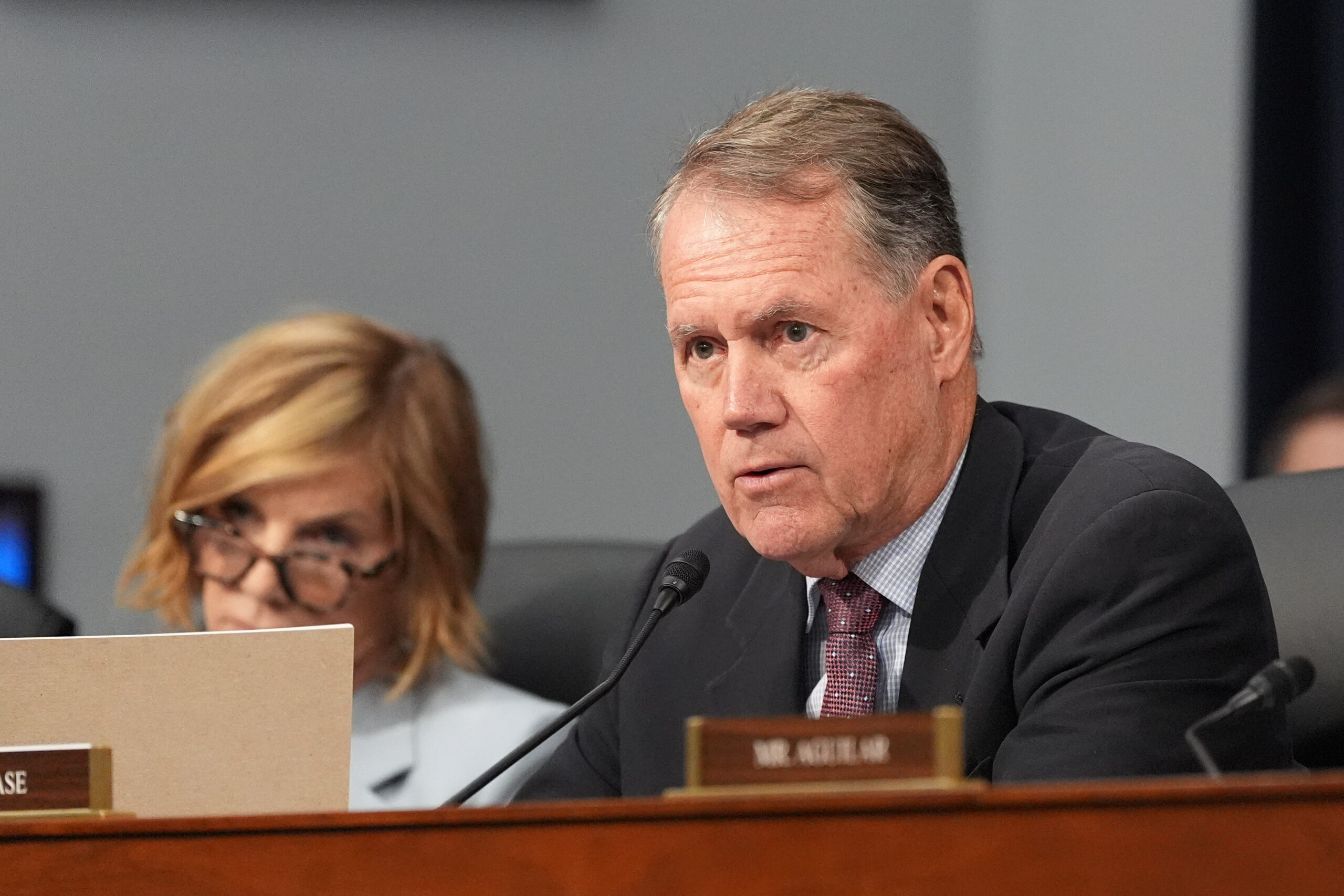
Rep. Ed Case (D-HI), a moderate pro-Israel Democrat in Hawaii who was first elected to the House in 2002, has not drawn a serious primary threat in several years. Now, as he prepares to defend his seat in a primary on Saturday that has largely flown under the radar, some Democrats are warning that the 73-year-old could be at risk of losing to a younger challenger capitalizing on a national political environment that has proven unfavorable to Democratic incumbents amid broader calls for generational change from the party’s activist base, Jewish Insider’s Matthew Kassel reports.
While you were sleeping: “It’s one of those sleeper races where there’s definitely an upset brewing,” said a Democratic operative who worked on the Case campaign until a few months ago, speaking on condition of anonymity to avoid professional reprisals. “Ed is running a poor race,” the former staffer told JI, echoing other observers who described a sluggish approach in which Case has largely foregone campaign events and avoided debates with his opposition.
ON THE HILL
Cruz links El-Sayed’s victory to Muslim Brotherhood network in United States
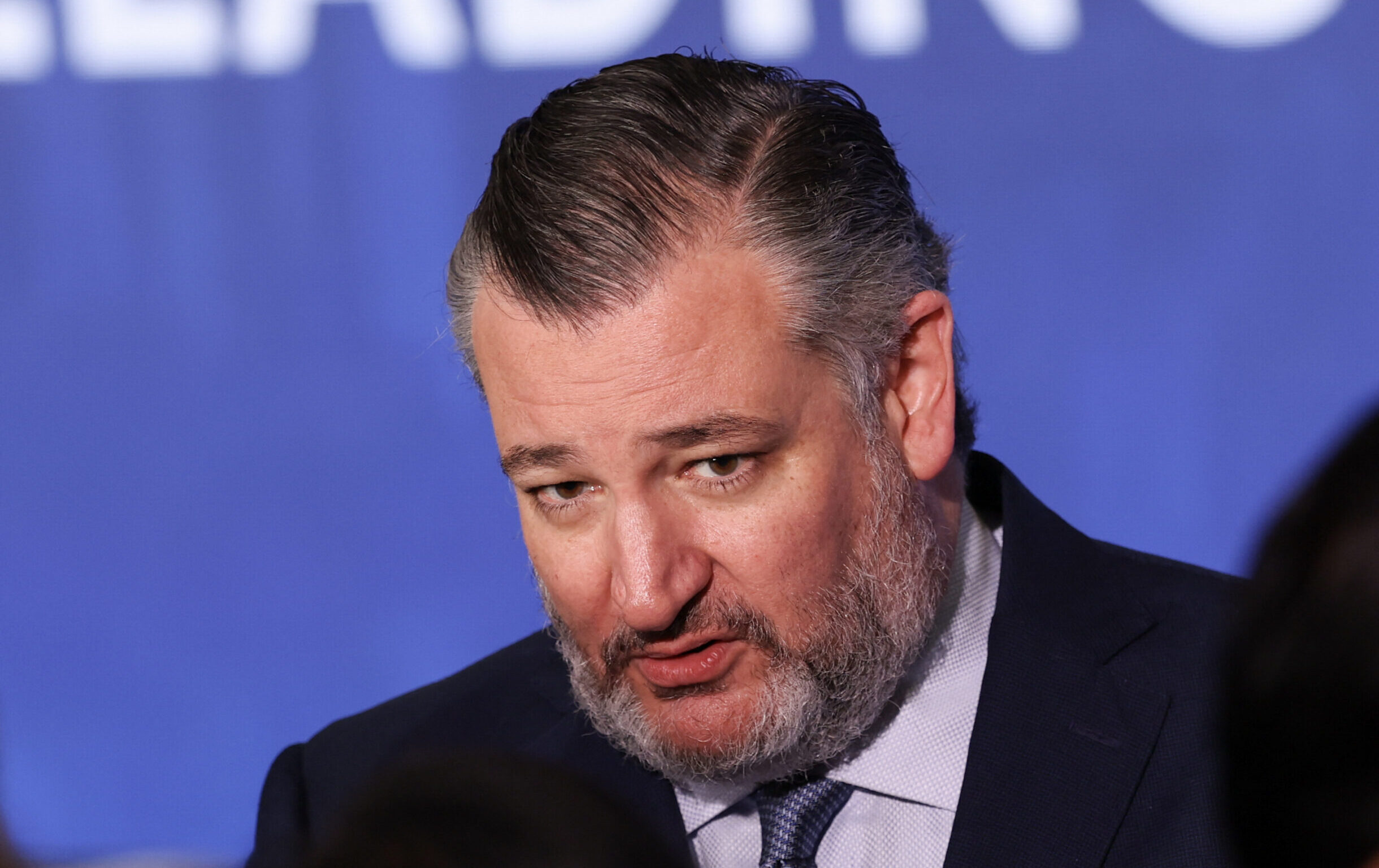
Sen. Ted Cruz (R-TX), speaking at a Senate Judiciary subcommittee hearing on Wednesday that he organized to examine Muslim Brotherhood networks and affiliates in the U.S., suggested that Michigan Senate candidate Abdul El-Sayed was tied to such networks and that his Democratic primary win represented a victory for them. “Behind El-Sayed’s political rise sits a much older and more entrenched institutional network,” Cruz asserted, Jewish Insider’s Marc Rod reports.
Zoom out: Kyle Shideler, a senior analyst for homeland security and counterterrorism at the Center for Security Policy, testified under questioning from Cruz that El-Sayed’s win concerned him given the nominee’s father-in-law’s ties to Muslim Brotherhood-linked groups and El-Sayed’s own relationship with groups connected to the Council on American-Islamic Relations. “It shows the success of the Muslim Brotherhood network over multiple decades. It achieved what they said they were going to achieve, which was to normalize support for Hamas and normalize support for terrorism,” Shideler said.
COMMUNITY CONCERN
Jewish Dems ‘disappointed’ in Michigan Senate results, stop short of endorsing El-Sayed
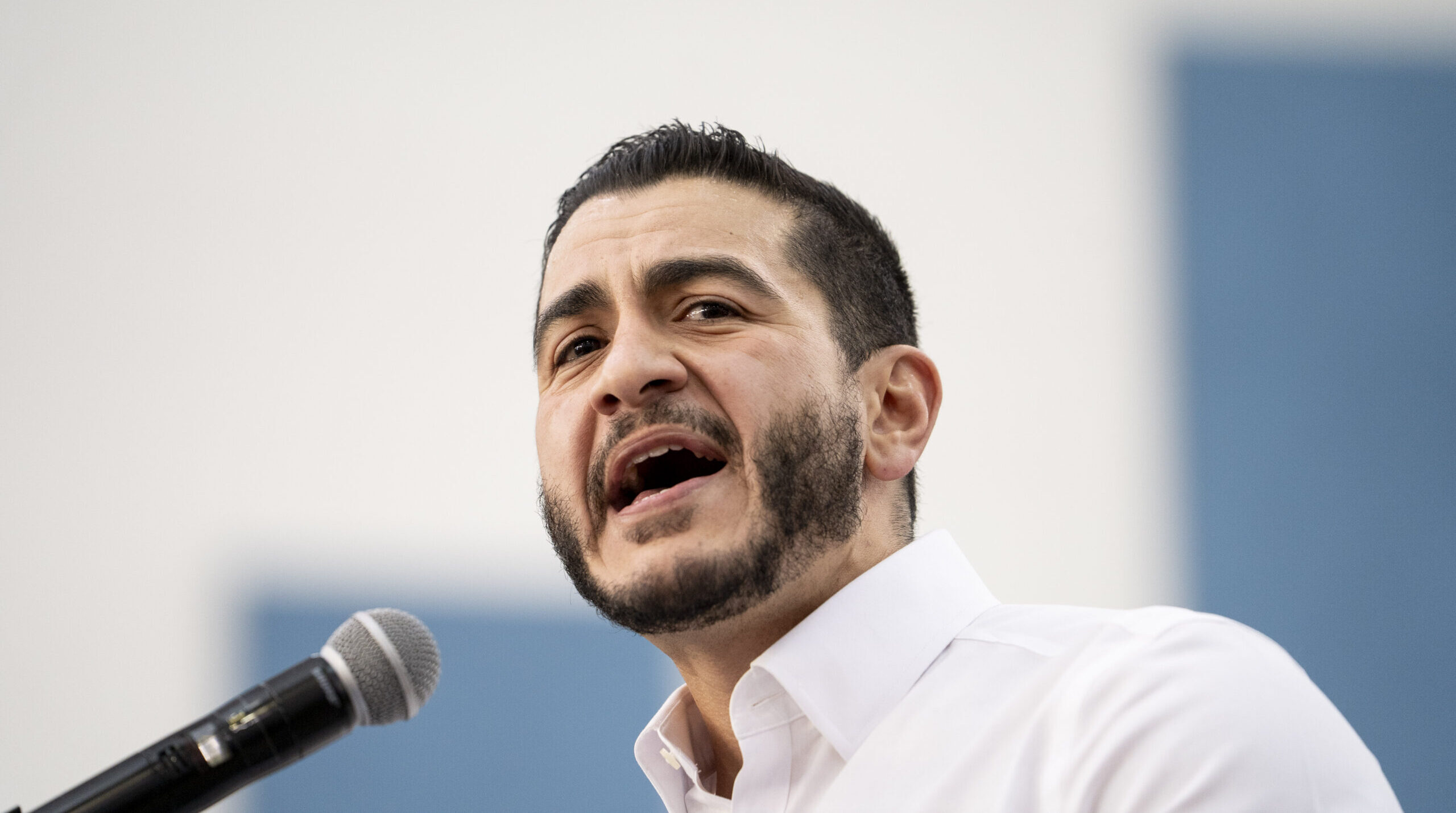
Jewish groups expressed concern on Wednesday about the victory of Abdul El-Sayed in the Democratic primary for U.S. Senate in Michigan, highlighting his extreme rhetoric on Israel and the broader rise of the far left, Jewish Insider’s Marc Rod reports.
Reactions: Jewish Democratic Council of America CEO Halie Soifer said in a statement that the group was “disappointed” by the results of the primary, in which the group had endorsed and campaigned strongly for Rep. Haley Stevens (D-MI). Soifer congratulated but stopped short of endorsing El-Sayed. AIPAC, while declining to preview specific plans, indicated it intends to stay engaged in the Michigan race through November. “Our members remain determined to ensure that voters reject Dr. El-Sayed and his radical anti-Israel agenda in November,” spokesperson Deryn Sousa told JI.
Trump’s take: President Donald Trump, speaking at an event in Las Vegas on Wednesday, said al-Sayed “hates Jews and he hates Israel,” adding, “He’s a man of hate, and now he’s going around saying, ‘Oh I love everybody.’ He doesn’t love everybody. Put him in office, and you’re going to find out what he loves.”
WITHHOLDING SUPPORT
Moderate Michigan Rep. Hillary Scholten does not offer endorsement of El-Sayed
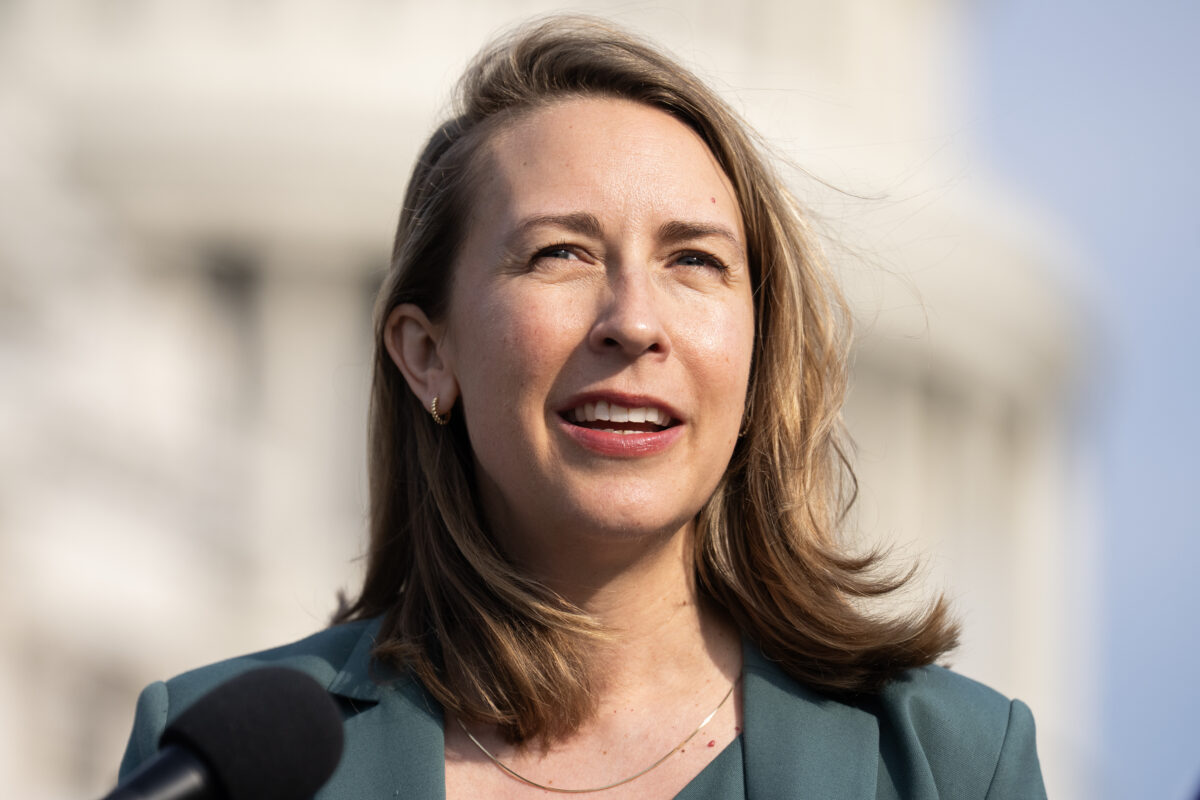
Rep. Hillary Scholten (D-MI), a moderate Michigan lawmaker representing a swing district, broke with most other Democratic members of the state’s congressional delegation in declining to offer an explicit endorsement of Democratic Senate nominee Abdul El-Sayed, after offering strident criticism of him during the primary campaign, Jewish Insider’s Marc Rod and Matthew Shea report.
What she said: “Congratulations to everyone who participated in Michigan’s hard-fought primary elections last night, and thank you to every voter who made your voice heard. In these close elections, we want you to know — you are HEARD,” Scholten said in a statement that did not mention El-Sayed. “Now our focus turns forward. I’ve always said I’ll work with anyone committed to lowering costs, expanding affordable health care, creating more opportunity, and fighting corruption. I mean that.”
Phone a friend: New York City Mayor Zohran Mamdani refused to close the door on a trip to Michigan to campaign for El-Sayed, whom Mamdani praised for what he described as a focus on “the concerns of working-class Americans” — even as he tried to explain away El-Sayed’s poor performance in the areas where working-class voters live, JI’s Will Bredderman reports.
RACE RHETORIC
El-Sayed calls Israel ‘bloodthirsty’ in first post-primary TV interview
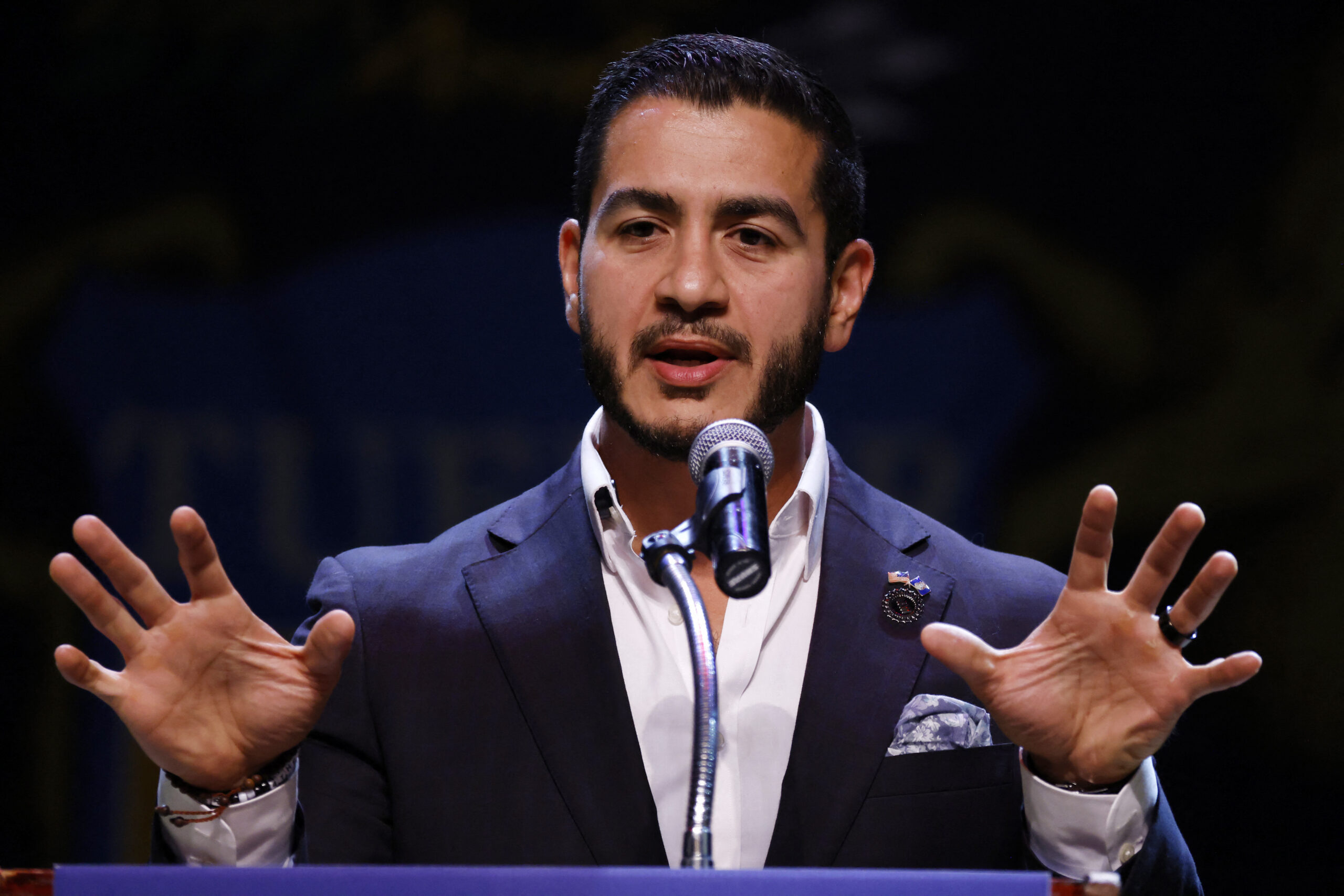
Appearing on MS NOW’s “Morning Joe” on Wednesday, Abdul El-Sayed doubled down on his criticism of Israel, calling the Jewish state “bloodthirsty” and saying his critiques go beyond the government of Israeli Prime Minister Benjamin Netanyahu, Jewish Insider’s Danielle Cohen-Kanik reports.
What he said: “I think we’ve seen the worst of what the Israeli government has done [under Netanyahu] but don’t forget that we’ve been talking about an illegal apartheid regime for a very, very long time, and that supersedes Netanyahu himself,” El-Sayed said. “I understand that Netanyahu is a big reason why they’ve gotten so aggressive and frankly so bloodthirsty under his reign, but I also understand that it’s impossible for us to say we want a two-state solution while we’ve been aiding, arming and abetting the very people who have been trying to foreclose on the possibility of a Palestinian state.”
It’s all over: Democrats quickly coalesced behind El-Sayed after the far-left candidate narrowly clinched victory in Michigan’s Democratic primary on Wednesday morning, while Republicans quickly pounced on his extremist history and ties, JI’s Marc Rod reports.
Worthy Reads
Reassessing Reality: The Atlantic‘s Jonathan Chait contends that, in order to wrest back their party from the far left, moderate Democrats will have to reevaluate some of their core stances, including support for AIPAC and Israel. “Fending off a leftist insurgency will be all but impossible unless Democrats reject AIPAC’s endorsements and stop supporting unconditional aid for an Israel that no longer works toward a two-state solution. Democrats also have to stop passively allowing multiple candidates to split the mainstream vote while the leftist vote consolidates behind a single candidate, as occurred in Michigan’s Seventh District and the Wisconsin governor’s race. But the greatest challenge for mainstream liberals is to find a way to engage in and win the substantive argument with the left.” [TheAtlantic]
Lemons into Lemonade: Tablet‘s Jacob Siegel argues that the U.S.-Israel alliance is loosening, and that the moment presents an opportunity for Israel to reduce its dependence on Washington and diversify its alliances. “A greater degree of separation between the United States and Israel is not only inevitable, it is desirable. Many supporters of Israel seem to be aware only of the significant challenges that this will create for the small country. They overlook the significant opportunities it presents for Israel’s growth. … With the chapter closing on its role as an outsize client state, Israel needs to develop itself as an independent regional power that is a desirable partner by virtue of its ability to innovate technologies and project force.” [Tablet]
Fashion Faux Pas: In The New York Times, John Galliano biographer Dana Thomas cautions against the decision by the Metropolitan Museum of Art to honor the designer, who was convicted of antisemitic abuse after praising Adolf Hitler. “Not all great creators deserve a retrospective, and someone as incendiary as Mr. Galliano certainly shouldn’t be the subject of one during his lifetime, when he stands to profit from the honor personally. With ‘John Galliano: Horizons,’ the Met and Ms. Wintour are selling the idea that they can tell the rest of us how to think about a difficult and divisive figure. Maybe they didn’t notice that idea has gone badly out of fashion.” [NYTimes]
Find more Worthy Reads in our Live Briefing via our new app (on Apple and Android) and website.
Word on the Street
Asked about an Axios report that claimed Israeli Prime Minister Benjamin Netanyahu “confronted” him over their diverging policy views during his visit to Washington last week, Vice President JD Vance said in an interview on Fox News on Wednesday, “He didn’t confront me. We had a nice and frank conversation. … I would describe it as a pleasant but direct conversation”…
The White House denied a Washington Post report that President Donald Trump and Defense Secretary Pete Hegseth clashed last week at Camp David over the war in Iran; the Post reported that the president asked why he had been misled about a shortage of munitions…
A group of far-right figures, including Tucker Carlson, outgoing Rep. Thomas Massie (R-KY), former Rep. Marjorie Taylor Greene (R-GA) and former National Counterterrorism Center head Joe Kent — who gathered over the weekend at Carlson’s Maine home — are considering launching a third-party political organization…
The Israeli Foreign Ministry denounced a joint statement adopted by Arab states — including Qatar, Saudi Arabia, Turkey, Pakistan and Egypt, among others — whose foreign ministers convened in Jordan on Wednesday to discuss Israel’s policies in Jerusalem and said that Israel, which the statement claimed “has no sovereignty” over the city, had “alter[ed] the Arab Islamic and Christian identity of occupied Jerusalem”…
The IDF is investigating a reported arson attack by Israeli settlers in a Palestinian village in the West Bank overnight in which suspects allegedly set fire to homes and attacked residents, including children…
A new Israel Democracy Institute survey found that a majority of Israelis believes the integrity of the October election is in danger…
The Iran-backed Houthis in Yemen said on Wednesday that they struck a Saudi oil tanker in the northern Red Sea, escalating the group’s stated blockade against Riyadh and strikes on Saudi ships that have thus far been focused in the southern Red Sea, near the Bab el-Mandeb strait…
James Stavridis, former supreme allied commander of NATO, argues in Bloomberg that a Saudi-led naval coalition could help protect commercial shipping in the Red Sea from Houthi attacks, though it would likely still require U.S. and European intelligence and logistical support to be effective…
An Azerbaijani official said on Turkish TV that Baku lobbied Israel to stop the Knesset from voting to recognize the Armenian genocide…
FIFA officials gathered in Morocco this week reaffirmed their support for Gianni Infantino, days after the FIFA president faced widespread criticism from within the organization over a plan to privatize elements of the World Cup…
The Atlantic investigates whether al-Qaida, 25 years after the 9/11 attacks, is quietly rebuilding or if its core organization is effectively defunct…
A new poll shows left-wing Brazilian President Luiz Inácio Lula da Silva‘s lead over conservative challenger Flávio Bolsonaro, the son of former President Jair Bolsonaro, narrowing ahead of the country’s October elections…
Benny Stanislawski, previously the communications director for Rep. Ritchie Torres (D-NY), is joining Pennsylvania Democrat Bob Brooks‘ congressional campaign as communications director…
American University’s School of Public Affairs named Tom Kahn as director of its Center for Congressional and Presidential Studies; Kahn, who served as acting director for the past year, was the longest-serving staff director in history for the House Budget Committee…
Find on-demand Live Briefing updates throughout the day via our new app (on Apple and Android) and website.
Pic of the Day

The Louis D. Brandeis Center for Human Rights Under Law hosted 34 law students from leading law schools, including Columbia, Cornell, Duke, Georgetown, NYU and Vanderbilt, for its three-day Law Student Leadership Conference in Washington, D.C., this week. The students received training in civil rights law, Title VI, free speech and advocacy on behalf of Jewish students from a range of experts, including Brandeis Center founder Ken Marcus, pictured here addressing attendees.
Birthdays
Actor, director, producer and screenwriter, Soleil Moon Frye turns 50…
Retired founding partner of the Jaffe Family Law Group, Daniel J. Jaffe turns 89… Esports executive and casino owner, he is a three-time bracelet winner at the World Series of Poker, Lyle Berman turns 85… Professor emerita and former dean at Bar Ilan University, Malka Elisheva Schaps turns 78… Film director, television director, producer and screenwriter, Brian Michael Levant turns 74… Austrian businessman with many U.S., Israeli and Eastern European investments, Martin Schlaff turns 73… Former state treasurer of Virginia and then state secretary of finance, she is now a gourmet popcorn manufacturer, Jody Moses Wagner turns 71… Professor of public diplomacy at The Fletcher School of Tufts University, she was formerly undersecretary of state for public diplomacy, Tara D. Sonenshine turns 67… Professor of psychiatry and behavioral sciences at The George Washington University Medical Center, Alan J. Lipman, Ph.D. turns 66… Israeli diplomat, he served as Israel’s consul general in NYC between 2000 and 2004, Alon Pinkas turns 65… NASA astronaut who spent 198 days on the International Space Station, he brought 18 bagels from his family’s bagel store in Montreal into space, Gregory Chamitoff turns 64… Chair of White & Case’s white collar practice group, Joel M. Cohen… Executive director of public affairs and policy communications at the American Council on Education, Jonathan Riskind… CEO of Elluminate (formerly known as the Jewish Women’s Foundation of New York), Melanie Roth Gorelick… Vice chair of Jewish California and a board member of JFNA and JCRC Bay Area, Susie Sorkin… Television and radio sports anchor on ESPN and ABC, he was one-half of the “Mike & Mike” team but now hosts his own ESPN morning program, Mike Greenberg turns 59… Chief economist at The Burning Glass Institute, Gad Levanon, Ph.D…. Law professor and associate dean at Michigan State University College of Law, David Blankfein-Tabachnick turns 55… Former boxing commentator and co-host of ESPN’s “This Just In,” Yiddish speaking Max Kellerman turns 53… Co-founder and former CEO of Uber, Travis Kalanick turns 50… Founder and CEO at Climb Together which helps prepare people from low-income backgrounds for entry level jobs, Nitzan Pelman… Screenwriter and television producer, he is best known for creating and executive producing the Fox teen drama “The O.C.,” Joshua Ian Schwartz turns 50… Former comms director for Zohran Mamdani’s New York City mayoral general election campaign, Jeffrey Lerner… Creative director and visual strategist, Rachel Gogel… Member of the New York State Assembly, Simcha Eichenstein turns 43… Winner of two gold medals in swimming at the 2008 Summer Olympics in Beijing, he is now CEO of Gather Campgrounds north of Austin, Garrett Weber-Gale turns 41… Director of strategy and policy at K2 Space Corporation, he is also a non-resident senior fellow at the Atlantic Council, Corey A. Jacobson… Reporter at San Antonio Express-News, Elizabeth Teitz… Special advisor at the Department of Homeland Security and former student at Marjory Stoneman Douglas High School, Hunter Pollack turns 29…
Several Jewish Democrats in the battleground state are now indicating that they will break with a party they have long called home and instead vote for the Republican nominee, Mike Rogers, in the November election
Scott Olson/Getty Images
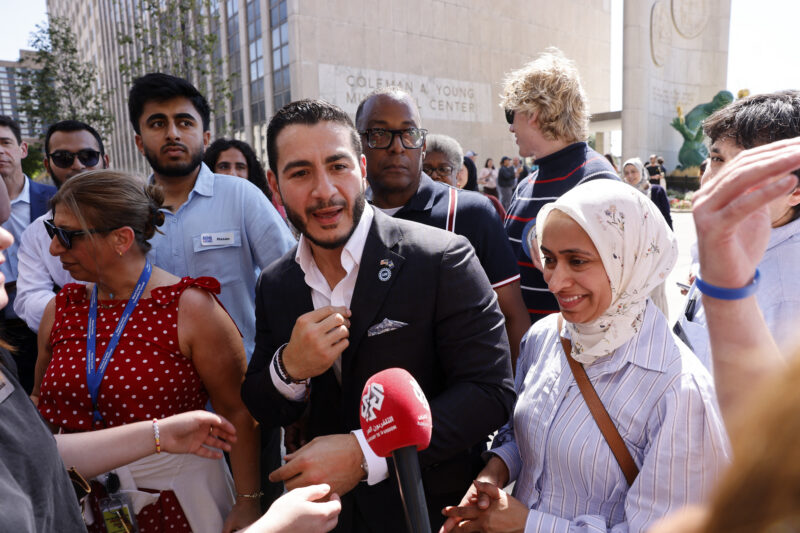
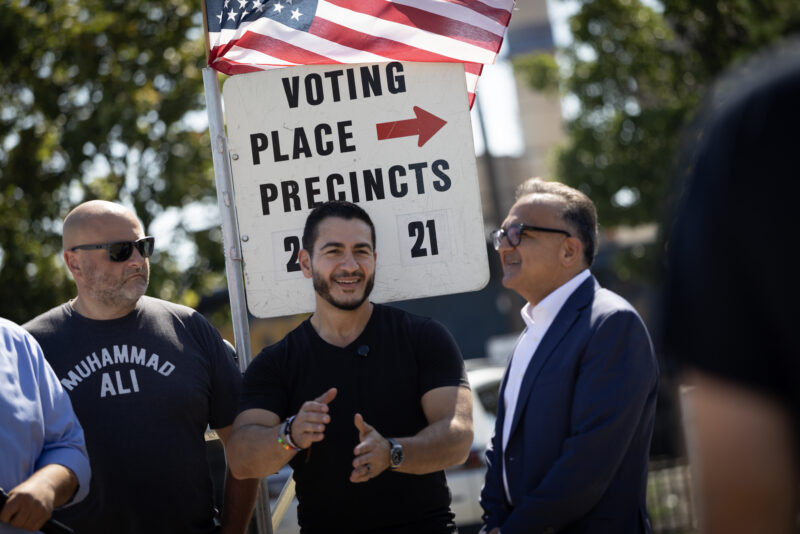
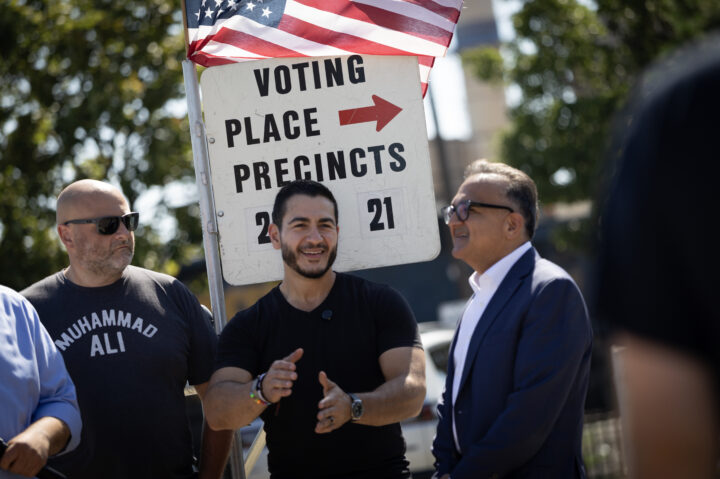
Democratic candidate for U.S. Senate in Michigan Abdul El-Sayed visits a polling place as residents cast their votes on August 04, 2026 in Dearborn, Michigan.
Abdul El-Sayed’s narrow victory over Rep. Haley Stevens (D-MI) in Michigan’s bruising Democratic Senate primary on Tuesday is forcing many Jewish leaders in the state to confront an uncomfortable decision as they now look ahead to the general election in November.
Several Jewish Democrats in the battleground state are now indicating that they will break with a party they have long called home and instead vote for the Republican nominee, Mike Rogers, in the November election, citing their continued alarm over El-Sayed’s hostile rhetoric toward Israel as well as remarks they have interpreted as indifferent to rising antisemitism, among other concerns.
“I can’t vote for El-Sayed,” Michael Horowitz, a Jewish community leader and Detroit businessman who supported Stevens, a pro-Israel moderate, told Jewish Insider. “So many things I find despicable about him, not the least of which is his close association with Hasan Piker,” the antisemitic Twitch streamer, who Horowitz said “demeans America, demeans Jews and demeans all but the most radical among us.”
Horowitz confirmed he was now “leaning strongly to Rogers,” a former congressman who narrowly lost in his bid for Senate last cycle. “And I have heard from many in the Jewish community who say they will be supporting Rogers,” he said on Wednesday.
Hannan Lis, a Democratic fundraiser and Jewish leader who splits his time between Michigan and Israel, was among those who had told JI before the primary that he would vote for Rogers in the general election if El-Sayed won the nomination, noting he knows “many” Jewish Democrats who plan to do the same.
His reservations about Republicans preserving their Senate majority by picking up the Michigan seat held by retiring Sen. Gary Peters (D-MI), he clarified, were superseded by his objections to El-Sayed’s stances on Israel and responses to antisemitism. “El-Sayed is no Democrat,” he claimed.
Dennis Bernard, a Jewish leader in Michigan who backed both Rogers and Stevens in their respective primaries, said that the “word is out on a few Rogers fundraisers targeting historical Jewish Dems,” efforts that he described as “co-led” with Jewish Democratic donors.
“Candidly,” he added, “the only area that may not jump on Rogers is the highly progressive Ann Arbor community,” which he called “very small.”
Bernard, national chair of government relations at the Jewish Federations of North America, told JI that it would likely take a few more days for such events to materialize as donors now “settle down and organize” in the wake of the primary. “Everyone is jumping in,” he said.
One Democratic fundraiser in Michigan, who spoke on the condition of anonymity to address a sensitive subject, said he was “absolutely certain” that “several large Jewish Dem donors” will be supporting Rogers.
“I would guarantee there will be fundraisers for him hosted by high-profile Jewish Dems,” he told JI.
The fundraiser, who backed Stevens, said that hours after the race had been called on Wednesday he was “already contacted by Rogers surrogates” seeking to make inroads with Jewish Democrats whose support could prove consequential in what is expected to be a close race.
The surrogates’ pitch, as he put it: “Essentially that as Jews, we need to put our communal well-being ahead of the party.”
It remains to be seen whether the depth of Jewish Democrats’ fears of electing El-Sayed will ultimately translate to a meaningful boost for Rogers’ bid amid a national political environment that is less favorable to Republicans.
Still, Rogers and his supporters have said they are eager to court Jewish Democrats alienated by their party as support for Israel has emerged as a litmus test on the far left — particularly in Michigan, where Jewish Democratic leaders have recently voiced fears of antisemitic harassment from anti-Israel activists in the state.
Alyssa Brouillet, a spokesperson for Rogers, told JI on Sunday that his campaign was “beginning to see more and more Jewish Democrats coming to us who feel abandoned by their party.”
“Mike Rogers stands with the Jewish community in Michigan and across the country,” she said, “and he will continue fighting to make life better for working families all across the state.”
In a video ad posted to social media on Wednesday, Rogers highlighted his opponent’s close ties to Piker, featuring past comments in which the streamer said “America deserved 9/11,” among other controversial remarks that have faced scrutiny. “You are who your friends are, and Abdul El-Sayed’s are radical leftists who hate America,” Rogers wrote.
The Republican Jewish Coalition called El-Sayed “a direct threat to Michigan’s Jewish community” in a statement on Wednesday that urged Jewish voters in the state to get behind Rogers in the general election.
“To our friends in Michigan’s Jewish community, including the tens of thousands who have voted Democrat their entire adult lives and now find themselves politically homeless: this is the moment for real change and action,” said Matt Brooks, the RJC’s CEO. “There are more than 100,000 Jewish voters in the Wolverine State. We are not a rounding error, we are the decisive margin. Mike Rogers has earned your vote.”
Even as El-Sayed quickly won backing on Wednesday from national Democratic leaders hoping to unite the party for a must-win election, the Jewish Democratic Council of America stopped short of an endorsement, underscoring the extent to which the divisive primary has left some Jewish leaders rudderless after Stevens’ defeat.
“While we are disappointed in the final result of the Michigan Senate race, the razor-thin margin isn’t the resounding win for the far-left that was predicted,” said Halie Soifer, the JDCA’s CEO. “We are proud of the race run by Rep. Haley Stevens, and we thank her for her consistent and principled leadership standing with Jewish Americans. We congratulate Dr. Abdul El-Sayed on his victory after a difficult and divisive primary.”
Several nonpartisan Jewish groups, including the Anti-Defamation League and the American Jewish Committee, released statements on Wednesday condemning El-Sayed.
Deryn Sousa, a spokesperson for AIPAC, whose super PAC invested over $30 million on an aggressive effort to boost Stevens, said in a statement that the group’s “members remain determined to ensure that voters reject Dr. El-Sayed and his radical anti-Israel agenda in November,” indicating it intends to back Rogers in the general election.
AIPAC’s super PAC, United Democracy Project, did not return a request for comment, but sources told JI the group was all but certain to support Rogers, who was recognized as a pro-Israel hawk while serving in the House from 2001 to 2015.
For his part, El-Sayed, who made his opposition to AIPAC a central feature of his campaign messaging, sought to ease tensions with skeptical Jewish voters on Wednesday, addressing what he called “an issue that has been focused on in this race.”
“To all of my sisters and brothers of the Jewish faith,” he said in his televised remarks, “I want you to know that my commitment to your safety, my commitment to Jewish safety, is the same commitment that I have to the safety of my own daughters.”
But many Jewish leaders in the state suggested that they would be unmoved by such appeals — especially as El-Sayed has continued to use incendiary rhetoric while discussing Israel. In an interview on MS NOW’s “Morning Joe” on Wednesday morning, for instance, he doubled down on his criticism of Israel, calling the Jewish state “bloodthirsty” while saying his critiques go beyond the government led by Israeli Prime Minister Benjamin Netanyahu.
His comments faced criticism from Democratic Majority for Israel, which said “El-Sayed should be working to build a bigger tent and earn the trust of Jewish Michiganders” but was instead invoking “an age-old antisemitic trope that is especially dangerous amid rising violence against Jews.”
Asher Lopatin, a rabbi who serves as director of community relations at the Jewish Federation of Greater Ann Arbor and endorsed Stevens, told JI he has “heard from several people who say that they will campaign for Rogers and support him and tell others to vote for him.”
“I have not spent a lot of time looking into his positions,” Lopatin added, “but I can say clearly that I will not be voting for Abdul El-Sayed and I wish more Democrats would come out and say they will not be voting for him.”
Some Jewish Democrats in the state have confirmed privately that while they cannot bring themselves to vote for Rogers, they will leave their ballots blank or write in another candidate due to their reservations about El-Sayed.
Despite widespread objections to El-Sayed within Michigan’s mainstream Jewish community, others suggested that their loyalty to the Democratic Party outweighed those concerns. “I know Jewish Dems who will vote for Rogers,” Richard Lenter, a Jewish community activist in Detroit, told JI. “I am leaning toward voting for El-Sayed while holding my nose.”
Michigan state Rep. Noah Arbit, a Jewish Democrat who has been outspoken against antisemitism in his party, declined to confirm whether he would vote for El-Sayed, even as he expressed strong concerns about past comments in which the candidate has dismissed Zionists as “illiberal” and refused to recognize Israel’s right to exist as a Jewish state.
“Abdul’s rhetoric has been alarming and dangerous for my community,” Arbit, whose district in suburban Detroit includes a sizable Jewish constituency, said in a message posted to Facebook Wednesday morning. “There is a profound need for him to come to the table and attempt to repair the harm he has caused, to see what semblance of trust and confidence may be built.”
Plus, Jewish leaders wary of Michigan's early primary role

Avi Ohayon (GPO) / Handout/Anadolu via Getty Images
Israeli Prime Minister Benjamin Netanyahu makes statements at Ben Gurion Airport ahead of his visit to Washington DC, where he will meet with US President Donald Trump in Tel Aviv, Israel on February 02, 2025.
Good Monday morning.
In today’s Daily Kickoff, we report on concerns among Jewish leaders regarding Michigan’s positioning as an early Democratic primary state in the 2028 presidential nominating contest, and have the scoop on Democratic Majority for Israel’s decision to pause its endorsements of nine House Democrats who voted against aid to Israel. We talk to pollster Dahlia Scheindlin about Israelis’ understanding of anti-Israel sentiment in the U.S., and spotlight Judaica artist Debra Band, whose biblical manuscripts were acquired by the Library of Congress earlier this year. Also in today’s Daily Kickoff: Ashley Jackson, Rabbi Yitz Greenberg and Harold Grinspoon.
We also have a new on-demand Live Briefing that you can access throughout the day via our new app (on Apple and Android) and on our website.
Today’s Daily Kickoff was curated by JI Executive Editor Melissa Weiss and Israel Editor Tamara Zieve, with assists from Danielle Cohen-Kanik and Marc Rod. Have a tip? Email us here.
What We’re Watching
- With the late Sen. Lindsey Graham’s (R-SC) funeral scheduled for tomorrow in Washington, attendees will begin making their way to the capital today. Israeli Prime Minister Benjamin Netanyahu took off earlier today for Washington, where he’ll also meet with President Donald Trump tomorrow. More below.
- As tensions continue to simmer in the Middle East, Trump appeared to deescalate, halting strikes on Iranian targets over the weekend after nearly two weeks of nightly strikes. Speaking at the rescheduled White House Correspondents’ Dinner on Friday, Trump said that he didn’t think that Iranian leaders were ready to make a deal. “They are talking to us right now. They’d love to make a deal. I don’t think they’re ready to. I don’t think it’s time yet, but I’m willing to listen,” Trump said at the dinner. Read more here.
- The recalibration comes amid reports of dwindling interceptor stockpiles, as well as pushback to continued engagement among military leaders. Axios reports that CENTCOM head Adm. Brad Cooper had advocated for ending the U.S. bombing campaign around the Strait of Hormuz, arguing that the effort had reached its maximum effectiveness.
- Meanwhile, the IDF confirmed that two drones were shot down over the Jordanian border this morning, but did not say where the drones originated.
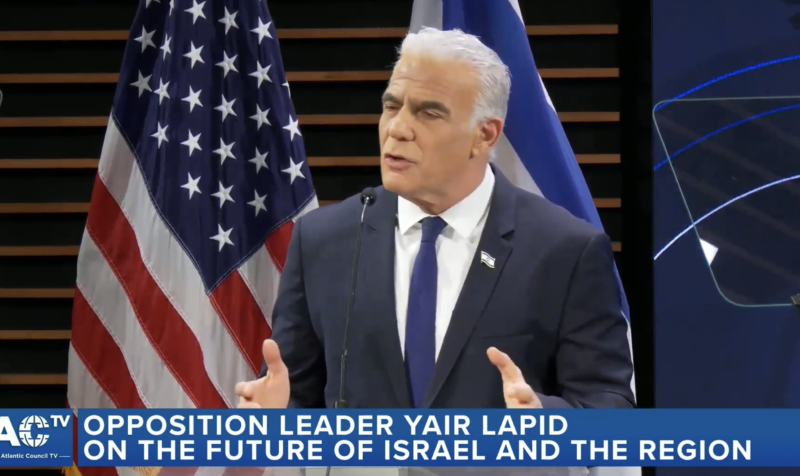
- The Atlantic Council is hosting a virtual fireside chat with Israeli Opposition Leader Yair Lapid in conversation with former U.S. Ambassador to Israel Dan Shapiro.
What You Should Know
A QUICK WORD WITH JI’S Josh kraushaar
For Democrats worried about the party’s left turn, the outcome of the presidential nominating calendar, which was approved by a Democratic National Committee panel on Friday, is something of a mixed bag. (For pro-Israel Democrats, the presence of Michigan taking center stage on the early schedule is already causing heartburn, per reporting from JI’s Matthew Kassel.)
In a boost for centrists, the nomination process is slated to lead with South Carolina, a Southern state that has long been a moderating force in the party’s presidential calendar, largely because of its sizable Black population.
But as Jonathan Martin noted in Politico, South Carolina’s first-in-the-nation status carries some unintended consequences. The state, which has typically voted after Iowa’s caucuses and New Hampshire’s primary, often played the role of choosing the nominee after the field was winnowed down by the earlier states. South Carolina has picked the primary winners in the last two decades: Barack Obama (in 2008), Hillary Clinton (in 2016) and most notably Joe Biden (in 2020) when pundits counted the former vice president out after losses in Iowa, New Hampshire and Nevada.
With South Carolina being moved to the front of the line, the state will end up narrowing down the lineup of candidates rather than having the final say on a shortlist of candidates. The changed primary calendar also puts pressure on moderate candidates to make a strong showing right away: If a leading centrist such as Pennsylvania Gov. Josh Shapiro runs for president, South Carolina suddenly becomes much more of a pivotal state, with outreach to Black voters a necessity.
SCOOP
DMFI pauses endorsements of nine House Democrats who voted against aid to Israel
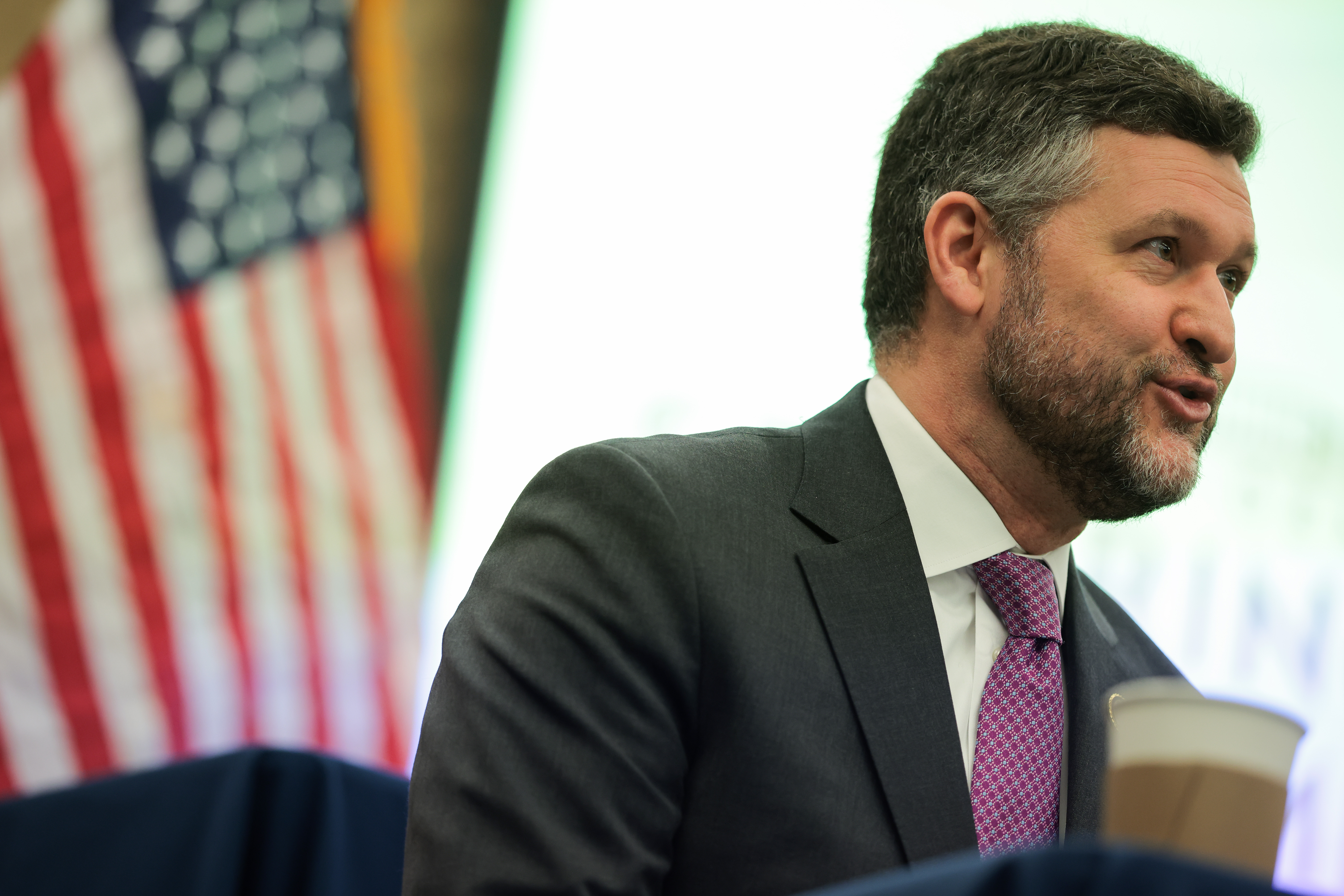
DMFI PAC, Democratic Majority for Israel’s political arm, is pausing its endorsements of nine Democratic House members who voted this month to end all U.S. aid to Israel, underscoring the depth of its frustration even as the group also seeks to preserve relationships with lawmakers it had championed, Jewish Insider’s Matthew Kassel reports.
On hold: “Because of that vote, we are pausing our endorsement and taking your name off the list of supported lawmakers on the DMFI PAC website,” Brian Romick, the president of DMFI PAC, said in a letter to the lawmakers, the full text of which was shared exclusively with JI on Sunday. “At the same time,” he added, “our hope is that this pause will be temporary and that, through a candid conversation about the path forward, we can resume our endorsement.”
MICHIGAN MATTERS
Jewish leaders worried about Michigan’s prime position on Dems’ 2028 calendar
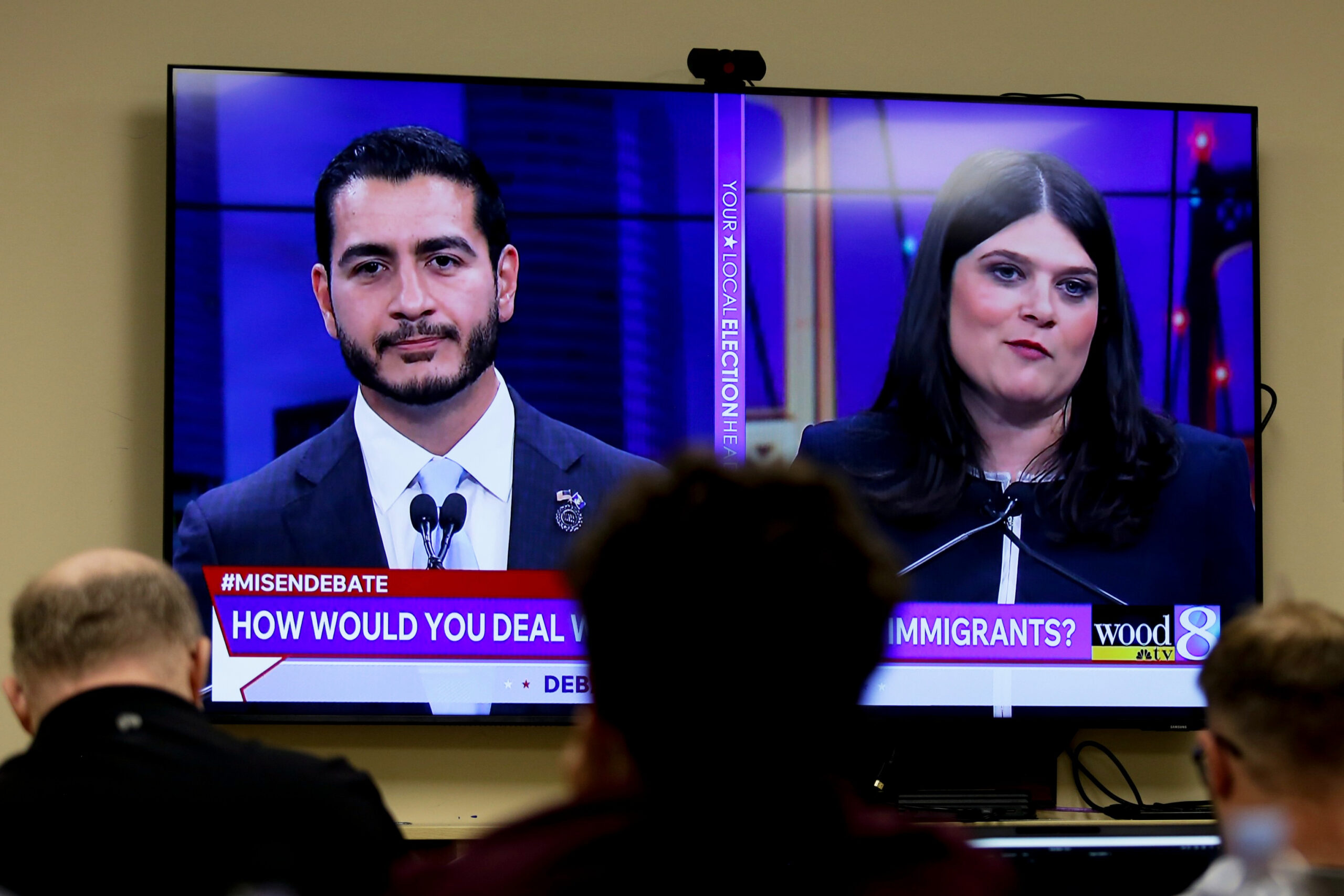
The selection of Michigan as an early Democratic primary state in the 2028 presidential nominating contest, approved on Friday by a panel of the Democratic National Committee, is prompting some concerns among Jewish and pro-Israel activists who fear the party’s sharp divisions over Israel and its recent controversies over antisemitism could create a volatile political landscape during the key contest, Jewish Insider’s Matthew Kassel reports.
Looking ahead: If the schedule is finalized, Michigan “figures to be one of the first anti-Israel or antisemitic states that has a vote,” said Dennis Bernard, a Jewish leader who advises members of both parties, told JI. The state’s Aug. 4 Senate primary — a bitter race between AIPAC-backed Rep. Haley Stevens (D-MI) and Abdul El-Sayed, whose rhetoric targeting Israel and ongoing refusal to recognize its right to exist has alarmed Jewish voters — is expected to offer an early read on how much that tension will shape 2028.
Moving the needle: With less than two weeks until Michigan’s contentious Democratic Senate primary, Michigan Gov. Gretchen Whitmer endorsed Stevens on Friday, offering a burst of momentum to the moderate Democrat’s campaign against progressive, anti-Israel firebrand El-Sayed, JI’s Gabby Deutch reports.
LEADER LIAISON
Netanyahu to meet with Trump at White House on Tuesday
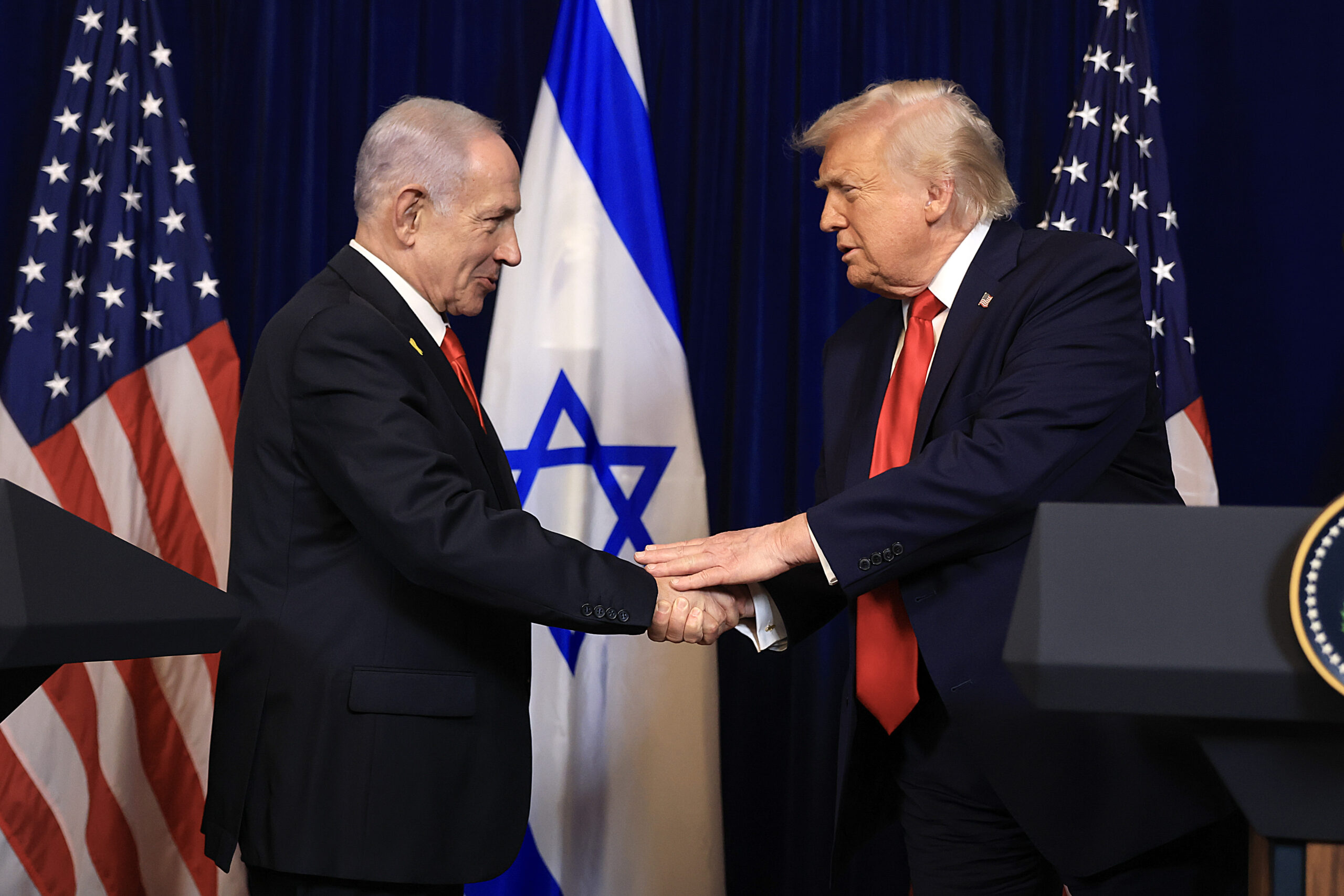
Israeli Prime Minister Benjamin Netanyahu is traveling to Washington on Monday, where he will meet with President Donald Trump and attend the funeral of Sen. Lindsey Graham (R-SC), his office announced on Friday, Jewish Insider’s Haley Cohen reports.
Honoring a friend: Netanyahu said that “Israel lost one of its greatest friends” after Graham died suddenly on July 11. The South Carolina senator’s funeral is scheduled for Tuesday at the National Cathedral in Washington.
POLLSTER PERSPECTIVE
Israelis fail to understand anti-Israel sentiment in the U.S., Israeli public opinion researcher says

Israelis generally don’t grasp the extent of the growing anti-Israel sentiment in the United States, Dahlia Scheindlin, an Israeli public opinion researcher and columnist, told Jewish Insider’s Marc Rod on the sidelines of the Aspen Security Forum this month.
Crying wolf: Speaking to JI hours before more than 100 House Democrats voted to cut U.S. military aid to Israel, Scheindlin said that most Israelis feel that warnings of slipping U.S. support have been repeated for years but haven’t come to fruition. “Israelis for a long time have been told ‘you have to worry about the America-Israel relationship’ and nothing ever really happened — they sort of took it for granted that the relationship would always be there, and in many ways they still do,” Scheindlin said. “From the Israeli perspective, there’s a little bit of a sense of crying wolf. We see that in the 53% who still think that the relationship will be fine.”
Policy perspective: Sen. Mark Kelly (D-AZ) said on Sunday on NBC’s “Meet The Press” that he will “always stand by Israel as a nation,” while adding that he hopes Israelis will oust Prime Minister Benjamin Netanyahu in the elections later this year.
ACCOUNTABILITY FIGHT
Jewish leaders blame Mamdani for fueling Manhattan attack, while most Dems avoid pointing fingers

Shockwaves from the Tisha B’Av stabbings on the Upper West Side reverberated through New York’s Jewish and Democratic Party elected leadership on Friday, as some blamed New York City Mayor Zohran Mamdani’s invective against Israel, while others called more broadly to turn down the temperature on the rhetoric in the city, Jewish Insider’s Will Bredderman reports.
Words of warning: Of the officials who participated in a press conference outside the Modern Orthodox Jewish Center, only Assemblymember Micah Lasher — who won a primary last month to succeed Rep. Jerry Nadler (D-NY) as congressional representative for the Upper West Side — openly called out Mamdani. “When a place, and by extension the people who are inextricably linked with that place, are singled out, compared to the worst evildoers in human history, blamed for problems half a world away, the space between rhetoric and violence can vanish,” warned Lasher.
BEE’S KNEES
How Debra Band revives a dying Jewish artform
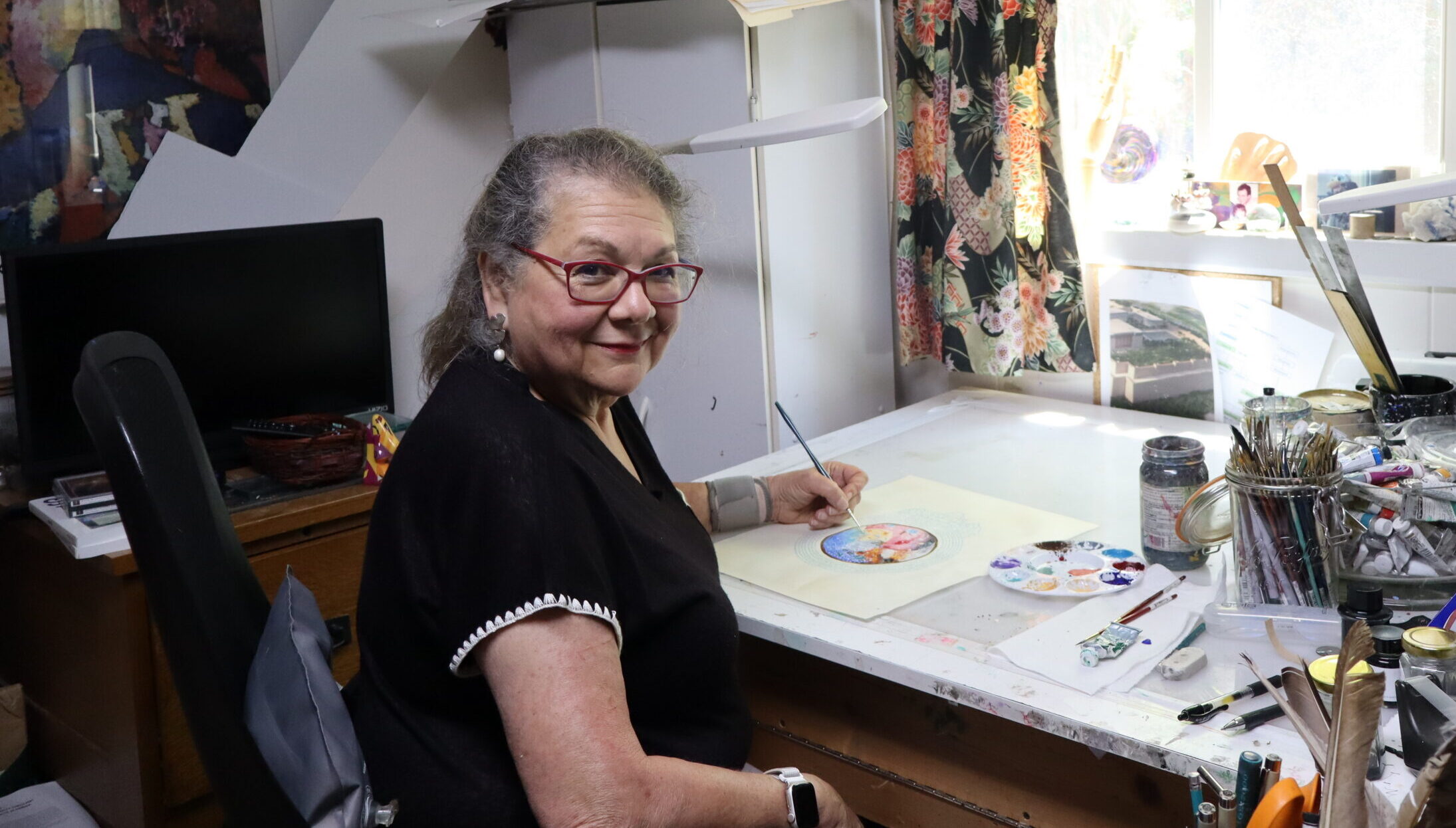
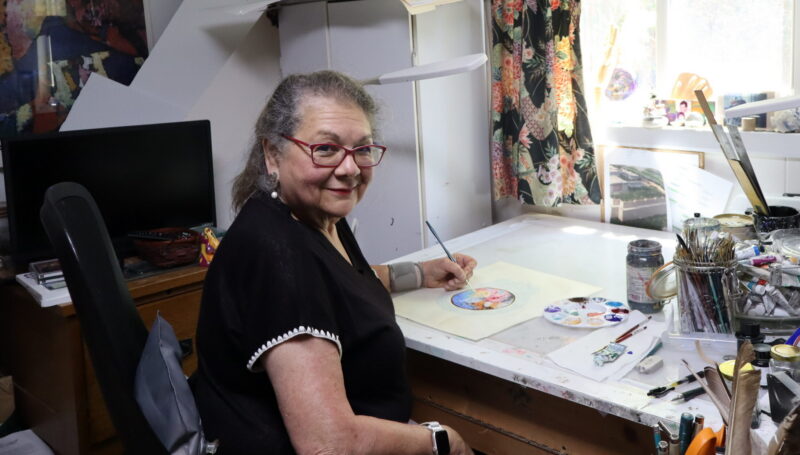
For 30 years, Debra Band built a career in health policy — but in her Maryland studio, surrounded by kosher parchment, gold leaf and an unfinished manuscript or three, she’s spent the last quarter-century quietly reviving a Jewish art form: the illuminated manuscript. Five of her books now sit in the Library of Congress’s permanent collection, Jewish Insider‘s Christina Sher reports.
Illuminating tradition: When Band first brought her Song of Songs book to the library to show its then-head of the Hebraica section, she watched him lay all 65 pages out on a long table and pull out a jeweler’s loupe. She assumed he was hunting for errors in her calligraphy, and started speaking quickly, over-explaining the iconography. In an interview with JI, Band recalled him cutting her off and saying: “Don’t worry, if anyone in the country reads this book when it comes out, it will be me. Right now, I just need to look for the honeybees.” The bees are Band’s signature; her Hebrew name is Devorah — honeybee. As a private joke with herself, she tucks a small painted bee into nearly every manuscript page she makes.
Worthy Reads
Ambassador’s Insight: In The Washington Post, Matthew Gould, who served as a British ambassador to Israel and a deputy ambassador to Iran, explains the decision-making processes of Iranian leaders. “First: Iranian leaders are focused single-mindedly on preserving their grip on power. They know that the overwhelming majority of Iranians despise them and that the people will not be forgiving if the regime is finally removed. … Second: Iran’s actions often have more to do with internal regime dynamics than with statecraft. Western governments tend to interpret Iranian actions as aimed at them. But often, they are aimed internally.” [WashPost]
Atomic Optics: In The Wall Street Journal, Matthew Kroenig and Henry Sokolski warn of the possible fallout from the U.S.-Saudi deal announced last week that could give Riyadh a civilian nuclear program. “Providing Saudi Arabia a pathway to build the capacity the U.S. Air Force is razing in Iran gives hypocrisy a bad name. It not only would make it more difficult to get Iran to restrict its own program, but also set a poor example and encourage other nuclear suppliers to misbehave. More important, it’s sure to spook Riyadh’s neighbors. … The U.S. got the United Arab Emirates to agree to forgo making nuclear fuel with the caveat that if Washington afforded any neighbor more-generous terms, the U.A.E. could renegotiate.” [WSJ]
Candidate Corner: The New Yorker’s David Remnick profiles Gadi Eisenkot as the former IDF chief of staff mounts a challenge to Israeli Prime Minister Benjamin Netanyahu, positioning himself as the “anti-Bibi” candidate. “Eisenkot is selling himself as the humble soldier, a political novice untainted by corruption or duplicity. After forty-one years in the Israel Defense Forces, including a stint under Netanyahu as chief of the general staff, the military’s highest post, Eisenkot served in the Knesset from 2022 to 2025. During that brief tenure, he says, he discovered that ‘Israeli democracy is far more fragile than I had imagined.’” [NewYorker]
A larger selection of Worthy Reads is available in our Live Briefing.
Word on the Street
A new CBS News/YouGov poll found that eight in 10 Americans think the Iran war was more challenging for the Trump administration than it had anticipated…
The Wall Street Journal spotlights Iran’s use of Kheibar Shekan missiles, which can be deployed more quickly than older weapons and some of which have advanced maneuvering features that have posed a challenge to interception efforts…
Israeli President Isaac Herzog spoke by phone on Sunday with Bahraini King Hamad bin Isa Al Khalifa in a conversation that was reportedly initiated by Al Khalifa, who asked for the discussion to be made public…
Board of Peace head Nickolay Mladenov said he welcomed “steps by Israel” that “enable the deployment” of the U.S.-led International Stabilization Force in Gaza…
Unreleased footage from a documentary filmmaker who was chronicling Sen. Lindsey Graham’s (R-SC) diplomatic endeavors showed the late senator expressing concerns over the involvement of White House Special Envoy Steve Witkoff and Jared Kushner in Middle East efforts, with Graham saying the two were “just too conflicted”; the footage, from documentarian Alex Holder, also includes Graham comparing Trump and Netanyahu to President Franklin Roosevelt and U.K. Prime Minister Winston Churchill…
Sen. Bernie Sanders (I-VT) told The Hill that he did not regret his previous support for former Maine Senate candidate Graham Platner, who ended his campaign after a slew of allegations ranging from a tattoo of a Nazi symbol to the sexual assault of a former girlfriend…
Morris Katz, a close advisor to Platner who stood by him until the final days of his Senate race, is now adopting a more contrite tone as he looks back on what went wrong in the campaign. “The tattoo should have been enough,” Katz said in an interview on “The Ezra Klein Show,” referring to Platner’s tattoo of a Totenkopf, a symbol associated with the Nazi regime’s elite SS unit, JI’s Gabby Deutch reports…
The New York Times examines what it describes as the “dysfunction and debt” wracking the Democratic National Committee and the “fraying nerves” of its chairman, Ken Martin, as the party seeks to capitalize on a favorable national environment to make sizable gains in the midterm elections…
The Department of Justice opened applications for a new grant program providing funding for local law enforcement agencies to deploy on-duty officers to protect houses of worship; the application closes on Sept. 2. The Department of Justice is set to provide more than $7.7 million for the program, more than the minimum $5 million budgeted by Congress…
A circuit court ordered the release of Georgetown researcher Badar Khan Suri, who had been held by immigration officials, a day after a federal appeals court overturned a lower court ruling ordering the release of Columbia University anti-Israel demonstrator Mohsen Mahdawi…
In eJewishPhilanthopy, Rabbi Yitz Greenberg honors his good friend Harold Grinspoon on the occasion of the philanthropist’s 97th birthday…
In a Washington Post op-ed, Ashley Jackson, a daughter of the late Rev. Jesse Jackson, reveals she converted to Judaism two years ago, a decision that was supported by her father…
Karim Khan, the chief prosecutor of the International Criminal Court who was suspended earlier this year over allegations that he’d sexually harassed a subordinate, was officially removed after 82 of the court’s 125 members voted on Friday to oust him from the role…
Authorities in Manchester, U.K., arrested two people who allegedly shot BB guns at Jewish pedestrians in what is being investigated as a religiously motivated crime…
Police in Canada are investigating attacks on two Jewish-owned bagel shops in Toronto on Sunday…
Brazilian politician Flávio Bolsonaro, the son of the country’s former president, secured the nomination of the country’s Liberal Party to challenge President Luiz Inácio Lula da Silva; Netanyahu sent a video expressing support for Bolsonaro during the party’s convention, which was held on Saturday…
The remains of Theodor Herzl’s grandparents will be moved from a Belgrade cemetery and reinterred at Jerusalem’s Mt. Herzl…
The New York Times does a deep dive into efforts by the Iran-backed Houthis in Yemen to use the current geopolitical situation to obtain concessions from Saudi Arabia…
The Wall Street Journal reviews Yitzhak Shalev’s 1964 novel The Gavriel Tirosh Affair, about a teacher in 1930s Mandatory Palestine who convinces his students to join a paramilitary group…
Japanese militant Kozo Okamoto, who served 12 years in an Israeli prison for taking part in a 1972 terror attack at Israel’s main airport in which 26 people were killed, died at 78 in Lebanon, which had granted him asylum…
Ida Schmertz, the founding director of Rutgers University’s Center for American Women and Politics, died at 91…
Pic of the Day

French Jewish DJ Barbara Butch performed on Saturday during the Hameau Festival in Saint-Martin-du-Tertre, France, a week after her concert in Grenoble was disrupted by anti-Israel activists. She has since filed a complaint against the organizers of the demonstration that forced her offstage while performing in Grenoble.
Birthdays

Comedian, writer, producer and actor, Carol Leifer turns 70…
Real estate developer who founded Aspen Square Management, he heads an eponymous foundation known for its flagship program PJ Library, Harold Grinspoon turns 97… Forensic pathologist known for his HBO show and his work investigating high-profile deaths, Michael M. Baden turns 92… Managing partner of Access Fund Management Company, he is a past president of the Jewish Community Federation of San Francisco, Harold Zlot… Former deputy secretary of defense and then CIA director in the Clinton administration, now a professor emeritus at MIT, John Mark Deutch turns 88… Steven M. Mizel turns 87… Artist and museum founder focused on Fusionism, Shalom Tomáš Neuman turns 79… Israeli author and television producer, he is best known for his documentaries of Israel’s intelligence agencies, Yarin Kimor turns 74… Washington bureau chief and White House correspondent for the Christian Science Monitor, Linda Feldmann… Former VP of global communications, marketing and public policy at Facebook, he previously held a similar position at Google, Elliot Schrage turns 66… U.S. Army colonel (retired), Jeffrey Brian Carra… Israeli television and radio personality, Erez Moshe Tal turns 65… Heir to the Hyatt Hotels fortune, now a film producer, Jean “Gigi” Pritzker turns 64… Former CEO of the Rabbinical Assembly, she is now the founder of Insight Eldercare, Rabbi Julie Schonfeld… Member of the European Parliament since 2009, Tamás Deutsch turns 60… Rabbi at Kesher Israel: The Georgetown Synagogue, Rabbi Hyim Shafner… Former national platform director for the Democratic National Committee, now a political consultant and recruiter, Andrew Grossman… Former chief of staff of the House Republican Conference, he is now the managing partner at Capitol Venture, LLC, Jeremy Deutsch… Head of marketing at Employee Navigator and winner on “Jeopardy!” in 2019, Aaron Lichtig… D.C. area political activist, Benjamin Rothenberg… SVP of communications at CBS News, Jeremy Adler…
Ansari is now rejecting support from Democratic Majority for Israel after the group championed her 2024 candidacy
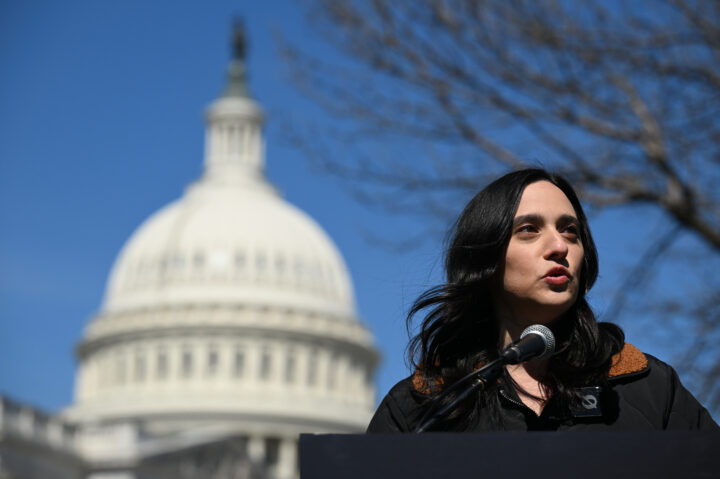
Photo by Matt McClain/Getty Images
Rep. Yassamin Ansari (D-AZ) speaks at a press conference calling for an end to the conflict in Iran outside the United States Capitol on March 18, 2026 in Washington, D.C.
When Rep. Yassamin Ansari (D-AZ) narrowly prevailed in the Democratic primary for an open House seat in Phoenix in 2024, winning by just 39 votes in a deep-blue district, the Arizona lawmaker could attribute her success, in part, to strong backing from the local Jewish community as well as a surge of outside spending from a prominent pro-Israel group.
Many Jewish and pro-Israel leaders in the state and beyond were encouraged that Ansari, who identifies as a progressive, staked out what seemed at the time like a moderate approach to Middle East policy issues amid rising Democratic hostility toward Israel over the war in Gaza — particularly in the party’s far-left wing.
Ansari, an Iranian American and former vice mayor of Phoenix, drew a contrast with her top rival, Raquel Terán, a former state lawmaker and party chair who had raised concerns among Jewish activists over her lack of clarity on key issues, such as whether she supported aid to Israel. For her part, Ansari stressed her commitment to U.S. military funding for Israel “without additional conditions,” while saying in a position paper that the United States “must do everything in its power to stop” Iran “from acquiring a nuclear weapon,” which she argued “would pose an existential threat to Israel.”
Now, however, Ansari, 34, has largely turned away from the stances she embraced during her primary, aligning with a range of far-left policy positions that have led several Jewish and pro-Israel leaders to feel they were misled, they told Jewish Insider.
Alma Hernandez, a Democratic state representative in Tucson who had been one of Ansari’s top Jewish campaign surrogates in the 2024 primary, said she “was really excited for the idea of having someone like” Ansari in office, noting that she attended the congresswoman’s swearing-in ceremony in Washington to demonstrate her solidarity.
“I have not talked to her since,” Hernandez said last week in an interview with JI. “I think a lot of folks in the community feel they were really used in a sense,” she added, alleging that Ansari “was very careful with all her words because she wanted the support and the financial backing” in a closely contested race.
Hernandez added that she did not think she could reasonably support Ansari’s reelection or ask Jewish community members to get behind her as she had in the primary race two years ago.
In an interview with JI on Wednesday, Ansari said that she has received positive feedback from Jewish voters in her district about her position on Israel. “I do believe I still have significant support from the Jewish community in Arizona,” she added, affirming that her “relationship to Arizona’s Jewish community has always been, and will continue to be, one of deep engagement and mutual respect.”
“I’m sorry that some people may feel misled, but that’s not how I see it at all,” she said, arguing that her views on the Middle East simply underscore the extent to which “the context and the situation on the ground have changed dramatically since a couple of years ago.”
Ansari said her office keeps a log of local outreach that shows most of her constituents, “if not the vast majority, are pretty in line with the American public on this issue,” stressing voters overwhelmingly agree “that what has happened in Gaza has been atrocious, that we need to really consider using U.S. leverage on how to influence Israeli policy and deep opposition to the far-right Netanyahu government.”
Still, her erstwhile Jewish supporters said they felt betrayed by her shift and questioned her sincerity. “I still really can’t believe how she played us,” said one pro-Israel leader in the state who had enthusiastically backed Ansari’s 2024 bid and was granted anonymity to speak freely about frustrations with the freshman lawmaker. “I thought she was somebody different.”
In her first Middle East policy test as a member of Congress in January, Ansari broke with progressives in backing Republican-led legislation to sanction the International Criminal Court for issuing arrest warrants against senior Israeli officials, even as she clarified it “wasn’t an easy vote.”
But since then, Ansari has adopted a more openly hostile approach to Israel that has fueled a mounting sense of disappointment among her Jewish allies who had believed she would strike a balanced tone while in the House. She is a co-sponsor of the Block the Bombs Act, which would impose sweeping new restrictions on weapons sales or transfers to Israel, for instance, and was an early backer of a Lebanon war powers resolution, introduced by Rep. Rashida Tlaib (D-MI), aimed at blocking U.S. support for Israeli military operations against Hezbollah, an Iranian terrorist proxy.
During an interview this week with Mehdi Hasan of the media outlet Zeteo that underscored her growing ties to the far left, Ansari said for the first time she believed that Israel had committed genocide in Gaza as well as Lebanon, citing a U.N. report released this month. “I just don’t think we can continue to mince our words or deny what so many credible actors and institutions and doctors are saying,” she said of her thinking.
Ansari told JI she was “deeply sympathetic” to Jewish colleagues and constituents who “find the term genocide to be extremely hurtful,” saying that she did not “believe that a word should be used as a litmus test” in political debates over Israel that have consumed several recent Democratic primary races.
“Ultimately,” she said, “being clear about what has happened in Gaza and what continues to happen is not to minimize the horrors of either the Holocaust or the violence committed on Oct. 7 by Hamas, and I continue to condemn that forcefully and continue to believe Israelis deserve to live in peace and security in the state of Israel, and I believe we need a secure Palestinian state.”
Elsewhere in the Zeteo discussion, Ansari said that she remained uncertain about where she would land on an anticipated House vote over an amendment led by Rep. Thomas Massie (R-KY) to slash the annual $3.3 billion in military aid the U.S. is set to provide Israel in the 2027 State Department funding bill, a controversial effort that Jewish activists in Arizona have urged her to oppose, according to a recent email shared with JI.
She also vowed to reject financial assistance from pro-Israel groups including AIPAC and Democratic Majority for Israel, the latter of which endorsed her 2024 campaign and pumped more than $400,000 into the race to boost her bid, hailing her victory as proof “that being pro-Israel is not just wise policy, but also winning politics.”
“I just don’t want anyone to think that any of my decisions are influenced by any organization,” she explained to Zeteo. “They never, quite frankly, have been or should.”
Speaking with JI, Ansari said she has continued to engage with DMFI and has a “respectful relationship” with the group, even as she now disavows its support. “I really do find the villainization of the members of these organizations to be very problematic,” she said of the pro-Israel community. “That’s why I have very much not been antagonistic, because I don’t want to give in to that.”
DMFI’s super PAC declined to comment on Ansari’s remarks. A spokesperson for AIPAC did not return a request for comment.
Ansari’s lack of interest in backing from AIPAC comes as the group’s brand has become toxic in a number of Democratic primaries, particularly those in progressive-minded districts. And her shift to a more skeptical position on the U.S.-Israel alliance is reflective of broader polling trends that show eroding support for Israel in both parties — especially among younger voters.
But according to a source with first-hand knowledge of the matter who spoke with JI on the condition of anonymity to address a sensitive subject, Ansari had “worked tirelessly” in her primary to claim an AIPAC endorsement, crafting a position paper with its policy expectations in mind, meeting with AIPAC’s staff and pledging to visit Israel on an AIPAC-sponsored trip if elected to Congress.
AIPAC held off on supporting Ansari because it was unconvinced about her views and out of deference to Sen. Mark Kelly (D-AZ), who was backing Terán and asked the group to remain neutral in the primary, the source noted.
Not long after she had entered the House, Ansari privately reiterated her interest in visiting Israel on an AIPAC-led congressional delegation, according to the source. But despite her prior outreach, her team said then that she did not want an AIPAC endorsement — indicating that it was too early in her tenure and she needed more time to acquaint herself with the group.
Ansari did not dispute that account but added there were irreconcilable disagreements with AIPAC that precluded constructive conversation, not to mention an endorsement. “The truth, from my perspective, is that there was never any room for policy differences with AIPAC,” she said, while stressing that the group “continued to provide feedback on” her positions that she was “unwilling to make.”
Despite having voiced interest in visiting Israel with AIPAC, Ansari said she “could not justify taking part” in a trip last year, amid “the continuation of violence in Gaza” and “well into the Trump administration.” Her outspoken opposition to the war in Iran subsequently hardened her resistance to such a trip, she suggested.
One pro-Israel activist in Arizona said that Jewish leaders who got behind Ansari in 2024 and are now stung by her reversals should not necessarily feel surprised, noting she had no demonstrable record as a strong supporter of Israel prior to her campaign for Congress.
In some ways, Ansari’s evolution echoes that of Rep. Maxwell Frost (D-FL), a fellow progressive who was elected in 2022 after making a range of commitments to uphold support for Israel that he has since reneged on in Congress, stoking disenchantment among local Jewish leaders who were initially energized over his campaign.
But while Frost had engaged in private diplomacy with DMFI to preempt attacks as he ran against the group’s preferred candidate, Ansari actively courted and accepted support from the pro-Israel community in her primary, a key distinguishing factor of the race featuring an opponent seen as more critical of Israel.
Zachary Bell, a Jewish community activist in Phoenix who has spoken to Ansari about Israel and Gaza, said that he was “very happy with how she has responded” to the wars in the Middle East. “I am far from a super far-left, anti-Israel person,” he clarified. “I think there is a wide range of opinions on this issue in the Jewish community,” he added. “She has done a very good job seriously engaging with people across that spectrum.”
Bell volunteers with J Street, the progressive Israel advocacy group, but said he was speaking for himself. J Street endorsed Terán, Ansari’s primary rival, in 2024, and it has not backed Ansari this cycle, as she runs unopposed for a second term in Arizona’s solidly Democratic 3rd Congressional District.
A Jewish community leader in Arizona said Ansari’s shifting stances on Israel indicate that she no longer feels she needs support from former pro-Israel allies to continue holding her seat. “She’s packing her bags for reelection, and there is a weight limit,” the Jewish leader told JI. “Israel, right now, weighs too much for her.”
Adam Goodman, a Jewish activist in Phoenix who supported Ansari’s campaign in 2024, said he was aligned with the congresswoman “on many issues,” calling her “smart, pragmatic and engaging, with a long political career ahead of her.”
But while he had once praised Ansari as “unequivocal in her support for Israel,” Goodman suggested he has since grown disillusioned about the congresswoman’s current approach.
“Unfortunately,” he told JI, “she is demagoguing Israel without holding other countries to the same standard.”
Ansari, for her part, said that her views were more carefully considered than her critics speculated and dismissed accusations that she is playing politics on Israel. “I’m not somebody who jumps on any sort of bandwagon,” she insisted to JI. “I think very deeply about foreign policy.”
“We are having quite the reckoning within the Democratic caucus and Congress about all of these issues right now,” she said.
Two DSA-backed challengers have a credible shot at winning seats, while Rep. Dan Goldman is down in polls against Brad Lander
Erik McGregor/LightRocket via Getty Images
NY Assemblymember Claire Valdez
As an emboldened socialist wing of the Democratic Party gains traction across New York City in the aftermath of Mayor Zohran Mamdani’s victory, Jewish leaders and moderate officials are bracing for the possibility of multiple upsets in key House races that could reshape the ideological orientation of the state’s congressional delegation.
Three races have drawn heightened attention in recent weeks, including a marquee House contest playing out largely in progressive Brooklyn where Rep. Dan Goldman (D-NY) is seeking to fend off a serious challenge from former New York City Comptroller Brad Lander. Meanwhile, in upper Manhattan and the Bronx, Rep. Adriano Espaillat (D-NY) is facing what looks like an increasingly credible challenge from an anti-Israel organizer. And in the race to replace retiring Rep. Nydia Velazquez (D-NY), her favored primary candidate is struggling to compete against a democratic socialist endorsed by Mamdani.
“If you have two socialists and Brad Lander” who are elected, “that’s a real move to the left — and it’s a lot of people who are bringing down the seniority of the congressional delegation,” said Chris Coffey, a New York City Democratic strategist not involved in the races. “That is probably the biggest shift we’ve seen at the congressional level in generations,” he told Jewish Insider, adding that there are “a lot of ifs baked into that.”
A recent public poll showing Goldman trailing badly behind Lander underscored how an emboldened far left is asserting itself in a race that is hinging in large part on the candidates’ differences over Israel. The independent survey, released last week by Emerson College, strongly indicated that Goldman is in serious trouble in the closely watched June 23 primary, lagging badly behind Lander, who held a commanding 57% of the vote.
Goldman, a pro-Israel Democrat who gained prominence as an outspoken critic of President Donald Trump, touts a relatively progressive record on domestic issues like healthcare, climate policy and immigration. But as he seeks a third term, Goldman has faced backlash from left-wing activists over his continued support for U.S. funding to Israel, which Lander, notably endorsed by Mamdani, has vowed to end, even for missile defense.
In a rare convergence on Middle East-related issues, the candidates opposed a successful effort this week to implement a boycott of Israeli products at a high-profile local food cooperative in the Park Slope neighborhood of Brooklyn, which sits in the district. (In a sign of the times, the boycott vote passed by a 2-to-1 margin.) But they otherwise disagreed on whether the measure was antisemitic, as Goldman and other Jewish community activists, including an influential rabbi in the district, had described the divisive effort.
Both Goldman and Lander are slated to address Jewish community concerns on June 7 during off-the-record town hall events at Congregation Beth Elohim, a Reform synagogue in Park Slope that is led by that rabbi, Rachel Timoner, according to an email recently sent to members. They will answer questions from congregants independently in the back-to-back, hour-long forums.
Despite tensions over Israel, some strategists note that Lander’s dominance in the progressive district covering sections of Brownstone Brooklyn and Lower Manhattan can be attributed to his standing as a popular former councilman and citywide elected official who also ran for mayor last cycle — a level of name ID that marks him as a sort of de facto incumbent.

But other races have also sharply demonstrated how anti-Israel sentiment is fueling the rise of candidates endorsed by the Democratic Socialists America’s New York City chapter. The group, which has championed anti-Zionism as a core element of its platform, is now backing challengers in two high-profile congressional primaries as well as some down-ballot races for seats in the state Legislature.
The closest race, for an open House seat spanning parts of Brooklyn and Queens, pits Claire Valdez, a democratic socialist assemblymember who is known for her anti-Israel activism, against Antonio Reynoso, the progressive Brooklyn borough president boasting establishment support from the outgoing incumbent, Velazquez, and the state attorney general, Letitia James, among other elected officials and groups.
But even as Reynoso entered the race in a favorable position, well-known to voters for his reputation as a more traditional progressive, he has struggled in his campaign to gain traction, recently calling himself an underdog, thanks to Valdez’s support from Mamdani paired with the grassroots organizational muscle of a resurgent DSA. A recent poll showed Valdez narrowly leading Reynoso by two points, with 23% of the vote, even while she is comparatively new to the district as a first-term state lawmaker.
Valdez’s favorable position has come as she has made opposition to Israel a primary focus of her campaign, while facing some scrutiny over her decision to sit for a friendly discussion earlier this month with a Twitch streamer who was once suspended from the platform for calling Jews a “demonic ethnicity.” Her campaign did not respond to a request for comment concerning the interview.
In a separate House primary in upper Manhattan as well as parts of the Bronx, Jewish leaders have begun to raise alarms about an insurgent challenger to Espaillat, a veteran incumbent who, like Goldman, is backed by the pro-Israel group AIPAC. In the final weeks of the race, he is now facing what Democratic strategists say is an increasingly serious threat from Darializa Avila Chevalier, a DSA-endorsed organizer who helped lead campus anti-Israel demonstrations at Columbia University.
“Folks seem to be getting very nervous,” one Jewish leader following the race told JI, echoing others who relayed similar concerns about the contest as it enters its closing stretch.
An internal campaign poll conducted in March, for instance, put Avila Chevalier at 28% among primary voters, with Espaillat at 42%, a poor showing for an incumbent who has held office for close to a decade. Political observers suggested the race could be closer as the primary nears and Avila Chevalier rides a wave of anti-establishment, leftist sentiment now shaping several races across the country where the DSA is involved.
In addition to backing an arms embargo on Israel and efforts to boycott the Jewish state, both Avila Chevalier and Valdez pledged to “refrain from any affiliation with the Israeli government and Zionist lobby groups, including but not limited to AIPAC, J Street, or DMFI,” according to DSA questionnaires reviewed by JI.
Justice Democrats, the far-left group that has frequently targeted incumbents, has also endorsed both candidates and is now spending to boost their campaigns. On Wednesday, it dropped $260,000 on ads to help boost Avila Chevalier — suggesting it sees the race as in play. The group also made its first foray into Valdez’s primary this week, according to filings, spending $11,000 on digital ads to prop up her bid.
Reynoso and Espaillat, meanwhile, can expect seven figures spent independently on their behalf in the coming weeks, a Democratic operative familiar with the matter told JI, but did not disclose the source of such funding.
The upcoming expenditures foreshadow what is shaping up to be a bitterly contested fight between the Democratic establishment and the far left now seeking to supplant it.
Still, there are signs that the far left is struggling to gain traction outside of deeply progressive districts. For example, Rep. Ritchie Torres (D-NY), a pro-Israel stalwart facing a challenge from former state lawmaker Michael Blake, who has made opposition to AIPAC a key part of his messaging, is expected to prevail. A recent poll showed Torres with a commanding 60% of the vote share, far outpacing Blake, who held just 15% in the Bronx-based district.
Torres’ position “shows that if you are actually working hard in your district and are there and present and delivering, then you should be OK,” Coffey, the Democratic strategist, told JI, noting that the congressman also developed a positive relationship with Mamdani, despite their disagreements on Middle East policy.
Hank Sheinkopf, a veteran Democratic strategist in New York City, characterized the DSA’s strategy as part of a “long-term plan” to “take over legislatures” across the country and influence foreign policy at the congressional level, as other far-left candidates have made inroads in key House races in Philadelphia and Denver. “New York is just the beginning,” he told JI.
The move makes Hochul the second Democratic governor to join the tax credit program
Susan Watts/Office of Governor Kathy Hochul
Gov. Kathy Hochul tours Anne Frank exhibit and delivers remarks at the Anti-Hate Center in Education at the Center for Jewish History.
New York Gov. Kathy Hochul confirmed to Jewish leaders on Thursday that she will opt into a new federal education tax initiative, a move promoted by community advocates to help fund Jewish day schools and yeshivas.
Starting in the 2027 tax year, the federal Education Freedom Tax Credit, part of President Donald Trump’s 2025 flagship policy package, provides a dollar-for-dollar tax credit — up to $1,700 annually — for donations to approved Scholarship Granting Organizations. These SGOs offer scholarships for a variety of K-12 public and private education expenses, including private school tuition, transportation and tutoring.
If states don’t opt in, taxpayers can still donate, but residents of that state won’t receive the benefit.
A spokesperson for Hochul confirmed to Jewish Insider that the governor told Jewish leaders she will opt in.
The move would make Hochul the second Democratic official to join the program, following Colorado Gov. Jared Polis in February.
While nearly all Republican governors have already opted in, their Democratic counterparts have been hesitant. Some critics have voiced concerns that the program has insufficient oversight against fraud or that it could divert public money to private schools.
New York would be the 30th state to opt in. States have the next several months to choose to participate.
Teach Coalition, an Orthodox Union-run organization that advocates for government funding and resources for yeshivas and Jewish day schools, as well as Jewish Federations of North America, have for months lobbied governors and met with Jewish communities to educate on the initiative. The tax credit push marks the first time JFNA has waded into the issue of Jewish day school affordability.
Hochul’s “support for this program puts New York at the forefront of expanding educational opportunity and positions the state as a leader among blue states looking to empower families,” said Sydney Altfield, CEO of Teach Coalition. “We are also deeply grateful to the parents, advocates, educators, and community leaders whose voices helped make this moment possible. This is bigger than New York. Blue states across the country will now be watching closely.”
Plus, the tefillin-wrapper chasing Milken moguls
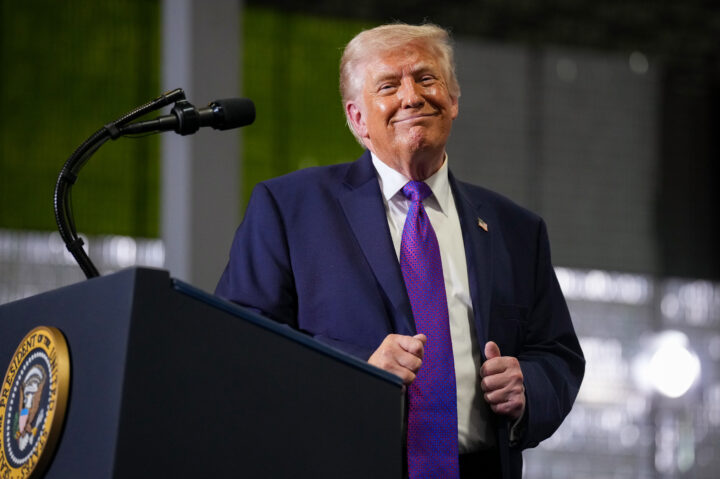
Andrew Harnik/Getty Images
President Donald Trump speaks on stage at Verst Logistics on March 11, 2026 in Hebron, Kentucky.
Good Wednesday morning.
In today’s Daily Kickoff, we look at concerns from Jewish leaders over the increasing targeting of Hillels by anti-Israel activists, and report on FEC filings indicating that far-left N.J. congressional candidate Adam Hamawy has charged his campaign for the use of office space in his medical practice. We tag along with Yossi Farro in Los Angeles as the 22-year-old hits the conference circuit in search of machers to wrap tefillin, and report on President Donald Trump’s call for Jewish Americans to observe a “national Sabbath” next week as part of the country’s Semiquincentennial celebrations and Jewish American Heritage Month. Also in today’s Daily Kickoff: Rep. Don Bacon, Michigan state Rep. Noah Arbit and David Frum and Danielle Crittenden.
Today’s Daily Kickoff was curated by JI Executive Editor Melissa Weiss and Israel Editor Tamara Zieve, with an assist from Danielle Cohen-Kanik. Have a tip? Email us here.
What We’re Watching
- President Donald Trump announced a pause in Project Freedom, the plan unveiled earlier this week to protect ships transiting through the Strait of Hormuz. Trump’s announcement came shortly after Secretary of State Marco Rubio told reporters at the White House that the administration had ended its Operation Epic Fury against Iran and transitioned to Project Freedom. Axios reported this morning that the Trump administration believes it is nearing an agreement on a memorandum of understanding that would lay the groundwork for nuclear talks between Washington and Tehran. More below.
- The pause was announced hours after Iranian Foreign Minister Abbas Araghchi met in Beijing with Chinese Foreign Minister Wang Yi.
- The White House plans to unveil a new U.S. counterterrorism strategy this morning, the Trump administration’s Seb Gorka announced at the National Press Club last night. Gorka said the new strategy will “shape everything America does” when it comes to countering terrorism and repatriating American hostages. “Countries that wrongfully detain our citizens run the danger of being designated as state sponsors of wrongful detention, with all the attendant consequences that accrue,” he added.
- The Milken Institute Global Conference concludes today, with Argentine President Javier Milei set to deliver the confab’s closing remarks this afternoon. More below on yesterday’s sessions and sidelines conversations.
- Manhattan’s Stephen Wise Free Synagogue is holding a NY-12 candidate forum tonight, with Democrats George Conway, Micah Lasher and Jack Schlossberg slated to attend. Absent from the forum will be Alex Bores, who withdrew from the event yesterday.
- Elsewhere in New York City, former Sen. Ben Sasse (R-NE) and Jeff Yass are set to be honored tonight at the Alexander Hamilton Award Dinner.
- The Chicago Cubs will hold their first Jewish American community night when the team takes on the Cincinnati Reds. Cantor Rachel Brook of Lakeview’s Anshe Emet Synagogue will sing the National Anthem before the first pitch.
What You Should Know
A QUICK WORD WITH JI’S JOSH KRAUSHAAR
Two Jewish Democrats from Chicago are looking to run for president.
One, Illinois’ two-term governor, JB Pritzker, has built up a reliably progressive record while steering clear of ideological fights over Israel, antisemitism and other cultural issues fueling the Democratic Party.
The other, former Chicago Mayor Rahm Emanuel, is one of his party’s leading pragmatists, known for feuding with left-wing Democrats over education, the power of unions and the degree to which cultural progressivism cost the party on the ballot box.
So it came as a surprise that, in two separate interviews each published Tuesday, it was Pritzker who came out as a more forceful voice against antisemitism and in support of the U.S. relationship with Israel, while Emanuel sounded like he was all too eager to blame Israeli Prime Minister Benjamin Netanyahu as he anticipated a future breakup between the two close allies.
Pritzker offered the point that relationships between allies aren’t dependent on whether you personally like the elected leadership in charge. It’s a line you’d expect more mainstream Democrats to invoke, especially as Israel’s favorability within the Democratic Party has sunk to new lows.
“There are a lot of people who don’t like Netanyahu, but you shouldn’t take it out on Israel. It’s a democracy that elected him. There are a lot of people who don’t like Trump. I mean, should we be tossed into The Hague as a country because of Trump?” Pritzker told Politico over matzoh ball soup at Manny’s Deli, referring to the home of the International Criminal Court.
Emanuel, when asked by Jewish Insider if there was a special relationship between the U.S. and Israel, agreed with the premise but then quickly pivoted to arguing the state of the relationship should be premised on Israel’s efforts contributing to peace in the region. It’s an implication that its post-Oct. 7 efforts at self-defense have gone too far.
FRONT LINES
Jewish leaders warn of new front in anti-Israel campus activity: targeting Hillels
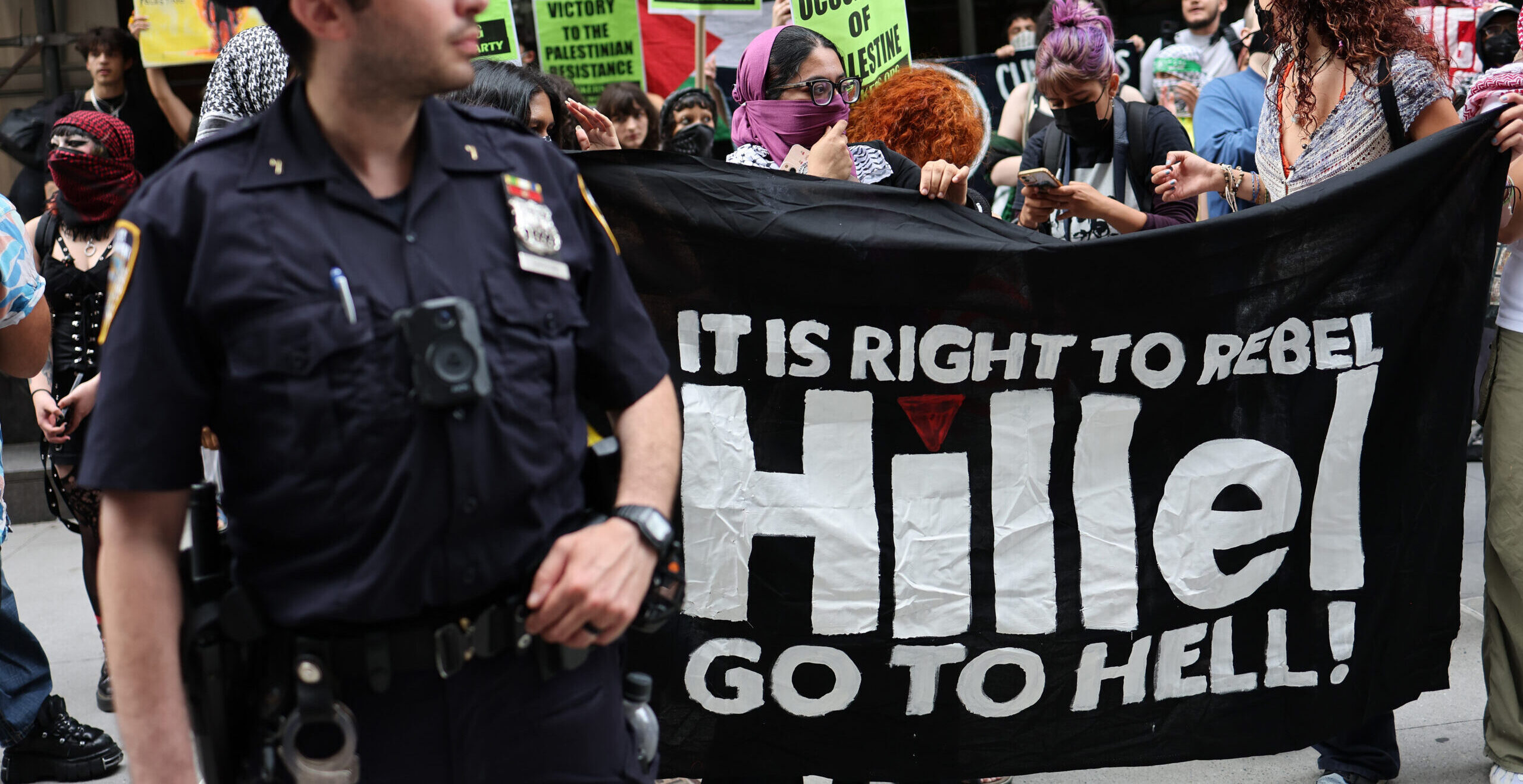
In the aftermath of The New School student government’s vote to defund and sever ties with Hillel, Jewish leaders are warning that the latest front in campus anti-Israel activity is designed to delegitimize the world’s largest Jewish campus organization, Jewish Insider’s Haley Cohen reports.
Red line: “Hillel is a space of Jewish belonging on campus. It is a place Jewish students need, and particularly need right now. For anyone to call into question a place that Jewish students go for their needs is beyond the pale. This absolutely crosses a red line,” Laura Shaw Frank, vice president of the American Jewish Committee Center for Education Advocacy, told JI. Shira Goodman, the Anti-Defamation League’s vice president of advocacy, labeled the incident at The New School “an escalation,” voicing concern that campus organizations are targeted solely for supporting Israel.
Elsewhere in New York: Members of NYU’s chapter of Jews Against Zionism spoke out in support of a nationwide campaign to boycott Hillel, calling on the university to cut ties with the organization.
MISSION TO WRAP
How Yossi Farro, the 22-year-old tefillin wrapper, chases influential Jews from coast to coast

Yossi Farro stepped onto the helipad, taking in the panoramic view of Los Angeles: the Hollywood sign in front of him, the skyscrapers of downtown L.A. behind him, all of it surrounded by mountains. But he was not there to take in the view. Farro was standing atop a Wilshire Boulevard office building on Tuesday afternoon to wrap tefillin with two budding Jewish entrepreneurs in their 20s, as part of his mission to spread mitzvot — this week on the sidelines of the Milken Institute Global Conference in Beverly Hills, Jewish Insider’s Gabby Deutch reports.
Milken moments: Farro, 22, grew up in New York as a Hasidic Jew, part of the Chabad-Lubavitch movement, and has gained a social media following for wrapping “the most Powerful Jews in the World,” as his Instagram bio reads. After Oaktree Capital Management co-founder Howard Marks told Farro he is not Jewish during a run-in at a Beverly Hills Starbucks, Farro Googled him — and learned he was lying. They did not wrap tefillin together, but “we grabbed a picture and ended up bonding over both growing up in New York.”
ANTISEMITISM REPORT
ADL report: Antisemitic incidents decline overall in 2025, remain elevated in post-Oct. 7 era

The number of antisemitic incidents in the U.S. plummeted by a third last year, led by a steep drop on college campuses, but assaults with a deadly weapon spiked dramatically, according to the Anti-Defamation League’s 2025 audit released on Wednesday, Jewish Insider’s Haley Cohen reports.
By the numbers: The ADL tallied 6,274 incidents of antisemitic assault, harassment and vandalism across the country in 2025, an average of 17 incidents per day. While representing a 33% decrease from 2024, this total remains significantly higher than levels before the Oct. 7, 2023, terrorist attacks in Israel, making 2025 the third-highest year for antisemitic incidents since ADL began tracking the data in 1979.
Ted talk: Speaking on a Milken Institute Global Conference panel titled “Combatting the New Cycle of Antisemitism,” Ted Deutch, CEO of the American Jewish Committee, said social media companies should be pressured to enforce their own rules and regulations in the absence of government action, eJewishPhilanthropy’s Nira Dayanim reports.
WAR WHIPLASH
Trump pauses Strait of Hormuz operation, citing ‘great progress’ in Iran negotiations

President Donald Trump announced on Tuesday that he was temporarily pausing “Project Freedom,” the three-day-old operation aimed at reopening the Strait of Hormuz to commercial traffic, at the request of Pakistan and due to progress in negotiations — hours after Secretary of State Marco Rubio heralded the start of the operation, Jewish Insider’s Emily Jacobs reports.
Trump talk: The president wrote on Truth Social on Tuesday evening that all elements of Project Freedom, a U.S. mission to escort commercial vessels safely through the Strait of Hormuz, “will be paused for a short period of time” in order to see if a “[peace] agreement can be finalized and signed.” The U.S. blockade of Iranian ports, however, “will remain in full force and effect,” Trump noted.
Show of support: Virginia’s former Republican governor, Glenn Youngkin, defended the war in Iran in a Tuesday address at the Milken Institute Global Conference in Los Angeles, JI’s Gabby Deutch reports.
Meanwhile in Israel: A majority of Israelis believe that ending the war with Iran under the current conditions would undermine the country’s security, according to a new poll from the Israel Democracy Institute, JI’s Matthew Shea reports.
FOLLOW THE MONEY
Anti-Israel House candidate sends campaign cash to his plastic surgery practice
Dr. Adam Hamawy’s New Jersey plastic surgery practice, which offers such procedures as Brazilian butt lifts, hair transplants and post-pregnancy “mommy makeovers,” is charging his own congressional campaign $7,900 a month for office space, Jewish Insider’s Will Bredderman reports.
Paper trail: Filings with the Federal Election Commission reveal that Hamawy, running on a fervent anti-Israel platform to replace retiring Rep. Bonnie Watson Coleman (D-NJ), has already relayed the first rent check to Princeton Plastic Surgeons, for which state business records show the candidate himself as the sole owner. And there’s more campaign cash headed to the clinic in the months ahead, a spokesperson told JI. “We would much rather be spending this money on paid media, literature, or anything else, but we are running a grassroots campaign in one of the most expensive real estate markets in America, and a space for our volunteers to gather and organize is crucial,” an emailed statement reads.
PRESIDENTIAL DECREE
Trump urges Jewish Americans to observe ‘national Sabbath’ in Heritage Month proclamation
President Donald Trump encouraged Jewish Americans to observe Shabbat next weekend in his Jewish American Heritage Month proclamation issued earlier this week, marking the first time a U.S. president has called for a national Shabbat, Jewish Insider’s Emily Jacobs reports.
Shalom Aleichem: The president wrote in the proclamation, issued on Monday, that he urged American Jews to “observe a national Sabbath” from sundown on Friday, May 15, 2026, to sundown on Saturday, May 16, 2026. The Shabbat coincides with Rededicate 250, Trump’s national prayer event commemorating “250 glorious years of American independence” as part of his Freedom 250 initiative, the public-private partnership overseeing the Semiquincentennial of the United States.
Warning bells: Rep. Don Bacon (R-NE), a co-chair of the House Antisemitism Task Force, warned on Tuesday that anti-Israel sentiment has moved from the political fringes to a “dominant” position within the Democratic Party and warned the same could happen to his own party, Jewish Insider’s Matthew Shea reports.
Worthy Reads
Oil Change: In the Financial Times, United Arab Emirates Ambassador to the U.S. Yousef Al Otaiba explains Abu Dhabi’s decision to split from OPEC. “Aviation, logistics, advanced manufacturing, artificial intelligence, tourism and life sciences are our fastest-growing sectors. In the past four years we have signed 35 comprehensive economic partnership agreements (of which 15 are already operational) with India, South Korea, Indonesia, Ukraine, Israel, Kenya, Malaysia, Vietnam, Jordan and others — broadening access to markets covering billions of people. We are advancing a bilateral trade agreement with the European Union. We have committed to a $1.4tn investment and technology partnership with the US. This is not the profile of a country whose primary interest is managing oil supply within a collective framework.” [FT]
As Trump Hesitates…: The Wall Street Journal’s Yaroslav Trofimov looks at concerns that Iran is taking advantage of the U.S.’ reluctance to reengage military by striking targets in the region knowing that the Trump administration is unlikely to respond. “President Trump chose to look the other way after Iran launched three salvos of missiles and drones into the United Arab Emirates, one of America’s main Middle Eastern partners, despite a cease-fire he negotiated nearly a month ago. The likely conclusion in Tehran, Gulf governments fear, is that further escalation pays off because Trump is so intent on extricating himself from the war that he will ignore renewed Iranian attacks on America’s regional allies.” [WSJ]
Maine Attraction: In The Free Press, Ruy Teixeira does a deep dive into the fundraising disparity between rivals Graham Platner and Maine Gov. Janet Mills, the latter of whom dropped her Senate bid after being significantly outraised by the far-left Democrat — and the national implications of Platner’s strategy. “Mills depended on itemized, large-donor contributions and institutional-style support. Platner, by contrast, sought and received national media coverage, national endorsements by progressive figures like Bernie Sanders, and a high profile in the online, generally progressive and antiestablishment Democratic discourse. That was then translated into massive numbers of small online donations through the ActBlue fundraising platform. Mills simply could not match this energy — and money.” [FreePress]
Word on the Street
Israeli Prime Minister Benjamin Netanyahu and United Arab Emirates President Mohamed bin Zayed spoke by phone this week to discuss Iran’s recent attacks on the Gulf nation; the Emirati news agency WAM said the two “affirmed their countries’ solidarity with the UAE and support for measures it takes to safeguard its security and stability and ensure the safety of its citizens”…
A majority of the candidates backed by President Donald Trump in Indiana as part of a broader redistricting fight in the state won their primaries, ousting sitting Republican legislators who opposed the redistricting effort…
In Ohio, Republican Vivek Ramaswamy secured the GOP nomination for governor, while Democrat Amy Acton, a former state health director, won the state’s Democratic primary…
Former Sen. Debbie Stabenow (D-MI) is endorsing Rep. Haley Stevens (D-MI) in the state’s Democratic primary for Senate…
The man accused of attempting to assassinate Trump at the White House Correspondents Dinner was hit with an additional charge of assaulting a Secret Service officer at the event last month…
The Atlantic does a deep dive into former Trump administration AI czar David Sacks’ efforts to fuse the Silicon Valley technology scene and White House priorities…
The New York Times’ Bret Stephens interviews Rep. Jake Auchincloss (D-MA) about the state of the Democratic Party ahead of the midterms, and the party’s goals for 2028 and beyond…
A California man reversed his plea of not guilty and pleaded to a charge of involuntary manslaughter in the death of pro-Israel activist Paul Kessler, who died after a clash at dueling pro- and anti-Israel rallies in November 2023…
The New York Times looks at how the decision by the Democratic Congressional Campaign Committee to get involved in some primaries has “bitterly divided Democrats, who are feuding openly over the choices in a sign of deeper rifts about the party’s tactics and future”…
Michigan state Rep. Noah Arbit clarified that a Democratic bill package that removed Rosh Hashanah and Yom Kippur as state-recognized holidays was done at the behest of Jewish legislators, following confusion in past years over whether state residents were expected to report to work on those days; Arbit added that the bills acknowledging holidays are “just symbolic bills and last time we introduced them, we got all kinds of excited feedback from constituents thinking they’d finally get Rosh Hashanah and Yom Kippur off as paid holidays”…
IAC Chairman Barry Diller said at The Wall Street Journal’s Future of Everything conference that he would “absolutely” buy CNN before the network’s executives “ruin it any further”…
The Washington Post interviews David Frum and Danielle Crittenden about their efforts, through a book and an essay, respectively, to process their grief over their daughter Miranda’s death in 2024…
The Free Press spotlights Harakat Ashab al-Yamin al-Islamia, or HAYI, a new group, believed to have ties to Iran, that has claimed responsibility for a number of attacks targeting Jewish institutions across Europe in recent months…
London’s Metropolitan Police announced the creation of a “community protection team” as part of an effort to protect the city’s Jewish community amid a spate of antisemitic attacks…
The announcement came a day after U.K. Prime Minister Keir Starmer convened Jewish and community leaders at 10 Downing St. for a summit on antisemitism; shortly after the British leader began his remarks, security officials in London confirmed an investigation into an arson attack at a former synagogue…
Former U.K. Green Party leader Caroline Lucas called on the party to take immediate action to address antisemitism in its ranks, amid investigations into a number of members and candidates accused of making antisemitic comments; Lucas’ comments come as Rachel Millward, a co-leader of the party, faces criticism for sharing on social media a conspiracy about last week’s attack in the heavily Jewish London suburb of Golders Green…
Authorities in Sydney, Australia, arrested a man wearing a swastika shirt outside the venue where the country’s royal commission on antisemitism was convening for a third day of public testimony…
Pianist and composer Seymour Bernstein died at 99…
Pic of the Day

Bar Ben-Yaakov and Matan Sivek, co-founders of the Hostages and Missing Families Forum in the U.S., received the James Foley Foundation’s Humanitarian Award on Tuesday night at an event hosted at the National Press Club in Washington.
Qatari Minister of State Mohammed Al-Khulaifi was also honored at the event, where he received the group’s 2026 American Hostage Freedom Award for his role in facilitating negotiations that contributed to the release of hostages in Gaza, as well as his efforts that have brought several other hostages and Americans home, Jewish Insider’s Matthew Shea reports.
Birthdays

President and CEO of The Jewish Federations of North America, he was previously CEO of Hillel and a U.S. congressman from Ohio, Eric David Fingerhut turns 67…
U.S. senator (R-AL) from 1987 to 2023, Richard Shelby turns 92… Senior fellow emeritus at the Hoover Institution at Stanford, a U.S. District Court judge and the State Department legal advisor, Abraham David Sofaer turns 88… Novelist, playwright and human rights activist, professor emeritus at Duke University, Vladimiro Ariel Dorfman turns 84… Professor of law and philosophy at the University of Chicago, Martha Nussbaum turns 79… Israeli theoretical physicist and astrophysicist, he is best known for his work on gamma-ray bursts and on numerical relativity, Tsvi Piran turns 77… Senior counsel at WilmerHale, she was the deputy attorney general of the U.S. in the Clinton administration, Jamie S. Gorelick turns 76… Former prime minister of the United Kingdom, he sits on the founding executive board of the Board of Peace for Gaza, Tony Blair turns 73… President emeritus of the Jerusalem College of Technology / Lev Academic Center, Noah Dana-Picard turns 72… Director of the Jewish studies program at Northeastern University, Lori Hope Lefkovitz turns 70… Pepper Pike, Ohio, resident, Sherry Krasney Feuer turns 70… and her son, Nicky Feuer, turns 36… Co-founder of Boston-based HighVista Strategies, he is the former board chair of Beth Israel Deaconess Medical Center, Daniel Jick turns 69… Member of the Knesset for Likud from 2003 to2006, Daniel Benlulu turns 68… Retired attorney and former member of the board of trustees of the Jewish Federation of Greater MetroWest NJ, Sheri Goldberg… Los Angeles-based attorney and real estate entrepreneur, Daniel Todd Gryczman… Israel’s minister of national security since 2022, he is the leader of the Otzma Yehudit party, Itamar Ben-Gvir turns 50… Member of the Knesset for the Yesh Atid party, Shelly Tal Meron turns 47… Los Angeles-based television personality, actress, writer and video blogger, Shira Lazar turns 43… Venture advisor at Vintage Investment Partners, Brachie Sprung… Conductor, pianist, clarinetist and composer, he is currently music director of The Louisville Orchestra, Edward “Teddy” Paul Maxwell Abrams turns 39… Founder at ALC Hospitality, Alyse Cohen… Principal at the UAE Presidential Court, Benjamin Levine… Partner at Courtside Ventures and advisor to the board of directors of the Atlanta Hawks, Oliver Ressler… Former head of business development at Seam and now a full-time conservative commentator across many social media platforms, Arynne Wexler turns 33… Actor and singer, married to actor Ben Platt, Noah Egidi Galvin turns 32…
Efforts to delegitimize Hillels tell Jewish students ‘that their identity is suspect and that their safety and belonging is up to the vote of their fellow students,’ AJC’s Laura Shaw Frank said

JOSEPH PREZIOSO/AFP via Getty Images
A sign calls the building a safe space at the Jewish student organization HILLEL society's building at Harvard University in Cambridge, Massachusetts on December 12, 2023.
In the aftermath of the New School student government’s vote to defund and sever ties with Hillel, Jewish leaders are warning that the latest front in campus anti-Israel activity is designed to delegitimize the world’s largest Jewish campus organization.
“Hillel is a space of Jewish belonging on campus. It is a place Jewish students need, and particularly need right now. For anyone to call into question a place that Jewish students go for their needs is beyond the pale. This absolutely crosses a red line,” Laura Shaw Frank, vice president of the American Jewish Committee Center for Education Advocacy, told Jewish Insider.
Last week, the New School’s student senate approved a resolution to strip funding and cease collaboration with Hillel, alleging that Hillel violated international law by running programming in Israel, including Birthright trips and volunteer opportunities with the Israel Defense Forces.
While the New School’s administration rejected the vote, the move marked the first time a student government has moved to officially cut ties with the organization that acts as a hub of campus life for Jewish students — although many have called on their universities to end partnerships with Hillel, particularly after the Oct. 7, 2023, terrorist attacks in Israel and the ensuing war in Gaza.
Now some in the Jewish community believe that student governments on other campuses will imitate the behavior.
“We’re very heartened by the New School making clear this is not going to happen and we’re pretty confident other university leaders would do the same,” said Shaw Frank. “At the same time, it has to be made clear that Hillel is one of the key places on campus that Jewish students go for support, Jewish identity and celebration, and this kind of message is that their community spaces are conditional, that their identity is suspect and that their safety and belonging is up to the vote of their fellow students.”
“None of those things are acceptable, so we will be doing everything in our power to ensure that any kind of trend in this direction is shut down. It’s completely unacceptable and antisemitic.”
Shira Goodman, the Anti-Defamation League’s vice president of advocacy, labeled the incident at the New School “an escalation,” voicing concern that campus organizations are targeted solely for supporting Israel.
“We’ve seen in the last two years calls to dissociate from Hillel; that was among some of the encampment demands and there have been protests blocking access to Hillel and Chabad events,” Goodman told JI. “We hadn’t seen a campus resolution like that so we’re certainly worried that it will become a bigger trend.”
Those concerns come as campus antisemitism and anti-Israel activity — which reached historic levels during Israel’s war with Hamas and has quieted down since a ceasefire was reached in the fall — appears to be ramping up again as the end of the academic year approaches.
The outgoing chair of University of Michigan’s faculty senate, who has a history of anti-Israel advocacy, attacked Israel at a commencement ceremony on Saturday in comments that deviated from his prepared remarks. The university apologized for his behavior.
Last month, UCLA’s student government condemned a campus event featuring former Israeli hostage Omer Shem Tov, labeling the speaker selection as “selective platforming of narratives that obscure the broader reality of ongoing state violence” and “a troubling disregard for Palestinian life.” UCLA said it stood by Hillel for hosting the event.
On Monday, the ADL sent a letter to around 150 campuses expressing concern about the resurgence of antisemitic harassment, including the recent reestablishment of encampments at Occidental College and Smith College. (Both were quickly dismantled.)
Goodman was skeptical that resolutions aimed at shutting down Hillel will be successful or that they could replace campus Boycott, Divestment and Sanctions efforts. While BDS initiatives had largely disappeared prior to Oct. 7, the months following the Hamas attack and the start of the war in Gaza sparked a resurgence in efforts to enact them on various campuses.
“Given that most of those resolutions have been unsuccessful in getting campuses to divest — although some have led to being able to present to investment committees — I think these will also be unsuccessful,” she said.
Still, both types of resolutions lead to a hostile campus climate for Jewish students, she said.
“These student government bodies are supposed to be places that deal with student organizations, funding, policies that impact students and they’re spending a lot of time on these issues that don’t impact students daily lives and are becoming increasingly hostile to the Jewish students on campus.”
Shaw Frank and Goodman both said that a silver lining of recent campus turmoil is that institutions are now better equipped to handle antisemitism than they were in 2024, when anti-Israel encampments first roiled campuses nationwide and university administrators floundered in shutting them down and negotiating with student protesters.
“I think with respect to the demonstrations that took place in 2024, it was very clear to campus administrators that their campuses were being shut down and they were unable to continue their work as institutions of learning,” said Shaw Frank. “Employing time, place and manner restrictions as we and other Jewish organizations called for largely solved the problem.”
She added that the current situation “is much smaller” than it was two years ago. “Most students are no longer active in this space on campus, even in places that were hotbeds of protests in 2024. The protests are much more anemic now. We know that students who see themselves as activists tend to choose places like student government. A small number of students have a disproportionately powerful impact,” said Shaw Frank.
Jewish leaders are looking to university administrations to take decisive action in protecting Jewish students.
“We want to make sure that they use the policies that they enacted, or decided to enforce, after 2024 and that they continue to do that, they continue to be clear that there are consequences for violating university policies and that all students can access their educational and extracurricular activities equally,” said Goodman.
Shaw Frank added, “This is a moment when university leadership must not only speak out very clearly to state this is unacceptable, but also ensure that their codes of conduct and guidelines are up to date and their departments of student life are educated about antisemitism.
“We urge universities to ensure that it is very clear to their student governments and student bodies what types of resolutions are OK and what are not OK.”
The plan proposed by the Florida governor eliminates seats held by four pro-Israel House Democrats, including two Jewish members

Joe Raedle/Getty Images
Florida Gov. Ron DeSantis on September 17, 2024 in West Palm Beach, Florida.
The hyperpartisan gerrymandering arms race is threatening to derail the careers of several of the strongest allies to the Jewish community within the Democratic Party.
A newly redrawn congressional map proposed by Florida Gov. Ron DeSantis on Monday targets four seats held by pro-Israel Democrats, raising concerns among many Jewish leaders at the state and national levels about the implications of losing pivotal voices helping moderate the Democratic Party’s rhetoric on Israel and antisemitism.
The aggressive redistricting plan, the broad outlines of which were first shared with Fox News, appears to eliminate a pair of South Florida House seats held by two of the most vocal pro-Israel Jewish Democrats in Congress, Reps. Jared Moskowitz (D-FL) and Debbie Wasserman Schultz (D-FL), as well as two districts in Tampa and Orlando held respectively by Reps. Kathy Castor (D-FL) and Darren Soto (D-FL), both of whom are viewed as dependable voices in support of Israel.
The map, which comes amid nationwide redistricting efforts from both parties, is expected to pass the Republican-controlled Legislature in a special session this week, though Democrats have said they intend to challenge it in court. Democrats currently hold seven of the state’s 28 congressional seats, after Rep. Sheila Cherfilus-McCormick (D-FL) resigned last week amid a House ethics investigation. Her seat did not seem to be affected by the map, which is facing accusations of partisan gerrymandering that could run afoul of state laws.
DeSantis has cast the new map as a necessary corrective meant to reflect the state’s changing population. But Jewish Democrats questioned the Republican governor’s motives, while expressing alarm that his plan threatens pro-Israel members, especially as the party has grown increasingly divided on Middle East policy and the rise of antisemitism.
The new congressional lines “risk drawing out members who have represented large Jewish constituencies for decades and dedicated their careers to combating antisemitism and strengthening the U.S.-Israel relationship,” Rep. Josh Gottheimer (D-NJ), a Jewish Democrat who is one of his party’s most outspoken supporters of Israel, told Jewish Insider on Monday. “Losing them would be a massive blow to Congress.”
Former Rep. Ron Klein (D-FL), a Jewish Democratic leader in South Florida, told JI he was troubled by the new map, calling the effort to “throw out” four pro-Israel members “very problematic” and “very dangerous” for the Jewish community, particularly amid dwindling Jewish representation in the House.
“When I was in Congress, there were a lot more Jewish representatives than there are today,” Klein noted. “It’s a big deal,” he said of the implications of potential redistricting.
Andrew Weinstein, a Democratic activist in South Florida close to Moskowitz and Wasserman Schultz, echoed that sentiment. “At a time when the Jewish community is constantly under threat, it would be a real loss to no longer have them in Congress,” he told JI in an interview, describing the two lawmakers as “proudly and openly supportive of” Jewish issues.
“Their prominence, I would say, is an important factor,” he explained.
Brian Romick, president of Democratic Majority for Israel, dismissed the map as a “blatant attempt to push out pro-Israel Democratic champions in Congress.”
“It’s bad for our country, it’s bad for those who care about Israel and it’s a violation of Florida’s redistricting constitutional amendment,” he said in a statement to JI. “We urge lawmakers to reject this shameless partisan stunt.”
Halie Soifer, the CEO of the Jewish Democratic Council of America, told JI that “South Florida is home to one of the largest Jewish communities in the country, which is why most of South Florida is represented by Democrats — because historically, and certainly under” President Donald Trump, “it’s only Democrats who share democratic and Jewish values.”
She suggested that DeSantis’ plan could ultimately “backfire on the GOP and and benefit Democrats in November,” citing Trump’s low approval ratings as well as Republicans’ unilateral effort to formalize a new map without voter feedback, in contrast with recent successful Democratic redistricting efforts in California and Virginia.
Richard Stark, president of the Florida Democratic Party Jewish Caucus, told JI he was “outraged that the supposedly pro-Jewish governor of Florida seeks to eliminate the congressional seats of mostly Jewish members,” adding of DeSantis, “Not surprising and certainly not pro-Jewish.”
For her part, Wasserman Schultz claimed that “DeSantis drew up illegal, partisan maps in a backroom and made sure Fox News got them before lawmakers did.”
“This clear effort to steal more seats for Republicans shows his total contempt for Florida voters, who voted two-to-one in favor of a ban on partisan gerrymandering in our Constitution,” she said in a statement to JI on Monday. “This nakedly partisan scheme breaks state law. While Republicans focus on cherry-picking their voters, I’ll keep fighting for better jobs and schools and take on the healthcare and housing high-cost crisis that Republicans continue to ignore.”
Soto, meanwhile, called the map “illegal,” telling reporters on Monday he plans to continue to run in Florida’s 9th Congressional District — which could be significantly redrawn to favor Republicans.
Moskowitz told JI he would need to take a closer look at the map but that DeSantis’ effort could result in some “dummymander situations,” as other Democrats suggested in response to the effort.
He said he did not believe DeSantis had intentionally targeted pro-Israel Jewish members. “DeSantis is just trying to eliminate Democrats,” Moskowitz said. “It just so happens that the Democrats in South Florida happen to be Jewish. If he wants four seats, where is he getting four seats from?“
Even as Jewish Democrats say they are worried that the new map could push dependable members out of Congress, some strategists expressed skepticism that the plan, pending further information, would have its intended effect of adding four new Republicans to the delegation.
Steve Schale, a Democratic strategist in Florida, said the map “clearly impacts both” Wasserman Schultz and Moskowitz, “but both will have a place where they can run and win — particularly this cycle.”
“Just based on what I know of these communities, this isn’t a map that guarantees a four-seat pick up by any stretch of the imagination,” he told JI, “and one can argue, might create some additional Democratic opportunities that didn’t exist before this map.”
Senior congressional correspondent Marc Rod and Washington reporter Matthew Shea contributed to this report.
The group, organized by the ADL, urged lawmakers to increase NSGP funding and pass the Pray Safe Act and a new bill establishing buffer zones around houses of worship
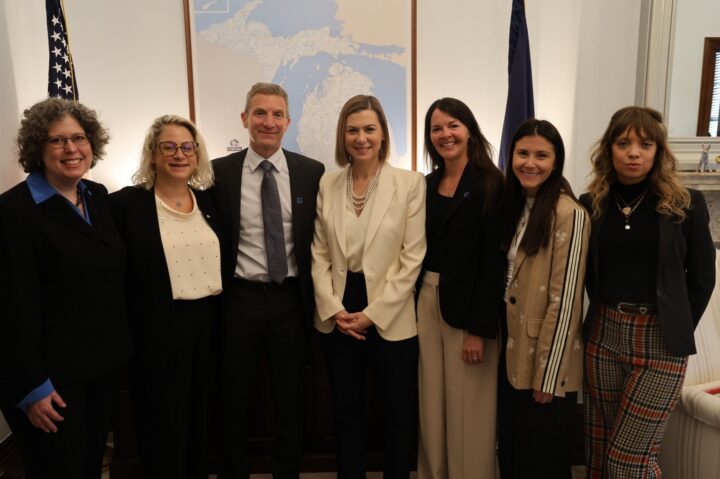
Sen. Elissa Slotkin/X
Sen. Elissa Slotkin (D-MI) meets with Jewish communal activists on April 22, 2026.
Jewish leaders from communities impacted by antisemitic violence in the past year met with House and Senate leaders on Capitol Hill on Wednesday to advocate for additional federal security assistance. The advocates represented Temple Israel in West Bloomfield, Mich., Beth Israel Congregation in Jackson, Miss., a hostage awareness march in Boulder, Colo. and, the Capital Jewish Museum in Washington.
“I will never forget the phone call. Or the images on the news of smoke rising from the place where I had just left my child,” Taylor Weintraub, a parent of a child who attended Temple Israel, told reporters on Wednesday morning. “Thank God, none of the children were physically hurt. But that wasn’t luck, that was preparation — reinforced doors, trained security, investments made because we knew this could happen. But here’s what keeps me up at night: we are the lucky ones.”
Among other priorities, the group, organized by the Anti-Defamation League, lobbied lawmakers for an increase to $1 billion in Nonprofit Security Grant Program funding in 2027, with Weintraub making the case that the program is “literally saving lives” — at Temple Israel, NSGP funding helped upgrade the synagogue’s cameras.
“Without these resources, more parents will get that phone call saying a terrorist is inside their child’s school,” Weintraub continued. “And no one should have to live through that.”
Cassi Cohen, the director of development at Temple Israel, said that, as a survivor of the attack, she is “living proof that these pieces of legislation work. … If I can be a voice to help ensure that other houses of worship have the ability to get the resources and the funding to prevent something as catastrophic as what we went through, then I’ll do this every day, because I don’t think there’s anything more important right now.”
Elyssa Schmier, a member of Temple Israel and the ADL’s regional director in Michigan, said that Jewish institutions across the state are undertaking reviews of their security and making upgrades — in some cases without the funding to pay for it.
Schmier’s son’s Jewish preschool is expanding its armed guard’s hours to full time — he previously worked part time because the school did not have enough money to pay for more — “and they’re not really sure how they’re paying for it. They’re just doing it.”
Smaller communities farther outside urban areas are especially vulnerable, she added.
Susan Rona, ADL’s Mountain States regional director, said that security has been critical to ensuring that the community feels able to continue gathering and participating in Jewish life.
“When we built the [Jewish Community Center] building, we benefited from the Nonprofit Security Grant Program as well, and it still is present,” Rona said. “We’re almost a year out, and there’s been real impacts to Boulder and our security needs are just getting higher to make sure that we can still create a space for the community to say, ‘Yes, I want to gather in this Jewish space.’”
The group met with the offices of House Speaker Mike Johnson (R-LA), House Majority Leader Steve Scalise (R-LA), House Majority Whip Tom Emmer (R-MN), Senate Minority Leader Chuck Schumer (D-NY), House Minority Leader Hakeem Jeffries (D-NY), House Democratic Whip Katherine Clark (D-MA), Sens. James Lankford (R-OK), Jacky Rosen (D-NV), Elissa Slotkin (D-MI), Michael Bennet (D-CO), Cindy Hyde-Smith (R-MS) and Gary Peters (D-MI) and Reps. Haley Stevens (D-MI), Hilary Scholten (D-MI), Joe Neguse (D-CO) and John James (R-MI).
In addition to NSGP funding, the group advocated for the Pray Safe Act and the SACRED Act, a new bill being led by Rep. Tom Suozzi (D-NY) to create a protected 100-foot buffer zone around houses of worship, similar to legislation being pursued in New York and California.
EEOC Chair Andrea Lucas: ‘At some point, either the government will know information related to individuals’ religion, or we will not be able to enforce the laws on their behalf’
Dillon Meyer Media
EEOC Chair Andrea Lucas and Brandeis Center founder Kenneth Marcus speak at the inaugural conference on antisemitism and civil rights law at Harvard University on April 16, 2026.
The Trump administration official leading a controversial probe into antisemitism at the University of Pennsylvania told Jewish leaders and legal experts on Thursday that compiling a list of Jewish faculty with their detailed personal information was necessary to identify and protect victims.
“There is no other way to protect victims of harassment or discrimination unless you collect information about them,” Andrea Lucas, chair of the United States Equal Employment Opportunity Commission, said at the Louis D. Brandeis Center for Human Rights Under Law’s inaugural conference on antisemitism and civil rights law, held at Harvard University.
“We never collect information to contact someone on their work system,” she said. “The EEOC’s long-standing practice is to collect personal information because we want to make sure that there is not any clear monitoring of your email systems … that when you speak to a government agency you feel completely not pressured.”
Last month, a federal judge ordered Penn to comply with a subpoena from the Trump administration requesting detailed information about Jewish university affiliates as part of the EEOC’s ongoing investigation into Penn’s handling of antisemitism. The subpoena had requested the school turn over lists of Jewish employees and members of Jewish organizations — including their identifying details and phone numbers — which the school called “extraordinary and unconstitutional.” Critics on campus have likened the move to Nazi-era methods of collecting information about Jews.
During a fireside chat with Kenneth Marcus, founder of the Brandeis Center and former assistant secretary of education for civil rights under the first Trump administration, Lucas noted she was speaking generally and not about the Penn case specifically, as litigation is ongoing.
“At some point, either the government will know information related to individuals’ religion, or we will not be able to enforce the laws on their behalf,” continued Lucas, who is not Jewish but emphasized a personal interest in religious liberty as “a core thing the EEOC needs to be focusing on.”
“I understand the sensitivities around this issue … but fundamentally the Jewish community does have to decide: do you want to have civil rights enforcement in this space? If you do, there is no other way we can get money for victims.”
Experts told Jewish Insider in January that a more typical investigation might involve agency officials interviewing people who issued complaints directly with the agency, then visiting the campus and publicizing their investigation, calling the EEOC’s methods in the Penn case “incredibly unusual, if not completely unprecedented.”
Lucas asserted that the same standard applied for helping members of any race, religion or gender. None of the event’s speakers publicly disagreed with Lucas’ statements.
The daylong conference was born out of last year’s settlement between the Brandeis Center and Harvard over a Title VI lawsuit, and was framed around this year’s U.S. Semiquincentennial.
It opened with an address from Marcus and a benediction from Harvard Chabad’s Rabbi Hirschy Zarchi. Attendees included Harvard community members, Jewish activists, lawyers and scholars.
The plenary session, “Towards a Jewish Civil Rights Movement,” moderated by Marcus, featured William Daroff, CEO of the Conference of Presidents of Major American Jewish Organizations; Elan Carr, CEO of Israeli-American Council and former special envoy to monitor and combat antisemitism; and Miriam Elman, executive director of the Academic Engagement Network.
Carr called the battle against antisemitism “a war for the soul of America and the soul of civilization,” and advocated for a shift in classroom curriculums and federal funding.
“Jew-hatred is history’s greatest barometer of human ruin and suffering. We are fighting for the future of our country and American values. So we need to get serious about teaching American values … we can’t safeguard this republic unless we teach American kids what this republic is, why it was founded, what our values are and constitutional structures are,” he said. “This is a national crisis with national implications. The federal government needs to say ‘no money goes anywhere to any educational institution unless there’s Western values, American civics, basic principles of the United States as part of the curriculum.’”
After the session, Daroff told JI that “today’s conference brought a united American Jewish community together, aligned in action. We are not standing back. We are organizing, building and acting together with shared purpose and resolve.”
The conference also featured a panel titled “Defining Anti-Semitism at America’s 250th: New Challenges for a New Century.” Speakers debated the importance of pushing states to codify the International Holocaust Remembrance Alliance’s working definition of antisemitism, as many mainstream Jewish groups are using resources to do. Critics of IHRA say the definition chills political speech and criticism of Israel.
Nathan Diament, executive director for the Orthodox Union Advocacy Center, said that IHRA is not only important for combating campus antisemitism — as several of the speakers emphasized — but also regarding legislation in Washington.
At the same time, “in the political arena, vagueness around questions [of what is antisemitism] is unhelpful. The most important currency in politics is votes. Advocates and voters need to be able to say with clarity to politicians [what they will and will not support]. This is the most important need for the definition of antisemitism, to draw a line as clearly as we can and make clear to politicians that if they cross this line, there will be consequences,” said Diament.
“Even as the OU has, and continues to, support legislation to codify the IHRA definition, I don’t think at this stage in the game that’s the most important way to further the definition and to use our political capital,” he continued. “We don’t need Congress’ approval of how we want to define antisemitism. We don’t need them to codify it and we don’t need them to give us permission to use it to hold members of Congress and other politicians accountable. We can use the IHRA definition because we say that’s the definition.”
Alyza Lewin, president of U.S. affairs for the Combat Antisemitism Movement and former president of the Brandeis Center, pushed back by highlighting how the law enforcement trainings she provides varies based on local adoption of the IHRA definition. She noted a stark difference between training in states where it is codified, such as Georgia, and those where it is not, such as New York.
Law enforcement in Georgia “has a very concrete reason now to understand and use” the training, said Lewin. “In New York, especially after [Mayor Zohran Mamdani] reversed the executive order on IHRA, I can try to explain it to them but it’s just a nice thing I teach them. They are under no obligation to actually engage with it and utilize it. So I do think on a state by state level, it does make a difference whether or not a state has adopted the IHRA definition.”
In a separate panel, moderated by Anat Alon-Beck, a visiting professor at Harvard Law School, speakers explored new avenues for litigation against antisemitism.
“Nearly two years after the largest massacre of Jews since the Holocaust, the Jewish community still lacks unified messaging, coordinated toolkits and a clear strategy. At a time when antisemitic actors are highly organized and aligned, our disunity is a serious vulnerability,” Alon-Beck told JI following her session. “We need to come together — with clarity, courage and coordination — because the stakes could not be higher.”
According to the Brandeis Center, this conference was the first in an annual three-part series.
Charles Dabda, a third-year student at Touro Law Center and law clerk with National Jewish Advocacy Center, told JI he was leaving the conference with a clear sense that “antisemitism is rising in real time with real consequences across campuses, professional spaces and beyond. At the Brandeis Center, and NJAC, our commitment remains resolute and steadfast; we will confront antisemitism wherever it manifests — through advocacy, and, when necessary, the courtroom.”
The president dialed in his daughter and son-in-law to speak to guests at an informal pre-gathering over speakerphone
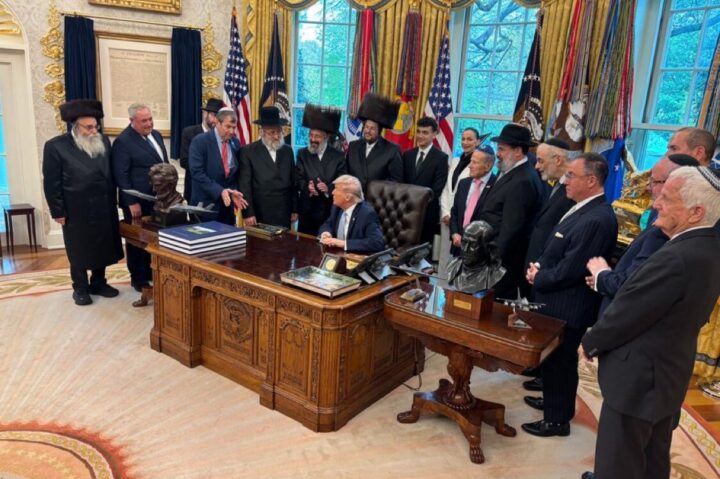
Prominent Jewish figures and senior Trump administration officials gathered at the White House on Monday afternoon for an event hosted by President Donald Trump commemorating the Passover holiday.
Administration officials in attendance at the event, which was closed to the press and took place in the Indian Treaty Room, included Commerce Secretary Howard Lutnick; White House Staff Secretary Will Scharf; James Blair, the White House deputy chief of staff for legislative, political and public affairs; Jacob Reses, chief of staff to Vice President JD Vance; Environmental Protection Agency Administrator Lee Zeldin; Martin Marks, the White House Jewish liaison; and Rabbi Yehuda Kaploun, the Trump administration’s special envoy to monitor and combat antisemitism.
Marks delivered comments to the crowd remarking on the holiday and the Trump administration’s record of support for Israel, according to an attendee.
Others spotted at the event were Rabbi Moshe Margaretten, president of the Tzedek Association; Matt Brooks, CEO of the Republican Jewish Coalition; William Daroff, CEO of the Conference of Presidents of Major American Jewish Organizations; Jeff Miller, chairman of the United States Holocaust Memorial Council; Jonathan Burkan, United States Holocaust Memorial Council member; Rabbi Levi Shemtov, the executive vice president of American Friends of Lubavitch (Chabad); Paul Packer, the former chairman of the U.S. Commission for the Preservation of America’s Heritage Abroad, Rabbi Chaim Dovid Zwiebel, executive vice president of Agudath Israel of America and Rabbi Meir Soloveichik, member of the Religious Liberty Commission and vice chair of the United States Commission on International Religious Freedom.
Jerry Wartski, a Holocaust survivor, and freed Israeli American hostage Edan Alexander were also in attendance.
Prior to the official reception, Trump invited about 20 guests to join him in the Oval Office. During the brief gathering, the president called Jared Kushner, an informal advisor to the White House and his son-in-law, and his daughter Ivanka. Kushner, who is Jewish, and Ivanka Trump, who converted to Judaism, spoke to attendees over speakerphone, one guest told Jewish Insider.
After a series of targeted attacks in Toronto and beyond, Jewish leaders are raising the alarms on Canada’s failure to properly protect its Jews amid ‘systemic’ antisemitism
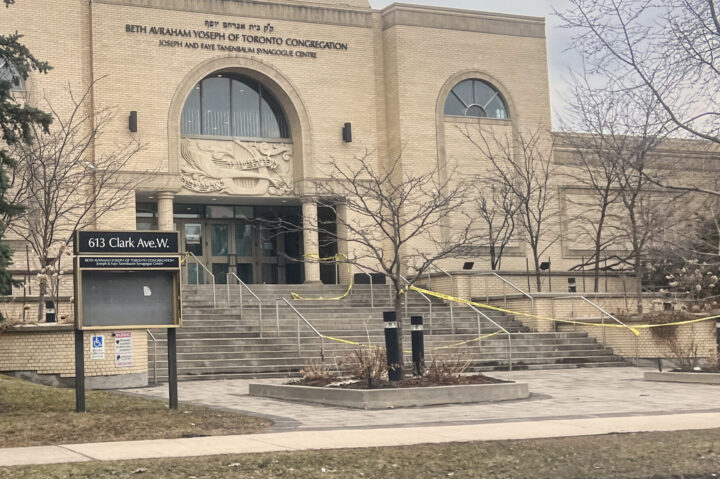
Creative Touch Imaging Ltd./NurPhoto via Getty Images
Police tape is seen outside the Beth Avraham Yoseph of Toronto (BAYT) synagogue following overnight gunshots fired at the building in Vaughan, Ontario, Canada, on March 21, 2026.
As Canadian Jewish families began celebrating the holiday of Passover, a commemoration of Jewish persecution and redemption, many found the ancient narrative colliding with a modern reality of rising fear at home.
Early Friday, a Jewish-owned restaurant in Toronto was struck by gunfire for the second time in weeks — a targeted, 14-bullet assault that police called a “glaring example of domestic terrorism.”
The incident marks the latest in a wave of antisemitic attacks, highlighting what Jewish leaders describe as “systemic” Jew-hatred in Canada. And it is even leading some Jewish Canadians to consider their own kind of exodus from their country, with one communal leader saying that “the promise” that Jews could practice their faith openly in the country “has been broken.”
“There’s a real sense — and I don’t want to overstate it — but that the Jewish community in Toronto has felt under siege since [the Oct. 7, 2023, terrorist attacks in Israel],” Rabbi Debra Landsberg, who leads Temple Emanu-El, a Reform synagogue in Toronto’s North York district, told Jewish Insider.
On March 2, Landsberg’s congregation was shot at several times, as her family and at least one staff member remained near the building following a Purim celebration. No injuries were reported, but the exterior and front lobby sustained significant damage.
The shooting was the first in a series of three synagogue attacks in Toronto last month. One week after Temple Emanu-El was targeted, the front doors of Shaarei Shomayim Synagogue and The Beth Avraham Yoseph of Toronto were shot at in the middle of the night, causing damage to both buildings.
In another recent incident, Canadian law enforcement arrested three Toronto-area men accused of planning violent kidnappings targeting women and members of the Jewish community.
Israel’s ambassador to Canada, Iddo Moed, said that last week’s restaurant shooting “the 12th incident of its kind in the latest wave of antisemitism and violence against the Jewish community in Canada.” UJA Federation of Greater Toronto warned that the incident should cause “all Canadians to be extremely concerned by what’s happening in our country right now.”
Toronto police have responded to the surge of violence by deploying armed officers at Jewish institutions around the city, an effort that was ramped up during the Passover holiday.
Canada has experienced some of the most severe manifestations of the global surge in antisemitism since Oct. 7. — with higher rates of antisemitic incidents than other countries but lower conviction rates.
In the first two months of 2026 alone, 22 antisemitic incidents were reported in Toronto, representing approximately 62% of all reported hate crimes in the country, according to police. Based on population, a Jewish Canadian is 25 times more likely to experience a hate crime than any other Canadian, according to the Centre for Israel and Jewish Affairs (CIJA).
Some Jewish leaders told JI they have come to expect sluggish or nonexistent responses from law enforcement and political leadership, a failure that they say exacerbates the problem.
One month after the synagogue shootings, no arrests have been made. Police say investigations are ongoing.
A spokesperson for the Toronto Police Department told JI last week that “the synagogue shootings are being examined for potential links … information, evidence, and intelligence are being shared to determine whether there are any connections.”
“There has been a systemic failure across jurisdictions to face antisemitism,” said Richard Marceau, senior vice president of strategic initiatives and general counsel at CIJA, an agency of the Jewish Federations of Canada. Marceau asserted that society has “a complete misunderstanding” of what antisemitism is, whether it stems from “the far left, far right [or] Islamic circles.”
“There’s also a reluctance to act,” he said. “There’s a desire to say ‘we’ll just let a little steam out and the pressure will go away.’ There’s no consequences to what’s happening [so] people feel emboldened.”
“In terms of fighting on the criminal legal side, the police are reluctant to press charges and go from a ‘let’s keep the peace’ mentality to ‘let’s enforce the law,’” continued Marceau, a former Bloc Québécois member of parliament. “Charges are dropped by the prosecution for no good reason. Often judges don’t understand what antisemitism is.”
“If there’s one thing that should be clear it’s that Jews are under threat and this type of thing should not take such a long time,” Marceau said of the investigations into last month’s synagogue shootings. “There should be infrastructure to make sure that the people who attack are quickly found and identified.”
“There’s also a reluctance to act,” Marceau said. “There’s a desire to say ‘we’ll just let a little steam out and the pressure will go away.’ There’s no consequences to what’s happening [so] people feel emboldened.”
Marceau noted some positive movement since the Toronto synagogue shootings. Bill C-9, which would amend the criminal code to strengthen penalties against hate-motivated crimes, protect religious spaces and ban public display of hate symbols, passed in the House of Commons last month. Marceau called for the Senate “to quickly pass it.”
“All around, the authorities have been given a failing grade on this. All the lights are flashing on Canada’s dashboard — things need fixing and the fixing needs to happen now,” said Marceau.
Landsberg, former president of the Toronto Board of Rabbis, said that among her congregants, “everybody is just a little jumpier” since last month’s attack. “The police are responsive but not forthcoming with information. Visible police presence has been noticeable here and at other Jewish institutions. The care and concern from our police has been real.”
But many questions remain, said Landsberg. “Whether or not they are able to solve this — and what it will take — and do they have the clear support of political leadership, to make Jews safe and feel safe? As time goes on, one imagines that we might live without ever having someone brought to account for this.”
“The political response has been complicated and underwhelming,” continued Landsberg. “Since Oct. 7 at least, the question of whether laws on the books are being implemented when it comes to hate crimes against Jews is an open question. I don’t know many people who are convinced that the law has been applied during some of these protests when there is classic imagery of Jews as rats.”
Few Jewish institutions have been targeted as severely as Kehillat Shaarei Torah, a Modern Orthodox synagogue that has endured 10 separate attacks in the last two years alone. The congregation is also located in North York, but about 2.5 miles from most of Toronto’s Jewish life.
Geographic distance hasn’t spared the synagogue from becoming a target of antisemitic incidents, the first of which occurred the Thursday before Passover two years ago when “about six or eight of our windows were smashed by somebody with a hammer who came in the middle of the night,” the congregation’s leader, Rabbi Joe Kanofsky, told JI.
“We got through Pesach and then there was another by the same person, judging by the security tapes, who came back to get what he missed,” said Kanofsky. “He missed our doors, he came back to smash our glass doors and some more windows. We had a couple more things throughout the summer into the next year.”
Other incidents included a sign outside of the synagogue calling for the release of the hostages kidnapped by Hamas on Oct. 7 being set on fire and dead animals being thrown onto the property. The windows were also smashed several more times.
Frustrated, synagogue leaders installed a black iron fence around the perimeter of the building in December 2024. That “slowed things down” until November 2025, said Kanofsky, “when we had somebody, possibly the same person, come smash the windows with a hammer again. That was our most recent and brought us up to 10 figures all together.” No arrests have been made in any of the attacks.
Canada operates under three levels of government — federal, provincial and municipal — and Kanofsky expressed dissatisfaction with the political response, noting that certain branches have performed worse than others.
“The municipal government seems to be wishing the problem away,” he said. “If they close their eyes they imagine it’s not so bad and maybe they’ll give a little money for increased security so the Jews can take care of that.” In March, days after the Toronto synagogue shootings, the Canadian government announced a new $10 million investment through the Canada Community Security Program to help Jewish institutions enhance security.
“I haven’t heard much from the provincial government until the three shootings in March happened. Right after that happened, the provincial government called the meeting of rabbis. [Doug Ford,] the premier of Ontario, asked a lot of questions and listened, sharing his plans for beefing up security. After a long time, finally there was some attention from the provincial government, which oversees prosecutions. That’s where things are falling apart, things do not go to trial and if they do they are dropped.”
“From the federal government, our representatives in Ottawa have been fairly supportive. There’s a bit of a degree of ‘it’s somebody else’s job’ and everyone points to someone else,” continued Kanofsky. “But the police are always there for us before and after we call. If the rest of the levels of government were as determined as the police, we probably would not have this problem.”
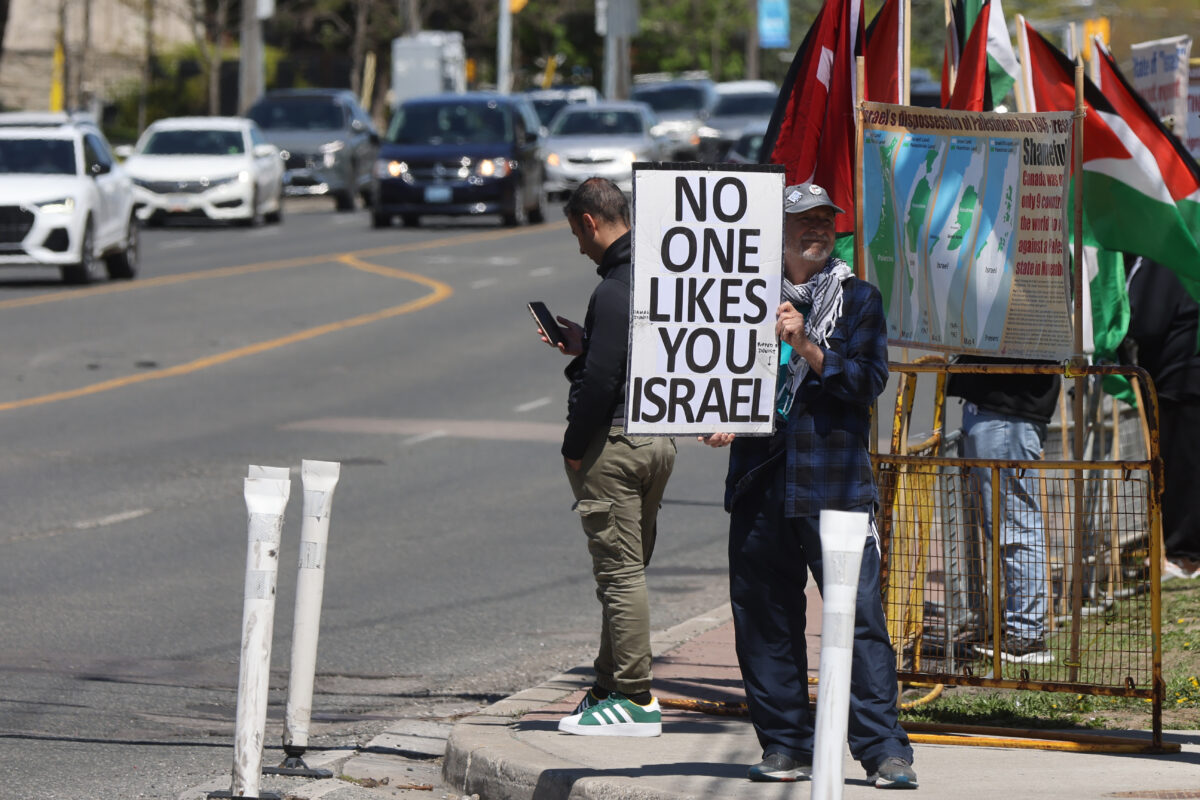
While nearly half of Canadian Jews reside in Toronto — which is home to about 150 Jewish institutions — the problem extends beyond Canada’s largest city. In Ottawa, the country’s capital, a Jewish grandmother was stabbed in August while shopping at a kosher supermarket. In 2024, Jews in Montreal were granted an injunction to prohibit the spate of anti-Israel protests, which included chants of “death to the Jews” in Arabic outside of a school, occurring within 50 meters of dozens of Jewish institutions.
In what The Atlantic recently called “Canada’s Polite Pogrom,” many incidents targeting Jews have been quieter, without broken glass or bones, but disruptive and exclusionary nevertheless.
Eighty percent of Jewish doctors and medical students surveyed by the Jewish Medical Association of Ontario reported experiencing antisemitism at work after the Oct. 7, 2023, attacks. In 2024, more than 100 Jewish doctors stopped acknowledging their affiliation with the University of Toronto’s Temerty Faculty of Medicine in protest of what they saw as the school’s failure to protect Jewish students and faculty. Almost a third of Ontario’s Jewish doctors say they are considering leaving Canada because of hostile work environments, according to the JMAO survey.
A group of Jewish teachers in British Columbia filed a human rights complaint against their own union, accusing the BC Teachers’ Federation of excluding, harassing and silencing its Jewish members. A federal investigation into Ontario’s K-12 schools found nearly 800 antisemitic incidents reported in elementary and high schools since 2023, many stemming from teachers’ conduct. The Toronto International Film Festival briefly dropped a documentary from its lineup that chronicled an Israeli grandfather’s experience rescuing his family from Hamas on Oct. 7, before a global effort successfully pushed for its reinstatement.
Jewish life in Canada wasn’t always this way, said Irwin Cotler, Canada’s former justice minister.
“When I was in the Ministry of Justice, at that time we had nowhere near the levels of antisemitism we’re witnessing now,” Cotler, who served as a member of Parliament, attorney general and Canada’s first special envoy on combating antisemitism, told JI. He called the current situation “an unprecedented explosion.”
“One would have thought that the times since [Oct. 7] would have resulted in actions to combat antisemitism. We’ve had on a public level, tragically almost, denials that Oct. 7 took place or support and justification — even celebration — for it in the public squares,” he said.
Upon completing his term as Canada’s special envoy on combating antisemitism in 2023, just before the Oct. 7 attacks, Cotler recalled reporting that “the conventional paradigm for combating antisemitism on the far right and far left was still true.” But, he continued, “the most important finding I had was that we were witnessing an increasing mainstream normalizing antisemitism and particularly in the campus culture, with an absence of outrage underpinned by indifference and a failure to appreciate that antisemitism is not only increasingly threatening Jews but that it’s toxic to democracies and an assault on our human rights values.”
If not addressed quickly, Cotler warned that there’s “a ticking bomb here in Canada for what will be the Bondi massacre occurring in Canada,” a reference to the December 2025 mass shooting at a Hanukkah gathering at Bondi Beach in Sydney, Australia, that killed 15 people.
“The synagogue shootings here are part of a pattern. We are experiencing not only the highest level of antisemitic incidents since tracking began in the 1970s, but the real disturbing data has been the dramatic increase in hate crimes targeting Canadian Jews. Hate crimes are different from other forms of antisemitism because they are identity crimes that target the whole community and reverberate within the whole community,” continued Cotler.
Cotler described law enforcement and government as ineffective. “Arrests are not made or if they are made then charges are not laid. If charges are laid, prosecutions are not proceeded with, or if prosecutions are proceeded with the courts do not sustain it,” he said.
Canada “needs a wake up call,” continued Cotler, “and it needs a whole government commitment at [all] levels to combat antisemitism. If the government gives a 10 percent increase in community security it’s basically telling Jews to protect themselves and giving a little more money to do that. That’s not a response. If you don’t have leadership at the governmental levels, lack of leadership will trickle down and start to become part of the culture of inaction. What we’re witnessing from the government are performative tweets and virtue signaling, but not effective leadership and action on the ground.”
Last month, frustration with political leadership deepened for many Jews with the election of Avi Lewis, a far-left Jewish anti-Zionist, as the leader of the New Democratic Party, widely described as Canada’s democratic socialist party.
“We are left with a deep sense of sadness,” Marceau and Rachel Chertkoff, senior vice president of community engagement at CIJA, said in a joint statement following the March 29 election. “When a leader declares that Zionism is inseparable from ethnic cleansing, he is not engaging in legitimate policy critique. He is telling Jewish Canadians that a core part of their identity is illegitimate. That is exclusion.”
Cotler, who was friends with Avi Lewis’ father, Stephen Lewis, said the election left him “concerned — not about criticism of Israel, but engaging in obsessive preoccupation in calling out alleged Israeli genocide.”
As a member of Parliament, Cotler said he was “close” with the NDP. “The astonishing difference [is] now we’ve gone down the road where NDP is no longer a place Jews feel they can be at home,” said Cotler. “It’s tragic because of the important role Jews played in the founding of the NDP.”

Landsberg noted that the writing was always on the wall: Canadian Jews would face a harsher reality than their American counterparts.
Canada is “50-plus years slower in reaching integration. In many ways the American story — of freedom and exodus — has been integrated naturally, the early Civil Rights Movement, for example,” Landsberg said. “There isn’t that comparable norming of the Jewish story [in Canada]. The first Jew who made it into a political cabinet position wasn’t until the late 1960s, decades after there were Jews on the Supreme Court in the U.S. Same thing with leadership in medicine and universities. It’s much later here. It’s a much smaller community that is made up of many more immigrants. It’s a different community in that this is home but these are people who have had to flee homes already. Canada’s understanding of Jewish citizens as part of the multicultural story that it has been trying to create has played out differently.”
Marceau, who splits his time between Montreal and Ottawa, has three friends who have left Canada because of antisemitism. “In discussions around Shabbat tables or at synagogue, [fleeing] is a constant conversation that is happening,” he said. “The promise that everyone could be openly themselves in Canada, to practice whatever faith they want — has been broken — certainly for Jews.”
Similarly, Kanofsky said that among his 200-family congregation, “people have already received second or third passports through their parents or grandparents. People are gathering their documents. Younger families are looking into Central America or other places that might be more hospitable. These are people that if you would have asked five years ago would have said they have deep roots and are not going anywhere for the long term. The Canadian Jewish community had a very deep-seated feeling of being part of society and being protected. A lot of that has been deeply damaged by the complacency of the government over the last couple of years.”
“Jewish communities will for sure learn from mistakes from the past and no one will stay longer than is necessary. People in our congregation have already gone on aliyah,” continued Kanofsky. “In a hurry, everybody gained a sense of mobility when they saw the inaction of the government.”
But, even when describing the boarded-up front lobby of her congregation — where leaders are still debating the type of shatterproof glass to install — Landsberg painted a picture of a resilient community with hope for the future.
“This is probably the same for Jews in the U.S.,” she said, “but there’s a sense of clarity that many people are really feeling a deep discomfort with how society here is handling this, and also the sense of strength [because] the Jewish people have been through a lot.”
Lewis George pledged not to exclude Jews ‘based on your opinions or feelings on matters here and across the world'
Jewish Community Relations Council of Greater Washington
D.C. City Councilmember Janeese Lewis George speaks at a "Lox and Legislators" breakfast held by the Jewish Community Relations Council of Greater Washington on Dec. 18, 2025
After Janeese Lewis George met last week with Washington rabbis and other local Jewish leaders who were concerned about her views on Israel and antisemitism, the Washington, D.C., mayoral candidate released a statement pledging to stand firm in both her opposition to antisemitism and her support for the Palestinian cause.
“Those two things are not in conflict,” Lewis George, who is endorsed by the Democratic Socialists of America, wrote in a statement that was posted to her campaign website on Wednesday.
Her campaign has not publicly acknowledged the meeting at Congregation Ohev Sholom, where Lewis George discussed a DSA questionnaire she filled out in which she pledged to avoid events that promote “Zionism and apartheid” and took issue with local Jewish groups’ approach to fighting antisemitism, according to attendees who spoke to Jewish Insider.
At the meeting, Lewis George apologized for the language she used in the questionnaire and attributed it to a staff member. She said she would have responded differently if she had written the answers herself. A spokesperson for Lewis George did not respond to requests for comment from JI about the meeting.
“To the Jewish community in DC: I will not be a mayor who includes or excludes you based on your opinions or feelings on matters here and across the world. I will always protect your freedom, safety, and sense of belonging,” Lewis George, a D.C. councilmember, wrote in the statement. She described going to synagogues when she was growing up and working with Jewish organizers in Washington.
“As Ward 4 Councilmember, I worked with Jewish organizations and neighbors to secure security grants for our schools and synagogues,” Lewis George wrote. “Antisemitism is morally wrong and unacceptable, and it is spreading. It is part of the same machinery of division and fear used against Black people, immigrant communities and others. We must work together to stop it.”
Lewis George then noted that she was one of the first councilmembers in the District to call for a ceasefire in Gaza and that she met with students at George Washington University who were advocating for a ceasefire.
“Together, we mourned the innocent lives that have been lost in Israel as well as in Gaza and the West Bank. I will continue to stand up against efforts to silence local pro-Palestinian speech and organizing,” Lewis George wrote. “I have no problem voicing my disagreement, loudly, when it is needed. I do not shy away from standing by my values in front of all audiences.”
The report’s author argued Harvard has been ‘ambivalent’ about its decreasing Jewish population, while other Jewish leaders cast doubt on its findings

Zhu Ziyu/VCG via Getty Images
A glimpse into the Harvard University campus on May 24, 2025 in Cambridge, Massachusetts.
A newly released report finding that Jewish enrollment at Harvard University has fallen to roughly 7% — its lowest level since the pre-World War II era — has sounded alarms among some Jewish leaders, while touching off a debate at Harvard about its accuracy.
The figure marks a steep decline from a decade ago, when Jewish students made up about twice that share, and represents the lowest proportion among Ivy League schools with available data. The decrease is not reflected at all Ivy Leagues, though: At Princeton, Jews declined at less than a fifth of the rate of their white non-Jewish peers. At Brown and Cornell, Jewish enrollment held or grew over the past decade.
The 64-page report, “A Narrowing Gate: Jewish Enrollment at Harvard and Its Peers, 1967-2025,” released this week by the university’s official Jewish alumni group, argues that the decline is not simply the byproduct of neutral admissions trends, but reflects a growing “ambivalence” to admitting Jewish students on Harvard’s part.
“It’s not that Harvard intended [Jewish enrollment] to decline. It’s that they were ambivalent about the decline. We were invisible and therefore irrelevant,” Adrian Ashkenazy, the report’s author and president of the Harvard Jewish Alumni Alliance, told Jewish Insider.
Jews face several documented structural disadvantages in the admissions process, according to the report, chief among them geography. Harvard has deliberately shifted enrollment away from the Northeast and Mid-Atlantic, it alleges, home to nearly half of all American Jews, with New York state enrollment alone falling from 264 students in 1992 to 160 in 2024.
An increase in international student enrollment has deepened the effect: The report finds that international students come from a “uniformly and dramatically less Jewish applicant pool,” meaning every percentage point of international student growth decreases the available seats for Jewish students.
Racial and ethnic diversity goals and financial aid present additional headwinds: The vast majority of American Jews are Ashkenazi and check “white” on an application box, placing them outside the diversity categories universities actively recruit.
Harvard’s access initiative since 2004 recalibrated holistic review to weight “socioeconomic context, parental occupation, and first-generation status as positive factors.” Jewish applicants are, the report finds, “disproportionately higher-income, continuing-generation, and concentrated in coastal urban centers, characteristics that sit on the unfavored side of all four dimensions of this initiative simultaneously.”
The Supreme Court’s decision reversing affirmative action, which was ostensibly meant to reverse these policies, has “made it much harder to pursue diversity for its own sake, which includes a targeted increase in Jewish enrollment,” said Ashkenazy.
But Ashkenazy argues it’s not a given that these factors have to decrease Jewish enrollment — he offered Brown as a counter-example to Harvard, saying the Rhode Island school had been intentional in its efforts to recruit Jews.
“Brown looked at its Jewish community and decided that maintaining and growing it was consistent with their broader diversity goals — that the Jewish community is not a monolith and that real diversity can be pursued within it. At Harvard we were absent from the equation. At Brown we were integrated into it. That is the difference.”
“The decline at Harvard is a story of absence, not intention,” he continued. “We were crowded out by other admissions priorities. Harvard didn’t measure it, anticipate it or manage it. The Jewish community simply was not a priority.”
“When a decline is steepest at particular institutions, it ceases to be coincidence and looks more like culture,” Rabbi David Wolpe, emeritus rabbi of Sinai Temple in Los Angeles, who served as a visiting scholar at Harvard Divinity School in 2023-24, told JI. Harvard now has “a choice of denial or determination to change the atmosphere and procedures that led us here,” said Wolpe, who stepped down from his position on Harvard’s antisemitism advisory committee in December 2023 due to what he said was an inability to effect change.
A spokesperson for Harvard told JI that the university “does not collect data on applicants’ shared ancestry or religious identity. Any estimates that exist on applicant data come from external surveys, which vary widely in methodology and cannot reliably measure changes over time, outline differences across schools, or explain application, admission, or enrollment patterns. Harvard continues to fully comply with the law, including Title VI and the Students for Fair Admissions decision, in its admissions policies and practices.”
Harvard “shares the Harvard Jewish Alumni Alliance’s commitment to fostering a vibrant Jewish community at Harvard,” the spokesperson said. “Jewish life on campus remains active and well-supported, with strong participation across student organizations, religious and cultural life, and campus programming. Additionally, over the last few years, Harvard has taken intentional steps to strengthen our campus culture and environment.”
Miriam Elman, executive director of the Academic Engagement Network, said that the report “has provided university leaders with a thoughtful and rigorous analysis.”
“While Harvard has seen a dramatic decline in Jewish undergraduate student enrollment, enrollment at Brown remains high and robust, even though this Ivy League university has also experienced antisemitic incidents in recent years. What explains the difference? It’s because Brown has significantly invested in campus Jewish life and cares about recruiting Jewish students,” Elman told JI.
“For a number of years it has strategically focused on a number of local New England high schools with high Jewish student populations,” Elman continued. “Brown is also initiating a host of educational programs that infuse a welcoming culture that supports Jewish and Zionist students: open inquiry, dialogue across difference and mutual understanding. So, while there are still challenges and room for improvement, Jewish life at Brown is thriving. Harvard should look closely at Brown’s successes.”
Two Jewish leaders on Harvard’s campus expressed skepticism about aspects of the study.
Rabbi Hirschy Zarchi, founder of Harvard Chabad, said that “while the data and studies are admittedly not scientific, they raise important questions.”
“However, because different methods and factors vary across universities — and even within the same institution over time — we don’t have the data to accurately contrast Jewish population figures,” Zarchi told JI. “Additionally, from Chabad’s personal relationships with hundreds of students, we know that many Jewish students at Harvard come from highly assimilated backgrounds who often first discover their Jewish identity and belonging with Chabad on campus. This indicates that the actual number of Jewish students is likely higher than what may surface on non-scientific surveys.”
Rabbi Jason Rubenstein, director of Harvard Hillel, told JI that the study provides a “vitally important” opportunity to better understand why Harvard’s Jewish population is “significantly smaller than similar institutions,” an issue that he said the Harvard Jewish community has been advocating on for several years already.
Still, “our perception is that each of the last two admitted classes have an appreciably larger number of Jewish students than the preceding classes,” said Rubenstein.
Hillel’s data from last year’s admissions cycle shows the number of students admitted from two prominent New York Modern Orthodox day schools — five from Salanter Akiba Riverdale Academy and five from Ramaz — is high compared to previous generations.
“Harvard has been speaking with stakeholders for a while about the need to refocus efforts” in outreach to Jewish day schools, said Ashkenazy. “That’s obviously a good thing that they’re starting to prioritize it. On the one hand, it’s a visible win for the university and Jewish community to recruit from Jewish day schools. At the same time, we all have to accept that the percentage of us that goes to Jewish day schools is excruciatingly small as it pertains to our community.”
Zac Sardi-Santos, a Jewish Harvard senior studying computer science, said the report left him with a question: “If this is true, where are these potential Harvard Jewish students going, and why?”
“But in order to diagnose this issue, we must first prove its existence with transparency and independent review,” said Sardi-Santos. “I do believe it would be in Harvard’s best interest to collect this data and verify if this anomaly is truly the case … especially for Jewish students, in a time when antisemitism on college campuses is increasing.”
The study draws only on data collected before the Oct. 7, 2023, terrorist attacks in Israel, and therefore does not reflect Jewish enrollment during and after the campus protests and encampments that disrupted many universities.
“I’m hoping the number has stayed stable. What I can say is that Jewish prospective students I’ve spoken with have expressed real hesitation about Harvard since Oct. 7, and that is something the university needs to take seriously,” said Ashkenazy.
In the aftermath of the attacks and the surge of antisemitism that ensued, Jewish scholars, as well as students and their parents, grappled over whether they should still attend schools such as Columbia and Harvard — two Ivy League campuses that have been beset by controversy over anti-Israel encampments and classroom disruptions, physical assaults of Jewish students and battles with the federal government over an alleged failure to address antisemitism. (While Brown has been relatively quieter, it too was targeted by the Trump administration over antisemitism allegations, and in July 2025 reached a settlement.)
But declines in Jewish representation have been a persistent and contentious issue at Ivy League institutions well before Oct. 7. In April 2023, Tablet reported that the number of Jews on most major prestigious campuses had been cut in half or more over the past decade, by “new elite doctrines that downplay merit in favor of amorphous definitions of ‘diversity’ and ‘privilege.’”
The issue dates further back, to the 20th century when wealthy, liberal American Jews in the Northeast navigated a system that tried to exclude them. Harvard admitted to having a quota system for Jews in the early 1920s. From the 1920s until the early 1960s, Yale’s administration implemented a series of secret admissions rules that had the intention of keeping the Jewish percentage of the student body at a consistent 10%.
But eventually, Ivy League doors opened to Jewish students, and the community at Harvard became “a present and vital part of this university for a century,” Ashkenazy told JI. “We have long believed in the importance of building a genuinely diverse university, and that commitment has not changed.”
“We ask only that we remain woven into the university’s social fabric, valued as much as those we have long advocated for. Diversity is not a finite resource. Making room for the Jewish community does not diminish anyone else’s place here. It never has. A university that embraces every other race, religion, and background should understand that better than most.”
Gov. Jared Polis of Colorado is the only Dem governor so far to opt into the program; other Dem governors actively considering it
CHET STRANGE/AFP via Getty Images
Colorado Governor Jared Polis speaks during a community gathering at the site of an attack against a group people holding a vigil for kidnapped Israeli citizens in Gaza oin Boulder, Colorado on June 4, 2025.
At the start of a pivotal campaign cycle, Democratic governors will face a politically high-stakes decision this year on a new education policy that President Donald Trump signed into law last year.
One provision of Republicans’ sweeping spending package adopted in 2025 — dubbed the “One Big Beautiful Bill” by Trump — was a measure that provides a dollar-for-dollar federal tax credit for people who donate to approved scholarship organizations that can support a range of education expenses, including private school tuition and tutoring.
Individual states must opt in for taxpayers to be eligible for the credit of up to $1,700 annually.
So far, the policy has been a no-brainer for Republican governors, who already support school choice programs, to allow parents to receive a federal tax credit to support private schools, including religious schools. Twenty-three states have formally opted in as of last month, and at least two other Republican-led states (Florida and Utah) said they plan to do so.
Democratic governors, skeptical of school choice programs and wary of powerful teachers’ unions, face a trickier choice. They have to opt in by the end of the year for taxpayers to be eligible for the credit. The National Education Association urged lawmakers to vote against the bill last year, and has said that “voucher-inspired schemes” like the federal tax credit program “erode public education, the foundation of our democracy.” (An NEA spokesperson declined to comment on Wednesday.)
Orthodox Jewish groups have long supported school choice efforts, including vouchers, while most non-Orthodox groups — including umbrella organizations such as the Jewish federations — sat out those matters in the past or opposed them. Now, Orthodox leaders are being joined by the Jewish Federations of North America as the umbrella group urges Democratic governors to support the bill. The Union for Reform Judaism, which opposed an earlier version of the tax credit that was farther-reaching, ultimately did not come out against the measure.
“We think this should be a priority for the entire Jewish community, to support students, especially in Jewish day schools,” said Rabbi A.D. Motzen, national director of government affairs at Agudath Israel, a major Orthodox organization. “I think it’s very helpful, because in many of those blue states, the more governors see that this is a politically wise idea, and that there is widespread support among different faiths, whether it’s Catholic clergy or Jewish leaders and business leaders, then it will make it easier for them to to opt in.”
Marc Baker, CEO of Combined Jewish Philanthropies, Boston’s Jewish federation, said the tax credit “aligns with CJP’s vision to make day school more affordable and accessible for families in Greater Boston,” and that he plans to discuss it with Massachusetts Gov. Maura Healey, a Democrat.
Part of the pitch that Gil Preuss, CEO of the Jewish Federation of Greater Washington, is making to Democratic leaders in Maryland, Virginia and Washington, is to differentiate the tax credit from more controversial voucher programs.
“I know, particularly for Democratic governors, they place significant value in public education, and we as a Jewish community strongly support public education,” said Preuss. “We don’t believe it’s taking away money from public education, but it is a way for individual households to direct some of their federal taxes.”
Colorado Gov. Jared Polis is so far the Democrat who has expressed the most enthusiasm about the tax-credit scholarship program.
“It supports donors to give more money to our schools,” Polis said in November. “I mean, I would be crazy not to” opt in. A spokesperson for Polis confirmed in December that he plans to add the state to the program.
North Carolina Gov. Josh Stein, a Democrat, has also said he intends to opt in his state once more information is released from the federal government. “School choice is good for students and parents,” Stein said last year. “I intend to opt North Carolina in so we can invest in the public school students most in need of after school programs, tutoring, and other resources.”
A handful of blue-state governors — in Wisconsin, Oregon, New Mexico and Hawaii — have stated they will opt out of the program.
Most Democratic governors, including in states with the largest Jewish communities, are taking a wait-and-see approach, saying they need to see formal regulations from the IRS and the Treasury Department outlining what the funds can be used for and how they can be collected. Activists in the Jewish community working on this issue say they are still in conversation with Democratic governors even though the timeline for implementation is not totally clear.
“The governors that we speak to on a regular basis about this are very clear that they want to see the regulations first, which we don’t hold against them. We think that’s fair. You don’t want to play a game until you see the rules of the game,” said Sydney Altfield, CEO of Teach Coalition, a project of the Orthodox Union that advocates for federal funding for nonpublic schools. “We think that in the long run, it will be a positive outcome, but we understand that there’s no movement yet.”
Rosie Lapowsky, a spokesperson for Pennsylvania Gov. Josh Shapiro, said his administration “is awaiting federal guidance to address key questions about how this program would work, including which students will be eligible, how this federal initiative will interact with existing programs, and more. We look forward to reviewing that guidance.”
A spokesperson for Maryland Gov. Wes Moore said he has not yet taken a position. Alana Davidson, director of communications at the Massachusetts Executive Office of Education, told JI that Gov. Healey “is awaiting official guidance from the U.S. Department of Education and Treasury at this time.”
Jen Goodman, a spokesperson for Gov. Kathy Hochul of New York, took a swipe at the Trump administration while saying Hochul has not yet made up her mind.
“While this proposal doesn’t take effect until 2027, it’s surprising that the federal government continues to fail to share any policy details with states,” Goodman told JI. “Gov. Hochul is supportive of anything that would help students and schools, but given this administration’s record of including poison pills in policies, the state needs to thoroughly review the proposal before making commitments.”
Spokespeople for Illinois Gov. JB Pritzker, California Gov. Gavin Newsom, New Jersey Gov. Mikie Sherrill, Washington, D.C., Mayor Muriel Bowser and Virginia Gov. Abigail Spanberger did not respond to requests for comment.
Spanberger is in a different position from other Democrats, because her predecessor — Republican Gov. Glenn Youngkin — already opted Virginia in last month before he left office, so she would have to formally revoke that permission.
Preuss said his goal at the moment is not necessarily to get area governors in the Washington area to a yes anytime soon, with IRS regulations not likely to come out for a few more months. He just wants to convince them to leave the door open.
“It’s very early on,” Preuss said. “We mostly want to make sure that governors do not come out against it.”
Rep. Christian Menefee is the favorite against Rep. Al Green in next month’s primary; Green has consistently voted against Israel since Oct. 7
Jason Fochtman/Houston Chronicle via Getty Images
Texas Rep. Al Green leaves the stage after speaking during a rally featuring California Governor Gavin Newsom in Houston, Saturday, Nov. 8, 2025.
Jewish leaders in the Houston area see a chance for a fresh start this year with a new congressman, after an increasingly strained relationship with their longtime representative, Rep. Al Green (D-TX), who has taken a strong anti-Israel turn in recent years.
Green, 78, is struggling to hold onto his seat in a primary against newly elected Rep. Christian Menefee (D-TX), the former Harris County attorney, who won a commanding victory in a special election runoff last month to replace former Rep. Sylvester Turner (D-TX). Turner died months after taking office to replace former Rep. Sheila Jackson Lee (D-TX), who died less than a year earlier of pancreatic cancer after serving for over 30 years in the House.
Due to Texas’ redistricting process, Menefee now faces Green, as well as other longshot candidates, for a full term in the House beginning in 2027.
Since the Oct. 7, 2023, Hamas attacks, Green has consistently taken anti-Israel stances, even on legislation that has received widespread support on a bipartisan basis. Weeks after the attacks, Green was one of just 10 House lawmakers who voted against legislation expressing support for Israel and condemning Hamas.
The veteran congressman was an early backer of efforts to unilaterally recognize Palestinian statehood, of legislation describing the war in Gaza as a genocide and of the Block the Bombs Act.
Siding with six other members of the House, he voted to cut off missile-defense funding to Israel last July. Green also voted against supplemental aid to Israel in 2024 and has supported legislation to block specific arms transfers to Israel.
Green was one of 11 lawmakers to vote against an amendment condemning Hamas’ use of human shields and demanding its unconditional surrender and disarmament.
He voted against declaring the phrase “From the river to the sea, Palestine will be free” to be antisemitic. And he was one of just four House members who voted to require universities to disclose investments in countries whose leaders are facing International Criminal Court arrest warrants, indirectly targeting Israel.
In 2024, he introduced a resolution affirming the Palestinian right to statehood, to which two Jewish members were added as cosponsors without their knowledge or consent. He led an effort, opposed by a majority of House Democrats, to impeach President Donald Trump for striking Iran last June without congressional authorization.
At the same time, Green has also continued to back certain measures to combat antisemitism.
Green told the Texas Tribune that he expects AIPAC to spend “inordinate amounts of money to get me out of office,” and has been railing against the group on the campaign trail, though AIPAC has not endorsed anyone in the race.
Menefee has said little publicly about Middle East politics, though in a January candidate forum for the special election, he described Israel’s operations in Gaza as excessive while also condemning the Oct. 7 Hamas attacks, according to The Daily Cougar, the University of Houston’s student newspaper.
“Look, what I want is peace, now,” Menefee said. “I want a lasting ceasefire so that not a single baby in either Israel or Gaza has to worry about being bombed.”
Leaders in the local Jewish community said their once-strong relationship with Green — who had been a frequent presence at community events and maintained strong relationships with members of the community — turned sour following Green’s vote on the post-Oct. 7 resolution, which surprised and hurt many in the community.
“Everybody — particularly in a large section of the Jewish community — carries this wound from that vote. They’ve not forgotten it. They’re unforgiving about it. It’s been very painful because there was a relationship,” Art Pronin, who is Jewish and leads the Meyerland Area Democrats Club, told Jewish Insider. “It felt like we lost a congressman. … it was just shocking.”
Pronin says he now hears concerns from others in the community about Green on a weekly basis at his synagogue.
“It’s really sad, because we used to have a very strong relationship with him,” Norri Leder, a founder of Houston Jewish Women Vote and a board member of the local federation, told JI. “It’s been incredibly disappointing, and especially because the way his district was newly drawn, he represents a very large chunk of the Jewish community. … It almost feels like he’s hostile towards us, not just disagrees. It doesn’t feel like respectful disagreement.”
Leder added that Green’s positions on Israel policy had appeared to begin to shift prior to Oct. 7, but the change became more pronounced after the attacks.
She said that she has heard from other members of the community for whom Green’s stance on Israel issues is factoring “very heavily” into their plans for their primary votes. “We’re looking for somebody that understands us and wants to represent us, and Al Green gets a poor grade on that front.”
The longtime congressman was the chair of the local NAACP before entering public office, building strong relationships with the local Jewish community that he maintained for years, according to Pronin.
Since Oct. 7, Pronin and Leder said that Green has not attended community events to which he’s been invited and has been inaccessible to Jewish constituents who have requested meetings or expressed concerns about his posture.
Leder said that lack of accessibility and engagement from Green and his office, in addition to the shock of his vote against the resolution condemning Hamas, has contributed to the sense of hostility she feels from him.
Pronin said he had multiple conversations with Green about his vote on the resolution condemning Hamas, seeking an explanation, but has never received a “solid explanation,” and Green has not softened his stance.
Leder joined a group meeting with Green recently, where he was pressed on his lack of engagement with Jewish constituents, and said Green vowed he would try to engage on some issues of mutual concern, but also “did launch off on Israel” during the conversation.
“The challenge is you can have very strong feelings about Israel, but if you’re representing the Jewish community that lives here, you still have to represent that community, and that’s where I think he’s really fallen down,” Leder continued. “He wasn’t present at any [Oct. 7 memorial] events in the community. He hasn’t attended … community seders, things like that a lot of elected officials attend, and he just has been completely absent.”
“It feels like his anger at [Israeli Prime Minister] Benjamin Netanyahu and whatever he’s feeling towards the Israeli government is spilling over into his treatment of Jewish constituents,” she added.
Leder said that Menefee, on the other hand, has interacted on numerous occasions with the Jewish community and attended events like the community Passover seder. He “understands our concerns,” Leder said, though she said she couldn’t speak specifically about his views on the current Israeli government.
“I know him personally. I think he has a lot of respect for the Jewish community and is available and that’s what the Jewish community is looking for: somebody that understands our concerns and is there for us as constituents, and when it comes to Israel, is somebody that is open and reasonable,” she continued.
Pronin said he has known Menefee for a long time and never heard him say anything about Israel policy that has concerned him, describing the newly elected lawmaker as “balanced” on the issue, though he hasn’t spoken about it extensively.
“I think he’s got a balancing act to play on this issue, and we’ll have to really kind of thread the needle in conversations with these communities, and maybe help bring people together to talk about this, so he can listen and hear out the perspectives on this as a congressman over time,” Pronin said.
Green’s campaign did not respond to a request for comment.
Mark Jones, a Texas pollster and fellow at Rice University’s Baker Institute for Public Policy, recently conducted a poll of the district showing Menefee with a commanding 52%-28% lead.
“Menefee’s crushing him,” Jones told Jewish Insider, noting that an internal poll by Menefee’s campaign conducted by the well-regarded Lake Research Partners shows similar results. Jones predicted that Menefee should be able to win the race cleanly in the primary, without advancing to a runoff.
Around two-thirds of the voters from the new district come from Green’s old district, but they are roughly evenly split — with a slight advantage toward Menefee — between the two leading candidates, Jones said. The quarter of the district that comes from the current 18th District “overwhelmingly prefer[s] Menefee,” Jones added. “And that’s also the case with some of the other northern parts of the district that used to be in other districts.”
“The only reason Green is even in this race remotely is that he still is popular among … his current constituents, but he’s doing very poorly among the roughly little more than a third of constituents who he currently doesn’t represent,” he said.
And though voters report positive views on both candidates, Jones noted, when forced to choose, “a significant majority — effectively almost two-to-one — prefer Menefee.”
Jones said that, for many Democrats, Menefee is a “perfect candidate,” with a reputation for being pragmatic progressive and a record opposing Trump. Green’s age is also a stumbling block for him, particularly for voters who saw two of their representatives die in office over the course of about a year.
“People like what he’s done over the past 20 years, but they believe it’s time to pass the baton,” Jones said.
Green has argued that he will be more effective given his greater seniority in the House, which is particularly valuable in the Democratic Caucus. At the same time, the veteran lawmaker has been a bomb-thrower who has sometimes found himself out of step with Democratic leadership.
Plus, in Doha, UpScrolled founder rails against 'Zionist money'
Anna Moneymaker/Getty Images
Saudi Arabia Defense Minister Prince Khalid bin Salman ahead of a meeting with Secretary of State Marco Rubio in the State Department Building on February 25, 2025 in Washington, DC.
👋 Good Monday morning!
In today’s Daily Kickoff, we report on Friday’s meeting between the Saudi defense minister and Jewish leaders in Washington, and talk to the State Department’s Jacob Helberg about the Trump administration’s efforts to push AI as a uniting force in the Middle East. We report on South Africa and Israel’s tit-for-tat diplomatic expulsions amid a deepening rift between Pretoria and Jerusalem, and have the scoop on a new bipartisan letter from Reps. Josh Gottheimer, Claudia Tenney, and Jared Golden blasting progressive groups over their silence on Iran’s crackdown on protestors. Also in today’s Daily Kickoff: Rep. Greg Meeks, Deni Avdija and Craig Newmark.
Today’s Daily Kickoff was curated by JI Executive Editor Melissa Weiss and Israel Editor Tamara Zieve, with an assist from Marc Rod. Have a tip? Email us here.
What We’re Watching
- The annual Web Summit conference kicked off on Sunday in Doha, Qatar. Earlier today, Issam Hijazi, the founder of new social media app UpScrolled, took the main stage, from which he boasted that the app “[doesn’t] have to rely on Zionist money, or Silicon Valley money.” Read more on Hijazi’s remarks from JI’s Lahav Harkov here.
- Lebanese Armed Forces Commander Gen. Rodolphe Haykal is in Washington today for meetings with senior U.S. officials, two months after a previously planned trip was scrapped at the 11th hour over a statement put out by the military criticizing Israel.
- Following last week’s decision by the European Union to designate the Islamic Revolutionary Guard Corps as a terror group, Iran summoned EU ambassadors stationed in the country over the designation. The move comes shortly after Iran’s parliament speaker said that the country considers the militaries of all EU member states to be terrorist groups.
- LionTree’s Aryeh Bourkoff is hosting his annual MediaSlopes gathering in Park City, Utah, ahead of the 10th Annual Silicon Slopes Summit, which kicks off Wednesday.
- Pedestrian transit resumed at the Rafah border crossing between the Gaza Strip and Egypt today, 10 months after it was closed following the collapse of a temporary ceasefire between Israel and Hamas.
What You Should Know
A QUICK WORD WITH JI’S JOSH KRAUSHAAR
Pro-Israel candidates and organizations showcased healthy financial hauls over the final three months of 2025, according to newly released fundraising reports. The strong totals were headlined by AIPAC’s United Democracy Project super PAC, which ended last year with an imposing $95.8 million on hand (up significantly from $40.7 million last cycle at this time), after raising $61.6 million in the final six months of 2025.
In many of the closely watched Democratic primaries pitting pro-Israel candidates against anti-Israel antagonists, both sides posted strong fundraising figures.
In Michigan’s hotly contested Senate race, Rep. Haley Stevens (D-MI) raised $2.1 million in the fourth quarter of 2025 and banked $3.05 million at the end of the year. Stevens, a stalwart ally of the state’s Jewish community, narrowly outraised physician Abdul El-Sayed ($1.8 million raised), who has made hostility to Israel central to his campaign, and state Sen. Mallory McMorrow ($1.7 million), who has tagged Israel’s war against Hamas as a genocide.
Stevens also has significantly more cash on hand ($3 million), aided by her time spent raising money in the House. Both McMorrow and El-Sayed have just under $2 million cash on hand.
In Illinois’ closely watched open 8th District race, former Rep. Melissa Bean (D-IL) showcased her fundraising skills to comfortably lead the crowded primary field, bringing in $772,000 in the fourth quarter. Bean, a pro-Israel moderate during her last stint in Congress, nearly doubled the fundraising haul of Junaid Ahmed, a leading anti-Israel challenger, who brought in $360,000.
In the race to succeed retiring Rep. Jan Schakowsky (D-IL), pro-Israel state Sen. Laura Fine raised an impressive $1.2 million — three times her fundraising total in the previous quarter — and banked $1.4 million. Her haul outdistanced her two anti-Israel rivals: Evanston Mayor Daniel Biss (who raised $659,000 and banked $1.37 million) and social media influencer Kat Abughazaleh (who raised $1.1 million, but spent $1.4 million, leaving her with $811,000 cash on hand).
REASSURANCE ATTEMPT
Saudi defense minister pushed back on realignment concerns in meeting with Jewish leaders
Several Jewish and pro-Israel leaders met privately with Saudi Arabia’s defense minister in Washington on Friday afternoon, as Riyadh draws scrutiny for its increasingly hostile posture toward Israel and promotion of antisemitic messaging, Jewish Insider’s Danielle Cohen-Kanik and Matthew Kassel report.
Prince’s position: According to several sources familiar with the discussion, Prince Khalid bin Salman denied to attendees that increasing antisemitic and anti-Israel rhetoric out of the kingdom was reflective of the monarchy’s position and emphasized that Riyadh and Jerusalem have mutual understanding and ongoing military, security and intelligence cooperation. He praised Israel’s actions against Hezbollah in Lebanon but said he doesn’t agree with Jerusalem’s recent decision to recognize Somaliland’s independence.
Yes, but: The same day of the meeting, a Muslim cleric in Medina, Saudi Arabia, gave a sermon calling for “victory” over the “Zionist aggressors,” while an imam in Mecca preached, “O God support them in Palestine and substitute their weakness with strength.” Hussain Abdul-Hussain, a research fellow at the Foundation for Defense of Democracies, noted that the Saudi government selects speakers to deliver Friday sermons.
Coordination confirmation: The Wall Street Journal reports on the “increasingly anti-Israel tone” taken by Saudi government-backed media outlets, noting that Saudi officials confirmed that the campaign “has been directed by the kingdom’s leadership and takes aim at [Israel-United Arab Emirates] ties, which make for an easy target to swing public opinion.”
SUPPLY CHAIN DIPLOMACY
Jacob Helberg is betting AI will be a bridge across a fractured Middle East
Jacob Helberg, the under secretary of state for economic affairs recently returned from a trip to Israel, Saudi Arabia, the United Arab Emirates and Qatar, where he presided over a series of signing ceremonies for Pax Silica, an effort by the Trump State Department to bring American partners together to develop AI supply chains that rely less intensively on China. In an interview with Jewish Insider’s Gabby Deutch last week, Helberg said the trip was “incredibly significant, because this is the first time that Israel and Qatar have been brought under the same framework and signed the same document to actually agree that shared supply chains are more important than shared ideologies.”
Eye on the prize: “Our goal has been the expansion of the Abraham Accords, and the president’s been very, very clear and vocal about that,” said Helberg, a China hawk who is leading the Pax Silica initiative. “When people do business together, when people focus on shared goals, you inherently create, identify and focus on things that people agree on. It’s certainly my hope that this will pave the way for peace and economic integration of the region.”
RHOADES’ RUN
Swing district Democratic congressional candidate in Omaha blasts rivals over their criticism of Israel
Democrat Crystal Rhoades, the district court clerk of Douglas County, Neb., is running for Congress in the state’s 2nd District on an unapologetically pro-Israel platform, with the explicit goal of blocking a progressive whose record on Israel has raised concerns from becoming the party’s nominee in the critical swing district, Jewish Insider’s Marc Rod reports.
What she’s saying: Asked by JI in an interview last week why she’s running for Congress, Rhoades answered simply, “to stop John Cavanaugh,” referring to the Democratic state senator seen as the front-runner in the race. In her interview with JI and a position paper she authored on Israel, Rhoades expressed a deep commitment to the Jewish state, its security and the U.S.-Israel relationship, and offered significant criticism for fellow Democrats who are critical of Israel. She traced her support for the Jewish state to her time as a teenager working in a nursing home, where she helped take care of a Holocaust survivor and first learned about his story, antisemitism and the Holocaust.
DIPLOMATIC SPAT
South Africa banishes Israeli diplomat days before vote in Congress on trade benefits
South Africa and Israel banished each other’s highest-ranking diplomat serving in each country, after a video of Israel offering water technology and medical aid to minority tribes angered Pretoria last week, Jewish Insider’s Lahav Harkov reports.
Zoom out: The diplomatic row took place days before Congress is expected to vote on renewing the African Growth and Opportunity Act, which would allow many products from the continent to enter the U.S. duty-free. The Trump administration has considered removing South Africa from the program because it is a “unique problem,” as U.S. Trade Representative Jamieson Greer described it in December. Removal from AGOA would adversely affect about half of South Africa’s exports to the U.S., its second-largest trading partner, Bloomberg reported.
EXCLUSIVE
Reps. Gottheimer, Tenney, Golden blast progressive groups over silence on Iranian crackdown on protests
Reps. Josh Gottheimer (D-NJ), Claudia Tenney (R-NY) and Jared Golden (D-ME) blasted a roster of progressive groups for their silence regarding the Iranian regime’s violent crackdown on recent protests, following the organizations’ outspoken criticisms of Israel over the past two years, Jewish Insider’s Marc Rod reports.
What they said: In a letter sent on Monday addressed to the League of Conservation Voters, Democratic Socialists of America, Sierra Club, Council on American-Islamic Relations, Jewish Voice for Peace, Queers for Liberation, Sunrise Movement and Justice Democrats, the lawmakers said that “as the Iranian regime guns down peaceful protesters, tortures dissidents, and shuts off the internet to hide its crimes, your voices are unfortunately and conspicuously silent.”
Preemptive action: Sens. Tim Kaine (D-VA) and Rand Paul (R-KY), leading voices in the Senate on war powers issues, introduced a war powers resolution on Friday to block military action against Iran without congressional approval.
TOXIC TECH TALK
In Doha, UpScrolled creator alleges Jewish tech execs are ‘controlling the media,’ rejects ‘Zionist money’
Issam Hijazi, creator of the new social media platform UpScrolled, presented his app as a way to escape “control [of] the narrative” by pro-Israel figures and said that he doesn’t need to rely on “Zionist money,” in his remarks at Web Summit Qatar in Doha on Sunday night. UpScrolled topped the charts in Apple’s app store in recent days, after an American investor group finalized a deal to buy part of TikTok from its Chinese owners, Jewish Insider’s Lahav Harkov reports.
What he said: Hijazi, a Jordan-born Australian citizen who identifies as Palestinian, said in an onstage interview that “we cannot keep blaming the algorithm or tech” for censorious social media, “because there are people who are gilding this tech … who train this algorithm to flag things that don’t really go well with their propaganda or agendas. It became very obvious from the latest acquisition of TikTok by Larry Ellison and [Michael] Dell, and [Ellison] is one of the biggest donators [sic] for the Friends of the IDF.” The UpScrolled founder evoked a classic antisemitic trope to describe the Jewish tech entrepreneurs: “They’ve been controlling the media, as in the TV news outlets, for the past, I don’t know, six years, and now they understand social media is the new way to get information out, so they want to control the narrative again.”
Worthy Reads
‘Loose’ Nukes: In The Wall Street Journal, David Albright and Andrea Stricker address concerns about the fate of Iran’s stockpile of nuclear material should regime change occur in the Islamic Republic. “These ‘loose’ assets risk falling into the hands of rogue actors, militias or nonstate groups. They also pose severe hazards to people in the region through accidental release or abandonment. The international community, led by the U.S. and Europe, with Russian and Chinese buy-in, must develop contingency plans to prevent this. … Risks to nuclear and radioactive materials during state collapse aren’t new, and effective prevention depends on proactive planning. Disaster following the collapse of the Soviet Union was averted largely by quick actions of the U.S. government, working in cooperation with former Soviet states.” [WSJ]
Red Sea Signal: In his Substack “The Abrahamic Metacritique,” Hussein Aboubakr Mansour considers the role of the Red Sea corridor in the political shifts underway across the Middle East. “If the Saudi pivot is a strategy, the Red Sea littoral is its primary theater of application; if the Abraham Accords represented a vision of an integrated regional order anchored in normalization and infrastructure interdependence, the Red Sea is where that vision encounters the structural obstacles to its realization. … What appeared as discrete events — Israel’s recognition of Somaliland, the Southern Transitional Council’s (STC) military offensive across southern Yemen, Saudi airstrikes on Emirati weapons shipments, Somalia’s abrogation of all agreements with the UAE — are, as a matter of fact, moves within a single interconnected contest, each triggering countermoves across nominally separate theaters.” [AbrahamicMetacritique]
Word on the Street
President Donald Trump nominated Kevin Warsh, the son-in-law of philanthropist Ronald Lauder, to be chairman of the Board of Governors of the Federal Reserve on Friday, elevating an outspoken critic of the Fed’s current leadership who has recently indicated support for Trump’s broad goals of lowering interest rates, Jewish Insider’s Gabby Deutch reports…
The U.S. would prefer a negotiated agreement with Iran to dismantle its nuclear program, U.S. Ambassador to Israel Mike Huckabee said in an interview that aired on Israel’s Channel 12 on Saturday night, Jewish Insider’s Lahav Harkov reports…
Rep. Gregory Meeks (D-NY), the ranking member of the House Foreign Affairs Committee, alleged on Friday that the Trump administration sidestepped standard congressional review procedures to fast-track a $6 billion arms sale to Israel, Jewish Insider’s Marc Rod reports…
Gregory Bovino, the head of U.S. Border Patrol, reportedly made antisemitic comments about Daniel Rosen, the U.S. attorney in Minnesota, who was unavailable to work on Shabbat, during a recent phone call with federal prosecutors; read JI’s October 2025 interview with Rosen, during which he said he was motivated to take the position because of the “rapid escalation of violent antisemitism”…
Former Harris County, Texas, Attorney Christian Menefee won the special election in the state’s 18th Congressional District to succeed Rep. Sylvester Turner (D-TX), who died last year; Menefee runoff victory over former Houston City Councilmember Amanda Edwards further shrinks House Republicans’ majority, 218-214…
The California Department of Education found that the Oakland Unified School District engaged in antisemitic discrimination in multiple instances since the Oct. 7, 2023, Hamas terror attacks and called for the Bay Area district to take corrective measures, including training for faculty and students regarding antisemitism awareness…
In the 46th annual State of World Jewry address at the 92NY in Manhattan, The New York Times‘ Bret Stephens said that the effort to fight antisemitism, “which consumes tens of millions of dollars every year in Jewish philanthropy, is a well-meaning but mostly wasted effort,” Jewish Insider’s Haley Cohen reports for eJewishPhilanthropy…
The New York Times profiles Forward senior political reporter Jacob Kornbluh, the “London-born former professional lox-slinger” who is “ubiquitous on the forever-circuit of Jewish politics” as he covers New York City Mayor Zohran Mamdani…
Israeli basketball sensation and Portland Trail Blazers forward Deni Avdija has been selected as a Western Conference reserve for the NBA All-Star Game, becoming the first Israeli-born player to earn an appearance in the league’s marquee midseason showcase, Jewish Insider’s Matthew Shea reports…
Gal Hirsch, who who was appointed by Israeli Prime Minister Benjamin Netanyahu to coordinate the government’s hostage-release efforts, said that the Biden administration’s pressure on Israel during hostage negotiations was “screwing up the negotiations” and “giving [Oct. 7 mastermind and former Hamas head Yahya] Sinwar exactly what he wants”…
Israel is halting the Gaza operations of Doctors Without Borders (MSF) over the group’s refusal to provide the names of its Palestinian staffers for vetting for possible links to terror groups; MSF slammed the decision, saying it was a “pretext to obstruct humanitarian assistance”…
The Wall Street Journal spotlights the Gen Z protesters who have taken to the streets of Iran in recent weeks during the country’s widespread protests…
Iranian screenwriter Mehdi Mahmoudian, who co-wrote Oscar nominee “It Was Just An Accident,” was arrested for signing onto a letter criticizing the Iranian government for its recent crackdowns on protesters in the country…
Emirates is preparing to restart flights to and from Israel in the coming months after a two-year pause following the Oct. 7, 2023, Hamas attacks in Israel and the ensuing war in Gaza…
United Arab Emirates President Mohammed bin Zayed canceled a planned trip to Japan this week amid elevated tensions between the U.S. and Iran, citing “domestic circumstances”…
The Wall Street Journal reports on a $500 million investment deal between a UAE-linked investment fund and the Trump family’s crypto company, World Liberty Financial, that will give the Emirati firm a 49% stake in World Liberty; meanwhile The New Yorker’s David Kirkpatrick does a deep dive into the Trump family’s finances and recent business dealings, finding the family had made $4 billion since Trump’s second inauguration by leveraging the power of the White Hosue…
The New York Times covers a clandestine Egyptian military base in the country’s west that is being used to aid in drone warfare in neighboring Sudan, where Cairo is carrying out strikes targeting the paramilitary Rapid Support Forces battling the country’s military…
Pic of the Day
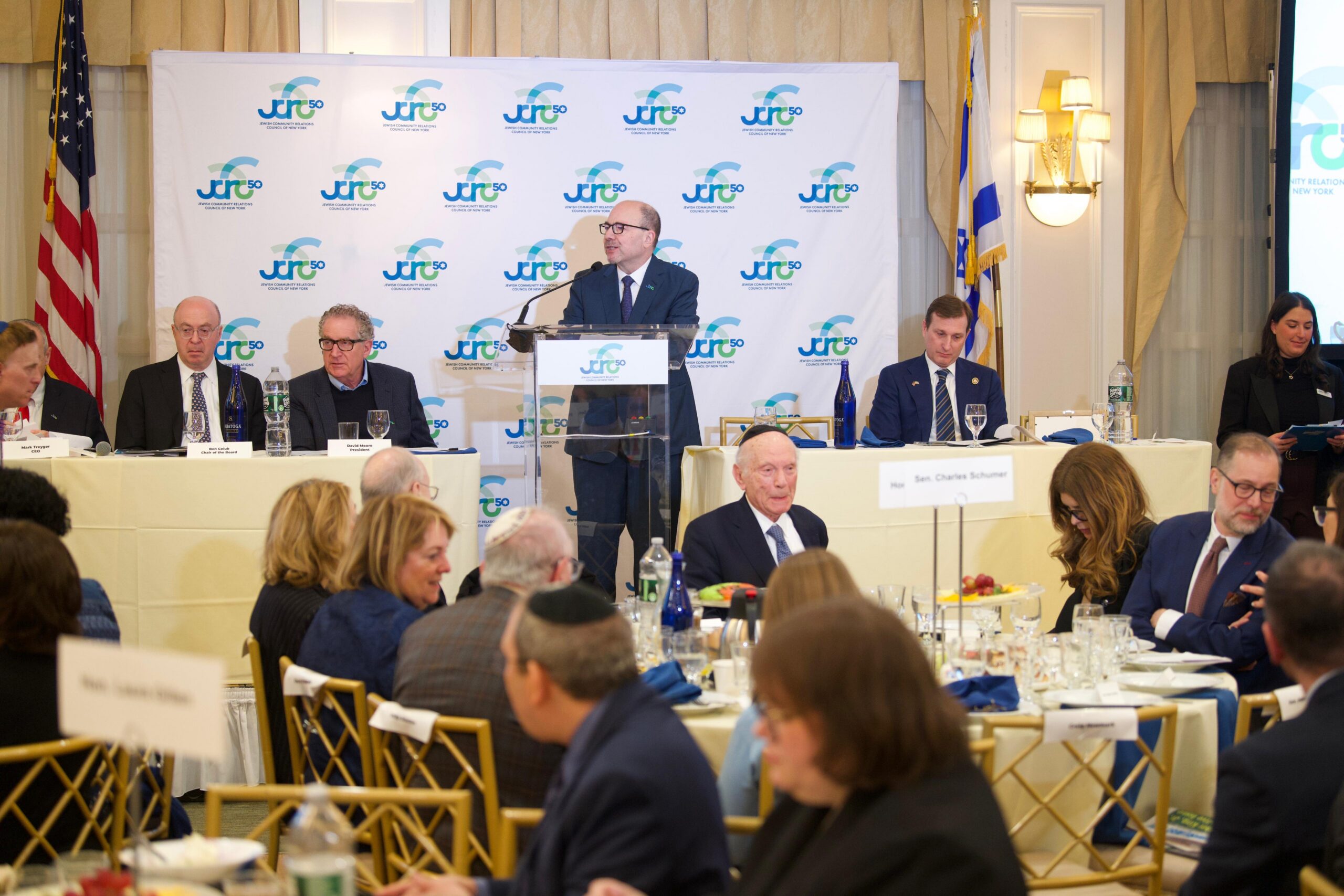
Philanthropist and Craigslist founder Craig Newmark addressed the Jewish Community Relations Council-New York’s annual Congressional Breakfast on Sunday in New York. Speakers at this year’s breakfast included Senate Minority Leader Chuck Schumer (D-NY), House Minority Leader Hakeem Jeffries (D-NY), and Reps. Dan Goldman (D-NY) and Jerry Nadler (D-NY).
Birthdays
Actress and comedian, Lori Beth Denberg turns 50…
Chairman of IAC/InterActiveCorp and Expedia, Barry Diller turns 84… Mayor of Irvine, Calif., Larry Agran (family name was Agranowsky) turns 81… Host of the Food Network program “Barefoot Contessa”, Ina Rosenberg Garten turns 78… Actor, comedian and singer, Brent Spiner turns 77… Journalist, novelist and author, Michael Zelig Castleman turns 76… U.S. Sen. John Cornyn (R-TX) turns 74… “Washington Secrets” columnist at the Washington Examiner, Paul Bedard… Science fiction publisher and author, Selina A. Rosen turns 66… Rabbi at the Pacific Jewish Center (the Shul On The Beach) in Venice, Calif., he is also a practicing attorney, Shalom Rubanowitz… Sportscaster who currently does play-by-play for the NFL, NBA, MLB and NHL, Kenny Albert turns 58… Movie and theater actress and screenwriter, Jennifer Westfeldt turns 56… Tony Award-winning actress, Marissa Jaret Winokur turns 53… Board-certified ophthalmologist, she is married to New England Patriots owner Robert Kraft and sits on the board of the Kennedy Center, Dr. Dana Blumberg… Basketball coach for many Israeli teams over more than 20 years, Dan Shamir turns 51… Singer, songwriter and multi-instrumentalist whose stage name is Mayer Hawthorne, Andrew Mayer Cohen turns 47… Assistant professor at Clemson University, Rebecca Shimoni Stoil, Ph.D. … Senior staff writer at GovCIO Media and Research, Ross Gianfortune… U.S. senator (R-AL), Katie Boyd Britt turns 44… Television and radio host, David Pakman turns 42… Deputy special envoy to combat and monitor antisemitism during the last three years of the Biden administration, Aaron Keyak… Actress and musician, Zosia Russell Mamet turns 38… Former Team Israel baseball catcher, he is now director of business development at a hospital in Las Vegas, Nicholas Jay “Nick” Rickles turns 36… Avi Katz…
Prince Khalid bin Salman said increasing antisemitic and anti-Israel rhetoric out of the kingdom are not reflective of the monarchy’s position
Kayla Bartkowski/Getty Images
Saudi Minister of Defense Khalid bin Salman attends a meeting with U.S. Secretary of Defense Pete Hegseth at the Pentagon on February 24, 2025 in Arlington, Virginia.
Several Jewish and pro-Israel leaders met privately with Saudi Arabia’s defense minister in Washington on Friday afternoon, as Riyadh draws scrutiny for its increasingly hostile posture toward Israel and promotion of antisemitic messaging.
According to several sources familiar with the discussion, Prince Khalid bin Salman Al Saud denied to attendees that increasing antisemitic and anti-Israel rhetoric out of the kingdom was reflective of the monarchy’s position and emphasized that Riyadh and Jerusalem have mutual understanding and ongoing military, security and intelligence cooperation. He praised Israel’s actions against Hezbollah in Lebanon but said he doesn’t agree with Jerusalem’s recent decision to recognize Somaliland’s independence.
The same day of the meeting, a Muslim cleric in Medina gave a sermon calling for “victory” over the “Zionist aggressors,” while an imam in Mecca preached, “O God support them in Palestine and substitute their weakness with strength.” Hussain Abdul-Hussain, a research fellow at the Foundation for Defense of Democracies, noted that the Saudi government selects speakers to deliver Friday sermons.
On Saudi Arabia’s seeming decline in relations with the UAE, the prince acknowledged the two countries have clashed recently in Yemen but denied any broader pivot in Saudi foreign policy or increasing acceptance of the Muslim Brotherhood in the kingdom, which experts have alleged.
He also spoke to Turkey’s importance in the region, as Saudi Arabia’s growing alliance with Ankara, in addition to countries including Qatar and Pakistan, has raised concerns about the country’s increasing alignment with Islamist actors.
One source confirmed reporting by Axios that Prince Khalid told the group that if President Donald Trump does not follow through on his pledge to take military action against Iran, “it will only embolden the regime.”
Among the attendees, according to two sources with knowledge of the meeting, were Anti-Defamation League CEO Jonathan Greenblatt, American Jewish Committee CEO Ted Deutch, Conference of Presidents of Major American Jewish Organizations CEO William Daroff, B’nai B’rith International CEO Daniel Mariaschin and Rabbi Levi Shemtov of American Friends of Lubavitch (Chabad).
An AJC spokesperson confirmed Deutch’s participation at the meeting. “AJC is in regular, ongoing dialogue with our partners across the Gulf and in Israel to strengthen regional security and advance cooperation and integration,” the spokesperson told JI. “Today was another example of that work. We carry out these efforts continuously from Washington, Jerusalem and Abu Dhabi.”
Daroff also confirmed his attendance to JI, saying the group “had a constructive, off-the-record conversation as part of an ongoing dialogue with Saudi Arabia on regional and geostrategic issues, and appreciated the opportunity to speak frankly.”
Shemtov similarly confirmed his participation and said the prince’s demeanor was “friendly and engaging.” Shemtov said he left the meeting “somewhat encouraged, even if not yet completely convinced” but declined to provide details on what was discussed as the meeting was off the record. Mariaschin confirmed his attendance as well.
The nearly two-hour meeting was also attended by 15 representatives of Washington-area think tanks, including Daniel Shapiro, a former U.S. ambassador to Israel now at the Atlantic Council; Dennis Ross, a veteran Middle East peace negotiator now at The Washington Institute for Near East Policy; Barbara Leaf, former assistant secretary of state for Near Eastern affairs who is now a distinguished diplomatic fellow at the Middle East Institute; Douglas Silliman, former U.S. ambassador to Iraq who is now the president of the Arab Gulf States Institute; Rev. Johnnie Moore, the former executive chairman of the Gaza Humanitarian Foundation; Karim Sadjadpour, a senior fellow at the Carnegie Endowment for International Peace; and former diplomat Daniel Fried, now a distinguished fellow at the Atlantic Council, the sources told JI.
In a separate meeting earlier Friday that ran for almost an hour and a half, Prince Khalid met with a smaller group of pro-Israel national security experts, including Mark Dubowitz of the Foundation for Defense of Democracies and Michael Makovsky of the Jewish Institute for National Security of America. Both confirmed to JI they had attended but declined to share details about the discussion.
Moran, a former longtime congressman now lobbying for Qatar, has an extensive record of using antisemitic tropes and hostility to Israel
ASUYOSHI CHIBA/AFP via Getty Images
Former Rep. Jim Moran (D-VA) speaks at a rally attended by supporters of Sudan's ruling Transitional Military Council (TMC) in the village of Abraq, about 60 kilometers northwest of Khartoum, on June 23, 2019.
Days after assuming office, Virginia Gov. Abigail Spanberger is facing scrutiny from Jewish leaders over her decision to appoint Jim Moran, a former congressman representing northern Virginia now working as a lobbyist for clients including Qatar, to the George Mason University board of visitors, despite his extensive record of using antisemitic tropes and hostility to Israel.
The appointment, which Spanberger announced on Saturday hours after she had been sworn into office, came as part of a broader leadership shake-up of the state’s three public universities — as the Democratic governor seeks to assert her influence in the wake of a Republican administration whose university board oversight she had criticized during the campaign as politically meddlesome.
But her nomination of Moran, whose incendiary rhetoric has long been a subject of controversy, is raising questions about her approach to countering anti-Jewish harassment at public universities such as George Mason, which last July was the subject of a federal Title VI investigation related to its handling of several high-profile incidents of antisemitism and anti-Israel extremism.
Moran, a Democrat who retired from Congress in 2015, faced widespread criticism as well as calls for his resignation over comments in 2003 in which he blamed the Jewish community for pushing the U.S. into war with Iraq, a remark he reiterated four years later while singling out the pro-Israel group AIPAC.
Even as he has voiced regret for some of his past remarks, Moran, who is now 80, has downplayed accusations of antisemitism and has continued to echo such rhetoric in recent years while appearing on panel discussions with a London-based NGO led by a former Hamas activist. In one virtual event in 2023, for example, Moran attributed Washington’s support for “apartheid” in Gaza to Jewish control of American politics.
“It’s about domestic politics and it always has been,” Moran insisted. “The majority of people who contribute to the Democratic Party in America have Jewish surnames. Now think about that,” he added, arguing that their “principal reason for contributing has been the sine qua non of support for Israel, and unqualified support for Israel.”
Moran’s recent lobbying for the Qatari government, meanwhile, has likewise drawn attention as the Gulf state has increasingly sought to burnish its image in the United States through funding higher education and ongoing outreach to federal lawmakers, among other efforts.
His work has included “outreach on Qatar’s higher education funding,” according to recent disclosures, pointing to possible conflicts of interest in his board appointment. Qatar, a major non-NATO U.S. ally that has frequently drawn criticism for hosting Hamas, has donated $5.9 million to George Mason.
Jewish leaders voiced befuddlement over the controversial appointment.
Cookie Hymer Blitz, a Jewish and Democratic activist in Northern Virginia, called Moran’s nomination “very concerning, disappointing and surprising.”
“His long history of anti-Israel bias and antisemitic comments seem to make his appointment to this board ill-advised at best,” she told Jewish Insider.
Another prominent Jewish leader, who spoke on condition of anonymity to avoid antagonizing Spanberger, told JI: “It is concerning to hear of anyone who has shared, or continues to share, antisemitic tropes or messages being appointed to leadership roles. I imagine the vast majority of Virginians would take pause.”
The local organized Jewish community is currently weighing a response to Spanberger’s decision in order to help raise awareness about Moran’s views as he prepares to seek confirmation from the state legislature, where he could face questions about his rhetoric and lobbying, according to a Jewish leader involved in government outreach.
Spanberger’s office did not respond to a request for comment from JI on Wednesday regarding the new appointment.
In an email to JI on Wednesday, Moran said that “Qatar has asked only three things of me but they’re a prerequisite for representing them: 1) always tell the truth, 2) always obey U.S. law and 3) always do what you feel is right.”
George Mason University, he added, “is committed to maintaining a diverse student body where every student feels secure and valued, and it aspires to provide the highest possible quality of educational experience.”
As for his opposition to Israel, he called himself “a longtime supporter of Israel’s Labor Party, although it’s a mere shadow of its former self.” He said he had “shared many meals with” former Israeli Prime Minister Shimon Peres and was “confident” that his “views on Israel today specifically and the Middle East in general are wholly consistent with Shimon’s worldview.”
He did not address his past antisemitic rhetoric, only saying that, “for what it’s worth, I’m a subscriber to the Jewish Insider.”
During the gubernatorial election, Spanberger touted her efforts to combat anti-Jewish prejudice as a former congresswoman and said that working to confront antisemitism in higher education would be “a top priority” for her. “My administration will not tolerate antisemitism in any form,” she vowed.
But Kenneth Marcus, a leading expert on antisemitism and the founder and chairman of the Louis D. Brandeis Center for Human Rights Under Law, questioned Spanberger’s commitment to such pledges as she now moves to elevate Moran to a key role in Virginia’s public university system.
Marcus, whose appointment by former Gov. Glenn Youngkin to George Mason’s board of advisors was rejected by Democratic lawmakers last year, called the nomination “hardly an auspicious start for Gov. Spanberger.”
“Given the lengthy trail of antisemitism accusations that Mr. Moran has faced for a long period of years,” Marcus told JI, “it is surprising that Gov. Spanberger has tapped him for leadership at an institution where so many questions have arisen about antisemitism.”
Shapiro writes in his new book that the Harris team asked if he had ever been a ‘double agent for Israel’

ANDREW CABALLERO-REYNOLDS/AFP via Getty Images
Pennsylvania Gov. Josh Shapiro (L) greets former Vice President Kamala Harris as she arrives at Pittsburgh International Airport in Pittsburgh, Pennsylvania on September 2, 2024.
In the summer of 2024, when Vice President Kamala Harris was vetting potential running mates for her expedited campaign for president, a senior member of her team asked Pennsylvania Gov. Josh Shapiro whether he had ever been a “double agent for Israel,” Shapiro writes in a new book that will be published later this month. “Was she kidding? I told her how offensive the question was,” Shapiro recounts in the book.
The exchange — which Shapiro describes in an outraged tone — has prompted sharp criticism from Jewish leaders, including some who served in the Biden-Harris administration.
“The more I read about [Shapiro’s] treatment in the vetting process, the more disturbed I become,” Deborah Lipstadt, who served as the State Department’s antisemitism envoy under President Joe Biden, said in a post on X. “These questions were classic antisemitism.”
Shapiro suggests in the book that he was being treated unfairly as a Jewish contender for the role of vice president: “I wondered whether these questions were being posed to just me — the only Jewish guy in the running — or if everyone who had not held a federal office was being grilled about Israel in the same way,” he writes.
Anti-Defamation League CEO Jonathan Greenblatt called the line of questioning “barely veiled bigotry,” and said it is “a textbook invocation of one of the oldest antisemitic canards in politics: the smear of dual loyalty.”
The comments also earned criticism from Rep. Josh Gottheimer (D-NJ), who said in a statement that “that kind of insinuation and targeting is antisemitism, plain and simple. No one should be judged or discriminated against because of their faith.”
Shapiro’s Jewish faith and his support for Israel became the object of criticism among far-left activists, who agitated against his selection as Harris’ running mate. Harris has maintained that antisemitism played no role in her decision not to pick Shapiro.
Shapiro’s account of his interactions with Harris’ campaign suggests that his views on Israel did present a problem for Harris. According to Shapiro, Harris asked him to apologize for comments he had made denouncing the actions of some anti-Israel protesters at the University of Pennsylvania. He refused, writing in his book that he felt Harris wanted him to align “perfectly” with her on all issues.
“It nagged at me that their questions weren’t really about substance,” Shapiro writes. “Rather, they were questioning my ideology, my approach, my world view.”
Abraham Foxman, the former longtime leader of the Anti-Defamation League, called it “very disturbing” that Shapiro was asked about being an Israeli double agent. “Aides focused on Israel to the extent he found it offensive. Something very troubling about our current political culture,” Foxman wrote in a post on X.
Shapiro was not the first Jewish official to face a “double standard” during the vetting process, Aaron Keyak, the Jewish outreach director on Biden’s 2020 campaign who later served as Lipstadt’s deputy at the State Department, said in a statement.
“During my vetting process I faced questions in a classified setting that my fellow non-Jewish political appointees did not,” Keyak said. “These sort of antisemitic questions are anti-American and do not represent the best that the Democratic Party offers. Now and especially during the next Presidential campaign we must demand better.”
Minnesota Gov. Tim Walz, who was chosen as Harris’ running mate, was also asked a question about his own ties to foreign nations. The Harris campaign asked Walz — who had previously lived and worked in China — if he had ever been an agent of China, CNN reported.
The adversarial nature of Harris and Shapiro’s relationship during the 2024 campaign was the source of a great deal of speculation. Harris took aim at Shapiro, too, in a book she published in 2025, writing that before they even met, he was asking questions about furnishing and decorating the Naval Observatory, where the vice president resides, should he be selected.
A spokesperson for Harris did not respond to a request for comment.
This story was updated on Jan. 20 with additional comments.
Syverud spoke out against antisemitism and boycotts of Israel while leading Syracuse University
Marc Flores/Getty Images for Syracuse University
Kent Syverud speaks on stage at Hollywood Bridging The Military Civilian Divide at Paramount Pictures on February 9, 2017 in Los Angeles, California.
While several prominent university presidents famously refused to say that advocating for the genocide of Jews violates school policy when pressed by Congress two months after the Oct. 7, 2023, Hamas terror attacks, Kent Syverud, the president and chancellor of Syracuse University, wrote a campus-wide email explaining that such rhetoric would not be tolerated on campus.
On Monday, Syverud was tapped as the University of Michigan’s 16th president following a six-month search to replace President Santa Ono. Syverud’s appointment was met with optimism from several Jewish leaders who said his strong ties to the Jewish community could benefit the Ann Arbor school, which experienced some of the most disruptive anti-Israel and antisemitic activity in the wake of the Oct. 7 attacks and the ensuing war in Gaza.
“Syverud’s appointment is very good news for the University of Michigan, which has faced numerous incidents of antisemitism and anti-Israel hostility in recent years,” Miriam Elman, who was a tenured associate professor at Syracuse before joining the Academic Engagement Network as its executive director in 2019, told Jewish Insider. University of Michigan’s undergraduate student body is 15% Jewish, according to Hillel International.
At Syracuse, Syverud supported the school’s large Jewish community, including engaging collaboratively with the campus Hillel and Chabad chapters, according to Elman. Syverud also met regularly with the leadership of the Jewish Federation of Central New York.
Last May, at the federation’s invitation, he provided introductory remarks for a community-wide screening of the documentary “October 8,” a film about the world’s response to the Oct. 7 attacks. “He provided an update on the campus response to antisemitism for the hundreds of attendees and made it clear that it will never be tolerated,” said Elman.
“He is committed to the principles of the academy, including unfettered free expression and academic freedom, as well as to community safety,” continued Elman. “While other university leaders equivocated and failed, since Oct. 7, the [Syracuse] administration, under his leadership, has consistently enforced the student code of conduct and reasonable time, place and manner restrictions on protests and demonstrations.
University of Michigan’s Board of Regents voted unanimously to appoint Syverud, an accomplished legal scholar, during a special session on Monday. Syverud is returning to his Ann Arbor roots; he served as the law school’s associate dean for academic affairs from 1995 to 1997. He then served as law school dean of Vanderbilt University from 1997 to 2005 and later as the dean of the law school at Washington University in St. Louis from 2005 to 2013 before coming to Syracuse.
University of Michigan Regent Jordan Acker, who was the target of anti-Israel vandals at his home and law office near campus several times in 2024, told JI he is “proud that Kent Syverud is returning to his alma mater as president.”
“His time at Syracuse, [and] his leadership at Washington University and Vanderbilt show a deep commitment to students, their welfare, and creating an environment for all to learn. I have no doubt he will continue that legacy as Michigan’s new president,” said Acker.
Elman noted Syverud’s “steadfast rejection of BDS and the academic boycott of Israel and support for numerous educational opportunities for students and faculty to engage with Israeli universities and scholars.”
“Syverud also understands the threats facing the Jewish people and the campus, recently noting that nefarious external actors, including Iran, seek to manipulate students, stoke divisions and cause mayhem,” continued Elman.
Alums for Campus Fairness praised Syverud and said the organization “looks forward to continuing our strong working relationship” with the incoming chancellor, who in October participated in a panel on campus antisemitism hosted by the group.
Syverud also participated in a 2024 summit on campus antisemitism for university presidents hosted by the American Jewish Committee, Hillel International and the American Council on Education.
“AJC is heartened over the news that Kent Syverud will take on the presidency at the University of Michigan,” Sara Coodin, AJC’s director of academic affairs, told JI.” “Syverud brings a wealth of experience and measured, thoughtful and heartfelt engagement and commitment to fostering a positive campus culture and countering hate.”
In 2019, Syverud was recognized by the Simon Wiesenthal Center for suspending Syracuse fraternities that posted videos with antisemitic and racist statements.
The search for Michigan’s next president began last summer after Ono stepped down following a tenure marked by post-Oct. 7 turbulence — including a nearly month-long encampment — until his resignation last spring.
Ono, now inaugural director of the Ellison Institute of Technology, was generally seen as an ally of Michigan’s pro-Israel community who was quick to condemn acts of antisemitism — leading to pro-Palestinian vandals attacking his home on the one-year anniversary of Hamas’ Oct. 7 attack.
Domenico Grasso, the former chancellor of the University of Michigan-Dearborn, currently serves as the university’s interim president. Syverud is expected to assume the position by July 1.
Julie Menin was elected the first Jewish speaker of the New York City Council on Wednesday
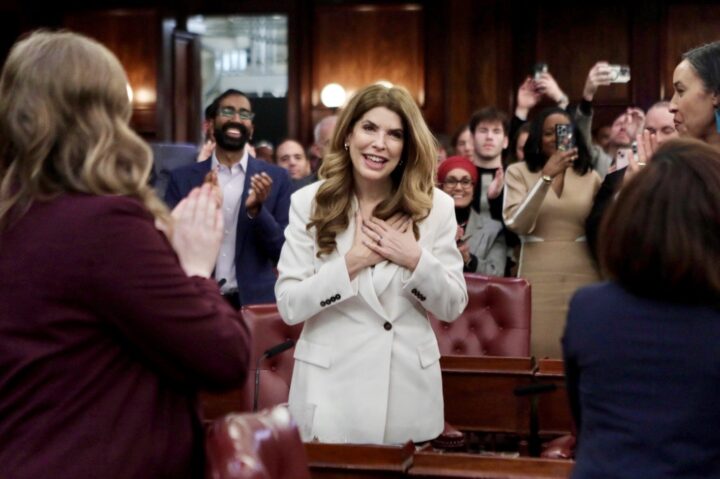
Julie Menin/X
New York City Councilmember Julie Menin is unanimously elected Council speaker on January 7, 2026.
Julie Menin’s election on Wednesday as speaker of the New York City Council was a reassuring sign to Jewish leaders who have long seen the 58-year-old centrist Democrat as a key ally and believe that she will act as a check on Mayor Zohran Mamdani with regard to issues involving Israel and antisemitism.
In a unanimous vote, Menin, a pro-Israel lawmaker and veteran city official who lives on the Upper East Side, became the council’s first Jewish speaker, pledging in her victory speech to focus on “dissolving division” and to “calm tensions” as she prepares to work with a mayor whose hostile views on Israel have long been a defining characteristic of his political ascendance.
“We live in a day with the first Muslim mayor of New York City and now the first Jewish speaker of the council serving at the same time,” Menin said on Wednesday.
Despite the positive tone, Menin, who as speaker now holds the second-most powerful elected role in city government, is still facing the looming prospect of conflict with Mamdani over their differing stances on Israel, which has already animated their nascent relationship.
In her speech, Menin alluded to some tensions that could stoke divisions, insisting that “we must never jeopardize a New Yorker’s right to worship.”
“Because we cannot let what happened outside Park East Synagogue ever happen again, at any house of worship,” Menin said, referring to a protest outside a Manhattan synagogue in November that targeted an event about immigration to Israel and featured chants including “death to the IDF” and “globalize the intifada,” a slogan that Mamdani has refused to condemn.
Mamdani had faced intense criticism after he had admonished the synagogue for promoting what he called “activities in violation of international law,” a statement he later revised.
More recently, after Mamdani had repealed a pair of executive orders tied to Israel and antisemitism on his first day in office last week, Menin said in an interview with The New York Post that she called the mayor to voice her concerns, noting there will “obviously be continued conversation around this.”
Menin added in a separate interview with The New York Times published on Wednesday that she had a “productive conversation” with Mamdani regarding his decision to rescind an executive order issued by former Mayor Eric Adams that adopted a working definition of antisemitism used by the International Holocaust Remembrance Alliance, which labels some criticism of Israel as antisemitic.
While Mamdani indicated during the election that he would seek to invalidate the order, the move triggered widespread backlash from Jewish leaders who said it raised questions over his commitment to effectively fighting antisemitism.
Menin, for her part, telegraphed a more diplomatic position to the Times, even as she had said she was “extremely concerned” by the repeals. “It’s one tool that can be utilized,” she said of the definition. “It’s obviously not the only tool.”
Her assessment underscores what Jewish leaders close to Menin characterized as an even-keeled and largely unflappable approach to governance, which could now be tested on issues she has described as intensely personal.
Menin, a daughter and granddaughter of Holocaust survivors, has long warned of rising antisemitism in New York and has advocated for increased funding to help promote Holocaust education. Menin visited Israel during a solidarity trip after the Hamas terror attacks of Oct. 7, 2023 — after which she introduced a program to send eighth graders to the Museum of Jewish Heritage to raise awareness about the global history of antisemitism.
Chris Coffey, a Democratic strategist who has served as an informal advisor to Menin, said she is “results-oriented and not focused on labels,” while predicting “she will work with the mayor when she can.”
“There may be times when they don’t agree and they will work through it,” he told Jewish Insider earlier this week, saying Menin is “more interested in results than drama.”
Yeruchim Silber, director of New York government relations at Agudath Israel of America, an Orthodox advocacy group, said that Menin “has a long history of working with the Jewish community,” calling her “an important part of the [former New York Mayor Bill] de Blasio administration,” when she led efforts to promote participation in the 2020 census.
He told JI he was “confident she will be able to work collaboratively with” Mamdani’s administration “on all issues important to the community.”
Still, other related issues could emerge as a more challenging test, as Jewish leaders speculate about what actions Mamdani will take next. One point of major tension stems from the partnership between Cornell University and Israel’s Technion, which the mayor’s team had indicated during the election that he would reassess.
Menin, a staunch opponent of Israel boycotts, has praised the joint Cornell Tech campus on Roosevelt Island, which sits in her district, as a crucial hub for local tech and business innovation. “That is an area, of course, of disagreement,” Menin said last month regarding Mamdani’s skepticism of the partnership.
A spokesperson for Menin did not respond to a request for comment from JI on her differences with the mayor.
Menin and Mamdani have in recent weeks largely struck a collaborative tone, appearing at their first joint press conference on Monday to sign executive orders to counter deceptive business practices such as junk fees. Menin has emphasized a shared focus on affordability goals including universal daycare, a key priority of Mamdani’s fledgling administration.
But their courteous public relationship belies other underlying tensions. For his part, Mamdani — who never formally voiced a preference in the contest for council speaker — had privately sought to thwart Menin’s effort as she consolidated backing from a range of members and locked up a supermajority several weeks before the Jan. 1 inauguration. Last month, in a notable snub, Mamdani also did not include Menin in a group of more than 100 elected officials he picked to advise his transition.
Menin, meanwhile, declined to endorse Mamdani, and during the primary chose not to join a summer meeting he had arranged with local Jewish elected officials to address their concerns about his critical views on Israel.
Now that they are working together, some Jewish allies of Menin said they expect that she will put her differences with Mamdani aside, unless provoked to take action with regard to key issues on which she is not aligned with the mayor.
One Jewish leader close to Menin, who asked to remain anonymous to speak candidly, said the new speaker “will be willing to partner with” Mamdani’s administration “to improve the city,” but suggested that it is in the mayor’s “hands to stop doing actions that isolate and antagonize the Jewish community.”
“She is definitely of a mindset of wanting to work together but doing what he did on inauguration day was definitely viewed as a first punch,” the Jewish leader told JI, referring to the executive orders that Mamdani revoked.
Jake Dilemani, a Democratic consultant who served as an informal advisor to Menin in her 2021 Council bid, said that the speaker “is focused on governance and delivering results, and has a strong track record on affordability and consumer protection issues.”
“So, the expectation is this will be a cornerstone of her speakership and that she will work with Mayor Mamdani to put points on the board,” he told JI. “She equally has a strong record on Jewish issues and fighting antisemitism, and it is something that is very personal for her. I fully expect that she will work productively with the mayor on many issues, but will stand up to the administration should she deem it necessary.”
Plus, the 92-year-old trailblazing judge overseeing the Maduro case
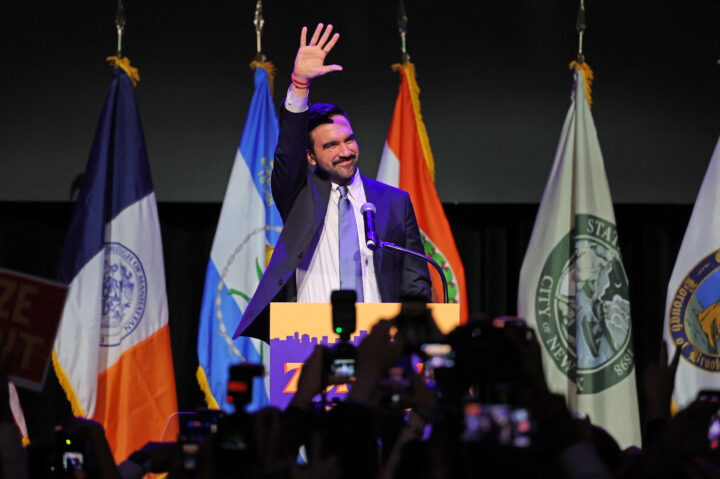
ANGELA WEISS/AFP via Getty Images
New York City Mayoral candidate Zohran Mamdani celebrates during an election night event at the Brooklyn Paramount Theater in Brooklyn, New York on November 4, 2025.
Good Tuesday morning.
In today’s Daily Kickoff, we look at how Minnesota Gov. Tim Walz’s leftward shift during last year’s presidential campaign contributed to his decision, announced yesterday, not to seek a third term, and talk to Jewish leaders in New York concerned about Mayor Zohran Mamdani’s first moves in office. We profile Judge Alvin Hellerstein, the 92-year-old Orthodox Jewish judge presiding over the trial of Venezuela’s Nicolás Maduro, and report on the Department of Justice’s 2026 funding package that will allocate $5 million to protect religious institutions. Also in today’s Daily Kickoff: Blake Blakeman, Jason Miyares and Sally Goldenberg.
Today’s Daily Kickoff was curated by Jewish Insider Executive Editor Melissa Weiss and Israel Editor Tamara Zieve, with an assist from Marc Rod. Have a tip? Email us here.
What We’re Watching
- House Republicans are holding their annual retreat today at the Kennedy Center. President Donald Trump is slated to address the gathering at 10 a.m.
- White House Special Envoy Steve Witkoff and Jared Kushner are meeting with European officials in Paris today for continued talks on the Russia-Ukraine war.
- Israeli Foreign Minister Gideon Sa’ar is in Hargeisa today for meetings with senior officials, after Israel last month became the first country to recognize Somaliland.
- CES 2026 kicks off today in Las Vegas.
- In Florida, former Israeli Strategic Affairs Minister Ron Dermer and “Call Me Back” host Dan Senor will speak in conversation this evening at an event hosted by Palm Beach Synagogue.
What You Should Know
A QUICK WORD WITH JI’S Josh Kraushaar
The political fall of Minnesota Gov. Tim Walz, who just months ago was near the apex of political prominence as Kamala Harris’ running mate in the 2024 presidential election, is an object lesson in the consequences of pandering to the far left of the Democratic Party.
Last year, Walz looked like he was on the fast track in national politics. Now he looks to be ending his career as a disgraced two-term governor.
Walz announced Monday that he’s not running for a third term in office, amid a growing scandal over massive welfare fraud, where dozens of individuals from the state’s Somali diaspora were convicted in schemes involving over a billion dollars stolen from the state’s social services programs.
The scandal offers a snapshot of some of the Democratic Party’s most glaring vulnerabilities. Walz, along with others in the state’s Democratic leadership, oversaw the allocation of generous welfare payments without ample accountability, while turning a blind eye to corruption in a Somali community that’s become a reliable Democratic voting bloc.
A nimbler, and more moderate, politician would have aggressively led the charge against the criminals instead of coming across as a passive bystander. After all, a scandal like this threatens the sustainability of generous social welfare programs that have defined the ethos of the Minnesota Democratic Party. Instead, in his announcement Monday, he decried “political gamesmanship” by Republicans for drawing outsized attention to the issue.
A more pragmatic Walz would also have been comfortable speaking out against scandalous elements within the Somali community (without painting the entire community with a broad brush). Instead, his belated comments speaking out against the fraud typically avoided reference to the perpetrators of the scandal, and he frequently blamed Republicans as racist for invoking their backgrounds. That only dug him into a deeper political hole.
Walz’s sensitivity about not alienating the state’s Somali community also came up in other areas that underscored his progressive instincts. When a leading Somali mayoral candidate (state Sen. Omar Fateh) came under fire for employing virulently antisemitic staffers at the top levels of his campaign, Walz remained silent, even as Sen. Amy Klobuchar (D-MN) spoke up.
Walz also has been supportive of far-left Rep. Ilhan Omar (D-MN) even when she’s faced controversies over using antisemitic tropes and embracing anti-Israel views that have placed her out of the Democratic Party’s mainstream. His selection as Harris’ running mate over Pennsylvania Gov. Josh Shapiro was cheered on by the anti-Israel wing of the party.
MAMDANI MOMENT
Jewish leaders question Mamdani’s antisemitism strategy
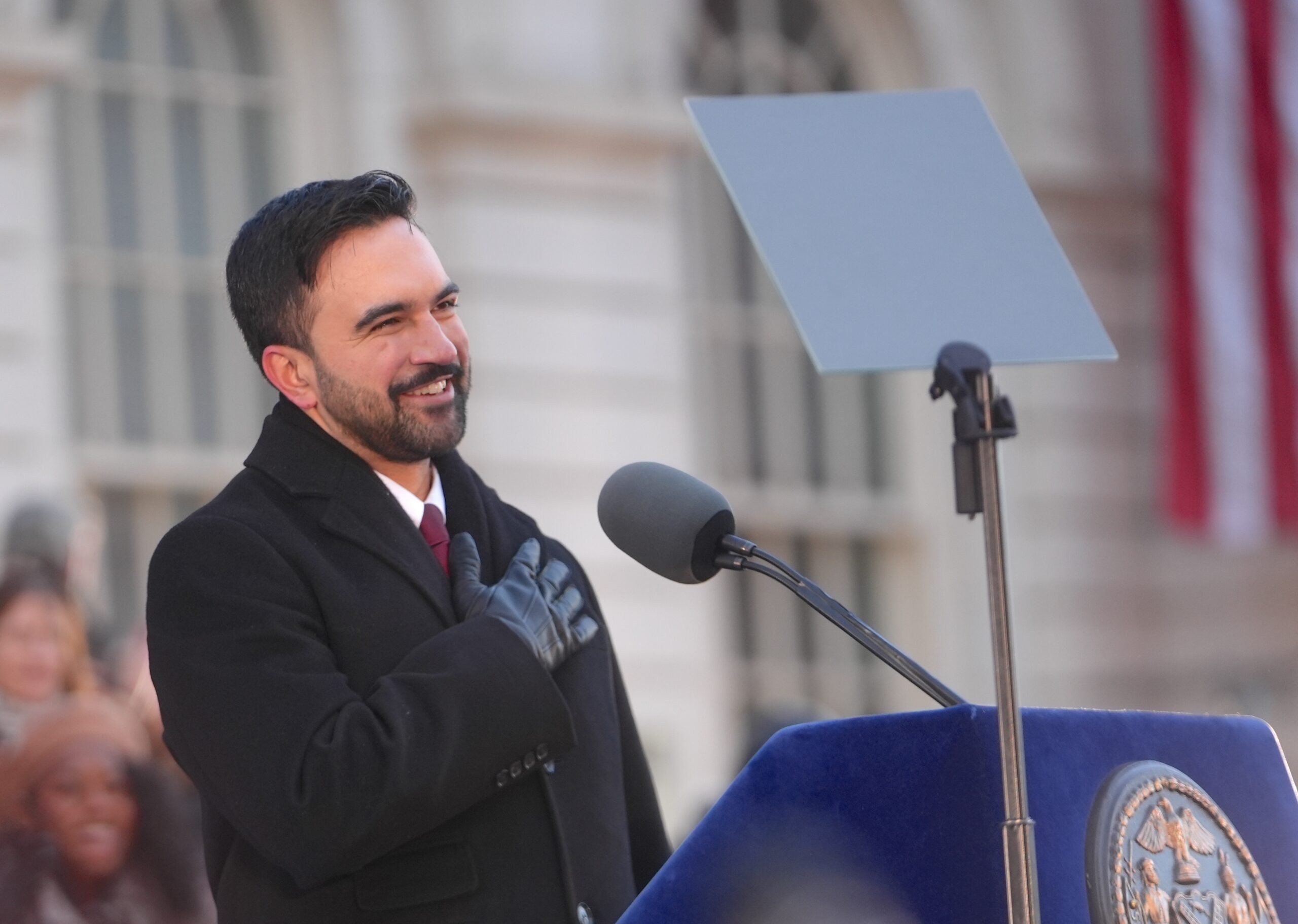
Days into Zohran Mamdani’s first week as mayor of New York City, some Jewish leaders are privately raising questions about whether his fledgling administration is prepared to implement a clear strategy to counter rising antisemitism, one of the key pledges of his campaign. Even as he swiftly moved to revoke two executive orders tied to Israel and antisemitism on his first day in office, Mamdani has yet to disclose how he and his team plan to substantively address what he has repeatedly called “the scourge of antisemitism” in remarks vowing to protect Jewish New Yorkers, Jewish Insider’s Matthew Kassel reports.
Wait and see: The mayor, a democratic socialist and outspoken critic of Israel, faced backlash from leading Jewish groups last week after he repealed executive orders issued by former Mayor Eric Adams, including ones that adopted a working definition of antisemitism used by the International Holocaust Remembrance Alliance and banned city agencies from engaging in boycotts targeting Israel. “He went from giving a speech about unity and collectivism to signing executive orders against the Jewish community,” one Jewish community leader said of Mamdani’s repeals. Rabbi Joe Potasnik, executive vice president of the New York Board of Rabbis who served on Mamdani’s transition committee for emergency response, said he was taking a wait-and-see approach to the first few weeks of the administration. “No further details have been released so there is nothing more to add at this time,” he told JI. “Let’s wait and see if there are changes.”
Bonus: Mamdani tapped Anna Bahr, the communications director for Sen. Bernie Sanders (I-VT) to serve in the same role in the Mamdani administration.
Torah and bench
The judge overseeing the Maduro trial blazed a trail for Jewish lawyers
Judge Alvin Hellerstein is 92 years old, and with 27 years on the federal bench in Manhattan, he has presided over some of the most prominent trials in recent memory — including thousands of lawsuits brought in the aftermath of the Sept. 11 terrorist attacks, a suit against disgraced Hollywood producer Harvey Weinstein and, now, the criminal case against deposed Venezuelan President Nicolás Maduro. It’s a remarkable final chapter in a legal career that was once nearly derailed by antisemitism, Jewish Insider’s Gabby Deutch reports.
The way things were: Hellerstein has described his judicial style as being influenced by New York Federal Judge Edmund Palmieri, for whom Hellerstein served as a law clerk in the 1950s. (Ruth Bader Ginsburg, later a Supreme Court justice, clerked for Palmieri a few years later.) But that chapter almost didn’t happen. Hellerstein wanted to work at a law firm, but he ended up applying to clerkships because he said the non-Jewish law firms in New York would not hire him. “As a Jewish boy coming to interview at law firms, you met up with very strong discrimination, some of it overt, most of it implied,” Hellerstein said in an interview in 2020 on the podcast “Behind the Bima.” He ended up working at a Jewish firm — one of the first Orthodox lawyers to be employed at any New York City firm. Read the full story here.
TEHRAN TALK
More U.S. strikes on Iran are possible, lawmakers say

Senators said on Monday that an additional round of U.S. strikes on Iran remains on the table if the regime makes strides in rebuilding its nuclear program or other malign activities, echoing recent warnings from President Donald Trump. Trump also threatened last week that the U.S. would intervene to protect Iranian protesters if the regime cracked down on nationwide demonstrations, as U.S. officials are watching closely while Tehran reportedly accelerates efforts to restore its ballistic missile capabilities — developments that could spark renewed conflict with Israel and potentially the United States, Jewish Insider’s Marc Rod and Emily Jacobs report.
Military mindset: Republican senators expressed confidence that the president would strike Iranian nuclear facilities a second time if the U.S. determined that Tehran was working to restore its nuclear program. “I think there’s a chance” Trump will strike Iran’s nuclear sites again, Sen. Rick Scott (R-FL) told JI. “If they go forward again and start building up nuclear facilities, yeah, I think Trump’s going to bomb the hell out of them.” Sen. Pete Ricketts (R-NE) told JI, “President Trump is demonstrating that we have the most outstanding military in the world. And if he believes we have to hit Iran again, I believe he will do that.”
Read the full story here with additional comments from Sens. John Kennedy (R-LA), Richard Blumenthal (D-CT) and Tim Kaine (D-VA).
MONEY MATTERS
Department of Justice funding deal allocates $5 million to protect religious institutions

The House and Senate’s negotiated 2026 funding package for the Department of Justice includes funding for state and local law enforcement specifically allocated for protecting religious institutions, Jewish Insider’s Marc Rod reports.
What it does: The explanatory report accompanying the bill, released Monday, instructs the Department of Justice to allocate at least $5 million in DOJ law enforcement grant funding to agencies “seeking to enhance security measures for at-risk religious institutions and to address the precipitous increases in hate crimes targeting individuals on the basis of religion.” Such funding, aimed at providing law enforcement with additional resources to step up their security presence at synagogues and other houses of worship, has been pursued by Jewish community groups particularly amid rising antisemitic attacks in the wake of the Oct. 7, 2023, attacks in Israel.
WALTZING OUT
Walz’s national ambitions foreshadowed his political fall
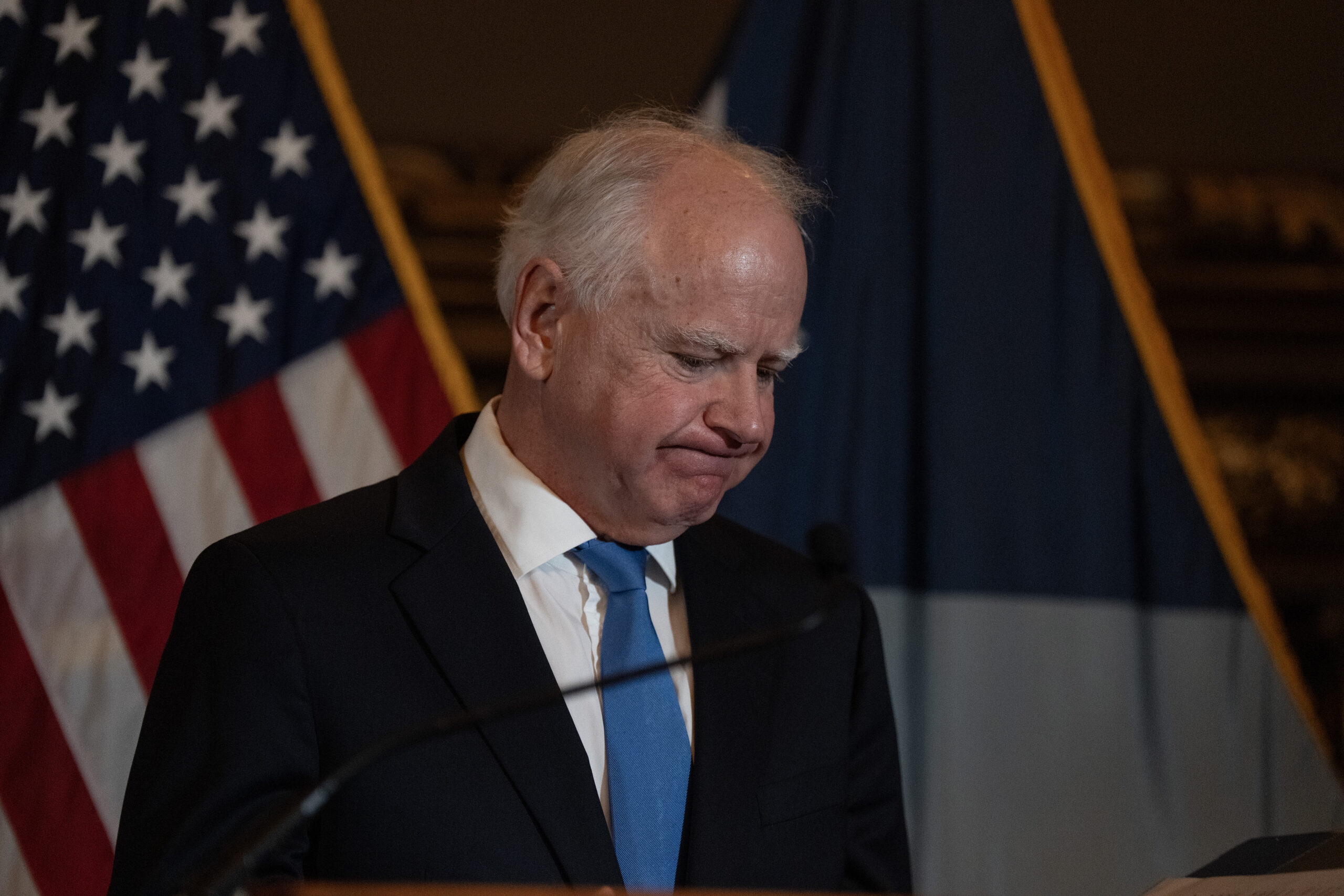
Minnesota Democratic Gov. Tim Walz’s decision to drop out of the 2026 gubernatorial race in a state heavily favored for Democrats marks a significant political fall for the party’s 2024 vice presidential nominee. Walz, 61, said while announcing on Monday that he would no longer seek a historic third term as governor that he had “every confidence” that he could have won his reelection bid — despite facing intense scrutiny for a state welfare fraud scandal that has gained national attention and become a political flashpoint in Minnesota. Still, Walz acknowledged that the fraud allegations, which have mostly been leveled at members of the state’s Somali community, and the broader scandal played a role in him ending his campaign, Jewish Insider’s Emily Jacobs and Marc Rod report.
Walz’s path: The decision to end his campaign means Walz will cap off two decades in elected office next January, less than two years after former Vice President Kamala Harris selected him as her running mate and thrust him onto the national stage. While holding a moderate voting record as a member of Congress, Walz largely governed as a progressive, and was the preferred choice of progressive Democrats critical of Israel in the 2024 veepstakes over Pennsylvania Gov. Josh Shapiro. On the campaign trail, Walz praised anti-Israel protesters and urged the U.S. to exert more leverage on Israel. He also drew scrutiny for appearing at events with an antisemitic and pro-Hamas Muslim cleric. He said last year after the election that war in Gaza was “rightfully” a “central focus” of the 2024 campaign.
DRAWING LINES
Bruce Blakeman outlines his approach to antisemitism if elected NY governor
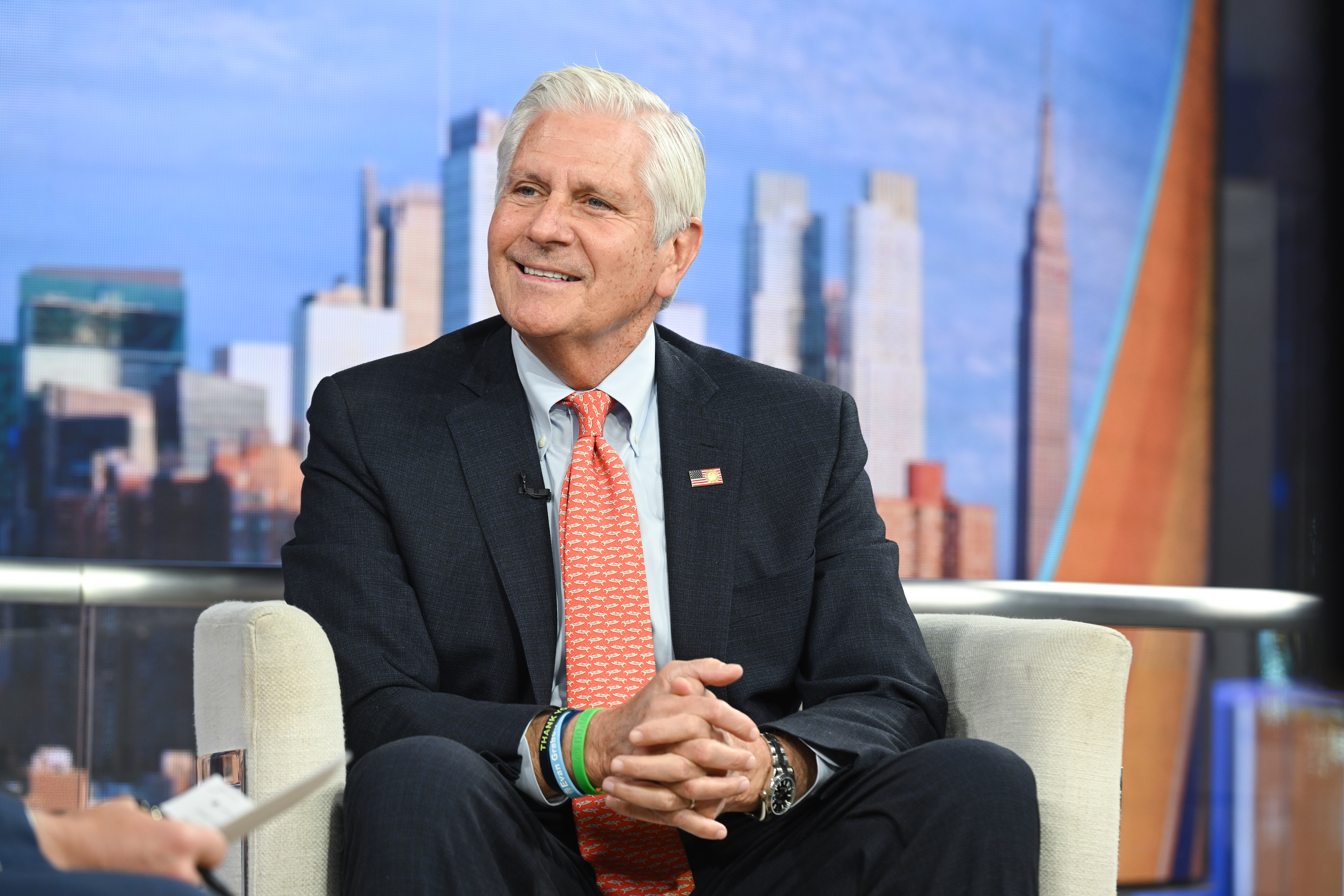
Nassau County Executive Bruce Blakeman suddenly emerged as the presumptive Republican nominee for governor of New York in December, with Rep. Elise Stefanik’s (R-NY) unexpected exit from the race against Gov. Kathy Hochul. Now, with the formal endorsement of President Donald Trump, Blakeman, 70, is preparing for an uphill battle in a reliably Democratic state. In an interview with Jewish Insider’s Marc Rod, Blakeman, who is Jewish, vowed to protect the Jewish community statewide against antisemitism, pledging that under his leadership, the state would step in if New York City Mayor Zohran Mamdani fails to do so.
Taking aim: Asked about voices like Tucker Carlson and neo-Nazi influencer Nick Fuentes who are working to mainstream antisemitic ideas in the Republican Party, Blakeman did not mince words in his condemnation, but described them as a small minority of the party and said he sees most antisemitism coming from the left. “Nick Fuentes is, in my opinion, a nut, but a dangerous one, and he has no place in the Republican Party,” Blakeman said. “Tucker Carlson is a big blowhard who has an issue with Jewish people, and it probably emanates from his chameleon-like personality. … He’s very unprincipled and I think he has biases that probably emanated from his youth.”
Worthy Reads
The Hawks are Back: Puck’s Julia Ioffe looks at how the Trump administration’s recent operation in Venezuela has shifted political and policy dynamics among conservatives split between neoconservatism and MAGA-style isolationism. “The affinity for using American military force has, weirdly, thrown Trump into alignment with the same neoconservative camp that he trampled during his ascent to the White House. This cohort, which has praised Trump’s moves in both Venezuela and Iran, has long insisted that Democrats are constitutionally uncomfortable with American power and that they are too scared to use it. In their view, liberals overlearned the lessons of Iraq and, as a result, grew too prone to overthinking and overanalyzing — imagining consequences to military action that are far worse than reality merits.”[Puck]
Digital Detox: In The Wall Street Journal, Vivek Ramaswamy, who is mounting a bid for governor of Ohio, explains why he is ending his personal use of a number of social media platforms. “There’s a fine line between using the internet to distribute your message and inadvertently allowing constant internet feedback to alter your message. That isn’t using social media; it’s letting social media use you. As someone who ran a digitally centered campaign for president, I’ve seen this effect firsthand — on myself and my competitors. Politicians want to respond to voters, and rightly so. But polls are expensive and infrequent. Social media offers a tempting alternative: free, abundant real-time feedback. It creates the impression that you’re hearing directly from ‘the people’ and responding in kind. Modern social media is increasingly disconnected from the electorate.” [WSJ]
Word on the Street
U.S. officials reportedly told acting Venezuelan President Delcy Rodriguez that Caracas must boot operatives from countries — including Iran and Cuba — that are hostile to the U.S….
In one of his final acts in office, Virginia Attorney General Jason Miyares sent a letter on Monday reminding all K-12 superintendents and school boards in the state of their obligation to adopt the International Holocaust Remembrance Alliance’s working definition of antisemitism into their codes of conduct and discrimination policies, Jewish Insider’s Haley Cohen reports…
Maine Senate candidate Graham Platner raised $4.7 million in the last quarter of 2025, despite numerous scandals related to past controversial social media posts and a tattoo that resembled Nazi imagery…
Attorney George Conway launched his bid in the crowded Democratic primary in New York’s 12th Congressional District to succeed Rep. Jerry Nadler (D-NY)…
Harvard President Alan Garber said in a recent episode of the Shalom Hartman Institute’s “Identity/Crisis” podcast that the Ivy League school had erred in allowing faculty members to share their personal views on politically charged issues, explaining that faculty activism had a chilling effect on campus climate…
Oracle Chairman Larry Ellison sold his Pacific Heights, Calif., home for $45 million, more than 10 times what he paid for the property in 1988…
Authorities in Germany are investigating a suspected arson attack targeting the home of the antisemitism commissioner of the state of Brandenburg…
Israel asked the country’s Supreme Court to allow for the continuation of a blanket ban on media access to the Gaza Strip, citing “security reasons” and suggesting that lifting the ban would endanger efforts to locate the body of hostage Ran Gvili; the court is set to rule on the petition, filed in 2024 by the Foreign Press Association as it sought access to Gaza…
The Israeli Communications Ministry approved a deal between Israeli and Palestinian telecom companies that will bring 4G access to the West Bank; the finalization of the agreement, which had been reached in 2022, had been delayed due to the Israel-Hamas war…
TheBank of Israel cut interest rates to 4%, the second straight time the bank has cut rates since Israel and Hamas reached a ceasefire in October 2025…
Israel struck what it said were Hezbollah and Hamas sites in southern Lebanon, days before the commander of the Lebanese Armed Forces is slated to brief officials in Beirut on the army’s efforts to disarm Hezbollah…
The Wall Street Journal looks at how Israel’s early recognition of Somaliland plays into Jerusalem’s broader strategy to establish diplomatic ties in a postwar era…
In an effort to curb ongoing protests around Iran over the country’s economic troubles, government officials announced a program to give approximately $7 per month to every Iranian citizen…
Politico’s Sally Goldenberg is joining The New York Times’ Metro section, covering New York City politics and the Mamdani administration…
David Rosen, the co-founder of Sega, died at 95…
Pic of the Day
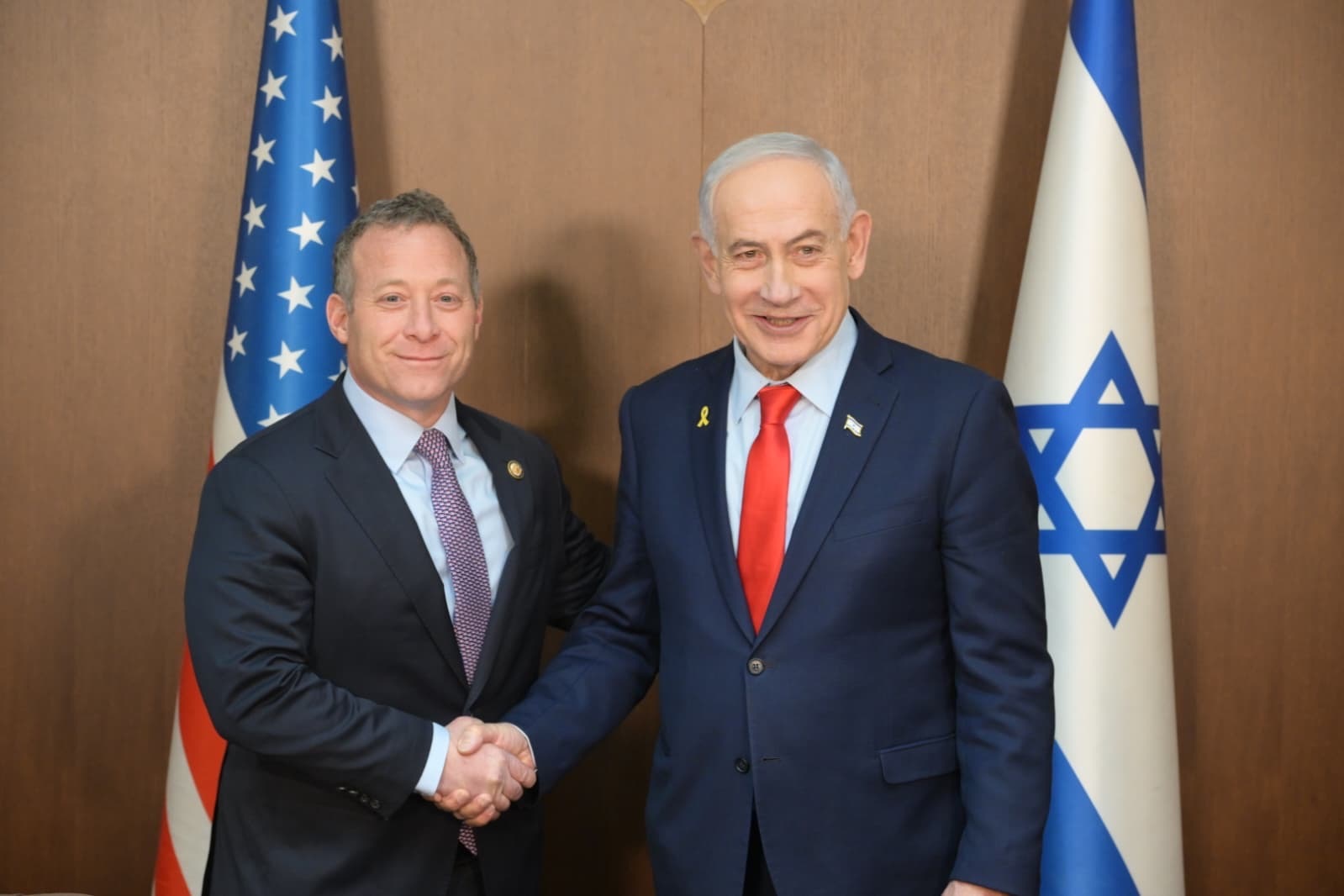
Rep. Josh Gottheimer (D-NJ) met on Monday in Jerusalem with Israeli Prime Minister Benjamin Netanyahu.
Birthdays
English food writer and television cook, Nigella Lucy Lawson turns 66…
Retired EVP and senior counsel of the Trump Organization, George H. Ross turns 98… International businessman and philanthropist, Nathan “Natie” Kirsh turns 94… Canadian businessman, investor and author, seven Canadian universities have a school named for him, Seymour Schulich turns 86… Co-founder of private equity firm Kohlberg Kravis Roberts, Henry R. Kravis turns 82… Chairman, president and CEO of Phibro Animal Health Corporation, he is a past chair of the Israel Policy Forum, Jack C. Bendheim turns 79… Yiddish-language author, journalist, playwright and lyricist, Boris Sandler turns 76… Attorney general of Oregon from 2012 until 2024, Ellen Rosenblum turns 75… Film, theater, and television director, her debut novel was published in 2020, Jan Pringle Eliasberg turns 72… Academic official at Tennessee State University for 10 years, he now serves as a consultant to the Tennessee Bureau of Investigation, Michael Harris turns 70… Retired television executive and political commentator, Mark E. Hyman turns 68… Founder and executive director of Healthcare Across Borders, Jodi Lynn Jacobson… Israeli celebrity chef, Eyal Shani turns 67… Member of the Ukrainian Parliament and president of the Ukrainian Jewish Committee, Oleksandr Feldman turns 66… Daniel G. Slatopolsky… Founder of Pure California Beverages, Sarah Beth Rena Conner… Member of the Knesset for the Religious Zionist Party, she chairs the Knesset’s Labor and Welfare Committee, Michal Miriam Waldiger turns 57… Actor, painter and fashion designer, Greg Lauren turns 56… Author of 13 spy fiction novels and four nonfiction books, Alex Berenson turns 53… President and CEO of United Wholesale Mortgage, he is the majority owner of the Phoenix Suns of the NBA and Phoenix Mercury of the WNBA, Mat Ishbia turns 46… Israeli news anchor and host of the “Jewish Crossroads: Jewish Identity in Times of Crisis” podcast, Tamar Ish-Shalom turns 45… Israeli actress, best known for her role in “The Zookeeper’s Wife,” Efrat Dor turns 43… Award-winning investigative reporter at WCCO/CBS in Minneapolis, Jonah P. Kaplan… Social media program director at the Committee for Accuracy in Middle East Reporting and Analysis (CAMERA), Aviva Slomich Rosenschein… Philanthropic advisor at the Community Foundation for a Greater Richmond, Sarah Arenstein Levy… Rabbinic fellow at NYC’s Park Avenue Synagogue, Aiden Pink… One of the youngest to ever sign a Major League Soccer contract at age 15, he is now a VP at Acacia Research, Zachary “Zach” Pfeffer turns 31… Rock climber for Team USA, he competed at the Paris Olympics in 2024, Jesse Grupper turns 29… Value accelerator lead at Goldman Sachs Growth, Anna Phillips…
One source said the mayor plans to replace Moshe Davis as NYC’s top antisemitism official
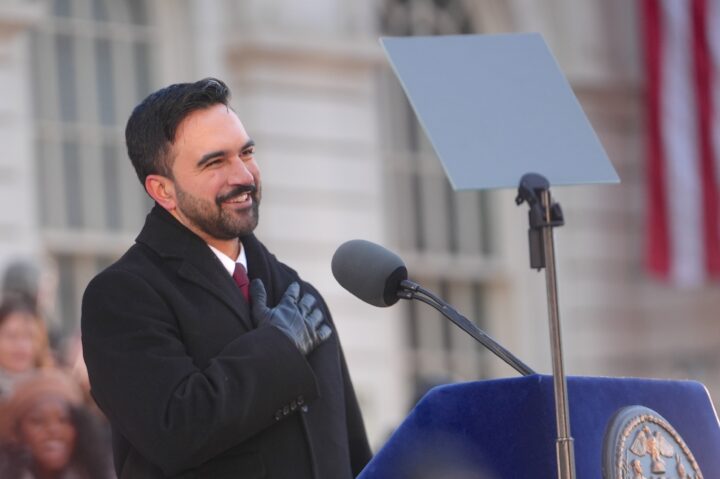
Selcuk Acar/Anadolu via Getty Images
Mayor Zohran Mamdani at his inauguration ceremony at City Hall, Manhattan, New York City, United States on January 1, 2026.
Days into Zohran Mamdani’s first week as mayor of New York City, some Jewish leaders are privately raising questions about whether his fledgling administration is prepared to implement a clear strategy to counter rising antisemitism, one of the key pledges of his campaign.
Even as he swiftly moved to revoke two executive orders tied to Israel and antisemitism on his first day in office, Mamdani has yet to disclose how he and his team plan to substantively address what he has repeatedly called “the scourge of antisemitism” in remarks vowing to protect Jewish New Yorkers.
The mayor, a democratic socialist and outspoken critic of Israel, faced backlash from leading Jewish groups last week after he repealed executive orders issued by former Mayor Eric Adams, including ones that adopted a working definition of antisemitism used by the International Holocaust Remembrance Alliance and banned city agencies from engaging in boycotts targeting Israel.
“He went from giving a speech about unity and collectivism to signing executive orders against the Jewish community,” one Jewish community leader said of Mamdani’s repeals.
Another Jewish leader in touch with Mamdani’s team echoed others who have emphasized that his advisers “need a plan” to counter antisemitism and that proposing a strategy is “important and should happen soon.”
The response so far has been limited. “A lot of ‘Yes, thanks for the feedback,’” the Jewish leader relayed. “I suspect they know and are working on it.”
While Mamdani also announced he would retain the office to combat antisemitism created last year by the Adams administration, he has otherwise not shared additional details about how it will be staffed or what specific issues it will prioritize.
Moshe Davis, who led the office under Adams, told Jewish Insider on Monday that he was “at his desk in City Hall,” but had not “heard much else” about the future of the office or his role in it. He said that on Friday he had distributed to officials an 80-page report produced by the office under Adams and publicly released last week.
The new report includes plans that Mamdani would likely oppose, such as training for all city employees on the IHRA definition, which labels some criticism of Israel as antisemitic.
One person familiar with the matter, who has spoken with Mamdani’s team, said that Davis will not be asked to continue on as the office’s executive director. Phylisa Wisdom, executive director of New York Jewish Agenda, a progressive Zionist group, is rumored to be a front-runner for the role, though no final decisions have been made, the source told JI.
Wisdom said that she was not familiar with the hiring process, but looks “forward to seeing how the Mamdani administration plans to tackle what he has rightly called the ‘scourge of antisemitism’ facing our city.”
“This will require a comprehensive strategy,” she told JI on Monday, noting that the office to combat antisemitism “can play a key role, coordinating between long-standing offices and agencies tasked with combating hate, and input from the diversity of New York’s Jewish community.”
A spokesperson for Mamdani did not respond to a request for comment on Monday.
Other Jewish community leaders said they were now waiting to learn more about Mamdani’s plans for the office — which could shed early light on his approach to antisemitism as he enacts his agenda.
“Haven’t heard anything beyond that he will retain the office but make some changes,” said one Jewish leader, who was unaware of what the changes would entail.
Mamdani, in defending his decision to revoke the executive orders, said last week his administration “will be relentless in its efforts to combat hate and division, and we will showcase that by fighting hate across the city.”
“That includes fighting the scourge of antisemitism by actually funding hate crime prevention, by celebrating our neighbors and by practicing a politics of universality,” he added during a Friday press conference.
Rabbi Joe Potasnik, executive vice president of the New York Board of Rabbis who served on Mamdani’s transition committee for emergency response, said he was taking a wait-and-see approach to the first few weeks of the administration. “No further details have been released so there is nothing more to add at this time,” he told JI. “Let’s wait and see if there are changes.”
Amy Spitalnick, the CEO of the Jewish Council for Public Affairs, said that the administration “has a real opportunity to not just signal its commitment to Jewish safety but to take real action.”
“From increased investment in hate crimes prevention to expansion of proven education tools, Mayor Mamdani can build this office into a hub to advance a comprehensive strategy to counter antisemitism and advance Jewish inclusion and safety,” she told JI.
Plus, Rabbi Shemtov's Hanukkah hop

Olivier Touron / AFP via Getty Images
Attendees listen to conservative political commentator Ben Shapiro during Turning Point's annual AmericaFest conference in remembrance of late right-wing political activist Charlie Kirk, in Phoenix, Arizona on December 18, 2025.
👋 Good Monday morning!
In today’s Daily Kickoff, we talk to Jewish leaders in Texas concerned about Democrat James Talarico’s rhetoric on Israel as he mounts a Senate bid in the Lone Star State, and spotlight Providence, R.I., Mayor Brett Smiley‘s efforts to lean on his Jewish faith as the city reels from the shooting at Brown University. We interview Rabbi Levi Shemtov as the rabbi concludes a week of criss-crossing the District to celebrate Hanukkah, and talk to AJC CEO Ted Deutch about the need for Jewish communal unity on security issues in the wake of the Bondi Beach attack. Also in today’s Daily Kickoff: Josh Blackman, Seymour Hersh and Sen. Lindsey Graham.
Today’s Daily Kickoff was curated by Jewish Insider Executive Editor Melissa Weiss and Israel Editor Tamara Zieve, with an assist from Marc Rod. Have a tip? Email us here.
What We’re Watching
- We’re continuing to monitor developments in Australia. At a Sunday vigil in Sydney for the victims of last week’s Bondi Beach attack, Australian Prime Minister Anthony Albanese was jeered and booed over what the country’s Jewish leaders have derided as inadequate efforts to address antisemitism before and since the attacks.
- Earlier today, an Australian court released police charging documents for the alleged shooter who was not killed during the attacks. The documents noted that Naveed Akram and his father had also hurled explosive devices into the crowd that had failed to detonate, and prior to the attacks had recorded a video explaining their motivations while standing in front of an ISIS flag.
- In Israel, Tel Aviv University’s Institute for National Security Studies, in collaboration with the Ruderman Family Foundation, is hosting a conference this afternoon examining the U.S.-Israel relationship, including the connection between Israel and American Jewry.
What You Should Know
A QUICK WORD WITH JI’S Josh Kraushaar
The kids aren’t alright.
That’s the unmistakable takeaway from a weekend filled with shocking developments surrounding the views of young conservatives, punctuated by a Turning Point USA conference that turned into a proxy war between mainstream voices led by Ben Shapiro, looking to create guardrails against antisemites and conspiracy theorists within the MAGA movement, against a growing cadre of bad-faith right-wing influencers leading the charge to embrace extremist voices into the conservative coalition.
The conference concluded with Vice President JD Vance all but taking the side of the extremists, while offering fulsome praise to his friend, Tucker Carlson, as an essential part of the Republican Party coalition.
The last several days also featured news of an eye-opening Manhattan Institute focus group of Gen Z Nashville-area conservatives reluctant to offer any negative reaction toward Adolf Hitler and sharing numerous antisemitic stereotypes about Jews. (One 29-year-old woman offered this representative reaction about Hitler: “I think he was a great leader, to be honest. I think what he was going for was terrible, but I think he showed very strong leadership values.”)
The weekend ended with a Jewish Insider scoop that a Trump administration nominee for a senior position at the State Department has a long track record of making derogatory comments about the Jewish community, characterizing Jews as religiously incorrect and in need of conversion.
This moment was further underscored by the hideously antisemitic tirade that Candace Owens went on over the last few days, barely eliciting any serious pushback from conservative movement leaders. Meanwhile, former journalist Megyn Kelly, during her own speech Friday at the TPUSA conference, chose to go after Shapiro and CBS News Editor-in-Chief Bari Weiss even as Kelly has publicly steered clear of criticizing Owens, citing the fact that she’s a young mother and a personal friend. (Shapiro, she said, is no longer a friend after he criticized her in his speech Thursday night.)
Shapiro, long one of the leading voices on the right, opened the conference with a warning that the conservative movement is in danger from “charlatans who claim to speak in the name of principle but actually traffic in conspiracism and dishonesty, who offer nothing but bile and despair.”
He called out Tucker Carlson, Owens and Kelly by name. “We must not let fear of audience anger deter us from telling the truth; we must not let fear of other hosts deter us from telling the truth,” Shapiro warned. “The fact that Candace has been vomiting all sorts of hideous and conspiratorial nonsense into the public square for years on end while others fly cover for her is … cowardly.”
TALARICO TALK
Texas Jewish voters, leaders alarmed by James Talarico’s Israel rhetoric

Jewish leaders in Texas are growing increasingly concerned about Democratic Senate candidate James Talarico’s comments on Israel, with four members of the community telling Jewish Insider’s Marc Rod that without concerted outreach from Talarico, they’re likely to back Rep. Jasmine Crockett (D-TX) in the Democratic primary. Their frustrations came to a head after Talarico accused Israel of war crimes in response to a general question on foreign policy at an event last week. “I will use every bit of financial and diplomatic leverage that this country has to end the atrocities in Palestine,” Talarico vowed to do if elected. “I will not use your tax dollars to fund these war crimes. I will vote to ban offensive weapons to Israel.” He also said he’d refuse to accept support from AIPAC.
Calling him out: Art Pronin, who leads the Meyerland Area Democrats Club, a largely Jewish Democratic group in the Houston area, told JI he’s known Talarico for years and the candidate has spoken to the Meyerland Democrats group. Pronin has repeatedly expressed concerns to Talarico directly and to the campaign about his Israel rhetoric, to little effect. “I told him … ‘You’ve got to stop singling out one group,’” Pronin said, referring to AIPAC. He said that Talarico had apologized and said he would modify his rhetoric, but offered similar comments, unprompted, at the Houston town hall last week.
BUOYED BY BELIEF
Finding faith in office: Providence mayor leans on his Judaism in hard times

As the Rhode Island capital has found itself a fixture in the national news following the recent mass shooting at Brown University, where a gunman killed two students and injured nine more, Providence Mayor Brett Smiley has also found himself in the spotlight. “I think my job in the days to come is to help our community heal, to process the trauma that they’ve been through,” Smiley said at a vigil last Sunday. A long-planned communal holiday gathering, meant to be a Hanukkah celebration and a Christmas tree lighting, had turned into a place for people to grieve together, Jewish Insider’s Gabby Deutch reports.
Healing together: On Friday, Smiley sat in his dark City Hall office before dawn, describing the surreal saga following the end of the dayslong manhunt, in an interview with a local NBC affiliate. “Everything about this situation is tragic, but at least we now know there is a definitive end to it,” Smiley said, sitting in front of a Hanukkah menorah. “Now we can start the healing process as a community.” The mayor leaned on his own faith in the days afterward. Aside from taking part in the menorah lighting, he stopped by his synagogue, Temple Beth-El, and spoke several times last week to Rabbi Sarah Mack. “He’s a lovely, wonderful person with deeply rooted morals and values, and he has found his Jewish faith to be incredibly meaningful to him,” Mack told JI on Thursday.
MENORAHS ON THE MALL
Lighting up Washington: Rabbi Levi Shemtov brings Hanukkah to the halls of power

One of Washington’s few remaining bipartisan traditions is the annual clamoring for a ticket to the White House Hanukkah party — an affair that was smaller than usual this year after the Trump administration tore down the East Wing, prompting disappointment even from some Republican allies who did not score an invite. If you’re a member of the opposing political party, forget about it. But even as power changes hands in Washington, one person is a fixture at Republican and Democratic White House Hanukkah parties, as well as Hanukkah gatherings all across the Beltway. That’s Rabbi Levi Shemtov, the executive vice president of American Friends of Lubavitch (Chabad), the Washington arm of the global Chabad movement, and Washington’s unofficial menorah-lighter-in-chief, Jewish Insider’s Gabby Deutch reports.
Expression of pride: “I was raised during the Bicentennial, and I got a very patriotic education in our day school. I felt very American, and I thought this was a strong public expression of a deep Jewish pride that I was able to enjoy,” Shemtov said during Hanukkah last week. “I come from grandfathers on both sides of my family who were arrested and imprisoned, tortured and exiled for being Jews and for practicing Judaism and for leading Jewish communities. So I wasn’t going to let the freedom we are so fortunate to have here just pass without my active participation in it.”
ON THE HILL
Senate Appropriations Committee proposes $330 million for nonprofit security grants
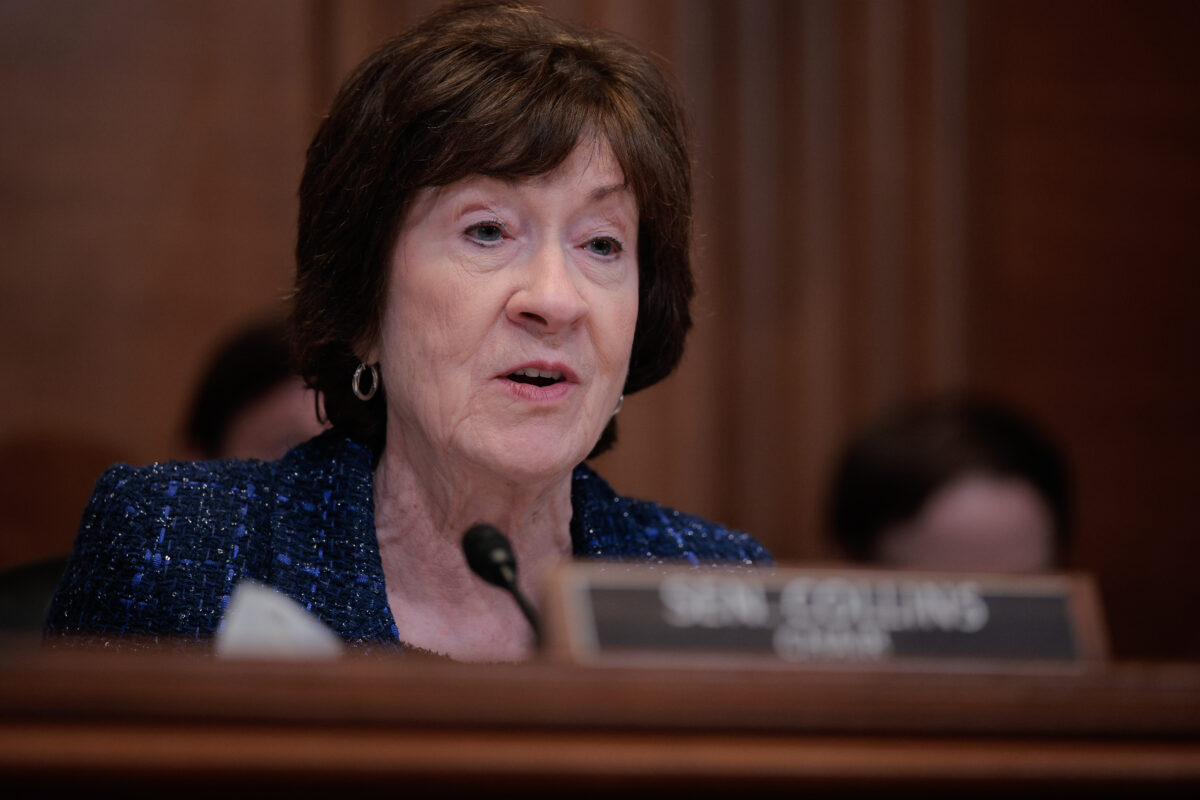
Senate Appropriations Committee Republicans, in a long-delayed Homeland Security funding bill released on Friday, proposed a modest increase in funding for the Nonprofit Security Grant Program to $330 million, Jewish Insider’s Marc Rod reports.
State of play: The program was funded at $274.5 million in 2025 — not counting supplemental funds included in the 2024 national security supplemental bill. The Senate’s proposed increase comes in far below the $500 million to $1 billion that Jewish community advocates and supporters of the program on Capitol Hill have called for. The proposal is also slightly below the $335 million approved by the House in its version of the bill earlier this year. The Senate proposal sets off a sprint to finalize 2026 government funding when Congress returns in January, ahead of an end-of-month deadline.
CALL TO ACTION
AJC CEO calls for Jewish organizations to unify over communal security

Following the shooting at a Sydney, Australia, Hanukkah event in which 15 people were killed, American Jewish Committee CEO Ted Deutch said that it’s critical for Jewish communal organizations to join together around a campaign to protect the Jewish community worldwide and win over allies in that fight, Jewish Insider’s Marc Rod reports.
Coming together: “The community organizations need to come together around an immediate effort to respond to Bondi Beach. This is urgent for us,” Deutch said. Even if various groups have different approaches to their work, “we’ve got to show the Jewish world” and the philanthropists who back them “that we can actually work together, all of us, in ways that will protect the Jewish community in response to what happened at Bondi Beach.” And he said that the Jewish community needs to stand its ground and be clear that it has the right and expectation to have its concerns and security “treated as seriously as other communities” and the “expectation that when we’re at risk, there will be action, rather than asking that everyone please consider our plight.”Read the full interview here.
SIGHTS ON SYRIA
Over half of House Republicans call for accountability on Syria sanctions repeal

A group of 136 House Republicans released a joint statement on Friday calling for increased oversight of and accountability from Syria, days after voting to repeal the last major sanctions package on the country as part of the 2026 National Defense Authorization Act, Jewish Insider’s Marc Rod reports.
What they said: The lawmakers said that the “the mass murder of the Syrian Christians, Druze, Alawites, Kurds, and other religious and ethnic minorities must be a thing of the past” and that they are “committed to keeping a watchful eye on the new al-Sharaa Administration to ensure protections for religious and ethnic minorities.” They said they had received assurances from the administration and House leadership that sanctions would be re-imposed if the Syrian government breaches the non-binding conditions laid out in the bill, that the House would hold a hearing on the treatment of religious minorities in Syria and that they would like to visit Syria to personally observe the situation on the ground.
Worthy Reads
Sounding the Alarm: In The Times, Deborah Lipstadt, the Biden administration’s special envoy to monitor and combat antisemitism, argues that efforts by governments and leaders to “engage in pieties but not action” that see officials ignore antisemitic elements in their coalitions will lead to more attacks on Jewish targets. “However, unlike the neo-Nazis of previous generations, the extreme right-wing of today looks quite respectable. Think of the influencer Nick Fuentes or the YouTube host Candace Owens. No sieg heil salutes. No Nazi-like uniforms. But the hate they spew is as dangerous as that we heard in years gone by. It may even be more dangerous than its predecessors, because it sounds rational. There is, of course, also a very real problem on the left, which we have seen playing out at universities in recent years. … Islamists have made common cause with the left. This alliance persists even though both groups’ views on democracy, LGBTQ identities, gender equality and much more are at opposite ends of the spectrum.” [TheTimes]
Parental Guidance: In The Wall Street Journal, former U.S. Ambassador to Japan Rahm Emanuel, who served as chief of staff in the Obama administration, reflects on the parenting choices he and his wife, Amy, made as they raised their three children. “Our first principle, perhaps the most important, is a tribute to my Jewish mother: Meals matter. If you want to raise successful children, families have to eat together. No matter my job, Amy and I made it a practice to carve out at least four evenings a week for dinner. Knowing that Shabbat dinners often run long, President [Barack] Obama would sometimes text me late on Friday nights: ‘Is it safe to call yet?’ I wasn’t only insisting on time alone with Amy and the kids; Amy and I were signaling to the kids how important they were to us and how important the Shabbat meal was to our family.” [WSJ]
Primary Problems: CNN’s Sarah Ferris and Manu Raju report on concerns among Capitol Hill Democrats over far-left primary challenges to sitting party members as the 2026 midterms gear up. “Democrats in Washington say primaries are simply part of life in a big-tent party. But privately, many see the surge in far-left challengers as an expensive headache that distracts from the party’s goal of seizing control of Congress next November. And it has infuriated some Democrats — including among the most vulnerable members — who fear the party will have to divert money away from the bigger fight against the GOP to protect incumbents in safe seats. ‘I think we’ve got individuals who might be caught up in the moment, caught up in the internet,’ said Rep. Greg Meeks, a fellow New York Democrat who has watched liberal challengers line up against many in his home state delegation.” [CNN]
‘Free Pass’ for Antisemitism: In the Deseret News, Nathan Diament, the executive director of the Orthodox Union Advocacy Center, calls for the protection of religious gatherings and places of worship in the wake of protests at synagogues in Los Angeles and New York and the recent attack in Bondi Beach. “It is crucial that society be honest about who and what we are dealing with. The ‘protestors’ are not genuine proponents of free speech. Their vile and violent chants are clear: They seek to dismantle, disrupt and deny Jewish religious life. They want to use their absolutist claim on free speech to annihilate the equally important right to freedom of religion. We are witnessing the natural consequence of two years of refusing to hold bad actors accountable. The vast majority of campus protestors and rioters were given a free pass by local politicians and prosecutors even though they assaulted students, destroyed private property and clearly violated Jews’ civil rights. They were essentially told society doesn’t care enough about those rights.” [DeseretNews]
Word on the Street
Israel is cautioning the U.S. that a recent missile drill conducted by Iran could be part of an effort to prepare for another military conflict with Israel, six months after the 12-day war between the countries…
White House Special Envoy Steve Witkoff and Jared Kushner, assisted by senior White House aide Josh Gruenbaum and other administration officials, are promoting their “Project Sunrise” plan to develop Gaza into a coastal metropolis; under the terms of the plan, the U.S. would contribute about 20% of the reconstruction costs over the next 10 years…
Sen. Lindsey Graham (R-SC), visiting Israel on Sunday, said that Hamas is “absolutely not” prepared to disarm, despite the move being a key stipulation of the Trump administration’s 20-point peace plan; Graham added that the terror group is “rearming” and “consolidating power” in the Gaza Strip…
The U.S. launched airstrikes on dozens of ISIS targets in Syria on Friday in response to an attack last week in which two U.S. troops and an American civilian interpreter were killed by a member of the Syrian security forces whom Syrian and American officials said had ISIS sympathies…
The Wall Street Journal interviewed U.S. Ambassador to Israel Mike Huckabee about the Republican Party’s divide over Israel…
Rep. Elise Stefanik (R-NY) announced on Friday that she was ending her campaign for governor of New York, an abrupt and unexpected move that comes just over a month after the Republican congresswoman launched her bid to unseat Gov. Kathy Hochul, Jewish Insider’s Emily Jacobs reports…
Los Angeles Rams wide receiver Puka Nacua was fined $25,000 by the NFL for comments made on a livestream last week in which the football player criticized the league’s officiating; Nacua was not fined for having made an antisemitic gesture on the same livestream…
The New York Times reviews “Cover-Up,” a documentary by Laura Poitras and Mark Obenhaus about the work of investigative journalist Seymour Hersh…
Josh Blackman announced his resignation as senior editor of the Heritage Foundation’s Heritage Guide to the Constitution, amid a wave of departures as the think tank’s leadership, staff and board clash over CEO Kevin Roberts’ embrace of Tucker Carlson…
The Financial Times spotlights Israeli-Arab MK Mansour Abbas as the Ra’am party leader works to again position himself as a kingmaker in next year’s elections…
An estimated 20,000 Saudi forces are amassing near the Gulf country’s border with Yemen amid efforts to force the Southern Transitional Council separatist group to relinquish its recent territorial gains…
Rabbi Emily Korzenik, who, as one of the first female ordained rabbis, presided over the first bar mitzvah in Krakow, Poland, since the Holocaust in 1985, died at 96…
Art historian and photographer Allan Ludwig, whose book Graven Images: New England Stonecarving and Its Symbols, 1650-1815 brought new interest to the field of Puritan funerary art, died at 92…
Stock trader and art dealer Robert Mnuchin, the father of former Treasury Secretary Steve Mnuchin, died at 92…
Pic of the Day

William Daroff, the CEO of the Conference of Presidents of Major American Jewish Organizations, lit Hanukkah candles in Jerusalem with freed hostages Keith and Aviva Siegel at the J50 gathering of Jewish leaders, representing the 50 largest Jewish communities in the world.
Birthdays
Filmmaker, novelist, video game writer and comic book writer, David Samuel Goyer turns 60…
Retired New York Supreme Court judge, Arthur J. Cooperman turns 92… Former president of the World Bank, U.S. ambassador to Indonesia, U.S. deputy secretary of defense and dean of JHU’s Nitze School of Advanced International Studies, Paul Wolfowitz turns 82… NYC-based political consultant, ordained as a Rabbi by Chabad in 2011, his early career included stints as a policeman, taxi driver and bounty hunter, Henry “Hank” Sheinkopf turns 76… Retired assistant principal from the Philadelphia school district, Elissa Siegel… Associate at Mersky, Jaffe & Associates, he was previously executive director of Big Tent Judaism and VP of the Wexner Heritage Foundation, Rabbi Kerry Olitzky turns 71… Rosh yeshiva at the Rabbi Isaac Elchanan Theological Seminary of Yeshiva University, Rabbi Michael Rosensweig turns 69… Cardiologist and professor of medical engineering at MIT, Elazer R. Edelman turns 69… Retired Israeli brigadier general who then served as the national CEO of the Friends of the IDF, Yehiel Gozal turns 68… Senior managing director in the D.C. office of Newmark where she is responsible for investment sales and commercial leasing transactions, Lisa Benjamin… Former CFO of Enron Corporation, Andrew Fastow turns 64… Rabbi at Temple Sinai of Palm Desert, Calif., David Novak turns 63… NPR correspondent covering the State Department and Washington’s diplomatic corps, Michele Kelemen turns 58… Film and television actress, Dina Meyer turns 57… CEO of Next Titan Capital until four months ago, Michael Huttner… U.S. senator (R-TX), Ted Cruz turns 55… CEO of American Council of Young Political Leaders, Libby Rosenbaum… Columnist and best-selling author, James Kirchick turns 42… Writer and editor from New York City, Sofia Ergas Groopman… Business development representative at HiBob, Carly Korman Schlakman… Head of philanthropy and impact investment for EJF Philanthropies, Simone Friedman… Liberty Consultants’ Lisa Brazie…
Local leaders said that, without improved outreach from Talarico to address their concerns, they’re likely to vote for Rep. Jasmine Crockett in the Democratic primary
Brandon Bell/Getty Images
Democratic Texas State Rep. James Talarico speaks during a campaign launch rally on September 09, 2025 in Round Rock, Texas.
Jewish leaders in Texas are growing increasingly concerned about Democratic Senate candidate James Talarico’s comments on Israel, with four members of the community telling Jewish Insider that without concerted outreach from Talarico, they’re likely to back Rep. Jasmine Crockett (D-TX) in the Democratic primary.
Their frustrations came to a head after Talarico accused Israel of war crimes in response to a general question on foreign policy at an event last week. “I will use every bit of financial and diplomatic leverage that this country has to end the atrocities in Palestine,” Talarico vowed to do if elected. “I will not use your tax dollars to fund these war crimes. I will vote to ban offensive weapons to Israel.”
He also said he’d refuse to accept support from AIPAC.
“I refuse to be complicit in the death and destruction in Gaza, and I will never use your tax dollars to support the killing in that part of the world, and it makes me sick to my stomach to see what’s happening,” Talarico said. “I hope in this campaign here in Texas we can send a crystal clear message to the rest of the country that we are done being complicit.”
The Texas state representative, who has studied to become a minister, said that the Gaza conflict “weighs on my heart as an educator, as someone who works with kids.”
“God is screaming at all of us in Gaza, as we speak,” he said.
In response to a later question about “what it means to protect all people, rather than only Palestinian people,” Talarico said that “all people are created in the divine image … which means every person has equal worth.”
“We shouldn’t be empowering people like [Israeli Prime Minister] Benjamin Netanyahu who are waging war against civilians. And that is not a reflection on the Israeli people because many of you know that we have seen historic protests in Israel from Israelis against their government and against Benjamin Netanyahu’s war cabinet,” Talarico continued.
Art Pronin, who leads the Meyerland Area Democrats Club, a largely Jewish Democratic group in the Houston area, told JI he’s known Talarico for years and the candidate has spoken to the Meyerland Democrats group. Pronin has repeatedly expressed concerns to Talarico directly and to the campaign about his Israel rhetoric, to little effect.
Pronin said he first confronted Talarico directly about the issue at the Texas Tribune festival in November, explaining that — while accusing Israel of war crimes and vowing not to accept funding from AIPAC or J Street — Talarico did not offer a word of condemnation for Hamas or its international backers, or express support for a two-state solution.
“I told him … ‘You’ve got to stop singling out one group,’” Pronin said, referring to AIPAC. He said that Talarico had apologized and said he would modify his rhetoric, but offered similar comments, unprompted, at the Houston town hall last week.
Pronin was in one of the front rows at the event, having been invited by Talarico personally. Pronin said that he again confronted Talarico and his staff after the event last week and they again apologized.
“It was the same conversation. I told him, ‘When you single out one institution over and over again, it’s dangerous.’ I explained to him why it’s dangerous: we just had a shooting in Australia this week. We had violence in New York, in the subway, a guy was stabbed in the street,” Pronin explained. “I said, ‘This is not helpful,’ and I said, ‘Somebody’s going to get hurt if you keep talking like this.’ I said, ‘You’re not balanced. You’re not talking about Hamas, you never mention [Oct. 7], you never even expressed empathy over what happened in Australia this week. And it’s Hanukkah tonight.’ I told him I was disgusted.”
Talarico has not addressed the shooting at a Hanukkah celebration in Sydney last week on social media, but did speak about it in an appearance on MSNOW’s “Politics Nation.”
“I am sending my love to our Jewish brothers and sisters in Australia and all over the world on this first night of Hanukkah,” Talarico said on Dec. 14, the day of the shooting. “It is incumbent upon all of us to confront antisemitism wherever it rears its ugly head, and it was inspiring to see a Muslim man stand up for his Jewish neighbors during that deadly attack in Australia. We need that kind of interfaith solidarity all over the world if we’re going to confront these problems with truth and love, and that act of courage should inspire all of us to do the same.”
“He needs to balance his comments out,” said Art Pronin, who leads the Meyerland Area Democrats Club. “He needs to meet with our Jewish federation, our Anti-Defamation League. He needs to have that round-table meeting that I’ve tried to get him to do. He needs to hear our voices on this matter and quit repeating this everywhere he goes. He’s got to balance it out, at least.”
Pronin said that, being near the front of the crowd and having been invited by Talarico personally, he felt insulted, “threatened” and “scared” by other members of the crowd.
He said that he asked Talarico to hold a meeting with Jewish community leaders in Houston, but hasn’t heard any further followup on the subject, and feels that Talarico is ignoring his and other Jewish community members’ concerns.
“I did express to him that I might vote for Jasmine Crockett over it,” Pronin continued. “He needs to balance his comments out … he needs to meet with our Jewish federation, our Anti-Defamation League. He needs to have that round-table meeting that I’ve tried to get him to do. He needs to hear our voices on this matter and quit repeating this everywhere he goes. He’s got to balance it out, at least.”
Talarico’s campaign manager, Seth Krasne, defended Talarico’s record in a statement to JI.
“James believes every human life is sacred. His longstanding record combating antisemitism, defending Jewish students on the floor of the Texas House, and supporting Israel’s right to exist demonstrate his steadfast commitment to Jewish safety,” Krasne said.
Krasne continued, “He will continue to speak out against Prime Minister Netanyahu’s unacceptable actions that threaten civilians in Gaza — this moral clarity should never be misconstrued as opposition to the safety and security of Israeli civilians and Jewish people around the world. In the coming months, James looks forward to working with Jewish leaders to continue the important work of eradicating hate wherever it rears its ugly head.”
A source familiar with the situation told JI that Talarico will not accept campaign contributions from any advocacy group associated with either side of the Israeli-Palestinian conflict, but is willing to meet with any group about the issue.
In a statement on the two-year anniversary of the Hamas attack, Talarico said that the “horrors of October 7th, 2023 will reverberate through our hearts and minds for generations to come,” noting that the attack was the deadliest day for the Jewish people since the Holocaust, and said that Hamas’ “war crimes should never be forgotten.”
“Every person on this Earth — no matter their color or creed — bears the image of the sacred. I continue to pray for the safe return of the hostages, an immediate end to the suffering in Gaza, and a lasting peace in the region,” he continued.
Days after the initial Hamas attack in October 2023, Talarico supported a resolution in the Texas statehouse that highlighted Hamas’ attack, its intent to destroy Israel and its use of Palestinian civilians as human shields and his support for Israel’s survival and right to “act decisively and unilaterally in self-defense to protect its citizens” and “pursue without interference or condemnation the elimination of Hamas until Hamas is permanently neutralized and public safety is assured.”
The resolution also called for the U.S. to “provide all assistance as may be required to support Israel in its defense against Hamas and all other terrorist organizations.”
“He’s very popular among the younger people and it’s very disheartening to see that he’s … going to pander to that very far-left wing progressive movement in terms of what’s going on with Israel,” Lisa Strauss, a leader in the local Jewish community, said, “especially given the fact that he’s technically in seminary to become a pastor.”
He also praised the ceasefire and hostage release agreement in November 2025, saying, “I hope this ceasefire will hold so we can achieve lasting peace and security for Palestinians and Israelis.”
Lisa Strauss, a leader in the local Jewish community who recently helped start Jewish Women Vote Houston, said that Talarico’s comments are “very disappointing.”
“He’s very popular among the younger people and it’s very disheartening to see that he’s … going to pander to that very far-left wing progressive movement in terms of what’s going on with Israel,” Strauss said, “especially given the fact that he’s technically in seminary to become a pastor.”
She expressed particular frustration at Talarico’s accusations of war crimes and other atrocities in Gaza, which she described as “propaganda,” and said that it’s “frightening” that he and so many other Democrats are taking similar stances and seem unwilling to “even open a discussion about Israel.”
“I would like to see him meet with Jewish groups and explain his stance in greater detail,” Strauss said.
She said that Talarico’s positions on Israel were a major subject of discussion at the first meeting of the Jewish women’s group, and are an issue that’s causing significant concern in her community.
“It’s definitely something that we need to look more into and be more concerned about,” Strauss said, adding that she was surprised that Crockett, an outspoken progressive on many issues, appears to be the more pro-Israel candidate in the race at the moment.
Yvette Pintar, a Jewish voter and local Jewish and Democratic leader who was also in the audience at Talarico’s event last week, said she’d heard Talarico make similar comments in the past and that they made her “uncomfortable.”
“It doesn’t provide context for what’s going on in Gaza,” Pintar said. “I have mixed feelings when I hear about, ‘I’m not taking one penny from AIPAC.’ I’m not a fan of AIPAC, so that’s OK, but it’s still very uncomfortable to hear it, when you single out one entity not to get money from in today’s world.”
“I don’t think that he’s inherently antisemitic … but I don’t think he has been very thoughtful about standing with Jews when it comes to concerns for our physical security, anywhere — overseas, here, or whatever it is,” Yvette Pintar, a Jewish voter and local Jewish and Democratic leader said. “It’s hard to believe that he has given much thought to the concerns of Jews when it comes to physical security.”
Pintar said she was particularly uncomfortable with Talarico’s answer to the follow-up question later in the event — about speaking for “all people, rather than only Palestinian people” — which she said had provided an opportunity for Talarico to commit to offering a statement of support for the Jewish community, particularly in the wake of the Sydney shooting, but felt he failed to do so.
“To me, it was so jarring not to address that, he missed a very easy and obvious opportunity to address the real anxieties that Jews and Israelis have about security. Jews right here in Texas, we had [the hostage crisis at a synagogue in] Colleyville in the not too distant past. This is right here in Texas, so I just thought that that was jarring and very concerning,” Pintar said.
“I don’t think that he’s inherently antisemitic … but I don’t think he has been very thoughtful about standing with Jews when it comes to concerns for our physical security, anywhere — overseas, here, or whatever it is,” Pintar said. “It’s hard to believe that he has given much thought to the concerns of Jews when it comes to physical security.”
Pintar said she hasn’t made up her mind on who to vote for yet, but has the “impression” that Crockett “may be better on these issues.” She said the Talarico campaign “needs to demonstrate to Jewish voters that he takes our concerns seriously. I haven’t seen anything yet that shows he has,” and particularly reassure Jews about their security.
She also said that his current approach to the conflict in Gaza “seems divisive, and that’s not what I would hope [for] from a candidate who is supposedly a peace-loving guy who is concerned with all kinds of communities.”
Plus, Vance draws difference between antisemitism and 'not liking Israel'

George Chan/Getty Images
A member of the public leaves the scene with her child, who is covered in an emergency blanket, after a shooting at Bondi Beach on December 14, 2025 in Sydney, Australia.
👋 Good Tuesday morning!
In today’s Daily Kickoff, we look at how New York Democrats, in the wake of the Sydney attack, are addressing anti-Israel rhetoric that Jewish leaders warn encourages antisemitic violence, and report on Vice President JD Vance’s comments linking youth antisemitism to immigration and Gen Z demographics. We cover the ties between a group plotting a New Year’s terror attack in California and the recent violent protest at the Wilshire Boulevard Temple, and interview writer Izabella Tabarovsky about her new book on Soviet dissident Zionism. Also in today’s Daily Kickoff: Alan Garber, Steve Cohen and Stephanie Hallett.
Today’s Daily Kickoff was curated by Jewish Insider Executive Editor Melissa Weiss and Israel Editor Tamara Zieve, with assists from Danielle Cohen-Kanik, Matthew Kassel and Marc Rod. Have a tip? Email us here.
What We’re Watching
- We’re continuing to monitor the situation in Sydney, Australia. Earlier today, Australian Prime Minister Anthony Albanese said that authorities believed the two gunmen had been “motivated by Islamic State ideology,” and that two homemade ISIS flags had been found in their car along with unexploded devices.
- The funeral of Rabbi Eli Schlanger, who was killed in the attacks, will take place at 11 a.m. local time tomorrow in Australia, 7 p.m. ET tonight.
- The White House is hosting its annual Hanukkah reception tonight.
- Other Hanukkah happenings in and around Washington today: Rep. Debbie Wasserman Schultz’s (D-FL) annual Hanukkah party and the Israeli American Council Washington chapter Hanukkah party, featuring remarks by the Justice Department’s Leo Terrell.
- In New York, UJA-Federation of New York and Israel’s mission at the U.N. are holding a Hanukkah reception, while American Friends of Anu — the Museum of the Jewish People is holding its Hanukkah party, where Dr. Albert Bourla and Greek Health Minister Adonis Georgiadis are slated to speak.
- Boston’s Vilna Shul is hosting a live taping of the Shalom Hartman Institute’s “Identity/Crisis” podcast, with host Yehuda Kurtzer in conversation with Harvard President Alan Garber.
- And in Qatar, CENTCOM is holding a daylong conference focused on the Trump administration’s proposed International Stabilization Force in Gaza.
- During a two-day state visit to Jordan, Indian Prime Minister Narendra Modi addressed the India-Jordan Business Forum, which convened today in Amman.
What You Should Know
A QUICK WORD WITH JI’S MARC ROD
The massacre in which 15 people were killed at a Hanukkah celebration at Bondi Beach in Sydney, Australia, on Sunday has once again brought the Jewish community’s security vulnerabilities into stark focus.
But for the American Jewish community, the prospects for much-needed help from the federal government in the form of additional Nonprofit Security Grant Program funding remain unclear.
The Senate Appropriations Committee’s homeland security subcommittee still hasn’t released a draft bill for 2026, greatly increasing the chances of a full-year continuing resolution that would keep funding for the program flat, at $274.5 million, a level that advocates and proponents on the Hill and Jewish groups say is severely insufficient. The House has passed its own version of the bill with $335 million in funding for the program.
Eric Fingerhut, the CEO of the Jewish Federations of North America, told JI, “The events in Australia and California these past days are terrible reminders of the violent antisemitism Jewish communities face. We’ve worked to ensure that every Federation community has a professional security program and director, but at the end of the day it is the government’s responsibility to keep its citizens safe from terrorism, and that’s why it is critical to both ensure that the Nonprofit Security Grant Program is fully funded and not allowed to lapse.”
Multiple lawmakers on the committee and those who follow the NSGP funding process closely said they have little clarity on the state of play on the funding bill, including subcommittee ranking member Sen. Chris Murphy (D-CT) and Sen. James Lankford (R-OK), a co-chair of the Senate antisemitism task force.
SLOGAN UNDER SCRUTINY
Sydney Hanukkah massacre leads New York Democrats to grapple with ‘globalize the intifada’ rhetoric

The deadly terrorist attack during a Hanukkah celebration in Australia on Sunday is sparking a renewed debate within the Democratic Party over anti-Israel slogans including “globalize the intifada,” and whether such extreme rhetoric fuels antisemitic prejudice that can lead to violence against Jews. Some candidates and elected officials in New York City, where recent anti-Israel demonstrations have raised alarms within the largest Jewish community in the world, are tying such rhetoric directly to the carnage at Bondi Beach in Sydney — after two gunmen killed at least 15 people and wounded more than three dozen in the deadliest attack against the Jewish community in Australian history, Jewish Insider’s Matthew Kassel reports.
The politics of words: Micah Lasher, a Jewish state assemblyman who is running to succeed Rep. Jerry Nadler (D-NY), asked rhetorically in a social media post Sunday whether there was “any question” that “the spread of violence against Jews is intertwined with the social acceptability of violent rhetoric directed at Jews.” Erik Bottcher, a city councilman who is also mounting a bid for Nadler’s seat, said that in the wake of “an attack like Bondi Beach, we should be unequivocal: antisemitic violence is unacceptable, full stop. And we should also be honest that slogans like ‘globalize the intifada’ don’t advance justice, they escalate hostility and make Jewish communities feel targeted.”
Read the full story here with additional comments from New York Democrats including Mayor Eric Adams, state Assemblymember Alex Bores, Rep. Ritchie Torres (D-NY) and NY-6 candidate Chuck Park.
Standing in solidarity: Speaking at the White House Sunday night, President Donald Trump called the shooting a “purely antisemitic attack,” and praised Ahmed al Ahmed, a Muslim man and bystander who stepped in to disarm the gunman at Bondi Beach, Jewish Insider’s Matthew Shea reports.
VANCE’S VIEW
JD Vance links youth antisemitism to immigration, demographics of Gen Z

In a series of social media posts, Vice President JD Vance linked data finding increased antisemitism among young people on both sides of the aisle to immigration, and said that there is a difference between “not liking Israel” and being antisemitic, Jewish Insider’s Marc Rod reports.
What he said: “To write an article about the ‘generational divide’ in anti-semitism without discussing the demographics of the various generations is mind boggling,” Vance wrote, referencing an Atlantic piece by Yair Rosenberg that looked at polling data indicating higher levels of antisemitism among younger Americans. Vance blamed the increase in antisemitism on immigration and the demographic makeup of younger Americans, adding “the most significant single thing you could do to eliminate anti-semitism and any other kind of ethnic hatred is to support our efforts to lower immigration and promote assimilation.” The vice president also wrote, “I would say there’s a difference between not liking Israel (or disagreeing with a given Israeli policy) and anti-semitism.”
PLOT PREVENTED
FBI foils New Year’s Eve terror attack by extremist group behind synagogue protest

Federal authorities foiled an alleged terror plot by an anti-Israel, anti-American extremist group, officials announced on Monday. The group — the Turtle Island Liberation Front — appears to also be one of the organizers of an anti-Israel protest that targeted a Los Angeles synagogue this month, Jewish Insider’s Gabby Deutch reports.
Plan for midnight: Four members of TILF were arrested over the weekend in the Mojave Desert, where they had allegedly gathered to attempt to construct improvised explosive devices. According to Bill Essayli, the first assistant U.S. attorney for the Central District of California, they planned to set off the pipe bombs in a coordinated attack at midnight on New Year’s Eve targeting U.S. companies in Los Angeles and Orange County, Calif.
FRIENDS IN HIGH PLACES
State Dept., GOP lawmakers meet with members of Germany’s far-right AfD party

A senior State Department official and two GOP members of Congress met Friday with members of Germany’s far-right Alternative for Germany (AfD) party, which has long faced accusations of extremism and pro-Nazi sympathies, Jewish Insider’s Marc Rod reports.
Meeting minutes: “My exchange with Under Secretary [of State for Public Diplomacy] Sarah Rogers on the new national security strategy of the Trump Administration has made it clear that Washington is seeking a strong German partner who is willing to take on responsibility,” Bundestag member Markus Frohnmaier posted after the meeting. Responding to a critic who noted that leaked Russian documents allegedly described Frohnmaier as a Russian asset, Rogers praised the AfD. The AfD delegation also met with Reps. Anna Paulina Luna (R-FL) and Tim Burchett (R-TN) and attended a New York Young Republican Club event.
STATE-SANCTIONED SERMON?
At Mecca’s Grand Mosque, Saudi imam condemns Israel and calls Palestinian children ‘role models’

During a Friday sermon at the Grand Mosque in Mecca, Saudi Arabia, Sheikh Saleh bin Abdullah bin Humaid — one of the nine imams of the mosque — urged Muslims to view Palestinian children as role models in the face of what he described as an “oppressive and brutal Zionist enemy,” Jewish Insider’s Matthew Shea reports.
What this means: Sermons delivered at the Grand Mosque are closely watched across the Muslim world and are widely seen as reflective of official Saudi religious and political messaging, making it notable that the senior Saudi cleric used the address at Islam’s holiest site to condemn Israel as President Donald Trump continues to promote normalization between the two countries. Hussain Abdul-Hussain, a research fellow at the Foundation for Defense of Democracies, said the remarks point to broader political implications. “Preachers in most Gulf countries are government employees, and their sermons often reflect official talking points,” Abdul-Hussain said.
BOOKSHELF
The new book urging young Jews to take inspiration from Soviet Jewish dissidents

Writer and activist Izabella Tabarovsky has heard from many Jewish students that large Jewish organizations advised them to keep their heads down and try not to attract attention as a strategy to weather the anti-Israel and antisemitic storms that have raged on campus since Oct. 7, 2023. Tabarovsky’s counter-message: Don’t hide. Reclaim your Zionism. And take inspiration from the Soviet refuseniks of the 1980s, who stared down Communist Party strongman Leonid Brezhnev, held fast to their Judaism and eventually won their freedom. Tabarovsky lays out some of these strategies for college students in a new book, Be a Refusenik: A Jewish Student’s Survival Guide, Jewish Insider’s Lahav Harkov reports.
Identifying a need: “We’re in a bleak moment, and a lot of books diagnose the bleakness. … I saw a hunger for an inspirational message,” Tabarovsky told JI. In the near-decade that she has been writing about the subject, it has become “widely accepted among scholars and people involved in this [activism] that the patterns of anti-Zionist demonization and erasure are some of what Soviet Jews experienced in [former Soviet Union leader Leonid] Brezhnev’s USSR,” she said.
Worthy Reads
Gathering Storm: In The Free Press, Rabbi David Wolpe and former U.S. antisemitism envoy Deborah Lipstadt consider how antisemitic rhetoric and protests are affecting public Jewish life. “These chants, attacks, and endorsements from public personalities are designed to make Jews think twice about gathering with other Jews, going to kosher restaurants, putting a mezuzah on the doorpost of their apartments or dorm rooms, or even wearing a Jewish star around their necks. … We are a people too wise to be hysterical but too experienced to be naive. The greatest enemy we face now is indifference. If the moral people of the world do not stand with us to denounce and expunge this kind of behavior so destructive to the fabric of any healthy society, especially one founded on the promise of freedom and equality, the consequences will not only be dire for the Jewish people — they will be dire for democracies, the rule of law, and the civilization we cherish.” [FreePress]
Hints of Humanity: In The New York Times, Rabbi Sharon Brous reflects on the instances of humanity that have appeared in times of darkness and despair. “I’m tired of looking for the silver lining after such tragedies. I no longer want to hear, after a mass shooting, of the remarkable ways a community came together. I don’t want platitudes and pieties. I want justice. … I don’t want to celebrate resiliency; I want to see reform. But as a spiritual matter, I urgently need the silver lining. I need the hints of humanity that remind us that what is is not what must be. The quiet insistence that there is more light than darkness in this world, that tenderness and love can prevail over even the most virulent hatred. Give me the counterfactual that makes it impossible to fall into despair, that will keep me from slipping into the self-defeating certainty of our impending doom.” [NYTimes]
Remembering Rabbi Eli: In The Atlantic, Zalman Rothschild reflects on his friendship with Rabbi Eli Schlanger and the lessons he learned from the rabbi, who was killed in the Bondi Beach attack. “Hanukkah does not commemorate despair or isolation. It marks rededication — to Jewish life, Jewish practice, and Jewish responsibility. As Schlanger himself put it earlier this year, the way forward in the face of darkness is to ‘be more Jewish, act more Jewish, and appear more Jewish.’ After October 7, 2023, my sister joined a synagogue for the first time and enrolled her daughters in Hebrew school — as did many others. On the road in Paris, I had no plans to light a menorah, but after learning of Schlanger’s murder, I felt compelled to attend a synagogue gathering and light a Hanukkah candle. … The story of Hanukkah is about political power and self-defense, but it is also about Judaism’s spirit and moral commitment. The words of the prophet Zechariah have been recited in synagogues for centuries on the Shabbat that falls on Hanukkah: ‘Not by might, nor by power, but by my spirit.’” [TheAtlantic]
Keep an Eye on Iran: In The Wall Street Journal, former National Security Advisor John Bolton warns that Iran is working to rebuild its proxy network as the U.S. and allies have their attention focused on other global and domestic events. “The Gaza cease-fire diverts Western attention from the real threat — Tehran and its surrogates — and benefits these bad actors. … The “axis of resistance” isn’t yet a well-oiled machine again, but it could be soon if the U.S. is inattentive. Washington’s frequent distractions must not prevent it from developing an effective long-term strategy. Now is the time not to negotiate with the ayatollahs but to resume serious enforcement of economic sanctions while adding new ones. When Supreme Leader Ali Khamenei dies, the leadership vacuum will provide Iran’s resistance a critical opportunity for regime change, and the opposition deserves U.S. assistance. Ignoring Iran until it fully regains its strength will only make matters worse.” [WSJ]
Word on the Street
President Donald Trump said the administration was “looking into” whether Israel’s targeted drone strike on a senior Hamas official in Gaza over the weekend violated the ceasefire that went into effect in October…
Israeli Prime Minister Benjamin Netanyahu met on Monday with U.S. Ambassador to Turkey Tom Barrack in Jerusalem as the U.S. works to alleviate tensions between Israel and both Lebanon and Syria; others present included Israeli Foreign Minister Gideon Sa’ar, incoming Mossad head Maj. Gen. Roman Gofman, U.S. Ambassador to Israel Mike Huckabee and White House Middle East advisor Aryeh Lightstone…
DMFI PAC is rolling out its first round of 2026 House endorsements in a list first shared first with JI, backing several Democratic incumbents facing challenges from the left including Reps. Ritchie Torres (D-NY), Dan Goldman (D-NY), Wesley Bell (D-MO), Shri Thanedar (D-MI) and Steve Cohen (D-TN)…
Harvard University’s governing board announced that Alan Garber, who had initially been tapped to lead the school on an interim basis through June 2027, will continue as the school’s president indefinitely…
Jared Kushner’s Affinity Partners is dropping out of a plan to turn a former army complex in Belgrade, Serbia, into a Trump-branded property; the redevelopment of the site, which had been bombed by NATO in 1999, had prompted protests as well as government investigations into efforts to strip the complex of its status as a protected cultural-heritage site…
Police in Redlands, Calif., are investigating as a possible hate crime an incident in which assailants fired 20 shots at a home with Hanukkah decorations…
Nick Reiner, the son of Rob Reiner, was arrested and booked on suspicion of murder charges after the bodies of his parents were found at their Los Angeles home on Sunday…
A crowdfunding campaign for Ahmed al Ahmed, a Sydney shopkeeper who was filmed restraining one of the gunmen in the Bondi Beach attack, has raised $1.5 million, eJewishPhilanthropy’s Judah Ari Gross reports; contributors to the campaign include Bill Ackman, who gave $66,000, as well as thousands of small-dollar donors…
New York Mets owner Steve Cohen received approval for the construction of his $8 billion Metropolitan Park casino project next to the team’s Citi Field stadium…
The International Criminal Court rejected an Israeli appeal for the court to end its investigation into Israel’s conduct in Gaza, which Israeli representatives said falls outside of the court’s jurisdiction…
Archeologists in Jerusalem discovered a 1,400-year-old pendant believed to date to the late Byzantine era; the discovery, made near the Western Wall complex…
Stephanie Hallett was sworn in as U.S. ambassador to Bahrain…
Alyssa Katz, the executive editor of The City, was tapped as the new editor-in-chief of The Forward…
Rachel Gorsky Bombach, previously a foreign policy advisor to former Sen. Dianne Feinstein (D-CA) and director of the National Security Council in the Obama administration, is joining Democratic Majority for Israel as chief policy officer…
Philanthropist Martin Rosen, an attorney and founding trustee of the Simon Wiesenthal Center, died at 100, eJewishPhilanthropy’s Jay Deitcher reports…
Columnist Robert Samuelson, whose work appeared in Newsweek, The Washington Post and the New York Sun, died at 87…
Pic of the Day

U.S. Ambassador to Israel Mike Huckabee and his wife, Janet Huckabee, Israeli Prime Minister Benjamin Netanyahu and Sara Netanyahu posed for a photo after lighting the second Hanukkah candle on Monday night at the Western Wall in Jerusalem. They were joined by IDF soldiers, Rabbi Shmuel Rabinowitz, who oversees the Western Wall and holy sites, as well as Western Wall Heritage Foundation Director Mordechai (Soli) Eliav.
Birthdays

Attorney, professor and author, she was the first woman to serve as president of the Harvard Law Review, Susan Estrich turns 73…
CBS News journalist who has won 13 Emmy Awards, she has reported for CBS’ “60 Minutes” since 1991, Lesley Stahl turns 84… Numismatist specializing in ancient Jewish and biblical coins and their archaeology, David Bruce Hendin turns 80… British chemist and research professor at the University of Nottingham, Sir Martyn Poliakoff turns 78… Litigator in Denver, Craig Alan Silverman… Novelist, journalist and lecturer, Allen Kurzweil turns 65… President and co-founder of The New Agenda, Amy Siskind… First OMB director in the Obama administration, now CEO of Lazard, Peter R. Orszag turns 57… Astrophysicist and professor at Johns Hopkins University and the Space Telescope Science Institute, he was a winner of the 2011 Nobel Prize in Physics, Adam Guy Riess turns 56… National campaign director in the northeast for the Jewish National Fund, Rabbi Eric Stark… Director of public affairs at Charles Schwab, Adam Bromberg… Mexican singer, she has toured individually and in bands in Central America, the U.S. and Europe, Alix Bauer Tapuach turns 54… Activist, writer, farmer and punk rock musician, Sascha Altman DuBrul turns 51… Rabbi at Congregation Beth Shalom in Clifton Park, N.Y., Shara Siegfeld… Principal at Elm City Strategies, Melissa Wisner… Former chief of staff for U.S. Attorney General Merrick Garland, Matthew Bennett Klapper turns 43… Middle East analyst at Christians United For Israel, Kasim Hafeez turns 42… Founder of Punchbowl News, Jake Sherman… Actress known for her role on The CW’s teen drama “Gossip Girl” and more recently ABC’s “General Hospital,” Amanda Setton turns 40… Congressional reporter at Bloomberg Tax, Zachary C. Cohen turns 34… Product manager at the Ignyte Group, Drew Liquerman…
New York state legislators are considering legislation that would establish a 25-foot buffer zone outside houses of worship
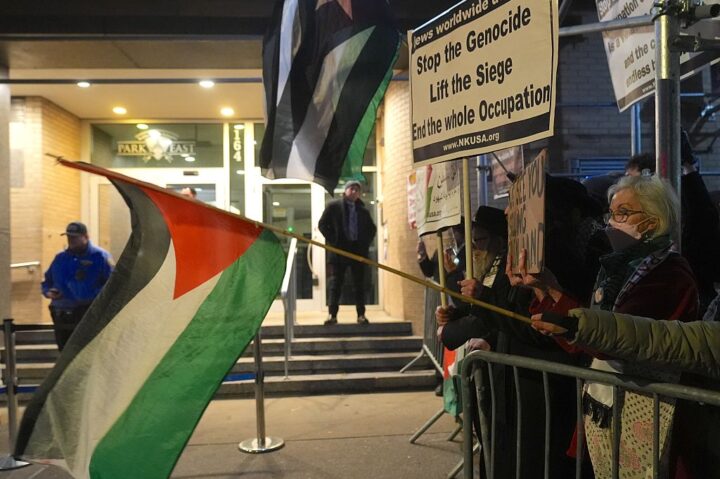
Selçuk Acar/Anadolu via Getty Images
Anti-Israel demonstrators gather at 'No Settlers on Stolen Land' protest against a Nefesh b'Nefesh event at the Park East Synagogue in Manhattan in November 2025.
As anti-Israel demonstrators increasingly target synagogues in protests that have turned violent and used antisemitic rhetoric, some Jewish leaders and state lawmakers are now calling for more expansive legislative safeguards to help bolster protections for houses of worship.
The new efforts have come in the wake of threatening behavior outside synagogues in New York City and Los Angeles that drew forceful condemnation from elected officials and raised concerns among Jewish leaders who fear that such incidents will normalize antisemitic harassment disguised as anti-Zionism.
In New York, state lawmakers this week introduced a new bill to ban protests directly outside houses of worship. The legislation seeks to amend the existing state penal law by establishing a 25-foot buffer zone around religious sanctuaries to insulate congregants from facing intimidation and potential clashes with demonstrators that have occurred more regularly in recent years.
The bill, which would also apply to abortion clinics, was advanced in response to a controversial protest last month outside Park East Synagogue, a Modern Orthodox congregation in Manhattan, where about 200 activists disrupted an event educating attendees about immigration to Israel while chanting slogans including “death to the IDF” and “globalize the intifada,” interpreted as calls to violence against Jews.
“We’re in a very troubled time, and that’s going to mean we need to adapt, including with legislation,” Micah Lasher, an assemblyman in Manhattan who introduced the legislation with a fellow Jewish state senator, Sam Sutton, told Jewish Insider on Thursday.
He said that he had weighed free speech concerns while drafting the bill to protect “the right of people to speak out, even when that speech is hateful, with the right of people to express their religion freely.”
“We’re going to see more and more of this until we can more broadly curb antisemitism,” he cautioned, calling the protest in Los Angeles this week, which ended in the arrests of two demonstrators, “a harbinger of things to come” in the absence of further legislative action.
Nily Rozic, a Democratic assemblywoman from Queens who is co-sponsoring the bill, echoed that view. “Houses of worship should serve as peaceful sanctuaries, not punching bags for protesters,” she explained. “Following incidents in NYC and LA, it’s becoming apparent that creating no-protest zones outside houses of worship is absolutely necessary.”
In contrast with the incident in New York City, the protest that erupted in Los Angeles on Wednesday was more intrusive, with video showing anti-Israel demonstrators shouting inside the historic Wilshire Boulevard Temple — where one activist shattered a vase during a public safety event held with Korean community members.
Jewish community activists in California said they viewed the incident, coupled with the recent protest in New York City, as an impetus to take a closer look at state law relating to such demonstrations.
Julia Mates, the director of policy and government affairs at Jewish Community Relations Council Bay Area, said that the state already has an existing law that protects access to houses of worship as well as abortion clinics — similar to the federal Freedom of Access to Clinic Entrances Act, which has been used by the Justice Department under President Donald Trump to target protesters charged with disrupting Jewish spaces.
Mates said that her organization last year had “started to reexamine the act” with an eye toward potentially expanding what she called the “bubble zone” protecting congregants, but tabled that effort in favor of focusing exclusively on legislation aimed at countering antisemitism in public schools.
But now, in light of recent events, “it might be a good time to reexamine a fixed distance rule and gaps in enforcement,” she told JI on Thursday.
“The environment is such that we need to take another look at this,” Tyler Gregory, CEO of the Bay Area JCRC, vowed. “This is getting a lot of chatter in the community. I think that Jewish legislators and organizations haven’t figured out where we want to land yet,” he continued. “But it’s certainly the topic du jour.”
Noah Farkas, who leads the Jewish Federation of Los Angeles, said that his organization, for its part, has “been pushing for” legislation to more forcefully regulate such demonstrations “for a long while.”
“While we recognize the right of anyone to assemble lawfully to express themselves,” he explained to JI Thursday, “it should not endanger the lives or limit the liberty of anyone else. And while this is a matter on a legal and political level of balancing one set of rights next to another, there is yet a deeper strain of values that needs to be addressed.”
Rep. Laura Friedman (D-CA), a Jewish Democrat from Los Angeles, said the Wilshire demonstration was “deeply personal,” noting that she had attended services at the synagogue during the High Holidays.
“At a time of surging antisemitism, no one should have to choose between their safety and their right to worship,” she said in a statement shared with JI. “I’ll always protect free speech, but when protests cross into criminal intimidation, threats or blocking access, authorities must step in to uphold the law and protect Americans’ right to gather and worship without intimidation.”
Julie Fishman Rayman, senior vice president of policy and political affairs at the American Jewish Committee, called the Los Angeles protest “horrific and beyond unacceptable,” while citing legal “tools that already exist and should be used to maximum impact” in order to hold anti-Israel demonstrators accountable.
As Jewish community activists are now considering efforts to strengthen such laws, Lasher said his new legislation “strikes the right balance” on free speech and safety issues, and “could potentially be a model for other states.”
“For as long as we’re dealing with these sorts of hateful events,” he said, “we should make sure we are giving appropriate tools that are constitutional to enable people to enter synagogues without fear of intimidation.”
New York Gov. Kathy Hochul, a Democrat, voiced interest in supporting the bill on Thursday, saying that she was “willing to look seriously at a buffer to protect that fundamental right we have, which is to express ourselves and practice the faith we choose to without fear and intimidation.”
“I don’t say whether or not I’ll support bills,” she told reporters, “but if it shows up in another place, I’m taking that very seriously. I think it’s time. I will be supportive of that.”
Zohran Mamdani, the mayor-elect of New York City and a democratic socialist long vocally critical of Israel, has also expressed interest in learning more about such legislation, after he had faced backlash for accusing the Park East Synagogue of promoting activities “in violation of international law,” even as he sought to distance himself from the protesters.
Mamdani’s team did not respond to a request for comment from JI about the newly proposed bill.
The deal reached last week ends the agreement made between the university and anti-Israel student protesters in the spring of 2024

Vincent Alban for The Washington Post via Getty Images
Northwestern University in Evanston, Ill. on Saturday, October 5, 2024.
Jewish leaders with ties to Northwestern University are cautiously celebrating a $75 million settlement reached on Friday with the Trump administration to restore federal funding that was frozen earlier this year over allegations that administrators failed to address campus antisemitism.
Under the agreement — which will restore at least $790 million in funding that was frozen in April — the Illinois private university agreed to end its commitment to the Deering Meadow agreement, a controversial pact made with anti-Israel encampment participants in the spring of 2024. The agreement allowed students to protest the war in Gaza until the end of the school year so long as tents were removed and encouraged employers not to rescind job offers for student protesters. The document also allowed students to weigh in on university investments — a major concession for students who had demanded the university divest from Israel.
The school’s settlement with the Department of Justice also stipulates that Northwestern commit to “clear policies and procedures” around demonstrations, protests and other “expressive activities” and implement mandatory antisemitism training for all students, faculty and staff.
“This is a major victory in the administration’s efforts to root out institutionalized antisemitism on college campuses,” Rich Goldberg, a senior advisor at the Foundation for Defense of Democracies who holds bachelor’s and master’s degrees from Northwestern, told Jewish Insider. “The White House won a complete termination of the deal Northwestern had cut with its pro-Hamas encampment along with an important ban on disrupting the campus while wearing masks. Now comes implementation and enforcement to ensure life improves for Jewish students and the university’s antisemitic DEI infrastructure gets fully dismantled.”
Goldberg said he’d also like to see Northwestern “welcome Chabad on to campus as a recognized Jewish organization, which would send a strong next signal of the university changing direction.”
“The agreement contains important commitments, but Northwestern has an extensive record of failing to enforce its own policies,” the Coalition Against Antisemitism at Northwestern said in a statement to JI. “The real test is whether the university finally delivers safety and equal treatment for Jewish students. We intend to monitor every step of implementation.”
“This agreement reflects progress, but Northwestern’s leadership still has a long way to go,” said CAAN, a coalition of Northwestern students, parents, alumni, faculty and trustees. “Jewish students have endured two years of escalating hostility, and trust will only be rebuilt through real enforcement.”
Michael Simon, executive director of Northwestern Hillel, told JI that in light of the deal, “We reiterate Northwestern Hillel’s unwavering commitment to working with University administrators, faculty and community partners to build on efforts underway to combat antisemitism and promote a campus climate that is safe and conducive to learning and exploration for everyone at Northwestern. The entire campus community has a critical role to play in countering antisemitism and all forms of hate.”
The settlement comes two months after Michael Schill, Northwestern’s former president, announced his resignation amid a series of controversies during his brief tenure. When anti-Israel encampments emerged on college campuses across the country in spring 2024, Schill, who is Jewish, became the first university president to strike a deal with demonstrators. The deal allowed the students to avoid disciplinary action taken and acceded to several demands of the protesters, which drew strong condemnation from many Jewish leaders at the time. In an August interview with the House Committee on Education and Workforce, Schill appeared unfazed to hear that a Palestinian professor he hired as part of the deal with encampment protesters had once met with slain Hamas leader Yahya Sinwar.
At the time of Schill’s resignation, Jewish alumni expressed optimism that his departure, and the House interview being made public, would lead Northwestern leaders to make reforms. Henry Bienen, who served as Northwestern president from 1995-2009, assumed the role of interim university president in September. Bienen previously established Northwestern’s Qatar campus, which has faced scrutiny for faculty ties to Hamas.
Bienen said in a video statement that under the settlement, the school would retain its academic freedom and autonomy from the federal government.
“There were several red lines that I, the board of trustees and university leadership refused to cross. I would not have signed anything that would have given the federal government any say in who we hire, what they teach, who we admit or what they study,” Bienen said. “Put simply, Northwestern runs Northwestern.”
Northwestern is required to pay $75 million to the federal government through 2028 without the use of donor funds. The figure is the second-highest fine any university has agreed to pay to the Trump administration so far, following Columbia University’s settlement of more than $200 million to the government in July. Several other elite institutions have reached deals with the Trump administration in recent months, including Columbia, Cornell University, Brown University, the University of Virginia and the University of Pennsylvania. Some of the settlements, such as Brown’s, have focused primarily on money, rather than campus reforms.
“Today’s settlement marks another victory in the Trump Administration’s fight to ensure that American educational institutions protect Jewish students and put merit first,” Attorney General Pam Bondi said in a statement. “Institutions that accept federal funds are obligated to follow civil rights law — we are grateful to Northwestern for negotiating this historic deal.”
The Texas senator recalled a conversation with Israeli PM Benjamin Netanyahu where he dismissed the severity of the issue on the American right
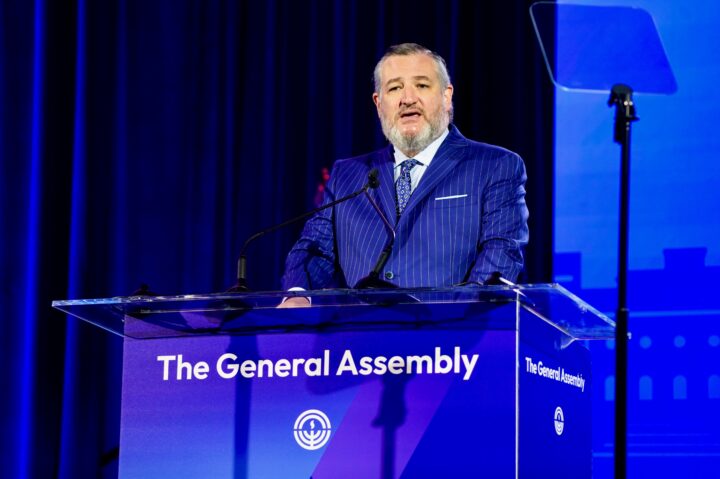
Jewish Federations of North America
Sen. Ted Cruz (R-TX) speaks at the Jewish Federations of North America's General Assembly on Nov. 18, 2025.
Sen. Ted Cruz (R-TX) upped the ante on his recent rhetoric targeting right-wing podcaster Tucker Carlson, telling a gathering of Jewish leaders in Washington that calling out antisemitism from Carlson and his Republican allies is necessary to defend American values. He said America faces an “existential crisis” if the rising antisemitism on the American right is not addressed.
“I do not want to wake up in five years and find that the Republican Party has become like the Democrat Party,” Cruz said on Tuesday at the Jewish Federations of North America’s General Assembly, which brought together 2,000 philanthropists, activists and Jewish communal professionals. “I do not want to wake up in five years and find that both major parties in America have embraced hatred of Israel and have tolerated, if not embraced, antisemitism.”
The conservative movement has faced internal division and tensions since Carlson hosted neo-Nazi Nick Fuentes on his podcast last month.
By digging in on his campaign against Carlson, Cruz further separated himself from President Donald Trump, who on Sunday night offered praise for the former Fox News host when he was asked about Carlson’s decision to do a friendly interview with Fuentes.
“He said good things about me over the years. I think he’s good,” Trump said. “You can’t tell him who to interview.”
Cruz, meanwhile, has gone after Carlson in increasingly sharp messages, after having his own heated interview with the podcaster in June — including at the recent Republican Jewish Coalition conference in Las Vegas, then at a Federalist Society conference in Washington and now at the GA.
In his latest speech, he did more than calling out Carlson and his Republican enablers. He made the case that countering Carlson’s influence is necessary for the future of America.
“That is a poison that not only does damage to Israel. That is a poison that does damage to America,” Cruz said. “And if we’re going to stop it, we’re going to stop it because we stand up and say, ‘No, this is not who we are. This is not what we believe. This is not what the Constitution and the Declaration [of Independence] were all about. This is not what America was all about.’”
At the GA, Cruz was addressing a friendly audience who had spent two days immersed in programming about antisemitism in America. But he warned that many people are not fully grasping the scope of the problem. He described a meeting with Israeli Prime Minister Benjamin Netanyahu this year where, he said, Netanyahu tried to push back on the idea that right-wing antisemitism was a threat.
“I’ll tell you, he actually was a little dismissive of that. He said, ‘No, no, no, that’s Qatar, that’s Iran, that’s bots,’” Cruz said. “My response: ‘Mr. Prime Minister, yes, but no. Yes, that’s happening. Yes, there are millions of dollars being spent to spread this poison. Yes, that’s happening online. But it is real and organic.’”
The misunderstanding, Cruz said, also exists in the Christian world.
“My message to the Christians is, this poison is spreading. There are pastors who love Israel, who think all is fine,” Cruz said. “My message to them is, ‘Go and talk to the teenagers in your congregation. Go and talk to the 20-somethings in your congregation, because they’re picking up their phone and they’re watching Tiktok and they’re watching Instagram, and they’re hearing this message being driven, and it is resonating.’”
The answer, Cruz said, is for other public officials — Republicans in particular — to speak out. But what’s at stake, he argued, is more than just their party or the Jewish community. He made the case that they must do so for the good of America.
“My hope is that we see other Republicans willing to stand up, willing to stand up and to be clear, willing to draw a line,” he said. “This is a fight worth fighting. Saving America is worth fighting. Bringing us back to our founding principles — that is worth fighting.”
At the JFNA General Assembly, Emanuel predicted that no candidates will travel to Israel in the 2028 Democratic presidential primary
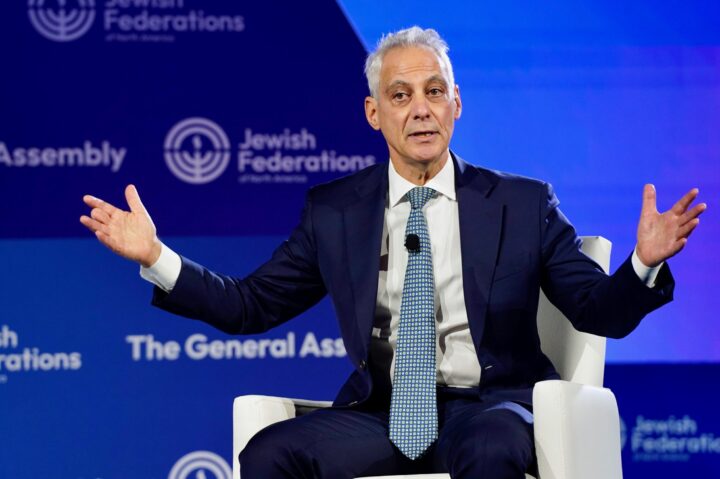
Jewish Federations of North America
Rahm Emanuel speaks at the Jewish Federations of North America's 2025 General Assembly opening plenary on Nov. 16, 2025.
Longtime Democratic official Rahm Emanuel offered a word of warning on Sunday night to the thousands of Jewish communal leaders gathered in Washington to kick off the Jewish Federations of North America’s General Assembly: Don’t expect 2028 presidential candidates to visit Israel like his old boss, Barack Obama, did on the campaign trail in 2008. He used an ice cream metaphor to make his point.
“If in 2024 the Democrats didn’t have a choice, in 2028 it’s going to be like Baskin-Robbins. There’s gonna be, like, 31 flavors. Some of us are gonna be chocolate mint. Nobody is going to Jerusalem,” Emanuel said at the opening plenary. “Nobody is leaving America to go travel to Jerusalem. That’s the politics. And it’s not just in the Democratic primary.”
Emanuel, Obama’s former chief of staff and the former U.S. ambassador to Japan, beseeched the attendees to reckon with the shifting political winds on Israel and work to make a stronger case for the U.S.-Israel relationship.
“For the generation under 30, the last two years will be as seminal a definition as what the Six-Day War was for those six days for a generation. We have our work cut out for us,” said Emanuel, who acknowledged that his message may not make him popular in a room of pro-Israel professionals. “This may be the last time I’m asked to speak to you.”
Emanuel has discussed the possibility of running for president in 2028, and this year has positioned himself as an independent-minded truth-teller willing to break with Democratic Party talking points. He urged the Jewish leaders, who are in Washington for a three-day conference focused on philanthropy and advocacy, to take stock of the task that awaits them.
“The task here is a major long-term rehabilitation of the narrative around what Israel needs, and if we don’t understand the depth of where we are, we’re never going to fix the problem,” said Emanuel, who was speaking on a panel with conservative CNN analyst Scott Jennings.
Emanuel described the American Jewish community as being “on the precipice,” when asked about a 2024 Atlantic article that argued that antisemitism on both sides of the aisle threatens to end the so-called “golden age” of American Jewish life.
“Whether that era, that golden era, closes or stays open for another generation is not only incumbent upon the people in this room, but incumbent upon all of us who believe in a set of values that, as noted, are universal,” he said. “I think what we’re seeing on the left and the right, not only about Israel, but now fully open about Jews and who they are, sits on the precipice. It can go either way.”
At the post-election Somos conference, Jewish officials tried to find areas of common ground with the new mayor
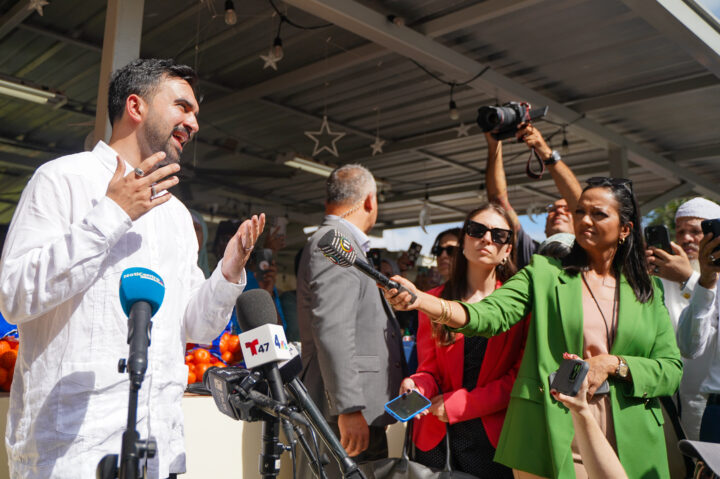
Angel Valentin/Getty Images
New York City Mayor elect Zohran Mamdani meets with the press after he joined members of the Centro Islamico del Caribe -Masjid Ebadur Rahman mosque in prayer, on November 7, 2025 in San Juan, Puerto Rico. Mamdani was in San Juan for the annual SOMOS political retreat.
SAN JUAN, Puerto Rico — The humid air was swelling with anticipation as thousands of New York politicos descended on Puerto Rico’s capital last week to attend the annual Somos conference, a multiday marathon of post-election elbow-rubbing where receptions and panels occur alongside covert negotiations and late-night schmoozing at local bars and hotels.
The extended Democratic gathering, which kicked off on Wednesday and continued into the weekend, was adjusting to the ascendant political order led by Zohran Mamdani, whose victory in New York City’s mayoral election earlier that week had upended the Democratic establishment and led to new alliances that until recently would have seemed improbable.
While Mamdani was still largely unknown during Somos last year, just weeks after announcing his long-shot mayoral bid, the 34-year-old democratic socialist and state assemblyman now seized the spotlight as attendees swarmed his arrival Thursday at the Caribe Hilton, where the incoming mayor was later fêted by some of the state’s top elected officials at a crowded beachside reception.
For many Jewish leaders who joined the Caribbean confab, however, the feeling was far more subdued, as they openly grappled with the sensitive question of how to work with a mayor-elect whose stridently anti-Israel views conflict with their own core values.
It is a wholly unfamiliar position for Jewish leaders and mainstream Jewish institutions in New York City, where the mayors have long been proudly pro-Israel. But Mamdani’s stunning rise challenged the conventional thinking that a winning candidate in New York, a place with the largest Jewish community of any city in the world, must show strong support for Israel. In breaking with decades of precedent, Mamdani still faced skepticism from a significant number of Jewish voters who cast their ballots for former New York Gov. Andrew Cuomo, who lost the Democratic primary and then ran as an independent. Exit polls showed that Cuomo, a vocal supporter of Israel, had doubled Mamdani among Jewish New Yorkers, with around two-thirds of the vote.
As Mamdani prepares to assume office in less than two months, Jewish leaders mingling at Somos were freshly processing his looming mayoralty with a mix of shock, hesitation and bemused detachment. Even if some voiced hope for a positive relationship, most were not ready to specify how they planned to move forward or what was expected of his administration.
One well-connected Jewish attendee cited the five stages of grief in characterizing the reactions among Jewish community leaders who had largely resisted engaging with Mamdani’s campaign. Many of them, it seemed, were dealing with the first stage of denial — and were far from finally reaching acceptance.
“We’re so screwed,” one Jewish political activist was overheard lamenting at an event on Friday evening.
Still, some Jewish community leaders who spoke with Jewish Insider over the course of the retreat suggested they were willing to give Mamdani the latitude to follow through on areas where they are aligned, pointing to a sort of provisional detente in the aftermath of a bruising and emotionally fraught election.
“The mainstream Jewish community is open to dealing with reality,” Noam Gilboord, the chief operating and community relations officer at the Jewish Community Relations Council of New York, said diplomatically while attending the conference.
The JCRC, for its part, has not yet held any direct meetings with Mamdani, though members of his team privately reached out about some key issues during the election and have continued to stay in touch, according to Mark Treyger, the group’s chief executive. The campaign gave a heads-up to JCRC leadership, for instance, before Mamdani publicly announced that he would ask Jessica Tisch to stay on as police commissioner, an encouraging choice to Jewish community leaders who favored her for the role.
“We are here to represent the transition with the Jewish community, and we’re so happy to be here,” Ali Najmi, a Mamdani confidante and chief counsel to the mayor-elect’s transition team, told JI in a brief exchange. “We see so many good friends and old friends, and we’re so looking forward to our new friends.”
Mamdani’s team also checked in with the JCRC after he had won the primary to give assurances that the newly anointed Democratic nominee was committed to providing continued security for its annual Israel Day on Fifth parade — even if he was unlikely to attend, as a supporter of the Boycott, Divestment and Sanctions movement against the Jewish state.
While Mamdani was absent from a Thursday night reception the JCRC hosted with the UJA-Federation of New York, he sent two of his top aides, Ali Najmi and Elle Bisgaard-Church, to join the event instead. They were warmly greeted by attendees in a public easing of tensions that would have been difficult to imagine just a few weeks ago.
“We are here to represent the transition with the Jewish community, and we’re so happy to be here,” Najmi, a Mamdani confidante and chief counsel to the mayor-elect’s transition team, told JI in a brief exchange. “We see so many good friends and old friends, and we’re so looking forward to our new friends.”
Najmi did not share further details regarding the transition’s formal plans to address Jewish issues, steps that are certain to be aggressively scrutinized in the coming months.
Yeruchim Silber, the director of New York government relations at Agudath Israel of America, an Orthodox advocacy group, said he appreciated the outreach and looked forward to meeting with Najmi again. “We’re hopeful that we could always find some common ground and work together,” he told JI during the reception. “Look, the mayor-elect said very clearly in his victory speech that he’s going to tackle antisemitism,” he added, “so we’ll take him at his word.”
“My understanding is there is interest in more formal Jewish outreach” from Mamdani’s team, said Phylisa Wisdom, the executive director of New York Jewish Agenda, a liberal Zionist group that has been receptive to the mayor-elect. Wisdom, who joined a private conversation with Mamdani at a Reform synagogue in Brooklyn before the election, said the appearance of his aides at the reception on Thursday demonstrated “a desire to be in all kinds of Jewish spaces they may not have been during the election,” in order to “build relationships and show goodwill.”
“This is a very, very divided time for the city, I think I can acknowledge that,” Mark Levine, the incoming city comptroller who endorsed Mamdani, said in his remarks to the room.
Mamdani, whose presence at formal Somos events drew throngs of eager admirers seeking selfies with the mayor-elect, likewise steered clear of an annual Shabbat gathering convened by the Met Council, the Jewish anti-poverty charity. Despite his victory, the event, which featured Rep. Gregory Meeks (D-NY), New York state Attorney General Letitia James and other prominent officials, made no direct allusion to Mamdani — further highlighting his uncomfortable relationship with the Jewish community.
Instead, the speakers at the Met Council’s widely attended reception zeroed in largely on such issues as hunger, poverty and the Trump administration’s efforts to withhold payments for food stamps amid the government shutdown.
“This is a very, very divided time for the city, I think I can acknowledge that,” Mark Levine, the incoming city comptroller who endorsed Mamdani, said in his remarks to the room.
Levine, who is Jewish, is now facing pressure from some Mamdani allies to divest the city from Israel bonds. He has refused to change course, saying last week that he has “criticism of the Israeli government” but still maintains “deep personal ties to Israel.” Mamdani, meanwhile, has voiced support for ending “the practice of purchasing Israel bonds,” though Levine has indicated he does not believe the mayor-elect has the power to enforce such a policy.
The Shabbat reception was disrupted by anti-Israel protesters two years ago, weeks after Hamas’ Oct. 7, 2023, attacks. But no such demonstrations occurred last Friday.
Mamdani, who will soon become New York City’s first Muslim and South Asian mayor, has frequently vowed to fight rising antisemitism. The day after the election, he swiftly moved to condemn vandalism of a Jewish day school in Brooklyn that was defaced by swastika graffiti, calling the attack a “disgusting and heartbreaking act of antisemitism” and pledging to “always stand steadfast with our Jewish neighbors to root the scourge of antisemitism out of our city.”
In his outreach to different parts of the Jewish community and in his public remarks during the election, Mamdani called for increased funding to prevent hate crimes and boosting police protection at Jewish institutions. He has expressed interest in a city curriculum backed by leading Jewish groups, even as it uses a definition of Zionism contradicting his own views on Israel. Mamdani has said he does not recognize Israel as a Jewish state.
Despite his pledges to counter antisemitism, that tension underscores how many Jewish leaders see his positions as an active threat and an impediment to upholding support for Israel, as the war in Gaza has fueled deep divisions in the Democratic Party.
Mamdani’s anti-Israel stances have provoked concerns that he will act on his views when he takes office. He has indicated, for instance, that he would reassess the partnership between Cornell University and Israel’s Technion, situated on Roosevelt Island. He has also pledged to arrest Israeli Prime Minister Benjamin Netanyahu for war crimes if he steps foot in New York City, in a controversial move that legal experts have questioned as legally dubious.
Mamdani has faced scrutiny for his ties to the Democratic Socialists of America, whose avowedly anti-Zionist mission includes demands that the mayor-elect implement several policies that would sever New York City’s relations with Israel. His refusal to explicitly condemn calls to “globalize the intifada” have otherwise continued to frustrate Jewish community leaders.
Robert Tucker, a Jewish philanthropist who had served as the commissioner of New York City’s Fire Department until last week, announced that he was resigning after Mamdani’s win, reportedly owing to the mayor-elect’s anti-Zionist stances.
But some Jewish leaders at Somos speculated that Mamdani may now see his vocal opposition to Israel as an albatross as he seeks to enact an ambitious affordability plan that will need buy-in from the state leadership.
During his time at Somos, the mayor-elect seemed careful to largely avoid the issue. “I will make clear that we are not looking to remake New York City in my image,” he said in remarks at a labor breakfast Saturday. “We are looking to remake it in the image of struggling workers across the five boroughs.”
In comments to a mosque he visited in San Juan, where the imam had mentioned Palestine during his own sermon, Mamdani spoke in metaphorical terms as he addressed the audience. “If you are not at the table, you may find yourself on the menu,” he noted. “It was a Muslim brother, Malcolm X, who reminded us that sitting at the table does not make you a diner. You have to be eating some of what’s on that plate.”
Still, some of Mamdani’s allies on the far left indicated that they were eager to use momentum from his victory to push a more hostile view of Israel into the mainstream discourse and to challenge incumbents who accept donations from AIPAC while promoting pro-Israel policies.
In a panel discussion on Thursday billed as “Colonialism, Resistance and Solidarity: Puerto Rico and Palestine,” Mamdani’s supporters — including City Councilmember Alexa Avilés, Beth Miller of Jewish Voice for Peace Action and Linda Sarsour, a Palestinian-American activist who has spread antisemitic rhetoric — were emboldened by his recent win, as attendees chanted “From the river to the sea, Palestina will be free!” and “Viva, viva Palestina!” Sarsour described Mamdani’s election as “a new day” and said “we’re not going back.”
“Being someone who supports the Palestinian people is no longer a political liability,” Sarsour, who has vowed to hold Mamdani “accountable” as mayor, told the room. “It is what gets you elected into office.”
In statements following the election, a range of Jewish organizations promised to hold Mamdani responsible for keeping Jews in New York City safe. The mayor-elect’s “victory marks the beginning of a new political chapter for New York, one that many in our community view with enormous concern,” Eric Goldstein, the CEO of the UJA-Federation of New York, said in a letter to supporters. “His rhetoric on Israel and Zionism raises serious questions about whether Jewish New Yorkers will continue to feel seen and protected in the very city we indelibly helped build and grow.”
He said the Jewish community would be watching closely to ensure “that antisemitism is not given any oxygen in our neighborhoods,” adding that “actions matter more” than “words.”
Rabbi Ammiel Hirsh, who leads Stephen Wise Free Synagogue on Manhattan’s Upper West Side, said in a post-election sermon that he “will readily engage in dialogue” with Mamdani if he chooses to reach out. “We will support Mayor Mamdani’s policies where we can — and oppose them when we must,” he concluded.
New York Gov. Kathy Hochul, who, at Somos, celebrated Mamdani’s win, also stressed to reporters on the sidelines of the conference that Jewish New Yorkers still need to “see action” from the mayor-elect to address their concerns. “That’s one area where I know that there’s some opportunities for him to demonstrate, as he has said, but also demonstrate that he is there to protect all New Yorkers, to protect anyone’s right to worship or their beliefs but also their institutions,” she explained.
The Anti-Defamation League, for its part, launched a “Mamdani Monitor” to track policies that could impact Jewish safety and security. Jewish leaders in attendance at Somos, however, voiced reservations with the effort, suggesting they did not see it as productive as some in the community look for common ground to work with the mayor-elect.
Others voiced hope that a leading candidate for City Council speaker, Julie Menin, who is Jewish, would serve as a counterweight to Mamdani — in contrast with a leftist rival, Crystal Hudson, seen more as an ally of the mayor-elect. Menin, who declined to join a meeting between Mamdani and Jewish officials in the primary, is known as an outspoken supporter of Israel in the City Council.
New York Gov. Kathy Hochul, who, at Somos, celebrated Mamdani’s win, also stressed to reporters on the sidelines of the conference that Jewish New Yorkers still need to “see action” from the mayor-elect to address their concerns. “That’s one area where I know that there’s some opportunities for him to demonstrate, as he has said, but also demonstrate that he is there to protect all New Yorkers, to protect anyone’s right to worship or their beliefs but also their institutions,” she explained.
Hochul, for her part, has also drawn backlash from Jewish donors for choosing to back Mamdani’s campaign in the general election, people familiar with the situation told JI. “She’s got a lot to prove,” one Jewish leader said of the governor, long regarded as a staunch defender of Israel.
Rep. Dan Goldman (D-NY), a pro-Israel Jewish Democrat who declined to endorse Mamdani in the general election, told JI at Somos that, despite their disagreements on Israel, he was looking forward to working with the mayor-elect on areas of alignment such as cost of living issues.
But some Jewish community activists were more suspicious of the incoming mayor. One Brooklyn organizer dismissed the possibility of working with Mamdani outright, saying that his stances on Israel had foreclosed any hope of finding common ground, even on unrelated issues.
Leon Goldenberg, an Orthodox business leader in Brooklyn who serves as an executive board member of the Flatbush Jewish Community Coalition, which endorsed Cuomo in the general election, told JI that he has been struggling to decide whether he will ask Mamdani for a meeting.
“I’m really at a loss,” he said on Thursday. “What are we going to talk about, Israel?”
The FJCC itself, which long enjoyed a close relationship with outgoing Mayor Eric Adams, was more optimistic, according to Josh Mehlman, the group’s chairman. “We have met, and will meet with them again,” he said of Mamdani’s team. “We are confident we can work together for the best interest of the Flatbush community and the Orthodox Jewish community citywide.”
OU Executive VP Rabbi Hauer unexpectedly passed of a heart attack earlier this week
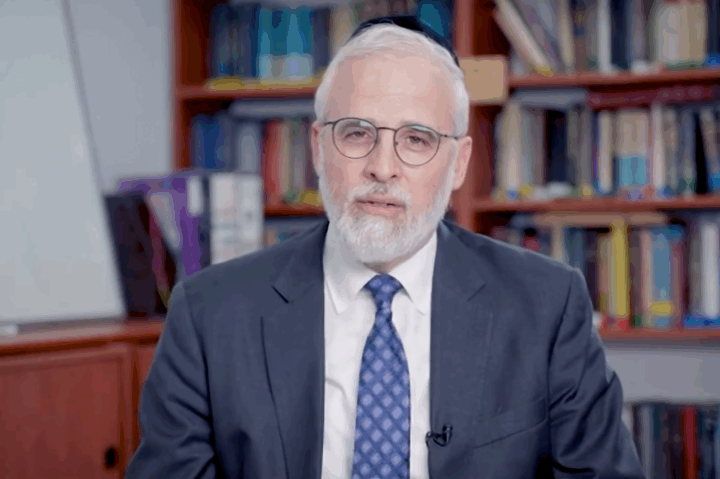
Screenshot/Youtube
Rabbi Moshe Hauer
Rabbi Moshe Hauer, the executive vice president of the Orthodox Union, died suddenly on Monday evening after suffering a heart attack, his organization said. He was 60.
Jewish communal leaders remembered Hauer as a friend, a bridge-builder, a faithful and committed leader and a source of wise counsel.
Hauer had served in his role at the OU since May 2020, acting as the organization’s professional and rabbinic leader and primary spokesperson, as well as helping to lead the organization’s outreach to U.S. administration officials and lawmakers.
“Rabbi Hauer was a true talmid chacham, a master teacher and communicator, the voice of Torah to the Orthodox community and the voice of Orthodoxy to the world. He personified what it means to be a Torah Jew and took nothing more seriously than his role of sharing the joy of Jewish life with our community and beyond,” OU President Mitchel Aeder and Chief Operating Officer Rabbi Josh Joseph said in a joint statement.
“Rabbi Hauer’s leadership was marked by unwavering dedication, deep compassion, and a vision rooted in faith in Hashem, integrity, and love for Klal Yisrael,” Aeder and Joseph continued. “Whether through his inspiring words, thoughtful counsel, powerful advocacy, or quiet acts of kindness, Rabbi Hauer uplifted those around him and made an impact on every person he encountered.”
Prior to his role at the OU, Hauer served for more than 26 years as the lead rabbi at Bnai Jacob Shaarei Zion Congregation in Baltimore.
William Daroff, the CEO of the Conference of Presidents of Major American Jewish Organizations, told Jewish Insider he was “shattered by the sudden passing of my dear friend and partner, Rabbi Moshe Hauer.”
“We just spoke this past Friday and texted on Monday, when he was overflowing with joy at the miracle of the hostages’ freedom and the unmistakable hand of Hashem in it. Rabbi Hauer was a trusted advisor, cherished colleague, and wise counselor to me, a bridge-builder whose faith, humility, and moral clarity inspired all who knew him. His loss leaves a deep void for all who loved and learned from him,” Daroff continued.
“He was a wise and thoughtful leader for so many dimensions of the OU’s activities — That included his partnership with me in advocacy,” Nathan Diament, the OU’s executive director of public policy, told JI. “Rabbi Hauer deeply believed in the imperative for the Orthodox community to be fully and proactively engaged with the world at large — not isolated from it. And for us to work to better society by advancing Torah values. In fact, the last time I was with him in person was just a couple of weeks ago — we met with senators and senior White House officials to discuss key issues and values.”
Israeli President Isaac Herzog mourned Hauer as “a true leader and teacher in the Jewish world,” in a post on X.
“Each and every conversation I was privileged to have with him was so very meangiful [sic] and showed his warmth and kindness, and his unwavering love for Torah, Israel, Zionism, and the Jewish people,” Herzog wrote.
Despite ideological and theological differences, Hauer maintained friendships and partnerships with Jewish leaders across the ideological spectrum and rejected claims that progressive and liberal Jews were “self-hating,” telling eJewishPhilanthropy last year that he “bristle[s] and object[s]” to the canard.
Sheila Katz, the CEO of the National Council of Jewish Women, said in a Facebook post, “Some leaders shape institutions. Others shape hearts. Rabbi Moshe Hauer did both.”
“After October 7, we found ourselves advocating side by side at the Department of Education and Department of Justice, in Congress, in the White House, and in the Knesset, determined to show what Jewish unity could look like,” Katz said. “It wasn’t unity for its own sake, but unity in service of the Jewish people, to advocate together for Jewish women, for the Orthodox community, and for all of us. Him, an Orthodox male rabbi. Me, a Reform Jewish progressive woman. Together, we were an unlikely duo that came together to advocate against antisemitism, to promote safety in Israel, and for the return of the hostages.”
“I’m grateful he lived to see all the living hostages come home. But I’m heartbroken that we won’t get to be with him for all that’s next, for the rebuilding, the hope, and the unity he modeled so powerfully,” Katz continued. “All we can do is continue to build a better world with love, and with Jewish life and wisdom, to honor the memory of our dear friend, Rabbi Hauer.”
Hauer was ordained at Ner Israel in Maryland and received a graduate degree from Johns Hopkins University.
According to the OU, during his time at Bnai Jacob Shaarei Zion he “was active in local communal leadership in many areas, with an emphasis on education, children-at-risk, and social service organizations serving the Jewish community… led a leadership training program for rabbis and communal leaders, and was a founding editor of the online journal Klal Perspectives.”
eJewishPhilanthropy‘s Judah Ari Gross contributed to this report.
Former Rep. Cori Bush, one of the most extreme critics of Israel, is planning to run against Rep. Wesley Bell for a second time
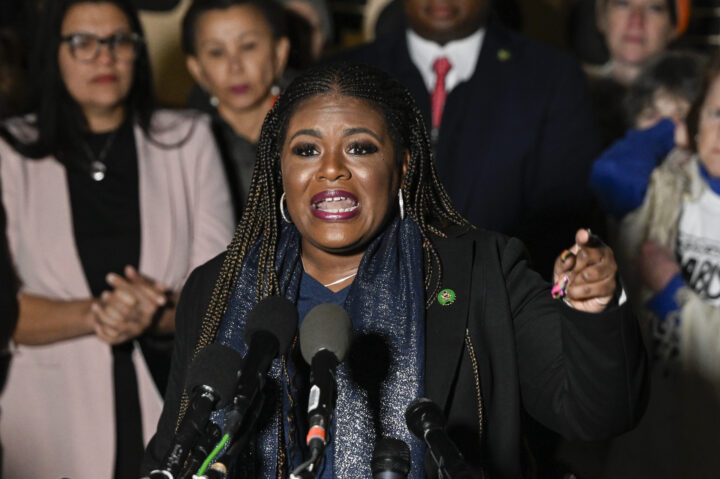
Celal Gunes/Anadolu via Getty Images
Rep. Cori Bush at a press conference in front of the U.S. Capitol to call for a ceasefire in Gaza on November 13, 2023.
Former Rep. Cori Bush (D-MO), one of the most virulently anti-Israel members of Congress during her tenure in Washington, is expected to launch a rematch against Rep. Wesley Bell (D-MO), who defeated her in 2024, according to political observers in St. Louis.
Local Jewish leaders expect the primary campaign to be a bitter repeat of the 2024 campaign, which focused heavily on Israel. Bell, who garnered substantial support from the Jewish community locally and pro-Israel groups nationally, has remained a strong supporter of Israel in office, even amid criticism from local progressive activists.
Braxton Payne, a St. Louis-based political strategist, described Bush’s intentions as “the worst-kept secret” and the St. Louis Post-Dispatch reported she may launch as early as this week, citing sources close to her campaign.
Payne said that this cycle, when Bell is still a freshman, would be Bush’s best chance of ousting Bell and reclaiming her seat.
“Her strongest place is inside the city [of St. Louis] and you’re seeing… a strong pendulum swinging in regards to the conflict in Gaza and Palestine, and I think that is going to be probably one of her main narratives that she’ll lead with,” Payne told Jewish Insider. “Among some of the progressive votes, especially among her base in St. Louis City, I think she’s going to do fairly well with those people.”
But one of Bush’s biggest vulnerabilities, he continued, is that she failed, once in office, to engage with or show up for major local groups and organized labor.
“That still seems to be the case. … And Wesley has made a conscious effort to do so, not only with organized labor that may have backed him, but people and organizations that did not back him,” Payne continued, “which I think is obviously important to currying favor among voters — and obviously large groups that have power, influence and, of course, money.”
Payne said that the race is likely to be close, and that there will likely be similar interest in the race from outside groups, like AIPAC, that invested heavily in 2024. Primary turnout could be impacted by other referenda on the ballot, which could fuel Democratic primary turnout.
Missouri recently redrew its congressional maps and, while Bell’s district was not changed significantly, the redrawn map includes a few additional precincts that may be more favorable to Bell, according to Payne, though the impacts will likely be minor. The maps also face various legal challenges.
Bush’s campaign is also $13,000 in debt, and she’ll need significant grassroots support and/or backing from a group like Justice Democrats to fill her coffers, Payne noted.
Her husband is facing a federal indictment for COVID relief aid fraud, a controversy Payne said has garnered public attention. Bush herself faced House Ethics Committee and Department of Justice investigations during her time in office.
At the same time, Payne noted, the strategy for groups backing Bell, including organized labor and AIPAC, is unknown. If AIPAC gets involved in the race, “even if they spend a bunch of money, does that actually end up hurting him with voters more than it does helping him?”
Bell’s supporters are signaling that they’re ready for a fight.
“Cori Bush spent her scandal-ridden time in Washington looking out for herself, while hiding from her constituents and ignoring their needs,” a Democratic strategist familiar with the Bell campaign’s thinking said. “As a result, Missouri voters kicked her out of office, and elected Wesley Bell, who promised to deliver better and more accountable representation. St. Louis is better off with a congressman who is focused every day on delivering for them, than someone who is more interested in furthering her personal agenda.”
Jewish leaders who supported Bell’s campaign also say that they are preparing for the campaign ahead, and a retread of the ugly 2024 race.
“The mainstream Jewish community is very much united in supporting Wesley Bell, and obviously not supporting Cori Bush for all of the same reasons we were not going to support her last time,” Rabbi Jeffrey Abraham, who helped organize a coalition of rabbis to oppose Bush in the previous campaign, told Jewish Insider. “The Jewish community, I’m confident, is going to rally again to support Wesley and hopefully make sure that he wins.”
He said he’s hopeful that leaders who did not get involved in the previous race might get involved to back Bell this time. “Jewish community leaders are ready to jump back in however we’re needed.”
Stacey Newman, a former state lawmaker who led Jewish outreach on Bell’s campaign team, agreed that the “mainstream Jewish community has remained organized and united” — in addition to feeling the impacts of antisemitism hit home in a recent firebombing incident.
“We won’t have to start from scratch,” Newman continued. “We still have 30-plus rabbis willing to go to work. I know the Orthodox community who typically do not vote Democrat are very thankful for Wesley’s leadership. He’s one of the few Democrats in St. Louis who are willing to support our community publicly.”
Plus, NY Jewish leaders fearful of Mamdani mayoralty

Jacquelyn Martin/AP
Qatari Prime Minister and Minister of Foreign Affairs Sheikh Mohammed bin Abdulrahman bin Jassim Al-Thani, attends a news conference about the Israel-Hamas war, and pressure to reduce civilian casualties, Friday, Dec. 8, 2023, in Washington.
Good Thursday morning.
In today’s Daily Kickoff, we talk to Jewish leaders who are reacting with fear and resignation to the increasing likelihood that Zohran Mamdani will be the next mayor of New York City, and cover remarks made by Sen. Elissa Slotkin about rising left-wing antisemitism. We report on House Speaker Mike Johnson’s efforts to push back on GOP isolationists and cover Education Secretary Linda McMahon’s comments about the Trump administration’s settlements with universities over campus antisemitism. Also in today’s Daily Kickoff: Richard Goldberg, Mimi Kravetz and Ken Marcus.
Today’s Daily Kickoff was curated by Jewish Insider Israel Editor Tamara Zieve and U.S. Editor Danielle Cohen-Kanik. Have a tip? Email us here.
What We’re Watching
- The Senate Committee on Health, Education, Labor and Pensions is holding a hearing this morning on the state of K-12 education.
- The Atlantic Festival begins in New York City today, opening with a session including former Vice President Mike Pence and former National Security Advisor H.R. McMaster.
- The Washington Institute for Near East Policy is holding a policy forum today on “Recognizing ‘Palestine’: Rationale, Expectations, Implications” with speakers Rob Satloff, the Washington Institute’s executive director, and Tal Becker, former legal advisor to the Israeli Foreign Ministry.
- The American Jewish Historical Society is hosting an interview with media executive Barry Diller about his recent memoir, Who Knew.
- Tonight, the Israeli Embassy will host its Rosh Hashanah reception in Washington.
- United Hatzalah will hold its 2025 Los Angeles gala with honorary guest Gal Gadot. Israeli Eurovision performer Yuval Raphael will receive United Hatzalah’s Hero Award and American venture capitalist Shaun Maguire will receive its Am Israel award.
What You Should Know
A QUICK WORD WITH JI’S LAHAV HARKOV
In the aftermath of Israel’s strike aimed at Hamas leaders in Qatar, questions have emerged about how much the U.S. knew, the extent of President Donald Trump’s frustration with Israel’s actions and what it means for the U.S.-Israel relationship.
But another important question is whether the strike marks a turning point for Qatar — and whether the Gulf nation may now be considering a shift in its own role and behavior.
The fact that the Trump administration has not dwelled on the attack — even sending Secretary of State Marco Rubio to Israel for a warm visit days after the strike — may give Doha pause. While Press Secretary Karoline Leavitt said the strike “did not advance Israel or America’s goals,” in the next breath, she said that “eliminating Hamas, who have profited off the misery of those living in Gaza, is a worthy goal.” That goes against the Qataris’ preferred narrative, that the U.S. wants it to host terrorists because they’re the only conduit to Hamas, the Taliban and others.
With that in mind, Qatar could reconsider the business of harboring terrorists, because it has become risky and could impact its relations with Western companies and institutions. Though the UAE was not in the terror-supporting business and has long opposed the Muslim Brotherhood, it didn’t prevent people like Hamas terrorist Mahmoud al-Mabhouh from visiting the UAE until the Mossad killed him in Dubai in 2010. The Emiratis publicly railed against Israel and the then-quiet relations between the countries were set back, but the UAE cracked down and banned such individuals associated with terror groups from entering their country.
However, Qatar does not seem to be taking recent events as a signal to change. Doha roundly condemned Israel, threatened to stop mediating hostage talks and convened an Arab summit to condemn Israel further. Senior Hamas official Ghazi Hamad appeared on Al Jazeera yesterday, with the chyron stating that he was in Doha, and the wife of senior Hamas official Khalil al-Haya was spotted visiting the grave of her son, killed in the strike, with Qatari security. On Tuesday, the Qatari Defense Minister hosted his Taliban counterpart.
And while Qatar could respond to the strike by turning away from America, it does not seem to have done that, either. Doha publicly denied reports that they were reconsidering its relationship with Washington. After its initial statement, Qatar said it would continue mediating Gaza hostage and ceasefire talks, and shifted to blaming Israeli Prime Minister Benjamin Netanyahu, rather than Israel, broadly. Doha softened its language in Arabic to describe the hostages, moving from “prisoners” to “captives,” according to Ariel Admoni, a Qatar expert at the Jerusalem Institute for Strategy and Security (JISS).
BITING THE BULLET
New York Jewish leaders reckon with a potential Mamdani win
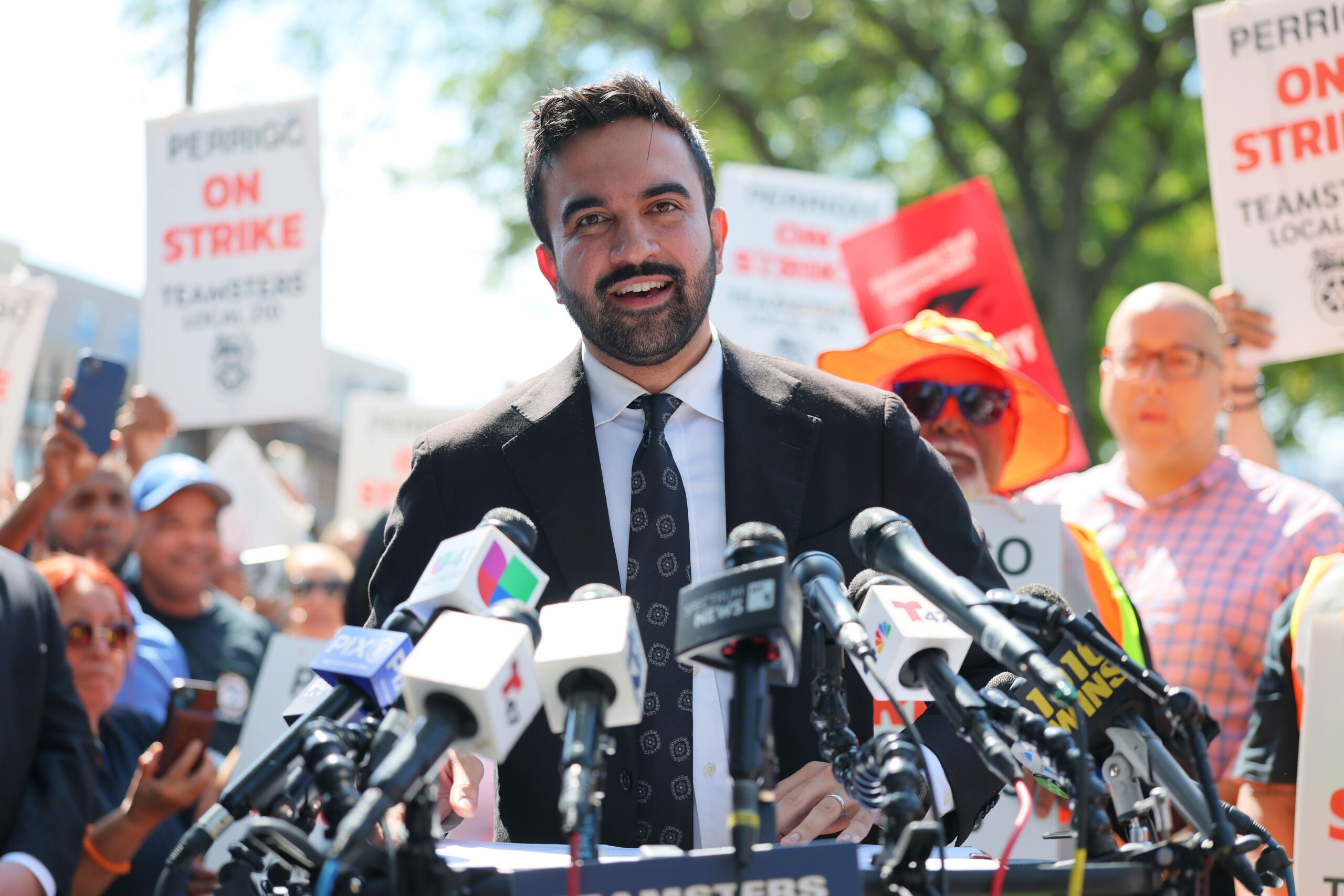
As Jewish leaders reckon with the increasing likelihood that Zohran Mamdani will be the next mayor of New York City, many who have voiced anxiety over his avowedly anti-Israel policies are reacting with a mix of fear and resignation. Their concerns have been mounting as Mamdani, the Democratic nominee, has continued to hold a comfortable lead in the race, where polling shows him handily prevailing over the divided field, Jewish Insider’s Matthew Kassel reports. The 33-year-old democratic socialist and Queens state assemblyman has recently claimed endorsements from prominent party leaders including New York Gov. Kathy Hochul, who clarified she does not agree with him on Israel issues but said she appreciated his commitment to combating antisemitism as well as his efforts to meet with Jewish community members to address “their concerns directly.”
Community concerns: But multiple Jewish leaders said in interviews with JI on Wednesday that they remain deeply skeptical of his campaign’s outreach and pledges to confront rising antisemitism, citing a string of recent statements in which he has doubled down on his hostile approach to Israel — as well as an ongoing refusal to explicitly denounce extreme rhetoric espoused by his allies on the far left. “I believe that he will genuinely work to drive a wedge between Jews and their neighbors as long as he serves in public office,” Sara Forman, executive director of New York Solidarity Network, a group that supports pro-Israel Democratic candidates for state and local office, told JI. “To this date,” she said of Mamdani, “his actions certainly have given us no indication they match his words.”
calling it out
Sen. Slotkin sounds alarm on left-wing antisemitism at Jewish security briefing

Sen. Elissa Slotkin (D-MI), speaking on Wednesday to a gathering of Jewish activists on Capitol Hill, highlighted concerns about rising left-wing antisemitism and the ways that antisemitic narratives are being spread to and by college students, Jewish Insider’s Marc Rod reports.
What she said: “We’re used to the right-wing side. What is new and what I think has so many in the Jewish community on our heels is that new left-wing antisemitism and how to approach it,” Slotkin said at a pre-High Holidays security briefing organized by several Jewish communal organizations. “How do we counteract it? How do we protect against it? How do we educate? And certainly, we’re watching, on many college campuses, a lot of young people who actually maybe didn’t grow up with the Jewish community at all, get to campus and maybe repeat what they’re hearing, sometimes not even understanding or knowing,” she continued. “I would just say that one of our responsibilities as Jewish leaders and Jewish activists is to try and really parse through how to deal with antisemitism on the left, since antisemitism on the right isn’t good, but it’s more of a well-known threat.”
HOLDING THE LINE
Johnson discusses efforts to push back on GOP isolationists with pro-Israel leaders

House Speaker Mike Johnson (R-LA) spoke about his efforts to hold the line against the isolationist wing of the Republican Party in a private meeting with pro-Israel leaders on Capitol Hill on Wednesday, several individuals who attended the meeting told Jewish Insider’s Marc Rod. Johnson, who described himself to the group as a “Reagan Republican” focused on “peace through strength,” acknowledged that isolationism is rising in the Republican Party, and that the party is likely bound for a major debate on the issue after President Donald Trump leaves office.
Preventative action: Johnson also told the group that, in his candidate recruiting efforts, he’s working to filter out isolationists to prevent that wing of the party from growing larger in the House, four people who attended the meeting said. “The speaker was very, very direct about the U.S. role with Israel and in the world and understands that there are voices that don’t agree in both parties, on both extremes, and urges us all to be involved in fighting back against those extremes,” Eric Fingerhut, the CEO of the Jewish Federations of North America, told JI.
education cooperation
Education Secretary McMahon says administration not looking for prolonged legal battle with Harvard
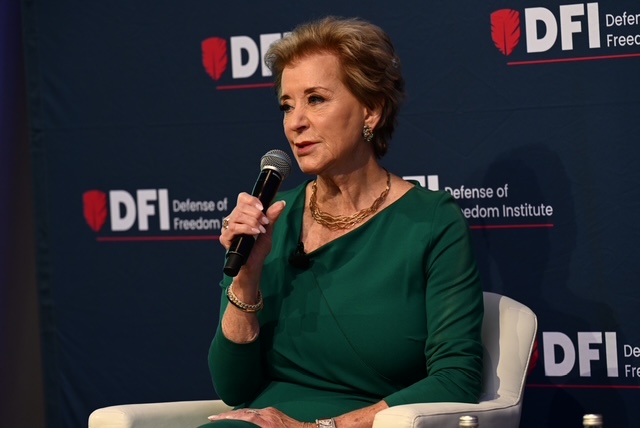
Education Secretary Linda McMahon said on Wednesday that the Trump administration’s goal is not to engage in a prolonged legal battle with Harvard University and expressed hope that the federal government would be able to reach a settlement that delivers meaningful reforms to the elite campus. McMahon made the comments while appearing at the Federalist Society and the Defense of Freedom Institute’s annual Education Law & Policy Conference on Wednesday morning, after being asked during a moderated conversation with Washington Examiner politics editor Marisa Schultz where negotiations between Harvard and the administration stand, Jewish Insider’s Emily Jacobs reports.
McMahon’s mission: “I’m certainly hopeful on the settlement. I have spoken to Alan Garber, their very good president, at the very beginning of this. I haven’t spoken to him since, but I do think that with the idea that Harvard has already started to take certain measures to change what they were doing, I certainly hope that there will be an agreement,” McMahon said. “It’s not our goal to have to go to court to make people abide by the law, to make universities abide by the law.” Asked by Schultz about the ongoing negotiations with the University of California, Los Angeles and other schools, and how the settlements fit into the Trump administration’s “big picture mission for elite universities and colleges in America,” McMahon said that their “goal is really not to be punitive necessarily, but to have universities, I think, return to what we all believe that universities started out to be.”
Backing McMahon: Ken Marcus, the founder of the Louis D. Brandeis Center for Human Rights Under Law, said on Wednesday that he had faith in McMahon to ensure that any settlements the Trump administration were to make with Harvard University or other schools would ensure concrete reforms to address campus antisemitism.
OU Action: Members of the Orthodox Union Advocacy Center met with McMahon yesterday to discuss federal efforts to counter antisemitism and new legislation promoting school choice, Jewish Insider’s Marc Rod reports.
EXPLAINING SNAPBACK
What to expect from snapback sanctions on Iran
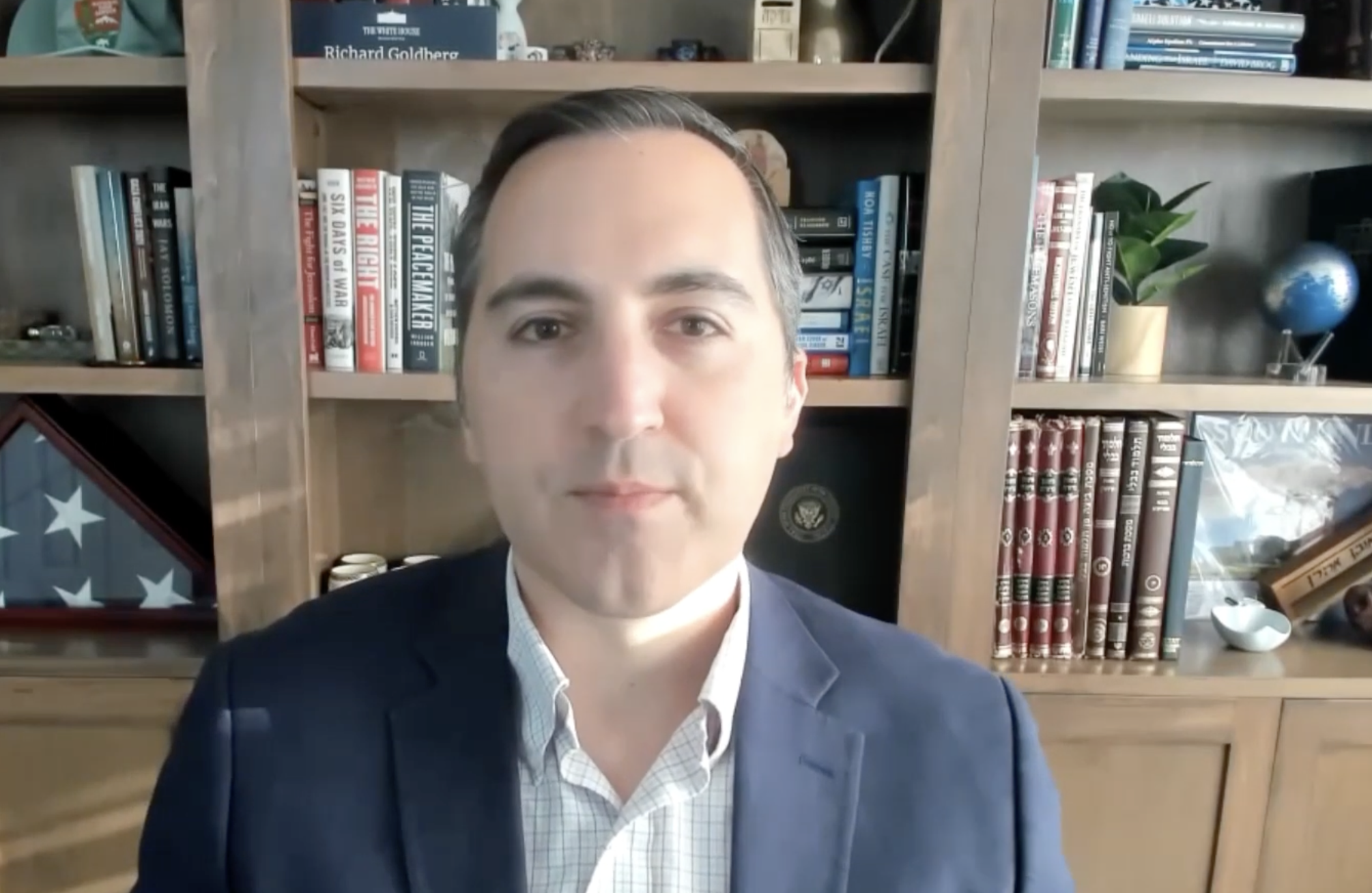
The Sept. 27 deadline to snap back United Nations sanctions on Iran’s nuclear and other weapons programs is rapidly approaching. The E3 — as France, Germany and the U.K. are known — announced last month that they planned to trigger the snapback sanctions mechanism, meaning the likely return of all U.N. sanctions that had been “sunsetted” per the 2015 Iran nuclear deal. In an interview with Jewish Insider’s Lahav Harkov on an episode of the Misgav Institute for National Security and Zionist Strategy’s “Mideast Horizons” podcast, Richard Goldberg, the Foundation for Defense of Democracies’ senior advisor, explained the snapback procedure and how the sanctions are expected to damage Iran’s economy. Goldberg recently finished a stint as the Trump administration’s National Energy Dominance Council’s senior counselor and was the director for countering Iranian weapons of mass destruction in the first Trump administration.
Now or never: Goldberg said it is important not to stop the snapback process, even if Iran suddenly agrees to cooperate. “You don’t stop the snapback, which goes away in just a few weeks,” he said. “You cannot trigger this again after October; it’s done. Iran just wins all these strategic gains forever. … You have to complete the snapback because you don’t get another chance at it.” The impact of snapback would be significant on several fronts. “On a strategic level, they will no longer have any claim of legitimacy to transfer weapons to Russia,” Goldberg said. “Technically, the Russians today will tell you that it is fully legal under the Security Council, which is true. … That will be done after the snapback is completed.”
survey says
Jewish ‘surge’ post-Oct. 7 slowing for marginalized groups

In the aftermath of the deadly Oct. 7 attacks two years ago, many American Jews were pulled off the sidelines and got much more involved in Jewish life — a trend, dubbed “the surge,” that has continued into a second year, according to a survey released this spring. But a further breakdown of that survey data, shared this week by the Jewish Federations of North America (JFNA), shows that the impact of “the surge” is waning more quickly among Jews from minority populations, including LGBTQ Jews, Jews of color, Jews with disabilities and financially vulnerable Jews, than it is among the broader Jewish community, Jewish Insider’s Gabby Deutch reports.
Yearly comparison: The survey found that 31% of Jewish respondents said this year that they are engaging more with the Jewish community now than before Oct. 7, down from 43% last year — still significant post-Oct. 7 growth, but slightly down from the immediate aftermath. But among historically marginalized populations, that decrease was even more pronounced. “We’re sad and disheartened to see that these marginalized groups are engaging so much less than they were at this time last year,” JFNA’s chief impact and growth officer, Mimi Kravetz, told JI on Wednesday. “It’s still higher than baseline. There’s still people showing up more. But there has been a more significant drop among these most marginalized groups.”
Worthy Reads
The Ties That Bind: The Wall Street Journal examines why the strong relationship between President Donald Trump and Israeli Prime Minister Benjamin Netanyahu has been resilient. “Trump, meanwhile, doesn’t want a public break with Netanyahu. He is proud of his close ties to Netanyahu and support for Israel, U.S. officials said. He often boasts about the Abraham Accords brokered during his first term, and continues to push for renewed ties between Israel and Saudi Arabia, a grand diplomatic prize he openly covets. Netanyahu also finds ways to ingratiate himself with Trump’s inner circle and flatter the president directly. On Saturday, Netanyahu, alongside U.S. Ambassador to Israel Mike Huckabee, participated in a cornerstone-laying ceremony to name a promenade in the beachside city of Bat Yam after Trump. In effect, Netanyahu has shaped a relationship where he can temporarily risk Trump’s ire, knowing it won’t last.” [WSJ]
Arrest Warning: Former Harvard Law School professor Alan Dershowitz argues in The Wall Street Journal against New York City Democratic mayoral nominee Zohran Mamdani’s pledge to arrest Israeli Prime Minister Benjamin Netanyahu if he travels to the city. “It’s easy to mock Zohran Mamdani’s pledge that he will order the New York City Police Department to arrest Benjamin Netanyahu if the Israeli prime minister visits the city while Mr. Mamdani is mayor. Does he expect the NYPD to overcome Mr. Netanyahu’s Shin Bet and Secret Service bodyguards? Or will a New York City Criminal Court judge issue a warrant and wait for the prime minister to turn himself in? Has Mr. Mamdani even heard of diplomatic immunity? … Should a Mayor Mamdani attempt such a stunt, I would happily represent the prime minister in a federal lawsuit, which would be the easiest win of my career. … New Yorkers deserve leaders who focus on the city’s and state’s real challenges, not on grandstanding gestures that flirt with illegality and embarrass this great city on the world stage.” [WSJ]
The Charlie Kirk I Knew: In The Free Press, Harvard Law School graduate Adam Sharf recalls how interactions with Charlie Kirk as an undergraduate influenced him to become Orthodox. “He never tried to convert me. What he said instead changed my life: ‘It’s important that you be Jewish.’ … He made a 19-year-old take first principles seriously: why we are here and what we are here for. I began attending Shabbat dinners, meeting weekly with my rabbi to try to understand the covenant Charlie told me about.” [FreePress]
Word on the Street
The Israeli Ministry of Defense announced that it has completed the development of the Iron Beam laser missile interception system, which will be operational by the end of the year…
British Prime Minister Keir Starmer delayed his announcement to recognize a Palestinian state until this weekend, after President Donald Trump has departed from his state visit to London…
Former U.K. Prime Minister Tony Blair, backed by Trump, has proposed creating a “Gaza International Transitional Authority” to govern Gaza postwar, with the goal of replacing Hamas and eventually handing control to a reformed Palestinian Authority, The Times of Israel reports…
An immigration judge in Louisiana ruled that anti-Israel protest leader Mahmoud Khalil must be deported to Syria or Algeria for omitting details from his green card application, despite another court ruling in New Jersey blocking his deportation. Khalil’s lawyers said they intend to appeal the decision but do not expect the appeal to be successful…
Trump told aides that Israeli Prime Minister Benjamin Netanyahu “is f***ing me,” officials told The Wall Street Journal, after Israel attempted to strike Hamas leaders in Doha, Qatar, as Trump reportedly grows more frustrated with the Israeli prime minister…
The State Department designated four Iran-aligned militias as Foreign Terrorist Organizations on Wednesday…
Israeli Strategic Affairs Minister Ron Dermer reportedly met with U.S. envoy Steve Witkoff last night in London in a bid to revive ceasefire and hostage-release efforts…
National Students for Justice in Palestine asked members on Wednesday to send letters to a judge in New York asking for a lenient sentence for Tarek Bazrouk, who pleaded guilty in June to attacking three Jews for their Jewish or Israeli identity…
In separate statements, Sen. Bernie Sanders (I-VT) and Rep. Becca Balint (D-VT) on Wednesday accused Israel of committing genocide in Gaza, the first Jewish lawmakers to do so…
House lawmakers voted down a Republican resolution to censure Rep. Ilhan Omar (D-MN) over a social media video she reposted that called Charlie Kirk a “reprehensible human being” and criticized the right’s reaction to his killing…
Rep. Marjorie Taylor Greene (R-GA) became the latest voice turning Charlie Kirk’s killing into a referendum on his views on Israel and Judaism with a series of social media posts on Wednesday. “Do not allow a foreign country, foreign agents, and another religion [to] tell you about Charlie Kirk. And I hope a foreign country and foreign agents and another religion does not take over Christian Patriotic Turning Point USA,” she wrote, indirectly referring to Israel and Jews…
Disney-owned ABC is taking Jimmy Kimmel’s late night talk show off air after he said during his Monday show, “The MAGA Gang (is) desperately trying to characterize this kid who murdered Charlie Kirk as anything other than one of them and doing everything they can to score political points from it.” …
In an excerpt from former Vice President Kamala Harris’ forthcoming book, 107 Days, she admits she would have preferred to choose former Transportation Secretary Pete Buttigeig as her running mate in the 2024 election, but “we were already asking a lot of America: to accept a woman, a Black woman, a Black woman married to a Jewish man”…
The Gothamist reports on growing tensions between Democratic New York City mayoral nominee Zohran Mamdani and City Comptroller Brad Lander, just months after they cross-endorsed each other in the primary race. Lander is reportedly insinuating behind closed doors that he’ll be appointed first deputy mayor, the mayor’s right hand, should Mamdani win the election, while Mamdani has told him to back off and insists no personnel decisions have been made…
Pro-Israel philanthropist Ronald Lauder injected $750,000 to the Fix the City PAC, which is backing former New York Gov. Andrew Cuomo in his bid to defeat Mamdani as an independent, despite Cuomo’s recent turn away from his full-throated support of Israel’s war in Gaza…
Top EU diplomat Kaja Kallas announced plans today for the EU to impose tariffs on Israel and sanction Israeli National Security Minister Itamar Ben-Gvir and Finance Minister Bezalel Smotrich, following on European Commission President Ursula von der Leyen’s call last week for the EU to suspend free trade measures with Israel…
The Israeli Ministry of Culture announced it’s cutting state funding for the Ophir Awards, known as the “Israeli Oscars,” after a film about a Palestinian boy from Ramallah seeing the ocean in Tel Aviv won five awards at the show on Tuesday, including 2025 Best Picture. The movie, “The Sea,” is now slated to represent Israel at the Oscars…
Bloomberg profiles Rachel Accurso, also known as Ms. Rachel, a popular children’s content creator and outspoken critic of Israel’s war in Gaza, which she regularly refers to as genocide……
The New York Times speaks to Jewish and Muslim experts on whether followers of the religion can accept pig heart transplants…
Restaurateurs Emily and Alon Shaya, along with Tulane University Professor Mara Force, recreated dishes from a recipe book of the Fenves family, saved as they were taken to Auschwitz in 1944, in a project dubbed “Rescued Recipes”…
Pic of the Day
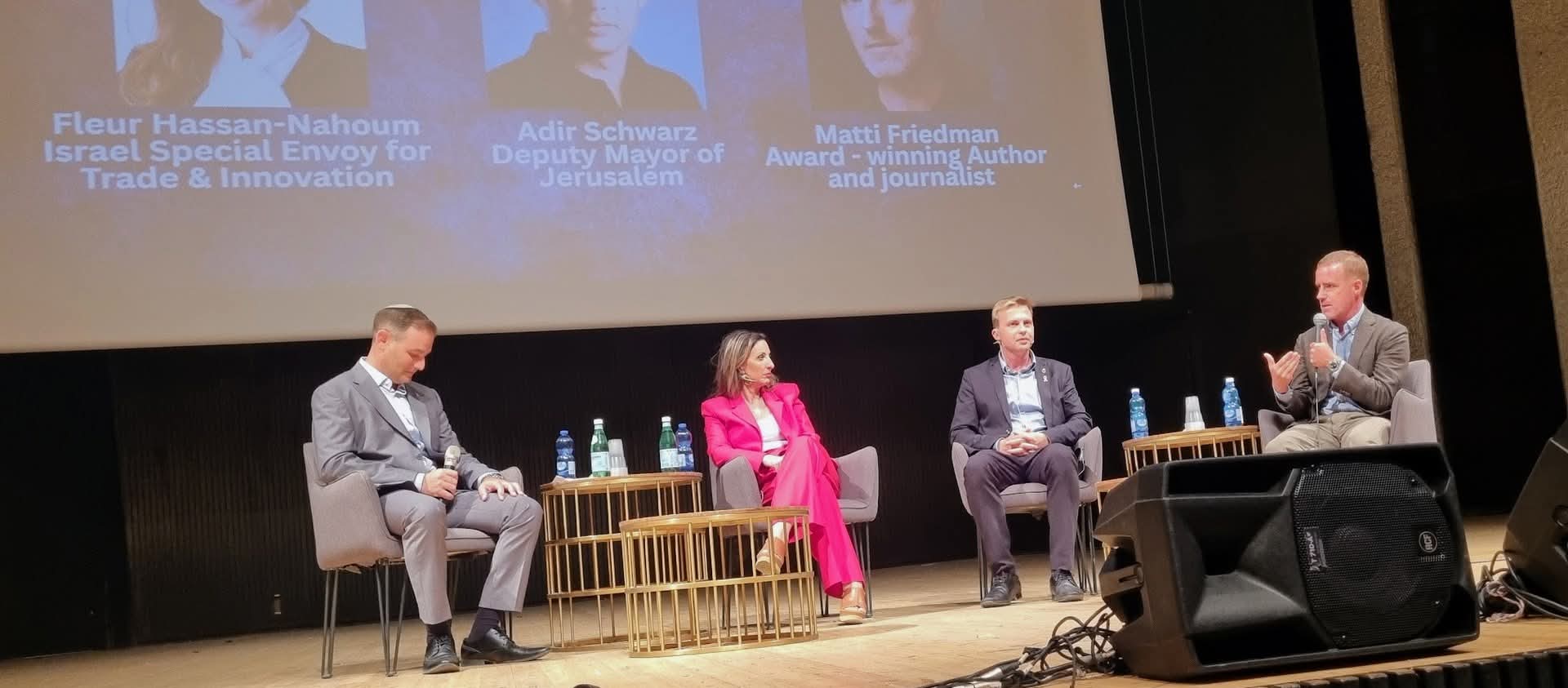
The Michael Levin Base for lone soldiers marked its annual gala on Tuesday evening at the Jerusalem Theater at which U.S. Ambassador to Israel Mike Huckabee gave the keynote address. Michael Dickson, executive director of StandWithUs Israel (left), moderated a panel on the rise of global antisemitism, with panelists (from left to right) Fleur Hassan-Nahoum, Israel’s special envoy for trade and innovation and honorary board member of The Michael Levin Base; Adir Schwarz, deputy mayor of Jerusalem; and Matti Friedman, author and journalist.
Birthdays

Winner of three Grammy Awards for music videos, he is also a filmmaker and photographer, Mark Lee Romanek turns 66…
Marina Del Rey, Calif., resident, Kathy Levinson Wolf… Retired Johns Hopkins neurosurgeon, he served as U.S. secretary of Housing and Urban Development in the Trump 45 administration, Dr. Ben Carson turns 74… Business executive who served as co-CEO of SAP and CEO of Hewlett-Packard, Léo Apotheker turns 72… Harvard professor of psychology, specializing in visual cognition and psycholinguistics, Steven Pinker turns 71… U.S. senator (R-AL), he had a career prior to politics as a collegiate football coach, Tommy Tuberville turns 71… Former CEO of The Jewish Federation of Sarasota-Manatee, Howard Tevlowitz… Former executive director of the Los Angeles Westside Jewish Community Center, Brian Greene… Attorney general of Israel, Gali Baharav-Miara turns 66… Professor of economics at MIT and a 2021 Nobel Prize laureate in economics, Joshua Angrist turns 65… One of the earliest Israeli tech entrepreneurs, he is best known for starting Aladdin Knowledge Systems in 1985, Yanki Margalit turns 63… Founder and executive chairman of Delek US, Ezra Uzi Yemin turns 57… Classical pianist, Simone Dinnerstein turns 53… Chief policy officer at the Louis D. Brandeis Center for Human Rights Under Law, Karen Paikin Barall… NBC and MSNBC legal analyst, she was a 2021 candidate for Manhattan district attorney, Tali Farhadian Weinstein turns 50… Founding partner of Shore Capital Partners, he is a part-owner of the NBA’s Phoenix Suns and the WNBA’s Phoenix Mercury along with his brother Mat Ishbia, Justin Ryan Ishbia turns 48… Comedian, actor, producer and screenwriter, Billy Eichner turns 47… Rome bureau chief of The New York Times, covering Italy and the Vatican, Jason Horowitz… Director of operations at Camp Ramah in Wisconsin, Robin Anderson… Co-host of Bloomberg Surveillance every morning on Bloomberg Television and Bloomberg Radio, Lisa Abramowicz turns 46… Author and CNN analyst, he was a member of the South Carolina House of Representatives, Bakari Sellers turns 41… Founder of the Jerusalem Journal, Avi Mayer… Professional poker player whose total career live tournament winnings exceed $24.5 million, Nick Schulman turns 41… Baseball broadcaster for the Washington Nationals, Dan Kolko… Television and film actress, Shoshana Bush turns 37… Senior director at TLG Communications – the Levinson Group, Zak Sawyer…
Several leaders in the community told JI they continue to have concerns about his record, while others are quietly engaging
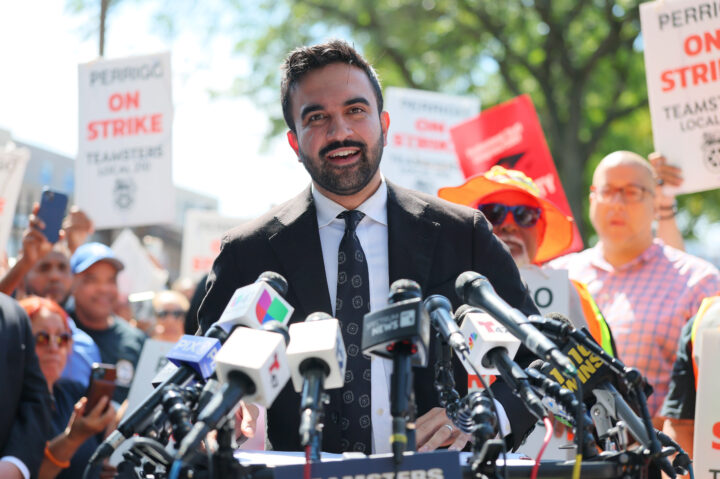
Michael M. Santiago/Getty Images
New York City Zohran Mamdani speaks on Sept. 15, 2025 in New York City.
As Jewish leaders reckon with the increasing likelihood that Zohran Mamdani will be the next mayor of New York City, many who have voiced anxiety over his avowedly anti-Israel policies are reacting with a mix of fear and resignation.
Their concerns have been mounting as Mamdani, the Democratic nominee, has continued to hold a comfortable lead in the race, where polling shows him handily prevailing over the divided field. The 33-year-old democratic socialist and Queens state assemblyman has recently claimed endorsements from prominent party leaders including New York Gov. Kathy Hochul, who clarified she does not agree with him on Israel issues but said she appreciated his commitment to combating antisemitism as well as his efforts to meet with Jewish community members to address “their concerns directly.”
But multiple Jewish leaders said in interviews with Jewish Insider on Wednesday that they remain deeply skeptical of his campaign’s outreach and pledges to confront rising antisemitism, citing a string of recent statements in which he has doubled down on his hostile approach to Israel — as well as an ongoing refusal to explicitly denounce extreme rhetoric espoused by his allies on the far left.
While Mamdani has, since winning the primary in June, walked back some of his polarizing views on key issues such as policing, he has otherwise made an exception for Israel, of which he has long been a fierce critic. In a series of interviews published last week, for instance, he reiterated a campaign vow to arrest Israeli Prime Minister Benjamin Netanyahu if elected, even as legal experts cautioned such a move could violate federal law.
A vocal supporter of the Boycott, Divestment and Sanctions movement against Israel — which some critics deem antisemitic — he said he would end a program established by Mayor Eric Adams, who is now running as an independent, to foster business partnerships between companies in Israel and New York City. He also said he would stop relying on the working definition of antisemitism promoted by the International Holocaust Remembrance Alliance — which labels some criticism of Israel as antisemitic — as was adopted by Adams in a recent executive order.
And although he has said he would discourage activists from invoking the slogan “globalize the intifada,” which he himself has not used publicly, Jewish leaders have noted that Mamdani has still not condemned the phrase itself, fueling suspicion that he tacitly approves of the chant critics interpret as a call to antisemitic violence.
“I believe that he will genuinely work to drive a wedge between Jews and their neighbors as long as he serves in public office,” Sara Forman, executive director of New York Solidarity Network, a group that supports pro-Israel Democratic candidates for state and local office, told JI. “To this date,” she said of Mamdani, “his actions certainly have given us no indication they match his words.”
Andres Spokoiny, who leads the Jewish Funders Network but emphasized that he was speaking only in his personal capacity, said that he was “extremely concerned and extremely fearful” about what he regards as a likely Mamdani mayoralty. “His views make the majority of Jews unsafe and unwelcome,” he told JI.
More broadly, Spokoiny said his worries had less to do with particular policies than what he called “the breaking of a taboo” around anti-Zionist sentiment that did not ultimately serve as an “impediment” to Mamdani’s rise, even in a place that is home to the largest Jewish community of any city in the world. “That fact that it is in New York is highly symbolic,” he said. “It shows that our society doesn’t have the antibodies to reject somebody with a very divisive message.”
He also voiced regret about a lack of unity in the organized Jewish community to collectively oppose Mamdani and coalesce behind one candidate in the race, which includes former New York Gov. Andrew Cuomo, running on an independent line, and Curtis Sliwa, the GOP nominee. “I think it asks for a deep rethinking in the Jewish community about how we face this challenge,” he said.
While Mamdani has won backing from some Jewish elected officials in New York, notably Rep. Jerry Nadler (D-NY), others have continued to keep the nominee at a safe distance with just weeks until November. Senate Minority Leader Chuck Schumer (D-NY) has withheld an endorsement of Mamdani despite meeting privately with him, as has Rep. Dan Goldman (D-NY), who said last month he is waiting for the nominee to take “concrete steps” to address antisemitic hate crimes.
“Typically during a general election you’ll see candidates moderate their positions either in a dishonest attempt to bridge the gap between themselves and uncomfortable voters or in a genuine extension of the olive branch,” said Sam Berger, an Orthodox Democrat who represents an Assembly district in Queens. “Indeed, we’ve seen Zohran do this with the business world as well as with the NYPD.”
Simone Kanter, a spokesperson for Goldman, said on Wednesday that the congressman had “nothing new to add yet beyond what he’s already said” about Mamdani.
During his campaign, Mamdani has more actively aligned with groups on the far left including Jewish Voice for Peace, which is anti-Zionist, and Jews for Racial and Economic Justice, which hosted a recent gala at which the nominee was celebrated alongside Brad Lander, the Jewish comptroller with whom he cross-endorsed in the primary.
Even as Mamdani has engaged in outreach to the Jewish community to address concerns about his platform, among other issues, some Jewish leaders indicated they did not anticipate there would be any common ground on which to develop a relationship with a potential Mamdani administration.
“Typically during a general election you’ll see candidates moderate their positions either in a dishonest attempt to bridge the gap between themselves and uncomfortable voters or in a genuine extension of the olive branch,” said Sam Berger, an Orthodox Democrat who represents an Assembly district in Queens. “Indeed, we’ve seen Zohran do this with the business world as well as with the NYPD.”
By contrast, Berger argued of his colleague in the state legislature, Mamdani “hasn’t done the bare minimum with long-recognized Jewish institutions and leaders, instead relying on his support from the fringe of the fringe,” which he called “a major red flag.”
“Fixing potholes is typically apolitical,” he told JI, “but [when] the point of contention is the uplifting of baseless hatred against the Jewish people there is no common ground to be had.”
Kalman Yeger, an Orthodox assemblyman in Brooklyn who has been among Mamdani’s most outspoken critics, said the nominee’s “inability to get his brain around the notion that globalizing the intifada is a bad thing is terrifying.”
Simcha Eichenstein, a Democratic assemblyman from the Hasidic neighborhood of Borough Park in Brooklyn, was equally pessimistic about Mamdani.
“We can agree to disagree when it comes to policy matters, but as a visible Jew, I should be able to walk the streets of New York City safely, without fear of harassment,” he told JI on Wednesday.
“The inability and unwillingness of a candidate running to represent nearly a million Jews to denounce radical, extreme and antisemitic groups have many within the Jewish community wondering whether we have a future in New York at all,” Eichenstein added, citing as an example the radical pro-Palestinian group Within Our Lifetime, which has led at least one protest that was attended by Mamdani in 2021.
Kalman Yeger, an Orthodox assemblyman in Brooklyn who has been among Mamdani’s most outspoken critics, said the nominee’s “inability to get his brain around the notion that globalizing the intifada is a bad thing is terrifying.”
“His lunatic threat to arrest Netanyahu, when he is surely not stupid enough to believe he has that power, is a sign to the Jew haters that he stands with them,” Yeger added, claiming Mamdani “will, by his words, his actions and his inactions, cause continued increasing antisemitism” in New York City.
Mamdani has forcefully rejected accusations he has fomented antisemitism, vowing to increase funding to counter hate crimes by 800%. A spokesperson for his campaign did not return a request for comment from JI on Wednesday.
Daniel Rosenthal, vice president of government relations at UJA-Federation of New York, said his organization, a nonprofit forbidden from making political endorsements, “will strongly oppose any actions that alienate or marginalize Jews, including attempts to delegitimize Israel and support BDS. As always, we will work to ensure that the needs and concerns of Jewish New Yorkers are heard and addressed.”
Leon Goldenberg, a Brooklyn real estate executive who is an executive board member of the Flatbush Jewish Community Coalition, said his group had no interest in meeting with Mamdani — despite that he expects him to win the election. “What I really have a problem with is ‘globalize the intifada,’” he told JI on Wednesday. “You can’t condemn it. ‘Globalize the intifada’ is murder Jews on the streets.”
Goldenberg, who endorsed Adams in the general election but now believes he has no chance, said he was considering moving his permanent residence to Florida, where he keeps an apartment, if Mamdani prevails this fall. “He’s bright. I’m not going to take that away from him,” he said of the nominee. “But there’s very little that qualifies him to be mayor. If he had a different mindset, he’d be a great mayor.”
Despite their concerns about a potential Mamdani administration, few Jewish leaders were ready to speculate about working with him.
Daniel Rosenthal, vice president of government relations at UJA-Federation of New York, said his organization, a nonprofit forbidden from making political endorsements, “will strongly oppose any actions that alienate or marginalize Jews, including attempts to delegitimize Israel and support BDS.”
“As always, we will work to ensure that the needs and concerns of Jewish New Yorkers are heard and addressed,” Rosenthal told JI.
Other Jewish leaders pointed to ongoing voter registration efforts to boost Jewish turnout in the election. Josh Mehlman, who chairs the Flatbush Jewish Community Coalition, said his group had helped register more than 5,000 new Democratic voters in the Orthodox community in the last week alone. He did not respond when asked if he felt the increase in registrations would have any discernible impact on the outcome of the mayoral race.
Joel Rosenfeld, a representative of the influential Bobov Hasidic sect, also stressed his community “is fully focused on voter registration” in the lead-up to the election. Asked if he had anything else to add on the matter, Rosenfeld said, “A blessed new year,” ahead of the Jewish holiday of Rosh Hashanah.
Still, there are signs that some Hasidic groups may now be cautiously — and quietly — warming up to a potential future Mamdani administration, even if it remains unlikely that any groups will endorse him, community members say.
“The Hasidim are a very practical bloc of voters, particularly the leadership,” said one Democratic consultant who has worked with the community. “Results matter more than ideology for them. If they think Mamdani will win, that’s where they’ll go.”
One Jewish community activist familiar with the matter said that “there are some groups secretly talking to” Mamdani “or his top people,” though he added it was “hard to believe any groups will openly endorse him, especially if Adams is still in the race.”
“The feeling is that like it or not he is most likely going to be the next mayor so we might as well begin a dialogue now rather than after the election,” he told JI.
Another activist familiar with a Satmar faction in Williamsburg, which represents the largest Hasidic voting bloc in New York City, said that Mamdani’s team is “aggressively courting” the community and has been in dialogue with leadership. “They want to work with us and we want to work with them,” the activist said in summarizing the dynamic, speaking on the condition of anonymity to address a sensitive situation.
“The Hasidim are a very practical bloc of voters, particularly the leadership,” said one Democratic consultant who has worked with the community. “Results matter more than ideology for them. If they think Mamdani will win, that’s where they’ll go.”
She also doubled down on her condemnation of the slogan ‘globalize the intifada,’ over which she previously criticized mayoral nominee Zohran Mamdani
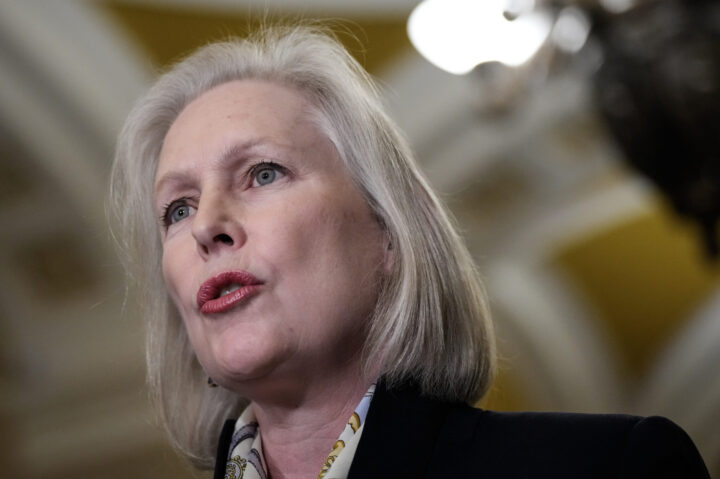
Drew Angerer/Getty Images
Sen. Kirsten Gillibrand (D-NY) speaks at a news conference following a closed-door lunch meeting with Senate Democrats at the U.S. Capitol on October 31, 2023, in Washington, D.C.
Sen. Kirsten Gillibrand (D-NY) said in comments to Jewish leaders in New York City on Monday that anti-Israel protesters and, in some cases, fellow Democratic lawmakers are fueling antisemitism through the rhetoric and slogans they use, though she said that in many cases it is unintentional.
“Some of the rhetoric that comes out of various protests globally, various protests on college campuses is so damaging. When they say words like ‘river to the sea,’ whey they say words like ‘globalize the intifada,’ it means end Israel. It means destroy Jews,” Gillibrand said in a video from a roundtable with Jewish leaders in Borough Park shared by The Forward. “No matter what words they intend to be saying, that is the meaning of these simple phrases.”
Intifada, she continued, is “not a social movement. It’s terrorism, it’s destruction, it’s death.”
The New York senator has been particularly outspoken about the “intifada” rhetoric in the context of the New York City mayoral race. She previously offered strong condemnation of Democratic mayoral nominee Zohran Mamdani for his refusal to condemn the “globalize the intifada” slogan and said that Jewish constituents were alarmed by his past comments.
Gillibrand also claimed Mamdani had made “references to global jihad,” but later apologized. She has not endorsed Mamdani’s mayoral bid.
The New York senator said she would work with Democratic colleagues “who sometimes, in my opinion, don’t use the right words or aren’t sensitive to the impact of those words” and explain to them how their comments are being received and contributing to antisemitism, and to rally them to support efforts to fight antisemitism.
“Nine times out of 10, they aren’t trying to be antisemitic or even trying to be anti-Israel. They just think they’re fighting for human rights,” Gillibrand continued, “but the words they often choose to use are very hurtful and harmful and are undermining.”
“It is very hurtful and it makes people feel like sometimes the members of our party do not have their back, and I think that’s very disruptive and damaging for our community, for our state, for our brothers and sisters,” Gillibrand said.
Gillibrand added that leaders and individuals have to “understand the impact of their words in all contexts,” including to the Muslim community and other faith and immigrant communities.
She also insisted that “nine out of 10 Democrats are pro-Israel and want peace in the Middle East,” though a majority of the Senate Democratic caucus recently voted in favor of blocking some arms sales to Israel.
Gillibrand argued that many of her colleagues’ concerns are driven by the political leadership in Israel, including Prime Minister Benjamin Netanyahu and far-right members of the Israeli government.
“They don’t know how to articulate political disagreement, and sometimes it comes out as anti-Israel,” she said. “I try very hard to explain that your intentions are one thing, but how you’re received is another, and that’s where we get the disconnect.”
The report comes after the Massachusetts Teachers Association was accused of promoting anti-Israel materials to its members

Getty Images
Notebook with a pen on a table in a classroom at a school
Jewish leaders in Massachusetts praised a new report and set of recommendations by a state body that called for K-12 schools to implement the International Holocaust Remembrance Alliance’s working definition of antisemitism.
The Massachusetts Special Commission on Combating Antisemitism voted unanimously on Thursday to approve their recommendations, which in addition to encouraging schools to embrace the IHRA definition, call on districts to implement anti-bias education that includes antisemitism, to establish an Advisory Council on Holocaust and Genocide Education and to develop curricula around Jewish history and identity.
“This is a hugely important moment for Massachusetts,” Jeremy Burton, CEO of the Jewish Community Relations Council of Greater Boston who is also a member of the commission, told Jewish Insider. “These recommendations provide a roadmap for meaningful interventions with clear timelines for follow up and accountability. We certainly welcome it,” said Burton.
The IHRA working definition was officially recognized and endorsed by Massachusetts in 2022 but largely has not been incorporated within school districts.
The report notes a sharp rise of antisemitism in the state’s K-12 schools since the Oct. 7, 2023, Hamas attacks on Israel and acknowledges that there has been significant harm to the mental health of Jewish and Israeli students and families caused by antisemitic incidents. It also notes inconsistencies in how districts respond to concerns around antisemitism, with some responding inadequately and others failing to respond at all.
The vote came as the Massachusetts Teachers Association has been accused of promoting anti-Israel materials for use by its members; in December, a report by the American Jewish Committee’s New England branch found that the union has been actively encouraging members to introduce “overtly political” anti-Israel materials into K-12 classrooms, reducing “a complex struggle between two people” to an “extreme, one-sided narrative.” In March, JI reported on a member of the MTA executive board who is a member of the American Communist Party — a group with direct connections to Hamas and Hezbollah.
“Addressing the issues of antisemitism in K-12 schools is a multifaceted process,” Rob Leikind, the regional director of AJC New England, told JI. “The recommendations of the commission do several things. They flag a problem and provide observations about how the problem manifested itself. The commission is helping to expand awareness about a problem and begin a discussion about how it presents itself in schools. Beyond that, there are recommendations that are going to begin a process of helping teachers, administrators and students recognize what may be antisemitic and things to do about it.”
Leikind said that, particularly since Oct. 7, he has observed that “many people, even those who have extensive contact with Jews, simply don’t understand what makes something antisemitic and don’t really have the tools to begin to discern what may be antisemitic.
“There’s a lot of education that needs to be done and the recommendations start to address that,” he said.
Burton lauded the recommendations for addressing “systemic gaps in responding to antisemitism in K-12 education and establishing standardized protocols for prevention and response.” He said they have been “embraced” by the state.
At Thursday’s hearing, Pedro Martinez, the newly appointed Commissioner of Elementary and Secondary Education in Massachusetts — formerly the head of Chicago public schools — expressed “his appreciation for the recommendations, confirmed his department’s support for the recommendations and committed resources including ‘at least’ one additional staff position to spearhead the Department of Education’s work on antisemitism,” Burton said.
“That’s a fairly significant commitment,” he continued. “It’s not just a document but it’s a document that has the full public embrace and support of a commissioner of education who prioritized his commitment to implement it on his first weeks on the job. That sends a strong signal of allyship and partnership, both with the commission and with the Jewish community.”
“Without ignoring anyone’s concerns about the MTA that are very legitimate, we know we have a partner and ally in our state government in moving forward,” said Burton.
Massachusetts Educators Against Antisemitism called the recommendations “essential for creating a safe and inclusive environment for all students and staff in Massachusetts schools” in a statement and urged state officials and local communities “to ensure these recommendations are not only adopted but are effectively and consistently implemented across the Commonwealth.”
The Florida Democrat has shifted away from commitments he made to Jewish leaders during his first run for Congress, fueling frustration among former supporters

Courtesy
Maxwell Frost
When Rep. Maxwell Frost (D-FL) won his first election to the House in 2022, Jewish leaders in his Orlando, Fla., district who had been encouraged by his personal outreach were optimistic he would follow through on a range of commitments he had made vowing to uphold support for Israel.
Despite some initial concerns about his history of involvement in pro-Palestinian demonstrations as well as relationships with anti-Israel activists, Frost had circulated a lengthy Middle East position paper in consultation, in part, with a top pro-Israel group that largely assuaged lingering reservations among Jewish community leaders over the sincerity of his views.
In the paper as well as a candidate questionnaire solicited by Jewish Insider during his first primary, the young progressive organizer, describing himself as both “pro-Israel” and “pro-Palestinian,” voiced opposition to conditioning aid to Israel — arguing that the security threats facing the Jewish state are “far too grave” to enact such measures. In backing a two-state solution, he clarified that any agreement should require “the basic recognition that Israel has a right to exist” as well as “an end to the antisemitic rhetoric and positions of Hamas.” And if elected, he pledged to visit Israel — which he called “one of the United States’ most important allies and strategic partners.”
Now, almost midway into his second term, Jewish and pro-Israel leaders are expressing some buyer’s remorse as Frost, 28, has embraced positions that put him at odds with his past commitments, fueling frustration among those who had believed he would be a more dependable ally on key issues concerning Israel.
Frost, for his part, insists that the humanitarian conditions in Israel’s war with Hamas in Gaza have deteriorated so drastically during his tenure that he had no choice but to change his views, though that has not quelled discontent among his former allies.
“He has broken a lot of promises,” said one Jewish leader, echoing others who expressed dismay with Frost’s turn in Congress.
The most recent move to draw scrutiny from Jewish and pro-Israel leaders is a letter Frost signed urging the Trump administration to recognize a Palestinian state over growing concerns with the humanitarian crisis in Gaza.
The letter, signed by several prominent House progressives and led by Rep. Ro Khanna (D-CA) — who plans to introduce a similar resolution — said such a state “will need to fully recognize Israel” and guarantee “the disarmament of and relinquishing of power by Hamas.” But pro-Israel activists broadly see the renewed effort as a misguided concession to Hamas amid the ongoing war — as the terror group seeks to leverage international outrage over Israel’s military conduct.
Democratic Majority for Israel, whose political arm had provided input on Frost’s position paper during his primary, took issue with his decision to join the letter. While the group felt sufficiently comfortable with Frost’s Middle East policy views when he first ran for Congress, opting not to intervene on behalf of a top primary rival who had won an endorsement from its super PAC, it has become dissatisfied with his approach as he has continued to stake out more adversarial stances toward Israel during his time in the House.
“We strongly support a two-state solution that ensures Israel’s future as a Jewish and democratic state with recognized borders and upholds the right of Palestinians to live in freedom and security in a viable state of their own,” Brian Romick, DMFI’s president, said in a statement to JI on Tuesday. “But unilateral recognition of a Palestinian state at this time — as the terrorist group Hamas still governs parts of Gaza and continues to hold Israeli hostages — would not advance peace. It will instead prolong the war by incentivizing Hamas to reject any ceasefire deal, and reward the terrorism we saw on Oct. 7 while making future acts of terror more likely.”
In addition to the letter — which followed a similar resolution he co-sponsored in 2023 during his first term — Frost in May joined legislation to place unprecedented new conditions on aid to Israel by withholding offensive weapons over its alleged violations of international law.
Last year, he also voted against a widely approved bill to provide supplemental aid to Israel six months after Hamas’ attacks. In a statement explaining his thinking at the time, Frost wrote that he was “only able to justify aid for defense, not offense, and this legislation did not allow me to separate the two,” as the war “has claimed the lives of countless innocent Palestinian civilians and brought us no closer to the return of innocent Israeli hostages held by Hamas.”
“For me, the North Star here is having a two-state solution, and everything, all the decisions we make, have to point to that,” Frost said, arguing that he has remained consistent in upholding his core beliefs on the conflict even as his positions on specific policies have changed since he launched his initial campaign for Congress. “The thing I have in mind is the safety and security of everybody, of Israel, of Palestinians — of everybody.”
Meanwhile, Frost has yet to fulfill his campaign vow to travel to Israel, and has declined invitations to do so while in Congress, according to a person familiar with the matter.
In an interview on Wednesday, Frost acknowledged that his approach has changed since he entered the House, attributing his new positions to his revulsion at Israel’s behavior in Gaza — which he described as “completely unacceptable” and “abhorrent” in light of the civilian death toll. “In terms of specific policy points, things have changed,” Frost told JI. “Things have changed a lot — and unfortunately, not for the better.”
“For me, the North Star here is having a two-state solution, and everything, all the decisions we make, have to point to that,” he added, arguing that he has remained consistent in upholding his core beliefs on the conflict even as his positions on specific policies have changed since he launched his initial campaign for Congress. “The thing I have in mind is the safety and security of everybody, of Israel, of Palestinians — of everybody.”
Even as he condemned Hamas and said the terror group should have no role in rebuilding postwar Gaza, Frost said the conflict has evolved into what he regards as a “war on innocent people,” resulting in “massive loss of innocent life” that has fueled his decision to speak up against the Israeli government and its ongoing military campaign.
In the Middle East position paper he wrote in his first primary, Frost had rejected placing additional conditions on aid to Israel because, he wrote at the time, it would “undermine Israel’s ability to defend itself against the very serious threats it faces.” But he explained on Wednesday he had also felt such measures were “already written into the law” and “we didn’t really need to go further” in enforcing it at the time.
Now, however, “I do believe that the law is being violated,” he told JI, clarifying his recent support for legislation that seeks to withhold transfers of offensive weapons to Israel. “Because of that, we have to look at the way that we are both complicit but also encouraging the current behavior of the Netanyahu government,” he said.
Unlike a handful of his far-left House colleagues who have accused Israel of carrying out a genocide in Gaza, Frost hesitated to use the term himself, calling it a “difficult” word because of its historical connection to the Holocaust. Still, he said he would not seek to discourage others from such charges. “I’m not going to sit here and defend what is going on right now in any way, shape or form,” he said. “I understand why people use that word. But when we see what’s going on, it’s hard to find the words for it.”
“There’s a lot of things to hold, but the main thing is, yes, there are many things that have changed,” he reiterated. “But for me, what has not changed is the main goal, which is making sure that everyone’s safe and everyone’s secure.”
Frost is hardly alone among Democratic lawmakers who in recent months have become more critical of Israel’s behavior, with even some of the staunchest supporters of the Jewish state struggling to defend the Israeli government as the humanitarian situation in Gaza has continued to worsen nearly two years into the war.
“It’s a radical shift,” one community activist told JI, voicing frustration with Frost’s positions, even as he described their ongoing conversations as “very open and honest.”
His vacillating stances also illustrate some of the cross-pressures facing progressive Democrats who are not completely aligned with the party’s far left on its hostility toward Israel. Pro-Israel Democrats have recently voiced their concerns that anti-Israel policies could become a litmus test for the left in the midterms, particularly amid Israeli Prime Minister Benjamin Netanyahu‘s moves to occupy the enclave.
But Jewish community leaders in Frost’s district, who spoke on condition of anonymity to address what they characterize as an increasingly delicate relationship with the congressman, explained they are particularly disappointed with his evolution on Middle East policy, given their initial hopes that he would be among a dwindling number of progressive allies committed to defending Israel in the House.
“It’s a radical shift,” one community activist told JI, voicing frustration with Frost’s positions, even as he described their ongoing conversations as “very open and honest.”
The activist noted that Frost, who had been a prominent gun control advocate before he was elected to Congress, has “a good heart and doesn’t want to see people dying.” But “as a result,” he said, Frost has “a lot of blind spots” in his assessment of the conflict. The activist argued that Frost’s critique of Israel’s conduct in Gaza has ignored Hamas’ role in perpetuating the crisis as it refuses to surrender.
“At the end of the day, he very much comes from the ‘oppressor-oppressed’ worldview and sees Israel as the oppressor,” the activist said.
Frost, for his part, said his statements have been misconstrued by a wide range of critics across the spectrum, including pro-Palestinian activists who allege that he made separate commitments during his first primary bid that he has failed to uphold in Congress.
He stressed that he does not “do tit-for-tat stuff” while addressing the war. “Whenever I post about the hostages, I’ll have people sending me messages. ‘What about this?’ No,” he said. “Whenever I post about Palestinians, I’ll have people saying, ‘What about this?’ No, I will post about it all. I will talk about it all. I will say how I feel about everything.”
“I’m very firm in that, just coming from a place of, since I was 15 years old, being involved in the fight to end gun violence, and have grown up through a movement of death,” he told JI. “I just don’t think that’s the way to live as a human, quite frankly.”
“We’ve been disappointed that he has not met the commitments he gave to us,” one DMFI source told JI. “At the same time, we’re grateful that he has come to realize he made a mistake in at least one case, but members of Congress should think through their votes fully and discuss them with knowledgeable people before casting them.”
Even as Jewish and pro-Israel leaders say their relationships with Frost have worsened in recent months, frustration over his approach to Israel has been mounting since his first term, when he called for an “immediate ceasefire” in Gaza just days after Hamas’ terror attacks. As a freshman, he also voted against a resolution condemning rising antisemitic activity on college campuses, but he later said that vote had been a mistake after meeting with Jewish students in his district.
While Frost had shown contrition for his vote on the resolution in November 2023, DMFI still expressed dissatisfaction with his initial decision at the time — alleging he had not performed proper due diligence beforehand. “We’ve been disappointed that he has not met the commitments he gave to us,” one DMFI source told JI not long after the vote.
“At the same time, we’re grateful that he has come to realize he made a mistake in at least one case, but members of Congress should think through their votes fully and discuss them with knowledgeable people before casting them,” the source stated.
A spokesperson for Frost told JI at the time that the congressman “is trying to hold multiple truths all at once” as he receives input from constituents pushing opposing interests.
“I’m very comfortable with the decisions I’ve made,” Frost said of his approach to Israel. “As I walk the streets of my district, as I speak with the people in my district, this is where I find most people are at. They’re not really at the extremes that I’ve heard from.”
Speaking with JI on Wednesday, Frost said he has appreciated his ongoing discussions with pro-Israel leaders in his district — even if they have not been aligned on major policy questions in recent months. “Hearing their perspective is really important,” he confirmed. “What I always tell people is I might not always come to the conclusion that you agree with,” he said, “but I hope you’ll always feel I’ve engaged in good faith.”
He suggested that Jewish community activists who have been irked by his approach to the Middle East have not fully reckoned with his belief that Israel’s military actions have damaged its reputation in the United States. “It’s palpable across the country, and I think a lot of this has to do with the decisions that are being made by Netanyahu,” he argued.
“I’m very comfortable with the decisions I’ve made,” Frost said of his approach to Israel. “As I walk the streets of my district, as I speak with the people in my district, this is where I find most people are at. They’re not really at the extremes that I’ve heard from.”
When he assumed office in 2023, Frost had sought guidance from pro-Israel Democrats including Rep. Ritchie Torres (D-NY), who enthusiastically backed his campaign, and House Minority Leader Hakeem Jeffries (D-NY), one person familiar with the matter told JI. But the congressman has since drifted away from the two lawmakers on Israel while staking out positions that have put him more in line with the far left.
More recently, Frost has built closer relationships with such leading Israel critics as Rep. Alexandria Ocasio-Cortez (D-NY), the source told JI, even if he has resisted identifying as an official member of the so-called Squad of progressive House Democrats.
Owing in part to his network in Congress, Jewish community leaders are doubtful Frost will change his views on Israel. “It may be the best that we can hope is that he doesn’t become an actual member of the Squad,” said one activist, while noting that Frost is “totally safe” in his deeply blue district as he seeks a third term next year.
Still, the activist said, “his refusal to actually go and see” Israel “first-hand is a problem,” particularly in light of his primary vow to visit the Jewish state as a congressman.
Frost, who acknowledged the commitment that he had made, said he hopes to see the region “at some point,” but added that it has “been difficult to figure out the timing.”
After the interview, Frost asked his spokesperson to clarify that he would “like to travel to the region at a point where he’d be able to visit both Israel and the Gaza Strip,” indicating a potential visit is unlikely to occur in the foreseeable future.
Many Maryland Jewish leaders are wary of speaking out against the Maryland Democrat’s votes to block arms sales to Israel
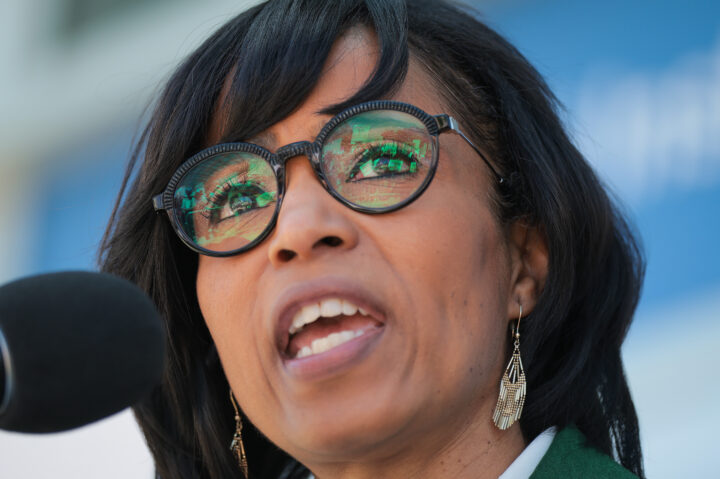
Kayla Bartkowski/Getty Images
U.S. Sen. Angela Alsobrooks (D-MD) speaks during her "Sick Of It" rally against the Trump administration's health care policies in front of the National Institutes of Health (NIH) on May 10, 2025 in Bethesda, Maryland.
Maryland Jewish leaders are expressing disappointment over Sen. Angela Alsobrooks’ (D-MD) decision to support both of Sen. Bernie Sanders’ (I-VT) resolutions blocking U.S. arms sales to Israel despite vowing to oppose such efforts when she campaigned for the Senate last year.
Alsobrooks and 26 of her Democratic colleagues voted on Wednesday evening to block U.S. shipments of automatic weapons that Sanders and others claimed were destined for police units controlled by Israeli National Security Minister Itamar Ben-Gvir, a far-right official in Israeli Prime Minister Benjamin Netanyahu’s government. She also joined 23 Democrats in supporting a second resolution relating to U.S. bombs and bomb guidance kits.
In a statement on her decision, the Maryland senator said she was joining the “voices of so many who feel the moral imperative to demand change. To witness the inhumanity of starving children and say nothing is not just a dereliction of duty but of conscience.”
“Netanyahu and his government must immediately change course. I remain committed to the U.S.-Israel relationship and my belief that the people of Israel have a right to defend themselves. In this moment, we must all do everything in our power as a global community to get desperately needed aid to the people of Gaza,” Alsobrooks said.
The votes marked a change in position for Alsobrooks, who campaigned last year in the general election contest for her seat on the promise to not support cutting off aid to Israel and subsequently told Jewish leaders after winning the race that she planned to maintain that vow. It was also a shift from her votes against Sanders’ prior resolutions blocking aid this past spring.
During the contested Democratic primary, however, she pledged to vote against future arms sales to Israel if the IDF invaded Rafah (an operation that later happened) and agreed with the Biden administration’s threat to withhold offensive weaponry.
In the general election, she moderated her position, and distanced herself from Sen. Chris Van Hollen’s (D-MD) antagonistic record toward the Jewish state, which has alienated much of Maryland’s Jewish community.
Now, many Jewish leaders in Maryland fear she’s aligning herself more closely with Van Hollen on Israel and Middle East policy.
A spokesperson for Alsobrooks told JI in a statement that, “As the Senator made explicit in her statement following the vote, she remains firmly committed to the U.S.-Israel relationship and her support for the security of the Israeli people. This vote was in direct response to the worsening humanitarian crisis in the region and her desire to see the delivery of desperately-needed aid. She will continue to support the people of Israel as well as the people of Gaza while remaining laser focused on eradicating the threat of Hamas and the return of the hostages.”
Ron Halber, the CEO of the Jewish Community Relations Council of Greater Washington, said that the JCRC planned to request a meeting with Alsobrooks to “try and figure out what her thoughts were on this matter and express our concern” about her votes on Wednesday.
Halber predicted that Alsobrooks was “probably swayed by the humanitarian disaster that has unfolded” in Gaza, pointing out her comments during the campaign and her votes against the April resolutions. He also noted that Alsobrooks was “speaking publicly at JCRC forums and speaking as recently as our legislative breakfast in December of last year” about her support for continued aid to Israel.
That record, he argued, was as relevant as Wednesday’s votes.
“Sen. Alsobrooks made it clear during her campaign that she would be a supporter of Israel, and I do not believe that this one vote takes her out of the pro-Israel camp,” Halber told Jewish Insider. “To me, one vote does not constitute a pattern. One vote does not constitute a dramatic shift in her support for Israel, but it’s certainly something we want to speak to her about and let her know that we are troubled by.”
“The concern is that for the Jewish community, Israel’s ability to defend itself is a holy grail, and that includes the ability to defend itself both defensively and offensively,” he continued.
Jennifer Laszlo Mizrahi, a Jewish philanthropist and Democratic activist in Maryland, said she sympathized with arguments from Democrats and others about the humanitarian situation in Gaza while defending Alsobrooks’ pivot from her prior position on Israel aid.
“There has been an evolution of facts between the campaign and now, and the situation with the suffering of innocent children in Gaza is highly problematic,” Mizrahi told JI.
Mizrahi dismissed the notion that Alsobrooks’s vote constituted a broken campaign promise, noting that several other Democratic senators had made similar statements to her and her team during the 2024 cycle that had since come out in support of blocking aid, including Sen. Elissa Slotkin (D-MI).
“Politicians evolve when facts evolve, particularly when they’re bright people. Angela Alsobrooks is an incredibly bright person, of course, and she cares a lot. What I would like to know is her motivation for the vote,” she explained.
Despite this, Mizrahi said she hoped to see Alsobrooks return to supporting Israel aid and to “see her step up more significantly about hate crimes and about antisemitism, because we’re seeing quite a lot of it.”
“I hope that Sen. Alsobrooks will change her vote and will change her tone back to her earlier tone once the ship has righted in terms of the humanitarian situation for innocent people in Gaza,” Mizrahi said, later adding that she wanted to know “whether she feels that if things get better, that she will change her mind again, and that she will enthusiastically support weapons sales to the only democratic ally that America has in the Middle East,” Mizrahi said.
“I’m not going to hold this one vote [against her] until I know more about what her motivation was and what she’s hoping to achieve,” she added.
Bobby Zirkin, a Jewish former Maryland state senator who led an effort to urge Democrats to support former Maryland Gov. Larry Hogan, a Republican, over Alsobrooks in their 2024 Senate contest, said that uncertainties over Alsobrooks’s commitment to Israel was a motivating factor behind his decision to back Hogan.
“There was a reason that I stepped out during the campaign for Gov. Hogan. … My concern was always that she would follow the craziest, most fringe [parts of the] left-wing, which has become Chris Van Hollen in our party,” Zirkin said of Alsobrooks. “She made promises to many people in the Jewish community during the campaign and she has absolutely broken them.”
“You’ve gotta give the Alsobrooks campaign people credit for changing the subject and misrepresenting what she was going to do and all the rest. And by credit, I mean that they hoodwinked people,” he continued. “She pulled the wool over the eyes of a lot of people, and now we’re living with that.”
One Jewish political leader: ‘No one thinks it’s going to be good for the Jewish community to be hostile and to be in constant war with the next mayor’
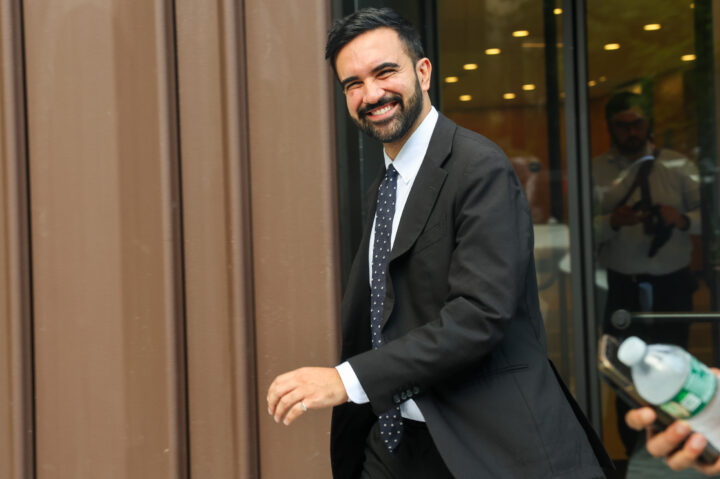
Spencer Platt/Getty Images
Democratic socialist candidate Zohran Mamdani, who won the Democratic primary for mayor of New York City, attends an endorsement event from the union DC 37 on July 15, 2025, in New York City.
In recent weeks, a creeping sense of frustration has settled in among many Jewish leaders in New York City as they have reckoned with the dawning reality that no one is stepping up to organize opposition to Zohran Mamdani, the Democratic nominee for mayor. Without a well-funded outside effort, Mamdani faces few obstacles in the general election despite numerous political vulnerabilities.
The complacency comes even as top Democratic leaders in New York have so far declined to endorse Mamdani, whose antagonistic views on Israel and democratic socialist affiliation have engendered criticism. But with a divided field of warring and baggage-laden candidates, Jewish leaders have privately voiced disappointment at the current state of the race.
“Big-money people are talking every week about how we have to do something, but I haven’t seen a real plan,” said one Jewish community leader who spoke on condition of anonymity to discuss private conversations. “People are just grasping,” he added. “There’s a sense of frustration out there and fear of a letdown.”
“You can’t beat somebody with nobody,” another Jewish leader said in assessing Mamdani’s rivals, including incumbent Mayor Eric Adams, former New York Gov. Andrew Cuomo and Curtis Sliwa, the GOP nominee — all of whom have so far resisted pleas to suspend their campaigns in order to avoid splitting the vote.
While some independent expenditure committees are preparing to spend heavily in the race to target Mamdani, an assemblyman from Queens whose far-left policies have provoked anxiety among Jewish New Yorkers, moderate voters and business leaders, the Jewish leader expressed skepticism that such efforts would ultimately “make a difference” as long as the election remains crowded with multiple opponents.
In the Hasidic enclave of Williamsburg, “the rank and file and donors are concerned” about Mamdani, said a source familiar with the situation. “But at the leadership level, people are mostly thinking that it’s a foregone conclusion” that Mamdani will prevail in November. “There’s not much to do and we have to start adapting and have to try to make amends with him and work with him.”
Jim Walden, an attorney, is also running as an independent alongside Adams and Cuomo, who in recent days have exchanged criticism as Mamdani, leading most polls with a plurality of the vote, stayed away from the headlines while celebrating his recent marriage in his birthplace of Uganda.
In the Hasidic enclave of Williamsburg, “the rank and file and donors are concerned” about Mamdani, said a source familiar with the situation. “But at the leadership level, people are mostly thinking that it’s a foregone conclusion” that Mamdani will prevail in November. “There’s not much to do and we have to start adapting and have to try to make amends with him and work with him.”
“No one thinks it’s going to be good for the Jewish community to be hostile and to be in constant war with the next mayor,” the source said on Monday. “For the community’s sake, we have to move on.”
As the anti-Mamdani coalition has struggled to coalesce more than a month after his shocking primary upset, the organized Jewish community is now largely taking a “wait-and-see” approach to the upcoming election, several Jewish activists told Jewish Insider on Monday.
David Greenfield, who leads the Jewish anti-poverty group Met Council and has been a fierce critic of Mamdani, said that many Jewish leaders are “watching closely to determine if he’ll moderate his socialist positions now that he has secured the Democratic nomination.”
“Zohran has floated possibly keeping NYPD Commissioner Jessica Tisch and that has caught the attention of several community leaders,” Greenfield told JI. “Currently, the race is quiet, partly due to Zohran himself being on vacation this month, but we expect it will significantly heat up again after Labor Day.”
A Jewish political activist who was not authorized to speak on the record echoed that assessment, even as he noted that some Jewish community leaders have been seeking to register new voters and working on “community structuring” in advance of the general election.
Still, he speculated that “if the race stays as is, then there will be a quiet shift to have conversations with Mamdani.”
For now, most mainstream Jewish groups remain hesitant to meet privately with Mamdani, according to a Jewish activist familiar with the matter, but the Democratic nominee has stepped up his outreach to Jewish voters and elected officials — while slightly softening his widely criticized defense of the slogan “globalize the intifada,” a phrase that many Jews interpret as a call to antisemitic violence. Mamdani has refused to personally condemn the slogan, but recently said he now discourages its use, marking a reversal from his primary comments as he seeks to grow his coalition.
“We’re planning to get started in August with messaging,” Jeff Leb, a political consultant who is leading a new super PAC called “New Yorkers for a Better Future Mayor 2025,” said on Monday. “I don’t think that people are sleeping on Zohran,” he said of the race. “I just think they’re making sure they have the resources they have to be active. Right now it’s a little bit early.”
Despite his evolution on the phrase, Mamdani remains a staunch opponent of Israel, backing the Boycott, Divestment and Sanctions movement he has indicated he could implement if elected. He has also suggested he would not visit Israel as mayor — defying a long-standing precedent in a place that is home to the largest Jewish population of any city in the world.
There are, to be sure, a range of anti-Mamdani initiatives underway in the Jewish community and beyond — some of which are expected to pick up in the coming weeks as summer begins to wind down after a period of relative inactivity, people involved in the efforts told JI.
Jeff Leb, a political consultant who is leading a new super PAC called “New Yorkers for a Better Future Mayor 2025” that plans to raise at least $20 million to hit Mamdani, told JI the group has in recent weeks held Zoom calls with more than 500 people and secured commitments as it readies attacks “to educate the public on Zohran’s priorities.”
“We’re planning to get started in August with messaging,” Leb said on Monday, noting that the super PAC is currently “candidate-agnostic” and will get behind Adams or Cuomo later in the race when polling indicates who is most favored. “I don’t think that people are sleeping on Zohran,” he said of the race. “I just think they’re making sure they have the resources they have to be active. Right now it’s a little bit early.”
Meanwhile, Eric Levine, a top GOP fundraiser in New York and a board member of the Republican Jewish coalition, is now organizing a fundraiser for Adams on Aug. 13, featuring former New York Gov. David Paterson and several donors from the legal and financial communities, according to an invite he has circulated within his network in recent days.
The Flatbush Jewish Community Coalition, which endorsed Cuomo in the primary but has not made a decision in the general election, recently launched a voter registration drive to boost Jewish turnout in November, Josh Mehlman, the group’s chairman, said on Monday.
The organization is expecting to register “tens of thousands of new voters,” Mehlman confirmed in a statement to JI. “With the political turbulence and antisemitism that unfortunately surrounds us, it is more clear than ever that the importance of every resident registering to vote for the upcoming and future elections will shape the quality of life and security of our communities,” he explained. “Our renewed efforts reflect that urgency.”
“No one wants to be fighting with the guy,” one Jewish leader said of Mamdani, acknowledging his rhetoric on Israel had evolved but not far enough to satisfy his most ardent skeptics. “No one wants to be in this position. But at the same time, I would put the onus on him. He’s the one who’s going to need to make changes.”
Sara Forman, the executive director of the New York Solidarity Network, a local pro-Israel group whose super PAC endorsed Cuomo in the primary, said the organization is now “keeping a close eye on everything that’s happening” in the race “and on its impact on the Jewish community,” while cautioning against “premature” conclusions at this stage of the election.
“Whether the field of candidates is able to coalesce in some way and what that looks like in September is very different from the end of July,” she told JI on Monday.
Privately, many Jewish leaders have fretted about the seemingly disaggregated and inchoate efforts to oppose Mamdani at a pivotal point in the race — as the current field continues to remain unsettled with limited time until the election.
“No one wants to be fighting with the guy,” one Jewish leader said of Mamdani, acknowledging his rhetoric on Israel had evolved but not far enough to satisfy his most ardent skeptics. “No one wants to be in this position. But at the same time, I would put the onus on him. He’s the one who’s going to need to make changes.”
Jewish students said their ‘support is contingent on enforcement’ and called the deal ‘not the end of the story’ but ‘an important start’
CHARLY TRIBALLEAU/AFP via Getty Images
Students are seen on the campus of Columbia University on April 14, 2025, in New York City.
Jewish leaders on and off Columbia University’s campus praised the settlement reached last week between the university and the Trump administration to restore some $400 million in federal funding that was slashed in March due to the Ivy League’s record dealing with antisemitism.
While some Jewish leaders, students and alumni are taking a wait-and-see-approach, others expressed cautious optimism that the deal could lead to a safer environment for Jewish students following nearly two years of antisemitic protests and disruptions on campus in the aftermath of the Oct. 7, 2023, Hamas terror attacks in Israel.
“I am heartened to see the resolution agreement for several reasons,” Adam Lehman, president and CEO of Hillel International, told Jewish Insider last week. “It recognizes both the clear, egregious violations of the civil rights of Jewish students and staff at Columbia and Barnard [an affiliate of Columbia] during the past two academic years, and the concrete steps Columbia has recently pursued to address these issues.”
Those steps, publicized last week, included further incorporating the International Holocaust Remembrance Alliance’s working definition of antisemitism by requiring its Office of Institutional Equity to embrace the definition; appointing a Title VI coordinator to review alleged violations of the Civil Rights Act; requiring antisemitism training for all students, faculty and staff; and refusing to recognize or meet with Columbia University Apartheid Divest, a coalition of over 80 university student groups that Instagram banned earlier this year for promoting violence.
The school also announced last week that disciplinary action and rules surrounding student protests would be moved out of the purview of the faculty-run University Senate and into the provost’s office, a move called for by pro-Israel students. Columbia also agreed to pay a $200 million settlement over three years to the federal government.
“Importantly, it also restores the university’s ability to pursue essential medical and scientific research with access to federal funding support,” Lehman said. “I hope and trust that the university will use this important resolution to see through its recent commitments to foster a campus environment that will be safer and more welcoming for Jewish students, and all students, moving forward.”
Still, some said that key reforms are missing from the deal, which falls short of several demands initially made by the Trump administration. Among the demands were putting the Middle Eastern, South Asian and African studies department and the Center for Palestine Studies under the purview of a senior vice provost, who would be appointed by the university to supervise course material and non-tenure faculty hiring, as well as the formation of a presidential search committee to replace acting President Claire Shipman.
In addition to the fine, the university has agreed to settle investigations brought by the U.S. Equal Employment Opportunity Commission for $21 million. A number of open Title VI investigations into the university alleging harassment of Jewish students will also be settled and the university will abide by laws banning the consideration of race in admissions and hiring. Columbia, which did not admit to wrongdoing in the deal, said it will continue to have “autonomy and authority over faculty hiring, admissions, and academic decision-making.”
“I’m on board [with the settlement] but my support is contingent on enforcement,” said Shoshana Aufzien, an incoming sophomore in the dual program between Barnard College and the Jewish Theological Seminary. At the same time, Aufzien said that “the scope of the settlement is unclear” and “many of the reforms mentioned are existing legal obligations” for recipients of federal funding, such as the appointment of a Title VI coordinator.
Lishi Baker, a rising Columbia senior studying Middle East history, called the settlement “an important moment for the Jewish community, Columbia, higher education and the United States more broadly. Getting federal funding back and committing to the work of positive reform within the university is a good thing,” Baker told JI.
“This deal is not the end of the story. It is an important start. Reforming Columbia for the better is a long-term endeavor that could never be covered in one deal, and need not be overly intertwined with the government.”
Eden Yadegar, a former president of the Columbia chapter of Students Supporting Israel who graduated in the spring with Middle East studies and modern Jewish studies degrees, told JI she is “grateful to the federal government for prioritizing the fight against antisemitism in higher education, and hope this deal is the beginning of what will be sustained change at Columbia.”
“I’m holding my breath to see if and how things will change for Jewish and Israeli students in September. There is undoubtedly plenty more work to do and the Jewish community is not going to back down from doing it and holding Columbia accountable,” Yadegar said.
The Anti-Defamation League called the settlement “an important next step in fighting antisemitism and hate on their campus, along with restoring federal funding needed for critical research.”
But others raised concerns that the settlement does not include the structural reforms initially demanded in the Trump administration’s letter to Columbia in March.
“The deal stops short of necessary internal reforms, such as discipline and review of faculty leadership for those who participated in encampments or violated other campus policies,” Inbar Brand, who graduated in the spring from Columbia’s dual-degree program with Tel Aviv University, told JI. “Worst to me is that this deal is a closing of the Title VI investigation without any admission of guilt by Columbia.”
A source familiar with the negotiations told JI that “while the [Trump] administration spins the deal as a win, the reality is it caved and let Columbia pay a fine and continue business as usual under a toothless monitor with no meaningful reforms.”
The settlement “lets Columbia off the hook in advance of presidential selection, meaning [that there’s] no incentive to pick a president committed to reform,” the source said, referring to the ongoing search for a permanent president.
The Trump administration is in talks with several other universities that have faced similar funding cutoffs, including Harvard, Cornell and Northwestern.
The senator asked several pro-Israel organizations to refrain from involvement in races where he endorsed candidates without Jewish communal support

Kevin Dietsch/Getty Images
Sen. Mark Kelly (D-AZ) talks to campaign volunteers on Election Day on November 08, 2022 in Tucson, Arizona.
Sen. Mark Kelly (D-AZ) is facing new scrutiny from some Jewish community leaders in Arizona who are frustrated by his endorsements boosting the activist left in a series of recent House primaries in which he has withheld support for pro-Israel candidates and has even worked to actively oppose their campaigns behind the scenes, according to people familiar with the matter.
Kelly’s engagement has strained what had been seen as a positive relationship with the pro-Israel community in Arizona, according to multiple local Jewish leaders who have voiced disappointment with his approach. Meanwhile, his recent interventions have raised questions about the political motivations of the Democratic senator in a key battleground state who has long been associated with his party’s moderate, centrist wing.
The most recent source of tension with Jewish and pro-Israel leaders stems from Kelly’s endorsement of Adelita Grijalva in a Tucson House primary this month to succeed her late father, former Rep. Raul Grijalva (D-AZ), a longtime critic of Israel who died in March.
While the younger Grijalva, a former Pima County supervisor, has a limited record of commentary on Israel and Middle East policy, her affiliation with a range of far-left leaders, including Rep. Ilhan Omar (D-MN) and Alexandria Ocasio-Cortez (D-NY), has raised concerns among mainstream Jewish activists who favored one of her primary opponents, Daniel Hernandez, a former state lawmaker and pro-Israel progressive.
Grijalva, who struggled to articulate her positions on key issues such as conditioning aid to Israel — suggesting during the race, for instance, that U.S. involvement in the ongoing conflict “has not been helpful at all” — handily won the primary and is all but assured a seat in the deeply Democratic district.
“Senator Kelly supports Adelita because she’s ready to fight for his home district in Congress, and clearly the district agrees,” a spokesperson for Kelly said in a statement to Jewish Insider on Thursday. “He respects that some folks may have a difference of opinion, and values the strong relationships he has in the Arizona Jewish community.”
Still, the pro-Israel community in Arizona was troubled that Kelly had bolstered her campaign, owing in part to their differences in tone on Middle East policy. Among other issues, Grijalva called for a ceasefire just 10 days after Hamas’ Oct. 7, 2023, terror attacks, whereas Kelly expressed continued support for Israel in the aftermath of the incursion and faced protesters outside his Phoenix office who demanded he back an end to the war. While serving as a county supervisor, Grijalva had also reluctantly voted for a resolution condemning Hamas, voicing frustration that she “couldn’t talk about peace and humanitarian aid” for Gaza.
One Jewish activist in Tucson, who like others spoke on condition of anonymity to avoid reprisals, called Kelly’s endorsement “a slap in the face” to the pro-Israel community in Arizona. “He tries to make himself seem like a very moderate, pro-Israel guy — especially when he’s fundraising,” the local activist claimed. “There’s a lot of mistrust in the community right now.”
From an even more personal standpoint, the senator and his wife, former Rep. Gabby Giffords (D-AZ) — who also endorsed Grijalva — have long been close with Hernandez and his family. In 2011, Hernandez, who was then a 20-year-old intern for Giffords, had been credited with helping to save her life immediately after she was shot in the head by a gunman during a political event in the Tucson area.
Despite such history, Kelly privately urged a leading pro-Israel group, Democratic Majority for Israel, to stay out of the primary, according to people familiar with the matter who spoke with JI this week. The organization’s political arm, DMFI PAC, ultimately endorsed Hernandez a month before the election, but it did not invest financial resources in the race, where polling indicated he was unlikely to prevail. He came in third place with just 14% of the vote.
“If you know the story, your mouth was wide open,” one Jewish community leader in Arizona remarked on Kelly’s decision to oppose Hernandez. “It could easily have been ‘I can’t help you but I’m not going to hurt you.’ But it wasn’t — it was like a stab in the heart.”
In a statement to JI on Wednesday, a spokesperson for DMFI PAC — which has backed Kelly in both of his previous Senate races — said the group “makes its own decisions on endorsements and spending,” adding, “No one else does.”
Hernandez did not respond to a message seeking comment.
Thomas J. Volgy, a former mayor of Tucson and a professor of political science at the University of Arizona, pushed back against accusations that Kelly is now emboldening the party’s far left. He said that Kelly is “not a single-issue politician” and had likely endorsed Grijalva based on “his understanding that she was the most qualified candidate in the field” — and “because she is consistent with his position on a range of issues, including on Israel but also across the spectrum.”
In a more closely contested Phoenix House race last cycle, Kelly had also engaged in private outreach to AIPAC, asking the pro-Israel lobbying group to keep away from the open-seat race in which he endorsed Raquel Terán, a left-leaning former state lawmaker and party chair, according to people with knowledge of the situation.
Like Grijalva, Terán, a prominent progressive activist who drew support from Squad-aligned House members, refused to publicly clarify her views on key Middle East policy questions during the race, fueling concerns among Jewish leaders who had backed Yassamin Ansari, a former vice mayor of Phoenix endorsed by DMFI’s political arm. Terán had also drawn criticism from Jewish community members over her decision to oppose an antisemitism reporting bill that had been widely approved by the Arizona state Legislature while she was in office.
In his outreach to AIPAC, whose super PAC has engaged in several recent primaries, Kelly sought to allay reservations with Terán’s continued lack of clarity on Middle East policy issues, offering assurances that if she were elected, he would help to personally oversee her House votes related to Israel, according to people familiar with the situation.
A spokesperson for AIPAC, which chose not to get involved in the race last year, declined to comment.
Ansari, the first Iranian-American to hold public office in Arizona who had explicitly opposed placing conditions on aid to Israel, won the primary by just 39 votes after a closely watched recount, buoyed in part by nearly $300,000 in outside spending from DMFI PAC.
Jason Morris, a pro-Israel activist and attorney in suburban Phoenix who supported Ansari and was informed of Kelly’s conversation with AIPAC during the race, said he found the senator’s endorsement of Terán “baffling,” and he voiced skepticism about the senator’s apparent proposal to serve as a counsel on Middle East issues in Congress.
Morris acknowledged that he assesses candidates “from a much more narrow perspective than the senator,” a former NASA astronaut and Navy pilot who is perhaps best known for his advocacy on gun control. But he said that Kelly’s efforts have left an impression that the senator is largely unconcerned about rising hostility toward Israel within the party, arguing that his endorsements are, inadvertently or not, “fueling the left and the most progressive Israel haters in the Capitol.”
Jewish and pro-Israel activists in Arizona have been puzzled over Kelly’s moves, with some speculating that he is seeking to appease the left even as he continues to be identified as a moderate Democrat. “He’s watched the party shift to the left in Arizona,” one pro-Israel leader told JI, arguing that Kelly has helped “create a permission structure” in the state for establishment Democrats to support candidates who are not seen as dependable allies on Israel. “I think he thinks he can have his cake and eat it too.”
“He wants to make sure that he’s got cred with the lefties,” another Jewish community leader said of Kelly, who saw his national profile rise last year as he was cited among a handful of candidates under consideration to be former Vice President Kamala Harris’ running mate. “In the Jewish community in Arizona, there’s a growing anxiety of, is this what’s to come?”
Kelly, who has visited Israel at least twice since the Oct. 7 Hamas attacks, has maintained his support for Israel in the Senate, even as he has been a critic of Israel’s military actions in Gaza and its handling of the unfolding humanitarian crisis in the enclave.
Last year, he raised the prospect of conditioning aid to Israel if the country did not “do better” to prevent civilian deaths in Gaza, though he later clarified that he was not yet ready to support such measures.
More recently, he has registered concerns with President Donald Trump’s decision to strike Iran’s nuclear facilities without congressional approval. In April, Kelly, who serves on the Senate Armed Services Committee, was among just three Democrats who broke with his party to confirm Elbridge Colby as under secretary of defense for policy — despite the nominee’s public skepticism of support for Ukraine and comments on containing a nuclear Iran that had provoked anxiety in the pro-Israel community.
But while some pro-Israel leaders in Arizona have interpreted such activity as a sign that Kelly is now beginning to gradually move away from reflexively backing Israel, Morris, the Phoenix-based attorney, said he is more concerned about what he called the senator’s “indifference” to the pro-Israel community as it raises objections to his recent endorsements in key House races.
“Ultimately,” Morris told JI in a recent interview, “you have to conclude that this is about what’s best for the senator — and not necessarily what’s best for the pro-Israel community.”
A DNC advisor told JI that Martin made clear to Jewish leaders that he 'is aligned with the community and that frankly people want full-throated leadership'

Aaron J. Thornton/Getty Images for One Fair Wage
Ken Martin, DNC chair candidate, speaks at the "Win With Workers" Rally and Press Conference at the DNC Midwestern Candidate Forum on January 16, 2025 in Detroit, Michigan.
Ken Martin, the chair of the Democratic National Committee, spent Friday calling Jewish leaders, seeking to reassure them that he does not condone the phrase “globalize the intifada,” two sources with knowledge of the meetings told Jewish Insider. Among the leaders he called were senior officials at the Anti-Defamation League and the American Israel Public Affairs Committee.
The meetings came shortly after a clip of Martin discussing New York City Democratic mayoral nominee Zohran Mamdani went viral online. PBS NewsHour anchor Amna Nawaz asked Martin to respond to concerns from Jewish colleagues that Mamdani’s refusal to condemn the phrase “globalize the intifada” was “very disturbing, potentially dangerous” — and asked Martin outright whether he agreed.
“There’s no candidate in this party that I agree 100 percent of the time with, to be honest with you. There’s things that I don’t agree with Mamdani that he said,” Martin told Nawaz. In the interview, he did not specifically address the “globalize the intifada” language.
The clip quickly garnered backlash, and on Friday morning Martin began doing damage control.
“I’ve never supported or condoned the phrase ‘globalize the intifada’, a phrase which is reckless and dangerous, as it can been [sic] seen as a green light to terror, and it should be unequivocally condemned,” Martin wrote in a Friday morning post on X. “Let me be clear, at a time of rising antisemitism, there’s no place for rhetoric that can be seen as a call to violence.”
In the Friday phone calls, Martin faced criticism from the Jewish leaders, the two sources confirmed. But a DNC senior advisor told JI that Martin made clear he stood with them against the harmful rhetoric.
“By the end of it there was an understanding that Ken does understand and is aligned with the community and that frankly people want full-throated leadership,” the advisor said. “This language isn’t about Democrats. This is just not acceptable, period, and as a party it’s not acceptable.”
But Martin still held his fire against Mamdani because Mamdani himself did not utter the phrase “globalize the intifada,” the DNC advisor explained. Rather, Mamdani defended its use by others.
In the PBS interview, Martin said he is committed to leading a “big tent” party.
“You win by bringing people into your coalition. We have conservative Democrats. We have centrist Democrats. We have labor progressives like me, and we have this new brand of Democrat, which is the leftist,” Martin said.
'We are going to succeed, we’ll bring them all home,' Netanyahu said, repeatedly acknowledging hostage family members in the room
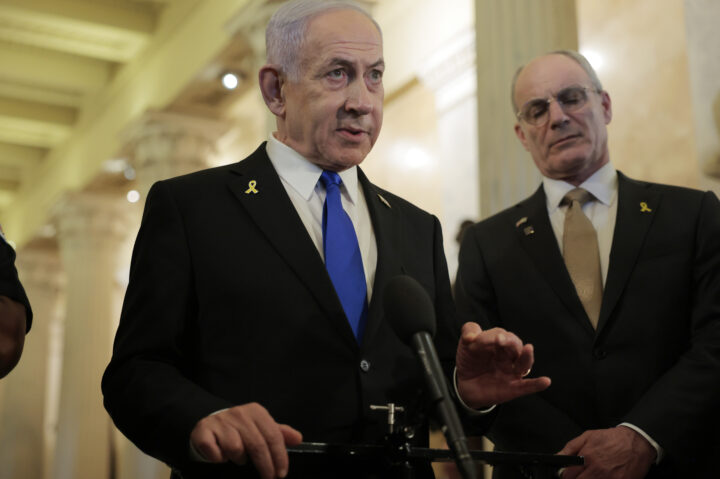
Anna Moneymaker/Getty Images
Israeli Prime Minister Benjamin Netanyahu speaks to reporters after meeting with U.S. Speaker Mike Johnson (R-LA) at the U.S. Capitol on July 8, 2025, in Washington, D.C.
Israeli Prime Minister Benjamin Netanyahu hosted senior administration officials, leaders from Jewish and pro-Israel Christian groups and hostage families for a reception last night at Blair House during his third visit to the United States this year.
Netanyahu was introduced by Paula White-Cain, the senior advisor to the White House Faith Office. “Israel, you are never, never alone,” she told the audience, pledging that evangelicals “will always stand with Israel.”
The Israeli prime minister spoke about efforts to free the hostages, both living and deceased, held in Gaza, saying, “We’re committed to getting every last one out … we don’t leave this sacred mission for a second.” He said he’d arrived a few minutes late because he had been speaking with the Israeli delegation engaging in hostage talks in Doha, Qatar, adding that he and President Donald Trump had spoken extensively about those efforts.
“We are going to succeed, we’ll bring them all home,” Netanyahu said, repeatedly acknowledging hostage family members in the room. “Each family has their own history of suffering, of hope, of prayer. … We do not forget, we will not relent, we’ll get them all home. All of them.”
Netanyahu also said that Iran would have had nuclear weapons within a year if Israel and the U.S. had not struck its facilities. He suggested that the U.S.’ show of force should also put to rest any questions about continued American supremacy in the 21st century, which “bodes well for the future.”
He honored Gen. Erik Kurilla, the outgoing head of U.S. Central Command — a rare public appearance in D.C. for the military leader. Netanyahu said Kurilla is a “commander without peer” whose successor would have “gigantic shoes” to fill, adding that Kurilla’s support has been “truly remarkable.” Netanyahu presented Kurilla with a sculpture made from a piece of an intercepted Iranian missile, featuring a map of Israel, a tree and a dove of peace, which Netanyahu said symbolized “peace through strength.”
Others in the crowded room — forced indoors by a torrential downpour and tornado watch in D.C. — included Education Secretary Linda McMahon, Commerce Secretary Howard Lutnick, Labor Secretary Lori Chavez-DeRemer, Small Business Administrator Kelly Loeffler, Under Secretary of Defense Elbridge Colby, U.S. Ambassador to Israel Mike Huckabee, Rep. Randy Fine (R-FL), Justice Department Senior Counsel Leo Terrell and Israeli Ambassador to the U.S. Yechiel Leiter. Brett McGurk, from the Biden administration’s National Security Council, was also in the crowd.
Jewish leaders in attendance included William Daroff, Elliot Brandt, Jonathan Greenblatt, Nathan Diament, Rabbi Moshe Hauer, former Sen. Norm Coleman (R-MN), Halie Soifer and Brian Romick. Christian leaders who attended included pastors Robert Jeffress, Mike Evans and Mario Bramnick.
The reception was the marquee event between the Israeli leader and officials from American Jewish groups during this visit. During recent visits to the U.S., Netanyahu skipped traditional sit-downs with Jewish leaders. Netanyahu has prioritized engagement with pro-Israel evangelical Christians and political conservatives, sometimes at the expense of more liberal-leaning American Jews.
He said he’s been working on the issue with top administration officials and acknowledged, ‘It’s already been held up too long’

Andrew Harnik/Getty Images
Sen. James Lankford (R-OK) speaks during a news conference on Capitol Hill on May 1, 2024 in Washington, DC.
Sen. James Lankford (R-OK), one of the leading Senate advocates for the Nonprofit Security Grant Program, told Jewish leaders on Wednesday that he is working with administration officials to ensure that NSGP funding moves forward quickly, but acknowledged that it had already taken too long.
Though the administration recently released freezes on reimbursements for past NSGP grants, it still has yet to announce awards for a supplemental grant round for which nonprofits applied in the fall of 2024, and has not yet opened the application for 2025 grants.
“That funding is not at risk. It is going to be let go, and it should be let go very, very quickly,” Lankford told an advocacy group organized by the Jewish Federations of North American and Conference of Presidents of Major American Jewish Organizations.
He continued, “We do have wide agreement to be able to say this needs to be done. It needs to be done faster, rather than slower. It’s already been held up too long. It’s June, almost July. The decision should have already been made to be able to move this.”
The Oklahoma senator, a co-chair of the Senate antisemitism task force, said he’s been in regular contact with Office of Management and Budget Director Russ Vought — seen as a key fiscal hawk inside the administration — about moving the funding ahead.
“He has assured me again that it is moving,” Lankford said, who spoke to Vought on Wednesday. “They are getting all the details worked out. They continue to be able to work with DHS to be able to make sure that funding is moving. That is not at risk. It is caught up in all the initial – we’re holding everything to be able to look at it. But that funding is not at risk.”
Lankford said he’s continuing to engage with the OMB and other parts of the administration, communicating “this is just common sense, that we need to be able to do this.” The senator urged advocates to keep calling their representatives to continue pushing the issue.
Rep. Virginia Foxx (R-NC), the chair of the House Rules Committee and former chair of the Education and Workforce Committee, also addressed the group, and said she plans to introduce legislation regarding Boycott, Divestment and Sanctions policies on college campuses, which is “going to hold the schools responsible for any BDS activity.”
Rep. Randy Fine (R-FL) warned that he plans to excoriate the president of Georgetown University at a congressional hearing next month if the school hasn’t fired a university professor who urged Iran to attack U.S. forces in retaliation for the U.S. strikes on Iran.
Rep. Haley Stevens (D-MI), who is mounting a bid for Senate, told the group that she’s a “proud Zionist” who “stand[s] with the Jewish community to call out rampant antisemitism, disgusting and egregious antisemitism.”
“My name is Haley Stevens, and you will always have a fierce ally in me,” she said.
She said she’s working to increase funding for the NSGP, noting that an attack like the one in Boulder, Colo., could happen at a synagogue in her district or anywhere in the country.
Other lawmakers who attended the meeting included Reps. Jim Jordan (R-OH), Greg Landsman (D-OH), Lisa McClain (R-MI), Josh Gottheimer (D-NJ), Celeste Maloy (R-UT), Gabe Amo (D-RI), Jake Auchincloss (D-MA), Darrell Issa (R-CA), Brad Sherman (D-CA), George Latimer (D-NY), Shri Thanedar (D-MI), Scott Franklin (R-FL), Joe Morelle (R-NY), Randy Weber (R-TX), Gary Palmer (R-AL) and Lois Frankel (D-FL).
Milgrim and other Israeli Embassy employees were constantly dealing with security threats, facing harassment upon leaving the building

Kevin Dietsch/Getty Images
Mourners lights candles during a vigil outside of the White House on May 22, 2025 in Washington, DC for the victims of the Capital Jewish Museum shooting on Wednesday evening, Yaron Lischinsky and Sarah Lynn Milgrim.
Bob Milgrim, the father of Sarah Milgrim, one of two Israeli Embassy employees who were killed last month at the Capital Jewish Museum, told Jewish leaders on Wednesday that better security at the event where his daughter was slain might have prevented the attack.
Milgrim’s comments were delivered to an audience of Jewish Federations of North America and Conference of Presidents of Major American Jewish Organizations leaders visiting Washington to advocate to Congress and the administration for increased security funding and other security resources to protect the Jewish community.
“Had there been more security at the event where Sarah and Yaron [Lischinsky] were tragically murdered, had there been more security outside, watching the crowd, I feel that it possibly could have identified the shooter pacing back and forth and possibly disarmed him,” Milgrim said.
Milgrim added that a heavy police presence was necessary when his family was sitting shiva in Kansas following his daughter’s death, including police cars parked in front of the family’s home and a SWAT team a few blocks away.
“It’s unbelievable,” Milgrim said. He noted that his local Jewish community had been targeted in an antisemitic shooting years earlier, in the 2014 attack at the Jewish Community Center in Overland Park, Kan.
Milgrim highlighted that security was an ongoing consideration for his daughter as an embassy employee during her life.
He said that, at one point, the embassy had opted to drive employees home to protect them from protesters camped outside, who threw items at embassy staffers and may have attempted to follow them home.
He said that, later, on multiple occasions, individuals in cars chased his daughter as she left the embassy, screaming anti-Israel slogans at her.
“She would take off running,” Milgrim said. “She didn’t feel so good.”
He urged Jewish leaders to call for “as much security as possible at all events,” including armed security and a visible police presence.
He also reflected on his daughter’s impact on their family, saying that he saw her passion for Judaism and Israel grow as she began preparing for her bat mitzvah, which Sarah had wanted to hold in Israel.
“That was the spark that started her journey of a love for Israel and Zionism,” Milgrim said. He explained, through tears, that growing up in a small Jewish community in southern Missouri, he “didn’t even know what the word Zionism meant. … [Sarah’s] life’s journey, and her studies, and her work eventually took her to the Israeli Embassy.”
President Trump could sign an executive order implementing the ban as soon as Wednesday, an administration official told a meeting of Jewish leaders

JIM WATSON/AFP via Getty Images
President Donald Trump signs an executive order in the Roosevelt Room of the White House on May 12, 2025, in Washington, DC.
The White House is considering issuing a new executive order banning travel to the United States from certain countries, resurrecting a controversial policy from President Donald Trump’s first term, according to three people who attended a Wednesday White House meeting where the plan was discussed.
The planned executive order was mentioned in a meeting at the White House with Jewish leaders. The meeting, which had several dozen attendees, was organized in response to the deadly antisemitic attack in Washington last month that left two Israeli Embassy staffers dead outside the Capital Jewish Museum. The briefing took place three days after an antisemitic attack in Boulder, Colo., injured 15 people at a march to raise awareness about Israeli hostages in Gaza.
White House Staff Secretary Will Scharf told the group about the order but did not mention which countries would be included in the ban. Scharf said Trump could sign the order as soon as Wednesday.
“They were just saying that an executive order regarding a travel ban is in the works,” one of the sources told Jewish Insider after the meeting. “Everyone was very careful about what they said and didn’t say.”
Another source said the planned order was “not directly because of the events in Boulder,” but that the attack in Boulder was mentioned “as a rationale, as proof of why this executive order was so important.”
The alleged perpetrator in the Boulder attack is an Egyptian national who is in the U.S. illegally, having overstayed his visa, according to the Department of Homeland Security. The suspect’s wife and five children were taken into Immigration and Customs Enforcement custody on Tuesday and were set to be deported to Egypt, but a federal judge on Wednesday halted deportation proceedings against the family members.
In 2017, days after taking office in his first term, Trump signed an executive order barring travel to the United States from seven Muslim-majority nations. Egypt was not one of them.
Speakers at the meeting included Susie Wiles, White House chief of staff; Harmeet Dhillon, assistant attorney general for civil rights at the Department of Justice; evangelical pastor Paula White and Jenny Korn from the White House Faith Office; Noah Pollak, senior advisor at the Education Department; Sebastian Gorka, senior director for counterterrorism at the National Security Council; Adam Boehler, U.S. special envoy for hostage response; Martin Marks, White House Jewish liaison; and Leo Terrell, chair of the federal antisemitism task force. Yehuda Kaploun, Trump’s nominee to serve as U.S. special envoy to monitor and combat antisemitism, was in the room.
Attendees at the meeting included a wide range of Jewish communal leaders, with representatives from Chabad, Jewish Federations of North America, the Anti-Defamation League, the Orthodox Union, American Jewish Committee, the Conference of Presidents of Major American Jewish Organizations, AIPAC, Agudath Israel and several Brooklyn-based Orthodox institutions.
A White House spokesperson did not immediately respond to a request for comment.
But the former governor’s recent outreach to skeptics could win him some late-breaking endorsements in the race’s final weeks

Spencer Platt/Getty Images
Former New York Gov. Andrew Cuomo speaks at the West Side Institutional Synagogue on April 1, 2025, in New York City.
In recent weeks, as Andrew Cuomo has stepped up his outreach to Orthodox Jewish leaders across New York City who represent sizable voting blocs crucial to his mayoral bid, he has found himself involved in an effort that is no doubt unfamiliar to the famously hard-nosed former New York governor: an apology tour.
Even as Cuomo has been outspoken in his support for Israel and opposition to rising antisemitism that he has called “the most important issue” in the race, he has continued to face lingering resentment from Orthodox voters who remain bitter over restrictions he implemented amid the COVID pandemic, which many community members recall as discriminatory.
The Cuomo campaign appears to have recognized that it could no longer avoid such tensions with just over a month until the June 24 Democratic primary, despite holding a sizable lead in the crowded race to unseat embattled Mayor Eric Adams, who is now running as an independent.
In ongoing listening sessions with a wide range of Orthodox leaders to whom he holds long-standing ties, Cuomo has sought to mend relationships that deteriorated over his crackdown on religious gatherings at the height of the pandemic, for which he first publicly voiced regret in recent comments to a local Jewish publication that in some ways laid the groundwork for his subsequent private meetings.
“I’m sure, in retrospect, I could have done some things differently and not every move is ever perfect in hindsight,” Cuomo acknowledged in an interview late last month with VIN News, which caters largely to Orthodox community members in New York City. “When some Orthodox communities had very high rates [of COVID-19], we were compelled to take action,” he added, “which created the impression that the community was targeted, although it was driven by the data that we had.”
In reflecting on what he called “the dark days of COVID,” he said his administration “absolutely could have done more to meet with and talk to community leaders and rabbis about what we were doing to ensure there was a two-way dialogue and that their concerns were addressed,” emphasizing he “would never want anyone to feel mistreated in any way.”
The former governor has reiterated some version of that explanation in recent sit-downs with Orthodox leaders whose coveted endorsements can hold sway in communities across the five boroughs, according to people familiar with the discussions. The outreach has been largely coordinated by Chris Coffey, a veteran Democratic strategist who is informally advising the Cuomo campaign and previously led Andrew Yang’s mayoral bid.
Recent interviews with Orthodox leaders, most of whom asked to remain anonymous to speak freely about a sensitive issue, suggest that they have been receptive to his efforts to make amends and express some contrition about his handling of the pandemic, even as they stressed feeling that he could have gone further in his comments.
“The leaders are listening to him,” said an Orthodox activist who is tracking Cuomo’s outreach but is not involved in the primary. “The problem is the people on the ground.”
Even one Hasidic activist who said he had helped to polish Cuomo’s statement before it was shared with VIN News admitted that the former governor “could have done more to show remorse” in his response to the community.
Still, the activist, who recently met with Cuomo and is part of a sizable and politically influential Hasidic community in the Williamsburg section of Brooklyn whose leaders can traditionally help deliver thousands of votes, said the former governor is now likely to win its endorsement. The eventual nod, he added, will still require some persuasion among the younger rank and file resentful of the so-called “red zones” Cuomo set in place during COVID — pointing to a generational divide that community leaders will almost certainly need to address.
“The leaders are listening to him,” said an Orthodox activist who is tracking Cuomo’s outreach but is not involved in the primary. “The problem is the people on the ground.”
Despite the bitter feelings, most Orthodox leaders believe constituents will back Cuomo once they are made aware of the current state of the race, which has consistently shown Zohran Mamdani, a Queens state assemblyman and fierce critic of Israel, firmly in second place, far outpacing other candidates who hold more established ties to the Jewish community — including the city comptroller, Brad Lander, and Adrienne Adams, the speaker of the City Council.
For his part, Mamdani, an outspoken member of the Democratic Socialists of America who has endorsed boycotts of Israel, has engaged in some outreach to the Orthodox community — though his efforts have been met with derision by most leaders who regard his campaign as a threat to their interests. The state lawmaker, for instance, has recently faced backlash for declining to sign on to a resolution last week that had recognized the 77th anniversary of Israel’s founding — not long after he had kept his name off of a separate resolution in Albany that condemned the Holocaust.
“He sort of apologized,” Leon Goldenberg, an Orthodox businessman who serves as an executive board chair of the Flatbush Jewish Community Coalition, said with a chuckle. “But we’ll make it acceptable, what can I tell you? We don’t have any choices. That’s really the bottom line,” he told JI, referring to Mamdani, whose positions on Israel and other issues he called “antisemitic.”
“I think the leadership sees the writing on the wall in the race and the alternatives,” said an Orthodox community activist supportive of Cuomo, summing up the stakes of the race. “I don’t want to undersell how bad the last few months were despite the solid relationship going back several decades,” he said of Cuomo’s time in office, which ended in 2021 when he was forced to resign amid accusations of sexual misconduct that the former governor continues to deny.
“He’s privately spent the last few months building confidence in those damaged relationships,” the activist explained. “I think the leadership is there, but they want to convey to constituents the dynamics of the primary and get them on board.”
Leon Goldenberg, an Orthodox businessman who serves as an executive board chair of the Flatbush Jewish Community Coalition, told JI his group met with Cuomo last Monday for what he described as a productive conversation in which he had pushed the former governor to speak about his COVID policies.
“He sort of apologized,” Goldenberg said with a chuckle. “But we’ll make it acceptable, what can I tell you? We don’t have any choices. That’s really the bottom line,” he told JI, referring to Mamdani, whose positions on Israel and other issues he called “antisemitic.”
By contrast, Goldenberg added, Cuomo “has been terrific on Israel and terrific on antisemitism,” which the former governor has highlighted among his top priorities in the race. “At the end of the day, he has done a lot of good things for the state and has been a competent manager,” he reasoned. “Has he made mistakes? Yes. That’s really what it is. He will make mistakes. But hopefully it won’t be on the Orthodox community’s back.”
Echoing others who spoke with JI, Goldenberg said he expected that Orthodox leaders would eventually fall in line behind Cuomo as the primary draws to a close in the coming weeks. “Everybody is accepting and everybody is going to be on board with him,” he said, noting that he and his board chairs would soon be engaging in outreach to constituents as part of an effort to clarify their choices in the looming election.
While a recent poll showed Cuomo with just 26% among Jewish voters in the primary, he still led the field by a wide margin — underscoring his favorable position in the race as he seeks to regain trust from the Orthodox community.
The Cuomo campaign, for its part, is hoping that Orthodox voters will ultimately view the race as a “binary choice” between the former governor and Mamdani, a source familiar with the matter told JI.
His recent outreach will likely help crystallize that decision, say Orthodox leaders who have met with him. In one meeting, for instance, Cuomo vowed to hire a senior Orthodox Jewish liaison if he is elected mayor, to maintain lines of communication with his office and avoid potential future conflicts, according to a person familiar with the pledge.
“On COVID, the red zones were driven by the data we had, but as the governor previously said, on reflection we absolutely could have done more to communicate with community leaders and rabbis about what we were doing to ensure that concerns were addressed,” Rich Azzopardi, a Cuomo campaign spokesperson told JI.
Last Monday, meanwhile, Cuomo even “used the phrase ‘I apologize” while meeting with a coalition of Orthodox leaders organized by Agudath Israel of America, which had sued Cuomo in federal court for his COVID restrictions, said an attendee. “He didn’t say what for,” the attendee told JI. “But those words came out.”
“People felt, policy-wise, he’s much more in tune with them than the other candidates, but they felt singled out and stigmatized” over his approach to COVID, the attendee told JI, noting that the meeting had gone smoothly. “People wanted to hear some sort of contrition, some acknowledgment of what happened.”
In a statement to JI on Sunday, Rich Azzopardi, a Cuomo campaign spokesperson, said the former governor “has deep and decades-long relationships with the Jewish community and appreciates the frank dialog.”
“On COVID, the red zones were driven by the data we had, but as the governor previously said, on reflection we absolutely could have done more to communicate with community leaders and rabbis about what we were doing to ensure that concerns were addressed,” Azzopardi continued.
He said Cuomo would fight rising antisemitism by “strengthening our laws, ensuring that violations of the human rights law are prosecuted to the fullest extent possible and making sure our schools adopt a curriculum that takes antisemitism and other forms of bias seriously.”
The former governor is expected to hold additional meetings with Orthodox leaders this week in heavily Jewish neighborhoods of Brooklyn such as Borough Park and Crown Heights, according to sources with knowledge of his outreach.
Hank Sheinkopf, a veteran Democratic strategist in New York City, said Orthodox community members who are still skeptical of Cuomo are misreading the moment as Mamdani gains traction in the final leg of the race.
“The polling data shows that Mamdani is on the move,” he told JI. “The Jewish community really doesn’t have much choice here.”
Please log in if you already have a subscription, or subscribe to access the latest updates.
 Continue with Google
 Continue with Apple