


Craig Hudson for The Washington Post via Getty Images
DSA’s ascent tests Democratic Party’s ideological boundaries
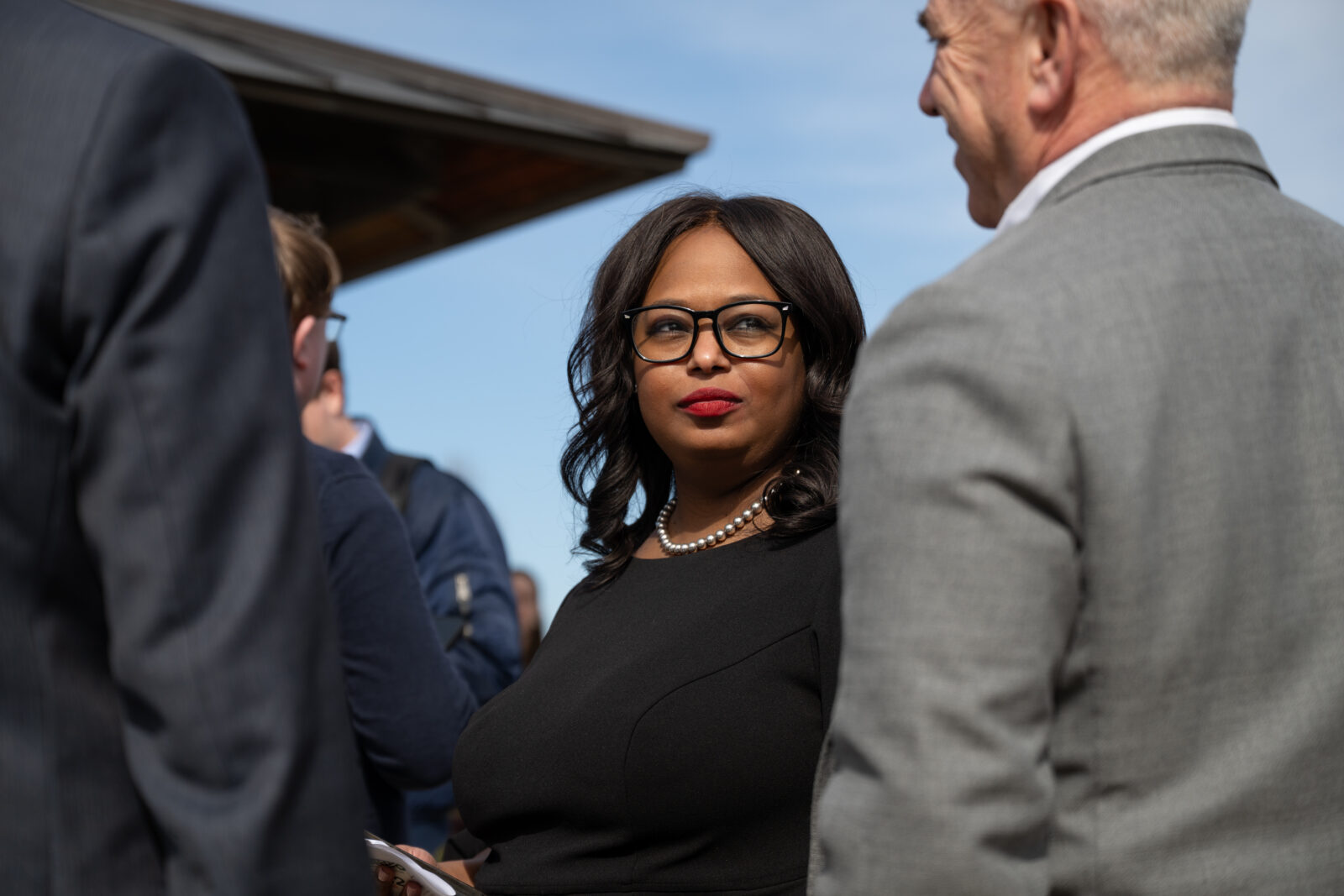
If elected mayor of Washington, D.C, Janeese Lewis George’s victory would hand a major win to Washington’s Democratic Socialists of America chapter


 Add JewishInsider on Google
The open race for mayor of Washington, D.C., has been largely uneventful ahead of next month’s primary — so much so that the first TV ads run by the leading candidates, Kenyan McDuffie and Janeese Lewis George, sound nearly identical. Both candidates tout affordability and safety on the campaign trail, with promises to build more housing and stand up against President Donald Trump.
But if elected, Lewis George’s victory would mark a significant shift away from the centrist brand of politics espoused by outgoing Mayor Muriel Bowser over the last 12 years, and would instead hand a major win to Washington’s Democratic Socialists of America chapter, of which Lewis George has been a member for years.
Lewis George has faced criticism throughout the campaign from some in the Jewish community for comments she made on a DSA endorsement questionnaire pledging to boycott events that “promote Zionism” and criticizing Jewish activists’ approach to combating antisemitism. Ron Halber, CEO of the Jewish Community Relations Council of Greater Washington, on Tuesday called DSA an “evil” organization that seeks “to make being Jewish unacceptable in polite society.”
DSA has activated its small but growing membership to knock on doors for Lewis George, a member of the D.C. Council, tapping into a grassroots energy that they hope translates into success at the ballot box. Rep. Rashida Tlaib (D-MI), one of two DSA members currently serving in Congress, attended a recent DC DSA rally alongside Lewis George.
DSA’s Metro DC chapter is relatively small. Yet its current roster of roughly 3,400 members represents a massive increase from its pre-2016 nadir of just 200 members — and mirrors DSA’s growing clout nationally.
“For most of the ‘80s and ‘90s and 2000s, DSA was a small organization with maybe 5,000 or 8,000 people at the most. I would say the average age was probably over 60, maybe higher than that,” said Peter Dreier, an emeritus professor of politics at Occidental College in Los Angeles. “Then Bernie [Sanders] ran for president in 2016 and started talking about democratic socialism in a way that made sense to, particularly, a lot of young people, and he kind of opened the door to people to be in DSA.”
Overall, DSA is still a small organization on the fringes of Democratic politics. Even the highest membership counts — adding up DSA’s local chapters — don’t top 100,000. But the unexpected popularity of Sanders’ 2016 presidential run sparked a resurgence of interest in democratic socialism not seen in generations, and that has continued well past his two campaigns. A 2025 Gallup poll found that 42% of Democrats have a positive image of capitalism, down from 54% a decade ago, while 66% have a positive view of socialism.
“If [young people] don’t remember the Cold War, then what do they think when they hear the word socialism? There’s still a battle over that, but they’re more likely to think, ‘Oh, countries that have more equality, or students that get free or almost free higher education, everybody has access to healthcare,’” said Dreier.
“We are going to raise money and develop a plan over the course of the next few months to try to make them toxic, to make it unacceptable for major figures in the party or anybody actually running for office to be affiliated with the DSA, the way it should be unacceptable to be affiliated with [neo-Nazi influencer] Nick Fuentes if you’re running as Republican,” Third Way’s senior vice president for public affairs, Matt Bennett, said.
The key question now facing capital-D Democrats — one they sound unsure of how to answer, or perhaps unwilling — is how to handle an insurgent faction that has galvanized people over its straightforward messaging on corporations (bad), taxing the rich (good) and Medicare for All (necessary), while at the same time promoting far-left positions like prison and police abolition that are nowhere near the Democratic mainstream. The group has long promoted the Boycott, Divestment and Sanctions movement, as well as calling for an arms embargo on Israel, and its members passed a resolution last year affirming their commitment to anti-Zionism. On Oct. 7, 2023, DSA released a statement holding Israel accountable for the Hamas attacks and calling on members to take to the streets to protest U.S. support for Israel.
The centrist Democratic group Third Way plans to launch a major PR campaign against DSA in the coming months, one of the group’s executives told JI, arguing that its far-left positions and incendiary brand of politics will be harmful for the party’s electoral prospects.
“We are going to raise money and develop a plan over the course of the next few months to try to make them toxic, to make it unacceptable for major figures in the party or anybody actually running for office to be affiliated with the DSA, the way it should be unacceptable to be affiliated with [neo-Nazi influencer] Nick Fuentes if you’re running as Republican,” Third Way’s senior vice president for public affairs, Matt Bennett, said.
In the decade since Sanders’ 2016 campaign, DSA has had an outsized impact on national politics. The 2018 congressional victory of Rep. Alexandria Ocasio-Cortez (D-NY), a DSA member, raised the group’s profile. A steady stream of more than 200 DSA-aligned candidates have been elected to state and local offices since, culminating with the election of DSA member Zohran Mamdani as mayor of New York City last year.
“To the degree that people need to pay attention to DSA, it’s because they built this kind of political machine,” said Micah Sifry, a journalist focused on left-wing political organizing. “In a time when people are, for the most part, not very organized, the ability of any small group, relatively speaking, to punch above its weight grows.”
Perhaps unsurprisingly, New York has the largest bench of DSA-affiliated state lawmakers. The group has slowly but steadily been gaining electoral power in state and local offices in some unexpected places, too, like Minnesota, Colorado, Delaware and Wisconsin. The group’s largest foothold is in city council races, where a small but committed cadre of volunteers can swing elections in low-turnout races.
National Democratic leaders are divided about how to treat the small but vocal socialist minority in the party.
House Minority Leader Hakeem Jeffries (D-NY) declined to support Mamdani in the primary election but ultimately endorsed him ahead of the general election last year. Weeks later, Jeffries voted in favor of a Republican-led resolution condemning socialism. He has been skeptical of the left-wing ideology throughout his political career: “There will never be a moment where I bend the knee to hard-left democratic socialism,” he said in 2021. A spokesperson for Jeffries declined to comment this week when asked if he believes Democrats should be welcoming socialists into the party.
Democratic National Committee Chair Ken Martin has been more open-minded about socialists. Asked by Fox News last year whether progressives like Mamdani and Ocasio-Cortez make his job harder, he said no.
“The party is a big tent. But just like we have to believe it’s a big tent, the DSA also has to believe it’s a big tent, and I’m not sure they do,” Brian Romick, CEO of Democratic Majority for Israel, said. “Democratic leaders want to win elections, and that means a big tent, and that means that Democratic base voters and pro-Israel voters and moderate people who maybe voted for [Donald] Trump sometimes because they’re concerned about prices have to be in the tent.”
“I don’t think they make it difficult at all,” Martin said in August 2025. “The difference between the Democratic Party and the Republican Party is that we’re a big tent. We have lots of people in that tent from all of the different ideological wings, from conservative Democrats, to centrists, to progressives, to these new leftists.” A DNC spokesperson did not respond to multiple requests for comment this week.
Brian Romick, CEO of Democratic Majority for Israel, told Jewish Insider this week that he is concerned about the inroads DSA is making in the party. He agreed with Martin that the Democratic Party should be a big tent, but noted that DSA members — who are at times intent on putting litmus tests even on would-be allies — don’t extend the same understanding to more moderate members of the party.
“The party is a big tent. But just like we have to believe it’s a big tent, the DSA also has to believe it’s a big tent, and I’m not sure they do,” Romick said. “Democratic leaders want to win elections, and that means a big tent, and that means that Democratic base voters and pro-Israel voters and moderate people who maybe voted for [Donald] Trump sometimes because they’re concerned about prices have to be in the tent.”
The questionnaire Lewis George filled out in Washington to earn DSA’s endorsement reveals how important hard-line opposition to Israel is to the organization, which requires even candidates for local offices with no connection to foreign policy to all but disavow the Jewish state. Most voters who support DSA-aligned candidates likely are not drawn to them because of their views on the Middle East; Mamdani’s message was first and foremost about affordability. But DSA’s growing reach among Democrats gave a foothold to anti-Israel views that may have once been rare, though global attention on the war in Gaza also contributed to shifting Democratic orthodoxy on the conflict. (Other far-left groups like Justice Democrats have played a role, too.)
Zach Shartiag, a Jewish Democratic campaign operative from Chicago, told JI that Democrats he has talked to who support DSA candidates generally do not do so because of DSA’s stance on Israel, even if the activists are themselves critical of Israel.
“People might be very anti-Israel now, but at the same time, it’s like, what does that have to do with local politics?” said Shartiag, who is currently working on a congressional campaign in Hawaii. “I’ve talked to a lot of people, just in general, normal humans, and it’s like, ‘Yeah, I might be against what Israel’s doing, but what does that have to do with the local and the city and the state?’”
The full picture of DSA’s influence in the party will not be known until all the votes are tallied at the end of this year’s midterm elections. A number of DSA-affiliated candidates are gaining ground in congressional primaries, such as Pennsylvania state Rep. Chris Rabb, who has garnered progressive endorsements in a Philadelphia-area open seat, and New York state Assemblymember Claire Valdez, who has Mamdani’s backing for her congressional campaign.
Still, the election outcomes in states across the country this year will present only a partial picture of where the Democratic Party is moving. In the same year that Mamdani won in New York City, for instance, Democratic moderates Abigail Spanberger and Mikie Sherrill won gubernatorial races in Virginia and New Jersey, respectively.
The only certainty, then, is that the battle between centrists and socialists will continue into 2028.
“I think you’re going to have a real mixed verdict, with us yelling about our side and the left yelling about their side,” Third Way’s Bennett acknowledged. “So what that means is, unsurprisingly, we’re going to go into the presidential primary season with the two camps demanding that they are right.”
Featured Stories
partnership pitch
Somaliland president discusses expanded military cooperation with U.S. officials
ENVOY DEBATE
Congressional Jewish Caucus opposes proposal to combine State Dept. Holocaust, antisemitism offices
FAMILY TRAGEDY
Israeli ambassador’s son seriously wounded in West Bank car-ramming attack
Please log in if you already have a subscription, or subscribe to access the latest updates.
 Continue with Google
 Continue with Apple