



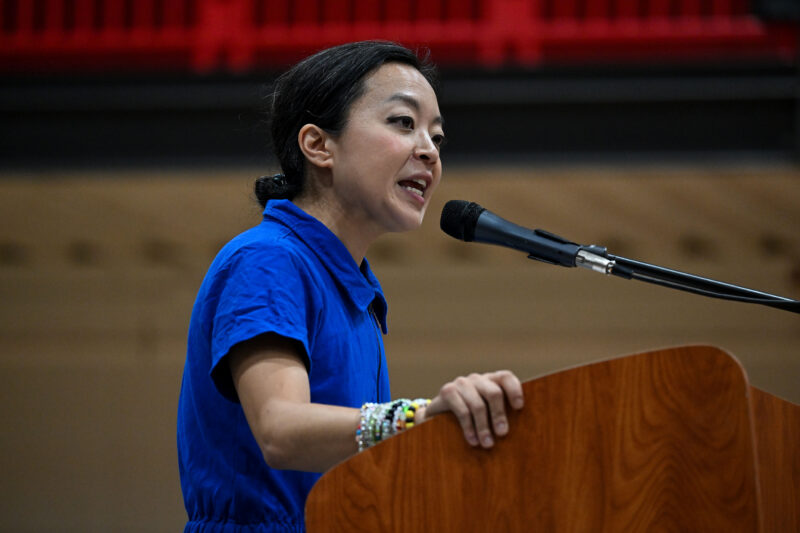









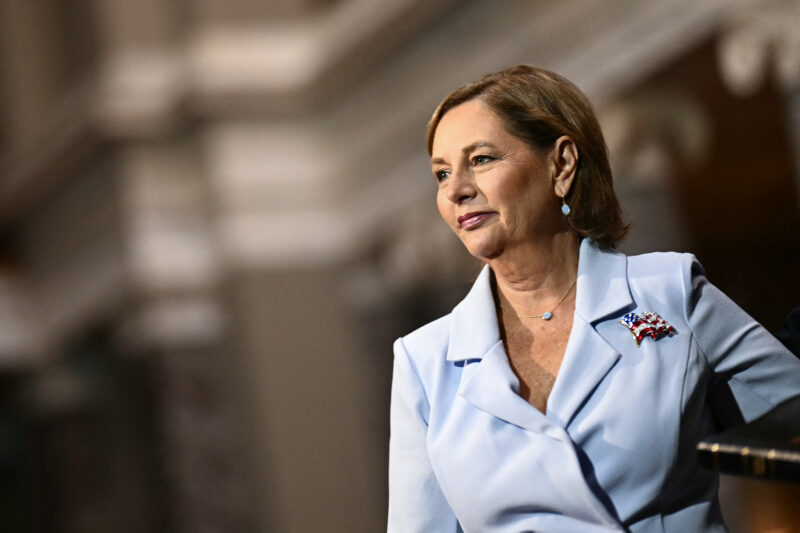






























Caroline Glick, an advisor to Netanyahu, pushed back on reports of a rift between the two leaders
Prime Minister's Office
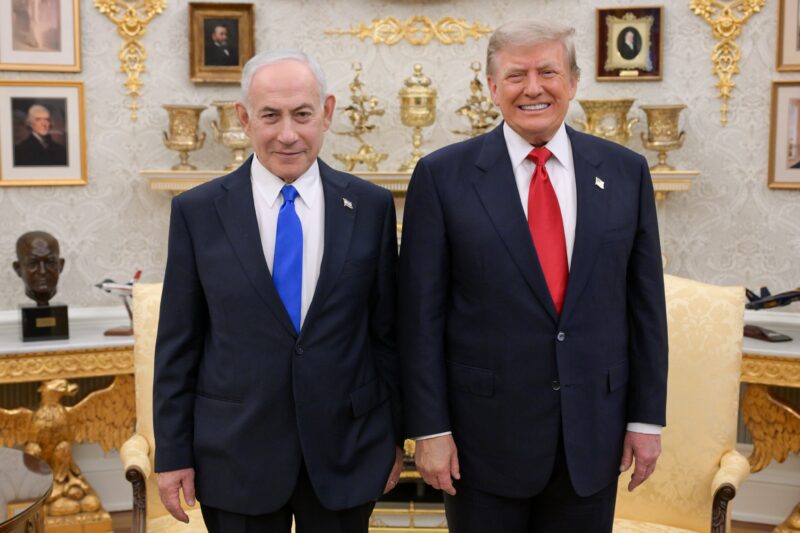
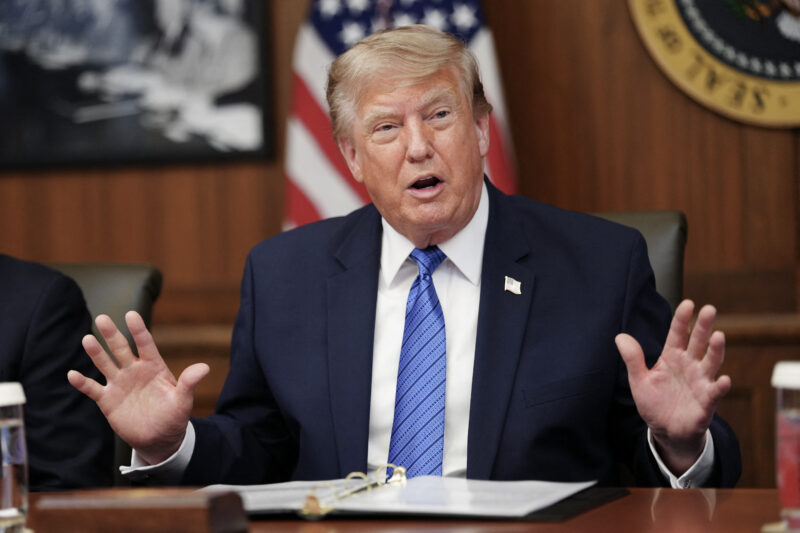
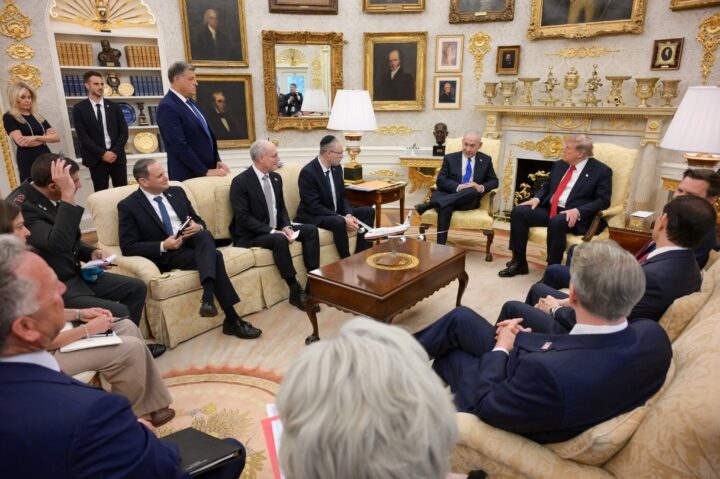
Israeli Prime Minister Benjamin Netanyahu meets with President Donald Trump in the Oval Office on July 28, 2026.


 Add JewishInsider on Google
Israeli Prime Minister Benjamin Netanyahu hailed his sit-down with President Donald Trump in the Oval Office on Tuesday as “one of the best conversations I’ve ever had with a president of the United States, our friend Donald Trump.”
The Israeli prime minister called the meeting “excellent.”
“When I say excellent, I don’t mean it lightly,” he added, speaking in a video statement after the summit. It was “a conversation with full partnership, mutual support, with understanding on the shared goal that Iran will not have nuclear weapons and also other goals,” he said.
Caroline Glick, Netanyahu’s international affairs advisor, similarly described the meeting as “extremely positive” and pushed back against reports of a rift between Jerusalem and Washington.
“The two sides continue to be totally committed to our shared goal of preventing Iran from acquiring nuclear weapons, and that was obviously the focus of the discussion, but we discussed a whole range of regional issues,” Glick told Jewish Insider.
Glick said the Israeli delegation left the meeting feeling “terrific” about the strategic alignment between Washington and Jerusalem.
Addressing reports of friction between the two leaders over strategy in the Iran war and Trump’s proposed sale of F-35 fighter jets to Turkey, Glick said “nothing specific” on the jet deal came up during the meeting. She added that Trump and Netanyahu “have an incredible relationship,” dismissing talk of tension as a “media-manufactured crisis.”
“They have arguments from time to time… but they are on the same page 100% with everything relating to the goal of all operations regarding Iran,” Glick said. “The discussion was what you would expect from an alliance. You had two leaders who know each other very well, have enormous amounts of respect for one another and share common goals that they are completely committed to achieving.”
Hours before the meeting, Trump had expressed frustration with Netanyahu’s reported intention to raise with him Israeli intelligence regarding Iranian nuclear activity, saying in an interview on Fox News, “I don’t need Bibi to tell me that. Bibi is telling me that because he wants me to stay involved.”
While analysts framed the Oval Office meeting as a key opportunity for Netanyahu to gauge where Trump stands on Iran, Glick declined to say where the administration truly prefers diplomacy or resuming strikes, stressing instead that both nations are moving toward a unified outcome.
“All the trends are moving towards the achievement of our joint goal, which is to prevent Iran from having nuclear weapons,” Glick said. “So if it’s the hard way, the easy way, the middle way, the side way, it’s all geared towards moving the ball into that goal. I don’t think you can characterize it one way or another. It’s not a linear process.”
Hostilities between the U.S. and Iran remain paused as the U.S. is in “very deep talks” with Iran, Trump said on Monday, though the president has repeatedly threatened to return to military action if talks fail.
Glick said the trilateral agreement between the U.S., Israel and Lebanon was “touched on” but “wasn’t the focus,” saying that it will be left to the meetings between the parties set to take place in Rome next week.
She also noted that the two leaders briefly discussed the issue of expanding the Abraham Accords, with both remaining committed to bringing additional nations into the normalization framework.
“We believe that the prospects for expanding them are very high and look forward to doing so,” Glick said. “But as the prime minister always says, if we discuss which specific country, it will only undermine the process.”
‘Bibi is telling me that because he wants me to stay involved,’ Trump said of reported Israeli intelligence about Iran’s Pickaxe Mountain, ahead his Oval Office meeting with Netanyahu

Samuel Corum/Getty Images
President Donald Trump speaks with reporters while aboard Air Force One on June 5, 2026 en route to Chippewa Falls, Wisconsin.
President Donald Trump expressed discontent with Israeli Prime Minister Benjamin Netanyahu’s reported forthcoming warnings regarding Iranian nuclear activity at Pickaxe Mountain, dismissing the issue as “not a big problem” in a sharp public split hours ahead of their high-stakes Oval Office meeting.
“I don’t need Bibi to tell me that. Bibi is telling me that because he wants me to stay involved [in Iran],” Trump alleged in an interview on Fox News on Tuesday morning.
Netanyahu is reportedly expected to brief Trump on Iran’s activities at Pickaxe Mountain during their meeting, attempting to demonstrate that Tehran is undermining diplomatic talks by relocating its nuclear infrastructure underground.
Commenting on reports that Netanyahu intends to raise with him Israeli intelligence demonstrating that Iran moved nuclear centrifuges into Pickaxe following the 12-day war in June 2025, Trump said: “Why don’t you [Netanyahu] just tell it to me? Why do you have to announce it to the world? I know exactly what’s happening at Pickaxe, it’s not a big problem.” Trump has previously downplayed such reports, saying earlier this month that the U.S. has not seen evidence of nuclear activity at the site.
Trump insisted on Tuesday that U.S. intelligence is monitoring Pickaxe Mountain closely, while renewing threats to launch military strikes if a diplomatic agreement falls through.
“We have the greatest cameras in the world focused on it,” Trump said. “We took out their nuclear sites, and we’ll have to take out Pickaxe if we don’t make a deal … We’ll take it out very easily.”
The complex, which Tehran is believed to have begun constructing in 2020, is located roughly a mile south of Iran’s primary Natanz nuclear facility, a site struck multiple times during the 12-day war.
While Trump has previously noted that Pickaxe Mountain was spared amid the current U.S.-Iran war due to a lack of evidence that nuclear enrichment was taking place there, he warned during a meeting last week with Lebanese President Joseph Aoun that the U.S. could target the area “pretty soon.”
Tuesday’s Oval Office meeting marks the eighth between Trump and Netanyahu during Trump’s second term, and their first face-to-face sit-down since the current Iran war began in February. Once closely aligned, the two leaders enter the talks divided over key strategic decisions, including how to conclude the war and Trump’s proposed sale of F-35 fighter jets to Turkey.
Plus, Bibi's back in town
Andrew Harnik/Getty Images
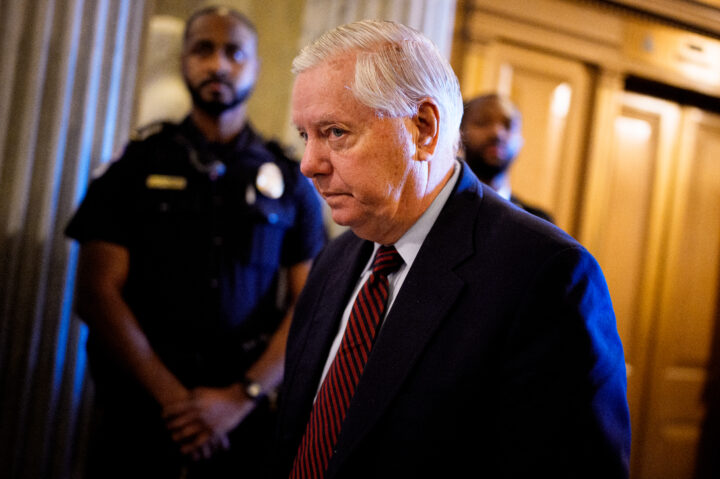
Sen. Lindsey Graham (R-SC) walks into the Senate Chamber on December 11, 2025 in Washington, DC.
Good Tuesday morning.
In today’s Daily Kickoff, we preview Israeli Prime Minister Benjamin Netanyahu’s meeting with President Donald Trump at the White House, which will take place today before the funeral of Sen. Lindsey Graham (R-SC), which both leaders are attending. We look at AIPAC’s messaging strategy to attack far-left candidates, and cover last night’s Michigan Senate primary debate between Abdul El-Sayed and Rep. Haley Stevens (D-MI). We also report on New York City Mayor Zohran Mamdani’s refusal to engage with calls to tone down his rhetoric on Israel after the recent stabbing attack on the Upper West Side, and highlight a meeting between Qatari Emir Sheikh Tamim bin Hamad Al Thani and a group of rabbis in Doha, which was publicized by the emir. Also in today’s Daily Kickoff: Yair Lapid, Rahm Emanuel and Amir Tibon.
We also have a new on-demand Live Briefing that you can access throughout the day via our new app (on Apple and Android) and on our website.
Today’s Daily Kickoff was curated by Israel Editor Tamara Zieve and U.S. Editor Danielle Cohen-Kanik. Have a tip? Email us here.
What We’re Watching
- Israeli Prime Minister Benjamin Netanyahu will meet with President Donald Trump at the White House this morning for their eighth such meeting during Trump’s second term. Read more below. Earlier, Trump is slated to meet separately with Ukrainian President Volodymyr Zelensky, before all the leaders — joined by others, including Israeli Opposition Leader Yair Lapid — make their way to the funeral of Sen. Lindsey Graham (R-SC).
- The Jewish Federations of North America is hosting a breakfast at its Washington office in honor of Graham, ahead of his funeral later today.
- Graham’s funeral will begin at the U.S. Capitol with a private ceremony and continue with a service at Washington National Cathedral, where remarks will be delivered by Trump, Fox News’ Sean Hannity and Emillie Boggs Roberts, Graham’s niece.
- The Senate is expected to hold votes on a number of issues including on Jay Clayton’s nomination to become director of national intelligence and on a procedural motion to begin consideration of Russia sanctions legislation championed by Graham before his death, which now includes Iran sanctions as well.
- This evening, Central Synagogue in Manhattan will hold a memorial service for Wesley LePatner, one year after the Blackstone executive and Jewish philanthropist was killed in a shooting at the firm’s Midtown headquarters.
- The 20th Sami Rohr Prize for Jewish Literature will be awarded to Haaretz journalist Amir Tibon for his Oct. 7 memoir, The Gates of Gaza, this evening at a private ceremony in Jerusalem.
What You Should Know
A QUICK WORD WITH JI’S melissa weiss
For watchers of the U.S.-Israel relationship, the events of the last few days have had a familiar feel. On Friday, President Donald Trump suggested at the White House Correspondents’ Dinner that Iran would “love to make a deal. I don’t think they’re ready to. I don’t think it’s time yet, but I’m willing to listen.” Today, the president will meet at the White House with Israeli Prime Minister Benjamin Netanyahu as the countries weigh a military escalation with Iran.
The similarities to the dialogue surrounding Iran earlier this year are striking. In early February, Trump told reporters aboard Air Force One, “Iran looks like it wants to make a deal very badly.” Days later, Trump would meet at the White House with Netanyahu for talks focused on Iran. Weeks after that meeting, the U.S. and Israel launched joint military strikes against the Islamic Republic, kicking off a six-week war.
Despite the similarities around these two meetings — much has changed.
In the U.S., there is growing opposition among Americans to renewed military action against Iran — a sentiment that extends to some top military officials, including, reportedly, CENTCOM head Adm. Brad Cooper.
Public perception of Israel — and Israelis — has hit its most negative point in years, with Gen Z Americans across the political spectrum having significantly more favorable views of Palestinians than Israelis.
The numbers demonstrate the degree to which opinions on Israel and Iran — and the U.S. role in the region — have shifted in the five months since the war began. The domestic politics in the U.S. vis-a-vis Iran look very different than they did during the last Trump-Netanyahu meeting.
PRIMARY PLAYBOOK
AIPAC reminds voters of far-left candidates’ hostility to Kamala Harris, Joe Biden

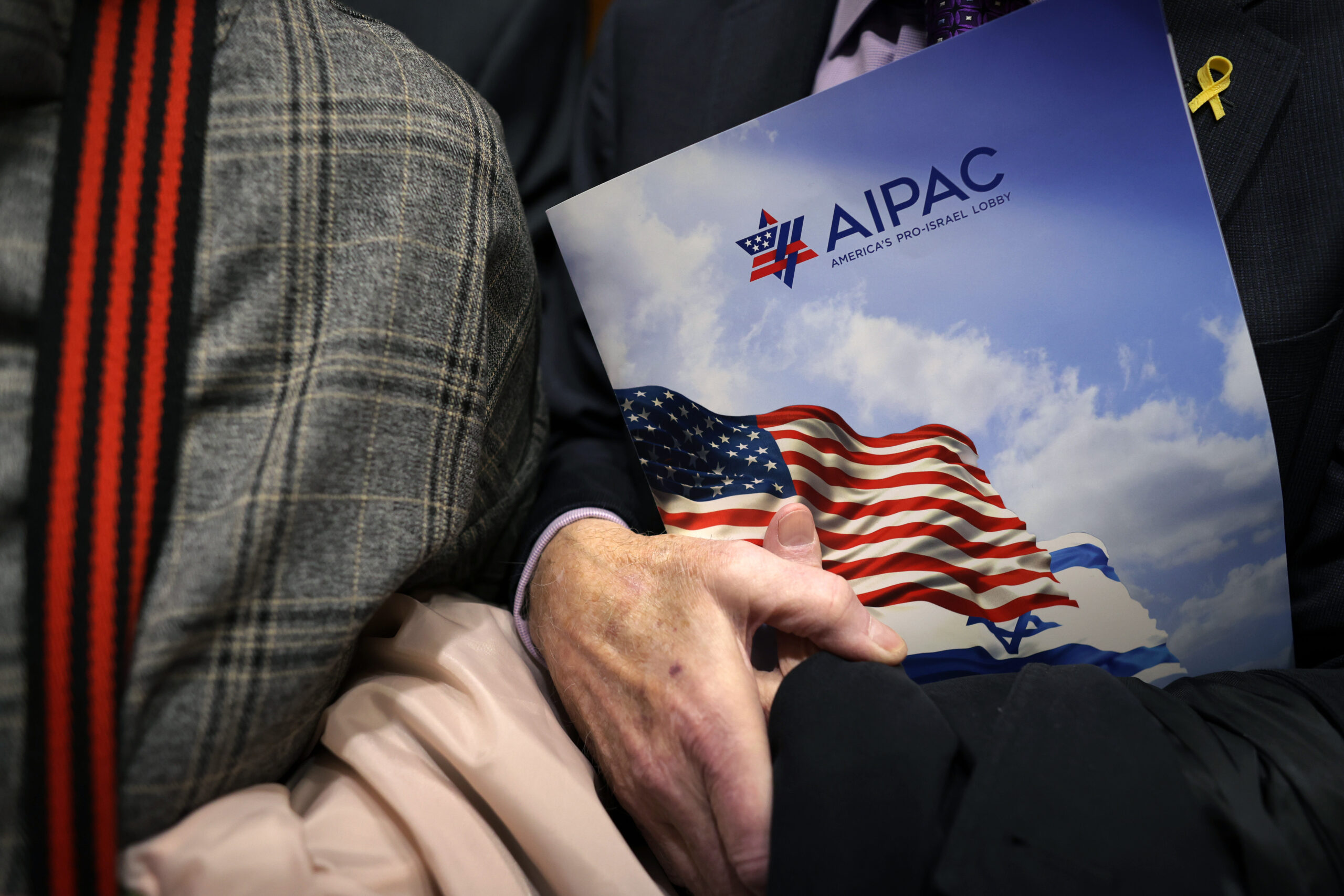
From Michigan to Missouri, where tensions between the Democratic Party’s moderate and far-left factions are playing out in high-profile contests for the House and Senate, AIPAC is hitting its anti-Israel opponents for their past criticism of former President Joe Biden and former Vice President Kamala Harris in an effort to portray the candidates as hostile to mainstream policy goals, Jewish Insider’s Matthew Kassel reports.
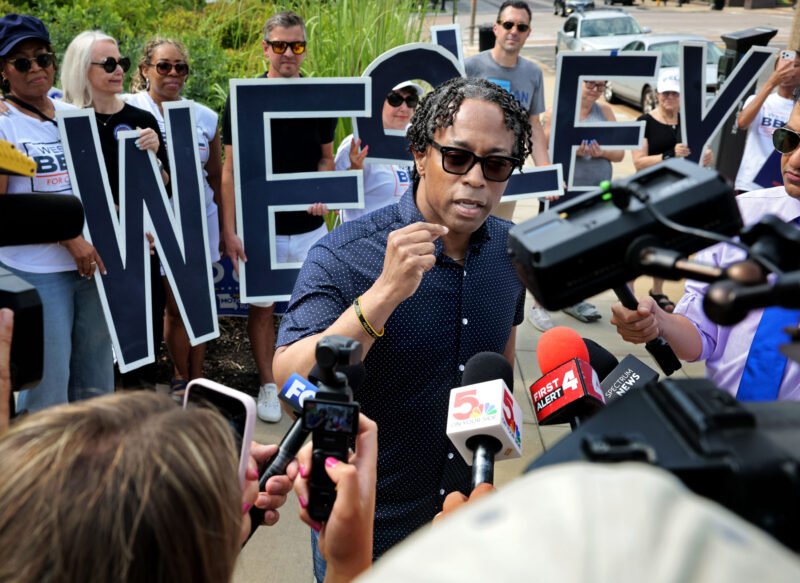
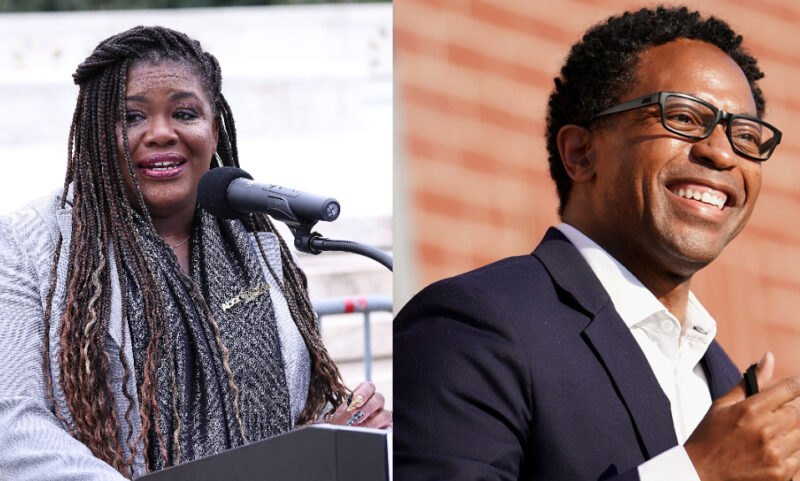
Messaging strategy: The tactic, which the AIPAC-linked United Democracy Project super PAC also deployed last election cycle in key races, dates back to at least 2021, when DMFI PAC, Democratic Majority for Israel’s political arm, had relentlessly attacked Nina Turner — a former Ohio state senator running for an open House seat in Cleveland on a platform that was critical of Israel — for remarks in which she had compared voting for Biden to eating a “bowl of s**t.” Now, UDP is reviving the playbook as it takes on former Rep. Cori Bush (D-MO), who is seeking a rematch against Rep. Wesley Bell (D-MO) after she lost her St. Louis House seat in 2024. In recent attack ads, UDP, which has spent over $2.5 million to boost Bell, is hitting Bush over past comments criticizing Biden and Harris, as well as her vote against the bipartisan infrastructure package while in Congress in 2021.
MICHIGAN MATCHUP
Israel, AIPAC take center stage in final Michigan Senate primary debate
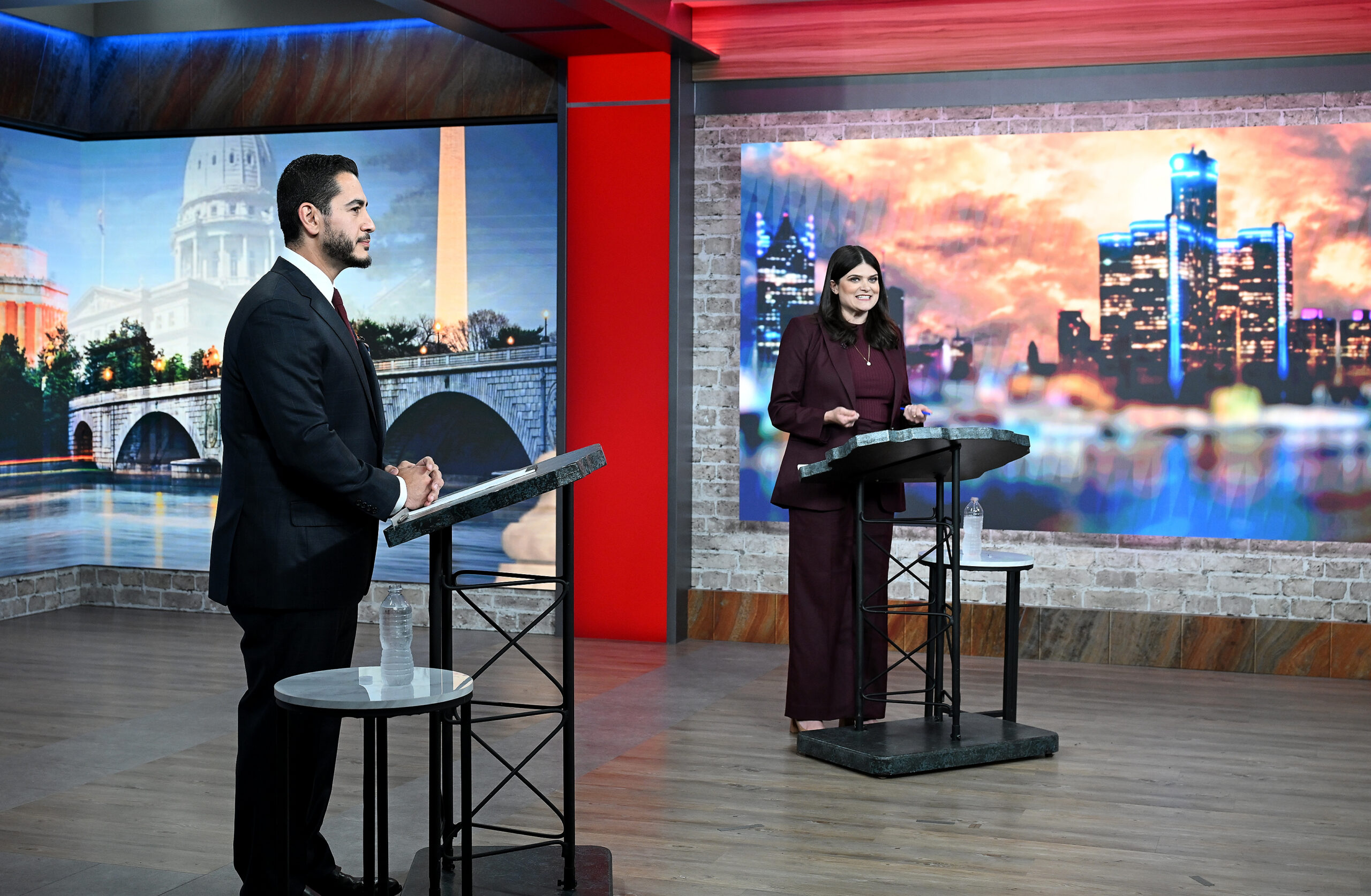
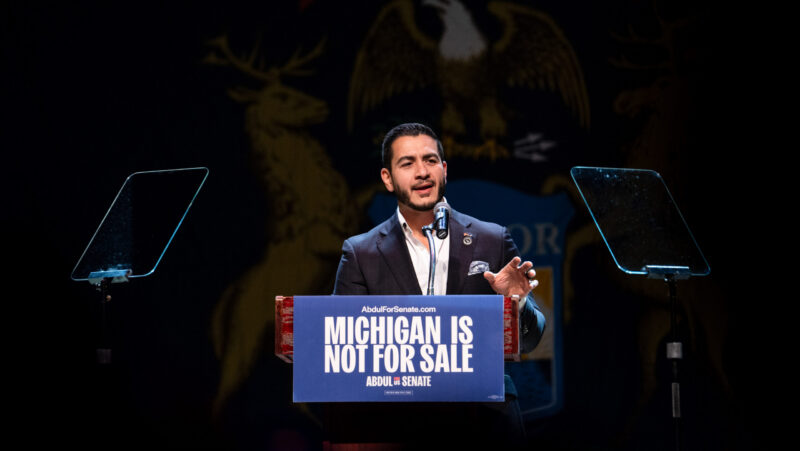
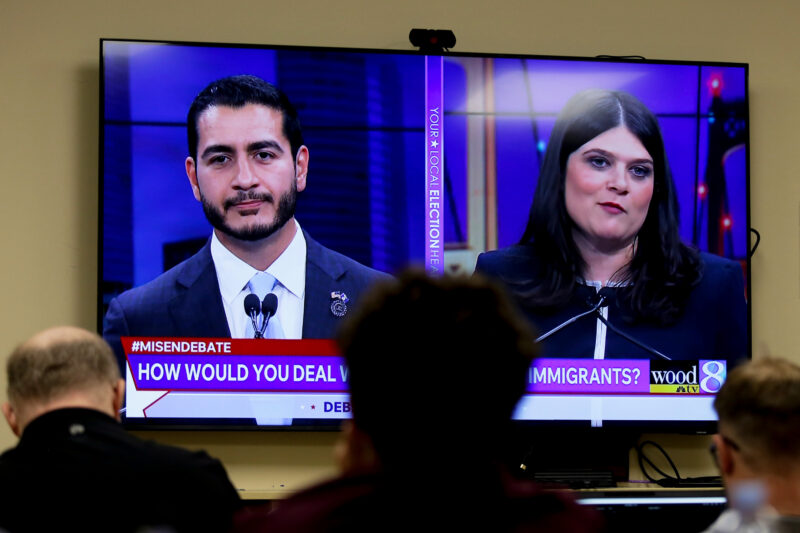
If Michigan’s Democratic Senate primary has become a test case for the saliency of AIPAC and Israel as a political issue for Democratic voters, then Monday night’s debate between Abdul El-Sayed, a far-left former public health official, and Rep. Haley Stevens (D-MI) served as the ultimate battlefield — and illustrated the gulf between the two candidates on the issue, Jewish Insider’s Gabby Deutch reports.
Debate recap: Over the course of an hourlong debate, El-Sayed made clear that he believes his opposition to AIPAC and to Israel will help him win next week’s election. Stevens, meanwhile, did not even utter the word “AIPAC.” Stevens outlined her views on the Middle East, arguing that she and El-Sayed diverge because she supports a two-state solution to the Israeli-Palestinian conflict while he has not acknowledged Israel’s right to exist as a Jewish state. She touted her support for Michigan’s Jewish community and mentioned the work she did to advocate for the hostages after the Oct. 7, 2023, Hamas attacks on Israel.
TEMPERATURE CHECK
Mamdani refuses to engage with calls to tone down Israel rhetoric after UWS stabbing
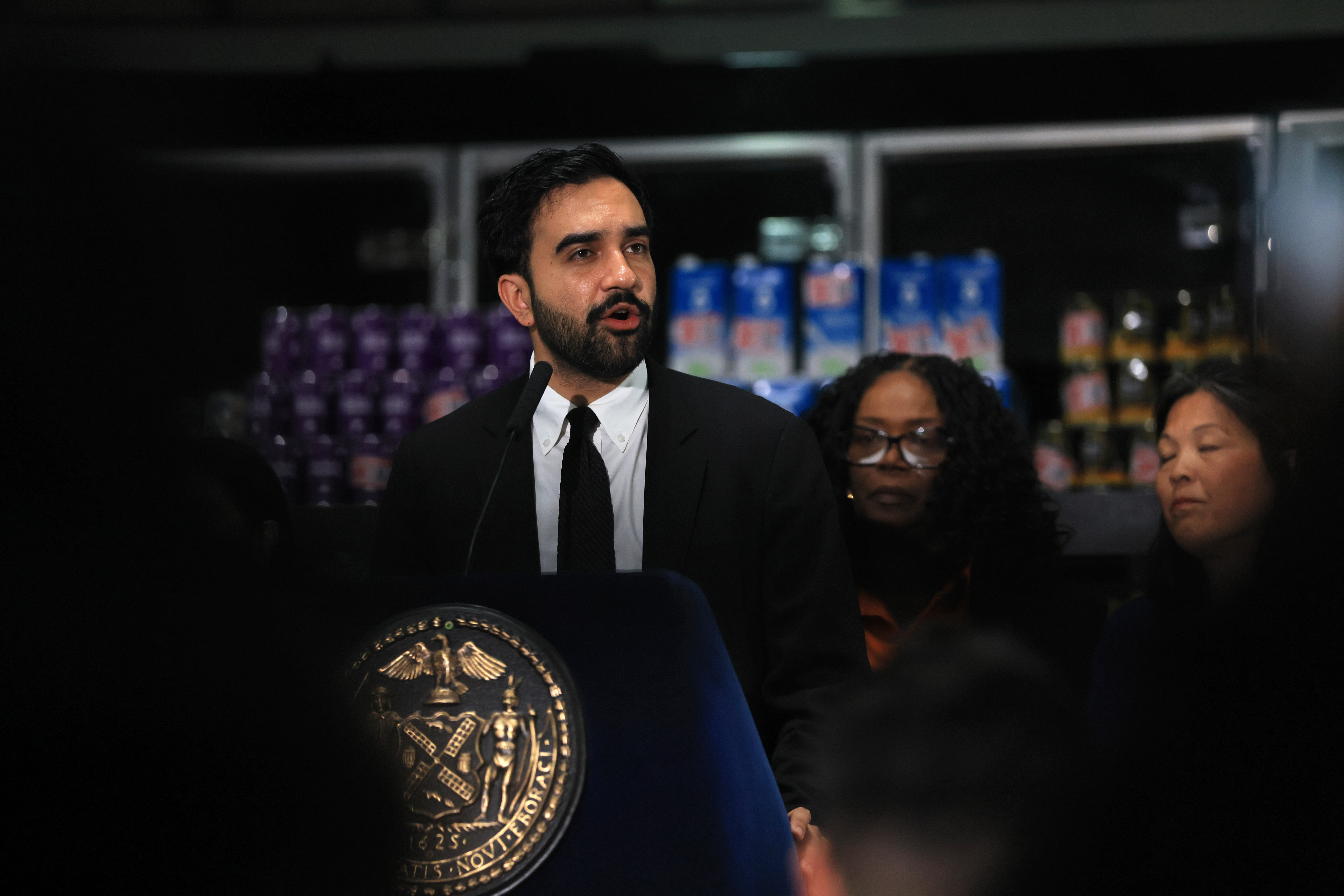
Days after an alleged hate crime against a Jewish person in Manhattan, New York City Mayor Zohran Mamdani refused to engage with suggestions from various corners that he de-escalate his rhetoric around Israel — or speak to why he continued publicly toying with arresting Israeli Prime Minister Benjamin Netanyahu well after city attorneys told him he couldn’t, Jewish Insider’s Will Bredderman reports.
Dismissing questions: A number of Jewish leaders linked the attack to the mayor’s recent denunciations of Netanyahu and the Jewish state, and even a fellow Democrat signaled at a press conference on Friday morning that Mamdani should “take the temperature down.” Netanyahu himself, whom Mamdani excoriated in a widely watched video last week, accused the mayor of “fomenting hate” in a Sunday appearance on Fox News. But the mayor declined to substantively engage with any of these criticisms when pressed by reporters on Monday. “I’m not interested in getting into a back-and-forth with Prime Minister Netanyahu,” the mayor said.
SHEIKH SHIVA
Qatar’s emir publicizes his meeting with a group of rabbis in Doha
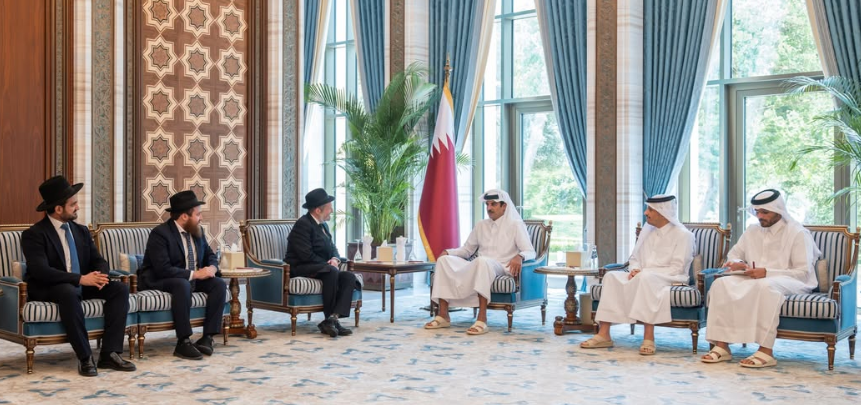
Qatari Emir Sheikh Tamim bin Hamad Al Thani hosted a group of rabbis on Monday at Lusail Palace in Doha. Rabbi Mendy Chitrik, chairman of the Alliance of Rabbis in Islamic States, led the delegation along with his son, Rabbi Eliyahu Chitrik, who organizes Jewish communal programming in Qatar. They were joined by Rabbi Yehuda Gerami, the chief rabbi of Iran, Jewish Insider’s Haley Cohen reports.
Making it public: The emir’s office publicized the meeting, posting on the palace’s social media account that the delegation offered condolences on the death of the emir’s father and predecessor, Sheikh Hamad bin Khalifa Al Thani. Qatari Prime Minister Sheikh Mohammed bin Abdulrahman Al Thani also attended the meeting. The emir’s decision to publicize the visit on his official channels is a rare public acknowledgment of Jewish communal ties by a Gulf state that has no formal relations with Israel and funds the news outlet Al Jazeera, which amplifies narratives hostile to the Jewish state.
COALITION CALCULUS
Lapid blames Netanyahu for Israel’s isolation, vows reset if he returns to gov’t
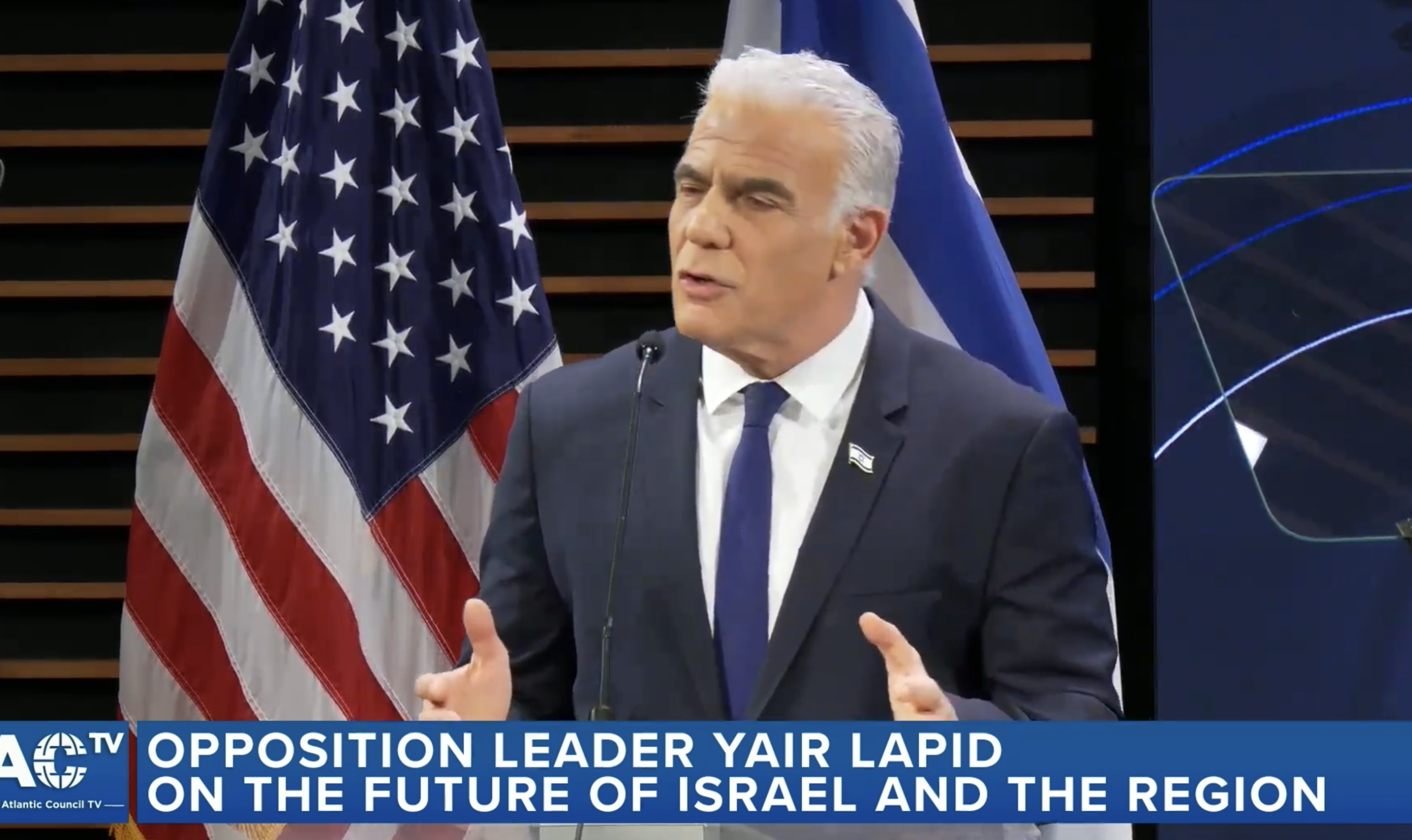
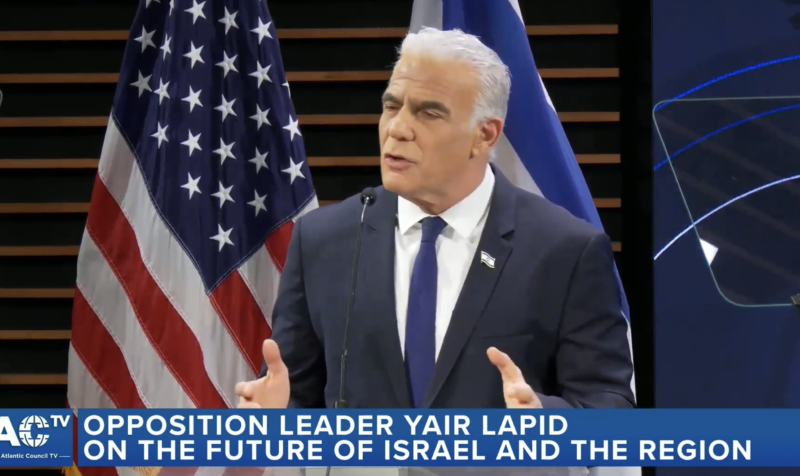
Addressing the Atlantic Council in Washington, former Israeli Prime Minister Yair Lapid presented his case on Monday for Israel’s diplomatic future should his opposition bloc form the country’s next government after the upcoming elections. Lapid argued that Israel is increasingly isolated diplomatically and feuding with its allies — which he blamed primarily on Prime Minister Benjamin Netanyahu and his coalition — and he recommended that Jerusalem adopt a more measured and bipartisan approach going forward, Jewish Insider’s Marc Rod reports.
What he said: Lapid said that Israel can’t act on the world stage with the same impunity that the United States can, that it needs to listen to its friends around the world instead of writing them off. The Jewish state, he continued, should never fund digital influence operations against American leaders, should stay out of American partisan politics and must rebuild its relationships with Europe. “Iran is an enemy. Hezbollah is an enemy. Hamas is an enemy,” Lapid said. “France is not the enemy. Sweden is not the enemy. [Sens.] Elizabeth Warren [D-MA], Jon Ossoff [D-GA] and Tim Kaine [D-VA] are not the enemy. The Democratic Party is not the enemy. [Vice President] JD Vance is not the enemy.”
CANDIDATE CORNER
Moskowitz challenger runs on military record in contested GOP primary
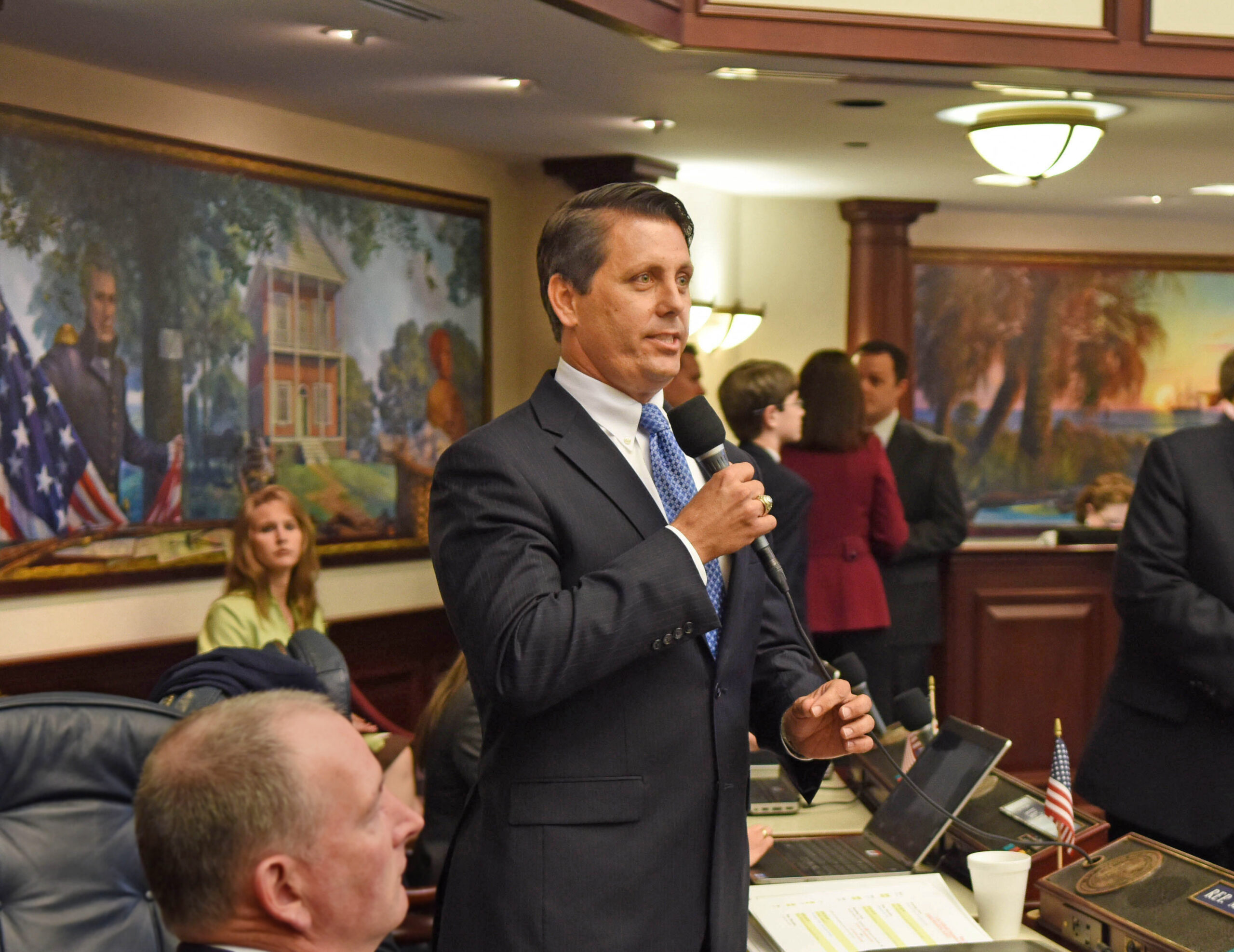
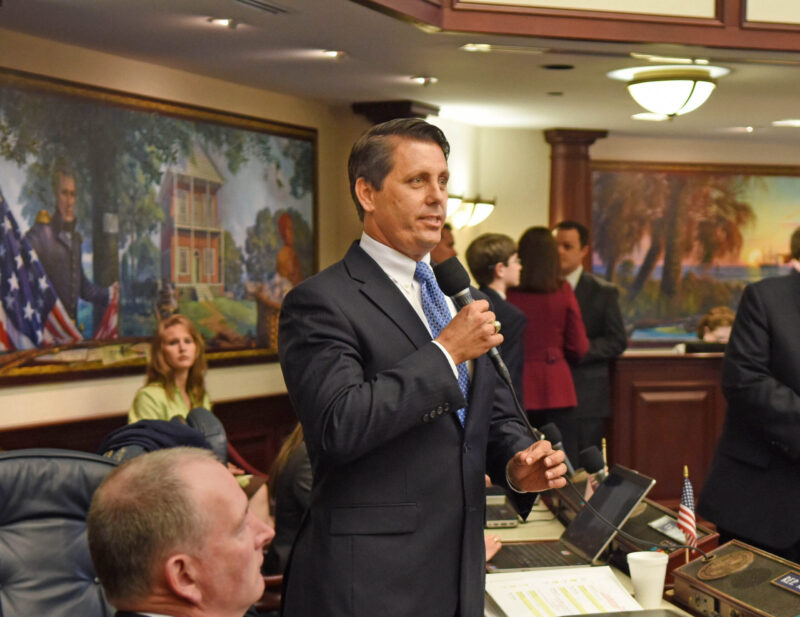
Former Florida state Rep. George Moraitis is hoping that a bipartisan approach and his background in the Statehouse and as a military veteran will make him a formidable candidate to take on Rep. Jared Moskowitz (D-FL) in South Florida in November. Moraitis is running in the Republican primary in Florida’s 25th Congressional District against former Boca Raton Mayor Scott Singer, who is Jewish, and businessman Dan Franzese, Jewish Insider’s Marc Rod reports.
Moraitis’ pitch: In the general election, the winner will face Moskowitz — or his socialist primary challenger — in the district redrawn to favor Republicans. Moraitis told JI he spent his “whole life in public service,” serving in the Navy on submarines and as a state representative. He said he wants to work to “restore the American dream,” protect U.S. national security and defend “our God-given freedoms” of worship, speech and assembly, including combating rising antisemitism, as well as what he described as efforts to shut down churches and Christian prayer.
Worthy Reads
Winning the Battle, Losing the War: The Atlantic‘s Franklin Foer argues that Israeli Prime Minister Benjamin Netanyahu has squandered his role as “the guardian of Israel’s standing in America.” “Netanyahu aggressively confronted the military threats — but proceeded to lose on the battlefield that made his career. He had risen to power by persuading Americans on the correctness of his cause, but came to govern as though persuasion were futile, as if his father had been right all along. He never seemed to recognize that his old successes had come amid tailwinds: the Cold War, the wars on terror, decades when America was predisposed to sympathize with Israel’s case. When the zeitgeist turned, Netanyahu did not adjust the argument. He concluded there were no minds to change: The hatred of the Jewish state was immutable. Under Netanyahu, Israeli public diplomacy has treated each new critic not as someone to be persuaded or corrected, but as an anti-Semite revealed.” [TheAtlantic]
A Home for Hate: Matthew Hennessey writes in The Wall Street Journal‘s “Free Expression” newsletter that New York City Mayor Zohran Mamdani’s recent invective against Israeli Prime Minister Benjamin Netanyahu was an “antisemitic smoke signal.” “Campaign crowds ate it up when Mr. Mamdani said he was going to make the NYPD enforce the International Criminal Court’s dubious arrest warrant for Mr. Netanyahu. Mr. Mamdani must have loved the buzz. Were he more experienced, or less of a zealot, he might realize that being mayor comes with responsibilities that a rabble-rouser in a kaffiyeh never needs to consider. … Mr. Mamdani and his allies play definitional games: We aren’t antisemitic, they say, only anti-Zionist. … You may think you’re making a clever distinction, or that your limp assertions about hate having no home in the city will absolve you of all blame when someone believes what you say and starts trying to kill Jews while shouting ‘Allahu akbar.’ It won’t.” [WSJ]
Surrender to Socialism: Axios co-founders Jim VandeHei and Mike Allen lay out the six stages of “political surrender,” warning the Democratic Party might be on its way to capitulating to socialism. “Republicans didn’t decide to become President Trump’s party. They surrendered to him, one stage at a time, over a decade, in plain sight. Democrats swear that socialism’s growing grip on their party is different, and can be contained. The early signals suggest otherwise. Why it matters: Party transformations follow a predictable six-stage evolution — recoil, squint, rationalize, submit, amplify, and purge. Each stage has language you can hear long before you see it in the votes. Republicans just finished the full cycle. Democrats might be starting it.” [Axios]
Forbidden Fruit: Designer and brand strategist Debbie Millman posits in The New York Times that guidelines around AI usage should follow those of Kabbalah, which many are encouraged not to study until they reach the age of 40. “We do not wait for children to turn 16 to hand them car keys because cars are evil, and we do not insist that surgeons train for years because scalpels are immoral. We build thresholds around powerful things because power requires judgment, and judgment can’t be downloaded or installed. Before a person asks a machine to write for them, they should know what it feels like to write from the depths of their own uncertainty and identity. Before a person lets a machine imitate their voice, they should have endured the long, uneven, often humiliating process of acquiring one.” [NYTimes]
Word on the Street
Israeli Prime Minister Benjamin Netanyahu will reportedly present intelligence to President Donald Trump at their meeting on Tuesday showing that Iran is rebuilding its military capabilities and pursuing a nuclear bomb at an accelerated pace, according to Israel’s Channel 12…
Asked about Netanyahu’s opposition to the U.S.’ planned sale of F-35 fighter jets to Turkey, Trump told reporters on Monday, “Turkey’s been a great ally — for me. … Nobody tells me what we should be selling,” a clip that the White House’s rapid response social media account posted to X…
Saudi Arabia intercepted drones launched by Iran-backed militias in Iraq on Monday, which were targeting oil facilities in the country’s Eastern Province and in Riyadh, the Saudi Defense Ministry said in a statement. Israel, Jordan and Iraq also reported drone attacks on Monday…
Senate Majority Leader John Thune (R-SD) said that he wants to include a significant increase in defense funding when the Senate takes up the budget reconciliation bill recently passed by the House, which is aimed in part at covering expenses related to the Iran war…
Next week’s talks between Israel and Lebanon, to be held again in Rome, will focus on expanding the “pilot zone” process in southern Lebanon, resolving “all outstanding border issues” and working towards a comprehensive peace agreement, a State Department official said…
Iranian authorities publicly hanged two men who were found guilty of attacking two police officers during anti-regime protests earlier this year, Iran’s judiciary said on Tuesday…
Far-right commentator Laura Loomer told Politico she would “like to serve as an envoy” to Trump on foreign policy, after the death of Sen. Lindsey Graham (R-SC), who had held a similar role in Trump’s orbit…
Former Congressional Black Caucus Chair Rep. Steven Horsford (D-NV), a relative moderate, joined several left-wing CBC members in endorsing Donovan McKinney, who is challenging Rep. Shri Thanedar (D-MI)…
Former New York City Mayor Eric Adams is being sued by an ex-staffer over allegations that she was discriminated against because she is Palestinian, claiming that Adams had adopted a strict anti-Palestinian stance after the Oct. 7, 2023, Hamas attacks. The aide, Hasibe Rashid, is asking for the court to reinstate her as a policy advisor in Mayor Zohran Mamdani’s office…
Several Jewish legal organizations sent Mamdani a letter protesting the makeup of his 18-person judicial nominating advisory committee, which contains no Jewish representation…
In an opinion piece in the Jewish Telegraphic Agency, William Daroff and Betsy Berns Korn, the CEO and chair of the Conference of Presidents of Major American Jewish Organizations, decry Mamdani’s repeated claim that Israel committed a “genocide” in Gaza, comparing it to medieval blood libels…
Former Chicago Mayor Rahm Emanuel told Politico he heard from Vice President Kamala Harris, former House Speaker Nancy Pelosi (D-CA), House Minority Leader Hakeem Jeffries (D-NY), Sen. Chris Coons (D-DE), Pennsylvania Gov. Josh Shapiro and GOP Utah Gov. Spencer Cox after his speech laying out his Israel policy at Tel Aviv University earlier this month, saying they were “all very affirmative and all appreciative”…
Daniel Moraff, the political consultant who helped recruit failed Maine Senate candidate Graham Platner before Platner’s campaign collapsed following a rape allegation, was himself accused of sexual assault: One former romantic partner told The Handbasket that Moraff had sex with her in 2019 in spite of her repeated objections and the former campaign manager for Rep. Summer Lee (D-PA) said Moraff was barred from Lee’s 2022 campaign due to six allegations of sexual misconduct, including at least one of sexual assault…
David Fox, the dealmaker credited with building Kirkland & Ellis into the world’s biggest law firm, has now launched Irving, a law firm primarily driven by AI, and is building a center for AI at Hebrew University’s law school…
In The Free Press, Casey Babb reports on a spike in emigration of Jewish Canadians due to heightened antisemitism in the country…
The New York Times profiles Sammy Nussdorf, the Jewish 29-year-old who parlayed his family’s business acumen and his TikTok account into Meadow Lane, a viral Lower Manhattan gourmet market that pulled in $3 million in its first 90 days…
“Mazel Tough,” a new romantic comedy series about modern dating in the Jewish community, will feature Jewish stars Alex Rich, Adam Shapiro, Michael Vlamis and Jonathan Lipnicki…
British musician Boy George released a new single defending Israel’s actions in the aftermath of the Oct. 7, 2023, Hamas-led attacks. Posted to his X account with the hashtag “Shalom,” the song is titled “We Will Dance Again,” a mantra used by survivors of the Nova music festival massacre…
Pic of the Day
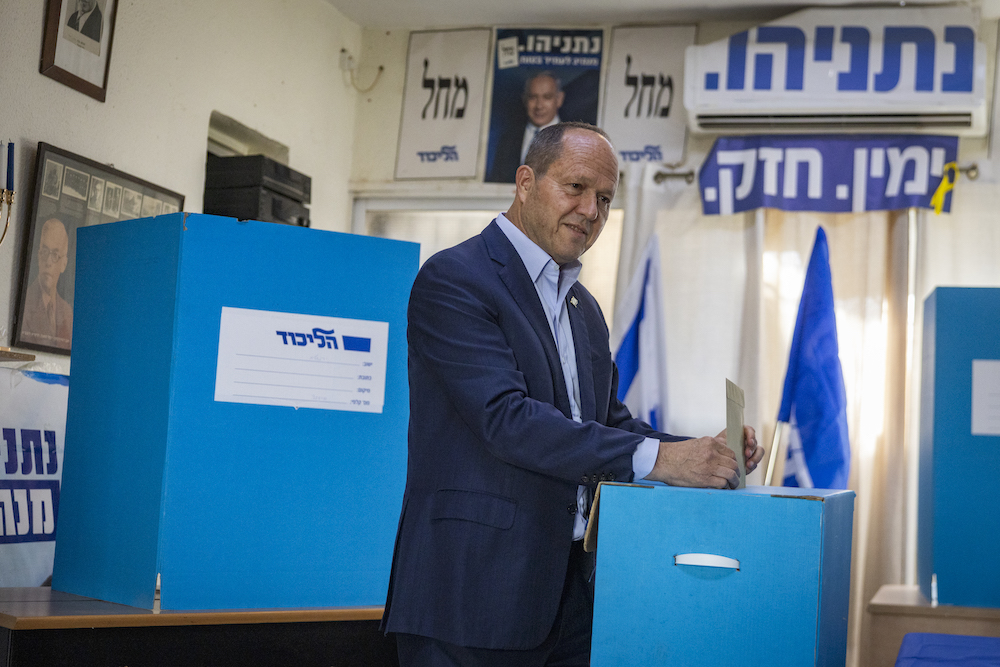
Israeli Minister of Economy and Industry Nir Barkat voted in the Likud party’s internal elections on Monday in Jerusalem.
The Likud Central Committee approved a proposal that grants Israeli Prime Minister Benjamin Netanyahu eight reserved slots in the top 29 places on the list, significantly increasing his control over the party’s slate.
Birthdays

Actor and reality show personality, Elizabeth Berkley Lauren turns 54…
Survivor of Auschwitz-Birkenau as a teen, he emigrated to Israel and became an artist, Yehuda Bacon turns 97… Chicago radio and television news personality, Walter David Jacobson turns 89… U.S. District Court judge in Manhattan, then U.S. attorney general during the Bush 43 administration, now of counsel at the international law firm of Debevoise & Plimpton, Michael Mukasey turns 85… Swedish industrialist, chairman of the Nobel Foundation (manager of the Nobel Prize) from 2005 to 2013, Marcus Storch Ph.D. turns 84… In 1986 she became the first woman in the IDF to hold the rank of brigadier general, she then served as a member of Knesset, and now serves on multiple for-profit and nonprofit boards, Amira Dotan turns 79… Tax professional, Joe Pollak turns 76… President of the Council on Foreign Relations for 20 years until he retired in 2023, Richard N. Haass turns 75… Tel Aviv-born real estate developer, he has restored many historic buildings in Downtown Los Angeles, Izek Shomof turns 67… Partner and managing director of Meadow Lane Advisors, he serves on the board of American Jewish World Service, Marty Friedman… French-Israeli hairdresser and entrepreneur, Michel Mercier turns 65… American schoolteacher, wrongfully detained by Russia in 2021, he was released in the early weeks of the Trump 47 administration, Marc Hilliard Fogel turns 65… Talent booker, publicist and television and radio personality in Atlanta, Mara Davis turns 57… Tech entrepreneur who has invested in more than 100 startups, New York Times best-selling author, Joshua M. “Josh” Linkner turns 56… Co-founder of the personal genomics and biotechnology company 23andMe, she recently regained control of the company, Anne Wojcicki turns 53… Inaugural Jewish life venture fellow at the William Davidson Foundation, now deputy CEO at UpStart, Jennifer Lew Goldstone… Jerusalem-born actor with more than 30 movie and television roles in the U.S., Ori Pfeffer turns 51… Associate justice of the Supreme Court of California, Leondra Kruger turns 50… Israeli journalist and former member of the Knesset, Ksenia Svetlova turns 49… Managing partner at Altitude Ventures, a healthcare venture capital firm, he served as White House Jewish liaison from 2005 to 2007, Jay Zeidman… Senior reporter at Bloomberg News, Laura Nahmias… CEO and CTO at Diagnostic Robotics in Jerusalem, the firm produced an app for managing COVID-19 patients during the pandemic, Kira Radinsky Ph.D. turns 40… VP of player personnel at MLB’s Miami Marlins, Samuel Mondry-Cohen… Director of operations at Elite Healthcare Consultants, Menachem “Mark” Perl… Actor and producer who stars in the CBS series “Ghosts,” Asher Chazen Grodman turns 39… Staff writer at The New Yorker, Ruby Cramer… Larry Gordon…
In an address in Washington, the opposition leader sketched a coalition with Bennett and Eisenkot that would mend U.S. and European ties, harden Israel's line on Iran and shift tone on Gaza
Screenshot
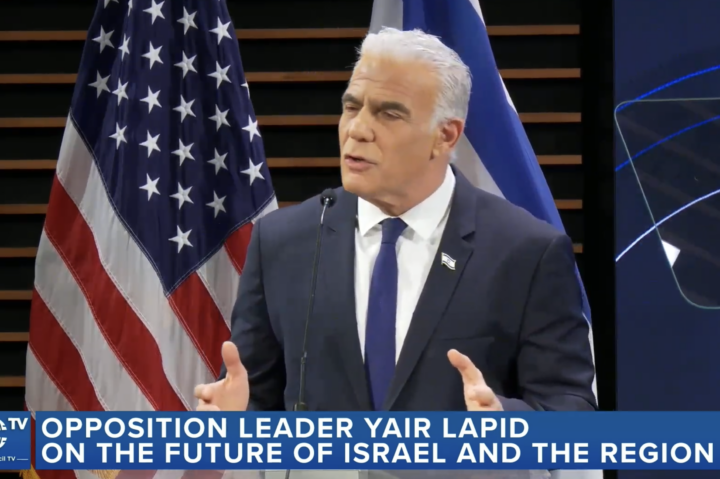
Israeli Opposition Leader Yair Lapid speaks at the Atlantic Council in Washington, July 27, 2026
Addressing one of the leading foreign policy think tanks in the United States, former Israeli Prime Minister Yair Lapid presented his case on Monday for Israel’s diplomatic future should his opposition bloc form the country’s next government after the upcoming elections.
Speaking at the Atlantic Council in Washington, Lapid argued that Israel is increasingly isolated diplomatically and feuding with its allies — which he blamed primarily on Prime Minister Benjamin Netanyahu and his coalition — and he recommended that Jerusalem adopt a more measured and bipartisan approach going forward.
Lapid is visiting Washington this week, concurrent with Netanyahu; both of them are set to attend the funeral of Sen. Lindsey Graham (R-SC) on Tuesday.
Lapid said that a new government, primarily made up of current opposition members, would remove officials who advocate for nuking Gaza or who mock detained activists. He said the government should also apologize for the accidental deaths of children in war and express greater empathy more generally, as well as deploy police and soldiers to address what he characterized as Jewish terrorism in the West Bank.
He also said that Israel can’t act on the world stage with the same impunity that the United States can, that it needs to listen to its friends around the world instead of writing them off, should never fund digital influence operations against American leaders, should stay out of American partisan politics and must rebuild its relationships with Europe.
“Iran is an enemy. Hezbollah is an enemy. Hamas is an enemy,” Lapid said. “France is not the enemy. Sweden is not the enemy. [Sens.] Elizabeth Warren [D-MA], Jon Ossoff [D-GA] and Tim Kaine [D-VA] are not the enemy. The Democratic Party is not the enemy. [Vice President] JD Vance is not the enemy.”
He said that the next Israeli government should communicate to the U.S. and the world that “this was a crazy period, but it is over” and, going forward, “stay out of American politics,” as well as “firmly encourage” both AIPAC and J Street to move away from partisanship.
“To be pro-Israel is to be bipartisan to build a broad coalition of support. Do not boycott people who dislike us. Insist on meeting them and presenting our case,” Lapid said.
Military capabilities and tactics, he continued, cannot stand apart from Israel’s place in the world, its relationship with the United States and its economic situation. Military strikes must come with “a moral, legal and strategic framework that Israel can defend with confidence,” with the ultimate goal of peace, rather than perpetual conflict, he continued.
Lapid asserted that the U.S.-Israel relationship had been damaged primarily by Netanyahu, describing his government as responsible for nearly all of the issues in the relationship. He suggested that the relationship would turn around with the opening provided by a new government.
He claimed that Israelis will vote accordingly in the upcoming elections, realizing that Netanyahu is damaging Israel’s international relations.
Lapid did not substantively address how the unity party led by himself and former Prime Minister Naftali Bennett would approach an increasingly likely situation in which Gadi Eisenkot leads the largest opposition party after the election. Instead, he suggested Eisenkot would be the defense minister in a coalition government with Bennett as prime minister and Lapid as foreign minister.
Bennett and Lapid announced in April that they had decided to merge their parties and run as a joint party called “Together,” led by Bennett.
Though Lapid’s previous governing coalition included the Arab party Ra’am, he predicted that his bloc would not need the support of Arab parties to form a government after the next election and claimed that MK Mansour Abbas, who leads Ra’am, “seems to understand this better than some of my Jewish friends, the fact that maybe it’s time for a coalition that will be made only of Zionist parties.”
But he said that such a government would address the needs of Arab citizens and address “Jewish racism against peaceful Arab citizens of Israel.”
Lapid said Israel should pursue direct negotiations with as many regional states as possible, including Lebanon, Syria and Saudi Arabia and leverage various regional forums to pursue greater ties and to isolate Iran.
He also said that Israel should work with the Palestinian Authority, arguing that doing so doesn’t necessitate recognizing a Palestinian state or ignoring issues inside the PA.
“It was almost ridiculous to me the fact that the current government was … incapable to admit the fact that they’re doing business with the Palestinian Authority — as they do in the West Bank and as they do in Gaza now,” Lapid said.
He said Israel will, over time, need to work to make Gaza livable, and that the Israeli government’s failure to show empathy over the situation in Gaza had “destroyed our international stature in huge groups” as well as stymied necessary and honest conversations in Israel about the costs of the war. But he rejected the idea that the war in Gaza had been a genocide.
Lapid took a hard line toward the Haredim, saying that they should not receive financial support if they do not serve in the military, that their schools should not receive government support if they do not provide a basic education and that they should not receive public assistance if they do not work.
“When you live in a democracy, you don’t only have rights; you also have duties, and these have to do with each other,” Lapid said.
Lapid also sought to position himself in a more hawkish stance on Iran than the current government, arguing that Israel should have, as early as 2024, bombed Iranian energy facilities, including Kharg Island. He said he still supports such a course of action.
He acknowledged that such an approach would carry political and economic pain for the United States ahead of the midterms, but said that it would be the “right thing to do in the long term” and would lead the Iranian regime to collapse.
Though he praised Saudi Crown Prince Mohammed bin Salman and expressed hope for expanding the Abraham Accords, Lapid raised serious concerns over the Trump administration’s recent deal with Saudi Arabia that would allow nuclear enrichment on Saudi soil — an effort that Trump, after signing the deal, conditioned on the Gulf state joining the Abraham Accords.
Lapid said he’d clashed with Graham, who worked for years to secure normalization between Israel and Saudi Arabia, over the subject, calling it “unacceptable” and “a huge mistake.”
A Saudi enrichment program, Lapid warned, would prompt a nuclear proliferation race throughout the Middle East and beyond. And he said any Saudi-U.S. deal should include Israel as well.
Lapid, once one of the Israeli leaders more amenable to the idea of a two-state solution, said that the Hamas-led Oct. 7, 2023, attacks on Israel and the support for them in the West Bank had changed his view of the situation. He said that any Palestinian state under the current circumstances would immediately become a launching pad for Hamas.
“Politics or policies are not a zero-sum game. There are so many things we can do in order to improve the lives of everybody, of Palestinians, of Israelis, of the security of everybody,” Lapid continued.
Lapid said that the pilot effort to turn over territory in Lebanon to the Lebanese Armed Forces to disarm Hezbollah is a strong idea in concept, but requires that Hezbollah actually be disarmed. He said Israel should continue to fight Hezbollah as necessary but also pursue diplomatic efforts with the Lebanese government.
He declined to back a full Israeli withdrawal from southern Lebanon, saying that Israel should not withdraw from areas where it knows Hezbollah would immediately return to because the terrorist group had been preparing to carry out an Oct. 7-style attack on northern Israel.
He also said he was disappointed that Syrian President Ahmad al-Sharaa had begun discussing reclaiming the Golan Heights from Israel, explaining that he’d initially seen the new Syrian government as “an opportunity to solve a problem that looked unsolvable for a long time.”
The Israeli prime minister, who will travel to Washington on Monday, is also set to attend Sen. Lindsey Graham’s funeral while in the U.S.
Joe Raedle/Getty Images
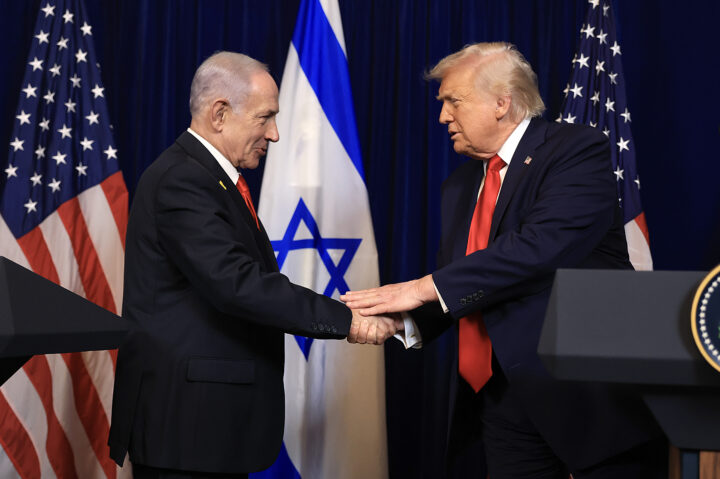
President Donald Trump shakes hands with Israeli Prime Minister Benjamin Netanyahu during a press conference at his Mar-a-Lago club on December 29, 2025 in Palm Beach, Florida.
Israeli Prime Minister Benjamin Netanyahu will fly to Washington on Monday, where he will meet with President Donald Trump and attend the funeral of Sen. Lindsey Graham (R-SC), his office announced on Friday.
Slated for Tuesday, the Oval Office meeting — Trump and Netanyahu’s first in-person sitdown since the start of the Iran war in late February — comes amid escalating U.S.-Iran hostilities and heightened Israeli readiness for potential strikes from Tehran.
Trump told Axios on Thursday that he’s considering restarting major combat operations in Iran — including strikes larger than those carried out by the U.S. and Israel against Iran before the ceasefire began in early April.
Netanyahu said that “Israel lost one of its greatest friends” after Graham died suddenly on July 11. The South Carolina senator’s funeral is scheduled for Tuesday at the National Cathedral in Washington.
ADL CEO Jonathan Greenblatt called Mamdani’s statement a ‘dangerous dereliction of duty’
Leonardo MUNOZ / AFP via Getty Images
New York City Mayor Zohran Mamdani arrives for a news conference at Gracie Mansion in New York City on March 9, 2026.
A video New York City Mayor Zohran Mamdani released late Tuesday night — in which the democratic socialist railed at length against Israeli Prime Minister Benjamin Netanyahu but confessed he couldn’t honor his campaign pledge to arrest him — triggered a wave of warnings from mainstream Jewish organizations that his singular focus on excoriating Israel from his official platforms places New Yorkers at risk.
The mayor’s video — which has received in the neighborhood of 150 million views across all his office’s social media channels, one of his most-viewed posts ever — ran with the tag “Benjamin Netanyahu is a war criminal” and denounced the Jewish state’s leader as “the architect of a horrific genocide.” Mamdani ultimately admitted in the video that his administration could not enforce an International Criminal Court warrant against Netanyahu should he attend the upcoming U.N. General Assembly.
The social media clip, which accused Netanyahu and Israel of various war crimes including targeting women and newborn babies, provoked widespread outcry from Jewish groups. They noted Mamdani had omitted any reference to Hamas and the Oct. 7, 2023, attacks that touched off the latest round of conflict, and asserted he had neglected his responsibility as a local official elected to represent all communities in the city.
“This isn’t just political theater. It’s a dangerous dereliction of duty,” Anti-Defamation League CEO Jonathan Greenblatt wrote on X, noting the spike in hate crimes targeting Jewish New Yorkers since Oct. 7. “He remains relentlessly obsessed with the world’s only Jewish state — even as Jewish New Yorkers face record levels of antisemitism and the city confronts urgent problems that demand his attention.”
Greenblatt further argued the video was the product of an “antisemitic worldview” and “the play-acting instincts of a perpetual student activist.”
The UJA-Federation of New York said in a statement, “New Yorkers elected a mayor to lead this city — not to make Israel the centerpiece of your political grandstanding. At a time of rising antisemitism, repeatedly singling out and vilifying the world’s only Jewish state for perceived political benefit is repugnant, puts Jews at greater risk — and leaves many Jewish New Yorkers feeling targeted and unwelcome in the city we call home.”
“Shame on you,” the post concluded.
AIPAC said Mamdani’s video was “based on a modern blood libel and outrageous lies.”
Other groups including the Simon Wiesenthal Center, Orthodox Union and American Jewish Committee contrasted the mayor’s pledges early in his administration to represent New Yorkers of all faiths and nationalities with his use of official city platforms to exclusively pillory Israel — with the OU calling it a “betrayal of his oath of office and his own commitment to protect all New Yorkers” and the AJC demanding he “stop putting a target on the back of the Jewish community.”
“New Yorkers elected a mayor, not a prosecutor of foreign leaders,” SWC wrote in a statement, arguing he had taken the issue beyond criticism of any one foreign statesman. “Mayor Mamdani repeatedly singles out Israel while using the prestige of his office to legitimize rhetoric that further isolates the Jewish state and deepens division here at home.”
The SWC statement added: “He delivered a sweeping moral indictment of Israel while erasing the terrorist atrocities that ignited this war.”
Pressed with these concerns after an unrelated event at City Hall on Wednesday, Mamdani said he would hypothetically have liked to see ICC warrants enforced against leaders of Hamas as well. Asked if he saw the Oct. 7 attacks, the deadliest wave of violence against Jews since the Holocaust, as genocidal, the mayor called them a “horrific war crime” and “something that should be deeply opposed with every single fiber of our being” — but declined to answer in the affirmative.
He maintained that criticizing Israel publicly was in keeping with his responsibilities to the city’s Palestinian American community, as well as a “universal politics.” He also reiterated that he would not “be welcoming” Netanyahu to the city, and suggested New Yorkers might greet his arrival with protests.
“This is a city where if anyone feels a level of frustration or opposition, protest is something that we will always respect,” he said. “I leave it to New Yorkers themselves to make that decision.”
The mayor ran on a promise to arrest the Israeli premier but on Monday wouldn’t commit to following through
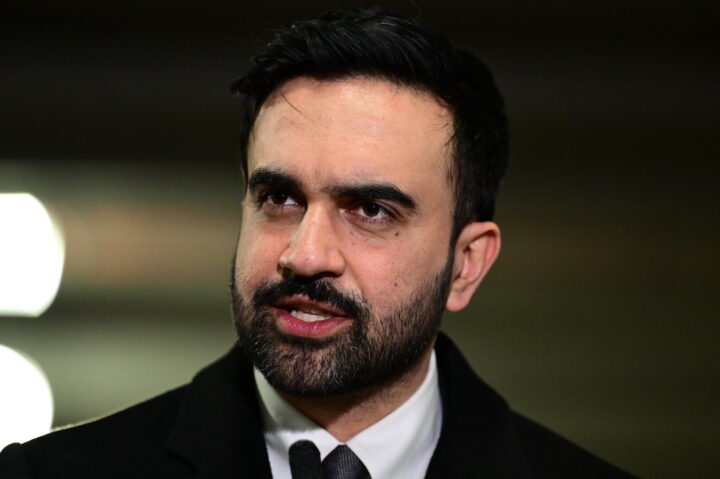
Kyle Mazza/Anadolu via Getty Images
New York City Mayor Zohran Mamdani
New York City Mayor Zohran Mamdani seemed to shy away on Monday from a campaign vow — referenced in an interview over the weekend — to arrest Israeli Prime Minister Benjamin Netanyahu, even as he continued to lob rhetorical fusillades at the leader of the Jewish state.
The now-mayor promised to arrest Netanyahu in the early days of his run for Gracie Mansion, as he sought to consolidate the far left behind his then-longshot bid, and reiterated the promise after winning the Democratic primary.
“My administration will follow all applicable local laws," Mayor Zohran Mamdani told reporters about arresting Israeli Prime Minister Benjamin Netanyahu — what legal experts and Gov. Kathy Hochul say is outside the NYPD's powers.
— Jewish Insider (@jewishinsider) July 20, 2026
Read more: https://t.co/xLADaz8fBu pic.twitter.com/hDC8VCtn9p
Legal experts and even Gov. Kathy Hochul have asserted this lies outside the powers of the NYPD. But the democratic socialist maintained in a weekend interview with The New York Times that an “active conversation” remained ongoing in the city’s law department about his ability to enforce a warrant from the International Criminal Court — of which the U.S. is not a member — to take the Israeli prime minister into custody if he comes to New York for the upcoming U.N. General Assembly meeting.
But Mamdani seemed to acknowledge on Monday that such a move might exceed his authority.
“My administration will follow all applicable local laws, that is our commitment, that is something will follow through on, when it comes to adherence to local laws,” the mayor told reporters after an unrelated event, stressing again when pressed: “We will follow our local laws.”
“I believe that when someone is charged with an International Criminal Court warrant, it’s something that should be taken seriously, whether it’s Benjamin Netanyahu or it’s [Russian President] Vladimir Putin or whomever else,” the mayor said.
Nonetheless, the mayor criticized Netanyahu as the “architect of the genocide of Palestinians” and affirmed his earlier assertion that the Israeli leader is a “war criminal.”
President Donald Trump, for his part, took to Truth Social after Mamdani’s sitdown with the Times to promise that Netanyahu “will not be arrested, in any way, shape, or form, while in the United States of America.”
Israeli Ambassador Yechiel Leiter said Khanna had declined a request to coordinate with the embassy for the trip where he was stopped by Israeli settlers in the West Bank
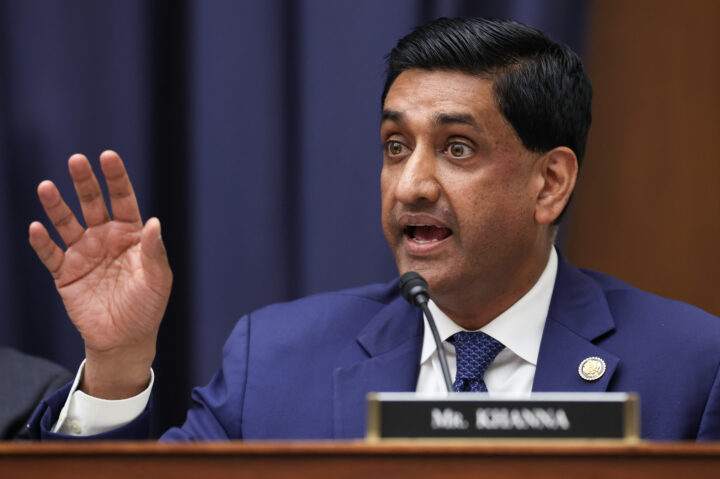
Photo by Win McNamee/Getty Images
Rep. Ro Khanna (D-CA) questions U.S. Secretary of Defense Pete Hegseth as he testifies before the House Armed Services Committee April 29, 2026.
Rep. Ro Khanna (D-CA) on Sunday called on Israeli Prime Minister Benjamin Netanyahu to launch an investigation after the lawmaker said he was harassed by Israeli settlers in the West Bank last week, an incident Netanyahu attributed to a small group of “vigilantes.”
During his first known trip to Israel and the West Bank since October 2024, Khanna said that his delegation’s van had been surrounded, stopped and taunted last Wednesday by Israeli settlers armed with U.S.-made M4 rifles during a tour of the southern West Bank, an incident that a New York Times photographer traveling in a different vehicle said he witnessed.
Khanna claimed IDF vehicles then appeared, and the soldiers spoke amiably with the settlers and continued to block the road themselves after the settlers departed. The IDF denied that the visitors were detained by military personnel.
Cameron Kasky, an aide to Khanna, said the group was held for over an hour and appealed to the U.S. Embassy in Jerusalem for assistance. Kasky previously ran in the Democratic primary in New York’s 12th Congressional District on an explicitly anti-Israel platform.
Khanna told NBC News the incident had made him “more resolved” to consider a presidential run in 2028.
“I have something unique to offer about the injustices of Palestinians,” he told the Times. “I’m going to go to every corner of America, regardless of whether I run or not, and tell their stories and tell the story of what is happening in the West Bank.”
An IDF spokesperson told NBC that troops and police officers were dispatched to the scene in a “closed military zone” after a “report was received regarding Israeli civilians who were unlawfully blocking the vehicle of foreign nationals.” The military said the soldiers reopened the road and let the delegation through.
Israel Police said that officers on the scene did not witness any violence and that the group was stopped in a restricted zone. Israel prohibits its citizens from entering certain areas of the West Bank without an IDF permit, particularly Palestinian Authority-controlled Area A, which are typically marked with warning signs. Foreign civilians are generally not legally barred from these areas, though they may be subject to security advisories or temporary restrictions.
Police added that Khanna’s tour group leader was warned of a possible arrest and that the group was told that civilians were not permitted in the area, before being released. Khanna said that his office had alerted the Israeli Embassy in Washington of his visit — a claim that was denied by the Israeli Ambassador to the U.S. Yechiel Leiter.
Speaking on CBS’ “Face the Nation,” Leiter said that Khanna’s team did not alert Israeli authorities, saying instead that the California lawmaker had ignored a request from officials to allow them to assist in coordinating the trip.
“We reached out to him [Khanna] when we heard he was going to Israel … We suggested he visit with survivors of the Oct. 7 [2023] massacre, that he visit the borders so he understands the issues that we have on our borders and so on,” Leiter said. “He [Khanna] ignored that and he decided to coordinate his trip not with Israel, but with Palestinian activists and with J Street.”
“There was a question about visas, that’s all,” Leiter added of Khanna’s outreach to the embassy. “But when we requested that he coordinate the trip with us, he rejected that by basically staying silent.”
J Street President Jeremy Ben-Ami on Sunday denied that J Street had any involvement in organizing Khanna’s visit.
Speaking on NBC’s “Meet the Press” on Sunday, Khanna called the encounter “unprecedented” and accused the IDF of “lying.”
“They had violent settlers detain American citizens, including an American government official,” Khanna said. “You had these settlers brandishing M4s, kicking the tires of our van, laughing at us, mocking us, videotaping us. We were detained for about 20 minutes, fearful for our lives. Then the IDF comes, four soldiers, they tell our translator that they’re on the side of the settlers.”
Also appearing on NBC on Sunday, Netanyahu insisted that Israel is “a country of laws” and blamed the confrontation on a fringe group of “vigilantes.”
“We’re a country of laws, and people who break the law, we take them to court,” Netanyahu said. “There is a vigilante effort, not by the settler community … There are 150 juvenile delinquents that are not part of that community. They come from other parts of Israel. I don’t want vigilantes of any kind, and we are working to put them under the law.”
Responding to Netanyahu’s remarks, Khanna pushed the Israeli leader to further investigate the matter.
“The prime minister needs to open an investigation on these violent settlers,” Khanna said. “They need to be prosecuted … their outpost needs to be investigated, and he [Netanyahu] needs to have an investigation on these four IDF officers.”
“Security cameras can see that they were involved in the detention of American citizens,” he added. “How dare they mistreat people with an American passport that way?”
Pennsylvania Sens. Dave McCormick and John Fetterman also spoke together at a session

Photo by Kevin Dietsch/Getty Images
Former Israeli Prime Minister Naftali Bennett (L) attends the Allen & Company Sun Valley Conference at the Sun Valley Lodge on July 9, 2026 in Sun Valley, Idaho.
Jared Kushner, United Arab Emirates Ambassador to the U.S. Yousef Al Otaiba and former Israeli Prime Minister Naftali Bennett participated in an off-the-record discussion on Thursday morning at Allen & Company’s annual Sun Valley conference, Puck News reported.
The closed-door conversation, held before the conference’s invite-only audience of business, media and technology leaders, took place months after Israel assisted the UAE during the war with Iran, sending an Iron Dome battery and operators to the Gulf state, which faced more rocket, missile and drone attacks from Iran than another country in the region.
Later in the morning, Sens. Dave McCormick (R-PA) and John Fetterman (D-PA) appeared together for a wide-ranging discussion.
Meta COO Dina Powell McCormick, who is married to the Pennsylvania senator, is also in attendance at Sun Valley this week alongside Meta CEO Mark Zuckerberg and other senior Meta executives.
The Israeli leader said Turkey was 'infected by the Muslim Brotherhood' and warned the sales would upset the regional power balance hours before Trump's NATO summit departure
POOL/AFP via Getty Images
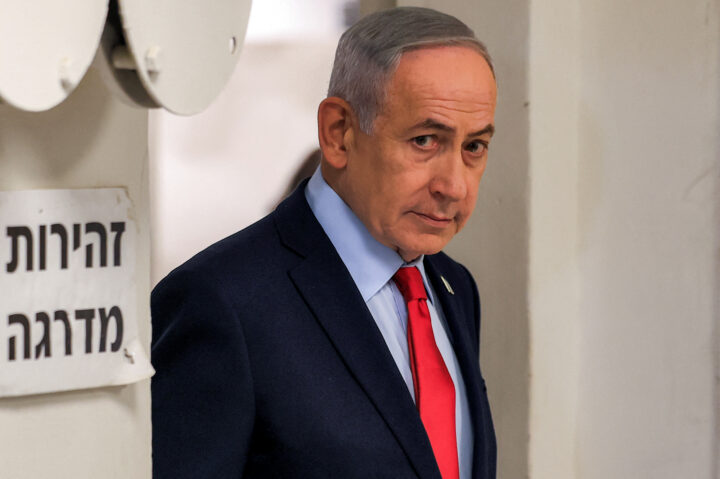
Israeli Prime Minister Benjamin Netanyahu arrives for a press conference in Jerusalem on March 19, 2026.
Israeli Prime Minister Benjamin Netanyahu voiced opposition to the Trump administration’s sale of jet engines and potential sale of F-35 fighter jets to Turkey on Monday, saying on “Fox & Friends” that such moves “will upset the power balance in the Middle East, which is ultimately guaranteed by Israeli air superiority” and “America’s posture” in the region.
Netanyahu’s remarks came hours before President Donald Trump’s departure for a NATO summit in Turkey, on the sidelines of which Trump is expected to hold a bilateral meeting with Turkish President Recep Tayyip Erdoğan.
“I don’t think [Turkey] should be given F-35s or the engines for their fighter jets,” Prime Minister Benjamin Netanyahu said on Fox News.
— Jewish Insider (@jewishinsider) July 6, 2026
He described Turkey as “infected by the Muslim Brotherhood, an extreme movement that hates America.”
Read more: https://t.co/gSW5VJLPfA pic.twitter.com/XKovNgVPJM
Last month, the Trump administration told Congress it was moving to sell more than $700 million of U.S.-made F-110 jet engines to the Turkish military and was reviewing Ankara’s eligibility for the F-35 program, in a potential change to U.S. sanctions which currently prevent Turkey from participating.
“I don’t think they should be given F-35s or the engines for their fighter jets,” Netanyahu said on Monday, describing Turkey as “infected by the Muslim Brotherhood, an extreme movement that hates America.” He also pointed to recent comments by Erdoğan and Turkish ministers that Netanyahu characterized as “calling for the annihilation of Israel.”
Netanyahu’s comments echo concerns shared by a bipartisan group of House lawmakers, led by Reps. Mike Lawler (R-NY) and Brad Sherman (D-CA), who wrote to Trump last week warning that Erdoğan’s “constant and growing anti-Israel rhetoric” and ties to Iran make Turkey’s inclusion in the F-35 program unwise.
The White House chief of staff initially pushed back on U.S. military engagement against Iran, according to a new book by Maggie Haberman and Jonathan Swan
Annabelle GORDON / AFP via Getty Images
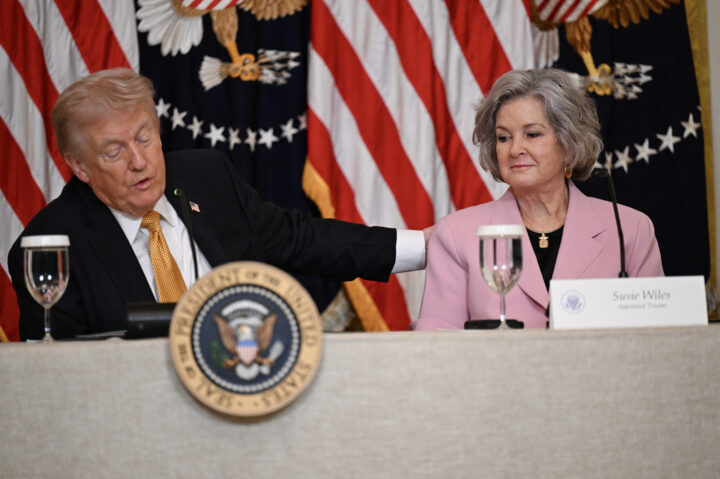
President Donald Trump hosts a lunch with the Kennedy Center Board members as chief of staff Susie Wiles looks on at the White House in Washington, DC, on March 16, 2026.
Israeli Prime Minister Benjamin Netanyahu traveled to Washington in early February 2025 with a pitch for President Donald Trump: to join Israel in a future campaign to bomb Iran’s nuclear sites. Trump did not agree at the time, though he eventually came around to the idea.
Two powerful White House figures were particularly skeptical of Netanyahu’s message.
The first was Vice President JD Vance, who has been calibrating a more isolationist worldview for years. The second, according to a new book by New York Times journalists Maggie Haberman and Jonathan Swan, was White House Chief of Staff Susie Wiles.
Their new book, Regime Change: Inside the Imperial Presidency of Donald Trump, paints a picture of Wiles as a savvy operator with sharp political instincts who, on Middle East policy matters, routinely aligned with Vance in urging Trump to reconsider major foreign policy interventions.
After that first meeting between Trump and Netanyahu, Wiles and Vance were both skeptical of Israel’s efforts to persuade the president. They feared that any involvement from the U.S. military could “spiral into an Israeli regime-change war,” according to Swan and Haberman.
Throughout the first months of Trump’s second term, Wiles and Vance both worried that former Rep. Mike Waltz (R-FL), Trump’s pick to be national security advisor, was “too hawkish” and “too sympathetic to the Israeli line,” according to the book.
Soon, after an embarrassing public scandal in which Atlantic Editor-in-Chief Jeffrey Goldberg was added to a group chat with Waltz, Defense Secretary Pete Hegseth and other top national security officials prior to U.S. strikes on Yemen last year, Waltz was removed from that position and nominated to be U.S. ambassador to the United Nations.
When Trump convened his Cabinet in early 2026 to consider whether to attack Iran again, after joining Israel in striking Iranian nuclear sites in June 2025, Wiles was once more concerned about the U.S. entering a new global conflict. She worried about “being dragged into another Middle East war,” Haberman and Swan write. Political concerns were top of mind for her — a war in Iran might lead to higher gas prices, which she feared could cost Republicans in the midterm elections this year.
Ultimately, though, Wiles got on board with the Iran war.
Wiles, Vance, Secretary of State Marco Rubio and Trump’s other top foreign policy advisors convened in the Situation Room in late February to discuss the matter.
Vance, who was known to oppose the war, spoke first. He told the president that he thought the operation was a bad idea, but he would support Trump.
Wiles was up next. She told Trump that she was on board if Trump felt the operation would protect America’s national security.
24 hours later, Trump authorized the strikes on Iran.
Trump cursed and yelled at the Israeli PM in a phone call with Steve Witkoff and Jared Kushner, according to book by NYT journalists Maggie Haberman and Jonathan Swan

Kevin Dietsch/Getty Images
President Donald Trump (R) speaks alongside Israeli Prime Minister Benjamin Netanyahu with a model of Air Force One on the table, during a meeting in the Oval Office of the White House on April 7, 2025 in Washington, DC.
President Donald Trump grew so frustrated with Israeli Prime Minister Benjamin Netanyahu during last September’s negotiations over a U.S.-brokered deal to end the Israel-Hamas war in Gaza, that Trump cursed and yelled at Netanyahu in a phone call days before the agreement was announced publicly, according to a new book.
“Everybody’s sick of you, Bibi,” Trump said in a phone call with Netanyahu, Jared Kushner and White House Special Envoy Steve Witkoff, according to a book published on Tuesday by New York Times journalists Maggie Haberman and Jonathan Swan chronicling the first year of Trump’s second term. “All the Jews are sick of you. Even the two Jews on this call are sick of you.”
The conversation came during the United Nations General Assembly last September, when Trump was selling the deal that became his 20-point plan to end the Gaza war that began after the Oct. 7, 2023, Hamas attacks. In the book, titled Regime Change: Inside the Imperial Presidency of Donald Trump, Haberman and Swan recount the turbulent couple of weeks that led to the deal — starting with Kushner’s searing anger at the Israeli government after the Israel Defense Forces conducted an airstrike that targeted Hamas leadership in Doha. The September 9 attack came one day after Kushner and Witkoff met in Witkoff’s Miami home with Ron Dermer, a top advisor to Netanyahu, to discuss day-after plans for Gaza.
“Dermer lied to us,” Kushner and Witkoff told officials at the White House after the strikes in Qatar.
The Qataris, according to Haberman and Swan, initially reacted by deciding they no longer wanted to help Israel. Kushner felt the same.
“I’m f**king out. The Israelis are crazy,” Kushner reportedly told an associate at the time. Then he realized it could provide an opening to rein in Netanyahu after nearly two years of war.
In the aftermath, Kushner drafted what would become Trump’s 20-point peace plan. Days later, on the sidelines of the UNGA in New York, Kushner and Witkoff met with Sheikh Mohammed bin Abdulrahman Al Thani, Qatar’s prime minister. The Americans told Al Thani that he had two options: isolate Israel further, which would be “understandable,” or use the moment “for leverage” to get Israel to negotiate.
Al Thani took Kushner’s laptop and began typing edits directly into the draft document, according to the book.
Trump brought the deal to Arab and Muslim leaders before he showed it to Netanyahu. Witkoff and Kushner warned White House Chief of Staff Susie Wiles that Netanyahu might try to call Trump to scuttle the plan. When he did finally call the White House, Wiles patched through Kushner and Witkoff, who stayed on the phone with Trump and Netanyahu.
As soon as Trump got on the phone, he began yelling at Netanyahu — the tirade where he said everyone was sick of the prime minister.
“You can’t back out of this. I’m the best friend Israel ever had. Everybody hates you, and I’ve stood by you,” Trump said, according to the book. “This is a great deal for Israel.”
Netanyahu said he would agree to the deal. The two men announced it together at a joint press conference two days later, though the deal was not yet official. They presented a united front. Trump said Netanyahu would have his “full backing” to continue the war if Hamas did not agree to the deal.
On the evening of Oct. 8, just over a week later, the deal was finalized. Soon after, the 20 living hostages who remained in Gaza were released.
Former Israeli Ambassador to the U.S. Michael Herzog told JI, 'President Trump, who has been a hero to many Israelis, is now openly criticized from within the Israeli government, including Netanyahu's close circle.'

Jack GUEZ / AFP via Getty Images
A billboard depicting an image of President Donald Trump with a message thanking him, is displayed on the side of a building in the Israeli coastal city of Tel Aviv on March 12, 2026.
The long love affair between Israelis and President Donald Trump, on the rocks over the last few weeks as the U.S. and Iran hammered out an end to the war, appears to be over, with humiliations mounting for Jerusalem. “I call all the shots,” not Israeli Prime Minister Benjamin Netanyahu, Trump said earlier this month. More recently, the Israeli leader’s bombing campaign in Beirut was “vicious,” Trump said. And perhaps most humiliating of all, Trump suggested that Syrian President Ahmad al-Sharaa could better take care of Hezbollah than the IDF.
The Israeli public — the spurned lover who once hailed the U.S. president with billboards hung in the center of Tel Aviv reading “Thank you God & Donald Trump” — is not taking it well. Former Israeli Ambassador to the U.S. Michael Herzog told JI, “President Trump, who has been a hero to many Israelis, is now openly criticized from within the Israeli government, including Netanyahu’s close circle.”
And this criticism is not only expressed behind closed doors. Channel 14, the popular right-wing outlet that promotes Netanyahu, has been criticizing Trump resolutely, with some of its anchors publicly cursing Vice President JD Vance and the president’s close advisors, White House Special Envoy Steve Witkoff and Jared Kushner.
It was not always this way. For most of the time since Trump reentered the White House in January 2025, he has been popular in Israel, with polls consistently showing high ratings for the American president.
For Israelis, Trump is the one who brokered the hostage-release agreement with Hamas; Trump is the one who made the strikes in Iran and the bombing of the nuclear enrichment facilities in Fordow and Natanz a reality; and Trump is the one who established the Abraham Accords and is willing to expand them, giving Israelis the chance to sunbathe in the UAE, and perhaps in other countries in the Gulf in the near future. And although some won’t admit it, many Israelis also like his tendency to speak very bluntly, and crudely: a president born in Queens, full of Israeli chutzpah.
In recent weeks, the attitude toward Trump among the Israeli public, and the Israeli leadership, has radically and rapidly changed. But this process began even before the signing of the memorandum of understanding with Iran. Over the past few months, time and again, Netanyahu has tried to convince Trump to resume strikes on Iran, only to be rejected. A source familiar with the discourse between the two leaders described to JI a situation that has played out repeatedly since April: the Israeli prime minister explains why only the military option is the correct approach to Iran, while Trump listens but prefers the diplomatic path.
And then Trump, in his typical fashion, says that Netanyahu will do whatever the U.S. president tells him to do — which has some degree of truth — but is not a good look for a prime minister seeking reelection. Trump has repeatedly criticized Israeli policy in Lebanon and publicly reprimanded Netanyahu for not being responsible enough. When the U.S. president once again floated the possibility that al-Sharaa should handle Hezbollah, which has fired thousands of rockets and drones toward Israel and most recently killed four Israeli soldiers overnight Thursday, the criticism in Israel escalated.
Trump had previously suggested that the Syrians take on Hezbollah, as reported by Kann earlier this week, during an official meeting between the Israeli and Lebanese ambassadors in April, though those in attendance were unenthusiastic about the idea. To understand the Israeli approach toward Trump’s suggestion, one can look at what the chairman of the Knesset Foreign Affairs and Defense Committee, Likud MK Boaz Bismuth, posted on X: “President Trump, we don’t trust the terrorist Jolani, we have Golani,” referencing a well-known IDF combat infantry brigade.
The opinion within the Trump administration has been made clear. “Trump is the only head of state in the entire world who is sympathetic to the nation of Israel at this moment and time,” Vance told reporters on Thursday. “If I was in the Cabinet of the Israeli government, I might not be attacking the only powerful ally that I have left in the entire world,” he said. “The problem for Israel is not Donald J. Trump. And anybody in Israel who thinks their biggest problem is the president of the U.S. needs to wake up and smell the reality of the situation that country is in.”
Yet now, after the agreement has been published, the criticism remains unchanged. An Israeli official told JI that the agreement raises several troubling signs, among them: the uncertainty over whether all enriched uranium will be removed from Iran, or only the high-level uranium; under the terms of the agreement, Iran, it appears, will be allowed to enrich uranium at a low level on its soil, meaning it can continue to operate centrifuges; and the issue of oversight is not explained.
“The second shocking thing here is the betrayal of the Iranian people. The second clause in the MOU agreement states that neither country will interfere in the internal affairs of the other. This means the Iranians can execute protesters, and nothing will be done to them,” the Israeli official said. “This entire war started because Trump said that ‘help is on the way,’ and that we would not allow tens of thousands of protesters to be shot and slaughtered. Beyond the concern that Iran will remain a nuclear threshold state, there is also a moral problem here.”
Avner Vilan, a former senior security official and Iran expert, also raised concerns about the agreement. “Iran is receiving a great deal of relief right now, but there is still a long way to go to reach an agreement in the nuclear field. This is an agreement that gives the murderous terror regime in Iran infinite immunity and incentives, allowing it to survive almost indefinitely, while recognizing the strategic significance of Hormuz,” he told JI.
Vilan also referred to the statements made by Trump in recent days that sparked concern within the Israeli defense establishment. Trump has legitimized Iran’s ballistic missile arsenal, and this, as Vilan points out, despite the fact that Israel defined this threat as an existential threat almost on par with the nuclear one. “This is more disturbing than the state of relations between Trump and Netanyahu, and of course, it doesn’t help that the president calls the State of Israel a ‘very small partner.’ At the beginning of the war, we were a ‘Model Ally.’ Not a small partner,” Vilan notes. “Israel’s point of strength for years was that the way to D.C. goes through Jerusalem. Today, that is no longer the case at all.”
“Israelis expected that the amazing military achievements the U.S. and Israel scored together would be translated into a strong, enduring diplomatic outcome focused on the nuclear issue,” says former Ambassador Herzog. “Instead, the U.S. opted out of the war with a general MOU that focuses on the Strait of Hormuz and the global economy, in return for releasing generous funds to Iran and postponing the core nuclear negotiations. There is little reason to believe that the Iranian regime will now agree to give up the nuclear option or change its orientation, especially as the U.S. military option is taken off the table.”
What looked like a year of celebrating blue, white and red cooperation has been fading more and more in recent weeks. The disappointment among senior Israeli officials is likely intensifying, due in part to the widespread praise that Trump has long received in Israel. It wasn’t for nothing that Trump said last month that he could run in the upcoming elections for prime minister in Israel and win. Even if he were on the ballot, with the thrill now gone, he wouldn’t stand a chance.
Without a resolution to the ongoing tensions with Tehran, Netanyahu could find himself fighting his toughest battle yet
POOL/AFP via Getty Images
Israeli Prime Minister Benjamin Netanyahu arrives for a press conference in Jerusalem on March 19, 2026.
The Likud party’s statement on Wednesday confirming that Israeli Prime Minister Benjamin Netanyahu would stand on the ballot this fall put to bed long-swirling rumors that the prime minister was considering forgoing another run — potentially in exchange for the government dropping its legal case against him.
That speculation had deepened earlier in the week, when President Donald Trump publicly mused whether Netanyahu, whom Trump referred to as “a wartime prime minister,” might decide to exit politics. A survey released this week by the Israel Democracy Institute found that 61% of Israelis — including 57% of Jewish Israelis and 87% of Arab Israelis — think Netanyahu should refrain from seeking another term.
With Netanyahu ending speculation about his political future, the focus now turns to the candidates seeking to unseat him.
Gadi Eisenkot’s ascent — earlier this week, a Channel 12 poll found for the first time that more Israelis favored him over Netanyahu as prime minister — comes as the former IDF chief of staff, who lost a son and two nephews in the Hamas war, becomes increasingly critical of Netanyahu, in whose war cabinet Eisenkot sat. As Israeli journalist Nadav Eyal points out, Eisenkot “isn’t seen as aggressive toward anyone but Netanyahu.”
Meanwhile, former Prime Ministers Naftali Bennett and Yair Lapid have experienced little momentum after they announced their merger into the “Together” slate in April.
The two made a risky bet in joining forces with many months to go before the election — one that can’t easily be undone. And while their broad coalition was successful in 2021, it’s unclear if Together’s tent is big enough for all the anti-Netanyahu voters — in a changed electorate post-Oct. 7 — whom Bennett and Lapid would need to pick up.
Bennett — whose previous party was called Yamina, the Hebrew word for “right,” and who has described himself as more right-wing than Netanyahu — will have the additional challenge of convincing his potential supporters that he will not be too accommodating to the left. It’s worth recalling that their previous “Change” government was felled by breakaway members who were angry over Bennett’s concessions to his more-liberal coalition partners.
Part of the Change coalition’s success in 2021 — and also its downfall the following year — was its recruitment of Mansour Abbas’ Ra’am party. Now, Ra’am remains the one Arab party not joining forces with the three others, as efforts to form an alliance falter. And Abbas said as recently as a month ago that Eisenkot, Bennett and former Defense Minister Avigdor Liberman “are all worthy and have the experience to lead the next government” — even as all three have distanced themselves from Abbas.
But depending on how the seats are apportioned after votes are counted, the anti-Netanyahu opposition could potentially need Ra’am’s support to get to 61 seats. That possibility — though Bennett has said he will only sit with Zionist parties — could prove to be a poison pill for some right-wing voters disenchanted by Netanyahu who could otherwise be swayed to vote for Bennett in the election.
Though no election date has been set, it is increasingly likely that Israelis will cast their ballots in late October, close to the deadline mandated by Israeli law, and weeks after the anniversary of the Oct. 7 attacks, which occurred on Netanyahu’s watch.
Even in spite of the Oct. 7 attacks, Netanyahu has sought to portray himself as a strongman protecting his country. But he is increasingly seen by Israelis — and even his own supporters — as deferential to Trump (who recently proclaimed, “I call the shots” regarding Iran moves). Netanyahu’s own envoy to Washington, Yechiel Leiter, told CNN last month that Israel was a “junior partner” to the U.S vis-à-vis Iran.
Without a resolution to the ongoing tensions with Tehran — to say nothing of the recent waves of ballistic missile attacks from Iran and Yemen, and Hezbollah’s ongoing fire targeting northern Israel — Netanyahu could find himself fighting his toughest battle yet.
The Israeli prime minister said that Israel had finished retaliating against Iran, but would defend itself against further attacks

Kevin Dietsch/Getty Images
Israeli Prime Minister Benjamin Netanyahu speaks during a meeting with U.S. President Donald Trump in the Oval Office of the White House on April 7, 2025 in Washington, DC.
Israeli Prime Minister Benjamin Netanyahu said on Monday that, though Israel is “holding its fire” against Iran, Jerusalem has “a full right to self-defense” and is “exercising it to the extent necessary.”
The prime minister warned that if Iran resumes its attacks on Israel, the IDF would respond with “overwhelming force.”
Netanyahu’s statement follows a series of tit-for-tat exchanges between Israel and Iran and its proxies that began with Hezbollah’s fire on northern Israel on Sunday. After Israel struck Hezbollah targets in Beirut, Iran fired a wave of ballistic missiles at Israel, prompting the IDF to strike military targets, as well as a petrochemical facility, in Iran.
Netanyahu also suggested he had pushed back on President Donald Trump’s request for Israel to not respond to Iranian strikes on Sunday. He said he had relayed to the White House the message about Israel’s right to self-defense “with appreciation and respect in my good conversations with my friend President Trump.”
Trump asked Netanyahu on Sunday to keep Israel’s strikes against Iran limited to prevent escalation, once it became clear that Israel would not stand down, according to a report from The Wall Street Journal. On Monday, Netanyahu agreed to a second request from Trump to halt Israel’s attacks, sources told the outlet.
Netanyahu offered a highly atypical letter of support for the resolution, following a meeting with the Indiana congressman last week
Bill Clark/CQ-Roll Call, Inc via Getty Images
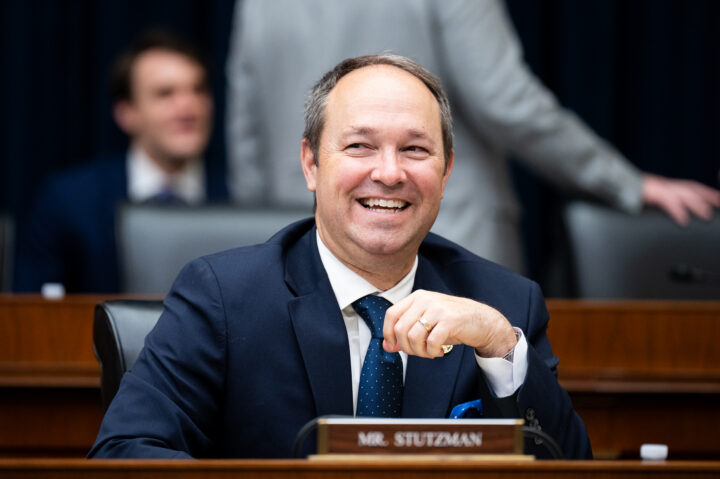
Rep. Marlin Stutzman (R-IN) at a House Financial Services Committee on May 7, 2025.
Rep. Marlin Stutzman (R-IN) introduced a resolution on Wednesday endorsing and praising Israeli Prime Minister Benjamin Netanyahu’s call to wind down U.S. aid to Israel over the next decade, the latest twist in the rapidly evolving U.S. conversation over the future of the U.S.-Israel relationship and U.S. aid to Israel.
Few Republicans, at this point, have publicly endorsed Netanyahu’s effort, which comes amid talks between the U.S. and Israel over the next memorandum of understanding on military aid. Top U.S. officials have confirmed in recent days that ending U.S. aid to Israel is part of those discussions. Future American aid is largely expected to pivot toward a model based on trade, partnership and joint development.
Stutzman said he had discussed the resolution and the effort with Netanyahu and other Cabinet ministers during a visit to Israel alongside Rep. Abe Hamadeh (R-AZ) last week, and that the Israeli officials were strongly supportive.
“We thought this was a good opportunity to get a sense of Congress, and of course support not only Israel, but support the administration, and as they move ahead in the next negotiations of MOU, and I’m excited about it. I think it’s a big step for both countries,” Stutzman told Jewish Insider during an interview in his Capitol Hill office on Wednesday.
He said he would not have moved ahead with the resolution if he did not find that he and Netanyahu were on the same page in their goals, and said he would walk it back if President Donald Trump offered a strong counterargument. Netanyahu himself offered a letter of support for the resolution, which Stutzman publicized alongside the resolution.
Netanyahu said in the letter to Stutzman that he was “glad to receive your proposed Congressional resolution endorsing my plan to shift the framework for US-Israel defense cooperation from aid to partnership” and that the “time has now arrived for us to move from aid recipient to partner.”
Such public letters from Netanyahu directly endorsing U.S. legislation are highly atypical, even for legislation supportive of Israel. The resolution “commends Prime Minister Benjamin Netanyahu for his bold proposal.”
Stutzman said he had discussed the resolution with the White House, House Speaker Mike Johnson (R-LA) and House Majority Leader Steve Scalise (R-LA), though none of them have given their backing to the resolution yet.
The congressman called it an expression of support from the House for “the efforts of both our countries to take this step in our maturing relationship.” He said that winding down aid is a “mature step” that acknowledges Israel’s role as a regional power and its growing economy. And he said it would communicate to the administration the support from Congress for winding down U.S. aid as part of the MOU talks.
Some pro-Israel voices in the U.S. have griped about the way Netanyahu has approached the wind-down of U.S. aid to Israel, with his comments being decontextualized and weaponized by critics of Israel in the United States to suggest Netanyahu himself supports a severing of the U.S.-Israel relationship or an immediate end to all U.S. aid.
“I’m sure people will try to weaponize it, and they’ll try to create conspiracy theories out of it, but you know what, I was in the room, there was nothing but discussion about our relationship and our partnership,” Stutzman said, when asked about such concerns. “I’m sure there will be some out there that try to use it as fuel for something. They already are, and it’s laughable, because you know it’s more out of a spirit of hatred for Israel than realizing that it’s in the best interest of both countries.”
He argued that the resolution should attract widespread support from budget hawks — for saving U.S. taxpayer money — and from pro-Israel colleagues for giving Israel the opportunity to “stand on their own two feet and be a standing partner beside us and not look like they’re dependent on us.”
Stutzman also said that the resolution, and ending U.S. aid, would remove an argument made by antisemites that the U.S.-Israel relationship is coercive or exploitative, though he acknowledged that it would not solve the problem of antisemitism.
“I hear too many young people especially say that, ‘Israel controls the United States,’ or ‘the United States controls Israel,’” Stutzman said. “No, we just have such common values, and it’s a very natural relationship.”
In addition to the provisions on U.S. aid, the resolution “condemns antisemitism in all its forms, including physical attacks on Jewish individuals and institutions, the harassment of Jewish Americans, the spread of antisemitic propaganda, and the delegitimization of Israel’s right to exist.”
Stutzman said he wants to see the next MOU with Israel — after the current one expires in 2028 — move the U.S.-Israel relationship toward partnership between American and Israeli companies, which he said would be beneficial for the U.S., Israel and other Middle Eastern countries.
The resolution “strongly supports” a new MOU “to replace traditional military assistance with a framework of joint defense codevelopment, coproduction, and mutual investment that will strengthen both nations’ defense industries and military readiness.”
He said the U.S. should also be exploring a Middle Eastern analogue to NATO, including Israel and Gulf states, to include an Article V-style defense guarantee from the United States to protect its various partners in the Middle East. He argued that the war in Iran, during which Tehran has struck various U.S. Gulf allies, has “helped show the world who the real problem was, and that’s Iran and the IRGC.”
Stutzman predicted that Trump will be able to bring regional partners, which are increasingly splitting into camps — Israel and the UAE on one side, and other Gulf and Arab states like Saudi Arabia and Qatar on the other — back together after the war in Iran ends, by touting his ability to defang the Iranian regime, and pointing to the threat it poses to all of them.
He said he believes reports that Saudi Crown Prince Mohammed Bin Salman would be willing to normalize relations with Israel if not for objections from his father, King Salman. Saudi Arabia has publicly rejected the idea of normalization prior to progress toward a two-state solution.
Stutzman’s resolution praises Netanyahu and Israel for their cooperation with the U.S. in military operations against Iran.
Asked about the resolution, Rep. Randy Fine (R-FL), one of the most vocal pro-Israel Republicans in the House, said he’s “not a huge fan of resolutions,” which are nonbinding, and that he “struggle[s] with this issue,” calling it a “win for Israel” to wean off of U.S. aid but a “terible decision for America” because “American benefits much, much more from that $3.8 billion than it costs us.”
He said that ending U.S. aid will not stop antisemitism.
“The unfortunate thing is people believe this will stop the antisemitism. It’s not driven by the aid to Israel, they’ll come up with something else,” he said. “I support getting rid of it, just because I like to call BS on all the antisemites, but you’re not going to see me running around to pass a resolution, which doesn’t mean all that much.”
He said that he hasn’t reviewed Stutzman’s resolution yet so he couldn’t commit to how he might vote on it, but said he would consider it. “But I’d rather we actually do things that would solve the problem than just talk about solving the problem.”
Netanyahu’s letter has already been weaponized by anti-Israel forces on the left and right, who are linking it to a provision of the 2027 National Defense Authorization Act set for a markup in the House Armed Services Committee on Thursday, which aims to enhance U.S.-Israel technological cooperation and sharing.
Those relatively routine measures, which enjoy bipartisan support and further existing programs, are being undertaken independent of the current MOU, and would not impact the level of U.S. foreign military financing being provided to Israel next year or in the future — though they do model the sort of joint development and co-production which are likely to be the focus of the next MOU.
Former Rep. Marjorie Taylor Greene (R-GA) posted a highlighted version of the letter pointing to sections where Netanyahu referenced “my plan” for the future of U.S. aid, suggesting that it was referring to the NDAA provision.
The anti-Israel group A New Policy posted the same highlighted graphic. Neither acknowledged the fact that Netanyahu’s letter referenced a different piece of legislation, instead declaring that he was discussing the NDAA language.
The secretary of state largely defended Israel’s strikes in response; ‘Israel has a right to act in its defense’
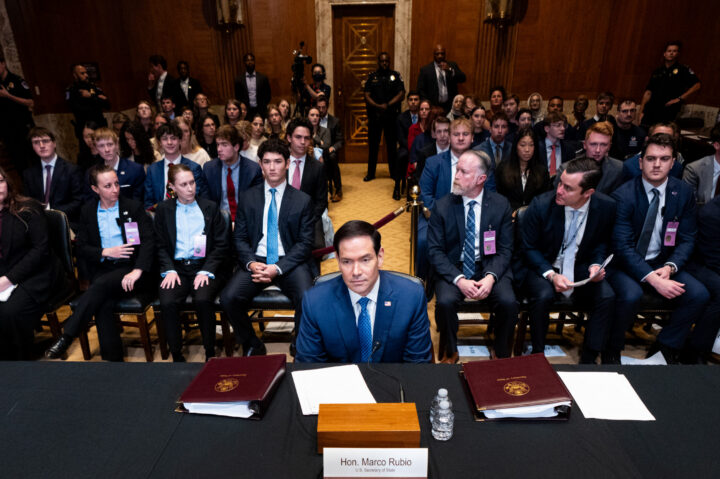
Bill Clark/CQ-Roll Call, Inc via Getty Images
Secretary of State Marco Rubio appears before the Senate Appropriations Subcommittee on State, Foreign Operations, and Related Programs hearing on the State Department budget request on Wednesday, June 3, 2026.
Despite President Donald Trump’s public acknowledgement of a confrontational phone call with Israeli Prime Minister Benjamin Netanyahu regarding Israeli operations in Lebanon, Secretary of State Marco Rubio on Wednesday largely defended Israel’s attacks against the Lebanese terrorist group.
He said that Hezbollah reached out to the U.S. government through the Lebanese authorities approximately two weeks ago and said that it would stop launching missiles into Israeli territory if Israel did not attack Beirut. But Rubio said that Hezbollah went back on that agreement and launched rockets at Israel within hours.
“Israel has not conducted massive operations in Beirut for some time,” Rubio said at a House Foreign Affairs Committee hearing. “Israel has a right to act in its defense.”
Israeli strikes have taken place largely to prevent imminent attacks by Hezbollah forces preparing to attack Israel, Rubio said. He said that Israel’s seizure of territory in southern Lebanon has been intended to deny Hezbollah freedom to operate and launch missiles, and that Israel has not been conducting large-scale operations in Beirut.
Pressed on the current U.S. position in negotiations with Iran, particularly in comparison to the first Trump administration’s condemnation of the 2015 Iran nuclear deal, Rubio largely focused on the nuclear elements of the deal, but said that Iran’s missile program would also be discussed.
He said that Iran would not receive money or sanctions relief unless it agrees to dispose of its highly enriched uranium and give up its enrichment program.
Asked whether the administration would submit any deal reached to Congress, he said that the administration would comply with the Iran Nuclear Agreement Review Act, which requires such review. He said in a Senate Appropriations Committee hearing in the afternoon that the bill, known as INARA, has “very specific requirements about elements of the nuclear program that would have to be noticed to Congress.”
Pressed by Sen. Lindsey Graham (R-SC) on whether Iran’s support for proxy terrorism would be part of any deal, Rubio said that the U.S. would like to see limits on that activity in a deal, but said that there could also be U.S. sanctions “just on that.”
He also suggested at the House hearing the U.S. is seeking to address Iran’s supply of 20% enriched uranium, in addition to 60% enriched uranium.
Asked about recent comments by Trump describing the Iranian military as moderate, and saying that the U.S. has left it “alone,” Rubio drew a distinction between military equipment and capabilities, which the U.S. has targeted, and certain figures inside the regime who have been more open to negotiations with the U.S. or a more conciliatory posture.
He also framed all U.S. operations since the ceasefire as defensive — retaliatory attacks to respond to or prevent attacks on commercial shipping, to which Iran has responded with strikes on facilities throughout the region.
“These are completely defensive in nature. But they are happening in response to an Iranian action. If they don’t shoot at those ships, we don’t shoot. But we have to respond,” Rubio said. “You have a civilian commercial vessel transiting the straits and they’re being targeted by drones.”
He denied a report that Iran had threatened to test a nuclear weapon if the U.S. does not make concessions in negotiations.
Asked about congressional action on Iran, Rubio noted that Iranian state media has framed congressional votes in favor of war powers resolutions to block operations against Iran as a victory which would tie the U.S.’ hands.
He also said that the administration does not feel it needs an Authorization for Use of Military force to carry out any potential further operations against Iran, but said that the administration would engage with Congress if that occurs and that it would welcome any further congressional authorities.
Pressed by Rep. Joaquin Castro (D-TX) about Israel’s alleged nuclear capabilities, Rubio emphasized that Israel has never acknowledged that it has a nuclear program, though most of the world believes it does. “But they’ve never acknowledged that publicly, and as a feature of our foreign policy, for a variety of reasons, we don’t discuss it in that way either,” he said.
He said that the State Department might be able to discuss the issue further in a closed session and in a different context than a letter Castro and other Democrats sent to Rubio on the subject.
Rubio also affirmed that Turkey is currently not eligible to receive F-35 fighter jets as long as it operates a Russian S-400 missile defense system, under U.S. statute.
In an interview on CNBC, the Israeli premier said ending U.S. aid to Israel will ‘take away the myth that Israel is depleting America's coffers’
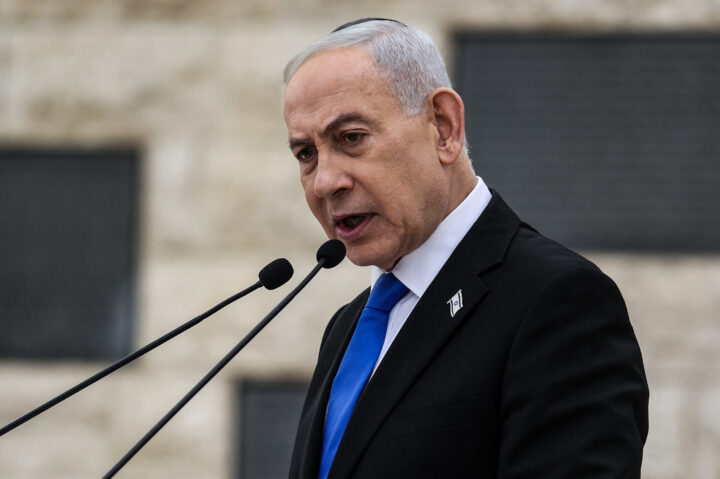
Ilia YEFIMOVICH / POOL / AFP via Getty Images
Israeli Prime Minister Benjamin Netanyahu speaks during a ceremony commemorating Israel's Remembrance Day on Mount Herzl in Jerusalem on April 21, 2026.
Israeli Prime Minister Benjamin Netanyahu said on Wednesday that he wants to start the process of winding down U.S. aid to Israel in the final two years of the Trump administration, as both countries work on a new memorandum of understanding.
Netanyahu made the comments in an interview with CNBC’s Sara Eisen after being asked about his political future and when Israel would be ready for new leadership. The prime minister responded by noting that while the Israeli people could decide at “any time” to remove him from power, he is currently focused on achieving four objectives: “finish[ing] the security envelope that we have to make vis-à-vis Iran and its proxies”; securing more investments globally to expand Israel’s AI and tech sectors; normalizing relations with several countries in the Middle East; and ending Israel’s reliance on U.S. aid.
“The other thing I want to do is move away, in America, from aid to partnership. We’re now working on a memorandum of understanding, which will bring down the aid,” Netanyahu said. “I want it to start now, I want it to start in the last two years of the Trump administration and I want it to keep going down, coming to zero, because I think we’ve come of age.”
The current MOU, which provides Israel with $3.8 billion in U.S. military aid annually, runs through FY 2028. Netanyahu did not clarify whether he would like to see aid begin to wind down through changes to the current agreement, or whether he is focused on ongoing negotiations for the next one.
“Israel has a robust economy, and I want us to go from aid to a partnership where we both invest equal amounts and both share equally in the fruits of our innovators and technologies,” he continued. “I think that’s very, very important. It will also take away the myth that Israel is depleting America’s coffers.”
Netanyahu has said on multiple occasions since January that he hopes to wean Israel off of U.S. aid, initially suggesting in January that Israel would work to end U.S. aid within the next ten years. He pitched the aid drawdown to President Donald Trump in late December, an idea the president was initially bewildered by and not supportive of.
Netanyahu also downplayed reports that Trump told him he is “f***ing crazy” in a phone call on Monday about Israel’s military escalation in Lebanon and rejected the notion that his relationship with the president had shifted, noting that the two speak as frequently as “every two days.”
Still, he did not deny that the conversation occurred as reported.
“Sometimes we have, as in the best of families, you have these tactical disagreements. We always find a way to work them out and we do so as great friends,” Netanyahu said. “We can disagree in the morning, and by the afternoon we have common action.”
Plus, Miami’s new kosher Michelin

MENAHEM KAHANA/AFP via Getty Images
Israel's Prime Minister Benjamin Netanyahu addresses the assembly during a session of the Israeli parliament (Knesset) at its headquarters in Jerusalem on June 11, 2025.
Good Friday morning.
In today’s Daily Kickoff, we look at the state of play in Israeli Prime Minister Benjamin Netanyahu’s inner security circle amid the departures of some of his key advisors, and talk to U.S. Ambassador to Israel Mike Huckabee about the influence of foreign funding in higher education. We spotlight the concerns among Jewish community members in Montana’s 1st Congressional District, as the leading Democratic candidates skew largely to the party’s left on Israel policy, and talk to American Jewish Committee CEO Ted Deutch ahead of AJC’s Global Forum, which kicks off on Sunday. Also in today’s Daily Kickoff: Daniel Loeb, Scooter Braun and Raz Shabtai.
Today’s Daily Kickoff was curated by JI Executive Editor Melissa Weiss and Israel Editor Tamara Zieve, with an assist from Danielle Cohen-Kanik. Have a tip? Email us here.
For less-distracted reading over the weekend, browse this week’s edition of The Weekly Print, a curated print-friendly PDF featuring a selection of recent Jewish Insider and eJewishPhilanthropy stories, including: State Dept. official Sarah Rogers urges protecting free speech while fighting antisemitism; Pro-Israel groups grapple with the future of Israel funding and DSA quietly poised to make inroads in NYC’s congressional delegation. Print the latest edition here.
What We’re Watching
- In Washington, the Pentagon is convening military representatives from Israel and Lebanon for a fourth round of talks between Jerusalem and Beirut aimed at winding down military action around the Israel-Lebanon border and disarming Hezbollah and its strongholds in southern Lebanon.
- Allison Hooker, the State Department’s under secretary for political affairs, is slated to meet this morning with Oman’s ambassador to the U.S. The meeting comes days after President Donald Trump said at a Cabinet meeting that “Oman will behave just like everybody else, or we’ll have to blow ‘em up.”
- Defense Secretary Pete Hegseth is in Singapore for the International Institute for Strategic Studies’ Shangri-La Dialogue, where he’ll speak tomorrow morning. Dozens of defense ministers and senior officials from around the world are slated to speak at the convening, which kicks off later today and runs through the weekend.
- In Israel, Prime Minister Benjamin Netanyahu said he ordered the IDF to expand its control in the Gaza Strip to 70% of the enclave, amid stalled talks aimed at disarming Hamas and beginning the reconstruction of Gaza.
- Rep. Jim Clyburn (D-SC) is hosting his annual World Famous Fish Fry, historically considered a mandatory pit stop for Democratic presidential aspirants. This year, Rep. Ro Khanna (D-CA) and Kentucky Gov. Andy Beshear are expected to attend the Columbia, S.C., fry-up.
- The Minnesota Democratic-Farmer-Labor State Convention kicks off today and runs through the weekend. This year’s convention takes place amid growing concerns that the party’s statewide conventions have become activist turf, after attendees at the Michigan Democratic Party convention last month heckled pro-Israel speakers and in one case screamed an antisemitic slur at the Jewish husband of Michigan Senate candidate Mallory McMorrow. Rep. Angie Craig (D-MN), who is running for Minnesota’s open Senate seat, will skip this weekend’s convention altogether.
- The American Jewish Committee’s Global Forum begins on Sunday. Read our interview with AJC CEO Ted Deutch below.
- The annual Israel on Fifth parade will take place on Sunday in Manhattan. New York City Mayor Zohran Mamdani will not attend the parade, marking the first time in more than six decades that a sitting mayor has not attended. In attendance, however, will be dozens of Israeli officials — the largest delegation the country has ever sent to the parade. More below.
- Elsewhere in New York on Sunday, the Republican Jewish Coalition is holding its USA 250 Gala Dinner. U.S. Ambassador to the U.N. Mike Waltz, Israeli Ambassador to the U.N. Danny Danon, Knesset Speaker Amir Ohana and Reps. Randy Fine (R-FL) and Mike Lawler (R-NY) are slated to speak at the event.
What You Should Know
A QUICK WORD WITH GILI COHEN
For years, Israeli Prime Minister Benjamin Netanyahu has relied on a small, passionately loyal inner circle of advisors — Ron Dermer foremost among them — to provide a sounding board on some of the country’s thorniest security matters.
Now, with Dermer (mostly) gone, new elections looming and Israel fighting a multifront war and isolated on the world stage, that inner circle is nearly empty. And the departures of key security advisors have left the longest-serving prime minister in the country’s history arguably more alone than ever.
The position of head of Israel’s National Security Council has been unfilled on a permanent basis since October 2025, when Netanyahu dismissed Tzachi Hanegbi from the role. It is currently held in an acting capacity by Gil Reich, a former senior official at the Israeli Atomic Energy Commission, who will move to a different role within the defense establishment on Monday.
Just a day later, the director of the Mossad, David Barnea, will also step down after completing a full five-year term. He is set to be replaced by Netanyahu’s military secretary, Gen. Roman Gofman.
However, in the Israel of 2026, nothing is straightforward. High Court justices must soon rule on whether Gofman’s sensitive appointment for the Mossad will be approved. This comes after the head of the Senior Appointments Advisory Committee — the Israeli version of a Senate hearing for high-ranking civil service roles — opined that Gofman’s appointment was flawed on ethical grounds.
But Gofman’s departure will mark a farewell to one of Netanyahu’s closest advisors and currently the most influential security figure in his orbit — and at a time when Netanyahu’s post-Oct. 7 relationship with the military echelon remains exceptionally complex.
“The role of the national security advisor and head of the NSC is critical and central for shaping, planning and overseeing the execution of Israel’s national security policy,” Eyal Hulata, who served as head of Israel’s NSC from 2021-2023, told Jewish Insider.
“The fact that the prime minister is not appointing a replacement for this role is, unfortunately, yet another example of a disregard for organized staff work and another blow to the professionalism required when working with the defense establishment,” Hulata continued. Sources close to the prime minister told JI that Netanyahu intends to fill these soon-to-be-empty positions shortly.
So, who are the candidates for head of the Israeli NSC? According to sources familiar with the matter, there are two front-runners: Reuven Azar, Israel’s ambassador to India, and Col. (res.) Gabi Siboni, a hawkish commentator on military strategy.
AMBASSADOR’S INSIGHTS
Huckabee warns foreign influence in schools is driving evangelicals away from Israel

U.S. Ambassador to Israel Mike Huckabee urged America to “be doing more” to combat foreign influence in schools, which he identified as a key factor in the declining support for Israel among younger evangelical Americans. While evangelicals have historically been some of Israel’s strongest allies, support among the youngest Americans is becoming “more divided” than in previous generations, Huckabee, who is an evangelical Christian, told Jewish Insider’s Haley Cohen in a wide-ranging interview.
Education consternation: “A lot of it is driven by social media and Middle Eastern studies programs that are heavily financed by Gulf state countries pouring billions of dollars into universities in the U.S. and giving people a very false understanding of what the realities in the Middle East are,” Huckabee said. His comments came shortly before he delivered the commencement address on Thursday at Yeshiva University’s graduation ceremony at Louis Armstrong Stadium in Queens.
Doubling down: A week after describing J Street as “a cancer within the Jewish community” for calling for the United States to restrict aid to Israel, Yechiel Leiter, Israel’s envoy to Washington, doubled down on his critique of the organization, stating that the liberal advocacy group’s recent actions are “decidedly not pro-Israel,” eJewishPhilanthropy’s Nira Dayanim reports for JI.
TED TALK
Antisemitism has become ‘instrumentalized’ and ‘institutionalized’ in politics, media and more, Ted Deutch says
Ahead of the American Jewish Committee’s annual Global Forum conference, which begins in Washington on Sunday, the group’s CEO, Ted Deutch, is reflecting on a significantly transformed landscape — in which, he said, antisemitism has become mainstream in politics and circles of power in alarming ways that seemed to leave the longtime former congressman stunned. But he also said, in an interview with Jewish Insider’s Marc Rod, that AJC has been working on a comprehensive new plan to address the changing manifestations of antisemitism in the current social environment, which it plans to unveil at next week’s conference.
Observing and adapting: “Antisemitism is unfortunately no longer just on the fringes, but it’s become instrumentalized, it’s become institutionalized in so many ways and amplified in mainstream politics and media and online and at international institutions,” Deutch told JI at AJC’s Washington offices on Thursday. “The threat of antisemitism has evolved, and I think our response has to evolve as well.”
UNDER SCRUTINY
Adam Hamawy’s Democratic rivals, Rep. Gottheimer call for answers on his terrorist ties

Several of Adam Hamawy’s opponents in the Democratic primary in New Jersey’s 12th Congressional District are challenging the candidate to explain his ties to Omar Abdel-Rahman, the convicted terrorist known as the Blind Sheikh, as well as his service with a charity later shuttered as a front for al-Qaida years after he volunteered, Jewish Insider’s Marc Rod and Will Bredderman report.
Seeking clarity: Rep. Josh Gottheimer (D-NJ) is now also joining them in seeking more clarity on the first-time congressional candidate’s background. Many of Hamawy’s other Democratic rivals appeared hesitant to address the military veteran and physician’s past ties to Islamist extremists, with only Mayor Adrian Mapp of Plainfield publicly addressing the weeks-old reporting about Hamawy testifying in defense of Abdel-Rahman. Brad Cohen, the mayor of East Brunswick, N.J., told JI Hamawy’s past ties require further explanation.
MARKED ABSENT
Mamdani won’t attend Israel Day parade, but pledges ‘comprehensive security’

New York City Mayor Zohran Mamdani will break with 61 years of tradition by skipping this year’s “Israel Day on Fifth” parade, but his police chief will serve as a grand marshal — and the two pledged a “comprehensive security plan” to protect the festivities taking place on Sunday, Jewish Insider’s Will Bredderman reports.
What he said: At a press conference at One Police Plaza on Thursday, the mayor affirmed his longstanding vow to boycott the event. “I said on the campaign trail that I wouldn’t be attending the parade, and I’ve made my views on the Israeli government abundantly clear,” said Mamdani, who distinguished himself not just from his predecessors but also the pack of rivals he faced in the 2025 election with his anti-Israel stance. “While I will not be attending, our administration has been preparing for weeks to ensure the parade is safe for all those who take part.”
Big Sky Battle
Most Montana Democrats running for Rep. Ryan Zinke’s seat slam U.S.-Israel relationship
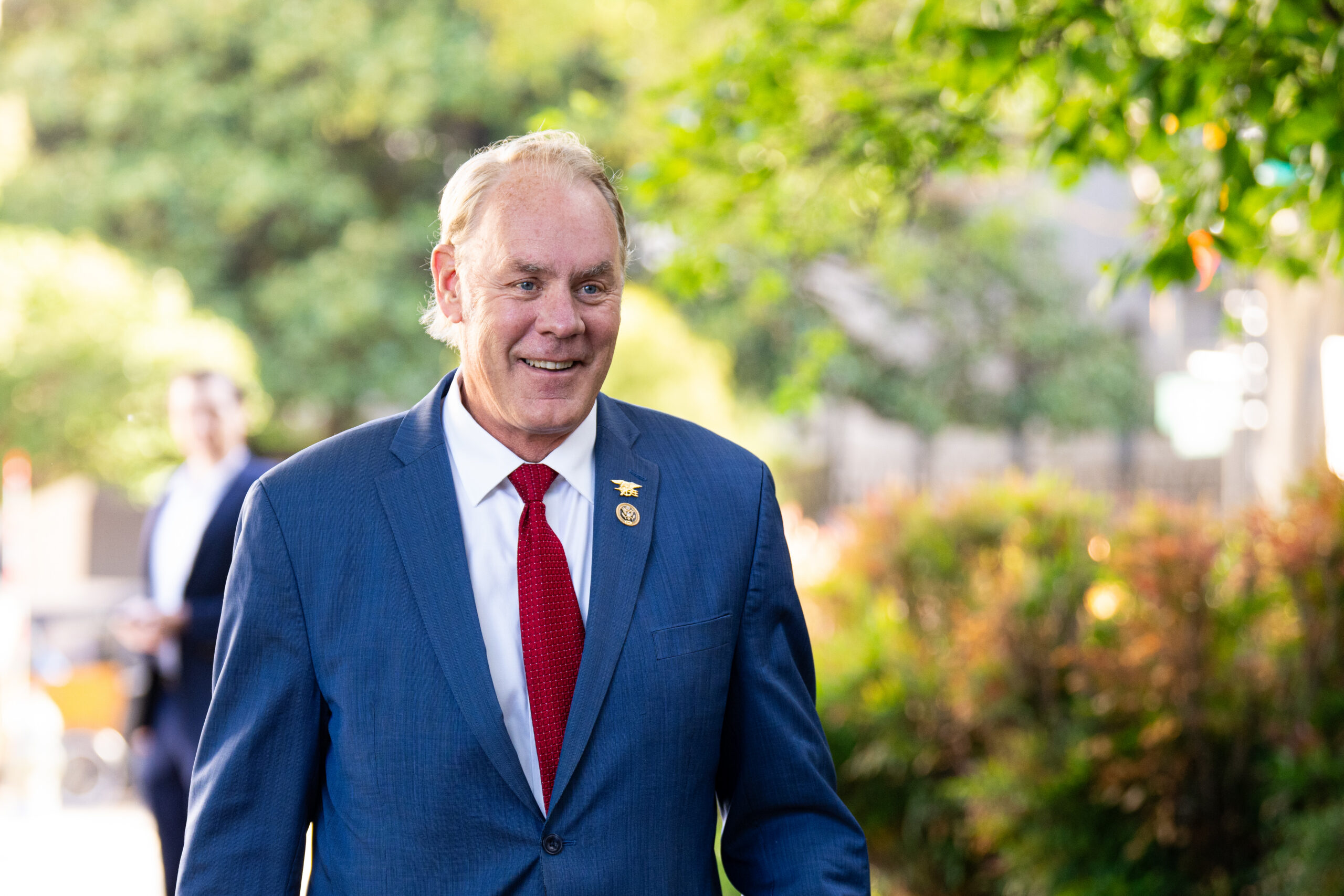
In the contentious Democratic primary in Montana’s 1st Congressional District, Israel and antisemitism have become flashpoints in ways that members of the local Jewish community say they find concerning and potentially dangerous. Rep. Ryan Zinke (R-MT), who currently represents the seat, is retiring at the end of his current term, and Democrats view it as a potential pickup opportunity in a favorable midterm climate, Jewish Insider’s Marc Rod reports.
Coming down on Israel: Though the district leans Republican, that hasn’t stopped a majority of Democrats in the field from racing to the left on Israel policy, a dynamic that was on clear display at a recent debate. Ryan Busse, a businessman and author who is the top fundraiser among the Democratic candidates, declared that the U.S. has been “forced into a war by another country,” alleging that Israel dragged the U.S. in its military campaign against Iran.
MACKINAC MOMENT
At Mich. Senate debate, McMorrow says Dems have an antisemitism problem

Michigan state Sen. Mallory McMorrow offered a straightforward answer when asked at a debate at the Mackinac Policy Conference on Thursday, alongside the other two Democrats vying for an open Senate seat in the state, whether there is an antisemitism problem in the Democratic Party, Jewish Insider’s Gabby Deutch reports. “There is,” said McMorrow. She told the story of an attendee at last month’s Democratic Party convention in Detroit who yelled an antisemitic slur at her Jewish husband, in front of their young daughter.
What she said: “That is terrifying. We need to be able to state very clearly that what the Netanyahu government is doing is wrong, that the violence needs to end, that we need to bring about long-term peace and security for Palestinians and for Israelis, and that turning that into not an anti-Netanyahu, but an anti-American Jewish message is dangerous,” McMorrow said, earning applause from the room.
Debate dodge: Rep. Haley Stevens (D-MI) sidestepped a question on accepting contributions from donors to AIPAC, giving a response characterized by The New York Times as “160 words without coming remotely close to answering the question” that failed to mention both Israel and AIPAC in her answer.
Worthy Reads
Weeding Out the Uyghurs: The Financial Times’ Alison Killing does a deep dive into China’s escalating efforts to crack down on Uyghurs and other Muslim minorities in the country. “But FT analysis suggests that the Chinese state’s campaign of oppression against Uyghurs and their culture and identity has in fact entered a new phase. It shows Xinjiang has the world’s highest prison detention capacity relative to its population size — evidence that authorities continue to rely on mass incarceration. Researchers and rights groups say repression in the region now extends towards the long-term remaking of Uyghur society. … ‘Everything that once reflected Uyghur civilization — our culture, our language — has been wiped out,’ says a Uyghur man who recently visited the region from the U.S.” [FT]
Making a Militia: In New Lines Magazine, Farea Al-Muslimi examines the decades-long effort by Hezbollah to grow and strengthen the Iran-backed Houthis in Yemen. “The relationship between Hezbollah and the Houthis is not simply a case of proxy support. It reflects a sustained process of construction — militarily, politically and institutionally — that produced an actor with its own strategic direction. Over time, that process altered the relationship itself. What began as mentorship created the conditions for autonomy. The Houthis remain aligned within a broader regional framework, but they are no longer defined by their allies.” [NewLines]
Word on the Street
Vice President JD Vance said on Thursday afternoon that the U.S. and Iran were “very close” to reaching an agreement on the wording of a memorandum of understanding that would institute a 60-day ceasefire, reopen the Strait of Hormuz and begin nuclear talks…
The Treasury Department reimposed sanctions on Francesca Albanese after the Trump administration appealed a federal court order to remove the U.N. special rapporteur from the U.S. sanctions list while a lawsuit challenging the sanctions plays out in court…
Michigan Gov. Gretchen Whitmer ruled out a 2028 presidential run, saying at Thursday’s Mackinac Policy Conference that “there will be a robust group of people running for president,” but she “will not be one of them”…
Rep. Jared Moskowitz (D-FL), a Jewish Democrat who is among the most vocal supporters of Israel in Congress, announced on Thursday that he would seek reelection in a new South Florida House district recently drawn to favor Republicans, after his own was largely erased, setting the stage for what is expected to be a costly and competitive race, Jewish Insider’s Matthew Kassel reports…
Reps. Marlin Stutzman (R-IN) and Abe Hamadeh (R-AZ), two strong supporters of Israel, made another trip to the country this week, during which they met separately with Israeli Prime Minister Benjamin Netanyahu, President Isaac Herzog and Foreign Minister Gideon Sa’ar, JI’s Matthew Shea reports…
New York City Mayor Zohran Mamdani endorsed democratic socialist Darializa Avila Chevalier in her primary challenge to Rep. Adriano Espaillat (D-NY); Mamdani had last year committed to backing Espaillat after the chair of the House Hispanic Caucus dropped his support for former Gov. Andrew Cuomo and endorsed Mamdani in the general election…
Hebrew Union College-Jewish Institute of Religion President Andrew Rehfeld, speaking at the Re-Charging Reform Judaism conference in New York this week, fought back against Rabbi Ammiel Hirsch’s condemnation of the Reform seminary’s ordination of anti-Zionist clergy, calling his comments “an attack on the very Enlightenment principles that founded our movement” and accusing him of “anti-intellectualism,” eJewishPhilanthropy’s Nira Dayanim reports…
Third Point founder and CEO Daniel Loeb made his first podcast appearance, appearing on Patrick O’Shaughnessy’s “Invest Like the Best” to discuss AI, corporate governance and investing in the current climate…
Appearing on The Free Press’ “Second Thought” podcast, Scooter Braun reflects on his relationship with Kanye West and the performer’s past antisemitic comments, noting that “obviously the things that [West has] gone through and the things he’s said been have been very upsetting to me,” but that Braun wants “to always believe people have an opportunity to have salvation and growth. And as much as I was very much upset because my family was in the Holocaust, and some of the things he said were incredibly inappropriate [and] very frustrating. And that’s the reason, probably, we haven’t spoken in a very long time”…
Jerusalem-born chef Raz Shabtai’s North Miami restaurant Mutra was awarded a Michelin star, becoming the only current kosher restaurant with the honor…
A who’s who of high-profile figures in sports management were in Budapest, Hungary, last night for the UEFA Champions League gala dinner; those in attendance included New England Patriots owner Robert Kraft and Fanatics CEO Michael Rubin…
A Jewish teenager in Toronto who had been missing since mid-May was found by authorities, who are investigating “whether or not there is any evidence of criminality” in her disappearance…
Organizers of Rome’s upcoming Pride parade denied a request from the country’s only Jewish LGBTQ group to march with a float, saying that the Keshet Italia, which is unaffiliated with Israel, had refused to called Israel’s actions in Gaza a “genocide”…
A soccer match between the Irish and Qatari national teams at Dublin’s Aviva Stadium was disrupted on two occasions by match-goers who threw tennis balls emblazoned with Palestinian flags onto the field, raising concerns about fans’ behavior ahead of two matches between Ireland and Israel slated for this fall in Dublin…
Israeli Ambassador to the U.N. Danny Danon said that Israel would cut ties with U.N. Secretary-General António Guterres over Israel’s inclusion in an upcoming sexual violence blacklist, owing to alleged abuses of Palestinian detainees in Israeli custody…
CBS News is tapping former New York Times columnist Nick Bilton, a Vanity Fair alum, as executive producer of “60 Minutes,” replacing Tanya Simon…
The New York Times interviews the Washington Star‘s new owner, Dovid Efune, about his plans to resurrect the publication 40 years after it last published; earlier this week, Efune filed a trademark infringement lawsuit against online publication NOTUS, which recently announced plans to rebrand as The Star…
William Daroff, CEO of the Conference of Presidents of Major American Jewish Organizations, was named the first chair of the J50 Forum, a group of leaders from 50 Jewish communities from around the world that was created last year by Israeli Foreign Minister Gideon Sa’ar…
CNN Jerusalem Correspondent Jeremy Diamond won the Emmy Award for Outstanding News Interview for his sit-down with senior Hamas official Ghazi Hamad…
Actor Marvin Chatinover died at 99…
Wine of the Week

JI wine columnist Yitz Applbaum reviews the Hajdu Reserve Cabernet Sauvignon 2022:
I have written before about the brilliant cult winemaker Jonathan Hajdu. His wines continue to grace the kosher market with varieties new to it, challenging our palates in ways at once playful and serious. His rieslings dance; his old-vine zinfandels brood.
This Shabbat, we were blessed to taste his 2022 Reserve Cabernet. A big, bold, all-encompassing wine, it opens with a rush of dry earthiness that yields to a mouthwatering mid-palate juiciness of dark berry. The finish is long, carrying familiar notes of dark chocolate and a whisper of cedar. Pair it with a meat-rich cholent, and lay a bottle down for years to come.
Pic of the Day
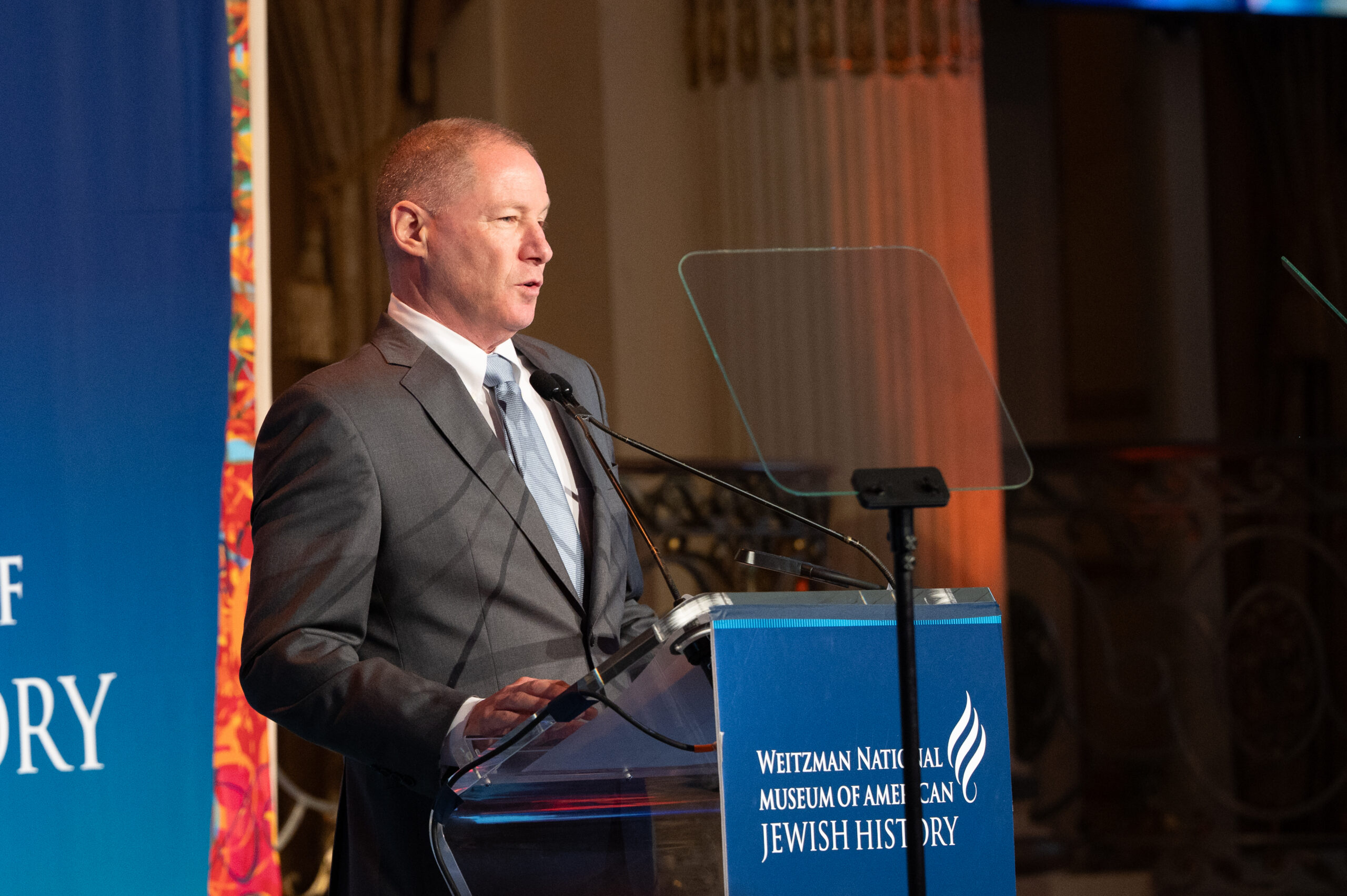
Dan Tadmor, the president of the Weitzman National Museum of American Jewish History, addressed the crowd at the museum gala last night in New York City, which honored Stuart and Jane Weitzman, eJewishPhilanthropy’s Nira Dayanim reports from the Plaza Hotel. The gala comes as the museum, which is making efforts to be incorporated into the Smithsonian, launches a $100 million fundraising campaign to transform and expand its mission.
“It’s the only museum that tells the American Jewish story in its entirety, geographically, historically, thematically, which is a tall order. It means that we need to excel,” Tadmor told eJP. “It’s been a very tumultuous 20 years, and thematic museums, which are museums that tell a story, they evolve, they need to evolve, because our stories change, narratives change, technology changes.”
Birthdays

Film, stage and television actor, singer and songwriter, Idina Menzel turns 55 on Saturday…
FRIDAY: Montreal-based businessman and philanthropist, Marvin Birnbom turns 96… Professor emerita of marine biology at Rutgers University, Judith Shulman Weis turns 85… Former member of the Knesset for the Likud party and then Israel’s ambassador to Japan, Eli Cohen turns 77… Winner of three Emmy Awards and a Grammy, actor, composer, singer, songwriter and record producer, Danny Elfman turns 73… U.S. Sen. Jerry Moran (R-KS) turns 72… Retired senior diplomat in the Israeli Ministry of Foreign Affairs, she was previously a brigadier general in the IDF, Ruth Yaron turns 69… Television writer, producer and actor, best known as the creator of the sitcom “Arrested Development” as well as the co-creator of “The Ellen Show,” Mitchell Hurwitz turns 63… Past president of Ahavath Achim Congregation in Wichita, Kan., she is a trustee-at-large on the board of JFNA, Ellen Ginsburg Beren… Professor at the University of Chicago, co-author of the best-selling books in the Freakonomics series, Steven Levitt turns 59… CEO and executive editor of 70 Faces Media, the parent company of the Jewish Telegraphic Agency, Amiram “Ami” Eden… Policy analyst at Centers for Medicare and Medicaid Services, Yaakov Feinstein… Founding partner of Blandford Capital, Nathaniel Jerome Meyohas turns 52… Founder and creative director of the fashion label Shoshanna, Shoshanna Lonstein Gruss turns 51… Chief communications officer and global spokesperson at Aish, she is also a cookbook author, Jamie Geller turns 48… Film producer and former corporate lawyer at Skadden Arps, Edward Frank “Teddy” Schwarzman turns 47… Senior political reporter at The Forward, Jacob Kornbluh… Swedish-born pro-Israel activist, commentator and reporter, Annika Hernroth-Rothstein turns 45… Managing director at Hudson Bay Capital Management and Jewish communal activist, Alexander Berger… Assistant secretary for constituency affairs for New York Gov. Kathy Hochul, he was formerly her Jewish liaison, Jacob “Jake” Adler… Israeli-born assistant pitching coach for the Colorado Rockies, he pitched for Team Israel at the 2020 Summer Olympics, Alon Leichman turns 37… English actor, his bar mitzvah was at the Western Wall in Jerusalem, Gregg Sulkin turns 34…
SATURDAY: Santa Monica, Calif.-based historian of Sephardic and Crypto-Jewish studies, Dolores Sloan turns 96… Real estate developer, landlord of the World Trade Center until 9/11, former chair of UJA-Federation of NY, Larry A. Silverstein turns 95… Partner in the NYC law firm of Mintz & Gold, he is also a leading supporter of Hebrew University, Ira Lee “Ike” Sorkin turns 83… Cape Town, South Africa, native, she is the owner and chef at Los Angeles-based Catering by Brenda, Brenda Walt turns 75… Former professional tennis player, he competed in nine Wimbledons and 13 U.S. Opens, Steve “Lightning” Krulevitz turns 75… Former chief rabbi of France, Gilles Uriel Bernheim turns 74… Medical director of the American Jewish Joint Distribution Committee’s Ethiopia spine and heart project, Dr. Richard “Rick” Hodes turns 73… Encino, Calif.-based business attorney, Andrew W. Hyman… Literary critic, essayist and novelist, Daphne Miriam Merkin turns 72… Israeli physicist and philosopher, Avshalom Cyrus Elitzur turns 69… Former member of Congress from Long Island for 16 years, since leaving Congress he has opened a bookstore and written three novels, Steve Israel turns 68… Former science editor for BBC News and author of several books, David Shukman turns 68… Founder of Krav Maga Global with 1,500 instructors in 60 countries, Eyal Yanilov turns 67… Member of the editorial board at The New York Times, Michelle Cottle… Writer, filmmaker, playwright and DJ, known by his pen name Ithamar Ben-Canaan, Itamar Handelman Smith turns 50… Member of Knesset who previously served as Israel’s minister of agriculture, Oded Forer turns 49… Director of marketing at NYC’s Congregation Rodeph Sholom, Scott Hertz… Deputy assistant to President Biden until 2023, the first Palestinian-American White House senior staffer, now the chief of staff for Sen. Brian Schatz (D-HI), Reema Dodin turns 46… Communication and marketing coordinator for the San Francisco office of AIPAC, Alina T. Katz… Israeli author, her debut novel has been published in dozens of countries, Shani Boianjiu turns 39… Rapper, singer, songwriter and record producer, known professionally as Hebro, Raphael Ohr Chaim Fulcher turns 39… Senior counsel at Gilead Sciences, Ashley Bender Spirn… Ice hockey head coach of the ECHL’s South Carolina Stingrays, David Matthew Warsofsky turns 36… Deputy chief of staff for Sen. Jon Ossoff (D-GA), Miryam Esther Lipper… Senior reporter for CNN, Eric Levenson… Challah baker and manager of San Francisco’s Howard Properties, Jason Friend…
SUNDAY: Investment advisor at Wedbush Securities in Los Angeles, Alfred Phillip Stern turns 93… Owner of one of the nation’s largest privately held industrial empires, Ira Leon Rennert turns 92… Professor emeritus at Yale University and the 2018 winner of the Nobel Prize in Economics, William Dawbney Nordhaus turns 85… Food critic at Vogue magazine since 1989 and judge on “Iron Chef America,” he is the author of the 1997 award-winning book The Man Who Ate Everything, Jeffrey Steingarten turns 84… Founder and retired CEO of the Democratic Leadership Council, Alvin “Al” From turns 83… Author, political pundit and a retired correspondent for HBO’s “Real Sports with Bryant Gumbel,” he has won fourteen Emmy Awards during his career, Bernie Goldberg turns 81… Comedian, actor and TV producer, Susie Essman turns 71… Founder and chairman of the Katz Group of Companies with operations in the sports (including the Edmonton Oilers), entertainment and real estate sectors, Daryl Katz turns 65… Reality television personality, best known for starring in and producing her own matchmaking reality series, “The Millionaire Matchmaker,” Patti Stanger turns 65… Jerusalem-born inventor, serial entrepreneur and novelist; founder, chairman and CEO of CyberArk Software, one of Israel’s leading software companies, Alon Nisim Cohen turns 58… Entrepreneur, best known as the co-founder of CryptoLogic, an online casino software firm, Andrew Rivkin turns 57… Former Democratic mayor of Annapolis, Md., now VP of policy at SWTCH, Joshua Jackson “Josh” Cohen turns 53… Senior director of volunteerism & advocacy at the Jewish Federation of Greater Los Angeles, Melissa York… Israeli actor, singer and dancer, she played a Mossad agent in the espionage TV series “Tehran,” Liraz Charhi turns 48… Author of the “Money Stuff” column at Bloomberg Opinion, Matthew Stone Levine turns 48… Freelance writer in Brooklyn, Sara Trappler Spielman… Former attorney and NYT-bestselling author of the Mara Dyer and Shaw Confessions series, Michelle Hodkin turns 44… Senior counsel for autonomy & robotics at DoorDash, formerly a senior advisor at the Department of Commerce, Bert Eli Kaufman… Senior product manager at Tel Aviv-based Forter, Zoe Goldfarb… Stephanie Oreck Weiss… Chief revenue officer at NOTUS, Brad E. Bosserman… Senior rabbi and executive director of Jewish life at D.C.’s Sixth & I, Aaron Potek… Managing editor at NOTUS, Matt Berman… Medical student in the class of 2027 at the University of Nicosia Medical School, Amital Isaac… Brad Goldstein… Basketball player in Israel’s Premier League until recent years, while at Princeton he won the Ivy League Player of the Year award (2017), Spencer Weisz turns 31… Professional golfer on the PGA Tour, Max Alexander Greyserman turns 31… Tech product leader and rapper known by his stage name, King Sol, Benjamin Solomon turns 28…
The departures of key security advisors have left the longest-serving prime minister in the country’s history arguably more alone than ever
POOL/AFP via Getty Images
Israeli Prime Minister Benjamin Netanyahu arrives for a press conference in Jerusalem on March 19, 2026.
For years, Israeli Prime Minister Benjamin Netanyahu has relied on a small, passionately loyal inner circle of advisors — Ron Dermer foremost among them — to provide a sounding board on some of the country’s thorniest security matters.
Now, with Dermer (mostly) gone, new elections looming and Israel fighting a multifront war and isolated on the world stage, that inner circle is nearly empty. And the departures of key security advisors have left the longest-serving prime minister in the country’s history arguably more alone than ever.
The position of head of Israel’s National Security Council has been unfilled on a permanent basis since October 2025, when Netanyahu dismissed Tzachi Hanegbi from the role. It is currently held in an acting capacity by Gil Reich, a former senior official at the Israeli Atomic Energy Commission, who will move to a different role within the defense establishment on Monday.
Just a day later, the director of the Mossad, David Barnea, will also step down after completing a full five-year term. He is set to be replaced by Netanyahu’s military secretary, Gen. Roman Gofman.
However, in the Israel of 2026, nothing is straightforward. High Court justices must soon rule on whether Gofman’s sensitive appointment for the Mossad will be approved. This comes after the head of the Senior Appointments Advisory Committee — the Israeli version of a Senate hearing for high-ranking civil service roles — opined that Gofman’s appointment was flawed on ethical grounds.
Netanyahu believes Gofman has been wronged, and that right now, amid a “seven-front war,” as he noted in a recent press release, this appointment is critical.
But Gofman’s departure will mark a farewell to one of Netanyahu’s closest advisors and currently the most influential security figure in his orbit — and at a time when Netanyahu’s post-Oct. 7 relationship with the military echelon remains exceptionally complex.
”The role of the national security advisor and head of the NSC is critical and central for shaping, planning and overseeing the execution of Israel’s national security policy,” Eyal Hulata, who served as head of Israel’s NSC from 2021-2023, told Jewish Insider.
“The fact that the prime minister is not appointing a replacement for this role is, unfortunately, yet another example of a disregard for organized staff work and another blow to the professionalism required when working with the defense establishment,” Hulata continued. Sources close to the prime minister told JI that Netanyahu intends to fill these soon-to-be-empty positions shortly.
So, who are the candidates for head of the Israeli NSC? According to sources familiar with the matter, there are two front-runners: Reuven Azar, Israel’s ambassador to India, and Col. (res.) Gabi Siboni, a hawkish commentator on military strategy.
Azar, who previously served as Netanyahu’s foreign policy advisor, was involved in the brokering of the Abraham Accords and is considered a highly professional diplomat. As President Donald Trump has made a priority of advancing the Abraham Accords 2.0, now with additional countries such as Qatar and Saudi Arabia, Azar’s experience could be an asset to the NSC.
Siboni is a military strategy expert who frequently provides commentary in the Israeli media, and is known for his hawkish views. He has a significant vulnerability, however: He is close friends with former IDF Chief of Staff Gadi Eisenkot, who is running against Netanyahu in the upcoming elections.
An Israeli source who worked for the current government claimed that while Netanyahu has other candidates in mind to be the next NSA, they don’t stand a real chance. “There are a little over three months left until the elections in Israel. Stepping into such a role when you know your tenure is about to end simply makes no sense,” the source told JI. “Moreover, Netanyahu is deeply suspicious when it comes to choosing the people he lets into his inner circle.”
Until recently, Netanyahu could rely on his loyal confidant Ron Dermer to serve as a de facto national security advisor, even though he held the title of minister of strategic affairs. Dermer left the role this year after an exhausting stretch of public service, but Netanyahu continues to invite him to security briefings, including highly classified ones.
While the Prime Minister’s Office promises that the vacant positions will be filled soon, Netanyahu likely won’t be looking for another trusted figure like Dermer. Instead, he will be seeking someone like the Israeli version of Secretary of State Marco Rubio, an official who can juggle multiple roles at the same time without causing the boss any political headaches.
Moore, to Politico: ‘I think that the state of Israel has a right to exist, but I also think that so do the Palestinian people’
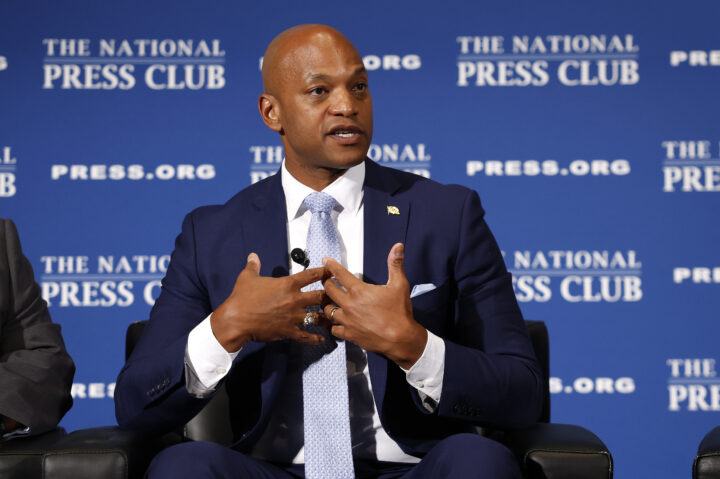
Kevin Dietsch/Getty Images
Maryland Gov. Wes Moore participates in a discussion on bipartisanship at the National Press Club on September 04, 2025 in Washington, DC.
Maryland Gov. Wes Moore slammed Israeli Prime Minister Benjamin Netanyahu in a recent interview with Politico, arguing that the Israeli premier has committed war crimes and that his actions make American Jews less safe.
Moore, a Democrat with close ties to Maryland’s Jewish community, reiterated his support for Israel’s existence. But he strongly criticized Netanyahu’s leadership.
“I think that the State of Israel has a right to exist, but I also think that so do the Palestinian people,” Moore said, when asked if he considers himself a Zionist. “From what we’ve seen from Bibi Netanyahu, I just do not know, and nor believe, that he is putting the same measure of focus on Palestinian lives as he does on Israeli lives.”
Moore declined to say whether he believes Israel’s actions in Gaza amount to a genocide, saying instead that the matter will be left to international courts to decide.
“I think that it’s going to have to be international tribunals [that] figure that out, but I do think this,” Moore said. “I know as a military person that you cannot use food as a negotiating tool. That is a war crime, and I think Bibi Netanyahu has committed war crimes.”
When asked whether Netanyahu should be in prison, Moore dodged the question.
“Look at it this way. First of all, he’s actually under investigation and indictment already right now,” said Moore. “But also if you look at what’s happened in Lebanon, even just since the start of the Iran war, he’s annexed and taken over 10% of Lebanon. That, again, is a war crime. I just don’t know how we can continue tolerating these types of actions by Bibi Netanyahu.”
Further, Moore continued, Netanyahu’s actions put Jews in Israel and America at risk, and complicate efforts to combat antisemitism.
“He’s not making Jewish people safe. He’s not making Israelis safe. He’s not making Jewish people in this country safe. We’re dealing with such a rise in antisemitism, Islamophobia, anti-Black. We’re dealing with such a rise of hate,” Moore said. He referenced a recent incident of antisemitic graffiti at an elementary school in Olney, Md., outside of Washington.
“This is real, and we have to be able to deal with this rising level of hate,” said Moore. “But the challenge that I have is I don’t know if Bibi Netanyahu actually believes that there should be Palestinian safety or Palestinian peace.”
Plus, TX Dem gets the preemptive boot

Julie Menin, speaker of the New York City Council and Zohran Mamdani, mayor of New York, arrive for an announcement in the Brooklyn borough of New York, US, on Monday, Jan. 12, 2026 (Photographer: John Lamparski/Bloomberg via Getty Images)
This P.M. edition is reserved for our premium subscribers like you — offering a forward-focused read on what we’re tracking now and what’s coming next.
Today’s Daily Overtime was curated by JI U.S. Editor Danielle Cohen-Kanik.
📡On Our Radar
Notable developments and interesting tidbits we’re tracking
President Donald Trump and Israeli Prime Minister Benjamin Netanyahu held a heated phone call on Tuesday where they discussed a potential peace deal with Iran that was drafted by Qatar, Pakistan and other mediators, Axios reports, with Netanyahu pushing for a return to war.
Responding to reports that Netanyahu favors continuing strikes, Trump said on Wednesday that the Israeli leader “will do whatever I want him to do”…
Trump said the U.S. and Iran are “right on the borderline” of either securing a deal or resuming the war, telling reporters the process “could go very quickly, or could be a few days.” Iran’s Islamic Revolutionary Guards Corps, meanwhile, threatened to strike “beyond the region” should military operations continue…
The Jewish Democratic Council of America announced a dual endorsement today of Rep. Haley Stevens (D-MI) and state Sen. Mallory McMorrow in Michigan’s three-way Senate Democratic primary, Jewish Insider’s Matthew Kassel reports, saying, “There are two candidates who stand with our community on issues of importance to Jewish voters, and there is one who does not.”
While JDCA CEO Halie Soifer acknowledged concerns that Stevens and McMorrow could end up splitting the more-moderate vote and inadvertently propelling the far-left Abdul El-Sayed to the nomination, she told JI the dual endorsement was meant to reflect JDCA’s broader assessment of the stakes of the race…
New York City Council Speaker Julie Menin is backing a new buffer zone bill for schools that aims to avoid another veto from Mayor Zohran Mamdani, JI’s Will Bredderman reports; the revised legislation narrows the language to early childhood facilities and K-12 schools and carves out other educational facilities, addressing concerns from the mayor and other councilmembers…
A new poll from the independent Pan Atlantic Research firm found presumptive Maine Senate Democratic nominee Graham Platner leading incumbent Sen. Susan Collins (R-ME) 48-41% among likely voters. There was a stark educational divide: Platner led Collins by 20 points among those with a four-year college degree or higher, while the candidates were neck-and-neck among those without…
Reps. Josh Gottheimer (D-NJ) and Jared Moskowitz (D-FL) vowed that if Maureen Galindo, the antisemitic conspiracy theorist running in the Democratic primary for Texas’ 35th District, is elected to Congress, “we will force a vote to expel her every single day we are here.”
All Jewish Democratic members of Congress also joined to condemn Galindo’s “vile, bigoted, and antisemitic views,” calling her “desperate and unhinged”…
Yesterday’s primary elections saw Rep. Andy Barr (R-KY) secure the GOP nomination for retiring Sen. Mitch McConnell’s (R-KY) Senate seat, while in Georgia, former Rep. Mike Collins (R-GA) and former football coach Derek Dooley will head to a runoff next month after neither received 50% in the race to take on Sen. Jon Ossoff (D-GA)…
Former Rep. Barney Frank (D-MA), who represented the Boston area in Congress for more than three decades and was the first openly gay member of Congress, died on Tuesday, JI’s Gabby Deutch reports. He was 86.
In the final weeks of his life, Frank did a series of interviews to promote his forthcoming book, even as he anticipated not making it to the release date. In a May 8 interview with the Jewish Telegraphic Agency, Frank said he believed Democrats should reject far-left litmus tests, but said Israel policy is “180 degrees” different and that Democrats need to make clear their opposition to Netanyahu…
Netanyahu, along with other Israeli officials, issued a sharp condemnation of far-right National Security Minister Itamar Ben-Gvir after he released a video showing himself taunting detained flotilla activists, JI’s Matthew Shea reports.
In the video, Ben-Gvir waves a large Israeli flag over blindfolded activists kneeling on the ground and shouts, “Welcome to Israel, we are the masters.” Netanyahu said the way his Cabinet minister “dealt with the flotilla activists is not in line with Israel’s values and norms”…
James Murdoch, the son of media mogul Rupert Murdoch, is purchasing, through his media holding company Lupa Systems, New York magazine, the Vox Media Podcast Network and Vox.com from Vox Media. Murdoch’s other business ventures include an investment firm, Bodhi Tree, founded in 2022 with $1.5 billion from the Qatar Investment Authority. His expanded holdings in American media mark a homecoming of sorts — his father owned New York magazine from 1977-1991…
⏩ Tomorrow’s Agenda, Today
An early look at tomorrow’s storylines and schedule to keep you a step ahead
Keep an eye out in Jewish Insider for an interview with the two Republican candidates running for the University of Michigan Board of Regents, as they see an opening to pitch themselves to voters over Amir Makled, an anti-Israel Democratic nominee.
The Capital Jewish Museum in Washington will open to the public to mark the one-year anniversary of the shooting that killed Israeli Embassy staffers Yaron Lischinsky and Sarah Milgrim.
The Jewish Community Relations Council of Greater Washington will hold candidate forums with D.C. mayoral hopefuls Janeese Lewis George and Kenyan McDuffie.
Stories You May Have Missed
DEM DISCUSSIONS
Center-left think tank’s conference avoids the elephant in the room: Israel

The Center for American Progress hosted leading Democratic officials and featured several panels on foreign policy. Israel was barely discussed
FLOURISHING FRIENDSHIPS
Iran war is leading to stronger alliance between Israel, India and the UAE, experts say
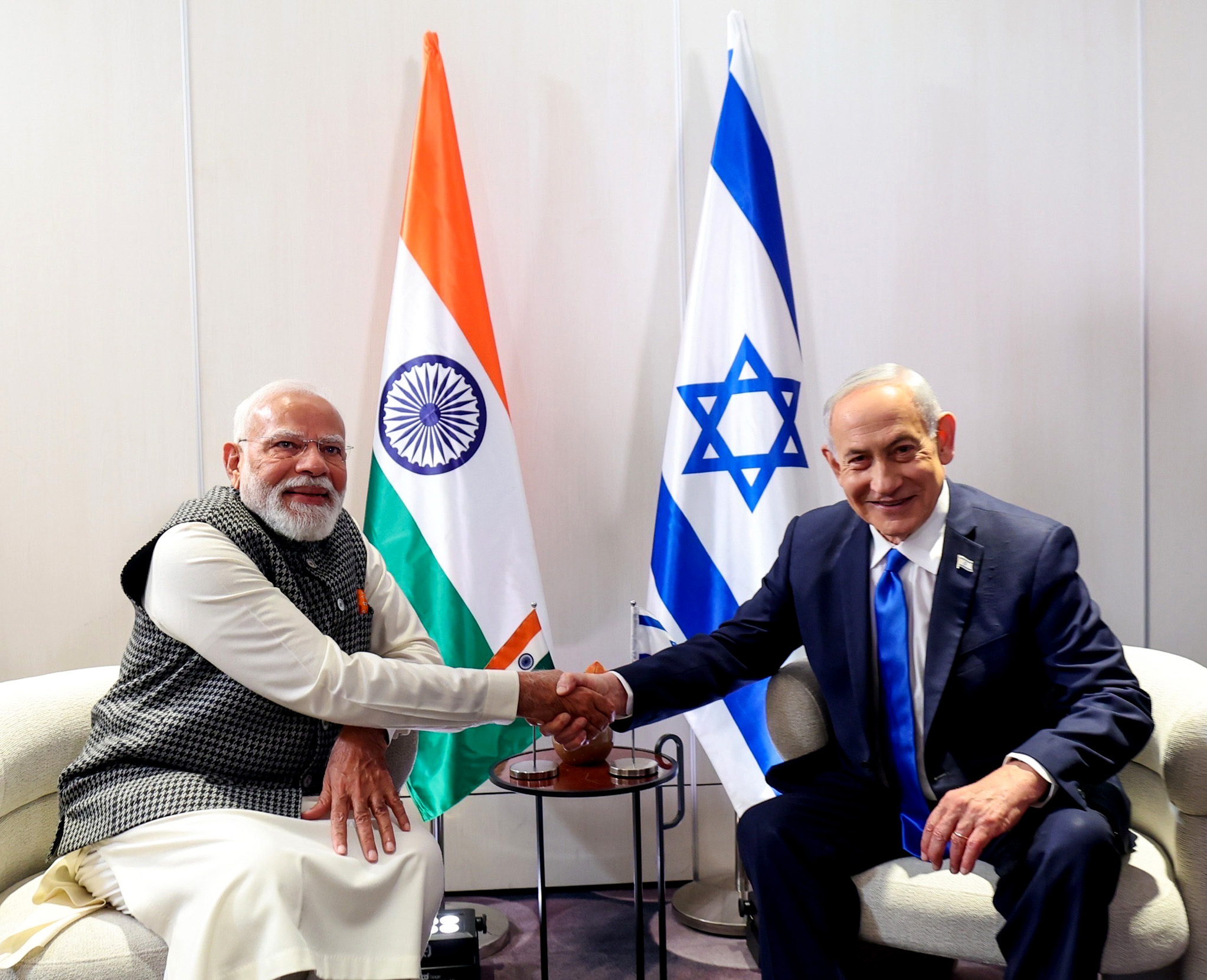
The emerging partnership is being sharpened by a rival alliance between Pakistan and Saudi Arabia
The Israeli prime minister said that the way his own national security minister ‘dealt with the flotilla activists is not in line with Israel’s values and norms’

MENAHEM KAHANA/POOL/AFP via Getty Images
Israeli National Security Minister Itamar Ben Gvir enters a district courtroom in Tel Aviv on December 10, 2024.
Israeli Prime Minister Benjamin Netanyahu, along with other Israeli officials, issued a sharp condemnation of far-right National Security Minister Itamar Ben-Gvir after he released a video showing himself taunting detained flotilla activists.
Ben-Gvir posted the video, filmed at Ashdod Port, to social media on Wednesday, where he can be seen mocking dozens of international activists captured from a Gaza-bound aid flotilla. In the footage, the blindfolded activists are shown kneeling on the ground with their hands cuffed behind their backs. Waving a large Israeli flag over the handcuffed activists, Ben-Gvir shouts in Hebrew, “Welcome to Israel, we are the masters.”
International activists have launched several flotillas since the start of Israel’s war with Hamas, attempting to break the blockade and deliver aid to Gaza. The IDF has repeatedly intercepted these convoys, many of which have been found not to have aid on board, and deported the participants. On Tuesday, the U.S. Treasury Department sanctioned four individuals “associated with the pro-Hamas flotilla,” which it said was organized by the U.S.-designated Popular Conference for Palestinians Abroad.
The political fallout from the video came quickly from Ben-Gvir’s own governing coalition, including public condemnation from Netanyahu, who sought to separate Israel’s defense policies from Ben-Gvir’s personal optics.
“Israel has every right to prevent provocative flotillas of Hamas terrorist supporters from entering our territorial waters and reaching Gaza,” Netanyahu said in a statement. “However, the way that Minister Ben-Gvir dealt with the flotilla activists is not in line with Israel’s values and norms.”
Netanyahu added that he had already instructed authorities to expedite the deportation of the foreign activists. Netanyahu has repeatedly resisted pressure to oust Ben-Gvir from his Cabinet, calculating that he was essential to the survival of his coalition.
Foreign Affairs Minister Gideon Sa’ar also fiercely rebuked the performance, sparking an online feud between the two Cabinet ministers. In a post on X, Sa’ar told Ben-Gvir that he is “not the face of Israel.”
“You deliberately caused damage to the state in this disgraceful performance, and not for the first time,” Sa’ar wrote. “You squandered enormous, professional, and successful efforts made by many, many people — from IDF soldiers to Ministry of Foreign Affairs employees and many other fine individuals.”
Ben-Gvir pushed back against Sa’ar, doubling down on his actions.
“Israel’s Foreign Minister is expected to understand that Israel has stopped being a pushover,” Ben-Gvir retorted. “Anyone who comes to our territory to support terrorism and identify with Hamas will get slapped, and we won’t turn the other cheek.”
The video also garnered outcry from the Italian government, which has since summoned Israel’s ambassador in Rome, Jonathan Peled.
“The images of the Israeli minister Ben-Gvir are unacceptable. It is inadmissible that these demonstrators, including many Italian citizens, are subjected to this treatment that violates human dignity,” Italian Prime Minister Giorgia Meloni said in an official statement.
Meloni noted that Italy is demanding “an apology for the treatment reserved to these demonstrators and for the total contempt shown toward the explicit requests of the Italian Government,” and said she plans to take immediate steps to secure the release of the detained Italians.
Antonio Tajani, Italy’s deputy prime minister and foreign minister, echoed Meloni’s sharp rebuke. “What emerges from Minister Ben-Gvir’s video is absolutely unacceptable and contrary to every basic safeguard of human dignity,” Tajani stated.
Plus, Trump's Paxton endorsement puts Texas in play

Noam Galai/Getty Images
Sen. James Lankford speaks during the 'March For Israel' at the National Mall on November 14, 2023 in Washington, DC.
This P.M. edition is reserved for our premium subscribers like you — offering a forward-focused read on what we’re tracking now and what’s coming next.
Today’s Daily Overtime was curated by JI U.S. Editor Danielle Cohen-Kanik.
📡On Our Radar
Notable developments and interesting tidbits we’re tracking
Sens. Jacky Rosen (D-NV) and James Lankford (R-OK) introduced the Jewish American Security Act today, a broad new effort to address antisemitism across multiple sectors of American society, Jewish Insider’s Marc Rod reports.
The bill — launched at a Jewish Federations of North America press conference on Capitol Hill — aims to combat antisemitism on campus and online, as well as streamline and provide $1 billion in funding for the Nonprofit Security Grant Program, and has broad support among Jewish community groups and across all major religious denominations.
William Daroff, CEO of the Conference of Presidents of Major American Jewish Organizations, told JI it was “deeply encouraging to see this bill come together with bipartisan, bicameral support at a time when that kind of consensus is all too rare”…
President Donald Trump endorsed Texas Attorney General Ken Paxton over Sen. John Cornyn (R-TX) ahead of the state’s heated GOP primary runoff next Tuesday, JI’s Emily Jacobs reports. Trump, who has repeatedly praised both candidates, claimed Cornyn “is a good man … but he was not supportive of me when times were tough.”
If Paxton wins the May 26 runoff, Democrats plan to invest millions behind their nominee, state Rep. James Talarico, who is trying to become the first Democrat to win a Senate seat in Texas since 1988. General election polling indicates that a matchup between Talarico and Paxton — who carries significant legal and ethical baggage — would be highly competitive…
Activist Maureen Galindo, a candidate for the Democratic nomination in Texas’ 35th Congressional District who has continuously trafficked in antisemitic conspiracy theories, pledged in an Instagram post last week to turn an immigrant detention center in south Texas into a “prison for American Zionists.” “It will also be a castration processing center for pedophiles which will probably be most of the Zionists,” she continued.
Jewish and Democratic groups, including Democratic Majority for Israel, are backing Galindo’s opponent, Bexar County sheriff’s deputy Johnny Garcia. In a statement about Galindo’s comments, DMFI accused Republicans of funding her campaign and “deliberately elevating one of the most grotesque antisemites in America”…
Trump blasted Rep. Thomas Massie (R-KY) for sending a campaign text to voters, as election day is underway in Kentucky, with a statement from Trump endorsing Massie — from 2022. Trump has endorsed Massie’s opponent, Ed Gallrein, in today’s Republican primary.
“Horrible Congressman Thomas Massie put out an old Endorsement, from many years ago, of him by me long before I found out that he was the Worst Congressman in the History of our Country,” Trump wrote on X — his first post on the platform in months…
New polling from the campaign of Navy veteran Rebecca Bennett shows her with a 20-point lead in the Democratic primary for New Jersey’s 7th Congressional District, the seat held by Rep. Tom Kean Jr. (R-NJ) — who is drawing increasing scrutiny for his monthslong unexplained absence from Congress. Bennett, who is leading the pack in fundraising, polled at 35% among likely primary voters, while Tina Shah came in second at 15%…
After abruptly scrapping a strike on Iran planned for today, Trump gave a vague timeline for renewed diplomacy, saying Tehran has only “a limited period of time” to return to the negotiating table. “Two or three days. Maybe Friday, Saturday, Sunday. Maybe early next week,” he told reporters today.
Hours after calling off the strike yesterday evening, Trump met with his national security team to discuss military options in Iran, Axios reports, suggesting resumed strikes are still on the table…
Speaking at the No Money for Terror Conference in Paris, Treasury Secretary Scott Bessent called on U.S. allies to “step up” and join Washington in taking aggressive economic action against Iran and its broader terrorism financing networks, JI’s Matthew Shea reports.
Bessent’s comments came as the Treasury Department announced sanctions against four individuals associated with the pro-Hamas flotilla traveling towards Gaza, as well as a suite of sanctions against Iranian shadow banking operations and 19 regime-linked vessels…
The Emirati Defense Ministry said that drone attacks that caused a fire at the UAE’s nuclear power plant over the weekend were launched from Iraqi territory, where several Iran-backed militias are based…
Adm. Brad Cooper, the head of U.S. Central Command, told members of the House Armed Services Committee that reports that Iran had managed to reconstitute many of its drone and missile sites struck during U.S. operations were inaccurate…
Twenty-five Republican senators led by Sen. Tom Cotton (R-AR) wrote a letter to Trump urging him to “fully dismantle” the U.N. Relief and Works Agency and remove it from the U.N. budget, citing the agency’s “systemic infiltration by Hamas and other U.S.-designated terrorist organizations”…
The Oklahoman, a local daily newspaper, pulled down an opinion article published on Monday comparing the Oklahoma City Thunder NBA team to Israel — an “underdog that has become hated.” The article, written by a pro-Israel Jewish Oklahoman, was “mistakenly published,” the paper’s executive editor said, and “did not align with our opinion standards”…
⏩ Tomorrow’s Agenda, Today
An early look at tomorrow’s storylines and schedule to keep you a step ahead
Keep an eye out in Jewish Insider for a readout from the Center for American Progress’ IDEAS Conference, where more than a dozen Democrats, several with national ambitions, shared their policy visions today in Washington.
The Jewish Federations of North America, Conference of Presidents of Major American Jewish Organizations, Combat Antisemitism Movement and Weitzman National Museum of American Jewish History will host a breakfast with lawmakers on Capitol Hill to celebrate Jewish American Heritage Month, with a keynote speech from Sam Salz, believed to be the first and only Orthodox Jew to play Division I college football.
The Senate will begin consideration on the reconciliation bill to fund immigration enforcement, as well as security for the new White House ballroom, during which Senate Democrats could force votes on a range of issues, including the war in Iran.
The House Foreign Affairs Committee will hold a budget hearing on State Department-adjacent entities, with testimony from former lawmaker and diplomat Tom Malinowski (D-NJ), National Endowment for Democracy President Damon Wilson and Inter-American Foundation CEO Sara Aviel.
The House Committee on Education & Workforce will hold a hearing on antisemitism in healthcare settings. Witnesses will include Deena Margolies, an attorney from the Louis D. Brandeis Center for Human Rights Under Law; Jamie Beran, CEO of the progressive Jewish organization Bend the Arc; Eveline Shekhman, CEO of the American Jewish Medical Association; and Dr. Jacob Agronin from Temple University Hospital.
Sarah Rogers, the under secretary of state for public diplomacy, will speak at the Hudson Institute about the U.S.’ public diplomacy strategy abroad, with opening remarks from Sen. Eric Schmitt (R-MO).
Stories You May Have Missed
PROBLEMATIC PLATFORMING
Nevada GOP candidate Marty O’Donnell hosted neo-Nazi influencer on podcast

In August 2025, O’Donnell hosted a popular far-right influencer best known by his online pseudonym ‘Raw Egg Nationalist’ on his podcast for a friendly discussion
MICHIGAN MIDDLE GROUND
McMorrow walks the line on Israel, floats Iron Dome for Palestinians
In an interview with leftist podcasters Matt Bernstein and Emma Vigeland, the Michigan Senate candidate backed Israel’s access to Iron Dome systems, suggested Palestinians should also have them
Plus, Massie's antisemitic closing message

Daniel Torok/The White House via Getty Images
President Donald Trump and Secretary of State Marco Rubio (R) sit in the Situation Room as they monitor the mission that took out three Iranian nuclear enrichment sites, at the White House on June 21, 2025 in Washington, DC.
This P.M. edition is reserved for our premium subscribers like you — offering a forward-focused read on what we’re tracking now and what’s coming next.
Today’s Daily Overtime was curated by JI U.S. Editor Danielle Cohen-Kanik.
📡On Our Radar
Notable developments and interesting tidbits we’re tracking
President Donald Trump announced that, at the request of Qatari, Saudi and Emirati leaders, he was calling off an attack on Iran he said was planned for tomorrow, after the heads of state assured him Iran would agree to a deal that “will include, importantly, NO NUCLEAR WEAPONS FOR IRAN!”
Trump said he had instructed Defense Secretary Pete Hegseth and Chairman of the Joint Chiefs of Staff Gen. Dan Caine to “be prepared to go forward with a full, large scale assault of Iran, on a moment’s notice, in the event that an acceptable Deal is not reached”…
A new New York Times/Siena poll found 35% of respondents said they sympathize more with Israelis, while 37% said they sympathize more with Palestinians. There was a stark partisan divide: Among Republicans, 66% said they sympathize more with Israelis, while just 17% of Democrats said the same.
Meanwhile, the poll found nearly two-thirds of respondents overall said they disapprove of the Iran war, including 91% of Democrats and 23% of Republicans. Eighty-one percent of Democrats said the costs of the Iran war would not be worth the benefits; 50% of Republicans said they thought it would be worth it, but 32% were unsure…
Several New York City Jewish leaders — including JCRC CEO Mark Treyger, the UJA-Federation of New York and Rabbi Joseph Potasanik, executive vice president of the New York Board of Rabbis — plan to skip Mayor Zohran Mamdani’s Shavuot event taking place this evening at Gracie Mansion, the New York Post reports, after the mayor released a video on Friday for “Nakba Day” that sparked outrage among the Jewish community.
Asked about the backlash, Mamdani claimed his “door is always open” for Jewish leaders “beyond just this evening’s event,” while doubling down on his decision to post the video, saying he was “proud to commemorate Nakba Day” because there are “many Nakba survivors in New York City”…
Two dozen Jewish lawmakers and candidates from both parties shared with Axios a stream of antisemitic voicemails and messages they’ve received, including repeated death threats and praise of Nazis. “It’s no longer a Republican and a Democrat [issue],” said Rep. Max Miller (R-OH). “Both ends of our parties are wackadoos who hate Jews”…
Ahead of tomorrow’s primary elections in Kentucky, Rep. Thomas Massie (R-KY) is going out with an antisemitic bang: He accused his opponent, Trump-backed Navy veteran Ed Gallrein, of being the “puppet” of the Republican Jewish Coalition, which has spent nearly $4 million opposing Massie. The congressman further claimed “a coalition of Israel’s lobbyists and donors” is executing a “blatant attempt to buy a KY congressional seat” and that the RJC is “running [Gallrein’s] race.”
Gallrein, meanwhile, got a boost from Hegseth, who appeared today in Hebron, Ky., to urge voters to turn out for the GOP challenger. Hegseth — who claimed he was there in his personal capacity, as his appearance broke a longstanding tradition of defense secretaries who typically avoid engaging in electoral politics — praised Gallrein as a military leader who would remain loyal to Trump…
House Majority Leader Steve Scalise (R-LA) endorsed Rep. Julia Letlow (R-LA) in her runoff for U.S. Senate, after she finished in first place in the Louisiana primary held over the weekend, ousting Sen. Bill Cassidy (R-LA). Letlow, who is already endorsed by Trump, is expected to prevail over state Treasurer John Fleming…
A man named Zaid Gitesatani was arrested today on a hate crime charge for assaulting a Jewish man in June 2024 in the heavily Orthodox Pico-Robertson neighborhood of Los Angeles, as the victim was walking his dog near a synagogue that was hosting an Israeli real estate event.
In the days following the assault, Gitesatani posted screenshots of a video of the incident to his Instagram account with the caption, “The Chosen People sometimes need a good smack to wake up” and claimed he “whopped 2 zios,” among other comments, according to the Justice Department…
The three leading Democratic candidates in the race for executive of Montgomery County, Md., — Councilmembers Andrew Friedson, Evan Glass and Will Jawando — pledged to address the rise of antisemitism within the local school system in a discussion today with the Jewish Community Relations Council of Greater Washington, Jewish Insider’s Haley Cohen reports.
Jawando, the most progressive Democrat in the race, said, “I am disappointed that MCPS has not accepted” the training recommended by the JCRC earlier this month. “I will continue to urge them to do so”…
Rahm Emanuel, the former Chicago mayor and prospective 2028 presidential candidate, is slated to discuss the future of U.S.-Israel relations at Tel Aviv University on July 8, according to an announcement from the school today, JI’s Matthew Kassel reports…
Israeli-founded AI startup Decart raised $300 million at a nearly $4 billion valuation for software that helps AI companies switch more easily between chips from Nvidia, which invested in the company, and its rivals…
Police said they “neutralized” a threat during an active shooter situation today at the Islamic Center of San Diego, the largest mosque in the county. Local news reported two suspects are dead, and the mosque’s chairman said a security guard had been killed…
⏩ Tomorrow’s Agenda, Today
An early look at tomorrow’s storylines and schedule to keep you a step ahead
Keep an eye out in Jewish Insider for a preview of tomorrow’s primaries in Kentucky and Pennsylvania.
CENTCOM Commander Adm. Brad Cooper will testify before the House Armed Services Committee.
The Senate Appropriations Committee will hold a budget hearing on the Department of Justice.
The Jewish Federations of North America will hold a press conference on the Hill with House and Senate lawmakers and hundreds of community leaders on the need for increased funding for the Nonprofit Security Grant Program.
The Center for American Progress will hold its 2026 IDEAS Conference in Washington with speakers including Govs. Gavin Newsom, Wes Moore, Mikie Sherrill and Abigail Spanberger, Senate Minority Leader Chuck Schumer (D-NY), House Minority Leader Hakeem Jeffries (D-NY), Sens. Cory Booker (D-NJ), Ruben Gallego (D-AZ) and Elizabeth Warren (D-MA), Minneapolis Mayor Jacob Frey and columnist Ezra Klein.
The Middle East Forum will begin its three-day policy conference in Washington, with keynote speeches from White House official Seb Gorka, Israeli Ambassador to the U.S. Yechiel Leiter and Deputy Special Presidential Envoy Morgan Ortagus.
The Stephen Wise Free Synagogue in Manhattan will hold its spring benefit where it will honor Amb. Deborah Lipstadt, the former State Department antisemitism envoy, with its Light of Freedom Award, and synagogue lay leader and attorney Ira Bogner with its Shem Tov Award.
Tomorrow is Jewish Community Day at Nationals Park in Washington as the team faces off against the New York Mets.
Stories You May Have Missed
DEM DYNAMICS
DSA’s ascent tests Democratic Party’s ideological boundaries

If elected mayor of Washington, D.C., Janeese Lewis George’s victory would hand a major win to Washington’s Democratic Socialists of America chapter
CAMPAIGN COMPANY
Claire Valdez sat for interview with Twitch streamer who called Jews ‘demonic ethnicity’

The far-left congressional candidate also liked a post celebrating Oct. 7 shortly after the attacks
Plus, Vance vouches for Susan Collins

Getty Images
A large plume of smoke rises over Tehran after explosions were reported in the city during the night on March 28, 2026 in Tehran, Iran.
This P.M. edition is reserved for our premium subscribers like you — offering a forward-focused read on what we’re tracking now and what’s coming next.
📡On Our Radar
Notable developments and interesting tidbits we’re tracking
During their meeting today in Beijing, President Donald Trump and Chinese President Xi Jinping discussed the issue of Iran, where the Chinese leader “did offer, he said, ‘if I can be of any help at all I would like to be of help,’” Trump recalled to Fox News’ Sean Hannity. “Anybody that buys that much oil has obviously got some kind of a relationship with them,” Trump added.
Secretary of State Marco Rubio told NBC News about the discussion that the “Chinese side is not in favor of militarizing the Strait of Hormuz and they’re not in favor of a tolling system,” which are positions the Trump administration shares…
At a meeting of foreign ministers of the BRICS bloc in India today, Iranian Foreign Minister Abbas Araghchi accused the UAE of “direct involvement” in military operations against Iran; Araghchi later met on the sidelines with Russian Foreign Minister Sergey Lavrov…
CENTCOM Commander Adm. Brad Cooper testified at a Senate Armed Services Committee hearing that the U.S. and Israeli campaign against Iran has severely degraded its capabilities across a variety of fronts, to the extent that it will take years to reconstitute, Jewish Insider’s Marc Rod reports.
Cooper said that 90% of Iran’s defense industrial base has been destroyed and that support to key Iranian proxies Hamas, Hezbollah and the Houthis has been “completely cut off.”
Treasury Secretary Scott Bessent, meanwhile, said on CNBC’s “Squawk Box” that the U.S. believes Iran has run out of storage capacity for its crude oil and will need to cut off oil production, a key marker that may put more pressure on the regime to agree to a deal…
Saudi Arabia has begun to consider promoting a nonaggression pact between Middle East countries and Iran once the war ends, according to the Financial Times, fearing that the conflict will leave Iran weaker but more hardline and conflict-prone. Several European countries are reportedly supporting the effort…
The House unanimously passed a resolution yesterday evening recognizing Jewish American Heritage Month and calling on elected officials to combat antisemitism…
Israeli Prime Minister Benjamin Netanyahu and Foreign Minister Gideon Sa’ar said they will initiate a defamation lawsuit against The New York Times over Nicholas Kristof’s column earlier this week alleging widespread Israeli sexual violence against Palestinian prisoners, which critics said used dubious sourcing and elevated conspiracy theories…
The Times looks under the hood of the campaign of Jack Schlossberg, running in New York’s 12th District Democratic primary, which sources described as “so erratic and plagued by turnover that it raises questions about how he might handle himself as a member of Congress”…
Vice President JD Vance, speaking at a rally in Maine, praised Sen. Susan Collins (R-ME) — despite her strained relationship with the president — as she heads to a competitive general election against presumptive Democratic nominee Graham Platner.
“Sometimes I get frustrated with Susan Collins, I almost wish that she was more partisan,” Vance said. “But the thing I love about Susan is she is independent, because Maine is an independent state. And frankly, if she was as partisan as I sometimes wish that she was, she would not be a good fit for the people of Maine”…
The United Federation of Teachers endorsed Rep. Dan Goldman (D-NY) in his competitive primary race against former New York City Comptroller Brad Lander next month; Goldman has been racking up labor support ahead of the June 23 primary against the progressive Lander, who is endorsed by New York City Mayor Zohran Mamdani…
Tune Inn, the D.C. bar where William Paul, son of Sen. Rand Paul (R-KY), accosted Rep. Mike Lawler (R-NY) with an antisemitic rant, announced that the younger Paul would be barred from the establishment going forward. The elder Paul hasn’t made any statement on the confrontation…
A flag with two swastikas and a Star of David was flown atop a building at New York University during a popular graduation event yesterday, reportedly appearing on top of the Steinhardt School of Culture, Education and Human Development, named for Jewish benefactors Michael and Judy Steinhardt. The flag was quickly removed and police say an investigation is underway…
⏩ Tomorrow’s Agenda, Today
An early look at tomorrow’s storylines and schedule to keep you a step ahead
Keep an eye out in Jewish Insider for a look at the emerging bloc of Sunni countries uniting against Israel’s allies, potentially complicating the Jewish state’s regional strategy.
The White House will host a reception with Jewish leaders tomorrow evening to kick off Shabbat 250, an initiative announced by President Donald Trump in his proclamation marking Jewish American Heritage Month where he encouraged Jewish Americans to “observe a national Sabbath” to celebrate the approaching Semiquincentennial of the United States.
Several Jewish organizations and institutions will also be marking the day with special events, including a Shabbat 250 dinner being held in Washington by the Combat Antisemitism Movement and American Association of Jewish Lawyers and Jurists.
New York City Police Commissioner Jessica Tisch will speak at Friday evening Shabbat services at Temple Emanu-El in Manhattan.
The Lennart Meri Conference, an annual foreign policy and security summit in Estonia, begins tomorrow. Speakers include several foreign leaders, former Israeli National Security Advisor Eyal Hulata and Israeli Russian researcher and former hostage Elizabeth Tsurkov.
Indian Prime Minister Narendra Modi is kicking off an international tour tomorrow with a visit to the UAE, later heading to several European countries.
We’ll be back with the Daily Overtime on Monday. Shabbat Shalom!
Stories You May Have Missed
FAMILY TIES
Alex Bores’ father, a key ally in his son’s House campaign, celebrated Israeli deaths, equated Zionists with Nazis
Alex Bores has invoked his labor bona fides through his union chief father in his run for the heavily Jewish Manhattan seat
PHILLY FRONTRUNNER
Far-left state Sen. Chris Rabb surging ahead in Philadelphia primary
Rabb is facing off against state Sen. Sharif Street, a former state Democratic Party chair, and Ala Stanford, a physician and activist
Plus, Lasher links with Mamdani consultant
POOL/AFP via Getty Images
Israeli Prime Minister Benjamin Netanyahu arrives for a press conference in Jerusalem on March 19, 2026.
This P.M. edition is reserved for our premium subscribers like you — offering a forward-focused read on what we’re tracking now and what’s coming next. Please don’t hesitate to share your thoughts and feedback by replying to this email.
📡On Our Radar
Notable developments and interesting tidbits we’re tracking
Israeli Prime Minister Benjamin Netanyahu’s office announced that he secretly traveled to the UAE during the war with Iran and met with President Sheikh Mohammed bin Zayed, leading to a “historic breakthrough in relations” between the two countries.
The UAE, however, called the prime minister’s report “baseless” and denied the meeting occurred, saying in a statement that its relations with Israel “are public … and are not based on secrecy or hidden arrangements.”
But Netanyahu’s not the only one to make an under-the-radar visit: Mossad chief David Barnea also reportedly traveled to Abu Dhabi twice during the war, sources told The Wall Street Journal…
Netanyahu’s governing coalition submitted a bill today to dissolve the Knesset and trigger early elections, which is expected to receive a vote next week. If the measure passes, elections would have to be held within five months, though it’s possible they could happen in early September, so as not to coincide with the High Holy Days and the anniversary of the Oct. 7, 2023, attacks.
The move appears to be an attempt to thwart the opposition, which submitted similar bills yesterday after Degel HaTorah, part of the ultra-Orthodox coalition party United Torah Judaism, said it would support such efforts due to the coalition’s failure to pass a law exempting yeshiva students from military service…
Sen. Lisa Murkowski (R-AK) became the latest of a small number of Senate Republicans to break ranks and vote today with the majority of Democrats in favor of an effort to force an end to the war in Iran, Jewish Insider’s Marc Rod reports.
She joined her colleagues Sens. Susan Collins (R-ME) and Rand Paul (R-KY) in supporting the war powers resolution, but the effort still fell short of a majority of the Senate — or of the 60-vote threshold needed for passage — with a final vote of 50-49…
Paul’s son,William Paul, drunkenly accosted Rep. Mike Lawler (R-NY) yesterday, telling Lawler in front of a NOTUS reporter that, if anti-Israel Rep. Thomas Massie (R-KY) is to lose his reelection race, it will be because of “your people” and “you Jews,” going on to accuse Jews of being “anti-American” and prioritizing Israeli interests. Lawler, who is not Jewish, reportedly defended his support for Israel and told Paul he was being antisemitic.
Paul apologized in a post on X today, claiming he “had too much to drink and said some things that don’t represent who I really am”…
The Board of Peace is considering implementing its governance and reconstruction efforts solely in the parts of Gaza not under Hamas control, Axios reports, a contingency option written into the Gaza peace plan in case the terror group refused to disarm…
In an unlikely pairing, New York state Assemblymember Micah Lasher has enlisted Fight Agency, a top progressive consulting firm, to cut ads for his campaign for the 12th Congressional District, JI’s Matthew Kassel reports.
The firm — which was co-founded by Morris Katz, who rose to prominence as an advisor for New York City Mayor Zohran Mamdani’s campaign — prides itself on elevating left-wing, anti-establishment candidates, including current clients and Senate hopefuls Graham Platner in Maine and Abdul El-Sayed in Michigan. Lasher, meanwhile, has called himself a “proud Zionist Jew” and has close connections to the state’s Democratic establishment…
A new nonprofit aiming to counter Mamdani has already raised over $1 million, according to its co-founder Phil Singer, who also worked on a super PAC for former Gov. Andrew Cuomo in the mayoral race. NYC Common Sense intends to run ads and issue policy papers about Mamdani’s policies with which it disagrees and file lawsuits as needed…
House Minority Leader Hakeem Jeffries (D-NY) called for an increase in funding for the Nonprofit Security Grant Program to $1 billion, JI’s Gabby Deutch reports from the Jewish Democratic Council of America’s leadership summit in Washington.
Noting that the Pentagon now estimates the cost of the Iran war at $29 billion, Jeffries asked, “How is it possible that we can’t spend at least 500 million [on NSGP]? I think the number should be even higher. Why wouldn’t we spend a billion dollars to make sure that the communities that we care about across this country are safe?”…
In a speech to parliament, King Charles III laid out his legislative priorities, including several aimed at combating the recent spate of violent attacks on the British Jewish community. One would permit the government to designate the Islamic Revolutionary Guards Corps as a terrorist organization and create a new penalty for those who attack synagogues on behalf of foreign actors like Iran, with a potential of up to 14 years in prison…
Open Society Foundations, founded by left-wing philanthropist George Soros and run by his son Alex, announced it will provide $30 million to organizations combating antisemitism and Islamophobia over the next three years.
In a video statement, Alex Soros spoke of the personal nature of the investment, mentioning his father, who is a Holocaust survivor, and his wife, who is Muslim. OSF President Binaifer Nowrojee further cited the “deep injustices occurring in the Middle East,” which she said are “fueling indiscriminate prejudice, dehumanization, and violence directed against both Muslims and Jews”…
The Senate confirmed Kevin Warsh to be chairman of the Federal Reserve this afternoon on a largely party-line vote, with only Sen. John Fetterman (D-PA) crossing the aisle to support the nominee, who is also the son-in-law of philanthropist Ronald Lauder. It’s the narrowest margin of approval for any Fed chair since the position became Senate confirmed in 1977…
⏩ Tomorrow’s Agenda, Today
An early look at tomorrow’s storylines and schedule to keep you a step ahead
Keep an eye out in Jewish Insider for a conversation with Rep. Mike Lawler (R-NY) about his antisemitic run-in with William Paul.
President Donald Trump and Chinese President Xi Jinping will hold bilateral talks in Beijing.
Back in Washington, Israel and Lebanon will hold their third round of ambassador-level talks — which will reportedly include military representatives for the first time — to continue discussions on a peace deal framework and efforts to disarm Hezbollah.
CENTCOM Commander Adm. Brad Cooper and AFRICOM Commander Gen. Dagvin Anderson will appear before the Senate Armed Services Committee for a hearing on the posture of their respective areas of command.
The congressional Abraham Accords Caucus will hold an event on the implications of the tensions in the Strait of Hormuz, including Reps. Craig Goldman (R-TX) and Brad Schneider (D-IL) and the Middle East Institute’s Ambassador Yael Lempert and Karen Young.
The Israeli American Council will host a gala in New York City, featuring a keynote speech from former CENTCOM Commander Erik Kurilla with special guests Miriam Adelson and former Mossad Deputy Director Henrike Weissberg. The event will honor Yakir Gabay, a member of the Gaza Board of Peace’s executive board, and his wife, Elena.
Stories You May Have Missed
HEATED BACKLASH
Israeli officials, AJC slam Nick Kristof’s NYT column as modern-day ‘blood libel’

Kristof, citing testimonies from victims, alleged that Israeli security forces and settlers committed sexual abuse against Palestinian prisoners; critics argue he relied on Hamas propaganda
SOUNDING THE ALARM
Lawmakers offer dire warnings about rising antisemitism at ADL reception
Former House Majority Leader Steny Hoyer said antisemitism has worsened to the point that Jews aren’t guaranteed safety in the U.S.
The prime minister’s office said Netanyahu’s meeting with MBZ ‘resulted in a historic breakthrough’; the UAE called the report ‘entirely unfounded’
POOL/AFP via Getty Images
Israeli Prime Minister Benjamin Netanyahu arrives for a press conference in Jerusalem on March 19, 2026.
The United Arab Emirates denied a report by Israeli Prime Minister Benjamin Netanyahu’s office on Wednesday that the Israeli leader secretly traveled to the UAE during the war with Iran to meet with Emirati President Mohammed bin Zayed, which would have marked the first known meeting between the two leaders since the signing of the Abraham Accords in 2020.
The Prime Minister’s Office said that the meeting “resulted in a historic breakthrough in relations between Israel and the United Arab Emirates.” However, the UAE’s ministry of foreign affairs released a statement hours later calling the claims “entirely unfounded.”
“The United Arab Emirates denies reports circulating regarding an alleged visit by Israeli Prime Minister Benjamin Netanyahu to the UAE, or receiving any Israeli military delegation in the country,” the statement read. “The UAE reaffirms that its relations with Israel are public and conducted within the framework of the well-known and officially declared Abraham Accords, and are not based on non-transparent or unofficial arrangements.”
According to Ziv Agnon, who was Netanyahu’s chief of staff until early April, bin Zayed picked Netanyahu up in his own car and drove him to the palace.
During the conflict in Iran, Israel and the UAE have seen a marked increase in military and intelligence cooperation. Mossad chief David Barnea also quietly visited the UAE at least twice over the course of the war with Iran to directly coordinate regional security strategies, sources told The Wall Street Journal.
U.S. Ambassador to Israel Mike Huckabee confirmed this week that Jerusalem dispatched an Iron Dome missile-defense battery to the UAE along with Israeli military personnel to operate it in order to shield the Gulf nation from Iranian ballistic missile and drone attacks.
Two Israeli jets landed in the city of Al-Ain in Abu Dhabi in late March, according to flight radars, and headed back to Israel after an apparent four-hour visit.
The Israeli and Emirati leaders also reportedly met in secret in 2018, two years prior to the signing of the Abraham Accords.
Plus, remembering Abe Foxman

Gary Hershorn/Getty Images
The sun sets on the skyline of lower Manhattan, One World Trade Center, and the Statue of Liberty in New York City on May 8, 2026, as seen from Jersey City, New Jersey.
Good Monday morning.
In today’s Daily Kickoff, we talk to friends and former colleagues of Abe Foxman, the longtime former head of the Anti-Defamation League who died yesterday, and cover Israeli Prime Minister Benjamin Netanyahu’s comments on Iran and the U.S.-Israel relationship during his “60 Minutes” interview last night. We talk to Minnesota Vikings owner Mark Wilf, who brought a group of football players and Black Minneapolis-area high school students to the U.S. Holocaust Memorial Museum, and report on Rep. Alexandria Ocasio-Cortez’s rebuke of former Rep. Marjorie Taylor Greene as a “proven bigot and antisemite,” which has earned the New York Democrat criticism from the far left. Also in today’s Daily Kickoff: Jeffrey Katzenberg, Morton Schapiro and Larry David.
Today’s Daily Kickoff was curated by JI Executive Editor Melissa Weiss and Israel Editor Tamara Zieve, with an assist from Danielle Cohen-Kanik. Have a tip? Email us here.
What We’re Watching
- The White House rejected Iran’s latest response to the U.S.-proposed peace plan given to negotiators earlier this month, with President Donald Trump calling Tehran’s response “TOTALLY UNACCEPTABLE.” The latest rejection comes days before Trump is set to travel to China to meet with President Xi Jinping — a trip that was initially postponed due to the Iran war.
- Jewish California, formerly the Jewish Public Affairs Committee of California, is kicking off its annual two-day Capitol Summit today in Sacramento. Speakers at the gathering include former Second Gentleman Doug Emhoff (who will be making his first advocacy address in the state since departing Washington) and Los Angeles District Attorney Nathan Hochman.
- The World Jewish Congress is convening in Geneva as the group marks its 90th anniversary. Read more about the conference from eJewishPhilanthropy’s Judah Ari Gross here.
- The 30th Annual Webby Awards will take place tonight in Manhattan. “Borrowed Spotlight,” the exhibit that paired A-list celebrities with Holocaust survivors, will be honored for its photography and design. Read our interview with “Borrowed Spotlight” creator Bryce Thompson here.
What You Should Know
A QUICK WORD WITH JI’S MELISSA WEISS
A mentor. A friend. A compass. A “professional’s professional.”
Those were just some of the descriptors that friends and former colleagues of Abe Foxman used as they reflected on the life and legacy of the longtime former head of the Anti-Defamation League following his death yesterday at age 86.
Foxman was born to Polish Jewish parents in present-day Belarus in 1940. As a toddler, his parents placed him in the care of his Catholic nanny, who had him baptized and raised him in the church. After being reunited with his parents at the end of World War II (following a legal battle in which his nanny attempted to keep custody of Foxman), the family moved into a displaced persons camp in Austria. In 1950, when he was 10 years old, the family immigrated to the U.S.
His early childhood experiences shaped the trajectory of his life. Foxman joined the ADL in 1965 as a legal assistant, becoming the organization’s national director in 1987, a post he held until his retirement in 2015. He built the ADL into a $60 million organization with more than two dozen offices around the country.
As the head of the ADL and in his retirement, Foxman was one of the nation’s foremost authorities on antisemitism. He met with presidents and popes, college students and celebrities — and everyone in between. He maintained close relationships over the years with those who had fallen under his tutelage.
“He was invaluable to me as a resource all those years, and he had a lot to offer,” Jay Kaiman, the president of the Marcus Foundation who was hired by Foxman to be the ADL’s Southeast regional director in 1996, told JI.
In 1987, Foxman was appointed by President Ronald Reagan to the U.S. Holocaust Memorial Museum’s board, an honor that Presidents George H.W. Bush, Bill Clinton and Joe Biden would also bestow upon him. In a 2022 conversation with JI, Foxman said he had recently learned that he was the only Holocaust survivor to sit on the board. Many others, he said, were the children and grandchildren of survivors. But he was the only one to experience the horrors of Nazi Europe firsthand.
Deborah Lipstadt, the former State Department envoy to monitor and combat antisemitism, told JI that Foxman “bridged that gap” — linking the devastating realities of the Holocaust to rising antisemitism in the present.
BLUE DOT BATTLE
Nebraska Democratic primary pits Israel critic against more-moderate challenger
Nebraska’s 2nd Congressional District — the so-called “blue dot” in an otherwise red state — is a critical pickup opportunity for Democrats in November’s midterms. Vice President Kamala Harris won the district in 2024, and the popular, moderate Republican incumbent, Rep. Don Bacon (R-NE), is retiring. The Democratic primary in the district on Tuesday is coming down to John Cavanaugh, a progressive state senator backed by a range of prominent left-wing leaders, and Denise Powell, a nonprofit executive backed by a host of Democratic political groups, Jewish Insider’s Marc Rod reports.
Positions on Israel: Cavanaugh was one of 10 state senators who declined to sign onto a resolution supporting Israel and condemning Hamas on the first anniversary of the terrorist group’s Oct. 7, 2023, attacks on Israel. “I support Israel and believe Israel has a right to exist. And I also believe a two-state solution is the only way to secure lasting peace,” Cavanaugh said in a statement to Jewish Insider in February. Powell is taking a more pro-Israel line, yet still falls to the left of other Democrats in the race on the issue. She said in a statement to JI earlier this year that she has “always unequivocally supported Israel’s right to exist and its right to defend itself.”
THE BATTLE FOR MANHATTAN
In America’s largest Jewish district, Democratic candidates split over Israel, antisemitic protests

With seven weeks remaining until the Democratic primary for an open House seat in Manhattan, the crowded race is beginning to show emerging signs of division over Israel and rising antisemitism, key issues in the heavily Jewish district where many voters closely identify with liberal Zionist sentiments, Jewish Insider’s Matthew Kassel reports.
Different lanes: From recent efforts to block U.S. weapons sales to Israel to the intersection between anti-Zionism and antisemitism, the four top candidates in the closely contested race — state Assemblymembers Alex Bores and Micah Lasher, Kennedy scion Jack Schlossberg and former Republican attorney George Conway — are by varying degrees staking out differing views on Middle East policy as well as domestic concerns affecting the Jewish community, while continuing to reaffirm their support for the Jewish state.
HORSESHOE THEORY
AOC blasts ‘proven bigot and antisemite’ MTG, earning some far-left criticism
Rep. Alexandria Ocasio-Cortez (D-NY) expressed skepticism of allying with former Rep. Marjorie Taylor Greene (R-GA) on issues like Israel policy, calling Greene a “proven bigot and antisemite.” The comments have, notably, earned her the opprobrium of others on the far left, and also mark a break with some more mainstream Democrats who have urged their party to join forces with the disgruntled GOP ex-lawmaker, Jewish Insider’s Marc Rod reports.
What she said: “There are certain places, certain areas where I don’t think that we should ignore some folks’ record on some of these issues. It’s about where we trust intent, where we trust where those outcomes are going,” Ocasio-Cortez said at an event last week at the University of Chicago Institute of Politics. “I personally do not trust someone like Marjorie Taylor Greene, a proven bigot and antisemite, on the issues of what is good for Gazans and Israelis.”
Pennsylvania politics: Axios reports on Gov. Josh Shapiro’s behind-the-scenes efforts to derail the congressional campaign of Chris Rabb, a state legislator with a history of anti-Israel activism who has the backing of Ocasio-Cortez and other progressive heavyweights, and with whom Shapiro has clashed in recent years.
on the record
Iran war is ‘not over,’ Netanyahu tells ‘60 Minutes’
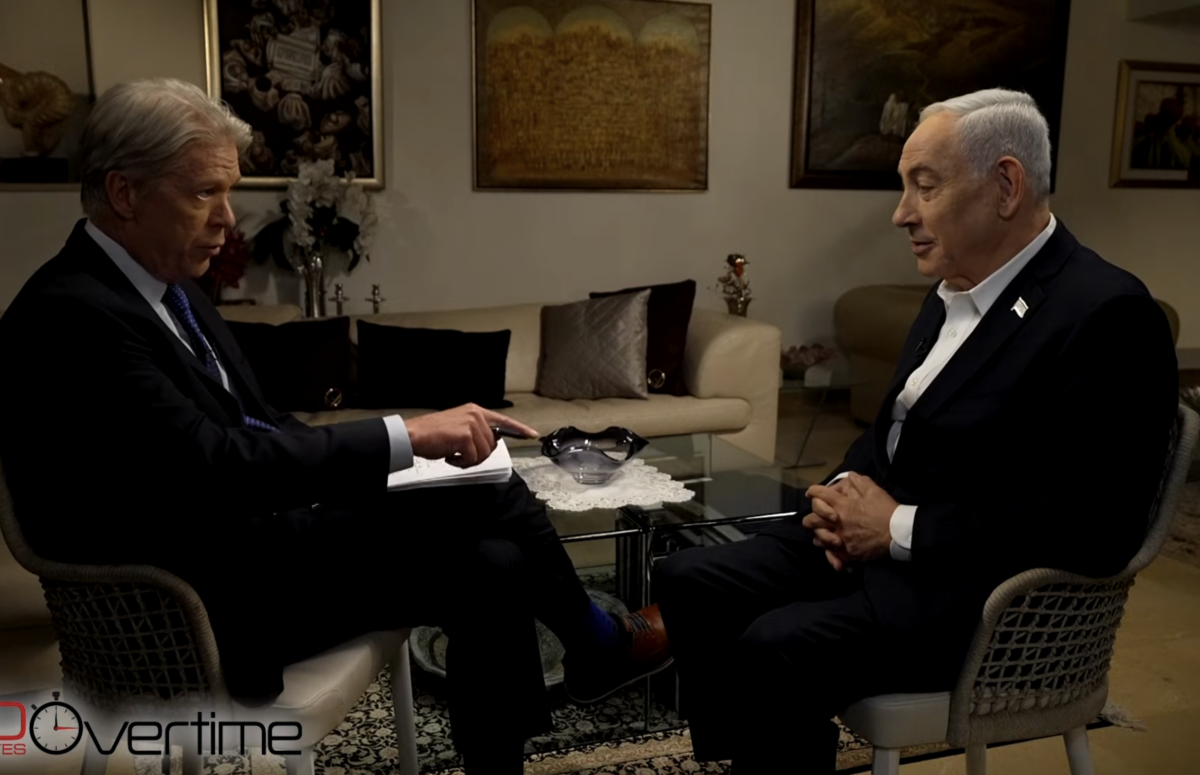
Israeli Prime Minister Benjamin Netanyahu said in a CBS “60 Minutes” interview on Sunday that the war against Iran is not yet over, in spite of the weekslong ceasefire and assertions by the U.S. administration that the operations that began in February have concluded. In the interview with Major Garrett, Netanyahu also reiterated his call to end direct U.S. financial aid for Israel over the next 10 years, Jewish Insider’s Marc Rod reports.
Premier’s position: Netanyahu said that, while the joint U.S. and Israeli operations in Iran accomplished much, the war is “not over,” with nuclear material still in Iran, and certain Iranian enrichment sites, proxies and ballistic missile efforts surviving. “We’ve degraded a lot of it. But all that is still there, and there’s work to be done,” he said, adding that any diplomatic agreement with Iran should address all of those areas. Netanyahu said that he would be happy to see an agreement, if it covers those areas, but that both Israel and the United States are prepared to reengage militarily if it does not.
MIA Mojtaba: The Wall Street Journal reports that among the hurdles facing Iranian negotiators as they attempt to negotiate with the U.S. is the inability to receive direction from Iranian Supreme Leader Ayatollah Mojtaba Khamenei, who was severely injured in Israeli strikes at the start of the war and who remains “noticeably MIA and silent on the talks.”
HISTORY LESSONS
Minnesota Vikings owner Mark Wilf leads players, high school students on Holocaust Museum trip

Minnesota Vikings owner Mark Wilf, the son of Holocaust survivors, was joined by Vikings defensive tackle Levi Drake Rodriguez, offensive lineman Walter Rouse, defensive end Elijah Williams and former Vikings tight end Visanthe Shiancoe for a tour of the U.S. Holocaust Memorial Museum together with a group of Black Minneapolis-area high school students, Jewish Insider’s Matthew Shea reports.
Looking back to move forward: “It’s very important for young people to learn about history and how they can make an impact on the world and society,” Wilf told JI during the group’s guided tour of the Holocaust museum. “To learn the history of the world — where sometimes there’s hatred and bigotry and see what it can lead to — and also learn the impact of an individual: how an individual can change things, can fight back and how we can set an example by being tolerant and learning from each other.”
ON THE SCENE
Addressing WJC, Axel Springer CEO Mathias Döpfner declares: ‘Europe must become more Jewish’

Mathias Döpfner, CEO of global publishing firm Axel Springer, doubled down on his and his company’s commitments to the Jewish People and the State of Israel on Monday morning in an address to the World Jewish Congress, condemning the rise of anti-Zionism and Jew hatred around the world, eJewishPhilanthropy’s Judah Ari Gross reports from Geneva.
Encouraging Jewish immigration: Perhaps most curiously, Döpfner called for European countries to encourage and facilitate Jewish immigration to the continent, noting that the Jewish population by capita is 10 times smaller than that of the United States. “Europe should introduce preferential immigration and naturalization for Jewish families. It is in Europe’s own best interests to change that,” he said. “It is more than a gesture. If the idea of a multicultural society is to be taken seriously, there is an urgent need for greater diversity in Europe’s Christian and increasingly Muslim-influenced societies today.”
Worthy Reads
Giving Hate a Pass: In The New York Times, Rep. Josh Gottheimer (D-NJ) warns that the Democratic Party has developed a double standard on antisemitism, citing its embrace of far-left antisemites and leftward shift on Israel. “I’ve spoken to congressional colleagues who have privately told me that many things [Hasan] Piker has said are disgusting. Yet they’ll say nothing about it in public, even as they rightly rush to condemn President Trump for his unending barrage of offensive comments and social media posts. … Democrats have justly denounced the Trump administration for its broadsides — in some cases, threats — toward some of America’s closest allies. But many increasingly excuse, or join, feverish denunciations of Israel, our longstanding, democratic and strategic ally.” [NYTimes]
Habit-Forming: In The Wall Street Journal, former Sen. Ben Sasse (R-NE) reflects on the good habits that can be adopted amid what he calls a “civilization-warping crisis of institutional decline,” naming among the good habits the institution of “tech Sabbaths” to disconnect from the internet. “Character, whether of an individual or of a nation, is molded by habits and by time. This republic requires men and women to do long-form deliberation, serious thinking, honest humility and daily striving. What good is it to gain the whole world if we forfeit the souls that we’re supposed to form? We can’t expect to remain free without being virtuous, we can’t be bold without being rooted, we can’t be great without aiming first to be good.” [WSJ]
No Layup for Silver: The Atlantic’s Tim Alberta looks at the challenges facing NBA Commissioner Adam Silver as the league enters “a moment of institutional crisis” amid a series of betting and corruption scandals. “The quality of the product has diminished. Narratives surrounding the league are prevailingly negative. Things once taken for granted — commercial satisfaction, cultural prestige, national relevance — no longer seem guaranteed. Peacetime is a thing of the past; for the foreseeable future, the commissioner will be at war — with fans, with media critics, with players and coaches, with the game itself.” [TheAtlantic]
Word on the Street
In response to an op-ed by Saudi Ambassador to Washington Turki al-Faisal that alleged that Israel attempted to ignite a war between Saudi Arabia and Iran, analyst Hussain Abdul-Hussain slammed al-Faisal and Riyadh’s “cowardice and abandoning of responsibility” over its decision not to respond to Iran’s attacks across the Middle East…
The FBI said that a man who was wearing a T-shirt with the flag of Iran when he killed three people outside an Austin, Texas, bar in early March had acted alone and without foreign influence, but “admired” slain Iranian Supreme Leader Ayatollah Ali Khamenei, who had been killed the previous day…
Sen. Rick Scott (R-FL) introduced a bill to ban certain federal funding to schools that operate branch campuses in Iran, Turkey, Qatar and other adversary states, a companion to legislation introduced recently in the House…
Rep. Brad Sherman (D-CA) introduced a bill to prohibit U.S. exports of oil and gasoline until hostilities with Iran cease, in a bid to lower energy prices spiking as a result of the war…
New York Gov. Kathy Hochul confirmed to Jewish leaders on Thursday that she will opt into a new federal education tax initiative, a move promoted by community advocates to help fund Jewish day schools and yeshivas, Jewish Insider’s Haley Cohen reports…
The Jewish Journal published the commencement address that former Northwestern University President Morton Schapiro had been slated to deliver at Georgetown University Law Center’s graduation ceremony; Schapiro withdrew as the school’s commencement speaker following backlash from anti-Israel student activists…
Despite being banned from campus, UCLA’s Students for Justice in Palestine chapter is actively lobbying candidates to influence upcoming student government elections, Jewish Insider’s Haley Cohen has learned…
A former Cornell student convicted of making threats against the school’s Jewish community in the wake of Hamas’ Oct. 7, 2023, terror attacks was sentenced to 21 months in prison; a lawyer for Patrick Dai said the posts were a “misguided attempt to highlight Hamas’ genocidal beliefs and garner support for Israel”…
Artist Paul Klee’s “Angelus Novus” sketch, which had been owned by German-Jewish philosopher Walter Benjamin, who died in Nazi Europe in 1940, will go on display today at New York’s Jewish Museum after its transport from Jerusalem was delayed by the Iran war…
The New York Post covers Jeffrey Katzenberg’s exclusive gathering of CEOs in Montecito, Calif., that took place last week…
The Wall Street Journal spotlights the “golden age of bagels” as restaurants across the country put their own spins on the classic Ashkenazi Jewish breakfast carb…
The New York Times reports on a decades-old screenplay written by Larry David that has found new life after being purchased by a fan on eBay and published online in full…
Authorities in north London charged a British man with religiously aggravated assault in an attack on three members of the Enfield Jewish community over the weekend…
The family of a deceased Palestinian man in the West Bank was forced by Israeli settlers to exhume and rebury the man after the settlers claimed the cemetery was too close to a newly established settlement; the family had been granted a permit for the burial by Israeli officials and coordinated with Israeli security forces, who did not intervene in the forced exhumation…
ZoomInfo announced plans to close its R&D center in Israel and lay off some 300 employees; the decision comes five years after the software company was acquired by Chorus.ai for $575 million…
Iranian human rights activist and Nobel Peace laureate Narges Mohammadi was transferred to a hospital in Tehran and had her sentence suspended after collapsing last week in prison…
The Wall Street Journal profiles Iraqi banking tycoon and Prime Minister-designate Ali Al Zaidi, the preferred candidate of President Donald Trump whose bank had in 2024 been penalized for its ties to the Islamic Revolutionary Guard Corps…
Pic of the Day

U.K. Chief Rabbi Ephraim Mirvis spoke on Sunday at a rally against antisemitism in London organized by the Board of Deputies of British Jews, Jenni Frazer reports for eJewishPhilanthropy.
Mirvis gave the opening address at the rally, which also included speeches from Conservative Party leader Kemi Badenoch, Liberal Democrat leader Ed Davey and senior Reform U.K. Party official Richard Tice.
Birthdays
Filmmaker and podcast host, Dan Trachtenberg turns 45…
Israeli optical and kinetic artist and sculptor, he was just awarded the Israel Prize, Yaacov Agam turns 98… Sociologist and author of numerous books, magazines and website columns on the subject of love, relationships and intimacy, Pepper Schwartz, Ph.D. turns 81… Israeli social activist focused on issues of women’s and human rights, Iris Stern Levi turns 73… Treasurer and receiver-general of the Commonwealth of Massachusetts, Deborah Beth Goldberg turns 72… Past president and then chairman of AIPAC, Morton Zvi Fridman, MD turns 68… Copy chief at Random House until 2023 and the author of Dreyer’s English: An Utterly Correct Guide to Clarity and Style, Benjamin Dreyer turns 68… Brian Mullen… Howard M. Pollack… CEO of hedge fund Pershing Square Capital Management, William Albert “Bill” Ackman turns 60… Former senior fellow and a Middle East analyst at the Hudson Institute, now a consultant, Michael Pregent turns 58… Member of the California state Senate since 2016, now running for Congress, Scott Wiener turns 56… Co-founder and president of Omaha Productions, which he started with Peyton Manning, Jamie Horowitz… Deputy chief of staff in the Office of the President at Carnegie Mellon University, Pamela Eichenbaum… Senior cost analyst at the Israeli Ministry of Defense, Michael Jeremy Alexander… PR and brand manager for overseas resource development at Leket Israel, Shira Woolf… Founder and CEO of the digital asset technology company Architect Financial Technologies, Brett Harrison turns 38… Staff writer at Time magazine, Olivia B. Waxman… Supervisor of commerce strategy at Zenith, James Frichner… Israeli actress, she appeared in “Shtisel,” “Unorthodox” and “Captain America: Brave New World,” Shira Haas turns 31… Paralympic track and field athlete, he is also a motivational speaker and disability rights advocate, Ezra Frech turns 21…
‘We've degraded a lot of it. But all that is still there, and there's work to be done,’ the Israeli prime minister told CBS
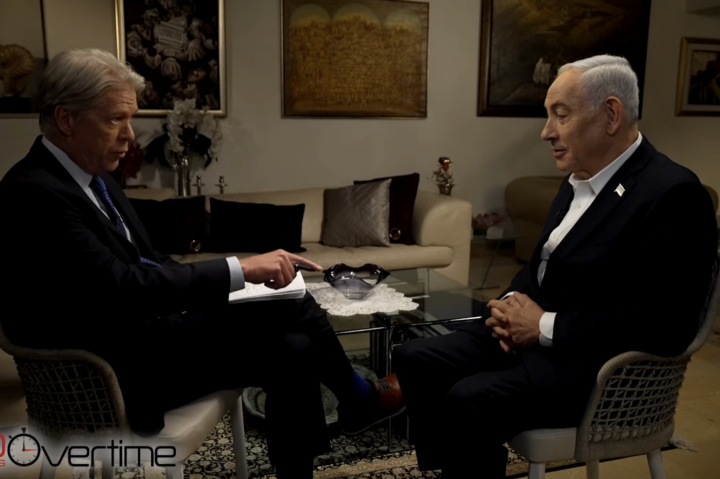
Screenshot
Israeli Prime Minister Benjamin Netanyahu in CBS “60 Minutes” interview with Major Garrett
Israeli Prime Minister Benjamin Netanyahu said in a CBS “60 Minutes” interview on Sunday that the war against Iran is not yet over, in spite of the weekslong ceasefire and assertions by the U.S. administration that the operations that began in February have concluded.
In the interview with Major Garrett, Netanyahu also reiterated his call to end direct U.S. financial aid for Israel over the next 10 years.
Netanyahu said that, while the joint U.S. and Israeli operations in Iran accomplished much, the war is “not over,” with nuclear material still in Iran, and certain Iranian enrichment sites, proxies and ballistic missile efforts surviving.
“We’ve degraded a lot of it. But all that is still there, and there’s work to be done,” he said, adding that any diplomatic agreement with Iran should address all of those areas. Netanyahu said that he would be happy to see an agreement, if it covers those areas, but that both Israel and the United States are prepared to re-engage militarily if it does not.
The Islamic Republic regime, he added, is at its “weakest point” but “it’s not over.” Asked whether there is anyone on the Iranian side capable of negotiating a durable deal, Netanyahu declined to disclose his views publicly, but said he had shared his opinion with Trump.
Netanyahu denied reports that he had assured Trump prior to the beginning of the war that the Iranian regime would fall.
“[We] both agreed that there was both uncertainty and risk involved,” Netanyahu said. “And I remember … I said, and he said that there’s danger in action, in taking action. But there’s greater danger in not taking action.”
Addressing a question about the physical condition and influence of Iran’s supreme leader, Ayatollah Mojtaba Khamenei, who was reportedly seriously wounded at the beginning of the war and has made no public appearances since, Netanyahu said, “I think he is alive.”
“What his condition is, it’s hard to say,” Netanyahu said. “You know, he’s holed up in some bunker or in some secret place and he’s, I think he’s trying to exert his authority. I don’t think he has the same authority that his father had … that’s also creating the disruptions in the regime.”
Asked whether the U.S. and Israel had underestimated the likelihood that Iran would close the Strait of Hormuz, he said that they came to understand the issue over the course of the war. But he argued that Tehran’s decision to close the Strait has proven costly for Iran, in light of the U.S.-imposed blockade.
He also declared that Iran would have had a nuclear weapon now, or within two months, if Israel and the U.S. had not carried out their operations in 2025 and 2026.
“The most pointed success is knocking out 20 top nuclear scientists who were working on the atomic bombs to be used against Israel, America and anyone else,” Netanyahu said.
🇮🇷WATCH: Iran might already have a nuclear bomb, had Israel not launched its two military operations, Israeli PM Netanyahu said on his "60 Minutes" CBS interview.
— Jewish Insider (@jewishinsider) May 11, 2026
Read more here: https://t.co/ABBvkCPGHp pic.twitter.com/chDlNiYKeB
“I think taking out that amount of know-how — it doesn’t eliminate the know-how but it sets them back,” he continued. “Does it mean that they can’t produce a device? No. But it means that if they planned this arsenal of nuclear atomic bombs that they thought they’d have by now — that’s gone, that’s been pushed back, and it’s important they don’t have an atomic arsenal. But they would have had it and we would have faced certain death. So the greatest accomplishment is we’re alive.”
Netanyahu recounted conversations in 2016 and 2024 with Trump in which Trump expressed concern about Iran’s nuclear program. Asked why the U.S. had not acted militarily until 2025, Netanyahu said that Trump had been hopeful that sanctions imposed in his first administration would stop Iran’s nuclear program, but they did not fully do so.
Netanyahu reiterated his call to draw down and ultimately end direct U.S. financial support for Israel over the next decade — despite tensions that his stance has caused with supporters of Israel on both sides of the aisle. He also said he wants to begin drawing down financial support now, rather than waiting for the next Congress, adding that “it could go down very fast.”
Israeli PM Benjamin Netanyahu: "I want to draw down the American support to Israel to zero."
— Jewish Insider (@jewishinsider) May 11, 2026
In a "60 Minutes" CBS interview, Netanyahu reiterated his call to end direct U.S. financial aid for Israel over the next 10 years.
Read more here: https://t.co/4AXZP3RyUc pic.twitter.com/3NI5nWNW47
He said that the future of the relationship should be focused on joint projects equally funded by both Israel and the United States, from which the two countries would share equally. Such a system is how missile defense funding is currently provided, among other projects, but that funding has also come under attack by some in the U.S.
Netanyahu blamed social media, and the manipulation of American social media users by hostile foreign actors using bot farms, for cratering support for Israel among the American people.
“While they’re attacking us with the equivalent of F-35, we’re trying to fight them with a Polish cavalry,” Netanyahu said. “So I think we have to engage on that front, not by censorship but by finding ways that are applicable to democracies. … We have a problem. I recognize it. And we have to get our act together.”
Asked about Gaza, Netanyahu said that Hamas still must be disarmed, demilitarized and deradicalized, and that he has asked the U.S. to provide names of countries that are willing to send in their own troops to carry out that effort, given that Hamas has reneged on its ceasefire obligations. He suggested that Israel may ultimately need to carry out that mission itself.
“If it comes down to us, then we’ll have to do it, but we’ll choose the time and the circumstances in which to do it because we’ve got a few other things,” he said. “But we are not going to let Hamas ever threaten Israel again.”
The Israeli prime minister said that Israel had destroyed more than 90% of Hezbollah’s missile and rocket stockpile, but that the group still maintains thousands of such weapons. He said that an invasion of Lebanon was necessary to prevent a repeat of the Oct. 7, 2023, Hamas incursions into Israel from Israel’s north.
Asked about Russian and Chinese support for Iran during the current war, Netanyahu largely dodged the question. He argued that an emboldened Iran is not in China’s best interests, and said that Russian military support to Iran has “not been a big issue” — while declining to comment on intelligence support, which Moscow has reportedly provided Tehran in the form of targeting data for missile and drone attacks throughout the region.
Jewish Insider’s Israel editor Tamara Zieve contributed to this report.
Judging by polls published by six Hebrew-language media outlets after the merger on Sunday, not much has changed since the announcement that Bennett and Lapid were joining forces
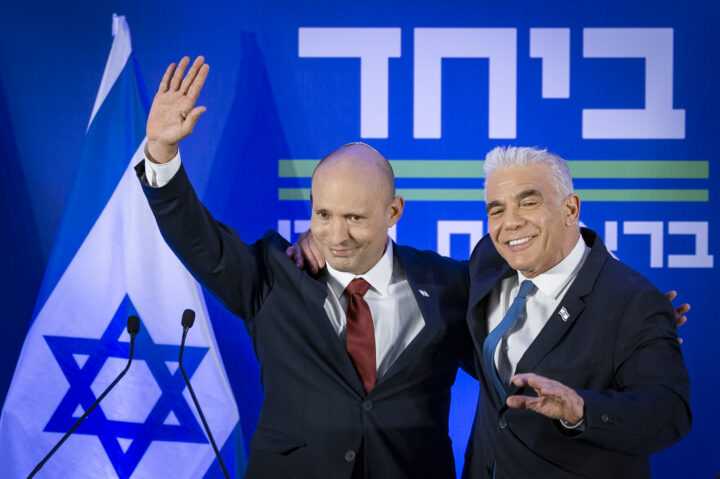
Chaim Goldberg/Flash90
Opposition Leader and Head of the Yesh Atid party Yair Lapid and former Prime Minister Naftali Bennett speak during a press conference announcing a joint list named “Together” ahead of upcoming elections, to be led by Bennett, in Herzliya, central Israel, April 26, 2026.
The near-consensus among Israeli political pundits is that the merger of the parties led by former Prime Ministers Naftali Bennett and Yair Lapid is a huge moment in the campaign ahead of the next Knesset election, scheduled for Oct. 27.
However, judging by polls published by six major Hebrew-language media outlets after the merger on Sunday, not much has changed since the announcement that Bennett and Lapid were joining forces.
The newly formed “Together” opposition party polled around 24 seats — nearly the same number of seats as the two parties combined before the merger. Israeli Prime Minister Benjamin Netanyahu’s Likud party is, according to the average of the latest polls, still the largest party at 29.
According to the latest polling, it would be difficult for either side to build a governing coalition. The opposition Zionist parties did not get a 61-seat majority in any of the six polls. The most favorable poll for the opposition showed the anti-Netanyahu Zionist parties at 60 seats in the 120-seat Knesset, while the current coalition received over 61 seats in two polls (from those commissioned by Channel 14 and I24NEWS, which are more sympathetic to Netanyahu than the other media outlets).
To be sure, polls taken within 24 hours of an event are not the most reliable, and much can change in the six months until the election.
The key question after the Bennett and Lapid merger is whether they are fighting other opposition candidates for dominance within their bloc – in which case, Bennett has likely solidified his status as Netanyahu’s main competition for the premiership – or to broaden the bloc’s appeal to win a majority in the Knesset.
Netanyahu famously said in 2018 and many times since, in reference to shifts in the opposition: “I don’t intervene in how the left divides up its votes.” That quip, made when Bennett was still in the pro-Netanyahu camp, is now reflective of Bennett’s weakness.
So far, the polling has shown that Bennett, who was solidly on the right for the first eight years of his political career, will struggle to peel off voters from the right-wing pro-Netanyahu bloc into his camp.
In his last election campaign in 2021, Bennett ran primarily on right-wing messages but ended up leading a coalition of mostly center and left parties, together with an Arab party in the government, something many right-wing voters, as well as two Knesset members who jumped ship, viewed as a betrayal.
Add to that the fact that Lapid is to Bennett’s left — something both acknowledged several times in their Sunday night press conference, referring to their “differences” – likely referring to Bennett’s support for settlements and opposition to a two-state solution, which Lapid supports. Both candidates emphasized their shared views on domestic policy in response.
Netanyahu has kept mostly quiet about the Bennett-Lapid merger, but his one response shows that he will try to widen the wedge between Bennett and the right.
Netanyahu’s social media accounts posted an image from 2021 showing Lapid and Bennett sitting with Mansour Abbas, head of Ra’am, the Islamist party in their governing coalition. Ominous music plays in the background, and the words “they already did it once; they will do it again” are splashed across the picture.
The Ra’am factor will also likely be key after the election. The Zionist opposition parties have said mixed things about whether they would be willing to have an Arab non-Zionist party in their coalition in a post-Oct. 7 Israel. Revelations about the Ra’am party’s financial and historic ties to Hamas will also likely come up in the campaign.
As of now, the Knesset’s three Arab parties have said they will run in a single Joint List this year, as they did in 2015-2021, increasing Arab voter turnout and their representation in the Knesset. Ra’am is the only one of the parties that has to date been willing to sit in a coalition, and unlike Abbas, the other party leaders, Ayman Odeh and Ahmed Tibi, do not accept Israel as a Jewish state.
Because of those realities, Bennett and Lapid’s Together party will likely have to make a concerted – and perhaps quixotic – effort to win over right-leaning voters if it wants to increase its bloc and unseat Netanyahu. That task will be easier said than done.
Plus, a publisher's nutty smear targeting Jews

According to reports, President (Andrew Harnik/Getty Images)
Health and Human Services Secretary Robert F. Kennedy Jr. (C) is taken out of the ballroom by security agents during a shooting incident at the annual White House Correspondents Association Dinner at the Washington Hilton on April 25, 2026 in Washington, DC.
👋 Good Monday morning!
In today’s Daily Kickoff, JI’s Marc Rod gives a first-person account from inside the chaos of the White House Correspondents’ Dinner after an assassination attempt on Trump administration officials. We report on the merger between former Israeli Prime Ministers Naftali Bennett and Yair Lapid as they seek to oust Benjamin Netanyahu, and talk to University of California regent Jay Sures about the UCLA student government’s recent condemnation of an event with a former Israeli hostage. Also in today’s Daily Kickoff: Daniel Shapero, Josh Kushner and Tzipi Hotovely.
Today’s Daily Kickoff was curated by JI Executive Editor Melissa Weiss and Israel Editor Tamara Zieve, with an assist from Danielle Cohen-Kanik. Have a tip? Email us here.
What We’re Watching
- King Charles III and Queen Camilla land in Washington today for their first state visit to the U.S. since assuming the throne. They’ll arrive to a city reeling from this weekend’s attempted attack on Trump administration officials at the White House Correspondents’ Dinner. More below from JI’s Marc Rod, who was attending the event at the Washington Hilton on Saturday night.
- The king and queen will be welcomed by President Donald Trump and First Lady Melania Trump, and will have afternoon tea before attending a White House garden party.
- Trump is expected to convene a Situation Room meeting — sans King Charles — on Iran as the countries remain at an impasse amid stalled talks. The meeting comes days after plans for White House Special Envoy Steve Witkoff and Jared Kushner to go to Islamabad for a second round of talks were scrapped, with Trump telling Fox News on Sunday, “If they want to talk, they can come to us or they can call us.” Tehran has reportedly offered to reopen the Strait of Hormuz and end the war without resolving its disputes with Washington over the future of the Iranian nuclear program.
- Iranian Foreign Minister Abbas Araghchi is in Moscow today, where he is slated to meet with Russian President Vladimir Putin.
- Israeli President Isaac Herzog is in Kazakhstan today, where he is slated to meet with President Qasym-Jomart Toqayev.
- Israel Tech Week kicks off today in Miami. Speakers include Daniel Flesch, Phil Goldfeder and Gabe Groisman.
What You Should Know
A QUICK WORD WITH JI’S MARC ROD
The White House Correspondents’ Dinner on Saturday night began normally enough — a bustle of reporters, administration officials and members of Congress among other A-listers streaming from the packed lobby of the Washington Hilton down into the basement ballroom.
White House Correspondents’ Association President Weija Jiang, a CBS News White House reporter, finished her introductory remarks, and the thousands of guests packed into the ballroom tucked into their salads.
Then, a loud, shattering bang rang out from the other side of the ballroom. Initially, I didn’t think anything of it — I thought someone had dropped a large tray of food (as President Donald Trump said later, he thought the same thing).
Videos and other accounts of the evening indicate that someone from the security staff shouted from the front of the room that guests should get down. I didn’t hear it. My first indication that something was wrong was when I started seeing other guests ducking under the tables and security officers drawing their guns.
I tried to duck under the tablecloth, but no luck — another occupant of the table was already underneath, and there was no room. My heart pounding, I was forced to do my best to stay low — but I was in the backmost row of tables, right by a door, sitting directly in the aisle.
If a shooter came into the ballroom from behind me, I was a sitting duck. I was completely helpless and exposed.
Two thoughts ran through my head. The main one: I’m getting married in six days. I can’t die now. The second: I can’t believe this is happening to me again. (For those readers who are newer to Jewish Insider — I was also on scene for the Jan. 6, 2021, attack on the U.S. Capitol.)
JOINING FORCES
Naftali Bennett, Yair Lapid announce Knesset run ‘Together’
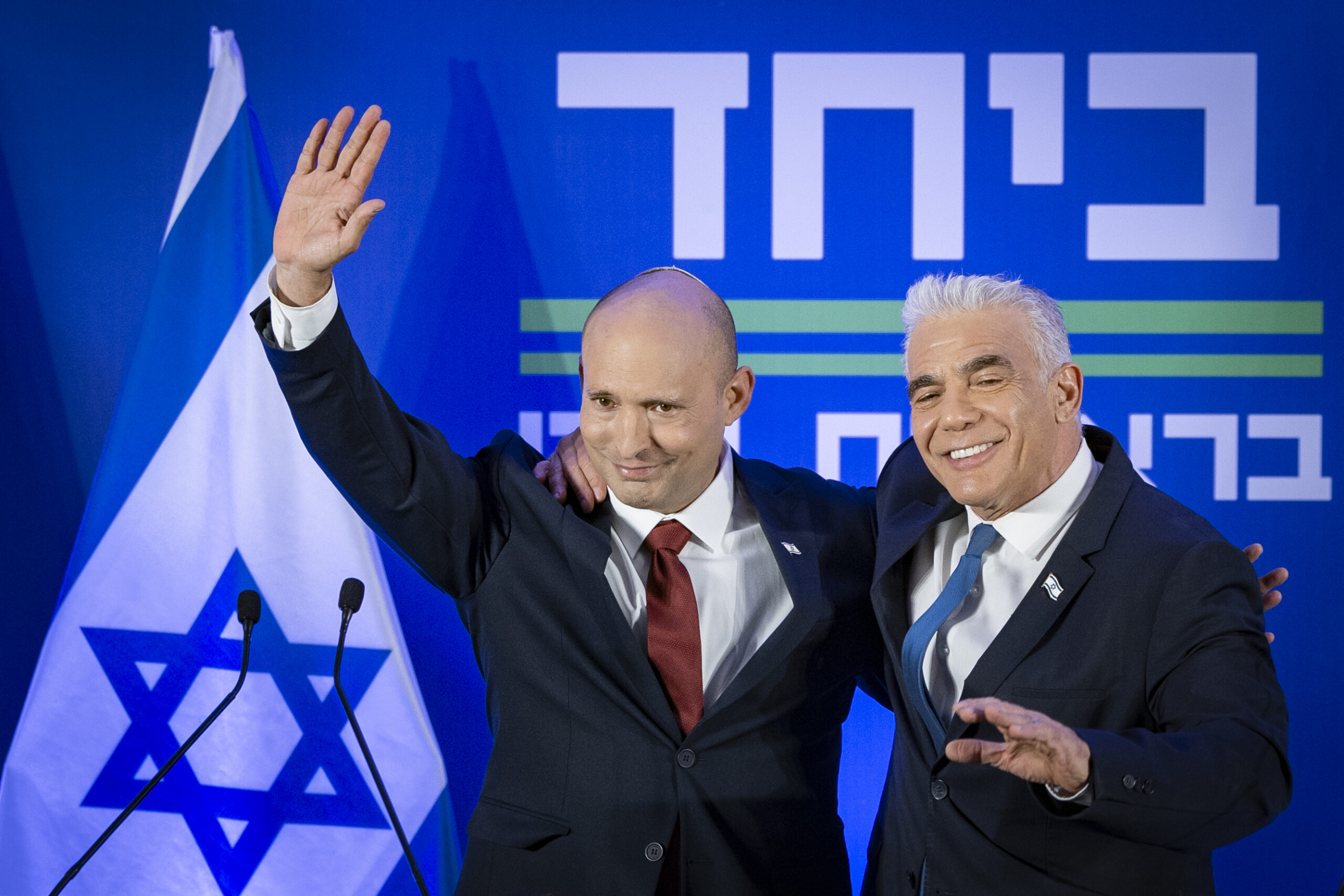
Former Israeli Prime Ministers Naftali Bennett and Yair Lapid will run in this year’s Knesset election as a joint party called “Together,” led by Bennett, they announced on Sunday. The move comes as the bloc of Zionist parties running against Prime Minister Benjamin Netanyahu’s bloc has recently polled higher than the parties in Netanyahu’s coalition, but with fewer than the 61-seat majority needed to form a government, Jewish Insider’s Lahav Harkov reports.
Behind the scenes: Sources close to both party leaders told JI that they began discussing a joint run a week ago, and reached the final decision on Saturday night. Bennett will lead the party after having a consistently stronger showing in polls in recent months. Bennett, a former IDF combat officer, described the merger as “the most Zionist and most patriotic thing we have ever done for our country.” Lapid said that the country “needs unity like air to breathe.”
Survey says: A poll conducted for Israel’s Walla news site on Monday found that Lapid and Bennett would lose seats if an election were held today, in comparison to previous polls when they were running separately.
EXCLUSIVE
UC Regent Jay Sures slams UCLA student body as ‘lunatics’ for condemning former Israeli hostage’s speech

Jay Sures, vice chairman of United Talent Agency and a regent of the University of California system, slammed the members of UCLA’s Undergraduate Student Association who authored a letter condemning former Israeli hostage Omer Shem Tov’s recent campus appearance as “shortsighted, antisemitic or both,” in an interview with Jewish Insider’s Haley Cohen.
What he said: “Why would anybody send out a letter condemning a hostage who is a student who was held in captivity for over 500 days? You have to be a complete lunatic to sign on to that letter,” Sures told JI on Friday, shortly after he issued a letter to the body stating he was “disgusted and appalled” by its condemnation.
SHELL GAME
Publisher of Drop Site News pushes conspiracy theory about a California Jewish family-owned business

Nika Soon-Shiong, the publisher of Drop Site News who is also the daughter of Los Angeles Times owner Patrick Soon-Shiong, is circulating conspiracy theories seeking to tie a California-based Jewish couple behind a major pistachio processor to the recent U.S.-Israeli military strikes in Iran, Jewish Insider’s Matthew Kassel reports.
Singled out: In a recent social media post that drew more than 1 million views, Soon-Shiong, citing unverified online claims that the United States and Israel had targeted pistachio warehouses in Iran this month, singled out Stewart and Lynda Resnick, the billionaire owners of the Wonderful Company, which grows and processes a large percentage of California’s pistachios as well as other products including almonds and mandarin oranges.
ON THE TRAIL
Mamdani veto of educational buffer zone bill draws rebuke from Jewish groups
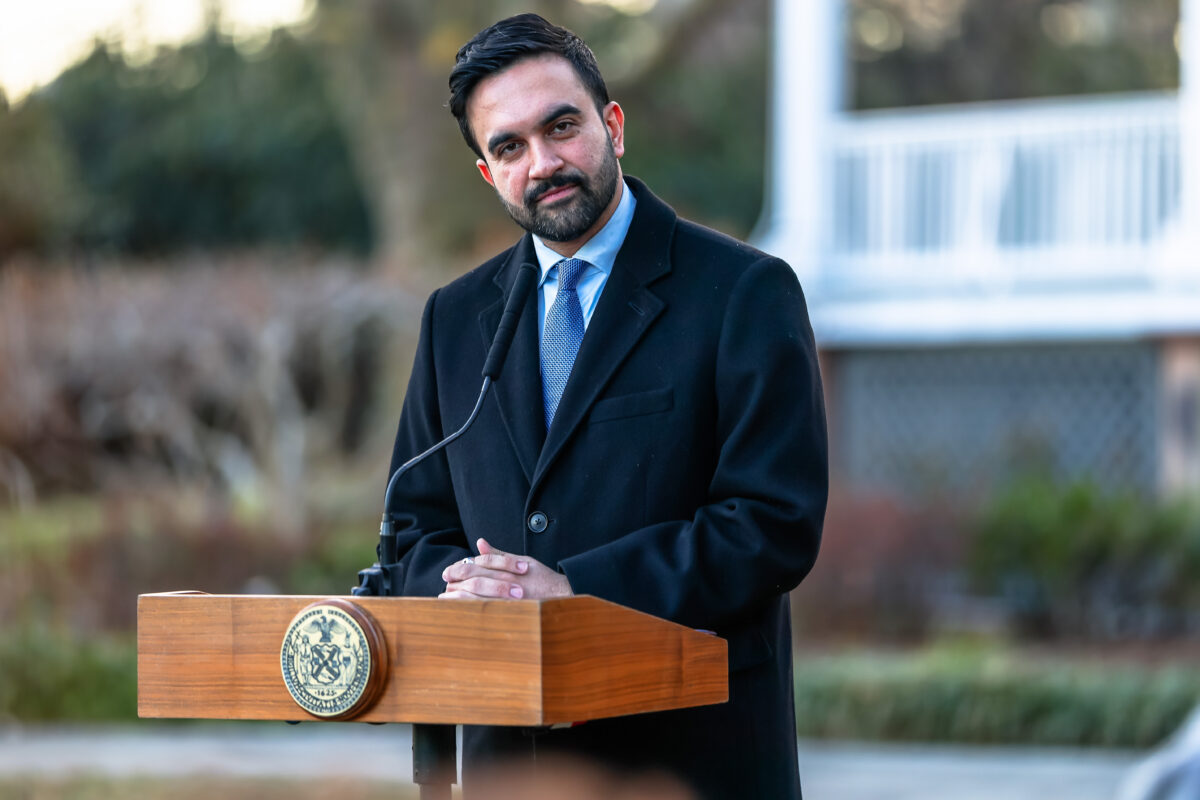
New York City Mayor Zohran Mamdani exercised his veto power for the first time since entering office on Friday to block a bill that would standardize NYPD policy around protests at educational institutions, Jewish Insider’s Will Bredderman reports.
What they said: “We are deeply disappointed by Mayor Mamdani’s decision,” said the UJA-Federation of New York, the Anti-Defamation League of New York/New Jersey, Jewish Community Relations Council of New York, American Jewish Committee New York, the Conference of Presidents of Major American Jewish Organizations, the New York Board of Rabbis, Orthodox Union, The Rabbinical Assembly, StandWithUs and Teach NYS, in a rare united response. “This veto is a profound failure of City Hall to demonstrate to all New Yorkers that our safety is a priority.”
STAYING PUT
Virginia Del. Sam Rasoul, who faced backlash over anti-Israel rhetoric, won’t run for Congress
A Virginia state lawmaker with a history of inflammatory anti-Israel rhetoric who had been exploring a congressional run announced on Friday that he would instead remain in the state’s House of Delegates. Sam Rasoul, a Roanoke Democrat who is the son of Palestinian immigrants, said he would hold onto his seat in the state Legislature to continue focusing on his work chairing the Education Committee, a role that has garnered concern from the state’s Jewish community due to his heated comments, Jewish Insider’s Gabby Deutch reports.
Zoom out: The decision comes days after Virginia voters approved a new congressional map that is likely to deliver four additional House seats to Democrats, prompting a reshuffling as politicians in the state opt to run — or not to run — for the newly drawn Democratic-friendly seats.
LINKEDIN LEADER
LinkedIn veteran Daniel Shapero tapped as new CEO
Microsoft, the parent company of LinkedIn, has tapped Daniel Shapero, the professional networking site’s current chief operating officer, as its next CEO, current chief executive Ryan Roslansky announced earlier this week, Jewish Insider’s Haley Cohen reports.
Announcement: Shapero, who has been serving as COO since 2021, wrote on the platform Wednesday, “Today, I’m taking on the role as CEO of Linkedin. I joined Linkedin in May 2008 as employee #300ish, and it’s easy to say that my time at the company has been one of the most meaningful experiences of my life.” The network has close to 1.5 billion users worldwide.
Worthy Reads
Riyadh’s Reluctance: Foreign Policy’s Steven Cook considers why Saudi Arabia is not playing a more central role in the U.S. and Israeli conflict with Iran. “This is not to suggest that Saudi Arabia should get into the fight, but it is revealing that a country that billed itself as a rising power and the most important country in the Middle East is betwixt and between when its neighborhood is burning down. The Saudis clearly have interests at stake, but rather than taking action, they have been issuing strongly worded statements while others, including their adversaries, are shaping the region. It seems that Riyadh would be better off taking concrete steps to protect its interests. What is the saying about it’s better to be at the table than be the meal?” [FP]
Feeding Israel to the Left: In his Substack “The Abrahamic Metacritique,” Hussein Aboubakr Mansour raises concerns about the willingness of Democratic leaders to shift leftward on issues related to Israel amid pressure from the activist left. “The establishment’s reasoning is basic strategic calculation: the left will not relent on Israel; a civil war inside the party over the Jewish state would destroy the coalition; therefore, the rational move is to concede this issue, preserve party unity, and proceed with the moderate agenda on everything else: affordability, climate, migration, AI, etc. Feed this one thing to the beast, and the beast will be satisfied. It is an intelligent calculation, a genius one, really, but it is also a catastrophic one, because it rests on a complete misapprehension of what is being conceded and to whom.” [AbrahamicMetacritique]
Battle Royal: For Fox News, presidential historian Tevi Troy does a deep dive into the history of visits to the U.S. from U.K. royals. “When [Queen Elizabeth II] visited Eisenhower in 1957, she helped smooth over tensions that had emerged between Britain and the U.S. as a result of the Suez Crisis. … And now, as King Charles embarks on his first visit to the U.S. in President Donald Trump’s second term, the U.S. and Britain are in the midst of a disagreement over the war with Iran. Charles is not a political ruler, but perhaps his visit, like his mother’s in 1957, can smooth over tensions and help maintain the special relationship America has long had with the United Kingdom.” [FoxNews]
Word on the Street
Axios reports that during the active conflict with Iran in March, Israel sent the United Arab Emirates an Iron Dome battery, interceptors and several dozen IDF troops to operate the missile-defense system; a senior Emirati official told Axios, “We are not going to forget it,” while a second official said, “It was a real eye-opening moment. To see who our real friends are”…
A new memo from the State Department acknowledges that the U.S.’ decision to launch Operation Epic Fury against Iran came — at least in part — at Israel’s request, Jewish Insider’s Gabby Deutch reports…
An 11-year-old Israeli girl who was critically wounded in an Iranian cluster bomb attack on her home in Bnei Brak earlier this month died of her injuries…
In an interview with The Wall Street Journal, Tucker Carlson suggested that he was given advance notice of the joint U.S.-Israel operation targeting Iran in late February, saying he received a text message at 10 p.m. ET on Feb. 27 — hours before the start of the operation — that read, “We’re going”; Carlson did not say who sent the message, acknowledging only that it was not President Donald Trump or Vice President JD Vance…
The WSJ notes that at the last meeting between Trump and Carlson, the president displayed a letter from evangelical leader Franklin Graham calling Carlson an antisemite…
The Treasury Department announced sanctions on a Chinese oil refinery and more than three dozen shipping firms and vessels tied to Iran’s oil export industry…
The New York Times examines the Trump administration’s “haphazard” approach to sanctions on Russia and Iran as Moscow and Tehran leverage their oil reserves amid a volatile market…
The Financial Times looks at the United Arab Emirates’ recent request that Pakistan repay $3.5 billion in loans, citing Islamabad’s deepening ties with Saudi Arabia and what the UAE “considers Pakistan’s meek response to Iranian attacks on the Gulf”…
UAE President Mohamed bin Zayed’s son-in-law Mohammed bin Hamad Al Nahyan and EDGE Group CEO Faisal Al Bannai — both of whom advise MBZ — visited Trump at Mar-a-Lago in Palm Beach, Fla., and made a swing through the U.S. to meet with SpaceX founder Elon Musk, Jared Kushner, investors Marc Andreessen and Ben Horowitz and defense firm Anduril, The Circuit’s Jonathan Ferziger reports…
Talks between the U.S. and Israel on the next 10-year memorandum of understanding are expected to begin next month, and will include Maj. Gen. (res.) Amir Baram, the director-general of Israel’s Defense Ministry, and Israeli Ambassador to the U.S. Michael Leiter representing Israel and Secretary of State Marco Rubio, U.S. Ambassador to Israel Mike Huckabee and State Department senior advisor Michael Needham…
Sen. Thom Tillis (R-NC) dropped his opposition to Kevin Warsh’s nomination to be chairman of the Federal Reserve, clearing the way for Warsh to assume the role when Jerome Powell’s term ends next month…
A federal judge in Texas halted the deportations of six family members of an Egyptian man who firebombed demonstrators, killing an elderly woman, at a Boulder, Colo., march last year raising awareness about the Israeli hostages in captivity in Gaza…
Thrive Capital founder Joshua Kushner announced on Friday the launch of Thrive Eternal, a capital holding company that will acquire a minority, non-controlling stake in the San Francisco Giants as its first major partnership, Jewish Insider’s Melissa Weiss reports…
The New York Times interviews Hollywood agent Michael Glantz, who went viral after being filmed eating his burrata salad at the White House Correspondents’ Dinner on Saturday as other guests around him ducked for cover…
Counterterrorism authorities investigating a string of antisemitic attacks in London arrested a 37-year-old man on suspicion of preparing to carry out terrorist acts; more than two dozen people have been arrested in connection with attacks against the country’s Jewish community since late March…
The Telegraph goes behind the scenes of the Met Police’s effort to track down arsonists targeting synagogues in the London area…
Israeli President Isaac Herzog is expected to push for a mediated resolution to reach a plea deal in Prime Minister Benjamin Netanyahu’s ongoing corruption trial, bucking pressure from the White House to pardon the prime minister…
Israel’s Cabinet signed off on the nomination of Michael Lotam to be the country’s first ambassador to Somaliland, four months after Jerusalem recognized the sovereignty of the East African nation…
The Cabinet also approved the appointment of former Israeli Ambassador to the U.K. Tzipi Hotovely to serve as the head of the National Public Diplomacy Directorate within the Prime Minister’s Office, which has been vacant for more than two years…
Israel launched a wide-scale, multimillion-dollar campaign – led by former Trump administration official Brad Parscale — to create pro-Israel web content that would be picked up by AI platforms…
Cardiologist Eugene Braunwald, who as a child fled Nazi Europe and went on to reshape how modern medicine approaches heart attacks, died at 96…
Diplomat Lionel Rosenblatt, whose experiences living in Haifa, Israel, as a child inspired him to join the U.S. Foreign Service and later lead Refugees International, died at 82…
Pic of the Day

Stars of the upcoming Keshet 12 series “Unconditional” attended the world premiere screening of the drama, about a mother-daughter pair stranded in Russia, ahead of its broadcast tonight, at the Cinematheque in Tel Aviv, Israel.
Birthdays

Showrunner, director, screenwriter and producer, Brian Koppelman turns 60…
Financial executive, he retired in 2014 as head of marketing for money manager Van Eck Global, Harvey Hirsch turns 85… Nonprofit executive who has managed the 92nd Street Y, the Robin Hood Foundation, the AT&T Foundation and Lincoln Center, Reynold Levy turns 81… U.S. senator (R-WV), Jim Justice turns 75… Physician and a former NASA astronaut, she is a veteran of three shuttle flights with more than 686 hours in space, Ellen Louise Shulman Baker, M.D., M.P.H. turns 73… Director-general of the Israel Antiquities Authority until 2020, he was previously a member of Knesset and deputy director of the Shin Bet, Yisrael Hasson turns 71… VP at Covington Fabric & Design, Donald Rifkin… Biologist and professor of pathology and genetics at Stanford University School of Medicine, he won the 2006 Nobel Prize in medicine, Andrew Zachary Fire turns 67… Co-founder of Casamigos Tequila and owner of restaurants, bars and lounges worldwide, Rande Gerber turns 64… Former member of the Knesset for the Shinui party, Yigal Yasinov turns 60… CEO of ZAM Asset Management, Elliot Mayerhoff… Founder and CEO of NYC-based Gotham Ghostwriters, he served as a senior advisor for Sen. Joseph Lieberman in his vice presidential and presidential campaigns, Daniel Gerstein turns 59… Israeli actor, entertainer and television host, Yitzhak “Aki” Avni turns 59… Attorney and journalist, she is a contributing editor at Newsweek and senior editor at Slate, Dahlia Lithwick turns 59… Author, political analyst and nationally syndicated op-ed columnist for The Washington Post, Dana Milbank turns 58… U.S. senator (D-NJ) since 2013, he was previously the mayor of Newark, Cory Booker turns 57… Israeli television and radio journalist and former member of the Knesset for the Jewish Home party, Yinon Magal turns 57… Professor of science writing at Massachusetts Institute of Technology, Seth Mnookin turns 54… Cinematographer and director, Rachel Morrison turns 48… Identical twin brothers, between the two of them they won 11 Israeli championships in the triathlon between 2001 and 2012, Dan and Ran Alterman both turn 46… Israeli screenwriter and producer, she has written numerous advertisements and screenplays, Savion Einstein turns 44… VP of AIPAC’s mid-Atlantic region, Leah Berry… Television and film actress, Ariel Geltman “Ari” Graynor turns 43… Basketball coach, analyst and writer, Benjamin Falk turns 38… Senior creative director at Trilogy Interactive, Jessica Ruby… Head of climate data at Watershed, Jonathan H. Glidden… Research fellow at Emory University law school, David Jonathan Benger… Entrepreneurial investor, Noah Swartz turns 33… Medical resident at UCLA Health, Amir Kashfi…
An Israeli diplomatic source told Jewish Insider that Ecuador and Paraguay are expected to join the Isaac Accords

Kobi Gideon (GPO
Argentinian President Javier Milei, Israeli Prime Minister Benjamin Netanyahu and U.S. Ambassador to Israel Mike Huckabee take part in the launch ceremony of the Isaac Accords
Argentine President Javier Milei began an event-packed visit to Israel on Sunday, which will include receiving a Presidential Medal of Honor and lighting a torch in Israel’s Independence Day ceremony on Tuesday.
Milei and Israeli Prime Minister Benjamin Netanyahu launched the “Isaac Accords” on Sunday, an initiative conceived by Milei to encourage closer cooperation between Israel and Latin American countries.
An Israeli diplomatic source told Jewish Insider that Ecuador and Paraguay are expected to join the Isaac Accords. Israeli media have reported that Costa Rica, Panama and Uruguay have also expressed interest.
Milei described the launch of the initiative as “a historic moment for our nations. It will not only strengthen the relationship between Argentina and Israel, united by shared values, but also represents a step toward a freer and more prosperous hemisphere.”
“Isaac, the son of Abraham, represents an initiative to extend the model initiated by President [Donald] Trump in the Middle East to Latin America, addressing challenges such as terrorism, antisemitism, and drug trafficking, while inviting other nations to join,” Milei said. “Nations that share values have a mission to work together. With the support of the United States, we have the opportunity to bring about transformative change.”
The accords are “a new strategic framework aimed at strengthening cooperation between Argentina, Israel and like-minded partners in the Western Hemisphere, the descendants of Isaac and nations of the Judeo-Christian tradition, in defense of freedom and democracy, and in the fight against terrorism, antisemitism, and drug trafficking,” according to Israel’s Foreign Ministry.
Milei suggested launching the accords in a meeting with Israel Foreign Minister Gideon Sa’ar, whose father was from Argentina. The Israeli foreign minister was the main Israeli catalyst pushing for the agreement, including in his most recent meeting with Secretary of State Marco Rubio last summer, during which they established a working group to advance the matter, an Israeli diplomatic source told JI.
Netanyahu said that he sees “great hope vis-à-vis the Latin American continent. We see the beginnings of change, certainly we’ve seen enormous change in Argentina, but I think that this is also a compass and a map for other countries, not only for their internal reforms but also for their external reforms, that is coming back to the alliance of freedom. It begins with the two of us and with the support that is always there of the United States for free societies.”
U.S. Ambassador to Israel Mike Huckabee took part in the launch ceremony, and called Milei and Netanyahu “two of President Trump’s greatest friends” who seek to “bring back the values that are the underpinning of Western civilization and Judeo-Christian values upon which our nations were built.”
Sa’ar described Milei as “one of the boldest leaders of our age. … We will continue to strengthen this close friendship! Viva Argentina! Viva Israel!”
Earlier Sunday, Milei visited the Western Wall with Argentinian Ambassador to Israel Axel Washnish, a rabbi with whom he learned Torah for years before becoming president.
Israel and Argentina also announced direct flights between the countries. The first El Al flights to Buenos Aires are expected to start in November.
Economic ties and broader European alliances are likely to preserve the bilateral relationship, even as the expected prime minister-elect moves to rejoin the ICC and potentially pivot back towards the EU

Ferenc ISZA / AFP via Getty Images
Peter Magyar, leader of the pro-European conservative TISZA party, waves the national flag during celebrations at the election night party in Budapest after the general election in Hungary, on April 12, 2026.
The end of Hungarian Prime Minister Viktor Orbán’s 16-year tenure following his electoral defeat on Sunday to center-right rival Péter Magyar has sparked immediate questions regarding the future of one of Jerusalem’s most reliable, yet complicated, alliances in Europe.
While Orbán’s departure removes a reliable ally of Israeli Prime Minister Benjamin Netanyahu within the European Union, experts suggest Jerusalem’s standing in Europe and bilateral relationship with Budapest will not be significantly set back.
Under Orbán, Hungary frequently broke ranks to block anti-Israel statements and actions from the EU. The former leader maintained a warm posture toward Israel and voiced opposition to terror organizations. He also initiated the process to withdraw Budapest from the International Criminal Court after it issued an arrest warrant for Netanyahu. Orbán called the court “political” and defied the ruling by welcoming the Israeli prime minister for a visit.
“Israel is losing a close friend with the electoral defeat of Viktor Orbán,” David May, a senior research analyst at the Foundation for Defense of Democracies, told Jewish Insider. “His willingness to defy EU consensus shielded Israel from many hostile actions. The Central and Eastern European states are far friendlier to Israel than their Western counterparts, and that will likely continue under Peter Magyar — though to what extent remains unclear.”
Magyar has vowed to maintain Hungary’s “special relationship” with Israel, calling the Jewish state an “important economic partner.” However, he has also called for “pragmatic relations,” including returning Hungary to the ICC and suggesting that Budapest will likely move away from the reflexive veto that characterized the Orbán era, replacing it with a case-by-case approach to EU measures concerning Israel.
“We do not know much about Péter Magyar’s policy views on Israel,” said Ferenc Németh, an international relations expert and Fulbright visiting researcher at Georgetown University. “Politically speaking, I do not expect relations to worsen or for Magyar to have a cold or hostile position toward Netanyahu; rather, Hungary will align with the views of its partners on key issues concerning Israel.”
Németh added that Israel will remain “an important partner for Hungary, especially given the economic ties and the shared Jewish heritage.” He noted that Magyar’s desire to rejoin the ICC is likely aimed at strengthening “Hungary’s position among its most valuable Western partners and to achieve full alignment with their views.”
Jonathan Ruhe, a fellow at the Jewish Institute for National Security of America, also suggested that significant change in posturing is unlikely. He noted that Orbán’s defeat is “easily overstated in terms of likely impact on Israel.”
“Israel’s standing in Europe won’t be dimmed by Orbán’s departure,” Ruhe said. “Israel has reliable partners like Germany, Czechia, Greece and Cyprus. Germany in particular has been a firewall against a lot of European anti-Israeli actions, and Magyar has suggested he’ll follow Germany’s lead here.”
Experts also noted that Orbán’s actions did not carry as much weight as they appeared and expressed concern over the former Hungarian leader’s preference for Moscow in the Russia-Ukraine conflict and complex relationship with Tehran.
“Orbán blocked primarily statements critical of Israel, not concrete measures — with the exception of a sanctions package targeting violent settlers and organizations targeting Palestinians in the West Bank,” Matthew Levitt, a senior fellow at the Washington Institute for Near East Policy, said. “And Hungary did not always act in Israel’s interest under Orbán, such as when Hungary offered Iran intelligence support after the pager attack against Hezbollah in September 2024.”
May similarly noted that Orbán was “not without controversy.”
“His close ties with Russia — and sometimes strong bonds with Iran — at times placed the Hungarian leader at odds with Israeli and U.S. interests,” May said. “Orbán’s proximity to antisemites and his antidemocratic tendencies also made him a less than desirable ally.”
Ruhe said that Orbán’s actions in support of Israel should be “weighed against everything he did to whitewash Hungary’s role in the Holocaust, engage in antisemitic dog-whistling, roll back democracy and essentially serve as an agent of Moscow — Iran’s partner in crime — inside the EU.”
“Magyar has pledged to maintain his country’s ‘special relationship’ with Israel, but without Orbán’s significant baggage that far outweighed the few concrete steps he took in support of Israel,” Ruhe added.
Németh said that Hungary will remain “a country with a strong zero-tolerance policy against all forms of antisemitism,” noting that Orbán, despite his often vocal support for Israel, engaged in actions that could be perceived as triggering “antisemitic views.”
“Orbán has used coded messages to trigger antisemitic views, [such as] making George Soros, an American-Hungarian businessman of Jewish heritage, a central figure in propaganda,” Németh said. “Magyar has pledged not to do that.”
With polls showing most Israelis opposing Iran ceasefire, Likud drops in three weekend polls, while two others show the current coalition maintaining power
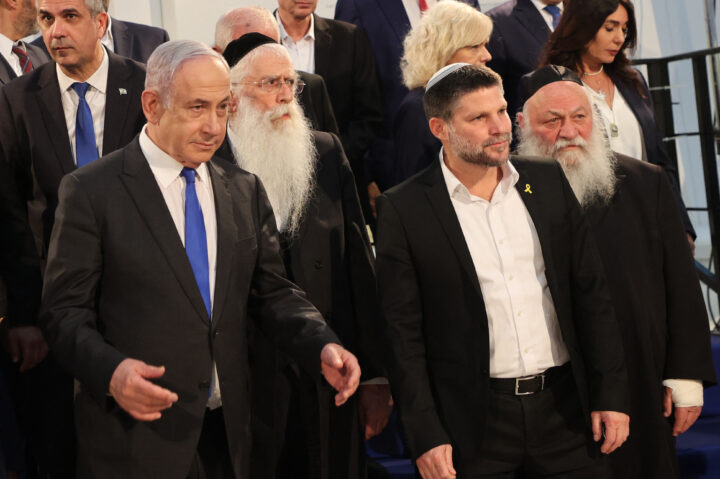
GIL COHEN-MAGEN/POOL/AFP via Getty Images
Israeli Prime Minister Benjamin Netanyahu (L) and Finance Minister Bezalel Smotrich (2nd R) arrive for a cabinet meeting at the Bible Lands Museum in Jerusalem on June 5, 2024.
Amid the ceasefire with Iran, new Israeli polls were split on the outcome for Israeli Prime Minister Benjamin Netanyahu’s Likud party and coalition. Three television polls showed Netanyahu losing significant support as a result of the unpopularity of the ceasefire, while polls from two right-leaning networks projected he would still have a majority in the Knesset to form a coalition.
The election is currently slated for the end of October. Israeli Channels 12, 13 and Kan 11 projected Netanyahu’s coalition would not receive enough votes to stay in power, but they also found that center-left parties — excluding Arab parties, which most Zionist parties have said would not be invited to join their coalition — would not get the 61-seat majority to form a winning coalition.
Channels 14 and i24NEWS news projected that the coalition would be able to remain in power, but with a smaller majority than it received in 2022, as it has consistently received in polling since then.
Netanyahu appeared defensive in a televised statement on Saturday night, during which he argued that the results of the nearly six-week war against Iran had been positive, and the ceasefire may not be final: “There are people who say ‘we have no achievements.’ There are giant achievements.”
“The campaign is not yet over, but even now it can be clearly stated: We have achieved historic accomplishments,” Netanyahu continued. “Iran tried to squeeze us in a stranglehold; Hamas in Gaza, Hezbollah in Lebanon, the Assad regime in Syria, the militias in Iraq, the Houthis in Yemen, Iran itself. They wanted to choke us, and we are choking them. … Those who threatened to destroy us are now fighting for their own survival.”
Netanyahu went on to list the war’s achievements: “We succeeded in crushing the nuclear program, crushing the missile program,” and brought Iran’s regime “to its lowest, weakest level since the establishment of the regime 47 years ago.” He also listed dozens of senior officials and military commanders who had been killed by Israel and weapons sites that had been destroyed.
Still, the prime minister acknowledged that the enriched uranium in Iran must be removed “either … by agreement, or it will come out in other ways.”
Netanyahu also spoke at length about negotiations with Lebanon as the IDF continued operations against Hezbollah. He said the talks would be about the disarmament of the Iran-backed terrorist group and “a real peace agreement” with Beirut.
In polls released the night before, Israeli channels 12 and 13 and public broadcaster Kan found that a narrow majority of Israelis (from 51% to 56%) said they oppose the two-week ceasefire with Iran. In addition, in a poll published Sunday by the Institute for National Security Studies at Tel Aviv University, 61% of Israelis opposed the ceasefire, and less than a third (31%) said they believed that the Iranian regime was significantly harmed in the war.
Elie Pieprz, an international political consultant who has worked on Likud campaigns, argued that Netanyahu doesn’t need the war to come to a conclusively positive end for Israel for him to use it to his political advantage.
“The prime minister has always thrived when something tantalizing is very close, and [he can say] ‘if you just give me another term, I can bring this home,” Pieprz said. “I think regime change [in Iran] is exactly one of those things.”
Conversely, Nilly Richman, a strategist who has worked with President Isaac Herzog and launched Yair Lapid’s Yesh Atid party, told Jewish Insider that “there is no doubt that Netanyahu is stressed, and he is broadcasting it.”
According to Richman, the stress comes from the fact that “the polls aren’t bringing [Netanyahu] to the point he hoped to be in after this war” and that he will have to testify again in the corruption trials against him this week, now that Israel is no longer in a state of emergency.
According to Kan’s poll, the current coalition parties were projected to receive 51 seats, while Zionist opposition parties got 59. Likud received 25 seats, down from 28 in the previous week’s polls, while former Prime Minister Naftali Bennett’s yet-unnamed party was steady at 19.
On Channel 12, Israel’s most-watched news broadcast, Likud was projected to drop to 25 from 27 last week, and Bennett to rise from 20 to 22 seats. The coalition would get 50 seats, and the Zionist opposition 60, according to the poll.
In Channel 13’s poll, the coalition got 54 seats and the Zionist opposition received 55. Likud received 22 seats, up from 25 last week, and Bennett went from 18 to 21.
Newer, more right-leaning channels 14 and i24 News, however, showed Netanyahu would be able to form a majority coalition with his current partners. They did not ask about support for the ceasefire.
In i24’s poll, Likud received 32 seats and former IDF Chief of Staff Gadi Eisenkot’s Yashar Party led the opposition with 14 seats. The coalition would win 64 seats and the Zionist opposition received 45.
Pro-Netanyahu Channel 14, whose pollster, former Netanyahu aide Shlomo Filber, most accurately predicted the results of the last election, found that the right-wing bloc received 66 seats while the Zionist opposition received 42. The poll also gave Likud 36 seats and Bennett’s party 10, with Yashar leading the Zionist opposition with 11 seats.
Filber’s poll was also the only one asking about the Joint List — a bloc of all four Arab parties, which they have said they plan to form — rather than polling them as the two separate blocs they have in the current Knesset – and found that the singular bloc received 12 seats, more than any Zionist opposition party.
Former Defense Minister Benny Gantz’s party did not pass the electoral threshold in any of the polls, while Finance Minister Bezalel Smotrich’s party passed it in the polls from Channels 13 and 14 and i24.
Pieprz said that “polls taken six months out [to the election] are not super-relevant, [though] there is value to tracking polls.”
Richman argued that “polls taken a moment after something happened are meaningless. It takes a moment for everything to sink in.” She also noted that “people want to see what will happen in two weeks,” when the current ceasefire with Iran is due to expire.
However, she pointed to a poll Channel 12 took of residents of Israel’s north as especially significant. Residents of the north are worth about 35 Knesset seats, and continue to be attacked by Hezbollah multiple times a day. The poll found that 70% of them — including a third of those who voted for the coalition in the last election — give the government a bad grade in dealing with their issues. While in 2022, the number of coalition and Zionist opposition voters in the north were about even, the Zionist opposition is now leading in the north by eight points.
Richman estimated that “three to four seats could move between the blocs.”
Much of that movement is from Likud to former Defense Minister Avigdor Liberman’s Israel Beytenu party, which is “on the right, but against Bibi,” Reichman said. She said that Liberman has kept his distance from the center-left and right-wing blocs, saying that he can be part of a coalition without Haredim or Arabs or the left-wing Democrats Party, a claim that appeals to moderate right-wing voters.
Pieprz said that, in line with Liberman’s more independent messaging, he may be signaling that he would be willing to join a coalition with Netanyahu but without Haredi parties, and that Netanyahu may be willing to do that rather than enter another cycle of multiple consecutive elections. “I don’t think Bibi will feel indebted to the Haredim,” he said.
Richman said moderate right-wing voters who don’t want to vote for Netanyahu are not moving toward Bennett, who is hawkish and holds right-wing positions on settlements, the economy and more. “Bennett will have to betray the left so that the right will forgive him” for forming a coalition with left-wing parties and an Arab party in 2021, she argued.
Pieprz said that Bennett is “moving in a downward trend” in the polls, and that “people in the opposition express frustration that he’s not going after voters on the right, and instead trying to concretize a base on the left, creating a problematic dynamic. I don’t think he can maintain it for six months.”
Pieprz noted that there has been a lot of infighting within the Zionist opposition, especially between Eisenkot and Bennett for dominance in the bloc.While calling the infighting “a bad look, they will never win that way,” he said they “have enough time to reconfigure and get on the same page and act in a way that shows the Israeli public that there is a legitimate alternative to Netanyahu.”
He posited that Netanyahu “is in relatively good shape, primarily because there is not a robust and developed opposition. … People supporting the prime minister are pretty solid. It would take a lot to dislodge [their votes]. In the opposition, there is fluidity.”
Pieprz, however, said that Netanyahu “squeezed out a lot of the political benefit of the war itself” — such as passing a budget that will allow his coalition to survive months longer than it may have — “and now he has to frame [the war] properly over the next six months. … He can make that case ‘allow me and the team that got us to this point to push it over the top.’”
Richman noted that the successful attacks on Iran’s nuclear program during last year’s 12-day war did not impact Netanyahu’s political standing much, but projected that after this war, the prime minister is likely to decline further in the polls.
“Bibi built [a monster] that ate him,” she said. “If Iran is so scary … Well, [Israel] attacked Iran and not much happened to us, Israel wasn’t destroyed, so we don’t need [Netanyahu] anymore. It’s like [former UK Prime Minister] Winston Churchill” — who lost an election right after World War II and Netanyahu is known to admire — “Be careful what you wish for, Bibi.”
Prime Minister Benjamin Netanyahu’s about-face came after President Donald Trump told him to scale back the attacks

AFP via Getty Images
Smoke plumes rise following Israeli bombardment on the village of Khiam in southern Lebanon near the border with Israel, as seen from nearby Marjayoun, on March 16, 2026.
Israel is working to launch direct negotiations with Lebanon, Israeli Prime Minister Benjamin Netanyahu announced on Thursday.
“In light of the repeated requests from Lebanon to open direct negotiations with Israel, I instructed the Security Cabinet yesterday to start direct negotiations with Lebanon as soon as possible,” Netanyahu said in a statement from his office.
Netanyahu’s announcement came as President Donald Trump said in a call with Israel’s Channel 13 that he told the prime minister to scale back its strikes on Lebanon.
A source familiar with the matter told Jewish Insider that talks would begin next week in Washington, with the U.S. facilitating. Israeli Ambassador to the U.S. Yechiel Leiter and his Lebanese counterpart, Nada Hamadeh Moawad, will represent their countries in the talks.
The negotiations, Netanyahu said, will focus on disarming Hezbollah and making peace between Israel and Lebanon.
“Israel appreciates the call today by Lebanon’s prime minister to demilitarize Beirut,” Netanyahu stated.
Minutes after Netanyahu’s announcement, Hezbollah shot rockets at northern Israel.
Earlier Thursday, the Lebanese cabinet told the armed forces to ensure its monopoly on force in Beirut, meaning that Hezbollah would not be able to operate in the city.
“The army and security forces are requested to immediately begin reinforcing the full imposition of state authority over Beirut Governorate and to monopolize weapons in the hands of legitimate authorities alone,” Lebanese Prime Minister Nawaf Salam said.
Meeting a day after Israel struck 100 targets in Beirut, the cabinet also decided to lodge a complaint against Israel with the United Nations Security Council. It called for Lebanon to be included in the current ceasefire in the Iran war.
Jerusalem and Washington have said that Israel’s war against Iranian proxy Hezbollah in Lebanon is not part of the ceasefire.
Israel and Lebanon reached a ceasefire deal at the end of 2024, which was brokered by the Biden administration and supported by the incoming Trump administration. As part of the agreement, the Lebanese Armed Forces were meant to ensure Hezbollah was disarmed south of the Litani River, however, proved incapable of doing so, and the Shi’ite terrorist group amassed arms and fighters near the Lebanon-Israel border.
The current round of fighting began soon after the war with Iran in late February, when Hezbollah began launching rockets, missiles and drones at Israel. Israel’s Foreign Ministry said on Thursday that the Iranian proxy had shot 6,500 projectiles at Israel in 40 days.
Lebanese President Joseph Aoun has called to hold direct negotiations with Israel repeatedly over the past five weeks, including on Thursday.
Netanyahu’s coalition promised Haredi parties to effectively bring back the draft exemption as IDF warns of dangerously low manpower
Yonatan Sindel/Flash90
A vote on the state budget at the auditorium in the Knesset, the Israeli parliament in Jerusalem, during the war with Iran and Hezbollah, March 29, 2026.
Israeli Prime Minister Benjamin Netanyahu’s governing coalition narrowly beat a deadline that would have led to an early election, passing the 2026 state budget early Monday morning, a day before the March 31 deadline.
The budget passed after the coalition granted NIS 800 million ($255 million) in benefits to Haredi institutions, and promised Shas and United Torah Judaism that the government would pass a law that, in effect, would continue yeshiva students’ exemption from military service, even as Lt. Gen. Eyal Zamir, the IDF chief of staff, raised “10 red flags” about insufficient military manpower.
According to Israeli law, state budgets are meant to be passed by the end of the previous fiscal year, on December 31, but an extension is permitted to the end of March. If no budget is passed by the final deadline, the Knesset is automatically dissolved and an election is called for three months later.
This government had used that extension amid disputes over legislation reducing the penalties on Haredi yeshivas and young men who do not enlist in the IDF such that it would effectively continue their blanket exemption from military service. The matter remained unresolved, with Haredi parties threatening to vote against the budget, as the war with Iran began at the end of February.
Two weeks into the war, Netanyahu and Israeli Finance Minister Bezalel Smotrich announced that the coalition would set aside legislation under dispute, including Haredi conscription, in order to pass the budget.
As part of the conditions for Haredi parties Shas and United Torah Judaism to drop their demand to pass the conscription exemption bill, the budget included an increase of over NIS 1 billion (approximately $319 million) for Haredi yeshivas and other institutions. The funding would offset much of the sanctions on Haredi individuals and institutions in recent years, after the High Court of Justice struck down their exemption from IDF service.
Israeli Attorney-General Gali Baharav-Miara had blocked most of the funds from being included in the draft of the budget that went to a vote, because it was meant to circumvent the law, but the coalition voted it in soon after midnight Sunday as an amendment to the budget bill.
In addition, Knesset Foreign Affairs and Defense Committee chairman Boaz Bismuth, of Netanyahu’s Likud Party, said last week that the Haredi IDF exemption bill would be back on the Knesset agenda in two weeks, after Passover — meeting another demand by the Haredi parties that the exemption from the IDF be legislated as soon as possible after the budget.
Bismuth’s remarks about the return of the Haredi exemption bill came on the same day as a report on Israel’s Channel 13 that Zamir warned in a Security Cabinet meeting that the “IDF is going to collapse in on itself” if it does not increase its ranks.
In addition to the likelihood of Haredim no longer facing penalties for failing to serve, a law reducing mandatory IDF service from 36 months to 30 months is set to go into effect in January 2027. Zamir asked the government earlier this year to revert to the previous length of mandatory service.
”I am raising 10 red flags,” Zamir reportedly said. “The IDF needs a [Haredi] conscription law, a reserve duty [extension] law and a law to extend mandatory service. Before long, the IDF will not be ready for its routine missions and the reserve system will not last.”
The 2026 budget is the largest in Israel’s history, reaching NIS 850.6 billion ($271 billion), with an unprecedented NIS 143 billion ($45.8 billion) for the defense budget alone, amid the war with Iran and Hezbollah and continued operations in Gaza.
All other ministries were cut by 3% to fund the extra wartime spending.
The budget was passed in a final vote after over 13 hours of opposition filibustering, as well as repeated missile sirens stopping the proceedings, during which lawmakers voted from a fortified room, as opposed to the regular Knesset plenum.
A JINSA report found that 90% of missiles and drones fired by Iran were intercepted, but U.S., Israeli and Gulf states' air defenses have been degraded by Iran's targeting of radar and communication links

Amir Levy/Getty Images
People seek cover at a bomb shelter as sirens warning for missiles launched from Iran sound on March 25, 2026 in Pardes Hanna, Israel.
Days after launching the war against Iran last month, Israel and the U.S. began signaling that they were quickly degrading the Iranian ballistic missile threat. Two weeks into the war, the White House posted on X that “Iran’s entire ballistic missile capacity [was] functionally destroyed.”
Israeli Prime Minister Benjamin Netanyahu said in a press conference last week that “Iran’s missile and drone arsenal is being massively degraded and will be destroyed.” The IDF has repeatedly sent updates over the past month about having destroyed the majority of Iran’s ballistic missiles and launchers.
So why are missile barrages and rushing to the bomb shelters still a part of most Israelis’ daily lives?
Sirens sounded 10 times in Israel’s center on Thursday. In the last week, about 1,000 alerts were sent out to different parts of Israel due to Iranian missiles. Israelis from Eilat to the Golan have spent many hours in shelters since the war began. Two fatalities were reported in recent days, but nearly 300 people have been injured since the beginning of this week, according to the spokesperson for Magen David Adom emergency services.
Jonathan Schanzer, executive director at the Foundation for Defense of Democracies, told Jewish Insider that “this is a war, and wars have tides that come in and out … [they] require a certain amount of adjustment and patience. You’re not going to get everything you want in a linear fashion.”
The IDF declined to comment on the unusual number of Iranian missiles penetrating Israel this week – in contrast with the war overall, during which only about 40% of the missiles crossed into Israeli skies, according to the INSS, generally resulting in fewer sirens each day.
Schanzer pointed to the weather as one explanation: Clouds, rain and fog in Iran make it difficult for Israeli Air Force drones, which remain in Iran’s skies at all times, to detect and destroy missile launchers before they shoot.
But even if the skies were sunny, “the number of missiles [left in Iran] is likely below 1,000 and could be down to 500; it’s an inexact science,” Schanzer said. “The missile capability is obviously still there and has been throughout, and that doesn’t change. … They still have the ability to fire.”
There’s a term in Hebrew, which translates to “armaments economy,” that explains another aspect of what is happening. The IDF, Schanzer said, is “probably thinking about … how many missile interceptors do you burn when you know there are another two or three weeks left of Iran’s capability to launch, and there’s also [the war in Lebanon]. There is a calculus and there is an uncomfortable one.”
A new report from the Jewish Institute for National Security of America (JINSA) found that 90% of the roughly 4,200 missiles and drones fired by Iran at targets across the region were intercepted, but American, Israeli and Gulf states’ air defenses have been degraded by Iran’s targeting of radar and communication links. “The war has become a stockpile race,” JINSA stated. “U.S. and Israeli offensive fire must exhaust Iran’s missiles and drones before … interceptor stocks run too low.”
Yaakov Katz, a military expert and author of While Israel Slept: How Hamas Surprised the Most Powerful Military in the Middle East, argued to JI that missile launcher destruction is the wrong way of looking at the war, meant to “create a narrative of accomplishment,” when there is still much work to be done.
Ultimately, Katz argued, people don’t care about the number of missiles that were destroyed when they’re “in the bomb shelter five, six times a day. … They’re getting hammered. It’s not a way to measure anything.”
“The IDF knows when they blow up a launcher … They know what they destroyed,” Katz said. “But the number remaining constantly changes, which proves it is BS. … In week one [the IDF] said there were 150 launchers left. In week two they said 150 left. A few days ago, they said 150 again.”
Katz pointed out that the IDF likely does not know how many missiles and launchers Iran has underground. “There is satellite footage showing [the IDF] destroyed entrances to the underground ‘missile cities,’ but they don’t know how long it takes to excavate [new entrances] or what damage there is inside.”
While Katz said that he doesn’t “diminish from the value of taking a threat, degrading it and having more time to live in a place of security,” he does not view that as a victory, because the threat will return. He pointed to how rapidly Iran was able to produce new ballistic missiles after last year’s 12-day war: “They’re going to rebuild everything.”
“Just saying they destroyed 70-80% of missile launchers … If that’s your measure of success, you’re basically confirming there will be another war in the future,” he added.
“This war has three potential victories,” Katz said, listing regime change, removing Iran’s stockpile of highly enriched uranium and, lastly, reaching “a deal that provides for any or all of those, plus restrictions on the development and range of ballistic missiles.”
Katz also noted that the United Arab Emirates is relaying a similar message — that degrading Iranian missiles is not enough. He cited a recent Fox News appearance by Lana Nusseibeh, the UAE’s minister of state at the foreign ministry, and an op-ed by Yousef Al Otaiba, the UAE ambassador to the U.S., who wrote in The Wall Street Journal, “We need a conclusive outcome that addresses Iran’s full range of threats: nuclear capabilities, missiles, drones, terror proxies and blockades of international sea lanes.”
Schanzer agreed that the number of missiles and launchers destroyed is “a tactical measure … you’re attacking the arrow and not the archer.” However, he added: “You can criticize it all you want, but if that’s all you’ve got, then you’re doing all you can.”
“The bigger goal is regime change, but there’s no handbook for that either,” he said. “I still think America and Israel have the advantage. There is zero air defense in Iran, the leadership is absolutely decimated, the arsenal is smaller than it was, and the regime is under enormous strain. That is the most important measure to look at right now. It doesn’t mean there aren’t challenges [such as] the Strait of Hormuz and missile attacks.”
The former secretary of state also said he questions whether the U.S. could have done more to save lives in Gaza

Kevin Dietsch/Getty Images
Then-Secretary of State Antony Blinken delivers remarks during a NATO public forum as part of the 2024 NATO Summit on July 10, 2024 in Washington, DC.
Former Secretary of State Tony Blinken said at a Harvard Kennedy School event this week that he warned Israeli Prime Minister Benjamin Netanyahu a few months into the war in Gaza that Israel was going to lose support among not just Democrats, but also Republicans and evangelical Christians.
“Israel was mostly seen as the David and other forces were seen as the Goliath. That is now flipped,” Blinken said. “One of the things that I told Netanyahu was, ‘You may not care that you’re losing the Democratic Party, but trust me, you are going to lose young Republicans. You’re going to lose young evangelicals. This is generational.’ And he moved on to something else.”
The conversation took place early in 2024, a few months after the Oct. 7 Hamas attacks that killed 1,200 people in Israel. During his remarks at Harvard, Blinken said he wonders if there is more the U.S. could have done to protect Palestinians in Gaza. But he also called on people not to be “binary” in their thinking about the Middle East.
“Of course, for me, coulda-woulda-shoulda is something that will always be there when it comes to Gaza. It could not help but be given the level of human suffering,” said Blinken.
“But where did we start? We started with Oct. 7. We started with the most horrific massacre of Jews since the Holocaust,” Blinken added. “It’s very easy to say, ‘Oh, yeah, that’s a given.’ Except it wasn’t a given for Israelis and Israeli society. It became one for the rest of the world, but not for Israelis.”
Blinken was being interviewed by New York Times reporter David Sanger, who said that history books written about President Joe Biden will show his administration as “strongest on Ukraine and weakest on Gaza.”
Asked whether the Biden administration could have done things differently in Gaza to save lives, Blinken said, “Could we, should we have done things differently such that the suffering that people endured, the loss of the children you just listed and so many others could have been averted? The short answer is: Maybe yes.”
“We had to make judgments in real time about how to try to get to a better place. We made those judgments. People will make their own judgments about what we did and what we didn’t do,” said Blinken.
Despite the humanitarian crisis that emerged in Gaza, the U.S. pushed Israel to do more for Palestinians and to allow more aid into Gaza, Blinken said.
“That didn’t just happen. It happened because every single day we were on the Israelis to try to get assistance in, to open more crossing points, to flood the zone. They did that profoundly inadequately. They did that in ways that were not the way I would like to have seen it done, but we got some of that done,” said Blinken. “But yes, of course, you couldn’t be and I wouldn’t be human if I didn’t ask myself every day, could we have done things differently.”
Blinken said that the trauma Israelis experienced after Oct. 7 was so severe that Israel’s war in Gaza would have continued, even without American support — and that cutting off American weapons sales to Israel may have actually lengthened the war.
“Cutting off arms, sure, that was an option. But I don’t actually believe that at least in the near term, it would have changed things,” said Blinken. “I also believe it would have led to an even wider war as Israel’s enemies, and they were multiple, jumped in, and that only would have extended the war in Gaza, not ended the war in Gaza.”
The main focus of the Biden administration, according to Blinken, was to reach a ceasefire, “with hostages coming out and with aid going in.” He acknowledged the pain of people who were angry about the situation in Gaza, but questioned why so little anger was directed at Hamas.
“I empathize with people who felt this so deeply,” said Blinken. “I do remain with a question in my mind about why barely a word was spoken in all those months about Hamas, which was an actor too, and is responsible for so much of what happened.”
The prime minister’s governing coalition is struggling to stay intact to pass 2026 budget amid shifting political priorities
GIL COHEN-MAGEN/POOL/AFP via Getty Images
Israeli Prime Minister Benjamin Netanyahu (L) and Finance Minister Bezalel Smotrich (2nd R) arrive for a cabinet meeting at the Bible Lands Museum in Jerusalem on June 5, 2024.
The war against Iran may have united the vast majority of Israelis who support its aims, but much of the governing coalition’s prewar political obstacles still have to be resolved by the end of the month — including the passing of a state budget for the current year and a Haredi conscription law — or else an early election will automatically be called.
The coalition failed to pass a 2026 budget by Dec. 31, a regular occurrence in Israel, due to several policy disputes. By law, if the Dec. 31 deadline is not met, it may be extended to the end of March. However, if the Knesset does not pass a budget by the end of March, the law states that the body will automatically dissolve, with an election held 90 days later.
The Knesset is slated to go into recess on March 24, but it appears increasingly likely that the legislature will stay in session, with efforts to finalize the budget continuing until hours before Passover, which begins on the evening of April 1.
If Israeli Prime Minister Benjamin Netanyahu and his coalition succeed in approving a budget, the official election date would be set for Oct. 26, though the parties could choose to hold it on an earlier date.
Some Israeli media have reported that Netanyahu would prefer to hold the election before Rosh Hashanah (Sept. 12) and the subsequent three weeks of Jewish holidays; other analysts have said he would not want an election after Oct. 7, because the date will serve as a reminder of his government’s failure to prevent Hamas’ 2023 terror attack.
If the coalition does not succeed in passing a budget, the election will be held at the end of June, and Netanyahu’s Likud party will have to launch a campaign, potentially as the war with Iran is still ongoing.
Before the war, the biggest political challenge for Netanyahu’s government related to issues surrounding Haredi military service.
The Haredi exemption from the mandatory IDF draft was canceled by the High Court of Justice in 2023, just prior to the Hamas attacks — and shortly before Israelis became acutely aware of the IDF’s urgent manpower needs. Since then, the government has been embroiled in legal and legislative disputes over how many young Haredi men to conscript and what penalties should be imposed on those who refuse to serve.
With the issue unresolved, both Haredi parties quit their Cabinet posts last year, though Shas and parts of United Torah Judaism mostly continued voting with the coalition in the Knesset. Still, the parties demanded that a bill reducing penalties for not serving in the IDF be passed before they supported the budget.
While the head of the Knesset Foreign Affairs and Defense Committee, Netanyahu loyalist Boaz Bismuth, led the effort to draft legislation that the Haredi parties would agree to — the proposal would institute relatively low enlistment quotas and lessen and defer most penalties for refusing to serve — enough members of Knesset from other coalition parties opposed it that it was unclear that Bismuth’s bill would get enough votes to pass.
Last week, Netanyahu and Finance Minister Bezalel Smotrich announced that coalition parties agreed to put aside all controversial legislation, including the Haredi draft bill, as well as a reform led by Smotrich to further privatize the dairy sector, which faced significant opposition within Likud. The Haredi parties were reportedly incentivized to drop their insistence on passing the bill when Smotrich and Netanyahu agreed to meet their other budgetary demands.
Dropping the Haredi draft bill means that the status quo remains: The IDF is legally required to send draft notices to all Haredi men aged 18-26, though they do not have to send them all at once, and the government must stop funding yeshivas for young men who are required by law to draft. Yet the government does not plan to enforce the law while the war against Iran is ongoing, Cabinet Secretary Yossi Fuchs told the High Court on Thursday.
Attorney General Gali Baharav-Miara flagged some Haredi budgetary demands as illegal, leading the parties to threaten once again to vote against the state budget unless the same amount of funding is diverted to places that Baharav-Miara would not reject. That dispute delayed a vote on increasing the wartime defense budget that had been set for Monday.
At the same time, National Security Minister Itamar Ben-Gvir and his Otzma Yehudit party have yet to drop their most controversial proposal, the death penalty for terrorists, which they continue to demand be passed before the budget vote. Otzma has followed through on past threats to vote against the coalition or absent themselves from key votes if their demands are not met.
Ben-Gvir posted a video on X on Wednesday, in which an off-camera voice said, “I heard the Iranians say that you’re dead.” Standing in front of a gallows with a plaque with Israel’s anthem, a memorial to Jewish underground fighters who were hanged by the British Mandatory government, Ben-Gvir said: “I am dying to execute terrorists. Death penalty for terrorists.”
Dermer may well be the point person tasked to smooth over the differences that are likely to come up between Netanyahu and Trump
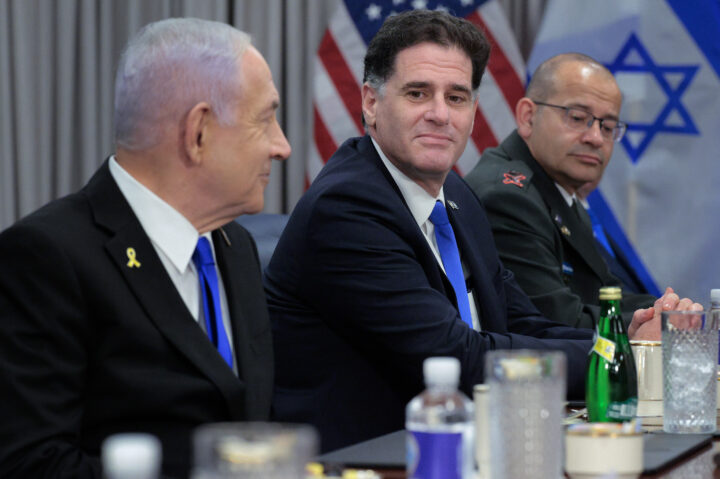
Chip Somodevilla/Getty Images
Israeli Prime Minister Benjamin Netanyahu (L) is joined by Israeli Minister of Strategic Affairs Ron Dermer and other officials for a meeting with U.S. Secretary of Defense Pete Hegseth at the Pentagon on July 09, 2025 in Arlington, Virginia.
When Israel and the U.S. launched their first strikes on Iran, Ron Dermer was in Australia, about as far as one could get from the Israeli Prime Minister’s Office in Jerusalem or the Defense Ministry in Tel Aviv. He soon found himself, like many other Israelis wanting to get home from abroad, on a plane to Taba, Egypt, from which point he would cross back into Israel, where airspace remains restricted.
Since November, when he resigned from his official post as strategic affairs minister, Dermer has spent most of his time traveling for speaking engagements. But now, two sources with knowledge of the matter confirmed to Jewish Insider, Dermer is back again in public service.
He may not have an official title, but he is doing what he has done for the previous three years — serving as Israeli Prime Minister Benjamin Netanyahu’s closest and most trusted advisor. Israel’s Walla News quoted a source in the Prime Minister’s Office who said Dermer was reporting for “reserve duty,” like over 100,000 other Israelis since the outset of the war with Iran.
Netanyahu and Dermer’s relationship has been so close for the past 26 years that Dermer has been called the prime minister’s third son and nicknamed “Bibi’s brain.” With a very small inner circle and few advisors whom he truly trusts, Netanyahu views Dermer as a critical asset to his team at a time when the U.S. and Israel are making decisions that will determine the future of the Middle East for years to come.
Dermer is also known as having a good relationship with the Trump administration, and has reportedly been taking part in Netanyahu’s nightly calls with President Donald Trump.
Those relationships have served Dermer well. When Trump presented his 20-point plan to end the war in Gaza last September, he repeatedly said, “Right, Ron?” addressing his remarks to Dermer, who was sitting in the front row.
Trump and Netanyahu have been remarkably in sync since the war began on Feb. 28. But some cracks are beginning to show: After the IDF bombed an Iranian fuel depot earlier this week, Trump administration sources leaked that they thought Israel went too far.
Trump has sent mixed messages about the expected duration of the war, saying on Monday that it is “very complete,” but also “could go further,” while Netanyahu said on Saturday night, “We are continuing with full force.”
Dermer may well be the point person tasked to smooth over the differences that are likely to come up between the leaders. Netanyahu is counting on it.
The retiring New Jersey congresswoman clashed with Cohen in 2019 after she voted against a resolution opposing the BDS movement
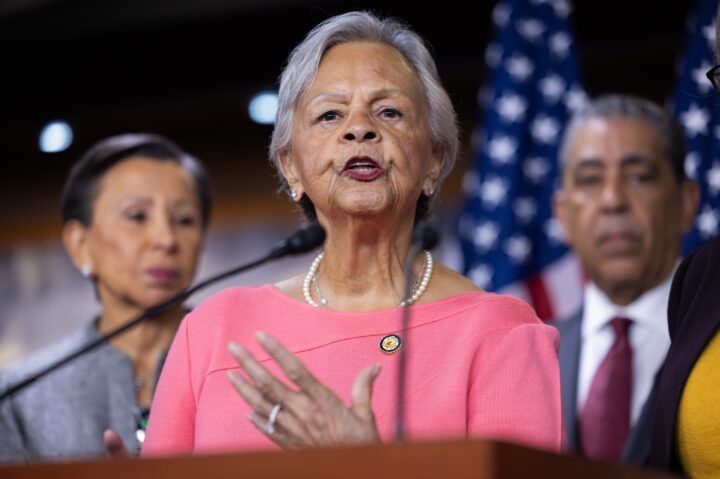
Nathan Posner/Anadolu via Getty Images
Rep. Bonnie Watson Coleman (D-NJ) speaks at a press conference with other House Democrats on articles of impeachment against Homeland Security Secretary Kristi Noem, in Washington, DC on January 14, 2026.
Rep. Bonnie Watson Coleman (D-NJ) urged voters in her district not to vote for East Brunswick Mayor Brad Cohen, one of the 17 candidates running to replace her, accusing him of being a “hardline supporter” of Israeli Prime Minister Benjamin Netanyahu.
Cohen, the top fundraiser in the field, was singled out for criticism by Watson Coleman, who declined to endorse a candidate in the 12th Congressional District primary, according to the New Jersey Globe.
“He’s a hardline supporter of Netanyahu, who is a despot, a corrupt leader,” Watson Coleman, a longtime critic of Israel, told the news outlet.
Cohen currently holds a substantial fundraising lead in the race to replace Watson Coleman, with $279,000 raised and $263,000 cash on hand as of the end of 2025.
Cohen told the Globe that Watson Coleman’s characterization of him is false, and that he disagrees with certain actions of the Israeli government.
“I have a lot of respect for Congresswoman Watson Coleman. She spent her first Passover at my house when she became a congresswoman, so our history goes back a long time,” Cohen said. “On most issues, we’re completely on the same page. But I think she’s mischaracterizing me when she calls me a hardliner.”
He did not respond to a request for comment from Jewish Insider.
Cohen is a prominent figure in the local Jewish community and a self-described AIPAC member, who also testified in support of legislation codifying the International Holocaust Remembrance Alliance’s working definition of antisemitism in the state legislature and pushed back against efforts to adopt a ceasefire resolution in the East Brunswick town council, according to the Jewish Link, a regional Jewish news outlet.
He and Watson Coleman clashed in 2019 after she voted against a resolution opposing the Boycott, Divestment and Sanctions movement targeting Israel, though he defended her from accusations of antisemitism a year later.
Cohen urged the East Brunswick public school district to investigate whether an antisemitic hate crime had occurred in 2024 when a picture of a Jewish student group was erased from the high school yearbook and replaced with a picture of Muslim students.
During a visit to Israel in 2022, Cohen signed a sister city agreement between East Brunswick and Yavne, Israel.
Other notable candidates in the race include Sue Altman, the former state director for Sen. Andy Kim (D-NJ), a progressive activist who ran for Congress on a pro-Israel platform in 2024 in a neighboring district, and Adam Hamawy.
Hamawy is a physician and veteran who gained prominence as a vocal critic of Israel after he volunteered as a doctor in Gaza in 2024. He’s endorsed by Sen. Tammy Duckworth (D-IL), whose life he saved after her helicopter was shot down in Iraq, and he was Watson Coleman’s guest to President Donald Trump’s address to Congress in 2024.
Watson Coleman praised five of the 17 candidates in the race, including Altman and Hamawy, as “hardworking, good people,” but said she would otherwise not “[put] my finger on this in any way, shape, or form.”
Cohen has already faced antisemitic attacks during his congressional campaign, including an Instagram page dedicated to attacking him that portrays him with devil horns and drinking blood, and derisively characterizes him as “Israel first” and a “Zionist … destroying usa.”
Departing from Washington, the Israeli PM said he stressed to Trump that if any deal is reached, it must go beyond the nuclear issue

Lahav Harkov
Israeli Prime Minister Benjamin Netanyahu departs Joint Base Andrews on Feb. 12, 2026.
Israeli Prime Minister Benjamin Netanyahu again voiced skepticism about the U.S.’ ability to reach an agreement with Iran as he departed Joint Base Andrews on Thursday, a day after his White House meeting with President Donald Trump.
Netanyahu said that his nearly three-hour meeting with Trump “mostly focused on the negotiations with Iran.”
“The president thinks the Iranians understand who they’re dealing with,” Netanyahu said. “He thinks the conditions he is setting, combined with their understanding that they made a mistake last time not reaching a deal, could bring them to agree to conditions that will allow a good deal to be reached.”
The prime minister’s view was more reserved: “I do not hide my general skepticism about the possibility of any deal with Iran.”
Netanyahu said he told Trump that if a deal is indeed reached, “it must include the components that are important to us, the State of Israel, and, I think, the entire international community: not just the nuclear matter, but also ballistic missiles and Iranian proxies in the region.”
After Wednesday’s White House meeting, the Prime Minister’s Office stated that the leaders discussed Iran and Gaza, and that Netanyahu “emphasized the security needs of the State of Israel in the context of the negotiations, and the two leaders agreed on continued coordination and the close contact between them.”
Trump posted on Truth Social that he “insisted that negotiations with Iran continue to see whether or not a Deal can be consummated. If it can, I let the Prime Minister know that will be a preference. If it cannot, we will just have to see what the outcome will be.”
The president warned that last time Tehran did not make a deal, the U.S. launched Operation Midnight Hammer, striking Iran’s nuclear sites.
The Prime Minister’s Office said Netanyahu will not be returning to Washington next week as he had been scheduled to, in order to speak at an AIPAC conference, and will instead appear virtually.
As he departed Washington a day after his meeting with Trump, Netanyahu voiced skepticism about the U.S.’ ability to reach an agreement with Iran.
— Jewish Insider (@J_Insider) February 12, 2026
“The president thinks the Iranians understand who they’re dealing with,” Netanyahu said from Joint Base Andrews. “He thinks the… pic.twitter.com/A1AsiDYZCe
The two leaders avoided the cameras during Israeli PM’s White House visit
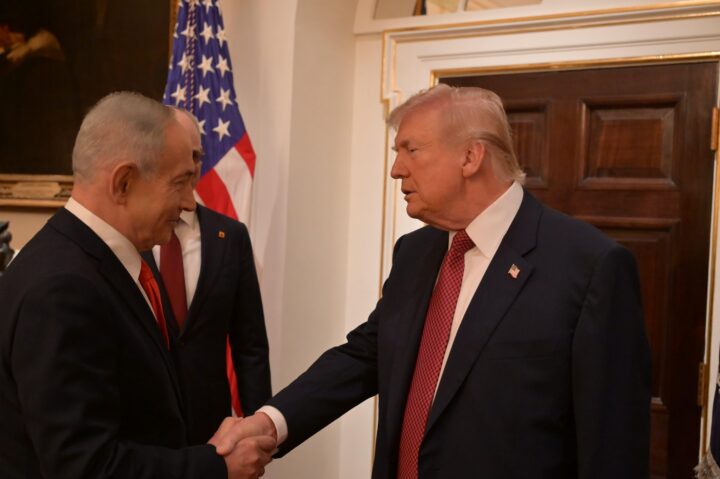
GPO
President Donald Trump greets Israeli Prime Minister Benjamin Netanyahu at the White House on Feb. 11, 2026.
The U.S. will continue pursuing diplomacy with Iran, President Donald Trump said following his White House meeting with Israeli Prime Minister Benjamin Netanyahu on Wednesday.
“There was nothing definitive reached other than I insisted that negotiations with Iran continue, to see whether or not a deal can be consummated,” Trump wrote on Truth Social. “If it can, I let the Prime Minister know that will be a preference.”
If negotiations do not lead to a deal, the president added, “we will just have to see what the outcome will be. Last time, Iran decided they were better off not making a deal, and they were hit with Midnight Hammer. That did not work out well for them. Hopefully, this time, they will be more reasonable and responsible.”
In addition, Trump wrote, he and Netanyahu discussed “the tremendous progress being made in Gaza.”
Trump characterized the summit as “a very good meeting, the tremendous relationship between our two countries continues.”
Netanyahu’s office said he and Trump discussed Iran, Gaza and regional developments.
“The prime minister stood up for the State of Israel’s security needs in the context of the negotiations, and the two agreed to continue to coordinate closely,” the Prime Minister’s Office statement read.
Netanyahu made a quiet entrance to the White House, and Trump was uncharacteristically camera-shy.
Trump and Netanyahu’s meetings — this was their seventh in the past year — have usually been accompanied by freewheeling press huddles, either in the Oval Office or East Room, in which Trump answered dozens of questions. On Wednesday, however, reporters were not allowed in the room before or after the meeting, which continued longer than scheduled and included lunch.
At the top of the meeting’s agenda were the details of the ongoing negotiations with Iran. The American team is led by White House Special Envoy Steve Witkoff and Jared Kushner, both of whom met with Netanyahu at Blair House on Tuesday.
On Tuesday, Trump said on Fox Business that the Iranians “want to make a deal. I think they’d be foolish if they didn’t. We took out their nuclear power last time, and we’ll have to see if we take out more this time.”
Trump added that a “good deal” would mean “no nuclear weapons, no ballistic missiles, no this or that.”
That statement checks off the most important items on Netanyahu’s priority list for an Iran deal, while leaving out the Islamic Republic’s sponsorship of terrorist proxies like Hezbollah and Hamas. It also does not include any aid to the Iranian protesters against the regime, whom Trump said late last year that he would help.
A source on Netanyahu’s delegation said that the prime minister is aware of the American political sensitivities around their meeting and was cautious to show deference to Trump, lest Netanyahu be seen as trying to push for war.
Iranian Foreign Minister Abbas Araghchi, however, said in an interview that his country’s ballistic missile program is “never negotiable.”
Qatari Emir Sheikh Tamim bin Hamad Al Thani called Trump ahead of his meeting with Netanyahu to encourage him to reach a deal, according to Qatari media.
Netanyahu met with Secretary of State Marco Rubio ahead of the Trump meeting, for discussions focused on the administration’s plans for Gaza.
Netanyahu presented Rubio with signed letters certifying his membership in the Board of Peace, which Trump founded to oversee reconstruction and demilitarization in Gaza and attempt to resolve other conflicts.
The Board of Peace’s first meeting is next week, and Netanyahu’s office has yet to say whether he will attend. The prime minister was expected to come back to Washington from Feb. 18-22 for an AIPAC conference beginning that Sunday, and his office said the trip is still on schedule.
Plus, the stakes of Bibi's upcoming White House visit
Rob Kim/Getty Images for Fanatics
Michael Rubin and Nasser Al-Khelaifi attend Fanatics Fest NYC 2025 at Javits Center on June 22, 2025 in New York City.
👋 Good Monday morning!
In today’s Daily Kickoff, we preview Israeli Prime Minister Benjamin Netanyahu’s trip to Washington this week following the White House’s talks with Iran on Friday, and have the exclusive on a new report from the North American Values Institute on antisemitism in K-12 schools. We report on Hamas leader Khaled Mashaal’s praise for the Oct. 7 attacks at the Al Jazeera Forum in Doha, Qatar, over the weekend, as Fanatics CEO Michael Rubin hosted his annual Super Bowl lunch that was attended by a senior Qatari official. Also in today’s Daily Kickoff: Rep. Alexandria Ocasio-Cortez, Yakir Gabay and Narges Mohammadi.
Today’s Daily Kickoff was curated by JI Executive Editor Melissa Weiss and Israel Editor Tamara Zieve, with assists from Danielle Cohen-Kanik and Marc Rod. Have a tip? Email us here.
What We’re Watching
- Vice President JD Vance is traveling to Armenia today as part of a two-country trip that will also include a stop in Azerbaijan later this week, in a last-minute trip first reported yesterday. Vance will not be in Washington during Israeli Prime Minister Benjamin Netanyahu’s visit to the White House, slated for Wednesday.
- Former Israeli hostage and musician Alon Ohel will play a one-night concert in Tel Aviv this evening. In videos shared by his loved ones during his more than two years in captivity, Ohel deftly played the piano, drawing widespread praise for his talent. He’ll be performing alongside a number of high-profile Israeli musicians, including Idan Amedi and Eviatar Banai for the performance, titled “Alon Ohel, Playing for Life.”
- The Religious Liberty Commission is holding its fifth hearing on issues related to antisemitism today at the Museum of the Bible. Speakers at the gathering, which begins this morning and runs through the mid-afternoon, include the Justice Department’s Leo Terrell, former Auburn men’s basketball coach Bruce Pearl and former U.S. Ambassador for Religious Freedom Sam Brownback.
Prince William is making his first official visit to Saudi Arabia this week. The trip comes as Riyadh hosts the World Defense Show, and as the U.K. works to establish Saudi Arabia as a partner in its next-generation Tempest fighter aircraft program. - Somali Defense Minister Ahmed Moallim Fiqi is also in Riyadh, where earlier in the day he inked a new defense cooperation agreement with Saudi Defense Minister Prince Khalid bin Salman. The Saudi official had met with Jewish leaders in Washington last month, during which he reiterated Riyadh’s opposition to Israel’s recent recognition of Somaliland.
What You Should Know
A QUICK WORD WITH JI’S LAHAV HARKOV
Israeli Prime Minister Benjamin Netanyahu plans to fly to Washington for a Wednesday White House meeting amid increasing concern in Jerusalem that the U.S. and Iran are headed towards a nuclear deal that does not meet Israel’s immediate security need — to drastically limit Iran’s ballistic missile program.
After the first round of indirect negotiations in Oman on Friday, President Donald Trump told reporters on Air Force One that talks had been “very good” and that “Iran looks like it wants to make a deal very badly.”
Asked about Iran’s demand that the talks only be about nuclear weapons, Trump said, “That would be acceptable. One thing, right up front, no nuclear weapons. … They weren’t willing to do that [last year]; now they are willing to do much more.” That message contrasted with Secretary of State Marco Rubio’s remarks from last week, that “in order for talks to actually lead to something meaningful, they will have to include certain things, and that includes the range of their ballistic missiles, that includes the sponsorship of terrorist organizations across the region, that includes the nuclear program and that includes the treatment of their own people.”
Netanyahu announced the urgent meeting with Trump, less than two months after they last met at Mar-a-Lago, with a statement that said: “The Prime Minister believes any negotiations must include limitations on ballistic missiles and a halting of the support for the Iranian axis.”
For Israel, while the Iranian nuclear program may be the biggest threat, Operation Midnight Hammer did enough damage that the ballistic missiles are the more urgent concern, one that Iran has been threatening to use against Israel if the U.S. launches an attack.
Though Israel destroyed hundreds of missiles, launchers and production sites during the 12-Day war last June, most of Iran’s missiles remained intact. The prime minister presented the president with evidence during their December meeting that Iran has been working to rebuild its ballistic missile program and air defenses with help from China and Russia.
Any deal that does not include significant limitations on the range of Iran’s ballistic missiles will be woefully inadequate from Israel’s perspective. Plus, as Netanyahu’s office said on Saturday, Israel wants a deal that addresses Iran’s sponsorship of terrorist proxies like Hamas and Hezbollah.
Sen. Lindsey Graham (R-SC) expressed skepticism that the negotiations would bring about an acceptable agreement and noted the legal requirement to bring any such deal before Congress, writing on X: “I hope it can meet our national security objectives and the needs of the people of Iran through diplomacy. Given Iran’s behavior regarding deals, it could be a tough sell. However, I am open-minded, understanding [that] any agreement with the Islamic Republic and the United States must come to Congress for review and a vote.”
FROM CENTER STAGE
In Qatar, Hamas leader Khaled Mashaal headlines Al Jazeera Forum focused on defaming Israel
Hamas leader Khaled Mashaal addressed Qatar’s 17th Al Jazeera Forum on Sunday in Doha, at a conference that focused heavily on denigrating Israel, while featuring senior officials from Iran and Somalia. Mashaal applauded the group’s Oct. 7, 2023, attacks on Israel as having “brought the Palestinian cause back to the forefront of the world” and said that Palestinians “take pride” in “resistance,” a euphemism for violence against Israelis. He called to “pursue Israel and establish that it is a pariah entity that is losing its international legitimacy,” noting the “changes in the elites, universities and social networks” against Israel, Jewish Insider’s Lahav Harkov reports.
Peak promotion: The Hamas leader, who resides in Doha, also hailed Qatar’s “honorable role in the [Palestinian] cause.” Hamas is designated by the U.S., European Union and other countries as a terrorist organization, and Mashaal is wanted in the U.S. for terrorism, murder conspiracy and sanctions evasion relating to his role in planning the Oct. 7 attacks. Mashaal was listed on the conference’s program and list of speakers in versions of the Al Jazeera Forum website archived by independent researcher Eitan Fischberger, but as of Sunday, Mashaal was no longer listed. At the same time, the Al Jazeera Forum X account extensively promoted Mashaal, with 19 posts about the terror leader’s remarks. The account featured two posts about conference keynote speaker Abbas Araghchi, the foreign minister of Iran.
Elsewhere at the Forum: Another speaker was Francesca Albanese, the U.N. special rapporteur who has been sanctioned by the U.S. for “infringement on the sovereignty” of Israel and the U.S. by pursuing International Criminal Court prosecutions of citizens of both countries, as Secretary of State Marco Rubio described her actions last year. Albanese claimed in her remarks, delivered via video, that Israel had committed a premeditated genocide of Palestinians in Gaza, and that all of humanity “now has a common enemy” in Israel.
DOHA DISSONANCE
As speakers in Doha brand Israel as humanity’s ‘common enemy,’ Michael Rubin hosts Qatari minister at Super Bowl lunch

As the Al Jazeera Forum took place in Doha, Qatari minister Nasser Al-Khelaifi was being feted by Fanatics CEO Michael Rubin at another high-profile convening — Super Bowl weekend, taking place in Santa Clara, Calif. Al-Khelaifi is the chairman of Qatar Sports Investments (QSI), one of the Qatari sovereign wealth funds that invests heavily in international sports and entertainment. Among his other titles, Al-Khelaifi is also a board member of the Qatar Investment Authority, a minister of state and the president of the Paris Saint-Germain Football Club in France and the Qatar Tennis Foundation.
Flourishing friendship: Rubin posted a picture with Al-Khelaifi from his annual Super Bowl luncheon on Instagram with the caption, “Incredible lunch with amazing people across sports, business, and culture.” Rubin and Al-Khelaifi have developed a friendship in recent years, including a long-term partnership between Fanatics and Paris Saint-Germain. Rubin posted a photo with Al-Khelaifi at the F1 Qatar Grand Prix last November, where he called the Qatari minister his “brother” and said, “What you did for both the city of Paris and country of Qatar is truly amazing.”
STICKING BY THE STICKY NOTE
Amid criticism, Kraft’s anti-hate group defends Super Bowl ad against antisemitism

The Blue Square Alliance Against Hate’s widely watched Super Bowl ad last night designed to combat antisemitism instead sparked a heated divide within the Jewish community over the effectiveness of its message, Jewish Insider’s Haley Cohen reports. Titled “Sticky Note,” the ad from New England Patriots owner Robert Kraft’s group featured a Jewish student being harassed by his high school classmates because of his religion, with bullies placing a “dirty Jew” sticker on his backpack. In a show of allyship, a Black classmate puts a blue square over the note. “Do not listen to that,” he tells his Jewish classmate. “I know how it feels.”
Target audience: A chorus of commentators criticized the advertisement, which is part of a $15 million media campaign that will also include ad spots during the Winter Olympics, for depicting Jews as victims in need of protection from non-Jews and for avoiding the reality that the source of many antisemitic incidents in schools stem from hostility toward or hatred of Israel. But the leader of Kraft’s group told JI that the ad wasn’t trying to appeal to a Jewish audience. Instead, Blue Square Alliance President Adam Katz told JI that with more than 100 million viewers, the Super Bowl provides an opportunity to reach an audience that is “unengaged — and in many cases uninformed — about antisemitism … We’re very focused on this audience that’s lacking awareness, empathy and motivation to act,” he said.
MEJIA MOMENTUM
Will Democrats rally behind progressive socialist Mejia as she vies to represent wealthy N.J. district?

With progressive activist Analilia Mejia’s expected victory in the special election Democratic primary in New Jersey’s 11th Congressional District, attention is now turning to the upcoming April special election and the June regular election primary as the last chances for moderates and pro-Israel groups to defeat her, Jewish Insider’s Marc Rod reports.
Looking ahead: “June is potentially irresistible for the other candidates who ran … if any of these candidates could get a one-on-one shot at making it in June,” Micah Rasmussen, the director of the Rebovich Institute for New Jersey Politics at Rider University, said. But unless the field can consolidate, Rasmussen said, it’s hard to see how the result would be any different in June. He said former Rep. Tom Malinowski (D-NJ), who closely trails Mejia, would have the strongest shot at defeating her head-to-head, while former Lt. Gov. Tahesha Way might have a tougher battle.
UDP’s outlook: “The outcome in NJ-11 was an anticipated possibility, and our focus remains on who will serve the next full term in Congress,” UDP spokesperson Patrick Dorton said in a statement on Friday. “UDP will be closely monitoring dozens of primary races, including the June NJ-11 primary, to help ensure pro-Israel candidates are elected to Congress.”
EXCLUSIVE
New report warns about the rise of activists smuggling in antisemitic content in K-12 schools

Political activists seeking to push extremist perspectives into the classroom are behind a nationwide acceleration of antisemitic content in K-12 classrooms, with increasingly active movements targeting school boards, district leadership and teacher organizations, according to a report published Monday by the North American Values Institute, Jewish Insider’s Haley Cohen reports.
Findings: The group’s 58-page report, “When the Classroom Turns Hostile: A Strategic Response to Extremism and Antisemitism in K-12 Education,” shared exclusively with JI, found that in the aftermath of the Oct. 7, 2023, Hamas terrorist attacks in Israel, what it described as radical ideological frameworks have dominated key education institutions across the country. Ideologies such as “oppressor-oppressed” are common in schools of education, accreditation bodies, teacher unions and district bureaucracies, all of which shape classroom materials.
MENTORSHIP MOVES
AOC under Matt Duss’ foreign policy tutelage as she makes 2028 moves

Rep. Alexandria Ocasio-Cortez (D-NY) has been receiving briefings from Matt Duss, an outspoken critic of the U.S.-Israel alliance and former foreign policy advisor to Sen. Bernie Sanders (I-VT), as she prepares for a high-profile appearance at the Munich Security Conference this week, The New York Times reported on Friday. Duss, who is now executive vice president at the Center for International Policy, a left-wing think tank, has long been a prominent detractor of U.S. relations with Israel, Jewish Insider’s Matthew Kassel reports.
Duss’ record: He has called for blocking aid to Israel and has expressed opposition to renewing the 10-year memorandum of understanding, which is set to expire in 2028 and currently provides $3.8 billion in military funding to Israel annually. He has also cast doubt on the Abraham Accords, accusing the normalization agreements between Israel and several Arab countries of using “racist logic” that is “premised on the perpetual repression of Palestinians” and helping to fuel Hamas’ Oct. 7, 2023, terror attacks. Duss has frequently called Israel’s resulting war in Gaza a genocide. “I don’t think a Democrat can be nominated in ‘28 without acknowledging that it is a genocide,” Duss suggested in an interview with The Financial Times last September.
Worthy Reads
Baker’s Recipe: Politico’s Diana Nerozzi and Ian Ward profile the Trump administration’s Andy Baker, whose “fingerprints are evident on some of the Trump administration’s most norm-shattering postures,” including Vice President JD Vance’s address at last year’s Munich Security Conference and the White House’s National Security Strategy. “Behind the scenes, the seldom-pictured and extremely private deputy national security adviser has emerged as a key figure in Vance’s orbit, shaping both the vice president’s foreign policy thinking and some of the White House’s most consequential national security decisions — especially its increasingly confrontational stance toward America’s allies in Europe. … With Vance emerging as a leading candidate to secure the 2028 Republican nomination, Baker, a self-described ‘realist’ who is skeptical of traditional American alliances and U.S. military intervention abroad, is expected to play an even more important role in shaping the future of the GOP’s foreign policy.” [Politico]
Harassed at Haverford: In The Free Press, Haviv Rettig Gur recounts his recent experience as a guest speaker at Haverford College, where his talk was disrupted by anti-Israel student protesters. “It was the strangest thing: The more I treated them like neglected children hungry for knowledge, the more likely they were to respond in healthy and productive ways. I didn’t meet violent illiberal radicals that evening at Haverford; I met children playing at violent illiberal radicalism. I met young people starved for wisdom and authority who had been told that their every emotional kink and outburst was valid and unassailable truth. … In the end, we managed to have an honest exchange of ideas, but it felt as though we had to buck everything their campus culture had taught them in order to reach that point. I met a real hunger for depth and understanding among young people who’d been told in a hundred different ways that their unexamined emotions were wisdom enough.” [FreePress]
The Two Elites: The Financial Times’ Janan Ganesh observes the “fatally interlocking” relationship between the private and public elite, against the backdrop of the resignation of former U.K. Ambassador to the U.S. Peter Mandelson over his ties to Jeffrey Epstein. “Most people do not find money — or the main ways of making money, such as banking — intrinsically interesting. This might be less true in societies that are new to wealth. But it holds in the established western cities. There, the self-made often discover too late that all their work and risk-taking has brought them less social status than expected. A minor magazine editor outranks them at a party. A hand-to-mouth actor is more welcome at Soho House. A bureaucrat can affect their business. Most rich people don’t mind. Even those who do tend to react maturely, perhaps sponsoring the arts for some reflected glory or buying a media outlet. But some will cross the line in seeking to be near the beau monde. Which consists of whom? Artists, intellectuals, politicians, even the occasional journalist: the public rather than private 1 per cent. Their value in social settings is high. Their income might not be.” [FT]
Word on the Street
The Pentagon is cutting its graduate-level programmatic and fellowship partnerships with Harvard, alleging that the school is imparting “globalist and radical ideologies” amid ongoing tensions between the school and the Trump administration…
NYPD Commissioner Jessica Tisch named Cardinal Timothy Dolan and the Rev. A.R. Bernard co-heads of the department’s chaplaincy unit, where they will jointly oversee a team of 10 chaplains; Dolan and Bernard, who respectively represent Catholic and Black churches, succeed Rabbi Alvin Kass, who died last year after six decades with the NYPD…
The New York Times looks at how conspiracy theories about the U.S.S. Liberty incident, in which Israel mistakenly fired on a U.S. naval ship during the Six-Day War, are spreading in far-right circles and are being promoted by Tucker Carlson and Candace Owens…
The Washington Post profiles American Conservative editor Curt Mills as the “avatar of a new right” works to shape the future of a post-Trump Republican Party; the “the No. 1 item on Mills’s agenda,” the Post reports, “is pushing back against Trump on U.S. support for Israel’s retaliation against Hamas after the attacks on Oct. 7, 2023, and agitating for a hard turn away from America’s 80-year bond with the Jewish state”…
The New York Times reviews Allegra Goodman’s This Is Not About Us, a collection of short but intertwined stories about generations of a fictional large Jewish family…
Israeli Olympic bobsled captain AJ Edelman said the apartment where the Israeli team had been staying in Milan ahead of the Olympic Games had been robbed; among the items taken, Edelman said, were thousands of dollars in cash as well as some of the team’s passports…
The Australian state of Queensland introduced a series of hate speech reforms that include the banning of the public use of such slogans as “globalize the intifada” and “from the river to the sea”; the move was undertaken in response to the December terror attack on a Hanukkah celebration at Sydney’s Bondi Beach…
Israeli President Isaac Herzog and First Lady Michal Herzog visited the site of the Bondi attack earlier today as part of a four-day visit to the country that will also include stops in Melbourne and Canberra…
Israeli carrier El Al was fined $39 million by the country’s Competition Authority over its price-gauging of tickets after the Oct. 7, 2023, Hamas terror attacks and through May 2024, finding that El Al raised prices on routes — a majority of which were only being served by the airline due to security concerns that resulted in widespread route suspensions — by between 16-31%…
Ynet profiles Israeli real estate investor Yakir Gabay, who was named to the executive board of the Trump administration’s Board of Peace…
The families of Druze children killed in a Hezbollah strike on a soccer field in the Israeli town of Majdal Shams in July 2024 are suing the terror organization for 80 million shekels ($25 million); 12 children were killed and dozens injured in the attack…
Israel’s Security Cabinet approved a series of measures that will allow Israeli authorities to exert more control in the West Bank, with far-right Finance Minister Bezalel Smotrich, who backed the expansion, saying, “we will continue to bury the idea of a Palestinian state”…
Iran sentenced activist Narges Mohammadi, who had been imprisoned since her arrest in December and had begun a hunger strike, to seven years in prison…
The new sentence against Mohammadi comes as Iranian security forces arrested four senior politicians affiliated with the country’s reformist parties…
Israeli music icon Matti Caspi died at 76…
Pic of the Day

Attendees of the International Conference of Shluchot in Brooklyn, N.Y., posed for the annual “class photo” outside the Chabad-Lubavitch world headquarters over the weekend. Some 4,500 women representing more than 100 countries traveled to New York for the annual gathering.
Birthdays
Sports announcer for NBA, NFL and college basketball games on CBS, TNT and TBS, as well as Brooklyn Nets games on the YES Network, Ian Eagle turns 57…
Grammy Award-winning songwriter of over 150 hits including “Somewhere Out There” from the movie “An American Tail,” in partnership with his late wife Cynthia Weil, Barry Mann (born Barry Imberman) turns 87… Singer-songwriter, she wrote 118 songs that made it to the Top 100 between 1955 and 1999 and was inducted into the Songwriters Hall of Fame and the Rock & Roll Hall of Fame, Carole King (born Carol Klein) turns 84… Professor of economics at Columbia University, Nobel laureate in 2001, former SVP and chief economist of the World Bank, Joseph Stiglitz turns 83… Three-time Tony Award and three-time Emmy Award-winning actress, Judith Light turns 77… Professor of history and modern Jewish studies at UCSD, Deborah Hertz turns 77… Israeli singer mostly in the Mizrahi music tradition, he has released over 30 albums, Shimi Tavori (born Shimshon Tawili) turns 73… Former governor of Virginia, chair of the DNC, chair of two Clinton presidential campaigns (Bill’s in 1996, Hillary’s in 2008), Terry McAuliffe, a/k/a “the Macker,” turns 69… Creator of the HBO series “The Wire” (2002-2008) and NBC’s series “Homicide: Life on the Street” (1993-1999), winner of a 2010 MacArthur genius fellowship, David Simon turns 66… Theoretical physics professor at Columbia University since 1996, author of multiple books written for the general public such as Icarus at the Edge of Time, Brian Greene turns 63… Isaac Lieberman… Managing director with the Draper Richards Kaplan Foundation, he was the lieutenant governor and then attorney general of Delaware, Matthew P. Denn turns 60… Play-by-play announcer for ESPN’s men’s college basketball and for the Toronto Blue Jays, Dan Shulman turns 59… British broadcasting executive who is currently chief content officer at the U.K.’s Channel 4, Ian Katz turns 58… President of the K-12 education portfolio at the Charles and Lynn Schusterman Family Philanthropies, Julie Mikuta… Assistant adjunct professor of journalism at UCLA, she was a Pulitzer Prize-winning reporter for the Los Angeles Times for 16 years, Abigail Helaine “Abbe” Goldman turns 56… Managing director of AlTi Tiedemann Global, Jeffrey L. Zlot… Charleston, S.C., resident, Ellen Miriam Brandwein… Television and film actress, Margarita Levieva turns 46… Member of the Minnesota state Senate since 2011, Jeremy R. Miller turns 43… Senior director of public policy and strategy for Christians United for Israel Action Fund, Boris Zilberman… Director of development for Ben-Gurion University, Jason Pressberg… Member of the Pennsylvania House of Representatives (D-182) since 2023, Benjamin R. Waxman turns 41… Managing partner of Precision Infrastructure Management, Thomas Szold… Brazilian chess grandmaster, André Diamant turns 36… Associate director at Merck Research Laboratories, Carly Abenstein Myar… Israeli judoka, he competed for Israel at the 2020 and 2024 Summer Olympics, Baruch Shmailov turns 32… Offensive tackle for the NFL’s Carolina Panthers, Jake Curhan turns 28…
Any deal that does not include significant limitations on the range of Iran’s ballistic missiles will be woefully inadequate from Israel’s perspective
Joe Raedle/Getty Images
President Donald Trump shakes hands with Israeli Prime Minister Benjamin Netanyahu during a press conference at his Mar-a-Lago club on December 29, 2025 in Palm Beach, Florida.
Israeli Prime Minister Benjamin Netanyahu plans to fly to Washington for a Wednesday White House meeting amid increasing concern in Jerusalem that the U.S. and Iran are headed towards a nuclear deal that does not meet Israel’s immediate security need — to drastically limit Iran’s ballistic missile program.
After the first round of indirect negotiations in Oman on Friday, President Donald Trump told reporters on Air Force One that talks had been “very good” and that “Iran looks like it wants to make a deal very badly.”
Asked about Iran’s demand that the talks only be about nuclear weapons, Trump said, “That would be acceptable. One thing, right up front, no nuclear weapons. … They weren’t willing to do that [last year]; now they are willing to do much more.” That message contrasted with Secretary of State Marco Rubio’s remarks from last week, that “in order for talks to actually lead to something meaningful, they will have to include certain things, and that includes the range of their ballistic missiles, that includes the sponsorship of terrorist organizations across the region, that includes the nuclear program and that includes the treatment of their own people.”
Netanyahu announced the urgent meeting with Trump, less than two months after they last met at Mar-a-Lago, with a statement that said: “The Prime Minister believes any negotiations must include limitations on ballistic missiles and a halting of the support for the Iranian axis.”
For Israel, while the Iranian nuclear program may be the biggest threat, Operation Midnight Hammer did enough damage that the ballistic missiles are the more urgent concern, one that Iran has been threatening to use against Israel if the U.S. launches an attack.
Though Israel destroyed hundreds of missiles, launchers and production sites during the 12-Day war last June, most of Iran’s missiles remained intact. The prime minister presented the president with evidence during their December meeting that Iran has been working to rebuild its ballistic missile program and air defenses with help from China and Russia.
Any deal that does not include significant limitations on the range of Iran’s ballistic missiles will be woefully inadequate from Israel’s perspective. Plus, as Netanyahu’s office said on Saturday, Israel wants a deal that addresses Iran’s sponsorship of terrorist proxies like Hamas and Hezbollah.
Trump said in December that he would give Israel a green light to strike Iran’s missile program – and a “fast” one if the Islamic Republic rebuilds its nuclear program. And a U.S. military threat still stands, with Trump telling reporters on Friday: “We have a big armada, a big fleet heading in that direction that will be there soon, so we’ll see how that works out. … If they don’t make a deal, the consequences are very steep.” The White House also announced on Friday new secondary sanctions on countries doing business with Iran, in the form of increased tariffs.
However, Trump also told reporters that he is in “no rush” to reach a deal. The president is less likely to green-light Israeli strikes while he still has Special Envoy Steve Witkoff negotiating with Iran. At the same time, nothing is stopping Iran from continuing to produce more medium- and long-range ballistic missiles in tandem with the talks.
Sen. Lindsey Graham (R-SC) expressed skepticism that the negotiations would bring about an acceptable agreement and noted the legal requirement to bring any such deal before Congress, writing on X: “I hope it can meet our national security objectives and the needs of the people of Iran through diplomacy. Given Iran’s behavior regarding deals, it could be a tough sell. However, I am open-minded, understanding [that] any agreement with the Islamic Republic and the United States must come to Congress for review and a vote.”
The Netanyahu-Trump meeting this week is politically tricky for both sides, as well. If Trump continues to pursue a nuclear-only deal that doesn’t meet Israel’s needs, while holding Israel back from striking Iran, the prime minister will look weak in an election year. If Trump continues to push the missiles and proxies issues, Tehran is even less likely to accept a deal and the U.S. and Iran may once again be brought to the brink of a military confrontation. That could lead to accusations that Trump is being unduly influenced by Netanyahu – though such claims from “kooky Tucker Carlson” and his ilk have not seemed to bother Trump much in similar past circumstances.
‘The Prime Minister believes any negotiations must include limitations on ballistic missiles and a halting of the support for the Iranian axis,’ Netanyahu’s office says

Avi Ohayon (GPO) / Handout/Anadolu via Getty Images
Israeli Prime Minister Benjamin Netanyahu makes statements at Ben Gurion Airport ahead of his visit to Washington DC, where he will meet with US President Donald Trump in Tel Aviv, Israel on February 02, 2025.
Israeli Prime Minister Benjamin Netanyahu’s office announced a last-minute trip to Washington on Wednesday to discuss talks between the U.S. and Iran, a day after President Donald Trump praised the negotiations with Tehran.
“The Prime Minister believes any negotiations must include limitations on ballistic missiles and a halting of the support for the Iranian axis,” the statement, sent Saturday night, read.
White House Special Envoy Steve Witkoff and Jared Kushner met with Iranian Foreign Minister Abbas Araghchi in Oman on Friday.
Later Friday, Trump told reporters on Air Force One that the talks had been “very good.”
“Iran looks like it wants to make a deal very badly,” he said. “We have to see what that deal is, but I think Iran wants to make a deal very badly, like they should. Last time, they didn’t want to make a deal, but I think this time they feel differently.”
Asked about Iran’s demand that the talks only be about nuclear weapons, Trump said, “That would be acceptable. One thing, right up front, no nuclear weapons. … They weren’t willing to do that [last year]; now they are willing to do much more.”
The president also said that he is in “no rush” in the negotiations, adding, “If you remember in Venezuela, we waited around for a while.”
Trump indicated that the military threat to Iran still stands: “We have a big armada, a big fleet heading in that direction that will be there soon, so we’ll see how that works out. … If they don’t make a deal, the consequences are very steep.”
Sen. Lindsey Graham (R-SC) expressed skepticism that the negotiations would bring about an acceptable agreement, and called for Congressional review and approval, which the 2015 Iran nuclear deal lacked.
“I hope it can meet our national security objectives and the needs of the people of Iran through diplomacy,” Graham wrote on X. “Given Iran’s behavior regarding deals, it could be a tough sell. However, I am open-minded, understanding [that] any agreement with the Islamic Republic and the United States must come to Congress for review and a vote.”
Meanwhile, in Iran, videos and photos were posted online of Iranians once again protesting the regime using methods other than mass demonstrations, The Wall Street Journal reported, including shouting slogans at funerals, doctors condemning the arrest of colleagues for treating wounded protesters, hosting memorials for wounded protesters and more.
The congressional candidate faced blowback from state Jewish leaders after flip-flopping on his genocide accusation, a word that he previously opted not to use

Yalonda M. James/San Francisco Chronicle via Getty Images
California state Sen. Scott Wiener (D-San Francisco) on Tuesday, November 18, 2025.
California state Sen. Scott Wiener announced on Thursday that he is stepping down from his role as one of the co-chairs of the California Legislative Jewish Caucus, capping off nearly two weeks of controversy and frustration among Jewish leaders in the state after the San Francisco Democrat declared Israel’s actions in Gaza to be a genocide.
Wiener said in a statement, which was obtained by Jewish Insider, that the decision was prompted in part by the fallout of his genocide comments.
“My campaign is accelerating, and my recent statements on Israel and Gaza have led to significant controversy in the Jewish community. The time to transition has arrived,” Wiener said. He will remain in the role until Feb. 15.
Wiener, who is running for Congress in a competitive Democratic primary to fill the seat being vacated by retiring Rep. Nancy Pelosi (D-CA), has long declared himself a progressive Zionist while also criticizing the government of Israeli Prime Minister Benjamin Netanyahu and Israel’s actions in Gaza.
But after a candidate forum this month where his two competitors were quick to say Israel has committed genocide in Gaza, Wiener faced pressure from his left to use the word himself, and released a video a few days later changing his stance.
“I’ve stopped short of calling it genocide, but I can’t anymore,” Wiener said. A coalition of local and statewide Jewish advocacy groups responded with a statement saying his position “is both incorrect and lacks moral clarity.”
Wiener said Thursday that the American Jewish community “is navigating an extremely difficult moment in time,” and called for more dialogue.
“As we move through this moment, it is even more important for Jews here and globally to foster open dialogue and acceptance of disagreement, even on the hardest of issues,” Wiener said. “Since I stated my view that the Netanyahu government committed a genocide in Gaza, I have had many in-depth conversations with members of the Jewish community with a range of perspectives. While many in the community strongly disagree with my view, I am grateful for their willingness to engage with me and hear my perspective, showing once again the deep respect for difference in our community.”
In an interview with Politico this week, Wiener said he had avoided using the word “genocide” until now because of the harm and hurt it would cause the Jewish community.
“Until now, I have not used the word genocide really for two reasons: First of all, it is an extremely sensitive issue in the Jewish community,” Wiener said. “And [second] particularly because the word genocide has been weaponized against Israel and against Jews for a long time. There are people who think Israel’s mere existence is genocide.”
He said he’s heard from Jewish voters and leaders in the days since who are unhappy with his statement, but asked them to remember his record.
“If you’re mad at me, if you feel betrayed, I respect and honor that. But just also remember how many times I’ve gone to the mat for this community, and the bullets I’ve taken for this community,” Wiener said.
A Trump administration source characterized Netanyahu's statement to JI as a minor issue that would likely be smoothed out within days
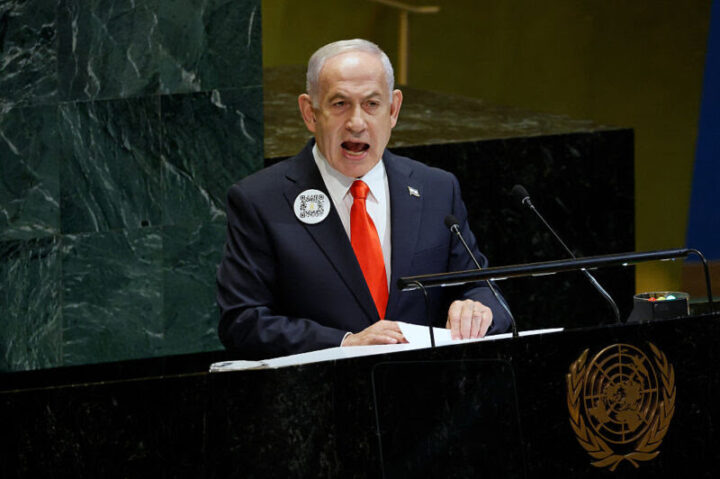
Taylor Hill/Getty Images
Prime Minister of Israel Benjamin Netanyahu speaks during the 80th session of the UN’s General Assembly (UNGA) at the United Nations headquarters on September 26, 2025 in New York City.
Israeli Prime Minister Benjamin Netanyahu opposes the composition of the executive board meant to oversee the rebuilding of Gaza, his office said on Saturday.
“The announcement regarding the composition of the Gaza Executive Board, which is subordinate to the Board of Peace, was not coordinated with Israel and runs contrary to its policy,” the Prime Minister’s Office stated. “The Prime Minister has instructed the Foreign Affairs Minister to contact the U.S. Secretary of State on this matter.”
Netanyahu emphasized his objection in a speech to the Knesset on Monday, saying that “there will be no Turkish or Qatari soldiers in Gaza. We are currently in a dispute with the U.S. over the makeup of the advisory council for Gaza.”
Though Netanyahu said the board was not coordinated with Israel, he spoke with President Donald Trump twice in recent days, and Mossad Chief David Barnea met with White House Special Envoy Steve Witkoff on Friday. The calls and meetings were reportedly about Iran.
The White House announced on Friday that several committees to govern Gaza and oversee its reconstruction and administration had been formed, including the Gaza Executive Board.
The Gaza Executive Board is meant to support the office of the high representative for Gaza and the National Committee for the Administration of Gaza, which is made up of Palestinian technocrats. It includes Witkoff, Jared Kushner, former U.K. Prime Minister U.K. Tony Blair, Apollo Global Management CEO Marc Rowan, Israeli-Cypriot businessman Yakir Gabay, head of Egyptian intelligence General Hassan Rashad, UAE Minister for International Cooperation Reem Al-Hashimy, U.N. Special Coordinator for the Middle East Peace Process Sigrid Kaag, and the previous holder of that position, Nickolay Mladenov, who will serve as the high representative for Gaza.
The board also includes Turkish Foreign Minister Hakan Fidan and Qatari diplomat Ali Al-Thawadi. Israeli officials have previously spoken out against Turkish involvement in Gaza’s reconstruction. Qatar has funded Gaza reconstruction in the past, with significant funding and dual-use materials reaching Hamas; the terrorist group’s leaders have also resided in Doha.
A Trump administration source characterized Netanyahu’s statement to Jewish Insider as a minor issue that would likely be smoothed out within days.
The source noted that Turkish and Qatari representatives were key to negotiating the ceasefire in Gaza, which took effect in October, and that they call Witkoff and Kushner daily, and therefore have an influence on the process regardless of the titles they are given. He also added that Netanyahu has a direct line to Trump.
“It’s all based on whether Hamas demilitarizes or not,” he added. “If Hamas demilitarizes, that is what’s most important [above the composition of the board]. If Hamas doesn’t demilitarize, none of this matters. … The prime minister has a commitment from the president that Hamas will demilitarize.”
Israeli Opposition Leader Yair Lapid said that “Netanyahu is allowing Turkey and Qatar into Gaza. That endangers Israel’s security. That is not what our brave soldiers fought for for two years.
“Instead of releasing panicky statements of protest, Israel should offer a clear alternative, for Egypt to administer Gaza for the next 15 years, for Hamas to be disarmed, and work with American partners to strengthen Israel’s border,” Lapid added.
Israeli National Security Minister Itamar Ben-Gvir said that he supports Netanyahu’s “important message.”
“Gaza does not need an ‘executive board’ that will supervise its ‘rehabilitation,’ it needs to be cleaned of Hamas terrorists who should be destroyed, along with encouraging massive voluntary emigration, in accordance with President Trump’s original plan,” Ben-Gvir said. “I call on the prime minister to instruct the IDF to prepare to go back to war in Gaza using great force in order to achieve the central goal of the war, the destruction of Hamas.”
The White House also announced the members of the founding executive board of the Trump-chaired Board of Peace, whose purview is not limited to Gaza. Netanyahu told the Knesset on Monday that the board is meant to serve as an alternative to the United Nations, 66 of whose organizations the U.S. left earlier this month. The board is composed of Secretary of State Marc Rubio, Witkoff, Kushner, Blair, Rowan, World Bank President Ajay Banga and Deputy National Security Advisor Robert Gabriel.
Canadian Prime Minister Mark Carney and Argentinian President Javier Milei also accepted invitations from Trump to join the board, while Egyptian President Abdel Fattah al-Sissi and Turkish President Recep Tayyip Erdogan had yet to respond. French President Emmanuel Macron declined to join. Netanyahu was invited to join or send an Israeli representative, according to Ynet. Russian President Vladimir Putin was invited, as was President Alyaksandr Lukashenka of Belarus; Ukrainian President Volodymyr Zelensky received an invitation on Tuesday, Ukrainian Ambassador to Israel Yevgen Kornichuk told JI. China, Germany, Australia, Albania, Jordan, Egypt and Bahrain reportedly received invitations, as well.
Membership on the Board of Peace is for three years; Trump asked countries to pay $1 billion for a permanent seat, Bloomberg reported.
Trump appointed Aryeh Lightstone and Josh Gruenbaum, members of Witkoff’s team, to be special advisors to the Board of Peace, “leading day-to-day strategy and operations, and translating the Board’s mandate and diplomatic priorities into disciplined execution,” the White House stated.
Two sources told JI the president pushed back on Netanyahu’s claims about the prudence of Israel’s proposal to end U.S. military assistance over the next decade
Joe Raedle/Getty Images
President Donald Trump shakes hands with Israeli Prime Minister Benjamin Netanyahu during a press conference at his Mar-a-Lago club on December 29, 2025 in Palm Beach, Florida.
When Israeli Prime Minister Benjamin Netanyahu proposed winding down U.S. military aid late last year, President Donald Trump was bewildered and did not immediately support the move, two sources familiar with the matter told Jewish Insider.
Since then, Netanyahu has announced his intentions to move ahead with the plan anyway.
Netanyahu pitched the president on his proposal while visiting Trump at his Mar-a-Lago estate in Palm Beach, Fla., in late December, the Israeli prime minister told The Economist in an interview released on Friday. The idea was spearheaded by Ron Dermer, Israel’s former minister of strategic affairs and a top Netanyahu advisor, according to two sources familiar with the matter.
Dermer has defended the idea to U.S. lawmakers and other officials, arguing that such a move would improve the Jewish state’s embattled reputation in the United States, a claim that Netanyahu repeated to Trump. Since Dermer left government late last year, Israeli Ambassador to the U.S. Yechiel Leiter has become the point person on the matter, a source close to the prime minister told JI.
Netanyahu even suggested that Israel may not take or could return some of the military aid it is set to receive from the U.S. in 2027 and 2028 under the terms of the current memorandum of understanding, one source said.
Trump could not understand why Netanyahu would propose ending American military aid to Israel and disagrees that the move would improve U.S. public opinion on the Jewish state, one source familiar with the president’s perspective told JI. He is skeptical that the plan would benefit either country, but is also not dismissing it out of hand, they said.
Netanyahu departed Trump’s Palm Beach resort on New Year’s Day without having committed to going through with or abandoning the plan. He continued engaging with U.S. lawmakers about the idea in the week and a half that followed, two congressional sources familiar with the matter said, with Netanyahu ultimately announcing last week that the plan was “in the works.”
“We’ve come of age and we’ve developed incredible capacity,” Netanyahu told The Economist. “And our economy, which will reach, certainly within a decade, will reach about a trillion dollars — it’s not a huge economy, but it’s not a small economy. So I want to taper off military aid within the next 10 years.”
“And that’s not saying that I don’t want to fight for the allegiance and support of the American people — I do, you would have to be crazy not to,” he continued.
White House Deputy Press Secretary Anna Kelly told JI in a statement regarding the meeting that “Israel has had no better friend in its history than President Trump. The administration continues to work closely with our ally Israel to successfully implement the President’s 20 Point Plan for Peace and strengthen regional security in the Middle East. We do not detail the President’s private conversations — any announcements would come from the administration directly.”
The apparent disconnect between the Israeli and U.S. positions on aid comes as the next MOU is being negotiated between the two countries, with the current 10-year agreement coming to an end in 2028.
One source said they understand Trump to be supportive of continued aid, something the Israelis have miscalculated, because “the president sees the aid relationship as a bridge to potentially restoring American manufacturing; essentially, giving Israel money to invest in the American industrial base.”
Israel receives $3.3 billion annually from the U.S. under the current MOU in foreign military financing, which usually must be used to purchase American defense products and services. Israel is unique in that it is allowed to use a portion of its FMF for domestic procurement, a benefit that is set to be phased out by the MOU’s end in 2028.
The other $500 million that Israel receives annually under the MOU is earmarked for joint missile-defense programs, such as Iron Dome, David’s Sling and the Arrow systems, which is appropriated directly to the Department of Defense, similarly to other U.S.-Israel cooperative programs including anti-tunneling and drone initiatives. This method of funding, appropriated to the U.S. government rather than directly to Israel, could be expanded to replace FMF if it is wound down.
Likud lawmaker Amit Halevi, who has been the primary engine within the party pushing to phase out U.S. military aid, told JI that the model Israel has been presenting to the Trump administration and on Capitol Hill is this one of “joint projects and investments.”
While Netanyahu has not detailed what he thinks phasing out U.S. aid would entail, Halevi’s proposal involves shifting to jointly funded research and development projects in defense, cybersecurity and intelligence.
Halevi said that Netanyahu “has a list of things he wants to get done before the next election,” which is officially set for late October but could take place sooner, and that an “MOU that he sees as an achievement” is likely on that list.
The Likud MK has led multiple Knesset subcommittee meetings on the matter, in which representatives from Dermer’s office said they were seriously discussing changing the military aid model.
Halevi argued that Netanyahu’s remarks in The Economist interview are unique in that it is the first time the prime minister is saying he wants Israel to eventually receive no aid at all.
Two of Netanyahu’s spokespeople, however, said that Netanyahu’s position is not new, citing his comments to conservative commentator Ben Shapiro in October and Australian journalist Erin Molan in November. In both interviews, Netanyahu recounted that he phased out American financial aid to Israel in his first term in office in 1996, and that he intends to do the same for military aid.
“I am committed to making Israel as fully self-sufficient as possible,” Netanyahu told Shapiro. “We can transform our military defense industry, make a quantum jump to be able to be self-sufficient and to share with America the extraordinary developments that we have.”
Netanyahu also said in a Cabinet meeting in May that “we receive close to $4 billion for arms. I think we will have to wean ourselves off of American security aid.”
His spokespeople had no further comment when asked if anything had changed in light of Netanyahu’s meeting with Trump in December.
Last March, Leiter canceled a meeting with Halevi over his advocacy on the Hill against continuing aid. Weeks earlier, Leiter pulled out of a Heritage Foundation event due to the publication of a paper that called for the gradual elimination of U.S. aid to Israel.
Yet, in September, reflecting the shift in Israel’s position, Leiter told JI that “the nature of any MOU or collaborative effort is going to change,” and it may consist of “greater [joint] research and development between our two countries, rather than relying on American weapons.”
One American source familiar with the negotiations said, “The Israelis just have to come in and ask for what they need and stop trying to figure out what the U.S. wants to hear.”
‘Now that this decision has been made, I don't think we need to wait 10 years,’ Graham told JI
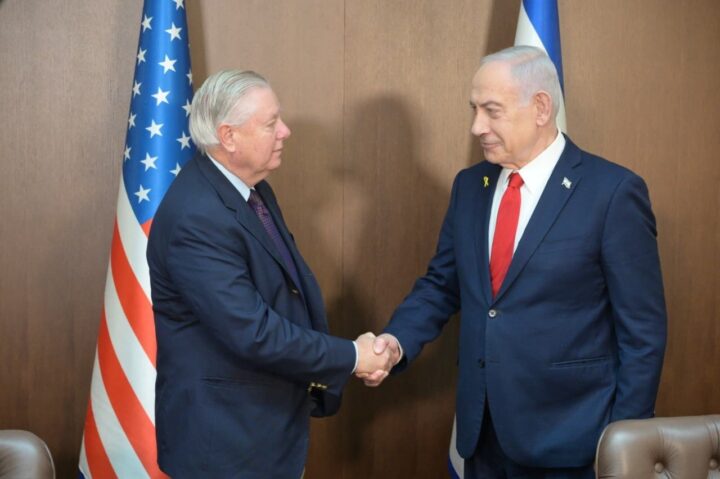
Amos Ben Gershom via Getty Images
Israeli Prime Minister Benjamin Netanyahu (R) meets with U.S. Senator Lindsey Graham (L) at the Israeli Prime Minister's Office in Jerusalem on December 21, 2025.
Following Israeli Prime Minister Benjamin Netanyahu’s announcement that Israel seeks to wean itself off of U.S. aid within next 10 years, Sen. Lindsey Graham (R-SC) told Jewish Insider he will push forward an effort to end U.S. aid more quickly — a major shift from one of Israel’s closest allies on Capitol Hill.
“From my point of view as an American, now that this decision has been made, I don’t think we need to wait 10 years,” Graham, who chairs the State, Foreign Operations and Related Programs (SFOPs) subcommittee of the Senate Appropriations Committee, said. “I’m going to work on expediting the wind down of the aid and recommend we plow the money back into our own military.”
The majority of direct U.S. military aid to Israel — $3.3 billion annually through the U.S.-Israel memorandum of understanding — comes through the SFOPs budget package. An additional $500 million in cooperative missile defense funding for co-produced systems is provided through the Defense funding tranche, along with funds for other cooperative programs.
The current MOU guaranteeing $3.8 billion per year expires in 2028.
Graham said that he wants to see the funding redirected into the U.S. military, in light of President Donald Trump’s plan, announced this week, to request $1.5 trillion for the Pentagon for 2027, a more than 50% increase over the 2025 budget.
“President Trump’s budget request of $1.5 trillion for [the] Department of War is a major increase, and every dollar we can recoup, from efficiency or allies who don’t need the money anymore, is welcome to go into building up our military,” Graham said. “Israel’s a great friend and a marvelous military, but we’re the only superpower in the world. America and the demands on us are at an all-time high because of the threats. The American military is the best in the world and in great demand. So what I think is best for America, now that Israel has made this decision, is to expedite this money, plowing it back into our own military needs.”
Netanyahu’s announcement came at a time of rising criticism of U.S. aid to Israel on both sides of the aisle.
But Graham argued that — if Israeli leaders believe that winding down U.S. aid will help rebuild support for the Jewish state among those who are critical of Israel — they are likely mistaken. He added that he’d communicated that view to Israeli leaders, but they pushed ahead anyway.
“From a political point of view, if people in Israel think this will get more support in America, I doubt it. I don’t think people who support Israel and understand its vital role object to the aid, which is a small fraction of our budget, and I don’t think you get any credit from people who think Israel is a liability by reducing our military assistance,” Graham said. “I made that position clear, but Israel is a sovereign nation, a great friend. I respect their decision.”
The South Carolina senator said that he “respect[s]” Netanyahu’s decision, adding “As an American, you’re always appreciating allies that can be more self-sufficient.”
Graham described the U.S. funding for Israel as a “great investment” for U.S. national security which has ultimately saved American taxpayer funding and filled capacities the U.S. would otherwise struggle to achieve.
“The investment we’ve made into the IDF has been a great investment for our national security. We have no better ally than Israel. The more capable they are, the safer America [is],” Graham said. “So I’ve always seen this money going to the IDF as investing in a very capable partner being able to do things that we can’t do at a fairly small price. It would be hard for America, if not impossible, to replicate some of the things the Israeli military and intelligence community can do because of location and expertise.”
Prime Minister Netanyahu said he told President Trump that Israel has ‘come of age’ and ‘developed incredible capacity’

Joshua Sukoff/Medill News Service
President Donald J. Trump holds a joint news conference at the White House with Israeli Prime Minister Benjamin Netanyahu on February 4, 2025.
Israeli Prime Minister Benjamin Netanyahu announced that Israel is seeking to end the military assistance it receives from the U.S. in the next 10 years, a move that he said is “in the works.”
In an interview with The Economist released Friday, Netanyahu said that during his December visit to President Donald Trump’s Mar-a-Lago resort in Palm Beach, Fla., he told Trump that Israel “very deeply appreciate[s] the military aid that America has given us over the years.”
But, he said, “we’ve come of age and we’ve developed incredible capacity. And our economy, which will reach, certainly within a decade, will reach about a trillion dollars — it’s not a huge economy, but it’s not a small economy. So I want to taper off military aid within the next 10 years.”
“And that’s not saying that I don’t want to fight for the allegiance and support of the American people — I do, you would have to be crazy not to,” Netanyahu continued.
“You want to taper it off to zero?” Zanny Minton Beddoes, editor-in-chief of The Economist, asked.
“Yes,” Netanyahu said.
“That would be a very dramatic shift,” Beddoes responded.
“Well, it’s in the works,” the prime minister replied.
Israel and the U.S. currently have a 10-year memorandum of understanding that provides Israel with $3.8 billion of security assistance annually, through 2028. Negotiations to establish the next MOU are underway.
Plus, the man tapped to lead the Mossad
Avi Ohayon (GPO) / Handout/Anadolu via Getty Images
Israeli Prime Minister Benjamin Netanyahu makes statements at Ben Gurion Airport ahead of his visit to Washington DC, where he will meet with US President Donald Trump in Tel Aviv, Israel on February 02, 2025.
👋 Good Tuesday morning!
In today’s Daily Kickoff, we preview next week’s White House meeting between Israeli Prime Minister Benjamin Netanyahu and President Donald Trump, and profile Israeli Maj.-Gen. Roman Gofman, who was recently announced as the next head of the Mossad. We look at efforts by former Vice President Mike Pence’s Advancing American Freedom organization to hire former Heritage Foundation staffers as the think tank faces mass departures over its support for Tucker Carlson, and report on moves by members of the Holocaust Memorial Council to remove Sen. Bernie Sanders over his failure to attend board meetings and repeated claims about Gaza that run counter to the museum’s mission. Also in today’s Daily Kickoff: Larry Ellison, George Conway and Sen. Ted Cruz.
Today’s Daily Kickoff was curated by Jewish Insider Executive Editor Melissa Weiss and Israel Editor Tamara Zieve, with an assist from Marc Rod. Have a tip? Email us here.
Ed. note: This is the last Daily Kickoff of 2025. The next Daily Kickoff will arrive on Monday, Jan. 5. Sign up for our email alerts to continue to read our breaking news reporting through the new year.
What We’re Watching
- We’ll be reporting on Israeli Prime Minister Benjamin Netanyahu’s meeting with President Donald Trump at the White House, slated for next week. More below.
- New York City Mayor-elect Zohran Mamdani will be sworn in on Jan. 1. New York Attorney General Tish James will conduct the official swearing-in at midnight, while Sen. Bernie Sanders (I-VT) will perform the ceremonial swearing-in during the day.
What You Should Know
A QUICK WORD WITH JI’S LAHAV’S HARKOV
When Israeli Prime Minister Benjamin Netanyahu meets with President Donald Trump next week, the Iranian threat will be at the top of the agenda. That’s a sentence that could have been written countless times in the past – but this time, after the degradation of Iran’s nuclear program, was supposed to be different.
We’re six months out from Operation Midnight Hammer, when the U.S. and Israel worked together to bomb Iranian nuclear facilities, and the 11 days of Israeli airstrikes on Iran that preceded it.
But much of the public conversation following that 12-day war focused on the damage done to Iran’s nuclear program – which is likely significant, but still hard to measure precisely – and less on the Islamic Republic’s ballistic missiles and air defenses.
Israel destroyed hundreds of missiles, launchers and production sites, and boasted about its control of the airspace over Tehran a day into the war as testament to its military prowess. But Jerusalem is now deeply concerned that Tehran has managed to recoup, with help from China, much of its losses.
In that vein, Netanyahu and his team are preparing to brief Trump on Israel’s concerns that Iran is expanding its ballistic missile program.
WAITING FOR GOFMAN
Netanyahu’s nominee to lead Mossad is his close advisor and an IDF general who fought the system
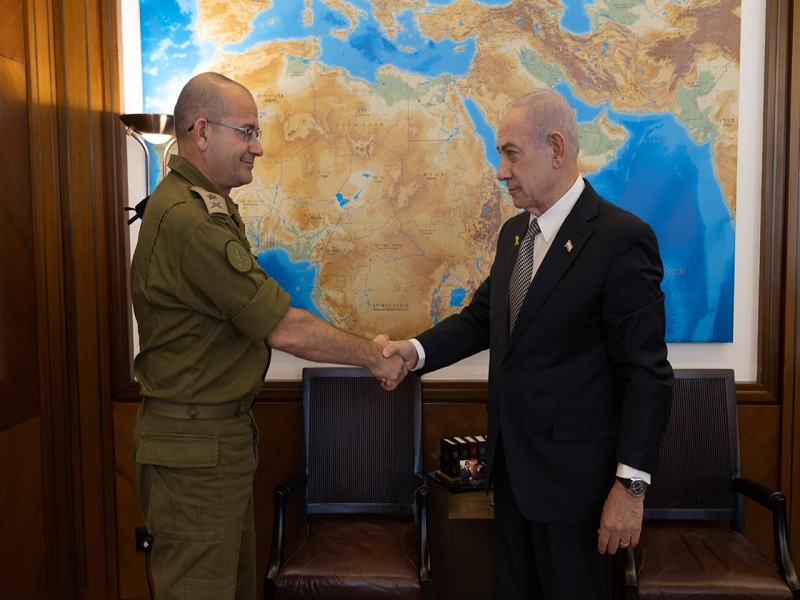
Israeli Prime Minister Benjamin Netanyahu’s announcement earlier this month that his military secretary, Maj.-Gen. Roman Gofman, would become head of the Mossad, came as a surprise to the public, as journalists and experts had been confident that current Mossad chief David Barnea’s deputy, known only as “A,” had the job in all but name. However, for those who know Gofman, his time in the IDF and his working relationship with Netanyahu, as well as the prime minister’s post-Oct. 7 predilection for bringing in outside candidates to take over defense institutions, Gofman was a natural choice, Jewish Insider’s Lahav Harkov reports.
Background: Gofman has a limited public profile as Netanyahu’s senior military advisor. But in Israel, his face is fairly familiar, as he can be seen walking behind Netanyahu into the Oval Office and other high-level meetings, even as military secretaries don’t make public statements. Gofman, 49, was born in Belarus, then part of the Soviet Union, and immigrated to Israel with his family at the age of 14. He was bullied in school and took up boxing to fight back, becoming the second-ranked young boxer in Israel in his weight category. He enlisted in the IDF Armored Corps in 1995 and has been in the military ever since, rising to the rank of Aluf, or major general.
CONSERVATIVE REALIGNMENT
Mike Pence’s think tank absorbs wave of Heritage departures
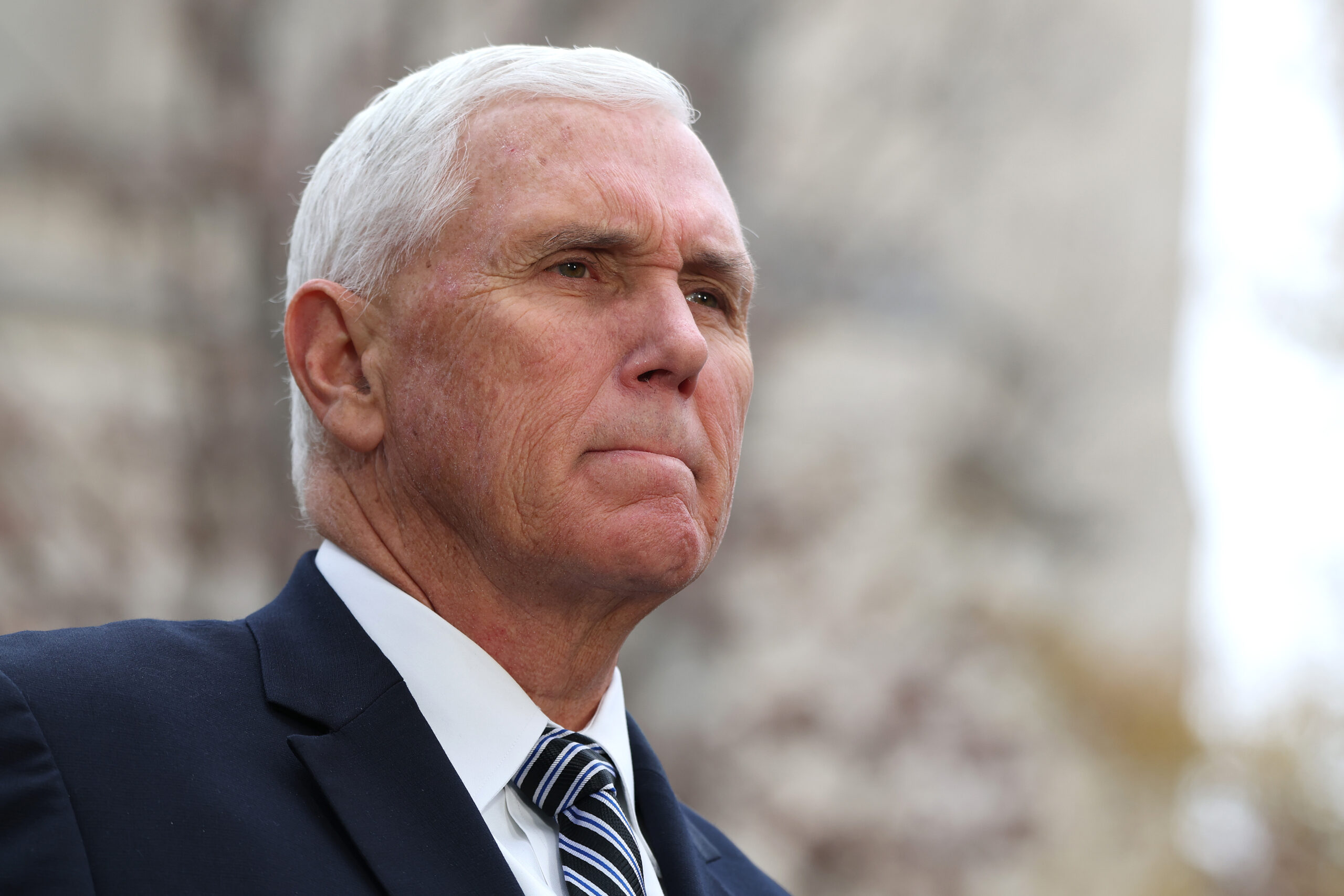
Tim Chapman, the president of former Vice President Mike Pence’s think tank, said on Monday that he expects his Advancing American Freedom organization to poach more staffers from the Heritage Foundation after announcing the hiring of 15 individuals from the embattled conservative organization, Jewish Insider’s Emily Jacobs reports.
New recruits: Advancing American Freedom, founded by Pence in 2021 to advocate for classical conservative principles as President Donald Trump’s MAGA movement cemented its hold on parts of the Republican Party, announced on Monday that 15 Heritage staffers, including three senior officials from the think tank’s legal, economic and data teams, would be moving to AAF at the start of the new year. Chapman, who has been leading the recruitment effort, predicted more Heritage staffers would resign amid continuing frustration over Heritage President Kevin Roberts’ refusal to disavow Tucker Carlson for his platforming of neo-Nazi influencer Nick Fuentes.
SANDERS SCRUTINY
Trump-appointed Holocaust Museum board members pushing to oust Bernie Sanders

Several Trump appointees to the board of the United States Holocaust Memorial Museum are pushing for the ouster of Sen. Bernie Sanders (I-VT), alleging that he has rarely attended meetings and that his accusations of genocide against Israel run directly counter to the museum’s mission, Jewish Insider’s Marc Rod reports.
What they’re saying: Jonathan Burkan, who was appointed to the council twice by President Donald Trump, said he’s never seen Sanders at any meetings of the council — which he said has not been the case for other lawmakers, both Democrats and Republicans. “Everything that’s happened after Oct. 7, everything that has been going on with antisemitism, with the Holocaust — I do feel that if someone is a Jewish elected official, they should at least attend one meeting in over a 20 year period of time,” Burkan said. “They should find someone else besides Bernie just to be on the council.”
MILITARY MATTERS
Pentagon plan to reorganize military could undermine U.S.-Israel security, experts warn

Senior Pentagon officials are reportedly weighing a sweeping proposal to reorganize the U.S. military that would shift authorities and resources away from the Middle East, a move experts warn could undermine U.S.-Israel security cooperation and destabilize the region. The plan, driven by Defense Secretary Pete Hegseth, would reduce the number of U.S. combatant commands from 11 to eight, cut the number of four-star generals and consolidate regional commands into broader organizations. Most notably, U.S. Central Command (CENTCOM) — which oversees the Middle East and parts of South Asia — would be placed under a newly created U.S. International Command, Jewish Insider’s Matthew Shea reports.
Regional ramifications: “If the reorganization happens, it will have detrimental effects on Israel and the wider region,” said Michael Koplow, chief policy officer at the Israel Policy Forum. “The Middle East presents unique challenges stemming from Iranian efforts to upend the regional order and the importance of protecting sea lanes and trade routes. Treating the region as one component of a larger command risks harming U.S. goals.”
DAMASCUS DEALINGS
Trump’s Syria strategy tested amid resurgence of ISIS in Damascus
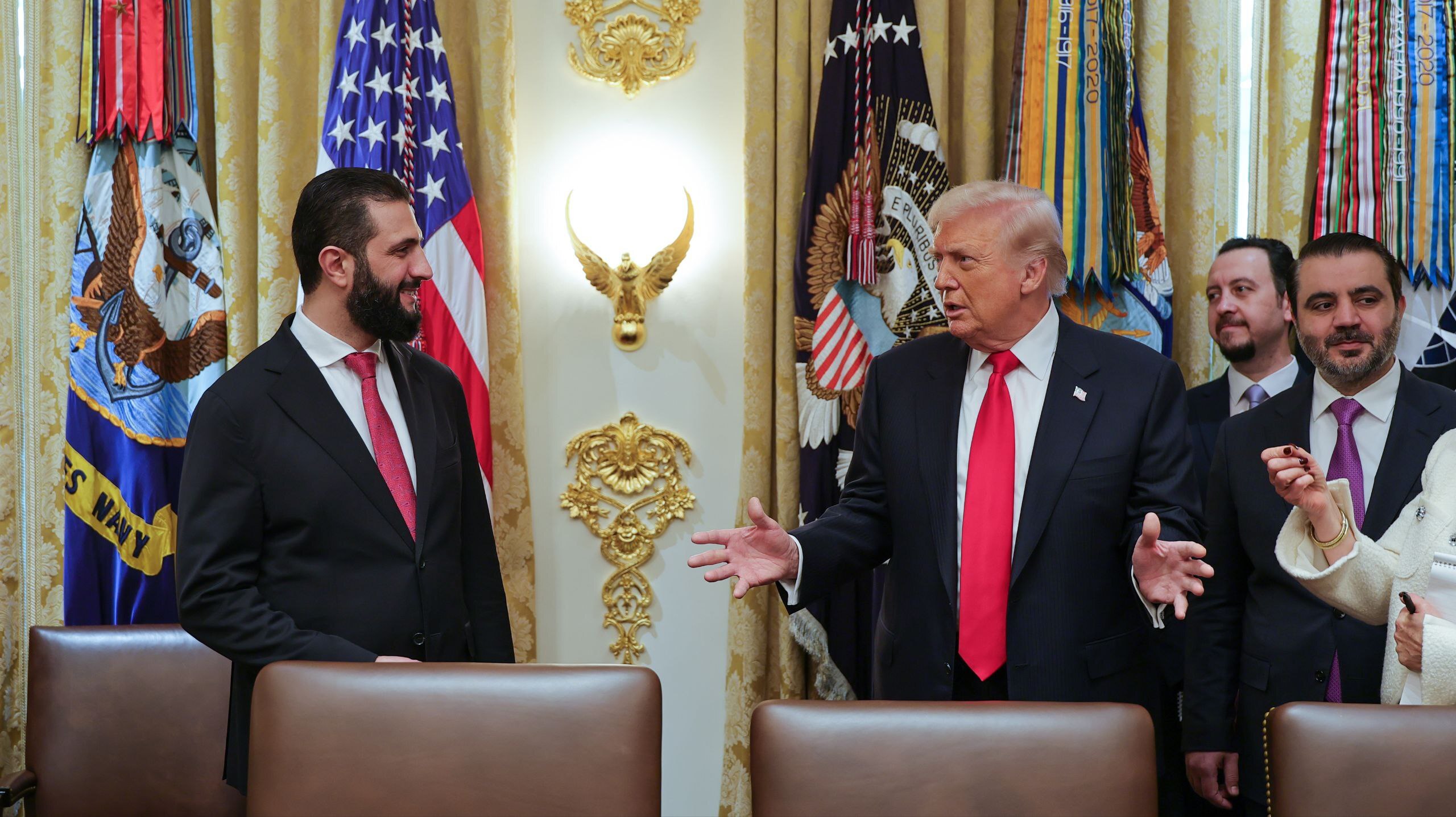
Following the fall of the Assad regime in Syria, President Donald Trump has taken an unusually open approach toward Damascus, seeking to usher in a new era of stability and regional integration. But that strategy is beginning to face significant tests from jihadist elements embedded within Syrian President Ahmad al-Sharaa’s own military ranks, Jewish Insider’s Matthew Shea reports.
Flagging concerns: “What my colleagues and I have been warning this entire year is that al-Sharaa was putting his jihadist allies into the new Syrian military without apparent measures to prevent bad things from happening,” said David Adesnik, vice president of research at the Foundation for Defense of Democracies, who added that those with jihadist beliefs were integrated in “large groups.” Those concerns were underscored earlier this month, when two U.S. soldiers and one civilian contractor were killed in Syria in an attack claimed by the Islamic State (ISIS) — the first U.S. casualties in the country since Assad’s fall in December 2024.
Bonus: The New York Times reports on the Assad family’s “life of luxury and impunity” in Moscow, a year after Bashar al-Assad, his wife and children left Damascus for Russia.
CAMPUS BEAT
Professor who backed encampment selected for role on Northwestern presidential search committee

A Northwestern University professor who supported the anti-Israel encampment on the Evanston, Ill., campus and is married to the founder of the university’s chapter of Educators for Justice in Palestine was tapped to join a new presidential search committee, the school announced last week. Ian Hurd, a professor of political science and president of the faculty senate at Northwestern University, is listed on Northwestern’s website as an “expert on the Middle East.” As Faculty Senate president, Hurd has played an influential role in shaping faculty responses to campus protests, academic freedom disputes and university governance questions, Jewish Insider’s Haley Cohen reports.
Raising eyebrows: Hurd’s appointment to the search committee drew criticism from some of the school’s Jewish alumni. “The antisemitic encampment at Northwestern occurred in April 2024, immediately before Ian Hurd was elevated into senior faculty leadership. At the time, Hurd was a leading figure in the Faculty Senate and publicly defended the administration’s response,” Michael Teplitsky, president of the Coalition Against Antisemitism at Northwestern and an alum of the school, told JI.
Worthy Reads
Banning the Brotherhood: In The Spectator, Ed Husain calls on the United Kingdom to follow the lead of the U.S. and other countries and ban the Muslim Brotherhood. “What does the Brotherhood’s growing influence mean for Britain’s Muslims? It results in women facing sharia court trials for divorce proceedings. Mosques must send coaches to marches in London or risk becoming outcasts. For the rest of the country it has meant greater communal separatism and multiple terror attacks. Britain’s Jews are afraid to walk the streets of their country, and MPs have been attacked by Islamist extremists. The resulting terror threat has been classed by the government as ‘substantial’, with 43,000 individuals on an MI5 watch list just five years ago. The Jenkins report warned a decade ago about the threat from the Brotherhood to Britain’s national security. That menace has now metastasised.” [TheSpectator]
What the Far Right Gets Wrong: In Compact, David Azerrad examines the rise of the “JQers” — far-right influencers who push the idea of the “Jewish Question” as a means of explaining societal ills. “The problems we face are so daunting, the odds so overwhelming, that it is easier to rail against the Jews than to undertake the Herculean task of revitalizing the dying nations of the West. The JQers simply don’t have the stomach to consider that, in fact, it may well be our fault. We Americans and Westerners are the ones who squandered our inheritance, defiled our countries, and replaced our populations. We elected — and re-elected — the leaders who launched reckless wars and embraced foolish policies. They were not hoodwinked by the Israel lobby, and they would not suddenly become prudent statesmen if all Jewish influence were expunged from our politics.” [Compact]
Bank Notes: Bloomberg’s Paul Davies looks at Apollo Global Management CEO Marc Rowan’s efforts to redefine private credit through the creation of what Davies calls a “narrow” bank. “Apollo has ridden the boom in private markets over the past decade to command $908 billion in assets and become an increasingly significant lender to the US economy, along with a string of rivals and copycats. Banks, investors, regulators and politicians are — or ought to be — watching closely for emerging risks and benefits from the model Rowan has built. He needs to get his message about Athene’s version of private credit to all of these observers and to a media he has called confused and hysterical, but most of all to the armies of mom-and-pop annuity holders whose trust his business relies on.” [Bloomberg]
Word on the Street
A new report by the Anti-Defamation League highlights several members of New York City Mayor-elect Zohran Mamdani’s transition team who have used antisemitic tropes and justified Hamas’ Oct. 7, 2023 attacks, among other issues the group flags as “deeply troubling” and that raise further questions about his vetting process, Jewish Insider’s Matthew Kassel reports…
The Trump administration is recalling senior career diplomats from 29 countries, all of whom were appointed during the Biden administration; the majority of those whose tenure is being ended are posted in Africa or the Pacific Islands…
Former Blackrock executive Mark Wiseman was named Canada’s next ambassador to the U.S….
Axios spotlights Steve Witkoff’s South Florida Shell Bay club, where the White House special envoy and Jared Kushner, and occasionally Secretary of State Marco Rubio, have hosted high-level diplomatic delegations to discuss issues ranging from the Israel-Gaza war to Ukraine…
NBC News reports on Witkoff and Rubio’s clashing approaches to the Trump administration’s Russia-Ukraine policy…
The Washington Post looks at Sen. Ted Cruz’s (R-TX) efforts to position himself as a traditional Republican on foreign policy issues ahead of the 2028 presidential election, as the Texas Republicans mulls another White House bid…
Attorney George Conway filed to run in the crowded Democratic primary in New York’s 12th Congressional District, where Rep. Jerry Nadler (D-NY) is not seeking reelection…
Larry Ellison is personally guaranteeing the $40.4 billion that Paramount, led by his son David Ellison, is putting forward in its bid for Warner Bros. Discovery…
A New York Times analysis of donors to Trump administration projects and priorities found that Dr. Miriam Adelson’s foundation pledged $25 million to the construction of a new White House ballroom; additional donors include Palantir and Lockheed Martin, which are both donating $10 million to the reconstruction effort…
Authorities in New York levied a hate crime charge against a man in connection with an attack in Brooklyn’s Crown Heights neighborhood last week in which a Jewish man was stabbed; the assault was captured on camera and took place blocks from the Chabad Lubavitch headquarters…
The Washington Post looks at efforts by volunteers, aided by Jewish communal security organizations, to identify threats to Jewish groups and institutions…
Israel’s Cabinet approved the closure of Galei Tzahal, the army radio station, after 75 years of operation, as part of a broader government effort to exert control over Israeli media; Israeli press organizations plan to challenge the decision, which was also opposed by Attorney General Gali Baharav-Miara…
Israeli Defense Minister Israel Katz told leaders of the country’s settlement movement that “when the time comes,” Israel will reestablish settlements in the Gaza Strip, contradicting previous assertions by Israeli Prime Minister Benjamin Netanyahu…
The Wall Street Journal spotlights security lapses that have allowed Iranian hackers to exploit vulnerabilities in an effort to breach Israeli institutions and obtain and leak information…
Longtime Jewish public relations professional H. Glenn Rosenkrantz died at 64…
Swedish-born actress May Britt, who converted to Judaism before marrying Sammy Davis Jr., died at 91…Record producer Jerry Kasenetz, who with his business partner Jeffry Katz produced such songs as “Yummy Yummy Yummy” and “Little Bit O’ Soul,” died at 82…
Pic of the Day

Israeli Prime Minister Benjamin Netanyahu met on Monday in Jerusalem with Cypriot President Nikos Christodoulides and Greek Prime Minister of Greece Kyriakos Mitsotakis.
Birthdays

Israeli-Spanish singer-songwriter of Judeo-Spanish (Ladino) music, Yasmin Levy turns 50…
Television producer, best known for his work on the 1980’s television series “Cagney & Lacey,” Barney Rosenzweig turns 88… Electrical engineer, who with Vint Cerf, invented the Transmission Control Protocol (TCP) and the Internet Protocol (IP), the fundamental protocols at the heart of the Internet, Robert Elliot “Bob” Kahn turns 87… Emmy Award-winning actor, writer, director and producer, best known for his work on “The Simpsons”, he is still an active podcast host, Harry Shearer turns 82… Russian-born mathematician, living in France, Mikhail Leonidovich Gromov turns 82… U.S. district judge in the Southern District of New York, he has been on senior status since 2011, Judge Lewis A. Kaplan turns 81… Documentary filmmaker, she is best known for her films on businessman Julius Rosenwald and baseball players Hank Greenberg and Moe Berg, Aviva Kempner turns 79… Retired Justice on the Supreme Court of Canada, Michael Moldaver turns 78… One of two Grand Rebbes of Satmar, Rabbi Zalman Leib Teitelbaum turns 74… Editor-at-large of The Bulwark, William “Bill” Kristol turns 73… Retired Israeli basketball player and coach, until 2006 she was in the Guinness Book of World Records for the most points (108) ever scored in a women’s professional game, Orna Ostfeld turns 73… Dean at Indiana University’s School of Global and International Studies, he served as the U.S. ambassador to Poland in the Obama administration, Lee A. Feinstein turns 66… Software engineer at Goldman Sachs, Bill Pinsky… CEO of the Rabbinical Assembly, the international association of Conservative rabbis, Rabbi Jacob Blumenthal turns 59… USAID acting mission director for the West Bank and Gaza until 2021, then mission director for Bosnia and Herzegovina until 2024, Courtney Chubb turns 56… Political technology entrepreneur and campaign finance attorney, Jonathan Eric Zucker turns 54… Israeli investor in natural resources including diamond and copper mining interests in Africa, Dan Gertler turns 52… Beverly Hills-based attorney and real estate agent, he is a supporter of pro-democracy groups in his native Iran, Pooya Dayanim… Attorney in Austin, she clerked for Justice Alito on the U.S. Supreme Court, Zina Linda Gelman Bash… VP of strategy and mergers at the Heritage Group, an Indiana-based multi-generational family portfolio of companies, Adam Milakofsky… Israeli singer, songwriter, musician and composer of the genre known as Mizrahi music, Dudu Aharon turns 41… COO at Israel Policy Forum, Snezhana Valdman Orlando turns 41… Liberal rabbi in the city of Dresden and founder of the Besht Yeshiva, Akiva Weingarten turns 41… Partner and chief investment officer at Gelt Venture Partners, he was an MLB infielder and played for Team Israel in 2012 and 2017, Joshua Blake Satin turns 41… Chief of staff for the U.S. Ambassador to France and Monaco Charles Kushner, Gabriel Scheinmann… Founder and CEO at Stealth AI, he is also a lecturer and research scholar at the Wharton School at the University of Pennsylvania, Emil Pitkin… Brand marketing manager at Metagenics, Lauren Kahn… Israeli fashion model, Shlomit Malka turns 32… Senior vice president of the American Foreign Policy Council, Ilan Berman… Former account executive at Edelman, India Goodman… Tom Epstein…
Roman Gofman’s supporters tout him as an Israeli patriot and Oct. 7 hero; his detractors say he’s unfamiliar with the agency
Prime Minister's Spokesperson's Office
Maj.-Gen. Roman Gofman
Israeli Prime Minister Benjamin Netanyahu’s announcement earlier this month that his military secretary, Maj.-Gen. Roman Gofman, would become head of the Mossad, came as a surprise to the public, as journalists and experts had been confident that current Mossad chief David Barnea’s deputy, known only as “A,” had the job in all but name.
However, for those who know Gofman, his time in the IDF and his working relationship with Netanyahu, as well as the prime minister’s post-Oct. 7 predilection for bringing in outside candidates to take over defense institutions, Gofman was a natural choice.
Netanyahu appeared on Sunday before the committee that will determine whether Gofman’s appointment is finalized, and IDF Chief of Staff Eyal Zamir and Gofman himself are expected to speak to the committee this week. Should the committee approve Gofman, he will enter the role in June.
Gofman has a limited public profile as Netanyahu’s senior military advisor. But in Israel, his face is fairly familiar, as he can be seen walking behind Netanyahu into the Oval Office and other high-level meetings, even as military secretaries don’t make public statements.
Gofman, 49, was born in Belarus, then part of the Soviet Union, and immigrated to Israel with his family at the age of 14. He was bullied in school and took up boxing to fight back, becoming the second-ranked young boxer in Israel in his weight category. He enlisted in the IDF Armored Corps in 1995 and has been in the military ever since, rising to the rank of Aluf, or major general.
In October 2022, Gofman was appointed commander of the National Center for Ground Training. A year later, when Hamas invaded southern Israel, Gofman drove from his home in Ashdod towards the Gaza border, without a bulletproof vest or a helmet. He took on Hamas terrorists at the Sha’ar HaNegev Junction, killing two and sustaining a severe wound to his knee, after which he found Israeli police officers nearby who took him to the hospital. In his first public remarks after the battle, he said: “We failed. … Now we’ll go forward and kill them all.”
Netanyahu chose Gofman as his military secretary in 2024, and he became one of the prime minister’s closest and most trusted advisors. As such, Gofman was a central figure in Israel’s decision to work with the Gaza Humanitarian Foundation to distribute food to civilians in Gaza, among other high-level moves.
Netanyahu has sent Gofman on multiple trips to Moscow for discussions on security matters, following the fall of former Syrian leader Bashar al-Assad, and Gofman is said to have played a key role in shaping Israel’s policies relating to Syria since then.
Maj.-Gen. (res.) Gershon Hacohen, who knows Gofman well from their years in the IDF, told Jewish Insider that “Gofman did what no military secretary has done in history. … Thanks to Roman, [Netanyahu] made significant decisions in running the war and … circumvent[ed] a system that sometimes leaves out the prime minister.”
Gofman, Hacohen said, “has strategic vision. Syria came as a surprise, and he had a decisive role in the decision [for the IDF] to go in.”
Hacohen said that Gofman’s background, as an immigrant from the former Soviet Union, is an advantage: “He knows that America is not the whole world and there are other forces we need to talk to and understand in depth.”
Several of Gofman’s current and former colleagues spoke to JI about the new appointee on condition of anonymity. They painted a picture of a passionate Israeli patriot who is well-read and informed on military history and international affairs, while being pragmatic and able to translate that knowledge into an operational approach. They said that Gofman is creative and takes initiative, but is also a good listener, who is willing to accept criticism and alternatives to his own ideas.
In the prime minister’s announcement of Gofman’s appointment as head of the Mossad, Netanyahu called him “an officer of great merit,” and praised his “significant involvement in the seven theaters of the war,” – meaning Gaza, Lebanon, the West Bank, Syria, Iraq, Yemen and Iran – as well as his work with all intelligence and security services, including the Mossad.
“Maj.-Gen. Gofman has demonstrated creativity, initiative, stratagem, deep recognition of the enemy, absolute discretion, and the safeguarding of secrets,” the statement from the Prime Minister’s Office reads. “These qualities, as well as his leadership and courage, were evident at the outbreak of the War of Redemption, when he rushed from his home and fought in person against Hamas terrorists in the Western Negev, where he was severely wounded.”
Following the announcement, critics of Netanyahu — mostly in the media, not in the Knesset — made the argument that Gofman does not have the experience in intelligence to head the Mossad.
Prominent left-wing activist and pundit Yariv Oppenheimer, a former leader of Peace Now, was one of many who argued that Gofman’s close relationship with Netanyahu made him suspect.
“I don’t know this general … but I care about the big picture, which is that Netanyahu is treating this country like it’s his personal property. He wants a Mossad chief who is loyal to him before the country,” Oppenheimer said on a panel on Israeli public broadcaster Kan. “This is an unnatural appointment, and when something is not natural, it raises questions.”
Hacohen rejected the argument that Gofman is “loyal to the king and not the kingdom. It’s nonsense, because the king is the kingdom. They go together.”
Historically, some of the Mossad’s best-known leaders came from outside the organization, including Meir Amit, Zvi Zamir and Meir Dagan, the latter of whom not only came from outside the Mossad, but was a leading figure in former Prime Minister Ariel Sharon’s 2001 election campaign. Hacohen noted that the “the best intelligence agency in the world, the MI6,” also often has leaders recruited from outside the organization.
Hacohen also argued that Gofman learned “unique and significant” things about Israel’s broader security picture as Netanyahu’s military secretary, including the role of the Mossad, and that the job of the head of the Mossad is to “connect people with micro-experience, while seeing the macro.”
Sources who worked with Gofman have cited his creativity and his willingness to stand up to his superiors and against conventional wisdom. Hacohen said that Gofman “challenged the system everywhere he went. … He had the ambition and desire to ask questions and do better.”
In 2019, Gofman argued for greater deployment of IDF ground forces in sensitive arenas, which, six years later, was one of the conclusions the IDF drew following the Oct. 7, 2023, Hamas attacks on Israel. His remarks were made at a conference of IDF officers with departing Chief of Staff Gadi Eisenkot, now a Knesset member. In footage of his remarks, Herzi Halevi and Aharon Haliva, who served as IDF chief of staff and head of intelligence, respectively, on Oct. 7, can be seen in the audience.
“We are ready to fight, but there is one problem,” Gofman said at the time. “You are not using us. Over time a very problematic pattern has developed, which is essentially the avoidance of using ground forces. And still, in the current reality, we have a lot to offer in the Gaza Strip, Lebanon and Syria … Time after time, [the IDF tells] people we have more relevant tools [than ground troops].”
Gofman’s critics also cite an incident from his time as commander of the IDF’s 210th “Bashan” Division, which is responsible for the front with Syria, that may be especially relevant in his new position as head of the Mossad, as it pertains to his treatment of spies.
Gofman authorized intelligence officers under his command to enlist then-17-year-old Ori Elmakayes, who was fluent in Arabic and ran a Telegram channel and other social media pages with news about the Arab world. The intelligence officers sent him classified information to publish online in an attempted influence operation, even though Gofman and the Bashan Division were not authorized to engage in psychological warfare.
Elmakayes was arrested by Israeli authorities in 2022 for publishing classified information and jailed for nearly two years, after which the indictment was dropped when the investigation found that the intelligence officers were working with Gofman’s approval.
After Gofman’s appointment as head of the Mossad was announced, Elmakayes posted on X that “Gofman abandoned me after initiating an operation in which I was used … Following his abandonment, I was falsely imprisoned … After he used me and ruined my life, Roman Gofman had no problem distancing himself from me despite knowing what I experienced. Such a person cannot be the head of the Mossad. If he abandoned me, what will stop him from abandoning Mossad agents if God forbid they get in trouble in different operations?”
The same year that he launched the influence operation with Elmakayes, Gofman wrote a paper for an IDF journal stating that commanders can act beyond their formal authority to enact the will of policymakers, citing the work of the contemporary Marxist philosopher Slavoj Žižek.
Another controversial paper by Gofman came to light after he was appointed Mossad chief: In 2019, he suggested in a paper for the IDF-run Israel National Defense College — where he received a master’s degree in political science and national security in cooperation with Haifa University — that, should Iran get too close to developing nuclear weapons, Israel should threaten to sell nuclear weapons to neighboring countries, such as Egypt, Saudi Arabia and Turkey, to balance the region.
Gofman leads an outwardly secular lifestyle, but after growing up in the Soviet Union, he sought an education in Judaism and Zionism as an adult.
Gofman told Ynet military reporter Yossi Yehoshua that when he was in the IDF officers’ course, Gofman realized he did not know Israel’s national anthem, “Hatikva,” by heart. “I started to feel like I had no depth in the Zionist, Israeli subject, that there are a lot of things the soldiers could ask and I won’t know how to explain. … It shook me. I was going to be an IDF officer and I was missing so much. I was carrying this vacuum since my aliyah.”
During his undergraduate studies, Gofman also began studying at the Bnei David Pre-Military Academy in Eli, the flagship religious-Zionist institution, for a year of Torah study between completing high school and starting IDF service, many of whose alumni have climbed the IDF ranks.
“They accepted me as I was, without a kippah,” Gofman recalled. “I built a curriculum and came to study one day a week about Zionism, Israel, history, to explain to myself, first and foremost, who I am and what I am.”
“Only then did I suddenly feel that I have two feet on the ground, but a head in the sky. I know how to explain the Zionist idea,” he said.
A former colleague of Gofman said that he is “very well-connected to his roots, because he went through a personal process to connect to them. He knows how to make war, but he also knows what it’s for, the deeper ideology behind it.”
“To fight for Israel,” Hacohen said of Gofman’s search for meaning in his Judaism, “you need faith. We, in the Land of Israel, have many struggles. If those who came from the former Soviet Union were looking for a safe place, why would they come here? This is not just a place for fun or safety, it’s for the liberation of the Jewish people.”
Netanyahu said on Sunday that Jerusalem had previously warned Australia’s PM that Palestinian statehood recognition endangered Jews in the country

Kevin Dietsch/Getty Images
Sen. Bernie Sanders (I-VT), joined by fellow senator Sen. Jeff Merkley (D-OR) (R), speaks at a news conference on restricting arms sales to Israel at the U.S. Capitol on November 19, 2024 in Washington, DC.
Sen. Bernie Sanders (I-VT) criticized Israeli Prime Minister Benjamin Netanyahu on Tuesday, after Netanyahu linked the terror attack in which 15 people were killed at a Hanukkah celebration in Sydney, Australia, to Canberra’s support for a Palestinian state.
Netanyahu highlighted in a speech on Sunday that he had warned Australian Prime Minister Anthony Albanese that Canberra’s recognition of a Palestinian state was fueling antisemitism and endangering Australian Jews. Netanyahu further accused Albanese of failing to take action against antisemitism.
Sanders issued a statement in response on Tuesday: “No, Mr. Netanyahu. Speaking out on behalf of the Palestinian people is not antisemitic. Opposing the disgraceful policies of your extremist government is not antisemitic. Condemning your genocidal war, which has killed more than 70,000 people — mostly women and children — is not antisemitic. Demanding that your government stop bombing hospitals and starving children is not antisemitic.”
He said that “we must continue to oppose antisemitism and all forms of racism and bigotry. At the same time, we must demand a world in which international law and human rights are respected by all governments, without exception.”
Sanders opted against signing onto a joint statement issued Monday by Jewish Senate Democrats condemning the Sydney attack. Asked about his decision not to join the collective statement from Jewish Senate Democrats, a Sanders spokesperson pointed JI to Sanders’ comment on Sunday mourning the attack, in which the Vermont senator called antisemitism “a disgusting and cowardly ideology” that is “growing worldwide” and added, “we must be equally committed to fighting all forms of” bigotry.
The Israeli PM called the Knesset vote ‘a deliberate political provocation by the opposition to sow discord during’ Vance’s visit
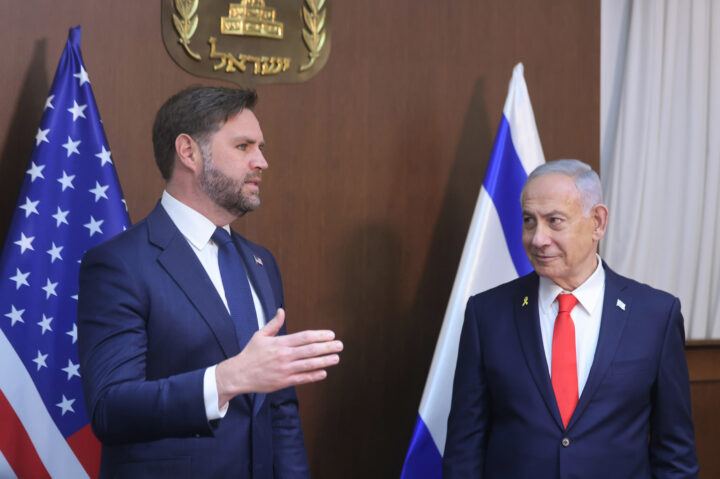
Marc Israel Sellem/Getty Images
U.S. Vice President J.D. Vance (L) and Israeli Prime Minister Benjamin Netanyahu (R) speak to the media at the Prime Minister's Office in West Jerusalem, on October 22, 2025.
Israeli Prime Minister Benjamin Netanyahu distanced himself on Thursday from the Knesset’s approval of two bills to extend Israeli sovereignty to the West Bank, after President Donald Trump, Vice President JD Vance and Secretary of State Marco Rubio spoke out against annexation.
The Knesset approved two settlement annexation bills brought by right-wing members of the opposition in preliminary votes on Wednesday, despite the coalition whipping votes against them.
The bill to annex the entire West Bank, proposed by Avi Maoz, the sole lawmaker from the anti-LGBT Noam party that quit the coalition earlier this year, received 25 votes — most of which were from Netanyahu’s coalition — with 24 voting against it.
The other bill, which would have the Jerusalem suburb of Maaleh Adumim be considered part of sovereign Israel, was proposed by former Defense Minister Avigdor Liberman and his Yisrael Beiteinu party and passed the early vote with 32 in favor — with only one from the coalition — and nine opposed. The bills still have to go through committee meetings and three plenary votes to become law.
Trump voiced opposition to annexation efforts in an interview with Time magazine published Thursday, but conducted before the Knesset vote, and said they could threaten U.S. support for Israel.
Annexation “won’t happen because I gave my word to the Arab countries,” Trump said, “and you can’t do that now. We’ve had great Arab support. … It will not happen. Israel would lose all of its support from the United States if that happened.”
Though the first Trump administration’s 2020 peace plan would have allowed Israel to annex parts of the West Bank, Netanyahu committed later that year to refrain from such a move in exchange for entering the Abraham Accords with the United Arab Emirates.
Vice President JD Vance was asked about the vote on his way onto Air Force Two departing Israel on Thursday, and said that he was “confused” and found the vote “weird.” He said he asked about the vote and was told it was symbolic.
“If it was a political stunt, it was a very stupid political stunt, and I personally take some insult to it,” he said. “The policy of the Trump administration is that the West Bank will not be annexed by Israel; that will continue to be our policy and if people want to take symbolic votes, they can do that, but we certainly weren’t happy about it.”
Rubio, who landed in Israel on Thursday, said the night before that the Knesset vote was “counterproductive,” while acknowledging that Israel is “a democracy, they’re going to have their votes. People are going to take these positions.”
Netanyahu attempted to repair the damage of the votes on Thursday morning, with a statement from his office calling them “a deliberate political provocation by the opposition to sow discord during Vice President JD Vance’s visit to Israel. The two bills were sponsored by opposition members of the Knesset.”
According to the statement, “the Likud party and the religious parties (the principal coalition members) did not vote for these bills, except for one disgruntled Likud member who was recently fired from the chairmanship of a Knesset committee. Without Likud support these bills are unlikely to go anywhere.”
Maoz’s bill got support from six coalition lawmakers from Finance Minister Bezalel Smotrich’s Religious Zionist Party and seven from National Security Minister Itamar Ben-Gvir’s Otzma Yehudit party. One Religious Zionist Party MK voted for Liberman’s legislation.
The one Likud lawmaker who supported Maoz’s bill was Yuli Edelstein, who was removed from the prestigious post of chairman of the Knesset Foreign Affairs and Defense Committee earlier this year due to his refusal to usher in legislation that would continue the broad exemption from IDF service for Haredim. Edelstein argued in a post on X: “If my only sin was standing with the Land of Israel and voting for applying sovereignty in Judea and Samaria” — the Biblical name for the West Bank — “then I am proud of it.”
Israeli Ambassador to the U.S. Yechiel Leiter assisted in Netanyahu’s damage control efforts, calling Sen. Lindsey Graham (R-SC) to clarify the situation.
Leiter assured Graham “that this vote was not intended to be a slight to the U.S. and the position of the Prime Minister is that the U.S. is Israel’s most important and valuable ally and partner, and there will be no major changes without consulting and cooperating with the U.S.,” the South Carolina senator wrote on X.
“As with all legislative bodies and democracies, there are things you can control and things you cannot,” Graham added. “[Leiter] vigorously stressed no offense was meant and reinforced that no major decisions will be made by Israel without cooperation and coordination with the U.S.”
Separately, coalition chairman Ophir Katz, the Likud lawmaker responsible for whipping votes, said on Thursday that Netanyahu “clearly instructed me last night that the coalition must not vote for the bills on the matter of sovereignty. There was coalition discipline on the matter. Since there were MKs who acted against the prime minister’s instructions, the bills passed. Following that, the prime minister instructed me not to advance these bills until further notice.”
Katz punished Edelstein by removing him from the Foreign Affairs and Defense Committee entirely, but consequences for the coalition members from other parties have yet to be announced.
Edelstein said that “every such removal is a medal of honor for me. Anyone who thinks this deters me is making a big mistake.”
In 2010, during a visit by then-Vice President Joe Biden to Israel, Israel’s Interior Ministry announced, without first consulting Netanyahu, that it had approved 1,600 housing units in a northern Jerusalem neighborhood that the Obama administration and most of the international community considered to be a settlement. The incident sparked a diplomatic row between the countries.
‘We have to fight the fight’ on social media, shore up support on American right, Netanyahu says

Avi Ohayon (GPO)
Israeli Prime Minister Benjamin Netanyahu meets with American pro-Israel influencers in New York, Sept. 28th, 2025
Israeli Prime Minister Benjamin Netanyahu expressed hope on Friday that the sale of TikTok to a joint venture partially owned by Oracle CEO Larry Ellison would be completed.
“Weapons change over time,” Netanyahu told a group of pro-Israel influencers in New York on the sidelines of the U.N. General Assembly. “You can’t fight today with swords and you can’t fight with cavalry. …You have to fight with the weapons that apply to the battlefield, and one of the most important ones is social media.”
Netanyahu called the sale of TikTok “the most important purchase happening.”
“I hope it goes through, because it can be consequential,” he added.
Following a law requiring TikTok’s owner, the China-based ByteDance, to sell the app’s U.S. operations or be banned over security concerns, President Donald Trump signed an executive order last week authorizing a new company to buy over much of TikTok’s U.S. business. The company started by Oracle – owned by longtime Netanyahu friend and Trump ally Larry Ellison – Silver Lake and U.A.E.-based MGX, will control a 45% stake in TikTok’s operations stateside. Oracle would oversee security operations, and Trump said that Ellison’s company is “playing a very big part.” China has yet to say it has changed laws needed for the deal to be completed, but Trump said that Beijing approved it.
Netanyahu also said that “we have to talk to Elon” Musk, describing the X owner as “not an enemy; he’s a friend.” The Israeli prime minister has met with Musk multiple times, including at Tesla’s headquarters in California in 2023, and Musk paid a solidarity visit to Israel soon after the Oct. 7 attacks.
Soon after Jewish conservative influencer Debra Lea posted the video of Netanyahu’s remarks on X, anti-Israel figures including Shaun King and Max Blumenthal began claiming that Israel was taking control of TikTok, an angle seized upon by Iranian and Turkish state media.
Netanyahu’s remarks came in response to a question from Lea about a drop in support for Israel from Evangelical Christians.
He talked about “the woke right — I call it the ‘woke reich.’”
“These people — they’re not any different from the woke left; they’re insane,” he said. “What we need to do is secure that place of our support in the U.S. that is being challenged systematically.”
That challenge, he argued, is funded by governments and NGOs.
“We have to fight the fight. Give direction to the Jewish people and give direction to our non-Jewish friends or those who could be our friends,” he said.
About 15 influencers attended the roundtable with Netanyahu, including comedian Zach Sage Fox, Florida Marlins co-owner Ari Ackerman, content creator Lizzy Savetsky, sports reporter Emily Austin, podcast host Ben Soffer and former Miss Israel Noa Cochva.
Netanyahu’s wife, Sara, attended, as did Israeli Consul-General in New York Ofir Akunis and his wife, Adi.
Several attendees spoke to Jewish Insider on condition of anonymity, as they were told the meeting was off the record, though numerous participants posted about it on social media.
Rather than conduct the event as a briefing, Netanyahu opened by asking the influencers what they thought their most significant challenges were, and their answers took up the first 20 or so minutes of the meeting. Attendees said they thought the prime minister was listening and taking them seriously, and took a lot of notes.
An attendee said he thought Netanyahu “understood the battle online and that the people in the room were fighting in their own way, in an important way.”
Akunis also thanked the influencers profusely for their efforts, attendees said.
One attendee felt that Netanyahu did not give the influencers any constructive advice on how to correct lies about Israel on social media.
Some in the meeting also said Netanyahu gave the group a pep talk to continue fighting online for Israel.
Savetsky said in a video on Instagram that Netanyahu quoted the Passover Haggadah, which says, “in every generation they rise up to destroy us.” According to Savetsky, Netanyahu said “it is not our job to cure antisemitism. It is not our job to get rid of all of our enemies, because each time we get rid of one, another one pops up. Our job is to fight each threat as it comes and to survive. Every time the Jewish people survive another threat, survive another day, that is a victory.”
As the UNGA begins, several countries are recognizing a Palestinian state and the EU is considering suspending free trade with Israel
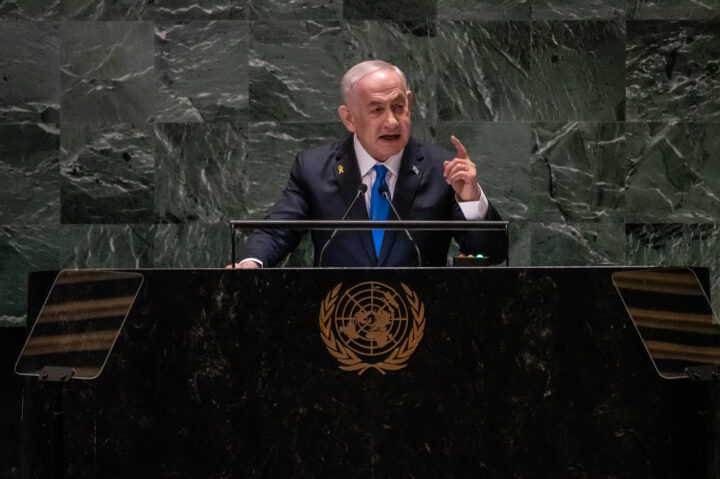
Stephanie Keith/Getty Images
Israeli Prime Minister Benjamin Netanyahu speaks during the United Nations General Assembly (UNGA) at the United Nations headquarters on September 27, 2024 in New York City.
Israeli Prime Minister Benjamin Netanyahu’s planned speech to the United Nations General Assembly on Friday is being overshadowed by European moves to isolate Israel, with the U.K., as well as Canada and Australia recognizing a Palestinian state on Sunday and more to come, as well as an upcoming EU vote on sanctions against Israel.
Netanyahu released a statement, in which he said he has “a clear message to the leaders who recognize a Palestinian state after the terrible massacre of Oct. 7: You are giving a massive prize to terror. … It will not happen. There will not be a Palestinian state west of the Jordan River.”
The prime minister hinted that Israel will increase settlement activity in response: “For years I prevented the establishment of this terror state facing great pressures, domestic and foreign … Not only that, we doubled the Jewish settlement in Judea and Samaria. The response to the latest attempt to force a terror state on us in the heart of our land will be given after my return from the U.S. Wait.”
U.K. Prime Minister Keir Starmer said on Sunday that his country is “acting to keep alive the possibility of peace and a two-state solution. That means a safe and secure Israel alongside a viable Palestinian state. At the moment, we have neither.”
He pushed back against the Israeli argument that recognition of a Palestinian state at this time acts as a reward for Hamas, arguing that “our call for a genuine two-state solution is the exact opposite of [Hamas’] hateful vision. … This solution is not a reward for Hamas, because it means Hamas can have no future.”
Hamas, however, praised the recognition as an “important move” and called for it to be accompanied by ending the “Judaization of the West Bank and Jerusalem, Israel’s isolation and Israel’s leaders brought before international court,” as well as the recognition of the Palestinians’ “natural right to resistance.”
The High-Level Conference on Palestine Statehood, led by France and Saudi Arabia, is set to take place Monday, on the eve of Rosh Hashanah. Nearly a dozen countries have said they would recognize a Palestinian state as part of that effort, following the announcements of the U.K., Canada and Australia on Sunday.
French President Emmanuel Macron argued in an interview with Israel’s Channel 12 News that “recognition of a Palestinian state is the best way to isolate Hamas … What they want is to destroy [Israel], but if we consider that the Palestinian state will always have the objective to destroy Israel, how [do] they want to build a sustainable future? There is no way.”
A recent poll commissioned by the French-Jewish umbrella organization CRIF found that 71% of French people reject the recognition of a Palestinian state before the hostages are freed and Hamas gives up power. In the U.K., a survey in The Telegraph showed 87% of Britons disagree with recognition of a Palestinian state without preconditions, including 89% of Labour voters. A YouGov poll, however, found that 44% of Britons supported the move, while 18% were opposed and 37% unsure.
U.S. Ambassador to France Charles Kushner noted that in conjunction with his announcement of Palestinian state recognition, Macron called for Palestinian recognition of Israel as a Jewish state, the demilitarization of Hamas and the establishment of strong governance for the Palestinians as preconditions for any recognition of Palestinian statehood. “These were France’s own conditions for recognition of a Palestinian state. How can France move forward with next week’s vote when none of these have been met?” Kushner said.
Netanyahu, who was Israel’s ambassador to the U.N. from 1984-1988, is known to relish his addresses to the U.N. General Assembly, embracing theatrical props, puns and long pauses on a platform where he hopes to capture the world’s attention for Israel’s benefit.
After his UNGA speeches, Netanyahu holds court, with other leaders visiting him in a conference room in Turtle Bay. This year, he is expected to meet with Argentinian President Javier Milei, the leaders of Paraguay and Serbia and New York Mayor Eric Adams, and there are reports that he will meet with Syrian President Ahmad al-Sharaa ahead of a possible security agreement between Damascus and Jerusalem. Then, Netanyahu is expected to fly to Washington to meet with President Donald Trump.
Meanwhile, Israel’s Foreign Ministry and Economy Ministry, which oversees foreign trade, have been pushing back against proposed European Union sanctions. The European Commission proposed the roll-back of relations between the bloc and Israel after it “found that actions taken by the Israeli government represent a breach of essential elements relating to respect for human rights” given “the rapidly deteriorating humanitarian situation in Gaza following the military intervention of Israel, the blockade of humanitarian aid, the intensifying of military operations and the decision of the Israeli authorities to advance the settlement plan in the so-called E1 area of the West Bank, which further undermines the two-state solution.”
The proposal, if accepted, would suspend free trade between Israel and the European Union, its largest trade partner.
A source in Brussels estimated that the move would cost Israel 227 million Euros ($266 million) in customs duties per year.
A date has not yet been set for voting on the suspension of free trade, which requires a qualified majority, also known as a “double majority,” meaning 55% of member states, and states representing 65% of the EU population, with at least four states opposed.
Hungary and the Czech Republic said they would oppose the proposal, following calls between their foreign ministers and Israeli Foreign Minister Gideon Sa’ar.
Sa’ar called the proposal “morally and politically distorted.”
“Moves against Israel will harm Europe’s own interests,” Sa’ar warned. “Israel will continue to struggle, with the help of its friends in Europe, against attempts to harm it while it is in the midst of an existential war. Steps against Israel will be answered accordingly, and we hope we will not be required to take them.”
Economy Minister Nir Barkat sent letters to Germany, Hungary, Czechia, Italy, Bulgaria, Greece, Lithuania, Cyprus, Croatia and Latvia asking them to oppose the measure to suspend free trade.
The European Commission also suspended 20 million Euros ($23.5 million) in projects with Israel, dealing with civil service training and regional-EU cooperation related to the Abraham Accords, through 2027. The commission was able to end the cooperation without a vote and noted in repeated statements that it was exempting “civil society and Yad Vashem.”
In addition, the European Commission proposed sanctions against Israeli Finance Minister Bezalel Smotrich and National Security Minister Itamar Ben-Gvir, as well as “violent settlers” and 10 members of the Hamas politburo, which would require a unanimous vote by EU member states. The ban on Israelis is unlikely to be approved, especially not the cabinet ministers.
In another sign of Israel’s increased isolation in Europe, several countries’ public broadcasters said they would boycott the 2026 Eurovision Song Contest if Israel were to take part, as it usually does.
Spain, the Netherlands, Slovenia, Iceland and Ireland have said they will not participate in the contest along with Israel, and Belgium threatened to follow suit.
Israeli public broadcaster Kan said that it will continue to be “a significant part in this cultural event, which cannot become political.”
“Israel is one of the most successful participants in the Eurovision contest — in the past seven years its songs and representatives have finished in 5th, 3rd, 2nd and 1st place,” Kan CEO Golan Yochpaz said.
Austrian Foreign Minister Beate Meinl-Reisinger, whose country is due to host the Eurovision next year, posted on X that the contest “is a symbol of peace, unity, and cultural exchange — not an instrument for sanctions.”
Right and left rail against Israeli plan to seize control of Gaza City to further pressure Hamas
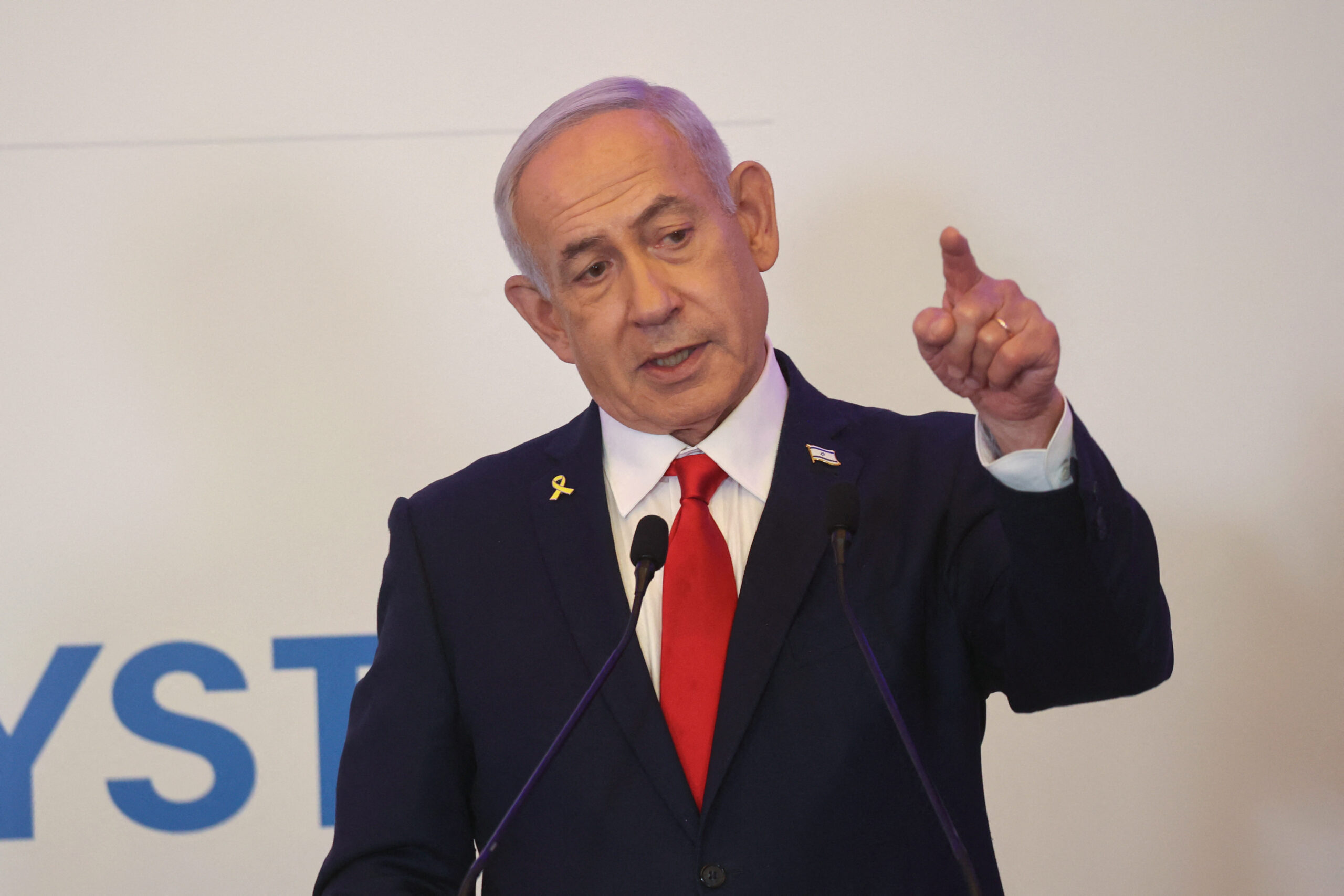
GIL COHEN-MAGEN/AFP via Getty Images
Israel's Prime Minister Benjamin Netanyahu speaks during an event at the Waldorf Astoria Hotel in Jerusalem on July 27, 2025.
Israel’s decision to take control of Gaza City is meant to prevent further prolonging the war, Israeli Prime Minister Benjamin Netanyahu said on Sunday.
The prime minister’s comments come as elements of the Israeli right and nearly all of the left have railed against the decision, further destabilizing the prime minister’s hold on Israel’s leadership.
In a video statement on Saturday night, Israeli Finance Minister Bezalel Smotrich said he had “lost trust that the prime minister can and wants to lead the IDF to a decisive victory.”
At the same time, tens of thousands of Israelis took to the streets of Tel Aviv to protest against the Cabinet’s decision, calling for an immediate hostage deal.
Speaking Sunday at a press conference for foreign media in Jerusalem, Netanyahu said that “Hamas still has thousands of terrorists in Gaza … Hamas is refusing to lay down its arms, so Israel has no choice but to finish the job.”
”Contrary to false claims,” the prime minister argued, “this is the best way to end the war and to end it speedily.”
Rather than take control of Gaza City, part of the remaining 25% of Gaza that Israel does not control, IDF Chief of Staff Lt. Gen. Eyal Zamir presented to the Security Cabinet on Thursday night a strategy of surrounding those areas, while expressing concern about the safety of the 20 hostages believed to still be alive if a military takeover is attempted.
As to whether Israel’s new plan puts hostages in further danger, Netanyahu said that “the option of just doing a war of attrition from a defensive position has not proved itself. It won’t bring [the hostages] out … [It will lead to a] protracted conflict that won’t bring the war to an end.”
”I don’t want to prolong the war. I want to end the war, and I think the other option would have prolonged the war,” he added. “Prolonging the war means that many of them could be starved to death.”
Netanyahu also emphasized Israel’s “five principles for concluding the war,” authorized by the Security Cabinet, which he said were his “day-after plan” for Gaza. They consist of disarming Hamas, returning the hostages, demilitarizing Gaza, Israeli security control of the enclave and establishing a civilian administration for Gaza led by neither Hamas nor the Palestinian Authority.
Though Netanyahu said in an interview with Fox News last week that Israel plans to take control of all of Gaza, the Security Cabinet decision announced early Friday morning fell short of that.
The Security Cabinet voted early Friday, after a 10-hour meeting that began the previous day, for the IDF to “prepare for taking control of Gaza City while distributing humanitarian assistance to the civilian population outside the combat zones.”
Netanyahu continued to speak of the IDF seizing all of Gaza on Sunday, presenting an image of the “remaining Hamas strongholds” of Gaza City and the “central camps and Moassi,” a second enclave. A spokesperson for the prime minister clarified to Jewish Insider after the press conference that “the decision that was authorized is about Gaza City. Later, if needed, the central camps as well.”
Netanyahu said that, as Israel did before maneuvering into Rafah over a year ago, it plans to move the population out of Gaza City, “safeguard the civilian population and let us go, at last, into the most important stronghold of Hamas.”
Gaza City is only part of the remaining 25% of Gaza not currently controlled by the IDF. Reports indicate that the IDF said it will take two months to move the civilian population out of the city; Netanyahu said he instructed the military to do it in less time because he wants to finish the war as soon as possible.
That two-month window leaves an opening for another ceasefire deal as Qatar, Egypt and the U.S. are reportedly working on reviving negotiations.
The plan was supported by “a decisive majority of Security Cabinet ministers,” according to the Prime Minister’s Office.
Smotrich accused Netanyahu of “making a U-turn” from a plan they devised together “to go all the way,” involving “dramatic moves to bring victory in Gaza, a combination of a quick military victory and an immediate diplomatic move to exact a painful price from Hamas, destroy its military and civilian capabilities, and put unprecedented pressure to free the hostages.”
Instead, Smotrich argued, the Security Cabinet chose to support “an immoral, unreasonable folly,” that would involve “sending tens of thousands of fighters to maneuver in Gaza City while endangering their lives and paying heavy diplomatic and international prices, only to pressure Hamas to free hostages and then retreat.”
“I cannot back this decision. My conscience doesn’t allow it … No more stopping [the war] in the middle … We must make a clear, sharp move to defeat Hamas and bring the hostages home all at once,” he stated.
Despite saying that he lost trust in Netanyahu, Smotrich did not say he was leaving the coalition. Instead, he called for another Security Cabinet meeting to further discuss Israel’s next steps in Gaza.
Israeli National Security Minister Itamar Ben-Gvir, who, like Smotrich, has pushed for more aggressive moves in the war in Gaza, told Army Radio on Sunday that Smotrich turned down his offer to present an ultimatum to Netanyahu to quit the government if it does not accept a plan to “go in, destroy, conquer.” Smotrich and Ben-Gvir have called for Israel to fully occupy Gaza and build Israeli settlements in the enclave.
Smotrich’s outspoken criticism is a signal of the growing leverage he holds within Netanyahu’s volatile government. Netanyahu currently has a minority coalition, holding just 60 out of the Knesset’s 120 seats, making his political situation tenuous. The United Torah Judaism and Noam parties left the coalition last month over disputes relating to sanctions for Haredim who do not serve in the IDF.
Tzvi Sukkot, a lawmaker from Smotrich’s Religious Zionism Party, wrote in a post on X on Sunday morning, “if we are going back to Oct. 6, 2023 and decide to give up on the war aims, it is an existential threat to the State of Israel. If that is the situation, in my humble opinion, we must go to an election.”
Israeli opposition leader Yair Lapid wrote Smotrich a letter asking for his support for a bill to disperse the Knesset, which would trigger an election.
“You admitted that the prime minister’s policy is not bringing a decisive victory in Gaza, is not bringing back our hostages and is not winning the war,” Lapid wrote. “You added that you cannot stand behind the prime minister and back him anymore. In light of this, I call you to join me in a letter to the Knesset speaker in which we can say there was a significant change in circumstances that justifies bringing up the bill to disperse the Knesset again.”
At the same time, the political opposition and the Hostages Families Forum spoke out against the more aggressive approach in Gaza approved by the Security Cabinet, pointing to Zamir’s opposition to the move.
Lapid called the decision “a disaster that will lead to many additional disasters.”
“In total opposition to the opinion of the military and security levels, without consideration for the exhaustion and attrition of the fighting forces, Ben-Gvir and Smotrich dragged Netanyahu to a move that will take many months, will lead to the death of hostages, to many soldiers killed, will cost tens of billions of Israeli taxpayer money and will lead to diplomatic collapse. That’s just what Hamas wants,” Lapid said.
“As we approach the tragic one-year anniversary of the murder of six hostages who were executed by their captors, the expansion of fighting only further endangers those still held in Gaza’s tunnels,” the forum stated. “Hamas continues to exploit military escalation as justification for its brutal treatment of our loved ones … Our government is leading us toward a colossal catastrophe for both the hostages and our soldiers. The Cabinet chose last night to embark on another march of recklessness, on the backs of the hostages, the soldiers, and Israeli society as a whole.”
Tens of thousands gathered for the weekly demonstrations in central Tel Aviv Saturday night, blocking the city’s central artery, the Ayalon Highway. Some of the hostages’ relatives called for a general strike on Sunday and for soldiers to refuse orders.
Shai Mozes, nephew of released hostage Gadi Mozes, said that following the Security Cabinet decision, “the mission you’ll be given is participation in killing the hostages. In this situation, there is no choice but to refuse.”
Several hostages’ relatives expressed support for a general strike, as did Lapid. The Hi-Tech Forum, representing dozens of Israeli tech companies and hedge funds, said they would allow their employees to miss work if a strike is held.
The Histadrut, Israel’s national labor union, declined to support a strike, following a court ruling last year that they can only strike for explicitly labor-related reasons.
Netanyahu also discussed the humanitarian situation in Gaza in the press conference Sunday, saying that Israel’s “policy throughout the war has been to prevent a humanitarian crisis while Hamas’ policy is to create it.”
Israel is working to avoid a humanitarian crisis by designating safe corridors for aid distribution, increasing safe distribution points managed by the Gaza Humanitarian Foundation and continuing airdrops by Israel and other countries, he said.
”The only ones being deliberately starved in Gaza are our hostages,” Netanyahu argued, displaying a screenshot from a video Hamas released last week of hostage Evyatar David and contrasting his emaciated arm with the much thicker one of his captor.
Netanyahu also displayed photographs of children from Gaza who appeared in the foreign media alongside claims that they had been starved by Israel, and listed the congenital diseases from which they suffered that were not originally reported. He said his office is looking into whether Israel can sue The New York Times over the matter.
The prime minister compared the claims to blood libels: “We were said to be spreading vermin in Christian society; we were said to be poisoning the wells; we were said to slaughter Christian children for blood. That was followed by massive violence, pogroms, displacement, followed by the worst of all, the Holocaust.”
”The international press is falling for Hamas propaganda, hook line and sinker,” he added, standing next to the text “Open your eyes to Hamas’s lies.”
Netanyahu also said he had ordered the IDF to allow more foreign journalists into Gaza.
However, he stated, “We will not commit suicide to get a good op-ed.
Last year, Hamas executed six hostages when the IDF approached their position; military reportedly opposes taking control of areas in Gaza where hostages are believed to be held
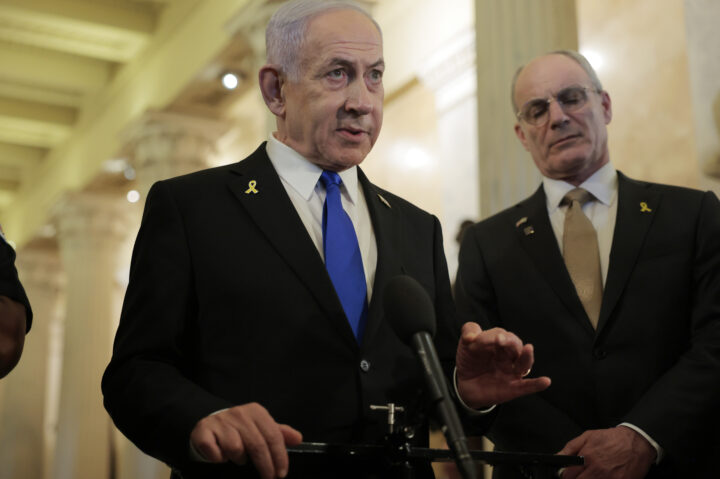
Anna Moneymaker/Getty Images
Israeli Prime Minister Benjamin Netanyahu speaks to reporters after meeting with U.S. Speaker Mike Johnson (R-LA) at the U.S. Capitol on July 8, 2025, in Washington, D.C.
Israeli Prime Minister Benjamin Netanyahu plans to ask the Security Cabinet to back expanding Israel’s military efforts in Gaza, Israeli media reported on Monday.
“We are going to conquer the [Gaza] Strip,” a senior source in Netanyahu’s office told Israel’s Channel 12. “The decision was made. Hamas will not free more hostages without us fully surrendering, and we will not surrender. If we don’t act now, the hostages will die of hunger and Gaza will remain under Hamas’ control.”
A few caveats: Netanyahu did not use the term conquer or occupy with all of the Cabinet ministers to whom he conveyed his position, according to Israeli public broadcaster KAN. Maariv reported that Netanyahu has not made a final decision yet about whether the IDF should take control of all of Gaza, and noted that legally, he cannot decide on his own without the Security Cabinet.
“Netanyahu realized … that there is no point anymore in waiting for Hamas [to agree to a deal], and therefore a decision about the next stage of the war must be made quickly,” a source involved in the matter told Maariv. “The dispute now is not about whether to act or negotiate, because a deal with Hamas is no longer on the table. Rather, it’s about how to act without a deal, whether to go for full conquest or for a siege and increased pressure.”
IDF Chief of Staff Maj.-Gen. Eyal Zamir reportedly favors a siege over occupying all of Gaza.
The IDF currently controls about 75% of the Gaza Strip, and the new plan would bring the entire area under Israel’s control. Among the areas the IDF would enter would include Gaza City, where the IDF has not maneuvered in a year and a half, and towns in central Gaza, where some 20 remaining living hostages are believed to be held.
The military’s hesitation to enter those areas was, in part, due to a concern for the hostages’ safety. Last year, Hamas executed six hostages when the IDF approached their position and former hostages have said that their captors said they would kill them if the army approached the location where they were held. Hamas has also warned the IDF that attempts to rescue hostages would result in death.
Senior officials were quoted in multiple Israeli news outlets saying that Zamir should resign if he disagrees with Netanyahu’s decision to take control of the remaining 25% of the Gaza Strip.
Netanyahu is expected to bring the proposal to a Security Cabinet vote on Tuesday.
The move comes two weeks after Hamas rejected a partial ceasefire and hostage-release deal, and Israel and the U.S. said they would only pursue comprehensive agreements to free all of the hostages moving forward. Hamas and Palestinian Islamic Jihad published videos in recent days of hostages Rom Braslavski and Evyatar David who appeared to be starving; the latter was filmed digging his own grave.
In addition to Zamir, others expected to argue against conquering the rest of Gaza, according to Channel 12, are Foreign Minister Gideon Sa’ar, Shas leader Arye Deri, National Security Advisor Tzachi Hanegbi and Mossad chief David Barnea, among others.
Netanyahu has the support of Strategic Affairs Minister Ron Dermer, Finance Minister Bezalel Smotrich, National Security Minister Itamar Ben-Gvir, Military Secretary Maj.-Gen. Roman Gofman and Cabinet Secretary Yossi Fuchs.
The Prime Minister’s Office did not respond to requests for comment on the reports.
Rather than confirm or deny that he had made a decision about Israel’s next military steps in Gaza, Netanyahu posted a video to X after Hebrew media reported on the matter, which focused on Israeli efforts to get food and medicine to residents of Gaza, and compared claims that Israel was starving Gazans to antisemitic conspiracy theories.
Dennis Ross and David Makovsky’s new book claims that past Israeli leaders have made brave moves, but Netanyahu prioritizes political considerations

Washington Institute
David Makovsky and Dennis Ross.
Former U.S. negotiators and veteran diplomats David Makovsky and Dennis Ross are out with a new book this week. During an in-depth conversation with Jewish Insider, the pair discussed their latest work titled Be Strong and of Good Courage: How Israel’s Most Important Leaders Shaped Its Destiny.
Makovsky and Ross focus on four Israeli prime ministers — David Ben-Gurion, Menachem Begin, Yitzchak Rabin and Ariel Sharon — who, the book says, “met the bar of history” by making courageous decisions that shaped the present and future of Israel.
Ross told JI that they decided to write the book out of a concern that Israel is on a path towards “one state for two peoples,” due to indecision by the Israeli government. “Historically, there have been Israeli leaders who always rose to the occasion and understood that when you face big stakes, you have to make a choice; realize that while there’s always a cost in making a decision, there’s also at times even a higher cost from not making a decision,” Ross said.
Another objective of the book, the authors wrote, was to provide U.S. leaders with ideas that would “make it easier for an Israeli prime minister, whoever it might be, to make a decision” by providing them “political tailwind” to convince the settler community to support an initiative that is of strategic value to Israel’s security.
According to Makovsky, the focus on Ben-Gurion, Begin, Rabin and Sharon was intended to highlight the successes of those leaders. While previous prime ministers — such as Ehud Barak and Ehud Olmert — also made far-reaching offers to move towards peace with the Palestinians, “for whatever reason there wasn’t a breakthrough,” he asserted.
“We thought it’s important for the public to understand that there are people who rose to extraordinary challenges and were successful’’ because they chose to deal with the issue and not kick the can down the road. “They were making a decision that was going to produce either high costs or a terrible political blowback and they were prepared to take that on anyway.”
Makovsky stressed that he and Ross wrote the book as “two centrists. There’s no discourse of polarization, no name-calling of anybody. We’re trying to drive some inspiration from the past in facing the challenges of the future. And, maybe, this book defies political gravity in Washington.”
The former journalist and diplomat said they are “trying to address an issue that is hyper-politicized in a very dispassionate way — because we don’t think that this issue was solved in the end zones of the political spectrum. We think we need to galvanize a consensus in the middle and we think the way to look at it is not to bash people over the head on either side of the parties — in this country or in Israel — but to look at the leaders who actually made a difference.”
Ross warned that Israel is approaching a tipping point at which the option of a two-state solution will no longer be viable. “We make the case that there is no two-state outcome anytime soon. I mean, if you ask me, we are talking 10 to 20 years at a minimum,” he said. “But it’s that tipping point that you have passed where you lose the ability to separate Israelis from the Palestinians, then your only outcome is one state.”
Both Ross and Makovsky agree that Israeli Prime Minister Benjamin Netanyahu’s lack of decision on this issue is driven by political convenience, not ideology or stubbornness. Makovsky is bothered that Netanyahu never made an effort to prepare his base for compromise.
“It is disappointing that someone who’s clearly very bright and is very capable — he’s certainly not shy in shaping the public’s response on Iran — when it comes to political survival, he is always focused on survival rather than changing the public’s attitude on this issue,” he said. “And I think that sets him apart from these other four leaders. These other four leaders found not just that they had to take a right course, but they had to explain it. They did not sugarcoat the problem, because they were problem-solvers. I think that when Netanyahu’s intellectual conclusions clash with his political imperatives, he tends to go with the political imperative.”
Ross echoed the last chapter of the book with regards to Netanyahu: “You don’t become prime minister unless you have political smarts and capability and insight. You certainly don’t become Israel’s longest-serving prime minister, as Netanyahu has, unless you also have an enormous amount of talent,” the former Mideast envoy said. “What we describe him as is someone that — when it comes to dealing with the Arabs, managing what was the Arab awakening, looking at the nature of the Iranian threat — he has been strategic in character and in policy. When it comes to dealing with the Palestinians, we describe him as being political, always trying to find a way to manage his political base even as he’s also trying to manage what he sees as pressures from the outside.”
Turning to the upcoming Israeli repeat election, Ross expressed concern that the Israeli-Palestinian issue is not even discussed as something that has a longterm effect on the Jewish and democratic future of Israel.
“I would love to see a discussion in the Israeli election on separation,” he said. “My guess is, if that actually was the discussion, you’d find most Israelis say, ‘yeah, we think we should separate from the Palestinians.’ The problem is that there isn’t a policy today that reflects that.”
Please log in if you already have a subscription, or subscribe to access the latest updates.
 Continue with Google
 Continue with Apple