




















































Nebraska Dem primary pits Israel critic against more-moderate challenger
State Sen. John Cavanaugh, backed by left-wing Democrats, declined to sign a resolution supporting Israel and condemning Hamas on anniversary of Oct. 7 terrorist attack

Campaign page/Wikimedia Commons
Denise Powell and John Cavanaugh


 Add JewishInsider on Google
Nebraska’s 2nd Congressional District — the so-called “blue dot” in an otherwise red state — is a critical pickup opportunity for Democrats in November’s midterms. Vice President Kamala Harris won the district in 2024, and the popular, moderate Republican incumbent, Rep. Don Bacon (R-NE), is retiring.
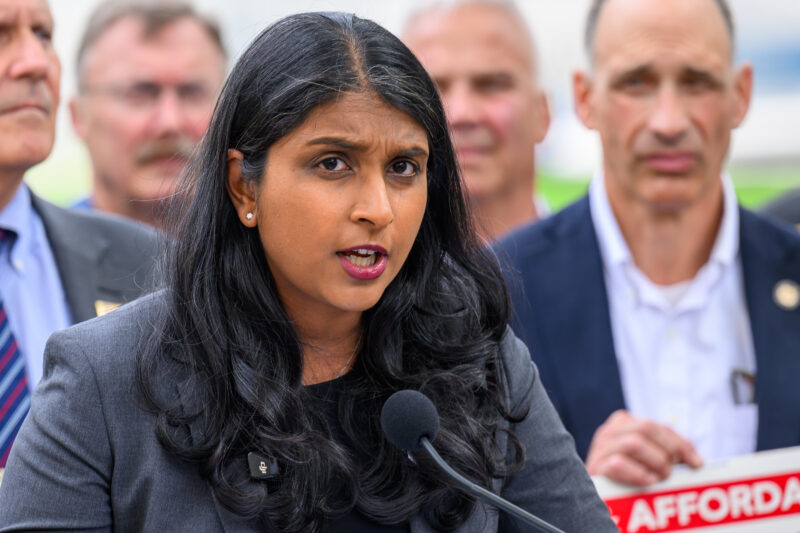
The Democratic primary in the district on Tuesday is coming down to John Cavanaugh, a progressive state senator backed by a range of prominent left-wing leaders, and Denise Powell, a nonprofit executive backed by a host of Democratic political groups.
The outgoing Bacon has been an outspoken supporter of Israel, and is also a co-chair of the House’s bipartisan antisemitism task force, speaking out at times against members of his own party on the issue.
Cavanaugh was one of 10 state senators who declined to sign onto a resolution supporting Israel and condemning Hamas on the first anniversary of the terrorist group’s Oct. 7, 2023, attacks on Israel. “I support Israel and believe Israel has a right to exist. And I also believe a two-state solution is the only way to secure lasting peace,” Cavanaugh said in a statement to Jewish Insider in February.
He has been endorsed by the Congressional Progressive Caucus and a range of left-wing lawmakers including Reps. Jamie Raskin (D-MD), Pramila Jayapal (D-WA), Ro Khanna (D-CA), Greg Casar (D-TX), Chris Deluzio (D-PA), Adelita Grijalva (D-AZ), Jan Schakowsky (D-IL) and Mark Pocan (D-WI), as well as J Street.
Following the attempted terrorist attack on a synagogue and preschool in West Bloomfield, Mich., in March, Cavanaugh said on Facebook, “I’m horrified by the acts of violence we are seeing against Jewish Americans. Everybody has the right to worship in safety and security and while I’m thankful the gunman didn’t make it inside, violence like this shakes entire communities — my thoughts are with West Bloomfield.”
Powell is taking a more pro-Israel line, yet still falls to the left of other Democrats in the race on the issue. She said in a statement to JI earlier this year that she has “always unequivocally supported Israel’s right to exist and its right to defend itself.”
“My position is clear: I fully support providing aid to Israel and believe that we should ensure humanitarian aid reaches those in need,” the statement continued. “In order for the region to rebuild, it is imperative that we center our efforts around a two-state solution that both ensures Israel’s security and gives the Palestinian people the resources they need to reestablish their lives.”
She said during a candidate forum that she would have been hesitant to support a State Department funding bill that would have blocked funding to the United Nations Relief and Works Agency, provided $3.3 billion in military funding for Israel and penalized Palestinian international legal action against Israel, citing, in her statement to JI, concerns about “strip[ping] humanitarian aid to Gaza.”
Powell has been endorsed by Reps. Annie Kuster (D-NH), Emily Randall (D-WA), Norma Torres (D-CA), Andrea Salinas (D-WA) and former state Sen. Tony Vargas, the two-time Democratic nominee in the district, as well as the New Democrat Coalition, the Congressional Black Caucus, the Congressional Hispanic Caucus’ BOLD PAC, EMILY’s List and 33Elect Democratic Women.
Cavanaugh said at a candidate forum earlier this year that he wouldn’t accept funding from pro-Israel groups, while Powell said she wouldn’t accept backing from any special interest groups.
Democratic Majority for Israel filed with the Federal Election Commission its plans to spend $750,000 attacking Cavanaugh, but ultimately withdrew the buy. A person familiar with DMFI’s thinking told JI that DMFI PAC “decided to direct its resources into other races” for “strategic reasons” but remains focused on boosting pro-Israel Democrats who will help Democrats retake the House.
Nevertheless, Cavanaugh has repeatedly bashed Powell over the ultimately canceled DMFI intervention in the race.
“AIPAC aligned groups that are funded by Trump donors are now supporting Denise Powell. She said that she would refuse support from Democratic Majority for Israel or AIPAC, and now dark money groups are pouring millions into the Democratic primary here in NE-02 – and trying to hide it,” he said on X. “Voters deserve to know which out-of-state groups are funding these misleading attacks.”
Other candidates who have taken an outspoken pro-Israel stance, including district court clerk Crystal Rhoades and former Rep. Steny Hoyer (D-MD) aide James Leuschen, are seen as lagging behind in the race.
Gary Javitch, a board member of B’nai B’rith who hosted both Cavanaugh and Powell for lunch events with the Jewish community in Omaha and has long been involved in bipartisan pro-Israel politics in the state, described Cavanaugh as “the worst candidate [in the race] for people who favor Israel” and Powell as “very strongly pro-Israel,” based on their comments at the lunch events and their overall records.
“The Republican candidate is the closest to retiring [Rep.] Don Bacon,” Javitch added.
The expected Republican nominee is Omaha City Councilmember Brinker Harding, who faces no primary opposition.
Powell leads the field in fundraising with $1.6 million total raised, followed by Cavanaugh with $1.1 million. Harding, meanwhile, has raised $1.3 million. All other Democratic candidates trail significantly behind the three.
Notably, a GOP-linked outside group has been spending in the Democratic primary in an apparent effort to boost Powell, claiming Cavanaugh is a supporter of President Donald Trump. Yet other Republicans see Cavanaugh as the weaker challenger to Harding.
Powell and her allies — along with other candidates challenging Cavanaugh — have also argued that a Cavanaugh victory would have farther-reaching consequences for Democrats nationwide. If he wins, Nebraska’s Republican governor would appoint Cavanaugh’s replacement in the state Senate, likely delivering a stronger GOP majority in the chamber and potentially allowing Nebraska Republicans to overhaul the state’s electoral college apportionment.
Currently, the 2nd District has its own electoral college vote, apportioned separately, which went to Democrats in 2020 and 2024. Democrats assume that Republicans, given the chance, would move to a winner-take-all system in the electoral college — and would use the expanded Senate majority to pass other conservative priorities as well.
Cavanaugh has brushed off these criticisms as a “Republican talking point” spread by “dark money PACs.”
More Stories
EARLY ADOPTER
El-Sayed accused Israel of genocide before Gaza ground war began
EDUCATION DELIBERATION
Democratic governors face looming deadline to opt in for educational tax credit

PASTOR'S POSITION
Kansas Democratic Senate candidate wants to cut offensive aid to Israel, rejects genocide label
chesapeake challenge
Maryland GOP gubernatorial nominee Dan Cox says he disagrees with son’s antisemitic posts
KINGS COUNTY KERFUFFLE
Treasurer for anti-AIPAC PAC behind effort to unseat Brooklyn Republicans
CITY HALL CRITICISM
Mamdani’s Oct. 7 statement assailing ‘genocide in Gaza’ provokes outrage from Jewish groups
Please log in if you already have a subscription, or subscribe to access the latest updates.
 Continue with Google
 Continue with Apple