










































































Bridge to Impact grants launch with goal of boosting innovation in Israel
The $1.5 million grants will bring researchers to Israel for a two-year course of work, during which time they will affiliate with an Israeli university
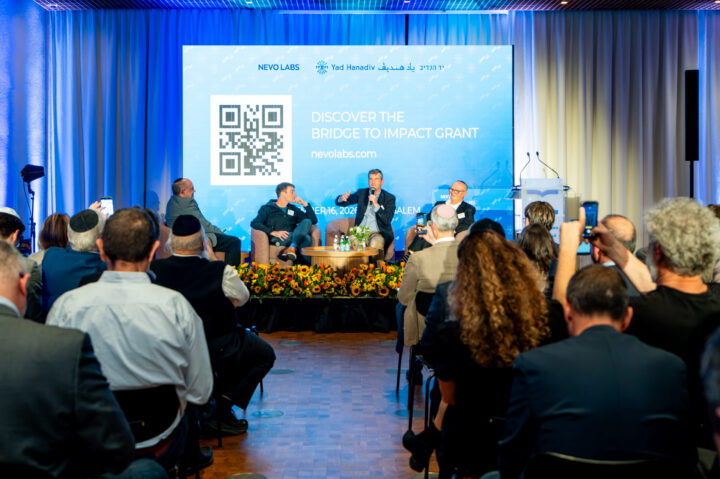
(Hanna Taieb)
From left: Sender Cohen, Eden Shochat, Michael Eisenberg and Alex Tsigutkin speak at the National Library of Israel at the Bridge to Impact event, on Monday 16th, Nov. 2024


 Add JewishInsider on Google
The three-year war between Israel and Hamas has, in one way or another, upended nearly every sector and element of Israeli society. The startup nation that produced groundbreaking technologies and garnered global praise for innovation has faced an accelerated brain drain since the war’s onset as highly educated CEOs, researchers and scientists have departed for quieter and more economically stable pastures.
But at the National Library of Israel in Jerusalem last week, a group of nearly 100 scientists, researchers, diplomats, inventors and investors gathered to launch a project aimed at bringing the brains back to Israel.
The Bridge to Impact grant program — which aims to bridge the divide between research and practical application — is the brainchild of Sender Cohen, who worked with his friends and fellow investors Michael Eisenberg, Adam Fisher and Scott Tobin to raise the capital for the project. Cohen’s Nevo Labs launched the effort in partnership with Yad Hanadiv, the Israeli philanthropic arm of a number of Rothschild family philanthropic trusts.
Grantees, Cohen explained, will spend two years in Israel, during which time they will affiliate with an Israeli university to conduct their research. The hope, he explained, “is you have this amazing alumni network of winners of the prize and of [intellectual property] that’s come out of it.”
The project was conceived shortly after Hamas’ Oct. 7, 2023, attacks. “People were asking, ‘What is a way to actually make a long-term difference that really changes the [Israeli] economy?’ and my head kept going back to Bell Labs,” Cohen explained, referring to the research and development hub that for decades has been at the forefront of American innovation.
Cohen and his partners built out the selection committees, whose members include Natera co-founder Matthew Rabinowitz, Lux Capital’s Josh Wolfe, Israeli cancer researcher Ronit Satchi-Fainaro and biochemist Ehud Gazit, the interim chair of Fulbright Israel. Each recipient will work with a team of mentors from the investment, science and entrepreneurial worlds over the course of the two-year grant.
“If you have the best investors and the best entrepreneurial scientists, then we should get the best young scientists with crazy ideas who want a breakthrough prize, and hopefully we can help them break through,” Cohen said.
“You want to have investors around the table that a young scientist who’s got that crazy idea … wants to learn [from] by osmosis,” Cohen continued.
Those accepted into the program will receive up to $1.5 million in funding, which will go toward research, materials, equipment, staffing and regulatory costs. The grants will not be disbursed outright, but rather in stages as each project hits its respective milestones. The first year, the program intends to accept three applicants, increasing the next year to five and then to 10.
Acknowledging Israel’s declining global image, Cohen said, the grants could help build more positive associations with Israel.
“Help somebody create a solution to a problem that helps the world, and that people know that that solution has come out from Israel, and the inventor of it is alive, and the world needs to consult with the inventor of that and work with them,” Cohen said. “I mean, that’s the reality, right? Why are the sciences better in general in terms of relations with Israel than the humanities? Why is the business world? One could say that psychologically it’s a different kind of person, maybe? But also, there’s a practical need.”
The program at the National Library event, Soroban Capital Partners co-founder Scott Friedman said, “calls Israel the land of impossible challenges and extraordinary breakthroughs. I suggest that those two aren’t separate facts. Here in Israel, one tends to cause the other.”
More Stories
On the Hill
House Dems nominate Hakeem Jeffries as speaker, rebuffing far-left opposition
REALITY CHECK
Counterterrorism chief says Iran’s leadership hasn’t moderated, undercutting Vance’s hopes

SCOOP
Eric Goldstein elected vice chair of New York Solidarity Network board

BRUSHBACK PITCH
Menin challenges Mamdani over controversial NYPD protest bill

A Qatar-ed affair
How Jewish nonprofits are directing charitable dollars to Qatar’s coffers
TEHRAN TARGET
Ex-Mossad chief: Only regime change will stop Iran from getting nuclear weapons
Please log in if you already have a subscription, or subscribe to access the latest updates.
 Continue with Google

 Continue with Apple