



























Iran war is leading to stronger alliance between Israel, India and the UAE, experts say
The emerging partnership is being sharpened by a rival alliance between Pakistan and Saudi Arabia
(Press Information Bureau (PIB)/Anadolu via Getty Images)
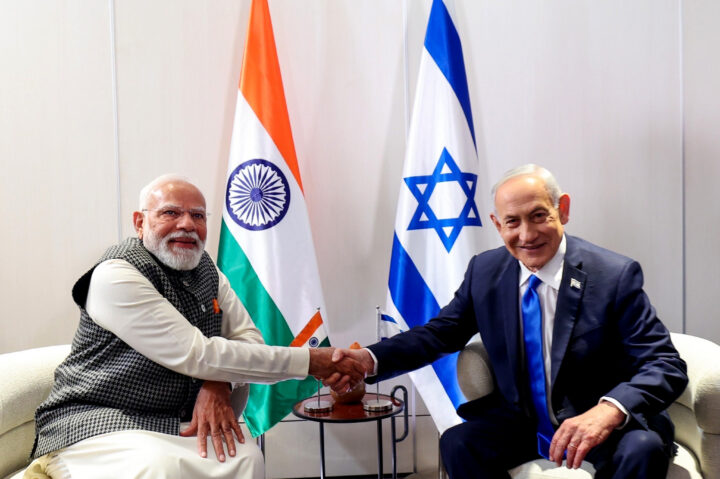
Indian Prime Minister Narendra Modi meets with Prime Minister of Israel Benjamin Netanyahu in New Delhi, India on February 25, 2026.


 Add JewishInsider on Google
While some geopolitical relationships have been tested by the Iran war, others have been strengthened: Emerging alignments between Israel, the United Arab Emirates and India are creating new opportunities for cooperation among three countries increasingly bound by shared defense and economic interests, experts said.
During the war, Israel provided the UAE with an Iron Dome defense battery and IDF operators to help protect the Gulf nation from Iranian attacks, officials have confirmed. But India also moved to support the Emiratis, establishing an air bridge to allow the country to import and export goods amid disruptions caused by the closure of the Strait of Hormuz, according to Hussain Abdul-Hussain, a research fellow at the Foundation for Defense of Democracies.
The growing cooperation between India and the UAE predates the war, experts said, but the conflict has accelerated it. On Friday, the two countries agreed on the framework for a strategic defense partnership, a step that could deepen ties between New Delhi and Abu Dhabi amid the regional fallout from the war.
Abdul-Hussain told Jewish Insider that the partnership also extends to Israel, which has remained a key ally of both countries. He said the emerging alignment is rooted in overlapping economic and strategic interests and shared adversaries.
“Absolutely there’s an alliance that’s emerging,” Abdul-Hussain said. “I think the three of them are like three pieces of a puzzle that fit neatly together.”
Abdul-Hussain said the UAE’s expected expansion of oil production could bring it even closer to India, one of the world’s largest energy importers. He argued that the UAE’s departure from OPEC and its ambition to increase oil output could position India as Abu Dhabi’s “biggest customer.”
He said the partnership is also driven by the defense and technology strengths of India and Israel, as well as the UAE’s position as a regional hub.
“If you add all these things together — energy and technology and military, and the size of the population of India, the dynamic technological economy of Israel, and then you put the UAE in the middle between them — I think the three of them can really help one another and push each other up,” Abdul-Hussain said. “They have a lot of mutual interests and they can get a lot of benefits from the cooperation.”
Edmund Fitton-Brown, a former British diplomat and senior fellow at FDD, said the new strategic defense framework between India and the UAE could allow New Delhi to provide Abu Dhabi with “significant help” in several areas, including cyber, communications, training and technology.
He said the partnership could include “joint patrols to defend against Iranian threats to cables and shipping lanes,” as well as broader military cooperation.
Experts also said the deeper significance of the emerging alignment lies in how Israel, the UAE and India are responding to rival powers that are increasingly coordinating in ways that threaten their interests. For India and the UAE, Pakistan has become a key point of overlap: New Delhi views Islamabad as its chief regional adversary, while Abu Dhabi has grown increasingly wary of Pakistan’s ties to Iran and its deepening defense relationship with Saudi Arabia.
“They understand that there’s an alliance of enemies,” Abdul-Hussain said, pointing to Iran and Saudi Arabia as UAE adversaries, Pakistan and Iran as Indian adversaries and Iran and Turkey as Israeli adversaries. “Each one in this alliance is happy to be in this alliance because they understand that their enemies are also ganging up together against them.”
Jonathan Ruhe, a fellow at the Jewish Institute for National Security of America, similarly said the new alignment “reflects how shared threats from Iran are driving deeper cooperation within, and beyond, the region.”
“Recent deals to strengthen Emirati-Indian trade, technology and security cooperation pick up on initial progress that preceded Hamas’ Oct. 7 attack and its disruptions to regional integration,” Ruhe said. “They also reflect how our Middle East partners don’t automatically look to American leadership like they used to.”
Abdul-Hussain pointed to the UAE’s shifting posture toward Pakistan as an example of how the war has reshaped regional alignments. Before the conflict, he noted that Abu Dhabi had grown closer to India while still avoiding an explicit break with Islamabad — a calculus that has since changed.
“Until this war, the UAE, even though they had become close with India, had not really taken sides between India and its traditional rival Pakistan,” he said. “Shortly after the war stopped, the Pakistanis had $3 billion in loans from the Emiratis that had matured, and the Pakistanis asked the Emiratis to extend the time or to reissue the debt again, and the Emiratis refused,” he said.
Abdul-Hussain said Pakistan’s warm ties with Iran, including its role hosting mediation between Washington and Tehran, added to Abu Dhabi’s frustration.
“We know that Pakistan is — even though they’re hosting the mediation between the U.S. and Iran — much closer to Iran,” he said. “They’re friends with Iran, and I think this friendship didn’t go well with the Emiratis.”
Ruhe said there is “logic to the Pakistan-Saudi angle of closer UAE-India ties,” but argued that China remains “India’s abiding concern here.” He pointed to Beijing’s weapons sales to Islamabad, which he said “inflicted real damage on Indian forces last year.”
Simon Henderson, a senior fellow at The Washington Institute for Near East Policy, was more skeptical, saying the “so-called pact seems to be words rather than substance” and that the current state of Gulf politics remains “hard to define.”
“Everything has been thrown up in the air and we are waiting to see how they land,” Henderson said.
More Stories
PRAIRIE STATE PRIORITIES
Illinois Democrats spend big for anti-Israel candidate running for state Senate

STUDENT SAFETY
Federal civil rights complaint accuses Montgomery County, Md., schools of ignoring antisemitic harassment
AID ARGUMENTS
Michael Oren, Jonathan Schanzer split over when Israel should move past U.S. aid
SECURITY SETBACK
Saudi Arabia postpones ‘Davos in the Desert’ until 2027 amid Houthi attacks
HILLTOP FORECAST
Democratic foreign policy veterans preview party’s shifts on Middle East policy
MAIL FAIL
El-Sayed letter to Jewish community on antisemitism fails to reassure skeptics
Please log in if you already have a subscription, or subscribe to access the latest updates.
 Continue with Google
 Continue with Apple