


































































Blinken says he warned Netanyahu that Israel would lose GOP, evangelical support over Gaza war
The former secretary of state also said he questions whether the U.S. could have done more to save lives in Gaza

Kevin Dietsch/Getty Images
Then-Secretary of State Antony Blinken delivers remarks during a NATO public forum as part of the 2024 NATO Summit on July 10, 2024 in Washington, DC.


 Add JewishInsider on Google
Former Secretary of State Tony Blinken said at a Harvard Kennedy School event this week that he warned Israeli Prime Minister Benjamin Netanyahu a few months into the war in Gaza that Israel was going to lose support among not just Democrats, but also Republicans and evangelical Christians.
“Israel was mostly seen as the David and other forces were seen as the Goliath. That is now flipped,” Blinken said. “One of the things that I told Netanyahu was, ‘You may not care that you’re losing the Democratic Party, but trust me, you are going to lose young Republicans. You’re going to lose young evangelicals. This is generational.’ And he moved on to something else.”
The conversation took place early in 2024, a few months after the Oct. 7 Hamas attacks that killed 1,200 people in Israel. During his remarks at Harvard, Blinken said he wonders if there is more the U.S. could have done to protect Palestinians in Gaza. But he also called on people not to be “binary” in their thinking about the Middle East.
“Of course, for me, coulda-woulda-shoulda is something that will always be there when it comes to Gaza. It could not help but be given the level of human suffering,” said Blinken.
“But where did we start? We started with Oct. 7. We started with the most horrific massacre of Jews since the Holocaust,” Blinken added. “It’s very easy to say, ‘Oh, yeah, that’s a given.’ Except it wasn’t a given for Israelis and Israeli society. It became one for the rest of the world, but not for Israelis.”
Blinken was being interviewed by New York Times reporter David Sanger, who said that history books written about President Joe Biden will show his administration as “strongest on Ukraine and weakest on Gaza.”
Asked whether the Biden administration could have done things differently in Gaza to save lives, Blinken said, “Could we, should we have done things differently such that the suffering that people endured, the loss of the children you just listed and so many others could have been averted? The short answer is: Maybe yes.”
“We had to make judgments in real time about how to try to get to a better place. We made those judgments. People will make their own judgments about what we did and what we didn’t do,” said Blinken.
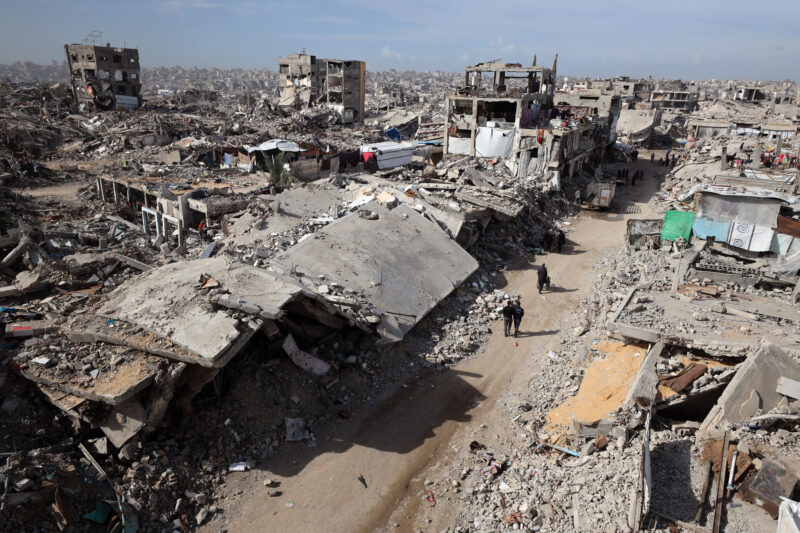
Despite the humanitarian crisis that emerged in Gaza, the U.S. pushed Israel to do more for Palestinians and to allow more aid into Gaza, Blinken said.
“That didn’t just happen. It happened because every single day we were on the Israelis to try to get assistance in, to open more crossing points, to flood the zone. They did that profoundly inadequately. They did that in ways that were not the way I would like to have seen it done, but we got some of that done,” said Blinken. “But yes, of course, you couldn’t be and I wouldn’t be human if I didn’t ask myself every day, could we have done things differently.”
Blinken said that the trauma Israelis experienced after Oct. 7 was so severe that Israel’s war in Gaza would have continued, even without American support — and that cutting off American weapons sales to Israel may have actually lengthened the war.
“Cutting off arms, sure, that was an option. But I don’t actually believe that at least in the near term, it would have changed things,” said Blinken. “I also believe it would have led to an even wider war as Israel’s enemies, and they were multiple, jumped in, and that only would have extended the war in Gaza, not ended the war in Gaza.”
The main focus of the Biden administration, according to Blinken, was to reach a ceasefire, “with hostages coming out and with aid going in.” He acknowledged the pain of people who were angry about the situation in Gaza, but questioned why so little anger was directed at Hamas.
“I empathize with people who felt this so deeply,” said Blinken. “I do remain with a question in my mind about why barely a word was spoken in all those months about Hamas, which was an actor too, and is responsible for so much of what happened.”
More Stories

Daily Overtime
Obama faults Israel’s founding in Belfast

HILLTOP FORECAST
Democratic foreign policy veterans preview party’s shifts on Middle East policy

FIRING FALLOUT
Hillels of Georgia claims fired Emory rabbi not ‘truthful or transparent’ during hiring process

Daily Overtime
Dublin hotel dumps antisemitism conference

Daily Kickoff
Barack to 1948

EDIT WARS
Wikipedia failed to address coordinated anti-Israel campaign, new ADL study finds
Please log in if you already have a subscription, or subscribe to access the latest updates.
 Continue with Google
 Continue with Apple