


Brian Stukes/Lev Radin/Roy Rochlin/John Nacion
In America’s largest Jewish district, Democratic candidates split over Israel, antisemitic protests
As Alex Bores and Jack Schlossberg woo the left, Micah Lasher emerges as favorite among Jewish voters


 Add JewishInsider on Google
With seven weeks remaining until the Democratic primary for an open House seat in Manhattan, the crowded race is beginning to show emerging signs of division over Israel and rising antisemitism, key issues in the heavily Jewish district where many voters closely identify with liberal Zionist sentiments.
The last week — which included two candidate forums focused on Jewish community issues and was punctuated by an anti-Israel protest near a synagogue in the district hosting an Israeli real estate event — highlighted some of the subtle ideological fault lines inflecting the June 23 race to succeed retiring Rep. Jerry Nadler (D-NY).
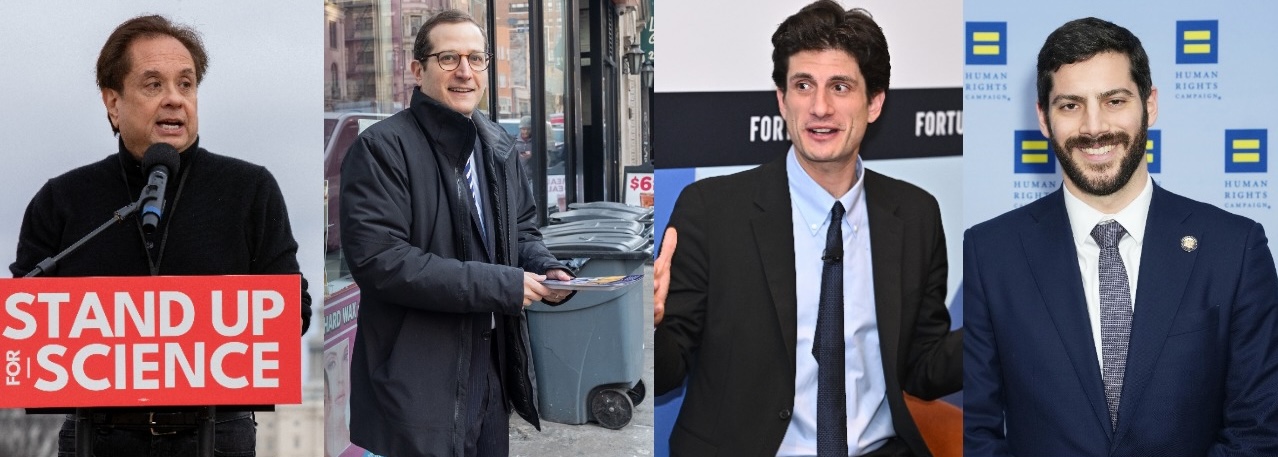
From recent efforts to block U.S. weapons sales to Israel to the intersection between anti-Zionism and antisemitism, the four top candidates in the closely contested race — state Assemblymembers Alex Bores and Micah Lasher, Kennedy scion Jack Schlossberg and former Republican attorney George Conway — are by varying degrees staking out differing views on Middle East policy as well as domestic concerns affecting the Jewish community, while continuing to reaffirm their support for the Jewish state.
Meanwhile, some recent endorsements that Bores received from left-wing advocacy groups hostile toward Israel have fueled skepticism of that support among Jewish leaders, along with speculation he is seeking to carve out a progressive lane for himself that has been largely unoccupied for most of the campaign.
The starkest disagreements were on display last Wednesday during a candidate forum at the Stephen Wise Free Synagogue on the Upper West Side, where Schlossberg, a social media influencer with a narrow lead in most private polls, notably said he would have joined most Senate Democrats who voted last month to restrict arms sales to Israel — even as he continues to back defensive aid to help boost Israel’s Iron Dome system.
For their parts, Conway and Lasher both confirmed they would have opposed the legislation introduced by Sen. Bernie Sanders (I-VT). “I don’t support the withholding of aid from Israel,” Conway explained, drawing applause from the audience, while Lasher said he did not believe the bill “would have actually improved the lives of people on the ground,” echoing comments he had made in a candidate questionnaire opposing House legislation to block weapons sales to Israel.
Bores, who had previously committed to the event, pulled out the day before, citing a scheduling conflict in Washington.
The forum, which took place a day after anti-Israel demonstrators had chanted antisemitic slogans near Park East Synagogue to oppose an Israeli real estate event featuring some advertising for settlements in the West Bank, drew other distinct contrasts among the candidates.
Schlossberg, for instance, condemned what he called the “antisemitic rhetoric” used by demonstrators who had shouted slogans such as, “We don’t want no Zionists here,” “Death to the IDF” and “We don’t want no two-state, we want ‘48.”
Still, he added, “I don’t think that a land sale for real estate that is in violation of international law should be happening in a house of worship.”
In comparison, Lasher, a Jewish protégé of Nadler’s, questioned the protesters’ aims. The demonstration was more broadly about “framing Israel, and the idea of making aliyah to Israel, as illegitimate,” he argued. Earlier, he said the protest was “intended to create fear in the hearts of Jewish New Yorkers and stigmatize our community.”
“I think it’s important to speak with clarity,” added Lasher, who has touted his state legislation to ban protests directly outside houses of worship, which has been opposed by anti-Israel activists in the city. “When people are outside a synagogue shouting, ‘We don’t want two states, we want ‘48’ — that’s not about the question of West Bank settlements. That is about the legitimacy of Israel.”
Bores, whose state Assembly district includes Park East Synagogue, said in a joint statement with City Councilmember Virginia Maloney before the protest on Tuesday that the demonstration evoked “painful memories of times when people have been harassed while entering houses of worship.” He did not appear to have commented on the protest after it occurred.
While Bores has recently accepted support from some groups opposed to U.S. funding for Israel, he has indicated that he does not share such positions. He has rejected legislative efforts to condition aid — stating in one candidate questionnaire, for example, that “determining foreign policy through legislation that targets individual countries has overall not been beneficial for achieving universal rights.”
He reiterated that view last Monday during a separate forum at The Jewish Center, a Modern Orthodox synagogue on the Upper West Side, where he appeared with Lasher. “I support the consistent application of Leahy Laws across all countries,” he said, referring to U.S. laws banning security funding to foreign military units that engage in human rights violations.
Lasher also agreed with that position. “It should be a universal standard,” he said.
“We should be able to stand up to people in our party,” Bores added at the forum last week, “and say how important our relationship is with the State of Israel and how important it is to ensure the rights of everyone in the region, including the Palestinians.”
Still, his recent endorsement from Our Revolution, a Sanders-aligned group that has advocated for cutting military funding to Israel, has fueled questions about the sincerity of his positions. His decision to pull out of the Stephen Wise candidate forum on short notice last week also raised eyebrows, particularly as he had done so after winning support from a City University of New York union that has called for divesting from Israel.
Bores has otherwise claimed backing from New York Progressive Action Network, which likewise supports efforts to withhold U.S. military aid to Israel.
“There’s a lot of skepticism now,” said one Jewish community leader who is closely following the race, speaking on the condition of anonymity to address a sensitive issue. “You don’t get the endorsements of Our Revolution and PSC CUNY,” which represents faculty and staff in the university system, “without saying something differently privately than you do publicly.”
“There’s concern now that there wasn’t a few weeks ago,” the Jewish leader said, noting Bores had been calling community members to do “damage control” after receiving the Our Revolution endorsement. He has explained that the nod extends from their shared goal of regulating the AI industry, which is targeting the former Palantir employee aggressively in the race, according to the Jewish leader.
A spokesperson for Bores’ campaign did not respond to a request for comment about the endorsement last week.
While some Jewish voters in the district feel that Lasher’s views on Israel are to the left of their own, his outspoken opposition to rising antisemitism and commitment to Israel’s security are now appealing to a segment of the community that is questioning the apparent dissonance between Bores’ publicly stated positions and his endorsements from organizations with which he is not aligned on Middle East policy.
A graphic circulating in local Jewish WhatsApp groups on Friday, which was shared with Jewish Insider, warned that “a Bernie Sanders PAC just endorsed Alex Bores” and that “Jack Schlossberg wants to cut arms sales to Israel,” highlighting the names in red.
“Micah Lasher is the clear choice. The community and rabbis are rallying behind him,” the message continued. “It’s time to unite to win this seat.”
Garth Symonds, who chairs The Jewish Center’s committee to get out the vote, said in a statement to JI on Friday that Bores “has proven his toughness in the face of well-funded attacks by those resistant to AI regulation” and that he “appears to have a strong legislative record, but so does Lasher.”
“On Israel, Lasher has a supportive track record, whereas Bores appears close to some people in the Working Families Party, which is anti-Israel, and has been endorsed by One Revolution,” he said, claiming Lasher, a veteran Democratic operative, “has deeper political experience.”
The Working Families Party, which supports conditioning aid to Israel, chose not to issue an endorsement after soliciting questionnaires from Bores, Lasher and Schlossberg. But the group has recently indicated it could rethink that decision as Schlossberg has gained traction, saying “we can do better than that.” It is most likely to support Bores if it does weigh on the primary, City & State New York has reported.
Please log in if you already have a subscription, or subscribe to access the latest updates.
 Continue with Google
 Continue with Apple