


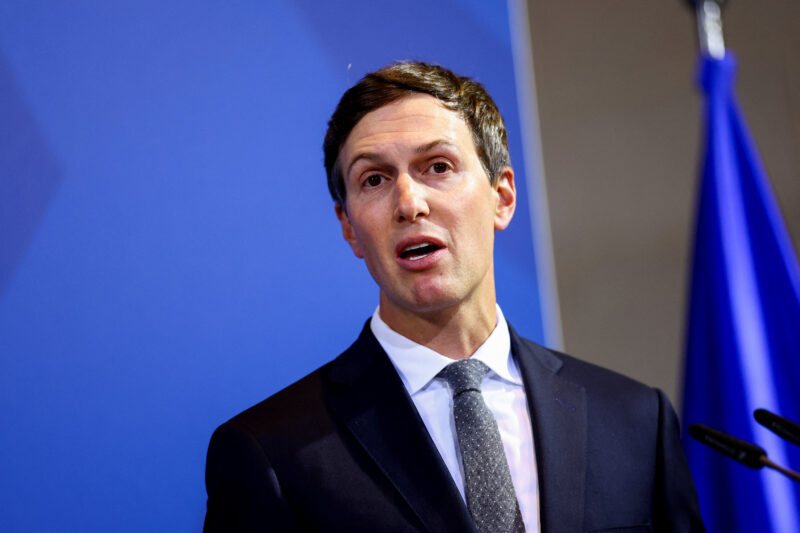






































































With under two weeks left on his mandate, Eisenkot’s coalition talks run on three clashing tracks
Bennett is pushing a unity government with Likud, Liberman is courting the Haredi parties and Eisenkot is betting on a minority government backed by Arab parties
(Amir Levy/Getty Images)
Leader of the Yashar Party, Gadi Eisenkot, gives a statement to the press before a party meeting at the Israeli parliament, the Knesset, on November 10, 2026 in Jerusalem.


 Add JewishInsider on Google
A Hanukkah miracle.
That’s what the Gadi Eisenkot-led “change bloc” will likely need in order to form a coalition government that topples the longtime reign of Israeli Prime Minister Benjamin Netanyahu. The deadline for Eisenkot to cobble together a government expires on Dec. 6, the third night of Hanukkah, at 11:59 p.m. Israel time, barring any extensions. Getting all the coalition cards to align will, in poker players’ parlance, take the political equivalent of a royal flush.
For now Eisenkot is signaling that he has no intention of dragging things out, and some observers believe the cards he is holding give him a slight edge. With a potential attack on Iran looming constantly in the background of the political discourse, coalition negotiations are moving along three distinct — and mutually contradictory — tracks.
The first scenario is rapidly evolving in the public eye, yet it is considered to have the lowest odds of success: a unity government formed between Netanyahu and Eisenkot. While such an arrangement might satisfy the most powerful players, the Likud and Yashar parties differ widely on many issues, beginning with the most simple: Who would serve first as prime minister in a rotation government — Netanyahu or Eisenkot?
As in typical gridlocked negotiations, the most complicated issue has been pushed to the very end of the talks. In the meantime, perhaps to project a sense of momentum, sources say the sides have reached a single point of agreement: that Israel is the nation-state of the Jewish people. Incidentally, that has been enshrined in Israel’s Basic Law since 2018. Monday was the fourth round of talks between the parties, and a fifth one has been scheduled.
“Eisenkot holds much better cards than Netanyahu, because at least on paper, he has more options. For Netanyahu, the options are either to go to another round of elections while he is prime minister [of a caretaker government] … The second option is to go for a unity government, though the challenge is that I find it hard to see him giving up being first in the PM office,” Nadav Shtrauchler, a political analyst and former advisor to Netanyahu, told Jewish Insider.
In practice, at least for now, this option represents Likud’s only viable path into a future coalition without triggering another round of elections. That likely explains why Likud is putting all its weight behind this scenario, including precisely targeting Knesset members from the opposition, seen as “vulnerable” or prone to breaking ranks, in hopes of getting them to vote against any government that excludes Likud.
The figure who surprised the “anti-Netanyahu” bloc over the past week by advancing these talks is former Prime Minister Naftali Bennett. In 2021, his prime ministerial handover meeting with Netanyahu lasted barely 25 minutes; last week, he sat with Netanyahu for nearly three hours for a meeting officially defined as a security briefing, though in practice it was political as well. Within the “change” bloc, Bennett’s move drew frustration, seen as overly public and out of step with the line being pursued in coalition talks. Yet partners had little room to push back against a meeting that was staged from the outset for the cameras, which captured Bennett entering Netanyahu’s Knesset office.
Speaking at the Knesset yesterday, Bennett stated aloud for the first time that this is the coalition he wants to build: “A government of the change bloc, Eisenkot together with Likud, with Eisenkot serving first as prime minister. I strongly prefer this,” he said. Democrats party head Yair Golan swiftly attacked the move at the start of his party meeting, addressing Bennett directly: “Naftali, anyone who leaves Netanyahu in power endangers the security of the state.” Associates of Bennett maintained that the outreach was intended “to examine other options for how to save the bloc and the country.”
The second scenario is forming a change-bloc government with the Haredi parties. Talks on this are taking place continuously behind closed doors, without any public documentation of the meetings themselves. The figure somewhat surprisingly championing this track is Avigdor Liberman, who currently serves as chair of the Knesset Foreign Affairs and Defense Committee. He ran in this election on a distinctly anti-Haredi message due to the sector’s exemption from military service, but has appeared to accept a political 180.
From Liberman’s perspective, this offers the best chance of dismantling Netanyahu’s bloc and establishing a government capable of lasting a full four-year term. A coalition reliant on the Arab parties, his associates argue, would collapse as soon as votes arise concerning Gaza or the situation in the West Bank. “A minority government will fall over this in short order,” sources close to his party told JI.
“There is clearly a chance for a Haredi-Eisenkot government; the talks on the matter are steadily progressing, though there are currently gaps between the various players and the timetable is quite tight,” said Yigal Guetta, a former Shas MK and currently a broadcaster at the Israeli Public Broadcasting Corporation (KAN). “The moment the United Torah Judaism Party joins the government, Shas will follow. It won’t stay outside.”
And then there is the third option, a minority government relying on the Arab parties’ support. This is the fallback option for the “change” bloc and the person who believes in this scenario more than anyone else is the man slated to lead it: Eisenkot. Within the Yashar party, the prevailing view is that they can simply bring a government to a Knesset vote based on the four core principles Eisenkot has laid out (recognizing Israel as a Jewish and democratic state, adopting the values of the Declaration of Independence, universal service and recognizing Hamas as a terrorist organization that must be stripped of its military and governing capabilities). Whoever is willing to join can do so; whoever isn’t should simply step aside and not obstruct it.
“Eisenkot has options, but in any of the scenarios, if there is one thing that all the heads of the other bloc agree on, and they agree on almost nothing, it is that Netanyahu needs to go,” said Shtrauchler. “From their perspective, this is the No. 1 goal, and missing this opportunity is like missing an open goal. But in real life there is no open goal. Netanyahu is the goalkeeper — the most experienced player in the arena, and experience carries weight here.”
And that is exactly the obstacle for Eisenkot and his allies. Given that such a government is not expected to be long-lived, at least according to assessments across the political system, this move is already sharpening the campaign messaging for the next election.
Unless, that is, Eisenkot plays his cards just right. And the oil holds out.
More Stories
eye on 2028
Poll finds strong GOP support for Israel in early 2028 primary states despite growing party divisions
DOUBLING DOWN
Mamdani says he can’t honor Oct. 7 victims without mentioning Gaza

BRAIN GAIN
Bridge to Impact grants launch with goal of boosting innovation in Israel

Daily Overtime
Rubio’s stock rising with Trump
SHENZHEN SHADOW
What the Trump-Xi-Putin summit means for Israel
BIG APPLE APPROVAL
Mamdani calls Jeffries push on settler violence bill ‘a welcome step’
Please log in if you already have a subscription, or subscribe to access the latest updates.
 Continue with Google

 Continue with Apple