










































Elias Rodriguez, the suspected gunman of the deadly shooting of two Israeli Embassy staffers, has ties organizations including the Party for Socialism and Liberation, People’s Congress of Resistance and ANSWER Chicago

Kayla Bartkowski/Getty Images
Sen. John Cornyn (R-TX) speaks with press in the Hart Senate Office Building on April 07, 2025 in Washington, DC.


 Add JewishInsider on Google
Sen. John Cornyn (R-TX) called on the Justice Department and the FBI to investigate the political organizations that Elias Rodriguez, the suspect in the fatal shooting of two Israeli Embassy staffers outside the Capital Jewish Museum, claims to be an active member of.
Cornyn made the call in a post on X on Thursday that federal authorities should investigate the organizations allegedly affiliated with Rodriguez and the funding networks that finance their operations. The Texas senator was responding to a post alleging Rodriguez has ties to groups including the Party for Socialism and Liberation, People’s Congress of Resistance and ANSWER Chicago.
“Every single one of these groups and their funding should be investigated immediately. This attack goes beyond antisemitism. We must know if this is domestic terrorism,” Cornyn said, adding that he was confident Attorney General Pam Bondi and FBI Director Kash Patel “will get to the bottom of this threat.”
Speaking to Newsmax on Thursday, Cornyn applauded the Trump administration for taking an aggressive approach to addressing the surge of domestic antisemitism since the Oct. 7, 2023, attacks on Israel. “There’s been a course correction since the election of President Trump,” he told the network.
“We have a new sheriff in town. We have a new attorney general, a new FBI director that can aggressively do investigations and prosecute individuals who violate the rights of our Jewish citizens, and I think that will go a long way to correcting the direction that we have been on for the last four years,” Cornyn said.
“A lot of the woke programs and policies of universities across this country were a big surprise to a lot of people — the blatant antisemitism in particular, the targeting of Jewish students. This is unacceptable,” he continued.
The Party for Socialism and Liberation quickly disavowed affiliation with Rodriguez after the attack, saying he “is not a member” of the organization and only had “a brief association” with the group in 2017.
The ANSWER Coalition has organized a series of anti-Israel protests in the United States, including the rally during Israeli Prime Minister Benjamin Netanyahu’s congressional speech in July 2024 that ended in numerous arrests and the vandalism of D.C.’s Union Station. Scripps News published archive footage from 2018 when the news service interviewed Rodriguez at a protest in Chicago, where he identified himself as a member of the group.
Both organizations have been linked to Neville Roy Singham, a financier who has been accused of funding groups to advance Chinese talking points as well as a network of anti-Israel protest groups, according to the Network Contagion Research Institute.
Separately, Sen. Bernie Moreno (R-OH) urged authorities to investigate the murders as a hate crime and a domestic terrorist attack, which Interim U.S. Attorney in Washington Jeanine Pirro said is currently being explored.
“In light of this horrific attack, I respectfully request you immediately launch an investigation into this hate crime and act of domestic terrorism,” Moreno said. “The city of Washington D.C. must also conduct a full review of the security failures that allowed this terrorist attack to happen.”
Moreno also called for full funding for the Nonprofit Security Grant Program and that Department of Justice law enforcement grants be used to protect religious institutions. He asked local and federal officials to review how the shooting occurred.
Rodriguez was charged in Washington with two counts of first- degree murder, the murder of foreign officials, causing death with a firearm and discharging a firearm in a violent crime. He is eligible for the death penalty, according to Pirro.
The bipartisan group wrote in their letter: ‘Failure to confront this pernicious ideology harms not only Jewish medical professionals, students, and patients but threatens to destroy the very foundations of our healthcare system’

Nathan Howard/Getty Images
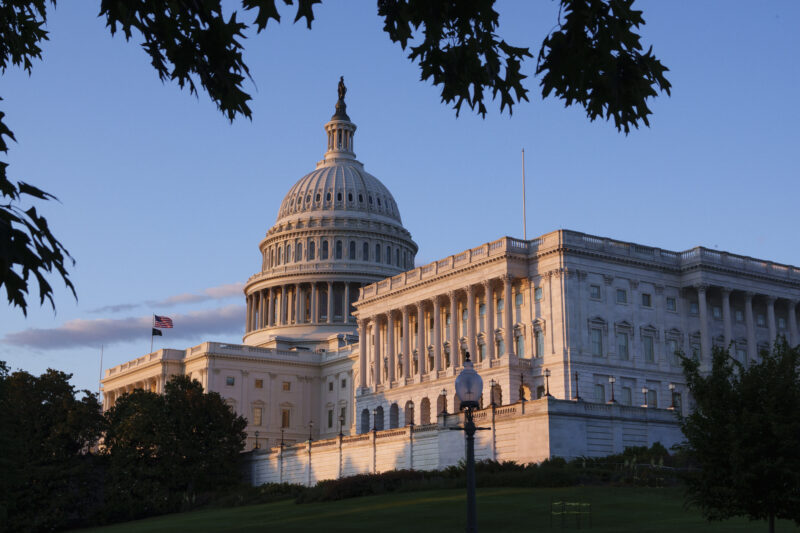
The U.S. Capitol is seen on June 13, 2024 in Washington, DC.
A bipartisan group of House lawmakers is urging colleagues to take steps to address antisemitism in the health care field in the 2026 appropriations process for the Department of Health and Human Services and related agencies.
In a letter sent Wednesday, the lawmakers called on the leaders of the Subcommittee on Labor, Health and Human Services, Education and Related Agencies to demand reports from HHS on the rise of antisemitism in health care.
“Failure to confront this pernicious ideology harms not only Jewish medical professionals, students, and patients but threatens to destroy the very foundations of our healthcare system,” the letter reads. “Dangerous rhetoric from individuals in positions of influence raises fears among Jewish and Israeli students, families, and patients about whether they will receive equitable and compassionate care. Antisemitic hate and bigotry put Jewish patients at risk and undermine the ethical foundations of medicine, where commitment to the patient should be paramount.”
The lawmakers argued that there is growing evidence of a “dangerous erosion of the professional standards that define graduate medical training” and said that medical schools must enforce codes of conduct to prevent antisemitism.
The letter highlights that the vast majority of Jewish medical professionals experienced antisemitism in the year after the Oct. 7, 2023 Hamas attacks, and points to specific incidents which the lawmakers argue have “directly compromised patient care.”
It also highlights issues in medical schools that they say constitute a “dangerous erosion of the professional standards that define graduate medical training” and issues in the mental health field including therapists promoting the view that Zionism is a mental illness and who have blacklisted Jewish patients and providers.
The letter urges the lawmakers, in their 2026 funding bill, to instruct HHS to provide a comprehensive report to Congress on antisemitism and civil rights violations in health care and medical schools, arguing that a lack of comprehensive data makes it difficult to tackle the problem.
It also requests a report on all civil rights complaints in health care and medical schools submitted to HHS in the past two years, including spelling out which cases included antisemitism, and how the complaints were addressed.
The letter was signed by Reps. Buddy Carter (R-GA), Dan Goldman (D-NY), Mike Lawler (R-NY), Greg Landsman (D-OH), Troy Balderson (R-OH), Brad Sherman (D-CA), Brian Fitzpatrick (R-PA), Tim Kennedy (D-NY), Haley Stevens (D-MI), Tom Suozzi (D-NY), Don Bacon (R-NE), Shelia Cherfilus-McCormick (D-FL), Sarah Elfreth (D-MD), Mike Carey (R-OH), Laura Friedman (D-CA) and Jared Moskowitz (D-FL).
“Far too many Jewish health professionals and graduate students face pervasive antisemitism that often goes unaddressed by the very institutions entrusted with their safety and wellbeing,” Rachel Dembo, the senior manager of government relations and engagement for the Jewish Federations of North America said in a statement.
“It’s alarming that today’s current and future providers are encountering environments where antisemitism is treated as acceptable — and where it can even distort or impact clinical care,” Dembo continued. “Compassion cannot coexist with discrimination and bigotry. Jewish Federations of North America are committed to ensuring clinical care is safe and fair for all — because bias can never be part of any patient’s treatment plan.”
Lauren Wolman, the director of government relations at the Anti-Defamation League, said in a statement, “We commend bipartisan Members of Congress for sounding the alarm on this disturbing trend, and we urge the Appropriations Committee to act.”
“From hospitals to medical schools — the mission of medicine is to heal, not to harm. Antisemitic discrimination in clinical and educational environments violates that fundamental principle,” Wolman added. “Providers, students, and patients deserve an environment rooted in equity, dignity, and safety — free from antisemitism and hate.”
The suspected shooter shouted “free Palestine” and “I did it for Gaza,” per an eyewitness

Marvin Joseph/The Washington Post via Getty Images
An exterior of the Lillian and Albert Small Capital Jewish Museum in Washington,DC on December 25, 2024.
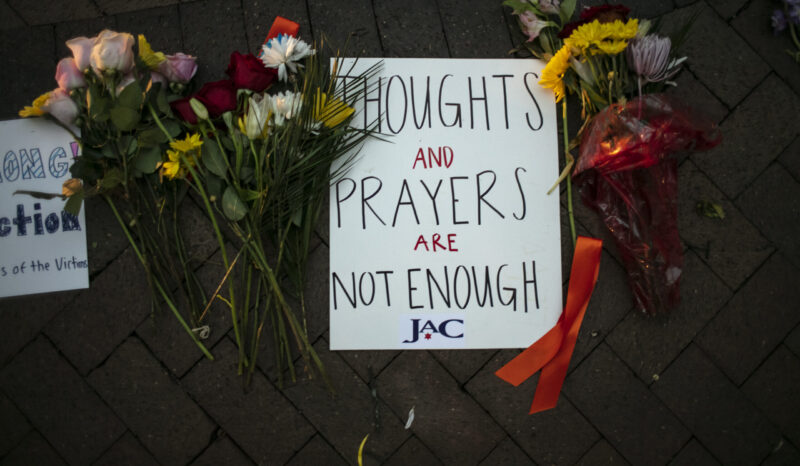
Antisemitic violence struck at the heart of the nation’s capital on Wednesday evening when an assailant shot and killed two Israeli embassy employees outside an event at the Capital Jewish Museum for young diplomats and Jewish professionals hosted by the American Jewish Committee.
“Two staff members of the Israeli embassy were shot this evening at close range while attending a Jewish event at the Capital Jewish Museum in Washington DC,” embassy spokesperson Tal Naim Cohen said in a statement. “We have full faith in law enforcement authorities on both the local and federal levels to apprehend the shooter and protect Israel’s representatives and Jewish communities throughout the United States.”
Officials said there was no ongoing threat to public safety and that a suspect had been arrested.
“American Jewish Committee (AJC) can confirm that we hosted an event at the Capital Jewish Museum in Washington, D.C. this evening,” AJC CEO Ted Deutch said in a statement. “We are devastated that an unspeakable act of violence took place outside the venue. At this moment, as we await more information from the police about exactly what transpired, our attention and our hearts are solely with those who were harmed and their families.”
President Donald Trump said in a statement, “These horrible D.C. killings, based obviously on antisemitism, must end, NOW! Hatred and Radicalism have no place in the USA.”
D.C. Police Chief Pamela Smith said that a man and woman were killed in the incident. Israeli Ambassador Michael Leiter said that the two victims were a young couple and embassy employees who were planning to get engaged next week in Jerusalem — the man purchased a ring earlier this week.
Eyewitness Paige Siegel, who was a guest at the event, told Jewish Insider that she heard two sets of multiple shots ring out, and then an individual, who police have since identified as suspected shooter Elias Rodriguez, entered the building appearing disoriented and panicked, seconds after the shooting ended. She said security allowed the man in, as well as two other women separately.
Siegel said she spoke to the man, asking him if he had been shot. He appeared panicked and was mumbling and repeatedly told bystanders to call the police. Siegel said that she felt the man was suspicious.
JoJo Drake Kalin, a member of AJC’s DC Young Professional Board and an organizer of the event, also told JI the man appeared disheveled and out of breath when he entered the building. Kalin assumed he had been a bystander to the shooting who needed assistance and she handed him a glass of water.
Siegel said that the man was sitting in the building in a state of distress for approximately 10 to 15 minutes, and she and a friend engaged him in conversation, informing him that he was in the Jewish museum.
After Siegel said that, she said the man started screaming, “I did it, I did it. Free Palestine. I did it for Gaza,” and opened a backpack, withdrawing a red Keffiyeh. She said that an officer, who had already arrived, detained the man and took him outside. She said that she subsequently saw security footage of Rodriguez shooting the female and identified the shooter as the same individual. Kalin said that some attendees stayed for several hours at the museum into the night to be debriefed by police.
A short video obtained by JI showed an individual in the lobby of the museum chanting “Free, free Palestine” being detained by police and removed from the building.
A video obtained by Jewish Insider shows the suspected shooter, identified by police as Elias Rodriguez, in the lobby of the Capital Jewish Museum chanting “free, free Palestine” as he is detained by police and removed from the building.
— Jewish Insider (@J_Insider) May 22, 2025
Full story: https://t.co/ZGZBj9agQx pic.twitter.com/zZUbTvovFm
Smith said in a press conference that the suspect, Rodriguez, a 30-year-old from Chicago, opened fire on a group of four outside the museum, and then entered the building and was detained by event security. Smith said that Rodriguez, once in custody, implied that he carried out the shooting and chanted “free, free Palestine.”
Smith said Rodriguez had been pacing outside the event before the altercation.
Leiter said that he had spoken to President Donald Trump, who vowed that the administration would do everything it can to fight antisemitism and demonization and delegitimization of Israel.
“We’ll stand together tall and firm and confront this moral depravity without fear,” Leiter said.
Smith said that police would coordinate with local Jewish organizations to ensure sufficient security. She said police had not received any intelligence warning of the attack.
Mayor Muriel Bowser said, “we will not tolerate antisemitism,” and said the city would continue to assist Jewish organizations with security grants.
FBI officials and Attorney General Pam Bondi and interim U.S. Attorney Jeanine Pirro joined the response alongside D.C. police.
“We are a resilient people. The people of Israel are a resilient people. The people of the United States of America are a resilient people. Together, we won’t be afraid. Together we will stand and overcome moral depravity of people who think they’re going to achieve political gains through murder,” Leiter said.
According to an invitation to the event viewed by JI, the event planned to discuss efforts to respond to humanitarian crises in the Middle East and North Africa, including in Gaza.
Danny Danon, the Israeli ambassador to the United Nations, described the shooting as a “depraved act of anti-Semitic terrorism.”
House Speaker Mike Johnson (R-LA) told JI, “I’ve been informed of the tragic shooting that occurred outside of the Capitol Jewish Museum tonight in Washington D.C. We are monitoring the situation as more details become known and lifting up the victim’s families in our prayers.”
Senate Minority Leader Chuck Schumer (D-NY) said in a post, “This sickening shooting seems to be another horrific instance of antisemitism which as we know is all too rampant in our society.”
Richard Priem, the CEO of the Community Security Service, told eJewishPhilanthropy that there are still “so many unknowns” about the shooting, namely if it was a sophisticated attack specifically targeting Israeli Embassy staff or an attack more generally against the Jewish event itself. In any case, the organization called for “increased situational awareness” at Jewish institutions going forward, particularly ahead of Shabbat.
“Anytime there’s an attack, certain people get activated and think, ’Now’s the time,’” Priem said. “But we don’t know yet if there might be a direct correlated threat.”
eJewishPhilanthropy’s Judah Ari Gross contributed reporting
In an interview with JI, the DOJ lawyer said the administration is ‘not being aggressive enough’ in its antisemitism policy, including the deportation of foreign students

Win McNamee/Getty Images
Civil rights attorney Leo Terrell leaves the stage after speaking alongside U.S. President Donald Trump and golf legend Tiger Woods during a reception honoring Black History Month in the East Room of the White House on February 20, 2025 in Washington, DC.
Leo Terrell, senior counsel to the assistant attorney general for civil rights, says he’s undeterred by critics of the Trump administration’s approach to combating antisemitism, arguing that those dissatisfied with its deportation strategy are “trying to justify, in my opinion, the antisemitic behavior” of those individuals.
Terrell, who has a career spanning three decades as a civil rights attorney and a conservative media personality, sat down on Monday for his first interview with Jewish Insider since joining the Justice Department earlier this year — at a time when some mainstream Jewish organizations, including the Anti-Defamation League and the American Jewish Committee, have expressed concern that the administration’s approach has violated the due process rights of the individuals being targeted. The Trump administration has argued that non-citizens do not have the same constitutional protections as U.S. citizens, though the Fourteenth Amendment grants due process rights to all people regardless of status.
“That question is being asked quite often, and I think those people who are raising that issue are trying to justify, in my opinion, the antisemitic behavior,” Terrell said. “If you’re an American citizen, I have due process on a lot of different criminal issues if I’m arrested. I have due process. That term due process needs to be evaluated depending on the status of the individuals who assert it.”
“I will submit to you that individuals who are here on, let’s say, for example, a student visa, who are not American citizens, who are here as a privilege by this country, do not have the same due process rights, do not have the same access to the court system as I do as an American citizen,” he continued, adding, “Your rights depend on your status in this country. You won’t hear that because it’s the truth, it’s not a talking point.”
Terrell said he and Harmeet Dhillon, the assistant attorney general for civil rights at the DOJ, remain confident they are following the law. He also said he wants injunctive relief for Jewish students from U.S. citizens and foreign nationals involved in antisemitic hate crimes.
“How many times do we see individuals violating the rights of Jewish American students use the lying argument of freedom of speech, and it was adopted by a majority of the left-wing media, but these blue cities allow these individuals to be violent. They were arrested, and then they were released, and they were never prosecuted. They were never prosecuted. And that type of mentality existed not only on the local level, but on the federal level as well. That has stopped under the Trump administration,” Terrell explained.
“One of the first questions you mentioned is, and I’ve heard it the last couple of days, if you think the Trump administration is too hard or being too aggressive? They raise that question, and I’ve heard it in three different locations, but I say no, we’re not aggressive enough. If you’re comparing that there’s been some progress in relationship to the Biden administration, that’s not much of a standard, because they did nothing,” he added.
When asked about Columbia University, where new acting President Claire Shipman oversaw the suspension and arrests of some of the students involved in last week’s takeover of the school’s main library, Terrell said the university’s actions were insufficient because they did not deter future action from the protesters.
“Some people have said, well, you know, some of these students have been suspended by the college president. Not good enough. There’s no deterrent mechanism. You need deterrence where it doesn’t happen again. And under the Trump administration, I can tell you right now, I’m using the tools of Title VI [of the Civil Rights Act]. I’m using the tools of filing hate crimes as a deterrent mechanism,” Terrell said, later noting, “Trump is dead set on eliminating antisemitism, and besides the litigation that we are contemplating … we’ve got some tools … that we’re going to be disclosing later on, that are going to definitely have a major factor.”
Terrell added that he stood by the decision to target the individuals the Trump administration had sought to deport as part of its antisemitism policy, including the case of Rümeysa Öztürk, the Tufts University doctoral student and Turkish national who was released from detention last week amid criticism from several leading Jewish groups as federal authorities continue pushing for her deportation. Some Jewish leaders and organizations had argued against Öztürk’s detention due to the lack of evidence against her the federal government has made public; currently, her only known anti-Israel activity is a critical op-ed she co-authored in her school newspaper.
“The Civil Rights team is more concerned with getting rid of the problem than making everybody comfortable while they do so. I believe the previous administration expressed commitment, both in speech and in certain actions, to fighting antisemitism, but then allowed antisemitism to get diluted to the point where the effort was regrettably no longer as effective. A wise man once said, when you get too well-rounded, you stop pointing anywhere. An effort to combat and eradicate antisemitism must do that,” Rabbi Levi Shemtov, the executive vice president of American Friends of Lubavitch (Chabad), told JI.
Öztürk’s release on bail, Terrell explained, “has nothing to do with the merit as to whether or not she can be removed based on the evidence and the discretion of the secretary of state.”
“Yes, she got released on bail. So the standard for bail is: Are you a flight risk? Are you a danger? Will you return? That has nothing to do with the merit of her status here. … The decision on the merits as to whether or not she will remain in this country has not been decided,” Terrell said, criticizing the news media’s portrayal of the latest developments in Öztürk’s case as inaccurate.
Asked if any universities had responded to campus antisemitism in ways that he found satisfactory, Terrell pointed to Dartmouth College. “I was very pleased when the president of Dartmouth College came by and spoke to us, and they got a very favorable grade from the ADL as far as battling antisemitism. If I was going to mention one school that is on the right track to combat antisemitism, that has addressed the issue, and not tried to dodge it or look for press coverage because they suspended some students, Dartmouth College would be probably number one on my list,” he said.
Looking off campus, Terrell told JI he has reached out to the mayors of Boston, Los Angeles, Chicago and New York City to try to find ways to work together on campus antisemitism “because I felt those were major cities that had failed to protect Jewish American students, not only on campus, but Jewish Americans period, in the city.”
Terrell said that he hasn’t heard back from Los Angeles Mayor Karen Bass or Chicago Mayor Brandon Johnson, but his message to them is that he’s “not going to run away from that. I’m going to meet it head on.”
“I’m going to do everything I can to get him [Johnson] and those [Chicago City] Council members to change their ways. The federal government has a lot of tools, and we’re going to use all of them. The one thing I can tell you is that I’ve had conversations with the president about this as late as last week, and he said basically in so many words, whatever you need on this subject just call me directly, just talk to me directly. Because I have approached him on certain issues involving resolving some of these issues in schools and he wants complete, 100% compliance,” Terrell said.
While he has some detractors, Terrell also has a number of Jewish leaders in his corner who argue his approach to his current role was bound to ruffle some feathers.
Ambassador Yechiel Leiter, Israel’s envoy to the U.S., told JI in a statement, “Leo Terrell has hit the ground running … showing remarkable clarity and passion. From day one, he has demonstrated unwavering commitment to this crucial fight — through strong public statements, meaningful action, and a clear moral compass.”
“The Civil Rights team is more concerned with getting rid of the problem than making everybody comfortable while they do so. I believe the previous administration expressed commitment, both in speech and in certain actions, to fighting antisemitism, but then allowed antisemitism to get diluted to the point where the effort was regrettably no longer as effective. A wise man once said, when you get too well-rounded, you stop pointing anywhere. An effort to combat and eradicate antisemitism must do that,” Rabbi Levi Shemtov, the executive vice president of American Friends of Lubavitch (Chabad), told JI.
“We cannot compromise our efforts to deal with the situation just so that everybody’s very comfortable with what we’re doing. Unconventional and illegal are not the same thing, and people facing existential threats cannot be expected to make everybody comfortable while they fight for their survival,” Shemtov continued, later adding: “Any energetic effort might test some limits here or there.”
Ambassador Yechiel Leiter, Israel’s envoy to the U.S., told JI in a statement, “Leo Terrell has hit the ground running … showing remarkable clarity and passion. From day one, he has demonstrated unwavering commitment to this crucial fight — through strong public statements, meaningful action, and a clear moral compass.”
“We deeply value our partnership with him and appreciate his willingness to listen, engage, and stand up against hatred in all its forms. His leadership is both encouraging and inspiring at a time when it’s needed most,” Leiter added.
Terrell spent more than two decades amassing a large following on the talk radio circuit and on cable news, serving as a Fox News contributor on legal issues for much of the last decade. He made headlines in 2020 when debuting “Leo 2.0,” his revamped persona, while announcing his move from the Democratic Party to the GOP.
In his new job, he frequently starts his morning tweeting on X about the rise in antisemitism to his 2.5 million followers.
“The Jewish American community and I have had a love affair for the last 35 years. One of my first jobs as a lawyer, I worked in a Jewish law firm, and I was befriended not only by the Jewish lawyer who helped me get started, but by the community at large. So my relationship with the Jewish American community has been in place for the last 35 plus years,” Terrell said, noting his time leading the California Commission Against Hate Crimes, “where we looked at all hate crimes against Blacks, Browns, Jews, Catholics.”
While Terrell warned in media appearances about the rise of antisemitism in recent years, he was not directly involved in trying to address the issue nationally until 2024, when he began criticizing the Biden administration’s lack of response to incidents of antisemitism taking place amid anti-Israel campus protests.
Still, Terrell says he’s no stranger to fighting for civil rights protections for all, citing his three-decade “love affair” with the Jewish people and his legal career, which included efforts to address antisemitism in California.
“The Jewish American community and I have had a love affair for the last 35 years. One of my first jobs as a lawyer, I worked in a Jewish law firm, and I was befriended not only by the Jewish lawyer who helped me get started, but by the community at large. So my relationship with the Jewish American community has been in place for the last 35 plus years,” Terrell said, noting his time leading the California Commission Against Hate Crimes, “where we looked at all hate crimes against Blacks, Browns, Jews, Catholics.”
“I have committed to civil rights and my commitment to the Jewish American community has been so heartwarming based on my experience here in this position and on Fox, but it goes well beyond that. It goes well beyond that. For the last 25 to 30 years, ever since I have been a lawyer, I’ve had a fantastic, strong, great relationship with the Jewish American community and it is going to maintain.”
The university organizations 'endorse[d] the Trump Administration’s priority of eradicating antisemitism' but said its tactics 'endanger' academic freedom

Cody Jackson/AP
American Jewish Committee (AJC) CEO Ted Deutch is seen during an interview, Friday, Feb. 8, 2024 in Boca Raton, Fla.
The American Jewish Committee — together with major groups representing U.S. universities — on Tuesday released a statement asking the Trump administration to reconsider its approach to combatting campus antisemitism, which it said involves steps that “endanger” academic freedom.
“America’s higher education and Jewish communities share and endorse the Trump Administration’s priority of eradicating antisemitism. We come together to ask the Administration to pursue this important goal in ways that preserve academic freedom, respect due process, and strengthen the government-campus scientific partnership,” said the joint statement, which was co-signed by American Council on Education, Association of American Universities, Association of Public and Land-grant Universities, American Association of Community Colleges, National Association of Independent Colleges and Universities and American Association of State Colleges and Universities.
The groups — which together represent more than 1,000 colleges and universities — called antisemitism “a plague on humanity” which “has found unacceptable expression on U.S. campuses in recent years, as it has elsewhere in American society, on both sides of the political spectrum.”
The statement continued, “In the name of combating antisemitism, the federal government has recently taken steps that endanger the research grants, academic freedom, and institutional autonomy of America’s higher education sector.”
It urged the U.S. government to instead address antisemitism “through the nation’s powerful anti-discrimination laws, which allow for vigorous enforcement while providing due process rights that are essential to ensure fair treatment of individuals and institutions.”
The groups pledged “continuing consequential reform and transparent action to root out antisemitism and all other forms of hate and prejudice from our campuses.”
The Trump administration has cut — or threatened to cut — more than $12 billion in research funding from elite schools including Harvard, Columbia, Cornell, Brown and Northwestern. The moves to rescind billions in federal funding from colleges and universities, as well as to detain and deport foreign students, have ignited debate in the Jewish community in recent months, with many stressing a need for due process.
“Our democratic values are not at odds with our vision for classrooms and campuses free from antisemitism – in fact, each is necessary for the other,” Ted Deutch, CEO of the AJC, said in a statement on Tuesday.
Deutch told Jewish Insider last month that the group is trying to take a nuanced approach to the White House’s response to campus antisemitism.
“There are campuses [where] so many of the challenges should have been addressed by universities, and weren’t. We’ve been clear that it’s really important that the administration, that the president, is making this a priority,” Deutch said. “At the same time, as we’ve said, due process matters and obviously our democratic principles matter as well, we have to be able to both express appreciation and, when necessary, express concern.”
“When the hammer [of funding cuts] is dropped in a way which winds up cutting life-saving cancer research, that’s when we have concern, which we’ve expressed,” Deutch warned.
Barbara Snyder, president of AAU, an organization of 69 leading research universities, said in a statement that “cutting funds for life-saving research and threatening academic freedom and constitutional rights such as freedom of speech do nothing to make students safer. Fighting discrimination and supporting due process are two sides of the same coin; you cannot have one without the other.”

Noam Moskovitz/Knesset Spokesperson
Amir Benayoun performs at the Knesset's “Songs in their Memory” event to mark Yom HaZikaron, April 29th, 2025
Good Wednesday morning.
In today’s Daily Kickoff, we report on a new musical project that aims to mark Yom HaZikaron, Israel’s national memorial day, and spotlight Sen. Bill Cassidy’s efforts to target antisemitism from his perch at the top of the Senate Health, Education, Labor and Pensions Committee. We also report on President Donald Trump’s dismissal of at least seven members of the U.S. Holocaust Memorial Council who were appointed by former President Joe Biden, and preview today’s Senate markup of the Antisemitism Awareness Act. Also in today’s Daily Kickoff: Abigail Mor Edan, Tom Barrack and Gov. Phil Murphy.
What We’re Watching
- Today is Yom HaZikaron, Israel’s day to honor and remember those killed in the country’s wars and in terror attacks. Official and unofficial events are being held around the country today. Yom Haatzmaut, the country’s independence day, begins at sundown tonight.
- The Israeli government’s official Yom Ha’atzmaut celebration was canceled due to high winds and adverse weather conditions.
- This morning in Washington, the Senate HELP Committee is voting on the Antisemitism Awareness Act and the Protecting Students on Campus Act. More below.
- The House Foreign Affairs Committee is holding a hearing on State Dept authorization.
- This afternoon, the House Armed Services Committee is holding a hearing on missile defense.
- Later today, the Senate Committee on Aging is holding a hearing on antisemitism targeting older Americans. Read more here.
- The Supreme Court is hearing oral arguments today in St. Isidore of Seville Catholic Virtual School v. Drummond, which focuses on funding for faith-based charter schools.
- Tonight, The Washington Institute for Near East Policy is holding its 40th anniversary gala dinner in Washington.
What You Should Know
A QUICK WORD WITH JI’S MELISSA WEISS
As a siren sounded last night at 8 p.m. and then again at 11 a.m. this morning local time, Israel came to a standstill as it honored some 25,000 Israelis killed in the nation’s wars and in terror attacks, Jewish Insider Executive Editor Melissa Weiss reports.
Cars stop on highways and their drivers step out. Neighbors step out onto their balconies, heads bowed. At public gatherings across the country, Israelis are briefly frozen in place — quiet, pensive — before coming to life again as the siren concludes.
As the siren ends and an altered version of normalcy resumes, Israelis are left to grapple with the dual realities of a nation at war that must simultaneously live and mourn, that must fight both an enemy committed to its destruction and tend to the millions traumatized by the Oct. 7 attacks and a year and a half of war, that is forced to fight both internal divisions and external threats.
In comments made at the Jewish News Syndicate‘s International Policy Summit in Jerusalem earlier this week, Israeli Strategic Affairs Minister Ron Dermer told attendees that Israel’s war with Hamas — the longest sustained war since the country’s fight for independence nearly eight decades ago — would be over within a year.
But it’s not the first time an Israeli official has given a timeline. In May 2024, Israeli National Security Advisor Tzachi Hanegbi predicted that the war would last through the end of the year — which at that point was a nearly unimaginable amount of time.
But today, the idea that the war could last another 12 months is draining to a populace that is fatigued from a year and a half of war, grieving those they have lost both in the war and the attacks that preceded it, and waiting for the return of the remaining 59 hostages.
Reservists, already struggling to maintain both their home lives and carry out their military duties, are buckling under the strain, amid a growing national anger over the failure of the government to make significant moves to draft soldiers from within the Haredi community, a segment of Israeli society that is among those that have suffered the fewest losses — both on Oct. 7 and in the ensuing war. (Read more on the topic from eJewishPhilanthropy’s Judah Ari Gross here.)
And the country’s military — the leadership of which has almost entirely turned over since last Yom HaZikaron — finds itself at odds both internally and with the government, amid debates over war strategy and priorities, as well as accountability for the Oct. 7 attacks.
In March, when the Israeli Democracy Institute last conducted a survey about how Israelis would prioritize the government’s stated war goals, 68% said that the release of the remaining hostages should be the top priority, with 25% saying that toppling Hamas should be the first priority. It’s a gulf that has widened since the question was first posed in January 2024, when 51% said that the hostages should be the first priority, and 36% wanted to prioritize the destruction of Hamas.
Concerns about the government’s attitude toward the hostages are even less likely to be allayed following a comment by Sara Netanyahu, made in a meeting on Tuesday with individuals selected to light torches in the state’s Independence Day ceremony, that fewer than 24 hostages remain alive — correcting her husband, who said that 24 were alive, in keeping with previous government information. The exchange was widely panned, with Channel 12’s Amit Segal saying it was “truly bizarre and inappropriate” for the families to learn of the devastating news “through an interjection by Sara Netanyahu.”
For the families of the remaining hostages, the prospect of another year of war is unthinkable.
Emily Damari, the British-Israeli hostage who was freed earlier this year, reflected on Yom HaZikaron in a social media post to her Instagram page. Damari said that last year, she and fellow hostage Romi Gonen realized the significance of the day as their captors watched Al Jazeera. “At 11 a.m.,” Damari said, “we decided to stand for a moment of silence in memory of the fallen, who in their death commanded us to live, in memory of our friends who were killed.”
Today in Gaza, miles from where Israelis commemorate the dead, the living hostages languish after 572 days in captivity, prisoners awaiting the kind of freedom that the rest of the world takes for granted while enduring the kind of inhumanity the rest of the world could not imagine. And across the country, parents, siblings and children mourn those who have died — some who were killed protecting the country, others who died simply for living in it.
More than 300 soldiers and 79 civilians were killed between last Yom HaZikaron and today. It is impossible to know how many of them attended Yom HaZikaron events last year in their communities and on their bases, listening to the stories of those fallen in battle and those killed in acts of terror. Did they think the war would have ended by the next Yom HaZikaron? Did they imagine that their names would be among those mourned this year?
It is in the days leading up to Yom Kippur that Jews ask to be inscribed in the Book of Life. But it is on Yom HaZikaron that many ponder their own mortality, and the country’s — and what it means to be Israeli.
ON THE HILL
Senate committee to mark up Antisemitism Awareness Act, amid growing Democratic opposition

The Senate Health, Education, Labor and Pensions Committee is set to meet on Wednesday to vote on the Antisemitism Awareness Act, in what could be a contentious meeting with a slew of potential amendments, some of which seek significant changes to the bill, Jewish Insider’s Marc Rod and Emily Jacobs report.
State of play: Sen. John Hickenlooper (D-CO), a HELP Committee member and co-sponsor of the AAA, told JI that “about 50 different amendments” have been introduced, and it remains to be seen what the bill will look like at the end of the committee’s markup. As a co-sponsor, he indicated that he is inclined to support the bill. Sens. Angela Alsobrooks (D-MD) and Lisa Blunt Rochester (D-DE), had been seen as potential or likely votes in favor, but are now expected to vote against the legislation. Some Democrats are framing the legislation as a giveaway of additional power to the Trump administration. Sen. Rand Paul (R-KY), who is seeking drastic changes to the legislation, is also likely to oppose it. A largely cosmetic amendment from GOP leadership appears aimed at mollifying freedom of speech and religion concerns from other Republicans.
Words of Warning: Matt Brooks, the CEO of the Republican Jewish Coalition, warned this week that anti-Israel sentiments that he said have taken over the Democratic Party are beginning to infiltrate the Republican Party and require a strong response, JI’s Marc Rod reports.
targeting hate
Bill Cassidy leans in to fight antisemitism as chair of key Senate committee

Sen. Bill Cassidy (R-LA), the chairman of the Senate Health, Education, Labor and Pensions (HELP) Committee, will bring up the Antisemitism Awareness Act and another piece of antisemitism legislation for consideration today — the latest in a series of steps Cassidy has taken to respond to campus antisemitism since the Oct. 7, 2023, Hamas attacks in Israel. AAA has been a priority for the Jewish community for years and for Cassidy, who told Jewish Insider’s Emily Jacobs in an interview this week that he expects both pieces of legislation to advance out of committee.
Legislative affairs: The Louisiana senator has made antisemitism a major focus for the HELP Committee this Congress. Cassidy has leaned in since taking over the chairmanship role from Sanders in January, signing on as a cosponsor of the AAA, reintroducing his Protecting Students on Campus Act with Sen. John Fetterman (D-PA) — which will also be marked up today — holding the panel’s first hearing on domestic antisemitism since Oct. 7 and launching an investigation into Americans Muslims for Palestine’s activities on college campuses. Cassidy says he wants to see the response from universities once the two bills become law, but is open to considering further legislative efforts if needed down the line. “I think we have to see how this plays, because, obviously, there’s executive orders, obviously there’s a greater sense of awareness among college and university presidents that they are being scrutinized because of this,” Cassidy said of next steps for Congress in finding policy avenues to address domestic antisemitism.
EXCLUSIVE DETAILS
Trump dismisses at least 7 Biden appointees to U.S. Holocaust Memorial Council

The Trump administration has dismissed multiple members of the U.S. Holocaust Memorial Council appointed by former President Joe Biden, Jewish Insider’s Marc Rod and Matthew Kassel report.
Who’s out: Sources familiar with the situation told JI that those fired from the board overseeing the U.S. Holocaust Memorial Museum and other Holocaust commemoration activities include former Second Gentleman Doug Emhoff, former White House Chief of Staff Ron Klain, former Ambassador Susan Rice, former Deputy National Security Advisor Jon Finer, former presidential senior advisor Tom Perez, former Ambassador Alan Solomont and Mary Zients (an activist and wife of former White House Chief of Staff Jeff Zients). “He’s talking all about fighting antisemitism, but he chooses to make a divisive call on the official arm of the federal government that was created to remember the Holocaust,” Solomont told JI. The New York Times also reported that Anthony Bernal, a senior advisor to former First Lady Jill Biden, had been dismissed.
REPORT RELEASE
Under fire, Harvard releases reports on antisemitism, Islamophobia on campus

Harvard University’s long-awaited dual reports on antisemitism and Islamophobia, released on Tuesday, reveal a campus beset by tension and simmering distrust — as well as a university struggling to handle competing claims of discrimination, animosity and exclusion made by Jewish and Muslim students, Jewish Insider’s Gabby Deutch and Haley Cohen report.
Commitments: In the 300-page antisemitism report, which was made public amid alumni frustration and pressure from the Trump administration, Harvard committed to partnering with an Israeli university; providing additional resources for the study of Hebrew and Judaic studies; hosting an annual academic symposium on antisemitism; asking the leadership of Sidechat, a social media app that allows college students to post anonymously, to enforce its content moderation policies; and launching a pilot program in the business school addressing contemporary antisemitism.
exclusive
Senate Republicans aim to defund U.N. agencies that penalize Israel

A group of more than 20 Senate Republicans led by Sen. Jim Risch (R-ID) is set to introduce legislation on Wednesday that would strip U.S. funding from any United Nations agency that takes action to expel, downgrade, suspend or restrict Israel’s participation, Jewish Insider’s Marc Rod reports. “Israel is one of America’s greatest allies, and under President Trump’s Administration, we will no longer tolerate — much less fund — the blatant antisemitism at the United Nations. This bill will send a clear message to the UN and any other antisemitic international organizations: if you want America’s money, you’ll need to respect our Israeli friends,” Risch, who chairs the Senate Foreign Relations Committee, said in a statement. “America will always stand with Israel.”
On board: The Stand with Israel Act is co-sponsored by Sens. Tom Cotton (R-AR), Ted Budd (R-NC), Mike Lee (R-UT), James Lankford (R-OK), Lindsey Graham (R-SC), Mike Crapo (R-ID), Dave McCormick (R-PA), Joni Ernst (R-IA), Katie Britt (R-AL), Bill Hagerty (R-TN), Thom Tillis (R-NC), Shelly Moore Capito (R-WV), John Boozman (R-AR), Marsha Blackburn (R-TN), Josh Hawley (R-MO), John Barrasso (R-WY), Pete Ricketts (R-NE), Jim Justice (R-WV), John Hoeven (R-ND), John Cornyn (R-TX) and Rick Scott (R-FL).
MEANINGFUL MUSIC
Songs of the fallen set the tone for Yom HaZikaron in Israel

Israelis start Yom HaZikaron, their day to honor those killed in wars or in terror attacks, by standing silently as a siren blares throughout the country. When the siren goes off, first at 8 p.m. and then at 11 the next morning, the nation comes to a standstill. Traffic stops in bustling intersections, and drivers get out to stand next to their cars. Bus drivers pull over on the side of the highway. But what do Israelis do after the evening siren? For many, the answer is easy: They sing. This year, Galgalatz and Army Radio, a news and talk station run by the IDF, worked on a joint project of reported audio features and songs relating to fallen soldiers and victims of terror. Army Radio shared details of the project with Jewish Insider’s Lahav Harkov before its release to the public planned for this afternoon.
Living lyrics: One new song, “You’re Out There Traveling,” is based on a poem written by Aharon Danino, brother of Ori Danino, who was kidnapped at the Nova festival on Oct. 7 and murdered soon after. Danino, 25, escaped the music festival in a car, but went back to help save the lives of Maya and Itay Regev and Omer Shemtov, who were taken hostage and later released. The song is performed by “M Hamistaarev,” an IDF reservist who goes undercover as a Palestinian and therefore performs with a mask covering his face. Tiktok videos of M singing in Gaza went viral soon after the war began in 2023, and he has since released original music. M went to the shiva for Ori Danino and became friendly with the family, and Danino’s brother brought him the poem, which they worked together to set to music.
Worthy Reads
A Country Divided: In his “Clarity” Substack, former Israeli Ambassador to the U.S. Michael Oren looks at the schisms dividing the country’s military that underscore deeper divisions across Israel. “Pilots fire from tens of thousands of feet in the air, far from almost any danger, while the ground troops are fighting in the ruins and mud of Gaza with indescribable dangers everywhere. But while seemingly about operational issues, the debate reflects the underlying divisions within Israeli society. The majority of the pilots come from a different socio-economic background than most of the Golani soldiers and paratroopers under the Southern Command. There are ethnic and religious schisms that separate the two groups as well. At stake is not only the differences between the blue uniforms of the air force and the ground forces’ green uniforms, but between people of Israel generally. … We must strive to achieve a compromise which, while not loved by all, will at least prove acceptable. Achieving that compromise is not just the job of the army but above all, the government’s, which must not retreat from its sovereign responsibility. We owe this all to the memory of the approximately 25,000 who fell in our wars and in terrorist attacks. We must honor them all with unity.” [Clarity]
A Pence for Your Thoughts: In The Wall Street Journal, former Vice President Mike Pence reflects on President Donald Trump’s first 100 days in office. “Similarly, reports of negotiations with the mullahs in Tehran sound increasingly like President Obama’s failed nuclear deal. In the interest of peace, and our cherished ally Israel, the Iranian nuclear program must be verifiably dismantled or destroyed. … President Trump deserves credit for an energetic and effective start. His instincts on security, strength and sovereignty are as sharp as ever. But if we want to see this nation become truly great again, we can’t exchange time-tested conservative principles for populist platitudes. We need to stand with our allies and stand up to our enemies. We need to cut taxes and tariffs, keep our military strong and well-funded, and lead on the world stage. A strong first 100 days is a foundation. But only a return to the conservative principles that guided our administration and achieved peace and prosperity during the president’s first term will ensure that this administration builds something lasting—for the president’s legacy, and for America’s future.” [WSJ]
Piker Problem: The Free Press’ Josh Code spotlights the mainstreaming of far-left anti-Israel streamer Hasan Piker, whose rise on Twitch has drawn scrutiny both of his rhetoric and of the platform’s decision to continue hosting him. “In an era when Democrats seem at a loss to counter the bro-y populism of the MAGA right, Piker uses the MAGA-coded activities of weightlifting and trips to the gun range to make socialist politics hip, courting an audience of young and very online men who have been drifting right. Mainstream news outlets have called him ‘The AOC of Twitch’ — Rep. Alexandria Ocasio-Cortez being one of the only other Democrats to successfully wield social media—and ‘a model for the future of progressive media.’ In the past year alone, he’s appeared at the Democratic National Convention, as well the left’s favorite podcast, ‘Pod Save America’ and the tour of Senator Bernie Sanders and AOC herself. He’s also done an interview with Jon Stewart for ‘The Daily Show,’ set to release in mid-May. … But Piker’s rise isn’t just the story of a young man realizing he can get rich by telling young Americans to hate their country and love their enemies — it’s the story of a platform that lets him promote it. Twitch’s 61-year-old CEO, Dan Clancy, is an apparent fan of Piker. In an interview with Bloomberg in April 2023, Clancy said he appreciates the streamer’s ‘frankness and bluntness.’” [FreePress]
Word on the Street
The Senate confirmed Tom Barrack as U.S. ambassador to Turkey by a 60-36 vote, with Democratic Sens. Michael Bennet (D-CO), Chris Coons (D-DE), Maggie Hassan (D-NH), Amy Klobuchar (D-MN), Jacky Rosen (D-NV), Jeanne Shaheen (D-NH) and Mark Warner (D-VA) supporting him…
The Qatari Diar and Dar Global are slated to announce a deal to construct a Trump International beachside project north of Doha, the company’s first real estate development in the Gulf nation…
The Trump administration is pushing Egypt to allow commercial and military American vessels free passage through the Suez Canal in exchange for the administration’s strikes on Houthi targets in Yemen that have targeted ships transiting through the Red Sea…
Defense Secretary Pete Hegseth is backing Vice Adm. Brad Cooper, the deputy commander of U.S. Central Command, to replace outgoing CENTCOM Gen. Michael “Erik” Kurilla, who is retiring this summer; Hegseth is boosting Cooper over Gen. James Mingus, an Army general who was widely expected to be tapped for the role…
The Treasury Department announced sanctions on six companies in China and Iran for their ties to Tehran’s ballistic missile program…
Secretary of State Marco Rubio is weighing the possibility of cutting the U.S. security coordinator role for the West Bank and Gaza Strip; the position, held by a three-star general, liaises between Israeli and Palestinian security officials…
New Jersey Gov. Phil Murphy, who is traveling in the Middle East with his family, met in Manama this week with members of the Jewish community, including former Bahraini Ambassador to the U.S. Houda Noonoo…
A Native American Democratic Party activist is challenging the results of the Democratic National Committee’s recent leadership vote, arguing that the election process, by which activist David Hogg was selected as one of the party’s vice chairs, had “discriminated against three women of color candidates”…
New York City Mayor Eric Adams, who is making his bid for reelection as an independent, is gathering signatures on a newly created “EndAntiSemitism” ballot line…
Washington, D.C., Mayor Muriel Bowser is facing questions over an unreported 2023 trip she and four staffers took to Qatar, for which Doha paid more than $60,000; Bowser’s office, which initially claimed the trip was paid for by the U.S. Conference of Mayors, has asked Doha to sign a donation agreement two years after the trip took place…
The Texas state legislature overwhelmingly passed legislation that would codify the International Holocaust Remembrance Alliance’s working definition of antisemitism; the bill, which has already been passed by the state Senate, will be sent to Gov. Greg Abbott’s desk…
A federal judge ruled that Mahmoud Khalil, the Columbia University graduate who has been detained by immigration authorities for the last month, can proceed with a lawsuit alleging that his detention violates his First Amendment rights…
Germany’s center-left Social Democrats party agreed to join a coalition government with the country’s center-right Christian Democratic Union and Christian Social Union, positioning CDU leader Friedrich Merz to be the country’s next chancellor…
A new survey by the Jewish Federations of North America found that a third of Jews are more engaged with the Jewish community than they were before Oct. 7, 2023, eJewishPhilanthropy’s Judah Ari Gross reports…
Israel’s Central Bureau of Statistics said in its annual report that the country’s population had exceeded 10 million for the first time in its history…
An Israeli man was sentenced to 10 years in prison for conspiring with Iranian agents to assassinate senior Israeli officials and for illegally entering an enemy country…
Iranian officials cited “false” documentation of the items stored at the Shahid Rajaee port prior to an explosion at the facility earlier this week…
Characterizing Turkey as a “potentially threatening regional power” led by a “pro-Hamas” president, a new report from the Jewish Institute for National Security of America released Wednesday argues that Turkey should not be considered for readmission into the F-35 fighter jet program, Jewish Insider’s Marc Rod reports…
Conservative commentator David Horowitz, the founder of the David Horowitz Freedom Center, died at 86…
Walter Frankenstein, who survived the Holocaust by hiding in locations throughout Germany before going on to fight in Israel’s War of Independence, died at 100…
World War II veteran and avid Mets fan Seymour Weiner, who became a viral sensation after he was honored as the team’s Veteran of the Game during Opening Day 2024, died at 98…
Pic of the Day

More than a dozen House lawmakers met on Tuesday with Abigail Mor Edan, an Israeli-American kidnapped by Hamas on Oct. 7, 2023, at age 3, and her family.
Lawmakers in attendance included Reps. Mike Lawler (R-NY), Ritchie Torres (D-NY), Nancy Pelosi (D-CA), Susie Lee (D-NV), Zoe Lofgren (D-CA), Nicole Malliotakis (R-NY), Laura Gillen (D-NY), Eugene Vindman (D-VA), Brad Schneider (D-IL), Grace Meng (D-NY), Sarah McBride (D-DE), Lois Frankel (D-FL), Debbie Wasserman Schultz (D-FL), Andrew Clyde (R-GA), Mike Levin (D-CA), Randy Fine (R-FL) and Pete Aguilar (D-CA).
Birthdays

“Wonder Woman” actress, Gal Gadot turns 40…
Rabbi, scholar and professor of Jewish studies at Yeshiva University, Saul J. Berman turns 86… Founder and CEO of Kansas City-based American Public Square, he was the U.S. ambassador to Portugal during the Obama administration, Allan J. Katz turns 78… Brooklyn-based clinical social worker, Marsha S. Rimler… Psychologist, author of several children’s books and president of the Saban Family Foundation, Cheryl Saban turns 74… Israeli Supreme Court justice until 2021, he was previously attorney general of Israel, Menachem “Meni” Mazuz turns 70… Partner in the communications and ad agency GMMB, he served as an advisor to President Obama in both his 2008 and 2012 presidential campaigns, James David (Jim) Margolis turns 70… London-based international real estate investor and developer, Zachariasz “Zak” Gertler turns 69… Cartoonist and illustrator, best known for his over 100 magazine covers appearing on The New Yorker and other publications, Barry Blitt turns 67… Former commissioner at the Equal Employment Opportunity Commission, she was a U.S. Supreme Court law clerk, Chai R. Feldblum turns 66… Professor of sociology at the Hebrew University in Jerusalem, she served as president of Jerusalem’s Bezalel Academy of Art and Design, Eva Illouz turns 64… Senior fellow at Misgav: the Institute for Zionist Strategy and National Security, David M. Weinberg… Borough president of Manhattan, Mark D. Levine turns 56… CEO of Newton, Mass.-based Gateways: Access to Jewish Education, focused on children with special educational needs, Tamar Davis… Senior director for U.S. Jewish grantmaking at the Charles and Lynn Schusterman Family Philanthropies, David Rittberg… Executive director of federal affairs at General Motors, Eric Feldman… Legislative director for U.S. Sen. Ted Cruz (R-TX), Omri Ceren… Senior policy advisor at Alston & Bird in Washington DC, Jonathan Jagoda… Chief communications officer at Business Insider, Ari Isaacman D’Angelo turns 40… Screen, stage and television actress and singer, Dianna Agron turns 39… Founder of Lubin Strategies, he is also an affiliate at Harvard’s Berkman Klein Center, Nathaniel (Nate) Lubin… Communications director for Sen. Mark R. Warner (D-VA), Rachel S. Cohen… Associate in the D.C office of Simpson Thacher & Bartlett, Daniel E. Wolman… Elementary schoolteacher at Broward County Public Schools, Jenna Luks… Reporter at The Wall Street Journal covering consumer behavior and economics, Rachel B. Wolfe… Director for NextGen at the World Jewish Congress, Yonatan (Yoni) Hammerman… Fund manager for a private foundation, Idan Megidish… Global account sales manager for Isotopia Molecular Imaging, Noam Aricha…
The antisemitism report included commitments to partner with an Israeli university, host an annual antisemitism symposium and release a yearly report on the university’s response to Title VI complaints
Andrew Lichtenstein/Corbis via Getty Images
Harvard Yard during finals week, December 13, 2023 in Cambridge, Mass.
Harvard University’s long-awaited dual reports on antisemitism and Islamophobia, released on Tuesday, reveal a campus beset by tension and simmering distrust — as well as a university struggling to handle competing claims of discrimination, animosity and exclusion made by Jewish and Muslim students.
In the 300-page antisemitism report, which was made public amid alumni frustration and pressure from the Trump administration, Harvard commits to partner with an Israeli university; provide additional resources for the study of Hebrew and Judaic studies; host an annual academic symposium on antisemitism; ask the leadership of Sidechat, a social media app that allows college students to post anonymously, to enforce its content moderation policies; and launch a pilot program in the business school addressing contemporary antisemitism.
The authors of the antisemitism report described “severe problems” that Jewish students have faced in the classroom, on social media and through campus protests. The report announced the hiring of an Office for Community Conduct staff member expected to consult on all complaints relating to antisemitism, as well as the release of an annual report on the university’s response to discrimination or harassment based on the Title VI of the Civil Rights Act.
In a letter publicizing the reports, Harvard President Alan Garber called the 2023-2024 academic year, following the Oct. 7 Hamas attacks, “disappointing and painful,” and said the reports “reveal aspects of a charged period in our recent history.” He condemned both antisemitism and Islamophobia, and pledged that the university will take action to counter both forms of hatred.
Many of the recommendations in both the antisemitism and Islamophobia reports are the same: working to create a pluralistic campus environment where differing opinions are respected, committing additional resources to the university’s Title VI office, providing greater halal and kosher food options and shoring up university policy around protests and activism.
But the instances of hate or discrimination that were described by Jewish and Muslim students differ. Often, what one group views as bigotry, the other views as acceptable behavior, or an expression of their freedom of speech.
For instance, a Muslim staff member described Harvard as “embarrassingly, shamefully biased” for shutting down the anti-Israel encampment in Harvard Yard last spring. Yet some Jewish students described “being followed and verbally harassed” as they walked near the encampment.
In the recommendations and commitments made by the antisemitism task force, Harvard pledged to follow the guidance of the International Holocaust Remembrance Alliance’s (IHRA) working definition of antisemitism in its Non-Discrimination and Anti-Bullying Policies. But the authors of the Islamophobia report say the IHRA definition — which identifies some criticism of Israel as antisemitic — “sparked concerns” and created “apprehension that this may suppress pro-Palestinian protest.”
Garber’s letter, and the recommendations issued by the task forces, do not address how the university will act when pulled in different directions by the Jewish and Muslim student populations.
The antisemitism report authors wrote that after more than a year of conducting listening sessions with the university community, it was clear that since Oct. 7, Jewish and Israeli students believed that their “presence had become triggering” to peers and in some cases, faculty. Many Jewish Harvard students were frequently asked to clarify that they were “one of the good ones” by denouncing Israel. The campus climate began to rapidly deteriorate while Hamas’ invasion of southern Israel was still underway, the authors wrote — when 33 Harvard student groups co-signed a letter saying Israel was “entirely responsible” for the terrorist attack.
The recommendations were divided into three areas: strengthening academic and residential life, supporting belonging and promoting respectful dialogue and revising and implementing campus policies, procedures and training.
The report called on department deans to work with faculty to “maintain appropriate focus on course subject matter; ensure students are treated fairly regardless of their political/religious beliefs; promote intellectual openness and respectful dialogue among students; and maintain appropriate professional boundaries in instructional settings by refraining from endorsing or advocating political positions.”
The reports come as Harvard, the world’s wealthiest university, finds itself embroiled in a high-stakes legal battle with the White House. The university is suing the Trump administration in protest of a series of demands issued by President Donald Trump earlier this month, aimed at reforming Harvard’s handling of antisemitism, as well as its governance structure, admissions policies and teaching practices.
The 15-member antisemitism task force’s final set of recommendations were initially expected to be issued last fall, following the release of preliminary recommendations in June, which several Jewish faculty and alumni told Jewish Insider at the time fell short of expectations. The reports were set to be released in early April, according to the Harvard Crimson, but their publication was again delayed as the university came under scrutiny from Trump.
Amid the Trump administration’s funding freeze and ongoing legal battle with Harvard, the Education Department’s Office for Civil Rights instructed the university earlier this month to send the report to the government.
The university has not commented on what led to the delay in issuing the final task force reports.
The conservative-leaning network has grown its audience in large liberal cities in the wake of Oct. 7 and campus protests

Erik McGregor/LightRocket via Getty Images
Sign at the main entrance to the FOX News Headquarters at NewsCorp Building in Manhattan.
For Fox News host Dana Perino, supporting Israel has been a given since the early days of her career, when she visited the Jewish state multiple times with President George W. Bush as his press secretary. Perino, who first arrived at the White House while the nation was reeling from the Sept. 11 terrorist attacks, worked alongside Bush, initially as his deputy press secretary, throughout the early years of the war on terror.
Two decades later, as co-anchor of Fox’s “America’s Newsroom,” Perino finds herself frequently drawing on those experiences, especially in the past year and a half as she’s reported on the aftermath of another crisis — Hamas’ Oct. 7, 2023, terrorist attacks in Israel, the ensuing war in Gaza and record-breaking levels of antisemitism in the U.S.
“Once you learn those issues, they are ingrained in you,” Perino told Jewish Insider, referring to the threats Jews face, in Israel and around the world. “Plus, if you care about doing the right thing — and an additional plus is working for a place that encourages you to do the right thing, that news comes first. To me, it was an obligation and an honor to tell the story the way it needed to be told: bluntly with really engaging guests that did not gloss over the complexities of the situation, but that [are] very honest about drawing a line between right and wrong.”
The sentiment has increasingly caught the eye of liberal-leaning American Jews who believe that much of the mainstream media’s coverage is unfairly hostile to Israel. Weeks after Oct. 7, Fox Corp.’s CEO, Lachlan Murdoch, told shareholders at the annual meeting that the network must “stand-up” to antisemitism.
It was then that even some staunchly liberal Jews found refuge in Fox’s coverage, which by the end of October 2023 had debuted a newsletter — and running section on its website — called “Antisemitism Exposed.”
Fox has also garnered attention for its Middle East coverage, with Tel Aviv-based chief foreign correspondent Trey Yingst leading the network’s coverage of the Israel-Hamas war. Yingst, who was the first reporter from a major American network on the scene on Oct. 7, 2023, following Hamas’ terrorist attack in southern Israel, detailed his firsthand account of the attacks and experience on the ground in Gaza in “Black Saturday,” his book published last fall.
Even as Fox has long been the leading news source for conservatives, ratings data from liberal-leaning major metropolitan areas show a spike in viewership that surpasses its rivals and has remained consistent since October 2023. (There is no publicly available data on the religious affiliation of the cable news viewing audience.)
According to Nielsen Ratings, between Oct. 8, 2023, and April 14, 2025, Fox News Channel viewership increased among its target demographic of 25-54 year-olds by 46% in L.A., 42% in New York, and 62% in Philadelphia. Comparatively, in those same cities, CNN viewership increased by 1%, 8% and 19%, respectively. MSNBC viewership declined by 8% in New York over the same period.
Fox News commentator and “The Five” co-host Jessica Tarlov, who is Jewish and one of the network’s liberal commentators, told JI she frequently hears from like-minded Jewish friends and peers in New York City that they’re increasingly watching Fox.
“A bunch of friends who are all Democratic voters, not part of the cohort who even switched over to voting for Trump on the issue of Israel in the 2024 election — I hear quite regularly people say they are making a choice to consume content that reflects the world they see — which is that there was a massive terrorist attack against the Israeli people and that’s the most important component of this and Hamas is the one that is regularly breaking these ceasefires,” Tarlov said.
“They are feeling underrepresented, and sometimes completely unrepresented, in some of the left-leaning coverage [at other networks]. They have found a home at Fox and are enjoying the rest of the coverage that we do on top of that.”
Reporting on college campus protests was “a huge lightning-bolt issue” on the topic of antisemitism, Tarlov said. But as university protests fizzle out in 2025 and other global and domestic events are taking attention away from the war in Gaza, Fox News has remained focused on the issue.
Earlier this month, its subscription service, Fox Nation, premiered “Rebound: A Year of Triumph and Tragedy at Yeshiva University Basketball,” a documentary that tells the story of YU’s basketball team’s challenges and successes in the wake of Oct. 7.
Perino said she’s made it a personal and professional goal to “never forget every day that there are hostages being held [in Gaza]. The story is not over.”
And it appears that more Jewish viewers are taking note of it these days — including in Israel, where an IDF soldier who accompanied Fox’s leadership on a visit to the Jerusalem bureau last year asked for a message to be delivered to “The Five” co-hosts in New York. “We love you all very much,” the soldier said in a video message. “Thanks for supporting Israel. This is a blessing from the IDF. Please come and visit us anytime. It is safe here. And when you come, you’re always welcome to each and every home.”
The lawmakers said Trump is ‘using what is a real crisis as a pretext to attack people and institutions who do not agree with [him]’

Kevin Dietsch/Getty Images
Senate Minority Leader Charles Schumer (D-NY) leaves a Senate briefing on China on February 15, 2023 in Washington, DC.
A group of Jewish Senate Democrats accused President Donald Trump of weaponizing antisemitism as a pretext to withhold funding from and punish colleges and universities, moves they said in a letter on Thursday “undermine the work of combating antisemitism” and ultimately make Jewish students “less safe.”
“We are extremely troubled and disturbed by your broad and extra-legal attacks against universities and higher education institutions as well as members of their communities, which seem to go far beyond combatting antisemitism, using what is a real crisis as a pretext to attack people and institutions who do not agree with you,” the lawmakers, including Senate Minority Leader Chuck Schumer (D-NY), antisemitism task force co-chair Sen. Jacky Rosen (D-NV) and Sens. Richard Blumenthal (D-CT), Adam Schiff (D-CA) and Brian Schatz (D-HI) wrote to the president.
“It has become abundantly clear that for this administration, the stated goal of fighting antisemitism — which is needed now more than ever, and for which we stand ready to work in a bipartisan way on real solution — is simply a means to an end to attack our nation’s universities and public schools and their ability to function as multifaceted and vital institutions of higher learning and to protect free speech and the civil liberties of their students and employees,” they continued.
The letter points to Trump’s attacks on Harvard University, including the freezing of billions of dollars in funding and threats to revoke its tax-exempt status, as the most prominent examples of the administration’s efforts, which they say “go far beyond constructive and necessary efforts” to support Jewish students.
They said the administration instead appears to be trying to change “the way the university functions” and impose significant penalties “in ways wholly unrelated to combating antisemitism.” The lawmakers instead accused Trump of trying to undermine or destroy these colleges under the “guise” of antisemitism.
“We strongly support efforts to ensure universities uphold their duty to protect students from unlawful discrimination and harassment, but we reject your administration’s policies of defunding and punishing universities out of spite, as they actually undermine the work of combating antisemitism,” the letter continues, “ultimately only making Jews less safe by pitting Jewish safety against other communities and undermining the freedoms and democratic norms that have allowed Jewish communities, and so many others, to thrive in the United States.”
The letter poses a series of questions to the administration, requesting answers by the end of April, including how the administration has chosen the institutions it has targeted, the specific charges made against Harvard, how the “totally disproportionate” penalties are being assessed, how the administration is deciding what funding to cut and what its legal basis is for threatening Harvard’s tax-exempt status.
The lawmakers particularly raised concerns about the impact of cuts to medical research funding, which they say will affect all students, including Jewish students, and why Harvard’s medical school has been targeted.
They also asked why the administration has significantly cut funding and resources for the Department of Education’s Office for Civil rights and how it plans to work with schools to implement reforms and protections for Jewish students going forward, in light of those cuts.
The letter further asks whether the administration has consulted “a broad range” of Jewish students and organizations on remedies for antisemitism and how it will ensure that funding cuts don’t hurt Jewish students or those uninvolved in or victimized by antisemitic activity.
They additionally inquired about the revocation of visas of foreign students and deportation proceedings and whether such actions are being taken based “solely on their expressed views and speech, which the administration has identified as antisemitic.” They asked whether the administration believes that the First Amendment applies to non-citizens and whether any deported or detained students have been charged with any crimes.
Mallory McMorrow, Haley Stevens and Mike Rogers condemned the attack; Abdul El-Sayed didn’t respond

JEFF KOWALSKY/AFP via Getty Images
Pro-Palestinian demonstrators set up a mock trial against the University of Michigan's Board of Regents on the university's campus in Ann Arbor, Michigan, on April 21, 2025.
Two of the leading Democratic hopefuls looking to replace retiring Sen. Gary Peters (D-MI) condemned anti-Israel protesters for harassing University of Michigan Regent Sarah Hubbard over the weekend.
Protesters could be heard in video of the incident, which began circulating on social media on Sunday evening, shouting at Hubbard that she had “blood on [her] hands” along with other insults as she was guided away by a uniformed police officer. “Your money has gone to kill Palestinian children. Your money has killed our families. We are your students, you answer to us,” one protester shouted as they filmed Hubbard.
In response, Hubbard wrote on X that, “I remain steadfast in my commitment to make our campus a safe place for all our students and will not be intimidated by protestors.”
The incident prompted quick statements of condemnation from Rep. Haley Stevens (D-MI) and state Sen. Mallory McMorrow, two of the Democratic Senate candidates looking to replace Peters. Abdul El-Sayed, a Bernie Sanders-endorsed progressive candidate, did not issue a statement and did not respond to Jewish Insider’s request for comment.
“The harassment and antisemitism we’ve seen against University of Michigan regents in recent months is wrong, plain and simple. Regent Hubbard should be able to walk to her car without a police escort. And Regent [Jordan] Acker’s family was terrorized in their own home when vandals threw jars of urine through their windows and spray painted graffiti on their car,” McMorrow told JI in a statement.
“The attacks and intimidation need to stop now,” McMorrow, who launched her campaign earlier this month, added.
A spokesperson for Rep. Haley Stevens (D-MI), who announced her candidacy on Tuesday, told JI in a statement, “Rep. Stevens has been clear that violence and vandalism have no place in our communities and will continue to make sure all Michiganders are safe in their daily lives.”
Former Rep. Mike Rogers (R-MI), who is also running to replace Peters, similarly denounced the harassment in a statement.
“These activists’ criminal actions toward university leaders at their homes cannot be tolerated. I stand with Sarah Hubbard and the Michigan Regents as they continue to stand up to hate and antisemitism in their efforts to make the campus safe for all students,” Rogers told JI.
Jewish Insider’s senior congressional correspondent Marc Rod contributed to this report.
Herzog expressed solidarity with Shapiro after the attack, which took place hours after the governor hosted a Passover Seder

Kyle Mazza/Anadolu via Getty Images
Police line cordon is seen at Pennsylvania Governor's Mansion after a suspected arson attack caused significant damage in Harrisburg, Pennsylvania, United States on April 13, 2025.
Israeli President Isaac Herzog called Pennsylvania Gov. Josh Shapiro on Sunday, a week after an arsonist motivated by anti-Israel animus set the governor’s mansion on fire.
Herzog expressed solidarity with Shapiro after the attack, which took place hours after the governor hosted a Passover Seder.
Shapiro told Herzog he greatly appreciated the call, a spokesperson for the president told Jewish Insider.
The man who set fire to the governor’s mansion last weekend said in a 911 call that he “will not take part in [Shapiro’s] plans for what he wants to do to the Palestinian people.”
While Shapiro quoted the Jewish priestly blessing following the attack, he stopped short of attributing the attack to antisemitism in an interview on Friday with ABC News and rebuffed a call by Sen. Chuck Schumer (D-NY) to have Attorney General Pam Bondi investigate the attack as a hate crime.
Herzog was the first Israeli official to call Shapiro after the attack.
Ofir Akunis, the Israeli consul general in New York, sent a letter to Shapiro last week, saying that he was “deeply shocked and saddened to learn of the arson attack.”
“This appalling act of violence, carried out during one of the most meaningful nights of the Jewish calendar, could have resulted in a far greater tragedy,” Akunis added. “We commend law enforcement for their swift and effective response, and we stand in full solidarity with you and your family.”
In an interview with ABC News, the Pennsylvania governor pivoted away from questions about the antisemitic motivations of the perpetrator

Kyle Mazza/Anadolu via Getty Images
Pennsylvania Governor Josh Shapiro speaks during a press conference outside of the Governor's Mansion after an arsonist sets fire to the Governor's Residence in a targeted attack in Harrisburg, Pennsylvania, United States on April 13, 2025.
Pennsylvania Gov. Josh Shapiro is holding firm in his choice not to label the arson attack that targeted the governor’s mansion on Passover as antisemitic or a hate crime, saying in a Friday interview on ABC News’ “Good Morning America” that he will leave that question to the prosecutors.
“I think that’s a question for the prosecutors to determine. They’re going to determine motive,” Shapiro said. “I recognize when you’re in these positions of power, there are people out there that want to do you harm, but I try not to be captive to the fear, and I try not to worry or think about why people want to do that harm.”
ABC News anchor George Stephanopoulos pressed Shapiro on the question, noting that Senate Minority Leader Chuck Schumer (D-NY) called on the Department of Justice to investigate the attack as a hate crime. Shapiro stood by his statement made on Thursday that Schumer’s letter was not “helpful.”
Stephanopoulos followed up with an opportunity for Shapiro to address antisemitism by connecting the attack on the governor’s mansion to the 2018 Tree of Life shooting.
Shapiro’s job, Stephanopoulos argued, “is to combat the kind of conditions we’re seeing to create the opportunity for situations like this. Pennsylvania is no stranger to this,” he said. “We saw the attack in the Tree of Life synagogue in Pittsburgh in 2018. How do you combat this kind of hate?”
Shapiro pivoted away from the comparison. “By speaking and acting with moral clarity,” Shapiro responded.
Rather than mentioning antisemitism in his response, Shapiro instead spoke about political violence. He talked about the assassination attempt on President Donald Trump in Butler, Pa., last summer and mentioned the arrest of Luigi Mangione, the man charged with murdering the CEO of UnitedHealthcare, in Altoona, Pa.
“I think it’s also important when you’re not dealing with a traumatic event, in Butler, in Altoona or here in Harrisburg, to be leading every day in a way that brings people together and doesn’t just continually divide us,” said Shapiro.
Jewish advocates said board members at the meeting expressed ‘classic antisemitic tropes’ before unanimously voting to renew

Getty Images
Students in a classroom
A yearslong debate in a California school district over ethnic studies education culminated on Wednesday night with a unanimous vote to renew a contract with a controversial consultant whose curriculum has sparked antisemitism allegations among local Jewish leaders.
The move has fueled concern by some of those leaders that the vote could potentially lay the groundwork for other school districts to follow suit.
The Pajaro Valley Unified School District Board of Trustees voted 7-0 in favor of returning to Community Responsive Education (CRE) as the vendor to provide consultation on teaching ethnic studies in the district, which is near Santa Cruz. “CRE has produced some frameworks that have [Boycott, Divestment and Sanctions movement against Israel] in the curriculum, with no balance about the Israeli-Palestinian conflict,” David Bocarsly, executive director of the Jewish Public Affairs Committee of California, told Jewish Insider.
Several local Jewish leaders pushed the district for months to secure a more inclusive ethnic studies training provider — and three of them gave public testimony at Wednesday’s board meeting.
Roz Shorenstein, a retired physician whose grandchildren are students in the district, was one of those advocates. She told JI that some of the board members used “classic antisemitic tropes” at the vote. This included an accusation that the Jewish community is not using their “privilege and power” to help underprivileged communities, according to video footage obtained by JI.
Another school board member said that they were “a little taken aback by the lack of acknowledgement of the economic power historically held by the Jewish community that the community of Black and brown people don’t have … there is that economic power that really does exist.”
Shorenstein told JI: “We’ll still be active in the field of fighting antisemitism and liberated ethnic studies. Our experience giving testimony has brought out some significant antisemitic behavior in the community.”
Marc Levine, the Anti-Defamation League’s Central Pacific regional director, echoed the sentiment that there was “raw antisemitism” on display at the board meeting.
“Most disturbing was that the rhetoric came from elected board members,” Levine said in a statement. “What does that say about their willingness to allow ethnic studies to be used as a gateway for antisemitism to seep into their classrooms?”
In 2021, California became the first state in the country to pass a law that high school students must take at least one semester of ethnic studies to graduate. The intent, according to the state’s California Ethnic Studies Model Curriculum, “is to encourage cultural understanding of the struggles of equality, equity, justice, racism, ethnicity, and bigotry that have been prevalent throughout the history of America.”
The bill, AB101, allows school districts to either adopt the state’s ethnic studies curriculum — without the need for an outside consultant — or develop their own.
That same year, the Pajaro Valley school board approved a contract with CRE, a for-profit consulting firm founded by San Francisco State University professor Allyson Tintiangco-Cubales, to offer guidelines for ethnic studies curricula at the district’s three high schools. CRE is marketed as a Liberated Ethnic Studies Model Curriculum, or simply “Liberated.”
The contract was canceled after two years due to pushback from the Jewish community, including the Simon Wiesenthal Center, which alleged the firm was promoting anti-Israel and antisemitic content in its curriculum. A push from the board to renew CRE’s contract soon followed.
Four local rabbis opposed using CRE’s curriculum in an October open letter to Pajaro Valley district leadership. “We strongly support the inclusive model of Ethnic Studies that focuses on the history of minorities and celebrates their contributions to our country. In contrast, Community Responsive Education led by its co-founder, Allyson Titiangco-Cubales, espouses a ‘Liberated Ethnic Studies’ model,” the rabbis wrote, adding that “based on CRE’s public statements and past performances, we do not believe that the CRE approach to Ethnic Studies is appropriate to train your educators.”
The rabbis voiced concern about the first draft of the California Ethnic Studies Curriculum, which Titiangco-Cubales co-authored. CRE was formed by supporters of that draft, which was rejected by Gov. Gavin Newsom “and a large number of community organizations as being offensive, biased and antisemitic,” according to the letter, which was signed by Rabbi Eli Cohen, who leads Chadesh Yameinu Jewish Renewal of Santa Cruz; Rabbi Paula Marcus, senior rabbi of Temple Beth El; Rabbi Rick Litvak, rabbi emeritus of Temple Beth El; and Rabbi Debbie Israel, community rabbi of Santa Cruz County.
CRE has bid for contracts in districts across California, including with the Fresno Unified School District, one of the largest districts in the state. At least two of those bids have been rejected. Bocarsly called the situation in Pajaro Valley “unprecedented,” especially because there was a successful effort earlier this year to oust sitting school board members who opposed CRE, he said.
Since the Oct. 7, 2023, Hamas terrorist attacks in Israel and ensuing war with Hamas, K-12 classrooms have seen a rise in the use of antisemitic materials — with several of the most serious incidents concentrated in California school districts. In February, Santa Ana Unified School District became the first in the state to cite antisemitism as its reason to stop teaching ethnic studies after settling a lawsuit that claimed course material used by the district was rooted in antisemitic rhetoric.
Pajaro Valley is a small district among the more than 900 public school districts in California. Still, Bocarsly expressed concern that the vote signals a wider problem.
“We know that there are ongoing efforts in many different ways amongst the liberated ethnic studies community to try to get their harmful content into the classrooms,” he said, adding that “we’ve got our eye on dozens of districts across the state.”
Part of that effort includes a statewide bill JPAC is currently working on that would create standards and frameworks to advise school districts what should not be taught in the classrooms to prevent harm to Jewish students, including transparency requirements in ethnic studies.
“If done right, ethnic studies can help build empathy and understanding, and that’s good for Jews,” Bocarsly said. “If done wrong, it’s quite unfortunate to see a lesson meant to alleviate bias in fact create bias against the Jewish community.”
Jewish leaders on campus agree that the university should implement some of the White House’s demands on its own

CRAIG F. WALKER/THE BOSTON GLOBE VIA GETTY IMAGES
President of Harvard University, Alan Garber, addresses the crowd during the 373rd Commencement at Harvard University.
Jewish faculty, alumni and students at Harvard — including some who have been outspoken against Harvard’s handling of antisemitism over the past year and a half — are watching with concern as the White House targets the Ivy League institution and the university prepares to battle with the Trump administration.
The Trump administration announced on Monday that it would be canceling $2.2 billion in federal funds to Harvard University after President Alan Garber said he would not cede to its demands. Many Jewish Harvard affiliates are wary of Trump’s aggressive intrusion into academia, while also calling for Harvard to take stronger action to address antisemitism.
An April 11 letter from the Trump administration called for reforms to Harvard’s governance structure, its hiring of faculty, its admissions policies and its approach to antisemitism, with stringent federal reporting requirements, with all demands expected to be implemented by August. Attorneys for Harvard responded that Trump’s demands “go beyond the lawful authority of this or any administration.”
“The second Trump letter had demands that could charitably be called ridiculous, and the Trump administration must have known that Garber would have no choice but to reject them,” Jesse Fried, a Harvard Law School professor who has spoken publicly about increasing antisemitism and anti-Zionism at Harvard after the Oct. 7, 2023, Hamas attacks, told Jewish Insider. “They say that Trump is the great divider, but I’ve never seen anybody unify the Harvard faculty as successfully as he has.”
Rabbi David Wolpe, who was a visiting faculty member at Harvard Divinity School from 2023-2024, said he has no problem “with the general goals that are laid out” in Trump’s letter. But, Wolpe added, “I think this is a letter that will have a lot of unintended consequences, and it seems to me an overreach.”
“I think there are people in the Trump administration — one or two of whom I’ve spoken to — who I know that this is a genuine cause of the heart for them, I have no doubt about that,” Wolpe said. “But I think there are a lot of other agendas swirling around that are not directly concerned with antisemitism.”
Jewish leaders on Harvard’s campus called on the university to implement some of the federal government’s suggestions to crackdown on antisemitism, even if the university rejects making a formal deal with Trump.
“Considering that there is wide support in the Harvard community and beyond for many of these policies and changes, they should have been put into place long ago,” Rabbi Hirschy Zarchi, who leads Harvard Chabad, told JI. “It’s our hope that in wanting to demonstrate its independence, Harvard will not delay implementing further necessary changes, because an authority is trying to impose it on them.”
Former Harvard President Lawrence Summers, who is still a professor at the university, praised Garber for “resisting extralegal and unreasonable demands from the federal government.” But just because Trump’s approach is the wrong one, Summers argued in a post on X, that doesn’t mean Harvard should ignore the issues raised in his letter.
“The wrongness of federal demands must not obscure the need for major reform to combat antisemitism, to promote genuine truth seeking, to venerate excellence and to ensure ideological diversity,” wrote Summers, who has been critical of Harvard’s handling of antisemitism after Oct. 7.
One Harvard senior who has sharply criticized Harvard’s response to campus antisemitism, Jacob Miller, argued that Trump’s “crusade against Harvard” seeks to “hobble” the university, “the same way he has sought to incapacitate other perceived political enemies, including a number of law firms.”
Alex Bernat, a senior who is co-president of the Harvard Chabad Undergraduate Board, said that if Harvard is set on resisting the government’s demands, “then it is imperative Harvard release the steps they will take to further fix antisemitism here.”
Bernat praised some of the recent changes Harvard made in an attempt to combat antisemitism ahead of the government’s reforms, such as last month’s firing of two controversial heads of the university’s Center for Middle Eastern Studies.
“But [that is] not enough by any means and I’d like to see a concrete plan, whether developed internally at Harvard or agreed upon with the government,” he continued. “Additionally, I think Harvard ought to be careful about failing to take a given appropriate action merely because it was recommended from outside the university.”
One nonprofit representing Harvard alumni calling for the school to make changes focused on promoting academic excellence, the 1636 Forum, has been highly critical of Harvard’s handling of campus protests after Oct. 7. 1636 Forum co-founder Allison Wu, a Harvard Business School alumna, said Garber should use this opportunity to clarify what reforms he will take.
“Harvard could benefit from publicly articulating a concrete roadmap for internal reforms and showing it can make swift, meaningful progress on that plan — even in the face of internal resistance or inertia,” Wu told JI.
Rabbi Jason Rubenstein, executive director of Harvard Hillel, declined to weigh in on the issue.
The funding freeze is already affecting major research projects at Harvard. Jeff Fredberg, a professor emeritus at the Harvard School of Public Health, has been meeting weekly with Jewish public health students, researchers and faculty over the past year, and the feeling among them now “is one of fear and depression.”
“They’ve dedicated their whole life to this, and now I’m hearing from them, ‘What am I going to do? There are not going to be positions, or my lab is going to get closed, or has been closed,’” said Fredberg, who started meeting with the group amid increasing antisemitism within the public health field. He worries the federal actions will backfire for budding Jewish scientists. “These Jewish students are afraid there’s going to be a backlash, because the sciences are going to take the body blows on this, and ‘It’s going to be because of the Jews.’”
Harvard’s attorneys made clear the university will fight Trump, although the school has not yet announced plans to file litigation against the federal government. The Trump administration’s antisemitism task force stated on Monday that it will not let up on its demands.
“Harvard’s statement today reinforces the troubling entitlement mindset that is endemic in our nation’s most prestigious universities and colleges — that federal investment does not come with the responsibility to uphold civil rights laws,” the task force wrote in a press release announcing the funding pause. “It is time for elite universities to take the problem seriously and commit to meaningful change if they wish to continue receiving taxpayer support.”
Trump added to Harvard’s worries on Tuesday by threatening to revoke the university’s tax-exempt status for “pushing political, ideological, and terrorist inspired/supporting ‘Sickness.’”
The university has disciplined students participating in the anti-Israel encampment

Kaya/Flickr
Columbia University
The intense scrutiny that the Trump administration has placed on Columbia University for failing to address rising campus antisemitism escalated last week in several incidents that culminated in Department of Homeland Security agents raiding two dorm rooms on Thursday night and arresting one student, and another student having their visa revoked by the State Department.
Leqaa Korda, a Palestinian from the West Bank who has been active in anti-Israel protests on campus, was arrested for allegedly overstaying her expired visa, which terminated in January 2022. Korda had previously been arrested for her involvement in the protests last year, according to DHS.
A second student, Ranjani Srinivasan, a Ph.D. candidate from India, had her student visa revoked on March 5 for “advocating for violence and terrorism,” DHS said in a statement Friday. Srinivasan has already “self-deported” to Canada.
Katrina Armstrong, Columbia’s interim president, said in a statement that she was “heartbroken” by the raid, adding that “no one was arrested or detained,” which DHS contradicted with its statement. DHS agents served Columbia with two warrants to access the dorms, where Armstrong said “no items were removed, and no further action was taken.”
The search came as Columbia University faces mounting pressure from the Trump administration to address the antisemitic demonstrations that have roiled the campus since the Oct. 7, 2023, Hamas terror attacks. The university became the focal point of a national debate on free speech last week when immigration officers arrested and threatened to deport recent graduate Mahmoud Khalil over his role in anti-Israel activism on campus.
Earlier this month, the White House cut $400 million from Columbia’s federal funding over its failure to crack down on antisemitism. The Wall Street Journal reported the decision is under a 30-day review period.
The Trump administration followed up last week with a series of preconditions and policy changes that Columbia must implement in order to restore the federal funding. Demands from the federal government — which the university must agree to by March 20 — include the termination of the University Judicial Board, the implementation of a mask ban and the granting of “full law enforcement authority, including arrest and removal of agitators” to public safety officers. The letter stated that Columbia has “fundamentally failed to protect American students and faculty from antisemitic violence and harassment in addition to other alleged violations of Title VI and Title VII of the Civil Rights Act of 1964.”
Also on Thursday, the university issued expulsions, multiyear suspensions and degree revocation for students who participated in the anti-Israel encampment and occupation of the university’s Hamilton Hall last spring, after the University Judicial Board found that the participants violated university policy.
A university official told Jewish Insider that Columbia began the disciplinary process against these students immediately following the takeover of the campus building last April — which initially included interim suspensions of several participants.
The official added that new revisions — including a designated rules administrator and the development of an Office of Rules Administration — will “allow the Rules process to operate more expeditiously” going forward. The university declined to provide the number of students impacted by these latest actions.
Brian Cohen, executive director of Columbia Hillel, called the disciplinary action “an important first step in righting the wrongs of the past year and a half.”
“I am grateful to the Rules Administrator and other members of the Administration for their roles in ensuring these cases were resolved,” Cohen wrote on X.
But the congressman — along with other GOP lawmakers who have been outspoken against antisemitism — didn’t explicitly call on Kingsley Wilson to step down

Bill Clark/CQ-Roll Call, Inc via Getty Images
Rep. Don Bacon, (R-NE) holds a news conference on Wednesday, October 16, 2024.
Rep. Don Bacon (R-NE) on Friday criticized the hiring of Kingsley Wilson, who has a lengthy history of sharing antisemitic conspiracy theories, as deputy press secretary at the Pentagon in a statement to Jewish Insider on Friday.
“Antisemitism and all forms of racism are completely unacceptable and have no place in the Pentagon or government,” Bacon, a new co-chair of the House antisemitism task force, said. “With the alarming rise in antisemitic rhetoric and attacks, we must firmly stand united with the Jewish communities here in the United States and around the world.”
Bacon is now one of just a small number of Republicans who have publicly addressed the situation, with many telling JI this week that they were not familiar with the situation or not responding to requests for comment.
JI reached out on Thursday to other Republican co-chairs of the antisemitism task force, including Reps. Brian Fitzpatrick (R-PA), Chris Smith (R-NJ) and Dan Meuser (R-PA) on Thursday, but they did not respond.
Rep. Craig Goldman (R-TX), one of three Jewish House Republicans, declined to comment.
JI also spoke to several senators about Wilson’s long record of antisemitism, most of whom said they were not aware of the situation but would look into it. Those members include Sens. James Lankford (R-OK), Susan Collins (R-ME), Mike Rounds (R-SD) and Thom Tillis (R-NC).
Experts say Rogan’s recent platforming of Ian Carroll is the latest sign of the normalization of antisemitism in popular discourse

Gregory Payan/AP
UFC announcer and podcaster Joe Rogan speaks at the weigh in before a UFC on FOX 5 event in Seattle, on Dec. 7, 2012.
Joe Rogan’s controversial decision to invite a prominent antisemitic conspiracy theorist onto his show earlier this week underscored how the popular podcast host is increasingly handing his megaphone to extremists while failing to challenge their claims, lending legitimacy to a range of false and incendiary views.
Rogan, whose lucrative podcast has more than 14 million subscribers, faced backlash on Wednesday for hosting a friendly discussion with Ian Carroll, a self-described journalist with a sizable following who has frequently spread antisemitic conspiracy theories — claiming that “Israel did 9/11” and that the U.S. is controlled by a “Zionist mafia,” among other baseless assertions.
During their nearly three-hour conversation, Carroll pushed another of his fixations, alleging that Jeffrey Epstein was just an “employee” of “organized crime rings” with ties to “the CIA, the Mossad and British intelligence.” The disgraced financier, he added in an incoherently worded insinuation, “was clearly a Jewish organization working on behalf of Israel and other groups.”
Elsewhere in the discussion, Carroll also rehashed the debunked “Pizzagate” conspiracy theory, which imagined a child sex-ring linked to Democrats run from a pizza parlor in Washington, claiming a cover-up.
Rogan, meanwhile, never seriously challenged his guest, at one point offering words of encouragement as Carroll continued to invoke a range of antisemitic tropes about Israel, including a claim that the country had been founded by “organized crime figures in America” with ties to “the Jewish mob” as well as “the Rothschild banking family.”
“What’s interesting is you can talk about this now, post-Oct. 7, post-Gaza,” Rogan mused in response to such claims.
“Ian Carroll has a troubling history of spreading toxic conspiracy theories and disinformation, especially related to the Jewish community and Israel,” added Oren Segal, the Anti-Defamation League’s senior vice president for counter-extremism and intelligence. “It is difficult to understand why Joe Rogan would offer his platform to further disseminate these ideas at a time when the Jewish community is facing increased vulnerability due to rising incidents targeting them.”
In the coming days, Rogan is also set to host Darryl Cooper, a known Holocaust revisionist and a Hitler apologist who produces his own history podcast. In a recent entry published on his Substack newsletter, Cooper said that he would soon be “going to Austin to” join Rogan’s show. Cooper’s appearance would come months after he drew widespread backlash over an interview with Tucker Carlson in which he downplayed the Holocaust and called Winston Churchill the “chief villain” of World War II.
Several leading Jewish and pro-Israel groups spoke out against the podcast on Thursday, raising alarms over Rogan’s behavior amid a surge in antisemitism in the wake of Hamas’ Oct. 7, 2023, terror attacks in Israel.
Holly Huffnagle, the American Jewish Committee’s U.S. director for combating antisemitism, said in a statement to Jewish Insider that “now is the time to decry antisemitism, not platform those who spread it.”
“Ian Carroll has a troubling history of spreading toxic conspiracy theories and disinformation, especially related to the Jewish community and Israel,” added Oren Segal, the Anti-Defamation League’s senior vice president for counter-extremism and intelligence. “It is difficult to understand why Joe Rogan would offer his platform to further disseminate these ideas at a time when the Jewish community is facing increased vulnerability due to rising incidents targeting them.”
Mark Mellman, president of Democratic Majority for Israel, said that Rogan “has offered his platform to antisemites on too many occasions,” referring to past episodes in which he has hosted the far-right pundit Candace Owens and former mixed martial arts fighter Jake Shields, who have both trafficked in antisemitic tropes and conspiracy theories about Israel.
“Now, we find him hosting Ian Carroll who has lodged vile attacks against Israelis accusing them of wanting to rape his children,” Mellman told JI. “Mr. Rogan should help stop burgeoning antisemitism in this country by denying purveyors of antisemitism a platform on his show and by acknowledging it was wrong to host Ian Carroll.”
“Since Oct. 7, overt antisemitism has become more normalized and mainstream,” said Gunther Jikeli, associate director of the Institute for the Study of Contemporary Antisemitism at Indiana University. “The fringes have become part of the mainstream and the mainstream has increasingly included views that were on the fringes not so long ago.”
Rogan’s team did not respond to a request for comment from JI on Thursday, nor did Spotify, which last year inked a multiyear agreement to renew its partnership with the podcast host for an estimated sum of $250 million.
Experts who track online extremism suggested that Rogan has little to no incentive to apologize or even acknowledge scrutiny, noting that his choice to host Carroll, whose bigoted views are well known, conforms with a wider trend in which antisemitism is becoming an accepted element of public discourse in the U.S. and beyond.
“Since Oct. 7, overt antisemitism has become more normalized and mainstream,” said Gunther Jikeli, associate director of the Institute for the Study of Contemporary Antisemitism at Indiana University. “The fringes have become part of the mainstream and the mainstream has increasingly included views that were on the fringes not so long ago.”
Such “taboo-breaking,” Jikeli added, “is attractive, finds a market — and can be monetized in today’s social media world.”
In addition to Carroll, other high-profile purveyors of antisemitic rhetoric have also found mainstream audiences this week, including Owens — who joined the comedian Theo Von’s podcast and received high praise from the sports commentator Stephen A. Smith after she sat down for an interview with him. Andrew Tate, the alleged sex trafficker, appeared on a popular podcast, where he complained that “speaking out against the Jews” is forbidden in American discourse and a hindrance to free speech.
Armin Langer, a visiting assistant professor at the University of Florida’s Center for European Studies who specializes in contemporary antisemitism, said Rogan’s choice to host Carroll “without challenging his antisemitic conspiracy myths reflects a troubling trend where podcasters amplify hate speech under the guise of free speech.”
“In the profit-oriented digital landscape, controversy drives engagement, and antisemitic content — whether coded dog-whistles or overt conspiracy myths — can spread easily because of the algorithmic amplification and the lack of moderation from hosts and the platforms,” Langer told JI. “I see an urgent need for accountability, not just from the podcasters but also from the platforms that profit from their shows, before hate speech becomes further entrenched in the mainstream.”
For his part, Rogan previously faced accusations of invoking an antisemitic trope in 2023 when he claimed that “the idea that Jewish people are not into money is ridiculous,” while defending comments from Rep. Ilhan Omar (D-MN) that were widely condemned as offensive to Jews.
More recently, he has drawn scrutiny for arguing that Israel was committing genocide amid its war with Hamas, suggesting that the Jewish state was enacting a “small scale” Holocaust in Gaza. Facing pushback from a podcast guest on another episode, however, Rogan later indicated that he was willing to change his views on the matter.
“What we are seeing now,” Jon Lewis, a research fellow at George Washington University’s Program on Extremism, told JI, “is the end result of a yearslong effort to create a permissive environment for antisemitism and racism, driven by brain-rotted, bad-faith actors who now have their hands on the levers of power.”
Susan Benesch, executive director of the Dangerous Speech Project, an independent research group, and a faculty associate of Harvard University’s Berkman Klein Center for Internet & Society, observed that “Israel’s bombing and besieging of Gaza have been a big present to antisemites, who take advantage of the deep sympathy that many well-intentioned, non-hating people have for Palestinian civilians.”
“They mix criticism of Israel and antisemitism, which allows the latter to circulate more widely,” she told JI.
While Rogan has long shown a penchant for indulging conspiracy theories and been relatively indiscriminate in choosing guests for his podcast — spanning the gamut from vaccine skeptics to serious public intellectuals — his recent invitations to both Carroll and Cooper suggest a broader turn toward extremism for the polarizing podcast host as he further engages with antisemitic figures on the right.
Jon Lewis, a research fellow at George Washington University’s Program on Extremism, characterized such engagement as “just the latest example of how mainstream these deeply antisemitic conspiracies have become in recent years.”
“What we are seeing now,” he told JI, “is the end result of a yearslong effort to create a permissive environment for antisemitism and racism, driven by brain-rotted, bad-faith actors who now have their hands on the levers of power.”
The artist, known as Fredwreck, has worked with prominent artists and on the 2022 Super Bowl halftime show

Al Drago-Pool/Getty Images
Rep. Ritchie Torres, a Democrat from New York, speaks at a House Financial Services Committee hearing on oversight of the Treasury Department and Federal Reserve coronavirus pandemic response on Capitol Hillon September 30, 2021 in Washington, DC.
Prominent Palestinian-American DJ and producer Farid Karam Nassar, who goes by the stage name Fredwreck, targeted Rep. Ritchie Torres (D-NY) earlier this week with a series of explicit racial slurs, citing Torres’ support for Israel.
Nassar, who has worked with artists including Eminem, Britney Spears, Ice Cube, 50 Cent, Dr. Dre and Snoop Dogg, won a Grammy in 2020 for an album with R&B artist Anderson .Paak and he assisted with the 2022 Super Bowl halftime show.
In response to a video of a recent public confrontation between Torres and a pro-Palestinian activist, Nassar described Torres as a “s@mbo koon,” using misspellings of two racial slurs for Black people.
Nassar also commented, “He’s lucky I didn’t run into him on the streets.”
The DJ followed up with a direct message to Torres’ Instagram account, shared with Jewish Insider by the congressman’s office, in which he called Torres a “sell out as House Slave” and made a remark referencing AIPAC and gay sex. Torres is openly gay.
“Violence is not a bug but a feature of the Free Palestine movement,” Torres said in a statement. “No amount of harassment and intimidation will deter me from standing up and speaking out against AntiZionism and antisemitism.”
Nassar did not respond to a message requesting comment.
Nassar accused Israel of genocide on Oct. 18, 2023, and posted on Instagram “From the River to the Sea… We will be free… #endapartheidisrael.”
‘It’s outrageous, and Secretary Hegseth must fire her now,’ Senate Minority Leader Chuck Schumer said in a statement

Screenshot/X
Kingsley Wilson
Congressional Democrats lambasted the Trump administration for hiring Kingsley Wilson, who has a lengthy history of posting antisemitic conspiracy theories, as a deputy press secretary at the Pentagon. Republicans have largely remained silent on the issue.
“As antisemitism continues to surge around the world since October 7th: The Trump administration hired a top Pentagon official with a history of antisemitic conspiracy theories and extremism,” Senate Minority Leader Chuck Schumer (D-NY) said in a statement. “It’s outrageous, and Secretary [Pete] Hegseth must fire her now.”
Sen. Jacky Rosen (D-NV), the co-chair of the Senate antisemitism task force, told Jewish Insider that Wilson’s “appalling comments and conspiracy theories paint a disturbing pattern of behavior.”
“No one who engages in this antisemitic rhetoric should ever hold a position in the U.S. government, and it is alarming that the Trump administration hired her in the first place,” Rosen continued.
Sen. Elissa Slotkin (D-MI), who previously served in the Pentagon, told JI, “Whether it’s her antisemitic comments, delegitimizing Kosovo or promoting conspiracy theories, this woman is unfit to serve alongside our men and women in uniform.”
Rep. Debbie Wasserman Schultz (D-FL) also described Wilson’s hiring as characteristic of the Trump administration.
“Wilson has a long history of antisemitism and her comments are egregious and disqualifying,” Wasserman Schultz said. “But Trump has always surrounded himself with extremists, conspiracy theorists, and the far-right fringe, so I can’t say I’m surprised. She is not fit to serve in any role given her bigoted views.”
Rep. Jerry Nadler (D-NY), a co-chair of the House Jewish Caucus, described Wilson as the latest in a series of problematic hires.
“It is outrageous that someone with a history of promoting antisemitic conspiracy theories is now speaking for the Pentagon,” Nadler said in a statement. “Kingsley Wilson’s extremist views have no place in our government — yet under President Trump, they are not the exception, they are the rule. She is just the latest addition to a disgraceful roster of staffers who reflect this administration’s disturbing embrace of hate and bigotry. The American people deserve better.”
Rep. Dan Goldman (D-NY), the co-chair of the House antisemitism task force, said that Wilson “must be removed immediately.”
“To stomp out antisemitism, we must do it on the extreme left & right,” Goldman said. “No one who compares Hamas’ infanticide to abortion, promotes Great Replacement Theory, or celebrates the lynching of Jews should get an important DOD appointment.”
Rep. Ritchie Torres (D-NY) wrote to Hegseth, calling Wilson’s hiring “an insult to the integrity of the Department of Defense” and that she is “unfit for any position of public trust,” and demanding she be fired immediately.
“If Kingsley Wilson is the type of person you believe should represent the Department of Defense, it raises serious questions about your judgement — and your commitment to the values that define this nation,” Torres wrote, adding that a failure to fire her would be “reasonably understood by the public as an endorsement on behalf of yourself and the Pentagon of her repugnant views.”
Sen. Tim Kaine (D-VA), who serves on the Senate Foreign Relations Committee and the Senate Armed Services Committee, said that he had not been briefed beyond the basic details about the situation, but expressed sadness at the notion of a young person being so bigoted.
The Virginia senator said that the “first thing” he asked himself upon learning of Wilson’s comments was, “I wonder how old this person is, because you should never see this from a young person.”
“How could a young person have their mind so poisoned by this? I mean, I don’t get it. There’s no excuse for antisemitism or bigotry, but I, sort of I guess naively, think that young people would be more immune to it,” Kaine told JI. “What has been your life experience that has led you to that belief?”
No congressional Republicans commented on the situation to JI on Thursday, with several saying they weren’t familiar with the situation and saying they would look into the matter. Others did not respond to requests for comment.
On Wednesday, Sen. Deb Fischer (R-NE) told Politico the comments were “horrible” and “not appropriate.” She was not the only member of her conference to speak out.
“I’m not gonna tell them who to hire, but I do know that [President Donald] Trump doesn’t believe any of the things she’s talking about, and I’ll leave it up to them to determine if they think she’s the right spokesperson,” Sen. Lindsey Graham (R-SC) told the outlet. “If what you say about these posts are true, then she’s completely off-script with President Trump.”
Second annual ADL report card shows modest improvement in campus antisemitism climate

Andrew Harnik/Getty Images
A woman wears a hat that reads "Curb Your Antisemitism" during a rally against campus antisemitism at George Washington University on May 2, 2024 in Washington, D.C.
The atmosphere for Jewish students on college campuses nationwide has somewhat improved in the last year, according to the Anti-Defamation League’s second annual Campus Antisemitism Report Card, released on Monday.
Several universities saw significant improvement in their scores compared to last year’s report card — which was released as antisemitism roiled campuses in the aftermath of the Oct. 7 attacks in Israel and ensuing war between Israel and Hamas.
Forty-six percent of previously graded schools improved, while only 9% declined. The ADL gave 36% of schools an “A” or “B” in this year’s report card, up from 23.5% in 2024. It assessed 135 schools — 50 more than last year — using 30 evaluation criteria to assign letter grades from A to F.
“While many campuses have improved in ways that are encouraging and commendable, Jewish students still do not feel safe or included on too many campuses,” Jonathan Greenblatt, ADL’s CEO, said in a statement. “The progress we’ve seen is evidence that change is possible — all university leaders should focus on addressing these very real challenges with real action.”
Despite modest improvement, Greenblatt cautioned, “Every single campus should get an ‘A’, this isn’t a high bar — this should be the standard.” He called on “all university leaders [to] focus on addressing these very real challenges with real action.”
The schools that received “A” grades were Brandeis University, CUNY Queens College, CUNY Brooklyn College, Elon University, Florida International University, University of Alabama, University of Miami and Vanderbilt University.
Failing schools — those that received “F” Grades — were California Polytechnic State University, DePaul University, Evergreen State College, Haverford College, Loyola University New Orleans, Pitzer College, Pomona College, Portland State University, Scripps College, The New School, University of California Santa Barbara, University of Illinois Chicago and University of Minnesota.
Twenty percent of schools received a “D,” including Barnard College, where a staff member was assaulted and sent to the hospital last Wednesday by anti-Israel demonstrators who stormed the college’s main administrative building.
The ADL released its first campus report card in April 2024 — and a revised version two months later.
The schools selected for the report card were among the country’s top liberal arts colleges, in addition to schools with the highest enrollment of Jewish students, according to the antisemitism watchdog group.
At the time, Shira Goodman, senior director of advocacy for the ADL, told Jewish Insider that the idea to rank universities’ handling of antisemitism came about prior to Oct. 7. But the attacks sped up the process, Goodman said, noting that “when there are problems in the Middle East, it tends to increase antisemitism at home.”
Some Jewish leaders and organizations, including Hillel, the most prominent group serving Jewish students on college campuses, which typically has a good relationship with the ADL, criticized the inaugural report card. “We do not believe it is constructive or accurate to try to assign grades to schools,” Adam Lehman, Hillel’s CEO, told JI at the time. “Efforts to do so, however well-intended, produce misleading impressions regarding the actual Jewish student experience at those schools.”
Sherrill and Gottheimer are backing the definition after a leading rival, Steve Fulop, said he’d veto the bill

Kyle Mazza / SOPA Images/Sipa USA via AP Images
Jersey City Mayor Steve Fulop during a press conference in Jersey City.
New Jersey legislation codifying the International Holocaust Remembrance Alliance’s working definition of antisemitism is splitting the Democratic field in the gubernatorial race, after one leading candidate said last week he’d veto the bill.
Rep. Mikie Sherrill (D-NJ) told JI this week that she supported legislation under consideration in the state that would codify the IHRA definition as New Jersey’s official definition of antisemitism for assessing cases of antisemitic discrimination. “I’ve supported the IHRA definition in the U.S. House, and would support the current state Senate bill to combat the alarming rise of antisemitism in New Jersey,” Sherrill said in a statement to JI.
Rep. Josh Gottheimer’s (D-NJ) campaign indicated in a statement that he also supports the bill. His campaign manager, Chelsea Brossard, noted that he “helped write and pass” the Antisemitism Awareness Act, which codifies the IHRA definition at the Department of Education.
“Since October 7th, antisemitic incidents have skyrocketed to an all-time high in New Jersey. This is unacceptable, and Josh will continue working tirelessly at all levels of government to protect Jewish students and families from all forms of hate,” Brossard said.
Those comments come after Jersey City Mayor Steven Fulop, who has touted his Jewish heritage on the campaign trail, said he was opposed to the legislation, arguing that it could infringe on criticism of Israel and ultimately exacerbate antisemitism.
Three other candidates in the race — Newark Mayor Ras Baraka, New Jersey Education Association President Sean Spiller and former state Sen. Steve Sweeney — did not respond to requests for comment on the IHRA issue.
Fulop and Sherrill have both recently come under scrutiny for campaigning alongside progressive leaders who’ve been outspoken against Israel.
A Jewish leader in the state told JI that Fulop’s IHRA stance, in combination to his ties to anti-Israel figures including Sadaf Jaffer, an outspoken anti-Israel former state assembly member, have generated growing frustration and a sense of betrayal among members of the Jewish community.
Fulop aggressively rejected the notion that his IHRA stance was motivated by politics, and said his comments have been misconstrued by various constituencies. “What I said was a very thoughtful, careful, deliberate answer that serves very little political benefit because I answered it honestly,” Fulop told JI.
He said that, in the same comments about IHRA, he had supported the New Jersey-Israel Commission and anti-Boycott, Divestment and Sanctions legislation and said that Gov. Phil Murphy had not been aggressive enough in response to antisemitism on college campuses.
He also said Jaffer was only a campaign volunteer and that they don’t agree on all issues. “Anybody who says that I’m antisemitic or I don’t sympathize with the Jewish community is totally misguided, and they’re purely political.”
Another Jewish leader said that many Jewish politicos see Gottheimer’s record as the strongest on antisemitism and supporting Israel, but that without an aggressive advocacy effort highlighting the differences in the candidates’ records, the Jewish vote could end up split among various candidates, with voters prioritizing other issues.
A key political dynamic in the race is becoming the fight between New Jersey’s Democratic machine and those casting themselves as outsiders opposing that machine. Institutional support has largely been divided between Sherrill and Gottheimer, but some leaders who had initially backed Gottheimer recently switched their allegiance to Sherrill.
“Party leadership in New Jersey is a little bit scared,” Dan Cassino, the executive director of the Fairleigh Dickinson University poll, told JI. “There’s a strong incentive for that group, for institutional Democrats, to unify behind one candidate and make sure that candidate gets the nomination, to preserve at least the perception that they’re able to pick the candidates and therefore maintain their power.”
If Sherrill and Gottheimer split the moderate vote, one of the other candidates could muster enough support to achieve victory. No reliable polling is available in the race at this point.
Fulop and Baraka seemed to pick up momentum from strong performances in a recent debate and have been making strides in fundraising, Cassino added. In that debate, Sherrill appeared to be “riding the fence,” he continued, and avoiding controversial policy positions, while Gottheimer was on the receiving end of criticism from several other candidates.
As they’re trying to lock down a winning coalition, some candidates are trying to balance appealing to both left-wing constituencies critical of Israel and the state’s sizable Arab and Muslim populations, as well as the state’s significant Jewish population and the moderate voters they’ll need to win the general election.
Baraka’s candidacy could raise concerns in the Jewish community given that his father, poet Amiri Baraka, claimed in a 2002 poem that Israelis knew about the 9/11 attacks in advance. A Baraka-backed initiative in Newark held an event on Oct. 7, 2023, honoring the elder Baraka, which featured multiple speakers who have been accused of antisemitism. Baraka has defended his father from accusations of antisemitism.
A Jewish leader in the state said that Baraka’s base largely coincides with anti-Israel parts of the Democratic Party.
Sweeney, a moderate Democrat and the former senate president, supported anti-Boycott, Divestment and Sanctions legislation when he was in the state Senate and led legislation to combat antisemitism in schools in 2019 which largely utilized the IHRA definition. Hailing from southern New Jersey, his base of support is expected to come largely from that part of the state, potentially including some Jewish voters in the Cherry Hill area.
The Jewish leader said that Sweeney’s record on Jewish issues has been unobjectionable.
Spiller, the former mayor of Montclair, N.J., could face issues among Jewish voters in the state over concerns about antisemitism in New Jersey’s public schools, though he has offered condemnations of antisemitism in the past. He’s leaning into education issues on the trail. The Jewish leader described the teachers’ union as having a poor record on Israel issues.
The new multi-agency group will focus on schools and college campuses

Valerie Plesch/picture alliance via Getty Images
Department of Justice - Federal Bureau of Investigation
The Department of Justice announced a new multi-agency task force on Monday whose “first priority” will be to “root out anti-Semitic harassment in schools and on college campuses,” according to an announcement by the department.
The formation of the task force comes days after President Donald Trump signed an executive order calling on every federal agency and department to review and report on civil and criminal actions available within their jurisdiction to fight antisemitism.
Under the executive order, the DOJ was directed to review existing antisemitism cases and prepare to more actively bring legal action against those who commit acts of antisemitism in violation of federal civil rights laws. The order also “demands the removal of resident aliens who violate our laws,” according to a White House fact sheet.
Other agencies involved in the new task force include the Department of Education and the Department of Health and Human Services, according to the DOJ.
In a statement, Leo Terrell, senior counsel to the assistant attorney general for civil rights, said that the department “takes seriously our responsibility to eradicate this hatred [antisemitism] wherever it is found.”
“The Task Force to Combat Anti-Semitism is the first step in giving life to President Trump’s renewed commitment to ending anti-Semitism in our schools,” said Terrell, who will head the task force.
Trump claimed during his 2024 campaign that, if reelected, U.S. universities that failed to address antisemitism would lose accreditation and federal support. In the weeks leading up to Trump’s return to the White House, a number of universities rushed to settle their antisemitism complaints with the Biden administration’s DOE in its final weeks.
The new administration’s focus on tackling antisemitism appears to be impacting administrators’ behavior. Over the last week, some of the universities that have been in the spotlight for slow — or nonexistent — crackdowns on antisemitism have been more responsive.
Columbia University, for example, recently suspended a student for participation in a masked demonstration in which four people barged into a History of Modern Israel class, banged on drums, chanted “free Palestine” and distributed posters to students that read “CRUSH ZIONISM” with a boot over the Star of David.
At Chapman University, the group Students for Justice in Palestine was stripped of a Martin Luther King Jr. Community Award last week due antisemitic demonstrations, including its involvement last year in the illegal anti-Israel campus encampment movement. The award was meant to honor groups “making strides in the area of diversity, social justice and community empowerment.”
‘A visa is not a right but a privilege,’ Rep. Ritchie Torres said about revoking student visas for foreign nationals who support terror

MANDEL NGAN/AFP via Getty Images
President Donald Trump speaks to the press after after signing an executive order in the Oval Office of the White House in Washington, DC on January 31, 2025.
Lawmakers on both sides of the aisle who have been leaders on speaking out against antisemitism and advocating for Israel largely praised the Trump administration’s executive order on antisemitism, issued earlier this week.
The centerpiece of that executive order was a directive that foreign nationals in the United States on student visas should have their visas revoked and be expelled if they express support for terrorist groups like Hamas and Hezbollah.
Sen. Tim Scott (R-SC), who was the lead Senate sponsor of the Antisemitism Awareness Act and other antisemitism legislation last year, praised the executive order as a welcome change of pace from the Biden administration.
“When antisemitism reared its ugly head across our nation, especially on college campuses, following Hamas’ October 7th terror attack on Israel, the previous administration equivocated and looked the other way. I’m thrilled to see clear-eyed, moral leadership has returned to the White House,” Scott said in a statement to Jewish Insider. “I fully support President Trump’s decisive actions to protect the rights and safety of our Jewish brothers and sisters and combat antisemitic hatred in all forms.”
Sen. Ted Cruz (R-TX) told JI that he thought the order was “fantastic. It is exactly what I predicted the Trump administration would do.”
“A foreign student who engages in that conduct should absolutely be deported, so I’m very glad to see the order,” Cruz said.
The Texas senator added that he had come away from conversations with Pam Bondi, Trump’s nominee for attorney general, with the impression that “enforcing Title VI, the civil rights laws, and cutting off funding for universities that allow Jewish students to be harassed and threatened” was “going to be a real priority” for the Department of Justice.
Sen. Jacky Rosen (D-NV), the Democratic co-chair of the Senate Bipartisan Task Force for Combating Antisemitism, praised the order while emphasizing the need for due process protections — a concern shared by some Jewish groups.
“I applaud this Administration for issuing strong guidance to all federal agencies to combat antisemitism. If someone is a material supporter of terrorism and has broken the law, they should absolutely face consequences,” Rosen told JI. “At the same time, we also have to ensure the Trump Administration follows due process and the law when carrying this out.”
Rep. Ritchie Torres (D-NY) expressed strong agreement with the executive order.
“If you’re a student who is here on a visa and you’re breaking laws, committing crimes, and aligning with terrorist organizations that seek the destruction of the United States, you should have your visa revoked,” Torres said. “A visa is not a right but a privilege, and that privilege, once abused, should be revoked.”
Rep. Jared Moskowitz (D-FL) called the executive order “good,” adding, “having a student visa is not a right if you support a terrorist organization.”
Sen. Jim Risch (R-ID), the chair of the Senate Foreign Relations Committee, said that Trump “took an important step … by showing that non-citizen criminals involved in hate speech against Jews following the horrific October 7 attacks in Israel must leave.”
The groups emphasized that deportations carried out under the executive order must be consistent with the First Amendment and existing laws

Selcuk Acar/Anadolu via Getty Images
Students at Columbia University have a demonstration near Gaza Solidarity Encampment on April 25, 2024 in New York City.
Several major Jewish organizations welcomed President Donald Trump’s executive order on Wednesday calling on every federal agency and department to review and report on civil and criminal actions available within their jurisdiction to fight antisemitism.
Some groups also expressed caution that deportations carried out under the executive order could conflict with the First Amendment.
Under the executive order, the Department of Justice is directed to review existing antisemitism cases and prepare to more actively bring legal action against those who commit acts of antisemitism in violation of federal civil rights laws. The Department of Education is directed to conduct a thorough review of pending Title VI complaints and investigations.
The order also “demands the removal of resident aliens who violate our laws,” according to a White House fact sheet.
The executive order expands on a 2019 executive order combating antisemitism issued during the first Trump administration, which said that federal agencies must utilize the International Holocaust Remembrance Alliance’s working definition of antisemitism when investigating Title VI civil rights violations.
Amid soaring antisemitism in the U.S. since the Oct. 7, 2023, Hamas attacks on Israel, Michael Masters, CEO of the Secure Community Network, called for “every lawful tool [to] be at the disposal of our federal law enforcement and public safety partners to be able to mitigate threats and stop violence against Jews before it happens.”
“Violent criminals who attack Jews or provide material support to designated terrorist organizations like Hamas, ISIS, or Iran and its proxies should not find safe harbor on American soil,” Masters told Jewish Insider. “Those criminals should be prosecuted in full accordance with the law; people must understand that America does not and will not stand for religious hate crimes against Jews or any religious group, nor will it —– or the people who foment it —– be tolerated.”
Nathan Diament, executive director of the Orthodox Union Advocacy Center, told JI that the group “applauds President Trump’s EO on additional steps to combat antisemitism.”
“The American Jewish community, sadly, has endured an unprecedented assault upon our religious freedoms, and it requires an unprecedented response by those charged with protecting us as citizens,” Diament said.
Jonathan Greenblatt, CEO of the Anti-Defamation League, said in a statement that “combating antisemitism requires a whole-of-government approach, and we are eager to see every federal agency and department take concrete measures to address this scourge.”
“We welcome this effort by President Trump to put the full force of the federal government against rising antisemitism in our country,” Greenblatt said, adding that since Trump returned to the White House last week, “the increased enforcement of university policies already has started to make a significant difference in the campus environment — and more should be done.”
“We hope that holding perpetrators accountable to the fullest extent of the law — including, where applicable, violations of one’s visa conditions — will have a similar effect,” Greenblatt said.
Greenblatt noted that while the ADL applauds “strong action and severe consequences for those who commit violent crimes or otherwise break the law,” he called for “any immigration-related ramifications” to be “consistent with due process and existing federal statutes and regulations.”
“They also should not be used to target individuals for their constitutionally protected speech,” Greenblatt said.
The American Jewish Committee welcomed the order. “We endorse without hesitation the instruction to identify statutes to prevent discrimination against Jews, and the call to apply existing laws to address civil rights violations relating to antisemitism in the aftermath of the October 7, 2023, Hamas terror attack against Israel,” a statement from AJC read. “With that said, it is vital that other provisions in the Executive Order which have the potential to be broadly interpreted to threaten certain ethnic and religious groups be implemented with strict adherence to existing law.”
The Nexus Task Force, which pushes for a definition of antisemitism favored by progressives as an alternative to the widely embraced IHRA definition, condemned the new executive order, arguing that it does violate free speech. “The order cynically weaponizes legitimate concerns about Jewish safety to suppress constitutionally protected speech and threatens vulnerable student populations,” Jonathan Jacoby, the group’s national director, said in a statement.
Amy Spitalnick, CEO of the Jewish Council for Public Affairs, said in a statement that the executive order left “many unanswered questions.”
These include, according to Spitalnick, “how it will actually be applied; how it intersects with and could undermine civil liberties; how the federal government will actually enforce hate crimes laws, given the freeze on civil rights cases and other disturbing steps taken over the past week; and more. Everyone in the United States has basic due process rights, and when we start applying them selectively we don’t only threaten our values – we ultimately threaten our safety too.”
Another leading Jewish group, the Jewish Federations of North America, told JI it would need time to review the executive order before commenting.
The conservative legal scholar specifically scrutinizes law schools, which he argues have grown hostile to free speech and inquiry

Legal scholar Ilya Shapiro had a personal run-in with cancel culture in 2022, when a tweet he later admitted was poorly worded sparked an online uproar and allegations of racism, leading to an official investigation by Georgetown University Law Center, where he had been hired to lead the university’s Center for the Constitution.
Months later, the university closed its investigation and cleared Shapiro’s name. But too much damage had been done, Shapiro said, and he resigned just days after formally taking the helm of the center.
Now, three years after he posted the ill-fated tweet that criticized President Joe Biden for promising to name a Black woman to the Supreme Court, Shapiro has many more allies in his criticism of the “illiberal takeover” of higher education and legal education in particular, a problem he describes in his new book, Lawless: The Miseducation of America’s Elite.
The aftermath of the Oct. 7, 2023, Hamas attacks in Israel and the rise in antisemitism that followed at many top American universities proved to be a tipping point, Shapiro argued.
“It raised the issue of the dysfunction and pathologies in our institutions of higher education to a national level,” Shapiro, a senior fellow and director of constitutional studies at the Manhattan Institute, told Jewish Insider in an interview on Thursday.
Shapiro, whose career has been spent in libertarian and conservative institutions, asserts that his critique of legal education today is not about the fact that most law school faculty at the nation’s top universities lean to the left politically. In other words, he insists that his concerns are not just the grievances of someone whose views place him firmly in the minority in the legal sphere.
“I want to emphasize that this is not the decades-long complaint that conservatives have with the hippie takeover of the faculty lounge, if you will,” said Shapiro.
Instead, Shapiro is sounding the alarm about what he fears is the corrupting of the legal profession, a field that is crucial to so many facets of American life, by a culture of silence and groupthink.
“[Law students] are being acculturated into the idea that inquiry is not a high value, that certain topics can’t even be broached, that certain perspectives shouldn’t be raised,” said Shapiro. “It’s antithetical to the idea that you train lawyers to understand the other side of the issues so they can better advocate for their clients.”
“What happens at law schools matters,” Shapiro added, “because lawyers, for good or ill, are overrepresented among our political leaders, among the gatekeepers of our institutions.”
He drew a distinction between why people outside of academia should care about the shift away from nuance and openmindedness at America’s top law schools versus similar challenges in other academic disciplines.
“While it’s sad and unfortunate for the development of human knowledge and such if an English department or a sociology department goes off the rails, the law schools are more directly connected to our public life, so it matters what kind of lawyers are turned out,” Shapiro argued.
He pointed to early career associates pressuring their law firms to take them off cases with certain clients, or firms parting ways with prominent partners who worked on conservative cases — such as former Solicitor General Paul Clement, who in 2022 won a major gun rights case at the Supreme Court but then had to start his own firm when his employer decided it no longer wanted to work on Second Amendment issues.
In his book, Shapiro outlines some high-profile incidents that occurred in recent years at top law schools. In 2022, several student groups at Berkeley Law School said they would not allow any Zionists to give talks to their members, which prompted outrage by Berkeley Law’s dean, Erwin Chemerinsky — who last year faced antisemitic hate from his own students.
“I think a lot of people have come to realize that there really are issues, and it’s not just conservatives whining about this or that,” said Shapiro, who attributes many contemporary challenges on university campuses to Diversity, Equity and Inclusion bureaucracies that have increasing power over many parts of campus life.
As President-elect Donald Trump’s inauguration approaches, some major companies are doing away with their DEI programs, a “vibe shift” that Shapiro says hasn’t yet come to American law schools.
What Shapiro wants to see at law schools is more commitment to showcasing diverse viewpoints, and a recommitment to teaching America’s future lawyers that the legal system, though imperfect, is not broken beyond repair, even as many students now learn that the rule of law in America is “irrevocably spoiled with racism, sexism, inequality, imbalances.” He thinks fixing the problem isn’t actually that hard, if law school administrators can muster the courage to do it.
“This is not rocket science,” said Shapiro. “It’s just a matter of enforcing your own policy and applying common sense and standing up to the mob. But all too few university leaders are willing to do that.”
Shapiro is on a book tour this spring, which includes a speaking gig at Georgetown. He hasn’t been back since his ignominious departure.
The U.S. special envoy to monitor and combat antisemitism also spoke about her hopes for the Trump administration’s efforts to fight antisemitism during a roundtable with reporters

Noam Galai/Getty Images
Ambassador Deborah Lipstadt, U.S. special envoy to monitor and combat antisemitism, speaks during 'March For Israel' at the National Mall on November 14, 2023 in Washington, D.C.
The U.S. special envoy to monitor and combat antisemitism, Ambassador Deborah Lipstadt, told reporters at a roundtable on Tuesday — her last before departing her role — that U.N. Secretary-General António Guterres had condemned Francesca Albanese, the special rapporteur on the situation on human rights in the Palestinian territories, who the U.S. has repeatedly criticized for antisemitic comments, in a one-on-one conversation with her.
Lipstadt also spoke about her hopes for the Trump administration’s efforts to fight antisemitism, internal issues among some State Department staff relating to her office’s mission, China’s role as a driver of global antisemitism and her most important accomplishments in office.
The outgoing envoy said that, during an event at a synagogue during the Munich Security Conference, she had spoken to Guterres about the U.S. government’s concerns with Albanese. In Lipstadt’s retelling, Guterres responded, twice, “She’s a horrible person.”
U.S. lawmakers have repeatedly pressed Guterres and the U.N. to dismiss Albanese, whose position is unpaid, but those calls have gone unanswered.
Lipstadt declined to comment on some of the controversial names, such as Shmuley Boteach, Alan Dershowitz and Dov Hikind, who’ve been floated to replace her, but said that she hopes President-elect Donald Trump will nominate “someone who will be a barn-builder, not a barn-burner,” and can build on the progress she has made.
“I would hope it would be someone who would command the respect and the attention of the foreign governments with which they’ll be dealing,” she continued. Lipstadt said she “certainly hope[s]” that the incoming administration is up to the task of combating the global surge in antisemitism.
She said that, based on conversations with Secretary of State-designate Marco Rubio during her confirmation process, she is confident that the Florida senator “takes this issue very seriously” and “gets it 100%, just as Secretary [Tony] Blinken got it, so that gives me direct hope on this issue.”
Lipstadt said she’d be willing to offer advice to the Trump team or her eventual replacement if they ask, explaining that refusing to do so “would be a dereliction of duty and everything I’ve said.”
Since the Oct. 7 attacks, several mid-level State Department staffers have publicly resigned in protest of the U.S.’ support for Israel. While Lipstadt said that the issue had not impacted the senior policy-making levels of the State Department, some individual mid-level staff had expressed issues with her office’s work because they did not understand that combating antisemitism and support for Israel are separate issues.
“For some of them, I think it spilled over into thinking, ‘Well, if they fight antisemitism, they must support Israel 120%,’ or something like that,” she said. “It wasn’t resistance to the work that we’re doing but I think there were some people, misinformed people, who thought [they knew] what our particular views were without ever asking us.”
Lipstadt said that State Department officials also still had yet to identify who scrawled a swastika inside an elevator in the State Department headquarters several years ago.
She also noted that China has been a significant driver of global antisemitism in recent years, which she described as a form of “utilitarian” antisemitism, employed for political gain, rather than ideological reasons.
“It seems to have been … a way of signaling that ‘We are with the global south. We’re with you and not with them,’” Lipstadt said.
She said that such discussions have made a particularly strong impression on foreign officials with whom she has met, and helped some better understand the nature and importance of combating antisemitism.
U.S. intelligence and security agencies are “very aware” of the Chinese government’s amplification of antisemitism and the “global implications” of that, she added.
Reflecting on the rise of antisemitism since Oct. 7, Lipstadt said she believes that the organized Jewish community overlooked and underestimated the extent to which anti-Israel and pro-Hamas groups had built up support on college campuses. She said she’s “glad the organizations are re-assessing” and are adapting to the new landscape.
She also emphasized that antisemitism is now impacting individual Jews’ “personal lives in a way that we haven’t seen since the ‘50s and early ‘60s.”
The spike, she said, has brought antisemitism issues “into sharper focus than I ever imagined,” and the global landscape has “changed tremendously,” with antisemites becoming more emboldened and brazen.
She noted that it’s been “frustrating at times” to be restricted, because of her international remit, in her ability to address domestic antisemitism on college campuses, where she spent most of her career before the State Department.
Lipstadt did say she was struck by how “heated and extreme” rhetoric on college campuses became, including overt support for terrorism and denial of Hamas’s atrocities, “in a way that I had never seen before in relation to other kinds of tragedies.” She said that “struck me as something really significant.”
Lipstadt said that one of her early goals in office was making progress on fighting antisemitism in Gulf states, and convincing them to separate the issue from geopolitical issues with Israel. Her first foreign trip in her role was to Saudi Arabia to pursue this goal.
She said those efforts were stalled as a result of the Oct. 7 attack, but said she hopes that the next administration is able to advance them.
“I think that could have a very big impact in terms of the power of those countries, the importance of those countries, but also in terms of antisemitism within the Muslim world, the Arab world,” Lipstadt said.
Lipstadt said she believes she has helped raise the prominence of antisemitism as a foreign policy concern issue both within the State Department and with partner governments abroad, even in countries without substantial Jewish populations.
One key signal of this, she said, is that the State Department distributed the global guidelines for combating antisemitism, which the U.S. and other partners developed, as a démarche to a range of U.S. partners, formally asking other nations to sign express their support for the guidelines and making them a formal part of the State Department’s global human rights agenda.
Lipstadt said another major success was overhauling the structure of the office, which had just two full time and one part-time permanent staff members when the Trump administration left office and effectively shut down in the transition period between presidential administrations.
Now, the office will have approximately 20 full-time non-political staff who will continue on into the Trump administration and will be able to keep the office’s work moving ahead even before a new special envoy is nominated or a deputy special envoy is appointed.
Those staff, she said, will continue to work on recruiting additional countries to sign the global guidelines, participate in international conferences and continue to advise other State Department personnel and policymakers on antisemitism.
Lipstadt, who was a frequent social media user in her pre-government life — a fact that caused issues with some Republicans during her confirmation process — said she’s still deciding how best to speak out in her post-government life.
She said that she’s also found, in government life, that not speaking out, or acting quietly, can be more effective in the long-run than public condemnations.
“I’ll have to decide,” she said. “Also, if you speak too much on everything, at some point you’ll just be dismissed as a partisan hack.”
Reps. George Latimer (D-NY), Johnny Olszewski (D-MD), Julie Johnson (D-TX) and Sarah McBride (D-DE) are also joining the committee

Kevin Dietsch/Getty Images
Rep. Pramila Jayapal (D-WA) questions a witness in the House Judiciary Committee on April 28, 2022, in Washington, D.C.
Rep. Pramila Jayapal (D-WA), the former chair of the House Progressive Caucus who has been a leading supporter of efforts to block weapons sales to Israel, is set to join the influential House Foreign Affairs Committee, House Democratic leadership announced on Tuesday.
Jayapal will join Reps. George Latimer (D-NY), Johnny Olszewski (D-MD), Julie Johnson (D-TX) and Sarah McBride (D-DE) as the new Democratic members of the key House committee.
Since Oct. 7, 2023, Jayapal has repeatedly voted against legislation to support Israel, counter Iran and combat antisemitism, including supplemental U.S. aid for Israel’s war effort, and has called on the U.S. to withhold aid, accusing Israel of violating arms sales law and serious human rights violations.
Weeks after the Hamas attack, Jayapal voted present on a widely bipartisan resolution expressing support for Israel and condemning Hamas, even though she initially sponsored it. She was among the earliest lawmakers to call for a cease-fire, sponsoring a resolution to that effect on Oct. 18, 2023.
She also faced accusations that she had equivocated about or downplayed Hamas’ use of sexual assault as a weapon of war in public comments.
Prior to Oct. 7, Jayapal described Israel as a “racist state,” comments she walked back under criticism from Democratic leadership, and suggested that the Progressive Caucus might ban members from taking funding from the pro-Israel advocacy group Democratic Majority for Israel. She also voted against a resolution supporting the Abraham Accords and the U.S.-Israel relationship and pushed for the State Department to consider controversial alternative definitions of antisemitism.
She suggested as early as 2020 that the U.S. should consider conditioning aid to Israel if it pursued annexation of the West Bank.
She has also led efforts to restore funding for the United Nations Relief and Works Agency and opposed U.S. strikes against the Houthis as unconstitutional.
Outside of Middle East policy, in 2022, Jayapal led Progressive Caucus members on a letter calling for direct talks between Russia and Ukraine for a peace deal that was quickly disavowed by some of its key signatories.
Jayapal did not immediately provide comment.
Latimer, also joining the committee, was elected on a staunchly pro-Israel platform — ousting anti-Israel Rep. Jamaal Bowman (D-NY) — with the support of the large Jewish community in Westchester, NY. He voted last week in favor of sanctions on the International Criminal Court.
Olszewski also ran on a pro-Israel platform and has ties to the Maryland Jewish community. He voted against the ICC sanctions but signed a letter to the ICC condemning its efforts to arrest Israeli leaders, as did Johnson and McBride.
In her campaign, McBride also expressed strong support for Israel, a stance that earned her the particular ire of some in the progressive community.
Johnson holds the seat of Rep. Collin Allred (D-TX), a former HFAC member.
Elsewhere, Democrats announced that Reps. Jason Crow (D-CO), Gil Cisneros (D-CA), Eric Sorensen (D-IL), Maggie Goodlander (D-NH), Sarah Elfreth (D-MD), George Whitesides (D-CA), Derek Tran (D-CA), Eugene Vindman (D-VA) and Wesley Bell (D-MO) will join the Armed Services Committee.
Crow has repeatedly led letters accusing Israel of violating U.S. arms sales law.
Among the freshmen members, Cisneros and Bell voted for the ICC sanctions, while Cisneros, Elfreth, Tran and Vindman voted against. Whitesides was not present for the vote.
Vindman, a former military war crimes prosecutor and investigator, ran as a supporter of Israel but has also called for caution in Israeli military operations. He was one of the leaders of the letter condemning the ICC arrest warrants. Cisneros, Sorensen, Goodlander and Elfreth all signed it as well.
Goodlander, the wife of Biden national security adviser Jake Sullivan, is a former congressional national security adviser and intelligence officer in the Navy Reserves, who conducted research fellowships in the Middle East. She expressed support for Israel and continued U.S. aid on the campaign trail.
Elfreth received support from the AIPAC-affiliated United Democracy Project super-PAC and said she opposes conditions on U.S. aid, though she appeared to indicate support for such efforts at a candidate forum last year. A spokesperson said after that event that she supports the existing, universally applicable regulations on U.S. aid, not new conditions.
Bell ran on a staunchly pro-Israel platform, with support from St. Louis’ Jewish community, to oust anti-Israel former Rep. Cori Bush (D-MO).
Reps. Greg Casar (D-TX), Summer Lee (D-PA) and John Mannion (D-NY) are set to join the House Committee on Education and the Workforce, the committee that investigated campus antisemitism.
A synagogue and Jewish community center in Canada’s second-biggest city were firebombed and vandalized

Donald Weber/Getty Images
Some 2,000 people attend a rally to support religious tolerance after a series of recent antisemitic attacks struck synagogues and homes March 24, 2004 at the Lipa Green Centre in Toronto, Canada.
A synagogue in Montreal was targeted with arson early Wednesday morning for the second time since the Oct. 7 attacks. The incident marks the seventh instance in the last 14 months where a Jewish institution in Montreal, Canada’s second largest city, has been attacked.
As a result, Jewish leaders criticized elected officials on Wednesday for what they say has been a muted response in the face of rising antisemitism and warn that Canada is becoming increasingly unsafe for Jews, spiraling into “total chaos.”
Police were called to Beth Tikvah, a Modern Orthodox synagogue, in the city’s Dollard-des-Ormeaux suburb around 3 a.m. after receiving reports of fire, according to the Montreal Gazette. Police also discovered two smashed windows at the nearby Jewish community center that houses offices of the Federation CJA and the Hebrew Foundation School.
Upon arriving at the scene, police reportedly found remnants of a crude firebomb and smashed glass. Smoke caused minor damage to the building. No injuries were reported. A spokesperson for the Montreal police told Jewish Insider that the investigation is ongoing and no arrests have been made.
Henry Topas, Beth Tikvah’s cantor and B’nai Brith Canada’s regional director for Quebec and Atlantic Canada, told JI that the attack comes as the government of Canada has “allowed unbridled immigration to come.”
“The people who have been coming have not been adapting to the fabric of Canadian society,” Topas said. “Montreal Mayor [Valérie Plante] has virtually handcuffed the police. She doesn’t let the police do their job and she has allowed threatening — verging on violent — [anti-Israel] demonstrations to go on and people feel free to do whatever the hell they want,” Topas said. “It’s total chaos.” Plante did not immediately respond to a request for comment from JI about her handling of anti-Israel protests.
In a statement Wednesday, Federation CJA echoed that the fire is a “brutal reminder of what happens when politicians don’t denounce antisemitism and the escalation of violence in our streets.”
Pierre Poilievre, Canada’s Conservative party opposition leader, condemned “these cowardly acts” in a statement.
He called on “this Liberal government to finally show a backbone and do something to protect our people.”
“Another brazen act of antisemitic hate and violence overnight,” Poilievre wrote on X. “After 9 years of [Prime Minister] Justin Trudeau, Canada has become a more dangerous place for people of the Jewish faith.”
Both Trudeau and Plante denounced the attacks in statements. On X, Plante wrote, “Antisemitic actions are criminal actions. The SPVM will investigate and will find those responsible. It is not acceptable that Montrealers live feeling unsafe because of their religion.”
Trudeau described it as a “cowardly, criminal” and a “vile antisemitic attack.”
Jewish leaders worldwide also condemned the attacks and called for a stronger response from Canada’s lawmakers.
Jonathan Greenblatt, CEO of the Anti-Defamation League, said on X that the “lack of global outrage” to attacks on Montreal’s Jewish community “is inexplicable and inexcusable.”
Israeli Foreign Minister Gideon Sa’ar said the local government should “take the strongest possible stance against antisemitism” following the attacks.
The recent spate of antisemitic incidents in Montreal has also included a Jewish day school being fired upon and the vandalism of a billboard announcing a new Montreal Holocaust Museum.
Beth Tikvah was also the target of a Molotov cocktail in November 2023, which caused burn marks on the front door. Topas said that despite the attacks, he expects “above normal attendance this [Shabbat] to show solidarity, [including] people from other societies and faiths.”
Shabbos Kestenbaum: ‘Whether it be the right or left, I will never attend an event with an antisemite’

Anna Moneymaker/Getty Images
Political commentator Tucker Carlson speaks alongside former President Donald Trump during a Turning Point Action campaign rally at the Gas South Arena.
Shabbos Kestenbaum, a Jewish activist who has emerged as a surrogate at Trump campaign events for speaking out against antisemitism within the Democratic Party, backed out of former President Donald Trump’s Madison Square Garden rally on Sunday over Tucker Carlson being granted a speaking slot.
Kestenbaum, a recent Harvard graduate who spoke at the Republican National Convention in support of Trump’s 2024 bid, told Jewish Insider he decided against participating in the event over Carlson’s attendance.
Kestenbaum said he was in discussions with the Trump campaign about speaking at the rally, but that the plans were scrapped to make room for speeches from Carlson, Elon Musk and House Speaker Mike Johnson (R-LA), among others.
“I believe President Trump, through the advocating for the Antisemitism Awareness Act, Title VI of the Civil Rights Act protections, Abraham Accords, and other measures, is the best choice for American Jewry,” Kestenbaum told JI in a statement on his decision. “I will be voting for him and will continue to make the argument for him to moderate and liberal Jewish voters as the election closes.”
“I also believe that Tucker Carlson is a dangerous antisemite who has no business in electoral politics. I will continue to call out far-left and far-right antisemitism. Whether it be the right or left, I will never attend an event with an antisemite,” he added.
The Trump campaign did not respond to JI’s request for comment on Kestenbaum’s withdrawal from the event over Carlson. Trump and his running mate, Sen. J.D. Vance (R-OH) have stood by the conservative commentator despite his decision to host Holocaust denier Darryl Cooper on his popular podcast last month.
At the Madison Square Garden rally, which featured a litany of derogatory and bigoted remarks towards minorities, Carlson mocked the media attention to Vice President Kamala Harris’ racial identity: “She’s just so impressive as the first Samoan Malaysian, low-IQ, former California prosecutor ever to be elected president,” Carlson said.
Carlson has emerged as a valued adviser to the Trump campaign, and will be hosting Trump as a featured guest as part of his cross-country speaking tour on Thursday in Glendale, Ariz. Carlson was given a primetime speaking spot on the final night of the Republican National Convention, and was feted in Trump’s presidential box in Milwaukee.
Carlson also lobbied Trump to choose Vance as his running mate; the senator appeared on his podcast after the much-maligned episode with Cooper. Vance was the guest at Carlson’s Sept. 21 stop in Hershey, Pa. on his nationwide tour.
Jewish Insider’s features reporter Matthew Kassel contributed to this report.
The accounts were only reinstated after Jewish Federations of North America intervened and contacted Meta directly

Justin Sullivan/Getty Images
A pedestrian walks in front of a new logo and the name 'Meta' on the sign in front of Facebook headquarters on October 28, 2021 in Menlo Park, California.
With the first anniversary of the Oct. 7 terror attacks approaching, JEWISHcolorado — a Denver-based nonprofit affiliated with the Jewish Federations of North America — posted on Instagram on Oct. 1 about the organization’s Oct. 7 commemoration event. Concerns about antisemitism meant attendees would need to register in advance, and JEWISHcolorado needed to give them time to do so before the start of Rosh Hashanah.
The post, though, did not successfully reach community members. That’s because soon after sharing it, JEWISHcolorado’s Instagram account was disabled. When the account manager tried to appeal the suspension, an automated email informed the JEWISHcolorado staff that their account, with 895 posts and nearly 2,500 followers, was “permanently disabled,” with all of its content set to be “permanently deleted,” according to messages shared with Jewish Insider.
JEWISHcolorado was one of at least four local Jewish federations in the United States to have accounts on Meta-run platforms disabled after posting in the lead-up to the anniversary of the Oct. 7 attacks. They did not receive any answers from Meta regarding why they had been suspended, leading some to question whether they were being targeted for the content of their posts — sharing information about Oct. 7.
“We suspect maybe it had something to do with our posting, but it’s an automated message that says you violated community guidelines. We don’t consider that to be so,” said Renee Rockford, president and CEO of JEWISHcolorado. The reasoning, according to a message from Meta, was that Meta does not “allow people on Instagram to pretend to be a business or speak for them with our permission.”
The Facebook account of the Jewish Federation of San Antonio was disabled in mid-September. Similar to JEWISHcolorado, they were removed for alleged “impersonation,” according to Kayde Jones, director of marketing and communications at the San Antonio federation.
Jones and her colleagues had no way of explaining themselves, or finding out who Meta believed them to be impersonating.
“It was as if we were completely wiped off the Facebook Earth,” said Jones. “It’s very hard to get in touch with anybody at Meta. There’s no phone calls. There’s no customer service that’s readily available.” Attempts to appeal the decision through Meta’s platforms were unsuccessful.
All of the disabled accounts have since been restored — JEWISHcolorado’s after four days, and the San Antonio federation’s after nearly two weeks. But it took the involvement of a staff member at JFNA, the national advocacy arm representing Jewish Federations, who reached out to a contact at Meta directly.
It’s not clear if someone had reported the Jewish federation accounts, or if Meta’s automated systems erroneously detected these accounts. None of them had ever previously had their accounts disabled.
“We are very grateful these issues were resolved, which seems to indicate that Meta is not intentionally targeting Jewish pages,” Niv Elis, a JFNA spokesperson, told JI. “That said, the fact that pages were taken down over Oct. 7 commemoration posts was very disappointing and indicates that there is clearly a problem that still needs to be fixed.”
A spokesperson for Meta did not respond to a request for comment on Monday.
The meeting came as a result of several antisemitic incidents CUNY students have faced just weeks into the new academic year

Haley Cohen
Mayor Eric Adams and Rep. Ritchie Torres (D-NY) met with CUNY Jewish students at City Hall to discuss antisemitism on campus, Sept. 23, 2024
Jewish student leaders from the City University of New York shared firsthand accounts of campus antisemitism with Rep. Ritchie Torres (D-NY) and New York City Mayor Eric Adams at a roundtable inside City Hall on Monday.
The meeting came as a result of several antisemitic incidents CUNY students have faced just weeks into the new academic year. Many of the students in attendance said that antisemitism is more intense on campus than it was last year. They shared that they were met with loud protests outside of a recent event intending to welcome new Jewish students to campus.
On Sep. 3, some CUNY Jewish students were followed to a kosher restaurant in midtown Manhattan, where pro-Palestinian student demonstrators blockaded the entrance and shouted threats at Jewish customers.
Also this month, CUNY’s Baruch College tried to cancel an annual campus Rosh Hashanah celebration over safety concerns. Baruch’s president, Szu-yung David Wu, initially told students that he could not “guarantee their security.” The decision was later reversed on the condition that Hillel’s name would not be on the Sept. 26 event due to fears of anti-Israel protests.
“We’ve been fighting for almost a year now with all of the antisemitism going on both on campus and in the city,” Maya Gavriel, a third-year student studying accounting at Baruch, told Jewish Insider at the event. “Being able to speak with leaders who can actually make change, and they’re listening to what’s happening, feels like I’m finally getting an opportunity to be proud about being Jewish. I’m under the impression that [Adams and Torres] care about wanting to give us the resources to make a change, but it will only come with time and a lot of pressure.”
Gavriel noted that she’s particularly appreciative of Torres for meeting with Baruch Jewish students immediately after the Rosh Hashanah event cancellation. “He set up the meeting with Mayor Adams and the NYPD,” she said. “He listened and gave us resources and that’s how I know things are happening. That’s why we keep showing up to tell our stories and we’re not stopping this fight.”
Students expressed that the NYPD did not move fast enough last year to break up demonstrations.
Adams told the group of about a dozen students that “we need action from you guys to ask them to go onto campus.”
“Our lawyers made it clear you don’t have the authority to go on those college campuses without the permission of the individuals of the schools, the presidents and the faculties,” the mayor said after listening to students’ concerns and experiences.
“Whatever the law allows me to do, I am going to do it to ensure New Yorkers are safe,” Adams said.
“Free expression is vital to a free society,” said Torres. “But there is a difference between free expression and harassment [and] intimidation. What we’re seeing in our colleges and universities is the creation of a hostile environment in violation of Title VI [of the Civil Rights Act of 1964].”
Several Jewish members of Adams’ team also addressed students’ concerns at the roundtable, including Menashe Shapiro, deputy chief of staff and senior advisor to the mayor; Richie Taylor, deputy chief of the NYPD and Fabien Levy, deputy mayor for communications.
The far-right provocateur, who traffics in antisemitic tropes and Holocaust denial, was set to appear in Nashville with Donald Trump Jr.

NASHVILLE, TENNESSEE - OCTOBER 12: Kanye West and Candace Owens attend the "The Greatest Lie Ever Sold" Premiere Screening on October 12, 2022 in Nashville, Tennessee. (Photo by Jason Davis/Getty Images for DailyWire+)
Candace Owens, a far-right pundit who has frequently broadcast antisemitic commentary, is no longer attending an event sponsored by the Trump campaign later this week, a source familiar with the event confirmed to Jewish Insider on Tuesday — after her scheduled participation faced backlash from conservative critics and Jewish allies of the former president.
Owens, 34, had been scheduled to appear with Donald Trump Jr. on Friday in Nashville, Tenn., for an event that will coincide with the annual Bitcoin Conference, according to an online promotional flier that listed her as a guest of the event until Tuesday afternoon, when her name was suddenly removed.
The inclusion of Owens — who has engaged in Holocaust denial and amplified blood libel in her commentary — had become a headache for former President Donald Trump on Tuesday, as his campaign privately faced pressure to remove her from the event.
Shabbos Kestenbaum, a recent Harvard graduate who voiced support for Trump’s policies to combat antisemitism during a speech at the Republican convention in Milwaukee last week, told JI earlier on Tuesday that Owens “is not merely intellectually challenged, but a Hitler-loving antisemite who should play no role in normative politics or the Republican Party.”
“It is simply outrageous, inexcusable, and deeply antisemitic that anyone in Trump’s orbit would associate with her,” Kestenbaum, who until recently identified as a progressive Democrat, told JI, adding that he “will continue to call out the far left and the far right for their antisemitism.”
In recent months, Owens has delivered a string of virulently antisemitic statements on Jews, Israel and the Holocaust. In one commentary on YouTube earlier this month, she called Holocaust education a form of Soviet indoctrination while also casting doubt on infamous Nazi doctor Josef Mengele’s experiments at Auschwitz, which she dismissed as “bizarre propaganda.”
In response to backlash over her comments, Owens shot back at what she called the “Zionist media” for trying to censor her. “The reason why this particular episode is so detrimental to Zionism,” she wrote on X, “is because they have polluted American minds to believe that we must defend Israel out of morality and the evils of the Holocaust.”
“It is inexplicable to me how you stand by Israel, stand against antisemitism, and stand with the execrable Candace Owens,” Danielle Pletka, a senior fellow at the American Enterprise Institute, said in an email to JI. “She is a Holocaust denier, an antisemite, and a loathsome bigot.”
Owens has also blamed rising antisemitism on “political Jews,” alleged that “secret Jewish gangs” are terrorizing Hollywood, liked a tweet claiming that Jews are “drunk on Christian blood” and defended Nick Fuentes, a prominent white nationalist and Holocaust denier.
John Podhoretz, the editor of Commentary and a conservative critic of Trump, said the Owens event presented what he viewed as the campaign’s “first serious internal test” after the GOP convention in Milwaukee last week, where several speakers who have advanced antisemitic rhetoric were elevated to prime-time roles.
“That is, whether or not Candace Owens ends up on that stage on Friday,” he said in an interview with JI. “If she does, then it will demonstrate that it is a far less disciplined and far more chaotic effort and organization than it appears to have been over the last six or seven months, and morally, will represent an absolutely horrific stain,” which be said would be “completely self-inflicted.”
In an email to JI on Tuesday afternoon, Mitchell Jackson, who claimed to be a spokesperson for Owens, said it “was never announced Candace was hosting an event with the” Trump campaign.
While Owens has long drawn controversy for promoting conspiracy theories, she has more recently faced criticism for advancing antisemitic commentary in the wake of Hamas’ Oct. 7 attacks.
In March, Ben Shapiro’s Daily Wire announced that it had ended its relationship with Owens, who had served as a weekday host for the conservative media outlet.
The far-right commentator has downplayed the Holocaust, advanced blood libel and defended antisemitic voices like Nick Fuentes in recent months

NASHVILLE, TENNESSEE - OCTOBER 12: Kanye West and Candace Owens attend the "The Greatest Lie Ever Sold" Premiere Screening on October 12, 2022 in Nashville, Tennessee. (Photo by Jason Davis/Getty Images for DailyWire+)
Donald Trump Jr. is set to headline a Trump campaign fundraiser on Friday in Nashville, Tenn., that will feature Candace Owens, the far-right pundit who has frequently advanced antisemitic commentary.
Owens, a fervent supporter of former President Donald Trump, has in recent months amplified the ancient blood libel against Jews, downplayed the Holocaust and defended Nick Fuentes, a prominent white nationalist, among other incendiary remarks.
In March, the 34-year-old conspiracy theorist parted ways with Ben Shapiro’s Daily Wire — where she had served as a weekday host — amid mounting tensions over her increasingly antisemitic rhetoric and fierce criticism of Israel in the wake of Hamas’ Oct. 7 attacks.
Trump Jr.’s scheduled appearance with Owens on Friday appears to underscore the influence he is now exerting on his father’s campaign — as Trump’s daughter and son-in-law, Ivanka Trump and Jared Kushner, have played a less prominent role with the former president’s campaign after previously serving as top advisers in his administration.
The former president’s eldest son also played a key part in persuading Trump to choose Sen. J.D. Vance (R-OH) as his running mate, in an effort to anoint an ideologically aligned successor.
Despite her extreme commentary, Owens has continued to find a place in Trump’s GOP, which elevated several speakers who have espoused antisemitic rhetoric during the Republican National Convention last week in Milwaukee.
In addition to Owens, the event on Friday will include David Bailey, the CEO of Bitcoin Inc., and Camryn Kinsey, a former Trump administration official who will moderate a panel discussion on the future of cryptocurrency and other topics.
The July 26 fundraiser, according to an online flier, is sponsored by the Trump campaign as well as a digital token called MAGAA — or Make America Great Again, Again — which describes itself as “the only crypto token that generates money to push conservative messaging and pro-Trump adverts.” It will be held on Friday evening at 7:30 p.m. on the rooftop lounge of the Westin Nashville.
The event, with tickets running as high as $5,000, will coincide with the annual Bitcoin Conference that kicks off in Nashville on Thursday, and where Trump is expected to give remarks. The former president is reportedly holding a separate, high-dollar campaign fundraiser on Saturday.
The Trump campaign did not immediately respond to a request for comment.
Former state Rep. Rick Becker opposes most U.S. foreign aid; he expressed skepticism of aid to Israel in a recent interview but told JI he wants to continue it for now

AP Photo/Jack Dura/Tom Stromme/The Bismarck Tribune via AP File
North Dakota Republican Public Service Commissioner Julie Fedorchak steps up to a lectern to announce her U.S. House candidacy at Republican Party headquarters in Bismarck, N.D., Thursday, Feb. 15, 2024/In this Nov. 9, 2015 photo, North Dakota state Rep. Rick Becker, R-Bismarck, speaks in Bismarck, N.D.
In North Dakota, the race for the state’s sole House seat is set to play out as another battle between the Republican Party’s traditional wing and the Freedom Caucus-aligned insurgent right wing.
North Dakota Public Service Commissioner Julie Fedorchak faces former state Rep. Rick Becker, a plastic surgeon, in the primary. Fedorchak is defending U.S. engagement around the world, while Becker is pushing for scaled back U.S. involvement globally and opposes most foreign aid.
Fedorchak has backing from GOP leaders including Gov. Doug Burgum, former Gov. Ed Schafer, Sen. John Hoeven (R-ND), Attorney General Drew Wrigley and a slew of state officials, as well as House Republican Conference Chair Elise Stefanik (R-NY).
Becker, meanwhile, is endorsed by various right-wing leaders at the federal level including Sen. Rand Paul (R-KY), Vivek Ramaswamy and Reps. Bob Good (R-VA), Chip Roy (R-TX), Lauren Boebert (R-CO), Matt Gaetz (R-FL), Paul Gosar (R-AZ), Scott Perry (R-PA), Thomas Massie (R-KY) and Warren Davidson (R-OH), as well as former Rep. Ron Paul (R-TX). Becker challenged Hoeven in the 2022 North Dakota Senate race, first as a Republican and subsequently as an independent.
He significantly led Fedorchak in fundraising as of the end of March, with $828,000 raised throughout the campaign to her $449,000 raised. The primary election will be held on June 11.
One of the sharpest divides between the two Republicans is over foreign policy. Fedorchak is leaning into traditional conservative views on foreign policy in her campaign — expressing staunch support for continued U.S. assistance to Israel and Ukraine — while Becker favors dramatically cutting foreign aid.
“I think Israel needs to have the resources necessary to properly secure its safety and stability and help reinforce the stability in the broader region as a whole and the Middle East,” Fedorchak told Jewish Insider, adding that she’s “committed to ensuring the continuation of foreign aid to Israel.”
Speaking more broadly about the recent foreign aid bill, Fedorchak said, “We have to support our allies around the world and help them defend their democracies and stave off the aggressors that are anti-democracy and anti-American.”
She declined to weigh in specifically on the humanitarian Palestinian aid in the bill, but said that there need to be mechanisms to “ensure that it’s going to the right places to help the women and children” impacted by the war and will not ultimately be used against Israel.
She called Iran “the trouble source in the Middle East,” emphasizing the need to work with U.S. allies to crack down on Iran, its nuclear program and its regional influence, using “the strongest diplomatic and economic sanctions.”
Fedorchak said U.S. energy independence and production is a critical method to ensure that U.S. allies globally aren’t dependent on countries like Iran and Russia for their energy supplies.
She said stronger U.S. energy production could also stave off price fluctuation driven by Saudi Arabia and other oil-producing gulf states. She described herself as “very excited to join forces with President Trump and support his America First energy policy.”
When he spoke to JI, Becker said that he is “very much in favor of pulling foreign aid,” particularly from U.S. adversaries, but that “Israel should be the last place that we pull foreign aid” and he is “completely in favor” of continuing that aid in the near term.
Ultimately, he continued, he wants to see Israel in “a position where Israel no longer even desires or needs aid from the United States.” He said Israel’s continued reliance on the U.S. may not be in Israel’s “best interest” because it “makes them susceptible to these changes that we have whenever we get a new administration.”
Becker’s support for continued near-term aid for Israel appears different from a view he has expressed in at least one other interview.
In a Feb. 17 interview with The Dakotan, Becker said that foreign aid “is a bunch of bullcrap for the most part.”
“I respect Israel and I respect Israel’s right to defend itself completely but sending billions and billions of dollars to Israel — they are less in debt than we are. I understand they may even have a surplus, I don’t know,” he said. “But the point is we’re in the hurt bay. There’s no place for us to be lending money, even to our friends, Israel.”
He said the U.S. should stop sending money ”to both Israel and Israel’s enemies” and “just maybe let the taxpayers keep it.”
Pressed on the apparent contradiction between those past comments and his position expressed to JI, Becker said he didn’t recall having made them and suggested they were taken out of context, insisting that he’s been consistent in his views.
“It’s crazy to me that we will go further into debt and then send money overseas… that is the starting point of the principle from where I’m coming,” Becker said. “But we have the conundrum that we have an ally which we have put into a precarious position because of funding her neighbors.”
When he spoke to JI, he said he supported the $14.3 billion in U.S. military aid for Israel passed by Congress, but said he would have preferred to see it voted on by itself and is not sure how he would have voted on the full Israel portion of the aid package.
Many of Becker’s congressional allies voted against the Israel aid bill.
He called humanitarian aid for the Palestinians, also included in the bill, potentially problematic, adding that he’s “very skeptical that the humanitarian aid money is going to where it’s supposed to go and isn’t just funding Hamas.” But he said he might be supportive of purely humanitarian support like food and medical supplies.
He also said cuts to the U.S.’ own defense budget must be in consideration, arguing that there’s “very likely inefficiency and waste,” and overall advocated for scaled-back U.S. military involvement globally.
Becker said he wants to avoid direct armed conflict with Iran, and that sanctions, whenever possible and effective, should be used. He said he’s more open to direct military action against the Houthis.
He said unequivocally that he opposes additional U.S. aid for Ukraine and that he’s “very reluctant” to support aid to Taiwan without receiving intelligence briefings on the nature of the threat and the planned “endgame.” He said he wants to see action to “calm the waters” and avoid a military conflict between China and Taiwan.
In the Dakotan interview, Becker further claimed the U.S. had “manipulated the Ukraine government since 2014,” when a pro-Western protest movement overthrew the Russian-backed government, and said that the U.S. may have “set up a situation that puts Russia in a position where they maybe feel like they have to do this.”
Addressing antisemitism at home, Fedorchak told JI that the current wave of antisemitism “just can’t be tolerated in our country.”
She said that colleges need to “get tougher” on protests that are “getting out of hand,” and said that federal aid for colleges that support anti-Israel and anti-American agendas should be reexamined.
Becker said he sees fighting antisemitism as “much more of a state issue and maybe even much more of a local issue.” He said he’s concerned that powers granted to the federal government to fight antisemitism “can be used elsewhere… perhaps one day against us.”
But he said that if he were running for a state office, like governor, he’d be pushing to “get some bulldozers and clear the encampment.” He said that leveraging education funding would be the limit of federal government action.
Told about the Nonprofit Security Grant Program, which provides funding to religious institutions and nonprofits, Becker said it sounded like it is “outside of the scope” of proper federal authority and spending, and that the federal government should instead reduce taxes to allow people to choose to spend their money on increasing their institutions’ security themselves.
The two GOP rivals also view their priorities in Washington very differently. In the interview with JI, Fedorchak highlighted her background in business and public service, and said she believes she has “a lot of good experience” and “the passion for conservative solutions” to solve issues like energy policy and border security. Her in-state work has focused heavily on energy policy.
She said she’d be a “very serious-minded problem-solving member of Congress who’s ready to get to work on day one.”
Becker told JI he’s running for Congress because “the entire country is in a very precarious position,” warning that federal spending is “effectively sending America over a cliff.”
He said he wants to work with lawmakers like those who’ve endorsed him to help rein in spending, describing himself as having been “very principled and very consistent” in his time in state government. In North Dakota, he founded an ultra-conservative legislative caucus, the Bastiat Caucus, named for 19th-century French economist Frederic Bastiat, famous for his free trade theories.
“I am happy to label myself America First,” Becker said. “For me it means refocusing on American sovereignty and moving away from some of these international treaties” and organizations, warning that the executive branch is implementing a “very globalist agenda.”
Task force punts on whether some slogans chanted at anti-Israel rallies are antisemitic

InSapphoWeTrust / Flickr
Columbia University
The recommendations handed down earlier this week from Columbia University’s task force on antisemitism painted a picture of Jewish students feeling “isolation and pain” in the wake of pro-Palestinian protests that have gripped the campus since Oct. 7.
They also cited a lack of disciplinary response from the university regarding unauthorized protests of the Israel-Hamas war as contributing to Jewish students’ struggles on campus, and called for the university to more effectively investigate policy violations by creating an easier process for filing complaints.
But on the pivotal question of whether some of the slogans chanted at those rallies veer from legitimate political speech into antisemitism the task force’s recommendations are ambiguous.
The report states, “Obviously, the chants ‘gas the Jews’ and ‘Hitler was right’ are calls to genocide, but fortunately no one at Columbia has been shouting these phrases… Rather, many of the chants at recent Columbia protests are viewed differently by different members of the Columbia community: some feel strongly that these are calls to genocide, while others feel strongly that they are not.”
The report does not, however, specifically address the slogan “from the river to the sea Palestine will be free,” which has frequently been chanted at protests on Columbia’s campus and is widely viewed by Jewish groups as a call for genocide of Israelis.
According to David Schizer, a professor of law and economics and dean emeritus of Columbia’s law school, who is one of the three co-chairs of the task force, the key issue that the 24-page report addresses is the thorny matter of campus free speech — emphasizing that “everyone needs to have a right to speak and to protest,” he said.
“How can we make sure the people have the right to speak and protest, while at the same time ensuring that protests don’t interfere with the ability of other members of the community to teach classes, study for a test, to hear their professors,” Schizer, who is also the former CEO of the American Jewish Joint Distribution Committee, continued. While the report emphasizes the right to peaceful demonstrations, it also condemns faculty for participating in unauthorized demonstrations.
But some prominent leaders of the movement to fight antisemitism in higher education expressed skepticism that a set of recommendations could fix the raging antisemitism on Columbia’s campus — which has included repeated violations of the rules on protests and physical assault and other serious attacks on Jewish students.
“The new recommendations have some technically good work which could provide incremental advances, but it’s certainly not the kind of thing that will solve Columbia’s problems,” Kenneth Marcus, founder of the Louis D. Brandeis Center for Human Rights Under Law, told JI. The Brandeis Center recently filed federal complaints against the University of California for antisemitism at UC Berkeley and American University, while the Department of Education is currently investigating Brandeis Center complaints filed against Wellesley, SUNY New Paltz, the University of Southern California, Brooklyn College and the University of Illinois for violating Title VI of the Civil Rights Act and for discrimination against Jewish students.
The recommendations come as Columbia faces pressure from donors and investigations by Congress and the Biden administration over antisemitism. It also comes in the wake of scrutiny regarding a number of antisemitism task forces set up at elite universities as a response to the surge in antisemitism that erupted following the Oct. 7 Hamas terror attacks in Israel. Five months later, questions remain over the effectiveness and direction of such groups — with some experts claiming task forces have been all talk with minimal action so far.
But Schizer said that in Columbia’s case, there have been months of ongoing research of university policies, including interviewing students. It aims to release a series of reports in the coming months with the goal of gaining a deeper understanding of the campus climate and providing further recommendations.
The report states that while it agrees with the university’s principle that calls for genocide, like other incitement to violence, violate the rules, “the application of it should be clarified.”
It goes on to encourage the university’s legal team to “provide more guidance on this issue,” and emphasizes that clearer guidance is needed, like the university has done with its rules on gender-based misconduct to include “scenarios,” “to provide greater clarity help to provide fair notice, so Columbia affiliates have more of a sense of what is permissible (even if offensive) and what is not.”
Columbia administration plans to review the task force’s interim policy at the end of this semester. Minouche Shafik, the university’s president, said in a statement that the new recommendations — the first set in a series — are welcomed by the university and “will continue across a number of fronts as the University works to address this ancient, but sadly persistent, form of hate.”
Marcus said it’s “good that Columbia finally has good people asking serious questions about harassment and disruptive protests,” but he added, “What’s needed is not just a few recommendations regarding the rules on protest. The fact is that there’s been antisemitic bigotry [at] Columbia University for decades now.”
“It’s not as if a few changes to the protest policies are going to substantially change the institution as long as they continue business as usual,” he continued. “Much of what’s in this new set of recommendations could have been written on Oct. 6 given everything that’s happened since. What’s needed is not a series of incremental measures, but a rethinking of what Columbia is doing to cause harm, not just to Jewish students but also to the surrounding community. These recommendations may lead to technical and marginal changes in the ways that the university responds to specific incidents, and generally speaking that’s a good thing.
But it’s certainly not a solution to the problem.”
Marcus noted that the recommendations are “framed fairly narrow, with response to only one narrow piece of the problem.”
“I know this is only one of the series of reports that we can anticipate, but if this is an indication of what’s to come, it may provide some useful professional iteration but not a truly substantial change,” he said. “It does not indicate a new mindset that is ready to deal with the problems Oct. 7 has revealed.”
Mark Yudof, chair of the Academic Engagement Network, expressed a similar sentiment as Marcus, but added that he’s “hopeful” the report will bring change. Schizer, as well as the two other co-chairs of the task force, Ester Fuchs and Nicolas Lemann, are all longtime members of AEN.
“We need adequate rules about speech and we need to put teeth into it and have reasonable procedures in which people are actually disciplined for violating the rules,” Yudof said, calling the report “complex.”
While skeptical, Yudof also expressed praise for the recommendations — “I think Columbia’s report gets at the core problem of education and I applaud them,” he said.
“I like the report and am hopeful… I would urge the Columbia administration to adopt the recommendations of the task force, but the proof will be in the pudding.”
Students from nine top schools from around the country offered strikingly similar accounts of the explosion of antisemitism on their campuses and their administrations’ failure to respond

Frank Schulenburg
Stanford University
For two hours on Wednesday, lawmakers heard from a parade of Jewish students, each delivering the same message: They do not feel safe on their college campuses.
Speaking to a roundtable organized by the House Committee on Education & the Workforce, Jewish students from Harvard, the University of Pennsylvania, Massachusetts Institute of Technology, Columbia, Rutgers, Stanford, Tulane, Cooper Union and University of California, Berkeley spoke about about the harassment, threats and violence they’ve faced on their campuses since the Oct. 7 attack on Israel.
The students’ accounts were all remarkably similar, despite coming from a range of locations and school types, including openly antisemitic taunts and harassment, angry mobs rampaging through campus and overtaking campus buildings, vandalism and in some cases threats of or actual incidents of violence, all going largely or completely unaddressed by university administrators and campus police, despite repeated and sustained pleas from the students for help and support.
In some cases, the students said professors and administrators were complicit or actively involved in the antisemitic activity. Students said that they feared for their safety and even their lives.
The students, saying they felt abandoned by their universities and had no faith in them to act to protect them, pleaded for action from Congress. They said that they hoped their testimony could serve as a wakeup call to both Congress and the American public.
“As my friends from Harvard and UPenn can tell you, it doesn’t end simply because presidents are replaced. Systemic change is needed,” Kevin Feigelis, a Stanford student, said. “Universities have proven they have no intention of fixing themselves. It must be you, and it must be now.”
Shabbos Kestenbaum — a Harvard student who said he’d contacted the school’s antisemitism task force more than 40 times without a response and had been threatened in a video with a machete by a still-employed Harvard staff member — called Congress and the courts the students’ “last hope.”
Multiple students and lawmakers said that the current events on campus carry echoes of 1930s Germany or the pogroms in Russia.
Some suggested potential courses of action that Congress and other federal branches could take, including leveraging U.S. taxpayer funding or the schools’ tax-exempt statuses, placing third-party monitors on campus and enforcing diversity requirements in Middle East studies departments requiring them to include pro-Israel views.
Students from Harvard, Penn and MIT all said that little has changed on their campuses since last year’s blockbuster congressional hearing on campus antisemitism, which prompted the ouster of Harvard and Penn’s presidents.
Rep. Virginia Foxx (R-NC), the committee’s chair, vowed that she and her colleagues would not stop their efforts to tackle antisemitism on campus.
“I was very emotional,” Foxx told Jewish Insider, “I’m a mother and a grandmother. I have one grandchild who went to college and I’m not sure what I would have done if he had come home to say he felt threatened on his campus like these students feel threatened. No student on a college campus, in this country, in the year 2024, should feel threatened.”
Foxx said that the committee’s antisemitism investigation is proceeding deliberately, but that the schools will be held to account. The committee has already requested documents from Harvard, Penn and Columbia and has now subpoenaed Harvard. Foxx suggested that other schools whose students had appeared Thursday could be next.
ADL, Brandeis Center file Title VI complaint against Berkeley school system for rampant antisemitism
The complaint alleges widespread bullying and taunting against Jewish students, with minimal recourse from school officials
Getty Images
Students in a classroom
Students chanting “kill the Jews.”
Students asking their Jewish classmates what “their number is,” referring to numbers tattooed on Jews during the Holocaust.
Teacher-promoted walk-outs in support of Hamas.
A second-grade teacher leading a classroom activity where children wrote: “Stop Bombing Babies” on sticky notes to display in the building.
Those are some of the incidents endured by K-12 Jewish students in the Berkeley Unified School District (BUSD) that have sparked a Title VI complaint filed on Wednesday with the U.S. Department of Education’s Office for Civil Rights, Jewish Insider has learned.
The complaint alleges that the district has failed to take action against “severe and persistent” bullying and harassment of Jewish students by peers and teachers since Oct. 7.
JI has obtained a copy of the complaint, which was filed jointly by the Brandeis Center for Human Rights Under Law and the Anti-Defamation League. It states that Berkeley administrators have ignored parent reports, including a letter signed by 1,370 Berkeley community members to the Berkeley superintendent and Board of Education, while knowingly allowing its public schools to become hostile environments for Jewish and Israeli students.
Chiara Juster, a parent in the district for years, recently made what she called the “uncomfortable” decision to pull her eighth-grade daughter out of the school district and homeschool instead because of “scary” antisemitism in the school district.
“She was called a ‘midget Jew,’” Juster told JI. “That just shook me in a different way than [other bullying she had faced]. It was scary.”
Juster recalled that her daughter was able to transfer to a different class, away from the student who name-called, but the situation grew worse. “That first day in the new class, she was told by a teacher that she should go to the watermelon club” — a reference to a symbol associated with Palestinian rights — “to learn the truth about Gaza.”
“The answer shouldn’t have to be moving classes,” Juster said, adding that homeschooling has been a challenge but that she doesn’t “trust the district to keep my child safe at all.”
“I think [the administration is full of] empty words,” she continued. “I hear things like ‘this is a safe and inclusive environment,’ when it’s anything but. I think the school district is trying to sweep a problem under the rug, and I don’t have a lot of hope. What I would like to see is no kid ever feel uncomfortable because of the way they were born and for the schools to protect our kids. I can’t believe I even need to say this in this day and age.”
Trish McDermott, a spokesperson for BUSD, told JI that “the district is not aware of any families that have left the district for this reason [antisemitism].”
Since Hamas’ Oct. 7 terror attacks on Israel, antisemitism has skyrocketed on U.S. college campuses. The Department of Education is currently investigating complaints filed against Wellesley College, SUNY New Paltz, the University of Southern California, Brooklyn College and the University of Illinois. The Brandeis Center recently filed federal complaints against American University and the University of California, Berkeley over concerns about the administration’s handling of antisemitism.
But the ideology behind anti-Israel sentiments infiltrating campuses is beginning earlier than college — and has been creeping in some public K-12 schools. The complaint against BUSD comes on the heels of a Title VI investigation that was opened in Oakland and San Franscico’s K-12 school districts. At least 30 parents between the two school districts have withdrawn their children and transferred them to other districts following an educator-organized unauthorized teach-in for Gaza last month.
“California has numerous anti-discrimination laws that apply to schools but are not being enforced by the district or by anyone else,” Rachel Lerman, the Brandeis Center’s vice chair and general counsel who is overseeing the complaint, told JI. “We are hoping this investigation will reveal some of the rot that is there and will prompt [action] on the part of the district.”
Since Oct. 7, the ADL has recorded a total of 256 antisemitic incidents, ranging from swastika graffiti to physical assault, in elementary, middle and high schools alone. The data represents a 140% increase compared to the same three-month period a year prior.
James Pasch, ADL’s senior director for national litigation, told JI that “there has certainly been a pattern of significant [antisemitism] in K-12 schools, particularly in California, but what we’re seeing is not isolated to California. We’ve seen it from coast to coast.”
“[The BUSD] district has certainly been [particularly] pervasive… and there’s a lack of a comprehensive response from the administration to protect its Jewish students… [which is] a legal obligation,” Pasch continued. “It needs to stop now.”
Letter cited the 'demonization of Jews pervading the press, social media, and the streets of this country.'

Erik McGregor/Getty Images
Participant holding a sign at the rally. Thousands of New Yorkers joined community leaders and city and statewide elected officials in Foley Square at the No Hate. No Fear. solidarity march in unity against the rise of anti-semitism.
Managing partners from 17 prominent global law firms issued a letter on Thursday denouncing antisemitism “in all its forms.” The letter, originally published in The American Lawyer, comes amid a sharp rise in antisemitic violence and rhetoric stemming from recent violence in Israel and Gaza.
The letter cites a recent opinion piece written by New York Times columnist Bret Stephens, titled “Anti-Zionism Isn’t Anti-Semitism? Someone Didn’t Get the Memo,” in which he criticized elements of the progressive left for distinguishing anti-Zionism from antisemitism. In the piece, Stephens pointed to the increased use of antisemitic dogwhistles and recent incidents in which pro-Palestinian demonstrators used overtly antisemitic language — including chanting “Death to Jews.”
The firms condemned the “demonization of Jews pervading the press, social media, and the streets of this country.”
The letter is the first of its kind on behalf of a group of major American companies.
“I had previously addressed the rise of antisemitism in a firm-wide communication earlier, including this past week,” Brad Karp, chairman of Paul Weiss, told Jewish Insider. “Sadly, I have found it necessary to publicly address intolerance and hate and violence targeting multiple communities, including the Jewish community, numerous times in recent years.”
Many law firms, at the behest of clients and staff, have taken public stances in support of minority communities in recent years, with some encouraging and funding their lawyers to take pro bono cases on certain issues. The letter’s signatories alluded to these efforts.
“We have fought against efforts to separate children from their parents’ arms at our borders; we have fought to expand the right to marry to include same-sex couples; and we are engaged in the struggle to end gun violence,” the letter continued. “We are advocates who take action to redress the wrongs in our country and to protect the vulnerable. Today, and every day, we stand against the pernicious and violent attacks against Jews in this country.”
The letter’s signatories noted the lack of media coverage and public condemnation following the recent uptick in antisemitic attacks.
“We are disheartened and alarmed by the lack of urgency in denouncing these escalating and offensive attacks on Jews. In the face of these acts in our own country, we are frightened by the silence of a nation that vowed never to forget the massacre of millions at the hands of hate.”
“The silence is kind of deafening, and it doesn’t make sense,” Joseph Shenker, chair of Sullivan & Cromwell, who first proposed writing a letter, told Jewish Insider in an interview on Thursday afternoon. “We are so used to not being considered a discriminated against minority — which was nice — that we don’t realize that there are elements that still hate Jews.”
The firms previously issued a joint letter supporting voting rights, along with numerous internal letters addressing social and civil issues across the country.
“I’m very proud of the increasing willingness of private law firm leaders to speak out on important issues of social justice, civil rights and tolerance and inclusion,” Karp said. “I believe it is vital for leaders – whether in business, in law, in government, in academia – to speak out in the face of intolerance and injustice, in all forms. Increasing acts of antisemitism cannot be ignored; they must be called out and hate crimes must be prosecuted.”
Shenker emphasized that these were not political statements. “These are the bedrock of what as officers of the court in the system of the United States and the Constitution we’re sworn to uphold.”
Read the full letter below.
As leaders of some of this country’s largest law firms, we are heeding the call by Bret Stephens, Anti-Zionism Isn’t Anti-Semitism? Someone Didn’t Get the Memo, The New York Times, May 24, 2021, to publicly denounce anti-Semitism and the demonization of Jews pervading the press, social media, and the streets of this country.
We stand for the rule of law and the tolerance and inclusion of all. We have protested the senseless murders of George Floyd, Breonna Taylor and countless others; we have publicly condemned acts of violence and hatred against Asian Pacific Islanders, Black, Latinx, LGBTQ, and Muslim communities; we are litigating against hate groups to hold them accountable for their racist and violent acts; we have litigated seminal civil rights cases; we have fought against efforts to separate children from their parents’ arms at our borders; we have fought to expand the right to marry to include same-sex couples; and we are engaged in the struggle to end gun violence. We are advocates who take action to redress the wrongs in our country and to protect the vulnerable.
Today, and every day, we stand against the pernicious and violent attacks against Jews in this country. We are horrified by the vitriolic hate being spewed, by both the uneducated and the educated who know better, on social media. We are disheartened and alarmed by the lack of urgency in denouncing these escalating and offensive attacks on Jews. In the face of these acts in our own country, we are frightened by the silence of a nation that vowed never to forget the massacre of millions at the hands of hate.
An attack on any group based on race, religion, color, sexual orientation, or national origin — including Jewish people — is an assault on the values of diversity, equity and inclusion that are the bedrock of this country and that we as law firms strive to uphold in our own institutions. We call on our colleagues, the leaders of corporate America, and private and public academic institutions, including law schools, to stand with us and publicly denounce anti-Semitism, in all of its forms.
Neil Barr (Davis Polk & Wardwell)
Barbara Becker (Gibson Dunn & Crutcher)
Michael W. Blair (Debevoise & Plimpton)
Bradley J. Butwin (O’Melveny & Myers)
William R. Dougherty (Simpson Thacher & Bartlett)
Scott Edelman (Milbank)
Eric Friedman (Skadden, Arps, Slate, Meagher & Flom)
Michael A. Gerstenzang (Cleary Gottlieb Steen & Hamilton)
David J. Greenwald (Fried, Frank, Harris, Shriver & Jacobson)
Julie Jones (Ropes & Gray)
Brad S. Karp (Paul, Weiss, Rifkind, Wharton & Garrison)
Kim Koopersmith (Akin Gump Strauss Hauer & Feld)
Jami McKeon (Morgan Lewis & Bockius)
Daniel A. Neff (Wachtell, Lipton, Rosen & Katz)
Faiza Saeed (Cravath Swaine & Moore)
Joseph C. Shenker (Sullivan & Cromwell)
Barry M. Wolf (Weil, Gotshal & Manges)
The former Nevada representative said the right ‘are as antisemitic as the Nazis’ and some left-wing Democrats ‘are just as hateful and antisemitic as the right’

Isaac Brekken/AP
Former Rep. Shelley Berkley (D-NV)
Rep. Shelley Berkley (D-NV) left politics nearly a decade ago. In that time, she has seen antisemitism increasingly consume elements of the political right — and is concerned that the same thing could happen in her own party. In her new role as the co-chair of the Jewish Federations of North America’s security and antisemitism committee, she wants to address the issue head-on.
“If you look at the right, they are as antisemitic as the Nazis,” Berkley, who represented Nevada’s first congressional district from 1999 to 2013, remarked in an interview with Jewish Insider on Thursday. “When you look to the left, there are Democrats on the far left that are just as hateful and antisemitic as on the right.”
“It upsets and angers me that there is a segment of the Democratic Party that is not only anti-Israel, but from their rhetoric there is no other conclusion than they are antisemitic,” she said. “It worries me on the left that mainstream Democrats are not taking a stand against the antisemitic, pro-BDS rhetoric coming out of the left,” she said, referring to the Boycott, Divestment and Sanctions movement that targets Israel.
Candidates aligned with the Democratic Socialists of America, which supports BDS, recently won control of the Democratic Party apparatus in Berkley’s home state.
As co-chair of the JFNA committee that leads the federations’ advocacy, education and training efforts fighting antisemitism and securing Jewish institutions, Berkley is attuned to the growing threats facing the community.
Berkley said she plans to actively oppose legislation like a recent bill from Rep. Betty McCollum (D-MN) that would place restrictions on U.S. aid and any BDS initiatives, as well as to support the National Security Grant Program and bills promoting Holocaust education.
“These issues are very important to me,” Berkley said, adding that she sees her new position with JFNA as a complement to her job as the chief executive officer and senior provost of Touro University’s Western Division.
As a legislator, Berkley was actively involved in Jewish community issues and was known as one of the most prominent pro-Israel members of Congress. Berkley left the House for an unsuccessful bid for Senate, later joining Touro.
Berkley said that right-wing antisemitism “once was a fringe” but is “becoming far more mainstream on the right,” pointing to incidents like the January 6 Capitol riot and the 2017 Unite the Right rally in Charlottesville, Va.
“Now, members of the Republican [Party in] Congress do not want to investigate that insurrection. The only conclusion is that they agree with it,” Berkley said, “or they would be far more anxious to get to the bottom of how that happened and ensure it never happens again.”
Berkley also reflected on the legacy of another major figure in Nevada and pro-Israel politics, Republican megadonor Sheldon Adelson, who died earlier this year.
Berkley and Adelson had a long and complicated relationship — she was a high-ranking lawyer for the casino mogul in the ‘90s, but the two split over a union dispute, and Adelson ultimately dedicated significant resources to her political opponents. A 2012 Politico article during Berkley’s Senate run described the two as “mortal foes.”
“One must give credit where credit is due. Some of the issues that came to the forefront under the Trump administration — moving the embassy to Jerusalem, which I have always supported, and initiating the Abraham Accords — I suspect came from Sheldon,” Berkley said. “Sheldon and Trump were very close allies. And I know that Sheldon had Trump’s ear. So I applaud those initiatives.”
Berkley praised the Abraham Accords, which normalized relations between Israel and several Arab states, as “a miraculous step forward,” which she hopes is expanded further.
“Imagine that region in the world if there was cooperation… Everyone will be better off for it,” Berkley said. “It makes absolutely no sense to continue these petty hatreds and refuse to recognize Israel’s right to exist. I don’t want to shock anybody in the Arab world, but Israel exists and it’s flourishing.”
The former congresswoman said she has confidence that President Joe Biden and his foreign policy team will continue to support the U.S.’s close alliance with Israel and create opportunities for Middle East peace.
“President Biden has been in public office at the forefront of foreign affairs for his entire career and almost his entire life… He has assembled a great foreign policy team,” she said. “As our most reliable ally and the only democracy in the Middle East, it is essential that Israel remain strong. And while they are certainly self-sustaining, it is the most important alliance in the world, the American-Israeli relationship.”
The letter calls for the State Department to consider both the Nexus Document and the Jerusalem Declaration on Antisemitism

Keith Mellnick
Rep. Jan Schakowsky (D-IL)
A group of progressive House Democrats plans to encourage Secretary of State Tony Blinken to consider alternatives to the International Holocaust Remembrance Alliance working definition of antisemitism, suggesting two definitions that allow for broader criticism of Israel.
A draft of a letter to Blinken obtained by Jewish Insider, which is being led by Rep. Jan Schakowsky (D-IL), and has been signed by Reps. Mark Pocan (D-WI), Andy Levin (D-MI), Jamie Raskin (D-MD) and Pramila Jayapal (D-WA), urges Blinken to “consider multiple definitions of antisemitism, including two new definitions that have been formulated and embraced by the Jewish community,” pointing to the Nexus Document and the Jerusalem Declaration on Antisemitism.
The IHRA definition, first developed in the mid-aughts by a collective of government officials and subject experts, was used as guidance by successive Republican and Democratic administrations dating back to the George W. Bush administration, and codified by a 2019 executive order from former President Donald Trump. The push to codify the definition was born out of a 2014 meeting in then-Senate Majority Leader Harry Reid’s (D-NV) office.
While there is some overlap between the two more recent definitions and the IHRA working definition of antisemitism — which has been adopted by dozens of countries, many of them European — both the Jerusalem Declaration on Antisemitism, a majority of whose signatories are academics, and the Nexus Document, which was authored by U.S.-based academics, allow more space for criticism of Israel. The Jerusalem Declaration describes the Boycott, Divestment and Sanctions movement as “not, in and of themselves, antisemitic.”
The Nexus Document pushes back on the idea — included in some of the IHRA definition’s associated examples — that applying double standards to Israel is inherently antisemitic. The Nexus Document argues instead that “paying disproportionate attention to Israel and treating Israel differently than other countries is not prima facie proof of anti-Semitism” and that “there are numerous reasons for devoting special attention to Israel and treating Israel differently.” The Jerusalem Declaration similarly argues that boycotts of Israel are not inherently antisemitic.
“While the IHRA definition can be informative, in order to most effectively combat antisemitism, we should use all of the best tools at our disposal,” the letter argues. The letter will remain open for signatures until Tuesday.
Left-wing Jewish groups, including J Street, have been vocal about their concerns with the IHRA definition.
Abe Foxman, the former director of the Anti-Defamation League who led the organization while the IHRA definition was being developed, argued that this criticism stems from disagreements with Israeli policy, rather than legitimate issues with the IHRA definition itself.
“The common denominator of all the groups who don’t like the current definition are groups that have issues with Israel,” Foxman said. “[The IHRA definition] included a new dimension of antisemitism which was anti-Israel and anti-Zionism because in the last 20 years or so, antisemitism metastasized to use Israel as a euphemism for attacking Jews.”
In a letter to the American Zionist Movement in February, Blinken said that the Biden administration “enthusiastically embraces” the IHRA definition, indicating that efforts to implement alternative definitions may struggle to gain traction at the State Department.
Foxman told JI that he is concerned that considering other definitions of antisemitism, as Schakowsky’s letter urges, would “water down” the State Department’s efforts to fight antisemitism and could also lead the range of other governments and private institutions that have adopted the IHRA definition to reconsider doing so.
Other House Democrats have defended the IHRA definition in the past and its adoption by the federal government. In a 2019 Times of Israel op-ed, Rep. Ted Deutch (D-FL) urged the government to adopt the IHRA definition as “an important tool to guide our government’s response to antisemitism.”
“Opponents of this definition argue that it would encroach on Americans’ right to freedom of speech,” Deutch wrote. “But this definition was drafted not to regulate free speech or punish people for expressing their beliefs, however hateful they may be. It would not suddenly make it illegal to tweet denial of the Holocaust or go on television accusing Jews of being more loyal to Israel than the United States. But it would identify those views as anti-Semitic.”
In January, the Conference of Presidents of Major American Jewish Organizations adopted the IHRA definition, and it has the support of major mainstream Jewish organizations including the American Jewish Committee and the Anti-Defamation League.
Read the full text of the letter here:
Dear Secretary Blinken:
We write to thank you and the entire Biden Administration for your commitment to fighting against the rising threat of antisemitism, both globally, and here in the United States. We applaud your prioritization of combatting this ancient hatred. In carrying out this critical work, we urge you to consider multiple definitions of antisemitism, including two new definitions that have been formulated and embraced by the Jewish community.
In 2016, the International Holocaust Remembrance Alliance (IHRA), of which the United States is a member, adopted a non-legally binding definition of antisemitism. The Department of State began using this working definition at this time. In September of 2018, the Trump Administration announced that it was expanding the use of the IHRA definition to the Department of Education. This was followed by the 2019 “White House Executive Order on Combatting Antisemitism” that formally directed federal agencies to consider the IHRA working definition and contemporary examples of antisemitism in enforcing Title VI of the Civil Rights Act.
While the IHRA definition can be informative, in order to most effectively combat antisemitism, we should use all of the best tools at our disposal. Recently, two new definitions have been introduced that can and should be equally considered by the State Department and the entire Administration. The first is the Nexus Document, drafted by the Nexus Task Force, “which examines the issues at the nexus of antisemitism and Israel in American politics.” The Task Force is a project of the Knight Program on Media and Religion at the Annenberg School of Communication and Journalism at USC. The definition is designed as a guide for policymakers and community leaders as they grapple with the complexities at the intersection of Israel and antisemitism.
Another valuable resource is the recently released Jerusalem Declaration on Antisemitism (JDA). The JDA is a tool to identify, confront and raise awareness about antisemitism as it manifests in countries around the world today. It includes a preamble, definition, and a set of 15 guidelines that provide detailed guidance for those seeking to recognize antisemitism in order to craft responses. It was developed by a group of scholars in the fields of Holocaust history, Jewish studies, and Middle East studies to meet what has become a growing challenge: providing clear guidance to identify and fight antisemitism while protecting free expression.
These two efforts are the work of hundreds of scholars and experts in the fields of antisemitism, Israel and Middle East Policy, and Jewish communal affairs, and have been helpful to us as we grapple with these complex issues. We believe that the Administration should, in addition to the IHRA definition, consider these two important documents as resources to help guide your thinking and actions when addressing issues of combatting antisemitism.
Once again, we thank you and President Biden for prioritizing this important matter and urge you to use all tools at your disposal to combat the threat of antisemitism.
Torres joined the inaugural episode of JI’s ‘Limited Liability’ podcast
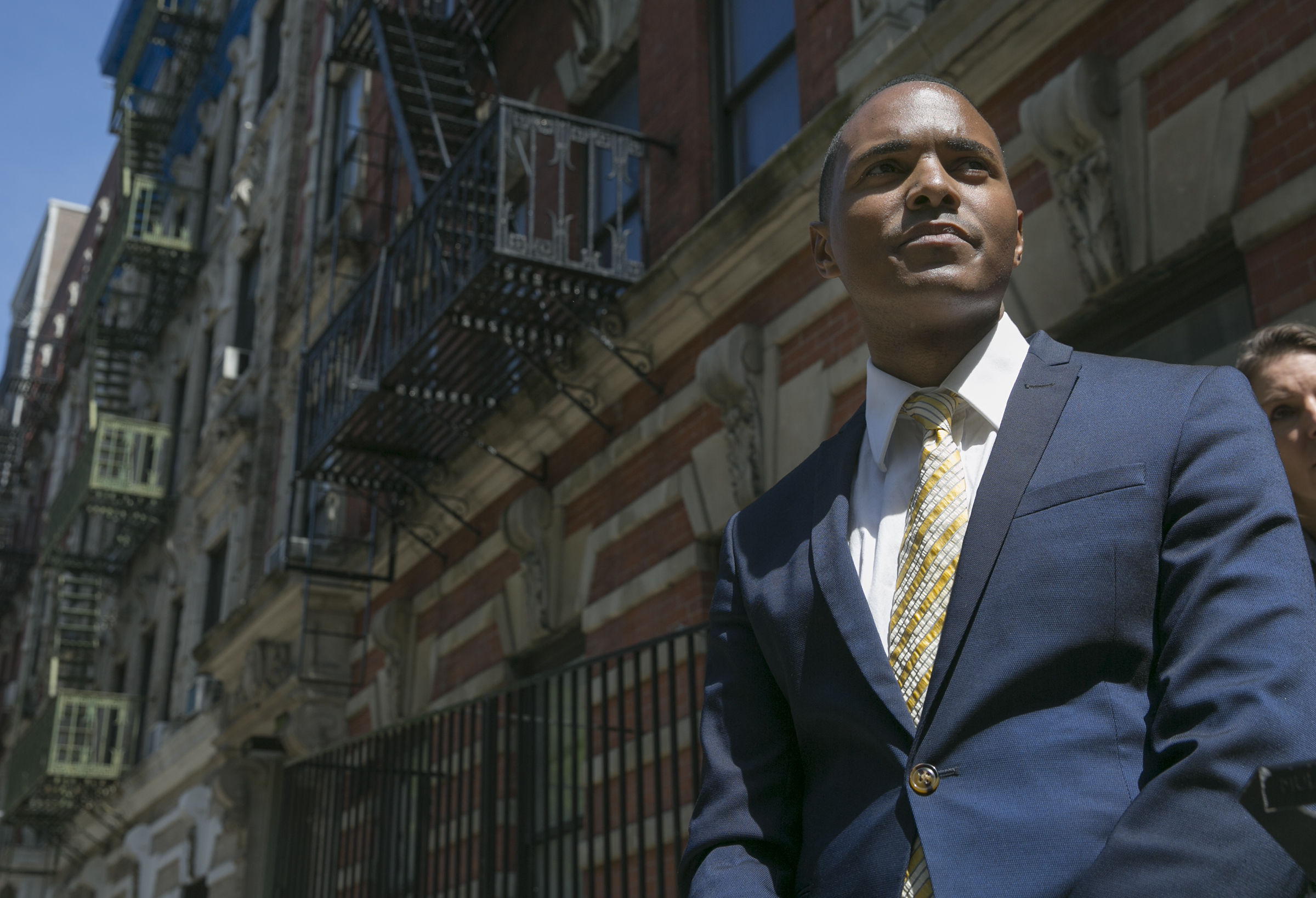
WILLIAM ALATRISTE
Freshman Rep. Ritchie Torres (D-NY) cautioned about the rise of antisemitism in progressive politics during a wide-ranging conversation in the inaugural episode of Jewish Insider’s “Limited Liability Podcast,” hosted by Rich Goldberg and Jarrod Bernstein.
Torres, who describes himself as “the embodiment of a pro-Israel progressive,” said he is mindful of anti-Israel elements within the Democratic Party that have the ability to turn antisemitic. “We have an obligation to combat antisemitism no matter where it emerges, whether it’s from the right, from the left. It has to be fought at every turn and in every form,” he said.
“My concern is that the pro-BDS left could be to the Democratic Party in American politics what Jeremy Corbyn has been to the Labour Party in British politics,” Torres cautioned. “It only takes a few demagogues to pump antisemitic poison into the bloodstream of a political party. And so I see it as my mission to resist the Jeremy Corbynization of progressive politics in the United States.”

Torres, a freshman representing New York’s 15th congressional district, addressed his hard-fought primary victory, which pitted him against a diverse group of Democratic candidates, from the conservative Rubén Díaz, Sr. to Democratic socialist Samelys López, who had the backing of high-profile progressive leaders and groups.
“New York City has become ground zero for Democratic socialism. In the latest election cycle, the [Democratic Socialists of America] won every single race in which it endorsed, except mine,” noted Torres, who on Thursday endorsed New York City mayoral candidate Andrew Yang.
“I had powerful forces arrayed against me — I had Bernie Sanders, [Alexandria Ocasio-Cortez], the [Working Families Party], the DSA, all endorsed Samelys López against me. And not only did I win, but I won decisively,” Torres said of his primary victory. “And I sent a powerful message that you can run as a pro-Israel, pragmatic progressive without catering to the extremes and you can win decisively in a place like the South Bronx.”
“Limited Liability Podcast” is a new weekly podcast for readers of Jewish Insider. Hear from the key players generating buzz and making headlines in conversation with two top political operatives, Jarrod Bernstein and Rich Goldberg. One Democrat, one Republican. Both hosts have extensive experience in the political arena and a deep rolodex to match. It’s Jewish Insider’s Daily Kickoff brought to life.
Concerted efforts from Sen. Jacky Rosen and outside groups helped push the long-delayed measure through a divided Congress

Courtesy
Sen. Jacky Rosen
A bill elevating the State Department’s special envoy to monitor and combat antisemitism to the rank of ambassador passed Congress on Thursday, nearly two years after first being introduced. Prior to its passage, the legislation appeared to stall in the Senate, raising concerns in the final days of the 116th Congress that legislators might have had to start over in the new Congress.
The House of Representatives first passed its version of the bill on Jan. 11, 2019. But — despite broad bipartisan support for the legislation — procedural issues bogged down the bill once it reached the Senate.
Several proponents of the bill both inside and outside Congress told JI that they believed the bill was going to die in the Senate, forcing a reset in the new session of Congress, which began January 3. This characterization was disputed by other Hill staffers and activists who had been communicating with senators to advance the legislation.
“I wouldn’t say it was dead, but it needed outside help,” a Republican aide told JI.
The bill was hampered by a dispute over whether to pass an amended version of the House bill or an identical bill that originated in the Senate, according to two Senate aides familiar with the bill, as well as American Jewish Congress President Jack Rosen.
Rosen, who spoke to several senators in an effort to move the bill forward, said Foreign Relations Committee ranking member Sen. Bob Menendez (D-NJ) preferred to pass the bill as a Senate measure. Menendez did not respond to a request for comment.
Backers of the legislation told JI that Sen. Jacky Rosen (D-NV) was critical to clearing the roadblocks that stood in the way of the bill’s passage.
“Rosen became incredibly engaged and helpful,” a Senate Republican aide familiar with the bill told JI. Both Senate staffers familiar with the bill said that the senator had aggressively pushed colleagues to pass the legislation.
“Senator Rosen… moved this up in her agenda and began to push her colleagues,” Karen Barall, director of government relations for Hadassah, told JI. “She was very effective in ensuring this was understood to be an important measure. Without her, this would not have passed the Senate.”
Rosen told JI she was pleased that the bill passed through both chambers by unanimous consent — a procedure used to expedite legislation without requiring a formal vote. “In the Senate, I was able to build on my bipartisan record of working with colleagues to fight antisemitism by ensuring this critically important bill was brought to the floor and passed,” she said.
The Senate passed the bill on December 16, leaving a narrow window for the House to pass the amended bill and send it to the president’s desk before the end of the 116th Congress.
To ensure the bill made it through the House, supporters had to contend with a chamber focused on urgent debates over government funding and COVID-19 relief payments, as well as disputes between Republican and Democratic leadership, generating concerns that the bill would not make it back through the House before the end of session.
“The issue that came up was not a substantive issue related to the text of the legislation, but rather they got caught up in Republican and Democratic food fight over other issues,” a pro-Israel activist involved in discussions about the bill said.
In addition to Rosen and the bill’s lead sponsors in the House, Reps. Chris Smith (R-NJ) and Brad Schneider (D-IL), a number of Jewish advocacy organizations joined the effort, including the Anti-Defamation League, Hadassah, the Orthodox Union, American Jewish Congress, American Jewish Committee, Jewish Federations of North America and the Conference of Presidents of Major American Jewish Organizations.
“After the Senate voted, there was very little time for the House leadership to act and major legislation — the NDAA, the omnibus, COVID relief — were understandably top priorities for House leadership,” said Barall. “Hadassah and other organizations made an aggressive push to get this done though, and send the bill to the president.”
The pro-Israel activist who asked not to be named credited Smith and Schneider for winning the support of their respective parties’ leaders to allow the bill to pass by unanimous consent on December 31.
Assuming President Donald Trump signs the bill, President-elect Joe Biden will become the first president to nominate a special envoy on antisemitism for Senate confirmation, although it will likely take time before he announces a pick for the spot, and even longer for the nominee to be confirmed.
Trump took 23 months to nominate the current special envoy, Elan Carr, for the position. An individual involved in discussions over the bill told JI that he expects an extended delay to fill the slot, noting that Senate-confirmed nominees face a more expansive background check process, and must go through the lengthy confirmation process, which can take months.
Given that Biden still has yet to nominate some Cabinet secretaries and a range of other high-level appointees that will require Senate confirmation, it’s unlikely the president-elect will name his pick for the position before his inauguration on January 20, the source added.
Among the names said to be under consideration by the Biden transition team are former ADL national director Abe Foxman, past envoy Ira Forman, Emory University professor and noted Holocaust historian Deborah Lipstadt, University of California, Berkeley professor Ethan Katz and ADL senior vice president of international affairs Sharon Nazarian. Foxman and Katz declined to comment to JI. Lipstadt did not respond to a request for comment.
Nazarian confirmed to JI she has spoken to members of the Biden transition team about the role and is submitting a formal application. She posited that her experience at ADL, as well as her personal experiences as an Iranian-born Jew, uniquely qualify her to expand and advance the special envoy’s office.
“My number one mission every day… is to advocate and to monitor and to educate, and to train as many people, stakeholders, government officials, as I can to first of all, make them aware of the threat of global antisemitism, and how it manifests in our lives today,” Nazarian said. “I feel like I’m well-positioned both as a practitioner of this work, as someone who’s led a very large team at ADL at the senior executive level, and also [as] someone who’s lived it through my own intersectional identity.”
Nazarian argued that the special envoy’s office, to date, has not taken a sufficiently modern or forward-looking approach to antisemitism, and has relied too heavily on 20th-century understandings of and approaches to global antisemitism.
Forman, who served as special envoy under former President Barack Obama from 2013 to the end of Obama’s term, declined to say if he was in consideration for the slot, but told JI, “I know there are a number of highly qualified people who could undertake this critical work and I am confident the Biden team will make an excellent choice.”
The envoy would require Senate confirmation and report directly to Secretary of State

U.S. Embassy in Ukraine
Former U.S. Special Envoy to Monitor and Combat Anti-Semitism Elan Carr
The Senate passed a bipartisan bill by unanimous consent on Wednesday night which upgrades the status of the State Department special envoy to monitor and combat antisemitism. The bill now goes to the House for a final vote.
Under the new bill, the special envoy would become an ambassador-level position requiring Senate confirmation.
Per the terms of the legislation, the special envoy — a position currently held by former Los Angeles County deputy district attorney Elan Carr — would be the primary advisor and coordinator for U.S. government efforts to monitor and combat antisemitism abroad.
“I welcome the passage of this important bipartisan bill that will ensure that the U.S. remains a leader in the fight against antisemitism worldwide,” Sen. Marco Rubio (R-FL), one of the legislation’s original cosponsors, said in a statement. “I commend my Senate colleagues for passing this legislation, and look forward to the House quickly passing it and sending it to the president to be signed into law.”
The bill’s other original cosponsors were Sens. Kirsten Gillibrand (D-NY), Lindsey Graham (R-SC), Bob Menendez (D-NJ), Jacky Rosen (D-NV), Elizabeth Warren (D-MA) and Cory Gardner (R-CO).
In her own statement, Rosen said, “To equip the State Department to better address rising antisemitism, it is critical that we elevate the role of the Special Envoy to Monitor and Combat Antisemitism to Ambassador-at-Large,” and that the bill will ensure “that the United States remains a leader in combating anti-Semitism internationally and has the tools needed to track and respond to this growing scourge.”
Sens. Ted Cruz (R-TX), Mike Rounds (R-SD), Patty Murray (D-WA), Tammy Duckworth (D-IL), Ed Markey (D-MA) and Amy Klobuchar (D-MN) signed on as cosponsors after the bill was introduced.
The House passed a version of the bill, introduced by Reps. Chris Smith (R-NJ), Brad Schneider (D-IL) and Eliot Engel (D-NY), in January of 2019 by a vote of 411 to 1 — Libertarian Rep. Justin Amash (I-MI) was the only representative to vote against the legislation.
Rubio, Gillibrand, Engel and Smith introduced similar legislation during the 115th Congress, but it did not pass the Senate during the previous term.
Outside advocates applauded the Senate for passing the legislation, with Anti-Defamation League CEO Jonathan Greenblatt calling it “an important step today to ensure that our government can better fight rising antisemitism around the world.”
American Jewish Committee Director of International Jewish Affairs Rabbi Andrew Baker concurred, saying the bill “will enable the U.S. to enhance our leadership addressing the scourge of antisemitism across the globe.”
Orthodox Union Executive Director for Public Policy Nathan Diament said in a separate statement, “With the passage of this legislation, the Senate is providing powerful new tools to the State Department to lead impactful international efforts to combat what has been aptly called ‘the world’s oldest form of hatred’ and roll back the tide of anti-Jewish hate.”
New York Attorney General Letitia James said police and community members both shoulder blame for underreporting such incidents

Alec Perkins
New York Attorney General Letitia James
Recently released statistics from the Federal Bureau of Investigation — indicating the highest number of antisemitic hate crimes in a decade — “severely” undercounted the number of incidents, New York Attorney General Letitia James said on Monday.
James and Ohio Attorney General Dave Yost joined a webcast hosted by the American Jewish Committee to discuss the release of the FBI’s annual hate crimes report, which found that hate crimes targeting the Jewish community had increased by 14% in 2019.
James said she questioned the accuracy of the data, suggesting that underreporting from both local law enforcement and the impacted communities themselves led to a lower number.
The New York attorney general — who described herself as an “honorary member of the Orthodox community,” having represented Crown Heights in the New York City Council for 10 years — sees the latter issue as a particular problem in what she called the “insular” Orthodox Jewish community.
“Going forward, obviously we’ve got to do a better job, particularly in the Orthodox community,” she said. “We’ve got to inform them and educate them and encourage them with respect to reporting these crimes.”
Yost agreed that underreporting is an issue for many categories of crimes, not just hate crimes, but noted that the victims of hate crimes are more than statistics laid out in data.
“We’re talking about hate crimes. That’s measured one life at a time. One case file at a time. This doesn’t happen to X number of people, it happens to one person… Someone who’s going to carry that trauma with them, the rest of their lives,” he said. “As much as I care about the data, it’s not the numbers that move me, it’s the stories.”
The Ohio attorney general criticized New York City Mayor Bill de Blasio for his particularly stringent enforcement of coronavirus mitigation measures in Orthodox Jewish communities.
“When you single out a particular group and other similarly situated groups are not called out, I think you’re really sending a subtle message that helps to create a fertile seed bed for antisemitism or for racism or what have you,” Yost said.
James and Yost diverged on recent discussions and protests over police accountability. While James saw them as a potential step toward rebuilding trust between citizens and the police — thereby increasing reporting of hate crimes — Yost painted a darker picture.
“The notion of law enforcement being a tool of the popular will frightens me and… it should frighten every American who knows anything about history,” he said. “The Holocaust, the things that happened in Nazi Germany were popularly supported. Law enforcement famously looked by while lynchings occurred in the South. Why? Because it was popularly supported… I’m really concerned that in our rush to make policing more responsive in some communities, that we risk unleashing the genie from the bottle.”
The Jewish Federations of North America president called on the next administration to provide additional COVID-19 relief

Courtesy/JFNA
CEO and President of the Jewish Federations of North America and former Congressman Eric Fingerhut
While Americans anxiously awaited the outcome of the presidential election, Eric Fingerhut, CEO and president of the Jewish Federations of North America and a former U.S. representative, called on the next administration and Congress to provide additional pandemic relief to “ailing non-profits” and increase funding for non-profit organizations’ security needs.
In an interview with Jewish Insider, Fingerhut — who represented Ohio’s 19th congressional district from 1993 to 1995 — said that at a time of deep divisions, he views the way that North America’s 146 Jewish federations function as a model for all Americans.
“Leaders of our community, many members of JFNA’s board and at most federations, are on both sides of this election,” he said. “This has always been the case.”
On Tuesday night, past JFNA board chair Kathy Manning flipped a redistricted House seat and will represent North Carolina’s 6th congressional district as a Democrat. Detroit oil and real estate magnate Max Fisher, a major philanthropist to Jewish causes until his death in 2005 and a member of JFNA’s board, served as an advisor to Republican presidents on Israel and Jewish concerns. Current JFNA board chair Mark Wilf, who co-owns the Milwaukee Bucks franchise, is a longtime Democratic donor who in March contributed $21,250 to the Biden Victory Fund.
“We have always had people on both sides of the political aisle, and always been a model of how we’ve worked together on matters of common concern for Jewish life, Israel and the Jewish people around the world,” said Fingerhut. “We have maintained that unity on that common agenda even as we’ve disagreed politically and worked against each other vigorously. We will continue to, no matter the outcome of this election.”
Fingerhut also noted that the Jewish community is “disproportionately deeply engaged in the civic affairs of the United States as candidates, campaign workers and as supporters of the democratic process, like as poll workers.” The community’s effort, he said, “reflects both our caring for the health and welfare of the country and our appreciation for the unbelievable welcoming and prosperity and success the Jewish community has achieved in this open, democratic society.”
JFNA has representatives in Washington who lobby Congress and the administration on a wide range of issues, including funding for human services — most Jewish federations fund or manage facilities for senior citizens and the mentally and physically disabled — but usually refrains from commenting on specific policies. Earlier this year, the organization worked with the Orthodox Union, the Union for Reform Judaism, Agudath Israel of America, the Anti-Defamation League and other groups to push legislators to provide relief to faith-based charities and religious nonprofits struggling from the economic impact of the COVID-19 pandemic.
Fingerhut was hopeful that the next president will sign into law the International Holocaust Remembrance Alliance’s working definition of antisemitism, and ensure that Medicaid and Medicare programs are extended.
Fingerhut was quick to point out that today’s political climate bears resemblance to other tumultuous times in modern American history.
His 2004 run for Senate coincided with former President George W. Bush’s campaign for a second term, and the country, he said, was terribly split over the Iraq war. His state, Ohio, a swing state, was “deeply divided. The rhetoric was very acute.”
“We have had very close elections in our recent past, have been very divided over very contentious issues, and we’ve gotten through,” Fingerhut told JI, adding that Jewish values have something to teach all of America at this tense time.
“One of the things we have in our Jewish tradition is a commitment to civility and respect for differences of opinion. We need to exemplify that in our own behavior, and insist on it in others in public life.”
The move comes after an independent EHRC report on antisemitism found ‘unlawful acts of harassment and discrimination’ during his tenure

House of Commons/PA Wire
Labour leader Jeremy Corbyn speaks during Prime Minister's Questions in the House of Commons, London. Wednesday July 10, 2019.
Former U.K. Labour leader Jeremy Corbyn was suspended by the party on Thursday for rejecting the findings of a long-awaited report by the Equality and Human Rights Commission (EHRC) that found “unlawful acts of harassment and discrimination for which the Labour Party is responsible.”
The report detailed numerous instances of unlawful behavior, examining at least 70 complaints of antisemitism made since 2016.
In a press conference following the release, current Labour leader Keir Starmer accepted the findings, calling the report “comprehensive, rigorous and thoroughly professional.” Apologizing to the Jewish community, Starmer admitted: “I found this report hard to read and it is a day of shame for the Labour Party… On behalf of the Labour Party, I am truly sorry for all the pain and grief that has been caused.”
The EHRC report, which concluded the party “at best, did not do enough to prevent antisemitism and, at worst, could be seen to accept it,” directed a series of changes to Labour’s reporting and investigation process. Under U.K. law, the mandates of the non-departmental government agency are legally enforceable.
In a statement, Gideon Falter, CEO of the Campaign Against Antisemitism (CAA), which submitted one of the first complaints to the EHRC, called the report “groundbreaking.”
“The EHRC’s report utterly vindicates Britain’s Jews who were accused of lying and exaggerating, acting as agents of another country and using their religion to ‘smear’ the Labour Party. In an unprecedented finding, it concludes that those who made such accusations broke the law and were responsible for illegal discrimination and harassment,” Falter continued. “The debate is over. Under Jeremy Corbyn’s leadership, the Labour Party became institutionally antisemitic. It drove almost half of British Jews to consider leaving the country.”
In addition to finding a persistent culture accepting antisemitism, the report found that the party had a “practice or policy of Political Interference” in responding to internal reports of antisemitism. This included efforts to “smear” complaints as fake, incidents which the EHRC found to have violated the Equality Act of 2010.
Complaints of antisemitism first emerged not long after Corbyn’s election as Labour leader in 2015. A left-leaning longtime backbencher, Corbyn rose swiftly through the party’s ranks following the resignation of former leader Ed Milliband. The allegations of antisemitism continued through Corbyn’s time as opposition leader, resulting in the resignation of numerous high-ranking Labour MPs, who accused him of harboring antisemitic views and protecting others accused of antisemitism. The controversy was a major campaign issue during the 2019 parliamentary election, which Labour lost. Corbyn eventually resigned following Labour’s landslide defeat.
Starmer, who previously served in Corbyn’s shadow government, skirted calls to punish the former party leader after succeeding him earlier this year. On Thursday, Starmer, in response to repeated media questions, again refused to criticize his predecessor, calling the findings of the EHRC a “collective failure of leadership.”
Corbyn, however, appeared far less accommodating. In a statement released on Facebook, Corbyn — while denouncing antisemitism — claimed “the scale of the problem was also dramatically overstated for political reasons by our opponents inside and outside the party, as well as by much of the media.”
The comment appeared to be the last straw for the Labour leaders who were already found by the EHRC to have unlawfully smeared and minimized complaints of antisemitism. Shortly after Starmer finished answering media questions — and reportedly after the Labour leadership failed to persuade Corbyn to retract his statement — a party spokesperson announced the suspension of the former leader pending an investigation.
The suspension sent shockwaves across the U.K. and U.S., where progressive politicians, including Sen. Bernie Sanders (I-VT) and Rep. Alexandria Ocasio-Cortez (D-NY), had previously praised Corbyn. Neither Sanders or Ocasio-Cortez responded to a request for comment, but shortly after news of the suspension, the Democratic Socialist Party, of which the New York representative is a member, tweeted a message of support for Corbyn.
In his remarks, Starmer urged Jewish Labour members, including Louise Ellman and Luciana Berger, to return to the party after having been “driven out.” Neither Ellman nor Berger, who acknowledged speaking personally with Starmer, indicated if they would rejoin the party.
In a statement, Ellman called the report “devastating.” Calling for the party to create an independent investigations system and adopt the IHRA’s working definition of antisemitism, the former MP added, “It is only by facing up to the enormity of what has happened and adopting these measures that the Labour party can be a safe place for Jewish people and a truly anti-racist party.”
During a Senate hearing, Jack Dorsey said the tweets do not represent a threat of ‘immediate harm’ to Israel or its citizens

Screenshot/CSPAN
Twitter CEO Jack Dorsey testifies before a Senate Commerce, Science, and Transportation committee hearing.
Twitter CEO Jack Dorsey sparred with Republican lawmakers over his company’s decision to permit tweets from Iranian Supreme Leader Ayatollah Ali Khamenei calling for the destruction of Israel and denying the Holocaust at a raucous Senate committee hearing on Wednesday.
During the Commerce, Science, and Transportation committee hearing, Sen. Roger Wicker (R-MS) pressed Dorsey on why Twitter had not taken action against tweets from Khamenei threatening Israel. The Twitter founder responded that the company does not see the tweets as an immediate threat to Israel or its citizens’ safety.
“We did not find those to violate our terms of service because we considered them saber-rattling, which is part of the speech of world leaders in concert with other countries,” Dorsey said. “Speech against… a country’s own citizens, we believe, is different and can cause more immediate harm.”
Dorsey’s explanation echoes a letter from the company sent to Israeli Strategic Affairs Minister Orit Farkash-Hacohen earlier this year.
Anti-Defamation League CEO Jonathan Greenblatt disputed Dorsey’s argument.
“Whether ostensibly aimed at Jews or Israel, his rhetoric is more than saber-rattling — it is antisemitism, pure and simple,” Greenblatt said in a statement. “We firmly believe that Twitter needs to apply its policy on hate speech against Khamenei as it would against anyone else who espouses antisemitism. His position is irrelevant when he is spouting prejudice — if anything, it makes his hate even more consequential.”
In response to a query from Sen. Cory Gardner (R-CO) over the company placing misinformation warnings on some tweets sent by President Donald Trump while allowing Khamenei’s tweets, Dorsey emphasized that Twitter does not have an overarching policy against misinformation or against Holocaust denial.
“It’s misleading information, but we don’t have a policy against that type of misleading information,” Dorsey said, specifying that the platform only bans misleading information relating to the coronavirus and voting, as well as manipulated media.
But Greenblatt highlighted that Twitter told Bloomberg earlier this month that it would remove Holocaust denial content under the company’s hate speech policy.
“Jack Dorsey’s statement today was confusing, because it appears to be in opposition to his company’s publicly stated policy and policy rationale regarding Holocaust denial,” Greenblatt said. “Twitter should clarify that their policy is that Holocaust denial is not just a form of misinformation, but an antisemitic conspiracy theory that is used to spread hatred of Jews.”
A Twitter spokesperson told JI that Holocaust denial is banned on the platform, and that the Bloomberg article was correct.
“Our Hateful Conduct Policy prohibits a wide range of behavior, including making references to violent events or types of violence where protected categories were the primary victims, or attempts to deny or diminish such events,” the spokesperson said in a statement. “We also have a robust glorification of violence policy in place and take action against content that glorifies or praises historical acts of violence and genocide, including the Holocaust.”
Twitter did not respond to a question from JI about why Khamenei’s tweets about the Holocaust were not removed or labeled under this policy.
This post was updated on Friday, Oct. 30 to include a response from Twitter.
VP of content policy Monika Bickert says company is ‘taking input’ from Jewish groups over content moderation decisions

Ståle Grut/NRK
Facebook Vice President of Content Policy Monika Bickert.
Facebook’s recent decision to ban Holocaust denial content from its platform was prompted by an uptick in global antisemitism and antisemitic violence coupled with an increasing lack of awareness about the Holocaust, the social media company’s top policy staffer said on Wednesday.
“It’s that combination of these two factors… that prompted us to say we need to recognize this as hate speech and remove it from our services,” Monika Bickert, Facebook’s vice president of content policy, said during an American Jewish Committee webcast.
This explanation echoes one provided by ADL CEO Jonathan Greenblatt earlier this month.
Bickert cautioned that, while Facebook began immediately removing Holocaust denial content when it announced the policy change on October 12, the company is still in the process of rolling out its subject-matter training for platform moderators.
The company will “be going full-force enforcing the policy” in the coming weeks, she added.
Greenblatt — who helped lead the “Stop Hate For Profit” campaign against Facebook — told Jewish Insider that officials at the social media platform “still have a long way to go” in reigning in Holocaust denial.
“One can still easily find pages on Facebook devoted to promoting Holocaust denial or raising questions about the veracity of Holocaust history,” Greenblatt said in a statement. “This is unacceptable, especially since they now have a policy that prohibits this form of hate speech. So there’s lots of room for improvement here.”
Responding to a question about the platform’s stance on anti-Zionist content, Bickert said the company is “taking input” from Jewish groups around the globe to decide where to draw the lines on content moderation, noting that regular meetings with Jewish groups are important to improving Facebook’s overall content moderation practices.
“We’ve increased our collaboration with groups like AJC and others who have direct relationships with stakeholders,” she said. “It’s us saying, ‘here’s how we’re thinking about this issue. Help us to know if we’re in the right place and to get better.’ And it’s those organizations saying, ‘here’s what we’re hearing from stakeholders.’”
Greenblatt said Facebook has not consulted with the ADL on this topic, adding that the company has not always been receptive to pressure and advice from outside groups.
“The fact that it took them this long to remove Holocaust denial, after Jewish organizations had been asking them to do so literally for more than a decade, doesn’t inspire much confidence in their ability to listen and take our concerns seriously,” he said. “Their efforts to try and better navigate these issues by consulting Jewish groups and others who fight hate is a crucial element of improving their platform, but too often it has been only surface level.”
Rep. Josh Gottheimer expressed hope Biden would extend the Trump administration’s actions to project Jewish students

Lt. Col. Angela Wallace
Rep. Josh Gottheimer
As the presidential election draws near, at least one House Democrat — Rep. Josh Gottheimer (D-NJ) — is hopeful that a potential Biden administration will maintain protections for Jewish college students, introduced by President Donald Trump in a 2019 executive order on antisemitism.
Speaking during a webinar on antisemitism alongside State Department Special Envoy Elan Carr on Tuesday, Gottheimer expressed support for continued action from the executive branch to address antisemitism and the Boycott, Divestment and Sanctions (BDS) movement, which has become widespread on U.S. college campuses.
“As a policy matter, whether it’s through executive action or other forms of standing up to the BDS movement, I would hope that the next administration continues that effort, because the BDS movement is antisemitic,” said Gottheimer, who attended the executive order’s signing ceremony last year.
In December 2019, Trump signed an executive order adding antisemitism to a list of punishable offenses included in the Civil Rights Act of 1964. The executive order originated as guidance in the George W. Bush and Barack Obama Departments of Education, but was made official by the president’s signature.
Since the executive order’s implementation, one school — New York University — has reached a settlement with the Education Department over its handling of antisemitism on the campus. It was announced last week that a similar complaint had been filed against the University of Illinois, Urbana-Champaign, due to years of unchecked antisemitic activity at the school.
Gottheimer also spoke about legislative efforts to address antisemitism, emphasizing that the 2019 House resolution condemning the BDS movement received broad bipartisan support, which he believes will serve as a signal to a potential Biden administration.
“I would hope, given the strength of that message and that resolution, that it would be carried forth as policy in the next administration,” he continued. “I think it’s very important that we remain vigilant. Regardless of who is the next president, I believe this must continue in force… I wouldn’t see any reason why we wouldn’t continue that posture in the years ahead.”
Few congressional Democrats have explicitly praised the executive order, but many legislators who have spoken to JI indicated that they hope more will be done to address the uptick in antisemitism around the country
In a statement to JI, Sen. Jacky Rosen (D-NV) skirted directly addressing the administration’s executive order, but highlighted the importance of applying the International Holocaust Remembrance Alliance’s working definition of antisemitism in the Department of Education.
Rosen pointed to the Anti-Semitism Awareness Act, which she is cosponosoring, that would codify the Department of Education’s use of the IHRA definition. “To protect Jewish students and others on campus from antisemitic hate, we must have the tools to enforce federal antidiscrimination laws in education,” she said.
The pair have shared multiple conversations and meetings — including Shabbat dinner

Loren Javier/Flickr
Nick Cannon
Three months after coming under public scrutiny — and his highly publicized firing from ViacomCBS — for making antisemitic comments on his podcast, actor Nick Cannon has worked to make amends with the Jewish community: He has devoured Bari Weiss’s How to Fight Anti-Semitism, hosted rabbis on his podcast and toured a Holocaust museum.
While much of Hollywood has moved on from the scandal, Cannon has continued his outreach to the Jewish community, including a growing friendship with Malcolm Hoenlein, the executive vice chairman of the Conference of Presidents of Major American Jewish Organizations.
The pair first began talking, Hoenlein said, shortly after controversy erupted over Cannon’s podcast with rapper Richard Griffin, who was kicked out of Public Enemy in 1989 for making antisemitic comments. Cannon and Griffin engaged in back-and-forth commentary that included clear antisemitic tropes.
“Somebody close to him connected us, and then he reached out to talk to me and to begin a dialogue that has continued steady throughout this kind of for months now,” Hoenlein told Jewish Insider on Monday of their connection. “It’s led to many hours of discussion. He came even to Friday night dinner at my daughter’s house.” The Shabbat dinner in Teaneck, N.J., Hoenlein believes, was Cannon’s first. “He spent hours talking with my family — my children, grandchildren.”
Since then, Hoenlein has met with the actor numerous times, including a dinner at Manhattan’s UN Plaza Grill last week. Hoenlein and Cannon were also photographed holding up a poster that read “stop Jew hatred.”
In the interview with JI, Hoenlein praised Cannon for his commitment to not only engaging with the Jewish community, but also learning from his missteps. “He made a mistake,” Hoenlein said, “but he has faced up to what he did and publicly spoke about doing t’shuvah.”
“This guy is anything but an antisemite,” Hoenlein added. “He fasted on Tisha B’av. Because he didn’t know it started at night, he fasted until the next morning.”
“He speaks whole Hebrew sentences, because he studies it,” Hoenlein said of Cannon. “I have fought antisemitism for five decades. I see one and I know somebody who is not.”
Hoenlein was hopeful Cannon could help not just educate younger generations about antisemitism and stereotypes, but also encourage other influencers to use their celebrity status to raise awareness about antisemitism.
The Jewish communal leader cautioned against the reaction, observed in the aftermath of Cannon’s controversial comments, to immediately cast the actor as an antisemite.
“We all react to these things, as we should, and we have to condemn antisemitism in whatever way when it appears,” Hoenlein suggested. “But not to jump to a conclusion that this is some ingrained ideology or hatred of a [certain person]. We have to be very careful about the use of the term and not have the term so misused and thrown around in careless ways.”
‘We know that what may begin as online threats in the virtual world can lead to violence in the real world,’ Rep. Ted Deutch tells JI

YouTube
Rep. Ted Deutch (D-FL)
A bipartisan group of members of Congress will announce on Tuesday the creation of a new global inter-parliamentary task force to combat digital antisemitism.
Members of the task force include Reps. Ted Deutch (D-FL), Debbie Wasserman Schultz (D-FL), Chris Smith (R-NJ) and Mario Diaz-Balart (R-FL), along with elected officials from major parties in Canada, the U.K. and Australia. Another member of the panel is member of Knesset Michal Cotler-Wunsh from Israel’s Blue and White Party, the daughter of former Canadian Justice Minister Irwin Cotler. In July, Cotler-Wunsh challenged a Twitter spokesperson during a Knesset hearing over the company’s decision not to delete or flag a post by Iran’s Ayatollah Ali Khamenei that she said was “calling for genocide.” In a May tweet, Khamenei called for “firm, armed resistance” to bring about the “elimination of the Zionist regime.”
In an interview with Jewish Insider, Deutch said the lawmakers coalesced around the issue of online antisemitism because as social media continues to grow, “it’s unfortunately more and more being used to spread hatred and antisemitism. And we know that what may begin as online threats in the virtual world can lead to violence in the real world.”
Deutch said conversations about combatting global antisemitism began when he attended the World Holocaust Forum at Yad Vashem in Jerusalem earlier this year, and felt “compelled to move forward” with more action after social media platforms — including Twitter, Facebook, TikTok and Google — failed to counter it. “We are aware that there are efforts by multiple groups, and non-governmental organizations who are trying to address this,” Deutch said. “We think that it’s important for elected officials from countries that are experiencing concerning and really upsetting increases in antisemitism to speak out.”
The goals set by the task force, as reviewed by Jewish Insider, include raising awareness about online antisemitism and establishing a consistent message in legislatures across the world to hold social media platforms accountable. The group will also work to adopt and publish transparent policies related to hate speech.
“Always and at this time in particular as we stand united in fighting a global pandemic, another virus rages that requires global collaboration and cooperation,” Cotler-Wunsh said in a statement. “By working with multi-partisan allies in parliaments around the world, we hope to create best practices and real change in holding the social media giants accountable to the hatred that exists on their platforms.”
Deutch maintained that “the power of having a group of elected officials” from different parties across the globe come together on this issue “will highlight the need for action by the companies and the need for action by our respective legislative bodies.” He added: “And most importantly, we hope this will help advance the conversation that’s premised upon the fundamental understanding that we just shouldn’t accept this spread of antisemitism that we’ve seen on social media platforms.”
The Florida congressman told JI that as the group gains traction, its organizers will look to expand “into many more countries.”
The Foundation to Combat Anti-Semitism is launching a campaign aimed at educating American youth on the issue of antisemitism

Lior Mizrahi
2019 Genesis Prize Laureate Robert Kraft with Prime Minister Netanyahu and Genesis Prize Co-Founder Stan Polovets.
Accepting the Genesis Prize from Israeli Prime Minister Benjamin Netanyahu during a glitzy ceremony in Jerusalem in June 2019, New England Patriots owner Robert Kraft announced his vision to “work to end the violence against Jewish communities.”
The prize, granted annually, has become an aspirational award for accomplished members of the Jewish community, honoring their achievements across a variety of fields. It is intended to have the simultaneous effect of encouraging Jewish activism, awarding a check of $1 million to its laureates who, to date, have shown no personal need for the money.
Before an applauding audience at the Jerusalem Theatre, Kraft used the occasion to announce the formation of the Foundation to Combat Anti-Semitism, an effort he painted in lofty terms as working to thwart the rise of antisemitism.
“To counter the normalization of antisemitic narratives that question Israel’s right to exist, disguised as part of legitimate debate on campuses and in the media. To educate, to inform, and to heal inter-communal relations,” Kraft said. “In combating the scourge of antisemitism, my solemn ambition is to counter all forms of intolerance in the spirit of the ancient Jewish value of tikkun olam — to heal and repair the world.”
Kraft immediately committed $20 million to the foundation, now a part of the larger Kraft Family Philanthropies. This was joined, shortly after, by a $5 million commitment from fellow billionaire philanthropist Roman Abramovich — all part of an initial plan to raise some $50 million for the new foundation. But despite the high-profile and high-dollar origins, little of the effort has been made public for over a year.
Now, the organization is going public with its first major initiative, [Together Beat Hate], or [TBH], an effort to engage youth in education, conversation, and activism around the meaning and reality of antisemitism.
“We’ve been saying all along, it’s not a Jewish issue, it’s a community and a society issue,” Josh Kraft, president of Kraft Philanthropies and Robert’s son, told Jewish Insider.
Kraft broke the general population down into three segments: those who hold antisemitic attitudes, those who are knowledgeable about and opposed to antisemitism and those with an incomplete or misconstrued understanding of antisemitism. This third group, which he believes is the most susceptible to learn about the issue, has become the focus for [TBH].
“We’re trying to reach that group in the middle specifically,” he explained. “We feel like we can influence their experience with the [Jewish] community.”
Institutional memory of the Holocaust is quickly fading as the number of survivors dwindles. A January study by the Pew Forum found that less than half of Americans can accurately approximate the number of Jews killed by the Nazis. Yet reports released by the FBI and the Anti-Defamation League show a rapid increase in antisemitic hate crimes in the United States.
In January, the foundation commissioned a study on the perceptions and knowledge of antisemitism among American youth — which they defined as those ages 13-35. The findings, according to the group, indicated a particular lack of familiarity with the terminology and history of antisemitism among those aged 13-17.
This age group appeared especially representative of the middle segment described by Kraft: largely unfamiliar with antisemitism and in need of education, but without any preconditioned antisemitic views.
“They truly just don’t know what we’re talking about when we say antisemitism,” Rachel Fish, the executive director of the Foundation to Combat Anti-Semitism added. “They say things like, well, ‘what’s a Semite?’ and ‘I’m not really sure what that is, but I’m anti-racist, I’m also against homophobia, I’m against Islamophobia, so I’m probably an antisemite,’ and they don’t understand that they’re actually an anti-antisemite. They don’t even understand the terminology.”
To address the issue, Kraft and Fish turned to Ryan Paul, an expert in digital media, to organize and run the outreach campaign.
Paul’s approach was modeled after the success of groups like Black Lives Matter, which attracted attention to its movement by exposing those without previous experience or knowledge to stories of racism. Through the [TBH] social media channels and website, the group built a platform that it hopes will bring attention to the issue of antisemitism.
“We’re encouraging people who may not be aware of Jew hatred or antisemitism to explore and to learn things, and we’ve provided content starters for them to have conversations with folks to share what those conversations have been like, in order to expose a broader group of people to this topic,” Paul explained.
Last week, [TBH] published its website, featuring glossy black-and-white photos and call-to-action quotes like “hatred is not a given.” The centerpiece of the site is a five-step plan for visitors to educate and raise awareness for themselves and others.
Step five — called “Act Together” — encourages visitors to submit their ideas for future campaigns or partnerships. Though the team did not mention any specific groups or opportunities, they repeatedly emphasized an interest in working alongside organizations dedicated to fighting other forms of hate.
The organizational and educational work — fueled primarily through social media — will be supplemented by a digital command center currently under construction in Gillette Stadium, the headquarters for the Patriots and other Kraft-affiliated organizations. There, a team will track more than 300 million websites and social media platforms across the internet and dark web, compiling data on incidents and trends in antisemitism.
Though other longstanding organizations monitor and compile similar information, Fish claims [TBH] will be the first to tie that data directly into social media campaigns aimed at youth. The real-time information gathering will also work as a rapid-response effort, determining which sites and patterns to target.
Fish and Paul admitted this real-time and far-reaching approach straddled the line between drawing attention to the hatefulness of the content and providing emerging movements with undue publicity. But while the organization works to define that standard, Fish argued the information would still prove useful in dissecting the methods of their internet opponents.
“What we want to do is understand that messaging, so that we can refine the way in which we engage with our target audience so that they won’t be seduced by that messaging, but rather, would be positively predisposed to the kind of framing that we’re putting out there,” she said.
The foundation — which has also consulted with experts on youth psychology and the effects of social media — will use the resulting research to furnish its partnerships with similar groups.
Given the logistical restrictions of the ongoing pandemic, the team seemed unsure of an exact timeline for their work. Still, only a few weeks into the project, Kraft, Fish and Paul are impressed with the response from groups seeking to partner with [TBH].
“I really feel very strongly that it relies on people to use their voices right and it’s people from many different backgrounds,” Paul added. “And I can tell you as somebody who’s not in the Jewish community, this is new. It’s a learning experience for me.”
The New York legislator said ‘We shouldn't have double standards, we shouldn't have moral equivalencies’

Flickr
Rep. Lee Zeldin (R-NY) speaks at the U.S. Institute of Peace in May, 2019.
Rep. Lee Zeldin (R-NY) defended the Republican Party against allegations of antisemitism in its ranks during a web event Monday held in conjunction with the Republican National Convention, which kicked off today in Charlotte, N.C.
“I, personally, haven’t encountered any antisemitism within the Republican Party,” Zeldin, who is one of two Jewish Republican members of Congress, said. “From a personal perspective, I can tell you — from kindergarten through 12th grade, college, law school and four years of active duty, I never once experienced antisemitism at all.”
The New York congressman said during Monday’s call, which was hosted by the American Jewish Committee, that he’s only faced antisemitism in recent years, something he attributes to the current political atmosphere. He estimated “several thousand” instances of being called a Nazi or a Nazi sympathizer but added, “I’m not aware of any of it coming from within the Republican Party.”
Zeldin instead assigned blame to the Democratic Party, pointing in particular to comments made by Rep. Ilhan Omar (D-MN) in 2019. ”I spent four years in the New York State Senate, and through my first four years in the U.S. House of Representatives, I didn’t experience it inside the actual chamber until the beginning of 2019,” Zeldin said. “That became an issue within the House Democratic Caucus in the first half of 2019.” He recalled that the House of Representatives passed a watered-down resolution against hate following Omar’s comments regarding AIPAC and lawmakers’ support for Israel. Zeldin noted that a few months earlier, in January 2019, the House voted in near unanimous fashion on a resolution to condemn Rep. Steve King (R-IA) following comments from the congressman that appeared to defend white nationalists and white supremacists. Republicans “named names, there was a resolution that passed, that member lost his committee assignments,” said Zeldin. “We shouldn’t have double standards, we shouldn’t have moral equivalencies.”
Zeldin suggested that if Omar’s statements had been made by a Republican legislator, “I guarantee you that we would have passed a resolution that singularly, emphatically and forcefully condemned antisemitism. There would have been no moral equivalencies, that member would have been removed from her committee assignments, and it would have been basically a unanimous effort in doing so.”
A number of Republican candidates have faced criticism this cycle for promoting antisemitic stereotypes. Georgia Senator David Purdue, who is facing a tough reelection challenge from Jon Ossoff, came under fire last month for a campaign advertisement that appeared to enlarge Ossoff’s nose. In the state’s 14th congressional district, Marjorie Taylor Greene, who has made claims about George Soros and the Rothschilds, won her party’s runoff and is all but guaranteed a seat in the next Congress.
Zeldin also suggested that the reason there’s not a major shift in support for President Donald Trump among Jewish voters is because Israel is “not popping at the top of their list” of priorities. “I’ll talk to a Jewish voter, and it’s possible that if I ask them for their top 15 issues, they might just not mention Israel,” he explained.
The Colorado governor cited the number of presidential candidates with Jewish backgrounds

Colorado Gov. Jared Polis, who was elected in 2018 as the state’s first Jewish governor, celebrated the increasing number of Jewish Americans involved in politics, with some rising through the ranks of the Democratic Party.
“It is very heartening to see the increasing visibility of Jewish Americans throughout politics,” Polis said during a virtual event on Tuesday for Jewish Democrats hosted by the Democratic National Committee during the 2020 Democratic National Convention. “This year, several of the candidates for president of the United States were of Jewish heritage. And of course, with the selection of [Sen.] Kamala Harris, our soon-to-be second gentleman of the U.S., Douglas Emhoff, is Jewish.”
Polis noted Emhoff’s possible role is “another reason” why Joe Biden’s selection of Harris as his running mate “was not just outstanding, but, frankly, groundbreaking.”
“These are milestones and speak well of the inclusive nature of our nation and of the Democratic Party,” said the Colorado Democrat.
Los Angeles Mayor Eric Garcetti, who participated in a follow-up panel focused on American Jewish voters, said he was deeply moved to watch “a Jew named Bernie Sanders give, I think, the most enthusiastic speech about a nominee in the nomination that he competed for and came in second place, of any second-place finisher I’ve ever heard.”
On the webcast, Polis also highlighted President Donald Trump’s comments on the campaign trail on Monday, suggesting that he “moved the capital of Israel to Jerusalem… for the evangelicals.”
“For once, President Trump was honest about his motives. It wasn’t because of a belief that Jerusalem is the capital of the State of Israel. It wasn’t because of any deeply held belief in the Jewish state. It was simply what he said it was: an appeal to evangelical voters,” Polis stressed. “I have friends on both sides of when or how, or if the embassy should be moved. But it should not be moved — I think we would all agree — simply because evangelical voters in America want it. It should be situated because of where we can best support the peace process, the stability and survival of the Jewish State of Israel.”
Greene has a history of promoting antisemitic conspiracy theories, including on the campaign trail

Marjorie Greene (Greene for Congress)
Controversial congressional candidate Marjorie Taylor Greene appears to be headed for Washington following her victory on Tuesday in the Republican runoff in Georgia’s 14th congressional district. Her win raises concerns among Jewish organizations who have sounded the alarm over her candidacy for months. The district’s overwhelmingly Republican make-up all but ensures that Greene will win the general election in November.
Greene has been a vocal promoter of the QAnon conspiracy theory — which alleges that President Donald Trump is working to take down a network of Democratic politicians and celebrities who practice satanism, pedophilia and cannibalism — and has posted Facebook videos expressing antisemitic, racist and Islamophobic views.
Even after launching her campaign, Greene continued to unapologetically propagate antisemitic conspiracy theories, including falsely accusing Democratic megadonor and Holocaust survivor George Soros of “turning people over to Nazis where they were burned in offices” in a recent television interview. She also dismissed questions about a photo she took with a former Ku Klux Klan leader who described her as a “friend.”
“Ms. Greene has a history of propagating antisemitic disinformation,” Allison Padilla-Goodman, Southern division vice president of the Anti-Defamation League, said in a statement to Jewish Insider. “ADL previously called on Ms. Greene to disavow her relationship with a prominent white supremacist leader and retract past antisemitic statements. ADL said that ‘failure to do so is a moral failure and unbecoming of someone seeking elected office.’ Ms. Greene’s continued insistence on propagating such antisemitism shows she has decided to double down on hate, which, to say the least, is deeply problematic.”
Republican leaders spoke out against Greene after her Facebook videos surfaced, but only House Minority Whip Steve Scalise (R-LA) actively worked to boost her opponent, physician John Cowan, frustrating some House Republicans, according to Politico. Scalise, House Minority Leader Kevin McCarthy (R-CA) and the National Republican Campaign Committee did not respond to requests for comment.
The Republican Jewish Coalition opposed Greene during the runoff and endorsed Cowan.
“We are really proud to have endorsed John Cowan. We do not endorse Greene and we think she is the antithesis of what our party stands for,” RJC communications director Neil Strauss said in a statement to JI. “We can hold our heads up high tonight for standing up to Greene, just like we did when we stood up to [Rep.] Steve King by supporting Randy Feenstra.”
Rabbi Abraham Cooper, associate dean of the Simon Wiesenthal Center, said he was hopeful that Republican leaders would continue to distance themselves from Greene.
“During the primary campaign, top national Republican leaders in Congress, led by the House Minority Leader, denounced her bigotry with good reason. Some even endorsed her opponent. Yet she will likely be elected to Congress this fall,” Cooper said in a statement to JI.
Cooper called on Republican leaders to marginalize Greene within the Republican caucus as they did with King after he questioned why white supremacy was considered offensive.
“If Ms. Green[e] doesn’t change course,” Cooper said, GOP leaders “may have to apply [the] same standards to her.”
In Georgia’s deep red 9th district, State Rep. Matt Gurtler, who also refused to apologize for taking a photo with the same former KKK leader, lost his runoff race against gun store owner and Navy veteran Andrew Clyde.
Antisemitic poster alluding to Jewish donors found at district office of NY Assemblymember Rebecca Seawright overnight

Assemblywoman Rebecca Seawright
Assemblymember Rebecca Seawright (D-Manhattan) called on the New York Police Department’s hate crimes unit to investigate the antisemitic vandalization of her office in New York’s 76th Assembly district.
Seawright’s office, located on Park Avenue on Manhattan’s Upper East Side, was sprayed with white paint overnight on Monday. A vulgar and antisemitic message alluding to Jewish donors was written on a large poster and slid under the door.

“I want to speak loud and clear today that we will never be intimidated by this criminal act,” Seawright said during a press conference, flanked by Rep. Carolyn Maloney (D-NY) and faith and community leaders, outside her office on Tuesday. “We will stand together, speak up, and remain vigilant against this violence and antisemitism.”
Though not Jewish, Seawright is a member of the Assembly’s Jewish Legislative Caucus. Her husband, Jay Hershenson, who serves as vice president for communications and marketing at Queens College of the City University of New York, is Jewish.
Seawright, who has represented the district since 2015, was knocked off the ballot’s Democratic line last month after missing a key deadline during the peak of the coronavirus outbreak. Following the ruling, she gathered more than 5,000 signatures to get on the November ballot on the “Rise and Unite” independent party line.
Maloney, who represents the neighborhood as part of the 12th congressional district, told JI that the incident was “extremely disturbing.” Maloney pointed out that the Never Again Education Act, which she sponsored in the House and which allocates resources to Holocaust education, is aimed “to stop this kind of hatred.”
Rabbi Joseph Potasnik of the New York Board of Rabbis, who participated in a virtual town hall on combating antisemitism hosted by Seawright’s office last month, said that it’s important that people of all faiths speak out against acts of antisemitism. ”The truth is that antisemitism is anti-Christianity, is anti-Islam. A person who hates me today is going to hate you tomorrow,” he explained. “You scratch the skin of an antisemite and you will find a racist and many other layers of bigotry.”
Some Jewish Twitter users displaying the Star of David reported having their accounts locked on the social media platform

Following complaints that Twitter locked the accounts of some Jewish users in the U.K. who displayed images of the Star of David, the social media company sought to explain its procedures for determining hateful conduct.
In a statement released Wednesday morning, Twitter clarified, “We categorically do not consider the Star of David as a hateful symbol or hateful image. We have for some time seen the ‘yellow star’ or ‘yellow badge’ symbol being used by those seeking to target Jewish people. This is a violation of the Twitter Rules, and our Hateful Conduct Policy prohibits the promotion of violence against — or threats of attack towards — people on the basis of categories such as religious affiliation, race and ethnic origin.”
“While the majority of cases were correctly actioned, some accounts highlighted recently were mistakes and have now been restored.”
In the statement, Twitter thanked the U.K.-based organizations Campaign Against Antisemitism and Community Security Trust, as well as the Anti-Defamation League, for “bringing this to our attention and for their partnership in tackling antisemitism.”
In a statement to Jewish Insider, Stephen Silverman, Campaign Against Antisemitism’s director of investigations and enforcement, said, “Only one of the accounts locked featured a yellow star, and it very clearly did so as a means of reclaiming the yellow stars used by the Nazis. This is precisely the kind of inept response to antisemitism that we have come to expect from Twitter, which just last week tried to convince us that the viral antisemitic #JewishPrivilege hashtag was legitimate.”

Users reported their accounts were locked by Twitter for depicting the Star of David.
Silverman continued, “We would happily help Twitter, but they largely ignore us when we approach them, which we take as a reflection of their inconsistency in addressing this,” Silverman continued. “It seems that Twitter prefers to go after Jewish users who proudly display their identity but not after antisemitic users who unabashedly promote anti-Jewish vitriol.”
ADL CEO Jonathan Greenblatt welcomed Twitter’s response, praising the social media platform in a tweet. “Good to see Twitter clarifying the difference between images used to harass and when used to express identity and empathy. The Star of David is an ancient symbol that represents all Jews and our solidarity,” he tweeted.
“Upon learning of the situation, ADL reached out to Twitter and worked with the company to help them get it right. Notable that they moved swiftly to correct this problem,” Greenblatt wrote, adding, “Kudos to Twitter for doing this here and elsewhere recently.”
NBA commissioner Adam Silver tells JI league condemns ‘all forms of hate speech, racism or anti-Semitic behavior no matter where it comes from.’

Kevin Burkett
Iverson with the Philadelphia 76ers in 2009.
More than 36 hours after posting a photo with Nation of Islam leader Louis Farrakhan, basketball Hall of Famer Allen Iverson addressed the maelstrom of criticism he faced for appearing to show support for a man who has for decades spouted antisemitic and homophobic conspiracy theories.
In a second Instagram post, published Thursday, Iverson — who has not removed the offending post — wrote, “I have always had the highest love and respect for all of my fans, regardless of their race, sexual orientation, gender, religion, political designation or personal or political views.”
“I respect Louis Farrakhan’s strong voice on behalf of Black people and his impact on the Black community,” Iverson continued, explaining “My post wasn’t meant to offend anyone.”
“As one who has been a victim of racial injustice personally, I do not support or condone hatred of any kind. Specifically, I do not support anti-Semitic or homphobic views from anyone,” Iverson said. “In this moment, when all oppressed people should stand together in solidarity, we need to see each other, learn from each other and heal. We cannot stand for empowerment unless it is empowerment for ALL people. We must reject hate in any form.”
Iverson explained that he was introduced to Farrakhan in 2017 by his son, Mustapha Farrakhan, Sr., who holds the title of supreme captain of the Nation of Islam. Iverson wrote that he initially met Mustapha during his playing days. “[Farrakhan’s] family grew to love and respect me and my family and the mutual respect that we have for one another still exists to this day,” Iverson said.

Allen Iverson and Louis Farrakhan in a 2017 photo posted by Iverson.
Mustapha’s own son, Mustapha Farrakhan, Jr., is a professional basketball player who spent time with the New York Knicks and Milwaukee Bucks, but never appeared in a game.
Considered one of the best players of his era, Iverson played for 14 seasons with the Philadelphia 76ers, Denver Nuggets, Detroit Pistons and Memphis Grizzlies. An 11-time NBA All-star, Iverson won the Most Valuable Player award in 2001. His jersey was retired by the 76ers in 2014, and he was inducted into the Naismith Basketball Hall of Fame two years later.
The image’s controversy has also caught other sports celebrities in its wake. Philadelphia Eagles star wide receiver DeSean Jackson, who recently came under fire for twice posting fake quotes he attributed to Adolf Hitler, initially liked the post, but later removed his like.
Former NBA player Stephen Jackson, who initially defended Jackson against accusations of antisemitism, commented on Iverson’s post, “Love u bro.”
In a statement provided to Jewish Insider, the 76ers addressed Iverson’s recent social media activity.
“When we were made aware of Allen’s post on social media yesterday, we reached out to him to understand it. When he learned the post had caused hurt and offense, Allen expressed a continued commitment to standing for equality and opposing Anti-Semitism, racism and homophobia. Now more than ever, we must come together to condemn bigotry of any kind. This includes embracing dialogue on these subjects and learning from each other, no matter how uncomfortable.”
A representative for Iverson did not return a request for comment.
NBA commissioner Adam Silver told JI, “The NBA has a long history of standing up for the principles of equality and the importance of respecting a diversity of viewpoints but we condemn all forms of hate speech, racism or anti-Semitic behavior no matter where it comes from.”
Iverson’s post is one of several recent incidents involving retired NBA players. In addition to Jackson’s comments, former Miami Heat star Dwyane Wade apologized after tweeting a message of support for actor Nick Cannon, who was fired by ViacomCBS for antisemtic comments made in a recently resurfaced video.
Retired basketball star latest celebrity to associate with the Nation of Islam leader widely denounced as antisemitic
Twitter/Allen Iverson
Allen Iverson and Louis Farrakhan in a 2017 photo posted by Iverson.
Basketball Hall of Famer and former Philadelphia 76ers point guard Allen Iverson became the latest celebrity to enter controversy after posting a picture with Minister Louis Farrakhan on Instagram on Tuesday.
Farrakhan, the leader of the Nation of Islam, has long been decried for decades of public antisemitic remarks.
Iverson, who has more than 8 million Instagram followers, posted the photo showing him meeting with Farrakhan on an unknown date, accompanied by the comment “I didn’t choose to be black. I just got lucky!!! #BucketListMoment #LoveConquersHate #GoodDefeatsEvil”
In a post on Wednesday, the Anti-Defamation League (ADL) called Farrakhan the “most popular antisemite in America,” citing a speech on July 4 in which he urged his followers to “fight Satan the arch deceiver [and] the imposter Jews who are worthy of the chastisement of God.” The video of his remarks has more than 1.2 million views on YouTube.
Iverson joins a sizable list of celebrities to recently show support for Farrakhan, including rapper Ice Cube, comedian Chelsea Handler — who later recanted — Philadelphia Eagles wide receiver DeSean Jackson, and actor Nick Cannon.
Iverson played for four teams in his 14-year NBA career, including the 76ers, Denver Nuggets, Detroit Pistons, and Memphis Grizzlies. An 11-time all-star and recipient of the 2001 Most Valuable Player award, Iverson is considered one of the greatest players of his era, and was inducted into the NBA Hall of Fame in 2016.
An hour after posting, embattled fellow former NBA player Stephen Jackson, under his Instagram handle “@_stak5_,” commented on the post “Love u bro.” DeSean Jackson also initially liked the photo under his handle “@0ne0fone,” according to a screenshot, but later removed his like without explanation.
In the blog post, the ADL wrote that despite “messages that espouse hate and division,” Farrakhan “has been given a pass in mainstream society.”
Greg Ehrie lived in Jerusalem for a year while learning Arabic

The Anti-Defamation League has tapped longtime FBI official Gregory Ehrie to oversee the group’s relationship with law enforcement.
Ehrie, who joined the ADL as its vice president for law enforcement and analysis on May 18, worked in a number of prominent roles in the FBI during his 22-year service, including as section chief of the Domestic Terrorism Operations Section, special agent in charge of the New York Office Intelligence Division and most recently, special agent in charge of the Newark, New Jersey, office.
Ehrie’s FBI career frequently brought him in contact with the ADL — he attended several ADL seminars and worked with the organization on law enforcement issues.
“Moving on from the Bureau, I can’t think of a better organization I’d want to join,” he said in an interview with Jewish Insider. “I think my background in law enforcement and my interactions with them really puts me in a unique position to enhance and forward the ADL mission.”
Ehrie’s role places him in charge of the organization’s efforts to build partnerships between law enforcement and both the ADL and the public at large. “I want to get to know both sides,” he said, “and hopefully [I] can translate the languages so we can better not only protect our communities but have a more respectful relationship.”
Though he hails from Irish ancestors, Ehrie said he has “a great affinity” for the Jewish community, fostered by his work in and with the community over several decades. In 2005 and 2006, he spent a year living on the Ramat Rachel kibbutz in Jerusalem learning Arabic for the FBI. Last year, he led the FBI’s Newark office during the investigation into the December attack on a kosher supermarket in Jersey City, N.J.
Ehrie described his time in Jerusalem as “one of the highlights of my life.” “Beautiful country, wonderful, strong people with a proud history and heritage, facing a lot of challenges throughout their history, even today,” he said. “But I found them to be, you know, some of the most caring people and… so welcoming, so open.”
Ehrie arrives at the ADL at a time when the relationship between the public and law enforcement is under severe stress. More than a week of protests against police brutality around the country have, in many cities, elevated tensions between community members and authorities.
The relationship between the public and law enforcement “is a marriage without divorce, as we like to call it,” Ehrie said. “So I hope… that I can in some way assist the ADL whose mission is to help these communities… to assist them in making this better and repairing this damage.”
U.K. Chief Rabbi Ephraim Mirvis warns that hatred of Jews 'can take the shape of whatever political or social philosophy chooses to use it'

Jonathan Brady/PA Wire via AP Images
U.K. Chief Rabbi Ephraim Mirvis
The award-winning British novelist Howard Jacobson once wrote, “To assert that antisemitism is not like other racisms, is not to claim a privilege for it.” It was essential for the British public to understand why this is so ahead of last year’s general election, and I believe it is essential for the American people to understand it today.
Recognizing antisemitism used to be relatively straightforward. A person who marches under a Nazi flag, shouting, “Jews will not replace us” — as so many did in Charlottesville — is easily identifiable and often, even proud of their hatred for Jews. But, antisemitism is hatred in liquid form and can take the shape of whatever political or social philosophy chooses to use it. It has a unique ability to adapt and change with circumstances, finding new proponents and vehicles and clothing familiar tropes in new guises. It has become more difficult to recognize.
In the U.K., the Jewish community has been battling against far-left antisemitism for several years. It is not that anti-Jewish hatred on the far-right has disappeared, just that it has more limited political credibility. Across Europe and elsewhere, however, antisemitism has crawled back and lodged itself into mainstream political discourse on both the left and the right. The far-right think nothing of demonizing high profile Jews as wealthy, manipulative puppet-masters, whilst the far-left think nothing of casting Zionism as the new Nazism.
Recent evidence suggests that unexpectedly, the United States has become one of the next battlegrounds — something that only a few years ago would have seemed unthinkable. More than a third of American Jews report that they have personally been the targets of antisemitism over the last five years. That is why I used my visit to Washington this week for the AIPAC Policy Conference to share some of the key lessons of the British experience.
There are several lessons, but they all flow from a single, inescapable principle: Antisemitism must be held above the realm of partisan politics. The moment that tackling anti-Jewish hatred becomes more of a political point scoring exercise than the merciless pursuit of bigotry and prejudice, the battle against it will be lost.
In practice, this means that figures on the left must lead the charge against left wing antisemitism just as those on the right must face down the anti-Jewish hatred which emanates on the right. Both Democrats and Republicans have their work cut out for them. Both must resist the temptation to judge their own responses to the problem by what they each perceive to be the low standards set by the other. It is easy to criticize the prejudice of one’s political opponents, but those who really care about fighting racism will call it out even when it is politically inconvenient to do so.
It also means avoiding hyperbole and personal attacks. As the tone of political debate sinks ever lower, it can be hard not to respond in kind. In my experience, temperance, patience and nuance are far more powerful allies in the long term than shrill soundbites which might generate cheap headlines in the short term.
Clarity of definition is invaluable. The International Holocaust Remembrance Alliance (IHRA) working definition of antisemitism is both clear and objective. Those who reject it must be confronted and those who accept it must be held to it. In our post-election U.K., 641 out of 643 members of Parliament have now stated publicly that they accept this definition. The public is left to draw its own conclusions about the two who have not. Lawmakers in the U.S. should be held to the same standard.
Finally, it is essential to be wise to the sinister formulation, favored by many antisemites, of “good Jews” and “bad Jews.” This formulation provides cover for the antisemites to maintain their animus towards Jews, by claiming an affinity (even a legitimate one) with other, “better” Jews in a different context. Understanding this formulation can render a whole host of familiar claims, weak and unconvincing: “I am not an antisemite because my hostility is reserved for Zionists/I have Jewish friends/I have Jewish heritage/I have a long record of fighting anti-racism.” None of these claims necessarily preclude anti-Jewish hatred as defined by the IHRA definition.
Jean Paul Sartre was right when he said, “If the Jew did not exist, the antisemite would have to invent him.” This is because anti-Jewish racism is a symptom, true across the globe and across time, of disquiet and unease in a society with a desperate need for someone to blame. The caricature of the Jew is as appealing a scapegoat to those who want to “strike upwards” against the privileged, as it is to those who want to “strike downwards” against those who are simply different.
In this world of social media trolls, fake news and political polarization, an increase in antisemitism should perhaps come as no surprise. Far too many political leaders, however, would rather deny it, ignore it or blame others for it. We must hold them to a higher standard and demand that they show an increasingly rare unity of purpose and join together to take responsibility for rooting it out. Because what starts with the Jews never ends with the Jews.

Governor's office
Governor Andrew M. Cuomo launches the “No Hate in Our State” campaign on Thursday.
New York Governor Andrew Cuomo apologized on Thursday to New York’s Jewish community for having to endure the pain of antisemitic violence under his watch. Cuomo issued the apology as he introduced a package of legislative measures to combat antisemitism in the upcoming April 1 budget. The governor spoke to Jewish Insider’s Jacob Kornbluh at a press conference following a meeting with Jewish leaders in midtown Manhattan.
Details: The package includes a first-in-the-nation domestic terrorism law, $25 million for religious nonprofit organizations vulnerable to hate crimes, an increase of $2 million to support the state police’s hate crimes task force, and a statewide education curriculum on diversity and tolerance for students. The Cuomo administration also launched a new website and an online petition to express support for the initiatives to combat antisemitism and hate.
We can do better: Following a roundtable with leaders of major Jewish organizations, Cuomo said, “This issue has caused me great personal pain, and my family personal pain, and families all across this nation should be embarrassed by this. I know I speak for every good New Yorker who disassociates themselves from these acts of cowardice and vengeance and hate. We’re sorry and I apologize to the Jewish community of this state that they had to go through this.”
Talk is cheap, action matters: Cuomo told JI that while authorities can punish hate crimes, treat them as domestic terrorism and implement security measures to help prevent such attacks, ultimately “you can’t legislate stopping hate.” But he emphasized that introducing such measures would reassure the Jewish community that the state is taking the issue seriously and it will not be tolerated. “It is not just what you say, it is what you do,” Cuomo said, “What does the state do after you have 22 acts of antisemitism? What does this nation do? I can tell you what New York does — we act. We pass the nation’s first legislative agenda that says loudly and clearly that we won’t tolerate this.”

Mayoral Photography Office
Amid a dramatic wave of antisemitic violence, Jewish community leaders excoriated NYC Mayor Bill de Blasio during a roundtable — which was closed to the media — in Borough Park on Thursday, Jewish Insider has learned.
According to several attendees who spoke on condition of anonymity, community leaders challenged the mayor over his response to the situation and expressed their disaffection about a lack of coordination with local NYPD precincts.
Speaking to reporters after the meeting, de Blasio said, “It’s going to take a lot of work at the grassroots to change hearts and minds. We have got to get to the day, and we’ve got to get there soon, where Jewish people in the city never have to worry about walking down the street, never have to worry about their safety.”
During the meeting, one of the leaders criticized the Democratic mayor for “politicizing” the issue of antisemitism by “pointing fingers” at President Trump, according to audio obtained by Jewish Insider. De Blasio pushed back, insisting that “the reality is” that the president “unleashed the forces of hatred” and it would be “dishonest” to claim that the threat doesn’t come from white supremacists and the alt-right.
De Blasio also defended critics of Israel in the Democratic Party, emphasizing that it is generally directed at the Netanyahu government. He added, “I am a Democrat, I am progressive, but I also went to the AIPAC [conference] purposely to make a message that all of us should be able to very clearly call out antisemitism, and we should be ready to oppose BDS and we should be ready to support Israel. But if see something that needs to be called out, I want to hear about it. I think we will probably agree 99 percent of the time. What I am not hearing so much is local leaders in New York City being antisemitic.”
De Blasio also defended the new state bail reform law which eliminates cash bail for those accused of committing misdemeanors and felonies, including non-violent hate crimes, though he pledged to work to change parts of the legislation.
Film producer Robert Lantos says rising antisemitism motivates him to bring Holocaust tales — like “The Song of Names” starring Clive Owen — to wide audiences

Sabrina Lantos/Sony Pictures Classics
Producer Robert Lantos (right) and director Francois Girard work on the set of "The Song of Names."
“The Song of Names,” due in theaters December 25, is a poignant, haunting and memorable film. It is also the first feature movie ever allowed to film on the grounds of Treblinka.
The film, starring Tim Roth and Clive Owen, darts back and forth between 1938, 1951 and 1985, following the lives of two young boys brought together just before the onset of the Holocaust. Dovidl Rapoport, a Jewish violin prodigy from Warsaw, is taken in as a lodger in London by the family of young Martin Simmonds.
The two young boys quickly become fast friends as they survive the London blitz together, though Dovidl never learns the fate of his parents and sisters left behind in Poland. On the day he is slated to make his musical debut at a London concert hall, Dovidl disappears without a trace. Decades later, Martin is still searching for him, hunting down clues to find the man he loved as a brother.
The film was directed by Francois Girard, set to a haunting and pivotal original score from Oscar-winner Howard Shore and produced by Robert Lantos, the Hungarian-born son of Holocaust survivors who has called Canada home for more than 50 years.
Lantos spoke with Jewish Insider recently about his work on the film, the troubling rise in global antisemitism and the lessons movies can teach about hatred and prejudice.
“This is a story that — in the climate in which we live today — absolutely has to be told,” Lantos said. “It’s a way to remember, it’s a way to honor the two key words in my entire vocabulary, which are ‘never again.’”
The screenplay for “The Song of Names” was written by Jeffrey Caine and adapted from a novel by Norman Lebrecht of the same name. When Lantos first read the book, he knew immediately that he wanted to bring it to the silver screen. The storyline, he said, is a way of telling a Holocaust tale “in an original manner and an emotionally compelling manner.” The musical-themed plot, he noted, is a conduit for “bringing the horrors of the Holocaust back to a contemporary audience without forcing people to come face to face with living skeletons and images of horror.”

Martin (Tim Roth) in a scene set at Treblinka.
The cast and crew spent just one day filming at the site of the Treblinka extermination camp, where close to a million people were murdered in its just over one year of operation. Today, nothing remains of the original camp, and the site is marked with a haunting memorial to the dead.
“We asked for a permit and the authorities read the script and surprisingly they said yes,” Lantos recalled. That single day of work was the most difficult and disturbing day on set, he said.
“It was like being in a state of altered reality,” he told JI. “We only shot there for one day. And frankly, I can’t imagine spending more than one day there. The weight of the place is unbearable.”
Caine’s original screenplay contained dialogue for the scenes set in Treblinka. But once the filmmakers arrived on location, they changed the plan entirely.
“Once we were there, we all felt that the dialogue had to go, because there’s nothing to say there,” Lantos said. “There’s nothing that can be said that wouldn’t be trivial in the context of what we were seeing with our eyes.”
While the original novel told a story of two young Jewish boys living through World War II, the film chose to make Martin and his family not Jewish.
“The character of Martin provides an access point” to a wider audience, Lantos said. “I thought it’d be important to bring to it the point of view of someone who wasn’t steeped from birth in Jewish rituals and tradition.”

Dovidl (Jonah Hauer-King) enters a synagogue in London in the 1950s.
Dovidl’s connection to religion is a key plot point throughout the film. In one emotional scene, he reflects on the ideas of Judaism as a faith and as an ethnicity — a debate that still resonates strongly today.
“Ethnicity isn’t soluble in water, Motl,” Dovidl tells Martin, using his affectionate nickname. “It’s a skin you’re born in and wear until the day you die. Now religion — that’s a coat. When it gets too hot — you can take it off.”
Lantos said they consulted with rabbis from Reform to Orthodox to “try and get every detail that had to do with religion and the period this film was set in” as authentic as possible.
Work on “The Song of Names” began several years ago, but Lantos has felt its importance and significance only grow as a rash of antisemitic incidents creeps across North America.
The scene that was filmed in Treblinka, Lantos said, “is the reason that I felt that the film had to be made. Because in the world in which we now live in, where Jew hatred has found brand new ammunition, and it is firing on all cylinders, and it’s sweeping across Europe and on our campuses in North America, anything that we can do, to not forget… the consequences of that hate and human suffering — anything that I can do to remember, has to be done,” he continued. “If we don’t remember the past, we’re guaranteed to repeat them, to repeat all of its tragedies.”

Dovidl (Clive Owen) performs a solo violin concert.
Lantos has enjoyed a long and storied career as a filmmaker in Canada. His works include the critically acclaimed 2004 film “Being Julia,” starring Annette Benning; 2007’s “Eastern Promises” with Viggo Mortensen and Naomi Watts; and 2010’s “Barney’s Version,” starring Paul Giamatti.
But many of Lantos’s films, particularly his recent ones, have dealt with the experiences of Jews during the Holocaust. Those include 1999’s “Sunshine,” starring Ralph Fiennes and Rachel Weisz; 2003’s “The Statement” with Michael Caine; and 2015’s “Remember,” featuring Christopher Plummer.
Lantos said his parents, both Hungarian Holocaust survivors, opted to hide their Jewish identity when he was a child, hoping that “the solution to sparing their son of the horrors and persecutions that they had lived through was to forget all about being Jewish.”
The award-winning producer said that for decades he made films that had nothing to do with the Holocaust or with his Jewish identity — which finally changed with 1999’s “Sunshine,” which follows five generations of a Hungarian Jewish family and in many ways mirrors his own life story.
“Up until that point, I didn’t feel that compelling need” to tell stories of Jewish persecution, Lantos said. And since then, as he watches a resurgence of antisemitism across the world, “I can’t think of anything that is more important to deal with than that in my life. I happen to be a filmmaker. That gives me a way of dealing with it that could possibly make a difference.”
Mayor blames rise in antisemitic attacks on right-wing antisemitism

Michael Appleton/Mayoral Photography Office
Mayor Bill de Blasio, Police Commissioner Dermot Shea and Executive Director of the Office for the Prevention of Hate Crimes Deborah Lauter meet with Jewish community leaders in Williamsburg to discuss the City's response to the attack in Jersey City, on Thursday, December 12, 2019.
New York City Mayor Bill de Blasio pledged on Thursday to increase efforts to root out hate speech and antisemitism in the aftermath of a terror attack at a Jersey City, N.J., kosher supermarket on Tuesday, the deadliest targeted attack against members of the tri-state Jewish community in history.
Calling it out and acting: “This is a moment to be really, profoundly concerned but history is not a teacher only of the negative, history teaches us something else. Which is these horrible trends, these horrible gathering storms can be stopped if people stand up and refuse to accept the reality,” de Blasio said during a press conference with Orthodox Jewish community leaders in the Williamsburg neighborhood of Brooklyn. “We need to be in the vanguard of stopping this hatred, turning the tide. And that is what we will do.”
High alert: De Blasio and Police Commissioner Dermot Shea told JI they were committed to increasing police presence around synagogues and Jewish establishments for as long as necessary. “Until this investigation is absolutely concluded, we are going to be in a state of high alert,” de Blasio told Jewish Insider. “and we’re going to assess the broader backdrop with this new unit focused on racially and ethnically motivated extremism of what kind of threats may be emerging over the horizon. This presence will be ongoing as we make that assessment.”
Shifting blame: The mayor maintained that the growing threat of antisemitism comes from the political right. “Where has the worst antisemitic attacks — before two days ago — happened in the United States of America in recent memory? Pittsburgh, Poway, and other parts of the country. And who were the perpetrators? White supremacists. We know this,” de Blasio explained to JI. “If folks on the right want to play this game with people’s lives, I would say you should be concerned about that. The historic danger to the Jewish people has come from right-wing extremists. That is a fact that is proven so deeply. I will debate anyone, anywhere on that one. De Blasio blamed the rise of violent antisemitic attacks on “a tragic global phenomenon” that has orginiated in Europe with the rise of political movements who are a “direct descendant of Nazism.”
De Blasio also pushed back against criticism that antisemitism has been rising under his watch, attributing it to the dramatic rise of hate speech on the right. “Why is there so much hate speech in America? Why is it different today that it was 4-5 years ago? I think you can fill in the blank. You can love [President Donald Trump], that is your choice, but you can’t miss the fact that the dialogue changed with the election in 2016.” He further insisted that there is an “extraordinary difference” between the rise of antisemitic incidents in New York City and the attacks in Jersey City, Poway and Pittsburgh. “And I will tell you just very clearly, we are going to go at all of it. I don’t care who the perpetrators are.”
De Blasio on the White House’s executive order to combat antisemitism on campus: “I have, honestly, mixed feelings about it. I have not read the exact proper document, but I have mixed feelings. Anything that confronts antisemitism, I support. But I worry, at the same time — as an American — about the balance we always strike in terms of freedom of speech and freedom of expression, particularly on college campuses. So this one leads me to real questions about whether that balance has been struck properly. Someone who disagrees with the Israeli government on a given policy, I don’t consider that antisemitic. If someone bears hatred in their heart towards the Jewish people, that’s antisemitism. So we have to understand where that line is.”

Jennifer Liseo/ADL
ADL CEO Jonathan Greenblatt
Anti-Defamation League CEO Jonathan Greenblatt on Tuesday bemoaned what he described as a lack of national media attention to a dramatic rise in antisemitic attacks across New York City, saying that the current polarized political environment has made it difficult to meaningfully address the uptick in violence against Jews in the major metropolis.
“The idea that you have 200 incidents [of antisemitism] here in New York City — [that] should be a national news story. It doesn’t belong in the metro section of The New York Times. It belongs on the front page,” Greenblatt told Jewish Insider during a press conference in Brooklyn, N.Y. “But here’s the thing: In a world which is so polarized, so charged, and so political, everything needs to fit to a narrative. You know what? I don’t care how you vote!”
The fight against antisemitism, Greenblatt stated, has to be, in the name of “decency, diversity and dignity,” a national focus. “When you don’t value these things, when you allow hostility to happen, when you sit and ignore intolerance, that is unacceptable.”
The ADL also announced an initiative in partnership with the Brooklyn Borough President’s office that will double the number of schools participating in its “No Place for Hate” program, with a goal of reaching as many as 40 schools in neighborhoods with significant Jewish populations. The move comes in response to a dramatic increase in violent antisemitic incidents across Brooklyn.
The announcement comes the same day as the FBI released its annual report on hate crime statistics. The report noted that anti-Jewish bias was the source of 57 percent of religion-based hate crimes reported in 2018.
“No one should fear for their safety or be victimized because of their religious beliefs,” said Brooklyn Borough President Eric Adams. “Since extremist, hate-filled rhetoric has become awakened and stoked across this country — particularly in Crown Heights right here in Brooklyn — this unacceptable behavior is increasingly becoming the norm for some.”
Greenblatt stressed that a national response, irrespective of political affiliation, is required regardless of who is the target. “Whether you are a borough president, whether you are a school board president, or the president of the United States, all of us have a responsibility to step up and speak out when hate happens on our watch, whether or not it affects us,” he said.

United Nations Headquarters
versello/Flickr
The United Nations released an unprecedented report on Thursday highlighting a “disproportionate” 38 percent increase in antisemitism across the globe, even in countries that have no Jewish population. The report also identifies certain actions by the Boycott, Divestment and Sanctions (BDS) movement against Israel as “fundamentally antisemitic.”
Dr. Ahmed Shaheed, the U.N. special rapporteur on freedom of religion or belief, will present the final version of the report at the annual session of the U.N. General Assembly’s third committee on Thursday afternoon. An interim report was released last month. According to Shaheed, antisemitism is a threat that requires a “multi-pronged human rights approach” to address the issue.
In his presentation, Shaheed recommends that states adopt the International Holocaust Remembrance Alliance (IHRA) definition of antisemitism as a “non-legal educational tool” to enable them to identify, monitor and respond to antisemitic discourses and attacks. He also calls on the U.N. Secretary General António Guterres to appoint a senior-level envoy to coordinate global efforts to combat antisemitism, as well as the establishment of faith-based organizations to show solidarity and build resilience and trust between communities.
“My key purpose in doing the report is to motivate states and other actors to take action against antisemitism and seize on the very serious threat to everybody to take common action to stop this,” Shaheed said in an interview with Jewish Insider. “I am very clear that governments must respond to all antisemitism by taking preemptive steps, but there’s also an obligation to have laws in place and enforce them to protect people and provide remedy to the victims of such incidents.”
Shaheed suggested that the U.N. report could help sooth concerns among Israelis and members of the Jewish community that the international body is biased against the Jewish state. “If the secretary-general appoints an envoy to a very senior level in his office to deal with the matter, I think Jews will start feeling that the U.N. also works for them,” Shaheed told JI. “Right now, I feel a sense of grievance that the U.N. is a very biased body against Israel and the Jewish community, and I am hoping that one of the outcomes of this is that those within the U.N. system itself start taking more notice of the issues faced by Jewish communities across the world and that we build bridges in working together.”
Shaheed, a career diplomat from the Maldives, revealed that when he was appointed to the post in November 2016, he “found almost nothing” was done by this mandate established three decades ago on addressing concerns raised by Jews. This inspired him to “start a conversation” with Jewish groups and human rights monitors how to address the issue. “I think there’s a grave understand that we have to address this deficit and pay more attention to this subject. This is a very good start, and I think we need to build on this connection for the time to come.”
Shaheed noted that, since boycotts are internationally legal, he took “a very fine line” when spotlighting the “antisemitic tropes” invoked by the BDS movement. “There are elements in the BDS movement who are overtly and openly antisemitic,” he said. “The effects of this movement have been attacks on campuses and incidents against students and religious academics.” The report also connects online antisemitism as a driving tool that leads to violent attacks against the Jewish community.
“This is a landmark report that represents the first time that the U.N., a body that has too often in the past been identified as a source of Jew hatred has seriously grappled with the stark reality of current antisemitism,” Mark Weitzman, director of government affairs at the Simon Wiesenthal Center, tells JI. “In reading it we get a sense that the author of the report, Prof. Shaheed, is morally outraged not only by the surge in antisemitism but also by many governments lack of recognition and commitment to fighting antisemitism.”
Chairman of city council’s Jewish Caucus says he’s ‘cautiously optimistic’ about the hire of Deborah Lauter

Richard Drew/AP
New York Mayor Bill de Blasio speaks at City Hall, Monday, Aug. 19, 2019.
On Tuesday, New York City Mayor Bill de Blasio announced the appointment of Deborah Lauter as executive director of the newly created Office for the Prevention of Hate Crimes.
Lauter previously served as the national civil rights director at the Anti-Defamation League. In her new position, she will supervise a team of six employees and oversee a budget of $1.7 million in the 2020 fiscal year, according to Colby Hamilton, a spokesman for the Mayor’s Office of Criminal Justice.
The opening of the new office follows a renewed push by New York City Councilmembers Chaim Deutsch (D-Brooklyn), Mark Levine (D-Manhattan) and Donovan Richards (D-Queens), who urged the mayor to take immediate action on antisemitism after a rash of recent incidents across New York City.
Earlier this year, a bill requiring educational outreach on the municipal level was passed by the City Council, and was slated to be implemented towards the end of the year. But in June, de Blasio declared the immediate opening of the office to combat the dramatic rise in antisemitic violence.
On Tuesday, three months after his initial announcement, the mayor made good on that promise.
“I’m cautiously optimistic about the mayor’s decision to hire Deborah Lauter as executive director,” Deutsch, chairman of the city council’s Jewish Caucus, told Jewish Insider. “She comes highly recommended, and I look forward to working together with her.”
Levine, who held the chairmanship until last year, lauded the pick as “an excellent choice,” saying Lauter “brings the right experience to this job.”
According to City Hall, Lauter has been on the job for a week now, but has yet to meet with de Blasio, who was reportedly in City Hall at the time of the announcement. “I don’t know the mayor’s schedule but I can assure you that everything that’s been communicated to me [indicates] the mayor is taking this extremely seriously,” Lauter told reporters.
Deutsch told ABC7 that it was “kind of disturbing” that the mayor had not yet met with his new appointee: “Does that kind of beg the question — is the mayor serious about this office or not?” The councilman said de Blasio has been “a little pre-occupied.” The mayor has spent much of the summer outside New York City following his May entrance into the 2020 Democratic presidential primary.
In an interview with Jewish Insider, Levine said: “Now that we have a strong director, we need this office fully staffed, adequately resourced and with the broadest possible mandate as soon as possible.”
The former British chief rabbi says that Jews may have enemies, but they also have very good friends

Kirsty Wigglesworth/AP
Rabbi Lord Jonathan Sacks speaks at a press conference in 2016.
Jews around the world facing rising antisemitism should know that they have a safe haven in the State of Israel, Rabbi Lord Jonathan Sacks said in a recent interview.
The former chief rabbi of the United Kingdom spoke to Jewish Insider about the rollout of his latest initiative, a network of Whatsapp channels that will disseminate daily inspirational ideas to individuals who sign up. The messages began on Sunday, the first day of the Hebrew month of Elul, which culminates in Rosh Hashana.
Sacks is particularly proud of this initiative, which as of Monday has reached more than 15,000 sign-ups.
“This is one of my passions,” he said. “Because I am a great believer that revolutions in information technology are the drivers of civilization… I see every single revolution in information technology as having huge spiritual implications. So as soon as the internet began to be important, it became central to our work.”
“Rabbis,” Sacks added, “are supposed to be teachers. It’s the oxygen we breathe. So when you have a new way of doing so — then I get very excited.”
Sacks said he wasn’t necessarily surprised by the outpouring of thousands of Jews signing up, since “people are looking for guidance in a very confused and confusing world,” he said. “And the wonderful thing about this new instant technology, is it allows us to communicate very fast and very directly to people without a lot of intermediaries.”
And what will those 15,000 people be receiving on their phones every day?
“It will be a big mix of spoken word, the written word, the visuals,” he said. “How can I connect with the [high holiday] prayers? Could you please explain some of the prayers to me? But also more general issues. How do I direct my life? How do I mend broken relationships? How do I get over some of the anger in my heart? We’re going to keep it very varied.”
Sacks is aware that many Jews around the globe are living in tense times and worried about the rising tide of antisemitism. But, he said, quoting Rabbi Nachman of Breslav, “the important thing is not to be afraid.”
“The terrifying thing about antisemitism in the 19th and early 20th century was that Jews had nowhere else to go,” he said. “Today we have a State of Israel. That means that every Jew in the world has a home — in the sense in which the poet Robert Frost defined it — as a place where, when you have to go there, they have to let you in. And that means that we walk without fear.”
There is one thing that Sacks pursued as chief rabbi, that he urges American Jews to embrace as well.
“We may have enemies out there, but we also have friends and they are very, very good friends,” he said. “So I would urge the American Jewish community do what I’m sure it’s done very well already… which is to go out and make friends, make friends among non-Jews, among other religious groups, among key figures in the political world, across parties.”
The relationships that he and the British Jewish community built with political figures has been crucial, Sacks said.
“When you get Tony Blair and Gordon Brown — both of whom were prime ministers from that party [of Labour leader Jeremy Corbyn] — coming out and saying this is absolutely unacceptable, it makes a huge difference when they are [the ones] saying it,” Sacks said. “They’ve been absolutely rock solid because they were the first people we ever enlisted… I believe the campaign against antisemitism in any country should be led by non-Jews.”
Asked about the internal divisions among the Jewish community, Sacks let out a laugh.
“I just get bored by internal divisions,” he said. “Haven’t we got enough enemies out there? It’s deja vu, been there done that. Let’s do something interesting for change. Let’s be friends.”
Sacks said that he put together two principles as British chief rabbi that helped solve many of the community’s conflicts.
“On all matters that affect us as Jews, regardless of our divisions, we will work together, regardless of our divisions,” he cited. “And on all matters that touch on our divisions, we will agree to differ but with respect.”
Please log in if you already have a subscription, or subscribe to access the latest updates.
 Continue with Google
 Continue with Apple

