










































A foiled synagogue attack — and the hate that made it possible
The potential terrorist attack against Temple Israel is a reminder of the consequences of what can happen when antisemitism is allowed to become normalized in our society

JEFF KOWALSKY/AFP via Getty Images
Families leave after being reunited outside Temple Israel synagogue after an assailant rammed his truck into the building in West Bloomfield, Michigan, a suburb of Detroit, on March 12, 2026.


 Add JewishInsider on Google
It’s a testament to the level of security, staff preparation and good fortune that a potential terrorist attack against Temple Israel in suburban Detroit was foiled yesterday. The fact that no one other than the heavily armed perpetrator was killed after driving a vehicle filled with explosives into a synagogue filled with preschoolers, counts as something of a miracle.
It’s also a reminder of the consequences of what can happen when antisemitism is allowed to become normalized in our society, moving unchecked through our social media feeds and political discourse, all amid the record levels of hate crimes committed against Jews simply for their identity.
Even as politicians are reflexively speaking out against antisemitism in the aftermath of the attack, it’s hard to forget the poisonous rhetoric many on the extremes have advanced that could easily activate a lone-wolf extremist to commit an unspeakable crime.
On the hard left, opposition to Israel’s war in Gaza has morphed into accusations of genocide, attacks against AIPAC as a uniquely sinister organization, conspiracy theories that Israel tricked the U.S. into war with Iran and euphemizing the support of terrorism as merely being “pro-Palestinian.”
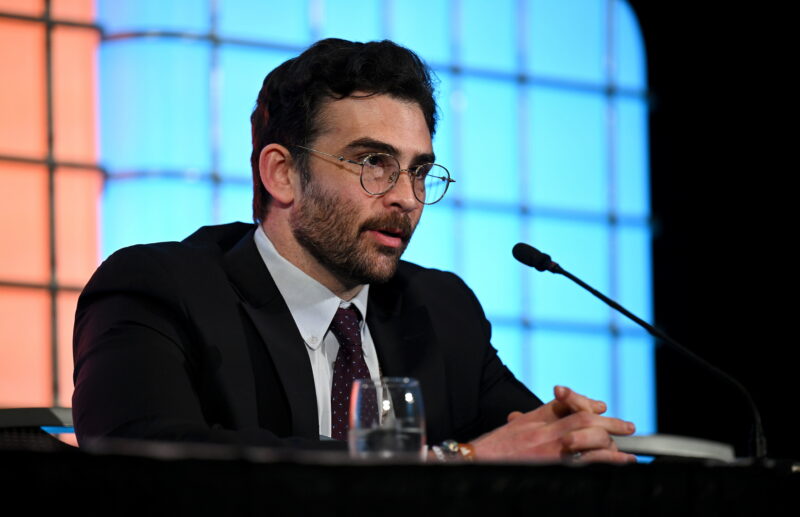
Rep. Ro Khanna (D-CA), who has emerged as one of his party’s leading anti-Israel voices as he mulls a presidential campaign, had the audacity to say he “stands with” antisemitic streamer Hasan Piker — along with New York City Mayor Zohran Mamdani, who has refused to condemn “globalize the intifada” rhetoric and anti-Israel Democratic Senate candidate Graham Platner — during the Michigan synagogue terror attack.
Former Obama deputy national security advisor Ben Rhodes and his “Pod Save America” colleagues are now declaring that anyone who supports the Iran war — a group that may well include some Jewish Democrats in Congress who are sympathetic to the operation’s aims, even if they have reservations — should be primaried, and have no place within the Democratic Party.
On the hard right, extremist podcasters are broadcasting the most undiluted antisemitism in media since the days of Father Coughlin in the 1930s. Tucker Carlson has devoted much of his show to promoting conspiracy theories about Jews, while other social media influencers have found that attacking Israel and questioning Jewish influence is a ticket to building a niche audience in online spaces. Gatherings of young right-wingers have all too often become cesspools of anti-Jewish hate.
Sen. Ted Cruz (R-TX), who has emerged as a leader in speaking out against right-wing antisemitism, cautioned that Republicans may be losing the fight to contain the scourge — especially among a younger generation of conservatives.
All this is happening amid relative bipartisan silence towards the social media companies that often profit through division, using tech-tailored algorithms to feed extreme content to unsuspecting audiences. It’s no coincidence that polls indicate dramatic levels of antisemitism and extremist views from the youngest Americans, who are marinating in echo chambers instead of reading the headlines dispassionately from newspapers, as the generation before them did.
That the only fatality from yesterday’s attack in West Bloomfield Township, Mich., was the assailant is a testament to the time, energy and money that the Jewish community, with some federal assistance, has dedicated to ensuring security for its many institutions across the country. The FBI’s recent active shooter preparedness drill held for clergy and staff at the synagogue undoubtedly led them to be prepared in that fraught moment Thursday.
But a strong defense — hardening security for Jewish institutions — requires a complementary offense, in leaders confronting rising extremism whenever it rears its ugly head. It shouldn’t take the avoidance of a mass casualty event to get candidates across the political spectrum to start speaking out against antisemitism, as Platner did on Thursday.
We saw some signs of growing courage from political leaders this week in calling out the hate emanating from their fringes. Cruz, who called Carlson “the single most dangerous demagogue in this country,” at an antisemitism conference this week co-sponsored by the Republican Jewish Coalition and National Review, was joined by Sens. Tom Cotton (R-AR) and Jim Banks (R-IN) in speaking out against anti-Jewish hate.
The moderate Democratic think tank Third Way directly confronted Khanna on Thursday for his praise of Piker and other anti-Israel figures in the party. “Our side has a real antisemitism problem too that too many Democrats are failing to face squarely,” Third Way VP Matt Bennett bluntly told JI, in one of the few public intraparty acknowledgements about the growing threat.
The country feels like it’s at a boiling point, with few institutional leaders providing the guardrails necessary to contain growing extremism and hate. We saw on Thursday where unchecked extremism leads. It will take leaders to put principles ahead of political expedience for the wave of antisemitism to subside.
As state Sen. Jeremy Moss, a Democrat who represents the district where the attack took place, wrote: “When I was growing up, antisemitism was primarily in history books and black and white film reels. Today it was in real color right up the road at Temple Israel … This is a fire that will take all of us to snuff out.”
More Stories

Daily Overtime
Mackle-no-more on Sheeran’s tour
PIKER PUSHBACK
University of Texas College Dems invitation to Hasan Piker sparks campus outrage, GOP fire
on the trail
Moskowitz leans into work combating antisemitism as he launches general election campaign

Daily Overtime
Vance’s Jewish voter problem

AID CONVERSATION
GOP Reps. Kustoff, Goldman say Republicans want to see U.S. aid to Israel continue

ON THE HILL
Senate Republicans urge Saudi response to Houthi attacks
Please log in if you already have a subscription, or subscribe to access the latest updates.
 Continue with Google
 Continue with Apple