







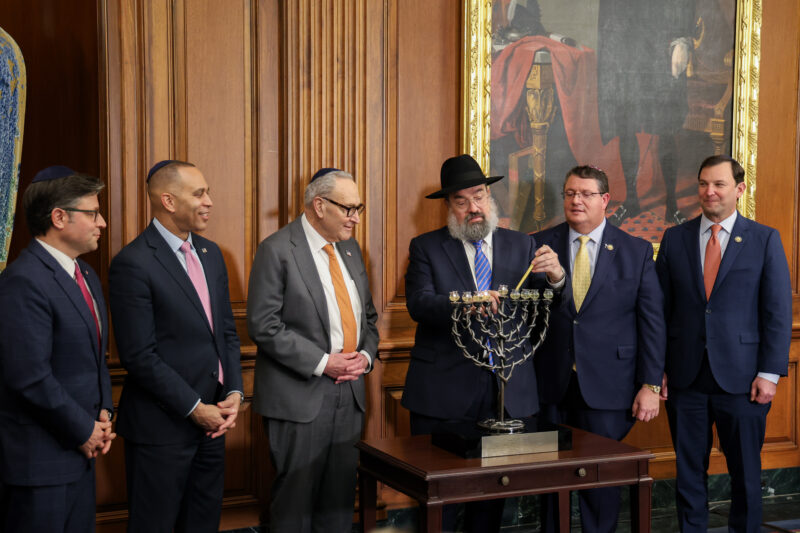


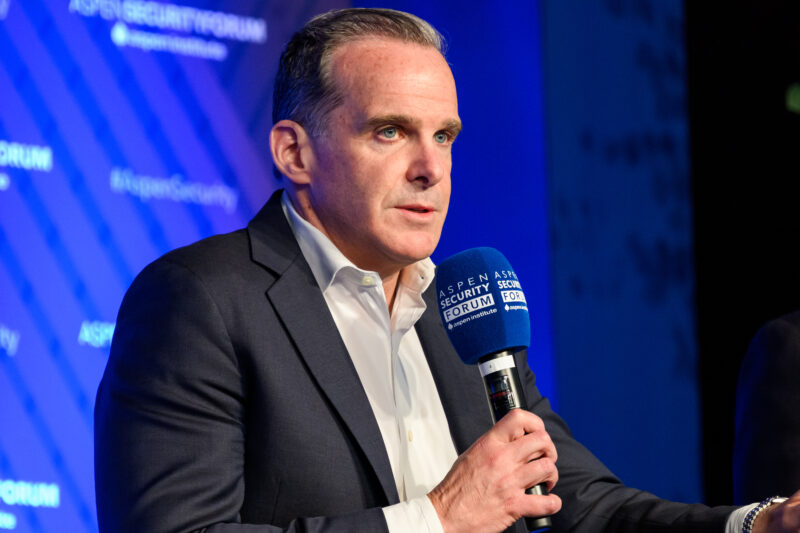
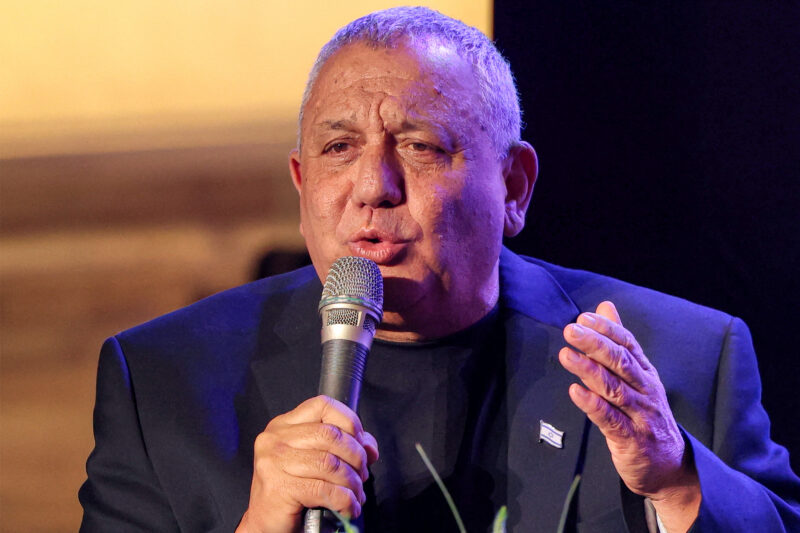


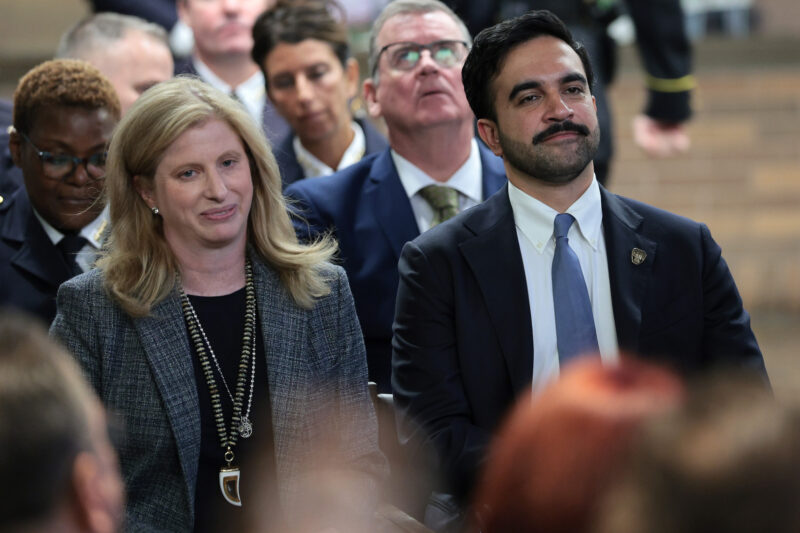
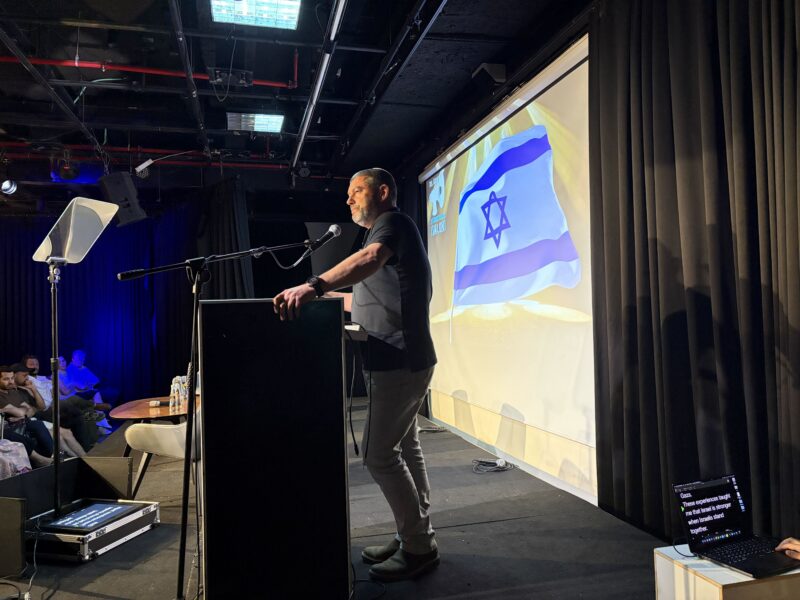






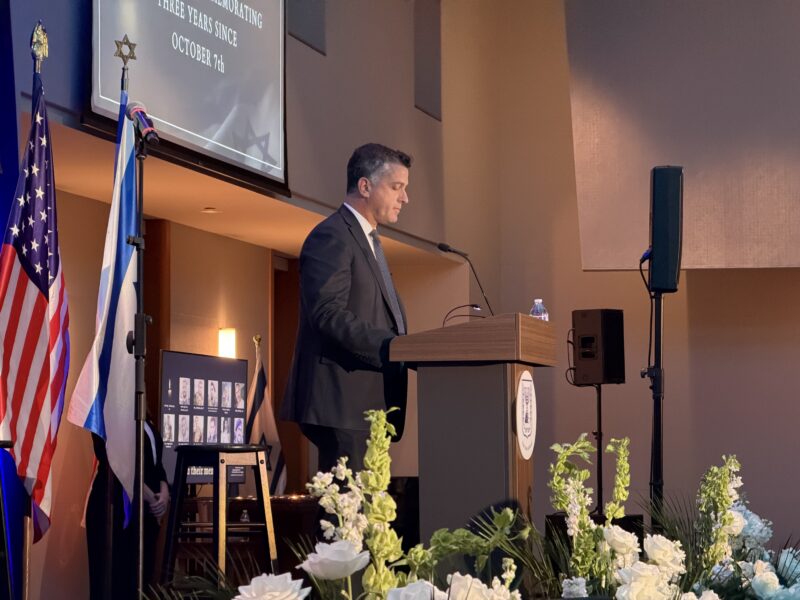







CENTCOM head Brad Cooper said he has carried with him a replica of the dog tags of slain hostage Itay Chen
Kevin Koski
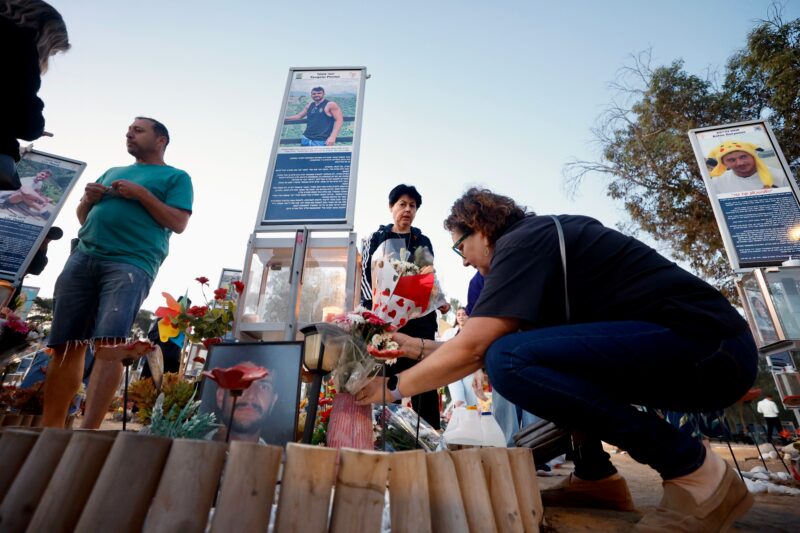
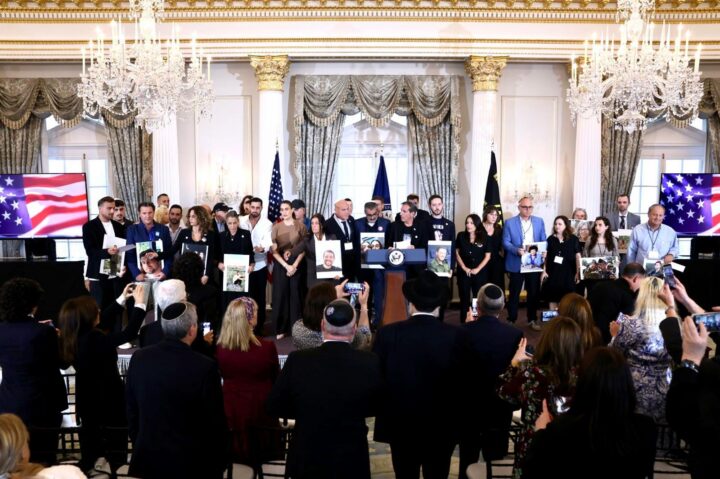
State Department memorial event for American victims of Oct. 7.


 Add JewishInsider on Google
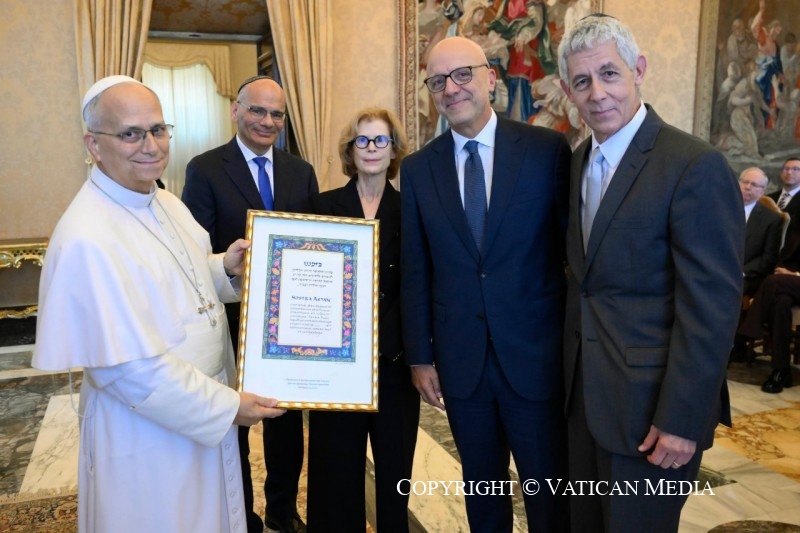
Secretary of State Marco Rubio, Secretary of Commerce Howard Lutnick and his wife, Allison, CENTCOM Commander Adm. Brad Cooper, State Department antisemitism envoy Rabbi Yehuda Kaploun and other administration officials joined the families of former hostages and victims of the Oct. 7, 2023, Hamas attacks on Israel for a commemoration event on Wednesday at the State Department.
The commemoration took place a week after the third anniversary of the attacks.
Rubio and Lutnick played a central role in organizing the event to honor the 46 Americans killed in the Oct. 7 attacks, following advocacy by Ruby Chen — father of Itay Chen, an American who served in the IDF and was killed on Oct. 7 — and other bereaved families, several of whom delivered remarks.
Others in attendance included Director of National Intelligence Jay Clayton, Sen. Bill Hagerty (R-TN) and Sebastian Gorka, the senior director of counterterrorism at the National Security Council.
Rubio spoke about the U.S.’ commitment to foreign engagement and the need to fight for Western civilization, according to Doug Maguire, policy director at Brownstein Hyatt Farber Schreck, which helped support the event, which was closed to the press. Rubio was joined by Lutnick, who spoke about his feeling of personal connection to the Oct. 7 attacks, having lost his brother, friends and co-workers in the 9/11 attacks, which destroyed his firm’s New York office.
Lutnick was heavily involved in advocacy for the hostages and has spoken previously about how his experience during 9/11 has brought him closer to the hostage families.
Cooper spoke about CENTCOM’s efforts as well as offered praise for the U.S. citizens who have enlisted in the Israeli Defense Forces and lost their lives protecting Israeli civilians on Oct. 7 and in the subsequent war in Gaza, describing that level of commitment as an uncommon bond that the U.S. cannot take for granted.
Cooper, who said he has attended dozens of memorial services in connection to the Oct. 7 attacks, also displayed a replica of the dog tags worn by Itay Chen — an IDF tank commander and U.S. citizen killed on Oct. 7 whose body was held by Hamas for more than two years — which Ruby Chen gave to Cooper at Itay’s funeral.
Cooper said he has carried them daily and kept them close to his heart.
Lutnick credited Chen and Allison Lutnick as the driving force behind bringing the memorial ceremony together. Maguire also credited Kaploun as playing a critical role in steering and advocating for it.
Chen recounted his son’s upbringing and life story, and his decision to enlist in the IDF instead of going off to college. He said he still struggles to speak about Hamas’ decision to hold his son’s body for more than two years as a “bargaining chip,” denying him the “most basic human dignity” of being laid to rest by his family.
“We could not even begin to grieve. Every night we went to sleep waiting for a call from the White House telling us Itay was coming home. It was the call we prayed for every night, and disappointed when that call did not happen,” Chen said. “I tell you this not because our story is unique, but because it is not. On Oct. 7, 12 American citizens were taken hostage into Gaza. Close to 50 were killed by Hamas. In this room are family members like ours who have lived their own version of those days.”
He said that the memorial event sends an important message to the families.
“This recognition, here in Washington, in the shadow of Oct. 7, tells our families something we needed to hear: Your loved ones were Americans. The United States remembers them,” Chen said.
But he added that the ceremony must be the start, not the end.
He called on Congress to launch its own investigation into the attacks to find the facts for the Americans killed and their families, with the Israeli government refusing to appoint its own commission.
He urged the federal government to make the memorial event an annual one, and to create a formal memorial in Washington displaying the names of the American citizens killed.
And he said that the U.S. must seek justice and consequences for those responsible for the attacks, including the financiers living abroad, who he said should be brought to trial in the United States.
“Itay chose to stand guard. Now it is our turn to stand guard: over their memory, over the truth, and over the promise we make in this room today,” Chen said.
Before leaving for its October recess, the Senate passed a resolution led by Sens. Rick Scott (R-FL) and Jacky Rosen (D-NV) honoring the 46 Americans killed and held hostage by Hamas, and urging continued engagement with the families and legal accountability for those responsible for the attacks.
Abbey Onn, the cousin of Carmela Dan — an 80-year-old grandmother taken hostage and killed alongside her 13-year-old granddaughter — said in a statement, “October 7 was not only a tragedy for Israel. Nearly 50 American citizens were murdered, and dozens more were injured. These were our loved ones—people with families who loved them and futures that were stolen from them. We are here to make sure their stories are heard, their memories are honored, and those responsible for their murders are brought to justice.”
Lutnick, Kaploun and the families of the victims are also set to attend a dinner on Wednesday evening hosted by the Jewish Federations of North America.
In a statement, the families also offered thanks to the government, the Lutnick family, the American Jewish Committee, Brownstein Hyatt Barber Schreck, Jeff Miller and his firm Miller Strategies for helping to bring the event together.
The lawmakers said Ankara is carrying out an 'alarming campaign of repression’ against the community, including raids and arrests
Diego Cupolo/NurPhoto via Getty Images
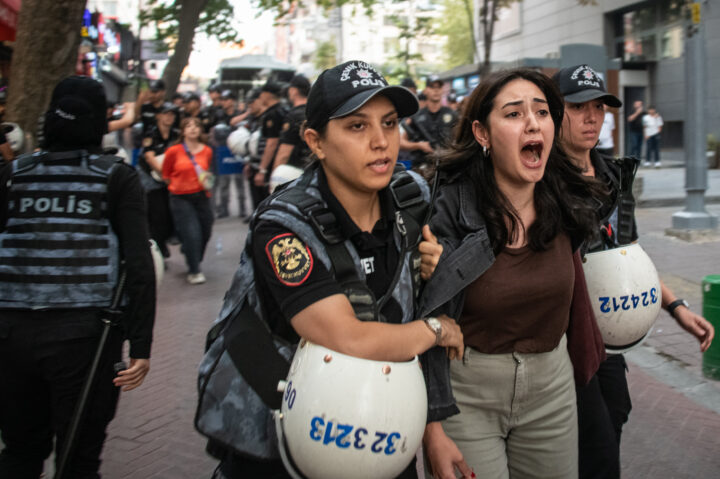
Turkish police detain dozens of LGBT rights protesters in Ankara, on September 15, 2026.
A group of 65 House Democrats wrote to Secretary of State Marco Rubio on Thursday urging him to take action in response to what they described as Turkey’s “alarming campaign of repression against LGBTQI+ people, human rights organizations, and advocates.”
They specifically highlighted a recent “crackdown” by Ankara starting in mid-September that they said represented a “dangerous and significant escalation,” with raids and arrests targeting HIV and LGBTQ civil society organizations and protesters, internet restrictions and efforts to dissolve human rights organizations.
“Together, these developments mark a dangerous new phase in the Erdogan regime’s efforts to use criminal law and the state apparatus to suppress legitimate human rights advocacy on behalf of the LGBTQI+ community,” the lawmakers, led by Reps. Yassamin Ansari (D-AZ) and Dina Titus (D-NV), said.
The lawmakers called on Rubio to undertake an “urgent diplomatic response” to protect basic rights for Turkish citizens, including using “all available channels to raise these concerns directly with the Turkish government,” work for the release of those arrested and monitor judicial proceedings related to these cases.
They said that Turkey is in violation of human rights agreements and that its actions are “an affront to basic human dignity and the values expected of a fellow NATO member.”
Other signatories included House Foreign Affairs Committee ranking member Rep. Greg Meeks (D-NY) and former House Speaker Nancy Pelosi (D-CA).
They also called on Rubio to provide an update on the State Department’s broader efforts to address human rights abuses by the Turkish government, describing the recent actions against the LGBTQ community as “part of a broader pattern of human rights violations and democratic backsliding in Turkey. We urge the Department to ensure that human rights are meaningfully integrated into all bilateral engagements and request a clear explanation of how the Department intends to do so.”
The lawmakers requested a response from Rubio by the end of the month.
Nineteen Jewish House Democrats urged Secretary of State Marco Rubio not to allow a push to merge the two offices proceed and to keep Holocaust issues distinct

AP Photo/Luis M. Alvarez
State Department in Washington
Nineteen Jewish House Democrats, writing under the auspices of the Congressional Jewish Caucus, sent a letter to Secretary of State Marco Rubio on Wednesday opposing a reported plan to merge the offices of the State Department’s special envoy for Holocaust issues (SEHI) and special envoy to monitor and combat antisemitism (SEAS).
Longtime Holocaust envoy Ellen Germain recently retired from her post, and antisemitism envoy Ambassador Yehuda Kaploun has been pushing to merge the two posts, a prospect that has received mixed reactions from Jewish communal organizations.
In their letter, the Jewish Democrats urged Rubio to “immediately appoint” a new Holocaust envoy and maintain the office “as a distinct, permanent office led by a dedicated career State Department official” and expressed concern about reports that the offices might be merged.
Reps. Brad Sherman (D-CA) and Seth Magaziner (D-RI) were the only two members of the caucus not to join the letter.
The lawmakers noted bipartisan support for SEHI and argued that its work on restitution issues is increasingly urgent as the number of living Holocaust survivors shrinks, and that survivors and their families need a “dedicated advocate within our government.”
“SEHI and SEAS have clearly distinct mandates and responsibilities,” they said, adding that the Holocaust envoy’s work has historically been aided by their status as an experienced career official, rather than a presidential appointee.
“Both are full-time responsibilities that require full-time principals with unique areas of focus and full-time staff with unique expertise,” the lawmakers continued. “Combining them would not streamline efficiency or eliminate any meaningful duplication; it would risk diminishing the focus, experience, and institutional capacity necessary for each.”
The letter suggests that the potential merger is being driven, at least in part, by “a desire to expand the influence of certain personnel within the State Department,” seemingly a reference to Kaploun.
The lawmakers warned that any delay in appointing a new envoy “risks losing opportunities for restitution, accountability, and historical preservation that may never return.”
Though under discussion for months, the merger efforts have not yet been formalized inside the department.
Jewish groups have come down on both sides of the issue. The American Jewish Committee, American Joint Distribution Committee, Agudath Israel of America, Anti-Defamation League, B’nai B’rith International, Conference on Jewish Material Claims Against Germany, the National Coalition Supporting Eurasian Jewry, the World Jewish Restitution Organization and the USC Shoah Foundation called for Rubio to appoint a new full-time Holocaust envoy.
But others including the Combat Antisemitism Movement, American Association of Jewish Lawyers and Jurists, Chabad-Lubavitch World Headquarters, Coalition for Jewish Values, Institute for the Study of Global Antisemitism and Policy, Orthodox Union, World Jewish Congress, Zionist Organization of America, Simon Wiesenthal Center, former U.S. Ambassador to Israel David Friedman, former antisemitism envoy Elan Carr, former deputy antisemitism envoy Ellie Cohanim and former deputy antisemitism envoy Karen Paikin Barall wrote to Rubio urging him to merge the two positions.
Proponents of a merger said that Holocaust denial and revisionism is inextricably linked to rising antisemitism today, that the current division hampers U.S. efforts and that the shrinking number of Holocaust survivors makes Holocaust memory and antisemitism a more core part of the Holocaust envoy’s work, overlapping with the antisemitism envoy’s duties. They said that consolidating the responsibilities under an ambassador-rank official would elevate Holocaust issues.
Kaploun has claimed behind closed doors that, given his unique connections to the White House and world leaders, he would be able to resolve all remaining Holocaust restitution issues before the end of President Donald Trump’s time in office — a difficult task that requires reaching agreements with international partners that have resisted providing restitution for decades.
The secretary of state said the U.S. wasn’t going to support the policy, but added that the U.S. doesn’t want destabilizing activity taking place in the West Bank
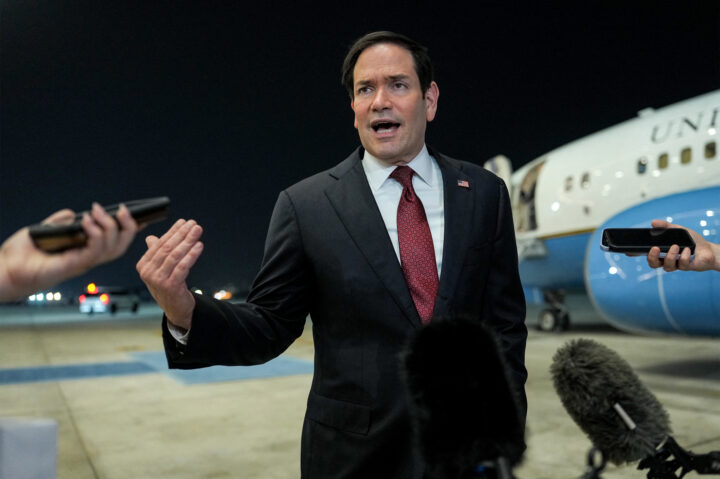
Photo by Eric Lee / POOL / AFP via Getty Images
Secretary of State Marco Rubio speaks to the media upon arrival at al-Bateen Executive Airport in Abu Dhabi on June 23, 2026.
Secretary of State Marco Rubio offered a tepid response on Tuesday to the United Kingdom’s new sanctions regime against Israeli settlements in the West Bank.
“Obviously, we’re not going to do what the U.K. did,” Rubio told reporters during a trip to Colombia when asked about U.K. Foreign Secretary Ed Miliband’s announcement, but said he didn’t have anything to add further.
“Obviously, these are decisions that they make,” he said. “And we — and the president has expressed this in the past — don’t want to see anything destabilizing going on right now in the West Bank with so much going on in the region. We think it has implications as well on our ability to make progress with regards to Gaza and the 20-point plan and Board of Peace that we’re very committed to.”
Rubio’s remarks followed an announcement earlier Tuesday by U.K. Foreign Secretary Ed Miliband, who unveiled a sweeping new sanctions regime targeting West Bank settlements. The British policy includes an import ban on goods produced in settlements alongside targeted sanctions against individuals and businesses involved in constructing, advertising or financing settlement expansion.
Prior to the formal announcement in London, U.S. Ambassador to Israel Mike Huckabee warned that Britain could face retaliatory “repercussions” from Washington over the policy shift.
Asked about Huckabee’s comment, Rubio noted that neither he nor President Donald Trump had issued an official response yet, but acknowledged that the administration was “made aware that [the U.K. was] going to make this decision.”
“We heard their arguments as to why,” Rubio said. “But look, we share the goal of stability. We don’t want to see some uptick in violence or an uptick in conflict or tensions in the West Bank at a very tenuous time in the region. But beyond that, as of this moment, we don’t have any further comment.”
The lawmakers said the U.S. should leverage its economic and military assistance to Malaysia to ensure that the relationship ‘is serving the best interests of the United States’
Tom Williams/CQ-Roll Call, Inc via Getty Images
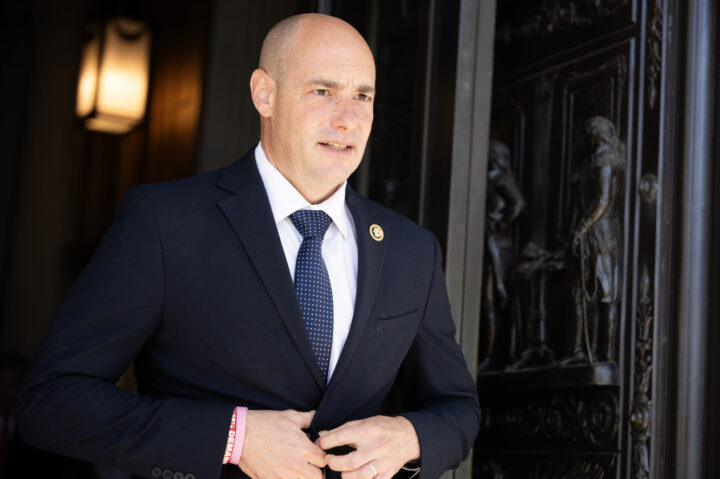
Rep. Greg Landsman (D-OH) leaves the U.S. Capitol after the last votes of the week on Thursday, September 4, 2025.
A group of House Democrats urged Secretary of State Marco Rubio on Tuesday to pressure Malaysia to walk back plans to deport Israeli citizens by leveraging U.S. military assistance to the Southeast Asian nation.
Malaysia’s prime minister said last week that the country, which does not recognize Israel and does not permit Israeli passport holders to enter the country, would immediately deport any Israeli nationals in the country. The comments came in response to a report that Israeli dual citizens were participating in a technology retreat in the country, having entered using other passports.
“For millennia, Jews around the world have seen this playbook. The demonization and expulsion of Jews eventually leads to the worst case outcomes. It is necessary that the United States push back on this antisemitism,” the Democrats, led by Reps. Greg Landsman (D-OH) and Josh Gottheimer (D-NJ), said in a letter to Rubio.
“Malaysia’s refusal to recognize Israel is troubling enough. But, it is totally unacceptable that a head of government has publicly declared that his country will hunt down and expel citizens of our close ally based solely on their nationality. It should not be underwritten by the American taxpayer,” the letter continues, further noting that Malaysia maintains ties with Hamas and that the terrorist group’s fighters have trained in Malaysia.
The lawmakers urged Rubio to make clear that the U.S. won’t tolerate the targeting of “the nationals of one of our closest allies” in light of U.S. security assistance to and military training for the Malaysian military, as well as Malaysian access to U.S. technology and markets.
“We, therefore, urge you to undertake a review of our security and economic relationship with Malaysia to ensure that it is serving the best interests of the United States,” the lawmakers said. “Should Malaysia refuse to reverse this discriminatory policy within 15 days, we urge you to suspend [International Military Education and Training] funding.”
They asked the State Department to articulate what steps it plans to take in response to the Malaysian policy and to “use every tool at your disposal to make clear that this conduct carries consequences.”
The letter was co-signed by Reps. Jimmy Panetta (D-CA), Dan Goldman (D-NY), Debbie Wasserman Schultz (D-FL), Jared Moskowitz (D-FL), Brad Sherman (D-CA) and Jake Auchincloss (D-MA).
Landsman issued a statement last week condemning the Malaysian government’s plans.
“We’ve seen this all before. The purge of Jews has begun. Predictable, and just the beginning. We know where this leads,” Landsman said. “There is only one country in the world that will take all Jews kicked out of another country, and that’s Israel. The same people targeting Jews in their countries are also working to destroy Israel.”
He said that the U.S. “should make it clear that our aid comes with the expectation they won’t brazenly discriminate against our allies, and our office is reaching out directly to the Malaysian embassy.”
Republican and Democratic senators paid tribute to his legacy, while wondering if anyone will be able to fill the leadership vacuum

Anna Moneymaker/Getty Images
Sen. Lindsey Graham (R-SC) in the Senate Judiciary Committee on January 30, 2025 in Washington, D.C.
Sen. Lindsey Graham’s (R-SC) sudden death last weekend is complicating an already difficult dynamic between Senate Republicans and President Donald Trump, as legislators try to muster enough support in the caucus to pass the president’s key legislative priorities.
Graham’s committee chairmanships, vast donor network and his close relationship with Trump and Secretary of State Marco Rubio made him a critical leader in Washington whose presence helped move forward multiple bipartisan efforts, especially on foreign policy. He became one of the most geopolitically connected members of Congress, with world leaders and captains of industry on speed dial.
“It’s impossible to fill that void, number one, so I’ll just take that off the table,” Sen. Tim Scott (R-SC), the chairman of the National Republican Senatorial Committee, told Jewish Insider at a press conference at NRSC headquarters on Capitol Hill on Wednesday.
Scott, who represented South Carolina alongside Graham for 13 years, said he has spoken with Senate Majority Leader John Thune (R-SD) about the challenges Graham’s death creates for the party and detailed several areas where Senate GOP leadership is hoping some of their members will attempt to step in on the late senator’s behalf.
The first of those “three layers,” Scott said, is “the foreign policy front.” The second was Graham’s “budgetary responsibilities” as chair of the Senate Budget Committee. The third area, he said, was “bridging the gap between the two sides of the aisle.”
“Those are the three areas that I know that we’ve been consciously considering,” Scott said. “I have spoken to Leader Thune as well. I think those are three big areas that we’d love to see, probably, a couple people step into.”
On the foreign policy front, Scott noted, “There’s no doubt that when you’re looking at leaders around the world who disagree vehemently with each other, the one guy you might be willing to sit at the table with was Lindsey Graham. He just did a really good job.”
“Frankly, you go to the Middle East and without any question, I’m not sure that there was a bigger, more enthusiastic supporter of the president’s actions in Iran — I happen to be one of them as well — than Lindsey Graham,” Scott said. “[Israeli Prime Minister] Bibi [Netanyahu] calling him at lunch was kind of fun to watch. I’m a big fan of Bibi myself, and just knowing the relationship that they had when I spoke with Bibi myself years ago, I would say without question, Lindsey Graham’s name always came up. You know why? Because, frankly, he took the time to make the trip there.”
“Whether it’s the European front, the Middle East, or frankly, his enthusiasm around Venezuela, he was always in the midst when it came to solving problems around the world because he believed in peace through strength,” he continued. “It was not just a tagline. It was not just a philosophy. It was embedded in his DNA.”
Scott said Republicans will need to focus on “finding someone who has that passion” that Graham applied to his foreign policy dealings. Graham spearheaded the passage of the second Trump administration’s two reconciliation packages — the One Big Beautiful Bill last July, which made the tax cuts implemented in the first Trump administration permanent and enacted a wide range of spending cuts, and the Secure America Act in June to fund Immigration and Customs Enforcement (ICE) and Customs and Border Protection (CBP).
“We are living in polarizing times politically. Lindsey Graham was not completely aware of that. He thought you could still find common ground to get something done,” Sen. Tim Scott (R-SC) said. “He turned out to be right. Being able to have [Sen. Richard] Blumenthal (D-CT) knocking on the door for Russian sanctions is only possible because Lindsey Graham spends so much time talking to people that vehemently disagree with him on 85% or 90% of topics. Find that one, you march together.”
As to the budget reconciliation process, Scott said, Sen. Ron Johnson (R-WI) would step in as budget chair. “Big shoes to fill,” Scott added.
Scott touted his late colleague’s ability to reach across the aisle and argued that “bridging that gap is going to be really important.”
“We are living in polarizing times politically. Lindsey Graham was not completely aware of that. He thought you could still find common ground to get something done. He turned out to be right. Being able to have [Sen. Richard] Blumenthal (D-CT) knocking on the door for Russian sanctions is only possible because Lindsey Graham spends so much time talking to people that vehemently disagree with him on 85% or 90% of topics. Find that one, you march together.”
As one of the few lawmakers capable of closing the gap between Senate Republicans and the president, Graham became somewhat of a mediator.
“Lindsey left an indelible mark on the Senate, on the nation and on the hearts of his colleagues,” Sen. Ted Cruz (R-TX) told JI. “At times when senators were at each other’s throats, were angry, Lindsey could cut the tension with a self-deprecating quip that brought everything to a stop and brought people back together again.”
Leading Democrats also paid tribute to Graham’s legislative acumen. “Lindsey was part of every important policy issue and an indispensable player in every Senate ‘gang.’ He was a fierce Republican partisan one day and a key bipartisan ally the next,” Senate Minority Whip Dick Durbin (D-IL) said of Graham after his death was announced.
“I don’t know who can play this role going forward. I just don’t see it,” Sen. Chris Coons (D-DE) told JI on Sunday of Graham. “He’s just not replaceable. There’s not going to be anyone like him again.”
Graham was involved in every successful bipartisan piece of legislation that Trump has signed into law thus far in his second term. During the Biden administration, Graham was one of the 19 Republican senators who crossed party lines to support the bipartisan infrastructure bill, and his decision to come out against the bipartisan immigration reform deal organized by Sens. James Lankford (R-OK), Chris Murphy (D-CT) and former Sen. Kyrsten Sinema (I-AZ) has been described as the final death knell that sealed the legislation’s fate.
Graham was also the Republican in Trump’s orbit to whom Senate Democrats would go when trying to settle a legislative dispute or join forces on an issue of bipartisan concern.
“I don’t know who can play this role going forward. I just don’t see it,” Sen. Chris Coons (D-DE) told JI on Sunday of Graham. “He’s just not replaceable. There’s not going to be anyone like him again.”
Graham’s passing puts the longtime legislative and geopolitical priorities he fought for in jeopardy.
The South Carolina Republican spent the last five years lobbying Saudi Crown Prince Mohammed bin Salman to bring Riyadh into the Abraham Accords. Graham tried to secure an agreement on several occasions under Trump and former President Joe Biden, and said repeatedly that he was on the verge of reaching a deal that would see Saudi Arabia normalize relations with Israel in exchange for Israel recognizing a Palestinian state.
After Hamas’ Oct. 7, 2023, attacks on Israel, Graham maintained that Iran ordered the attacks to upend his Saudi-Israeli normalization efforts.
Graham was one of the most outspoken and effective Republican advocates in Congress for increasing military funding. Prior to his death, he had been lobbying the president to get behind the Russia sanctions bill he co-sponsored with Blumenthal, and expressed optimism in his final phone call with Morgan Ortagus, the former deputy presidential envoy for Middle East peace in the second Trump administration, that Trump was coming around to the idea.
Trump said on Tuesday that he was considering supporting the bill, which he has long hesitated to get behind, “in honor of Lindsey.”
“This was his thing, he wanted this more than any other thing. You know how he felt,” Trump said from the White House. “There’s a good chance that it gets done. But they’d like to add Iran. And they’d like to add Hezbollah to it. That’s what I’m hearing.”
Ortagus told JI, “There was not a fight on domestic or foreign affairs that he didn’t want to jump into. If he believed in an issue and believed that a particular policy was the right thing, he really didn’t care about the politics.”
The secretary of state warned that the international body threatens the American way of life and said he will pressure U.S. allies to withdraw from the body
Photo by Eric Lee / POOL / AFP via Getty Images
Secretary of State Marco Rubio speaks to the media upon arrival at al-Bateen Executive Airport in Abu Dhabi on June 23, 2026.
The Trump administration plans to launch a major diplomatic offensive against the International Criminal Court, furthering the White House’s long-running battle against the international organization, Secretary of State Marco Rubio announced on Monday. The ICC poses a threat not just to American sovereignty, but to the American way of life, Rubio said, as he pledged to deploy American diplomatic power to sanction and target the body.
“For 250 years, Americans have governed ourselves as a free and sovereign people,” Rubio said in a video, which was accompanied by an op-ed in The Wall Street Journal. He described America’s legal system as “the essential and indispensable feature of our form of government,” but cautioned that “powerful people in far away places want to take that away from us.” He warned of shadowy “unelected globalist bureaucrats who claim their power is almost unlimited,” unless the U.S. acts quickly.
"The ICC and its friends are waging a war against our country," Marco Rubio said in a State Department video about the administration's diplomatic offensive against the international organization.
— Jewish Insider (@jewishinsider) July 13, 2026
"Not with bullets or missiles but with statutes and compacts and the force of… pic.twitter.com/j40vaZwwid
The Trump administration pledged to undertake “a wide range of actions” to make sure that the ICC, seated in The Hague, Netherlands, “is incapable of threatening U.S. sovereignty or targeting Americans,” according to a State Department statement.
Senior U.S. diplomats will follow Rubio’s lead, with public relations campaigns spotlighting the alleged abuses of the ICC and urging U.S. allies to withdraw from the body.
The campaign appears to be rooted in concerns that the ICC will seek to prosecute American servicemembers. Such actions would not only be “a grave overreach of its purported authorities,” Rubio wrote in the op-ed, “It would mean the death of the U.S. as a sovereign and independent nation.” Washington wants countries that partner with the U.S. military and American law enforcement, or that otherwise benefit from American security support, to push back on this purported ability of the court to prosecute American military officials.
“The ICC and its friends are waging a war against our country, not with bullets or missiles, but with statutes, compacts and the force of so-called international law,” Rubio said.
The campaign is the latest effort in the Trump administration’s push against the ICC, which has been an ongoing focus of President Donald Trump’s second term. Trump first sanctioned the court just weeks into his second term, with a February 2025 executive order targeting ICC officials who investigate Americans and Israelis with financial sanctions and visa restrictions. Last December, the State Department sanctioned two ICC judges for their targeting of Israeli leaders.
The U.S. is not a party to the Rome Statute, the international treaty that created the ICC; President Bill Clinton signed the statute but the Senate never ratified it.
Rubio made clear on Monday that in the latest stage of this offensive, “no diplomatic option will be off-limits.” The U.S. is considering heightened scrutiny of countries that rely on American assistance while also supporting the ICC, and urging nations that — like the U.S. — are not parties to the Rome Statute to join the American campaign against the body. Additional sanctions against the ICC and its personnel may follow.
Combat Antisemitism Movement is co-hosting the July 3 gathering at the U.S. Institute of Peace

Paul Morigi/Getty Images for The Hill & Valley Forum
Under Secretary of State Jacob Helberg participates in the The Hill & Valley Forum 2026 at Andrew W. Mellon Auditorium on March 24, 2026 in Washington, DC.
As Washington, D.C., prepares to host a weekend of July Fourth hoopla on the National Mall, senior Trump administration officials, diplomats and Jewish communal leaders will gather on Friday evening across from the Lincoln Memorial for a Shabbat dinner celebrating America’s 250th birthday.
Jacob Helberg, the under secretary of state for economic affairs, and Ambassador Yehuda Kaploun, the Trump administration’s special envoy to monitor and combat antisemitism, are hosting the Shabbat dinner at the U.S. Institute of Peace, according to an invitation obtained by Jewish Insider. The July 3rd gathering is co-hosted by the State Department and Combat Antisemitism Movement.
Attendees can expect to walk away with branded yarmulkes, Jewish prayer books and special challenge coins. Several hundred people are expected to attend, a source familiar with the event told JI.
Both Vance and Rubio will have their work cut out for them as they navigate the coming weeks
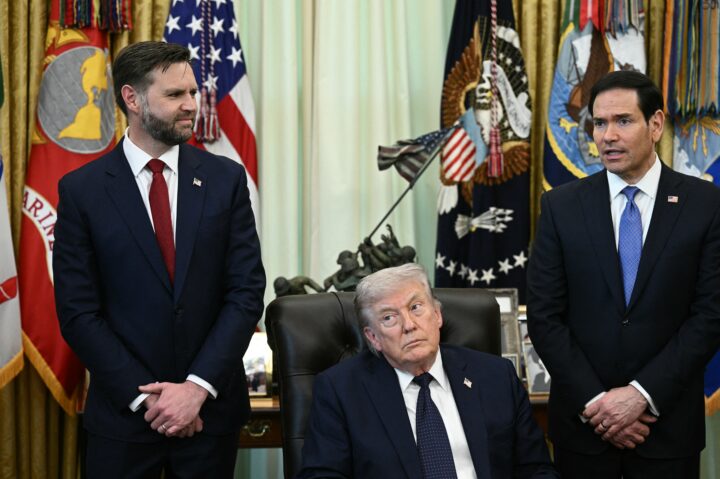
Photo by Brendan SMIALOWSKI / AFP via Getty Images
Vice President JD Vance and President Donald Trump listen to Secretary of State Marco Rubio speak during a meeting with Lebanon Ambassador to the U.S. and Israel Ambassador to the U.S., at the White House in Washington, D.C. on April 23, 2026.
As tensions run high in the Gulf following exchanges of fire between the U.S. and Iran over the weekend, a vastly different security situation is taking shape in Lebanon, with the Trump administration’s top officials — Vice President JD Vance and Secretary of State Marco Rubio — taking responsibility for the respective outcomes.
Vance, who led last week’s negotiations with Iran in Switzerland, said upon his departure from the talks that a “good foundation” had been established between the countries. But that foundation displayed its first cracks just three days later, when Iranian drones fired on a commercial vessel in the Strait of Hormuz, prompting the U.S. to strike Iranian military infrastructure.
The vice president’s tone changed by the weekend, when he said that if Iran had “disagreements about how the MOU is being applied, they can pick up the phone. But violence will be met with violence.” The Iranians skipped technical talks slated for Sunday, saying that the U.S. had not fulfilled the condition of the MOU that would release billions in frozen funds.
Now, officials say that the U.S. and Iranian delegations have agreed to hold fire and will meet in Doha, Qatar, on Tuesday to discuss the status of the Strait of Hormuz.
In Washington, officials are meanwhile celebrating the signing of a framework agreement between Israel and Lebanon that would see Israel scale back its presence in southern Lebanon, creating two “pilot zones” for the Lebanese Armed Forces to administer.
The Foundation for Defense of Democracies’ David Daoud cautioned that the celebration could be premature, telling JI that the fractious nature of Lebanon’s political and religious makeup — as well as Hezbollah’s role in the daily lives of many Lebanese citizens — makes the agreement difficult to implement, even with all the damage the Iranian-backed group has sustained over the last three years.
“Don’t underestimate Hezbollah’s ability to snatch victory from the jaws of defeat,” Daoud said. “I don’t want to overestimate their ability, but this group has proven itself very adaptable over the course of its existence.”
With the agreement signed, the next step will be its implementation. If the LAF is able to administer the pilot zones, there is the possibility of replicating the strategy elsewhere in southern Lebanon. The challenge will be when residents of southern Lebanon — which include Hezbollah members from the area — begin to return to villages south of the Litani River.
In Lebanon, the challenge is not only political will but Beirut’s capacity to address Hezbollah, which is deeply embedded in Lebanese society.
Both Vance and Rubio will have their work cut out for them as they navigate the coming weeks: Vance with continued talks with Iran and the pressure to reopen the Strait of Hormuz, and Rubio with the implementation of an agreement he hailed as the “beginning of the beginning.” Whether they are successful depends more on the actors themselves than the agreements they sign.
Under the preliminary agreement, Israel will withdraw from two ‘pilot zones’ while maintaining its security zone in southern Lebanon
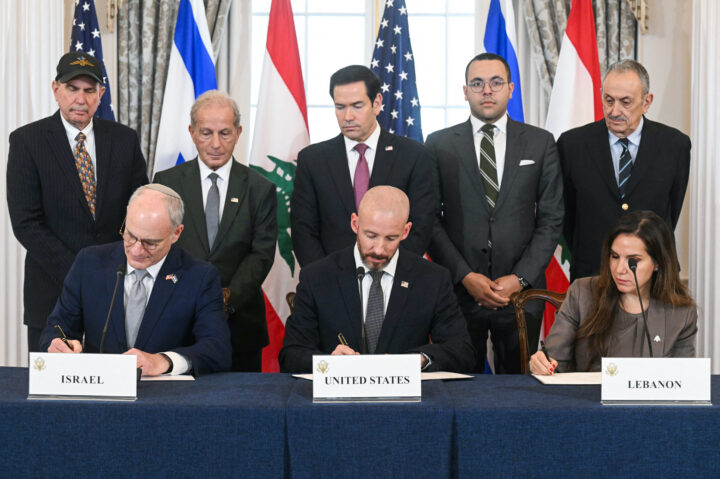
Photo by SAUL LOEB / AFP via Getty Images
Secretary of State Marco Rubio looks on as Israeli Ambassador to the U.S. Yechiel Leiter, State Department Chief of Staff Daniel Holler, and Lebanese Ambassador to the U.S. Nada Hamadeh sign a framework agreement at the U.S. Department of State in Washington, DC, on June 26, 2026.
Secretary of State Marco Rubio and the ambassadors of Israel and Lebanon signed a framework agreement in Washington on Friday aimed at scaling back Israel’s military presence in Lebanon, where the IDF has established a presence for the last three months as part of its campaign against Hezbollah.
Israeli Ambassador to the U.S. Yechiel Leiter and Lebanese Ambassador to the U.S. Nada Hamadeh Moawad announced the deal at a press conference with Rubio, following four days of negotiations in Washington during the fifth round of direct talks between Jerusalem and Beirut.
Under the deal, Israel will withdraw from two “pilot zones,” one north of the Litani river and one in southern Lebanon, and transfer administration of the areas to the Lebanese Armed Forces.
The preliminary deal between Israel, Lebanon and the U.S. is aimed at enabling a broader agreement in the future, a senior Israeli official told CNN.
Israeli Prime Minister Benjamin Netanyahu hailed the framework agreement as a “major blow to Iran,” emphasizing in a video statement that Israeli forces will maintain their presence in Israel’s security zone in southern Lebanon until Hezbollah is disarmed.
“Iran is trying to force us into a withdrawal from southern Lebanon by force. In effect, Israel, Lebanon and the United States are telling them: this is none of your business,” Netanyahu said.
Today is “the beginning of the beginning,” Rubio said at the signing ceremony. “There’s a lot of work ahead. We don’t, in any way, underestimate the difficulty of the task ahead. But we understand the importance of it, how vital it is. And we are honored to play a part in bringing this together.”
Moawad said at the signing that the agreement would be the “first step on the road to restoring Lebanese sovereignty and territorial integrity.”
The announcement comes after months of negotiations and on the heels of the Trump administration signing a memorandum of understanding with Iran and launching a deconfliction mechanism to end the fighting in Lebanon without Israel’s participation.
The vice president suggested Iran could help rein in Hezbollah, while the secretary of state emphasized Lebanon’s sovereignty and described the Iran and Lebanon talks as separate diplomatic tracks
Photo by Brendan SMIALOWSKI / AFP via Getty Images
Vice President JD Vance and President Donald Trump listen to Secretary of State Marco Rubio speak during a meeting with Lebanon Ambassador to the U.S. and Israel Ambassador to the U.S., at the White House in Washington, D.C. on April 23, 2026.
As the details around the memorandum of understanding between the U.S. and Iran emerge, Vice President JD Vance, who has been deputized with leading the effort, and Secretary of State Marco Rubio, ostensibly the Trump administration’s top diplomat, have offered different messaging around the issue of Lebanon and Hezbollah being subsumed into discussions with Tehran.
After the U.S. and Iran agreed to create a “deconfliction cell” for military operations in Lebanon — a mechanism that, notably, does not include Israel — Vance said on Monday that the U.S. will be counting on Iran to “rein in” its proxy Hezbollah, without referencing Tehran’s material support for the terror group.
Vance called on Israel to respond to Hezbollah’s attacks “in the context of a conversation that’s ongoing between Hezbollah, Lebanon, Israel and other partners in the region.” He said the conflict is “a bit of a chicken and egg problem,” in which he claimed lower-level Hezbollah operatives are firing on Israel without approval from their superiors.
Rubio, meanwhile, has been clearer about Iran’s role in propagating terror in the Middle East. Arriving in the United Arab Emirates on Tuesday, he said a “complete end of hostilities in the entire region” is “not possible … as long as Iranian proxies are launching missiles and drones from Iraq and are participating in terrorism like Hamas did and like Hezbollah did.”
WATCH: Marco Rubio said upon arriving in Abu Dhabi that the U.S.–Iran and Israel–Lebanon diplomatic tracks “are separate because Lebanon is a sovereign country,” while adding that Iran’s “support and sponsorship of Hezbollah” will be part of “our conversations with the Iranians.” pic.twitter.com/iADhszGTZC
— Jewish Insider (@jewishinsider) June 23, 2026
Rubio also distanced the Lebanon conflict from negotiations with Iran: Asked if he believes the Israel-Lebanon peace process should be separate from the Iran discussions, Rubio said, “That process is separate.”
“It’s separate because Lebanon is a sovereign country. … When it comes to Lebanon and what’s happening inside of Lebanon, we’re going to negotiate a deal directly with the Lebanese government,” he continued, again without mentioning Israel.
“Now, there’s an Iranian issue with regards to Lebanon, and that is their support and sponsorship of Hezbollah. And so that factor will be discussed as part of our conversation with the Iranians, but … the future of Lebanon belongs to the Lebanese people, through their sovereign, elected government, and that’s who we’re going to be working with,” Rubio said.
He referenced a phone call he and Vance held earlier on Tuesday with Lebanese President Joseph Aoun, who said in a readout that the deconfliction mechanism will now include Lebanon as a party.
Olivia Wales, a White House spokesperson, told Jewish Insider, “Both Vice President Vance and Secretary Rubio are in lockstep with President Trump: Iran can never have a nuclear weapon and must stop their proxies in Lebanon from causing trouble. What President Trump and his entire national security team achieved on the battlefield and at the negotiating table is nothing short of remarkable and will strengthen American security for years to come.”
This story was updated on June 23 to include comment from the White House.
Speaking at the G7 summit in France, the president said he could not enforce the provision since other countries also ‘have some.’
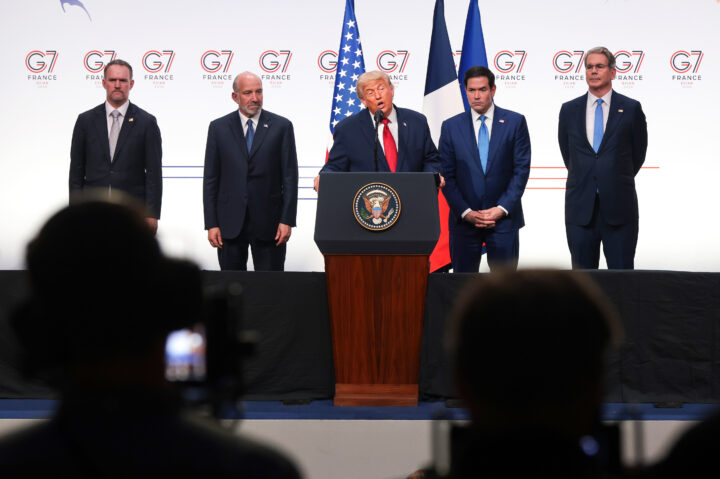
Photo by Anna Moneymaker/Getty Images
U.S. President Donald Trump is joined by (L-R) U.S. Trade Representative Jamieson Greer, U.S. Commerce Secretary Howard Lutnick, U.S. Secretary of State Marco Rubio and U.S. Treasury Secretary Scott Bessent as he speaks at a press conference during the G7 Leaders' Summit on June 17, 2026 in Evian-les-Bains, France.
President Donald Trump on Wednesday said that the U.S. would not forbid Iran from possessing ballistic missiles, downplaying the threat despite it being a key war aim in the onset of the conflict. Speaking at the G7 summit in France, the president asserted that the majority of Iran’s missile capabilities have been destroyed and that he could not enforce the provision since other countries also “have some.”
Secretary of State Marco Rubio asserted in March that a key U.S. aim in the war would be “the destruction of Iran’s ballistic missile capabilities and their ability to manufacture them.”
“I mean, they have to have some, because other people have some … It doesn’t work that way. And missiles aren’t the problem,” Trump explained. “Missiles are, they hurt a little location, but they don’t blow up the planet.”
When asked whether it would be acceptable for the administration to allow Iran to keep its ballistic missiles, Trump argued that Tehran’s capacity has been significantly depleted over the course of the conflict.
“What are they keeping?” Trump responded. “We knocked out probably 84%-85% of their missiles. The rest are underground, they can’t even get them out. On the first night we knocked out hundreds of their missiles.”
Trump also asserted that Iran does not “want to be firing missiles right now,” noting that instead Tehran is likely focused on rebuilding what has been damaged during the war.
WATCH: When asked whether it would be acceptable for the administration to allow Iran to keep its ballistic missiles, Trump argued that their capacity has been significantly depleted over the course of the conflict.
— Jewish Insider (@jewishinsider) June 17, 2026
“What are they keeping?” Trump responded. “We knocked out… pic.twitter.com/Ysu5MfiZjt
The president also praised Israel as a “good partner” in the conflict and argued that the nuclear restrictions laid out in the U.S.’ agreement with Tehran are the ultimate victory for Jerusalem. According to Trump, if Iran were to acquire a nuclear weapon, “Israel would have been blown away.”
“Look, think of what Israel’s getting, they’re not going to be nuked, very simple,” Trump said. “I told [Israeli Prime Minister Benjamin Netanyahu], ‘Your biggest risk was that they [Iran] drop a nuclear weapon into the middle of Israel. They’d only need one, and there would be no more Israel. Think of it, Bibi, you got the best, the most important thing that you were asking for is that. So, I think they’re happy.”
Regarding the technical specifics of the deal, Trump stated that Iran has agreed to work with the U.S. to “turn over” its enriched material. He noted that while the material is secured “deep in the bowels of the earth” and monitored by cameras, technical discussions to remove the stockpiles would begin immediately. He insisted that, unlike the Obama administration’s implementation of the JCPOA, any relief Iran receives under this framework would be strictly “based on merit.”
Additionally, while Trump maintained that the U.S. did not enter the conflict seeking “regime change,” he argued that the war’s casualties effectively accomplished that by wiping out multiple tiers of Iranian leadership.
“They have a new group of leaders that I think is actually very smart, I think they’re far less radicalized, and I think they’re really good. They love their country,” Trump said. “You talk about regime change, nobody will say that, but … one set of leaders is all gone, the second set of leaders is all gone, their third set of leaders a little bit gone, but for the most part, I think that’s regime change.”
Trump also returned to vocalizing his frustrations with Israel’s military approach against Hezbollah in Lebanon.
“Israel, by the way, they’ve been a good partner again. I love them as a partner. They were terrific, but they could do a much better job with Hezbollah. On that, I don’t think they’re doing well, and I feel very bad for Lebanon,” Trump said. “I’m not saying they shouldn’t protect themselves. I’m saying, when two drones are shot into the desert and drop harmlessly, you don’t have to knock down buildings in Beirut. [Israel] could behave better, and frankly, they could do a better job.”
Trump characterized the ongoing conflict between Israel and Hezbollah as a “very small piece of the puzzle” compared to the agreement with Iran, though he said it “makes a lot of noise,” adding that he has urged Netanyahu to use a “softer touch” when conducting strikes.
“He happens to be a very good man. We’ve had an amazing partnership,” Trump said of Netanyahu. “We have a little dispute over Lebanon. I say you can do a little softer touch, maybe you don’t have to knock down a building every time somebody walks into it that’s from Hezbollah … but he will say we’re the big partner, he’s the very small partner, that’s true.”
The president contrasted the situation in Lebanon with what he described as major progress in the Gaza Strip, claiming that “Hamas has been very silent” as the U.S. attempts to disarm the group.
“Look at the job we’ve done in Gaza. Look at Hamas. Hamas has been very silent. You haven’t read anything about Hamas. We’re trying to get them unarmed,” Trump remarked. “They grew up with a machine gun in their hand … but they’ve actually behaved pretty well, considering this was not the lifestyle that they were taught to have.”
The secretary of state largely defended Israel’s strikes in response; ‘Israel has a right to act in its defense’
Bill Clark/CQ-Roll Call, Inc via Getty Images
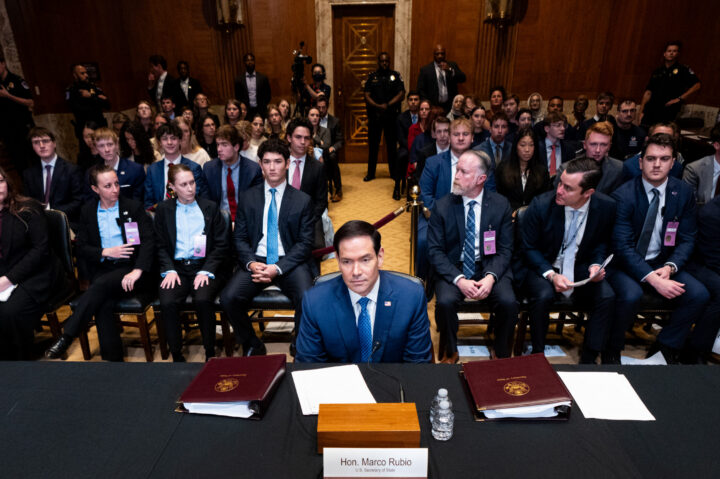
Secretary of State Marco Rubio appears before the Senate Appropriations Subcommittee on State, Foreign Operations, and Related Programs hearing on the State Department budget request on Wednesday, June 3, 2026.
Despite President Donald Trump’s public acknowledgement of a confrontational phone call with Israeli Prime Minister Benjamin Netanyahu regarding Israeli operations in Lebanon, Secretary of State Marco Rubio on Wednesday largely defended Israel’s attacks against the Lebanese terrorist group.
He said that Hezbollah reached out to the U.S. government through the Lebanese authorities approximately two weeks ago and said that it would stop launching missiles into Israeli territory if Israel did not attack Beirut. But Rubio said that Hezbollah went back on that agreement and launched rockets at Israel within hours.
“Israel has not conducted massive operations in Beirut for some time,” Rubio said at a House Foreign Affairs Committee hearing. “Israel has a right to act in its defense.”
Israeli strikes have taken place largely to prevent imminent attacks by Hezbollah forces preparing to attack Israel, Rubio said. He said that Israel’s seizure of territory in southern Lebanon has been intended to deny Hezbollah freedom to operate and launch missiles, and that Israel has not been conducting large-scale operations in Beirut.
Pressed on the current U.S. position in negotiations with Iran, particularly in comparison to the first Trump administration’s condemnation of the 2015 Iran nuclear deal, Rubio largely focused on the nuclear elements of the deal, but said that Iran’s missile program would also be discussed.
He said that Iran would not receive money or sanctions relief unless it agrees to dispose of its highly enriched uranium and give up its enrichment program.
Asked whether the administration would submit any deal reached to Congress, he said that the administration would comply with the Iran Nuclear Agreement Review Act, which requires such review. He said in a Senate Appropriations Committee hearing in the afternoon that the bill, known as INARA, has “very specific requirements about elements of the nuclear program that would have to be noticed to Congress.”
Pressed by Sen. Lindsey Graham (R-SC) on whether Iran’s support for proxy terrorism would be part of any deal, Rubio said that the U.S. would like to see limits on that activity in a deal, but said that there could also be U.S. sanctions “just on that.”
He also suggested at the House hearing the U.S. is seeking to address Iran’s supply of 20% enriched uranium, in addition to 60% enriched uranium.
Asked about recent comments by Trump describing the Iranian military as moderate, and saying that the U.S. has left it “alone,” Rubio drew a distinction between military equipment and capabilities, which the U.S. has targeted, and certain figures inside the regime who have been more open to negotiations with the U.S. or a more conciliatory posture.
He also framed all U.S. operations since the ceasefire as defensive — retaliatory attacks to respond to or prevent attacks on commercial shipping, to which Iran has responded with strikes on facilities throughout the region.
“These are completely defensive in nature. But they are happening in response to an Iranian action. If they don’t shoot at those ships, we don’t shoot. But we have to respond,” Rubio said. “You have a civilian commercial vessel transiting the straits and they’re being targeted by drones.”
He denied a report that Iran had threatened to test a nuclear weapon if the U.S. does not make concessions in negotiations.
Asked about congressional action on Iran, Rubio noted that Iranian state media has framed congressional votes in favor of war powers resolutions to block operations against Iran as a victory which would tie the U.S.’ hands.
He also said that the administration does not feel it needs an Authorization for Use of Military force to carry out any potential further operations against Iran, but said that the administration would engage with Congress if that occurs and that it would welcome any further congressional authorities.
Pressed by Rep. Joaquin Castro (D-TX) about Israel’s alleged nuclear capabilities, Rubio emphasized that Israel has never acknowledged that it has a nuclear program, though most of the world believes it does. “But they’ve never acknowledged that publicly, and as a feature of our foreign policy, for a variety of reasons, we don’t discuss it in that way either,” he said.
He said that the State Department might be able to discuss the issue further in a closed session and in a different context than a letter Castro and other Democrats sent to Rubio on the subject.
Rubio also affirmed that Turkey is currently not eligible to receive F-35 fighter jets as long as it operates a Russian S-400 missile defense system, under U.S. statute.
The secretary of state said Israel eventually wants be in a position where it can continue buying U.S. defense products without receiving ‘any sort of assistance’ in doing so
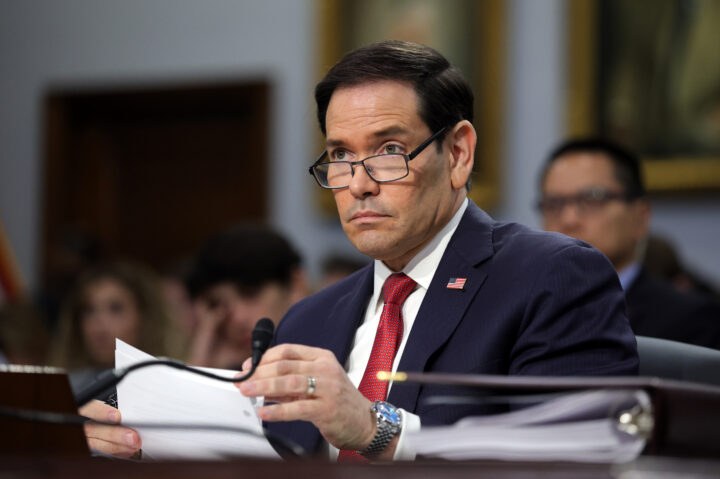
Kevin Dietsch/Getty Images
Secretary of State Marco Rubio testifies during a House Appropriations Committee hearing in the Rayburn House Office Building on June 02, 2026 in Washington, DC.
Secretary of State Marco Rubio confirmed that, as part of negotiations over the next U.S.-Israel memorandum of understanding covering military aid, the U.S. and Israel have been discussing an Israeli proposal to wind down U.S. military aid to Israel.
“What Prime Minister [Benjamin] Netanyahu and the Israelis have told us is they would like to set up a scenario where they wean off U.S. assistance the way they did with foreign aid a decade and a half ago,” Rubio said at a House Appropriations Committee hearing on Tuesday, referring to non-military, economic aid, which was phased out in 2007. “They’d like to go from the numbers they’re getting now to slowly less every year, until the number hits zero.”
He said that current MOU talks are at a “high level,” and that Israeli Ambassador to the U.S. Yechiel Leiter has been engaging with Rubio’s counselor and chief of staff on the issue, as well as with the Department of Defense.
And he said that the Israelis had made such a proposal “on a number of occasions over the last year” in private, which Netanyahu has since made public.
He said that nothing is finalized at this point, but that the Israelis want over the next 10 years to end in a position where they can continue to buy defense products from the U.S. but will not receive “any sort of assistance” in doing so.
Also at the hearing, Rubio blamed the stalled ceasefire and reconstruction effort in Gaza on Hamas’ intransigence. He said that, at this point in the ceasefire agreement, an international stabilization force should be going into Gaza, but “this requires the demilitarization of Hamas, which right now, they have not been willing to meet the conditions necessary.”
As originally conceived, the security force was set to be charged with demilitarizing Hamas, but there had been ongoing questions about whether states other than Israel would be willing to commit troops to that effort.
Rubio said that other U.S. partners in the region are also pressuring Hamas to proceed with demilitarization. He also said various donors and countries are coming forward to offer funds and investment for reconstruction, but none of that can begin until Hamas is demilitarized.
He also said that the administration continues to oppose any change in the status of the West Bank, and that moves by Israel to annex territory would complicate the U.S.’ ability to push the Gaza peace plan forward. He said the U.S. has shared its position on the issue with Israel as well.
The secretary of state acknowledged that granting Iran access to additional funds would risk Tehran using the money for malign activity in the region
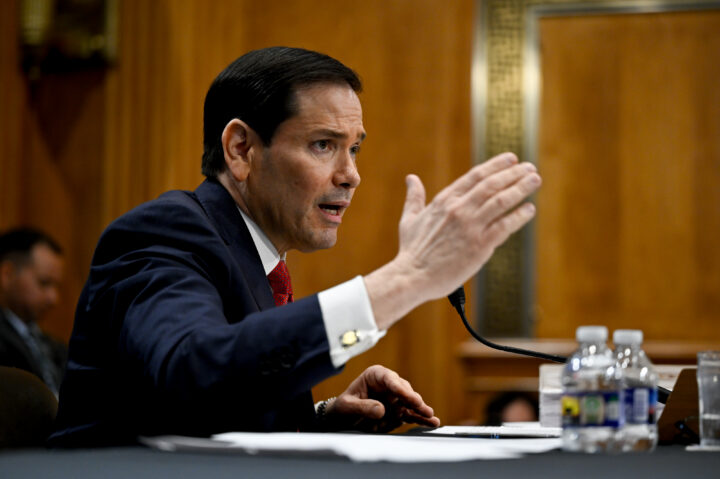
Daniel Heuer/Bloomberg via Getty Images
Secretary of State Marco Rubio during a Senate Foreign Relations Committee hearing in Washington, DC, on Tuesday, June 2, 2026.
Secretary of State Marco Rubio said in testimony to the Senate Foreign Relations Committee on Tuesday that the U.S. is not offering Iran any sanctions relief in exchange for reopening the Strait of Hormuz, and that sanctions relief would only be on the table if the Islamic Republic made concessions related to its nuclear program.
The secretary of state described the diplomatic talks as two-phased: The current phase is focused on getting Iran to agree to reopen the strait and to commit to enter further negotiations on disposing its highly enriched uranium and on “severe and long-term limitations and/or cancelation of enrichment.” In exchange, the U.S. would lift its blockade of Iranian ports.
“For example, they have to commit to say, ‘We will dispose of the enriched uranium.’ And the question now is what are the mechanisms by which we can dispose of it,” Rubio said.
The second phase would entail technical discussions on Iran’s nuclear program and fissile material, in exchange for potential U.S. sanctions relief, and could take months to work through.
“Any sanctions relief is condition-based, which means it has to be in return for the reason why the sanctions are put in place in the first place, which is their nuclear program,” Rubio said. “If they agree to give up [nuclear activities], there will be sanctions relief associated with their commitment and their compliance.”
He said that if Iran complies with U.S. demands including giving up nuclear enrichment and disposing of its enriched uranium, “that’s the place where the frozen assets could be discussed. The more they give, the more they would get.”
But he acknowledged that granting Iran access to additional funds would raise other challenges, including using such funding to support terrorist activities.
Rubio said later during a Tuesday afternoon hearing with the House Appropriations Committee that “if money is going to fund the proxies, it won’t be returned to them,” emphasizing that “there are specific sanctions that are in place related directly to the nuclear program” that could be removed as part of talks.
Republicans cried foul when the Biden administration made similar arguments during its own negotiations with Iran, arguing that any sanctions relief for Iran — even if funds were limited to certain specific humanitarian purposes — would ultimately allow the regime more room in its budget to fund proxy terrorism and other malign activities.
Rep. Lois Frankel (D-FL), who questioned Rubio on the issue, urged him “not to give money to Iran to continue the work of their proxies.”
Sen. Lindsey Graham (R-SC) urged the administration in a Tuesday morning X post to ensure that any deal with Iran forecloses support for terrorism going forward.
“ANY DEAL WITH IRAN MUST CLEARLY STATE THAT IF IRAN PROVIDES FUTURE SUPPORT TO TERRORIST ORGANIZATIONS LIKE HEZBOLLAH, IT WILL RESULT IN CRIPPLING SANCTIONS AND OTHER PUNITIVE MEASURES,” Graham wrote.
Rubio said during the Senate hearing that if Iran refuses to reopen the Strait of Hormuz voluntarily, “then we have other options available to us.”
He added that if the U.S. had refrained from action against Iran because of fears it could close the strait, it would have given Iran effective veto power over U.S. action and acceded to Iran the ability to develop nuclear weapons. “That’s an untenable situation.”
Rubio argued that the U.S. is in the strongest position diplomatically in his memory.
“They have agreed to negotiate aspects of the nuclear program that just a month ago, just a year ago, they were refusing to even mention, much less enter into discussion about,” he said. “That is not a guarantee that it will lead to a deal that is acceptable to the Senate or acceptable to the American people, but we were able to engage them in a process that truly tests the proposition of how far they’re willing to go.”
He insisted that any deal would be stronger than the 2015 Joint Comprehensive Plan of Action agreed to by the Obama administration.
Sen. John Cornyn (R-TX) — who recently lost his primary election to a Trump-backed challenger and may now have more leeway to oppose President Donald Trump’s initiatives for the remainder of his term — suggested he was skeptical of any diplomatic agreement with Iran. Under the Iran Nuclear Agreement Review Act, the administration would be obligated to submit any nuclear deal with Iran for congressional review.
“I do applaud the president’s attempt to try to use some diplomacy here in order to deny them access to the enriched uranium and other weapons that they use against Israel and the West, but tell me, why do you think anything that the Iranian regime agrees to that they will comply with?” Cornyn asked. “What evidence is there that they will agree to anything that they ultimately will stick with?”
Rubio said that any deal will require verifiable steps, and that sanctions relief would come after “they actually do certain things,” not simply in exchange for Iran’s agreement in principle.
He also repeatedly said that issues inside Iran that predate the war, such as the growing economic crisis, have only further accelerated during the war.
He added that diplomatic talks have been slowed by Iran’s internal system and by communications issues inside the country, including divisions between elements of Iran’s government and leadership structure.
The “political class,” Rubio said, would “probably make a deal tomorrow,” but Supreme Leader Mojtaba Khamenei — who was believed to have been injured in the Feb. 28 Israeli strike that killed his father and predecessor, Ayatollah Ali Khamenei — and the Islamic Revolutionary Guard Corps are more insulated from economic and political pressure.
Rubio said that the U.S. has not seen or heard directly from Khamenei, but that there are indications that he is alive and increasingly engaging in governing matters.
Despite urging from Sen. Ted Cruz (R-TX), Rubio said that he is not aware of any U.S. program or plans to arm Iranian protesters against the government.
Rubio also described Operation Epic Fury as “highly successful” in shutting down Iran’s defense industrial base and navy, though he acknowledged that “they still have a lot of drones,” framing that as a challenge that is not unique to Iran.
“There is no Iranian navy. … There’s a bunch of Boston whalers with machine guns on them, but there is no navy,” he said.
Cornyn said that it would be “ludicrous” to suggest that, before the war, Iran’s nuclear program did not pose an imminent threat to the United States. Rubio agreed, adding that if Iran were to develop a nuclear weapon, it “could very well use it,” and even if it did not, having such capability would allow it to hold the world hostage and “hyper-scale” its support for terrorism.
Rubio said that Iran is attempting to drag out the conflict in Lebanon between Israel and Hezbollah by continuing to prop up the terror group. He said the U.S. aims to keep talks over Lebanon separate from negotiations with Iran, while Iran is attempting to merge the two issues.
“The Lebanese government and the Israeli government, they could do a peace deal tomorrow. Israel has no territorial claims in Lebanon, and Hezbollah … has called for the overthrow of the current Lebanese government. The impediment in Lebanon is the fact that Hezbollah has embedded itself in that country and is the reason for all the suffering that’s happening there right now.”
Lebanese and Israeli officials are meeting at the State Department for negotiations on Tuesday.
He said that there are continued difficulties in demilitarizing and defanging Hezbollah, explaining that the Lebanese Armed Forces’ capabilities “are not where they need to be” and that certain elements of the LAF have cooperated with Hezbollah, though he said that there has been progress by the Lebanese government.
Rubio praised the United Arab Emirates as having been “very aggressively cooperative” in the U.S. campaign against Iran and said Kuwait has been “fantastic.” He added that while other U.S. partners have been displeased with Iranian strikes on their energy infrastructure, he called those strikes a “reminder” of the threat they all face from Iran.
Asked about the Board of Peace, Rubio said that the group, which he said is now being structured as an international nongovernmental organization, has just begun to hire staff in the past few weeks. He said the organization aims to remain lean, with just five full-time staff now and a goal of growing to 15 to 20.
He also said that the U.S. has not provided any of the funding it pledged to the Board of Peace and has, for now, walked back the commitment of $50 million that Trump initially offered for the body.
Rubio also flatly denied reports that the U.S. was coordinating with Israel to remove Jordanian custodianship of the Al-Aqsa Mosque complex on the Temple Mount.
Trump’s former top diplomat sat down with JI to discuss the U.S. war in Iran, backsliding support for Israel among young Americans, and how he’s looking at the midterms

Siavosh Hosseini/SOPA Images/LightRocket via Getty Images
Former Secretary of State Mike Pompeo speaking at a conference titled "Iran: Organized Resistance, Key to Overthrow" held at the National Council of Resistance of Iran (NCRI) headquarters in January 2025.
Former Secretary of State Mike Pompeo is keeping the door open to a possible 2028 presidential run, saying “only the good Lord knows” what comes next as he continues to reestablish himself in the private sector and policy world after serving in the first Trump administration.
In a wide-ranging interview with Jewish Insider, Pompeo emphasized that there will be a “donnybrook” of competing visions for both parties in the next election cycle, and urged candidates to focus on “important issues” rather than online theatrics. He also praised Columbia University, where he now teaches at the School of International and Public Affairs, for “beg[inning] to get back the correct leadership … in a way where more voices can be heard.”
The conversation came one day after Pompeo made a brief visit to the State Department for a private ceremony unveiling his official portrait. The gathering included an appearance by Secretary of State Marco Rubio, who delivered remarks to the crowd on his predecessor’s tenure as the chief U.S. diplomat.
This interview has been condensed and edited for clarity.
Jewish Insider: What’s your message to the current Iranian leadership if you were traveling to Islamabad, Pakistan, on behalf of President Trump to negotiate an end to the war in Iran?
Mike Pompeo: My message would be that you’ve lost. You’ve lost the people of your country, who no longer want you to lead. You’ve lost the capacity to project terror around the world. You’re about to lose any capability to use nuclear weapons to continue to blackmail the world. The Strait [of Hormuz] is going to be reopened. You’re going to miss payroll in just a few weeks, because you’re not going to be able to ship product and receive currency that is usable in foreign exchange, and people will stop doing their jobs.
You miss payroll enough times and all of a sudden, Hezbollah decides it’s not as great a fighting force, or the Shia militias, or the knuckleheads in Yemen, the Houthis. They’ve all become hooked on Iranian money.
There is a solution that is different to that. It’ll mean you’re not in power. It will mean that you lose. It will mean that you personally lose power, but the other alternative is that you will be killed.
JI: Do you think that the president made the right decision by reentering negotiations with the Iranians when he did, or do you think there are targets he should have hit beforehand, for military or diplomatic leverage?
Pompeo: I think the blockade is sufficient to merit another try. Look, I’m deeply skeptical. I’m not sure there is a decision maker in Iran today. I think there are multiple fractured decision making processes and lots of confusion.
I don’t know that he needed to go after additional targets. The denial of their capacity to move product through the strait is a very significant impact on them, but I do think it’s the case if, in fact, the Iranian regime cannot coherently present a resolution that will look and feel to them like surrender … — because they’re going to give up the entirety of their nuclear program, they’re going to have to stop funding their proxy forces, their ballistic missile program is gone, their industrial base will have to be shut down and redirected towards commercial activity, not terror; that will feel like surrender to them — then I think the president will have to begin to go back at some of those industrial targets that continue to pose risk to Israeli and American servicemembers that are in the region, and more broadly, to commercial activity that needs to move through the region as well.
JI: We’re seeing a lot of reporting about various terms that the Trump administration has purportedly offered Iran in these talks, specifically when it comes to the enrichment of uranium. There have been reports suggesting the U.S. proposed a 20-year moratorium on Iran’s enrichment program, while others allege a 10-year pause is being discussed. What do you make of these reported offers and, more broadly speaking, what would a good deal look like to you?
Pompeo: Color me cynical, but having lived as a secretary of state for two and a half years, when I see that reporting — and I don’t have first hand knowledge — I suspect that is someone playing games.
I put no credit in anything that I read in The New York Times or The Washington Post, only in the sense that they don’t know or they heard from a single individual that wasn’t actually representing the holistic view of the U.S. government. I spend no time thinking about those. I do spend a lot of time thinking about what “good” looks like. Good is infinity.
I’m also practical as someone who was a practitioner. I get it. You don’t ever get forever, but you don’t put external constraints on duration when it comes to something as serious as a regime that is in power with the capacity to inflict enormous harm on the world, with a conventional force that is serious and a nuclear capability that is real.
There’s two things. One, you can’t pay them. That’s what President Obama, then President Biden tried to do, send pallets of cash to buy your way out of this solution. The regime is not for sale. Second, I think it’s also the case that you can’t falsely give them hope that says, ‘You’re going to be able to return to status quo in five years, 10 years, 20 years from now. I think it’s the case that we’ve reached the moment where now this is a durational change in the nature of the regime.
Maybe some of the names will be the same, maybe the good spirit will move them and they will become a normal nation again. These are the things we hope and pray for as Jews and Christians, but we also do it with the knowledge that it is unlikely, and that means we have to change the leaders that are actually directing activities inside of the country.
JI: Do you think NATO has handled this moment and responded to President Trump deciding to take action in Iran well? The president is vocally frustrated with them and thinks they’ve been a thorn in the administration’s side.
Pompeo: We all know that you figure out exactly who’s with you in times of stress. This is true in our personal lives. It’s true in our professional lives. It’s certainly true in sovereign interactions.
Putting aside NATO for the moment, the way some of the European nations have behaved is absolutely abhorrent. I get that they weren’t brought in at the beginning and how that makes it complicated and it creates hurt feelings, but this isn’t about feelings. This is about national sovereignty and the safety of their own citizens.
Whether it was Spain or another nation that wouldn’t do so much as to be quiet and allow our aircraft to fly through their space, for someone who has been a staunch defender of NATO, because I believe deeply it has been important to the United States of America and to global security, to watch a leader of a country cozy up to China while the United States is doing its level best to save the very security for his own citizens is deeply indecent.
I hope there will come to be an understanding that America is indeed the good guy in this all throughout Europe and many nations in Europe, that’s why I hesitate to broad brush NATO. Many nations in Europe have actually been great and have done their best with the tools that they have available. Others have chosen a path that is very different from that. I think that will be something that takes a long time to rebuild — the trust with those countries — and they’ll have to demonstrate that they are worthy of partnership with Israel or the United States or the West.
JI: Are you still facing death threats from Iran or has your standing with Tehran changed as a result of the war?
Pompeo: As far as I know, they have not lifted the fatwa on me, so yes. We still do our level best to have adequate security to keep me from being killed by the Iranians, who have repeatedly said that they would like to see me go away.
JI: How would you grade Israel as an ally, both historically and in the last few years in the post-Oct. 7, 2023, landscape?
Pompeo: First, the United States and Israel have sovereignty, they’re independent of each other, and a different set of priorities and a different set of understandings on particular matters, very full stop. Second, they are the most fundamentally important ally and a great partner and enormous friends and important to the United States in so many deep ways.
As a Christian, this matters to me, but more importantly as a security matter, I had no better partner than the Israeli intelligence services when I was CIA director and Prime Minister Netanyahu and the foreign policy and security team inside of Israel when I was secretary of state. They did so many things to help America, often when it was difficult and much more in our interest than theirs.
That doesn’t mean we’re not going to have knock down, drag out fights over certain things. I’m sure that’s going to be true. We’ll have different target priorities, and that’s normal. It would be odd if you didn’t find that, but boy, I don’t know that the United States has ever had a closer military and security relationship than today between the United States and Israel, and I think the Iranians found that out the hard way.
They saw us flying together. They saw us intelligence sharing together. They saw the hard work that is the logistical tail that sits behind all of this. It doesn’t get much glory, but you’ve got to move a lot of ammo, a lot of fuel, a lot of people, a lot of stuff. We did that alongside Israel, and it would have been very difficult for either of us to have achieved what’s been achieved today without the other.
JI: With that in mind, we’re seeing a real shift in attitude, especially with young people, both in the Democratic and Republican parties on supporting Israel. What’s your reaction to this and what do you think was the catalyst for this change? Do you attribute it to negative feelings about the war on terror in the 2000s? What role do you think antisemitic figures in the podcast space play?
Pompeo: The causation is so difficult to identify. I think probably each of those has some element of impact and shaping. Israel has always been a flashpoint because of the conflict between Israel and the terrorists, but it’s been framed as a Palestinian-Israeli conflict, with Israel pitched to most of the world as the bad guy in that. My judgment is nothing could be further from the truth.
Israel has simply wanted to live as a sovereign, independent nation. It’s made many offers. The Palestinian Authority rejected them for decades. I think that has worn on a certain piece of the intelligentsia, the American left and some pockets on the right for sure. Some of it’s rooted in antisemitism, almost certainly. Some of it’s rooted in that it’s popular. It’s cool on a campus because the faculty is all talking about the genocidal horrors inflicted by Israel, which, I mean, it’s just patently false. I think each of those things contribute to it.
My prayer and my hope is, and I think this will prove to be true, that in the end, decent people who are part of Western civilization can identify evil from good, and will see the difference between the two. They may not like a particular strike that the United States takes somewhere where innocent civilians are killed — it’s true, as collateral [damage], it happens — but they will be able to see the difference between genocidal intent, that is driven by the Iranian regime around the world, and a desire for peace, which is driven by nations like the United States and Israel.
That means those of us who see it that way have a duty to try and articulate it, to explain it, to be relentless in articulating why that’s true, not to call people names, not to mock them, but rather to make the arguments, to use reason to convince them of reality and of the truth about what’s really taking place there. I pray one day that the bad guys will lay down their weapons, because the moment they do, the reality will be before us all. There will be peace.
JI: Staying on politics, there’s a lot of trepidation from Republicans on Capitol Hill about how the November midterms are going to play out. Do you share that concern?
Pompeo: Having served in Congress, having been elected four times, I’m always mindful that this conversation isn’t that important. What’s really important is that you work your tail off, and you, the candidates, have the first responsibility, and the rest of us try our best to help them.
It is the case, I think, that there’s a lot of energy in the progressive movement on the left today. I think that energy is there that sometimes has been more on our side. When I got elected in 2010, we had 74 brand new Republicans in districts we hadn’t won in years and years, so there was more energy. I think the next six months require us to go build that energy. If we build that energy, I think we’ll do better than the mean.
These midterms are always tough for the party that’s in control. No reason to think that historical change will take place, but if you work hard and tell a story properly, which is that these conservative ideas will deliver better outcomes for America, then we’ll do better than I think some of the fearmongers are predicting.
JI: Do you worry about the situation in the Middle East hurting Republicans in November?
Pompeo: You’ve seen that already. You’ve seen Sen. [Chris] Murphy (D-CT) do this. You’ve seen Sen. [Bernie] Sanders (I-VT) do this. They’re already trying to say: ‘This was a war of choice. President Trump failed. This is a disaster. Look how expensive gasoline is.’ So yes, this will be part of the political conversation, but that just means you have to go and articulate the why of this.
I know how people are struggling, and I feel bad when I see gas prices high for everybody too, especially the least amongst us, but I’d remind them we just have lived in this false state for so long where we thought we could just ignore this problem when it had to be solved. If the price of that, of solving that and keeping Americans for decades to come from Iran with a nuclear weapon, then to pay a little bit more at the gas pump for a little while is an acceptable cost, in my view.
I think most Americans actually get that, and they just need to understand the why and the how. When explained, I think they’ll come to the same conclusion I do, that this was a noble and important decision that President Trump made, and that it is, in the long run, better for them and their children and their grandchildren. We [Republicans] shouldn’t play politics with it either, because this is about national security, but we should articulate the rationale for why this is the best outcome for every American, Democrat and Republican alike.
JI: How are you looking at the 2028 Republican presidential bench? Do you see yourself being a part of that race?
Pompeo: It’s gonna be a donnybrook on both sides. I think there will be lots of candidates who present themselves, and I love that. As for what comes for the Pompeo family next, only the good Lord knows. We’ll see. I have a brand new grandson, I’m loving life, but we’ll see.
But I will say something that I do think is really important about the 2028 election. I hope it’s fought over important issues in a rational way. I hope the progressives show up and make their best arguments to the American people, and that the center-left and center-right do the same, and the MAGA folks and the right wing, just everybody don’t do memes, don’t tell fibs, don’t think, ‘Gosh, I was really good. I owned a lib on X.’ That might bring a sugar high, but what it doesn’t do is really deliver for the American people. I hope the campaign will turn out to be about things that really matter and be discussed in a serious way, and if so, I always have confidence the American people will get it right.
JI: What are the next steps for you in your career?
Pompeo: I’m back in the business world. It’s what I did for most of my life, before I ran for Congress. I’m involved with a private equity firm. I’m helping a couple other businesses as a board member, back in the capitalist mode, and that’s great because there’s lots of risk but lots of joy. … I’m keeping my hand in the policy space too. I teach at Columbia University and at Liberty University, two very different institutions, and I love them both, each in their own way. Then I’m trying to help some candidates be successful in these midterm elections as well.
JI: We’ve covered Columbia closely at JI since Oct. 7, and it’s notable for them to have a voice like yours join their faculty. On that front, what’s your take on the lack of campus protests or encampments against the Iranian regime? We’re not seeing the same type of protests we saw against Israel taking place against Iran.
Pompeo: It’s a great question. It got out of control because of failed leadership. The institution’s leaders failed those students. They didn’t keep the students safe. They didn’t set the correct boundaries.
We all want to protect First Amendment freedoms. That’s what college is about. Knock yourself out. You can say crazy stuff, but you can’t threaten and you can’t put other students at risk, and you can’t blockade classrooms so the students can’t enter. That’s just functionally terrible leadership.
I think what you’re seeing is some of these institutions have begun to get back the correct leadership, and I think they’ve actually done it in a way where more voices can be heard.
I was at another liberal campus a few weeks back, and some of the conservative students were still saying to me that they felt like it was still difficult to speak up in class, and that the faculty was, they didn’t use the word oppressive, but they felt the faculty was difficult. I hope that veil will be lifted, and I hope those students and all students that have different views will all feel comfortable saying, ‘Here’s what I think, and here’s why I think that.’ Then somebody will challenge them and say, ‘Well, have you thought about X or Y,’ or ‘I see it differently.’ That’s what these institutions are all about. It’s what Columbia was when it was at its finest. That’s what Harvard and Dartmouth and Liberty all should aspire to.
The secretary of state emphasized that all ‘the complexities are not going to be resolved in the next six hours’ but that he was hopeful talks could create a ‘framework’ to progress from
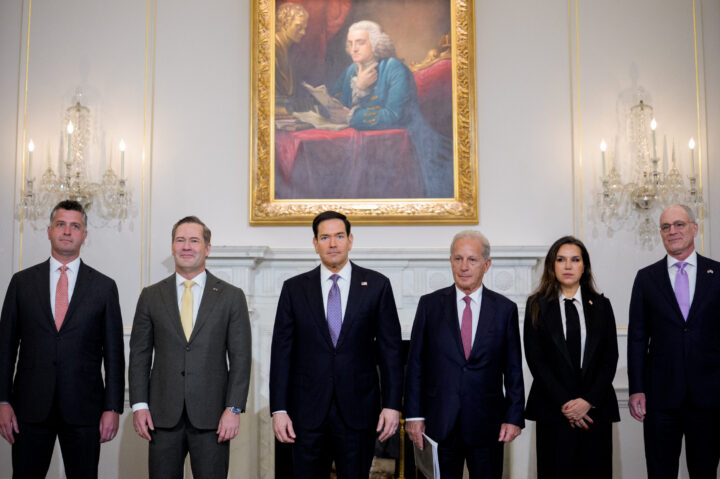
Andrew Harnik/Getty Images
(L-R) Counselor of U.S. State Department Michael Needham, U.S. Ambassador to the United Nations Michael Waltz, U.S. Secretary of State Marco Rubio, U.S. Ambassador to Lebanon Michel Issa, Lebanese Ambassador to the U.S. Nada Hamadeh Moawad and Israeli Ambassador to the U.S. Yechiel Leiter pose for photos before beginning working-level peace talks at the U.S. State Department on April 14, 2026 in Washington, DC.
Sitting at a roundtable of Israeli, Lebanese and American officials, Secretary of State Marco Rubio emphasized at the outset of negotiations between Jerusalem and Beirut that the talks are a “process” that will “take time,” stating that the objective of Tuesday’s meeting, the highest-level direct talks between the countries in over 30 years, is to “outline a framework upon which a permanent and lasting peace can be developed” and bring a “permanent end to Hezbollah’s influence” in the region.
“This is a process, not an event. This is more than just one day,” Rubio said. “All of the complexities are not going to be resolved in the next six hours … This will take time, but we believe it’s worth this endeavor and it’s a historic gathering that we hope to build on.”
“We understand we’re working against decades of history that have led us to this unique moment and opportunity here,” Rubio added. “We have to remember, the Lebanese people are victims of Hezbollah. The Lebanese people are victims of Iranian aggression, and this needs to stop.”
Rubio said the parties want to provide the people of Lebanon “the kind of future they deserve, and so that the people of Israel can live without fear of being struck by rocket attacks from a terrorist proxy of Iran.”
Taking part in the high-level talks between Israel and Lebanon on Tuesday in Washington were Israeli Ambassador to the U.S. Yechiel Leiter, Lebanese Ambassador to the U.S. Nada Hamadeh, U.S. Ambassador to Lebanon Michel Issa and State Department Counselor Michael Needham.
In a statement released by the State Department following the meeting, Washington indicated that any agreement “must be reached between the two governments, brokered by the United States, and not through any separate track.” The U.S. also expressed “support for further talks,” however it is not yet clear when the next round of discussions are expected to take place.
“All sides agreed to launch direct negotiations at a mutually agreed time and venue,” the statement read. It also indicated that Israel “expressed its commitment to working with the Government of Lebanon to achieve … security for the people of both countries” as well as a “commitment to engage in direct negotiations to resolve all outstanding issues and achieve a durable peace that will strengthen security, stability and prosperity in the region.”
In his opening statement ahead of the talks, Leiter commended Lebanese President Joseph Aoun and his government “for not allowing itself to be held hostage to the threats of Hezbollah’s leader,” adding that the group belongs “to the past.”
“I believe that we can, in good faith, accomplish the following interrelated goals: the complete dismantlement of Hezbollah, the freeing of Lebanon from Iran’s terror proxy and the achievement of a real, lasting and mutually celebrated peace for the benefit of our people,” Leiter said. “We also have the courage to pursue peace through strength, and to work tirelessly for tranquility and prosperity for all. Today, we pursue those values for ourselves and especially for our Lebanese neighbors of all ethnic denominations.”
After negotiations wrapped, Leiter struck a positive tone and said he was “honored” to sit at the negotiating table with Lebanese officials.
“We discovered today that we’re on the same side of the equation,” Leiter told reporters. “That’s the most positive thing we could have come away with. We are both united in liberating Lebanon from an occupation power dominated by Iran called Hezbollah.”
Similarly, Hamadeh also called the preliminary meeting “positive” and indicated that another round of talks is likely to take place. She stated that “the date and location of the next meeting will be announced at a later time.”
Tuesday’s negotiations were expected to focus on how Israel and Lebanon can work together to disarm Hezbollah and make peace between the countries. Israeli Prime Minister Benjamin Netanyahu announced the talks last week, saying he had shifted his position once the scope of the negotiations were expanded beyond just a ceasefire to also include disarming Hezbollah and working toward peaceful relations. Lebanese Foreign Minister Youssef Raggi indicated that the direct talks are meant to show that the “Lebanese state alone holds the authority to negotiate on behalf of Lebanon,” rather than Hezbollah.
The two nations currently share no formal diplomatic relations.
Hezbollah, however, has signaled it will not abide by any agreements and called on the Lebanese government to cancel the talks. Wafiq Safa, a high-ranking member of the group’s political council, stated prior to the meeting that the terrorist organization is “not interested or concerned with” the negotiations, saying the group is “not bound by what they [Israel, Lebanon and the U.S.] agree to.”
The negotiations took place against the backdrop of a massive Israeli strike in Beirut last week targeting Hezbollah. The recent round of hostilities was triggered on March 2 when Hezbollah launched rockets at northern Israel days after Israel and the U.S. launched strikes on Iran.
The talks have also received significant support from European and Western nations, with foreign ministers from 17 countries, including the U.K. and France, calling on the two countries to “seize the opportunity presented by the U.S.-Iran ceasefire,” per a joint statement.
Even if a deal is reached, major hurdles lie ahead as it remains unclear whether Lebanon possesses sufficient influence to hold Hezbollah to any potential agreements. While the group is a major political party with seats in the Lebanese parliament, its militia operates largely independently of the government, receiving funding and direction from Iran. Although a growing number of Lebanese officials and civilians view Hezbollah as an intrusive arm of Iranian interference, the group remains a powerful, independent force within the country.
The negotiations will mark the highest-level direct talks between the countries in over 30 years

Jalaa MAREY/AFP via Getty Images
Smoke rises following Israeli strikes in southern Lebanon near the border as seen from the Upper Galilee, in northern Israel on April 10, 2026
Secretary of State Marco Rubio will convene the ambassadors from Israel and Lebanon in Washington on Tuesday for the highest-level direct talks between the countries in over 30 years.
Israeli Ambassador to the U.S. Yechiel Leiter and Lebanese Ambassador to the U.S. Nada Hamadeh will represent their countries, with U.S. Ambassador to Lebanon Michel Issa and State Department Counselor Michael Needham also taking part in the meeting.
The negotiations are meant to focus on how Israel and Lebanon can work together to disarm Hezbollah and make peace between the countries.
A State Department official said the talks are “a direct result of Hezbollah’s reckless actions,” and “will scope the ongoing dialog about how to ensure the long-term security of Israel’s northern border and to support the Government of Lebanon’s determination to reclaim full sovereignty over its territory and political life.”
“Israel is at war with Hezbollah, not Lebanon, so there is no reason the two neighbors should not be talking,” the State Department official said.
Lebanese Prime Minister Nawaf Salam canceled a planned visit to the U.S. this week to monitor the situation from Beirut and “safeguard the security of the Lebanese people and preserve national unit,” he wrote on X.
Israeli Prime Minister Benjamin Netanyahu announced the talks last week, marking a shift in his position from earlier in the Lebanon campaign that began after Hezbollah joined Iran in attacking Israel in late February. Netanyahu said over the weekend that he had agreed to the talks because they would not only be about a ceasefire, but about disarming Hezbollah and working toward peace with Lebanon. President Donald Trump said at the time that he asked Israel to “low-key a bit” the strikes in Lebanon.
Lebanese Foreign Minister Youssef Raggi posted on X that the direct talks “in practice reinforced the separation between the Lebanese file and the Iranian track. … The Lebanese state alone holds the authority to negotiate on behalf of Lebanon.”
The talks are set to take place as Hezbollah continues to launch rockets and drone attacks at northern Israel on a daily basis and the IDF continues to target Hezbollah in southern Lebanon. The IDF said it struck about 150 Hezbollah targets on Monday, and it continues its ground operations in the Iran-backed terrorist organization’s stronghold of Bint Jbeil.
The IDF cleared for publication on Tuesday the name of Sgt.-Maj. Ayal Uriel Bianco, who was killed in battle in Lebanon.
Netanyahu visited IDF troops in Lebanon over the weekend, and praised them on Monday for “pushing the enemy away from the border” and creating “a solid, deeper security zone that both prevents the danger of invasion and distances the anti-tank missile threat.”
The former secretary of state also said he questions whether the U.S. could have done more to save lives in Gaza

Kevin Dietsch/Getty Images
Then-Secretary of State Antony Blinken delivers remarks during a NATO public forum as part of the 2024 NATO Summit on July 10, 2024 in Washington, DC.
Former Secretary of State Tony Blinken said at a Harvard Kennedy School event this week that he warned Israeli Prime Minister Benjamin Netanyahu a few months into the war in Gaza that Israel was going to lose support among not just Democrats, but also Republicans and evangelical Christians.
“Israel was mostly seen as the David and other forces were seen as the Goliath. That is now flipped,” Blinken said. “One of the things that I told Netanyahu was, ‘You may not care that you’re losing the Democratic Party, but trust me, you are going to lose young Republicans. You’re going to lose young evangelicals. This is generational.’ And he moved on to something else.”
The conversation took place early in 2024, a few months after the Oct. 7 Hamas attacks that killed 1,200 people in Israel. During his remarks at Harvard, Blinken said he wonders if there is more the U.S. could have done to protect Palestinians in Gaza. But he also called on people not to be “binary” in their thinking about the Middle East.
“Of course, for me, coulda-woulda-shoulda is something that will always be there when it comes to Gaza. It could not help but be given the level of human suffering,” said Blinken.
“But where did we start? We started with Oct. 7. We started with the most horrific massacre of Jews since the Holocaust,” Blinken added. “It’s very easy to say, ‘Oh, yeah, that’s a given.’ Except it wasn’t a given for Israelis and Israeli society. It became one for the rest of the world, but not for Israelis.”
Blinken was being interviewed by New York Times reporter David Sanger, who said that history books written about President Joe Biden will show his administration as “strongest on Ukraine and weakest on Gaza.”
Asked whether the Biden administration could have done things differently in Gaza to save lives, Blinken said, “Could we, should we have done things differently such that the suffering that people endured, the loss of the children you just listed and so many others could have been averted? The short answer is: Maybe yes.”
“We had to make judgments in real time about how to try to get to a better place. We made those judgments. People will make their own judgments about what we did and what we didn’t do,” said Blinken.
Despite the humanitarian crisis that emerged in Gaza, the U.S. pushed Israel to do more for Palestinians and to allow more aid into Gaza, Blinken said.
“That didn’t just happen. It happened because every single day we were on the Israelis to try to get assistance in, to open more crossing points, to flood the zone. They did that profoundly inadequately. They did that in ways that were not the way I would like to have seen it done, but we got some of that done,” said Blinken. “But yes, of course, you couldn’t be and I wouldn’t be human if I didn’t ask myself every day, could we have done things differently.”
Blinken said that the trauma Israelis experienced after Oct. 7 was so severe that Israel’s war in Gaza would have continued, even without American support — and that cutting off American weapons sales to Israel may have actually lengthened the war.
“Cutting off arms, sure, that was an option. But I don’t actually believe that at least in the near term, it would have changed things,” said Blinken. “I also believe it would have led to an even wider war as Israel’s enemies, and they were multiple, jumped in, and that only would have extended the war in Gaza, not ended the war in Gaza.”
The main focus of the Biden administration, according to Blinken, was to reach a ceasefire, “with hostages coming out and with aid going in.” He acknowledged the pain of people who were angry about the situation in Gaza, but questioned why so little anger was directed at Hamas.
“I empathize with people who felt this so deeply,” said Blinken. “I do remain with a question in my mind about why barely a word was spoken in all those months about Hamas, which was an actor too, and is responsible for so much of what happened.”
‘At post’s discretion, advocacy efforts should be coordinated with Israeli diplomatic counterparts,’ a leaked diplomatic cable stated, according to ABC
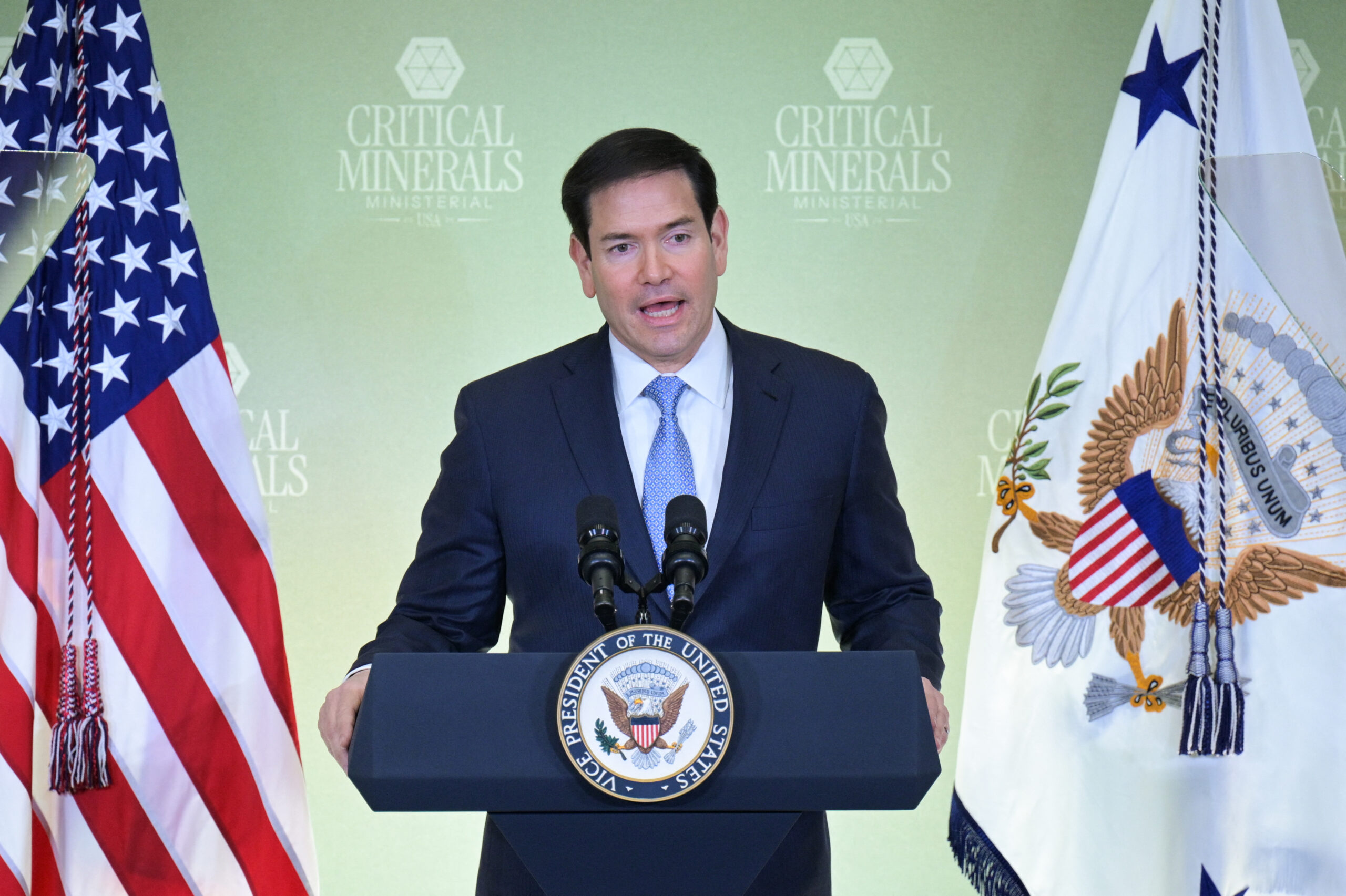
Oliver Contreras / AFP via Getty Images
Secretary of State Marco Rubio speaks during the inaugural Critical Minerals Ministerial meeting at the Sate Department in Washington, DC, on February 4, 2026.
Secretary of State Marco Rubio in a recent cable encouraged American diplomats to work with local Israeli embassies on messaging efforts to encourage foreign governments to collaborate with the U.S. in its war against Iran, ABC News reported on Monday.
“At post’s discretion, advocacy efforts should be coordinated with Israeli diplomatic counterparts,” a leaked diplomatic cable stated, according to ABC.
In the cable titled “Elevated Concern of [Islamic Revolutionary Guard Corps] Activity,” Rubio noted that there is an “elevated risk of attack” from Iran, and told diplomats to encourage the governments where they were posted to “move expeditiously to diminish the capabilities of Iran and Iran-aligned terrorist groups from attacking our respective nations and citizens.”
“We assess that the Iranian regime is more sensitive to collective action than unilateral action, and that joint pressure is more likely to compel behavior change by the regime than unilateral actions alone,” the cable reportedly stated. “We must act while international attention is focused now to end the Iranian campaign of terror in the Middle East and globally. Do not allow this critical movement to pass.”
The report comes as President Donald Trump pushes for other countries to join U.S. efforts to prevent Iran from closing the Strait of Hormuz, the point through which oil can be transported out of the Gulf to the open sea.
Rubio also directed diplomats in countries that have not declared the IRGC and Hezbollah to be terrorist organizations to relay the message that they should do so “swiftly,” because “such a designation will intensify the pressure on the Iranian regime and limit its ability to sponsor terror activities across the globe that jeopardizes the safety and security of your populations.”
The cable reportedly noted that the IRGC plans and carries out terrorist attacks on foreign soil and directs espionage and influence operations, which are “intentional acts designed to intimidate populations and inflict harm on your civilians.”
The move marks the latest crackdown from the White House against Muslim Brotherhood affiliates
Andrea Domeniconi/SOPA Images/LightRocket via Getty Images
Man hold a banner reading "The Muslim Brotherhood is a terrorist organization" during a Sudanese rally in Trafalgar Square on Dec. 20, 2025.
On Monday, the Trump administration moved to designate the Sudanese Muslim Brotherhood (SMB) as a Specially Designated Global Terrorist (SDGT) entity and announced plans to impose a Foreign Terrorist Organization (FTO) designation on March 16.
“The Sudanese Muslim Brotherhood uses unrestrained violence against civilians to undermine efforts to resolve the conflict in Sudan and advance its violent Islamist ideology,” Secretary of State Marco Rubio said in a press release. “The United States will use all available tools to deprive the Iranian regime and Muslim Brotherhood chapters of the resources to engage in or support terrorism.”
The SMB is composed of the Sudanese Islamic Movement and its armed wing, the al-Baraa Bin Malik Brigade (BBMB). The Muslim Brotherhood has maintained a significant presence in Sudan since the 1940s and has played a role in the country’s ongoing civil war between the Sudanese Armed Forces (SAF) — backed by Iran, Russia, Egypt and Turkey — and the Rapid Support Forces, which have reportedly received support from the United Arab Emirates.
Experts have previously told Jewish Insider that the SAF is heavily influenced by the SMB, working alongside several Islamist militias and receiving attack drones from Iran’s Islamic Revolutionary Guard Corps (IRGC), which has been designated as a terrorist organization by both the U.S. and the European Union. The SMB has contributed roughly 20,000 fighters to the conflict, with many receiving “training and other support” from the IRGC, according to the State Department.
An alleged Muslim Brotherhood leader in the Sudanese Armed Forces was also caught on video last week asserting that the group is ready to defend Iran amid the ongoing conflict between Tehran and the U.S. and Israel. The leader suggested that the group would send battalions to fight alongside Iran, according to Sky News Arabia.
“As the world’s leading state sponsor of terrorism, the Iranian regime has financed and directed malign activities globally through its IRGC,” Rubio said in the statement, adding that the SMB has also “conducted mass executions of civilians.”
The designation marks the Trump administration’s latest crackdown on Muslim Brotherhood affiliates and represents a notable policy step into the Sudan conflict. In January, the administration designated three Muslim Brotherhood branches in Egypt, Lebanon and Jordan as SDGT entities, with the State Department citing their provision of “material support to Hamas.”
Plus, Alex Soros boosts antisemitic conspiracy theorist
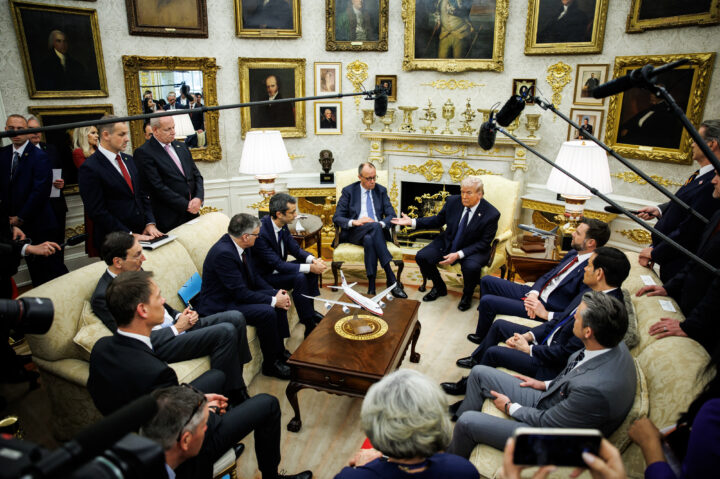
Samuel Corum/Sipa/Bloomberg via Getty Images
Friedrich Merz, Germany's chancellor, center left, and US President Donald Trump during a meeting in the Oval Office of the White House in Washington, DC, US, on Tuesday, March 3, 2026.
Good Tuesday afternoon,
This P.M. edition is reserved for our premium subscribers — offering a forward-focused read on what we’re tracking now and what’s coming next.
It’s me again — Danielle Cohen-Kanik, U.S. editor at Jewish Insider and curator, along with assists from my colleagues, of the Daily Overtime. Please don’t hesitate to share your thoughts and feedback by replying to this email.
📡On Our Radar
Notable developments and interesting tidbits we’re tracking
The Trump administration emphatically denied reports, based on partial comments made by Secretary of State Marco Rubio yesterday, that Israel forced the U.S. to launch the operation against Iran.
“If anything, I might’ve forced Israel’s hand,” President Donald Trump told reporters while meeting with German Chancellor Friedrich Merz in the Oval Office today. “You see, we were having negotiations with these lunatics, and it was my opinion that they [Iran] were going to attack first.”
Defense Secretary Pete Hegseth boosted the president’s comments, saying, “This is 100% correct,” while Rubio insisted his original remarks were misrepresented…
Trump continues to share optimistic assessments of the war’s progress: he told Politico that Iran is running out of missile launchers while claiming the U.S. has “a virtually unlimited supply” of weapons, saying, “wars can be fought ‘forever,’ and very successfully, using just these supplies”…
The Israeli Air Force struck a building where senior clerics had gathered to elect Iran’s next supreme leader, Israeli Ambassador to the U.S. Yechiel Leiter told CNN, “and there’s a very good chance that the electors won’t be readily available for any further meetings”…
Trump is open to backing militias in Iran who will work to mount regime change, U.S. officials told The Wall Street Journal, after he held phone calls with Kurdish leaders who maintain armed groups along the Iran-Iraq border.
Trump has wavered in recent comments on his vision for the future of Iran, saying today that “somebody from within” might be the best option to lead, rather than individuals like exiled former crown prince, Reza Pahlavi. At the same time, Trump told reporters, “Most of the people we had in mind are dead. And now we have another group, they may be dead also. Pretty soon we’re not gonna know anybody”…
Trump ordered the U.S. Development Finance Corporation to provide political risk insurance for all maritime trade traveling through the Gulf, as oil traffic has essentially halted and energy prices have soared. The U.S. Navy will also, if necessary, begin physically escorting tankers through the Strait of Hormuz, Trump said…
Ukrainian President Volodymyr Zelensky offered his country’s assistance to the UAE, as the Gulf country has been targeted by over 1,000 Iranian drones and missiles since the operation began Saturday. Ukraine has become particularly skilled in combating Iranian Shahed drones, something the UAE has little experience with, as Russia has regularly used them in its attacks on Ukraine…
The U.S. Embassy in Saudi Arabia was struck with two Iranian drones, with no casualties reported; the embassy was closed, along with U.S. embassies in Kuwait and Beirut. The State Department ordered the mandatory departure of all non-emergency personnel in several countries and has begun “actively securing military aircraft and charter flights for American citizens who wish to leave” the region…
The International Atomic Energy Agency confirmed that Iran’s underground Natanz nuclear enrichment plant was struck in the course of hostilities in recent days. Trump has claimed the site was rendered inoperable during the U.S.’ June 2025 strikes…
Alex Soros, one of the progressive movement’s most influential donors, boosted a social media post today about U.S. casualties in the war with Iran from Max Blumenthal, a prominent anti-Israel conspiracy theorist, Jewish Insider‘s Matthew Kassel reports.
Soros also praised Spain for its refusal to allow the U.S. to use joint bases on its soil, calling Madrid the “leader of the free world” and reprimanding other European countries for not doing the same…
After issuing a statement solely attacking the U.S. and Israel over the campaign against Iran — which provoked backlash from members of the Iranian dissident and diaspora communities — New York City Mayor Zohran Mamdani acknowledged the “systematic repression” of the Iranian people by the regime, while declining to criticize the late Supreme Leader Ayatollah Ali Khamenei, JI’s Will Bredderman reports.
Even as he acknowledged Tehran’s bloody suppression of protesters, Mamdani did not directly answer a reporter’s question at a press conference today about whether the Middle Eastern nation was better off without the radical cleric who ruled for nearly 37 years…
Amazon Web Services operations are “significantly impaired” after three of its data centers in the Middle East were struck by Iranian drones — two directly hit in the UAE and one sustaining damage in Bahrain. The strikes “caused structural damage, disrupted power delivery to our infrastructure, and in some cases required fire suppression activities that resulted in additional water damage,” AWS said…
⏩ Tomorrow’s Agenda, Today
An early look at tomorrow’s storylines and schedule to keep you a step ahead
Keep an eye out in Jewish Insider for a look at the results of today’s high-stakes primary elections in North Carolina and Texas and their implications for pro-Israel voters.
The Heritage Foundation will hold an event to launch its 2026 “Index of U.S. Military Strength” with remarks from Sen. Jim Banks (R-IN) and Reps. August Pfluger (R-TX), Pat Harrigan (R-TX) and Matt Van Epps (R-TN).
The U.S. Commission on International Religious Freedom will release its annual report tomorrow on Capitol Hill.
Stories You May Have Missed
SQUARING OFF
A trio of Mamdani backers united with tech and real estate investors to boost anti-Israel candidates
PARTY PERSPECTIVE

Speaking at J Street’s national summit, Sen. Tim Kaine also said ‘virtually all’ Democratic senators now seek the group’s endorsement
Plus, Tehran takes aim at global energy
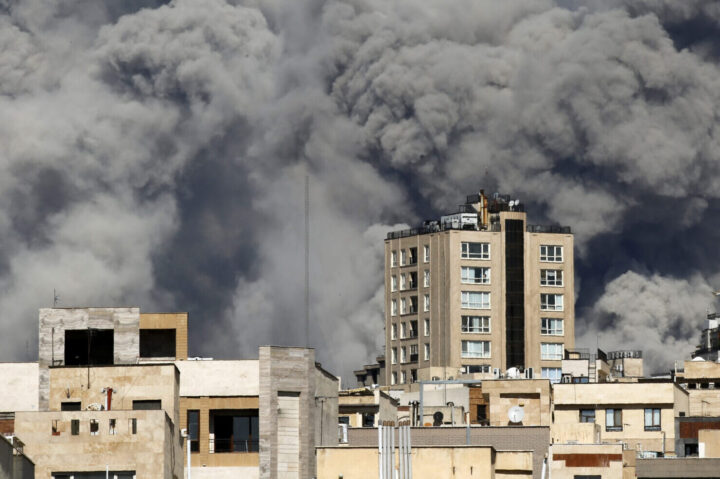
Fatemeh Bahrami/Anadolu via Getty Images
Smoke rises from the area after it was targeted in attacks as a series of explosions are heard in Tehran, Iran on March 01, 2026.
Good Monday afternoon,
This P.M. edition is reserved for our premium subscribers — offering a forward-focused read on what we’re tracking now and what’s coming next.
It’s me again — Danielle Cohen-Kanik, U.S. editor at Jewish Insider and curator, along with assists from my colleagues, of the Daily Overtime. Please don’t hesitate to share your thoughts and feedback by replying to this email.
📡On Our Radar
Notable developments and interesting tidbits we’re tracking
President Donald Trump and senior U.S. defense officials laid out an open-ended timeline for the ongoing bombing campaign against Iran in several press briefings and interviews today, Jewish Insider’s Matthew Shea and Emily Jacobs report.
Trump and Defense Secretary Pete Hegseth both declined to rule out a U.S. ground invasion of Iran, while Joint Chiefs Chairman Gen. Dan Caine announced more American troops are en route to the region. “Every president says, ‘There will be no boots on the ground.’ I don’t say it. I say ‘probably don’t need them,’ [or] ‘if they were necessary,’” Trump told the New York Post.
The president repeatedly said the operation is “ahead of schedule,” but added that the U.S. military is prepared to continue the campaign beyond his initial four-to-five-week timeline. Trump also told CNN that the “big wave” of strikes on Iran “hasn’t even happened. The big one is coming soon”…
On the American public’s perception of the strikes, Trump said, “I think that the polling is very good, but I don’t care about polling. I have to do the right thing. This should have been done a long time ago.” A new CNN poll found that 41% of Americans support the strikes against Iran, while 59% disapprove…
After Hezbollah jumped into the conflict by launching strikes on Israel overnight, prompting Israeli fire on Hezbollah targets in Lebanon in return, Lebanese Prime Minister Nawaf Salam banned the terror group’s “military activities,” restricting it “to the political sphere.”
Salam said the group’s actions are now “illegal” and called on the Lebanese Armed Forces to “prevent any attacks originating from Lebanese territory,” a long-awaited show of resolve from Beirut. The LAF has struggled to disarm Hezbollah forces since the signing of a ceasefire agreement with Israel in November 2024…
On a ground invasion of Lebanon, IDF spokesperson Brig. Gen. Effie Defrin said, similarly to the U.S. position on Iran, “all options are on the table”…
U.S. casualties in the course of the operation increased today to six servicemembers…
Qatar’s Ministry of Defense condemned attacks by Iran on a power plant and an oil facility in the country, further indicating Tehran is setting its sights on civilian and energy infrastructure. The targeted energy plant, Ras Laffan, is responsible for around a fifth of all global natural gas production — Qatar halted production after the strike which, along with decreased passage through the vital Strait of Hormuz, sent oil prices soaring…
Iran continues to sustain heavy losses: The U.S. said it has sunk all 11 of Iran’s warships in the Gulf of Oman while Qatar shot down two Iranian SU-24 tactical bombers, which were developed by Russia; the UAE also intercepted around 150 Iranian drones and 15 missiles today in addition to hundreds over the weekend…
U.K. Prime Minister Keir Starmer reiterated in an address to parliament today that Britain will not be joining the strikes on Iran but will allow the U.S. to use its bases for “defensive actions,” noting that Iran has already struck a military base in Bahrain that houses around 300 British troops. “France and Germany are also prepared to enable U.S. action to destroy Iran’s capability to fire missiles and drones from the source,” Starmer added.
Trump said he was “very disappointed” with Starmer in an interview with The Telegraph, saying the prime minister “took far too long” in deciding to allow U.S. forces to utilize its bases…
NATO Secretary-General Mark Rutte praised the campaign, calling it “really important … because it is taking out, degrading the capacity of Iran to get its hands on nuclear capability, the ballistic missile capability.” But, he said, “there are absolutely no plans whatsoever for NATO to get dragged into this”…
GOP lawmakers are pushing Democrats to agree to a funding deal for the still-shuttered Department of Homeland Security, as hostilities with Iran raise concerns about domestic terror threats…
The war is also making its way into some of the most heated primary races unfolding across the country: In North Carolina’s 4th Congressional District, anti-Israel activist Nida Allam, who is challenging Rep. Valerie Foushee (D-NC), put out a new campaign ad just before tomorrow’s primary slamming “Trump and Netanyahu’s reckless war.”
Allam accused the administration of using “our taxpayer dollars to bomb a school in Iran, killing over 100 elementary school children,” even though there has been no proof that the U.S. was responsible for the strike…
Some pro-Israel Democratic candidates in Illinois also took harsh stances against the Iran operation: state Sen. Laura Fine, running in Illinois’ 9th Congressional District, called for Trump’s impeachment, while Cook County Commissioner Donna Miller, running in the 2nd District, and Chicago Treasurer Melissa Conyears-Ervin, running in the 7th District, called the strikes “reckless” and “immoral,” respectively…
⏩ Tomorrow’s Agenda, Today
An early look at tomorrow’s storylines and schedule to keep you a step ahead
Keep an eye out in Jewish Insider for a rundown of the high-profile primaries on the ballot tomorrow in North Carolina and Texas.
German Chancellor Friedrich Merz will meet with President Donald Trump at the White House for a conversation that was set to focus on negotiations between Russia and Ukraine but will likely be overshadowed by the ongoing operation against Iran. Germany joined the U.K. and France over the weekend in offering a supportive but cautious stance on the hostilities.
It will be a busy day on the Hill, where administration officials including Secretary of State Marco Rubio, Defense Secretary Pete Hegseth, CIA Director John Ratcliffe and Joint Chiefs Chairman Gen. Dan Caine will hold all-member briefings on Iran for the House and Senate. Rubio is briefing the Gang of Eight again this afternoon, and national security committees in both chambers were briefed over the weekend.
Elbridge Colby, the under secretary of defense for policy, will brief the Senate Armed Services Committee on the Pentagon’s National Defense Strategy; Colby has previously drawn bipartisan ire from the committee over a lack of consultation by his team and alleged rogue decision-making on a range of issues by his office.
The Senate Judiciary Committee will hold a hearing on oversight of the Department of Homeland Security with testimony from Homeland Security Secretary Kristi Noem.
The Capitol Jewish Forum will host its annual Capitol Hill Purim celebration, attended by a number of Jewish lawmakers.
Stories You May Have Missed
WEIGHING IN

The resolutions are unlikely to pass; if they do, they will need two-thirds support to override an inevitable presidential veto
CLOSING RANKS

UAE and Saudi leaders spoke by phone; the GCC affirmed its ‘right to respond’
Plus, Mamdani makes surprise WH visit
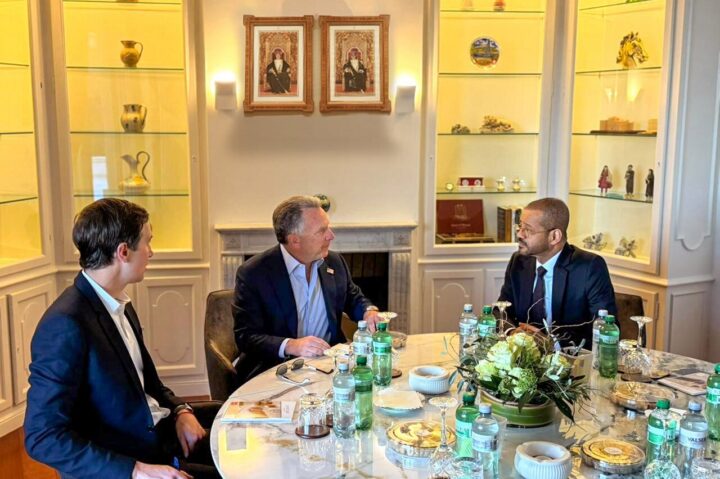
Umman Foreign Ministry/Handout/Anadolu via Getty Images
Special Envoy Steve Witkoff (C) advisor Jared Kushner (L) meet with Omani Foreign Minister Badr bin Hamad Al Busaidi (R), who is mediating between the parties in the third round of Iran-U.S. negotiations held in Geneva, Switzerland, on February 26, 2026.
Good Thursday afternoon!
This P.M. edition is reserved for our premium subscribers — offering a forward-focused read on what we’re tracking now and what’s coming next.
It’s me again — Danielle Cohen-Kanik, U.S. editor at Jewish Insider and curator, along with assists from my colleagues, of the Daily Overtime. Please don’t hesitate to share your thoughts and feedback by replying to this email.
📡On Our Radar
Notable developments and interesting tidbits we’re tracking
U.S.-Iran negotiations wrapped up for the day in Geneva without a decisive result: Omani Foreign Minister Badr Albusaidi said the sides had made “significant progress” while Iranian Foreign Minister Abbas Araghchi told state media they negotiated “very seriously,” but no agreement was reached.
Araghchi said technical experts will meet on Monday in Vienna at the International Atomic Energy Agency and fourth round negotiations will take place later next week, after consultations in both capitals…
Secretary of State Marco Rubio told reporters yesterday that Iran “poses a very grave threat to the United States” and is trying to reconstitute its nuclear program. “After their nuclear program was obliterated, they were told not to try to restart it, and here they are. You can see them always trying to rebuild elements of it. They’re not enriching right now, but they’re trying to get to the point where they ultimately can.”
Beyond the nuclear issue, Rubio said, Iran also has “conventional weapons that are solely designed to attack America and attack Americans. … These things have to be addressed.” While the current talks are focused solely on Tehran’s nuclear program, “it’s also important to remember that Iran refuses to talk about ballistic missiles to us or to anyone, and that’s a big problem”…
House Democratic leaders said in a joint statement today that they plan to force a vote “as soon as Congress reconvenes next week” on a resolution blocking military action against Iran without congressional authorization, Jewish Insider’s Marc Rod reports. Three Democrats have already indicated they will oppose the resolution, with other defections likely to follow…
U.S. forces raided a ship last month and seized cargo heading from China to Iran, officials told The Wall Street Journal, part of a broader effort to head off Iran’s covert arms purchases after the 12-day war last June. The cargo was reportedly intended for Iranian companies that procure weapons for the regime’s missile program…
The Journal interviews fighter pilots involved in the U.S. bombing campaign against the Houthis last spring, as military assets are once again amassing in the Middle East for a potential operation against Iran…
Maine Senate candidate Graham Platner amplified a social media post today from a far-right conspiracy theorist well-known for viciously antisemitic commentary — before quickly deleting the statement, JI’s Matthew Kassel reports. In a comment on X, Platner approvingly boosted a remark opposing war with Iran from Stew Peters, who has said Judaism is “satanic” and a “death cult,” promoted blood libels and called for a “final solution” to mass-deport American Jews…
The issue is particularly sensitive for Platner, who earlier in his campaign faced scrutiny over a Nazi tattoo on his chest, which he has since had covered. He was pressed today on a YouTube call-in show about his knowledge of the tattoo’s symbolism because of his self-identification as a WWII history enthusiast.
“I was well aware that they [Nazis] used a similar-looking thing,” Platner said. “You have to admit it’s not a ‘similar-looking thing,’ it’s the same thing. … Anyone who’s remotely a WWII buff knows what that is,” the caller replied. Platner answered, “I’m not going to apologize for something that I didn’t know about or do”…
New York City Mayor Zohran Mamdani made an unannounced visit to the White House to meet with President Donald Trump today. Among other issues, the two discussed housing and immigration activities…
The family of Francesca Albanese, the U.N. special rapporteur for Israel and the Palestinian territories, sued Trump and other administration officials yesterday in district court, alleging that the sanctions imposed on Albanese by the U.S. violate her First, Fourth and Fifth Amendment rights…
Israeli President Isaac Herzog and Foreign Minister Gideon Sa’ar attended an iftar meal to break the Ramadan fast hosted by UAE Ambassador to Israel Mohamed Al Khaja in Tel Aviv, where Herzog said that the “members of the Abraham Accords should be treated in an upgraded manner as they pursue the noble cause of peace.”
“And this I say especially,” Herzog continued, “when there are nations who are spreading hate, spreading blasphemy against nations who seek peace — against the Emiratis, against the Israelis,” ostensibly referring to Saudi Arabia…
As Indian Prime Minister Narendra Modi wrapped up his trip to Israel today, the two countries signed 16 memorandums of understanding to expand cooperation in fields including agriculture and AI. Modi also met with the cast of “Fauda”…
⏩ Tomorrow’s Agenda, Today
An early look at tomorrow’s storylines and schedule to keep you a step ahead
Keep an eye out in Jewish Insider for a profile of Sam Bregman, the Jewish cowboy-hat wearing former district attorney running for governor of New Mexico.
ADL’s Desert Region will hold its annual conference at Arizona State University, with speakers including ADL CEO Jonathan Greenblatt, Arizona Gov. Katie Hobbs, Phoenix Mayor Kate Gallego and state Rep. Alma Hernandez.
J Street’s annual conference will kick off Saturday in Washington. Speakers will include former Israeli Prime Minister Ehud Olmert, Sens. Chris Van Hollen (D-MD), Brian Schatz (D-HI), Adam Schiff (D-CA), Tim Kaine (D-VA) and Chris Murphy (D-CT) and Reps. Nancy Pelosi (D-CA), Sara Jacobs (D-CA), Sean Casten (D-IL) and Madeleine Dean (D-PA). J Street’s PAC will hold an event with Roy Cooper, the former governor of North Carolina now running for Senate, and phone banking sessions for Evanston, Ill., Mayor Daniel Biss, running for the House.
We’ll be back in your inbox with the Daily Overtime on Monday. Shabbat Shalom!
Stories You May Have Missed
EDUCATION CONSTERNATION
The suit highlights several complaints from Jewish parents and children statewide, in school districts including Berkeley, Los Angeles, Santa Clara, San Francisco, Campbell Union, Fremont, Etiwanda and Oakland
PRAIRIE STATE DEBATE
The far-left influencer, running competitively in a Chicago-area district with a sizable Jewish constituency, debated primary rivals Laura Fine and Daniel Biss on Wednesday
Plus, Witkoff calls for indefinite Iran nuclear deal

Mario Tama/Getty Images
An attendee wears a jacket at an Iowa caucus watch party organized by Metro D.C. Democratic Socialists of America, on February 3, 2020 in Washington, DC.
Good Wednesday afternoon!
This P.M. edition is reserved for our premium subscribers — offering a forward-focused read on what we’re tracking now and what’s coming next.
It’s me again — Danielle Cohen-Kanik, U.S. editor at Jewish Insider and curator, along with assists from my colleagues, of the Daily Overtime. Please don’t hesitate to share your thoughts and feedback by replying to this email.
📡On Our Radar
Notable developments and interesting tidbits we’re tracking
Ahead of the third round of U.S.-Iran negotiations taking place in Geneva tomorrow, Vice President JD Vance told Fox News that President Donald Trump “has a number of other tools at his disposal” besides diplomacy to ensure “the craziest and worst regime in the world” does not obtain nuclear weapons, following on the president’s remarks during last night’s State of the Union calling Iran “the world’s No. 1 sponsor of terror”…
In response to Trump’s comments, where he also said Iran was developing advanced ballistic missiles and had killed 32,000 protesters, Iranian Foreign Ministry spokesperson Esmail Baghaei tied Trump to the “law of propaganda coined by Nazi [chief propagandist] Joseph Goebbels.”
“This is now systematically used by the U.S. administration and the war profiteers encircling it, particularly the genocidal Israeli regime … Whatever they’re alleging in regards to Iran’s nuclear program, Iran’s ballistic missiles, and the number of casualties during January’s unrest is simply the repetition of ‘big lies,’” Baghaei wrote on X…
White House Special Envoy Steve Witkoff, who is leading Iran negotiations alongside Jared Kushner, reportedly told AIPAC members at the group’s summit in Washington yesterday that any deal reached with Iran should not have a “sunset clause,” as the 2015 Joint Comprehensive Plan of Action was criticized for.
“We start with the Iranians with the premise that there is no sunset provision. Whether we get a deal or not, our premise is: you have to behave for the rest of your lives,” Witkoff told the group, according to Axios. He said talks are currently focused only on the nuclear issue, but if they are successful, the administration would look to hold additional talks on Tehran’s missile program and support for terror proxies…
Satellite photos analyzed by the Associated Press appear to show U.S. ships that typically dock in Bahrain as part of the U.S. Navy’s 5th Fleet have moved out to sea. The 5th Fleet similarly scattered its ships during the U.S. strikes in Iran last June…
Dutch airline KLM announced a suspension of flights between its hub in Amsterdam and Israel’s Ben Gurion Airport starting March 1 until further notice, saying in a statement that it is currently “not commercially or operationally feasible for KLM to operate flights to Tel Aviv.” It’s the first airline to pause flights amid the current unrest with Iran…
On the campaign trail, Washington, D.C., mayoral candidate Janeese Lewis George vowed to reject the “Zionist lobby” in a questionnaire seeking the endorsement of the Metro D.C. chapter of the Democratic Socialists of America, Jewish Insider’s Gabby Deutch reports, a category that the DSA said includes AIPAC, Democratic Majority for Israel, Christians United for Israel and J Street.
Referencing her appearance at an event with the Jewish Community Relations Council of Greater Washington in December, Lewis George assured the DSA she “disagree[s] with the JCRC on a number of issues,” including its opposition to describing Israel’s actions in Gaza as a genocide and its “definition of antisemitism that criminalizes dissent, and their attacks on activists.”
Ron Halber, CEO of the JCRC, told JI, “As far as I’m concerned, [the DSA’s questionnaire] is an antisemitic manifesto. They are making the price of their endorsement the social exclusion of Jews”…
Illinois state Sen. Laura Fine, a Democrat running for an open Illinois House seat, unapologetically championed her backing for Israel in a position paper obtained by JI’s Marc Rod, amid attacks from anti-Israel activists and groups over her support for the Jewish state and backing from pro-Israel supporters.
Fine described Israel in the paper as “more than just a strategic ally, it is a beacon of democracy in one of the world’s most volatile regions,” as she and some of her primary opponents, including Evanston Mayor Daniel Biss and far-left activist Kat Abughazaleh, are set to participate in a televised debate tonight…
The U.S.-led Board of Peace released a video today laying out its vision for Gaza. The board’s goal by Year 3 is to fully rebuild the southern Gazan city of Rafah and have Gaza “connected to the world through an Abrahamic gateway, linking it with Egypt, Israel, Jordan, Saudi Arabia, the UAE and extending to India and Europe.” By the board’s 10th year, it said, Gaza will be “self-governed,” without specifying who will oversee the enclave and how Hamas will be removed from power…
Knesset Speaker Amir Ohana awarded Indian Prime Minister Narendra Modi the newly established Medal of the Knesset, the highest honor of the body, after Modi’s address there today. His remarks were warmly received by members of Knesset and Israeli Prime Minister Benjamin Netanyahu, who was also in the chamber…
Following Israel’s recognition of Somaliland’s independence in December, Jerusalem accepted the appointment of Mohamed Hagi as the first Somaliland ambassador to the Jewish state (and its first fully accredited ambassador anywhere in the world). Hagi “was a member of the inner circle of officials who promoted the establishment of relations between Israel and Somaliland,” the Israeli Foreign Ministry said, and vowed that a reciprocal Israeli ambassador “will soon be appointed”…
Former Harvard President Larry Summers will remain on leave from his teaching position at the Ivy League school for the duration of the academic year, at which point he will retire, Harvard announced today, after files released by the Department of Justice showed Summers maintained a relationship with sex trafficker Jeffrey Epstein after the financier had been convicted of prostitution involving a minor…
⏩ Tomorrow’s Agenda, Today
An early look at tomorrow’s storylines and schedule to keep you a step ahead
Keep an eye out in Jewish Insider for a preview of Fox Nation’s new docudrama on King David, offering a dramatic reenactment of the biblical coming-of-age story of the Jewish leader.
White House Special Envoy Steve Witkoff and Jared Kushner will hold discussions with Iranian Foreign Minister Abbas Araghchi in Geneva, mediated by Omani Foreign Minister Badr Albusaidi.
California Jewish groups including the JCRC Bay Area, the Jewish Federation of Los Angeles and Jewish California, which rebranded today from its previous name of JPAC, are hosting a forum for candidates running for governor, as Gov. Gavin Newsom reaches his term limit. Participating candidates include former presidential contender Tom Steyer, Rep. Eric Swalwell (D-CA), San Jose Mayor Matt Mahan and former Los Angeles Mayor Antonio Villaraigosa, all of whom are Democrats, as well as Republican commentator Steve Hilton.
Stories You May Have Missed
PUSHING BACK
Rep. Jared Moskowitz, representing a swing district: ‘The idea that the vice president lost every swing state because she wasn’t more extreme on this issue is laughable’
CAPPELLO’S CAMPAIGN
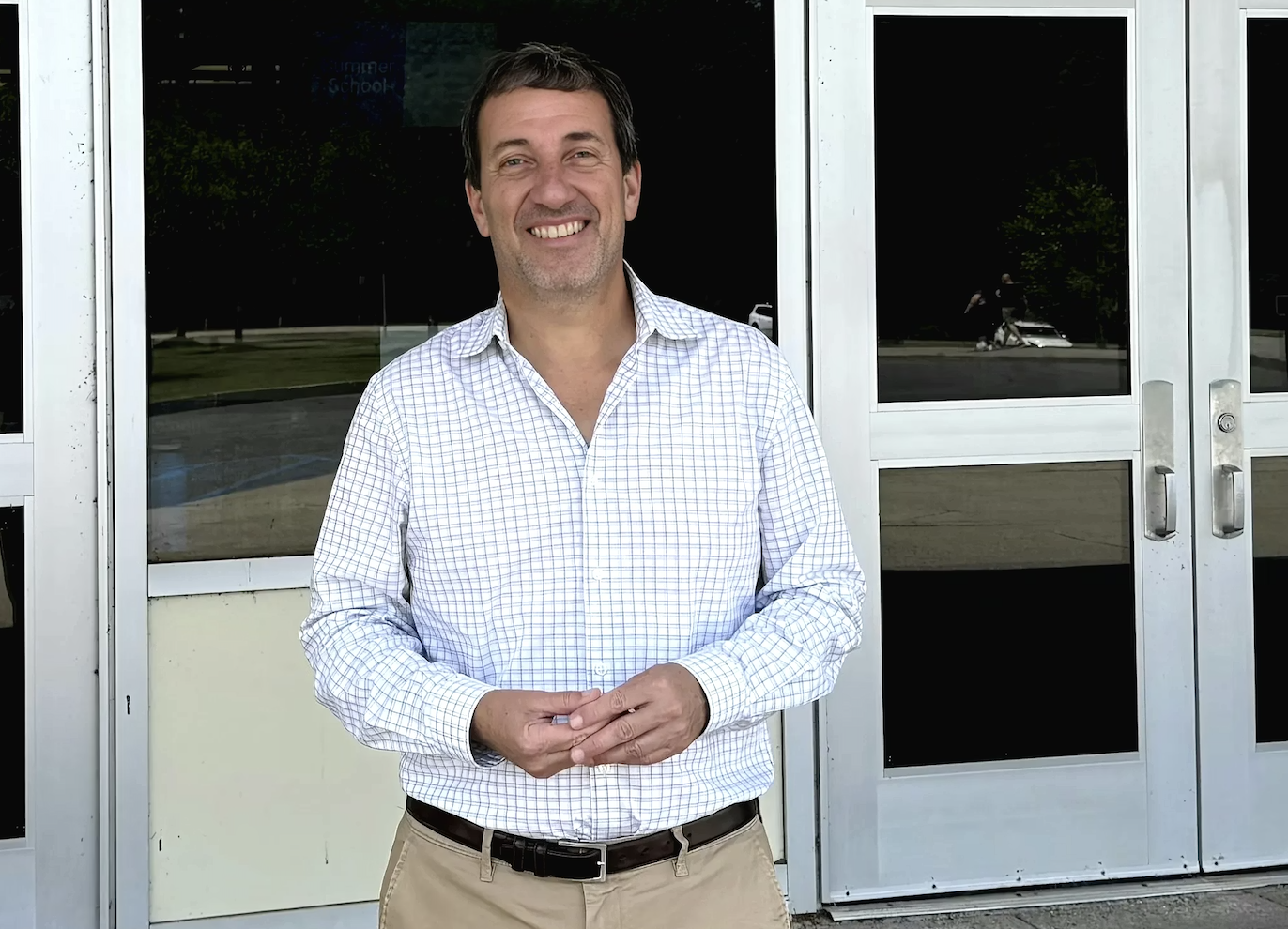
The Air Force veteran, who served for six years at the U.S. Embassy in Israel, said Israel should continue to make efforts toward peace
Plus, Trump says Iran won't rule out nuclear weapons
Mario Tama/Getty Images
Protestors gather after police cleared a new encampment on the UCLA campus on May 23, 2024 in Los Angeles, California.
Good Tuesday afternoon!
This P.M. edition is reserved for our premium subscribers — offering a forward-focused read on what we’re tracking now and what’s coming next.
It’s me again — Danielle Cohen-Kanik, U.S. editor at Jewish Insider and curator, along with assists from my colleagues, of the Daily Overtime. Please don’t hesitate to share your thoughts and feedback by replying to this email.
📡On Our Radar
Notable developments and interesting tidbits we’re tracking
Previewing his State of the Union address tonight, where it remains to be seen if he will make any announcements on Iran, President Donald Trump told reporters, “Iran wants to make a deal more than I do, but they just won’t say the sacred phrase: ‘We won’t build nuclear weapons,’” signaling that the two sides are still at an impasse ahead of the third round of negotiations scheduled for Thursday…
Secretary of State Marco Rubio briefed the congressional Gang of Eight, the bipartisan set of leaders advised on classified matters by the executive branch, this afternoon to provide an update on Iran, with CIA Director John Ratcliffe reportedly joining the discussion. The White House did not brief the group before striking Iran last June, drawing ire from Democrats…
Ahead of the meeting, Senate Minority Leader Chuck Schumer (D-NY) told C-SPAN about potential Iran strikes, “Closed-door briefings are fine, but the administration has to make its case to the American people on something as important as this”…
Around a dozen U.S. F-22 stealth fighter jets departed from the U.K. today to be deployed at an Israeli Air Force base in the south of the country, as over 150 aircraft are being moved to the region. Military experts told The Washington Post that the “assets being assembled are indicative of a multiday campaign without a ground invasion”…
The Coast Guard is investigating a swastika drawn at its primary recruit training center in New Jersey, where Coast Guard commandant Adm. Kevin Lunday quickly flew to address recruits and staff about the incident. Lunday recently came under fire from Congress, and had his confirmation delayed, over a change in Coast Guard policy that downgraded the swastika from a prohibited hate symbol to “potentially divisive,” which was eventually walked back.
Regarding the recent incident, Lunday said in a statement to The Washington Post, “Anyone who adheres to or advances hate or extremist ideology — get out. Leave. You don’t belong in the United States Coast Guard and we reject you”…
Rep. Brad Sherman (D-CA) is pushing for legislation to require an affirmative congressional vote prior to the U.S. reaching any nuclear deal with Saudi Arabia, Jewish Insider’s Marc Rod reports, following a notification from the administration to Congress indicating that it is moving toward a deal that could allow Riyadh to enrich uranium for civilian purposes.
The notification procedures, which do not include specific terms of a potential deal, suggest that Saudi Arabia will not be required to agree to more intrusive International Atomic Energy Agency inspections or “gold standard” safeguards — which would require Saudi Arabia to agree not to enrich or reprocess nuclear material — used for the U.S. nuclear cooperation agreement with the United Arab Emirates…
The Justice Department sued the University of California today under Title VII of the Civil Rights Act, which prohibits employment discrimination, alleging that the UCLA campus created a “hostile work environment against Jewish and Israeli faculty and staff.”
During campus anti-Israel protests in 2024, the DOJ said, “the University allowed antisemitic harassment to continue unabated for days” and “has ignored, and continues to ignore, gross and repeated violations” of time, place and manner restrictions on student protest. The department further claimed Jewish and Israeli faculty at the school have been physically threatened, ostracized, harassed, forced to take leave and assaulted…
The New York Times details efforts by New York’s business community and Democratic establishment to organize and promote the moderate wing of the party in response to New York City Mayor Zohran Mamdani’s rise to power. Some of the individuals involved, including former Gov. Andrew Cuomo allies Phil Singer and Steven Cohen, are considering forming PACs, watchdog groups, lobbying campaigns and more…
New York’s Working Families Party endorsed Brooklyn Borough President Antonio Reynoso to replace retiring Rep. Nydia Velázquez (D-NY) yesterday over Mamdani’s objections. The mayor has been backing Assemblymember Claire Valdez, who, like Mamdani, is a member of the Democratic Socialists of America and a vocal critic of Israel, and he had lobbied the WFP to endorse her or to stay out of the race. WFP’s director, Jasmine Gripper, told the Times, “At the end of the day, Zohran is an individual who gets to weigh in as an individual”…
A new poll from the University of New Hampshire found oyster farmer Graham Platner with a commanding lead among likely Senate Democratic primary voters, outdistancing Gov. Janet Mills by 34 points, with the primary less than four months away. In a general election matchup with incumbent Sen. Susan Collins (R-ME), Platner leads Collins by 11 points, while Mills and Collins are neck-and-neck…
Khalid Turaani, executive director of the Ohio branch of the Council on American-Islamic Relations (CAIR), testified at the Ohio Senate Judiciary Committee last week against a bill to codify the International Holocaust Remembrance Alliance’s working definition of antisemitism, where he claimed that Israel operates the world’s largest human skin bank and harvests the skin from deceased Palestinians. “And if I call them Nazis,” Turaani continued, “your law is going to punish me.”
The Anti-Defamation League’s Ohio River Valley office condemned Turaani’s speech, saying that the “antisemitic organ harvesting myth plays on the blood libel trope, which has spurred the torture, murder, and expulsion of Jews for centuries”…
The U.S. Embassy in Israel announced that, as part of the government’s “efforts to reach all Americans,” the embassy will be providing consular services for one day only at several locations across Israel and the West Bank, including Ramallah and the Jewish settlement of Efrat…
⏩ Tomorrow’s Agenda, Today
An early look at tomorrow’s storylines and schedule to keep you a step ahead
Keep an eye out in Jewish Insider for the highlights from President Donald Trump’s State of the Union address, taking place at 9 p.m. ET tonight, as all eyes are on possible U.S. military action against Iran.
Indian Prime Minister Narendra Modi arrives in Israel tomorrow, where he will be greeted by Prime Minister Benjamin Netanyahu before addressing the Knesset. In the evening, the two leaders will have dinner at Jerusalem’s King David Hotel. Read JI’s interview on Modi’s visit with Israeli Ambassador to India Reuven Azar.
The New York City Council will hold its first hearing on Council Speaker Julie Menin’s bill aiming to create “buffer zones” around houses of worship to protect from disruptive protests. The bill’s language was updated last night to remove the original 100-foot figure, which had reportedly emerged as a point of concern for the NYPD.
Congressional candidates from Illinois’ 9th District, where pro-Israel spending is boosting state Sen. Laura Fine and attacking Evanston Mayor Daniel Biss, will hold a debate on local news.
Stories You May Have Missed
SHIFTING STANCE

The progressive activist ran as a pro-Israel candidate in a neighboring swing district, but is now walking back her support as she runs to succeed Rep. Bonnie Watson Coleman
PRAIRIE STATE OF PLAY
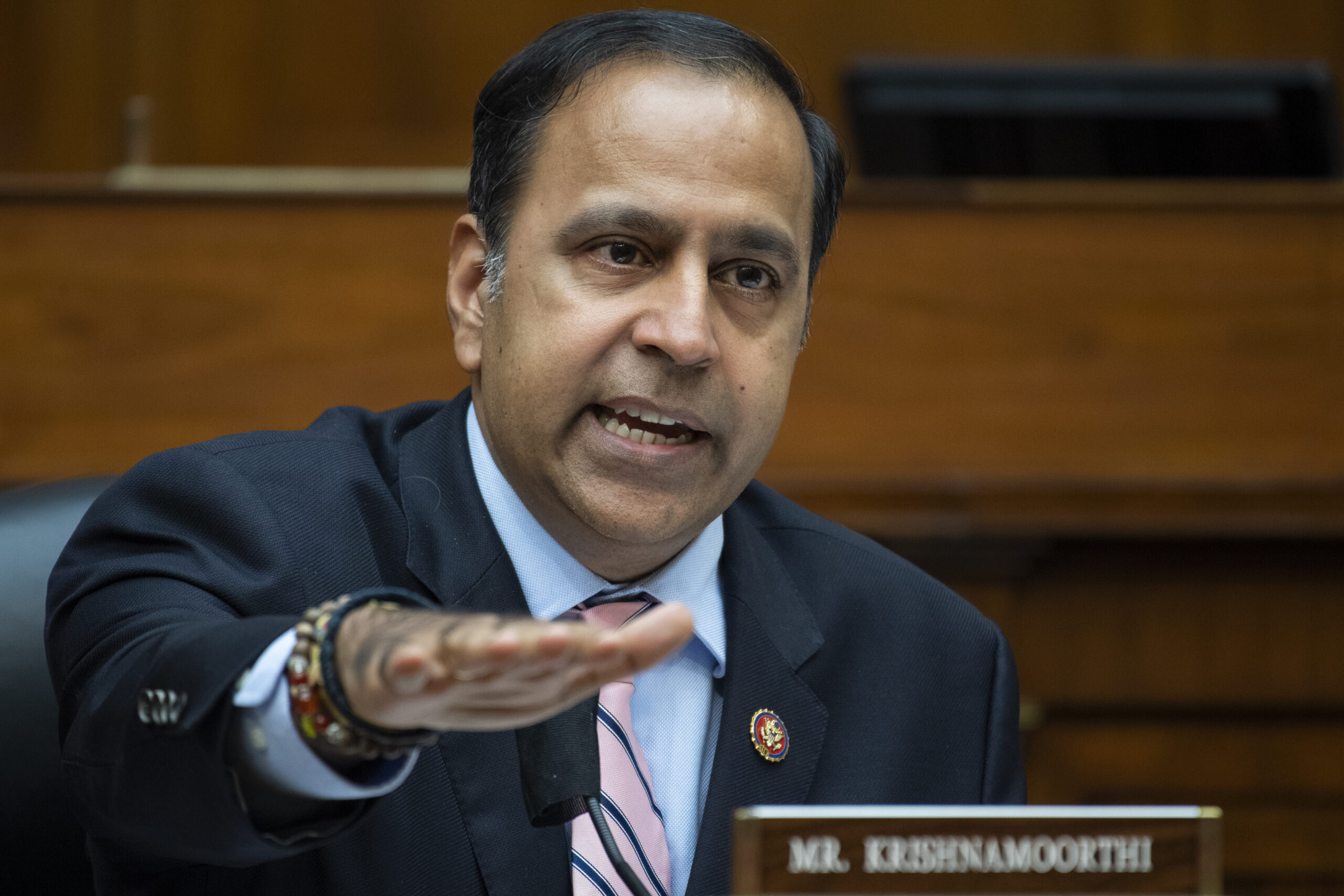
Lt. Gov. Juliana Stratton seems to be running to the congressman’s left on Israel, even as Rep. Robin Kelly is the most outspoken critic of Israel in the race
‘Today, many of the NGOs and technology providers that maintain these tools are facing closure due to funding cuts,’ the letter warns
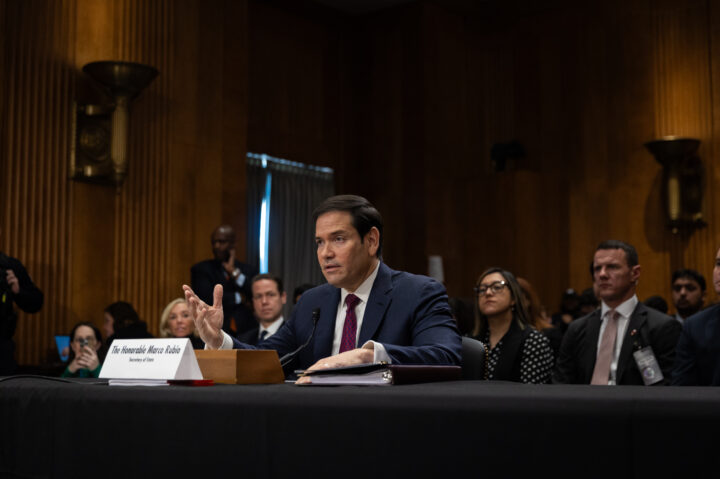
Nathan Posner/Anadolu via Getty Images
Secretary of State Marco Rubio testifies during a Senate Foreign Relations Committee hearing on Venezuela, in Washington, DC, United States on January 28, 2026.
A bipartisan group of senators wrote to Secretary of State Marco Rubio on Wednesday urging him to “surge resources to quickly enable critical internet freedom support” to protesters in Iran, pointing to funding cuts that have stretched resources for such programs.
“Today, many of the NGOs and technology providers that maintain these tools are facing closure due to funding cuts and more importantly, fewer Iranian citizens can share their videos and messages with the world and each other,” the letter warns. “Without the continuous operation of internet freedom programming carried out by the State Department and Open Technology Fund, millions of Iranians will lose their last secure window and voice to the outside world.”
The lawmakers, Sens. James Lankford (R-OK), Jacky Rosen (D-NV), Lindsey Graham (R-SC) and Cory Booker (D-NJ), warned that if U.S. programs fully lapse, regime-controlled programs and state media will step into the gap, “giving the regime near-total control over the digital space and putting users at far greater risk.”
“As we watch brave Iranians take to the streets, it is clear that supporting the Iranian people’s access to information is not a partisan issue but a matter of national security, as well as meeting legislative requirements for a strategy for promoting internet freedom in Iran,” the lawmakers said, pointing to existing legislation mandating the State Department to expand internet access in Iran. “The United States must pair its maximum pressure on the regime with maximum support for the Iranian people.”
The letter comes at a time when Congress has offered few of its own strategies to respond to the wave of protests around Iran — which, according to Rubio, have now largely been put down by the regime.
Such efforts to promote free internet access to the Iranian people, amid efforts by the regime to impose an internet blackout, have emerged as a key area of bipartisan agreement.
Much of the U.S.’ global communications programming, including funding for promoting internet access, was slashed last year amid cutbacks to various foreign aid programs. Some prominent Republicans have criticized the administration, saying that government-sponsored news programming and communications assistance have failed to meet the moment in Iran.
The letter emphasizes the “long-standing and bipartisan commitment” to supporting internet freedom programs, which are “more important than ever as the people of Iran protest against the regime in record numbers.” The legislators noted that prior administrations have, for two decades, supported various anti-censorship and internet freedom tools in Iran, and that Congress passed legislation in 2024 supporting such programs.
“Without U.S. leadership, an entire generation of Iranians would have remained in the dark — and the most powerful source of pressure against the Islamic Republic, the Iranian people themselves, would have been neutralized,” the letter reads.
It notes that the existing U.S. programs allowing a small number of Iranians to remain online had “proved decisive” during the Israel-Iran war last summer to demonstrate the division between the Iranian people and the regime, and said that expanded internet access now “would put a spotlight on the increasingly securitized atmosphere that is cracking down on dissent.”
The secretary of state also said that it is unclear who would take over Iran if the supreme leader were removed from power
Nathan Posner/Anadolu via Getty Images
Secretary of State Marco Rubio testifies during a Senate Foreign Relations Committee hearing on Venezuela, in Washington, DC, United States on January 28, 2026.
Secretary of State Marco Rubio said at a hearing before the Senate Foreign Relations Committee on Wednesday that the Iranian regime is historically weak due to serious economic troubles, but also said that Tehran’s violent crackdown on protesters has appeared to have successfully quelled the demonstrations that have swept the country in recent weeks.
Rubio also said that it’s uncertain who would take over the country if the Iranian regime were to fall. He framed the buildup of U.S. forces in the region — a U.S. carrier strike group arrived in the area this week — as a largely defensive measure to protect U.S. troops and allies from an Iranian attack.
“That regime is probably weaker than it has ever been, and the core problem they face, unlike the protests you saw in the past on some other topics, is that they don’t have a way to address the core complaints of the protests, which is that their economy is in collapse,” Rubio told senators.
“The reason why their economy is in collapse is because they spend all their money and all their resources building weapons and sponsoring terrorist groups around the world instead of reinvesting it back into their society, and as a result have taken on massive global sanctions which have isolated their economy and their country.”
He said the Iranian demonstrators want those sanctions removed and the regime to begin addressing their interests, “and this regime is unwilling to do it.”
Asked who would take over in the event that the Iranian supreme leader, Ayatollah Ali Khamenei, was removed from power, Rubio said that it was uncertain but suggested that the U.S. would expect to work with someone from within the Iranian government, rather than an outside actor, mirroring the approach it has taken in Venezuela.
“I don’t think anyone can give you a simple answer as to what happens next in Iran if the supreme leader and the regime were to fall, other than the hope that there would be some ability to have somebody in their systems that you could work toward a similar transition” as in Venezuela, Rubio said.
“I would imagine it would be even far more complex than [Venezuela] because you’re talking about a regime that’s been in place for a very long time, so that’s going to require a lot of careful thinking, if that eventuality ever presents itself,” he continued.
Addressing the U.S. military buildup in the region, he noted that the 30-40,000 U.S. troops in the region are within range of Iran’s arsenal of thousands of drones and short-range ballistic missiles. He said that the U.S. needs a “baseline” of “force and power” in the region to defend against that threat, if Iran “at some point, as a result of something” decided to attack U.S. forces.
“The president always reserves the preemptive defensive option — in essence, if we have indications that, in fact, they’re going to attack our troops in the region,” he continued, in addition to security agreements to defend allies such as Israel “that require us to have a force posture in the region.”
“I think it’s wise and prudent to have a force posture in the region that could respond and, potentially — not necessarily what’s going to happen — preemptively prevent the attack” against U.S. forces or allies, Rubio added.
The secretary of state said, however, that the violent crackdown by regime officials on the protests, which he said has killed thousands of people, has been “effective and … it’s horrifying.”
Though he said the protests have now “ebbed,” he said he was confident that “they will spark up again in the future because this regime, unless they are willing to change, or leave, have no way of addressing the legitimate and consistent complaints of the people of Iran who deserve better.”
Asked by Sen. Brian Schatz (D-HI) about the makeup of the Trump administration’s newly created Board of Peace — specifically why some close U.S. allies are not part of the group while U.S. adversaries are — and whether the body is intended to be a competitor to the United Nations, Rubio answered, “This is not a replacement for the U.N., but the U.N. has served very little purpose in the case of Gaza other than the food assistance, and so we think it’s critical to have something that’s in charge of that.”
Rubio noted that the Board of Peace was chartered through a U.N. resolution and said that the “primary and sole focus of that board right now is to administer Phase 2 and Phase 3 of the plan in Gaza.” He said that various countries have been invited to the board but some U.S. allies in Europe have declined to join or are waiting on parliamentary approval to do so.
Asked by Sen. Jacky Rosen (D-NV) whether the administration would be seeking congressional ratification or legislation to establish and join the Board of Peace, Rubio responded by again highlighting the U.N. Security Council’s support for and recognition of the board.
Rubio’s testimony came at a hearing focused primarily on the U.S. military operation in Venezuela in which former President Nicolás Maduro was arrested and U.S. policy toward Venezuela going forward.
He said that one of the Trump administration’s primary goals in conducting the operation was denying Iran, along with Russia and China, a foothold in the Western Hemisphere. He asserted that the success of the operation could help provide a deterrent to adversaries such as Iran, “because the U.S. is the only country in the world that could have done this operation.”
He also said that he does not anticipate further military action in Venezuela, but that the U.S. would act in case of a threat — offering as an example if Iran were to establish a drone factory in the country.
He further noted that Venezuela had been providing false passports to Iranian and Hezbollah operatives, which he described as deeply concerning.
During a heated back-and-forth with Sen. Tim Kaine (D-VA), Kaine referenced comments by acting Venezuelan President Delcy Rodriguez — who currently has Washington’s support — that the U.S. attack on Venezuela had “Zionist undertones.”
“What the hell did Delcy Rodriguez mean when she said this attack had Zionist undertones?” Kaine said. Rubio responded that he had “an idea what she meant” but Kaine pivoted and Rubio was not able to answer further.
A Trump administration source characterized Netanyahu's statement to JI as a minor issue that would likely be smoothed out within days
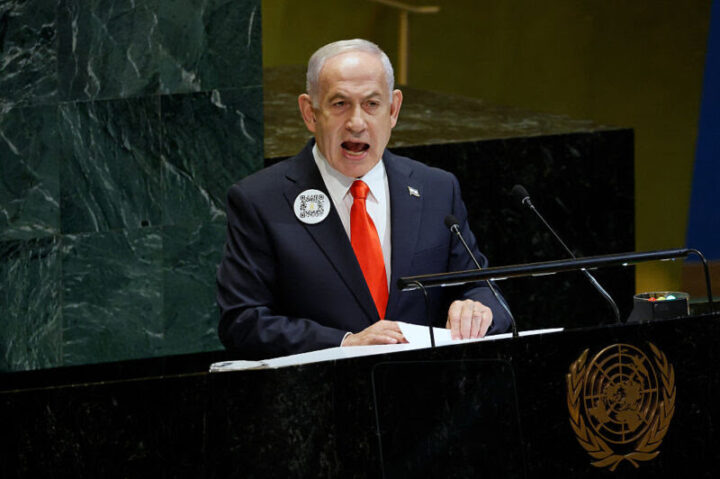
Taylor Hill/Getty Images
Prime Minister of Israel Benjamin Netanyahu speaks during the 80th session of the UN’s General Assembly (UNGA) at the United Nations headquarters on September 26, 2025 in New York City.
Israeli Prime Minister Benjamin Netanyahu opposes the composition of the executive board meant to oversee the rebuilding of Gaza, his office said on Saturday.
“The announcement regarding the composition of the Gaza Executive Board, which is subordinate to the Board of Peace, was not coordinated with Israel and runs contrary to its policy,” the Prime Minister’s Office stated. “The Prime Minister has instructed the Foreign Affairs Minister to contact the U.S. Secretary of State on this matter.”
Netanyahu emphasized his objection in a speech to the Knesset on Monday, saying that “there will be no Turkish or Qatari soldiers in Gaza. We are currently in a dispute with the U.S. over the makeup of the advisory council for Gaza.”
Though Netanyahu said the board was not coordinated with Israel, he spoke with President Donald Trump twice in recent days, and Mossad Chief David Barnea met with White House Special Envoy Steve Witkoff on Friday. The calls and meetings were reportedly about Iran.
The White House announced on Friday that several committees to govern Gaza and oversee its reconstruction and administration had been formed, including the Gaza Executive Board.
The Gaza Executive Board is meant to support the office of the high representative for Gaza and the National Committee for the Administration of Gaza, which is made up of Palestinian technocrats. It includes Witkoff, Jared Kushner, former U.K. Prime Minister U.K. Tony Blair, Apollo Global Management CEO Marc Rowan, Israeli-Cypriot businessman Yakir Gabay, head of Egyptian intelligence General Hassan Rashad, UAE Minister for International Cooperation Reem Al-Hashimy, U.N. Special Coordinator for the Middle East Peace Process Sigrid Kaag, and the previous holder of that position, Nickolay Mladenov, who will serve as the high representative for Gaza.
The board also includes Turkish Foreign Minister Hakan Fidan and Qatari diplomat Ali Al-Thawadi. Israeli officials have previously spoken out against Turkish involvement in Gaza’s reconstruction. Qatar has funded Gaza reconstruction in the past, with significant funding and dual-use materials reaching Hamas; the terrorist group’s leaders have also resided in Doha.
A Trump administration source characterized Netanyahu’s statement to Jewish Insider as a minor issue that would likely be smoothed out within days.
The source noted that Turkish and Qatari representatives were key to negotiating the ceasefire in Gaza, which took effect in October, and that they call Witkoff and Kushner daily, and therefore have an influence on the process regardless of the titles they are given. He also added that Netanyahu has a direct line to Trump.
“It’s all based on whether Hamas demilitarizes or not,” he added. “If Hamas demilitarizes, that is what’s most important [above the composition of the board]. If Hamas doesn’t demilitarize, none of this matters. … The prime minister has a commitment from the president that Hamas will demilitarize.”
Israeli Opposition Leader Yair Lapid said that “Netanyahu is allowing Turkey and Qatar into Gaza. That endangers Israel’s security. That is not what our brave soldiers fought for for two years.
“Instead of releasing panicky statements of protest, Israel should offer a clear alternative, for Egypt to administer Gaza for the next 15 years, for Hamas to be disarmed, and work with American partners to strengthen Israel’s border,” Lapid added.
Israeli National Security Minister Itamar Ben-Gvir said that he supports Netanyahu’s “important message.”
“Gaza does not need an ‘executive board’ that will supervise its ‘rehabilitation,’ it needs to be cleaned of Hamas terrorists who should be destroyed, along with encouraging massive voluntary emigration, in accordance with President Trump’s original plan,” Ben-Gvir said. “I call on the prime minister to instruct the IDF to prepare to go back to war in Gaza using great force in order to achieve the central goal of the war, the destruction of Hamas.”
The White House also announced the members of the founding executive board of the Trump-chaired Board of Peace, whose purview is not limited to Gaza. Netanyahu told the Knesset on Monday that the board is meant to serve as an alternative to the United Nations, 66 of whose organizations the U.S. left earlier this month. The board is composed of Secretary of State Marc Rubio, Witkoff, Kushner, Blair, Rowan, World Bank President Ajay Banga and Deputy National Security Advisor Robert Gabriel.
Canadian Prime Minister Mark Carney and Argentinian President Javier Milei also accepted invitations from Trump to join the board, while Egyptian President Abdel Fattah al-Sissi and Turkish President Recep Tayyip Erdogan had yet to respond. French President Emmanuel Macron declined to join. Netanyahu was invited to join or send an Israeli representative, according to Ynet. Russian President Vladimir Putin was invited, as was President Alyaksandr Lukashenka of Belarus; Ukrainian President Volodymyr Zelensky received an invitation on Tuesday, Ukrainian Ambassador to Israel Yevgen Kornichuk told JI. China, Germany, Australia, Albania, Jordan, Egypt and Bahrain reportedly received invitations, as well.
Membership on the Board of Peace is for three years; Trump asked countries to pay $1 billion for a permanent seat, Bloomberg reported.
Trump appointed Aryeh Lightstone and Josh Gruenbaum, members of Witkoff’s team, to be special advisors to the Board of Peace, “leading day-to-day strategy and operations, and translating the Board’s mandate and diplomatic priorities into disciplined execution,” the White House stated.
The letter was signed by 45 House Republicans and 14 House Democrats

John McDonnell/Getty Images
Secretary of State Marco Rubio testifies before the House Committee on Appropriations | Subcommittee on National Security, Department of State, and Related Programs at the Rayburn House Office Building on May 21, 2025 in Washington, DC.
A bipartisan group of 59 House lawmakers sent a letter to Secretary of State Marco Rubio on Thursday urging the State Department to continue condemning Iran’s crackdown on protesters across the country.
The letter, led by Rep. Randy Weber (R-TX), encourages the Trump administration to remain vocally supportive of the protesters amid “the Iranian regime’s ongoing violent suppression of protests across Iran.” The lawmakers urged Rubio to continue speaking out and ensure “whole-of-government support” from the U.S. is presented publicly to Iranians.
“The Iranian people have made clear their demand for a secular, democratic, non-nuclear republic grounded in political pluralism and respect for human dignity,” the letter reads. “Protesters have also explicitly rejected all forms of authoritarian rule, whether Iran’s former monarchy dictatorship or its current theocratic system, and seek the right to determine their own future. Recent international reactions against the regime’s brutalities underscore the urgent global concern over continued violence against civilians and abuses of power in Iran.”
“We urge the Department of State to continue publicly condemning the Iranian regime’s violent repression of protesters, including attacks on hospitals and medical facilities,” it continues. “At this critical juncture, whole-of-government support is essential to reaffirm the United States’ commitment to universal human rights and solidarity with the Iranian people.”
The lawmakers also noted their “deep concern” about the ongoing crackdown against protesters.
“Credible reports indicate the use of lethal force, mass arrests, and intimidation against civilians exercising their fundamental rights,” they wrote. “We are particularly alarmed by reports that Iranian authorities have targeted civilian sites, including hospitals and medical facilities, denying injured protesters access to urgent medical care. Such actions constitute violations of international humanitarian and human rights law.”
Weber’s letter was cosigned by Reps. Don Bacon (R-NE), Andy Barr (R-KY), Austin Scott (R-GA), Nancy Mace (R-SC), Brian Babin (R-TX), James Walkinshaw (D-VA), Beth Van Duyne (R-TX), William Timmons (R-SC), Tom Tiffany (R-WI), Glenn Thompson (R-PA), Tom Suozzi (D-NY), Marlin Stutzman (R-IN), Pete Stauber (R-MN), Chris Smith (R-NJ), Maria Salazar (R-FL), John Rutherford (R-FL), Raul Ruiz (D-CA), Zach Nunn (R-IA), Donald Norcross (D-NJ), Jared Moskowitz (D-FL), John Moolenaar (R-MI), Mariannette Miller-Meeks (R-IA), Carol Miller (R-WV), Tom McClintock (R-CA), Nicole Malliotakis (R-NY), Zoe Lofgren (D-CA), Laurel Lee (R-FL), Mike Lawler (R-NY), Nick Langworthy (R-NY), Nick LaLota (R-NY), Tom Kean (R-NJ), Jeff Hurd (R-CO), Val Hoyle (D-OR), Andy Harris (R-MD), Brett Guthrie (R-KY), Michael Guest (R-MS), Josh Gottheimer (D-NJ), Carlos Gimenez (R-FL), Laura Friedman (D-CA), Scott Franklin (R-FL), Brian Fitzpatrick (R-PA), Scott Fitzgerald (R-WI), Randy Fine (R-FL), Randy Feenstra (R-IA), Jake Ellzey (R-TX), Danny Davis (D-IL), Jeff Crank (R-CO), Joe Courtney (D-CT), Herbert Conaway (D-NJ), Mike Carey (R-OH), Brendan Boyle (D-PA), Mike Bost (R-IL), Sanford Bishop (D-GA), Gus Bilirakis (R-FL), Aaron Bean (R-FL), Troy Balderson (R-OH), Mark Amodei (R-NV) and Rick Allen (R-GA).
“The Iranian people have made it unmistakably clear that they reject this regime and the system of repression it has imposed on them,” Weber said in a statement on the letter. “From mass arrests to targeting hospitals, the regime has shown it will use any means to silence political dissent. The United States must continue to condemn these abuses and stand with the Iranian people as they demand the right to determine their own future.”
‘It is pathetic that in the state with the fourth largest Jewish population in the United States, we don't have that,’ local Jewish leader Jeff Grayzel said
Michael M. Santiago/Getty Images
New Jersey Lt. Gov. Tahesha L. Way, speaks during a Naturalization Ceremony at Liberty State Park on September 17, 2024 in Jersey City, New Jersey.
Two Democratic candidates running in the crowded special election to replace New Jersey Gov.-elect Mikie Sherrill, including the state’s current secretary of state and lieutenant governor, criticized the state Assembly for failing to pass legislation codifying the International Holocaust Remembrance Alliance’s working definition of antisemitism.
Their comments came during a virtual forum hosted by the Jewish Democratic Council of America on Tuesday evening with most of the candidates in the race for the northern New Jersey House district, though some including Essex County Commissioner Brendan Gill, the likely front-runner, were missing; Gill was expected to join but organizers said he had unexpected family obligations.
“I, too, take offense that my own state did not adopt IHRA, and I will definitely move this forward as your congresswoman,” New Jersey’s lieutenant governor and secretary of state, Tahesha Way, said.
Multiple sources blamed the state’s governor and other senior Democratic officials for killing the bill due to concerns about political blowback from progressives targeting Democratic lawmakers who would vote for it.
Way issued a statement expressing similar support last week after the legislation failed to move forward in the legislature. “As we witness an alarming rise in antisemitism across our country, we must be unequivocal: hate has no place in our society. I will always stand by the Jewish community, and I support legislation adopting the International Holocaust Remembrance Alliance’s working definition of antisemitism in the New Jersey Assembly and will wholeheartedly support similar federal legislation if elected to Congress.”
Candidate Jeff Grayzel, the deputy mayor of Morris Township and a local Jewish leader who testified before the New Jersey Assembly in support of the bill, also expressed frustration that the legislation had failed, when similar legislation has passed in a majority of states.
“It is pathetic that in the state with the fourth largest Jewish population in the United States, we don’t have that,” Grayzel said.
In addition to her comments on the IHRA legislation, Way also emphasized her work with the New Jersey-Israel Commission, which falls under her purview as secretary of state, to address campus antisemitism, and said she would back efforts to “streamline access” to Nonprofit Security Grant Program funding.
She said that her trip with an American Jewish Committee delegation to Israel in 2019 “really underscored … the strong alliance between the U.S. and Israel,” and emphasized the need to rebuild Gaza without Hamas and to expand the Abraham Accords, as well as pursue a two-state solution.
Former Rep. Tom Malinowski (D-NJ), viewed as another top contender in the field, said that leaders need to police antisemitism on their own sides, while arguing that the far left “hates our leadership” and that the far right leads the GOP. He also called for proper resources and funding to combat domestic extremism, an effort he said is being undermined by shifting federal resources to immigration enforcement, and called for regulation of social media.
He said that he had a “perfect pro-Israel voting record in Congress as a pro-Israel Democrat,” while accusing Israeli Prime Minister Benjamin Netanyahu of dragging the war in Gaza out for his own interests, and calling for more pressure on both sides to continue the ceasefire agreement.
Grayzel, in his opening statement, described himself as a “proud Jew and a proud Zionist” and declared unequivocally that “anti-Zionism is antisemitism,” adding that he is running for Congress in part to stand up for the Jewish people.
He pushed back on suggestions from a fellow candidate that Israel is depriving members of its Arab population of equal rights, and emphasized his support for unconditional aid to the Jewish state.
Passaic County Commissioner John Bartlett noted that he had spent a year living in Israel studying at Hebrew University, experiencing the daily security threats that Israelis face. He said that he supports the continued U.S.-Israel relationship and rejected “arbitrary distinctions between offensive and defensive weapons.”
“I recognize the relationship between the United States and Israel as fundamental and rooted in shared democratic values. I’ve also heard loud and clear from you, your kids and your rabbis that families need to feel safe right here in New Jersey again. You can count on me to be a consistent and outspoken ally in Congress,” Bartlett said.
He also condemned those who are targeting the Jewish community over political differences with Israel, and said that he supports the IHRA working definition and the Antisemitism Awareness Act.
Army veteran and venture capitalist Zach Beecher noted that his wife is Jewish and they are raising their son Jewish, and highlighting his experience in combat in the Middle East. He called for expanded NSGP funding and greater Holocaust education.
He said he “categorically support[s] security assistance and the right of Israel to defend itself” following the Oct. 7, 2023, Hamas attacks on Israel.
Other candidates took a more hesitant stance toward support for Israel while expressing support for its right to exist.
Analilia Mejia, who leads a progressive advocacy group, said, “Israel has the responsibility to ensure freedom for all those who live within it,” and said U.S. funding should go “towards peace” and defensive systems “and not bombs.”
Community advocate Anna Lee Williams said, “I’m someone who really promotes peacebuilding and long-term diplomatic strategies so that we can properly support that. I think that’s the main thing — I just want to move forward in terms of, how do we use our partnership to value human rights and make sure that we are holding the Israeli government accountable when they are hurting people.”
Attorney J-L Cauvin, who has gone viral for his impersonations of President Donald Trump, said Netanyahu is “something of a monster,” and had “spit in the face of Joe Biden and is dragging America’s moral authority through the gutter.” Cauvin said that he wants to see less U.S. aid flowing to Israel.
On antisemitism, Cauvin highlighted his own experience with discrimination as the son of an immigrant and as a mixed-race person, arguing that he knows “how to fight it probably better than most people in this race.” He said that he had personally broken with a friend over his “disgusting” reaction to Oct. 7. He largely blamed Trump for the rise in antisemitism, saying he had given a “license to discriminate and speak horribly.”
Williams said her longtime partner is Jewish, and that they have had conversations about the fear that the Jewish community is feeling. She called for steps to make the Jewish community feel safe, to combat antisemitism online and in AI and to improve education.
Throughout the event, several of the candidates described the Trump administration’s policies, particularly its deportation efforts, as fascist and drew comparisons to the Nazi regime.
Grayzel said that the Jewish community “knows where fascism leads. We have an experience of what happened in Germany, and what happened in Minnesota last week is the next step in that fascist process,” referring to the killing of a woman by an Immigration and Customs Enforcement officer.
“We all know how the Nazis terrorized Jews in Germany, and ICE is now terrorizing our immigrants here in this country,” Grayzel said. “But I am so scared, so, so scared as a Jew of where this country is headed and how ICE is treating people and terrorizing them. It absolutely needs to stop.”
Malinowski agreed, describing the ICE arrests as “proto-fascist operations that we’re seeing on our street.”
Williams said, of recent ICE raids, “For those of us who are part of the Jewish community, and for anyone who studies history, alarm bells should be going off.”
Beecher alleged that a slogan displayed behind Homeland Security Secretary Kristi Noem at a news event this week echoed SS rhetoric, a characterization disputed by historians.
The former secretary of state said that the ‘emphasis’ on one global conflict ‘doesn’t do justice to the challenges that we are confronting’
MOFA/AFP via Getty Images
Former Secretary of State Hillary Clinton speaks during the Doha Forum in Qatar on December 7, 2025.
Former Secretary of State Hillary Clinton on Sunday underscored her recent comments that American youth are turning against Israel due to social media and lack of historical knowledge.
During a discussion on President Donald Trump’s foreign policy and global power dynamics at the Doha Forum in Qatar, Clinton was pressed by moderator Ravi Agrawal — the editor-in-chief of Foreign Policy, who has taken a critical stance toward Israel’s war against Hamas — to elaborate on her remarks at the recent Israel Hayom Summit, in which she said that young people lack “context” on the conflict and are exposed to “propaganda” on social media.
“How are you reflecting on your words and the controversy around it?” Agrawal pushed.
“I’ve had many conversations with very smart young people,” said Clinton, referring to a class that she teaches with the dean at Columbia University’s School of International Public Affairs. “In talking with them about their views, which they are entitled to those views based on whatever information they had, but they did not always know why they were saying what they said.”
“All I’m asking for is that people have a historical context, both for what has happened to the Palestinians and what has happened to the Israelis,” Clinton added.
Clinton again brought up an example of young Americans chanting “from the river to the sea,” a popular phrase within the Palestinian movement and one that pro-Israel and Jewish groups have taken as a call for the eradication of the Jewish state, in which students were unable to specify which river and sea they were speaking of.
“I think it is a provable fact that most Americans, and an even bigger percentage of young Americans, get their news from social media. If that is controversial, then people are not paying attention,” said Clinton.
Agrawal pushed back, saying that while there is “misinformation and disinformation,” that there is also “genuine anger” from young people who are “grappling with witnessing images that are livestreamed.”
Clinton cautioned that the public often fixates on Gaza at the expense of other major geopolitical crises.
“I’m angry about all of the human rights abuses. I’m angry about all of the excessive use of force,” Clinton responded. “So, of course, the suffering in Gaza is horrific. Full stop. Suffering everywhere is horrific. I think that the emphasis on one terrible conflict sort of doesn’t do justice to the challenges that we are confronting.”
The new ISGAP report cites authenticated Muslim Brotherhood documents describing the group’s strategy of entrenching itself in the institutions of Western democracies

Salah Malkawi/Getty Images
Jordanian police close the entrance of a Muslim Brotherhood headquarter after the announcement of banning the society in the country on April 23, 2025 in Amman, Jordan.
The Muslim Brotherhood’s influence has become increasingly pervasive in the United States, according to a new report by the Institute for the Study of Global Antisemitism and Policy, titled “The Muslim Brotherhood’s Strategic Entryism into the United States: A Systemic Analysis.”
President Donald Trump’s recent instruction to Secretary of State Marco Rubio to take steps toward banning Muslim Brotherhood-affiliated organizations came soon after ISGAP briefed policymakers from both parties and national security professionals, including Trump administration officials, in Washington and beyond about the study.
“For decades now, we’ve known that Islamism has been a problem within our liberal secular democracies,” ISGAP Vice President Haras Rafiq told the Misgav Mideast Horizons podcast. (Jewish Insider’s Lahav Harkov co-hosts the podcast.)
The new ISGAP report cites authenticated Muslim Brotherhood documents describing the group’s strategy – called tamkeen, which loosely translates to “empowerment” – of entrenching itself in the institutions of Western democracies.
“It was a 100-year plan, and they’re 43 years into it,” Rafiq said. “We looked at the who, why, what, where … and then analyzed how well we’re doing against it.”
The Muslim Brotherhood’s basic goals, he said, are “to set up a utopian Islamist state and enforce their vision of Sharia-based law on the whole state, and secondly, to spread that around the world. … [Their] tactic, the opium of the masses, is to wipe Israel off the map.”
In liberal democracies, one of the major elements of the plan is “figuring out a way to persuade Muslims, if you’re living in the West, that the Islam that your parents practice … is actually wrong and it fits into … innovation, false association with a deity, [and] haram, which means not allowed,” Rafiq said. “So first of all, change the Islam that’s practiced from within.”
The way the Muslim Brotherhood relates to non-Muslim societies, Rafiq said, is to “try to persuade others by using a faith-based identity politics which aligns with what they believe — that they are the proper Muslims. And over time, there are four key areas where they focus: One is political infiltration and legislation, the second is controlling the narrative, the media, the third is how they can increase the capacity [of those steps], and looking at Muslims and changing from within.”
Rafiq said that Muslim Brotherhood-sympathetic organizations latched onto the Sept. 11, 2001, attacks to increase their influence.
“It was a time when there was a lot of confusion,” he recounted. “What organizations like CAIR [the Council on American-Islamic Relations] and others were able to do was to latch onto people who wanted to understand who were these Muslims, why did people want to fly planes into the Twin Towers … and they actually were very quick to latch onto the media, the politicians, the people within civil society who were hungry to know more, and become one of the main voices.”
Texas Gov. Greg Abbott, a Republican, recently declared both the Muslim Brotherhood and CAIR to be foreign terrorist organizations banned from the state. Rafiq pointed out, however, that the state has not seized any assets or taken any concrete action against the organization.
The difference between CAIR, which presents itself as an advocacy group for a minority population, and other organizations that aim to do the same, Rafiq said, is that “ultimately, at the end of the day, the people who set up the organization actually are part of the Muslim Brotherhood Islamist worldview, and ultimately are trying to … use entrenchment to change the liberal democracy from within.”
Rafiq also cited ties between CAIR and unindicted co-conspirators in the Holy Land Foundation trial, the largest terrorism finance trial in the U.S., which shut down an organization that was funding Hamas.
“I guess other non-Islamist organizations that represent Muslims and other organizations don’t want those objectives and are not involved in these kinds of criminal activities,” he said.
CAIR has “been able to persuade and fool people that they’re actually representing Islam and Muslims and they’re the correct voices,” he said. Still, Rafiq cited polling that out of 1.9 billion Muslims worldwide, 1.4 billion reject Islamism, which includes the Muslim Brotherhood.
“The good news is still that the majority of Muslims around the world reject Islamism,” Rafiq said, while noting that he did not have specific data about the U.S.
However, Rafiq said that the Muslim Brotherhood has successfully inculcated young Muslims in the West with antisemitism.
“Antisemitism is a key tool that they use in the guise of being anti-Israel or anti-Zionist, etc., to recruit people to their worldview,” he said.
Rafiq called Qatar “the last man standing” in the Sunni Arab world, in that its regime supports the Muslim Brotherhood.
“Muslim Brotherhood Islamist ideology is deeply entrenched within all parts of [Qatar’s] civil society, all the way to the top,” he said. “As a result of this entrenchment … they’ve used tamkeen successfully across the board, from educating children all the way up to civil society organizations and the leadership. One can say the Muslim Brotherhood has a funding arm, which is directly the Emir and the institution, the country, the economy and the corporation that is Qatar.”
ISGAP has estimated that Qatar’s soft power assets worldwide are worth $1 trillion. The Gulf state is the largest state donor to universities in the U.S., and much of those donations are undocumented.
Qatar spreads the Muslim Brotherhood’s messages via Al Jazeera in Arabic and English.
“The English one will be a lot more palatable, but still pushing the Islamist narrative. The Arabic is downright nasty – and they get away with it, because what they’ve done is set up Al Jazeera as a corporation,” Rafiq said. “But they are 100% owned by the Qatari royal family. Therefore, in my view, when they operate in the U.S., they should [register] under the Foreign Agents Registration Act.”
Rafiq said the West can do more to make support for the Muslim Brotherhood more costly for Qatar and discourage its leadership from continuing. One example he gave is an ISGAP report exposing Qatari funding for Texas A&M, including a contract that said all of the research projects are property of the Qatar Foundation – including those with dual-use purposes that could be used to develop weapons. After initially denying the links, the president of the university pulled it out of Education City in Doha.
“That really hurt [Qatar],” Rafiq said. “The reason I know it hurt them was that we are constantly besmirched and lies are told about us and we are targeted by the Qatari government.”
Another win, Rafiq argued, was the Israeli strike on Doha in September.
“That was the key moment in which they realized that even though they have a defense agreement with the U.S., they can’t really hide. But the downside was that rather than actually use that and push on the advantage, what the U.S. government has done is create the situation with the ceasefire in Gaza … and pushed out countries like Saudi Arabia and the U.A.E. … and decided to bring in Qatar and Turkey, and that’s a problem.”
“We need more support from [the Trump administration] in terms of Qatar, and not to be taken in by geopolitics,” he added.
Rafiq compared fighting the Muslim Brotherhood without taking on Qatar to taking aspirin when you have cancer.
“Islamism is a virus or a cancer … which is spreading rapidly, and unless we deal with it, the root cause, and we persuade Qatar to stop funding it … it won’t really make a difference,” Rafiq said.
One of the challenges in combating Islamism, Rafiq said, is that “we don’t make it easy to recognize Islamism in the same way that we recognize fascism and communism … [because] they’ve been able to push this narrative so effectively of Islamophobia.”
“Islam is a set of ideas, a set of values. In a liberal democracy, no set of ideas should be beyond critique, satire or even parody, even if they are ideas that I believe – and I’m a Muslim,” he said. “The people who are intolerant have persuaded us that these concepts are intolerant; therefore, we fall in line.”
Hillary Clinton says anti-Israel sentiment among young people fueled by ‘propaganda’ on social media
Speaking at the Israel Hayom summit, Clinton recalled the ‘frankly shocking’ lack of understanding among her students at Columbia University
Alex Wong/Getty Images
Former U.S. Secretary of State Hillary Clinton delivers keynote remarks during a discussion at Georgetown University on December 2, 2025 in Washington, DC.
Speaking at the Israel Hayom summit in Manhattan on Tuesday, former Secretary of State Hillary Clinton warned of the influence of social media in shaping young people’s perceptions on Israel and the Israeli-Palestinian conflict.
“There is a great deal of valid concern about how Israel is viewed, not just around the world, but from the United States, how Jewish Americans are viewed, and what is being seen as a significant increase in antisemitism in real life and online,” said Clinton. “It’s time now that the hostages are back and people can breathe again, that everyone needs to take stock of where we are, both in Israel and in this country, learn the lessons that perhaps can help us determine a more productive future.”
Clinton said she believes growing hostility toward Israel is a “generational” issue, rather than a “Republican versus Democrat” divide.
“A lot of the challenge is with younger people. More than 50% of young people in America get their news from social media,” said Clinton, who added that the problem lies in the information users are receiving “and the conclusions they are drawing from it.”
Clinton recalled teaching at Columbia University, where she is a professor of practice at the School of International and Public Affairs, during and after the Oct. 7, 2023, terrorist attacks and seeing this impact firsthand.
“We began to realize that our students — smart, well-educated young people from our own country, from around the world — where were they getting their information? They were getting their information from social media, particularly TikTok. That is where they were learning about what happened on Oct. 7,” said Clinton. “What they were being told on social media was not just one sided, it was pure propaganda.”
Clinton said it was often difficult to engage in “reasonable discussion” in such a climate because students lacked historical knowledge and “had very little context,” calling it “frankly shocking.” She also warned that in addition to social media, she saw immediate and planned efforts to distort the context of the Oct. 7 attacks.
“There was an organized effort that was prepared literally on Oct. 8 to begin to try to both provide mis- and disinformation about what had happened on Oct. 7, what the meaning was, what the history between the Israelis and the Palestinians [was],” said Clinton.
A key way forward, according to Clinton, is finding an effective way to talk about Israel to the younger generation. She added that Israel has “the worst PR.”
“The story that needed to be told was not getting told as effectively as I thought it should. And I think that’s only worse now,” said Clinton. “We have to do a better job of talking through the importance of supporting Israel and Israel’s security in a way that crosses generations.”
Plus, Mamdani invokes antisemitic tropes in newly revealed video
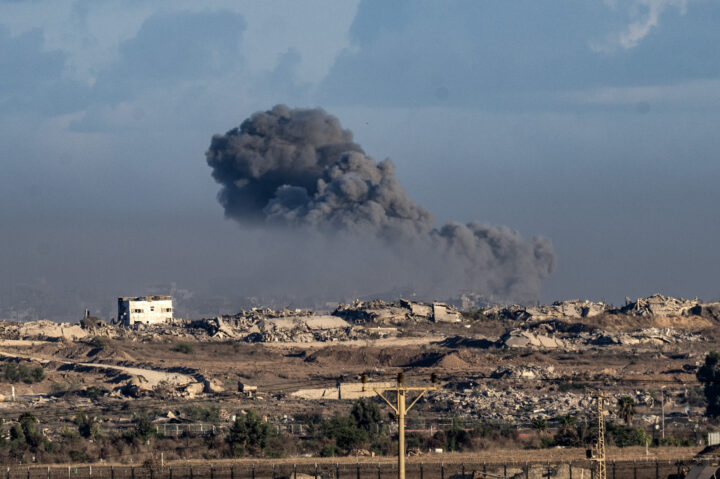
Mostafa Alkharouf/Anadolu via Getty Images
Smoke rises after Israeli airstrikes in the Gaza Strip, as seen from Israel near the border, on Oct. 7, 2025.
Good Tuesday afternoon!
This P.M. briefing is reserved for our premium subscribers like you — offering a forward-focused read on what we’re tracking now and what’s coming next.
I’m Danielle Cohen-Kanik, U.S. editor at Jewish Insider and curator, along with assists from my colleagues, of the Daily Overtime briefing. Please don’t hesitate to share your thoughts and feedback by replying to this email.
📡On Our Radar
Notable developments and interesting tidbits we’re tracking
Israeli Prime Minister Benjamin Netanyahu today ordered the IDF to “immediately carry out forceful strikes in the Gaza Strip” after Hamas terrorists opened fire on Israeli troops in the southern Gaza city of Rafah.
Hamas, in response, said it is postponing the release of a hostage body meant to be turned over to Israel today. Yesterday, Hamas staged the recovery of hostage remains that it reburied before handing to the Red Cross, caught on film by the IDF, which turned out to be partial remains belonging to a hostage who was already recovered by the Israeli army in 2023. Netanyahu said the act “constitute[d] a clear violation of the [ceasefire] agreement.”
Israeli officials told Axios that Netanyahu initially sought approval for action against Hamas from President Donald Trump, who is currently traveling in Asia, before moving forward, but there’s “no indication” the two leaders spoke before Netanyahu’s announcement on today’s strikes…
A senior Israeli official told Israel Hayom that Saudi Arabia has scaled back its participation in ceasefire talks after far-right Israeli Finance Minister Bezalel Smotrich made a disparaging comment last week on Saudi-Israel normalization, if it were to require the establishment of a Palestinian state. The statement (“No thank you, keep riding camels in the desert”) prompted blowback and he apologized shortly after.
“It’s not only because of Smotrich, but his comments certainly pushed [the Saudis] in that direction,” the official told the outlet. “Israel is now dealing with a bloc that includes Turkey, Qatar and Egypt — countries interested in preserving Hamas’ role in Gaza to varying degrees and refusing to pressure it to disarm”…
The Wall Street Journal traveled to an IDF outpost on the “yellow line” demarcating where Israeli troops have pulled back in Gaza. Israel is working on building water and electricity infrastructure and new aid hubs in the area and believes the entire line, which sits on high ground by design, is defensible from Hamas, Israeli officials told the Journal…
With a week to go until Election Day in the New York City mayoral race, new video has surfaced of Democratic nominee Zohran Mamdani invoking antisemitic rhetoric shortly before the Oct. 7, 2023, terror attacks.
Speaking at a Democratic Socialists of America convention in August 2023, Mamdani said, “For anyone to care about these issues, we have to make them hyper local. We have to make clear that when the boot of the NYPD is on your neck, it’s been laced by the IDF.” The idea that police brutality in the United States is caused by law enforcement training or coordination with Israel is a modern antisemitic trope.
Mamdani continued, “We are in a country where those connections abound, especially in New York City. You have so many opportunities to make clear the ways in which that struggle over there [Israel], is tied to capitalist interests over here”…
Meanwhile, The New York Times reports on the super PACs backing former New York Gov. Andrew Cuomo for mayor, which have raised him more than $40 million over the course of the election — compared to $10 million raised by super PACs for Mamdani and $1 million for Curtis Sliwa, the Republican nominee.
“The donors to the pro-Cuomo super PACs have included Michael R. Bloomberg, the former mayor; William Lauder, the chair of the Estée Lauder Companies; Ronald Lauder, the president of the World Jewish Congress; Bill Ackman, the investor; Steve Wynn, the casino investor; Daniel Loeb, the hedge fund manager; Barry Diller, the chairman of IAC; and Joe Gebbia, the co-founder of Airbnb,” the Times reports.
Bloomberg, who spent at least $8 million attempting to defeat Mamdani in the Democratic primary, met with him last month after he clinched the party’s nomination. Bloomberg was careful to note it was not an endorsement meeting, but rather a discussion on policy and staffing if Mamdani is elected mayor…
On the Hill, the nomination of Amer Ghalib, the mayor of Hamtramck, Mich., to be U.S. ambassador to Kuwait is facing what appear to be insurmountable odds as opposition to his confirmation grows among Senate Republicans, Jewish Insider’s Emily Jacobs reports.
Senators on both sides of the aisle had privately expressed reservations about Ghalib’s nomination prior to his rocky confirmation hearing in the Senate Foreign Relations Committee last week, but his attempts to evade responsibility for his support of antisemitic positions prompted several Republicans on the committee to go public.
Sen. Ted Cruz (R-TX) announced at the end of Ghalib’s hearing last Thursday that he would not be able to support moving his nomination out of committee to the Senate floor. Sens. John Curtis (R-UT), John Cornyn (R-TX) and Dave McCormick (R-PA) have since followed suit. Others on the panel, including Sen. Pete Ricketts (R-NE), have said they plan to raise their concerns about Ghalib with the committee chairman, Sen. Jim Risch (R-ID), and the White House…
Rep. Claudia Tenney (R-NY) will introduce a resolution this week affirming Israel’s sovereignty over the Temple Mount and demanding equal freedom of worship for all, JI’s Emily Jacobs scooped.
The resolution, if adopted, would put the House of Representatives on record as affirming “the inalienable right of the Jewish people to full access [of] the Temple Mount and the right to pray and worship on the Temple Mount, consistent with the principles of religious freedom.”
The current Israeli position, however, that Netanyahu has consistently affirmed, is to maintain the status quo at the holy site, which restricts Jewish prayer…
Rep. Elise Stefanik (R-NY), who led the the memorable questioning of university presidents at a House Education Committee hearing in December 2023, is coming out with a new book, titled Poisoned Ivies: The Inside Account of the Academic and Moral Rot at America’s Elite Universities, on April 7, 2026…
⏩ Tomorrow’s Agenda, Today
An early look at tomorrow’s storylines and schedule to keep you a step ahead
Keep an eye on Jewish Insider tomorrow morning for reaction in Washington to Israel’s latest strikes in Gaza in response to Hamas’ ceasefire violations.
Tomorrow, the Future Investment Initiative continues its ninth annual conference in Riyadh, Saudi Arabia.
In the evening, the Jewish Community Relations Council of Greater Washington is hosting its 2025 annual gala. Honorees include former Rep. David Trone (D-MD) and his wife, June, who is a JCRC board member; Behnam Dayanim, attorney and JCRC vice president; and Eva Davis, a realtor and co-chair of the Jewish Federation of Greater Washington’s Network Council.
Stories You May Have Missed
POSTWAR PLAN
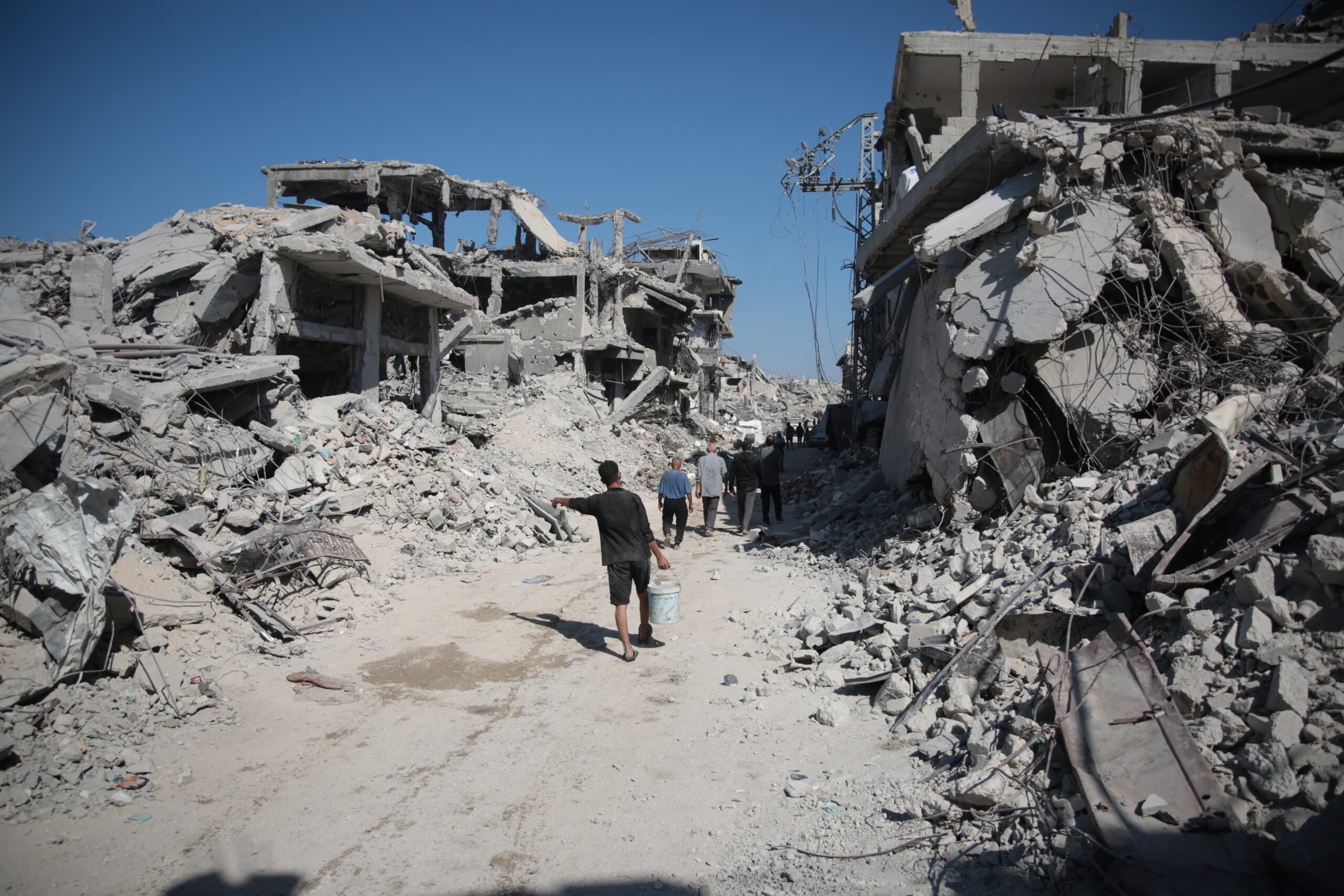
Experts say the IDF-controlled eastern region of Gaza could become a tool to isolate the terrorist group and reshape the enclave’s future, even as major hurdles remain
COPYCAT EFFECT

The DC area’s Jewish community council calls for the offending students to be disciplined
Plus, Brad Lander considers congressional bid
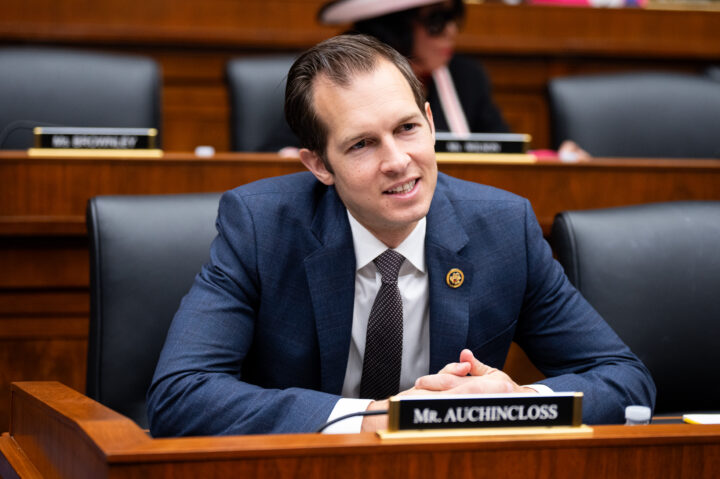
Bill Clark/CQ-Roll Call, Inc via Getty Images
Rep. Jake Auchincloss (D-MA) participates in the House Transportation Committee hearing on Thursday, June 27, 2024.
Good Monday afternoon!
This P.M. briefing is reserved for our premium subscribers like you — offering a forward-focused read on what we’re tracking now and what’s coming next.
I’m Danielle Cohen-Kanik, U.S. editor at Jewish Insider and curator, along with assists from my colleagues, of the Daily Overtime briefing. Please don’t hesitate to share your thoughts and feedback by replying to this email.
📡On Our Radar
Notable developments and interesting tidbits we’re tracking
Secretary of State Marco Rubio said today that Israel’s airstrike in Gaza over the weekend, which the IDF said targeted a Palestinian Islamic Jihad member who was planning a terror attack, did not violate the ongoing ceasefire with Hamas.
Rubio, who visited Jerusalem last week, told reporters standing next to President Donald Trump aboard Air Force One, “Israel didn’t surrender its right to self-defense. … We don’t view that as a violation of the ceasefire. They have a right — if there’s an imminent threat to Israel — and all the mediators agree to that”…
On the campaign trail, Rep. Jake Auchincloss (D-MA) became the first elected Democrat to call for Democratic Maine Senate candidate Graham Platner to drop out of the race to replace Sen. Susan Collins (R-ME), saying he finds the candidate’s conduct “personally disqualifying,” Jewish Insider’s Matthew Shea reports.
“This is a man who criticized and mocked police, rural Americans, and then put a Nazi tattoo on his body,” Auchincloss said. He expressed dissatisfaction with Platner’s defenses, in which the progressive candidate has claimed his actions aren’t a “liability.”
“I think it’s a liability, and I think we should have high standards for United States senators and one of them is: you don’t have a Nazi tattoo on your body,” Auchincloss continued…
Kevin Brown, the campaign manager for Platner, is stepping down after starting the job just last week, Axios scooped today. Brown told the outlet, “I started this campaign Tuesday but found out Friday we have a baby on the way. Graham deserves someone who is 100% in on his race and we want to lean into this new experience as a family”…
More than 160,000 New Yorkers submitted their ballot for New York City mayor with the start of early voting over the weekend, five times higher than the first weekend of early voting in 2021, according to Gothamist. Voters over 55 made up the majority of ballots cast, in contrast with the Democratic primary when voters ages 25-34 were first to the polls…
New York City Comptroller Brad Lander, who also ran in the mayoral Democratic primary and has been backing nominee Zohran Mamdani, is advancing plans to challenge Rep. Dan Goldman (D-NY) for his congressional seat, City & State New York reports.
“I’m very focused on helping Zohran win next Tuesday, and I’ll focus on after that, after that,” Lander told the outlet. At a rally for Mamdani over the weekend, Lander said “it’s more important than ever that we have leaders who understand this moment and will be partners to Zohran” in “the halls of Congress,” potentially hinting at his desire to run. Read JI’s reporting last month of the dynamics of a possible Lander-Goldman matchup…
Former Sen. John E. Sununu (R-NH), the former New Hampshire senator and part of an influential Granite State political family, officially launched his bid last week to take over the Senate seat of retiring Sen. Jeanne Shaheen (D-NH).
Sununu’s candidacy ensures a hotly contested GOP primary against former Sen. Scott Brown (R-MA), who served as ambassador to New Zealand during the first Trump administration. Brown, who announced his candidacy in June, served a partial term representing Massachusetts in the Senate from 2010-2012, only holding the seat for two years before being bested by Sen. Elizabeth Warren (D-MA).
Brown and Sununu, both of whom had pro-Israel records when they served in the Senate, will battle it out before taking on Rep. Chris Pappas (D-NH), the expected Democratic nominee with a history of winning in a swing district…
In an interview with The New York Times, Pennsylvania Gov. Josh Shapiro said that he still believes the U.S. could elect a Jewish president in his lifetime, even in the face of frequent antisemitic violence like the Passover arson attack on his residence.
“Being open about my faith has opened me up to be able to have a deeper relationship with the people of Pennsylvania, allowed them to share their stories … We’re doing that in this ultimate swing state,” Shapiro, seen as a 2028 presidential contender, said…
Semafor reports on a new survey of hundreds of thousands of voters, conducted by a new center-left group called Welcome, that finds that 70% of voters think the Democratic Party over-prioritizes cultural issues. The report urges Democrats “to abandon some of the progressive language about race, abortion, and LGBTQ issues that Democrats began using after the 2012 election — and recommends the nomination of more candidates willing to vote with Republicans on conservative immigration and crime bills”…
⏩ Tomorrow’s Agenda, Today
An early look at tomorrow’s storylines and schedule to keep you a step ahead
Keep an eye on Jewish Insider tomorrow morning for reporting on Fairfax County Public Schools’ reaction to glorifications of violence by local Muslim Student Association chapters.
Tomorrow afternoon, the Senate Judiciary Committee’s Subcommittee on the Constitution will hold a hearing on “Politically Violent Attacks: A Threat to Our Constitutional Order.”
Jewish Federations of North America will hold a briefing tomorrow on how the deal that split off ownership of TikTok’s U.S. business may impact the social media platform’s treatment of antisemitic content.
The 39th World Zionist Congress kicks off in Jerusalem tomorrow with the largest U.S. delegation in history, made up of 155 delegates and approximately 100 alternates. U.S. Ambassador to Israel Mike Huckabee will address a luncheon hosted by the American Zionist Movement ahead of the Congress’ opening.
Stories You May Have Missed
PEOPLE OF THE BOOK (CLUB)

The Jewish Book Council launched a new subscription service, Nu Reads, which provides six Jewish books per year, modeled on the success of PJ Library
QUAD CONTROL

In an interview with JI, the senior DOJ official said that while combating antisemitism is a priority, the Justice Department is focused on the Trump administration’s battle with DEI
‘Bibi-sitting’: Experts say Vance, Rubio trips to Israel part of U.S. efforts to constrain Netanyahu
The secretary of state’s trip follows a flurry of dispatched U.S. officials aiming to reassure Israel on security concerns and maintain a delicate ceasefire

HOCKSTEIN/POOL/AFP via Getty Images
US Secretary of State Marco Rubio waves before departure from Israel's Ben Gurion Airport in Lod on February 17, 2025, bound for Saudi Arabia.
Secretary of State Marco Rubio traveled to Israel on Thursday, becoming the latest senior official dispatched to the country by President Donald Trump as the fragile ceasefire between Israel and Hamas extends into its second week.
Rubio joins several other administration officials and representatives who have made the journey to Israel this past week, on the heels of the signing of the first phase of Trump’s peace proposal, including Vice President JD Vance, White House Special Envoy Steve Witkoff and advisor Jared Kushner.
The swift mobilization of U.S. officials comes as the Trump administration aims to lay the groundwork for the second phase of the deal and works to keep Israeli Prime Minister Benjamin Netanyahu from reigniting fighting in the Gaza Strip and fracturing a delicate peace deal, amid Hamas’ repeated violations of the agreement.
Vance, in his meeting with Netanyahu on Wednesday, emphasized that Israel is not a “vassal state” that needs to be told what to do.
The string of high-level visits is “not about monitoring in the sense of, you know, monitoring a toddler,” Vance told reporters alongside Netanyahu. “It’s about monitoring in the sense that there’s a lot of work.”
Meanwhile, ahead of his own visit to Israel, Rubio warned Israeli leaders that the West Bank annexation vote that passed the Knesset this week — championed by far-right MK Avi Moaz — threatened to derail the Trump-orchestrated ceasefire deal.
Chuck Freilich, an associate professor of political science at Columbia University, told Jewish Insider he sees it as a form of U.S. oversight, or “Bibi-sitting,” something he says is “long-standing tradition” in the U.S.-Israel relationship.
“From the U.S. perspective, you want to go over and reassure Israel its legitimate security concerns are not in jeopardy by continuing to adhere to the ceasefire,” said Jonathan Ruhe, a fellow for American strategy at the Jewish Institute for National Security of America. “I imagine that Rubio will be there to more echo and amplify the messages that have already been laid out, assuming the facts on the ground don’t change between now and then.”
While disagreements between the U.S. and Israel are not unusual, the Biden administration’s efforts to oppose Netanyahu’s preferred policies often led to accusations of insufficient U.S. support for the Jewish state.
During the Biden administration, senior officials, including Secretary of State Tony Blinken, were dispatched to the region to keep Israel from conducting military operations in the southern Gaza city of Rafah. At the time, Biden faced criticism from some in the pro-Israel world for restraining Netanyahu’s government from doing what they saw to be in Israel’s best interest during the war.
Given Trump’s high popularity in Israel in the immediate aftermath of the hostage-release deal, that blowback is not happening this time around. Freilich says the Trump administration’s exertion of restraint on Netanyahu from going after Hamas to uphold the ceasefire is different.
“Unlike with Biden, I don’t think there is a war to be won now that the U.S. is blocking,” said Freilich. “Israel has already done most of what it can do. The real problem is with phase two, how to dismantle and disarm Hamas and remove it as the governing body in Gaza. The administration is working on it intensively, including in all of these visits.”
The continued engagement is also a way for the Trump administration to provide Netanyahu cover from the right-wing coalition of his government, which had been more reluctant to end the fighting and make a hostage deal before the complete elimination of Hamas. The Trump administration may see holding them at bay as another way to keep the ceasefire intact.
David May, a senior research analyst at the Foundation for Defense of Democracies, said Rubio will be a worthy asset alongside Witkoff and Kushner, stating that his presence could help Israel get Hamas to “uphold a ceasefire that would effectively dismantle the terrorist group.”
“Dispatching Secretary of State Marco Rubio is a very positive development,” May told JI. “Rubio possesses immense knowledge of the issues and the actors with his decades of experience operating in U.S. foreign policy.”
This will be Rubio’s fourth visit to Israel since taking office in January. The secretary of state has a plethora of diplomatic experience with the Jewish state and has long expressed steadfast support for Israel’s war against Hamas in Gaza, dating back to his time in the U.S. Senate.
Less than one-quarter of House Democrats signed the letter, even as several European allies recognized a Palestinian state at the U.N.

Chip Somodevilla/Getty Images
Rep. Ro Khanna (D-CA) leaves the U.S. Capitol on March 13, 2024 in Washington.
Forty-seven progressive House Democrats, led by Rep. Ro Khanna (D-CA), signed onto a letter to President Donald Trump and Secretary of State Marco Rubio calling for the U.S. to recognize a Palestinian state on the heels of similar decisions by European allies last week.
“It has long been acknowledged by much of the international community and previous U.S. administrations of both major political parties that a Palestinian state recognized as a full and equal member of the community of nations is necessary to fulfill the legitimate national rights of the Palestinian people and ensure the state of Israel’s survival as the democratic homeland of the Jewish people,” the letter, which was first reported on by Jewish Insider, reads.
The lawmakers argue that because the current Israeli government opposes a two-state solution — a position currently shared by much of Israeli society — and is “actively undermin[ing]” the prospects of an independent Palestinian state, “meaningful action is necessary to join the majority of the world in codifying Palestinian statehood and to unlock the potential for a broader regional peace and security arrangement.”
Trump vowed last week week that he would not allow Israel to annex the West Bank.
The letter also claims that recognizing Palestinian statehood would make reform of the Palestinian Authority “far more achievable and sustainable.”
Signatories to the letter include Reps. Becca Balint (D-VT), Donald Beyer (D-VA), André Carson (D-IN), Greg Casar (D-TX), Joaquin Castro (D-TX), Judy Chu (D-CA), Danny Davis (D-IL), Madeleine Dean (D-PA), Diana DeGette (D-CO), Chris Deluzio (D-PA), Mark DeSaulnier (D-CA), Maxine Dexter (D-OR), Lloyd Doggett (D-TX), Veronica Escobar (D-TX), Dwight Evans (D-PA), Bill Foster (D-MA), Maxwell Frost (D-FL), John Garamendi (D-CA), Chuy García (D-IL), Sylvia Garcia (D-TX), Robert Garcia (D-CA), Al Green (D-TX), Val Hoyle (D-OR), Jared Huffman (D-CA), Jonathan Jackson (D-IL), Sara Jacobs (D-CA), Pramila Jayapal (D-WA), Hank Johnson (D-GA), Marcy Kaptur (D-OH), Zoe Lofgren (D-CA), Stephen Lynch (D-MA), Betty McCollum (D-MN), James McGovern (D-CA), Chellie Pingree (D-ME), Mark Pocan (D-WI), Mike Quigley (D-IL), Emily Randall (D-WA), Mary Gay Scanlon (D-PA), Jan Schakowsky (D-IL), Bennie Thompson (D-MS), Mike Thompson (D-CA), Jill Tokuda (D-HI), Paul Tonko (D-NY), Nydia Velázquez (D-NY), Maxine Waters (D-CA) and Bonnie Watson Coleman (D-NJ).
Dexter and Garcia were both beneficiaries of significant outside spending from AIPAC’s United Democracy Project super PAC in their primary races, running against farther-left anti-Israel opponents.
Balint and Schakowsky are both Jewish. Davis, Evans and Schakowsky are retiring from Congress at the end of their current terms.
Many of the furthest-left lawmakers in the House, including some of the Jewish state’s most outspoken critics, did not sign onto Khanna’s letter, nor did some of the more moderate Democrats backing a concurrent effort to place strict restrictions on U.S. aid to Israel.
The letter is backed by groups including American Muslims for Palestine, DAWN, Emgage Action, Indivisible, J Street, MoveOn, MPower, Muslim Public Affairs Council, New Jewish Narrative and the Quincy Institute.
There is a notable split on this issue within the Democratic caucus: Khanna’s letter follows a letter from 30 moderate pro-Israel Democrats condemning unilateral recognition of a Palestinian state as “performative” and saying that doing so risks “emboldening Hamas, entrenching division, and undermining the very legitimacy and peace such recognition purports to advance.”
The lawmakers also said unilateral recognitions of a Palestinian state are ‘performative’ and ‘risk emboldening Hamas’
Bill Clark/CQ-Roll Call, Inc via Getty Images
Rep. Jake Auchincloss (D-MA) participates in the House Transportation Committee hearing on Thursday, June 27, 2024.
A group of 30 House Democrats urged Secretary of State Marco Rubio to leverage a joint statement from the Arab League this summer — which called for Hamas’ disarmament and removal of power, the release of hostages and a path toward a two-state solution — as a potential diplomatic breakthrough for the region.
The lawmakers also condemned the unilateral recognition of a Palestinian state recently undertaken by several close U.S. allies.
“While there is much we disagree with in the statement, we do believe that this breakthrough presents a rare and urgent opportunity to ensure Israel’s security and create a brighter future for innocent Palestinians free from Hamas through American leadership,” the lawmakers said in a letter to Rubio on Thursday, emphasizing that it is the first time the Arab League has explicitly rejected Hamas.
“The statement made at the conference offers a unique opportunity — one that strengthens both Israel’s long-term security and Palestinians’ aspirations for self-determination under accountable, nonviolent leadership,” the letter continues. “While we once again emphasize that we do not endorse everything in the text, we recognize the unprecedented nature of the declaration and believe it presents a positive shift that opens the door to productive diplomacy and long-term solutions.”
The lawmakers urged Rubio to work with Israel to bring together regional and international partners to broker an agreement that would immediately and unconditionally free the hostages, remove Hamas from power in Gaza and achieve a “responsible deescalation of the conflict” in Gaza that would allow for rebuilding, governmental reform and peace.
They said that such an approach would be “far more constructive than recent unilateral and performative recognitions of a Palestinian state by other nations, which risk emboldening Hamas, entrenching division, and undermining the very legitimacy and peace such recognition purports to advance.”
“With regional partners signaling readiness to help facilitate both security and governance transitions, the United States has a pivotal role to play in turning principle into progress toward a two-state solution,” the letter reads. “This is a chance to protect Israel — our strongest ally — and align American values with regional momentum, and also leave a lasting legacy.”
The letter was led by Reps. Jake Auchincloss (D-MA), Debbie Wasserman Schultz (D-FL), Greg Landsman (D-OH) and Tim Kennedy (D-NY), joined by Reps. Dan Goldman (D-NY), Grace Meng (D-NY), Marilyn Strickland (D-WA), Emilia Sykes (D-OH), Josh Gottheimer (D-NJ), Frank Pallone (D-NJ), Jared Moskowitz (D-FL), Lois Frankel (D-FL), Kim Schrier (D-WA), Tom Suozzi (D-NY), Jimmy Panetta (D-CA), Brad Schneider (D-IL), Angie Craig (D-MN), Kevin Mullin (D-CA), Juan Vargas (D-CA), Ritchie Torres (D-NY), Chris Pappas (D-NH), Eric Swalwell (D-CA), Ted Lieu (D-CA), George Latimer (D-NY), Haley Stevens (D-MI), Darren Soto (D-FL), Greg Stanton (D-AZ), Nikki Budzinski (D-IL), Shri Thanedar (D-MI) and Wesley Bell (D-MO).
Craig, Pappas and Stevens are all running for the Senate in their respective states.
Democratic Majority for Israel supported the letter.
“The U.S. must act quickly to seize on this diplomatic opportunity which presents a unique opening to both ensure Israel’s security and create a future for Israelis and Palestinians free from the terrorist group Hamas,” the group’s CEO, Brian Romick, said in a statement. “While there is much we disagree with in the Arab League statement, its historic nature is unprecedented. By calling for the release of hostages, condemning the October 7 attacks, disavowing Hamas and endorsing a two-state path, Arab countries have signaled a potential willingness to be part of a new, constructive chapter for the Middle East.”
“At the same time, we call on all leaders to reject unilateral performative recognition of a Palestinian state which risks emboldening Hamas rather than advancing peace,” Romick continued.
Plus, Suozzi, Gillen join Never Mamdani camp

MENAHEM KAHANA/AFP via Getty Images
This picture taken from a position at Israel's border with the Gaza Strip shows Israeli military vehicles by the border fence in the besieged Palestinian territory on September 16, 2025.
Good Tuesday morning.
In today’s Daily Kickoff, we report on the ground operation Israel launched in Gaza City this morning and continue to cover Secretary of State Marco Rubio’s visit to Israel. We talk to Jewish social workers who are warning of growing antisemitism in the field and interview journalist and author Yaakov Katz about his new book about the Oct. 7 attacks on Israel. We also interview Rep. Zach Nunn about the U.S.-Israel military relationship. Also in today’s Daily Kickoff: Reps. Tom Suozzi, Laura Gillen and Debbie Wasserman Schultz.
Today’s Daily Kickoff was curated by Jewish Insider Israel Editor Tamara Zieve and U.S. Editor Danielle Cohen-Kanik, with assists from Marc Rod and Gabby Deutch. Have a tip? Email us here.
What We’re Watching
- The Israel Defense Forces launched a major ground operation in Gaza City on Tuesday morning, Israeli Prime Minister Benjamin Netanyahu and the military announced, Jewish Insider’s Lahav Harkov reports.
- Pennsylvania Gov. Josh Shapiro will be delivering a speech this morning on political violence in America at the Eradicate Hate Global Summit in Pittsburgh.
- The Senate Judiciary Committee is holding a hearing this morning on oversight of the FBI with FBI Director Kash Patel.
- Democratic Majority for Israel is hosting a live briefing with Rep. Josh Gottheimer (D-NJ) and former U.S. Ambassador to Israel Dan Shapiro on Gottheimer’s recent trip to Israel, next steps for the Abraham Accords and the latest in the Israel-Hamas war.
- The Center for a New American Security is holding a live fireside chat with Adam Boehler, the U.S. special envoy for hostage response.
- Alan Dershowitz, a former Harvard Law School professor and prominent defense attorney and Israel advocate, is speaking at the JFK Jr. forum at Harvard at the first “Middle East Dialogues” event of the academic year, hosted by professor Tarek Masoud, who invites polarizing speakers to debate the Israeli-Palestinian conflict.
- In the evening, American Friends of Lubavitch (Chabad) will host its Lamplighter Awards at D.C.’s Union Station. This year’s honoree is Palantir CEO Alex Karp, and House Minority Leader Hakeem Jeffries (D-NY) will receive a leadership award.
- Magen David Adom will host its 2025 New York City Gala in Manhattan, where political commentator Meghan McCain will receive its Champion of Israel Award.
What You Should Know
A QUICK WORD WITH jI’S MATTHEW KASSEL
As Zohran Mamdani wins support from a growing number of Democratic leaders in his bid for mayor of New York City, he has notably walked back some of his most polarizing views on several key issues — with one major exception: Israel.
In recent days, the Democratic nominee, who has long been an outspoken critic of Israel and its war in Gaza, has doubled down on his campaign vow to arrest Israeli Prime Minister Benjamin Netanyahu if elected, even as legal experts cautioned such a move could be illegal.
Mamdani, a vocal supporter of the Boycott, Divestment and Sanctions movement, also said that he would seek to divest city holdings in Israel bonds and terminate a program established by Mayor Eric Adams, who is running as an independent, to foster business partnerships between companies in Israel and New York City.
Meanwhile, Mamdani has refused invitations to explicitly condemn calls to “globalize the intifada,” even as he has acknowledged concerns from Jewish voters who see the phrase as provoking antisemitic violence. He has said he will instead discourage use of the slogan, which he himself has not used publicly.
The 33-year-old democratic socialist and Queens assemblyman has otherwise declined to denounce Hasan Piker, a far-left streamer who has said that “America deserved 9/11” and has used antisemitic rhetoric in commenting on Israel. Mamdani sat for a lengthy interview with Piker during the primary.
Mamdani’s unyielding approach to opposing Israel underscores just how central the issue is to his self-conception as an activist and an elected official long involved in such causes. “This is something that I will never stray from for the rest of my life,” he explained in a Zoom discussion in 2020 with a pro-Palestinian advocacy group. “This is kind of, in many ways, the founding battle for justice that I’ve had.”
FIELD FRACTURES

Like most social workers, Jennifer Kogan went into the field to help people. A therapist who works in Ontario, Canada, and Washington, she markets her private practice as “compassion-focused counseling.” Everyone is welcome here, a banner on her website states. But Kogan’s understanding of her profession has radically shifted in the two years since the Oct. 7 attacks in Israel. Despite its focus on compassion, the field of social work has been engulfed by antisemitism, according to a new report authored by Kogan and Andrea Yudell, a licensed clinical social worker in Washington and Maryland, Jewish Insider’s Gabby Deutch reports.
Called out: “Since Oct. 7, Jewish social workers have experienced unprecedented silencing, gaslighting, exclusion, isolation and public targeting in professional spaces,” states the report, which was published on Monday by the Jewish Social Work Consortium. The report’s authors claim that antisemitic rhetoric — and, in particular, anti-Israel litmus tests foisted on Jewish practitioners — has become endemic in the field. The report describes Jewish social workers being targeted on industry-wide email listservs, doxed and publicly called out during academic courses and lectures.
WTAER UNDER THE BRIDGE
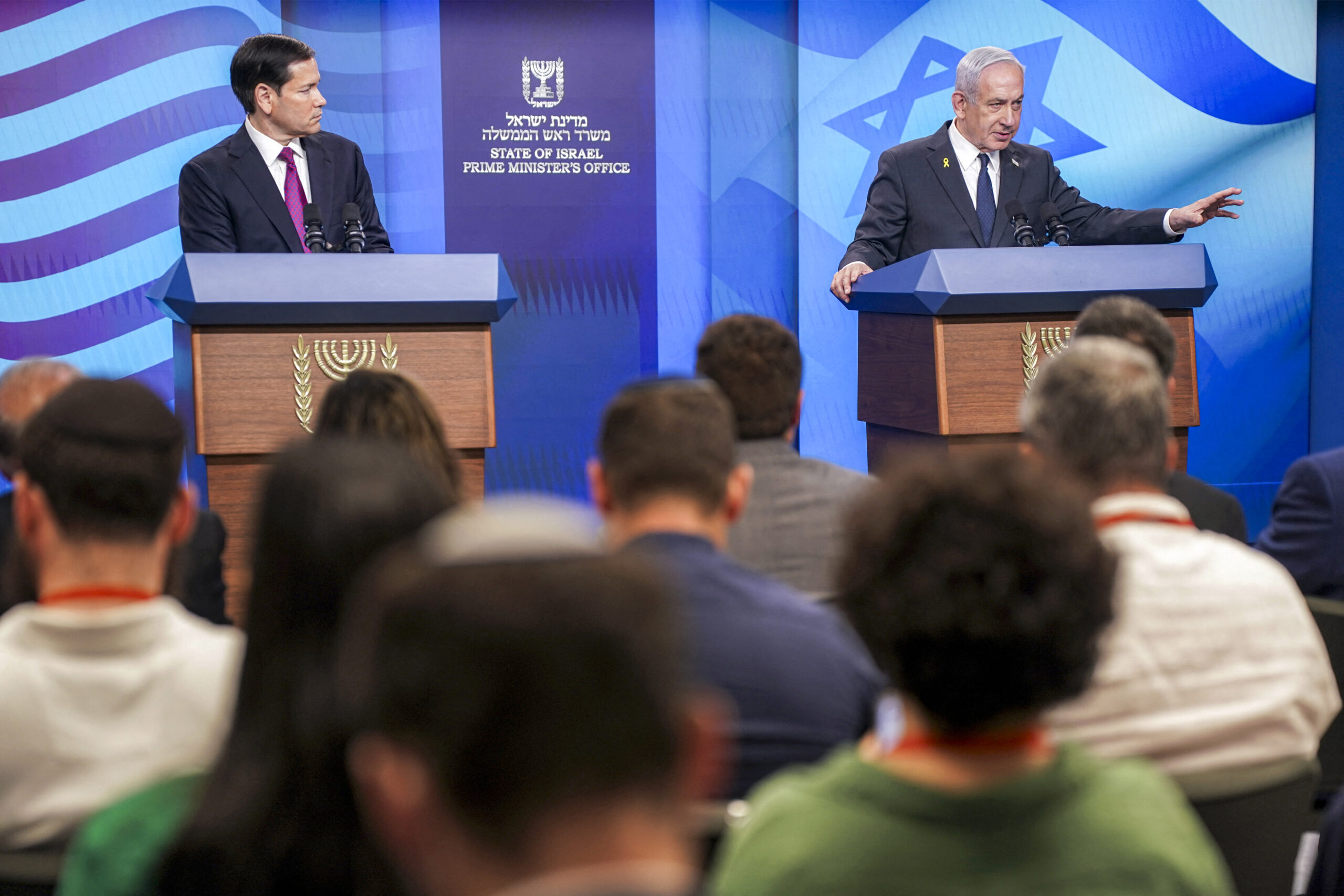
Secretary of State Marco Rubio said the U.S. is focused on moving forward from Israel’s strike on Qatar last week, refraining from doubling down on criticism during a joint press conference with Israeli Prime Minister Benjamin Netanyahu in Jerusalem on Monday, Jewish Insider’s Lahav Harkov reports.
What he said: “We are just focused on what happens next,” Rubio said, when asked about Tuesday’s strike aiming at Hamas’ leadership in Doha, Qatar’s capital. On Saturday, Rubio had echoed comments by President Donald Trump that the U.S. “is not happy” about the strike. “Some fundamentals still remain that have to be addressed, regardless of what has occurred,” Rubio said at the press conference on Monday. “We still have 48 hostages. Hamas is holding not only 48 hostages but all of Gaza hostage … As long as they still exist, are still around, there will be no peace in this region.”
Economic isolation: Netanyahu predicted yesterday that Israel will have to become increasingly self-reliant as countries call for embargoes and sanctions against the Jewish state. Speaking at a Finance Ministry conference in Jerusalem, Netanyahu said, “We will increasingly need to adapt to an economy with autarkic characteristics.”
Diplomatic isolation: The Washington Institute for Near East Policy’s Robert Satloff sounds an alarm on Israel’s growing international isolation, highlighting the U.N. Security Council’s condemnation of Israel’s strike in Qatar and the U.N. General Assembly’s endorsement of a French and Saudi plan for Palestinian statehood.
defense innovation
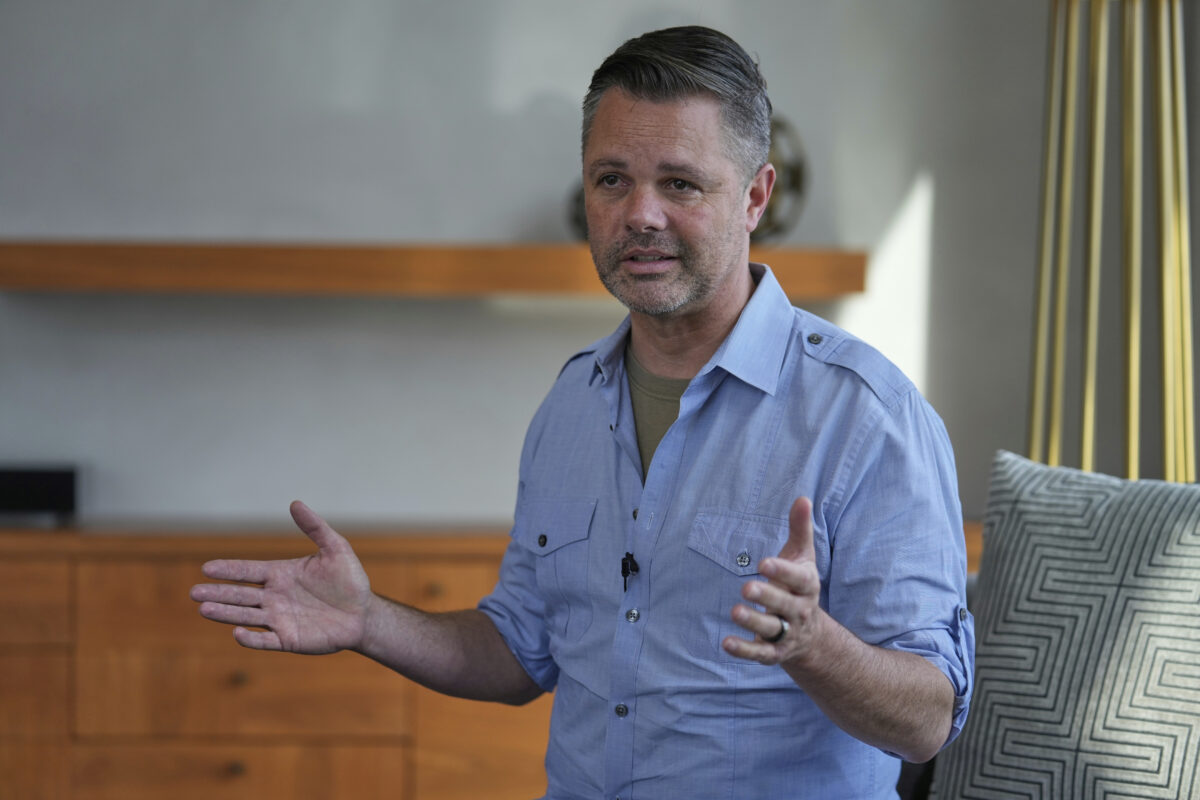
For Rep. Zach Nunn (R-IA), the U.S.-Israel military relationship is crucial to pushing the boundaries of defensive technological development, keeping Americans safe, staying ahead of global adversaries and even providing advancements in sectors far-removed from the battlefield, Jewish Insider’s Marc Rod reports.
Notable quotable: “We know that not only is Israel our best military partner for the region, it is the best stabilizing force,” Nunn, who led a pair of successful amendments in last week’s National Defense Authorization Act markup on the House floor aimed at improving U.S.-Israel military cooperation, told JI in a recent interview. “Not only is Israel a force for good in the region, it’s one of our best innovative partners out here, and national defense begins with a tech and human capability that’s able to execute on it. And that really is funded through democracies that allow this type of innovation to take place.”
DRAWING A LINE
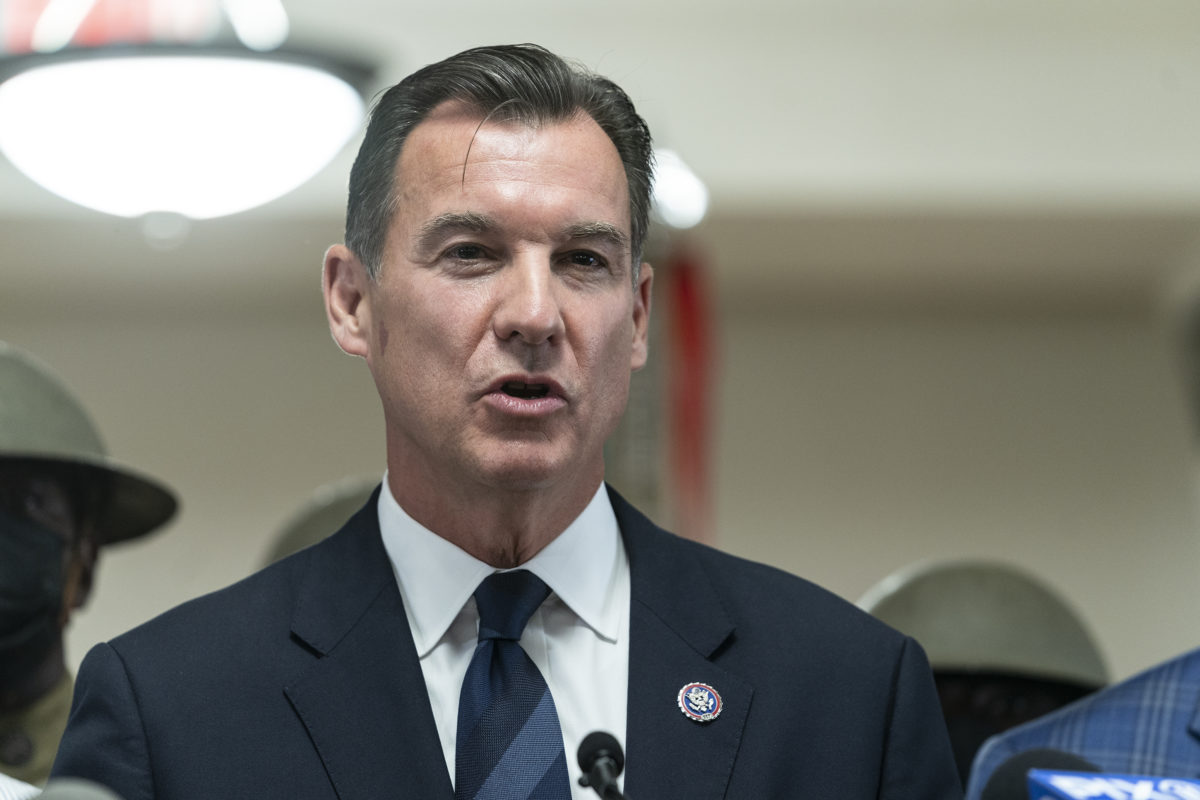
Rep. Tom Suozzi (D-NY) announced on Monday that he would not endorse Zohran Mamdani, the Democratic nominee for mayor of New York City. Suozzi, who represents a Long Island-based swing district on the outskirts of New York City that takes in a slice of Queens, said in an interview with ABC7 that, while he believes Mamdani is “very talented” and “very smart,” he feels the Democratic mayoral candidate’s policies would lead to increased costs for New Yorkers, Jewish Insider’s Emily Jacobs reports.
What he said: “Let me say very clearly: Mamdani is a very talented guy. He’s very smart, he’s very charismatic. … I have nothing against him personally, and I’m sure he’s a good person, but I completely disagree with his ideas. I disagree that we should raise taxes in New York City because people are leaving New York State and New York City as it is,” Suozzi said. “I’m all for making sure wealthy people pay their fair share at the federal level, so that wherever you go in the country you’re still going to have to pay, but not to encourage people to escape New York and go to Florida and go to Texas.”
Standing firm: Rep. Laura Gillen (D-NY) blasted New York Gov. Kathy Hochul for endorsing Democratic New York City mayoral nominee Zohran Mamdani, citing Mamdani’s record on antisemitism. “I completely disagree with the Governor’s endorsement of Mr. Mamdani,” Gillen told Jewish Insider’s Marc Rod. “At a time of skyrocketing antisemitism, his views are far too extreme and would fuel hate and threats against our Jewish community. His antisemitic views deserve to be condemned, not endorsed.”
grant get
The National Endowment for the Humanities announced Monday that it was awarding its largest-ever grant to the Tikvah Fund, a Jewish and pro-Israel educational nonprofit, for work to fight antisemitism, Jewish Insider’s Marc Rod reports.
Setting a record: The grant totals $10.4 million over three years and will support Tikvah’s Jewish Civilization Project, to “examine Jewish history, culture, and identity in the broader context of Western history” with the goal of fighting antisemitism “through greater understanding of the enduring moral, religious, and intellectual contributions of the Jewish people to the country and the Western world,” according to an NEH release.
book shelf
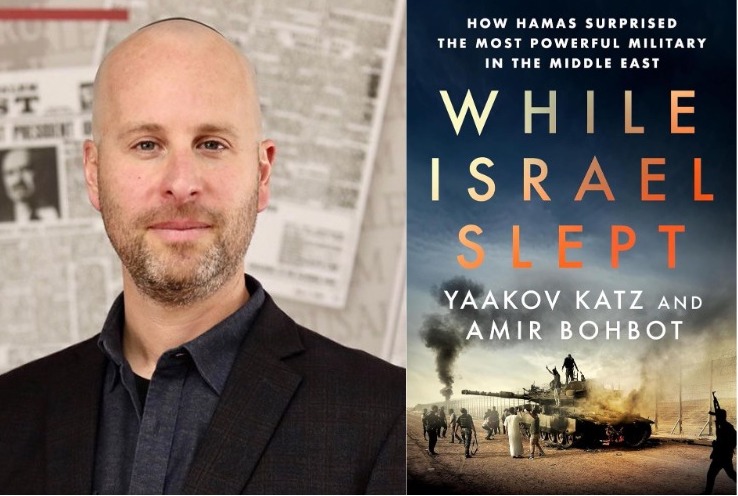
In the two years since the Oct. 7, 2023, attacks on Israel, there have been many books in multiple languages published on the topic — personal accounts, tales of heroism, a hostage memoir — but While Israel Slept: How Hamas Surprised the Most Powerful Military in the Middle East by Yaakov Katz and Amir Bohbot may be the most comprehensive. In the book, Katz, the founder of the MEAD (Middle East-America Dialogue) and former editor-in-chief of The Jerusalem Post, and Bohbot, a veteran Israeli defense reporter, answer the biggest questions about that day, going through the events leading up to the attacks, including the fateful night before. The book also dedicates chapters to stark warnings that an Oct. 7-style attack could happen again if Israel does not make necessary changes. In an interview with Jewish Insider’s Lahav Harkov and Asher Fredman, the executive director of the Misgav Institute for National Security and Zionist Strategy, on the “Misgav Mideast Horizons” podcast last week, Katz said that his “deepest fear is that this could happen again.”
The sound of silence: “Eventually, quiet will set in,” Katz said. “And I fear that Israel will fall back in love with the quiet and will neglect, to some extent, the vigilance that it will require to prevent Hamas from being able to … reconstitute itself.” While Katz said he is skeptical Hamas could again launch attacks at the scale of Oct. 7, “to prevent them from rebuilding and reconstituting … will require a major effort that Israel has never really done.”
Worthy Reads
Charlie Kirk and the Debate on Israel: Semafor Editor-in-Chief Ben Smith writes about what the right-wing debate over Charlie Kirk’s views on Israel say about the future of the MAGA movement. “Future historians will puzzle over why the conflict between Israel and Palestine has been the issue, above all others, to split both US political parties in the 2020s. But one thing the feuding MAGA factions agree on is that there isn’t really another prominent figure like Kirk — a big voice who was focused on smoothing over his movement’s fractures, not hashing them out in public for clout. The only other one, in fact, is Donald Trump, who has proven — in his transactional way — a master of holding together disparate Republican factions. But so far, Trump has firmly chosen Israel’s side in the intraparty dispute. And now it’s not clear who remains to try to smooth over the generational divide, or who would even want to try.” [Semafor]
The Social Media Curse: Jewish Journal Editor-in-Chief David Suissa applauds Gov. Spencer Cox’s statement that “Social media is a cancer on our society right now,” and call for people to “log off, turn off, touch grass,” a message Cox conveyed as he announced the arrest of the suspect in the killing of Charlie Kirk. “We’ll hear plenty of sermons during the upcoming Holy Days, but I can’t help wishing that every rabbi finds a way to squeeze in that message. Why? Because our country has gone off the deep end. The reactions to the murder of Charlie Kirk have brought out our worst. The poor guy can’t die in peace without becoming a lightning rod for our societal dysfunctions. Unlike the old days before social media, today this toxic ugliness is front and center and screeching loud. Indeed the minute Kirk died, armies of social media soldiers put on their uniforms and let fly their predictable bullets. When Cox called social media a ‘cancer on our society,’ he might have added that it’s also an addiction.” [JewishJournal]
The Clock is Tik(Tok)ing: Carrie Filipetti, executive director of the Vandenberg Coalition, calls for the Trump administration to enforce the ban on TikTok in The Washington Post ahead of the Sept. 17 deadline for the company to be acquired by an American company or face a ban, calling it “critical to heading off a military confrontation and, if necessary winning one” against the Chinese Communist Party. “Imagine the following scenario. China decides to attack Taiwan, and, fearing the United States will come to Taiwan’s aid, launches preemptive strikes against American targets overseas. In the United States, Chinese operators launch drone attacks from secret bases located on more than 380,000 acres of farmland China has purchased. As the government considers its options, the 170 million American TikTok users open their feeds to thousands of bots disguised as people, rattling off anti-American propaganda; encouraging young students desperate for meaning to fight their own government; and spreading disinformation at such a rapid rate that it is impossible to discern fact from fiction.” [WashPost]
Word on the Street
Former New York Gov. Andrew Cuomo called Israel’s war in Gaza “horrific” in an interview with The New York Times on Monday and called for an immediate end to its military operations. “There is no doubt that the people of New York and the nation see the continued carnage that is happening and are deeply, deeply disturbed and want it over, and believe it has gone on way too long,” he said…
An independent United Nations inquiry has concluded that Israel has committed genocide in Gaza and that top Israeli officials, including Netanyahu, have incited genocide, in a 72-page report released today. Israel said it “categorically rejects this distorted and false report and calls for the immediate abolition of this Commission of Inquiry.” …
Washington Post columnist Karen Attiah said she was fired from the paper on Monday over her social media posts reacting to the Charlie Kirk assassination. Attiah, a far-left commentator, retweeted social media messages justifying the Oct. 7 Hamas attack on Israel as it was taking place…
The Fallen Servicemembers Religious Heritage Restoration Act, which aims to ensure that Jewish World War I and II veterans receive the proper grave markers reflecting their religion, passed the House. “This bill is an important step to allow for the research necessary to correct these errors and ensure there are resources for that work,” Rep. Debbie Wasserman Schultz (D-FL), who is leading the bill with Rep. Max Miller (R-OH), said. “This will make it possible for these brave Jewish servicemembers’ descendants to know that their loved one’s military service, life and religious heritage are properly honored”…
Micah Lasher, a New York state assemblyman and former aide to Rep. Jerry Nadler (D-NY), launched his campaign for his former mentor’s congressional seat on Monday…
Former Sen. Joe Manchin’s (I-WV) new book, Dead Center, comes out today, detailing his departure from the Democratic Party to become an independent, featuring scathing remarks for his former Democratic colleagues…
The New York Times investigates a series of trade and business dealings over the UAE’s access to AI chips that appear to be connected with cryptocurrency windfalls for the Witkoff and Trump families…
U.S. and Chinese negotiators have reached a framework deal for switching ownership of TikTok, in an effort to avert a threatened shutdown of the app…
HBO Max acquired the rights to a new series, “One Day in October,” the first scripted portrayal of the Oct. 7 attacks, filmed on location in Israel and based on real accounts. The show will premiere Oct. 7, 2025, the two-year anniversary of the attacks…
Israeli Prime Minister Benjamin Netanyahu said in an interview clip that accusations that he’s prolonging the war in Gaza for his own political purposes are “malicious and false.” The interview with Israel’s Channel 13, a rarity for Netanyahu, will air in full today…
Tzachi Braverman, Netanyahu’s chief of staff and close confidant, was approved to serve as Israel’s ambassador to the U.K., replacing Tzipi Hotovely at the end of her five-year term, though he likely won’t be posted to London for several months…
The Heritage Foundation released a report yesterday marking the fifth anniversary of the Abraham Accords, “looking back at all the Accords achieved and looking forward to the fulfillment of their tremendous potential.” …
UJA-Federation of New York announced new grants totaling approximately $7.8 million to expand support for Israel’s recovery and long-term rebuilding efforts, including recovery in Israel’s north and south and support for families including those of reservists, wounded soldiers and hostages, eJewishPhilanthropy’s Judah Ari Gross reports…
Sotheby’s is launching its new flagship at the Breuer Building in Manhattan in November by staging a major auction featuring the late Leonard Lauder’s $400 million art collection —including Gustav Klimt masterpieces —and an estimated $80 million group of artworks from the estate of Jay and Marian Pritzker…
The Monuments Men and Women Foundation stopped the auction of two Nazi-looted oil paintings from the collection of more than 300 works seized from Adolphe Schloss during World War II…
The New York Times announced a new weekly newsletter on religion and spirituality, hosted by the Times’ Lauren Jackson…
Lynn Forester de Rothschild is exploring a sale of a minority stake in the parent company of The Economist magazine, according to Bloomberg, which would mark the publication’s first ownership shakeup in over a decade…
Pic of the Day
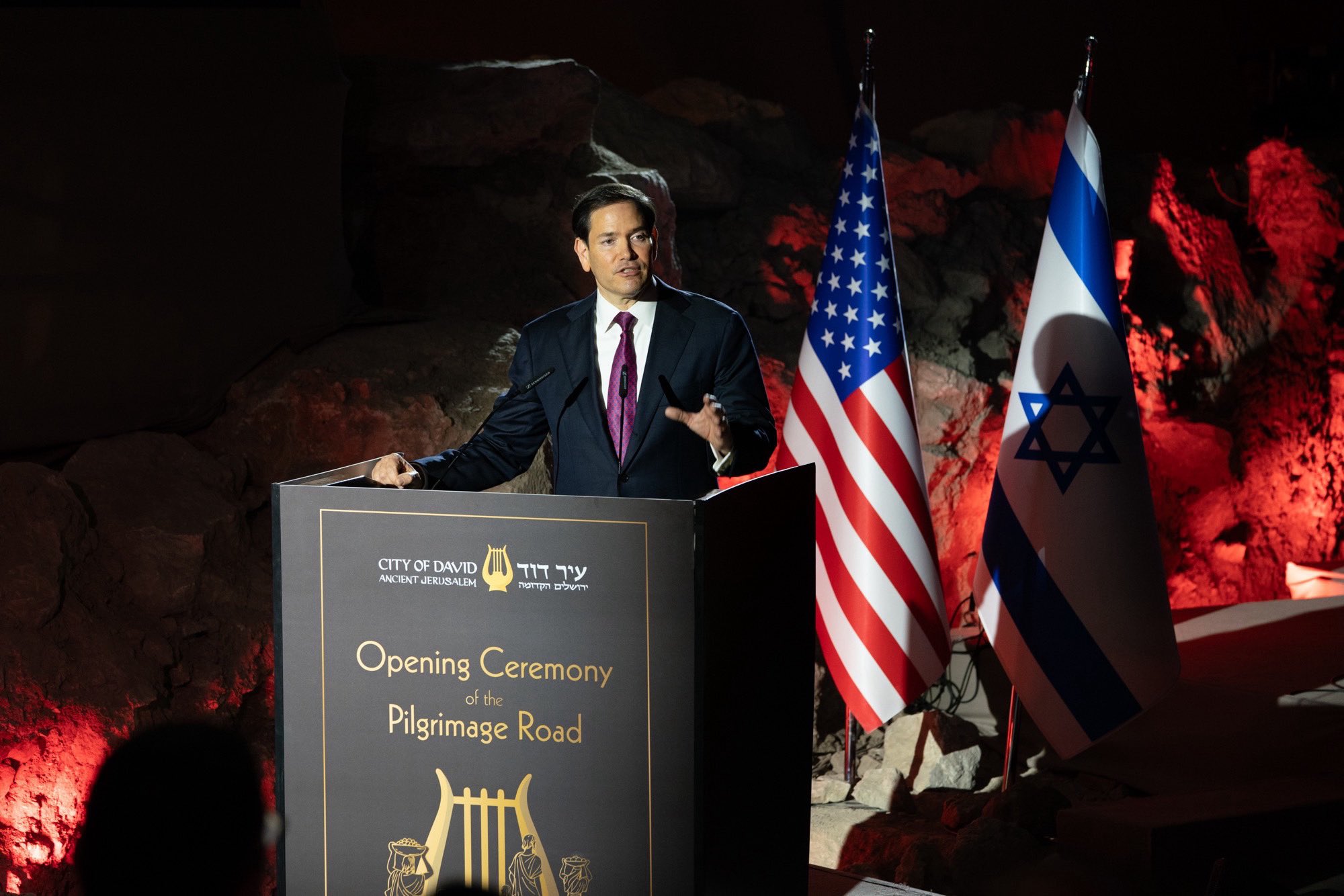
Secretary of State Marco Rubio attended the inauguration yesterday of the Pilgrimage Road archaeological site in the City of David, Jerusalem, calling the site “an enduring cultural and historical bond between the United States and Israel” and “a powerful reminder of the Judeo-Christian values that inspired America’s Founding Fathers.”
Birthdays
Israeli windsurfer, he won bronze in Atlanta 1996 and gold in Athens 2004, Israel’s first Olympic gold medalist, Gal Fridman turns 50…
Argentinian physician, author of books on gender relations, Esther Katzen Vilar turns 90… Democratic member of the Florida House of Representatives for multiple terms, in 2015 she became the president of Plaza Health Network, Elaine Bloom turns 88… NYC-based real estate investor and the founder of Cammeby’s International Group, Rubin “Rubie” Schron turns 87… Defense policy advisor to Presidents Reagan, Bush 41 and Bush 43 and member of a number of D.C. based think tanks, Richard Perle turns 84… Montebello, Calif., resident, Jon Olesen… Pompano Beach, Fla., resident, Shari Goldberg… Israeli playwright and screenwriter, Motti Lerner turns 76… Sheriff of Nantucket County, Mass., James A. Perelman turns 75… Founder and CEO of OurCrowd, Jonathan Medved turns 70… Media sales consultant, Fern Wallach… Award winning illusionist, who has sold tens of millions of tickets to his shows worldwide, known professionally as David Copperfield, David Seth Kotkin turns 69… Anthropology professor at Cornell, his work centers on Jewish communities and culture, Jonathan Boyarin turns 69… Director of stakeholder engagement at the National Council of Jewish Women, he is a nephew of former U.S. Sen. Herb Kohl, Dan Kohl turns 60… President and rabbinic head of Yeshivat Chovevei Torah Rabbinical School in Riverdale, N.Y., Rabbi Dov Linzer turns 59… Writer-at-large for The New York Times Magazine, Jason Zengerle… Mayor of Kiryat Motzkin, a city in the Haifa suburbs, Tzvi (Tziki) Avisar turns 47… VP of public affairs and corporate marketing at Meta / Facebook, Josh Ginsberg… President of basketball operations for the NBA’s Cleveland Cavaliers, Koby Altman turns 43… National field director at the Israel on Campus Coalition, Lauren Morgan Suriel… VP of customer success at SimpliFed, Suzy Goldenkranz… Actor, best known for starring in “The Secret Life of the American Teenager,” Daren Maxwell Kagasoff turns 38… NYC-based economics and wealth reporter at The Wall Street Journal, Rachel Louise Ensign… Israeli actress who played the lead role in Apple TV’s spy thriller “Tehran,” Niv Sultan turns 33… Winner of an Olympic bronze medal for Israel in Taekwondo at the 2020 Games in Paris, Avishag Semberg turns 24…
Commissioner of the Federal Acquisition Service, an office within the General Services Administration, Joshua Z. Gruenbaum turned 40 on Monday…
At a press conference with Israeli PM Netanyahu, Rubio said an agreement with Hamas to end war ‘probably won’t happen’ because ‘savage terrorists don’t often agree to disarm’
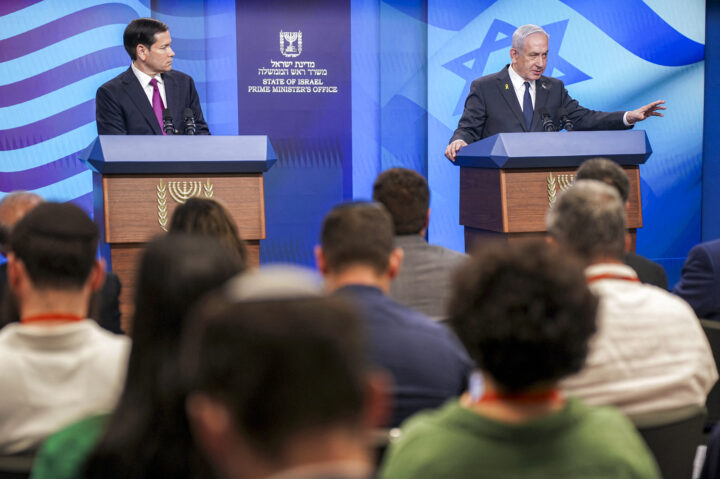
NATHAN HOWARD/POOL/AFP via Getty Images
Secretary of State Marco Rubio and Israeli Prime Minister Benjamin Netanyahu give a joint press conference at the Prime Minister's Office in Jerusalem on September 15, 2025.
Secretary of State Marco Rubio said the U.S. is focused on moving forward from Israel’s strike on Qatar last week, refraining from doubling down on criticism during a joint press conference with Israeli Prime Minister Benjamin Netanyahu in Jerusalem on Monday.
“We are just focused on what happens next,” Rubio said, when asked about Tuesday’s strike aiming at Hamas’ leadership in Doha, Qatar’s capital. On Saturday, Rubio had echoed comments by President Donald Trump that the U.S. “is not happy” about the strike.
“Some fundamentals still remain that have to be addressed, regardless of what has occurred,” Rubio said at the press conference on Monday. “We still have 48 hostages. Hamas is holding not only 48 hostages but all of Gaza hostage … As long as they still exist, are still around, there will be no peace in this region.”
Rubio said the end of the war in Gaza, disarmament of Hamas and freeing the hostages are “pillars of what we hope will happen in the region.”
The secretary of state said that the U.S. not only wants Qatar to continue to play a role in those matters “but also in a better future for the people of Gaza, which cannot happen with Hamas intact. We are going to continue to encourage Qatar to play a constructive role in that regard.” Rubio is scheduled to visit Qatar on Tuesday after concluding his trip in Israel.
As to the chance of a negotiated deal to end the war, Rubio said that “the problem is Hamas is a terrorist group, a barbaric group, committed to destroying the Jewish state, so it probably won’t happen.”
“I don’t think there’s anyone who wouldn’t prefer a negotiated settlement,” he added. “That would be the ideal outcome we can see, one we worked on, but we need to be prepared for the reality that savage terrorists don’t often agree to disarm.”
Netanyahu reiterated that “Israel’s decision to act against Hamas’ terrorist leadership was a wholly independent decision by Israel … It was conducted by us and we assume full responsibility for it, because we believe terrorists should not be given a haven.”
As to those saying Israel violated Qatari sovereignty, Netanyahu said that the U.S. took similar action against the Taliban in Afghanistan and Osama bin Laden in Pakistan.
“You don’t have such sovereignty when you are effectively giving a base to terrorists, a place where they can ply their gruesome trade,” he said.
Netanyahu also took issue with a claim made by a reporter during the press conference that the Doha strike was a failure, because it remains unclear if any of Hamas’ leaders were killed. The prime minister said Israel is waiting for further reports on the matter.
“I’ll tell you the results,” he added. “We sent a message to the terrorists. You can run, you can hide, but we’ll get you. … I don’t accept the premise that the raid failed, because it had one central message. … If the terrorists think they enjoy immunity they’ll do it again and again, and if you deny that immunity, they’ll think twice.”
Netanyahu opened the press conference by paying tribute to the “powerful bond” between Israel and the U.S. and thanking Trump for helping target Iran’s nuclear facilities in June, as well as his efforts to free the hostages remaining in Gaza, 20 of whom are believed to still be alive.
Rubio said that Iran is a threat not only because of its pursuit of nuclear weapons, but because of its development of short and midrange missiles that can reach across the Middle East and into Europe.
“This is an unacceptable risk not just for Israel but for the U.S. and the world, which is why the president has continued with his campaign of maximum pressure on Iran until they change course,” Rubio said. “We are encouraged by our partners in Europe beginning the process of snapping back [sanctions] on Iran, who are clearly out of compliance [with the 2015 nuclear deal]. We 100% support that; that’s what needs to happen.”
The secretary of state criticized countries that recently announced they would recognize a Palestinian state.
“The things these nations are doing in the U.N. are largely because of domestic politics. They’re largely symbolic. The only impact they have is to make Hamas feel emboldened … You know, there’s a negotiation going on and maybe you think you made some progress on getting hostages released and ending the war, and then these things come out and Hamas walks away … They see international support, they believe they’re getting what they want, and they walk away,” Rubio said.
Rubio also spoke about his plan to attend the inauguration of the Pilgrims Road on Monday evening. The site features the path on which Jewish pilgrims walked to the Second Temple in Jerusalem, which Rubio described as “perhaps one of the most important archeological sites on the planet, important to many in the U.S.”
The secretary of state arrived in Israel on Sunday, beginning his visit with prayers at the Western Wall with Netanyahu. He also met with Israeli Foreign Minister Gideon Sa’ar and Strategic Affairs Minister Ron Dermer on Monday.
Plus, Yossi Cohen talks to JI about political ambitions
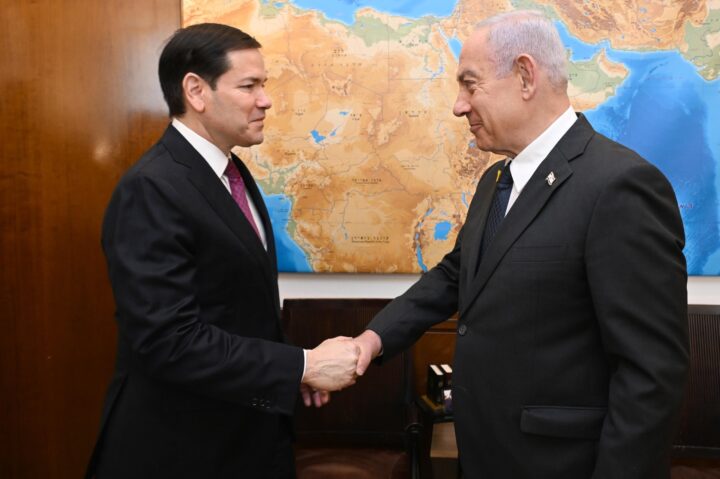
Haim Tzach/GPO
U.S. Secretary of State Marco Rubio meets Israeli Prime Minister Benjamin Netanyahu in Jerusalem, Sept. 15th, 2025
Good Monday morning.
In today’s Daily Kickoff, we cover Secretary of State Marco Rubio’s visit to Israel this week and interview former Mossad chief Yossi Cohen who is releasing a new book tomorrow amid talk that he may enter the political arena. We report on the retirement of Rep. Michael McCaul and highlight antisemitic, white nationalist views expressed by the suspected shooter who critically injured two students at Evergreen High School in Colorado last week. We also report on the anti-Israel views of state Rep. Chris Rabb, who is running in the Democratic primary race for Pennsylvania’s 3rd Congressional District. Also in today’s Daily Kickoff: Gov. Wes Moore, David Rubenstein and Esther Safran Foer.
Today’s Daily Kickoff was curated by Jewish Insider Israel Editor Tamara Zieve and U.S. Editor Danielle Cohen-Kanik, with assists from Marc Rod and Melissa Weiss. Have a tip? Email us here.
What We’re Watching
- Secretary of State Marco Rubio is set to attend the inauguration of the Pilgrim’s Road in the City of David in Jerusalem this evening after meeting earlier today with Israeli Prime Minister Benjamin Netanyahu and Foreign Minister Gideon Sa’ar. More below on Rubio’s visit to Israel.
- Seb Gorka, the White House’s senior director for counterterrorism and a deputy assistant to the president, is also in Israel this week. After landing at Ben Gurion Airport yesterday, he wrote on X, “Utterly sobering to see the pictures of all the innocent hostages still being held by Hamas for more than 700 days lining the walkway to passport control.”
- Also in Israel is a delegation of nearly 250 state lawmakers from around the U.S., organized by Israel’s Ministry of Foreign Affairs.
- A summit of Arab and Muslim leaders is being held in Doha, Qatar, today to denounce Israel’s strike on Hamas officials hosted by the Gulf state. Ahead of the gathering, Iranian Foreign Minister Abbas Araghchi met with his Qatari counterpart in Doha yesterday …
- Stateside, RJC board member Eric Levine is holding a fundraiser for Sen. Lindsey Graham (R-SC). The invite to the event, co-hosted by James Baker, Wayne Berman, Jeff Cohen, Steve Sall, RJC PAC and the NRSC, said the fundraiser will help Senate Republicans maintain their majority and “stand against the tide of communism and antisemitism overtaking the Democratic Party.”
- The Academic Engagement Network is hosting a three-day symposium for college administrators for the launch of its fifth annual Signature Seminar Series. The gathering, taking place in Washington, will focus on how administrations can meaningfully address antisemitism on college campuses.
- The Eradicate Hate Global Summit begins in Pittsburgh today.
- Today is the five-year anniversary of the signing of the Abraham Accords at the White House on Sept. 15, 2020.
What You Should Know
A QUICK WORD WITH JI’S GABBY DEUTCH
Over the weekend, the California State Assembly passed a bill that is intended to address what Jewish community advocates describe as crisis levels of antisemitism in the state’s K-12 schools.
The bill passed despite the objections of the powerful California Teachers Association, the state’s largest teachers’ union, which had stalled the legislation in July, claiming that efforts to combat antisemitism could impinge on teachers’ academic freedom when it came to discussing the Israeli-Palestinian conflict.
It was just one of several examples of influential state and national teachers’ unions presenting a roadblock against efforts to fight antisemitism in public schools, where discrimination against Jewish and Israeli students has skyrocketed over the past two years — even though many of those efforts have broad support from within the Jewish community, and from outside it, too.
In California, the CTA and anti-Israel groups like the Council on American-Islamic Relations were on one side of the issue, facing a diverse coalition of the bill’s backers that included the legislature’s Jewish, Black, Latino and Asian American and Pacific Islander caucuses. In an effort to appease the CTA during negotiations, some parts of the bill were removed, including language that would’ve defined what constituted an antisemitic learning environment.
But the union never changed course.
MOSSAD MEMOIR
Like any former Mossad chief, Yossi Cohen has long been a relatively elusive figure in Israeli public life. So his recent embrace of the spotlight has left Israeli politicos wondering whether he will run for prime minister in the next election. Cohen received attention for commanding ambitious Mossad operations, such as smuggling Iran’s nuclear archive to Israel, and for Israeli Prime Minister Benjamin Netanyahu reportedly naming him as one of his possible heirs, but he rarely gave interviews — until now. Cohen has been on a Hebrew media blitz ahead of Tuesday’s release of his new book, The Sword of Freedom: Israel, Mossad and the Secret War, in Hebrew and English. It reads, in many ways, like the kind of book a politician would publish before a big run, to let potential voters get to know him — albeit with the much more exciting elements of spycraft. Yet, in an interview with Jewish Insider’s Lahav Harkov last week at his office in a Tel Aviv high-rise, where Cohen’s day job is representing the Japanese investment holding company SoftBank in Israel, he dismissed the idea that his book was the first step in a political campaign.
A question of timing: “That was not the reason for me to write the book,” he said. “I started writing the book something like three years ago, much earlier. I decided to [publish the book] now, because I believe that now is the time … Since I started the book we had the judicial reform, the seventh of October, a war against Hezbollah and the Iranian events. Each of those chapters had to be updated.” Still, Cohen added, “I can’t say that one day it will not serve my political goals if I will decide to go into politics.” Thus far, Cohen has kept politics as an “if.” In the past, it was a “no,” he said, but now, he’s thinking about it.
ENDURING FRIENDSHIP
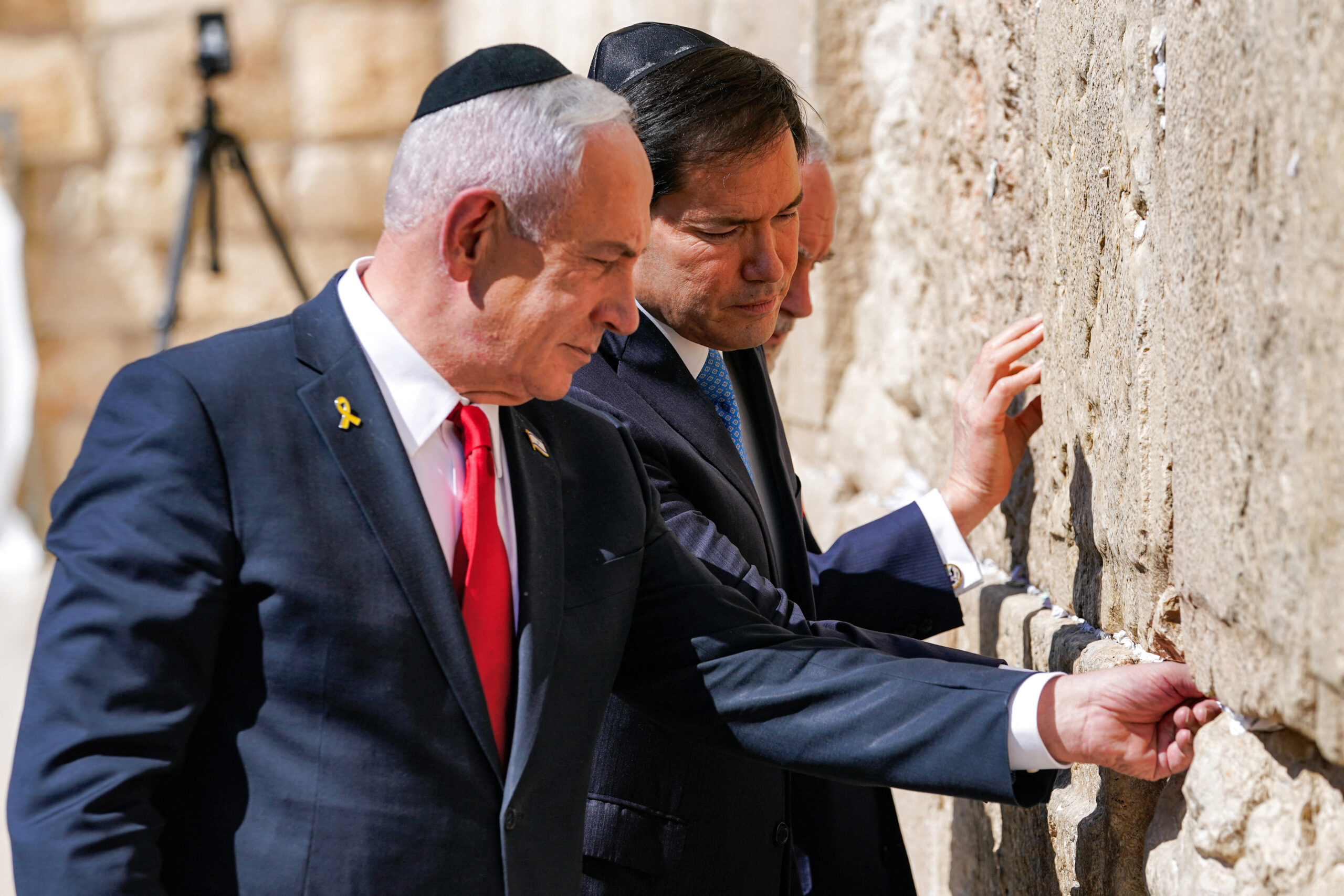
Secretary of State Marco Rubio arrived in Jerusalem on Sunday, at the start of a five-day trip to Israel and the U.K. Rubio began the visit with prayers at the Western Wall, together with Prime Minister Benjamin Netanyahu and U.S. Ambassador to Israel Mike Huckabee, Jewish Insider’s Lahav Harkov reports.
Premier praise: During a tour of the Western Wall Tunnels, Netanyahu called Rubio an “extraordinary friend of the State of Israel.” Netanyahu said, “The Israeli-American alliance is as strong and as durable as the stones of the Western Wall that we just touched. Under President [Donald] Trump and Secretary Rubio and their entire team, this alliance has never been stronger, and we deeply appreciate it.” Rubio’s visit comes days after Israel’s attempted strike on Hamas leaders in Doha, Qatar, which the secretary said he was “not happy” about.
stepping down

Rep. Michael McCaul (R-TX), a former chairman of the House Foreign Affairs and Homeland Security Committees, announced Sunday that he will retire from Congress at the end of next year, after 11 terms in office, Jewish Insider’s Marc Rod reports.
Foreign policy focus: McCaul, 63, has been a critical voice for traditional conservative internationalism at a time of rising isolationist sentiment among some factions of the GOP; he’s seen as a key leader who helped drive the passage of supplemental aid to Ukraine, Israel and Taiwan in the House last year. The Texas congressman has been a staunch supporter of Israel and an Iran hawk in the House and has also been a lead Republican voice in support of expanded funding for the Nonprofit Security Grant Program, which helps protect Jewish and other vulnerable nonprofits.
EXTREMISM IN ACTION

Desmond Holly, the suspected shooter who critically injured two students at Evergreen High School in Colorado on Wednesday, shared antisemitic and white nationalist views online, according to the Denver Post and the Anti-Defamation League, Jewish Insider’s Marc Rod reports.
Concerning history: According to the Denver Post, one of Holly’s online accounts used a coded slogan for Holocaust denial and reposted antisemitic videos and other videos showing individuals in Nazi uniforms. The ADL’s Center on Extremism said Friday that Holly’s TikTok accounts were “filled with white supremacist symbolism,” including a reference to the white nationalist “14 words” slogan, and utilized a neo-Nazi symbol in his profile photo. The suspected shooter, like several other recent attackers, was also active in violent online forums and showed a fascination with previous mass killers.
PHILLY FAULTLINES
The wide-open primary race for the most Democratic district in the country is highlighting stark divisions in Israel policy among the leading candidates, Jewish Insider’s Marc Rod reports.
Candidate field: The race for Pennsylvania’s 3rd Congressional District — which includes western Philadelphia, Center City and parts of north Philadelphia — is attracting a host of prominent local officials, as well as some outsider candidates, including state Sen. Sharif Street, who recently resigned as state Democratic Party chair, progressive state Rep. Chris Rabb, state Rep. Morgan Cephas and physician Dr. David Oxman. Dr. Ala Stanford, a local surgeon and activist who gained prominence during the COVID-19 pandemic, is also seen as a likely candidate, and former City Councilman Derek Green may also join the race. Rabb has an extensive history, particularly since Oct. 7, of anti-Israel activism, and has accused Israel of genocide.
DUELING ENDORSEMENT
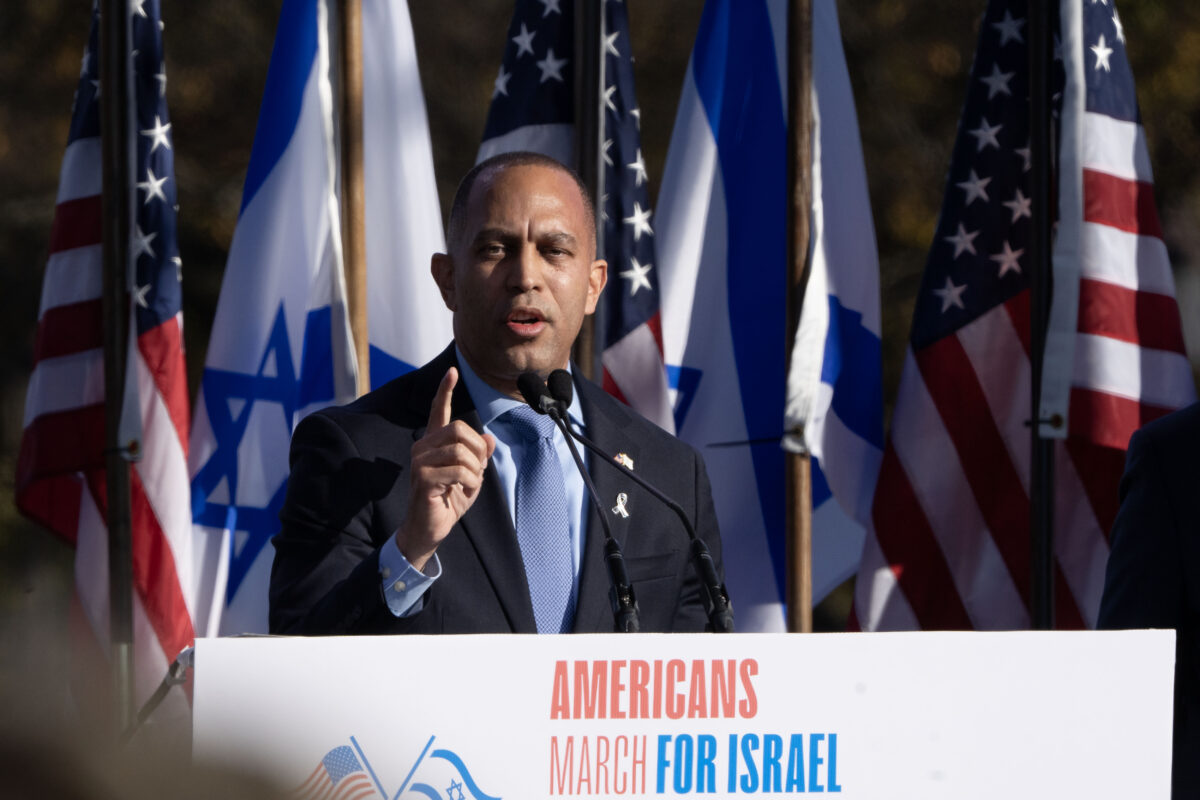
The progressive Israel advocacy group J Street endorsed House Minority Leader Hakeem Jeffries (D-NY) on Friday, marking the first time the top Democratic congressional leader accepted an endorsement from the group. With Jeffries endorsed by J Street, the group has now thrown its support behind the entire House Democratic leadership team: Jeffries, Democratic Whip Katherine Clark (D-MA) and Democratic Caucus Chair Pete Aguilar (D-CA). Jeffries, Clark and Aguilar have all also been endorsed by AIPAC, and they have each traveled to Israel on AIPAC-affiliated trips, Jewish Insider’s Gabby Deutch reports.
Announcement: “J Street is proud to endorse the House Democratic leadership team at such a critical moment in the US-Israel relationship,” J Street President Jeremy Ben-Ami said in a statement Friday. “After 23 months of war, it is important to endorse Democratic leaders who understand the time has come for a just and lasting peace that brings the remaining hostages home and immediately and permanently surges aid to the people of Gaza.”
Worthy Reads
Loaded Language: Andrew Weinstein, a former U.S. public delegate to the United Nations under the Biden administration, writes in Time magazine about why the use of phrases like “globalize the intifada” are so damaging. “Language doesn’t only reflect intention — it carries the weight of past use, of collective trauma, of coded threats. It has an impact. And so, when a community tells you a phrase evokes existential fear, it’s not enough to say, ‘I didn’t mean it that way.’ To do so is more than just a failure of sensitivity — it’s a failure of solidarity. And this is where so many well-meaning people lose their way. They treat empathy as if it were conditional, or zero-sum. They hear Jewish pain and ask first whether it aligns with their politics, parsing slogans instead of listening to those affected by them. This hurts Jews. But even more than that, it fractures coalitions, pushing away people who, too, strive for collective justice — and driving them toward those who cynically (and capriciously) dangle the carrot of protection.” [Time]
Is Mamdani a Team Player? In The Hill, Amanda Berman, founder and executive director of the Zioness Action fund, pushes back against pressure by supporters of New York City mayoral candidate Zohran Mamdani on Democratic leaders to endorse him, highlighting Mamdani’s own recent history during the last presidential campaign. “Mamdani didn’t just fail to support Democratic presidential nominees Vice President Kamala Harris and President Joe Biden in last year’s existentially urgent campaign, he spoke out and organized against them. In March of 2024, Mamdani urged voters to withhold their vote from Biden. ‘As proud Democrats and elected officials and New Yorkers,’ Mamdani declared, ‘we endorse the Leave it Blank campaign.’ Last summer, as the world watched the Democrats make history by nominating the first Black woman on a major party ticket, Mamdani proudly platformed the Uncommitted Movement, which protested her convention. This was not passive disagreement. It was an intentional and successful effort to sabotage the Democratic ticket in a general election — when the risks could not have been more clear, when every vote mattered, when Democrats were working tirelessly to defeat an authoritarian megalomaniac who had already incited a violent insurrection to stop the peaceful transfer of power.” [The Hill]
Word on the Street
New York Gov. Kathy Hochul endorsed New York City Democratic mayoral nominee Zohran Mamdani, becoming one of the few prominent Democrats in the state to do so, saying, “I didn’t leave my conversations with him aligned on every issue” but the two “discussed the need to combat the rise of antisemitism urgently and unequivocally”…
Rep. Elise Stefanik (R-NY), who is mulling a 2026 challenge to Hochul, responded to the endorsement with a statement accusing Hochul of “embrac[ing] this raging Communist who will destroy New York making it less affordable and more dangerous — once again putting criminals and communists first, and New Yorkers LAST”…
In an interview with CNN’s Manu Raju, Sen. John Fetterman (D-PA) said the New York City mayoral race, in which Mamdani is the front-runner, “has really no impact on my life.” Fetterman also said Hamas and Iran are to blame for the humanitarian crisis in Gaza: “It is hell on earth. Why do some people blame Israel for that? I blame Hamas and Iran for that,” he said…
The Washington Post reports that the Mossad declined to implement a ground operation in Doha, Qatar, last week to assassinate senior Hamas officials in the Gulf nation over concerns that such a move would damage ties with Doha as it acts as a mediator between Israel and Hamas. As a result, Israel instead carried out an airstrike that looks like it failed to kill the top targets …
CENTCOM head Bradley Cooper, joined by U.S. special envoy Tom Barrack, met with Syrian President Ahmad al-Sharaa in Damascus…
Antisemitic conspiracy theories proliferated online in the aftermath of the fatal shooting of conservative activist Charlie Kirk, the Anti-Defamation League found, with over 10,000 posts on X that include the phrase “Israel killed Charlie Kirk” posted in the two days after his murder…
Republican officials are considering an effort to persuade former Kentucky Attorney General Daniel Cameron to drop his bid for Senate, as he pursues Sen. Mitch McConnell’s (R-KY) seat upon his retirement, and instead challenge Rep. Thomas Massie (R-KY), Politico reports…
“The Road Between Us: The Ultimate Rescue,” a documentary about Oct. 7, won the People’s Choice Award for best documentary at the Toronto International Film Festival, after originally being canceled due to the festival’s concern that Hamas footage had not been approved for use…
Among several actors who used their platform at the Emmy Awards in Los Angeles last night to criticize Israel, Hannah Einbinder called to “Free Palestine” and Javier Bardem wore a keffiyeh while calling for a “commercial and diplomatic blockade” on Israel…
The Wall Street Journal profiles billionaire Oracle co-founder Larry Ellison, as he backs a bid for Paramount, headed by his son David, to acquire Warner Bros. Discovery and The Free Press…
Nika Soon-Shiong, daughter of the Los Angeles Times owner Patrick Soon-Shiong, has been tapped as the publisher of Drop Site News, a far-left anti-Israel outlet. She told Semafor that she was inspired by the site’s coverage of the war in Gaza…
The Vuelta a Espana bike race in Madrid was called off during its finale on Sunday after anti-Israel protesters occupied the route and overturned barriers…
Police in London arrested and charged a 37-year-old homeless man with smearing feces on synagogues and other Jewish institutions in the city…
Holocaust survivor Fania Fainer, known for the heart-shaped booklet of birthday wishes she was gifted by fellow prisoners at the Auschwitz concentration camp in 1944 — an object she preserved throughout death marches and the war and that went on to become the subject of a film and a book, died at 100…
Pic of the Day

Several hundred people gathered on Sunday evening at the French Embassy in Washington for the Capital Jewish Museum’s second annual gala, in service of a simple theme: “preserving history and building bridges,” Jewish Insider’s Gabby Deutch reports. The gala honored the investor and philanthropist David Rubenstein and Esther Safran Foer, the former longtime CEO of Sixth & I Synagogue and the Capital Jewish Museum’s founding board president. Speaking at the event, Gov. Wes Moore of Maryland decried rising antisemitism in the United States and, in particular, the killing of Israeli Embassy staffers Sarah Milgrim and Yaron Lischinsky outside the museum in May. Read more here.
Birthdays

Film executive, she produced “The Hunger Games” film series, Nina Jacobson turns 60…
Founder and former CEO of Elektra Records, he is a member of the Rock & Roll Hall of Fame, Jac Holzman turns 94… Professor at the Hebrew University and a leading scholar of the Dead Sea Scrolls, Emanuel Tov turns 84… Chief rabbi of Migdal HaEmek, known as the “Disco Rabbi,” Rabbi Yitzchak Dovid Grossman turns 79… Professor emerita of education at Boston University’s Wheelock College, Diane Elizabeth Levin turns 78… NYC-based composer and multi-instrument musician, Ned Rothenberg turns 69… Television comedy writer, he served as a showrunner, writer, and producer for “The Simpsons” and co-created the animated series “The Critic,” Michael L. Reiss turns 66… Business litigator in the Miami office of Gunster, Aron U. Raskas… Managing partner and chief technology officer at Differential Ventures in Philadelphia, he is also the founder of a series of kosher restaurants, David Magerman… NPR’s media correspondent, David Folkenflik turns 56… Actor, best known for his roles on “Sports Night” and “The Good Wife,” Josh Charles turns 54… Comedian, writer and actress, Kira Soltanovich turns 52… VP of leadership at the Anti-Defamation League until earlier this year, Deborah Leipzig… Customer success manager at Screencastify, event organizer and fundraiser, Shayla Rosen… Author and longtime education correspondent at NPR, Anya Kamenetz turns 45… Data scientist, economist and author of the 2017 New York Times bestseller Everybody Lies, Seth Stephens-Davidowitz turns 43… Screenwriter, film producer and director, often in collaboration with his childhood friend Seth Rogen, Evan D. Goldberg turns 43… Model and Israeli beauty pageant winner, Yael Markovich turns 41… Partner in CHW Strategic Advisors and CEO of Harmon Face Values, Jonah Raskas… CFO at Israel on Campus Coalition, Tomer Zvi Elias… Chief strategy officer at PW Communications, Amanda Bresler… Reporter at The New York Times, Eliza Shapiro… Singer and actress, she was the 2009 winner of the Israeli version of “A Star is Born,” Roni Dalumi turns 34… Beauty pageant titleholder, she was crowned Miss Israel 2012, Shani Hazan turns 33…
Israeli PM Benjamin Netanyahu called Rubio an ‘extraordinary friend of the State of Israel’
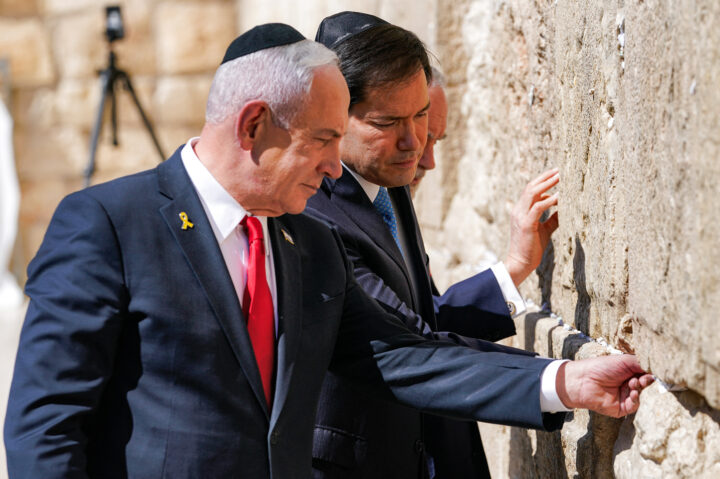
NATHAN HOWARD/POOL/AFP via Getty Images
Israeli Prime Minister Benjamin Netanyahu, U.S. Secretary of State Marco Rubio and U.S. ambassador to Israel Mike Huckabee visit the Western Wall on September 14, 2025.
Secretary of State Marco Rubio arrived in Jerusalem on Sunday, at the start of a five-day trip to Israel and the U.K.
Rubio began the visit with prayers at the Western Wall, together with Prime Minister Benjamin Netanyahu and U.S. Ambassador to Israel Mike Huckabee.
During a tour of the Western Wall Tunnels, Netanyahu called Rubio an “extraordinary friend of the State of Israel.”
“The Israeli-American alliance,” Netanyahu said, “is as strong and as durable as the stones of the Western Wall that we just touched. Under President [Donald] Trump and Secretary Rubio and their entire team, this alliance has never been stronger, and we deeply appreciate it.”
Rubio is expected to attend on Monday the inauguration of an ancient tunnel connecting the City of David archeological park to Jerusalem’s Old City. The tunnel is said to be the road pilgrims took to the ancient Temple in Jerusalem.
Rubio’s visit comes days after Israel’s attempted strike on Hamas leaders in Doha, Qatar last week, which the secretary said he was “not happy” about.
“Now we need to move forward and figure out what comes next,” he told reporters on Saturday.
Before taking off for Israel, Rubio posted on X that the focus of the trip “will be on securing the return of hostages, finding ways to make sure humanitarian aid reaches civilians, and addressing the threat posed by Hamas. Hamas cannot continue to exist if peace in the region is the goal.”
The State Department said that Rubio plans to “convey America’s priorities in the Israel-Hamas conflict and broader issues concerning Middle Eastern security, reaffirming U.S. commitment to Israeli security.”
Rubio and Israeli leaders are expected to discuss Operation Gideon’s Chariots II, as Israel has called its coming invasion of Gaza City, which it has been preparing for by evacuating an estimated 300,000 residents and bombing buildings with terrorist targets inside.
The secretary of state’s visit is taking place amid a push within Netanyahu’s coalition for Israel to annex parts of the West Bank in response to the announcement by a dozen countries, led by France, that they would unilaterally recognize a Palestinian state this month.
The State Department said Rubio’s agenda for the visit includes discussing ways to push back against recognition of a Palestinian state, as well as the International Criminal Court and International Court of Justice cases against Israel.
Rubio is expected to hold further meetings with Netanyahu and Strategic Affairs Minister Ron Dermer and with Foreign Minister Gideon Sa’ar.
The secretary of state is also expected to meet with families of hostages being held in Gaza.
Plus, UAE warns Israel against annexation

Sean Zanni/Getty Images for National Alliance for Eating Disorders
Chelsea Clinton speaks onstage during the World Eating Disorder Action Day Summit 2025 at United Nations on June 02, 2025 in New York City.
Good Wednesday morning.
In today’s Daily Kickoff, we report on Secretary of State Marco Rubio’s upcoming trip to Israel, and look at the primary field already taking shape in New York’s 12th Congressional District following Rep. Jerry Nadler’s retirement announcement. We report on Maine Senate candidate Graham Platner’s campaign ads, all of which mention AIPAC, and talk to a former board member of the International Association of Genocide Scholars about the organization’s “deeply flawed” passage of a resolution accusing Israel of genocide. Also in today’s Daily Kickoff: Deni Avdija, Lana Nusseibah and Yael Lempert.
What We’re Watching
- Senior Emirati diplomat Lana Nusseibah warned in a just-published interview that Israel’s potential annexation of the West Bank would constitute a “red line” for Abu Dhabi that would “end the vision of regional integration.” We’re keeping an eye on the diplomatic dynamics following Israeli Finance Minister Bezalel Smotrich‘s announcement earlier today that Israel plans to annex approximately 82% of the West Bank.
- This morning, the Middle East and North Africa subcommittee of the House Foreign Affairs Committee will sit for a closed-door, member-only roundtable with U.S. Ambassador to Israel Mike Huckabee “on key issues facing the bilateral relationship as it relates to Judea and Samaria,” the biblical term for the West Bank.
- We’re monitoring Secretary of State Marco Rubio’s upcoming trip to Israel, first reported yesterday. Rubio is slated to attend the inauguration of the Pilgrims’ Road at the City of David in Jerusalem on Sept. 15. Read more here from JI’s Melissa Weiss.
- We’re also keeping an eye on Sacramento, where California legislators are days from the end of the legislative year and have yet to take up a bipartisan antisemitism bill. Jewish groups in the state have voiced support for the legislation, which has faced pushback from the California Teachers Association.
- Tonight in New York, journalist Yaakov Katz will speak in conversation with The New York Times’ Bret Stephens about Katz’s new book, While Israel Slept, written with Amir Bohbot.
What You Should Know
A QUICK WORD WITH JI’S MELISSA WEISS
As Israel calls up tens of thousands of reservists ahead of a planned takeover of Gaza City and rejects ceasefire proposals that fall short of a comprehensive deal to end the war and release all of the hostages, Jerusalem finds itself facing calls both at home and abroad against further entrenchment in Gaza.
At the same time, Israeli Prime Minister Benjamin Netanyahu is facing pressure from Washington to end the war — with a decisive victory over Hamas.
President Donald Trump signaled his growing weariness with a protracted war in an exchange with The Daily Caller, published earlier this week, in which he said Israel is “gonna have to get that war over with,” noting that Israel “may be winning the war, but they’re not winning the world of public relations.” Netanyahu said at his weekly Cabinet meeting on Sunday that Trump had instructed Israel to go into Gaza City with “full force.”
Days earlier, the president held a White House meeting that included Jared Kushner and former U.K. Prime Minister Tony Blair to discuss a “day-after” plan for the Gaza Strip. Israeli Strategic Affairs Minister Ron Dermer scrapped a planned meeting with World Food Program head Cindy McCain to fly to Washington for consultations.
Taken together, Trump’s comments and last week’s gathering underscore the president’s dwindling patience with the ongoing war — concerns that have been highlighted in Israeli media reports in recent days.
Israel’s Channel 12 reported over the weekend that Trump, frustrated by Hamas’ intransigence, is pushing Netanyahu to move more quickly to decisively defeat Hamas. That could pose a challenge for Israel, which has not been able to declare “total victory” against Hamas in nearly two years but now faces White House pressure to end the war in a short amount of time — “perhaps even within two weeks,” according to Channel 12.
SUCCESSION IN MANHATTAN
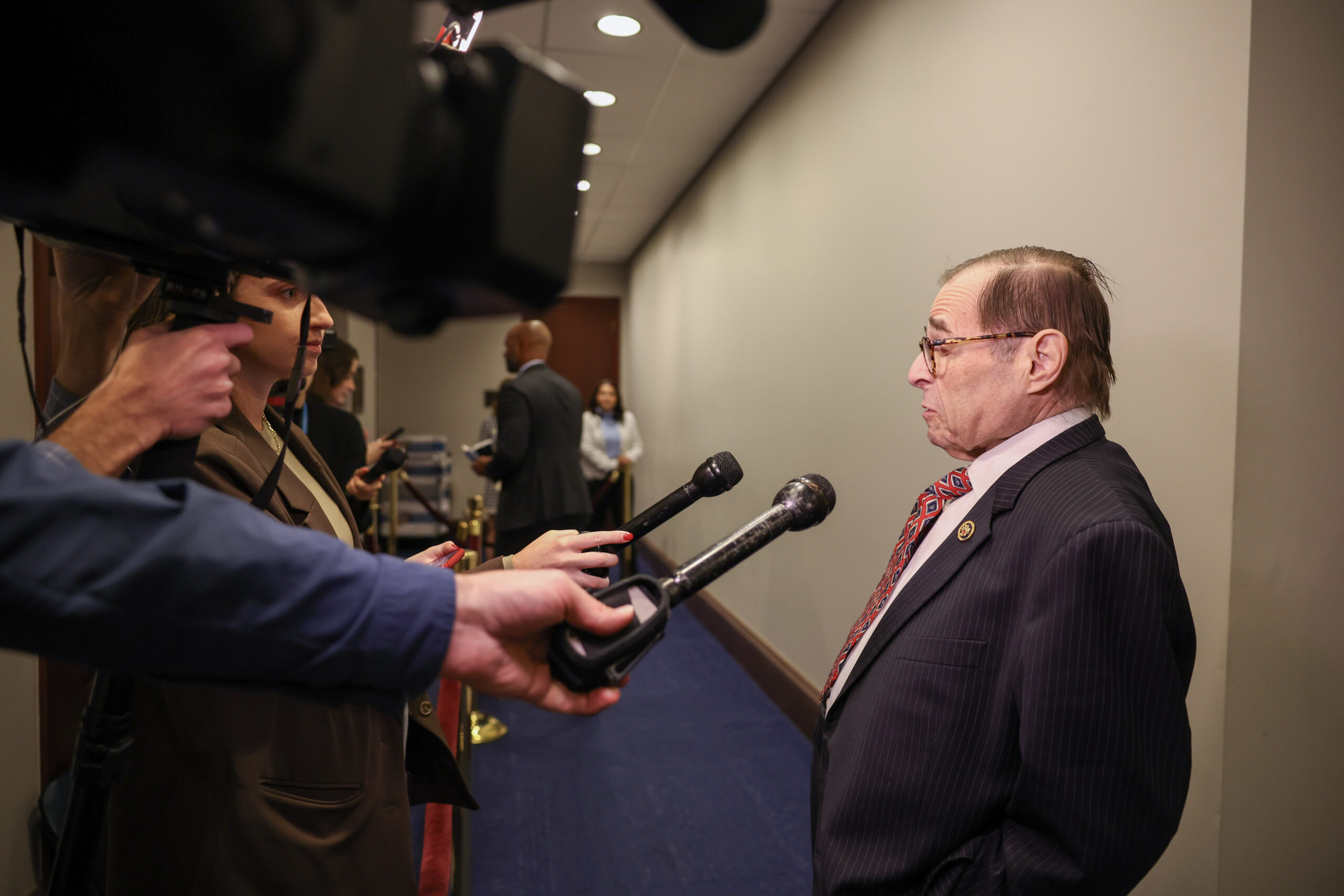
Rep. Jerry Nadler’s (D-NY) surprise decision on Monday to retire at the end of his current term has set off what is expected to be a crowded primary to succeed the long-serving Jewish Democrat — with a growing number of candidates weighing bids for the coveted Manhattan House seat he has held for more than three decades. The looming open-seat primary has also raised questions about whether candidates will embrace Nadler’s increasingly skeptical views on Israel, and how the issue will shape the race. The 78-year-old lawmaker, who represents one of the largest Jewish constituencies in the nation, has long identified as a pro-Israel progressive, even as he has vocally criticized Israel’s conduct during its ongoing war in Gaza and drew scrutiny from some Jewish community leaders over his early endorsement of Zohran Mamdani, the far-left Democratic nominee for mayor of New York City, Jewish Insider’s Matthew Kassel reports.
Looking at Lasher: Potential candidates include New York state Assemblymember Micah Lasher, Chelsea Clinton, Jack Schlossberg and former FTC Commissioner Lina Khan. Lasher, a former aide to Nadler who is expected to claim the congressman’s blessing, according to people familiar with the situation, has built strong ties to the pro-Israel community, but he faced backlash from local rabbis over his similarly quick choice to support Mamdani, in spite of the nominee’s hostile views on Israel. One Jewish leader said it was premature to draw conclusions about Lasher’s positions on Israel, while voicing confidence that he “makes up his own mind” on tough issues, regardless of where his allies may stand. “Lasher is center-left but has always been relatively moderate on Israel,” a pro-Israel strategist added in assessing the assemblyman’s stances on the Middle East.
ONE TRACK MIND
Democratic Maine Senate candidate Graham Platner is putting anti-AIPAC and anti-Israel messaging front and center in fundraising appeals he’s circulating on social media, Jewish Insider‘s Marc Rod reports.
Ad attack: “My opponent has already been endorsed by AIPAC — an endorsement I will never get. Because what is happening right now in Gaza is a genocide,” Platner says in one direct-to-camera video ad focused specifically on his opposition to AIPAC. “I need your help because we refuse to take money from AIPAC, and we refuse to take money from the billionaires who support it.” Every one of the eight active ads that Platner is running on Facebook and Instagram, according to Meta’s political advertising library tool, includes a repudiation of AIPAC, and around half accuse Israel of genocide.
Notes from the field: Maine Beer Company co-founder and political neophyte Dan Kleban is entering the growing primary field of candidates hoping to challenge Sen. Susan Collins (R-ME).
MILITARY MUSCLE
China showcased its growing aggressiveness on the world stage in a major military parade on Wednesday, showing off missiles and fighter jets to mark the 80th anniversary of Japan’s surrender in World War II with Russian President Vladimir Putin and North Korea’s Kim Jong Un in attendance. The parade was an example of how Beijing has used WWII not only to encourage nationalism, but to project power internationally, from Jerusalem to Taipei and beyond, Jewish Insider’s Lahav Harkov reports.
Zoom out: The parade came shortly after China hosted a summit with Putin, Indian Prime Minister Narendra Modi and other Eurasian leaders, deepening ties among major powers not aligned with the West. The attendees issued a communique last week strongly condemning “the military aggression launched by Israel and the United States against Iran” in June. China has also used World War II and Holocaust terminology in recent weeks as it continues its hostility against Israel, calling Israel’s war in Gaza a “genocide,” even as the Chinese Embassy in Israel held an event highlighting Beijing’s positioning with the Allies in World War II. The recent statements reflect a broader double game China has played in its relations toward Israel, consistently showing hostility to Israel on the international stage since the Oct. 7, 2023, Hamas-led attacks, while within Israel, the Chinese ambassador has pursued a friendlier posture.
SPEAKING OUT
A longtime former board member of the International Association of Genocide Scholars criticized the group’s passage of a resolution on Monday accusing Israel of genocide in Gaza, calling the move deeply flawed and the result of a politicized process. Sara Brown, the American Jewish Committee’s regional director in San Diego who has a Ph.D. in genocide studies, argued that “the whole premise and tenor of the resolution is deeply problematic.” In an interview with Jewish Insider’s Lahav Harkov on Tuesday, Brown, who maintains her membership in IAGS, also pushed back against the narrative that most genocide scholars are accusing Israel of genocide.
How it played out: The resolution passed with only 129 out of over 500 IAGS members voting, 108 in favor, 18 opposed and three abstaining. All paid members have the right to vote, and membership is not restricted to academics; its ranks include artists, activists and others interested in the field of genocide studies. As a result, some pro-Israel figures paid to join the IAGS following the resolution’s approval. Under normal circumstances, Brown said, any member can propose a resolution, which goes before a committee for comments and feedback. Controversial or high-stakes resolutions are brought before a virtual town hall to discuss the text. This time, when the resolution was proposed on an IAGS listserv, Brown said that she and others attempted to publish a dissent that was deleted by the moderators.
CLASSROOM CONTROVERSY
A book that centers on Palestinian identity is drawing controversy from some Jewish parents in the Montgomery County, Md., public school system after it was assigned to first grade students as required classroom reading, Jewish Insider’s Haley Cohen has learned. The book, Tunjur! Tunjur! Tunjur! A Palestinian Folktale, written by Margaret Read MacDonald, aims to convey a message to children that there are consequences for taking things that don’t belong to them. It tells the story of a woman who “prayed to Allah” for a child and received a pot as her child. The pot, too young to know right from wrong, had a tendency to steal honey from the marketplace and jewels from the king — until she got caught.
Voiced concerns: While the book does not mention Israel, local Jewish leaders and parents voiced concern that the required book’s subtext sends an anti-Israel message to elementary schoolers and that the reference to “Allah” does not belong in a public school setting. A syllabus notes that students can receive supplemental reading materials if “any instructional material conflicts with your family’s sincerely held religious beliefs.” The book’s lesson that “‘you cannot take things that do not belong to you’ echoes activist rhetoric that falsely casts Israel as an oppressor and the Jewish people as imperialist rather than indigenous,” Dana Stangel-Plowe, chief program officer at the North American Values Institute, a nonprofit that monitors antisemitism in K-12 schools, told JI.
But: Not all Jewish communal leaders agreed that the book was problematic. Guila Franklin Siegel, chief operating officer of the Jewish Community Relations Council of Greater Washington, argued that Jewish families should embrace the book. “If the only complaint about this book is that it’s sharing a Palestinian folktale that teaches children not to take things that don’t belong to them, I can’t see what the problem with the book is,” Franklin Siegel told JI. “It will be a shame if Jewish people wind up objecting to books only because they have protagonists who happen to be Palestinian.”
money matters

The House Appropriations Committee’s proposed funding bill for the Department of Education includes sweeping new provisions cutting off funding for colleges and universities that fail to address campus antisemitism, but would also cut $49 million in funding for the Department of Education’s Office for Civil Rights in 2026, Jewish Insider’s Marc Rod reports.
New language: New language included in the bill states that no federal funding may be provided to institutions of higher education “unless and until such institution adopts a prohibition on antisemitic conduct that creates a hostile environment in violation of Title VI of the Civil Rights Act of 1964 in all documents relating to student or employee conduct.” The bill also bans funding to schools that have “failed to take administrative action against any student, staff member, or student group that commits acts of antisemitism while utilizing the facilities, grounds, or resources of such institution.” At the same time, the bill would provide $91 million in funding for the Office for Civil Rights, which pursues complaints of antisemitism lodged by Jewish students, down from $140 million provided in several previous years.
Elsewhere on the Hill: With the 2025-26 school year kicking off, Sens. Dave McCormick (R-PA) and John Fetterman (D-PA) wrote to the presidents of five Pennsylvania universities urging them to work with their Jewish communities to ensure Jewish students’ safety and ability to participate in campus life, Jewish Insider’s Marc Rod reports.
Worthy Reads
Hitting the Houthis: The Wall Street Journal’s Dov Lieber and Saleh al-Batati spotlight Israel’s efforts to target Houthi leadership, following a strike last week that killed the terror group’s prime minister and nearly a dozen other senior officials. “The strike also reflects an aggressive Israeli security posture in which Israel wants its adversaries to know it will hit back hard against any potential threat, say military analysts. The new doctrine is referred to among soldiers as FAFO, an acronym for f— around and find out, according to one of the security officials. … After escalating its fight against the Houthis, Israel hopes its strikes will have a deterrent effect on the group and other potential enemies in the region, one of the Israeli security officials said. The official said there is hope in Israel that the Yemeni people opposed to the Houthis will once again take up arms against them. ” [WSJ]
Inspection Time: The editorial board of The Washington Post calls on Iran to allow International Atomic Energy Agency inspectors back into the country and to resume nuclear talks with the U.S. “The only way to know for certain what’s left is for the inspectors to fully return and for the Iranian government to come clean about what, if anything, it still has. To prevent further conflict, Iran also needs to reenter negotiations with the United States over any future nuclear program for civilian-only use. The United States says it is ready to talk, but Iran has insisted as a precondition, among other things, that Trump commit to no further strikes. That would give away too much leverage. … If Tehran takes any lesson from June, it should be that the United States is not afraid of using military force to prevent Iran from getting nuclear weapons. Trump resisted pressure from the vocal isolationist faction in his base, and he could do so again if he feels it is necessary to protect the nation’s security.” [WashPost]
Higher Ed’s Real Problem: In The Atlantic, Boston University professor E. Thomas Finan posits that the Trump administration’s legal efforts against top-tier universities should serve as a “wake-up call” that pushes schools to meaningfully address deep-seated issues. “Strong free-speech protections for students and faculty combined with a commitment to intellectual diversity can help foster open inquiry and rigorous analysis. Colleges and universities should also consider remaining neutral on more political issues: Constant interventions can sap the academy’s credibility and make students who take opposing views feel unwelcome. … Colleges cannot assume that the public consensus that has sustained them will simply remain in place, nor should they assume that reaching financial settlements will mend the structural weaknesses that have made them so vulnerable in the first place. The surest protection for the academy is to forge a new political compact — to prove, once again, that America’s higher education is indispensable to its democracy.” [TheAtlantic]
New War Footing: In his “Clarity” Substack, former Israeli Ambassador to the U.S. Michael Oren considers the ways in which the Israeli approach to the country’s military has shifted in the post-Oct. 7 era. “Never will we forfeit the need for deep buffer zones along all our frontiers. Never again will the IDF favor a defensive over an offensive strategy — Iron Dome over tanks and armored personnel carriers — and rely almost exclusively on technology rather than soldiers to guard our land. Never again will our reservists go years without training or go into battle without even the most basic gear. … If, before the war, the questions of Haredi military service and integration into the economy were important but still open to debate, today that discussion has ended.” [Clarity]
Word on the Street
The Treasury Department announced sanctions on Iraqi businessman Waleed al-Samarra’i, who also holds citizenship in St. Kitts and Nevis, over his efforts to help Iran evade restrictions on oil exports…
Sen. Joni Ernst (R-IA) announced she will not seek reelection in 2026, setting up a potential primary clash between the establishment and MAGA wings of the GOP; Rep. Ashley Hinson (R-IA), an ally of Ernst, launched her bid shortly after Ernst’s announcement…
NBA Commissioner Adam Silver, Disney CEO Bob Iger and Thrive Capital’s Josh Kushner were spotted sitting together in the first row at last night’s U.S. Open match in Queens, N.Y., between Novak Djokovic and Taylor Fritz; Jeffrey Katzenberg was also spotted attending the same match…
Elliott Investment Management, which has a $4 billion stake in PepsiCo, is pushing for changes at the food and beverage conglomerate, including re-franchising its bottling network and pulling low-selling products…
Bridgewater Associates founder Ray Dalio cautioned that the U.S. risks falling into pre-WWII-era autocratic politics…
In The Wall Street Journal, stock trader Peter Tuchman, who has been photographed more than 1,000 times on the floor of the New York Stock Exchange, reflects on his 18-year “15 minutes of fame as the Einstein of Wall Street” after the New York Daily News ran a front-page photograph of Tuchman in 2007…
New York mayoral candidate Jim Walden, who had been polling in single digits, dropped out of the race and called on the remaining candidates who are polling low to consider exiting the race, citing concerns over Democratic nominee and front-runner Zohran Mamdani’s “extreme bigotry toward police, his authentic commitment to communism, his antisemitic obsessions, and his sympathies for terrorists”…
Police in Los Angeles are investigating the vandalism of a Jewish supplies store in the city’s Encino neighborhood; security camera footage captured the vandal spray-painting antisemitic graffiti on the side of the Mitzvahland goods store on Shabbat…
Palantir co-founders Peter Thiel and Joe Lonsdale, as well as Elad Gil and Keith Rabois,were in Israel this past weekend for the wedding of Zach Frenkel, an investor in Thiel’s VC firm; some of the high-profile wedding attendees, including Blackstone and Palantir executives, reportedly met with Israeli Prime Minister Benjamin Netanyahu during the trip…
French President Emmanuel Macron announced that the upcoming Conference on the Two-State Solution, which Paris is co-hosting with Saudi Arabia, will be held in New York on Sept. 22; Macron called for a “reformed and strengthened” Palestinian Authority, a “fully reconstructed” Gaza Strip and the disarmament of Hamas…
Pope Leo XIV is slated to meet with Israeli President Isaac Herzog on Thursday at the Vatican…
UAE National Security Advisor Sheikh Tahnoon bin Zayed hosted Larry Fink in Abu Dhabi, where he congratulated the BlackRock CEO on his new position as co-chair of the World Economic Forum…
Ali Larijani, the head of Iran’s Supreme National Security Council, said that U.S. demands that Tehran curb its missile program were hindering potential nuclear talks…
Former U.S. Ambassador to Jordan Yael Lempert was named vice president for outreach at the Middle East Institute…
Pic of the Day

Israel’s national basketball team, led by Deni Avdija (pictured, in blue), secured a Sweet 16 spot in the EuroBasket tournament for the first time in more than a decade. The team beat Belgium 92-89 on Tuesday in Katowice, Poland.
Birthdays
Media personality, psychologist and socialite, also known as Dr. Estella, Estella Sneider, Psy.D. turns 75…
London-based advice columnist for the Cosmopolitan UK magazine for over 40 years, known there as an agony aunt, Irma Kurtz turns 90… Past chair of the Anti-Defamation League and later the Conference of Presidents of Major American Jewish Organizations, Robert G. Sugarman turns 86… Retired software engineer at IBM for 39 years, he persevered after many years to locate and inter the remains of the crew of a crashed WW II American B-24 in the Indian Himalayans, succeeding in 2008, Gary Zaetz turns 71… Actor best known for portraying Bobby Baccalieri on “The Sopranos,” more recently he has appeared in 146 episodes of CBS’ “Blue Bloods,” Steve Schirripa turns 68… Chair of the global sustainability platform at Apollo Global Management, Jonathan Silver… Offensive lineman for the NFL’s New Orleans Saints from 1982 to 1989, now a professional photographer, Brad M. Edelman turns 65… Producer and reporter at NBC and MSNBC, early in his career he spent eight years as a volunteer broadcaster and reader for the Jewish Guild for the Blind, Adam Reiss turns 60… Executive chairman of Time magazine, Edward Felsenthal turns 59… Historian and journalist who has written four books on the rise of the American conservative movement (focused on Goldwater, Nixon and Reagan), Eric S. “Rick” Perlstein turns 56… Mayor of Haifa until 2024, she was the first woman to lead that city, Einat Kalisch-Rotem turns 55… Executive director at the Michael Reese Research & Education Foundation, Jason Rothstein… VP of data visualization at Moody’s Corporation, Todd Lindeman… CEO of PR and communications firm Sunshine Sachs Morgan & Lylis, Shawn Sachs… Founder of the Silverstein Group, providing strategic policy, crisis management and communications advice, Rustin Silverstein… Rabbi of The Hampton Synagogue, Avraham Bronstein turns 45… Chief advancement officer of Honeymoon Israel, Avital Ingber… Head of global public affairs marketing at Meta / Facebook, Joel Martín Kliksberg… Chief media correspondent for CNN until 2022, then a fellow at Harvard’s Kennedy School, now back at CNN, Brian Stelter turns 40… South Florida-based attorney, she served as the co-chair of JFNA’s national young leadership cabinet, Lindsey Tania Glantz… Comedy writer, producer and performer, Megan Amram turns 38… Fashion model and actress, Kaia Jordan Gerber turns 24…
The secretary of state is making his second trip to Israel since becoming the U.S.’ top diplomat
John McDonnell/Getty Images
Secretary of State Marco Rubio testifies before the House Committee on Appropriations | Subcommittee on National Security, Department of State, and Related Programs at the Rayburn House Office Building on May 21, 2025 in Washington, DC.
Secretary of State Marco Rubio is slated to attend the inauguration of the Pilgrims’ Road at the City of David in Jerusalem during his upcoming visit to Israel, two sources familiar with Rubio’s travel confirmed to Jewish Insider this week.
Rubio will be making his second trip to Israel as secretary of state, after first visiting in February. The September 15 event, according to an invitation viewed by JI and translated into English, “will be attended by senior diplomats and high-ranking officials from the government[s] of Israel and the United States, along with our close friends.”
Last week, Rubio met in Washington with Israeli Foreign Minister Gideon Sa’ar, who was making his first trip to the nation’s capital since becoming Israel’s most senior diplomat last year.
The lawmakers said allowing Turkey to obtain the jets while still possessing a Russian missile defense system ‘would jeopardize the integrity of F-35 systems’ and ‘expose U.S. military secrets to Russian intelligence’

Nicolas Economou/NurPhoto via Getty Images
Lockheed Martin F-35 Lightning II a fifth generation fighter jet during a flight demonstration while landing, at Paris Air Show 2025 at Le Bourget Airport.
A bipartisan group of 40 House members is urging Secretary of State Marco Rubio to maintain the U.S. ban on exporting advanced F-35 fighter jets to Turkey, amid ongoing reports that the U.S. and Turkey are negotiating to allow the sale of the jets.
“We strongly urge the Administration to review the facts and reject Turkey’s attempt to rewrite the history of its violation of U.S. law and national security policy,” the lawmakers said in a letter to Rubio on Thursday.
The group highlighted that President Donald Trump, during his first term, signed the law that bans the sale of the F-35s to Turkey in light of its purchase of an S-400 missile defense system from Russia.
“Nearly a decade later, Turkey still possesses S-400 systems and has shown no willingness to comply with U.S. law. This behavior cannot be rewarded,” the letter reads. “Lifting sanctions or allowing Turkey back into the F-35 program without first removing its S-400s would jeopardize the integrity of F-35 systems; expose U.S. military secrets to Russian intelligence; undermine our defense industrial base and allied confidence in purchasing future U.S. platforms; and disrupt development of the next-generation fighter jet recently announced by the Administration.”
The lawmakers emphasized that U.S. policy on the issue has been consistent across administrations and parties.
They said that the U.S. must “uphold U.S. law, maintain CAATSA sanctions, and protect American defense and intelligence assets” and “continue to hold allies and adversaries alike accountable when their actions threaten U.S. interests.”
The letter was led by Reps. Chris Pappas (D-NH), Gus Bilirakis (R-FL), Dina Titus (D-NV) and Nicole Malliotakis (R-NY), who lead the Congressional Hellenic Caucus.
The letter is supported by the American Jewish Committee, Christians United for Israel Action Fund and FDD Action as well as the American Hellenic Educational Progressive Association, the American Hellenic Institute, American Friends of Kurdistan, Armenian National Committee of America, Coordinated Effort of Hellenes, the Hellenic American Leadership Council, Middle East Forum and the International Coordinating Committee Justice for Cyprus.
A letter signed by prominent House progressives said such a state ‘will need to fully recognize Israel’ and guarantee ‘the disarmament of and relinquishing of power by Hamas’
Chip Somodevilla/Getty Images
Rep. Ro Khanna (D-CA) leaves the U.S. Capitol on March 13, 2024 in Washington.
Rep. Ro Khanna (D-CA) is circulating a letter to President Donald Trump and Secretary of State Marco Rubio among House lawmakers calling for the United States to recognize a Palestinian state.
Khanna, a prominent progressive voice in the House with aspirations for higher office, has become increasingly vocal in recent weeks about the humanitarian crisis in Gaza and in his criticism of the pro-Israel lobby group AIPAC.
“We are writing to request that the United States officially recognize a Palestinian state, as this tragic moment has highlighted for the world the long overdue need to recognize Palestinian self-determination,” a draft version of the letter obtained by Jewish Insider reads. “Just as the lives of Palestinians must be immediately protected, so too must their rights as a people and nation urgently be acknowledged and upheld.”
The letter had nine co-signatories, in addition to Khanna, as of Thursday evening.
The signatories said they welcome French President Emmanuel Macron’s decision to recognize a Palestinian state, and urged other governments to do the same. The U.K. and Canada said this week that they intend to do so as well, given certain conditions.
“It has long been acknowledged by much of the international community and previous U.S. administrations of both major political parties that a Palestinian state recognized as a full and equal member of the community of nations is necessary to fulfill the legitimate national rights of the Palestinian people and ensure the state of Israel’s survival as the democratic homeland of the Jewish people,” the letter continues.
U.S. policy has long opposed the unilateral recognition of a Palestinian state outside of a negotiated two-state solution between the Israelis and Palestinians.
“A viable Palestinian state will need to fully recognize Israel and adopt a framework to guarantee Israel’s security, including the disarmament of and relinquishing of power by Hamas in order to be broadly embraced by the community of nations,” the letter continues. “We will need to work closely with the Palestinian people, the Palestinian Authority, our Arab allies, and Israel to make this feasible.”
The letter argues that “recognizing Palestinian statehood and obligating Palestinian leaders to abide by the international law binding on states and their governments will make that far more achievable and sustainable than decades of statelessness and repression have.”
The letter has been co-signed by Reps. Greg Casar (D-TX), Lloyd Doggett (D-TX), Veronica Escobar (D-TX), Maxwell Frost (D-FL), Al Green (D-TX), Jared Huffman (D-CA), Pramila Jayapal (D-WA), Mark Pocan (D-WI) and Bonnie Watson Coleman (D-NJ) — all prominent progressive lawmakers in the House — since opening on Tuesday evening.
In a statement to JI, Khanna said, “This is the moment for the United States to officially recognize a Palestinian state. All 22 states in the Arab League this week called for a non Hamas Palestinian state that recognizes Israel.”
He said that his office had begun outreach on the issue this week, but did not plan to send the letter until the United Nations General Assembly in September, when France and others said they plan to formally recognize a Palestinian state. He described the response from his fellow lawmakers as “overwhelming.”
“It’s disappointing someone would leak the letter thinking it would sabotage the effort,” Khanna continued. “But you cannot sabotage an idea whose time has come.”
Khanna said in a memo to colleagues about the letter, “Recognition of Palestinian statehood — alongside continued efforts to secure Israel’s safety and guarantee its future as a democratic homeland for the Jewish people — is essential to achieving peace.”
He continued, “As the devastating toll of the war in Gaza continues to mount, this tragic moment has underscored the urgent need to acknowledge Palestinian self-determination and take meaningful steps toward a just and lasting resolution to the Israeli-Palestinian conflict.”
Previously, a resolution supporting Palestinian statehood, introduced in the House by Green in December 2023, received five co-sponsors — Watson Coleman, Frost, Doggett, Escobar and Rep. Andre Carson (D-IN).
Secretary of State Marco Rubio attributed the move to ‘her illegitimate and shameful efforts to prompt [ICC] action against U.S. and Israeli officials, companies, and executives’

Brian Lawless/PA Images via Getty Images
Francesca Albanese, United Nations special rapporteur on the Occupied Palestinian Territories, during a press conference at Buswells Hotel in Dublin on March 20, 2025.
Secretary of State Marco Rubio announced on Wednesday that the U.S. would sanction Francesca Albanese, the widely criticized United Nations special rapporteur for Israel and the Palestinian Territories.
“Today I am imposing sanctions on UN Human Rights Council Special Rapporteur Francesca Albanese for her illegitimate and shameful efforts to prompt [International Criminal Court] action against U.S. and Israeli officials, companies, and executives,” Rubio said in a statement. “Albanese’s campaign of political and economic warfare against the United States and Israel will no longer be tolerated. We will always stand by our partners in their right to self-defense.”
She is being sanctioned under the Trump administration’s executive order targeting the International Criminal Court.
Members of Congress from both parties, as well as officials in both the Trump and Biden administrations, have condemned Albanese for her bias against Israel, downplaying and justifying the Oct. 7, 2023, Hamas attacks, comparing Israel to Nazi Germany, denying Israel’s right to defend itself and utilizing antisemitic rhetoric, among other issues, calling repeatedly calling for her to be dismissed. The French and German governments have also condemned the U.N. official.
A group of House members issued another call for her dismissal as recently as last month.
“The United States will continue to take whatever actions we deem necessary to respond to lawfare and protect our sovereignty and that of our allies,” Rubio continued.
The sanctions would bar Albanese from entering the U.S., where she has conducted speaking tours, and freeze any assets she, or any of her family members, have in the U.S.
“As chair of the DOJ Task Force to Combat Antisemitism, I applaud Secretary Rubio’s decision to impose sanctions on UN Human Rights Council Special Rapporteur Francesca Albanese,” Leo Terrell, a senior counsel at the Justice Department, told Jewish Insider. “In May, I wrote a public letter calling for her removal due to her long and troubling record of antisemitic rhetoric. This long-overdue step sends a clear message: such hatred will not be tolerated.“
Israel’s ambassador to the United Nations, Danny Danon, praised Rubio for the decision.
“Her relentless and biased campaign against Israel and the United States has long crossed the line from human rights advocacy into political warfare,” Danon said. “Albanese has consistently debased the credibility of the UN by promoting false, dangerous narratives that are detached from reality.”
Rep. Brad Sherman (D-CA), who has led multiple communiques from Congress calling for Albanese to be fired and recently said she has “blood on her hands,” told JI, “Today’s sanctions are … an important step in response to Ms. Albanese’s regular antisemitism.”
“However,” Sherman continued, “until [the] UN removes Ms. Albanese from her post, it is clear that the UN continues to endorse antisemitism within its ranks.”
Rep. Mike Lawler (R-NY), the chair of the House Foreign Affairs Committee’s Middle East subcommittee, said, “Francesca Albanese’s absurd campaign against the U.S. and Israel ends today. We will not tolerate antisemitic witch hunts by the UN and its affiliates.”
Rep. Randy Fine (R-FL) said, “Albanese is a full-throated supporter of Muslim terror.”
Terrell wrote to Albanese earlier this year condemning her for a series of letters she wrote to organizations and businesses that support and invest in Israel, suggesting they may be criminally liable for genocide and war crimes.
Albanese has also allegedly faced private criticism from U.N. Secretary-General Antonio Guterres.
Hillel Neuer, the executive director of UN Watch, which has scrutinized Albanese’s activity and history, called Rubio’s decision “bold and courageous.”
“No U.N. official has ever been sanctioned before in history,” Neuer told JI. “Then again, no U.N. official has ever been condemned for Holocaust distortion and antisemitism by France, Germany, Canada, and both Democratic and Republican US administrations. … She will never again spread her poison on American campuses or enter the country. Justice is served. Good triumphs over evil.”
Jewish Insider congressional correspondent Emily Jacobs contributed reporting.
Netanyahu, Trump project unity in D.C., but diverging views on Iran, Gaza hint at future fault lines
Differences between the two leaders’ comments on potential further strikes on Iran indicated a possible point of friction in the future

Andrew Harnik/Getty Images
President Donald Trump, seated next to Secretary of Defense Pete Hegseth, hosts Israeli Prime Minister Benjamin Netanyahu for a dinner in the Blue Room of the White House on July 7, 2025, in Washington, DC.
Israeli Prime Minister Benjamin Netanyahu’s third visit to Washington since the start of the Trump presidency kicked off Monday with closed-door meetings with President Donald Trump, Secretary of State Marco Rubio and Middle East envoy Steve Witkoff.
Trump and Netanyahu were on warm terms during remarks to the press ahead of their dinner. Netanyahu offered effusive praise for Trump for the U.S. strikes on Iran’s nuclear facilities and said he nominated Trump for a Nobel Peace Prize, as well as following Trump’s lead in expressing openness to the new Syrian government.
Trump, for his part, deferred to Netanyahu on a question about a two-state solution, “We’ll work out a peace with our Palestinian neighbors, those who don’t want to destroy us,” Netanyahu said, while adding that in any future peace agreement, “the sovereign power of security, always remains in our hands.”
White House Press Secretary Karoline Leavitt told reporters earlier in the day that Trump’s “utmost priority … is to end the war in Gaza and return all of the hostages” and that Trump and Netanyahu would discuss “peace in Gaza and ending that conflict.”
But that agenda item saw little discussion in Trump and Netanyahu’s public remarks. Asked about talks with Hamas, Trump instead spoke about Iran.
At the same time, the differences between the two leaders’ comments on potential further strikes on Iran indicated a possible point of friction in the future.
Asked about further strikes, Trump said he “can’t imagine wanting to do that” and maintained that Iran’s nuclear program had been “knocked out completely.” Trump added, “I think they want to make peace and I’m all for it,” while also suggesting that there is no need for negotiations or a deal, saying “What’s the purpose of talking?” He said that the U.S. is “ready, willing and able” if further strikes are necessary, “but I don’t think we’re going to have to be.”
Netanyahu seemed somewhat less certain that Iran’s nuclear and ballistic missile programs had been permanently stopped, even as he called the strikes a “historic victory.” “When you remove a tumor, that doesn’t mean that it can’t come back,” the Israeli prime minister said. “You have to constantly monitor the situation to make sure that there’s no attempt to bring it back.”
The two leaders downplayed another potential test of U.S.-Israel relations, the potential election of Democratic nominee Zohran Mamdani, who has pledged to arrest Netanyahu — following the International Criminal Court’s warrant against him — as mayor of New York City. Netanyahu dismissed the notion as “folly.”
Trump interjected that he’d “get him out of there” and suggested that he could use federal funding to force Mamdani to “behave.” Both men also said that Mamdani’s election is not guaranteed.
Trump also said that he would send more weapons, particularly defensive weapons, to Ukraine, shipments reportedly halted as a result of a push by top Pentagon official Elbridge Colby. Hours later, the Pentagon confirmed it would send additional defensive weapons to Ukraine.
It’s another sign that Trump’s instincts on foreign policy don’t always line up with those of vocal isolationist members of his team. Colby also reportedly resisted moving U.S. systems and personnel, including missile defense platforms, from Asia to the Middle East.
Today, Netanyahu heads to Capitol Hill, where he’s set to sit down with House Speaker Mike Johnson (R-LA) and a group with Senate leaders including Majority Leader John Thune (R-SD), Minority Leader Chuck Schumer (D-NY) and Senate Foreign Relations Committee Chairman Jim Risch (R-ID).
Most House members will likely not be in town to meet with the Israeli leader this week, with the House out of session. The Israeli prime minister will return to the Capitol on Wednesday for one-on-one meetings with several close allies in the Senate.
In Kushner’s confirmation testimony, he spoke about his parents having lost most of their family in the Holocaust

Ivanka Trump/Instagram
Charles Kushner is sworn in as U.S. ambassador to France on June 18, 2025.
President Donald Trump and Secretary of State Marco Rubio on Wednesday swore in Charles Kushner as the U.S. ambassador to France.
Kushner, a real estate executive, longtime Jewish philanthropist and father of Trump’s son-in-law Jared, was confirmed in May on a mostly party-line vote, with Sen. Cory Booker (D-NJ) the only Democrat to support the confirmation.
In Kushner’s testimony to the Senate Foreign Relations Committee, he told senators about his parents having immigrated to the U.S. from Belarus, where most of their family died in the Holocaust.
“My parents loved and appreciated our great country, the land of opportunity, just as I do,” Kushner said.
In 2020, Trump pardoned Kushner, after the latter served two years in a federal prison for tax evasion and for retaliating against a federal witness. In November, Trump described Kushner as “a tremendous business leader, philanthropist and dealmaker.”
During Kushner’s Oval Office swearing-in, he was joined by his children and grandchildren, including Jared Kushner and Ivanka Trump — a rare White House appearance for the couple, who opted not to take on any official roles in Trump’s second term. Jared Kushner was a top Middle East advisor to Trump in his first term, and his swearing-in came as Trump is considering whether the U.S. should attack Iran’s nuclear program.
A bipartisan group of House members described the State Department’s response to Americans stuck in Israel as inadequate thus far

GETTY IMAGES
Rep. Josh Gottheimer, D-N.J., leaves the U.S. Capitol after the House passed the One Big Beautiful Bill Act on Thursday, May 22, 2025.
A bipartisan group of 45 House members wrote to President Donald Trump and Secretary of State Marco Rubio on Tuesday urging officials to act promptly to facilitate evacuations of American citizens from Israel, or at least provide them with additional information on efforts to allow for such evacuations.
They argued that communication from the administration to this point has been inadequate, leaving Americans without clear information or a path to leave Israel. They asked the administration to provide information to them by Wednesday that they can convey to their constituents.
“Americans in Israel are depending on our government for guidance and a pathway to safety,” the letter, obtained by Jewish Insider, reads. “All available options including evacuations by land routes and sea must be explored. At a minimum, American citizens in Israel deserve updates on the efforts underway to ensure their safe departure.”
The lawmakers criticized the State Department for failing to provide any additional information beyond directing them to enroll in the State Department’s travel registration and information program.
“We trust that you will honor our responsibility to protect the American people, no matter where they are in the world,” the lawmakers wrote.
The letter was led by Reps. Josh Gottheimer (D-NJ) and Wesley Bell (D-MO). The majority of the signatories were Democrats but two Republicans — Reps. Don Bacon (R-NE) and Nicole Malliotakis (R-NY) — also signed on.
The U.S. embassy’s offices in both Jerusalem and Tel Aviv are set to be closed through at least Friday, the State Department announced.
The letter is particularly notable, given that a number of prominent Democrats joined Republicans in holding a hard line against Iran’s nuclear program

Jemal Countess/Getty Images for Protect Our Care
A view of the U.S. Capitol on March 12, 2024 in Washington, DC.
A new bipartisan letter sent Friday by 16 House lawmakers to Secretary of State Marco Rubio and Middle East envoy Steve Witkoff argues that any nuclear deal with Iran must permanently dismantle its capacity to enrich uranium — a notable message particularly from pro-Israel Democrats to the administration.
The letter highlights that an insistence on full dismantlement of Iran’s enrichment capabilities is not only a Republican position, and that President Donald Trump will not be able to count on unified Democratic support for a deal that falls short of that benchmark. Previously, 177 House Republicans said they also demand a deal that does not allow enrichment and some pro-Israel Democrats have expressed the view individually.
“We wholeheartedly agree that Iran must not retain any capacity to enrich uranium or continue advancing its nuclear weapons infrastructure,” the letter, which frames the appeal as an endorsement of Rubio and Witkoff’s public positions on the subject, states. “There is widespread bipartisan support for this requirement and we appreciate your commitment to this essential cornerstone of any agreement.”
The letter highlights the Iran Nuclear Agreement Review Act, which mandates that any agreement with Iran be submitted for congressional review, and emphasizes, “for any agreement to endure, it must have strong bipartisan support. We urge you to engage with Congress as negotiations proceed to ensure that any final agreement commands broad support.”
The lawmakers called on the officials to work with the U.S.’ European allies to “promptly invoke the snapback mechanism” to reimpose United Nations sanctions on Iran if talks fail to yield an agreement that fully dismantles Iran’s nuclear program.
They note that, given the Oct. 18 expiration of the snapback provision, “the process must begin by late Summer at the latest if no deal is reached. Iran’s repeated violations must be met with clear consequences.”
“The Iranian regime must understand that the United States is unwavering in its demand that Iran’s uranium enrichment capability be totally dismantled,” the letter reiterates. “We appreciate your leadership on this pressing matter vital to America’s national security interests and stand ready to work in a bipartisan manner to prevent Iran from obtaining a nuclear weapon.”
The letter, led by Reps. Laura Gillen (D-NY) and Claudia Tenney (R-NY), was co-signed by Reps. Dan Goldman (D-NY), Wesley Bell (D-MO), Joe Wilson (R-SC), Josh Gottheimer (D-NJ), Brad Schneider (D-IL), Don Bacon (R-NE), Eugene Vindman (D-VA), Lois Frankel (D-FL), Debbie Wasserman Schultz (D-FL), Jared Moskowitz (D-FL), Grace Meng (D-NY), Frank Pallone (D-NJ), Ted Lieu (D-CA) and Chris Pappas (D-NH).
Pappas is also mounting a run for the U.S. Senate.
The secretary of state said Israel had acknowledged publicly that U.S. pressure had contributed to Israel’s decision to begin allowing aid back into the territory
John McDonnell/Getty Images
Secretary of State Marco Rubio testifies before the House Committee on Appropriations | Subcommittee on National Security, Department of State, and Related Programs at the Rayburn House Office Building on May 21, 2025 in Washington, DC.
Secretary of State Marco Rubio, in a shift, said in a House Appropriations Committee hearing on Wednesday that Israel’s 11-week blockade of aid into Gaza was damaging Israel’s national security and international standing and that U.S. pressure had contributed to Israel’s decision to release the hold. He also said that current levels of aid entering Gaza are not sufficient.
The remarks are strikingly similar to comments made since the beginning of the war in Gaza by Democrats, particularly progressives, who have criticized Israel’s policy toward aid to Gaza, and stand in contrast with Rubio’s and other Republicans’ previous comments arguing against allowing aid to flow back into Gaza.
“In the interim period, the one thing we’ve made abundantly clear is that the humanitarian situation — and I think this was acknowledged by the prime minister in his statement — the humanitarian situation, the direction that it was headed was undermining Israel’s standing and national security,” Rubio said.
He added that the Israelis had “acknowledged in their own statement that … the intervention of the United States and others is the reason why they’ve started to allow aid, albeit … not at the levels that are necessary.”
Israeli Prime Minister Benjamin Netanyahu acknowledged in a press conference on Wednesday, his first to Israeli media in five months, that friends of Israel, including U.S. senators, have said they support Israel in its war against Hamas but they have concerns regarding the humanitarian situation in Gaza.
Rubio said that U.S. officials, including Middle East envoy Steve Witkoff, are actively working to ensure that additional aid is provided “because, as we said, we were concerned about the conditions and the directions that they were headed.”
Throughout the post-Oct. 7 period, Rubio had argued repeatedly as a member of the Senate that any additional aid provided to Gaza “would go directly to Hamas and would be controlled by them,” concerns he again acknowledged in the hearing on Wednesday and other appearances on the Hill this week.
He said repeatedly that he spoke last weekend with Cindy McCain, who leads the World Food Program, about the WFP’s aid distribution mechanisms in Gaza. Israeli and U.S. officials have been working to implement alternative aid delivery processes rather than rely on U.N. agencies.
Rubio reiterated that the administration fully supports Israel’s right to defend itself against Hamas and that there is no future for the people of Gaza as long as Hamas is in power. He said he has “some level of optimism that we may have a breakthrough” in efforts to end the war and free the hostages “pretty quickly.”
But, Rubio continued, “I have felt that way now at least four separate times in the last couple of months, and for one reason or another, at the last minute, it didn’t happen, and so I don’t want to be disappointed on it again.”
The secretary of state also assured lawmakers that all Trump administration officials are unified in their opposition to Iran maintaining domestic nuclear enrichment capabilities
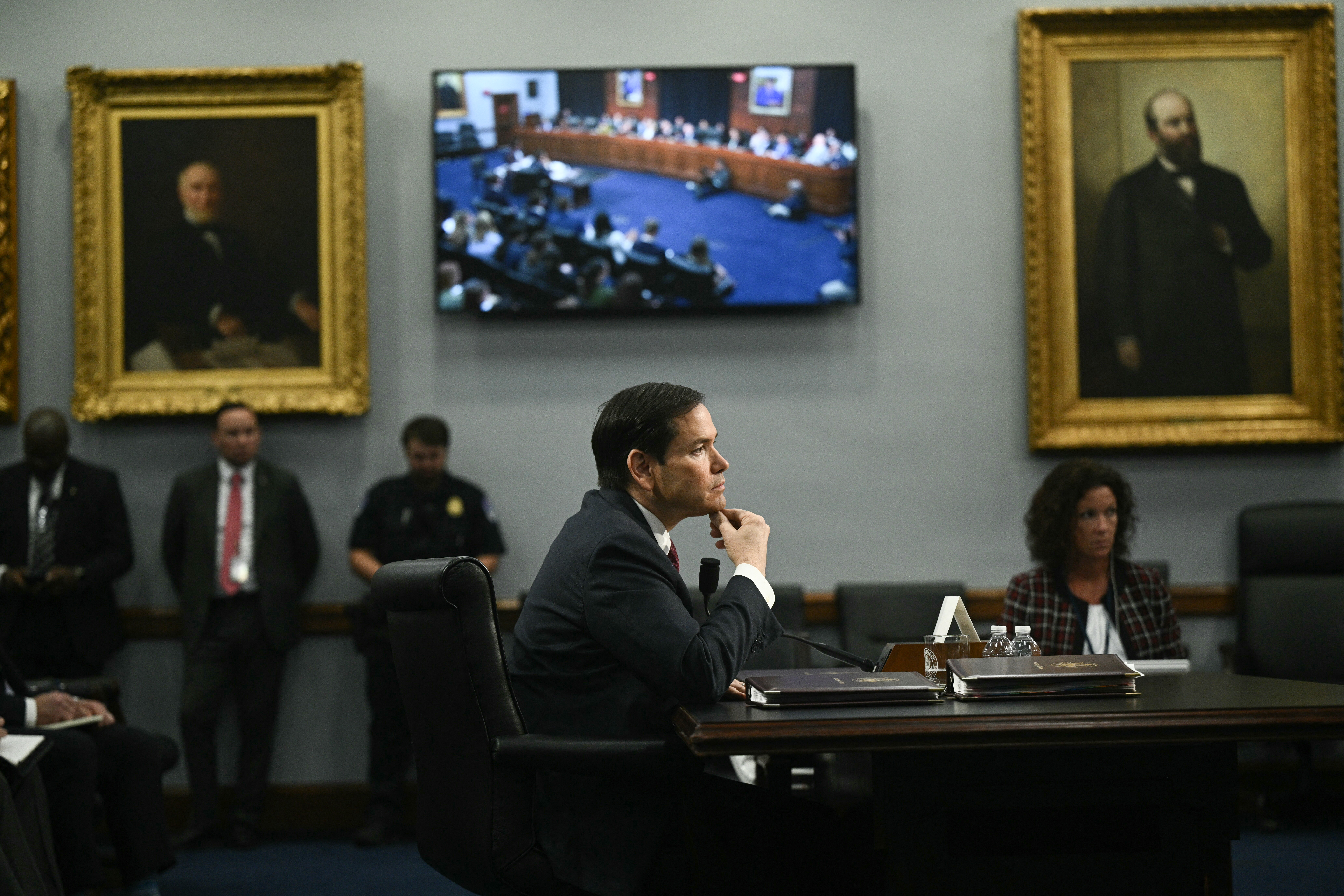
BRENDAN SMIALOWSKI/AFP via Getty Images
Secretary of State Marco Rubio testifies before a House Subcommittee on National Security, Department of State, and Related Programs hearing on the budget for the Department of State, on Capitol Hill in Washington, DC on May 21, 2025.
In his second consecutive day of hearings on Capitol Hill, Secretary of State Marco Rubio said that he expects that additional Arab countries will join the Abraham Accords by the end of the year, if not earlier.
“We do have an Abraham Accords office that is actively working to identify a number of countries who have lined up and already I think we may have good news, certainly before the end of this year, of a number of more countries that are willing to join that alliance,” Rubio said a House Foreign Affairs Committee hearing on Wednesday.
The comments are consistent with other recent remarks by President Donald Trump and Middle East envoy Steve Witkoff.
Rubio added that the administration is currently working on selecting an ambassador for the Abraham Accords, as required under law, to submit for congressional confirmation.
He said that there is “still a willingness” in Saudi Arabia to normalize relations with Israel, but “certain conditions are impediments,” including the Oct. 7, 2023, Hamas attacks on Israel and the ensuing war.
Rubio’s testimony largely reinforced and added on his comments the day before, on issues including Iran and Syria.
He again insisted that all elements of the Trump administration, including Vice President JD Vance and Witkoff, are unified behind the position that Iran cannot be allowed to maintain its capacity to enrich uranium.
And he affirmed that U.S. law requires that any deal with Iran be submitted to Congress for review and approval, noting that he had been in Congress when that law was passed.
At an afternoon hearing with the House Appropriations Committee, Rubio again said that sanctions relating to Iranian proxy terrorism or other malign activities will not be impacted by a nuclear deal that does not address those subjects. Republicans in the past have questioned the distinction between nuclear and non-nuclear sanctions, particularly as part of the original 2015 nuclear deal, which took a similar approach. And they’ve argued that any sanctions relief would allow Iran to expand its support for regional terrorism.
Rubio said the administration is continuing to ramp up sanctions on Iran, and said that European parties to the deal are “on the verge” of implementing snapback sanctions on Iran. He said that the administration would support legislation to implement additional sanctions on Iran’s oil sector.
He denied knowledge of a Tuesday leak by administration officials that Israel was making plans to strike Iran’s nuclear program, adding, “I also don’t think it’s a mystery, though … that Israel has made clear that they retain the option of action to limit Iran from ever gaining a nuclear capability.”
Expanding on comments he made the day before, Rubio said that he favors moving the mission of U.S. security coordinator for Israel and the Palestinian territories under the authority of the U.S. ambassador to Israel so that it can be a better-integrated part of the U.S.’ Israel policy. But he vowed that the core function of the office will continue.
Rubio denied reports of talks between the United States and Saudi Arabia about potential nuclear cooperation outside of a “gold standard” deal, which would include banning domestic enrichment.
The secretary of state reiterated comments about the critical necessity of providing sanctions relief to Syria to help contribute to stability, but he said that continued sanctions relief “does have to be conditioned on them continuing to live by the commitments” that the Syrian government has made verbally, including to combat extremism, prevent Syria from becoming a launchpad for attacks on Israel and form a government that represents, includes and protects ethnic and religious diversity.
He indicated that the U.S. is not actively working to shut down the United Nations Relief and Works Agency, but pledged that the United States will not be providing any further aid to or through that organization and will use its power and funding to look for alternatives.
He said it will be up to other countries whether they continue working with UNRWA, though he noted that the U.S. has been the agency’s largest donor.
Rubio said that he would be supportive, in concept, of legislation to expand current U.S. anti-boycott laws to include compulsory boycotts imposed by international organizations. That legislation was pulled from a House floor vote after right-wing lawmakers falsely claimed it would ban U.S. citizens from boycotting Israel.
Pushing back on calls for the U.S. to withhold weapons sales to the United Arab Emirates over its support for one of the parties involved in the Sudanese Civil War that the U.S. has found is committing genocide, Rubio said that the U.S. is not fully in alignment with the UAE but argued that it’s critical for the U.S. to continue engaging with and maintain a strong relationship with the UAE for its broader foreign policy goals in the Middle East.
He said that maintaining such a relationship and expanding the U.S.’ diplomatic and economic relationship with Abraham Accords countries is also important to ensuring that the Accords continue to be successful.
Rubio said that the State Department had approved restarting aid programs for Jordan that remained frozen — though he noted most were initially exempted from the administration’s blanket freeze. He acknowledged that the frozen programs had been “a source of frustration for [Jordan], and frankly for me.” He continued, “Ultimately, we’re going to get all those programs online, if they’re not online already.”
In a heated back-and-forth with Rep. Pramila Jayapal (D-WA), who was brandishing a pocket Constitution, Rubio again defended the administration’s policy of revoking student visas from individuals accused of involvement in anti-Israel activity on college campuses, saying that they are coming to the United States to “tear this country [apart]” and “stir up problems on our campuses.”
Addressing the case of Rümeysa Öztürk, a Tufts University graduate student that supporters have said was detained solely for writing an op-ed in a student newspaper criticizing Israel, Rubio claimed the situation is not as has been represented. “Those are her lawyers’ claims and your claims, those are not the facts,” Rubio said.
Asked by Jayapal about a comment — “Jews are untrustworthy and a dangerous group” — made by an Afrikaner refugee recently admitted to the United States from South Africa, Rubio said that he would “look forward to revoking the visas of any lunatics you can identify.”
But when presented with the fact that the individual in question was admitted as a refugee, not on a visa, Rubio said that refugee admissions are “a totally different process,” adding “student visas are a privilege.”
The secretary of state said that terrorism and weapons sanctions would remain in place if Iran’s other malign activity is not addressed under a nuclear deal

Anna Moneymaker/Getty Images
Secretary of State Marco Rubio speaks during a Senate Foreign Relations Committee hearing in the Dirksen Senate Office Building on May 20, 2025 in Washington, DC. Rubio testified on President Trump's FY2026 budget request for the State Department.
Secretary of State Marco Rubio said in his first appearance on Capitol Hill since being confirmed as secretary of state that Iran’s support for regional terrorist proxies has not been part of the ongoing talks between the Iranian government and Middle East envoy Steve Witkoff, which Rubio said have been focused wholly on Iran’s nuclear program and enrichment capabilities.
At the same time, Rubio insisted that any sanctions related to terrorist activity and weapons proliferation would remain in place if such issues are not part of the nuclear deal.
Rubio’s comments indicate the deal might still be subject to what some critics in the United States and the region described as a key flaw of the original nuclear deal — that it failed to address other malign activity by the regime. One U.S. lawmaker who traveled to the Middle East recently said that U.S. partners in Israel and the Arab world had argued that any deal must include non-nuclear provocations.
Rubio added that sanctions will remain in place until a deal is reached, and that European partners are working separately on re-implementing snapback sanctions, potentially by October of this year, when such sanctions expire.
He also said that Iran cannot have any level of nuclear enrichment under a nuclear deal, as it would inevitably provide a pathway for Iran to enrich to weapons-grade levels.
“About 90% of the work of enrichment is getting to that 3.67% level [necessary for civilian nuclear power]. After that, the rest of it is just a matter of time,” Rubio said. “They [Iran] claim that enrichment is a matter of national pride. It is our view that they want enrichment as a deterrent. They believe that it makes them a threshold nuclear power, and as a result, [become] untouchable.”
Rubio said that reaching a nuclear deal will not be easy, but that it is the administration’s preference. He reiterated that Iran can be permitted to have nuclear energy for civilian use, but only if it imports nuclear material from elsewhere. He said at a second hearing later in the day that a so-called 123 Agreement for civilian nuclear cooperation with the United States or an equivalent deal would be possible if Iran dismantles its enrichment capacity.
Addressing the war in Gaza, Rubio said that the U.S. is ultimately hoping to end hostilities, adding that ending the war will require Hamas freeing the hostages and ensuring that Hamas and similar terrorist groups do not maintain power in Gaza. He placed blame on Hamas for failing to agree to a ceasefire.
Rubio said that regional partners are willing to step up to help support the reconstruction of Gaza, but said that the territory’s future governance will be the key question going forward. He said that a stable governing authority capable of providing peace and security will be necessary to keep Hamas out of power.
Rubio also denied any plans for forcible or permanent relocation of Palestinians in Gaza, but said that the administration had been engaged in discussions with other regional partners about allowing Gazans who want to temporarily relocate to do so. He said he was not aware of any such conversations with Libya, as a recent NBC News report suggested.
“You don’t want people trapped [in Gaza]. They may want to come back, they may want to live there in the future, but right now, they can’t,” Rubio said. “And if there’s some nation willing to accept them in the interim period, yes, we’ve asked countries preliminarily whether they would be open to accepting people, not as a permanent situation, but as a bridge towards reconstruction.”
He said that the U.S. was “pleased to see that aid is starting to flow” into Gaza, after Israel had blocked it for 11 weeks.
He rebutted accusations that Israel is seeking to destroy Gaza, saying that Israel has told the U.S. and the world that “they need to root out the remaining elements of Hamas — who, by the way, have been an impediment to multiple ceasefires.”
Later in the day, Rubio reiterated that the U.S. sees resuming humanitarian aid as a priority and has encouraged Israel to allow aid into Gaza — a divergence from some Israeli officials and congressional Republicans who have opposed allowing aid into Gaza. He appeared to acknowledge that the humanitarian situation in Gaza is dire.
“Many of you have noticed there’s been a growing number of anti-Hamas protests and demonstrations as well. So there are people there that understand that this is a root cause of it,” Rubio said. “That said, you have this, you have this acute, immediate challenge of food and aid not reaching people, and you have existing distribution systems that could get them there.”
He said that Israel can defeat Hamas and prevent diversion of aid while still permitting “sufficient quantities” of aid to move into the territory. He said that organizations like the World Food Program have the capacity to immediately begin distributing aid, reflecting the reticence of Israeli and U.S. officials to rely on the U.N. for distribution.
The secretary of state continued to embrace the administration’s policy of revoking student visas and residency permits from individuals alleged to be involved in anti-Israel activity on college campuses, adding that such revocations will continue.
“We’re going to do more. There are more coming. We’re going to continue to revoke the visas of people who are here as guests and are disrupting our higher education facilities,” Rubio said. “I want to do more, I hope we can find more.”
Rubio said later in the day that thousands of student visas have been revoked, but many for reasons unrelated to anti-Israel activity.
He denied reports that the administration is planning to eliminate the position of U.S. security coordinator for Israel and the Palestinian territories, saying that there had instead been discussions about bringing the mission under the authority of the U.S. embassy in Jerusalem.
Rubio also pushed back on accusations from Sen. Jacky Rosen (D-NV) that the administration was “abandoning” a push for normalization of relations between Israel and Saudi Arabia, saying instead that “the Saudis are the ones that have expressed their inability to move forward on it, so long as the conflict is happening in Gaza. But we would love to see normalization.”
The secretary of state spoke at length about the situation in Syria and the administration’s decision to remove sanctions on the country. He acknowledged that, even with U.S. engagement, the situation in Syria could still collapse, but argued that collapse would have been a certainty if the U.S. had not chosen to engage and lift sanctions.
“It is our assessment that, frankly, the transitional authority, given the challenges they’re facing, are maybe weeks, not many months, away from potential collapse and a full scale civil war of epic proportions, basically the country splitting up,” Rubio said.
Despite President Donald Trump’s announcement that the U.S. would remove “all” sanctions from Syria, Rubio said in the second hearing that the sanctions would be removed “incrementally.” He said that Syria’s designation as a state sponsor of terrorism should be removed if Syria meets the conditions for such a move.
Rubio said that resolving internal divisions, restoring a unified Syrian national identity and creating a situation in which millions of displaced persons can return will be critical challenges going forward.
Rubio described the fall of the Assad regime and the possibility of a stable and peaceful Syria as an “opportunity for Israel,” despite the Israeli government’s deep concerns about the new Syrian government and its leader’s past jihadi loyalties.
“They’re not viewing themselves as a launch pad for revolution. They’re not viewing themselves as a launch pad for attacks against Israel,” Rubio said. “So we think this is an extraordinary thing, if, in fact, you have in Syria a stable government that encompasses all the elements of their society and has no interest whatsoever in fighting wars with Israel over borders or anything else. I think that’s an extraordinary achievement for Israel’s security.”
He said that the U.S. has been working to mediate conflicts between Turkey and Israel inside Syria, but added that Syrian government decisions in the medium term about whether to allow Turkey or Russia to maintain bases inside Syria will be a key issue going forward.
He said Iran is still working to foment violence inside Syria, which he characterized as one of the most critical threats to the new government’s stability.
Rubio said Trump had moved more quickly than anticipated in meeting with Syrian President Ahmed al-Sharaa, but said that removing sanctions will allow regional partners to surge aid in, helping to build a more stable government and unify armed forces in the country.
But Rubio also said that action from Congress will be needed to repeal other sanctions legislation like the Caesar Act that can only be temporarily waived by the president, pending performance from the Syrian government.
He described the situation in Syria as the “first test” of what he characterized as a new approach to U.S. foreign aid and engagement driven more by local personnel and bureaus than Foggy Bottom.
Rubio said that the U.S. Embassy in Syria remains closed due to concerns about potential attacks from other armed groups in the country, explaining that the U.S. does not see the new government led by former jihadist fighters as a security threat.
He said that ISIS, with which al-Sharaa was previously affiliated, “hates the transitional authority, and they hate al-Sharaa, and they hate everybody in his government and I think pose a grave risk to them.”
He said that the Syrian government is willing to take over counter-ISIS operations but currently lacks the capacity to do so.
He added that stability in Syria would help bring stability in Lebanon, and if those two countries become stabilized, it “opens up incredible opportunities around the region for all kinds of peace and security and the end of conflicts and wars.”
Rubio denied any knowledge related to a potential gift of a Boeing 747 jet from Qatar to Trump or the U.S. government.
Asked about the situation, the secretary of state declined to speak publicly about conversations with the United Arab Emirates regarding its backing of one of the warring parties in Sudan that the U.S. has found is committing genocide, but said that it doesn’t “serve the interests” of international parties to back belligerents in the conflict “because instability there is going to create a breeding nest for radicalism.”
In an interview with The Free Press, Rubio said Iran could be allowed to import enriched material but that maintaining its own enrichment program would be ‘problematic’
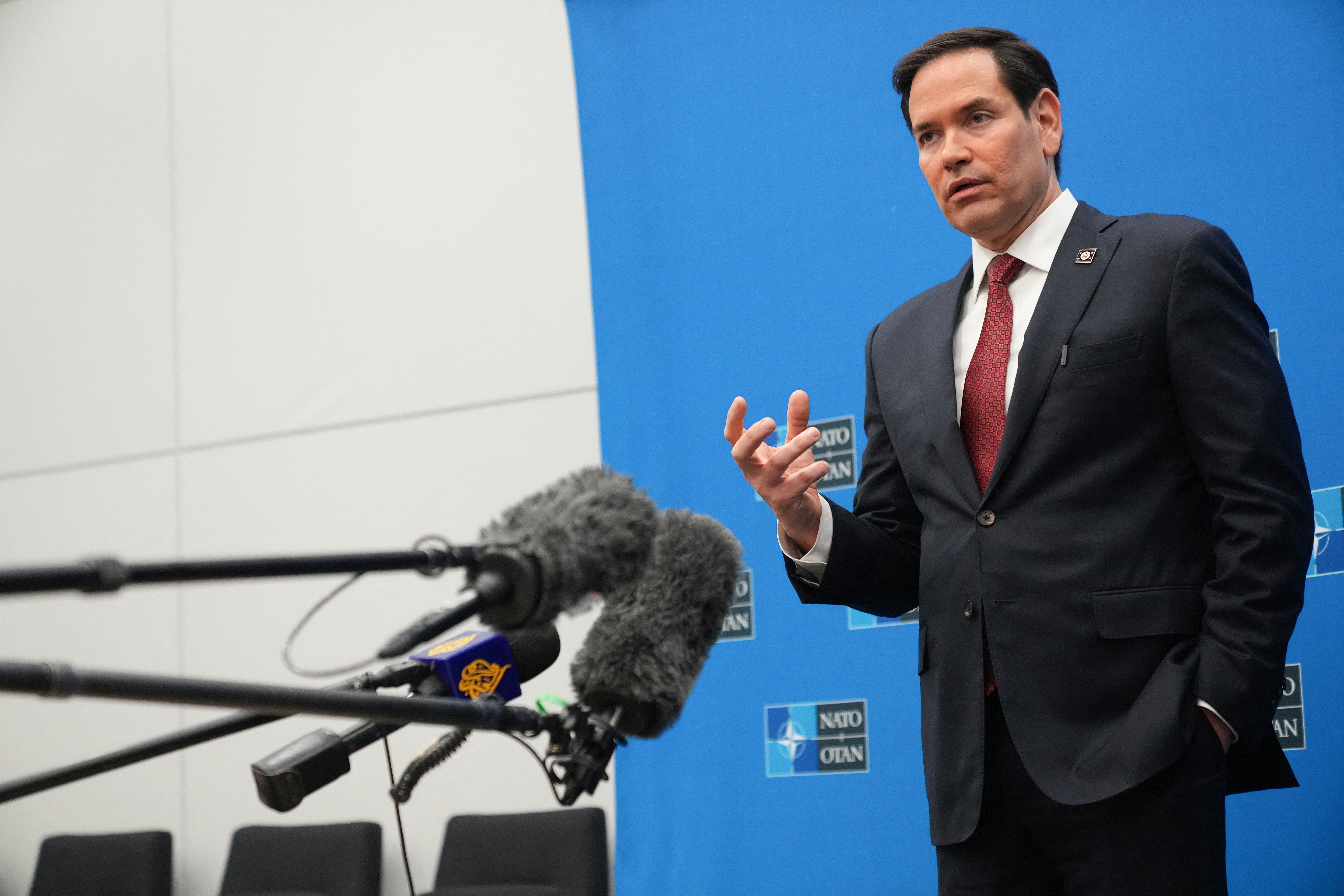
JACQUELYN MARTIN/POOL/AFP via Getty Images
Secretary of State Marco Rubio addresses media at NATO's headquarters in Brussels on April 4, 2025.
Secretary of State Marco Rubio suggested he was open to Iran maintaining a civil nuclear program and did not explicitly rule out allowing the Islamic Republic to enrich uranium itself, even as he expressed concern about such activity in an interview with The Free Press’ Bari Weiss on Wednesday.
“If Iran wants a civil nuclear program, they can have one just like many other countries in the world have one, meaning they can import enriched material,” Rubio told Weiss on the Free Press’ “Honestly” podcast. “But if they insist on enriching uranium themselves, then they will be the only country in the world that ‘doesn’t have a weapons program’ but is enriching,” he added. “I think that’s problematic.”
Rubio’s comments came as the Trump administration faces scrutiny over its mixed messaging amid ongoing nuclear negotiations with Iran.
Most notably, Steve Witkoff, President Donald Trump’s Middle East envoy, suggested last week that the U.S. was willing to allow Iran to maintain some level of nuclear enrichment, as it did in the original 2015 nuclear deal. But he soon walked back his remarks and said the administration is instead demanding Iran eliminate its enrichment program entirely.
The lack of clarity has raised concerns among foreign policy hawks who opposed the deal brokered by the Obama administration that had allowed Iran to continue its uranium enrichment up to 3.67% — which critics viewed as a pathway to a nuclear weapon. Trump pulled out of the original deal during his first term.
Rubio, who opposed the first nuclear deal with Iran, did little to elucidate how renewed talks would help deliver a different agreement, even as he hinted at some subtle distinctions in his interview with The Free Press.
“Without using the word dismantlement, and perhaps more subtly, the secretary pointed out that Iranian domestic enrichment remains the problem,” Behnam Ben Taleblu, a senior fellow at the Foundation for Defense of Democracies who specializes in Iran, told Jewish Insider. “We will have to wait and see if this problem is reflected both in the marching orders special envoy Witkoff has received as well as what are the contours of any technical framework offered by U.S. negotiators in Oman.”
Rubio also “reupped that the military option was on the table, but there is no clear timeline as to when such an option might enter the U.S.’ equation,” Ben Taleblu said.
“Suffice it to say that I do believe the United States has options, but we don’t want to ever get to that,” Rubio said of a possible military strike against Iran during the interview. “We really don’t.”
Rubio more broadly argued in favor of giving “peace every chance to succeed,” adding, “I don’t want to see a war. The president certainly doesn’t want to see one either.”
But he set low expectations for ultimately achieving a deal.
“We’re a long ways away from any sort of agreement with Iran,” Rubio said. “We recognize it’s difficult and hard. Oftentimes, unfortunately, peace is. But we’re committed to achieving a peaceful outcome that’s acceptable to everyone. It may not be possible — we don’t know.”
The incoming Trump administration’s nominee to be secretary of state is expected to enjoy an easy glide-path to confirmation with overwhelming bipartisan support

Kevin Dietsch/Getty Images
President-elect Donald Trump’s nominee for Secretary of State, Sen. Marco Rubio (R-FL) testifies during his Senate Foreign Relations confirmation hearing at Dirksen Senate Office Building on January 15, 2025 in Washington, DC.
Sen. Marco Rubio (R-FL), the incoming Trump administration’s nominee to be secretary of state, said at his Senate confirmation hearing on Wednesday that President-elect Donald Trump’s administration is open to a new nuclear deal with Iran, under strict conditions.
Over the course of his testimony, Rubio also framed the announcement of a cease-fire between Israel and Gaza and recent losses for Iran and its proxies in the region as creating an opportunity for major steps forward on regional normalization and Israeli-Palestinian peace, condemned the International Criminal Court’s targeting of Israel and spoke forcefully about the need to combat antisemitism globally.
Overall, Rubio’s hearing — businesslike and cordial, focused on details of every region of the globe — marked a striking difference from the heated partisan slug-fests at confirmation hearings for other top Trump nominees this week. Rubio is expected to enjoy an easy glide-path to confirmation with overwhelming bipartisan support.
“My view is that we should be open to any arrangement that allows us to have safety and stability in the region, but one in which we’re clear-eyed,” Rubio said on the subject of Iran’s nuclear program. “Any concessions that we make to the Iranian regime, we should anticipate that they will use, as they have used in the past, to build their weapons systems and to try to restart their sponsorship of Hezbollah and other related entities around the region.”
He described the Iranian regime as at its “weakest point in recent memory, maybe ever,” with its air defenses degraded, its regional partners and proxies undermined and its economy in dire straits.
Secretary of State Nominee @marcorubio appeared at his confirmation hearing today, and discussed Israel, the ICC and Iran, among other issues. The following thread includes some of the highlights:
— Jewish Insider (@J_Insider) January 15, 2025
"How can any nation state on the planet co-exist side-by-side with a group of… pic.twitter.com/8x2Jl5oRab
Rubio said that this could push the Iranian regime in one of two directions: toward negotiations to buy time to rebuild, or toward rapid nuclearization as a method of regime protection.
He said that recent outreach from the regime to European nations, in the context of the expiration of snapback sanctions under the 2015 nuclear deal later this year, indicates that Iran may be leaning toward pursuing negotiations.
He said the U.S. cannot allow “under any circumstances” Iran to become a nuclear weapons state, to continue to sponsor terrorism or have the ability to attack its neighbors and the United States. He also noted that U.S. policy would be shaped by Iran’s yearslong efforts to assassinate Trump and other U.S. officials.
Rubio was careful to repeatedly draw a clear distinction between the Iranian regime of “radical Shia clerics” and the people of Iran, arguing that the gap between the regime and Iranian citizens is perhaps the widest of any country on Earth.
“In no way [are] the clerics who run that country representative of the people of that country and of its history and of the contributions it has made to humanity,” Rubio said.
He also noted that in Iran and other key U.S. adversaries, a “market” has developed for kidnapping and holding American citizens hostage, emphasizing the need for greater awareness about those risks.
Rubio described the cease-fire and hostage-release agreement between Israel and Hamas — announced in the middle of his hearing — as “a foundation to build upon” toward broader regional change, including Israeli-Palestinian peace and regional normalization. He said that the deal, in combination with the cratering of Hezbollah in Lebanon and the fall of the Assad regime, had altered the landscape of the Middle East, potentially opening pathways to renewed normalization and an Israeli-Palestinian peace process.
"I don't know of any nation on earth in which there is a bigger difference between the people and those who govern them than what exists in Iran. And that's a fact that needs to be made repeatedly." pic.twitter.com/cVAx1iUFCU
— Jewish Insider (@J_Insider) January 15, 2025
“There are opportunities now in the Middle East that did not exist 90 days ago,” Rubio said. “There are now factors at play in the Middle East that I think we can build upon and may open the door to extraordinary and historic opportunities, not just to provide for Israel’s security but ultimately begin to confront some of these other factors. But these things are going to be hard work and they’re going to require us to take advantage of those opportunities if they exist.”
Rubio said that the six-week first phase of the deal will be a critical period to build international cooperation to bring stability and new governance into Gaza. He said that both President Joe Biden and Trump deserved credit for working in tandem in the negotiations.
But he also noted that the deal did not ensure the release of all of the hostages, and emphasized that any cease-fire would be short-lived if hostages remain in Hamas captivity.
“Without the hostage situation resolved, this situation will not be resolved. It is the lynchpin,” Rubio said. “Hamas has been severely degraded, but these people, who include a number of American citizens, need to be home as soon as possible, and that will remain a priority in any engagement that we’re involved in.”
Rubio said that potential normalization between Saudi Arabia and Israel would be “one of the most historic developments in the history of the region,” adding that the Saudis and other partners in the Middle East should be part of the post-war stabilization efforts in Gaza and that a normalization agreement would help bring “a level of stability and peace” to the entire region.
He said that a key part of expanding and strengthening the Abraham Accords is ensuring that there are benefits to the countries joining the pact, such as, for Saudi Arabia, high tech investment, economic diversification and security against the mutual Iranian threat. He said the U.S. could help provide security assurances as well.
"Any concessions we make to the Iranian regime we should anticipate that they will use as they have used in the past to rebuild their weapons systems and to try to restart their sponsorship of Hezbollah and other related entities around the region." pic.twitter.com/CjH9BNsJVA
— Jewish Insider (@J_Insider) January 15, 2025
“We’re still going to have some issues with UAE and with Saudi Arabia, but we also have to be pragmatic enough to understand what an enormous achievement it would be if, in fact, you not just get a cease-fire but that leads to the opportunity of a Saudi-Israeli partnership and joint recognition,” Rubio said.
One such issue with the United Arab Emirates that Rubio said the U.S. should raise is Abu Dhabi’s support for a militant group in Sudan that Rubio and the Biden administration have said is commiting genocide. At the same time, he described the UAE as a critical partner to build stability in the Middle East.
On the subject of Israeli-Palestinian peace and a two-state solution, Rubio argued that the “conditions for that have not been in place for some time” — noting that the Palestinian Authority had rejected a Trump administration peace proposal in 2020.
He argued that if Israel had not responded forcefully to the Oct. 7 attack, the country may have faced existential threats from enemies on its various borders.
But Rubio said that there has been a potential “dynamic shift in the region” that has “an historic opportunity, if appropriately structured and pursued, that changes the dynamics of what might be possible.” He emphasized that for Israel, its existential safety is the non-negotiable starting point. If Israeli security can be guaranteed, Rubio said, there may be more opportunities for a peace process.
He said the key question for the Palestinians moving forward will be the future of governance in Gaza. “[Israel] can’t turn it over to people who seek [it’s] destruction … You cannot coexist with armed elements at your border who seek your destruction and evisceration as a state.”
Pressed by Sen. Ted Cruz (R-TX) — who accused the administration of secretly prohibiting Jews in the West Bank from accessing U.S. grants — Rubio committed to ending any waivers to sanctions in Gaza and the West Bank, ending what Cruz described as “discriminatory policies, including the Biden administration’s secret boycott policies” in the territory and ending the Biden administration’s sanctions regime against Israeli settlers accused of inciting violence in the West Bank.
One of the alleged boycotts, through the Development Finance Corporation, does not appear to have been revealed publicly before the hearing.
Senator @tedcruz pressed Senator @marcorubio during his secretary of state confirmation hearing on reversing discriminatory sanctions against Israeli Jews living in Judea and Samaria.
— Jewish Insider (@J_Insider) January 15, 2025
Rubio responded: "I'm confident in saying that President Trump's administration will continue… pic.twitter.com/i4p9mNkwny
He did not address a question from Sen. Chris Van Hollen (D-MD) about whether the Trump administration would oppose potential Israeli annexation of the West Bank.
Addressing the ICC prosecutions targeting Israeli leaders, Rubio said that the court had “done tremendous damage to its global credibility” with the effort, calling the case “completely flawed” and “completely offensive” in drawing equivalency between Israel and Hamas.
“Hamas carried out an atrocious operation. They sent a bunch of savages into Israel with the express and explicit purpose of targeting civilians,” Rubio said. “They deliberately targeted civilians. The ones they didn’t murder, the families they didn’t eviscerate, the people whose skulls they didn’t crack open, they kidnapped, and to this day continue to hold people, innocents that they took.”
He said that Israel cannot be expected to “coexist side-by-side with a group of savages like Hamas. They have to defend their national security and their national interest. And they didn’t target civilians.”
Rubio said that innocent people had been caught up in the war, “but there is a difference between those who in the conduct of armed action deliberately target civilians and those who do as much as they can to avoid civilians being caught up against an enemy that doesn’t wear a uniform, against an enemy that hides in tunnels, against an enemy that hides behind women and children.”
Further, Rubio said the case appeared to be a “test run” for a future case targeting U.S. leaders and military personnel.
Echoing rhetoric from other top Trump nominees, Rubio said that any individuals in the U.S. on visas who express support for Hamas or other terrorist groups should lose their visas and be forced out of the country.
Rubio committed to Sen. Jacky Rosen (D-NV) that the Trump administration would quickly nominate a qualified individual to serve as U.S. special envoy to monitor and combat antisemitism, saying that the nominee “needs to be someone that enjoys broad support across different sectors.”
He also said that the administration would promptly name a deputy envoy to run the office until an envoy is confirmed. Rubio said the antisemitism envoy role is particularly urgent in light of a recent Anti-Defamation League report that showed 60% of people hold some antisemitic views.
“Antisemitism is a unique danger. The suffering that it inflicted on the world historically, but within the last century, is unimaginable and can never be allowed to be repeated, and it’s something that we should make sure we’re constantly speaking out against, and identifying for what it is,” Rubio said. “I think the U.S.’s role in speaking out in that regard is indispensable, and we need to be forceful about it.”
Asked by multiple senators about the incoming administration’s approach to multilateral organizations such as the United Nations, Rubio said that the guiding philosophy for the administration’s engagement with such organizations will be whether engagement with them makes the U.S. safer and more prosperous. He said that no international organizations would be allowed to hold a veto over U.S. security interests.
Any funding to such organizations will require strict examination, Rubio added, suggesting that the administration may pull back funding from some of them.
He further described the U.N. Security Council as having become “almost irrelevant” and “weaponized” against the United States because of the power of Russia and China, which he called two of the top drivers of global conflict.
Rubio also said that international organizations had become “havens” for antisemitism, undermining their credibility.
Rubio characterized the new regime in Syria, led by leaders of an Al-Qaeda offshoot, as “not ideal” but nonetheless “worth exploring.”
“I do think it’s important to respond to this opportunity in Syria,” Rubio said. “It is in the national interest of the United States, if possible, to have a Syria that’s no longer a playground for ISIS, that respects religious minorities … that protects the Kurds and at the same time is not a vehicle through which Iran can spread its terrorism.”
Rubio said that an improved situation in Syria could positively impact Lebanon, Israel, Gaza and the Middle East as a whole. He said Iran and Russia would return to fill the gap in Syria if the U.S. does not “explore these opportunities.”
He described Turkish President Recep Tayyip Erdoğan as an “impediment” to that path forward, and said the Trump administration would communicate immediately to Erdoğan not to move against the Kurds in Syria. He said the U.S. should maintain its support for the Kurdish Syrian Democratic Forces — something Trump sought to pull back in his first administration.
Please log in if you already have a subscription, or subscribe to access the latest updates.
 Continue with Google
 Continue with Apple