










Rubio: Iranian regime is ‘weaker than it has ever been’ but protest crackdown has been effective
The secretary of state also said that it is unclear who would take over Iran if the supreme leader were removed from power
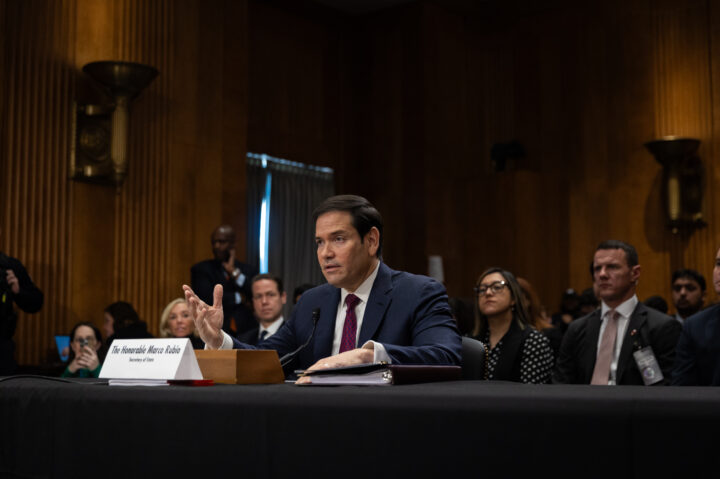
Nathan Posner/Anadolu via Getty Images
Secretary of State Marco Rubio testifies during a Senate Foreign Relations Committee hearing on Venezuela, in Washington, DC, United States on January 28, 2026.


 Add JewishInsider on Google
Secretary of State Marco Rubio said at a hearing before the Senate Foreign Relations Committee on Wednesday that the Iranian regime is historically weak due to serious economic troubles, but also said that Tehran’s violent crackdown on protesters has appeared to have successfully quelled the demonstrations that have swept the country in recent weeks.
Rubio also said that it’s uncertain who would take over the country if the Iranian regime were to fall. He framed the buildup of U.S. forces in the region — a U.S. carrier strike group arrived in the area this week — as a largely defensive measure to protect U.S. troops and allies from an Iranian attack.
“That regime is probably weaker than it has ever been, and the core problem they face, unlike the protests you saw in the past on some other topics, is that they don’t have a way to address the core complaints of the protests, which is that their economy is in collapse,” Rubio told senators.
“The reason why their economy is in collapse is because they spend all their money and all their resources building weapons and sponsoring terrorist groups around the world instead of reinvesting it back into their society, and as a result have taken on massive global sanctions which have isolated their economy and their country.”
He said the Iranian demonstrators want those sanctions removed and the regime to begin addressing their interests, “and this regime is unwilling to do it.”
Asked who would take over in the event that the Iranian supreme leader, Ayatollah Ali Khamenei, was removed from power, Rubio said that it was uncertain but suggested that the U.S. would expect to work with someone from within the Iranian government, rather than an outside actor, mirroring the approach it has taken in Venezuela.
“I don’t think anyone can give you a simple answer as to what happens next in Iran if the supreme leader and the regime were to fall, other than the hope that there would be some ability to have somebody in their systems that you could work toward a similar transition” as in Venezuela, Rubio said.
“I would imagine it would be even far more complex than [Venezuela] because you’re talking about a regime that’s been in place for a very long time, so that’s going to require a lot of careful thinking, if that eventuality ever presents itself,” he continued.
Addressing the U.S. military buildup in the region, he noted that the 30-40,000 U.S. troops in the region are within range of Iran’s arsenal of thousands of drones and short-range ballistic missiles. He said that the U.S. needs a “baseline” of “force and power” in the region to defend against that threat, if Iran “at some point, as a result of something” decided to attack U.S. forces.
“The president always reserves the preemptive defensive option — in essence, if we have indications that, in fact, they’re going to attack our troops in the region,” he continued, in addition to security agreements to defend allies such as Israel “that require us to have a force posture in the region.”
“I think it’s wise and prudent to have a force posture in the region that could respond and, potentially — not necessarily what’s going to happen — preemptively prevent the attack” against U.S. forces or allies, Rubio added.
The secretary of state said, however, that the violent crackdown by regime officials on the protests, which he said has killed thousands of people, has been “effective and … it’s horrifying.”
Though he said the protests have now “ebbed,” he said he was confident that “they will spark up again in the future because this regime, unless they are willing to change, or leave, have no way of addressing the legitimate and consistent complaints of the people of Iran who deserve better.”
Asked by Sen. Brian Schatz (D-HI) about the makeup of the Trump administration’s newly created Board of Peace — specifically why some close U.S. allies are not part of the group while U.S. adversaries are — and whether the body is intended to be a competitor to the United Nations, Rubio answered, “This is not a replacement for the U.N., but the U.N. has served very little purpose in the case of Gaza other than the food assistance, and so we think it’s critical to have something that’s in charge of that.”
Rubio noted that the Board of Peace was chartered through a U.N. resolution and said that the “primary and sole focus of that board right now is to administer Phase 2 and Phase 3 of the plan in Gaza.” He said that various countries have been invited to the board but some U.S. allies in Europe have declined to join or are waiting on parliamentary approval to do so.
Asked by Sen. Jacky Rosen (D-NV) whether the administration would be seeking congressional ratification or legislation to establish and join the Board of Peace, Rubio responded by again highlighting the U.N. Security Council’s support for and recognition of the board.
Rubio’s testimony came at a hearing focused primarily on the U.S. military operation in Venezuela in which former President Nicolás Maduro was arrested and U.S. policy toward Venezuela going forward.
He said that one of the Trump administration’s primary goals in conducting the operation was denying Iran, along with Russia and China, a foothold in the Western Hemisphere. He asserted that the success of the operation could help provide a deterrent to adversaries such as Iran, “because the U.S. is the only country in the world that could have done this operation.”
He also said that he does not anticipate further military action in Venezuela, but that the U.S. would act in case of a threat — offering as an example if Iran were to establish a drone factory in the country.
He further noted that Venezuela had been providing false passports to Iranian and Hezbollah operatives, which he described as deeply concerning.
During a heated back-and-forth with Sen. Tim Kaine (D-VA), Kaine referenced comments by acting Venezuelan President Delcy Rodriguez — who currently has Washington’s support — that the U.S. attack on Venezuela had “Zionist undertones.”
“What the hell did Delcy Rodriguez mean when she said this attack had Zionist undertones?” Kaine said. Rubio responded that he had “an idea what she meant” but Kaine pivoted and Rubio was not able to answer further.
More Stories
SHARING A STAGE
Top N.J. Dem recruit campaigned alongside New Jersey mayor accused of antisemitism

Daily Kickoff
Barack to 1948
UNLOCKING THE KEYSTONE
RJC drops $400,000 to boost Brian Fitzpatrick in Pennsylvania swing district

EXCLUSIVE
JDCA launches streaming and digital ads supporting Cait Conley, attacking Lawler
DAYLIGHT DEBATE
Brett McGurk pushes back on former Biden WH colleagues who called for greater pressure on Israel

PACKED PEWS
Scholten, Gottheimer and Bret Stephens join Dan Senor before packed Michigan crowd
Please log in if you already have a subscription, or subscribe to access the latest updates.
 Continue with Google
 Continue with Apple