


































The defense secretary indicated at a Senate Appropriations Committee hearing that the U.S. has the capability to destroy the deeply buried site, which experts say may be beyond the reach of even the most powerful conventional weapons
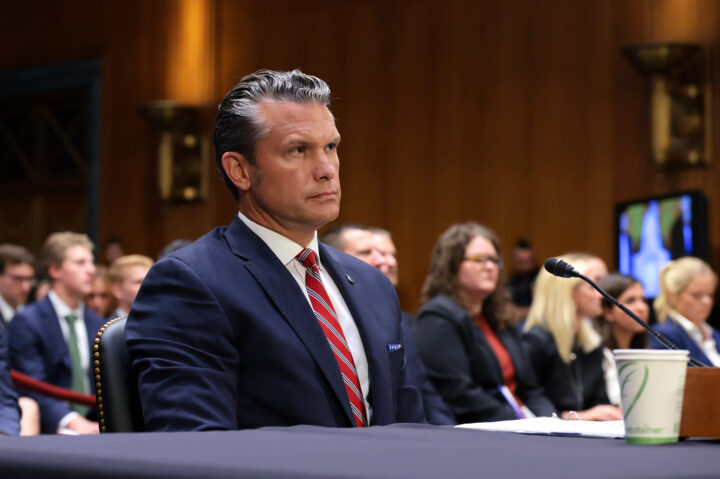
Anna Moneymaker/Getty Images
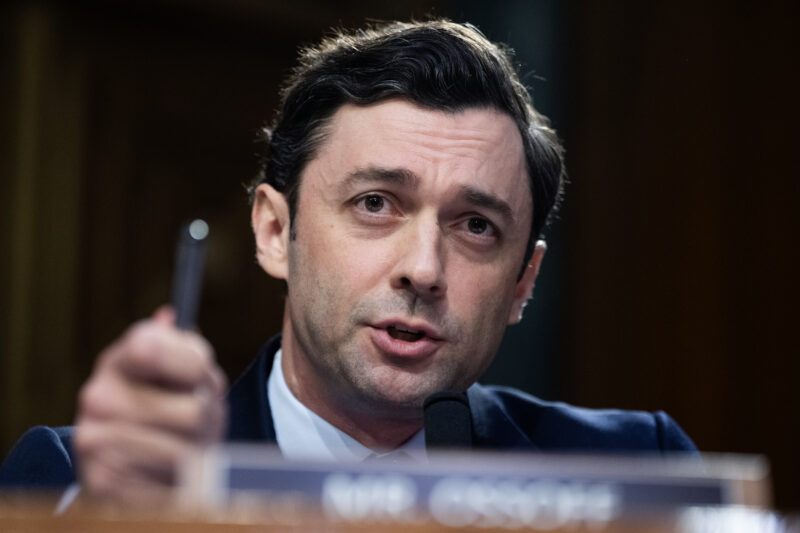
Secretary of Defense Pete Hegseth testifies during a Senate Appropriations Committee hearing in the Dirksen Senate Office Building on Capitol Hill on July 21, 2026 in Washington, DC.


 Add JewishInsider on Google
Secretary of Defense Pete Hegseth indicated at a Senate Appropriations Committee hearing on Tuesday that the U.S. military has the capacity to destroy Iran’s Pickaxe Mountain, the underground site suspected of housing elements of Tehran’s nuclear program, following a series of threats by President Donald Trump to strike the site.
The facility is buried inside a mountain in a manner that experts believe would be difficult to fully destroy, even with the heavy munitions used by the U.S. to target Iran’s Fordow and Natanz facilities last summer.
“A lot of our capabilities are classified,” Hegseth said, in response to a question about whether the U.S. has the capacity to destroy the facility. “But if anybody in the world can reach anything on God’s green earth, it’s the United States military, the most powerful military in the world. It’s all about options and trade-offs.”
"If anybody in the world can reach anything on God’s green earth, it’s the United States military."
— Jewish Insider (@jewishinsider) July 22, 2026
Pete Hegseth indicated the U.S. military can destroy Pickaxe Mountain, suspected of housing elements of Iran's nuclear program.
Read more: https://t.co/wxqcuGwu2t pic.twitter.com/an5VEFu4aZ
Hegseth, during a hearing focused on a nearly $90 billion supplemental funding request to recoup costs from the war, estimated the current costs of the Iran war at $37.5 billion, up from a $29 billion estimate provided by another Pentagon official in mid-May. He said that estimate includes certain expenses such as troop pay through the end of the fiscal year, but does not incorporate other expenditures related to the war.
He did not directly address a question about whether the Pentagon would put forward another supplemental request to repair or rebuild damaged U.S. bases and facilities, which were excluded from the previous Pentagon estimate.
Asked whether China and Russia were assisting Iran in its military operations against the U.S., Hegseth suggested that they were, but declined to discuss the extent of the cooperation.
“There’s definitely adversary alignment — attempts to do so — and there are many ways that we deter that,” Hegseth said. “Some of which are — and the depth and extent of it ought to remain — classified, and it should. But there are ways in which both of those countries are, at different levels, enabling some of the things Iran is doing.”
Sen. Mike Rounds (R-SD) pressed Gen. Dan Caine, the chairman of the Joint Chiefs of Staff, on whether the supplemental would provide sufficient resources to “appropriately end this war favorable to the United States and to take care of this problem permanently.”
Caine responded that such a scenario would be dependent on how Iran responds and behaves.
“I can’t answer the question on what it will cost because the enemy has a vote. What I’ll commit to you as this plays out, we’ll make sure that the Congress is informed,” Caine said. “But because I’m not quite sure how this is going to play out yet, it would be unwise for me to comment on what a future cost may or may not be depending on what they choose.”
Hegseth said that the administration continues to believe it has the authorities necessary to continue the war without congressional authorization, but said he would defer to legal experts on whether passing the supplemental would constitute a congressional authorization for use of military force — an argument made by the Clinton administration during operations against Yugoslavia in the 1990s.
Throughout the hearing, Hegseth insisted that Iran’s capabilities had been significantly degraded, despite its continued attacks on commercial shipping and U.S. bases around the region, several of which have recently resulted in the deaths and injuries of U.S. service members. Hegseth also called the U.S. blockade of Iranian ports “effectively impenetrable.”
“Iran is at the weakest point militarily it has ever been in in the past decade, certainly — maybe in 47 years,” Hegseth said. He said the Iranian regime had built thousands of ballistic missiles to defend its nuclear program “many of which we have destroyed, others of which they have hidden in underground facilities.”
“So I acknowledge they still have capabilities, no doubt,” Hegseth continued. “But the amount of damage that we’ve done to them over the course of these series of operations has put them in the worst place they’ve ever been.”
He didn’t answer questions about whether the U.S. would attempt to impose tolls on the Strait of Hormuz, as Trump recently floated and then walked back.
Caine acknowledged that air power has “limits, and we always have to be mindful of those,” but argued that the U.S. has other capabilities in the diplomatic, informational, economic and military realms. He declined to discuss the possibility of U.S. ground forces being deployed to Iran, but said that his job involves developing a range of options and laying out their risks.
Though the hearing was principally focused on the supplemental request that the administration put forward to cover the Iran war, Hegseth and Caine both repeatedly argued for the full $1.5 trillion military funding request the administration has put forward for 2027.
It’s unclear at this point if or how that request will be fulfilled. Lawmakers had planned to include $1.15 trillion in the base defense budget and an additional $350 billion in a partisan reconciliation bill, but both of those are currently in limbo.
Senate Democrats have largely rejected the $1.15 trillion topline, particularly in the midst of the Iran war, and the House’s third reconciliation bill aims to cover just the Iran supplemental request.
Republicans are now floating the idea of a fourth reconciliation bill — but many Senate Republicans have been skeptical that the current third package can pass, so it’s not clear how realistic another reconciliation bill would be ahead of the midterm elections.
“This request is an urgent, necessary injection of resources to address the immediate needs of our department. The supplemental funding request is not a substitute for the president’s full $1.5 trillion base budget request,” Hegseth said, amid repeated interruptions of his opening statement by anti-war protesters in the chamber. “$1.5 trillion is what the president seeks and what we need to defend the country. The members of this committee understand better than most that long-term strategic dominance cannot be funded through one-off supplementals.”
Hegseth lambasted what he alleged was neglect and gross negligence by the Biden administration, as well as blaming U.S. aid to Ukraine for some of the current deficits, and said that without additional funding, the U.S. would face “critical shortfalls” that would imperil its ability to pay service members, replenish supplies and continue critical operations.
Plus, direct flights to Beirut cleared for takeoff
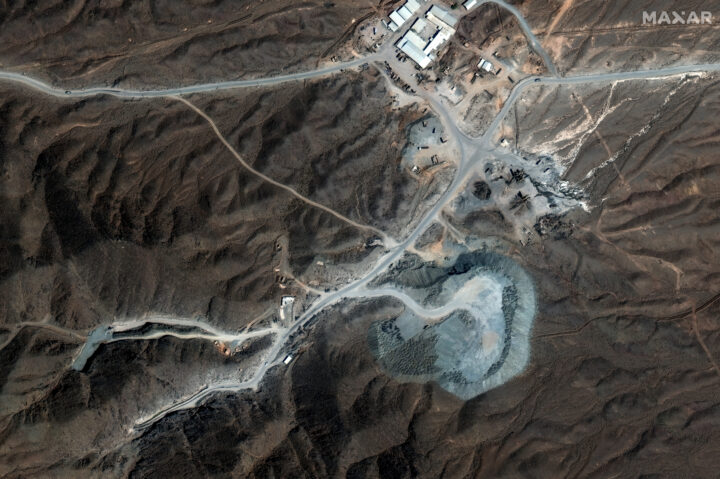
Satellite image (c) 2026 Vantor
Vantor satellite image shows tunnel construction activity and road infrastructure near the Natanz nuclear facility in the mountainous area around Pickaxe Mountain.
Good Tuesday afternoon.
This P.M. briefing is reserved for our premium subscribers like you — offering a forward-focused read on what we’re tracking now and what’s coming next.
Today’s Daily Overtime was curated by JI U.S. Editor Danielle Cohen-Kanik.
📡On Our Radar
Notable developments and interesting tidbits we’re tracking
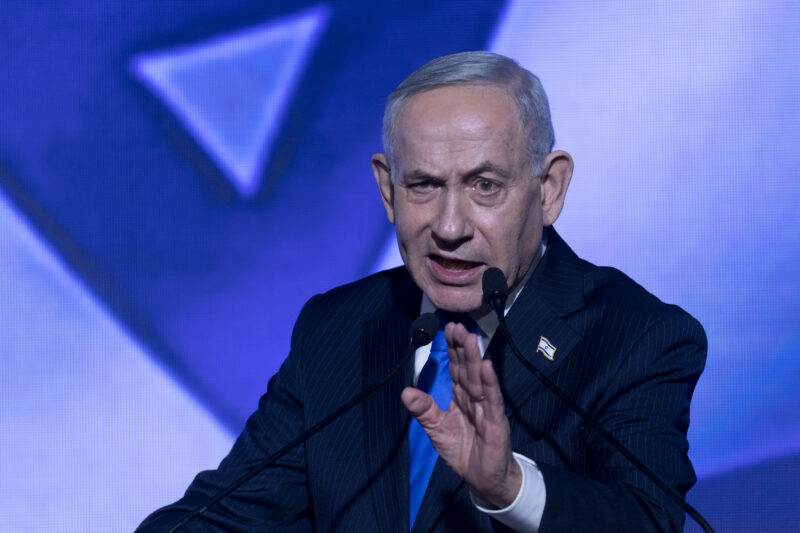
Meeting with Lebanese President Joseph Aoun in the Oval Office today, President Donald Trump warned that the U.S. would “pretty soon” strike Iran’s Pickaxe Mountain, the underground facility suspected of housing components of Tehran’s nuclear program, Jewish Insider’sEmily Jacobs reports.
“We’ll be hitting that area pretty soon, and very heavily,” he said, following a Wall Street Journal report that Israeli intelligence indicates Iran moved thousands of centrifuges into the site last fall…
Trump added in his comments that Iran “wants to meet desperately” with the U.S. to end the war, but “until they’re ready to meet in a meaningful way, we have no interest in meeting with them”…
Trump announced after his meeting with Aoun that he is directing his administration toallow all U.S. airlines to fly directly between the U.S. and Lebanon. The Reagan administration suspended direct flights in 1985 after Hezbollah-linked hijackers seized TWA Flight 847 and killed a U.S. service member aboard…
Israeli Finance Minister Bezalel Smotrich said at a conference today that Israel has “no interest” in joining the renewed U.S. campaign against Iran. “The best way to bring about the regime’s downfall is to crush it economically,” he said, pointing to the U.S. blockade on Iranian ports…
Defense Secretary Pete Hegseth told the Senate Appropriations Committee during a hearing this afternoon that the estimated cost of the Iran war thus far is $37.5 billion, up from $29 billion estimated by Pentagon Comptroller Jules Hurst in May.
Sen. Patty Murray (D-WA), the top Democrat on the committee, indicated that Democrats do not intend to support the Pentagon’s $88 billion supplemental funding request. The administration’s “expectation that Americans will just pay for [the war in Iran] without any explanation or transparency is disrespectful,” she said…
The IDF said its soldiers operating in southern Lebanon fired warning shots today as personnel from the Lebanese Armed Forces crossed into Israeli-controlled territory, an area the IDF said was not included in the pilot zones the LAF is meant to control. The LAF called the incident “an act of aggression” that could hinder the broader deployment plan…
A senior White House official told JI that a report that Vice President JD Vance was attempting to scuttle a potential White House meeting between Trump and Israeli Prime Minister Benjamin Netanyahu is “completely false.”
“The idea that the vice president’s team, or any official in the administration for that matter, would try or even be able to interfere with a visit by a foreign leader with the president is laughable,” the official said…
A group of Jewish House Democrats asked Secretary of State Marco Rubio today to pressure Malaysia to walk back plans to deport Israeli citizens, JI’s Marc Rod reports, urging him to leverage U.S. military assistance to the Southeast Asian nation…
The Senate Intelligence Committee voted to advance the nomination of Jay Clayton to be director of national intelligence, Committee Chair Sen. Tom Cotton (R-AR) announced, sending his nomination to the full Senate for approval. Democrats who had previously wanted to see Clayton confirmed said they were disappointed by his refusal to affirm at his hearing that former President Joe Biden won the 2020 election…
The Jewish Caucus of the College Democrats of America condemned the CDA’s decision to host far-left streamer Hasan Piker at its convention over the weekend and claimed in a statement that attendees were prevented from conducting a walkout during Piker’s speech. The caucus called on CDA leadership to issue a formal apology and to publicly condemn Piker’s previous antisemitic comments, JI’s Haley Cohen reports…
Rep. Tom Tiffany (R-WI), the leading Republican candidate for governor in Wisconsin, appeared on a podcast hosted by an individual who defended Hitler and joked about the Holocaust, the Milwaukee Courier reports. Tiffany had previously criticized his likely Democratic opponent, Francesca Hong, for going on Piker’s podcast…
The now-former treasurer of the New York Young Republican Club, Nicholas T. Rafael Jr., appeared to operate an anonymous X account that posted Hitler images and antisemitic caricatures, according to New York Magazine, which also obtained a photo of Rafael making what appears to be a Nazi salute while wearing German military attire. It’s the latest scandal regarding far-right extremism for the once-influential club…
The University of New Hampshire released a new poll of the race for U.S. Senate in Maine showing former state Sen. Troy Jackson, the presumed replacement for former Democratic nominee Graham Platner, leading Sen. Susan Collins (R-ME) 49-46% in the general election…
New York Assemblymember Micah Lasher, the presumed successor to retiring Rep. Jerry Nadler (D-NY), strongly defended his ongoing relationship with Morris Katz and said he’ll continue to work with the consultant who was behind Platner‘s failed Senate bid, a week after New York City Mayor Zohran Mamdani said the same…
⏩ Tomorrow’s Agenda, Today
An early look at tomorrow’s storylines and schedule to keep you a step ahead
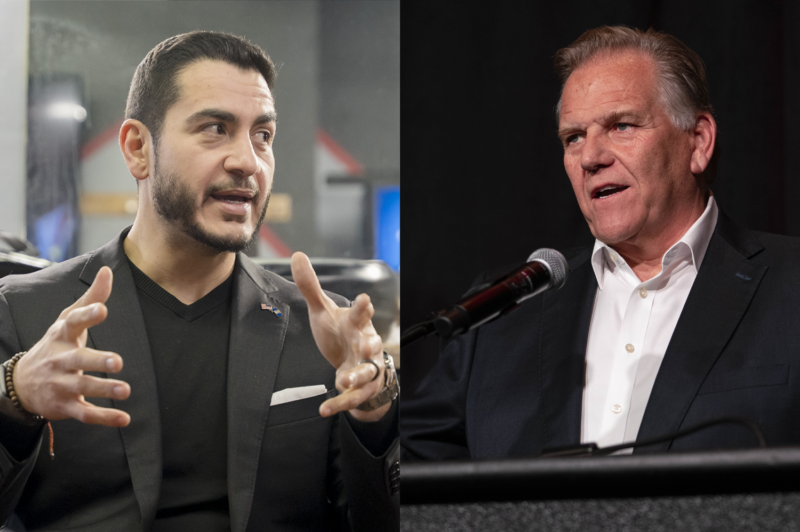
Keep an eye on Jewish Insider for a look at the Democratic primary in Michigan‘s battleground 7th Congressional District, where two Democrats with national security backgrounds are facing off against a far-left activist.
The House Foreign Affairs Committee will hold a hearing on U.N. accountability and reform with U.S. Ambassador to the U.N. Mike Waltz and U.S. Representative to the U.N. for Management and Reform Jeff Bartos.
Later, the committee’s Middle East subcommittee will hold a hearing on the “next phase of the Abraham Accords” with former U.S. Ambassadors to Israel David Friedman and Dan Shapiro as well as Asher Fredman, executive director of the Misgav Institute for National Security.
The House Ways and Means Committee will mark up several bills including the Foreign Funding Transparency Act, which would make nonprofits disclose foreign donors; the Fiscal Sponsorship Transparency Act, which would require charities to report the groups they fund; and the Fair Treatment of Religious Organizations Act, which would shield religious groups’ tax-exempt status.
Stories You May Have Missed
FRIENDLY FIRE
Joel Rubin: Sanders has endorsed ‘the most categorically anti-Israel, antisemitic candidates that we’ve seen in a generation, if ever’
BLUE STATE BLUES
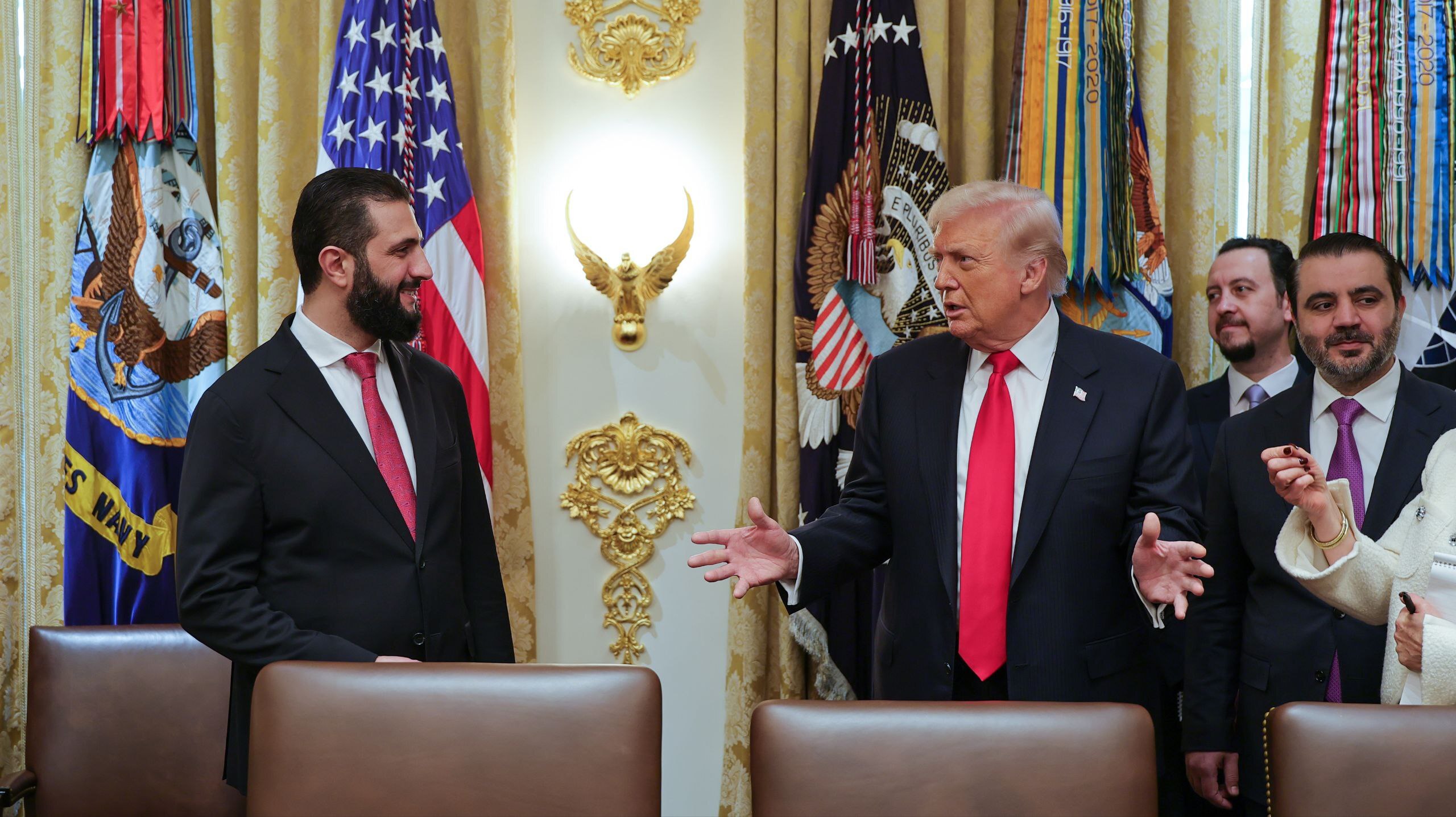
In one of the bluest states in the country, Jewish Democrats feel increasingly estranged from a party they helped build — but the answer, they say, is to lean in
The president said Iran ‘desperately’ wants to meet with the U.S. but ‘until they're ready to meet in a meaningful way, we have no interest in meeting with them’
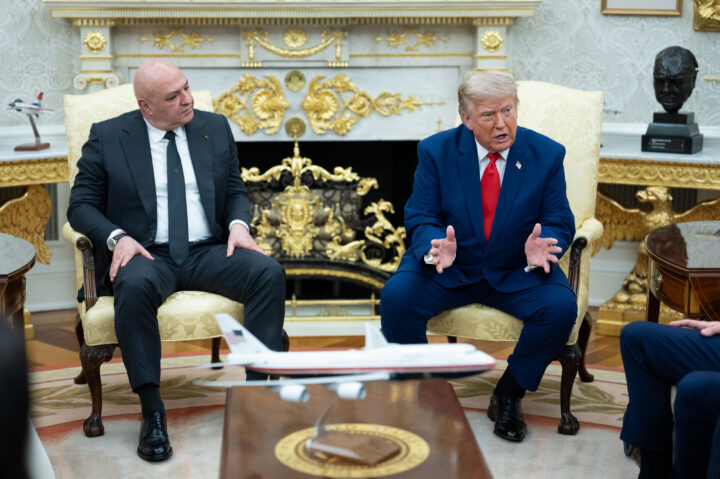
Aaron Schwartz/CNP/Bloomberg via Getty Images
Joseph Aoun, Lebanon's president, left, and President Donald Trump during a meeting in the Oval Office of the White House on July 21, 2026.
President Donald Trump warned on Tuesday that the U.S. would “pretty soon” strike Iran’s Pickaxe Mountain, the underground facility suspected of housing components of Tehran’s nuclear program.
The president made the comments from the Oval Office while welcoming Lebanese President Joseph Aoun for a meeting about the ongoing U.S.-led talks between Israel and Lebanon. Trump was asked about a Wall Street Journal report that Israeli intelligence shared with the U.S. indicated that Iran moved thousands of centrifuges into its clandestine Pickaxe Mountain site last fall.
“I think that they may have [moved the centrifuges],” Trump said. “It doesn’t mean anything unless they have the [nuclear] material. They don’t have it. We follow the material. That’s where the action is.”
“We’ll be hitting that area probably pretty soon. There’s not a thing they can do about it,” he continued. “Normally, I wouldn’t say that. If I thought they could do something about it, I would never say that, but we’ll be hitting that area pretty soon, and very heavily.”
The president predicted that it would take Iran between 20 to 25 years to rebuild its nuclear program if U.S. forces immediately ceased striking Iranian nuclear targets, though he noted that the U.S. was “not finished at all” in Iran and was “not leaving right now.”
He added that Iran “wants to meet desperately” with the U.S. to end the war “because they’re getting decimated,” but “until they’re ready to meet in a meaningful way, we have no interest in meeting with them.”
Joining Trump for his meeting with Aoun were Vice President JD Vance, Defense Secretary Pete Hegseth, Treasury Secretary Scott Bessent and White House Chief of Staff Susie Wiles.
On the subject of Lebanon, Trump told reporters that he was willing to speak to Hezbollah’s leaders directly to advance peacemaking efforts with Israel.
“I would speak to Hezbollah. I speak to everybody. I’ll speak to people that a lot of people think I shouldn’t be speaking to and things work out,” Trump said. “If [Aoun] wanted me to speak to Hezbollah, you know he’s lived with Hezbollah for a long time, and if the president wanted me to speak to Hezbollah, I would.”
Trump praised Aoun directly and detailed his own affinity for Lebanon, telling reporters that the U.S. is “going to help [the country] a lot” and describing the U.S.-Lebanese relationship as “very good.”
“I think that Lebanon has been a very mistreated country for a long period of time,” Trump said.
The president said that he planned to discuss with Aoun Israel’s ongoing troop withdrawal from southern Lebanon and ways to empower the Lebanese Armed Forces.
“We’ll be speaking about that today with the president, and we have some very concrete plans already in store for that with others going in and helping,” Trump said. “But they’re also becoming much more self-sufficient, and we will be speaking about that.”
For now, Israel’s restraint is less about hesitation, and more of a calculation that deterrence, rather than direct military engagement, will serve Jerusalem’s interests in the long term

AFPTV / AFP via Getty Images
A cargo ship anchoring near the Strait of Hormuz off the eastern coast of the United Arab Emirates on July 12, 2026.
In recent weeks, following the collapse of the memorandum of understanding between Washington and Tehran and the closure of the Strait of Hormuz, Iran has fired dozens of times on Jordan, Saudi Arabia, Iraq, Bahrain, Kuwait, Qatar and the United Arab Emirates.
At the same time, it has sustained fire from the U.S., whose military bases across the region have been targeted by the Islamic Republic, with several service members killed. And all the while, Tehran has targeted commercial ships transiting through the strait.
But as focus on the conflict with Iran has shifted from addressing the Islamic Republic’s nuclear ambitions to the Strait of Hormuz, Israel has stayed out of the fighting — despite Iranian threats earlier this month to target the Jewish state if the U.S. attacks did not cease.
There is no upside for Israel to reenter the fight, especially when the issue of the Strait of Hormuz falls outside of the objectives set by Israel at the start of the war earlier this year. (This, despite the widespread sentiment among Israelis that this year’s war did not improve Israel’s security situation, according to polling last month from the Israel Democracy Institute.)
Key among the goals laid out by Israel was degrading Iran’s ballistic missile program and setting back elements of its nuclear program. Reopening Hormuz is an American objective, not an Israeli one. With Israel having made the calculus that the most immediate Iranian threats have been blunted — at least in the short term — the current mission has become an American one.
“Israel’s best move is to not move — yet,” Mark Dubowitz, the CEO of the Foundation for Defense of Democracies, told Jewish Insider this morning. “Washington does the striking. Israel keeps its fire and its threats in reserve, waiting for one of two triggers: a U.S. request to join, or an Iranian regime foolish enough to hit Israel and invite the reprisal that has been promised.”
Despite Iran’s threats to target Israel, such a move would likely be a strategic misstep for the Islamic Republic. Iran’s blockade of the strait and its attacks on Arab and Gulf states are an attempt to reassert its dominance over the region and demonstrate its ability to impact the global energy market. Tehran also appears to be betting that sustained attacks across the region will push Arab states to pressure the U.S. to accept an agreement to reopen the strait, handing the Islamic Republic a win.
In that sense, Tehran is calibrating its escalation according to the expected retaliation, knowing that Arab states are, unlike Israel, hesitant to respond with military action.
One week ago, Israeli Prime Minister Benjamin Netanyahu, speaking in Dimona, drew a line in the sand. “I have one message for Iran’s leaders: Do not count on there being calm if you attack us,” Netanyahu said. “Do not expect a repeat of what happened before, because there will be no repeat. The previous response was powerful enough, but any further attempt to harm us will be met with a different response — far more powerful.”
Thus far, the Arab states have shown little indication that they intend to escalate to match Iran’s attacks, and will not retaliate with a proportional response (or even a disproportionate response). But with the intermittent fire, Iran keeps the region on edge and Hormuz closed for business.
The question many Israelis are asking is how much longer the domestic quiet will continue. But unless Iran directly strikes Israel or acts in a way that compromises Jerusalem’s interests, there is little appetite in Israel to transform what has become a U.S. effort to reopen shipping routes into another round of intensive fighting between Iran and Israel. For now, Israel’s restraint is less about hesitation, and more of a calculation that deterrence, rather than direct military engagement, will serve Jerusalem’s interests in the long term.
Plus, Darline Graham heads for the campaign trail

Kyle Mazza/Anadolu via Getty Images
A U.S. Army carry team moves the flagged-draped coffins containing the remains of the U.S. soldiers killed in an Iranian strike on March 7, 2026.
Good Monday afternoon.
This P.M. briefing is reserved for our premium subscribers like you — offering a forward-focused read on what we’re tracking now and what’s coming next.
Today’s Daily Overtime was curated by JI U.S. Editor Danielle Cohen-Kanik.
📡On Our Radar
Notable developments and interesting tidbits we’re tracking
U.S. and Iranian leaders continued to escalate their rhetoric as renewed military hostilities entered their second week: Iranian President Masoud Pezeshkian said today that Tehran is in “full-scale war” with the U.S., while President Donald Trump proclaimed that “every time Iran kills an American soldier” — after three service members were killed in Iranian attacks over the weekend — “they will pay for that killing many times over!” Trump said he had conveyed that directive to Defense Secretary Pete Hegseth, Joint Chiefs Chairman Gen. Dan Caine and “every leader in the military”…
U.S. officials told The New York Times that dozens of U.S. service members were injuredand several helicopters damaged in previously undisclosed Iranian strikes in Jordan last week, prior to this weekend’s fatal attacks.
The deadly strikes reportedly hit housing units where U.S. forces live and sleep, with some troops unable to reach bomb shelters before the missiles struck…
The NYT also investigates the deaths of three civilian crewmembers aboard a shadow tanker carrying Iranian oil that was targeted by U.S. strikes on June 10 as part of the American blockade of Iranian ports.
The Strait of Hormuz continues to be a focal point of the conflict, as the Islamic Revolutionary Guard Corps claimed today that two oil tankers had exploded after passing through the waterway…
All the while, the White House posted to its social media feed a three-week-old poll from a right-wing polling firm showing support for the now-defunct U.S.-Iran memorandum of understanding signed last month, Jewish Insider’s Haley Cohen reports…
New York City Mayor Zohran Mamdani seemed to back away today from a campaign pledge — reiterated in an interview over the weekend — to arrest Israeli Prime Minister Benjamin Netanyahu when he visits New York for the upcoming U.N. General Assembly, JI’s Will Bredderman reports.
“My administration will follow all applicable local laws. That is our commitment,” the mayor told reporters. Trump, meanwhile, pledged on Truth Social that Netanyahu “will not be arrested, in any way, shape, or form, while in the United States of America”…
Sen. Darline Graham (R-SC) confirmed on Fox News that she will run in the special election next month for U.S. Senate to fill the seat of her late brother, Sen. Lindsey Graham (R-SC); Darline Graham already has Trump’s endorsement, given as he encouraged her to run on Friday.
Not to be dissuaded, Rep. Russell Fry (R-SC), who was thought to be a front-runner before Darline Graham came on the scene, also declared his candidacy for the seattoday. Senate Majority Leader John Thune (R-SD) told reporters he is not endorsing anyone “at the moment” in the race…
Sen. Elizabeth Warren (D-MA) became the latest progressive lawmaker to endorse far-left Michigan Senate candidate Abdul El-Sayed today, citing the “special interests running millions of dollars in TV ads to buy this seat,” an apparent reference to the AIPAC-linked United Democracy Project super PAC supporting El-Sayed’s opponent, Rep. Haley Stevens (D-MI)…
Rep. Mike Collins (R-GA) pulled family pictures off of his campaign site that feature his son-in-law, who was found to have promoted white nationalism and Nazi ideology online, as he runs for U.S. Senate against Sen. Jon Ossoff (D-GA)…
The State Departmentannounced today that the Lebanese Armed Forces is assuming control of three villages in southern Lebanon as part of pilot zones established under the trilateral agreement between Israel, Lebanon and the U.S. The IDF, which is coordinating the effort with the LAF and U.S. military, said it will “respond forcefully to any violation of the agreement”…
Houthi military spokesman Yahya Saree announced a maritime blockade of Saudi Arabia today in retaliation for what the terror group called Riyadh’s “oppressive siege” on Yemen…
Former Israeli Minister of Strategic Affairs Ron Dermer has rejoined the Jewish Institute for National Security of America as a distinguished fellow, the organization announced…
⏩ Tomorrow’s Agenda, Today
An early look at tomorrow’s storylines and schedule to keep you a step ahead
Keep an eye on Jewish Insider for a look at Ed Miliband, the member of Parliament who was tapped today by new U.K. Prime Minister Andy Burnham to serve as foreign secretary, and what his selection could mean for British policy toward Israel.
Lebanese President Joseph Aoun will meet President Donald Trump at the White House. The two leaders’ first in-person meeting comes as Lebanon, the U.S. and Israel work to implement their trilateral agreement signed last month and as the Lebanese government seeks to demonstrate its ability to disarm and contain Hezbollah.
On the Hill, Defense Secretary Pete Hegseth and Joint Chiefs Chairman Gen. Dan Caine will appear before the Senate Appropriations Committee for a hearing on the Trump administration’s $88 billion supplemental funding request for the Pentagon.
The House Intelligence Committee will hold a hearing on the terror threat landscape ahead of the upcoming 25th anniversary of the 9/11 terror attacks with testimony from former National Security Advisor H.R. McMaster.
Jewish groups including the Jewish Federation of Columbia South Carolina, the Conference of Presidents of Major American Jewish Organizations, the Zionist Organization of America, Young Jewish Conservatives, the Jewish Community Action Network, the Focus Project, ChaiTech and Stop Antisemitism will hold a virtual national tribute to the late Sen. Lindsey Graham (R-SC).
Stories You May Have Missed
TRUST FALL
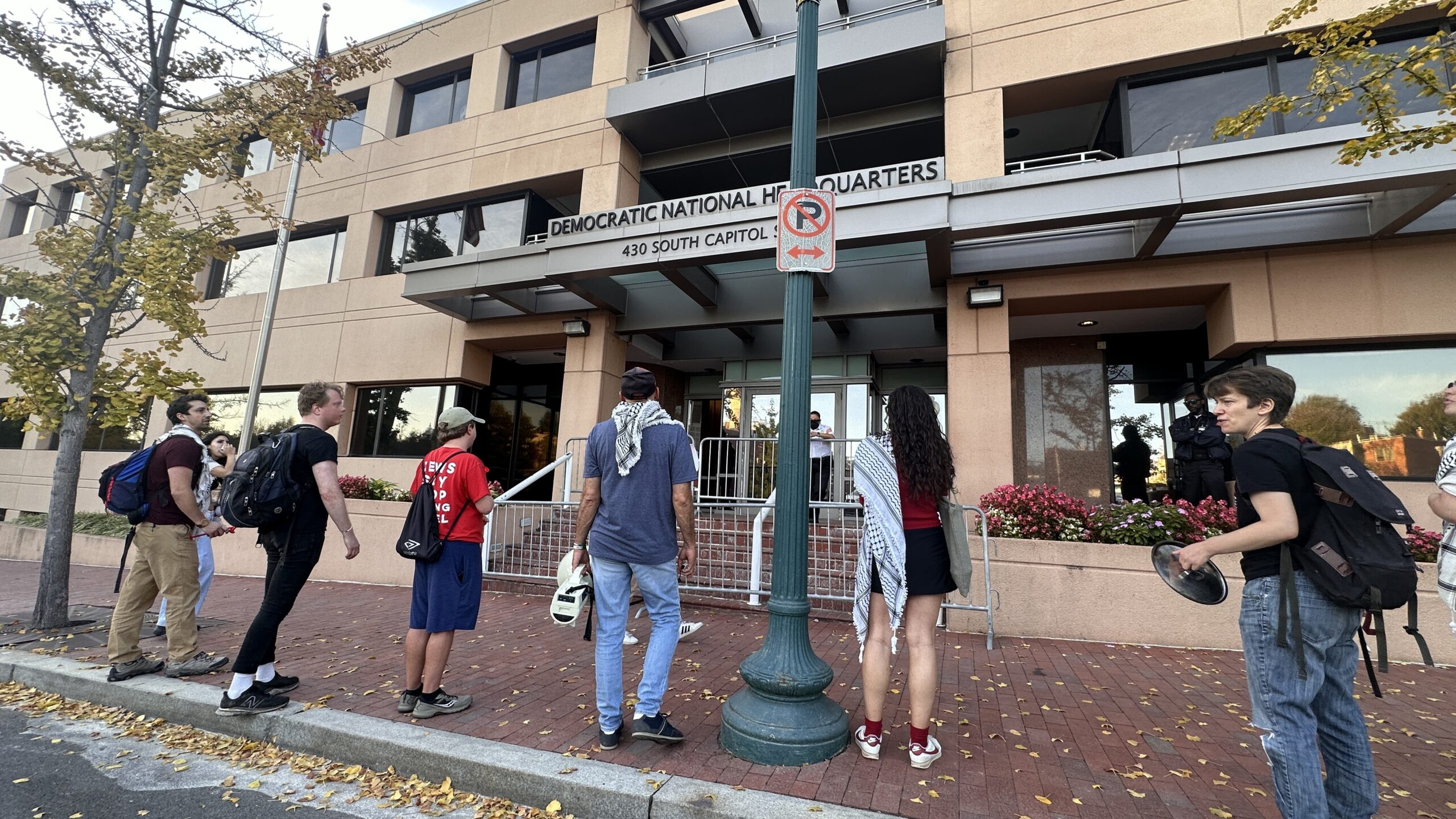
After 104 members of the House voted last week in favor of an amendment to eliminate military aid to Israel, pro-Israel activists who have spent years building ties with lawmakers are now wondering how to approach those relationships
NO STRINGS ATTACHED
Members of Congress acknowledged Israel-Syria normalization is a worthwhile goal, while recognizing the limits of the current geopolitical landscape
Sens. Blumenthal and Shaheen said the late Sen. Lindsey Graham never sought to include Iran sanctions in the legislation he spent months negotiating before his death
Jakub Porzycki/NurPhoto via Getty Images
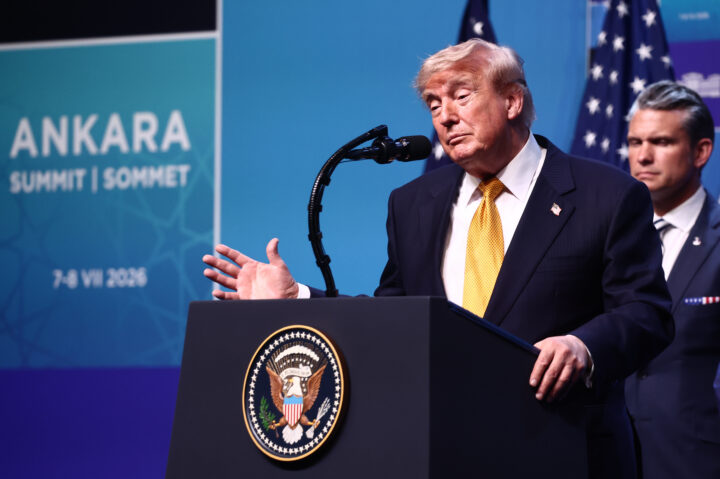
President Donald Trump during the press conference at the NATO Summit in Ankara, Turkiye on July 8, 2026.
President Donald Trump’s call for Republicans to incorporate sanctions against Iran into the late Sen. Lindsey Graham’s (R-SC) bipartisan legislation sanctioning Russia and countries that buy Russian oil was met with confusion by some of the Democrats supporting the bill.
The legislation, which was renamed in the late senator’s honor, places sanctions on Russia and secondary sanctions on countries that buy Russian oil and gas in an effort to cut off Russian President Vladimir Putin’s ability to finance his war in Ukraine. It also codifies sanctions against Russia that have already been implemented via executive order, preventing a future president from easily terminating them.
Trump wrote on his Truth Social platform on Sunday that, “Republicans should add Iran to the Russian Sanctions Bill. That’s what Lindsey wanted to do, and it was going to happen.”
His comments come less than a week after he said that Republicans would “like to add Iran and they’d like to add Hezbollah” to the sanctions package. “That’s what I’m hearing,” the president told reporters at the White House on Tuesday.
“This is in honor of Lindsey,” Trump said when asked if he will sign the Russia sanctions bill if it reaches his desk. “This was his thing, he wanted this more than any other thing. You know how he felt.”
The president’s comments came as a surprise to the Democrats who worked with Graham on the legislation, who noted that the late senator had never sought to add sanctions on Iran or its proxies into the package.
“Our Russia sanctions bill was meticulously crafted during painstaking, sometimes painful negotiations over many months,” Sen. Richard Blumenthal (D-CT), who spearheaded the effort alongside Graham for over a year, told Jewish Insider in a statement. “This bill should move forward as quickly as possible — as is — without additional provisions, which can be done separately.”
Sen. Jeanne Shaheen (D-NH), the top Democrat on the Senate Foreign Relations Committee, told Bloomberg’s “This Weekend” on Sunday that, “Sen. Graham never raised the concern about putting Iranian sanctions on the bill.”
“The fact is, we have significant sanctions on Iran. When the war started, we put additional sanctions on Iran. I think if the president wants to do that, let’s do it in a separate bill, but this bill is moving,” Shaheen said. “It’s targeted in a way that is important and it comes on the heels of the G7 conference, where everyone, including President Trump, signed on to a communiqué that said we need to support Ukraine and put more pressure on Putin. That was echoed at the NATO summit.”
“We know that that’s what it’s going to take to get Vladimir Putin to the table,” she continued. “So far, we have not been successful at getting him to the negotiating table. Let’s put more pressure on him to do that.”
Sen. Katie Britt (R-AL), a cosponsor of the sanctions legislation and an ally of both Graham and Trump, did not rule out Trump’s idea to add Iran sanctions to the bill during a joint appearance with Shaheen on “Fox News Sunday.”
“I think Lindsey Graham was clear-eyed about this,” Britt said. “He knew what Iran was capable of, and he knew that when they chanted, ‘Death to America,’ that they meant it. Look, he believed in President Trump and knew that President Trump had what it takes to create a resolution to what is happening there”
“Being able to move this bill across the finish line — [along with] the bipartisan support that we have gotten to hold Putin accountable, to give President Trump the flexibility and the tools he needs and the economic firepower to bring Putin to the table to create peace and resolution here — will ultimately have a lasting impact across the globe, making sure that those who are funding bad actors, whether it be Russia or those in Iran, will be held accountable,” the Alabama senator continued.
Graham and Blumenthal first introduced their legislation last April. By May, the duo had accumulated more than 80 cosponsors in the Senate for the bill, which was repeatedly stalled last year as the late senator worked to secure Trump’s support. Despite the bipartisan support, a number of Democrats and other critics, including the Wall Street Journal editorial board, expressed concern about the legislation over the fact that its language grants sweeping tariff authorities to the president.
After being sworn in last Tuesday, Sen. Darline Graham (R-SC), the late senator’s sister who was appointed to serve out the remainder of his term, sponsored a revised version of the legislation, which was renamed to honor her late brother. The bill has since collected 62 cosponsors.
‘It is in our interest to strengthen the GCC as much as possible,’ Herro Mustafa Garg said on a panel at the Aspen Security Forum
(KHALED DESOUKI/AFP via Getty Images)
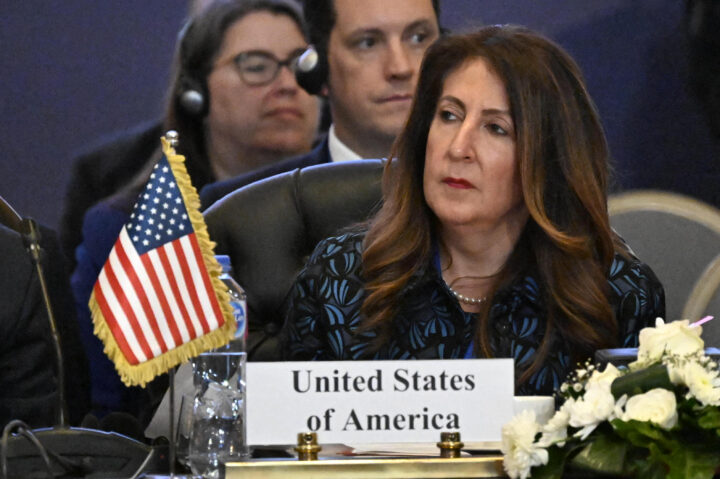
U.S. ambassador to Egypt Herro Mustafa Garg attends a humanitarian conference for Gaza in Cairo on December 2, 2024.
ASPEN, Colo. — The rift growing rift between Saudi Arabia and the United Arab Emirates hurts U.S. interests in the region and Washington should work to bring the countries and other Gulf Cooperation Council states back together, Herro Mustafa Garg, a former U.S. ambassador to Egypt, argued on a panel at the Aspen Security Forum on Thursday.
“This conflict, this current war with Iran, made the animosity between these two countries — and some of the other Gulf countries — at a point that is not in the U.S. national interest,” Garg said. “Also, I don’t think it helps us when we think about what we do with Iran, what we do with Iraq. We need a united GCC in order to tackle these important strategic questions.”
She said that with a divided Gulf, the U.S. will see unilateral backchannelling to Iran by various partners, internal suspicion and more. And, she noted, the conflict between the UAE and Saudi Arabia is also playing out in other arenas — including Sudan, Libya and the Horn of Africa — fomenting instability that does not serve the U.S.
“It is in our interest to strengthen the GCC as much as possible,” Garg said.
Garg, who represented the U.S. in Cairo from 2023 until earlier this year, also praised comments by Iraqi President Ali al-Zaidi during a visit to Washington, D.C., this week, in which he committed to efforts to demilitarize Iranian-backed militias in the country, though Garg warned that such a task is easier said than done, given the political and structural constraints in the country and the Iranian regime’s continued resilience.
“This is an area that will be very very important for us to give our support, sustain support, and here again I would say, bring in the GCC because we need this to be not Iran versus U.S., but a coalition supporting Iraq,” Garg continued.
On the same panel, former Palestinian Authority Prime Minister Salam Fayyad highlighted the delays in implementing what he described as a laudable peace agreement to end the war in Gaza, including the failure of the proposed governance committee to actually enter Gaza.
He argued that the best path forward would be to establish a technocratic interim government, with the promise of elections at the end of a set period, for a government to manage both the West Bank and Gaza.
He added that the PA has long been stunted by basic failures of governance to provide for basic needs of the Palestinian people and because it lacks broad acceptance and legitimacy. He described the discussions of reform in the PA over the past few years as an exercise in “kicking the can down the road” — and said that the prospect of true reform is difficult to envision at this stage.
“In the way it’s constituted right now, it’s difficult for me to see how the Palestinian Authority can be fundamentally reformed,” Fayyad said. “Part of the reason goes to the fact that actually our own basic law … is not being respected in the way it should be. That is something that was promulgated by our administration going back to 2003. It created a position of prime minister and a purview for a government that has, over the past years, become completely usurped by the president and his office.”
But he emphasized that he believes the PA remains critical and that it must be politically reconfigured such that it becomes a product of popular consensus with true legitimacy.
Kim Ghattas, a Lebanese journalist who writes for The Atlantic, argued on the panel that the focus in Lebanon should move away from disarming Hezbollah, arguing that it’s unrealistic for Israel to expect the Lebanese Armed Forces to expect to go into neighborhoods and villages and forcibly disarm Hezbollah — something the LAF is obligated to do under various international agreements.
Ghattas said that a more realistic path is for the Lebanese government to work on interdicting weapons shipments and going after Hezbollah through legal, judicial and financial restrictions, as well as empowering the Lebanese state to deliver for all its citizens.
Jordan’s foreign minister offered a similar readout during a separate panel earlier in the day.
Sen. Chris Murphy said that the U.S. could no longer guarantee regional security, but that might have a ‘silver lining’ by obligating the Gulf states to negotiate directly with Iran

Jemal Countess/Getty Images for Fair Share America
Sen. Chris Murphy (D-CT) speaks at the U.S. Capitol on April 10, 2025 in Washington, DC.
ASPEN, Colo. — Sen. Chris Murphy (D-CT) argued on a panel at the Aspen Security Forum on Thursday that the war with Iran had irreparably damaged the U.S.’ reputation and capacity in the Middle East, and that Gulf states would now need to take the lead and negotiate with Iran over the region’s future.
The U.S. has been “effectively eliminated as a security guarantor for our allies” because of what he described as a failed military campaign against Iran, Murphy argued.
“You can make an argument that that could be a long-term silver lining, that the Gulf states will have to sit down and negotiate, at the beginning, the question over the Strait of Hormuz and maybe another set of factors, and in those negotiations, that might be the new reality in the Middle East,” he said.
“Maybe in that conversation with the U.S. not in the lead, but as a partner, there is a solution to the ultimate Iranian control of the strait, but it’s admittedly very hard to answer that question right now,” Murphy continued.
He said that the current state of play suggests that an emboldened, enriched Iran with control of the Strait of Hormuz “seems to be the best-case endgame” and “that is why our allies and friends in the region are questioning whether there is any way the United States can ever secure them.”
Some allies, he acknowledged, want to see the U.S. “finish the job” in Iran, but argued that that’s an unclear and undefined goal that in some cases might involve committing U.S. ground forces.
Asked by moderator Jim Scuitto, a CNN correspondent, how a future Democratic president would approach the situation assuming the current status quo persists through 2028, Murphy said that is “kind of an impossible question,” adding that the U.S. would have to engage with its partners and Iran to try to secure freedom of transit in the Strait of Hormuz. Murphy himself is viewed as a potential presidential candidate.
He said that resolving the current standoff would likely require lifting sanctions and pressuring Israel to permanently end its war against Hezbollah in Lebanon.
Asked about the possibility of expanded U.S. strikes on Iranian oil infrastructure, as suggested earlier in the forum by former National Security Advisor Robert O’Brien, Murphy said that would only lead Iran to escalate further by ordering the Houthis to close the Bab el-Mandeb strait.
Iran, in Murphy’s framing, had “taken our best shot and survived” and realized it can use the Strait of Hormuz to increase its leverage at the negotiating table. He said that the current situation essentially removes any leverage the U.S. had in nuclear talks — having surrendered sanctions relief for the reopening of the Strait of Hormuz and showing that the U.S. military threat is not sufficient to bring down the regime.
As a result, he said that the U.S. would likely not be able to get a better deal than the Obama administration’s 2015 nuclear deal even if talks resumed.
Murphy characterized the war as a catastrophic, generational mistake — “the greatest foreign policy disaster of the last 20 years [and] one of the greatest mistakes any president has made in the world in our country’s history,” which left the U.S. looking “weak and feckless.”
He said that, as a result of the munitions expenditures in the war, the U.S. could not defend Taiwan from China today if it wanted to.
Robert Greenway, who led Middle East policy on the National Security Council during President Donald Trump’s first term, was the primary voice of optimism on the panel, arguing that despite some changing rhetoric, Trump’s objectives have been clear — dating back even to his first administration — and that there is “no question in my mind” that Iran’s capabilities have been significantly degraded.
“Their means and the opportunity to constitute a threat to U.S. vital interests and to global interests, as a matter of fact, are probably the lowest they have ever been since 1979. From the enrichment standpoint, they haven’t been at zero enrichment capacity since 2006,” Greenway said. “So, from an empirical perspective, I would say yes, progress has been made, and I think at this juncture, I would be pleased with that progress. And I don’t think there’s a lot left to be done to eliminate the remaining threat.
He argued that those who are concerned by Iran’s disruptions of the global economy should be supportive of the administration’s military campaign, arguing that Iran would only be more emboldened under a nuclear and missile umbrella.
“This is the most practical way to solve it. Diplomacy up to this point hasn’t prevailed, and it won’t as long as you have a disingenuous partner,” Greenway said. “Now, Iran cannot defend itself from any attack by the United States, or frankly, anyone else.”
Diplomacy, he reiterated, was a “failed approach” and he said military action is the “fastest” and “probably the only realistic way” to achieve the U.S.’ objectives.
He also said that definitively eliminating the threat from Iran would allow the U.S. to reduce its troop presence in the Middle East in the longer term. He said he doesn’t see any need for U.S. ground forces in Iran, arguing that the only potential uses for them would be for search and rescue operations or recovery of Iranian nuclear materials.
But with the nuclear materials currently buried and closely monitored, Greenway said, a ground infiltration to remove them isn’t necessary in the short term, though he said they should be removed from the country in the long term.
Countering Murphy, Greenway also said that many Middle East allies are privately supportive of continued U.S. military operations to finish the job, and are happy to see the threat of Iran reduced, though he acknowledged opinions vary.
Karim Sadjadpour, a senior fellow at the Carnegie Endowment for International Peace, disputed Murphy’s notion that the result of the war would remove the U.S. as a guarantor of regional security. He said that the Gulf countries understand that only the U.S. can protect them in the near term — China and Russia not being viable alternatives — and they still understand and fear Iran as a threat.
But he also acknowledged that, as a consequence of geography, Middle Eastern states will need to seek side deals with Iran to some extent.
Sadjadpour also emphasized that there will never be lasting stability in the Middle East until Iran is led by a government that actually represents the interests of the Iranian people — an aim he said the war did not advance.
“It is militarily weaker than it was four and a half months ago, but … psychologically it feels much stronger. It’s much more confident than it was four and a half months ago before the war,” Sadjadpour said. “I don’t think it’s going to give up its control of the strait anytime soon. I don’t think it’s going to make meaningful compromise anytime soon.”
He compared the current situation in Turkey to post-Soviet Russia — continuing to pursue its own security and destabilize its neighbors, and use energy and trade as a weapon.
He added that leaders in the U.S. often misunderstand Iran, comparing it either to Nazi Germany, an ideologically rigid regime that cannot be bargained with, or to China, ripe for grand bargain and rapprochement. Iran is most similar, he said, to the Soviet Union — not suicidal but not willing to place its economic and national interests above its revolutionary ideology except when faced with “almost existential” economic pressure.
With the Iranians appearing prepared to wait out the Trump administration, Sadjadpour continued, he doesn’t see a clear end to the current war.
Roxana Saberi, a journalist and author with contacts inside Iran, said that most people in the country remain hopeful but were disappointed by the results of the war and the memorandum of understanding, which she said had demonstrably emboldened Iran to step up human rights abuses at home.
Among the anti-regime population in Iran, which she said constitutes 80% of the Iranian public, there are now three groups: those that opposed the war, those that supported it and want to see further strikes and those that have become numb to the situation and are simply trying to survive.
The lawmakers argue the meeting, which was canceled after interference by the State Department, should be investigated for potentially violating of the Logan Act

Photo by MADISON SWART/Hans Lucas/AFP via Getty Images
New York Working Families Party co-directors Ana Maria Archila (R) and Jasmine Gripper (L) take the stage during a rally in support of Zohran Mamdani at Brooklyn Steel in Brooklyn, New York, on May 4, 2025.
Several House Republicans sent a letter on Thursday to the Department of Justice calling for an investigation into whether New York City Mayor Zohran Mamdani and his international affairs commissioner, Ana María Archila, violated the Logan Act by scheduling a meeting with the Iranian ambassador to the United Nations.
Archila, who heads the New York City Mayor’s Office for International Affairs, had previously scheduled a July 7 meeting with Amir-Saeid Iravani, Iran’s U.N. ambassador, before the State Department intervened and the meeting was canceled.
Mamdani claimed last week that the meeting was “made in error” and had been scheduled without his knowledge. The mayor also stressed that the Iranian mission had reached out to his team and not the other way around.
The lawmakers argue that the planned meeting should be investigated for potentially violating the Logan Act, a centuries-old statute that prohibits American citizens from negotiating with foreign governments without authorization on behalf of the United States.
The letter was led by Rep. Addison McDowell (R-NC) and also signed by Reps. Buddy Carter (R-GA), Clay Fuller (R-GA), Pat Fallon (R-TX), Randy Fine (R-FL), Riley Moore (R-WV), Wesley Hunt (R-TX), Lauren Boebert (R-CO), Pete Sessions (R-TX), Pat Harrigan (R-NC), Rich McCormick (R-GA), Claudia Tenney (R-NY), Anna Paulina Luna (R-FL), and Max Miller (R-OH).
The lawmakers said they were especially concerned about the attempted meeting in light of negotiations between the U.S. and Iran being “in a critical stage.”
“Given its timing, we believe this proposed meeting may have presented significant national security risks,” the letter reads. “In light of this, we respectfully ask that the Department of Justice investigate potential violations of the Logan Act on the part of the mayor’s office.”
“We support President Trump’s efforts to shore up American economic and national security interests in the Middle East, and we understand the vulnerable nature of continued peace negotiations,” it continues. “For that reason, we believe that a formal investigation is necessary to determine whether Commissioner Archila, acting on behalf of Mayor Madani, engaged in any unlawful activity or communication with the Islamic Republic of Iran.”
The mayor’s office did not immediately respond to a request for comment.
Speaking at the Aspen Security Forum, an advisor to the Turkish president called Iran's nuclear program a 'civil' project and said Ankara is in talks with Washington to resolve a standoff over Russian-made missile defense systems
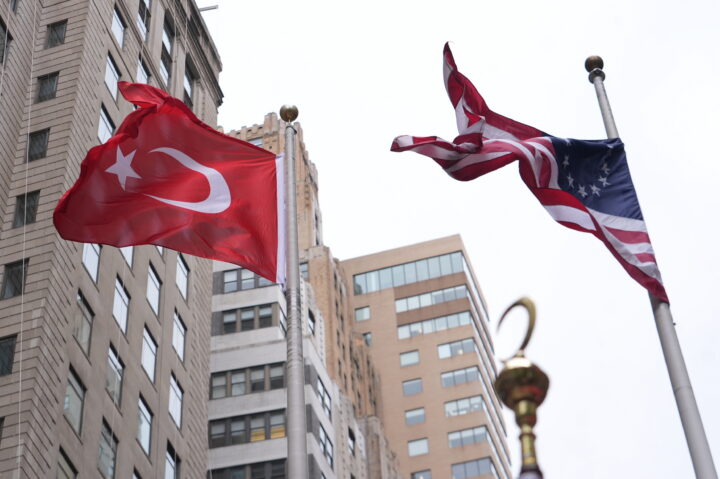
Photo by Selcuk Acar/Anadolu via Getty Images
A flag-raising ceremony is held at Bowling Green Park in New York, U.S. on May 15, 2026.
ASPEN, Colo. — Akif Çağatay Kılıç, a top foreign policy and security advisor to Turkish President Recep Tayyip Erdoğan, downplayed the threat posed to the region by Iran’s nuclear program at the Aspen Security Forum, while also repeatedly sidestepping questions about the status of Turkey’s Russian S-400 missile defense system and efforts to acquire F-35 fighter jets.
“I don’t perceive that we have a nuclear threat to the level that is being talked about, but we are closely monitoring it, and we’re talking to our Iranian colleagues and friends on how they perceive to be working on their nuclear program — civil nuclear program,” Kılıç said.
He continued to defend his country’s decision to acquire the S-400 system.
Kılıç also argued that the alternative energy corridors through the region that have been proposed to avoid the Strait of Hormuz are not a viable option so long as the war continues.
Kılıç said that Turkey is working with the U.S. to resolve the “legal issue” around the F-35s and S-400s, emphasizing that the leaders of both countries have expressed a desire to move the F-35 sale forward.
Asked directly about whether Turkey will offload its S-400s, Kılıç prevaricated and did not offer clear answers.
“It’s not easy always to navigate these things. But we’re trying to work with our American partners and allies to find a way that both countries can live with and go towards the future,” Kılıç said.
Speaking at the Aspen Security Forum, Safadi said a deal must be 'comprehensive enough' to address Iran’s regional provocations and accused Netanyahu of lying about who is securing the Jordan-Israel border
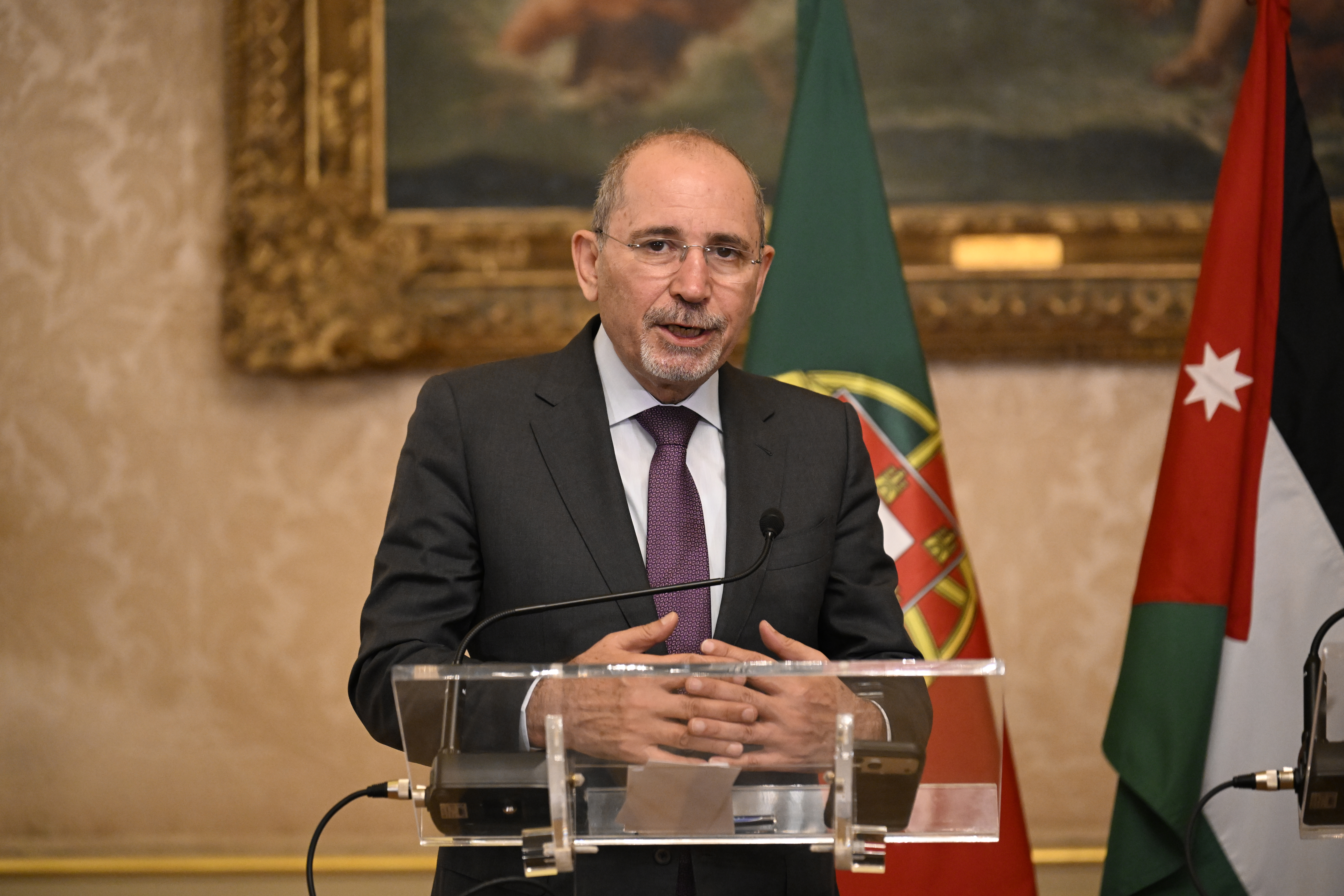
Horacio Villalobos#Corbis/Corbis via Getty Images
Jordan's Deputy Prime Minister and Minister of Foreign Affairs Ayman Safadi delivers remarks on May 18, 2026 in Lisbon, Portugal.
ASPEN, Colo. — Jordanian Deputy Prime Minister Ayman Safadi repeatedly emphasized on Wednesday that any deal with Iran should be comprehensive and ensure an end to Iran’s support for proxy groups and confront its efforts to destabilize the region.
The position suggests concern in the Arab world that a U.S. deal with Iran would not cover the regime’s long-running regional provocations — a concern Arab partners similarly raised about former President Barack Obama’s nuclear deal with Iran.
“All of us in the region have always wanted good relations with Iran, but we said in order for those good relations to be had, Iran’s interventionism in the region, its meddling in the affairs of the area, non-respect for sovereignty of states must end,” Safadi, who also serves as Jordan’s foreign minister, said at the Aspen Security Forum. “Let’s put all those issues on the table and hopefully come up with a deal that will address all sorts of tension and allow for the region to enjoy the peace and stability that we deserve.”
Safadi emphasized that both Iran’s nuclear program and reopening the Strait of Hormuz are important, but that a deal also must address “other aspects that cause tension in the region,” including Iran’s proxies and regional aggression, and must be “comprehensive enough to make sure that we don’t find ourselves in the same place that we have been for years.”
Safadi also criticized Iran for closing the Strait of Hormuz and for retaliating against Jordan and Gulf states for U.S. and Israeli strikes on Iran.
He accused Israeli Prime Minister Benjamin Netanyahu of lying about the situation along the border between Jordan and Israel — asserting that Jordan, rather than Israel, is carrying the brunt of securing that border, and that much of the smuggling is coming from Israel into Jordan rather than the other way around.
He also blamed Israel for “manufactur[ing] unreal threats” in order to perpetuate an unproductive “strategy of perpetual conflict.”
Safadi criticized Israeli policy and activities in the West Bank, which he said are “undermining our objective of achieving a just and lasting peace” for both Israelis and Palestinians, and amount to a policy of annexation and encroachment on Muslim and Christian holy sites.
He also urged Israel against undermining a two-state solution without presenting a viable alternative.
“If you undermine the two-state solution, then where do you go from here? What are you going to do with 5 million Palestinians who live in Gaza and the West Bank?” Safadi said. “The two-state solution is the only path to that just and lasting future. The Israeli government has completely refused that. What we say is, ‘Okay, … what do you want? Put that plan on the table. … Tell us what is your alternative to that.’ And you hear nothing.”
Safadi further warned that a flare-up in violence in the West Bank would undermine efforts to restore peace in Gaza. He said that spreading hate or antagonism on either side is unproductive and, at some point, “you can’t walk back if you cross a certain threshold.”
In Gaza, he called for the implementation of the U.S.-backed 20 point peace plan and lamented the delays on numerous fronts, also accusing Israel of blocking aid from Jordan from flowing into Gaza.
Safadi also called for an end to “power politics” in Lebanon — referring to the continued IDF presence — while expressing support for a long-term strategy to ensure Lebanese sovereignty and monopoly on arms. He argued that a military option alone for disarming Hezbollah is not viable, and that there is no short-term answer for restoring full Lebanese government control.
“I don’t believe that the military option should be on the table because it will only lead to the destruction of the country,” Safadi said, calling instead for a comprehensive social, economic and political strategy. “We have to have a comprehensive strategy that must be realistic, that must take into account what can and cannot be done, that must factor in what is the price of one option over the other, and obviously none of us want Lebanon to go into civil war.”
‘Without oil, they're nothing,’ the former national security adviser said at the Aspen Security Forum, adding that by cutting it off, the U.S. could ‘turn them into a ‘stan, turn them into a nonentity’
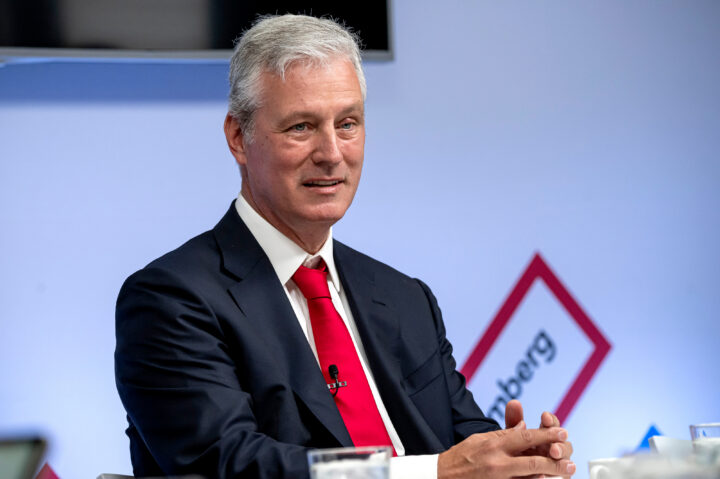
(David Paul Morris/Bloomberg via Getty Images)
Robert O'Brien, former national security adviser, at an interview during the Republican National Convention (RNC) near the Fiserv Forum in Milwaukee, Wisconsin, US, on Wednesday, July 17, 2024.
ASPEN, Colo. — Robert O’Brien, who served as national security advisor during President Donald Trump’s first term, said on Wednesday that the U.S. should target Iran’s oil infrastructure with the goal of choking off its economy — and predicted that the president is moving in that direction.
The former national security advisor said on a panel at the Aspen Security Forum that Trump had been “very, very generous” with Iran but he believes that Trump’s “patience” with Iran is running thin. The next steps, he predicted, would be for the U.S. to “hit them hard” and “finish the job” by targeting sites connected with Iran’s oil infrastructure, including the facilities at Kharg Island, in order to deprive Iran of its ability to produce and export oil.
“Without oil, they’re nothing. With oil, the regime thinks if they can survive, they can just buy more kit,” O’Brien said. “I think President Trump will finish the job. The Iranians are using the old playbook of extend, pretend and snowball. … They’re dealing with a whole new administration with Donald Trump. They don’t understand it, and I think that they’ll pay a heavy penalty for their lack of understanding.”
The first Trump administration’s strategy of maximum pressure through economic sanctions is “not enough” without strikes on Iran’s oil production, he continued.
O’Brien said that cutting short Iran’s oil exports would be the skeleton key to deafening the regime — cutting off its ability to build missiles, support terrorism or rebuild its nuclear program, and said that the U.S. could “turn them into a ‘stan, turn them into a nonentity” and prevent it from ever rebuilding.
The former national security advisor acknowledged that targeting Iranian oil production would hurt the world economy, but made the case that there are other oil producers that would be able to fill the gap with the right support, including Venezuela, Guyana and Mozambique, along with increased production in the U.S.
Asked after the panel by Jewish Insider about how he views the future of Israel policy among conservatives — and about comments by Vice President JD Vance accusing Israel of running a cover influence campaign to undermine the Iran deal and of having ties to sex offender Jeffrey Epstein — O’Brien insisted that support for Israel among conservatives, including Vance, remains strong.
O’Brien said he hadn’t heard Vance’s comments but called him a “supporter” and “friend of Israel.” He added that Trump is “a very good friend of Israel. President Trump has Jewish grandkids, I mean, so he cares deeply about it. He got the Abraham Accords for us and sent me to Jerusalem many times. And I can tell you, after Oct. 7, he was very concerned about Israel and has remained so ever since. No better friend to Israel than President Trump.”
He argued that recent polling indicates that support for Israel remains strong among Republicans in general, even among young people, and predicted that issues among “some conservatives — or people who claim to be conservatives” will not “hold.”
“Those of us who value the partnership, love our Jewish friends, our Israeli colleagues, just need to be forthright and stand up for Israel,” O’Brien said. “Israel, I’ve always said throughout my career, is a canary in the coal mine. If people are attacking Israel, the next country they’re going to attack is America, and so we need to stand strong with our allies in Israel, stand strong with Jerusalem, and I think it’s going to be a relationship that lasts long into the future.“
Stephen Hadley, who served as national security advisor in the Bush administration, said on the panel that the U.S. “can do better in terms of an outcome” with Iran, urging the administration to “stop chasing after the Iranians for an agreement on the nuclear issue,” adding that the U.S.’ operations have done significant damage to Iran’s nuclear program and can hit Iran again if it attempts to reconstitute the program.
It’s a similar strategy to that outlined by former Secretary of State Condoleezza Rice, also a Bush administration alumnus, a day prior at the Aspen conference.
Hadley said the U.S. should be open to nuclear talks if Iran seeks them out — but with the preconditions of no enrichment and no financial paydays for Iran.
He said that with continued sanctions, facilitation of trade along the Omani side of the Strait of Hormuz, strikes on Iranian capabilities threatening trade in the strait and assistance to countries in the region to diversify their export channels in the longer term, the U.S. could erode Iran’s ability to hold the global economy hostage and reach a stable situation.
“Hopefully, someday an Iranian regime will come forward and decide that their pursuit of nuclear weapons and support for Hezbollah and the like has been a dead end, and they will join the countries in the region to try to build a more prosperous and secure Iran for their people,” Hadley said. “If that happens, great. If it does not happen, the kind of arrangement I think I’ve described will protect our interests, protect the interests of our allies. “
At the same time, he emphasized that regime change through air power alone is likely off the table.
“[Trump] has to be clear that his objectives are consistent with the tools and means he has at his disposal,” Hadley said. “I think that’s a mistake he made in Iran initially when he was talking about regime change.”
Former Undersecretary of Defense Michèle Flournoy, who served under President Barack Obama, praised the U.S.’ Operation Midnight Hammer last June as “very targeted, very specific and very effective” — something few Democrats said at the time.
She contrasted her praise of that operation to the war this year, which she said started with unclear objectives, priorities and strategy, a lack of appreciation of the risks and a failure to appreciate the Iranian regime’s durability.
“I don’t know how this is going to conclude,” Flournoy said. “But the most likely outcome is we’re going to have a new normal. Even if the Strait opens, Iran is still going to have a few drones, a few mines to jerk the chain of the international economy when it’s unhappy.”
She said that, even if one agrees with the objectives of the war, “the way it’s been done has not paid enough attention to managing the risks, having a clear strategy, and ensuring you want to translate the military campaign into political outcomes.”
Plus, Vance alleges Israeli influence campaign to extend Iran war
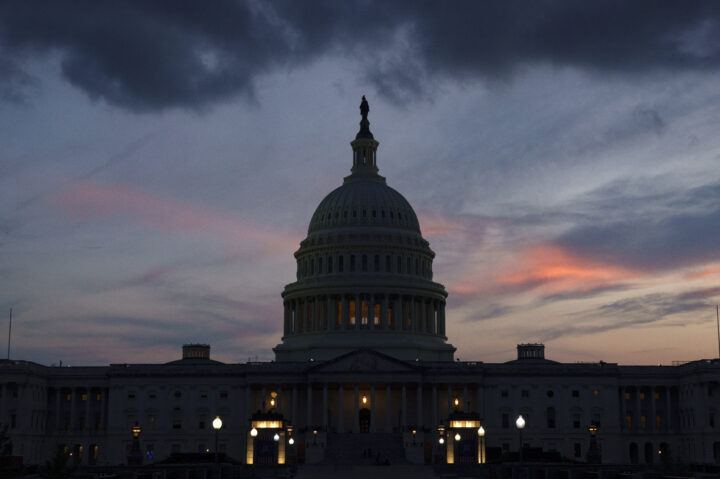
Photo by Kevin Carter/Getty Images
The sun sets behind the U.S. Capitol Building on July 8, 2026 in Washington, D.C.
Good Wednesday afternoon.
This P.M. briefing is reserved for our premium subscribers like you — offering a forward-focused read on what we’re tracking now and what’s coming next.
Today’s Daily Overtime was curated by JI U.S. Editor Danielle Cohen-Kanik.
📡On Our Radar
Notable developments and interesting tidbits we’re tracking
More than 100 House Democrats, about half of the caucus, voted in favorof Rep. Thomas Massie’s (R-KY) amendment to strip all U.S. aid to Israel out of the State Department appropriations bill this afternoon, including several leaders of the caucus such as Rep. Katherine Clark (D-MA), the No. 2 House Democrat, and former House Speaker Nancy Pelosi (D-CA).
While the amendment was overwhelmingly defeated, 314-104, the large segment of Democrats supporting the measure indicates a growing shift away from the party’s historic support for Israel…
Vice President JD Vance, in an episode of “The Joe Rogan Experience” released today, stated repeatedly that Israeli actors are engaged in a “very discreet, very well-funded” influence campaign to extend the war in Iran: “There are some people within their system we know beyond a shadow of a doubt who are manipulating and trying to change American public opinion to keep the war going on indefinitely. Again, not towards any objective, but just indefinitely,” he alleged.
Vance also said that the late disgraced financier Jeffrey Epstein “clearly had connections to the highest levels of Israeli intelligence” and to “elements of the Israeli deep state that were left of center”…
The U.S., Israel and Lebanon, wrapping up talks in Rome this week, agreed on the structure and guidelines for implementing the two pilot zones the parties agreed to create in southern Lebanon, a State Department official said today, without specifying a timeline for the IDF’s withdrawal. The parties will now engage in expanded technical talks to implement the trilateral agreement reached in the last round of negotiations…
CENTCOM began another round of strikes against Iran this afternoon; coming after strikes earlier in the day, the pace of the operations appears to be gaining momentum. President Donald Trump is reportedly considering expanding U.S. military efforts to include more airstrikes, utilizing ground forces and targeting nuclear sites again, according to The Wall Street Journal…
Three senior U.S. officials connected to the Board of Peace, the Trump-led body created to resolve the conflict in Gaza, have been meeting with congressional offices this week to request $200 million for the International Stabilization Force, two people with knowledge of the meetings told Jewish Insider’s Gabby Deutch. The meetings mark the first time that Board of Peace representatives have approached Congress with a funding request…
Ahead of today’s deadline, candidates have begun releasing their fundraising reports for the second quarter. In Georgia, where some in the Jewish community have felt torn between two less-than-ideal options in Sen. Jon Ossoff (D-GA) and his opponent, Rep. Mike Collins (R-GA), Ossoff holds a commanding fundraising advantage: The senator reported raising$20 million this quarter with $42 million in the bank, while Collins raised $2.1 million, leaving him with $2.2 million in cash on hand…
Meanwhile, Michigan Senate candidate Abdul El-Sayed released his 2025 tax returns, which he is not legally obligated to do but was pressured to do by his opponent in the Democratic primary, Rep. Haley Stevens (D-MI). El-Sayed’s reported total income was over $680,000, nearly $300,000 of which was unspecified as to its source…
The anti-Israel American Priorities super PAC made an initial investment of $375,000 to boost El-Sayed in the race; El-Sayed has repeatedly railed against super PAC involvement in politics — particularly that of AIPAC’s United Democracy Project, which is spending heavily in favor of Stevens…
Rep. Hilary Scholten (D-MI), speaking to Semafor about electability concerns in the Democratic Party, criticized progressives who “prop up other candidates who have said really problematic things.” The moderate congresswoman added that El-Sayed, who has been criticized for comments about Stevens seen as misogynistic, “has a problematic record with women”…
A new Quinnipiac poll of Pennsylvania voters found Gov. Josh Shapiro leading his Republican opponent in his reelection race by 13 points, 53-40%, with a 56% overall approval rating. Sen. John Fetterman (D-PA) had a 77% approval rating among Republicans, but only 19% among voters in his own party. Nearly half (49%) of voters said the Democratic Party has moved too far to the left, while 42% said the Republican Party has moved too far to the right…
Former White House senior official Brett McGurk is releasing a book, Brink: Inside the Race to Free the October 7 Hostages, on his role leading U.S. efforts under former President Joe Biden to secure the release of hostages held by Hamas after the Oct. 7, 2023, attacks, due out on Oct. 6 to coincide with the third anniversary of the attacks…
The New York Times examines the role that Hollywood superagent Ari Emanuel could play in the potential presidential run of his brother, former Chicago Mayor Rahm Emanuel, as politicians increasingly seek access to media as part of their campaigns; among those close to Ari Emanuel are the UFC’s Dana White, commentator Joe Rogan, pundit Stephen A. Smith as well as Elon Musk…
⏩ Tomorrow’s Agenda, Today
An early look at tomorrow’s storylines and schedule to keep you a step ahead
Keep an eye on Jewish Insider for a look at what this afternoon’s vote on Massie‘s amendment to cut all U.S. aid to Israel means for the future of Israel policy in the Democratic Party.
At least eight Democratic candidates vying to replace former nominee Graham Platner on the ballotfor U.S. Senate in Maine will take the debate stage tomorrow evening in their first chance to pitch themselves to voters, ahead of the state Democratic Party’s nominating convention later this month.
President Donald Trump will give an address to the nation in the evening, which he has said will largely focus on American election security.
The American Federation of Teachers’ annual convention will kick off in Washington. The second largest teachers’ union in the U.S., the AFT has previously featured anti-Israel resolutions at its gatherings.
The Aspen Security Forum continues with several panels on the Middle East, including speakers such as Akif Çağatay Kılıç, top advisor to Turkish President Recep Tayyip Erdoğan; Ayman Safadi, Jordan’s foreign minister; Sen. Chris Murphy (D-CT); Ted Deutch, CEO of the American Jewish Committee; Dan Shapiro, former U.S. Ambassador to Israel; Rahm Emanuel; Anne Neuberger, former deputy national security advisor; and Salam Fayyad, former prime minister of the Palestinian Authority.
Stories You May Have Missed
SPACE MAN

Harvard professor Avi Loeb believes his research, which propelled him to the White House, could usher in a ‘new messianic era’
LITMUS TEST
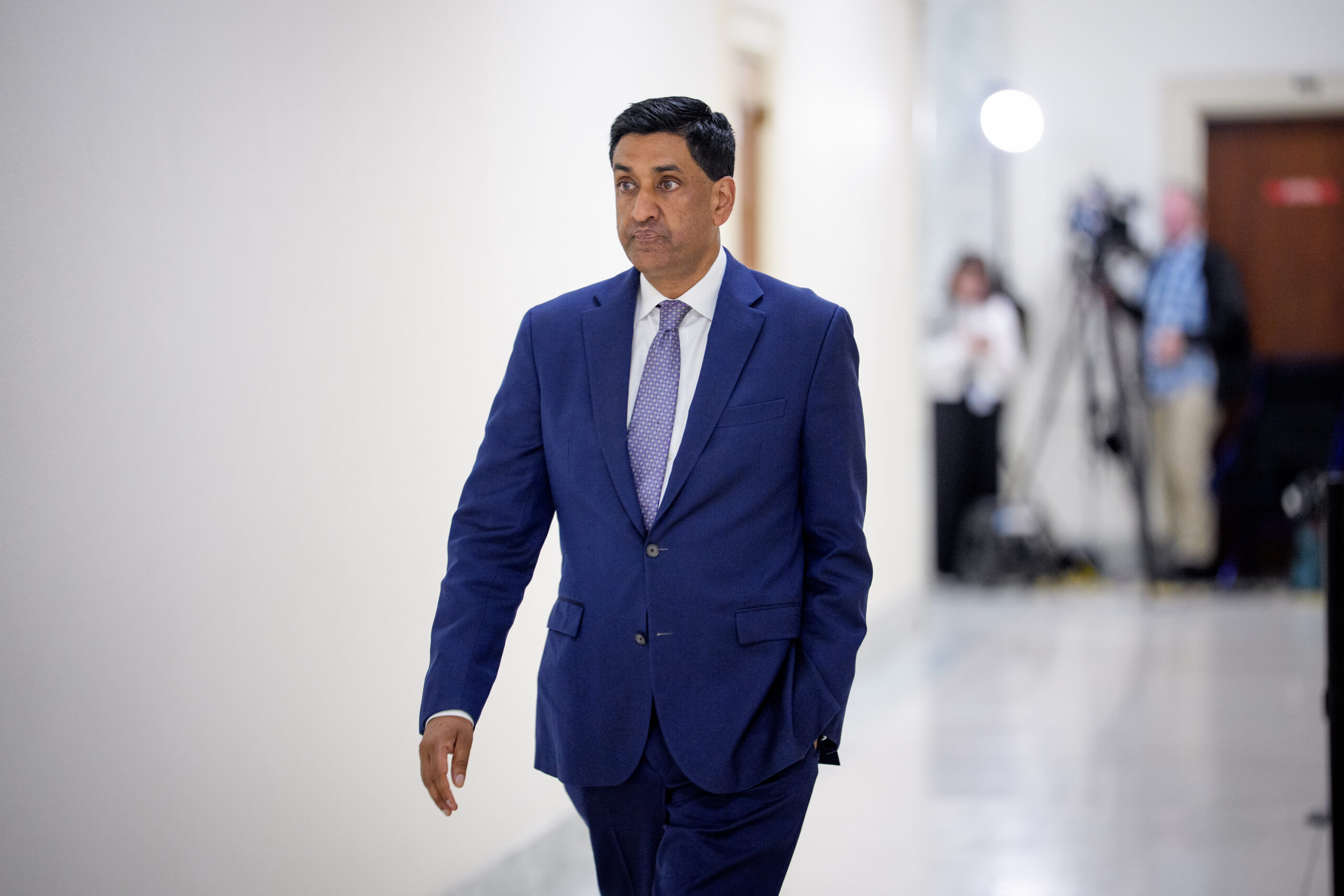
The congressman angered Drop Site co-founder Jeremy Scahill by refusing to condone the attacks; Scahill accused Khanna of promoting a ‘double standard’
The VP warned of a ‘very discreet, extremely well-funded campaign’ by Israeli actors who want to see the war extended ‘not towards any objective, but just indefinitely’
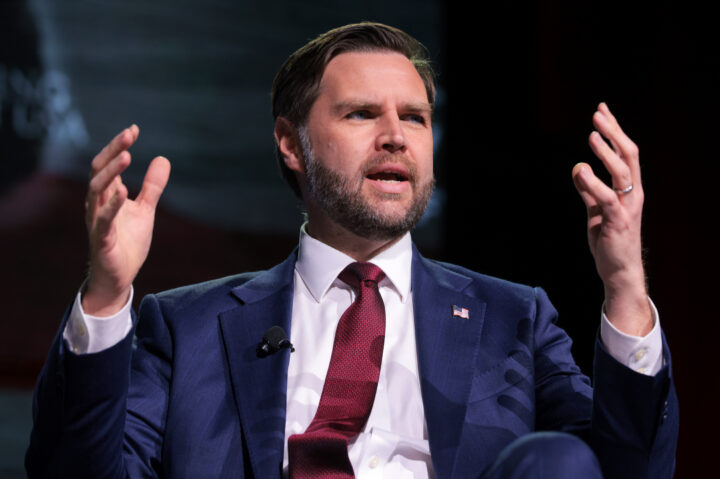
Chip Somodevilla/Getty Images
U.S. Vice President JD Vance speaks during a Turning Point USA event at Akins Ford Arena at the Classic Center on April 14, 2026 in Athens, Georgia.
Vice President JD Vance told podcaster Joe Rogan on Wednesday that he is worried American politicians are being swayed by Israeli “influence campaigns.”
In the three-hour interview on “The Joe Rogan Experience,” Vance warned of a “very discreet, extremely well-funded campaign” to derail negotiations between the U.S. and Iran.
“What does bother me is when those operations, those influence campaigns, actually affect American political judgment, because they shouldn’t. Because we should be thinking, What is in the best interest of the United States of America?”
Vice President JD Vance told Joe Rogan he is worried American politicians are being swayed by Israeli “influence campaigns" and warned of a “very discreet, extremely well-funded campaign” to derail negotiations between the U.S. and Iran.
— Jewish Insider (@jewishinsider) July 15, 2026
Read more: https://t.co/yN72h76DSY pic.twitter.com/eAeh8eAJNm
The interview comes after a series of recent statements in which Vance has criticized Israel’s handling of the Iran war. Last month, he issued a rebuke to Israeli leaders critical of President Donald Trump’s decision to negotiate with Iran, urging them against “attacking the only powerful ally” they have left.
“[Israel is] a country of 9 million people. We have 330 million people. And so, of course, they’re going to try to persuade Americans. They’re going to try to move Americans in one direction or another,” Vance told Rogan. He noted that Israel’s efforts to influence American foreign policy are not themselves suspect — “a lot of other countries do [it],” Vance said — but, rather, that American officials will act in ways that do not serve the American public as a result of Israel’s urging.
Vance compared these alleged Israeli efforts to influence campaigns by Qatar and Russia. “It doesn’t bother me that Qatar tries to influence the United States …. I like a lot of the Qataris, just like I like a lot of the Israelis …. It frankly doesn’t even bother me that Russia or some of these other countries do it. It’s just the nature of being a political leader in 2026,” he said.
He also claimed such Israeli influence campaigns are supportive of war for its own sake: “There are some people within their system we know beyond a shadow of a doubt who are manipulating and trying to change American public opinion to keep the war going on indefinitely. Again, not towards any objective, but just indefinitely,” he said.
In the interview, Vance described an ongoing “massive pro-Israel, anti-Israel debate in the United States of America,” and painted himself as the “reasonable moderate” in that conversation. For that reason, Vance said, he has “been accused of being an antisemite.”
“I guess some people say that I’ve insulted the Jewish religion, which is insane. Like, I have a ton of respect for the Jewish religion,” said Vance. But even as he defended himself against charges of antisemitism, he suggested that his accusers need to acknowledge that American political support for Israel is receding.
“I’ve never heard a good, compelling argument for why I’m an antisemite, even though I’ve been accused of being an antisemite by many people. But what I say to these guys is, look at public opinion, look at the way young Republicans versus Republicans over the age of 65 approach this issue,” said Vance. “Right now, Israel is losing the public opinion battle in the United States of America. It is a simple and obvious fact. Donald Trump has said that publicly.”
What he supports instead is a reevaluation of the U.S.-Israel relationship, he said.
“Israel is an ally like France or like the United Kingdom. We’re going to have disagreements with them. We’re going to have agreements with them,” said Vance. “So my approach to this is to say, you know what? When we’re partnered, great, let’s work together. When we’re not, let’s just be honest about it. And for that, people attack me for being an antisemite or anti-Israel, and they don’t see the writing on the wall, that I’m actually just the guy advocating for a normal relationship with a normal country that’s based around shared interests, as opposed to based around something else.”
It’s a position that sounds similar to recent policy positions adopted by J Street, the progressive Israel advocacy group. J Street said in April, when it announced that the U.S. should no longer support any foreign military aid to Israel, that the country should be treated as a “normal ally — not an exception that receives unquestioning, blank check support from the United States.”
Later in the interview, in a lengthy discussion about disgraced financier Jeffrey Epstein, Vance agreed with Rogan’s comments that some have claimed that Epstein may have been connected to the Mossad, Israel’s intelligence service.
“He clearly had connections to the highest levels of American intelligence. He clearly had connections to the highest levels of Israeli intelligence,” said Vance.
Plus, meet Trump’s Jewish UFO czar
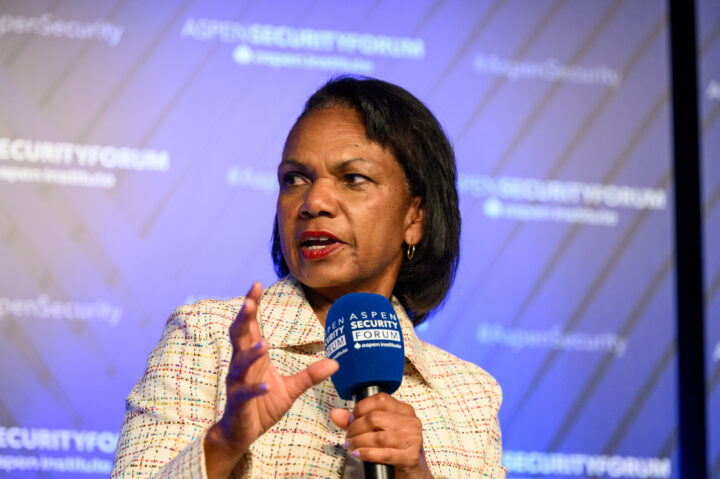
Aspen Security Forum
Former Secretary of State Condoleezza Rice speaks at the Aspen Security Forum on July 17, 2025.
Good Wednesday morning.
In today’s Daily Kickoff, we report on former Secretary of State Condoleezza Rice’s suggestion that the U.S. forgo diplomacy with Iran and continue to pressure Tehran, and cover a meeting this week between the Board of Peace’s Nickolay Mladenov and Aryeh Lightstone and the executive board of the Alliance of Rabbis in Islamic States. We report on the House’s passage of a bill opposed by some Orthodox Jewish groups that would permanently institute daylight saving time, and interview Harvard astrophysicist Avi Loeb, who is now serving as the Trump administration’s UFO czar. Also in today’s Daily Kickoff: Michael Diamond, Elena Kagan and George Deek.
We have also launched a new on-demand Live Briefing that you can access throughout the day via our new app (on Apple and Android) and on our website.
Today’s Daily Kickoff was curated by JI Executive Editor Melissa Weiss and Israel Editor Tamara Zieve, with assists from Danielle Cohen-Kanik and Marc Rod. Have a tip? Email us here.
What We’re Watching
- President Donald Trump is slated to speak at the Pennsylvania Defense and Innovation Summit, organized by Sen. Dave McCormick (R-PA), at the U.S. Army War College today. Additional speakers include Army Secretary Dan Driscoll, U.S. Ambassador to the U.N. Mike Waltz, CIA Director John Ratcliffe and JPMorgan Chase CEO Jamie Dimon.
- A vote on Rep. Thomas Massie’s (R-KY) legislation to strip all U.S. aid to Israel out of the 2027 State Department appropriations bill could come for a vote as soon as today. House Minority Leader Hakeem Jeffries (D-NY) said in a “Dear Colleague” letter on Tuesday that he opposes the legislation, but also argued for “urgent change” in the U.S.-Israel relationship, including changes to U.S. aid going forward. Read more here.
- The Senate Intelligence Committee will hold its rescheduled confirmation hearing for Jay Clayton, the Trump administration’s nominee to be director of national intelligence. Originally slated to testify before the committee last month, Clayton heeded a directive from Trump not to appear as the president battled Congress on voter-ID legislation.
- The Hudson Institute is hosting a fireside chat this morning with Rep. Mike Lawler (R-NY).
- The Aspen Security Forum continues today in Colorado, with sessions focused on a range of issues including China, Europe and trade challenges. Later in the day, the American Enterprise Institute’s Danielle Pletka and Marc Thiessen will record an episode of their “What the Hell Is Going On” podcast with former Under Secretary of Defense for Policy Michèle Flournoy and former National Security Advisors Stephen Hadley and Robert O’Brien.
What You Should Know
A QUICK WORD WITH JI’S GABBY DEUTCH
As Maine Democrats pick up the pieces of Graham Platner’s failed Senate campaign and quickly try to find a replacement for the scandal-tarred candidate on the ballot, moderate Democrats in Michigan, where a primary is fast approaching, are in a race against time to prevent another far-left Senate candidate from capturing a valuable nomination.
The final three weeks of the Michigan primary will be 2026’s most consequential test yet for the power the party establishment still holds, particularly in a pivotal swing state. After socialist candidates scored a number of surprise victories in heavily blue districts in New York City, Philadelphia and Denver, party leaders are fighting with renewed vigor to rally behind Rep. Haley Stevens (D-MI) in the primary against her left-wing challenger, Abdul El-Sayed.
Retiring Sen. Gary Peters (D-MI) endorsed Stevens on Monday, a pivot from his announcement in May that he planned to stay out of the race, joining Senate Minority Leader Chuck Schumer (D-NY), who had already backed the congresswoman. The party’s left flank — including Sens. Bernie Sanders (I-VT) and Chris Van Hollen (D-MD) — is backing El-Sayed.
“The change of heart is we just know that we have to hold Michigan,” Peters said on “Morning Joe” on Tuesday of his decision to endorse, with Stevens sitting beside him. “She’s an outstanding candidate and I certainly hope that folks get behind her around the country and understand that she’s the right person to be the next senator from the state of Michigan.”
There are fresh signs that the late push for Stevens from Democratic leaders — along with millions in ad spending from pro-Stevens outside groups — has given the congresswoman momentum in the closing stretch of the race. A new poll commissioned by the Detroit News found Stevens pulling ahead of El-Sayed by seven points, 48-41%, after she trailed in most public polls this year.
LITMUS TEST
Rep. Ro Khanna (D-CA), fresh off a trip to the West Bank where he alleges he was unjustly detained by Israeli settlers and Israeli military forces, faced a barrage of criticism in a Drop Site News interview on Tuesday for refusing to endorse Hamas’ Oct. 7, 2023, attack on Israel, Jewish Insider’s Marc Rod reports.
Back-and-forth: In the lengthy exchange, Drop Site co-founder Jeremy Scahill repeatedly questioned Khanna, a 2028 presidential hopeful, on why he would not express support for Hamas attacks on Israeli soldiers. Scahill framed the Oct. 7 attacks as primarily targeting Israeli military bases and soldiers, despite the fact that the group attacked many civilian communities and fired thousands of rockets at civilian centers. Further angering Scahill, Khanna said he believed Israel had a right to go after Hamas terrorists “who killed the civilians” on Oct. 7, “but not in the way they went about it, which I said is genocide.”
WAR WORRIES
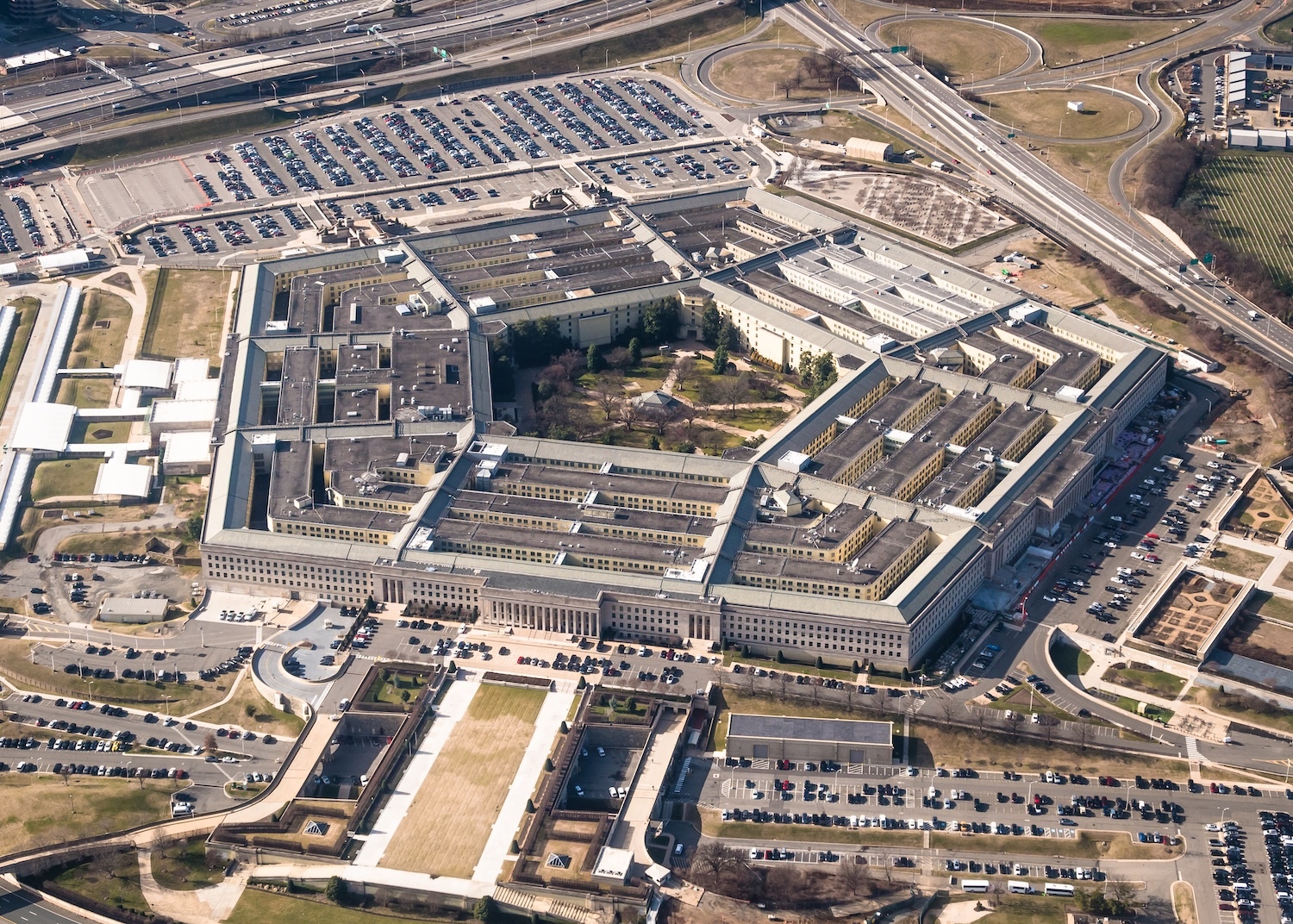
Citing concerns about the Iran war and the administration’s elevated defense funding request, Senate Democrats voted in lockstep on Tuesday evening to block a procedural motion to open debate on the 2027 National Defense Authorization Act, despite the bill passing out of the Armed Services Committee with bipartisan support, Jewish Insider’s Marc Rod reports.
Why it matters: The decision to block the start of debate on the NDAA — an annual must-pass bill which typically garners strong bipartisan support — is a rare and significant step by Democrats signaling significant frustrations with the Trump administration’s ongoing war against Iran. Some anti-Israel voices have sought to cast the vote as a rejection of a provision in the bill expanding U.S.-Israel military cooperation but only a handful of Democrats have cited that as part of their reasoning for opposing the bill.
Trade-off: President Donald Trump on Tuesday walked back his announcement, made the previous day, that the U.S. would institute a 20% fee on cargo transiting the Strait of Hormuz, saying the toll would be replaced by trade deals with Gulf states, but providing no details, JI’s Christina Sher reports.
HEARD AT ASPEN
Former Secretary of State Condoleezza Rice on Tuesday opposed any nuclear deal with Iran, arguing that the U.S. should continue pressure on Iran’s economy and “see what happens,” Jewish Insider’s Marc Rod reports from the Aspen Security Forum.
Assessment: Meanwhile, former Secretary of Defense Mark Esper, speaking alongside Rice on a panel, suggested that the U.S. had potentially overestimated its capabilities in the war, agreeing that continued economic pressure and a renewed blockade are the best strategy going forward. Both also offered strong criticisms of U.S. allies for not joining with and even attempting to obstruct the U.S. campaign against Iran. “I would not buy a nuclear agreement under any circumstances. I’d let them sit there and stew in their lousy economy … and let’s just see what happens,” Rice said.
DST DEBATE

In a bipartisan vote pushed in part by President Donald Trump, the House passed the Sunshine Protection Act, making daylight saving time permanent, a situation that raises concerns for Orthodox Jewish groups that have long warned that such a move would have negative impacts for Jewish morning prayer and potentially raise dangers for school children who have to travel to school before daybreak, Jewish Insider’s Marc Rod reports.
State of play: The bill passed the House by a 308-117 vote, with 95 Democrats and 22 Republicans voting no. The issue has been a priority for Trump, and lawmakers have also included the same legislation in a must-pass transportation bill, with near unanimous support in committee. Orthodox groups now say they’re placing their hopes on the Senate to stop the bill from passing, where the policy has some vocal opponents.
SPACE MAN
President Donald Trump has a border czar, a government official leading the crackdown on undocumented immigrants — whom the White House calls “illegal aliens” — crossing the southern border. The president, who likes to go big, now also has a UFO czar, a Harvard astrophysicist who is scanning the cosmos in search of aliens of the science-fiction variety, Jewish Insider’s Gabby Deutch reports.
From farm to universe: It’s a stunning if improbable career highlight for Avi Loeb, the grandson of a Holocaust survivor who fled Nazi Germany and settled in a communal farm in central Israel. As a child, Loeb had a lot of time alone with his thoughts — walking around to collect eggs from the chickens, or driving a tractor to the surrounding hills, where he would sit and read philosophy books. “I was deeply interested in the most fundamental questions of our existence,” Loeb told JI in a recent interview.
BRUSSELS BUNCH
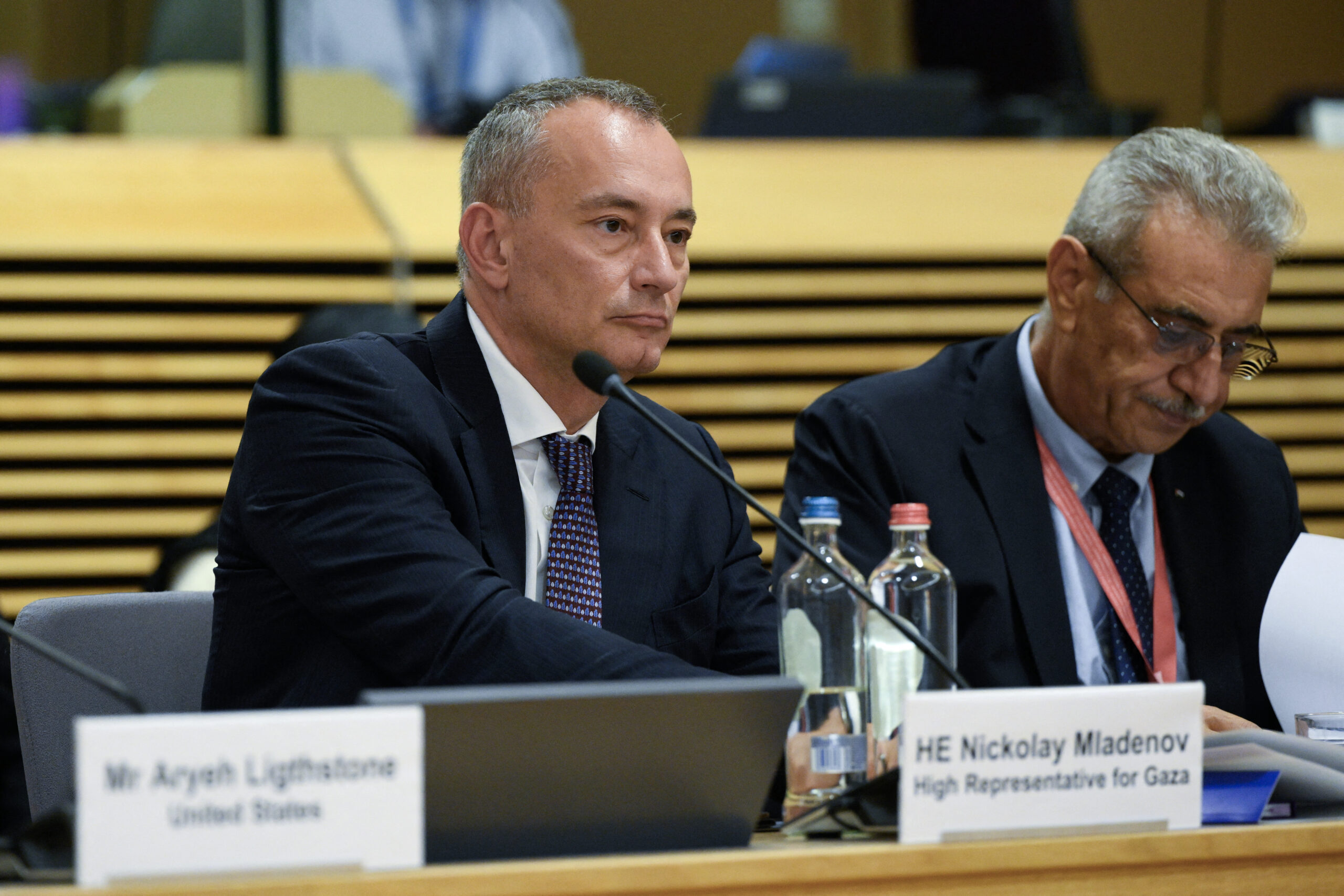
Nickolay Mladenov and Aryeh Lightstone, respectively the high representative for the Board of Peace and the body’s senior advisor, met in Brussels earlier this week with rabbis representing Jewish communities across the Islamic world, Jewish Insider’s Melissa Weiss reports.
Money for Gaza: Mladenov and Lightstone met with the executive board of the Alliance of Rabbis in Islamic States at the group’s annual two-day board meeting. On Monday, the two also attended the second convening of the EU-backed Palestine Donor Group, as the collective of some 65 delegations launched a billion-dollar initiative to begin the economic recovery of the Gaza Strip. Jared Kushner joined the donor conference by video. Among those in attendance at the board meeting were rabbis from Morocco and Turkey.
Worthy Reads
Stroke of the PEN: In The Wall Street Journal, author Meg Keene addresses a recent article from PEN America that detailed the isolation of Israeli and Jewish writers following the Oct. 7, 2023, Hamas terror attacks, the publication of which prompted the resignation of the organization’s president. “The article acknowledges that the accounts reveal ‘blatant hostility, discrimination, and hate.’ That should have been the thesis, not an aside. PEN can see the discrimination; it struggles to name it when the targets are Jews and Israelis and the method is anti-Zionist exclusion. PEN America’s article claims to describe a silent moratorium. Its president’s resignation broke that silence. The scandal, apparently, wasn’t the marginalization of Jewish and Israeli writers; it was PEN’s willingness to acknowledge, even tentatively, that it is going on.” [WSJ]
Don’t Chase the Iranians: The Washington Post’s David Ignatius suggests that President Donald Trump should not rush diplomacy with Iran, arguing that Tehran is headed toward eventual collapse. “I’m usually an enthusiast for diplomacy, but for now, we should stop chasing the Iranians — through the front channel, back channel or anything in between. Let’s wait and see. The Iranian government is obviously split. … A genuine peace with Iran ‘will come in two weeks, or two months, or two years,’ as one U.S. negotiator puts it. Trying to rush that timetable hasn’t worked. But I think the Iranian regime is still on a one-way street to an eventual demise, however long that takes.” [WashPost]
Beyond the Startup Nation: In Time, Frayda Leibtag looks at the economic impact of nearly three years of war on Israelis who work outside the country’s high-tech bubble. “The high-tech sector driving the headline numbers is small. It employs only about one in nine Israeli workers, pays them close to three times the average wage in the rest of the economy, and earns most of its revenue from customers abroad, who keep paying when the sirens sound. The other eight out of nine Israeli workers make their living in shops, farms, and one-person businesses that depend on local customers, the ones who stay home and lose a day’s income every time the fighting flares up. Those Israelis have borne much of the toll of the war.” [Time]
A larger selection of Worthy Reads is available in our Live Briefing.
Word on the Street
President Donald Trump held a Situation Room meeting on Tuesday night ahead of a fresh bombing campaign targeting Iran this morning, including rare daylight strikes…
Following a complaint by the U.S., Israel lifted its restriction on the number of American refueling jets permitted at Ben Gurion Airport, a day after Transportation Minister Miri Regev announced that no more than 20 refuelers would be permitted to land at the airport due to overcrowding that threatened to cancel commercial flights in the coming weeks…
Trump reportedly told Israeli Prime Minister Benjamin Netanyahu last week that Israel should begin redeploying its troops currently stationed in southern Syria, suggesting that the IDF’s presence threatens to escalate tensions in the area; Trump also said that the IDF should withdraw its troops from southern Lebanon to avoid a similar escalation there…
Israeli media reports that Netanyahu is planning to travel to the U.S. this weekend, and will attend the funeral of late Sen. Lindsey Graham (R-SC), expected to be held on Tuesday…
Trump hosted five Holocaust survivors in the Oval Office on Tuesday; the group also met with Secretary of State Marco Rubio and Jared Kushner…
White House Special Envoy Steve Witkoff and Kushner were spotted in the Senate chambers during the swearing-in of Graham‘s sister, Darline Graham, who was appointed to fill the remainder of her brother’s Senate term following his death over the weekend…
Supreme Court Justice Elena Kagan, who along with Justice Amy Coney Barrett testified on Capitol Hill yesterday about the Supreme Court’s budget request, reflected on her now-viral exchange with Graham during her 2010 confirmation hearing, during which he asked her how she spent Christmas and she responded that she spent the day “like all Jews … probably at a Chinese restaurant”; testifying on Tuesday, Kagan said, “Many people have talked about how funny Senator Graham was… What I remember about that hearing was that somehow Senator Graham made me look funny, which is a harder thing entirely”…
Former Columbia University graduate student Mahmoud Khalil, a leader of the school’s anti-Israel protests, is suing the federal government, the Heritage Foundation, Canary Mission and Betar, alleging a coordinated campaign targeting student activists who organized against Israel in the wake of the Oct. 7, 2023, Hamas terror attacks and ensuing war in Gaza…
The New York Times spotlights Michael Diamond — known to Beastie Boy fans as Mike D — ahead of the release of the performer’s first solo album following the 2012 death of bandmate Adam Yauch…
An 82-year-old Israeli man who was wounded in an Iranian missile attack that struck his apartment building in Haifa in April died of his injuries earlier today…
The Israeli government announced the allocation of $431 million to fund the construction of several dozen new West Bank settlements over the next four years…
The Wall Street Journal reports on allegations from human rights groups that the treatment of Palestinian prisoners in Israel significantly deteriorated following Hamas’ Oct. 7, 2023, attacks…
Gabe Stutman has joined Inside Political Money as a senior reporter…
Leonard Abramson, who pioneered the industry of HMOs following his creation of U.S. Healthcare, died at 93…
Pic of the Day
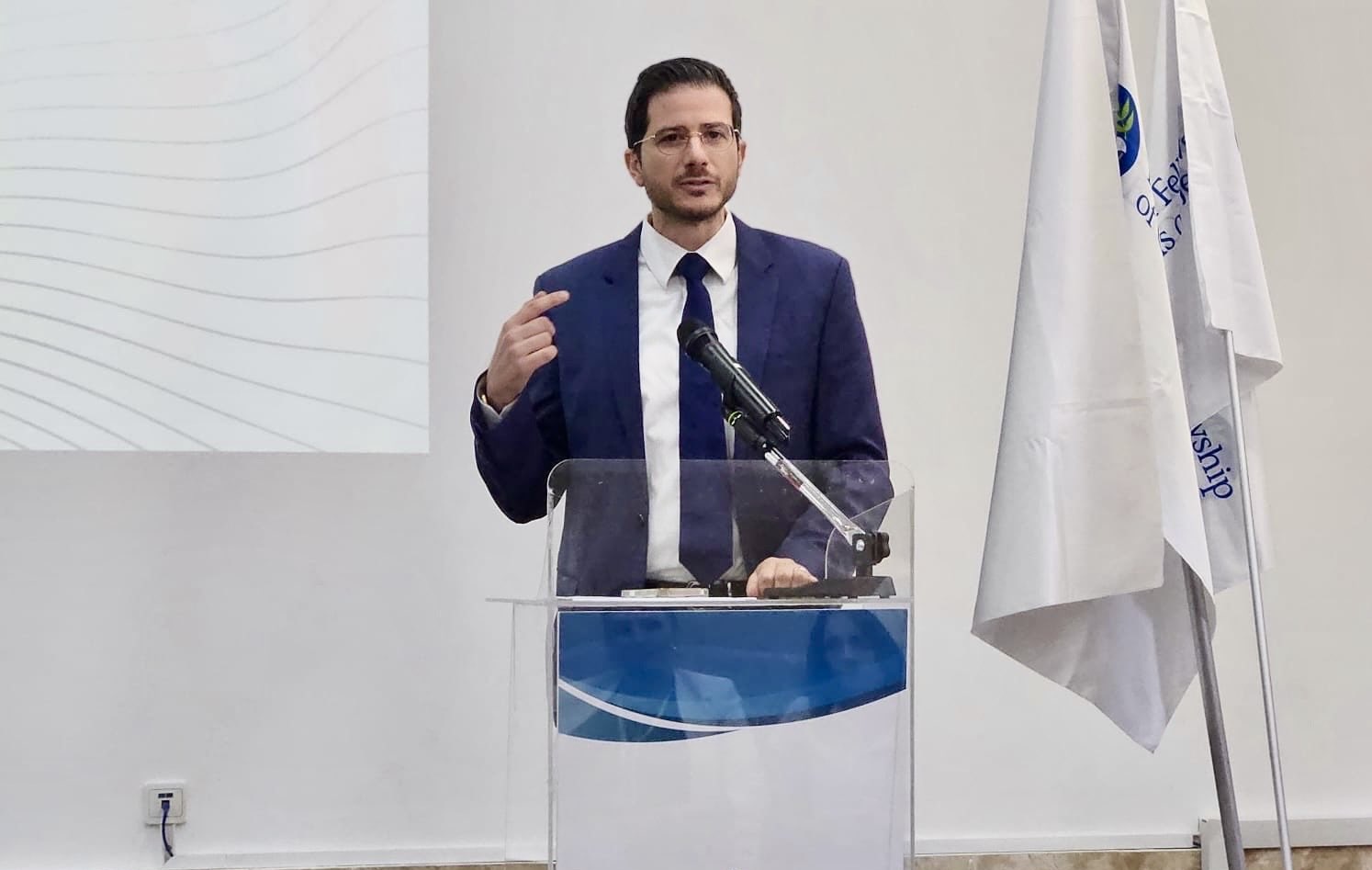
Birthdays

Immediate past board chair of The Jewish Federations of North America, Julie Beren Platt (pictured with her husband, Marc, and Barbra Streisand)…
Member of the British House of Lords, he is a professor, medical doctor, scientist, television anchor and Labour party politician, Baron Robert Maurice Lipson Winston turns 86… Israeli composer and conductor, he composed and conducted the winning entry at the 1979 Eurovision Song Contest, Kobi Oshrat turns 82… Professional sports bettor and poker player, he is a four-time winner of World Series of Poker bracelets, Mickey Appleman turns 81… Physician and life fellow of the American Psychiatric Association, Dr. David Harris Lippman… Co-rosh yeshiva of Beth Medrash Govoha in Lakewood, N.J., one of the largest yeshivas in the world, Rabbi Dovid Schustal turns 79… Congresswoman from Florida for 30 years ending in 2019, Ileana Ros-Lehtinen turns 74… Senior fellow at the Aspen Institute, Elliot Gerson… Israel’s ambassador to the U.S. from 2021-2025, Michael “Mike” Herzog turns 74… Retired California-based appellate attorney, Feris M. Greenberger… Executive director of Friends of OU (Orthodox Union) Israel, Miriam Baron “Mimi” Jankovits… Professor at the UCLA School of Law, Richard Harold Steinberg turns 66… Former political news director at Bloomberg, Jodi Schneider… Member of Congress (D-RI) until 2023, his mother is Sabra née Peskin, David Nicola Cicilline turns 65… Anchorage, Alaska-based attorney, a member of the Alaska House of Representatives since 2012, Andrew Lewis “Andy” Josephson turns 62… Former U.K. Labour party MP including three years as foreign secretary, now CEO of NYC-based International Rescue Committee, David Miliband turns 61… Co-founder and chief investment officer of Toronto-based EdgeStone Capital Partners, one of Canada’s leading private equity firms, Gilbert S. Palter… Israeli actor and singer, she is the 1991 and 1998 winner of the Ophir Award (Israel’s Academy Award) for best actress, Dafna Rechter turns 61… Senior advisor at investment bank Greif & Co., he was the CFO of Jewish Family Service of Los Angeles, David S. Felman… Senior business development representative at Atera, he served for eight years as the Florida synagogue initiative director of AIPAC, Sam Kalmowicz… Senior correspondent at New York magazine, she is a co-author of Notorious RBG: The Life and Times of Ruth Bader Ginsburg, Irin Carmon turns 43… Israeli actor, he played Boaz in Season 1 of “Fauda,” Tomer Kapon turns 41… Filmmaker and co-founder of the Square Peg film production company, Ari Aster turns 40… Managing editor of the U.S. deals team at Bloomberg, Liana Baker… Deputy assistant secretary for travel and tourism at the U.S. Department of Commerce during the Biden administration, now CEO of the FIFA World Cup 26 NYNJ host committee, Alexander Lasry turns 39… SVP of campus solutions at Hillel International, Jonathan Steven “Jon” Falk… Independent journalism consultant, Ariel Zirulnick… Senior NFL reporter at Yahoo Sports, she is also the author of a biography of a Holocaust survivor, Jori Epstein…
Former Secretary of Defense Mark Esper, joining Rice at the Aspen Security Forum, said the U.S. was right to launch the war but may have overestimated or overstated its own capabilities
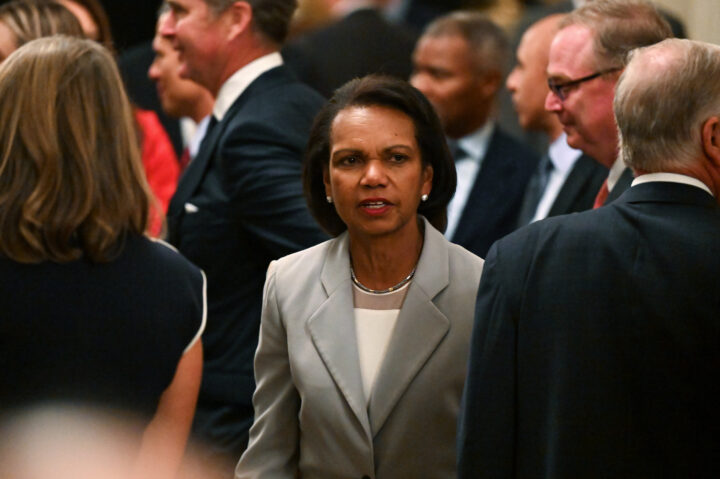
(Roberto Schmidt/Getty Images)
Former U.S. Secretary of State Condoleezza Rice attends the swearing-in ceremony for Chairman of the Federal Reserve Kevin Warsh in the East Room of the White House on May 22, 2026 in Washington, DC.
ASPEN, Colo. — Former Secretary of State Condoleezza Rice on Tuesday opposed any nuclear deal with Iran, arguing at the Aspen Security Forum that the U.S. should continue pressure on Iran’s economy and “see what happens.”
Meanwhile, former Secretary of Defense Mark Esper speaking alongside Rice on a panel, suggested that the U.S. had potentially overestimated its capabilities in the war, agreeing that continued economic pressure and a renewed blockade would be the best strategies going forward.
The two, speaking at the Aspen Security Forum, also offered strong criticisms of U.S. allies for not joining with and at times attempting to obstruct the U.S. campaign against Iran.
“I would not buy a nuclear agreement [with Iran] under any circumstances. I’d let them sit there and stew in their lousy economy, where most of their A-level nuclear scientists have been killed, where I believe there are deep splits in the Iranian government … and let’s just see what happens,” Rice said. “I wouldn’t give them a penny back, and let’s just see what happens to that economy over time.”
Rice said that she believes the U.S. did do significant damage to Iran’s nuclear program and that she’s “quite confident” that the country is not in a position to produce a nuclear weapon in the near future.
Mark Esper, who served during President Donald Trump’s first term, said that the U.S. war on Iran was a “a good thing to do to show the seriousness of of how we felt about this and our willingness to commit force to do that” but added, “we can discuss whether our reach exceeded our grasp, and some of the language used about unconditional surrender, et cetera, pushed them into a corner”
He said that a success in the war would require a return to the status quo in the Strait of Hormuz and a deal on Iran’s nuclear program superior to the 2015 Joint Comprehensive Plan of Action.
Esper argued that there would be no way to bring such a result solely through airstrikes, and that the primary path forward should be renewed economic pressure on Iran, including a renewed blockade targeting Iran’s ports and land and air routes. He said the U.S. should continue to respond to Iranian attacks with strikes on its missile and drone capabilities.
Esper said that strategy will take time, patience, discipline and the support of allies and come at the cost of higher gas prices. He said the end goal should not be to collapse the Iranian regime but to bring Iran back to the negotiating table.
“That approach, barring — I’m open to any better one — gives you the highest return with the lowest risk to where we don’t want to go,” Esper said.
Former Secretary of Commerce Penny Pritzker, who also spoke on the panel, emphasized that economic pressure is a useful tool, which can be effective but takes time, will and coordination, without which there are ways to evade sanctions.
“I’m hopeful that with all this pressure, that something rational can come of this, because we’re not in a good place right now, obviously,” Pritzker said.
Rice and Esper both expressed frustration with U.S. allies’ refusal to cooperate with the U.S. operations and, particularly, European allies’ decisions to block the U.S. from using their bases in their countries in the course of those operations — a move Esper called “really stupid.”
Rice said it was “really not a very smart thing” for allies to dismiss the conflict as not “our war.”
She said would have “preferred” if the U.S. had worked more closely with its allies before the operation, but acknowledged that actually getting them onboard would have been questionable, pointing to her own experience trying to bring allies onboard with the Iraq invasion during the Bush administration.
Sometimes, she said, “the United States has to do something really hard, like really deal with a bad guy who’s been a bad guy for a long time,” she said, emphasizing that the sophistication and range of Iran’s missile program was increasing and it was preparing to make a major agreement with Russia on missiles. “When the time comes, if it’s your ally and your friend, even if you’re not going to join, you don’t try to harm the effort,” she said.
“When I hear, ‘Well, it wasn’t imminent,’ I think, ‘Do you really want to wait until it’s imminent, or do you want to try to degrade it earlier?’” she continued.
Both Esper and Rice warned that, through their actions around the Iran war and comments denigrating the U.S.’ reliability as an ally, or declaring that they will handle their own defense without American assistance, allies are only playing into the hands of those who want to see those alliances collapse.
“You may speak into existence exactly what you need to avoid, because there are some people inside the American political system, on both sides of the aisle, who would be perfectly happy to withdraw from the world, and you don’t want to help empower those people,” Rice warned.
Plus, Dem leaders split on Israel aid
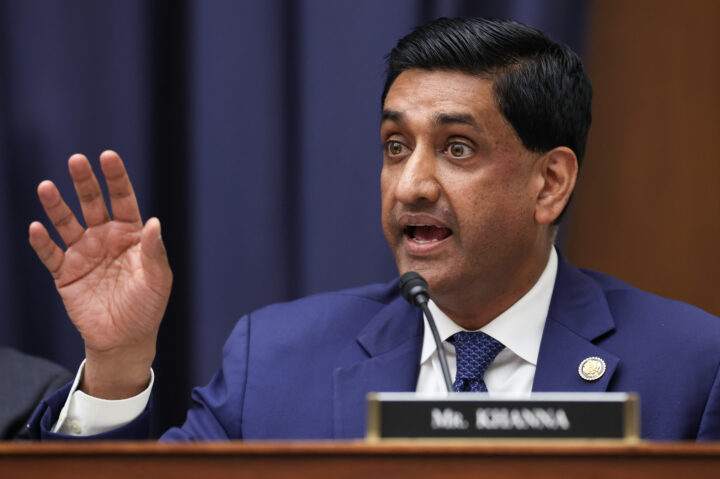
Photo by Win McNamee/Getty Images
Rep. Ro Khanna (D-CA) questions U.S. Secretary of Defense Pete Hegseth as he testifies before the House Armed Services Committee April 29, 2026.
Good Tuesday afternoon.
This P.M. briefing is reserved for our premium subscribers like you — offering a forward-focused read on what we’re tracking now and what’s coming next.
Today’s Daily Overtime was curated by JI U.S. Editor Danielle Cohen-Kanik.
📡On Our Radar
Notable developments and interesting tidbits we’re tracking
Israeli Prime Minister Benjamin Netanyahu issued a warning to Iranian leaders, as military hostilities escalate between Iran and the U.S.: “Do not count on there being calm if you attack us,” Netanyahu addressed Tehran, while speaking today at a conference in southern Israel. “Do not expect a repeat of what happened before, because there will be no repeat. … Any further attempt to harm us will be met with a different response — far more powerful”…
Meanwhile, President Donald Trump walked back his announcement that the U.S. would institute a 20% toll on all cargo passing through the Strait of Hormuz, saying in a post on Truth Social that Middle East leaders had agreed to additional trade and investment deals with the U.S. to replace the fee…
CENTCOM announced it began launching an additional round of strikes against Iran this afternoon “to continue degrading Iranian capabilities used to attack commercial shipping” in the strait, and officially reinstated a blockade on Iranian ports. The Islamic Revolutionary Guard Corps said it launched missile and drone attacks in retaliation against bases in Kuwait and Bahrain…
House Minority Leader Hakeem Jeffries (D-NY) said he would oppose an amendment led by Rep. Thomas Massie (R-KY) to strip all aid to Israel out of the 2027 State Department appropriations bill, Jewish Insider’s Marc Rod reports. But Jeffries also argued for “urgent change” to the U.S.-Israel relationship, including suggesting that direct U.S. military aid to Israel should end when the current memorandum of understanding expires.
Progressive Caucus Chair Rep. Greg Casar (D-TX), on the other hand, said he plans to vote yes on Massie’s amendment, writing in a “Dear Colleague” letter that the “American people are crying out for an end to US tax dollars subsidizing Israel’s military”…
Israeli Transportation Minister Miri Regev announced today that the U.S. will only be permitted to station 20 military refueling aircraft at Ben Gurion Airport, while the rest must be parked at Israeli Air Force bases, in order to facilitate commercial travel for Israelis over the summer…
U.N. official Ramiz Alakbarov accused Hamas forces of interfering at a humanitarian aid distribution site in Gaza, saying armed men had entered a warehouse and “endangered humanitarian personnel,” leading the organization to suspend its operations at the site. “These incidents are not isolated. They are completely unacceptable and reflect an increasingly dangerous pattern of intimidation, violence and obstruction,” Alakbarov said…
Trump asked Netanyahu in a phone call last week to pull IDF forces back from Syria and Lebanon, Axios reports; the Prime Minister’s Office said Netanyahu in turn emphasized Israel’s need for security zones along its borders…
The Jewish Community Relations Council Bay Area issued a statement today on Rep. Ro Khanna’s (D-CA) recent encounter in the West Bank, where he claims he was detained by violent settlers as well as the IDF. The group said it has “conveyed our concerns to the Congressman in how he is representing the district and our community on foreign policy issues” and called on Khanna “to exercise the same urgency he has brought to criticizing Israel to address the hostile climate many Jewish Americans face every day”…
Pressed repeatedly by writers with the Hamas-sympathetic outlet Drop Site News to offer support for the Oct. 7, 2023, terror attacks and Palestinians’ “right to kill Israeli soldiers,” Khanna said he is “not for violence in any way”…
Asked about legislation imposing sanctions on Russia that was championed by the late Sen. Lindsey Graham (R-SC), Trump said in the Oval Office today that lawmakers “may be adding Iran to it … They may add Hezbollah, too.” He said there’s a “good chance” it will pass “in honor of Lindsey”…
White House Special Envoy Steve Witkoff and Jared Kushner were spotted in the Senate chamber during the swearing-in this afternoon of Darline Graham Nordone to fill Graham’s seat…
The AIPAC-linked United Democracy Project super PAC sent direct mail to voters in Michigan highlighting far-left Senate candidate Abdul El-Sayed’s refusal to condemn extreme rhetoric from antisemitic streamer Hasan Piker and El-Sayed’s efforts to “rationalize” the attack on Michigan’s Temple Israel earlier this year…
Columbia University anti-Israel protest leader Mahmoud Khalil filed a civil rights lawsuit against Trump administration officials, the Heritage Foundation and pro-Israel groups Canary Mission and Betar, alleging they “sought to terrorize” him to “intimidate and silence the growing movement for Palestinian rights”…
⏩ Tomorrow’s Agenda, Today
An early look at tomorrow’s storylines and schedule to keep you a step ahead
Keep an eye on Jewish Insider for an interview with Avi Loeb, the Israeli Harvard scientist leading Trump’s search for answers that may be out of this world.
Trump will headline the last day of Sen. Dave McCormick’s (R-PA) Pennsylvania Defense and Innovation Summit at the U.S. Army War College, with additional remarks from Army Secretary Dan Driscoll, U.S. Ambassador to the U.N. Mike Waltz, CIA Director John Ratcliffe and JPMorgan Chase CEO Jamie Dimon.
The Aspen Security Forum in Colorado will feature fireside chats with former Navy Secretary John Phelan and Trade Representative Jamieson Greer. Also on tomorrow’s agenda: a live taping of the “What the Hell is Going On?” podcast hosted by the American Enterprise Institute’s Danielle Pletka and Marc Thiessen, in conversation with former National Security Advisors Stephen Hadley and Robert O’Brien as well as Michèle Flournoy, former under secretary of defense for policy.
Jay Clayton will appear before the Senate Intelligence Committee for his confirmation hearing to be director of national intelligence, after Trump abruptly canceled his hearing originally scheduled for last month.
Rep. Mike Lawler (R-NY) will speak at the Hudson Institute on the future of U.S. foreign policy in the Middle East..
Stories You May Have Missed
MICHIGAN MATTERS

William Lawrence, who has won support from progressive lawmakers and groups, has been under fire for his comments attacking Kamala Harris and denigrating Black political leadership
PEACH STATE PROBLEMS
Top contributors to Florida gubernatorial candidate James Fishback are also bankrolling Rashida Tlaib, Ilhan Omar, Abdul El-Sayed and Andre Carson
The president implied that the renewed strikes reset the 60-day clock for operations without congressional authorization
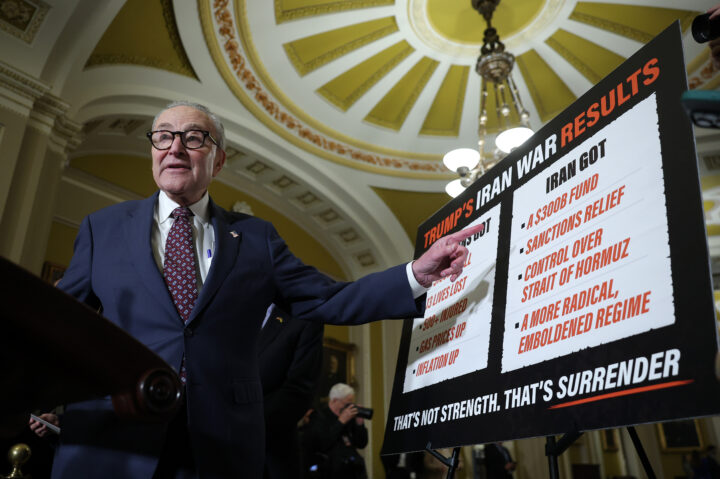
Photo by Kevin Dietsch/Getty Images
U.S. Senate Minority Leader Chuck Schumer (D-NY) speaks to reporters after the weekly Senate policy luncheons at the U.S. Capitol on June 23, 2026 in Washington. Schumer spoke out against President Trump's Iran deal and a the need for the Senate to pass a War Powers Resolution regarding Iran.
Democrats on Monday slammed President Donald Trump’s resumption of hostilities against Iran, as well as the notion, implicit in Trump’s notification, that the operations mark a new conflict and therefore reset the 60-day window for military operations launched by the executive branch without congressional approval.
In a letter to congressional leaders on Friday notifying them that the war had resumed, Trump said that Iran repeatedly violated the memorandum of understanding by attacking commercial vessels on July 6 and 7, and that the U.S. had, as of July 7, commenced “defensive strikes against targets within Iran including missile launch sites, air defenses, military maritime assets, military support infrastructure, and command and control capabilities.”
Trump said that ground forces are not involved in the operations and are focused on protecting the U.S., but American forces “remain postured to take further action.” He added that he was notifying Congress pursuant to his obligation under the War Powers Act, the statute that lays out the 60-day timeline.
Critics of the war have argued consistently that the operations that began in February never actually concluded during the since-terminated ceasefire, despite the administration’s assertions otherwise.
“Trump’s rinse and repeat approach to the Iran war isn’t a strategy, it’s a recipe for utter disaster,” Senate Minority Leader Chuck Schumer (D-NY) said Monday. “It’s incredible what a fiasco this war is. Trump’s so-called understanding — lot of bull — with Iran fell apart faster than the ink could dry.”
Sen. Tim Kaine (D-VA), who has led war powers efforts in the Senate to end the conflict, said the U.S. has been at war, and argued that the administration is obligated to withdraw U.S. forces in response to the war powers resolution that Congress passed last month.
“The notion that [the 60-day clock] was paused before, I think, was sort of laughed out of the room. This has been an ongoing conflict, even during the midst of a ceasefire,” Kaine said. “There were still hostilities underway. So this is not a war that paused and restarted.”
He said he will continue to support war powers efforts but believes that Congress has already definitively declared the war illegal. The resolution that Congress passed came in the form of a concurrent resolution, which is not presented to the president, and its legal force is disputed.
Sen. Adam Schiff (D-CA) filed a new war powers resolution on Monday to oppose the war, which likewise argues that combat operations never ceased.
“We were promised the war would be over for months. And now in a matter of days we’ve gone from a bad U.S.-Iran deal to more strikes, another blockade, and added turmoil that will only drive prices higher,” Schiff said in a statement. “Any assertion by the Trump administration that he gets 60 more days to act without Congress has no foundation in law.”
Kaine and Sens. Andy Kim (D-NJ), Jeff Merkley (D-OR) and Chris Van Hollen (D-MD) cosponsored the resolution.
Rep. Adam Smith (D-WA), the ranking member of the House Armed Services Committee, “wholeheartedly condemn[ed]” Trump’s plans to take control of the Strait of Hormuz, arguing that it is impossible without significant escalation and would be “frankly, just wrong.”
“Iran has gained greater leverage, continues to destabilize the region, and has a younger and more hardline leadership than when this war started,” Smith said. “It is past time for [Republicans] to work with us to ensure the president finds a diplomatic solution to ending a war he never should have started and that threatens our national security and defense as well as that of our partners.”
Even some Republicans have expressed skepticism of the administration’s strategy, including over Trump’s plan to impose a toll on the Strait of Hormuz.
“I recall Secretary [of State Marco] Rubio saying that would not be proper for any country. … Am I wrong?” Sen. John Cornyn (R-TX) told reporters.
Additionally, given the recent sudden death of Sen. Lindsey Graham (R-SC) and the extended medical absence of Sen. Mitch McConnell (R-KY), Democrats may be able to more consistently pass war powers resolutions to oppose the war in Iran.
Many Democrats also say they plan to oppose a procedural vote this week to advance the 2027 National Defense Authorization Act in protest of the continued operations against Iran.
Experts said suspected Saudi strikes on Yemen’s main airport were aimed at stopping Iran from establishing an airlink with the Houthis, which could be used to funnel weapons to the terror group
Photo by Mohammed HUWAIS / AFP via Getty Images
A Yemeni supporter of the Iran-backed Houthi movement holds a portrait of Iran's slain supreme leader, Ayatollah Ali Khamenei, during a protest against U.S. strikes on Iran in Sanaa on July 10, 2026.
Airstrikes on Yemen’s Sanaa International Airport on Monday were intended to stop Iran and the Houthis from breaking a decades-long air blockade and opening an uncontrolled air link between Tehran and its Yemeni proxy, regional analysts said — a corridor they warn could let Iran resupply the Houthis directly with weapons for future campaigns against Saudi Arabia and Israel.
The Houthis accused Saudi Arabia of carrying out the strikes and vowed to retaliate, with a spokesperson claiming the period of “de-escalation” between Riyadh and the terror group was over. Later Monday, the group said it had fired on Saudi Arabia’s Abha International Airport.
The Saudi-backed Yemeni government took responsibility for the original attacks, with Defense Minister Gen. Taher al-Aqili saying on X that the strikes hit the runway to stop an Iranian aircraft — carrying the Houthi delegation returning from the funeral of the late Iranian Supreme Leader Ayatollah Ali Khamenei — from landing. The Houthis said the plane was diverted to Hodeida Airport, and the government ordered all airports under its control closed until further notice.
Riyadh has not claimed responsibility for the attack in Sanaa, but “it was certainly responsible,” said Edmund Fitton-Brown, a former British diplomat and senior fellow at the Foundation for Defense of Democracies.
“The attack was intended to resist Iranian and Houthi efforts to break the air blockade on the Houthi-controlled part of Yemen that has existed for more than a decade,” Fitton-Brown told JI. “Iran and the Houthis took the opportunity of Khamenei’s funeral to test Saudi resolve. Their explicit intention is to establish a regular air link between Iran and Sanaa, uncontrolled by the Saudis or their allies.” He warned such a link would let Iran funnel weaponry to the terror group for “future campaigns” against Israel and Saudi Arabia, as well as in the Red Sea.
President Donald Trump reportedly gave his blessing for the strikes to Saudi Crown Prince Mohammed bin Salman, who called him on Friday to get U.S. backing for military action against the Houthis, according to an Axios report.
Kristin Diwan, a senior resident scholar at the Arab Gulf States Institute, said similarly that “there were well-founded fears on the part of the Yemen government and the Saudis that the Houthis would use this as a pretext to get around U.N. restrictions and to normalize flights from Iran. If they succeeded, these flights could funnel weapons and other material support to the Houthis.”
The renewed tensions between Saudi Arabia and the Houthis come after a period of relative calm in Yemen’s decade-long civil war, which began in 2014 when the Houthis seized the capital, Sanaa, and much of northern Yemen – forcing the internationally recognized government into exile.
A Saudi-led coalition, including the United Arab Emirates, intervened the following year in support of the government. The parties have held a fragile truce since 2023, which has lasted even as the Houthis launched strikes around the region in the aftermath of the Oct. 7 Hamas attacks in Israel.
Today, the Houthis control Sanaa and much of northern Yemen, including most major population centers, while the Saudi-backed government controls much of the south.
The incident “fits a long-term pattern of covert Iranian assistance to the Houthis, which remains subject to U.N. Security Council prohibitions,” said Jonathan Ruhe, a fellow at the Jewish Institute for National Security of America. “Riyadh wants to prevent the Houthis from recovering after being hit hard by U.S.-Israeli strikes last year, before the counter-Houthi coalition fractured.”
Ruhe said that while the “counter-Houthi coalition is weakened right now,” he noted that the Houthis are also not at full strength.
“Riyadh might be calculating that it’s better to deal with Houthi retaliation now, and to assert the Yemeni government’s authority to keep Iran out of the country, than to stand by and wait for the Houthis to rearm and become a major problem once again,” Ruhe said.
“Riyadh historically has seen Yemen as its own soft underbelly, long before the Houthis ever took Sanaa. Iran is the obvious threat on the kingdom’s front door, but Saudis’ threat perception from the south has always been acute, which leads it to be more assertive in Yemen than people might normally expect,” he continued.
“There is a contradiction [on the part of the Saudis] between trumpeting the strength and resolve of the Saudi-led coalition on Yemen and the Saudi-Emirati quarrel that erupted over southern Yemeni independence late last year and it’s still not fully resolved,” Fitton-Brown said. “Ironically, Iranian and Houthi overreach may drive the Saudis and Emiratis back into each other’s arms.”
Fitton-Brown said next steps could also depend on what the Houthi retaliation looks like. He noted that the terror proxy could employ drone or missile attacks on Saudi Arabia or disrupt shipping in the region.
“[The Houthis] may attack Saudi Arabia directly with drones and missiles, as they have in the past. Or they may decide that it is time to resume disruption of the Red Sea and [the] Bab el-Mandeb [strait], compounding the impact of Iran’s blockade of the Strait of Hormuz on the global economy,” Fitton-Brown said. “That risks drawing a U.S.-led united international response.”
Diwan noted that the Houthis have shown a willingness to “take revenge” on key assets in the region. She said the group could “take revenge both through provocations in the Bab el-Mandeb strait and aerial strikes on Saudi airports in the west.”
Ruhe said that while the Houthis have notably been silent during the conflict between Washington and Tehran, their lack of involvement “can’t be taken for granted going forward.” He similarly noted that Houthi retaliation is possible as Iran seeks to “ratchet up pressure on shipping chokepoints and key regional energy infrastructure,” such as the Red Sea, which has been a bypass for Saudi oil exports that would have previously gone through the Gulf.
The analysis by the Jewish Institute for National Security of America found that Tehran made 47% more in the three weeks following the MOU than it normally did in a month before the war

Photo by AFP via Getty Images
A cargo ship is pictured off coast of the Khor Fakkan Container Terminal, the only natural deep-sea port in the region, along the Gulf of Oman on June 28, 2026.
Iran netted nearly $5 billion in the 22 days after Washington and Tehran signed their memorandum of understanding on June 17, according to a new report from the Jewish Institute for National Security of America.
The findings come as President Donald Trump announced on Monday that the U.S. would reimpose its naval blockade on Iranian ports effective July 14 at 4 p.m. ET, with an added 20% U.S. toll on all shipping through the strait.
The U.S. had lifted the blockade last month upon the signing of the MOU with Iran, at which time the Trump administration also issued a waiver that allowed the sale of Iranian oil. That waiver was revoked last week in response to Iranian attacks on shipping vessels in the strait, but the damage, JINSA says, was already done.
The JINSA report, published on July 8, found that once the initial maritime blockade was lifted mid-June, the Iranian regime “rushed to export its oil at the first opportunity.” Shipping data analyzed in the report indicates that Iran exported 50 million barrels of crude within the first two weeks after the blockade was lifted. By early July, total exports under the temporary truce topped 55 million barrels, netting the regime more than $4.5 billion.
Before the conflict, Iran typically exported between 47 million and 50 million barrels in a single month, averaging roughly $3.05 billion in revenue, according to the report. Because the U.S. waiver allowed Iran to sell its crude at standard market prices rather than the heavily discounted rates it usually relied on to bypass international sanctions, the regime pulled in 47% more cash in the 22 days following the MOU than it normally did in an entire month before the war.
Tehran has simultaneously maintained a tight grip on the Strait of Hormuz that has severely constrained broader global shipping, in what the report describes as a “bad omen for the future of maritime security in the Middle East — and U.S. deterrence of Iran.”
Daily global transit through the Strait of Hormuz fell from 15 million barrels of crude oil per day before the war to 4.8 million barrels per day during the first week after the MOU was reached — less than a third of normal volumes. By contrast, Iran managed to export 5 million barrels of its own crude oil per day during that same week.
Beyond standard oil sales, the report notes that Iran maintained an aggressive financial squeeze on foreign vessels transiting the region. Citing Israeli media reports, the report said Iranian authorities blocked commercial oil tankers from passing through the Strait of Hormuz unless they paid a transit fee of up to $2 million per vessel.
Tracking data from the shipping analytics firm Kpler suggests that these unauthorized checkpoints generated roughly $300 million in extra revenue for Tehran, directly violating the agreement’s terms guaranteeing free passage for international trade.
Plus, Graham's Senate seat kept in the family

Shady Alassar/Anadolu via Getty Images
Commercial vessels and oil tankers preparing to transit through the Strait of Hormuz maintain their wait in the Gulf of Oman, on June 17, 2026.
Good Monday afternoon.
This P.M. briefing is reserved for our premium subscribers like you — offering a forward-focused read on what we’re tracking now and what’s coming next.
Today’s Daily Overtime was curated by JI U.S. Editor Danielle Cohen-Kanik.
📡On Our Radar
Notable developments and interesting tidbits we’re tracking
President Donald Trump declared today that the U.S. will take control of the Strait of Hormuz and will institute a 20% fee on all cargo passing through the waterway “for any and all costs necessary to do the job of providing safety and security to this very volatile section of the World,” Jewish Insider’s Christina Sher reports. The move comes after Trump and his administration insisted for months that no country is permitted to charge fees to transiting ships…
Trump also announced he is reinstating a blockade of Iranian ports, which was lifted when the two countries signed a memorandum of understanding last month. CENTCOM said the blockade will resume tomorrow at 4 p.m. ET and will be enforced “against vessels transiting to or from Iranian ports and coastal areas.”
CENTCOM also revealed that it successfully deployed sea drones in combat operations for the first time yesterday, using the unmanned vessels to strike an Iranian submarine at the Bandar Abbas Naval Base…
Trump notified Congress on Friday that fighting with Iran officially resumed last week, further stoking tensions between the executive and legislative branches as lawmakers already approved a war powers resolution calling for an end to American operations in Iran.
Trump’s letter to congressional leadership said U.S. “ground forces are not involved in these strikes” — which he described as “limited, measured, planned, and executed in a manner designed to minimize civilian casualties” — and said he is acting “pursuant to [his] constitutional authority as Commander in Chief”…
The Mossad spent years grooming former Iranian President Mahmoud Ahmadinejad as an intelligence asset to be installed as Iran’s leader after a post-Khamenei regime change, including paying for his housing and travel and arranging a meeting with then-Mossad chief David Barnea under cover of a climate conference in Budapest in 2024, American and Iranian officials told The New York Times.
As the Iran war broke out on Feb. 28, Mossad operatives rescued Ahmadinejad from an Israeli airstrike on his Tehran compound and took him to a safe house, but he balked and left — Ahmadinejad is now reportedly under house arrest by the Islamic Revolutionary Guard Corps…
The Houthis accused Saudi Arabia of bombing Yemen’s international airport today, with a spokesperson saying the action “will not go unanswered,” threatening a tenuous truce enacted several years ago between the terror group and the Saudis. A spokesperson for the internationally recognized Yemeni government, which is backed by Riyadh, said the Houthis subsequently fired ballistic missiles into Saudi Arabia…
U.K. Home Secretary Shabana Mahmood announced on Monday that the country designated the IRGC as a terror organization, with those found guilty of supporting the group facing up to 14 years in prison. The government also banned the Islamic Movement of Companions of the Right, which No. 10 Downing St. said was behind a number of attacks on British Jewish sites…
South Carolina Gov. Henry McMaster announced at a press conference this afternoon that he is appointing Darline Graham Nordone, the late Sen. Lindsey Graham’s (R-SC) sister, to serve out the rest of Graham’s term. Trump had voiced his support for Nordone, who shared an exceptionally close bond with her brother, as “a fabulous tribute to Lindsey.” Fox Newsreported that Nordone could be sworn in as soon as Wednesday…
The Trump administration plans to launch a major diplomatic offensive against the International Criminal Court, Secretary of State Marco Rubio announced today, the latest move in the White House’s longtime battle against the international organization.
The push appears to be rooted in concerns that the ICC will seek to prosecute American servicemembers, JI’s Gabby Deutch reports. Such actions would not only be “a grave overreach of its purported authorities,” Rubio wrote in a Wall Street Journal op-ed, “it would mean the death of the U.S. as a sovereign and independent nation”…
New York City Mayor Zohran Mamdani vowed that he would maintain ties with Morris Katz, the controversial political operative behind Mamdani’s own victory as well as the imploded campaign of former Maine Senate candidate Graham Platner, JI’s Will Bredderman reports, despite calls from members of the Democratic Socialists of America to boycott the consultant’s services…
Rep. Ilhan Omar (D-MN), a member of the Squad and a vocal detractor of Israel, endorsed far-left Michigan Senate candidate Abdul El-Sayed today, joining fellow Squad members Reps. Alexandria Ocasio-Cortez (D-NY), Rashida Tlaib (D-MI), Summer Lee (D-PA) and Delia Ramirez (D-IL) in backing him less than a month before the primary…
⏩ Tomorrow’s Agenda, Today
An early look at tomorrow’s storylines and schedule to keep you a step ahead
Keep an eye on Jewish Insider for a look at the surging anti-Israel candidate in the Democratic primary for Michigan‘s swing 7th Congressional District.
The sixth round of talks between Israel and Lebanon are slated to begin tomorrow in Rome, despite Beirut’s reported threat not to attend if the IDF did not vacate two pilot zones in southern Lebanon before the discussions. Israeli media reported that this week’s talks will focus on the timeline for the withdrawal.
The Aspen Security Forum, the high-profile annual gathering of national security leaders, policymakers and foreign policy experts, begins tomorrow afternoon in Colorado. Former Secretary of State Condoleezza Rice, former Defense Secretary Mark Esper and former Commerce Secretary Penny Pritzker will speak on a panel on the “state of the world.”
The two-day Pennsylvania Defense and Innovation Summit, hosted by Sen. Dave McCormick (R-PA), will kick off at the U.S. Army War College in Carlisle, Pa., with a keynote address from Joint Chiefs Chairman Gen. Dan Caine.
Some House Republicans were invited to a dinner tomorrow night with Defense Secretary Pete Hegseth, according to Punchbowl News, as the Trump administration is seeking more than $67 billion for the Pentagon in its supplemental funding request.
Stories You May Have Missed
REMEMBERING
Trump, Cruz, Fetterman, Coons and Jewish organizations remembered the South Carolina Republican, who died suddenly at 71
FOLLOW THE MONEY
Top contributors to Florida gubernatorial candidate James Fishback are also bankrolling Rashida Tlaib, Ilhan Omar, Abdul El-Sayed and Andre Carson
The president also said he is reinstating a blockade on Iranian ports
AFPTV / AFP via Getty Images
A cargo ship anchoring near the Strait of Hormuz off the eastern coast of the United Arab Emirates on July 12, 2026.
President Donald Trump declared on Monday that the U.S. will take control of the Strait of Hormuz and said Washington will institute a 20% fee on all cargo passing through the waterway “for any and all costs necessary to do the job of providing safety and security to this very volatile section of the World.”
“The Hormuz Strait is OPEN, and will remain OPEN, with or without Iran,” Trump wrote on Truth Social. “The U.S.A. will be, from this point forward, known as ‘THE GUARDIAN OF THE HORMUZ STRAIT,’ but as such, and as a matter of FAIRNESS, will be reimbursed, at the rate of 20% on all cargo shipped.”
Trump’s comments came after the Islamic Revolutionary Guard Corps announced on Sunday that the strait was considered closed until further notice.
Trump also said he is reinstating the U.S. blockade on Iran, which had been lifted as part of the memorandum of understanding signed between the two countries last month. The blockade will once again prevent “Iran’s ships or customers from entering or leaving,” he said. “All other countries will have fair and open use of the Strait.”
Earlier on Monday, Trump said during a “Fox & Friends” interview that “we’re going to keep the strait, and we’ll probably run it.”
Trump has declared the MOU, which said Iran would oversee arrangements for ships transiting the key waterway, as finished.
“We had a deal. It was a done deal, and then they broke it. They always break it,” Trump said of Iran on Monday, declaring his intent to “hit them very hard.” The U.S. struck Iranian targets near the strait on Sunday night after Iran hit a Cyprus-flagged container ship, prompting Iran to fire barrages of drones and missiles at Qatar, Jordan and the United Arab Emirates.
Iran has attacked several commercial tankers this month for traversing the strait through “unauthorized routes.”
Iran’s Islamic Revolutionary Guards Corps said that normal shipping traffic can only resume if the U.S. ends its military involvement in the strait entirely, according to Iranian state media.
Mayor Zohran Mamdani called his international affairs commissioner’s scheduled sitdown with Iran’s U.N. representative ‘an error’

Yuki Iwamura-Pool/Getty Images
Democratic mayoral candidate Zohran Mamdani
New York City Mayor Zohran Mamdani told reporters on Friday that he had been unaware that top officials in his administration planned to meet with Iran’s ambassador to the United Nations earlier this month — calling the decision “an error” on the part of one of his most prominent and politically active commissioners.
Speaking after an unrelated event, the mayor maintained he only learned from a request for comment from City Journal that International Affairs Commissioner Ana Maria Archila and what the publication described as “two other senior officials” working under her had planned to sit down on Tuesday with Amir-Saeid Iravani of the Iranian Mission to the U.N. City Journal, affiliated with the right-of-center Manhattan Institute, reported that the State Department stepped in to preempt the meeting.
“That meeting did not take place, it will not take place, and I did not know about it until there was a press inquiry regarding it,” Mamdani told reporters, vowing a change in internal policy to prevent it from occurring again. “The commissioner recognizes that this was made in error, and we’re working on a new process, in terms of new meeting requests.”
The democratic socialist stressed that the Iranian mission had reached out to his team, not the other way around, and maintained that the office’s function is to maintain the city’s international relationships.
However, City Journal and El Pais have reported that Archila has taken a decidedly political tack in her outreach to foreign governments, explicitly seeking to engage with those that are “in political alignment/leftist,” including Colombian President Gustavo Petro, a fierce critic of Israel.
Archila first gained attention for confronting then-Sen. Jeff Flake (R-AZ) in a Senate elevator over the nomination of now-Supreme Court Justice Brett Kavanaugh in 2018, and subsequently ran unsuccessfully for New York lieutenant governor in 2022. Prior to joining the Mamdani administration, she served as co-director of the New York chapter of the left-wing Working Families Party.
Israeli officials have increasingly indicated that Jerusalem is ready to return to military action if it determines that circumstances demand it
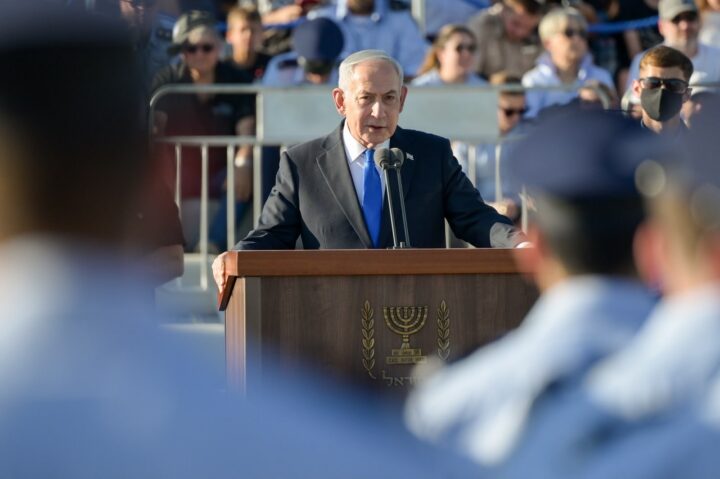
Ma'ayan Toaf (GPO)
Israeli Prime Minister Benjamin Netanyahu speaks at the graduation ceremony of the IAF pilots' course, July 9th, 2026
After several days of watching from the wings as the United States has conducted strikes against Iran, Israeli officials have increasingly indicated that Jerusalem is ready to return to military action if it determines that circumstances demand it.
Israeli Ambassador to the U.S. Yechiel Leiter told CNN on Thursday that Jerusalem is “supportive of the position of the United States” and would “fly alongside U.S. aircraft” if called on to do so.
At an Israeli Air Force graduation ceremony the same day, Defense Minister Israel Katz said the IDF is prepared to “regain air superiority and carry out ‘blue-and-white’ [Israeli] strikes in Iran to remove threats — even for a third time,” warning that it would be with “even greater force” than before. Meanwhile, IDF Chief of Staff Lt. Gen. Eyal Zamir told graduates that “on the drawing board are new plans. Major operations are still expected to lie ahead of us. Be prepared.”
Prime Minister Benjamin Netanyahu reinforced that message in his remarks at the ceremony. While celebrating the outcome of Operations Rising Lion and Roaring Lion, he made clear that Israel does not view the conflict with Iran as settled. “Our policy is clear: With an agreement or without an agreement, Iran will not have nuclear weapons,” Netanyahu said. He added: “The war is not yet over. Alongside old challenges, new ones are emerging. Axes fall, and axes rise. We are turning our attention to this. We are prepared for any scenario.”
Security analysts say the messaging reflects a desire to preserve military pressure without committing to another immediate campaign. Yoni Tobin, a senior political analyst at the Jewish Institute for National Security of America, told Jewish Insider, “While Israel isn’t exactly clamoring for more combat with Iran, particularly after nearly three years of multifront war, it is certainly ready for it.” Tobin noted that “Israel will likely feel comfortable acting against Iran if the United States does so as well, and if the two countries are aligned on objectives and strategy.”
David May, a senior research analyst at the Foundation for Defense of Democracies, said the memorandum of understanding “should be seen as part of the process of ending the fighting between the United States and Iran, not the final agreement.”
“Washington needed the Strait of Hormuz opened urgently, but Iranian provocations have prevented the strait’s return to normal. Iran has always tried to cheat on the margins of deals with the United States — even with favorable agreements — to test American resolve,” May continued. “With the terms of the MOU so favorable to Iran, Tehran would have been wise to abide by the deal but didn’t, thanks in part to internal divisions. The renewed fighting will hopefully lead to the MOU being scrapped and replaced by a more reasonable peace agreement.”
“Israel has enjoyed the relative quiet and is feeling a bit shaky over its exclusion from ceasefire talks,” May posited. “But open conflict with the Islamic Republic remains a likely possibility.”
At the same time, the current situation may be more complicated than the public rhetoric suggests. Ran Zimmt, director of the Iran and Shiite Axis research program at the Institute for National Security Studies, wrote in an op-ed for Ynet that both Washington and Tehran would prefer to avoid a return to full-scale war.
“In this reality, the most likely scenario at this stage appears to be a continuation of the current situation: not a full-scale war, but also not a long-term diplomatic arrangement,” Zimmt wrote. “From Israel’s perspective, this reality seemingly has clear advantages. The military option remains on the table, and Iran does not enjoy a broad package of economic benefits that could strengthen the regime and allow it to invest significant resources in rebuilding its power.”
Zimmt warned, however, that while the status quo “may be preferable in the short term,” it does not “provide a stable solution, but at most a temporary pause,” during which Iran can rebuild its military capabilities.
Plus, Labour's leftward turn on Israel
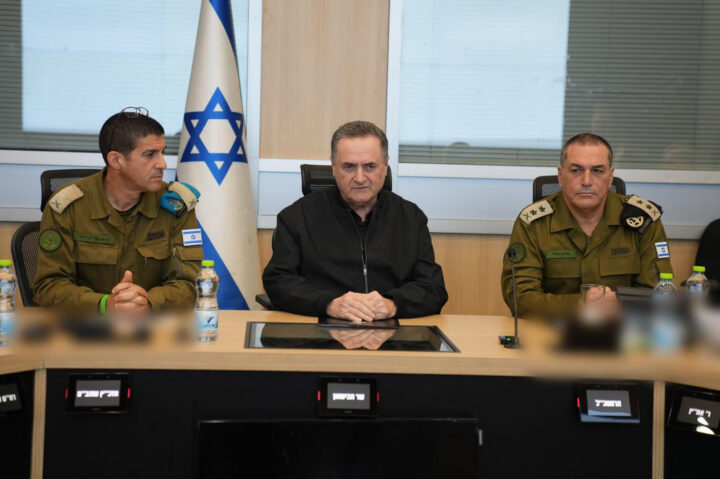
Israeli Ministry of Defense/Anadolu via Getty Images
Israeli Defense Minister Yisrael Katz holds a security situation assessment meeting with IDF Chief of Staff Lt. Gen. Eyal Zamir and other senior commanders in Tel Aviv, Israel, on March 07, 2026.
Good Thursday afternoon.
This P.M. briefing is reserved for our premium subscribers like you — offering a forward-focused read on what we’re tracking now and what’s coming next.
Today’s Daily Overtime was curated by JI U.S. Editor Danielle Cohen-Kanik.
📡On Our Radar
Notable developments and interesting tidbits we’re tracking
Appearing on CNN this morning, Israeli Ambassador to the U.S. Yechiel Leiter said Jerusalem is “supportive of the position of the United States” regarding renewed strikes on Iran, and said Israel would “fly alongside U.S. aircraft” if called on to do so.
He added that Iran had violated its “only obligation” under the memorandum of understanding — to keep the Strait of Hormuz open — and that if the Iranians “persist in their malign intentions,” the war could resume “in full swing”…
Israeli military leaders are also hinting at potential Israeli involvement: At an Israeli Air Force graduation ceremony, Defense Minister Israel Katz said the IDF is prepared to carry out independent strikes “to remove threats” in Iran. Lt. Gen. Eyal Zamir, the IDF’s chief of staff, told the graduates that “new plans” are “on the drawing board” and that “major operations are still expected to lie ahead of us. Be prepared”…
Israeli Prime Minister Benjamin Netanyahu’s office said he spoke with President Donald Trump today and was updated by the president “on American moves in the Gulf.” According to a statement from the PMO, Netanyahu again raised the issue of Turkish President Recep Tayyip Erdoğan‘s hostile rhetoric toward Israel…
The Wall Street Journal examines the “root of the dispute” over the Strait of Hormuz — the “poorly worded” fifth article in the U.S.-Iran memorandum of understanding that says Tehran will “make arrangements” to restore shipping in the waterway and then work with Oman on a plan to administer it going forward.
“Notably, the paragraph says nothing about the U.S. making arrangements for the safe passage of vessels, which Iran has seized on to attack ships that use a U.S.-coordinated route,” a U.S. official told the outlet…
Rep. Ro Khanna (D-CA) is in Israel and the West Bank this week while Congress is in recess, according to two individuals with knowledge of the trip. Khanna has not posted publicly about his visit, which is scheduled to conclude tonight, JI’s Melissa Weiss reports…
While wrapping up his trip, Khanna, who was one of Senate candidate Graham Platner’s most vociferous defenders until a rape allegation was made against the Maine Democrat earlier this week, told MS NOW that he’s endorsing former state Sen. Troy Jackson to take Platner’s place on the ballot. Jackson, who previously ran for governor, is a progressive seen as aligned with Platner…
But Platner’s potential replacements will have to wait a few more days: The candidate told campaign staff he intends to wait until the very last day — Monday — to officially file his paperwork to drop out of the race, Axios reports…
The Journal profiles Cheyenne Hunt, the progressive influencer and activist who played a key role in bringing to light the sexual assault and misconduct allegations that ultimately saw the ouster of Platner and the resignation of former Rep. Eric Swalwell (D-CA)…
Rep. Carlos Gimenez (R-FL) withdrew as co-chair of the Congressional Friends of Spain Caucus due to what he called Madrid’s “escalating, hostile crusade” against Israel…
Andy Burnham, widely expected to become Britain’s next prime minister, told The Guardian that the response of his Labour party to Israel’s military actions in Gaza “has too often not been good enough” and that the U.K. has “got to do more to put pressure on the Israeli government,” including sanctions and potentially banning trade in goods from Israeli settlements in the West Bank.
Burnham also said there is “increasing evidence” that Israel committed war crimes, though he did not use the word genocide, and said the determination should be left to international courts. His comments mark a shift to the left of Labour’s outgoing leader, Keir Starmer, who was slower than other European leaders to back a ceasefire and recognize Palestinian statehood…
Among those speaking at the closed-door Allen & Company retreat in Sun Valley, Idaho, today were Jared Kushner, UAE Ambassador to the U.S. Yousef Al Otaiba, former Israeli Prime Minister Naftali Bennett, Sens. John Fetterman (D-PA) and Dave McCormick (R-PA) as well as Ken Griffin, the hedge fund manager and GOP megadonor.
Asked whether he would support Vice President JD Vance or Secretary of State Marco Rubio in the 2028 presidential election, Griffin said he’d be inclined to back Rubio…
⏩ Tomorrow’s Agenda, Today
An early look at tomorrow’s storylines and schedule to keep you a step ahead
Keep an eye on Jewish Insider for a look at Platner’s potential replacements, as a handful of Maine Democrats are already jockeying for the position less than 24 hours after Platner announced he intends to drop out of the race for U.S. Senate.
We’ll be watching to see if U.S. and Iranian strikes continue into the weekend, or if the current flare-up has run its course. Prior to the outbreak in hostilities, Saudi media had reported that talks between Washington and Iran would restart on July 11, after the dayslong funeral of late Supreme Leader Ayatollah Ali Khamenei wraps up today. Trump said this morning that the Iranians had called and “want to make a deal so badly,” but it’s unclear whether the two sides intend to meet.
We’ll be back in your inbox with the Daily Overtime on Monday. Shabbat shalom!
Stories You May Have Missed
SCOOP
Allies of the Texas senator are launching The Front Line, a 501(c)(4) nonprofit aimed at making antisemitism ‘disqualifying’ for GOP candidates
BELL BOUY
As of this week, UDP has reserved $865,000 in ad time for the race and New Democrat Majority has reserved $500,000, ahead of the Aug. 4 primary
The senator credited al-Sharaa with diminishing Iran’s influence in Syria and urged Israel to recognize how the move could benefit the region

Photo by Kevin Dietsch/Getty Images
Sen. Lindsey Graham (R-SC) speaks during a news conference at the U.S. Capitol on July 30, 2021 in Washington, DC.
In a change of tone, Sen. Lindsey Graham (R-SC) said on Wednesday that Syrian President Ahmad al-Sharaa deserves a chance to rebuild the war-torn country, arguing that his efforts to curb Iran’s influence in Syria should prompt Israel to reassess its approach to the new government.
Graham, who has long been skeptical of Syria’s new government, released a statement at the conclusion of his visit to Ankara, Turkey, this week for the NATO summit, where he took part in several bipartisan meetings between U.S. lawmakers and world leaders including al-Sharaa.
The South Carolina senator said he left his meeting with the Syrian president feeling encouraged, saying the Syrian leader has earned U.S. backing as he seeks to rebuild the war ravaged country.
Graham’s latest statement came hours after President Donald Trump notified Congress that he’s moving to remove Syria from the State Sponsor of Terrorism list, which the president had been publicly considering.
“I believe it is in America’s national security interest to work with him and give him a chance to see if he can put together a lasting, functioning government in Syria,” Graham said of al-Sharaa. “A fractured Syria, on the other hand, plays into the hands of our enemies. I think President al-Sharaa presents the best chance for a functioning, united Syria over time.”
“I very much understand Israel’s concerns, but President al-Sharaa has been a true thorn in the side of Iran. He has dramatically reduced Iran’s influence in Syria, which is a giant step forward for the Syrian people and a blow to Iran,” he continued. “It is time to recognize what he’s done regarding Iran and give him the capability to improve the lives of the Syrian people, realizing that the status quo is unacceptable for all.”
The comments mark a notable shift for the South Carolina senator, who has been among the most vocal skeptics of the new Syrian government since it took power in March 2025. Graham had tried to convince the Trump administration to place binding conditions on the repeal of Caesar Act sanctions on Syria last year, which the White House and Syrian diaspora groups successfully pushed congressional Republicans to lift unconditionally.
Graham vowed to “do everything in my power to revive the Caesar Act sanctions, making them even more bone crushing” in response to the Syrian government’s military offensive in January against territory held by the Kurdish-led Syrian Democratic Forces. He introduced legislation that month imposing sanctions on any government or group involved in targeting Kurdish forces in Syria.
Plus, Rahm Emanuel on the ‘moral bankruptcy’ of far-left Dems
Jakub Porzycki/NurPhoto via Getty Images
President Donald Trump during the press conference at the NATO Summit in Ankara, Turkiye on July 8, 2026.
Good Wednesday afternoon.
This P.M. briefing is reserved for our premium subscribers like you — offering a forward-focused read on what we’re tracking now and what’s coming next.
Today’s Daily Overtime was curated by JI U.S. Editor Danielle Cohen-Kanik.
📡On Our Radar
Notable developments and interesting tidbits we’re tracking
CENTCOM began conducting additional strikes against Iran this afternoon, after President Donald Trump continued to escalate his rhetoric against the regime in his remarks today at the NATO summit in Ankara, Turkey.
Trump said he wasn’t sure he wanted to make a deal with the Iranians any longer and reiterated his threat to “finish the job,” but still denied the strikes mark a return to full-scale war: “I think anything that happens is going to be over very quickly,” he said…
Israeli Prime Minister Benjamin Netanyahu confirmed that Defense Secretary Pete Hegseth had scrapped a planned trip to Israel, saying in an interview that the defense chief had been “called back home” from the summit in Ankara. Meanwhile, Israeli media reports that American military refueling planes have begun to return to the region…
Trump is likely to face pushback from lawmakers over the renewed strikes: Rep. Greg Meeks (D-NY), the ranking member of the House Foreign Affairs Committee, said he’s already “in conversations with the Senate to explore any and all legal pathways to hold Trump accountable,” given that both chambers of Congress already passed a war powers resolution seeking an end to U.S. military action in Iran…
Trump also informed Congress today that he intends to rescind Syria’s designation as a State Sponsor of Terrorism following a 45-day pre-notification period, Secretary of State Marco Rubio announced, shortly after Trump held a friendly meeting with Syrian President Ahmad al-Sharaa on the sidelines of the NATO summit…
Former Chicago Mayor Rahm Emanuel, speaking to Jewish Insider’s Melissa Weiss prior to his speech at Tel Aviv University today, criticized the “moral bankruptcy” of “those that paraded, celebrated and cheered” in the aftermath of Hamas’ Oct. 7, 2023, attacks on Israel.
Responding to a question about Democrats who did so — including New York City congressional candidate Darializa Avila Chevalier, who attended an anti-Israel rally in Times Square on Oct. 8, 2023 — Emanuel said, “I have no place for the moral bankruptcy of those that found Oct. 8 as the day to cheer 1,200 people not only killed but sexually abused, and for taking hostage 250 people”…
In an interview on Israel’s Channel 12, Emanuel confirmed he’s “thinking about” running for president in 2028 and said he believes Americans could elect a Jewish president. “I believe people will evaluate me based on my character and my background,” he said…
Maine Democratic Senate candidate Graham Platner still remains in the race two days after Politico published an account from a former romantic partner accusing him of rape, though the candidate’s feud with the Maine Democratic Party continues. Platner’s campaign manager, Ben Chin, sent a message to supporters today accusing the MDP of allowing the national Democratic Senatorial Campaign Committee to orchestrate Platner’s replacement “behind closed doors.”
In response, the MDP, which was reportedly set to hold a meeting on the issue this afternoon, said Platner’s campaign is “distracting from the job of defeating [Sen.] Susan Collins (R-ME) in November with false accusations” and pledged to develop “a representative, transparent and inclusive process to select a new nominee when he chooses to withdraw from the race”…
A new Politico survey of Democratic primary voters in Michigan, conducted in the two days after state Sen. Mallory McMorrow dropped out of the race for U.S. Senate, found the two remaining candidates — Rep. Haley Stevens (D-MI) and Abdul El-Sayed — in a statistical tie at 42-41%, with nearly 20% of voters undecided…
Kentucky Gov. Andy Beshear sent a letter to Sen. Mitch McConnell (R-KY) requesting that he “fully update Kentuckians regarding the current status of your health,” as McConnell has been hospitalized for nearly a month…
A new poll from the Associated Press-NORC Center for Public Affairs Research found that 44% of American Jews hold a favorable view of New York City Mayor Zohran Mamdani — a higher percentage than Netanyahu, who received a 32% favorability rating…
Jewish groups — including the Jewish Council for Public Affairs, Anti-Defamation League, American Jewish Committee, Conference of Presidents of Major American Jewish Organizations, Hadassah and StandWithUs — celebrated several steps taken at the National Education Association’s Representative Assembly, which wrapped up yesterday in Denver, including the Jewish Affairs Caucus’ work in advancing three amendments to the NEA Constitution and a resolution on Jewish education…
Bertrand Benoit, The Wall Street Journal’s bureau chief in Germany, explores what it means for Germany’s identity as its citizens begin to lose their living connection to the Holocaust, including how the fading of survivor testimony, rising antisemitism and challenges from both the political right and left are reshaping the country’s culture of remembrance…
⏩ Tomorrow’s Agenda, Today
An early look at tomorrow’s storylines and schedule to keep you a step ahead
Keep an eye on Jewish Insider for a look at the choice ahead for Georgia’s Jewish community in the race between Sen. Jon Ossoff (D-GA) and his opponent, Rep. Mike Collins (R-GA).
The Contemporary Antisemitism conference at the University of Haifa will wrap up with a keynote speech by philosopher and author Bernard-Henri Lévy.
Stories You May Have Missed
SANCTIONS STANDOFF

Members from both parties warned lifting penalties would reward Erdoğan’s destabilizing actions, while senators at NATO summit said Turkey could rejoin F-35 program if concerns over Russian S-400 system are resolved
CHATBOT FAIL

The antisemitism watchdog tested ChatGPT, Claude, Gemini and Grok and found Persian responses hedged or missed antisemitic framing that English responses rejected outright
The president called Iran’s leaders ‘a little loco’ and said he was no longer sure he wanted a deal, while insisting that renewed strikes did not mean the war was resuming
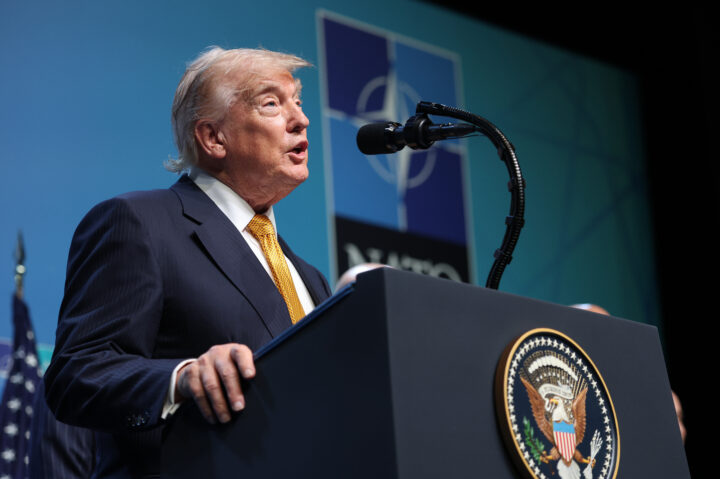
Photo by Win McNamee/Getty Images
U.S. President Donald Trump speaks at a press conference during the 2026 NATO Leaders Summit at the Beştepe Presidential Compound on July 08, 2026 in Ankara, Turkey.
President Donald Trump on Wednesday reiterated his threat to “finish the job” in Iran and said the current ceasefire is “over” while denying that renewed U.S. strikes in the country mark a return to war.
Trump told reporters during a press conference at the NATO summit in Ankara, Turkey, on Wednesday that he was no longer sure if he was interested in a peace deal with Iran and was questioning if the country’s leadership was rational enough to work with.
Hours after Trump’s remarks, CENTCOM announced additional strikes on Iranian targets “at the direction of” the president, saying in a statement that the operation was intended to “further degrade [Iran’s] ability to threaten freedom of navigation in the Strait of Hormuz.”
Asked during the press conference what caused him to sour on Iran’s leadership — whom he referred to on Wednesday as “scum” and “sick people,” after praising them last month as “very rational” and “nice to deal with” — Trump replied: “I got to know them.”
Trump noted that he was comparing the current regime to the previous two regimes in his prior complimentary statements.“I think they’re much more rational than level one, level two. Level one is gone, level two is gone. This is level three,” Trump said. “I think they are more rational, but based on their actions over the last week or two, they’re not doing a service to the people.”
“I’m not sure I want to make a deal with them,” he continued. “We can play games, but I’m not sure I want to make a deal. Let’s just finish the job.”
The comments came hours after the president said that the memorandum of understanding between the U.S. and Iran was “over” and said “I don’t want to deal with them anymore.”
Trump went on to criticize Iran’s leaders as “a little loco. They’re a little crazy,” pointing to Iran’s continued attacks against commercial shipping in the Strait of Hormuz and claiming he’s Iran’s top target for assassination.
“They want to make a deal, but they don’t know how to make the deal, and then they go around shooting ships at night [in the Strait of Hormuz]. I don’t like that,” he said. “I’m the No. 1 target. … I’m the No. 1, because they’re scum. That’s the way they act, and that’s the way they’ve done it for 47 years.”
Still, he rejected the idea that the military operations meant that the U.S. was resuming full-scale warfare with Iran.
“I don’t think it’s going to start again. I think it’s going to go very quickly. They hit a couple of ships, and so we hit them much harder,” Trump said of the war. “When they hit, we hit. We use their language. We speak their language. No, I don’t think so. I think anything that happens is going to be over very quickly and will only make [the region] safer.”
The president said the U.S. would ‘de-nuke’ the Islamic Republic following Iranian strikes targeting U.S. military facilities in Bahrain and Kuwait
Win McNamee/Getty Images
President Donald Trump speaks during bilateral meeting at the Bestepe Presidential Compound, following his arrival to attend the annual NATO Summit on July 7, 2026 in Ankara, Turkey.
President Donald Trump, speaking at the NATO summit in Ankara, Turkey, on Wednesday, said that the memorandum of understanding with Iran that was inked last month was “over,” following overnight Iranian attacks targeting U.S. military installations in Bahrain and Kuwait.
“To me, I think it’s over,” Trump said. “I don’t want to deal with them anymore.”
The Iranian attacks came after CENTCOM hit over 80 targets in Iran on Tuesday in retaliation for Iranian strikes on three commercial vessels — including a Qatari ship and a Saudi oil tanker — in the Strait of Hormuz earlier this week.
“We attacked very powerfully last night the very dangerous people from Iran,” Trump said of the U.S. strikes, which targeted air-defense systems, command and control networks, coastal radar sites and more than 60 Islamic Revolutionary Guard Corps small boats. “They’re sick. There’s something wrong with them.”
“We said, ‘Go and do your funeral stuff,’” Trump added, noting the multiday funeral ceremonies for the late Iranian Supreme Leader Ayatollah Ali Khamenei, who was killed in joint U.S.-Israeli strikes on the first day of the war against the Islamic Republic in February. “Instead of that, they start shooting rockets at ships yesterday, and so we hit them very hard last night.”
The president, appearing alongside NATO Secretary General Mark Rutte in Ankara, said that the U.S. was “going to de-nuke Iran.”
“We’re not going to let them because they’re crazy,” Trump added.
The Iranians, the president said, are “bad people, very bad people. I think they’re incompetent, by the way, because if they were competent they would have made a deal a long time ago.”
“Of course they’re dirty players, so they go after everyone. Probably including me. I’ve been No. 1 on their list for years. And they’re a bunch of scum, if you want to know the truth. They’re scum. So we don’t like them, I don’t like them. And they’re evil people.”
Plus, progressives pull the plug on Platner

Photo by Elke Scholiers/Getty Images
Crude oil tankers, bulk carriers and vessels sit anchored around Qaboos Port on June 22, 2026 in Muscat, Oman.
Good Tuesday afternoon.
This P.M. briefing is reserved for our premium subscribers like you — offering a forward-focused read on what we’re tracking now and what’s coming next.
Today’s Daily Overtime was curated by JI U.S. Editor Danielle Cohen-Kanik.
📡On Our Radar
Notable developments and interesting tidbits we’re tracking
The fallout from a rape allegation made against Maine Senate candidate Graham Platner intensified today as Sens. Bernie Sanders (I-VT) and Chris Van Hollen (D-MD) — some of the Democrat’s most prominent progressive backers — rescinded their support of Platner and called on him to drop out. New York City Mayor Zohran Mamdani, who shares a top consultant with Platner, also advised the candidate to drop his bid.
Platner’s campaign has canceled all in-person fundraising events scheduled for the coming days and put holds on its social media ads, according to Politico. The candidate reportedly told his campaign staff in a call last night that a decision on the future of his race is forthcoming…
Several prominent Maine Democrats have begun to signal interest in replacing Platner on the general election ballot, should he withdraw by the deadline of July 13. Among those hinting at a run are Troy Jackson, a former state Senate president who has already filed with the Federal Election Commission to explore a bid; former U.S. House candidate Jordan Wood; former gubernatorial candidate Nirav Shah; and Platner’s former primary opponent David Costello.
Maine Democratic Party officials are considering holding a pop-up convention around July 25 or holding a statewide caucus to choose Platner’s replacement, sources told The New York Times…
As the heated Democratic Senate primary in Michigan enters its final stretch, far-left candidate Abdul El-Sayed told CNN this week that he does not believe that a politician’s support for Israel could be about anything other than money, Jewish Insider’s Gabby Deutch reports. “Not if you’re a Democrat and you believe in human rights,” El-Sayed told CNN when asked about such a distinction…
The Treasury Department revoked the waiver it issued last month lifting sanctions on Iranian oil, after Iran reportedly struck another vessel in the Strait of Hormuz today, marking the third such attack in the last 24 hours.
“As President [Donald] Trump and the administration have repeatedly affirmed, the [memorandum of understanding] in effect with Iran is entirely performance-based. Iran will only reap benefits if they exhibit good behavior,” a U.S. official told JI’s Matthew Shea. “Iran’s actions in the Strait were wholly unacceptable to the United States and will be met with consequences. Our negotiators continue to work in good faith towards a final deal”…
Qatar’s Foreign Ministry summoned Iran’s deputy ambassador in the Gulf stateto express its “strong condemnation and denunciation” of Tehran’s strike yesterday on a Qatari tanker, after Doha sent a delegation of officials to the funeral of Supreme Leader Ayatollah Ali Khamenei in an apparent diplomatic olive branch…
Saudi Arabia is considering increasing the capacity of its East-West oil pipeline in order to bypass the Strait of Hormuz and facilitate oil exports out of the Red Sea, Reuters reports…
Trump announced today that his administration is preparing to lift congressionally mandated sanctions on Turkey as he weighs moving forward with the sale of F-35 fighter jets to Ankara, JI’s Matthew Shea reports.
“It’s time to do that. We don’t want to sanction friends,” the president said. Defense experts and lawmakers previously told JI that Turkey still maintains the Russian air-defense system that prompted the sanctions in 2020, which makes lifting the sanctions legally complicated…
Israeli Prime Minister Benjamin Netanyahu again voiced his opposition to Trump’s overtures to Ankara, telling CNN that Turkish President Recep Tayyip Erdoğan is “not exactly a model ally of the United States” as he “threatens to destroy my country, the one and only Jewish state.”
Israeli Diaspora Affairs Minister Amichai Chikli went further in his rhetoric, calling Erdoğan a “grotesque hybrid of Hitler and [late Hamas leader Yahya] Sinwar” and a “pathetic blood-soaked zero” in a post on X yesterday…
The Israeli Consulate in New York was evacuated from its Midtown Manhattan building after a nearby high-rise building under construction showed signs of collapsing, prompting evacuations across the area…
⏩ Tomorrow’s Agenda, Today
An early look at tomorrow’s storylines and schedule to keep you a step ahead
Keep an eye on Jewish Insider for coverage of tonight’s debate between Michigan Senate Democratic primary candidates Abdul El-Sayed and Rep. Haley Stevens (D-MI), with less than a month to go until the election.
The NATO summit in Ankara will conclude with the main working session of all 32 member states as well as a press conference from NATO Secretary-General Mark Rutte. A bipartisan delegation of U.S. lawmakers is set to attend a dinner tonight on the sidelines of the summit with Treasury Secretary Scott Bessent and U.S. Ambassador to Turkey Tom Barrack.
Former U.S. Ambassador to Japan Rahm Emanuel will deliver a speech at Tel Aviv University, where he is set to lay out his vision for the future of the U.S.-Israel relationship as he prepares for a potential 2028 presidential run. Emanuel met today with Israeli President Isaac Herzog and visited the Yad Vashem Holocaust museum.
The Contemporary Antisemitism conference will continue at the University of Haifa.
Stories You May Have Missed
SORE SPOT
Black leaders in the district have failed to unite behind a single challenger, leaving the Jewish congresswoman favored in a plurality race but potentially vulnerable down the road
DEAL DISPUTE
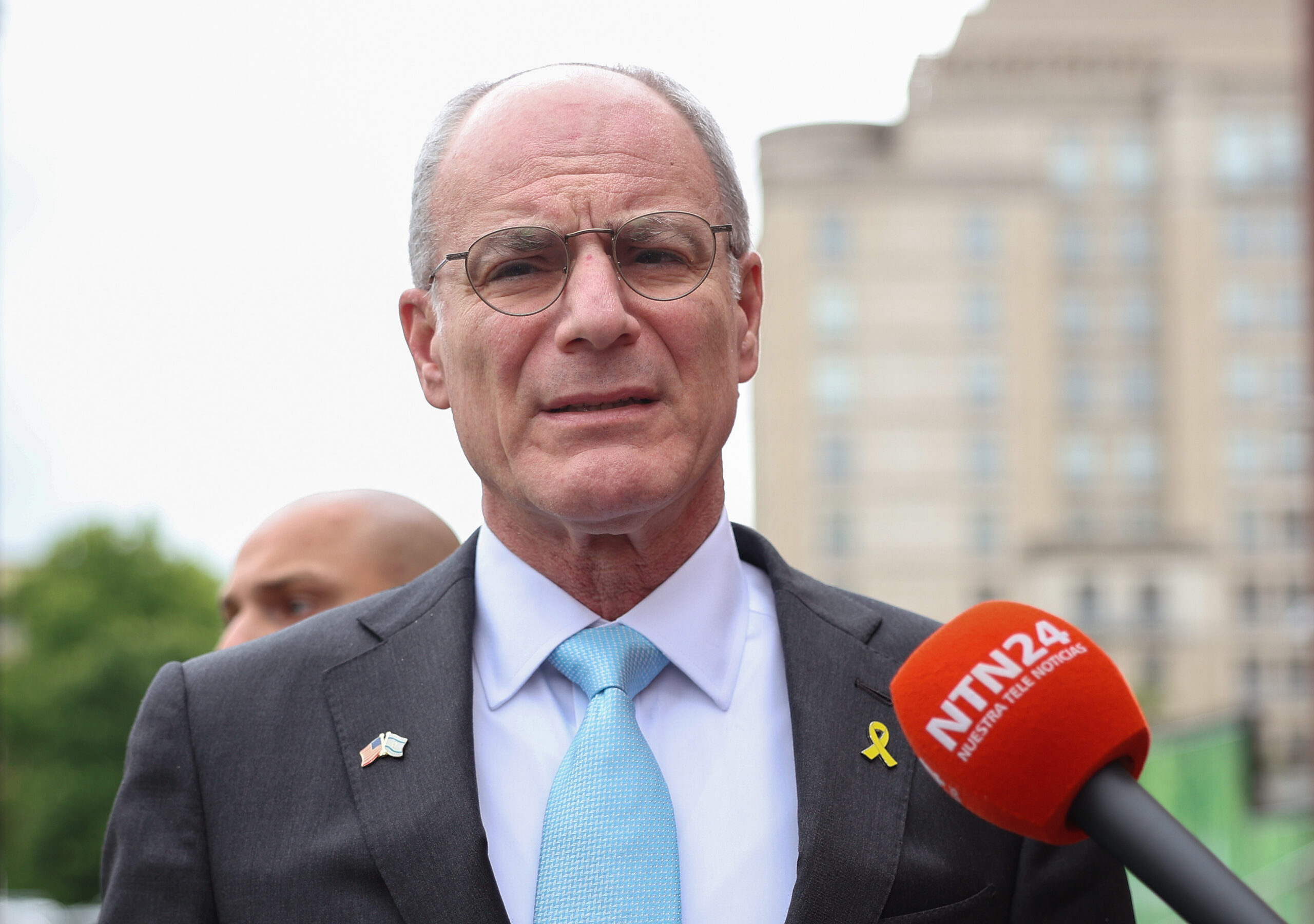
The ambassador announced that the next round of Israel-Lebanon negotiations will take place next week in Rome
A U.S. official called Iran's actions ‘wholly unacceptable’ but said negotiators continue to work ‘in good faith’ toward a final deal
Photo by Elke Scholiers/Getty Images
Crude oil tankers, bulk carriers and vessels sit anchored around Qaboos Port on June 22, 2026 in Muscat, Oman.
A brief window of U.S. sanctions relief for Tehran closed on Tuesday as the Trump administration revoked a waiver that allowed the sale of Iranian oil in response to continued Iranian attacks on shipping vessels in the Strait of Hormuz.
Last month, the Treasury Department lifted sanctions on Iranian oil sales by issuing a 60-day license, a decision experts told Jewish Insider risked providing Tehran with significant revenue for malign activity. Treasury Secretary Scott Bessent had said the temporary license was issued due to Iran’s commitments under the memorandum of understanding, including guaranteeing safe passage through the Strait of Hormuz and inviting international nuclear inspectors back into the country — a claim that Iran swiftly denied. The license allowed Iran to produce, deliver and sell oil, including to U.S. importers, through Aug. 21.
But since the agreement was signed, Iran has since continued its attacks on commercial vessels navigating the Strait of Hormuz, including strikes on three commercial tankers since the beginning of the week, which a U.S. official called “wholly unacceptable.”
“As President [Donald] Trump and the administration have repeatedly affirmed, the MOU in effect with Iran is entirely performance-based. Iran will only reap benefits if they exhibit good behavior,” the official told JI. “Iran’s actions in the Strait were wholly unacceptable to the United States and will be met with consequences. Our negotiators continue to work in good faith towards a final deal.”
An Iranian Foreign Ministry spokesperson had warned that commercial vessels using routes outside of Iranian control could face consequences and said that Iran was “diligently fulfilling its commitments” within the MOU to manage the strait, according to Axios.
President Donald Trump mused that the gathering would be an opportune time to take out Iran’s remaining leadership
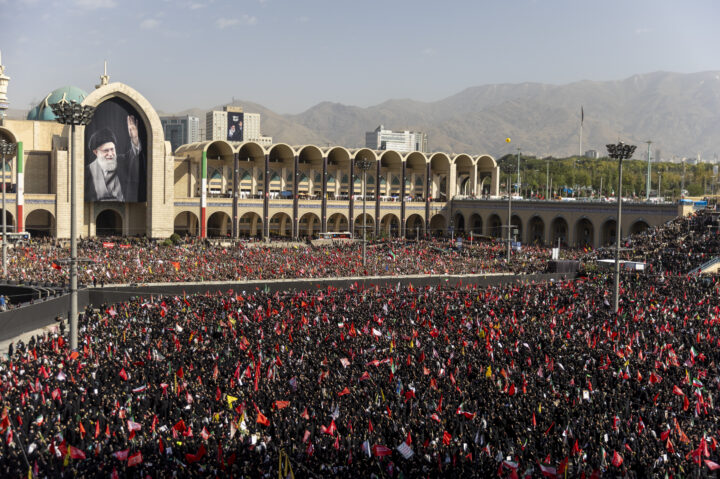
Majid Saeedi/Getty Images
People gather at the Imam Khomeini Grand Mosalla for a farewell ceremony for Iran's late Ayatollah Ali Khamenei on July 4, 2026 in Tehran, Iran.
The United Arab Emirates and Kuwait — both of which came under heavy Iranian fire during the recent war — skipped the funeral proceedings for late Iranian Supreme Leader Ayatollah Ali Khamenei, while representatives from Qatar, Saudi Arabia, India, China and Turkey traveled to the Islamic Republic to attend the ceremonies for Khamenei, who was killed in Tehran at the outset of the war at the end of February.
The event began on Friday and spans five cities across Iran and Iraq, ending in the Iranian city of Mashhad, where he will be buried Thursday.
Despite his three brothers’ attendance at the funeral proceedings, Mojtaba Khamenei, who succeeded his father as supreme leader and is thought to be seriously injured from the same airstrike, still has not appeared publicly.
IRGC Commander Ahmad Vahidi made his own first public appearance since the war began, sitting beside Khamenei’s casket on Thursday before the funeral began. Former Iranian President Mahmoud Ahmadinejad, estranged from Khamenei for years, made a rare public appearance at the procession.
President Donald Trump noted on Monday that the gathering would be an opportune time to take out Iran’s remaining leadership. “They are all there,” the president told Axios. “One shot and we can take them all out, but we are not going to do that because then we would have nobody to negotiate with.” Talks between the U.S. and Iran are expected to resume after the funeral ends later this week.
Though Lebanon sent Lebanese Defense Minister Michel Menassa, a delegation from Iranian proxy Hezbollah also traveled to Iran for the ceremonies.
Hamas, meanwhile, said in a statement that its delegation was led by the head of its political bureau, Mohammed Darwish, and included other bureau members such as Bassem Naim.
Also attending Saturday’s ceremonies in Tehran were Ziyad al-Nakhalah, the leader of the Palestinian Islamic Jihad, and senior Houthi member Dhaif Allah al-Shami, state TV reported. Russia sent former President Dmitry Medvedev, the deputy chairman of the security council, as a special envoy of President Vladimir Putin.
Pakistani Prime Minister Shehbaz Sharif, a key mediator between Washington and Tehran, was one of the few sitting heads of government to attend in person. “The late supreme leader’s wisdom, leadership and profound influence on Iran and the wider region will be remembered for generations,” Sharif said, per his office.
Plus, Rahm Emanuel says Israel support should come with strings
Joe Raedle/Getty Images
Democratic U.S. Senate candidate Graham Platner speaks at a “Fighting Oligarchy” tour stop held by Sen. Bernie Sanders (I-VT) at the Collins Center for the Arts on the University of Maine campus on May 24, 2026 in Orono, Maine.
Good Monday afternoon.
This P.M. briefing is reserved for our premium subscribers like you — offering a forward-focused read on what we’re tracking now and what’s coming next.
Today’s Daily Overtime was curated by JI U.S. Editor Danielle Cohen-Kanik.
📡On Our Radar
Notable developments and interesting tidbits we’re tracking
A woman who dated Maine Senate nominee Graham Platner alleged in a series of interviews with Politico that the Democrat sexually assaulted her in 2021, an account the outlet backed up with her correspondence and other interviews.The woman, Jenny Racicot, said Platner came into her home uninvited while intoxicated and forced himself on her despite her repeated objections.
In a video statement, Platner denied the accusation outright but said he’s “mindful of the political reality it will inflict” and would be “taking the time to reflect on the best path forward for the state that I love,” a different tone than Platner has struck in the aftermath of his previous controversies. The Maine Democratic Party can only choose a replacement nominee for the general election ballot if Platner voluntarily withdraws by July 13…
Israeli Prime Minister Benjamin Netanyahu voiced opposition today to the Trump administration’s sale of jet engines and potential sale of F-35 fighter jets to Turkey, hours before President Donald Trump was set to depart for the NATO summit in Ankara, Jewish Insider’s Christina Sher reports.
Netanyahu suggested on “Fox & Friends” that such moves “will upset the power balance in the Middle East, which is ultimately guaranteed by Israeli air superiority” and U.S. posture in the region. Axios reports that Netanyahu relayed the same message directly to Trump in a phone call last week and asked him to help address Turkish President Recep Tayyip Erdoğan‘s escalating anti-Israel rhetoric…
The percentage of Jewish Israelis who believe Israel’s security is a central consideration for Trump has reached a record low of 26%, according to a new survey from the Israel Democracy Institute, JI’s Matthew Shea reports. The figure marks a 15-point decrease from a month ago, during which time the Trump administration signed its memorandum of understanding with Iran…
Hamas spokesperson Hazem Qassem announced at a press conference in Gaza today that the terror group’s Emergency Committee — the administrative body that has governed the enclave for more than two decades — is dissolving and that its civil servants, who will remain in their roles, stand ready to work under the new technocratic government established by the Board of Peace.
The BoP expressed skepticism about the announcement, JI’s Emily Jacobs and Matthew Shea report, saying its “assessment will be guided by actions, not promises” and calling for a “genuine transfer of authority” and for Hamas to disarm. Israeli Foreign Minister Gideon Sa’ar dismissed the move outright, calling it a “trick … designed to prevent [Hamas’] own disarmament”…
Israeli Ambassador to the U.S. Yechiel Leiter said both Israel and Lebanon see the agreement signed between Jerusalem, Beirut and Washington earlier this month as “superseding” the first clause of the U.S.-Iran MOU, which calls for the end of hostilities on all fronts. “Whether or not the United States does, you’ll have to ask an administration spokesman,” Leiter said at an event with the Council on Foreign Relations.
Leiter also said he “can’t imagine that any ultimate agreement with Iran would be absent a clause limiting the development of ballistic missiles,” though the MOU did not mention Iran’s ballistic missile program…
In a preview obtained by Politico of the speech former U.S. Ambassador to Japan Rahm Emanuel is set to deliver at Tel Aviv University on Wednesday, the prospective 2028 presidential candidate is set to say that the U.S. has spent too long “averting its eyes” from what he views as Israel’s misadventures, calling for “significant changes and a new direction” in the bilateral relationship.
“Going forward, Emanuel plans to say, Israelis should regard U.S. support as expressly contingent: On reviving a serious commitment to Palestinian sovereignty; On rejecting dreams of asserting dominion beyond official borders in pursuit of ‘Greater Israel’; On abandoning a security strategy that emphasizes brutally effective military force with scant attention to diplomacy or credible what-next plans in Gaza and Iran,” the outlet reported…
French President Emmanuel Macron became the first major Western head of state to visit Syria since the fall of dictator Bashar al-Assad in 2024, landing in Damascus today for meetings with Syrian leaders. Syrian President Ahmad al-Sharaa is also expected to meet with Trump on the sidelines of the NATO summit in Turkey this week…
⏩ Tomorrow’s Agenda, Today
An early look at tomorrow’s storylines and schedule to keep you a step ahead
The two-day NATO summit begins in Turkey tomorrow with leaders of all 32 NATO countries expected to attend, as well as a congressional delegation comprised of Sens. Dick Durbin (D-IL), Jeanne Shaheen (D-NH), Thom Tillis (R-NC), Chris Coons (D-DE) and Mike Rounds (R-SD) and Rep. Mike Turner (R-OH). At the top of the agenda are increasing defense investments, as Trump continues to press NATO allies to shoulder a greater share of the alliance’s defense burden and threatens to draw down U.S. troops from Europe, and continuing to support Ukraine in its war with Russia.
Rep. Haley Stevens (D-MI) and Abdul El-Sayed, now the only remaining candidates in Michigan’s Democratic U.S. Senate primary, will participate in a televised debate on local news tomorrow night, their first head-to-head matchup since state Sen. Mallory McMorrow suspended her campaign yesterday.
The annual Contemporary Antisemitism conference, which bills itself as the largest annual academic conference on contemporary antisemitism, will kick off tomorrow at the University of Haifa. The three-day summit will feature hundreds of academics and experts, with a keynote speech tomorrow from former State Department antisemitism envoy Deborah Lipstadt and a lifetime achievement award presented to Tel Aviv University professor emerita Dina Porat.
Stories You May Have Missed
NO FLIGHT PLAN

Rep. Dina Titus is leading the Joint Resolution of Disapproval against the Trump administration’s $700 million sale of F110 jet engines to Turkey despite legal restrictions on U.S. military sales to the country
TEACHING MOMENT

Some Jewish Affairs Caucus leaders say they weren’t consulted about the changes, which are meant to prevent issues around antisemitism that occurred at last year’s assembly
Trust in Trump dropped 15 points among Jewish Israelis in the last month, though a majority still see tensions between Washington and Jerusalem as temporary

Jack GUEZ / AFP via Getty Images
A billboard depicting an image of President Donald Trump with a message thanking him, is displayed on the side of a building in the Israeli coastal city of Tel Aviv on March 12, 2026.
The number of Israelis who believe President Donald Trump views Israel’s security as a central consideration has continued to fall to record lows after Washington signed a memorandum of understanding with Iran, according to a new survey from the Israel Democracy Institute.
The June 2026 Israeli Voice Index, conducted between June 28 and July 1, found that 28% of respondents — including 26% of Jewish Israelis and 36% of Arab Israelis — believe Israel’s security is a key consideration for Trump.
Among Jewish Israelis, the figure dropped 15 percentage points from a month ago, when 41% of respondents said they felt Israeli security was a key consideration for Trump as his administration engaged in negotiations with Tehran. At the time, those findings marked the lowest levels of Israeli trust in Trump since the research center began tracking the metric when he was elected to a second term in November 2024.
Despite declining confidence in Trump, a majority of Israelis continue to view current tensions between Washington and Jerusalem as temporary rather than indicative of a meaningful deterioration in bilateral ties. Among Jewish Israelis, 54% said current disagreements represent a temporary crisis that will not harm the relationship, while 34% said they mark a longer-term shift for the worse.
Respondents were more divided when asked whether Israel’s strategic security situation was better or worse than it was before the Iran war. Thirty-six percent said Israel’s security situation is now worse, an increase of eight percentage points from April. Meanwhile, 38% said it is better, down six percentage points over the same period.
The survey also found strong support for maintaining an Israeli security zone in southern Lebanon, even if doing so conflicts with U.S. interests. Overall, 72% of respondents backed a permanent security zone in the area. Support was especially high among Jewish Israelis, at 80%, while a majority of Arab Israelis (58%) opposed maintaining a permanent Israeli presence in southern Lebanon.
Beyond military and diplomatic issues, the poll found that rising antisemitism and attacks targeting Israelis abroad were influencing travel decisions. Fifty-six percent of respondents said the threat environment has affected their travel plans, with 41% saying it has impacted where they choose to travel and 15% saying they plan to avoid traveling abroad altogether because of security concerns.
Plus, Israel ally draws the line at Syria
Andrew Harnik/Getty Images
Rep. Yassamin Ansari (D-AZ) speaks during a news conference on Capitol Hill on November 13, 2025 in Washington, DC.
Good Thursday afternoon.
This P.M. briefing is reserved for our premium subscribers like you — offering a forward-focused read on what we’re tracking now and what’s coming next.
Today’s Daily Overtime was curated by JI U.S. Editor Danielle Cohen-Kanik.
📡On Our Radar
Notable developments and interesting tidbits we’re tracking
In their indirect talks in Doha this week, the U.S. offered Iran access to some of its$100 billion in frozen funds in exchange for Tehran not instituting a toll on the Strait of Hormuz, but Iranian officials have continued to signal they plan to proceed with the move. Continued fighting between Israel and Hezbollah in Lebanon also caused tension during the discussions, The Wall Street Journal reports…
U.S. officials told The New York Times that Washington believed Israel was plotting to assassinate Iran’s top negotiators — Foreign Minister Abbas Araghchi and parliament speaker Mohammad Bagher Ghalibaf — as they were engaged in recent talks with the U.S. over the memorandum of understanding…
Arizona Jewish and pro-Israel leaders told Jewish Insider’s Matthew Kassel that they feel misled by Rep. Yassamin Ansari (D-AZ), whom they supported in her contested 2024 primary but who has since turned away from the pro-Israel views she espoused during the campaign — including now rejecting support from Democratic Majority for Israel, which backed her with a surge of spending in 2024…
The AIPAC-linked United Democracy Project super PAC is up with its first negative ad against far-left Michigan Senate candidate Abdul El-Sayed, JI’s Marc Rod reports, hitting the Democrat in the initial $2 million ad buy for his “long history of disrespecting women.” Meanwhile, El-Sayed picked up a high-profile endorsement today from Rep. Alexandria Ocasio-Cortez (D-NY), her first in a contested Senate race this cycle.
UDP also made $400,000 in advertising reservations to support Rep. Wesley Bell (D-MO) as he faces a comeback primary challenge from former Rep. Cori Bush (D-MO), whom UDP helped Bell defeat in 2024…
Colorado Attorney General Phil Weiser, the Democratic nominee for governor, criticized his party’s socialist congressional nominee, Melat Kiros, for her refusal to describe the deadly firebombing of a Boulder, Colo., hostage awareness march last year as an act of antisemitism, JI’s Marc Rod reports…
New York City congressional nominee Brad Lander published a response to Rabbi Elliot Cosgrove’s letter earlier this week in which Cosgrove predicted that Lander’s hostility to Israel would not be enough to protect him from being targeted by the far left. Lander argued in his response that criticism of Israel — including describing its war in Gaza as a genocide — is consistent with Jewish values and that excluding anti-Zionist Jews weakens the Jewish community…
New polling data shows that a sizable majority of Jewish voters disapprove of New York City Mayor Zohran Mamdani’s job performance and fear he is pushing the Democratic Party too far to the left, in contrast with non-Jewish voters who hold a largely favorable view of the democratic socialist, JI’s Matthew Kassel reports…
A bipartisan group of House lawmakers, led by Reps. Mike Lawler (R-NY) and Brad Sherman (D-CA), wrote to President Donald Trump today to “express deep concern about any effort” to sell F-35 fighter jets to Turkey, JI’s Marc Rod reports, after Trump and Vice President JD Vance indicated they were looking into it last week…
Rep. Joe Wilson (R-SC), the founder of the Republican Israel Caucus and a reliable ally of the Jewish state, called Israel’s “continuing aggressive operations” in Syria “deeply disturbing,” “counterproductive” and “irresponsible.” Wilson accused Israel of “taking Syrian land and attacking Syrian cities,” saying the operations “need to end immediately”…
Wilson, along with Sens. Jeanne Shaheen (D-NH) and Elizabeth Warren (D-MA), also sent a letter to Secretary of State Marco Rubio urging the administration to remove Syriafrom the State Sponsor of Terrorism list…
Israel marked 1,000 days today since the Oct. 7, 2023, Hamas terror attacks, with memorials and protests taking place around the country…
Far-right commentator Tucker Carlson told the Columbia Journalism Review that he plans to help start a new political party — after saying last month he was renouncing the Republican Party — but does not plan to run as a candidate. He repeatedly railed against Israel in the interview and accused it of “taking over my political system and destroying my country”…
Fanatics CEO Michael Rubin hosted his annual White Party at his Hamptons estate yesterday featuring a host of high-profile attendees, including Ivanka Trump, New England Patriots owner Robert Kraft, former quarterback Tom Brady, actor Leonardo di Caprio and more…
⏩ Tomorrow’s Agenda, Today
An early look at tomorrow’s storylines and schedule to keep you a step ahead
Keep an eye on Jewish Insider for a look at Rep. Debbie Wasserman Schultz’s (D-FL) contentious primary race in Florida’s 20th Congressional District.
Fourth of July celebrations in the nation’s capital are kicking off with a bang (literally — the fireworks show on the National Mall could break world records). President Donald Trump is slated to give a speech on the Mall ahead of the fireworks show on Saturday night, followed by a military flyover debuting the new Qatari-gifted Air Force One jet.
Iran is slated to hold a massive, dayslong funeral procession for the late Supreme Leader Ayatollah Ali Khamenei beginning on Saturday in Tehran and including cities across Iran and Iraq. Pakistan’s Foreign Ministry said Prime Minister Shehbaz Sharif, a top mediator between the U.S. and Iran, will attend the memorial, alongside officials from dozens of other countries.
Christians United for Israel’s annual summit in Washington will begin on Sunday. Speakers over the three-day confab include State Department antisemitism envoy Rabbi Yehuda Kaploun; former Auburn University basketball coach Bruce Pearl; Malcolm Hoenlein, vice chair of the Conference of Presidents of Major American Jewish Organizations; Georgia state Rep. Esther Panitch; and former Israeli hostage Yair Horn.
We’ll be back in your inbox with the Daily Overtime on Monday. Shabbat shalom and happy Fourth of July weekend!
Stories You May Have Missed
LAND OF THE FREE

Rabbis, historians and communal leaders told JI that the nation’s semiquincentennial offers an opportunity to celebrate America’s promise even as they confront the antisemitism and political currents challenging Jewish life today
CAMPAIGN CONTROVERSY
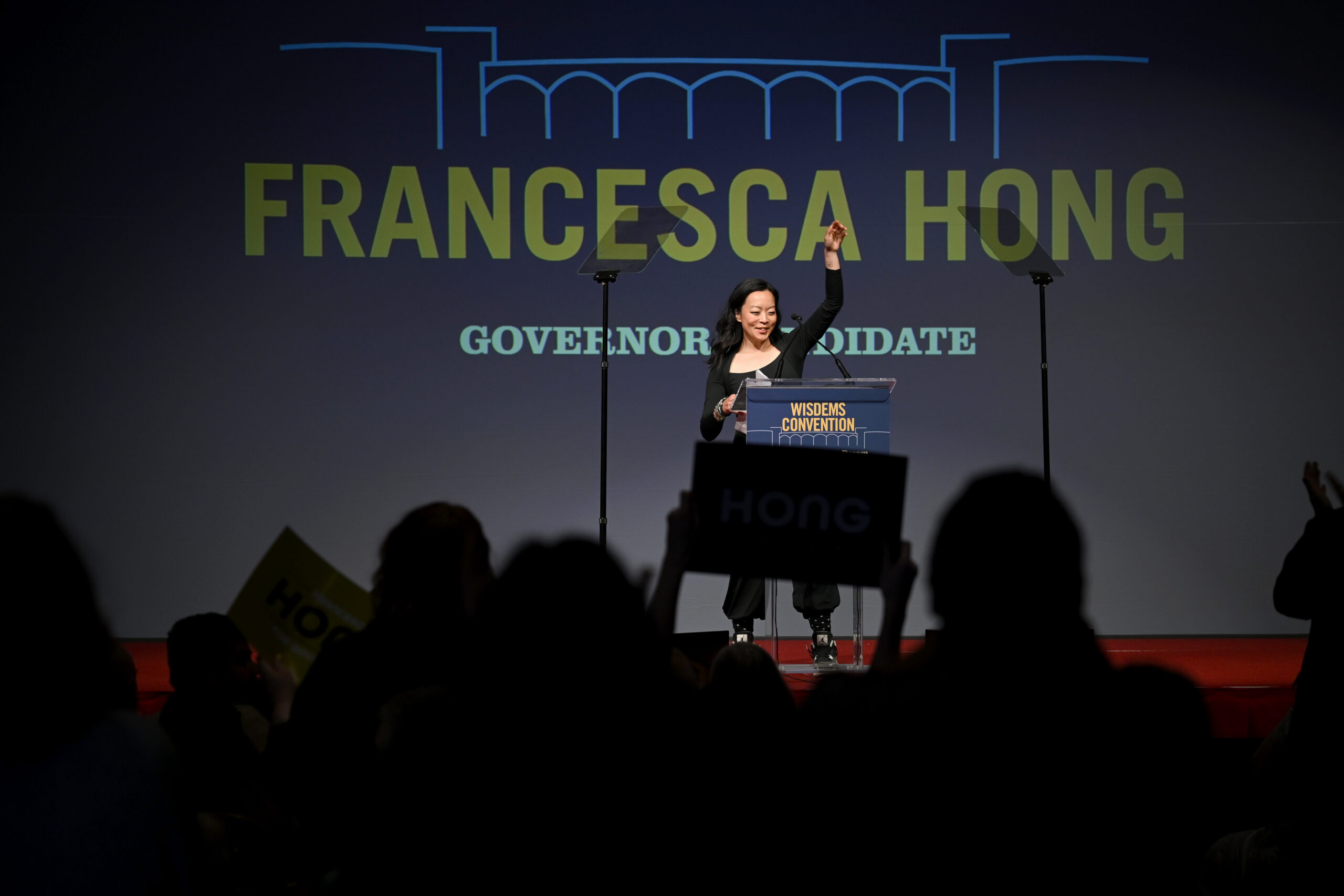
The same day Francesca Hong appeared on the livestream of antisemitic conspiracy theorist ‘Mike From PA,’ she also joined Hasan Piker’s Twitch show
Plus, NEA cracks down on antisemitism chaos

Amirhossein KHORGOOEI / ISNA / AFP via Getty Images
Vessels are pictured anchored in the Strait of Hormuz off Bandar Abbas in southern Iran on May 5, 2026.
Good Wednesday afternoon.
This P.M. briefing is reserved for our premium subscribers like you — offering a forward-focused read on what we’re tracking now and what’s coming next.
Today’s Daily Overtime was curated by JI U.S. Editor Danielle Cohen-Kanik.
📡On Our Radar
Notable developments and interesting tidbits we’re tracking
Talks in Doha about the U.S.-Iran memorandum of understanding have concluded, Iranian Deputy Foreign Minister Kazem Gharibabadi announced, with the countries agreeing to create a communication channel “by tomorrow” in order to address MOU violations.
The U.S. and Iran also agreed to “keep things quiet for the coming week,” a U.S. official told Axios, while Washington is reportedly continuing to press Tehran to abandon its plan to charge tolls in the Strait of Hormuz and “think bigger” on a nuclear deal. The sums Iran could generate from freely selling oil without sanctions under such a deal “would be 100 times more valuable to them,” the official said…
New York Times/Siena polls of the six Senate battleground states — Alaska, Iowa, Maine, North Carolina, Ohio and Texas — found that Democrats have a path, albeit an uphill one, to retake the chamber in November. All of the races are within the margin of error except in North Carolina, where former Democratic Gov. Roy Cooper leads Michael Whatley, former chair of the Republican National Committee, with the largest margin of seven points…
Poetica Coffee, the Brooklyn cafe that banned Rep. Dan Goldman (D-NY) last week over his support of Israel, claimed in an Instagram post today that Goldman intentionally “smear[ed]” the business in talking about his experience “possibly for election-eve media exposure”…
Rep. Adam Smith (D-WA), ranking member of the House Armed Services Committee, told CNN yesterday that some democratic socialist candidates have views that are “vastly more radical” than where the “Democratic coalition” stands, saying their support for communism, open borders and defunding the police represents “a fundamental attack on America itself”…
Asked about Republicans viewing him as easier to beat in a general election than his more-moderate primary opponents, far-left Michigan Democratic Senate candidate Abdul El-Sayed told Semafor, “The number of times I’m gonna define and redefine Mike Rogers!” referring to the GOP Senate front-runner and former Michigan representative. “By the time I’m done, his best friends are gonna look at him and think what I think, say what I say. I’m gonna define him into eternity”…
The National Education Association adopted new policies ahead of its convening this weekend in Denver after its Jewish Affairs Caucus and the Jewish Council for Public Affairs advocated for such changes, JCPA said, in response to last year’s assembly which grew contentious over antisemitism issues. The new changes include stronger conduct enforcement for delegates, electronic voting to reduce shouting on the floor during resolution votes, de-escalation training for NEA staff and repeated public reminders of the rules…
Loay Abdelfattah Alnaji was sentenced to one year in jail and two years of probation yesterday after pleading guilty to involuntary manslaughter and battery in the death of Paul Kessler, a 69-year-old Jewish man who died after Alnaji struck him with a megaphone at a protest in California shortly after the Oct. 7 Hamas attacks. The Anti-Defamation League’s California regional offices decried the sentence as “little more than a slap on the wrist” and expressed concern at the judge’s dismissive demeanor during sentencing…
A New York woman was arrested yesterday by the FBI for allegedly providing material support to the Palestinian Islamic Jihad, including over $30,000 in cryptocurrency. The woman is a leader of an extremist organization called the Direct Action Movement for Palestinian Liberation, according to the FBI, and had communicated with a person claiming to be a PIJ fighter in Gaza, whom she told she “wish[es] every day were October 7th”…
Speaking at the Herzliya Conference in Israel, Maj. Gen. (res.) Amir Baram, director general of the Israeli Ministry of Defense, addressed Israeli public criticism of the U.S.’ foreign policy, Jewish Insider’s Matthew Shea reports: “What some in Israel perceive as weakness or folly, an apparent disregard for every warning sign on the ground, is viewed in Washington as cold, calculated and clear-eyed risk management in an era of shifting global attention.”
“For us, Iran is an existential threat; for the United States, it is a chronic regional challenge,” Baram said of the countries’ differing priorities. “We think Tehran, they think Taiwan”…
U.S. Ambassador to Israel Mike Huckabee and Israeli Foreign Minister Gideon Sa’ar held a ceremony to sign the lease for the permanent new complex of the U.S. Embassy in Jerusalem; Huckabee handed Sa’ar a $1 bill as symbolic payment for the 99-year lease…
The New York Times looks at President Donald Trump’s insistence that Syria take over fighting Hezbollah in Lebanon from Israel, an idea that has been shot down by Syrian President Ahmad al-Sharaa and raised alarm across the Middle East…
CENTCOM hosted a regional security dialogue alongside the Bahrain Defense Force with participation from Egypt, Jordan, Kuwait, Lebanon, Oman, Qatar, Saudi Arabia, Syria, the UAE and Yemen — “the first time military leaders from Syria and Lebanon participated in a regional defense conference led by the United States,” CENTCOM said…
The U.S. Navy is searching for a missing aircrew member after a Sea Hawk helicopter made an emergency water landing in the Arabian Sea, with three of the four crew members rescued in stable condition. There’s no indication any hostile action was involved, the Navy’s 5th Fleet said…
⏩ Tomorrow’s Agenda, Today
An early look at tomorrow’s storylines and schedule to keep you a step ahead
Keep an eye on Jewish Insider for a look at how Jewish leaders are approaching America’s 250th birthday — and why many see the milestone, coming at a fraught moment, as a chance to reaffirm both their Jewish identity and their faith in the American experiment.
The Maccabiah Games, which kicked off today in Jerusalem with a grand opening ceremony, begin in earnest tomorrow as about 5,000 athletes — including 900 from the U.S. — compete in more than 30 sports over the next two weeks.
Stories You May Have Missed
PLATFORM PUNT

House Minority Leader Hakeem Jeffries and Reps. Alexandria Ocasio-Cortez and Greg Casar were noncommittal when pressed by JI
RED SCARE

Jeffries said Avila Chevalier has ‘walked away from many of the things that have been unearthed’ following a CNN report on her past sympathetic posts about communism and Soviet figures
‘We think Tehran, they think Taiwan,’ Maj. Gen. (res.) Amir Baram said of diverging U.S.-Israeli foreign policy at the Herzliya Conference at Reichman University
Israeli Ministry of Defense/LinkedIn
Maj. Gen. (res.) Amir Baram, director general of Israel’s Ministry of Defense, speaks at the Herzliya Conference at Reichman University on July 1, 2026.
The director general of Israel’s Ministry of Defense, Maj. Gen. (res.) Amir Baram, urged Israelis on Wednesday to understand Washington’s perspective as the U.S. and Israel negotiate the next memorandum of understanding, cautioning against judging American policy through a purely “provincial lens.”
“What some in Israel perceive as weakness or folly, an apparent disregard for every warning sign on the ground, is viewed in Washington as cold, calculated and clear-eyed risk management in an era of shifting global attention,” he said at the annual Herzliya Conference at Reichman University.
The divergence between the two allies, he concluded, is not a misunderstanding of the fundamental threat, but rather a byproduct of different national security priorities.
“For us, Iran is an existential threat; for the United States, it is a chronic regional challenge, while China and the Indo-Pacific theater remain the core concern,” Baram said. “We think Tehran, they think Taiwan.”
“At the same time, based on my deep familiarity with the range of views within the American system, if there is one thing Americans hate more than this war that has dragged on for them, it is losing a campaign they have already won,” he added of the conflict with Iran.
Ultimately, Baram asserted that as Washington increasingly operates under an “America First” framework, the historic bilateral relationship must pivot toward concrete, mutually beneficial strategic dividends.
“Our partnership cannot rest on shared values alone. It must also rest on hard interests: a strong, independent, and proactive Israel that stabilizes the Middle East is the very asset that allows the United States to redirect resources toward Asia,” Baram stated. “This is the foundation of the next memorandum of understanding on security cooperation now being formulated. The agreement will need to generate security, economic, and strategic benefits for both countries for years to come.”
The director general also noted that he understands the differing strategic realities in Washington, including a growing American desire to avoid prolonged Middle East entanglements while prioritizing competing global theaters.
“From the Pentagon’s perspective, with American munitions stretched between supporting current wars and preparing for a potential confrontation in the Taiwan Strait, a prolonged war in the Middle East runs counter to America’s global posture,” Baram observed.
Baram emphasized that the war with Iran has fundamentally transformed Jerusalem’s strategic military calculus, warning that an escalating Iranian threat necessitates a sweeping, expanded regional security alliance.
“The war has sharpened, for every actor in the region, the price of Iran’s military buildup,” Baram said. “It has created a shared interest in forging a broader alliance, from India through the UAE to Greece and Cyprus. Israel’s strengths in technology, proven operational experience, and defense innovation, combined with the Gulf’s financial power, could enable a new security-economic front.”
Baram said that building these alternative multilateral partnerships is “not a substitute” for Israel’s bedrock security relationship with the United States. Rather, he argued, the strategy allows Israel to “broaden its room to maneuver and its standing on the international stage, and allow us to diversify our strategic footing.”
Mark Dubowitz and Karim Sadjadpour held opposing views but agreed that the MOU is ‘fatally flawed’ and favors Iran
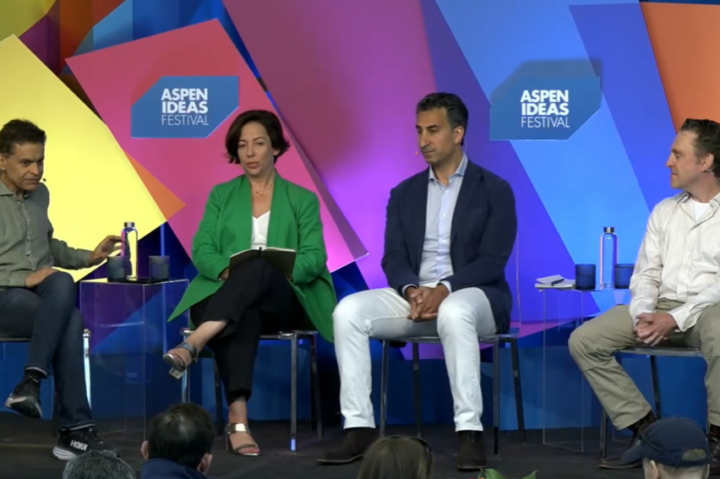
Screenshot/YouTube
Karim Sadjadpour, Mark Dubowitz and Kim Ghattas speak at the Aspen Ideas Festival with CNN's Fareed Zakaria.
Top Middle East analysts — including the Carnegie Endowment’s Karim Sadjadpour and Foundation for Defense of Democracies’ Mark Dubowitz — offered starkly different takes on whether the United States or Iran has emerged in a stronger strategic position following the recent U.S.-Iran conflict, yet shared a deeply critical view of the preliminary memorandum of understanding brokered between Washington and Tehran.
Speaking on Monday at the Aspen Ideas Festival in Colorado during a panel discussion moderated by CNN’s Fareed Zakaria, Sadjadpour, a senior fellow at the Carnegie Endowment for International Peace, argued that Tehran successfully leveraged the crisis to its advantage.
“Iran is in a much better place now than it was four months ago, before the war,” Sadjadpour said. “I think the biggest advantage they now have is controlling the Strait of Hormuz. They want to try to turn it, if not into the Panama Canal, at least have administrative control over it.”
Sadjadpour expressed deep skepticism that the Islamic Republic has any intention of making the fundamental concessions that the Trump administration has long demanded.
“I don’t think that they plan to make any meaningful compromises on the points which President Trump hoped to advance before the war, which is their nuclear program, their missile program, their regional proxies,” Sadjadpour said. “If you read that memorandum of understanding, which I call a ‘memorandum of misunderstanding,’ the two sides have very different takeaways from that. Really, the only thing it asks of Iran is a vague nuclear compromise, but it concedes the idea that after 60 days, perhaps they could control the strait. There’s nothing in there about missiles or proxies.”
Sadjadpour added that the conflict has inadvertently reinvigorated an Iranian regime that had otherwise appeared to be buckling under domestic dissent prior to the outbreak of hostilities.
“Four months ago, I used to describe the Islamic Republic as a zombie regime with a dying ideology, a dying leader, and dying legitimacy,” he observed. “I fear, at least in the immediate term, that we’ve kind of breathed new life into this zombie regime. It has a newfound self-confidence.”
He noted that while the war and protests among the Iranian public should have forced Tehran to rethink its priorities, the regime ultimately drew the wrong conclusions from the conflict.
“A lot of governments would say, ‘You know what? It is time for us to prioritize our economic and national interests first, instead of our ideology being death to America and death to Israel’ — which has gotten them into two catastrophic wars and triggered continuous popular uprisings,” Sadjadpour said. “But I actually think the regime has reached the opposite conclusion: that revolutionary ideology is not an albatross around the neck that’s going to sink the regime, it’s actually proven to be a life preserver, and we’re going to double down on it.”
Veteran Middle East journalist Ghattas similarly argued that the war has not led to a favorable outcome for the U.S. and has left the Iranian people in a worse position.
“I don’t see yet how this leads us to a better place in the region, and there’s a sense of despair in Iran,” Ghattas said. “It’s hard to get access to voices in Iran, but I think people feel betrayed.”
She added, however, that Tehran did suffer some losses, including that its “regional project has been severely damaged.” Ghattas also notedthat Iran has “lost their foothold in Syria.”
Offering an opposing perspective, Dubowitz, CEO of FDD, countered that Tehran has actually suffered an unprecedented, devastating strategic and military defeat.
“The United States of America is winning, Israel is winning and the Islamic Republic of Iran is losing,” Dubowitz insisted, pointing to the physical damage inflicted on Iran’s sensitive facilities.
“Their nuclear infrastructure is severely degraded, the top 40 of their nuclear weapons scientists have been eliminated, and their nuclear sites are in ruins, with nuclear dust under the rubble,” Dubowitz added. “Their nuclear program has been set back by years, and their missile program has been severely curtailed.” Iran’s intercontinental ballistic missile program, he argued could have allowed Tehran to target America, is “obliterated.”
But Dubowitz agreed that the White House squandered its upper hand by rushing into a substandard diplomatic framework.
“Why would you take that incredible military leverage and negotiate a fatally flawed MOU, which looks like it was written by the Qataris, written by the Iranians, and translated by ChatGPT into English?” Dubowitz asked. “It’s a terrible agreement. Why would you squander all that leverage at the negotiating table?”
According to Dubowitz, the driving force behind the agreement stemmed from domestic political pressures rather than long-term geopolitical strategy. Trump, he argued, felt compelled to secure a quick pause in hostilities to stabilize the U.S. economy ahead of the upcoming midterm elections.
“Why? Because Trump needs to hold the House, he needs to hold the Senate, he needs to punt to November,” Dubowitz said. “He needs to open Hormuz, he needs to get gasoline and oil prices down, inflation down, and punt to November. And then he’s got two years and three months to double down on his Iran strategy” until his term is over.
“I think what Trump did is he realized ‘I have serious leverage, but I have a time issue,’” he continued. “So two parties are going in for an MOU, neither believes that either party is going to comply with it, and for their own reasons they need to hit the pause button.”
Sadjadpour noted, however, that those within the president’s inner circle remain deeply divided over whether the current diplomatic pause represents a genuine policy shift or a mere tactical intermission.
“When you talk to people who are in daily contact with the president, they will tell you very different things about where his mind is on this,” Sadjadpour said. “Some will tell you that this MOU was just temporary, don’t take it that seriously — ‘We needed to bring down the price of oil, and if within two months the Iranians are not playing ball, he’ll go back to the blockade or back to bombing.’ I speak to other people who are in daily contact with the president who say no, he’s done with Iran.”
Plus, Bruce Pearl's warning to JD Vance

Photo by Michael Ciaglo/Getty Images
Democratic congressional candidate Melat Kiros speaks to supporters at an election-night watch party after winning the Colorado primary on June 30, 2026 in Denver, Colorado.
Good Wednesday morning.
In today’s Daily Kickoff, we cover the results of yesterday’s Democratic primaries in Colorado, where the momentum for far-left, anti-Israel candidates in the party continued. We talk to House Democrats about whether they think Israel’s right to exist in safety and security should continue to be a policy position of their party and highlight the division within their party over a push by Rep. Thomas Massie (R-KY) to slash $3.3 billion in military aid the U.S. is set to provide Israel. We also report on a failed effort, which most House Democrats voted for, to block U.S. support for Israeli operations against Hezbollah. Also in today’s Daily Kickoff: Ellie Cohanim, Bruce Pearl and Mark Isakowitz.
Today’s Daily Kickoff was curated by JI Israel Editor Tamara Zieve and U.S. Editor Danielle Cohen-Kanik with an assist from Marc Rod. Have a tip? Email us here.
What We’re Watching
- Technical delegations from the U.S. and Iran are meeting separately with Qatari and Pakistani mediators in Doha, but have no plans to meet directly. A senior Iranian official told Reuters that the focus of the discussions is the release of Tehran’s frozen funds and the Strait of Hormuz, while President Donald Trump indicated on Monday that the negotiations would focus on Iran’s nuclear program.
- The Wall Street Journal reveals that after Saudi Arabia blocked U.S. military access needed for Project Freedom — Trump’s operation to crack open the Strait of Hormuz — and prompted the White House to threaten to withhold missile interceptors from the kingdom, the confrontation triggered a widening rift in the U.S.-Saudi relationship, with the U.S. now considering reducing its military footprint in the kingdom. Secretary of State Marco Rubio visited the Gulf last week but skipped a visit to Saudi Arabia; the week before, Saudi Crown Prince Mohammed bin Salman declined an invitation to attend the G7 summit in France, reportedly in protest of the U.S.’ handling of the war with Iran.
- Some of the most prominent figures in U.S.-Israel diplomacy, Israeli national security and the American Jewish community are gathering at Bar-Ilan University in Ramat Gan, Israel, to help train a new generation of leaders confronting Israel’s evolving strategic challenges, as part of a pilot program that ends on Thursday. Among the faculty is former Ambassador Dennis Ross, the veteran Middle East negotiator who advised four U.S. presidents; Howard Kohr, the former longtime executive director of AIPAC; and Malcolm Hoenlein, who for decades served as executive vice chairman of the Conference of Presidents of Major American Jewish Organizations. Read more in eJewishPhilanthropy.
- The Herzliya Conference wraps up today in Israel: Among the many top national security and political officials speaking are former Prime Ministers Naftali Bennett and Yair Lapid; former Israeli Ambassadors to the U.S. Danny Ayalon and Michael Herzog; former U.S. Ambassador to Israel Dan Shapiro; EU Ambassador to Israel Michael Mann; Yashar party leader Gadi Eisenkot; Yisrael Beiteinu party leader Avigdor Liberman; Democrats party leader Yair Golan; Ra’am party leader Mansour Abbas; and Nadav Tamir, executive director of J Street Israel.
- And the Aspen Ideas Festival concludes today in Colorado. Jeff Flake, the former U.S. senator and former U.S. ambassador to Turkey; the Atlantic Council’s Ian Brzezinski; and the Stimson Center’s Emma Ashford will speak on a panel about the “next chapter of the trans-Atlantic relationship.”
What You Should Know
A QUICK WORD WITH JI’S JOSH KRAUSHAAR
Progressives in Colorado scored a number of key victories Tuesday night, including Democratic Socialists of America-aligned candidate Melat Kiros’ defeat of Rep. Diana DeGette (D-CO) in the state’s 1st Congressional District.
The Colorado results suggest that, far from being contained to a few scattered congressional districts in New York City, the momentum for far-left, anti-Israel candidates is only growing within the Democratic Party, especially within urban population centers.
Kiros, a 29-year-old doctoral student, campaigned on her hostility to Israel and faced scrutiny when she declined to call the firebombing attack on a hostage awareness march in Boulder, Colo., antisemitic. DeGette, despite a long-standing progressive record in Congress, struggled to satisfy a critical mass of Democratic voters who preferred a more radical choice, especially when it came to opposing Israel.
Sen. John Hickenlooper (D-CO) survived a scare from a little-known socialist challenger, state Sen. Julie Gonzales, but only won renomination with less than 60% of the Democratic vote. Even in the vote-rich Denver suburbs, the far-left challenger came within striking distance of the state’s well-known senator and former governor.
Former state Rep. Shannon Bird, a moderate championed by Democratic Majority for Israel, lost badly to state Rep. Manny Rutinel for the Democratic nomination in Colorado’s swing 8th District, currently held by Rep. Gabe Evans (R-CO). With most votes counted, Rutinel holds a 28-point lead over Bird, 62-34%.
PLATFORM PUNT

The official 2024 Democratic Party Platform, released by the DNC for former President Joe Biden and former Vice President Kamala Harris, stated that party leaders “believe a strong, secure, and democratic Israel is vital to the interests of the United States” and that the party’s “commitment to Israel’s security, its qualitative military edge, its right to defend itself … is ironclad.” Several House Democrats, including in leadership and top progressives, however, remain divided or noncommittal over whether Israel’s right to exist in safety and security should continue to be a policy position of the Democratic Party, Jewish Insider’s Matthew Shea reports.
What they’re saying: When asked on Tuesday whether support for Israel’s right to exist in safety and security should continue to be an official policy position of the Democratic Party moving forward, House Minority Leader Rep. Hakeem Jeffries (D-NY) instead told JI that Democrats are “continuing to focus on driving down the high cost of living, fixing our broken healthcare system and cleaning up corruption in an environment where the Trump cartel is the most corrupt administration in American history.” Rep. Alexandria Ocasio-Cortez (D-NY) also did not provide a concrete answer, telling JI she is “less concerned with slogans” and more interested in “what it would mean in terms of policy.”
Read the full story here with additional comments from Reps. Greg Casar (D-TX), Pete Aguilar (D-CA), Jamie Raskin (D-MD) and Jim McGovern (D-MA).
Breaking away: Rep. Rosa DeLauro (D-CT), the ranking Democrat on the House Appropriations Committee, said she’ll no longer accept support from AIPAC, a major break with the pro-Israel group by one of the key power players in the House, JI’s Marc Rod reports.
DEM DEBATE
House Democrats remain divided over a push by Rep. Thomas Massie (R-KY) to slash $3.3 billion in military aid the U.S. is set to provide Israel in the 2027 State Department funding bill, and top Democratic leaders are continuing to keep their own positions vague, Jewish Insider’s Marc Rod reports. Consideration of the amendment is now delayed until at least July 13, after hard-right Republicans again brought proceedings on the House floor to a halt.
Where things stand: House Democratic leaders on Tuesday declined to say how they plan to vote or advise other members to vote following a closed-door caucus meeting. Minority Leader Hakeem Jeffries (D-NY) said, “Those conversations are ongoing,” while No. 3 House Democrat Rep. Pete Aguilar (D-CA) suggested that U.S. “aid and support” for Israel may not “go on forever.” Meanwhile, Rep. Jim Himes (D-CT), the top Democrat on the Intelligence Committee, joined colleagues on other national security committees in saying he’ll oppose the amendment, but progressive leaders maintained that many members will support the effort.
War powers play: Nearly all House Democrats voted for a war powers resolution on Tuesday that aimed to block U.S. support for Israeli operations against Hezbollah in Lebanon, though the legislation failed to secure a House majority, with nearly all Republicans and 22 Democrats voting against the measure.
RED SCARE
Asked about New York City congressional candidate Darializa Avila Chevalier’s reported past comments supporting communism, House Democratic leaders suggested this week that she had changed and moderated her views,Jewish Insider’s Marc Rod reports.
Jeffries’s defense: House Minority Leader Hakeem Jeffries (D-NY) said, when asked about Avila Chevalier’s previous comments supportive of communism, that Avila Chevalier is “going to have to speak for herself in terms of what she said in the past” but said she has been “pretty clear that she’s walked away from many of the things that have been unearthed, and has pretty clearly indicated that she’s a different person, but that’s for her, ultimately, to communicate, and I’m confident that she will, as best she can.”
Party problem: New York City Council Speaker Julie Menin — the first Jewish person to hold her role — slammed a newly elected Brooklyn Democrat’s promotion of antisemitic conspiracy theories, but declined to call her commentary disqualifying, JI’s Will Bredderman reports.
BORN IN THE USA
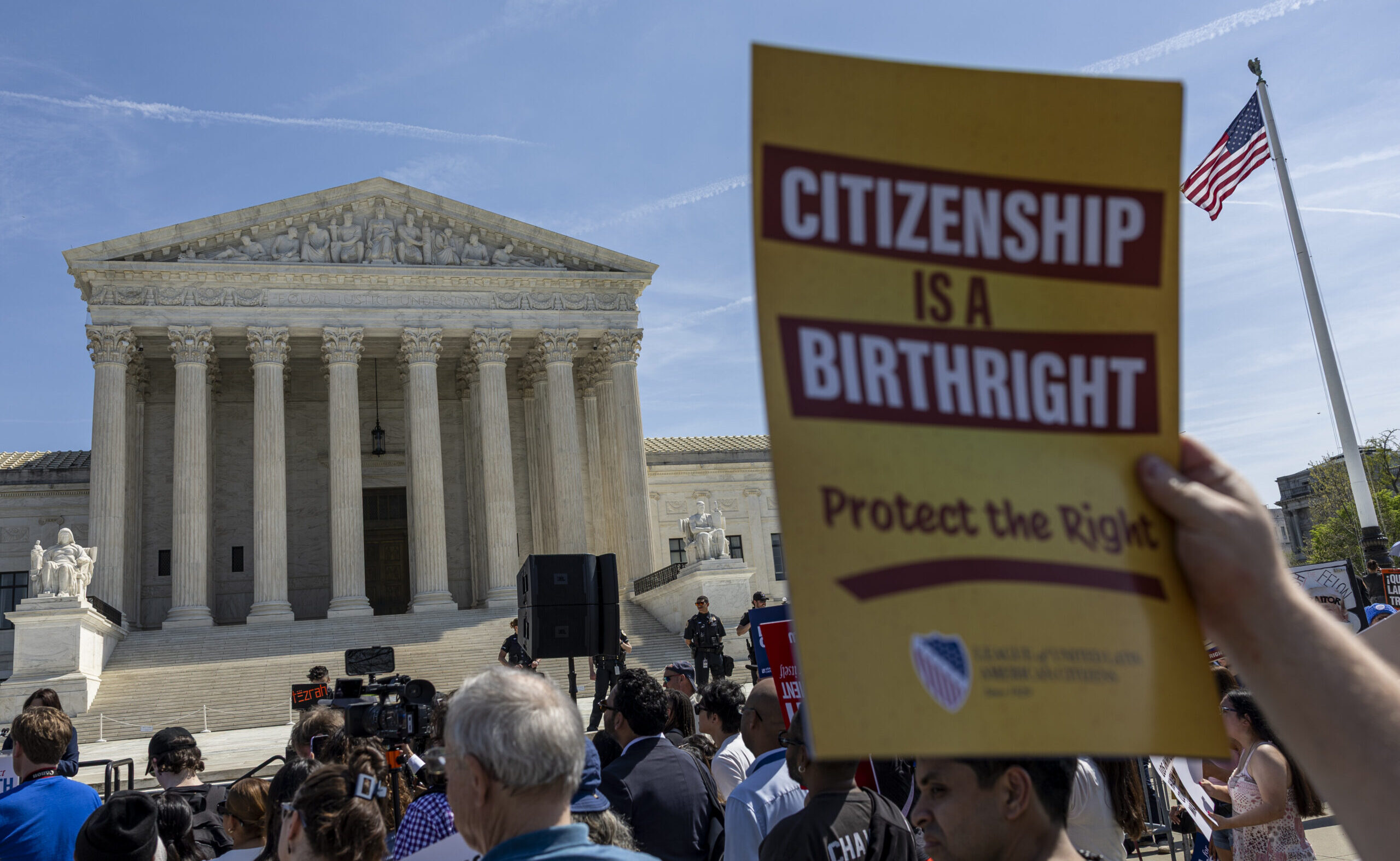
Several Jewish groups celebrated the Supreme Court’s decision on Tuesday to uphold birthright citizenship and strike down a Trump administration executive order that aimed to eliminate citizenship for children of undocumented immigrants and those in the U.S. on temporary visas, Jewish Insider’s Marc Rod reports.
Weighing in: The American Jewish Committee, HIAS and the Religious Action Center of Reform Judaism all joined an amicus brief against the executive order with various other religious groups, and praised the Supreme Court’s decision. The National Council of Jewish Women and Jewish Council for Public Affairs also weighed in in support of the justices’ ruling.
PEARL OF WISDOM

Bruce Pearl, the veteran former Auburn University men’s basketball coach, told Jewish Insider’s Emily Jacobs that Vice President JD Vance needs to “make a decision” about his continued association with far-right commentator Tucker Carlson, warning that his support of Vance’s expected 2028 presidential bid will be contingent on the vice president severing ties with the antisemitic podcaster.
‘Enemies of the state’: Pearl, who is currently splitting his time between pro-Israel political advocacy and serving as an analyst for TNT and CBS Sports, made the comments in an interview with JI on Monday while discussing the rise of right-wing antisemitism and the prominence of Carlson, neo-Nazi Nick Fuentes and other commentators who promote antisemitic ideas within the America First right-wing movement. Pearl argued that Carlson and Fuentes “are absolutely enemies of the state. What they’re doing is treasonous, it’s disgusting and it’s not based on fact. It’s based on lies and propaganda and antisemitism. They’re bought and paid for, but they’ve got huge followings.”
COHANIM COMEBACK
Ellie Cohanim, who served as deputy special envoy to monitor and combat antisemitism in President Donald Trump’s first term, recently joined his administration as a senior policy advisor to U.S. Ambassador to the U.N. Mike Waltz, Waltz announced on Tuesday, Jewish Insider’s Gabby Deutch reports. Cohanim was born in Tehran and left Iran as a child in 1979, following the Islamic Revolution. She came with her family to New York.
Waltz’s words: “Ellie’s story is the American story,” Waltz said in a statement. “Her family fled persecution in Iran, built a life in New York, and she has spent her career looking for ways to serve America, fighting for freedom, standing with the persecuted, and calling out antisemitism wherever it hides. That is exactly the kind of conviction and courage we need at the United Nations.”
Scoop: As Washington prepares to host a weekend of July Fourth hoopla on the National Mall, senior Trump administration officials, diplomats and Jewish communal leaders will gather on Friday evening across from the Lincoln Memorial for a Shabbat dinner celebrating America’s 250th birthday.
Worthy Reads
When the DSA Came for Lander: Park Avenue Synagogue Rabbi Elliot Cosgrove penned a letter dated two years from now, published in the New York Daily News, to New York Democratic congressional nominee Brad Lander, predicting that he will be ousted by a Democratic Socialists of America-backed candidate in the next primary. “They told you it was never about being a Jew — only about being a Zionist — as if the two could be peeled apart, as if your Jewishness had nothing to do with the nation they demanded you disown. There’s an old teaching about the man who thinks he can ride the tiger and dismount whenever he likes. You didn’t tame the coalition you joined. You were, for one term, useful — until the moment it decided to disown you. You could renounce the policy, the lobby, even Zionism, but you could not renounce being a Jew.” [Daily News]
Drone Prone: Foreign Policy’s John Haltiwanger unpacks Israel’s “Hezbollah drone problem.” “After the fighting resumed in March, it wasn’t long before explosive drones were a leading cause of battlefield deaths for Israel in Lebanon. As a result, Netanyahu established a team of experts to address the issue and pledged to give the IDF an unlimited budget to address the Hezbollah drone threat. But there are no simple solutions. … In ancient Rome, gladiators used nets to entangle opponents before moving in for the kill. Today, Israeli troops are using the same primitive tool to defend against drones and intercept them before they reach their targets. The situation is indicative of how militaries have struggled to find countermeasures to drones and have been forced to adapt, particularly as the technology evolves at such a rapid pace.” [FP]
Separate But Equal: Hannah Rosenthal, former special envoy to monitor and combat antisemitism under the Obama administration, argues in the Jewish Telegraphic Agency against the proposal of combining the role of the antisemitism envoy with that of the special envoy on Holocaust issues. “The office of special envoy on antisemitism and the special envoy on the Holocaust are complementary, but not duplicative. The former works to address contemporary antisemitism, hate crimes, extremism and government policy around the world. The latter focuses on historical justice, restitution, remembrance, archives and Holocaust-era accountability. The United States deliberately created separate offices because both missions are full time responsibilities.” [JTA]
Jews Turning on Israel: Actor and Jewish commentator Jonah Platt argues in a post on X against the trope of the young, “self-hating” Jew in an essay on X. “It’s maddening. It’s dangerous. It’s irresponsible. It’s shameful. But it isn’t nefarious. It isn’t Jew-hatred, it isn’t self-hatred, and honestly, it isn’t that hard to understand. These are disconnected, uneducated people, surrounded by like-minded peers, all reinforcing one another in a disconnected, uneducated worldview — one they’re not especially invested in anyway, and focus on only because progressive society says they’re supposed to.” [X]
Word on the Street
President Donald Trump is considering returning to a full-scale military conflict with Iran and has discussed the idea with Defense Secretary Pete Hegseth and Joint Chiefs Chairman Dan Caine in recent days, The Wall Street Journal reports, but has decided to continue on the diplomatic track for now…
In an analysis of the U.S.-Iran memorandum of understanding, the Foundation for Defense of Democracies found that the Trump administration is “evidently not applying [the 2015 Iran Nuclear Agreement Review Act’s] requirements and restrictions to the MOU, apparently on the basis of an opinion from the Department of Justice,” but the White House and DOJ “have apparently not shared this surprising opinion, or its arguments, with either Congress or the public”…
Homeland Security Secretary Markwayne Mullin said on Monday that he did a “happy dance,” after Iran was knocked out of the FIFA World Cup, telling reporters that Iranian officials tried to bring into the U.S. individuals with ties to the Islamic Revolutionary Guard Corps and that accommodating the team while protecting national security had demanded incomparable attention…
The Terrorist Financing Targeting Center — a coalition comprised of Bahrain, Kuwait, Oman, Qatar, Saudi Arabia, the UAE and the U.S. — announced joint sanctions against five entities and 16 individuals tied to Hezbollah’s financial network…
Oman has submitted a proposal to the U.S. for Muscat and Tehran to collect service fees from shipping companies seeking to transit the Strait of Hormuz, according to The New York Times. One of Iran’s deputy foreign ministers, Kazem Gharibabadi, said on Monday if Iran was unable to come to an arrangement with Oman it would move forward on its own…
A person close to the anti-Israel American Priorities super PAC told CNN many of its contributors weren’t very politically active until New York City Mayor Zohran Mamdani’s campaign victory, which was the “moment that inspired them and brought them into the fold”…
Former Vice President Kamala Harris called Mamdani last week, and is holding lengthy, closed-door meetings with Palestinian activists in the run-up to a possible presidential campaign, Axios reports…
Rep. Dan Goldman (D-NY), speaking to CNN’s Jake Tapper, warned of the “tremendous danger and fear” for American Jews as they are being “dehumanized” and antisemitism is “becoming normalized”…
Phylisa Wisdom, the liberal activist appointed by New York City Mayor Zohran Mamdani as executive director of his Office to Combat Antisemitism, got a harsh reception at a Holocaust memorial event in Brooklyn on Sunday. Video from the event shows a small group of hecklers booing, calling Wisdom a “kapo” and shouting that she was supportive of Adolf Hitler, JI’s Will Bredderman reports…
Far-left Michigan Senate candidate Abdul El-Sayed dismissed a question on CNN about the Democratic Party’s “embrace” of antisemitic streamer Hasan Piker as a “ridiculous way to think about politics”…
Adam Jentleson, former chief of staff to Sen. John Fetterman (D-PA) who went on to found the center-left Searchlight Institute think tank, urged Democrats to “just say no to AIPAC,” arguing the pro-Israel organization has “evolved from a group to a ‘Group,’” in the pejorative sense…
Israeli Prime Minister Benjamin Netanyahu visited southern Lebanon on Tuesday for the first time since the U.S.-brokered security agreement was signed last Friday. Netanyahu told IDF troops, “We will not leave southern Lebanon until the threat is removed”…
“Pod Save America” co-host Jon Lovett said the harassment of California state Sen. Scott Wiener at a transgender pride march last week was “as pure antisemitism as you can see”…
The Supreme Court agreed to hear the case of Daniel Grand, an Orthodox Jewish man from Ohio who was barred from holding Shabbat prayer meetings in his home without a “special use permit” and later faced harassment from city officials who encouraged neighbors to watch his home for signs of religious activity…
Haaretz tracks the carbon footprint of FIFA President Gianni Infantino as he has traveled between World Cup matches across North America on a Qatari private jet, racking up 47,337 kilometers (29,000 miles) from the tournament’s opening days through the first knockout match, after championing the body’s sustainability strategy…
Ellie Gottheimer and Larra Mullin, the children of Rep. Josh Gottheimer (D-NJ) and Homeland Security Secretary Markwayne Mullin, are releasing Shmoo & Ozzie Go to Washington today, a children’s book on bipartisanship. Proceeds from the book will go to support homeless children…
Mark Isakowitz, Sen. Dave McCormick (R-PA)’s chief of staff, is set to release a book in January about his personal journey following the loss of his father, who immigrated to America after surviving Auschwitz, and Isakowitz’s daily practice of reciting the mourner’s prayer at a synagogue in Washington, JI’s Gabby Deutch reports…
Axel Springer CEO Mathias Döpfner tapped Carolin Hulshoff Pol to serve as CEO of Telegraph Media Group following the German media company’s completion of its £575 million acquisition of the British publisher, ending a three-year ownership transition…
Former Israeli Air Force Commander Maj. Gen. (res.) Amikam Norkin is a leading candidate to head Anduril’s operations in Israel, as the American defense tech company explores a major expansion into the Israeli market, Calcalist reports…
The Iranian regime plans to take over St. Peter Evangelical Church, the oldest Protestant church in Iran, and evict the 20 families living there, The Free Press reports. The theocratic regime had thus far left it alone in fear of the U.S.’ retaliation, according to the outlet…
The Washington State Democratic Party adopted into its platform during its June convention an amendment blaming the “dramatic resurgence in antisemitism … in part [on] actions taken by the Israeli government,” Jewish News Syndicate reports…
Pentagon official Jason Olson has departed his position as the director of deradicalization for the Gaza Board of Peace, an official from the body told The Times of Israel, as the BoP is convening for discussions in Cyprus…
Tuesday marked the end of Steffen Seibert‘s four-year term as German ambassador to Israel. In a farewell social media video, he paid tribute to the country by listing 25 things he will miss. Seibert is succeeded by Alexander Graf Lambsdorff, who most recently served as the German Ambassador to Moscow…
Judah Gribetz, who as a top aide to Gov. Hugh Carey helped negotiate New York City‘s rescue from financial collapse in the 1970s and later devised a distribution plan for $1.25 billion in restitution to Holocaust survivors in a landmark class-action suit against Swiss banks, died Friday at 97…
Pic of the Day

Comedian Judy Gold spoke at an event hosted by the Israeli Embassy in Washington, “A Zionist LGBTQ+ Celebration,” at Adas Israel Congregation on Tuesday — a night of solidarity in memory of Sarah Milgrim, the embassy staffer murdered alongside her partner, Yaron Lischinsky, outside the Capital Jewish Museum in May 2025. Milgrim spent her time at the embassy building bridges between Israel and marginalized communities, including D.C.’s LGBTQ+ Jewish community.
Birthdays

Television, film and theater actor, including early career roles in Yiddish theater, Michael Burstein turns 81…
Applied mathematician, statistician and physicist, professor emeritus at both MIT and Harvard, Herman Chernoff turns 103… Former U.S. assistant secretary of education and former research professor at NYU, Diane Silvers Ravitch turns 88… Nobel laureate in economics for 1997 and co-creator of the Black-Scholes model for valuing options and other derivatives, Myron Scholes turns 85… Noted British art dealer and founder of an eponymous London art gallery, Victoria Marion Miro turns 81… Born in a DP Camp to her Holocaust survivor parents, she was the first Jewish woman to serve on the Canadian Supreme Court, Rosalie Silberman Abella turns 80… Israeli-Russian businessman, with holdings in energy and international real estate development, Shalva Chigirinsky turns 77… Partner in the Encino, Calif.-based law firm of Nolan Heimann, Douglas E. Mirell… Campaign, communications and fundraising consultant, Robert Kaplan turns 69… Hall of Fame player and coach in the WNBA and now an NBA broadcaster, Nancy Lieberman turns 68… Attorney and longtime Democratic activist in Pittsburgh, he is a regional chair of the ADL, Steven D. Irwin turns 67… Senior columnist at The Forward and former CEO of the A-Mark Foundation, Rob Eshman… President emeritus of the Orthodox Union and a retired partner at Ropes & Gray, Mark “Moishe” Bane… Under secretary of state for political affairs during most of the Biden administration, Victoria Jane Nuland (family name was Nudelman) turns 65… Journalist, filmmaker and educator, he is the co-founder of Aish[dot]com, Shraga Simmons turns 65… Professor of Jewish thought at Hebrew University, Benjamin Brown turns 60… Member of the Virginia House of Delegates since 2014, Marcus Bertram Simon turns 56… U.S. senator (R-IA), Joni Ernst turns 56… Screenwriter, producer and film director known for romantic comedy films, Marc Silverstein turns 55… Los Angeles resident, Adam B. Siegel… NASA astronaut, on her 2019 trip to the International Space Station she took novelty socks with Stars of David and menorahs, Jessica Meir turns 49… Co-founder of Edgeline Films, Elyse Steinberg… Hasidic musician mixing elements of dancehall, reggae, hip-hop and R&B, known by his stage name DeScribe, Shneur Hasofer turns 44…
Plus, Menin's measured rebuke of antisemitic Brooklyn Dem

Jabin Botsford/The Washington Post via Getty Images
Rep. Rashida Tlaib (D-MI) speaks during a hearing on Capitol Hill on Wednesday, Dec. 01, 2021, in Washington, D.C.
Good Tuesday afternoon.
This P.M. briefing is reserved for our premium subscribers like you — offering a forward-focused read on what we’re tracking now and what’s coming next.
Today’s Daily Overtime was curated by JI U.S. Editor Danielle Cohen-Kanik.
📡On Our Radar
Notable developments and interesting tidbits we’re tracking
Nearly all House Democrats voted in favor of a war powers resolution this afternoon that aimed to block U.S. support for Israeli operations against Hezbollah in Lebanon, Jewish Insider’s Marc Rod reports, though the legislation failed to secure a House majority, with nearly all Republicans and 22 Democrats voting against the measure…
White House Special Envoy Steve Witkoff and Jared Kushner are in Doha, Qatari Foreign Ministry spokesperson Majed al-Ansari confirmed, where they were set to meet with Qatari Prime Minister Sheikh Mohammed bin Abdulrahman Al Thani and other mediators, but did not hold talks with Iranian officials. It’s a step back from the direct negotiations that took place in Switzerland just a week ago…
Al-Ansari said further that the $6 billion in frozen Iranian assets has not yet been released to Tehran. “Whether the funds are transferred depends on the agreement of both parties and the progress of negotiations, which has not yet occurred,” he announced at a press briefing today…
Meanwhile, Oman has submitted a proposal to the U.S. for Muscat and Tehran to collect service fees from shipping companies seeking to transit the Strait of Hormuz, The New York Times reports. One of Iran’s deputy foreign ministers, Kazem Gharibabadi, said yesterday if Iran was unable to come to an arrangement with Oman it would move forward on its own…
A small group of House Republicans, led by Rep. Don Bacon (R-NE), is threatening not to support the Trump administration’s $88 billion Iran war supplemental funding request unless the White House replaces more than 4,000 U.S. troops who were pulled out of Poland last month, Politico reports. The effort could hold up the supplemental, already expected to face a tough fight, given the GOP’s razor-thin majority in the chamber…
A 20-year-old U.S. citizen living in Jerusalem is set to be charged by Israeli prosecutors for spying on Iran’s behalf. The suspect, arrested earlier this month, was allegedly paid to take pictures and videos of “sensitive sites” in Israel over several months…
Iranian Foreign Minister Abbas Araghchi met with Iraqi leaders in Baghdad today as both countries prepare for a “mass funeral” for the late Iranian Supreme Leader Ayatollah Ali Khamenei, Araghchi said, after Khamenei was killed in February in a joint U.S.-Israeli operation…
The Israeli Ministry of Defense and defense manufacturer Rafael completed a successful test integrating the Iron Beam laser system into the Iron Dome missile-defense array, marking a “major breakthrough,” Rafael announced…
Ellie Cohanim, who served as deputy special envoy to monitor and combat antisemitism in President Donald Trump’s first term, recently joined his administration as a senior policy advisor to U.S. Ambassador to the U.N. Mike Waltz, Waltz announced today…
A New York Times/Siena poll of the race for U.S. Senate in Texas found Republican Attorney General Ken Paxton and Democratic state Rep. James Talarico in a dead heat, 47-47%, among likely voters. The seat, once considered a long shot for Democrats in the deep-red state, has emerged as a top-tier pickup opportunity, given Paxton’s ethical and legal baggage…
New York City Council Speaker Julie Menin — the first Jewish person to hold her role — slammed a newly elected Brooklyn Democrat’s promotion of antisemitic conspiracy theories, but declined to call her commentary disqualifying, JI’s Will Bredderman reports…
After a monthslong unexplained absence from Congress, Rep. Tom Kean Jr. (R-NJ) returned to the House floor today to disclose that he had been hospitalized for depression. Kean faces a competitive reelection race against Democratic nominee Rebecca Bennett in a key battleground district in Democrats’ bid to retake the House…
Prominent pro-Israel activist Arsen Ostrovsky, who was injured in the Bondi Beach Hanukkah shooting in Sydney last year, testified before Australia’s Royal Commission on Antisemitism about how he faced “relentless” and “vicious” harassment online after the attack, including AI-altered images of his injuries and accusations that he was a crisis actor…
In a series of high-profiledecisions today, the Supreme Court sided with Vice President JD Vance in a case he brought as a Senate candidate, along with other plaintiffs, and lifted federal limits on coordinated spending between political parties and candidates.
The court also struck down Trump’s attempt to end birthright citizenship — a move that garnered praise from Jewish groups including the American Jewish Committee, the Union for Reform Judaism and the Jewish Council for Public Affairs…
⏩ Tomorrow’s Agenda, Today
An early look at tomorrow’s storylines and schedule to keep you a step ahead
Keep an eye on Jewish Insider for a look at Democrats’ ongoing divisions over an effort to cut aid to Israel led by Rep. Thomas Massie (R-KY).
Technical delegations from the U.S. and Iran are expected to meet separately with Qatari and Pakistani mediators in Doha — still with no direct talks planned.
Hard-line Republicans upended business on the House floor for the second week in a row, blocking the procedural measure that would have teed up consideration of the 2027 State Department funding bill and the 2027 National Defense Authorization Act. After a final vote this evening, the House will head to recess early, until July 13.
The Herzliya Conference continues in Israel: Among the many top national security and political officials speaking are former Prime Ministers Naftali Bennett and Yair Lapid; former Israeli Ambassadors to the U.S. Danny Ayalon and Michael Herzog; former U.S. Ambassador to Israel Dan Shapiro; EU Ambassador to Israel Michael Mann; Yashar party leader Gadi Eisenkot; Yisrael Beiteinu party leader Avigdor Liberman; Democrats party leader Yair Golan; Ra’am party leader Mansour Abbas; and Nadav Tamir, executive director of J Street Israel.
President Donald Trump is set to take his first trip on the jumbo jet gifted to him by Qatar as he travels to an event in North Dakota.
Stories You May Have Missed
PRIDE AND PREJUDICE

Wiener said the incident where he was accosted at a pride march was ‘absolutely’ antisemitic; only a few California elected officials said the same
WESTWARD BOUND
Gen. Frank McKenzie revealed that CENTCOM had previously proposed a similar western contingency plan to the Biden administration which was shot down
Plus, moderates’ big Colorado test

Miikka Skaffari/Getty Images
California state Sen. Scott Wiener during the San Francisco Pride Parade on June 28, 2026 in San Francisco, Calif.
Good Tuesday morning.
In today’s Daily Kickoff, we preview tonight’s Democratic primaries in Colorado, where a wave of Democratic Socialists of America-backed challengers is testing whether even the party’s pragmatic epicenter is vulnerable to the socialist left, and report on comments by Rep. Suzan DelBene (D-WA), the chair of the Democratic Congressional Campaign Committee, downplaying concerns about the party’s response to antisemitism. We cover the conflicting messaging put out by the U.S. and Iran about the continuation of talks in Qatar, and report on remarks by Rep. Brian Mast (R-FL) on the expected timeline for a final agreement between the countries. We also follow up on the reactions to the harassment of California state Sen. Scott Wiener at a transgender pride march, highlighting a divide between politicians who described the incident as antisemitic and those who did not. Also in today’s Daily Kickoff: Susie Wiles, Gen. Frank McKenzie and Luke Moon.
Today’s Daily Kickoff was curated by JI Israel Editor Tamara Zieve and U.S. Editor Danielle Cohen-Kanik with an assist from Marc Rod. Have a tip? Email us here.
What We’re Watching
- White House Special Envoy Steve Witkoff and Jared Kushner arrived in Qatar to represent the U.S. in talks with Iran, as the status of the negotiations remains unclear. The technical talks on the memorandum of understanding meant to be taking place separately are also up in the air — Iran’s foreign ministry said an Iranian technical delegation will be in Doha this week but will not be meeting with American officials. More below.
- Representatives of President Donald Trump’s Board of Peace are meeting this week in Cyprus as they seek to advance plans for a committee of Palestinian technocrats to replace Hamas in governing the Gaza Strip, The Times of Israel reports. Former U.K. Prime Minister Tony Blair, who sits on the Board of Peace’s executive board and has recently taken on a larger role in the organization, is set to participate in the “strategic workshop” being held from Tuesday to Thursday.
- Colorado voters will head to the polls in today’s Democratic primaries, where moderate candidates are fearing a far-left wave. More below.
- Russell Vought, director of the Office of Management and Budget, will testify before the House Appropriations Committee where he is expected to address the White House’s $88 billion supplemental funding request for the war with Iran and FY2027 budget request.
- The Israeli Embassy in Washington will hold a “Zionist LGBTQ+ celebration” on the last day of Pride Month in memory of slain embassy staffer Sarah Milgrim’s allyship.
- In Israel, Reichman University’s Herzliya Conference kicks off, focusing this year on national security and national resilience. Israeli President Isaac Herzog will address the confab, as well as U.S. Ambassador to Israel Mike Huckabee; Amos Hochstein, who served as a Middle East envoy under former President Joe Biden; former Mossad chief Tamir Pardo; former Israeli National Security Advisor Tzachi Hanegbi; journalist Barak Ravid; and Aliyah Minister Ofir Sofer.
What You Should Know
A QUICK WORD WITH JI’S JOSH KRAUSHAAR
Colorado is a state famous for its moderation, with its governor (Jared Polis) and two senators (Michael Bennet and John Hickenlooper) among the most pragmatic figures in Democratic politics. So if a far-left, anti-Israel wave sweeps over the Democratic Party in tonight’s statewide primaries, it will be a true wake-up call for those downplaying the rise of the socialist left.
The biggest race we’re tracking — and the one where a Democratic incumbent looks most vulnerable — is the primary between longtime Rep. Diana DeGette, 68, an influential progressive who has left an imprint on major legislation in Congress, and Democratic Socialists of America-affiliated 29-year-old doctoral student Melat Kiros, whose deep-seated antagonism against Israel is a top focus of her campaign.
Kiros is the latest example of how radical candidates running for office on their hostility toward Israel are also indulgent of the rising antisemitism around them. Her political awakening came after she was fired from the law firm Sidley Austin for writing a public letter denouncing the hundreds of law firms that signed a petition calling on law schools to do a better job addressing antisemitism on their campuses.
Kiros was angered that the law firms considered those calling for the elimination of Israel as antisemitic. In the last week, she also refused to call the firebombing of a hostage awareness march in Boulder, Colo., antisemitic. Sense a pattern?
As JI’s Marc Rod reported, Kiros’ extreme views have done little to dent her support in a progressive Denver-area district that DeGette has easily held for the last three decades. In March, DeGette barely won the 30% of the vote from party activists necessary to qualify for the primary ballot — in what could be a foreshadowing of the primary results tonight.
PRIDE AND PREJUDICE
Elected officials in California swiftly condemned an incident last week in which protesters accosted and harassed California state Sen. Scott Wiener at a transgender pride march, with one demonstrator shouting “F*** you and your Zionist handlers. F*** you and your Israeli masters.” A divide emerged, however, between the politicians who described the incident as antisemitic and those who did not. It was the second such incident in days, after Wiener was harassed at a bar by a protester demanding he say “Free Palestine” on camera, Jewish Insider’s Gabby Deutch reports.
Reactions: Wiener told CNN on Monday that the incident was “absolutely” antisemitic. “There were elected officials in that march who have not taken the positions that I’ve taken, and they were left alone,” said Wiener, who is running to replace retiring Rep. Nancy Pelosi (D-CA) in the San Francisco-based seat. San Francisco Mayor Daniel Lurie, who is Jewish, criticized the incident as “targeted, hateful and antisemitic.” San Francisco Supervisor Connie Chan, Wiener’s competitor in the congressional race who is running to his left, said in a statement that she stands “firm against threats of violence and hate speech. There is no place for hate and violence in our city.” Asked whether Chan believed the specific incident targeting Wiener to be hate speech, a spokesperson for Chan declined to say.
Read the full story here with additional comments from Sens. Adam Schiff (D-CA) and Alex Padilla (D-CA), Pelosi, Rep. Ro Khanna (D-CA) and former Health and Human Services Secretary Xavier Becerra, the Democratic nominee for governor in California.
Leadership message: Rep. Suzan DelBene (D-WA), the chair of the Democratic Congressional Campaign Committee, responsible for electing House Democrats, downplayed concerns about the party’s response to antisemitism in the wake of New York City elections that elevated several far-left candidates, JI’s Marc Rod reports. “If you look across the board and talk to individual candidates, that’s not representative of where other candidates land,” she said in an interview with former NBC News anchor Chuck Todd.
ON THE HILL

The top House Democrats on the Foreign Affairs and Armed Services committees said Monday that they will oppose efforts led by Rep. Thomas Massie (R-KY) to cut the $3.3 billion in U.S. aid to Israel expected under the memorandum of understanding if and when they come to a vote on the House floor, Jewish Insider’s Marc Rod reports.
No go: Reps. Greg Meeks (D-NY) and Adam Smith (D-WA), the ranking Democrats on the House Foreign Affairs and Armed Services committees, both told JI they intend to oppose the amendment. Meeks said there are “so many unanswered questions” about the implications and effects of the amendment. “I know there is still danger [in Israel]. I don’t want Israel to be without what they need,” Meeks said. He also noted that many of the weapons that would be purchased with the funding would not be built for years to come.
Read the full story here with additional comments from Reps. Rosa DeLauro (D-CT) and Greg Casar (D-TX).
Tehran talk: Rep. Brian Mast (R-FL), the chair of the House Foreign Affairs Committee, suggested following both unclassified and classified briefings from the Trump administration on Iran on Monday that talks with the regime for a final agreement could continue past the 60-day timeline laid out in the U.S.-Iran memorandum of understanding finalized earlier this month.
BOMBS TO BARGAINS

President Donald Trump confirmed on Monday that the U.S. and Iran will meet in Qatar on Tuesday to continue negotiations, as both nations attempt to step back from a weekend exchange of military strikes that threatened to derail the fragile ceasefire agreement. “IRAN HAS REQUESTED A MEETING. IT WILL TAKE PLACE TOMORROW IN DOHA!” Trump posted on Truth Social, Jewish Insider’s Matthew Shea reports.
Yes, but: Iran’s deputy foreign minister and senior negotiator Kazem Gharibabadi, however, dismissed the reports, telling Iranian state news agency IRNA that the technical talks in the Qatari capital “are not confirmed.” Esmaeil Baghaei, a spokesperson for Iran’s foreign ministry, later said Iran has no discussions scheduled with the U.S. and that an Iranian technical delegation heading to Qatar this week will not be meeting with U.S. officials.
Chief concerns: White House Chief of Staff Susie Wiles, according to a new book by New York Times journalists Maggie Haberman and Jonathan Swan, initially pushed back on U.S. military engagement against Iran, skeptical of Israel’s efforts to convince Trump to join a bombing campaign on Iran’s nuclear sites and fearful that any involvement from the U.S. military could “spiral into an Israeli regime-change war,” JI’s Gabby Deutch reports.
TEXAS TILT
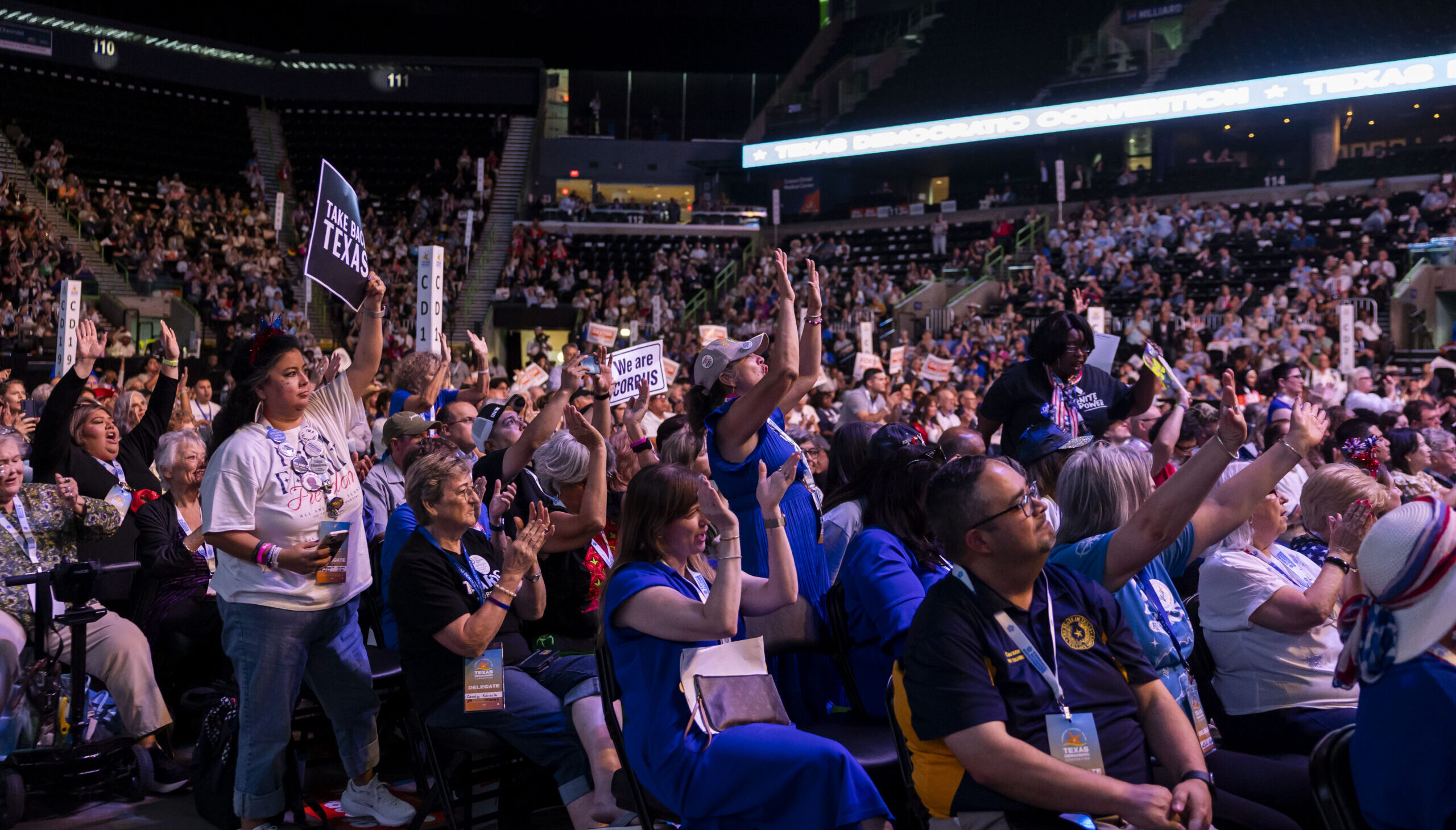
Texas Democrats adopted several anti-Israel amendments into their party platform at a state party convention last weekend — a significant move to the left on Israel policy in a generally conservative state with marquee Senate and gubernatorial races this November. That said, much of the anti-Israel language was toned down from the original amendments as introduced — and the party also adopted some pro-Israel language in the platform, Jewish Insider’s Marc Rod reports.
Notable provisions: The platform offers support for the right of return for Palestinian refugees as well as for Palestine becoming a U.N. member state “when qualified under the U.N. Charter” and the International Court of Justice’s interim judgement in the genocide case against Israel — though it acknowledges that the ICJ has not ruled that Israel committed genocide — and recognizes the Palestinian “Nakba.” The platform urges Texas Democratic members of Congress to support the Block the Bombs Act and the end of U.S. offensive weapons sales to Israel, as well as calling for the repeal of Texas’ anti-Boycott, Divestment and Sanctions legislation.
WESTWARD BOUND
Former U.S. CENTCOM Commander Gen. Frank McKenzie on Monday voiced his support for the U.S. to shift its military footprint in the Middle East westward, including in Israel, to mitigate threats from Iran, Jewish Insider’s Matthew Shea reports.
Location, location, location: Speaking on a Jewish Institute for National Security of America webinar, McKenzie said, “No one in their right mind would ever put the CENTCOM forward headquarters, you know, 100 miles away from Iran [in Qatar], yet that’s where it is. Because when we put it in place many years ago, we were thinking Iraq, we were thinking Afghanistan, we were thinking other things, and not the growing threat from Iran.”
BACK IN THE FOLD
Luke Moon, a conservative Christian activist who has emerged in recent months as an outspoken critic of antisemitism on the right, has joined the Heritage Foundation as a part-time visiting fellow supporting the think tank’s work to combat antisemitism, Jewish Insider’s Gabby Deutch reports. Moon publicly disaffiliated from the prominent conservative institution in November after its president, Kevin Roberts, released a controversial video defending Tucker Carlson following the podcast host’s friendly interview with neo-Nazi Nick Fuentes.
Shift in position: Moon told JI in an interview on Monday that he believes the conservative movement has begun to make progress in fighting back against antisemitism within its ranks. “It’s a war where we lose some battles and win some battles, and I think I’m winning more than I’m losing,” Moon said. “What I didn’t have a year ago was enough allies and tools, and now I have a lot more allies, and I think I have a lot more tools, and so I’m actually optimistic.”
Worthy Reads
Mamdani’s Misunderstanding: Israeli journalist Nadav Eyal argues in his Substack that New York City Mayor Zohran Mamdani’s comments to ABC News rejecting support for Israel as a Jewish state reveal a fundamental misunderstanding of the Jewish people. “Either he knows very little about Judaism — an astonishing level of ignorance for the mayor of New York — or his hostility toward Israel has blinded him to one of the most elementary historical facts about the Jewish people. Judaism is both a religion and a nation. For thousands of years, Jews have understood themselves as a people with a shared history, a common language, collective institutions, diverse religious traditions, and — crucially — a homeland from which they originated.” [Substack]
Unfortunate Turn of Events: In The Wall Street Journal’s “Free Expression” newsletter, Masada Siegel uses “A Series of Unfortunate Events” — the children’s book series about orphans trying to elude a disguised villain and his followers — as a lens to examine institutional failure in addressing antisemitism in American schools and universities. “In the series, the children’s guardian Mr. Poe hesitates, doubts the children and is useless whenever the villain reappears. Mr. Poe isn’t evil; he’s self-absorbed and personifies institutions that exist to stop threats, but refuse to do their jobs. Since Oct. 7, the international community has acted as a global Mr. Poe. Institutions like the United Nations and Red Cross allowed hostages, including children, to be held by Hamas and to languish in terror tunnels. In the U.S., institutions failed our youth. School boards and Ivy League administrations showed little to no moral clarity, leaving Jewish students to fend for themselves in hostile environments.” [WSJ]
The Rubio Accord: The Wall Street Journal’s editorial board applauds Secretary of State Marco Rubio’s work securing the U.S.-Israel-Lebanon agreement signed last week. “Some Iran analysts associated with Vice President JD Vance have criticized the framework as ‘incompatible’ with the memorandum of understanding with Iran. But Trump Administration sources tell us this framework is the U.S. interpretation of the MOU’s language regarding Lebanon. On this the Vice President backs Mr. Rubio; nobody on the Trump team wants to force Israel to cede all of southern Lebanon to Iran’s proxy, as Iran demands.” [WSJ]
From Corbyn to Mamdani: Simone Rodan-Benzaquen, the Foundation for Defense of Democracies’ senior envoy for Europe, argues that New York City Mayor Zohran Mamdani poses the same threat to the Democratic Party as Jeremy Corbyn did to the U.K.’s Labour Party when he served as leader. “From London to Paris, from Paris to New York, one finds the same mechanism: anti-Zionism presented as courage, accusations of antisemitism dismissed as a right-wing maneuver, and the worried Jew transformed into an obstacle to progress. Labour thought it could absorb Corbyn. Part of the French left thought it could contain [Jean-Luc] Mélenchon. The Democratic Party may believe it can confine Mamdani and the DSA to a handful of urban districts. This is always how capitulations begin: with the idea that the problem will remain local.” [FDD]
Word on the Street
CENTCOM Commander Adm. Brad Cooper met with Lebanese Armed Forces chief Gen. Rodolphe Haykal in Beirut and senior civilian and military personnel in Israel to discuss implementing the Israel–Lebanon framework agreement signed last week…
New documents released by the State Department under Freedom of Information Act litigation show top Trump administration staffers continued to use the encrypted messaging app Signal for government communications after President Donald Trump suggested they stop when Atlantic Editor-in-Chief Jeffrey Goldberg was inadvertently added to an administration chat about bombing the Houthis last year…
New York state Democratic Party Chairman Jay Jacobs told the New York Post that anti-Israel sentiment helped propel to victory New York City Mayor Zohran Mamdani’s slate of candidates for Congress in last week’s primaries…
A new New York Times/Portland Press Herald/Siena poll shows Democratic Senate candidate Graham Platner and Republican Sen. Susan Collins in a statistical tie in Maine, 49-47%, among likely voters…
J Street President Jeremy Ben-Ami wrote on Substack that Mamdani “missed the mark” when he called AIPAC the “monsters of our time” and warned broadly against characterizing “every organization connected to Israel … as part of a uniquely sinister enterprise”…
Trump nominated acting Labor Secretary Keith Sonderling, who is the grandson of Holocaust survivors, to assume the role permanently. Read JI’s profile of Sonderling here…
CNN reports on since-deleted tweets from far-left New York congressional candidate Darializa Avila Chevalier hailing communism, Marxism and Soviet figures, including revolutionary Vladimir Lenin…
Jewish Voice for Peace Action, the political arm of the anti-Israel advocacy group, issued its first-ever Senate endorsement, backing far-left candidate Abdul El-Sayed in the Democratic primary for U.S. Senate in Michigan. The Detroit Free Press endorsed one of his opponents, state Sen. Mallory McMorrow…
Minneapolis Mayor Jacob Frey is backing Rep. Angie Craig (D-MN) for U.S. Senate against her more-progressive primary opponent, Lt. Gov. Peggy Flanagan, and Sen. Bernie Sanders (I-VT) endorsed Sen. Ed Markey (D-MA) as he fends off a generational primary challenge from Rep. Seth Moulton (D-MA)….
The New York Times talks to Jennifer Mnookin, who on Wednesday will begin her role as Columbia University’s fifth president in four years — and first Jewish leader in three decades…
TheNYTexplores how the raging debates over Israel and Iran are fracturing both parties ahead of the midterms, with far-left primary victories in New York rattling establishment Democrats and isolationist MAGA voters souring on Trump over the Iran war…
The Wall Street Journal reports that while a Trump administration waiver last week to let Iran sell its oil and receive dollar payments could bring in up to $10 billion over two months, it is likely to take much longer to reach the pockets of ordinary Iranians, some of whom have expressed skepticism that the deal will improve their daily life…
The IDF’s Military Intelligence Directorate and Southern Command told Chief of Staff Lt. Gen. Eyal Zamir last week that Hamas is reconstituting in order to resume war against Israel, Israeli broadcaster Kan reports, indicating the IDF is urging a return to fighting against the terror group but that the U.S. is opposed as it seeks to promote Trump’s Board of Peace…
Armenian Prime Minister Nikol Pashinyan, asked about Israel’s recent recognition of the Armenian Genocide, said, “We do not see a need for response,” adding that it is in his country’s interest to avoid “the weaponization of the Armenian Genocide”…
The New Yorker‘s Oscar Schwartz examines how former Prime Minister John Howard — architect of Australia’s celebrated post-Port Arthur gun laws — broke with Prime Minister Anthony Albanese after the massacre at a Hanukkah party at Bondi Beach, arguing the real culprit was rising antisemitism rather than lax gun control, a framing that has reshaped the country’s political discourse…
Former Walt Disney Co. CEO Bob Iger and Thrive Capital founder Josh Kushner are weighing making a bid for the NBA expansion team in Las Vegas, Bloomberg reports…
Yair Rosenberg, a longtime journalist and commentator on American Jewry, is joining The New York Times as a reporter covering Jewish American life, the Times announced on Monday, JI’s Haley Cohen reports…
Pic of the Day
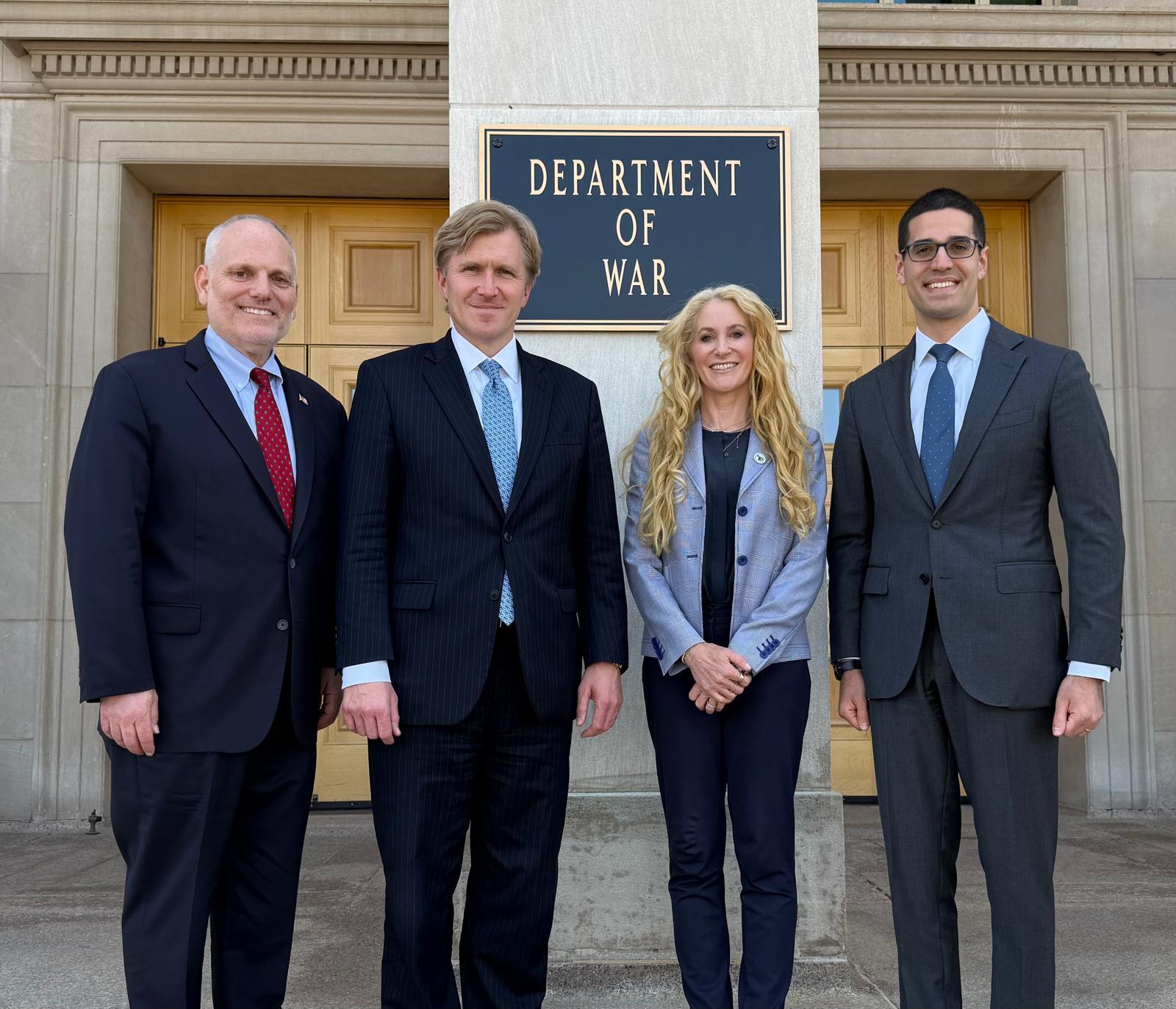
Conference of Presidents of Major American Jewish Organizations CEO William Daroff (left) and Chair Betsy Berns Korn met with Under Secretary of Defense Elbridge Colby (second from left) and Alex Velez-Green, the embattled nominee to be deputy under secretary, at the Pentagon on Monday. The group’s discussion focused on the rapidly evolving geopolitical environment, regional security dynamics and the strategic challenges and opportunities facing the United States, Israel and the broader Middle East.
Birthdays

Film and television actor, Elizabeth Anne “Lizzy” Caplan turns 44…
Rapid City, S.D., resident, Leedel Chittim Williamson turns 82… Palm Beach Gardens, Fla., resident, podiatrist, Dr. David Peter Bartos… Executive coach to nonprofit leaders, he was the founding director of the Museum of Jewish Heritage, Dr. David Altshuler… Former New York state assemblyman for 36 years, he is the founder of Americans Against Antisemitism, Dov Hikind turns 76… Former Harvard professor and author of books on the Holocaust and antisemitism, Daniel Goldhagen turns 67… Staff writer at The Atlantic, podcaster, author of 10 books and former Bush 43 speechwriter, David Frum turns 66… Chief justice of the New Jersey Supreme Court, Stuart Jeff Rabner turns 66… Professor of astrophysics at McGill University, Victoria Michelle Kaspi turns 59… Independent philanthropic advisor, formerly the founding executive director of JOIN for Justice: the Jewish Organizing Institute and Network, Karla Van Praag… Professor of Jewish studies at the University of Georgia, he is the co-editor of a handbook on 25 different Jewish languages, Aaron David Rubin turns 50… Columnist, author, poet and screenwriter, Matthew “Matthue” Roth turns 48… Former sports business analyst and reporter, now focused on the collectibles market, Darren Rovell turns 48… Reggae and alternative rock musician, known by his stage name Matisyahu, Matthew Paul Miller turns 47… Partner at OnMessage Public Strategies, Kyle J. Plotkin turns 44… Senior software engineer at Bloomberg LP, Noam Lustiger… Chief marketing officer for Aleph Venture Capital, Erica Marom (Chernofsky)… COO at the Conference of Presidents of Major American Jewish Organizations, Stephanie Hausner… Head coach of the men’s lacrosse program at Long Island University, Jordan Levine turns 40… Rhythmic gymnast who represented the U.S. at the 2012 Olympic Games, now a fitness coach and personal trainer, Julie Ashley Zetlin turns 36… English teacher in Tel Aviv, Michal Adar… Real estate director at AIPAC in New York, Abbey Taub…
Rep. Debbie Wasserman Schultz said that Steve Witkoff denied that Iran had received any sanctions relief, and ended the call when pressed

Samuel Corum/Getty Images
Rep. Brian Mast (R-FL) speaks during a House Committee on Foreign Affairs hearing on Capitol Hill on January 11, 2024 in Washington, DC.
Rep. Brian Mast (R-FL), the chair of the House Foreign Affairs Committee, suggested following both unclassified and classified briefings from the Trump administration on Iran on Monday that talks with the regime for a final agreement could continue past the 60-day timeline laid out in the U.S.-Iran memorandum of understanding finalized earlier this month.
“I think [the] 60-day window … is probably more of a fluid thing, just like you think about some of the stuff that went on with the Gaza-Israel [negotiations and the] Board of Peace, right?” Mast said.
“You get to some things, you don’t necessarily get to everything … over a 60-day window,” Mast said. “I think you get to some, I don’t think you get to everything. I don’t think that it just ends after 60 days by any means.”
He said that the briefings didn’t specifically touch on whether there had been any reassurances that a final deal would be reached.
“There are reassurances that people want in specific sectors,” Mast said, including that Iran will not return to pursuing nuclear weapons. “That would be important to have inked.”
Talks over and efforts to implement the ceasefire plan in Gaza have continued long beyond their original timeline, particularly efforts to disarm Hamas — which the group continues to resist — and to deploy an international military force to stabilize the territory, both of which are lynchpins to moving the peace process forward.
Some in Washington have worried about similar stagnation in the U.S.-Iran talks, and that the MOU might become the new status quo.
The administration held an unclassified briefing open to all House members on the phone on Monday afternoon, which included Secretary of State Marco Rubio and White House Special Envoy Steve Witkoff. Immediately after, the top lawmakers on key House committees, including Mast, received a classified briefing from Deputy National Security Advisor Andy Baker.
Senate lawmakers, who are in recess, also participated in a separate phone briefing on Monday afternoon.
Rep. Debbie Wasserman Schultz (D-FL) told Jewish Insider she pressed Witkoff at the end of the unclassified phone briefing about comments he had made earlier in the briefing claiming that no waivers had been used to allow Iran to sell oil.
Wasserman Schultz pointed out to Witkoff that the Treasury Department issued a license last week to allow the sale and importation of Iranian oil and petrochemical products, and said Witkoff “really was taken aback and [he] had difficulty answering.”
She said Witkoff had initially denied that any sanctions had been waived or any oil sales had been permitted since the MOU was signed. But when confronted about the waiver, she said Witkoff “acted like he wasn’t aware of it.” She said that Witkoff said he would follow up with her and officials subsequently “turned tail and cut off the call.”
“What was clear to me was that Mr. Witkoff either, disturbingly, had no idea that what he was saying was not true, or he did know what he was saying wasn’t true,” she said. “I don’t know which it was. … We’ll see if they actually get back to me …. But really it’s part of a larger pattern with this administration of misleading Congress on Iran. They’re constantly moving the ball.”
Rep. Greg Meeks (D-NY), the ranking member of the House Foreign Affairs Committee, offered a similar account of confusion among administration officials over the sanctions relief, and said Rubio told lawmakers Iran would not receive any money if it did not comply with the MOU, something he said was out of step with the actual terms of the MOU.
“The secretary of state indicated that there was no money going to Iran, but when you look at the MOU, it says money would start going to Iran at the implementation of the MOU,” Meeks said. “The Iranians are claiming they are receiving some funds now. … The Treasury Department has made ways for money to go to Iran, and unfortunately I think that Mr. Witkoff in the [unclassified] briefing did not realize that.”
Both Meeks and Wasserman Schultz said the call indicated that Witkoff and others involved in the talks are not qualified to handle the negotiations.
Mast called the MOU a “work in progress” and said there are “reasons to be hopeful and reasons to be skeptical” about the deal. Chief among the reasons for skepticism, he said, is that Iran is untrustworthy and does not act in good faith.
But he said that the damage done through U.S. operations against Iran — burying Iran’s nuclear program and doing hundreds of billions of dollars of damage to the country and critical industries — provides reasons for optimism.
Asked about the sanctions relief already provided to Iran, and the potential additional financial benefits Iran stands to gain, Mast told JI it’s a question of “math” — he estimated that the U.S. did half a trillion dollars in damage to Iran, and said that any reconstruction funding or investments from other countries or released frozen assets “subtracts from that math.”
Mast also argued that reconstruction funding would be going to companies involved in the effort, including potentially American companies, rather than the regime, but acknowledged that money is fungible and “it affects the math equation.” He also argued that any release of frozen assets would be based on a “behavior change.”
Pressed on whether he thought Iran’s behavior to this point merited the oil sanctions waiver, Mast said that depends on the timeline of Iranian behavior examined — Iran’s pace of attacks on commercial shipping has slowed from its peak during the war, but its behavior now is “very similar” to “what was a year, or three years ago.”
“I think [the Iranians are] doing everything to prove they are who they are,” Mast said. “They will lie about everything and, you know, say they agree to something and then not [follow through]. It’s a very good reason to be skeptical of anything about them, but again, it’s a different world post-[Operation] Epic Fury.”
Rep. Adam Smith (D-WA), the ranking member of the House Armed Services Committee, emerged from the classified session pessimistic that the administration is in a position to achieve the goals it has set out for the talks.
“We know where they want to go, what they want to negotiate. The evidence that they’re progressing towards that outcome isn’t great,” Smith said. “They’re hoping to get the Strait [of Hormuz] open and reach some sort of economic deal with Iran and negotiate on the nuclear program, which they sort of outlined, and they said they’re optimistic about it. I don’t see as much cause for optimism personally.”
He said that the information provided in the classified briefing was not substantially different from that which was shared on the unclassified call.
Meeks said he left the classified briefing with “some of the same questions I had before I went in.” He said that he thinks the U.S. is in a worse position after the war, and said he wants to have additional briefings.
“I can’t tell you that I got information that says you’ve done anything or made any great progress subsequent to the war that had not already been accomplished before the war, and much of what they have talked about has been or was in the JCPOA,” Meeks said, referring to the 2015 Iran nuclear deal.
Mast said he does not plan to call any public hearings with administration officials on Iran in the Foreign Affairs Committee, but wants to hear in a classified setting from senior administration officials. He also said that administration officials said they would convey lawmakers’ desire for additional briefings.
Wasserman Schultz criticized the administration for calling the open briefing in the late afternoon on a day when many members are traveling to Washington, and holding it in an unclassified setting where they would be unable to discuss many substantive details.
Gen. Frank McKenzie revealed that CENTCOM had previously proposed a similar western contingency plan to the Biden administration which was shot down

Ahmad Seir/AP
Marine Gen. Frank McKenzie, then- head of U.S. Central Command, attends at a ceremony where Gen. Scott Miller, who has served as America's top commander in Afghanistan since 2018, handed over command, at Resolute Support headquarters, in Kabul, Afghanistan, July 12, 2021.
Former U.S. CENTCOM Commander Gen. Frank McKenzie on Monday voiced his support for the U.S. to shift its military footprint in the Middle East westward, including in Israel, to mitigate threats from Iran.
Speaking on a Jewish Institute for National Security of America webinar, McKenzie said, “No one in their right mind would ever put the CENTCOM forward headquarters, you know, 100 miles away from Iran [in Qatar], yet that’s where it is. Because when we put it in place many years ago, we were thinking Iraq, we were thinking Afghanistan, we were thinking other things, and not the growing threat from Iran.”
The U.S. has long operated a sprawling network of bases across the Middle East as critical hubs for air operations, naval logistics, and intelligence gathering, housing between 40,000 and 50,000 personnel. These include Qatar’s Al Udeid Air Base — the largest U.S. military facility in the region — and Al Dhafra Air Base in the United Arab Emirates, alongside key installations in Bahrain, Iraq, Jordan, Kuwait and Saudi Arabia.
However, throughout the conflict with Iran, U.S. bases across the region came under repeated drone and missile fire from Tehran and its proxies. Recent reports have suggested that the U.S. is considering moving the damaged bases westward further out of Iran’s range, including in Israel.
The U.S. does not currently maintain a permanent, sovereign military base in Israel, though American forces temporarily operated out of Israel’s Ovda Air Base during the conflict with Iran and the U.S. stationed dozens of military refueling and cargo aircraft at Ben Gurion Airport.
McKenzie argued in support of JINSA’s position that the U.S. should continue operations at Israel’s Ovda Air Base on an ongoing basis.
“What we’ve got is a situation where it’s good to be close to your potential enemy, because it’s a short commute to the fight,” McKenzie said. “But it’s bad to be close to your potential enemy, because he has the ability to strike you very quickly.”
While McKenzie argued that the U.S. should maintain its existing Gulf footprint to signal continued solidarity with regional partners, he noted that an anchor in Israel would grant Washington unparalleled operational flexibility. “The goal is to spread out that necklace of bases far to the west, where you make it harder for the Iranians to reach you,” he said, though he cautioned that the strategy faces a shelf-life as Tehran continues to expand its missile capabilities.
“We need to look at basing in Israel. I think it’s a great idea,” McKenzie said, suggesting that Ben Gurion could continue to serve as a vital refueling hub for American tankers. He also pointed to Egypt, Jordan, and Oman as viable components of a broader western basing network designed to complicate Iran’s targeting calculus.
Israel provides a unique advantage over traditional Gulf hosts, McKenzie argued, because it is far less likely to impose strict political or operational parameters on American missions.
“Of all the countries, one thing that’s significant is the [host] country … they’re going to want to have a say in where those jets go when they take off,” McKenzie explained. “Probably Israel is the place where you’re going to have the fewest ABO [access, basing, and overflight] restrictions on your airplanes. That’s why Israel is a particularly attractive location.”
Beyond fewer diplomatic hurdles, McKenzie emphasized that Israel remains an ideal option because its multi-layered air-defense architecture makes it uniquely resilient against incoming fire. “That’s probably the most significant thing,” he said. Iranian strikes on U.S. facilities in Qatar and Bahrain forced the U.S. to evacuate or disperse personnel and relocate troops after missiles damaged several facilities.
McKenzie revealed that CENTCOM had previously proposed a similar western contingency plan to the Biden administration, but encountered stiff bureaucratic resistance.
“We had plans to do this, plans that were not supported by the policy shop in the Pentagon during the Biden administration. But I think now is the time to go back and take a look at it,” McKenzie said. “It just really was a refusal to examine the reality of the situation on the ground and the growing trend of Iranian rearmament weaponization, which placed these bases at a very close range to Iran under increasing degrees of risk.”
When asked whether shifting forces westward would satisfy the ongoing memorandum of understanding between Washington and Tehran — which requires the U.S. to withdraw forces from the “immediate proximity” of Iran within 30 days of a final deal — McKenzie remained noncommittal, expressing strong skepticism.
“I think we still need to further negotiate what removal from immediate proximity of Iran means,” McKenzie said. “It would be easy to say moving west would grant you that visibility. I’m just not sure I’d recommend that, and I’m not sure that this administration is going to want to do that.”
Addressing whether a permanent U.S. presence would put Israel at a heightened risk for more frequent or intense Iranian or proxy strikes, McKenzie acknowledged the potential but argued the protective benefits outweigh the downsides, stating: “I’m not sure how we could get to a higher level” of threat environment.
“Yes, possibly. But on the other hand, what you gain by U.S. basing there is you gain the use of those aircraft against [Iran] in order to reduce the frequency, duration and intensity of those attacks,” McKenzie said. “I’d rather have U.S. forces there than not.”
Plus, Susie Wiles' Iran strike skepticism

Nathan Howard-Pool/Getty Images
Delegation staff members meet in the lobby during a quadrilateral meeting between the U.S., Iran, Pakistan, and Qatar at the Lake Lucerne Summit, aimed at advancing a deal to end the Middle East conflict at the Buergenstock Resort, Lake Lucerne on June 21, 2026 near Stansstad, Switzerland.
Good Monday afternoon.
This P.M. briefing is reserved for our premium subscribers like you — offering a forward-focused read on what we’re tracking now and what’s coming next.
Today’s Daily Overtime was curated by JI U.S. Editor Danielle Cohen-Kanik.
📡On Our Radar
Notable developments and interesting tidbits we’re tracking
The U.S. and Iran offered conflicting reports about whether talks will be heldthis week as the countries attempt to deescalate after a weekend exchange of military strikes: President Donald Trump claimed today that Iran had requested a meeting that would take place in Qatar on Tuesday, Jewish Insider’s Matthew Shea reports, while Iranian Foreign Ministry spokesperson Esmaeil Baghaei denied any scheduled meetings with the U.S…
White House Special Envoy Steve Witkoff and Secretary of State Marco Rubio briefed Congress this afternoon on the memorandum of understanding signed with Iran earlier this month, in the first member-wide update on the agreement…
CENTCOM head Adm. Brad Cooper met with Lebanese Armed Forces chief Gen. Rodolphe Haykal in Beirut today to discuss “implementing the security annex” to the Israel–Lebanon framework agreement signed on Friday, the LAF said in a statement. CENTCOM said Cooper also met with “senior civilian and military leaders” in Israel…
White House Chief of Staff Susie Wiles joined Vice President JD Vance in initially voicing skepticism to Israeli Prime Minister Benjamin Netanyahu’s pitch to Trump in February 2025 that the U.S. join Israel in striking Iran’s nuclear facilities, according to a new book by New York Times journalists Maggie Haberman and Jonathan Swan. Wiles feared that any involvement from the U.S. military could “spiral into an Israeli regime-change war,” the authors write…
The IDF’s Military Intelligence Directorate and Southern Command told Lt. Gen. Eyal Zamir, the IDF chief of staff, that Hamas is reconstitutingin order to resume war against Israel, according to Israeli media. The report indicates the IDF is urging a return to its campaign against the terror group, but the U.S. is opposed as it seeks to move forward with Trump’s Board of Peace…
Nika Soon-Shiong, the publisher of the Hamas-sympathetic outlet Drop Site News, claimed she was removed from the board of the Committee to Protect Journalists, sharing a letter she had written to the board objecting to CPJ’s announcement that it would audit its database of members of the media killed during the Israel-Hamas war. The move was undertaken after Hamas and Palestinian Islamic Jihad identified individuals CPJ listed as journalists as members of the terrorist groups…
In the lead-up to this summer’s primary elections, endorsement season is in full swing: In its first-ever endorsement, Jewish Voice for Peace Action, the political arm of the anti-Israel advocacy group, is backing far-left Abdul El-Sayed in the Democratic primary for U.S. Senate in Michigan. The Detroit Free Press, Michigan’s largest newspaper, endorsed one of his opponents, state Sen. Mallory McMorrow.
In Minnesota, Minneapolis Mayor Jacob Frey is backing Rep. Angie Craig (D-MN) for U.S. Senate against her more-progressive primary opponent, Lt. Gov. Peggy Flanagan, and in Massachusetts, Sen. Bernie Sanders (I-VT) endorsed Sen. Ed Markey (D-MA) as he fends off a generational primary challenge from Rep. Seth Moulton (D-MA)…
A new New York Times/Portland Press Herald/Siena poll shows Democratic candidate Graham Platner and Republican Sen. Susan Collins in a statistical tie, 49-47%, among likely voters in the Maine Senate race. The close margin reflects Platner’s struggles to consolidate Democratic support — 10% of voters who say they want Democrats to control the Senate indicated they plan to vote for Collins anyway.
Platner and the Democratic National Committee sent a joint fundraising email today, after Democratic leadership had hesitated to support him during the primary…
New York state Democratic Party Chairman Jay Jacobs acknowledged to The New York Post that the “Israel-Palestinian issue had an impact” in the state’s recent primary elections, where several socialist candidates prevailed. “It hurt establishment Democrats,” he said, including “people who may have voted against [Democratic incumbent Reps. Adriano] Espaillat and [Dan] Goldman because of it”…
Yair Rosenberg, a longtime journalist and commentator on American Jewry, is joining The New York Timesas a reporter covering Jewish American life, the Times announced today, amid criticism over the outlet’s alleged bias in covering antisemitism and Israel.
In the latest such incident, noted by Gabe Stutman, the former editor of J. The Jewish News of Northern California, the Times’ reporting on antisemitic harassment targeting California state Sen. Scott Wiener failed to mention Wiener is Jewish…
⏩ Tomorrow’s Agenda, Today
An early look at tomorrow’s storylines and schedule to keep you a step ahead
Keep an eye on Jewish Insider for a look at how California politicians are responding to the repeated harassment targeting Wiener, who is running to replace retiring Rep. Nancy Pelosi (D-CA) in Congress.
Witkoff and Jared Kushner are headed to Qatar in order to represent the U.S. in talks with Iran, White House spokesperson Karoline Leavitt told Fox News, as the status of the negotiations remains unclear.
The technical talks on the memorandum of understanding meant to be taking place separately are also up in the air — Iran’s Baghaei said an Iranian technical delegation will be in Doha this week but will not be meeting with American officials.
Colorado voters will head to the polls in tomorrow’s Democratic primaries, where moderate incumbents are fearing a far-left sweep similar to that of New York City’s primaries earlier this month. Internal polling from the campaigns of longtime state Democratic leaders Sen. Michael Bennet — who is running for governor — and Rep. Diana DeGette shows much tighter races than expected for the established politicians.
Russell Vought, director of the Office of Management and Budget, will testify before the House Appropriations Committee where he is expected to address the White House’s $88 billion supplemental funding request for the war with Iran and FY2027 budget request.
The Israeli Embassy in Washington will hold a “Zionist LGBTQ+ celebration” on the last day of Pride Month in memory of slain embassy staffer Sarah Milgrim’s allyship.
Reichman University’s Herzliya Conference kicks off in Israel, focusing this year on national security and national resilience. Israeli President Isaac Herzog will address the confab, as well as U.S. Ambassador to Israel Mike Huckabee; Amos Hochstein, who served as a Middle East envoy under former President Joe Biden; former Mossad chief Tamir Pardo; former Israeli National Security Advisor Tzachi Hanegbi; journalist Barak Ravid; and Aliyah Minister Ofir Sofer.
Stories You May Have Missed
WALK-BACK
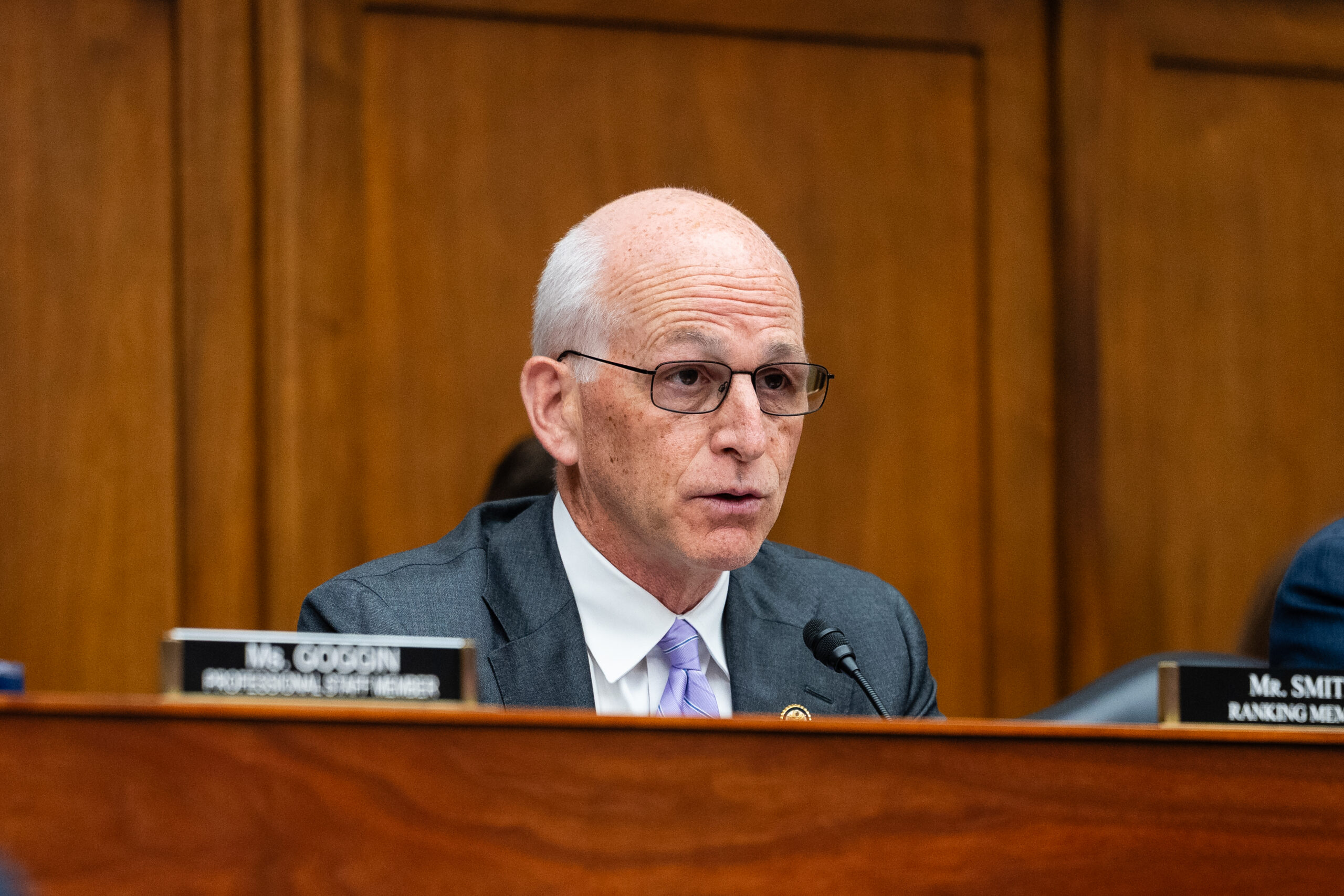
Adam Smith, a reliable supporter of Israel, said he would now join progressives in his party to oppose a provision bolstering a close U.S.-Israel alliance
POLICY PERSPECTIVE

In conversation with Biden foreign policy officials Jake Sullivan and Jon Finer, Kagan said, ‘Israel’s vision for the Middle East has never been a vision that the United States should sign up to’
The White House chief of staff initially pushed back on U.S. military engagement against Iran, according to a new book by Maggie Haberman and Jonathan Swan
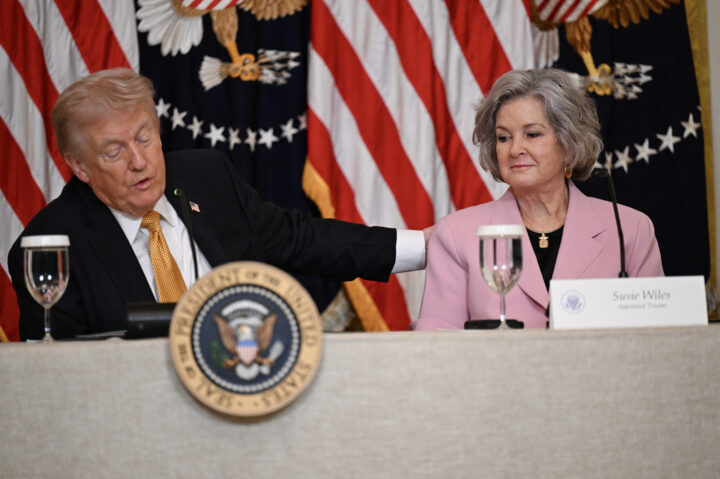
Annabelle GORDON / AFP via Getty Images
President Donald Trump hosts a lunch with the Kennedy Center Board members as chief of staff Susie Wiles looks on at the White House in Washington, DC, on March 16, 2026.
Israeli Prime Minister Benjamin Netanyahu traveled to Washington in early February 2025 with a pitch for President Donald Trump: to join Israel in a future campaign to bomb Iran’s nuclear sites. Trump did not agree at the time, though he eventually came around to the idea.
Two powerful White House figures were particularly skeptical of Netanyahu’s message.
The first was Vice President JD Vance, who has been calibrating a more isolationist worldview for years. The second, according to a new book by New York Times journalists Maggie Haberman and Jonathan Swan, was White House Chief of Staff Susie Wiles.
Their new book, Regime Change: Inside the Imperial Presidency of Donald Trump, paints a picture of Wiles as a savvy operator with sharp political instincts who, on Middle East policy matters, routinely aligned with Vance in urging Trump to reconsider major foreign policy interventions.
After that first meeting between Trump and Netanyahu, Wiles and Vance were both skeptical of Israel’s efforts to persuade the president. They feared that any involvement from the U.S. military could “spiral into an Israeli regime-change war,” according to Swan and Haberman.
Throughout the first months of Trump’s second term, Wiles and Vance both worried that former Rep. Mike Waltz (R-FL), Trump’s pick to be national security advisor, was “too hawkish” and “too sympathetic to the Israeli line,” according to the book.
Soon, after an embarrassing public scandal in which Atlantic Editor-in-Chief Jeffrey Goldberg was added to a group chat with Waltz, Defense Secretary Pete Hegseth and other top national security officials prior to U.S. strikes on Yemen last year, Waltz was removed from that position and nominated to be U.S. ambassador to the United Nations.
When Trump convened his Cabinet in early 2026 to consider whether to attack Iran again, after joining Israel in striking Iranian nuclear sites in June 2025, Wiles was once more concerned about the U.S. entering a new global conflict. She worried about “being dragged into another Middle East war,” Haberman and Swan write. Political concerns were top of mind for her — a war in Iran might lead to higher gas prices, which she feared could cost Republicans in the midterm elections this year.
Ultimately, though, Wiles got on board with the Iran war.
Wiles, Vance, Secretary of State Marco Rubio and Trump’s other top foreign policy advisors convened in the Situation Room in late February to discuss the matter.
Vance, who was known to oppose the war, spoke first. He told the president that he thought the operation was a bad idea, but he would support Trump.
Wiles was up next. She told Trump that she was on board if Trump felt the operation would protect America’s national security.
24 hours later, Trump authorized the strikes on Iran.
The White House said Special Envoy Steve Witkoff and Jared Kushner will participate in the talks, which Iran has denied
Nathan Howard-Pool/Getty Images
Delegation staff members meet in the lobby during a quadrilateral meeting between the U.S., Iran, Pakistan, and Qatar at the Lake Lucerne Summit, aimed at advancing a deal to end the Middle East conflict at the Buergenstock Resort, Lake Lucerne on June 21, 2026 near Stansstad, Switzerland.
President Donald Trump confirmed on Monday that the U.S. and Iran will meet in Qatar on Tuesday to continue negotiations, as both nations attempt to step back from a weekend exchange of military strikes that threatened to derail the fragile ceasefire agreement.
“IRAN HAS REQUESTED A MEETING. IT WILL TAKE PLACE TOMORROW IN DOHA!” Trump posted on Truth Social.
White House spokesperson Karoline Leavitt said on Fox News that White House Special Envoy Steve Witkoff and Jared Kushner would be attending the talks. “On the sidelines of those high-level talks, there will be the technical talks” to move forward the memorandum of understanding, she said.
Tehran, however, has indicated that no meeting is scheduled to take place. Iran’s deputy foreign minister and senior negotiator Kazem Gharibabadi dismissed the reports, telling Iranian state news agency IRNA that the technical talks in the Qatari capital “are not confirmed.” Esmaeil Baghaei, a spokesperson for Iran’s foreign ministry, later said Iran has no discussions scheduled with the U.S. and that an Iranian technical delegation heading to Qatar this week will not be meeting with U.S. officials.
Over the weekend, the U.S. launched targeted strikes against multiple military sites in Iran after Iran struck two oil tankers, first on Thursday and again on Saturday. Iran’s Islamic Revolutionary Guard Corps responded by firing a volley of missiles and drones at U.S. military infrastructure in Kuwait and Bahrain on Sunday.
The renewed fighting stemmed from Iran’s insistence that commercial vessels transiting the Strait of Hormuz do so within a lane under its jurisdiction, rather than Oman’s, and obtain permits to do so. Meanwhile, Trump has insisted that the ceasefire terms dictate the critical shipping lane immediately be reopened to international transit without restrictions.
Underscoring the high stakes of the breakdown, Trump warned on Truth Social following Saturday’s strikes that Iran may “never learn.”
“There may come a point when we are no longer able to be reasonable, and will be forced to militarily complete the job that we very successfully started,” Trump wrote. “If that happens, the Islamic Republic of Iran will no longer exist!”
Plus, Adam Smith's about-face
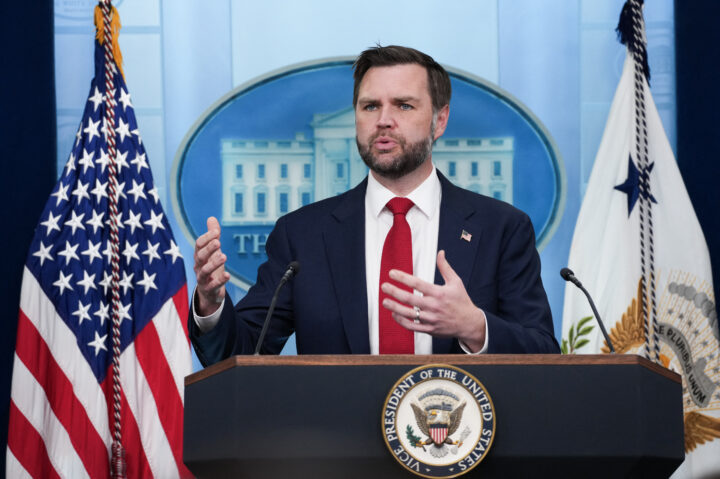
Ken Cedeno / AFP via Getty Images
US Vice President JD Vance speaks during a press briefing in the Brady Briefing Room of the White House in Washington, DC, on June 18, 2026.
Good Monday morning.
In today’s Daily Kickoff, we spotlight tomorrow’s Colorado Democratic primaries as far-left insurgents target two of the state’s top Democrats, and report on the weekend clashes between the U.S. and Iran following Tehran’s violations of the MOU signed earlier this month. We look at an effort by the California Faculty Association to repeal restrictions on gatherings put into place after the wave of anti-Israel encampments on college campuses, and report on the pivot by Rep. Adam Smith, the top Democrat on the House Armed Services Committee, to oppose a U.S.-Israel cooperation provision in the 2027 NDAA. Also in today’s Daily Kickoff: Scott Wiener, Mike Waltz and Robby Hoffman.
Today’s Daily Kickoff was curated by JI Executive Editor Melissa Weiss and Israel Editor Tamara Zieve, with assists from Danielle Cohen-Kanik and Marc Rod. Have a tip? Email us here.
What We’re Watching
- We’re keeping a close eye on the situation in the Gulf, following Iran’s targeting of commercial vessels last week and retaliatory U.S. strikes on Iranian military infrastructure. Earlier today, Iranian state media published comments from President Masoud Pezeshkian calling the agreement with the U.S. — which will include the unfreezing of some $6 billion in Iranian funds — “a great victory for the Iranian people.”
- It’s the final day of campaigning ahead of Colorado’s primaries on Tuesday. More below on the top races we’re watching.
- Elsewhere in Colorado, the Aspen Ideas Festival continues today. This afternoon, Sens. Cynthia Lummis (R-WY) and Kirsten Gillibrand (D-NY) will sit for a conversation about the role of government in the cryptocurrency market, followed by a conversation between Kim Ghattas, Karim Sadjadpour and Mark Dubowitz about Iran.
What You Should Know
A QUICK WORD WITH JI’S MELISSA WEISS
As tensions run high in the Gulf following exchanges of fire between the U.S. and Iran over the weekend, a vastly different security situation is taking shape in Lebanon, with the Trump administration’s top officials — Vice President JD Vance and Secretary of State Marco Rubio — taking responsibility for the respective outcomes.
Vance, who led last week’s negotiations with Iran in Switzerland, said upon his departure from the talks that a “good foundation” had been established between the countries. But that foundation displayed its first cracks just three days later, when Iranian drones fired on a commercial vessel in the Strait of Hormuz, prompting the U.S. to strike Iranian military infrastructure.
The vice president’s tone changed by the weekend, when he said that if Iran had “disagreements about how the MOU is being applied, they can pick up the phone. But violence will be met with violence.” The Iranians skipped technical talks slated for Sunday, saying that the U.S. had not fulfilled the condition of the MOU that would release billions in frozen funds.
Now, officials say that the U.S. and Iranian delegations have agreed to hold fire and will meet in Doha, Qatar, on Tuesday to discuss the status of the Strait of Hormuz.
In Washington, officials are meanwhile celebrating the signing of a framework agreement between Israel and Lebanon that would see Israel scale back its presence in southern Lebanon, creating two “pilot zones” for the Lebanese Armed Forces to administer.
ROCKY ROAD
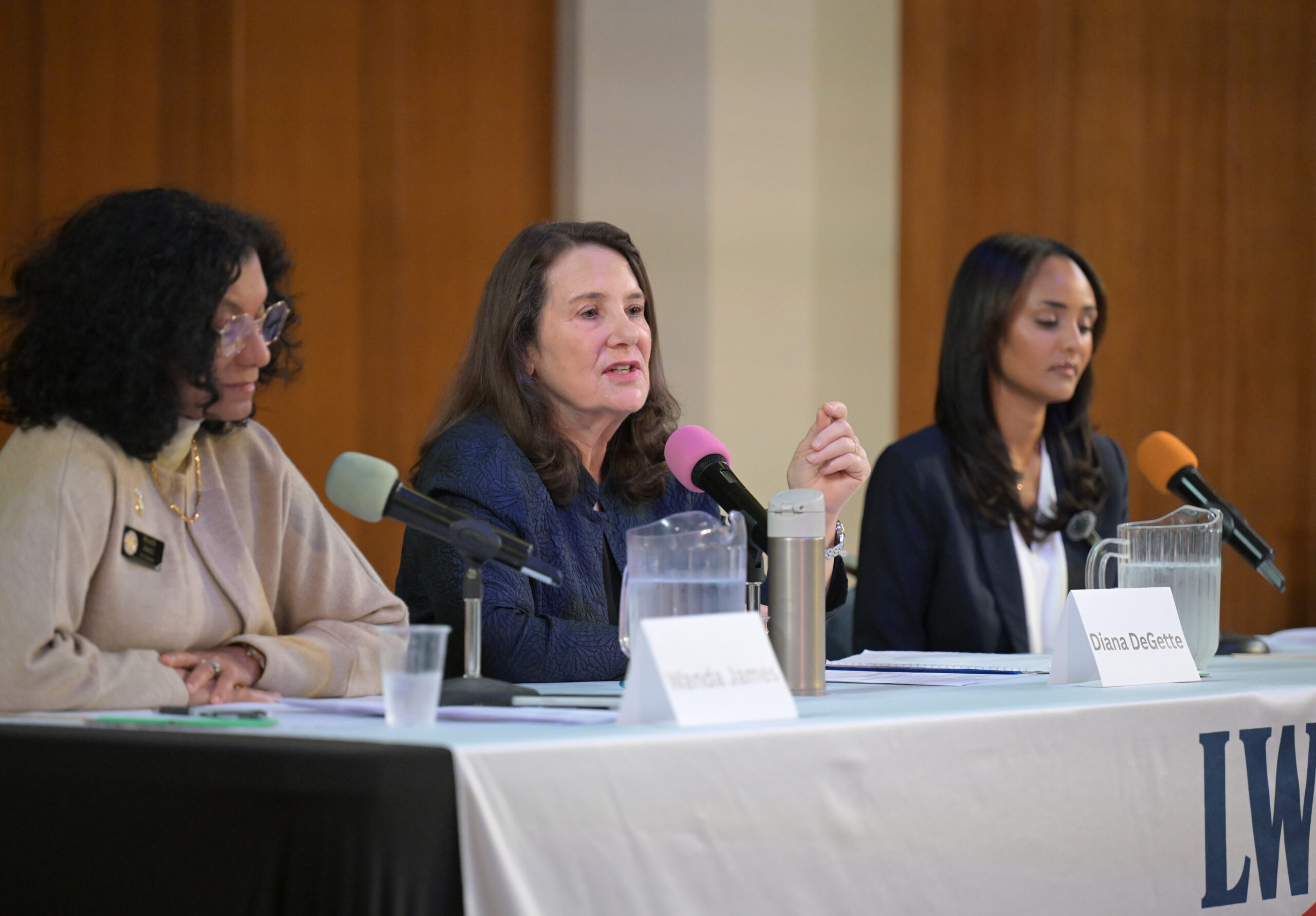
The wave of victories for Democratic Socialists of America-aligned candidates in New York City on Tuesday is buoying the hopes of progressives that the far left can pull off upsets against two Democratic incumbents in Colorado’s Tuesday primary elections, Jewish Insider’s Marc Rod reports.
Off to the races: Rep. Diana DeGette (D-CO) is facing a challenge from Melat Kiros, whose campaign has attracted substantial national attention and backing from several anti-Israel organizations and individuals. Just this week, she declined to call the firebombing of a Boulder, Colo., hostage awareness march as antisemitic. Sen. John Hickenlooper (D-CO) is also facing a DSA-aligned challenger, state Sen. Julie Gonzales, though her campaign hasn’t garnered as much attention as Kiros’. A local Democratic strategist said that he expects DeGette to be victorious but that the race is the most serious challenge she’s faced in her time in office. He also predicted a Hickenlooper victory.
SINGLED OUT
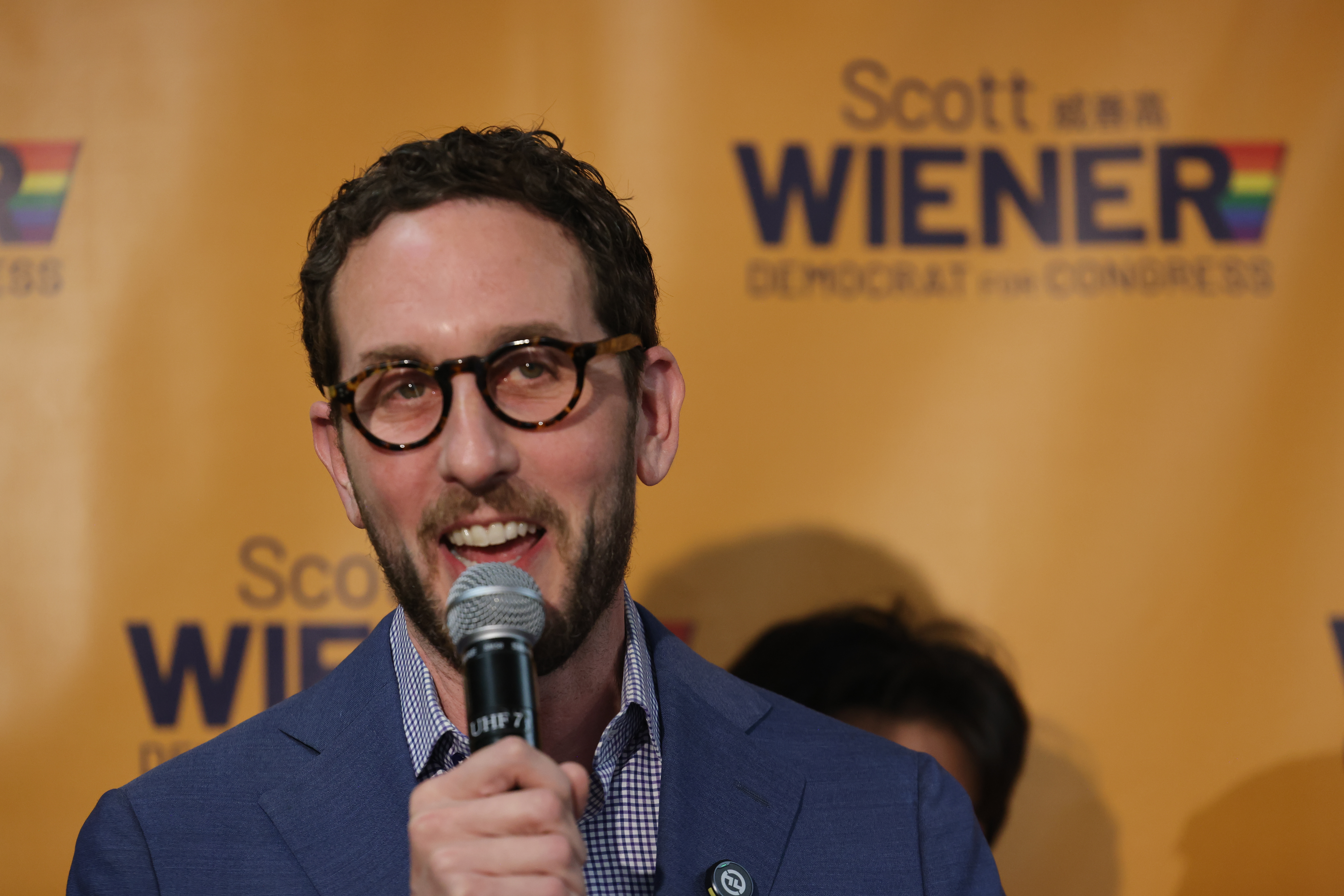
California state Sen. Scott Wiener, the front-runner to succeed retiring Rep. Nancy Pelosi (D-CA) in Congress, has become the target of antisemitic harassment twice in the last week in his San Francisco district, marking the latest example of a high-profile progressive Jewish politician being singled out and facing threats for his background, Jewish Insider’s Josh Kraushaar reports.
Forced out: On Friday, Wiener, on his way to participate in a Pride Shabbat service at a transgender march in San Francisco, was chased out of the event by anti-Israel activists. In a video posted by one local anti-Israel activist, the activist follows Wiener around, attacking him for “being terrible on Gaza,” adding, “You do not belong here anymore, Scott. And it breaks my f—ing heart.” Soon after the initial engagement, other even-more hostile activists start cursing at Wiener, with one calling him a “genocidal piece of sh—” and another saying, “F— you and your Zionist handlers.” Two days earlier, Wiener, while watching a World Cup game with staffers at a local bar, was berated by another anti-Israel activist who demanded he say the words “Free Palestine” on camera.
TRUCE TESTED

The U.S. and Iran traded strikes over the weekend, testing the fragile memorandum of understanding signed between the countries earlier this month. The U.S. first accused Iran of violating the ceasefire after it launched drone attacks on a Singapore-flagged oil tanker in the Strait of Hormuz on Thursday, Jewish Insider’s Danielle Cohen-Kanik reports.
Tit for tat: In a “powerful response” to Iran’s “unwarranted aggression,” CENTCOM said, the U.S. struck Iranian missile and drone storage locations and coastal radar sites on Friday. On Saturday, CENTCOM said Iran was “given [another] chance to honor the ceasefire agreement but elected not to” when it launched another one-way attack drone on a Panama-flagged oil tanker earlier that morning. In retaliation, the U.S. targeted Iranian military surveillance infrastructure, communication systems, air-defense sites, drone storage facilities and minelayer capabilities, CENTCOM said. By Sunday afternoon, the U.S. and Iran had agreed to cease their strikes and meet on Tuesday in Qatar to discuss the dispute over the Strait of Hormuz, Axios reported.
Policy shift: As the Trump administration moves to dismantle much of the decades-old U.S. sanctions regime imposed on Syria, the White House and lawmakers have signaled that it could soon lift its designation of Damascus as a state sponsor of terrorism, JI’s Matthew Shea reports.
WALK-BACK
Rep. Adam Smith (D-WA), the top Democrat on the House Armed Services Committee, now says he plans to support efforts to strip a provision on U.S.-Israel cooperation from the 2027 National Defense Authorization Act, after arguing strenuously against similar efforts during the committee’s markup of the same bill weeks ago, Jewish Insider’s Marc Rod reports.
Breaking it down: The provision, based on the FUTURES Act, is relatively routine, creating a single official to oversee all U.S.-Israel cooperative programs in developing and acquiring defense technologies, and builds on existing programs. But critics have falsely claimed the provision would irrevocably link the U.S. and Israeli militaries and undermine American sovereignty. Smith himself said during the committee markup that the way critics have described the amendment “is simply not accurate” and that the provision should not be treated as a referendum on the U.S.-Israel relationship. In a message to constituents viewed by JI, Smith said he now supports removing the provision.
Elsewhere on the Hill: Democrats on the House Appropriations Committee are warning that an effort by Rep. Thomas Massie (R-KY) to cut aid to Israel from the State Department’s annual funding bill could have further-reaching consequences than intended and could impact a range of other programs and issues, JI has learned.
POLICY PERSPECTIVE
Historian and prominent neoconservative foreign policy analyst Robert Kagan claimed the U.S. was “never supporting Israel for strategic reasons” and that American strategy in the Middle East has come “to be about defending the interests of Israel,” during a live taping on Friday of “The Long Game” podcast — hosted by former National Security Advisor Jake Sullivan and Jon Finer — at the Aspen Ideas Festival in Colorado, Jewish Insider’s Danielle Cohen-Kanik reports.
Podcast playback: Finer, who served as principal deputy national security advisor in the Biden administration and also worked with him under President Barack Obama, asked Kagan if he believes Israel is still a democracy and if Israel is still a U.S. ally, “given [their] increasingly divergent interests.” Calling Israel “at least an imperfect democracy,” Kagan said, “Our discussion of Israel [has become] one in which we began to believe that we had a vital interest in supporting Israel. We started supporting Israel out of a sense of moral obligation. And I think that was a noble thing to do after World War II and the Holocaust, etc. But we never were supporting Israel for strategic reasons.”
REPEAL PUSH
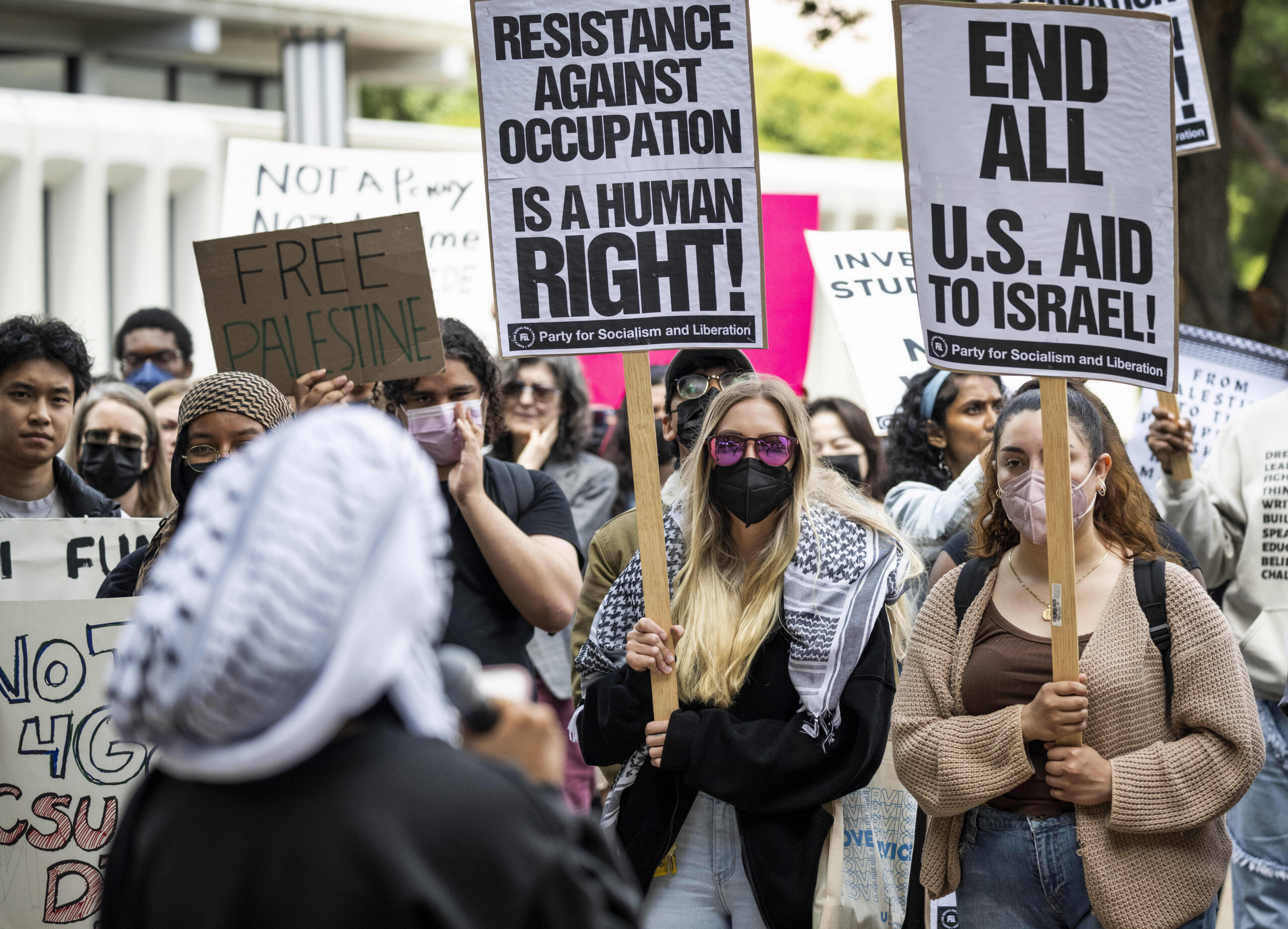
The 29,000-member California Faculty Association, California State University’s teachers’ union, is spearheading a backdoor legislative push to repeal the time, place and manner restrictions implemented across the state’s university system following its 2024 anti-Israel encampments, Jewish Insider’s Haley Cohen reports.
Campus beat: The California Faculty Association, which represents faculty across the 23 campuses of the California State University system, announced it would sponsor AB 2551, authored by Assemblymember Sade Elhawary. AB 2551 would repeal SB 1287 — California’s landmark campus safety and civil rights law — in its entirety by Jan. 1, 2029. Under SB 1287, which was introduced in 2024, California’s public universities and colleges must adopt and enforce rules against violence, harassment, intimidation and discrimination.
Worthy Reads
Perks for Pakistan: The Financial Times’ Humza Jilani spotlights Pakistani Field Marshal Asim Munir’s efforts to position Islamabad to financially benefit from a deal between the U.S. and Iran. “The larger hope is to ensure the country remains sufficiently relevant to its key partners in the U.S. and the Gulf to guarantee steady support and wean the country off a mountain of external debt, analysts and officials say. The relationship with the Trump administration helped position ‘Pakistan as a long-term stakeholder in West Asian security and stability, and provides a major opportunity to reap the economic dividends that will come with the role,’ said Kamran Bokhari, senior resident fellow with the Middle East Policy Council in Washington.” [FT]
Lesson From Louisiana: In The Wall Street Journal, Peter Kovacs, the former editor of New Orleans’ Times-Picayune, contrasts Democrats’ embrace of Maine Senate candidate Graham Platner, whose tattoo of a Nazi totenkopf has drawn widespread scrutiny, with Republicans’ rejection of former KKK leader David Duke, the party’s candidate in Louisiana’s 1991 gubernatorial runoff. “Republicans gave up the Louisiana governorship, but they achieved something more important: David Duke faded from the scene, though he kept running for office until 2016, when he finished seventh in a U.S. Senate jungle primary. … Democrats may wish they had followed the GOP’s 1991 example. Mr. Platner could win, but Republicans and their media supporters will make [Sens. Bernie] Sanders and [Chuck] Schumer — and their party’s presidential nominees — wear that tattoo for years.” [WSJ]
Slip, Sliding Away: The New York Times’ David Halbfinger talks to Israeli officials and analysts about Washington’s slipping support for the country following the latest wave of Democratic Socialists of America primary wins. “[Asaf] Zamir, the Tel Aviv deputy mayor, said, ‘I’m waking up and hearing that we’re “genocidal” and “apartheid.” I’m a left wing, two-state, pro-peace Israeli, but I’m not blind or crazy,’ he added. ‘I know what the situation in Israel is, and we’re not those things we’re being called. And yet, more and more Americans are buying into and voting on those grounds. That troubles me.’” [NYTimes]
Bondi and Beyond: In The New Yorker, Oscar Schwartz looks at how last year’s terror attack at a Hanukkah celebration in Sydney ignited a political debate in Australia that goes beyond the events at Bondi Beach. “In the immediate fallout of the mass shooting, Australia’s political discourse was dominated by two topics, gun control and antisemitism, with some casting the issues in oppositional terms. … The political backlash to the shooting at Bondi can be seen as a product of fear stoked by the attack, of course, but beneath that a deeper anxiety about the transformations occurring in Australian society can be detected.” [NewYorker]
Word on the Street
New York City Mayor Zohran Mamdani declined to express support for Israel as a Jewish state in an interview with ABC News aired Sunday, saying, “Any state that privileges one religion over the other is one that I can’t tell you I support, whether it be Israel or Saudi Arabia or anywhere else”…
U.S. Ambassador to the U.N. Mike Waltz posted a photo from Saturday’s Argentina-Jordan World Cup match alongside his wife, former Homeland Security Advisor Julia Nesheiwat — whose parents immigrated from Jordan — and the Jordanian royal family, writing, “Only in America!”…
The Washington Post does a deep dive into the “extraordinary feud” between leading Senate Republicans and Elbridge Colby, the Pentagon’s under secretary of defense for policy; the Post also reports that Sen. Rick Scott (R-FL) is continuing to block the nominations of Colby acolytes Alex Velez-Green and Austin Dahmer…
Sen. Rick Scott (R-FL) raised concerns about Qatar‘s relationship with Iran and role as an intermediary in U.S.-Iran talks, telling “Fox News Sunday” that Doha is “not our friend”…
Sen. Peter Welch (D-VT) introduced a resolution requesting information on Israel’s human rights practices in its campaign in Lebanon and whether Israel has used U.S.-provided equipment in such activities…
Sens. John Hoeven (R-ND) and Kirsten Gillibrand (D-NY) introduced a bill to expand the BARD program, which supports joint U.S.-Israel agricultural cooperation, to support mid-stage research…
U.C. Berkeley announced the planned launch of the Nancy Pelosi Institute for Representative Democracy, a nonpartisan institute named after the former House speaker that will focus on civic engagement…
The Committee to Protect Journalists said it is conducting a review of its database of journalists killed during the Israel-Hamas war after Hamas and Palestinian Islamic Jihad posted obituaries for combatants who had been listed by CPJ as journalists in Gaza…
Montgomery County, Md., Councilmember Will Jawondo on Friday declared victory in the race for county executive, having secured 40% of the tallied vote; County Councilmember Andrew Friedson, who had 34% of the vote, conceded on Sunday…
The New York Times Magazine profiles comic Robby Hoffman about the “Hacks” star’s religious upbringing in Crown Heights and career trajectory…
The head of Venezuela’s largest Ashkenazi congregation said that three members of the country’s 5,000-strong Jewish community were confirmed to have been killed in the dual earthquakes that rocked the country last week…
Whole Foods, Sprouts Farmers Market and H-E-B will begin selling products from plant-based meat company Chunk Foods as the Israeli company, founded by Amos Golan, continues its U.S. expansion…
More than two dozen people were killed in clashes along the Pakistan–Afghanistan border after Pakistani forces launched strikes and a ground operation it said targeted militant hideouts; Afghan officials said women and children were killed and injured in the attack…
Israel‘s government unanimously voted on Sunday to recognize the Armenian Genocide, a move expected to deepen already strained ties with Turkey, which rejects the genocide label. The vote came a day after Turkish President Recep Tayyip Erdoğan declared that Zionism is a “genocidal, occupying, expansionist ideology” that “threatens everyone”…
The Israeli government approved a NIS 100 million ($33.4 million) budget, which will be matched by philanthropic donations, to support Jewish day school education in the United States and Canada through the Jewish Federations of North America, eJewishPhilanthropy’s Judah Ari Gross reports…
The Financial Times spotlights U.S. efforts to modernize the production of its military arsenal and shift from expensive and time-intensive weapons to artillery that can be quickly mass-produced…
The Iran-backed Houthis in Yemen are reportedly using the recent calm in the region to conduct missile tests in preparation for potential future conflict with Israel…
The U.K.’s Times reports that Qatar provided all-expenses-paid trips to the World Cup for 1,000 “fake” fans to support the Gulf team at its matches…
Pic of the Day

Birthdays

Screenwriter, director and producer, he has won nine Emmy Awards for his work on AMC’s “Mad Men” and HBO’s “The Sopranos,” Matthew Hoffman Weiner turns 61…
Baltimore-area gastroenterologist, he is an assistant professor at the Johns Hopkins University School of Medicine, Marshall S. Bedine, M.D…. Chairman of Carnival Corporation, the world’s largest cruise ship operator (includes Carnival, Cunard, Holland America and others), and owner of the NBA’s Miami Heat, Micky Arison turns 77… Rosh yeshiva of Yeshivas Brisk in Jerusalem, Rabbi Avraham Yehoshua Soloveitchik turns 77… Former assistant surgeon general of the U.S. and deputy assistant secretary of HHS for women’s health, Susan Jane Blumenthal, M.D. turns 74… Former SVP and counsel at Columbus, Ohio-based L Brands for almost 30 years, now a consultant, Bruce A. Soll… CEO of two firms including Aliya Marketing Group, Joshua Karlin… Israeli actor, screenwriter, playwright and film director, Hanna Azoulay-Hasfari turns 66… Founder and president of Medallion Financial Corp., Andrew Murstein turns 62… Senior rabbi of Toronto’s Beth Tzedec Congregation, Rabbi Steven C. Wernick turns 59… Theater, film and television screenwriter, his credits include the 2017 film “Wonder Woman,” Allan Heinberg turns 59… Israeli political consultant and former chief of staff to Prime Minister Netanyahu, Ari Harow turns 53… Consultant, facilitator, trainer and coach, Nanette Rochelle Fridman… Rabbi of The Young Israel of Bal Harbour (Fla.), Gidon Moskovitz… Film and television director and writer, she is known for writing and directing the films “Obvious Child” and “Landline,” Gillian Robespierre turns 48… Former member of the U.K. Parliament for the Labour party, she is now a member of the House of Lords, Baroness Ruth Smeeth turns 47… Israeli actor and model, Yehuda Levi turns 47… President and dean of Phoenix-based Valley Beit Midrash and author of 30 books, Rabbi Shmuly Yanklowitz… Partner at FGS Global, Andrew Duberstein… Pitcher for Team Israel in the 2023 World Baseball Classic, he then played in the Mexican League, Charles Irvin “Bubby” Rossman turns 34… Campaign finance consultant, who has raised money for Hillary Clinton and the DNC, David Wolf… Steven Kohn… Sara Sansone… Fred Gruber…
Both Vance and Rubio will have their work cut out for them as they navigate the coming weeks
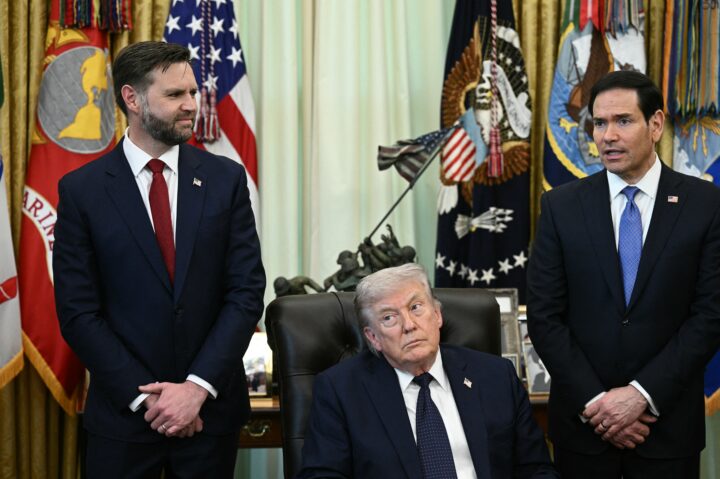
Photo by Brendan SMIALOWSKI / AFP via Getty Images
Vice President JD Vance and President Donald Trump listen to Secretary of State Marco Rubio speak during a meeting with Lebanon Ambassador to the U.S. and Israel Ambassador to the U.S., at the White House in Washington, D.C. on April 23, 2026.
As tensions run high in the Gulf following exchanges of fire between the U.S. and Iran over the weekend, a vastly different security situation is taking shape in Lebanon, with the Trump administration’s top officials — Vice President JD Vance and Secretary of State Marco Rubio — taking responsibility for the respective outcomes.
Vance, who led last week’s negotiations with Iran in Switzerland, said upon his departure from the talks that a “good foundation” had been established between the countries. But that foundation displayed its first cracks just three days later, when Iranian drones fired on a commercial vessel in the Strait of Hormuz, prompting the U.S. to strike Iranian military infrastructure.
The vice president’s tone changed by the weekend, when he said that if Iran had “disagreements about how the MOU is being applied, they can pick up the phone. But violence will be met with violence.” The Iranians skipped technical talks slated for Sunday, saying that the U.S. had not fulfilled the condition of the MOU that would release billions in frozen funds.
Now, officials say that the U.S. and Iranian delegations have agreed to hold fire and will meet in Doha, Qatar, on Tuesday to discuss the status of the Strait of Hormuz.
In Washington, officials are meanwhile celebrating the signing of a framework agreement between Israel and Lebanon that would see Israel scale back its presence in southern Lebanon, creating two “pilot zones” for the Lebanese Armed Forces to administer.
The Foundation for Defense of Democracies’ David Daoud cautioned that the celebration could be premature, telling JI that the fractious nature of Lebanon’s political and religious makeup — as well as Hezbollah’s role in the daily lives of many Lebanese citizens — makes the agreement difficult to implement, even with all the damage the Iranian-backed group has sustained over the last three years.
“Don’t underestimate Hezbollah’s ability to snatch victory from the jaws of defeat,” Daoud said. “I don’t want to overestimate their ability, but this group has proven itself very adaptable over the course of its existence.”
With the agreement signed, the next step will be its implementation. If the LAF is able to administer the pilot zones, there is the possibility of replicating the strategy elsewhere in southern Lebanon. The challenge will be when residents of southern Lebanon — which include Hezbollah members from the area — begin to return to villages south of the Litani River.
In Lebanon, the challenge is not only political will but Beirut’s capacity to address Hezbollah, which is deeply embedded in Lebanese society.
Both Vance and Rubio will have their work cut out for them as they navigate the coming weeks: Vance with continued talks with Iran and the pressure to reopen the Strait of Hormuz, and Rubio with the implementation of an agreement he hailed as the “beginning of the beginning.” Whether they are successful depends more on the actors themselves than the agreements they sign.
On Sunday afternoon, the U.S. and Iran agreed to cease their strikes and meet later in the week in Doha, Axios reported

ATTA KENARE / AFP via Getty Images
Explosions erupt following strikes at Tehran Oil Refinery in Tehran on March 7, 2026.
The U.S. and Iran traded strikes over the weekend, testing the fragile memorandum of understanding signed between the countries earlier this month.
The U.S. first accused Iran of violating the ceasefire after it launched drone attacks on a Singapore-flagged oil tanker in the Strait of Hormuz on Thursday. The Islamic Revolutionary Guard Corps had earlier issued a warning to commercial vessels “to strictly refrain from any movement outside the designated routes,” which are in parts of the waterway that it controls.
In a “powerful response” to Iran’s “unwarranted aggression,” CENTCOM said, the U.S. struck Iranian missile and drone storage locations and coastal radar sites on Friday.
On Saturday, CENTCOM said Iran was “given [another] chance to honor the ceasefire agreement but elected not to” when it launched another one-way attack drone on a Panama-flagged oil tanker earlier that morning. In retaliation, the U.S. targeted Iranian military surveillance infrastructure, communication systems, air-defense sites, drone storage facilities and minelayer capabilities, CENTCOM said.
President Donald Trump sounded his frustration in a post on Truth Social on Saturday, writing, “There may come a point when we are no longer able to be reasonable, and will be forced to militarily complete the job that we very successfully started” in Iran. “If that happens, the Islamic Republic of Iran will no longer exist!”
After the U.S. strikes, the governments of Bahrain and Kuwait said they were targeted by Iranian drone and missile attacks, which the IRGC said were attempted strikes on U.S. military bases in the country.
The IRGC added in its statement that vessels violating Iran’s instruction in the Strait of Hormuz “will be dealt with even more forcefully” and that U.S. bases in the region will be “experiencing hell” in the coming days.
By Sunday afternoon, the U.S. and Iran had agreed to cease their strikes and meet on Tuesday in Qatar to discuss the dispute over the Strait of Hormuz, Axios reported.
Qatar’s once-quiet intermediary role is now not only public, but a key element of the infrastructure supporting the new regional dynamics
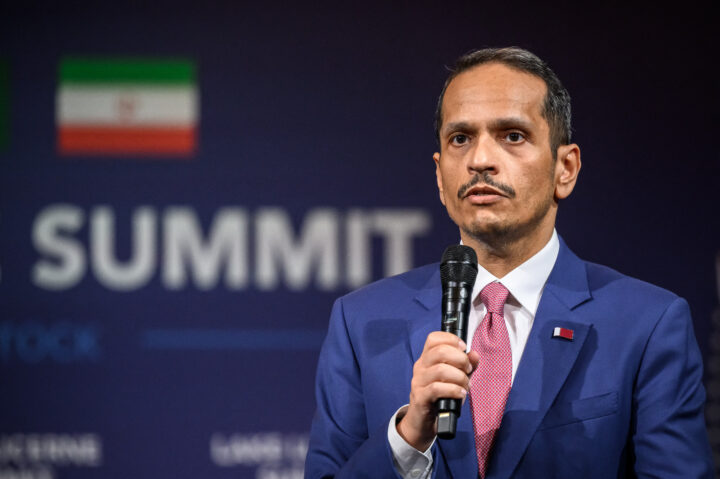
Fabrice Coffrini / POOL / AFP via Getty Images
Qatar's Prime Minister Sheikh Mohammed bin Abdulrahman bin Jassim al-Thani speaks prior to a quadrilateral meeting between the United States, Iran, Pakistan and Qatar at the Burgenstock luxury hotel complex overlooking Lake Lucerne, Switzerland, on June 21, 2026.
As diplomacy between the U.S. and Iran continues following the adoption of the memorandum of understanding between the two countries last week, Washington is again leaning on Qatar to serve as a critical interlocutor, further cementing Doha’s standing as an intermediary despite the significant setbacks sustained by the Gulf state during the recent war with Iran.
In an interview with UnHerd that was published on Thursday, Vice President JD Vance, traveling back from the Iran talks in Switzerland earlier this week, said that Doha would serve as the location for CENTCOM to meet with Islamic Revolutionary Guard Corps officials — despite the IRGC’s designation as a foreign terror organization by the U.S. (a move undertaken by President Donald Trump in his first term).
“One of the things we wanted to come out [of the negotiations] with” was a “channel on the Iranian side” to seek conflict resolution, Vance told UnHerd aboard Air Force Two. “Which we did. They were like, ‘OK, fine, we’ll send somebody from the IRGC to go hang out in Doha with somebody from CENTCOM,’ and that’s how we’re going to settle a lot of these disputes,” he said.
Doha has long played a role in the back-channel communications between the U.S. and adversaries. But Vance’s comments underscore the degree to which Qatar’s once-quiet intermediary role is now not only public, but a key element of the infrastructure supporting the new regional dynamics.
The close relationship between Washington and Doha was on full display during the Switzerland talks. On Sunday, Qatari Prime Minister Sheikh Mohammed bin Abdulrahman Al Thani posted a photo of himself with Vance and Jared Kushner as the three huddled around a laptop. “Live from Lucerne, work continues” with Vance and Kushner, Al Thani wrote in separate English and Arabic posts.
Earlier this week, the White House leaned on Al Jazeera, the Qatari-owned media outlet, to deny a report that Vance had been snubbed by the Iranians at a press conference following talks in Switzerland — a signal that Washington is increasingly treating Qatari institutions as useful and legitimate when its message is being amplified.
Qatar wasn’t affected by the war in the same way as the UAE, which faced more missile fire than any other country in the region, including Israel. But it also wasn’t immune from Iranian attacks. Early in the war, Iranian missiles targeted the Gulf state’s Ras Laffan gas complex, causing some $20 billion in annual revenue loss and damage that is estimated to take five years to fully repair.
The strike on Ras Laffan came in spite of a secret effort by Qatar, first reported by The Washington Post, to press Iran not to target the facility. In exchange, the Post reported, Doha offered to use its leverage to halt gas production and send oil costs up — moves intended to increase pressure on the U.S. and Israel to wind down the war quickly.
Qatar has long tried to play to all sides in conflicts even as it serves as a mediator — despite the inherent risks. It was an Iranian strike on the U.S. base in Qatar last June that marked one of the final salvos of the 12-day war. Months later, five Hamas members and a Qatari security guard were killed in an Israeli strike on a building used by Hamas for its senior officials who live in Doha.
Doha’s strategy over the last two decades of investing anywhere and everywhere has largely paid off (though not through sports prowess, as evidenced by the Qatari team’s World Cup loss to Bosnia and Herzegovina on Wednesday). In this next phase, Qatar will continue to seek to play a key role in Iran talks and the implementation of any agreements — ensuring that the Gulf state has significant buy-in in shaping the future of the region.
Plus, David Harris' message for Dems

Morteza Nikoubazl/NurPhoto via Getty Images
Islamic Revolutionary Guard Corps (IRGC) military personnel stand guard on an avenue in downtown Tehran during a rally commemorating the International Quds Day, also known as the Jerusalem day, on April 29, 2022.
Good Thursday afternoon.
This P.M. briefing is reserved for our premium subscribers like you — offering a forward-focused read on what we’re tracking now and what’s coming next.
Today’s Daily Overtime was curated by JI U.S. Editor Danielle Cohen-Kanik.
📡On Our Radar
Notable developments and interesting tidbits we’re tracking
Vice President JD Vance said in an interview released todaythat U.S. military officials are going to “hang out” with representatives of the Islamic Revolutionary Guard Corps, a U.S.-designated terror organization, in Qatar in an effort to establish a conflict-reduction mechanism, Jewish Insider’s Danielle Cohen-Kanik reports.
“[Iran was] like, ‘OK, fine, we’ll send somebody from the IRGC to go hang out in Doha with somebody from CENTCOM,’ and that’s how we’re going to settle a lot of these disputes,” Vance said. He added that officials from the UAE — “by far the most hawkish, by far the most pro-Israel country in the [Gulf Cooperation Council]” — are also in touch directly with the IRGC…
Meanwhile, the IRGC reportedly attacked a cargo ship in the Strait of Hormuz today after issuing a warning to commercial vessels “to strictly refrain from any movement outside the designated routes.”
Iranian officials are further considering a plan to charge for security and environmental services in the strait that would generate $40 billion a year, sources told The Wall Street Journal. Tehran is seeking buy-in from other countries bordering the waterway and offering to share the revenue…
Secretary of State Marco Rubio, speaking to reporters in Bahrain as he wrapped up his Middle East tour today, said that U.S., Israeli and Lebanese representatives meeting for their last day of negotiations in Washington were “very close in our hopes of getting a commitment of intent” — a formal document typically used to outline preliminary terms between parties…
Rubio also spoke at a meeting of GCC foreign ministers where he vowed that Washington would not strike a deal with Iran that undermines “the security, the stability or the prosperity of any of our partners in the Gulf region”…
Iranian parliament speaker and top negotiator Mohammad Bagher Ghalibaf denied President Donald Trump’s claim that the funds received by Iran under the memorandum of understanding will be used to buy American agricultural products. “The only crop we’re harvesting is what you planted: decades of mistrust,” Ghalibaf wrote on X, adding, “apparently the US only exports GMO soybeans, broken promises and trash talks”…
A new Quinnipiac University poll released yesterday found 48% of American voters say the U.S. is too supportive of Israel — the highest level since the survey started posing the question in 2017 — including 66% of Democrats and 20% of Republicans.
Fifty-nine percent of voters said they are “not so confident” or “not confident at all” that Trump’s deal with Iran will work, while 37% said they are “very” or “somewhat” confident…
The New York Times reports on a February meeting between Carl Heastie, speaker of the New York State Assembly, and officials from the New York City Democratic Socialists of America chapter, where Heastie reiterated his request that the group stop targeting incumbent Democrats.
“We told him then, and we’ll tell him now: That’s not something we can do. We have to continue to grow our numbers and grow our influence, and that means challenging incumbents,” recalled Grace Mausser, an NYC-DSA co-chair…
Nassau County Executive Bruce Blakeman, the long-shot GOP candidate for New York governor, lashed out at congressional candidate Brad Lander on Wednesday night, telling Newsmax that the Jewish nominee is “antisemitic” and “would be a camp guard in the concentration camp if he could.” Blakeman, who is also Jewish, dialed back his remarks somewhat in a subsequent statement, saying, “Maybe camp guard was too strong, but certainly collaborator.”
Lander responded, “We named our son after Marek Edelman, a leader of the Warsaw ghetto uprising. That’s how seriously I take the legacy of Jews who fought Nazis”…
Sen. Chris Van Hollen (D-MD) became the second senator to endorsefar-left Michigan Senate candidate Abdul El-Sayed today, after Sen. Bernie Sanders (I-VT) became an early backer of the physician’s campaign. El-Sayed, who has drawn criticism for his heated anti-Israel rhetoric and campaigning with antisemitic streamer Hasan Piker, has previously advocated for Van Hollen to replace Senate Minority Leader Chuck Schumer (D-NY) as the Democratic leader in the Senate, due to Schumer’s continued support for U.S. aid to Israel…
Andy Burnham, the presumptive next prime minister of the U.K., has tapped as his chief of staff James Purnell, a former member of Parliament and lobbying executive who previously served as head of Labour Friends of Israel more than 20 years ago. Purnell also served as a Cabinet minister under former Prime Minister Tony Blair, who is now leading efforts on the Board of Peace for Gaza…
MIT professor Yossi Sheffi talks to the NYT about his forthcoming book on antisemitism at the elite school in the aftermath of the Oct. 7 Hamas attacks: Unsafe at M.I.T.: A Chronicle of a Campus War on the Jews. Sheffi said his book takes the place of an official study and report on campus antisemitism, which many universities undertook after the disruptive student protests of 2023-2024, but MIT did not…
Some Texas Jewish leaders are objecting to proposals under consideration by the State Board of Education that would require public school students to read Bible passages in class, saying they misrepresent Jewish tradition, despite their supporters touting the promotion of “Judeo-Christian” values…
⏩ Tomorrow’s Agenda, Today
An early look at tomorrow’s storylines and schedule to keep you a step ahead
Keep an eye on Jewish Insider for an interview with David Harris, the longtime former CEO of the American Jewish Committee, about his book, Antisemitism: What Everyone Needs to Know.
Harris’ view: “Every Jewish organization looking for a Democrat from Washington lines up to invite Sen. John Fetterman (D-PA). If he’s not available, they’re all baffled as to who else to invite from the contingent of Democrats in the U.S. Senate.”
Amid gridlock on the House floor driven by some Republicans’ frustration with the Senate’s failure to pass President Donald Trump’s signature voter ID bill, the House canceled many of its expected votes this week, including those on the 2027 State Department budget and an effort to cut U.S. aid to Israel. The chamber will return next week with plans to work on the 2027 National Defense Authorization Act.
The Aspen Ideas Festival in Colorado continues, including a session on higher education with Princeton University President Chris Eisgruber and a live recording of “The Long Game” with former National Security Advisor Jake Sullivan and his deputy Jon Finer, the podcast’s co-hosts, with Brookings senior fellow Robert Kagan.
We’ll be back in your inbox with the Daily Overtime on Monday. Shabbat Shalom!
Stories You May Have Missed
TORRES TACTICS

The pro-Israel congressman raised early campaign cash, defined his opponent aggressively and prioritized strong constituent services
ON THE HILL
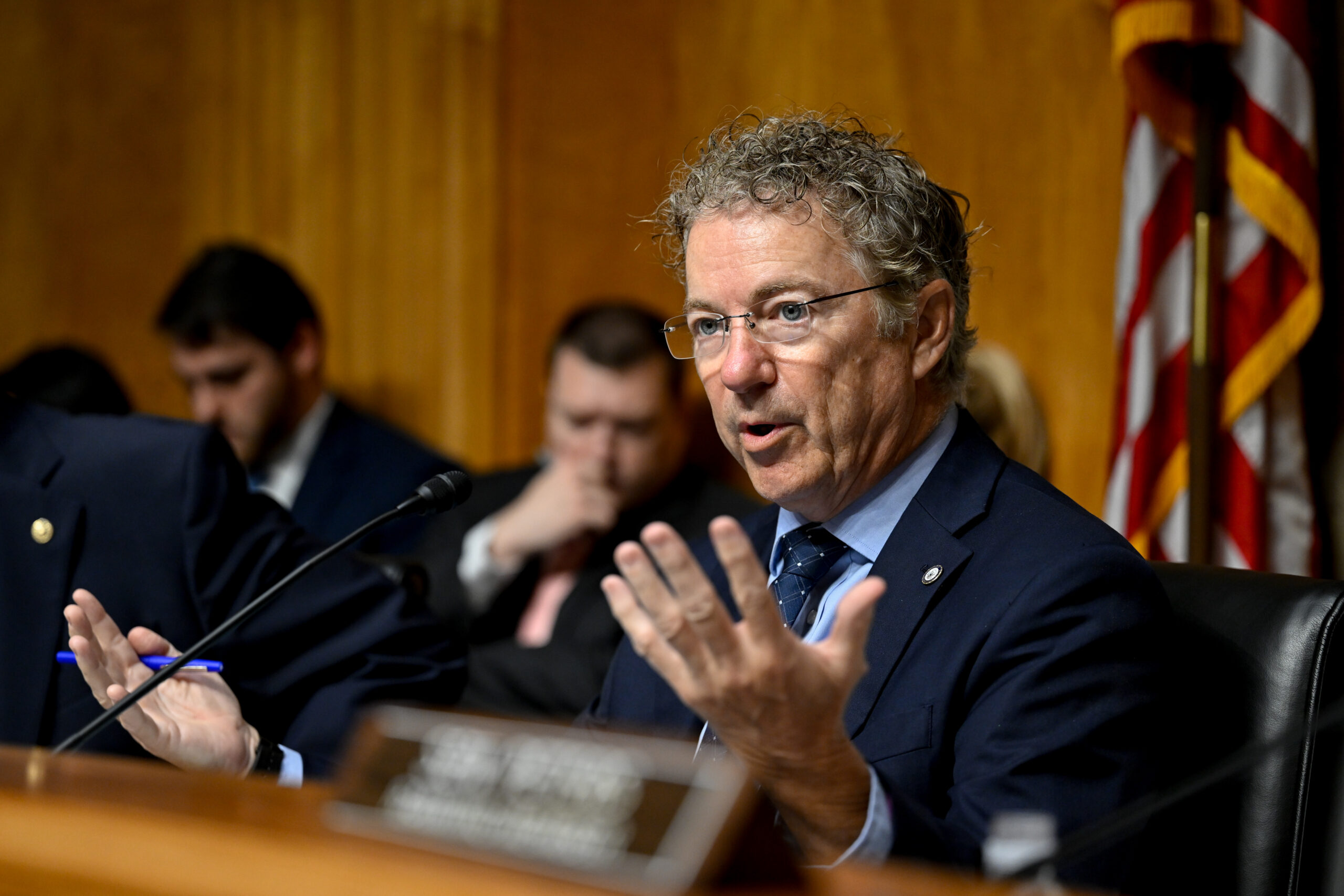
Sens. Bill Cassidy and Rand Paul, supporters of previous war powers efforts, changed their votes on the resolution, which had previously passed a procedural hurdle
Trump designated the Islamic Revolutionary Guard Corps as a terrorist organization during his first term; the group has been tied to plots to assassinate him and other U.S. officials
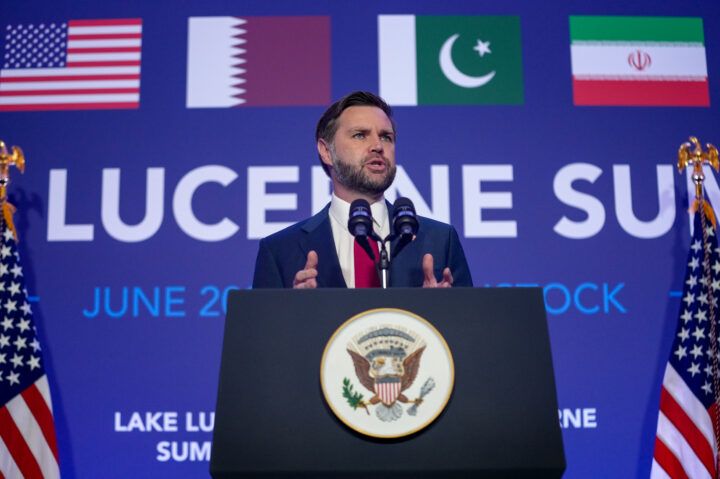
Nathan Howard-Pool/Getty Images
Vice President JD Vance speaks to members of the media at the Buergenstock Resort Lake Lucerne, after the U.S. and Iran held high-level talks at the Lake Lucerne Summit on June 22, 2026 near Stansstad, Switzerland.
Vice President JD Vance said this week that U.S. military officials are working directly with Iran’s Islamic Revolutionary Guard Corps, a U.S.-designated Foreign Terrorist Organization. The vice president made the comments after departing Switzerland following the conclusion of talks with Iran that lasted until Monday.
“One of the things we wanted to come out [of the negotiations]” was a “channel on the Iranian side” to seek conflict resolution, Vance told the outlet UnHerd aboard Air Force Two. “Which we did. They were like, ‘OK, fine, we’ll send somebody from the IRGC to go hang out in Doha with somebody from CENTCOM,’ and that’s how we’re going to settle a lot of these disputes,” he said.
President Donald Trump designated the IRGC an FTO during his first term in 2019 and ordered the strike that killed IRGC Quds Force head Qasem Soleimani in 2020. Announcing the designation, the State Department said the group “has been directly involved in terrorist plotting; its support for terrorism is foundational and institutional, and it has killed U.S. citizens.” The IRGC also “continues to provide financial and other material support” for terror groups including Hezbollah, Kataib Hezbollah, Hamas and Palestinian Islamic Jihad, the statement added.
The group played a central role in Iran’s attacks around the region during the U.S.-Iran war, including an attack on the U.S. Fifth Fleet headquarters in Bahrain earlier this month, and is linked to dozens of recent plots and attacks in Europe. U.S. authorities have also repeatedly alleged IRGC involvement in assassination schemes targeting current and former American officials, including Trump.
Vance said that the Emiratis — “by far the most hawkish, by far the most pro-Israel country in the [Gulf Cooperation Council]” — are also “having conversations with the Iranians that have never happened before, including with the IRGC,” namely about economic incentives to urge Iran to cooperate.
Regarding criticism of the memorandum of understanding reached with Iran, Vance said, “There are many things I don’t like about the comparison to the [2015 Joint Comprehensive Plan of Action], but one of them is that the MOU is a much more generic document than the JCPOA.”
“It really is a foundational document,” he said of the MOU. “Let’s open the strait, let’s stop shooting at each other, and let’s see if we can make a nuclear deal. And from their perspective, it’s, ‘Let’s lift the blockade, let’s stop shooting at each other, and let’s see if there’s a sanctions deal.’ That’s fundamentally where it’s coming from.”
Vance claimed the Iranians are now offering “things radically different from the JCPOA” and “want a fundamentally transformed relationship with the United States and the world.”
Sens. Bill Cassidy and Rand Paul, supporters of previous war powers efforts, changed their votes on the resolution, which had previously passed a procedural hurdle
Daniel Heuer/Bloomberg via Getty Images
Senator Rand Paul, a Republican from Kentucky and chairman of the Senate Homeland Security and Governmental Affairs Committee, during a confirmation hearing in Washington, DC, US, on Wednesday, June 17, 2026.
The Senate voted on Wednesday night to block a Democratic-led war powers resolution seeking to end military operations against Iran, after a heated meeting between President Donald Trump and Senate Republicans where he berated a handful of lawmakers over their votes in favor of a successful war powers resolution the previous day.
Sens. Bill Cassidy (R-LA) and Rand Paul (R-KY), supporters of previous war powers efforts, changed their votes on the resolution on Wednesday, which had previously passed a procedural hurdle — Cassidy now voting no and Paul voting present. Sens. Susan Collins (R-ME) and Lisa Murkowski (R-AK) again voted yes, while Sen. John Fetterman (D-PA) voted no. The final vote was 50-47.
Cassidy, who engaged in a shouting match with Trump in the meeting over his recent war powers votes, told reporters after the meeting that he would not change his vote until he had been briefed on the war. Hours later, Cassidy received a private briefing on the war from Vice President JD Vance and White House Special Envoy Steve Witkoff.
“I am reassured. I had my briefing. My criteria is met,” Cassidy said. “As long as I’m reassured that there’s honesty and that, as they’re depicting events, it’s playing out appropriately, I’m reassured. But again, you want to trust but verify.”
Cassidy had said earlier in the day that he did not believe the administration’s prosecution of the war was on track to achieve the goals it laid out. Following that conversation, Cassidy changed his tune.
“I think it’s plausible that they are achieving the objectives, as they laid it out,” Cassidy told Jewish Insider. He added that he wants to “see events transpire the way they depict them, but they had plausible explanations for how they’re achieving those objectives.”
Cassidy said he had passed a note to Witkoff, who attended the Senate meeting with Trump, asking him for a briefing, and the White House had called within the hour to set it up.
The Louisiana senator has emerged as a key swing vote since losing his primary to Trump-backed Rep. Julia Letlow (R-LA).
Paul, the earliest GOP vote in favor of war powers efforts, said his present vote came in deference to the administration’s negotiating strategy.
“My opinion on the debate over war and executive power has not changed and I have voted that way several times. But since hostilities seem to be over and the president asked me to give consideration to his negotiating position, I will do so,” Paul said. “My vote of present is a way to give the president more space and leverage to negotiate a lasting peace.”
Cassidy said Trump raised his voice after the senator defended his vote backing a resolution directing the administration to withdraw U.S. forces from Iran
Bill Clark/CQ-Roll Call, Inc via Getty Images
Sen. Bill Cassidy, (R-LA), walks through the Ohio Clock Corridor before President Donald Trump arrives for the Senate Republicans' lunch meeting in the U.S. Capitol on Wednesday, June 24, 2026.
President Donald Trump engaged in a shouting match with Sen. Bill Cassidy (R-LA) during a closed-door lunch with Senate Republicans on Wednesday over the outgoing Louisiana senator’s support for a war powers resolution directing the administration to withdraw U.S. forces from Iran that passed the chamber the previous day.
Cassidy acknowledged the incident after the luncheon concluded, telling reporters that the dispute began when the president questioned aloud why any Republican would vote for the resolution. The Louisiana senator stood up from his chair and asked Trump if his question was rhetorical or if he wanted an explanation. Cassidy said Trump responded by asking for an explanation, which the senator obliged.
The Louisiana senator said that he told the president, “You have not told the American people what’s going on. It was supposed to last four weeks, it has lasted for four months. Our original objectives have not been achieved. And I want to know what’s going on.”
He went on to say that Trump “did not particularly care for my comments” and “raised his voice,” prompting Cassidy to grow angry. At some point during the confrontation, other GOP senators encouraged Cassidy to sit down and tried to “deescalate” the situation. Cassidy obliged his colleagues and stopped engaging the president.
“I lost my temper,” Cassidy said. “That’s not appropriate, it’s the Irish in me. But I, again, matched his tone, and his volume. It went back and forth.”
Cassidy accused Trump of making several negative comments about him, including a remark about Cassidy losing his reelection bid to a Trump-backed challenger. Another GOP senator said that Cassidy referred to Trump as “my brother” at one point instead of his formal title, which Trump responded to angrily.
Still, the senator said that Cassidy remained respectful of the president during the exchange, and attributed the blowup in part to Trump’s longstanding frustration with Cassidy on a range of issues, including his impeachment in 2021.
Cassidy noted that he would continue to vote for the war powers resolutions until he is briefed on the war effort. Sens. Lisa Murkowski (R-AK), Susan Collins (R-ME) and Rand Paul (R-KY) joined Cassidy in helping Democrats pass a war powers resolution in the Senate for the first time on Tuesday, delivering the upper chamber’s first rebuke of the president’s war.
He added that he will be satisfied once the administration briefs Congress on the details of the U.S. memorandum of understanding with Iran. “You say everything’s fine, but on the outside, it doesn’t look like everything’s fine,” he said of the Trump administration’s handling of diplomatic efforts to end the war in Iran.
“I make no apologies for standing up to the president, if you will, trying to demand that more information be shared with the American people,” Cassidy said. “If someone tries to bully you into not asking that question, I’m not going to accept that either. I am sticking up for the American people, even if I’m speaking to the president.”
The meeting was organized by Sen. Rick Scott (R-FL) and comes at a time of heightened tension between Trump and the Senate Republican conference over the war powers vote; Trump’s demands that the Senate pass his signature voter ID bill, for which Senate Republicans say they lack the votes; and, most recently, Trump’s last-minute decision on Wednesday morning to cancel a signing ceremony at the Capitol for a much-anticipated bipartisan housing package.
A large group of Senate Republicans — including Senate Majority Leader John Thune (R-SD), Majority Whip John Barrasso (R-WY), Sens. John Hoeven (R-ND), Jerry Moran (R-KS), Thom Tillis (R-NC), Mike Rounds (R-SD), Katie Britt (R-AL), Kevin Cramer (R-ND), Tim Scott (R-SC), Mike Crapo (R-ID), John Kennedy (R-LA), Collins, Murkowski and others — huddled on the Senate floor for an extended period after the contentious meeting, in what appeared to be an at-times animated conversation.
Following the luncheon, Scott told reporters that Trump was “very forceful about what he cares about,” also noting that the president talked about Iran “a lot.”
“[Trump] is very comfortable he’s going to get a deal,” Scott said. “[Iran is] doing exactly what he wants. He was very disappointed that somebody would vote on the war powers resolution to stop him in the middle of negotiations, so that frustrates him.”
Scott suggested he understands Trump’s heated demeanor: “If I was the president, I was in the middle of a negotiation to protect American lives, I would be frustrated too.”
Scott said that Trump told senators that Iran is not telling the truth about the talks, and that if Iran doesn’t agree to a good deal, the U.S. will return to military action.
“He said Iran’s agreeing to whatever his requests are. Don’t believe in anything [that] the Iranian press is putting out, because it’s a complete lie,” Scott said. “He’s very comfortable that they’re not gonna have nuclear weapons, they’re not going to have the money to be able to continue to support Hamas, Hezbollah and the Houthis, so he’s very comfortable that we’re going to have a good deal.”
Kennedy, who has been skeptical that the Iranian regime will hold to the terms of any deal but supportive of the administration’s negotiation efforts, offered a similar view.
“I’m in the middle of serious negotiations, trying to settle a conflict, and one of my mates undermines me,” Kennedy said of the president’s perspective. “I’m going to be mad too, and he was mad as a murder hornet about that. He’s right to be mad, in my opinion. Not criticizing anybody for their vote, but these next 60 days are critical,” he added, referring to the 60-day window for further negotiations established in the agreement with Iran.
“We ought to support him, whether you like him or not,” Kennedy continued. “I don’t know how it’s going to end up, you’ll have plenty of time to assess it after 60 days, but we’re going to give peace a chance for 60 days.”
Cramer said that Trump was “very detailed” in his discussion of the situation in the Middle East, but he and other Republicans said there was little opportunity for them to ask questions.
Like Scott, Cramer said Trump disputed Iran’s characterizations of the talks. “He emphasized again that everything they’re saying they’re not giving up, they’re giving up,” Cramer said. “My trust is in our administration until such time as they sign something that’s foolish.”
Another GOP senator, speaking on condition of anonymity, said that Trump emphasized to the group that he could “blow everything up” but that that would have harmed many Iranians, which he wanted to avoid.
The senator told JI that the president explained the MOU to senators — including the financial benefits Iran stands to gain and his decision to strike Iranian nuclear sites in 2025 — and defended his diplomatic overtures to the Iranian regime. They said that Trump told the group, “Without any question in his mind, the number one thing is that Iran is just not going to be able to have a nuclear weapon, ever.” The senator said Trump expressed “so much compassion for Israel” in his remarks.
Trump also warned the lawmakers, according to the senator, that, “If we don’t watch out, what we do here can screw up a whole lot of stuff when you’ve got people that are negotiating” a possible deal with Iran.
Rounds said the president provided senators “more of a briefing in terms of what [the administration is] doing over [in Iran] than we’ve heard to date.” However, Rounds noted that “most of it to me was consistent with what we’ve learned” in previous classified briefings.
When asked whether Republican senators explained to Trump that there is a lack of votes to pass his voter ID bill, the SAVE America Act, Rounds said, “We really didn’t get into that.”
Sen. Tommy Tuberville (R-AL), a strong supporter of the president, praised Trump’s performance in the meeting, telling reporters after the luncheon, “You can’t take it personal. You’ve got to go in knowing that the head coach is coming into the … room.”
“The president did a hell of a job of getting his message over, and sometimes in a loud voice, sometimes not so loud,” Tuberville said. “That’s how you do it. That’s how I did it. Not to say it’s perfect. He came in and got his point across, and I think when we all left, we understood where he [stands].”
Sen. Roger Marshall (R-KS) similarly dismissed the shouting match between Trump and Cassidy as indicative of the president having an issue with the Senate GOP conference.
“I think it’s great for a family to have these types of discussions,” Marshall said. “You all act like no one ever yelled at each other. I didn’t go into a doctor’s hospital board meeting where there wasn’t yelling at each other. I think it’s perfectly fine if you’re trying to air your grievances.”
Sen. John Cornyn (R-TX), meanwhile, sarcastically told reporters that there “was quite a unity message” during the meeting.
Cornyn also remarked that Trump spoke for an hour and 15 minutes and that there “wasn’t really an opportunity” for him to get a question in.
The president’s continued push for the Senate to pass the SAVE America Act, despite lacking the votes without abolishing the 60-vote filibuster threshold, was also a major point of contention.
“He wants the SAVE Act, that much is clear,” Kennedy told reporters. “I want to say that I’m on the record for any way to get the SAVE Act passed. I still think there’s potential through reconciliation, but some of my Senate colleagues don’t agree with it. … It’s clear he wants it.”
“I know there’s frustration over the SAVE Act passage, but we simply don’t have the votes because we’re not going to nuke the filibuster,” Tillis said. “We’ve made it clear multiple times, if the SAVE Act requires nuking the filibuster it’s simply not going to happen and that’s been obvious long before today.”
Plus, Trump brings the heat to Capitol Hill
John Lamparski/Bloomberg via Getty Images
Voting booths at a polling location during a primary election in New York on June 23, 2026.
Good Wednesday afternoon.
This P.M. briefing is reserved for our premium subscribers like you — offering a forward-focused read on what we’re tracking now and what’s coming next.
Today’s Daily Overtime was curated by JI U.S. Editor Danielle Cohen-Kanik.
📡On Our Radar
Notable developments and interesting tidbits we’re tracking
Moderate House Democrats were shaken by the success of several Democratic Socialists of America-backed candidates in New York City primaries last night, and particularly the ouster of two incumbents by their left-wing challengers. “People who do not support the DSA wring their hands at cocktail parties, while the DSA is organizing,” Rep. Tom Suozzi (D-NY) told Axios. “You can’t win with these guys by playing patty cake,” another centrist House Democrat said…
Jewish leaders also expressed dismay at the election results: Rabbi Ammiel Hirsch of the Reform Stephen Wise Free Synagogue, an outspoken critic of New York City Mayor Zohran Mamdani, told The New York Times that “a lot of American Jews” woke up today to “a sense of sadness, a sense that we’re losing something important.”
Rabbi Andy Bachman, a former rabbi at Congregation Beth Elohim in Brooklyn, said the “most disturbing” thing about the election results was that “if you declare genocide in Gaza, despite a distinct lack of experience compared to people that you’re running against, it can win you an election”…
Fresh off his election night victories, Mamdani announced today he would be meeting with House Minority Leader Hakeem Jeffries (D-NY), Jewish Insider’s Will Bredderman reports.
Jeffries said earlier that he and Mamdani “agree to strongly disagree about some of his endorsements,” after the mayor helped unseat two New York City Democrats: Reps. Dan Goldman and Adriano Espaillat. “He’s got work to do in terms of the conversations that he’s going to have with members of Congress moving forward,” Jeffries said of Mamdani…
After blindsiding lawmakers today when he abruptly canceled a bill signing for a widely supported bipartisan housing bill, President Donald Trump attended a tense GOP Senate luncheon where he railed against the Senate’s passage of an Iran war powers resolution yesterday and got into a shouting match with Sen. Bill Cassidy (R-LA), who voted in favor.
When Trump asked why any Republican would have supported the measure, Cassidy, who was recently defeated by a Trump-backed challenger, recalled, “I stood and said, ‘You have not told the American people what’s going on’”…
Secretary of State Marco Rubio met with UAE President Sheikh Mohamed bin Zayed in Abu Dhabi this morning, where Rubio said he “thanked the UAE leadership for their unparalleled support, praised their courage and resilience in the face of Iran’s attacks, and reaffirmed our commitment to Emirati security”…
Pictured sitting next to the secretary of state in a working lunch with MBZ was Michael Boulos, Trump’s son-in-law whose father serves as a senior advisor to the president on the Middle East. Rubio said later that his “good friend” Boulos was not involved in the policy discussions…
Rubio then traveled to Kuwait, where he told reporters that technical talks with Iran are slated to resume next week and dismissed speculation that Israel is attempting to undermine the memorandum of understanding: “The Israelis exactly know what we’re working on. All of our partners in the region know what we’re working on”…
Yesterday’s discussions between Israeli and Lebanese representatives for their fifth round of negotiations at the State Department ended without progress and at some points became “ugly,” Axios reports, as military officials from both countries presented conflicting plans for the IDF’s withdrawal from southern Lebanon.
Rubio told reporters that Jerusalem and Beirut are still working to establish pilot zones under the control of the Lebanese Armed Forces where the IDF will pull back, saying, “The more of that area that the LAF is able to secure, the less of it is in Hezbollah’s control, the less Israel will be in Lebanon.” But Israeli Defense Minister Israel Katz stated today that the IDF will not withdraw from southern Lebanon “even if there is an American demand”…
Rubio also presided over the official reopening of the U.S. Embassy in Kuwait City after it was shuttered for security reasons several months ago amid the Iran war…
Iranian parliament speaker and chief negotiator Mohammad Bagher Ghalibaf called the agreement signed with the U.S. “a declaration of America’s defeat,” saying at a conference in Azerbaijan that it was reached as a “result of the resistance and authority” of Iran…
The Trump administration is planning to approve the sale of dozens of jet engines worth more than $700 million to Turkey, according to Reuters, ahead of the NATO summit in Ankara next month. The move comes despite reported security concerns from Congress…
FBI Director Kash Patel met with Qatari Interior Minister Sheikh Khalifa bin Hamad Al-Thani in Washington…
CENTCOM announced that the U.S. killed senior ISIS leader Ali Husayn al-‘Ulaywi in an airstrike in northwest Syria on Friday…
Iranian negotiators are consulting Trump’s book, The Art of the Deal, and psychologists in order to navigate the president’s shifting tone in negotiations, sources told The Wall Street Journal…
⏩ Tomorrow’s Agenda, Today
An early look at tomorrow’s storylines and schedule to keep you a step ahead
Keep an eye on Jewish Insider for a look at how Rep. Ritchie Torres (D-NY) avoided a similar fate to his pro-Israel House colleagues who were ousted from their seats as he overwhelmingly defeated a left-wing challenger who made Torres’ support for Israel central to his attacks.
The House Committee on Education and Workforce will mark up Rep. Randy Fine’s (R-FL) No Antisemitism in Education Act.
Homeland Security Secretary Markwayne Mullin will testify at an oversight hearing in the House Appropriations Committee.
The State Department will begin its two-day Pax Silica Summit at the U.S. Institute of Peace, hosted by Under Secretary of State for Economic Affairs Jacob Helberg, focused on strengthening cooperation in AI supply chains, critical minerals, energy and more. The event will be attended by representatives from the Pax Silica signatory countries — which include Israel, Qatar, the UAE, India, Germany and the U.K., among others — and senior business executives.
The Texas Democratic State Convention begins tomorrow, featuring remarks over the three-day event from Sens. Cory Booker (D-NJ) and Bernie Sanders (I-VT), Texas U.S. Senate candidate James Talarico, Illinois Gov. JB Pritzker and Democratic National Committee Chair Ken Martin. Activists will consider close to 20 resolutions critical of Israel — some of which condemn AIPAC and DMFI — introduced by seven individuals at a party convention in June.
The annual Aspen Ideas Festival will kick off in Colorado, bringing together leading figures from politics, business, media and academia for a week of discussions on global challenges including AI, economic policy and national security.
Stories You May Have Missed
MAMDANI MAM-ENTUM
The mayor flexed his political muscle as Brad Lander, Claire Valdez and Darializa Avila Chevalier triumphed in their congressional primaries
2028 WATCH
Several Democrats considering presidential bids have cast the Iran agreement as evidence of weak leadership, arguing that Trump has been outmaneuvered by Tehran
Several Democrats considering presidential bids have cast the Iran agreement as evidence of weak leadership, arguing that Trump has been outmaneuvered by Tehran
Meg Kinnard/AP
Former U.S. ambassador to Japan Rahm Emanuel speaks to voters as he participates in the South Carolina Democratic Party's "On the Road" series on Thursday, April 2, 2026, in Abbeville, S.C.
Among the Democrats mulling a presidential run in 2028 — a group that is ideologically divided, each with their own diagnosis about what’s wrong with the Democratic Party and how to fix it — there was a unified reaction in February when President Donald Trump decided to attack Iran: opposition to a war they viewed as reckless and unconstitutional.
As those Democrats respond to the U.S.-Iran memorandum of understanding that Trump announced last week, another consensus is emerging, which holds that the deal is just another example of Trump’s ineffectual leadership — yet another instance, these Democrats argue, of Trump getting taken advantage of and undermining the American people.
“They’re negotiating a deal that, truthfully, every single detail we continue to hear just looks like the Iranians continue to do better than us. I think they should have been the one to write The Art of the Deal, not Donald Trump,” Maryland Gov. Wes Moore said in a TV interview on Tuesday.
Rahm Emanuel, the former U.S. ambassador to Japan, member of Congress and chief of staff to President Barack Obama, offered a similar quip at a recent Financial Times event after describing the deal as “the memorandum of misunderstanding.”
“While the president thinks he wrote a book called The Art of the Deal, they’re going to teach him a lesson, which is the Persian lesson: the art of the negotiation,” Emanuel said. “And he just got schooled, unbelievably.” He called the war with Iran “the single worst — and there’s a lot of competition for it — American national security mess that I’ve ever seen.”
The MOU offered immediate sanctions relief for the Islamic Republic and launched a 60-day window for nuclear negotiations.
The 2028 contenders who have commented on the deal have generally done so without much detail. Pennsylvania Gov. Josh Shapiro criticized the agreement in an interview with CNBC on Monday, though he shared little in the way of specific critiques or concerns.
“I think what’s clear is the Trump administration, the president, specifically chose to enter this war and had absolutely no plan when he went in, and that’s why he’s got no idea how to get out,” said Shapiro. “The president created a mess, and now he’s dispatched JD Vance … to try and figure out a way out of it, and seemingly both of them are getting played by the Iranians.”
A spokesperson for Shapiro declined to comment further.
Illinois Gov. JB Pritzker has used the deal as a political talking point. He was asked by reporters on Monday and Tuesday to respond to a social media post where Trump called on Pritzker to seek his help in responding to gun violence in Chicago. In response, Pritzker referred to Trump’s Iran negotiations as a reason why he would never want to ask Trump for help.
“This is the president who wants to blame everybody else for algae that showed up at the Reflecting Pool in Washington, D.C.,” Pritzker told reporters during an event in Illinois on Tuesday, “the same president that thinks that after bombing Iran, that they should pick up the phone and call him, and indeed, who’s failing to put together an agreement that is anywhere near as good as the JCPOA [Joint Comprehensive Plan of Action], that was the agreement that he ripped up as president of the United States.”
Last week, he said at a Punchbowl News event that the deal sounds like it is “really just a cessation of hostilities and pushing off into the future negotiations about things.”
Some Democrats considering a 2028 run are avoiding the question entirely for now.
California Gov. Gavin Newsom, who on the day the U.S. began its campaign in Iran referred to the American actions as an “illegal, dangerous war,” has thus far not weighed on the MOU. Anthony Martinez, a spokesperson for Newsom, said that “Trump’s reckless war” has been costly to Americans. “That’s a bad deal for hardworking Americans, plain and simple,” Martinez said. He declined to comment on the MOU.
Kentucky Gov. Andy Beshear, Sen. Jon Ossoff (D-GA) and Rep. Alexandria Ocasio-Cortez (D-NY) have also criticized the war but so far refrained from discussing the agreement.
Most potential Democratic 2028 contenders view the Iran war as a hard-to-solve morass, with little offered in the way of alternatives to a war and deal that they oppose. Merely criticizing Trump for an unpopular war appears to be enough.
Shapiro acknowledged that he wants the U.S. to come out ahead in the war, but he said he doesn’t see how that will be possible with Trump leading the negotiations.
“I’m on Team USA. I want us to win, but this is the problem when you have a president who is just hell-bent on creating chaos around the world,” Shapiro said on CNBC. “What we need instead is steady-handed leadership, and we don’t have that right now.”
Pritzker pointed to the 2015 Obama nuclear deal as the best-case alternative, although that deal is now defunct.
“It’s a real question whether there’s any advancement at all of U.S. interests,” said Pritzker. “I think the question I think we’re all going to have to ask is, is this any better than the JCPOA that was already in place when Donald Trump tore it up in his first term?”
It was a line that former Vice President Kamala Harris, who is also mulling a presidential bid in 2028, echoed recently.
“This is a president who has proven himself to be entirely self-indulgent. And we will see what happens in the coming hours and days in terms of the negotiation. And really, it’s a concept of an agreement,” Harris said last week at a speech during a conference in Vienna. “Whatever is being negotiated, this president is going to declare victory, and we’ll end up where we were after the JCPOA and call that a victory.”
Far-left lawmaker Rep. Ro Khanna (D-CA), who has said he is considering a 2028 run, called the ceasefire between the U.S. and Iran “welcome news that Americans should support.” But he said it “delivers Iran a better deal” than the JCPOA that Trump “spent years ridiculing.” His message got a boost on X on Tuesday from former Secretary of State Tony Blinken.
“Wise words from my friend,” Blinken wrote.
The package would face steep hurdles in the Senate, where lawmakers have already balked at the Pentagon's initial $1.5 trillion funding request
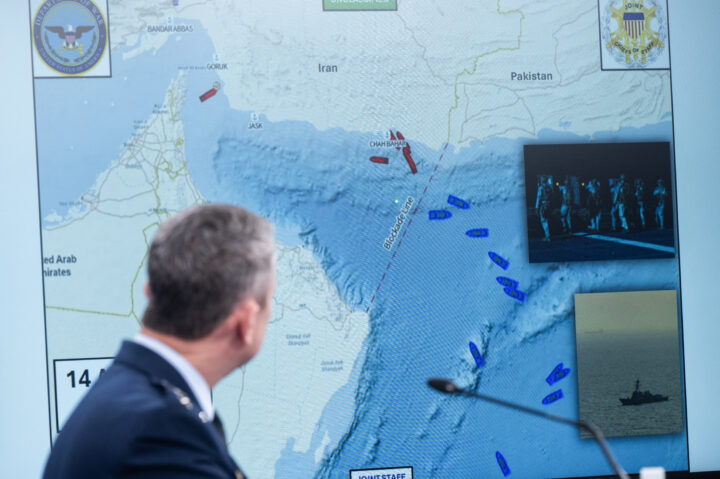
SAUL LOEB / AFP via Getty Images
Chairman of the Joint Chiefs of Staff Gen. Dan Caine speaks as a map of the Strait of Hormuz is displayed during a press briefing at the Pentagon in Washington, DC, on April 16, 2026.
The Trump administration is planning to ask Congress to approve an $80 billion request for additional funding to replenish stockpiles and otherwise pay for the war in Iran, according to several reports.
That request comes on top of a push for a $1.15 trillion regular defense budget for 2027 as well as another $350 billion for the Pentagon that the administration wants Congress to pass through a partisan reconciliation process — a $1.5 trillion request in total that Republican lawmakers have criticized and some key Senate Republicans have described as unrealistic.
The supplemental request, too, could prove difficult to pass, requiring 60 votes in the Senate. Many Democrats declared at the outset of the war that they would refuse to pass any supplemental funding for the effort, and have further balked at the initial $1.5 trillion defense budget request.
Secretary of Defense Pete Hegseth is set to brief some House Republicans on Wednesday about the administration’s defense funding requests and the war in Iran.
Sen. Thom Tillis (R-NC) indicated he’s generally supportive of the anticipated $80 billion request, and argued that many of his colleagues could be convinced to support it if it’s primarily focused on restocking expended U.S. munitions supplies.
“It doesn’t surprise me. I think a part of what we need to do is figure out how much of that is for replenishment, that’s basically to get us the base load pre-conflict,” Tillis told Jewish Insider. “So I think the more that people spend on describing at that level, the more likely it is you’ll get support for it, and particularly if they only focus on what’s critical to get back to pre-conflict baselines. I think most members would say we got to do that.”
Sen. Mark Kelly (D-AZ), a military veteran who has generally been more moderate on defense issues than some of his more progressive colleagues, indicated he’s more skeptical of the proposal.
“I always want to make sure that the troops have what they need to do a really hard job and defend themselves especially,” Kelly said.
But, he continued, when he joined the Senate in 2022, the total defense budget was $650 billion, and the $1.5 trillion the administration is now seeking is higher than much of the rest of the world’s defense budgets combined.
He said that some of the systems the administration is asking for, such as space-based missile defense, are impractical or unneeded, “so I want to see the munitions be replaced, but let’s do it within a responsible top line of the defense bill, not this crazy, overly inflated number.”
Sen. Josh Hawley (R-MO), who had called for a prompt end to the war and has been supportive of talks with the Iranian regime, said he was withholding judgement on the supplemental request until the administration actually submits it.
Initial reports indicated the Pentagon intended to request as much as $200 billion for the war, but Pentagon officials testified last month that the costs of the war — excluding anticipated rebuilding costs of U.S. facilities in the region, came in between $20 and $30 billion.
“I don’t want to get out ahead of what the Pentagon will propose here,” Hawley said. “There’s been multiple iterations, so next week it may be something different. Let’s let them come up with something.”
Plus, NYC first lady snubs Brad Lander on primary day
Oliver Contreras / AFP via Getty Images
Israel's Ambassador to the U.S. Yechiel Leiter speaks to reporters after a meeting between Israeli and Lebanese delegations hosted by the United States at the State Department in Washington, DC, on June 3, 2026.
Good Tuesday afternoon.
This P.M. briefing is reserved for our premium subscribers like you — offering a forward-focused read on what we’re tracking now and what’s coming next.
Today’s Daily Overtime was curated by JI U.S. Editor Danielle Cohen-Kanik.
📡On Our Radar
Notable developments and interesting tidbits we’re tracking
The U.S. and Iran continued to offer conflicting accounts of the agreement reached over the weekend: President Donald Trump posted on Truth Social this morning that Iran “fully and completely agreed to highest level Nuclear inspections long into the future,” without which “there would be no further negotiations.” But Iranian Foreign Ministry spokesperson Esmail Baghaei said it was untrue and that the parties had not discussed any nuclear issues.
About Tehran’s denial, Secretary of State Marco Rubio said the U.S. “know[s] what [Iran] agreed to do, and now they’ll either do it or they won’t. And if they do, the process moves forward. And if they don’t, the president will have some decisions to make”…
Trump also said in his post that the funds received by Iran through the deal will go “into escrow, controlled by the U.S.A., and will be used for the purchase of food and medical supplies.” Yet the Treasury Department’s waiver of Iranian oil sanctions contains no such language and the text of the memorandum of understanding says unfrozen Iranian assets “shall be made fully usable” for “any ultimate beneficiary designated by the Central Bank of the Islamic Republic of Iran”…
Meanwhile, Iranian Parliament Speaker Mohammad Bagher Ghalibaf and Foreign Minister Abbas Araghchi were in Muscat speaking with Omani leaders about the Strait of Hormuz: In a joint statement, the parties said their foreign ministries will work towards an agreement on the “future administration” of the strait, the “services that will be provided in this regard and the costs associated with them,” as the Trump administration has repeatedly stated it will not accept any tolls placed on transit through the key waterway…
Iranian President Masoud Pezeshkian was also abroad, meeting in Islamabad with Pakistani Prime Minister Shehbaz Sharif, where Pezeshkian said Iran’s ballistic missile program “will never be” up for negotiation with the U.S…
Jerusalem is publicly expressing concern about the Lebanon deconfliction mechanism established by the U.S. and Iran for the first time, Jewish Insider’s Emily Jacobs reports: At the opening of Israel and Lebanon’s fifth round of direct talks taking place in Washington today, Israeli Ambassador to the U.S. Yechiel Leiter claimed the parties are “heading towards a train wreck.”
Leiter said he’s “concerned the concept of deconfliction is misplaced” because “Israel is not in conflict with Lebanon,” and that Israel had assumed “the central issue was Lebanon and Hezbollah — not the extent to which Iran could restrain Hezbollah. That is not Iran’s role”…
Rubio, arriving in Abu Dhabi, said the U.S.-Iran and Israel-Lebanon tracks “are separate because Lebanon is a sovereign country,” and that the U.S. is “going to negotiate a deal directly with the Lebanese government,” without mentioning Israel.
Rubio also made clear that Iran is responsible for much of the terror activity in the Middle East, striking a different tone than that of Vice President JD Vance, JI’s Danielle Cohen-Kanik reports, after Vance said yesterday the U.S. is counting on Iran to “rein in” Hezbollah…
The Senate passed a war powers resolution this afternoon directing the administration to withdraw U.S. forces from Iran, 50-48, with GOP Sens. Rand Paul (R-KY), Lisa Murkowski (R-AK), Susan Collins (R-ME) and Bill Cassidy (R-LA) voting in favor with Democrats,JI’s Marc Rod reports.
The resolution, now passed by both chambers, came as a concurrent resolution — meaning it will not be submitted to the president and, based on past court precedent, is not seen as carrying the force of law…
A manifesto allegedly left by the gunman behind yesterday’s rampage in Côte-des-Neiges, a heavily Jewish neighborhood in Montreal, repeatedly targeted Jews and Zionists, specifically identifying “influential Zionists” among his intended victims, JI’s Haley Cohen reports…
New York City First Lady Rama Duwaji posted an Instagram story today flashing an “I Voted” sticker and encouraging her followers to support two congressional candidates endorsed by Mayor Zohran Mamdani and the Democratic Socialists of America: Assemblymember Claire Valdez and doctoral candidate Darializa Avila Chevalier. Not receiving a mention was the only Jewish congressional candidate endorsed by her husband: former New York City Comptroller Brad Lander, JI’s Will Bredderman reports…
Ammar Campa-Najjar, a DSA-backed candidate who was recently defeated in his run for a California congressional seat, launched a new PAC called Democratic Majority for America — a counter to Democratic Majority for Israel, which organized against him in the June primary — to support progressive candidates who want to end aid to Israel, Politico reports.
The PAC, which Campa-Najjar said has about $100,000 in cash on hand, has already endorsed California congressional candidate Randy Villegas and far-left Michigan Senate candidate Abdul El-Sayed…
AIPAC’s super PAC, the United Democracy Project, has spent more than $38 million backing candidates this election cycle so far through direct and indirect spending, according to Politico, surpassing the $26 million it spent on the 2022 midterms…
The Blue Square Alliance Against Hate, headed by New England Patriots owner Robert Kraft, announced the formation of its inaugural advisory board, including Bank of America CEO Brian Moynihan, Dentons CEO Kate Barton, Salesforce CEO Marc Benioff, former Secretary of State Condoleezza Rice and Warner Bros. CEO David Zaslav…
⏩ Tomorrow’s Agenda, Today
An early look at tomorrow’s storylines and schedule to keep you a step ahead
Keep an eye on Jewish Insider for primary results from key races in New York and Maryland, as well as a postmortem on New York City Mayor Zohran Mamdani’s ability to wield his political capital in the three congressional races where he endorsed progressive candidates.
President Donald Trump is expected to attend a GOP Senate luncheon as he remains at odds with his party over several legislative efforts and as some Republicans speak out against his efforts to curb Israeli operations against Hezbollah.
In the afternoon, Trump will hold a rally on the National Mall to kick off his Great American State Fair in the lead-up to the country’s 250th anniversary.
Defense Secretary Pete Hegseth is slated to brief House Republicans tomorrow as the Pentagon gears up for a contentious fight over an expected $80 billion supplemental funding request tied largely to the Iran war.
The House Appropriations Committee will mark up the 2027 defense spending bill.
Sen. Jacky Rosen (D-NV) will speak in conversation with Jewish Council for Public Affairs CEO Amy Spitalnick as well as leaders from other religious groups, including the Union for Reform Judaism and Orthodox Union, about the Jewish American Security Act.
Stories You May Have Missed
ACROSS THE POND

Jewish leaders view Andy Burnham as an ally in the fight against antisemitism, but his expected bid for the premiership is renewing scrutiny of his views on Israel and Labour’s post-Corbyn direction
RABBI ROADBLOCK

The mayor has inserted himself in the costly fight between Rabbi Stephanie Ruskay and lawyer Eli Northrup, spurning a key Jewish ally in the process
The resolution passed 50-48 with GOP Sens. Paul, Murkowski, Collins and Cassidy voting with Democrats in favor
Photo by Kevin Dietsch/Getty Images
U.S. Senate Minority Leader Chuck Schumer (D-NY) speaks to reporters after the weekly Senate policy luncheons at the U.S. Capitol on June 23, 2026 in Washington. Schumer spoke out against President Trump's Iran deal and a the need for the Senate to pass a War Powers Resolution regarding Iran.
The Senate voted on Tuesday to pass a House-passed war powers resolution directing the administration to withdraw U.S. forces from Iran — a congressional rebuke of the administration over the war in Iran — though legally its effects are likely to be largely symbolic.
The resolution passed by a 50-48 vote, with Republican Sens. Rand Paul (R-KY), Lisa Murkowski (R-AK), Susan Collins (R-ME) and Bill Cassidy (R-LA) again voting in favor and Sen. John Fetterman (D-PA) voting against it. Ultimately, GOP absences enabled the resolution to go forward.
But the resolution, now passed by both chambers, came in the form of a concurrent resolution, which is not submitted to the president and, based on past court precedent, is not seen as carrying the force of law — though a House Democratic aide argued to CNN that the measure would be binding.
Rep. Greg Meeks (D-NY), the ranking member of the House Foreign Affairs Committee and lead Democratic sponsor of the war powers resolution, insisted in a statement, “Regardless of what President Trump says, this measure is binding under the War Powers Resolution, and I will explore all legal avenues to ensure the Executive complies with the will of Congress.”
Unlike previous efforts, however, the concurrent resolution did not require other procedural votes by the Senate, allowing Democrats to take advantage of the Republican absences and move directly toward final passage to deliver a message of rebuke to the administration.
The Senate still has other war powers resolutions pending, including one which passed an initial procedural hurdle, but currently lacks the support to pass through an additional procedural vote and final passage with full attendance. That legislation, which comes in a different form as joint resolutions, would be presented to the president if passed and set up a potential veto or other legal fight.
Republicans warned that adopting the resolution would send a further signal to Iran that it does not need to negotiate or make any compromises with the U.S. as part of ongoing talks.
The vice president suggested Iran could help rein in Hezbollah, while the secretary of state emphasized Lebanon’s sovereignty and described the Iran and Lebanon talks as separate diplomatic tracks
Photo by Brendan SMIALOWSKI / AFP via Getty Images
Vice President JD Vance and President Donald Trump listen to Secretary of State Marco Rubio speak during a meeting with Lebanon Ambassador to the U.S. and Israel Ambassador to the U.S., at the White House in Washington, D.C. on April 23, 2026.
As the details around the memorandum of understanding between the U.S. and Iran emerge, Vice President JD Vance, who has been deputized with leading the effort, and Secretary of State Marco Rubio, ostensibly the Trump administration’s top diplomat, have offered different messaging around the issue of Lebanon and Hezbollah being subsumed into discussions with Tehran.
After the U.S. and Iran agreed to create a “deconfliction cell” for military operations in Lebanon — a mechanism that, notably, does not include Israel — Vance said on Monday that the U.S. will be counting on Iran to “rein in” its proxy Hezbollah, without referencing Tehran’s material support for the terror group.
Vance called on Israel to respond to Hezbollah’s attacks “in the context of a conversation that’s ongoing between Hezbollah, Lebanon, Israel and other partners in the region.” He said the conflict is “a bit of a chicken and egg problem,” in which he claimed lower-level Hezbollah operatives are firing on Israel without approval from their superiors.
Rubio, meanwhile, has been clearer about Iran’s role in propagating terror in the Middle East. Arriving in the United Arab Emirates on Tuesday, he said a “complete end of hostilities in the entire region” is “not possible … as long as Iranian proxies are launching missiles and drones from Iraq and are participating in terrorism like Hamas did and like Hezbollah did.”
WATCH: Marco Rubio said upon arriving in Abu Dhabi that the U.S.–Iran and Israel–Lebanon diplomatic tracks “are separate because Lebanon is a sovereign country,” while adding that Iran’s “support and sponsorship of Hezbollah” will be part of “our conversations with the Iranians.” pic.twitter.com/iADhszGTZC
— Jewish Insider (@jewishinsider) June 23, 2026
Rubio also distanced the Lebanon conflict from negotiations with Iran: Asked if he believes the Israel-Lebanon peace process should be separate from the Iran discussions, Rubio said, “That process is separate.”
“It’s separate because Lebanon is a sovereign country. … When it comes to Lebanon and what’s happening inside of Lebanon, we’re going to negotiate a deal directly with the Lebanese government,” he continued, again without mentioning Israel.
“Now, there’s an Iranian issue with regards to Lebanon, and that is their support and sponsorship of Hezbollah. And so that factor will be discussed as part of our conversation with the Iranians, but … the future of Lebanon belongs to the Lebanese people, through their sovereign, elected government, and that’s who we’re going to be working with,” Rubio said.
He referenced a phone call he and Vance held earlier on Tuesday with Lebanese President Joseph Aoun, who said in a readout that the deconfliction mechanism will now include Lebanon as a party.
Olivia Wales, a White House spokesperson, told Jewish Insider, “Both Vice President Vance and Secretary Rubio are in lockstep with President Trump: Iran can never have a nuclear weapon and must stop their proxies in Lebanon from causing trouble. What President Trump and his entire national security team achieved on the battlefield and at the negotiating table is nothing short of remarkable and will strengthen American security for years to come.”
This story was updated on June 23 to include comment from the White House.
Plus, GOP lawmakers speak out against WH's Hezbollah stance
Spencer Platt/Getty Images
New York City Mayor Zohran Mamdani speaks at a "Rental Ripoff" hearing at Fordham University in the Bronx borough of New York on March 11, 2026, in New York City.
Good Tuesday morning.
In today’s Daily Kickoff, we speak with former White House officials and Middle East experts about the Trump administration’s move to lift sanctions on Iranian oil sales through August, and report on the concerns of Senate Republicans over the U.S. effort to halt Israeli operations against Hezbollah. We report on New York City Mayor Zohran Mamdani’s intervention in today’s New York primaries, as well as the mayor’s comments doubling down on his rhetorical assault on AIPAC. We also report on a highly charged telephone call between President Donald Trump and Israeli Prime Minister Benjamin Netanyahu, as revealed in a new book by Maggie Haberman and Jonathan Swan. Also in today’s Daily Kickoff: Sen. Susan Collins, Rep. Steny Hoyer and Ambassador Yehuda Kaploun.
Today’s Daily Kickoff was curated by JI Israel Editor Tamara Zieve and U.S. Editor Danielle Cohen-Kanik, with an assist from Marc Rod. Have a tip? Email us here.
What We’re Watching
- Voters in Maryland, New York and Utah are heading to the polls for their primaries today. The biggest races to watch are in New York, where New York City Mayor Zohran Mamdani has endorsed three far-left, anti-Israel candidates running against Reps. Dan Goldman (D-NY), Adriano Espaillat (D-NY) and Brooklyn Borough President Antonio Reynoso. We’re also closely watching the hotly contested Democratic primary to succeed retiring Rep. Jerry Nadler (D-NY), in a Manhattan district with the largest Jewish constituency in the country.
- In Maryland, we’re keeping a close eye on the race to replace former House Majority Leader Steny Hoyer (D-MD), where state Del. Adrian Boafo, endorsed by the outgoing congressman and a strong ally of Israel, has emerged as the favorite. See more below.
- Israeli and Lebanese representatives are expected to begin multiday talks in Washington in a continuation of the countries’ direct negotiations, starting with a joint military and political session, days after the U.S. and Iran said they had established a “deconfliction cell” to end military operations in Lebanon without Israel’s involvement.
- Israeli Prime Minister Benjamin Netanyahu asserted multiple times on Monday that the IDF retains the right to act against Hezbollah in southern Lebanon if necessary, as Axios reported that the Israeli government fears the U.S. is limiting its freedom of action through its negotiations with Iran. On Tuesday morning, the IDF said it struck armed terrorists operating close to Israeli soldiers in Ali al-Taher Ridge area in southern Lebanon.
- Secretary of State Marco Rubio is departing for a three-day trip to the United Arab Emirates, Kuwait and Bahrain to discuss issues including the memorandum of understanding with Iran and transit through the Strait of Hormuz.
- Orthodox Union Advocacy will hold its annual lobbying day on the Hill, including a luncheon with senators from both parties.
What You Should Know
A QUICK WORD WITH JI’S matthew kassel
As Rep. Steny Hoyer (D-MD) prepares to step down at the end of his current term, the former Democratic House majority leader is staking his pro-Israel legacy on a little-known candidate who he hopes will uphold his long-standing commitment to maintaining a close relationship with the Jewish state.
In throwing his support behind Adrian Boafo, a 32-year-old Maryland state delegate who is among two dozen Democratic candidates running in Maryland’s 5th Congressional District primary on Tuesday, Hoyer, 87, is using his connections to establishment party leaders and ties with pro-Israel groups to boost his hand-picked choice to the nomination for a safely blue seat.
United Democracy Project, AIPAC’s super PAC, has emerged as the biggest spender in the race, investing more than $5.7 million as part of an aggressive effort to promote Boafo launched by Hoyer and his allies.
The well-funded foray is a useful illustration of the degree to which planning and organization helped put Boafo in contention for the seat Hoyer has held for 45 years, in contrast with recent primaries where UDP and other pro-Israel advocacy groups have been relatively cautious with their engagement while being outflanked by the far left.
A UDP source, granted anonymity to speak candidly about the race, said polling showed Boafo was not in the lead when Hoyer endorsed him in January. “It’s a super close race that could go either way,” the source told Jewish Insider on Monday, stressing a high level of undecided primary voters. “Many candidates are in contention.”
EASY MONEY

Former White House officials and Middle East experts are expressing concern over the Trump administration’s move to lift sanctions on Iranian oil sales through August, warning that Tehran will gain significant revenue it could use for malign activities before it demonstrates concrete progress on its diplomatic commitments, Jewish Insider’s Matthew Shea reports. The move was made in response to Tehran’s agreement to open the Strait of Hormuz and allow international nuclear inspectors into the country following weekend talks in Switzerland, according to Treasury Secretary Scott Bessent, a claim which Iranian officials have denied.
Airing concerns: When asked whether the Iranians could use the profits from oil sales for malign activity, President Donald Trump said “they’re not supposed to be doing that,” and that Tehran is meant to use the income to purchase agricultural goods from the U.S. “Why give them the money to stabilize the regime and start rebuilding their military before they have done anything at all on their nuclear program?” Elliott Abrams, who served as special envoy for Iran during the first Trump administration, asked. “Why do we just get promises while they get billions?”
Talking to terror: Vice President JD Vance on Monday backed Iran’s participation in bringing about the end of the military conflict between Israel and Hezbollah, while talking at a press conference in Switzerland. “Of course, Israel has to respond to that,” he said of Hezbollah attacks on northern Israeli towns, “but … we could actually have a better and more peaceful situation if Israel responds in the context of a conversation that’s ongoing between Hezbollah, Lebanon, Israel and other partners in the region.”
SKEPTICAL SENATORS
Senate Majority Leader John Thune (R-SD) said that Israel’s right to self-defense must be protected in U.S. talks with Iran, after administration officials publicly urged Israel to cease operations against Hezbollah as part of the recent memorandum of understanding — even though Israel, Hezbollah and Lebanon are not parties to that agreement, Jewish Insider’s Emily Jacobs and Marc Rod report.
Lebanon lens: “I just want to make sure that Israel is able to defend itself, and I think whatever happens as a result of these talks, that is something that needs to be maintained,” Thune said. “Hopefully the U.S.-Israeli relationship will remain such that we fully understand their need to be able to defend themselves, and right now on their northern border, they’re being attacked daily.” Other Senate Republicans also took issue with the administration’s efforts to halt anti-Hezbollah operations, as well as with the lifting of sanctions on Iran.
Read the full story here with additional comments from Sens. John Cornyn (R-TX), James Lankford (R-OK), Bill Cassidy (R-LA), Ted Budd (R-NC), John Kennedy (R-LA), Chris Coons (D-DE) and Tim Kaine (D-VA).
Standing strong: Sen. Susan Collins (R-ME) accused Maine Democratic Senate nominee Graham Platner of antisemitism and defended her support for Israel in a Fox News interview on Monday, JI’s Marc Rod reports. “I remain a very strong supporter of Israel, the one democracy in the Middle East, our true ally in the Middle East,” Collins said when asked about increasing hostility to Israel and AIPAC among the American public.
BOOK BOMBSHELL

President Donald Trump grew so frustrated with Israeli Prime Minister Benjamin Netanyahu during last September’s negotiations over a U.S.-brokered deal to end the Israel-Hamas war in Gaza, that Trump cursed and yelled at Netanyahu in a phone call days before the agreement was announced publicly, according to a new book, Jewish Insider’s Gabby Deutch reports.
Tense talk: “Everybody’s sick of you, Bibi,” Trump said in a phone call with Netanyahu, Jared Kushner and White House Special Envoy Steve Witkoff, according to a book published on Tuesday by New York Times journalists Maggie Haberman and Jonathan Swan chronicling the first year of Trump’s second term. “All the Jews are sick of you. Even the two Jews on this call are sick of you.”
Elsewhere: The White House’s “Rapid Response” X account boosted an Al Jazeera video interview about U.S.-Iran negotiations with Qatari Prime Minister Sheikh Mohammed bin Abdulrahman Al Thani, calling it “the real story from people actually in the room,” JI’s Emily Jacobs reports.
RABBI ROADBLOCK
New York City Mayor Zohran Mamdani’s intervention in a state-level race in Manhattan could also reverberate through the city’s Jewish community and beyond. The mayor has inserted himself in the costly fight between Rabbi Stephanie Ruskay and lawyer Eli Northrup for the 69th Assembly District on the Upper West Side, spurning a key Jewish ally in the process, Jewish Insider’s Will Bredderman reports.
Picking sides: Rival left-of-center Jewish factions have lined up behind each candidate: the anti-Zionist Jews for Racial and Economic Justice behind public defender Eli Northrup, and a suite of long-standing Jewish elected officials — including City Comptroller Mark Levine and his predecessor Scott Stringer — with Rabbi Stephanie Ruskay, associate dean of The Rabbinical School at the Jewish Theological Seminary. Ruskay’s prominent backers include her longtime friend and mentor, former Manhattan Borough President Ruth Messinger, one of Mamdani’s most prominent Jewish supporters. Multiple sources told JI that Messinger had personally asked the mayor not to get involved in the race, but Mamdani did so anyway, even releasing one of his signature social media videos featuring Northrup.
Doubling down: Mamdani doubled down on his rhetorical assault on AIPAC on Monday, after Jewish groups over the weekend criticized his comments about the pro-Israel organization at a Thursday rally last week that they argued evoked classic antisemitic tropes.
ACROSS THE POND
British Prime Minister Keir Starmer’s resignation on Monday set up a leadership battle within the Labour Party and raised the question of how his likely successor will deal with one of the issues that brought Starmer to office in the first place: combating antisemitism. Starmer’s successor is likely to be Andy Burnham, a newly sworn-in Labour MP representing a district that includes parts of the Greater Manchester region in the north of England. He spent the last nine years as mayor of Greater Manchester, home to the second-largest Jewish community in the U.K, Jewish Insider’s Gabby Deutch reports.
Community approach: Jewish community leaders in Manchester have close ties with Burnham, whom they view as an ally. He earned praise for strongly supporting the community after a terror attack on Manchester’s Heaton Park Hebrew Congregation last year on Yom Kippur, in which two congregants were murdered. Burnham’s record on Israel is relatively short — he has not brought Middle East politics into his mayoralty in the way that some other local leaders have focused on the issue. “I think he’ll be strong on antisemitism, on Holocaust education and on tackling Jew hatred, but it remains to be seen about Israel. I don’t think he’ll change the government’s position much, if at all,” said Raphi Bloom, director of fundraising and marketing at the Fed, a Jewish social services charity in Manchester.
moco moment
Ahead of Tuesday’s primary election for executive of Montgomery County, Md., progressives have largely broken for Montgomery County Councilmember Will Jawando, leaving the more moderate Councilmembers Andrew Friedson and Evan Glass to jockey for the remaining undecided voters, Jewish Insider’s Christina Sher reports. The vote of the Jewish community — which is, according to a source familiar with the race, expected to account for more than one-fifth of primary turnout in the county with Maryland’s largest Jewish population — could be especially critical.
Eye on antisemitism: Jewish leaders have raised the alarm on antisemitism in the deep-blue county — which saw the highest rate of incidents in the state in 2025 — and the particular issue of antisemitism in the area’s public schools. Ron Halber, CEO of the Jewish Community Relations Council of Greater Washington, told JI that Jawando, Glass and Friedson “have all denounced antisemitism during their eight-year terms in the council” and said he hopes that other community leaders “awake from their slumber” to speak out against hate without needing to be prompted by the Jewish community.
Worthy Reads
AI Accuracy?: ForumAI CEO Campbell Brown writes in The Wall Street Journal about AI models’ limitations in assessing accurate information. “We tested the major AI models on three dimensions this group identified as the foundation of trustworthy information: quality of sources, factual accuracy and whether they present a response with real balance or just the appearance of it. We found serious gaps: The models misstated public opinion on political topics and attributed quotations to people who didn’t say them … The most revealing failures were much subtler. When we asked the major models something as basic as what form of government the U.S. has, one of them, Claude Opus 4.7, cited Global Times, a Chinese state-run tabloid.” [WSJ]
MOU As Rough Draft: In Newsweek, former White House Middle East Special Envoy Jason Greenblatt offers a conflicted but measured assessment of the U.S.-Iran memorandum of understanding, drawing from his diplomatic experience during Trump’s first term. “I read the 14 points of the U.S.-Iran memorandum of understanding (MOU) the way I used to read drafts in the White House and, before that, for two decades at The Trump Organization: pen in hand, marking up every clause … My honest reaction, reading it that way, is that I have serious questions about its structure and its terms … And yet I know how incomplete my reaction is, coming from someone standing outside the room. I spent three years watching the gap between what the public saw and what was actually happening behind closed doors, and I learned that the view from outside the room almost always misses things the people inside knew or were reaching for.” [Newsweek]
Trump’s ‘Surrender’: Former Rep. Kathy Manning (D-NC), now board chair of Democratic Majority for Israel, slams President Donald Trump’s memorandum of understanding with Iran as a mirage obfuscating his negotiation failures. “Like the arsonist who wants credit for putting out the fire he started, Mr. Trump now claims victory with a deal that pauses Iran’s use of a previously unused weapon — a weapon that may be as powerful as its nuclear threat — the closing of the Strait of Hormuz. Add to that the release of hundreds of billions of dollars to Iran and you have the real Art of the Deal: surrender and betrayal of the American people, the Gulf States, Israel, and our NATO allies.” [Substack]
What Greenspan Meant: Greg Ip, The Wall Street Journal’s chief economics commentator, reflects on the impact Alan Greenspan, who died on Monday, left on the country and on Ip personally, after years covering him as he reported on the Federal Reserve. “He was introverted, but came alive when the topic of conversation interested him. Luckily, our interests overlapped. For my fellow journalists and me, Greenspan wasn’t just a news subject but a bottomless well of insight and ideas. And he loved that role. I came away from every meeting with Greenspan smarter. Admonished for not knowing Knut Wicksell’s theory of the natural rate of interest, I quickly brushed up. After a discussion of Keynesian prescriptions for preventing depression in the 1940s, he sent me to read George Terborgh, an obscure economist with a contrarian and bullish view on American potential.” [WSJ]
Word on the Street
The FBI announced the arrest of two more individuals who allegedly plotted to attack members of Congress connected to the “pro-Israel lobby” at the UFC event at the White House last week, joining five other suspects charged with conspiracy to commit murder…
Three people were killed in a shooting attack in Côte-des-Neiges, a heavily Jewish neighborhood in Montreal. A civilian, a police officer and the suspect were confirmed dead by Montreal police, while one other police officer was seriously injured but in stable condition, Jewish Insider’s Haley Cohen and Tamara Zieve report…
The Department of Justice’s Civil Rights Division is investigating a Brooklyn cafe after it banned Rep. Dan Goldman (D-NY) from its store, posting discriminatory messages online that accused the congressman of enabling genocide and tying him to AIPAC, JI’s Haley Cohen reports…
The coffee shop is owned by Parviz Mukhamadkulov, who, the Free Beacon reported, is a donor to scandal-plagued Maine Democratic Senate nominee Graham Platner…
Rep. Ro Khanna (D-CA) announced last week that he had been endorsed by the anti-Israel group TrackAIPAC, which has faced widespread accusations of antisemitism, after becoming the first politician or candidate to sign a new “pledge” promulgated by the group, JI’s Marc Rod reports…
Conservative commentator Ben Shapiro called Vice President JD Vance’s conduct in negotiations with Iran over the weekend “humiliating,” slamming Vance — while continuing to praise President Donald Trump — on his show on Monday for “looking weak in front of the Qataris, the Pakistanis and most of all, the Iranians”…
Three men killed in a small plane crash in Bowie, Md., on Saturday night have been identified as Israeli citizens, JI’s Haley Cohen reports…
Israeli defense contractor Elbit Systems announced it would phase out its use of Chinese-manufactured vehicles, following similar moves by other entities including the IDF and Rafael as the vehicles are increasingly viewed as a security risk by both Jerusalem and Washington…
Shin Bet chief David Zini has instructed officials to prepare for a potential attack in Israel’s southern resort city, warning that “the next October 7 will be in Eilat,” Haaretz reports, citing security sources…
An independent U.N. inquiry found that Israeli forces deliberately targeted Palestinian children, resulting in genocide, crimes against humanity and war crimes in Gaza, and war crimes in the West Bank. The Israeli Foreign Ministry rejected the report as a “libelous sham,” and said it “lacks any credible verification mechanism for its claims” and ignores “Hamas’ cynical use of Palestinian children as human shields”…
A federal investigation found that the condominium collapse in Surfside, Fla., almost exactly five years ago, that killed 98 people began with a structural failure in the building’s garage three weeks earlier…
The New York Times spotlights “Food Network” star Ina Garten’s foray into podcasting with her forthcoming show “Happy Hour With Ina Garten,” after Vox Media secured the in-demand contract in a seven-figure deal…
Alan Greenspan — the influential economist who led the Federal Reserve for 19 years across four presidencies — died on Monday at 100, JI’s Haley Cohen reports…
Music executive Clive Davis, who championed the careers of stars including Whitney Houston, Aretha Franklin and Barry Manilow, died on Monday at 94…
Pic of the Day
Ambassador Yehuda Kaploun, the Trump administration’s special envoy to monitor and combat antisemitism, said on Monday that his office, under President Donald Trump, had been given a broader remit across the federal government, including assisting in the recent arrest and indictment of an alleged mastermind of attacks on Jewish communities in Europe and the U.S.
Kaploun said at an Orthodox Union conference in Washington that his office had worked with the Department of Justice, FBI, intelligence community and the White House to help bring to justice Mohammed Al-Saadi, an Iranian Iraqi Kata-ib Hizballah operative allegedly involved in more than two dozen attacks and attempted attacks across Europe and the U.S., Jewish Insider’s Marc Rod reports.
Birthdays

Ethiopian-born Israeli model who won the title of Miss Israel in 2013, Yityish “Titi” Aynaw turns 35…
Real estate developer and co-founder of Tishman Speyer, Jerry Speyer turns 86… Associate justice of the Supreme Court of the United States, Justice Clarence Thomas turns 78… Senior advisor at Eurasia Group, a political risk consultancy, he is the author of 24 books on foreign affairs, global politics and travel, Robert D. Kaplan turns 74… Novelist and journalist, Roy Hoffman turns 73… Los Angeles-based socialite, restaurateur and breast cancer fundraiser, a 2008 Lifetime Television movie starring Renée Zellweger portrayed her cancer-fighting efforts, Lilly Tartikoff Karatz turns 73… Klezmer expert, violinist, composer, filmmaker, writer, photographer and playwright, Yale Strom turns 69… Senior director of health policy at the National Consumers League until 2024, Robin Strongin… President of the Harrington Discovery Institute at University Hospitals, Dr. Jonathan Solomon Stamler turns 67… Sports memorabilia marketer, in 2009 his firm sold all of the seats, signs and lockers from the old Yankee Stadium, Brandon Steiner turns 67… Member of the Pennsylvania state Senate until 2020, now president of Cannabis GPO, Daylin Leach turns 65… Editorial director of Ben Yehuda Press, Lawrence Yudelson… Former teacher for 19 years at Golda Och Academy in West Orange, N.J., she is on Hadassah’s 2025 list of 18 American Zionist Women You Should Know, Stephanie Z. Bonder… Israeli-American professor, journalist and filmmaker, Boaz Dvir turns 59… Film and television actor, her Hebrew name is Bat-Sheva, Selma Blair Beitner turns 54… U.S. special envoy for hostage response, Adam Seth Boehler turns 53… EVP and general manager of the NFL’s Philadelphia Eagles, Howie Roseman turns 51… President and COO of D1 Capital Partners, he was deputy director of the White House National Economic Council in the Trump 45 administration, Jeremy Katz… Founder of Innovation: Africa, which uses Israeli solar technology to bring electricity and solar-powered water pumps to impoverished African villages, Sivan Borowich-Ya’ari turns 48… Actor and comedian, best known for playing Dr. Bernadette Rostenkowski-Wolowitz on CBS’ sitcom “The Big Bang Theory,” Melissa Rauch turns 46… Actor, singer and model, Marielle Jaffe turns 37… Executive assistant to the CEO at Jazz, Gila Bublick turns 37… Western regional major gifts director at United Hatzalah of Israel, Ely Benhamo… Recent MBA graduate at Columbia Business School, Josh Lauder…
Trump officials pointed to the Qatari state-controlled outlet to deny reports that Vance was being ignored by Iranian and Qatari officials during the peace talks
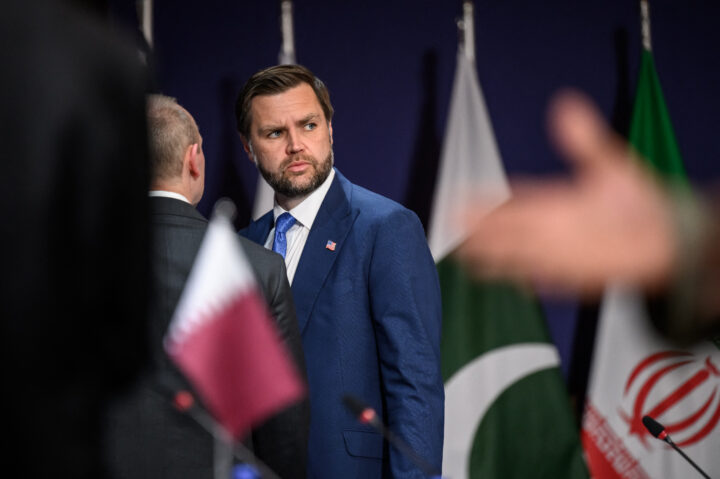
Photo by Fabrice Coffrini / POOL / AFP via Getty Images
U.S. Vice President JD Vance looks on prior to a quadrilateral meeting between the United States, Iran, Pakistan and Qatar in Switzerland, on June 21, 2026.
The White House’s rapid response social media account on Monday criticized media coverage of Vice President JD Vance’s participation in U.S. peace talks with Iran in Switzerland — and pointed to Al Jazeera’s reporting as evidence.
The rapid response team, a part of the White House’s communications office that defends the Trump administration’s record through social media, criticized media outlets on X that reported on Iranian Foreign Minister Abbas Araghchi declining to participate in a photo op with Vance, and Qatari officials not shaking Vance’s hand when photos were taken, as intentional digs at the United States.
“A lot of biased media outlets and Democrats were pushing a fake narrative yesterday about the talks in Switzerland,” the rapid response team wrote. “Here’s the real story from people actually in the room,” it said, referring to a tweet from Al Jazeera that included video of Qatari Prime Minister Mohammed bin Abdulrahman Al Thani rejecting such reports. Al Thani told Al Jazeera, according to the outlet’s social media post that the White House team shared, “that reports of him snubbing the US vice president were unfounded, saying they had spent hours together during negotiations and maintained a strong partnership throughout the process.”
Al Jazeera is a Qatari state-controlled news organization long criticized for its sympathetic coverage of Hamas and hostility to Israel. The outlet, which is financed by the Qatari government and ruling Al Thani family, has faced accusations that it spreads misinformation to promote Qatar’s preferred narrative on a range of sensitive topics, including the Israeli-Palestinian conflict.
The White House did not respond to a request for comment on the rapid response team’s post complimenting Al Jazeera’s coverage.
Video footage from the peace talks began to circulate on social media on Sunday showing Al Thani walking past the vice president and instead embracing Pakistani Prime Minister Shehbaz Sharif and Field Marshal Syed Asim Munir. The footage also showed Araghchi walking into the room and greeting Al Thani before exiting without acknowledging Vance.
Several media outlets went on to describe the incident as a “snub” of the vice president by the Iranians and Qataris, which a U.S. official pushed back on by noting that Vance had met with Al Thani for hours beforehand.
“This is complete nonsense,” the official said. “The U.S. delegation had just spent hours with the Qataris and there was no need to re-greet someone having just spent hours with.”
The official said that “Iranian representatives previously agreed to a press availability at the beginning of the meeting. They even brought state media with them to cover it, who were pre-staged at the event. Despite this, they left the meeting upon seeing the volume of press in attendance and then distributed an inaccurate account of the situation through state media.”
Even as the official refuted the characterization of both incidents as a snub, Iranian state media wrote on Sunday that Iran’s delegation to the peace talks declined an offer by the U.S. and others to participate in the photo op.
‘Why do we just get promises while they get billions?’ former Trump Iran envoy Elliott Abrams said

Jonathan Raa/NurPhoto via Getty Images
The Brent crude oil price chart is displayed on a mobile screen on March 2, 2026.
Former White House officials and Middle East experts are expressing concern over the Trump administration’s move to lift sanctions on Iranian oil sales through August, warning that Tehran will gain significant revenue it could use for malign activities before it demonstrates concrete progress on its diplomatic commitments.
On Monday, the U.S. Treasury Department issued a temporary 60-day license authorizing the production, delivery and sale of Iranian oil, lifting decades-old sanctions. The move was made in response to Tehran’s agreement to open the Strait of Hormuz and allow international nuclear inspectors into the country following weekend talks in Switzerland, according to Treasury Secretary Scott Bessent, a claim which Iranian officials have denied.
Under the memorandum of understanding signed last week between Washington and Tehran, the U.S. agreed to authorize waivers allowing the export of Iranian crude oil, petroleum products and related derivatives, as well as associated services such as banking transactions, insurance and transportation.
The temporary license is set to expire on Aug. 21 and represents a historic pivot in U.S. policy. It marks the first time since Washington imposed strict energy sanctions on Iran in the wake of the 1979 Islamic Revolution that Iranian oil can be legally imported into the U.S. and purchased using U.S. dollars. The 2015 Joint Comprehensive Plan of Action suspended certain secondary sanctions, allowing foreign companies to purchase Iranian oil, but it did not authorize imports of Iranian oil into the U.S.
Tehran has previously relied on a “shadow fleet” of aging oil tankers to move its crude abroad, funneling most of it to Chinese refineries. Under the new license, the Treasury Department said Iran may now lawfully sell oil from these previously sanctioned vessels, temporarily legitimizing that clandestine network. The waiver also shields Iranian entities, including the Central Bank of Iran, from nonnuclear sanctions tied to terrorist activity.
When asked whether the Iranians could use the profits from oil sales for malign activity, President Donald Trump said “they’re not supposed to be doing that,” and that Tehran is meant to use the income to purchase agricultural goods from the U.S.
“We’ll see, but they’re supposed to use the money to buy food for their people,” Trump told reporters in the Oval Office on Monday. “They’re buying it exclusively from us … all that money is coming back [to the U.S.] in the form of purchase of food … largely to our farmers.”
Meanwhile, foreign policy experts told Jewish Insider that Iran could use the money for malign activity, also expressing concern that Tehran is receiving revenue before proving it will fulfill its long-term obligations under the deal.
“It doesn’t take a lot of imagination to guess what this oil revenue will be used for,” Dan Shapiro, a former U.S. ambassador to Israel under President Barack Obama, told JI. “It won’t be used to benefit the Iranian people. This early concession is just further evidence of how badly the United States conceded leverage to Iran in Trump’s misguided war. We are paying dearly now just to get the Strait of Hormuz reopened.”
Elliott Abrams, who served as special envoy for Iran during the first Trump administration, similarly indicated that the regime would likely use the funds in ways contrary to U.S. interests.
“Why give them the money to stabilize the regime and start rebuilding their military before they have done anything at all on their nuclear program?” Abrams asked. “Why do we just get promises while they get billions?”
Miad Maleki, a former senior Treasury official, said that the sanctions relief “could be an economic lifeline for the Islamic Republic,” in a post on X on Monday. Maleki said the move “theoretically unlocks” around 67 million barrels of oil that are stranded in the Gulf, which he estimated would be worth roughly $8-9 billion, as well as another $10-15 billion in potential relief through the sale of petrochemical tons.
“The license explicitly allows buyers to pay Iran — including the Iranian government and blacklisted Iranian entities — directly for the oil. This isn’t just permission to sell. It’s permission to get paid,” Maleki wrote. “And the payments can be made in U.S. dollars. The dollar is the backbone of global finance, and Iran has been largely locked out of it for years. Handing the regime dollar revenue restores access that sanctions were specifically designed to deny.”
He also noted that the Treasury Department’s authorization will allow Tehran’s “shadow market” to operate “cheaper, faster, and [be] dollar-denominated.”
“While major Western and new-market buyers won’t be rushing to do business with Iran, the license authorizes far more than Iran can currently produce, and there are more than enough willing buyers in China and across Asia to absorb every barrel and petrochemical ton Iran can move,” he wrote.
Abrams also took issue with Iran appearing to gain notable benefits without yet complying with all the U.S. demands.
“The benefits for Iran in the MOU seem to be frontloaded,” Abrams said. “That’s a mistake because to the extent that they benefit now, they have less and less incentive to comply with what we want.”
Abrams maintained that U.S. sanctions should continue even after the lifting of the U.S. naval blockade and the reopening of the Strait of Hormuz.
Shapiro told JI he held similar concerns, particularly regarding how Iran is securing immediate relief without any concessions on its nuclear program and noted that the agreement “doesn’t even mention Iran’s ballistic missile program or support for terrorist proxies.”
Jonathan Ruhe, a fellow at the Jewish Institute for National Security of America, argued that the move provides Iran “upfront sanctions relief,” while simultaneously requiring “fewer concessions” than the JCPOA signed in 2015 under Obama.
AIPAC similarly compared the agreement to the JCPOA, which the group spearheaded efforts to oppose when it was signed.“This license is broader than the terms detailed in the MOU or what was included in the JCPOA,” AIPAC wrote on X on Monday. “Waiving sanctions on production will allow Iran to increase its output and gain increased revenues under the terms of the MOU.”
Ruhe noted that such a move sidesteps mandatory congressional oversight by granting immediate waivers before lawmakers have had a chance to formally review or vote on the arrangement.
“It also runs afoul of the Iran Nuclear Agreement Review Act (INARA), which prohibits any sanctions relief until Congress can review the deal,” Ruhe said. “Iran’s regime should get sanctions relief only in exchange for meaningful concessions on its nuclear program, which it has not made, and congressional review of the deal, which has not happened.”
Plus, the White House amplifies Al Jazeera
Jonathan Raa/NurPhoto via Getty Images
The Brent crude oil price chart is displayed on a mobile screen on March 2, 2026.
Good Monday afternoon.
This P.M. briefing is reserved for our premium subscribers like you — offering a forward-focused read on what we’re tracking now and what’s coming next.
Today’s Daily Overtime was curated by JI U.S. Editor Danielle Cohen-Kanik.
📡On Our Radar
Notable developments and interesting tidbits we’re tracking
Three people were killed in a shooting attack today in Côte-des-Neiges, a heavily Jewish neighborhood in Montreal, Jewish Insider’s Haley Cohen and Tamara Zieve report. A civilian, a police officer and the suspect were confirmed dead by Montreal police, while one other police officer was seriously injured but in stable condition. Police said the suspect’s motive is still under investigation. Stay updated on this developing story with JI’s What We’re Watching briefing…
After the U.S. and Iran agreed to create a “deconfliction cell” for military operations in Lebanon during their negotiations yesterday, Vice President JD Vance said at a press conference today that the U.S. will be counting on Iran to “rein in” Hezbollah — without acknowledging that Tehran offers material backing to its proxy in Lebanon, JI’s Matthew Shea reports.
Vance called Hezbollah’s attacks on northern Israel and the IDF’s retaliation “a bit of a chicken and egg problem, that you’ve got a junior guy who fires a drone that didn’t have approval from the high command. Of course Israel has to respond to that,” he acknowledged, “but … we could actually have a better and more peaceful situation if Israel responds in the context of a conversation that’s ongoing between Hezbollah, Lebanon, Israel and other partners in the region”…
Israeli Prime Minister Benjamin Netanyahu appeared to push back on Vance’s framing, saying in a video statement this morning that his directive to the IDF “has not changed: Our fighters in southern Lebanon have full freedom of action to thwart any direct or developing threat to them or to the residents of the north. The IDF has no restrictions on this matter,” he said, while the tenuous ceasefire with Hezbollah appeared to hold today…
Vance also announced Iran had agreed to let U.N. nuclear inspectors back into the country, and President Donald Trump wrote on Truth Social that “everybody is fully aware” Iran will agree to “have Major Weapons Inspections in order to ensure ‘Nuclear Honesty’ long into the future,” but Esmail Baghaei, Iran’s foreign ministry spokesperson, told state media that Iran made “no new commitments” regarding inspections…
Pursuant to the agreement reached between the U.S. and Iran over the weekend, the Treasury Department issued a waiver lifting decades-old U.S. sanctions on Iranian oil for the next 60 days, permitting imports of Iranian oil directly to the U.S. and paying for the goods in U.S. dollars.
Asked this afternoon in the Oval Office if he can ensure that Iran won’t use the funds for military purposes, Trump said, “They’re not supposed to be doing that, so we’ll see, but they’re supposed to use the money to buy food for their people.” AIPAC described the waiver as “broader than the terms detailed in the MOU or what was included in the JCPOA”…
The White House’s “Rapid Response” X account boosted an Al Jazeera video interview about the negotiations with Qatari Prime Minister Sheikh Mohammed bin Abdulrahman Al Thani, calling it “the real story from people actually in the room”…
Avigdor Liberman, head of Israel’s Yisrael Beiteinu party and a leading opponent of Netanyahu, wrote in The Wall Street Journal that the “deal between Washington and Tehran won’t stop Iran from becoming a nuclear power. It will guarantee it.” He called for Jerusalem to “inform Washington that Israel won’t accept any linkage between Iran and Lebanon” and end its reliance on U.S. missile systems, preparing to attack key Iranian infrastructure if Tehran strikes Israel…
Asked about her stance on Israel in a rare nationally televised interview on Fox News today, Sen. Susan Collins (R-ME) said she “remain[s] a very strong supporter of Israel” despite rising hostility to Israel and AIPAC among the American public, which she said “sadly reflects rising antisemitism in our country that” her opponent, Democratic nominee Graham Platner, “certainly is part of.”
“It’s important to recognize that AIPAC is made up of Americans who care deeply about our relationship with Israel. Platner makes it sound like this is some sort of evil foreign influence and that is absolutely wrong,” Collins continued…
New York City Mayor Zohran Mamdani doubled down on his rhetorical assault on AIPAC today, JI’s Will Bredderman reports, after Jewish groups over the weekend criticized his comments about the pro-Israel organization at a rally last week that they argued evoked classic antisemitic tropes.
Mamdani defended naming AIPAC among the “monsters who move dark money” as a reference to a widely known misquote of 20th-century Marxist philosopher Antonio Gramsci, and backed up his argument with statistics from the Hamas-controlled Gaza Health Ministry alleging that the IDF has killed more than 1,000 Palestinians since the ceasefire last fall…
JI’s Christina Sher looks at the state of tomorrow’s Democratic primary for executive of Montgomery County, Md., as all three of the front-runners — County Councilmembers Will Jawando, Andrew Friedson and Evan Glass — have been outspoken against antisemitism, but diverge in their policy positions and views on Israel…
Three men killed in asmall plane crash in Bowie, Md., on Saturday night have been identified as Israeli citizens, JI’s Haley Cohen reports: Yoav Bomrind, 26, David Rabinovitz, 19, and Elad Neidik, 20, boarded the single-engine plane in Ocean City, N.J., for a training flight before it crashed just outside Washington, D.C…
Alan Greenspan — the influential economist who led the Federal Reserve across four presidencies and whose track record guiding economic growth earned him status as an economic “maestro” — died today at 100, JI’s Haley Cohen reports…
⏩ Tomorrow’s Agenda, Today
An early look at tomorrow’s storylines and schedule to keep you a step ahead
Keep an eye on Jewish Insider for a look at how pro-Israel groups’ intervention in the race to replace retiring Rep. Steny Hoyer (D-MD) — where they are supporting state Delegate Adrian Boafo — revealed a more proactive strategy for taking on the left than the one the groups have employed in New York City’s Democratic primaries, as voters in both states head to the polls tomorrow.
Israeli and Lebanese representatives are expected to meet in Washington to continue their direct negotiations, as the U.S. and Iran seek to intervene in ending military operations in Lebanon.
Secretary of State Marco Rubio will embark on a three-day trip to the United Arab Emirates, Kuwait and Bahrain to discuss issues including the memorandum of understanding with Iran and transit through the Strait of Hormuz.
Orthodox Union Advocacy will hold its annual lobbying day on the Hill, including a luncheon with senators from both parties and a speech by Israeli Ambassador to the U.S. Yechiel Leiter.
The Jerusalem News Syndicate’s policy summit continues in Jerusalem with remarks from former Israeli Prime Minister Naftali Bennett, former Defense Minister Benny Gantz, Foreign Minister Gideon Sa’ar, Diaspora Affairs Minister Amichai Chikli, Netanyahu advisor Michael Eisenberg and Magen David Adom President Gilad Erdan.