



























































Brandeis University study finds nearly half of Jewish students experience antisemitism on campus
The report finds that anti-Israel sentiment was ‘very common’ among students who identified as extreme liberals, but was virtually non-existent among moderates and conservatives
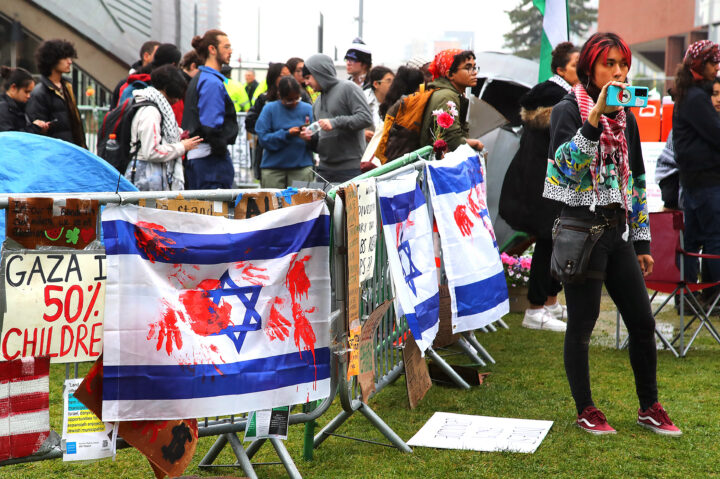
John Tlumacki/The Boston Globe via Getty Images
Israeli flags hung by Jewish students and their supporters that were hung on a railing were "bloodied" by Palestinian supporters who have a tent encampment on the MIT campus.


 Add JewishInsider on Google
A new study on campus discrimination highlights that at least a third of Jewish, Muslim, Black and Asian students have encountered hate and hostility at their universities.
The report, “Antisemitism and Prejudice on Campus,” released Tuesday from the Maurice and Marilyn Cohen Center for Modern Jewish Studies at Brandeis University, draws on data from an October 2025–January 2026 survey of nearly 4,000 undergraduates at 303 four-year schools across the country — including an oversample of Jewish respondents.
The study found that a significant minority of students, regardless of their background, held views that minority groups viewed as prejudicial.
Furthermore, Jewish students on campus expressed concerns about antisemitism from both the political right and the political left, about antisemitism related to Israel and about antisemitism expressed as traditional anti-Jewish stereotypes.
Nearly half of Jewish students (47%) reported experiencing some form of prejudice on campus because of their Jewish identity. According to the report’s authors, much of this figure came from Jewish students’ higher reported rate of exposure to graffiti and posters with offensive images and language.
Jewish and Muslim students were also asked if, in the past academic year, they had ever been blamed for the actions of either Islamic extremists (for Muslim students) or the Israeli government (for Jewish students). The report noted that although these two questions are not exactly comparable, similar proportions of both groups (just under 20%) responded in the affirmative.
37% of Jewish students and 47% of Muslim students reported a hostile campus environment, while 34% of Black students reported similar hostility.
Notably, those concerns were not shared by the majority of students outside of those minority groups.
The report found that 17% of students were likely to hold views expressing anti-Black resentment, 9% held hostile views about Jews, 15% held views about Israel that most Jews find antisemitic and 4% held hostile views toward multiple religious and racial minority groups (including Jews). These views were evident among students from across the racial, religious and political spectrum.
Antisemitic expressions among students varied based on political ideology and demographics. While anti-Israel sentiment, seen as antsemitic, was “very common” among those who identified as extreme liberals, it was virtually non-existent among moderates and conservatives. Hostility towards Jews was not linked students’ to race, ethnicity, or religion. It was, however, somewhat more common among Muslim and non-white students. Holding hostile views towards multiple minority groups (Jews, Black, Muslims, and Asians) was more common, although still more rare, among those on the political right.
Unlike a study conducted by the Cohen Center in the immediate aftermath of the Oct. 7, 2023 terrorist attacks, which showed antisemitism varied greatly, campus to campus, this study did not explore variation in experiences between campuses. To protect anonymity, responses to the survey were not linked to individual schools.
Leonard Saxe, one of the study’s authors and a Brandeis professor of contemporary Jewish studies and social policy who heads the Steinhardt Social Research Institute and the Cohen Center, told Jewish Insider that the findings “enable us to understand what has happened on campuses in the last year. Many Jewish students experience hostility that, by and large, is not recognized by non-Jews. Notably, the pattern is similar for members of other ethno-religious and racial groups.”
“Antisemitism is a unique hatred, but members of other groups also experience hostility not recognized by their peers. To address antisemitism on campuses, we need to understand these forces and design policy and programs that address the current situation on campuses,” said Saxe.
The report’s authors called on universities to implement several new approaches in response to the findings. These include targeting antisemitism interventions for different groups — noting that a single intervention would be ineffective for all students given the distinct forms of antisemitism that were expressed — and investing in research that goes beyond studying forms of prejudice independently but explores how they relate to one another and to antisemitism.
More Stories

DIPLOMATIC PUSH
Miliband agrees to host international antisemitism meeting at urging of J7 Task Force

UNSETTLED POLICY
Trump WH sends mixed signals over response to European sanctions against Israeli settlements

TORAH AND TAXES
First female Haredi candidate promises reform to ultra-Orthodox politics

CAMPAIGN TRAIL
‘There is no Palestinian nation,’ Ofer Winter says as party dips in polls

CAMPAIGN BLITZ
AIPAC’s super PAC wades into Michigan Senate race

SURVEY SAYS
Poll finds sliding NYC Jewish support for Dems since Oct. 7, substantial concern about DSA
Please log in if you already have a subscription, or subscribe to access the latest updates.
 Continue with Google
 Continue with Apple