









































































Iran missile launch at Diego Garcia exposes gap between Tehran’s claims and apparent strike range
Though neither missile reached the Chagos Island base — one fell short and one was intercepted — the weekend launches have elevated concerns that Tehran has developed the capacity to strike deep inside Europe
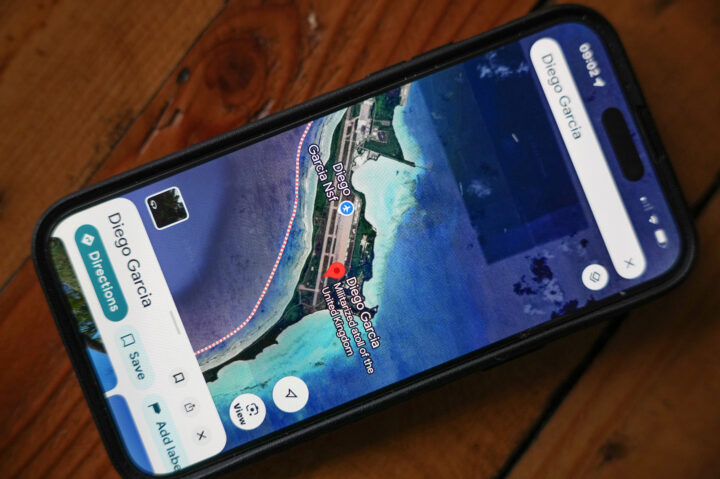
(Christopher Furlong/Getty Images)
In this photo illustration, a phone shows the position of Island of Diego Garcia on Google maps.


 Add JewishInsider on Google
Iran’s launch over the weekend of two ballistic missiles targeting the joint U.S.-U.K. Diego Garcia base in the Indian Ocean — hours after London said it would allow the U.S. to use the base to launch strikes on Iranian missile sites — deepened concerns that the Islamic Republic had not been forthcoming in the past about its weapons capabilities and set off alarms in Europe that the continent could find itself on the receiving end of Tehran’s long-range missiles.
Iranian Foreign Minister Abbas Araghchi said last month that the Islamic Republic only had ballistic missiles with the capacity to hit targets within a 2,000-km radius (approximately 1,200 miles), with the country’s state-run media quoting the diplomat as saying “We are not developing long-range missiles … we have limited the range below 2,000 kilometers.”
Diego Garcia is some 4,000 km from Iran, twice as far as the distance Iran’s top diplomat had claimed the country’s missiles could reach. It’s further from Tehran than most major European capitals — meaning that the bulk of the European continent is potentially within striking range of Iran. (And, critically, without the types of air defenses and civilian protective measures that have been deployed multiple times a day in Israel for the last month.)
The discrepancy didn’t go unnoticed by current and former U.S. officials. Brett McGurk, who served as a senior national security official in the Biden administration, noted Araghchi’s February claim alongside a map showing Diego Garcia’s distance from Iran, saying that Araghchi’s blatant falsehood “speaks for itself.” In a rare show of agreement between the Trump administration and its predecessor, Defense Secretary Pete Hegseth and the White House’s rapid-response account shared McGurk’s post.
In a statement over the weekend, IDF Chief of Staff Eyal Zamir warned that Iran had missiles “that can reach London, Paris or Berlin.”
A senior Iranian official denied to the fringe outlet Drop Site News that it was behind the attack.
Though neither missile reached the Chagos Island base — one fell short and one was intercepted — the weekend launches have elevated concerns that Tehran has developed the capacity to strike deep inside Europe — most of which is much closer to the Islamic Republic than the Diego Garcia base in the middle of the Indian Ocean.
Senior British officials largely sidestepped specific concerns about the potential for Tehran to target U.K. soil. The country’s housing minister, Steve Reed, appeared to be the most senior British official to directly take on the implications for the U.K. of the attempted strikes on Diego Garcia, saying that there was “no specific assessment” indicating that Iran was planning to target the U.K. London has so far refrained from direct military engagement with Iran, but that neutrality could be tested if Tehran threatens U.K. interests.
The twin revelations that Iran has the capabilities to strike much further than initially believed, and that Tehran’s top diplomat — who has engaged in direct talks with the White House — has lied about those capabilities, are likely to deepen suspicion of the Islamic Republic among Trump administration officials and could prompt the EU and the U.K. to take a more aggressive posture toward the Islamic Republic.
More Stories

SCOOP
El-Sayed met with Temple Israel rabbis in closed-door sit-down
ON THE HILL
Senate Republicans urge Saudi response to Houthi attacks

WINDY CITY WEDGE
Chicago Mayor Brandon Johnson targets top Jewish Democratic donor amid rocky road to reelection

ON ALERT
NYPD braced for ‘multiple protests every day’ around U.N. summit
Please log in if you already have a subscription, or subscribe to access the latest updates.
 Continue with Google
 Continue with Apple