













































Group of Democrats threatens to obstruct Senate business to secure hearings, debate on Iran war
‘Each individual senator has a tremendous amount of power to disrupt the normal functionings of the Senate,’ Sen. Cory Booker said
Marc Rod
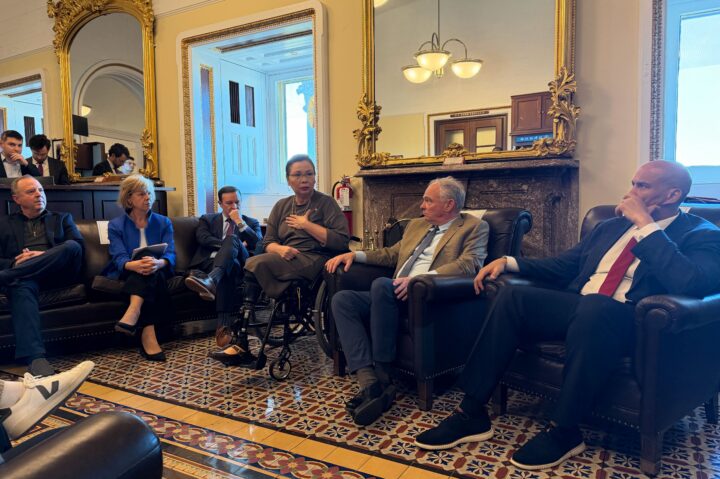
Sens. Cory Booker (D-NJ), Tim Kaine (D-VA), Tammy Duckworth (D-IL), Chris Murphy (D-CT), Tammy Baldwin (D-WI) and Adam Schiff (D-CA) hold a press briefing on Iran war powers resolutions on March 9, 2026.


 Add JewishInsider on Google
A group of six Senate Democrats is threatening to immediately begin obstructing proceedings on the Senate floor in order to force public hearings in the Senate Armed Services Committee and Foreign Relations Committee and debate on the chamber floor on the war in Iran.
Jewish Insider first reported that several of those lawmakers — including Sens. Cory Booker (D-NJ), Tim Kaine (D-VA), Tammy Duckworth (D-IL), Chris Murphy (D-CT), Tammy Baldwin (D-WI) and Adam Schiff (D-CA) — introduced a series of five new war powers resolutions late last week.
The senators indicated in a meeting with reporters on Monday that they plan to force votes on those, and possibly additional, war powers resolutions when they become eligible for votes next week, but that those resolutions are just part of a broader strategy to disrupt normal Senate business in an attempt to force greater public discussion about the war in Iran.
“We’ve had no oversight whatsoever over what the executive is doing, as they’re spending a billion dollars a day. And we have failed to have any real substantive debate or discussion,” Booker said. “We are not going to let business as usual go on in the Senate … we are demanding that the Republican leadership of the Senate hold the adequate hearings and oversight, as well as to allow a debate that brings transparency to this onto the Senate floor.”
Booker declined to discuss their specific plans, but said that the senators would “use the levers that we have,” citing efforts over the years by Republican colleagues to block or slow down Senate procedure to compel votes on various issues.
“Each individual senator has a tremendous amount of power to disrupt the normal functionings of the Senate, as well as certain privileges that we can exercise,” Booker said. “And what we have agreed on right now is that we are not going to let the Senate continue its business as usual.”
Though the war powers resolutions won’t be eligible for Senate floor votes until next week, Booker indicated that the senators plan to begin other obstructionist tactics immediately, unless hearings are announced.
Murphy highlighted that the lawmakers have the ability, should they choose to do so, to “force a vote and debate every single day in the Senate” on the war powers resolutions. But Baldwin indicated that the lawmakers might not force the war powers votes if Republicans do schedule the hearings they request.
Booker said that the group is not necessarily speaking for the entire Senate Democratic caucus.
Murphy asserted that public hearings with administration officials, tasked with defending and explaining the war effort to the public, would only make the operation less popular with the American public. The Democrats also highlighted other costs, including increasing gas prices, associated with the war.
Kaine argued that the question for the Senate and the American people is not whether “Iran [is] a bad actor” or whether “in the abstract, [they have] done terrible things,” it is whether the war is worth risking American lives. Seven U.S. servicemembers have died in the course of the campaign so far.
Murphy and other Senate Democrats had also been pushing for a Senate vote on an authorization for use of military force regarding Iran. But on Monday, the six Democrats involved in this effort said they had ruled out the idea of a Democratic-led AUMF, arguing that the burden is on Republicans and the administration to put forward such a proposal and define its scope.
“They have to tell us and bring evidence to us that this war is worth an AUMF,” Duckworth said. “I personally don’t even want to have the discussion about an AUMF, because they haven’t even gone to the first step yet” of proving the need for the war.
Kaine said that the lawmakers, including Murphy, had “explored the procedural option” of an AUMF, but said that the “burden” to write such a bill should not be on the Democrats “who think this war is a bad idea.”
“It would be too unusual for the opponents to file the AUMF,” he continued. “The proponents are the ones that carry the burden of proof with the American public. They need to file it.”
The six Democrats did not appear to be entirely in agreement about how they would handle a potential request by the administration for supplemental funding to support the war effort or replenish U.S. armaments expended in it.
Kaine said he would withhold judgement on the issue until such a request was presented, explaining, “I want to end the war, I want to protect our troops.”
Schiff argued that the military has “plenty of money” from last year’s reconciliation bill, and also said that a congressional appropriation for a military effort could, legally, be considered an authorization for use of military force.
Should they secure the hearings they seek, the senators said they want to press administration officials on the goals and timeline for the war, the rules of engagement and restrictions imposed on U.S. forces, the circumstances that led to a deadly strike — which some have attributed to the U.S., though the administration disputes this — on a girls’ school, potential plans to support separatist movements inside Iran and the administration’s plans to support and protect Iranian demonstrators should another mass uprising occur.
“My goal is to end this war, to stop wasting millions of dollars and to protect further servicemembers from dying, and I think the way that you do that is by exposing to the public the fact that this is a war of choice, the fact that this president has ignored the law and the Constitution and the people through us, hold him to account,” Baldwin said.
More Stories
LESSONS LEARNED?
Three years after Oct. 7, Israel’s security is ‘much better,’ but risks loom

NEW YORK STATE OF MIND
Hochul will opt New York into education tax credit that will help fund Jewish education
REGIONAL SHIFT
Amb. Kaploun: More Latin American countries plan to adopt IHRA definition of antisemitism
Mayor Unmoved
Mamdani brushes off pro-Hamas heckling at Oct. 7 vigil

Daylight Between Them
Trump, Cotton feud over daylight saving time legislation

DOHA DEALINGS
Moskowitz challenger visited Qatar in 2024, photographed with Qatari official
Please log in if you already have a subscription, or subscribe to access the latest updates.
 Continue with Google
 Continue with Apple