













































































Iran’s missile capabilities degraded despite recent increase in missile attacks, experts say
Tehran is ‘timing their attacks overnight, but fewer missiles per launch,’ JINSA’s Ari Cicurel found
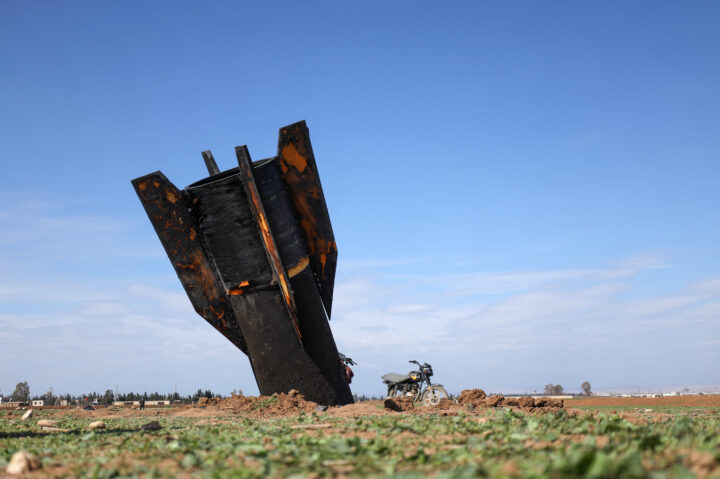
Amjad Kurdo / Middle East Images / AFP via Getty Images
A view of an Iranian missile after it fell near Qamishli International Airport, near the Turkish border in the Qamishli district of Hasakah, Syria, on March 4, 2026, amid the U.S.-Israeli conflict with Iran.


 Add JewishInsider on Google
Despite a recent escalation in Iranian missile attacks targeting Israel, experts remain confident that Tehran’s military capabilities have been significantly degraded by the U.S. and Israel.
U.S. and Israeli officials have touted that Iran’s missile capabilities have been severely reduced, with CENTCOM Commander Adm. Brad Cooper saying Wednesday that Iran’s ballistic missile attacks have “dropped drastically.”
That may not feel like the reality for Israelis — after four consecutive days of declining missile fire, Iran briefly increased its launches to 46 missiles on Wednesday, a roughly 70 percent increase from the 27 missiles fired the previous day. That included a seemingly coordinated operation between Iran and Hezbollah, as well as a missile barrage directed toward the Old City of Jerusalem on Thursday that caused prayer at holy sites to be suspended.
But the data shows and analysts remain confident that Iran’s stockpiles are being degraded.
Ari Cicurel, the associate director of foreign policy at the Jewish Institute for National Security of America, told Jewish Insider that the escalated attacks might actually be a “reflection of Iran’s degrading capabilities.”
“[Iran is] launching more attacks throughout the day, but the overall size of the attacks, the number of missiles they’re launching, is substantially down from the first day of the war,” Cicurel said. “What I see them doing is trying to use all of their resources to fight a psychological war against Israel and to keep the Israelis under constant fire for as long as they can without as many missile launchers because the U.S. and Israel have degraded their launcher capabilities.”
Since the beginning of the war, Iran has launched 1,158 ballistic missiles and 28 cruise missiles across the region. As of March 12, at least 80 percent of Iran’s capacity to launch missiles at Israel has been eliminated, a mark officials expect could rise to 95 percent “within a week.”
“Instead [Iran is] firing more frequent attacks. They’re timing their attacks overnight, but fewer missiles per launch, because they have lost those capabilities,” he added.
Cicurel said it “tracks with the U.S. and Israeli claims that their launch capacity is substantially down,” adding that Wednesday night’s supposedly coordinated strikes on Israel from Iran and Hezbollah is also evidence of this, arguing it is a sign that “as Iran continues to lose its own capabilities, it is going to have to increasingly rely on proxies.” Experts stressed that Hezbollah’s arsenal is different from Iran’s and that the terrorist group “has its own supply.”
“Iran loses capacity, Hezbollah is weakened, and so that’s why you see them joining the war,” Cicurel said. “Iran really has a few main proxies left. Hezbollah, despite Israel severely degrading it over the past few years, still remains a threat with rockets and missiles, but [Iran is] relying on Hezbollah to launch the mass amount of fire, and then Iran is sending a handful of missiles alongside that.”
Dan Shapiro, a deputy assistant secretary of defense under the Biden administration, U.S. ambassador to Israel under the Obama administration and senior fellow at the Atlantic Council, told JI that the latest wave of attacks from Iran and Hezbollah was “not unexpected.” He said the attacks, however, could suggest that Hezbollah “has been able to rebuild and recover, maybe more than had been understood,” adding that it is possible that Iran’s remaining capabilities could be slightly underestimated.
“It’s definitely possible,” Shapiro said. “I’m sure there has been success in eliminating and degrading significant portions of the Iranian missile attack capability, both in terms of missiles in storage and launchers, but I would be cautious about triumphal claims that the threat has been nearly eliminated, because it’s very likely Iran retains some capability and will continue to be able to use it if the war continues.”
Shapiro, however, agreed that Iran’s stockpile and launching of missiles has appeared to decline. He suggested Iran will likely conduct reduced attacks moving forward, referencing Israeli claims that 70 to 75 percent of Iranian launchers have been eliminated. “If that’s true, the degradation of the launcher inventory is important, and that reduces the ability of the Iranians to fire as many missiles as they did in the early days of the war.”
“I think the likelihood is that they [Iran] will continue to fire at lower levels than they did in the early days of the war, both because of reduced capacity and in order to preserve their remaining capability, but be able to sustain some attack presence on any given day,” Shapiro added. “That’s the most likely trend, if the war continues — sustained fire at reduced levels from the early days.”
Both experts expressed that, while it is unlikely that the U.S. and Israel will completely deplete Iran’s missile arsenal, Washington and Jerusalem could still maintain a successful operation should Tehran’s capabilities be severely degraded.
“They [the U.S. and Israel] may not fully remove all Iranian capabilities and capacity in this war, but the amount of degradation they’ve done to Iran and the lost capabilities could leave it in a bad enough position that the regime no longer has the capacity to launch a massive effort,” Cicurel said. “It also puts the regime in a place where internal dynamics take over and that leads to internal regime collapse. I think that’s the main effort.”
Cicurel also said that while the U.S. and Israel were initially focusing their attacks on military sites and missile launchers, both partners have “shifted” to going after Iran’s stockpiles of missiles and production capabilities.
“I think part of the objective is to severely degrade their [Iran’s] ability over the long term so you don’t see a situation like after the 12-day war, where Israel severely degraded Iran’s missile stockpile and then it was quickly rebuilt back to pre-war levels when this current war started.”
Cicurel added that Iran has “very little capability to be rebuilding” its stockpiles during the ongoing conflict; however, he cautioned that Iran could be attempting to “seek Russian or Chinese support over the long term.”
“Ultimately, [the U.S. and Israel] have to contain the threat during the war and then reach a stable endpoint to the war … and then, when the fighting stops, you have to have a diplomatic strategy to put guardrails around any rebuild of the program,” Shapiro said. “I don’t think there is such a thing as removing the threat completely, but it has to be reduced and it has to be defeated.”
More Stories

FAMILY TRAGEDY
Israeli ambassador’s son seriously wounded in West Bank car-ramming attack

ALTERNATE REALITY
Pezeshkian denies Iran seeks nuclear weapons at UNGA

CANARY CALL
Two Seattle Jewish leaders warn of Jewish complacency in face of rising antisemitism

analysis
Attack on Ambassador Leiter’s son casts pall over Netanyahu’s abbreviated UNGA visit

QUESTIONABLE COMPANY
Democratic nominee Chris Rabb photographed with Code Pink leader

MEMORIAL EVENT
State Department plans memorial for American victims of Oct. 7 attack
Please log in if you already have a subscription, or subscribe to access the latest updates.
 Continue with Google
 Continue with Apple